
Roselle City Zoning Code
SECTION 6
- LANDSCAPING REGULATIONS
6-1. - How to Use this Section.
A. Landscaping is more than the grass yard and plants around one's property. Landscaping provides many benefits to communities including aesthetics, screening of parking lots, and even improvements in stormwater management and air quality enhancement. This Section of the zoning ordinance sets minimum standards for landscaping of new development. It focuses on screening between different types of development, making parking lots greener and more attractive, and the procedures for ensuring a minimum level of quality. Finally, this Section has suggestions on how to incorporate native plants and grasses into landscaping in order to benefit from their unique attractiveness, stormwater absorption, and low maintenance.
B. The requirements in this Section apply mainly to new commercial and multiple family developments. The Village does not regulate what is planted for single family homes (though conditions like grass that is too tall or bushes that block drivers' visibility are still nuisances to be avoided). However, other developments are more visible and require special attention to landscaping. Those developing, expanding, or reconstructing commercial, industrial, or multifamily uses should review this Section to understand how the landscape requirements apply to their projects.
6-2. - Purpose and Applicability.
A. Purpose: This Section creates uniform landscape, screening and tree preservation standards for development of property to ensure that the Village of Roselle remains attractive, safe, and comfortable. The landscaping and screening requirements specified herein are intended to:
1. Foster aesthetically pleasing development that will protect and preserve the appearance, character, general health, safety and welfare of the community.
2. Increase the compatibility of adjacent uses requiring a buffer or screen between uses.
3. Minimize the harmful impact of noise, dust, debris, motor vehicle headlight glare, or other intrusions.
4. Mitigate potential adverse impacts of an adjoining or nearby use.
5. Enhance the environment by reducing soil erosion and stormwater runoff, provide oxygen regeneration to enhance air quality, and minimize the effects of urban heat islands.
6. Safeguard the environmental quality and aesthetic character of Roselle by limiting removal and ensuring replacement of trees upon private property.
7. Preserve existing vegetation and topographical features by limiting unnecessary clearing and modification of land, encouraging retention of existing mature trees, and requiring replacement of indigenous trees with approved species.
8. Encourage energy efficiency in the Village.
B. Applicability: The requirements contained in this Section are applicable to all properties in all zoning districts. As required by this Chapter, sites shall be landscaped with trees, shrubs, flowers, ground cover and/or grass to advance the Purpose outlined in Section 6-2-A.
6-3. - Landscaping Design and Screening Regulations.
A Landscape Plan prepared in accordance with the standards set forth in this Section shall be required for any land development requiring Site Plan Review, prepared in keeping with the requirements of this Chapter, and include information as specified in Section 6-5: Landscape Plans.
A. General Design Criteria:
1. Preservation of existing trees. Every effort shall be made to save all healthy, desirable trees.
2. Compatible plantings. All plantings shall be compatible to existing soil, weather and environmental conditions.
3. Scale and nature of landscape material. The scale and nature of landscape material should be appropriate to the site and structures. Large scaled buildings, for example, should generally be complemented by larger scaled plants.
4. Selection of plant material. Plant material should be selected for its form, texture, color, and concern for its ultimate growth. Depending on location of the plant, salt and drought tolerance shall be considered in selection plant species.
5. Evergreens. Evergreens shall be incorporated into the landscape treatment of a site, particularly in those areas screening parking lots from dedicated public rights-of-way or property zoned for residential use.
6. Softening of walls and fences. Plant materials should be placed intermittently against long expanses of building walls, fences, and other barriers to create a softening effect.
7. Planting beds. Planting beds should be mulched with bark chips, or similar materials.
8. Detention/retention basins and ponds. Detention/retention basins and ponds shall be landscaped. Such landscaping should include shade and ornamental trees, evergreens, shrubbery, hedges and/or other live planting materials, and other materials as required by the Village Engineer to prevent erosion at the water line. As may be approved though site plan review, native plantings may be incorporated into and around the detention basin to filter, absorb, and slow the runoff of stormwater.
9. Intersection Visibility: Landscaping must be designed and installed to minimize potential obstruction of critical sightlines. Landscape plantings shall not encroach into the Sight Triangle area as defined in Section 1 Definitions. Trees are allowed in sight triangles provided the lowest branching begins not less than eight feet (8') above the pavement.
10. Artificial Plants: No artificial plants of any type shall be used to satisfy any requirements of this Section.
11. Prohibited and Permitted Trees: Trees found on the list of prohibited trees as maintained by the Village in accordance with Subsection 6-8-F.4 of the Village Code, shall not be used to satisfy the requirements of this Article. Only trees found on the permitted tree list shall be planed.
12. Minimum Size: Minimum sizes for plant materials at time of installation for all landscape areas shall be as follows:
a. Deciduous trees shall be a minimum caliper of three inches (2.5") when installed.
b. Coniferous trees shall be a minimum six feet (6') in height when installed.
c. Deciduous shrubs shall be a minimum of three feet (3') in height at time of installation if used as a perimeter screen planting, and thirty inches (30") in height for all other installations.
d. Ground cover shall be designed, planted and spaced so that complete coverage can be obtained within two (2) years after date of installation.
e. Ornamental trees may be used, where appropriate in smaller planting areas, and shall have a minimum caliper of two inches (2") or be of a clump form at a minimum height of five feet (5').
B. Screening requirements. All nonresidential and multiple-family development projects shall provide perimeter landscaping in accordance with the standards listed as follows and approved as part of Site Plan Review consideration:
1. Nonresidential land abutting nonresidential land. When nonresidential property abuts properly zoned as nonresidential use, landscaping shall be provided as follows:
a. Shade trees. Shade trees shall be provided at the equivalent of not more than seventy-five (75) feet apart along the abutting property line. Such trees may be clustered or spaced linearly as determined appropriate by the Zoning Administrator, so as to not conflict with existing or proposed utility locations.
b. Other planting materials. Other landscaping materials including berms, ornamental trees, evergreens, shrubbery, hedges, and/or other live materials may be provided at appropriate locations along the abutting property line.
c. Ground cover. Except where occupied by planting beds, all perimeter landscaping areas shall be sodded or seeded.
2. Nonresidential property abutting residential property. When nonresidential property abuts property zoned as residential use, or is located across the street from residential uses, landscaping shall be provided as follows:
a. Screening. Solid screening to a minimum of six (6) feet in height at installation, shall be provided along the length of the abutting property line to the front building setback line of the abutting residential property. Such screening shall consist of a continuous landscaped berm, solid wood or decorative masonry fence, wall, or other comparable barrier. Continuous landscaping, a minimum of three (3) feet in height at installation shall be provided along that portion of the abutting property line from the front building setback line to the front lot line of the abutting residential property. Such landscaping shall consist of berms, if feasible, trees, evergreen, shrubbery, hedges, and/or other live planting materials.
b. Shade trees. Shade trees shall be provided at the equivalent of not more than seventy-five (75) feet apart along the abutting property line. Such trees may be clustered or spaced linearly as determined appropriate by the Zoning Administrator so as to not conflict with existing or proposed utility locations.
c. Other planting materials. Other landscaping materials including berms, if feasible, ornamental trees, evergreen, shrubbery, hedges, and/or live planting materials may be required as part of Site Plan Review at appropriate locations along the abutting property line.
d. Ground cover. Except where occupied by planting beds, all perimeter landscaping areas shall be sodded or seeded.
3. Multiple-family residential property abutting single-family residential property. Where multiple-family residential property abuts single-family residential property, required transition yards shall be landscaped as follows:
a. Screening. Continuous landscaping, a minimum of three (3) feet in height at installation, and in a design satisfactory to the Zoning Administrator shall be provided in all required transition yards. Such landscaping shall consist of berms, if feasible, trees, evergreens, shrubbery, hedges, and/or other live planting materials.
b. Shade trees. Shade trees shall be provided at the equivalent of not more than seventy-five (75) feet apart along the abutting single-family residential property line. Such trees may be clustered or spaced linearly as determined appropriate by the zoning administrator so as to not conflict with existing or proposed utility locations.
c. Ground cover. Except where occupied by planting beds, all perimeter landscaping areas shall be sodded or seeded.
4. Multiple-family residential property abutting other than single-family residential property. Where multiple-family residential property abuts property other than single-family residential property landscaping shall be provided as follows:
a. Shade trees. Shade trees shall be provided at the equivalent of not more than seventy-five (75) feet apart along the abutting property line. Such trees may be clustered or spaced linearly as determined appropriate by the Zoning Administrator, so as to not conflict with existing or proposed utility locations.
b. Other planting materials. Other landscaping materials including berms, if feasible, ornamental trees, evergreens, shrubbery, hedges, and/or other live planting materials shall be provided at intermittent locations across fifty (50) percent of the abutting property line. This landscaping is equivalent to the placement of shrub clusters containing seven (7) to nine (9) shrubs per cluster, spaced at intervals of approximately thirty-five (35) feet along the abutting property line.
c. Ground cover. Except where occupied by planting beds, all perimeter landscaping areas shall be sodded or seeded.
5. Service Area Screening: Service areas, utilities, loading docks and any outdoor storage areas of nonresidential and multifamily residential properties shall be screened if visible from a public right-of-way or adjacent property. Screening shall be equally effective at all times of the year and meet the following standards as determined through the Site Plan Review process outlined in Article 4: Administration and Enforcement.
a. Screening of refuse disposal areas. All refuse disposal areas shall be screened on all four (4) sides by a solid wood or decorative masonry fence or an equivalent material to a height of not less than six (6) feet but not more than seven (7) feet.
b. All utility equipment (meters, transformers, etc.) shall be provided with planting screens to mitigate unsightly views.
c. All garage doors and loading areas on nonresidential property shall be concealed from view (at grade) by landscape material.
d. Outdoor storage areas that exceed eight feet (8') in height shall be screened with landscaping equal to or exceeding the height of the materials to be stored, in addition to other requirements specified in this Section.
6. Substitution: Landscaping required under this Section may be substituted with native plantings, rain gardens bioswales and biofilter strips providing equivalent or greater screening impact, as determined by the Zoning Administrator.
C. Foundation Landscaping. A landscaping area a minimum of seven (7) feet in width shall be located around the perimeter of all buildings in the following zoning districts: R-3, R-4, B-2, B-4, B-5, M and ORI. Such landscaping shall be in accordance with the standards listed as follows:
1. Coverage. Required foundation landscaping areas shall remain open and free of all paving except where walks to buildings and other similar paving is required. Particular attention shall be paid toward screening mechanical equipment, bicycle parking areas, and loading docks; softening large expanses of building walls; and accenting building entrances and architectural features.
2. Landscaping materials. Foundation landscaping shall be provided for all buildings. Such landscaping shall consist of shade and ornamental trees, evergreens, shrubbery, hedges, and/or other live planting materials.
3. Ground cover. Except where occupied by planting beds, all foundation landscaping areas shall be sodded.
D. Parkway trees. Parkway trees shall be provided in the public right-of-way of any parcel to be developed. Parkway trees shall be provided in accordance with the following standards:
1. Quantity. Parkway trees shall be provided at the equivalent of not more than forty (40) feet apart in the right-of-way adjacent to the parcel, unless authorized by the Director of Public Works.
2. Spacing. Such trees may be clustered or spaced linearly in the right-of-way as determined appropriate by the Director of Public Works. Such placement shall not endanger the safety of vehicular or pedestrian traffic.
3. Size. All new or replacement trees provided shall have a minimum trunk diameter of two and one - half (2.5) inches, as measured six (6) inches above the established ground level, upon installation.
4. Form. All trees shall have the proper height, crown width, height to first branch, root ball width and branch distribution common for the species, and as specified in Tree Appendix B, as determined by the Director of Public Works.
5. Guarantee by developer. All parkway trees shall be guaranteed for two (2) full years after planting by the developer.
6. Species. Species for parkway planting shall be selected and/or approved by the Director of Public Works with the intention of creating an aesthetically pleasing landscape and avoiding large monocultures, encouraging diversity for public benefit. Trees which are suitable, and which are not suitable for parkway use, are listed in Tree Appendix A and are on file and available for inspection in the office of the Village Clerk.
7. Planting details. All parkway trees shall be properly installed, to ensure upright growth and form. Proper bracing, cabling, planting depth, trunk wrapping, mulching, pruning, fertilizing, and watering shall be required.
8. Inspections and acceptance. Final inspection and acceptance of parkway trees will be made by the Village of Roselle.
E. Ground cover specifications.
1. Areas to be graded and sodded. Parkways within the public right-of-way, swales draining two (2) or more lots, and those areas specifically referenced by this ordinance, shall be graded and sodded. Areas to be sodded shall be graded smooth and topped with at least four (4) inches of black dirt after compacting and removal of stumps, trees that cannot be saved, boulders and other debris. Swales which require sodding shall have a minimum sodding width of ten (10) feet.
2. Areas to be graded and seeded. All open areas of the development which are not paved, sodded or otherwise landscaped shall have a new lawn established through seeding in accordance with the standards listed as follows:
a. Material. Fertilizer shall be standard commercial 10-8-6 or 10-6-4 grade (or approved equal) uniform in composition, free flowing and suitable for application with proposed equipment. Seed mixture shall be certified seed mix consisting of thirty (30) percent Park Kentucky Bluegrass, thirty (30) percent Dawson Creeping Red Fescue, thirty (30) percent "Fults" Puccinellia distans, and ten (10) percent Pennfine Perennial Ryegrass, and shall be applied at the minimum rate of one hundred eighty (180) pounds per acre. Any changes or substitutions must be approved by the Village Engineer.
b. Preparation of seed bed.
i. After the areas to be seeded have been brought to proper grades, the area shall be thoroughly tilled to a depth of at least three (3) inches by disking, harrowing, or other approved methods until the condition of the soil is acceptable.
ii. Fertilizer shall be distributed uniformly at the rate of four hundred (400) pounds per acre and shall be incorporated into the soil to a depth of at least three (3) inches by disking, harrowing or other approved methods.
c. Planting. Planting shall be done by hydroseeding with a mulching material unless otherwise approved by the Village Engineer, during March, April, the last two (2) weeks of August, September, and the first two (2) weeks of October; but no soil will be sown during high winds, nor until the surface is suitable for working and is in proper condition for seeding.
3. Substitution: Landscaping required under this Section may be substituted with native plant materials, rain gardens, bioswales and biofilter strips as determined by the Zoning Administrator to provided equivalent or greater aesthetic character.
F. Maintenance of landscaping.
1. Appropriate care and maintenance of plant material shall be provided to keep such growth alive and in good condition; diseased or dead plant material shall be replaced.
2. All trees shall be maintained and warrantied until established. All trees not in a vigorous growing condition after one growing season shall be replaced at the beginning of the next succeeding planting season, at no cost to the Village.
G. Distribution of plant material and acceptance of existing landscaping:
1. Under circumstances where existing development or the physical condition of a site and its surroundings makes an alternative landscape plan more practical while still facilitating the intent of this Section, the Zoning Administrator may approve like kind and density of planting material different than what this Section requires so long as the overall volume and density of landscaping required by this Section is not reduced.
2. Where existing plant material is proposed to be maintained and kept on-site as part of a landscaping or screening requirement, the Zoning Administrator may approve such materials as counting toward the requirements of this Section provided that the plant material qualifies as meeting any one or more planting requirement contained herein and that there is no visible sign of plant deterioration or disease or that the plant material is of an unacceptable species or variety.
6-4. - Parking Lot Landscaping.
All parking lots designed for six (6) or more parking spaces shall provide landscaping in accordance with requirements listed as below. Final review and approval shall occur as part of the Site Plan Review Process outlined in Article 7 of this Chapter or by the Planning & Zoning Commission and Village Board as part of a Planned Unit Development or Special Use application.
A. Interior Parking Lot Landscaping.
1. Coverage. For areas with six (6) or more parking spaces, not less than five (5) percent of the interior of a parking lot shall be devoted to landscaping. For lots with parking lots providing in excess of one hundred and fifty (150) required parking spaces, not less than eight (8) percent of the interior of the parking lot shall be devoted to landscaping.
2. The "interior" of a parking lot shall be defined as the area between the back-of-curbs of the parking lot. Landscaping areas located along the perimeter of a parking lot as required in this chapter shall not be included toward satisfying this requirement, nor shall this landscaping be counted toward any minimum landscape area required elsewhere in this ordinance.
3. Landscaping areas:
a. Dispersion. Interior parking lot landscaping areas shall generally be dispersed throughout the parking lot in a design meeting standards for Site Plan Review, PUD, or Special Use.
b. Minimum Aisle Landscape Parking Island Location. A landscaped island shall be provided at the end of each parking row.
c. Area. Interior parking lot landscaping areas shall be a minimum of one hundred eighty (180) square feet in area. Such landscaping areas shall be a minimum of ten (10) feet in width, as measured from back of curb to back of curb.
4. Landscaping material:
a. Type. The primary landscaping materials used in parking lots shall be trees which provide shade or are capable of providing shade. Ornamental trees, shrubbery, hedges, and other live planting materials may be used to supplement the tree landscaping but shall not be the sole contribution to the landscaping.
b. Quantity. One shade tree shall be provided for every one hundred eighty (180) square feet of landscaping area, including a minimum of at least one tree planted in each interior parking lot landscaping area.
c. Ground care. A minimum of seventy-five (75) percent of every interior parking lot landscaping area shall be comprised of live landscaping.
5. Additional Landscape Parking Island Location: In addition to the landscape island requirements of this Section, one landscape island shall be located across the rows so as to break up a run of twenty (20) parking spaces in the double row of parking.
6. Perimeter Parking Lot Landscaping.
a. Front and corner side yards.
i. Across from residential property.
1. Landscaping. Where a parking lot is located across a dedicated public right-of-way from property zoned for residential use, continuous landscaping shall be provided across one hundred percent (100%) of the parking lot frontage (excluding any curb cuts) to a minimum height of three (3) feet at installation. Such landscaping shall consist of any combination of berms, shade and ornamental trees, evergreens, shrubbery, hedges, and/or other live planting material.
2. Ground cover. Except where occupied by planting beds, all landscaping areas located in front and corner side yards shall be sodded or planted in keeping with sustainable planting practices as described in Section 6-7-A and approved as part of the Site Plan Review or Zoning Entitlement process.
ii. Across from nonresidential property.
1. Landscaping. Where a parking lot is located across a dedicated public right-of-way from property zoned for nonresidential use, landscaping shall be provided across fifty percent (50%) of the street frontage to a minimum height of three (3) feet at installation. Such landscaping shall consist of any combination of berms, shade and ornamental trees, evergreens, shrubbery, and/or other live planting materials.
2. Ground cover. Except where occupied by planting beds, all landscaping areas located in front and corner side yards shall be sodded or planted in keeping with sustainable planting practices as described in Section 6-7-A and approved as part of the Site Plan Review or Zoning Entitlement process.
b. Rear And interior side yards.
i. Abutting residential property. Where a parking lot abuts property zoned for residential use, landscaping shall be provided as follows:
1. Screening. Screening between the parking lot and the residential property line shall be a minimum of six feet (6') in height at installation and shall be provided along that portion of the parking lot abutting the residential property. Such screening shall consist of a continuous landscaped berm, solid wood or decorative masonry fence, or other comparable barrier. If the parking lot extends beyond the front building setback line of the abutting residential property, continuous landscaping, a minimum of three (3) feet in height at installation, and in a design satisfactory to the Zoning Administrator, shall be provided in lieu of the aforementioned fence or wall. Such landscaping shall consist of berms, trees, evergreens, shrubbery, hedges, and/or other live planting materials.
2. Shade trees. Shade trees shall be provided at the equivalent of not more than forty (40) feet apart along that portion of the parking lot abutting the residential property. Such trees may be clustered or spaced linearly as determined appropriate by the Zoning Administrator.
3. Other planting material. Other landscaping material including ornamental trees, evergreens, shrubbery, hedges, and/or other live planting materials may be required at intermittent locations along that portion of the parking abutting the residential property in order to reduce direct views of the parking lot from adjoining properties.
4. Ground cover. Except where occupied by planting beds, all side and rear yard perimeter landscaping areas shall be sodded or seeded.
ii. Abutting nonresidential property.
1. Planting materials. Where a parking lot abuts property zoned for nonresidential use, landscaping shall be provided across fifty (50) percent of that portion of the parking lot abutting the property line to a minimum height of three (3) feet at installation. Such landscaping shall consist of berms, if feasible, shade and ornamental trees, evergreens, shrubbery, hedges, and/or other live planting materials. This landscaping is equivalent to the placement of shrub clusters, containing seven (7) to nine (9) shrubs per cluster, spaced at intervals of approximately thirty-five (35) feet along the property line.
2. Ground cover. Except where occupied by planting beds, all side and rear yard perimeter landscaping areas shall be sodded or seeded.
B. Perimeter Landscaping Requirements: In addition to the general design criteria prescribed in Section 6-4-A above, all nonresidential and multiple-family development shall provide perimeter landscaping as prescribed in this Subsection. Parking lots located on the perimeter of a lot shall comply with the requirements of Section 6-4-A above.
1. Nonresidential land abutting nonresidential land. When nonresidential property abuts or is located across a public right-of-way from a nonresidential use, landscaping shall be provided as follows:
a. Shade trees. Shade trees shall be provided at the equivalent of one for each seventy-five feet (75'), or fraction thereof, of frontage along the abutting property line. Such trees may be clustered or spaced linearly as determined appropriate by the Zoning Administrator so as to not conflict with existing or proposed utility locations.
b. Other planting materials. Other landscaping materials including berms, ornamental trees, evergreens, shrubbery, hedges, and/or other live materials may be required at locations along the abutting property line to further screen mechanical equipment, storage areas, large building expanses and other unsightly aspects of the site.
c. Ground cover. Except where occupied by planting beds, all perimeter landscaping areas shall be sodded or seeded.
2. Nonresidential property abutting residential property. When nonresidential property abuts a residential property, landscaping shall be provided as follows:
a. Screening. A solid screen six feet (6') in height shall be provided along the entire length of the abutting property line. Such screen shall consist of a solid wood fence, berms, trees, conifers, shrubbery, and/or other live planting materials, necessary to provide one hundred percent (100%) coverage.
b. Shade trees. Shade trees shall be provided at the equivalent of not more than seventy-five (75) feet apart along the abutting property line. Such trees may be clustered or spaced linearly as determined appropriate by the Zoning Administrator so as to not conflict with existing or proposed utility locations.
c. Other planting materials. Other landscaping materials including berms, if feasible, ornamental trees, evergreen, shrubbery, hedges, and/or live planting materials may be provided at appropriate locations along the abutting property line.
d. Ground cover. Except where occupied by planting beds, all perimeter landscaping areas shall be sodded or seeded.
3. Multiple-family residential property abutting single-family residential property. Where multiple-family residential property abuts single-family residential property, required transition yards shall be landscaped as follows:
a. Screening. Continuous landscaping, a minimum of three (3) feet in height at installation, shall be provided in all required transition yards. Such landscaping shall consist of berms, if feasible, trees, evergreens, shrubbery, hedges, and/or other live planting materials.
b. Shade trees. Shade trees shall be provided at the equivalent of not more than seventy-five (75) feet apart along the abutting single-family residential property line. Such trees may be clustered or spaced linearly as determined appropriate by the Zoning Administrator so as to not conflict with existing or proposed utility locations.
c. Ground cover. Except where occupied by planting beds, all perimeter landscaping areas shall be sodded or seeded.
4. Multiple-family residential property. Where multiple-family residential property abuts property in any other zoning district (other than single-family residential property) landscaping shall be provided as follows:
a. Shade trees. Shade trees shall be provided at the equivalent of not more than seventy-five (75) feet apart along the abutting property line. Such trees may be clustered or spaced linearly as determined appropriate by the Zoning Administrator, so as to not conflict with existing or proposed utility locations.
b. Other planting materials. Other landscaping materials including berms, if feasible, ornamental trees, evergreens, shrubbery, hedges, and/or other live planting materials shall be provided at intermittent locations across fifty (50) percent of the abutting property line. This landscaping is equivalent to the placement of shrub clusters containing seven (7) to nine (9) shrubs per cluster, spaced at intervals of approximately thirty-five (35) feet along the abutting property line.
c. Ground cover. Except where occupied by planting beds, all perimeter landscaping areas shall be sodded or seeded.
6-5. - Administration of Landscaping and Tree Preservation Regulations.
A. Exceptions from Requirements of this Section: The Village recognizes the variety of developments and site configurations may warrant flexibility in applying standards set forth in this Section. In instances where 1) unique site conditions, 2) visibility of businesses, 3) safe site access, or 4) limitations on availability of plant material create a practical difficulty in meeting the standards of these Sections, the Zoning Administrator may authorize deviations not more than twenty five percent (25%) from the requirements set forth in these Subsections. Whenever such deviations are allowed or required from Subsections 4-3 and 4-4, the Zoning Administrator shall find that the intent of this Section is met and the least amount of relief necessary shall be allowed. When an Exception is granted, the applicant shall enter on the face of the landscape plan the reasons for allowing or requiring deviation from the requirements of the Sections specified here.
B. Innovative Landscaping: Innovative landscaping treatments (such as Section 6-7 Best Management Practices described in this Section) are encouraged and shall be considered as an additional or alternative installation to the requirements of this Section. These planting treatments shall be submitted as part of the Landscape Plan and be considered as part of the Site Plan Review process specified in Article 4: Administration and Enforcement.
C. Certificate of Occupancy: All required landscaping shall be installed prior to the issuance of a Certificate of Occupancy, except in keeping with the following:
1. If weather conditions or other circumstances beyond the developer's control prevent installation of all or portions of the landscape materials and all other requirements for the issuance of a Certificate of Occupancy have been met, a Temporary Certificate of Occupancy may be issued as specified in Article X: Administration and Enforcement.
2. In the case of a Temporary Certificate of Occupancy being issued for landscaping, a letter of credit or a performance guarantee approved by the Village Attorney to ensure completion of approved landscaping shall be filed with the Zoning Administrator. The amount of the performance guarantee and the required completion data shall be recommended by the Zoning Administrator based on current costs and set by the Village. If such a letter of credit or performance guarantee has already been submitted for the proposed landscape improvements, the Village may permit the developer to extend the performance guarantee for an additional specified period of time.
3. A Temporary Certificate of Occupancy issued in regard to landscaping shall be valid only until the subsequent July 1 st . At that time, 1) the required landscaping shall be installed, 2) an extension granted by the Zoning Administrator due to continuation of unique circumstances, or 3) the amount of the letter of credit or performance guarantee shall be forfeit to the Village.
6-6. - Landscape Plans.
A. Landscape Plan Preparation: Any Landscape Plan submitted to meet the requirements of this Chapter shall be prepared by a Registered or Professional Landscape Architect. Others preparing such plans shall provide evidence to the Zoning Administrator equivalent experience or competencies to prepare a Landscape Plan that meets the regulations and design standards specified in this Chapter.
B. Information Required on Landscape Plans: All Landscape Plans submitted shall include the following:
1. Contact Information: The preparer's contact information.
2. Base Information: Scale, north arrow, and date of preparation.
3. Location and dimensions of existing and proposed buildings and structures, including adjacent lot lines and significant features and buildings on adjoining properties.
4. The location and dimensions of all existing and proposed improvements, including proposed parking lots and drives, roadways and rights-of-way, sidewalks, bicycle paths, ground signs, refuse disposal areas, bicycle parking areas, fences, freestanding electrical equipment, freestanding HVAC/mechanical equipment, snow storage, and other freestanding structural features as determined necessary by the zoning administrator.
5. Landscape treatment such as berming, contouring, shaping, ornamental lighting, paving materials, non-plant elements, fences, planters, etc. All berming and contouring of land shall be identified by one foot contours on the landscape plan.
6. Planting Schedule: The planting schedule listing botanical names, common names, size or height, and quantity.
7. Ground Surfaces: The proposed treatment of all ground surfaces (such as ground covers, sod, seed and/or prairie).
8. Tree Plan: Tree Preservation and Removal Plan.
9. Technical Information: Samples, details, and/or photographs of materials to be used for light standards, benches, fences, walls, signage, safety lighting, and other site details.
10. Installation of Plant Materials: Plant materials of all types and species shall be installed in accordance with the most recent publication of the American Standard for Nursery Stock as approved by American National Standards Institute and issued as ANSI Z60.1.
11. Maintenance of Plant Material: A means of irrigating plant material shall be provided. Installation of an automatic underground sprinkling system is recommended.
12. Method of screening waste disposal areas (trash enclosures) and horizontal elevations with construction design.
13. The area (square footage) of the following must be included on all landscape plans:
a. Total lot area.
b. Total landscaped area.
c. Total area devoted to parking lots and driveways.
d. Total area of interior parking lot landscaping.
14. Elevations, cross-sections, and other details as determined necessary by the Zoning Administrator.
15. Supporting Information: Drawings providing support information regarding landscape installation and maintenance: 1) irrigation plans, 2) grading and drainage plan (showing spot elevations and/or cross section,) and 3) methods to be used to protect plants and planted areas, (e.g., curbs, ties, walls).
16. Design / Character Information: Provide 1) elevations, 2) cross sections, 3) samples and/or photographs to indicate texture of exposed surfaces, landscape material, scale, color of exposed surfaces, and planting in relation to buildings.
17. The Zoning Administrator may waive the requirement for any of the submission materials in this Subsection 6-6-B upon request by the applicant and sufficient indication that such information is not relevant or necessary to adequately review the Landscape Plan.
C. Landscape Plan Design Criteria: The Landscape Plan shall evidence to the Village that the following design criteria will be met. These standards will be incorporated into consideration of plans submitted, as required, for Site Plan Review, Special Use, Planned Development, or Zoning Administrator approval.
1. Scale and Nature of Landscape Materials: The scale and nature of landscape material shall be appropriate to the site and the structures thereon.
2. Selection of Plant Material: Planting materials used in conformance with the provisions of this Section shall be of good quality and of a species normally grown in northeastern Illinois that is:
a. Capable of withstanding the extremes of individual site microclimates.
b. Selected for interest in its structure, texture, and color for its ultimate growth.
c. Harmonious to the design, and of good appearance.
d. In conformance with the most recent publication of the American Standard for Nursery Stock as approved by American National Standards Institute and issued as ANSI Z60.1.
e. Not considered an invasive species by the IDNR.
f. Salt and / or drought tolerant as appropriate given location of the planting.
3. Planting Beds: Planting beds shall be mulched in their entirety with shredded bark or other similar organic material. Lava rock or large diameter (1½ inch diameter or larger) bark chips ("chunk bark") are not acceptable. Gravel and stone mulches are not permitted, unless specifically approved in writing by the Zoning Administrator upon finding that other materials cannot survive in the location or create a safety hazard. Mulch beds shall be designed so that at time of planting they extend a minimum of two feet (2') beyond the center of a shrub.
4. Detention/Retention Basins and Ponds: Detention/retention basin and pond areas shall be planted. Such plantings shall include shade and ornamental trees, conifers, shrubbery, hedges and/or other live planting materials. Plants must be able to tolerate wet conditions if planted within the basin.
5. Evergreens. Evergreens shall be incorporated into the landscape treatment of a site, particularly in those areas screening parking lots from dedicated public rights-of-way or property zoned for residential use.
6. Softening of walls and fences. Plant materials should be placed intermittently against long expanses of building walls, fences, and other barriers to create a softening effect.
7. Energy Conservation:
a. Deciduous trees, shrubs and vines should dominate the south and west sides of buildings and plaza areas to provide shade during the summer and limited shade during winter.
b. Coniferous and other plant materials should be concentrated on the north side of buildings in a manner that dissipates the effect of winter winds.
c. Water Conservation: Wherever possible landscape designs and plant material that is indigenous and/or drought tolerant should be used to reduce the need for irrigation.
d. Berms: Earthen berms and existing topography shall, wherever practical, be incorporated into the landscape treatment of a site. Berms shall not exceed a maximum slope of four horizontal units to one vertical unit (4:1), except in parking islands, where the maximum slope shall not exceed two horizontal units to one vertical unit (2:1).
e. Topography: Where natural, existing topographic patterns contribute to the beauty and utility of a development, they shall be preserved and developed. Modification of topography may be allowed where it contributes to the aesthetic quality of the site.
f. Protection of Plant Material and/or People: In locations where plant materials may be susceptible to injury or cause personal injury, appropriate curbs, tree guards, or other devices shall be provided.
g. Areas Where Plant Material Will Not Prosper: In areas where general planting will not prosper, other materials such as fences, walls and pavings of wood, brick, stone, and cobbles shall be used where permitted by controlling jurisdiction. Carefully selected plant material shall be combined with such materials where possible.
h. Exterior Landscape Lighting: Lighting standards and fixtures when used to enhance the building design and the adjoining landscape shall be of a size and design compatible with the building and adjacent areas. Lighting shall be restrained in design, and excessive brightness and brilliant colors shall be avoided. Electrical service shall be underground.
i. Amenities: In business, office and industrial districts seating areas, paved areas, plant enclosures, benches, waste receptacles, lights, and other amenities shall be provided where appropriate.
j. Edging: Edging is recommended to separate grass areas from shrubs, ground cover and mulch and shall be a good quality steel, plastic, or weather resistant (redwood, cedar) or treated wood secured with stakes.
k. Ground Cover: All drainage swales and slopes having a slope of four vertical units to one horizontal unit (4:1) or greater shall be sodded. All other ground areas not covered by buildings, parking, sidewalks or other impervious surfaces, or occupied by planting beds shall be graded smooth with a minimum of six inches (6") of black dirt after compacting and removing stumps, rocks and other debris, and shall be seeded or sodded to prevent soil erosion and sedimentation of public drainage systems, creeks, streams, rivers and wetlands.
l. Flowerbeds: Flowerbeds are encouraged and shall be planted in masses in acceptable areas to create color, texture and visual interest.
6-7. - Best Management Practices (BMPs).
Best Management Practices (BMPs), including those described in this Section, are encouraged in developments through appropriate application of landscape design, site construction and landscape maintenance practices. Use of BMPs may be used to off-set a portion of stormwater management requirements if, at the sole discretion of the Public Works Director, the applicant provides evidence by a licensed engineer that such offsets are feasible and the applicant provides a plan for ongoing maintenance and sufficiency of such facilities. Should the applicant or subsequent owners fail to maintain BMPs as effective stormwater management elements, the Public Works Director, at their sole discretion, may require repair of such BMPs or replacement with conventional stormwater management systems as may be needed to meet the intent and standards of the Village Code.
A. Sustainable Development Standards. Green design considers the environment and site during design, construction, operations and maintenance. In evaluating site plans with BMPs in the Site Plan Review process spelled out in Article 4: Administration and Enforcement, the Village shall consider all relevant engineering and design standards as well as the standards of this Section 6-7. BMPs shall be evaluated in regard to sustainable building design, site planning, streetscape/landscape design and infrastructure engineering. The following considerations should be included in site and building design and construction when incorporating BMPs:
1. Optimize building orientation for heat gain, solar shading, daylighting and natural ventilation.
2. Design landscape, hardscape and building roofs to create comfortable micro-climates and reduce heat island effects.
3. Select native landscape materials and reuse rainwater and graywater where feasible and allowed by Code to reduce or eliminate the need for potable water in the irrigation of landscape.
4. Increase water efficiency through the use of high-efficiency systems and fixtures or through rainwater and graywater reuse as allowed by Code to decrease use of the Village's water supply and wastewater system.
5. Design all sites and buildings to be "transit-supportive" to facilitate access to existing and future transit services.
6. Use sustainable, rapidly renewable or recycled building materials.
7. Use building materials manufactured within the region.
8. Design and select lighting and equipment for efficient energy use.
9. Minimize off-site light pollution.
10. Create healthy, comfortable indoor environments through increased natural lighting, control of thermal systems, reduced VOCs (volatile organic compounds) and improved indoor air-quality and ventilation.
11. Maximize on-site stormwater management through landscaping and permeable pavement as well as shared facilities.
12. Maintain or reduce the peak stormwater discharge rate and quantity.
13. Enact plans to control erosion, sedimentation and dust during construction.
14. Conduct commissioning of building energy systems to ensure desired performance.
15. Include on-site renewable energy sources (such as solar, wind, geothermal) where feasible.
16. Reduce or eliminate heating, ventilation, air conditioning and refrigeration equipment that emits compounds that contribute to ozone depletion and climate change.
17. Provide for an easily accessible, dedicated area for the collection and storage of materials for recycling
18. Incorporate universal design into building plans where feasible.
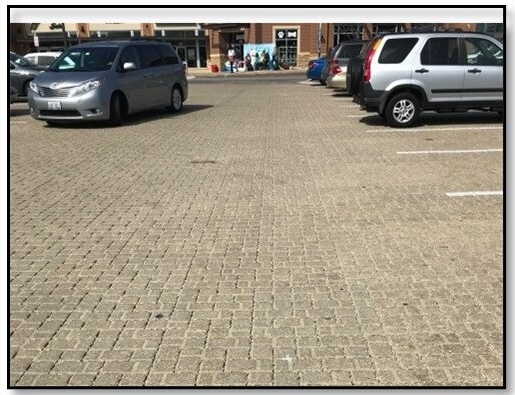
B. Permeable Pavement and Pavers: Permeable pavement and pavers are an alternative method of hard surface that allows stormwater runoff to filter through voids material. The use of this porous material can help promote the natural cleaning and infiltration of water, instead of allowing it to wash into streets and down storm drains. Use of this material may be allowed in designated drive or path areas.
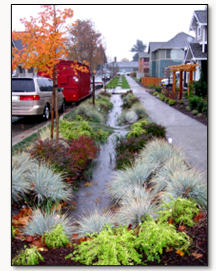
C. Bioswales or Retention Ponds: Bioswales and Retention ponds are vegetated landscaped depressions that capture, treat, and slow down stormwater runoff. They provide a more aesthetically pleasing environment than the typical required concrete stormwater fixtures.
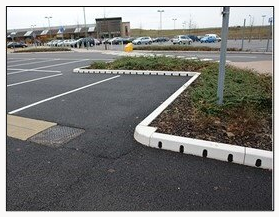
D. Parking Lot Drainage: Stormwater drainage is an integral component in the design of parking lots. Stormwater may be infiltrated into the parking lot planting areas and then drained to a specified area. This approach can clean, detail, and direct stormwater.
E. Green Roofs: Green roofs incorporate plants into the roofing system to reduce pervious surfaces and stormwater runoff. These systems can serve as short term stormwater management to reduce, delay, and clean stormwater runoff from a site.
6-8. - Tree Preservation.
Removal and replacement of trees shall be regulated by the following requirements of this Section.
(a)
Purpose: The preservation, protection and replacement of trees under this subchapter is intended to protect and enhance resident's quality of life and conserve the Village's physical and aesthetic environment by:
(1) Providing a buffer and screen against unattractive views, noise, light and pollution;
(2) Reducing air pollution through removal of carbon dioxide and generation of oxygen.
(3) Maintaining each property owner's enjoyment of their property;
(4) Protecting and enhancing the natural environment;
(5) Preventing or minimizing soil erosion and sedimentation;
(6) Controlling stormwater run-off; and
(7) Protecting existing healthy trees during the course of construction and development
(b) Applicability.
(1) Tree Removal Permit:
(A) Protected Trees: Any tree having a diameter at breast height (dbh) of eight inches (8") or greater and is in "fair" or better condition and the species is not listed on the Prohibited Tree list, shall be designated as a Protected Tree. Any tree that does not meet the definition of Protected Tree does not need a permit for removal.
(B) A Tree Removal Permit is only required when a Protected Tree is being removed as part of a Tree Preservation and Removal Plan as defined in Section 6-8-B-2. A tree removal permit is not required for removal of individual Protected Trees when a Tree Preservation and Removal Plan is also not required.
(C) When tree removal is required by any development requiring site plan review, submission of a Landscape Plan, Tree Preservation and Removal Plan, Site Plan, or Subdivision Plan, such plan shall constitute a Tree Removal Permit, provided the Zoning Administrator determines that all required information to constitute a complete submittal has been provided.
(2) Tree Preservation and Removal Plan Required: A Tree Preservation and Removal Plan shall be required for any parcel of land where Protected Tree(s) are proposed to be removed and subject to one or any of the following:
(A) A public hearing held by the Planning & Zoning Commission as required by the Village Zoning Code, or
(B) Site Plan Review as defined by Section 4-4-G of this Ordinance. All Tree Preservation and Removal Plans shall include the following:
(i) A tree survey identifying the following:
a. Location of on-site and adjacent right-of-way trees.
b. General description of the tree(s), including but not limited to tree size (measured as dbh), species type, and condition of tree.
c. Identification of trees designated for removal, preservation and/or transplanting.
(ii) A written statement indicating the reason for removal of the tree(s). A report from a licensed Illinois arborist may be requested by the Zoning Administrator to confirm the need for tree removal.
(iii) Details, specifications and/or technical information of materials or procedures to be used to preserve, protect and/or transplant trees.
(3) Landscape Plan Required:
(A) Landscape Plan Required: A Landscape Plan shall be required to receive a Tree Removal Permit when five (5) or more replacement trees are required by this Section.
(B) Information: In addition to being prepared in accordance with applicable provisions of Section 6-6: Landscape Plans of this Article, the Landscape Plan shall include the following:
(i) Identify each existing tree designated to remain.
(ii) Identify each existing tree designated for removal.
(iii) Indicate the location, species, and size (caliper) or height of each replacement tree.
(C) No replacement tree shall be used to satisfy the requirements for tree planting in the public right-of-way or in parking lots; except when those are the trees that must be replaced.
(4) Right-of-Way Trees: The provisions of this Section 6-8 Tree Preservation, do not apply to trees on public property.
(c)
Existing Trees: Existing trees shall be maintained on properties, to the extent feasible, through their integration into the site and landscape planning for a proposed development. Trees infested, incurably diseased, weakened by age, storm, fire, or other injury may be removed consistent with established good forestry practices and the regulations of the Village Code.
(d)
Construction Requirements: During any construction undertaken within the Village, trees shall be protected as specified in this Section and other requirements of the Village Code.
(1) Grading and Construction Equipment: Grading and construction equipment shall be forbidden from encroaching within the drip line of a tree.
(2) Material Detrimental to Trees: Crushed limestone, cement, hydrocarbons or any other material detrimental to trees shall not be stored or dumped within the drip line of any tree nor at any higher location where drainage toward the tree could conceivably affect the health of the tree.
(3) Toxic Chemicals and Other Injurious Substances: Toxic chemicals, gasoline, oil and other injurious substances shall not be stored or allowed to seep, drain or empty within one hundred feet (100') of the drip line of protected trees.
(4) Snow Fencing: Snow fencing shall be temporarily installed at the periphery of the tree's drip line.
(5) Tree Trunks and Branches: Tree trunks and branches shall be protected when construction must occur within a tree drip line.
(6) Grade Changes: No grade changes shall be allowed under drip line of any trees designated for preservation.
(7) Underground Utility Lines: Any underground utility line approved by the Village for installation within five feet (5') of the trunk of a tree, or within the drip line of said tree, shall be installed by manual auguring unless another installation method shown to be safe for said tree is approved by the Zoning Administrator.
(e)
Removal of Trees to be Preserved: Removal of trees designated for preservation and/or transplanting shall only be allowed by amending the Tree Preservation and Removal Plan or Landscape Plan.
(f)
Tree Replacement Required: Any tree that is 1) intended to be removed, 2) unintentionally removed or damaged during construction shall be replaced as follows:
(1) Trees Designated for Removal: Replacement of Protected Trees as indicated on a Tree Removal Permit, Tree Preservation and Removal Plan, Landscape Plan, or other submittal indicated removal of trees shall be such that the sum of the total number of new trees is equal to the sum total of number of Protected Trees removed.
(2) Trees Designated for Preservation: In the event that a tree designated for preservation is destroyed, damaged, or removed during the construction process, the replacement of each tree shall be such that the sum of the total number of new trees is equal to the sum total of number of Protected Trees removed.
(3) For each tree designated for preservation that is destroyed, damaged, or removed, the permit applicant, in addition to replacing such trees as required in Subsection 2 above, shall be subject to a fee equal to the current Village contract amount for tree planting. The collected fee-in-lieu shall be used to plant trees on public property at the Village's discretion.
(4) Prohibited or Nuisance Trees: When a tree designated for removal is one of the species on the list of prohibited trees as maintained by the Village in accordance with Section 6-7 of the Village Zoning Code or when a tree is declared a nuisance tree, each such tree shall be replaced with one (1) new tree.
(5) Replacement Tree Requirements:
(A) All replacement shade trees shall have a minimum caliper of three inches (3").
(B) All replacement coniferous trees shall have a minimum height of six feet (6').
(C) Replacement trees may not include any tree on the list of prohibited trees in accordance with Section 6-7 of the Village Zoning Code.
(D) A variety of tree species are encouraged to promote a diverse tree canopy and minimize the impact from disease and infestation, thus when five (5) or more replacement trees are required no more than eighty percent (80%) of the replacement trees shall be of one species type.
(g)
Fee In-Lieu: It may be impractical to plant the required number of replacement trees on the same zoning lot due to space limitations or the density of existing trees. Such determination may be made by the Zoning Administrator based on evidence provided by the applicant. If such is found to be the case the Village may allow the payment of a fee in-lieu for each replacement tree not planted on the subject property. Said fee shall be equal to the current Village contract amount for tree planting. The collected fee-in-lieu shall be used to plant trees on public property at the Village's discretion.
(h)
Failure To Comply: Should tree preservation precautions specified in the Tree Preservation and Removal Plan be not adequately undertaken before and maintained during construction, the land development permit for the parcel shall not be issued or, if previously issued, shall be revoked until such time as these precautions have been satisfied.
(i)
Prohibited and/or Nuisance Trees: Any species on this list must be removed from the property as part of a Tree Preservation and Removal Plan and may not be replanted on the property.
(Ord. No. 2025-4392, § 2, 5-27-25)

