
Roselle City Zoning Code
SECTION 3
REGULATIONS FOR ZONING DISTRICTS
3-1. - How to Use this Section.
This Section assists property owners and others improving and developing property to understand two essential elements about zoning: Permitted Uses and Bulk Standards.
3-1-A. Uses of Land: Zoning ordinances define Permitted and Special Uses to ensure logical development of the Village and predictability for property owners as to what can happen on their property and those nearby. The distinction between Permitted and Special Uses is based on the Zoning District in which a property is located. The Land Use Table at the end of this Section (Section 3-6) shows what types of uses are allowed on their property, or property they want to improve, and whether the use is permitted or specially permitted.
3-1-B. Permitted Uses: If a use is designated permitted (marked with a "P") in the Land Use Table in the zoning district where the property is located, and the proposed improvements meet all of the applicable bulk regulations of the zoning district, locating there requires only meeting the relevant Village Codes, such as building permits and business licenses, but users are advised to check with the Village about other approvals that may be required to proceed with the improvements and development of the property, which may include approvals from other non-village governmental agencies.
3-1-C. Special Uses: If a use is designated as a Special Use ("S" in the Use Table), a determination has been made by the Village that the use is generally appropriate for the Zoning District in which it is located. However, the Special Use may impact neighbors in some unique way, and conditions should be added to approval of allowing the use on the property. To be sure those impacts are eliminated or minimized, Special Uses are reviewed through a public process by Village officials who may place conditions on the use, so it does not overly impact neighbors.
3-1-D. "Bulk" standards define how buildings may be located on a property in terms of their dimensions: how tall a main building can be, how far from a property line a building can be, and how much of the property may be covered by buildings and other structures. This is to ensure that new buildings have limited impact on other properties and fit into the overall character of Roselle. Those standards are summarized in Table 5.1 below and detailed in the zoning districts that follow. This information is essential for new buildings, additions, and understanding how buildings can fit onto a property. These rules consider a wide range of conditions and will assist in formulating construction plans. Be aware that additional rules in other Sections of the Zoning Ordinance may be applicable to the property and must also be followed.
3-2. - Bulk, Area and Yard Regulations by Zoning District.
3-2-A. All development shall conform to the standards set out in this Chapter and summarized in Table 5.1 below. Any variation from these standards sought by a property owner or people seeking to improve and develop property must seek approval of variations as provided in Section 4-4-C. Additional development standards are provided in sections related to each District.
3-3. - Residential Districts.
The residential districts promote development and maintenance of a wide range of housing opportunities throughout the Village, as well as pleasant and attractive neighborhoods that meet residents needs for the quiet enjoyment and use of their property, together with access to recreational, educational, spiritual, and cultural opportunities. These housing opportunities enable existing and new residents to meet their current and future housing needs as their personal circumstances and family living needs change over time.
As noted in the Village's Comprehensive Plan, a majority of Roselle's existing housing stock is comprised of single-family detached homes. Increasing the range and type of housing stock—to include more rental products, senior-targeted housing, transit-oriented housing, etc. —can help Roselle provide for a changing market and full spectrum of existing and future residents.
3-3-A. Single-Family Residence District (R-1).
1. Purpose: The R-1 Single Family Residence District is established to preserve and further promote low-density neighborhoods with single-family detached dwellings, consistent with the predominant character of the Village.
2. Permitted Uses: Permitted uses in the R-1 District shall be as listed in the Table of Permitted Uses in Article 3: Table 3.2.
3. Special Uses: Special Uses in the R-1 District shall be as listed in the Table of Permitted Uses in Article 3: Table 3.2.
4. Parking Requirements: Parking requirements in the R-1 District shall be as specified in Article 5.
5. Bulk Space and Yard Regulations: Bulk regulations in the R-1 District shall be as specified in Table 3.1 and illustrated in Figure 3-1.
Figure 3-1: R-1 Bulk Standards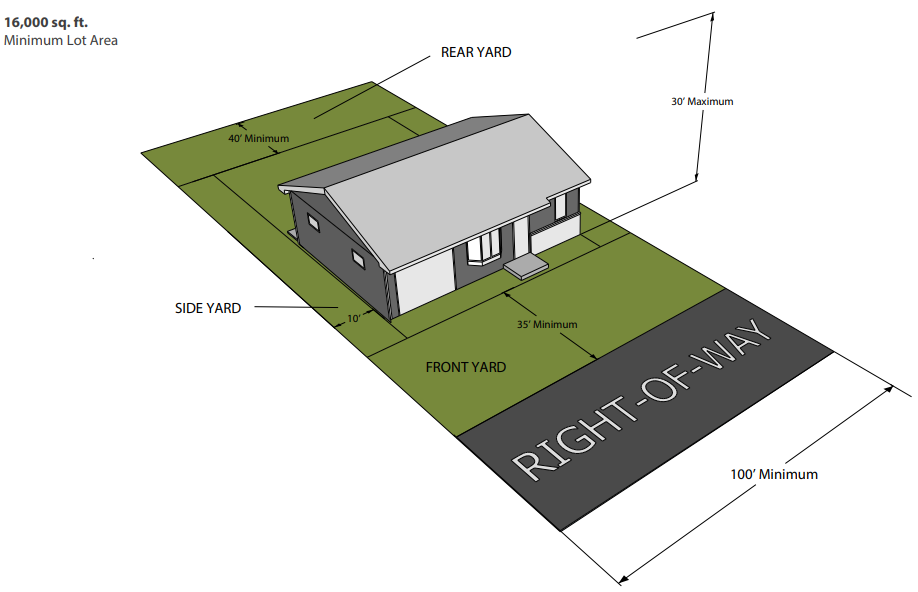
6. Additional Standards
a. Nonresidential Permitted Uses and Special Uses: Yards.
i. Buildings less than twenty-five (25) feet in height shall provide front, side, and rear yards as required in Table 3.1 above.
ii. For buildings twenty-five (25) to thirty (30) feet in height, each yard (front, side, and rear) shall be increased in width or depth by two (2) feet for each additional one foot of building height over twenty-five (25) feet.
b. Detached Accessory Buildings. A minimum of five (5) feet from the side lot line and three (3) feet from the rear lot line. In no instance may a Detached Accessory Structure be located in a properly designated easement.
3-3-B. Single-Family Residence Districts (R-2, R-2A, and R-2B).
1. Purpose: The R-2, R-2A, and R-2B Single-Family Residence Districts provide areas for development of moderate density single-family residences. Existing parts of the Village initially zoned R-2 were developed over time with varying minimum lot sizes. These areas each provide a consistent single family neighborhood character. Given that lot size is a primary distinguishing characteristic of single-family areas, the original R-2 District is regulated in three sub-districts. To reflect and preserve this development pattern, the R-2, R-2A and R-2B distinctions continue to apply.
2. Permitted Uses: Permitted uses in the R-2 Districts shall be as listed in the Table of Permitted Uses in Article 3: Table 3.2.
3. Special Uses: Special Uses in the R-2 Districts shall be as listed in the Table of Permitted Uses in Article 3: Table 3.2.
4. Parking Requirements: Parking requirements in the R-2 Districts shall be as specified in Article 5.
5. Bulk Space and Yard Regulations: Bulk regulations in the R-2 Districts shall be as specified in Table 3.1 and illustrated in Figure 3-2.
Figure 3-2: R-2, R-2A, R-2B Bulk Standards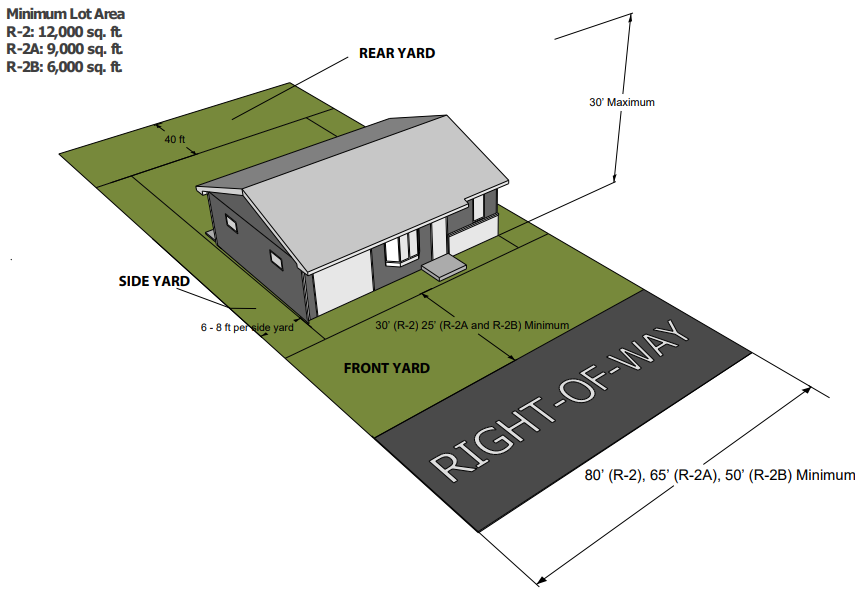
6. Additional Standards (R-2)
a. Side Yards: On existing interior lots under eighty (80) feet in width, there shall be one side yard of ten (10) percent of the width of the lot, the other side yard shall be a minimum width of nine (9) feet.
b. Yards: Nonresidential Permitted Uses and Special Uses.
i. Buildings less than twenty-five (25) feet in height shall provide front, side, and rear yards as required in Table 3.1 above.
ii. For buildings twenty-five (25) to thirty (30) feet in height, each yard-front, side, and rear, shall be increased in width or depth by two (2) feet for each additional one foot of building height over twenty-five (25) feet.
c. Detached Accessory Buildings.
i. A minimum side yard of five (5) feet and a minimum rear yard of three (3) feet on eighty (80) foot lots.
ii. On existing lots, under eighty (80) feet in width the side yard shall be a minimum of three (3) feet and the rear yard shall be a minimum of three (3) feet.
iii. In no instance may a Detached Accessory Structure be located in a properly designated easement.
7. Additional Standards (R-2A)
a. Side Yards: On existing interior lots under sixty-five (65) feet in width, there shall be one side yard of ten (10) percent of the width of the lot; the other side yard shall be a minimum width of five (5) feet.
b. Yards: Nonresidential Permitted Uses and Special Uses.
i. Buildings less than twenty-five (25) feet in height shall provide front, side, and rear yards as required in Table 3.1 above.
ii. For buildings twenty-five (25) feet to thirty (30) feet in height, each yard—front, side, and rear shall be increased in width or depth by two (2) feet for each additional one foot of building height over twenty-five (25) feet.
c. Detached Accessory Building.
i. A minimum side yard of five (5) feet and a minimum rear yard of three (3) feet on sixty-five (65) foot lots.
ii. On existing lots, under sixty-five (65) feet in width, as of the date of this Ordinance the side yard shall be a minimum of three (3) feet and the rear yard shall be a minimum of three (3) feet.
iii. In no instance may a Detached Accessory Structure be located in a properly designated easement.
8. Additional Standards (R-2B)
a. Side Yards: On existing interior lots under fifty (50) feet in width, there shall be one side yard of ten (10) percent of the width of the lot; the other side yard shall be a minimum width of five (5) feet.
b. Yards: Nonresidential Permitted Uses and Special Uses.
iv. Buildings less than twenty-five (25) feet in height shall provide front, side, and rear yards as required in Table X above.
v. For buildings twenty-five (25) feet to thirty (30) feet in height, each yard—front, side, and rear shall be increased in width or depth by two (2) feet for each additional one foot of building height over twenty-five (25) feet.
c. Detached Accessory Building.
vi. A minimum of five (5) feet from the side lot line and three (3) feet from the rear lot line.
vii. On existing lots under fifty (50) feet in width, a minimum of three (3) feet from the side lot line and three (3) feet from the rear lot line.
viii. In no instance may a Detached Accessory Structure be located in a properly designated easement.
3-3-C. General Residence District (R-3).
1. Purpose: The R-3 General Residence District encourages the development of a variety of housing types from single family to multiple family, to create mixed residential areas of overall medium density. This mix of development intensities creates highly comfortable and desirable neighborhoods through a layout that employs creative and thoughtful road and lot configurations. In some instances, the R-3 District is located as an "infill" development near single-family areas, while sometimes it is near high-traffic volume roads. This facilitates a mix of housing throughout the Village designed to mitigate impacts of increased density on other residential uses.
2. Permitted Uses: Permitted uses in the R-3 District shall be as listed in the Table of Permitted Uses in Article 3: Table 3.2.
3. Special Uses: Special Uses in the R-3 District shall be as listed in the Table of Permitted Uses in Article 3: Table 3.2.
4. Parking Requirements: Parking requirements in the R-3 District shall be as specified in Article 5.
5. Bulk Space and Yard Regulations: Bulk regulations in the R-3 District shall be as specified in Table 3.1 and illustrated in Figures 3-3 through 3-6.
Figure 3-3: R-3 Bulk Standards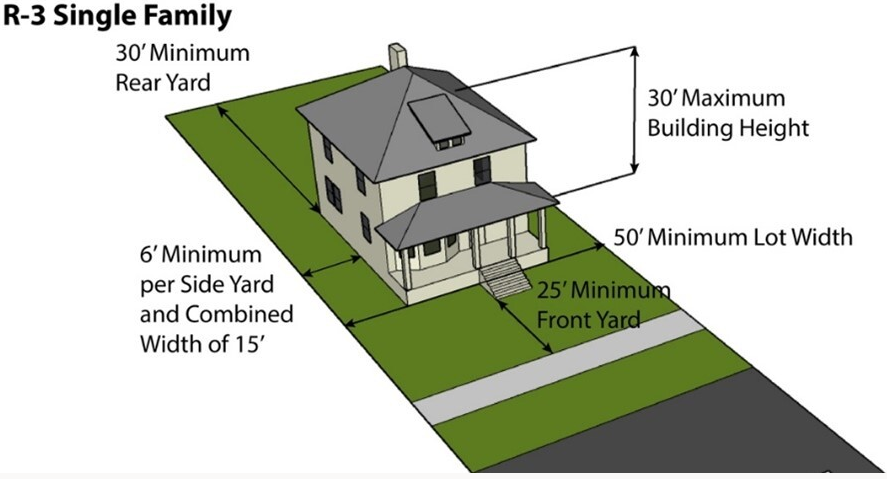
Figure 3-4: R-3 Townhome Bulk Standards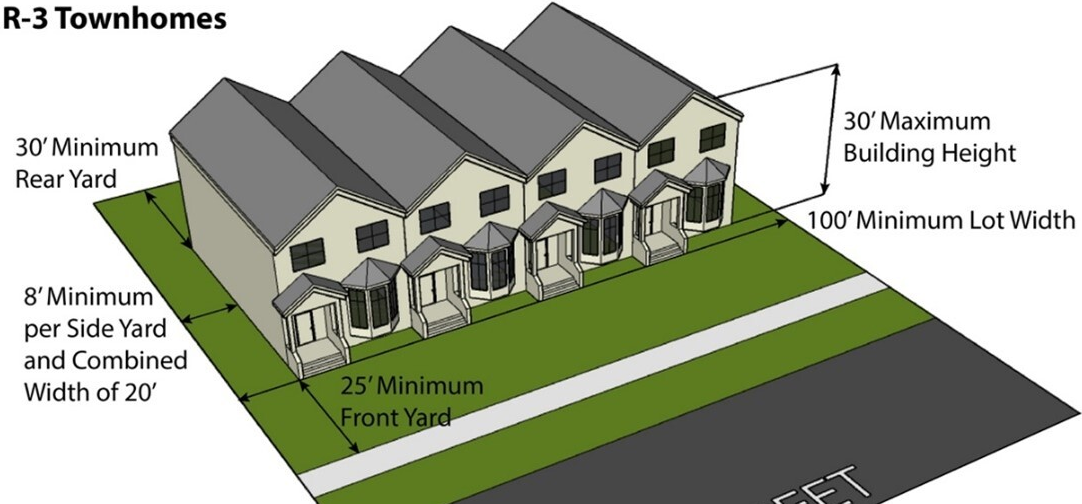
Figure 3-5: R-3 Duplex Bulk Standards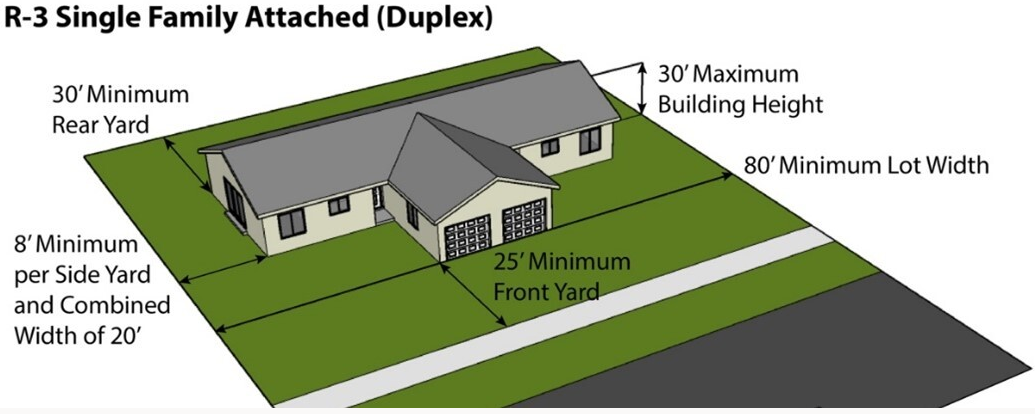
Figure 3-6: R-3 Townhome Bulk Standards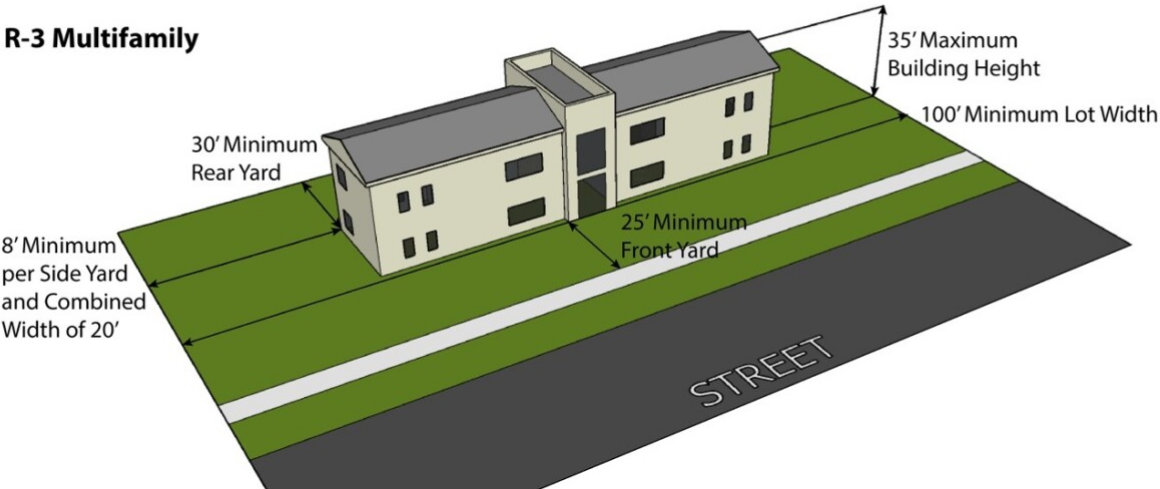
7. Additional Standards
a. Yards: Multi-family and nonresidential Permitted Uses and Special Uses.
i. Buildings less than twenty-five (25) feet in height shall provide front, side, and rear yards as required in Table X above.
ii. For multiple-family and nonresidential buildings twenty-five (25) feet to thirty-five (35) feet in height, each yard—front, side, and rear—shall be increased in width or depth by two (2) feet for each additional one foot of building height over twenty-five (25) feet.
b. Transition Yard. When a side or rear lot line of a property zoned R-3 MF, R-3 Duplex, or R-3 Townhome coincides with a side or rear lot line in an adjacent R-1 or R-2 Residence District, a yard shall be provided along such side or rear lot line equal in dimension to the side or rear yard required under this ordinance for the applicable Residence District; such yards shall be landscaped in accordance with the provisions of Section 6 of this ordinance.
c. Detached Accessory Buildings. A minimum of five (5) feet from the side lot line and three (3) feet from the rear lot line. In no instance may a Detached Accessory Structure be located in a properly designated easement.
d. Site Plan Review. All applications for building permits, except single-family detached dwellings, shall be approved by the planning & zoning commission in accordance with the site plan review process specified in Section 4-4-G of this ordinance.
e. Articulated Building Elevations. As a condition of approval for Special Uses, the building elevations of residential structures and mixed-use structures shall have articulated wall recesses and projections so as to create an articulation of the building wall. In addition to the wall recesses, the building elevation shall contain articulation of the facade elements, including but not limited to bay windows, porches, turrets and balconies.
f. Trash Enclosures. For multiple-family dwellings, trash containers shall be enclosed with fences or landscaping of at least seventy-five (75) percent opacity.
3-3-D. Multiple-Family Residence District (R-4).
1. Purpose: The R-4 District provides for the highest densities of housing in Roselle, with multiple-family dwellings and townhomes as the characteristic housing type in the District. The R-4 District is located as an "infill" development near single-family areas, as well as near high-traffic volume roads. This facilitates a mix of housing type throughout the Village that is designed to mitigate impacts of increased density on other residential uses.
2. Permitted Uses: Permitted uses in the R-4 District shall be as listed in the Table of Permitted Uses in Article 3: Table 3.2.
3. Special Uses: Special Uses in the R-4 District shall be as listed in the Table of Permitted Uses in Article 3: Table 3.2.
4. Parking Requirements: Parking requirements in the R-4 District shall be as specified in Article 5.
5. Bulk Space and Yard Regulations: Bulk regulations in the R-4 District shall be as specified in Table 3.1 and illustrated in Figures 3-7 and 3-8.
Figure 3-7: R-4 Townhome Bulk Standards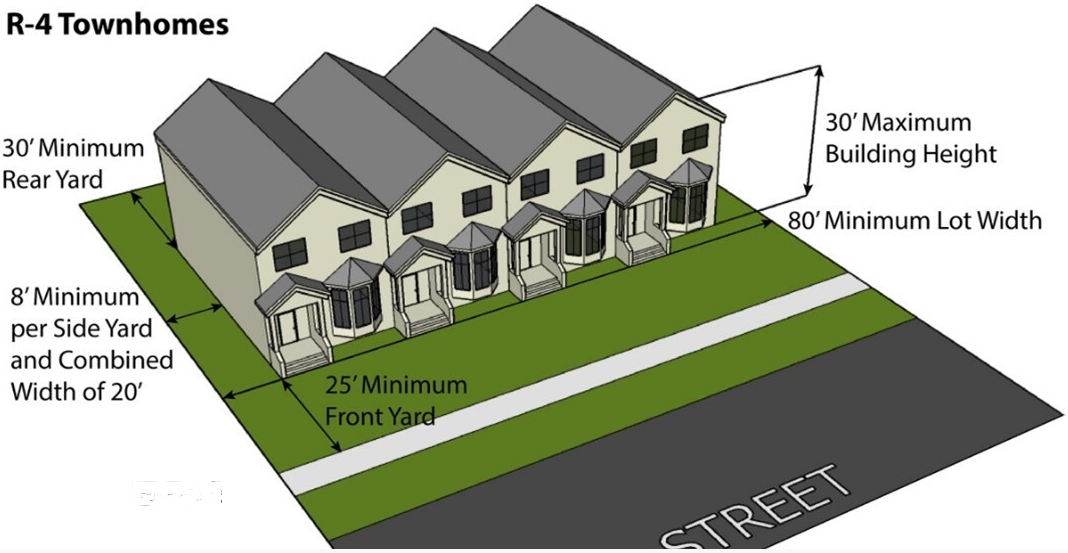
Figure 3-8: R-4 Multifamily Bulk Standards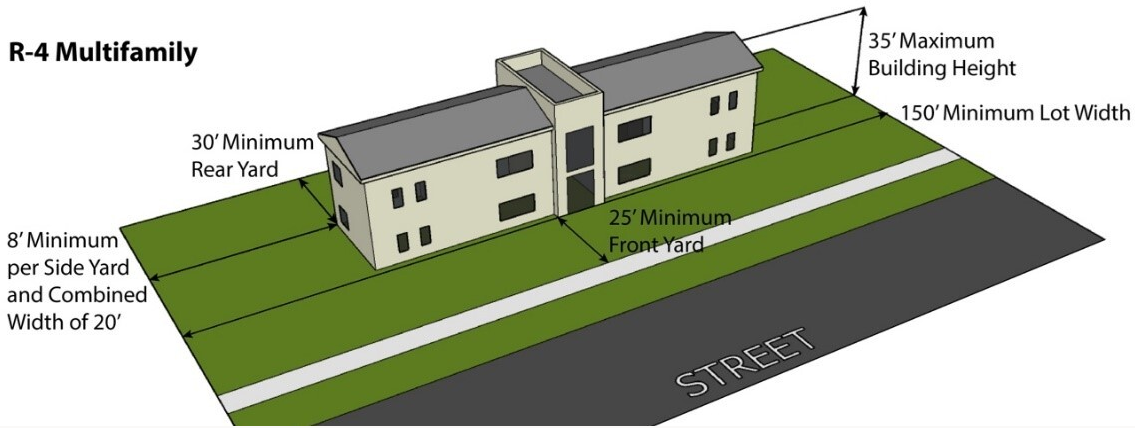
6. Additional Standards:
a. Yards, General. For all Permitted and Special Uses, each yard—front, side, and rear, as heretofore required—shall be increased in depth or width by two (2) feet for each additional one foot of building height over twenty-five (25) feet.
b. Transition Yard. When a side or rear lot line in an R-4 District coincides with a side or rear lot line in an adjacent R-1, R-2, or R-3 Single Family Residence District, a yard shall be provided along such side or rear lot line equal in dimension to the side or rear yard required under this ordinance for the applicable Residence District; such yards shall be landscaped in accordance with the provisions of Section 6 of this ordinance.
c. Site plan review. All applications for building permits shall be approved by the plan commission in accordance with the site plan review process specified in Section 4-4-G of this ordinance.
3-4. - Business Districts.
The business districts are established to promote diversified retail and broader commercial business development throughout the Village, thereby supporting Village residents day to day shopping and service needs, as well as building the Village local economy through new sources of revenue and employment opportunities. The business districts also serve to attract visitors to the Village from throughout the region.
The Comprehensive Plan notes that Roselle is located in a highly competitive retail environment. As a result, new commercial development in the business districts should be attractive and distinct from what is offered in surrounding communities. To that end, the Districts accommodate a range of business types and incorporate design concepts where appropriate.
3-4-A. General Provisions for All Business Districts.
1. All business, service, merchandise, display, and, where permitted, repair and processing activities shall be conducted wholly within enclosed buildings, except for off-street automobile parking, off-street loading, and open sales and rental lots in Districts where they are allowed by this Chapter.
2. All outside storage areas of goods, materials, products, or trash containers shall be enclosed with fences or landscaping of at least seventy-five (75) percent opacity.
3. Any goods produced on the premises shall be sold at retail on the premises unless otherwise permitted herein for specified uses.
4. All business operations shall conform to the Performance Standards specified in Section 8.
5. Drive-through facilities. In addition to standards for and review as a Special Use, all Drive-through facilities shall comply with the following:
a. Setbacks: All drive-through facilities adjoining residential property shall locate drive-through lanes (including the required by-pass lane and the required stacking space requirements) a minimum of forty (40) feet from the closest residential property, measured as the distance between the residential property line and the nearest component of the drive-through facility, which includes but is not limited to the drive-through lane(s), the stacking spaces, or the by-pass lane.
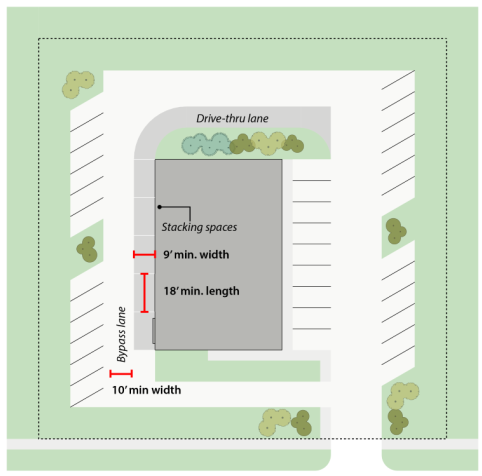
b. By-pass: A minimum of a ten-foot by-pass lane shall be provided adjacent to the drive-through lane(s) in order for vehicles to by-pass the drive-through lane(s); unless a variation to this requirement is granted per the requirements of Section 4-4-C.
c. Drive-through lane and stacking space requirements:
i. All drive-through lanes and stacking spaces shall be no less than nine (9) feet wide by eighteen (18) feet long.
ii. Drive-through lanes and stacking spaces shall be designed to avoid crossing or conflicting with parking areas or pedestrian walkways. Where such design is not practical, the Village may approve a design as part of the Special Use process upon find that potential impacts on parking spaces and pedestrian walkways have been minimized.
iii. All drive-through lanes and stacking spaces shall be distinct from the site access (public street, neighboring lots, etc.) and parking.
iv. Minimum standards for stacking: The minimum number of stacking spaces as set forth in Section 5: Parking.
6. Overnight parking. Unless otherwise permitted herein for specified uses, long-term overnight parking is prohibited in all Business Districts but short-term overnight parking is allowed in all Business Districts.
3-4-B. B-2 Convenience Shopping Center District.
1. Purpose: The B-2 District provides for small-scale shopping, retail, and personal service uses that serve the needs of those who live and work nearby. Uses satisfy daily or frequent basic shopping needs, commonly in shopping centers along arterial or major streets. The district incorporates transitions between commercial areas and their residential neighbors. All customers—whether by or on foot or bike—should have convenient access to and within developments in this District.
2. Permitted Uses: Permitted uses in the B-2 District shall be as listed in the Table of Permitted Uses in Article 3: Table 3.2.
3. Special Uses: Special Uses in the B-2 District shall be as listed in the Table of Permitted Uses in Article 3: Table 3.2.
4. Parking Requirements: Parking requirements in the B-2 District shall be as specified in Article 5.
5. Bulk Space and Yard Regulations: Bulk regulations in the B-2 District shall be as specified in Table 3.1 and illustrated in Figure 3-9.
6. Additional Standards:
a. Transitional Yards. When a side or rear lot line in a B-2 District coincides with a side or rear lot line in an adjacent Residence District, a yard shall be provided along such side or rear lot line equal in dimension to the side or rear yard required under this ordinance for the applicable Residence District; such yards shall be landscaped in accordance with the provisions of Section 6 of this ordinance.
Figure 3-9: B-2 Residential Bulk Standards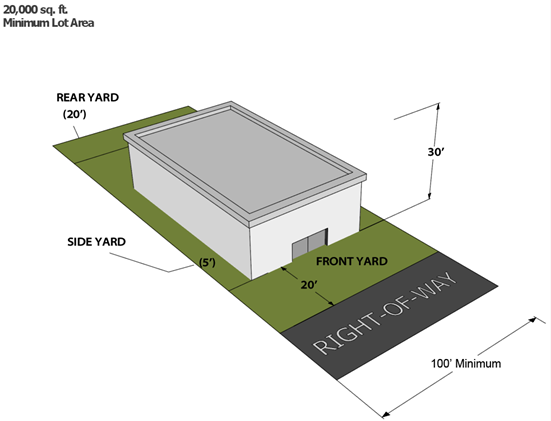
3-4-C. B-3 Town Center District.
1. Purpose: The Town Center District promotes and maintains a mix of uses, including, retail, residential, personal services, office, and restaurants, that make up the central business area of Roselle. This core district includes the Village's primary governmental, civic, and cultural institutions. Design and character in the Town Center create a sense of place and community pride for Roselle. As described in the 2016 Comprehensive Plan, the Town Center is envisioned as the transit-oriented heart of the community. A pedestrian friendly setting balances old town charm with modern amenities. With the municipal campus as the anchor, future development of higher density residential and mixed use developments will support and add to restaurants, shops, and activities in the area, as well as offer more diverse housing choices that attract all age groups.
2. Permitted Uses: Permitted uses in the B-3 District shall be as listed in the Table of Permitted Uses in Article 3: Table 3.2.
3. Special Uses: Special Uses in the B-3 District shall be as listed in the Table of Permitted Uses in Article 3: Table 3.2.
4. Parking Requirements: Parking requirements in the B-3 District shall be as specified in Article 5.
5. Bulk Space and Yard Regulations: Bulk regulations in the B-3 District shall be as specified in Table 3.1 and illustrated in Figures 3-10 through 3-13.
Figure 3-10: B-3 Multifamily Bulk Standards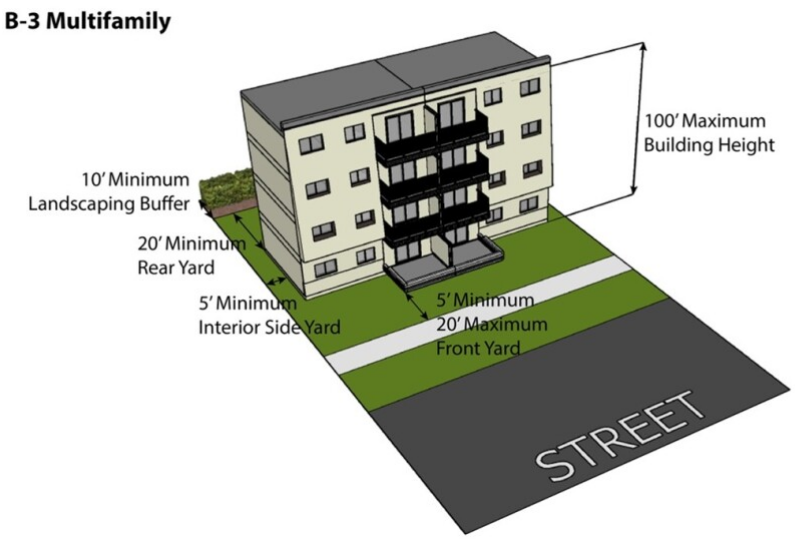
Figure 3-11: B-3 Townhome Bulk Standards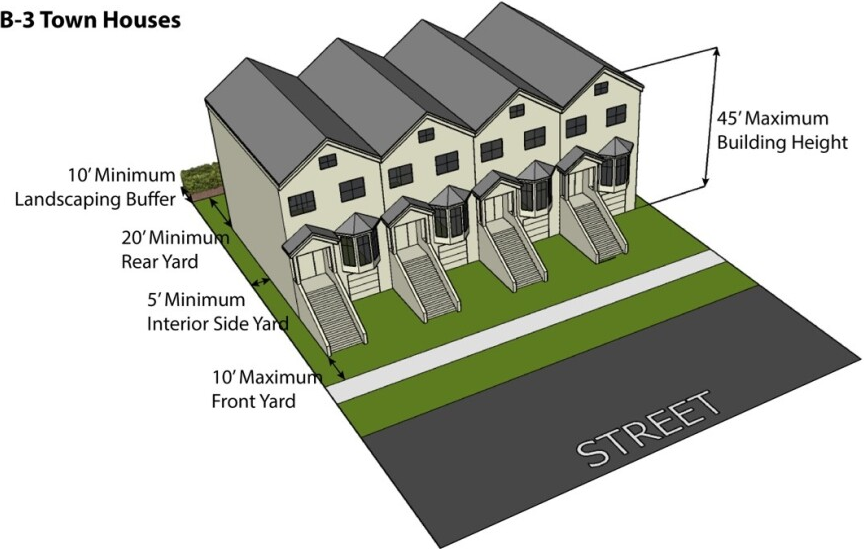
Figure 3-12: B-3 Commercial / Mixed Use Bulk Standards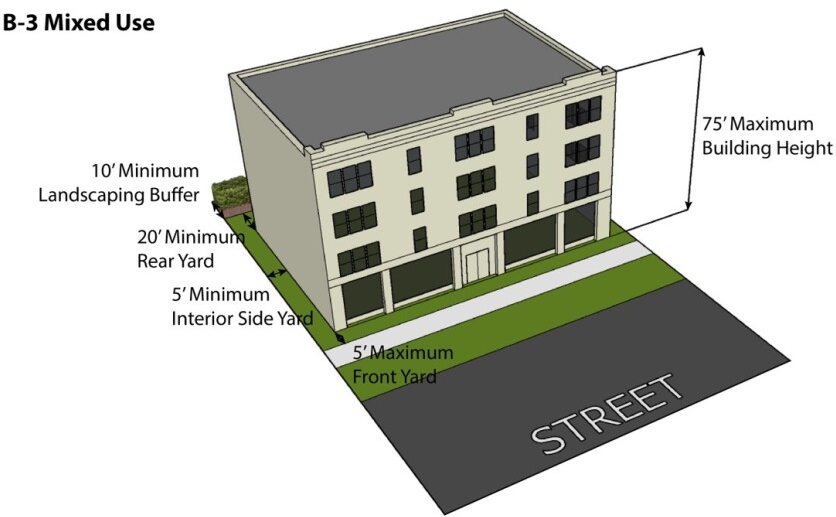
Figure 3-13: B-3 Commercial Bulk Standards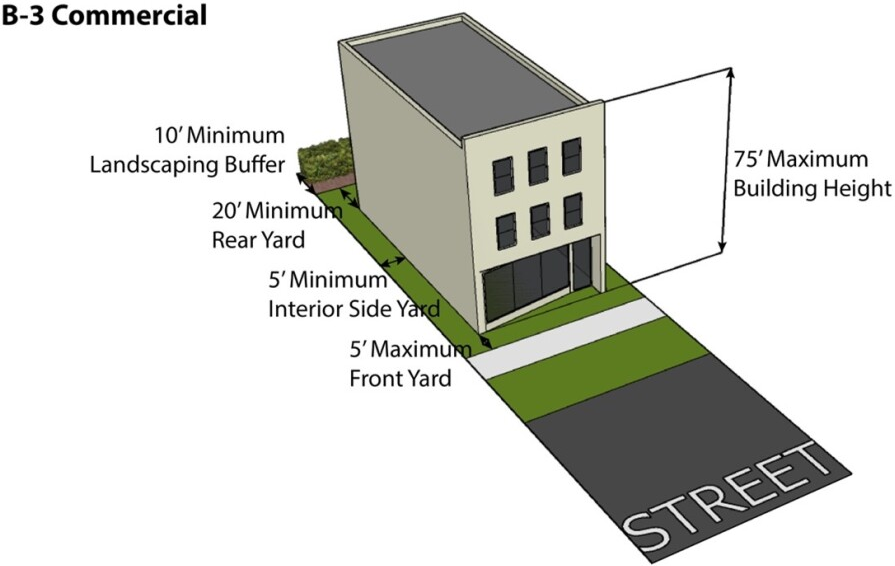
6. Additional Standards
a. Development Process: All new development (for the purpose of this Section, defined as any newly constructed building) that occurs in the B-3 Town Center District shall be considered by the Village through the PUD process specified in Section 4-4-F. There shall be no minimum size for a PUD in the B-3 District.
b. Transitional Yards. When a side or rear lot line in the B-3 District coincides with a side or rear lot line in an adjacent Residence District, a yard shall be provided along each side or rear lot line equal to or greater in dimension to the side or rear yard required under this ordinance for the applicable Residence District; such yards shall be landscaped in accordance with the provisions of Section 6 of this ordinance.
c. Articulated building elevations. In addition to the Design Guidelines outlined in the Comprehensive Plan, and as a condition of approval for Special Uses, the building elevations of residential structures and mixed-use structures shall have articulated wall recesses and projections so as to create an articulation of the building wall. In addition to the wall recesses, the building elevation shall contain articulation of the facade elements, including but not limited to bay windows, porches, turrets and balconies.
d. Dwelling units shall not be permitted below the second floor of any mixed-use building or structure. Dwelling units and business uses may be permitted on the same floor, above the ground floor, of mixed-use buildings or structures, provided that the public access to the business uses is separated from the entrance to the residential uses.
e. Multifamily residential and mixed-use development building heights greater than 75 feet up to a maximum height of 100 feet may be permitted upon approval of the Village Board as part of a Special Use approval.
3-4-D. B-4 General Business District.
1. Purpose: The B-4 District provides for and maintains a wide range of retail, dining, and service businesses that serve the Roselle community and adjacent communities. Located primarily along Irving Park Road, this district can accommodate pedestrian oriented uses that neighbors can easily access by means other than automobiles and enjoy.
2. Permitted Uses: Permitted uses in the B-4 District shall be as listed in the Table of Permitted Uses in Article 3: Table 3.2.
3. Special Uses: Special Uses in the B-4 District shall be as listed in the Table of Permitted Uses in Article 3: Table 3.2.
4. Parking Requirements: Parking requirements in the B-4 District shall be as specified in Article 5.
5. Bulk Space and Yard Regulations: Bulk regulations in the B-4 District shall be as specified in Table 3.1 and illustrated in Figure 3-14.
Figure 3-14: B-4 Commercial Bulk Standards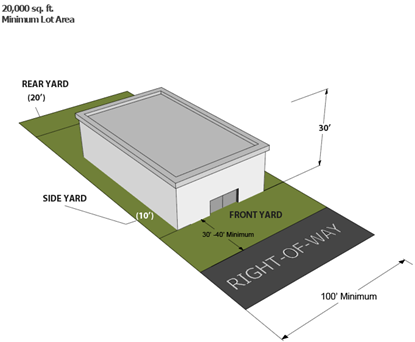
6. Additional Standards.
a. Front Yards. Where a front yard is across an existing or proposed right-of-way from a Residence District, the front yard shall be not less than forty (40) feet and shall be landscaped per requirements in this Chapter.
b. Transitional Yards. When a side or rear lot line in a B-4 District coincides with a side or rear lot line in an adjacent Residence District, a yard shall be provided along such side or rear lot line equal in dimension to the side or rear yard required under this ordinance for the applicable Residence District; such yard shall be landscaped in accordance with the provisions of Section 6 of this ordinance.
3-4-E. B-5 Arterial Business District.
1. Purpose: The B-5 District provides for and maintains a wide range of retail, dining, and service businesses that serve community residents and a broader regional market area. Located along principal arterial streets—and primarily along Lake Street—these uses draw in users from beyond the Village and across the region. Roselle's Comprehensive Plan identifies the Lake Street Corridor as Roselle's primary retail corridor, with approximately 450,000 square feet of retail space. New retail development in the Village since 2000 has primarily located in this area within the B-5 District. Common businesses include, without limitation, restaurants, pharmacies, florists, and auto-related shops.
2. Permitted Uses: Permitted uses in the B-5 District shall be as listed in the Table of Permitted Uses in Article 3: Table 3.2.
3. Special Uses: Special Uses in the B-5 District shall be as listed in the Table of Permitted Uses in Article 3: Table 3.2.
4. Parking Requirements: Parking requirements in the B-5 District shall be as specified in Article 5.
5. Bulk Space and Yard Regulations: Bulk regulations in the B-5 District shall be as specified in Table 3.1 and illustrated in Figure 3-15.
Figure 3-15: B-5 Commercial Bulk Standards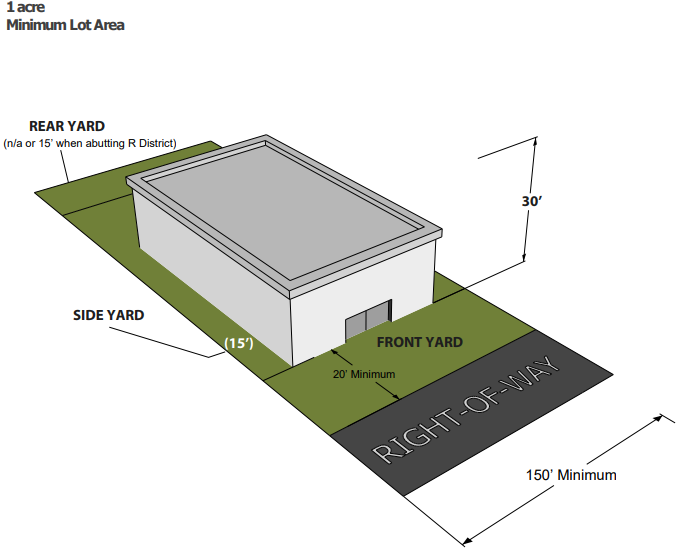
6. Additional Standards.
a. Yards: No encroachments may be located in any yard of the B-5 District. All required yards shall be used only for landscaping, landscape screening and planting strips to provide a buffer to other abutting zoned districts.
b. Corner Side yards. If a fire lane is required, such lane width shall be in addition to the required corner side yard.
c. Transitional yards. When a side or rear lot line in a B-5 District coincides with a side or rear lot line in an adjacent Residence District within the incorporated area or another adjacent jurisdiction, a yard shall be provided along such side or rear lot line not less than twenty-five (25) feet in depth. The required transitional yard shall contain landscaping and planting suitable to provide at least seventy-five (75) percent opacity along such Residence District. See also Section 6 of this ordinance.
d. Landscaping: Not less than ten (10) percent of the entire lot area (development site) shall be devoted to landscaping maintained as permanent open space.
e. Outdoor Storage: All storage shall be within completely enclosed buildings or effectively screened by a solid wall or fence (including solid entrance and exit gates) not less than six (6) feet nor more than eight (8) feet in height.
3-5. - Industrial Districts.
The Industrial Districts are established to advance a diverse economic base in the Village. The Village's location in northern DuPage County and proximity to interstate highways make it attractive for industrial development. To serve potential users, the zoning districts accommodate a range of building sizes and formats. Where industrial districts are near residential areas, transitional regulations to mitigate potential adverse impacts are applied.
As noted in the Comprehensive Plan, Roselle has a healthy industrial base that plays an important role in the local economy. These zoning regulations are designed to accommodate existing and future uses in the district given industrial market needs.
3-5-A. ORI Office, Research, and Light Industrial District.
1. Purpose: The ORI District provides a campus-like setting for larger office, research, and light industrial activities in a pleasant, hazard-and-nuisance-free environment. In keeping with this character and reflective of some parts of the District abutting residential properties, a high quality of general and transitional landscape standards is incorporated into the District. As outlined in the 2016 Comprehensive Plan, smaller office users, such as professional and medical office spaces, are also appropriate in this District. These smaller spaces function more like retail in that they need to be near consumers, and common tenants include insurance agencies, relators, doctors, dentists, and attorneys.
2. Permitted Uses: Permitted uses in the ORI District shall be as listed in the Table of Permitted Uses in Article 3: Table 3.2.
3. Special Uses: Special Uses in the ORI District shall be as listed in the Table of Permitted Uses in Article 3: Table 3.2.
4. Parking Requirements: Parking requirements in the ORI District shall be as specified in Article 5.
5. Bulk Space and Yard Regulations: Bulk regulations in the ORI District shall be as specified in Table 3.1 and illustrated in Figure 3-16.
Figure 3-16: ORI Bulk Standards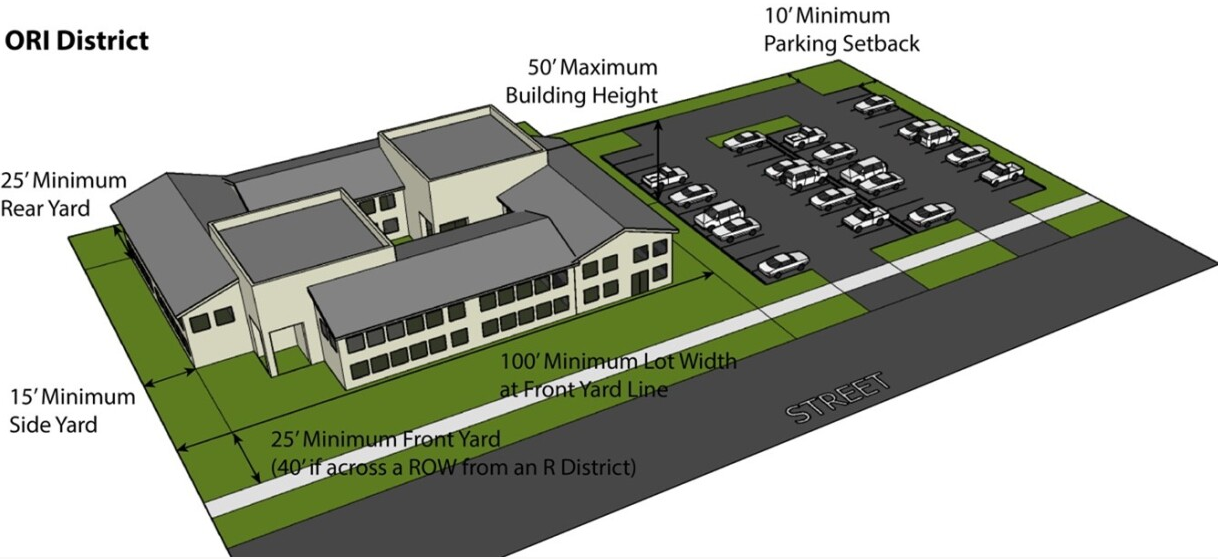
6. Additional Standards.
a. Building Height. For buildings greater than twenty-five (25) feet in height, the minimum required yards shall be increased by one foot for each one foot in building height over twenty-five (25) feet.
b. Business Activities: All business, servicing or processing, except for off-street parking and off-street loading, shall be conducted within completely enclosed buildings, unless otherwise authorized as a Special Use.
c. Performance Standards: The performance standards specified in Section 8, shall apply to all uses in the ORI District.
d. Outdoor Storage: All outside storage areas of goods, materials, products, or trash containers shall either be enclosed with solid fences or walls (including solid entrance and exit gates) not less than six (6) feet nor more than eight (8) feet in height, or screened with natural landscaping which shall provide a minimum of one hundred (100) percent opacity when adjacent to a residence district, or seventy-five (75) percent opacity when adjacent to any other district. Such opacity calculation shall be on a full year basis.
e. Lighting: Lighting of any outdoor storage facility shall be directed away from surrounding properties.
f. Barbed Wire: Barbed wire may be permitted provided upon determination by the Board of Trustees that the property has an extraordinarily high risk of theft or vandalism, and the barbed wire is designed to minimize personal harm.
g. Residential: Residential units may only be allowed as watchmen's dwellings as accessory uses on the premises where employed, as permitted by a Special Use.
h. Retail: The retail uses in the ORI District shall be located within a building or structure containing an otherwise Permitted Use. Advertising for such sale shall not be visible from the outside of the building or structure. Such business uses shall be for the service and convenience of the tenants and employees of the ORI District in which they are located.
i. Transitional Yards. Where a side or rear lot line in an ORI District coincides with a side or rear lot line in an adjacent Residence or Business District, a yard shall be provided as follows:
i. A transitional yard of one hundred (100) feet shall be established adjacent to a residential district or use.
ii. A transitional yard of twenty-five (25) feet shall be established adjacent to a business district or use.
j. Landscaping Requirements. Landscaping shall be provided in accordance with the provisions set forth in Section 3-5-A.1.j of this Chapter, except as amended by the following provisions. Where there is a conflict between the standards defined below and Section 6-3, the stricter shall apply:
i. Transitional yard. Transitional yard landscaping and screening shall be provided in the transitional yard.
(1) Adjacent to Residential: The required transitional yard of one hundred (100) feet adjacent to a residential district or use shall contain landscaping and planting suitable to provide at least seventy-five (75) percent opacity along such Residence District boundary line.
(2) Such screening shall be a minimum of five (5) feet in height. When adjacent to residential lots, the height of such screen shall be increased so as to be measured from the average elevation of the adjoining residential property line.
(3) When adjacent to a residence district, the use of a three-foot to five-foot berm shall be required.
(4) When adjacent to a residence district, at a minimum, trees shall be planted within the transition yard and shall include:
(5) Adjacent to Business: When adjacent to a Business District, the use of a two-foot to four-foot earthen berm shall be required. At a minimum, trees shall be planted within the transition yard and shall include:
ii. Streets and rights-of-way. To create "entranceways" into the development, landscaping, signage and other forms of monumenting shall be provided at major street intersections. These "entranceways" shall be accented with denser more mature plantings than required by other sections and shall include the installation of evergreen and other flowering shrubs.
iii. Lot landscaping.
(1) Foundation. A minimum ten-foot strip in the front of the structure and a five-foot strip of landscaping along the rear and side lines of the structure. On a corner lot there shall be two (2) front faces of the structure (along the front and corner side yards). These areas shall contain a maximum of fifty (50) percent of ground cover (i.e. sod and/or herbaceous), unless shown to be functionally impractical due to building/structural appurtenances as determined by the Zoning Administrator.
(2) Interior parking lots. For parking lots over six (6) spaces in size, landscaping islands will be required at both ends of every row of parking spaces and a mid-row landscape island must be provided for each twenty (20) parking spaces or five (5) percent of the parking area must be landscaped, whichever requires the greater amount. Three (3) feet of landscaping around the perimeter of the parking area may be applied to the five (5) percent landscape requirement provided that it is not part of a required setback. The minimum size of a planting area is one hundred eighty (180) square feet with a minimum width dimension of ten (10) feet. One shade tree must be provided for each one hundred eighty (180) square feet of landscaped area.
(3) Parking lot screening. Unless sufficiently screened by transition yard landscaping and screening, all yards and off-street parking areas must be screened as required by Section 6-4.
(4) Interior side yards. As a minimum, one shade tree for each eighty (80) feet on center (as measured per lineal foot along the side lot line), and alternately spaced with the existing or proposed trees within an interior side yard or rear yard of an adjoining parcel.
(5) Rear yard landscaping. As a minimum, one shade tree for each eighty (80) feet on center (as measured per lineal foot along the side lot line) and alternately spaced with the existing or proposed trees if within an interior side yard or rear yard of an adjoining parcel.
iv. General conditions on landscaping.
(1) Berming. Mounding shall generally vary in height, width and length, to create a free-form, naturalistic effect.
(2) Sideslope. The sideslope of berms shall not exceed 3:1 ratio, and a 6:1 ratio is desired.
3-5-B. M - 1 Limited Industrial District.
1. Purpose: The M-1 Limited Industrial District supports a variety of manufacturing, warehousing, distribution, logistics, and office uses. Uses in this district are intended to be non-intensive in terms of their impact on nearby uses and the community character overall. Existing buildings range in size and age, and serve a variety of industrial and intensive commercial business operations.
2. Permitted Uses: Permitted uses in the M-1 District shall be as listed in the Table of Permitted Uses in Article 3: Table 3.2.
3. Special Uses: Special Uses in the M-1 District shall be as listed in the Table of Permitted Uses in Article 3: Table 3.2.
4. Parking Requirements: Parking requirements in the M-1 District shall be as specified in Article 5.
5. Bulk Space and Yard Regulations: Bulk regulations in the M-1 District shall be as specified in Table 3.1 and illustrated in Figure 3-17.
Figure 3-17: M-1 Bulk Standards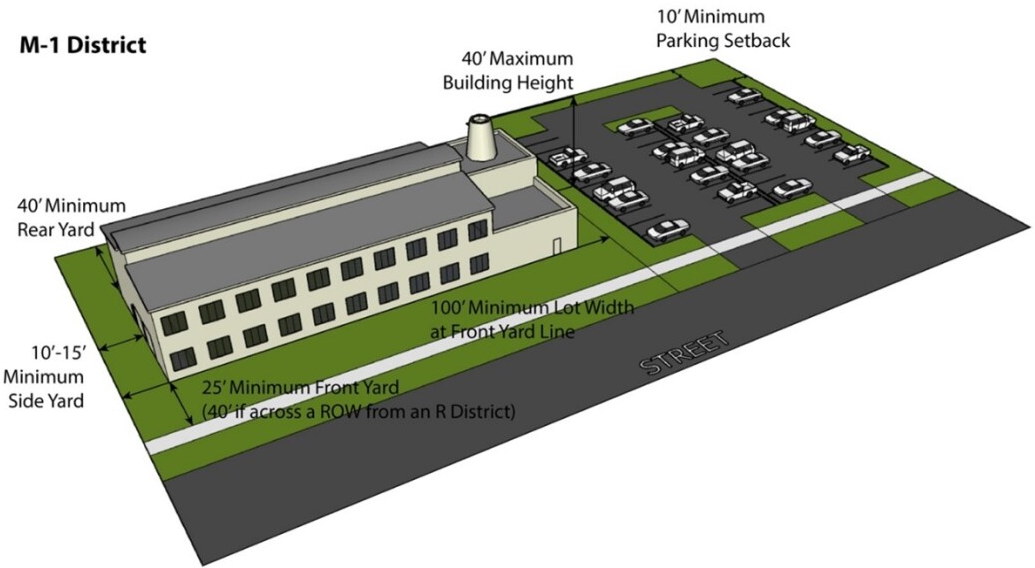
6. Additional Standards.
a. Front yards. Where a front yard is across a right-of-way from a Residence District, the front yard shall be not less than forty (40) feet and shall be landscaped per requirements described in Section 6.
b. Side yards.
i. On an interior lot, at least one interior side yard not less than fifteen (15) feet.
ii. If a second interior side yard is provided on an interior lot, neither yard shall be less than ten (10) feet, and the two (2) yards combined shall be not less than twenty-five (25) feet.
c. Rear yard. Not less than forty (40) feet in depth, except a rear yard abutting an alley or railroad right-of-way may be reduced to twenty (20) feet in depth.
d. Transition yards.
i. When a side or rear lot line in a M Limited Manufacturing District coincides with a lot line in an adjacent Residence District, a yard that includes only landscaping shall be provided along such side or rear lot line not less than twenty-five (25) feet in depth.
ii. The required transitional yard shall contain landscaping and planting suitable to provide at least seventy-five (75) percent opacity along such Residence District boundary line.
iii. No building or structure shall be erected on land used within seventy-five (75) feet of any lot line of a lot located in a Residence District, except open off-street parking and open off-street loading spaces may be located within this area.
e. Business Activities: All activities and operations shall be within completely enclosed buildings, or may be outside if completely screened by a solid wall or uniformly painted solid fence at least eight (8) feet in height, and if there is no open storage at a greater height than that of the enclosing fence. Lighting of the facility shall be directed away from surrounding properties.
3-6. Land Use Table (Table 3.2 on following page).
3-6. Land Use Table
Table 3.2
(Ord. No. 2023-4306, § 2(Exh. A), 12-4-23; Ord. No. 2025-4380, § 2, 2-24-25)

