
San Luis Obispo County Unincorporated
City Zoning Code
City Zoning Code
ARTICLE 4
STANDARDS FOR SPECIFIC LAND USES
Chapter 22.32 - ENERGY-GENERATING FACILITIES[3]
Editor's note— Ord. No. 3291, §§ 16—25, adopted March 24, 2015, repealed ch. 22.32, §§ 22.32.010—22.32.080 and enacted a new ch. 22.32. Former ch. 22.32 pertained to electric generating plants and derived from Ord. 2409, adopted 1989.
22.30.010 - Purpose.
This Chapter establishes supplementary standards for certain land uses that may affect adjacent properties, the neighborhood, or the community even if all other standards of this Title are met. It is the intent of this Chapter to establish appropriate standards for the location, design, and operation of special uses and, where necessary, permit requirements, to avoid their creating unanticipated problems or hazards, and to ensure these uses will be consistent with the General Plan. [22.08.010]
22.30.020 - Applicability of Standards for Special Uses.
The standards provided by this Chapter are related to the special characteristics of the uses discussed and unless otherwise noted, apply to developments in addition to all other applicable standards of this Title. Any land use subject to this Chapter shall comply with the provisions of this Chapter for the duration of the use.
A.
Where allowed. The land uses regulated by this Chapter are allowed only where noted by Section 22.06.030, Table 2-2 (Allowable Land Uses and Permit Requirements).
B.
Permit requirements. The land uses regulated by this Chapter shall comply with the land use permit requirements of Article 2 (Allowable Land Uses and Permit Requirements) unless otherwise specified in this Chapter, or unless other permit requirements are set by Article 9 (Community Planning Standards), or combining designation standards (Chapter 22.14).
C.
Conflicts with other provisions. In cases where the provisions of this Chapter conflict with other applicable requirements of this Title, the following rules apply:
1.
If the standards of this Chapter conflict with the provisions of Articles 2, 3, 5, or 6, these standards shall control;
2.
If a use is subject to more than one section of this Chapter, the most restrictive standard shall control;
3.
Where planning area standards in Article 9 conflict with the provisions of this Chapter, the planning area standards shall control.
D.
Exceptions to special use standards. The standards of this Chapter may be waived or modified through Conditional Use Permit approval, except where otherwise provided by this Chapter and except for standards relating to residential density or limitations on the duration of a use (unless specific provisions of this Chapter allow their modification). Waiver of modification of standards shall be granted only where the Commission first makes findings that:
1.
Set forth the necessity for modification or waiver of standards by identifying the specific conditions of the site and/or vicinity which make standard unnecessary or ineffective;
2.
Identify the specific standards of this Chapter being waived or modified;
3.
The project, including the proposed modifications to the standards of this Chapter, will satisfy all mandatory findings required for Conditional Use Permit approval by Section 22.62.060.C.4.
In no case, however, shall any standard of this Chapter be reduced beyond the minimum standards of the other chapters of this Title, except through Variance (Section 22.62.070).
[Amended 1984, Ord. 2163; 1986, Ord. 2250; 1992, Ord. 2553] [22.08.012]
22.30.030 - Accessory Uses.
Accessory uses are customarily incidental, related and subordinate to the main use of a lot or building and do not alter or change the character of the main use. With the exception of dwellings in the Agriculture category (Section 22.30.480), an accessory use as defined in this Chapter shall not be established unless a principal use has first been established on the site in compliance with all applicable provisions of this Title. An accessory structure shall not be constructed until after construction of a main building has been commenced.
[Amended 1992, Ord. 2539] [22.08.022]
22.30.040 - Accessory Storage.
Where the principal building or use on a site is other than storage, and storage accessory to that use is also located on the site, the accessory storage is subject to the following standards (see also Section 22.30.560, Storage Yards). A land use permit is not required to establish accessory storage except when this Section requires a permit for a specific type of storage, or the storage involves construction of a new structure or alteration of an existing structure.
A.
Building materials and equipment. Building materials and equipment being used in a construction project on the same or adjacent site may be stored on or adjacent to the construction site as long as a valid building permit is in effect for construction on the premises. Building materials and equipment include stockpiles of construction materials, tools, equipment, and building component assembly operations. When storage is proposed on a lot adjacent to the construction site, the land use permit application for the project is to also describe the storage site. Temporary storage of construction materials on a site not adjacent to the construction is subject to Section 22.30.620 (Temporary Off-Site Construction Yards).
B.
Commercial vehicles. This Subsection applies to the accessory storage and incidental parking of vehicles and/or self-propelled equipment used for shipping, delivery of freight and products or other purposes in support of a business. Storage means parking a vehicle longer than two consecutive nights. The storage of vehicles as a principal use is subject to the standards of Section 22.30.630 (Vehicle Storage).
1.
Within a residential area, commercial vehicles other than a standard passenger car, pickup truck or van less than 20 feet in length, shall not be stored or parked for any time longer than necessary for a pickup or delivery at the site, except:
a.
Moving vans may be parked for a single night at a site in a residential area where the contents of a dwelling are being moved; and
b.
Within the Residential Rural or Rural Lands land use categories on sites with a gross area of five acres or more, one licensed commercial vehicle unit that is more than 20 feet in length may be stored.
2.
Commercial vehicles stored in the Commercial Retail land use category shall be in an enclosed building, screened parking or loading area, except as provided in Subsections B.4.
3.
Commercial or agricultural vehicles may be stored in the Commercial Service and Industrial categories without regulation other than the standards of Chapter 22.18 (Parking).
4.
Agricultural vehicles may be stored outdoors in Commercial, Recreational and Residential categories when agricultural activities occur on site, and only within the buildable area of a site with a gross area of five acres or more. (This requirement does not apply to farm vehicle dealerships.) The storage of agricultural vehicles in the Agriculture and Rural Lands categories is unrestricted.
C.
Non-commercial and inoperative vehicles. The storage or keeping of operative non-commercial and inoperative vehicles is subject to the following, in addition to Chapter 8.24 of the County Code (Inoperative Vehicles). Storage means parking a vehicle longer than two consecutive nights. Nothing in this Title shall be construed as preventing the abatement of an inoperative vehicle which is found to be a nuisance in compliance with Chapter 8.24.
1.
Vehicles under commercial repair. The repair of vehicles is allowed only in the Commercial or Industrial land use categories as provided by Section 22.06.030 (Allowable Land Uses and Permit Requirements) except for repair of a personal vehicle by the vehicle owner, on a site owned or rented by the vehicle owner. The storage of inoperative vehicles in a Commercial or Industrial category for the purposes of repair, alteration, painting, impoundment or temporary storage by a towing service is subject to Section 22.30.120 (Automobile Repair or Services).
2.
Wrecked and abandoned vehicle dismantling or storage. Any area greater than 300 square feet used for the dismantling of inoperative vehicles, or for the storage of wrecked or abandoned vehicles not being dismantled or repaired, is subject to Section 22.30.380 (Recycling and Scrap).
3.
Automobiles stored accessory to a residential use. The storage of operative or inoperative vehicles accessory to a residential use for the purposes of maintaining a personal collection, or for personal repair, alteration, restoration or painting for hobby or other personal use is limited to two vehicles when stored outdoors, with a maximum storage area of 300 square feet. Such storage may be located only where it is not visible from the public street. Storage of such vehicles within an approved accessory building (Section 22.30.410.C) is not subject to limitation on the number of vehicles.
D.
Fuel and explosives. See Section 22.10.160 (Toxic and Hazardous Materials).
E.
Recreational vehicles and RV equipment. The accessory storage of recreational vehicles (RV's) or dependent trailers, RV equipment (camper shells, etc.) airplanes, boats, or parts of such vehicles is subject to the following standards (the storage of such vehicles as a principal or commercial use is subject to Section 22.30.630 (Vehicle Storage); the storage of mobile homes is subject to Section 22.30.450.G):
1.
Number of vehicles allowed. The number of RVs that may be stored accessory to a residential use is as follows:
a.
Residential, Office, Commercial, Recreation and Industrial categories. One self-propelled highway vehicle (e.g. a motorhome or camper) or one trailer or other dependent vehicle may be stored outdoors on a site. There is no limitation on the number of RVs, RV equipment or other vehicles listed in this Subsection when stored within a closed building.
b.
Agriculture, Rural Lands and Residential Rural categories. No more than 10 RV's may be stored when such vehicles are the personal property of residents of the site.
2.
Location of storage. Recreational vehicles are not to be stored in the required front setback area, except for one self-propelled highway vehicle in the driveway. (Vehicles on public streets are regulated by Section 15.64.010 (Time Limits) of the County Code.)
3.
Use. Stored vehicles shall be solely for the personal use of the property owner or residents of the site intended for accessory storage. Recreational vehicles shall not be used for living, sleeping or housekeeping purposes when stored on a residential lot, or in any location not approved for such use.
4.
Residential project group storage. Planned development, mobile home park or multi-family residential projects may provide an area residents to store their RVs. The storage area shall either be authorized as part of the overall project approval, or through the same type of permit required for the overall project if the storage area is in addition to a previously-approved project. These storage areas shall include no more than one storage space per residential unit in the project and shall comply with the site design standards of Section 22.30.440.D. These storage areas shall not be made available to or used by persons who do not reside in the residential project.
F.
Stockpiled materials, scrap and junk. The storage of miscellaneous materials (including building materials), articles, equipment, scrap or junk in support of ongoing work and projects or accessory to another use is subject to the following requirements. The storage of scrap and junk as a principal use is subject to the standards of Section 22.30.380 (Recycling and Scrap).
1.
Area occupied by stored materials. Stored materials shall be limited to the following maximum area, based upon the area of the site. These area limitations do not apply to materials stored entirely within a single building.
Stored materials may occupy an area larger than allowed by this Subsection if the method of storage complies instead with the provisions of Section 22.30.560 (Storage Yards) and the site is within a land use category where storage yards are allowable.
2.
Maximum height of materials stored outdoors: Five feet.
3.
Fencing required. The accessory storage outdoors of scrap, junk or miscellaneous materials in compliance with this Section shall be enclosed within a six-foot high solid wood or masonry fence. This requirement may be waived through adjustment (Section 22.70.030) where the Director determines that the proposed storage area is not visible from the public road or any adjoining parcel, and that the size of the storage area is in compliance with Subsection F.1. The outdoor storage of neatly-stacked, cut firewood for on-site domestic use only need not be fenced.
4.
Location of storage. Shall not be located within required front setback areas; or within required side setback areas within a Residential land use category.
[Amended 1981, Ord. 2063; 1982, Ord. 2091, Ord. 2106; 1984, Ord. 2163; 1986, Ord. 2250; 1987, Ord. 2320; 1992, Ord. 2539, 2553; 1999, Ord. 2880] [22.08.024]
22.30.050 - Adult Businesses.
This Section provides comprehensive regulations applicable to and regulating the location of adult businesses, and similar and related uses. These regulations are in addition to all other provisions of this Title and apply to the land uses listed in Table 2-2 (e.g., bookstores, motion picture theaters, etc.) which, because of an emphasis or primary orientation of their stock-in-trade or services offered, constitute adult businesses as defined in this Section. If any provisions of this Section conflict with other applicable provisions of this Title, the provisions of this Section shall prevail.
A.
Regulated uses. In the development and adoption of this Section, the Board finds that adult businesses, because of their very nature, are recognized as having serious objectionable operational characteristics, particularly when several of them are concentrated under certain circumstances thereby having a deleterious effect upon the adjacent areas. Special regulation of these businesses is necessary to insure that these adverse effects will not contribute to the blighting or downgrading of the surrounding neighborhoods. The primary purpose of these regulations is to prevent the concentration or clustering of these businesses in any one area.
B.
Definitions. In addition to the definitions in Article 8, the following words and phrases shall be defined as follows for the purposes of this Section, unless it is clearly apparent from the context that another meaning is intended.
1.
Adult bookstore. An establishment having as a substantial or significant portion of its stock in trade, material which is distinguished or characterized by its emphasis on matter depicting, describing, or relating to "specified sexual activities" or "specified anatomical areas," (as defined below), or an establishment with a segment or section thereof devoted to the sale or display of such material.
2.
Adult business. Any adult bookstore, adult hotel or motel, adult motion picture arcade, adult motion picture theater, cabaret, and model studio, but not including those uses or activities, the regulation of which is preempted by State law.
3.
Adult hotel or motel. A hotel, motel or other overnight establishment, which provides, through closed circuit television, or other media, material which is distinguished or characterized by an emphasis on matter depicting, describing, or relating to "specified sexual activities" or "specified anatomical areas," (as defined below), for observation by patrons therein.
4.
Adult motion picture arcade. An establishment to which the public is permitted or invited wherein coin or slug-operated or electronically, electrically, or mechanically controlled still or motion picture machines, projectors, or other image-producing devices are maintained to show images to five or fewer persons per machine at any one time, and where the images so displayed are distinguished or characterized by an emphasis on depicting or describing "special sexual activities" or "specified anatomical areas," (as defined below), for observation by patrons therein.
5.
Adult motion picture theater. An establishment in an enclosed building used for presenting material in the form of motion picture film, video tape, slides or other similar means, which is distinguished or characterized by an emphasis on matter depicting, describing, or relating to "specified sexual activities" or "specified anatomical areas," (as defined below), for observation by patrons therein.
6.
Cabaret. A bar, nightclub, theater or other establishment which features live performances by topless and/or bottomless dancers, "go-go" dancers, exotic dancers, strippers, or similar entertainers, where such performances are distinguished or characterized by an emphasis on "specified sexual activities" or "specified anatomical areas," (as defined below), for observation by patrons therein.
7.
Material. Relative to adult businesses, "material" shall mean and include, but not be limited to, accessories, books, magazines, pamphlets, photographs, prints, drawings, paintings, motion pictures, and video tapes, or any combination thereof.
8.
Model studio. An establishment where, for any form of consideration or gratuity, figure models who display "specified anatomical areas" (as defined below) are provided to be observed, sketched, drawn, painted, sculptured, photographed, or similarly depicted by patrons paying such consideration or gratuity.
9.
Specified anatomical areas. Less than completely and opaquely covered: human genitals, pubic region; buttock; female breast below a point immediately above the top of the areola; in combination with human male genitals in a discernibly turgid state, even if completely and opaquely covered.
10.
Specified sexual activities. Human genitals in a state of sexual stimulation or arousal; acts of human masturbation, sexual intercourse, or sodomy; fondling or other erotic touching of human genitals, pubic region, buttock, or female breasts.
C.
Specific regulations. In those land use categories where adult businesses regulated by this Section would otherwise be an allowable, permitted, or conditional use under Table 2-2 , it shall be unlawful to cause or permit the establishment of any adult business if the adult business is to be located within:
1.
500 feet of any land located within any Residential category or residential zone district; or
2.
1,000 feet of any other adult business; or
3.
1,000 feet of any parcel on which there is located any public library or any public, private, or parochial school or preschool; or
4.
1,000 feet of any parcel on which there is located a church or any noncommercial establishment operated by a bona fide religious organization; or
5.
1,000 feet of any parcel or which there is located a city, district, or County owned, operated and maintained public park, public playground, or other public facility.
The "establishment" of any adult business shall include the opening of such a business as a new business, the relocation of such a business, the enlargement of such a business, or the conversion of an existing business location to any adult business use.
The "enlargement" of any adult business shall include an increase in the size of the building within which the adult business is conducted by either construction or use of an adjacent building or any portion thereof whether located on the same or an adjacent parcel of land.
D.
Measure of distance. The distance between any two adult businesses shall be measured in a straight line, without regard to intervening structures, from the closest exterior structural wall of each business. The distance between any adult business and any church, school, public library, public park, public playground, public recreational facility, Residential category, or residential zone district shall be measured in a straight line, without regard to intervening structures, from the closest exterior structural wall of the adult business to the closest property line of the church, school, public library, public park, public playground, public recreational facility, Residential category, or residential zone district.
E.
Waiver of locational provisions. Any property owner or authorized agent may apply to the Commission for waiver of the locational provisions for adult businesses set forth in Subsection C.
1.
Permit requirement. Conditional Use Permit approval is required for a waiver of the locational provisions set forth in Subsection C.
2.
Application content. The Conditional Use Permit application is to include a description of the proposed adult business and the reasons why the applicant feels that the location of the proposed business would be consistent with the requirements and objectives of this Section.
3.
Additional notice. The public notice required for a public hearing on a Conditional Use Permit by Section 22.70.060 shall include mailed notice to all owners of property located within 1,000 feet of the exterior boundaries of the parcel on which the adult business is proposed to be located.
4.
Additional findings required. The Commission may approve or conditionally approve a Conditional Use Permit to waive any of the locational provisions of this Section if, in addition to the findings of fact required to be made by Section 22.62.060.C.4 , it makes findings of fact:
a.
The proposed use will not be contrary to the public interest or injurious to nearby properties, and that the spirit and intent of this Section will be observed.
b.
The proposed use will not enlarge or encourage the development of a "skid row" area.
c.
The establishment of an additional regulated use in the area will not be contrary to any program of neighborhood conservation nor with it interfere with any program of urban renewal.
[22.04.400]22.30.060 - Agricultural Accessory Structures.
A.
Limitation on use. No structure approved in compliance with this Section or Section 22.06.040.E.1 (Exemptions from Permit Requirements - Agricultural Accessory Buildings) as an agriculture accessory structure (e.g., a barn, shop, etc.) shall be used for residential purposes without first securing a land use permit for residential use and thereafter obtaining a construction permit. The construction permit shall be required for the entire structure if it was constructed as an exempt agricultural building in compliance with Section 22.06.040.E.1 and in any case for any changes to the structure proposed by the applicant and/or necessary to satisfy the requirements of Title 19 of this code (The Building and Construction Ordinance) for a dwelling.
B.
Timing. Where a parcel proposed as the site of an agricultural accessory building is less than 10 acres, an agricultural accessory building shall be established only after a principal use has first been established on the site.
C.
Minimum site area. An agricultural accessory building shall not be established on a lot with an area less than one acre.
D.
Front setback. 50 feet, unless a greater setback is otherwise required by Section 1108(b) of Title 19 of the County Code.
E.
Side and rear setbacks. 30 feet, unless a greater setback is otherwise required by Section 1108(b) of Title 19 of the County Code, but no closer than 100 feet to any dwelling outside the ownership of the applicant.
[Amended 1984, Ord. 2163; 1986, Ord. 2250; 1992, Ord. 2553; 1994, Ord. 2696; 2014, Ord. 3282] [22.08.041]
22.30.070 - Agricultural Processing Uses.
Agricultural processing activities, including, but not limited to, wineries, packing and processing plants, fertilizer plants, commercial composting and olive oil production without the use of solvents, are allowable subject to the following standards.
A.
Permit requirements.
1.
Minor Use Permit approval is required for agricultural processing activities, including, but not limited to, wineries, distilleries, packing and processing plants, fertilizer plants, commercial composting, and industrial hemp processing, unless Section 22.08.030 (Project-Based Permit Requirements) or Subsection D. would otherwise require Conditional Use Permit approval.
2.
Olive oil production. In the Agriculture and Rural Lands land use categories the permit shall be determined by Section 22.06.030, Table 2-3 for olive oil production as allowed by this Section where 100 percent of the raw materials being processed are grown on the site of the processing facility or on adjacent parcels. Olive oil production facilities as allowed by this Section where any of the raw materials being processed are not grown on the site of the processing facility or on adjacent parcels shall be subject to Minor Use Permit approval.
B.
Application content.
1.
Public notice.
a.
Prior to application submittal. The applicant shall submit evidence that the neighboring property owners and the applicable advisory group were notified of the request prior to the submission of the land use permit to the county. This notice shall be provided by the applicant sending a letter using the form provided by the Department of Planning and Building. The letter shall be mailed or delivered at least 10 days prior to application submittal to the applicable advisory group and to all owners of real property as shown on the latest equalized assessment roll within 1,000 feet of the subject site.
b.
Public hearing notice. Public notice shall be provided to owners of property within a minimum of 1,000 feet of the exterior boundaries of the proposed agricultural processing site and to all property owners fronting any local roads that serve the facility back to an arterial or collector, instead of in the manner normally required for public hearings by Section 22.70.060. Public notice may be required to be provided to properties greater than 1,000 feet away for certain applications at the discretion of the Director of Planning and Building.
2.
Description of use. Applications for agricultural processing uses are to include a description of all processes and equipment proposed for use on the site, and a description of measures proposed to minimize the off-site effects of dust, odor or noise generated by the proposed operation. Such information is to be provided in addition to that specified in Article 6 (Land Use and Development Permit Procedures), in order to evaluate the conformity of a proposed use with the standards of Article 3 (Site Planning and General Project Design Standards).
C.
Minimum site area. No minimum required unless Subsection D. would otherwise require a minimum site area.
D.
Standards for specific uses.
1.
Fertilizer plants. The following are minimum requirements to enable consideration of a specific proposal. Greater separation between fertilizer plants and other uses may be required through land use permit approval.
a.
Location: No closer than one-half mile from any residential category located within an urban or village reserve line; and no closer than 400 feet to any residence outside the ownership of the applicant.
b.
Setbacks: 200 feet from each property line.
2.
Wineries and Distilleries. For the purposes of this section, a winery is defined as an agricultural processing facility used for the processing (fermentation when combined with any of the following: crushing, barrel aging, blending, and bottling) of juices into wine or the refermenting of still wine into sparkling wine. This definition does not include the storage of case goods in the absence of processing (included under Warehousing).
For the purposes of this section, a distillery is defined as an agricultural processing facility used for the processing (fermentation when combined with any of the following: crushing, mashing, barrel aging, blending, and bottling) of fermentable raw materials into distilled spirits. This definition does not include the storage of case goods in the absence of processing (included under Warehousing).
For existing permitted wineries, the incorporation of distilling into the existing wine making activities may be deemed consistent with the approved winery land use approvals in accordance with Section 22.64.050.B (Changes to an Approved Project).
a.
Access location. The principal access driveway to a winery or distillery with public tours, tasting, retail sales or special events held in compliance with Subsection D.2.i. is to be located on or within one mile of an arterial or collector. Location of wineries and distilleries must be in compliance with access and Dead-end road requirements set in CCR title 14 and San Luis Obispo County Title 16.
b.
Solid waste disposal. Pomace may be used as fertilizer or soil amendment, provided that such use or other disposal shall occur in accordance with applicable Health Department standards.
c.
Liquid waste disposal. Standards will be set, where applicable, through Regional Water Quality Control Board discharge requirements developed in compliance with Section 22.10.180 (Water Quality).
d.
Setbacks.
(1)
Rural areas. All winery or distillery structures and outdoor use areas shall be a minimum of 100 feet from each property line and no closer than 200 feet to any existing residence outside of the ownership of the applicant. Where a winery or distillery has public tours, tasting, retail sales, or special events (in compliance with Subsection D.2.i.), the setback shall be increased to 200 feet from each property line and no closer than 400 feet to any existing residence outside the ownership of the applicant. These setbacks can be modified through Minor Use Permit approval when a Conditional Use Permit is not otherwise required by Subsection A. Approval may be granted only after the Review Authority first determines that the request satisfies any of the following findings: (1) there is no feasible way to meet the required setbacks without creating environmental impacts or impacting prime agricultural land (SCS Class I, II and III); (2) the property fronts an arterial or collector street; (3) the setbacks are not practical or feasible due to existing topographic conditions or existing on-site vegetation or (4) is a legally constructed existing structure that was built prior to 1980 and it can be clearly demonstrated that the structure was intended for a legitimate agricultural or residential use.
(2)
Urban and village areas. As required by Section 22.10.140 et seq.
e.
Signing. As provided by Chapter 22.20 (Signs) of this title and San Luis Obispo County Title 16.
f.
Parking. Parking shall be provided in compliance with Chapter 22.18 (Parking and Loading Standards). Parking lot construction standards shall be provided in compliance with Section 22.18.060. The parking shall be located and/or landscaped so it is screened from public roads where topography or existing on-site vegetation (including vineyards) does not provide for adequate screening. No parking shall be allowed within any adjoining road right-of-way.
g.
Design standards.
(1)
Exterior. In the Agriculture, Rural Lands or Residential Rural land use categories, all structures associated with the winery or distillery (including production facilities) shall have an exterior design style that is agricultural or residential in nature using non-reflective siding and roofing materials. Structures shall not use an exterior design style typically associated with large industrial facilities unless the facility is proposed in the Commercial Service or Industrial land use categories.
(2)
Screening. Any portion of the winery structures that are visible from public roads shall be screened where necessary to ensure the rural character of the area is unchanged unless screening is not practical, feasible or necessary due to existing topographic conditions or existing on-site vegetation (including vineyards). The screening may include such measures as landscape or existing vegetative screening, existing topography, and/or arrangement of the structures on the site to minimize bulky appearance. Any tank located outside of structures shall be screened 100 percent from public roads.
(3)
Height. The maximum height of any structure associated with a winery or distillery facility shall be 35 feet. The height may be increase to 45 feet where a pitched roof of greater than 4 in 12 is proposed and at least 50 percent of the structure is at 35 feet in height or less.
(4)
Lighting. All lighting fixtures shall be shielded so that neither the lamp nor the related reflector interior surface is visible from any location off the project site. All lighting poles, fixtures, and hoods shall be dark colored. No exterior lighting shall be installed operated in a manner that would throw light, either reflected or directly, in an upward direction.
h.
Tasting rooms. Tasting rooms shall be clearly incidental, related and subordinate to the primary operation of the winery or distillery as a production facility.
(1)
Permit requirement. Minor Use Permit approval. Tasting rooms shall also meet all the standards for wineries or distilleries set forth in Subsection D.2., in addition to the specific standards of this Subsection.
(2)
Location. The tasting room shall be located within or no more than 200 feet from the winery or distillery facilities. This standard may be waived where site constraints, on-site access, visual concerns, grading or other environmental issues can be better addressed through an increased distance. A Minor Use Permit application may be used to modify this standard where an existing structure built prior to 1980 is being used as the tasting facility.
(3)
Number of tasting rooms allowed. A site that includes both winery and distillery production facilities is allowed a total of two tasting rooms, one for each production facility. A site that includes only a winery production facility or only a distillery production facility is allowed one tasting room. If more than one winery or distillery share a production facility or are located on the same site, the wineries or distilleries may share a tasting room, subject to the limits above.
i.
Special events. For the purposes of this section special events are defined as any of the following events when there is the possibility that 50 people or more individuals will attend: concerts (with or without amplified sound), weddings, advertised events (including fund raising, but not including industry-wide events), and advertised winemaker/distiller dinners open to the general public. Does not include normal patronage of the tasting room or non-advertised events.
(1)
Permit requirement. Minor Use Permit approval where six or less special events for no more than 80 individuals are proposed, unless a higher level of permit is required by this ordinance for the proposed facility. Conditional Use Permit approval for six or more special events or where there is the possibility that more than 80 individuals may attend.
(2)
Minimum site area. 20 acres. A Minor Use Permit application may be used to waive this standard where the character of the area, access, and the types of special event proposed make a 20 acre minimum site area unnecessary, unless a higher level of permit is required by this ordinance for the proposed facility.
(3)
Limitation on use. Special events are limited to 40 days a year. Any special event proposing outdoor amplified music shall only be allowed from 10:00 a.m. to 5:00 p.m. No outside amplified sound shall occur before 10:00 a.m. or after 5:00 p.m. The standard relating to amplified music may only be waived or modified where a finding can be made by the Review Authority that the noise at the property line will not exceed 65dB.
(4)
Design and operational standards: All special events shall also meet all the applicable standards set forth in Subsection D.2. and the standards set forth in Subsection 22.30.610.D.1—4 and E, in addition to the specific standards of this Subsection
(5)
Setbacks. All special events shall conform to the setback standards of Subsection D.2.d.
(6)
Effect on existing Special Events. All unpermitted existing special events in existence on the effective date of this section (November 21, 2001) shall be subject to the standards specified in this Subsection. Required land use permits shall be requested from the county within 120 days of the effective date specified above. If the required land use permit, has not been requested within the time frames set forth in this section, the penalties of Chapter 22.74 (Enforcement) of this Title shall apply.
3.
Commercial composting. These standards apply to the establishment of a commercial composting operation in addition to any applicable standards or permits that may be required from the California Integrated Waste Management Board or the County Environmental Health Department.
a.
Minimum site area: Five acres.
b.
Parking requirement. None, provided that sufficient usable area is available to permanently accommodate all employee and user parking needs entirely on-site. Parking areas shall be located no closer than 100 feet from each property line.
c.
Setbacks. Outdoor use areas and structures shall be 200 feet from each property line, and no closer than 500 feet to any residence outside of the ownership of the applicant.
4.
Olive oil production. For the purposes of this section the production of olive oil is the making of edible oil obtained solely from the fruit of the olive tree (olea europea L.) and specifically excludes the manufacture of edible oils obtained using solvents or re-esterification processes and any oils resulting from a mixture with other oils except in the making of flavored olive oil. Olive oil processed using solvents is included under "Food and Beverage Products."
a.
Solid waste disposal. Pomace may be used as fertilizer or soil amendment, provided that such use or other disposal shall occur in accordance with applicable Health Department standards.
b.
Liquid waste disposal. Standards shall be set, where applicable, through Regional Water Quality Control Board discharge requirements developed in compliance with Section 22.10.180 (Water Quality).
c.
Setbacks.
(1)
Rural areas. All structures and outdoor use areas shall be a minimum of 200 feet from each property line and no closer than 500 feet to any existing residence outside of the ownership of the applicant.
(2)
Urban and village areas. As required by Section 22.10.140 et seq.
d.
Parking. None, provided that sufficient usable area is available to permanently accommodate all employee and visitor parking needs entirely on-site.
e.
Design standards. In the Agriculture, Rural Lands or Residential Rural land use categories, all structures associated with olive oil production shall have an exterior design style that is agricultural or residential in nature. Structures shall not use an exterior design style typically associated with large industrial facilities unless the facility is proposed in the Commercial Service or Industrial land use category.
f.
Lighting. All lighting fixtures shall be shielded so that neither the lamp nor the related reflector or interior surface is visible from any location off the project site. All lighting poles, fixtures, and hoods shall be dark colored. No exterior lighting shall be installed or operated in a manner that would emit light, either reflected or directly, in an upward direction.
g.
Tasting rooms and retail sales. Tasting rooms and retail sales shall be clearly incidental, related and subordinate to the primary operation of olive oil production facility. On-site tasting rooms and retail sales of olive oil are subject to Section 22.30.075 (Agricultural Retail Sales—Farm Stands).
h.
Effect on existing olive oil production facilities. All existing unpermitted olive oil processing facilities in existence on the effective date of this section (January 17, 2013) shall be subject to the standards specified in this Subsection. Required land use permits shall be requested from the County within 18 months of the effective date specified above. If the required land use permit, has not been requested within the time frames set forth in this section, the penalties of Chapter 22.74 (Enforcement) of this Title may apply.
5.
Industrial Hemp Processing. For the purposes of this section the processing of industrial hemp is limited solely to drying, curing, trimming, packaging and preparing for further processing within a permanent building (not a hoop house or similar non-permanent structure). The harvesting of industrial hemp grown onsite that is performed in the field with mobile equipment not involving permanent buildings, hoop houses, or trailers is included under crop production and grazing and subject to the standards set forth under 22.30.244. Industrial hemp processing does not include cannabinoid extraction and infusion and manufacturing of finished products. Extraction of cannabinoids from industrial hemp is considered chemical manufacturing. Manufacturing of finished hemp products are classified under existing industry, manufacturing, and processing uses according to their end product and scale of operations. For example and not limitation, manufacturing of CBD infused chemical products would be considered chemical manufacturing, hemp cloth manufacturing would be classified as textile products and manufacturing of CBD infused food and beverage products, once allowed under state law, would be included under food and beverage products.
a.
Location. Industrial hemp processing is only allowed in the Agriculture (AG), Rural Lands (RL), Commercial Service (CS), Residential Rural (RR), and Industrial (IND) land use categories.
b.
Nuisance Odors. All industrial hemp processing facilities shall be sited and/or operated in a manner that prevents hemp nuisance odors from being detected offsite. An odor management plan shall be submitted with the use permit application that demonstrates how nuisance odor will be controlled to be undetectable offsite.
c.
Design Standards. In the agriculture and rural lands land use categories, all new structures associated with onsite industrial hemp processing shall have an exterior design style that is agricultural or residential in nature. Structures shall not use an exterior design style typically associated with large industrial facilities.
[Amended 1986, Ord. 2250; 1992, Ord. 2553; Added 1995, Ord. 2741 2001, Ord. 2942; 2012, Ord. 3235; 2020, Ord. 3414; 2023, Ord. No. 3500][22.08.042]
22.30.075 - Agricultural Retail Sales.
These standards apply to the retail sale of agricultural products in structures, or a portion of a structure, constructed or converted for agricultural product merchandising. Hay, grain and feed sales are subject to Section 22.30.210 (Farm Equipment and Supplies). Sales from vehicles and seasonal sales are subject to the applicable provisions of Section 22.30.330 (Outdoor Retail Sales). Sales in the field not involving a structure that requires a building permit, including U-Pick operations, are considered Crop Production and Grazing. The standards of this Section apply in addition to all applicable permit requirements and standards of the County Health Department, and any other applicable Federal and State statutes or regulations. It is recommended that applicants contact the County Health Department as early as possible to determine if any additional standards apply.
A.
Limitation on use.
1.
Field Stand. Field Stands allowed under this section are defined as an open or fully enclosed structure, where 100 percent of the fruits, vegetables, flowers, shell eggs, nuts, raw fiber or honey offered for sale are grown or produced by the operator and the stand is located on the site where the products offered for sale are grown or produced or on another site controlled by the grower. Does not include packaging, processing, sampling or tasting or the sales of any packaged or processed produce or products.
2.
Farm Stand. Farm Stands allowed under this section are defined as a structure or portion thereof, where at least 50 percent of the floor area of the stand is dedicated to selling fruits, vegetables, flowers, shell eggs, nuts, raw fiber or honey that is grown or produced by the operator and the stand is located on the site where the products offered for sale are grown or produced or the sale of prepackaged non-potentially hazardous food, including olive oil, from a state approved source grown or produced on-site. The remaining 50 percent of the floor area of the stand may be used for the selling of fruits, vegetables, flowers, shell eggs, nuts, raw fiber or honey that is grown off site. The sale of prepackaged non-potentially hazardous food from a state approved source not grown or produced on site and other non-food ancillary items is limited to 50 square feet of storage and sales area and may include bottled water and soft drinks. Food preparation is prohibited except for food sampling or tasting.
B.
Design Standards.
1.
Sales Area Limitation. The floor area of the structure, portion of a structure and/or any outdoor display area shall be limited to a total of 500 square feet unless otherwise authorized by Minor Use Permit approval.
2.
Use of Structures. Agricultural Retail Sales located in a structure shall be permitted as required by applicable building codes.
3.
Location. The principal access driveway to a site with a Field Stand or Farm Stand in a residential land use category shall be located on or within one mile of an arterial or collector. The driveway approach shall conform with current county standards for construction and sight distance.
4.
Setbacks. Agricultural Retail Sales shall be located a minimum of 50 feet from the front property line, 30 feet from side and rear property lines, but no closer than 400 feet to any existing residence outside the ownership of the applicant. If it is not possible to maintain 400 feet from a residence outside of the ownership of the applicant, the setback can be modified through a Minor Use Permit.
5.
Parking. One parking space is required per 250 square feet of structure or outdoor display area. Parking shall be provided as follows, with such parking consisting at a minimum of an open area with a slope of 10 percent or less, at a ratio of 400 square feet per car, on a lot free of combustible material, on areas of the site that are not Class I soils as defined by the Natural Resource Conservation Service (NRCS), and outside of the public road right-of-way. Parking areas shall be located in an off-street area accessed by a driveway which conforms to local fire agency standards. The parking area shall be surfaced with crushed rock, Class II aggregate base or similar semi-permanent all weather surface.
6.
Discontinued agricultural use. In the event that the agricultural use that justified the Agricultural Retail Sales is discontinued for more than one growing season in consultation with Agriculture Department, all use of the site for Agricultural Retail Sales shall be terminated.
C.
Notice and hearing requirements.
1.
Public notice. For stands in the Residential Rural, Residential Suburban and Recreation categories, notice shall be provided to owners of property within 300 feet of the exterior boundaries of the site. The notice shall be provided not less than 10 days before the date of action on the Site Plan Review in compliance with Section 22.62.040. The notice of a Site Plan Review shall declare that the application will be acted on without a public hearing if no request for a hearing is made in compliance with Subsection C.2.
2.
Public hearing. No public hearing shall be held on the application for a Site Plan Review, unless a hearing is requested by the applicant or other affected person. Such request shall be made in writing to the Director no later than 10 days after the date of the public notice provided in compliance with Subsection C.1. If a public hearing is requested, the Agricultural Retail Sales use shall be subject a Minor Use Permit and the Director shall provide notice of the public hearing for the Minor Use Permit in compliance with Section 22.62.050.
D.
Application content.
1.
Site Plan. A site plan which clearly shows the location of the structure(s) to be used as the Agricultural Retail Sales facility, setbacks to nearest property lines, location of road access and designated parking areas.
2.
Floor Plans and Architectural Elevations. A floor plan with dimensions and elevations of the structure(s) to be used.
3.
Fire Protection. A fire safety plan that sets forth adequate fire safety measures for the proposed Agricultural Retail Sales facility. Facilities are to be provided as required by the County Fire Department or applicable Fire Agency.
4.
Water Supply, Sanitation, and Food Preparation. For Farm Stands, a clearance letter from the County Health Department shall be submitted with the land use permit application that sets forth facilities and permits that are required. The Health Department requirements may include but are not limited to: vermin proof storage, toilet, hand washing facilities and potable water.
E.
Exceptions. A Conditional Use Permit may be used to modify the limitation on use and the site design standards as set forth in Subsections A. and B.
[Amended 1994, Ord. 2696; 1999, Ord. 2880; Added 2012, Ord. 3235][22.08.056]
22.30.080 - Airfields and Heliports.
The standards of this Section apply to airfields and heliports in addition to all applicable permit requirements and standards of the Federal Aviation Administration (FAA), and the California State Department of Transportation, Division of Aeronautics. The Board hereby delegates to the Commission the authority to approve plans for construction of proposed airports and heliports, as provided by this Section.
A.
Limitation on use. Only heliports may be approved in the Office and Professional and Commercial Service land use categories; airfields are prohibited.
B.
Permit requirement. Conditional Use Permit approval, which shall constitute county approval of the plan for construction of the airport or heliport as required by the California Department of Transportation, Division of Aeronautics. If approved, the Conditional Use Permit shall be subject to a condition of approval which requires airport or heliport construction to be in compliance with the approved plan for construction. Buildings or uses accessory to an airport or heliport are subject to permit requirements and standards applicable to each use.
C.
Location criteria.
1.
Agricultural and Personal Use facilities. Shall be located only within an Agriculture or Rural Lands category, no closer than 2,500 feet to an urban reserve.
2.
Restricted Use facility. Shall be located outside of and no closer than 2,500 feet to an urban or village reserve line, except for an emergency use heliport, which may be located within an urban or village reserve. Restricted use airfields shall be located such that aircraft in approach or departure maneuvers within two miles of the airfield do not pass within 500 feet in any direction of:
a.
An existing residential use outside the ownership of the airfield;
b.
An urban or village reserve line;
c.
Any area within a Residential or Commercial Retail category;
Except for an emergency heliport established to support a medical, fire protection or other public safety facility.
3.
Public Use facilities. Shall be located only within a Public Facility land use category.
D.
Operational requirements.
1.
Agricultural or Personal Use facility. Based aircraft shall be limited to those used for agricultural crop dusting, or personal use of the tenant or owner of record. No commercial flights other than those directly related to agricultural activities are permitted.
2.
Restricted Use facilities. Not more than 10 aircraft shall be based at the strip.
E.
Permit processing.
1.
A land use permit or exemption from the State Department of Transportation, Division of Aeronautics shall be obtained for all airfields and heliports. Prior to establishment of an airfield or heliport, the applicant shall file with the Department of Planning and Building evidence of approval of such permit or exemption.
2.
Prior to or in conjunction with the approval of an airport land use permit for a public use airport, height limitations shall be established for the surrounding area in compliance with current Federal Aviation Administration regulations. Such height limitations shall be established by:
a.
Amendment of the Land Use Element to establish an Airport Review area combining designation around the airport; or
b.
Execution of easements with each property owner over whose property such height limits shall apply, with such easements to run with the land and contain restrictions on the height of structures or vegetation which are in compliance with FAA regulations.
[Amended 1992, Ord. 2553] [22.08.282]
22.30.090 - Animal Keeping.
A.
Purpose. This Section limits the number of animals allowed and the methods by which domestic, farm and exotic animals may be kept on private property, under the circumstances specified. This Section is intended to minimize potential adverse effects on adjoining property, the neighborhood and persons in the vicinity from the improper management of animals. Potential adverse effects include but are not limited to the propagation of flies and other disease vectors, dust, noise, offensive odors, soil erosion and sedimentation.
B.
Applicability. This Section applies to any keeping of animals as either an incidental or principal use, except for pet stores. (Pet stores are included under the definition of General Retail in Article 8). Certain specialized structures and facilities for animals (including animal hospitals, kennels, feed lots, fowl, poultry, hog or horse ranches) may also be subject to Sections 22.30.060 (Agricultural Accessory Structures) or 22.30.100 (Specialized Animal Facilities), as applicable.
C.
Limitation on use. Animal keeping is not allowed in the Residential Multi-Family, Office and Professional and Commercial land use categories except for:
1.
The keeping of household pets in an approved residential use; and
2.
Animal facilities allowed in compliance with Section 22.30.060 and
3.
Agricultural uses in urban and village areas in compliance with Section 22.30.200.
D.
Permits and applications.
1.
Permit requirements: None, except as otherwise required by Subsection F. for specific types of animals, or as required by Section 22.30.100 (Animal Facilities) or other provisions of this code for structures used to enclose or house animals; provided that all animal keeping activities are subject to the requirements of this Section regardless of whether a permit is required.
2.
Application content. Where this Section requires land use permit approval for a specific animal raising activity, the permit application shall include the following, in addition to all information required by Article 6:
a.
Site drainage patterns and a statement of measures proposed by the applicant to avoid soil erosion and sedimentation caused by the keeping of animals.
b.
The applicant's plans for animal waste disposal.
c.
Where the site is located within or adjacent to a Residential or Recreation category, a statement of other measures proposed by the applicant for the management of the site and proposed animals to insure that the animals will not become a nuisance to other residents in the vicinity of the site.
E.
Site requirements. Animal keeping is allowed only on sites that comply with the following standards, except for the keeping of household pets in compliance with Subsection F. (Household Pets).
1.
Minimum site area. As provided Subsection F. for the specific animal raising activity.
2.
Setbacks required.
a.
Buildings. Livestock and poultry buildings, barns, stables or other accessory buildings related to the animal raising activity are subject to the setback and other applicable provisions of Section 22.30.060 (Agricultural Accessory Structures), except as otherwise provided in Subsection H.
b.
Outdoor animal enclosures. Corrals, paddocks, pens and other outdoor animal enclosures shall be located as required by the following setbacks:
(1)
Setback from adjoining residential use. Animal enclosures shall be located at least 50 feet from any previously existing dwelling, swimming pool, patio or other living area on property other than the site.
(2)
Setback from streets. As required by Section 22.10.140, animal enclosures shall be located a minimum of 25 feet from a front property line and 10 feet from a street side property line; except that no such setbacks are required in the Agriculture, Rural Lands and Open Space categories, or in the Residential Rural or Suburban categories outside of urban or village areas.
(3)
Setback for specific animals. Where Subsection H. requires a specific setback for a particular animal species, the Subsection H. setback shall prevail.
F.
Permit requirements and minimum site area for animal keeping. The following requirements apply to the keeping and raising of specific types of animals in addition to all other applicable standards of this Section, including but not limited to animal density and other limitations set forth in Subsection H.
G.
Maintenance and operational standards.
1.
Odor and vector control. All animal enclosures, including but not limited to pens, coops, cages and feed areas shall be maintained free from litter, garbage and the accumulation of manure, so as to discourage the proliferation of flies, other disease vectors and offensive odors. Sites shall be maintained in a neat and sanitary manner.
2.
Erosion and sedimentation control. In no case shall an animal keeping operation be managed or maintained so as to produce sedimentation on any public road, adjoining property, or in any drainage channel. In the event such sedimentation occurs, the keeping of animals outdoors on the site shall be deemed a nuisance and may be subject to abatement in compliance with Chapter 22.74 (Enforcement).
3.
Noise Control. Animal keeping within urban or village areas or in Residential land use categories shall comply with the noise standards established by Section 22.10.120.
H.
Specific animal standards. The following requirements apply to the keeping of specific types of animals, in addition to all other applicable standards of this Section. More than one type of animal may be kept on a single site, subject also to the provisions of Subsection I. The limitations of this Subsection on numbers of animals do not apply to unweaned offspring.
1.
Animal husbandry projects.
a.
General standards. Notwithstanding the other provisions of this Section, except the limitations on use in Subsection C. and the maintenance and operational standards of Subsection G., the keeping or raising of a calf, horse, goat, sheep, hog, chickens, rabbits, birds or other animals as a current and certified (or otherwise documented) 4-H or Future Farmers of America (FFA) official project is subject to the standards Subsection F. for animal husbandry projects.
b.
Enclosure required. On any parcel less than one acre, project animals shall be confined in a pen or fenced area that is located no closer than 25 feet to any residence other than that on the project site. Hogs shall not be located closer than 100 feet from any dwelling other than those on the project site.
2.
Bee keeping. Permit requirements and standards for bee keeping are specified by Chapter 5.04 of this code (Bees).
3.
Birds. Applicants should be advised that the keeping of imported birds may require approval by the U.S. Department of Agriculture, Fish and Wildlife Service, U.S. Department of Public Health, California Department of Fish and Game, and/or California Department of Food and Agriculture, in addition to any approval required by this Title.
4.
Cattle.
a.
Animal density. The maximum number of animals allowed is one per acre of site area in the Residential Single-Family category; two per acre in the Residential Suburban category; and three per acre in other categories; except as provided by Subsection H4b. The keeping of cattle at four or more per acre for more than 45 days is considered a feedlot and is subject to Section 22.30.100.C.
b.
Uses not regulated. Cattle operations in the Agriculture, Rural Lands and Open Space categories on parcels larger than 20 acres are not regulated by this Title, except to the extent that land use or construction permits may be required for buildings and structures, and except for feedlots, which are subject to the requirements of Section 22.30.100.C.
5.
Fowl and poultry. The following standards apply to the keeping of fowl or poultry for personal domestic use and the keeping of 20 or fewer fowl or poultry for commercial purposes. The keeping of more than 20 fowl or poultry for commercial purposes is instead subject to Section 22.30.100.D (Fowl and Poultry Ranches).
a.
Limitation on use. No male fowl or poultry shall be kept or raised in a Residential Single-Family category except on parcels of two acres or larger, where all adjacent parcels are of equivalent size or larger.
b.
Animal density. Except where greater numbers are authorized through Minor Use Permit, the number of fowl or poultry allowed on a site shall be limited to a ratio of one mature animal for each 500 square feet of site area, except that 3,000 square feet per mature animal is required for turkeys.
c.
Enclosure required. All mature fowl and poultry shall be contained in coops or pens and not allowed free run of a site.
6.
Fur-bearing animals. The keeping of mink, chinchillas or other animals of similar size is subject to the following standards.
a.
Animal density. No more than 50 mature animals per acre; no limitation when pens are entirely within a building; no limitation in the Agriculture or Rural Lands categories on parcels of 20 acres or larger, or in the Industrial category.
b.
Setbacks. Enclosures for the keeping of animals shall be located no closer than 200 feet from any dwelling other than those on the site.
c.
Enclosure required. All carnivorous animals shall be contained in cages or pens, and not allowed free run of a site.
7.
Goats and sheep (and animals of similar size at maturity). The maximum number of animals allowed in a land use category other than Agriculture and Rural Lands is four per acre of site area, unless Minor Use Permit approval is first obtained. Keeping goats or sheep in the Agriculture or Rural Lands categories is not subject to the provisions of this Title.
8.
Hogs and swine.
a.
Limitation on use. The keeping of hogs and swine is prohibited in the Residential Single-Family category, except as otherwise provided by Subsection H.1.
b.
Animal density. The maximum number of hogs or swine allowed is three sows, one boar and their unweaned litter. More animals constitute a hog ranch, and are subject to Section 22.30.100.E (Hog ranches).
c.
Setbacks. Animal enclosures shall be located no closer than 100 feet from any dwelling other than those on the site.
9.
Horses. The following requirements apply to the keeping of less than 30 of any member of the horse family, including donkeys and mules. The keeping of 30 or more animals or the establishment of equestrian facilities including boarding stables, riding schools and academies and horse exhibition facilities (for shows or other competitive events) constitute specialized animal facilities and are instead subject to Section 22.30.100.F. The keeping of horses for commercial purposes is also subject to the provisions of Title 9 of the County Code.
a.
Permit requirement.
(1)
Agriculture or Rural Lands. No permit required for the keeping of less than 30 horses in the Agriculture or Rural Lands categories on sites of 20 acres or larger.
(2)
Other land use categories, smaller sites. In other than the Agriculture and Rural lands categories (and in Agriculture or Rural Lands on parcels less than 20 acres), no permit required for one to 14 horses; Zoning Clearance for 15 to 29.
b.
Animal density - Single-family areas. The maximum number of horses allowed is one per acre of site area in the Residential Single-Family (RSF) land use category.
c.
Animal density in other than single-family areas.
(1)
Residential Suburban category. Three horses per gross acre are allowed in the Residential Suburban category.
(2)
Parcels less than five acres. Three horses per gross acre may be kept on parcels less than five acres in allowed land use categories.
(3)
Other categories, larger parcels. Four horses per acre may be kept in allowed land use categories on parcels of five acres or larger.
The keeping of horses at greater densities or the keeping of more than 30 horses on a single site constitutes a horse ranch and is instead subject to Section 22.30.046f.
10.
Rabbits and rabbit farms.
a.
Applicability. The raising or keeping of 20 or more rabbits, and the raising or keeping of rabbits for commercial purposes are subject to the standards of this Subsection. The raising or keeping of fewer than 20 rabbits not for commercial purposes, are subject only to the requirements of Subsections C., D., and G.
b.
Animal density. No more than 50 mature animals per acre; no limitation when pens are entirely within an enclosed building; no limitation in the Agriculture or Rural Lands categories on parcels of 20 acres or larger, or in the Industrial category.
11.
Zoo animals. The raising or keeping of animals other than those specified in Subsections H.2 through H.10 that are common to zoos, are carnivorous, poisonous or are not native to North America are subject to the location limitations and permit requirements of Section 22.06.030, Table 2-2, except that:
a.
Where the animals have satisfied all applicable requirements of the U.S. Department of Agriculture, Fish and Wildlife Service, U.S. Department of Public Health, California Department of Fish and Game and the California Department of Food and Agriculture, the Director may determine after consultation with appropriate zoological experts that a particular non-carnivorous, non-poisonous animal is substantially similar in its physical characteristics and/or potential effects on a site and persons in the vicinity to one of the animals listed in Subsections H.2 through G.10; and
b.
In this case, the keeping of the particular exotic animal may be allowed subject to the specific provisions of Subsections H.2 through H.11 identified by the Director.
I.
Multiple animal types. More than one species of the animals listed in Subsections F. and H. may be kept on a single site provided that:
1.
The requirements of Subsection H. and all other applicable provisions of this Section are satisfied for each species, except as provided in following Subsections I.2 and I.3.
2.
Where Subsection H. establishes a minimum site area for specific species, the largest minimum site area applicable to any of the proposed animals shall apply.
3.
Where multiple proposed animal species have equivalent animal density requirements established by Subsection H., the total number of animals shall not exceed the density requirement. (e.g. cattle and horses are both limited to a density of two per acre of site area in the Residential Rural land use category. A site with two acres of pasture area could have as many as four horses or cows, or any combination of horses and cows, as long as the total did not exceed four.)
[Added 1986, Ord. 2290; amended 1987, Ord. 2309; 1992, Ord. 2553; 1999, Ord. 2880; 2009, Ord. 3183] [22.08.044]
22.30.100 - Animal Facilities - Specialized.
Certain facilities and structures included under the definition in Article 8 of "Animal Keeping" that are used in support of the raising or keeping of animals are subject to the requirements of this Section. These standards apply in addition to all applicable provisions of Title 3 (Food and Agriculture) and Title 17 (Public Health) of the California Code of Regulations.
A.
General standards. All the specific uses addressed by Subsections B. through G., and any other uses included under the definition of animal facilities, are subject to the following standards, except where otherwise provided by this Section.
1.
Application content. Permit applications required by this Section shall include all information specified by Article 6, all information specified by Section 22.30.090.D.2, and a description of measures proposed for rodent and vector control, which shall be approved by the Agricultural Commissioner and Health Department.
2.
Conditions of approval. Approval of a Minor Use Permit or Conditional Use Permit for a specialized animal facility shall include conditions of approval as necessary to assure sanitary operations which will not create a nuisance or health hazard.
3.
Parking requirements. Except where specific parking requirements are set through Minor Use Permit or Conditional Use Permit approval, no improved parking is required, provided that sufficient usable area is make available to accommodate all employee and user vehicles entirely on the site.
4.
Maintenance. The specialized animal facilities allowed in compliance with this Section are subject to the same maintenance and operational standards as are applied to animal raising and keeping by Section 22.30.090.G, except where Minor Use Permit or Conditional Use Permit approval imposes conditions of approval that authorize alternative measures.
5.
Animal density. There is no limitation on the number of animals that may be kept on a site approved for a specialized animal facility in compliance with this Section, except where limits may be set by the applicable approval body through conditions of approval, because of specific problems associated with keeping animals on the site that are identified through the land use permit process.
B.
Animal hospitals and veterinary medical facilities.
1.
Minimum site area. 6,000 square feet in the Office, Commercial, Industrial and Public Facilities categories; one acre in other allowed categories.
2.
Site requirements.
a.
Setbacks. When located in the Agriculture, Rural Lands and Recreation categories, enclosures for the keeping of animals shall be located 100 feet from any dwelling other than those on the site. Setbacks in other allowed categories shall be provided as required by Sections 22.10.140 et seq. (Setbacks).
b.
Access. From a paved, publicly maintained road.
c.
Enclosure required. When located in an Office and Professional or Commercial category, all veterinary activities shall be conducted entirely within a building.
3.
Operation.
a.
Care and boarding. Care and boarding shall be limited to small animals, and may not include cattle, horses, or swine, except in the Agriculture, Rural Lands, Commercial Service or Industrial categories.
b.
Maintenance. The premises shall be maintained in a clean and sanitary condition by the daily removal of waste and by the use of spray and disinfectants to prevent the accumulation of flies, the spread of disease or offensive odor. Waste incineration is prohibited.
C.
Beef and dairy feedlots. The keeping or raising of four or more cattle per acre (not including unweaned offspring) for a period exceeding 45 days is subject to the following standards:
1.
Minimum site area. 20 acres.
2.
Location. A feedlot site shall be located so that cattle enclosures are: no closer than one mile from any Residential category located within an urban or village reserve line; and no closer than 400 feet from any dwelling other than those on the site.
3.
Access. From an all-weather road or railroad spur.
4.
Waste disposal. To be in compliance with discharge requirements established in compliance with Section 22.10.190 (Water Quality), and any requirements of the Health Department.
5.
Additional notice. The public notice required for a hearing on a Conditional Use Permit by Section 22.70.060 shall include additional mailed notice to all owners of property located within 1,500 feet of the exterior boundaries of the site.
D.
Fowl and poultry ranches. The raising or keeping of more than 20 fowl or poultry for commercial purposes, or at densities greater than 500 square feet of site area per mature animal (or more than one turkey per 3,000 square feet) is subject to the same standards that are required of beef and dairy feedlots by Subsections C.3 through C.5 and a minimum site area requirement of five acres.
E.
Hog ranches. The raising or keeping of more than three sows, a boar and their unweaned litter is subject to the same standards that are required of beef and dairy feedlots by Subsection C. A hog ranch shall be located no closer than one mile from any residential category; and no closer than 1000 feet from any school, or dwelling other than those on the site.
F.
Horse ranches and other equestrian facilities. The keeping of 30 or more horses, or horses at greater densities than provided by Section 22.30.090.H.9.b and H.9.c, or the establishment of equestrian facilities including boarding stables, riding schools and academies and horse exhibition facilities (for shows or other competitive events), is subject to a minimum site area requirement of 10 acres, except where a smaller site area is authorized through Conditional Use Permit approval.
G.
Kennels.
1.
Minimum site area. 2-½ acres in the Rural and Suburban Residential categories; 6,000 square feet in the Office and Professional, Commercial, Industrial and Public Facilities categories; one acre in the Residential Single-Family land use category.
2.
Site design.
a.
Setbacks. When located in the Residential Rural, Suburban and Single-Family categories, enclosures for the keeping of animals shall be located 100 feet from any dwelling other than those on the site. Setbacks in the other allowed categories shall be as required by Section 22.10.140 (Setbacks).
b.
Access. None, where no on-site boarding or sale will occur. Where on-site boarding and sale will occur the following access standards apply:
(1)
When located in the Residential Suburban and Single-Family, Recreation, Office and Professional, Industrial, and Commercial Retail and Service land use categories, access shall be provided from a paved, publicly maintained road.
(2)
When located in the Agriculture, Rural Lands or Residential Rural land use categories, access shall be provided from a road improved with chip-seal or better that is maintained through organized maintenance such as a homeowner's association or a road maintenance agreement.
c.
Enclosure required. When located in an Office and Professional or Commercial category, all kennel activities shall be conducted entirely within a building.
3.
Operation. Kennels are subject to the same operation standards as are required for animal hospitals by Subsection B.3.
[Added 1986, Ord. 2290; Amended 1987, Ord. 2309; 1992, Ord. 2553; 1992, Ord. 2583; Added 1995, Ord. 2741; 1999, Ord. 2880] [22.08.046]
22.30.110 - Auto and Vehicle Dealerships.
Vehicle dealerships in the Commercial Retail category are subject to the following standards. Auto parts stores are not subject to these standards when conducted entirely within a building.
A.
Limitations on use. Vehicle dealerships are limited to new and/or used automobiles and motorcycles (including mopeds). In a central business district, vehicle dealerships are allowed provided all vehicles for sale are stored, displayed and serviced entirely within a building.
B.
Access. From a collector, arterial or freeway frontage road, or a local street in an auto sales park development.
C.
Setbacks. A minimum 10-foot landscaped setback is required from all street frontage property lines.
D.
Outdoor use. The outdoor display or storage of vehicles is allowed subject to the standards of Section 22.30.530 (Sales Lots), except that the outdoor display or storage of any product or material by a vehicle dealership except vehicles for sale is prohibited in a Commercial Retail category.
[Amended 1984, Ord. 2163; 1992, Ord. 2553] [22.08.201]
22.30.120 - Auto and Vehicle Repair and Service.
A.
Repair and services other than self-service washing. All repair and service activities, and the temporary storage of vehicles while waiting for repair, service or body work shall be conducted within a building, or within a yard enclosed by a six-foot high solid fence, such that storage or repair activities are not visible from the public street.
B.
Self-service car washes. The standards of this Subsection are applicable to self-service car washes where the vehicle remains stationary during washing.
1.
Permit requirement. Site Plan Review, except when Section 22.08.030 (Permit Requirements), would require Conditional Use Permit approval.
2.
Location. A car wash shall not be located within 100 feet of a Residential Single Family land use category.
3.
Access lanes. Separate on-site access and egress lanes shall be provided, and identified with directional signing. Site access and egress may be from a single driveway, provided that one-way traffic flow is maintained on-site.
4.
Washing line or bay orientation. Washing bays shall be oriented so that the bay entrances and exits do not face an adjoining street. Access to the bays shall be one-way only.
5.
Setbacks. Structures shall be set back from site property lines at distances sufficient to provide the following features.
a.
Waiting area. An area 10 by 20 feet shall be provided adjacent to the entrance of each washing bay for a vehicle waiting to use the bay.
b.
On-site circulation. The car wash structure, and waiting area described in Subsection B.5.a shall be encircled by a one-way driving lane with a minimum width of 24 feet along the washing bays, and 12 feet adjacent to the building ends.
c.
Drying area. An area shall be provided for the drying of vehicles after washing, consisting of separate spaces which are a minimum size of 12 by 20 feet. Drying spaces shall be provided at a ratio of two per washing bay.
d.
Adjacent to multi-family use. A 10-foot landscaped setback shall be provided along the total length of any property line abutting a multi-family residential use.
6.
Landscaping. A 10-foot landscaping strip shall be provided across any street frontage of the site, exclusive of driveways.
7.
Fencing. The interior lot lines of a car wash site shall be screened with solid wood or masonry fencing, six feet in height, except within 10 feet of the street right-of-way, where no fencing is required.
[Amended 1984, Ord. 2163; 1992, Ord. 2553] [22.08.222]
22.30.130 - Automobile Service Stations and Gas Stations.
Gas stations, and vehicle fuel sales businesses with incidental service facilities shall comply with the following standards.
A.
Location criteria.
1.
Location adjacent to RSF prohibited. No new gas station shall be located adjacent to a lot in the Residential Single-Family land use category.
2.
Access. An automobile service station shall be approved only at locations which meet the following standards for street access:
a.
At any intersection where at least one intersecting street is a collector or arterial; or
b.
Between intersections on an arterial, provided that such location is at least 1,000 feet from any intersection with another arterial; or
c.
Within a shopping center or industrial park, when vehicle access to the service station is only from within the shopping center or industrial park and not directly from a public street, except as provided by Subsections A.2.a and A.2.b.
B.
Minimum site area. 15,000 square feet, with minimum dimensions of 125 feet on all street frontages.
C.
Site design criteria. The following standards apply to gas stations in addition to the other applicable standards of this Title.
1.
Setbacks.
a.
Pump islands. 18 feet from any street right-of-way.
b.
Buildings. 10 feet from any street right-of-way.
c.
Adjacent to multi-family use. A 10-foot landscaped setback shall be provided along the total length of any property line abutting a multi-family residential use.
2.
Access driveways. Driveways providing access to service station sites shall be a minimum width of 30 feet, and shall no closer than 20 feet from the nearest curb line of any intersecting street.
3.
Parking requirement. One space, plus two spaces per service bay.
4.
Landscaping. A landscaping strip with a minimum width of five feet shall be located adjacent to all street frontages, exclusive of driveway areas. The total area of landscaping shall be a minimum of 20 percent of the total site area.
5.
Signs. Signage shall be as provided by Chapter 22.20 (Signs) of this title.
D.
Repair activities. All areas set aside for repair activities allowed by Section 22.06.030, Table 2-2 in conjunction with a service station shall be entirely within a building.
[Amended 1992, Ord. 2553; 2020, Ord. 3420] [22.08.202]
22.30.140 - Building Materials Sale.
A.
Commercial Retail land use category. Building materials sales in the Commercial Retail category shall comply with the following standards.
1.
Limitation on use. Building materials sales shall not include incidental retail ready-mix concrete operations.
2.
Enclosure required. In the Commercial Retail category, all building materials sales activities and storage shall be enclosed within a building.
B.
Commercial Service land use category. Building materials sales uses in the CS land use category that include incidental retail ready-mix concrete operations used primarily by retail customers (not wholesalers or contractors) shall comply with the following standards.
1.
Application content. Where the site adjoins a residential land use category or a lot containing a residential use, the Conditional Use Permit application shall include an acoustical report with recommended mitigation measures which enable compliance with the exterior noise standard in Section 22.10.120.
2.
Access. Shall be taken from a collector, arterial or freeway frontage road, and shall not be taken through residential areas or on streets used primarily by residential traffic.
3.
Operation.
a.
Hours of operation. Between 7:00 a.m. and 9:00 p.m. where adjacent to a residential category or a lot containing a residential use; no limitations in other locations.
b.
Noise. Noise from the ready-mix concrete operation shall not exceed 65 dBA as measured at the nearest property line of a residential category or a lot containing a residential use.
[Amended 1987, Ord. 2330] [22.08.203]
22.30.150 - Cemeteries and Columbariums.
A.
Minimum site area. One acre for cemeteries; no minimum for a columbarium.
B.
Location. On a collector or arterial.
C.
Site design standards.
1.
Setbacks. All structures and burial plots shall be located no closer than 30 feet to any property line.
2.
Site coverage. No more than five percent of a cemetery site may be occupied by buildings.
3.
Landscaping. A 10-foot landscaping strip containing screening plant materials shall be provided adjacent to all interior lot lines.
4.
Interment facilities. All facilities for ground burial shall be designed and constructed in compliance with any requirements established by the Regional Water Quality Control Board (see Section 22.10.190 - Regional Water Quality Control Board Review).
[Amended 1994, Ord. 2696] [22.08.064]
22.30.160 - Chemical Products Manufacturing.
A.
Permit requirement. Minor Use Permit approval, unless a Conditional Use Permit is otherwise required by Section 22.08.030 (Permit Requirements - Manufacturing and Processing Uses.
B.
Location. A chemical product manufacturing facility shall be located no closer than 1,000 feet to a Residential, Office and Professional, Commercial Retail, Public Facilities or Recreation land use category.
C.
Minimum site area. Five acres, unless otherwise provided by Subsection D.
D.
Specific use standards.
1.
Explosives manufacture. The manufacture of explosives is subject to the following standards.
a.
Location. No closer than one mile to any Residential, Commercial, Office and Professional, Recreation, or Public Facilities category.
b.
Minimum site area. 20 acres.
c.
Storage. The storage of explosives shall be in compliance with Section 22.10.050 (Toxic and Hazardous Materials).
2.
Gaseous products. The manufacture or bulk storage of explosive or corrosive gaseous products such as acetylene, chlorine, fluorene and hydrogen, are subject to the special standards for explosives in Subsection D1.
[Amended 1992, Ord. 2553] [22.08.082]
22.30.170 - Child Day Care Facilities.
The following standards apply to large family day care homes and child care centers in addition to state licensing requirements in the California Code of Regulations, title 22, sections 81009 et seq. These standards do not apply to any facility that provides elementary school educational programs for non-resident children older than six years of age; these facilities are instead subject to Section 22.30.540 (Schools). These standards do not apply to child day care facilities that are accessory and secondary in nature to an approved principal non-residential use.
A.
Permit requirements - Family day care homes. No permit is required for facilities with six or fewer children (Small Family Day Care Homes), which are not regulated by this Title; Zoning Clearance or Minor Use Permit approval is required for facilities with seven to 12 children (Large Family Day Care Homes).
Zoning Clearance approval is required where no public hearing is requested in compliance with Subsection A.2. Where a public hearing is requested, a large family day care home requires Minor Use Permit approval and an additional fee in an amount equivalent to the difference between the fees for Zoning Clearances and Minor Use Permits shall be paid by the applicant. The Zoning Clearance shall be processed and approved in compliance with Section 22.62.030 and the Minor Use Permit shall be processed and approved in compliance with Section 22.62.050, except as follows:
1.
Public notice. As required by California Health and Safety Code Section 1597.46(a)(3), the notice for a Zoning Clearance or Minor Use Permit shall be provided to owners of property within 100 feet of the exterior boundaries of the large family day care home instead of in the manner normally required for Minor Use Permits by Section 22.62.050.B.4.a. Notice shall be provided not less than 10 days before the date of action on the Zoning Clearance in compliance with Section 22.62.030.D or action on the Minor Use Permit in compliance with Section 22.62.050. The notice for a Zoning Clearance approval shall declare that the application will be acted on without a public hearing if no request for a hearing is made in compliance with Subsection A.2.
2.
Public hearing. As required by California Health and Safety Code Section 1597.46(a)(3), no public hearing shall be held on the application for a Zoning Clearance for a large family day care home, unless a hearing is requested by the applicant or other affected person. The request shall be made in writing to the Director no later than 10 days after the date of the public notice provided in compliance with Subsection A.1. In the event a public hearing is requested, the large family day care home shall be subject to Minor Use Permit approval and the Director shall provide notice of the public hearing for the Minor Use Permit in compliance with Subsection A.1.
3.
Permit approval. As required by California Health and Safety Code Section 1597.46(a)(3), the Director shall approve a Zoning Clearance or Minor Use Permit for a large family day care home when he or she determines that the proposed facility will satisfy all applicable requirements of this Section, and can find that the facility will not generate a volume of traffic beyond the safe capacity of all roads providing access to the project.
B.
Permit requirements - Child care centers. Except as set forth in Subsection A.1, Conditional Use Permit approval is required for facilities with 13 or more children.
C.
Site location. Large family day care homes and child care centers shall be located only on sites which satisfy the following standards:
1.
Minimum street improvements. In order to assure safe vehicular access to the site of a child care facility, the street providing access to the site shall be a paved or publicly-maintained road with sufficient clear width to accommodate on-street parking at the site, located entirely outside of the travel lanes.
2.
Concentration standards. In order to avoid excessive concentrations of large family day care homes in single-family residential areas, no child care facility shall be approved within the same block or within 500 feet of any other large family day care home or child care center in the residential single-family category, except where specifically authorized through Minor Use Permit approval.
D.
Fencing requirements. All outdoor play areas shall be enclosed with fencing; a minimum of four feet high. Such fencing shall be solid and a minimum of six feet high on any property line abutting a residential use on an adjoining lot where determined to be needed for effective noise control.
E.
Parking and loading requirements.
1.
Large family day care homes. An off-street drop-off area shall be provided with the capability to accommodate at least two cars, in addition to the parking normally required for the residence; a driveway may be used for this purpose. Additional off-street parking shall be provided as necessary to accommodate all employee vehicles on the site.
2.
Child care centers. Parking and loading requirements shall be established through Conditional Use Permit approval.
F.
Noise control - Outdoor uses. Where one or more parcels adjoining the site of a large family day care home or child care center are in a residential land use category and are developed with single-family dwellings, outdoor play or activity areas shall not be used by client children before 8:00 a.m., except:
1.
Where such outdoor areas are located no closer than 100 feet from any dwelling other than that of the applicant; or
2.
Where specifically authorized through Minor Use Permit or Conditional Use Permit approval.
[Amended 1982, Ord. 2091; 1986, Ord. 2250; 1987, Ord. 2293; 1994, Ord. 2693, 2696]
22.30.180 - Communications Facilities.
The requirements of this Section apply to communications transmission and receiving facilities in addition to all applicable permit requirements and standards of the Federal Communications Commission (FCC) and any other applicable Federal or State statutes or regulations. Communications facilities in the Residential Suburban, Single- and Multi-Family land use categories shall be limited to those specified in Subsection C.
A.
Permit requirements. In addition to the emergency repair and the general permit requirement of Sections 22.30.360.A and B., Conditional Use Permit approval is required for any new facility or modification of any existing facility that would increase the power output or the power received, or the structure heights above those specified in Section 22.10.090, or modify any operational standards causing a change in exterior noise, vibrations, air quality, water quality or storage and use of toxic and hazardous materials as specified in Article 3.
B.
Application content. The application for a land use permit shall contain estimates of the non-ionizing radiation generated by the facility and/or received by the facility. These shall include estimates of the maximum electric and magnetic field strengths at the edge of the facility site and the extent that measurable fields extend in all directions from the facility.
C.
Wireless communication facilities.
1.
Permit requirements.
a.
Minor Use Permit. Minor Use Permit approval is required for the following wireless communications facilities:
(1)
Existing Structures. Installation proposed on existing structures (buildings, water tanks, signs etc.), existing electric transmission towers, or any other applicable existing structure; and
(2)
Co-location. Wireless communication system antennas or other similar equipment that share locations with their own or other carriers' antennas either on existing monopoles, existing structures (buildings, water tanks, signs etc.), existing electric transmission towers, existing lattice towers or any other existing structures.
b.
Conditional Use Permit. Conditional Use Permit approval is required for any wireless communication antenna or other similar equipment not in compliance with Subsection C.1.a.
2.
Application contents. In addition to all information required by Chapter 22.60 and Section 22.30.360.B, the applicant shall submit the following information:
a.
Information on the proposed rights-of-way, including width, ownership, present land use, slope, soils and vegetation, types of sizes of towers or other structures to be used, proposed screening or other method of finishing so as to be unobtrusive to the neighborhood in which it is located.
b.
If co-location is not proposed, the applicant shall provide information pertaining to the feasibility of joint-use antenna facilities, and discuss the reasons why such joint use is not a viable option or alternative to a new facility site. The information shall include:
(1)
Whether it is feasible to locate proposed sites where facilities currently exist;
(2)
Information on the existing structure which is closest to the site of the applicant's proposed tower relative to the existing structure's structural capacity, radio frequency interference, or incompatibility of different technologies, which would include mechanical or electrical incompatibilities; and
(3)
Written notification of refusal of the existing structure owner to lease space on the structure.
3.
Development standards. The following standards apply to the development of proposed wireless communication system antenna and related facilities in addition to any that may be established during the permit review process.
a.
Setbacks. As set forth in Section 22.10.140, except where locating the facility outside those setbacks is the most practical and unobtrusive location possible on the proposed site.
b.
Location. The applicant shall pursue placement of facilities in the following preferential order:
(1)
Side-mount antenna on existing structures (buildings, water tanks, etc.) when integrated into the existing structure, completely hidden from public view or painted and blended to match existing structures; or
(2)
Within existing signs when blended within or on existing signage to be completely hidden from public view; or
(3)
Atop existing structures (buildings, water tanks, etc.) with appropriate visual/architectural screening to be completely hidden from public view; or
(4)
Existing monopoles, existing electric transmission towers, and existing lattice towers; or
(5)
New locations.
c.
Signs. No sign of any kind shall be posted or displayed on any antenna structure except for public safety warnings.
d.
Screening. All facilities shall be screened with vegetation or landscaping. Where screening with vegetation is not feasible, the facilities shall be disguised to resemble rural, pastoral architecture (ex: windmills, barns, trees) or other features determined to blend with the surrounding area and be finished in a texture and color deemed unobtrusive to the neighborhood in which it is located.
e.
Availability. All existing facilities shall be available to other carriers as long as structural or technological obstacles do not exist.
4.
Unused facilities. All obsolete or unused facilities shall be removed within 12 months of cessation of telecommunication operations at the site.
[Added 1990, Ord. 2444; amended 1999, Ord. 2884] [22.08.284]
22.30.190 - Consumer Product Repair Services.
When located in a central business district, a repair service that is a principal use (not accessory to retail sales on the same premises), shall be limited to hand-carried items. Repair services in the Commercial Retail category are not subject to this Section when not located within a central business district. [22.08.226]
22.30.200 - Crop Production and Grazing within Urban or Village Areas.
This Section applies to crop production and grazing activities when located within an urban or village reserve line. This Section does not apply to the keeping of animals for personal use, which is included under Section 22.30.090 (Animal Keeping).
A.
Crop production. The continuance or establishment of crop production activities on land within an urban or village reserve line is not limited by this Title, except as provided in Section 22.30.204.
B.
Grazing. Grazing operations shall not be established within an urban or village area after the effective date of this Title except in an Agriculture category, or a Residential category where the keeping of animals is in compliance with Section 22.30.090 (Animal Keeping), or is on a site of 20 acres or larger.
[Amended 1986, Ord. 2290; 2022, Ord. 3483; 2023, Ord. 3484] [22.08.050]
22.30.204 - New or expanded irrigated crop production using water from the Paso Robles Groundwater Basin, excluding the Atascadero Sub-basin.
Prior to new or expanded irrigated crop production using water from the Paso Robles Groundwater Basin (PRGWB), excluding the Atascadero Sub-basin, the following requirements apply where designated by Section 22.06.030 (Allowable Land Uses and Permit Requirements) as being subject to the provisions of this section. The provisions of this chapter must be complied with prior to initiation or the establishment of new or expanded irrigated crop production and prior to the issuance of a permit pursuant to Title 8 of the County Code to construct, repair, or modify a water well (bore hole, casing, or packing) or water system proposed to serve any new or expanded irrigated crop production on land using water from the PRGWB (excluding the Atascadero Sub-basin). All new or expanded irrigated crop production using water from the PRGWB (excluding the Atascadero Sub-basin) shall be required to obtain an agricultural offset clearance. The offset clearance shall be the equivalent of a zoning clearance. The agricultural offset clearance is subject to the provisions of Chapter 22.64 that are applicable to zoning clearances except for land use permit time limits (Section 22.64.060) and extensions of time (Section 22.64.070). The purpose of the agricultural offset clearance is to allow for new or conversion of existing irrigated crop production using water from the PRGWB (excluding the Atascadero Sub-basin) while protecting the critical resource of groundwater by requiring water use to be offset at a 1:1 ratio for qualifying crops.
A.
Where Applicable. The provisions of this chapter apply to sites using water from the PRGWB, excluding the Atascadero sub-basin, as defined by Figure 30-1. All sites shall overlie the PRGWB (excluding the Atascadero sub-basin), as shown in Figure 30-1. In no case shall a request for an agricultural offset clearance be granted for a site not using water from the PRGWB (excluding the Atascadero Sub-basin).
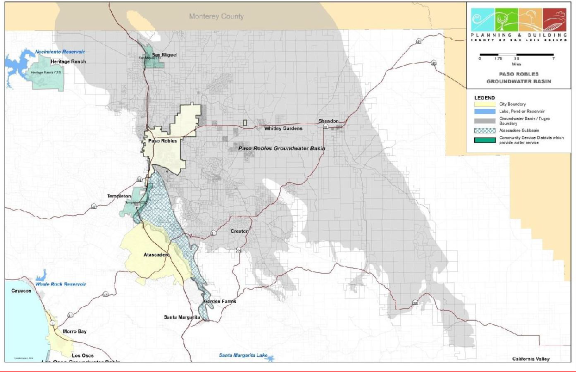
Figure 30-1: Paso Robles Groundwater Basin (Excluding the Atascadero Sub-basin)
B.
Exemptions. Consideration of an exemption is subject to section 22.30.204 F (Application Contents), except for consideration of an exemption for a farming unit enrolled in a County-approved fallowed land registry. The agricultural offset clearance requirements as outlined in this section do not apply to the following activities, unless specified below:
1.
Sites with existing irrigated annual or rotational crop production, where satisfactory evidence is shown that those crops have been planted within the last five years.
2.
Replanting of a site with the same crop type, as identified in Tables 2 and 3 below, where satisfactory evidence is shown that those crops have been planted within the last five years. Replanting must not exceed the acreage of the crop production being replaced.
3.
Expanded irrigated crop production on sites with crop types that involve implementation of new water efficiency technologies, where satisfactory evidence, as defined by resolution adopted by board of supervisors, is shown that crops have been planted within the last five years, and shall not exceed the average water use of the existing crop production, as identified in Tables 2 and 3.
4.
Sites that were granted a vested right to plant new or expanded irrigated crop production under the provisions of the Paso Robles Groundwater Basin Urgency Ordinance, where satisfactory evidence is shown that the vested crops have been planted within 2 years from the date of the expiration of the Paso Robles Groundwater Basin Urgency Ordinance (Ordinance Nos. 3246 and 3247).
5.
For the purpose of new crop production irrigated with water from the Paso Robles Groundwater Basin (excluding the Atascadero Sub-basin), as defined by Figure 30-1, sites that do not have any existing crop production and are not served by wells located within the area of severe decline (50 feet or greater Spring Groundwater Elevation Change 1997-2013 AND 1997-2017) as shown in Figure 30-2, may be eligible for a one-time only exemption. The one-time only exemption is limited to the establishment of crop production representing a new total of no more than 5.0 AF per year per site. If a one-time only exemption is granted, the resulting crop production cannot be used as a source of Agricultural Offset Clearance credits in any future application.
6.
Farming units enrolled in a County-approved fallowed land registry for the Multi-Benefit Irrigated Land Repurposing (MILR) Program. Irrigated crop annual consumptive water use for each farming unit shall not increase from the time of enrollment in the registry, unless allowed by an Agricultural Offset Clearance or Exemption. Consumptive water use shall be determined using best available satellite-based evapotranspiration data or other applicant-submitted data and be subject to verification by the Groundwater Sustainability Director and in compliance with the rules and procedures of the County-approved fallowed land registry. Farming unit is defined as contiguous or semi-contiguous parcels under the same ownership, or with the contiguous/semi-contiguous owners' written consent, in active agricultural operation managed as a single irrigated farming operation with a fallowed area of at least two acres.
C.
Agricultural Offset Clearance Fees. Fees for an agricultural offset clearance are set forth in the county fee ordinance.
D.
Permit Requirements.
1.
An Agricultural offset clearance shall be issued upon satisfactory compliance with section 22.30.204 F. and G.
2.
Metering and Monitoring. All new or existing wells that serve sites associated with an agricultural offset clearance application must have a well meter installed and verified prior to final inspection. No new or expanded irrigated agriculture shall occur until final inspection has been completed. The following requirements apply to all issued agricultural offset clearances:
a.
Within 30 days of installation of a well for which a permit has been issued pursuant to Chapter 8.40 of the County Code, or prior to final inspection, whichever is applicable, meter installation must be verified by the county public works department. The configuration of the installation shall conform to the water well metering standards and installation guidelines set forth by the department of public works and incorporated into the public improvement standards.
b.
Property owners or a person designated by the property owner must read the water meter and record the water usage on or near the first day of the month. These records must be maintained by the property owner and may be subject to inspection only by code enforcement pursuant to a violation investigation.
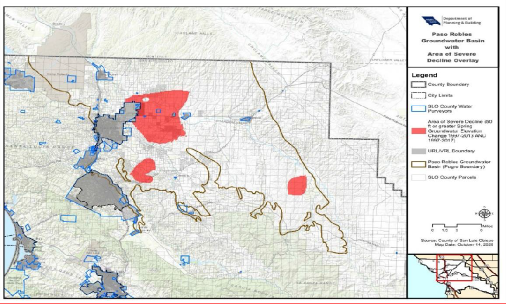
Figure 30-2
E.
Eligible Sites for Participation. For the purpose of an agricultural offset clearance, a site is as defined in section 22.80.030 (Definitions of Land Use). Owners of sites that use water from the PRGWB (excluding the Atascadero Sub-basin) may be granted an agricultural offset clearance, as described below and referenced in Table 1:
1.
On-site offset clearance means conversion of existing irrigated crop production on the same site. An expansion to the definition of a "site" under Section 22.80.030 may be granted where contiguous parcels are commonly owned or collectively operated.
Table 1 - Agricultural Offset Clearance Requirements
F.
Application Contents. In addition to meeting the application contents of section 22.62.030 (Zoning Clearance), a request for an agricultural offset clearance shall include all of the following:
1.
Vicinity of site(s) participating in the requested agricultural offset clearance, including all parcels currently under crop production, and adjacent parcels with same ownership.
2.
Identification of specific locations and acreage of current crop type(s).
3.
Identification of specific locations and acreage of proposed crop type(s). The applicant may indicate that they are voluntarily fallowing the land or not planting irrigated crops to receive conditional approval to submit a proposed planting plan at a later date. The conditional approval expires with the termination of this ordinance.
4.
A current title report or lot book guarantee for all parcels participating in the requested agricultural offset clearance.
G.
Agricultural Offset Clearance Review and Approval. The criteria of this subsection shall be used in determining if a site is eligible for participation in an agricultural offset clearance. An agricultural offset clearance may be granted only when the following criteria have been met:
1.
Proposed sites included in the request for an agricultural offset clearance use water from the PRGWB (excluding the Atascadero Sub-basin).
2.
Proposed sites will maintain an eligible use in compliance with the provisions of any existing Williamson Act contract for the property and County of San Luis Obispo Rules of Procedure to Implement the California Land Conservation Act of 1965.
3.
Water demand shall be determined based on the crop type as follows:
a.
Crops shown in Table 2 and Table 3. Water demand for the proposed irrigated crop production is equal to or less than the crop production it is replacing, such that an offset at a 1:1 ratio is achieved. Water demand shall be derived from the crop-specific applied water figures as specified in Table 2 and Table 3 below.
b.
Crops not shown in Table 2 and Table 3. Water duty factors for existing and new irrigated crops that do not fall into one of the crop groups listed in Table 2 and Table 3 will be assigned a water duty factor by a joint committee of representatives from the department of planning and building, department of public works, and the department of agriculture/weights and measures, in consultation with UC Cooperative Extension.
c.
Supplementally Irrigated Dry Cropland. The following criteria shall be used to determine a water duty factor:
(1)
A minimum water duty factor of 0.1 AF/Ac/Yr will be granted upon validation of the use of supplemental irrigation of an average of 0.1 AF/Ac/Yr over the five-year period preceding the application date. To qualify for a water duty factor of 0.1 AF/Ac/Yr, the applicant shall validate the practice of supplemental irrigation of dry cropland by providing aerial imagery showing planting and irrigation patterns and provide proof of the presence of infrastructure capable of supporting regular supplemental irrigation, and provide annual estimates of water usage with substantiating and verifiable water usage data including, but not limited to, monthly utility bills for irrigation wells during the irrigation period and pump test reports for each agricultural well for the 5 years preceding the application date.
(2)
Applications claiming greater historic supplemental irrigation of dry cropland will be evaluated on a case-by-case basis for a water duty factor greater than 0.1 AF/Ac/Yr. This factor will be established based on the 5-year average water use for the 5 years preceding the application date. The applicant shall submit annual estimates of water usage with substantiating and verifiable water usage data including, but not limited to, monthly utility bills for irrigation wells during the irrigation period and pump test reports for each agricultural well. Based on review and confirmation of the submitted information and other sources of available information such as aerial imagery, dry cropland water duty factors will be assigned a water duty factor by a joint committee of representatives from the department of planning and building, department of public works, and the department of agriculture/weights and measures, in consultation with UC Cooperative Extension.
4.
A disclosure notice has been recorded in the office of the county clerk recorder on all parcels associated with an agricultural offset clearance prior to any planting authorized under an Ag Offset Clearance.
5.
Any plantings approved under an agricultural offset clearance will be completed prior to the termination of this ordinance.
Table 2 - Crop Group and Commodities Used for the Agricultural Demand Analysis
Source: Table 3 of the Agricultural Water Offset Program, Paso Robles Groundwater
Basin, October 2014.
*San Luis Obispo County General Plan Agriculture Element
Table 3 - Existing Crop-Specific Applied Water by Crop Type
1
Information obtained from RCD Program, UCCE, UC Davis (Strawberries 2011 data)
2
;hg;Information obtained from UCCE, San Luis Obispo County Cooperative Extension,
April 2019
3
;hg;Supplementally irrigated dry cropland application requirements outlined per Section
G.3.C above.
4
;hg;Information obtained from UCCE, San Luis Obispo County Cooperative Extension,
April 2021.
Source: Table 9 of the Agricultural Water Offset Program, Paso Robles Groundwater
Basin, October 2014.
H.
Termination. The provisions of this section for the Paso Robles Groundwater Basin (excluding the Atascadero Sub-basin) shall expire on January 1, 2028, unless extended or sooner terminated.
(2023, Ord. 3484; 2026, Ord. 3583)
22.30.205 - Reserved.
Editor's note— Ord. No. 3484, § VIII, adopted February 7, 2023, repealed § 22.30.205. Former § 22.30.205 pertained to New or expanded crop production irrigated from groundwater wells within the Paso Basin Land Use Management Area and derived from Ord. No. 3483 adopted December 6, 2022. Similar subject matter can now be found in § 22.30.204.
22.30.210 - Farm Equipment and Supplies Sales.
A.
Permit requirement.
1.
Hay and feed sales. The sale of hay and feed not grown on-site is allowable in the Agriculture and Rural Lands categories subject to Site Plan Review; and in the Residential Rural category subject to Minor Use Permit approval. When grown on-site in the Agriculture or Rural Lands categories, no permit is required. When grown on-site in the Residential Rural category, hay sales may be conducted with Zoning Clearance approval.
2.
Products other than hay and feed. Farm equipment and supplies sales which offer more than hay and feed are subject to Conditional Use Permit approval.
B.
Location. Establishments selling hay grown on-site may be on a local road. Other farm equipment and supplies sales, and the sale of hay and feed not grown on-site shall be located on a collector or arterial.
C.
Minimum site area. None required.
D.
Setbacks. As set forth in Section 22.30.060 (Agricultural Accessory Structures).
E.
Parking. To be provided in compliance with Chapter 22.18, except that establishments selling hay and feed exclusively may provide parking in the form of an open yard adjacent to the sales activities, with an area equivalent to 400 square feet per space required. The dimensions of the overall area shall be sufficiently large to enable customer vehicles to turn around before exiting the site.
[Amended 1992, Ord. 2553] [22.08.048]
22.30.220 - Fuel Dealers.
A.
Minimum site area. 20,000 square feet.
B.
Location. For aboveground fuel tank storage, no closer than 500 feet to a residential category. No location limitation for establishments using underground storage only.
C.
Site design. Where storage yards or outdoor activity areas are proposed, they are subject to the provisions of Section 22.30.146 (Storage Yards).
D.
Setbacks. All aboveground fuel storage facilities shall be no closer than 50 feet to any property line or any residential use.
[Amended 1992; Ord. 2553] [22.08.088]
22.30.225 - Reserved.
Editor's note— Ord. No. 3358, § 2, adopted November 27, 2017, repealed § 22.30.225. Former § 22.30.225 pertained to general retail and derived from Ord. No. 3114, adopted in 2006.
22.30.230 - Home Occupations.
A.
Permit requirement. As required by Section 22.06.030, Table 2-2 (Allowable Land Uses and Permit Requirements), except for garage sales (see Subsection G.1) which require no land use permit, but are subject to Business License Clearance if required by the County Tax Collector.
B.
Appearance, visibility and location. The standards of this Section determine what physical changes may occur in a dwelling unit to accommodate a home occupation, and where on a residential site a home occupation may be conducted.
1.
Changes to the dwelling. The home occupation shall not change the residential character of the outside appearance of the building, either by the use of colors; materials; lighting; signs; or by the construction of accessory structures or garages visible from off-site and not of the same architectural character as the residence; or by the emission of noise, glare, flashing lights, vibrations or odors not commonly experienced in residential areas.
2.
Display of products. The display of home occupation products for sale, in a manner visible from the public street or adjoining properties is prohibited.
3.
Outdoor activities. On sites of less than one acre the use shall be conducted entirely within a principal or accessory structure; except instructional activities that must be performed outdoors, and in the case of pottery or ceramics production, one relocatable kiln with a maximum interior volume of 36 cubic feet may be located in a rear yard when all other associated pottery or ceramics production activities (except pottery drying) occur indoors. Outdoor storage of materials related to the home occupation is allowed only on one acre or larger (except as otherwise provided by Section 22.30.040 - Accessory Storage), where such storage is to be screened from view of any public road or adjacent property.
4.
Use of garage or accessory structure. The use of a garage or accessory structure is allowed subject to the size limitations of Sections 22.30.410.C and G.(Residential Accessory Uses - Garages and Workshops, respectively), except that the conduct of the home occupation shall not preclude the use of the garage for vehicle parking on a daily basis. If a garage is used for a home occupation on a site less than one acre, the garage door shall not be left open in order to conduct the home occupation.
C.
Area devoted to a home occupation. The home occupation shall be incidental and subordinate to the principal use of the site as a residence.
D.
Employees. No person other than members of the household residing on the premises may be employed and working on the site.
E.
Hours of operation. Hours of operation are unrestricted except that home occupations which generate sounds audible from off-site shall be limited to the hours from 7:00 a.m. to 10:00 p.m., provided that such home occupation complies with the standards of Section 22.10.120 (Noise Standards).
F.
Limits on the kinds of home occupations allowable. Subject to the rest of this Section, allowable home occupations consist of the following.
1.
Offices and personal services. Office-type or personal services (including personal instruction such as music lessons, and counseling services) that do not involve the presence of more than one client vehicle at any time; and other services (e.g. repair, maintenance, etc.) that are performed on the premises of a client.
2.
Handcrafts. Handcraft or artwork production, including but not limited to pottery and ceramics, artistic glass or metalwork, electronic components, woodcarving and woodworking (except for mass-production operations such as cabinet shops), antique furniture restoration, painting and photography.
3.
Home distributors. The personal sale of cosmetics, personal or household products (except appliances), when such sales occur on the premises of the purchaser, provided that wholesale sales may occur in compliance with Subsection G.
4.
Offices for off-site businesses. Offices for off-site businesses (e.g., contractors, etc.) where the home site is used for phone answering and bookkeeping only, and there is no on-site storage of materials or equipment related to the business.
Provided that no home occupation is to involve on-site use of equipment requiring more than standard household electrical current at 110 or 220 volts or that produces noise (see Section 22.10.120 - Noise Standards), dust, odor or vibration detrimental to occupants of adjoining dwellings.
G.
Sale of products. On-site retail sales of the products of a home occupation are prohibited, except for the following
1.
Garage sales. Garage sales, or the sale of handcrafted items and artwork produced on-site are allowed not more than twice per year, for a maximum of two days per sale.
2.
Home distributors. Home distributors of cosmetics and personal or household products may supply other approved home occupation proprietors.
3.
Animal sales. The sale of animals in conjunction with an animal keeping operation approved in compliance with Section 22.30.044, where the sales are also approved in compliance with Chapter 9.04 of this code (Animal Regulations).
H.
Signs. Signage shall be as provided by Chapter 22.20 (Signs) of this title.
I.
Parking and traffic. The traffic generated by a home occupation shall not exceed 10 trips per day, and shall only involve types of vehicles normally associated with a home in a residential neighborhood, except in compliance with Section 22.30.040.B.1. All parking needs of the home occupation shall be met off the street. This Subsection does not apply to garage or handcraft sales in compliance with to Subsection G.1.
[Amended 1981, Ord. 2063; 1984, Ord. 2163; 1992, Ord. 2553; 1999, Ord. 2880; 2020, Ord. 3420.] [22.08.030]
22.30.240 - Indoor Amusement and Recreation Facilities.
This Section applies only to the specific uses listed.
A.
Limitation on use - Office and Professional category. Amusement and recreational service uses allowed in the Office and Professional land use category are limited to indoor facilities including gymnasiums, reducing salons, health and athletic clubs (including indoor sauna, spa or hot tub facilities), racquetball, handball and other similar indoor sports activities.
B.
General permit requirement. Site Plan Review, except where otherwise provided in Subsection C.
C.
Requirements for specific uses.
1.
Electronic game arcades. These provisions apply to establishments containing five or more electronic games or coin-operated amusements; four or fewer are not considered as a land use separate from the primary use of the site.
a.
Limitation on use. Arcades are allowable only in the Recreation and Commercial Retail land use categories.
b.
Permit requirement. Minor Use Permit.
c.
Location criteria. Arcades shall be at least 1,000 feet from any elementary or secondary school site and at least 200 feet from any Residential land use category.
d.
Building requirements. Arcades shall be located within a completely enclosed building, in space separate from other uses on the same site, so designed as to prevent excessive noise, glare or other offensive factor from affecting other uses in the immediate vicinity. The arcade shall be designed and arranged to that there is a management attendant within the arcade at all times. Adequate space shall be provided to allow the use of each machine and unimpaired access throughout the arcade without overcrowding.
e.
Parking. See Chapter 22.18.
f.
Signs. Signage shall be as provided by Chapter 22.20 (Signs) of this title.
2.
Card rooms. These provisions apply to the establishment of card rooms. For the purposes of this Section, a card room is defined as being an establishment only for the purposes of playing card games as authorized by state statutes and local ordinance.
a.
Permit requirement. Conditional Use Permit approval.
b.
Limitation on use. Card rooms are limited to a maximum of four tables. A table, for the purposes of this Section, is defined as serving no more than 10 seated customers at one time.
c.
Location criteria. Card rooms shall be located at least 300 feet from any parcel on which there is located any public library, public, private, or parochial school or preschool, church, city, district, county or state owned, operated and maintained public park, playground, beach or other facility and 200 feet from any land located within an Agriculture, Rural Lands or residential land use category.
d.
Measure of distances. The distances referenced above shall be measured in a straight line, without regard to intervening structures, from the closest exterior structural wall of the card room to closest property line of the library, school, church, park, Agriculture, Rural Lands or residential land use category.
e.
Additional findings required. The Review Authority may approve, or conditionally approve a land use permit only if, in addition to the findings of fact required to be made by Section 22.62.060.C.4, it makes the following findings of fact:
(1)
The proposed use will not be contrary to the public interest or injurious to nearby properties.
(2)
The establishment of the use will not be contrary to any program of neighborhood preservation nor will it interfere with any program of urban renewal.
f.
Exceptions. Alternatives to the location criteria of Subsection C.2.c may be approved by the Review Authority in compliance with Section 22.30.020.B. These standards are the only provisions of this Section subject to this action.
[Amended 1992, Ord. 2553; 1995, Ord. 2714; 2020, Ord. 3420] [22.08.062]
22.30.244 - Industrial Hemp Cultivation.
A.
Limitation on use.
1.
Industrial hemp cultivation (indoor and outdoor) may be allowed in the Agriculture (AG) and Rural Lands (RL).
2.
Industrial hemp cultivation in Residential Rural (RR) land use categories is limited to indoor cultivation of industrial hemp transplants.
3.
Outdoor industrial hemp cultivation is limited to sites of four-hundred (400) acres or larger. Indoor industrial hemp cultivation is limited to sites of five (5) acres or larger.
4.
Outdoor industrial hemp cultivation in the Residential Rural (RR) land use category is prohibited.
B.
Permit Requirements. No permit required.
C.
Cultivation Standards.
1.
Location Standards. The location standards in this Section shall be measured from the location of the proposed outdoor or indoor hemp cultivation to the nearest point of the existing sensitive use or area boundary. A new adjacent use does not affect the continuation of an existing use that was legally established under the standards of this section.
a.
Outdoor Industrial Hemp. Outdoor industrial hemp cultivation shall not be located within two-thousand (2,000) feet from adjacent property lines and one-mile from Urban Reserve Lines (URL), and Village Reserve Lines (VRL). For any properties adjoining parcels located within the jurisdiction of another agency and the agency allows industrial hemp cultivation, the setback shall be the lesser of the setback set forth above or the setback required by the other agency. For any properties adjoining parcels located within the jurisdiction of another agency and the agency does not allow industrial hemp cultivation, the setback set forth above shall control.
b.
Indoor Industrial Hemp. Indoor industrial hemp cultivation shall be within a fully enclosed permitted building or greenhouse that has been setback as set forth in Section 22.30.060. In addition, indoor hemp cultivation shall be setback one hundred (100) feet from any existing offsite residences of separate ownership.
c.
All industrial hemp cultivation shall be setback at least fifty (50) feet from the upland extent of riparian vegetation of any watercourse, and one hundred (100) feet from any wetland.
d.
Exclusion Area. The cultivation and processing of industrial hemp is prohibited within the unincorporated portions of the Edna Valley American Viticultural Area recognized in Title 27 of the Code of Federal Regulations Part 9.35 and more particularly described as follows:
(1)
From Cuesta Canyon County Park, located on U.S.G.S. map "San Luis Obispo Quadrangle" at the north end of Section 25, Township 30 South, Range 12 East, the boundary runs southwesterly along San Luis Obispo Creek to a point .7 mile southerly of the confluence with Davenport Creek;
(2)
Thence due east to the intersection with the 400-foot contour line of the northeastern flank of the San Luis Range;
(3)
Thence in a generally easterly and then a southeasterly direction along this 400-foot contour line of the northeastern flank of the San Luis Range, which forms the southwestern rim of Edna Valley, to the township line identified as "T31S/T32S" on the U.S.G.S. map;
(4)
Thence east along township line "T31S/T32S," across Price Canyon to Tiber;
(5)
Thence in a generally easterly direction along the 400-foot contour line of Tiber Canyon and the southern rim of Canada Verde, crossing Corbit Canyon Road and continuing along the 400-foot contour line to longitude line 120°32′30″;
(6)
Thence north along longitude line 120°32′30″ to the 600-foot contour line of the southwestern flank of the Santa Lucia Mountain Range;
(7)
Thence in a generally northwesterly direction along the 600-foot contour line of the southwestern flank of the Santa Lucia Range to Cuesta Canyon County Park, the beginning point.
2.
Nuisance Odors. All structures utilized for indoor hemp cultivation shall be equipped and/or maintained with sufficient ventilation controls (e.g. carbon scrubbers) to eliminate nuisance odor emissions from being detected offsite.
3.
State Industrial Hemp Registration. Applicants must satisfy the registration requirements specified in the California Food and Agricultural Code. Applicants must submit those registration materials to the Agricultural Commissioner in accordance with state laws and regulation. The registration materials must be accompanied by all required fees.
4.
Industrial hemp cultivation is prohibited in hoop houses.
D.
Enforcement. The remedies provided by this subsection are cumulative and in addition to any other remedies available at law or in equity.
1.
Inspection. All industrial hemp operations in the unincorporated territory of San Luis Obispo County are subject to review and inspection at any time, including crop and/or product testing by agents of the County of San Luis Obispo Sheriff's Department, Code Enforcement, and Department of Agriculture/Weights and Measures.
2.
Violations. Any violation of County Code or state law related to industrial hemp constitutes a public nuisance and shall be subject to the enforcement procedures and provisions set forth in Chapters 22.40 and 22.74 of this code and by any other means available by law. In the event any test of industrial hemp grown by an industrial hemp operation who holds a valid registration with the County Agricultural Commissioner's Office pursuant to Food and Agricultural Code section 81000 et seq. indicates a tetrahydrocannabinol (THC) content greater than that established under Section 81000 of the Food and Agricultural Code or Section 11018.5 of the Health and Safety Code, as they may be amended, that crop shall not constitute a violation of County Code so long as the remedial actions required or available under state law are being followed by the registrant and verified by the County Agricultural Commissioner's Office in compliance with state law, and the operation otherwise complies with the standards of this section.
[Added, 2020, Ord. 3414]
22.30.250 - Libraries and Museums.
A.
Limitation on use. In the Agriculture or Rural Lands land use categories, libraries and museums are allowable only where the facility displays items primarily of agricultural, local historical, ecological, or environmental interest.
B.
Limitation on project area. In the Agriculture land use category, no development shall occur on prime agricultural soils, and the total area of site disturbance shall not exceed two percent of the gross site area or one acre, whichever is greater.
C.
Access and circulation. Direct access shall be provided from a county-maintained road, unless otherwise approved through a Minor Use Permit or Conditional Use Permit. The project shall not result in an adverse impact to the circulation system.
D.
Setbacks. In the Agriculture, Rural Lands and Residential Rural land use categories, all structures shall be set back a minimum of 50 feet from all property lines and a minimum of 100 feet from a dwelling on any other property.
E.
Retail sales. In the Agriculture, Rural Lands, Residential Rural, Office and Professional, and Public Facilities land use categories, libraries and museums may include the incidental retail sales of books, gifts, souvenirs, and other items only if they are related to the items being exhibited.
F.
Required findings. A land use permit may be approved only where the Review Authority makes the following findings in addition to those required in Sections 22.62.060.C.4:
1.
The use will not adversely affect or conflict with surrounding agricultural lands and uses and will not adversely affect water supplies for existing or expanded agricultural uses; and
2.
The project will be designed and developed in a manner that protects environmentally sensitive resources.
[Added 1993, Ord. 2615] [22.08.076]
22.30.260 - Lodging - Bed and Breakfast Facilities.
The following standards apply to bed and breakfast facilities located in other than the Recreation, Office and Commercial land use categories. A bed and breakfast in the Recreation, Office and Professional and Commercial categories is instead subject to the provisions of Section 22.30.280 (Hotels and Motels). This Section does not apply to the rental of bedrooms in a residence to the same tenants for longer than seven days, although the County Tax Collector may still require special fees and/or licensing for any residential rental less than 30 days.
A.
Limitations on use.
1.
A bed and breakfast shall be established only in a single family dwelling that has been determined by the Review Authority to be of historical or architectural interest except:
a.
Where the bed and breakfast is located on a site in the Agriculture, Rural Lands and Residential Rural categories with an existing conforming visitor-serving facility (e.g., winery, riding stable, health resort), it may be established in one structure, with an exterior design style that is residential or agricultural in appearance, built expressly for a bed and breakfast inn where the facility is approved with a Conditional Use Permit. The bed and breakfast inn shall be clearly incidental, related and subordinate to the primary operation of the winery as a production facility or the visitor serving use where the use is not a winery.
(1)
The bed and breakfast inn shall be located on the same legal parcel as, and within 100 feet of, the existing conforming visitor serving use. A bed breakfast may be located farther from the existing conforming visitor serving use where the Review Authority make the following findings: (1) the site of the proposed use does not contain Class I, II or III soils; and (2) on-site access, visual concerns and grading or other environmental issues can be better addressed through a larger distance.
(2)
A bed and breakfast inn authorized in compliance with Subsection A.1.a. may be allowed in addition to the number of dwellings allowed by Section 22.10.130.
(3)
A bed and breakfast authorized in compliance with Subsection A.1.a shall only be subject to the provisions of Subsections B., D., E., and F. Additional operational standards shall be set through Conditional Use Permit approval.
2.
A bed and breakfast with three or fewer guest rooms shall be conducted to be clearly incidental and accessory to the primary use of the site as a single-family dwelling.
B.
Limitation on size. A bed and breakfast shall provide no more than the following number of guest rooms. Except for facilities proposed in compliance with Subsection A.1.a., the rest of the dwelling shall solely be used by the family in permanent residence. Where a bed and breakfast inn is proposed as provided for in Subsection A.1.a., a family does not need to be in permanent residence within the inn.
1.
A bed and breakfast in the Agriculture, Rural Lands, Residential Rural and Residential Multi-Family categories may be approved with a maximum of eight guest rooms.
2.
A bed and breakfast in the Residential Suburban category shall provide no more than three guest rooms.
C.
Expansion of existing building. Physical expansion of a residence to accommodate bed and breakfast facilities or operations shall be limited to 15 percent of the existing floor area, through Zoning Clearance where the residence contains three or less guest rooms and through Minor Use Permit approval where the residence contains four or more guest rooms.
D.
Location. Within the Residential Suburban land use category, no bed and breakfast facility shall be located within 500 feet of a parcel on which is located any other bed and breakfast facility. The site of a bed and breakfast inn established in compliance with Subsection A.1.a shall be located within 5 miles from an urban or village reserve line, on or within one mile of an arterial or collector, 200 feet from each property line and no closer than 400 feet to any existing residence outside the ownership of the applicant.
E.
Minimum site area.
1.
One acre in rural areas; except in cases where the bed and breakfast is being requested in compliance with Subsection A.1.a., a 10 acre minimum site area is required.
2.
Equal to the minimum parcel size required by Chapter 22.22 in urban and village areas.
F.
Parking required. Two spaces, plus one space per transient lodging unit. Bed and breakfast facilities shall not use on-street parking for the bed and breakfast operation or the resident family at any time. For the purpose of determining parking lot construction standards in compliance with Chapter 22.18, the parking lot turnover for a bed and breakfast facility is medium.
G.
Operation. A bed and breakfast with three or less guest rooms shall be subject to the provisions of Subsections 22.30.230.B, C., D., E., G., H., and I, for home occupations.
[Added 1981, Ord. 2063; Amended 1982, Ord. 2091; 1984, Ord. 2163, Ord. 2164; 1985, Ord. 2213; 1986, Ord. 2250; 1992, Ord. 2553; 1993, Ord. 2648; 1995, Ord. 2741; 2001, Ord. 2942] [22.08.261]
22.30.265 - Lodging - Emergency Shelters.
The following standards apply to emergency shelters, which include housing with minimal support services to homeless persons. Emergency shelters are not allowed outside of urban and village reserve lines.
A.
Permit requirement.
1.
Except as set forth in Subsections A.2 and A.3, Zoning Clearance where allowed by Section 22.06.030 when community water and sewer is available within urban or village reserve lines.
2.
Minor Use Permit when community water and sewer is available and the site is subject to the following: Historic, Airport Review Area, Flood Hazard, Energy or Extractive Area, Mineral Resource Area, Geologic Study Area or Sensitive Resource Combining Designations, Open Space Agreement, Avigation Easement, Water and/or Soil Contamination, or Very High Fire Hazard Area.
3.
Minor Use Permit when community water and sewer is not available.
B.
Maximum number of persons. An emergency shelter facility may allow up to 100 persons.
C.
Onsite waiting and client intake areas. A minimum of seven percent of the total square footage of an emergency shelter shall be designated for indoor onsite waiting and client intake areas.
D.
Management.
1.
A minimum of one on-site or on-call manager or supervisor plus additional trained staff and volunteers for up to 50 shelter beds. A minimum of two on-site or on-call managers or supervisors plus additional trained staff and volunteers for 51-100 shelter beds. On-site or on-call management shall be provided during hours of operation.
2.
The emergency shelter provider shall submit a Neighborhood Relations Plan for review and approval by the Director. The Plan shall include regular meetings between the emergency shelter provider and the surrounding neighborhood, a 24-hour contact for questions or complaints, and other provisions for addressing potential neighborhood concerns.
E.
Proximity to other emergency shelters. No emergency shelter shall be within a 300 foot radius from another emergency shelter.
F.
Length of stay. Individual occupancy is limited to six consecutive months or less. However, individual emergency shelter occupancy policies apply. Emergency shelter providers may allow clients to stay more than six months if no subsequent housing has been identified.
G.
Lighting. External lighting shall be provided for security purposes, and shall be in compliance with the provisions of Section 22.10.060.
H.
Security during hours of operation. The emergency shelter provider shall submit a Security Plan for review and approval by the Director. The Plan shall include security cameras or other appropriate security measures.
[Added 2010, Ord. 3199; 2025, Ord. 3531]
Editor's note— In order to avoid duplicating section numbers and at the discretion of the editor, § 22.30.270 (Lodging - Emergency Shelters as added by Ord. 3199) has been renumbered to § 22.30.265.
22.30.270 - Lodging - Homestays.
The following standards apply to Homestays in the Residential Suburban or Residential Single Family land use categories. The provisions of this Section do not apply to the rental of bedrooms in a residence to the same tenant for longer than seven days, although the County Tax Collector may still require special fees and/or licensing for any residential rental less than 30 days.
A.
Limitation on use. A homestay shall be:
1.
Established only in an existing single-family dwelling; and
2.
Conducted so as to be clearly incidental and accessory to the primary use of the site as a single-family dwelling.
B.
Limitation on size. A homestay shall provide no more than the following number of guest rooms, with the rest of the dwelling being used solely by the family in residence.
1.
A homestay in the Residential Suburban or Residential Single Family land use category shall provide no more than two guest rooms.
2.
A homestay providing more than two guest rooms in the Residential Suburban land use category shall be considered a bed and breakfast. A homestay providing more than two guest rooms in the Residential Single Family land use category shall not be allowed.
E.
Expansion of existing building. Physical expansion of a residence to specifically accommodate homestay facilities or operations shall not be allowed.
F.
Minimum site area.
1.
One acre in the Residential Suburban category.
2.
Equal to the minimum site area required by Section 22.10.110 for residential uses in the Residential Single Family category.
G.
Parking. Two spaces, plus one space for each bedroom used as a transient lodging unit. Homestay facilities shall not use on-street parking for the homestay operation or the resident family. For the purposes of determining parking area construction standards in compliance with Chapter 22.18, the parking lot turnover for homestays is medium.
H.
Operation. A homestay shall be subject to the provisions of Subsections 22.30.230.A, B., C., D., and E. for home occupations.
I.
Exceptions to the standards. None of the standards in this Section shall be waived or modified using the exception provisions of Section 22.30.020.
J.
Violation-Lodging-homestays. It is unlawful for any person to use or allow the use of property in violation of the provisions of this section and to advertise a use that is in violation of this section. The penalties (including fines) and process for addressing a violation of this section are set forth in Chapter 22.74 of this Title (Enforcement). Additional penalties for violation of this section may include revocation of any required permit or business license.
For purposes of this Section, "advertise" shall mean any form of communication, promotion, or solicitation in any medium including, but not limited to, print, signage, internet website posts, intended to induce the use of property in violation of this Section.
[Added 1995, Ord. 2741; 2021, Ord. 3434] [22.08.265]
22.30.280 - Lodging - Hotels and Motels.
A.
Limitation on use. Transient lodgings in the Public Facilities category are limited to hotel and motels in conjunction with public airport or port facilities.
B.
Density. The density of a hotel or motel is not limited by this Title except that a site for such use shall be designed to accommodate all proposed units while also satisfying all applicable height, setback, parking and other standards of this Title without the need for modification, adjustment or variance of such standards.
C.
Parking. Hotels and motels shall provide off-street parking as set forth in Chapter 22.18 for transient lodgings. In the event that a hotel or motel includes any facilities in addition to overnight units (e.g., restaurant, bar, meeting rooms, etc.), all additional facilities shall be provided off-street parking as required by Chapter 22.18, in addition to the parking required for the hotel or motel.
[Amended 1981, Ord. 2063; 1982, Ord. 2091; 1992, Ord. 2553] [22.08.262]
22.30.290 - Lodging - Hotels, Motels - Condominium or Planned Development.
The following standards apply to hotels and motels that are condominium or planned development projects as defined in Civil Code Section 1351. These standards apply in place of the standards of Section 22.22.145.
A.
Limitation on use. Uses shall be limited as provided by Section 22.30.280.
B.
Required finding. A Conditional Use Permit may be approved only if the Review Authority first finds that the proposal will not reduce the availability of accommodations for overnight or transient occupancy by the general public, tourists and visitors compared to a conventional hotel or motel.
C.
Density. The density of hotel and motel units shall be as provided in Section 22.30.280.
D.
Design standards.
1.
Required hotel, motel facilities. Each hotel or motel shall include a reception lobby area, office space for administrative use, service areas and facilities for employees (such as a lounge, lockers and showers), and laundry facilities for use by the hotel or motel. This standard may be waived if the Review Authority determines that provision of any or all of the required facilities is unnecessary due to the size or particular nature of the hotel or motel.
2.
Other facilities. The size of individual units, the number of kitchens and the amount of personal storage space shall be determined by the Review Authority through Conditional Use Permit approval.
3.
Parking. Parking shall be provided as stated in Section 22.30.280, provided that the required ratio of parking for hotel and motel units (excluding additional facilities) shall not be exceeded. The Review Authority may require additional parking spaces for the exclusive parking of recreational vehicles.
E.
Occupancy.
1.
No person or persons shall occupy a hotel or motel unit for more than 29 consecutive days except for employees of the hotel or motel.
2.
No owner or owners holding separate interest in a hotel or motel unit shall occupy that unit more than a total of 84 days per year, including no more than a total of 14 days during the period from Memorial Day to Labor Day.
3.
The occupancy standards in Subsections E.1 and E.2 shall be included in the declaration of conditions, covenants and restrictions and recorded against all individual property titles.
F.
Administration. A management entity shall be formed to manage the operation of the hotel or motel. The management shall have sole responsibility for providing room accommodation services and transient occupancy tax reporting. Transient occupancy tax shall be collected for all units except for the manager's unit. No owner or owners holding separate interest in a hotel or motel unit shall rent or lease that unit or otherwise offer accommodations to any other person or persons. The provisions of this Subsection shall be included in the declaration of conditions, covenants and restrictions and recorded against all individual property titles.
G.
Reporting requirement. A report shall be submitted periodically to the Department of Planning and Building by the hotel or motel management at intervals to be determined by the Review Authority through Conditional Use Permit approval. The report shall state the total number of days that each unit was occupied in the preceding year, including occupancies by guests and the owners of each unit.
H.
Conditions of approval. The Review Authority may adopt conditions of approval which are necessary in order to ensure compliance with the standards of this Section and to ensure that the design, operation and occupancy of the hotel or motel will serve primarily the general public, tourists and visitors for overnight or transient lodging.
[Added 1994, Ord. 2696; 2013, Ord. 3242] [22.08.264]
22.30.300 - Lodging - Recreational Vehicle (RV) Parks.
The provisions of this Section apply to all recreational vehicle parks and commercial campgrounds, including any separate designated section of a mobile home park located in the Recreation category. These standards apply in addition to all applicable provisions of Title 25 of the California Code of Regulations, and any permit requirements of the California Department of Housing and Community Development.
A.
Location criteria.
1.
Limited visibility required. Approval of a Conditional Use Permit application by the Commission shall include a finding that the recreational vehicle park will not be excessively visible from a public road or residential use, or that its visibility will be acceptably mitigated.
2.
Parks in Commercial categories. An RV park in the Commercial Retail or Commercial Service Categories shall be located on a collector, arterial or frontage road, within one mile from one of the following state highways or frontage roads thereto: 1, 41, 46, 58, 101, or 166. The mile shall be measured along the shortest length of public roads between the proposed site and the applicable state highway.
B.
Minimum site area.
1.
RV park site. 10 acres outside an urban or village reserve line; five acres within a reserve line.
2.
Individual RV spaces. 20 foot width; 750 square foot area.
C.
Density. Maximum density shall be 15 RV units per gross acre, not including any exterior public street right-of-way.
D.
Site design standards.
1.
Setbacks. No part of a recreational vehicle shall be located closer than 25 feet to any street property line, and no closer than 30 feet to any interior property line. No RV or tent shall be located closer than 10 feet to any other RV or tent.
2.
Recreation area and common open space. "Destination" RV parks (intended for more than overnight use) shall include common areas for recreational use by park occupants in addition to required setbacks. These areas shall include landscaped, common open space for passive recreation and active recreation facilities. Active recreation facilities may include swimming pools, tennis and handball courts, recreation buildings, and barbecue areas. These recreation areas shall be provided as follows.
a.
Parks with uninterrupted pedestrian access to, or located within 1,000 feet of a major public recreational facility including beach frontage, lakes or reservoirs are not required to provide recreation areas, except for playground facilities as specified by Subsection D.3.
b.
Parks located within one mile of major public recreational facilities or within 1,000 feet of public hiking or riding trails or forested areas shall provide 400 square feet of recreation or common open space per unit, of which 20 percent shall be designed for active recreation.
c.
Parks not meeting the criteria of Subsections D.2.a or D.2.b shall provide 500 square feet of recreation or common open space per unit, of which 30 percent shall be designed for active recreation.
3.
Playgrounds. In addition to any recreation areas required by Subsection D.2, at least one 800 square foot children's playground shall be provided for a park with 20 or more spaces, at a ratio of one such 800 square foot area for each 60 RV spaces or campsites, or fraction thereof. The playground shall be equipped with any of the following: swings, slides, climbing structures of timber, concrete or other material finished to eliminate sharp edges and minimize splinters, or other equipment which is ridden.
4.
Internal streets.
a.
Width. The width of roads and driveways within an RV park shall be as follows.
(1)
One-way: 18 feet if the road serves 60 spaces or more; 15 feet if road serves less than 60 spaces; 12 feet for one-way internal road between campsite clusters without individual space access.
(2)
Two-way divided: 15 feet on each side of divider.
(3)
Two-way: 24 feet.
b.
Parking. Parking along internal roadways is allowed only when a paved parking lane, eight feet wide is provided in addition to the roadway.
c.
Road improvement standard. Two inches of A.C. plant mix over six inches of Class II Aggregate Base or equivalent structural section based on a Traffic Index of 4. For seasonal-occupancy parks in rural areas, or where density does not exceed 10 spaces per acre, double chip seal may be substituted for the two inches of A.C. Alternative hard-surface paving materials are allowable subject to approval by the County Engineer.
5.
Utilities.
a.
Water. All recreational vehicle spaces shall be provided water supply hookups. Tent camping spaces shall have water service for each 10 spaces, but not located within 20 feet of a designated tent site. When common water supply facilities are provided in the form of hose bibs, they shall be over a drain-equipped concrete pad, rock bed or other construction to prevent the creation of mud as a result of water supply use.
b.
Holding tank dump. All recreational vehicle parks shall be provided with one holding tank dumping facility for each 100 RV spaces or fraction thereof, to be located near park exits.
c.
Restrooms. No space or campsite shall be located closer than 25 feet, nor further than 400 feet from a public restroom facility.
6.
Fencing and screening. A solid wood or masonry six foot high solid fence, screen or hedge will be required along all property lines and front yard setbacks. In addition, recreational vehicle spaces should be generally screened from adjacent properties and public roads by means of natural landscaping, terrain variations and distance. Where a proposed park will be visible from a major highway or freeway, additional screening landscaping will be required, which shall use plant materials with the capability of achieving 80 percent opacity within two years when viewed from the roadway. The Commission may waive or adjust fencing and screening standards where terrain, natural vegetation or area character would make screening unnecessary or ineffective.
a.
Street trees. Street trees shall be planted where the park abuts a public road right-of-way. Trees shall be planted at 20 foot intervals, or at more frequent intervals if appropriate for the species selected. Varied groupings are encouraged with linear plantings to be varied in setback.
b.
Interior trees. Trees shall be planted in the park interior in all common and recreation areas.
E.
Violation - recreational vehicle parks and commercial campgrounds. It is unlawful for any person to use or allow the use of property in violation of the provisions of this section and to advertise a use that is in violation of this section. The penalties (including fines) and process for addressing a violation of this section are set forth in Chapter 22.74 of this Title (Enforcement). Additional penalties for violation of this section may include revocation of any required permit or business license.
For purposes of this Section, "advertise" shall mean any form of communication, promotion, or solicitation in any medium including, but not limited to, print, signage, internet website posts, intended to induce the use of property in violation of this Section.
[Amended 1994, Ord. 2696; 2021, Ord. 3434] [22.08.266]
22.30.310 - Nursery Specialties.
The following standards apply to the production and sale of ornamental plants and other nursery products, grown under cover, outdoors or in greenhouses: including bulbs, flowers, shrubbery, florist greens, fruit stock, floral products, nursery stock, ornamental plants (including potted plants), seed, sod, and food crops (including vegetables):
A.
Agriculture and Rural Lands land use categories.
1.
Limitation on use. Nursery specialty operations including outdoor nursery specialties, greenhouses and retail sales, are allowed in the Agriculture and Rural Lands land use categories. Roadside stands are subject to Section 22.30.075 (Agricultural Retail Sales).
2.
Permit requirement.
a.
Outdoor nursery specialties. No permit required.
b.
Greenhouses. Zoning Clearance approval.
c.
Retail sales. No permit required if no structures are proposed to house product displays or sales activities, and all products sold are produced on-site. Permanent retail facilities require Conditional Use Permit approval.
3.
Minimum site area. No minimum area.
4.
Location. Nursery specialty operations engaging in retail sales in the Agriculture or Rural Lands categories shall be located on a collector or arterial.
5.
Setbacks. As required by Section 22.30.060 (Agricultural Accessory Structures), unless the California Building Standards Code would require a larger setback because of construction materials.
B.
Residential Rural land use category.
1.
Limitation on use. Nursery specialty operations are limited to outdoor nursery specialties and greenhouses in the Residential Rural land use category. No on-site retail sales are allowed except as provided by Sections 22.30.075 (Agricultural Retail Sales - Residential categories), and 22.30.330.F (Seasonal or Temporary sales).
2.
Permit requirement.
a.
Outdoor nursery specialties. No permit required.
b.
Greenhouses. The land use permit requirement for greenhouses shall be based on the floor area of the facility, as required by the following table.
;sz=8q;Notes:
(1)
From the property frontage to the nearest county-maintained road.
(2)
Surface shall be a bituminous seal on base in compliance with Section 36 of the CalTrans standard specifications and in conformance with the width and grade requirements of Section 22.54.020.E.
(3)
Surface shall be asphalt or concrete as specified in the San Luis Obispo Standard Specifications and Improvement Drawings and in conformance with the width and grade requirements of Section 22.54.020.E.
(4)
Greenhouses on an unpaved road shall provide at a minimum, the following, in order to mitigate the air pollution (i.e.: dust) effects created by the use:
a.
A mitigation plan for continuing dust control from the property frontage to the nearest county-maintained road. The plan may be modified to adjust for changed conditions or to improve the effectiveness of the dust reducing technology. The plan and all modifications to the plan are subject to review and approval by the Director.
b.
Evidence of road maintenance provided by the County, state, special district, homeowners association or other organized maintenance, such as a road maintenance agreement.
c.
An agreement, to support and not protest:
(1)
The formation of an assessment district or;
(2)
The creation of another funding mechanism.
The consenting person(s) retains all due process rights as to any term or condition that was unknown at the time of application approval. The consenting person(s) may contest the specific proportionality rate or other term or condition of the assessment or funding mechanism.
(5)
Greenhouses on a double chip seal road shall provide, at a minimum, the following in order to guarantee continued maintenance and to mitigate air pollution (i.e.: dust) effects created by the use:
a.
Evidence of road maintenance provided by the County, state, special district, homeowners association or other organized maintenance, such as a road maintenance agreement.
b.
An agreement, to support and not protest:
(1)
the formation of an assessment district or;
(2)
the creation of another funding mechanism.
The consenting person(s) retains all due process rights as to any term or condition that was unknown at the time of application approval. The consenting person(s) may contest the specific proportionality rate or other term or condition of the assessment or funding mechanism.
3.
Minimum site area. 5 acres.
4.
Setbacks. Front - 80 feet; Side and Rear - 100 feet. Side and rear setbacks may be reduced to 50 feet (or as required by the California Building Standards Code, whichever is larger) where solid fencing or landscape screening meeting the standards of Section 22.10.080 is provided, or as otherwise determined by Minor Use Permit or Conditional Use Permit approval.
5.
Design Standards. Greenhouses shall use open ventilation. If exhaust fans are necessary, the fans shall be located away from non-agricultural land uses where feasible, and should maximize energy efficiency. Greenhouses shall be screened at least 50 percent from public roads, unless one of the following conditions exist: (1) screening will create a fire hazard as determined by CDF; (2) screening will restrict provision of the sunlight necessary for the operation of the greenhouse or will affect the certification of the greenhouse; or (3) screening is not possible, practical or feasible due to existing topographic conditions. The screening may include measures such as landscape or existing vegetative screening (to ensure at least 50 percent screening of the structures at plant maturity), berming, and/or arrangement of the structures on the site to minimize bulky appearance. Perimeter access roads on the site of a greenhouse operation within 25 feet of property lines shall have a continuing program for dust control meeting the provisions of Note 4a in Subsection B.
C.
Residential Suburban land use category.
1.
Limitation on use. Nursery specialty operations are limited to outdoor nursery specialties in the Residential Suburban land use category. Greenhouses other than accessory greenhouses (Section 22.30.410.D) are not allowed unless authorized by Conditional Use Permit approval in compliance with Subsection B.2.b. No on-site retail sales are allowed except as provided by Sections 22.30.075 (Agricultural Retail Sales - Residential categories), and 22.30.330.F (Outdoor Retail Sales).
2.
Permit requirement.
a.
Outdoor nursery specialties. No permit required.
b.
Greenhouses. As set forth in Section 22.30.410.D for accessory greenhouses. Conditional Use Permit approval when the total area of greenhouse is larger than that set for an accessory greenhouse in Section 22.30.410.D.
3.
Minimum site area. None for outdoor nursery specialties. To be determined by Conditional Use Permit approval for greenhouse facilities, except accessory greenhouses (see Section 22.30.410.D).
4.
Setbacks. As required by Section 22.30.060 (Agricultural Accessory Structures) for accessory greenhouses; to be determined through Conditional Use Permit approval for other than accessory greenhouse.
D.
Commercial and Industrial land use categories.
1.
Limitation on use. Nursery specialty operations including outdoor nursery specialties, greenhouses and retail sales are allowed in the Commercial Service and Industrial land use categories. Nursery specialty operations are limited to retail sales in the Commercial Retail land use category.
2.
Permit requirement.
a.
Outdoor nursery specialties. No permit required.
b.
Greenhouses. Zoning Clearance approval.
c.
Retail sales. Site Plan Review. Minor Use Permit approval where outdoor sales areas located in a Commercial Retail category do not meet the standards as set forth in Subsection D.5.
3.
Minimum site area. No minimum area.
4.
Setbacks. As required by Section 22.10.140 (Setbacks).
5.
Design standards. Outdoor sales areas of products other than plant materials in the Commercial Retail category shall be located behind commercial structures or at the rear of the lot. Minor Use Permit approval may authorize outdoor retail sales in other locations on the site where such sales area is consistent with surrounding retail development.
E.
Effect on previously established nursery specialties. Where a nursery specialty that was lawfully established prior to October 11, 1994 does not meet the standards of this Section, the permit requirement will be determined by considering only facilities proposed after October 11, 1994. A destroyed nursery specialty lawfully established prior to October 11, 1994 may be restored to its former status, provided that the floor area or the footprint shall not be enlarged or altered from its previous condition.
F.
Establishment or Expansion of Nurseries Overlying the Paso Robles Groundwater Basin, Excluding the Atascadero Sub-Basin. The establishment or expansion of any nursery use overlying the Paso Robles Groundwater Basin (excluding the Atascadero Sub-basin) is subject to the standards set forth in section 22.30.204.
[Amended 1981, Ord. 2089; 1983, Ord. 2648; 1984, Ord. 2163; 1994, Ord. 2696; 1999, Ord. 2880; 2014, Ord. 3282; 2015, Ord. 3308; 2022, Ord. 3483; 2023, Ord. 3484] [22.08.054]
22.30.320 - Nursing and Personal Care.
Allowable in the Residential Suburban, Residential Multi-Family and Commercial Retail categories subject to the following provisions.
A.
Location. Nursing and personal care facilities shall be located within an urban or village reserve line.
B.
Minimum site area. 20,000 square feet.
C.
Parking requirement. One space per four beds. The Commission may reduce such requirements where it can be found that parking needs are less than required because of the nature of the facility or residents, and that other transportation is available to the facility as part of the program of care.
[Amended 1984, Ord. 2163; 1992, Ord. 2553] [22.08.108]
22.30.330 - Outdoor Retail Sales.
This Section provides standards for the conduct of temporary outdoor retail sales activities including farmers' markets, home sales, sales from individual vehicles, seasonal sales and sidewalk sales. Permanent outdoor retail sales activities are subject to Section 22.30.530 (Sales lots and Swap Meets) and Section 22.30.075 (Agricultural Retail Sales).
A.
General requirements. The following standards apply to all temporary outdoor retail sales activities unless otherwise provided in Subsections B. through G.
1.
Permit requirement. Business License Clearance.
2.
Hours of operation. Daylight hours only, with all sales facilities, signs and any related vehicles removed from the site at the close of daily business. Except where otherwise provided by this Section, night operations are allowed only when specifically authorized through Conditional Use Permit approval.
3.
Parking requirement. None, provided sufficient open area is available to accommodate all employee and customer parking needs either on the site or on adjoining property, entirely outside of public rights-of-way other than designated parking spaces.
4.
Food sales. The sale of raw or processed foodstuffs is subject to Chapter 8.04 of the County Code (Food and Drink Establishments), and any other applicable regulations of the County Health Department or Agricultural Commissioner.
5.
Signs. Signs allowed in conjunction with outdoor retail sales are subject to the provisions of Chapter 22.20 except where otherwise provided in this Section.
B.
Art and craft sales. The temporary outdoor sale of handcrafted items and artwork is allowed only in conjunction with a temporary event (Section 22.30.610), except as otherwise provided by this Section.
C.
Farmers' markets. A farmers' market in compliance with this Section is the temporary use of a site for the sale of food and farm produce items from parked vehicles. Farmers' markets are subject to all applicable provisions of Sections 1392 et seq. of the California Food and Agriculture Code. (The sale of agricultural products in roadside stands is subject to Section 22.30.056; the sale of seasonal agricultural products is subject to Subsection F.)
1.
Permit requirement. Minor Use Permit approval.
2.
Limitation on use. Farmers' markets are limited to the sale of food and produce items, including raw and prepared foodstuffs, plants and cut flowers.
3.
Location. Farmers' markets are limited to the Agriculture, Commercial, Industrial, Public Facilities and Recreation land use categories.
4.
Duration of use. Farmers' markets shall occur no more than three days per week on any site, unless the Minor Use Permit approval specifically authorizes a longer duration.
D.
Home sales. Garage sales and the temporary sale of handcrafted items and artwork produced by an authorized home occupation are allowable as set forth in Section 22.30.230.G.1.
E.
Sales from parked vehicles or temporary stands. This use involves the retail sale of various commodities from a vehicle or temporary, portable stand, parked or located outside the public right-of-way. Sales from a vehicle within the public right-of-way are subject to Title 6 of the County Code. Sales lots and swap meets are subject to Section 22.30.530. Farmers markets are subject to Subsection C.
1.
Permit requirement. Business License Clearance. When submitted to the Department of Planning and Building for approval, the Business License application shall be accompanied by the following:
a.
A site layout plan showing the location of proposed sales in relation to other uses, buildings and activities on the site; and
b.
Written authorization from the owner of the site proposed for the sales use; and
c.
A statement of intent shall be filed with the Planning and Building Department at the time of Business License Clearance, which shall include the applicant's acknowledgment of acceptance of the responsibility to conduct business operations in conformity with this Section and all other applicable requirements.
2.
Location. Sales from vehicles are not to occur in any Residential or Office and Professional land use category and are limited to a maximum of one such operation per legal lot and no more than one vendor per 300 lineal feet of street frontage, unless the subject site is authorized as a farmers' market in compliance with Subsection C., or a swap meet in compliance with Section 22.30.530.
3.
Duration of use. Sales from vehicles shall occur no more than two days per week, except that such sales may also occur on national and state holidays. More frequent use may be authorized through Minor Use Permit approval.
4.
Operational standards. When not in use, any commercial vehicle from which sales are conducted shall be stored within an enclosed garage, or on a site in a Commercial or Industrial category.
5.
Signs. Signs for sales from vehicles are limited to a maximum aggregate area of 20 square feet.
F.
Seasonal sales. Seasonal sales include the retail sale of seasonal products such as pumpkins and Christmas trees. Where allowed, fireworks sales are subject to the requirements of the applicable fire protection agency, in addition to the requirements of this Section.
1.
Time limit. The length of time during which seasonal sales may occur is as follows.
a.
Seasonal products grown on-site. When the seasonal products sold are produced by an on-site agricultural operation, no time limit applies, provided that such sales are conducted in compliance with Section 22.30.075 (Agricultural Retail Sales) or Crop Production and Grazing when not involving a structure that requires a building permit.).
b.
Non-agricultural or off-site products. The seasonal sale of non-agricultural products, or agricultural products grown in a location separate from sales, is limited to 45 days.
2.
Location. Seasonal sales shall be conducted only in the land use categories authorized for this use by Section 22.06.030 (Allowable Land Uses and Permit Requirements) in the following locations:
a.
On the site where the seasonal agricultural products were grown; or
b.
Outside of any public road right-of-way unless an encroachment permit is approved by County Public Works. A shopping center parking lot may be used only where no more than 20 percent of the parking spaces shall be occupied by seasonal sales activities.
3.
Guarantee of site restoration. A bond or cash deposit is required to guarantee site restoration after use, and operation in compliance with the standards of this Section, except when sales of agricultural seasonal products occur on the site where they are grown. When required, the guarantee shall be in the form established by Section 22.64.040 (Performance Guarantees), in the amount of $50.00 for each 5,000 square feet of use area.
4.
Hours of operation. Between 7:00 a.m. and 10:00 p.m. when located in the Agriculture, Rural Lands, Residential Rural or Recreation categories; no limitation in other categories.
G.
Sidewalk and parking lot sales. Sidewalk and parking lot sales in the Commercial Retail category shall comply with the following requirements. Parking lot sales differ from "sales from parked vehicles or temporary stands" (Subsection E.) in that sidewalk and parking lot sales are infrequent, promotional events involving the majority of merchants in a shopping center (as defined in Article 8, "Shopping Center"). Sidewalk and parking lot sales shall be.
1.
Located within a central business district or shopping center parking lot; and
2.
Conducted by the merchants of shops abutting the sidewalk or parking lot; and
3.
Authorized by an encroachment permit issued as set forth in Chapter 13.08 of the County Code (Encroachment) when located within the public right-of-way; and
4.
Conducted no more often than two days in every 30 days.
[Amended 1982, Ord. 2091; 1992, Ord. 2553] [22.08.142]
22.30.340 - Outdoor Sports and Recreational Facilities.
Commercial or public outdoor athletic facilities, amusement parks, public parks and recreation equipment rental are subject to the provisions of this Section, provided that the only such uses allowed in the Commercial Retail land use category are public parks and recreation equipment rental. (Indoor athletic facilities are subject to Section 22.30.240 (Indoor Amusements and Recreation) and applicable provisions of this Title other than those in this Chapter).
A.
Amusement parks. Outdoor commercial recreation and entertainment facilities including but not limited to theme parks, permanent carnival-type rides, miniature golf, skateboard parks, go-cart and miniature auto tracks are subject to the following.
1.
Limitation on use. Amusement parks are not allowed in residential categories.
2.
Location. On a collector or arterial; not closer than 1,000 feet to a residential category.
3.
Minimum site area. One acre.
4.
Site design standards.
a.
Setbacks. All amusement park facilities shall be set back a minimum of 25 feet from street frontage property lines, and 10 feet from all interior lot lines.
b.
Landscaping. 25 percent of an amusement park site shall be landscaped, including all required setbacks which shall be provided with screening plant materials.
c.
Fencing. Amusement park sites shall be enclosed by a six-foot high fence, which may be chain link, and which shall be located no closer to a street than the setback line.
B.
Outdoor athletic facilities. The standards of this Subsection apply to commercial, public or membership participant athletic facilities operated as a principal use. These standards do not affect swimming pools, tennis courts or similar facilities when accessory to an individual residence or group of residences and not open to the public, or when accessory to a school.
1.
Location. When proposed in a residential category, an outdoor athletic facility shall be located on a collector or arterial. An outdoor athletic facility may be located on a local street in the Recreation, Commercial Service or Public Facilities categories.
2.
Minimum site area. One acre, unless otherwise provided in Subsection B.4 for a specific facility.
3.
Setbacks. The following setbacks apply to all athletic facilities approved under this Section; except where a facility are located adjacent to a lake or ocean coastline, the normal setbacks of Section 22.10.140 apply.
4.
Specific use standards.
a.
Golf driving ranges. Facilities for the stationary driving of golf balls are subject to the following standards:
(1)
Minimum site area. 5 acres.
(2)
Location. When located in a residential category, the site of a driving range shall be located on a collector or arterial.
b.
Swimming pools. Public or membership use swimming pools shall be enclosed with security fencing at least six feet in height, with entry through a controlled gate or turnstile to prevent unsupervised access by children.
C.
Public park facilities. Playfields, childrens' playgrounds, and public parks as principal uses are subject to the following.
1.
Setbacks.
a.
Childrens playgrounds. 50 feet.
b.
Other park facilities. As set forth in Subsection B.3.
c.
Buildings. Set forth in Section 22.10.140 (Setbacks).
2.
Minimum site area. None Required.
D.
Recreation equipment rental.
1.
Limitations on use.
a.
The outdoor storage of recreational equipment and/or the conduct of recreational equipment rental transactions outdoors may be approved only where Section 22.06.030, Table 2-2 (Allowable Land Uses and Permit Requirements) also allows storage yards and sales lots in the land use category applicable to the site.
b.
Recreation equipment rental is not allowed as a temporary use.
2.
Approval criteria. In addition to other relevant issues, the Review Authority shall consider the effects of motorized recreation equipment on proposed or likely areas of use in their decision to approve or disapprove a Conditional Use Permit for recreation equipment rental.
[Amended 1982, Ord. 2091; 1992, Ord. 2553; 1994, Ord. 2696] [22.08.070]
22.30.350 - Personal Service Uses in Residential Land Use Categories.
A personal service use in the Residential Single-Family or Residential Multi-Family land use categories, shall comply with the following standards.
A.
Limitation on use. Personal service uses are limited to beauty and barber shops, dry cleaning pick-up stores and laundromats.
B.
Location. At the intersection of two collectors, arterials, or combination of both.
C.
Minimum site area. 6,000 square feet.
D.
Hours of operation. The hours of operation of a personal service use in a residential area shall be limited to between 7:00 a.m. and 10:00 p.m., daily.
[22.08.228]
22.30.360 - Pipelines and Transmission Lines.
This Section provides standards for pipeline and power and communications transmission lines and related facilities, where designated as allowable by Section 22.06.030. This Section applies to emergency repairs, replacement, renewal, and upgrading of existing facilities, as well as to new facilities.
A.
Emergency repairs. Notwithstanding the other provisions of this Section, emergency repairs necessary for public or environmental health and safety reasons do not require prior approval; however, nothing in this Title exempts reporting as required by various State and Federal regulations. Following the emergency, land use and building permit applications which would otherwise have been required for the type of work performed shall be submitted within 30 days, documenting what occurred and demonstrating that the required clearing, construction, cleanup and restoration was accomplished in compliance with this Title, Title 19 and Title 13 of the County Code, as appropriate.
B.
General permit requirements.
1.
Determination of permit level. Except as otherwise provided by this Section for specific facilities, and except where county land use permit authority is preempted by state law, the land use permit required to authorize a proposed land use of this type is determined by the magnitude of site disturbance, i.e., the area in square feet per site (or project if the project crosses more than one site) of grading or removal of natural ground cover, as follows.
2.
No permit required. No land use or grading permit is required for routine pipeline maintenance practices disturbing areas less than 1,000 square feet; or installation, testing, placement in service, or the replacement of any necessary utility connection between an existing facility and an individual customer or approved development for utilities regulated by the Public Utilities Commission, including electrical, water, telephone, sewage disposal or natural gas lines on a single site or within a public right-of-way.
3.
Application contents. In addition to the application materials required by Chapter 22.62, the application for a proposed new or replacement pipeline, electrical or communications transmission line shall be accompanied by documentation that the applicant:
a.
Is the owner of record of the land involved; or
b.
Has easements or lease arrangements from the owners of record sufficient to carry out the actions proposed; or
c.
Has notified all landowners of record (e.g., a copy of a letter informing landowners of the proposed activities and proposed rights-of-way for this project and the mailing list used) potentially involved within the corridor being proposed.
C.
Pipeline facilities.
1.
Permit requirements.
a.
Where an existing or proposed pipeline shall be used for conveyance of toxic substances or highly volatile liquids (HVL) other than crude oil, and non-HVL liquefied petroleum products, Conditional Use Permit approval is required.
b.
Conditional Use Permit approval is required for all surface facilities, pumping or booster stations for pipelines, except that these facilities included in Article 8 (Definitions) under the definition of "Public Utility Centers" are subject to the applicable permit requirements for that use.
2.
Application contents.
a.
A route-specific Geologic Investigation, Design and Mitigation Program shall be submitted with the land use permit application for proposed pipelines. At minimum, this program shall contain:
(1)
A detailed geologic hazard investigation defining specific hazards;
(2)
An engineering design component showing plans for each hazard identified;
(3)
A geohazards mitigation component demonstrating how and to what extent each hazard is reduced; and
(4)
A program of trench inspection to identify any potential geologic hazard not previously noted with a mitigation measures program to be instigated prior to pipeline installation.
b.
Included in the land use permit application will be information on how construction at stream crossings will use low-flow periods, incorporate sediment retention devices and minimize time and area of disturbance.
c.
A restoration, erosion control and revegetation plan shall be included in the grading permit application.
3.
Development standards. The following standards apply to the development of proposed underground pipelines in addition to any that may be established during the permit review process. Standards for pipeline surface facilities shall be determined through Conditional Use Permit review.
a.
Prior to construction, the entire right-of-way shall be prominently staked. All property owners shall be notified at least 30 days prior to start of construction.
b.
Before entering upon any property for construction, the applicant shall demonstrate to the Director that it has obtained the right to enter the property for purposes of such construction.
c.
Included in the land use permit application will be a plan for a route-specific cultural resources survey of the entire right-of-way. This shall include an identification and mitigation program for all known, or later identified sites.
d.
Prior to operation, there will be an approved Oil Spill Contingency and Emergency Response Plan in place which details identification, cleanup and restoration procedures to be employed in the event of a spill.
e.
After startup, use of the pipeline right-of-way shall be restricted to operational maintenance, inspection, repair, and protection of the pipeline.
D.
Electric power transmission lines.
1.
Permit requirements.
a.
Emergency Repair and General Permit Requirements, Sections 22.30.360.A and B., apply to electric power distribution lines, i.e., less than 69kV design capacity.
b.
Conditional Use Permit approval is required for electric power transmission lines, i.e., 69kV design capacity and greater, whether to be established or upgraded.
2.
Application contents. In addition to all information required by Chapter 22.02, the applicant shall submit information on the proposed rights-of-way, including width, ownership, present land use, slope, soils and vegetation, types and sizes of towers to be used, estimates of noise generated during various operating and weather conditions, and estimates of maximum electric and magnetic field strengths generated under the line, at rights-of-way edges, and the extent that measurable fields extend in all directions from the facility.
[Amended 1990, Ord. 2444] [22.08.286]
22.30.370 - Public Utility Facilities.
The following requirements apply to Public Utility Facilities where designated by Section 22.06.030 (Allowable Land Uses and Permit Requirements) as being subject to the provisions of this Section. Public Utility Facilities for other than electric and communications transmission and natural gas regulation and distribution, require Conditional Use Permit approval in compliance with Section 22.62.060 (Conditional Use Permit).
A.
Permit requirements. In addition to the Emergency Repair and General Permit Requirements of Section 22.30.360.A and B., Conditional Use Permit approval is required for any new facility or modification of any existing facility in the Agriculture, Rural Lands, Recreation, Residential, Office and Professional, and Commercial Retail land use categories. Conditional Use Permit approval is required for any new facility or modification to any existing facility which would increase the structure heights above those specified in Section 22.10.090 or modify any operational standards causing an increase in any of the categories specified in Sections 22.10.030 (Air Quality), 22.10.050 (Explosives Storage), 22.10.070 (Flammable and Combustible Liquids Storage), 22.10.120 (Noise), 22.10.160 (Toxic and Hazardous Materials), 22.10.180 (Vibration), or 22.10.190 (Water Quality).
B.
Application contents. In addition to the application materials required by Chapter 22.62 (Permit Applications), permit applications shall also include descriptions of.
1.
The proposed design capacity of the facility; the operating schedule; and how the proposed facility interacts with incoming and outgoing utility services.
2.
Plans for any overhead or underground transmission lines, transformers, inverters, switchyards or any required new or upgraded off-site transmission facilities.
3.
Proposed erosion control measures, revegetation, screening and landscaping during construction and operation.
4.
An oil and hazardous materials spill contingency plan, including a demonstration that all materials can be contained on-site.
5.
For electric and telephone centers, estimates of the non-ionizing radiation generated and/or received by the facility. These will include estimates of the maximum electric and magnetic field strengths at the edge of the facility site and the extent that measurable fields extend in all directions from the facility.
6.
The number and identification by trades of estimated construction and operation forces. If construction is estimated to take over six months, the construction workforce shall be estimated for each six-month period. The estimates shall include numbers of locally hired employees and employees who will move into the area, and a discussion of the estimated impact that employees moving into the area will have on housing, schools and traffic.
C.
Development standards. The following standards apply in addition to any that may be established as conditions of approval.
1.
Environmental quality assurance. An Environmental Quality Assurance Program covering all aspects of construction and operation shall be submitted prior to construction of any project component. This program will include a schedule and plan for monitoring and demonstrating compliance with all conditions required by the Conditional Use Permit. Specific requirements of this Environmental Quality Assurance Program will be determined during environmental review and Conditional Use Permit review and approval.
2.
Clearing and revegetation. The land area exposed and the vegetation removed during construction shall be the minimum necessary to install and operate the facility. Topsoil will be stripped and stored separately. Disturbed areas no longer required for operation will be regraded, covered with topsoil and replanted during the next appropriate season.
3.
Fencing and screening. Public Utility Facilities shall be screened on all sides. An effective visual barrier will be established through the use of a solid wall, fencing and/or landscaping. The adequacy of the proposed screening will be determined during the land use permitting process.
[Added 1990, Ord. 2444] [22.08.288]
22.30.380 - Recycling and Scrap.
A.
Limitation on use. Recycling operations in the Agriculture, Rural Lands and Public Facilities categories are not to include vehicle wrecking, dismantling or storage; recycling facilities are allowable in the Rural Lands category only when in conjunction with an approved waste disposal site.
B.
Permit requirement. Conditional Use Permit approval; or Minor Use Permit approval in cases where the subject site is within the interior of a Commercial Service or Industrial category such that no portion of the subject site is located adjacent to a land use category other than that of the subject site.
C.
Location. At least 500 feet from any school, church, hospital, public building, Commercial Retail, Office and Professional, Residential Single-Family or Multi-Family category, or residential use on an adjoining lot.
D.
Minimum site area. One acre.
E.
Parking requirement. None, provided that sufficient usable area is available to permanently accommodate all employee and user parking needs entirely on-site.
F.
Site design and operation. Recycling facilities and wrecking yards are subject to all provisions of Section 22.30.560 (Storage Yards).
[Amended 1992, Ord. 2553] [22.08.097]
22.30.390 - Recycling - Collection Stations.
A.
Location.
1.
Site access. Access to a recycling collection station shall be from a collector or arterial, except that a local street may be used where the site is located in a Commercial or Industrial land use category.
2.
Facility location. Outside of any street right-of-way. In rural or village areas where a public waste collection point has been established by the County, a proposed recycling collection station shall use the same site.
B.
Minimum site area. None required.
C.
Setbacks. None required, provided that no collection station shall be within 100 feet of an intersection.
D.
Parking requirement.
1.
Rural or village areas. A collection station in a rural or village area shall be located to allow a user vehicle to pull entirely off the street pavement while using the facility, and sufficient area shall be provided to accommodate two vehicles at the same time.
2.
Urban areas. No parking is required, unless on-street parking is unavailable at the site, in which case at least two off-street spaces shall be provided.
E.
Design standards. A recycling collection station shall be designed as follows:
1.
Containers. Portable containers shall be used, placed within a stationary wood framework, solid fence or bin, or otherwise designed to prevent the containers from being overturned.
2.
Container enclosure. To be equipped with a lid to prevent access to stored materials be animals or vermin, and to preclude stored paper from being scattered by wind.
3.
Maximum area. A collection station shall be no larger than 200 square feet.
4.
Signs. Signage shall be as provided by Chapter 22.20 (Signs) of this title.
F.
Maintenance. All collection stations shall be maintained in a clean and sanitary condition, with no material stored or discarded outside the container enclosure. All collection stations shall be emptied at intervals sufficient to preclude containers from being filled, but in no case are containers to be emptied less than once every seven days.
[Amended 1992, Ord. 2553; 2020, Ord. 3420] [22.08.098]
22.30.400 - Religious Facilities.
Religious meeting facilities and related activities are subject to the following standards.
A.
Location. Within an urban or village reserve line, religious shall be on a road identified as a collector or arterial roadway by the Land Use Element, which shall be improved to collector or arterial standards as specified in the "San Luis Obispo County Standard Specifications and Drawings"; except that a church or related activity in the Office and Professional category may be on a local street. Religious facilities and related activities may be located on local roads in the Agriculture, Residential Rural and Rural Lands categories outside of urban and village reserve lines.
B.
Minimum site area. 20,000 square feet.
[Amended 1994, Ord. 2687] [22.08.066]
22.30.410 - Residential - Accessory Uses.
The following standards apply to the specific types of accessory uses structures listed. Residential accessory structures for the keeping of animals are subject to Section 22.30.090 (Animal Keeping). All accessory uses and structures are also subject to Section 22.30.030 (Accessory Uses).
A.
Antennas. Antennas (including dish antennas) for non-commercial TV and radio transmitting and/or receiving are subject to the following standards:
1.
Permit requirement: Plot Plan approval, except:
a.
As provided in Subsections A.2 or A.3 for antennas of excess height or in particular locations; and
b.
For surface-broadcast television receiving antennas, which require no land use permit, but are still subject to the other provisions of this Section.
The land use permit requirements of this Section are in addition to any construction permits required by Title 19 of this code.
2.
Height limit. Antennas are limited to a height of 50 feet, except that:
a.
A height of up to 75 feet may be authorized by Minor Use Permit.
b.
Antennas higher than 75 feet may be authorized by Conditional Use Permit approval.
3.
Limitation on location. In order to minimize the visual impact of antennas and their supporting structures on residential neighborhoods and community commercial areas, antennas shall be placed in locations consistent with the following provisions:
a.
Setbacks. Antennas are not to be located within required setback areas (Section 22.10.140), except that placement in a side or rear setback may be authorized by Minor Use Permit if the Review Authority first finds that:
(1)
No broadcast reception is possible in another allowed location; and
(2)
Placement in such setback will not result in detrimental effects on the enjoyment and use of adjoining properties.
Specific setbacks for antennas higher than 50 feet shall be determined through Minor Use Permit or Conditional Use Permit approval, as applicable.
b.
Roof installation. Antennas shall not be placed on the roof of a building unless they are located on the half of the roof furthest away from any abutting street, or;
(1)
Other location determined by the Director to not be visible from public streets or adjoining properties; or
(2)
Another location on the roof authorized through Minor Use Permit approval, subject to the findings in Subsection A.3.a.
C.
Garages. A detached accessory garage may occupy not more than 1,000 square feet per dwelling unit, unless authorized by Minor Use Permit. The size of an accessory garage attached by a common wall to a dwelling is not limited, except as may be required by the California Building Standards Code. Workshop or storage space within a garage is included in determining conformance with this standard.
D.
Greenhouses. An accessory greenhouse may occupy up to 500 square feet per dwelling unit or 10 percent of the site, whichever is smaller. Larger greenhouses are subject to Section 22.30.310 (Nursery Specialties).
E.
Guesthouses and home offices. One guesthouse or home office (sleeping or home office facilities without indoor connection to the living area of a principal residence) per parcel may be established as a use accessory to a residence as follows:
1.
Limitation on use. A guesthouse or home office:
a.
May contain living area, a maximum of two bedrooms and one bathroom. The living area may include a wet bar, limited to a single sink and an under-counter refrigerator that are not located in a separate room;
b.
Shall not be designed to contain or accommodate cooking or laundry facilities, and shall not be used for residential occupancy independent from the principal residence or as a dwelling unit for rental;
c.
In the Residential Multi-Family land use category, shall satisfy the residential density provisions of Section 22.10.130 (Multi-Family Dwellings); and
d.
Shall not be provided an electric meter separate from the principal residence.
2.
Location. A guesthouse shall not be located more than 50 feet from the principal residence, or as otherwise approved through a Minor Use Permit, and shall not be located within any required setback area (see Section 22.10.140 - Setbacks).
3.
Floor area limitation. The maximum floor area allowed for a guesthouse is 40 percent of the habitable floor area of the main residence, up to a maximum of 600 square feet.
F.
Swimming pools. Including hot tubs, spas, and related equipment, may be located within any required side or rear setback, provided that they are no closer than 18 inches to a property line, and provided that they are fenced as required by Section 22.10.080 (Screening and Fencing).
G.
Workshops or studios. Any accessory structure intended solely or primarily for engaging in artwork, crafts, light hand manufacturing, mechanical work, etc. is subject to the following standards when located in a residential category.
1.
Limits on use. An accessory structure may be constructed or used as a workshop or studio in any residential category solely for non-commercial hobbies or amusements; for maintenance of the principal structure or yards; for artistic endeavors such as painting, photography or sculpture; maintenance or mechanical work on vehicles owned or operated by the occupants; or for other similar purposes. Any use of accessory workshops for any commercial activity shall meet the standards for home occupations (Section 22.30.230).
2.
Floor area. A workshop shall not occupy an area greater than 40 percent of the floor area of the principal structure; except where a workshop is combined with a garage, Subsection C. applies.
[Amended 1982, Ord. 2091, 2112; 1985, Ord. 2211; 1986, Ord. 2267; 1992, Ord. 2553; 1993, Ord. 2648; 1995, Ord. 2741; 1999, Ord. 2880; 2014, Ord. 3282; 2020, Ord. 3409; 2025, Ord. 3536] [22.08.032]
22.30.420 - Residential - Care Facilities.
Board and care homes for ambulatory residents, where no medical care is provided, are subject to all applicable standards for multiple-family dwellings in addition to the provisions of this Section.
A.
Minimum site area. 20,000 square feet is the minimum site area for more than six boarders.
B.
Fencing. Any play areas for children shall be fenced to prevent uncontrolled access to and from the site.
C.
Parking. For facilities with more than six boarders, parking shall be provided as set forth in Section 22.30.320.C (Nursing and Personal Care - Parking).
[Amended 1982, Ord. 2091; 1992, Ord. 2553] [22.08.110]
22.30.430 - Residential - Caretaker Units.
One permanent accessory dwelling is permitted for purposes of housing a caretaker employed on the site of any allowable agricultural, commercial, institutional or industrial use in all categories except Residential Single Family, and Residential Multiple Family, subject to the following standards (a caretaker residence in the Agriculture land use category is subject to Section 22.30.460.B and C. - Agricultural Worker Housing).
A.
Minimum site area. A maximum of one caretaker residence may be established on a site with the following minimum area.
1.
Commercial service and industrial categories. No minimum.
2.
Other categories. Five acres in rural areas; as required by Section 22.10.110 (Minimum Site Area) within an urban or village area.
B.
Status of caretaker. The resident of the dwelling shall be the owner or lessee, or an employee of the owner or lessee of the site. The application for approval shall include a statement explaining the need for, and the responsibilities of, the proposed caretaker.
C.
Type of use requiring a caretaker. A caretaker dwelling shall not be approved unless the Director first determines that having a caretaker living on the site is critical and needed to the conduct of the business. The principal use of the site must require a caretaker for security purposes or for continuous supervision or care of people, plants, animals, equipment, or other conditions on the site. A caretaker's dwelling requested in connection with an agricultural use in any land use category is subject to Section 22.30.480.B and C.
D.
Allowable location for a caretaker dwelling. In Commercial, Office and Professional and Recreation categories, such dwelling shall be located on a second floor, or in the rear half or behind a principal building. In the Industrial and Public Facility categories, such dwelling may be located in compliance with the needs of the applicant, provided that the location preserves the industrial or public facility visual character of the principal use. In all categories, a caretaker residence shall be located on the same lot of record or contiguous ownership as the use requiring a caretaker. Where a mobile home is proposed as a caretaker residence, its location shall satisfy all applicable provisions of Section 22.30.450 (Residential - Mobile Homes).
F.
Size, type and duration of dwelling unit allowed. The floor area of a caretaker residence shall not exceed 50 percent of the floor area of the commercial use on the site or 10 percent of the outdoor use area where no commercial building exists or is proposed, to a maximum size of 1,200 square feet. Where a caretaker dwelling is proposed in the Residential Rural or Residential Suburban land use categories, the design standards of Section 22.30.470 shall apply. Caretaker residences shall meet all applicable California Building Standards Code requirements for a dwelling unit unless a mobile home is used and shall be either:
1.
A standard site-built home; a modular home; or an apartment-type unit if the caretaker residence is to be integral with a principal structure; or
2.
A mobile home, which may be used only in the Rural Lands, Recreation, Residential Rural, Commercial Service, Industrial and Public Facility categories, in compliance with Section 22.30.450 (Mobile Homes). In the event that the commercial use that justified the caretaker dwelling is discontinued, the caretaker residence shall be vacated within 180 days of the commercial use portion of the site being vacated.
G.
Parking requirement: One space, in addition to those required for the principal use of the site.
[Amended 1982, Ord. 2091, 2102, 2112; 1984, Ord. 2163; 1992, Ord. 2539, 2553; 1995, Ord. 2714; 1999, Ord. 2880; 2014, Ord. 3282; 2020, Ord. 3417] [22.08.161]
22.30.440 - Residential - Mobile Home Parks.
Mobile home parks are subject to the regulations of Title 25 of the California Code of Regulations, and the applicable permit requirements of the California Department of Housing and Community Development in addition to this Section and other applicable standards of this Title.
A.
Application content. 10 copies of the Conditional Use Permit application and all accompanying materials shall be provided.
B.
Minimum site area and density. A site proposed for a mobile home park shall be a minimum of 5 acres. Maximum park density shall be as follows:
1.
Urban or village areas. Eight dwelling units per acre of gross site area.
2.
Rural areas. Allowed density is one mobile home for each area equivalent to the minimum parcel size required by Chapter 22.22 for the land use category applicable to the site. Sites for individual mobile homes may be clustered, and of a size consistent with Subsection D.1, when the mobile home park is provided on-site community water supply and sewage disposal systems.
3.
Recreation category. Eight dwelling units per acre of gross site area.
C.
Access. A collector, arterial or freeway frontage road, except that a mobile home park with less than 40 units may be on a local road not more than 500 feet from a collector, arterial or freeway frontage road.
D.
Site design standards.
1.
Required yards.
a.
Individual mobile home lots. To be provided with a 10-foot front yard between the mobile home and the edge of an internal park street, measured from the center point of the mobile home wall to the edge of the interior park street; and five-foot side and rear setbacks, except that a carport or unenclosed patio may extend to one foot of the side lot line.
b.
Separation between structures. No mobile home may be located closer than 10 feet to another mobile home or structure.
c.
Park boundary yards. Mobile homes shall be set back from park property lines as follows:
Park Entrance Street - 25 feet
Other Street Frontage - 15 feet
Other Property Lines - 10 feet
2.
Coverage. A maximum of 75 percent of the mobile home park site may be covered by mobile homes, structures, and paving for vehicle use.
3.
Landscaping. Areas not occupied by mobile homes, other structures or paving, or unpaved fenced storage areas shall be landscaped.
4.
Parking. The mobile home park shall be provided with parking spaces as follows.
a.
Individual mobile home. A minimum of two off-street parking spaces shall be located on each mobile home site. Such spaces may be arranged in tandem, and may extend into the required front yard.
b.
Guest parking. To be provided at a ratio of one space for every four mobile homes. Guest spaces may be located along interior streets within the park, provided that street width is in conformity with the provisions of Section 1106, Title 25 of the California Code of Regulations.
5.
Utilities. All on-site utilities shall be installed underground.
6.
Screening fencing.
a.
Fencing required. The perimeter of a mobile home park (with the exception of the park entrance street frontage) and any recreational vehicle storage areas shall be enclosed with solid wood or masonry fencing, or other alternative screening approved by the Commission, a minimum of six feet in height.
b.
Location of fencing. Park perimeter fencing shall be located at the setback line on street frontages where required, and on the property line elsewhere.
c.
Adjustment. An adjustment to this standard may be authorized by the Commission to reduce or eliminate the fencing requirement where topography, existing vegetation intended to remain, or other conditions would make screening unnecessary or ineffective.
7.
Antennas. A mobile home park may be provided with cable television service or a single community receiving antenna. Individual television antennas are not to be used.
8.
Skirting. Each mobile home shall be equipped with skirting, or provided with a support pad which is recessed to give the appearance of the mobile home located on-grade.
E.
Mobile home park condominiums. A mobile home park condominium, planned development or similar residential unit ownership project may use smaller parcel sizes than what would otherwise be allowed by Chapter 22.22, to be determined by the Review Authority through Conditional Use Permit approval provided that the density of the units is in compliance with Subsection B. Mobile home park condominiums are also subject to the requirements of Subsection F in place of the standards of Section 22.22.145.
F.
Closure or conversion of a mobile home park to another use. Any closure, subdivision or conversion to another use of a mobilehome park, or any portion thereof, is subject to the following requirements, in addition to all other applicable provisions of this Title.
Any conversion of an existing rental mobilehome park to a mobilehome park subdivision with ownership of individual lots, or to a condominium conversion, is not subject to this Section but shall instead be subject to Title 21 Sections 21.02.050 and 21.06.040 - Condominium conversion.
1.
Purpose and intent. The purpose of this Section is to:
a.
Establish standards for the closure or conversion of a mobilehome park that conform to the General Plan and Housing Element.
b.
Inform the Review Authority of the impact of such closure or conversion upon the displaced residents.
c.
Provide financial compensation and relocation assistance to displaced residents.
d.
Provide mobilehome park owners with relief from unreasonable relocation costs.
e.
Reduce the incremental loss of mobilehome parks, preserve existing mobilehome parks, and reduce the loss of affordable housing stock.
2.
Permit requirement. Conditional Use Permit approval in compliance with Section 22.62.060.
3.
Application content. The Conditional Use Permit application shall include the following items, in addition to all information required by Section 22.62.060.
a.
Conversion Impact Report. A report shall be prepared and submitted with the application pursuant to Government Code 65863.7 or 66427.4. The Conversion Impact Report shall be prepared by an independent agent acceptable to the County and at a minimum, shall include the following information:
(1)
The number of mobilehomes that will remain and/or be displaced by the proposed development. For displaced units describe the age, size and condition of the mobilehomes.
(2)
The number of available vacant mobilehome spaces in existing comparable mobilehome parks within a twenty (20) mile radius, the space rental rates and evidence of the willingness of other mobilehome park owners to receive some or all of the displaced mobilehomes.
(3)
An estimate of the relocation cost considering all of the costs related to installing the displaced mobilehomes on an available receiving site, as described in subsection F.6.
(4)
For displaced residents, the household sizes, income levels, age of the residents, whether they own or rent the mobilehome, and the monthly rental rates (space rent and/or unit rental rate).
(5)
A list with the names, addresses and phone numbers of the conversion impact report consultants, mobilehome appraisers, mobilehome movers, and relocation counselors who the applicant may use. The professional credentials of these specialists shall be described, and all such specialists used during the project shall be acceptable to the County.
(6)
A list of all known alternative housing and/or replacement housing that is currently available to displaced mobilehome park residents. The list shall include mobilehomes and housing units that are available for rent or for sale, both affordable and market-rate units.
4.
Special notice requirement. The applicant shall verify, to the Planning Director's satisfaction, that each park resident and mobilehome owner has received or will receive each of the following notices and documents. No hearing on a proposed mobile home park conversion shall be scheduled until the applicant has verified the notification to the satisfaction of the Director.
a.
Notice of Intent. A "notice of intent" by applicant to convert or close the mobilehome park shall be sent by certified mail at least 60 days prior to submittal of the application to the County. After the "notice of intent" has been issued, the applicant shall inform all new or prospective residents and/or mobilehome owners that the applicant has requested County approval of a change of use or that a change of use request has been granted, pursuant to Civil Code 798.56(g).
b.
Conversion Impact Report. A copy of the Conversion Impact Report as set forth in subsection F.3.a. at least 15 days before the County holds the Conditional Use Permit hearing, pursuant to Civil Code 798.56(h).
c.
Public hearing notice. A public hearing notice, in addition to the public hearing notice provided by the County, at least 15 days before the County holds the Conditional Use Permit hearing, pursuant to Civil Code 798.56(g).
d.
Notice of termination of tenancy. All displaced residents and mobilehome owners shall be given a written "notice of termination of tenancy" that provides for a minimum of 180 days after County approval of the Conditional Use Permit to vacate their spaces, pursuant to Civil Code 798.56(g). The said notice shall be delivered by certified mail to each resident and mobilehome owner within 10 days of permit approval by the County.
5.
Informational meeting. No less than ten (10) days prior to the first public hearing regarding the proposed mobilehome park conversion, the applicant shall conduct an informational meeting for the residents of the mobilehome park. The meeting shall be conducted on the premises of the mobilehome park, or other location acceptable to the County, and the Relocation Counselor and a County representative shall be present. The meeting shall address the proposed mobilehome park conversion, the conversion application process, the contents of the conversion impact report, and proposed relocation assistance for displaced mobilehome owners and residents. Prior to the date of the first public hearing the applicant shall verify, to the Planning Director's satisfaction, that the informational meeting has occurred in conformance with this Section.
6.
Conditions of approval. Approval of a Conditional Use Permit shall include the following conditions of approval at a minimum.
a.
Relocation or sale. Pursuant to Government Code Section 65863.7 and 66427.4, the County shall apply mitigation measures to fully cover the reasonable costs of relocation for displaced mobilehome park residents who must find another mobilehome park. If no comparable mobilehome park space or mobilehome owner-approved receiving site exists, then the applicant shall buy the mobilehome at its "in-place" value as described below. Mobilehome owners who do not use the mobilehome as their primary residence shall receive assistance in relocation of their mobilehomes, but shall not be eligible for the "in-place" value option. Mobilehome owners who experienced a personal, disabling condition that required a temporary residential stay elsewhere within the 12 months prior to the submittal date of the Conditional Use Permit application (pursuant to Civil Code 798.23.5) are eligible for all options described below. The Conditional Use Permit shall identify the option assigned to each displaced mobilehome in a Relocation Plan, as follows:
(1)
Relocation of mobilehome. Applicant shall pay all costs related to moving the mobilehome plus fixtures, accessories, and the mobilehome owner's possessions to a comparable mobilehome park within 20 miles of the existing location or to a receiving site within the County as requested by the mobilehome owner. Fixtures and accessories include, but are not limited to: decks, porches, stairs, access ramps, skirting, awnings, carports and storage sheds. Relocation shall include all disassembly and moving costs, mobilehome set up costs, utility hook up fees, moving of mobilehome owner's possessions, any move in deposit, any permitting fees (i.e., mobilehome permit, land use permit) and the reasonable living expenses of displaced mobilehome residents for a period not exceeding 45 days (from the date of actual displacement until the date of occupancy at the new site) except where the County determines that extenuating circumstances prolong the moving period. The comparable mobilehome park, or mobilehome owner-approved receiving site, and the relocated mobilehome shall conform to all applicable county codes. The mobilehome park or receiving site shall be available and willing to receive the mobilehome. A comparable mobilehome park is one that is safe, sanitary, well-maintained, and is in conformance with state and local codes.
(2)
Rent subsidy for another mobilehome park. Applicant shall provide displaced mobilehome owners with payment of the difference of rent between the old and new mobilehome park spaces for up to twenty-four months for relocated mobilehomes.
(3)
Sale at "in-place" value. This option shall be available only to permanent resident mobilehome owner(s). If the mobilehome cannot be relocated to a comparable mobilehome park or mobilehome owner-approved receiving site the applicant shall buy the mobilehome and pay the "in place" sale value, which shall be the appraised fair market value as determined by a certified real estate appraiser who is acceptable to the County, utilizing principles applicable in mobilehome relocation matters. The appraised value shall be determined after consideration of relevant factors, including the value of the mobilehome in its current location, assuming continuation of the mobilehome park in a safe, sanitary and well maintained condition.
(4)
Relocation plan. The relocation plan shall describe the relocation assistance to be provided for all permanent mobilehome park residents who will be displaced, whether they rent or own their mobilehome unit. The plan shall describe the cost of relocation for each displaced mobilehome and/or household, identify the location of the new mobilehome space or replacement housing unit, the amount of financial assistance to be provided, and shall describe the time frame and steps that will be taken to complete the relocation. All real estate and financial transactions and all relocation activities shall be completed prior to termination of mobilehome park tenancy for each displaced household.
The plan shall identify all displaced mobilehomes to be sold to the applicant or to be relocated for the mobilehome owner(s). The plan shall provide the appraised "in-place" sales price of all mobilehomes to be sold. The plan shall describe all relocation costs for displaced mobilehome park residents. Any disagreement between a mobilehome park resident and the applicant regarding relocation assistance or "in-place" sales value shall be referred to a professional arbitrator acceptable to the County and paid for by the applicant. Such disagreements must be submitted in writing to the applicant by the mobilehome park resident within 45 days after the mobilehome park resident has obtained a written notice describing what he/she will receive.
The applicant and displaced mobilehome park residents may agree on other mutually satisfactory relocation assistance. Such assistance may include, but is not limited to, mortgage assistance with the purchase of another mobilehome or replacement housing unit on-site or off-site.
(5)
Relocation Counselor. Applicant shall provide for all displaced mobilehome owners and residents the services of a Relocation Counselor, acceptable to the County, to provide information about the available housing resources and to assist with the selection of suitable relocation alternatives. Acceptable relocation alternatives include, but are not limited to, vacant mobilehome units and spaces, rental and ownership housing units, affordable and market-rate units. The Relocation Counselor shall be familiar with the region's housing market and qualified to assist residents to evaluate, select, and secure placement in the replacement housing, to arrange the moving of all of the household's personal property and belongings to the replacement housing, to render financial advice on qualifying for various housing types, to explain the range of housing alternatives available, and to gather and present adequate information as to available housing. The Relocation Counselor shall assist in the preparation and implementation of the Relocation Plan.
No later than thirty (30) days after the County approval date of the Conditional Use Permit for the mobilehome park conversion the Relocation Counselor(s) shall make personal contact with each displaced resident of the mobilehome park and commence consultations to determine the applicable relocation costs and assistance to be provided. The Relocation Counselor shall give to each person eligible to receive relocation assistance a written notice of his or her options for relocation assistance as determined by the Conditional Use Permit.
(6)
Relocation assistance for mobilehome park renters. Mobilehome park renters are permanent residents who rent mobilehomes as their primary residences, but who do not own the mobilehomes. The applicant shall pay all costs for providing the following services for displaced mobilehome park renters: assistance of the Relocation Counselor to locate and secure placement in comparable replacement housing, the moving of all of the household's personal property and belongings to the replacement housing, and the security deposit. Displaced low income renters are also eligible for one year of rent subsidy. When the low-income renter household moves into a comparable unit where the rent is higher than the rent of the mobilehome that the household occupied then the applicant shall pay the difference for a period of one year from the date of relocation.
A comparable unit has facilities that are equivalent to the household's existing rental mobilehome with regards to the following features: a) unit size including the number of rooms; b) rent range; c) major kitchen and bathroom facilities; d) special facilities for the handicapped or senior citizens; and e) willingness to accept families with children. A comparable unit is located in an area no less desirable than the household's existing unit with regards to accessibility to the following features: a) the household's place(s) of employment; b) community and commercial facilities; c) schools; and d) public transportation. A unit is not comparable if it is located in a building for which a notice of intent to convert or demolish has been given.
(7)
Permanent resident. Permanent resident status is established at the time that the mobilehome park conversion application is submitted. A "permanent resident" is any person who lives in the mobilehome park for 270 days or more in any 12-month period, and whose residential address in the mobilehome park can be verified as one that meets at least half of the following criteria:
(a)
Address where registered to vote.
(b)
Home address on file at place of employment or business.
(c)
Home address on file at dependents' primary or secondary school.
(d)
Not receiving a homeowner's exemption for another property or mobilehome in this state nor having a principal residence in another state.
(e)
Department of Motor Vehicle license address.
(f)
Mailing address.
(g)
Vehicle insurance address.
(h)
Home address on file with Bank account.
(i)
Home address on file with IRS.
(j)
Home address on file with local club/association membership.
7.
Vacancy of a mobilehome park exceeding twenty-five (25%) percent.
a.
Whenever twenty-five (25%) percent or more of the total number of mobilehome sites within a mobilehome park are uninhabited and such condition was not caused by a natural or physical disaster beyond the control of the mobilehome park owner, then such condition shall be deemed a "mobilehome park conversion" for the purposes of this ordinance. The mobilehome park owner shall file an application for the closure or conversion of a mobile home park to another use, pursuant to the requirements of this Section. A mobilehome site is considered to be "uninhabited" when it is either (i) unoccupied by a mobilehome, or (ii) occupied by a mobilehome in which no person resides.
b.
Whenever a mobilehome park resident or other interested person has reason to believe that 25 percent or more of the total number of mobilehome sites within a mobilehome park are uninhabited, as described in subsection F.7.a, such resident or person may file a written statement to that effect with the Director of the Department of Planning and Building. Upon receipt of such statement, the Director shall cause an investigation and inspection to be conducted to verify the accuracy of such statement. Upon completion of the investigation and inspection, the Director shall make a determination as to whether an unauthorized mobilehome park conversion is underway.
c.
If the Director of the Department of Planning and Building determines that an unauthorized mobilehome park conversion is underway he or she shall send to the mobilehome park owner a written notice by certified mail which describes the Director's determination and establishes a reasonable period of time by which the mobilehome park owner shall submit an application pursuant to this Section for the closure or conversion of a mobile home park to another use.
d.
Once the Director of Planning and Building has determined whether or not an unauthorized mobilehome park conversion is underway, a written notice that describes such determination shall be sent by the County to the mobilehome park owner, the mobilehome park resident or person who filed the written statement pursuant to subsection F.7.b, and to all the residents in the mobilehome park.
e.
The determination of the Director of the Department of Planning and Building pursuant to subsection F.7.b. may be appealed by the person who filed the statement, by the mobilehome park owner or by any other interested person but not more than fifteen (15) calendar days after the date of the notice of determination. All such appeals shall be submitted and processed in conformance with Section 22.70.050.
8.
Application for exemption from relocation assistance requirements.
a.
Any person who files an application for closure or conversion of a mobilehome park to another use may, simultaneous with such application, file an application for exemption from some or all of the relocation assistance requirements described above in subsection F.6 - Conditions of Approval.
b.
If such an exemption application is filed, the applicant shall verify, to the Planning Director's satisfaction, that each mobilehome park resident and mobilehome owner has received or will receive a copy of the complete application for exemption.
c.
The County may consider an application for exemption only for one or both of the following reasons:
(1)
That the requirement(s) for relocation assistance would eliminate substantially all reasonable use or economic value of the property.
(2)
That a court of competent jurisdiction has determined in connection with a proceeding in bankruptcy that mobilehome park closure or cessation of use of the property as a mobilehome park is necessary, and that such court has taken further action that would prohibit or preclude the payment of relocation assistance benefits, in whole or in part.
d.
Any application for exemption made pursuant to subsection F.8.c(1) shall contain, at a minimum, the following information:
(1)
Statements of profit and loss from the operations of the mobilehome park for the five-year period immediately preceding the date of the application of exemption, certified by a certified public accountant. All such statements shall be maintained in confidence to the extent permitted by the California Public Records Act.
(2)
If the applicant contends that continued use of the property as a mobilehome park necessitates repairs and/or improvements that are not the result of the park owner or applicant's negligence or failure to properly maintain the said property, and that the costs thereof makes continuation of the mobilehome park economically infeasible, then a report shall be made and submitted, under penalty of perjury, by a civil engineer or general contractor licensed as such pursuant to the laws of the State of California. The said report shall verify that such civil engineer or contractor has thoroughly inspected the entire mobilehome park and has determined that certain repairs and improvements must be made to the mobilehome park to maintain the mobilehome park in decent, safe and sanitary condition, and that those certain repairs are not the result of the mobilehome park owner or applicant's negligent failure to properly maintain the said property. The report shall describe the minimum period of time in which such improvements or repairs must be made, and provide an itemized statement of the improvements and repairs along with the estimated cost for the improvements and repairs. The anticipated costs or damages, if any, which may result if maintenance is deferred shall be identified separately. The report shall also describe any additional repairs or improvements that will be necessary for continuous upkeep and maintenance of the property. The report shall be referred to the California Department of Housing and Community Development for review and comment. If the Planning Director requires an analysis of the information submitted by the civil engineer or general contractor, the Planning Director may procure services of another licensed civil engineer or general contractor to provide such written analysis, and all such costs shall be paid entirely by the applicant.
(3)
An estimate of the total cost of relocation assistance which would be required pursuant to subsection F.6 - Conditions of Approval. This estimate shall be based on surveys, appraisals and reports, prepared to the County's satisfaction, that document the number of residents of the park who are willing to relocate their mobilehomes and those who would elect to sell their mobilehomes, and the costs related to providing the relocation assistance measures delineated in subsection F.6. - Conditions of Approval.
(4)
An estimate of the value of the mobilehome park if the park were permitted to be developed for the change of use proposed in the application for conversion of the park, and an estimate of the value of such park if use of the property as a mobilehome park is continued. These estimates shall be prepared by a certified real estate appraiser who is acceptable to the County.
(5)
Any other information which the applicant believes to be pertinent, or that may be required by the Planning Director.
e.
Any application for exemption filed pursuant to subsection F.8.c(2) shall be accompanied by adequate documentation regarding the title, case number, and court in which the bankruptcy proceeding was held, and copies of all pertinent judgments, orders, and decrees of the said court.
f.
When making its determination as to whether to waive or modify a portion or all of any type of benefit that would otherwise be applicable, the County may take into account the financial history of the mobilehome park, its condition and the condition of amenities and improvements thereon, the cost of any necessary repairs, improvements or rehabilitation of such park, the estimated costs of relocation, the fair market value of the property for any proposed alternative use, the fair market value of the property for continued use as a mobilehome park, and any other pertinent evidence requested or presented. The County shall expressly indicate in its decision any waiver and the extent thereof.
Where a court of competent jurisdiction has determined in connection with a proceeding in bankruptcy that the closure or cessation of the use of said property as a mobilehome park is necessary, and such court has taken action which would prohibit or preclude payment of relocation benefits, whether in whole or in part, the County shall have the power to waive all or a portion of any type of benefit to the extent necessary to comply with the judgement, order, or decree of the court.
9.
Special Findings for closure or conversion of a mobile home park to another use. A Conditional Use Permit may be approved only after the Review Authority first determines that the request satisfies the following findings, in addition to the findings required by Section 22.62.060.C.4:
a.
Adequate measures to address the financial and other adverse impacts to the residents and/or owners of the displaced mobilehomes have been taken.
b.
The conversion or closure of all or part of the mobilehome park will not result in a significant decrease in the affordable housing stock in the community where the conversion or closure is proposed, and adequate mitigation measures will be taken by the park owner for all displaced residents
[Amended 1981, Ord. 2063, 2087; 1982, Ord. 2102; 1984, Ord. 2163; 1986, Ord. 2250; 1992, Ord. 2553; 1992, Ord. 2583; 1994, Ord. 2696; 2008, Ord. 3164] [22.08.164]
22.30.450 - Residential - Mobile Homes.
When used as permanent dwellings, individual mobile homes (described as manufactured homes by California Government Code Section 65852.3 et seq.) are subject to the standards of this Section, in addition to Chapter 19.60 of the Building and Construction Ordinance. Mobile homes used as caretaker housing are subject to Section 22.30.430 (Caretaker Residences) in addition to Subsection B. Mobile homes for temporary office or dwellings are subject to Sections 22.30.600. Mobile homes in sales lots are subject to Section 22.30.530 (Sales Lots).
A.
Permit requirement. Zoning Clearance, except that no County permit is required for individual mobile homes in approved mobile home parks under the jurisdiction of the California Department of Housing and Community Development. The Zoning Clearance application shall include either photos or a manufacturer's brochure depicting the actual type, exterior finishes, roof overhang, and roofing materials of the proposed mobile home.
B.
Location. An individual mobile home may be installed where allowed by Section 22.06.030 (Allowable Land Uses and Permit Requirements) in compliance with this Section, provided that the mobile home complies with all applicable County standards for single family dwellings, and:
1.
Is certified under the National Manufactured Housing Construction and Safety Act of 1974; and
2.
Shall be installed on a permanent foundation or a foundation system in compliance with Section 18551 of the California Health and Safety Code.
[Amended 1993, Ord. 2648]
C.
Minimum site area. The minimum site area for mobile homes outside of mobile home parks shall be as required by Section 22.10.110 for single-family dwellings, except where a planning area standard (Article 9) requires a larger area for single-family dwellings. The minimum site area for mobile homes located within mobile home parks shall be as specified in Section 22.30.440.
D.
Setbacks. As set forth in Sections 22.10.140. When located in an approved mobile home park, setbacks shall be as set forth in Section 22.30.440.D.1.
E.
Mobile home design standards. The following standards apply to all new mobile homes proposed within urban or village areas or in rural areas, except in mobile home parks. These requirements apply in addition to all applicable standards for single-family dwellings, as well as all applicable provisions of Chapter 19.60 of this code.
1.
Exterior design standards.
a.
Siding materials. Exterior siding (excluding windows) shall consist of non-reflective materials designed to resemble wood, stucco, rock, masonry or concrete block or other non-reflective, textured surface.
b.
Roofing materials. Roofs (excluding skylights) shall consist of non-reflective materials designed to resemble wood shakes, wood or composition shingles, tile, rock, sod, or metal with a baked-on color or other non-reflective, textured surface.
c.
Roof overhang. Roofs shall have eave and gable overhangs of not less than one foot as measured from the vertical side of the structure.
F.
Special permit requirement. If, in the opinion of the Director, a mobile home proposed for a site does not satisfy the criteria of Subsections B. or E., Minor Use Permit approval is required to allow the non-standard mobile home. The provisions of this Section are not otherwise subject to waiver or modification in compliance with Section 22.30.020.B.
G.
Storage. Unoccupied mobile homes that are not fixed to a foundation system or otherwise installed on an approved permanent site shall be stored only in a mobile home sales lot (Section 22.30.530), an approved storage yard (Section 22.30.560), or in a mobile home park.
[Amended 1981, Ord. 2087; 1982, Ord. 2102; 1983, Ord. 2144; 1986, Ord. 2250; 1992, Ord. 2539, 2553; 1994, Ord. 2696] [22.08.163]
22.30.460 - Residential - Organizational Houses.
The minimum site area for organizational houses shall be 20,000 square feet in the Multi-Family categories; and as set forth in Section 22.04.020 (Minimum Parcel Size), in other land use categories.
[Amended 1982, Ord. 2091; 1992, Ord. 2539; 1994, Ord. 2687] [22.08.166]
22.30.470 - Residential - Accessory Dwellings.
Accessory dwellings may be allowed, in compliance with this Section, in addition to the primary residential use on a site, as allowed by Section 22.06.030 (Allowable Land Uses and Permit Requirements). For the purpose of this Section, primary residential use shall mean a single-family dwelling, urban dwelling, or multi-family dwellings; and "accessory dwelling" shall apply to both accessory dwellings and junior accessory dwellings.
A.
Authority. Accessory dwellings are authorized in compliance with the authority established by California Government Code Sections 66310-66342. Accessory dwellings that comply with the regulations in this Section shall be subject to ministerial review, without discretionary review or public hearing. In accordance with California Government Code Sections 66310-66342, where the standards of this Section conflict with other provisions of this Title, the standards of this Section control.
B.
Applicable standards. Accessory dwellings are subject to public health and safety regulations (including but not limited to fire, drainage, flood control, wastewater, and water supply regulations), which may affect the allowed number of accessory dwellings and applicable design standards (such as setbacks, height, and other standards).
1.
Fire sprinklers. Fire sprinklers shall be required for attached accessory dwellings if the primary dwelling requires fire sprinklers or if two or more accessory dwellings (including junior accessory dwellings) are attached to primary dwelling, even if the total floor area of the accessory dwellings is less than 50 percent of the existing floor area of the primary dwelling.
C.
Limitations on use.
1.
Accessory unit only. Accessory dwellings shall be accessory to the primary residential use and are considered residential accessory uses. Certificates of occupancy for accessory dwellings shall not be issued prior to the issuance of certificates of occupancy for the primary residential use.
2.
Density. Accessory dwellings that conform to this Section shall be deemed to be a residential accessory use and shall not be counted towards the allowable density for the lot upon which it is located.
3.
Nonconforming primary residential use. Subject to the requirements of this Section and in lieu of Section 22.72.060 (Nonconforming Buildings, Structures Or Site Development), accessory dwellings in compliance with this Section may be established without the correction of nonconforming zoning conditions, provided that (1) the degree of nonconformity will not be increased and (2) no new nonconformities will be created or established.
4.
Rental of accessory dwellings.
a.
30 days or more. An accessory dwelling may be rented separately from the primary dwelling, but shall not be sold or otherwise conveyed separately from the primary dwelling.
b.
Less than 30 days. Rental of an entire accessory dwelling or portion of an accessory dwelling for less than 30 days shall be prohibited.
c.
Exception. Rental of an entire accessory dwelling or portion of an accessory dwelling for less than 30 days may continue as approved if such use was approved prior to February 28, 2020.
D.
Permit requirement. Accessory dwellings require Zoning Clearance subject to ministerial approval. Submittal of accessory dwelling plans shall include the following:
1.
Checklist. Accessory dwelling checklist completed by the applicant, indicating the proposed accessory dwelling adheres to this Section, applicable site constraints, and applicable public health and safety regulations in accordance with Subsection B.
2.
Site Layout Plan. Site layout plan containing all required information for Zoning Clearance per Section 22.62.030.A.1 including all proposed accessory dwelling(s) and urban dwellings (Section 22.30.471), and, if applicable, urban lot splits (Section 21.02.041) for the site.
E.
Review timeline. Land use and construction applications for accessory dwellings shall be approved or denied within 60 days from the date the application is deemed complete and within 30 days from the date the application is deemed complete if the accessory dwelling is in the form of a manufactured/mobile home or using County-authorized pre-reviewed accessory dwelling plans. For the purpose of the review timeline, the time period during which the applicant is in receipt of County review comments and responding to such comments shall not be counted towards the 60-day and 30-day review period, respectively.
F.
Number of accessory dwellings. The number of accessory dwellings is as allowed by this section except when limited by public health and safety regulations in accordance with Subsection B.
1.
Accessory dwellings on a parcel with a single-family dwelling or urban dwelling. Up to three accessory dwellings are allowed per parcel with an existing or proposed primary dwelling and can be any combination of the following types:
a.
Attached or detached accessory dwelling. An accessory dwelling that is either attached to or detached from the existing or proposed primary dwelling.
b.
Junior accessory dwelling. A junior accessory dwelling is a type of attached accessory dwelling.
2.
Accessory dwellings on a parcel with multi-family dwellings.
a.
Converted accessory dwellings. Accessory dwellings may be created within the portions of existing multi-family dwelling structures that are not livable space. The number of converted accessory dwellings allowed shall be at least one and, if more than one, shall not exceed 25 percent of the number of existing multi-family dwelling units.
b.
Detached accessory dwellings. Up to eight detached accessory dwellings are allowed per parcel with existing multi-family dwellings; however, the total number shall not exceed the existing number of multi-family dwelling units.
3.
Accessory dwellings using onsite wastewater treatment systems. On parcels served by onsite wastewater treatment systems, the number of accessory dwellings shall be limited to comply with regulations of the San Luis Obispo County Local Agency Management Program (LAMP) and Title 19. Unless served by community sewer, accessory dwellings shall not be allowed in the Nipomo Regional Water Quality Control Board Prohibition Zone for new or expanded onsite wastewater treatment systems.
G.
Size. The maximum allowable size for an accessory dwelling includes livable space, attics greater than six feet in height, basements, and lofts, but excludes garages and any other accessory structures. The minimum size for an accessory dwelling is an efficiency unit, as defined in Section 17958.1 of the California Health and Safety Code.
1.
Attached, detached, and converted accessory dwellings. Maximum of 1,200 square feet.
2.
Junior accessory dwellings. Maximum of 500 square feet.
H.
Entrance. Accessory dwellings shall have an exterior entrance separate from the proposed or existing primary dwelling. If a junior accessory dwelling does not include a separate bathroom, it shall include an interior entrance to access the bathroom within the existing structure.
I.
Maximum height. Accessory dwellings are subject to the height limits ministerially allowable per Section 22.10.090.C (Height Limits) and Chapter 22.09 (Community Planning Standards).
J.
Setbacks. Except as otherwise required by public health and safety regulations in accordance with Subsection B, setbacks for accessory dwellings shall be as follows.
1.
Detached accessory dwellings.
a.
Front setback: For accessory dwellings 800 square-feet or below, no minimum. For accessory dwellings over 800 square-feet, subject to ministerially required setback for the primary dwelling.
b.
Side and rear setback: Four (4) feet minimum.
2.
Converted and attached accessory dwellings (including junior accessory dwellings). Subject to the ministerially allowable setback requirements of the primary residential use.
3.
Exceptions. No additional setback shall be required for accessory dwellings or portions of accessory dwellings constructed in the same location and to the same dimensions of a permitted existing structure. And front setbacks cannot preclude an attached or detached accessory dwelling of at least 800 square feet and with at least four feet side and rear setbacks from being built on the property.
K.
Parking. No off-street parking spaces are required for accessory dwellings. Existing off-street parking spaces for the primary residential use shall be maintained for automobile parking unless they are demolished or converted to construct the accessory dwelling.
L.
Driveways. The driveways serving the primary residential use and accessory dwelling(s) shall be combined where possible. An adjustment may be granted in compliance with Section 22.70.030 if combining driveways is hindered by a physical site constraint, would result in grading on slopes over 15 percent, or would require the removal of oak trees or other native trees.
M.
Amendments to state law. In the event California Government Code Section 66310 et seq. is amended to impose additional mandatory requirementson the approval of accessory dwellings, those requirements shall be imposed without the need to amend this Section.
N.
Conflict with state law. If any provision of this section conflicts with California Government Code Section 66310 et seq., or other applicable state law, state law shall supersede the provisions of this Section.
[Added 1985, Ord. 2211; Amended 1986, Ord. 2251; 1988, Ord. 2344; 1992, Ord. 2539, 2553; 1994, Ord. 2696; 1995, Ord. 2714; 1995, Ord. 2741; 2006, 3097; 2017, Ord. 3340; 2017, Ord. 3353; 2020, Ord. 3409; 2025, Ord. 3536] [22.08.169]
Editor's note— Ord. No. 3409, § 2, adopted January 28, 2020, renamed § 22.30.470 from "residential - secondary dwellings" to "residential - accessory dwellings."
22.30.471 - Residential - Urban Dwellings.
A.
Authority. Urban dwellings are authorized in accordance with California Government Code Section 65852.21.
B.
Applicable standards. Urban dwellings are subject to all provisions of this title and public health and safety regulations (including, but not limited to, fire, drainage, flood control, wastewater, and water supply regulations) applicable to new dwellings, unless otherwise specified in this Section.
1.
Exception. No objective land use standards, objective subdivision standards, and objective design review standards shall be applied that would have the effect of physically precluding the construction of two primary dwellings on either of the resulting parcels of an Urban Lot Split or that would result in a primary dwelling size of less than 800 square feet in floor area unless the dwellings and/or lot configuration do not meet public health and safety regulations.
C.
Eligibility.
1.
Eligible areas. Urban dwellings shall only be approved on parcels that meet all the following criteria:
a.
Designated as a Single-Family Residential Land Use Category - Residential Rural, Residential Suburban, or Residential Single-Family.
b.
Within an urbanized area or urban cluster, as designated by the United States Census Bureau's 2010 Census or 2020 Census; or within an Urban Reserve Line.
c.
Outside the Coastal Zone.
d.
Not located on prime farmland or farmland of statewide importance, per maps prepared by the Farmland Mapping and Monitoring Program of the Department of Conservation.
e.
Not designated as wetlands, as defined by the United States Fish and Wildlife Service Manual.
f.
Not designated as a hazardous waste site.
g.
Located outside 100-year flood hazard areas and floodways, as defined by Federal Emergency Management Agency official maps and areas subject to flooding determined by the Director of Public Works.
h.
Not subject to a natural community conservation plan, containing habitat for protected species, or under conservation easement.
i.
Not located within a historic district, included in the State Historic Resources Inventory, or within a site listed as a County landmark or historic property.
j.
Has legal access.
k.
Unless served by community sewer, not located within a Regional Water Quality Control Board Prohibition Zone for new or expanded onsite wastewater treatment systems.
l.
If served by onsite wastewater treatment system(s), complies with the San Luis Obispo County Local Agency Management Program (LAMP) and Title 19.
2.
Eligible demolition and alteration of existing residences.
a.
The urban dwelling shall not require demolition or alteration of deed-restricted affordable housing rented or sold to very low-, low-, or moderate-income tenants; units subject to Title 25 (Mobilehome Rent Stabilization); or housing that has been occupied by a tenant in the last three years.
b.
When demolition and alteration of existing residences is allowed, only up to 25 percent of the existing exterior structural walls of the existing residence may be demolished to establish an urban dwelling.
D.
Permit requirements. Urban dwellings require Zoning Clearance subject to ministerial approval. Submittal of urban dwelling plans shall include the following:
1.
Checklist. Urban Dwelling checklist completed by the applicant, indicating the proposed urban dwelling adheres to this Section, applicable site constraints, and applicable public health and safety regulations in accordance with Subsection B.
2.
Site Layout Plan. Site layout plan containing all required information for Zoning Clearance per Section 22.62.030.A.1 including all proposed urban dwelling(s) and anticipated accessory dwellings (Section 22.30.470), or if applicable, urban lot splits (Section 21.02.041) for the site.
E.
Denial of urban dwelling applications.
1.
Denial based on health and safety impacts. Urban dwellings may be denied if the Building Official or authorized agent makes a written finding, based on substantial evidence, that the proposed project would have a specific, adverse (significant, quantifiable, direct, and unavoidable) impact upon public health and safety that cannot be feasibly mitigated or avoided, based on objective, identified written public health or safety standards, policies, or conditions as they existed on the date the application was deemed complete (such as, but not limited to, failure to meet fire, access, drainage, flood control, wastewater, and water supply standards).
2.
Denial based on adjacent or connected structures. An urban dwelling shall not be denied solely because it proposes adjacent or connected structures, provided that the structures meet building code safety standards and are sufficient to allow separate conveyance.
F.
Density. One urban dwelling shall be allowed per eligible parcel with an existing single-family dwelling, consistent with density allowed in Section 22.10.130 (Residential Density), unless prohibited by public health and safety regulations in accordance with Subsection B. Urban dwelling is considered a primary use on a residential parcel.
G.
Setbacks. Except as otherwise required by public health and safety regulations in accordance with Subsection B, setbacks for urban dwellings shall be as follows:
1.
Front. Subject to the minimum setback requirements applicable to single-family dwellings on the site.
2.
Rear and side. Four (4) feet minimum.
3.
Exception. No setback is required for an existing structure or a structure constructed in the same location and to the same dimensions as an existing structure (replacement structure).
H.
Parking. One off-street parking space is required per urban dwelling in addition to the space(s) required for the existing primary dwelling. No off-street parking is required if there is a car share vehicle located within one block of the parcel.
I.
Rental term agreement. Prior to construction permit issuance, an agreement between the County and the owner must be signed, notarized, and recorded to run with the property and remain in effect in perpetuity limiting the rental of the urban dwelling unit to a term longer than 30 days.
J.
Amendments to state law. In the event California Government Code Section 65852.21 is amended to impose additional mandatory requirements on the approval of urban dwellings, those requirements shall be imposed without the need to amend this Section.
K.
Conflict with state law. If any provision of this section conflicts with California Government Code Section 65852.21, or other applicable state law, state law shall supersede the provisions of this section.
(Ord. No. 3237, § 6, 6-3-25)
22.30.475 - Residential - Small Lot Single-Family.
In addition to complying with the Planned Development standards in Sections 22.22.145.B, Small-Lot Single-Family projects in the Residential Single-Family and Residential Multi-Family land use categories shall comply with the following standards:
A.
Minimum site area. 6,000 square feet in Residential Single-Family.
B.
Parking. The garage/workshop is limited to a maximum of 50 percent of the size of the dwelling. Parking shall be provided as follows:
C.
Height. The height of all structures shall be no greater than 35 feet.
D.
Second and third stories. Second story floor area cannot exceed 75 percent of first floor footprint. The second story floor footprint may be up to 100 percent of the first floor footprint where design features such as architectural details, building materials or building articulation are proposed. Where the structure is greater than two stories in height, the top story shall not exceed 75 percent of the first floor footprint; design features shall be used to break up the visual mass of the structure; and the effects of shadows of the structure on surrounding residences and yard areas shall be considered.
E.
Distance between structures. Six feet minimum is required between all structures. Zero lot line designs are also allowable in accordance with Section 22.10.140.E.6.c.
F.
Attached Covered Porches. The use of attached covered front porches is highly encouraged. If not proposed, the applicant shall include a request and explanation in the justification letter consistent with Subsection 22.22.145.H. Front porches shall be a minimum of 60 square feet.
G.
Common Community Gathering Area (CCGA). In addition to the requirements for CCGA for Planned Developments in Section 22.22.145.B.1.e, CCGA shall be provided for Small-Lot Single Family developments as follows:
1.
300 square feet minimum per unit. This requirement replaces the requirement as set forth in Subsection 22.22.145.B.1.e.(1).
2.
All units shall be a minimum 200 feet walking distance of CCGA.
H.
Storage. For units with no dedicated enclosed parking, a storage area of a minimum of 100 cubic feet shall be provided for each unit. The storage may be attached to the dwellings or may be attached to a carport structure(s).
[Added 2013, Ord. 3242; 2018, Ord. 3369]
22.30.477 - Residential—Workforce Housing Subdivision
A.
Purpose and intent. The purpose of this Section is to create a program that incentivizes development of new housing that is affordable to San Luis Obispo County's workforce. The ordinance provides a means to reduce the standard subdivision requirements in exchange for a commitment to construct workforce housing.
A workforce housing subdivision is meant to facilitate the creation of small fee-simple lots to accommodate infill housing within existing communities. A workforce housing subdivision differs from a planned development (see Section 22.22.145), in that there is no requirement for common space and lots. Lots are individually owned and structurally independent of one another, as in a conventional subdivision.
B.
Workforce housing subdivision requirements. To qualify as a workforce housing subdivision, a subdivision of land or adjustment of lot lines shall meet the following standards:
1.
Location and land use category. Workforce housing subdivisions shall be located within the Residential Rural, Residential Suburban, Residential Single-Family, Residential Multi-Family, Office and Professional, and Commercial Retail land use category.
2.
Services. Workforce housing subdivisions shall be served by community water and sewer service.
3.
Restriction on first conveyance. The first conveyance of a developed workforce housing lot shall be subject to the following restrictions:
a.
The initial sales price shall be limited to the maximum affordable sales price for workforce households, as set forth in Subsection C of Section 22.12.030 (Housing Affordability Standards), except in the following communities:
(1)
Oceano: The initial sales price shall be limited to 75 percent of the maximum affordable sales price for workforce households.
(2)
San Miguel: The initial sales price shall be limited to 71 percent of the maximum affordable sales price for workforce households.
4.
The grantee shall occupy the parcel as their primary residence.
5.
Workforce Housing Units within Residential Subdivision. Workforce housing units may be proposed as part of a larger residential subdivision. When workforce housing units comprise a minimum of 50% of the subdivision, the entire subdivision shall comply with Subsections C, D, E, F and G of Section 22.30.477.
C.
Permit level. A workforce housing subdivision may be approved as part of a tentative parcel map or tentative tract map. A lot line adjustment may be approved in compliance with this Section, if processed concurrently with a Minor Use Permit.
D.
Application content. In addition to the application materials required by Chapter 21.02 of the Real Property Division Ordinance, the following shall be submitted with any application for a workforce housing subdivision:
1.
Lot design. For each lot, the tentative map shall identify the following features:
a.
Designation of a front property line. The front entrance for the primary residence will be required to align with the front property line on each new lot.
b.
The setbacks proposed from the front, rear, and side property lines.
c.
The location of required parking spaces.
2.
Floor plans and elevations. Conceptual-level floor plans and elevations demonstrating how a workforce residence may be located on each lot.
3.
Draft maintenance agreement. A draft agreement identifying how subdivision infrastructure will be maintained.
4.
Preliminary grading and drainage plans. Preliminary grading and drainage plans for all lots and subdivision improvements. Such plans shall be compliance with Section 22.10.155 and Chapter 22.52.
5.
Preliminary landscaping and fencing plans. Preliminary landscaping and fencing plans in compliance with Chapter 22.16.
E.
Development standards for workforce housing subdivisions. The following standards apply to projects approved as workforce housing subdivisions:
1.
Minimum Site Area. The Minimum Site Area for a workforce housing subdivision is 6,000 gross square feet.
2.
Residential Density. The maximum residential density for workforce housing subdivisions shall be determined on the basis of the gross area of the subdivision as follows:
a.
Commercial Retail, Office and Professional, and Residential Multi-Family: As specified in Section 22.10.130; except where a lower maximum density is required by Article 9 (Planning Area Standards) or Article 10 (Community Planning Standards) of this Title.
b.
Residential Single-Family:
(1)
A density of one lot per 6,000 square feet.
3.
Lot size and design. Notwithstanding the minimum parcel sizes designated in Chapter 22.22 and the parcel design standards established in Section 21.03.010, the minimum lot dimensions resulting from a workforce housing subdivision shall be as follows:
a.
Minimum Lot Size: 1,000 gross square feet
b.
Minimum Lot Width: 15 feet.
c.
Minimum Private Outdoor Area: A useable private outdoor area shall be provided for each lot. This area may include patios, decks, balconies, or yards. The following requirements apply:
(1)
The private outdoor area shall include at least one unobstructed area measuring at least 6 feet by at least 8 feet.
(2)
Each lot shall have at least 200 square feet of cumulative private outdoor area.
4.
Setbacks. Notwithstanding the setbacks specified in Section 22.10.140, the following setbacks shall apply within a workforce housing subdivision:
a.
Setbacks from Exterior Subdivision Boundaries. A lot within a workforce housing subdivision shall maintain a minimum setback of 5 feet from any lot outside of the subdivision, as indicated in Figure 30-1.
b.
Interior Lot Line Setbacks. A minimum 3-foot setback shall be established from all lot boundaries adjacent to other lots within the workforce housing subdivision, as indicated in Figure 30-2. This setback may be reduced to 0 feet with an adjustment, pursuant to Section 22.70.030, provided that development on each parcel remains structurally independent.
c.
Balconies. If approved by the hearing body, a balcony can extend over a public right-of-way in conformance with UBC Chapter 3202.2 (Encroachments). The balcony shall extend no more than 5 feet over the public right-of-way if the allowed front setback is zero and shall be a minimum of 8-foot depth by 10-foot width.
Figure 30-1—Exterior Subdivision Boundaries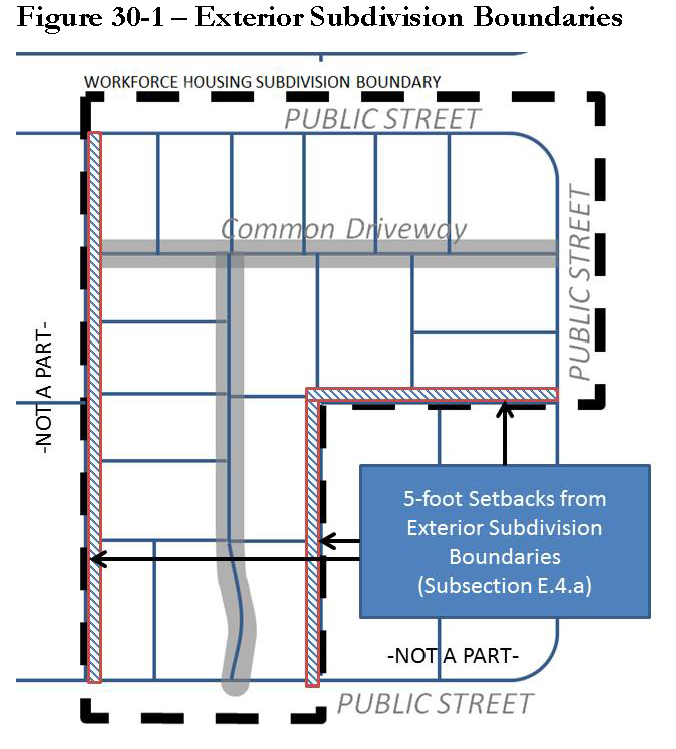
Figure 30-2—Interior Lot Lines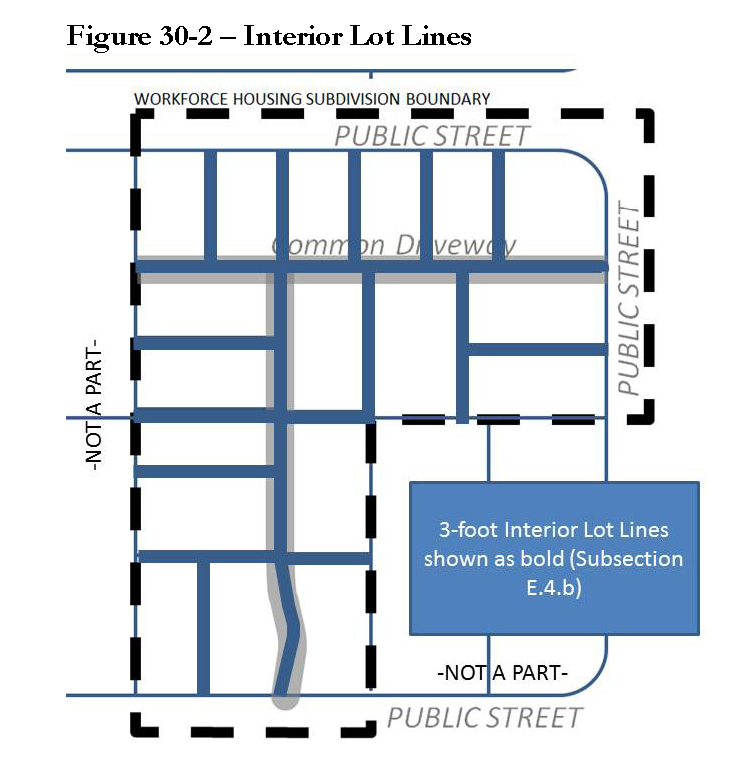
d.
Setbacks from lot lines with public street frontages: A minimum setback of 15 feet shall be established from any public road right-of-way, as indicated in Figure 30-3; except in the following circumstances:
(1)
Front porches and/or entryway features shall be set back a minimum of 10 feet. If front porches are a minimum of 8-foot depth and a minimum 10-foot width, the minimum setback shall be 5 feet.
(2)
Garages fronting and directly accessible from a public road shall be set back a minimum of 20 feet from back of sidewalk.
(3)
Where a lot created by a workforce housing subdivision has frontage on two public streets, one of the two frontages shall have a minimum set back of 10 feet.
(4)
A reduced structural setback of 10 feet may be approved with an adjustment, pursuant to Section 22.70.030.
Figure 30-3—Public Street Frontages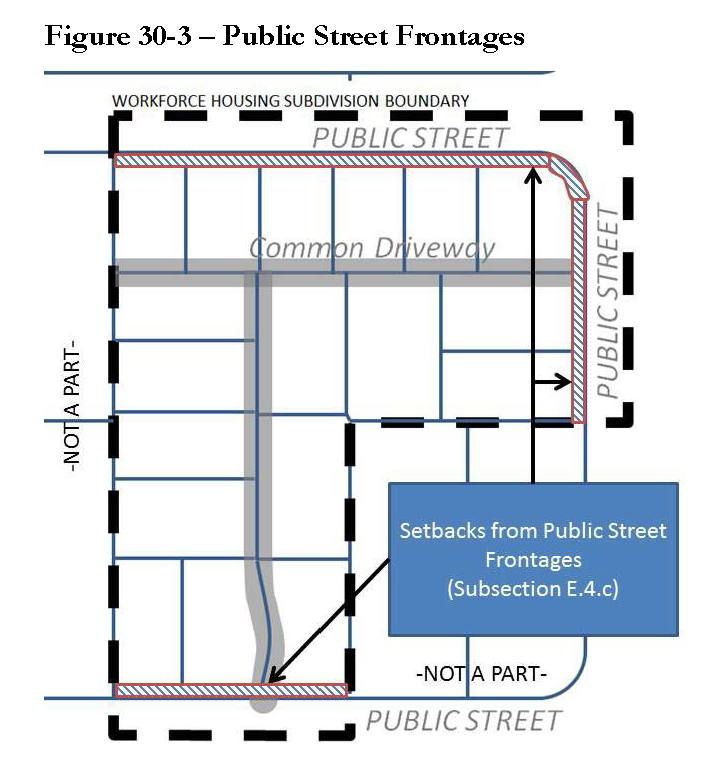
5.
Parking.
a.
Number of spaces. Parking shall be provided on each parcel or in a consolidated location within or adjacent to the workforce housing subdivision, as follows:
b.
Consolidated parking. If parking within the workforce housing subdivision is proposed to be consolidated, the following standards shall apply.
(1)
Uncovered residential parking spaces shall be screened from public streets and adjacent residential uses by landscaping or architectural screening.
(2)
Shall be located in clusters of not more than six spaces. Each parking bay of six spaces shall be separated by at least a six-foot landscape area unless located under a covered structure, which would allow up to 10 spaces.
(3)
All detached covered parking shall have a roof design that is consistent with the architecture of the primary structures. Flat or slightly pitched roofs may be used for solar access applications or where the architectural relationship to the overall design is compatible.
6.
Road Access.
a.
All lots shall have vehicular access (either direct or by private easement) to a publicly maintained road; except that an adjustment may be granted pursuant to Section 21.03.020 for subdivisions where the following standards are met:
(1)
Designated parking for multiple lots is consolidated on-site or adjacent to the site in a location that has vehicular access from a publicly maintained road.
(2)
Lots with no vehicular access to a publicly maintained road shall, at a minimum, have pedestrian access by way of a passageway of at least 10 feet in width, extending from a publicly maintained road to one entrance of each dwelling unit.
b.
Notwithstanding the provisions of Section 21.03.010(d)(7), a private easement may be used to provide vehicular access within a workforce housing subdivision, regardless of the number of lots.
7.
Site planning and residential design.
a.
Minimum Open Area. The minimum open area, including setbacks and all areas of the site except buildings shall be at least 35 percent of the gross lot area.
b.
Compliance with Countywide and Community Design Plans. Residences in workforce housing subdivisions should be consistent with the Countywide Design Plan and any relevant local design plans.
c.
Compliance with Workforce Housing Design Guidelines. Residences in workforce housing subdivisions should be consistent with the Workforce Housing Design Guidelines.
d.
Front entrances.
(1)
Each primary residence shall be provided with a decorative entry feature, consistent with the Workforce Housing Design Guidelines.
e.
Storage. For units with no dedicated enclosed parking, a storage area of a minimum of 100 cubic feet shall be provided for each unit. The storage may be attached to the dwellings or may be attached to a carport structure.
f.
Street trees. A minimum of one street tree per 25 feet of public road frontage shall be provided. Street trees shall be located within the road right-of-way or the front or street side setback of the subdivision.
g.
Fencing. Fencing within designated street frontage setbacks shall not exceed four feet in height.
8.
Inclusionary housing. Workforce housing subdivisions are exempt from the requirements for Section 22.12.040 (Inclusionary Housing).
F.
Ownership and maintenance. Facilities that are common to a workforce housing subdivision shall be owned and maintained in common by the owners of the separate interests who have rights to beneficial use and enjoyment through easements and a maintenance agreement.
G.
Additional map sheet. An additional map sheet shall be concurrently recorded with the final tract map or parcel map (or a developer's agreement with a certificate of compliance effectuating a lot line adjustment), including, at a minimum, the following items:
1.
Graphic exhibit. A graphic exhibit, consistent with plans approved by the Reviewing Authority showing the following features in relation to the lot and subdivision boundaries:
a.
Identification of the location of the front property line for each parcel.
b.
Building setback lines. Alternatively, a setback table indicating the approved setbacks for each lot may be provided.
c.
Conceptual floor plans and elevations.
d.
Restricted open areas where structural development is precluded, such as the designated useable yard area.
e.
Identification of common facilities, such as driveways, utilities, drainage systems, garbage collection, and guest parking.
f.
Location of any infrastructure referenced in the maintenance agreement.
2.
Notification of Maintenance Agreement. Notification that a maintenance agreement for common subdivision infrastructure is recorded.
3.
Conditions of approval. A copy of the conditions of approval affecting the workforce housing subdivision shall be included with the additional map sheet.
H.
Timing.
1.
Eligibility. An application for subdivision pursuant to this Section shall only be accepted for processing when the following timing eligibility criteria have been satisfied:
a.
Cap on number of lots. No more than 200 cumulative lots may be approved pursuant to this Section as part of one or more workforce housing subdivisions.
2.
Expiration. Timeframes and time extensions for workforce housing subdivisions are the same as those timeframes associated with the approved tentative map or lot line adjustment.
(Added 2017, Ord. 3340; 2020, Ord. 3409; 2021, Ord. 3464]
22.30.480 - Residential Uses in the Agriculture and Rural Lands Land Use Categories.
In the Agriculture and Rural Lands land use categories primary dwellings and agricultural worker dwellings are allowed, subject to the standards of this Section. These dwellings may include manufactured homes, subject to the standards in Section 22.30.450 (Residential - Mobile Homes), in addition to the standards of this Section.
A.
Primary dwellings.
1.
Permit requirements. Zoning Clearance is required for each of the two primary dwellings. Agricultural worker dwellings are subject to the provisions of Subsection B. (Agricultural Worker Dwellings)
2.
Density. The maximum number of primary dwellings on a legal parcel shall not exceed the number of dwellings specified in the following table. Dwellings on a legal parcel in addition to those specified in the following table, shall satisfy all provisions of Subsection B for agricultural worker dwellings and Section 22.30.470 for accessory dwellings.
3.
Williamson Act Land. Residential density on lands under Williamson Act Contracts must adhere to the County's Rules of Procedure to Implement The California Land Conservation Act of 1965 (Table 2), individual Contracts, the provisions of the Williamson Act itself and any changes that may be made to it.
B.
Agricultural Worker Dwellings.
1.
Purpose. This subsection provides standards for the application and development of agricultural worker dwellings. Agricultural worker dwellings are categorized into two forms: (1) single-family dwellings, including mobile homes, and (2) group quarters.
2.
Limitations on use.
a.
Agricultural worker dwellings: (1) Are allowable in the Agriculture (AG) and Rural Lands (RL) land use categories, and (2) Shall be in direct support of existing agricultural activities.
b.
Agricultural worker dwellings in the form of single-family dwellings, including manufactured homes, shall be located on parcels owned or leased by the owner of the supported agricultural activities.
3.
Permit requirements. The required permit shall be obtained prior to the establishment of agricultural worker dwellings, as specified in the following table.
4.
Application content. The application shall include explanation and documentation of the need for agricultural worker dwellings. The magnitude of existing agricultural activities to be directly supported by the proposed agricultural worker dwellings must be described, as well as the number of agricultural workers necessary to conduct the agricultural operations.
5.
Criteria for approval. The applicant shall demonstrate that the number of agricultural workers for which the agricultural worker dwellings is proposed is consistent with the "Maximum Density and Capacity of Agricultural Worker Dwellings" table in this Subsection, or that a greater number of agricultural worker dwellings is necessary to support the existing agricultural activity.
6.
Status of residents. Occupancy of agricultural worker is limited to the employees of agricultural or ranching operations and the spouses and children of those employees. Agricultural Worker Dwellings are not to be rented or leased to individuals other than agricultural workers and their spouses and children. An agreement between the property owner and the County limiting occupancy to agricultural workers and their spouses and children shall be executed and recorded prior to building permit issuance.
7.
Density. The maximum allowable density and capacity of agricultural worker dwellings shall be as follows, unless authorized by a Minor Use Permit or Conditional Use Permit.
8.
Sale of agricultural worker dwellings. The site of agricultural worker dwellings shall not be separated from contiguous property in the same ownership by sale or land division, unless a Conditional Use Permit has been prior approved, with the Review Authority making the findings in Section 22.62.060.C.4 (Conditional Use Permit - Required Findings) and the following findings
a.
The proposed reduction of the total acreage of the ownership will not affect its continuing use as a productive agricultural unit; and
b.
The proposed reduction of the ownership size will not encourage population increases in the surrounding area incompatible with continuing agricultural operations.
9.
Parking. Off-street parking shall be provided as specified in the following table:
10.
Manufactured homes. The use of a manufactured home as an agricultural worker dwelling shall satisfy the standards of Section 22.30.450 (Residential - Mobile Homes), in addition to the requirements of this Section.
11.
Group quarter requirements. The use of group quarter facilities, such as dormitories or bunkhouses and mess halls, as agricultural worker dwellings shall be subject to the following additional standards:
a.
Minimum site area. Twenty acres for group quarters.
b.
Minimum setbacks. Group quarters as agricultural worker dwellings shall provide setbacks from the following features as specified:
(1)
Property line - 60 feet;
(2)
Property line adjacent to street - 50 feet;
(3)
Barns, pens, or other facilities for livestock or poultry - 75 feet;
(4)
Structures other than barns, pens, or other facilities for livestock or poultry - 40 feet; and
(5)
Centerline of streams shown on USGS Topographic Maps with blue lines - 100 feet.
c.
Allowable accessory uses. The following uses, if included specifically as part of a ministerial review permit, may be allowed as an accessory use for residents of group quarters. Such accessory uses shall be located in a single common building or in a permitted outdoor location, and may not be advertised to the general public:
(1)
Food service for residents of the agricultural worker dwellings; and
(2)
Laundry facilities for residents of the agricultural worker dwellings.
12.
Amenities. Agricultural worker dwellings developed for more than 12 persons shall provide recreation facilities and open space, proportional to the amount and type of agricultural worker dwellings to be provided. The facilities shall include appropriate recreational areas, such as children play equipment, baseball, basketball, soccer, or horseshoe pitching facilities.
13.
Clustered units. Where an ownership of multiple, legally-created lots of record is entitled to multiple dwellings in compliance with this Section, the owner may group the dwellings on a single lot of the ownership, rather than on each of the various lots entitled to the dwellings, provided that the clustering is approved in conjunction with the application to establish agricultural worker dwellings. An agreement, prepared by County Counsel, shall be executed and recorded to the County's satisfaction prior to the issuance of a construction permit.
14.
Federal and State requirements. Any agricultural worker dwellings accommodating six or more agricultural employees (not necessarily all employed by the owner of the agricultural worker dwellings) shall also comply with applicable state and federal laws and regulations regarding construction, operation, and occupants of the dwellings. The applicable laws and regulations include, but are not limited to, Part 20, Section 654 of the Code of Federal Regulations (20 CFR 654) and Section 17010 et. seq. of the California Health and Safety Code, copies of which are available at the County Department of Planning and Building.
[Amended 1981, Ord. 2063; 1982, Ord. 2091; 1984, Ord. 2163; 1985, Ord. 2211; 1992, Ord. 2539, 2553; 2007; Ord. 3136; 2020, Ord. 3417] [22.08.167]
22.30.490 - Residential Uses in Office or Commercial Land Use Categories.
Single family and multi-family dwellings in the Office and Professional, Commercial Retail, or Commercial Service land use categories are subject to the standards of this Section; except for caretaker residences, which are subject to Section 22.30.430.
A.
Limitation on Use. Except where prohibited by planning area standards (Article 9) and community planning standards (Article 10), [A] single-family dwellings are allowed in Office and Professional and Commercial Retail land use categories and [B] multi-family dwellings are allowed in Office and Professional, Commercial Retail, and Commercial Service land use categories, in accordance with the requirements of this section.
B.
Existing Non-Conforming Uses. In Office and Professional, Commercial Retail, and Commercial Service land use categories, a detached single-family dwelling which is the principal use of its site may be continued as a residential use as set forth in Section 22.72.050.d (Nonconforming Uses of Land).
C.
Permit Requirements. Permit requirements are as follows unless a higher permit level is otherwise required by this Title or is required for an accompanying nonresidential use.
1.
Office Professional and Commercial Retail Land Use Categories. Permit requirements are based on the project characteristics per Table 2-3 in Section 22.08.030.
2.
Commercial Service Land Use Category. Minor use permit required, unless Table 2-3 requires a Conditional Use Permit.
D.
Number of Dwelling Units. The maximum number of units per acre shall be based on intensity factor in accordance with Section 22.10.130.B, or applicable standards in Chapters 9 or 10,
E.
Required Commercial Use. For sites that are either [A] one acre or larger or [B] within a central business district, ground-level floor area that faces or has frontage on an access road shall be for commercial uses.
1.
Exception for Guaranteed Affordable Housing. Commercial use is not required if 10% of total dwelling units is provided as guaranteed affordable housing in the low- or very low-income category in accordance with Section 22.12.030 (Housing Affordability Standards).
2.
Design requirements. The following requirements apply to ensure that commercial uses are not precluded from ground floor space:
a.
Structural. Structural design shall take into account all necessary building code requirements for commercial uses, such as those for accessibility and fire safety.
b.
Building façade. The ground floor building façade must abut front and street side property lines. Setbacks of up to 10 feet may be approved if needed to provide useable public space such as a plaza or dining area.
c.
Ceiling height. Ground floor space shall have a minimum floor-to-floor ceiling height of 12 feet.
d.
Windows. A minimum of 60 percent of the street-facing façade between two feet and eight feet in height shall be comprised of transparent storefront windows that allow views of indoor space or product display areas.
e.
Primary entrance. The primary entrance to ground floor commercial space shall be oriented towards the public street.
[Amended 1981, Ord. 2063; 1982, Ord. 2091; 1986, Ord. 2256, 2269; 1992, Ord. 2539, 2553; 1994, Ord. 2696; 2016, Ord. 3340; 2025, Ord. 3547] [22.08.162]
22.30.500 - Residential Uses in the Recreation Land Use Category.
A residential use identified as allowable in the Recreation land use category by Section 22.06.030 (Allowable Land Uses and Permit Requirements) is subject to the standards of this Section, except for caretaker residences (see Section 22.30.430).
A.
Permit requirement.
1.
Principal use. Multi-family units proposed as the principal use of a site in a Recreation category require Minor Use Permit approval, unless Section 22.08.030 (Project-Based Permit Requirements) would otherwise require Conditional Use Permit approval.
2.
Secondary use. Residential units secondary to a commercial use allowed in the Recreation category are subject to the permit requirements of Section 22.08.030 for residential uses.
B.
Minimum site area and density: To be as required by Section 22.10.130 (Residential Density - Multi-Family Dwellings), or applicable planning area standards (Article 9).
[Added 1982, Ord. 2091; amended 1986, Ord. 2250; 1992, Ord. 2539, 2553] [22.08.168]
[Section 22.30.510 Amended 1994, Ord. 2696; 1999, Ord. 2880; deleted 2012, Ord. 3235]
[22.08.056]
22.30.510 - Residential Vacation Rentals.
Rental of a residential vacation rental shall not exceed one individual tenancy/occupancy per seven calendar days. The first day of each tenancy determines the month assigned to that tenancy.
a.
Permit Requirements. Zoning Clearance, Business License and Transient Occupancy Tax Registration is required for each Residential Vacation Rental.
b.
Adelaida/Willow Creek Area. The following additional requirements apply to Residential Vacation Rentals in the Adelaida/Willow Creek Area shown in Figure 30-1, below. These requirements do not apply to Residential Vacation Rentals on parcels with direct primary access (i.e. an existing driveway) on Highway 46.
Figure 30-1: Adelaida/Willow Creek Area
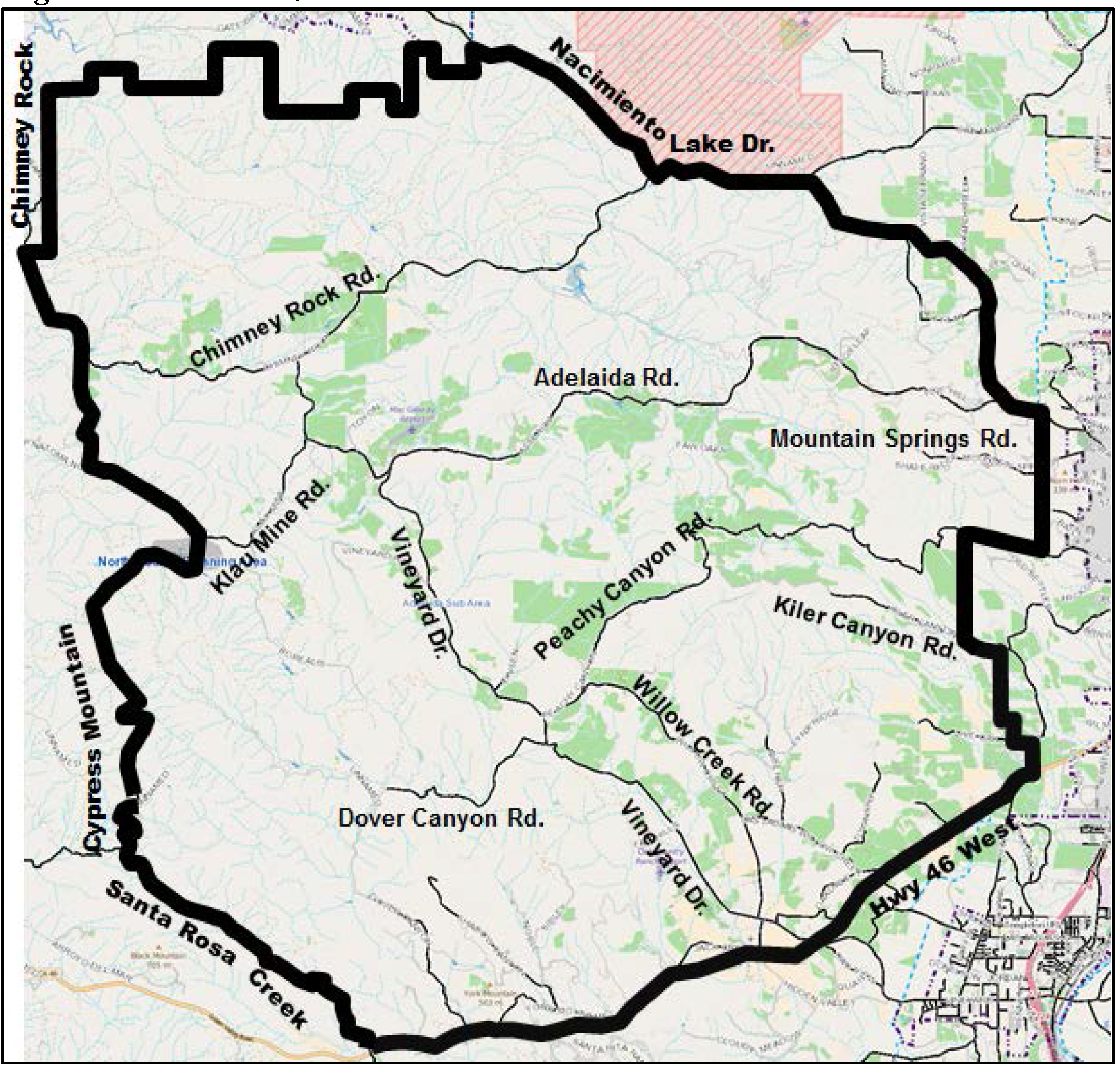
i.
Purpose. The Adelaida/Willow Creek Area is an agricultural and rural residential area with limited infrastructure, narrow roadways, challenged fire service, and topography that magnifies noise and light issues. There is also a concentration of wineries, bed and breakfast inns, lodging, and events in the area. Tailored residential vacation rental standards are necessary to address these unique neighborhood compatibility and community character issues.
ii.
Location. No residential vacation rental shall be located within 1,500 feet of an existing permitted vacation rental. This requirement may be modified through Minor Use Permit approval when a Conditional Use Permit is not otherwise required.
iii.
Temporary Events. Temporary events are not allowed on any site containing a residential vacation rental unless they are authorized under Section 22.30.610 (Temporary Events). Vacation rentals holding temporary events as of the effective date (December 15, 2016) of this section shall be subject to the standards of this section, and owners of such venues shall request the required land use permits within 6 months of the effective date specified above. If the required land use permit has not been requested within the time frames set forth in this section, the penalties of Chapter 22.74 (Enforcement) of this Title shall apply.
iv.
Maximum Overnight Occupancy. Maximum overnight occupancy for residential vacation rentals shall not exceed the number of occupants that can be accommodated consistent with the on-site parking requirement set forth in subsection b.ix hereof, and shall not exceed two persons per bedroom plus two additional persons, excluding children under five (5) years of age. The Zoning Clearance shall specify the maximum number of occupants allowed in each individual vacation rental.
v.
Maximum Number of Guests and Daytime Visitors. The maximum number of total guests and visitors allowed at any time in a single vacation rental shall not exceed the maximum overnight occupancy plus six (6) additional persons per property during the daytime, or eighteen (18) persons, whichever is less, excluding children under five (5) years of age. Daytime visitors shall not be on the property during quiet hours (10:00 PM - 7:00 AM). Vacation rentals with larger numbers of guests and visitors may only be allowed subject to approval under Section 22.30.610 (Temporary Events).
vi.
Number and type of dwellings allowed as vacation rentals. No more than one residential vacation rental shall be established on any single parcel. Agricultural worker housing and/or caretaker dwellings shall not be used as residential vacation rentals. On parcels that contain two primary dwellings, only one of the dwellings shall be used as a residential vacation rental.
vii.
Appearance, visibility and location. The residential vacation rental shall not change the residential character of the outside appearance of the building, either by the use of colors, materials, lighting, or by the construction of accessory structures or garages visible from off-site and not of the same architectural character as the residence; or by the emission of noise, glare, flashing lights, vibrations or odors not commonly experienced in residential areas. The address for each residential vacation rental shall be posted and clearly visible from the main access road.
viii.
Signs/Advertising. Availability of the rental unit to the public shall not be advertised on site. All advertising shall include the TOT Certificate number.
ix.
On-site parking required. All parking associated with a residential vacation rental shall be entirely on-site, in the garage, driveway or otherwise out of the roadway, in accordance with subsection b.iv, above. Tenants of residential vacation rentals shall not use on-street parking at any time.
x.
Noise. All residential vacation rentals shall comply with the standards of Section 22.10.120 et seq. (Noise Standards). No residential vacation rental is to involve on-site use of equipment requiring more than standard household electrical current at 110 or 220 volts or that produces noise, dust, odor or vibration detrimental to occupants of adjoining dwellings. In addition, property owners and/or property managers shall insure that the occupants of the residential vacation rental do not create loud or unreasonable noise that disturbs others and is not in keeping with the character of the surrounding neighborhood. Loud and unreasonable noise shall be evaluated through field observations by a County Sheriff, County Code Enforcement or other official personnel, based upon a threshold of noise disturbance related to the residential vacation rental use that is audible from a distance of 50 feet from the property lines of the rental property.
xi.
Local contact person. All residential vacation rentals shall designate a local property manager. The local property manager shall be available 24 hours a day to respond to tenant and neighborhood questions or concerns. Where a property owner lives in the Adelaida sub-area, the property owner may designate themselves as the local contact person. All the requirements enumerated in this section shall continue to apply.
(1)
A notice shall be submitted to the Department of Planning and Building, the local Sheriff Substation, the main county Sheriff's Office, and the local fire agency; and supplied to the property owners within a 1,500 foot radius. Distances shall be measured as a radius from the exterior property lines of the property containing the residential vacation rental unit. This notice shall state the property owner's intention to establish a residential vacation rental and shall include the name, address and phone number of the local contact person and the standards for noise, parking and maximum number of occupants. A copy of the notice, a form certifying that the notice has been sent and a list of the property owners notified shall be supplied to the Planning and Building Department at the time of application for the Zoning Clearance, Business License and Transient Occupancy Tax Certificate for the residential vacation rental.
(2)
The name, address and telephone number(s) of the local contact person shall be permanently posted in the rental unit in a prominent location(s). Any change in the local contact person's address or telephone number shall be promptly furnished to the agencies and neighboring property owners as specified in this subsection. In addition, the standards for parking, maximum occupancy and noise shall be posted inside the residential vacation rental unit and shall be incorporated as an addendum to the vacation rental contracts.
xii.
Transient Occupancy Tax. Each residential vacation rental unit shall meet the regulations and standards set forth in Chapter 3.08 of the County Code, including any required payment of transient occupancy tax for each residential vacation rental unit. The Transient Occupancy Tax Certificate number shall be included in all advertising for the residential vacation rental.
xiii.
Right to Farm Disclosure. For residential vacation rentals near agricultural land, all rental agreements for individual tenancies shall include the following disclosure language: "The County of San Luis Obispo recognizes the statewide policy to protect and encourage agriculture. Sections 3482.5 and 3482.6 of the California Civil Code and Chapter 5.16 of the San Luis Obispo County Code protect certain, pre-existing agricultural production and processing operations ("agricultural operation") from nuisance claims. If your rental property is near an agricultural operation in the unincorporated area of the County you may at times be subject to one or more inconveniences and/or discomfort arising from that operation. Such inconveniences may include (depending upon the type of agricultural operation protected), but are not necessarily limited to, the following: noise, odors, fumes, dust, legal pesticide use, fertilizers, smoke, insects, farm personnel and truck traffic, visual impacts night time, lighting, operation of machinery and the storage, warehousing and processing of agricultural products or other inconveniences or discomforts associated with the protected agricultural operations. For additional information pertaining to this disclosure and the Right to Farm Ordinance, or concerns with an agricultural operation, please contact the San Luis Obispo County Agricultural Commissioner's Office."
xiv.
Effect on existing residential vacation rentals. Each individual vacation rental in existence on the effective date of this section shall be subject to a Zoning Clearance, Business License, Transient Occupancy Tax Registration, and all standards set forth in this section except subsection b.ii regarding location, provided the owner submits evidence showing that the vacation rental was in existence prior to December 15, 2016. Zoning Clearance, Business License, and Transient Occupancy Tax Registration shall be requested from the county within 120 days of the effective date specified above or prior to the expiration date of any existing valid business license to operate a residential vacation rental. If the Zoning Clearance, Business License, and Transient Occupancy Tax Registration have not been requested within the time frames set forth in this section, the penalties of Chapter 22.74 (Enforcement) of this Title shall apply.
xv.
Complaints. Complaints about possible violations of these standards should first be directed to the local contact person. If the local contact person is unavailable or fails to respond, the complaining party should contact the County Sheriff's Department (Dispatch). Sheriff Dispatch will attempt to reach the local contact person. If Sheriff Dispatch is unable to reach the local contact person because the contact person is not available or because current contact information has not been provided to the Sheriff's Department, the Sheriff's Department will inform County Code Enforcement staff.
During normal business hours, complaints may also be submitted to County Code Enforcement staff. County staff will attempt to reach the contact person or will visit the property as appropriate. Complaints about alleged violations shall be documented by a County Code Enforcement Officer. County staff shall prepare a written report which describes the nature of the violation, when it occurred and how it came to the attention of County officials. In some cases, a report may also be written by the Sheriff's deputy responding to the complaint.
xvi.
Violation - vacation rental. It is unlawful for any person to use or allow the use of property in violation of the provisions of this section and to advertise a use that is in violation of this section. The penalties (including fines) and process for addressing a violation of this section are set forth in Chapter 22.74 of this Title (Enforcement). Additional penalties for violation of this section may include revocation of the Zoning Clearance and Business License. Violations that will cause the processing of Zoning Clearance revocation include, but are not limited to:
(1)
Failure to notify County staff when the contact person, or contact information, changes.
(2)
Violation of the residential vacation rental tenancy standards as set forth above.
(3)
Violation of the residential vacation rental maximum occupancy, parking and noise requirements as set forth above.
(4)
The inability of County staff or the Sheriff's Dispatch to reach a contact person.
(5)
Failure of the local contact person, or property owner, to respond to the complaint.
Three verified violations of this subsection, as determined by a County Planning and Building staff person, within any consecutive six month period, shall also be grounds for revocation of the Zoning Clearance. Signed affidavits by members of the community may be used to verify violations. Revocation of the Zoning Clearance shall follow the same procedure used for land use permit revocation as set forth in Section 22.74.160 of the County Land Use Ordinance.
For purposes of this Section, "advertise" shall mean any form of communication, promotion, or solicitation in any medium including, but not limited to, print, signage, internet website posts, intended to induce the use of property in violation of this Section.
xvii.
Appeal of Permit Denial. An appeal of the denial of any permit requirement as set forth in subdivision a. of this Section or of any request to modify or amend an issued permit as it applies to residential vacation rentals shall be heard by the Hearing Officer in accordance with the hearing procedures set forth in Section 22.74.060.
[2016, Ord. 3338; 2020, Ord. 3409; 2020, Ord. 3417; 2021, Ord. 3434]
22.30.520 - Rural Recreation and Camping.
A.
Camping. Permanent organizational group camps sponsored by a church, youth group, corporation or other organization, or camping that is seasonal and incidental to an agricultural use, are subject to the following provisions. (Commercial campgrounds as principal uses are subject to Section 22.30.300 (RV Parks); temporary camps are subject to Chapter 8.64 of the County Code (Temporary Camps).
1.
Limitation on use. Organizational camps are allowed only in the Rural Lands, Recreation, and Public Facilities categories. Incidental camping is allowed in the Agriculture category as well as where organizational camps are allowed.
2.
Permit requirements. A Health Department permit shall be required in compliance with Chapter 8.62 of the County Code, in addition to the land use permit required by Section 22.06.030.
3.
Minimum site area. As specified in Chapter 22.22 (Subdivision Design).
4.
Density. To be set by the Review Authority where Conditional Use Permit or Minor Use Permit approval is required, to a maximum of one unit per acre, which is also to be the maximum density for incidental camping of less than 10 units.
5.
Setbacks. All camping facilities and activities shall occur no closer than 1,000 feet from any property line or public road.
6.
Parking. No improved parking is required for incidental camping, provided that sufficient usable area is available to accommodate all user vehicles entirely on-site. The parking requirement for organizational camps shall be determined by the Conditional Use Permit approval.
7.
Access. All-weather access shall be provided to the site.
8.
Allowed facilities. Camps established in compliance with this Section may include the following facilities in addition to tent camping areas, based on the type of camp:
a.
Organizational camps. Cabins; meeting hall; swimming pool; permanent restroom facilities; accessory and storage buildings.
b.
Incidental camping. Water supply and portable restrooms only. Incidental camping uses may also include spaces for a maximum of 10 self-contained recreational vehicles, without utility hookup facilities.
9.
Sanitation. Restroom facilities shall be provided as required by the Health Department.
10.
Required findings - incidental camping. A land use permit for incidental camping shall be approved only where the Review Authority first finds that:
a.
The proposed use will not affect the continuing use of the site as a productive agricultural unit providing food or fibre; and
b.
The proposed use will result in no effect upon the continuance or establishment of agricultural uses on surrounding properties.
B.
Dude and guest ranches. A dude and guest ranch is a commercial transient guest occupancy facility incidental to a working agricultural operation, which may include common eating and drinking and recreation facilities subject to the provisions of this Subsection, provided that these facilities shall be used by lodging facility guests only, and not made available to the general public for day use.
1.
Limitation on use. Dude and guest ranches are not to be established in a residential category.
2.
Permit requirement. Conditional Use Permit approval.
3.
Application content. To include a description of recreational facilities and activities to be offered, and an explanation of the relationship between the recreational use and continuing agricultural uses.
4.
Minimum site area. 160 acres, except that where a proposed facility has obtained a recorded right of access and use of adjoining property for recreational purposes, the Commission may reduce the minimum site area as part of the Conditional Use Permit approval.
5.
Setbacks. All facilities shall be located no closer than 500 feet from any property line or public road.
6.
Coverage. The aggregate area occupied by all structures and facilities established for the dude and guest ranch (including all roads, parking areas, lodging and support facilities dedicated to the dude ranch use) shall not exceed two percent of the total site area.
7.
Lodging facilities.
a.
Type of facilities allowed. Dude and guest ranch facilities may be authorized by the Commission to be attached, motel-type units or detached cabins, provided that they include no cooking or eating facilities.
b.
Occupancy. Lodging facilities shall be rented only to guests which will also use other dude and guest ranch facilities. Dude and guest ranch lodgings are not to be used for RV park or motel-type overnighters.
c.
Density. The density of guest lodgings shall be established by the Commission, with the total number of units to be based upon the capability of the ranching activities to continue without interference from guest activities, provided that the maximum density of lodging facilities shall be no more than one guest unit for each five acres in the Agriculture category, and one guest unit per acre in other categories.
8.
Parking requirement and Access requirements. Access will be required to be CCR title 14 (where applicable) including dead-end road standards and San Luis Obispo County Title 16. Parking to be set through Conditional Use Permit approval.
9.
Required findings. A Conditional Use Permit for a dude and guest ranch in the Agriculture land use category shall be approved only where the Commission makes the following findings in addition to those required by Section 22.62.060.C.4:
a.
The proposed use will not substantially affect the continuing use of the site as a productive agricultural unit providing food or fibre; and
b.
The proposed use will result in no substantially adverse effect upon the continuance or establishment of agricultural uses on surrounding properties.
Where located in other than in an Agriculture category, the only required findings are those in Section 22.62.060.C.4.
C.
Health resorts and bathing. Commercial health resorts, outdoor hot springs, spas, or hot tub rental operations that are operated as a principal use, and transient lodging facilities accessory to such use, are subject to the following:
1.
Limitation on use. Health resorts and bathing facilities are not allowed in a Residential Suburban category, and are not allowed in the Agriculture land use category unless the facility is dependent upon a natural on-site resource such as a lake or hot springs.
2.
Permit requirement. Conditional Use Permit approval, in addition to a Health Department permit as required by Chapter 8.60 of the County Code.
3.
Minimum site area. 10 acres in the Agriculture and Rural Lands categories; five acres in other rural categories; one acre when located within an urban or village reserve line.
4.
Parking. Two spaces per hot tub or spa; and one space per 100 square feet of swimming pool area. Where lodging units are included, additional spaces shall be provided at a ratio of one space per lodging unit.
5.
Sanitation and water disposal. The provision of sanitary facilities and the disposal of wastewater from hot tubs or pools shall be in compliance with requirements established by the Health Department, and by the Regional Water Quality Control Board in compliance with Section 22.10.190 (Regional Water Quality Control Board Review).
D.
Hunting and fishing clubs.
1.
Limitation on use. Hunting and fishing clubs shall be located only in the Agriculture, Rural Lands and Recreation categories.
2.
Permit requirement. Site Plan Review.
3.
Location. Hunting activities shall be limited to areas no closer than one-half mile from any residential category or residential use other than that of the applicant.
4.
Setbacks. Any membership hunting facilities and activities shall be located no closer than 1,000 feet from any property line or the public road. No limitation on the location of fishing activities other than required for structures by Section 22.10.140 (Setbacks) or other provisions of this Chapter.
5.
Camping and lodging. Allowable only if authorized in compliance with Subsection A. (Camping), or Section 22.30.300 (Lodging - Recreational Vehicle Parks), including the permit requirements of those sections.
6.
Parking requirement. No improved parking is required, provided that sufficient usable area is made available to accommodate all employee and user vehicles entirely on site, unless other requirements are set through Conditional Use Permit approval.
F.
Sport shooting facilities. Establishments providing an outdoor shooting range for pistol or rifle target practice, skeet shooting, trap shooting, archery or similar facilities open to the public, members of a club, or public safety agency are subject to the following:
1.
Limitation on use. Outdoor sport shooting facilities are allowed only in the Agriculture, Rural Lands and Public Facility categories.
2.
Permit requirement. Conditional Use Permit approval.
3.
Location. Outdoor sport shooting facilities except for archery shall be located no closer than one mile to any urban or village reserve line or residential land use category; and no closer than one-half mile from any residential use on an adjoining lot.
4.
Minimum site area. Five acres.
5.
Parking requirement. To be set through Conditional Use Permit approval.
6.
Noise control. The proposed use must satisfy the requirements of Section 22.10.120 (Exterior Noise Standards) for the Residential Suburban and Recreation categories, regardless of the land use category in which the range is located.
[Amended 1981, Ord. 2063; 1984, Ord. 2163; 1986, Ord. 2290; 1992, Ord. 2553; 1994, Ord. 2696; 1995, Ord. 2741; 2023, Ord. No. 3500] [22.08.072]
22.30.530 - Sales Lots and Swap Meets.
Outdoor sales lots and swap meets are allowed in the Commercial Service and Industrial categories subject to the provisions of this Section. (Wrecking yards are subject to Section 22.30.380 - Recycling and Scrap.)
A.
Sales lots. May be conducted as a principal use (as in the case of a used car lot), or as an accessory use (such as a sales yard in conjunction with a building materials store), subject to the following.
1.
Permit requirement. As determined by Section 22.08.030 (Project-Based Permit Requirements - Outdoor Storage Uses), except when a sales lot is accessory to a use that is otherwise required to have a higher permit.
2.
Site design standards.
a.
Displays. Displays shall be limited to street frontages only. All other property lines shall be screened in compliance with Subsection A.2.d. All signing shall comply with Chapter 22.20 (Sign Standards).
b.
Parking requirement. One space per 3,000 square feet of outdoor use area, one space per 300 square feet of office space.
c.
Landscape planting. A five foot wide planting strip shall be provided adjacent to all street property lines, consisting of ground-covering vegetation which may be maintained at a height less than three feet, with street trees located within the planting strip at 20-foot intervals. This is in addition to any landscape requirements of Chapter 22.16. (Landscaping).
d.
Screening. All interior property lines shall be screened with a six foot high solid wall or fence.
e.
Office facilities. When no buildings exist or are proposed on a sales yard site, one commercial coach may be used for an office, provided that such vehicle is equipped with skirting, and installed pursuant the permit requirements of Title 19 of the County Code (the Building and Construction Ordinance).
f.
Site surfacing. A sales lot shall be surfaced with concrete, A.C. paving, crushed rock, or other material maintained in a dust-free condition. All vehicle drive areas shall be paved with concrete, asphalt or crushed rock.
B.
Outdoor equipment rental yards with incidental ready-mix concrete. Outdoor equipment rental yards which include incidental retail ready-mix concrete operations shall satisfy the requirements of Section 22.30.140.B, in addition to the provisions of Subsection A.
C.
Swap meets. May be conducted only as a temporary use on the site of another use established in compliance with this Title in a Commercial Service or Industrial category, provided that such site is also in conformity with the standards of this Section.
1.
Location. On an arterial, or on a collector which extends between two other collectors or arterials, provided that a swap meet shall not be located on a site that abuts a residential category.
2.
Limitation on use. The sale of vehicles is not permitted. Any sales of food items are subject to Health Department approval.
3.
Site design standards.
a.
Parking requirement. As determined by the Review Authority.
b.
Restrooms. Public restrooms shall be provided at a swap meet as required by the Health Department.
c.
Site surfacing. Portions of a swap meet site used for sales activities, or pedestrian circulation shall be surfaced with concrete, asphalt, or planted with maintained lawn. Vehicle access and parking areas shall be surfaced in compliance with Chapter 22.18 (Parking and Loading). All site areas not otherwise used for buildings or vehicle circulation shall be landscaped.
4.
Operation. Swap meets shall be held during the daylight hours, on no more than two days out of every seven days. This standard may be modified through Conditional Use Permit approval where it is found that the proposed site will be provided with adequate permanent parking and restroom facilities, and that the surrounding area can sustain traffic volumes generated by a swap meet without adverse effects in the area.
[Amended 1987, Ord. 2330; 1992, Ord. 2553; 1993, Ord. 2648; 1999, Ord. 2880] [22.08.144]
22.30.540 - Schools.
The provisions of this Section apply to public and private schools providing instruction for kindergarten through 12th grade children, and schools providing specialized education and training, where identified by Table 2-2 as being subject to the standards of this Section. Preschools and other child day care facilities are instead subject to Section 22.30.170 (Child Day Care Facilities).
A.
Elementary and high schools.
1.
Limitation on use. Schools in the Office and Professional category are limited to high schools.
2.
Location. No closer than 1,000 feet to an Industrial or Commercial Service category or 500 feet from a Commercial Retail category.
3.
Parking. Off-street parking shall be provided at a ratio of two spaces for each classroom, and one space for 100 square feet of administrative or clerical office space. Except that where Chapter 22.18 (Parking and Loading) would require more spaces for an on-site auditorium, stadium, gymnasium or other public or sports assembly facility, the larger number of spaces shall be provided. For all school facilities, parking lot turnover is low; loading bay intensity is low.
B.
Specialized education and training schools.
1.
Limitation on use.
a.
Agriculture category. Specialized education and training schools are allowable in the Agriculture category only when the curriculum offered is primarily in subjects related to agriculture or forestry.
b.
Industrial category. Specialized education and training schools are allowed in the Industrial category only when the curriculum offered is primarily in subjects related to industry and/or manufacturing.
2.
Parking. Off-street parking shall be provided at a ratio of one space per seat in the largest classroom or instructional area, in addition to spaces required for any proposed auditorium by Chapter 22.18. Parking lot turnover is high; loading bay intensity is low.
[Amended 1981, Ord. 2063; 1982, Ord. 2091; 1986, Ord. 2250; 1987, Ord. 2293; 1994, Ord. 2693, 2696] [22.08.074.a and b]
22.30.550 - Small-Scale Manufacturing.
The establishment of a small-scale manufacturing use in an Agriculture, Rural Lands or Commercial Retail category is subject to the following standards:
A.
Limitation on use.
1.
Commercial Retail category. A small-scale manufacturing use shall not be located in a ground-floor store frontage in a Commercial Retail land use category except where the storefront is used for display and retail sale of the products of the manufacturing operation.
2.
Agriculture and Rural Lands categories. Small-scale manufacturing in the Agriculture and Rural Lands categories is limited to establishments accessory or secondary to full-time farming or ranching operations on the same site, and which produce farm or ranch-related equipment, or small products sold off-site to supplement farm income. Such use shall be conducted entirely within a building, or in a yard area screened in compliance with Section 22.30.246.
B.
Required findings. The approval of small-scale manufacturing in the Agriculture or Rural Lands land use category shall require that the Review Authority first find that the proposed manufacturing use will:
1.
Be clearly secondary or accessory to a full-time farming or ranching operation on the same site; and
2.
Not detrimentally affect the continuation of agricultural uses on the subject site and on surrounding properties.
[Amended 1981, Ord. 2063; 1992, Ord. 2553] [22.08.099]
22.30.560 - Storage Yards.
Outdoor storage yards, including the storage of vehicles in other than a day use parking lot or garage, are allowed in the Commercial Service and Industrial categories subject to the provisions of this Section. The storage of vehicles in a public or commercial parking lot or garage is subject to Chapter 22.18 (Parking and Loading); the storage of wrecked or abandoned vehicles, or vehicles being dismantled, is subject to Section 22.30.380 (Recycling and Scrap), in addition to this Section.
A.
Limitation on use. Storage yards in the Recreation land use category are limited to the storage of recreational vehicles and boats.
B.
Site design standards.
1.
Access. There shall be only one access point to a storage yard for each 300 feet of street frontage. Such access point shall be a maximum width of 20 feet, and shall be provided with a solid gate or door.
2.
Screening. A storage yard (except a temporary off-street construction yard) shall be screened from public view on all sides by solid wood, painted metal or masonry fencing, with a minimum height of six feet; provided that this requirement may be waived through adjustment (Section 22.70.030), when:
a.
The side of a storage yard abuts a railroad right-of-way; or
b.
The surrounding terrain would make fencing ineffective or unnecessary for the purpose of screening the storage yard from the view of public roads.
3.
Parking requirement. None, provided that sufficient usable area is available to accommodate all employee and user parking needs entirely on-site.
4.
Site surfacing. A storage yard shall be surfaced with concrete, asphalt paving, crushed rock, or oiled earth, maintained in a dust-free condition.
5.
Office facilities. When no buildings exist or are proposed on a storage yard site, one commercial coach may be used for an office, provided that such vehicle is equipped with skirting, and installed in compliance with the permit requirements of Title 19 of the County Code (the Building and Construction Ordinance).
C.
Operation. Materials within a storage yard shall not be stacked or stored higher than six feet, except where:
1.
Materials stored are vehicles, freestanding equipment, or materials that are of a single piece that is higher than six feet; or
2.
The storage yard site is an interior lot within an Industrial land use category that is not visible from a collector or arterial road and from outside the Industrial category; or
3.
Screening requirements have been waived or modified in compliance with Subsection B.2; or
4.
A higher wall or fence is constructed at the required setback line under an approved building permit and materials stored are not higher than the fence.
[Amended 1992, Ord. 2553] [22.08.146]
22.30.570 - Stores and Restaurants in Non-Commercial Categories.
The provisions of this Section apply to restaurants, bars, and night clubs where allowed by Section 22.06.030 in other than the commercial land use categories.
A.
Limitations on use.
1.
Restaurants, bars, and night clubs.
a.
Bars or other places selling alcoholic beverages for on-premise consumption as a principal use rather than being accessory to a restaurant are not allowed in residential and agriculture land use categories.
b.
Dancing and other entertainment activities normally secondary to a restaurant are not allowed in a residential land use category.
c.
A limited food service facility may be established in the Agriculture land use category where there is an existing conforming visitor-serving use (e.g.: winery, riding stable, health resort), and where the use is clearly incidental, related and subordinate in nature and size to the primary operation of the winery as a production facility or to the existing visitor-serving use where the use is not a winery. The limited food service facility shall be within the same structure as the wine tasting facility, or the winery facility where no tasting is proposed, or within the same structure as the visitor serving use where the use is not a winery.
B.
Minimum site area. 6,000 square feet in urban areas; one acre in rural areas.
C.
Location and access. In Residential categories, the site of a restaurant shall be located on a collector or arterial; the site of a store selling food or beverages for off-premise consumption shall be located at the intersection of two collectors, arterials or combination of both. Such uses may be sited on local streets in Recreation and Office and Professional categories. The site of a limited food service facility in the Agriculture category shall be located within 5 miles from an urban or village reserve line, and on or within one mile of an arterial or collector.
D.
Hours of operation. The conduct of retail business in residential or agricultural areas is limited to the hours between 7:00 a.m. and 9:00 p.m. daily. A limited food service facility in the Agriculture land use category is restricted to the hours the wine tasting facility, or the winery facility where no tasting is proposed, or the visitor serving use where the use is not a winery, is open to the public.
E.
Size of accessory restaurant. The size of a limited food service facility in the Agriculture category shall contain no more than 800 square feet of kitchen and dining area, including any outdoor dining area.
[Amended 1984, Ord. 2163; 1992, Ord. 2553; 1994, Ord. 2696; 1995, Ord. 2741; 2001, Ord. 2942] [22.08.208]
22.30.580 - Temporary Uses - General Standards.
Temporary uses may include construction of permanent structures, grading, or other alteration of a site except the cutting of grasses or weeds, only when the temporary use occurs in conjunction with a construction project authorized by an approved land use or grading permit. [22.08.241]
22.30.590 - Temporary Construction Trailer Parks.
This Section may allow the developer of a major rural area construction project to provide short-term construction employees the opportunity to use trailers and other recreational vehicles for housing during project construction, provided that such vehicles are located in a special occupancy park approved in compliance with this Section. These requirements are in addition to any permit requirements and other applicable regulations of the California Department of Housing and Community Development in compliance with Title 25 of the California Code of Regulations.
A.
Definitions. The following terms are defined for the purposes of this Section:
1.
Major rural area construction project. A development occurring outside of an urban or village reserve line that will employ 50 or more full-time construction workers during construction. Such projects include but are not limited to energy production, extraction or transmission facilities, pipelines and other land uses requiring Conditional Use Permit approval.
2.
Recreational vehicle space. A lot or defined area inside a temporary construction trailer park, within which a single occupied travel trailer, motor home, truck mounted camper or other vehicle used for temporary housing purposes may be accommodated.
3.
Title 25. Title 25 of the California Code of Regulations.
B.
Application requirements. The land use permit application shall be filed only by the applicant for the project the park is intended to support, or an independent contractor engaged by the construction project applicant.
C.
Limitation on duration of park.
1.
Time for removal. Except as otherwise provided by Subsection C.2, a temporary construction trailer park shall be removed from the approved site and the site shall be restored to its pre-park state, or other condition or use consistent with the provisions of this Title, within one year from the date of its approval, or within 60 days after completion of the construction project the park supports, whichever comes first.
2.
Extensions of time. Operation of an approved park may continue beyond the period prescribed by Subsection C.1, if extended by the Review Authority through approval of a request for extension from the applicant before the expiration of one year; or if extended through the approval of another Conditional Use Permit authorizing use of the park to support another approved major rural area construction project. Extensions of time without additional Conditional Use Permit approval may be granted by the Review Authority for a maximum of one year each, and shall not exceed a total of three years.
3.
Guarantee of removal and restoration required. In order to ensure proper termination, removal and site restoration of a temporary construction trailer park as required by this Section, the applicant shall provide the County a performance guarantee in compliance with Section 22.64.040 before establishment of the park, in an amount to be determined through condition of approval of the Conditional Use Permit.
D.
Location criteria.
1.
A temporary construction trailer park shall not be located closer than 1,500 feet from any dwelling on other than the site of the park.
2.
The park shall not be visible from a public road unless the Review Authority finds that:
a.
The location of a park near a remote rural area construction project will significantly reduce the length of vehicle trips generated by the construction project; and
b.
There is not a site with suitably limited visibility within a reasonable distance of the construction project.
E.
Minimum site area: Five acres.
F.
Site design and development standards. The design and development of a temporary construction trailer park shall be in compliance with the provisions of Title 25 of the California Code of Regulations for Special Occupancy Parks, Sections 2000 et seq., and the following.
1.
Maximum park density. 10 recreational vehicle spaces per acre.
2.
Site coverage. The occupied area of the site shall not exceed 75 percent of the total site area.
3.
Setbacks. No part of a recreational vehicle shall be located closer than 50 feet to any street property line, and no closer than 30 feet to any interior property line; provided that the Commission may reduce the street property line setback where it finds that site topography or other natural features eliminate the need for the screening or buffering provided by such setbacks.
4.
Security fencing. A solid wood fence or chain link fence with slats is the minimum requirement for security fencing, which shall be located on all interior property lines and street setbacks.
5.
Parking. Each recreational vehicle space shall be provided sufficient area to accommodate the parking of one passenger vehicle in addition to the recreational vehicle.
6.
Roads. Interior park roads may be constructed to the County gravel standard structural section, at the widths provided by Section 2408 of Title 25, provided that such roads shall be maintained in a dust-free condition as required by Title 25.
7.
Utilities.
a.
Water Supply. Domestic water facilities are not required at each recreational vehicle space but shall be provided as required by Title 25 and shall be constructed in compliance with a permit from the Health Department.
b.
Restrooms and sewage disposal. Restroom facilities shall be provided as required by Title 25. Sewage disposal facilities shall be approved by the Planning and Health Departments and Regional Water Quality Control Board. A holding tank dump shall be provided as required by Title 25.
c.
Power. Electrical hookups shall be provided each recreational vehicle space.
8.
Fire protection facilities. Shall be provided as required by the County Fire Department.
9.
Trash collection. The park shall be provided at least one central trash collection area and the applicant shall arrange for weekly removal of trash from the park to an approved disposal site.
[Added 1987, Ord. 2319; 1994, Ord. 2696] [22.08.268]
22.30.600 - Temporary Dwellings or Offices.
The use of a temporary dwelling or office is subject to the provisions of this Section. Standards for permanent caretaker dwellings are in Section 22.30.430; when a vehicle or temporary or relocatable building is proposed for use as an office for a sales lot (including mobile home sales), such use is subject to the standards of Section 22.30.530 (Sales Yards and Swap Meets).
A.
General requirements.
1.
Location. Temporary dwellings and offices shall be located outside of required setbacks.
2.
Type of structure. A temporary dwelling or office may be a mobile home, recreational vehicle, or portable modular building in conformity with the California Building Standards Code, except within an urban or village area, a temporary dwelling may only be a recreational vehicle of 29 feet or less in length.
3.
Sanitation and water supply.
a.
Restroom required. A restroom within the temporary dwelling or office, or a portable restroom approved by the Health Department shall be provided.
b.
Sewage disposal. Sewage disposal for a restroom within a temporary dwelling or office shall be by means of temporary hookup to community sewer facilities or the on-site septic system; sewage disposal from portable restrooms (only allowed for a temporary office) shall be as authorized by the Health Department.
c.
Water supply. Water shall be supplied by a public water supply or on-site well. The temporary dwelling or office shall not be occupied until it is connected by means of a temporary hookup to a public water supply or an approved on-site water supply.
4.
Parking requirement. None for a temporary dwelling or construction office, provided sufficient usable area is available to accommodate all parking needs entirely on-site; as required by Chapter 22.18 (Parking and Loading), for other temporary offices.
5.
Time limits. The use of a temporary dwelling or office is subject to the time limits in Subsections B. through E., which may be extended in compliance with Section 22.64.070 (Extensions of Time).
6.
Approved permanent use required. Temporary dwellings or offices are allowed only while an approved building permit and an approved land use permit are in effect for the permanent use (Section 22.64.150 - Lapse of Land Use Permit), except where other circumstances are authorized through Minor Use Permit approval or as otherwise provided in this Section. A mobile home shall not be authorized as a temporary dwelling where the permanent dwelling is also proposed to be a mobile home.
7.
Removal of temporary dwelling or office. Temporary dwelling or office use shall be terminated before issuance of a certificate of occupancy or final building inspection approval of the permanent use.
B.
Temporary dwellings. A temporary dwelling may be established on the same site as the construction of a permanent residence, or on the site of a non-residential construction project. A temporary dwelling shall be occupied only by either the property owner, permittee, contractor, or an employee of the owner or the contractor who is directly related to the construction project. Use of a temporary dwelling is limited to a maximum period of one year, unless the land use permit for the temporary dwelling is extended as set forth in Subsection A.5.
C.
Temporary business offices. A temporary business office may be used as follows.
1.
On the site of a permanent business facility where such building is under construction; or where a temporary office has been authorized through a land use permit approval; or
2.
As a real estate office on the site of an approved new subdivision under construction within an urban or village reserve line or any other residential land use category, for a maximum of two years from recordation of a final subdivision map, unless a longer period is authorized through the tentative subdivision map approval, Minor Use Permit or Specific Plan approval. Such temporary real estate office may occupy one dwelling unit in the subdivision or may be a separate structure; or
3.
A financial service (e.g. a bank) may use a temporary business office on the permanent site, or a site other than that proposed for the permanent facility in advance of a decision to construct permanent quarters, for a maximum of 18 months before issuance of a land use permit for a permanent facility, and thereafter until either the permanent facility is established or its land use permit expires.
D.
Temporary construction offices. May be established on the site of any subdivision, construction project or temporary off-site construction yard (Section 22.30.620) in compliance with the provisions of this Section. The temporary office may remain on the site until construction is completed.
E.
Emergency use of temporary dwellings or offices. In the event of an emergency such as the destruction of a dwelling or the permanent quarters of a business, a temporary dwelling or office may be established in advance of the issuance of a building permit to reconstruct the destroyed structure, provided that a building permit is obtained for the temporary use and proper sanitation facilities are installed in compliance with Health Department approval.
[Amended 1981, Ord. 2063; 1982, Ord. 2091; 1984, Ord. 2163; 1992, Ord. 2539, 2553; 1999, Ord. 2880; 2014, Ord. 3282] [22.08.246]
22.30.610 - Temporary Events.
Where allowed by Section 22.06.030, temporary events are subject to the standards of this Section. (Swap meets are subject to the standards of Section 22.30.530 - Sales Lots and Swap Meets.)
A.
Permit requirements. Minor Use Permit approval, except as follows.
1.
Public events. No land use permit is required for:
a.
Events occurring in approved theaters, convention centers, meeting halls or other approved public assembly facilities; or
b.
Admission free events held at a public park or on other land in public ownership when conducted with the approval of the public agency having jurisdiction, provided that the event is conducted in compliance with all applicable provisions of this Title; or
c.
Other free admission events which are eight hours or less in duration and are operated by non-profit organizations.
2.
Commercial entertainment. Commercial outdoor entertainment activities are subject to the permit requirements and standards of Chapter 6.56 of the County Code (Temporary Commercial Outdoor Entertainment Licenses).
3.
Parades. Parades and other temporary events within the public right-of-way are not subject to land use permit requirements, provided that all requirements of the County Public Works Department and County Sheriff are met.
4.
Temporary camps. Temporary camps as a principal use or accessory to another temporary event are subject to the permit requirements and other provisions of Chapter 8.64 of the County Code.
B.
Time limit. A temporary event shall be held in a single location for no longer than 12 consecutive days, or four successive weekends, except where a different time limit is established by other applicable provisions of the County Code or through Minor Use Permit approval.
C.
Location. The site of any temporary event other than public events and parades shall be located no closer than 1000 feet to any Residential Single-Family land use category.
D.
Site design standards. All temporary events are subject to the following standards, regardless of whether a land use permit is required, except where alternate standards are established by Chapters 6.56 or 8.64 of the County Code.
1.
Access. Outdoor temporary events shall be provided a minimum of two unobstructed access points, each a minimum of 18 feet wide, from the event site to a publicly maintained road.
2.
Parking. Off-street parking shall be provided private events as follows with such parking consisting at minimum, of an open area with a slope of 10 percent or less, at a ratio of 400 square feet per car, on a lot free of combustible material.
a.
Seated spectator events. One parking space for each 12 square feet of seating area.
b.
Exhibit event. One parking space for each 75 square feet of exhibit area.
3.
Fire protection. Facilities to be provided as required by the County Fire Department.
4.
Water supply and sanitation. Facilities to be provided as required by the Health Department.
E.
Guarantee of site restoration. A bond or cash deposit may be required for approval of a temporary event to guarantee site restoration after use, and operation in compliance with the standards of this Chapter. The guarantee shall cover both operation and restoration, and is subject to the provisions of Section 22.02.060 (Guarantees of Performance).
F.
Violation - Temporary Events. It is unlawful for any person to use or allow the use of property in violation of the provisions of this section and to advertise a use that is in violation of this section. The penalties (including fines) and process for addressing a violation of this section are set forth in Chapter 22.74 of this Title (Enforcement). Additional penalties for violation of this section may include revocation any issued permit and Business License.
For purposes of this Section, "advertise" shall mean any form of communication, promotion, or solicitation in any medium including, but not limited to, print, signage, internet website posts, intended to induce the use of property in violation of this Section.
[Amended 1984, Ord. 2163; 1992, Ord. 2553; 2021, Ord. 3434] [22.08.248]
22.30.620 - Temporary Off-Site Construction Yards.
A storage yard for construction supplies, materials or equipment for temporary use during a construction project (which may include a temporary office in compliance with Section 22.30.600) is allowable on a site not adjacent to the construction site subject to the provisions of this Section. The temporary storage of construction materials on or adjacent to a construction site is subject to Section 22.30.040 (Accessory Storage - Building Materials and Equipment).
A.
Site design standards. To be determined through the review and approval process for Minor Use Permit proposals in addition to the site design standards as set forth in Section 22.30.560.B (Storage Yards - Site Design Standards); for Site Plan Review proposals as set forth in Section 22.30.560.B (Storage Yards - Site Design Standards).
B.
Site restoration required. The site of a temporary construction yard shall be restored to its original vegetative and topographic state within 30 days after completion of construction. Proper site restoration within another period of time shall be approved by the Director. Prior to establishment of the use, all site restoration shall be guaranteed as set forth in Section 22.64.040 (Guarantees of Performance).
[Amended 1992, Ord. 2553] [22.08.244]
22.30.630 - Vehicle Storage.
This Section applies to commercial parking lots, garage and other establishments engaged in the storage of vehicles for a fee or without fee as a principal use, whether owned and operated publicly or privately. (The storage of vehicles for sale is subject to Section 22.30.530 (Sales Lots and Swap Meets); the storage of vehicles in the Commercial Service and Industrial categories is subject to Section 22.30.560 (Storage Yards)).
A.
Limitation on use. Vehicle storage establishments in the Commercial Retail and Office and Professional categories shall be limited to the temporary parking of automobiles, busses and self-propelled recreational vehicles.
B.
Minimum site area. 10,000 square feet.
C.
Access. From a local street or greater.
D.
Development standards. The design and development of parking areas shall be in compliance with Chapter 22.18 (Parking and Loading), except that indoor parking facilities where all parking maneuvers are performed by attendants may use tandem parking.
[22.08.290]
22.30.640 - Reserved.
Editor's note— Ord. No. 3292, § 2, adopted March 24, 2015, repealed § 22.30.640. Former § 22.30.640 pertained to warehousing and derived from Ord. 2553, adopted in 1992.
22.32.010 - Purpose.
This Chapter provides standards to regulate and mitigate the potential adverse effects of various types of energy-generating facilities.
(2015, Ord. 3291)
22.32.020 - Applicability.
The land use permit requirements of this Chapter apply to the new construction of energy-generating facilities.
A.
Exemptions.
1.
Previously permitted projects. Energy-generating facilities approved prior to the effective date of this Section shall not be required to meet the requirements of this Chapter, except that physical modification or alteration to an existing energy-generating facility that materially alters the size, type, or electrical components of the facility which are directly engaged in the production of energy or storage of energy shall be subject to this Section. Only the modification or alteration shall be subject to this Section as follows:
a.
Staff determinations of substantial conformance with the original permit do not require the issuance of new permits.
b.
Routine operation, maintenance, or in-kind replacements do not require the issuance of new permits.
2.
Accessory renewable energy-generating facilities.
a.
An accessory renewable energy-generating facility (see definition in Chapter 22.80) that provides energy for on-site uses shall be subject to the permit requirements of this chapter only when the facility meets one or more of the criteria listed in Subsection b. If proposed accessory renewable energy-generating facilities do not meet the criteria in Subsection b and demonstrate compliance with all applicable standards provided in this Chapter and any other applicable provisions of this Title, the project shall require Zoning Clearance.
b.
An accessory renewable energy-generating facility shall require a land use permit (other than a Zoning Clearance) as established by Section 22.32.030 of this Chapter if the facility meets one or more of the following criteria:
(1)
Provides energy for sale to off-site uses.
(2)
Is within an area designated Open Space (OS).
(3)
Is within a Flood Hazard, or Sensitive Resource Area Combining Designation.
(4)
Is a ground-mounted facility that is greater than 3 acres in area.
(5)
Is located within 100 feet of any adjacent property or public road.
(6)
Is not consistent with definitions for "Use, Accessory" in this Title and accessory to active, on-site uses.
(7)
Is subject to environmentally related permits.
B.
Other area standards. Where a parcel is subject to standards for combining designations in Chapter 22.14, or the standards in Article 9 (Planning Area Standards) or Article 10 (Community Planning Standards), the standards of those sections shall prevail over the requirements of this Chapter (22.32, Energy-Generating Facilities), except for accessory energy-generating facilities within the Airport Review (AR) Area consistent with the criteria in Subsection 22.32.020.A.2.
(2015, Ord. 3291)
22.32.030 - Permit and Application Requirements.
A.
Permit requirements. Except where county land use permit authority is preempted by state law, and except where other provisions of this Chapter establish a different permit requirement, the required land use permit for energy-generating facilities is determined as described below.
1.
Non-renewable energy-generating facilities. Permit requirement is determined by the area in square feet per site of grading or the removal of natural ground cover as follows.
PERMIT REQUIREMENTS FOR NON-RENEWABLE ENERGY-GENERATING FACILITIES
2.
Energy storage.
a.
For purposes of this Chapter, energy storage is defined by Section 22.80.030E.
b.
Energy storage shall require a Conditional Use Permit where it meets any of the following criteria:
(1)
It is the primary use of the site.
(2)
It is proposed on a site with no existing or apparent use or development.
c.
Energy storage that is accessory to a primary use shall be subject to the permit requirements and development standards of the primary use.
3.
Renewable energy facilities.
a.
Permit requirements for SEFs within the Renewable Energy (RE) Combining Designation seeking Site Plan Review are established in Section 22.14.100 (Renewable Energy Area).
b.
Permit requirements for renewable energy facilities, including, but not limited to, SEFs outside of the RE Combining Designation, are determined based on land use and land use category:
ALLOWABLE LAND USES AND PERMIT REQUIREMENTS FOR RENEWABLE ENERGY FACILITIES BY LAND USE CATEGORY
Notes
(1)
See Article 8 and this Chapter for definitions of the listed land uses.
(2)
See Article 9 for any restrictions or special permit requirements for a listed use in a specific community or area.
(3)
L.U.C. means "land use category." See Section 22.04.030, Table 2-1, for a key to the land use category abbreviations.
(4)
Land uses on property under Land Conservation Act contracts must adhere to the County's Rules of Procedure to Implement The California Land Conservation Act of 1965 (Table 2), individual Contracts, the provisions of the Land Conservation Act itself and any changes that may be made to it.
(5)
The size of the SEF shall be measured as the total area of the facility, inclusive of components and subsystems that, in combination, convert or store solar energy into electric energy suitable for use.
(6)
For renewable energy facilities proposed on land under Land Conservation Act:
1.
Proposed projects up to 10 acres in size may be reviewed by Department of Planning and Building staff for consistency with the Rules of Procedure and the Principles of Compatibility unless a discretionary use permit is required by Title 22, in which case the REF project shall be presented to the Agricultural Preserve Review Committee for a recommendation to the Review Authority. The Agricultural Preserve Review Committee shall base their review on the criteria in the Rules of Procedure and the Principles of Compatibility.
2.
Proposed projects greater than 10 acres shall require a Minor Use Permit (or Conditional Use Permit, if otherwise required by this Section), and the project shall comply with the County's Rules of Procedure to Implement The California Land Conservation Act of 1965 (Table 2), individual Contracts, the provisions of the Land Conservation Act itself and any changes that may be made to it. For purposes of determining permit requirements for WECS proposed on land under Land Conservation Act contract, the area shall be measured as the total area of site disturbance.
(7)
Tier 2 - Tier 3 SEFs are allowable up to 20 acres in size when proposed on parcels in the Residential, Single-Family (RSF); Residential, Multi-Family (RMF); or Residential, Suburban (RS) land use designations.
(8)
For projects proposed in the Renewable Energy Combining Designation, if the project is consistent with criteria of the RE Combining Designation, alternative permit requirements may apply. Refer to Section 22.14.100 (Renewable Energy Area).
(9)
Solar heating and hot water systems are separately defined in Article 8, and are generally allowable as accessory energy-generating facilities, consistent with the criteria of this Chapter.
Key To Permit Requirements
ALLOWABLE LAND USES AND PERMIT REQUIREMENTS FOR RENEWABLE ENERGY FACILITIES BY LAND USE CATEGORY
Notes
(1)
See Article 8 and this Chapter for definitions of the listed land uses.
(2)
See Article 9 for any restrictions or special permit requirements for a listed use in a specific community or area.
(3)
L.U.C. means "land use category." See Section 22.04.030, Table 2-1, for a key to the land use category abbreviations.
(4)
The size of the SEF shall be measured as the total area of the facility, inclusive of components and subsystems that, in combination, convert or store solar energy into electric energy suitable for use.
(5)
For projects proposed in the Renewable Energy Combining Designation, if the project is consistent with criteria of the RE Combining Designation, alternative permit requirements may apply. Refer to Section 22.14.100 (Renewable Energy Area).
(6)
Solar heating and hot water systems are separately defined in Article 8, and are generally allowable as accessory energy-generating facilities, consistent with the criteria of this Chapter.
Key To Permit Requirements
4.
Permit requirements for all other energy-generating facilities not identified in this Section are determined by Chapter 22.06.
B.
Application contents. In addition to any specific requirements later in this Section, land use permit applications shall comply with the requirements of Chapter 22.62 (Permit Applications) and shall also describe:
1.
The physical and operating characteristics of the facility; the proposed design capacity of the facility; the operating schedule; how the electric energy shall be used for on-site purposes or for off-site distribution; and if any electric energy shall leave the site, the physical and contractual arrangement for tying-in, or connecting, to other facilities.
2.
For discretionary projects, alternatives to the proposed facility and to distinct or separable aspects of the proposal. This will include reliability, as well as economic and environmental advantages and disadvantages.
3.
Plans for any overhead or underground transmission lines, transformers, inverters, switchyards, or any required new or upgraded off-site transmission facilities.
4.
For energy-generating facilities that require a Site Plan Review, an application form and other information prepared as specified in Chapter 22.60 (Permit Application Filing and Processing) and Section 22.62.040 for Site Plan Review.
i.
Prior to application submittal the applicant shall submit evidence that the neighboring property owners and the applicable advisory groups were notified of the request prior to the submission of the land use permit to the County. This notice shall be provided by the applicant sending a letter using the form provided by the Department of Planning and Building. The letter shall be mailed (via certified mail with return receipt) or delivered at least 10 days prior to application submittal to the applicable advisory group and to all owners of real property within 300 feet as shown on the latest equalized assessment roll.
ii.
REFs that qualify for Site Plan Review per this Title shall be referred to organizations such as and including the California Native Plant Society (CNPS) for review of botanical and biological reports for the proposed project, in addition to other notifications and referrals identified in Subsection 22.60.050.B.
5.
As noted in Section 22.60.040E, the Director may waive some or all application content requirements at the written request of the applicant if it is demonstrated that the absence of the documentation will not reduce the ability of the Director to evaluate the compliance of the proposed project with the standards of this Title.
6.
For energy-generating facilities eligible for Zoning Clearance as determined by this Chapter, an application form and information required by Section 22.60.040 and 22.62.030 of this Title.
7.
For Tier 3 SEFs and discretionary non-renewable energy-generating facilities, the number and characterization by trades of the estimated construction and operation force. If construction is estimated to take over six months, the construction workforce will be estimated for each six-month period and will include estimates of numbers of locally hired employees and employees who will move into the area, and a discussion of the estimated impact that employees moving into the area will have on housing, schools, and traffic.
8.
Proposed energy-generating facilities that require a discretionary permit that are located in the Camp Roberts Study Area (see Figure) shall be referred by the County to Camp Roberts for review and comment.
CAMP ROBERTS STUDY AREA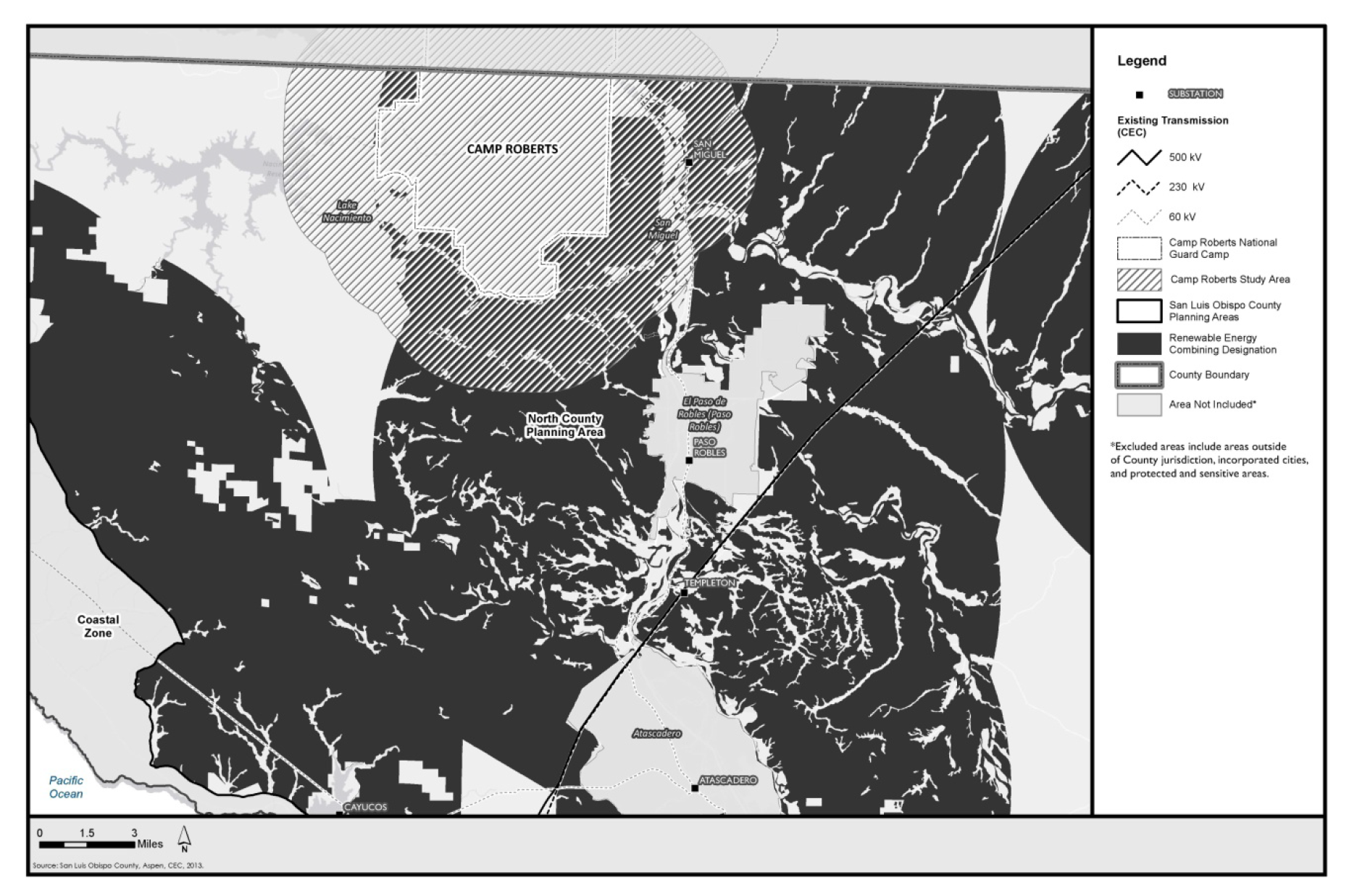
C.
Approvals from other agencies. If another public agency must approve the proposed facility, the applicant shall:
1.
Describe the requirements of that agency; summarize the agency's procedures for acting on the proposed use, and describe the studies, analyses, and other data collection which the applicant or agency will perform in order to resolve each substantive requirement of the agency.
2.
List the required actions related to the proposed facility by other public agencies and utilities and a schedule for application and approval of those actions.
3.
Provide a copy of necessary state and federal permits and all written comments and decisions made by officials of the agencies listed prior to the start of construction.
D.
Information from other applications. An applicant may incorporate by reference any information developed or submitted in any other application for the project, provided the applicant submits a copy or summary of the referenced material, identifies the permitting process in which it was submitted and the outcome of that permitting process, and explains the relevance of the information to the approval standards of this Title.
(2015, Ord. 3291)
22.32.040 - Development Standards and General Requirements.
The following development standards are applicable to all types of energy-generating facilities allowable by this Title, as identified below. Note that general standards are not exclusive. Projects may be subject to multiple types of standards from Subsections A—E.
A.
General standards applicable to all energy-generating facilities.
1.
Decommissioning and restoration. A decommissioning and restoration plan shall be submitted that includes the removal of all facility elements and reclamation of the site. Plans shall address: removal of all facility elements and reclamation of the site including, but not limited to, evaluation of adjacent grasses and vegetation, soil preparation, seed/crop planting, and watering and fertilization (if necessary). Removal and restoration shall also address all facility elements, including but not limited to, solar modules, trackers, tracking, posts, power station electrical equipment, underground conduits and cables, concrete pads, fences, security lighting, and access road gravels.
2.
Clearing and revegetation. The land area exposed and the vegetation removed during construction shall be the minimum necessary to install and operate the facility. Topsoil must be stripped and stored separately. Disturbed areas no longer required for operation will be regraded, covered with topsoil, and replanted during the next appropriate season.
3.
Utility interconnect. All distribution lines, electrical substations, and other interconnection facilities shall be constructed to the specifications of the utility. A statement from the utility confirming that the proposed interconnection is acceptable shall be filed with the County building inspector prior to the issuance of any building permit. Interconnection shall conform to procedures and standards established by the California Public Utilities Commission.
4.
Undergrounding of electrical equipment. All electric distribution lines of low to medium voltage less than 60 kV shall be located underground up to the low-voltage side of the step-up transformer, to the point of on-site use, or to the utility-interface point of an on-site substation.
5.
Safety signage. The project shall include electrical safety signage on all arrays in the immediate vicinity of all wiring and all electrical conduits to reduce the risk of electrical shock and fire. All signage shall use weather-resistant and fade-proof materials to provide reasonable notice to protect employees and visitors.
6.
Easements. Any application for a renewable energy facility or distribution lines requiring easements across parcels other than those under the control of the project applicant, or involving multiple parcels, shall provide evidence of necessary easements prior to the issuance of a building permit. The applicant shall also provide evidence of adequate noticing for all impacted landowners and regulatory agencies
B.
Bonding. The permit application for any energy-generating facility except for Tier 1 SEF, Tier 1 WECS, and accessory energy-generating facilities shall include a cost estimate of the decommissioning work with the decommissioning and restoration plan required by Subsection 22.32.040.A, for review by the County or qualified third-party consultant approved by the County. A bond shall be posted in the amount identified in the cost estimate prior to issuance of any construction permits.
C.
Standards applicable to energy-generating facilities requiring a discretionary permit.
1.
Environmental quality assurance. Projects that require a discretionary permit per this Chapter shall submit an Environmental Quality Assurance Program covering all aspects of construction and operation prior to construction of any project component. This program will include a schedule and plan for monitoring and demonstrating compliance with all requirements of the land use permit. Specific requirements of this Environmental Quality Assurance Program will be determined during the environmental review process and land use permit review and approval process.
2.
Recycling and disposal plan for renewable energy facilities. Projects subject to a discretionary permit per this Chapter shall submit a recycling and disposal plan for renewable energy infrastructure, including photovoltaic panels, in order that project structures not pose a risk to human health or the environment. The recycling and disposal plan should include panels that are broken during all project phases, including transport, installation, operation, and after project decommissioning. The plan shall specify how these project components will be disposed of in a manner that will not pose a risk to human health or the environment, and the costs of such disposal.
D.
Standards applicable to all ground-mounted energy-generating facilities.
1.
Requirements of this section do not preclude authorities and requirements of other local, state, and federal agencies, including, but not limited to, the San Luis Obispo County Air Pollution Control District, California Department of Fish and Wildlife, California Department of Transportation, United States Fish and Wildlife Service, and the United States Army Corps of Engineers.
2.
Proposed ground-mounted energy-generating facilities otherwise eligible for a Site Plan Review shall be subject to a Minor Use Permit, unless this Chapter (22.32, Energy-Generating Facilities) otherwise requires a Conditional Use Permit, if Botanical Reports or Biological Reports prepared as part of the permit application indicate the presence or potential presence of state or federally listed wildlife or plant species or designated critical habitat. Exceptions to this requirement may apply to ground-mounted energy-generating facilities if the proposed project is located in the San Joaquin Kit Fox Habitat Area and meets the following criteria.
a.
The project site of the proposed energy-generating facility is 20 acres or less; measured as total project site inclusive of total site disturbance. For all other purposes of determining consistency with standards of this Chapter (22.32, Energy-Generating Facilities), the area of the facility shall be calculated as otherwise directed by Subsection 22.32.030;
b.
Botanical Reports or Biological Reports do not indicate the presence of additional state or federally listed wildlife or plant species or designated critical habitat on or adjacent to the project site; and
c.
The project complies with the standard mitigation ratio and all applicable San Joaquin Kit Fox Habitat Area conditions for grading and building plans set forth by the Director.
3.
Abandonment of ground-mounted facilities. When any ground-mounted energy-generating facility ceases to produce energy on a continuous basis for 12 months, it shall be considered abandoned and a public nuisance unless the owner or operator demonstrates by substantial evidence satisfactory to the Director of Planning and Building Department that there is no intent to abandon the facility. Owners or operators are required to remove all equipment and facilities and to restore the site to the original condition upon abandonment. Facilities deemed by the County to be unsafe and facilities erected in violation of this Section shall also be considered abandoned.
a.
The Code Enforcement Officer or any other employee of the Planning and Building Department shall have the right to request documentation and/or affidavits from the system owner/operator regarding the system's usage and to make a determination as to the date of abandonment or the date on which other violation(s) occurred.
b.
Upon a determination of abandonment or other violation(s), the Director of Planning and Building shall send a notice thereof to the owner or operator, indicating that the responsible party shall remove the energy-generating facility and all associated facilities, and remediate the site to its approximate original condition within 90 days of notice by the Director of Planning and Building, unless the County determines that the facilities must be removed in a shorter period to protect public safety. Alternatively, if the violation(s) can be addressed by means other than removing the energy-generating facility and restoration of the site, the Director may advise the owner or operator of such alternative means of resolving the violation(s).
c.
In the event the responsible parties have failed to comply, the County's Director of Planning and Building or his or her designee may remove the energy-generating facility and restore the site and may thereafter (a) draw funds from any bond, security, or financial assurance that may have been provided, or (b) initiate judicial proceedings or take other steps authorized by law against the responsible parties to recover only those costs associated with the removal of structures deemed a public hazard.
4.
Standards applicable to ground-mounted renewable energy facilities (including projects requiring a ministerial or discretionary permit).
a.
Ground-mounted renewable energy facilities shall avoid siting on exposed bedrock, rock outcrops, or significant ridgetops.
b.
Ground-mounted renewable energy facilities shall provide an Integrated Pest Management Plan to identify measures for weed control. Measures may include, but are not limited to, native ground cover, livestock grazing to control grasses, manual harvest, or vegetative management.
E.
Other requirements. Where this Section does not specify development standards for a proposed energy-generating use, the County will establish standards through the required land use permit.
(2015, Ord. 3291)
22.32.050 - Solar Electric Facilities.
A.
Permit requirements. Permit requirements by land use category for SEFs are summarized in Section 22.32.030 of this Chapter. Where requirements vary based on the technology and site criteria, requirements shall be as described in Subsections 1?3.
1.
Calculation of SEF size. For purposes of this Section, the size of the proposed SEF shall be measured as the total area of the facility inclusive of components and subsystems that, in combination, convert or store solar energy into electric energy suitable for use.
2.
Applicability of SEF permit requirements. The permit requirements of this Section shall apply only to the proposed SEF, inclusive of components and subsystems that, in combination, convert or store solar energy into electric energy suitable for use. Where other accessory or primary uses are proposed that indirectly support the proposed SEF, the applicable permit requirement for the additional use shall be determined as described in Chapter 22.06 (Allowable Land Uses and Permit Requirements by Land Use Category).
3.
Applicable permit requirements for SEFs based on site criteria.
a.
Tier 1 SEF, Roof- or Structure-Mounted. If a proposed SEF is located on the roof or structure of a use that is conforming per Chapter 22.72 of this Title, the project shall require Zoning Clearance.
b.
Tier 1 SEF, Ground-Mounted. If a proposed SEF is 20 acres or less, is not located on Prime Farmland, and is located to meet one or more of the site eligibility criteria presented in (1)—(2) below, the project is considered a Tier 1 SEF and shall require Site Plan Review. Projects seeking Tier 1 site eligibility must meet the following criteria:
(1)
Is located on land that is graded, disturbed, or altered; consistent with definitions for "Development," "Grading," or "Site Disturbance" in this Title, or
(2)
Is located on land that was previously developed for industrial or commercial purposes and degraded or contaminated and then abandoned or underused.
Proposed SEFs that are 20 acres or less but do not meet the Tier 1 site eligibility criteria may be considered a Tier 2 SEF eligible for a Minor Use Permit when consistent with the standards of Subsection c below.
c.
Tier 2 SEF. If a proposed SEF is 40 acres or less, is not located on Prime Farmland, and is located to meet the site eligibility criteria in (1)—(3) below, the project is considered a Tier 2 SEF and shall require a Minor Use Permit where allowable in Section 22.32.030. Proposed projects that are 40 acres or less and located in the Renewable Energy (RE) Combining Designation may be eligible for Site Plan Review when consistent with the site criteria in Section 22.14.100 (Renewable Energy Combining Designation). Projects located outside of the RE Combining Designation seeking Tier 2 site eligibility must meet the following criteria
(1)
Is not located on Prime Farmland; and
(2)
Is ground-mounted; and
(3)
Located in urban areas, or located in rural areas on sites designated as Commercial Service (CS) or Industrial (IND).
Proposed SEFs that are 40 acres or less but do not meet the Tier 2 site eligibility criteria may be considered a Tier 3 SEF allowable with a Minor Use Permit when consistent with the standards of Subsection d below.
d.
Tier 3 SEF. If a proposed SEF is greater than 40 acres or does not meet the criteria for Tier 1 or Tier 2 SEFs described above in Subsections a—c, and is not located on Prime Farmland, the project is considered a Tier 3 SEF and shall require a Minor Use Permit where allowable in Section 22.32.030.
B.
Setbacks.
1.
Roof- or structure-mounted SEFs are subject to the setback areas for the type of structure on which they are mounted as regulated by Section 22.10.140.
2.
The minimum setbacks for ground-mounted SEFs are determined as follows:
MINIMUM SETBACKS FOR GROUND-MOUNTED SOLAR ELECTRIC FACILITIES(1)
Notes:
(1)
Proposed ground-mounted SEFs shall also comply with the following minimum setbacks where applicable:
• Ground-mounted SEFs shall be set back a minimum of 100 feet from all adjacent parcels in Open Space and Recreation land use categories.
• Ground-mounted SEFs shall be set back a minimum of 50 feet from any seasonal or perennial wetlands, drainages, and vernal pools, except as follows.
• Ground-mounted SEFs requiring a Site Plan Review or discretionary review shall be set back a minimum of 500 feet from any of the following where it is identified in the biological report:
○ Sensitive vegetation and habitat that could support special-status plant or wildlife species.
○ Special-status species that could occur on the site or adjacent properties.
○ Any seasonal or perennial wetlands, drainages, vernal pools, and any other potentially jurisdictional features where sensitive wildlife is present.
(2)
Tier 1 and Tier 2 ground-mounted solar electric facilities that are 40 acres or less in size shall be set back from all adjacent parcels in a Residential land use category 10 feet more than the minimum setbacks.
C.
Height limits.
1.
Measurement of height. The height for all SEFs shall be measured as the vertical distance from the highest point of the SEF to the average of the highest and lowest points where the vertical planes of the SEF would touch the roof surface (for roof-mounted SEFs) or the ground (for ground-mounted SEFs).
2.
Height limits. The maximum heights for ground-mounted and roof-mounted SEFs are provided below, respectively:
HEIGHT LIMITS FOR GROUND-MOUNTED SOLAR ELECTRIC FACILITIES/b>
MAXIMUM HEIGHT LIMITS FOR ROOF-MOUNTED SOLAR ELECTRIC FACILITIES
D.
Other special standards for SEFs. In addition to the general standards applicable to all energy-generating facilities, the following standards shall apply to SEFs.
1.
All SEFs shall use nonreflective surfaces that minimize glare to the greatest extent feasible.
2.
Tier 1 roof- or structure-mounted SEFs shall be integrated with roofing materials and/or blended with a structure's architectural form. Any roof- or structure-mounted SEF and its equipment shall be designed to be removed at a later date for the roof to be returned to its original pre-project condition.
3.
Rotating SEFs shall have tracking system design and shall not create concentrated reflections directed at occupied structures, recreation areas, Sensitive Resource Areas, or public roads.
4.
Ground-mounted SEFs shall be located a minimum of 18 inches from the ground to allow wildlife movement and line of sight for wildlife.
5.
Lighting. If lighting is required, it shall be activated by motion sensors, fully shielded, and a downcast type so the light does not spill onto adjacent parcels or illuminate the night sky.
6.
In the Flood Hazard Combining Designation, solar equipment, wiring, and other supportive electric equipment (such as inverters or transfer switches) shall be located above the base flood elevation.
7.
SEFs requiring a discretionary permit shall be sited for screening from residences, Sensitive Resources Areas for visual resources, and areas subject to Highway Corridor Design Standards. Screening measures shall use existing site characteristics to the greatest extent feasible, including existing vegetation and natural topography. Where a project cannot be sited to provide adequate screening, the project shall provide additional screening such as landscaping, or wildlife-friendly fencing.
8.
SEFs shall not be sited on designated Prime Farmland. Where proposed on parcels with Prime Farmland, the SEF shall be sited on other areas of the parcel
9.
SEFs requiring a discretionary permit proposed in the Agriculture (AG) land use category on land in an active agricultural use or on Important Agricultural Soils, as defined in the Conservation and Open Space Element, shall meet the following:
a.
For projects proposed on land in an active agricultural use, the project shall provide an open space easement (or, if requested by the applicant, a conservation easement) in consultation with the Agriculture Department, which shall be on land that supports grazing or uses similar to those within the project site that would be lost due to the proposed project and is located within San Luis Obispo County at a 1:1 ratio, located on land that can support agricultural uses at the same intensity as the affected agricultural uses. The open space easement may be located at the proposed project site or on a parcel other than the proposed project site.
b.
For projects proposed on parcels with Important Agricultural Soils, the project should be sited to minimize impacts to Important Agricultural Soils to the maximum extent feasible, in consultation with the Agriculture Department. Where that is not feasible, projects proposed on Important Agricultural Soils shall provide an open space easement (or, if requested by the applicant, a conservation easement) in consultation with the Agriculture Department, which shall be at a 1:1 ratio on Important Agricultural Soils of comparable suitability for agricultural production. The open space easement may be located at the proposed project site or on a parcel other than the proposed project site.
c.
To determine the suitability of proposed easement sites for purposes of addressing the conversion of agricultural uses or Important Agricultural Soils, the Agriculture Department shall evaluate criteria related to the intensity and suitability of the site for agriculture, including, but not limited to, soil capability, available water supply, existing on-site land uses, parcel size, and land use designation.
d.
If a proposed project demonstrates dual-use design measures that ensure the long-term productivity of agricultural uses on site, or protects Important Agricultural Soils through other means, the project is allowable without an open space easement through a Conditional Use Permit in consultation with the Agriculture Department. Techniques to allow for continuation of agriculture uses (dual-use) or protection of Highly Productive Rangeland Soils may vary based on underlying parcel and site characteristics, but can be achieved through multiple design features. Examples include, but are not limited to:
(1)
The installation of SEFs on poles with no disturbance to soils or crops;
(2)
Elimination of concrete bases, or
(3)
Mounting panels off the ground using other technologies while continuing agricultural uses or protecting soils underneath.
(2015, Ord. 3291)
22.32.060 - Wind Energy Conversion Systems
A.
Determination of permit requirements for wind energy conversion systems (WECS). Permit requirements for WECS are identified in Section 22.32.030 of this Chapter by land use category. Where allowable, WECS requirements vary based on technology and system type as described in Subsections 1—3.
1.
Tier 1 WECS. A wind energy conversion system that is mounted on a roof or structure of a conforming use per 22.72 of this Title is considered a Tier 1 WECS and shall require a Zoning Clearance where allowable.
2.
Tier 2 WECS. A wind energy conversion system is considered a Tier 2 WECS and shall require a Minor Use Permit where allowable if it meets all of the following criteria:
a.
Is ground-mounted.
b.
Is no greater than 100 feet tall, as measured from the natural grade below the wind turbine to the uppermost extension of any blades.
c.
Has a cumulative rated capacity of 2 MW or less for all turbines proposed on the site.
3.
Tier 3 WECS. A wind energy conversion system that is ground-mounted and does not meet the criteria for Tier 2 WECS is considered a Tier 3 solar WECS and shall require a Conditional Use Permit where allowable.
B.
Setbacks.
1.
Tier 1 WECs (roof- or structure-mounted) are subject to the setbacks for the type of structure on which they are mounted as specified in Section 22.10.140.
2.
Ground-mounted WECs.
a.
The minimum setbacks for ground-mounted WECS are determined by project height, as measured from the lowest point to the highest point of the WECS, as shown below.
MINIMUM SETBACKS FOR GROUND-MOUNTED WIND ENERGY CONVERSION SYSTEMS(1)
Notes:
(1)
All ground-mounted WECS shall also comply with the following minimum setbacks where applicable:
a.
50 feet from any seasonal or perennial wetlands, drainages, and vernal pools.
b.
500 feet from any wetlands or riparian zones, or from any location found to serve as a nesting or roosting site for any sensitive bird or bat species or any species of raptor.
C.
Height limits.
1.
Measurement of height. The height for all WECS shall be measured as the vertical distance from the lowest point of the WECS to the uppermost extension of any rotor, for both roof-mounted and ground-mounted systems.
2.
Height limits. The maximum heights for WECS are shown in the table below. For roof- or structure-mounted WECS, these height limits may exceed the maximum height limits for the structure established in Section 22.10.090 (Height Measurement and Height Limit Exceptions).
HEIGHT LIMITS FOR WIND ENERGY CONVERSION SYSTEMS(1)
Notes:
(1)
All WECS in the Vertical Obstruction Camp Roberts Influence Areas shall not exceed 75 feet in height, as described in Subsection 22.32.060.D of this Chapter:
D.
Other Special Standards for Wind Energy Conversion Systems
1.
All ground-mounted WECS shall be sited to maintain natural grades and shall use existing roads for access to the extent possible. Any grading or road construction that is required shall be the minimum necessary to locate the system and establish sufficient access. The land use permit application shall demonstrate that an alternative site on the parcel is less suitable for other reasons.
2.
Tier 1 roof- or structure-mounted WECS shall be designed to be removed at a later date for the roof to be returned to its original pre-project condition.
3.
Ground-mounted WECS shall not be sited on designated Prime Farmland. Where proposed on parcels with Prime Farmland, the WECS shall be sited on other areas of the parcel.
4.
A WECS shall not generate noise levels exceeding any standards of the Noise Element of the San Luis Obispo County General Plan. The system shall be designed and constructed in compliance with the California Building Code and the National Electric Code. The safety of the design and construction shall be certified by a California-licensed mechanical, structural, or civil engineer.
5.
For a WECS with multiple turbines, each turbine shall be separated from all others by a distance at least equal to that of the diameter of the rotors.
6.
Ground-mounted WECS shall be located to minimize visual impacts to residences, Sensitive Resource Areas for visual resources, and areas subject to Highway Corridor Design Standards.
7.
Ground-mounted WECS within the Vertical Obstruction Camp Roberts Influence Areas (see Figure) shall not exceed 75 feet in height.
VERTICAL OBSTRUCTION CAMP ROBERTS INFLUENCE AREAS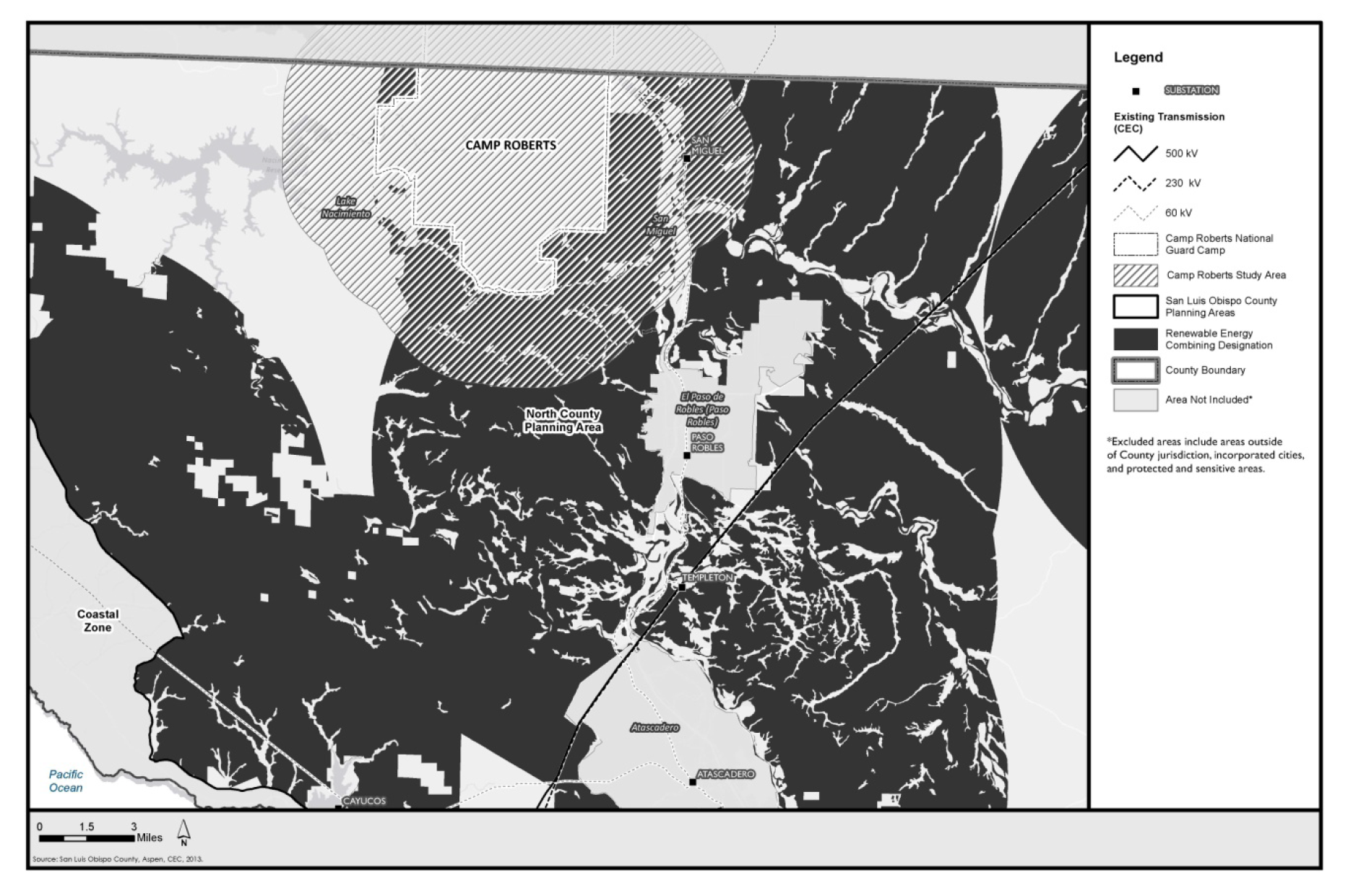
8.
The design of all WECS shall be as follows:
a.
All materials and surfaces shall be nonreflective and of an unobtrusive color.
b.
The WECS and individual components shall carry all appropriate warning signs.
c.
Guy wires shall be avoided to the extent possible. If they are necessary, all guy wires shall be marked with bird deterrent devices as recommended by the US Fish and Wildlife Service or the California Department of Fish and Wildlife.
d.
No exterior lighting shall be allowed except for lighting required by the Federal Aviation Administration, which shall be at the lowest allowable intensity.
e.
All turbines shall be equipped with manual and automatic overspeed controls capable of limiting the blade rotation speeds to within the design limits of the system.
f.
Ground-mounted WECS shall be designed to prevent climbing within the first 12 feet. Any climbing apparatus shall be located at least 12 feet above the finished grade.
g.
No portion of a blade of a ground-mounted WECS shall extend within 20 feet of the finished grade.
h.
The lowermost extension of any rotor of a Tier 2 or Tier 3 WECS shall be 30 feet above the highest existing occupied structure or tree within a 250-foot radius. A modification to this standard may be approved by the Review Authority if the applicant demonstrates that a lower height will not jeopardize the safety of the wind turbine structure.
i.
All hollow vertical structures installed as part of a WECS shall be capped immediately upon installation to prevent the entrapment and death of birds.
(2015, Ord. 3291)
22.32.070 - Steam Electric Generating Facilities.
A.
Application contents. In addition to the general requirements of Section 22.32.020, an application for a steam electric generating facility shall describe:
1.
The cooling system, including volume and flow characteristics, source of the cooling fluid and the location, flow and chemical make-up of any liquid or gaseous discharges;
2.
Potable water requirements and proposed source;
3.
Fuel sources, delivery and storage systems and firing characteristics;
4.
The air pollution control system and emission characteristics; and
5.
Toxic and/or hazardous materials which will be used during the construction and operation, including estimates of the volumes, the inventory control system that is proposed, the disposition of these materials and the disposal system and ultimate location for disposal.
B.
Development Standards - Hazardous Materials. Prior to their delivery and use on-site, the applicant shall submit a hazardous material and waste management plan for review and approval. Details to be contained in this plan will be established in the environmental review and Conditional Use Permit approval process.
(2015, Ord. 3291)
22.32.080 - Hydro-Electric Generating Facilities.
In addition to the general requirements of Section 22.32.020, an application for a hydroelectric generating facility shall describe:
A.
How proposed construction and operation of the facility complies with state water rights laws and all other applicable state regulations.
B.
Any water diversion facilities proposed for the facility, their relation to existing facilities, and how the surface elevation of any impoundment will change.
C.
How the operation of the generating facility will change the flow regime in the affected stream, canal, or pipeline including, but not limited to:
1.
Rate and volume of flow;
2.
Temperature;
3.
Amounts of dissolved oxygen to a degree that could adversely affect aquatic life;
4.
Timing of releases; and
5.
Whether there will be a change in the up- or down-stream passage of fish.
(2015, Ord. 3291)
22.32.090 - Co-Generation Facilities.
A.
Application contents. In addition to the general requirements of Section 22.32.020, the application for a co-generating facility shall contain the descriptions required in Section 22.32.040 for steam electric generating facilities as applicable, and shall describe the characteristics of the energy conversions of the proposed facility and the proportions going to the various end-uses and their seasonal variation.
B.
Development standards. The standards of Sections 22.32.020, 22.32.030 and 22.32.040.B apply.
(2015, Ord. 3291)
22.34.010 - Purpose.
This Chapter provides reasonable regulations for the extraction and development of onshore petroleum and other subterranean resources in San Luis Obispo County, including but not limited to exploration, production, storage, processing, transportation, and the disposal of petroleum and other hydrocarbons and of any operations accessory thereto. This Chapter is intended to supplement regulations administered by the California State Division of Oil and Gas, to address particular problems in the County that do not apply generally throughout the state. These problems include a limited water supply for agricultural and domestic uses in a county that depends heavily on agriculture and tourism for its economic welfare. The fresh water supply must be fully protected from pollution by petroleum operations.
[Amended 1989, Ord. 2409] [22.08.172]
22.34.020 - Applicability.
All petroleum resource extraction operations shall be conducted in compliance with the standards of this Chapter. The extraction of petroleum from oil sands or shales by any method other than wells is subject to the standards of Chapter 22.36 for surface mining operations).
[Amended 1989, Ord. 2409] [22.08.172]
22.34.030 - Drilling Permit Requirements.
A drilling permit shall be obtained to authorize exploration or production wells for oil, gas, geothermal steam or any other subterranean resource except water (water wells are subject to Chapter 8.40 of this code), as follows.
A.
Exploratory well permit. Exploratory wells are drilled to verify the location, extent, or feasibility of commercial extraction of subterranean resources. Minor Use Permit approval is required for an exploratory well, except that Conditional Use Permit approval is required where drilling is proposed:
1.
Within an urban or village reserve line, a Residential Suburban land use category, or a Sensitive Resource Area; or
2.
When exploration for, or extraction of any resource other than oil, gas or geothermal steam is proposed.
B.
Production well permit. Production wells are permanent installations for the extraction and preparation for transportation of a proven resource.
1.
Conditional Use Permit approval is required for establishing any new oil field, other resource extraction production area, or to reopen a field that has been unused for 12 months or more, that involves single or multiple wells and related facilities.
2.
Minor Use Permit approval is required where an additional well is proposed in an existing designated oil field, as identified by the California Department of Conservation, Division of Oil and Gas.
C.
Application content. In addition to the information required for applications by Chapter 22.62, (Permit Applications) drilling permit applications shall also describe:
1.
Location and dimensions of wells, well pads and earthen sumps, location of roads and associated improvements (including housing), locations of any pipelines or storage tanks and pump facilities.
2.
Identification of the type of drilling equipment (e.g., portable or fixed) intended to be used in the drilling activities.
3.
When landscaping plans are required by Chapter 22.16, they shall include measures proposed for screening producing wells and permanent equipment from the view of public roads or residential uses, revegetation of all cut and fill banks, and restoration of disturbed areas of the site not directly related to oil and gas production.
4.
Proposed erosion control measures.
5.
All development associated with the proposed well and associated facilities and how that development complies with the standards of this Title.
6.
If another public agency must also approve the proposed facility, the applicant shall also provide:
a.
A brief description of the nature and scope of the requirements of that agency, including the agency's procedures for acting on the proposed use.
b.
A schedule for applications and approvals for actions by other responsible agencies.
c.
A copy of all necessary state and federal permits and associated conditions of approval issued by the agencies listed prior to the submittal of the application.
7.
An applicant may incorporate by reference any information developed or submitted in any other application, provided the applicant submits a copy or summary of the referenced material, identifies the permitting process in which it was submitted and the outcome of that permitting process, and explains the relevance of the information to the approval standards of this Title.
[Amended 1981, Ord. 2063; 1989, Ord. 2409] [22.08.173]
22.34.040 - Oil and Gas Well Development Standards.
The following standards apply to all resource extraction wells:
A.
Bonding. Performance guarantees to assure compliance with applicable provisions of this Title, conditions of approval and other applicable regulations, shall be provided as follows:
1.
Single bonds. Following approval of a drilling permit and prior to any work on the proposed drilling site, the applicant shall post a surety bond in the minimum sum of $5,000 per well, in favor of the County, conditioned that the applicant (who shall be named in the bond) shall faithfully comply with all applicable conditions, restrictions, and requirements of this Title, APCD regulations, and any conditions of approval in drilling or redrilling and maintaining all surface production facilities as required by this Title or APCD regulations and conditions of approval, until abandonment of such facilities in compliance with this Title. The bond shall secure the County of San Luis Obispo against all expenses incurred on account of any failure of the applicant to comply with the provisions of this Title, APCD regulations and any conditions of approval. The bond shall include the correct name or number of the well and such other information as may be necessary to readily identify the well. Such guarantee is in addition to any bond required by the state.
2.
Blanket bonds. Where the Director is satisfied as to the financial responsibility of an operator, the Director may permit the filing of a bond in the minimum amount of $25,000 to cover all the operator's surface operations in the County, instead of the single bond required by Subsection A.1. The bond shall be accompanied by a rider filed with the Director that includes a description of all operations and facilities covered by the bond.
3.
Increase in bond amount. The bond amounts in this Subsection may be increased or decreased by the Director when justified by particular circumstances. The Director shall annually review all such bond amounts to determine whether they are adequate to insure compliance with the provisions of this Title. Disputes between the Director and applicant regarding increased or decreased bond amounts shall be subject to the appeal process of Section 22.70.050.
B.
Site development.
1.
Roads, access and site preparation. Roadwork and grading for drill site preparation shall be limited to that necessary for site access and shall be designed and oriented to minimize cut and fill slopes and removal of vegetation. Roads shall be maintained in a dust-free condition by periodic watering or by compacted surfacing. A grading permit may be required for drill site access roads and site preparation, as determined by Chapter 22.52 (Grading).
2.
Clearing and revegetation. The land area exposed and the vegetation removed during construction shall be the minimum necessary to install and operate the facility. Top soil shall be stripped and stored separately. Disturbed areas no longer required for production will be regraded, covered with topsoil and replanted during the next appropriate season.
3.
Well locations. A well hole, derrick or tank shall not be placed closer than 100 feet of any residence, or closer than 25 feet from any public road, street or highway, except where the Review Authority determines that separations are unnecessary or ineffective because of physical conditions of the drilling site or the vicinity.
4.
Drilling within a community. The following standards apply to drilling operations within urban or village reserve lines or Residential Suburban land use categories.
a.
Portable rig required. Drilling operations shall use portable drilling apparatus only, which shall be removed from the site within five calendar days from completion of drilling.
b.
Hours of operation. Drilling operations may continue uninterrupted once started. Delivery of materials, equipment, tools or pipe shall occur only between the hours of 7:00 a.m. and 9:00 p.m., or such other hours as the Commission may establish, except in case of emergency.
5.
Sumps and waste disposal. All waste substances such as drilling muds, oil, brine, or acids produced or used in connection with oil drilling operations or oil production shall be retained in watertight receptors, from which they can be piped or hauled for terminal disposal in a dumping area specifically approved for such disposal by the Regional Water Quality Control Board. The use of unprotected earthen sumps is prohibited except during drilling operations. Any allowed sump located within view of any public street or within 1,000 feet of any residence shall be enclosed with a fence not less than five nor more than 10 feet in height, mounted on steel posts with not less than three strands of barbed wire around the top, except when an earthen sump is under continuous supervision and use during drilling operations. Fencing shall be constructed of woven wire fencing or equivalent of not greater than six inch mesh.
6.
Fire protection. Fire fighting apparatus and supplies, approved by the County Fire Department shall be maintained on the site at all times during drilling and production operations.
7.
Completion of drilling. The applicant shall notify the Director within 10 days after completing or abandoning the facility. Within 30 days after completion or abandonment of an exploratory or production well, all derricks, other drilling apparatus and equipment, including any earthen sumps, shall be removed from the site and the sumps filled. Drill rigs in urban areas shall be removed within five calendar days as provided in Subsection B.4. After completion of drilling, any necessary servicing or maintenance of wells may use portable derricks, if needed.
C.
Well operation and site maintenance.
1.
Landscaping. Within 30 days after the completion of the drilling of a producing well within view of any public street or any residence, production equipment shall be screened, and the entire extraction site, including disturbed areas not directly related to the extraction shall be revegetated and thereafter maintained as shown on the approved landscaping plan. This requirement is not applicable in Agriculture and Rural Lands categories outside of urban and village reserve lines.
2.
Site maintenance. The drillsite, permanent equipment and approaches to the site shall be kept in a clean, neat appearing condition free from debris, other than necessary and incidental drilling equipment and supplies. The site shall be maintained so as to prevent any accumulation of oil, oil products, or oil-coated boards, materials or equipment which might cause fumes or odors detrimental to adjoining property.
3.
Storage tanks. Oil storage tanks erected or maintained on the premises shall be removed no later than 180 days after the first well on the site is completed except where located as part of a permanent tank battery authorized through Conditional Use Permit approval. Oil produced thereafter shall be transported from the drilling site by means of an underground pipeline connected directly with the producing pump without venting to the atmosphere at the drilling site. This requirement is not applicable in Agriculture and Rural Lands categories outside urban and village reserve lines.
4.
Parking and loading. All parking and loading activities related to well drilling or production shall occur on-site.
5.
Signing. Only directional, instructional and warning signs, and signs required for identification of a well may be placed on the premises.
6.
Operating wells. Pumping wells shall be operated by electric motors or muffled internal combustion engines. Pumping units within urban or village reserve lines or Residential Suburban land use categories shall be installed within pits or above-grade structures which screen all mechanical equipment from the view of public roads or adjoining properties and which reduce noise generated by pumping equipment to within the limits specified by Section 22.10.120 (Noise Standards).
7.
Violations. If the facility is operated in a manner that violates the standards or conditions of this Section or any other required permit, the applicant shall:
a.
Immediately stop, contain, or correct the unauthorized action or inaction.
b.
Within 30 days of the violation, inform the Director in writing about the cause of the violation, its effects, and corrective action the applicant took in response to the violation and proposes to take to prevent a reoccurrence of the violation or its cause.
D.
Periodic inspection. All active wells will be inspected annually by the Department. The applicant shall pay the costs of such inspections in compliance with the County Fee ordinance.
E.
Well abandonment. The abandonment of an oil well shall occur as follows.
1.
All production and processing facilities related to the well shall be removed from the site unless they have been approved for use with another adjacent well.
2.
The well site and surroundings affected by drilling operations shall be restored and revegetated to achieve a natural-appearing condition which will approximate their original vegetative and topographic state.
3.
The applicant shall notify the Director within 10 days after abandoning the well and associated facilities.
4.
The requirements of Title 7.04 of this code shall be complied with.
5.
The applicant shall report the well abandonment as required to the Division of Oil and Gas, and the applicant shall provide the Director a copy of the response received from the Division of Oil and Gas regarding completion of abandonment in compliance with their requirements.
[Amended 1989, Ord. 2409] [22.08.174]
22.34.050 - Petroleum Refining and Related Activities.
This Section applies to petroleum refining facilities, operations, and related activities, including compounding lubricating oils and greases from purchased materials, oil or gas processing facilities, manufacture of petroleum coke and fuel briquettes, and tank farms.
A.
Majority Vote Required. In accordance with Measure A passed by initiative ordinance on November 4, 1986, no permit, entitlement, lease, or other authorization of any kind within the County of San Luis Obispo which would authorize or allow the development, construction, installation, or expansion of any onshore support facility for offshore oil and gas activity shall be final unless such authorization is approved by a majority of the votes cast by a vote of the people of the County of San Luis Obispo in a general or special election. For the purpose of this ordinance, the term "onshore support facility" means any land use, installation, or activity required to support the exploration, development, production, storage, processing, transportation, or related activities of offshore energy resources.
B.
Specific Plan required. A land use permit application for a use included by Article 8 within the definition of Petroleum Refining and Related Activities (including extended reach facilities) may be filed with the Department of Planning and Building and a land use permit may be granted only after a Specific Plan, as described in Government Code Section 65450 et seq., has been approved for the overall development of the parcel, except for:
1.
An existing facility used solely for in-field processing of petroleum produced from a field surrounding or adjacent to the facility and not exceeding 10,000 barrels processing capacity of petroleum and related fluids, excluding produced water, per day;
2.
An existing facility used solely for in-field compression or sweetening of natural gas and similar fluids produced from a field surrounding or adjacent to the facility;
3.
Existing storage facilities having a capacity not exceeding 210,000 barrels of crude petroleum or refined petroleum products;
4.
Emergency oil spill response facilities;
5.
Additions within existing facilities or modifications to existing facilities mandated by local, state, or federal requirements or by a demonstrated need for replacement due to technological improvement or facility age that do not expand the capacity of a facility by more than 10 percent or expand the existing exterior boundary of the site; and,
6.
Any facility described by size, capacity, physical characteristics, and site as part of a previously approved Specific Plan.
C.
Specific Plan preparation costs to be borne by applicant. Any applicant requesting preparation and approval of a Specific Plan must, prior to the initial acceptance of the application, agree in writing to pay all reasonable expenses incurred by the County of San Luis Obispo in preparing and reviewing the request within 30 days after being invoiced for such costs, and must deposit with the County of San Luis Obispo a sum to be set in compliance with the fee schedule adopted by County ordinance in order to pay for any such costs incurred by San Luis Obispo County and not otherwise compensated by the applicant.
D.
Contents of Specific Plan. Specific Plans shall include all information required by Government Code sections 65450 et seq., all information required by provision of the San Luis Obispo County General Plan, and by other provisions of County ordinances, and all information required by each of the following;
1.
A detailed description of long-term plans for use of the site, including specific characteristics, volumes, and sources of hydrocarbons; specific descriptions of all expected incoming and outgoing transmission or shipment facilities or changes in intensity of use of existing facilities which may result from a proposal; description of anticipated size, type and location of initial and subsequent refining, processing, cogeneration, storage, transmission, and associated facilities; and delineation of transportation and access routes for materials and personnel, including location and physical characteristics of such routes and the incremental burdens to be imposed on each route during construction or operation of facilities and analysis of the extent, if any, to which access routes may create nuisances or hazards for adjacent properties.
2.
A schedule for initial and subsequent phases of development of the site which specifies the anticipated order in which facilities will be constructed and operated, circumstances which will cause need for specific facilities, and anticipated timing of commencement of permitting, construction, operation, peak operation, and decommissioning for each facility;
3.
Volume and time of demand for other resources including but not limited to water, natural gas, and electricity;
4.
Identification, volume and nature of hazardous materials other than crude oil, natural gas, or petroleum products refined on-site to be imported into the site, stored or produced on-site, transmitted or shipped off-site, as well as characterization of any hazardous waste contamination existing on the parcel or which may be expected from construction or operation of the planned facility;
5.
An analysis of the compatibility of the proposed use with present characteristics of the parcel, with surrounding uses, and with the physical, cultural, socioeconomic, recreational and aesthetic character of the surrounding region;
6.
A plan showing that the proposed use will be buffered and screened from adjacent land uses to protect adjacent uses, the proposed use, and the people and resources of the region from harm or encroachment;
7.
An analysis of the extent to which the configuration and characteristics of intended facilities and operations will be compatible over the life of facilities with surrounding uses, physical, cultural, socioeconomic, recreational and aesthetic characteristics of the region, and with public health and safety;
8.
Plans of the proponent and any partners or other operators for any fields expected to send production to the planned facility together with a showing of the extent to which the planned facility addresses consolidation of processing, refining, storage, shipment and transmission of hydrocarbons;
9.
A detailed description of a buffer area which includes a sufficient area around the planned project to confine, buffer, and screen impacts, including potential impacts, from the project and to prevent encroachment of incompatible land uses within the area of influence of the planned facility to promote public health and safety, and to promote land use compatibility by designating an area around the facility within which no land uses incompatible with the proposed project will be allowed during the life of the project. The precise designation of the buffer area shall be reviewed during the CEQA process and approved at the time of Specific Plan approval to prevent subsequent encroachment.
E.
Factors to be considered. Because the Specific Plan is a tool for the systematic implementation of the General Plan, it must be precise in its descriptions of the distribution, location, and extent and intensity of the major components for the proposed facility. Prior to the approval of any Specific Plan requested in compliance with this Section, the Board shall consider whether its action protects and promotes community health, safety, air and water quality, soil and habitat stability, riparian and wetland areas, cultural and visual resources, traffic and noise thresholds, land use compatibility, and availability of services and also recognizes a need for facilities to support offshore or onshore hydrocarbon production.
F.
Pre-application conference required. Conditional Use Permit applications filed after approval of the Specific Plan, as required by Subsection 22.30.050.A, shall be preceded by a pre-application conference scheduled by the Department. The purpose of the conference shall be to identify concerns, standards, regulatory limits, application contents, information needs, requirements and mitigations as set forth in the approved Specific Plan, and format requirements that are necessary to process and evaluate a proposal.
G.
Permit requirements. Conditional Use Permit approval by the Board is required for all new uses and any expansion of the external boundaries of existing uses. The action of the Review Authority described in Section 22.62.060 shall be a recommendation to the Board. Minor Use Permit approval is required for modification of facilities within an existing approved development, unless a condition of a previous Conditional Use Permit approval sets a different land use permit requirement.
H.
Application requirements. In addition to the application content requirements of Chapter 22.62 (Permit Applications) an application filed in compliance with this Section shall also include written explanation of the following requirements as determined at the preapplication conference:
1.
The proposed design capacity of the facility; the operating schedule; the energy use; the products and materials to be received at the facility; how the products and materials shall be delivered; the processing methods; the products to leave the site; and the physical and contractual arrangements for connections with other facilities.
2.
Alternatives to the proposed facility and to separable aspects of the proposal. This discussion shall include discussion of reliability of the proposed facility and alternatives, as well as their economic and environmental advantages and disadvantages.
3.
Plans for any overhead or underground electric transmission lines, transformers, inverters, switchyards, including their size and capacity or any required new or upgraded off-site transmission facilities.
4.
Plans for any other required utility connections such as telecommunications, natural gas, water or sewage. This will include physical arrangements, timing of construction, expected volumes, and contractual arrangements.
5.
The cooling system, if any, including volume and flow characteristics, source of the cooling fluid and the location, flow and chemical make-up of any liquid or gaseous discharges.
6.
Potable water requirements and proposed source.
7.
The fuel sources, delivery and storage systems and firing characteristics.
8.
The air pollution control system and emission characteristics.
9.
The characteristics of the liquid and solid wastes produced and the liquid and solid waste disposal systems.
10.
Any toxic and/or hazardous materials as defined by the EPA or the State of California which will be used during the construction and operation, including estimates of the volumes of each, the inventory control system that is proposed, the disposition of these materials and the disposal system and ultimate location for disposal. The applicant shall also demonstrate why non-toxic materials cannot be substituted for the toxic and/or hazardous materials proposed.
11.
An oil spill contingency plan, a spill prevention control and countermeasure plan and a system safety plan.
12.
If another public agency must also approve the proposed facility, the applicant shall also provide:
a.
A brief description of the nature and scope of the requirements of that agency; including the agency's procedures for acting on the proposed use.
b.
A schedule for applications and approvals for actions by other responsible agencies.
c.
A copy of all necessary state and federal permits and associated conditions of approval issued by the agencies listed prior to the submittal of the application.
13.
An applicant may incorporate by reference any information developed or submitted in any other application, provided the applicant submits a copy of the referenced material, identifies the permitting process in which it was submitted and the outcome of that permitting process, and explains the relevance of the information to the standards for approval in compliance with this Title.
14.
The number and identification by trades of estimated construction and operation forces. If construction is estimated to take over six months, the construction workforce shall be estimated for each six-month period. The estimates shall include numbers of locally hired employees and employees who will move into the area, and a discussion of the estimated impact that employees moving into the area will have on housing, schools, traffic, water supply, waste water facilities and emergency services.
I.
Standards and specifications. The following standards apply in addition to other applicable provisions of this Title, and any requirements imposed through the Conditional Use Permit process.
1.
Bonding. Following permit approval and before any work on the proposed site, the applicant shall post a surety bond in favor of the County, conditioned on conformance with all applicable conditions, restrictions, and requirements of this Title and all conditions required by the Conditional Use Permit. Such guarantee is in addition to any bond required by the state. The total value of this bond will be established through the Conditional Use Permit approval process.
2.
Environmental quality assurance. An Environmental Quality Assurance Program covering all aspects of construction and operation shall be submitted for approval by the Director prior to construction of any project component. This program will include a schedule and plan for monitoring and demonstrating compliance with all requirements of the Conditional Use Permit. Specific components of this Environmental Quality Assurance Program will be determined during the environmental review process and Conditional Use Permit approval process.
3.
Clearing and revegetation. The land area disturbed and the vegetation removed during construction shall be the minimum necessary to install and operate the facility. Topsoil will be stripped and stored separately. Disturbed areas no longer required for operation shall be regraded, covered with topsoil and replanted during the next appropriate season.
4.
Utility interconnect. All distribution lines, electrical substations, and other interconnection facilities shall be constructed to the specifications of the affected utility. A statement from the utility confirming that the proposed interconnection is acceptable shall be filed with the chief building inspector prior to the issuance of any building permit. Interconnection shall conform to procedures and standards established by the California Public Utilities Commission.
5.
Hazardous materials. Prior to their delivery and use on-site, the applicant shall submit a hazardous material and waste management plan for review and approval. Details to be contained in this plan will be established through the environmental review process and the Conditional Use Permit approval process.
[Added 1985, Ord. 2239; Amended 1989, Ord. 2409; 1991, Ord. 2523; 1999, Ord. 2880; 2026, Ord. 3588] [22.08.094]
22.36.010 - Purpose.
A.
This Chapter provides regulations for surface mining and related mineral extraction operations, to provide for the reclamation of mined lands, prevent or minimize adverse environmental effects and safety hazards, and provide for the protection and subsequent beneficial use of mined and reclaimed lands. Because surface mining occurs in areas diverse in environmental and social conditions, reclamation operations and specifications may vary accordingly.
B.
These standards are adopted as required by the California Surface Mining and Reclamation Act of 1975 (SMARA) (Section 2207 and 2710 et seq. of the Public Resources Code and Chapter 8, Title 14, California Code of Regulations, Section 3500 et seq.).
C.
Surface mining operations include the processes of removing overburden and mining directly from mineral deposits, open-pit mining of minerals naturally exposed, mining by the auger method, dredging and quarrying, or surface work incident to an underground mine. In addition, surface mining operations include, but are not limited to: Inplace distillation, retorting or leaching; the production and disposal of mining waste; prospecting and exploratory activities; borrow pitting, streambed skimming, segregation, recovery, and stockpiling of mined materials; and extractions of natural materials for building, construction.
[22.08.180 and 180a]22.36.020 - Applicability.
A.
Permit and reclamation plan required. No person shall conduct surface mining operations unless a permit, financial assurances, and reclamation plan have first been approved by the County for such operations, except as otherwise provided by this Chapter.
B.
Exceptions. The provisions this Chapter are not applicable to:
1.
Excavations or grading conducted for farming or on-site construction, or to restore land following a flood or natural disaster when the excavation is conducted only on the land directly affected by disaster.
2.
Prospecting and exploration for minerals of commercial value where less than 1,000 cubic yards of overburden is removed in any one site of one acre or less, provided:
a.
A grading permit is required for such exploration in compliance with Chapter 22.52 (Grading); and
b.
Each such site is restored to a natural appearing or otherwise usable condition to the approval of the Director upon completion of exploration.
3.
Any surface mining operation that does not involve either the removal of a total of more than 1,000 cubic yards of minerals, ores, and overburden, or cover more than one acre in any one site. (This does not exempt the owner from obtaining a Grading Permit if required by 22.52 (Grading)).
4.
The solar evaporation of sea water or bay water for the production of salt and related minerals.
5.
Other mining operations categorically identified by the State Board in compliance with Sections 2714(d) and 2758(c), California Surface Mining and Reclamation Act of 1975.
C.
Conflicting provisions. Where any conflicts arise as to materials, methods, requirements, and interpretation of different sections between this Chapter, and Chapter 22.52 (Grading), the most restrictive shall govern.
[Amended 1992, Ord. 2553; 1994, Ord. 2696] [22.08.180b, c, d]
22.36.030 - Surface Mining Practices.
The state guidelines for surface mining and reclamation practices contained in the Surface Mining and Reclamation Act of 1975 (SMARA) Section 2207 and 2710 et seq. of the Public Resources Code and Chapter 8, Title 14, California Code of Regulations, Section 3500 et seq. are incorporated into this Chapter as though they were set fully forth here, excepting that when the provisions of this Chapter are more restrictive than conflicting state sections, this Chapter shall prevail, and are the minimum acceptable practices to be followed in surface mining operations.
[Amended 1994, Ord. 2696] [22.08.181]
22.36.040 - Permit Requirements for Surface Mining.
A.
New surface mining operations. Conditional Use Permit approval shall be obtained before starting any surface mining operations as defined in this Chapter, except as provided in Subsection B. New mines shall be limited to a maximum of one operator per site, and such operator shall take full responsibility for reclamation per Section 22.36.060.
B.
Existing surface mining operations. A person who has obtained a vested right to conduct a surface mining operation before January 1, 1976, need not secure a permit as required by Subsection a, as long as the vested right continues and there are no substantial changes. All operations are required to have an approved Reclamation Plan and Financial Assurances per Sections 22.36.050 and 22.36.060. Provided, however, that Conditional Use Permit approval is also required if an existing mine is changed by increasing the on-site processing capabilities of the operation or by changing the method of mining (i.e. from mechanical to hydraulic technology), or the mine is expanded beyond the external boundaries of the original surface mining site.
C.
New operations on a reclaimed site. The resumption of surface mining operations on a site where reclamation was previously completed shall only occur in compliance with the approval of a new Conditional Use Permit and Reclamation Plan.
D.
Vested right defined. For the purposes of surface mining operations only, a person is deemed to have a vested right if, prior to January 1, 1976, he has in good faith and in reliance upon a permit or other authorization, if a permit or other authorization was required, diligently commenced surface mining operations and incurred substantial costs for work and materials necessary therefor. Expenses incurred in obtaining an amendment to the Land Use Element, or the issuance of a permit to establish or expand a mine, are not deemed costs for work or materials.
E.
Surface mining permit review procedure. The Department of Planning and Building will review the permit application and the reclamation plan for accuracy and completeness, and coordinate review of the application and plan with the State Department of Conservation and other agencies. A public hearing will be scheduled after the filing of both the permit application and the reclamation plan. The hearing will be held in compliance with Section 22.70.060. The purpose of the hearing will be to consider the applicant's request and to approve, conditionally approve or disapprove the issuance of a permit and reclamation plan for the proposed surface mining operation. Approval or conditional approval may be granted only upon making the findings that the application and reclamation plan or amendments to reclamation plan and reports submitted:
1.
Adequately describe the proposed operation in sufficient detail and comply with applicable state mandated requirements of SMARA;
2.
Incorporate adequate measures to mitigate the probable significant adverse environmental effects and operational visual effects of the proposed operation;
3.
Incorporate adequate measures to restore the site to a natural appearing or otherwise usable condition compatible with adjacent areas;
4.
Show proposed uses which are consistent with the County General Plan; and
5.
Demonstrate that the uses proposed are not likely to cause public health or safety problems.
In addition, when any significant environmental impact has been identified, the findings mandated by the Public Resources Code shall be made.
[Amended 1992, Ord. 2553; 1992, Ord. 2583; 1994, Ord. 2696] [22.08.182]
22.36.050 - Reclamation Plan.
A.
When required.
1.
Proposed surface mining operations. Approval of a reclamation plan shall be obtained before starting any proposed surface mining operation for which a permit is required by Section 22.36.040.
2.
Active surface mining operations.
a.
No later than July 5, 1980, any person who is presently conducting surface mining operations under a vested right obtained before January 1, 1976, shall file with the Department of Planning and Building a reclamation plan for all operations conducted and planned after January 1, 1976. Provided, however, that a reclamation plan need not be filed if:
(1)
A reclamation plan was approved by the County before January 1, 1976, and the person submitting that plan has accepted responsibility for reclaiming the mined lands in compliance with that plan; or
(2)
The owner/operator files a letter with the Department of Planning and Building stating that the mine is being temporarily deactivated, and agreeing to file a reclamation plan as set forth in Subsection A.3 before resuming operations; or
(3)
Surface mining operations were completed before January 1, 1976.
b.
In the case of surface mining operations physically conducted and operated by San Luis Obispo County agencies in support of county projects, the County agency shall file the required reclamation plan , which shall be reviewed as described below in Subsection A.3.b, A.3.c, and A.3.d, subject to the other provisions of this Chapter.
3.
Temporarily deactivated surface mining operations.
a.
Within 90 days of a surface mining operation becoming idle, the operator shall submit an interim management plan to the department. "Idle" is defined as curtailing for a period of one year or more surface mining operations by more than 90 percent of the operation's previous maximum annual mineral production, with the intent to resume those surface mining operations at a future date. The interim management plan shall be processed as an amendment to the Reclamation Plan, but shall not be considered a project for the purposes of environmental review. The plan shall provide measures which the operator will implement to maintain the site in compliance with this ordinance, SMARA, and all conditions of the Conditional Use Permit and/or Reclamation Plan.
b.
Within 60 days of receipt of the interim management plan, or a longer period mutually agreed upon by the Department of Planning and Building and the operator, the plan shall be reviewed by the department. During this time period, the plan will either be approved by the Review Authority or the operator shall be notified in writing of any deficiencies in the plan or additional information needed to review the submittal. The operator shall have 30 days, or a longer period if mutually agreed upon, to submit the revised plan or additional information. The Review Authority shall approve or deny the revised interim management plan within 60 days of receipt of a plan that has been determined to be complete by the department. If the plan is denied by the Review Authority, it may be appealed as described in 22.70.050.
c.
The interim management plan may remain in effect for a period not to exceed five years, at which time the operator may apply to renew the plan for one more period not to exceed five years. The renewal shall be processed as an amendment to the Reclamation Plan and, prior to approval, the Review Authority must find that the operator has complied with the previously approved plan. The Review Authority may then either approve the renewal or require the operator to commence reclamation in compliance with its approved Reclamation Plan. In any event, the required financial assurances, sufficient to reclaim a mine in accordance with the Reclamation Plan, shall remain in effect during the period the surface mining operation is idle. If the surface mining operation is still idle after expiration of its interim management plan, reclamation shall commence in compliance with its approved Reclamation Plan.
d.
The owner/operator of a surface mining operation for which a vested right was obtained before January 1, 1976, and which is temporarily deactivated on the effective date of this Title shall, prior to reactivation, receive approval of a Reclamation Plan for operations to be conducted after January 1, 1976. Failure to receive approval of a reclamation plan before reactivating a temporarily deactivated operation shall create a presumption of termination of the vested right and surface mining operations shall be prohibited unless a new Surface Mining Permit is approved.
B.
Reclamation plan filing and content. The filing and content of all reclamation plans shall be in compliance with the provisions of this Chapter and as further provided in Section 2770 et seq. of the Public Resources Code. All applications for a reclamation plan shall be made on forms provided by the County Department, and as called for by the Public Resources Code. The plan shall be prepared by a registered civil engineer, licensed landscape architect, state-registered geologist or forester, or other qualified professional approved by the Director.
1.
Reclamation standards. The proposed plan shall include detailed and verifiable provisions adequate to determine compliance with the minimum SMARA performance standards for reclamation as described in Section 3500 et seq. of the California Code of Regulations. The plan shall include provisions for, but shall not be limited to, the following:
a.
wildlife habitat;
b.
backfilling, regrading, slope stability, and recontouring;
c.
revegetation;
d.
drainage, diversion structures, waterways, and erosion control;
e.
agricultural land reclamation;
f.
building, structure, and equipment removal;
g.
stream protection, including surface and groundwater;
h.
topsoil salvage, maintenance, and redistribution;
i.
tailing and mine waste management.
2.
Phasing of reclamation. Proposed plans shall include a reclamation phasing schedule where appropriate, which is consistent with the phasing of the mining operation. Reclamation shall be initiated at the earliest possible time on those portions of the mined lands that will not be subject to further disturbance. Interim reclamation measures may also be required for areas that have been disturbed and will be disturbed again in future operations. The phasing schedule shall include the following minimum components:
a.
the beginning and expected ending dates for each phase;
b.
a clear description of all reclamation activities;
c.
criteria for measuring completion of each specific activity; and
d.
estimated costs for each phase of reclamation as described in Section 22.36.060.
3.
Visual resources. The reclamation plan shall, to the extent feasible, provide for the protection and reclamation of the visual resources of the area affected by the mining operation. Measures may include, but not be limited to, resoiling, recontouring of the land to be compatible with the surrounding natural topography, and revegetation and the end use or uses specified by the landowner. Where the mining operation requires the leveling, cutting, removal, or other alteration of ridgelines on slopes of twenty percent or more, the reclamation plan shall ensure that such mined areas are found compatible with the surrounding natural topography and other resources of the site.
C.
Notification of Department of Conservation (State). The State will be notified within 30 days of the filing of all permit applications and reclamation plans. The State shall have 45 days to prepare written comments prior to any final action taken by the Review Authority. Any comments provided will be evaluated and a written response describing the disposition of the major issues will be included in the staff report. When the Review Authority's position is different from the recommendations and/or objections raised in the state's comments, the staff report shall describe in detail why specific comments and suggestions were not accepted.
D.
Reclamation plan review procedure. The Department of Planning and Building will review the reclamation plan for accuracy and completeness, and coordinate review of the plan by other agencies. It will be processed following the procedure as described in Section 22.02.050 (Minor Use Permit), including the environmental review process and a subsequent public hearing. A reclamation plan will be accepted for review only when the Director has determined that the surface mining operation was established in compliance with legal requirements applicable at the time of its establishment. Such determination shall be based upon information submitted by the applicant, relevant county records, or a Certification of Vested Right previously issued by the County. Approval or conditional approval of a reclamation plan may be granted only upon making the finding that the reclamation plan or amendments thereto:
1.
Adequately describes the proposed operation in sufficient detail and complies with applicable requirements of SMARA;
2.
Incorporates adequate measures to mitigate the probable significant adverse environmental effects of the proposed operation;
3.
Incorporates adequate measures to restore the site to a natural appearing or otherwise usable condition compatible with adjacent areas, and to a use consistent with the General Plan. Where a significant environmental impact has been identified, all findings mandated by the Public Resources Code shall be made.
E.
Amendments. Amendments to an approved reclamation plan can be submitted to the County at any time, detailing proposed changes from the original plan. Such amendments shall be filed with, and approved by the County using the same procedure required for approval of a reclamation plan by Subsection d.
[Amended 1994, Ord. 2696] [22.08.183]
22.36.060 - Financial Assurances for Guarantee of Reclamation.
Appropriate security or guarantees shall be provided by the applicant to ensure proper implementation of the reclamation plan as required by the Public Resources Code, as a condition of issuance of a permit and/or approval of a reclamation plan. The guarantee may be in the form of a surety bond, trust fund, irrevocable letter of credit, or other financial assurance mechanisms acceptable and payable to the County and the State Department of Conservation (beneficiaries must be stated as "County of San Luis Obispo or Department of Conservation") and consistent with the procedure described in Section 22.62.040. The amount of financial assurances shall be determined and processed as follows.
A.
The applicant shall provide estimated total costs of reclamation and maintenance for each year or phase as approved in the Reclamation Plan. Cost estimates shall be prepared by a licensed civil engineer, licensed landscape architect, state-registered forester, mining operator, or other qualified professionals retained by the operator and approved by the Director. In estimating the costs, it shall be assumed without prejudice or insinuation that the operation could be abandoned by the operator and, consequently, the County or state may need to contract with a third party to complete reclamation of the site. Cost estimates shall include, but not be limited to, labor, equipment, materials, mobilization of equipment, administration, and reasonable profit by a third party.
B.
Two copies of the cost estimates, including documentation of the calculations, shall be submitted to the Director for concurrent review by the County and the state. One copy will be transmitted to the State Department of Conservation for their review. The state shall have 45 days to prepare written comments regarding consistency with statutory requirements prior to any final action taken by the County. When the Director's position is different from the recommendations and/or objections raised in the state's comments, the County will prepare a written response describing in detail why specific comments and suggestions were not accepted. Upon notification of approval of the financial assurances, the applicant will have 30 days to return a completed performance agreement and valid financial assurance mechanism to the Director.
C.
The amount of the financial assurance will be reviewed as part of the annual review of the operation by the County to determine if any changes are necessary. Where reclamation is phased in annual increments, the amount shall be adjusted annually to cover the full estimated costs for reclamation of any land projected to be in a disturbed condition from mining operations by the end of the following year. The estimated costs shall be the amount required to complete the reclamation on all areas that will not be subject to further disturbance, and to provide interim reclamation, as necessary, for any partially excavated areas in compliance with the approved Reclamation Plan. Financial assurances for each year shall be reviewed upon successful completion of reclamation (including maintenance) of all areas that will not be subject to further disturbance and adjusted as necessary to provide adequate assurances for the following year. Prior to county approval, any amendments or changes to an existing financial assurance will be submitted to the state for its review.
D.
If a mining operation is sold or ownership is transferred to another person, the existing financial assurances shall remain in force and shall not be released by the lead agency until new financial assurances are secured from the new owner and have been approved by the lead agency. Financial assurances shall no longer be required of a surface mining operation, and shall be released, upon written notification by the lead agency, which shall be forwarded to the operator and the state, that reclamation has been completed in compliance with the approved reclamation plan.
[Amended 1994, Ord. 2696] [22.08.184]
22.36.070 - Public Records.
Reclamation plans, reports, applications, and other documents submitted in compliance with this Chapter are public records unless the applicant states in writing that such information, or part thereof, would reveal production, reserves, or rates of depletion which are entitled to protection as proprietary information. The County shall identify and file such proprietary information as a separate part of each application. A copy of all permits, reclamation plans, reports, applications, and other documents submitted, including proprietary information, shall be furnished to the District Geologist of the State Division of Mines. Proprietary information shall be made available to persons other than the State Geologist only when authorized by the mine operator and by the mine owner. (See Public Resources Code Section 2778). [22.08.185]
22.36.080 - Annual Review.
An annual inspection shall be conducted by the County for all active surface mining operations within six months of receipt of the operator's annual report filed with the State Department of Conservation and upon payment of the inspection fee to the County. The purpose of the inspection shall evaluate continuing compliance with the permit and reclamation plan. A fee for such inspections is established by the County fee resolution. All inspections will be conducted using a form provided by the State Mining and Geology Board. An inspector shall not be used who has been employed by the mining operation in any capacity during the previous 12 months. The County will notify the operator and the state within 30 days of completion of the inspection and forward copies of the inspection form and any supporting documentation. Any surface mine subject to this inspection requirement for which the inspection fee remains unpaid 30 days or more from the time it becomes due constitutes grounds for revocation of such permit or plan. Surface mining operations which are determined to be in violation by the County or the state may be subject to administrative penalties not to exceed five thousand dollars ($5,000) per day, assessed from the original date of noncompliance, in compliance with Section 2774 of the Public Resources Code and as described in Chapter 22.74.
[Amended 1994, Ord. 2696] [22.08.186]
22.36.090 - Nuisance Abatement.
Any surface mining operation existing after January 1, 1976, which is not conducted in compliance with the provisions of the chapter, constitutes a nuisance and shall be abated in compliance with Chapter 22.74 (Enforcement). Any surface mining operation for which a vested right exists, but which is deactivated as of the effective date of this Ordinance constitutes a nuisance to be abated if surface mining operations are again started without compliance with the applicable provisions of this Chapter. [22.08.187]
22.36.100 - Underground Mining.
The mining and extraction of subterranean mineral deposits by means of a shaft or tunnel is subject to the following standards.
A.
Permit requirements. Conditional Use Permit approval is required:
1.
To authorize the commercial production of ore; or
2.
When the total volume of tailings produced exceeds 1,000 cubic yards; or
3.
When any on-site processing of ore is proposed.
No land use permit is required for prospecting and exploration activities where the volume of tailings produced is less than 1,000 cubic yards, except when a grading permit is required by Chapter 22.52 (Grading), or any authorizations are required by the State Division of Mines and Geology, the Federal Mine Safety Administration, and/or California Regional Water Quality Control Board.
B.
Surface operations. All surface operations in conjunction with an underground mine are subject to the standards for surface mining operations (Sections 22.36.010 through 22.36.090).
[Amended 1992, Ord. 2553] [22.08.192]
22.36.110 - Use of County Roads by Extraction Operations.
In any case where a proposed resource extraction operation (including extraction wells, surface and subsurface mining) will use county roads for the conveyance of extraction equipment or extracted products, and when in the opinion of the County Public Works Department, the resource extraction operation would impact the County road to a degree that would likely cause the expenditure of additional maintenance funds, the applicant shall enter into an agreement with the County as provided by this Section prior to the commencement of any resource extraction operations. When an agreement is required, the applicant shall execute such an agreement with the County Public Works Department to deposit into the County road fund a sum to be determined by the County Public Works Department based upon the volume of resource being hauled over county roads as compensation for the increase in road use and road maintenance requirements generated by the project.
[Added 1981, Ord. 2063; Amended 1992, Ord. 2553] [22.08.192]
22.40.010 - Purpose of Chapter.
The purpose of this Chapter is to protect the public health, safety, and welfare, enact strong and effective regulatory and enforcement controls in compliance with State law and federal enforcement guidelines, protect neighborhood character, and minimize potential for negative impacts on people, communities, and the environment in the unincorporated areas of San Luis Obispo County by establishing minimum land use requirements for cannabis activities. Cannabis activity, as defined in Chapter 22.80 of Title 22, includes the cultivation, possession, manufacturing, processing, storing, laboratory testing, labeling, transporting, distribution, delivery, or sale of cannabis or a cannabis product. Unpermitted cannabis activities are a public nuisance which constitute an immediate threat to public health and safety, and may, at the discretion of the enforcing officer, be summarily abated in accordance with the procedures authorized by County Code or other law and any or all costs of such summary abatement may be recovered from the owner of the real property where the nuisance is found in addition to any other responsible party. Therefore, this Chapter recognizes that cannabis activities require land use controls due to the unique federal and State legal constraints on cannabis activity, and the potential environmental and social impacts associated with cannabis activity. These standards cannot be waived or modified through Conditional Use Permit approval, except as specifically noted.
[2017, Ord. 3358; 2018, Ord. 3377; 2019, Ord. 3390; 2024, Ord. 3512]
22.40.020 - Applicability.
California Business and Professions Code Section 26067 specifies: "For the purposes of this division [Division 10], cannabis is an agricultural product." However, the identification of cannabis as an agricultural product does not extend to other areas of the law. For example, cannabis is not an agricultural commodity with respect to local "right to farm" ordinances. Additionally, cannabis cultivation has never been considered "crop production and grazing" (a land use type) as that term is defined in the San Luis Obispo County General Plan or Titles 22 and 23, and is therefore not exempt from land use permitting requirements.
Except as provided in Section 22.40.030 of this Chapter, cannabis activities shall not be allowed in the unincorporated areas of San Luis Obispo County without first securing all permits, licenses, or other entitlements required by County ordinance and State law and regulation.
For the purposes of this Chapter, cannabis does not include "industrial hemp" as that term is defined by Section 81000 of the Food and Agricultural Code or Section 11018.5 of the Health and Safety Code, as they may be amended. For regulations pertaining to the cultivation of industrial hemp see Section 22.30.244. For regulations pertaining to industrial hemp processing refer to Section 22.30.070. Persons claiming plants do not fall under this Chapter bear the burden of presenting evidence demonstrating the plants are industrial hemp, and not cannabis, including, but not limited to, providing THC testing, germplasm, cultivar, strain and/or clone information, as well as evidence the operation is in compliance with state law. Any violation of state law related to industrial hemp shall be considered a violation of this Chapter and subject to the enforcement procedures and provisions set forth under Sections 1.05.080, 22.40.130, and 22.74.150.
For the purposes of this Chapter, "site" means any lot or parcel of land or contiguous combination thereof, under the same ownership.
[2017, Ord. 3358; 2018, Ord. 3377; 2019, Ord. 3390; 2020, Ord. 3424]
22.40.030 - Exemptions from Land Use Permit Requirements.
The provisions of this Section are applicable in all land use categories. In all cases, activities that are exempt under this Section shall be accessory to a legally established and permitted residential use. Any development utilized for activities that are exempt under this Section shall be legally established and permitted, and shall meet all other requirements of the County Code and all State regulations and provisions as they may be amended for personal and commercial cannabis activities. Any exempt cannabis activity carried on under this Section shall comply with all other applicable provisions of this Title and the following standards:
A.
All exempt activities shall be conducted indoors in a legally established structure.
B.
All exempt grows shall comply with the following minimum standards in Section 22.40.050:
1.
Odor control requirements pursuant to Subsection D.8.
2.
Pesticide management requirements pursuant to Subsection D.9.
C.
Cannabis cultivation for personal use. Possession or storage of cannabis, or cultivation of cannabis for personal use, where indoor cultivation does not exceed one hundred (100) square feet of total canopy area of cannabis and does not exceed six (6) plants, including both mature (flowering) and immature plants per dwelling unit, is exempt from the land use permit requirements contained in this Chapter. Cultivation of cannabis by an individual shall be located indoors in a legally established dwelling or accessory structure that is fully enclosed and secured. Outdoor cultivation is not permitted under this exemption, and is thereby subject to the permit requirements of Sections 22.40.040 and 22.40.050.
Under this exemption, the individual that, possesses, stores, or cultivates cannabis shall do so exclusively for his or her personal use, and shall not provide, donate, sell, or distribute cannabis to any other person, except as otherwise allowed by State law. Use of this exemption is limited to one per dwelling unit.
D.
Cannabis cultivation by a primary caregiver. Possession or storage of medical cannabis, or cultivation of up to one hundred (100) square feet of total canopy area of medical cannabis by a primary caregiver within the meaning of Section 11362.7 of the California Health and Safety Code, on behalf of qualified patients, with not more than six (6) plants total, including both mature (flowering) and immature plants, per site, is exempt from the land use permit requirements contained in this Chapter, provided the primary caregiver does not receive remuneration for these activities except for compensation in full compliance with subdivision (c) of Section 11362.765 of the California Health and Safety Code. Cultivation of medical cannabis by a primary caregiver shall be located indoors in a legally established dwelling or accessory structure that is fully enclosed and secured; outdoor cultivation is not permitted under this exemption, and is thereby subject to the permit requirements of Sections 22.40.040 and 22.40.050. Primary caregivers shall provide appropriate documentation to enforcement personnel demonstrating that they are the primary caregiver for a qualified patient.
Primary caregivers, while exempt from the requirements contained in this Chapter, are required to obtain Business License authorization pursuant to Title 6 of the County Code to remain in compliance with this Section.
[2017, Ord. 3358; 2018, Ord. 3377; 2019, Ord. 3390]
22.40.040 - Requirements for All Cannabis Activities.
The application for a land use permit and for amendments thereto, shall be processed in accordance with Chapter 22.60. Notwithstanding the foregoing, and in addition to all other remedies available under this Title, the procedures for revocation of a land use permit granted under this Chapter shall be as set forth in Sections 22.40.110 and 22.40.120 of this Chapter. The following requirements apply to all cannabis activities not otherwise exempted by this Chapter.
A.
Application requirements.
1.
Site plan, floor plans, and a general description of the nature, square-footage, and type of cannabis activity(ies) being requested shall be submitted with the land use permit application.
2.
An application for a project that includes indoor cultivation, indoor ancillary nursery or indoor commercial nursery shall include the following:
a.
A detailed inventory of energy demand prepared by a Certified Energy Analyst. The inventory shall include an estimate of total energy demand from all sources associated with all proposed cannabis cultivation activities including, but not limited to, lighting, odor management, processing, manufacturing and climate control equipment. The quantification of demand associated with electricity shall be expressed in total kilowatt hours (kWh) per year; demand associated with natural gas shall be converted to kWh per year.
b.
Specific steps to be taken to minimize energy demand and greenhouse gas emissions associated with the project. Such steps may include, but are not limited to:
i.
Source project energy demands from renewable energy sources;
ii.
Evidence documenting the permanent retrofit or elimination of equipment, buildings, facilities, processes, or other energy saving strategies to provide a net reduction in electricity demand and/or GHG emissions.
iii.
Construction of a qualified renewable energy source such as wind, solar photovoltaics, biomass, etc., as part of the project.
iv.
Purchase of greenhouse gas offset credits from recognized and reputable voluntary carbon registries.
v.
Installation of battery storage to offset nighttime energy use.
vi.
Any combination of the above or other qualifying strategies or programs that would achieve a reduction or offset of project energy demand and GHG emissions.
3.
Evidence documenting that the site has legal access to a public road.
4.
Evidence the applicant has submitted a business license application to the County Tax Collector and obtained background check approval from the Sheriff's Office.
5.
All cannabis activities shall include an operations plan including at a minimum, the following information:
a.
On-site security measures consistent with guidance issued by the Sheriff's Office, both physical and operational and, if applicable, security measures for the delivery of cannabis associated with the commercial cannabis business;
b.
Odor management plan;
c.
Size, height, colors, and design of any proposed signage at the site;
d.
Parking plan consistent with Chapter 22.18;
e.
Proof of ownership or lease agreement with landowner's consent;
f.
Employee safety and training plan;
g.
Hours of operations, including any shifts;
h.
Number of anticipated employees at full build out, and if applicable, include the number of employees per shift;
i.
Estimated number of cannabis and non-cannabis deliveries to and from the site;
j.
A statement on neighborhood compatibility and a plan for addressing potential compatibility issues;
k.
Waste management plan consistent with Sections 22.10.150. B and C.; and
l.
Vicinity map showing at least one-thousand (1,000) feet of surrounding area and the distances to the following uses: any pre-school, elementary school, junior high school, high school, library, park, playground, recreation or youth center, licensed drug or alcohol recovery facility, or licensed sober living facility. Distance shall be measured from the nearest point of the property line of the site that contains the cultivation to the nearest point of the property line of the enumerated use using a direct straight-line measurement.
B.
Vertical integration. Any land use permit proposing more than one cannabis activity on one site shall be subject to Conditional Use Permit approval. This requirement does not apply to activities which qualify as ancillary to another cannabis activity in accordance with this Chapter.
C.
Previous violations. Any site proposing cannabis activities where there have been verified violations of a County ordinance or other laws relating to cannabis within the last twenty-four (24) months shall require a Conditional Use Permit approval.
D.
Security. Security measures sufficient to restrict access to only those intended and to deter trespass and theft of cannabis or cannabis products shall be provided and maintained in accordance with guidance issued by the Sheriff's Office. Security measures shall include, but are not limited to, the following:
1.
Prevent individuals from loitering on the premises if they are not engaging in activity expressly related to the operations of the facility;
2.
Store all cannabis in a secured and locked structure or behind a secured and locked fence, and all cannabis products in a secured and locked safe room, safe, or vault, and in a manner as to prevent diversion, theft, and loss.
E.
Site posting. The owner shall post on site all required land use permit approvals and all required County and State permits and licenses required to operate. Such posting shall be in a central location, visible to the patrons, at the operating site, and in all vehicles that deliver or transport cannabis.
F.
Records. The owner and all permittees of all cannabis activities requiring land use permit approval shall maintain clear and adequate records and documentation demonstrating that all cannabis or cannabis products have been obtained from and are provided to other permitted and licensed cannabis operations. The County shall have the right to examine, monitor, and audit such records and documentation, which shall be made available to the County upon request.
G.
Compliance. The owner and all permittees of all cannabis activities requiring land use permit approval shall conduct cannabis activities in compliance with all required County permits, State licenses, County ordinance, and State law and regulation. The owner shall be responsible for the payment of all required fees and taxes. The owner shall comply with all business license requirements and tax collector guidelines and requirements.
H.
Inspection. All sites with cannabis activities, including proposed or permitted, are subject to review and inspection from law enforcement or any agents of the State or County charged with enforcement of this Chapter.
I.
Operation. No person shall operate a commercial cannabis business under a commercial cannabis land use permit issued pursuant to this Chapter at any place or location, or in any manner other than that identified on the permit.
J.
State license required. One or more of the State cannabis license types set forth in California Business and Professions Code and all other applicable regulatory permits shall be obtained and maintained in good status by the permittee in order for a land use permit issued under this Section to remain valid.
K.
Pesticides. Approved cannabis operations employing the use of pesticides shall also obtain the appropriate pesticide use permitting from the Department of Agriculture/Weights and Measures. Application of pesticides and fertilizers must comply with County, State, and Federal regulations.
L.
Water quality. Cannabis cultivation shall operate pursuant to a permit from the Central Coast Regional Water Quality Control Board (CCRWQCB). Until the permitting process is in place, all cannabis cultivators shall adhere to the environmental measures outlined by CCRWQCB.
M.
Location. All cannabis activities are prohibited on sites that are surrounded by federal land or on property where the only access to a site is through federal land.
N.
Solid waste and recycling. Cannabis activities (regardless of the site's location) shall provide solid waste and recycling collection consistent with Sections 22.10.150.B and C.
O.
Monitoring program. All land use permits for cannabis activities shall require the applicant's participation in a County-run monitoring program. The monitoring program shall be funded by applicants and will be used to conduct site visits and inspections of all commercial cannabis sites to verify compliance with this chapter and conditions of approval for the land use permits. The applicable program fees shall be collected by the County at the time of Business License issuance and on a monthly, quarterly, or annual basis thereafter as assessed by the County. Sites with inspection reports that indicate failure to comply with the standards of this Chapter are subject to permit revocation pursuant to Section 22.40.120 and/or Business License non-renewal.
P.
Public notice.
1.
Prior to application submittal. The applicant shall submit evidence that the neighboring property owners and the applicable advisory group were notified of the request prior to the submission of the land use permit to the county. This notice shall be provided by the applicant sending a letter using the form provided by the Department of Planning and Building. The letter shall be mailed or delivered at least 10 days prior to application submittal to the applicable advisory group and to all owners of real property as shown on the latest equalized assessment roll within 1,000 feet of the subject site.
2.
Public hearing notice. Public notice shall be provided to owners of property within a minimum of 1,000 feet of the exterior boundaries of the proposed site and to all property owners fronting any local roads that serve the facility back to an arterial or collector, instead of in the manner normally required for public hearings by Section 22.70.060. Public notice may be required to be provided to properties greater than 1,000 feet away for certain applications at the discretion of the Director of Planning and Building.
Q.
Use of a Residence. Except for those activities considered exempt pursuant to Section 22.40.030, no structure or portion thereof used for residential purposes, including vacation rentals, shall be used for Cannabis Activities.
[2017, Ord. 3358; 2018, Ord. 3377; 2019, Ord. 3390; 2020, Ord. 3424; 2024, Ord. 3512]
22.40.050 - Cannabis Cultivation.
A.
Limitation on use. Except as provided in Section 22.40.030, cannabis cultivation may only be permitted in the Agriculture (AG), Rural Lands (RL), Residential Rural (RR), and Industrial (IND) land use categories with a land use permit in each case and as may further be restricted by this Title.
1.
Limit on cultivation type allowed. Outdoor cannabis cultivation shall be prohibited in the Industrial (IND) and Residential Rural (RR) land use categories.
2.
Limit on the number of cannabis cultivation sites. The maximum number of cannabis cultivation sites in the unincorporated portions of the County shall be limited to 141, and as follows:
a.
Indoor cultivation. Any site, as defined by this Chapter, in the AG, IND, RL, or RR land use category may receive land use permit approval for indoor cannabis cultivation with a maximum of 22,000 square feet of cannabis canopy and shall occur entirely within the designated and approved cannabis cultivation area(s).
b.
Outdoor cultivation. Any site, as defined by this Chapter, in the AG or RL land use category may receive land use permit approval for outdoor cannabis cultivation, including any cannabis cultivation within a cannabis hoop structure, which shall occur entirely within the designated and approved cannabis cultivation area(s), as follows:
Within the Agriculture (AG) land use category on sites between 10 and 25 acres in area, the maximum area of outdoor cannabis canopy is two (2) acres.
Within the Agriculture (AG) land use category on sites greater than 25 acres in area, the maximum area of outdoor cannabis canopy is three (3) acres.
Sites within the Rural Lands (RL) land use category shall be limited to a maximum area of outdoor cannabis canopy of one acre.
3.
Ancillary activities. Cannabis cultivation operations may include the following ancillary activities:
a.
Cannabis nursery. A separate area for cannabis nursery for on-site use may be established, provided the nursery area (inclusive of walkways) does not exceed 25% of the approved cannabis cultivation area. The immature plants, seeds or clones shall not be sold or transported off site. Any area solely allocated for use as an ancillary cannabis nursery shall be subject to the location and setback standards set forth under Section 22.40.060.E.1 and 3.
b.
Cannabis processing. Cannabis grown on site may be processed in an on-site, non-residential structure. This does not include cannabis manufacturing, which would otherwise require Conditional Use Permit approval when done in conjunction with cannabis cultivation. Drying is allowed within a greenhouse, provided it occurs within (and does not exceed 25% of) the approved cultivation area for indoor cannabis cultivation. The drying of cannabis is not allowed within unpermitted structures, such as cannabis hoop structures. Except for structures used for cultivation, which are subject to standards set forth in Section 22.40.050.D, any structures used for processing shall be subject to the location and setback standards set forth under Section 22.40.065.D.1.a and D.3.
c.
Cannabis transport. Cannabis grown or processed on site may be transported to certain license types, as specified by State law. Only cannabis grown on site or cannabis products manufactured with cannabis grown on site shall be transported under this provision. The transport operation shall be conducted from a non-residential structure.
B.
Land use permit required. A Minor Use Permit is required for all cannabis cultivation, unless a Conditional Use Permit is required by another Section of this Title.
1.
Reserved.
2.
Relocation of a permitted cannabis cultivation operation. When a site owner and cultivation permittee elect to vacate a cannabis cultivation operation that is operating pursuant to an approved land use permit and relocate the operation to a new site, a new application, discretionary land use permit, and CEQA compliance action shall be required, but such applicants shall not be subject to otherwise-required permit allocation procedures and limitations, as specified in subsection B.1. All such applicants shall comply with the following:
a.
Obtain all necessary permits for the new site, including, but not limited to, a new land use permit pursuant to this Chapter.
b.
The applicant shall submit, with their land use permit application for the new site, written notification from the landowner of the current site that the landowner agrees to vacate the approved cannabis cultivation operation.
c.
On or before the effective date for the land use permit on the new site (15 days after its approval, or upon final action, if the approval is appealed), the cannabis operation on the previous site shall be vacated.
d.
The applicant is responsible for complying with the requirements of the State and the County Tax Collector as applicable to any State license or County-issued Business License for the new site.
C.
Application requirements. In addition to any specific requirements in this Section, land use permit applications shall comply with the requirements of Chapter 22.60 and Section 22.40.040.
1.
Site plan including parcel location, size, and dimensions, identification of all existing and proposed structures onsite, existing and proposed utilities/utility connections, proposed access road improvements, proposed tree removal or trimming, and floor plans of existing or proposed structures in which cannabis cultivation activities and any supportive/ancillary business operations would occur.
2.
A general description of the nature, square-footage, and type of cannabis activity(ies) being requested, including, but not limited to, number of harvests anticipated per year, total volume (in cubic yards) of proposed earthwork, number and species of trees to be removed or trimmed, and height and materials of proposed fencing. If outdoor cannabis cultivation is proposed, include clarification as to whether plants would occur in the ground or in above-ground planters and whether hoop structures are proposed.
3.
A detailed water management plan including the proposed water supply, proposed conservation measures, and any water offset requirements.
4.
A four-hour pump test performed on all wells to be used for cannabis cultivation within the last 12 months of application date.
5.
Information regarding stormwater control and wastewater discharge, including, but not limited to, total area of proposed impervious surfaces and identification of existing stormwater control features onsite.
6.
A list of all pesticides, fertilizers, and any other hazardous materials that are expected to be used in the cultivation process.
7.
A storage and hazard response plan for all pesticides, fertilizers, and any other hazardous materials kept on the cultivator's site.
8.
A description of any proposed ancillary activities, pursuant to Section 22.40.050(A)(3). The site plan shall identify any proposed structures associated with ancillary activities.
D.
Cultivation standards.
1.
Location. Cannabis cultivation shall not be located within one thousand (1,000) feet from any pre-school, elementary school, junior high school, high school, library, park, playground, recreation or youth center, licensed drug or alcohol recovery facility, or licensed sober living facility. Distance shall be measured from the nearest point of the property line of the site that contains the cannabis cultivation to the nearest point of the property line of the enumerated use using a direct straight-line measurement. A new adjacent use does not affect the continuation of an existing use that was permitted and legally established under the standards of this Section. This location standard may be modified through Minor Use Permit approval to reduce the distance to six hundred (600) feet. This location standard may be modified to reduce the distance below 600 feet from any library, park, playground, recreation center, licensed drug or alcohol recovery facility, or licensed sober living facility through Conditional Use Permit approval, provided the Commission first makes the findings specified in Section 22.40.050(E)(2).
2.
Minimum site area.
a.
Outdoor cultivation. Outdoor cannabis cultivation is limited to sites that meet the minimum site area by land use category listed below:
Agriculture (AG) .....10 acres
Industrial (IND) .....Not allowed
Residential Rural (RR) .....Not allowed
Rural Lands (RL) .....50 acres
b.
Indoor cultivation. Indoor cannabis cultivation is limited to sites that meet the minimum site area by land use category listed below:
Agriculture (AG) .....10 acres
Industrial (IND) .....No minimum
Residential Rural (RR) .....20 acres
Rural Lands (RL) .....50 acres
3.
Setbacks.
a.
Indoor cannabis cultivation shall be within a fully enclosed building that has been setback as set forth in Section 22.30.310.
b.
Outdoor cannabis cultivation shall be setback a minimum of 300 feet from the property lines of the site or public right-of-way, whichever is closer.
c.
Indoor cannabis cultivation shall be setback 100 feet from any existing offsite residence, swimming pool, patio, or other living area of separate ownership. A new adjacent use does not affect the continuation of an existing use that was legally established under the standards of this Section.
d.
All cannabis cultivation shall be setback at least 50 feet from the upland extent of riparian vegetation of any watercourse, and 100 feet from any wetland, and from all watercourses consistent with the Regional Water Board's setbacks for cannabis cultivation.
e.
Setbacks may be modified through Minor Use Permit approval, except for setbacks required by the California Building Code, or for the resource setbacks identified in subsection d above.
4.
Air quality. Cannabis cultivation sites located on an unpaved public or private road as defined in Title 20 shall provide, at a minimum, the following, in order to mitigate the air pollution (i.e. dust) effects created by the use prior to the establishment of the use.
a.
A mitigation plan for continuing dust control from the property frontage to the nearest County-maintained road. The plan may be modified to adjust for changed conditions or to improve the effectiveness of the dust reducing technology. The plan and all modifications to the plan are subject to review and approval by the Review Authority.
b.
Evidence of road maintenance provided by the County, State, special district, homeowners association or other organized maintenance, such as a road maintenance agreement.
c.
An agreement, to support and not protest: the formation of an assessment district or; the creation of another funding mechanism. The consenting person(s) retains all due process rights as to any term or condition that was unknown at the time of application approval. The consenting person(s) may contest the specific proportionality rate or other term or condition of the assessment or funding mechanism.
5.
Water.
a.
Cannabis cultivation sites that require a land use permit and are in a groundwater basin at Level of Severity III shall provide an estimate of water demand prepared by a licensed Professional Geologist, Certified Engineering Geologist, or Certified Hydrogeologist or other expert on water demand, as approved by the Director of Planning and Building, and a detailed description of how the new water demand will be offset. All water demand within a groundwater basin at Level of Severity III shall offset at a minimum 1:1 ratio. All water demand within an identified Area of Severe Decline shall offset at a minimum 2:1 ratio. Offset clearance shall be obtained, prior to establishment of the use or receipt of Business License Clearance pursuant to 22.62.020, through an approved project specific or a County approved water conservation program for the respective groundwater basin, that has been subject to environmental review, expressly provides water offsets for cannabis activities, and results in a verifiable reduction of water demand equal to, or exceeding, the required water demand offset for the life of the project. For clarification and not limitation, Planning Area Standards under Article 9 of the land use ordinance which apply water offset requirements on development for non-agricultural purposes, including, but not limited to, Section 22.94.025, do not apply to or supersede the offset requirements under this subsection for cannabis cultivation, nursery or processing uses.
b.
Irrigation water supplies for cannabis cultivation shall not include water transported by vehicle from off-site sources.
6.
Screening and Fencing. Cannabis plants shall not be easily visible from offsite. All cannabis cultivation activities shall occur within a secure fence at least six (6) feet in height that fully encloses the cultivation area(s) and prevents easy access to the cultivation areas (indoor and/or outdoor). The fence must include a lockable gate(s) that is locked at all times, except for during times of active ingress/egress.
The required fencing and screening are subject to the following standards instead of Section 22.10.080:
a.
Fencing shall be constructed of durable materials for security purposes.
b.
Fencing materials shall be solid, such as wood, masonry or chain-link with security slats. All fencing and/or walls shall be made from material that blends into the surrounding terrain and shall minimize any visual impacts. Tarpaulins, scarp material, dust guard fencing, privacy netting, or woven or non-woven polyethylene plastic, hedges, or bushes are not considered as fencing.
c.
Solid fencing shall be located outside of setback areas (LUO 22.10.140).
d.
Where necessary, fencing shall be designed to allow for the movement of wildlife.
e.
Fencing and screening shall conform with the fencing and screening standards contained Articles 9 or 10, specific plans, community plans or design plans.
f.
Substitution for indoor cultivation. Where the proposed structures are designed to provide the functional equivalent of fencing for security, and opacity for screening, fencing around indoor cultivation structures may be waived or modified as specified below.
This section may be waived or modified through Minor Use Permit or Conditional Use Permit approval, provided the review authority first finds that specifically identified characteristics of the site or site vicinity would make the required fencing or screening unnecessary or ineffective, and, if applicable, would enhance neighborhood compatibility and minimize impacts to viewsheds. Waiver or modification of fencing or screening requirements may result in, or be granted in conjunction with, additional or alternative security measures being required by the Sheriff's Office in accordance with Section 22.40.040.D.
7.
Renewable energy. All sites engaging in artificial light or mixed-light indoor cannabis cultivation shall comply with State regulations regarding energy requirements.
8.
Nuisance Odors. All cannabis cultivation shall be sited and/or operated in a manner that prevents cannabis nuisance odors from being detected offsite. All structures utilized for indoor cannabis cultivation shall be equipped and/or maintained with sufficient ventilation controls (e.g. carbon scrubbers) to eliminate nuisance odor emissions from being detected offsite.
9.
Pesticides. Pesticides and fertilizers shall be properly labeled, stored, and applied to avoid and prevent contamination through erosion, leakage, or inadvertent damage from rodents, pests, or wildlife.
10.
Outdoor Lighting. Outdoor lighting shall be used for the purpose of illumination only and is subject to the provisions of Sections 22.10.060(B) through (F). Outdoor lighting shall not be located within the outdoor cannabis or nursery canopy area, used for photosynthesis, mixed-light processes, other purposes intended to manipulate cannabis plant growth, or in conjunction with cannabis hoop or shade cloth structures, whether attached or not to a cannabis hoop or shade cloth structure. Temporary lighting, whether powered by a portable generator or permitted electrical service, is prohibited. Any exterior lighting used for security purposes shall be motion activated, be located and designed to be motion activated, and shall be directed downward and to the interior of the site to avoid the light source from being visible off-site, and shall be the lowest-lumen necessary to address security issues. Where necessary, outdoor lighting shall be designed to minimize impacts to wildlife.
11.
Interior Lighting. All facilities shall prevent interior lighting from being detected outside the facilities between the period of 1 hour before dusk and 1 hour after dawn. All Facilities employing artificial lighting techniques shall include shielding and/or blackout tarps that are engaged between the period of 1 hour before dusk and 1 hour after dawn and prevent any and all light from escaping.
E.
Required findings. In addition to the mandatory findings required by Section 22.62.060.C.4, the Review Authority shall make the following additional findings in order to approve a land use permit under this subsection:
1.
The cannabis cultivation, as proposed, will comply with all the requirements of State and County for the cultivation of cannabis, including dual licensure and participation in an authorized track-and-trace program;
2.
The cannabis cultivation will not be located within one thousand (1,000) feet from any pre-school, elementary school, junior high school, high school, library, park, playground, recreation or youth center, licensed drug or alcohol recovery facility, or licensed sober living facility; or
(For location modifications only.) Specific conditions of the site and/or vicinity make the required one thousand (1,000) foot location standard unnecessary or ineffective. The cannabis cultivation will not be located within six hundred (600) feet from any pre-school, elementary school, junior high school, high school, library, park, playground, recreation or youth center, licensed drug or alcohol recovery facility, or licensed sober living facility; or
(For location modifications only.) Specific conditions of the site and/or vicinity make the required six hundred (600) foot location standard from libraries, parks, playgrounds, recreation centers, licensed drug or alcohol recovery facilities, or licensed sober living facilities unnecessary or ineffective.
3.
The cannabis cultivation includes adequate measures that minimize use of water for cannabis cultivation at the site;
4.
The cannabis cultivation includes adequate quality control measures to ensure cannabis cultivated at the site meets State regulatory standards;
5.
The cannabis cultivation includes adequate measures that address enforcement priorities for cannabis activities including restricting access to minors, and ensuring that cannabis and cannabis products are not supplied to unlicensed or unpermitted persons within the State and not distributed out of state.
6.
(For cultivation sites with verified cannabis-related violations within the last twenty-four (24) months.) The proposed project or use will not contribute to repeat violation on the site. The subject site is in compliance with all laws, rules, and regulations pertaining to land uses, building and construction, health and safety, and any other applicable provisions of this Title, and such violation processing fees have been paid.
7.
(For setback modifications only.) Specific conditions of the site and/or vicinity make the required setback unnecessary to achieve compatibility with the surrounding land uses. Modification of the setback will not allow nuisance odor emissions from being detected offsite.
8.
(For fencing and screening modifications only.) Specific conditions of the site and/or vicinity make the required fencing or screening unnecessary or ineffective, and, if applicable, would enhance neighborhood compatibility and minimize impacts to viewsheds.
[2017, Ord. 3358; 2018, Ord. 3377; 2019, Ord. 3390; 2020, Ord. 3424; 2024, Ord. 3512]
22.40.060 - Cannabis Nurseries.
A.
Limitation on use. Cannabis nurseries shall be limited to the Agriculture (AG), Rural Lands (RL), Residential Rural (RR), and Industrial (IND) land use categories. Cannabis nurseries in the Industrial and Residential Rural land use categories shall be limited to indoor propagation only.
B.
Ancillary Activity. Cannabis nursery operations may include the following ancillary activity:
1.
Cannabis transport. Immature plants and seeds grown on site may be transported to certain license types, as specified by State law. Cannabis nursery plants (immature and/or seeds) not grown on site shall not be transported under this provision. The transport operation shall be conducted from a non-residential structure.
C.
Land use permit required.
1.
Minor Use Permit. A Minor Use Permit is required for all cannabis nurseries, unless a Conditional Use Permit is required by another Section of this Title.
2.
Conditional Use Permit. A Conditional Use Permit is required for cannabis nurseries 75,000 square-feet or greater in the Residential Rural land use category.
D.
Application requirements. In addition to any specific requirements in this Section, land use permit applications shall comply with the requirements of Chapter 22.60 and Section 22.40.040.
1.
A detailed water management plan including the proposed water supply proposed conservation measures, and any water offset requirements.
2.
A four-hour pump test performed on all wells to be used for cannabis cultivation within the last 12 months of application date.
3.
Information regarding stormwater control and wastewater discharge, including, but not limited to, total area of proposed impervious surfaces and identification of existing stormwater control features onsite.
4.
A list of all pesticides, fertilizers, and any other hazardous materials used in the nursery process.
5.
A storage and hazard response plan for all pesticides, fertilizers, and any other hazardous materials kept on the nursery's site.
6.
For indoor and mixed-light nurseries, and/or ancillary processing activities, all power sources proposed to be used.
E.
Nursery standards.
1.
Location. Cannabis nurseries shall not be located within one thousand (1,000) feet from any pre-school, elementary school, junior high school, high school, library, park, playground, recreation or youth center, licensed drug or alcohol recovery facility, or licensed sober living facility. Distance shall be measured from the nearest point of the property line of the site that contains the cannabis nursery to the nearest point of the property line of the enumerated use using a direct straight-line measurement. A new adjacent use does not affect the continuation of an existing use that was permitted and legally established under the standards of this Section. This location standard may be modified through Minor Use Permit approval to reduce the distance to six hundred (600) feet. This location standard may be modified to reduce the distance below 600 feet from any library, park, playground, recreation center, licensed drug or alcohol recovery facility, or licensed sober living facility through Conditional Use Permit approval, provided the Commission first makes the findings specified in Section 22.40.060(E)(2).
2.
Minimum site area. No minimum site area is required in the Agriculture, Rural Lands, and Industrial land use categories. Cannabis nurseries in the Residential Rural land use category shall be located on sites that are a minimum of 5 acres in area.
3.
Setbacks.
a.
Indoor and outdoor cannabis nurseries shall be setback as set forth in Section 22.30.310.
b.
All cannabis nurseries shall be setback 100 feet from any existing offsite residence, swimming pool, patio, or other living area of separate ownership. A new adjacent use does not affect the continuation of an existing use that was legally established under the standards of this Section.
c.
All cannabis nurseries shall be setback at least 50 feet from the upland extent of riparian vegetation of any watercourse, 100 feet from any wetland, and from all watercourses consistent with the Regional Water Board's setbacks for cannabis cultivation.
d.
Setbacks may be modified through Minor Use Permit approval, except for setbacks required by the California Building Code, or for the resource setbacks identified in subsection c above.
4.
Air quality. Nurseries located on an unpaved road shall provide, at a minimum, the following, in order to mitigate the air pollution (i.e. dust) effects created by the use.
a.
A mitigation plan for continuing dust control from the property frontage to the nearest County-maintained road. The plan may be modified to adjust for changed conditions or to improve the effectiveness of the dust reducing technology. The plan and all modifications to the plan are subject to review and approval by the Review Authority.
b.
Evidence of road maintenance provided by the County, State, special district, homeowners association or other organized maintenance, such as a road maintenance agreement.
c.
An agreement, to support and not protest: the formation of an assessment district or; the creation of another funding mechanism. The consenting person(s) retains all due process rights as to any term or condition that was unknown at the time of application approval. The consenting person(s) may contest the specific proportionality rate or other term or condition of the assessment or funding mechanism.
5.
Water.
a.
Cannabis nursery sites that require a land use permit and are in a groundwater basin at Level of Severity III shall provide an estimate of water demand prepared by a licensed Professional Geologist, Certified Engineering Geologist, or Certified Hydrogeologist or other expert on water demand, as approved by the Director of Planning and Building, and a detailed description of how the new water demand will be offset. All water demand within a groundwater basin at Level of Severity III shall offset at a minimum 1:1 ratio. All water demand within an identified Area of Severe Decline shall offset at a minimum 2:1 ratio. Offset clearance shall be obtained, prior to establishment of the use or receipt of Business License Clearance pursuant to 22.62.020, through an approved project specific or a County approved water conservation program for the respective groundwater basin, that has been subject to environmental review, expressly provides water offsets for cannabis activities, and results in a verifiable reduction of water demand equal to, or exceeding, the required water demand offset for the life of the project. For clarification and not limitation, Planning Area Standards under Article 9 of land use ordinance which apply water offset requirements on development for non-agricultural purposes, including, but not limited to, Section 22.94.025, do not apply to or supersede the offset requirements under this subsection for cannabis cultivation, nursery or processing uses.
b.
Irrigation water supplies for cannabis nurseries shall not include water transported by vehicle from off-site sources.
6.
Screening and Fencing. Cannabis plants shall not be easily visible from offsite. All outdoor cannabis nursery activities shall occur within a secure fence at least six (6) feet in height that fully encloses the nursery area(s) and prevents easy access to the cultivation areas (indoor and/or outdoor). The fence must include a lockable gate(s) that is locked at all times, except for during times of active ingress/egress.
The required fencing and screening are subject to the following standards in addition to Section 22.10.080:
a.
Fencing shall be constructed out of durable materials for security purposes.
b.
Fencing materials shall be solid, such as wood, masonry or chain-link with security slats, all fencing and/or walls shall be made from material that blends into the surrounding terrain and shall minimize any visual impacts. Tarpaulins, scarp material, dust guard fencing, privacy netting, or woven or non-woven polyethylene plastic, hedges, or bushes are not considered as fencing.
c.
Solid fencing shall be located outside of setback areas (LUO 22. 10.140).
d.
Where necessary, fencing shall be designed to allow for the movement of wildlife.
e.
Fencing and screening shall conform with the fencing and screening standards contained Articles 9 or 10, specific plans, or design plans.
f.
Substitution for indoor cultivation. Where the proposed structures are designed to provide the functional equivalent of fencing for security, and opacity for screening, fencing around indoor cultivation structures may be waived or modified as specified below.
This section may be waived or modified through Minor Use Permit or Conditional Use Permit approval, provided the review authority first finds that specifically identified characteristics of the site or site vicinity would make the required fencing or screening unnecessary or ineffective, and, if applicable, would enhance neighborhood compatibility and minimize impacts to viewsheds. Waiver or modification of fencing or screening requirements may result in, or be granted in conjunction with, additional or alternative security measures being required by the Sheriff's Office in accordance with Section 22.40.040.D.
7.
Renewable energy. All sites engaging in artificial light or mixed-light indoor cannabis nursery cultivation shall comply with State regulations regarding energy requirements.
8.
Nuisance Odors. All cannabis nurseries shall be sited and/or operated in a manner that prevents cannabis nuisance odors from being detected offsite. All structures utilized for indoor cannabis nursery cultivation shall be equipped and/or maintained with sufficient ventilation controls (e.g. carbon scrubbers) to eliminate nuisance odor emissions from being detected offsite.
9.
Pesticides. Pesticides and fertilizers shall be properly labeled, stored, and applied to avoid and prevent contamination through erosion, leakage, or inadvertent damage from rodents, pests, or wildlife.
10.
Outdoor Lighting. Outdoor lighting shall be used for the purpose of illumination only and is subject to the provisions of Sections 22.10.060(B) through (F). Outdoor lighting shall not be located within the canopy area, used for photosynthesis, mixed-light processes, other purposes intended to manipulate cannabis plant growth, or in conjunction with cannabis hoop or shade cloth structures, whether attached or not to a cannabis hoop or shade cloth structure. Temporary lighting, whether powered by a portable generator or permitted electrical service, is prohibited. Any exterior lighting used for security purposes shall be motion activated, be located and designed to be motion activated, and shall be directed downward and to the interior of the site to avoid the light source from being visible off-site, and shall be the lowest-lumen necessary to address security issues. Where necessary, outdoor lighting shall be designed to minimize impacts to wildlife.
11.
Interior Lighting. All facilities shall prevent interior lighting from being detected outside the facilities between the period of 1 hour before dusk and 1 hour after dawn. All Facilities employing artificial lighting techniques shall include shielding and/or blackout tarps that are engaged between the period of 1 hour before dusk and 1 hour after dawn and prevent any and all light from escaping.
F.
Required findings. In addition to the mandatory findings required by Section 22.62.060.C.4, the Review Authority shall make the following additional findings in order to approve a land use permit under this subsection:
1.
The cannabis nursery, as proposed, will comply with all the requirements of State and County for the propagation of cannabis, including dual licensure and participation in an authorized track and trace program;
2.
The cannabis nursery will not be located within one thousand (1,000) feet from any pre-school, elementary school, junior high school, high school, library, park, playground, recreation or youth center, licensed drug or alcohol recovery facility, or licensed sober living facility; or
(For location modifications only.) Specific conditions of the site and/or vicinity make the required one thousand (1,000) foot location standard unnecessary or ineffective. The cannabis nursery will not be located within six hundred (600) feet from any pre-school, elementary school, junior high school, high school, library, park, playground, recreation or youth center, licensed drug or alcohol recovery facility, or licensed sober living facility; or
(For location modifications only.) Specific conditions of the site and/or vicinity make the required six hundred (600) foot location standard from libraries, parks, playgrounds, recreation centers, licensed drug or alcohol recovery facilities, or licensed sober living facilities unnecessary or ineffective.
3.
The cannabis nursery includes adequate measures that minimize use of water for cannabis propagation at the site;
4.
The cannabis nursery includes adequate quality control measures to ensure cannabis propagated at the site meets State regulatory standards;
5.
The cannabis nursery includes adequate measures that address enforcement priorities for cannabis activities including restricting access to minors, and ensuring that cannabis and cannabis products are not supplied to unlicensed or unpermitted persons within the State and not distributed out of state.
6.
(For nursery sites with verified cannabis-related violations within the last twenty-four (24) months.) The proposed project or use will not contribute to repeat violation on the site. The subject site is in compliance with all laws, rules, and regulations pertaining to land uses, building and construction, health and safety, and any other applicable provisions of this Title, and such violation processing fees have been paid.
7.
(For setback modifications only.) Specific conditions of the site and/or vicinity make the required setback unnecessary or ineffective. Modification of the setback will not allow nuisance odor emissions from being detected offsite.
8.
(For fencing and screening modifications only.) Specific conditions of the site and/or vicinity make the required fencing or screening unnecessary or ineffective, and, if applicable, would enhance neighborhood compatibility and minimize impacts to viewsheds.
[2017, Ord. 3358; 2018, Ord. 3377; 2019, Ord. 3390; 2020, Ord. 3424]
22.40.065 - Cannabis Processing Facilities.
A.
Limitation on use. Cannabis processing facilities may be permitted in the Commercial Service (CS), Industrial (IND), Agriculture (AG), Rural Lands (RL) land use categories, subject to a land use permit as required below. Cannabis processing in the AG or RL land use categories may be vertically integrated with cannabis cultivation only. This section does not apply to cannabis processing that is ancillary to an approved cannabis cultivation site (the processing of cannabis grown on site only), which is otherwise subject to Section 22.40.050.
B.
Land use permit required. Cannabis processing facilities shall require Minor Use Permit approval unless a Conditional Use Permit is required by another Section of this Title.
C.
Application requirements. In addition to any specific requirements in this Section, land use permit applications shall comply with the requirements of Chapter 22.60 and Section 22.40.040.
1.
Storage and handling protocol plan.
2.
A security plan that is consistent with Sheriff security guidelines that includes at a minimum lighting, security video cameras, alarm systems and secure area for cannabis storage. The security plan shall include a requirement that there be at least 90 (ninety) business days of surveillance video (that captures both inside and outside images) stored on an ongoing basis. The video system for the security cameras must be located in a locked, tamper-proof compartment.
3.
Employee safety and training equipment plan, plus Materials Safety Data Sheet requirements, if any.
D.
Processing facilities standards.
1.
Location.
a.
Cannabis processing facilities shall not be located within six hundred (600) feet from any pre-school, elementary school, junior high school, high school, library, park, playground, recreation or youth center, licensed drug or alcohol recovery facility, or licensed sober living facility. Distance shall be measured from the structure that contains the cannabis processing facility to the property line of the enumerated use using a direct straight-line measurement. This location standard may be modified to reduce the distance below 600 feet from any library, park, playground, recreation center, licensed drug or alcohol recovery facility, or licensed sober living facility through Conditional Use Permit approval, provided the Commission first makes the findings specified in Section 22.40.065(E)(4).
b.
Cannabis processing facilities shall not be located in a Flood Hazard Zone, Sensitive Resource Area, or High Fire Hazard Severity Zone.
c.
Limit on agricultural land. Cannabis processing facilities shall not be located on prime agricultural soils or on land under Williamson Act contract.
d.
Access in the AG or RL land use category. Cannabis processing facilities shall be located on and take access from a publicly maintained, paved, and through (non-dead-end) road.
2.
Rural character design criteria. Cannabis processing facilities located outside of an Urban or Village Reserve Line (URL or VRL), shall be sited and designed (including, but not limited to, structures, pavement, fencing, signs, and exterior lighting) to be compatible with the rural character of the site and surrounding area. Factors to be considered include:
• Avoiding the removal of native oak trees or other significant landscape
• Minimizing grading
• Minimizing negative effect on the night sky
• Agrarian Architectural style
• Offsite views of structures and screening.
3.
Setbacks. Setbacks are required as set forth in Section 22.10.140, and structures and impervious surfaces shall be setback t least 50 feet from the upland extent of riparian vegetation of any watercourse, 100 feet from any wetland, and from all watercourses consistent with the Regional Water Board's setbacks for cannabis cultivation.
4.
Nuisance Odor. All cannabis processing shall be sited and/or operated in a manner that prevents cannabis nuisance odors from being detected offsite. All structures utilized for processing shall be equipped and/or maintained with sufficient ventilation controls (e.g. carbon scrubbers) to eliminate nuisance odor emissions from being detected offsite.
E.
Required findings. In addition to the mandatory findings required by Section 22.62.060.C.4, the Review Authority shall make the following additional findings in order to approve a land use permit under this subsection:
1.
The cannabis processing facility, as proposed, will comply with all the requirements of State and County for the processing of cannabis, including dual licensure and participation in an authorized track and trace program;
2.
The cannabis processing facility includes adequate quality control measures to ensure cannabis processed at the site meets State regulatory standards;
3.
The cannabis processing facility includes adequate measures that address enforcement priorities for cannabis activities including restricting access to minors and ensuring that cannabis is obtained from and supplied only to other permitted licensed sources within the State and not distributed out of State.
4.
The cannabis processing facility will not be located within six hundred (600) feet from any pre-school, elementary school, junior high school, high school, library, park, playground, recreation or youth center, licensed drug or alcohol recovery facility, or licensed sober living facility; or
(For location modifications only.) Specific conditions of the site and/or vicinity make the required six hundred (600) foot location standard from libraries, parks, playgrounds, recreation centers, licensed drug or alcohol recovery facilities, or licensed sober living facilities unnecessary or ineffective.
5.
(For processing sites with verified cannabis-related violations within the last twenty-four (24) months.) The proposed project or use will not contribute to repeat violation on the site. The subject site is in compliance with all laws, rules, and regulations pertaining to land uses, building and construction, health and safety, and any other applicable provisions of this Title, and such violation processing fees have been paid.
[2018, Ord. 3377; 2019, Ord. 3390; 2020, Ord. 3424]
22.40.070 - Cannabis Manufacturing.
A.
Limitation on use. Non-volatile cannabis manufacturing facilities may be permitted in the Commercial Service (CS), Industrial (IND), and Agriculture (AG) land use categories subject to a land use permit, as required below. Cannabis manufacturing facilities involving volatile processes or substances (requiring a Type 7 volatile manufacturing State license) are prohibited. Cannabis manufacturing facilities in the Commercial Service land use category are limited to those sites within an Urban Reserve Line (URL) only. Cannabis manufacturing facilities in the Agriculture land use category are limited to the processing of the raw cannabis materials grown on site.
1.
Limitations on type of manufacturing allowed on AG land.
a.
Manufacturing of cannabis not grown on site is prohibited.
1.
Extraction shall be limited to the processing of raw cannabis materials grown on site.
2.
Infusion is prohibited.
2.
Limit on the size of manufacturing facilities on AG land. Cannabis manufacturing facilities (including all product and storage areas) within the AG land use category shall be limited to a maximum gross floor area of 2,500 square feet.
3.
Ancillary Activity. Cannabis manufacturing operations may include the following ancillary activity:
a.
Cannabis transport. Only cannabis products manufactured on site may be transported to certain license types, as specified by State law. The transport operation shall be conducted from a non-residential structure.
B.
Land use permit required.
1.
Minor Use Permit. Non-volatile manufacturing facilities of less than 40,000 square feet shall require Minor Use Permit approval unless a Conditional Use Permit is required by another Section of this Title.
2.
Conditional Use Permit. Non-volatile manufacturing facilities of 40,000 square feet or more shall require Conditional Use Permit approval.
C.
Application requirements. In addition to any specific requirements in this Section, land use permit applications shall comply with the requirements of Chapter 22.60 and Section 22.40.040.
1.
A complete description of all products used in the manufacturing process including the cannabis supply chain, liquids, solvents, agents, and processes.
2.
Storage protocol and hazard response plan.
3.
A security plan that is consistent with Sheriff's security guidelines and includes, at a minimum, lighting, security video cameras, alarm systems and secure area for cannabis storage. The security plan shall include a requirement that there be at least 90 (ninety) business days of surveillance video (that captures both inside and outside images) stored on an ongoing basis. The video system for the security cameras must be located in a locked, tamper-proof compartment.
4.
Employee safety and training equipment plan, plus Materials Safety Data Sheet requirements, if any.
D.
Manufacturing standards.
1.
Location. Cannabis manufacturing shall not be located within six hundred (600) feet from any pre-school, elementary school, junior high school, high school, library, park, playground, recreation or youth center, licensed drug or alcohol recovery facility, or licensed sober living facility. Distance shall be measured from the structure that contains the cannabis manufacturing facility to the property line of the enumerated use using a direct straight-line measurement. This location standard may be modified to reduce the distance below 600 feet from any library, park, playground, recreation center, licensed drug or alcohol recovery facility, or licensed sober living facility through Conditional Use Permit approval, provided the Commission first makes the findings specified in Section 22.40.070(E)(5).
a.
Limit on AG land. Cannabis manufacturing facilities shall not be located in a Flood Hazard Zone, or Sensitive Resource Area.
b.
Limit on AG land. Cannabis manufacturing facilities shall not be located on prime agricultural soils or on land under Williamson Act contract (does not apply to extraction of raw cannabis materials grown on site).
2.
Rural character design criteria. Cannabis manufacturing facilities located outside of an Urban or Village Reserve Line (URL or VRL), shall be sited and designed (including, but not limited to, structures, pavement, fencing, signs, and exterior lighting) to be compatible with the rural character of the site and surrounding area. Factors to be considered include:
• Avoiding the removal of native oak trees or other significant landscape
• Minimizing grading
• Minimizing negative effect on the night sky
• Agrarian Architectural style
• Offsite views of structures and screening.
3.
Setbacks. Setbacks are required as set forth in Section 22.10.140, and structures and impervious surfaces shall be setback at least 50 feet from the upland extent of riparian vegetation of any watercourse, 100 feet from any wetland, and from all watercourses consistent with the Regional Water Board's setbacks for cannabis cultivation.
4.
Nuisance odors. All cannabis manufacturing shall be sited and/or operated in a manner that prevents cannabis nuisance odors from being detected offsite. All structures utilized for indoor cannabis manufacturing shall be equipped and/or maintained with sufficient ventilation controls (e.g. carbon scrubbers) to eliminate nuisance odor emissions from being detected offsite.
5.
Limitation on the manufacturing of cannabis edible products. The manufacturing of cannabis edible products, as defined by this Title, that are in the shape of animals, people, insects, or fruit is prohibited.
6.
The system used to manufacture shall comply with applicable Building Codes, Fire Codes, Engineering Codes and Cal-OSHA standards, California Building Code, California Electrical Code, California Mechanical Code, California Occupational Health and Safety Regulations, California Plumbing Code, California Energy Code, California Existing Building Code, California Green Building Standards Code, California Fire Code, California Health and Safety Code, National Fire Protection Association Standards, San Luis Obispo County Code and any fire and life safety requirements established by the Board or their designee.
7.
The applicant shall have a registered professional engineer or a Certified Industrial Hygienist provide a statement to certify that the proposed manufacturing facility complies with the referenced codes and standards.
E.
Required findings. In addition to the mandatory findings required by Section 22.62.060.C.4, the Review Authority shall make the following additional findings in order to approve a land use permit under this subsection:
1.
The cannabis manufacturing facility, as proposed, will comply with all the requirements of State and County for the manufacturing of cannabis, including dual licensure and participation in an authorized track and trace program;
2.
The cannabis manufacturing facility does not pose a significant threat to the public or to neighboring uses from explosion or from release of harmful gases, liquids, or substances;
3.
The cannabis manufacturing facility includes adequate quality control measures to ensure cannabis manufactured at the site meets industry standards and includes a documented employee safety training program, a Materials Data Safety Sheet (MSDS), and meets all requirements in the Health and Safety Code Section 11362.775, and as it may be amended;
4.
The cannabis manufacturing facility includes adequate measures that address enforcement priorities for cannabis activities including restricting access to minors and ensuring that cannabis and cannabis products are obtained from and supplied only to other permitted licensed sources within the State and not distributed out of State.
5.
The cannabis manufacturing facility will not be located within six hundred (600) feet from any pre-school, elementary school, junior high school, high school, library, park, playground, recreation or youth center, licensed drug or alcohol recovery facility, or licensed sober living facility; or
(For location modifications only.) Specific conditions of the site and/or vicinity make the required six hundred (600) foot location standard from libraries, parks, playgrounds, recreation centers, licensed drug or alcohol recovery facilities, or licensed sober living facilities unnecessary or ineffective.
6.
(For manufacturing sites with verified cannabis-related violations within the last twenty-four (24) months.) The proposed project or use will not contribute to repeat violation on the site. The subject site is in compliance with all laws, rules, and regulations pertaining to land uses, building and construction, health and safety, and any other applicable provisions of this Title, and such violation processing fees have been paid.
7.
(For manufacturing on AG land) The cannabis manufacturing facility, as proposed, shall be clearly incidental and related to the primary operation of the cannabis cultivation in use and size and will not significantly alter or change the character of the cultivation operation occurring on the site.
[2017, Ord. 3358; 2018, Ord. 3377; 2019, Ord. 3390; 2020, Ord. 3424]
22.40.080 - Cannabis Testing Facilities.
A.
Limitation on use. Cannabis testing facilities may be permitted in the Commercial Service (CS) and Industrial (IND) land use categories subject to a land use permit. Cannabis testing facilities in the Commercial Service land use category are limited to those sites within an Urban Reserve Line (URL) only.
B.
Land use permit required. Cannabis testing facilities of less than 20,000 square-feet shall require Minor Use Permit approval. Cannabis testing facilities of 20,000 square-feet or greater shall require Conditional Use Permit approval.
C.
Application requirements. In addition to any specific requirements in this Section, land use permit applications shall comply with the requirements of Chapter 22.60, Section 22.40.040, and include an operations plan detailing how cannabis will be received, secured, tested, and destroyed upon completion.
D.
Cannabis testing facilities standards.
1.
Location. Cannabis testing facilities shall not be located within six hundred (600) feet from any pre-school, elementary school, junior high school, high school, library, park, playground, recreation or youth center, licensed drug or alcohol recovery facility, or licensed sober living facility. Distance shall be measured from the structure that contains the testing facility to the property line of the enumerated use using a direct straight-line measurement. This location standard may be modified to reduce the distance below 600 feet from any library, park, playground, recreation center, licensed drug or alcohol recovery facility, or licensed sober living facility through Conditional Use Permit approval, provided the Commission first makes the findings specified in Section 22.40.080(E)(6).
2.
Setbacks. Setbacks are required as set forth in Section 22.10.140, and structures and impervious surfaces shall be setback at least 50 feet from the upland extent of riparian vegetation of any watercourse, 100 feet from any wetland, and from all watercourses consistent with the Regional Water Board's setbacks for cannabis cultivation.
E.
Required findings. In addition to the mandatory findings required by Section 22.62.060.C.4, the Review Authority shall make the following additional findings in order to approve a land use permit under this subsection:
1.
The cannabis testing facility, as proposed, will comply with all the requirements of State and County for the testing of cannabis, including dual licensure and participation in an authorized track and trace program;
2.
The owners, permittees, operators, and employees of the cannabis testing facility will not be associated with any other form of commercial cannabis activity;
3.
The cannabis testing facility is accredited by an appropriate accrediting agency as approved by the State and further described in Health and Safety Code Section 5238 and as it may be amended;
4.
The cannabis testing facility operating plan demonstrates proper protocols and procedures for statistically valid sampling methods and accurate certification of cannabis and cannabis products for potency, purity, pesticide residual levels, mold, and other contaminants according to adopted industry standards.
5.
The cannabis testing facility includes adequate measures that address enforcement priorities for cannabis activities including restricting access to minors and ensuring that cannabis and cannabis products are obtained from and supplied only to other permitted licensed sources within the State and not distributed out of State.
6.
The cannabis testing facility will not be located within six hundred (600) feet from any pre-school, elementary school, junior high school, high school, library, park, playground, recreation or youth center, licensed drug or alcohol recovery facility, or licensed sober living facility; or
(For location modifications only.) Specific conditions of the site and/or vicinity make the required six hundred (600) foot location standard from libraries, parks, playgrounds, recreation centers, licensed drug or alcohol recovery facilities, or licensed sober living facilities unnecessary or ineffective;
7.
(For testing sites with verified cannabis-related violations within the last twenty-four (24) months.) The proposed project or use will not contribute to repeat violation on the site. The subject site is in compliance with all laws, rules, and regulations pertaining to land uses, building and construction, health and safety, and any other applicable provisions of this Title, and such violation processing fees have been paid.
[2017, Ord. 3358; 2018, Ord. 3377; 2019, Ord. 3390; 2020, Ord. 3424]
22.40.090 - Cannabis Dispensaries.
A.
Limitation on use.
1.
Cannabis dispensary structures shall not be open to the public for retail sales. Only dispensaries requiring a Non-Storefront Retailer State license are allowed. Dispensaries requiring a Type 10 Retailer State license are prohibited.
2.
Cannabis dispensaries not operating within a permanent structure (mobile retailers) are prohibited.
3.
Cannabis dispensaries (non-storefront retailers) may be permitted in the Agriculture (AG), Commercial Service (CS) within an Urban Reserve Line (URL) only, Industrial (IND), Residential Rural (RR), and Rural Lands (RL) land use categories subject to a land use permit.
4.
Cannabis dispensaries in the RR and RL land use categories are limited to the dispensing of cannabis that is grown on site.
5.
Cannabis dispensaries in the AG land use category are limited to the dispensing of cannabis that is grown on site, or cannabis products manufactured with cannabis grown on site.
B.
Land use permit required. All cannabis dispensaries shall require Minor Use Permit approval unless a Conditional Use Permit is required by another Section of this Title.
C.
Application requirements. In addition to any specific requirements in this Section, land use permit applications shall comply with the requirements of Chapter 22.60 and Section 22.40.040.
1.
A security plan that is consistent with Sheriff's security guidelines and includes, at a minimum, lighting, security video cameras, alarm systems and secure area for cannabis storage. The security plan shall include a requirement that there be at least 90 (ninety) business days of surveillance video (that captures both inside and outside images) stored on an ongoing basis, and the surveillance video shall have real-time access for the Sheriff's Office. The video system for the security cameras must be located in a locked, tamper-proof compartment.
D.
Dispensary standards.
1.
Location.
a.
Cannabis dispensaries with storefronts not open to the public (mobile deliveries) shall not be located within six hundred (600) feet from any pre-school, elementary school, junior high school, high school, library, park, playground, recreation or youth center, licensed drug or alcohol recovery facility, or licensed sober living facility. Distance shall be measured from the structure that contains the dispensary to the property line of the enumerated use using a direct straight-line measurement. This location standard may be modified to reduce the distance below 600 feet from any library, park, playground, recreation center, licensed drug or alcohol recovery facility, or licensed sober living facility through Conditional Use Permit approval, provided the Commission first makes the findings specified in Section 22.40.090(E)(2).
b.
A new adjacent use does not affect the continuation of an existing use that was permitted and legally established under the standards of this Section.
2.
Setbacks. Setbacks are required as set forth in Section 22.10.140, and structures and impervious surfaces shall be setback at least 50 feet from the upland extent of riparian vegetation of any watercourse, 100 feet from any wetland, and from all watercourses consistent with the Regional Water Board's setbacks for cannabis cultivation.
3.
Hours of operation. Dispensaries may operate in accordance with §15403. Hours of Operation as updated by the California Department of Cannabis Control.
4.
Non-storefront retailers. Deliveries from a legally established and permitted cannabis dispensary, within a permanent structure are allowed under this Section.
5.
Mobile retailers. Mobile retailers are prohibited.
E.
Required findings. In addition to the mandatory findings required by Section 22.62.060.C.4, the Review Authority shall make the following additional findings in order to approve a land use permit under this subsection:
1.
The cannabis dispensary, as proposed, will comply with all the requirements of State and County for the dispensing of cannabis, including dual licensure and participation in an authorized track and trace program;
2.
The cannabis dispensary will not be open to the public (non-storefront retailers only) and will not be located within six hundred (600) feet from any pre-school, elementary school, junior high school, high school, library, park, playground, recreation or youth center, licensed drug or alcohol recovery facility, or licensed sober living facility; or
(For location modifications only.) Specific conditions of the site and/or vicinity make the required six hundred (600) foot location standard from libraries, parks, playgrounds, recreation centers, licensed drug or alcohol recovery facilities, or licensed sober living facilities unnecessary or ineffective.
3.
The cannabis dispensary includes adequate measures that address enforcement priorities for cannabis activities including restricting access to minors, and ensuring that cannabis and cannabis products are obtained from and supplied only to other permitted licensed sources within the State and not distributed out of State.
4.
(For dispensary sites with verified cannabis-related violations within the last twenty-four (24) months.) The proposed project or use will not contribute to repeat violation on the site. The subject site is in compliance with all laws, rules, and regulations pertaining to land uses, building and construction, health and safety, and any other applicable provisions of this Title, and such violation processing fees have been paid.
[2017, Ord. 3358; 2018, Ord. 3377; 2019, Ord. 3390; 2020, Ord. 3424; 2024, Ord. 3512]
22.40.100 - Cannabis Distribution Facilities.
A.
Limitation on use. Cannabis distribution facilities may be permitted in the Commercial Service (CS) and Industrial (IND) land use categories subject to a land use permit. Cannabis distribution facilities in the Commercial Service land use category are limited to those sites within an Urban Reserve Line (URL) only.
B.
Land use permit required.
1.
Minor Use Permit. Distribution facilities of less than 40,000 square feet shall require Minor Use Permit approval unless a Conditional Use Permit is required by another Section of this Title.
2.
Conditional Use Permit. Distribution facilities of 40,000 square feet or more shall require Conditional Use Permit approval.
C.
Application requirements. In addition to any specific requirements in this Section, land use permit applications shall comply with the requirements of Chapter 22.60 and Section 22.40.040.
1.
An operations plan detailing how, and from where, cannabis and cannabis products will be received, how any storage and distribution operations will be secured to prevent theft and trespass, and to whom the product will be distributed.
2.
Loading areas.
3.
Storage and handling plans.
D.
Cannabis distribution facilities standards.
1.
Location. Cannabis distribution facilities shall not be located within six hundred (600) feet from any pre-school, elementary school, junior high school, high school, library, park, playground, recreation or youth center, licensed drug or alcohol recovery facility, or licensed sober living facility. Distance shall be measured from the structure that contains the distribution facility to the property line of the enumerated use using a direct straight-line measurement. This location standard may be modified to reduce the distance below 600 feet from any library, park, playground, recreation center, licensed drug or alcohol recovery facility, or licensed sober living facility through Conditional Use Permit approval, provided the Commission first makes the findings specified in Section 22.40.100(E)(3).
2.
Setbacks. Setbacks are required as set forth in Section 22.10.140, and structures and impervious surfaces shall be setback at least 50 feet from the upland extent of riparian vegetation of any watercourse, 100 feet from any wetland, and from all watercourses consistent with the Regional Water Board's setbacks for cannabis cultivation.
E.
Required findings. In addition to the mandatory findings required by Section 22.62.060.C.4, the Review Authority shall make the following additional findings in order to approve a land use permit under this subsection:
1.
The cannabis distribution facility, as proposed, will comply with all the requirements of State and County for the distribution of cannabis, including dual licensure and participation in an authorized track and trace program;
2.
The cannabis distribution facility operating plan demonstrates proper protocols and procedures that address enforcement priorities for cannabis activities including restricting access to minors and ensuring that cannabis and cannabis products are obtained from and supplied only to other permitted licensed sources within the State and not distributed out of State.
3.
The cannabis distribution will not be located within six hundred (600) feet from any pre-school, elementary school, junior high school, high school, library, park, playground, recreation or youth center, licensed drug or alcohol recovery facility, or licensed sober living facility; or
(For location modifications only.) Specific conditions of the site and/or vicinity make the required six hundred (600) foot location standard from libraries, parks, playgrounds, recreation centers, licensed drug or alcohol recovery facilities, or licensed sober living facilities unnecessary or ineffective.
4.
(For distribution sites with verified cannabis-related violations within the last twenty-four (24) months.) The proposed project or use will not contribute to repeat violation on the site. The subject site is in compliance with all laws, rules, and regulations pertaining to land uses, building and construction, health and safety, and any other applicable provisions of this Title, and such violation processing fees have been paid.
[2017, Ord. 3358; 2018, Ord. 3377; 2019, Ord. 3390; 2020, Ord. 3424]
22.40.105 - Cannabis Transport Facilities.
A.
Limitation on use. Cannabis transport-only facilities may be permitted in the Agriculture (AG), Rural Lands (RL), Residential Rural (RR), Residential Suburban (RS), Residential Single Family (RSF), Office and Professional (OP), Commercial Retail (CR), Commercial Service (CS) and Industrial (IND) land use categories subject to a land use permit. This does not include transport to end users or for retail sale (cannabis dispensary) or transport of nursery products (cannabis nursery). This section does not apply to the transport of cannabis when ancillary to an approved cannabis cultivation, cannabis nursery, or cannabis manufacturing land use permit.
B.
Land use permit required.
1.
Zoning Clearance. Cannabis transport facilities shall require a zoning clearance and business licenses approval pursuant to Section 22.62.030, unless a Minor Use Permit is required per subsection 2, or a Conditional Use Permit is required by another Section of this Title.
2.
Minor Use Permit. Minor Use Permit approval is required where site disturbance of one acre or greater is proposed, or where grading is proposed on slopes of 10 percent or greater.
C.
Application requirements. In addition to any specific requirements in this Section, land use permit applications for cannabis transport facilities shall comply with the requirements of Chapter 22.60 and Section 22.40.040.
1.
Statement of understanding of and compliance with State law as applicable to the safe handling and transport of cannabis and cannabis products, including track-and-trace system requirements.
2.
A list of the licenses types for which transport will be provided.
3.
Waiver of content. The Director may waive the application requirements of both Sections 22.60 and 22.40.040 provided the circumstances or conditions described in Section 22.60.040.E apply.
D.
Cannabis transport facilities standards.
1.
Location. Cannabis transport facilities shall not be located within six hundred (600) feet from any pre-school, elementary school, junior high school, high school, or youth center. Distance shall be measured from the structure that contains the transport facility to the property line of the enumerated use using a direct straight-line measurement.
2.
Setbacks. Setbacks are required as set forth in Section 22.10.140, and structures and impervious surfaces shall be setback at least 50 feet from the upland extent of riparian vegetation of any watercourse, 100 feet from any wetland, and from all watercourses consistent with the Regional Water Board's setbacks for cannabis cultivation.
3.
Parking in commercial and industrial land use categories (OP, CR, CS and IND). Off street parking shall be provided pursuant to Section 22.18.020 for "Other Offices." Commercial vehicles shall be stored in compliance with Section 22.30.040.B.
4.
Requirements in AG, RL, RR, RS, and RSF land use categories. The following standards apply in the Agriculture (AG), Rural Lands (RL), Residential Rural (RR), Residential Suburban (RS), and Residential Single Family (RSF) land use categories:
a.
Principal Use. Notwithstanding Section 22.40.040.Q, there shall be a principal residence on the site of the transport facility.
b.
Employees. No other person other than members of the household residing on the premises may be working at the site.
c.
Parking and Traffic. The cumulative traffic generated for the site, shall not exceed 10 trips per day, and shall only involve types of vehicles normally associated with a home in a residential neighborhood, except in compliance with Section 22.30.040.B.1. All parking needs shall be met off the street.
5.
Ownership and sale prohibited. Transport facilities may not own or sell cannabis or cannabis products, or store cannabis or cannabis products at the premises of the business.
E.
Required findings for discretionary land use permits only. In addition to the mandatory findings required by Section 22.62.060.C.4, the Review Authority shall make the following additional findings in order to approve a land use permit under this subsection:
1.
The cannabis transport facility, as proposed, will comply with all the requirements of State and County for the processing of cannabis, including dual licensure and participation in an authorized track and trace program;
2.
The cannabis transport facility includes adequate quality control measures to ensure cannabis processed at the site meets State regulatory standards;
3.
The cannabis transport facility includes adequate measures that address enforcement priorities for cannabis activities including restricting access to minors and ensuring that cannabis is obtained from and supplied only to other permitted licensed sources within the State and not distributed out of State.
4.
The cannabis transport facility will not be located within six hundred (600) feet from any pre-school, elementary school, junior high school, high school, or youth center;
5.
(For transport facility sites with verified cannabis-related violations within the last twenty-four (24) months.) The proposed project or use will not contribute to repeat violation on the site. The subject site is in compliance with all laws, rules, and regulations pertaining to land uses, building and construction, health and safety, and any other applicable provisions of this Title, and such violation processing fees have been paid.
[2018, Ord. 3377; 2019, Ord. 3390; 2020, Ord. 3424]
22.40.110 - Grounds for Revocation.
Any of the following shall be grounds for revocation of the land use permit, based on substantial evidence and following notice and public hearing pursuant to Section 22.40.120:
A.
Failure to comply with one or more of the conditions of the land use permit;
B.
The land use permit was granted on the basis of false material information, written or oral, given willfully or negligently by the applicant;
C.
Any act or omission by an owner or permittee in contravention of the provisions of this Chapter;
D.
Any act or omission by an owner or permittee that results in the denial or revocation of the owner's or permittee's State license;
E.
Any act or omission that results in the revocation of that owner's or permittee's commercial cannabis Business License Clearance under Title 6 of the San Luis Obispo County Code;
F.
Any act or omission by an owner or permittee in contravention of State law or the San Luis Obispo County Code on the site that received land use permit approval;
G.
An owner's or permittee's failure to take appropriate action to evict or otherwise remove persons conducting commercial cannabis activities who do not maintain the necessary permits or licenses in good standing with the County or State;
H.
Conviction for possession or delivery of any form of illegal drugs; or
I.
Conduct of the commercial cannabis activities in a manner that constitutes a nuisance, where the owner or permittee has failed to comply with reasonable conditions to abate the nuisance (e.g. odor).
[2017, Ord. 3358; 2018, Ord. 3377]
22.40.120 - Procedure for Revocation.
A Cannabis Enforcement Officer may initiate proceedings to revoke the approval of any land use permit issued in compliance with this Chapter in any case where a use of land has been established or is conducted in a manner which violates or fails to observe the provisions of this Chapter or a condition of approval, as provided by this Chapter.
A.
Notice of pending revocation. The Cannabis Enforcement Officer shall notify the permit holder of the intended revocation of the approval of a land use permit at least 10 calendar days before a revocation hearing, which will be held in accordance with Section 22.40.130. Service of notice shall be accordance with Section 22.74.020. If the Notice is served by mail the time period set forth above shall be extended by two (2) additional days. The notice shall contain the following.
1.
A heading reading, "Notice of Revocation Hearing".
2.
The provisions and/or conditions violated and the means to correct the violation(s), if any.
3.
The date and place of the revocation hearing.
B.
Revocation hearing. Before any action is taken to revoke an approved land use permit, a hearing shall be conducted in compliance with Section 22.40.130.
C.
Action to revoke. If after the revocation hearing the Cannabis Hearing Officer finds that grounds for revocation have been established, the Cannabis Hearing Officer may:
1.
Allow the permit holder additional time to correct the violation or non-compliance; or;
2.
Modify conditions of approval on the basis of evidence presented at the hearing; or;
3.
Revoke the approved land use permit and order the discontinuance or removal of the approved use within a time specified by the Cannabis Hearing Officer following an enforcement hearing held pursuant to section 22.40.130.
The Cannabis Hearing Officer shall issue a written decision within five (5) calendar days after the close of the hearing. The decision of the Cannabis Hearing Officer shall be final and revocation shall become effective 7 days after the action of the Cannabis Hearing Officer. Upon the effective date of revocation, the Cannabis Enforcement Officer shall initiate nuisance abatement proceedings by preparing and serving a Notice of Nuisance in compliance with Section 22.40.130.
D.
Use after revocation. When an approved land use permit has been revoked, no further development or use of the property authorized by the revoked entitlement shall be continued, except in compliance with approval of a new land use permit and any other authorizations or permits required by this Code.
[2017, Ord. 3358; 2018, Ord. 3377]
22.40.130 - Enforcement.
The remedies provided by this Chapter are cumulative and in addition to any other remedies available at law or in equity.
A.
Any condition caused or allowed to exist in violation of any of the provisions of this Chapter shall be deemed a public nuisance constituting an immediate threat to public health and safety which may, at the discretion of the County, be summarily abated and all costs of abatement recovered from the owner of the real property where the violation is found in addition to any other responsible party, and which shall additionally, at the discretion of the County, create a cause of action for penalty pursuant to Chapter 22.74 of this code, and any other action authorized by law:
1.
Additionally, it shall be unlawful for any person to violate any provision, or to fail to comply with any of the requirements, of this Chapter. Any person violating any of the provisions or failing to comply with any of the mandatory requirements of this Chapter shall be guilty of a misdemeanor. No proof of knowledge, intent, or other mental state is required to establish a violation.
2.
Any person violating any of the provisions of this Chapter shall be guilty of a separate offense for each and every day or portion thereof during which any violation of any of the provisions of this Chapter is committed, continued, or permitted.
3.
Each and every cannabis plant, including both immature and mature (flowering) plants, cultivated in violation of this Chapter shall constitute a separate violation subject to the penalties of this Chapter and Chapter 22.74.
4.
Paying a fine or serving a jail sentence shall not relieve any person from responsibility for correcting any condition which violates any provision of this Chapter or from liability for the County's cost of abatement of such violation.
B.
Notice of nuisance abatement.
1.
Upon the determination by the Cannabis Enforcement Officer that a nuisance exists, the Cannabis Enforcement Officer shall prepare a Notice of Nuisance Abatement, which may be combined with a notice of violation and a notice of the approximate amount of administrative fines, in accordance with this Section. The notices shall be served in accordance with Section 22.74.070.A. If the Notice is served by mail the time period set forth below shall be extended by two (2) additional days. The Notice of Nuisance Abatement shall contain:
a.
A heading, "Notice of Nuisance Abatement".
b.
A legal description and street address, assessor's parcel number, or other description sufficient to identify the premises affected.
c.
A statement that unlawful cannabis activity exists on the site and that the Cannabis Enforcement Officer has determined it to be a public nuisance under this Chapter.
d.
A description of unlawful cannabis activity and the actions required to abate it if the County has not already abated such activity as an immediate threat to public health or safety.
e.
An order to complete abatement within 5 calendar days of any nuisance which has not already been abated by the County as an immediate threat to public health or safety.
f.
A statement that a hearing will be held before the Cannabis Hearing Officer to consider whether to order abatement of the nuisance, if the County has not already abated such activity as an immediate threat to public health and safety, and/or levy a special assessment for abatement costs, including administrative costs, which may be collected at the same time and in the same manner as is provided for the collection of ordinary county taxes in compliance with Section 25845 of the Government Code. Special assessments are subject to the same penalties, interest and procedures of foreclosure and sale in the case of delinquency as is provided for ordinary county taxes.
g.
A statement that the County intends to charge the property owner for all administrative costs associated with abatement of conditions defined as a nuisance by Section 22.74.150.A, in compliance with Section 22.74.080. It shall also state that the abatement costs, including administrative costs, may be made a special assessment added to the county assessment roll and become a lien on the real property, or be placed on the unsecured tax roll.
h.
A notice to appear before the Cannabis Hearing Officer at a stated time and place not less than 5 days after service of the notice, to show cause why stated conditions should not be found to be a nuisance, and why the nuisance should not be abated by the County if the County has not already abated such activity as an immediate threat to public health or safety.
C.
Enforcement hearings. Hearings conducted for the purposes of permit revocation and nuisance abatement pursuant to this Chapter, shall be conducted as follows:
1.
The Board of Supervisors hereby establishes the Office of County Cannabis Hearing Officer pursuant to Chapter 14 (commencing with Section 27720) of Part 3 of Division 2 of Title 3 of the Government Code, to which Office the Board of Supervisors by resolution shall appoint one or more Cannabis Hearing Officers. Each Cannabis Hearing Officer shall be a duly licensed attorney at law that has been admitted to practice before the courts of this state for at least five years. A Cannabis Hearing Officer shall be appointed for a term of at least one year. If the Board appoints more than one Cannabis Hearing Officer, a Cannabis Hearing Officer shall be assigned by the Director of the Department of Planning and Building, or a designee, based on an alphabetical rotation and/or availability of the officer(s).
The Board of Supervisors shall approve by resolution policies and procedures relating to the contracting with and compensation of Cannabis Hearing Officers. The compensation and/or future appointment of a Cannabis Hearing Officer shall not be directly or indirectly conditioned upon the substance of his/her rulings, including but not limited to the amount of administrative fines levied In the event of a vacancy, conflict of interest or other unavailability of an appointed Cannabis Hearing Officer, an administrative law judge provided by the State of California Office of Administrative Hearings to function as the County Hearing Officer pursuant to Chapter 14 of Part 3 of Division 2 of Title 3 of the California Government Code or an independent contractor assigned by an organization or entity which provides hearing officers may act as a Cannabis Hearing Officer for the purposes of this Chapter without further approval required by the Board of Supervisors.
Cannabis Hearing Officers shall have all those powers set forth in sections 27721 and 27722 of the Government Code, including, but not limited to, the power to conduct the hearing, to issue subpoenas, to receive evidence, to administer oaths, to rule on questions of law and the admissibility of evidence, to make findings of fact and conclusions of law, and to prepare a record of the proceedings, as well as the powers to in his or her discretion continue a hearing one time for no more than five (5) days, upon a showing of good cause by a party of interest in advance of the date originally set for the hearing, and the power to uphold fines and abatement orders and order that the cost of the abatement be specially assessed against the parcel.
2.
Pursuant to Government Code sections 25845, subdivision (i) and 27721, subdivision (a), the Cannabis Hearing Officer shall hold an administrative hearing to determine whether the conditions existing on the property subject to the notice constitute a nuisance under this Chapter, or whether there is any other good cause why those conditions should not be abated. This hearing shall be held no less than five (5) calendar days after service of the notice of violation.
3.
The Cannabis Hearing Officer shall conduct the hearing as follows:
a.
The Cannabis Hearing Officer will hear sworn testimony and consider other evidence concerning the conditions constituting cause to revoke approved permit(s) and/or abate a nuisance.
b.
Respondents to enforcement actions may be present at the hearing, may be represented by counsel, may present testimony, evidence, and cross-examine witnesses.
c.
If the respondent does not appear and present evidence at the hearing, the Cannabis Hearing Officer may base their decision solely upon the evidence submitted by the Cannabis Enforcing Officer. Failure of the respondent to appear and present evidence at the hearing shall constitute a failure to exhaust administrative remedies.
d.
The hearing need not be conducted according to technical rules relating to evidence and witnesses, and may be continued from time to time.
e.
The hearing shall be conducted in the English language. The proponent of any testimony by a witness who does not proficiently speak the English language shall provide an interpreter who has been certified as an interpreter by either the State of California or the County of San Luis Obispo.
f.
The Cannabis Hearing Officer will deliberate upon the evidence presented, and shall, within two (2) calendar days after the close of the hearing, issue a written decision and order that either affirms, reverses, or modifies the determination contained in the Notice of Nuisance Abatement issued by the Cannabis Enforcement Officer, and may include findings relating to the existence or non-existence of the alleged nuisance, as well as findings concerning the propriety and means of abatement of the conditions set forth in the Notice of Nuisance Abatement and/or appropriateness of fines levied. The decision of the Cannabis Hearing Officer shall be mailed to, or personally served upon, the respondent and any other party upon whom the notice of violation was served, and the Cannabis Enforcement Officer. The decision shall be final when signed by the Cannabis Hearing Officer and served as herein provided.
g.
Whenever the Cannabis Hearing Officer becomes aware that a respondent has failed to abate any unlawful cannabis activity within two (2) calendar days of the date of service of the decision of the Cannabis Hearing Officer under this Section requiring such abatement, the Cannabis Hearing Officer may direct a Cannabis Enforcement Officer to enter upon the property and abate the nuisance. The Cannabis Enforcement Officer may apply to a court of competent jurisdiction for a warrant authorizing entry upon the property for purposes of undertaking the work, if necessary.
h.
The costs of abatement and all administrative costs incurred pursuant to this Chapter shall be recoverable in accordance with the Section 22.74.080 and Section 22.74.150.F.
D.
Pesticide use enforcement. Pursuant to the California Code of Regulations, Title 3. Food and Agriculture, Section 6140(a), the director or commissioner may, during business hours, or if necessary to ensure immediate compliance, at any other reasonable time enter and inspect, and/or sample any of the following or related items in order to determine compliance with the provisions of this Chapter and Divisions 6 and 7 of the Food and Agricultural Code, which pertain to pesticides and pest control operations:
1.
Fields, areas, structures, and greenhouses where pesticides are handled, stored or applied;
2.
Growing crops and harvested commodities;
3.
Equipment (including protective clothing and equipment) used to store, transport or handle pesticides;
4.
Change areas and other facilities used by employees; and
5.
Pesticides and tank mixtures thereof.
In addition, California Code of Regulations, Title 3. Food and Agriculture, Section 6140(b) gives the commissioner the authority to inspect the pesticide related records of growers, pest control businesses, and other during business hours.
E.
Weights and measures. Notwithstanding this ordinance, the County Agricultural Commissioner/Sealer shall have the duty of enforcing Division 5 of the California Business and Professions Code and carrying out its provisions and requirements as set forth in the California Code of Regulations, Title 4, Division 9. This shall include the inspection, testing, and registration of weighing devices, the inspection of prepackaged product, and the inspection of product labeling relative to the commercial sale of cannabis.
1.
Additionally, it shall be unlawful for any person to violate any provision, or to fail to comply with any of the requirements, of this Chapter. Any person violating any of the provisions or failing to comply with any of the mandatory requirements of this Chapter shall be guilty of a misdemeanor. No proof of knowledge, intent, or other mental State is required to establish a violation.
2.
Any person violating any of the provisions of this chapter shall be guilty of a separate offense for each and every day or portion thereof during which any violation of any of the provisions of this chapter is committed, continued, or permitted.
3.
Paying a fine or serving a jail sentence shall not relieve any person from responsibility for correcting any condition which violates any provision of this Title.
[2017, Ord. 3358; 2018, Ord. 3362; 2018, Ord. 3377; 2024, Ord. 3512]

