
Santee City Zoning Code
ARTICLE 10
- GENERAL PROVISIONS AND DEVELOPMENT REGULATIONS
Section 10.1.- Street Standards.
Each principal building shall be located on a lot or parcel having direct vehicular and pedestrian access to a publicly dedicated or publicly maintained street; or approved private street.
10.1.1 Purpose
The purpose of this Section is to:
a.
Ensure that the design of streets conforms to the recommendations of the Comprehensive Plan;
b.
Provide for the safety of both vehicular and pedestrian traffic;
c.
Provide for livable residential and commercial environments;
d.
Provide economy of land use, construction, and maintenance; and
e.
Provide safe and efficient access to property.
10.1.2 Shared System
The road system shall respect the function of streets as the shared domain of drivers, pedestrians and bicyclists. Street widths shall be adequate to accommodate vehicles and emergency services, but not excessively wide so as to encourage speeding. To the extent possible the street system shall incorporate pedestrian amenities including sidewalks, crosswalks, center medians, landscaping strips between the curb and sidewalk, street trees and narrow intersection radii so as to improve the walkability of the streetscape.
10.1.3 Land Use Context
The street network shall respect the context of the land use and design of the neighborhood it serves. Streets in new neighborhoods, including conventional subdivisions, and Planned Developments (PDs), shall provide a high level of access, connectivity and a sense of enclosure in design.
10.1.4 Connectivity and Cul-de-Sacs
The street system shall balance the public goal of connectivity with market demands for privacy. While this Section does not ban cul-de-sacs, cul-de-sacs and dead-end streets shall be reserved for situations involving unique topography, environmental restrictions or similar considerations. Wherever possible, cul-de-sacs should be designed as closes.
10.1.5 System Design
The road system shall be designed to permit the safe, efficient and orderly movement of traffic; to meet, but not exceed, the needs of the present and future population served; to have a simple and logical pattern; to respect natural features and topography; and to present an attractive streetscape.
10.1.6 Residential Design
In residential subdivisions, the road system shall be designed to serve the needs of the neighborhoods while addressing the needs of the town wide circulation pattern necessary to functionally move traffic.
10.1.7 Pedestrian System Design
The pedestrian system shall be located as required for safety. In standard residential developments, sidewalks shall be placed parallel to the street, with exceptions permitted to preserve natural features or to provide visual interest. In PDs, walks may be placed away from road systems, but they may also be required parallel to the street for safety reasons.
10.1.8 Bike Paths
Though not required, bike paths are encouraged as part of any new development, particularly in neighborhoods, Planned Developments, and as connections to major hubs throughout the community.
Section 10.2. - Street Hierarchy.
10.2.1 Classification
Streets are classified in a street hierarchy system with design tailored to function. The street hierarchy system consists of four (4) categories that include arterial, collector, subcollector and local streets. These street categories may be classified further as alleys, lanes, streets, collectors and arterials in accordance with the Street Design Criteria in Table 10-2. The functional description of each of the classes is set forth in Table 10-1, Street Classification.
10.2.2 Design
All streets shall conform to city standards for the street as classified and defined in Tables 10-1 through 10-4 and as established in this Section. The projected annual daily traffic (ADT) volume of a proposed street segment shall determine the classification. The type of street section proposed under each classification shall be determined based on the land use, type of residential unit proposed and to provide a mix of the types of street developed in the town.
10.2.3 Applicability to Private Streets
The requirements of this Section apply to both public and private streets.
TABLE 10-1 STREET CLASSIFICATION
Section 10.3. - Street Design Criteria.
The street design criteria in Table 10-2 shall be utilized for streets that are the responsibility of the South Carolina Department of Transportation (SCDOT) for operation and maintenance, and are on the SCDOT highway network system. The notes to Table 10-2 follow Table 10-3, Pedestrian Walkway Design Criteria.
TABLE 10-2 STREET DESIGN CRITERIA
The width and design of all new sidewalks and pedestrian walkways shall be consistent with the standards established in Table 10-3, Pedestrian Walkway Design Criteria.
TABLE 10-3 PEDESTRIAN WALKWAY DESIGN CRITERIA
Notes to Tables 10-2 and 10-3:
a.
The meaning of the following terms is as set forth in the SCDOT, Standard Specifications for Highway Construction, which document is hereby incorporated by reference: Acceleration and Deceleration Lanes, Base Course, Crossover, Culvert, Median, Parking Lane, Pavement, Pavement Structure, Right-of-Way, Road, Roadbed, Roadside, Roadside Development, Roadway, Shoulders, Sidewalk, Skew or Skew Angle, Specifications, Street, Structures, Subbase, Subgrade, Substructure, Traffic Lane and Traveled Way.
b.
Where a number is stated as a range, the street may include any dimension or number within the range at the discretion of the applicant.
c.
Right-of-Way. Right-of-way width depends on the number of travel lanes and parking lanes provided and is expressed in a range. Right-of-way width shall be a minimum of the lesser of the numbers shown. The dimensions are in feet. The right-of-way includes the travel lanes, medians, planting strips, sidewalks and bike lanes.
d.
Travel Lanes. Refers to the number of travel lanes required. Travel lanes should be a minimum of ten (10) feet in width for alleys, local streets and rural streets; eleven (11) feet in width for subcollectors; and twelve (12) feet in width for all other streets.
e.
Parking Lanes. Refers to the minimum number of parking lanes. If parking lanes are required they shall be located on the outside of the travel lanes. If two (2) lanes are required, one (1) parking lane shall be provided on each side of the street. Access, subcollector and collector streets that include a center median may provide a parking lane adjacent to each side of the median provided the design speed of the street is thirty-five (35) miles per hour or less. Parking lanes shall be a minimum of eight (8) feet in width.
f.
Pavement Width. Refers to the minimum width of the traveled way and any parking lanes, in feet, from curb face to curb face. All streets listed in Tables 10-1, Street Classification, and 10-2, Street Design Criteria, shall be paved with a hard surface. Gravel or other loose surfacing material is not permitted. Surface material for the various pedestrian walkway types is specified in the table.
g.
Corner Radius. Refers to the minimum radius, in feet, of the curb located at the street intersection of a block corner.
h.
Centerline Radius. Refers to the radius described by the radius of the circle formed by a curve which is tangent to the centerline of the road.
i.
Drainage. "CG" means curb and gutter. "SW" means swale. "SH" means shoulder. All curbed streets shall be built in accordance with SCDOT requirements for vertical curb and gutter construction. Curb and gutters shall be at least eighteen (18) inches in width. Curb and gutter sections for lanes and street medians shall be at least twelve (12) inches.
j.
Median. Where median widths are specified, a median of not less than the designated width shall be provided and shall be landscaped at a density equivalent to a subdivision entrance as set forth in Section 8.5, Landscaping. Medians shall be a minimum of seventy-five (75) square feet in size. Structures and plantings within the island shall not obscure the visibility of cars entering a cross street for a distance of twenty (20) feet back from the curb face of the cross street, unless a larger setback is required due to inadequate sight distance as a result of horizontal or vertical curve alignment or other conflicts.
k.
Block Length. Refers to the maximum block length permitted, in feet, for each street type. Block length is determined by the distance between the rights-of-way of intersecting streets. For the purposes of block length, lanes and alleys are not considered intersecting streets.
l.
Sidewalks. Refers to the number of sidewalks required. Sidewalks for boulevards, avenues and collector streets shall have a minimum width of six (6) feet and a maximum width of twenty (20) feet. Sidewalks for all other classifications shall have a minimum width of five (5) feet. Sidewalks shall include additional width where required by the Americans with Disabilities Act. A minimum six (6) foot paved shoulder shall be included on any street with a design speed of forty-five (45) miles per hour or greater where curb and gutter and sidewalk are not provided.
m.
Planting Strip. Refers to the minimum width of the planting strip, located between the curb and sidewalk parallel with the street.
n.
Bike Lanes. On access and subcollector streets, bicyclists should be considered a normal part of the vehicle mix on the street and, accordingly, no separate lanes or markings are required. On collector streets, bicyclists shall be accommodated with five (5) feet wide bike lanes.
Applicants may also provide separate routes for bicyclists in lieu of a bike lane. Refer to table 10-4, Bikeway Design Width, for additional information.
o.
Subdivision and Street Trees. Street trees shall generally be located within the right-of-way on both sides of and parallel to the street. Where sidewalks are installed, street trees shall be located between the sidewalk and the curb. Planting strips for street trees shall be a minimum of four (4) feet in width. Subdivision trees shall be planted in the front setback behind the right-of-way line and shall be in addition to other landscaping requirements contained in this Ordinance.
p.
Grade. Refers to the maximum slope of a street, expressed as the percentage (%) of the change in elevation relative to the horizontal distance.
TABLE 10-4 BIKEWAY DESIGN WIDTH
Section 10.4. - Corner Lots.
Where a side yard abuts a street, the minimum side yard requirements along the street shall be not less than the minimum front yard setback prescribed by Table 6-2 for the district in which the corner lot is located.
Section 10.5. - Front and Side Yard Requirements.
The front yard setback requirements of this Ordinance shall not apply on any lot where fifty percent or more of the frontage between two (2) intersecting streets or within 200 feet on each side of such lot is improved with buildings that are setback from the street line or where all of the buildings, though occupying less than fifty percent but more than twenty percent of such frontage, are setback from the street line. In such cases the average alignment of the existing buildings shall be the minimum setback line. For the purpose of this Ordinance, the frontage along the side line of a corner lot is excluded.
Section 10.6. - Measurement of Front, Side and Rear Yards: Determination of Buildable Area.
The required front, side and rear yards for individual lots, as set forth for the particular zoning district within which a given lot is located, shall be measured inward toward the center of said lot from all points along the respective front, side and rear property lines of the lot. Once the yard areas of a given lot have been established, the remaining area of the lot which is not included in any required front, side or rear lot shall be known as the buildable area within which the approved structure(s) shall be placed.
Yards and Setbacks Illustration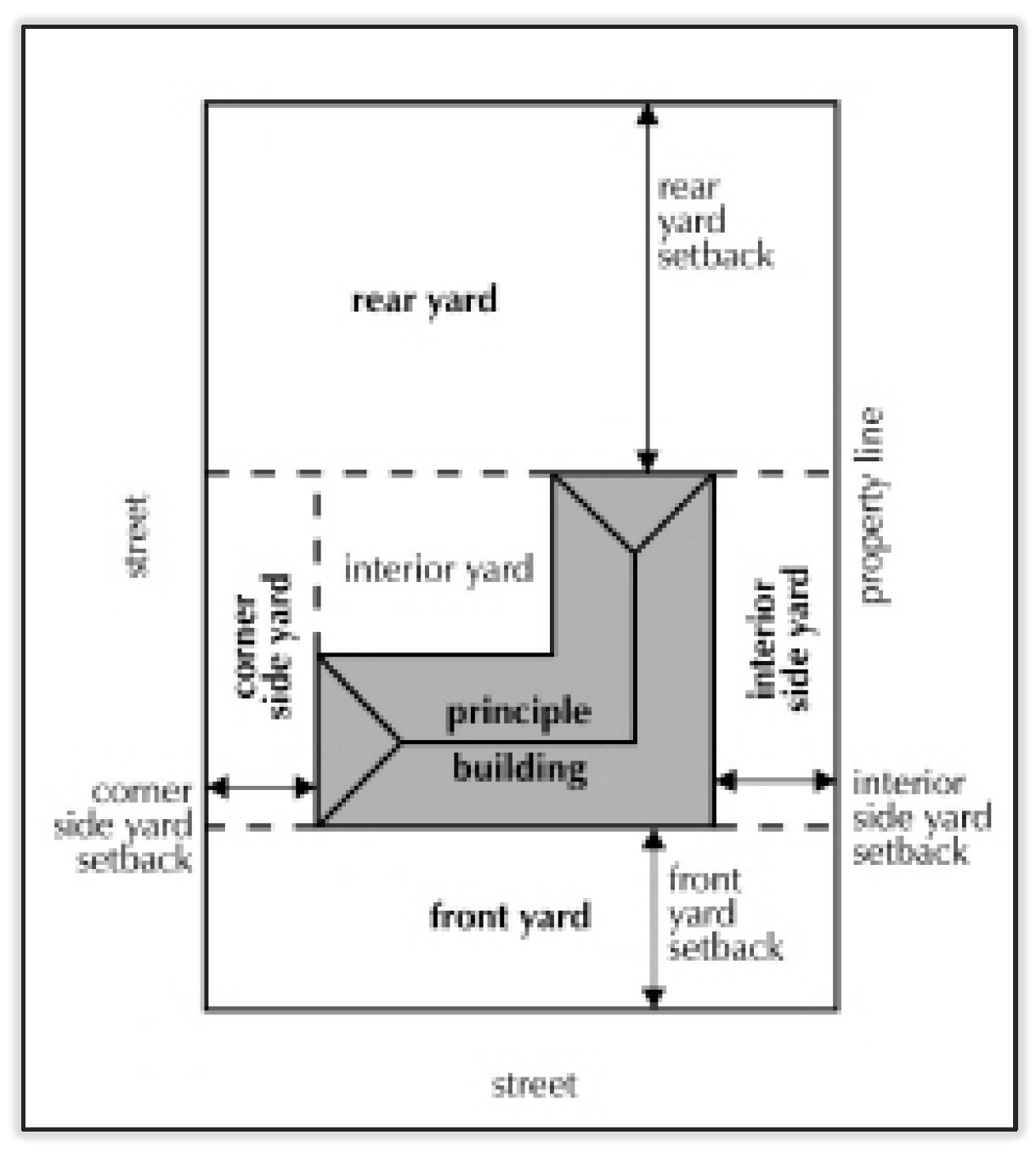
Section 10.7. - Visibility at Street Intersections.
On corner lots in any zoning district established by this Ordinance no fence, wall, terrace, sign, shrubbery, planting or other structure or object capable of obstructing driver vision shall be permitted between the heights of two and a half (2½) and ten (10) feet above the finished street level shall be permitted on a corner lot within twenty-five (25) feet of the point formed by the intersection of the street right-of-way lines (or such lines extended in case of a rounded corner) which bound said lot. However, freestanding poles and support structures are allowed within the corner setback with a minimum vertical clearance of 9 feet.
Vision Clearance Area (as defined by Law Insider) is typically a triangle area at an intersection; the space being defined by a line across the corner, the ends of which are on the street lines or alley lines, an equal and specified distance from the corner.
Intersection Visibility Illustration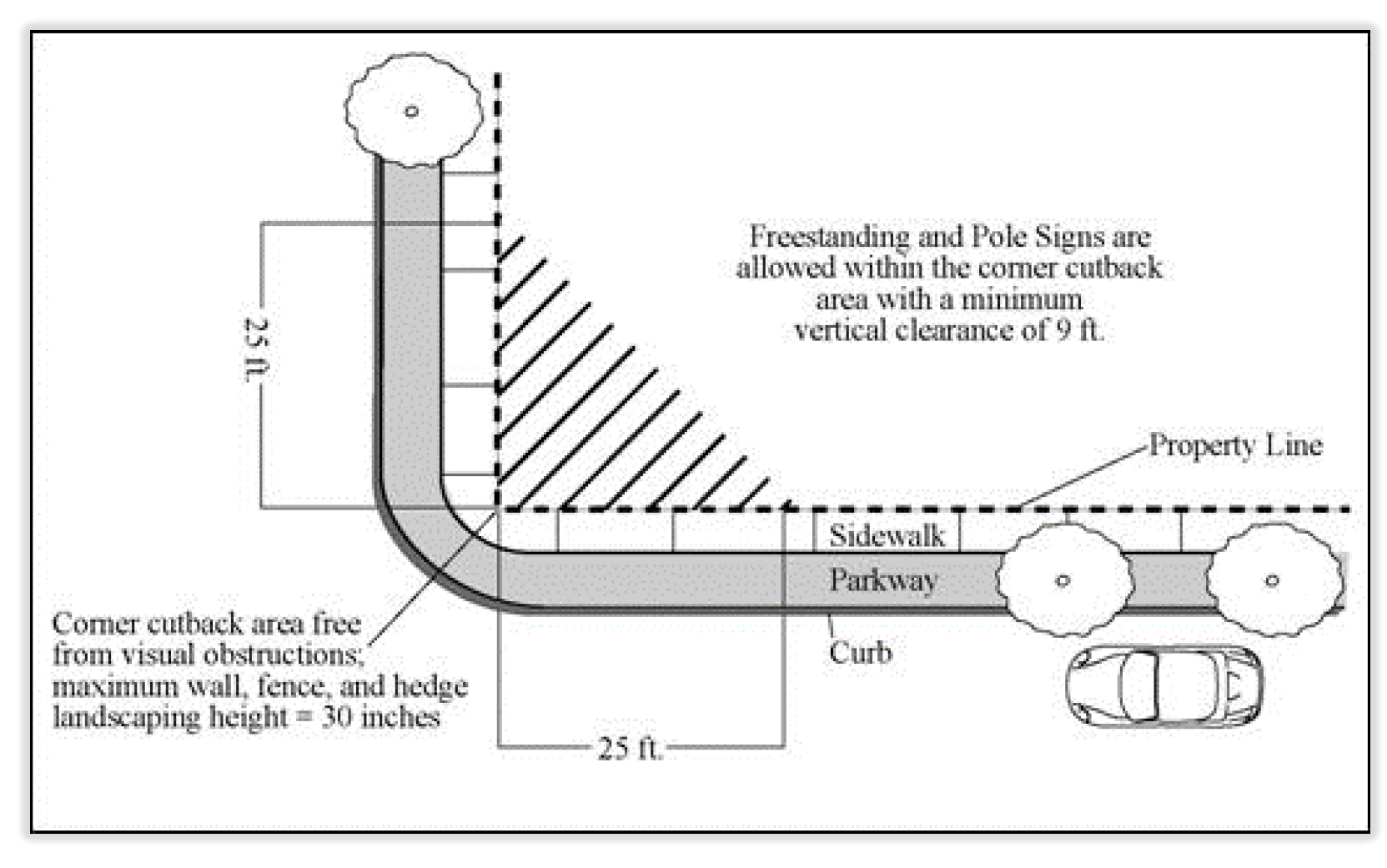
Sign Visual Clearance Area at Intersection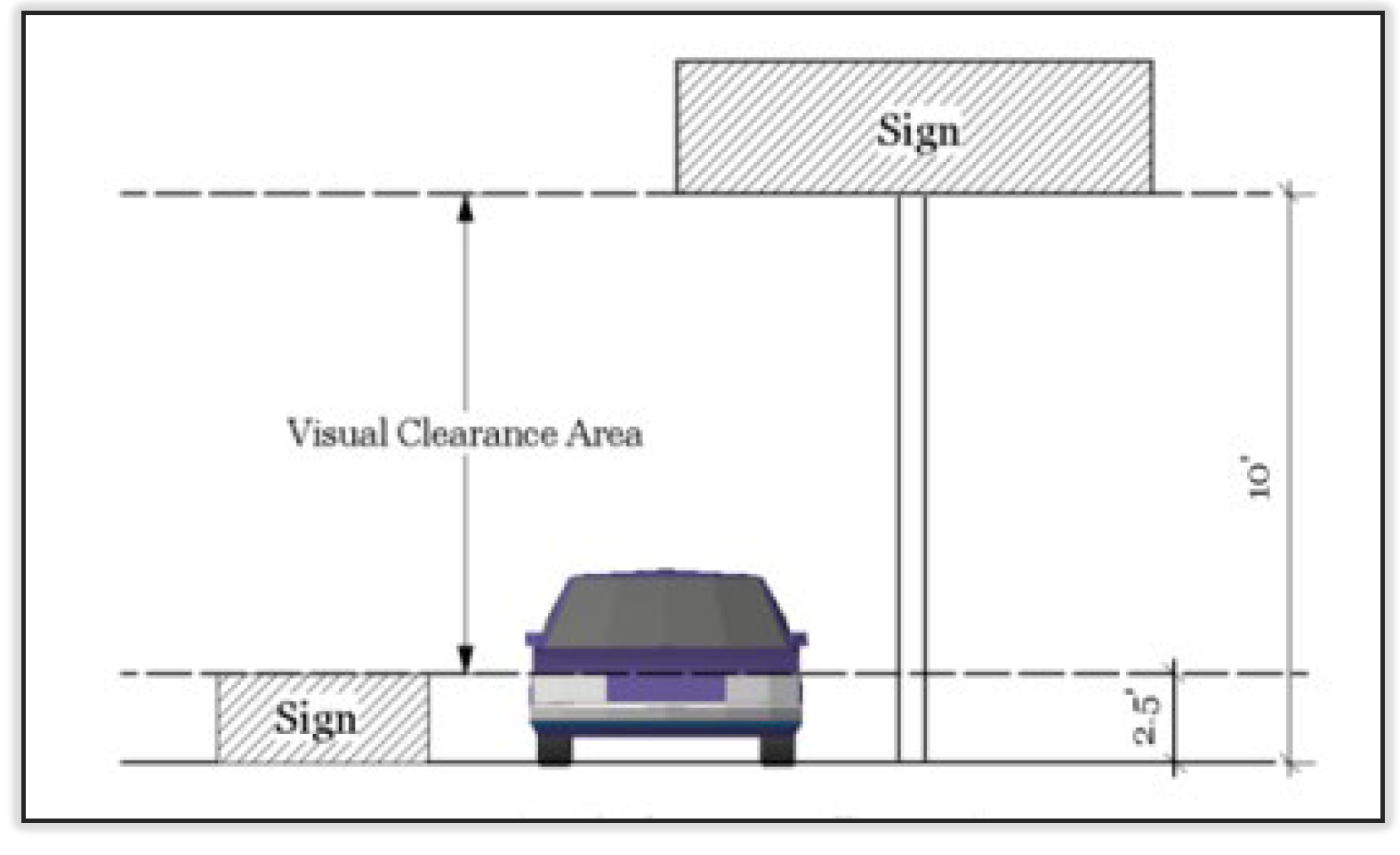
Section 10.8. - Visibility at Private Drives and Entrances Intersecting with Public Streets.
At the intersection of any private drive or entrance or exit with a public street, no fence, wall, hedge or other planting or sign forming a material impediment to visibility over a height of two and one half (2½) feet shall be erected, planted, placed or maintained.
Section 10.9. - Exceptions to Height Regulations.
The height limitations established by this Ordinance shall not apply to spires, belfries, cupolas, antennas, water tanks, transmission towers, silos, chimneys, smokestacks, or other appurtenances usually required to be placed above the roof level and not intended for human occupancy.
Section 10.10. - Accessory Uses.
This section applies to any subordinate use of a building or other structure, or use of land which is:
a.
Conducted on the same lot as the principal use to which it is related, and
b.
Clearly incidental to, and customarily found in connection with, such principal use.
10.10.1 Generally
Accessory buildings and uses may be located in required yards, under the following conditions set forth in Table 10-5, Accessory Uses or Accessory Structures. No accessory use shall be located in any required buffer yard unless otherwise permitted herein. Any reference to an accessory use in this Section refers to any accessory use, accessory building, or accessory structure, unless otherwise provided herein.
10.10.2 Establishment
Accessory buildings or uses shall not be constructed or established on a lot until construction of the principal building has commenced or the primary use is established. In no instance shall an accessory building or use be established on a vacant lot. Accessory buildings shall not be used for dwelling purposes, except where permitted in the Use Matrix, Table 6-1, or in PD districts.
TABLE 10-5 ACCESSORY USES OR ACCESSORY STRUCTURES
10.10.3 Fences and Walls
Purpose. This section establishes standards for walls and fences that are erected where desirable for privacy, screening, separation, security, erosion control, or to serve other necessary and reasonable functions. The standards are designed to ensure that the design is functional and compatible with existing and proposed site architecture. The fence standards promote the positive benefits of fences without negatively impacting the community or endangering public or vehicle safety. Fences can create a sense of privacy, protect children and pets, provide separation from busy streets, and enhance the appearance of property by providing attractive landscape materials. The negative effects of fences can include the creation of street walls that inhibit police and community surveillance, decrease the sense of community, hinder emergency access, hinder the safe movement of pedestrians and vehicles, and create an unattractive appearance. These standards are intended to promote the positive aspects of fences and to limit the negative ones.
Applicability. This section applies to walls, fences, and screens of all types whether open, solid, wood, metal, wire, masonry, or other material constructed in a required setback anywhere in the town. Walls or fences that are not located in required building setbacks may be constructed to the height of the principal structure at the eaves shall be constructed of a material that is similar to or consistent with the architectural design of the building or structure and approved by the Zoning Administrator.
Location. Any required yard.
Setbacks. No setback is required in side and rear yards adjacent to another property. In front yards and side yards adjacent to a street a fence or wall may be constructed at the back of the sidewalk provided it is not located within any right-of-way. Where no sidewalk exists, a wall or fence must be set back not less than eighteen (18) inches from the public right-of-way.
Maximum Height.
a.
Fences up to four (4) feet high are allowed in required front yard setbacks, in areas of the lot between the front elevation of the building or structure and the street and in side yards adjacent to a street between the front and rear walls of the building or structure.
b.
Fences up to eight (8) feet high are allowed on side or rear yard setbacks adjacent to another property.
c.
In the IND, Industrial, District there is no limitation as to fence height except for parcels or portions of parcels fronting or adjacent to a residential or commercial district. In no event shall a fence or wall be constructed where it will obstruct a sight triangle or site distance at any driveway, street or alley intersection.
10.10.4 Accessory Dwelling Units
Applicability. This section applies to any building or portion of a building, including the principal building, used as a dwelling unit and which is additional to the use of a principal building. Accessory dwelling units may be rented as residential units.
Standards.
a.
Not more than one (1) accessory dwelling unit may be established on a lot, where permitted by the Use Matrix, Table 6-1.
b.
One (1) detached accessory unit in addition to other permitted detached accessory structures may be permitted on the same lot. Accessory units may be created as a second story within another permitted detached accessory structure provided that the height does not exceed the height of the principal structure.
c.
An accessory dwelling shall not exceed two (2) stories or the height of the principal dwelling unit.
d.
Accessory dwelling units shall not exceed a gross floor area of one thousand (1,000) square feet or more than fifty percent (50%) of the principal structure's floor area, whichever is less, and shall include no more than two (2) bedrooms.
e.
At least one (1) parking space shall be provided per accessory dwelling unit. Parking spaces shall be located on the side or rear and behind the face of the principal building.
f.
A detached accessory dwelling shall include at least one (1) of the following design elements: a pitched roof; a dormer located above each window; or windows oriented so that the length of the vertical side is at least two (2), and not more than three (3) times, the horizontal length.
Section 10.11. - Setback and Other Yard Requirements for Accessory Uses.
In any district, all accessory uses operated in structures above ground level shall observe all setbacks, yard and other requirements set forth for the District within which they are located.
Section 10.12. - Home Occupations.
This section applies to any occupation, profession, activity or use carried on by any member of the immediate family residing on the premises, that is clearly incidental, and a secondary use of a residential dwelling unit which does not alter the exterior of the property or affect the residential character of the neighborhood, and has the following characteristics:
a.
Is conducted entirely on the premises of the subject's home;
b.
Displays no products from the street and may not involve retail trade on the premises; except that non-durable articles (consumable products) that are incidental to a service, which service shall be the principal use in the home occupation, may be sold on the premises;
c.
Creates no disturbing or offensive noise, vibration, smoke, dust, odor, heat, glare, traffic hazards, unhealthy or unsightly conditions; and
d.
Is not visibly evident from outside the structure except for an identification sign which shall conform to the requirements for signage in a residential zoning district (see Article 9, Signs).
Standards. Home occupations are permitted in any dwelling unit subject to the following provisions:
a.
The appearance of the dwelling unit shall not be altered.
b.
The home occupation shall not affect the residential character of the neighborhood and shall not be conducted in a manner which would cause the premises to differ from its residential character either by the use of colors, materials, construction, lighting, signs, increased traffic or the emission of odors, sounds, or vibrations.
c.
No outdoor display of goods or outdoor storage of equipment or materials used in the home occupation shall be permitted.
d.
The home occupation shall not involve the use of advertising signs on the premises or an any other advertising medium which calls attention to the fact that the dwelling unit is being used for a home occupation except for an identification sign which shall conform to the requirements for signage in a residential zoning district permitted pursuant to Article 9, Signs.
e.
The home occupation shall be conducted solely by resident occupants of the dwelling unit and one (1) additional employee or volunteer.
f.
The home occupation shall be conducted entirely within the dwelling unit or within in an accessory structure located on the same parcel as the dwelling unit except for those necessary outdoor activities related to the care of children. No more than twenty five percent (25%) of the gross area of the dwelling unit shall be used for the home occupation.
g.
A home occupation which utilizes an accessory building, whether attached or detached, shall not occupy a floor space greater than five hundred (500) square feet.
h.
The use of electrical or mechanical equipment that would change the fire rating of the dwelling or create visible or audible interference in radio or television receivers or cause fluctuations in line voltage outside the dwelling unit is prohibited.
i.
The home occupation shall not involve the use of commercial vehicles for delivery of materials to and from the premises.
j.
The home occupation does not generate additional traffic in excess of ten (10) vehicle trips per day or otherwise increase traffic or on street parking that would be inconsistent with a residential area.
k.
No direct on premises selling of retail goods shall be allowed except that non-durable articles (consumable products) that are incidental to a service, which service shall be the principal activity in the home occupation, may be sold on the premises. Telephone solicitation is permitted.
Prohibited Uses. The following uses are prohibited as home occupations:
a.
Vehicle painting, service or repair;
b.
Animal hospitals, kennels, stables, hospitals, or obedience/training schools;
c.
Restaurants;
d.
Automobile and/or body and fender repair;
e.
Food handling, processing or packing;
f.
Repair, manufacturing, and processing uses; however, this shall not exclude the home occupation of small scale skilled trades including a dressmaker, tailor gunsmith, jeweler, watchmaker, etc., where goods are not manufactured for stock, sale or distribution;
g.
Construction trades where activities or the storage of materials or equipment associated with the conduct on the business are conducted on the premises; and
h.
Service trades where automobile or truck fleets are customary to the conduct of the business.
Section 10.13. - Nonconforming Uses.
10.13.1 Permitted Continuation
It is the purpose of this Section to permit nonconforming uses to continue, under regulations herein contained, until the same are voluntarily or involuntarily removed, but not to encourage their perpetual survival.
10.13.2 No Enlargement or Extension
It is further the intent of this Section that nonconforming uses shall not be enlarged, extended, reconstructed or be used as grounds for adding other structures or uses prohibited elsewhere in the same district.
10.13.3 Incompatible with Permitted Uses
Nonconforming uses are hereby declared to be incompatible with the permitted uses in the districts involved.
10.13.4 Nonconforming Uses Defined
Within districts established by this Ordinance or amendments thereto, there exist lots, structures, site improvements, activities and uses of land or structures, and characteristics of uses, which were lawful before the effective date this Ordinance was enacted, amended or otherwise made applicable to such lots, structures, improvements, activities and uses of land or structures, but which now do not conform to the regulations of the district in which they are located. These lots, structures, site improvements, activities and uses of land or structures are defined as nonconforming uses, nonconforming buildings or structures or nonconforming site improvements.
10.13.5 Determination of Nonconforming Uses
Nonconforming uses and activities shall be determined pursuant to the Use Matrix, Table 6-1.
10.13.6 Determination of Nonconforming Lots, Building and Structures
Nonconforming lots, buildings and structures including signs shall be determined by the prescribed dimensional and design standards for lots, buildings and structures located in base zoning districts, special zoning districts, overlay zoning districts and signs provided for in this Ordinance.
10.13.7 Determination of Nonconforming Site Improvements
Nonconforming site improvements shall be determined by the prescribed improvement standards related to parking, drainage, landscaping, buffers and other standards contained in this Ordinance.
Section 10.14. - Nonconforming Lots of Record.
10.14.1 Preexisting Nonconforming Lot
Where a lot of record at the time of the effective date of this Ordinance has less area, width or depth than herein required in the district in which it is located, and the owner of such lot does not own any other parcel or tract adjacent thereto, said lot may nevertheless be used for any use permitted within the district in which it is located, provided that the setback requirements as provided for in Table 6-2 are reduced by no more than forty percent (40%).
10.14.2 Subsequent Nonconforming Lot
Where the owner of a lot that was subdivided subsequent to the effective date of this Ordinance does not own sufficient land to enable him to conform to the dimensional requirements of Table 6-2, such lot may be used as a building site provided the proposed structure conforms to the minimum setback requirements only after a variance has been granted by the Board of Zoning Appeals.
10.14.3 Required Combination of Subsequent Nonconforming Lots
If the owner of two (2) or more adjoining undeveloped lots with substandard dimensions, any one (1) of which was subdivided subsequent to the effective date of this Ordinance, wishes to build upon any of the nonconforming lots, the lots must be combined and if the resulting lot or lots conform to the dimensional requirements of Table 6-2 they may be used as a building site or sites. If the resulting lot or lots does not conform to the dimensional requirements of Table 6-2, the owner may appeal for a variance.
Section 10.15. - Change of Nonconforming Use.
10.15.1 Change to Different Nonconforming Use Prohibited
A nonconforming use of land, building or structure may not be changed to another nonconforming use.
10.15.2 Expansion Prohibited
A nonconforming use of land, building or structure may not be enlarged or expanded.
10.15.3 Reversion of Nonconforming Use Prohibited
Whenever a nonconforming use of land, building or structure has been changed to a conforming use of land, building or structure, it shall not be allowed to revert to any nonconforming use.
10.15.4 Change in Ownership
A change in ownership does not affect a nonconforming use.
Section 10.16. - Nonconforming Buildings, Structures and Site Improvements.
10.16.1 Applicability
Nonconforming buildings, structures and site improvements are buildings or structures that are nonconforming in height, area, setback, bulk or other dimensional requirements and sites that are nonconforming as to site improvement requirements including the amount of parking, parking lot design, drainage, landscaping, buffers and any other site improvement provisions of this Ordinance.
10.16.2 Repair and Reconstruction from Damage
If a nonconforming building or structure is damaged by any cause whatsoever to an extent less than fifty percent (50%) of the fair market value based upon the most recent market value as determined by the Orangeburg County Assessor's Office, as applicable, prior to the damage, it may be repaired or reconstructed and used as before the time of damage, provided that such repair or reconstruction is substantially completed within twelve (12) months of the date of such damage and provided the degree of nonconformity is not increased in any respect.
If a nonconforming building or structure is damaged by any cause whatsoever to an extent equal to or exceeding fifty percent (50%) of the fair market value based upon the most recent market value as determined by the Orangeburg County Assessor's Office prior to the damage, it may not be repaired or reconstructed, except in conformity with this Ordinance.
10.16.3 Renovation and Expansion
A nonconforming building or structure may be renovated provided the estimated cost of the renovation does not exceed fifty percent (50%) of the fair market value of the nonconforming building or structure based upon the most recent market value as determined by the Orangeburg County Assessor's Office, as applicable, and the renovations serve to reduce the nonconformities associated with site improvements.
A nonconforming building or structure may be expanded provided the estimated cost of the expansion does not exceed fifty percent (50%) of the fair market value of the nonconforming building or structure based upon the most recent market value as determined by the Orangeburg County Assessor's Office, as applicable and the Zoning Administrator finds that the expansion does not increase any nonconformity to more than fifty percent (50%) of the dimensional standard established in this Ordinance and the expansion serves to reduce the nonconformities associated with site improvements.
A site that is nonconforming as to site improvements may be improved provided the estimated cost of the improvements does not exceed seventy-five percent (75%) of the estimated replacement cost of the existing nonconforming site improvements as determined by the Zoning Administrator, and the proposed site improvements serve to reduce the nonconformities associated with existing site improvements.
A renovation, expansion or improvement of a nonconforming building, structure or site that is disapproved by the Zoning Administrator may be appealed to the Board of Zoning Appeals.
Section 10.17. - Abandonment of Nonconforming Uses, Buildings, Structures and Site Improvements.
10.17.1 Abandonment of Use or Activity
No nonconforming use or activity of land, building or structure shall be resumed if it has been abandoned for a continuous period of six (6) months. This condition shall apply whether or not the equipment or fixtures have been removed. After the specified time period referenced herein, the property shall not again be used except in conformity with the use regulations of the district in which such lot, building or structure is located.
10.17.2 Abandonment of Building, Structure or Site
No use or occupancy of a nonconforming building, structure or improved site shall be resumed if it has been abandoned for a continuous period of six (6) months. After the specified time period referenced herein, the lot, building, structure or improved site shall not again be used except in conformity with the dimensional and site improvement regulations of the district in which such lot, building or structure is located or is renovated.
10.17.3 Definition
For purposes of this section, "abandon" or "abandonment" means discontinuance of the nonconforming use or any use of the nonconforming building or structure regardless of the property owner's intent to relinquish the right to so use the property. A building, land, structure or activity is considered abandoned when:
a.
It has been intentionally discontinued, remains idle or unused;
b.
Necessary utilities, such as water, sewer or electricity have been discontinued for any reason including a failure to pay fees, rates or other required charges lawfully established by the service provider; or
c.
The principal buildings or structures are no longer actively occupied.

