
Santee City Zoning Code
ARTICLE 9
- SIGN REGULATIONS
Section 9.1.- Purpose.
These regulations are to provide fair and comprehensive guidelines that will eliminate confusing, distracting, and unsafe signs, assure the efficient transfer of information, ensure the maintenance of signs and foster a good visual environment for the Town of Santee. It is declared that the regulation of signs within the Town of Santee is necessary and in the public interest:
a.
To protect the safety and welfare of the public by minimizing hazards and distractions to pedestrian and vehicular traffic;
b.
To promote and aid in the tourist industry which is declared to be of importance to the economy of the Town of Santee;
c.
To avoid unnecessary visual clutter and to avoid the unregulated construction, placement and display of signs that are or may become a public nuisance;
d.
To provide a pleasing overall environmental setting and good community appearance which is deemed vital to tourism and to the continued economic attractiveness of the town;
e.
To provide a means of way-finding in the community, thus improving the pedestrian experience, walkability of the community, and reducing traffic confusion and congestion;
f.
To allow signs appropriate to the planned character of each zoning district;
g.
To allow signs as accessory and incidental uses to the primary residential, commercial, industrial and related uses in the Town;
h.
To encourage the effective use of signs as a means of communication for businesses, organizations and individuals in the Town of Santee;
i.
To prohibit signs of such excessive size and number that they obscure one another to the detriment of the economic and social well-being of the Town and its residents, property owners and visitors;
j.
To minimize adverse effects of signs on nearby property;
k.
To provide broadly for the expression of individual opinions through the use of signs on private property; and
l.
To promote the public safety, welfare, convenience and enjoyment of the unique character of Santee.
Section 9.2. - Scope.
The provisions of this ordinance shall apply to the construction, erection, alteration, use, location, size and height of and the maintaining of all signs, regardless of their cost of construction. No reference in this ordinance referring to sign copy or sign purpose shall be interpreted or applied to improperly regulate content or impair the right of free speech. The provisions of this ordinance shall not apply to:
a.
Signs not visible beyond the boundaries of the lot or parcel upon which they are situated, or from any public thoroughfare, or right-of-way;
b.
Any commercial communication intended to be solely viewed while stopped in location or primarily viewed by pedestrian or other nonmotorized travelers; provided, however, that the restrictions of 9.9 Prohibited Signs, shall apply to such commercial communications;
c.
Signage or markings authorized by the governing authority for public safety or public informational purposes.
d.
Pavement markings of a traffic directional nature;
e.
Temporary signs as specifically permitted for special events, parades, facility uses or outdoor vending under the authority of law in ordinances and regulatory procedures enacted by Town Council and then only during the duration of those events.
Section 9.3. - Definitions.
Except as specifically defined herein, all words used in these regulations have their customary dictionary definitions. The definitional sections may not be interpreted or applied to improperly regulate the content of the sign or impair the right of free speech. For the purposes of the sign regulations, certain words or terms used are herein defined as follows:
1.
Abandoned. A sign not in use or a sign structure not containing a sign for 90 continuous days, or a sign advertising a business no longer occupying the site on which the sign exists or to which it refers.
2.
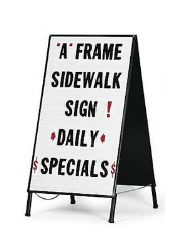
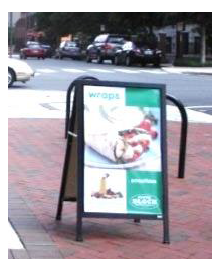
A-Frame. Any upright, ridged supporting frame in the form of a triangle having the capability to stand on its own supports and being portable.

3.
Animation. The movement, or the optical illusion of movement, of any part of the sign structure, design or pictorial segment including the movement of any illumination of the blinking, flashing, scintillating or varying of light intensity. Also included in this definition are signs having "chasing action" which is the action of a row of lights commonly used to create the appearance of motion. Animation also includes Changeable Electronic Variable Message Sign (CEVMS) display that are running or depicting action, as in a video display, but does not include the fading, scrolling or rolling of one static display to the next, which is defined as static electronic display. Also, this includes any person or persons wearing any costume, character dress, or other distinctive attire for the purpose of attracting attention to any business or commercial activity shall be regulated as an animated sign.
4.
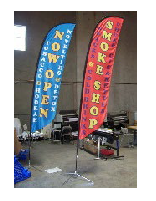
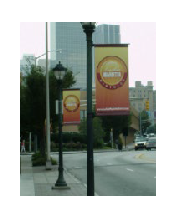
Banner. A sign or outside advertising display having characters, letters, illustrations, ornamentation, symbol, color, or visual representation applied to cloth, vinyl, fabric, plastic, or like material with or without frame. The term banner shall include pennants, life rafts, T-shirts, floats, towels, ribbons, spinners, streamers, kites, balloons (but not dirigibles) and/or similar types of lighter than air objects, or any other material or outside advertising display fastened in such manner as to move upon being subjected to movement of the atmosphere or any mechanical device.
 |  |

5.
Bench. A sign located on any part of the surface of a bench or seat placed on or adjacent to a public right-of-way.
6.
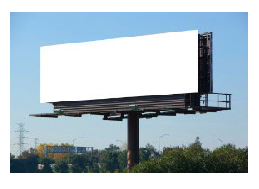
Billboard. A sign identifying/advertising and/or directing the public to a business or merchandise or service or institution or residential area or entertainment which is located, sold, rented, leased, produced, manufactured and/or furnished at a place other than the real property on which said sign is located. Such signs are also known as off-premises or outdoor advertising display signs. A billboard may also be known as a freestanding sign.
7.
Building frontage. The linear length of a building facing the street right-of-way.
8.
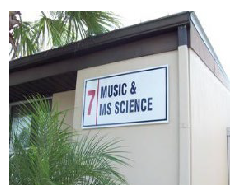
Building identification. A sign bearing only the name, number(s), letter(s) and/or symbol(s) which identifies a particular building.
9.
Business identification. A sign bearing the name, trademark, or symbol of the business located on the premises. A business identification sign may contain the name of the business enterprise located on the same premises as the sign and the nature of the business conducted there.
10.
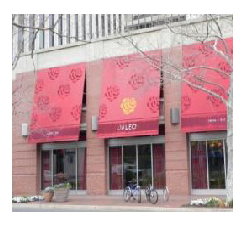
Canopy sign. A sign that is suspended from, attached to, supported from, applied to, or forms part of a canopy.
11.
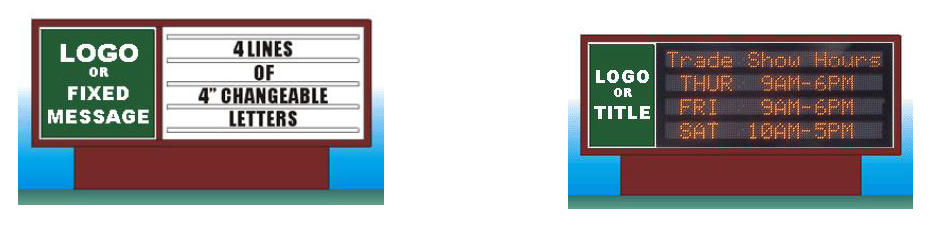
Changeable copy. A sign on which message copy is changed either manually in the field, through the utilization of attachable letters, numbers, symbols, and other similar characters or changeable pictorial panels, or automatically or electronically on site as a CEVMS sign (see #12 below) with animation or static display as permitted by zone.
12.
Changeable electronic variable message sign (CEVMS). A sign on which light is turned on or off intermittently by any means, including any illuminated sign on which such illumination is not kept stationary or constant in intensity and color at all times when such sign is in use; including alternative sign displays of a digital or controlled light emitting variety, including digital signs that may be scrolling message boards, liquid crystal display (LCD), or plasma display panels, electronic billboards, projection screens, or other emerging display types like living surfaces like organic light-emitting diode (OLEDs), light emitting diode (LED), light emitting polymer (LEP) and organic electro-luminescence (OEL), that can be controlled electronically using a computer or other devices, allowing direct or remote access and control of graphic, text or content, and which may vary in intensity or color. A CEVMS sign does not include a sign located within the right-of-way that functions as a traffic control device and that is described and identified in the Manual on Uniform Traffic Control Devices (MUTCD) approved by the Federal Highway Administration as the National Standard.

13.
Channel Letter sign. A sign comprising individual letters that are independently mounted to a wall or other surface and internally illuminated with a covered face. The "air space" is not part of the sign structure but rather of the building facade. A logo may also be considered a channel letter provided it is clearly distinguishable from other sign elements.
14.
Commercial center. Two or more retail stores, or service establishments, professional offices or any other businesses serving a community or neighborhood, not necessarily owned by one party nor by a single land ownership, which occupy a common and/or adjacent building(s) on premises and utilize common parking area(s).

15.
Cutout. An extension of the perimeter of an outdoor advertising sign face, which is commonly irregular in shape, and which is added for the purpose of accomplishing a creative design.
16.
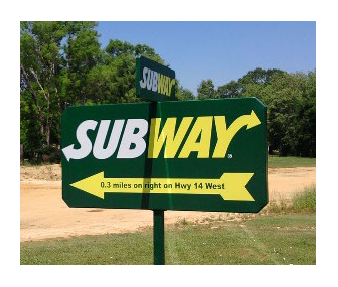
Directional. An off-premises sign whose content is limited exclusively to the identification of a use or occupancy located elsewhere and which tells the location of or route to such use or occupancy.
17.
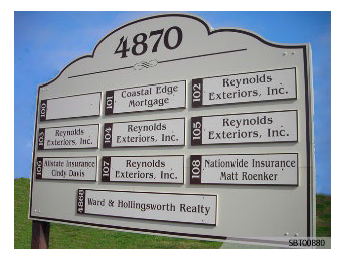
Directory. A sign listing the names and/or use, or location of more than one business, activity or professional office conducted within a building, group of buildings or commercial center.
18.
Double-faced. A sign with two faces that are parallel or within 20° of parallel.
19.
Facade. The entire building walls, including wall faces, parapets, fascia, windows, doors, canopy and visible roof surfaces, of one complete elevation.

20.
Fence Sign. A sign erected parallel to and/or extending not more than 12 inches from the face of any fence to which it is attached or applied, and supported throughout its entire length by the fence and not extending above the fence.
21.
Festoon lighting. A string of outdoor lights suspended between two or more points.

22.
Flag. A rectangular display having characters, letters, illustrations, ornamentation, symbol, color, or visual representation applied to cloth, vinyl, fabric, plastic, or like material. Furthermore, grommets or a rope spline must be provided for mounting and hemming must finish all four edges.
23.
Fixed projecting. A sign, other than a parallel sign, which extends outward for more than six inches from the facade of any building and is rigidly affixed thereto.
24.
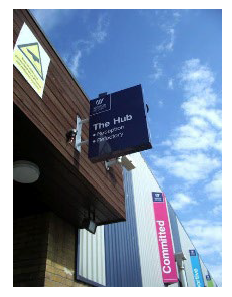
Flat. A sign erected parallel to and extending not more than 12 inches from the facade of any building to which it is attached and supported throughout its entire length by the facade and not extending above the building.
25.
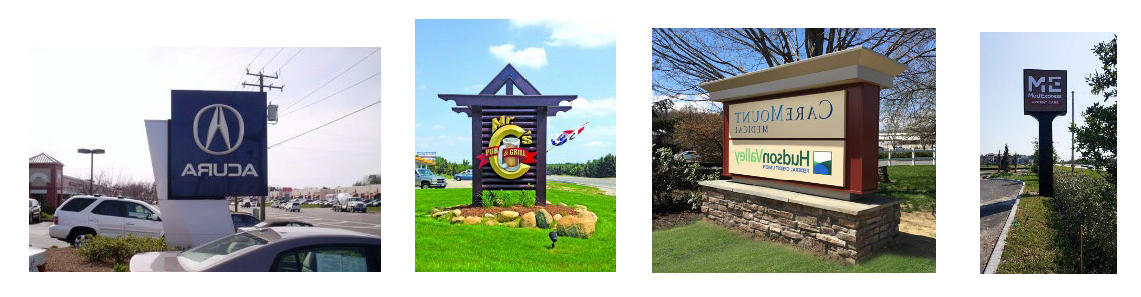
Freestanding. A sign supported by a sign structure placed in the ground and which is wholly independent of any building, fence, vehicle or object other than the sign structure, for support. A freestanding sign may contain a sign or signs on one side only or it may be a V-shaped structure or one containing signs back-to-back. A freestanding sign structure is one sign.
26.
Frontage. The length of the property line of any one premises serving as a public street right-of-way line. For lots with multiple frontages, the principal street frontage shall generally be that which abuts the street having the highest vehicular traffic volumes; but if the frontages have equal traffic exposure, the property owner shall be permitted to designate his principal street frontage. For the purpose of determining allowable sign area, the frontage may be measured (at the option of the property owner) at the required front building setback line instead of along the public street right-of-way line.
27.
Grade. The uppermost surface directly below the sign or immediately adjacent to the support. Where the uppermost surface has been artificially raised for landscaping or other purposes, grade shall be measured from the level of the nearest town or state street curb.
28.
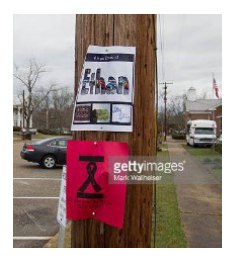
Handbill (circular). A sign that is distributed to the public or placed on vehicles, buildings, structures, objects or surfaces as part of said distribution.
29.
Height of sign. The vertical distance measured from the adjacent street crown grade to the top of the sign face or sign structure, whichever is greater.
30.
Illumination, direct. Illumination which emits light either by means of an artificial light source on a surface, or by means of an artificial light source transmitted through a surface.
31.
Illumination, indirect. Illumination which reflects light from an artificial light source intentionally directed upon a surface. This shall also include silhouettes of letters or symbols placed before a background of reflected light.
32.
Incidental. A sign, generally informational, that has a purpose secondary to the use of the zone lot on which it is located, such as "no parking", "entrance", "loading zone", "help wanted", "lost dog" and other similar directives.

33.
Inflatable sign. Any object enlarged or shaped by inserting air or other gas, which floats, is tethered in the air or activated by air. Does not include individual balloons under 18" (eighteen inches) in size.
34.
Model. A three-dimensional representation of an object or product, whether in miniature, actual or exaggerated scale.
35.
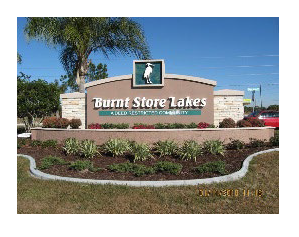
Monument. A freestanding sign whose support structure is integral with the sign faces; that is, the blank support portion of the sign abuts the sign face(s), is essentially in the same planes as the sign face(s) and is essentially of the same width as the sign face(s).
36.
Multiunit identification. A sign bearing only the name of the principal occupant and the number(s) and/or letter(s) of units in a multiple family residence, other than a duplex. Includes hotel and motel rooms.
37.
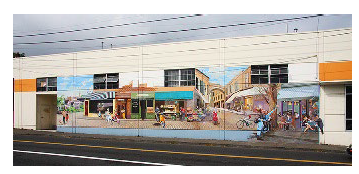
Mural. A painted or adhered image or representation on the exterior of a building that is visible from a public right-of-way or neighboring property, does not contain commercial advertisement & is designed in a manner so as to serve as public art or provide inspiration.
38.
Occupant/street number. A sign bearing only the name of the principal occupant and/or the street number of a private residence or duplex.
39.
Off-premises. A sign that identifies or communicates a message related to an activity conducted, a service rendered, or a commodity sold, which is not the primary activity, service or commodity provided on the premises where the sign is located.
40.
On-premises. A sign that identifies or communicates a message related to the activity conducted, the service offered, or the commodity sold, on the premises upon which the sign is located and shall include non-profit event signs.
41.
Occupancy. Any one business, activity or office.
42.
Outdoor advertising signs. Refer to billboards.

43.
Painted wall. A sign painted directly on any exterior building wall or door surface, exclusive of window and door glass areas.
44.
Panel. The primary surface of a sign that carries the identifying/advertising message.
45.
Panel extension. Any additional structure or device extending beyond the panel of any sign, within the allowable sign area, but projecting into the third dimension more than 12 inches from any panel of any sign will be considered as an additional sign face.
46.
Parapet. A false front or wall extension above the roof line.
47.
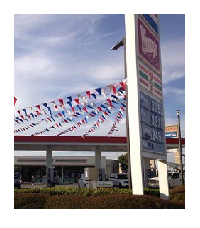
Pennant. Any lightweight plastic, fabric, or other material, whether or not containing a message of any kind, attached to a rope, wire, or string, usually in series, designed to move in the wind.
48.
Perimeter. The contour of the face of the sign.
49.
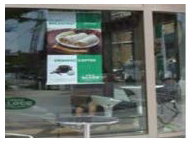
Permanent window sign. Any sign which is applied to or near the glass area, located such that the identifying/advertising message, symbol, insignia, visual representation, logotype or any other form which communicates information, can be read from off-premises. This includes signs within a building where the clear intent is for the sign to be read through the glass from the exterior of the building. The area of the sign shall be included as a part of the allowable sign area.
50.
Portable sign. Any sign designed or intended to be readily relocated whether or not it is permanently attached to a building, structure or on the ground. The term includes signs on wheels or on portable structures, tent signs, A-frame signs and similar devices and any sign not secured or securely affixed to the ground or a permanent structure.
51.
Premises. A lot, as defined in the zoning ordinance herein. In the case of a business center, each tenant of occupancy shall be considered a separate premises. In the case of business establishments consisting of lots located in two or more contiguous blocks (separated by a dedicated public street or dedicated public walkway), the contiguous lots in each block shall be considered a separate premises.
52.
Roof sign. A sign that is mounted on the roof of a building or which is wholly dependent upon a building for support and which projects above the point of a building with a flat roof, the ridge line of a building with a mansard roof. Signs mounted on the sloping section of a roof or the gable end of a roof shall be classified as a wall sign.
53.
Roof integral. A sign whose structure is integrated into the structure of the roof, and is an integral part thereof.
54.
Sign. Any device designed to impart information to the public or attract the attention of the public, which is attached, painted or otherwise affixed to, or a part of, a building, structure, material, surface, vehicle, or object, integral decorative or architectural features of buildings except letters or trademarks, fences, walls and works of art which are noncommercial in nature are not to be construed as being a sign. Sign shall include any artificial light source, and any device which animates or projects a visual representation which attracts the attention of the public. The definitional provisions of this section act as an aid in identification and classification of the different types of signs, and shall not be interpreted or applied so to regulate the content of a sign or to impair the right of free speech.
55.
Sign area. The area of the rectangle if the sign is rectangular; or if the sign is not rectangular, the smallest convex polygon that contains the entire sign, excluding those architectural embellishments and supports on which no advertising material or lighting is displayed.
56.
Sign face. The part of the sign that is or can be used for visual representation which attracts the attention of the public for any purpose. Sign face includes any background material, panel, trim color, and direct or self-illumination used that differentiates that sign from the building, structure, backdrop surface or object upon which or against which it is placed. The sign structure shall not be included as a portion of the sign face provide that no identifying/advertising message, symbol or any of the aforementioned sign face criteria are displayed on or designed as part of the sign structure, whether structurally necessary or not. In the case of signs designed with integral sign face and sign structure, the blank (support) area equivalent to a maximum of 50 percent of the allowable sign area shall be exempt from computations of sign area.
57.
Sign structure. The supporting structure erected or intended for identifying/advertising purposes, with or without a sign thereon, situated upon or attached to real property, upon which any sign is fastened, affixed, displayed, applied or a part of; provided, however, said definition shall not include a building, fence, or flag pole.
58.
Statue. A likeness (as of a person or animal) sculptured or modeled in a solid substance.
59.
Swinging projecting. A sign projecting from the outside wall or walls of any building which is supported by only one rigid support, irrespective of the number of guy wires used in connection therewith.
60.
Permanent window. Any sign which is applied to or near the glass area, located such that the identifying/advertising message, symbol, insignia, visual representation, logotype or any other form which communicates information, can be read from off-premises. This includes signs within a building where the clear intent is for the sign to be read through the glass from the exterior of the building. The area of the sign shall be included as a part of the allowable sign area.
61.
Temporary window. Any sign of a temporary nature which is applied to or near the glass area, located such that the identifying/advertising message, symbol, insignia, visual representation, logotype or any other form which communicates information, can be read from off-premises. This includes signs within a building where the clear intent is for the sign to be read through the glass from the exterior of the building.
62.
Wall sign. Any sign attached to and within six inches of a wall, painted on the wall surface, or erected and confined within the limits of an outside wall of any building or structure, which is supported by such wall or building, and which displays only one sign surface.
63.
Window sign. A sign that is applied or attached to the exterior or interior of a window or located in such manner within a building that it can be seen from the exterior of the structure through a window.
Sign Types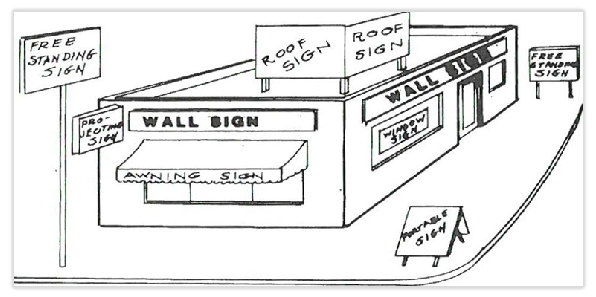
Section 9.4. - Conformity.
The provisions of this ordinance shall apply to the construction, erection, alteration, use, location, size, and height of signs. It also regulates the number of signs, physical characteristics and the maintenance of all signs. No reference in this ordinance referring to sign copy or sign purpose shall be interpreted or applied to improperly regulate content or impair the right of free speech.
From and after the adoption of this Ordinance, no sign may be erected, or enlarged within the jurisdiction of this Ordinance unless it conforms to the requirements of this Chapter. This Ordinance allows for certain signs without a permit, prohibits certain signs and requires permits for certain signs.
Section 9.5. - Sign Permit Applications.
Where a sign permit is required, the permit application shall be accompanied by the following:
1.
Identification of landowner and/or leaseholder of property on which the sign is to be erected, including street address.
2.
Name and address of owner of the sign.
3.
Site plan sketch with dimensions (non-professionally drafted plan is acceptable) showing the location of the sign with respect to the property and right-of-way lines, building and setback lines, and buildings, parking areas, existing free-standing signs, and buffer areas. (Note. To the extent possible, the proposed location of a sign shall not block or obstruct the sign face of a sign on a contiguous property, and shall be subject to approval of the Zoning Administrator).
4.
Correct size, shape, configuration, face area, height, nature, number, and type of sign to be erected, including size of letters and graphics.
5.
Signs shall be accompanied by a drawing and written assurances from the applicant for a sign permit that the sign is structurally sound and safe, does not constitute a hazard to persons or property on the premises, on adjoining property, or in the vicinity, and that the sign is in compliance with all applicable requirements of the Standard Building Code, latest edition.
6.
The Zoning Administrator may waive any of the informational requirements listed above deemed unnecessary to process an application.
9.5.1 Fees
Before issuing a permit the Zoning Administrator shall collect the fees as established below:
Application Fee .....$25.00
NOTE: Electrical Signage requires a Building Permit
Permit Fee - By value of sign:
$1.00 - $9,000 .....$50.00
$9,001 - $20,000 .....$70.00
$20,001 - $50,000 .....$100.00
$50,001 - over .....$150.00
Section 9.6. - Common Signage Plan Required.
A Common Signage Plan shall be a prerequisite to the issuance of any sign permit involving:
1.
Two or more contiguous lots under the same ownership,
2.
A PD (Planned Development) project, and
3.
A single lot or parcel with more than one principal use or building (not including accessory uses or buildings) or qualifying on the basis of street frontage for more than one free-standing sign.
The Plan shall contain all information required for sign permits generally and shall specify standards for consistency among all signs on the lot affected by the Plan with regard to:
• Lettering or graphic style;
• Lighting;
• Location of each sign on the buildings;
• Material; and
• Sign proportions.
A Common Signage Plan shall limit the number of free-standing signs to a total of one for each street on which there is frontage and shall provide for sharing or common usage of such signs; however, the maximum sign area may be increased by 10% for each additional business, not to exceed 120 square feet.
Once approved by the Zoning Administrator, the Common Signage Plan shall become binding on all businesses and uses occupying the affected lots, but may be amended by filing a new or revised Plan in conformance with the requirements of this Ordinance.
If any new or amended Common Signage Plan is filed for a property on which existing signs are located, it shall include a schedule for bringing into conformance, within three years, all signs not conforming to the proposed amended Plan or to the requirements of this Ordinance in effect on the date of submission.
Section 9.7. - Development and Design Standards.
9.7.1 Area Clearance
A.
Visual. No sign shall be located within a vision clearance area as defined in the town's Zoning Ordinance.
B.
Vehicle. When a sign extends over an area where vehicles travel or park, the bottom of the sign structure shall be at least 14 feet above the ground. Vehicle areas include driveways, alleys, parking lots, and loading and maneuvering areas.
C.
Pedestrian. When a sign extends over a sidewalk, walkway, or other space accessible to pedestrians, the bottom of the sign structure shall be at least 8 feet above the ground.
9.7.2 Design Standards
A.
Sign Materials. Permanent and temporary identification signs must be constructed in accord with all applicable provisions of the Building Code and National Electrical Code, and consist of durable all-weather materials.
Images, logos, graphics, etc. painted on permanent signs or buildings must be performed in a professional and workmanlike manner. Permits for painted signs will only be issued to companies who are engaged as sign painters.
B.
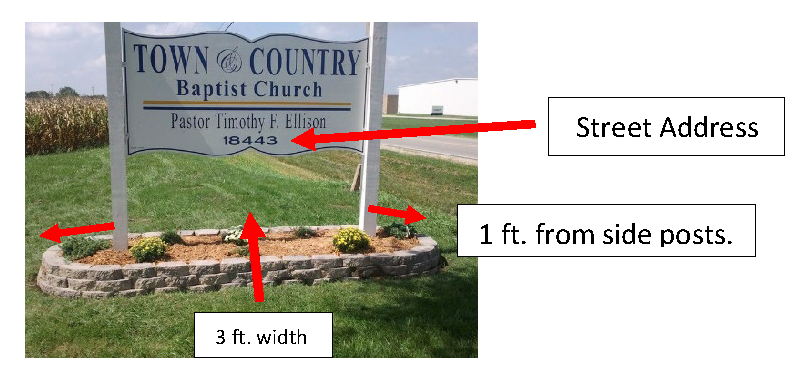
Landscaping Requirements. A landscape strip of at least 3 feet in width and 1 foot in length past each side of the edges of the sign shall be provided. One shrub, at least 12 inches tall at planting time, per each foot of landscaping strip or other approved ground cover plantings shall be provided and maintained. The sign shall not extend beyond the landscaped area. Curbing, railroad ties, fencing or other types of vehicular barriers acceptable to the zoning administrator shall be placed around the landscaped strip for protection.
C.
Emergency Precautions. In order to provide efficient emergency vehicle operations as well as to aid in the location of businesses, each primary freestanding sign on commercial or multifamily properties are required to display the street address on the sign in a prominent location so as to allow said numbers to be clearly readable from the street.
D.
Sign Face Area.
1.
The area of a sign enclosed in frames or cabinets is determined by measuring the outer dimensions of the frame or cabinet surrounding the sign face. Sign area does not include foundations or supports. Only one side of a double-faced or V-shaped, free-standing sign is counted. (Illustration 1)
2.
For signs on a base material and attached without a frame, such as a wood board or Plexiglas panel, the dimensions of the base material are to be used in the measurement unless it is clear that part of the base contains no sign related display or decoration.
3.
For signs constructed of individual pieces attached to a building wall, the sign area is determined by a perimeter drawn around all the pieces. (Illustration 2)
4.
For sign structures containing multiple modules oriented in the same direction, the modules together are counted as one sign face. (Illustration 3)
5.
The maximum surface area visible at one time of a round or three-dimensional sign is counted to determine sign area.
6.
For signs incorporated into awnings, the entire panel containing the sign is counted as the sign face unless it is clear that part of the panel contains not sign related display or decoration.
E.
Clearances. Clearances are measured from the grade directly below the sign to the bottom of the sign structure enclosing the sign face. (Illustration 4)
Sign Measurement Illustrations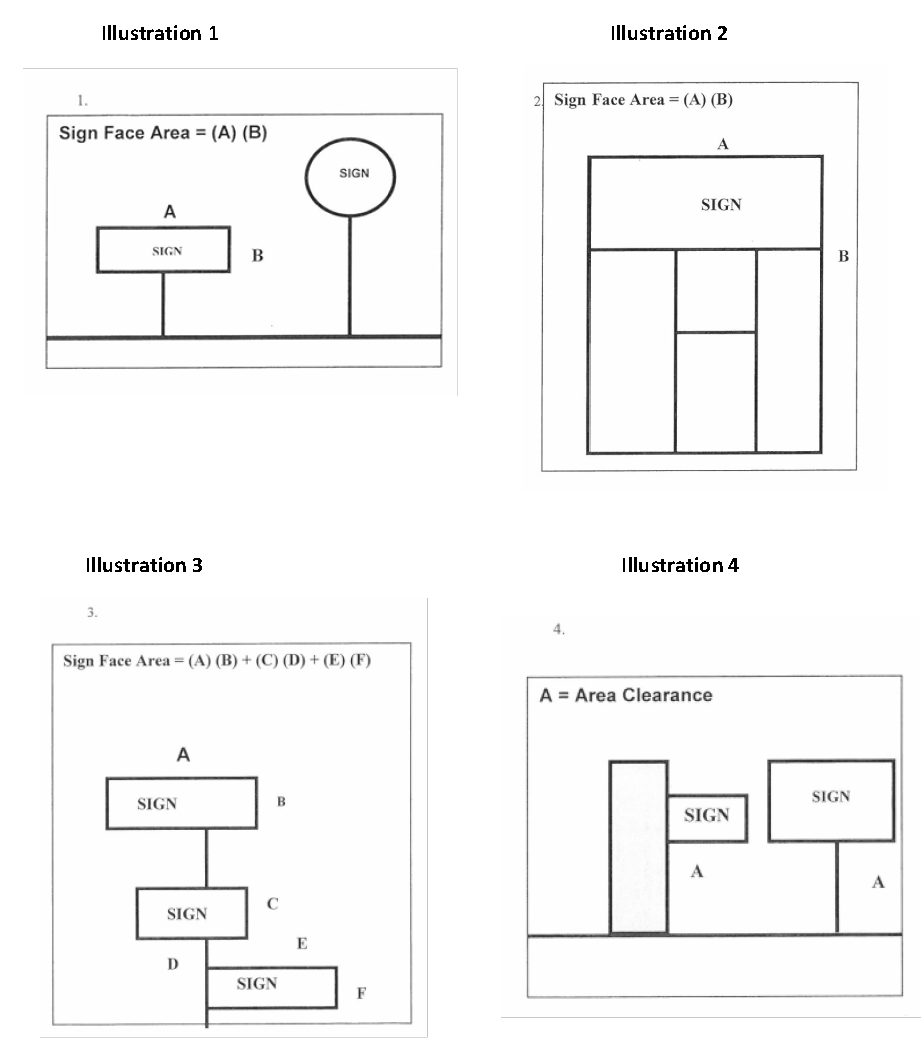
Section 9.8. - Removal of Signs.
A.
False Advertising. It shall be unlawful for a person to display false or misleading statements upon signs, or other public places, calculated to mislead the public as to anything sold, any services to be performed, or information disseminated.
B.
Unsafe Signs/Dilapidated. Signs which have fallen into disrepair (dilapidated), are not property maintained, are insecure or otherwise structurally unsound, have defective parts in the support, guys and/or anchors, or which are unable to meet minimum safety requirements of the Standard Building Code.
C.
Public Right-of-Way. No sign shall be allowed in the public right-of-way, except for the following:
1.
Public sign erected by or on behalf of a government body to post legal notices, identify public property, convey public information and direct or regulate pedestrian or vehicular traffic;
2.
Informational signs of a public agency or utility;
3.
Church signs, in accord with state law;
4.
Historic signs and markers;
5.
Emergency signs; and
6.
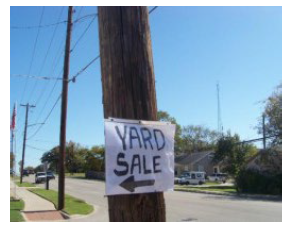
Directional signs of a temporary nature not to exceed three (3) sq. ft. in area and 24 hours in duration for such events as yard sales, auctions, public gatherings, etc. and must not be closer than 500 feet apart.
D.
Non-Conforming. Signs existing at the time of the enactment of this Ordinance may be continued although such use does not conform with the provisions of this Ordinance, except those declared abandoned or unsafe which shall be removed or remedial action take upon notification by the Zoning Administrator.
Non-conforming signs shall be removed or brought into conformity whenever the following occurs:
1.
The property changes ownership
2.
The name of the business changes
3.
The occupancy classification of the building is changed
Section 9.9. - Prohibited Signs.
All signs not expressly permitted by this ordinance are prohibited. Such signs include, but are not limited to:
1.
Signs painted on or attached to trees, fence posts, utility poles, stationary vehicles, or natural features.
2.
Signs displaying intermittent lights resembling the flashing lights customarily used in traffic signals or in police, fire, ambulance, rescue vehicles or other warning signals, and signs using the words "stop", "danger" or any other word, phrase, symbol, or character in a manner that might mislead or confuse motorist.
3.
Signs which have been abandoned and no longer correctly direct or exhort any person, advertises a bona fide business, lessor, owner, product, or activity conducted or product available for 90 days.
4.
No new high-rise signs are allowed.
5.
No new billboard signs are allowed.
6.
Off-Premise signs of any type are not allowed.
7.
Handbills (circulars)-distribution of is not allowed.
8.
Signs which have fallen into disrepair (dilapidated), are not properly maintained, are insecure or otherwise structurally unsound, have defective parts in the support, guys and/or anchors, or which are unable to meet minimum safety requirements of the Standard Building Code.
9.
Any nonconforming sign shall be removed or brought into conformity no later than 60 days following the effective date of this Ordinance.
10.
No sign illuminated using beacon, spot, search or stroboscopic light or reflectors is allowed that is visible from any public right-of-way, or adjacent property. Also any flood lights which are not hooded or shielded so as to not impair driver vision.
11.
Changeable Electronic Message signs shall not exceed the maximum brightness standards: Dawn to dusk-not more than 7,500 nits, Dusk to dawn-no greater than 750 nits, as measured from the sign's face at maximum brightness.
Section 9.10. - Notice Order: Non-Compliance/Violations.
Service of any order may be in person, by registered or certified mail, return receipt requested. Service shall be deemed complete upon delivery; in the event the address of the person to be notified is unknown or the notice which has been mailed is returned, such notice may be served by posting the same on a conspicuous place on the premises on which the nuisance is located and by advertising said notice once a week for three weeks in the local newspaper, in which event service shall be deemed complete after the preceding is accomplished.
Once the notification process has been completed, the responsible party has thirty (30) days to comply with the order. Upon failure to comply with such notice order, the Zoning Administrator may cause the sign to be removed and any costs of removal incurred in the process may be collected in a manner prescribed by law.
The Zoning Administrator may, with or without notice, cause any unsafe or unsecure sign to be immediately removed if; in their opinion, the sign presents an immediate safety hazard.
Section 9.11. - Appeals.
Application for relief from any part or provision of this Ordinance, or from any decision of the Zoning Administrator, may be filed with the Zoning Board of Appeals for the Town of Santee, as provided for in the Town's Zoning Ordinance.
TABLE 9-1 REGULATIONS OF SIGNS BY TYPE, CHARACTERISTICS & ZONING DISTRICTS
Table 9-1 Notes:
Table 9-1 Indicates the Type of Signs for each District.
A = Allowed without a permit approval, although only if in compliance with the conditional requirements of Table 9-2
P = Permit approval required
N = Not Allowed
Zoning Districts:
RS-1, 2, 3 and RG are Residential
OC - Office Commercial
GC - General Commercial
I - Industrial
PD - Planned Development
INS - Applies to institutional and other non-residential uses permitted in residential districts, i.e., churches, schools, parks, etc., and includes historic markers.
TABLE 9-2 NUMBER, DIMENSION, AND LOCATION OF
PERMITTED SIGNS BY ZONING DISTRICT
Table 9-2 Notes:
Table 9-2 indicates the number, dimension, and location of permitted signs by Zoning District.
N/A = Not Applicable
sq. ft. = square feet
A.
Not more than two identification signs are permitted for each entrance of a subdivision or residential project. Total sign are not to exceed 40 sq. ft.
B.
This column applies to institutional and other non-residential uses permitted in RS Zoning Districts, i.e., churches, schools, parks, etc.
C.
One per occupies lot only.
D.
Lots fronting on two or more streets are allowed one additional sign for each street frontage, but signage cannot be accumulated and used on one street in excess of that allowed for lots with only one street frontage.
E.
One per occupied lot only; however, high-rise signs in excess of 50 feet in height and in existence at the time of adoption of this ordinance, may remain in place and shall not count toward the maximum number of signs permitted per occupied lot; provided however, that if the sign area is changed or enlarged it shall not exceed 175 square feet in area and if the sign is relocated on the lot is shall be reestablished in the rear yard only. No additional high-rise signs shall be allowed.
F.
For purpose of regulating signs, the GC Zoning District is hereby divided into two sub-districts (1 & 2) as shown.
TABLE 9-3 TEMPORARY SIGNS
Table 9-3 Notes:
A.
A-Frame signs, where located on sidewalks, shall be located in such a manner as not to obstruct pedestrian or vehicular movement.
B.
Banners and pennants shall be properly secured and maintained at all times, and shall not interfere with pedestrian or vehicular movement.
C.
Shall not be allowed on any utility poles or any public right-of-way.
D.
Inflatable signs shall be properly anchored and shall not interfere with utility operations and facilities or any vehicular traffic.
E.
Temporary projects or work under construction identification signs shall adhere to the Development Standards in this Ordinance.
F.
Political signs shall be removed within 7 days of the election.

