
Santee City Zoning Code
ARTICLE 8
- SUPPLEMENTAL REGULATIONS
Section 8.1.- Purpose.
This Article provides additional and general provisions intended to enhance the community be ensuring land use compatibility, screening of unsightly uses, ensuring adequate provision of open space, and the protection of trees within the Town. Additionally, this Article provides parking and off-street parking and loading regulations.
Section 8.2. - Applicability.
The provisions of this Article apply to uses and structures in all districts unless specified otherwise in this Article.
Section 8.3. - Required Landscaped Street Yard.
(a)
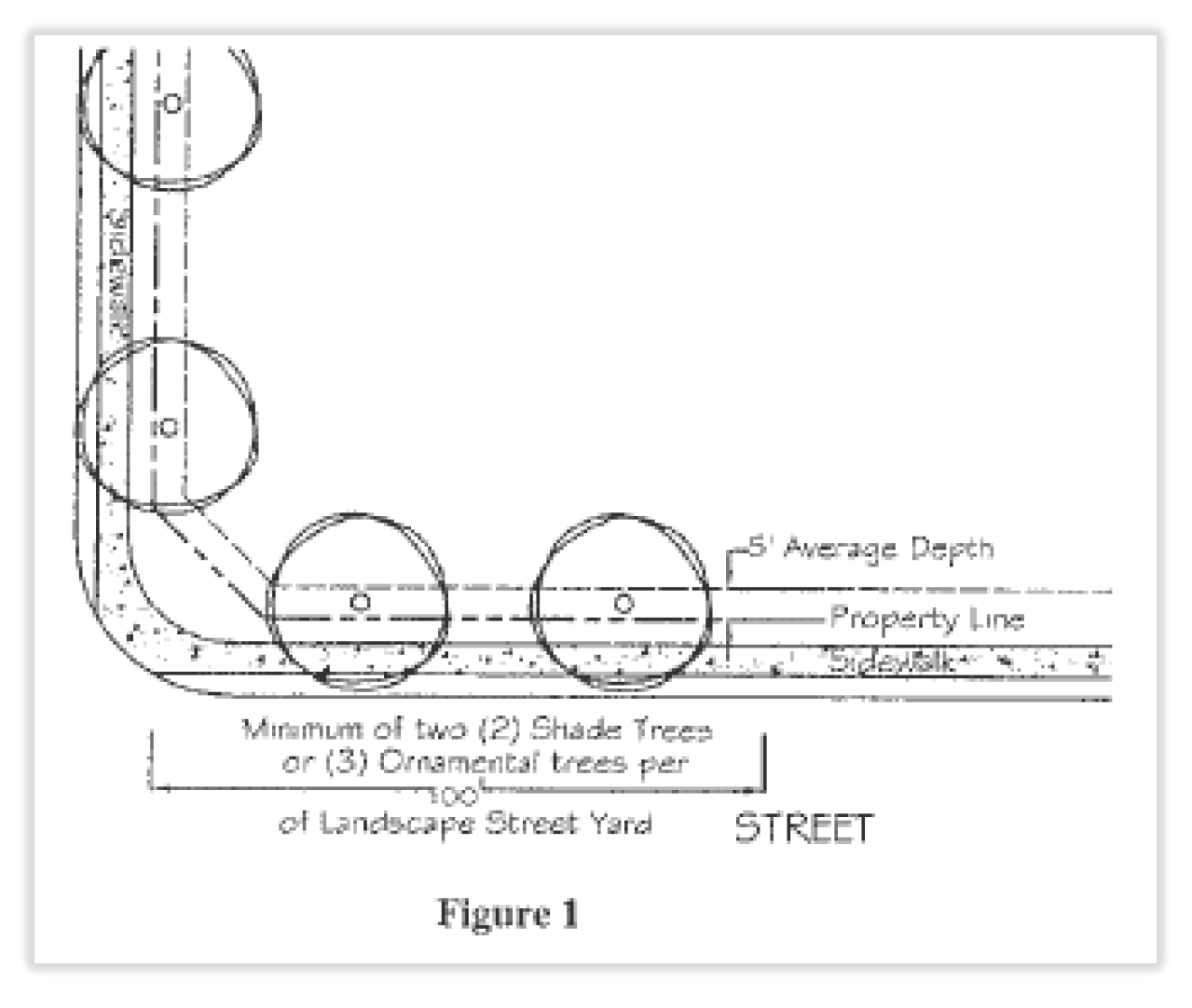
Landscaped street yards shall consist of a landscape area or areas along all adjacent public street rights-of-way.
(b)
Lots with frontage on more than one street shall provide landscape street yards on all street frontages.
(c)
Landscape street yards shall average five (5) feet in depth, excluding walkways, measured perpendicular from the adjoining property/street right-of-way to the proposed back of curb or edge of pavement on subject property.
(d)
Street yard landscaping at driveways and street intersections shall comply with the visibility requirements of Sec 10.7 and 10.8 in Article 10.
(e)
A minimum of two shade trees or three ornamental trees for every 100 feet or fraction thereof shall be provided in all street yards. Where overhead utilities exist, ornamental trees must be used.
(f)
The required trees may be clustered along a particular boundary of the project. Trees need not be spaced evenly although it is permissible to do so, provided adequate distance is maintained between individual specimens. Minimum spacing for ornamental trees is recommended to be fifteen (15) feet and forty or more for shade trees. However spacing may vary according to species.
(g)
The minimum size of trees at time of installation of required trees shall be as follows: Shade trees 2½" caliper measured at six (6) inches above the ground; Ornamental trees 2½" caliper measured six (6) inches above the ground; Evergreen trees - five (5) feet or more in height.
(h)
Trees and shrubs within the landscaped street yard shall be protected by some barrier to prevent damage from vehicles and maintenance equipment.
(i)
The required trees and shrubs may not be located within adjacent street rights-of-way.
Section 8.4. - Required Buffer Transition Yards.
(a)
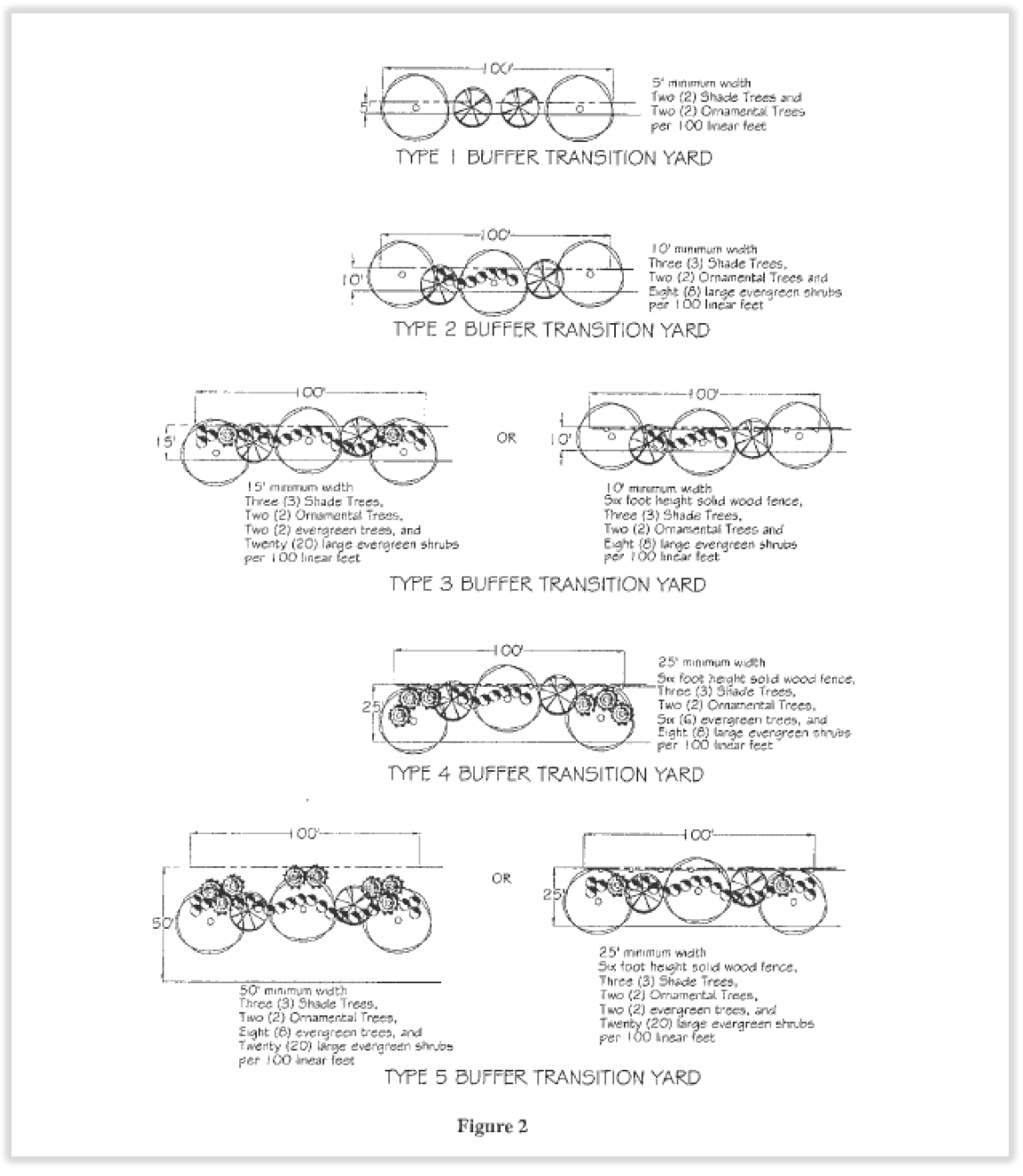
A buffer transition yard is a landscaped area designed to provide screening and separation between land uses of different impacts and between like uses.
To determine the buffer transition yard required between the two adjacent land uses, the following procedure shall be followed:
Identify the proposed new or expanding land use and each adjacent land use. Follow the matrix established in Table 8-1 on the following page to determine the Bufferyard Type Number required. The Bufferyard Type determines width and planting or fencing requirements. This process shall be followed for each property line, except where street protective yards may apply. If adjacent property is vacant, and no building permit has been issued for an intended use, its use shall be determined by assigning the highest level of impact in its zoning classification.
TABLE 8-1 BUFFER TRANSITION YARD REQUIREMENTS
Footnotes:
(1)
Buffer uses across minor street as if the property were an adjacent parcel.
(2)
In determining bufferyard classification, adjacent vacant parcel(s) that total less than 100 feet in width shall be disregarded, and the buffer applied shall be determined by the next adjacent parcel.
(3)
Includes subdivision of 25 or more submitted for approval or recorded platted lots, or a single-family home or manufactured home on a minor street.
(4)
To be considered, existing residence must be within 100 feet of property line adjacent to new use. Accessory uses and structures are not to be considered.
If the proposed use is not stated on the site plan or plat, then the highest intensity buffer shall be required at the perimeter of the project boundary. If projects are phased, bufferyards must be consistent with previous or other phases.
(b)
The minimum size of trees at time of installation of required trees and shrubs shall be as follows: Shade trees 2½" caliper measured at six (6) inches above the ground; Ornamental trees 2½" caliper measured six (6) inches above the ground; Evergreen trees - five (5) feet or more in height; and Evergreen shrubs 30" in height.
(c)
Should these buffer requirements conflict with any other Section of this Ordinance, the requirements of this Section shall prevail.
(d)
Transitional buffers, when required, shall occur within and between districts, on the property for which the development is being proposed, along interior property lines and rights-of-way. Use buffers may partially or wholly overlap required easements on the property, provided the utility company to which the easement is granted allows it.
(e)
Bufferyards shall be interrupted only by vehicular and pedestrian access ways. These access ways shall not affect the required plan material count.
(f)
If fences are required or incorporated, the fence must have the finished side facing outward toward the adjacent property.
(g)
Service areas including dumpsters, outdoor storage areas and loading areas shall be screened from adjacent residential. Screening height shall be sufficient enough to provide adequate screening but in case less than six (6) foot height, screening materials maybe an opaque fence or continuous evergreen hedge.
(h)
Plantings shall be irregularly spaced. The exact placement of the required plants shall be determined by the developer, except that evergreen plants shall be placed in clusters to maximize screening potential.
(i)
Existing vegetation may be used to comply with the Bufferyard Transition requirements, provided that no underbrushing or other clearing activities have taken place prior to development. The natural vegetation shall, alone or supplemented meet or exceed planting and opacity requirements of the required buffer and shall be free of kudzu.
(j)
The figures are minimum requirements; however no one species shall be outnumbered by another species in the same classification type by a ratio of more than 2:1. This is to promote diversity of species and encourage diversity of canopy and shrub type.
(k)
Large maturing canopy shade trees may substitute for small maturing ornamental trees but not vice versa, unless overhead utility lines are in potential conflict. If overhead utility lines conflict then small maturing trees may be substituted at the ratio of 1.5 small maturing trees for every 1 large maturing tree.
Section 8.5. - Vehicle Use Area Buffering and Landscaping.
All new parking lots of more than ten (10) spaces or renovations or additions to existing parking lots of more than ten (10) spaces are required to provide buffering and landscaping. Vehicle queuing and holding areas such as car washes, drive up windows, and gasoline pumping stations are also required to provide buffering.
(a)
Parking lots and vehicle use areas shall be buffered from all street frontages. Buffering shall be provided in the landscape street yard as defined in Section 8.3. Buffering shall be accomplished by visibly obscuring 60% of the parking lot or vehicle use area exposed to the street frontage. This screening does not have to be continuous. The recommended height of buffering planting and fencing should not exceed 48 inches.
(b)
Walls or fences may be used in combination with berms or plantings, but may not be the sole means of buffering.
(c)
Buffering treatment shall avoid a blank and monotonous appearance.
(d)
Shrub plantings to meet the required buffering must be a minimum of 18 inches in height at the time of planting. Shrub spacing is recommended to be ¾ of its mature spread.
(e)
Visibility requirements of 10.7 and 10.8 in Article 10 must be met. In addition to those requirements three (3) feet around fire hydrants, traffic signs, traffic signals or utility structures, planting must remain under 12 inches tall.
(f)
Interior parking lot landscaping. Trees shall be required to be planted in the interior of all lots over ten (10) spaces. No more than four (4) bays of parking (two aisles and four (4) bays = 128') shall be provided without a five (5) foot continuous median/landscaped strip. The landscaped strip shall be planted with canopy and ornamental trees and shrubs.
No more than 16 parking spaces are allowed in a row without providing a tree planting area. A tree planting area shall be a minimum of 170 square feet and contain a minimum of one (1) shade tree or two (2) ornamental trees. Trees and shrubs shall be protected by some barrier (e.g., curbs or wheel stops) to prevent damage from vehicles and maintenance equipment.
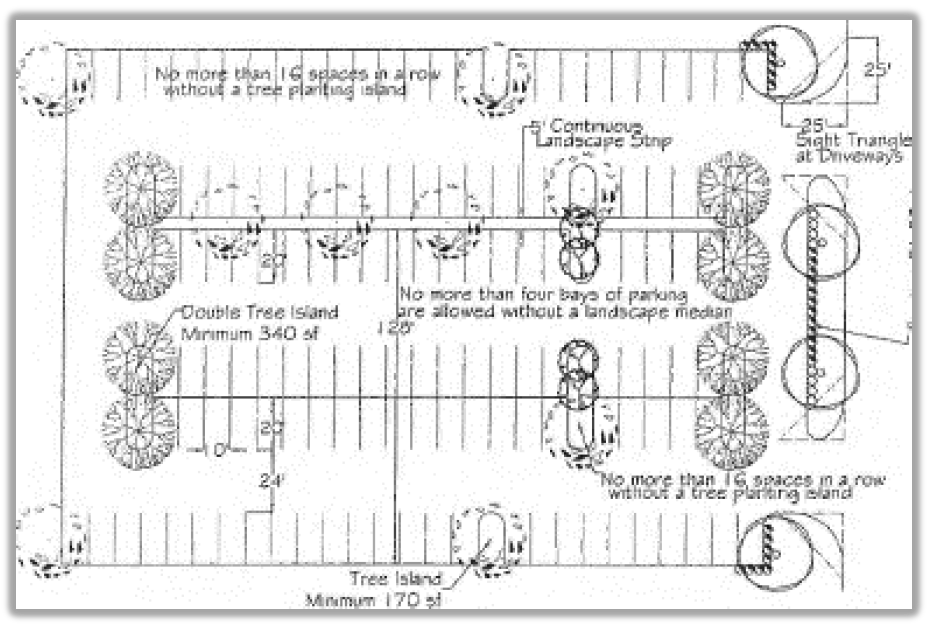
Figure 3
Section 8.6. - Foundation Landscaping.
Foundation landscaping shall require a landscaped bed with an average minimum depth of four (4) feet along the front (facing a public street or right-of-way) of the primary structure. The bed shall contain shrubbery spaced properly for plant size at maturity. Additionally the landscaped area shall be protected by some barrier to prevent damage from vehicles and maintenance equipment. Should the requirement of foundation planting impede with the intended accessibility of the proposed building, the Zoning Administrator may elect to work with the developer to define alternative landscape options for the site.
Section 8.7. - Open Space.
8.7.1 Definition
Common open space is land and/or water bodies used for recreation, amenity or buffer; it shall be freely accessible to all residents and property owners of a development, where required by this Ordinance.
8.7.2 Purpose
The purpose of this Section is to ensure adequate open space for high density residential development; to integrate recreation, landscaping, greenery and/or natural areas into such projects; to promote the health and safety of residents of such projects; and to compensate for the loss of open space inherent in single-family residential subdivisions.
8.7.3 Open Space Landscaping Requirements
The following open space landscaping requirements shall apply to land uses in all zoning districts.
8.7.4 Common Open Space Plan
Proposed uses/projects set forth in 8.7.3 shall submit an open space or landscaping plan as part of the application for a building permit. The plan shall:
1.
Designate areas to be reserved for open space. The specific design of open space shall be sensitive to the physical and design characteristics of the site.
2.
Designate the type of open space which will be provided, and indicate the location of plant materials, decorative features, recreational facilities, etc.
3.
Specify the manner in which common open space shall be perpetuated, maintained and administered.
8.7.5 Types of Common Open Space and Required Maintenance.
The types of common open space which may be provided to satisfy the requirements of this Ordinance together with the maintenance required for each are as follows:
1.
Natural areas. Natural areas of undisturbed vegetation or areas replanted with vegetation after construction. Woodlands and wetlands are specific types of natural areas. Maintenance is limited to removal of litter, dead trees, plant materials, and brush. Natural water courses are to be maintained as free-flowing and devoid of debris. Stream channels shall be maintained so as not to alter floodplain levels.
2.
Recreational areas. Recreational areas are designed for specific active recreational uses such as tot lots, tennis courts, swimming pools, ballfields, and similar uses. Recreational areas shall be accessible to all residents of the development. Maintenance is limited to ensuring that there exist no hazards, nuisances, or unhealthy conditions.
3.
Greenways. Greenways are linear green belts linking residential areas with other open space areas. These greenways may contain bicycle paths, footpaths, and bridle paths. Connecting greenways between residences and recreational areas are encouraged. Maintenance is limited to a minimum of removal and avoidance of hazards, nuisances, or unhealthy conditions.
4.
Landscaped areas, lawns and required buffer areas. Landscaped areas, lawns and required buffer areas, including creative landscaped areas with gravel and tile, so long as the tile does not occupy more than two (2) percent of the required open space. Lawns, with or without trees and shrubs shall be watered regularly to ensure survival, and mowed regularly to ensure neatness. Landscaped areas shall be trimmed, cleaned and weeded regularly.
8.7.6 Preservation of Open Space
Land designated as common open space may not be separately sold, subdivided or developed. Open space areas shall be maintained so that their use and enjoyment as open space are not diminished or destroyed. Open space areas may be owned, preserved and maintained as required by this Section by any of the following mechanisms or combinations thereof:
1.
Dedication of and acceptance by the Town.
2.
Common ownership of the open space by a home-owner's association which assumes full responsibility for its maintenance.
3.
Deed restricted, private ownership which shall prevent development and/or subsequent subdivision of the open space land and provide the maintenance.
In the event that any private owner of open space fails to maintain same, the Town may in accordance with the Open Space Plan and following reasonable notice, demand that deficiency of maintenance be corrected, and enter the open space to maintain same. The cost of such maintenance shall be charged to those persons having the primary responsibility for maintenance of the open space.
Section 8.8. - Tree Protection.
8.8.1 Purpose
The purpose of this Section is to prevent the clear cutting of building sites, a practice which destroys the balance of nature, leads to sedimentation and erosion, contributes to air and water pollution, and unnecessarily robs the community of valuable natural resources.
8.8.2 Existing Trees of Significance
Because any healthy tree greater than twelve inches in diameter is a valuable natural resource, by virtue of its age and size and its contribution to the environment, all said trees meeting this measurement shall be referred to as "significant trees" and protected to the extent practical and feasible.
All existing significant trees located in all required yards, open space and buffer areas shall be flagged and shown on the required plat or site plan for a building permit or grading permit.
No more than 25 percent of said trees shall be felled and removed, except by order of the Board of Zoning Appeals owing to unique circumstances surrounding the development of the property.
Where, due to unusual topographic conditions or circumstances peculiar to a given site, more than 25 percent of the trees to be preserved must be felled, replacement trees measuring not less than two (2) inches in diameter shall be planted in like number. To the extent possible, said trees shall be integrated into the required landscaping.
8.8.3 Removal of Existing Trees of Significance
Removal of existing significant trees shall be prohibited prior to securing a grading and/or building permit. However, in the event that a tree poses a severe or imminent threat to public safety or property, the Zoning Administrator or his designee may waive the requirements of this Section. Written findings must later be issued, outlining the threat which initiated the removal. The Zoning Administrator or his designee may require replacement of any trees which are removed where it is determined that the threat resulted from negligence.
8.8.4 Significant Trees Removed Without Permits
Where significant trees have been removed or where removal is necessitated at any time due to acts of negligence, or where sites were cleared of significant trees in violation of this Section, replacement trees shall be planted in accordance with a replacement schedule approved by the Board of Zoning Appeals. The Zoning Administrator or his designee shall recommend the number, species, diameter, and location of replacement trees, according to the following criteria:
a.
Combined diameter of replacement trees is equal to the diameter of the tree removed or;
b.
Individual replacement trees are of the largest transplantable diameter available.
Where significant tree removal is necessitated by emergencies or death and disease of trees due to natural causes, as determined by the Zoning Administrator or his designee, replacement will not be required.
Prior to issuance of permits, the developer shall flag any significant trees to be removed and schedule an onsite meeting with the Zoning Administrator to review. A determination will be made onsite of the required protected zone of significant tree(s) to be removed. Development plans shall be revised accordingly to ensure protection of the significant tree(s) removed.
8.8.5 Development Precautions
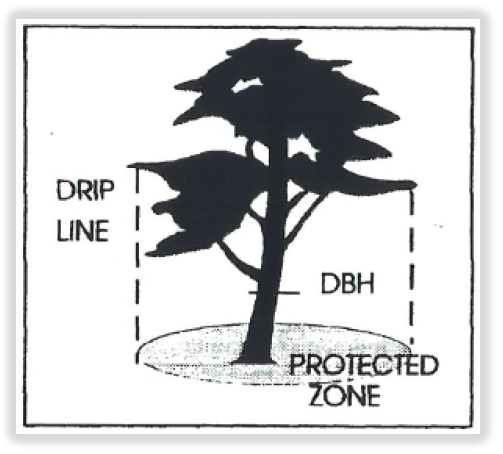
After the necessary permit approvals have been granted, and before any site work has begun, the developer shall cause protected trees to be marked with surveyor's flagging. During development, a minimum protective zone, marked by barriers, shall be established at the "drip line" and maintained around all trees to be retained as required by this Section. There shall be no construction, paving, grading, operation of equipment or vehicles, or storage of materials within this protected zone.
8.8.6 Cutting, etc. of Significant Trees Prohibited
No person shall cut down, remove, relocate, damage, destroy, or in any manner abuse any significant tree on any lot or tract or public right-of-way in the Town unless authorized by the terms of this Section or unless approved by the Zoning Administrator.
Section 8.9. - Off-Street Parking.
Off-street parking spaces required by district regulations shall be located on the same lot as the principal use, or on a lot within 400 feet of the main entrance to the principal use which under the same ownership as the principal use or has been legally restricted for parking in connection with the principal use, and shall have required buffer and landscaped areas.
Required off-street parking for a commercial or industrial use may extend up to 120 feet into a residential zoning district provided: (1) the parking area adjoins the property on which the principal commercial or industrial use is located; (2) the parking area access is to the same street as the principal use; and (3) the parking area has a Type B buffer area along residential lot lines and required landscaping.
Combined parking areas serving two (2) or more principal uses shall contain spaces equal in number to the total of spaces required for all principal uses served.
Section 8.10. - Parking Space Requirements.
Required off-street parking must be provided on the same lot or parcel as the principal use for which it is required. Where off-street parking for ten (10) or more vehicles is required, the off-street parking spaces shall meet the following design and development standards:
Section 8.11. - Off-Street Loading and Unloading Spaces.
All uses shall provide off-street loading and unloading space so that no vehicle being loaded or unloaded in connection with normal operations shall stand in or project into a public street, walkway, alley, or private street.
Each lot used for commercial or industrial purposes, or multi-family residences with more than ten (10) units, shall provide off-street space for loading and unloading as follows:
Section 8.12. - Approval of Parking and Off-Street Loading Plans.
Designs and plans for areas to be used for off-street parking and off-street loading and unloading shall be subject to approval by the Zoning Administrator, who may withhold a permit or take other action if the layout of either would create avoidable safety or traffic congestion issues, pending acceptable modification of the layout, or appeal to the Board of Zoning Appeals.
Section 8.13. - Parking of Unlicensed Vehicles.
In a residential district, any vehicle or trailer subject to State licensing which does not display a current license plate shall be parked or stored within an enclosed building or parked behind the building set-back line and covered with a waterproof tarp or located under a shed roof.
Section 8.14. - Parking of Recreational, Oversize and Emergency Vehicles.
A.
Recreational Vehicles. A recreational vehicle (including motor homes, travel or camper trailers, pickup campers, boats, and boat trailers) may be parked or stored on any lot in a residential zoning district in accordance with the following standards.
1.
On an interior lot, the recreational vehicle is parked in an enclosed building, or in the rear yard, or in the side yard not projecting beyond the front of the roof line of the principal dwelling on the lot.
2.
On a corner lot, the recreational vehicle is parked in an enclosed building, or in the rear yard, or in the side yard not projecting beyond the front of the roof line of the principal dwelling on the lot; if parked in the rear or side yard, the recreational vehicle must be completely screened by evergreen vegetation from view from all streets that run along the rear yard or side yard in which it is parked.
3.
The recreational vehicle is parked or stored entirely on the residential lot in a safe and orderly condition, and if parked or stored on a driveway, it shall not be a hazard to persons or vehicles entering or exiting the driveway, persons passing on the sidewalk, or persons in vehicles passing on any adjoining street.
4.
The combined total number of recreational vehicles and oversized vehicles permitted so parked or stored on any residential lot shall be limited to three (3), not including those kept in a garage or other enclosed building.
5.
A recreational vehicle may be parked anywhere on a residential lot for a period not to exceed 24 hours for the purposes of loading and unloading.
6.
A recreational vehicle shall not be used for the purposes of permanent human habitation while parked or stored on any residential lot. Temporary storage or parking of a recreational vehicle for housing of temporary guests shall be permitted for a period not to exceed two (2) consecutive weeks during any one calendar year.
B.
Oversize Vehicles Other Than Recreational Vehicles.
1.
Any vehicle or combination of vehicles exceeding 26,000 pounds Gross Vehicle Weight Rating (GVWR), or any vehicle designed to transport 16 or more passengers including the driver, or any vehicle placarded for hazardous materials shall be prohibited in a residential zone except to allow deliveries or provide services to residents.
2.
Any vehicle which has an overall vehicle length exceeding 22.5 feet in length or eight (8) feet in height, excluding trailer hitches, winches, handicapped accessories, roof racks, etc. must be located and screened in the same manner as a recreational vehicle as set forth in Section 8.13. The total combined number of those oversize vehicles and recreational vehicles permitted, parked or stored on any residential lot shall be limited to three (3).
3.
No such vehicle may be parked on a lot in a residential zone unless the lot is occupied by a single-family dwelling and the vehicle is operated by the occupant of the dwelling.
4.
This section shall not apply to any vehicle kept in a garage or other enclosed building.
C.
Emergency Vehicles. One emergency vehicle may be located on a lot occupied by a single-family dwelling as long as the vehicle complies with the standards for recreational vehicles in Section 8.13, and the vehicle does not use its siren or flashing lights while on the lot. Emergency vehicles may be located in a multi-family or attached single-family residential property in an area screened from view. For the purposes of this section, an emergency vehicle is an ambulance or a tow truck displaying a decal in a prominent location verifying that it is licensed by the State of South Carolina to provide emergency road service.

