
Sauk Village City Zoning Code
ARTICLE I
- IN GENERAL
Sec. 82-1.- Purpose and intent.
This chapter is adopted for the following purposes:
(1)
To promote public health, safety, convenience, comfort and welfare.
(2)
To secure adequate light, air, open space and safety from fire and other dangers.
(3)
To conserve the taxable value of land and buildings throughout the municipality.
(4)
To lessen or avoid congestion in public streets.
(5)
To ensure and facilitate the preservation of sites, areas, and structures of historical, architectural and aesthetic importance.
(6)
To regulate and limit the height and bulk of buildings hereafter to be erected.
(7)
To establish, regulate and limit the building or setback lines on, or along, any street, trafficway, drive, parkway, or stormwater or floodwater runoff channel or basin.
(8)
To regulate and limit the intensity of the use of lot areas, and to regulate and determine the area of open spaces, within and surrounding such buildings.
(9)
To classify, regulate and restrict the location of trades and industries, and the location of buildings designed for specified industrial, business, residential and other uses.
(10)
To divide the entire municipality into districts of such number, shape, area and of such different classes, according to use of land and buildings, height and bulk of buildings, intensity of the use of lot area, area of open spaces, or other classification, as may be deemed best suited to carry out the purposes of this chapter.
(11)
To fix standards to which buildings or structures shall conform.
(12)
To prohibit uses, buildings or structures incompatible with the character of those districts.
(13)
To define the powers and duties of administrative officers and bodies, as provided hereinafter.
(14)
To prescribe rules and regulations governing the subdivision and platting of land, and the preparation of plats, and to establish procedures for the submission, consideration, approval and recording of plats and improvement plans.
(15)
To regulate the location, width and course of streets and highways, and the installation of utilities, street pavements and other essential improvements
(16)
To minimize increases in stormwater runoff from any development in order to reduce flooding, siltation, increases in stream temperature, and streambank erosion, and to maintain the integrity of stream channels.
(17)
To minimize pollution caused by stormwater runoff from development that would otherwise degrade local water quality.
(18)
To minimize the total annual volume of surface water runoff that flows from any specific site during, and following, development to not exceed the pre-development levels to the maximum extent practicable.
(19)
To reduce stormwater runoff rates and volumes, soil erosion and pollution, wherever possible, through stormwater management controls and to ensure that those controls are properly maintained and pose no threat to public safety.
(20)
To prescribe penalties for the violation of the provisions of this chapter, including any amendments.
(Ord. No. 08-50, § 2(exh. A(1.2)), 8-12-2008)
Sec. 82-2. - Interpretation.
The language set forth in the text of this chapter is interpreted in accordance with the following rules of construction:
(1)
The singular number includes the plural, and the plural the singular.
(2)
The present tense includes the past and future tenses, and the future tense includes the present.
(3)
The masculine gender includes the feminine and neuter.
(4)
Whenever a defined word or term appears in the text of this chapter, its meaning is construed as set forth in the definition. Any word appearing in parenthesis, between a word and its definition herein, is construed in the same sense as that word. Words not defined are interpreted in accordance with the definitions considered to be normal dictionary usage.
(5)
If a definition contains a regulation and the use is inconsistent with that regulation, the use is prohibited.
(Ord. No. 08-50, § 2(exh. A(18.2)), 8-12-2008; Ord. No. 12-009, 4-24-2012)
Sec. 82-3. - Use definition rules of interpretation.
(a)
Certain terms in this section are defined to be inclusive of many uses in order to eliminate overly detailed lists of uses in the zoning districts established by this chapter. These terms are referred to as generic use definitions.
(b)
A use that is not specifically listed in a zoning district or does not fall within a generic use definition as defined in this section is prohibited.
(c)
If a use is listed specifically, it cannot be considered part of a generic use definition.
(Ord. No. 08-50, § 2(exh. A(18.3)), 8-12-2008; Ord. No. 12-009, 4-24-2012)
Sec. 82-4. - Use definitions.
The following words, terms and phrases, when used in this chapter, shall have the meanings ascribed to them in this section, except where the context clearly indicates a different meaning:
Animal hospital.
(1)
The term "animal hospital" means an establishment for the care and treatment of the diseases and injuries of animals and where animals may be boarded during their convalescence.
(2)
The term "animal hospital" does not include "kennel" as defined herein.
Art gallery.
(1)
The term "art gallery" means a commercial establishment engaged in the sale, loan, or display of paintings, sculpture, video art, or other works.
(2)
The term "art gallery" does not include "cultural facilities" as defined herein, such as libraries, museums or noncommercial galleries that may also display paintings, sculpture, video art or other works.
Assisted living facility means a facility that provides daily assistance and long-term residence for disabled or elderly individuals. The term "assisted living facility" includes a combination of housing, supportive services, personalized assistance and health care designed to respond to the individual needs of those who need help with activities of daily living, such as dressing, grooming, bathing, etc.
Carwash means a commercial establishment engaged in the washing and cleaning of passenger vehicles, recreational vehicles, or other light duty equipment, whether automatic or by hand.
Cargo terminal means a facility for loading, unloading of freight for current distribution and not warehousing. The term "cargo terminal" includes truck terminals where goods transported by truck are received, transferred, stored for the short-term and/or dispatched.
Community residence means a residential building housing physically or developmentally disabled people living together with resident staff. The term "community residence" constitutes a single housekeeping unit in which residents share responsibilities, meals and recreation.
Cultural facility includes services open to the public including, but not limited to, museums, cultural centers, historical societies, aquariums and libraries operated by a public, private or nonprofit organization.
Currency exchange.
(1)
The term "currency exchange" means a commercial use that exchanges common currencies, sells money orders, or cashiers checks and cashes checks as its principal business activity.
(2)
The term "currency exchange" does not include a "financial institution" as defined herein.
Day care center, adult.
(1)
The term "adult day care center" means a facility providing care for more than three elderly and/or functionally-impaired adults in a protective setting for less than 24 hours per day.
(2)
The term "adult day care center" does not include a program operated by a "place of worship" as defined herein that provides care for elderly and/or functionally impaired adults in a protective setting for less than 24 hours per day.
Day care center, child.
(1)
The term "child day care center" means a facility providing care for more than three children in a protective setting for less than 24 hours per day.
(2)
The term "child day care center" does not include a program operated by an "educational facility" (all types) or "place of worship" as defined herein that provides care for children three years of age or older for less than 24 hours per day.
Day care home, adult, means a dwelling in which a permanent occupant of the dwelling provides care for the elderly and/or functionally impaired adults in a protective setting for more than three, up to a maximum of 12, adults for less than 24 hours per day.
Day care home, child, means a dwelling in which a permanent occupant of the dwelling receives more than three and up to a maximum of 12 children for less than 24 hours per day. The number counted includes the family's natural or adopted children and all other persons under the age of 12. The term does not include facilities which receive only children from a single household.
Drive-through facility.
(1)
The term "drive-through facility" means premises used to provide or dispense products or services, through an attendant, window, or automated machine, to persons remaining in motor vehicles in a designated stacking aisle. The term "drive-through facility" may be in combination with other uses, such as a "financial institution," "personal services establishment," "retail goods establishment" or "restaurant" as defined herein.
(2)
The term "drive-through facility" does not mean "carwash," "gas station" or "motor vehicle service and repair (major and minor)" as defined herein.
Dwelling, above the ground floor of office or commercial, means dwelling units located in multistory buildings above the ground floor of office or commercial uses.
Dwelling, multifamily.
(1)
The term "multifamily dwelling" means a building containing three or more individual dwelling units with varying arrangements of party walls and entrances, and each dwelling unit having an individual entrance to a common hallway or the outdoors.
(2)
The term "multifamily dwelling" does not include "townhouse dwelling" as defined herein.
Dwelling, single-family, means a building containing one individual dwelling unit, which is located on an individual lot and is not attached to any other dwelling unit.
Dwelling, townhouse.
(1)
The term "townhouse dwelling" means a structure consisting of not less than three dwelling units, with no other dwelling, or portion of other dwelling, directly above or below, each having a separate entrance and direct ground level access to the outdoors, and connected to the other dwelling units by a single party wall with no opening. The term "townhouse dwelling" refers to the design of a building and does not reflect the type of ownership of the individual units.
(2)
The term "townhouse dwelling" does not include "multifamily dwelling" as defined herein.
Dwelling, two-family.
(1)
The term "two-family dwelling" means a building designed as a single structure, containing two separate dwelling units, each of which is designed to be occupied as a separate permanent residence for one household or family. Each dwelling is separated from the other by a wall extending from the ground to the roof or a ceiling and floor extending from exterior wall to exterior wall, except for a common stairwell exterior to both dwelling units.
(2)
The term "two-family dwelling" does not include "multifamily dwelling" or "townhouse dwelling" as defined herein.
Educational facilities, college/university.
(1)
The term "college/university educational facilities" means a post-secondary institution for higher learning, including community colleges, that grants associate or bachelor degrees, which may also have research facilities, or professional schools that grant master and doctoral degrees. The term "college/university educational facilities" also includes post-secondary theological schools for training ministers, priests, or rabbis.
(2)
The term "college/university educational facilities" does not include "educational facilities, vocational" as defined herein.
Educational facilities, primary/secondary, means a public, private or parochial school offering instruction at the elementary, junior, or senior high school levels. The term "primary/secondary educational facilities" also includes secondary theological schools for training ministers, priests or rabbis.
Educational facilities, vocational school.
(1)
The term "vocational school educational facilities" means a school established to provide for the teaching of industrial, clerical, managerial or artistic skills. This definition applies to schools that are owned and operated privately for profit and that do not offer a complete educational curriculum.
(2)
The term "vocational school educational facilities" does not include "college/university educational facilities" as defined herein.
Financial institution.
(1)
The term "financial institution" means a bank, savings and loan, credit union, mortgage office, or automated teller machine (ATM).
(2)
The term "financial institution" does not include "currency exchange" as defined herein.
Gas station means that portion of property where flammable or combustible liquids or gases used as fuel are stored and dispersed from fixed equipment into the fuel tanks of motor vehicles.
Government offices.
(1)
The term "government offices" means a building or structure owned, operated or occupied by a governmental agency to provide a governmental service to the public. The term "government offices" includes government offices.
(2)
The term "government offices" does not include "public safety facility" or "public works facility" as defined herein.
Greenhouse/nursery means retail business whose principal activity is the selling of plants grown on the site and having outside storage, growing or display.
Heavy retail and service establishment includes retail or service establishments that have regular outdoor service or storage areas, or partially enclosed structures including, but not limited to, large-scale home improvement centers, lumberyards, equipment rental and leasing, recreational vehicles, and playground equipment sales and rental.
Hospital means an institution providing health services primarily for inpatient, or medical or surgical care for the sick or injured, and include the related facilities such as laboratories, outpatient departments, training facilities, central service facilities, and staff offices that are an integral part of the facility.
Hotel/motel means an establishment providing, for a fee, sleeping accommodations and customary lodging services, including maid service, the furnishing and upkeep of furniture and bed linens, and telephone and desk service. Related ancillary uses may include, but shall not be limited to, conference and meeting rooms, restaurants, tavern/bars and recreational facilities.
Independent living facility.
(1)
The term "independent living facility" means a residential complex containing dwellings where the occupancy is limited to persons who are 55 years of age or older or, if two persons occupy a unit, at least one shall be 55 years or older. Such facilities may include common areas for meals and socializing, offer minimal convenience services.
(2)
The term "independent living facility" does not include institutional care such as medical or nursing care. The term "independent living facility" does not include "assisted living facility," "community residence" or "nursing home," as defined herein.
Indoor entertainment.
(1)
The term "indoor entertainment" includes predominantly spectator uses conducted within an enclosed building including, but not limited to, movie theaters and sport or game matches or exhibitions. The term "indoor entertainment" shall include accessory uses, such as snack bars or refreshment stands, which are designed and intended primarily for the use of patrons.
(2)
The term "indoor entertainment" does not include "indoor recreation" or "live entertainment" as defined herein. The term "indoor entertainment" is distinguished from "indoor recreation" in that the predominant use is spectator-oriented and not participatory.
Indoor recreation.
(1)
The term "indoor recreation" includes predominantly participant uses where recreational activities or games of skill are conducted within a wholly enclosed building including, but not limited to, a bowling alley, billiard parlor, arcade, health/sport clubs, indoor tennis courts, indoor sports arenas, indoor swimming pools, or similar uses. The term "indoor recreation" shall include accessory uses, such as snack bars or refreshment stands that are designed and intended primarily for the use of patrons.
(2)
The term "indoor recreation" does not include "indoor entertainment" or "live entertainment" as defined herein. Park district field houses with indoor recreation facilities are not considered indoor recreation.
Kennel, commercial.
(1)
The term "commercial kennel" means a commercial establishment where pet animals owned by another person are temporarily boarded for pay or remuneration of any sort.
(2)
The term "commercial kennel" does not apply to zoos or animal hospitals operated by veterinarians duly licensed under the law where the boarding of animals is accessory to medical treatment.
Live entertainment.
(1)
The term "live entertainment" means an establishment maintained for general patronage where both alcoholic beverages and/or food for consumption on the premises are served or dispensed, and musical, theatrical, dance, cabaret, or comedy act are performed by one or more persons live. Patrons are also permitted to engage in dancing. The term "restaurants" or "taverns/bars" as defined herein that regularly host such performances shall be considered "live entertainment." The term "live entertainment" establishment are commonly referred to as "nightclubs."
(2)
The term "live entertainment" does not include "indoor entertainment" as defined herein.
Manufacturing, general, means the manufacturing of products from processed or unprocessed raw materials, including processing, fabrication, assembly, treatment and packaging of such products and incidental storage, sales and distribution of such products. This manufacturing may produce noise, vibrations, illumination or particulate that is perceptible to adjacent land users but is not offensive or obnoxious.
Manufacturing, light, means the manufacturing from previously prepared materials of finished products or parts, including processing, fabrication, assembly, treatment and packaging of such products and incidental storage, sales and distribution of such products, provided all manufacturing activities are contained entirely within a building and noise, odor, smoke, heat, glare, and vibration resulting from the manufacturing activity are confined entirely within the building.
Medical cannabis cultivation center means an establishment operated by an organization or business that is registered by the department of agriculture to perform necessary activities to provide only registered medical cannabis dispensing organizations with usable medical cannabis.
Medical cannabis dispensing facilities means an establishment operated by an organization or business that is registered by the department of financial and professional regulation to acquire medical cannabis from a registered cultivation center for the purpose of dispensing cannabis, paraphernalia or related supplies and educational materials to registered qualifying patients.
Medical/dental clinic means a facility operated by one or more physicians, dentists, chiropractors or other licensed practitioners of the healing arts for the examination and treatment of persons solely on an outpatient basis.
Mini-warehouse means a facility used only for the storing of personal property (no commercial storage) where individual owners control individual storage spaces and no commercial transactions are permitted other than the rental of the storage units.
Motor fueling facility means facility for the dispensing of gasoline and diesel fuels located adjacent to a state highway which includes one or more of the following ancillary permitted uses: restaurant, convenience store, drive through facility or carwash.
Motor vehicle dealership means any business establishment that sells or leases new or used automobiles, trucks, vans, trailers, recreational vehicles, boats or motorcycles, or other similar motorized transportation vehicles. An automobile dealership may maintain an inventory of the vehicles for sale or lease either on-site or at a nearby location and may provide on-site facilities for the repair and service of the vehicles sold or leased by the dealership.
Motor vehicle operations facility.
(1)
The term "motor vehicle operations facility" means a privately owned facility for the dispatch, storage and maintenance of emergency medical care vehicles, taxicabs and other livery vehicles.
(2)
The term "motor vehicle operations facility" does not include "public works facility" or "public safety facility" as defined herein where the vehicles of the fire, police or other municipal departments are dispatched, stored or maintained.
Motor vehicle rental establishment means the rental of automobiles and light trucks and vans, including incidental parking and servicing of vehicles for rent.
Motor vehicle service and repair, major, includes, but is not limited to, establishments involved in engine rebuilding, major reconditioning of worn or damaged motor vehicles or trailers, towing and collision service, including body, frame, or fender straightening or repair, and painting of motor vehicles.
Motor vehicle service and repair, minor, includes, but is not limited to, minor repairs to motor vehicles, including repair or replacement of cooling, electrical, fuel and exhaust systems, brake adjustments, relining and repairs, wheel servicing, alignment and balancing, repair and replacement of shock absorbers, and replacement or adjustment of mufflers and tail pipes, hoses, belts, light bulbs, fuses, windshield wipers/wiper blades, grease retainers, wheel bearings, and the like. The term "minor motor vehicle service and repair" includes establishments where gasoline or fuel oil, and oil, grease, batteries, tires and automobile accessories are sold in addition to the repair facilities.
Nursing home.
(1)
The term "nursing home" means a facility providing bed care and inpatient services on a 24-hour per day basis for persons requiring regular medical attention, but excluding a facility providing surgical or emergency medical services and a facility providing care for alcoholism, drug addiction, mental disease or communicable disease.
(2)
The term "nursing home" does not include "independent living facility," "assisted living facility," "community residence," or "hospital" as defined herein.
Office.
(1)
The term "office" means an office business, which may or may not offer services to the public, is engaged in the processing, manipulation or application of business information or professional expertise. An office is not materially involved in fabricating, assembling or warehousing of physical products for the retail or wholesale market, nor is an office engaged in the repair of products or retail services. It is characteristic of an office that retail or wholesale goods are not shown on the premises to a customer. Examples include, but are not limited to, professional offices for nonprofit organizations, advertising, accounting, investment services, insurance, contracting, architecture, engineering, legal services and real estate services.
(2)
The term "office" does not include government offices, which are considered "government offices" as defined herein.
Office park means a large tract of land that has been planned, developed and operated as an integrated facility for a number of separate office buildings and supporting ancillary uses with special attention to circulation, parking, utility needs, aesthetics and compatibility.
Outdoor dining means seating area located outdoors of a contiguous restaurant, usually in addition to an indoor seating area. Outdoor seating areas for tavern/bars, typically referred to as beer gardens, are considered outdoor dining.
Outdoor entertainment.
(1)
The term "outdoor entertainment" includes predominantly spectator uses conducted outdoors in open or only partially enclosed facilities. Typical uses include, but are not limited to, fairgrounds, outdoor stadiums, outdoor theaters, raceways, rodeos, music arenas, theme parks, and amusement parks. The term "outdoor entertainment" includes accessory uses, such as snack bars or refreshment stands that are designed and intended primarily for the use of patrons.
(2)
The term "outdoor entertainment" does not include "outdoor recreation," as defined herein.
Outdoor recreation.
(1)
The term "outdoor recreation" includes predominantly participant uses that take place outside of a building including, but not limited to, miniature golf, swimming pools, tennis courts, ballfields, skateboard parks, and other similar facilities. The term "outdoor recreation" includes accessory uses, such as snack bars or refreshment stands that are designed and intended primarily for the use of patrons.
(2)
The term "outdoor recreation" does not include "outdoor entertainment," as defined herein.
Park means a noncommercial, not-for-profit facility designed to serve the recreation needs of the residents of the community. The term "park" includes, but is not limited to, ballfields, football fields, soccer fields, basketball courts, playgrounds, and park district field houses with indoor recreation facilities.
Parking lot means an open, hard-surfaced area, other than street or public way, to be used for the storage for limited periods of time of operable passenger automobiles and commercial vehicles, and available to the public, whether for compensation, free, or as an accommodation to residents of a multifamily dwelling, or clients and customers of a business.
Parking structure means a structure composed of one or more levels or floors used for the parking or storage of motor vehicles. A parking structure may be totally below grade, as in an underground parking garage, or either partially or totally above grade with those levels being either open or enclosed.
Passenger terminal means a facility for on- and off-loading passengers on passenger modes of travel including, but not limited to, buses and public rail systems. The term "passenger terminal" includes bus terminals where there are premises designated for the transient housing or parking of buses and the loading and unloading of passengers.
Pawnshop means an establishment that, in part or in whole, loans or advances money on security of personal property left in pawn and pledged as collateral, and where the pledged property may be sold to the public if not redeemed by the pledger within a fixed amount of time.
Payday or title loan agency means an establishment providing loans to individuals in exchange for receiving personal checks or titles to the borrowers' motor vehicles as collateral.
Personal services establishment.
(1)
The term "personal services establishment" means an establishment or place of business primarily engaged in the provision of frequent or recurrent needed services of a personal nature. Typical uses include, but are not limited to, beauty shops, barbershops, shoe repair, laundromats, dry cleaners and tailors.
(2)
The term "personal services establishment" does not include tattoo parlors or massage establishments.
Place of worship means a building, together with its accessory buildings and use, where persons regularly assemble for religious purposes and related social events and which building, together with its accessory buildings and uses, is maintained and controlled by a religious body organized to sustain religious ceremonies and purposes.
Planned unit development (PUD) means the subdivision and/or development of a land area as a single unified development, where certain zoning regulations, such as bulk and use standards, are modified to allow for more flexible planning in conformance with the planned unit development standards and approval processes.
Precious metal and/or gem broker means any person having an interest in or employed by or acting as an agent of or on behalf of any person having an interest in a business whose undertakings involve the purchase or sale of precious metals or gems.
Public safety facility means facilities operated by public safety agencies including fire stations and other fire prevention and firefighting facilities, and police and sheriff substations and headquarters, including interim incarceration facilities. The vehicles of fire and police may be dispatched, stored or maintained within the public safety facility.
Public works facility.
(1)
The term "public works facility" means all production, storage, transmission, and recovery facilities for water, sewer, telephone and other similar utilities owned or operated by any public agency or utility, and including any municipal repair, storage or production facility or public works yard, as well as any accessory office or meeting rooms. Municipal vehicles may be dispatched, stored or maintained within the public works facility.
(2)
The term "public works facility" does not include "public safety facility" as defined herein.
Research and development facility.
(1)
The term "research and development facility" means an establishment which conducts research, development or controlled production in the following industries: biotechnology, pharmaceuticals, medical instrumentation or supplies, communications and information technology, electronics and instrumentation, and computer hardware and software.
(2)
The term "research and development facility" does not involve the mass manufacture, fabrication, processing, or sale of products.
Restaurant.
(1)
The term "restaurant" means a structure in which the principal use is the preparation and sale of food and beverages for consumption on the premises or for carry-out. The term "restaurant" does not include "tavern/bar," or snack bars or refreshment stands accessory to "indoor or outdoor entertainment" and "indoor or outdoor recreation" facilities as defined herein.
(2)
The term "restaurant with live performances" (music, theater, etc.) is considered "live entertainment."
Retail goods establishment.
(1)
The term "retail goods establishment" means a commercial enterprise that provides physical goods, products or merchandise directly to the consumer, where such goods are typically available for immediate purchase and removal from the premises by the purchaser.
(2)
The term "retail goods establishment" does not include "heavy retail and service" as defined herein.
Social club or lodge means a membership organization, which holds regular meetings, and its premises, which cater exclusively to members and their guests for social, intellectual, recreational or athletic purposes. A social club or lodge may, subject to other regulations controlling such uses, maintain dining facilities, serve alcohol or engage professional entertainment for the enjoyment of dues-paying members and their guests, there are no sleeping facilities.
Tavern/bar.
(1)
The term "tavern/bar" means an establishment serving alcoholic beverages in which the principal business is the sale of such beverages at retail for consumption on the premises. Snack foods or other prepared food may be available for consumption on the premises as an accessory use only.
(2)
The term "tavern/bar with live performances" (music, theater, etc.) is considered "live entertainment."
Warehouse/distribution means the storage, wholesale and distribution of manufactured products, supplies and equipment.
Wireless telecommunications antenna.
(1)
The term "wireless telecommunications antenna" means a specific device, the surface of which is used to transmit or receive radio frequency signals, microwave signals, or other signals transmitted to or from other antennas.
(2)
The term "wireless telecommunications antenna" does not include "satellite dish antenna" as defined in this chapter.
Wireless telecommunications facility means an unstaffed structure used to house and protect the equipment necessary for processing telecommunications signals, which may include air conditioning equipment and emergency generators.
Wireless telecommunications tower means a structure designed and constructed to support one or more "telecommunications antennas" and including all appurtenant devices attached to it. A tower can be freestanding (solely self-supported by attachment to the ground) or supported (attached directly to the ground and with guy wires) of either lattice or monopole construction.
(Ord. No. 08-50, § 2(exh. A(18.4)), 8-12-2008; Ord. No. 12-009, 4-24-2012; Ord. No. 14-002, § 4, 1-14-2014; Ord. No. 17-018, § 4, 9-12-2017)
Sec. 82-5. - General terms definitions.
The following words, terms and phrases, when used in this chapter, shall have the meanings ascribed to them in this section, except where the context clearly indicates a different meaning:
Abut means to have a common district boundary or zoning lot boundary. For the purposes of this chapter, a zoning lot line shall be considered to abut a zoning district even though it may be separated by any portion of a street, parkway, sidewalk, public way, alley, waterway or railroad right-of-way. The terms "adjacent," "adjoining" and "contiguous" shall have the same meaning as abutting.
Accessibility ramp means a ramp or similar structure which provides wheelchair or similar access to a building.
Accessory structure means a structure on the same lot with, and of a nature customarily incidental and subordinate to, the principal structure. See figure 82-1, accessory structure.
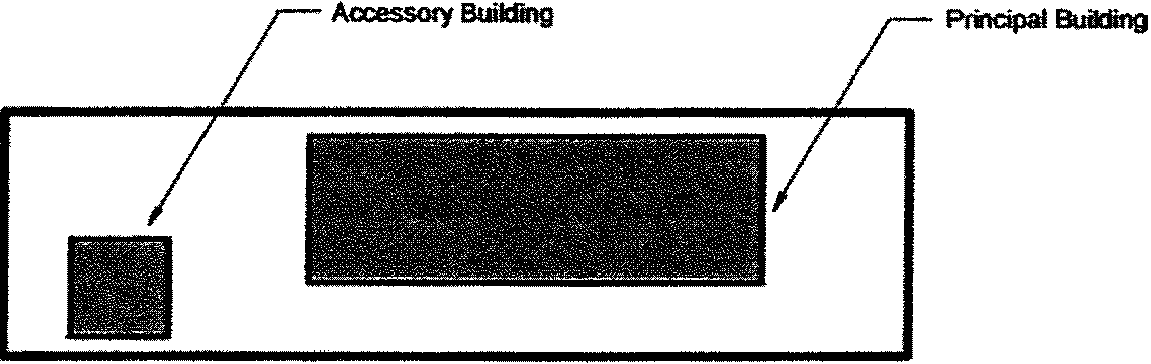
Figure 82-1. Accessory Structure
Accessory use means a use on the same lot with, and of a nature customarily incidental and subordinate to, the principal use.
Adjacent means an area where the property lines are contiguous, or are separated by a street, alley, easement or right-of-way.
Alley means a public right-of-way primarily designed to serve as secondary access to the side or rear of those properties whose principal frontage is on some other street.
Appurtenance means an architectural feature of a structure that is higher than the remainder of the building it accompanies, such as a chimney, cupola, spire or parapet wall.
Arbor means a freestanding structure used in a garden to support vines or climbing plants; also called a trellis.
Awning means a roof-like cover, made of canvas or other material, designed and intended for protection from the weather and/or as a decorative embellishment, and which projects from a wall or roof of a structure, typically over a window or door. See figure 82-2, awning. (The photograph is available in the village clerk's office.)
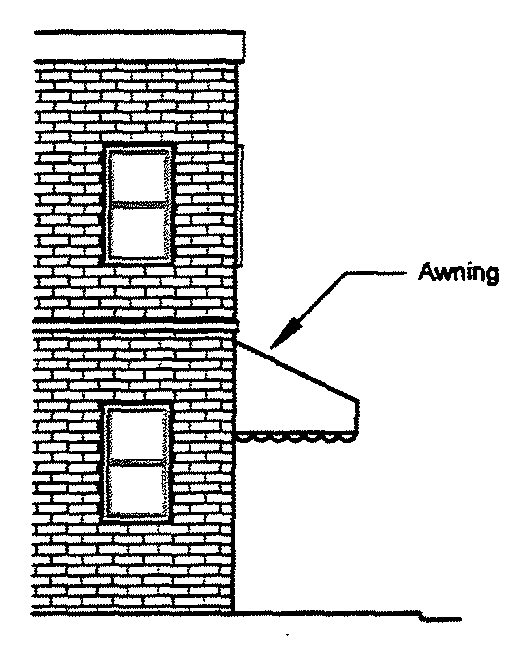
Figure 82-2. Awning
Balcony means an accessory use structure consisting of a railed deck or open porch that is at least eight feet above the average grade of the ground surface below the structure.
Basement means a story having part, but no more than 50 percent, of its height below the average level of the adjoining finished grade. See figure 82-3, basement.
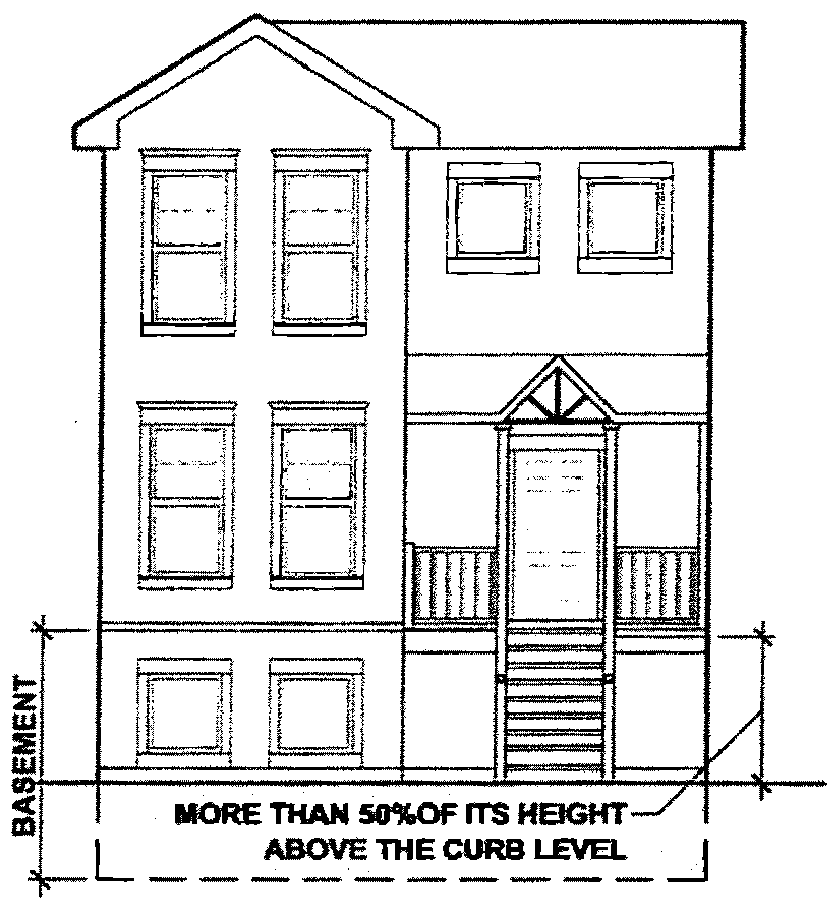
Figure 82-3. Basement
Bay window means a window projection protruding from an exterior wall of a building, located at least two feet above ground. See figure 82-4, bay window. (The photographs are available in the village clerk's office.)
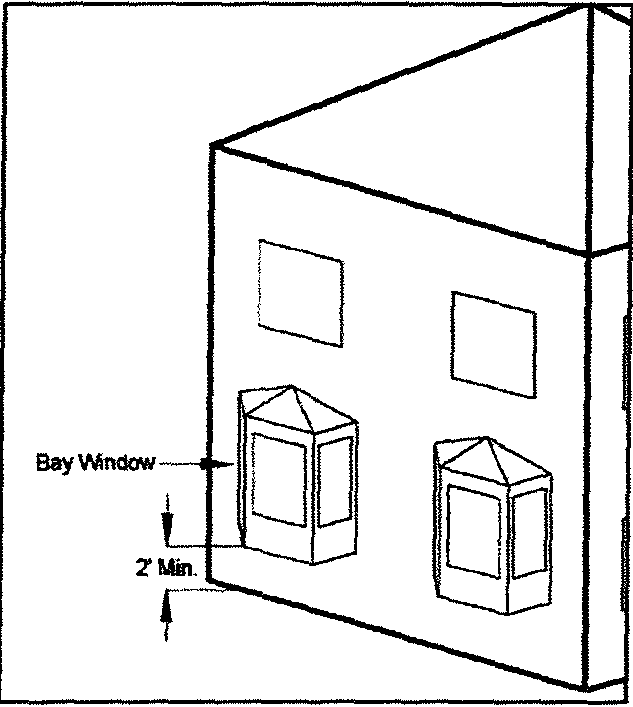
Figure 82-4. Bay Window
Berm means a mound of dirt used for screening or landscaping purposes which is planted with low-lying shrubs or ground cover so as to prevent erosion.
Billboard. See Off-premises sign.
Block means a tract of land bounded by street rights-of-way, or by a combination of street rights-of-way and public parks, cemeteries, railroad and utility rights-of-way, bulkhead lines or shore lines of waterways, or corporate boundary lines.
Buffer means a visual screen constructed of wood, concrete block, or landscape material in such a manner that the view of adjacent property will be completely or partially obscured from the use contemplated, so noise, solid waste, or other objectionable influences will be avoided.
Buildable area means the space remaining on a zoning lot after the minimum setback requirements of this chapter have been met.
Building means a structure having a roof supported by columns or walls. When separated by division walls without openings, each portion of such building is deemed a separate building.
Building, detached, means a building surrounded by open space, with the open space located on the same zoning lot as the building.
Building, height of, means the vertical distance measured from the curb level to:
(1)
The highest point of the roof surface in a flat roof;
(2)
The deck line of mansard roofs;
(3)
The mean height level between eaves and ridge of gable, hip and gambrel roofs.
For buildings set back from the street line, the height of the building is measured from the average elevation of the finished grade along the front of the building, provided its setback from the street line is not less than the height of such finished grade above the established curb level. See figure 82-5, building height and figure 82-6, height measured from grade.
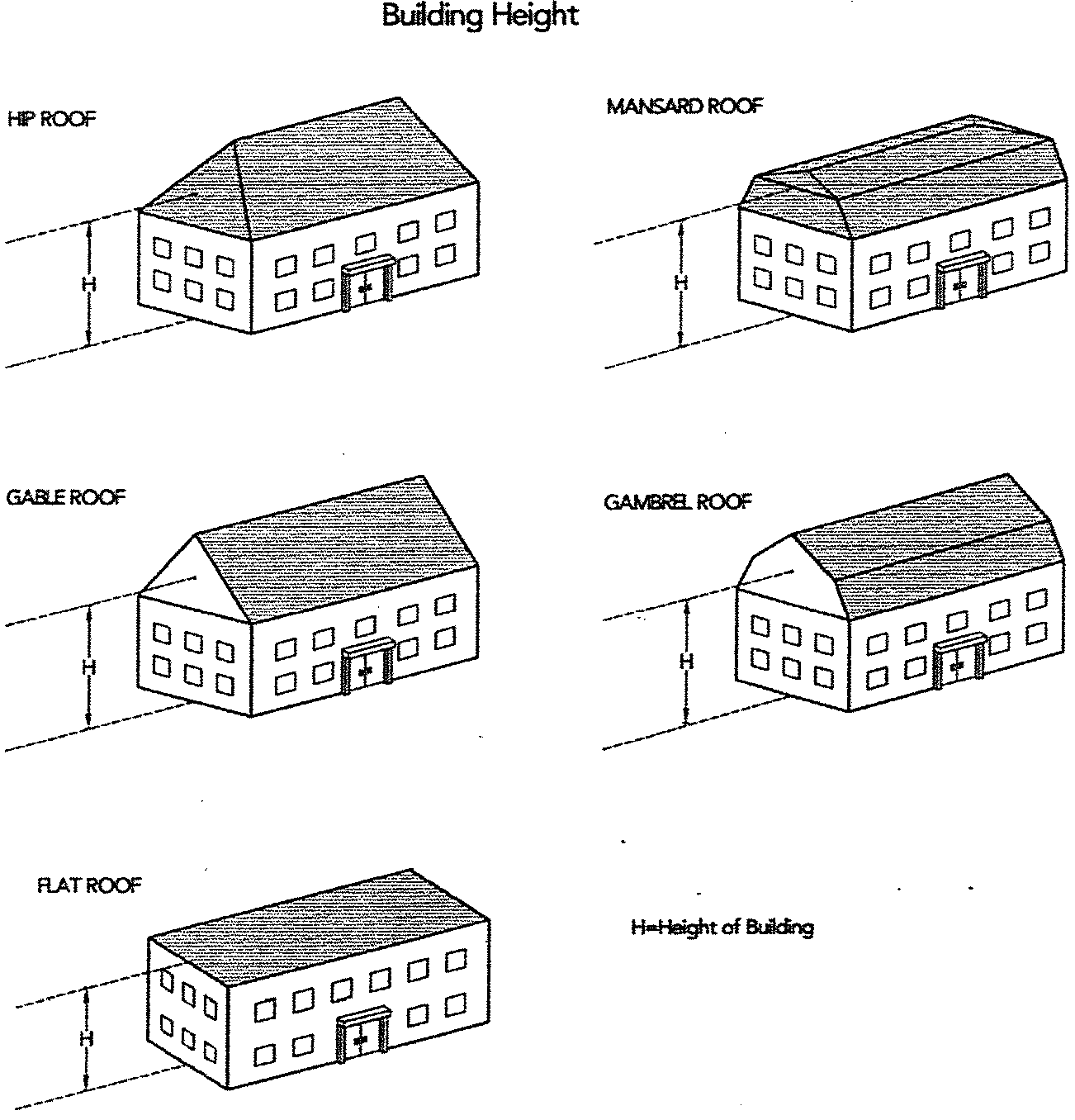
Figure 82-5. Building Height
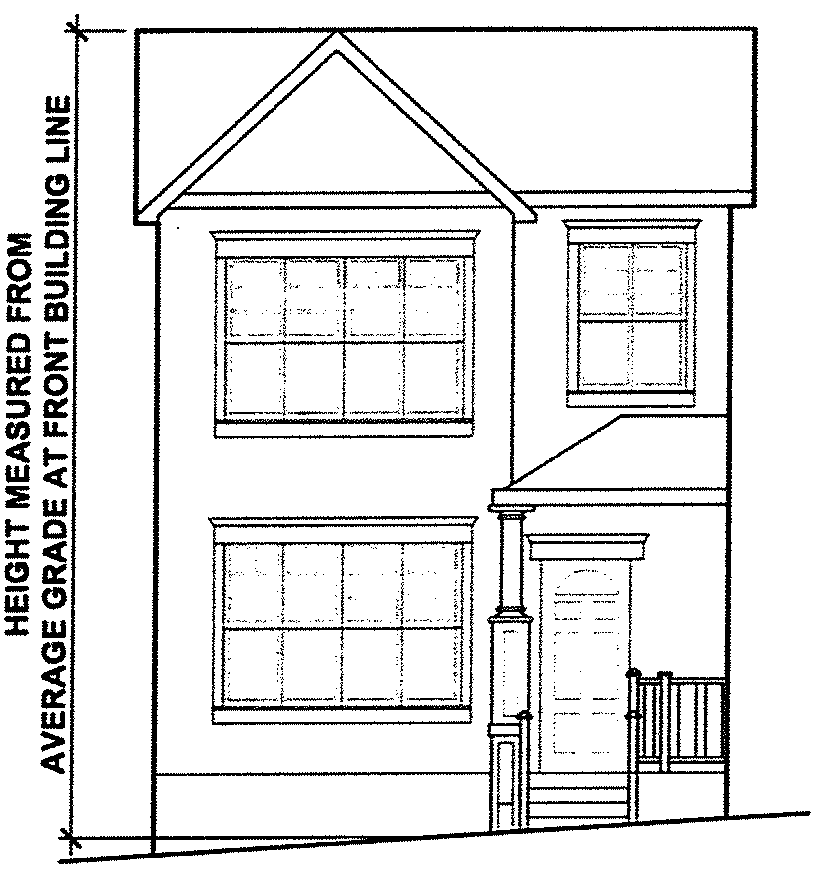
Figure 82-6.
Height Measured From Grade
Building line means the inner edge of any required setback, and the corresponding outer edge of the buildable area. Except as specifically provided by this chapter, no portion of any building or structure may be extended to occupy any portion of a lot outside its building lines.
Bulk indicates the size and setbacks of structures and their location.
Bus means every motor vehicle designed to carry more than 15 passengers, including the driver, and used for transporting persons.
Caliper means the American Association of Nurserymen standard for trunk measurement of nursery stock, as measured at six inches above the ground for trees up to and including four inch caliper size, and as measured at 12 inches above the ground for larger sizes.
Canopy means a rooflike cover, made of canvas or other material, with supports extending to the ground from underneath the hood, and placed so as to extend outward from the building providing a protective shield for building entrances. See figure 82-7, canopy. (The photograph is available in the village clerk's office.)
Channel means a natural or artificial watercourse with a definite bed and banks that conducts continuously or periodically flowing water.
Clearing means any activity that removes the vegetative surface cover.
Commercial vehicle.
(1)
The term "commercial vehicle" means any vehicle operated for the transportation of persons or property in the furtherance of any commercial enterprise, for-hire or not-for-hire.
(2)
The term "commercial vehicle" does not include a commuter van, a vehicle currently being used for ride-sharing or a recreational vehicle that is not being used commercially.
Concept plan means a drawing or any other accompanying information which shows existing and proposed development conditions as proposed in this chapter.
Cul-de-sac means a street permanently terminated by a vehicle turnaround.
Curb level means the level of the established curb in front of the building measured at the center of such front. Where a building faces on more than one street, the curb level is the average of the levels of the curbs at the center of the front of each street. Where no curb elevation has been established, the village engineer will establish such curb levels.
Datum plane means a reference level from which ground elevation is based. The datum plane is at mean sea level as established by the United States Geological Survey cases NAVD88.
Day, unless otherwise specifically indicated, means one calendar day.
Deck means a horizontal, unenclosed platform, with or without attached railings, seats, trellises or other features, attached or functionally related to a principal structure and, at any point, raised more than seven inches above the ground. A deck is not roofed.
Detention means the temporary storage of storm runoff in a stormwater management practice with the goals of controlling peak discharge rates and providing gravity settling of pollutants.
Detention basin means a covered or uncovered reservoir designed to hold an accumulation of stormwater runoff so as to reduce peak flow in a stormwater drainage system.
Detention facility means a detention basin or alternative structure designed for the purpose of temporary storage of stream flow or surface runoff and gradual release of stored water at controlled rates.
Developed area means that portion of a lot or parcel upon which a building, structure, pavement or other improvements have been placed.
Developer means a person, group of persons, organization, or other entity who petitions the village according to this chapter for the purpose of improving or subdividing land. The term "developer" may also be referred to as owner depending on the context.
Development means any subdivision or change to improved or unimproved real property including single lots and shall not be limited to buildings or other structures, mining, dredging, filling, grading, paving, excavation or drilling operations located within the planning jurisdiction of the village.
Drainageway means any channel that conveys surface runoff throughout the site.
Driveway means a paved or unpaved strip of land providing vehicular access between the street and a parking space or garage of private or public property.
Dwelling.
(1)
The term "dwelling" means a structure, or portion thereof, designed or used exclusively for residential occupancy, including single-family, two-family, townhouse and multifamily dwellings.
(2)
The term "dwelling" does not include hotels/motels.
Dwelling, detached, means a dwelling entirely surrounded by open space with the open space located on the same zoning lot as the dwelling.
Dwelling unit means one or more rooms in a dwelling designed for occupancy by one family for living purposes, and having its own permanently installed kitchen and bathroom facilities.
Easement means a grant by a property owner for the use of a strip of land for public purposes of constructing and maintaining utilities and transportation ways including, but not limited to, electric lines, telephone lines, storm sewer or storm drainageways and gas lines.
Eave means the projecting edges of a roof overhanging the wall of a building.
Elevation means the vertical distance of an existing point from a stated datum plane.
EME/RF study means a study of the amount of electromagnetic energy (EME) and radio frequency (RF) emitted by a wireless telecommunications antenna.
Enlargement means to increase physical land or structural floor area or volume than currently exists.
Erosion and sediment control plan means a plan prepared by or under the direction of a licensed professional engineer indicating the specific measures and sequencing to be used to control sediment and erosion on a development site during and after construction.
Erosion control means a measure that prevents erosion.
Exception means the modification to existing bulk and use standards within a zoning district granted as part of a development approval process, such as planned unit development.
Expansion means an increase in the physical land or structural area of use, the addition of equipment or machinery of a structural nature, and/or the adding of a substantially new or different product, service or activity to an existing use.
Family means a parent or parents and their children, or a group of not more than five persons who are not parents and children, who maintain a common household in a dwelling unit. This definition does not include convents, rectories, sororities, fraternities or similar uses.
Fill means any act by which earth, sand, gravel, rock, or other material is deposited, placed, replaced, pushed, dumped, pulled, transported or moved to a new location and includes the conditions resulting therefrom.
Final plat means the plan or plat of subdivision intended for recording, and any other accompanying material as described herein.
Flood fringe means that portion of the floodplain outside of the regulatory floodway.
Flood route means the overland route that floodwaters would naturally flow.
Floodplain means that land typically adjacent to a body of water with ground surface elevations at or below the base flood or the 100-year frequency flood elevation. The floodplain is also known as the special flood hazard area (SFHA).
Floodway means the channel and that portion of the floodplain adjacent to a stream or watercourse which is needed to store and convey the anticipated existing and future 100 year frequency flood discharge with no more than a one-tenth-foot increase in stage due to any loss of flood conveyance or storage and no more than a ten percent increase in velocities.
Floor area, gross, (GFA) means he gross floor area of a building is the sum of the gross horizontal areas of the floors of the building, measured from the exterior faces of the exterior walls.
Footcandle means a unit of illumination intensity.
Frequency means the number of oscillations per second in a sound wave and an index of the pitch of the resulting sound.
Frontage means all the property fronting on one side of a street between the nearest intersecting streets, or between a street and a right-of-way, waterway or other similar barrier.
Garage means a building, either attached or detached, used or designed to be used for storage of automobiles and accessory storage related to the use of the principal dwelling.
Grade means the elevation established for the purpose of regulating the number of stories and the height of principal buildings. Grade shall be the mean level of the finished surface of the ground adjacent to the exterior walls of the building. The mean grade shall be calculated from the grade elevations at the four points of intersection of an imaginary line drawn parallel to both the rear and front yard setback lines across the front and rear facades, where the imaginary line intersects the side yard setback. Where applicable, for structures other than the principal building. The term "grade" may also refer to the mean level of the finished surface of the ground adjacent to a structure.
Grading means excavation or fill of material, including the resulting conditions thereof.
Ground cover means low-growing plants planted in such a manner as to form a continuous cover over the ground.
Home occupation means any occupation or profession carried on by a member of a family, residing on the premises, conducted entirely within the dwelling.
IEPA means the Illinois Environmental Protection Agency.
Illinois Urban Manual means the Illinois Urban Manual, current edition, developed by the USDA Natural Resources Conservation Service and the Illinois Environmental Protection Agency.
Impervious means a surface consisting of material, such as asphalt, concrete, roofing material, plastic and similar materials, which does not absorb water.
Infiltration means the process of percolating stormwater into the subsoil.
Intensification means an increase in measure of or degree in the extent, quantity or volume of use.
Intensity of use means the number of square feet of development devoted to a land use.
Land disturbance activity means any activity that changes the volume or peak flow discharge rate of rainfall runoff from the land surface. The term "land disturbance activity" may include the grading, digging, cutting, scraping or excavating of soil, placement of fill materials, paving, construction, substantial removal of vegetation or any activity which bares soil or rock or involves the diversion or piping of any natural or manmade watercourse.
Landscaping means a ground cover that contains one or more of the following materials: grass, decorative rock, wood chips, shrubs, flower and vegetable gardens and trees, and to exclude patios, sidewalks, and open decks materials as qualifying as a landscaping material.
Light trespass means the spilling of light, whether directly, indirectly or by glare onto a lot, parcel or public way other than the lot or parcel on which the light fixture is located.
Lighting, shielded, means a fixture that is shielded in such a manner that light rays emitted by the fixture, either directly from the lamp or indirectly from the fixture, are projected below a horizontal plane running through the lowest point on the fixture where light is emitted.
Lighting, unshielded, means a fixture that allows light, either directly from the lamp or indirectly from the fixture or a reflector, to be emitted above the horizontal plane running through the lowest point on the fixture where light is emitted.
Loading berth means a space within a loading facility exclusive of driveways, aisles, maneuvering areas, ramps, columns, landscaping areas, office and work areas for the temporary parking of a commercial vehicle while loading or unloading goods or materials, and which abuts upon a street, alley or other appropriate means of access.
Lot means a parcel of land designated by plat, metes and bounds, registered land survey, auditors plot or other accepted means, and separated from other parcels or portions by the description for the purpose of sale, lease or separation.
Lot area means the computed area contained within the boundary lines of a lot.
Lot, corner, means a lot located at the intersection of two streets or a lot bounded on two sides by a curving street two chords of which form an angle of 120 degrees Fahrenheit or less measured on the lot side. See figure 82-8, corner and interior lots.
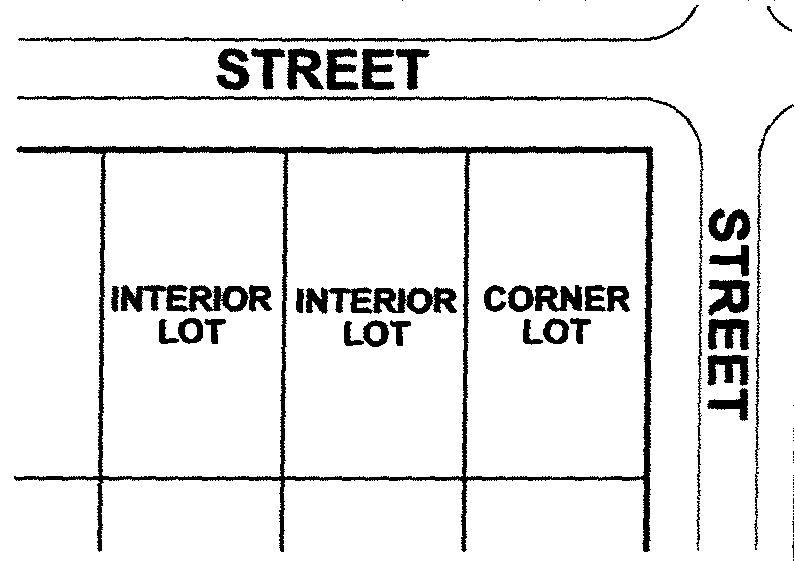
Figure 82-8
Corner and Interior Lots
Lot coverage means the area of a zoning lot occupied by principal and accessory structures.
Lot depth means the mean horizontal distance between the front and rear lot lines. See figure 82-9, lot depth and width.
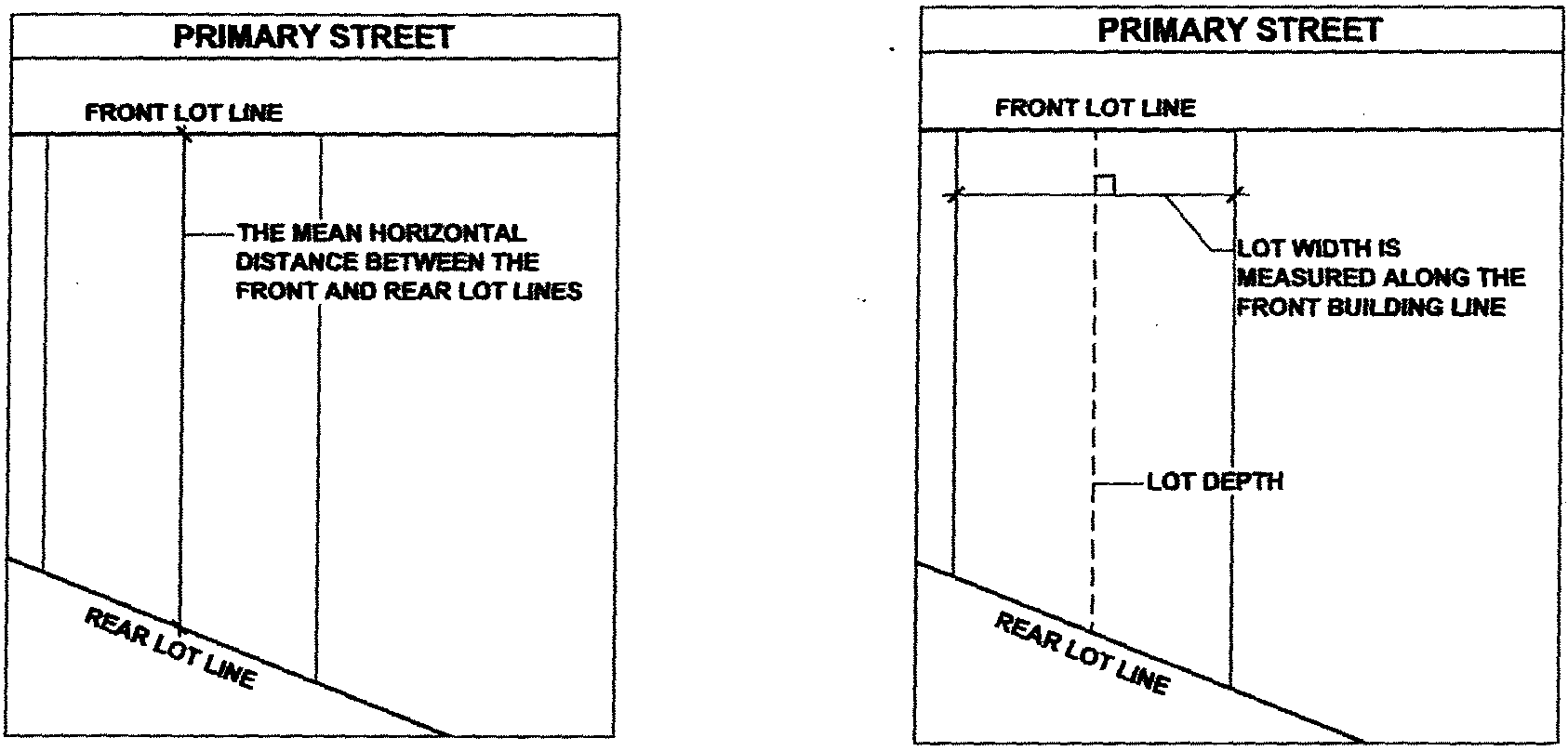
Figure 82-9. Lot Depth and Width
Lot, double frontage. See Through lot.
Lot, interior, means a lot other than a corner or through lot. See figure 82-8.
Lot line, front, means the boundary of a lot abutting a street. On a corner lot, the shortest street lot line is the front lot line.
Lot line, rear, means the rear lot line is the lot line or lot lines most nearly parallel to and most remote from the front lot line. Lot lines other than front or rear lot lines are side lot lines.
Lot line, side, means any boundary of a lot that is not a front lot line or a rear lot line.
Lot, through, means a lot having frontage on two nonintersecting streets as distinguished from a corner lot. A through lot is also called a double frontage lot. See figure 82-10, through lot.
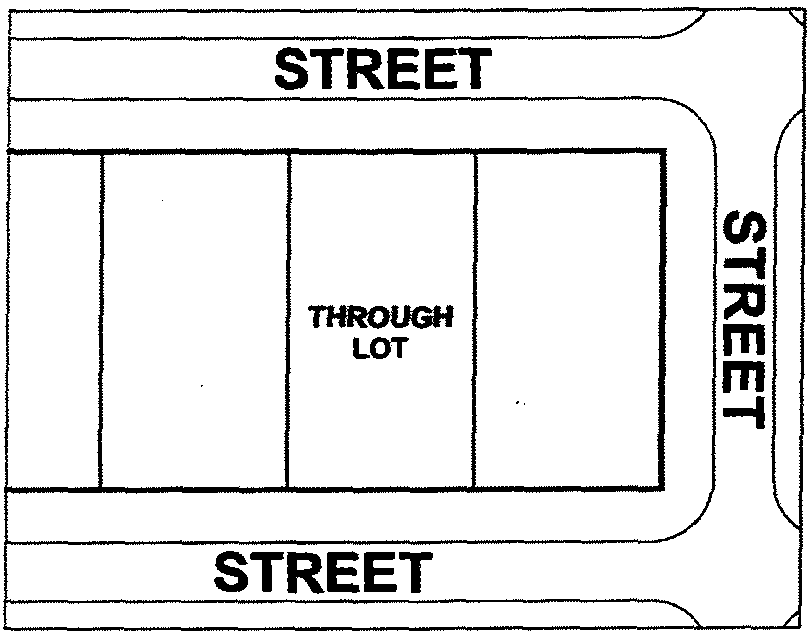
Figure 82-10. Through Lot
Lot of record means a lot which is part of a subdivision, the map of which has been recorded in the office of the register of deeds, or a lot described by metes and bounds, the deed to which has been recorded in the office of the register of deeds at the time the ordinance from which this chapter was passed.
Lot width means the horizontal distance between the side lot line measured at right angles to the lot depth at the established front building line. See figure 82-9.
Lot, zoning, means a single tract of land located within a single block which, at the time of filing for a building permit, is designated by its owner or developer as a tract to be used, developed or built upon as a unit, under single ownership or control. A zoning lot may or may not coincide with a lot of record.
Motor vehicle means any motor operated conveyance allowed to operate on the streets including, but not limited to, automobiles, pickups, vans, trucks, semitractors, motorcycles and recreational campers.
MPE stands for maximum permissible exposure to radio frequencies. This standard, calculated by the Federal Communications Commission, is the safe level of exposure of persons to radio frequencies, such as those emitted by wireless telecommunications antennas.
MWRDGC means the Metropolitan Water Reclamation District of Greater Chicago.
Nonconformity means any legal use, structure or parcel of land already in existence, recorded or authorized before the adoption of official regulations that do not permit such use, structure or parcel of land.
Off-site facility means a stormwater management measure located outside the subject property boundary described in the permit application for land development activity.
On-site facility means a stormwater management measure located within the subject property boundary described in the permit application for land development activity.
Outdoor sales and display means part of a lot used for outdoor sales or display of goods accessory to the principal use.
Outdoor storage means the keeping of any goods, material, merchandise or equipment not within an enclosed building. An item shall be deemed to be in storage if it is being maintained or repaired on a premises.
Outlot means a lot that shall not be developed but is reserved for a specific purpose or purposes.
Owner, for purposes of this chapter, includes any person having a freehold interest, or a contractual interest that may become a freehold interest, or lessee of the property, or by an agent or contract purchaser specifically authorized by the owner to file such application.
Parapet wall means that portion of a wall which extends above the roofline.
Parcel means a continuous area or acreage of land which can be described as provided for in the Plat Act.
Parking area means land area used for parking motor vehicles and the areas of access to parking spaces and public streets or alleys.
Parking, land-banked, means designating land on a site to be held and preserved for an additional parking.
Parking, off-street, means the storage space for an automobile on premises other than streets, alleys or rights-of way.
Parking, on-street, means the storage space for an automobile that is located within the street right-of-way.
Parkway means the part of the public street right-of-way not occupied by the street pavement and located between the back of the curb and the sidewalk, as well as the dividing strip of a roadway.
Party wall means a wall starting from the foundation and extending continuously through all stories to or above the roof, that separates one building from another, but is in joint use by each building.
Patio means an at-grade ground covering consisting of interlocking brick, tile, cement, asphalt or similar material.
Paved ground surface area means any paved surface area (excepting public right-of-way) used for the purpose of driving, parking, storing, or displaying of vehicles, boats, trailers and mobile homes, including new and used car lots and other open lot uses.
Pavement means the portion of a street, access easement or driveway intended to bear vehicular traffic, not including curbs.
Pedestrian walkway or crosswalk means a right-of-way across or within a block, for use by pedestrians whether designated as a pedestrian walkway or crosswalk or however designated; and may include utilities where necessary.
Perimeter control means a barrier that prevents sediment from leaving a site by filtering sediment-laden runoff or diverting it to a sediment trap or basin.
Person means any individual, firm, association, organization, partnership, business, trust, corporation or company.
Phasing means clearing a parcel of land in distinct phases, with the stabilization of each phase completed before the clearing of the next.
Plat means the drawing or map of a subdivision prepared for filing of record containing all elements and requirements set forth in this chapter.
Plat, final, means a drawing or map of a subdivision meeting all the requirements of the village, and in such form as required by the county for purposes of recording.
Plat, preliminary, means the preliminary map, drawing or chart indicating the proposed layout of the subdivision.
Porch means a structure, which can be enclosed or unenclosed, that projects from the exterior wall of a building, has direct access to the street level of the building, and is covered by a roof or eaves. An unenclosed porch is a porch that is open on two or more sides. An enclosed porch is a porch that is enclosed by walls, screens, lattice or other material on two or more sides. A screened-in porch shall be considered an enclosed porch.
Preliminary plat means a plat showing proposed surveyor subdivision data, as described within, subject to village approval.
Principal building means a nonaccessory building in which is conducted a principal use of the zoning lot on which it is located.
Principal use means all uses that are not accessory uses.
Protective covenants means contracts entered into between private parties and constitute a restriction on the use of all private property within a subdivision for the benefit of property owners, and to provide mutual protection against undesirable aspects of development which would tend to affect aesthetics.
Real estate model unit means a residential unit temporarily used for display purposes as an example of dwelling units available or to be available for sale or rental in a particular subdivision or other residential development. The term "real estate model unit" may also incorporate sales or rental offices for dwellings within the development.
Reconstruction means rehabilitation or replacement of a structure or structures on property which either have been damaged, altered or removed.
Recreational equipment means items that are used off-road including, but not limited to, boats, canoes and snowmobiles.
Recreational vehicle includes the following:
(1)
Travel trailers including those that telescope or fold down, chassis, house cars, motor homes, tent trailers, slip-in campers and converted vans that are motor homes.
(2)
A nonmotorized trailer intended and generally used for transporting boats.
(3)
Snowmobiles, all-terrain vehicles (ATV), boats and any type of watercraft.
Such vehicles that are placed on a utility trailer are, together with the trailer, considered a single recreational vehicle.
Redevelopment means any construction, alteration or improvement exceeding one acre in areas where existing land use is high density commercial, industrial, institutional or multifamily residential.
Resubdivision means the rearrangement of a portion of land previously subdivided, subject to the same constraints that apply to subdivision.
Retaining wall means a raised area of soil that is supported or enclosed around an edge or edges by stone or timber, designed to resist lateral earth or fluid pressures. The term "retaining wall" includes terracing used in landscaping.
Right-of-way means a general term denoting land, property, or interest therein, acquired for or used as a roadway, pedestrian way, bike path, railroad route, utility route, or other public or quasi-public use.
Satellite dish antenna means a dish antenna designed for transmitting signals to a receiver or receiving station or for receiving television, radio, data, communication or other signals from other antennas, satellites or other services.
Sediment control means the measures that prevent eroded sediment from leaving the site.
Setback means the minimum distance by which any building or structure must be separated from a property line. See figure 82-11, setback.
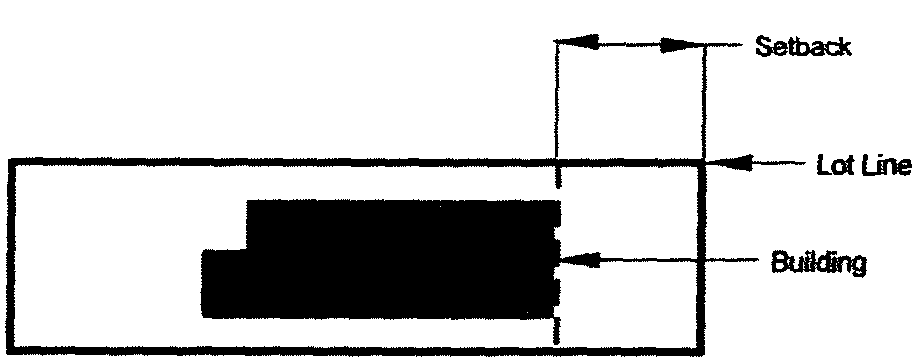
Figure 82-11. Setback
Shade tree means a deciduous tree planted primarily for its high crown of foliage or overhead canopy. A large shade tree is over 40 feet in height. Medium shade trees are between 25 and 40 feet in height. Small shade trees reach up to 25 feet in height.
Shopping center means a group of retail and other commercial establishments that is planned, owned and managed as a single property. The center's size and orientation are generally determined by the market characteristics of the trade area served by the center. The two main configurations of shopping centers are malls and strip centers.
Sign means a name identification, description, display, illustration, or device which is affixed to or represented directly or indirectly upon a building, structure, or land in view of the general public and which directs attention to a product, place, activity, person, institution, or business.
Sign, A-frame, means a temporary advertising device ordinarily in the shape of an "A," or some variation thereof, located on the ground, not permanently attached and easily movable, and usually two-sided. The term "A-frame sign" is also called a "sandwich board." See figure 82-12, A-frame sign. (The photographs are available in the village clerk's office.)
Sign, balloon.
(1)
The term "balloon sign" means any sign that is any lighter-than-air or gas-filled balloon attached by means of a rope or tether to a definite or fixed location. Displays designed to inflate or move by use of a fan or blower is also considered a balloon sign.
(2)
The term "balloon sign" does not include balloons that are used as temporary attention-getting devices in conjunction with another sign which are no more than 18 inches in diameter.
Sign, banner, means any sign printed or displayed upon cloth or other flexible material with or without frames.
Sign, directional, means a sign that identifies parking lot entrances and exits, restrooms, public telephone, walkways, parking lot entrances and exits, and features of a similar nature.
Sign, electronic, means signs whose alphabetic, pictographic or symbolic informational content can be changed or altered on a fixed display screen composed of electrically illuminated segments. The term "electronic signs" within ground or wall signs are regulated as one of the two following types:
(1)
Electronic display screen means a sign, or portion of a sign, that displays an electronic image or video, which may or may not include text. The term "electronic display screen" includes television screens, plasma screens, digital screens, flat screens, LED screens, video boards and holographic displays. See figure 82-13, electronic display screen. (The photograph is available in the village clerk's office.)
(2)
Electronic message sign means any sign, or portion of a sign, that uses changing lights to form a sign message or messages in text form wherein the sequence of messages and the rate of change is electronically programmed and can be modified by electronic processes. Time and temperature signs are considered electronic message signs. See figure 82-14, electronic message sign. (The photograph is available in the village clerk's office.)
Sign, flashing, means a sign with blinking or flashing lights, or other illuminating devices that change light intensity, brightness or color, traveling/chasing or blinking lights, or rotating beacons. Electronic signs, as permitted by chapter 58, are not considered flashing signs; however, the messages or images on an electronic sign may not imitate flashing signs.
Sign, ground, means a sign that is attached to a completely self-supporting structure. A ground sign may be a pole or monument sign. See Sign, ground monument, and Sign, ground pole.
(1)
Sign, ground monument, means any sign, other than a pole sign, placed upon or supported by the ground independently of any other structure. Ground monument signs are typically mounted on a masonry base. As distinguished from a ground pole sign, the sign base of any monument sign must be a minimum of 75 percent or more of the width of the sign face that is to be situated upon the base. A sign base less than 75 percent of the width of the sign face is considered a ground pole sign. See figure 82-15, ground monument sign. (The photograph is available in the village clerk's office.)
(2)
Sign, ground pole, means a sign erected and maintained on one or more freestanding masts or poles and not attached to any building, but not including a ground monument sign. See figure 82-16, ground pole sign. (The photograph is available in the village clerk's office.)
Sign, nonconforming, means a sign lawfully erected and maintained prior to the adoption of the ordinance from which this chapter is derived that does not conform to the requirements of this chapter.
Sign, obscene, means a sign which is found to meet the three established criteria of obscenity:
(1)
Prurient in nature;
(2)
Completely devoid of scientific, political, educational or social value; and
(3)
A violation of local community standards.
Sign, obsolete or abandoned, means a sign that advertises a business, product, service or activity that is no longer located on the premises where the sign is displayed.
Sign, off-premises, means a sign which directs attention to a business, commodity, service or entertainment conducted, sold or offered at any location other than upon the premises where such sign is located or to which it is affixed. The term "off-premises sign" is also called a billboard.
Sign, pennant, means any geometric shaped cloth, fabric or other lightweight material normally fastened to a stringer, which is secured or tethered so as to allow movement of the sign.
Sign, permanent, means a sign attached to a structure or the ground which is made of materials intended for long-term use.
Sign, permanent window, means a sign printed on the interior of a window or door of a building intended for viewing from the exterior of such a building. See figure 82-19, permanent window sign. (The photograph is available in the village clerk's office.)
Sign permit means a permit for erection, alteration or relocation of a sign.
Sign, portable, means a sign whose principal supporting structure is intended, by design and construction, to be used by resting upon the ground for support and may be easily moved or relocated for reuse. The term "portable signs" includes, but is not limited to, signs mounted upon a trailer, wheeled carrier or other nonmotorized mobile structure, with or without wheels.
Sign, projecting.
(1)
The term "projecting sign" means any sign that is attached to a building or other structure, and extends beyond the surface of the building or structure to which it is attached by more than 12 inches.
(2)
The term "projecting sign" does not include a wall sign. See figure 82-17, projecting sign. (The photograph is available in the village clerk's office.)
Sign, roof, means any sign wholly erected, constructed or maintained upon or above the roof or parapet of any building, with the principal support attached to the roof structure.
Sign support structure means any structure that supports, or is capable of supporting, a sign, including decorative cover.
Sign, temporary, means a sign not intended or designed for permanent display.
Sign, temporary window, means a sign attached to or placed upon the interior of a window or door of a building intended for viewing from the exterior of such a building.
Sign, unsafe, means a sign or other advertising structure that constitutes a hazard to public safety or health by reason of inadequate design, construction, repair or maintenance.
Sign, wall.
(1)
The term "wall sign" means a sign mounted on the wall of a building or structure, with the exposed face of the sign in a plane parallel to the face of the wall. See figure 82-18, wall sign. (The photograph is available in the village clerk's office.)
(2)
The term "wall sign" does not include projecting signs.
Sign with moving parts.
(1)
The term "sign with moving parts" means a sign or other advertising structure with moving, revolving or rotating parts or visible mechanical movement of any kind, including wind-activated signs.
(2)
The term "sign with moving parts" does not include clocks and signs which change messages by way of louvers.
Site (site development permit) means a parcel of land or a contiguous combination thereof, where grading work is performed as a single unified operation.
Site development permit means a permit issued by the municipality for the construction or alteration of ground improvements and structures for the control of erosion, runoff and grading.
Stabilization means the use of practices that prevent exposed soil from eroding.
Start of construction means the first land disturbing activity associated with a development, including land preparation such as:
(1)
Clearing, grading, and filling;
(2)
Installation of streets and walkways;
(3)
Excavation for basements, footings, piers or foundations;
(4)
Erection of temporary forms; and
(5)
Installation of accessory buildings such as garages.
Stoop means a landing pad providing ingress and egress from an above grade door in the principal building. A stoop may be roofed, but cannot be enclosed. See figure 82-20, stoop. (The photograph is available in the village clerk's office.)
Stormwater management means the use of structural or nonstructural practices that are designed to reduce stormwater runoff pollutant loads, discharge volumes, peak flow discharge rates and detrimental changes in stream temperature that affect water quality and habitat.
Stormwater runoff means flow on the surface of the ground, resulting from precipitation.
Story means that portion of a building included between the surface of any floor and the surface of the floor next above it, or, if no such floor above, the space between such floor and the ceiling next above it.
Story, half, means a space under a sloping roof which has the line of intersection roof decking and wall face not more than three feet above the top floor level, and in which space not more than two-thirds of the floor area is finished off for use. A half-story containing an independent apartment or living quarters is counted as a full story.
Streaming video (signs) means a digital version of video, which may include audio, that is sent (streamed) to a sign in compressed form in real time for viewing on an electronic display screen. The media is sent in a continuous stream and is played as it arrives. In relation to sign standards, streaming video is distinct from animation in that streaming video requires constant movement of images.
Street means a public right-of-way affording primary access by pedestrians and vehicles to abutting properties, whether designated as a street, highway, thoroughfare, parkway, throughway, road, avenue, boulevard, land, place or however otherwise designated.
Street, frontage, means all of the property fronting on one side of a street between two intersecting streets, or in the case of a dead-end street, all of the property along the side of the street between an intersecting street and the end of such dead-end street.
Street line means that line limiting the right-of-way of the street and being identical with the property line of persons owning property fronting on the streets.
Strip commercial development means a pattern of commercial development comprised of two or more separate businesses, generally one lot in depth with commercial activity arranged in a line, usually along an arterial street.
Structural alterations.
(1)
The term "structural alterations" means any change in the supporting members of a building, such as bearing walls, columns, beams or girders, or any substantial changes in the roof and exterior walls.
(2)
The term "structural alterations" does not include the application of any exterior siding to an existing building for the purpose of beautifying and modernizing.
Structure means anything constructed or erected on the ground or attached to the ground or on-site utilities, including, but not limited to, buildings, factories, sheds, detached garages, cabins, manufactured homes and other similar items.
Subdivider means the person or persons responsible for preparing and recording the plats of the subdivision and for carrying out all appropriate requirements including responsibility for public improvements installation relating thereto as outlined in this chapter.
Subdivision means any land, vacant or improved, which is divided or proposed to be divided into two or more lots, parcels, sites, units, plots, tracts or interests for the purpose of offer, sale, lease or development whether immediate or future, either on the installment plan or upon any and all other plans, terms, and conditions. The term "subdivision" includes the division or development of residential and nonresidential zoned land, whether by deed, metes and bounds description, devise, intestacy, lease, map, plat or other recorded instruments. The term "subdivision" includes resubdivision.
Village means the Village of Sauk Village, Illinois.
Watercourse means any body of water, including, but not limited to lakes, ponds, rivers, streams and bodies of water delineated by the state department of natural resources office of water resources (IDNR/OWR), the United States Geologic Survey (USGS), the United States Army Corps of Engineers or the village.
Waterway means a channel that directs surface runoff to a watercourse or to the public storm drain.
Yard means an open space on the same zoning lot with a building or structure, which yard is unoccupied and unobstructed from its lowest level to the sky, except as otherwise permitted by this chapter. See figure 82-21, yards.
Yard, corner side, means a side yard on a corner lot that abuts a public street. See figure 82-21.
Yard, front, means an open, unobstructed yard across the front of a lot between the building or allowed building line, and the front property line and between side yard property lines. See figure 82-21.
Yard, interior side, means a side yard that does not abut a street right-of-way. See figure 82-21.
Yard, rear, means an open, unobstructed yard, except as permitted herein, on the same lot with a building between the nearest line of the building or allowed building line and the rear property line extending between the interior property lines or between the interior property line and the street side yard. See figure 82-21.
Yard, side, means a yard extending along a side lot line between the front and rear yard, for the required minimum depth, as specified for the district in which such lot is located, measured perpendicular to the side lot line. See figure 82-21.
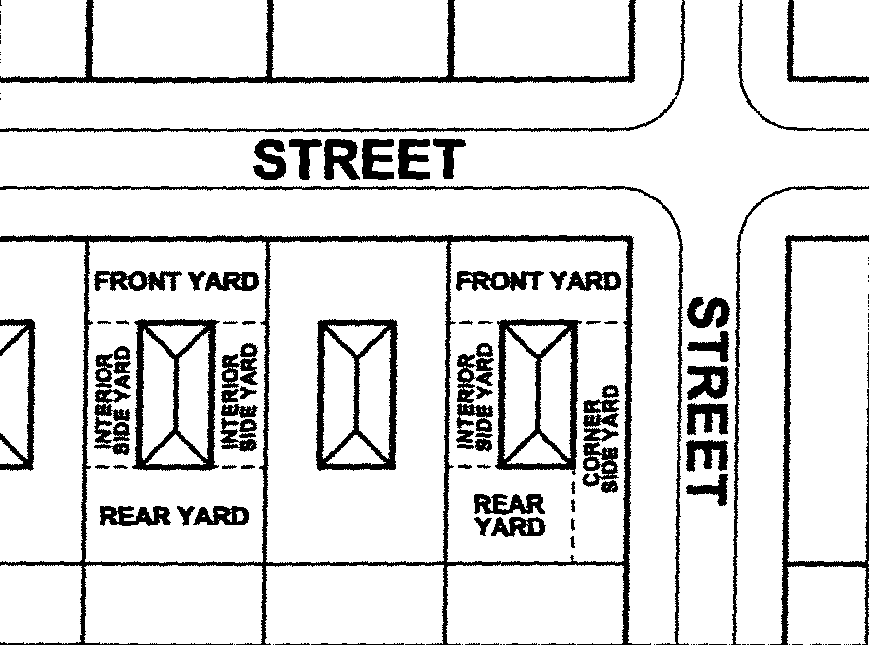
Figure 82-21. Yards
Zoning map means the map or maps incorporated into this chapter as a part hereof, designating the use district.
(Ord. No. 08-50, § 2(exh. A(18.5)), 8-12-2008; Ord. No. 12-009, 4-24-2012)
Sec. 82-6. - Applicability.
(a)
Territorial application. This chapter shall apply to all land, uses, buildings and structures within the village, including those owned by other municipal corporations and government bodies. The village's planning jurisdiction includes property within its corporate limits and unincorporated areas located within 1½ miles of village limits.
(b)
General application. In their interpretation and application, the provisions of this chapter shall be held to be the minimum requirements for the promotion and protection of the public health, safety, convenience, comfort and general welfare, and shall be construed to achieve the purposes for which the ordinance from which this chapter was adopted.
(c)
General prohibition. Except as otherwise provided by this chapter, no building, structure or land shall be used or occupied, and no building or structure, or portion thereof, shall be erected, constructed, reconstructed, moved, enlarged or structurally altered unless it conforms with the provisions of this chapter governing the zoning district in which it is located.
(d)
Private agreements. This chapter is not intended to nullify any private agreement, provided where there is a conflict between such private agreement and this chapter, and, where this chapter is more restrictive, this chapter shall control.
(e)
Other laws and regulations. Unless otherwise specifically provided, this chapter shall control over less restrictive statutes, ordinances or regulations, and more restrictive statutes, ordinances or regulations will control over the provisions of this chapter.
(Ord. No. 08-50, § 2(exh. A(1.3)), 8-12-2008)
Sec. 82-7. - Transition rules.
In determining the applicability of this chapter, with respect to the previously applicable zoning regulations, the following rules shall apply:
(1)
Existing unlawful uses and structures. A structure or use not lawfully existing at the time of the adoption of this chapter is hereby deemed lawful as of the effective date of the ordinance from which this chapter is derived if it conforms with all of requirements of this chapter. However, if such structure or use does not conform with all of the requirements of this chapter, then the structure or use remains unlawful.
(2)
Existing permitted uses. When a lot is used for a purpose that was classified as a permitted use prior to the effective date of the ordinance from which this chapter is derived, and such use is classified as a special use by this chapter, that use is hereby deemed a lawful special use for the purpose of this chapter. Any addition, enlargement or expansion of such use shall conform to the requirements for special uses within this chapter.
(3)
Uses rendered nonconforming. When a lot is used for a purpose that was a lawful use before the effective date of the ordinance from which this chapter is derived, and this chapter, or any amendment thereto, no longer classifies the use as either a permitted or special use in the zoning district in which it is located, that use is deemed a legal nonconforming use and shall be controlled by the provisions of article XIII, nonconformities.
(4)
Buildings, structures and lots rendered nonconforming. Where any lawful building, structure or lot existing on the effective date of the ordinance from which this chapter is derived does not meet all standards set forth in this chapter, or any amendment thereto, that building, structure or lot is deemed nonconforming and shall be controlled by the provisions of article XIII of this chapter, nonconformities.
(5)
Previously issued building permits. If a building permit for a building or structure was lawfully issued prior to the effective date of the ordinance from which this chapter is derived, and if construction has begun within 180 days of the issuance of that permit, the building or structure may be completed in accordance with the plans on the basis of which the building permit was issued and may, upon completion, be occupied under an certificate of occupancy for the use originally intended.
(6)
Previously granted special uses and variations. All special uses and variations granted prior to the effective date of the ordinance from which this chapter is derived shall remain in full force and effect. The recipient of the special use or variation may proceed to develop the property in accordance with the approved plans, including any applicable conditions. However, if the recipient has failed to act on the special use or variation before the approval expires, including any periods of extension granted, the provisions of this chapter shall govern.
(7)
Pending applications. Where an application is pending on the effective date of the ordinance from which this chapter is derived, the provisions of this chapter shall govern such application.
(Ord. No. 08-50, § 2(exh. A(1.4)), 8-12-2008)

