
Sauk Village City Zoning Code
Sec. 82-305
Additional standards; required criteria.
In addition to the use standards below, all uses are required to comply with the provisions of this article including, but not limited to, article IX of this chapter, on-site development standards; article X of this chapter, off-street parking and loading; article XI of this chapter, landscaping and screening; and chapter 58, signs; as well as all applicable village ordinances.
(1)
Assisted living facility, independent living facility and nursing home. Assisted living facilities, independent living facilities and nursing homes shall meet all federal, state and local requirements including, but not limited to, licensing, health, safety and building code requirements. Upon request, each operator shall provide the village fire department or police department a list of all residents of the facility. In addition, the following criteria shall be considered:
a.
The location, design, and operating characteristics of the facility shall be compatible with, and shall not adversely affect, adjacent properties and the surrounding area.
b.
The facility shall be harmonious with surrounding buildings with respect to scale, architectural design, and building placement.
c.
The street network shall be capable of accommodating the traffic generated by the facility.
(2)
Community residences. Community residences shall meet all federal, state and local requirements including, but not limited to, licensing, health, safety and building code requirements. In addition, the following criteria shall be considered.
a.
The cumulative affect of such uses will not alter the residential character of the neighborhood.
b.
The facility shall retain a residential, rather than institutional, character.
c.
The operation of the facility shall not adversely impact surrounding properties.
d.
Each operator shall make available to the village fire department and police department, upon request, a list indicating the names, addresses and phone numbers of all residents within the community residence.
(3)
Cultural facility. Cultural facilities shall be designed so that the location of entrances and exits, exterior lighting, service areas, and parking and loading facilities will minimize traffic congestion, pedestrian hazards, and adverse impacts on adjoining properties.
(4)
Day care center, adult, and day care center, child. Day care centers shall meet all federal, state and local requirements including, but not limited to, licensing, health, safety and building code requirements. Upon request of the village fire department and/or police department, each operator shall provide the village fire department and/or police department a list of all adults or children being cared for, including names, addresses and phone numbers. In addition, the following criteria shall be considered:
a.
The provision of adequate on-site drop-off zones, sidewalks and exterior lighting.
b.
The amount of traffic or noise to be generated.
c.
The provision of adequate open space.
(5)
Day care home, adult, and day care home, child. Day care homes shall meet all federal, state and local requirements including, but not limited to, licensing, health, safety and building code requirements. Upon request of the village fire department and/or police department, each operator shall provide the village fire department and/or police department a list of all adults or children being cared for, including names, addresses and phone numbers. In addition, the following criteria shall be considered:
a.
The provision of adequate on-site drop-off zones, sidewalks and exterior lighting.
b.
The amount of traffic or noise to be generated.
c.
The provision of adequate open space.
d.
The day care home shall retain a residential character and the affect of the day care home will not alter the residential character of the neighborhood.
e.
The operation of the day care home shall not adversely impact surrounding properties.
(6)
Drive-through facility. A drive-through facility is considered a separate use, rather than accessory to the principal use. For the purposes of this chapter, carwashes, gas stations and motor vehicle service and repair facilities are exempt from the following standards:
a.
Drive-through facilities shall provide adequate stacking spaces, in accordance with article X of this chapter, off-street parking and loading.
b.
All drive-through lanes must be located and designed to ensure that they will not adversely affect the safety and efficiency of traffic circulation on adjoining streets.
c.
The volume on all intercom menu displays shall be maintained at a level so as not to create a public nuisance for adjoining residential districts.
d.
The operator of the drive-through facility shall provide adequate on-site outdoor waste receptacles and shall provide daily litter cleanup along the rights-of-way abutting the property.
(7)
Dwelling, multifamily, and dwelling, townhouse.
a.
All townhouse developments and multifamily dwellings shall be designed with the front facade facing the street. When the side walls of a townhouse development and multifamily dwelling face the street, building facades shall be designed with elements of a front facade, including doors or windows, to avoid the appearance of blank walls.
b.
There shall be a minimum separation of ten feet between sidewalls among rows of townhouse developments and multifamily dwellings. (See figure 11-1. ground-level separation.) Where the front or rear wall of a row of townhouse developments and multifamily dwellings faces the front or rear wall of another row of townhouse developments and multifamily dwellings, the minimum required separation between such buildings shall be a minimum of 30 feet. Driveways and parking areas may be located within this minimum separation area. The minimum separation at the ground-floor may be reduced to 20 feet for interior drives with garage doors facing garage doors, provided that the upper-story living spaces comply with the 30-foot separation requirements. (See figure 11-2. upper-floor separation.)
c.
No more than five townhouse dwelling units shall be attached to one another in a row.
d.
Townhouses should be designed with either detached garages located in the rear yard, or attached garages oriented to the rear or side of the units.
e.
Private yards a minimum of 200 square feet in area shall be required for each townhouse dwelling unit. This private yard may be located adjacent to a front wall, rear wall or side wall, provided that it is immediately adjacent to the townhouse unit it serves and directly accessible from the townhouse unit by way of a door or stair. Required private yards must be at-grade or, if located on a terrace or patio, within four feet of grade. All private yards must be landscaped with turf, ground cover, shrubs, trees or other landscape improvements, including hardscape such as patios.
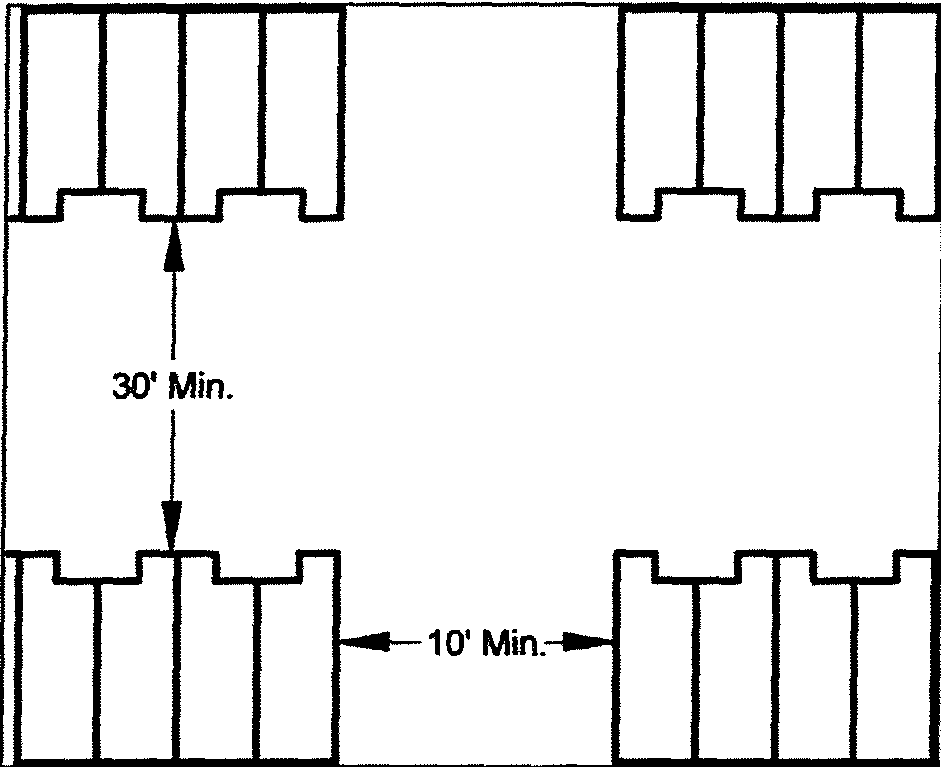
Figure 11-1. Ground-Level Separation
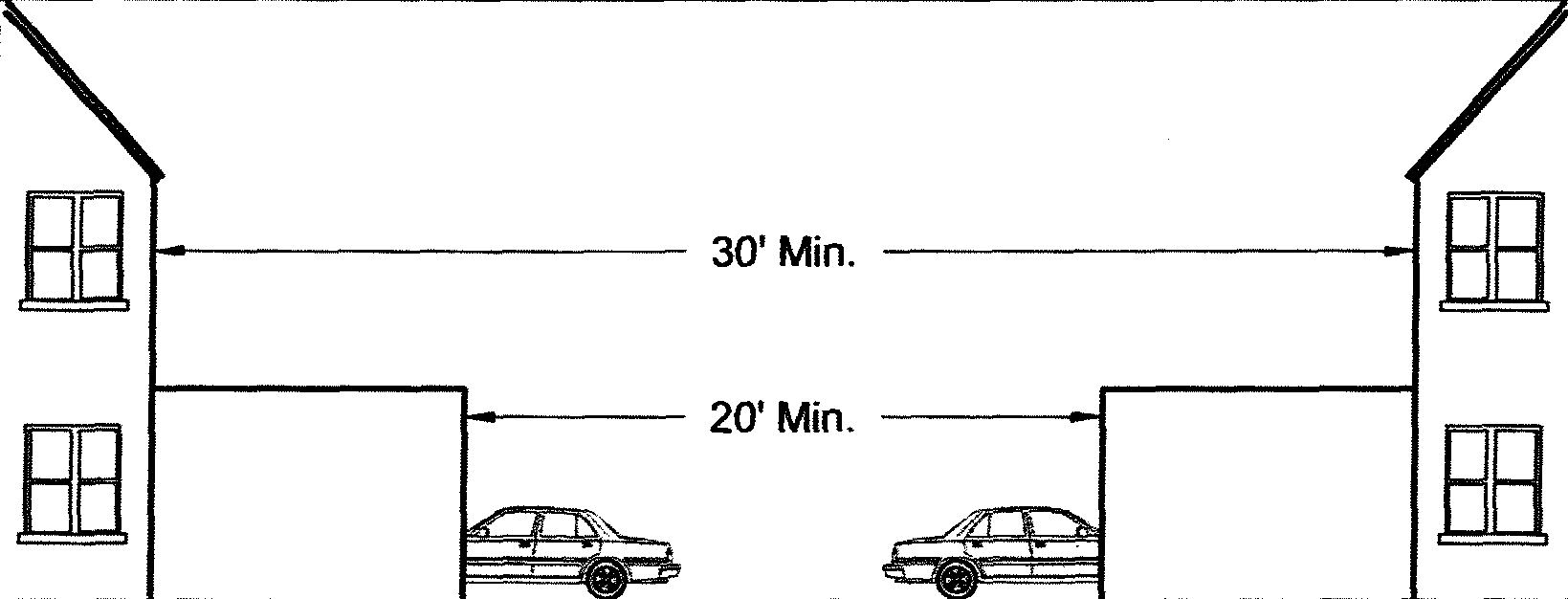
Figure 11-2. Upper-Floor Separation
(8)
Gas station.
a.
Gas station canopies shall be designed with luminaires recessed under the canopy to minimize light pollution. Light intensity directly under the canopy shall not exceed ten footcandles at any location. All lighting mounted under the canopy, including auxiliary lighting within signage and panels over the pumps, shall be included in the ten footcandle limit.
b.
All gas station driveways must be located and designed to ensure that they will not adversely affect the safety and efficiency of traffic circulation on adjoining streets.
c.
Gas stations may offer convenience items for sale as a secondary activity and may also include an automatic car wash.
d.
In addition, gas stations may be included as part of a minor motor vehicle repair and service shop. These gas stations shall be subject to the provisions of this section and the standards of subsection (14) of this section, motor vehicle repair and service, minor.
(9)
Indoor and outdoor entertainment and recreation. Indoor entertainment and indoor recreation facilities shall be designed so that the location of entrances and exits, exterior lighting, service areas, and parking and loading facilities will minimize traffic congestion, pedestrian hazards, and adverse impacts on adjoining properties.
(10)
Kennel (commercial).
a.
Enclosures and runs shall provide protection against weather extremes. Floors of runs shall be made of impervious material to permit proper cleaning and disinfecting.
b.
Kennels shall provide an exercise area of a size equal to that required by the maximum number of animals that can be kept on premises at one time.
c.
All animal quarters and runs are to be kept in a clean, dry and sanitary condition.
d.
Fencing surrounding exercise areas and/or runs shall be of a sufficient height to discourage jumping and shall be buried (as part of installation) to discourage digging beneath the fence posts.
(11)
Manufacturing, light. All manufacturing activities shall be conducted within completely enclosed buildings.
(11.1)
Medical cannabis cultivation centers and medical cannabis dispensing facilities. Medical cannabis centers and medical cannabis dispensing facilities shall meet all state regulations, as amended from time to time, including but not limited to zoning distance regulations.
(12)
Motor vehicle dealership and motor vehicle rental establishment. Newly established motor vehicle dealerships or rental establishments shall have a minimum lot size of 15,000 square feet.
(13)
Motor vehicle operations facility. All repair operations and service bays shall be fully enclosed.
(14)
Motor vehicle service and repair, major, and motor vehicle service and repair, minor.
a.
Minor motor vehicle service and repair shops may not store the same vehicles outdoors on the site for longer than seven days. Major motor vehicle service and repair shops may not store the same vehicles outdoors on the site for longer than 30 days.
b.
All driveways must be located and designed to ensure that they will not adversely affect the safety and efficiency of traffic circulation on adjoining streets.
c.
All repair operations shall be fully enclosed. Wrecked or junked vehicles shall not be stored for longer time periods than those specified in subsection (14)a of this section and shall be screened from the public right-of-way and any adjacent residential districts.
d.
Minor motor vehicle service and repair shops may also include gas stations as a secondary use. All gas stations which are part of such an establishment must comply with the regulations of subsection (9) of this section, gas station.
(15)
Outdoor dining.
a.
Outdoor dining is considered a separate use, rather than accessory to the principal use.
b.
Outdoor dining areas shall not interfere with the use of parking spaces and aisles.
c.
Outdoor dining areas shall not be located in any required yard that abuts a residential use or district, unless an alley is located between an abutting commercial use and a residential use or district.
d.
Outdoor dining is permitted on a public sidewalk, subject to approval by the zoning administrator. Any property owner requesting an outdoor dining area on a public sidewalk shall provide proof of insurance, naming the village, as additionally insured, in the form and amount acceptable to the village attorney.
(16)
Parking structure. Parking structures shall provide a landscaped yard of ten feet along any facade adjacent to a public right-of-way.
(17)
Places of worship. Places of worship shall be designed so that the location of entrances and exits, exterior lighting, service areas, and parking and loading facilities will minimize traffic congestion, pedestrian hazards, and adverse impacts on adjoining properties.
(18)
Social club or lodge.
a.
Social clubs or lodges shall be designed so that the location of entrances and exits, exterior lighting, service areas, and parking and loading facilities will minimize traffic congestion, pedestrian hazards and adverse impacts on adjoining properties.
b.
No more than 20 percent of the gross floor area may be used as office space.
c.
Social clubs and lodges are permitted to serve food and meals on the premises provided that adequate dining room space and kitchen facilities are available.
d.
The sale of alcoholic beverages to members and the guests is permitted provided it is secondary and incidental to the promotion of some other common objective by the organization, and further provided that such sale of alcoholic beverages is in compliance with all applicable federal, state and local laws.
(19)
Wireless telecommunications antenna, facility and tower.
a.
Purpose. The following standards for wireless telecommunications antennas, facilities and towers are intended to:
1.
Ensure public health, safety, convenience, comfort and general welfare.
2.
Ensure access to reliable wireless telecommunications services throughout the village.
3.
Encourage the use of existing towers and other structures for the collocation of wireless telecommunications antennas.
4.
Encourage the location of towers, to the extent possible, in areas where the adverse impact on the village will be minimal and preferably in nonresidential, as opposed to residential, districts.
5.
Minimize the potential adverse effects associated with the construction of wireless telecommunications towers through the implementation of reasonable design, landscaping and construction practices.
b.
Applications requirements. In addition to the requirements for a special use, all applications to erect, construct or modify any part of a wireless telecommunications antenna, facility or tower shall include the following items unless waived by the village:
1.
A site plan showing the following:
(i)
The locations, size, screening and design of all buildings and structures, including fences.
(ii)
The location and size of all outdoor equipment.
(iii)
A landscape plan showing all screening.
(iv)
If the site plan is for a new wireless telecommunications tower, indication of the fall zone (shaded circle).
2.
A maintenance plan, and any applicable maintenance agreement, designed to ensure long-term, continuous maintenance to a reasonably prudent standard, including maintenance of landscaping, keeping the area free from debris and litter, and immediate removal of any graffiti.
3.
A disclosure of what is proposed, demonstrating the need for the wireless telecommunications antenna, facility or tower to be located where proposed.
4.
The reason or purpose for the placement, construction or modification, with specific reference to the provider's coverage, capacity, or quality needs, goals and objectives.
5.
The service area of the proposed wireless telecommunications antenna, facility or tower.
6.
An EME/RF study which documents both the individual carrier's contribution of radio frequencies (RF) to the environment, and the cumulative effects of all RF sources at the site. The study must document where the maximum permissible exposure (MPE) is exceeded.
7.
The nature and extent of the provider/applicant's ownership, easement or lease interest in the property, building or structure upon which the antenna, facility or tower is proposed for placement, construction or modification.
8.
The identity and address of all owners and other persons with a real property recorded interests in the property, building, or structure upon which the antenna, facility or tower is proposed for placement, construction or modification.
9.
If the proposal is for a new telecommunications tower, then a map showing collocation opportunities within the village and within areas surrounding the borders of the village shall be provided and justification for why collocation is not feasible in order to demonstrate the need for a new tower.
10.
Certification by a state-licensed and registered professional engineer regarding the manner in which the proposed structure will fail. The certification may be utilized, along with other criteria such as applicable regulations for the district in question, in determining if additional setback should be required for the structure and other facilities.
11.
A visual simulation or rendering of the proposed support structure that illustrates the relationship between the height and the visual appearance of the structure. The village may require the visual simulation shall be provided from two different perspectives and accurately depict the scale of the proposed structure in the context of the surrounding area.
c.
Fall zone setback.
1.
A fall zone shall be constructed around any wireless telecommunications tower equal to 125 percent of the height of the tower. The fall zone shall not include public right-of-way, and must be located on property either owned or leased by the applicant, or for which the applicant has obtained an easement, and may not contain any structure other than an associated wireless telecommunications facility. In all cases, the wireless telecommunications tower must at least meet the underlying setback requirements of the zoning district in which it is located.
2.
The village may reduce the required fall zone as part of the special use approval, but the village must find that the tower is less visible as a result and that safety is not compromised. Such reduction in the fall zone setback shall require submission of a written instrument signed by all adjoining property owners, and duly notarized, agreeing to such modification. In all cases, the wireless telecommunications tower must at least meet the underlying setback requirements of the zoning district in which it is located.
3.
Any associated wireless telecommunications facilities shall be set back from all property lines in accordance with the minimum setback requirements in the zoning district.
d.
Height. The maximum height of a wireless telecommunications tower shall be 100 feet as measured from grade, including all attachments (antennas, lightening rods, arrays, etc.). A special use application for approval of a wireless telecommunications tower shall demonstrate that the tower does not exceed the minimum height requirement necessary to function satisfactorily, which may be less than the 100-foot maximum permitted here. As part of the special use approval, a tower may exceed the maximum height if the village finds that the exception is necessary for collocation purposes. In any case, the tower shall not exceed the height necessary to function satisfactorily.
e.
Lighting and marking. Wireless telecommunications antennas, towers and facilities shall not be lit or marked unless required by the Federal Communications Commission (FCC) or the Federal Aviation Administration (FAA).
f.
Landscaping. Landscaping is required to enhance compatibility with adjacent land uses. A fence six feet in height must be erected around the wireless telecommunications tower and/or facility. Landscaping shall be installed outside the fencing in accordance with the following:
1.
One shade tree shall be provided for every 25 feet of fence length, not including gates or other fence openings.
2.
One shrub for every five feet of fence length, not including gates or other fence openings.
3.
The landscaping may be flexible in its arrangement (but not quantity) by appropriately aggregating the required plant materials and maintaining open areas around gates or other fence openings.
g.
Additional standards for wireless telecommunications—Antennas.
1.
Wireless telecommunications antennas shall be a special use in all districts, except where they are considered a permitted use subject to administrative site plan review in accordance with subsection (19)j of this section, stealth design for wireless telecommunications antennas.
2.
Wireless telecommunications antennas do not include satellite dishes, as regulated in section 82-334(13), satellite dish antennas.
3.
Antennas shall be of a color that is identical or similar to the color of the supporting structure to make the antenna visually unobtrusive.
4.
No antenna shall increase the overall height of any building or structure on which it is mounted by more than ten percent, or ten feet, whichever is less. However, antennas attached to existing communication towers shall not increase the height of tower above the maximum allowed.
5.
The village may require, at its discretion, additional EME/RF studies once antennas have been mounted and are in use in order to verify that the MPE has not been exceeded.
h.
Same—Facilities.
1.
Wireless telecommunications facilities shall be a special use in all districts.
2.
Any buildings, cabinets or shelters may house only equipment and supplies for operation of the wireless telecommunication tower. Any equipment not used in direct support of such operation shall not be stored on the site. The facility shall be unstaffed and does not include telecom hotels.
3.
Signs for the wireless telecommunications facility shall be limited to ownership and contact information, FCC antenna registration number (if required), and any other information required by government regulation. Commercial advertising is strictly prohibited.
i.
Same—Towers.
1.
Wireless telecommunications towers shall be a special use in all districts.
2.
Wireless telecommunications towers shall be designed to accommodate at least three telecommunications providers.
3.
The area surrounding a tower must be of a sufficient size to accommodate accompanying wireless telecommunications facilities for at least three telecommunications providers.
4.
Unless otherwise required by the Federal Communications Commission, the Federal Aviation Administration or the village, towers shall have a galvanized silver or gray finish.
j.
Stealth design for wireless telecommunications antennas. Stealth design for wireless antennas is encouraged and shall be considered a permitted use in all districts, subject to site plan review. All applications for site plan review shall include the information required by this section. In addition to the standards of this section for wireless telecommunications antennas, stealth design shall comply with the following regulations:
1.
To qualify as a stealth design, wireless telecommunications antennas must be enclosed, camouflaged, screened, obscured or otherwise not readily apparent to a causal observer.
2.
Antennas must be located on or in structures already permitted within zoning districts, such as bell towers, clock towers, crosses, streetlights, monuments, penthouses, water towers, parapet walls and steeples, and shall be designed to blend in to the structure. Antennas that collocate on existing wireless telecommunications towers shall also be considered stealth design. However, antennas attached to existing communication towers shall not increase the height of tower above the maximum allowed.
3.
No antenna shall increase the overall height of any building or structure on which it is mounted. If an antenna exceeds the overall height of any building or structure, it shall be considered a special use.
k.
Abandonment. Any wireless telecommunications tower or facility that is not operated for a period of 180 consecutive days shall be considered abandoned. The owner shall remove the tower or facility within 180 days of its abandonment. The village shall ensure and enforce removal by means of its existing regulatory authority.
l.
Nonconformities.
1.
Nonconforming wireless telecommunications antenna or facilities. Ordinary maintenance may be performed on nonconforming antenna or facilities. However, if the proposed alteration would intensify a nonconforming characteristic of the antenna or facility, a special use permit is required.
2.
Nonconforming telecommunications towers.
(i)
Ordinary maintenance may be performed on nonconforming towers.
(ii)
Collocation of an antenna on an existing nonconforming tower is permitted upon approval of the zoning administrator, provided that the addition of the antenna and any additional wireless telecommunications facilities do not intensify the nonconformity.
(20)
Utility. Utilities shall be designed so that the location of entrances and exits, exterior lighting, service areas, and parking and loading facilities will minimize traffic congestion, pedestrian hazards, and adverse impacts on adjoining properties. Additional landscaping and screening may be required. Any aboveground private utility structures, such as pedestals for cable wire access or other access points for underground infrastructure (communications wiring, fiber optic, etc.) may not encroach into the required front yard and shall be screened from view of any public right-of-way.
(Ord. No. 08-50, § 2(exh. A(11.2)), 8-12-2008; Ord. No. 14-002, § 5, 1-14-2014)

