
Scotts Valley City Zoning Code
CHAPTER 17
04 - DEFINITIONS
17.04.010 - Applicability of chapter.
For the purpose of implementing the intent of this title, the words, phrases and terms included herein shall be deemed to have the meaning ascribed to them in this chapter. (Ord. 16.76 § 1 (part), 1989)
17.04.020 - General terminology.
Words used in the present tense include the future, the singular number shall include the plural and the plural shall include the singular. The word "building" shall include the word "structure." The word "used" shall include the words "arranged," "designed," "constructed," "altered," "converted," "rented," "leased," or "intended to be used." The word "shall" is mandatory and not directory. (Ord. 16.76 § 1 (part), 1989)
17.04.030 - Definition of terms.
For purposes of this title, certain terms used herein are defined as set out in this chapter, unless the context indicates otherwise. (Ord. 16.76 § 1 (part), 1989)
17.04.040 - Definition of "A" terms.
"Accessory dwelling unit" means a residential dwelling unit that provides complete independent living facilities for one or more persons and is located on a lot with a proposed or existing primary dwelling. An accessory dwelling unit shall include permanent provisions for living, sleeping, eating, cooking, and sanitation on the same parcel as the single-family or multifamily dwelling is or will be situated. An accessory dwelling unit includes an efficiency unit and a manufactured home, as defined in Section 18007 of the Health and Safety Code.
"Accessory dwelling unit, attached" means an accessory dwelling unit that is established as an addition to or extension of the primary residence.
"Accessory dwelling unit, converted" means an accessory dwelling unit that is fully contained within the existing space of the primary dwelling or an accessory structure.
"Accessory dwelling unit, detached" means an accessory dwelling unit in a new structure that is entirely separated from the primary dwelling. The term includes a second story accessory dwelling built above a detached garage.
"Agent or owner" means any person showing written verification that he or she is acting for the property owner.
"Agriculture" means the art or science of cultivating the ground, including harvesting of crops, rearing and management of livestock, tillage, husbandry, farming, horticulture and forestry, and the science and art of the production of plants and animals useful to man.
"Alley or lane" means a public or private street which affords only secondary access to abutting property.
"Amusement center or arcade" means any business, use or structure which contains six or more games of chance, pinball or science and/or viewing machines which may or may not be coin-operated, whether the operation be the main business or incidental to the main business on the premises.
"Animal" means any live, vertebrate creature, domestic or wild.
"Apiary" means a place where bees, hive boxes, and related appliances wherever the same are kept, located, or found, especially a colony of bees kept for their honey.
"Arbor" means a horizontal frame constructed materials including, but not limited to lattice, vines, or wood, metal or similar materials attached to vertical elements, such as a fence or upright panels, used as a screen or support for plants. See definition of Fence, Open.
"Automobile body shop" means collision repair services, including body, frame, or fender repair and automobile painting.
"Automobile repair shop" means rebuilding or reconditioning of engines, motor vehicles or trailers; replacement of parts; and general mechanical repair service to passenger cars and trucks.
"Automobile sales area or trailer sales area" means an open area, other than a street, used for display, sale or rental of new or used motor vehicles or trailers in operable condition and where no repair work is done.
"Automobile service station or filling station" means a place where gasoline, kerosene, or any other motor fuel, lubricating oil; or grease for operating motor vehicles is offered for sale to the public and deliveries are made directly into motor vehicles, and where services are performed, including tube and tire repair, battery charging, storage of merchandise, greasing of automobiles and automobile washing (not including mechanical wash), and not to include repairs performed of a minor or major type unless otherwise permitted by this title.
(Ord. 16.76 § 1 (part), 1989; Ord. 16.77 (part), 1989; Ord. 16-112 § 3, 2000; Ord. 16.123, §§ 1, 2, 9-5-2007; Ord. 16.130, § 1, 8-18-2010; Ord. No. 16.142, § 7, 12-4-2024)
17.04.050 - Definition of "B" terms.
"Basement" means that portion of a structure located entirely below grade, except for the top of such basement, which may extend for a vertical distance not exceeding two feet from the grade to the ceiling of the basement. As used herein, the term "grade" shall mean either the natural grade or the finished grade adjacent to the exterior walls of the structure, whichever is lower.
"Bed and breakfast establishment" means a structure designed as a single-family dwelling in which rooms are rented for transient occupancy and breakfast is served to the guests on the premises. The building shall not contain more than eight guest rooms which may be occupied by not more than sixteen guests at one time. The building must be managed and occupied by the owner of the property.
"Bedroom" means a private room intended for sleeping, which has closet space, is separable from other rooms by a door, and has access to a bathroom.
"Bee colony" is the group of bees which consists of the queen, the drones, and the workers, which live in the hive box or similar receptacle.
"Beekeeping" (or apiculture, from Latin apis, bee) is the maintenance of honey bee colonies, commonly in hives, by humans. A beekeeper (or apiarist) keeps bees in order to collect honey and beeswax, for the purpose of pollinating vegetation, or to produce bees for sale to other beekeepers.
"Bees" means honey-producing insects of the species aspis mellifica, including the adults, eggs, larvae, pupae or other immature states thereof, together with such materials as are deposited into hives by the adults, except honey and rendered beeswax. Bees are a monophyletic lineage within the superfamily Apoidea, presently classified by the unranked taxon name Anthophila.
"Breezeway" means a covered passageway, open to the outdoors, connecting two buildings.
"Building" means any structure having a roof supported by columns or walls, used or intended to be used for the shelter or enclosure of persons, animals or property.
"Building coverage" means the horizontal area measured within the outside of the exterior walls of the ground floor of all main and accessory buildings on a lot. The coverage of a structure, or portion thereof, not provided with surrounding exterior walls shall be the area under the horizontal projection of the roof or floor above.
"Building envelope" means the three-dimensional space within which a structure is permitted to be built on a lot and which is defined by maximum height regulations, yard setbacks, and sky exposure plane regulations.
Building, Height of. See "Height of building" (Section 17.04.110).
"Building, main" means a structure in which is conducted the primary use of the site on which it is situated.
"Building site" means the area enclosed within the exterior walls of the proposed structure plus any covered or uncovered decks and/or balconies and an area extending ten feet in all directions beyond the exterior walls and covered or uncovered decks and/or balconies.
"Bulk" means magnitude, dimension, size, mass.
"Business services" means businesses that primarily (but not exclusively) serve the needs of professional offices, including but not limited to print shops, copy shops, business equipment repair shops, bookkeeping and accounting firms, and computer consulting and repair.
(Ord. 16.76 § 1 (part), 1989; Ord. 16.109 § 1, 1999; Ord. 16.130, § 2, 8-18-2010; Ord. No. 16.142, § 8, 12-4-2024)
17.04.060 - Definition of "C" terms.
"Carport" means a roofed structure providing space for the parking or storage of motor vehicles and enclosed on not more than three sides.
"CC&Rs" means covenants, conditions and restrictions.
"City" means the City of Scotts Valley, California.
"City council" means the City Council of the City of Scotts Valley, California.
"Clerestory window" means a window where the bottom of the glass is at least six feet above the finished floor height.
"Combining district" means a zoning district which must be attached to or combined with an underlying zoning district to become effective. Once the district designation is combined with an underlying district (the base district), the combining district regulations are applied to all uses of the base district, in addition to those applicable in the base district. When in conflict, the combining district regulations shall control.
"Common area" means the area that is available for the common use of condominium unit owners or occupants in an entire project. This could mean the common area used by condominium unit owners or occupants, or common area shared by tenants or owners in a commercial project.
"Community care facility" means any facility, place, or building, as defined in Health and Safety Code Section 1502, which is maintained and operated to provide nonmedical residential care, day treatment, adult daycare, or foster family agency services for children, adults, or adults and children, including, but not limited to, the physically handicapped, mentally impaired, incompetent person, and abused or neglected children. All community care facilities shall be appropriately licensed or registered pursuant to state law, unless exempted therefrom by state law. This definition and all other definitions relating to community care facilities shall be interpreted so as to be consistent with definitions found in state law or state administrative regulations. A community care facility does not include a group home as defined in this chapter.
A "small community care facility" is a community care facility of six or fewer residents. When determining the number of residents, that number does not include persons operating the facility, their family members or staff. A "large community care facility" has seven or more residents.
"Community facilities" means a place, structure, area or other facility used for and providing fraternal, social or recreational programs or activities generally open to the public. The term includes parks, swimming pools, recreational courts, community centers, libraries, museums and golf courses.
"Court" means an open, unoccupied and unobstructed space, other than a yard, on the same lot with a building or group of buildings. A court shall be counted as open space in coverage requirements.
"Crop and tree farming" means the raising for commercial purposes of any truck, field or orchard crops, or wholesale nursery or greenhouses, including necessary buildings incidental to such crops.
(Ord. 16.76 § 1 (part), 1989; Ord. 16.123, §§ 3, 4, 9-5-2007; Ord. No. 16.142, § 9, 12-4-2024)
17.04.070 - Definition of "D" terms.
"Day care center" means a facility (including nonresidential structures) that provides supervision and care of more than six children for periods of less than twenty-four hours per day. The term includes nursery school, preschool and similar facilities.
"Depth" means the horizontal distance between the front and rear property lines of a site, measured along a line midway between the side property lines.
"Developer" means the owner, option holder or subdivider of real property who has a controlling proprietary interest in the proposed project.
"Duplex" means a building that contains two dwelling units, each with its own exterior entrance. Each unit within a duplex provides complete, independent living facilities for one or more persons, including permanent provisions for living, sleeping, eating, cooking, and sanitation.
"Dwelling" means any building or portion thereof, designed or used as the residence or sleeping place of one or more persons.
"Dwelling, multifamily" means a building, or portion thereof, designed or used for residential purposes by two or more families or housekeeping units. This term includes single-room occupancy facilities and group homes as defined by this chapter.
"Dwelling, primary" means a dwelling unit on a lot that is not an accessory dwelling unit or a junior accessory dwelling unit as defined by this chapter.
"Dwelling, single-family" means a detached building designed or used for residential purposes by one family or housekeeping unit. This term includes a single-family dwelling used as a group home as defined by this chapter.
"Dwelling, townhouse" means a one-family dwelling in a row of at least two such units in which each unit has its own front and rear access to the outside, no unit is located over another unit, and each unit is separated from any other unit by one or more common, fire-resistant walls.
"Dwelling unit" means one or more rooms in a building, or portion thereof, designed, intended to be used, or used for occupancy by one family for living and sleeping purposes and having only one kitchen.
Dwelling Unit, Second. See "Second dwelling unit" (Section 17.04.220).
(Ord. 16.76 § 1 (part), 1989; Ord. No. 16.142, § 10, 12-4-2024; Ord. No. 16.142.1, § 5, 6-18-2025)
17.04.080 - Definition of "E" terms.
"Emergency shelters" means housing with minimal supportive services that is limited to occupancy of six months or less. No individual or household may be denied emergency shelter because of an inability to pay; as defined and used in Section 50801(e) of the California Health and Safety Code. However, emergency shelter providers are not obligated to accept individuals if the shelter is at its approved capacity. An emergency shelter may also include other interim interventions, including, but not limited to, a navigation center, bridge housing, and respite or recuperative care.
"Essential services" means the erection, construction, alteration or maintenance by public utilities or municipal or other governmental agencies of underground or overhead gas, electrical, steam or water transmission or distribution systems. Essential services also include collection, communication, supply or disposal systems, including poles, wires, mains, drains, sewers, pipes, conduits, cables, fire alarm boxes, police call boxes, traffic signals, hydrants and other similar equipment and accessories in connection therewith, reasonably necessary for the furnishing of adequate service by such utilities or municipal or other governmental agencies, or for the public health, safety or general welfare, but not including buildings, electrical substations or transmission lines of fifty kilovolt or greater capacity.
(Ord. 16.89 § 1, 1993: Ord. 16.76 § 1 (part), 1989; Ord. No. 16-138, § 1, 7-15-2015; Ord. No. 16.142, § 11, 12-4-2024)
17.04.090 - Definition of "F" terms.
"Fabrication and assembly" means the manufacturing from standardized parts of a distinct object differing from the individual components.
"Family" means one or more persons, whether or not related by blood, marriage or adoption, living together in a single residential unit, with common access to, and common use of, all living areas and all areas and facilities for the preparation and storage of food.
"Family animal raising" means the noncommercial raising or maintaining of not to exceed an aggregate of twenty-five laying fowl or birds, not including guinea fowl, crowing roosters or turkey gobblers, and not to exceed an aggregate of twenty-five rabbits, chinchillas, hamsters, guinea pigs or similar animals.
"Family child care homes "means a home that regularly provides care, protection and supervision for fourteen or fewer children, in the provider's own home, for periods of less than twenty-four hours per day, while parents or guardians are away, and is either a large family child care home or a small family child care home. Family child care home is the same as described in state law as a family day care home. (See Section 1596.78 of the California Health and Safety Code.)
A.
"Large family child care home" means a home that provides family child care for up to twelve children, or for up to fourteen children if certain criteria are met, as set forth in California Health and Safety Code Section 1597.465 and as defined in state regulations (see California Administrative Code Sections 102352(f)(1)(B) and 102316.5(b). These capacities include children under age ten who live in the licensee's home and the assistant provider's children under age ten.
B.
"Small family child care home" means a home that provides family child care for up to six children, or for up to eight children if certain criteria are met, as set forth in California Health and Safety Code Section 1597.44 and as defined in regulations (see California Administrative Code Sections 102352(f)(1)(B) and 102316.5(b). These capacities include children under age ten who live in the licensee's home.
"Fence" means a barrier to prevent escape or intrusion or to mark a boundary.
"Fence, open" means a fence constructed of wood, metal, plastic or other materials assembled in a manner in which a minimum of fifty percent of the fence surface allows for the passage of air and light when viewed from a point perpendicular to the orientation of the fence. Open fences can include arbors and trellises. For example, wood or plastic lattice is considered to be material suitable for an open fence.
"Fence, solid" means a fence constructed of wood, metal, plastic, cement, brick, block, or other materials or any combination thereof. Solid fences also include walls which retain soil on one side and may or may not be attached to a fence.
"Fence, view" means a fence constructed of metal wire, wrought iron, plastic or other materials in a manner in which a minimum of ninety percent of the fence surface allows for a clear view of the area beyond the fence from any angle. For example, chain link, wrought iron or metal materials are considered to be materials suitable for a view fence which allows exiting pedestrians and vehicles to see beyond the fence and safely enter or exit an area.
"Firearms" means a device as defined by California Penal Code Section 16520.
"Firearms retail" means a use providing retail sale of firearms.
"Flag lot" means a parcel that is located behind parcel which has frontage along a street and which provides an access easement to the rear flag lot. The driveway access easement may be public or private but must have a minimum width of 12 feet along a public street (see Figure 17.46.060 in Section 17.46.060).
"Floor area" means the total horizontal area, in square feet, on each floor within the exterior walls of a structure, but not including the area of inner courts, shaft enclosures or exterior walls.
"Footcandle" means a unit of measuring illumination equal to the amount of direct light thrown by one candle on a square foot of surface which is one foot away from the source of illumination.
"Forest products, other" means logs, poles, posts, pilings, split products, chips, fuel wood and other solid products.
"Foster home" means a private family home in which one or more children under nineteen years of age, not related to the proprietary family, are resident on a more or less permanent basis, and in which the children participate in normal family relationships with the proprietary family.
"Frontage" means the property line(s) of a site abutting a street.
(Ord. 16.76 § 1 (part), 1989; Ord. 16-112 § 4, 2000; Ord. No. 16.120, § 1, 9-21-2005; Ord. 16.123, §§ 5, 6, 9-5-2007; Ord. No. 16.139, § 2, 12-20-2017; Ord. No. 16.142, § 12, 12-4-2024)
17.04.100 - Definition of "G" terms.
"Garage, private" means an accessory structure or a portion of a primary structure designed for the storage of motor vehicles, boats or trailers, having a permanent roof and designed to be enclosed on all sides. The minimum size of a private garage shall be twenty-two feet by twenty-two feet for two cars and twenty-two feet by twelve feet for one car.
"Garage, public" means a structure, or portion thereof, other than a private garage, used for the storage, sale, care, repair or refinishing of motor vehicles or trailers.
"Grading" means any stripping, cutting, filling or stockpiling of earth or land, including the land in its cut or filled condition.
"Ground coverage" means the percentage of the total lot area that is covered by structures as herein defined.
"Group home" means housing shared by unrelated persons with disabilities that provide peer and other support for their residents' disability related needs and in which residents share cooking, dining, and living areas, and may, in some group homes, participate in cooking, housekeeping, and other communal living activities.
"Guesthouse" means accessory living quarters, without kitchen or cooking facilities, of a permanent type of construction, clearly subordinate and incidental to the main building on the same lot, and not separately rented, let or leased, whether compensation be direct or indirect.
(Ord. 16.76 § 1 (part), 1989; Ord. 16.109 § 2, 1999; Ord. No. 16.142, § 13, 12-4-2024)
17.04.110 - Definition of "H" terms.
"Height of building" means the vertical distance from the highest point of a structure to either the natural grade or the finished grade of the structure pad, whichever distance is greater, excluding basements or crawl spaces around the structure which are below grade and not created by a fill; provided, however, that for the purposes of measuring height, chimneys, flagpoles, and radio and television aerials shall not be considered a part of the structure.
"Hive" is the same definition as colony.
"Hive box" means any box, receptacle, or container made or prepared for the use of bees, or similar container of which bees have taken possession. A hive box is usually called a Langstroth deep or super, and is roughly 19.75 inches long, 16.5 inches wide, and 9.5 inches tall. It contains ten frames of foundation on which the bees build comb for producing brood and food. A hive box requires some kind of top board, some kind of bottom board, and an entrance which is usually incorporated in the bottom board.
"Home occupation" means any use conducted entirely within a dwelling and carried on by the inhabitants thereof which is clearly incidental and secondary to the use of the structure for dwelling purposes and which does not change the character thereof, which does not adversely affect the uses permitted in the zone of which it is a part, and which does not interfere with the health, safety and welfare of the neighborhood.
"Hospital" means an institution providing physical or mental health services, in-patient or overnight accommodations, and medical or surgical care of the sick or injured.
"Hotel" means a structure or portion thereof or a group of attached or detached structures containing individual guest rooms or suites where lodging is provided primarily to transients for compensation. The term includes motel, inn, tourist court, bed and breakfast establishment or similar use.
Hot Tub. See "Spa" (Section 17.04.220).
(Ord. 16.76 § 1 (part), 1989; Ord. 16-112 § 5, 2000; Ord. 16.130, § 3, 8-18-2010)
17.04.120 - Definition of "I" terms.
"Institutional facility" means a place, structure or area operated by a public or private organization or agency, used for and providing educational, residential or healthcare services to the community at large. The term includes residential developments and healthcare facilities operated by nonprofit organizations and both public and private schools or colleges.
"Intermittent stream" means a water channel in which the flow of water usually ceases during summer and no flows connect pools of water.
(Ord. 16.76 § 1 (part), 1989)
17.04.130 - Definition of "J" terms.
"Junior accessory dwelling unit (JADU)" means a converted accessory dwelling unit that is no more than five hundred square feet of interior livable space in size and contained entirely within a single-family residence. A junior accessory dwelling unit may include separate sanitation facilities, or may share sanitation facilities with the existing structure.
"Junkyard" means a site or portion of a site on which waste, discarded or salvaged materials are bought, sold, exchanged, stored, baled, cleaned, packed, disassembled or handled, including used furniture and household equipment yards, used lumber yards and the like.
(Ord. 16.76 § 1 (part), 1989; Ord. No. 16.142, § 14, 12-4-2024; Ord. No. 16.143, § 2, 12-17-2025)
17.04.140 - Definition of "K" terms.
"Kennel" means any lot, building, structure, enclosure or premises whereupon or wherein are kept five or more dogs, cats or similar small animals in any combination for more than five days, whether such keeping is for pleasure, profit breeding or exhibiting, and including places where dogs or cats or similar small animals in any combination are boarded or kept for sale.
"Kitchen" means any room, or part of a room, which is designed, built, used or intended to be used for food preparation and dishwashing, but not including a bar, pantry or similar room adjacent to or connected with a kitchen.
(Ord. 16.76 § 1 (part), 1989)
17.04.150 - Definition of "L" terms.
"Land clearing" means the removal of vegetation down to duff or bare soil, by any method.
"Lot" means a parcel of land consisting of a single lot of record.
"Lot area" means the computed area contained within the lot lines.
"Lot, corner" means a lot abutting upon two or more streets at their intersection or upon two parts of the same street, such streets or parts of the same street forming an interior angle of less than one hundred thirty-five degrees. The point of intersection of the street right-of-way lines is the corner.
"Lot depth" means the horizontal distance between the front and the rear lot lines, measured along a line midway between the side property lines, or between the front lot line and intersection of the two side lines if there should be no rear lot line.
"Lot, interior" means a lot other than a corner lot.
"Lot, key" means an interior lot adjoining the rear lot line of a reversed corner lot.
"Lot line, front" means the line separating the lot from the street, extending the full width of the site.
"Lot line, rear" means the lot line opposite and most distant from the front lot line.
"Lot lines" means the property lines establishing the circumference of the lot.
"Lot line, side" means any lot line other than a front or rear lot line. A side lot line separating a lot from a street is called a side street or exterior side lot line.
"Lot, reversed corner" means a corner lot, the exterior side lot line of which is substantially a continuation of the front lot line of a lot or parcel of land which adjoins the rear lot line of said corner lot (see Figure 17.04.150).
"Lot width" means the horizontal distance between the side lot lines of a lot, measured at right angles to its depth along a straight line parallel to the front line at the minimum required building setback line.
Figure 17.04.150 Lot Types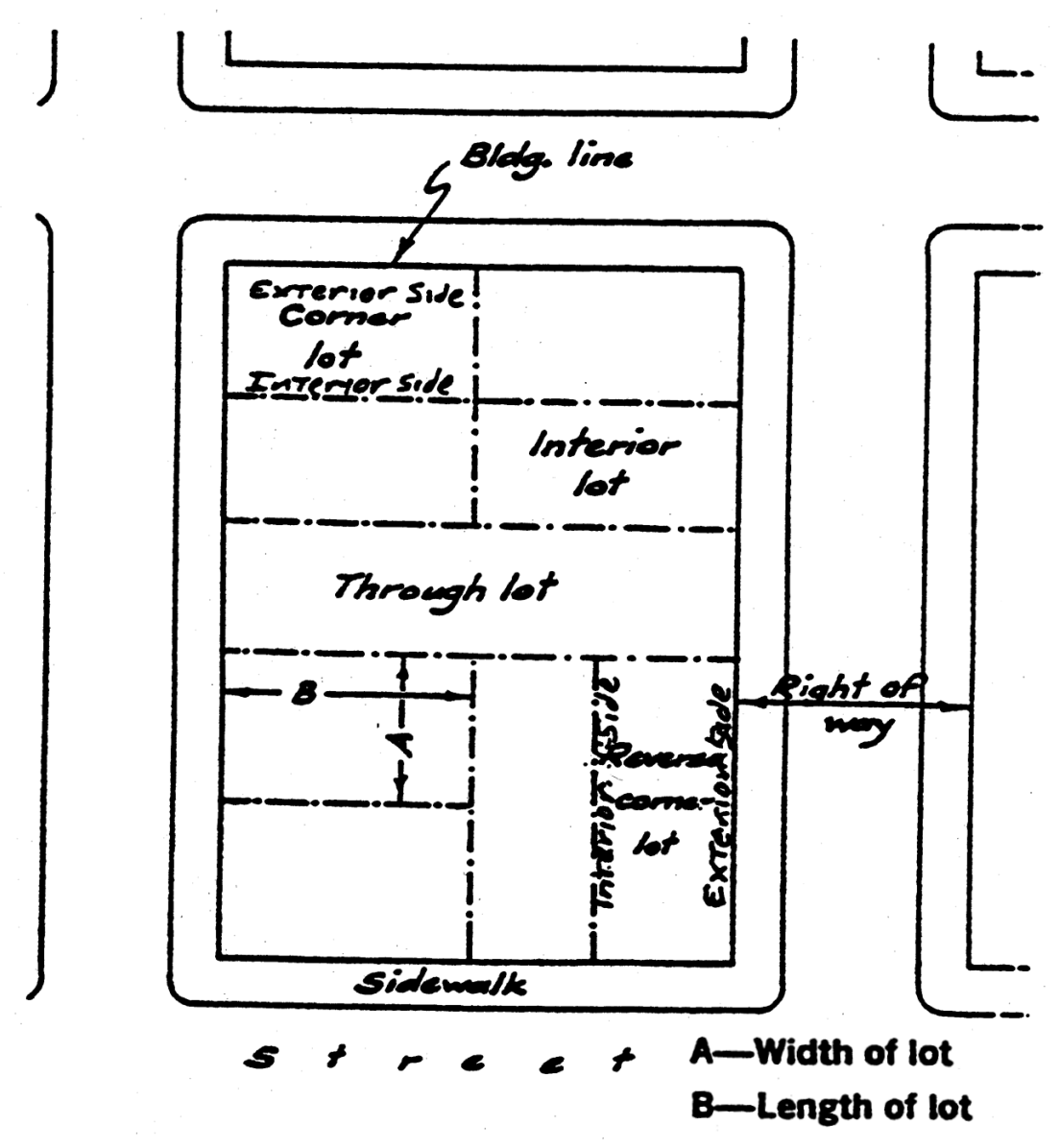
"Low barrier navigation center" means a housing first, low-barrier, service-enriched shelter focused on moving people into permanent housing that provides temporary living facilities while case managers connect individuals experiencing homelessness to income, public benefits, health services, shelter, and housing, as defined in Government Code Section 65660.
(Ord. 16.76 § 1 (part), 1989; Ord. No. 16.142, § 15, 12-4-2024)
17.04.160 - Definition of "M" terms.
"Medical clinic" means a structure for health care, other than a hospital, with or without emergency room facilities but without beds for overnight treatment.
"Ministorage (Miniwarehouse)" means a structure containing separate storage spaces of varying sizes which are leased or rented on an individual basis with direct access to paved driveways.
"Mixed use" means a development that contains both commercial (retail or office) uses and residential uses.
"Motel" means a structure or portion thereof or a group of attached or detached structures containing individual guest rooms or suites where lodging is provided primarily to transients for compensation. The term includes motel, inn, tourist court, bed and breakfast establishment or similar use.
Multifamily dwelling. See "Dwelling, multifamily" (Section 17.04.070).
"Multi-unit residential development" means a development project that creates two or more dwelling units, including detached single-family dwellings, townhomes, multifamily dwellings, and mixed-use residential projects.
(Ord. 16.76 § 1 (part), 1989; Ord. 16.123, § 7, 9-5-2007; Ord. No. 16.140, § 1, 11-15-2023)
17.04.170 - Definition of "N" terms.
"Net site area" is defined in the Hillside Residential Combining District Regulations (Chap. 17.40) to determine average slope. This term does not apply to other sections within the zoning ordinance.
"Nonconforming structure, lawful" means any structure or improvement that was lawfully established and in existence at the time the ordinance codified in this title, or any amendment thereto, became effective, but which, due to the application of this title or any amendment thereto, no longer complies with all of the applicable regulations and standards of the zoning district in which the use is located.
"Nonconforming use, lawful" means a use of a structure or land which was lawfully established and maintained prior to the adoption of the ordinance codified in this title but which, under this title, does not conform with the use regulations for the district in which it is located.
"Nursery" means a commercial use of land and/or greenhouses used to raise and sell trees, flowers, shrubs, plants and ancillary packaged horticultural products.
"Nursing home" means a structure used for the rooming or boarding of any aged or convalescent person or persons, whether ambulatory or nonambulatory, for which a license is required by a county, state or federal agency. The term "convalescent" is construed to include the mentally ill and the inebriate.
(Ord. 16.76 § 1 (part), 1989; Ord. 16.123, §§ 8, 9, 9-5-2007)
17.04.180 - Definition of "O" terms.
"Objective standards" means standards that involve no personal or subjective judgement by a public official and are uniformly verifiable by reference to an external and uniform benchmark or criterion available and knowable by both the development applicant or proponent and the public official prior to submittal.
"Offices, administrative or executive" means offices pertaining to the management of office operations or the direction of enterprises, but not including merchandising or sales offices.
"Offices, professional" means offices pertaining to the practice of the professions and arts, including but not limited to architecture, dentistry, engineering, law and medicine, but not including the sale of drugs or prescriptions, except as incidental to the primary use and where there is no external evidence of such incidental use.
"Off-street loading facilities" means a site or a portion of a site devoted to loading or unloading motor vehicles, trucks or tractor-trailers, including loading berths, aisles, access drives and landscaped areas.
"Off-street parking facilities" means a site or portion of a site devoted to the off-street parking of motor vehicles, including parking spaces, aisles, access drives and landscaped areas.
"On-site" means located on the lot(s) or parcel(s) that is (are) the subject of an application for development.
"Outdoor storage." Outdoor storage uses are prohibited in the C-S zone on Scotts Valley Drive and on all properties located on Scotts Valley Drive, no matter the zone. On all other properties zoned C-S, outdoor storage uses are conditional uses. Outdoor storage shall mean a space or place for storing items in the open air, not inside a completely enclosed building for a continuous period longer than twenty-four hours. A completely enclosed building is four or more walls with a roof but not a carport or porch. Items considered as outdoor storage shall include any of the following items, but not limited to, as determined by the community development director:
1.
Appliances and furniture which are clearly not intended for outdoor use on the property;
2.
Building materials that are not part of a current project under construction;
3.
Commercial vehicles;
4.
Contractor's storage yard;
5.
Inoperable vehicles;
6.
Junkyards, see existing definition in this Title;
7.
Machinery and equipment;
8.
Portable outdoor storage containers, roll-off bins, shipping cargo containers;
9.
Recreational vehicles;
10.
Trailers;
11.
Watercraft; and,
12.
Other similar items as determined by the community development director to be inconsistent with the purpose and objectives of the applicable zoning district.
Permitted outdoor storage uses may remain in place until their individual use permits expire, or in accordance with Chapter 17.48, Nonconforming Uses and Structures, of this Title. Unpermitted outdoor storage uses shall vacate the subject properties by July 1, 2016.
This definition shall not apply to:
13.
Auto rental businesses;
14.
Auto repair shops;
15.
Christmas tree sales;
16.
Construction sites with an active building permit for new development which involve storing construction materials that are intended to be used within sixty days on the subject property;
17.
Garden shops;
18.
Gasoline service stations;
19.
Merchandise associated with a retail or other permitted use which is displayed outdoors during the day and brought indoors at the end of the business day unless otherwise approved for merchandise to remain outdoors;
20.
Occasional sidewalk sales;
21.
Off-street parking and loading areas;
22.
Open-air markets;
23.
Outdoor garden shops;
24.
Outdoor theatrical activities;
25.
Sale of nursery products; and,
26.
Vehicle sales, in accordance with this Title.
(Ord. 16.76 § 1 (part), 1989; Ord. No. 16-133.3, § 1, 7-15-2015; Ord. No. 16.142, § 16, 12-4-2024)
17.04.190 - Definition of "P" terms.
"Parapet" means the extension of the main walls of a building above the roof level.
"Perennial stream" means a water channel in which water is present during all seasons of the year.
"Person" includes a natural person, joint venture, join stock company, partnership, association, club, company, corporation, business, trust, organization, or the manager, lessee, agent, servant, officer or employee of any of them.
"Personal service" means a use providing services of a personal convenience nature and not primarily for the sale of goods or merchandise, including repair shops, beauty shops and barber shops, repair and fitting of clothes and personal accessories, laundry and cleaning (where bulk cleaning and servicing is done elsewhere) and similar services.
"Planned unit development (PUD)" means a form of development usually characterized by a unified site design for a number of housing units, clustered buildings and the provision of common open space, density increases and a mix of building types and land uses.
"Planning director" means the Director of the Planning Department of the City of Scotts Valley or the designated representative. The term "planning director" and "community development director" are interchangeable and have the same meaning.
"Planning commission" means the Planning Commission of the City of Scotts Valley.
"Public uses" means publicly owned or operated facilities and spaces, including public streets, parking spaces, parks, public facilities and open spaces maintained or available for the public to use.
"Public utility service yard" means a site or portion of a site on which a public utility company may store, house and/or service equipment such as service trucks and other trucks and trailers, pumps, spools of wire, pipe conduits, transformers, cross arms, utility poles or any other material, tools or supplies necessary for the normal maintenance of utility facilities.
(Ord. 16.76 § 1 (part), 1989; Ord. 16-112 § 6, 2000; Ord. 16.123, § 10, 9-5-2007)
17.04.200 - Definition of "Q" terms.
"Quasi-public uses" means uses owned or operated by a nonprofit, religious or philanthropic institution and providing educational, cultural, recreational, religious or similar types of public programs.
(Ord. 16.76 § 1 (part), 1989)
17.04.210 - Definition of "R" terms.
"Recreation, commercial" means clubs or recreation facilities operated as a business which may or may not be open to the general public for a fee.
"Recreation, private" means clubs or recreation facilities of a noncommercial nature operated by a nonprofit organization and open only to bona fide members of such nonprofit organizations.
"Recreation, public" means publicly owned or operated clubs or recreation facilities.
"Research and development" means firms or businesses whose function includes information gathering, scholarly or scientific inquiry or investigation, medical research, high technology or the development of computer software.
"Rest home" means premises used for the housing of and caring for the ambulatory, aged or infirm, which premises require a license from the state or county (this includes a home for the aged).
"Restaurant" means any eating or drinking establishment having seating capacity which sells or offers for sale to the public any food or drink for immediate human consumption on the premises, including any coffeeshop, cafeteria, short-order cafe, luncheonette, tavern, bar, soda fountain, dining room, drive-in and/or drive-through facility.
"Retail service" means a use engaged in providing retail sale or rental of items primarily intended for consumer or household use, including but not limited to the following: groceries, meat, vegetables, dairy products, baked goods, candy and other food products; liquor and bottled goods; household cleaning and maintenance products; drugs; cards, stationery, notions, tobacco products, cosmetics and specialty items; flowers, plants and garden products; hobby materials; toys; handcrafted items; clothing, shoes, apparel, jewelry, fabrics and like items; cameras and photography equipment; household electronic equipment, computers, televisions, video and tape recorders and similar items; books, records and tapes; sporting equipment; furniture, furnishings, appliances, antiques, art objects, paint and wallpaper, floor coverings and lighting fixtures; office supplies; musical instruments; hardware and building supplies; and bicycles, mopeds and automotive parts and accessories.
(Ord. 16.76 § 1 (part), 1989; Ord. 16.123, § 11, 9-5-2007)
17.04.220 - Definition of "S" terms.
"Screening" shall mean a visual buffer consisting of wood, masonry, dense evergreen hedge, or other plant material, or a combination of these elements, or other material approved by the community development director, to reduce visual unsightliness of uses and/or items stored on the subject property.
"Second dwelling unit" means an additional dwelling unit which contains no greater than eight hundred square feet of living space, not including the garage, which shares a lot with a primary residence. The second unit is served by the same driveway access to the street as the existing main dwelling.
"Setback" means the distance between the existing or planned right-of-way line or property line and a building or any projection thereof, excluding uncovered steps.
"Single-room occupancy (SRO)" means a residential facility with single-room dwelling units where each dwelling unit is the primary residence of its occupants. An SRO unit may contain kitchen or bathroom facilities, but not both.
"Site" means any plot or parcel of land or combination of contiguous lots or parcels of land.
"Site area" means the total area (e.g., square feet, acres) included within the property lines of a site.
"Site coverage" means the percentage of site area covered by impervious surfaces, including all structures, open or enclosed or projections of structures.
"Spa" means a self-contained or non-self-contained hydro-massage pool or tub for recreation or therapeutic use, designed for immersion of users and usually having a filter, heater and motor-driven blower. It may be installed on the ground or on a supporting structure, or in the ground or in a supporting structure. A spa is intended for recreational bathing and contains water over twenty-four inches deep.
"Stable, private" means a detached building for the keeping of horses which are owned by the occupant(s) of the premises and not kept for remuneration, hire or sale.
"Stable, public" means a stable other than a private stable.
"Story" means that portion of a building included between the upper surface of any floor and the upper surface of the floor next above, except that the uppermost story shall be that portion of a building included between the upper surface of the uppermost floor and the ceiling or roof above.
"Street" means a public or private right-of-way which provides means of access to abutting property. The term "street" shall include avenue, drive, circle, road, parkway, boulevard, highway, thoroughfare or any other similar term (but not alley or lane, which terms are defined in Section 17.04.040).
"Structural alteration" means any change in the structural members of a building, such as walls, columns, beams or girders.
"Structure" means an object directly or indirectly fixed or attached to the ground which is built or constructed by man. A structure includes, but is not limited to, buildings, edifices, bridges, signs, fences, foundations, kiosks, arches, fountains, walls and building appendages such as marquees, awnings, canopies, decks, and lighting fixtures.
"Structure, accessory" means a detached structure, the use of which is subordinate and incidental to and customarily associated with, the primary structure or the primary use of the site and which is located on the same site as the primary structure or primary use. The term includes, but is not limited to detached garages or carports, cabanas, gazebos, arbors, sheds and buildings connected to a primary structure by a breeze way.
"Structure, primary" means a structure housing the primary use of a site or functioning as the primary use.
"Structure, principal" means a structure housing the principal use of a site or functioning as the principal use.
"Supportive housing" means housing with no limit on length of stay, that is occupied by the target population, and that is linked to onsite or offsite services that assist the supportive housing resident in retaining the housing, improving his or her health status, and maximizing his or her ability to live and, when possible, work in the community; as defined by Section 50675 of the California Health and Safety Code.
"Swimming pool" means any structure intended for swimming or recreational bathing that contains water over twenty-four inches deep. This includes in ground, above ground and on-ground swimming pools, and fixed-in-place wading pools. This definition does not include hot tubs or spas.
(Ord. 16.76 § 1 (part), 1989; Ord. 16.82 § 8, 1991; Ord. 16-112 § 7, 2000; Ord. No. 16-133.3, § 2, 7-15-2015; Ord. No. 16-138, § 2, 7-15-2015; Ord. No. 16.142, § 17, 12-4-2024)
17.04.230 - Definition of "T" terms.
"Target population" means adults with low-income having one or more disabilities, including mental illness, HIV or AIDS, substance abuse, or other chronic health conditions, or individuals eligible for services provided under the Lanterman Developmental Disabilities Services Act (Division 4.5 (commencing with Section 4500) of the Welfare and Institutions Code) and may, among other populations, include families with children, elderly persons, young adults aging out of the foster care system, individuals exiting from institutional settings, veterans, or homeless people; as defined in Section 50675.14 of the California Health and Safety Code.
"Temporary structure" means a structure without any foundation or footings and which is removed when the designated time period, activity or use for which the temporary structure was erected has ceased.
"Top of bank" means the edge of the floodway as depicted in Figure 17.04.230. Within the area formed by the edges of a floodway shall lie a stream channel and the portions of the adjacent hundred-year flood plain as required to efficiently carry the flood flows of the stream. This area includes areas A and B as shown on the diagram in Figure 17.04.230. This definition is not intended to be used to define a bank-to-bank easement or offer of dedication for open space and drainage or any other purpose in other ordinances of the city or other titles of this code. "Top of bank" is defined only for purposes of the zoning ordinance codified in this title.
Figure 17.04.230 Top of Bank Diagram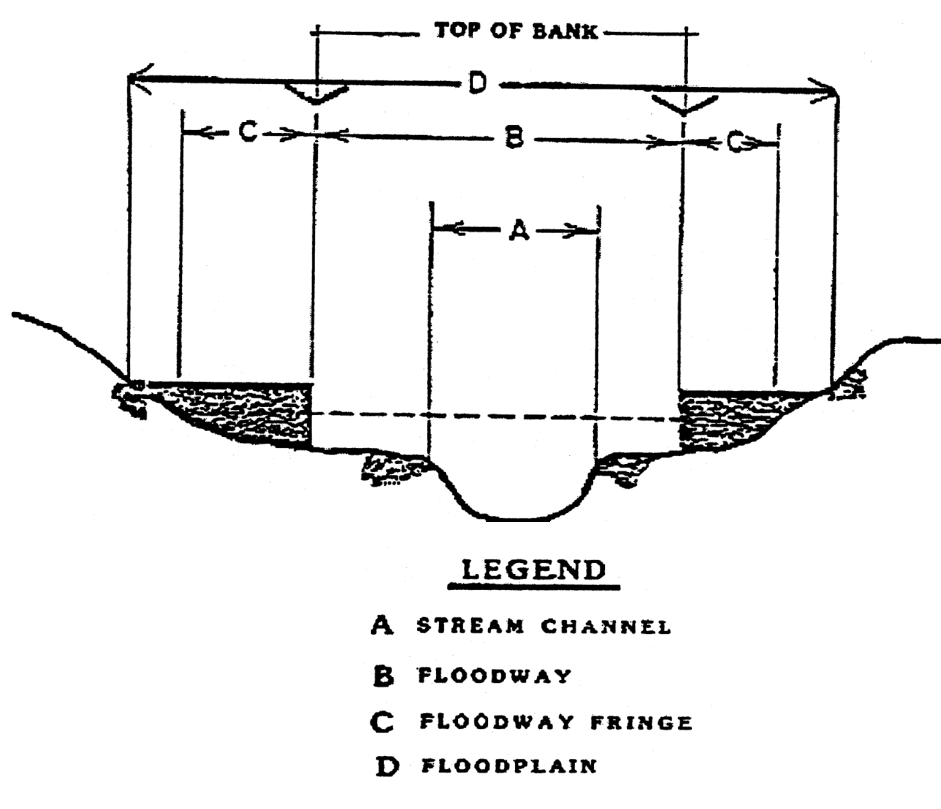
"Tot lot" means an improved and equipped play area for small children (usually up to elementary school age).
Townhouse. See "Dwelling, townhouse"
"Transitional housing" means temporary rental housing intended for occupancy by target populations transitioning to permanent housing that is operated under program requirements calling for the termination of assistance and recirculation of the assisted unit to another eligible program recipient at some predetermined future point in time, which shall be no less than six months as defined in Section 50675.2 of the California Health and Safety Code.
"Trellis" means a vertical structure or frame constructed of materials including but not limited to lattice work or other similar wood, metal or plastic embellishment used as a screen or as a support for climbing plants. See definition of Fence, open.
"Triplex" means a building that contains three dwelling units, each with its own exterior entrance. Each unit within a triplex provides complete, independent living facilities for one or more persons, including permanent provisions for living, sleeping, eating, cooking, and sanitation.
(Ord. 16.76 § 1 (part), 1989; Ord. 16.77 (part), 1989; Ord. 16-112 § 8, 2000; Ord. 16.123, § 12, 9-5-2007; Ord. No. 16-138, § 3, 7-15-2015; Ord. No. 16.142.1, § 6, 6-18-2025)
17.04.240 - Definition of "U" terms.
"Use" means the purpose for which a site or structure is arranged, designed, intended, constructed, erected, moved, altered or enlarged or for which either a site or structure(s) may be occupied or maintained.
"Use, accessory" means a use which is clearly incidental and secondary to the primary use and which does not change the character thereof. (See also "Structure, accessory," Section 17.04.220).
"Use, primary" means the main purpose for which a site is developed and occupied.
"Used car" means any vehicle used by a previous owner or traded in.
(Ord. 16.76 § 1 (part), 1989; Ord. No. 16.142, § 18, 12-4-2024)
17.04.250 - Definition of "V" terms.
Reserved.
(Ord. 16.76 § 1 (part), 1989)
17.04.260 - Definition of "W" terms.
Reserved.
(Ord. 16.76 § 1 (part), 1989)
17.04.270 - Definition of "X" terms.
Reserved.
(Ord. 16.76 § 1 (part), 1989)
17.04.280 - Definition of "Y" terms.
"Yard, front" means an open space extending the full width of the lot, measured between the portion of the building closest to the front lot line and said front lot line (except where the front lot line lies within a public or private right-of-way, in which case the measurement is between the portion of the building closest to the front lot line and the edge of the right-of-way closest thereto), measured perpendicularly to said front lot line, which open space is unoccupied and unobstructed from the ground upward, except as otherwise specified in this title (see Figure 17.04.280).
"Yard, rear" means an open space extending the full width of the lot between a building and the rear lot line, unoccupied and unobstructed from the ground upward, except as otherwise specified in this title (see Figure 17.04.280).
Figure 17.04.280 Setback Illustrations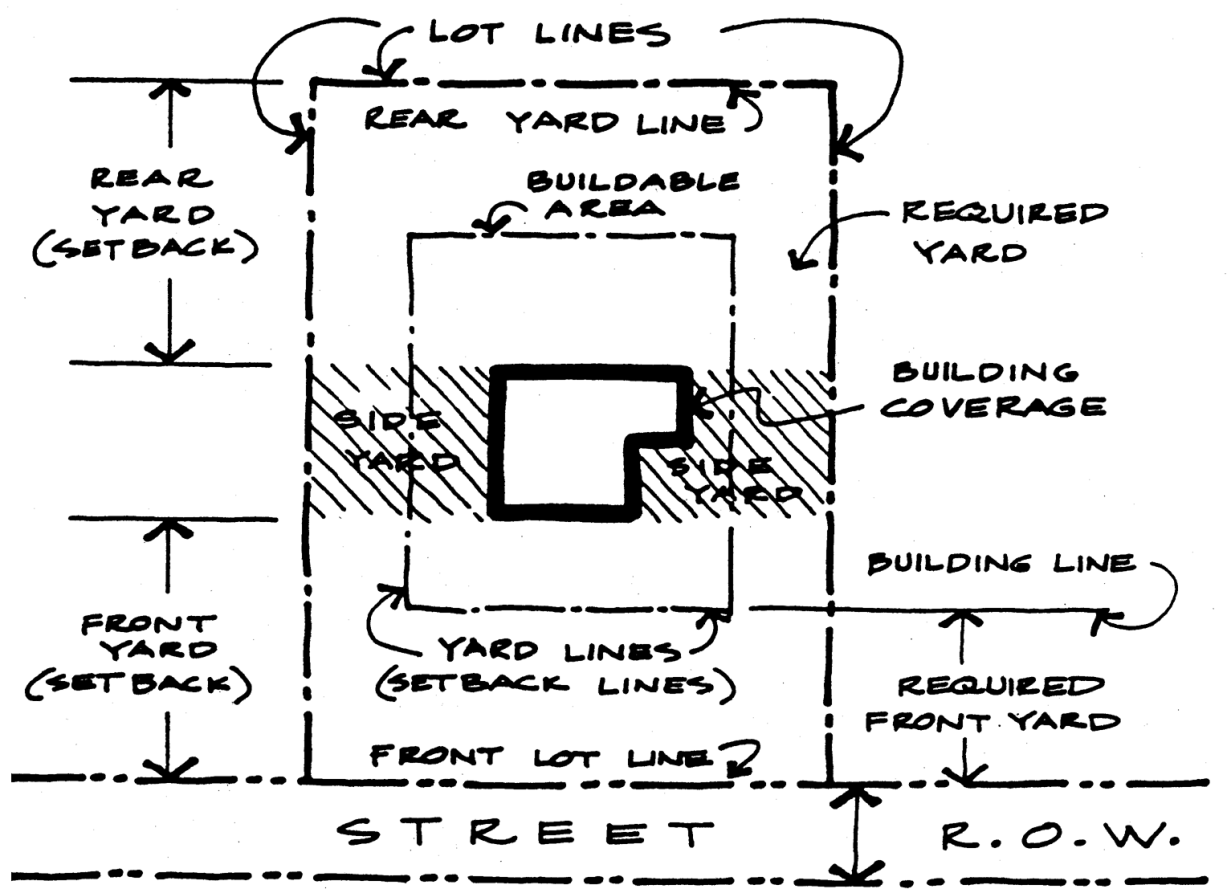
"Yard, side" means an open space extending from the rear boundary of the front yard to the front boundary of the rear yard (or to the rear lot line in the event there is no rear yard) between a building and nearest side lot line, unoccupied and unobstructed from the ground upward, except as otherwise specified in this title.
"Yard, side (exterior)" means a side yard which abuts a street (applies to corner lots) (see Figure 17.04.150).
"Yard, side (interior)" means a side yard which abuts an adjoining lot (see Figure 17.04.150).
(Ord. 16.76 § 1 (part), 1989)
17.04.290 - Definition of "Z" terms.
"Zone or zoning district" means a portion of the territory of the city within which certain uniform regulations and requirements or various combinations thereof, apply under the provisions of this title. Zone or zoning districts are shown on the official zoning map or maps referred to in Chapter 17.08.
"Zoning map" means the official zoning map or maps of the City of Scotts Valley, adopted by the city council and effective upon the effective date of the ordinance codified in this title, together with all amendments thereto hereafter made.
"Zoning permit" means a document signed by the building inspector, as required in this title, as a condition precedent to the commencement of a use or the erection, construction, reconstruction, restoration, alteration, conversion or installation of a structure or building which acknowledges that such use, structure or building complies with the provisions of this title.
(Ord. 16.76 § 1 (part), 1989)

