
Scotts Valley City Zoning Code
CHAPTER 17
44 - GENERAL AND SPECIAL PROVISIONS
17.44.020 - Commercial and industrial performance standards.
A.
Specific Purposes. The performance standards established in this section apply in all commercial and industrial zones. These standards are intended to assure that all commercial and industrial operations carried out in the city are conducted in such a manner so as to avoid any nuisance, hazard or commonly recognized offensive condition or characteristic adverse to the public health, safety and general welfare.
B.
Prohibition of Dangerous or Objectionable Elements. No land or building shall be used or occupied in any manner so as to create any dangerous, injurious, noxious or otherwise objectionable explosive or other hazard. Nor shall any use create noise or vibration, smoke, dust, odor or other form of air pollution; heat, cold or dampness; electrical or other disturbance; glare; liquid or solid refuse or wastes; or other substance, condition or element in such a manner or in such amount as to unreasonably adversely affect the surrounding area or adjoining premises.
C.
Performance Standards. The following performance standards shall apply to all uses of property in the commercial and industrial zoning districts specified in Chapters 17.20, 17.22, 17.24, 17.26 and 17.28 of this title.
1.
Fire and Explosive Hazards. All activities involving storage of flammable or explosive materials shall comply with applicable Uniform Fire Codes and Chapter 13.12 of this code.
2.
Radioactive or Electrical Disturbance. No activities shall be permitted which utilize fissionable or radioactive materials. Activities shall not be permitted which emit electrical disturbance affecting the operation of any equipment other than that of the creator of such disturbance.
3.
Noise. At the lot line of all uses specified in Chapters 17.20, 17.22, 17.24, 17.26 and 17.28 of this title, the maximum sound generated by any user shall not exceed seventy-five dbA when adjacent users are industrial or wholesale users. When adjacent to offices or retail, the sound level shall be limited to seventy dbA. When users are adjacent or contiguous to residential, park or institutional uses, the maximum sound level shall not exceed sixty dbA. Excluded from these standards are occasional noises which are specifically exempted under Section 5.17.030.
4.
Vibration. No vibration shall be permitted which is discernible without instruments at the lot line of the establishment or use.
5.
Smoke. No emission shall be permitted at any point, from any chimney or otherwise, of visible grey smoke of a shade equal to or darker than No. 2 on the Power's Micro Ringelmann Chart, published by McGraw-Hill, Inc.
6.
Odors, Flying Ash, Dust, Fumes, Vapors, Gases and Other Forms of Air Pollution. All uses shall conform with applicable standards established by the Association of Monterey Bay Area Governments (AMBAG), adopted herein by reference.
7.
Glare. No direct or sky-reflected glare, whether from floodlights or from high-temperature processes such as combustion or welding or otherwise, shall emanate from any establishment or use so as to be visible at a distance of five hundred feet from said establishment or use.
8.
Liquid or Solid Wastes. All liquid and solid waste discharge shall be in compliance with Chapter 13.04 of this code.
9.
Traffic. No use shall generate vehicular traffic which would cause an adjacent arterial or collector road to exceed a traffic-carrying capacity of Level of Service C without providing appropriate mitigation measures in the form of roadway improvements, traffic-control devices, restrictions on hours of operation or staggered work hours. Traffic-generating potential shall be determined by use of Caltrans trip-generation studies or other information acceptable to the director of public works. In the event an adjacent arterial or collector is already below Level of Service C, appropriate mitigations shall offset any significant impact on the traffic-carrying capacity of the road.
10.
Trash Collection and Other Service Areas. Trash containers and service loading docks should be conveniently located and sized but must not interfere with other circulation or parking on the site. Trash containers should be located away from public streets and store entrances and should be completely screened with materials similar to or compatible with buildings located on the same site, or as otherwise provided in the district regulations. If required as part of a discretionary permit process, all outdoor refuse collection areas shall be enclosed per city-approved standard details as illustrated in Figure 17.44.020 unless an enclosure is in use on June 1, 1996, which meets the approval of the disposal company servicing the business, does not violate health and safety, and has been previously approved by the city.
(Ord. 16.76 § 1 (part), 1989; Ord. 16.96 § 1, 1996; Ord. 174, § 3(part), 2-4-2004)
Figure 17.44.020 Standard Trash Enclosure*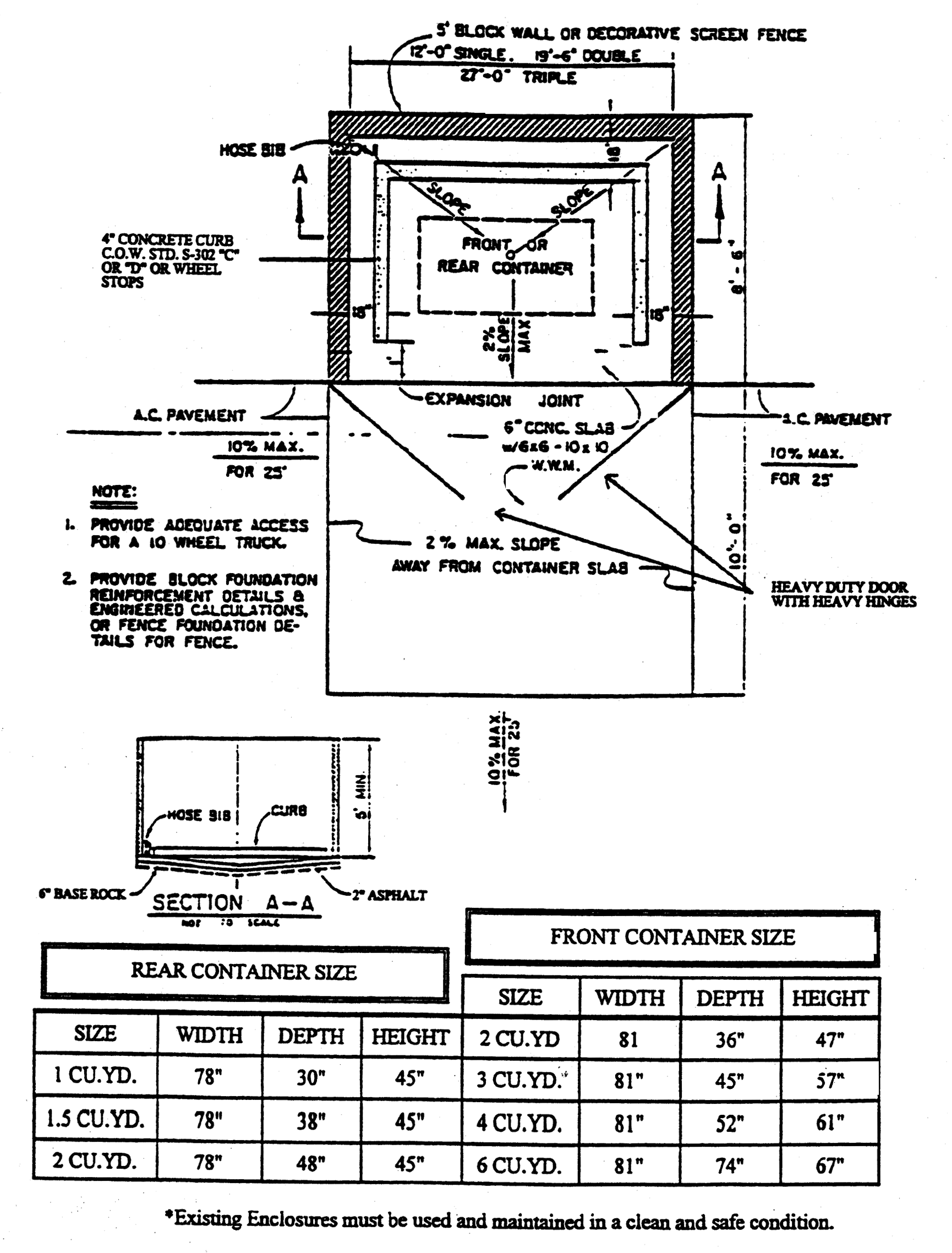
17.44.030 - Off-street parking and loading requirements.
A.
Purposes. These parking and loading requirements are intended to prevent traffic congestion and traffic hazards in the city and to add to the safety and convenience of its citizens by incorporating adequate, attractively designed and functional facilities for off-street parking as an integral part of every land use in the city. Off-street parking and loading facilities are required to be provided incidental to new land uses and major alterations and enlargements of existing land uses. The number of parking spaces and the number of loading areas prescribed in this section or to be prescribed by the planning commission shall be in proportion to the need for such facilities created by the particular type of land use. Off-street parking and loading areas are to be designed in a manner which will ensure their usefulness, protect the public safety and, where appropriate, insulate surrounding land uses from their impact.
B.
Definitions:
1.
Driveway" means a roadway or access way connecting a public or private street with the required parking space(s), dwelling or other structure of an individual parcel.
2.
Garage, Private. "Private garage" means an accessory structure or a portion of a primary structure designed for the storage of motor vehicles, boats or trailers, having permanent roof and designed to be enclosed on all sides. The minimum size of a private garage shall be twenty-two feet by twenty-two for two cars and twenty-two feet by twelve feet for one car.
3.
Garage, Public. "Public garage" means a structure or portion thereof, other than a private garage, used for the storage, sale, care, repair or refinishing of motor vehicles or trailers.
4.
"Off-street loading facilities" means a site or a portion of a site devoted to loading or unloading motor vehicles, trucks or tractor-trailers, including loading berths, aisles, access drives and landscaped areas.
5.
"Off-street parking facilities" means a site or portion of a site devoted to the off-street parking of motor vehicles, including parking spaces, aisles, access drives and landscaped areas.
6.
"Parking space" means an area reserved for parking a motor vehicle, trailer, mobile home, airplane or boat, while it is not in use. The area must be accessible from a driveway. The size of the area must be suitable for the vehicle served but not less than eight and one-half feet wide by eighteen feet long.
C.
Off-Street Parking Facilities Required.
1.
In all districts, for every use, parking shall be provided at the time of initial occupancy of a site. When structures in any district are reconstructed, enlarged, structurally altered, changed in occupancy to a more intensive use category or otherwise increased in capacity, such off-street parking facilities shall be provided only for that portion of the structure constituting the increase in capacity. The exception to this requirement is when the pre-existing number of parking spaces is greater than the number prescribed in this section, in which instance the number in excess of the prescribed minimum shall be counted in calculating the number provided to serve the major alteration or enlargement, as defined in subdivision 3 of this subsection.
2.
If, in the application of the requirements of this section, a fractional number is obtained, one parking space shall be provided for a fraction of one-half or more and no parking space shall be required for a fraction less than one-half.
3.
If more than one use is located on a site, the number of parking spaces required shall be equal to the sum of the requirements prescribed in this section for each use or major alteration or enlargement. For the purposes of this section, the term "major alteration or enlargement" means a change of use or an addition which would increase the number of parking spaces required by more than ten percent of the total number required. The number of parking spaces provided for a major alteration or enlargement of a site or structure shall be in addition to the number existing prior to the alteration, subject to subdivision 1 of this subsection, unless otherwise modified by the planning commission.
4.
The off-street parking facility requirements of this section shall be satisfied by the permanent allocation of the prescribed number of spaces for each use in a common parking facility; provided, that the total number of spaces shall not be less than the sum of the individual requirements and provided further, that an easement for parking facility is filed with the Santa Cruz County recorder prior to application for a building permit.
5.
In any commercial or industrial district, the off-street parking and loading regulations may be modified by the planning commission upon approval of a use permit if the site has a width of sixty feet or less and has existing structures on the site.
D.
Variances to Off-Street Parking Space Requirements. Notwithstanding the provisions of Section 17.50.010 of this title, a variance to the off-street parking requirements prescribed in this section may be granted for nonresidential developments in order that some or all of the required parking spaces be located off-site, including locations in other jurisdictions, or that in-lieu fees or facilities be provided instead of the required parking spaces, if both of the following conditions are met:
1.
The variance will be an incentive to and a benefit for the nonresidential development.
2.
The variance will facilitate access to the nonresidential development by patrons of public transit facilities, particularly guideway facilities.
E.
Use for Advertising Prohibited.
1.
No off-street parking or loading facility related to any commercial or industrial use in any zoning district shall be used for the stopping, standing or parking of any vehicle for the purpose of advertising or displaying such vehicle for sale.
2.
In residential districts, no off-street parking space, driveway or front yard shall be used for the stopping, standing or parking of any vehicle for the purpose of advertising or displaying such vehicle for sale; except, that the occupant of said property may park one vehicle owned by such occupant, displayed for sale and bearing a sign not exceeding two square feet in area restricted to the sale of the vehicle upon which it is posted.
F.
Schedule of Off-Street Parking Space Requirements.
If it can be shown that a use does not expect to utilize the required number of spaces and assurance is given by recorded instrument or by other means that the required number of spaces will be provided when the use or circumstances of occupancy change, then a conditional use permit may be granted by the planning commission, pursuant to Section 17.50.020 of this title, allowing for a reduction in the number of required parking spaces. The use permit shall be conditioned on the necessary number of spaces being provided when the use or circumstances of occupancy change and on the giving of a recorded instrument to that effect which shall be recorded at the Santa Cruz County recorder's office.
G.
Standards of Commercial Off-Street Parking Facilities. For further clarification of parking standards and requirements, please refer to Figures 17.44.030A and B. For existing parking lots which do not conform to the compact parking standards, see Section 17.48.080.
1.
Each full-sized parking space shall not be less than twenty feet in length and nine feet in width, exclusive of aisles and access drives. When the overhang is provided, the parking stall shall be seventeen feet, plus a three-foot overhang area, which shall be paved, rock lined, concrete or landscaped with low growing plants or ground covers. The overhang area shall be edged with continuous cubing of six inches in height. No light standards or fixed objects are allowed in this overhang area. A three-foot overhang and a four-foot-wide sidewalk is required if the parking space is adjacent to a building.
2.
Each compact parking space shall not be less than nine feet in width and sixteen feet in length, exclusive of aisles and access drives. When an overhang is provided, the parking stall shall be thirteen feet, plus a three footed paved, rock-lined, or concrete overhang area, which may be landscaped with low growing plants or ground covers. The overhang shall be edged with continuous cubing of six inches in height. No light standards or fixed objects are allowed in this overhang area. A three-foot overhang and a four-foot-wide sidewalk is required if the parking space is adjacent to a building.
3.
Entrances and exits to parking facilities shall be provided at locations approved by the city engineer.
4.
The parking area, aisles and access drives shall be treated so as to provide a durable, dustless surface and shall be so graded and drained as to dispose of surface water.
5.
Six-inch high concrete curbs, or other material approved by the city engineer, shall separate all paved and landscaped areas.
6.
Ten percent of the required parking area shall be landscaped; the landscaping shall be evenly distributed throughout the parking area and adjacent to buildings. Minimum planter width shall be five feet.
7.
Landscaped areas within or adjacent to the parking area shall provide for a minimum of one shade tree for every four parking stalls. Depending on the parking dimensions, layout type and size of shade tree, this requirement may be modified by the planning director.
8.
Concrete curbing shall be used as wheel stops. The use of bumper blocks is discouraged and can be approved only by the planning commission after findings of unusual circumstances which warrant their use.
9.
If the parking area is illuminated, lighting shall be deflected away from any abutting residential sites. Parking lot lighting should be low profile, with standards of anodized bronze aluminum or other material approved by the design review board.
10.
In any commercial or industrial district where a parking area is located across a street or alley from or immediately adjacent to, a residential district, a landscape strip not less than five feet in depth shall be planted and permanently maintained along the abutting property line of the parking area.
11.
Twenty percent of the spaces for off-street parking may be compact spaces. This section shall be applicable only if ten or more spaces are required.
12.
Each compact space shall be marked in accordance with the following standard: The word "COMPACT" shall be placed in a permanent manner on the pavement at the center of the entrance to each designated space. The letters shall be white in color and eight inches or more in height on the pavement.
13.
Handicapped parking spaces shall be provided as specified in state law.
14.
Parking lot design shall conform to the current edition of the American Association of State Highway and Transportation Officials (AASHTO) "Single Unit Demand Design Criteria" and to the current edition of the Transportation and Traffic Engineering Handbook (Institute of Transportation Engineers).
15.
All striping shall be a minimum of four inches in width. Signing and striping shall conform to state standards. All parking spaces in parking lots shall be striped.
H.
Parking Lot Design. Figures 17.44.030A and B provided in this section shall be used as guides in the development and arrangement of parking spaces and parking areas.
I.
Location of Off-Street Parking Facilities. In all residential and open-space districts, off-street parking facilities prescribed in this section shall be located on the same site as the use for which the spaces are required or on an adjoining site or a site separated only by an alley from the use for which the spaces are required.
Figure 17.44.030A Parking Stall Geometrics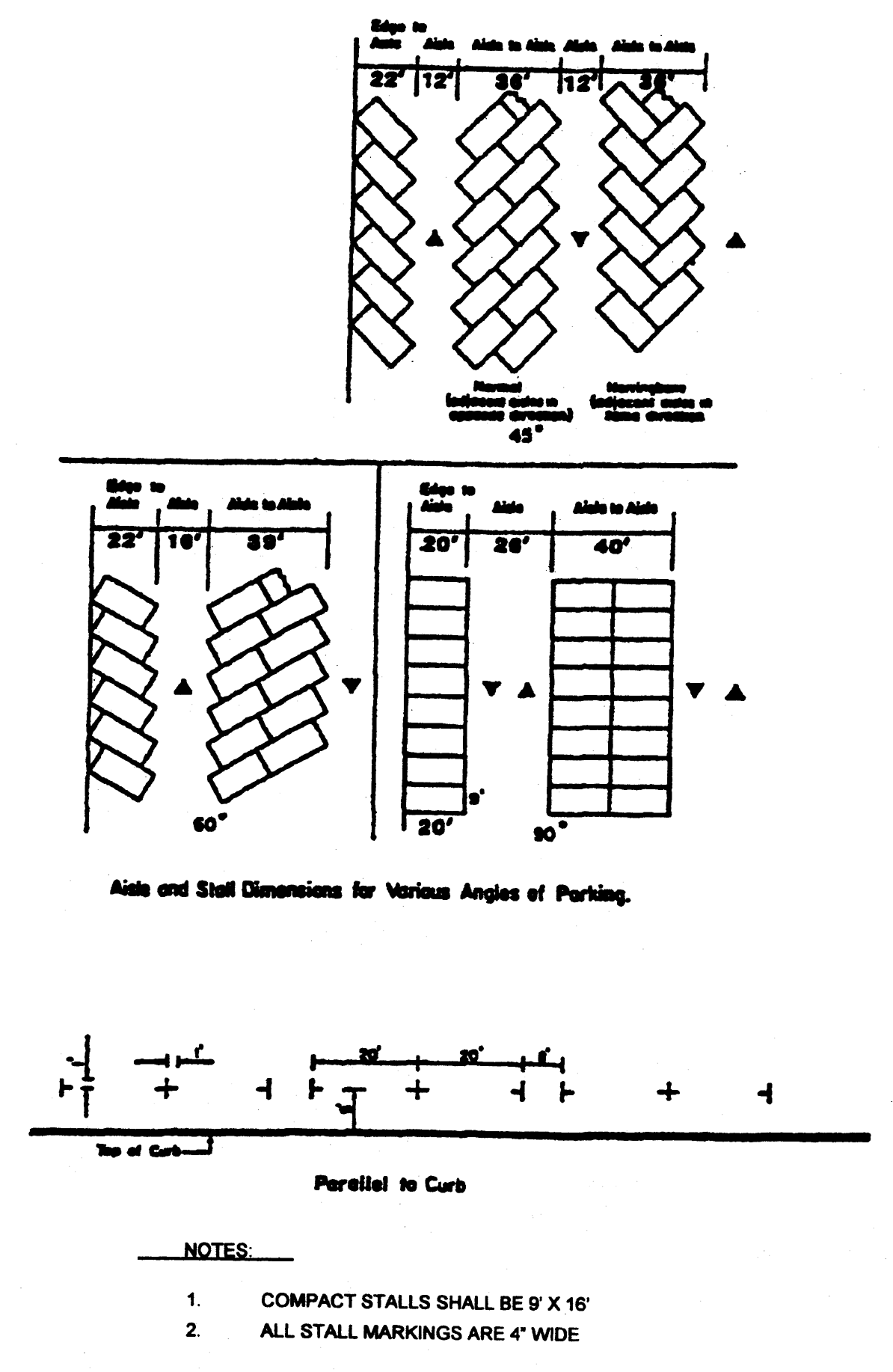
Figure 17.44.030B Parking Lot Layout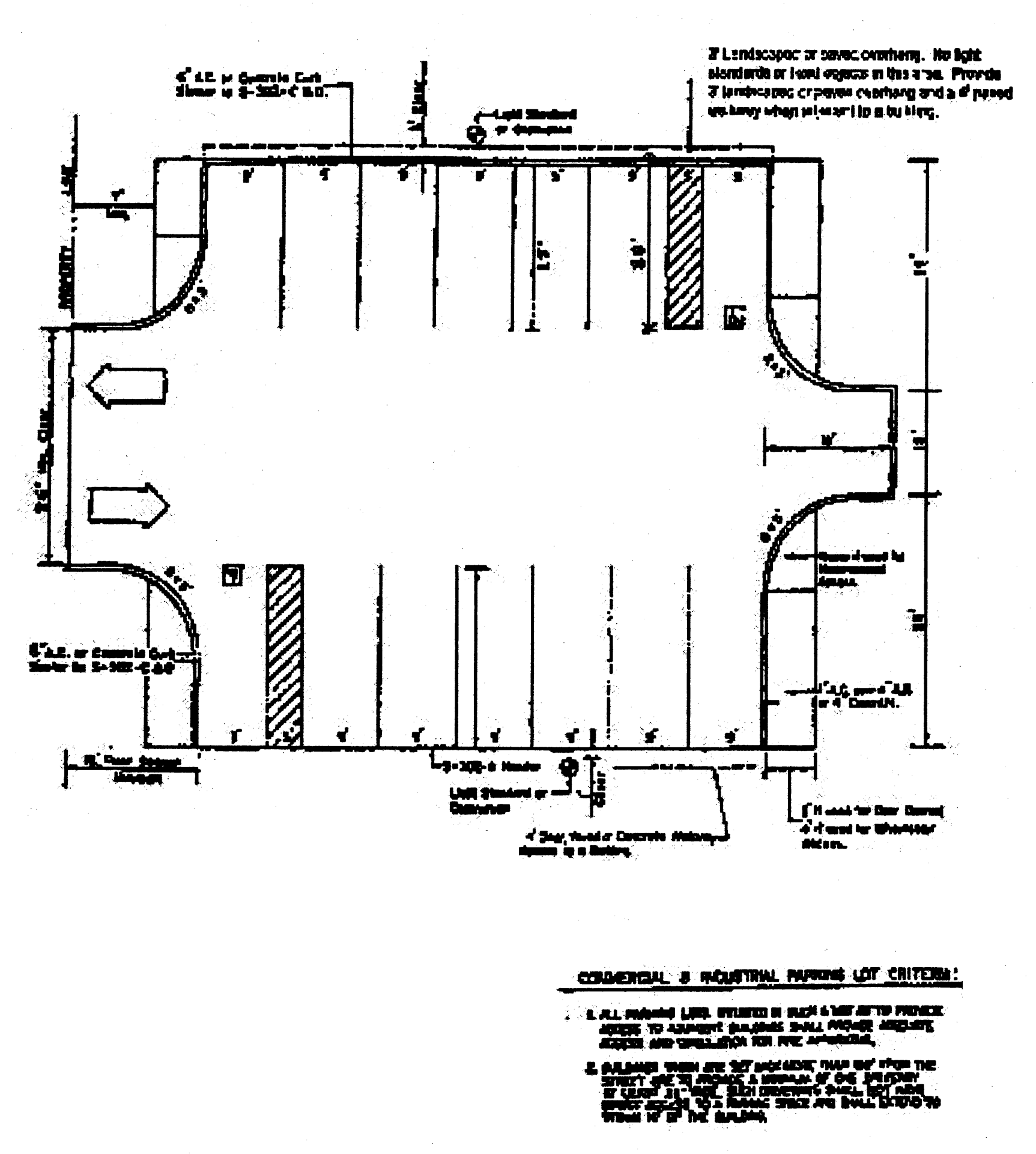
In all commercial and industrial districts where on-site location cannot be provided, off-street parking facilities prescribed in this section shall be located within three hundred feet of the use for which the spaces are required, measured by the shortest route of pedestrian access.
J.
Standards for Residential Parking Facilities.
1.
Parking of motor vehicles, trailers, campers, recreational vehicles, boats or airplanes in front yards of any lot or exterior side yards of corner lots, shall be restricted to driveways and parking spaces.
2.
Driveways and parking spaces in any residential zone district shall not proportionately occupy more than three hundred square feet per each ten feet of required setback.
3.
In any residential district, it is unlawful to park more than five motor vehicles, mobile homes, trailers, airplanes or boats or any combination thereof exceeding five, for a period of time in excess of twenty-four hours in front yards of any lots or exterior side yard of corner lots whether or not located in a required setback, when visible from a public or private street.
4.
One uncovered required parking space may be provided in a tandem arrangement for a single-family dwelling. A tandem space shall not obstruct access to more than one of the required spaces.
L.
Off-Street Loading Required.
1.
All multifamily dwellings containing fifty or more rental units shall provide one off-street loading space. Each such space shall be at least forty-five feet long and twelve feet wide, exclusive of necessary area for maneuvering, ingress and egress.
2.
All retail business uses, wholesale or warehouse establishments and industrial uses containing less than ten thousand square feet of gross floor area shall provide one off-street loading space. Each such space shall be at least thirty feet long and twelve feet wide, exclusive of necessary area for maneuvering, ingress and egress.
3.
All retail business uses, wholesale or warehouse establishments and industrial uses containing ten thousand or more square feet of gross floor area shall provide the number of off-street loading spaces specified below. Each such space shall be at least forty-five feet long and twelve feet wide, exclusive of necessary area for maneuvering, ingress and egress.
One additional space shall be required for each additional one hundred thousand square feet above three hundred thousand square feet of gross floor area.
M.
Standards for Off-Street Loading Facilities. Off-street loading facilities provided in compliance with subsection L of this section shall conform to the following standards:
1.
Each loading space shall be at least thirty feet long or forty-five feet long as provided in subsection L and twelve feet wide, exclusive of necessary area for maneuvering, ingress and egress.
2.
Sufficient distances for turning and maneuvering vehicles shall be provided on the site.
3.
Each loading area shall be accessible from a street or alley.
4.
Entrances and exits shall be provided at locations approved by the city engineer.
5.
The loading area, aisles and access drives shall be paved so as to provide a durable, dustless surface and shall be so graded and drained as to dispose of surface water.
6.
A loading area shall not be located in a required front or side yard, nor shall it be visible from a public street or private residential property from ground level adjacent to the site of the loading facility.
7.
Off-street loading facilities prescribed in Section 17.46.080 shall be located on the same site with the use for which the areas are required or on an adjoining site.
N.
Existing Uses. No existing use of land or structure shall be deemed to be a nonconforming use or a nonconforming structure solely because of the lack of off-street parking facilities or off-street loading facilities prescribed in this section, provided, that facilities being used for off-street parking and loading shall not be reduced in capacity to less than the number of spaces or loading areas prescribed in this section or reduced in area to less than the minimum standards prescribed in this section.
O.
Designation of Off-Street Parking and Loading. When off-street parking facilities or off-street loading facilities are provided, in compliance with the requirements of this section, on a site other than the site on which the use or structure to be served by the parking and loading facilities is located, an agreement shall be recorded in the Santa Cruz County recorder's office designating the off-street parking or the off-street loading and the use or structure to be served, with legal descriptions of both sites, and certifying that the off-street parking facility or the off-street loading facility shall not be used for any other purpose unless the restriction is removed by resolution of the planning commission. No building permit shall be issued until an attested copy of the recorded agreement has been filed with the building inspector. Upon submission of satisfactory evidence that other off-street parking facilities or off-street loading facilities have been provided in compliance with the requirements of this section, or that the use has ceased or the structure has been removed or altered so as no longer to require the off-street parking or off-street loading facility, the planning commission shall by resolution remove the restriction.
(Ord. 16.76 § 1 (part), 1989; Ord. 16.77 (part), 1989; Ord. 16.82 § 2, 1991; Ord. 16-113 § 4, 2002; Ord. 16.116, § 2, 3-4-2004; Ord. 16.123, §§ 51, 52, 9-5-2007; Ord. No. 16.142, § 57, 12-4-2024; Ord. No. 16.142.1, § 12, 6-18-2025)
17.44.040 - Prezoning of unincorporated territory.
The city may prezone unincorporated territory adjoining the city for the purpose of determining the zoning that will apply to such property in the event of subsequent annexation to the city. The method of accomplishing such prezoning shall be as provided by Chapter 17.52 of this title, for zoning within the city. Such zoning shall become effective at the same time that the annexation becomes effective.
(Ord. 16.76 § 1 (part), 1989)
17.44.050 - Underground utilities.
A.
Undergrounding of Utilities Required.
1.
All electrical transmission and/or distribution lines, communication lines and appurtenances, including all public utility systems and service facilities therefor, and also all telegraph and cable television (CATV) distribution or transmission facilities, shall be located and installed underground on all lands and zoning districts within the city, except as hereinafter specifically permitted.
2.
No person shall directly or indirectly erect, construct or fabricate any building or structure, or install any pole or poles, for the purpose of operating or maintaining any overhead electric transmission and/or distribution line or lines, and/or any overhead communication line or lines, or any appurtenant structure or part thereof, except as follows:
a.
Existing overhead electric and communication lines, poles and transformers destroyed by fire, flood, wind, falling trees or similar events may be replaced overhead.
b.
Temporary electric and communication lines, poles and transformers may be erected to serve construction projects or emergency situations for periods not to exceed six months, unless such time is extended by the chief building inspector.
c.
Overhead electric distribution lines, communication lines, poles and transformers may be replaced at the same location with facilities of greater capacity where such facilities are not already included in an existing conversion program adopted by the city.
d.
Pad-mounted transformers, service pedestals, meter cabinets, surface-mounted switches and concealed ducts may be installed, so long as they are used solely in connection with, and as appurtenances to, an underground distribution system or facilities.
e.
Poles supporting electric transmission lines, and the electric transmission lines supported by such poles, may be erected where the voltage carried by such lines is more than 34.5 kV.
f.
Poles supporting street lights and the electric lines within said poles may be erected.
3.
No use shall be made of any land, building or structure in the city, or in any zoning district or area thereof, for any electric transmission or distribution lines, or communication lines and appurtenances, except as set forth in this section.
B.
Exceptions. Variances to the regulations set forth in this section governing the undergrounding of public utilities may be granted by the planning commission in accordance with Section 17.50.010 of this title.
(Ord. 16.76 § 1 (part), 1989)
17.44.060 - Condominium conversions and condominiums.
A.
Intent. Residential condominiums provide for individual ownership of separate dwelling units which usually are proximate to one another. The area surrounding the dwelling units is a common area that is managed and maintained by the individual owners of dwelling units in accordance with the rules of an associated agreement. This mix of individual and common ownership is different from detached single-family residences and apartment house use; in single-family dwellings the dwelling is physically separate and the yard areas are under the more or less complete control of the owner; in conventional apartments there is an implied guarantee of continuous and effective management of the project. The occupant is not the owner of the unit and does not have the financial commitment or problems of use, maintenance or resale associated with ownership. The unique nature of condominium projects tends to magnify the effects associated with higher urban densities to the point where they may have deleterious effects upon the occupant, seller and buyer, who often do not appreciate the implications of condominium living and ownership; this may lead to conditions of mismanagement, neglect and blight that affect the public health, safety, welfare and economic prosperity of the larger community. To ensure that such problems are avoided in both the short and long term, it is the express intent of the city to treat such projects differently from other multiple-family dwelling developments of other structures which are not residential condominium projects. It is found that the implementation of this section requires adoption of special requirements contained in this section for new condominium developments and the conversion of existing community apartment projects to residential condominiums.
B.
Purpose. The purpose of this section is to:
1.
Establish requirements and procedures to be followed for the review and approval or disapproval of:
a.
New condominium project development, and
b.
The conversion of existing multiple-family rental housing to residential condominiums;
2.
Establish criteria for new condominium developments and condominium conversion projects by requiring conformance to the city's building code and other development standards set forth in this section;
3.
Ensure that the developer of the project provides adequate private outdoor living space, storage and parking space, open space and other amenities;
4.
Provide for planning, unforeseen change and compliance with the city's General Plan and housing element;
5.
Provide:
a.
A desirable balance of rental and ownership housing within the city, and
b.
A variety of individual choice of tenure, type, price and location of housing;
6.
Ensure that the project sponsor is attentive to the performance characteristics of the structure and mitigates such problems as vibration and noise transmission which may not be apparent to the buyer without living in the unit but which, if not adequately attenuated, may nevertheless render the living environment within the project insufferable and the transfer of unit ownership difficult;
7.
Ensure that the project sponsor uses contemporary and environmentally sensitive concepts of site planning and architectural design in the construction of a new condominium project and ensure that the project, once completed, maintains its integrity, not only to preserve the long-term financial commitment of the unit owner but to optimize the utilitarian and aesthetic qualities that make the project a viable home for the owner long into the future.
C.
Definitions. For the purposes of this section, certain words and phrases are defined and certain provisions shall be construed as set forth in this subsection unless it is apparent from their context that a different meaning is intended.
1.
"Association" means an organization composed of persons who own a condominium unit(s) or right of exclusive occupancy in a community apartment, and who are organized to operate and maintain common areas for condominiums.
2.
"Common area" means the area that is available to the common use of unit owners in an entire project, excepting the individual units therein.
3.
"Community apartment" means one residential unit within a community apartment project. For the purposes of this section "community apartment" means the same thing and shall be treated in the same manner as a unit as defined in subdivision 17 of this subsection.
4.
"Community apartment project," as defined in Section 11004 of the Business and Profession Code, means a development of real property in which an undivided interest in the land is coupled with the right of exclusive occupancy of a designated residential unit located thereon or therein. For the purposes of this title, "community apartment" means the same thing and shall be treated the same way as a residential condominium, as defined in subdivision 14 of this subsection.
5.
"Condominium" means an estate in real property consisting of an undivided interest in common in a portion of a parcel of real property, together with a separate interest in space in a residential building such as an apartment. A condominium may include, in addition, a separate interest in other portions of such real property.
6.
"Condominium documents" means the covenants, conditions and restrictions, the description of the project elements and any other documents establishing a plan for condominium ownership.
7.
"Conversion" means a change in the type of ownership of a parcel or parcels of real property, together with the existing attached structures, to that defined as a condominium development or a community apartment project regardless of the present or prior use of such land and structures and whether substantial improvements have been made or are to be made to such structures.
8.
"Covenants, conditions and restrictions" means a written declaration relating to the maintenance, operation, duties and responsibilities of the common owners of the project and may include, but is not limited to those restrictions provided for in Section 1355 of the California Civil Code and as such may hereafter be amended.
9.
"Developer" means the owner or subdivider of real property with a controlling proprietary interest in the proposed project.
10.
"Open space" means open space on the project (exclusive of the required front setback area) which is to be used exclusively for leisure and recreational purposes, for the use and enjoyment of occupants of units on the project and to which such occupants shall have the exclusive right of use and enjoyment. Accessory structures such as swimming pools, recreational buildings and landscaped areas may be included as open space.
11.
"Owner" means the owner of a residential condominium unit.
12.
"Project" means the entire parcel of real property divided or to be divided into condominiums, including all structures thereon.
13.
"Project elements" means condominium units which are to be conveyed, the areas and spaces which are to be assigned to such units and the common areas (including improvements) which are to be shared by the owners of all units.
14.
"Residential condominium" means a condominium for residential purposes.
15.
"Subdivision Map Act" means Division 2 of Title 7 of the California Government Code, commencing with Section 66410 et seq. and as may hereafter be amended.
16.
"Subdivision ordinances" means those ordinances contained in Title 16 of this code and as may hereafter be amended.
17.
"Unit" means the element of a residential condominium project which is not owned in common with the owners of other condominiums in the project or is an apartment in a community apartment project to which an owner of an undivided interest in common in a community apartment project has a right of exclusive occupancy.
D.
General Provisions. The following provisions shall apply to all condominium developments:
1.
A condominium development may be located in any zoning district upon the granting of a use permit in accordance with the provisions of this section and Section 17.50.020 of this title.
2.
A condominium development shall include only uses which are either permitted or conditional uses in the zoning district in which the development is located.
3.
In residential condominium developments, the density may not exceed the density prescribed for the zoning district in which the development is located.
E.
Use Permit Application Required. The developer of a new condominium project or a developer who desires to convert an existing multiple-family rental housing or a nonresidential structure to a residential condominium shall first submit an application for a use permit to the planning department. The application shall include, but not be limited to, the following:
1.
Written authorization from all owners of parcels within the boundaries of the development;
2.
A complete legal description of the property, including a delineation of the project boundary and a tabulation of gross and net land area, including a title report. The project boundary map should show the existing topography of the site and the location of all existing easements, structures and other improvements. Significant surface features within the development area, including but not limited to natural ground cover, trees more than six inches in diameter (trunk diameter, variety and size), water courses, rock outcroppings and soil cover, should be included in the description. In addition, the description should include the proposed circulation system, showing the location of all streets (public and private), pedestrian pathways and other circulation facilities;
3.
A detailed grading plan, including a transverse and longitudinal section showing natural and proposed grades, including all cut-and-fill slopes and the location of retaining walls, and methods of erosion control;
4.
Proposed land uses, including building locations and types, floor plans, number of units, building elevations (all sides), open space, recreation area, off-street parking, loading and service areas, a conceptual landscaping plan for the project as a whole, a lighting plan, the approximate number and characteristics of the population anticipated and the relationship of the project to surrounding land uses;
5.
A data table showing how the project compares to the minimum standard for the residential district in which it would be located;
6.
Typical detailed sections of the types of wall, floor and ceiling construction that would be used in both common and interior partition walls within the condominium project, including either published data from a recognized and approved testing laboratory or a statement from a licensed acoustical engineer or the city building official as to sound transmission control ("STC," as defined in Chapter 35 of the Uniform Building Code);
7.
A statement of special or unusual seismic, soil or geologic conditions within the development area, if applicable;
8.
A development schedule indicating anticipated dates of construction, including any proposed project phasing;
9.
Any additional information as required by the planning director or planning commission.
F.
Modification of Requirements. Recognizing that the conversion of existing multiple-family residential structures to condominium usage presents unique problems with respect to the requirements of this section, the planning commission is empowered to vary any and all requirements contained herein, provided, that said modifications are consistent with the public health, safety and welfare and will not contravene the purposes and intent of this section. Project characteristics of critical importance in making this determination are the structure(s) and the degree to which the proposal varies from the required standards for the following: parking, private open space, storage space, sound transmission characteristics, fire protection and development criteria.
The planning commission is also empowered to impose conditions on any approval which would require that specified changes designed to bring a structure into compliance with the condominium development standards contained herein be made to the structure proposed for conversion.
Requirement for subdivision application for construction or conversion of a condominium project shall be accompanied by a tentative map application pursuant to Title 16 of this code, unless waived pursuant to Government Code Section 66428.
G.
Development Standards. The following development standards shall apply to all condominium development unless otherwise modified by the planning commission:
1.
Parking: All condominium developments shall conform to the parking requirements of this title.
2.
Open space: Each unit within the project shall have an appurtenant private patio, deck, balcony, atrium or solarium with a minimum area of one hundred square feet. Such space shall be designed for the sole enjoyment of the unit owner, shall have at least two weatherproofed electrical convenience outlets and shall have a shape and size that would allow for optimum usable space. Such space shall be at the same level as and immediately accessible from, a room within the unit. The planning commission may allow variations from the above dimensional standards where it can be shown that the required private open space meets the intent and purpose of this section.
3.
Storage space: In addition to guest, linen, food pantry and clothes closets customarily provided, each unit within the project shall have at least two hundred cubic feet of enclosed, weatherproofed and lockable private storage space. The location and design of such space shall be approved by the planning commission and shall not be divided into two or more locations. If such space is located within a common area within the project, the association shall be responsible for the care and maintenance of the exterior surface of the space in order to assure that the surface is maintained in a manner compatible with the architectural treatment of the project.
4.
Sound transmission: All permanent mechanical equipment such as motors, compressors, pumps and compactors which is determined by the building official to be a source of structural vibration or structure-borne noise shall be shock mounted with inertia blocks or bases and/or vibration isolators in a manner approved by the building official. Common walls and floors between units shall comply with the city's ordinances governing noise resistance for newly constructed common walls and floors.
5.
Fire prevention: Every dwelling unit shall be provided with a smoke detector conforming to Uniform Building Code standards. The detector shall be mounted on the ceiling or wall at a point centrally located in the corridor or area giving access to rooms used for sleeping purposes. Where sleeping rooms are on an upper level, the detector shall be placed at the center of the ceiling directly above the stairway. All detectors shall be located within twelve inches of the ceiling. When activated, the detector shall provide an alarm in the dwelling unit. Draft stops shall be placed in all attics that are determined to be accessible by the building official.
6.
Condition of equipment and appliances: Regarding conversion, the developer shall provide a one-year warranty to the buyer of each unit at the close of escrow on any dishwashers, garbage disposals, stoves, refrigerators, hot water tanks and air conditioners that are provided. At such time as the homeowners' association takes over management of the development, the developer shall provide a one-year warranty to the association that any pool and pool equipment and any appliances and mechanical equipment to be owned in common by the association are in operable working condition.
7.
Condition of paved areas: Regarding conversion, the developer will make any repairs needed so that the public works department can determine that any paved areas are in satisfactory condition.
8.
Condominium development criteria: The following criteria shall be considered in reviewing the overall design and site layout of the project:
a.
The project should have a comprehensive and integrated design, providing its own open space, off-street parking and amenities for contemporary living. Insofar as the scale of the project allows, open space, walkways and other areas for people should be separated from parking areas, driveways and areas for automobiles.
b.
Architectural unity and harmony should be achieved both within the project and between the project and the surrounding community so that it does not constitute an adverse disruption to the established fabric of the community.
c.
The layout of structures and other facilities should minimize street, driveway, curb cut, utility and other public or quasi-public improvements. Additionally, structures should be designed to minimize, within the context of accepted architectural practice, the consumption of natural resources, either directly or indirectly, e.g., gas, water and electricity.
9.
Other facilities: Consideration shall be given by the planning commission to the inclusion of the following facilities in the project:
a.
A laundry area shall be provided in each unit or if common laundry facilities are provided, then such facilities shall be subject to the review of the planning commission as to their adequacy.
b.
In addition to any other parking requirements, at least one space per five units shall be provided for the enclosed storage of recreational vehicles and boats in new construction only. If the requirement cannot be met, a provision shall be placed in the covenants, conditions and restrictions (CC&Rs) precluding the parking of recreational vehicles and boats on the site. Such parking area shall be enclosed.
H.
Approval of Tentative and Final Map. Pursuant to Section 66427 of the Government Code, the city council or planning commission shall not refuse approval of the tentative or final map of a condominium conversion project because of design or location of the buildings shown on the map or plan which are in conformance with the provisions of this section, or because of the manner in which the airspace is to be divided in conveying units within the condominium.
I.
Approval of Declaration of Covenants, Conditions and Restrictions (CC&Rs) and Project Elements. To achieve the purpose of this section, the planning commission shall require that a declaration of covenants, conditions and restrictions (CC&Rs) and project elements relating to the management of the common area and facilities be approved by the planning department and city attorney prior to the approval of the final map. In addition to such covenants, conditions and restrictions that may be required by the Department of Real Estate of the State of California pursuant to Section 1350, et seq. of the California Civil Code or other state laws or policies, such declaration shall be subject to recording and shall provide for the following, none of which, when approved by the planning department or city attorney, shall be amended, modified or changed without first obtaining the written consent of the planning department and city attorney and all of which shall contain a statement to that effect.
1.
Conveyance of private open space: The surface area and appurtenant airspace of private open-space areas, including but not limited to the private patio, deck, balcony, solarium or atrium required by this section, and any integral portion of that space that may exceed the minimum area requirements, shall be described and conveyed in the grant deed as an integral part of the unit.
2.
Conveyance of private storage areas: The surface and appurtenant airspace of private storage spaces required by this section shall be described and conveyed in the deed as an integral part of the unit.
3.
Assignment of off-street parking: Required off-street parking spaces shall be permanently, irrevocably and specifically assigned to particular units within the project on the basis of the parking spaces required per unit pursuant to Section 17.44.030 of this chapter. To the maximum practicable extent, the spaces assigned to each unit shall be contiguous. In no case shall the private storage area of one unit overhang or take its access from the required off-street parking space of another unit. All studio and one-bedroom units shall be assigned one parking space and may rent additional spaces from the association as available. All occupants of a unit with two or more bedrooms may rent one parking space back to the association. All parking spaces, except those specifically designated for parking recreational vehicles, shall be used solely for the purpose of parking motor vehicles and shall not be used for trailers, unmounted campers or similar recreational vehicles.
4.
Right of public entry to common area: Officers, agents and employees of the city, the county, the state and the Government of the United States and any department, bureau or agency thereof, shall have the right of immediate access to all common areas of the project at all times for the purpose of preserving the public health, safety and welfare, except in those instances where a common area is accessible only through a private unit.
5.
Maintenance of common areas: In order to protect the public health, safety and welfare, provision shall be made for annual assessments for capital improvements. The amount of the regular annual assessment and the procedure for its change shall be specified. The manner in which special assessments may be levied for the construction, reconstruction, repair or replacement of a capital improvement upon the common area shall be specified. Both annual and special assessments may be collected on a monthly basis. The remedies which the association may bring for the nonpayment of assessments shall be specified and may include penalties for late payment.
6.
Utility easements over private streets and other areas: If the condominium project contains private streets, paths or roadways, provision shall be made for public utility easements over the entire private street, path or roadway network. The planning commission may also require public utility easements adjacent to public streets or over other portions of the project to accommodate fire hydrants, water meters, street furniture, storm drainage, sanitary sewers, water and gas mains, electrical lines and similar public improvements and utilities. The planning commission may also require access routes necessary to assure that fire-fighting equipment can reach and operate efficiently in all areas of the project.
7.
Access for construction, maintenance or repairs: Each owner and the association shall have an easement for entry upon any privately owned unit, where necessary, in connection with construction, maintenance or repair for the benefit of the common area or the owners of the units in common.
8.
Contract termination right: Unless otherwise prohibited by law or any local, state or federal regulation, the association shall have the right to terminate the contract of any person or organization engaged by the developer to perform management or maintenance duties three months after the association assumes control of the project, or at that time to renegotiate any such contracts.
9.
Provision for equity in sales: The conditions, covenants and restrictions (CC&Rs) shall contain a provision that the sale of any unit shall not be prevented because of the age, sex or family composition of any potential buyer.
J.
Additional Requirements. In addition to the requirements for a major subdivision, the application for the subdivision of existing multiple-family rental housing as a condominium conversion shall be subject to the additional requirements set forth in subsections K through O of this section.
K.
Code Inspection, Compliance and Disclosure. All units to be under separate ownership or lease after conversion shall be inspected by the city prior to city approval of the final map. Separate ownership shall mean a condominium unit where the entire fee is in one entity, whether individually, in joint tenancy or as tenants in common. All units shall be brought into compliance with the Uniform Building Code effective at the time the units were first constructed. A form containing pertinent information regarding the project, including age and physical and spatial amenities within and in proximity to the condominium complex, shall be filed with and approved by the planning director and shall be provided to prospective condominium buyers.
L.
Utilities. All units to be subdivided shall be provided with separate gas and electric meters and provision shall be made for individual shutoff valves. All units shall also be provided with separate water meters and shutoff valves or with separate shutoff valves for all fixtures in each unit. If it is not possible to have separate water meters, provision shall be made for the equitable sharing of water costs.
M.
Public Report Application. A copy of the proposed application submitted by the applicant to the Department of Real Estate of the state for a subdivision public report on the current forms required by the Department of Real Estate shall be submitted to the city planning department, together with the submittal of the tentative map. Such application need not contain exhibits regarding the availability of utility services or the organizational documents of the project. However, the application for the final subdivision map shall include a full and complete copy of all information submitted to the department of real estate by the applicant.
N.
Notification to Tenants.
1.
Developers of condominium conversions shall submit to the planning department the following:
a.
With the use permit application, a list of the names and addresses of the residents of each unit in the conversion project, certified as to accuracy by the developer as of the date of the application. The developer shall immediately notify the city of any change in the names or addresses on the list as they occur;
b.
Prior to filing a tentative subdivision map, certification that all notices required to be given to and received prior to the filing of such map have been given in the manner and within the time limits specified or referenced in Government Code Section 66427.1 and all other notification requirements of the Subdivision Map Act as amended from time to time.
c.
Prior to approval of a final subdivision map, certification that all notices specified or referenced in Government Code Section 66427.1 in connection with approval of such map have been given to the persons in the manner and within the time limits specified or referenced therein.
2.
The city shall provide notification of the public hearing before the planning commission on the use permit and subdivision applications to the tenants of the units in the conversion project pursuant to Section 17.50.090 of this title, as well as to all other persons therein prescribed.
3.
A copy of the written staff report shall be delivered to the subdivider and to each tenant of the subject property at least three days prior to any hearing on the tentative map.
O.
Tenant's Right To Purchase.
1.
As provided in Government Code Section 66459, each tenant shall receive a nontransferable right of first refusal to purchase the unit.
2.
The right of first refusal shall extend for ninety days from the date of issuance of the subdivision public report or the beginning of sales, whichever is later.
P.
Tenant Relocation Assistance.
1.
Relocation and Assistance Plan.
a.
The subdivider shall submit a tenant relocation and assistance plan with the use permit and tentative map or tentative parcel map application for the condominium conversion.
b.
The plan shall include the information consistent with the State of California Relocation Assistance Act (Government Code Sections 7260—7277) and the Federal Uniform Relocation Assistance and Real Property Policies for Federal and Federally Assisted Programs Act (United States Code Title 42, Chapter 61) as well as those additional provisions in Subparagraphs 2 to 5 below.
2.
Rent Freeze.
a.
Upon notification of intent to convert, the then-current rents shall remain in effect for up to twelve months or until the conversion process has been completed or terminated.
b.
If approval of the tentative map or tentative parcel map is still pending at the end of twelve months, the freeze shall apply for another twelve months, allowing for an increase based on the rental component of the consumer price index.
c.
During such period as any rent freeze is in effect, thirty-day eviction notices shall be issued only where a clear breach of the rental agreement exists.
3.
Moving Allowance.
a.
Persons who are tenants at the time of the initial notice to convert the project shall be offered a minimum moving allowance of two times the monthly rent in effect at the time the tenant elects to move.
b.
Such allowance shall be payable only after city approval of the use permit and tentative map or tentative parcel map. Payment to the tenant shall be within fourteen days after the tenant vacates the premises.
4.
Extended Leases. Tenants who have been displaced from previous conversions of apartments to condominiums in Scotts Valley during the last five years shall be offered a three-year lease from the date of the initial offering of units for sale to the public.
5.
Other Tenant Situations. Any non-purchasing tenant who is disabled or has minor children in school or is age sixty-two or older, living in any unit prior to the time a completed use permit and tentative map or tentative parcel map application has been accepted as complete by the city shall be given at least six months in which to find suitable replacement housing.
Q.
Pest Infestation and Dry Rot Report. The developer shall, prior to approval of the final map, submit to the planning department a copy of the structural pest infestation and dry rot report for all buildings within the proposed project. This report shall be made available to all prospective buyers by the developer.
Any and all actual structural damage shall be repaired or financial provision made for appropriate repair within a specific time period, prior to the approval of final map or properly bonded under the Subdivision Map Act.
R.
Effect On Housing Stock. In reviewing requests for conversion of existing apartment buildings to condominiums, the city shall consider the following:
1.
Whether the amount and impact of the displacement of tenants would be detrimental to the health, safety or general welfare of the community;
2.
The role that the apartment structure plays in the existing rental housing market;
3.
The effect of the conversion on the need and demand for low-cost housing (both rental and ownership housing).
In no case shall apartment conversions be allowed if the rental vacancy rate is below four percent, as determined by the planning department.
S.
Advertising. The developer shall make no advertising use of any city approval of use, subdivision or occupancy for the project.
T.
Required Findings. Pursuant to Government Code Section 66427.1 as it presently exists or may hereafter be amended, approval of the final map of a conversion of residential real property to a condominium project shall be withheld unless the city council makes all findings required by that section and further finds that:
1.
The proposed conversion will not have an adverse effect on the diversity of housing types available in the city.
2.
The proposed conversion will not displace a significant percentage of tenants and deplete low-income and moderate-income rental units from the city's housing stock at a time when no equivalent condominium housing is readily available in the city.
3.
The proposed conversion would not be detrimental to the health, safety or general welfare of the community and is consistent with the city's General Plan, particularly the housing element.
4.
The overall design and construction of the development meets the standards outlined herein.
U.
Appeals. Any person who is dissatisfied with any decision made by the planning commission may appeal the same in accordance with the procedures established in Section 17.50.060 of this title.
(Ord. 16.76 § 1 (part), 1989; Ord. 16.82 § 3, 1991; Ord. No. 16.142, § 58, 12-4-2024; Ord. No. 16.142.1, §§ 13, 14, 6-18-2025)
17.44.070 - Mobile home park conversion regulations.
A.
Purpose and Findings. The city council finds, determines and declares that:
1.
Chapter 9.16 (Mobile Home Park Rent Stabilization) of this code was enacted to protect the owners of mobile homes who reside in mobile home parks from unreasonable and excessive space rent increases and/or assessments, while at the same time providing owners of mobile home parks with a just and reasonable return on their investment. The findings, determinations and declarations contained in Chapter 9.16 are incorporated herein and made a part of this section.
2.
This section is intended as the logical extension of the purpose and findings contained in Chapter 9.16 in that the unrestricted conversion of such mobile home parks to other uses can further diminish the availability of mobile home parks and space rentals, can interfere with existing tenants' quiet enjoyment of their mobile homes and can subject such tenants to the costs and inconvenience of relocation.
3.
The protection of mobile home park stock, mobile home residents and potential purchasers of mobile homes warrants the implementation of the safeguards contained in this section. Such safeguards are permissible pursuant to California Government Code Sections 65863.7 and 66427.4 and California Civil Code Section 798.56(f).
B.
Definitions. For the purposes of this section, the following words are defined as follows:
1.
"Conversion" means the change in use from a mobile home park to any other use (including, without limitation, those uses described in California Civil Code Section 798.10) or the closure of a mobile home park or the cessation of the use of the land as a mobile home park.
2.
"Owner" means the owner, lessor or designated agent of a park.
3.
"Park" means a mobile home park which rents spaces for mobile home dwelling units.
4.
"Reasonable costs of relocation" means the costs involved in the relocation of each resident from a mobile home park which is being converted pursuant to this section.
5.
"Resident" means the owner of a mobile home dwelling unit who is renting space from the owner of a park.
C.
Applications for Mobile Home Park Conversions.
1.
The use of property as a mobile home park shall not be changed for the purpose of conversion to any other land use until application for a mobile home park conversion has been approved by the planning commission or by the city council following an appeal.
2.
No building permit shall be issued on property occupied by a mobile home park or any portion thereof, for any other use that would constitute a conversion as defined in this section until approval for mobile home park conversion has been obtained pursuant to this section.
3.
Applications for a mobile home park conversion shall be made to the planning director with the filing fee prescribed by resolution of the city council. The application shall contain the following information:
a.
Plans indicating the use for which an application for conversion is made;
b.
The timetable for conversion of the park;
c.
The total number of spaces within the park, the number of spaces occupied, the length of time each space has been occupied by the present tenant and the monthly rent currently charged;
d.
The names and current addresses of each park resident;
e.
The report regarding the impact of the conversion upon the displaced residents of the mobile home park to be converted or closed which is required by Government Code Section 65863.7 (attached to the application);
f.
The report regarding the impact of the conversion upon the displaced residents of the mobile home park to be converted or closed which is required by Government Code Section 66427.4 (attached to the application);
g.
A statement indicating whether there has been an adjudication of bankruptcy involving the park and, if so, whether the closure of the mobile home park or cessation of use of the land as a mobile home park results therefrom and the specific information supporting any such assertion(s) or conclusion(s).
4.
An application for a mobile home park conversion shall be subject to all other applicable laws, rules and/or regulations of the city and the state, including, but not limited to, Government Code Sections 65863.7 and 66427.4 and the provisions of the California Environmental Quality Act (California Public Resources Code section 21000, et seq.). This section is intended to be no more stringent or exacting than allowed by applicable state law. In the event that any provision of this section is determined to be in conflict with an applicable state law, such state law shall be controlling.
5.
At least thirty days prior to a hearing or any other action on the application, the city shall notify the applicant in writing of the provisions of Civil Code Sections 798.55 and 798.56, Government Code Sections 65863.7 and 66427.4, and all applicable state and local requirements which impose upon the applicant the duty to notify residents of the mobile home park of the proposed change in use and shall specify in said notice the manner in which the applicant shall verify that residents have been so notified of the proposed change in use. Neither a hearing on the application nor any other action thereon shall be taken by the city before the applicant has satisfactorily verified that the residents of the park have been so notified in the manner prescribed by said city notice.
D.
Procedures for Review.
1.
After receiving the city notice described in subsection C5 of this section, the applicant shall be responsible for providing all required reports, notices and the like to the residents as may be required by law, including, without limitation, the reports and notices required by California Civil Code Sections 798.55 and 798.56 and Government Code Sections 65863.7 and 66427.4.
2.
Within sixty days following the submission of all required information in connection with an application for a mobile home park conversion, including the notices and verifications of notice required by subsection C5 of this section, the application shall be set for public hearing before the planning commission. The public hearing shall be opened, conducted and closed within that sixty day period. However, an extension or extensions cumulatively totaling no more than sixty additional days may be granted if mutually agreed to by the planning commission and the applicant.
3.
The planning commission shall, within thirty days after the close of the public hearing, take final action on the application.
4.
The planning commission shall approve, conditionally approve or deny a conversion application involving a proposed change of use (other than the simple closure of the mobile home park or cessation of the use of the land as a mobile home park) pursuant to its inherent implied and express local land use authority under both state and local law. The planning commission shall not deny but shall approve or conditionally approve (pursuant to subsection F of this section) a conversion application involving the simple closure of the mobile home park or cessation of the use of the land as a mobile home park, with no intended new use other than the closure or cessation; provided that the applicant has properly complied with the requirements of this section.
5.
Any applicant, or any other person aggrieved, or any other person whose interests are adversely affected by any act or determination of the planning commission may appeal the act or determination to the city council in accordance with Section 17.50.060 of this title. For this purpose, the procedures therein set forth are incorporated herein and made a part of this section.
E.
Findings. The planning commission, in considering an application for a conversion permit, shall accept and hear evidence, shall consider such evidence, and shall make written findings based on such evidence regarding each of the following factors (and any other factors as it deems appropriate):
1.
Whether the reports submitted with the conversion application (pursuant to subsection C of this section) have been properly completed, and whether those reports evidence an adverse impact upon the displaced residents of the mobile home park which will be caused by the proposed conversion;
2.
Whether there will exist at the time of conversion sufficient mobile home space availability within the city and/or surrounding areas to accommodate the mobile homes to be displaced by reason of the conversion;
3.
Whether the age, type and style of mobile homes within the park proposed for conversion are such that the mobile homes are able to be moved and accepted into other parks within the city or surrounding areas if such relocation of individual mobile homes is anticipated;
4.
If the proposed conversion is to another residential use, whether the residents of the mobile home park will have first opportunity to purchase, if for sale, or occupy the new units and whether the construction schedule will result in unreasonably long term displacements;
5.
Whether closure of the mobile home park or cessation of the use of the land as a mobile home park results from an adjudication of bankruptcy and the evidence supporting each finding;
6.
Whether the proposed conversion is consistent with the city's General Plan, specific plan and/or zoning ordinance;
7.
Whether the proposed conversion will be detrimental to the public health, safety and general welfare;
8.
Whether all reports and notices required by law have been properly prepared and properly served.
Any proposed conversion of a mobile home park shall be consistent with and in conformance with, the city's General Plan, applicable specific plan and/or zoning ordinance, as well as all other applicable state and local regulations.
F.
Conditions. In approving a mobile home park conversion, the city may attach reasonable conditions in order to mitigate the impacts associated with the conversion. However, such conditions shall not exceed the reasonable costs of relocation. Such conditions may include, without limitation, the following:
1.
An effective date of the approval of the conversion of not less than six months from the date of the conversion application approval (as required by California Civil Code Section 798.56(f)) so as to provide sufficient time for the relocation of the mobile homes to other parks;
2.
Full payment by the owner to each mobile home park resident of the resident's reasonable costs of relocation related to the conversion of the park;
3.
In order to facilitate the intentions of the residents and owners with regard to a proposed conversion, the parties may agree to mutually satisfactory conditions. To be valid, however, such an agreement shall be in writing, shall include a provision stating that the resident is aware of the provisions of this section, shall include a copy of this section as an attachment and shall include a provision in at least ten point type which clearly informs the resident that he has the right to seek the advice of an attorney of his choice prior to signing the agreement with regard to his rights under such agreement and shall be drafted in the form and content otherwise required by applicable state law.
G.
Application. The provisions of this section shall not apply if it is finally determined that the closure of a mobile home park or cessation of the use of the land as a mobile home park results from an adjudication of bankruptcy.
H.
Prohibition of Waiver of Rights—Sanctions. It shall be unlawful for an owner to require that any resident or prospective resident, waive his or her rights under this section as a condition of tenancy. Any owner who wilfully and knowingly violates this subsection shall be guilty of a misdemeanor and upon conviction shall be punished by a fine of not more than one thousand dollars or by imprisonment for not more than six months or by both such fine and imprisonment.
(Ord. 16.76 § 1 (part), 1989)
17.44.080 - Tree protection regulations.
A.
Purpose and Intent. The city is forested with several varieties of native and significant trees which contribute greatly to the value of the land in the city and the preservation of which is necessary for the health, safety and welfare of the citizens of the city. It is the intent of this section to: (1) regulate the removal of protected trees within the city in order to preserve scenic beauty, and a diverse ecosystem, prevent erosion of topsoil, protect against flood hazard and risks of land slides, counteract pollutants in the area, maintain the climatic balance, decrease wind velocities; (2) retain as many trees as possible consistent with the reasonable enjoyment of private property; (3) preserve significant, healthy trees when development of property is proposed; and, (4) protect trees designated for preservation during the construction of new development projects.
B.
Definitions. The terms used herein have the following meanings:
1.
"Certified arborist" means an arborist who has experience in the Santa Cruz County area in preparing tree reports and has valid certification credentials. A list of certified arborists who meet these criteria shall be maintained by the planning department.
2.
"City arborist" means a certified arborist retained by the City of Scotts Valley to provide professional arboricultural services to the city.
3.
"Damage" means any action undertaken which may cause the death or significant injury, or which places a protected tree in a hazardous condition or in an irreversible state of decline. This includes but is not limited to tree cutting, excessive foliar crown removal, topping, girdling, or poisoning, or trenching, compacting or excavating within a tree's root zone.
4.
"Drip line" means a line which may be drawn on the ground around a tree directly under its outermost branch tips and which identifies that location where rainwater tends to drop from the tree.
5.
"Foliar crown" means the leaves and branches of a tree; the upper portion of a tree from the lowest branch on the trunk to the top of the tree.
6.
"Heritage trees" means trees which have been identified because of unique quality and/or size as the most significant and noteworthy in the city and which have been listed in an adopted resolution of the city council as to common name, location and the reason for listing.
7.
"Protected tree" means a standing or upright tree meeting any one of the following:
a.
Any tree having a main stem or trunk which measures twenty-five inches or greater in circumference (eight 8 inches in diameter, approximately) measured fifty-four inches above natural grade, located in a hillside residential zone where the slope of the area within twenty feet of where the tree is located exceeds twenty percent;
b.
Any tree which existed at the time of any approval granted under any zoning ordinance in effect prior to the adoption of the ordinance codified in this title and which was required to the preserved as part of such approval;
c.
Any tree required to be planted as condition of any approval under this title;
d.
Any tree that was or is required to be planted as a replacement for any unlawfully removed tree;
e.
Any oak tree having a main stem or trunk which measures twenty-five inches or greater in circumference (eight inches diameter, approximately) measure fifty-four inches above natural grade. Any multi-trunk oak with an individual trunk of over twelve inches in circumference (four inches diameter, approximately) measured fifty-four inches above the natural grade;
f.
Any street tree, as defined in subsection B.9, regardless of size;
g.
Heritage tree, as adopted in a resolution approved by the city council and shown on the map on file in the planning department;
h.
All trees which have a forty-inch or greater circumference of any trunk measured fifty-four inches above the natural grade or, in the case of multi-trunk tress, a total of above the natural grade. This provision shall not apply to the following trees: eucalyptus (blue gum), fruit trees and acacias. It also shall not apply to any bat laurel below and located within the drip line of any established oak tree.
8.
"Pruning or trimming" means the removal of superfluous parts, branches or shoots from a plant or tree for better shaped or more fruitful growth.
9.
"Street tree" means any tree within five feet of public or private street or right-of-way.
10.
"Tree" means a woody perennial plant characterized by having a main stem or trunk or a multi-stemmed trunk system with more or less definitely formed crown, usually over ten feet high at maturity. This definition shall not include trees planted, grown and held for sale by licensed nurseries or the first removal or transplanting of such trees pursuant to and as part of the operation of a licensed nursery business.
11.
"Tree removal" means the killing of a tree by any means.
12.
"Tree root zone" means an area extending five feet beyond the tree's drip line.
C.
Protection of Trees. No person shall willfully cause or permit any condition which may damage a protected tree, including but not limited to the following:
1.
Maintenance of a tree irretrievably infested or infected with insects or disease that could be detrimental to the health of any adjacent protected tree.
2.
Alteration of natural grade around any protected tree that impacts the flow of air, moisture or nutrients, or degrades the function of feeding or structural roots of a protected tree. This regulation does not include landscaping improvements which were approved by the city with an original development approval. Landscaping projects which are not subject to city review for existing development are not subject to this requirement unless a project was approved with conditions regarding location of landscaping or protection of trees.
3.
Storage of building materials or parking of vehicles or equipment within the root zone of a protected tree during development, unless specifically authorized by the city and under the direction of a certified arborist.
4.
Application of any substance which might be detrimental to the health of any protected tree.
5.
Driving metal stakes into tree trunks or stems or the root zone for any purpose other than to support a protected tree.
6.
Open flames within fifteen feet of the foliar canopy or trunk of a protected tree.
D.
Tree Removals Subject to Obtaining a Permit. Except as otherwise provided in subsection E, it is unlawful for any person to damage, destroy or remove, or cause to be damaged, destroyed or removed, any protected tree defined in subsection B.7, upon any private or public property in the city without first having obtained a permit to do so issued pursuant to this chapter. Exceptions to obtaining a permit provided in subsection E.
E.
Exceptions. The permit requirement set forth in subsection D shall not apply to any of the following:
1.
Emergencies. If the condition of a tree presents an immediate hazard to life or property, or if the city has determined that a tree is a hazard to other protected trees via in infestation or disease which presents an imminent hazard to other protected trees in the vicinity, it may be removed without a permit on order of the city manager, the city engineer, building inspector, community development director, a peace officer employed by the Scotts Valley police department, or an employee of the Scotts Valley Fire Protection District acting in the course and within the scope of employment. The community development director shall require a written determination from a certified arborist to confirm the immediate or imminent hazard of the tree when the situation warrants such confirmation.
2.
City Employees. Employees of the city may without a permit take such action with regard to trees on city-owned property as may be necessary to maintain safety unless such trees are designated as Heritage trees. If a Heritage tree is to be removed, a tree removal permit is required pursuant to subsection D and G unless an emergency exists pursuant to subsection E.1.
3.
Public Utilities. Public utilities subject to the jurisdiction of the state public utilities commission may without a permit take such action as may be necessary to comply with the safety regulations of the public utilities commission and as may be necessary to maintain a safe operation of their facilities.
4.
Project Approval. Where removal of a tree has been specifically authorized as part of any development application approved by the planning commission or city council under any other provision of this title, no additional permit shall be required for removal of such tree. Tree removal request shall be included as part of the development application, including an arborist's report, and shall be approved by the planning commission or city council. The development review process shall include a review of the information and requirements set forth below for the purpose of preserving healthy trees, trees that contribute to the overall aesthetic quality of an area, and to preserve significantly sized trees that are important to the overall landscape of an area. The development application shall the following information, and prior to deeming an application complete, shall be subject to the following process for review:
a.
All development plans, and landscaping and irrigation plans shall show all trees and indicate size and species with locations, drip lines and tree root zones properly surveyed.
b.
The city arborist shall perform a resource evaluation, tree survey, and/or impact report using the plans provided by the applicant. The city arborist shall make recommendations for trees requiring removal or appropriate for preservation. The report shall include procedures for pre-construction treatment and alternative construction methods. In addition, requirements for Preservation and Maintenance, contained in sub-section I shall be considered and appropriate conditions for long term maintenance of preserved trees shall be evaluated.
c.
Tree preservation measures shall be incorporated as conditions of permit approval.
d.
The city arborist shall place a monetary value on trees preserved on development sites and a surety bond in an amount equal to the value of the preserved trees shall be deposited with the city. If damaged occurs to the preserved trees during development and/or construction, funds will be drawn from the deposited amount. Funds remaining in the account will be returned to the applicant upon final inspection of the project.
e.
During the pre-construction phase of development the city arborist shall inspect tree protection fencing and the completion of pre-construction treatments. This inspection shall be completed prior to the issuance of any grading or building permits.
f.
The city arborist shall routinely inspect the development site through the term of the project.
g.
The cost of the city arborist review and implementation of conditions, site inspection and related work shall be borne by the applicant.
F.
City-Required Removal of Trees. On order of the city manager, city engineer, building inspector, community development director, peace officer employed by the City of Scotts Valley police department or an employee of the fire district, a dead or diseased non-heritage tree may be required to be removed if it is determined to be a potential threat or if its removal is determined to be beneficial to the health and safety of surrounding vegetation or property.
G.
Applications. Application for a tree removal permit for any tree protected in this section shall be filed with the city planning department on forms prescribed by the community development director, and shall be accompanied by a fee as set forth by resolution of the city council. The application shall contain the number and location of each tree to be removed, the type and approximate size of the tree, the reason for removal, and such additional information as the community development director may require. The city shall mail notices to at least the five closest neighboring property owners, the Scotts Valley planning commissioners and others deemed necessary by the community development director. The planning staff will determine who will receive the notice.
H.
Processing of and Determinations on Tree Removal Permits.
1.
Permit. Applications for removal of all protected trees except Heritage trees shall be reviewed and determined by the planning director. Permit application for removal of Heritage trees shall be reviewed and determined by the planning commission.
2.
Criteria. Each application for a tree removal permit shall be reviewed and a decision rendered on approval or denial (in whole or in part) on the basis of following criteria:
a.
The condition of the tree with respect to disease, danger of falling, proximity to existing or proposed structures, and interference with existing utility services;
b.
The topography of the land and the effect of the tree removal upon erosion, soil retention and the diversion or increased flow of surface waters;
c.
The number, species, size and location of existing trees in the area and the effect the removal would have upon shade, sunlight, privacy, scenic beauty, wildlife, noise, air quality, wind, health, safety, prosperity, historic values and general welfare of the area and the city as a whole.
3.
Additional Recommendations. The community development director or planning commission may refer the application to another department, commission or person for a report and recommendation. They may also require the applicant to furnish a written report from a certified arborist as identified on the list maintained by the planning department, such report to be obtained at the expense of the applicant.
4.
Dead or Diseased Tree(s).
a.
If a property owner is required to presents a written report from a certified arborist, which identifies a tree(s) as dead or diseased and recommends removal, no fee shall be charged if such disease is considered terminal or can be spread to other trees causing further damage, disease or death.
b.
If a property owner has been directed by city staff to remove a potentially destructive, dead or diseased tree, no tree removal permit shall be required.
c.
If a request is filed to remove a dead tree, such tree shall be inspected by the community development director, and if determined to be dead, no fee for a permit to remove such tree shall be required nor shall any of the procedures for dead trees shall be processed within three business days. Failure to process the permit within three days results in approval of the permit and the tree can be removed.
5.
Decision by Community Development Director of Planning Commission on Permits and Replacement Tree(s) Requirements.
a.
The community development director shall render a decision on the permit in accordance with the adopted processing schedule maintained by the planning department. The director may grant or deny the application or grant the same with conditions, including, but not limited to, the condition that one or more replacement trees be planted of a species and size, at on or off site location(s) as designated by the community development director. Any such replacement trees shall be planted and maintained on the same site at the expense of the applicant. When a site is not of a sufficient size or other factors determined by the community development director warrant placement of trees off-site, such replacement tree(s) shall be substituted by payment of a fee to the city's tree replacement fund. When a permit is granted, denied or conditions attached, the community development director shall provide the applicant with a written statement of the reasons for said grant, denial or conditions based on the criteria of this subsection.
b.
[Reserved.]
c.
The planning commission may request a tree removal permit to be reviewed by the planning commission during the initial notice period or by an appeal of the community development director's decision on a tree removal permit. If such request is made during the initial notice period, the community development director shall place such permit on the next available planning commission agenda. No action on the permit can be taken until the permit is reviewed and an action is taken by the planning commission. Action by the planning commission shall be in accordance with the criteria for approval of a tree removal permit as contained subsection H.2. Notwithstanding any other provision of this code, the decision of the planning commission on any tree removal permit shall be final.
d.
An application to remove any heritage tree shall be considered by the planning commission at a public hearing schedule for the next available planning commission meeting from the date the permit is filed. Notice of the public hearing shall be given pursuant to Section 17.50.090 of this title. The planning commission may grant or deny the application or grant the same with conditions, including, but not limited to, the condition that one or more replacement trees be planted of a species and size and at locations as designated by the planning commission. Any such replacement trees shall be obtained and planted at the expense of the applicant. When a permit is granted, denied or conditions attached, the planning commission shall provide the applicant with a written statement of the reasons for said grant, denial or conditions based on the criteria of this subsection. Notwithstanding any other provision of this code, the decision of the planning commission shall be final.
e.
Notice of the community development director's or planning commission's decision on any application for a tree removal permit shall be made by first class mail, postage prepaid, to the owners of the five closest neighboring properties, or others as required in subsection G and to any other person who has filed with the community development director a written request for such notice.
6.
Denial of Tree Removal Permits. If a tree removal permit is denied by the community development director or planning commission, a re-application for removal of the tree(s) may be made at any time if conditions change or significant new information becomes available.
I.
Preservation and Maintenance.
1.
The existing ground surface in the tree zone of any protected trees shall not be cut, filled, compacted or paved as a part of any new development project unless specifically recommended by a certified arborist. Specific attention to paving or covering soil within the tree zone of the any protected trees shall be evaluated to ensure the long term health of the tree(s). All cut fill, compaction and paving within the tree root zone of any protected tree shall be reviewed by a certified arborist and appropriate recommendations made based upon the conditions relative to the particular site and the condition and type of tree being affected. When conditions are applied to new development projects for preservation of specific tree(s), such conditions shall be applied to the future preservation and maintenance of the tree(s) after construction is complete.
2.
When a proposed development complies with subsection E.4 and still encroaches into the tree root zone of any protected tree, special construction techniques shall be employed to permit the roots to remain undisturbed. The special construction techniques, as recommended by a certified arborist, may be required to be submitted with the application for building permits.
3.
Excavation adjacent to any protected tree shall not be permitted where material damage to the root system will result. In questionable situations, the applicant shall provide substantiated documentation acceptable and satisfactory to the certified arborist and the community development director showing that the trees will be properly protected. Posting of a bond to insure tree protection may be required at the discretion of the community development director.
4.
Chain link fencing with posts sunk in the ground or other fencing method approved by the city arborist shall be installed in locations surrounding tree(s) to be preserved during all construction activities on site. The location of the fencing shall be as determined by the certified arborist and community development director. Such fencing shall be installed by the applicant and inspected prior to issuance of a grading and building permit.
5.
Landscaping and irrigation plans within the tree root zone of any protected tree(s) shall be reviewed and recommended by a certified arborist.
J.
Appeal.
1.
The applicant or any other interested person may appeal the decision of the community development director to the planning commission whose decision shall be final. Notice of the hearing shall be provided in the same manner as notice in subsection G. Notice of the planning commission's decision shall be forwarded to applicant within twenty-one days of the date of the decision.
2.
Where an application for a tree removal permit has been granted and the community development director determines that the tree in question presents a clear and immediate threat of causing injury to persons or property, the community development director may issue the tree removal permit prior to expiration of the appeal period.
K.
Designation of Heritage Trees. Any member of the public may petition the city council in writing to designate a tree or group of trees of the heritage tree inventory and the city council shall consider the request. A tree or group of trees may be designated as heritage tree(s) by resolution of the city council upon their finding that the tree(s) is/are of outstanding value because of any of the following reasons: age, size, aesthetics, history, uniqueness, tradition, or location. Trees designated as heritage trees shall be included in the heritage tree inventory.
L.
Removal from Heritage Tree Inventory. A tree or trees shall be removed from the heritage tree inventory upon adoption of a resolution by the city council based on findings of the city arborist that:
1.
The tree or trees is/are dead, or
2.
The tree or trees is/are irreparably damaged so that they will not survive, or
3.
The tree or trees is/are damaged, diseased, infested or infected so that they are a hazard to public health and safety or to other trees, or
4.
The tree or trees has/have been removed with the required tree removal permit for one of the above reasons, or
5.
The tree or trees longer retain or hold the value for which they were placed upon the heritage tree list.
M.
No Liability Upon City. Nothing in this section shall be deemed to impose any liability upon the city or upon any of its officers or employees, nor to relieve the owner or occupant of any private property from the duty to keep in safe condition any trees and shrubs upon his property or upon a public right-of-way over his property.
N.
Enforcement. The community development director of the city, and his/her duly authorized representatives, are authorized and directed to enforce all the provisions of this chapter. Whenever activity is being done in violation of this chapter, the community development director may order the work stopped by notice in writing served on any persons engaged in such activity and such persons shall stop immediately until authorized by the community development director to proceed with such activity.
O.
Violations—Penalties. The violation of any provision contained in this chapter is declared to be unlawful and shall constitute a misdemeanor and a public nuisance, subject to the penalties as prescribed in Chapter 1.08 of this code. Such penalties may be waged also against a certified arborist or contractor who performed work in violation of this section. In addition thereto, any person unlawfully removing, destroying or damaging any protected tree shall be penalized as follows:
1.
Replacing the unlawfully removed tree with one or more new trees which, in the opinion of the community development director or planning commission, will provide equivalent aesthetic quality in terms of size, height, location, appearance, age and other characteristics of the unlawfully removed tree. Such trees may be required to be located either on or off of the site where the tree was removed.
2.
Where similar replacement trees will not provide reasonably equivalent aesthetic quality because of the size, height, location, appearance, age and other characteristics of the unlawfully removed or damaged tree, the community development director shall calculate the value of the removed tree in accordance with the latest edition of the Guide for Establishing Values of Trees and Other Plants, as prepared by the council of tree and landscape appraisers. Upon the determination of such value, the community development director may require either a cash payment to the city, and/or the planting of replacement trees as designated by the community development director, or any combination thereof, in accordance with the following:
a.
To the extent that a cash payment is required for any portion or all of the value of the removed tree, and
b.
To the extent that the planting of replacement trees is required, the retail costs of such trees, as shown by documentary evidence satisfactory to the community development director, shall be offset against the value of the removed or damaged tree, but no credit shall be given for transportation, installation, maintenance and other costs incidental to the planting and care of the replacement trees.
3.
Where a violation(s) of this section has previously occurred with the same property owner, agent, certified arborist or contractor or advance knowledge of the requirements of this section have been provided to the property owner, agent or certified or contractor, the community development director or planning commission, at their discretion, shall require payment of a penalty fee pursuant to sub-section O.2.
4.
In the event a violation is performed under the direction of a certified arborist, the certified arborist shall be removed from the city's list for a minimum of one year. If the certified arborist wishes to be placed back on the list after one year, a written confirmation of agreement to abide by the these regulations shall be submitted and approved by the community development director. Repeat violations of these regulations by a certified arborist is basis to permanently remove the certified arborist from the city's lists.
5.
All applications and permit fees paid to the city shall be forfeited.
(Ord. 16.94 § 1; Ord. 16.104 § 2, 1998; Ord. 16-114 § 4, 2002; Ord. 16.123, § 54, 9-5-2007)
17.44.100 - Congregate senior housing facilities.
A.
Applicability. A congregate senior housing facility may be established on any site that is within the planning area of the General Plan designated for medium high density (or greater) residential use and which the General Plan further designates as a "special consideration area" for a congregate senior housing facility upon securing a conditional use permit therefor from the planning commission, provided the project consists of five or more dwelling units.
B.
Definition. "Congregate senior housing facilities" means a housing project or portion thereof, designed to serve the housing needs of a particular segment or group of elderly persons. Such projects frequently include nonresidential facilities such as stores, garages, dining rooms, recreation facilities, chapels, health and related services and functions to provide for the needs of the residents.
C.
Provisions For Density Bonuses. In evaluating any use permit application for congregate facilities, the planning commission shall allow a density bonus for any such project in accordance with the formula established below, where the developer agrees to construct at least twenty-five percent of the total units for persons and families of low or moderate income as defined in Section 50093 of the Health and Safety Code, or ten percent of the total units for lower income households, as defined in Section 50079.5 of the Health and Safety Code, or fifty percent of the total units for "qualifying residents" as defined in Section 51.2 of the Civil Code. The planning commission shall determine the size of the density bonus based on the size of the project and its location.
1.
No density bonus shall be less than twenty-five percent of the maximum allowable residential density otherwise permitted under the applicable zoning district regulations and land use element of the General Plan.
2.
The density bonus shall not be included when determining the number of housing units which is equal to ten or twenty-five or fifty percent of the total units referenced above.
3.
Subject to the provisions of subdivisions 1 and 2 of this subsection a density bonus of up to seven units for every unit to be constructed and committed for one or more of the income groups referenced above shall be allowed subject to a maximum density bonus equivalent to 2.5 times the maximum number of units otherwise permitted under the applicable zoning district regulations and land use element of the General Plan, provided that the maximum density, including density bonuses in any General Plan designation area, shall be no greater than thirty-five units per acre.
4.
Within the parameters specified in subdivision 3 of this subsection, the planning commission shall determine the density bonus to be allowed by giving due consideration to the size of the site, the character of the surrounding area and uses located therein, the proximity of the site to shopping centers and major arterials, the accessibility of the site, the proximity of the site to recreational areas and medical facilities, the topography of the site and any other factors that may be pertinent to a proper evaluation of the density bonus to be allowed.
D.
Design Criteria and Performance Standards. Design criteria and performance standards for the zoning district regulations applicable to the site shall be satisfied, except as modified herein.
1.
Minimum unit size:
a.
Studio, 400 square feet,
b.
One bedroom, 600 square feet,
c.
Two bedroom, 800 square feet;
2.
All units shall consist of studios and/or one bedroom or two bedroom dwelling units;
3.
Kitchen facilities. Minimum kitchen facilities shall contain a small one basin sink, a half size (nine cubic foot) refrigerator and two burner stove top;
4.
Individual bathrooms shall be required for all units and shall meet the following standards:
a.
Handrail shall be provided in bathroom,
b.
Nonskid surfaces shall be installed for floors, tubs and showers,
c.
Each bathroom shall be equipped with a tub or shower,
d.
All showers shall contain a built in seat with grab bars for safety purposes;
5.
Each unit shall be equipped with an intercom system that will allow for two way communication with the central management area;
6.
Handrails shall be provided the full length of all hallways on both sides, with occasional seating if hallway length exceeds fifty feet;
7.
Transportation services. Van services shall be provided in accordance with a program designed and maintained to meet the reasonable transportation needs of the residents of the project. The planning commission shall approve the transportation services plan proposed for the congregate senior housing facility;
8.
Adequate organized physical activity or activities shall be provided on site;
9.
Peepholes shall be required in all unit entryway doors;
10.
Twenty-four hour security staff shall be provided for the site;
11.
All building exteriors and exterior walkways shall be well lit, but glare shall not be directed onto adjacent properties or streets;
12.
A minimum of two emergency pull cords or buttons shall be provided for each unit, one of which shall be located in the bathroom near the toilet, tub or shower;
13.
Management must possess a thorough knowledge of the needs of the elderly as well as expertise in property management;
14.
A central management area shall be provided in the facility. This area shall be equipped to handle communications from residents on a twenty-four hour per day basis;
15.
A minimum of two hot meals per day shall be provided;
16.
A snack bar shall be located in or adjacent to the central dining area where sandwiches, fruit, soft drinks and assorted items can be purchased;
17.
An area shall be located on the premises where sundry items such as soap, toilet paper, paper towels, toothpaste and similar items can be purchased;
18.
Areas of a room must be provided for group meetings, social interaction, exercising and/or other activities;
19.
All entrances and exits, including to and from dwelling units, shall be wheelchair accessible from outside and inside the building;
20.
Parking for residential, staff and visitor purposes shall be in the ratio of one space for every three units with sufficient space set aside to increase parking to a ratio of one space per two units;
21.
All units shall be wheelchair adaptable;
22.
All services, amenities and other features of the facility, in addition to rent levels, shall be disclosed in writing to a prospective tenant prior to the execution of any rental or lease agreement;
23.
All units shall be available for rental congregate senior housing only.
E.
Agreement Required. Prior to the issuance of any building or grading permit for the project, the applicant shall enter into an agreement with the city:
1.
Whereby the requisite number of units to be committed to the purposes specified in subsection C of this section shall be committed indefinitely;
2.
Which requires the applicant to pay for the cost of an appropriate rental and monitoring program that will ensure that the requisite number of units to be committed for the applicable purposes specified in subsection C of this section are utilized appropriately;
3.
Whereby the rental and monitoring program referenced in subdivision 2 of this subsection shall be satisfied, at the option of the city, by the execution of an agreement between the city and the Santa Cruz County housing authority (or similar public housing agency) for the institution and maintenance of a rental processing and monitoring program, with the applicant being required to enter into appropriate agreements with the Santa Cruz County housing authority (or similar housing agency) consistent and in accordance therewith;
4.
Which requires that the provisions of any agreement specified in subdivisions 1 through 3 of this subsection shall be treated as conditions running with the land, shall be binding on and inure to the benefit of any successor(s) in interest of the parties thereto, shall be referenced in any deed or other document whereby the land or any interest, right and/or title therein is transferred or otherwise conveyed to any other person and shall be recorded in the Santa Cruz County recorder's office;
5.
Which contains appropriate provisions relating to enforcement of the terms and conditions thereof by the city and/or the Santa Cruz County housing authority (or similar public housing agency).
Any such agreements shall be approved by the city attorney and city council.
F.
Other Requirements.
1.
The design criteria and performance standards specified in subsection D of this section are intended to and shall apply to all congregate senior housing facilities except to the extent that such criteria and standards are preempted now or in the future by applicable provisions contained in any statute, rule or regulation of the state of California, including without limitation any such provisions set forth in Title 24 of the California Administrative Code. The design criteria and performance standards set forth in subsection D of this section are intended to and shall supplement the provisions of any state or local statute ordinance, rule or regulation otherwise applicable to congregate senior housing facilities.
2.
The provisions of any use permit issued hereunder shall be considered to constitute covenants and/or conditions running with the land and the use permit shall be recorded at the Santa Cruz County recorder's office prior to issuance of any building or grading permit.
(Ord. 16.76 § 1 (part), 1989)
17.44.110 - Emergency shelters.
A.
Purpose. The purpose of these regulations is to provide operational and management standards for emergency shelters. The regulations contained herein are intended to establish compatibility with surrounding uses.
B.
Standards. In addition to development standards in the applicable zoning district, emergency shelters shall comply with the following standards:
1.
Length of Stay. The maximum term of staying at an emergency shelter is six months in a consecutive twelve-month period.
2.
Siting. To avoid over concentration of emergency shelter facilities, a minimum distance of three hundred feet shall be maintained from any other emergency shelter, as measured from the property line.
3.
Waiting Areas. Waiting areas must be provided within the premises for clients and prospective clients of at least ten square feet per bed and a minimum of one hundred square feet regardless of the number of beds.
4.
Off-Street Parking. An emergency shelter facility shall provide off-street parking at the ratio of one space per staff member when the greatest number of employees are on duty.
5.
Bicycle Parking. Secure bicycle rack parking shall be provided at the facility at a rate of one space per three staff members when the greatest number of employees are on duty.
6.
Lighting. External lighting shall be provided for security purposes. The lighting shall be stationary, directed away from adjacent properties and public rights-of-way.
7.
Code Requirements. The facility shall comply with all other laws, rules, and regulations that apply including, but not limited to, building and fire codes. The facility shall be subject to city inspections prior to the commencement of operation.
(Ord. No. 16-138, § 4, 7-15-2015; Ord. No. 16.142, § 59, 12-4-2024)
17.44.120 - Cultural resource preservation commission.
A.
Establishment of the Commission. For the protection of cultural resources, both historic and prehistoric, the city shall establish a cultural resource preservation commission (CRPC). It shall be responsible for safeguarding the city's prehistory and history in accordance with Sections 17.44.130 and 17.44.140 of this chapter.
B.
Membership of the Commission. This commission shall have seven members who shall be the five members of the city's planning commission and two cultural members who shall be residents of the planning area of Scotts Valley and have exceptional knowledge of the history or prehistory of the area. One of the two cultural members shall be nominated for appointment by the Santa Cruz Archaeological Society and one member shall be nominated for appointment from the Scotts Valley Historical Society. They shall each be confirmed or denied appointment by the city council. If denied appointment, the nominating agency may propose another candidate until someone is properly selected.
C.
Powers and Duties. When the CRPC meets, it shall have the same powers to condition a project as the planning commission within those matters prescribed in Sections 17.44.130 and 17.44.140. Conditions on projects determined by the seven-member CRPC cannot be altered by the planning commission later meeting on the same project as the planning commission, but the planning commission may reconvene the CRPC for further discussion of any project, prior to final approval.
D.
Terms. Each member of the CRPC shall be appointed to a four-year term. From the effective date of this chapter the first term of the member from the Scotts Valley Historical Society shall be two years.
E.
Vacancies. A vacant position will be filled for the remainder of the original term in the same manner as a regular nomination.
(Ord. 16.76 § 1 (part), 1989; Ord. 16.101 § 1, 1996)
17.44.130 - Cultural resource preservation.
A.
Policy and Purposes. Pursuant to the California Environmental Quality Act, it is incumbent upon the city as a public agency to protect the interest of the public by providing for the identification, protection, enhancement, perpetuation and use of archaeological resources and sites within the city that reflect special elements of the city's prehistoric and historic archaeological heritage. The city council finds and declares that the sites of these resources (hereinafter alternatively referred to as "cultural resources" and "cultural resource sites") are unique, nonrenewable, irreplaceable and significant areas containing evidence of past human activity; and that such sites constitute a precious prehistoric and historic heritage, which is (or is in danger of) rapidly disappearing as a result of public and private land development and/or modification activities. It is the policy of the city to preserve and protect these resources because of their cultural, educational and scientific values; and to recognize that these resources are rightfully the legacy of future generations.
1.
The city council, concurring with the State Legislature, finds and declares that:
a.
The safeguarding of the city's heritage as embodied and reflected in such resources is a matter of city-wide concern.
b.
It is the intent of the city council to encourage public knowledge, understanding and appreciation of the city's past.
c.
There is a need to foster civic and neighborhood pride and a sense of identity based on the recognition and use of cultural resources.
d.
It is necessary to promote the enjoyment and use of cultural resources appropriate for the education and recreation of the people of the city.
e.
There is a need to enhance property values and to increase economic and financial benefits to the city and its inhabitants.
f.
It is necessary to protect and enhance the city's attraction to tourists and visitors (thereby stimulating business and industry).
g.
There is a need to identify as early as possible and resolve conflicts between the preservation of cultural resources and alternative land uses.
h.
Every citizen has a right and a responsibility to contribute to the preservation and enhancement of our cultural heritage.
i.
It is the intent of the city council that the city regulate activities of private individuals, corporations and public agencies which are found to affect the purposes of this section so that major consideration is given to preventing damage to cultural resources.
2.
The city council, concurring with the State Legislature, further finds and declares that it is the policy of the city to:
a.
Integrate the preservation of archaeological resources and the extraction of relevant data from such resources into public and private land-management and development processes;
b.
Develop and maintain a cultural resource conservation and protection environment now and in the future and take all actions necessary to protect and enhance the cultural resource heritage of the city;
c.
Ensure that the long-term protection of the cultural resource heritage shall guide public decision;
d.
Require consideration of protection of cultural resources as well as economic and technical factors and long-term benefits and costs in addition to short-term benefits and costs; and consider alternatives to proposed actions affecting the cultural resource heritage of the city in land-use management and development activities.
3.
Nothing contained herein shall supersede the powers of other local legislative or regulatory bodies or relieve any person of responsibility for complying with the requirements of any other state statutes or municipal ordinances or regulations.
B.
Scope of Application—Construction—Limitation. This section shall apply to archaeological resources and sites only, both historic and prehistoric, as defined and referenced herein and shall have no application to historic landmarks (which are the subject of separate treatment and regulation pursuant to Section 17.44.140 of this chapter).
This section shall be construed and applied in a manner designed to achieve its purposes, subject to the limitation that it shall not be construed or applied in any manner or fashion that is violative of or contrary to or be held to demand requirements or conditions or the expenditure of funds in excess of or contrary to, the provisions of controlling state law, including without limitation, and where applicable, the provisions of Section 21083.2 of the Public Resources Code.
C.
Definitions. Unless the context requires otherwise, the following definitions shall be used in the interpretation of this section:
1.
"Alteration" means any change, modification, alteration, disruption or disturbance of land or earth materials, such as rock or soil, involving the movement or removal of more than four cubic yards, including but not limited to excavation, filling, grading, surface grading, land clearing, topsoil removal, trenching, construction or other ground disturbance, through public or private action, resulting in an impact, either direct or indirect, on a cultural resource.
2.
"Archaeological excavation" means removal of the soil from its matrix in order to discover and retrieve archaeological data from beneath the ground, thereby revealing a three-dimensional structure of the data and matrix, both vertically and horizontally.
3.
"Archaeological resource" means cultural resource.
4.
Archaeological Resource Site. See "Designated cultural resource site."
5.
"Artifact" means material remains which provide evidence of the activities of prehistoric culture or historic occupation.
6.
"Burial" means the process of placement of human remains in a grave inside or outside of a burial park, or the results of such process.
7.
"City" means the City of Scotts Valley.
8.
"Commission" means the Cultural Resource Preservation Commission of the City of Scotts Valley.
9.
"Cultural resource" means any material remains of past human life or activities which are of historic or prehistoric value or interest. Cultural resources remain from the prehistoric and historic periods and occur either below or above the ground.
a.
"Historic cultural resource(s)" means any archaeological site, including but not limited to, structural ruins, roadways, trails or transportation networks, cemeteries, artifact caches, bones, ceramics or other physical manifestations significant to an understanding of historic settlement and development, which has existed from or after the beginning of written recorded history for the area (which is generally considered to be circa 1750).
b.
"Prehistoric cultural resource(s)" means any archaeological site, including but not limited to any mound, midden, cave, place of settlement, burial ground, ceremonial site, mine, trail, rock art or other feature or location of prehistoric native Californians. The material remains of prehistoric cultures include, but are not limited to, stone tools, weapons, human skeletal materials, graves, walls and other natural or manmade objects or features significant to the area's prehistoric past. "Prehistoric" refers to anything which existed before the beginning of written recorded history for the area.
10.
"Cultural resource alteration permit" means a permit required before alterations to known cultural resources can be undertaken or when potentially significant resources are in danger of being affected by human activity. The permit establishes conditions which shall be met before project development may be undertaken or resumed.
11.
"Cultural resource consultant" means an appropriately qualified archaeologist or historic archaeologist who has appropriate expertise in field research and management of cultural resources as herein defined and in other pertinent disciplines and who has a demonstrable familiarity with the prehistory and history of the city and region. This person shall be qualified to undertake specialized archival research, field identification and scientific exploration of cultural resources. The consultant shall be qualified to make appropriate management recommendations based on the provisions of this section and other applicable local, state and/or federal laws, rules and/or regulations.
12.
"Cultural resources inventory" means a regularly updated listing of parcels identified by current Assessor's Parcel Number that are located within five hundred feet of a known archaeological site. The cultural resource preservation commission is responsible for the maintenance of such inventory. In conformance with the State Attorney General's advisement to the State Historic Preservation Officer regarding protection of fragile cultural resources from vandalism, the identification listing is made available to the public only on a need-to-know basis.
13.
"Cultural resource report" means the types of cultural resource reports which can be prepared as part of the cultural resource evaluation process and includes:
a.
"Preliminary cultural resource report" means and includes an archival search in the state records on file with the California Archaeological Inventory and a surface reconnaissance of property under review. The work is conducted by or under the supervision of a qualified cultural resource consultant to determine the presence or absence of cultural resources on the property under review. This report is a prerequisite to issuing a cultural resource alteration permit.
b.
"Comprehensive cultural resource report" means comprehensive investigation of cultural resources following a positive preliminary cultural resource report. It is a prerequisite to issuing a cultural resource alteration permit. The purpose of this report is to further define the cultural resource as to physical extent, age, significance and the like and to outline mitigation measures which avoid or minimize adverse impacts on the cultural resource. This report shall include an inventory and recommendations for long-term storage.
14.
"Cultural resources sensitivity area" means areas of the city where cultural resources are known and/or predicted. Cultural resources sensitivity areas are designated on a regularly updated map. Such updating is done in consultation with a cultural resource consultant. This map is on file in the planning department; the city is constrained from allowing the sensitivity map to enter the public domain. The cultural resource preservation commission is responsible for the maintenance of this map.
15.
Cultural Significance.
a.
A cultural resource may be deemed to be significant if it has identification or association with persons, eras or events that have contributed to local, regional, state or national history or prehistory in a distinctive or important way; or if it has yielded or is substantially likely to yield information of value about history, technology, architecture, culture or aesthetics; or if it provides for existing and future generations an example of the physical surroundings in which past generations worked.
b.
The factor of age alone does not necessarily confer archaeological value or interest upon a resource. However, age may have such effect if a more distinctive or important example thereof no longer exists.
16.
"Designated cultural resource site" means a parcel or part thereof which contains a cultural resource and any abutting parcel or part thereof constituting part of the premises which contains the cultural resource and which has been designated as a designated cultural resource site pursuant to this section.
17.
"Discovered cultural resource" means any artifact or other evidence of a cultural resource, including human remains, which reasonably appears to exceed fifty years of age that is discovered at any time during preparation for or during the process of excavation or during natural erosion processes or other ground disturbance.
18.
"Excavation" means the removal of soil from its matrix.
19.
Excavation Plan. As defined by the Resources Agency of the State of California in the California Environmental Quality Act (CEQA), Appendix K, Archaeological Impacts (effective August 1, 1983), an excavation plan may:
a.
List and briefly discuss the important information the archaeological resources contain or are likely to contain;
b.
Explain how the information should be recovered to be useful in addressing scientifically valid research questions and other concerns dealing with significant cultural objects;
c.
Explain the methods of analysis and, if feasible, the proposed manner of display of excavated materials;
d.
Provide for final report preparation and distribution; and
e.
Explain the estimated cost and time required to complete all activities undertaken under the plan.
20.
Ground Disturbance. See "Alteration."
21.
"Human remains" means the body or any part thereof, of a deceased human being in any stage of decomposition.
22.
"Improvement" means any building, structure, place, parking facility, fence, gate, wall, work of art or other object constituting a physical betterment of real property or any part of such betterment.
23.
Interment. See "Burial."
24.
"Knowingly" means a person who disturbs, excavates or causes to be disturbed or excavated a cultural resource shall be deemed to have done so "knowingly" if the person knew or reasonably should have known, that the area contained artifacts, remains or other evidence of a cultural resource. The city shall institute procedures for notifying property owners of the presence of cultural resources.
25.
"Land clearing" means the removal of vegetation down to duff or bare soil by any method.
26.
"Local interest group" means any organized body of persons who have a recognized interest in the cultural resources within the city. These groups include, but are not limited to, the Scotts Valley Historical Society, the Santa Cruz Archaeological Society, the Society for California Archaeology, and Native American groups as defined in California Senate Bill 297 and others who identify their interest in a particular resource or project.
27.
"Preservation" means the identification, study, protection, restoration, rehabilitation or enhancement of cultural resources intended to maintain and perpetuate existing cultural resources for the benefit of future generations carried out in conformance with current state and federal historic preservation practices.
28.
"Property owner" means the owner, builder, developer or lessee or any agent thereof, of property on which a cultural resource is located.
29.
"Protection" means the introduction of measures intended to arrest natural and man-induced processes of destruction or decay of existing cultural resources carried out in conformance with current state and federal historic preservation practices.
30.
"Recorded cultural resource" means a cultural resource which has been officially recorded on the California Archaeological Inventory or which has been designated as a designated cultural resource site pursuant to this section.
31.
"Structure" means an object directly or indirectly fixed or attached to the ground which is built or constructed by man. A structure includes, but is not limited to, buildings, edifices, bridges, signs, fences, foundations, walks, kiosks, arches, fountains, walls and building appendages, such as marquees, awnings, canopies and lighting fixtures.
D.
Powers and Duties of the Cultural Resource Preservation Commission. The commission shall have the following powers and duties:
1.
Undertake to establish and maintain a list of sites having a special archaeological interest or value. This list may include single sites, portions of sites or groups of sites;
2.
Adopt specific guidelines for evaluating the designation of cultural resources;
3.
Review and comment upon the conduct of land use, housing and redevelopment, municipal improvement and other types of planning and programs undertaken by the city or state, as they affect the significant and unique cultural resources of the city;
4.
Adopt prescriptive standards to be used by the cultural resource preservation commission in reviewing applications for permits to construct, change, alter, modify, remove or significantly affect any cultural resource;
5.
Recommend to the city council the purchase of fee or less-than-fee interests in property for the purposes of cultural resources preservation;
6.
Investigate and report to the city council on the use of various federal, state, local or private funding sources and mechanisms available to promote cultural resource preservation in the city;
7.
Review preliminary cultural resource reports and applications for cultural resource alteration permits. Approve or disapprove, in whole or in part, applications for permits pursuant to the provisions set forth in Subsections J and K of this section;
8.
Review all applications for permits, environmental assessments, environmental impact reports, environmental impact statements and other similar documents which affect cultural resources. The commission shall forward its comments, as appropriate, to the decision-making body;
9.
Inspect sites of discovered cultural resources upon notification by the planning director and/or review the recommendations of the cultural resource consultant regarding the management of discovered cultural resource sites;
10.
Cooperate with local, county, state and federal governments in the pursuit of the objectives of historic preservation;
11.
Adopt procedural rules for the conduct of its business in accordance with the provisions of this section;
12.
Keep minutes and records of all meetings and proceedings, including voting records, attendance, resolutions, findings, determinations and decisions. All such material shall constitute public records, except that in conformance with the policies of the State Historic Preservation Office referring to protection of cultural resources from vandalism, the exact location of an archaeological resource will not be identified in any reports made available for general public review;
13.
Render advice and guidance, upon the request of the property owner or occupant, on the restoration, alteration, landscaping or maintenance of any cultural resource;
14.
Participate in, promote and conduct public informational, educational and interpretive programs pertaining to cultural resources;
15.
Recommend established significant cultural resources for inclusion as amendments to the city's General Plan;
16.
Adopt specific guidelines for the selection of cultural resource consultants;
All guidelines and rules of procedure adopted by the cultural resource preservation commission shall be approved by resolution of the city council prior to their effectiveness. All guidelines, rules of procedure and other matters adopted by the commission under the same provision of Ordinance No. 16.70 and in effect immediately prior to the effective date of the ordinance codified in this title shall continue in full force and effect until amended, modified or repealed hereafter.
E.
Cultural Resource Site Designation Procedures. Designated cultural resource sites shall be established in the following manner:
1.
Any person or group may request the designation of an area or place as a designated cultural resource site by submitting an application for such designation to the cultural resource preservation commission. The commission may also initiate such proceedings on its own motion. An application shall contain the name(s) and address(es) of the applicant, property owner and occupant, as appropriate, as well as such information as is required by the commission in order to enable it to conduct an informed initial study.
2.
The cultural resource preservation commission shall conduct an initial study of the proposed designation and make a preliminary determination, based on such documentation as it has, as to its appropriateness for consideration. If the commission determines that the application merits consideration, but only if it so determines, it shall schedule a public hearing to be held within thirty-five days of the date of its determination.
3.
The cultural resource preservation commission's decision to schedule or not to schedule a public hearing shall be in writing and shall be filed with the planning director, the building official and the city clerk. Notice of a decision not to schedule a public hearing shall be given by mail to the applicant at the address shown on the application.
4.
In the case of a determination to schedule a public hearing, notice of the proposed designation and hearing shall be given in accordance with and pursuant to the provisions of Section 17.50.090 of this title.
5.
At the conclusion of the public hearing, but in no event more than thirty days from the date set for the commencement thereof, the cultural resource preservation commission shall approve in whole or in part, or disapprove in whole or in part, the application in writing.
6.
Within ten days after approval of such designation, the cultural resource preservation commission shall cause to be sent to the applicant, owner and/or occupant, as appropriate, of the property so designated, by registered or certified mail, a copy of the designation and a letter outlining the basis for such designation and the obligations and restrictions which result from such designation. These documents shall also be filed with the planning director, the building official and the city clerk within said period.
Within ten days after the disapproval of such application, the cultural resource preservation commission shall cause to be filed with the planning director, the building official and the city clerk, and to be sent to the applicant, owner and/or occupant, as appropriate, of the property proposed for designation, notice of denial of cultural resource site designation.
7.
All notices required herein shall be addressed to an applicant, property owner or occupant as his or her name and address appear on the application. In the case of a property owner, notice shall also be sent to him or her as his or her name and address appear on the latest equalized assessment roll of the Santa Cruz County assessor's office where they are different from the name and address shown on the application, unless the property owner has signed the application. All notices to such persons shall be sent by registered or certified mail, postage prepaid. The notification requirements in this subdivision are supplemental to any other applicable provisions herein.
8.
Failure to send any notice to any owner of property proposed for designation, where the address of such owner is not a matter of public record and failure to send any notice to any other person shall not invalidate any proceedings in connection with the proposed designation. The cultural resource preservation commission may also give such other additional notice as it may deem desirable and practicable.
9.
Further, as soon thereafter as is reasonably possible, the cultural resource preservation commission shall notify the planning department, the building official and the city clerk of the official designation and shall also file with the recorder of deeds of Santa Cruz County a certified copy of the designation and a summary of the effect such designation will have.
10.
Once a public hearing has been scheduled by the cultural resource preservation commission to consider the designation of a proposed designated cultural resource site, no building, alteration, demolition or removal permits shall be issued for and no construction, reconstruction, alteration, demolition or removal activity shall take place with respect to, the site proposed for designation pending a final determination of the matter by the commission or pending final determination by the city council of any appeal therefrom.
F.
Cultural Resource Reports Required.
1.
Preliminary cultural resource report. In accordance with guidelines adopted by the cultural resource preservation commission and as supervised by a cultural resource consultant, a preliminary cultural resource report shall be prepared for any private or public project which is located within a mapped cultural resources sensitivity area. This report shall be required by the planning department prior to any determination of environmental impact. Upon completion of this report, the planning director shall cause it to be submitted to the commission for its review and approval. The review and approval of this report shall occur within thirty days of its submission to the commission by the planning director.
In the event the approved report contains positive findings indicating the presence of a potentially significant cultural resource, the commission shall require the preparation of a comprehensive cultural resource report.
In the event the approved report indicates that the site does not contain a potentially significant cultural resource, the project shall be allowed to proceed without further application of the provisions of this section.
2.
Comprehensive Cultural Resource Report. In accordance with guidelines adopted by the cultural resource preservation commission and as supervised by a cultural resource consultant, a comprehensive cultural resource report shall be prepared prior to the issuance of any private or public project permits when a project site contains a potentially significant cultural resource, as indicated by inclusion to the cultural resources inventory and/or current inventories of recorded cultural resources, or based upon a positive preliminary cultural resource report.
G.
Cost of Reports. The costs of any preliminary or comprehensive cultural resource report shall be borne by the developer, who shall enter into an appropriate agreement with a cultural resource consultant to be selected by the city (consistent with guidelines adopted by the cultural resource preservation commission) with respect to the preparation of any such reports. The agreement shall recognize that the consultant is to be hired by the city but paid by the developer only.
H.
Project Approval. The city shall not approve projects as proposed if there are feasible alternatives or feasible mitigation measures available which would substantially lessen the significant impacts on cultural resources. The city shall require the mitigation or avoidance of significant effects on cultural resources of projects it approves or carries out where this is feasible.
The procedures required by this section are intended to assist the city in systematically identifying both the significant effects of proposed projects and the feasible alternatives or feasible mitigation measures which will avoid or substantially lessen such significant effects.
City agencies shall integrate the requirements of this section with planning and environmental review procedures otherwise required by law or local practice so that all such procedures, to the maximum feasible extent, run concurrently rather than consecutively.
Whenever a significant cultural resource is discovered during the planning process, the planning department shall ensure that the permits subsequently issued shall contain whatever conditions are necessary to promote the purposes of this section, as determined by the cultural resource preservation commission in accordance with the provisions hereof. The planning department shall encourage developers to design their projects in a manner consistent with the purposes and intent of this section and in accordance with mitigation measures and conditions previously approved by the commission for projects on similar sites, where appropriate. In order to assist the city in carrying out the intent and purposes of this section, all development permits issued by the city for projects located in a mapped sensitivity area which involve ground disturbance activity shall include a provision that if previously undiscovered cultural resources are encountered during the course of excavation or development, all applicable provisions of this section shall be followed.
I.
Cultural Resource Alteration Permit Required. It is unlawful for any person to demolish, alter, remove or relocate any recorded cultural resource, designated cultural resource site or discovered cultural resource, or any portion thereof, or to alter any area which has been identified in any preliminary or comprehensive cultural resource report as containing a potentially significant cultural resource without first obtaining written approval to do so in the manner provided in this section, nor shall the building official or planning commission grant any permit to carry out such work without the prior written approval of the commission first being given. It shall also be unlawful for any person to violate, allow or cause the violation of any condition of a permit issued pursuant to the provisions of this section.
A cultural resource alteration permit shall be required for relocation, removal, alteration or demolition of any recorded cultural resource, designated cultural resource site or area which has been identified in any preliminary or comprehensive cultural resource report as containing a potentially significant cultural resource.
J.
Procedure for Permit Issuance. The following procedures shall apply in processing applications for approval of work covered by this section:
1.
An application for a cultural resource alteration permit for approval of any work covered by this section, on a form approved by the cultural resource preservation commission, shall be filed with the planning director.
2.
The application shall set forth the name and address of the applicant and the property owner (if different from the applicant), shall specify the Santa Cruz County Assessor's Parcel Number of the property involved and shall contain a clear statement of the work proposed to be done and shall contain such other information as may be required by the cultural resource preservation commission in order to enable it to properly process the permit.
3.
The application shall also include a copy of the preliminary and comprehensive cultural resource reports. In addition, it shall include a written excavation plan if impact on potentially significant cultural resources is deemed unavoidable.
4.
In conformance with the policies of the State Historic Preservation Office referring to protection of cultural resources from vandalism, city staff shall not identify the exact location of an archaeological resource in any reports made available for general public review. Such information provided by the applicant or others involved with a permit will be marked "Not For Public Review" and kept for use only by staff and others having a bona fide need for the information, as determined by the planning director.
5.
Upon receipt of the application, the cultural resource preservation commission shall set the matter for public hearing within thirty-five days. The commission shall provide notice of the hearing consistent with the requirements for notice specified and referenced in subsections E4 and E7 and of this section.
6.
At the conclusion of the hearing, but in no event more than thirty days from the date set for the commencement thereof, the cultural resource preservation commission shall approve, conditionally approve or deny the application with specification as to the reasons and findings therefor. If the application is approved or conditionally approved, the commission shall issue the cultural resource alteration permit and specify thereon any conditions imposed.
7.
Conditions that may be imposed by the cultural resource preservation commission include, but are not limited to, preservation of the surface or subsurface resource through project design or restrictions on use and/or grading, such as restricting improvement and grading activities to portions of the parcel not containing the resource or covering the resource with earthfill where appropriate, to such a depth that the resource will not be disturbed by development.
K.
Cultural Resource Alteration Permit—Findings Required. Prior to approval or conditional approval of an application for a cultural resource alteration permit, the cultural resource preservation commission shall find that:
1.
The action proposed is consistent with the purposes of cultural resource preservation as set forth in this title; and
2.
The action proposed retains the archaeological value and significance of the cultural resource.
L.
Revocation of Permit.
1.
Violation of any of the conditions of a cultural resource alteration permit committed, allowed or caused by the person to whom it is issued shall constitute grounds for revocation or suspension thereof, or other appropriate action as herein set forth.
2.
In the event any of the conditions of a cultural resource alteration permit are violated or allowed or caused to be violated by the person to whom it is issued, the planning director may issue a cease and desist order directing that all activities for which the permit was issued shall be discontinued immediately.
3.
The planning director shall thereupon schedule a public hearing before the cultural resource preservation commission for consideration of revocation of the permit or other appropriate action with respect thereto.
4.
The hearing shall be conducted within thirty days of issuance of the cease and desist order. Notice of the hearing shall be given consistent with the requirements for notices referenced in subsection J5 of this section.
5.
At the hearing, the cultural resource preservation commission shall consider whether any violation of the conditions of the permit occurred and, if so, the extent of any damage that may have been caused to the cultural resource. The commission may also consider any report and recommendations of a cultural resource consultant as to the necessity and type of corrective action to be taken to mitigate the effects of any damage to the cultural resource.
6.
At the conclusion of the hearing, which shall occur not later than thirty days after its commencement, the cultural resource preservation commission shall determine whether a violation occurred and, if so, the appropriate corrective measures to be undertaken by the permittee. The commission shall further determine whether to revoke or suspend the permit or impose additional conditions thereon, as appropriate. The commission shall adopt findings in support of its decision.
M.
Discovered Cultural Resources.
1.
In the event bones or other human remains or artifacts clearly associated with a human interment are discovered, the person making the discovery shall immediately notify the Santa Cruz County sheriff-coroner. Any person who under any circumstances discovers any human remains and/or artifacts or other evidence of a cultural resource site which reasonably appears to exceed fifty years of age shall notify the planning department immediately.
2.
Upon notification of the discovery, the planning director shall immediately notifying the property owner that no alteration or ground-disturbance activity (or no further activity of such nature) may take place on the site of the discovery for a period of forty-five days, unless sooner notified to the contrary. The planning director shall arrange for a personal inspection of the property with a cultural resource consultant. This inspection shall take place within five working days after the planning director has been notified of the discovery. The planning director shall notify both the property owner and the members of the cultural resource preservation commission of the date and time of the inspection. Members of the commission may accompany the planning director and the cultural resource consultant on the property. The purpose of the inspection shall be to determine whether the discovery is a potentially significant cultural resource. The cultural resource consultant shall prepare a preliminary cultural resource report indicating appropriate findings and submit it to the planning director.
3.
The preliminary cultural resource report shall be submitted to the cultural resource preservation commission for its review and approval, disapproval or modification in the same manner and subject to the same time limitations as specified in subsection F of this section; provided, however, that if there is a current and lawful development activity in progress on the site of the discovery that is being delayed by the restriction hereunder on further activity, the planning director and the commission shall undertake diligent efforts to secure and complete review of the preliminary cultural resource report in as short a period of time as is reasonably possible. (This provision shall be considered directory only.)
4.
In the event the preliminary cultural resource report, as approved by the cultural resource preservation commission, declares that the discovery is not a potentially significant cultural resource, the planning director shall immediately notify the property owner of such determination and all restrictions theretofore imposed shall be removed.
5.
If the preliminary cultural resource report, as approved by the cultural resource preservation commission, declares that the discovery is a potentially significant cultural resource, the director shall immediately notify the property owner of this determination and that no alteration or ground-disturbance activity (or no further activity of such nature) may take place except as authorized by a cultural resource alteration permit (which may be issued, as appropriate, only after preparation of a comprehensive cultural resource report).
6.
All notices referenced in this section shall be in writing and copies shall be given to the cultural resource preservation commission.
7.
Should the discovery be of potential importance to living Native Americans, a representative of the local Native American community shall be given an opportunity to inspect the find and submit comments regarding its disposition.
N.
Unsafe or Dangerous Conditions. None of the provisions of this section shall be construed to prevent construction, reconstruction, alteration, removal, demolition or relocation necessary to correct any unsafe or dangerous condition of any property or part thereof, when the building official certifies to the commission that such action is required for public safety purposes. To the extent reasonably feasible, however, any such action shall adhere to the requirements and intent of the provisions of this section.
O.
Notification by Building Official. The building official shall report to the planning director any application for a permit to work on any designated cultural resource site or on any other area referenced in subsection I of this section.
P.
Ordinary Agricultural or Gardening Activity Excepted. Nothing in this section shall be construed to prevent ordinary agricultural or gardening activity.
Q.
Fraudulent Transfer.
1.
It shall be unlawful for any person to place, install, plant or otherwise transfer to any property any artifacts, remains or other evidence, whether real or manufactured, of a cultural resource for the purpose of requiring the property owner to comply with the provisions of this section.
2.
It shall be unlawful for any person to remove from any property any artifacts, remains or other evidence of a cultural resource for the purpose of avoiding compliance with the provisions of this section. This prohibition shall be considered as supplementary to all other prohibitions of this section.
R.
Appeals. The following actions of the commission may be appealed by any interested party to the city council, pursuant to Section 17.50.060 of this title, by filing a notice of appeal with the city clerk within ten days following the date of the action to be appealed:
1.
The commission's decision not to hold a public hearing on an application for designation of a designated cultural resource site;
2.
A determination made after a public hearing to designate or not to designate a designated cultural resource site;
3.
The commission's decision to grant, deny, revoke, suspend or otherwise deal with a permit;
4.
Any other decision or determination made by the commission.
S.
Integration with Other Processes, Procedures and Requirements. Procedures and processes required by this section are supplemental to any other requirements, processes and procedures prescribed by any other local, state and/or federal law, rule or regulation. The requirements, procedures and processes established by this section shall, to the maximum extent feasible, be integrated with all others that may be applicable in order that they may run concurrently, rather than consecutively.
T.
Fees and Cost. Fees and/or costs deemed necessary for the administration and implementation of this section shall be set by resolution of the city council.
U.
Enforcement and Penalties.
1.
Enforcement. In addition to remedies provided by any other provisions of law, the planning director shall have the authority to implement the enforcement of the provisions of this section by any of the following means:
a.
Serving notice requiring the correction of any violation of this section upon the owner agent, occupant or tenant of the improvement, building, structure or land;
b.
Calling upon the city attorney to institute any necessary legal proceedings to enforce the provisions of this section, and the city attorney is hereby authorized to institute any actions to that end;
c.
Calling upon the chief of police and officers of the police department to assist in the enforcement of this section.
In addition to any of the foregoing remedies, the city attorney may maintain an action for injunctive relief to restrain or enjoin or to cause the correction or removal of any violation of this section.
2.
Penalties. Any person violating any provision of this section shall be guilty of a misdemeanor and upon conviction therefor shall be fined in an amount not more than one thousand dollars or by imprisonment of not more than six months or both. Each day in which a violation of any provision of this section occurs or continues shall constitute a separate violation.
(Ord. 16.76 § 1 (part), 1989)
17.44.140 - Historic landmark preservation.
A.
Purpose. It is found that the protection, enhancement, perpetuation and use of improvements, buildings, structures, signs, objects and features of historic, architectural, artistic, cultural, engineering, aesthetic, political, social and other significance located within the city are of cultural and aesthetic benefit to the community. It is further found that the economic, cultural and aesthetic standing of this city will be enhanced by respecting the heritage of the city. The purposes of the provisions in this section are to:
1.
Designate, preserve, protect, enhance and perpetuate those historic structures and sites, places and/or improvements contributing to the cultural and aesthetic benefit of the city, the county, the state or the nation;
2.
Foster civic pride in the beauty and accomplishments of the past;
3.
Stabilize and improve the economic value of certain historic structures and neighborhoods in which they are located;
4.
Protect and enhance the city's cultural and aesthetic heritage;
5.
Promote and encourage continued private ownership and use of such buildings and other structures now so owned and used, to the extent that the objectives listed above can be obtained;
6.
Promote the enjoyment and use of cultural resources appropriate for the education and recreation of the people of the city;
7.
Protect and enhance the city's attraction to tourists and visitors (thereby stimulating business and industry);
8.
Preserve diverse and harmonious architectural styles and design preferences reflecting phases of the city's history.
B.
Scope of Application. This section shall apply to all historic landmarks within the city that are designated pursuant to the provisions hereof. This section shall not apply, however, to archaeological resources (which are dealt with separately in Section 17.44.130 of this chapter).
C.
Definitions.
1.
"Alteration" means any exterior change or modification, through public or private action, of any historic landmark, including but not limited to exterior changes to or modifications of structures, architectural details or visual characteristics such as paint color and surface texture, grading, surface paving, construction of new structures and the placement or removal of any exterior objects such as signs, plaques, light fixtures, walls, fences, steps and the like affecting the exterior visual qualities of the property.
2.
"Commission" means the cultural resource preservation commission of the City of Scotts Valley.
3.
"Consultant" means an appropriately qualified person (architect, architectural historian, historian, archaeologist, historic archaeologist, engineer and the like) who has appropriate expertise in historic landmark designation and/or preservation and/or other disciplines that may be pertinent to the subject matter.
4.
"Exterior architectural feature" means architectural elements embodying style, design, general arrangement and components of all of the outer surfaces of an improvement, including but not limited to the kind, color and texture of the building materials and the type and style of all windows, doors, lights, signs and other fixtures appurtenant to such improvement.
5.
"Historic landmark" means an improvement, building structure, sign, feature, site, place, area or other object of special historical, cultural, architectural or engineering character, interest or value as part of the development, heritage or history of the city, the county, the state or the nation (excluding archaeological resources, which are recognized as a distinct cultural resource pursuant to Section 17.44.130 of this chapter and separately dealt with and treated therein) and which has been designated as such pursuant to the provisions of this title.
6.
"Improvement" means any building, structure, sign, place, parking facility, fence, gate, wall or other object constituting a physical betterment of real property or any part of such betterment.
7.
"Object" means a material thing of functional, aesthetic, cultural, educational, historical, architectural, symbolic or scientific value which is usually, by design or nature, movable.
8.
"Preservation" means the identification, study, protection, restoration, rehabilitation or enhancement of historic landmarks.
9.
"Structure" means an object directly or indirectly fixed or attached to the ground which is built or constructed by man. A structure includes, but is not limited to, buildings, edifices, bridges, signs, fences, foundations, walks, kiosks, arches, fountains, walls and building appendages, such as marquees, awnings, canopies and lighting fixtures.
D.
Powers and Duties of the Cultural Resource Preservation Commission. The commission shall have the following powers and duties:
1.
Establish criteria and conduct or cause to be conducted a comprehensive survey of properties within the boundaries of the city that may contain potential historic landmarks. Publicize and periodically update survey results;
2.
Adopt specific guidelines for designation of historic landmarks;
3.
Maintain a local register of historic landmarks within the city;
4.
Approve or disapprove, in whole or in part, applications for historic landmark designation pursuant to subsections E and F of this section;
5.
Review and comment upon the conduct of land use, housing and redevelopment, municipal improvement and other types of planning and programs undertaken by any agency of the city, county, state or federal government as they relate to historic landmarks within the city;
6.
Adopt prescriptive standards for the use of the cultural resource preservation commission in reviewing applications for permits to change, alter, modify, remodel, remove or significantly affect any historic landmark, and determine the presence of an immediate and substantial hardship;
7.
Recommend to the city council the purchase of fee or less-than-fee interests in property for purposes of historic landmark preservation;
8.
Investigate and report to the city council on the use of various federal, state, local or private funding sources and mechanisms available to promote historic landmark preservation in the city;
9.
Coordinate and monitor activities relating to preservation, restoration, maintenance and operation of historic landmarks under the ownership of the city;
10.
Approve or disapprove, in whole or in part, all applications for permits pursuant to the provisions of this section;
11.
Review all environmental assessments, environmental impact reports, environmental impact statements and other similar documents as set forth in this section pertaining to historic landmarks within the city. The cultural resource preservation commission shall forward its comments to the decision-making body;
12.
Retain consultants and conduct studies related to the purposes of this section, as the commission deems desirable or necessary, except that all expenditures of city funds are subject to prior approval by the city council;
13.
Adopt guidelines relating to the selection of consultants;
14.
Cooperate with local, county, state and federal governments in the pursuit of the objectives of historic landmark preservation;
15.
Adopt procedural rules for the conduct of its business in accordance with the provisions of this section;
16.
Keep minutes and records of all meetings and proceedings, including voting records, attendance, resolutions, findings, determinations and decisions. All such material shall constitute public records;
17.
Render advice and guidance, upon the request of a property owner or occupant, on the restoration, alteration, decoration, landscaping or maintenance of any historic landmark, landmark site or neighboring property within public view;
18.
Participate in, promote and conduct public informational, educational and interpretive programs pertaining to historic landmarks;
19.
Perform any other functions that may be designated by resolution or motion of the city council.
Any rules of procedure and any guidelines adopted by the commission must be approved by resolution of the city council prior to their effectiveness. All guidelines, rules of procedure and other matters adopted by the commission under the same provision of Ordinance No. 16.67 and in effect immediately prior to the effective date of the ordinance codified in this title shall continue in full force and effect until amended, modified or repealed hereafter.
E.
Historic Landmark Designation Criteria. For the purposes of this section, an improvement may be designated a historic landmark pursuant to subsection F of this section if it has qualities that relate to the following factors:
1.
Identification or association with persons, eras or events that have contributed to local, regional, state or national history in a distinctive or important way;
2.
Identification as or association with a distinctive or important work or vestige:
a.
Of an architectural style with historic value, design or method of construction, or
b.
Of a notable architect, engineer, builder, artist or craftsman, or
c.
The totality of which comprises a distinctive or important work or vestige whose component parts may lack the same attributes, or
d.
That has yielded or is substantially likely to yield information of value about history or culture, or that provides for existing and future generations an example of the physical surroundings in which past generations lived and worked;
3.
Exemplification or reflection of special elements or characteristics of local, regional, state or national cultural, social, economic, political, aesthetic, engineering or architectural history.
The factor of age alone does not necessarily confer a special historical, cultural or architectural value or interest upon an improvement, but it may have such effect if a more distinctive or important example thereof no longer exists.
F.
Historic Landmark Designation Procedures. Historic landmarks shall be established in the following manner:
1.
Any person or group may request the designation of an improvement as a historic landmark by submitting an application for such designation to the cultural resource preservation commission. The commission may also initiate such proceedings on its own motion. An application shall contain the name and address of the applicant, property owner and occupant, as appropriate, as well as such information as is required by the commission in order to enable it to conduct an informed initial study.
2.
The cultural resource preservation commission shall conduct an initial study of the proposed designation and shall make a preliminary determination, based on such documentation as it has, as to its appropriateness for consideration. If the commission determines that the application merits consideration, but only if it so determines, it shall schedule a public hearing to be held within thirty-five days of the date of its determination.
3.
The cultural resource preservation commission's decision to schedule or not to schedule a public hearing shall be in writing and shall be filed with the planning director, the building official and the city clerk. Notice of a decision not to schedule a public hearing shall be given by mail to the applicant at the address shown on the application.
4.
In the case of a determination to schedule a public hearing, notice of the proposed designation and hearing shall be given in accordance with and pursuant to the provisions of Section 17.50.090 of this title.
5.
At the conclusion of the public hearing, but in no event more than thirty days from the date set for the commencement of the public hearing, the cultural resource preservation commission shall approve in whole or in part, or disapprove in whole or in part, the application in writing.
6.
Within ten days after approval of such designation, the cultural resource preservation commission shall cause to be sent to the applicant(s), owner(s) and/or occupant(s), as appropriate, of the property so designated, by registered or certified mail, a copy of the designation and a letter outlining the basis for such designation and the obligations and restrictions which result from such designation. These documents shall also be filed with the planning director, the building official and the city clerk within said period.
Within ten days after the disapproval of such application, the cultural resource preservation commission shall cause to be filed with the planning director, the building official and the city clerk and to be sent to the applicant(s), owner(s) and/or occupant(s), as appropriate, of the property proposed for designation, notice of such denial of historic landmark designation.
7.
All notices required herein shall be addressed to an applicant, property owner or occupant as his or her name and address appear on the application. In the case of a property owner, notice shall also be sent to him or her as his or her name and address appear on the latest equalized assessment roll of the Santa Cruz County assessor's office where they are different from the name and address shown on the application, unless the property owner has signed the application. All notices to such persons shall be sent by registered or certified mail, postage prepaid. The notification requirements in this subdivision are supplemental to any other applicable provisions herein.
8.
Failure to send any notice to any owner of property proposed for designation where the address of such owner is not a matter of public record, and failure to send any notice to any other person, shall not invalidate any proceedings in connection with the proposed designation. The cultural resource preservation commission may also give such other additional notice as it may deem desirable and practicable.
9.
Further, as soon thereafter as is reasonably possible, the cultural resource preservation commission shall notify the planning department, the building official and the city clerk of the official designation and shall also file with the recorder of deeds of Santa Cruz County and the assessor of Santa Cruz County a certified copy of the designation and a summary of the effect such designation will have.
10.
Once an application has been submitted to the cultural resource preservation commission (or submitted by the commission on its own initiative) to consider the designation of a proposed historic landmark, no building, alteration, demolition or removal permits shall be issued for and no reconstruction, alteration, demolition or removal of or with respect to, an improvement proposed for historic landmark designation shall occur pending a final determination of the matter by the commission or pending final determination by the city council of any appeal therefrom.
G.
Historic Landmark Alteration or Demolition Permit Required. It is unlawful for any person to tear down, demolish, alter, reconstruct, remove or relocate any improvement or any portion thereof, which has been designated a historic landmark pursuant to the provisions of this section, or to alter in any manner any exterior architectural feature of such an historic landmark, without first obtaining written approval to do so, as required herein, in the manner provided in this section, nor shall the building official or planning commission grant any permit to carry out such work on a designated historic landmark without the prior written approval of the cultural resource preservation commission having first been given, as required herein. It shall also be unlawful for any person to violate, or to allow or cause the violation of, any condition of a permit issued pursuant to the provisions of this section.
1.
A historic landmark alteration permit shall be required for relocation of a designated historic landmark or for any alteration to a designated historic landmark that involves change in design, replacement of construction material or change in external appearance, or for any reconstruction thereof. Normal maintenance and repair are excepted pursuant to the provisions of subsection N of this section.
2.
A historic landmark demolition permit shall be required in order to tear down or demolish any designated historic landmark.
H.
Procedure for Permit Issuance. The following procedures shall apply in processing applications for approval of work covered by this section:
1.
An application for a historic landmark alteration or demolition permit, as appropriate, for approval of any work covered by this section, on a form approved by the cultural resource preservation commission, shall be filed with the planning director.
2.
The application shall set forth the name and address of the applicant and the property owner (if different from the applicant); shall specify the exact location of the designated historic landmark involved; shall contain a clear statement of the work proposed to be done; and shall contain such other information as may be required by the cultural resource preservation commission in order to enable it to properly process the permit.
3.
Upon receipt of the application, the cultural resource preservation commission shall set the matter for public hearing within thirty-five days. The commission shall provide notice of the hearing consistent with the requirements for notice specified and referenced in subsections F4 and F7 of this section.
4.
At the conclusion of the hearing, but in no event more than thirty days from the date set for the commencement thereof, the cultural resource preservation commission shall approve, conditionally approve or deny the application with specification as to the reasons and findings therefor. If the application is approved or conditionally approved, the commission shall issue the historic landmark alteration or demolition permit, as appropriate and specify thereon any conditions imposed.
I.
Historic Landmark Alteration Permit—Findings Required. Prior to approval or conditional approval of an application for an historic landmark alteration permit, the cultural resource preservation commission shall find that:
1.
The action proposed is consistent with the purposes of historic preservation as set forth in subsection A of this section; and
2.
The action proposed retains the historic architectural value and significance of the designated historic landmark, and retains the texture and material of the building, structure or improvement in question or its appurtenant fixtures and exterior architectural features;
3.
The action proposed is compatible with the position of such building, structure or improvement in relation to the street or public way and to other buildings and structures in the neighborhood; or
4.
As an alternative to the findings specified in subdivisions 1 through 3 of this subsection the applicant has demonstrated that denial of the application will result in immediate or substantial hardship pursuant to subsection L of this section.
J.
Historic Landmark Demolition Permit—Findings. Prior to approval or conditional approval of an application for an historic landmark demolition permit, the cultural resource preservation commission shall find that the applicant has demonstrated that denial of the application will result in immediate or substantial hardship pursuant to subsection L of this section.
K.
Unsafe or Dangerous Conditions. None of the provisions of this section shall be construed to prevent reconstruction, alteration, removal, demolition or relocation necessary to correct any unsafe or dangerous conditions of any designated historic landmark or part thereof, when the building official certifies to the cultural resource preservation commission that such action is required for public safety purposes and that such conditions cannot be corrected through use of the California Historical Building Code.
L.
Showing of Hardship. The cultural resource preservation commission may approve a permit to carry out reconstruction, alteration, relocation or demolition of a historic landmark if the applicant presents facts clearly demonstrating to the satisfaction of the commission at the public hearing that failure to receive such approval will cause an immediate and substantial hardship. If hardship is found to exist under this subsection, the commission shall make a finding to that effect and shall also specify the facts relied upon in making such finding.
M.
Notification by Building Official. The building official shall immediately report any application for a permit to work on a designated historic landmark to the planning director; and shall immediately report to him all applications for demolition permits regardless of whether or not they pertain to a designated historic landmark. All such applications shall immediately be forwarded by the planning director to cultural resource preservation commission members.
N.
Ordinary Maintenance and Repair. Nothing in this section shall be construed to prevent the ordinary maintenance or repair of any exterior architectural feature in or on any designated historic landmark that does not involve a change in design, material or external appearance thereof.
O.
Discovered Potential Historic Landmark. A person who under any circumstances discovers any improvement and/or structure as herein defined which reasonably appears to be a potential historic landmark shall notify the planning department immediately.
Upon notification of the discovery, the planning director shall immediately notify the property owner that no further alteration, demolition, removal or building activity may take place with respect to the discovery for a maximum period of fifteen days or until further notification, whichever first occurs. The planning director shall arrange for a personal inspection of the property with a consultant. This inspection shall take place within ten working days after the planning director has been notified of the discovery. The planning director shall notify both the property owner and the members of the cultural resource preservation commission of the date and time of the inspection. Members of the commission may accompany the planning director and the consultant on the property. The purpose of the inspection shall be to determine whether the discovery is a potential historic landmark meriting designation hereunder.
If the consultant reports to the planning director that the discovery is a potential historic landmark, the director shall so notify the property owner and shall also notify him that no further alteration activity may take place until further notice from the planning director or the expiration of thirty days, whichever sooner occurs. However, the potential historic landmark may thereafter be subject to the provisions of subsection F regarding designation of historic landmarks and, if so, may be subject to further restrictions as therein provided.
P.
Revocation of Permits.
1.
Violation of any of the conditions of any historic landmark alteration or demolition permit committed, allowed or caused by the person to whom it is issued shall constitute grounds for revocation or suspension thereof, or other appropriate action as herein set forth.
2.
In the event any of the conditions of such permit are violated or allowed or caused to be violated by the person to whom it is issued, the planning director may issue a cease and desist order directing that all activities for which the permit was issued shall be discontinued immediately.
3.
The planning director shall thereupon schedule a public hearing before the cultural resource preservation commission for consideration of revocation of the permit or other appropriate action with respect thereto.
4.
The hearing shall be conducted within thirty days of issuance of the cease and desist order. Notice of the hearing shall be given consistent with the requirements for notices referenced in subsection H3 of this section.
5.
At the hearing, the cultural resource preservation commission shall consider whether any violation of the conditions of the permit occurred and, if so, the extent of any damage that may have been caused to the designated historic landmark. The commission may also consider any report and recommendations of the consultant as to the necessity and type of corrective action to be taken to mitigate the effects of any damage to the designated historic landmark.
6.
At the conclusion of the hearing, which shall occur not later than thirty days after its commencement, the cultural resource preservation commission shall determine whether a violation occurred and, if so, the appropriate corrective measures to be undertaken by the permittee. The commission shall further determine whether to revoke or suspend the permit or impose additional conditions thereon, as appropriate. The commission shall adopt findings in support of its decision.
Q.
Appeals. The following actions of the cultural resource preservation commission may be appealed by any interested party to the city council:
1.
The cultural resource preservation commission's decision not to hold a public hearing on an application for designation of an historic landmark;
2.
A determination made after a public hearing to designate or not to designate a proposed historic landmark;
3.
The cultural resource preservation commission's decision to grant, deny, revoke, suspend or otherwise deal with a permit;
4.
Any other decision or determination made by the cultural resource preservation commission.
Any interested party may appeal by filing a notice of appeal with the city clerk pursuant to Section 17.50.060 of this title within ten days following the date of the action or determination to be appealed.
R.
Integration With Other Processes, Procedures and Requirements. Procedures and processes required by this section are supplemental to any other requirements, processes and procedures prescribed by any other local, state and/or federal law, rule or regulation. The requirements, procedures and processes established by this section shall, to the maximum extent feasible, be integrated with all others that may be applicable in order that they may run concurrently rather than consecutively.
S.
Fees and Costs. Fees and/or costs deemed necessary for the administration and implementation of this section shall be set by resolution of the city council.
T.
Enforcement and Penalties.
1.
Enforcement. In addition to remedies provided by any other provisions of law, the planning director shall have the authority to implement enforcement of the provisions of this section by any of the following means:
a.
Serving notice requiring the removal of any violation of this section upon the owner, agent, occupant or tenant of the improvement, building, structure or land;
b.
Calling upon the city attorney to institute any necessary legal proceedings to enforce the provisions of this section, and the city attorney is hereby authorized to institute any actions to that end;
c.
Calling upon the chief of police and officers of the police department to assist in the enforcement of this section.
In addition to any of the foregoing remedies, the city attorney may maintain an action for injunctive relief to restrain or enjoin or to cause the correction or removal of any violation of this section.
2.
Penalties. Any person violating any provisions of this section shall be guilty of a misdemeanor and upon conviction therefor shall be fined in an amount not more than one thousand dollars or by imprisonment of not more than six months or both. Each day in which a violation of any provision of this section occurs or continues shall constitute a separate violation.
(Ord. 16.76 § 1 (part), 1989)
17.44.150 - External antennae.
A.
Statement of Findings. The use of external antennae for reception or transmission of radio and television signals is increasing throughout the city due to technological advances of such equipment; although such equipment is large, cumbersome and can be aesthetically unattractive, it appears to be a necessary and desirable accessory use of property within the city. At the present time the size, location and appearance of such equipment are not adequately addressed in the zoning regulations in effect in the city. In the absence of regulation, the placement of unattractive equipment in various locations would interfere with the use, possession and enjoyment of adjacent property and the public peace, health, safety and general welfare require enactment of the ordinance codified in this section to regulate the use of external antennae rather than prohibit them.
B.
Definitions.
1.
"External antenna" means a structure which is external to or attached to the exterior part of any building or structure, and which is composed of any system of wires, poles, rods, reflecting discs or similar devices used for the transmission or reception of signals or electromagnetic waves for radio or television purposes including, without limitation, satellite earth station antennae.
2.
"Satellite earth station antenna" means a structure composed of any system of wires, poles, rods, reflecting discs or similar devices used for the purpose of receiving or transmitting electromagnetic waves for radio or television purposes and includes, but is not limited to, "dish" antennae and devices having active elements extending in any direction, and directional beam-type arrays having elements carried by and disposed from a generally horizontal boom which may be mounted upon and rotated through the boom and antenna support, all of which elements are deemed to be a part of the antenna.
C.
Restrictions and Standards. The following regulations shall apply to the maintenance of external antennae in all zone districts:
1.
External antennae shall not be visible from a public or private street; shall have an immediate screening to protect the adjacent properties. Screening may be structural screens mounted on the ground or on structures, vine-covered fences, compact hedges or the like. Screening for all antennae shall be reviewed and approved by the planning director (hereinafter referenced as "director"). Screening, however, shall not be required in a fashion that obstructs proper reception or transmission of signals.
2.
External antennae shall not be located in any front yard; or within any area between a public or private street and the main structure on the site (unless unusual or unique site conditions preclude location in any other area).
3.
No antenna shall exceed six feet in height, plus one additional foot in height for each additional three feet of setback from the property line or lines adjacent to the antenna, up to a maximum height of ten feet. The height of the antenna shall be the total maximum height to which it is capable of being extended.
4.
External antennae shall not be located closer to the property line than the required setback.
5.
Roof-mounted antenna shall be limited to twenty-four inches in diameter and shall not be higher than the maximum height for structures allowed by the applicable district regulations.
6.
External antennae shall not be located in parking or driveway areas.
7.
External antennae shall be considered an accessory use.
D.
Application for External Antenna Permit. Prior to installing an external antenna regulated by this section, an application (on a form approved by the director) for an external antenna permit (hereinafter referenced as "permit") shall be submitted to the planning department. The application shall include all information therein requested including, but not limited to, elevations and a site plan showing the proposed location of the external antenna, the location of all relevant improvements existing on the site, and the location of adjacent public or private streets, roads, alleys, rights-of-way and the like.
E.
Review of Application; Conditions. The director of planning shall review and approve, conditionally approve or disapprove all applications for a permit. The director shall review each application for compliance with the provisions of this section and, as appropriate, may modify the proposed antenna, its location and/or its screening. The director may attach such conditions to approval of an application as he deems appropriate, in the exercise of reasonable discretion, to secure compliance with the purpose and intent of the provisions of this section.
F.
Approval, Conditional Approval or Disapproval of Application. The approval, conditional approval or disapproval of an application for a permit shall be set forth in writing by the director and shall specify in the case of approval that the application is in compliance with the provisions of this section and the conditions attached to the approval, if any, and shall specify the reasons for disapproval in the event the application is disapproved. A copy of the written decision shall forthwith be given to the applicant.
G.
Notice to Adjacent Property Owners. If an application is approved by the director, notice shall forthwith be sent to the adjacent property owners (as their names and addresses appear on the latest equalized assessment roll of the Santa Cruz County assessor's office) and occupants thereof, if different from the owners, informing them that an application has been approved and specifying the date of approval, the property involved, the conditions of approval, if any, and that any aggrieved person may appeal the decision to the planning commission by filing an appeal with the planning department within twenty-one days of the date of approval.
H.
Approval of Application; Permit Issuance; Stay. Following approval or conditional approval of an application, no permit shall be issued until the expiration of the period for appeal of said decision; provided, however, that if an appeal is filed in a timely fashion, no permit shall be issued pending final determination by the planing commission of the appeal.
I.
Revocation of Permit. Violation of any of the provisions of this section or of any conditions of a permit committed, allowed or caused by the person to whom a permit has been issued, shall constitute grounds for revocation of a permit or other appropriate action as herein set forth.
J.
Cease and Desist Order. In the event any such violation occurs, the director may issue a cease and desist order to the permittee directing that all activities for which the permit was issued shall be discontinued immediately.
K.
Hearing on Revocation; Notice; Findings.
1.
The director shall thereafter schedule a hearing before himself on revocation of the permit. The hearing before the director shall be held within twenty days of the issuance of the cease and desist order. Notice of the time, date and place of the hearing, specifying the reason(s) therefor, shall be sent by certified mail, postage prepaid, for the permittee as his name and address appear on the permit, at least ten days prior to the date of the hearing. The hearing shall be open to the public and notice thereof shall also be published in a newspaper of general circulation within the city and posted at City Hall in an appropriate place for posting of public notices, at least ten days prior to the date of the hearing.
2.
At the hearing, the director shall determine, after all evidence and testimony has been presented (including that which is offered by or on behalf of the permittee), whether a violation has occurred and, if so, he shall determine whether to revoke the permit, impose appropriate conditions, and/or the appropriate corrective measures to be undertaken. The decision of the director shall be set forth in writing and shall specify appropriate findings in support thereof, and shall forthwith be given to the permittee and any interested persons who have filed a written request for a copy with the planning department.
3.
Any decision of the director finding that a violation has occurred shall be stayed in the event an appeal is filed in a timely fashion; and, if so, shall be further stayed until the appeal is finally determined by the planning commission.
L.
Appeals to Planning Commission. Any decision of the director under the provisions of this section, may be appealed to the planning commission by any person aggrieved thereby, by filing a written notice of appeal with the planning department within twenty-one days of the date of the decision sought to be appealed. The notice shall specify decision being appealed and the reason(s) therefor.
M.
Setting Hearing Before Commission; Notice. Upon receipt by the planning department of a written notice of appeal, the director shall cause a hearing to be set before the planning commission within thirty days thereafter. Notice of the date, time and place of the hearing shall be mailed to the permittee, published and posted in the same manner and subject to the same time periods as specified in subsection K of this section with respect to notice of a revocation hearing before the director.
N.
Decision of the Planning Commission. At the conclusion of its hearing, the planning commission shall approve, modify or reverse the decision of the director. The planning commission, as appropriate, may add to or modify the conditions of any decision of the director approving or conditionally approving an application for a permit. The decision of the planning commission shall be rendered at the conclusion of its hearing (which may be continued from time to time, but in no event shall it extend beyond thirty days from the date it commenced). The decision shall be in writing and shall contain appropriate findings to support it. A copy of the written decision shall be given forthwith to the applicant or permittee and to any person who has filed a written request with the planning department for a copy thereof.
O.
Decision of the Planning Commission Final. The decision of the planning commission with respect to the appeal of any decision of the director under the provisions of this section, shall be final.
P.
Decision of Director Final if no Appeal is Filed. The decision of the director with respect to any matter under the provisions of this section shall become final in the event an appeal is not made in a timely fashion.
Q.
Fees to be Set by Resolution of the City Council. The fees, if any, to be established for any permit or proceeding hereunder shall be established by resolution of the city council. In the event a fee is so established, the fee specified shall be paid when the application or appeal to which it relates is filed.
R.
Building Permit Required. Following issuance of an external antenna permit, a building permit shall be obtained prior to installation as required.
S.
Maintenance of Antenna. All satellite earth antennas installed pursuant to a permit issued hereunder, shall be properly maintained including, without limitation, the approved screening therefor, in order to ensure continued compliance with the purposes and intent of this section.
T.
Existing Antennae; Repair or Replacement. The provisions of this section shall not apply to any external antenna (as defined herein) in existence on the date of adoption of this ordinance; provided, however, that the provisions of this section shall apply and an external antenna permit shall be required, in the event said antenna is to be replaced, removed to a different location, or substantially altered. A substantial alteration shall mean an alteration whose cost exceeds twenty-five percent of the existing fair market value of the antenna.
U.
Violation; Infraction. Any person who violates any provision of this section shall be guilty of an infraction, and shall be subject to all provisions of Section 1.08.010 of this code relating to the treatment and punishment therefor.
(Ord. 16.77 (part), 1989)
17.44.170 - Reserved.
Editorial Note:Ord. No. 16.142, § 60, adopted Dec. 4, 2024, repealed § 17.44.170, which pertained to transitional housing and derived from Ord. No. 16-138, § 13, adopted July 15, 2015.
17.44.180 - Multi-Unit Residential Design Standards.
A.
All new multi-unit residential development shall comply with the Multi-Unit Residential Design Standards, which are adopted by city council resolution and may be amended from time to time.
B.
Where there is a conflict between the Zoning Code and the Multi-Unit Residential Design Standards, the Multi-Unit Residential Design Standards govern.
(Ord. No. 16.140, § 10, 11-15-2023)
17.44.190 - Employee housing.
A.
Qualified Employee Housing Defined. As used in this section, "qualified employee housing" means accommodations for employees as defined in Section 17008 of the California Health and Safety Code which has qualified or where the owner intends to qualify for a permit to operate under the Employee Housing Act (Health and Safety Code Section 17000 et seq.).
B.
Housing for Six or Fewer Employees. Qualified employee housing providing accommodations for six or fewer employees, pursuant to Health and Safety Code Section 17021.5(b), shall be deemed a single-family dwelling and is allowed in residential zoning districts.
C.
Housing for Seven or More Employees. Qualified employee housing providing accommodations for seven or more employees and consisting of no more than thirty-six beds in group quarters or twelve units or spaces designed for use by a single family or household, pursuant to Health and Safety Code Section 17021.6(b), shall be deemed an agricultural land use and is allowed as such in zoning districts where agriculture is a permitted land use.
D.
Standards. Qualified employee housing is subject to all city standards and regulations generally applicable to other residential dwellings of the same type in the same zoning district.
(Ord. No. 16.142, § 61, 12-4-2024)
17.44.200 - Racially concentrated areas of affluence.
A.
Purpose. This section implements General Plan 6th cycle Housing Element programs to affirmatively further fair housing by taking actions to overcome patterns of segregation and increase access to opportunities for all residents.
B.
Applicability. The provisions in this section apply to racially concentrated areas of affluence (RCAA) as identified in 6th cycle Housing Element Figure E-4a.
C.
Missing Middle Conversions. Within RCAA, an existing single-family dwelling may be converted into a duplex or a triplex subject to the following:
1.
The lot must conform to zoning district minimum lot area standard.
2.
The lot may contain only one existing dwelling unit.
3.
The conversion may only use existing living area in the primary dwelling. Conversion of accessory structures is not permitted.
4.
A minimum lot area of five thousand square feet is required per unit.
5
A triplex is permitted only on lots with an average slope of less than twenty-five percent.
6.
Conversions are not permitted on lot with an existing accessory dwelling unit.
7.
The conversion may not be combined with an SB 9 residential development project or urban lot split (Chapters 17.55 and 16.78).
8.
Off-street parking spaces must be provided as follows:
a.
One space for a studio or one-bedroom unit.
b.
Two spaces for a unit with two bedrooms or more.
9.
Parking spaces may not be in the required front yard. The conversion may not add or enlarge an existing driveway curb cut.
10.
Dwelling units must be connected to the municipal water and sewer system.
D.
SB 9 Triplexes. An existing single-family home in RCAA zoned R-1 may be converted into an SB 9 triplex if one or more new units on the site are deed restricted affordable. See Section 17.55.080 (SB 9 triplexes).
E.
Condominiums and Townhomes. Within RCAA, townhouses and condominiums in the R-1 zoning district are a permitted use. See Section 17.14.020 (Permitted uses).
(Ord. No. 16.142.1, § 15, 6-18-2025)

