
Scotts Valley City Zoning Code
CHAPTER 17
56 - SIGNS
17.56.010 - Purpose, objective and intent.
This chapter provides standards for signs to safeguard life, health, property, safety, and public welfare, while encouraging compatibility, creativity, variety, and enhancement of the city's visual image. The specific purposes of sign regulation are to:
A.
Provide each sign user an opportunity for effective identification by regulating the time, place, and manner under which signs may be displayed;
B.
Enable users of goods and services to identify establishments offering services to meet their needs;
C.
Ensure freedom of expression for all sign uses by maintaining a content-neutral approach to sign regulation;
D.
Regulate the number and size of signs according to standards consistent with the purpose of each zoning district;
E.
Protect residential districts adjoining nonresidential districts from adverse impacts of excessive numbers or sizes of signs nearby;
F.
Encourage creative, well-designed signs that contribute in a positive way to the city's visual environment, and help maintain an image of quality for the city;
G.
Ensure that signs are responsive to the aesthetics and character of their particular location (adjacent buildings and surrounding neighborhood) and that are compatible and integrated with the building's architectural design, including historic building elements, and with other signs on the property; and
H.
Ensure the quality of the city's appearance by avoiding clutter and by subjecting certain signs to the design review process.
(Ord. 16.95 § 2(part), 1996; Ord. 16.129, § 1, 8-18-2010)
17.56.020 - Definitions.
As used in this chapter, the terms set out below are defined to mean the following:
"Approving authority" means that person or body (planning director, planning commission or city council) which has authority pursuant to the provisions of this chapter to approve an application for a sign permit.
"Blank face" means a sign containing no graphics, wording, numerals, etc.
"Building face" means the outer surface of a building or portion of building given to an individual business, including exposed foundation, windows, doors, parapet, fascia and wall area, but not including any overhanging fascia, canopy, marquee, awning, or roof surface.
"Building frontage" means the width of the face of a building abutting the public right-of-way or primary pedestrian access.
"Bulletin board" means a board, either in a free-standing kiosk or on a wall, on which temporary bulletins or notices are posted.
"Business frontage (primary)" means the width of the face of a business abutting, or if not abutting, exposed to an abutting public right-of-way. In the case of multiple frontages abutting public rights-of-way, the longest frontage shall be considered the primary business frontage.
"Business frontage (secondary)" means the width of the face of a business abutting a secondary street, freeway, parking lot, or pedestrian access.
"Canopy" means a permanent, roof-like shelter extending from part or all of the building face and constructed of some durable material which may or may not project over a public right-of-way.
"Commercial center" means a group of five or more contiguous businesses which utilizes common off-street parking and access and which exhibit a common architectural design.
"Commercial sign" means a sign designed to advertise a product, or service or event.
"Construction sign" means any sign giving the name or names of principal contractors, architects, and lending institutions responsible for construction on the site where the sign is placed, together with other information included thereon.
Design review board. Any reference to design review board is a reference to and means the planning commission which is comprised of a group of five persons appointed by the city council, who serve at the city council's pleasure, to carry out the objectives of the zoning ordinance and to ensure that new uses and structures will not be detrimental to the appearance of the city.
"Directional sign" means an incidental sign designed to guide or direct pedestrian or vehicular traffic.
"Freestanding or monument sign" means a sign not attached to a building or other structure, but which is attached to the ground and which exhibits sign graphics on one or two faces, which, if two faces shall be the same on both faces.
"Height of a freestanding sign" means the distance from the average surface grade surrounding the base of the sign to the top of its highest element, including any structural element. Where a sign is placed on a mound, the height of the mound shall be included.
"Highway" means State Highway 17.
"Identification sign" means a permanent sign which identifies a building, occupant, or activity conducted on the premises.
"Illegal sign" means a sign installed in violation of this chapter or installed without a permit.
"Illumination (external)" means any light from a source outside a sign and which illuminates the sign by reflection. No directly or transparently exposed light source is included in this definition. Illumination shall be at the lowest level consistent with adequate identification and readability.
"Illumination (internal)" means any light from a source contained within a sign and which is seen translucently through the face of the sign. No directly or transparently exposed light source is included in this definition. Illumination shall be at the lowest level consistent with adequate identification and readability.
"Mural" means a picture or decoration which is painted on, or otherwise applied directly to an external wall and which does not nor is intended to convey the name of or information regarding any specific business or product. This does not preclude the mural being signed by the artist.
"Neighborhood sign" means any sign which advertises, promotes, identifies, declares, or informs people living in a residential area of the activities, events or problems in that area. For example, garage sales, lost pets or real estate signs.
"Noncommercial sign" means a sign designed to express a political, religious, or other ideological sentiment that does not advertise a product or service, and is also not an event sign.
Nonconforming sign. See Section 17.56.190A.
"Open house caravan day" means the day on which a periodic convoy of real estate brokers and agents tour the city to view new listings on the real estate market.
"Pedestrian access (primary)" means the single doorway located and designed to be the major entry to a building.
"Pedestrian access (secondary)" means doorways, other than the primary pedestrian access, for gaining entry to a building.
Planned sign program. See Section 17.56.180B.
"Planning director" means, when referred to in this chapter, the community development director of the city or a designated representative.
"Political sign" means a sign associated with a candidate for elected office, political party, ballot measure or which makes a political statement.
"Portable sign" means a sign not permanently affixed to the ground or a structure.
"Projecting sign" means a sign attached to a building wall or structure but which protrudes out from the wall or structure at an angle, as opposed to being attached flush against the wall or structure.
"Promotional sales sign" means a sign erected on a temporary basis to promote the sale of new products, new management, new hours of operation, a new service, to promote a special sale, or similar purpose.
"Property frontage" means the linear dimension of a parcel of property abutting a public street.
Public convenience sign. See Section 17.56.050.
"Real estate sign" means a sign advertising the sale, lease or rental of property. See Sections 17.56.080C and F and 17.56.180H.
"Roof eaves" means the lower border of a roof that overhangs the wall.
"School" means a public or private elementary, junior high school or high school.
"Setback" means the distance measured from the improved right-of-way to the structure."
"Sign" means a visual communications device used to convey information to the viewer and visible from a right-of-way.
"Sign area" means the area of the background surface, and frame if present, on which the sign graphics are displayed. The area of a sign without a background surface, or where a significantly larger building element such as a wall or fascia serves as the background, shall be taken as the smallest three- or four-sided geometric figure enclosing the graphics. The area of a freestanding sign shall be taken as the area of only one face even though sign graphics are exhibited on both faces if both faces are identical and not more than twelve inches apart.
"Sign copy" means any words, letters, numbers, figures, designs or other symbolic representations incorporated into a sign, but does not include color.
"Temporary sign" means a sign intended to be displayed for a limited period of time and capable of being viewed at a building frontage.
"Under-canopy sign" means a sign suspended from an overhead element such as a canopy, marquee or roof.
"'V' sign" means a free-standing two-sided "v" shaped sign whose faces are not parallel and has one support in common for both faces and the apex of the "v" is pointed at the street from which the sign is intended to be seen.
"Wall sign" means a sign attached to and flat against a building wall or structure.
"Window sign" means a sign located inside a building in a window and visible from the nearest pedestrian or vehicle right-of-way outside the building.
(Ord. 16.95 § 2 (part), 1996; Ord. 16.100 § 1, 1996; Ord. No. 16.121, § 1, 9-21-2005; Ord. 16.129, § 2, 8-18-2010)
17.56.030 - Scope.
By adopting this chapter the city intends to regulate signs on the basis of location, relationship to land uses, illumination, motion, size, height, orientation, separation, safety of physical structures, and the public need for functional information. It is the intent of this chapter to minimize visual clutter, and enhance traffic safety by ensuring that signage does not distract, obstruct or otherwise impede traffic circulation. Proper sign control also safeguards and preserves the health, property and public welfare by prohibiting, regulating and controlling the structural design, location and maintenance of signs. It is the city's policy to regulate signs in a constitutional manner, that is content neutral as to noncommercial signs and viewpoint neutral as to commercial signs.
This chapter is not intended to regulate official traffic or government signs; product displays or dispensers or point of purchase displays or any display or construction not defined as a sign; signs not intended to be seen from the public or private right-of-way; window displays; scoreboards on athletic fields; flags of any nation; gravestones; barber poles; religious symbols; commemorative plaques; murals.
(Ord. 16.95 § 2 (part), 1996; Ord. 16.129, § 3, 8-18-2010)
17.56.040 - Street addresses.
All commercial and industrial structures shall display a street address in such a position as to be plainly visible and legible from the street or road fronting the property. The street address may alternatively be on an approved sign obviously associated with the structure(s). The numbers and letters shall not be less than six inches in height nor larger than eighteen inches in height. The street address sign area shall not be counted when calculating permitted sign area.
(Ord. 16.95 § 2 (part), 1996)
17.56.050 - Public convenience signs.
A.
Signs which serve the public safety or convenience, such as entrance, exit, parking, no parking, no trespassing, office, manager, street address, bulletin boards, map boards, instructional and directional signs, and civic and cultural promotion signs, may be allowed in any zoning district of the city.
B.
Public convenience signs may be wall signs, freestanding signs or monument signs and may be of any size, number and illumination determined by the approving authority to be necessary and adequate to their intended purpose. Minimum setback for freestanding signs shall be five feet. Such signs shall be in conformance with the Americans with Disabilities Act as described in the current edition of the California Building Code.
C.
Public convenience signs six square feet or less in area and not illuminated may be approved by the planning director. Signs larger than six square feet or illuminated shall require approval by the design review board; however, public hearing notices in excess of six square feet may be approved by the planning director.
(Ord. 16.95 § 2 (part), 1996; Ord. No. 16.121, § 2, 9-21-2005; Ord. 16.129, § 4, 8-18-2010)
17.56.060 - Construction and maintenance.
A.
Construction/Installation. All signs shall be constructed and installed in compliance with the applicable building codes as amended and applied by the city, using accepted engineering and building practices.
B.
Maintenance.
1.
Every sign, including but not limited to those signs for which permits are required, shall be maintained in a safe and structurally sound condition at all times, including replacement of defective parts, painting, cleaning and other acts required to maintain the sign's original condition.
2.
Any sign which advertises a business, commodity, service, entertainment, activity or event which has ceased to operate for a period of thirty consecutive days, or is located on property which has been vacant and unoccupied for a period of thirty consecutive days shall be removed; however, a blank face can be substituted to avoid removal.
3.
Landscaped areas surrounding signs shall be maintained in a healthy condition by the owner and kept free and clear of all debris.
(Ord. 16.95 § 2 (part), 1996)
17.56.070 - Prohibited signs.
Permits will not be issued for:
A.
Signs placed on, affixed to, or erected on or over public property, public or private rights-of-way, or public waterways, unless it is:
1.
Erected by the city public works department in the interests of public, health, safety or welfare; or
2.
Located within the non-paved outside edge of a public right of way, or behind any existing curb or sidewalk along the property frontage, subject to obtaining an encroachment permit from the Public Works Director.
B.
Signs which can create hazards or dangerous distractions to motorists or pedestrians by the direction or reflection of light or by the sign's movement, such as signs with blinking or flashing lights; or where the source of light is directly is directly visible; or where the signs rotate or are mechanically driven;
C.
Signs located near an intersection that may obstruct the visual lines of sight for drivers of motor vehicles (see Figure A);
D.
Signs which may obstruct the free use of any otherwise required exit, entrance, window vent, emergency access, fire lane or standpipe;
E.
Illuminated signs of nonresidential uses facing directly on and immediately adjacent to residential property.
F.
Signs facing the freeway, except for signs that identify the property tenant or that advertise the property as for sale or lease;
G.
Signs which block the line of sight from the street facing the sign to the top of the roof (see Figure B);
H.
Any sign affixed to trees or fences;
I.
Any sign that utilizes visible guy wires, angle irons, or iron frame structures, unless specifically approved by design review;
J.
Any sign not in compliance with the size or specific use criteria of Section 17.56.180;
K.
Any portable or readily moveable sign, except those signs allowed pursuant to Section 17.56.080;
L.
Any other signs not specifically allowed by provisions of this chapter; however, nothing in this chapter shall be construed to prohibit any sign, notice or advertisement required by law.
(Ord. 16.95 § 2 (part), 1996; Ord. 16-113 § 2, 2002; Ord. No. 16.121, § 3, 9-21-2005)
Figure A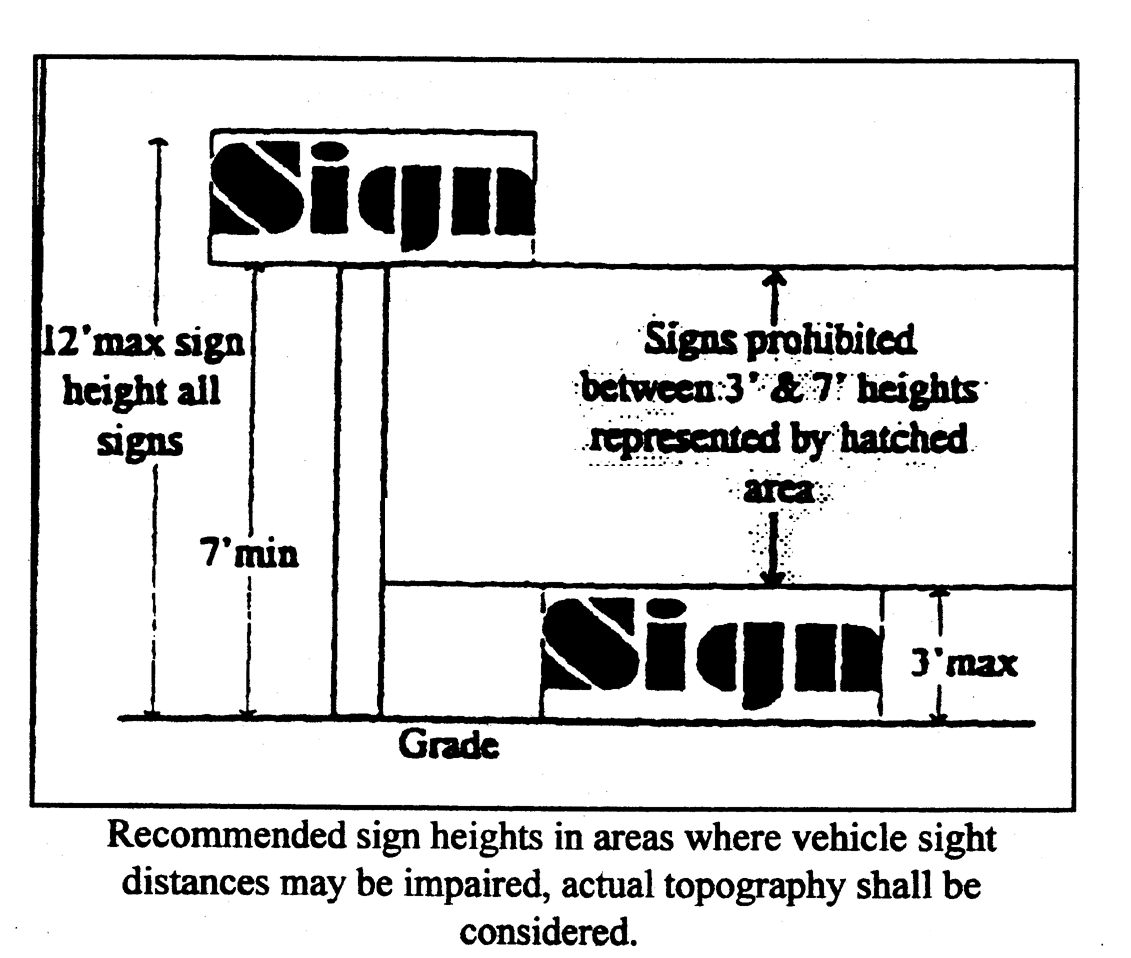
Figure B—Typical Height of Sign on Roofing Examples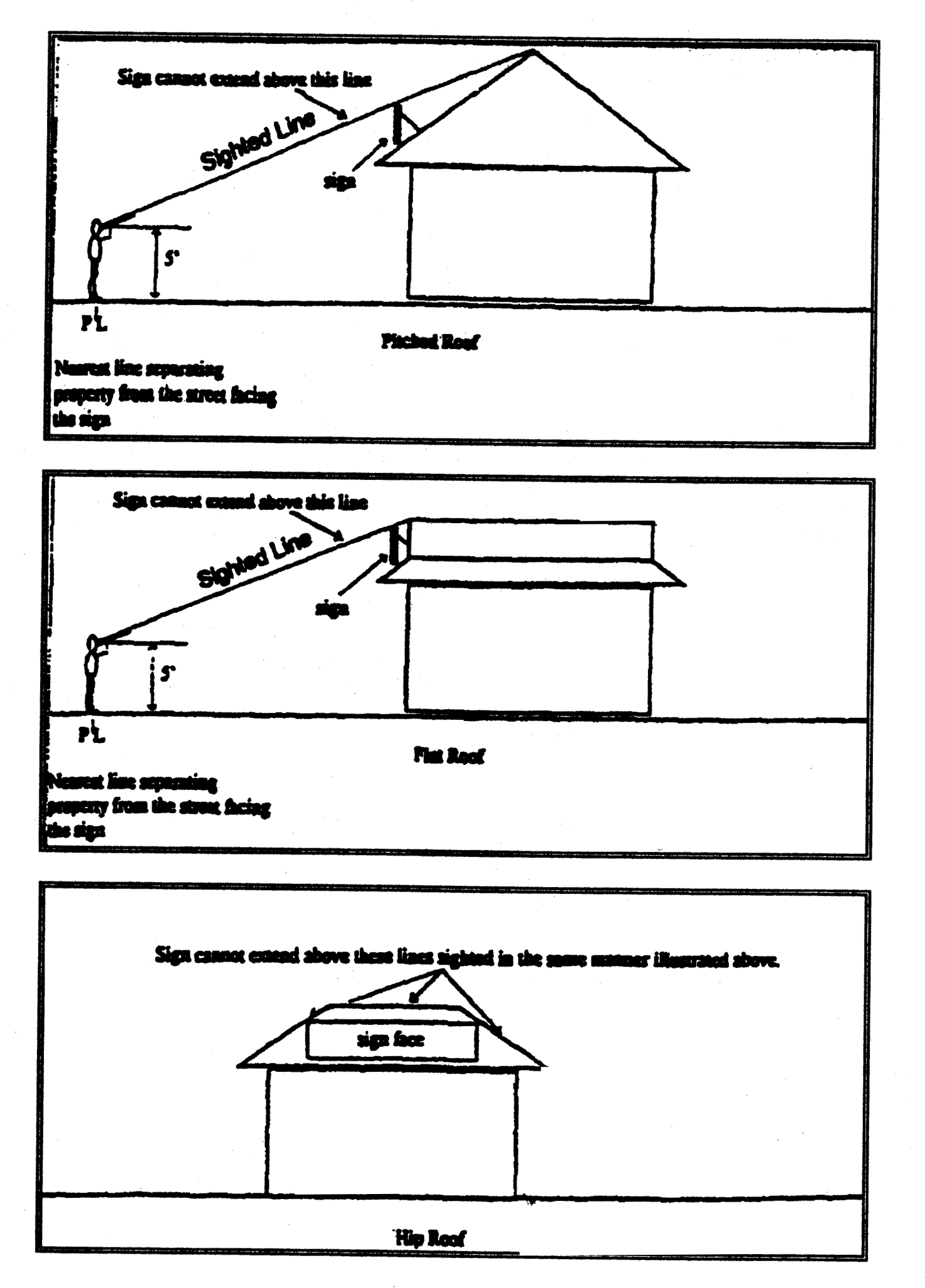
Figure B (cont'd.)—Typical Height of Sign on Roofing Examples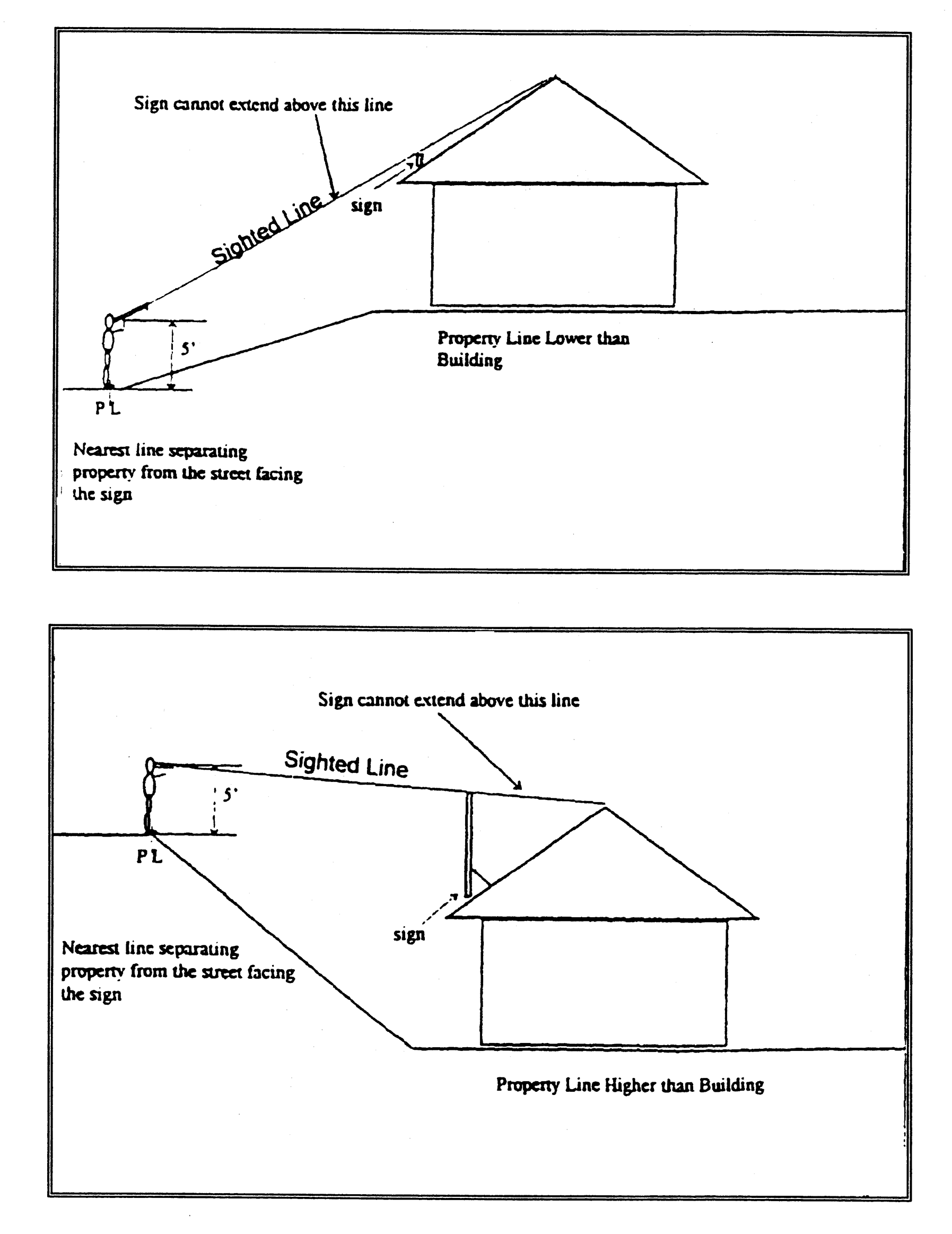
17.56.080 - Temporary signs.
Temporary signs may be located in any zoning district in the city subject to this subsection 17.56.080. Temporary signs shall be exempt from the requirements of a sign permit application, review, approval and fees but must adhere to all other regulations of federal, state and local laws.
A.
Temporary Noncommercial Signs:
1.
Applicability. The following standards apply to temporary noncommercial signs located in any zoning district in the city.
2.
Standards for temporary noncommercial signs.
a.
Temporary noncommercial signs shall not exceed four and one-half square feet.
b.
No sign shall exceed five feet in height measured from existing grade and shall not be located above the edge of the roof.
c.
On Scotts Valley Drive south of Bethany Drive and on Mount Hermon Road, temporary noncommercial signs shall not be located in the public or private rights-of-way. On all other streets in the city, temporary noncommercial signs shall not be located on sidewalks, streets, medians or where the sign interferes with vehicular sight distance, and are only allowed on unimproved public or private rights-of-way with the adjacent property owner's consent.
d.
Temporary noncommercial signs shall be removed no later than fifty days after installation of the temporary noncommercial sign.
B.
Temporary Commercial Signs:
1.
Applicability. The following standards apply to temporary commercial signs in the city.
a.
Number and size allowed. Temporary commercial signs are allowed in addition to permanent signs allowed for the property. However, combinations of permanent and temporary window signs shall not cover more than twenty-five percent of any window.
2.
Standards for temporary commercial signs.
a.
Real estate signs used to advertise residential property, provided they are not illuminated, and do not exceed four and one-half square feet in area are permitted subject to the following standards:
i.
One sign shall be allowed on the subject property.
ii.
Up to four additional signs, which may also exhibit directional arrows and instructions, shall be allowed on weekends, holidays, and on the traditional "Open House Caravan Day" provided that on Scotts Valley Drive south of Bethany Drive and on Mount Hermon Road, the signs shall not be located in the public or private rights-of-way. On all other streets in the city, the signs shall not be located on sidewalks, streets, medians or where the sign interferes with vehicular sight distance, and are only allowed on unimproved public or private rights-of-way with the adjacent property owner's consent.
iii.
Removal is required within thirty days of sale or lease.
b.
Real estate signs used to advertise commercial or industrial property, provided they are not illuminated, are permitted subject to the following standards:
i.
The sign shall be up to a maximum size of twenty square feet, a minimum set back of five feet from the property line and outside of the right of way, non-illuminated and, if freestanding, not more than twelve feet in height.
ii.
Removal is required within thirty days of sale or lease.
c.
Special or Community Event or Neighborhood Signs for Special or community event or neighborhood signs for events such as parades, garage, yard, sidewalk or parking lot sales, carnivals, exhibits, paper drives, blood drives or school activities shall be allowed to announce, identify, advertise or locate the events subject to the following standards:
i.
Special or Community Event or Neighborhood signs shall not exceed four and one-half square feet in area, can be placed seven days prior to the beginning of the event, must be removed on the final day of the event, and cannot be illuminated. One sign may be located on the subject property with up to four additional signs on other private property with the permission of the owner.
d.
One commercial, industrial or residential construction sign, either freestanding or wall mounted, which identifies a project under construction is permitted subject to the following standards:
i.
The sign shall be up to a maximum size of twenty square feet, a minimum setback of five feet from the property line and outside of the public or private right-of-way, non-illuminated and, if freestanding, not more than twelve feet in height.
ii.
Removal is required within thirty days of completion of the construction, sale or lease.
iii.
The freestanding construction sign may be a "V" sign as long as the combined total area of both faces does not exceed twenty square feet.
e.
Promotional Sales Signs are allowed in the commercial and industrial zoning districts subject to the following standards:
i.
A promotional sales sign is permitted for a period of no more than sixty days total per year. No more than one sign at a time shall be allowed per activity or business. It shall be located on the building below the roof eaves. It shall be no larger than thirty square feet and at no time shall any portion of the sign be higher than twenty feet above ground level. The sign shall not exceed the length of the business frontage portion of the building, nor shall it block the ingress/egress to any of the business entrances. It shall be placed on the primary frontage of the commercial or industrial business which is the subject of the sign. The sign must be maintained in good condition.
ii.
Searchlights and/or balloons greater than two feet (twenty-four inches) in diameter may only be used in conjunction with the promotional sales for a period not to exceed three consecutive days three times per year. All balloons must be securely tethered and shall not be released.
3.
Placement of temporary commercial signs. Temporary commercial signs shall not be attached to temporary structures.
4.
Illumination prohibited. Temporary commercial signs shall not be illuminated.
5.
Durable materials required. Temporary commercial signs shall be constructed of durable, rigid material suitable to their location and purpose. Only interior window signs may be made of nonrigid (e.g., paper) material.
(Ord. 16.95 § 2 (part), 1996; Ord. 16-113 § 3, 2002; Ord. 16.129, § 5, 8-18-2010)
17.56.100 - Sign permits required.
No sign shall be placed, installed or altered without first obtaining a sign permit and otherwise complying with all other applicable provisions of federal, state and local law, except as exempt pursuant to Section 17.56.080. However, copy can be changed without a permit on existing legal signs using the same materials and where only the colors, typeface and/or style are changed.
(Ord. 16.95 § 2 (part), 1996; Ord. 16.129, § 6, 8-18-2010)
17.56.110 - Permit application.
To obtain a sign permit, the applicant shall first submit a permit application form (available in the office of the planning director located at City Hall), plans and/or specifications for the sign and the required fees to the planning director or his/her authorized representative. The application may be acted upon by the planning director if it is so specified in this chapter or if the site is subject to a planned sign program; otherwise the application shall be acted upon by the design review board.
(Ord. 16.95 § 2 (part), 1996)
17.56.120 - Permit and appeal fees.
A.
A permit or appeal fee shall be required as set forth in the fee schedule adopted by resolution of the city council.
B.
Any sign erected by nonprofit and community interest organizations such as schools, churches, organized youth groups, service clubs and charitable organizations defined as tax exempt in the Internal Revenue Code, shall be exempt from payment of the required fees.
(Ord. 16.95 § 2 (part), 1996)
17.56.130 - Sign permit review and appeal process.
All sign permit applications, plans, specifications and other required material shall be submitted to the planning department for distribution and review. Review and approval will be as follows:
A.
The planning director shall approve, approve with conditions, deny, or schedule the item for consideration by the design review board in accordance with the provisions of this chapter and any other applicable requirements of federal, state or local laws or regulations.
B.
The design review board shall approve, approve with conditions, or deny the application in accordance with the provisions of this chapter and any other applicable requirements of federal, state or local laws or regulations.
C.
In the event an application is denied, written notice of the denial including the findings of the reviewing body and minutes of the meeting shall be provided to the applicant within fifteen working days after the decision is rendered.
D.
Any decision may be appealed pursuant to Section 17.50.060 of this Code.
E.
If, upon appeal, a sign permit is granted, modified or denied, the sign shall be constructed, modified or removed as directed by the body acting upon the appeal.
(Ord. 16.95 § 2 (part), 1996)
17.56.140 - Effective date.
All approved sign permits shall become effective upon expiration of the appeal period as defined in Section 17.50.060 of this Code.
(Ord. 16.95 § 2 (part), 1996)
17.56.150 - Additional building permits and limitations.
A.
In addition to the sign permit, other permits may be required, such as a mechanical and/or electrical permit. It shall be the responsibility of the applicant to obtain such additional permits, if required, from the planning director.
B.
The issuance or granting of any permit or approval of plans and specifications such as a building permit or approval of architectural design is not a permit for any sign on that property. A separate permit must be obtained for any sign erected in the city.
(Ord. 16.95 § 2 (part), 1996)
17.56.160 - Expiration of sign permit.
Every sign permit approved under the provisions of this chapter shall expire and become null and void if the work authorized by such permit is not commenced within one year from the date of such permit.
(Ord. 16.95 § 2 (part), 1996)
17.56.170 - Criteria for sign approval.
A.
A sign shall be approved by either the planning director or the planning commission if it:
1.
Serves to identify the business or the activity conducted on the property, or identifies the product or service offered thereon; and
2.
Is located on the property, or within the contiguous right-of-way; and
3.
Is harmonious with the materials, color, texture, size, shape, height, location and design of the building, landscaping, property and environment of which it is a part; and
4.
Is in compliance with this chapter.
B.
Signs attached to buildings shall be incorporated into the architectural features of the building, considering the placement, style, proportions, materials and finish.
C.
Freestanding signs shall be harmonious with the building and where appropriate shall include landscaping around the base of the sign, with such landscape area approved as part of the sign permit. Landscape plans shall include size, species, location and spacing of plant materials, method of separation between planter and adjacent area, and an irrigation plan for maintaining the landscape materials.
(Ord. 16.95 § 2 (part), 1996; Ord. No. 16.121, § 4, 9-21-2005)
17.56.180 - Sign area and signs allowed for specific uses.
A.
Unless otherwise specified in this chapter, the maximum allowable sign area for signs located on a building shall be the larger of:
1.
One square foot of sign per foot of width of front of building or front and street side elevations of building on corner lot; or
2.
One-half square foot of sign per foot of property line adjoining street.
B.
Planned Sign Program.
1.
The intent of this section is to facilitate creation of thorough and integrated signing systems for three or more tenant developments, or for commercial property over one acre in size or with two hundred fifty linear feet or more of frontage. Additional, larger or different types of signs may be allowed where conditions warrant, and to encourage high quality sign designs which will enhance the character or value of the community.
2.
Planned sign programs may be approved by the design review board. The design review board may increase the allowed maximum aggregate sign area up to fifty percent and include additional numbers and types of signs as it deems appropriate.
3.
The planned sign program shall include a format for all signs to be used in the development, including their maximum size, colors, location, illumination details, mounting details and landscaping details (if any).
4.
Unless otherwise provided in the approved planned sign program for a specific development, the planning director shall have the authority to approve permits for signs in conformance with the adopted planned sign program for that development.
C.
Commercial Center Identification.
1.
Each commercial center shall be allowed one freestanding identification sign in addition to commercial business signs allowed by the chapter. The maximum allowable sign area for the freestanding sign shall be forty square feet of sign area per acre or portion thereof, which may be used in any ratio for identification of center and/or the tenants; however, no sign shall exceed one hundred square feet in area or twelve feet in height unless the city council approves an exception which could allow signs up to two hundred square feet. Minimum setback for freestanding signs shall be five feet. Such signs may be internally or externally illuminated, but shall be restricted to identification of the name and address of the center and tenants unless approved by the planning commission as part of a planned sign program. Each commercial center shall comply with Section 17.56.040 regarding street addresses.
2.
For commercial centers that have more than one entrance on a major thoroughfare, one sign for each entrance shall be allowed if the entrances are separated by at least three hundred feet. The maximum allowable sign area identified in Subsection C.1. of this section shall apply to each sign.
D.
Commercial Business Identification Signs.
1.
One wall sign, projecting sign or under-canopy sign, shall be allowed to be located on the primary business frontage of each business, to identify that business. Businesses with secondary business frontage shall be allowed one additional wall sign on each secondary business frontage, unless such signs are prohibited pursuant to a planned sign program for a specific development. Identification signs on the primary and secondary business frontages may be externally illuminated with low level ground-mounted lights or internally illuminated.
2.
For businesses not a part of a commercial center, a freestanding sign not to exceed twelve feet in height may be allowed. The allowable sign area for a freestanding sign shall be one-quarter square foot per linear foot of property line along the adjoining street plus two square feet per tenth of an acre. The longer of the two frontages may be used when a business is located on a corner lot at the intersection of public streets. The maximum allowable sign area for the freestanding sign shall be fifty square feet. Minimum setback for freestanding signs shall be five feet.
3.
Additional identification signs may be allowed to identify a primary pedestrian access if it is not located on the primary business frontage or to identify a secondary pedestrian access or loading area, pursuant to a sign permit approved by the design review board. The number of additional identification signs shall be as determined by the design review board, the sign area of each shall not exceed five square feet and the signs may be wall signs, projecting signs or under-canopy signs. These additional signs may be externally or internally illuminated.
E.
Gasoline Service Station Price Signs. For each business frontage, one freestanding sign not to exceed eight feet in height shall be allowed to indicate the prices and types of gasoline for sale. This information shall not be repeated in any other form on the same frontage. The sign area for each sign shall not exceed twenty square feet. The signs may be designed to use replaceable, interchangeable numerals and the replacement or rearrangement of the numerals shall not require review or approval. The signs may be externally illuminated with low level ground-mounted lighting or internally illuminated.
F.
Theater Marquee Signs. A separate freestanding sign may be allowed on a parcel containing a facility for theatrical performances or movies. This freestanding sign may be up to fifty square feet in area plus an additional thirty square feet for each screen or stage.
G.
Subdivision/Apartment Identification.
1.
A residential development, such as a subdivision of single-family homes, townhouses or condominiums shall be allowed one freestanding sign or one wall- or fence-mounted sign to identify the development. Such sign shall not exceed twenty square feet in area or three feet in height for a freestanding sign or thirty square feet for a wall- or fence-mounted sign. Any proposed illumination shall be approved by the design review board. Minimum setback for freestanding signs shall be five feet.
2.
Apartment identification. An apartment development shall be allowed one freestanding sign not to exceed three feet in height or one wall sign per property frontage plus one additional sign for each additional five hundred linear feet of property frontage. Each sign shall not exceed twenty square feet in area and shall be so designed to temporarily or permanently incorporate rental availability information. Rental availability information shall be restricted to identification of the manager's or agent's location and/or telephone number and the number of bedrooms. Rental or lease terms, apartment sizes and description of amenities shall not be included. Such signs may be externally illuminated. Minimum setback for freestanding signs shall be five feet.
H.
Residential Real Estate Development Signs. Residential real estate signs announcing, locating, identifying or advertising a development of two or more residences shall have a maximum size, number of signs per frontage, setback and time of removal requirements as allowed by the design review board. The submittal package should include a complete signing program for model homes, identification, directional and any supplemental signs which will complement the character of the development, the neighborhood and the community. All signs shall be freestanding or wall-mounted and not illuminated. The signs shall not be more than twelve feet in height.
(Ord. 16.95 § 2 (part), 1996; Ord. No. 16.121, § 5, 9-21-2005; Ord. No. 16-127, § 1, 3-3-2010)
17.56.190 - Enforcement.
A.
Nonconforming Signs.
1.
Every sign in existence on September 19, 1995, and which does not conform to the provisions of this chapter, is a legal nonconforming sign. A legal nonconforming sign shall comply with Subsection 17.56.060.B., and may be modified provided that the modifications do not increase the nonconformity, or do not create danger to public health, safety or welfare.
2.
Every sign not lawfully in existence after September 19, 1995, and which does not conform to the provisions of this chapter, is an illegal nonconforming sign. An illegal nonconforming sign must be removed or brought into conformance with the provisions of this chapter.
3.
[Reserved.]
B.
Violations. Any person who violates any provision of this chapter or fails to comply with any of the requirements of this chapter, is guilty of an infraction, punishable as set forth in SVMC Chapter 1.08.
C.
Violations Constitute Public Nuisance. In addition to the penalties otherwise provided in this chapter, any violation of the chapter is a public nuisance. The city attorney, upon order of the city council, shall commence the necessary action or proceedings for the abatement, removal and enjoinment thereof in the manner prescribed by law in the courts which may have jurisdiction to grant such relief as will accomplish such abatement and restraint. The remedies provided for in this section shall be in addition to any other remedy or remedies or penalties provided in this title or other law or ordinance.
D.
Notice of Violation/Removal.
1.
No citation will be issued until the planning director has issued a notice of violation to the owner, agent or person having a beneficial interest in the building or the premises on which a prohibited sign or any other sign which violates any provision of this chapter is located. The person having a beneficial interest in the sign, the agent or the owner of the sign shall remove or alter the sign to comply with the provisions of this chapter within seventy-two hours of the date of the notice. The notice shall also state that if the sign is not removed or brought into compliance within seventy-two hours of the date of the notice, the planning director may cause it to be removed.
2.
If the planning director causes the sign to be removed, the sign must be retained for fifteen days, during which the owner, agent or person having a beneficial interest may protest the action and reclaim the sign. At the expiration of fifteen days, any unclaimed sign shall be deemed abandoned and may be discarded.
3.
The cost of removal, alteration and/or storage of any sign erected or maintained in violation of this chapter shall be paid by a permittee, sign owner, agent or person having a beneficial interest in the sign. The cost of removal and storage shall be determined by resolution of the city council. The cost of removal and storage or alteration shall become a debt owing the city for the collection of which the city may maintain a civil action in its name.
4.
The planning director or his/her representative may summarily and without notice cause the removal of any sign which is an immediate safety threat to person or property.
(Ord. 16.95 § 2 (part), 1996; Ord. 16.100 § 2, 1996; Ord. 16.121, § 6, 9-21-2005; Ord. 16.129, § 7, 8-18-2010)

