
Scotts Valley City Zoning Code
CHAPTER 17
46 - EXCEPTIONS AND MODIFICATIONS
17.46.010 - Applicability of chapter.
The requirements and regulations specified in this title shall be subject to the following exceptions, modifications and interpretations.
(Ord. 16.76 § 1 (part), 1989)
17.46.020 - Building lines.
Where the topography or other special circumstance of the area may call for a building line contrary to the requirements of any district under this title, the planning commission may establish building lines for the location of future buildings; provided, that they shall be shown on the zoning map followed by the designation OBL (Official Building Line).
(Ord. 16.76 § 1 (part), 1989)
17.46.030 - Special uses requiring use permits.
A.
No dancehall, roadhouse, nightclub, commercial club or any amusement or recreation, or any place where live entertainment is provided, shall be established in any district closer than two hundred feet from the boundary of any residential or open space district unless a use permit is first secured in each case.
B.
Radio and television transmission towers, wireless communication facilities and accessory uses thereto, but not including radio and television broadcasting studios, shall be allowed in any nonresidential district, subject to securing a use permit in each case.
(Ord. 16.76 § 1 (part), 1989; Ord. 16.97 § 1, 1996)
17.46.040 - Private stables.
The following regulations shall apply in all cases for the maintenance of private stables.
A.
The minimum lot upon which a horse may be kept is forty thousand square feet. One additional horse may be kept for each additional twenty thousand square feet above the square foot minimum.
B.
Corrals and stables shall be located on the rear half of the lot and not closer than forty feet from any property line and/or dwelling on the same or adjacent property.
C.
Contiguous parcels which are leased pursuant to a written or oral rental agreement may not be considered as a part of the minimum lot area requirements hereof.
(Ord. 16.76 § 1 (part), 1989; Ord. 16.77 (part), 1989)
17.46.050 - Height limits.
A.
Towers, spires, or cupolas for the housing of equipment used solely to operate and maintain a building; chimneys, water tanks, flagpoles, monuments, noncommercial radio and television aerials and transmission towers, fire towers and similar structures and necessary mechanical appurtenances covering not more than ten percent of the ground area covered by a primary structure may be erected to a height not more than twenty-five feet above the height limit prescribed by the regulations for the district in which the site is located. Utility poles and commercial towers shall not be subject to the height limits prescribed in the district regulations.
(Ord. 16.76 § 1 (part), 1989; Ord. 16.82 § 4, 1991; Ord. No. 16.142, § 62, 12-4-2024)
17.46.060 - Area requirements.
A.
The use of land as permitted for the district in which it is located shall be permitted on a building site of less area, width, depth or frontage than that required by the regulations for such district, providing such was a separate lot or parcel of record or was shown on a map of a recorded subdivision on the effective date of the ordinance codified in this title.
B.
A lot shall not be subsequently divided so as to reduce the lot area, width, depth or frontage below the requirements of this title for the zoning district in which it is located.
C.
Site area, width, depth and frontage requirements of this title shall not apply to sites used for public utility pumping stations, power stations, public utility installations and drainage ways, which shall require a use permit. Such requirements shall be determined by conditions of the use permit granted for the use.
D.
The percentage of the site area covered by structures shall be measured by dividing the number of square feet of horizontal area covered by structures, open or enclosed, by the total horizontal area within the property lines of the site.
E.
On a cul-de-sac turnaround or a curved street with a radius of curvature of two hundred feet or less, a site may have a frontage of not less than forty feet.
F.
Flag lots.
1.
The creation of flag lots may be permitted in any Single-family Residential R-1 district upon specific approval of the city council (see Figure 17.46.060 Flag Lot Diagram), after report and recommendation of the planning commission. To be considered for approval, a proposed flag lot shall meet, while excluding the flag/access easement area itself, all requirements of width, depth and area specified for lots in the district in which it is located and shall not, by its creation, result in any other lot failing to meet the width, depth and area requirements of its district. The lot must be served by a corridor (flag area) which shall be defined as that portion of the lot fronting on the street and having a width of less than the minimum required lot frontage for the district and which also meets the following conditions:
a.
Has not less than twelve feet frontage;
b.
Is nowhere less than twelve feet in width;
c.
Is not more than one hundred fifty feet in length; and,
d.
Is suitable throughout its length for access by emergency vehicles;
2.
The end of the flag/access easement area shall constitute the front yard of the lot. Lot area and the front yard setback shall be measured from this line, provided, that the minimum required setback must be maintained from any other lot line between the structure and the street upon which the flag area fronts.
3.
The flag lot shall not result in more than four adjacent driveways in any two hundred feet along the frontage street.
4.
The flag lot must not otherwise be detrimental to the public health, safety or welfare or materially injurious to properties or improvements in the vicinity.
5.
The new lot lines created shall be at right angles to the existing property lines. Angling lot lines or irregular lot lines to reduce the length of the flag is not consistent with the lot division standards.
6.
Each flag lot and the lot in front of the flag lot must contain at least the required minimum site area required by the zoning district. The area of flag/access easement shall be included with the front lot and shall not be excluded in calculating the size of the front lot. Any paving located within the flag/access easement shall be included in the site coverage calculations for the front lot. The front lot shall conform with the parking and driveway area allowances specified in SVMC Section 17.44.030J.
7.
All new or existing structures shall conform to the required setbacks after the creation of the new lot. No subdivision will be approved that will create a nonconforming setback to an existing or proposed structure.
8.
Where both parcels take access off the same street, new driveways shall be combined with an existing driveway, where feasible to limit the amount of impervious surfaces and the number of access points on streets.
9.
Flag lots shall have the street address clearly visible from the street to identify a dwelling that is set back from the street.
Figure 17.46.060 Flag Lot Diagram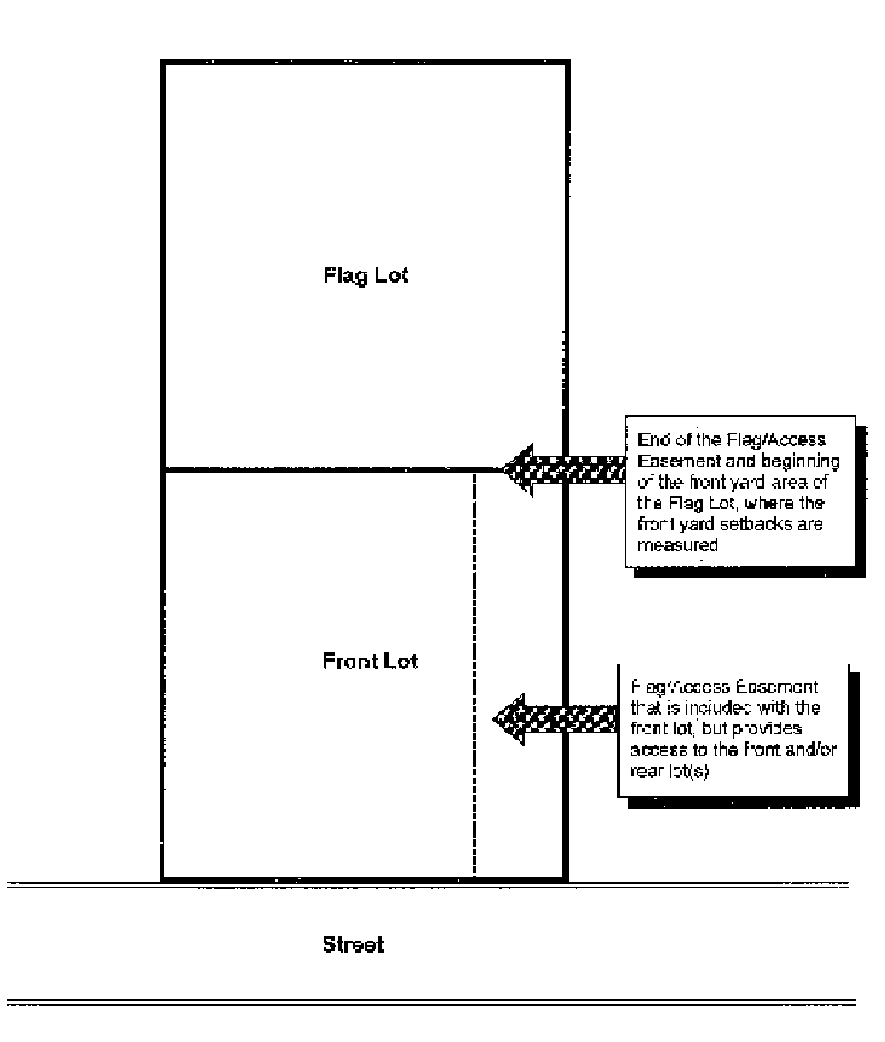
(Ord. 16.76 § 1(part), 1989; Ord. 16.80 § 2, 1990; Ord. No. 16.119, § 1, 6-1-2005)
17.46.070 - Yard exceptions and modifications.
A.
On a residentially zoned site situated between sites improved with buildings, the minimum front yard depth shall be the average depth of the front yards on the improved sites adjoining the side lines of the site.
B.
Where a site is not situated between sites improved with buildings and where sites comprising forty percent of the frontage on a block are improved with buildings, the minimum front yard depth shall be the average of the existing front yard depths on the block.
C.
In computing average front yard depths, the figure of thirty feet shall be used in lieu of any front yard depth greater than thirty feet.
D.
Where an official plan line has been established by the city, the required yards on the street side of any lot shall be measured from such official plan lines, and in no case shall the provisions of this title be construed as permitting any structure to extend beyond such official plan line.
E.
Architectural features including sills, chimneys, cornices, bay windows and eaves may extend into a required side yard no more than fifty percent of the required side yard nor more than two feet into a required front or rear yard.
F.
Open unenclosed, uncovered balconies, porches, decks, platforms, stairways and landing places may extend into any required front or rear yard not more than six feet nor more than three feet into any required side yard.
G.
In cases where the rear lot line abuts the side lot line of a key lot, a rear yard of fifteen feet shall be maintained from the rear lot line of such abutting lot.
H.
In cases where a building site is less than sixty feet in width, a side yard of not less than five feet shall be required, except in commercial districts.
I.
The minimum exterior side yard on a corner lot shall be ten feet.
J.
Where there is more than one structure on a site exceeding sixteen feet in height, the minimum distance between the structures shall be ten feet. The minimum distance between such structures shall be increased one foot for every two feet of height above sixteen feet of height of the lowest of such structures.
K.
On the street side of a reversed corner lot, the side yard shall not be less than one-half of the required front yard of the adjoining key lot.
L.
In all cases where the front and rear property lines of a lot abut a street (a double frontage lot), buildings shall not be located closer to either street than the required front yard; provided, however, that in all cases where either street upon which the lot abuts is a street to which access to the subject lot has been legally precluded, then the setback required shall apply only from the street from which access is allowed.
M.
In cases where the elevation of the front half of the lot at a point fifty feet from the centerline of the traveled roadway is seven feet above or below the grade of the centerline (fourteen percent or greater slope), a private garage attached or detached may be built to within five feet of the front property line.
(Ord. 16.76 § 1(part), 1989; Ord. 16.77 (part), 1989; Ord. 16.115, § 20, 6-4-2003; Ord. No. 16.142, § 63, 12-4-2024)
17.46.080 - Swimming pools, spas and hot tubs.
A.
Every person who owns or possesses any premises where there is a swimming pool, or in-ground spa shall maintain a fence, wall or structure at least five feet high, completely enclosing the swimming pool or in-ground spa pursuant to the requirements of the California Building Code or other applicable building code. Fencing or enclosures for above ground spas or hot tubs shall be in accordance with the applicable building code.
B.
Swimming pools and spas are prohibited in the required front yard of all residential districts. Swimming pools and in-ground spas shall be located a minimum of five feet from the rear or side property line. Mechanical and/or air handling equipment for maintenance, temperature control and chemical balance of a swimming pool and/or spa shall be located a minimum of three feet from any property line and shall be entirely enclosed to muffle the noise.
(Ord. 16-112 § 9, 2000)
17.46.090 - Moving of buildings.
A.
No person or persons shall move or cause to be moved any building or structure without first obtaining a permit from the planning department.
B.
An application shall be made showing the existing location of the structure to be moved together with the location to which it is proposed to be moved and its intended use.
C.
If the planning department finds that the proposed structure to be moved and the intended use are within the zoning requirements, a permit shall be issued for moving the building.
D.
If the planning department finds that the building to be moved is of substandard construction or unsound structurally, no permit shall be issued unless the person who wishes to move the building agrees to reconstruct the building or to otherwise structurally alter the building at its new location so as to bring the structure into compliance with the standards of the Uniform Building Code. In the event of the latter situation, the building inspector shall ascertain the amount of performance bond necessary to bring the structure into compliance with the Uniform Building Code and shall notify the applicant of the amount of the bond. No permit shall be issued in such situation unless and until an appropriate bond issued by a reputable surety authorized to do business in the state is filed with the planning department in favor of the city, in the designated amount. Any such performance bond shall be approved by the city attorney prior to its acceptance. In lieu of a performance bond, equivalent security may be accepted upon approval of the city attorney as to form and content.
E.
All structures, other than single-family residences, to be relocated within the city shall be subject to design review board approval to assure that the structure is compatible with the design characteristics of the neighborhood in which it is proposed to be located.
(Ord. 16.76 § 1 (part), 1989)
17.46.100 - Kennels and small animal hospitals.
The following regulations shall apply in all cases for the maintenance of kennels or small animal hospitals.
A.
The premises where kennels or small animal hospitals are maintained shall be entirely enclosed by a nontransparent fence a minimum of six feet in height.
B.
The actual enclosure in which animals are treated or maintained shall be at least seventy-five feet from any residence.
C.
The premises shall be kept in a neat and sanitary manner by the daily removal of offal and the use of sprays and disinfectants to prevent an accumulation of flies, the spread of disease or offensive odor.
(Ord. 16.76 § 1(part), 1989)
17.46.110 - Fences, walls and ornamental structures.
A.
Fences may be embellished with arbors and trellises when the overall height of the fence, including the trellis or arbor, meets the height limits set forth in Table 17.46.110.G. Arbors are allowed in the required side and rear yards. Arbors are allowed in the required front yard setback if they are less than twenty square feet in roof area and placed so as not to block the line of sight. Arbors over twenty square feet in roof area or over eight feet in height and not more than ten feet in height, proposed within a front yard setback, may be approved by the planning commission through design review (see Section 17.50.030 D).
B.
Light posts, mail boxes and related ornamental structures may be installed in front yards as long as the structure is less than two feet in width and eight feet in height, if an arbor or trellis see Section 17.46.110 A.
C.
Fences and walls, or any combination thereof are allowed in all zoning districts subject to the type, height and related permitting regulations as specified in Table 17.46.110.G below.
D.
Heights of fences and walls shall be determined based upon the adjacent grade of the fence or wall, unless the grade adjacent to a fence or wall varies from side to side or along the length of the fence or wall. Whenever the grade adjacent to a fence or wall varies, the lowest grade surface adjacent to the fence or wall shall be used as the base to determine fence height.
E.
No fence, wall or hedge located within a triangle having sides fifty feet in length from a street intersection, as measured from intersecting curb lines or intersecting edges of the street pavement where no curb exists, shall exceed three feet in height above the established grade of the adjoining street (see Figure 17.46.110.H).
F.
Fences and retaining walls taller than three feet may be allowed in the front yard of a residentially zoned lot subject to obtaining a Special Fence Permit as provided in Section 17.50.050.
Table 17.46.110 F. Fencing Locations, Heights, Types, Height Adjustments and Other
Restrictions
G.
Sight safety distance shall be determined by the figure below:
Figure 17.46.110G
Sight Distance Across Street Comer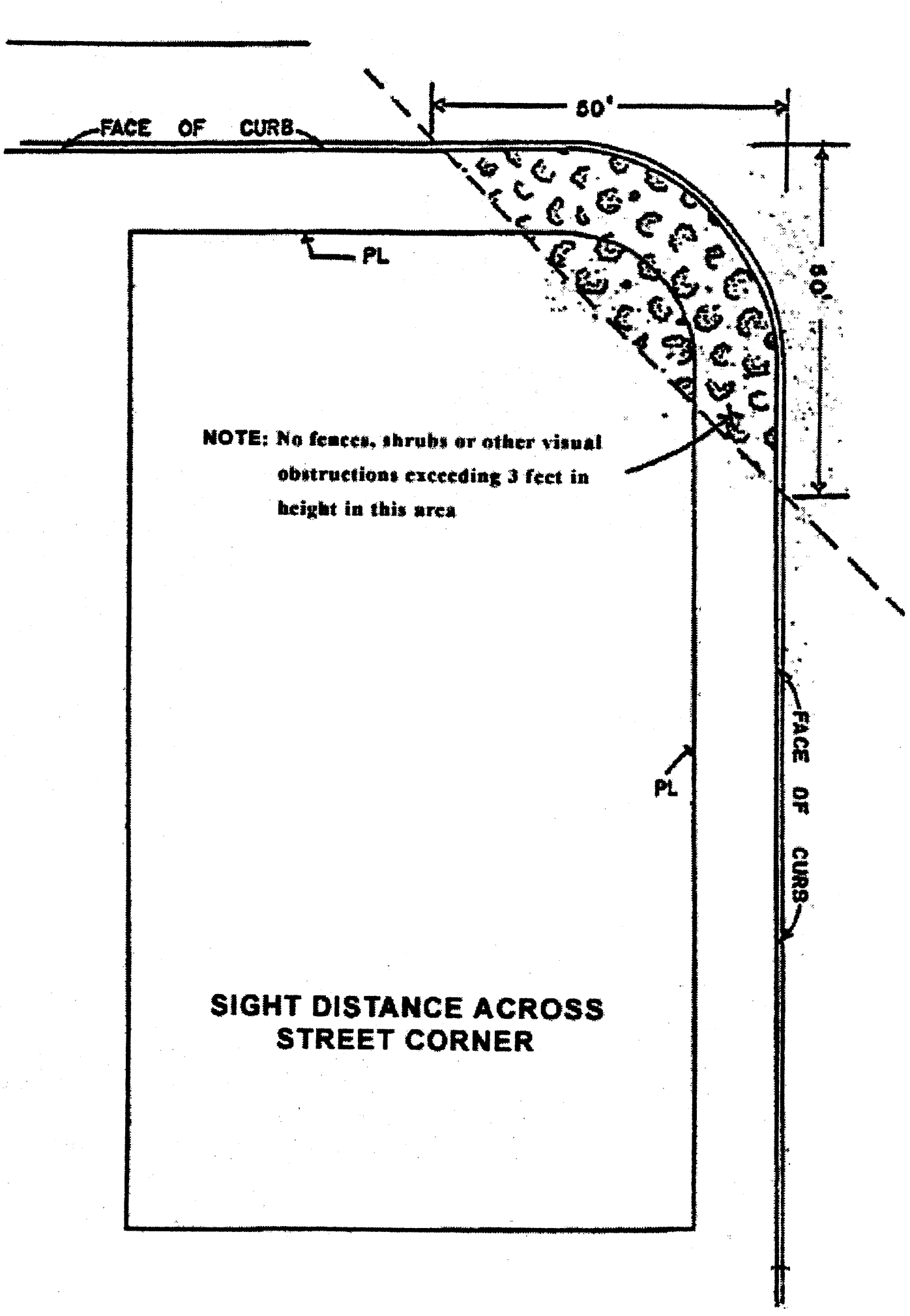
(Ord. 16.76 § 1 (part), 1989; Ord. 16.82 § 5, 1991; Ord. 16.99 § 1, 1996; Ord. 16.107 § 1, 1999; Ord. 16-112 § 10, 2000; Ord. 16-113 § 5, 2002; Ord. No. 16.118, § 1, 2-2-05)
17.46.120 - Animal raising.
The following regulations shall apply in all cases where poultry, birds, rabbits or fur-bearing animals in any number and for any purpose are raised, kept or maintained.
A.
All dead animals or birds and offal shall be removed and disposed of, and sprays and disinfectants shall be used so as to prevent the accumulation or spread of disease, flies or offensive odors.
B.
Where in excess of fifty birds are maintained in one block within a distance of one-quarter of a mile from any residence, ground sprays or ground cover shall be used to prevent the accumulation and spread of dust.
(Ord. 16.76 § 1 (part), 1989)
17.46.125 - Beekeeping permits issued by the community development director.
A.
Authority and Purpose.
1.
The purpose of the beekeeping permit is to provide appropriate review and consideration of small scale beekeeping under the direction of the community development director or their designee, and to ensure that beekeeping on certain-sized parcels in single-family residential zones will not be detrimental or injurious to property and improvements and to the health, safety, and welfare of persons residing or working in the neighborhood of the proposed use.
2.
Beekeeping requires review and approval of a beekeeping permit before any beekeeping on the subject property.
B.
Definitions. The terms used herein have the following meanings:
"Apiary" means a place where bees, hive boxes, and related appliances wherever the same are kept, located, or found, especially a colony of bees kept for their honey.
"Bee colony" is a group of bees which consist of the queen, the drones, and the worker which live in a hive box or similar receptacle.
"Beekeeping" (or apiculture, from Latin apis, bee) is the maintenance of honey bee colonies, commonly in hives, by humans. A beekeeper (or apiarist) keeps bees in order to collect honey and beeswax, for the purpose of pollinating vegetation, or to produce bees for sale to other beekeepers.
"Bees" means honey-producing insects of the species aspis mellifica, including the adults, eggs, larvae, pupae or other immature states thereof, together with such materials as are deposited into hives by the adults, except honey and rendered beeswax. Bees are a monophyletic lineage within the superfamily Apoidea, presently classified by the unranked taxon name Anthophila.
"Hive" is the same definition as bee colony.
"Hive box" means any box, receptacle, or container made or prepared for the use of bees, or similar container of which bees have taken possession. A hive box is usually called a Langstroth deep or super, and is roughly 19.75 inches long, 16.5 inches wide, and 9.5 inches tall. It contains ten frames of foundation on which the bees build comb for producing brood and food. A hive box needs some kind of top board, some kind of bottom board, and an entrance which is usually incorporated in the bottom board.
C.
Applications and Submittal Requirements.
1.
Application for a beekeeping permit shall be made on a form prescribed for this purpose by the city and shall be filed with the planning department, accompanied by the filing fee.
2.
The application shall be accompanied by such maps, site plans, and other drawings, or information required or necessary to enable the community development director to make the determinations as set forth herein. The application form provided by the planning department shall provide a list of submittal requirements.
3.
The filing fee for an application shall be as set forth by resolution of the city council.
D.
Application Processing Procedures and Notice.
1.
The application shall be subject to review by the planning department to determine if the application is complete.
2.
Upon deeming the application complete, the planning department shall send a notice to the applicant, property owner, the owners and tenants of property of the five parcels located closest to the subject property, and to all members of the planning commission. The notice shall indicate the date upon which the community development director will act on the permit and the intended action to be taken by the community development director. Such notices shall be mailed, via first class mail, a minimum of fifteen days prior to date that action is to be taken.
E.
Development Standards. The community development director shall determine from data submitted whether the proposed beekeeping use and any related structures proposed for the beekeeping use will meet the development standards prescribed below, as determined by the community development director.
1.
One bee colony and/or hive box will be allowed in single-family residential parcels which are greater than ten thousand square feet in size. Single-family residential parcels which are greater than forty thousand square feet may have up to two bee colonies and/or hive boxes;
2.
No bee colony and/or hive box shall be located closer than twenty-five feet from any side or rear property line or adjacent residence or business;
3.
Bee colonies and/or hive boxes shall be located in the rear of the property to the extent practical and feasible, as determined by the community development director; and
4.
All properties on which a bee colony and/or hive box are kept must provide for adequate water sources on the property.
F.
Required Findings. The application may be approved as submitted, disapproved, conditionally approved; or, the community development director may refer the requested beekeeping permit to the planning commission for consideration. The following finding shall be made by the community development director and/or planning commission: The proposed beekeeping use, location of the bee colony/hive box, its effect, and the resulting number of beekeeping permits in a neighborhood will not be detrimental or injurious to property and improvements, and to the health, safety, and welfare of persons residing or working in the neighborhood of the proposed use.
G.
Appeals. Appeal from the determination by the community development director shall be to the planning commission in accordance with the procedures and subject to the provisions set forth in Section 17.50.060 of this chapter.
H.
Penalty. Every person violating any provision of this section shall be guilty of a misdemeanor and subject to Title 4 of the Municipal Code.
(Ord. 16.130, § 4, 8-18-2010)
17.46.130 - Accessory structures.
A.
Applicability. This section applies to all accessory structures except for fences, walls and ornamental structures as provided in Section 17.46.110 and accessory dwelling units (ADUs) as provided in Chapter 17.57.
B.
All Zoning Districts.
1.
Accessory structures that comply with this section are permitted in all zoning districts.
2.
An accessory structure shall comply with all regulations applicable to the primary structure on the site unless specifically stated otherwise in this section or elsewhere in this title.
3.
An accessory structure shall be clearly incidental and subordinate to the primary structure on the site.
4.
An accessory structure shall be located on the same parcel as the primary structure.
5.
An accessory structure attached to a primary structure shall be considered a part of the primary structure and shall comply with development standards applicable to the primary structure.
C.
Residential Zoning Districts.
1.
Development Standards. Accessory structures in residential zoning districts shall comply with the standards in Table 17.46-1.
Table 17.46-1: Accessory Structure Standards in Residential Zoning Districts
2.
Reverse Corner Lots. On a reversed corner lot, an accessory structure ten feet or more in height and/or one hundred twenty sq. ft. in size shall comply with the following minimum setbacks:
a.
Rear property line: Same as the required side yard on the adjoining key lot.
b.
Side property line adjoining the street: Same as the required front yard of the adjoining key lot.
3.
Alleys. An accessory structure shall be setback a minimum of six feet from an alley.
4.
Double-Frontage Lots. An accessory structure on a double frontage lot shall comply with Section 17.46.070.L.
5.
Hillside Lots.
a.
See 17.46.070.M for front setback standards for garages on sloped lots.
b.
See 17.40.060 for design criteria in the hillside residential combining district.
6.
Design of Site-built Accessory Structures. In the R-1, R-R, and R-MT zoning districts, the roof forms and pitches and exterior building materials and colors of site-built accessory structures shall be architecturally compatible with those of the primary dwelling, to the extent practical and feasible as determined by the Community Development Director, subject to review and approval by the Community Development Director.
D.
Non-Residential Zoning District.
1.
Accessory structures in non-residential zoning districts are subject to the same development standards as primary structures in the applicable zoning district.
2.
See "accessory use" definition in Section 17.04.240 for limitations on the floor area of incidental uses in commercial and industrial zoning districts.
E.
Habitable Accessory Structures.
1.
An accessory structure with habitable space must either:
a.
Contain a bathroom and kitchen facility and comply with the city's accessory dwelling unit requirements in Chapter 17.57; or
b.
Contain no plumbing connections or fixtures.
2.
Habitable accessory structures with plumbing connections or fixtures but without kitchen facilities are not allowed.
(Ord. No. 16.142, § 64, 12-4-2024)
17.46.140 - Temporary construction offices.
A trailer may be used as a temporary construction office in any commercial or industrial district upon compliance with the following regulations.
A.
A temporary trailer permit shall be obtained upon approval of the planning department.
B.
Use of the trailer shall be terminated and the trailer shall be removed from the site six months after the temporary permit is granted or within fifteen days of final building inspection, whichever is the first to occur, provided, that the term of use may be extended in the same manner as a use permit is extended for an additional period not to exceed six months. In no event shall the use of the trailer exceed a period of one year.
C.
A deposit of cash, bond and/or certificate of deposit in a sum to be determined by the building official shall be required to guarantee the removal of the portable trailer.
D.
A temporary trailer shall be permitted only after the issuance of a valid building permit for work to be done on the site where the construction office will be located.
E.
No residential use shall be made of the temporary trailer except in commercial districts as provided in subsection F of this section.
F.
Recreational vehicles/trailers may be utilized as temporary living quarters only for construction of public or nonprofit facilities, churches and schools located in the commercial district only as long as the following minimum standards are satisfied, which shall be in addition to the other standards, conditions and provisions set forth above in subsection A through D (which shall also apply):
1.
A maximum of five temporary trailers/recreational vehicles shall be placed on any one site.
2.
No temporary living quarters shall be located within three hundred feet of any existing residence.
3.
All temporary living quarters shall connect to utilities (i.e., sewer, water and electricity) in conformance with the Uniform Building Code. No holding tanks, temporary septic systems or the like shall be permitted.
4.
A permit shall be required prior to placement of recreational vehicles/trailers. The permit shall be issued by the planning director. In issuing such permit the planning director may impose reasonable conditions to ensure that the placement of recreational vehicles/trailers conforms to health and safety standards. The planning director may deny the permit if the director finds that the temporary living quarters may be detrimental to the health, safety or welfare of the neighborhood.
5.
The minimum site area for the use of temporary living quarters on a jobsite shall be one-and-one-half acres.
6.
If conditions are not adhered to or written complaints are received, the planning director may revoke the permit or add conditions to the permit in the interest of public health, safety or welfare.
7.
Applicant and/or property owner shall sign a binding agreement to vacate the property and cease the activity within five days of written request by the planning director. In the event there is an immediate threat to public health, safety or welfare, the planning director may require the use to cease immediately.
8.
The temporary living quarters shall be located on the site on which the construction will occur.
(Ord. 16.76 § 1 (part), 1989; Ord. 16.80 § 1, 1990)
17.46.150 - Covenants for easements.
A.
Creation of Easement by Covenant. In addition to any other method for the creation of an easement, an easement for parking, ingress, egress, emergency access, light and air access, landscaping or open space purposes may be created by a recorded written covenant of easement made by an owner of real property to the city pursuant to this section. The purpose of the covenant is to implement the goals and policies of the General Plan.
B.
Contents of Covenant. The covenant of easement shall contain the following:
1.
The legal description of the real property to be burdened by the covenant of easement and the real property to be benefited thereby;
2.
The legal description or a scale drawing of the easement showing the location of the easement on the restricted property;
3.
The purpose for which the covenant of easement is made;
4.
The terms, conditions or limitations, if any, imposed upon the use of the easement;
5.
An identification of the approval, permit or designation granted by the city which relied upon or required the covenant;
6.
A statement that the covenant of easement is made pursuant to this section.
C.
Common Ownership Required. At the time of recording the covenant of easement, all of the real property benefitted or burdened by the covenant shall be in common ownership.
D.
Execution and Recording. The covenant of easement shall be duly executed by the owner(s) of the real property to be restricted and shall be recorded by the city in the office of the recorder of the county of Santa Cruz. The cost of recordation shall be borne by the owner(s) of the real property to be restricted by the covenant.
E.
Effect of Recording. The covenant of easement shall be effective when recorded and shall act as an easement pursuant to Chapter 3 (commencing with Section 801) of Title 2 of Part 2 of Division 2 of the State Civil Code, except that it shall not merge into any other interest in the real property. From and after the time of its recordation, the covenant shall impart notice thereof to all persons to the extent affordable by the recording laws of the state. Section 1104 of the California Civil Code shall be applicable to a conveyance of the affected real property.
F.
Enforcement. A covenant of easement executed and recorded pursuant to this section shall be enforceable by the city and/or the successors in interest to the real property benefitted by the covenant; and the burdens of the covenant shall be binding upon the successors in interest to the real property burdened thereby, and the benefits of the covenant shall inure to the successors in interest to the real property benefitted thereby. Nothing in this section shall create in any person other than the city and the owner of the real property benefitted or burdened by the covenant standing to enforce or to challenge the covenant or any amendment thereto or release therefrom.
G.
Release of Covenant. A covenant of easement made pursuant to the provisions of this section shall be released upon a determination by the city council that the restriction of the real property burdened by the covenant is no longer necessary to achieve the land use goals of the city, all pursuant to the procedure herein below specified.
1.
Upon the application of any person (whether or not that person has title to the affected real property) filed with the city clerk, accompanied by payment of any fee established by resolution of the city council or upon the city council's own initiative, the matter of release of the covenant shall automatically be referred to the planning commission for report and recommendation to the city council following a public hearing conducted by said commission. The commission shall make its report and recommendation to the city council within forty-five days of the reference date. The public hearing conducted by the commission shall be noticed in accordance with the provisions of Section 17.50.090 of this title.
2.
Upon receipt of the report and recommendation of the planning commission, the city council shall schedule a public hearing on the matter of the release of the covenant of easement within thirty days. The hearing shall be noticed in accordance with the provisions of Section 17.50.090 of this title. The hearing may be continued from time to time but shall be concluded within thirty days of the hearing date, except as the time may be extended upon written consent of the applicant. Upon a determination of the city council that the restrictions on the real property burdened by covenant of easement is no longer necessary to achieve the land use goals of the city, the covenant of easement shall be released; otherwise, it shall not be released. The decision of the city council shall be in writing and shall be supported by adequate findings. Notice of the decision shall forthwith be given to the applicant and to the owner(s) of the affected real property.
3.
If the covenant of easement is to be released, a release shall forthwith be recorded by the city in the office of the recorder of the county of Santa Cruz. Upon recordation of the release, the covenant of easement shall be of no further force or effect.
4.
Fees to cover the reasonable cost of processing the release, including, without limitation, the costs of administering the provisions of this section, shall be set by resolution of the city council and shall be paid by the applicant at the time of filing of the application.
H.
Authority for Section. This section is adopted pursuant to and in accordance with the provisions of Article 2.7 (commencing with Section 65870) of Chapter 4 of Division 1 of Title 7 of the Government Code.
(Ord. 16.76 § 1 (part), 1989)
17.46.160 - Construction standards.
A.
Dust. Dust from grading and construction operations must be controlled. The permittee may be required to keep adequate equipment on the construction site to prevent dust problems.
B.
Hours of Operation. All construction activity shall be limited to the hours between eight a.m. and six p.m., Monday through Friday, and nine a.m. through five p.m. on Saturday. No construction activity is allowed on Sunday.
(Ord. 16.76 § 1 (part), 1989)

