
Seguin City Zoning Code
CHAPTER 1
- GENERAL PROVISIONS
Sec. 1.1. - [Generally.]
1.1.1.
Title. This document is known as the "Unified Development Code of the City of Seguin, Texas", and may be referred to as the "UDC", "this code", "Development Code", "Zoning Code", or "Subdivision Code".
1.1.2.
Purpose. The purpose of the Unified Development Code (UDC) is to implement the vision of the adopted Comprehensive Master Plan and to promote the public health, safety, general welfare and quality of life of the present and future citizens of the City of Seguin.
1.1.3.
Authority. The Unified Development Code is adopted under authority of the constitution and laws of the State of Texas, including Section 211, Texas Local Government Code, and under the provisions of the City Charter.
1.1.4.
Chapter Components. This chapter contains the following sections:
Applicability of this Code
Violations
Officials—Responsibilities/Authority
Nonconformities
Expiration of Applications
1.1.5.
Applicability.
A.
General. The Unified Development Code includes all regulations and other matters regarding land use and development of land, including zoning, subdivision, platting, site development, floodplains, and historic preservation.
B.
City Limits. In the City corporate limits, all provisions of this code apply to all land, buildings, structures, and uses, except as otherwise stated.
C.
Extraterritorial Jurisdiction (ETJ). In the ETJ, signage requirements, subdivision and platting provisions apply to all land as provided in the Texas Local Government Code.
1.1.6.
Consistency with Comprehensive Plan. This UDC is intended to implement the policies and objectives contained in the City of Seguin's Comprehensive Master Plan. Any application for development shall be consistent with the City's Comprehensive Plan. The land use policies adopted in the City's Comprehensive Plan have been used in the development of this UDC in order to ensure that land development within the City's jurisdictional area is consistent with the adopted vision for City growth and development.
1.1.7.
Effective Date. This Code shall become effective and be in full force immediately following its passage and approval by the City Council.
1.1.8.
Severability. If any section or part of this Code is held by a court of competent jurisdiction to be unconstitutional or invalid, such judgment shall not affect, impair or invalidate the remaining provisions of this Code but shall be confined in its operation to the specific sections of this Code that are held unconstitutional or invalid. The invalidity of any section of this Code in any one or more instances shall not affect or prejudice in any way the validity of this Code in any other instance.
1.1.9.
Violations, Enforcement and Remedies.
A.
Responsible Official. The provisions of this Code shall be administered and enforced by the Official identified in Section 1.2.7 or his/her duly authorized representative of the City of Seguin.
B.
Right to Enter. The Responsible Official or any duly authorized person shall have the right to enter upon any premises at any reasonable time for the purpose of making inspection of buildings or premises necessary to carry out the duties in the enforcement of this Code. If the Responsible Official or his/her duly authorized representative is refused entry, he shall have to obtain proper judicial authorization.
C.
Stop Orders. Whenever any work is being done contrary to the provisions of this Code, the Responsible Official or his/her duly authorized representative may order the work stopped by notice in writing served on the owner or contractor doing the work or causing such work to be done, and any such person shall forthwith stop such work until authorized to proceed with the work.
D.
Violations. A failure to timely perform any duty or obligation set forth in this Ordinance, the failure to develop any land or subdivision in conformance with this Ordinance, or the use of property in a manner not specifically permitted by this Ordinance is a violation and may be punished as a misdemeanor that, upon conviction, is subject to fines in accordance with Section 1-14 of the Seguin Code of Ordinances. Each day that a violation occurs shall be a separate violation.
E.
Additional Remedies. In case any building or structure is erected, constructed, reconstructed, altered, repaired, converted, or maintained or any building, structure, or land is used in violation of this act or of any ordinance or other regulation made under the authorities of the municipality, in addition to other remedies, the City shall institute any appropriate action or proceedings to prevent such unlawful erection, construction, reconstruction, alteration, repair, conversion, maintenance or use, to refrain, correct or abate such violation, to prevent the occupancy of said building, structure or land, or to prevent any illegal act, conduct, business or use in or about such premises. Appropriate action or proceedings shall include termination of utility services (water, gas, electric), revocation of permits, licenses, or bonds, and institution of legal action in courts of competent jurisdiction.
1.1.10.
Interpretation. The words "will" and "must" are the equivalent of "shall," and imply mandatory rules and actions. The word "may" in conjunction with a value or attribute implies permission to a limit; for example, "A freestanding sign may be up to five feet tall" means the same as "A freestanding sign must be five feet tall or less." Otherwise, the word "may" is permissive. If a requirement or process in this code conflicts with another applicable local, county, state or federal law, the more restrictive standard applies. Photos are not considered official, adopted parts of this code. Photos and drawings used in the printed version of this code are examples intended to explain certain design concept, processes, or concepts. Some features shown in photos and drawings may not conform to other sections of this code. If there is a conflict of meaning or implication between the text of this code and any heading, drawing, table, figure, or illustration, the text will control.
(Ord. No. 2015-28, § 1, 5-5-15)
Sec. 1.2. - Officials—Authority and responsibilities.
1.2.1 City Council. The City Council may from time to time amend, supplement or change by ordinance the text of this Unified Development Code on its own initiative or upon petition for a text amendment. The City Council shall act as the final decision maker on all zoning change cases, general land use plans associated with Planned Unit Developments, amendments to the comprehensive master plan, and any amendments to this Unified Development Code. Additionally, the Council shall decide appeals on all decisions made by the Planning and Zoning Commission.
1.2.2 Planning and Zoning Commission. The Planning and Zoning Commission, also referred to as the Planning Commission shall act as an advisory body to the City Council regarding all matters related to the physical growth and development of the City. The Planning and Zoning Commission shall advise the City Council on applications and petitions for zoning change requests, general land use plans associated with Planned Unit Developments, amendments to the comprehensive master plan, and amendments to the UDC. The Planning and Zoning Commission shall act as the final decision maker on the following development applications:
A.
Specific Use Permits.
B.
Residential Replats that require a variance.
C.
Subdivision Plat Variances—When a request is associated with a new subdivision or undeveloped area the Planning and Zoning Commission may grant a variance to vary the applicable lot area, lot width or frontage, and lot depth requirements.
D.
Appeals on Limited Use Permits.
E.
Appeals on Disapproved Plats.
1.2.3.
Zoning Board of Adjustments (ZBA). The regulations and restrictions of the Board of Adjustment (ZBA) for the City of Seguin will be pursuant to the provisions of applicable statutory requirements of the State of Texas. It shall consist of five (5) regular members who shall be appointed by the Mayor with the approval of the City Council of the City of Seguin, for a term of two (2) years, and removable for cause by the City Council upon written charges and after a public hearing. All such regular members shall reside within the corporate limits of the City of Seguin. All cases to be heard by the Board of Adjustments will be heard by a minimum number of four (4) members. Vacancies shall be filled for the unexpired term of any member by appointment by the City Council. In accordance with state law, each case before the ZBA must be heard by at-least seventy-five percent (75%) of the members.
1.2.4.
Historic Preservation & Design Commission (HPDC). There is hereby created a Commission to be known as the Historic Preservation & Design Commission, hereafter referred to as the "HPDC." The HPDC shall consist of seven (7) members appointed by the Mayor, and at least two (2) of such members shall be business or property owners within a historic district overlay and one (1) shall be a design professional. A design professional is defined as someone having knowledge and demonstrated interest in preservation-related fields such as architecture, history, archaeology, planning, or urban or community design. All HPDC members shall have a knowledge of and demonstrated interest, competence or knowledge of historic preservation within the City.
Regardless of profession, background, or experience, members of the HPDC will require ongoing training and education in architectural history, historic preservation law, and other relevant topics. Initial and annual training for new members, as well as an up-to-date reference manual for Commissioners shall be provided.
HPDC members shall serve for staggered terms of three years. Members shall serve a maximum of two terms and shall be reappointed after the initial term is completed. The chairman and vice-chairman of the HPDC shall be elected by and from the members of the HPDC and shall remain in their elected position for one year.
The HDRC shall be empowered to:
A.
Make recommendations to the City for the employment of professional consultants as necessary to carry out the duties of the Commission.
B.
Adopt bylaws, parliamentary rules and procedures necessary to carry out the business of the Commission.
C.
Adopt criteria for the evaluation of significance of historic landmarks and rules for the delineation of historic district boundaries, subject to ratification by the City Council.
D.
Review and take action on the designation of historic landmarks, and the delineation of historic districts, subject to ratification by the City Council.
E.
Recommend and confer recognition upon the owners of historic landmarks or properties within historic districts by means of certificates, plaques, or markers.
F.
Review and recommend to City Council and other applicable City boards and Commissions all proposed changes to the zoning ordinance, building code, general plan or other adopted policies of the City that may affect the purpose of the ordinance.
G.
Implement and maintain a system of survey or inventory of significant historic, architectural, and cultural properties or resources and all properties located within designated historic districts located in the City. Such information shall be maintained securely and made accessible to the public and should be updated at least every ten (10) years.
H.
Monitor and report to the Texas Historical Commission all actions affecting any Recorded Texas Historic Landmark, State Archaeological Landmark, National Register property, and any locally designed property, as deemed necessary.
I.
Create sub-committees from among its membership and delegate to these committees such responsibilities as necessary to carry out the purposes of this ordinance.
J.
Increase public awareness of the value of historic, cultural, and architectural preservation by developing and participating in public education programs.
K.
Review and take action on all certificate of appropriateness applications.
L.
Review and take action on all appeals on action taken by the HPO regarding the administrative review of Certificate of Appropriateness applications.
M.
Develop, prepare, and adopt specific design guidelines, subject to ratification by the City Council, for use in the review of all Certificates of Appropriateness applications.
N.
Review and provide comments on National Register nominations and Section 106 reviews as necessary.
O.
Make recommendations to the City Council concerning the utilization of state, federal, or private funds to promote the preservation of historic properties within the City.
P.
Recommend to City Council the acquisition of historic properties endangered by demolition where their preservation is essential to the purpose of this ordinance and where private preservation is not feasible.
Q.
Propose incentive program(s) to the City Council for the owners of historic properties.
R.
Review and take action on all City preservation-related incentive program applications involving work on historic properties, for compliance with adopted "Design Guidelines for Historic Seguin, Texas" pursuant to this ordinance.
S.
Recommend whether to accept, on behalf of City government, any donation of preservation easements and/or development rights, as well as any other gift of value for the purpose of historic preservation, subject to approval of City Council.
1.2.5.
Long Range Planning Committee. The Long Range Planning Committee is comprised of seven (7) citizens appointed by the Seguin City Council. This committee serves as an advisory committee to help and advise the Planning and Zoning Commission and City Council on the implementation of the Comprehensive Plan. The Long Range Planning Committee shall in addition try to anticipate the future needs to the City and make recommendations concerning the same. All requests for amendments to the Comprehensive Master Plan, excluding Future Thoroughfare Plan amendments, shall be reviewed by the Long Range Planning Committee. The Committee will make a recommendation to the Planning and Zoning Commission on how to proceed with the request.
1.2.6.
Parks and Recreation Advisory Board. The Parks and Recreation Advisory Board is a seven-member Council appointed board charged with making recommendations to the City Council on matters concerning general rules and regulations governing use of parks and open space, programs for all segments of the population, park and recreation capital appropriations, and future park development. The Parks and Recreation Advisory Board is charged with reviewing and preparing a recommendation to the Planning and Zoning Commission on all proposals for parkland dedication.
1.2.7.
Administrative Authority. The City Manager or his/her designees shall have such powers and authority as granted by State law, the City Charter, the Code of Ordinances, and this UDC to initiate, undertake, and decide any matters pertaining to the regulation of the use and development of land as identified in this UDC and are authorized to take all actions necessary to carry out their responsibilities in accordance with the requirements and limitations prescribed therein. Below is a brief description of the staff involved in the development process and referenced to within the UDC.
A.
Planning Director. Duties of the Planning Director or his/her designees include, but are not limited to, the following:
•
Administer, interpret and enforce this code, and other plans, policies and rules affecting development.
•
Serve as a case manager for development requests.
•
Prepare and update the City's Comprehensive Master Plan, Unified Development Code, and other planning policy and regulatory documents.
•
Provide technical help with planning and land use issues to customers, City staff and officials.
•
Work with other local government agencies to promote good planning practices.
•
Final decision maker for application for Administrative Plats.
•
Final decision maker along with the City Engineer for application for a Subdivision Concept Plan.
•
Final decision maker for Limited Use Permits.
•
Review and Approval with the City Engineer for Site Development Permits.
•
Jointly responsible for Technical Manual criteria along with the City Engineer.
B.
Building Official. Duties of the Building Official or his/her designee include, but are not limited to, the following:
•
Final decision maker for building permits.
•
Final decision maker for sign permits.
•
Final decision maker for certificates of occupancy.
C.
Floodplain Administrator. The Floodplain Administrator or his/her designee shall administer and implement the provisions of this article and other appropriate sections of 44 CFR (Emergency Management and Assistance-National Flood Insurance Program Regulations) pertaining to floodplain management. Duties and responsibilities of the floodplain administrator shall include, but not be limited to, the following:
•
Maintain and hold open for public inspection all records pertaining to the provisions of this article.
•
Review permit application to determine whether proposed building sites, including the placement of manufactured homes, will be reasonably safe from flooding.
•
Review, approve or deny all applications for floodplain development permits as required by adoption of this article.
•
Review permits for proposed development to assure that all necessary permits have been obtained from those federal, state or local governmental agencies (including section 404 of the Federal Water Pollution Control Act Amendments of 1972, 33 U.S.C. 1334) from which prior approval is required.
•
Where interpretation is needed as to the exact location of the boundaries of the areas of special flood hazards (for example, where there appears to be a conflict between a mapped boundary and actual field conditions) the floodplain administrator shall make the necessary interpretation.
•
Notify, in riverine situations, adjacent communities and the state coordinating agency which is the Texas Water Development Board (TWDB) and also the Texas Commission of Environmental Quality (TCEQ) prior to any alteration or relocation of a watercourse, and submit evidence of such notification to the Federal Emergency Management Agency.
•
Assure that the flood-carrying capacity within the altered or relocated portion of any watercourse is maintained.
•
When base flood elevation data has not been provided in accordance with Division II, the floodplain administrator shall require the owner of the property, or their representative, to perform the necessary hydraulic studies to determine the one (1) percent annual chance (100-year) floodplain, base flood elevation and floodway to obtain a letter of map revision from FEMA.
•
The floodplain administrator may obtain, review, and reasonably utilize any base flood, elevation data, hydrology, and floodway data available from a federal, state, or other source, in order to administer the provisions of Article II.
•
When a regulatory floodway has not been designated, the floodplain administrator must require that no new construction, substantial, improvements, or other development (including fill) shall be permitted within zones A1-30 and AE on the community's FIRM, unless it is demonstrated that the cumulative effect of the proposed development, when combined with all other existing and anticipated development, will not increase the water surface elevation of the base flood more than one foot at any point within the community.
•
Under the provisions of 44 CFR Chapter 1, Section 65.12 of the National Flood Insurance Program regulations, a community may approve certain developments in zones A1-30, AE, AH, on the community's FIRM which increased the water surface elevation of the base flood by more than one foot, provided that the community first completes all of the provisions required by Section 65.12.
D.
City Engineer. Duties of the City Engineer or his/her designees include, but are not limited to, the following:
•
Final decision maker along with the Planning Director for application for a Subdivision Concept Plan.
•
Final decision maker for approval of Development Studies
•
Review and approval of all Public Infrastructure Permits
•
Review and approval with the Planning Director of all Site Development Permits.
•
Review and approval of Utility Extension Requests.
•
Review and approval of Drainage Plans.
•
Jointly responsible for Technical Manual criteria along with the Planning Director.
E.
Historic Preservation Officer. The City Manager shall appoint a qualified City staff person to serve as Historic Preservation Officer. The City's Historic Preservation Officer (HPO) shall be charged with the role of supervising the historic preservation program. In connection with his or her supervision of the program, the HPO shall:
•
Develop application procedures for property owners and neighborhood or commercial groups interested in participating in the program, and distribute the executed applications to the appropriate recommending bodies.
•
Assist property owners with state and national applications for historic markers to be submitted to the Texas Historical Commission and the National Park Service as appropriate.
•
Conduct an initial review of all applications, local, State and national to determine if a property clearly does or does not meet the landmark criteria.
•
Conduct surveys and maintain an inventory of significant historic, architectural and cultural landmarks and all properties located in historic districts within the City.
•
Recommend acquisition of a landmark structure by the City where its preservation is essential to the purpose of this act and where private preservation is not feasible.
•
Recommend the designation of historic districts that meet one or more criteria for designation of a landmark and constitute a distinct section of the City.
•
Increase public awareness of the value of historic, cultural and architectural preservation by developing and participating in public education programs.
•
Make recommendations to the City Council and other City boards concerning the utilization of State, Federal or private funds to promote the preservation of landmarks and historic districts within the City.
•
Prepare and submit annually to the City Council a report summarizing the work completed during the previous year.
•
Propose tax abatement programs for designated properties.
•
Ensure proper posting and noticing of all Commission meetings, scheduled applications for Commission review, provide information packets to its members prior to the meetings, record meeting minutes, and facilitate all Commission meetings.
•
Maintain written meeting minutes for all meetings of the Historic Preservation & Design Commission with distribution to all commission members for review and approval at subsequent meetings.
•
Report any actions affecting any county courthouses, Recorded Texas Historic Landmark (RTHL), State Archeological Landmarks (SAL), National Register (NR), National Historic Landmark (NHL) and any locally designated properties.
1.2.8
Administrative Changes to the Technical Manual.
•
A responsible Department Director, or designee, may initiate a change to the section or sections of the Technical Manual which he or she administers. Prior to becoming effective, the change shall be posted on the City's website for a minimum of fifteen (15) business days to allow for public review and comment. This posting shall identify the proposed change, the Department Director proposing the change, and instructions to the public for providing comments. The Department Director shall consider all public comments received during the comment period prior to the change becoming effective as well as comments from other Directors.
•
Changes to applications that do not affect technical requirements shall be posted on the City's website immediately and will not require a comment period.
•
The Planning and Zoning Commission and City Council shall receive an annual report with a list of all of the changes made in the previous year and may provide direction to the Department Director(s).
(Ord. No. 2015-28, § 2, 5-5-15; Ord. No. 2019-005, § 1, 2, 2-19-19; Ord. No. 2019-013, § 1, 4-2-19; Ord. No. 2019-054, § 3, 9-17-19; Ord. No. 2020-014, § 1, 2-18-20; Ord. No. 2023-003, pt. 1, 1-17-23; Ord. No. 2024-005, § 2, 2-20-24; Ord. No. 2024-026, pt. 1(Att.), 5-21-24; Ord. No. 2024-061, pt. 1, 11-19-24)
Sec. 1.3. - Nonconformities.
[1.3.0.]
[Nonconformities.]
A.
General. Nonconformities are commonly called "grandfathered uses." A building, site, lot or use that was previously compliant becomes nonconforming if:
•
The zoning regulations change.
•
The use or building was first established when the property was outside Seguin, and the property was later annexed.
•
The use or building was first established before Seguin adopted zoning (1989).
•
A change in conditions in the area surrounding the property beyond the control of the property occurs, such as widening of a street therefore reducing the size of a lot or causing a structure to be closer to the right-of-way than setback standards permit.
B.
Intent. The purpose of this section is to provide recognition of nonconformities and establish standards and procedures for bringing nonconformities into conformance. Use and ordinary maintenance of nonconforming uses, sites, and structures may continue, subject to the provisions of this chapter. The right to maintain a nonconforming use, building or structure runs with the land and is not ended by a change in ownership.
C.
Types of Nonconformities. For the purpose of this ordinance there are four types of nonconformities:
1.
Nonconforming uses.
2.
Nonconforming Structures.
3.
Nonconforming Sites.
4.
Nonconforming Lots.
1.3.1.
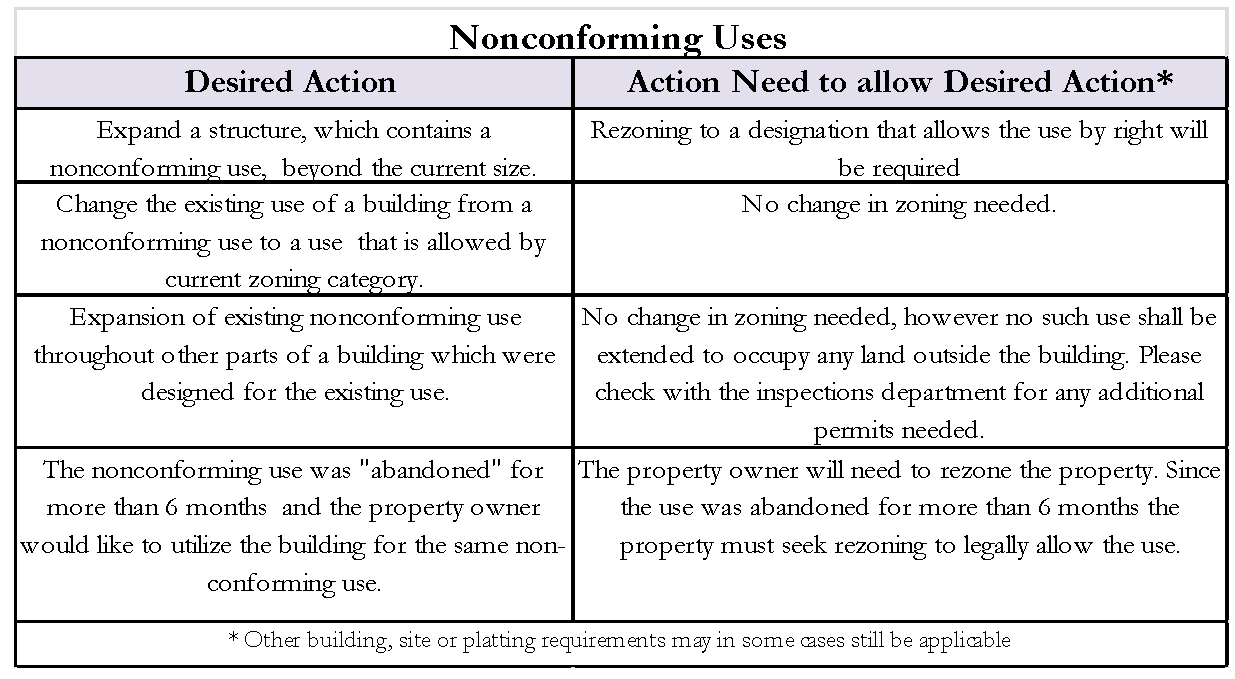
Nonconforming Uses.
A.
General. A nonconforming use is any use that does not conform to the regulations of this Code on the effective date. A use shall be deemed a nonconforming use provided that:
1.
Such use was in existence under and in compliance with the provisions of the immediately prior Zoning Ordinance; or
2.
Such use was a lawful, nonconforming use under the immediately prior Zoning Ordinance; or
3.
Such use was in existence at the time of annexation into the City, was a legal use of the land at such time, and has been in regular and continuous use since such time.
B.
Standards. Nonconforming use standards are as follows:
1.
A structure devoted to a nonconforming use shall not be permitted to be enlarged, extended, reconstructed, or moved.
2.
The use of the structure shall only be changed to a use permitted in the zoning district in which it is located. A nonconforming use may be changed to a conforming use provided that, once such change is made, the use shall not be changed back to a nonconforming use.
3.
The existing nonconforming use may be extended throughout any parts of a building which were arranged or designed for such use at the time of adoption of this ordinance, but no such use shall be extended to occupy any land outside such building.
4.
If a nonconforming use is abandoned, any future use of the premises shall be in conformity with the provisions of this Code, and with any other applicable City codes or ordinances that are in effect at the time the use is resumed or the structure is re-occupied. A nonconforming use shall be deemed "abandoned" in the following circumstances:
•
The use ceases to operate for a continuous period of six months;
•
In the case of a temporary use, the use is moved from the premises for any length of time.
•
For purposes of calculating the six month period, a use is abandoned upon the occurrence of the first of any of the following events:
º
On the date when the use of land is physically vacated;
º
On the date the use ceases to be actively involved in the sale of merchandise or the provision of services;
º
On the date of termination of any lease or contract under which the nonconforming use has occupied the land; or
º
On the date a final reading of water and/or power meters is made by the applicable utility provider(s).
1.3.2.
Nonconforming Structures.
A.
General. Any structure, not including non-conforming signs, that lawfully exists at the effective date of adoption or amendment of this ordinance that could not be built under the terms of this ordinance by reason of restrictions on area, lot coverage, height, yards, its locations on the lot, or other requirements concerning the structure, such structure shall be deemed a nonconforming structure provided that:
1.
Such structure was in existence under and in compliance with the provisions of the immediately prior Zoning Ordinance; or
2.
Such structure was a lawful, nonconforming structure under the immediately prior Zoning Ordinance; or
3.
Such structure was in existence at the time of annexation into the City, was a legal structure at such time, and has been in regular and continuous use since such time;
4.
Such structure was a conforming structure prior to ROW acquisition which reduced the required setback of a structure.
B.
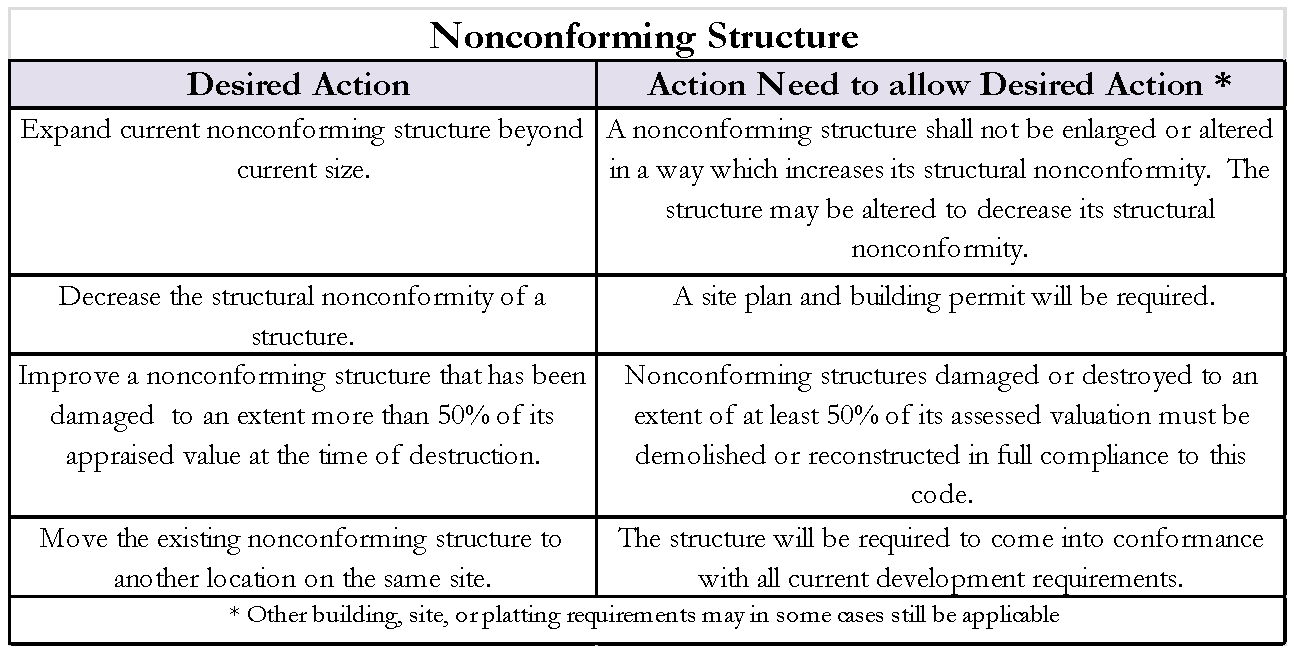
Standards. Nonconforming structures may be allowed to remain in existence as long as it remains otherwise lawful. The nonconforming structure is subject to the following provisions:
1.
A nonconforming structure shall not be enlarged or altered in a way which increases its structural nonconformity.
2.
The structure may be altered to decrease its structural nonconformity or to meet the requirements of the current development regulations.
3.
Nonconforming structures damaged or destroyed to an extent of 50% of its assessed valuation (per Guadalupe County appraisal district) must be demolished or reconstructed in full compliance to this code.
4.
Should such structure be moved for any reason for any distance whatsoever, it shall thereafter conform to the regulations of the district in which it is located after it is moved.
1.3.3.
Nonconforming Sites.
A.
General. Any developed site that lawfully exists at the effective date of adoption or amendment of this ordinance that could not be developed under the terms of this ordinance by reason of restrictions on buffering, screening, landscaping, sidewalk, detention or parking requirements shall be deemed a nonconforming site provided that:
1.
Such site was in existence under and in compliance with the provisions of the immediately prior Zoning Ordinance; or
2.
Such site was a lawful, nonconforming structure under the immediately prior Zoning Ordinance;
B.
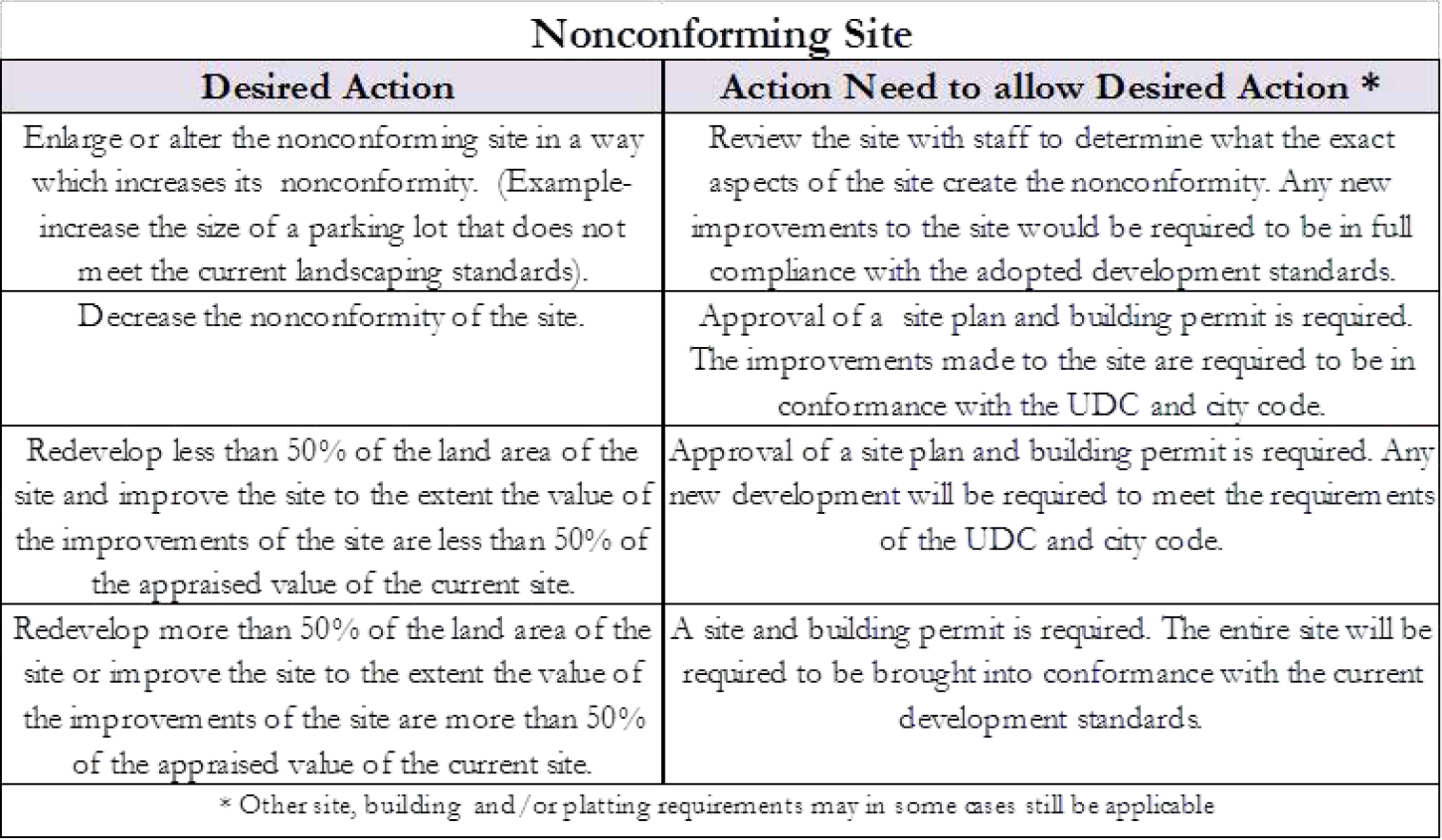
Standards. Nonconforming sites may be allowed to remain in existence as long as it remains otherwise lawful. The nonconforming site is subject to the following provisions:
1.
A nonconforming site shall not be enlarged or altered in a way which increases its nonconformity.
2.
The site may be altered to decrease its structural nonconformity.
3.
All new improvements will be required to meet the requirements of the UDC and other City codes.
4.
All modifications to a nonconforming site or the structures located on the site are subject to the provisions of Chapter 5, Site Development Standards, which may include bringing a site in its entirety into full conformance with the current requirements of the City's adopted codes.
5.
A nonconforming site shall be subject to immediate conformance with screening requirements for garbage containers as contained in Chapter 5, Site Development Standards.
6.
A nonconforming site shall be subject to immediate conformance with the screening and vehicle storage requirements for automotive repair and servicing facilities as contained in Chapter 5, Site Development Standards.
1.3.4.
Nonconforming Lots. Any platted lot that does not conform to the regulations of this Code on the effective date, shall be deemed a nonconforming platted lot provided that:
1.
Such platted lot was in existence under and in compliance with the provisions of the immediately prior Zoning Ordinance; or
2.
Such platted lot was in existence at the time of annexation into the City, was a legally platted subdivision of the land at such time.
3.
Nothing in this Code shall be construed to prohibit the use of a lot that does not meet the minimum lot standards of the zoning district in which it is located, provided that the lot is zoned for the land use(s) intended and the lot was platted as a lot of record prior to the effective date of this Code. Please refer to Chapter 4, Subdivisions for information on legal lot determinations and platting exemptions.
(Ord. No. 2017-35, pt. 1, 7-18-17)
Sec. 1.4. - Expiration of applications.
Below is a listing of development applications required by the UDC and the applicable expiration date of the specified development application.
(Ord. No. 2019-054, § 3, 9-17-19; Ord. No. 2023-003, pt. 2, 1-17-23; Ord. No. 2024-061, pt. 2, 11-19-24)

