
Selma City Zoning Code
ARTICLE XIV
APPEALS, VARIANCES, AND EVIDENTIARY HEARING PROCEDURES
Sec. 17-1400. - Appeals.
A.
Making an Appeal to the Board of Adjustment.
1.
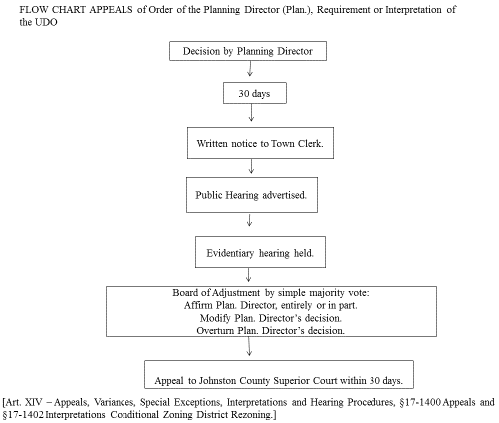
An appeal from any order, requirement, decision or determination of the Administrator, Town Manager or their designee made in the administration of the provisions of this chapter may be taken to the Board of Adjustment by any aggrieved person. Persons who may appeal are:
a)
The owner of the property.
b)
The party who sought the decision.
c)
Any person who has standing as described in section F. below.
d)
The Town.
2.
An appeal is taken by filing a written notice of appeal with the Town Clerk specifying the grounds of the appeal. A notice of appeal shall be considered filed with the Land Use Administrator and the Board of Adjustment when delivered to the Town Clerk, and the date and time of filing shall be entered on the notice by the Town Clerk.
3.
This subsection shall not apply to appeals of the approval or denial of a minor subdivision plat, which decision must be appealed to the Johnston County Superior Court in accordance with G.S. § 160D-1403.
B.
Notice of Appeal; Time to Appeal. The Administrator or official who made the decision shall give written notice to the owner of the property that is the subject of the administrative decision and to the party who sought the decision, if different from the owner. The written notice shall be delivered by personal delivery, electronic mail, or by first-class mail. An appeal must be taken by the owner within thirty (30) days after the date of the receipt of the final written decision or order appealed from. The party who sought the decision (if not the owner) and any other person with standing to appeal under subsection F. below must take their appeal within thirty (30) days of actual or constructive notice of the decision. It shall be conclusively presumed that all persons with standing to appeal have constructive notice of the decision from the date a sign containing the words "Zoning Decision," "Appeal" or "Subdivision Decision" in letters at least six (6) inches high and identifying the means to contact an official for information about the decision is prominently posted on the property that is the subject of the decision, provided the sign remains on the property for at least ten (10) days. Posting of signs is not the only form of constructive notice. Additional Public Notice requirements for all evidentiary hearings are found in Section 17-1451 "Notice of Evidentiary Hearing." An appeal must be taken within thirty (30) days after the date of the decision or order appealed from.
C.
Whenever an appeal is filed, the Administrator shall forthwith transmit to (i) the Board of Adjustment (ii) the person(s) making the appeal (the appellant) and (iii) the property owner (if the property owner did not make the appeal) all the documents and exhibits constituting the record relating to the action appealed from.
D.
An appeal stays all proceedings in furtherance of the action appealed from, unless the Administrator (or other official who made the decision being appealed) certifies in an affidavit to the Board of Adjustment, after notice of appeal has been filed with him, that because of facts stated in the affidavit a stay would cause imminent peril to life or property or that because the violation charged is transitory in nature a stay would seriously interfere with enforcement of the ordinance. In that case, proceedings shall not be stayed except by a restraining order, which may be granted by a court. If enforcement proceedings are not stayed, the appellant may file with the Administrator a request for an expedited evidentiary hearing of the appeal, and the Board of Adjustment shall meet to hear the appeal within fifteen (15) days after such a request is filed. Notwithstanding the foregoing, appeals of decisions granting a permit or otherwise affirming that a proposed use of property is consistent with the ordinance shall not stay the further review of an application for permits or permissions to use such property; in these situations, the appellant may request and the board may grant a stay of a final decision of permit applications or building permits affected by the issue being appealed.
E.
The Board of Adjustment may reverse or affirm, wholly or partly, or may modify the order, requirement, administrative decision, or determination appealed from, and shall make any order, requirement, quasi-judicial decision, or determination that in its opinion ought to be made. To this end the board shall have all the powers of the Administrator or officer from whom the appeal is taken.
F.
Other Persons with Standing to Appeal:
1.
Any person meeting any of the following criteria:
a)
Has an ownership interest in the property that is the subject of the administrative decision being appealed, a leasehold interest in the property that is the subject of the decision being appealed, or an interest created by easement, restriction, or covenant in the property that is the subject of the decision being appealed.
b)
Has an option or contract to purchase the property that is the subject of the administrative decision being appeal.
c)
Was an applicant before the decision-making board whose administrative decision is being appealed.
2.
Any other person who will suffer special damages as the result of the administrative decision being appealed.
3.
An incorporated or unincorporated association to which owners or lessees of property in a designated area belong by virtue of their owning or leasing property in that area, or an association otherwise organized to protect and foster the interest of the particular neighborhood or local area, so long as at least one (1) of the members of the association would have standing as an individual to challenge the administrative decision being appealed, and the association was not created in response to the particular development or issue that is the subject of the appeal.
4.
The Town when Town Council believes that an official made an administrative decision that is otherwise inconsistent with the proper interpretation of this Unified Development Ordinance.
(Ord. No. 2021-64-R, 7-13-21)
Sec. 17-1401. - Variances.
A.
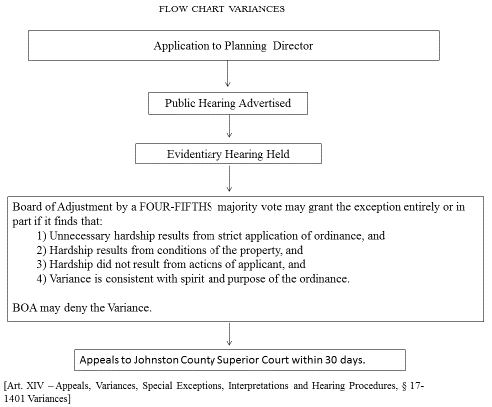
An application for a variance shall be submitted to the Board of Adjustment by filing a copy of the application with the Administrator. Applications shall conform to Section 17-602, "Who May Submit Permit Applications," and Section 17-603, "Applications to Be Complete."
B.
When presented to the Board of Adjustment at the evidentiary hearing, the application for a variance shall be accompanied by a report setting forth the planning staff's proposed findings concerning the application's compliance with Section 17-503 and the other requirements of this chapter. If the staff proposes a finding or conclusion that the application fails to comply with Section 17-603 "Applications to be Complete," the report shall identify the requirement in question and specifically state supporting reasons for the proposed findings or conclusions.
C.
A variance may be granted by the Board of Adjustment if it concludes that strict enforcement of the ordinance would result in unnecessary hardships for the applicant upon a showing of all of the following:
1.
Unnecessary hardship would result from the strict application of the ordinance. It shall not be necessary to demonstrate that, in the absence of the variance, no reasonable use can be made of the property; and
2.
The hardship results from conditions that are peculiar to the property, such as location, size, or topography. Hardships resulting from personal circumstances, as well as hardships resulting from conditions that are common to the neighborhood or the general public, may not be the basis for granting a variance. A variance may be granted when necessary and appropriate to make a reasonable accommodation under the Federal Fair Housing Act for a person with a disability; and
3.
The hardship did not result from actions taken by the applicant or the property owner. The act of purchasing property with knowledge that circumstances exist that may justify the granting of a variance shall not be regarded as a self-created hardship; and
4.
The requested variance is consistent with the spirit, purpose, and intent of the ordinance, such that public safety is secured, and substantial justice is achieved.
D.
An applicant need not meet the criteria of subsections C.1. and 2. if he or she can prove to the satisfaction of the Board that (i) the need for the variance arises out of an error by the town staff (i.e., the applicant relied in good faith upon an error made by the town staff), (ii) in the absence of the variance the applicant will suffer significant hardship, and (iii) the variance will not have an adverse effect on the surrounding properties.
E.
In granting variances, the Board of Adjustment may impose such reasonable conditions as will ensure that the use of the property to which the variance applies will be as compatible as practicable with the surrounding properties.
F.
A variance may be issued for an indefinite duration or for a specified duration only.
G.
The nature of the variance and any conditions attached to it shall be entered on the face of the certificate of zoning compliance, or the certificate of zoning compliance may simply note the issuance of the variance and refer to the written record of the variance for further information. All such conditions are enforceable in the same manner as any other applicable requirement of this ordinance.
(Ord. No. 2021-64-R, 7-13-21)
Sec. 17-1405. - Requests to be heard expeditiously.
As provided in Article VI, Section 17-621, "Applications to Be Processed Expeditiously," the Board of Adjustment shall hear and decide all appeals, variance requests, and requests for interpretations as expeditiously as possible, consistent with the need to follow regularly established agenda procedures, provide notice in accordance with article VII of this chapter, and obtain the necessary information to make sound decisions.
(Ord. No. 2021-64-R, 7-13-21)
Sec. 17-1406. - Burden of proof in appeals and variances.
A.
When an appeal is taken to the Board of Adjustment in accordance with Section 17-1400, "Appeals," the Administrator shall have the initial burden of presenting to the Board sufficient evidence and argument to justify the order or decision appealed from. The burden of presenting evidence and argument to the contrary then shifts to the appellant, who shall also have the burden of persuasion.
B.
The burden of presenting evidence sufficient to allow the Board of Adjustment to reach the conclusions set forth in Section 17-1401C. "Variances," as well as the burden of persuasion on those issues remains with the applicant seeking the variance.
(Ord. No. 2021-64-R, 7-13-21)
Sec. 17-1407. - Board action on appeals and variances.
A.
With respect to appeals and interpretations, a motion to reverse, affirm, or modify the order, requirement, administrative decision, or determination appealed from shall include, insofar as practicable, a statement of the specific reasons or findings of facts that support the motion. If a motion to reverse or modify an administrative decision on appeal is not made or fails to receive a simple majority vote necessary for adoption, then a motion to uphold the decision appealed from shall be in order. This motion is adopted as the Board's decision if supported by more than one-half (½) of the Board's membership (excluding vacant seats).
B.
With respect to variances, a motion to reverse, affirm, or modify the order, requirement, decision, or determination appealed from shall include, insofar as practicable, a statement of the specific reasons or findings of facts that support the motion. If a motion to grant a variance is not made or fails to receive the four-fifths (4/5) vote necessary for adoption, then a motion to deny the variance shall be in order. This motion is adopted as the Board's decision if supported by more than one-fifth (1/5) of the Board's membership (excluding vacant seats).
A motion to deny a variance may be made on the basis that any one (1) or more of the seven (7) criteria set forth in Section 17-1401, "Variances," are not satisfied or that the application is incomplete. Insofar as practicable, such a motion shall include a statement of the specific reasons or findings of fact that support it.
1.
Before granting a variance, the Board must take a separate vote and vote affirmatively (by a four-fifths (4/5) majority) on each of the four required findings stated in Section 17-1401C. Insofar as practicable, a motion to make an affirmative finding on each of the requirements set forth in Section 17-1401C. shall include a statement of the specific reasons or findings of fact supporting such motion.
2.
A motion to deny a variance may be made on the basis that any one or more of the four (4) criteria set forth in Section 17-1401C. are not satisfied or that the application is incomplete. Insofar as practicable, such a motion shall include a statement of the specific reasons or findings of fact that support it. This motion is adopted as the Board's decision if supported by more than one-fifth (1/5) of the Board's membership (excluding vacant seats).
(Ord. No. 2021-64-R, 7-13-21)
Sec. 17-1408. - Fees for appeals and variance requests.
A fee shall be paid to the town for each application for an appeal, interpretation or variance. The fee shall be adopted and periodically amended by the Town Council as needed to cover the administrative costs and advertising associated with the appeal or variance. A copy of the fee schedule shall be available for review in the office of the Town Clerk.
(Ord. No. 2021-64-R, 7-13-21)
Sec. 17-1450. - Hearing required on appeals and applications.
A.
Before making a quasi-judicial decision on an appeal or an application for a special use permit, variance, or a petition from the planning staff to revoke a special use permit, the Town Council or Board of Adjustment, as the case may be, shall hold an evidentiary hearing on the appeal or application.
B.
Subject to subsection C., the evidentiary hearing shall be open to the public and all persons interested in the outcome of the appeal or application shall be given an opportunity to present evidence and arguments and ask questions of persons who testify.
C.
The Town Council or Board of Adjustment may place reasonable and equitable limitations on the presentation of evidence and arguments and the cross-examination of witnesses so that the matter at issue may be heard and decided without undue delay.
D.
The Board may continue the evidentiary hearing until a subsequent meeting and may keep the hearing open to take additional information up to the point a final quasi-judicial decision is made. No further notice of a continued hearing need be published unless a period of six (6) weeks or more elapses between hearing dates. If an evidentiary hearing is set for a given date and a quorum of the board is not then present, the hearing shall be continued until the next regular board meeting without further advertisement.
E.
The official who made the decision appealed from (usually the Administrator) shall be present at the evidentiary hearing as a witness. The appellant shall not be limited at the hearing to matters stated in the notice of appeal. If any party or the town would be unduly prejudiced by the presentation of matters not presented in the notice of appeal, the board shall continue the hearing.
(Ord. No. 2021-64-R, 7-13-21)
Sec. 17-1451. - Notice of hearing.
The Administrator shall give notice of any hearing required by Sections 17-1600 "Town Council," 17-1614 "Powers and Duties of Planning Board," 17-1622 "Powers and Duties [of the Board of Adjustment]," 17-1631 "Powers and Duties [of the Appearance Commission]," 17-1642 "Powers and Duties [of the Historic Preservation Commission]," 17-1400, "Appeals," 17-1401 "Variances," 17-610 "Special Use Permits," and 17-1404 "Interpretations" as provided in Section 17-1703 "Hearing Required, Notice [for Zoning Map or Text Amendments]."
(Ord. No. 2021-64-R, 7-13-21)
Sec. 17-1452. - Evidence.
A.
The provisions of this section apply to all hearings for which a notice is required by Section 17-1451.
B.
All persons who intend to present evidence to the permit-issuing board, rather than arguments only, shall be sworn.
C.
All findings and conclusions necessary to the issuance or denial of the requested permit or appeal (i.e., crucial findings) shall be based upon competent, material and substantial evidence.
D.
Competent evidence:
1.
Competent evidence (evidence admissible in a court of law) shall be preferred whenever reasonably available, but in no case may crucial findings be based solely upon incompetent evidence unless competent evidence is not reasonably available, the evidence in question appears to be particularly reliable, and the matter at issue is not seriously disputed.
2.
Competent evidence shall not include the opinion testimony of lay witnesses as to any of the following:
a)
The use of property in a particular way would [effect] the value of other property;
b)
The increase in vehicular traffic resulting from a proposed development would pose a danger to the public safety; or
c)
Matters about which only expert testimony would generally be admissible under the rules of evidence.
(Ord. No. 2021-64-R, 7-13-21)
Sec. 17-1453. - Modification of application at hearing.
A.
In response to questions or comments by persons appearing at the hearing or to suggestions or recommendations by the Planning Board, Town Council or Board of Adjustment, the applicant may agree to modify his application, including the plans and specifications submitted.
B.
Unless such modifications are so substantial or extensive that the Board cannot reasonably be expected to perceive the nature and impact of the proposed changes without revised plans before it, the board may approve the application with the stipulation that the permit will not be issued until plans reflecting the agreed upon changes are submitted to the planning staff.
(Ord. No. 2021-64-R, 7-13-21)
Sec. 17-1454. - Record.
A.
A tape or digital recording shall be made of all hearings required by Section 17-1450, and such recordings shall be kept for at least two (2) years. Accurate minutes shall also be kept of all such proceedings, but a transcript need not be made.
(Ord. No. 2021-64-R, 7-13-21)
Sec. 17-1455. - Written decision.
A.
Every quasi-judicial decision shall be based upon competent, material, and substantial evidence in the record. Each quasi-judicial decision shall be reduced to writing and reflect the board's determination of contested facts and conclusions of law and their application to the applicable standards.
B.
The written decision shall be signed by the chair or other duly authorized member of the board. A quasi-judicial decision is effective upon filing the written decision with the clerk to the board. The decision of the board shall be delivered by personal delivery, electronic mail, or by first-class mail to the applicant, property owner, and to any person who has submitted a written request for a copy, prior to the date the decision becomes effective. The person required to provide notice shall certify that proper notice has been made.
(Ord. No. 2021-64-R, 7-13-21)
Sec. 17-1456. - Appeals of quasi-judicial decisions.
Every quasi-judicial decision shall be subject to review by the Johnston County Superior Court by proceedings in the nature of certiorari pursuant to G.S. § 160D-1402. A petition for review shall be filed with the clerk of superior court by the later of thirty (30) days after the decision is effective or after a written copy thereof is given in accordance with Section 17-1407 "Board Action on Appeals and Variances." When first-class mail is used to deliver notice, three (3) days shall be added to the time to file the petition.
(Ord. No. 2021-64-R, 7-13-21)

