
Selma City Zoning Code
ARTICLE VI
PERMITS AND FINAL PLAT APPROVAL
PART 2. - MAJOR AND MINOR SUBDIVISIONS[3]
Editor's note— For subdivisions to be in a Water Supply Watershed, see also Section 17-422, "Water Supply Watershed Protection District."
Sec. 17-600. - Permits required.
A.
Subject to Section 17-1101, "Permit Required, Permitting Procedures," with regard to signs, the use made of property may not be substantially changed (see Section 17-407, "Change in Use"); substantial clearing, grading, or excavation may not be commenced; and buildings or other substantial structures may not be constructed, erected, moved, or substantially altered except in accordance with and pursuant to one (1) of the following permits:
1.
A zoning permit issued by the Director of Planning & Economic Development who is also referred to as the Administrator. (A landscape plan may be needed in order to obtain a zoning permit. See Section 17-607 and Appendix C);
2.
A certificate of zoning compliance issued by the Administrator;
3.
A special use permit issued by the Town Council;
4.
A special use zoning map amendment with site plan approval issued by the Town Council (See Article XVII, Part 2. Conditional Zoning District Rezoning);
5.
A certificate of appropriateness issued by the Historic Preservation Commission or Planning Director;
6.
A floodplain development permit issued by the Floodplain Administrator (Planning Director);
7.
A watershed development permit issued by the Stormwater Administrator (Planning Director).
B.
Zoning permits, certificates of zoning compliance, special use permits, site plan approvals, floodplain development permits, watershed development permits, certificates of appropriateness and sign permits are issued under this chapter only when a review of the application submitted, including the plans contained therein, indicates that the development will comply with the provisions of this chapter if completed as proposed. Such plans and applications as are finally approved are incorporated into any permit issued, and except as otherwise provided in Section 17-619, "Amendments to and Modifications of Permits," all development shall occur strictly in accordance with such approved plans and applications.
C.
Physical improvements to land to be subdivided may not be commenced except in accordance with a special use permit issued by the Town Council for major subdivisions or after final plat approval by the planning director for minor subdivisions (see Part 2 of this article).
D.
A zoning permit, certificate of zoning compliance, special use permit, watershed development permit, floodplain development permit, certificate of appropriateness or sign permit shall be issued in the name of the applicant (except that applications submitted by an agent shall be issued in the name of the principal); shall identify the property involved and the proposed use; shall incorporate by reference the plans submitted; and shall contain any special conditions or requirements lawfully imposed by the permit-issuing authority. All special use permits shall be recorded in the Johnston County Registry after execution by the record owner as provided in Section 17-616.
(Ord. No. 2021-64-R, 7-13-21)
Sec. 17-601. - No occupancy, use or sale of lots until requirements fulfilled.
A.
Issuance of a zoning permit or special use permit authorizes the recipient to commence the activity resulting in a change in use of the land or (subject to obtaining a building permit, floodplain development permit or certificate of appropriateness as needed) to commence work designed to construct, erect, move, or substantially alter buildings or other substantial structures or make necessary improvements to a subdivision. However, except as provided in Sections 17-609, "Authorizing Use or Occupancy Before Completion of Development Under Certificate of Zoning Compliance"; 17-615, "Authorizing Use, Occupancy, or Sale Before Completion of Development Under Special Use Permit"; and 17-616, "Completing Developments in Phases," the intended use may not be commenced, no building may be occupied, and in the case of subdivisions, no lots may be sold until all of the requirements of this chapter and all additional requirements imposed pursuant to the issuance of a special use permit have been complied with.
B.
Additionally, a certificate of zoning compliance must be issued for all projects for which a special use permit and the other permits (listed in Section 17-600 above) has been issued or which are subject to a conditional zoning district. The zoning permit must be issued prior to the issuance of a building permit to show compliance with this chapter and the applicable special use permit or the regulations and conditions of the applicable conditional zoning district.
C.
A certificate of zoning compliance must be issued by the Administrator before a certificate of occupancy is obtained.
(Ord. No. 2021-64-R, 7-13-21)
Sec. 17-602. - Who may submit permit applications.
A.
Applications for all permits, including but not limited to, zoning, special use or sign permits or subdivision plat approvals will be accepted only from persons having the legal authority to act in accordance with the permit, certificate or the subdivision plat approval. By way of illustration, in general this means that applications should be made by the owners or lessees of property, or their agents, or persons who have contracted to purchase property contingent upon their ability to acquire the necessary permits under this chapter, or the agents of such persons (who may make application in the name of such owners, lessees, or contract vendees).
B.
When the applicant does not own the property at issue, the Administrator shall require the applicant to submit written evidence of his authority to submit the application in accordance with the Section 17-602A. See also Appendix A.
(Ord. No. 2021-64-R, 7-13-21)
Sec. 17-603. - Applications to be complete.
A.
All applications for zoning, special use, subdivision approval, flood plain, and watershed development permits, or certificates of appropriateness or sign permits must be complete before the permit-issuing authority is required to consider the application.
B.
Subject to subsection C., an application is complete when it contains all the information that is necessary for the permit-issuing authority to decide whether the development, if completed as proposed, will comply with all the requirements of this chapter.
C.
In this chapter, detailed or technical design requirements and construction specifications relating to various types of improvements (streets, sidewalks, etc.) are set forth in one (1) or more of the appendices to this chapter. It is not necessary that the application contain the type of detailed construction drawings that would be necessary to determine compliance with these appendices, so long as the plans provide sufficient information to allow the permit-issuing authority to evaluate the application in light of the substantive requirements set forth in this text of this chapter. However, when this chapter requires a certain element of a development to be constructed in accordance with the detailed requirements set forth in one (1) or more of these appendices, then no construction work on such element may be commenced until detailed construction drawings have been submitted to and approved by the Administrator. Failure to observe this requirement may result in permit revocation, denial of final subdivision plat approval, or other penalty as provided in article XV of this chapter.
D.
All applications for special use permits, watershed development permits and flood plain development permits must be accompanied by a site plan of such proposal prepared by a N.C. Licensed Engineer, Architect or Professional Surveyor. The presumption established by this chapter is that all the information set forth in Appendix A, "Information Required With Applications," is necessary to satisfy the requirements of this section. However, it is recognized that each development is unique, and therefore the Planning Director/Administrator may allow less information or require more information to be submitted according to the needs of the particular case. For applications submitted to the Planning Board or Town Council, the applicant may rely in the first instance on the recommendations of the Administrator as to whether more or less information than that set forth in Appendix A should be submitted.
E.
All applications for zoning permits and any other permit (except applications for subdivision plat approval, applications requiring site plan approval, individual single family or duplexes dwellings on single lots) must be accompanied by a sketch plan prepared by a N.C. Licensed Engineer, Architect or Professional Surveyor. The presumption established by this chapter is that all the information set forth in this subsection is necessary to satisfy the requirements of this subsection. However, it is recognized that each development is unique, and therefore the Planning Director/Administrator may allow less information or require more information to be submitted according to the needs of the particular case. For applications submitted to the Zoning Board of Adjustment, the applicant may rely in the first instance on the recommendations of the Administrator as to whether more or less information than that set forth below be submitted.
F.
The sketch plan shall contain:
1.
The name and address of the owner and applicant, if not the same person;
2.
The proposed name and location of the development;
3.
The approximate total acreage of the proposed development;
4.
The tentative streets, sidewalks or greenways and lot arrangements, and lot boundary lines;
5.
Topographic lines;
6.
Perennial streams, water bodies, flood plain and watershed boundaries, and setbacks therefrom (if any);
7.
Proposed utilities layouts;
8.
Proposed open space and recreation areas;
9.
The locations of buildings or the building setback lines; and
10.
Any other information the owner or applicant believes necessary to obtain the informal opinion of the planning staff as to proposed development's compliance with the requirements of this chapter.
G.
All applications for zoning permits for single family dwellings or duplexes on single lots must be accompanied by a sketch plan drawn to scale. The presumption established by this chapter is that all the information set forth in subsection F. above is necessary to satisfy the requirements of this subsection. However, it is recognized that each development is unique, and therefore the Planning Director/Administrator may allow less information or require more information to be submitted according to the needs of the particular case. The sketch plan shall contain:
1.
The name and address of the owner and applicant, if not the same person;
2.
The approximate total acreage of the proposed development;
3.
The locations of buildings, lot boundary and building setback lines; and
4.
Any other information the owner or applicant believes necessary to obtain the informal opinion of the planning staff as to proposed development's compliance with the requirements of this chapter. If the principal structure is less than ten (10) feet from a lot boundary line, the Planning Director may require a survey drawn by a N.C. Licensed Engineer, Architect or Professional Surveyor.
5.
If the property is located in a floodplain, the application requirements of Article X must be met.
H.
The Administrator shall make every effort to develop application forms, instructional sheets, checklists, or other techniques or devices to assist applicants in understanding the application requirements and the form and type of information that must be submitted.
(Ord. No. 2021-64-R, 7-13-21)
Sec. 17-604. - Staff consultation before formal application.
To minimize development planning costs, avoid misunderstanding or misinterpretation, and ensure compliance with the requirements of this chapter, pre-application consultation between the developer and the planning staff is strongly encouraged.
(Ord. No. 2021-64-R, 7-13-21)
Sec. 17-605. - Staff consultation after application submitted.
A.
Upon receipt of a formal application for a zoning permit, certificate of zoning compliance, special use permit, watershed development permit, flood plain development permit, or subdivision plat approval, the Administrator shall review the application and, if the applicant wishes, confer with the applicant to ensure that he or she understands the planning staff's interpretation of the applicable requirements of this chapter, that the developer has submitted all of the information that he or she intends to submit, and that the application represents precisely and completely what he or she proposes to do. If the Administrator believes that the application is incomplete, he or she shall advise the applicant in writing about what is required to complete the application.
B.
If the application is for a permit that requires board approval (such as a special use permit), the Administrator shall place the application on the agenda of the Planning Board when the application is as complete as the applicant intends to make it. However, as provided in Section 17-612, "Recommendations on Special Use Permit Applications," if the Administrator believes that the application is incomplete, he or she shall recommend to the Planning Board and Town Council that the application be denied on that basis.
(Ord. No. 2021-64-R, 7-13-21)
Sec. 17-606. - Zoning permit applications.
A.
A completed application form for a zoning permit shall be submitted to the Administrator by filing a complete copy of the application with the Administrator in the Planning Department.
B.
The Administrator shall issue the zoning permit unless he finds, after reviewing the application and consulting with the applicant as provided in Section 17-605 that:
1.
The requested permit is not within the Administrator's jurisdiction according to the Table of Permissible Uses; or
2.
The application is incomplete; or
3.
The permitted site work has not been approved by other Town Departments or government agencies having jurisdiction; or
4.
If completed as proposed in the application, the development will not comply with one (1) or more requirements of this chapter (not including those requirements concerning which a variance has been granted or those the applicant is not required to comply with under the circumstances specified in Article XIII, "Nonconformities," of this chapter).
(Ord. No. 2021-64-R, 7-13-21)
Sec. 17-607. - Landscape plan procedures.
A.
Landscape plans shall be submitted to the Planning Department and shall be reviewed by the Planning Department. Plans shall be approved by the Administrator for uses by right. They shall review and forward recommendations to the Planning Board and Town Council for major subdivision plats (Section 17-654 et seq.), special use permits (Section 17-610 et seq.) and conditional rezoning applications (Section 17-1750 et seq.).
B.
The Administrator shall not issue a certificate of zoning of compliance for an approved development permit or plan or part thereof until all applicable requirements of this section have been satisfied. A temporary certificate of zoning compliance may be issued for a period not to exceed ninety (90) days, if the Planning Director determines there are extenuating circumstances that would affect the seeding or planting of the site and if applicant posts a sufficient performance guarantee (Section 17-657). The Administrator may recommend that Johnston County Building Inspections Department issue a temporary certificate of occupancy for a period not to exceed ninety (90) days.
C.
Landscaping Plan. Landscaping plans shall be submitted before or at the time of application for a zoning permit or site plan review, or as described in subsection A. above. Landscaping Plans shall meet the standards of Sec. 17-509 and Appendix A for all development projects. These plans shall contain the following information:
1.
Date of plan preparation.
2.
Project name and description of land use.
3.
Project owner and mailing address.
4.
A map at a scale of 1" = 100' or less showing:
a)
North arrow.
b)
Scale.
c)
Approximate locations and species of all existing hardwood trees at least eight (8) inches DBH, all conifer trees at least twelve (12) inches DBH, and all dogwoods and American Hollies at least four (4) inches DBH. The canopy drip line of those trees shall be delineated. If groves of protected trees exist that will not be removed or disturbed, it is permitted to label the grove as such on the map, stating the approximate number of protected trees and species mix, without specifying data on each individual tree.
d)
Note on plan stating that prior to any clearing, grading, or construction activity, tree protection fencing will be installed around protected trees or groves of trees. And no construction workers, tools, materials, or vehicles are permitted within the tree protection fencing.
e)
Locations, dimensions and square footages of required buffer strips and parking lot landscaping.
f)
Details of required landscaping showing species, dimensions, and spacing of planted materials and the use and protection of existing vegetation.
g)
All existing and proposed utilities and if applicable, their associated easements.
h)
Location and square footage of structures and parking lots.
i)
Adjacent zoning districts.
j)
Approximate locations of all trees greater than eight (8) inches DBH within required buffers and of all areas of natural vegetation to be used as part of the buffer.
k)
Setbacks of all structures and specifications and shielding of certain uses, as required.
Exception to the proposed use of canopy trees may be applied to plantings proposed near power lines. The Administrator may suggest a suitable substitution in such cases.
(Ord. No. 2021-64-R, 7-13-21)
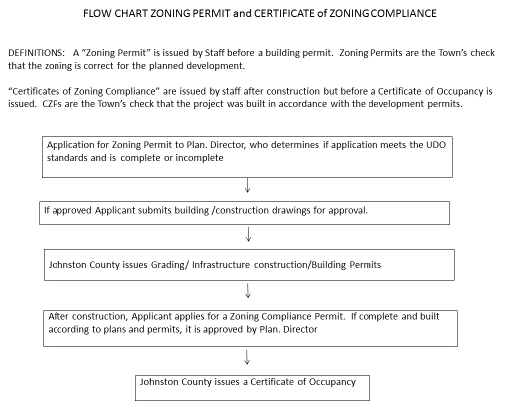
Sec. 17-608. - Certificates of zoning compliance.
A.
A completed application form for a certificate of zoning compliance shall be submitted to the Administrator by filing a complete copy of the application with the Administrator in the Planning Department.
B.
The Administrator shall issue the certificate of zoning compliance unless he finds, after reviewing the application and consulting with the applicant as provided in Section 17-604 that:
1.
The approved and permitted work on the site has not been completed; or
2.
The application is incomplete; or
3.
The permitted site work has not been approved by other Town Departments or government agencies having jurisdiction; or
4.
If completed as proposed in the application, the development will not comply with one (1) or more requirements of this chapter (not including those requirements concerning which a variance has been granted or those the applicant is not required to comply with under the circumstances specified in article XIII, "Nonconformities," of this chapter).
(Ord. No. 2021-64-R, 7-13-21)
Sec. 17-609. - Authorizing use or occupancy before completion of development under a certificate of zoning compliance.
In cases when, because of weather conditions or other factors beyond the control of the zoning-permit recipient (exclusive of financial hardship), it would be unreasonable to require the zoning-permit recipient to comply with all of the requirements of this chapter prior to commencing the intended use of the property or occupying any buildings, the Administrator may authorize the commencement of the intended use or occupancy of buildings (insofar as the requirements of this chapter are concerned) if the permit recipient provides a performance guarantee to ensure that all of these requirements will be fulfilled within a reasonable period (not to exceed twelve (12) months) determined by the Administrator. The performance guarantee shall be payable to or in favor of the town and shall be in an amount equal to one hundred twenty-five (125) percent of the reasonably estimated cost of completion of the project, as estimated by the developer and approved by the Administrator. Any extension of the performance guarantee necessary to complete required improvements shall not exceed one hundred twenty-five (125) percent of the reasonably estimated cost of completion of the remaining incomplete improvements still outstanding at the time the extension is obtained.
The permit recipient may elect which performance guarantee he or she will use from the options specified by this subsection.
A.
The term "performance guarantee" shall mean any of the following forms of guarantee:
1.
Surety bond issued by any company authorized to do business in this State.
2.
Letter of credit issued by any financial institution licensed to do business in this State.
3.
Other form of guarantee that provides equivalent security to a surety bond or letter of credit.
B.
The performance guarantee shall be returned or released, as appropriate, in a timely manner upon the acknowledgement by the Town that the improvements for which the performance guarantee is being required are complete. If the improvements are not complete and the current performance guarantee is expiring, the performance guarantee shall be extended, or a new performance guarantee issued, for an additional period until such required improvements are complete. A developer shall demonstrate reasonable, good faith progress toward completion of the required improvements that are the subject of the performance guarantee or any extension. The form of any extension shall remain at the election of the developer.
C.
The performance guarantee shall only be used for completion of the required improvements and not for repairs or maintenance after completion.
(Ord. No. 2021-64-R, 7-13-21)
Sec. 17-610. - Special use permits.
A.
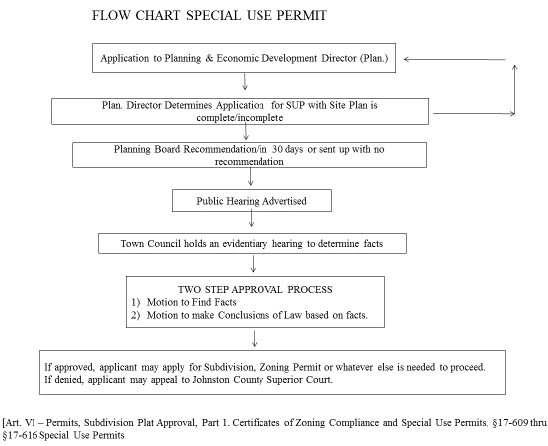
An application for a special use permit shall be considered by the Town Council by filing a copy of the application with the Administrator in the Planning Department.
B.
The Town shall follow the procedures at Article VI, Part 1 for all Town Council hearings on Special Use Permit applications.
C.
Subject to subsection D., the Town Council shall issue the requested permit unless it concludes, based upon the information submitted at the evidentiary hearing, that:
1.
The requested permit is not within its jurisdiction according to the Table of permissible uses; or
2.
The application is incomplete; or
3.
If completed as proposed in the application, the development will not comply with one (1) or more requirements of this chapter (not including those the applicant is not required to comply with under the circumstances specified in Article XIII, "Nonconformities," of this chapter).
D.
Even if the Town Council finds that the application complies with all other provisions of this chapter, it may still deny the permit if it concludes, based upon the information submitted at the hearing, that if completed as proposed, the development, more probably than not:
1.
Will materially endanger the public health or safety; or
2.
Will substantially injure the value of adjoining or abutting property; or
3.
Will not be in harmony with the area in which it is to be located; or
4.
Will not be in general conformity with the future land-use plan, thoroughfare plan, or other plan specifically adopted by the Town Council.
(Ord. No. 2021-64-R, 7-13-21)
Sec. 17-611. - Burden of presenting evidence; burden of persuasion.
A.
The burden of presenting a complete application (as described in Section 17-603) to the Planning Board and Town Council shall be upon the applicant. However, unless the Planning Board or Town Council informs the applicant at the hearing in what way the application is incomplete and offers the applicant an opportunity to complete the application (either at that meeting or at a continuation hearing), the application shall be presumed to be complete.
B.
Once a completed application has been submitted, the burden of presenting evidence to the Town Council sufficient to lead it to conclude that the application should be denied for any reasons stated in Sections 17-610C.1., 17-610C.3. or 17-610D. shall be upon the party or parties urging this position, unless the information presented by the applicant in his application and at the public hearing is sufficient to justify a reasonable conclusion that a reason exists to so deny the application.
C.
The burden of persuasion on the issue of whether the development, if completed as proposed, will comply with the requirements of this chapter remains always on the applicant. The burden of persuasion on the issue of whether the application should be turned down for any reasons set forth in Section 17-610C. rests on the party or parties urging that the requested permit should be denied.
(Ord. No. 2021-64-R, 7-13-21)
Sec. 17-612. - Recommendations on special use permit applications.
A.
Before being presented to the Town Council, an application for a special use permit shall be referred to the Planning Board for action in accordance with this section. The Town Council may not hold a hearing on a special use permit application until the Planning Board has had an opportunity to consider the application pursuant to standard agenda procedures. In addition, at the request of the Planning Board, the Town Council may allow the Planning Board more time to consider the application.
B.
When presented to the Planning Board, the application shall be accompanied by a report setting forth the planning staff's proposed findings concerning the application's compliance with Section 17-603, "Applications to be Complete," and other requirements of this chapter, as well as any staff recommendations for additional requirements to be imposed by the Town Council. If the planning staff report proposes a finding or conclusion that the application fails to comply with Section 17-603 or any other requirement of this chapter, it shall identify the requirement in question and specifically state supporting reasons for the proposed findings or conclusions.
C.
The Planning Board shall consider the application and the attached staff report in a timely fashion, and may, in the Chairperson's discretion, hear from the applicant or members of the public. (Notice to the adjoining property owners is provided for in Section 17-1611, "Meetings of the Planning Board").
D.
The Planning Board provides a preliminary forum for review of special permit applications, provided that no part of the forum or recommendation may be used as a basis for the quasi-judicial decision by the Town Council.
E.
In response to the Planning Board's recommendations, the applicant may modify this application prior to submission to the Town Council and the planning staff may likewise revise its recommendations.
(Ord. No. 2021-64-R, 7-13-21)
Sec. 17-613. - Town Council action on special use permits.
In considering whether to approve an application for a special use permit, the Town Council shall proceed according to the following format:
A.
A simple majority vote of the Town Council is required to approve any motion related to the issuance of a special use permit.
B.
The Town Council shall consider whether the application is complete. If the Town Council concludes that the application is incomplete and the applicant refuses to provide the necessary information, the application shall be denied. A motion to this effect shall specify either the information lacking or the requirement with respect to which the application is incomplete. If a motion to this effect is not approved, this shall be taken as an affirmative finding by the board that the application is complete.
C.
The Town Council shall consider whether the application complies with all the applicable requirements of this chapter. If a motion to this effect passes, the Town Council need not make further findings concerning such requirements. If such a motion fails or is not made, then a motion shall be made that the application be found not in compliance with one (1) or more of the requirements of this chapter. Such a motion shall specify the requirements the application fails to meet. Separate votes may be taken with respect to each requirement not met by the application. It shall be conclusively presumed that the application complies with all requirements not found by the Town Council to be unsatisfied through this process.
D.
If the Town Council concludes that the application fails to comply with one (1) or more requirements of this chapter, the application shall be denied. If the Town Council concludes that all such requirements are met, it shall issue the permit, unless it adopts a motion to deny the application for one (1) or more of the reasons set forth in Section 17-610D. Such a motion shall propose specific findings, based upon the evidence submitted, justifying such a conclusion.
(Ord. No. 2021-64-R, 7-13-21)
Sec. 17-614. - Additional requirements on special use permits.
A.
Subject to subsection B., in granting a special use permit, the Town Council may, by a simple majority vote, attach to the permit such reasonable requirements in addition to those specified in this chapter as will ensure that the development in its proposed location:
1.
Will not endanger the public health or safety;
2.
Will not injure the value of adjoining or abutting property;
3.
Will be in harmony with the area in which it is located; and
4.
Will be in conformity with the land-use plan, thoroughfare plan, or other plan officially adopted by the Town Council; and
5.
Will comply with any additional requirements listed in Article V, Part 2 beginning at Section 17-520.
B.
The Town Council may not attach additional conditions that modify or alter the specific requirements set forth in this chapter unless the development in question presents extraordinary circumstances that justify the variation from the specified requirements.
C.
The Town Council may not attach conditions for which the Town does not have authority under statue to regulate nor conditions that the courts have held to be unenforceable.
D.
Without limiting the foregoing, the Town Council may attach to a permit a condition limiting the permit to a specified duration.
E.
All additional conditions or requirements shall be entered on the permit.
F.
All additional conditions or requirements authorized by this section are enforceable in the same manner and to the same extent as any other applicable requirement of this chapter.
G.
A vote may be taken on application conditions or requirements before consideration of whether the permit should be denied for any reasons set forth in Sections 17-610C. or D.
(Ord. No. 2021-64-R, 7-13-21)
Sec. 17-615. - Authorizing use, occupancy, or sale before completion of development under a special use permit.
A.
In cases when, because of weather conditions or other factors beyond the control of the special use permit recipient (exclusive of financial hardship), it would be unreasonable to require the permit recipient to comply with all of the requirements of this chapter prior to commencing the intended use of the property or occupying any buildings or selling lots in any subdivision, the Town Council may authorize the commencement of the intended use or occupancy of buildings (insofar as the requirements of this chapter are concerned) if the permit recipient provides a performance guarantee as provided in Section 17-609.
B.
In the case of a failure on the part of the developer to timely complete all improvements, the Administrator shall immediately call either the entire performance guarantees or as much of said guarantee as is necessary to complete the remaining improvements. The town shall return to the developer any funds not spent in completing the improvements.
C.
The Administrator or Town Council, as appropriate, shall release a portion of any performance guarantee as the improvements are completed.
D.
When the Town Council imposes additional requirements upon the permit recipient in accordance with Section 17-614 or when the developer proposes in the plans submitted to install amenities beyond those required by this chapter, the Town Council may authorize the permittee to commence the intended use of the property or to occupy any building or to sell any subdivision lots before the additional requirements are fulfilled or the amenities installed if the Council specifies a date by which or a schedule according to which such requirements must be met or each amenity installed and if the Council concludes that compliance will be ensured as the result of any one (1) or more of the following:
1.
A performance guarantee is furnished to and administered by the Town in the manner described in subsection A.;
2.
A condition is imposed establishing an automatic expiration date on the permit, thereby ensuring that the permit recipient's compliance will be reviewed when application for renewal is made; or
3.
The nature of the requirements or amenities is such that sufficient assurance of compliance is given by Article XV. "Enforcement" Section 17-1504, "Penalties and Remedies for Violations," and Section 17-1505, "Permit Revocation and Building Permit Denial."
E.
With respect to subdivisions in which the developer is selling only undeveloped lots, the Town Council may authorize final plat approval and the sale of lots before all the requirements of this chapter are fulfilled if the subdivider provides a performance guarantee to the Town Council to ensure that all of these requirements will be fulfilled within not more than twelve (12) months after final plat approval. The subdivider may elect which performance guarantee he or she will use from the range specified by this subsection A. above. The performance guarantee shall be furnished and administered in this section.
(Ord. No. 2021-64-R, 7-13-21)
Sec. 17-616. - Completing developments in phases.
A.
If a development is constructed in phases or stages in accordance with this section, then, subject to subsection C., the provisions of Section 17-601, "No Occupancy, Use, or Sale of Lots Until Requirements Fulfilled," and Section 17-615 "Authorizing Use, Occupancy, or Sale Before Completion of Development Under a Special Use Permit" (exceptions to Section 17-601 "No Occupancy, Use or Sale of Lots Until Requirements Fulfilled") shall apply to each phase as if it were the entire development.
B.
As a prerequisite to taking advantage of the provisions of subsection A., the developer shall submit plans that clearly show the various phases or stages of the proposed development and the requirements of this chapter that will be satisfied with respect to each phase or stage.
C.
If a development that is to be built in phases or stages includes improvements that are designed to relate to, benefit, or be used by the entire development (such as a swimming pool or tennis courts in a residential development) then, as part of his application for development approval, the developer shall submit a proposed schedule or completion of such improvements. The schedule shall relate completion of such improvements to completion of one (1) or more phases or stages of the entire development. Once a schedule has been approved and made part of the permit by the permit-issuing authority, no land may be used, no buildings may be occupied, and no subdivision lots may be sold except in accordance with the schedule approved as part of the permit, provided that:
1.
If the improvement is one required by this chapter, then the developer may utilize the provisions of Sections 17-615A. and C. "Authorizing Use, Occupancy or Sale Before Completion of Development Under a Special Use Permit"; and
2.
If the improvement is an amenity, not required by this chapter, or is provided in response to a condition imposed by the Town Council, then the developer may utilize the provisions of Section 17-615B.
(Ord. No. 2021-64-R, 7-13-21)
Sec. 17-617. - Expiration of permits.
A.
Zoning, special use, watershed development, flood plain development and sign permits shall expire automatically if, within one (1) year after the issuance of such permit:
1.
The use authorized by such permits has not commenced, in circumstances where no substantial construction, erection, alteration, excavation, demolition, or similar work is necessary before commencement of such use; or
2.
Less than ten (10) percent of the total cost of all construction, erection, alteration, excavation, demolition, or similar work on any development authorized by such permits has been completed on the site. With respect to phased development (see Section 17-616 "Completing Development in Phases"), this requirement shall apply only to the first phase.
B.
If, after some physical alteration to land or structures begins to take place, such work is discontinued for a period of two (2) years, then the permit authorizing such work shall immediately expire. However, expiration of the permit shall not affect the provisions of Section 17-618 "Effect of Permit on Successors and Assigns."
C.
The permit-issuing authority may extend for a period up to one (1) year the date when a permit would otherwise expire pursuant to subsection A. or B. if it concludes that:
1.
The permit has not yet expired;
2.
The permit recipient has proceeded with due diligence and in good faith; and
3.
Conditions have not changed so substantially as to warrant a new application.
Successive extensions may be granted for periods up to one (1) year upon the same findings. All such extensions may be granted without resort to the formal processes and fees required for a new permit.
D.
For purposes of this section, the permit within the jurisdiction of the Town Council is issued when it votes to approve the application and issue the permit. A permit within the jurisdiction of the Planning Director/Administrator is issued when the earlier of the following takes place:
1.
A copy of the fully executed permit is delivered to the permit recipient, and delivery is accomplished when the permit is hand delivered or mailed to the permit applicant; or
2.
The Land Use Administrator notifies the permit applicant that the application has been approved and that all that remains before a fully executed permit can be delivered is for the applicant to take certain specified actions.
E.
Notwithstanding any of the provisions article XIII, "Nonconformities," of this chapter, this section shall be applicable to permits issued prior to the date this section becomes effective.
(Ord. No. 2021-64-R, 7-13-21)
Sec. 17-618. - Effect of permit on successors and assigns.
A.
Zoning, certificate of zoning compliance, special use, watershed development and floodplain development and sign permits authorize the permittee to make use of land and structures in a particular way. Such permits are transferable, until expired.
However, so long as the land or structures or any portion thereof covered under a permit continue to be used for the purposes for which the permit was granted, then:
1.
No person (including successors or assigns of the person who obtained the permit) may make use of the land or structures covered under such permit for the purposes authorized in the permit except in accordance with all the terms and requirements of that permit; and
2.
The terms and requirements of the permit apply to and restrict the use of land or structures covered under the permit, not only with respect to all persons having any interest in the property at the time the permit was obtained, but also with respect to persons who subsequently obtain any interest in all or part of the covered property and wish to use it for or in connection with purposes other than those for which the permit was originally issued, so long as the persons who subsequently obtain an interest in the property had actual or record notice (as provided in subsection (B)) of the existence of the permit at the time they acquired their interest.
B.
Whenever a special use permit is issued to authorize development, nothing authorized by the permit may be done until the record owner of the property signs a written acknowledgment that the permit has been issued and the permit is subsequently recorded in the Johnston County Registry and indexed under the record owner's name as grantor.
(Ord. No. 2021-64-R, 7-13-21)
Sec. 17-619. - Amendments to and modifications of permits.
A.
Administrative Minor Modifications. Minor modifications from the permit (including approved plans) issued by the Town Council or the Administrator are permissible, and the Administrator may authorize such modifications. A modification is minor if it does not involve a change in uses permitted or the density of overall development.
B
Major Changes. All other requests for changes in approved plans will be processed as new applications. If such requests are required to be acted upon by the Town Council, new conditions may be imposed in accordance with Section 17-614 "Additional Requirements on Special Use Permits," but the applicant retains the right to reject such additional conditions by withdrawing his request for an amendment and may then proceed in accordance with the previously issued permit.
C.
The Administrator shall determine whether amendments to and modifications of permits fall within the categories set forth above in subsections A. and B.
D.
An applicant requesting a change in approved plans shall point out to the Administrator, specifically and in writing, what deviation or changes are requested. The Administrator shall respond in writing. No changes shall be authorized except in conformity with this section.
E.
When (i) a request for a change in a permit is made under this section (whether for an administrative minor modification or major modification), and (ii) the use of the property is not changed, and (iii) some type of nonconforming situation other than a non-conforming use exists on the property, then the permit change may be approved without requiring the elimination of the nonconforming situations. However, any new development authorized by the permit change shall comply with current standards to the extent reasonably practicable, and the permit issuing authority may require the elimination of nonconforming situations when the cost (financial and otherwise) of doing so is clearly proportional to the benefits of elimination of such nonconformity.
(Ord. No. 2021-64-R, 7-13-21)
Sec. 17-620. - Reconsideration of town council action.
A.
Whenever (i) the Town Council disapproves an application for a special use permit, or (ii) the Board of Adjustment denies an application for a variance, on any basis other than the failure of the applicant to submit a complete application, such action may not be reconsidered by the respective board for one (1) calendar year unless the applicant clearly demonstrates that:
1.
Circumstances affecting the property that is the subject of the application have substantially changed; or
2.
New information is available that could not with reasonable diligence have been presented at a previous hearing. A request to be heard on this basis must be filed with the Administrator within the time for an appeal to superior court (see Art XV "Enforcement Section, 17-1506, "Judicial Review"). However, such a request does not extend the period within which an appeal must be taken.
B.
Notwithstanding subsection A., the Town Council may at any time consider a new application affecting the same property as an application previously denied. A new application is one that differs in some substantial way from the one previously considered.
(Ord. No. 2021-64-R, 7-13-21)
Sec. 17-621. - Applications to be processed expeditiously.
Recognizing that inordinate delays in acting upon applications or appeals may impose unnecessary costs on the applicant or appellant, the Town shall make every reasonable effort to process permit applications and appeals as expeditiously as possible, consistent with the need to ensure that all development conforms to the requirements of this chapter.
(Ord. No. 2021-64-R, 7-13-21)
Sec. 17-650. - Regulation of subdivisions.
See Section 17-600 for the applicability of this Part to the development process. Major subdivisions are subject to a two-step approval process. Physical improvements to the land to be subdivided are authorized by a special use permit as provided in Part I of this article, and sale of lots is permitted after final plat approval as provided in Section 17-654, "Major Subdivision Approval Process." Minor subdivisions only require a one-step approval process, and the sale of lots is permitted after final plat approval as provided in Section 17-653, "Minor Subdivision Approval."
(Ord. No. 2021-64-R, 7-13-21)
Sec. 17-651. - No subdivision without plat approval.
A.
No person may subdivide his land except in accordance with all the provisions of this chapter. No person may subdivide his land unless and until a final plat of the subdivision has been approved in accordance with the provisions of Sections 17-652, 17-653 or 17-654 and recorded in the Johnston County Registry. Gift lots, as defined in Section 17-652A., are exempt from the requirements of this part, and nothing in this part shall require that a plat for any gift lot be recorded in Johnston County Registry.
B.
The Johnston County Register of Deeds may not record a plat of any subdivision within the Town's planning and development regulation jurisdiction unless the plat has been approved in accordance with the provisions of this chapter.
(Ord. No. 2021-64-R, 7-13-21)
Sec. 17-652. - Special purpose subdivisions.
A.
Gift Lots. A gift lot is defined as a one-time gift from a parent to his or her child of a parcel of land divided from the parent's property. In such cases, the transaction shall not be deemed to be for the purpose of sale or building development, as those terms are used in G.S. § 160A-376, and the resulting transaction is therefore not subject to the requirements of this part.
B.
Public Infrastructure Subdivisions.
1.
A public infrastructure subdivision is defined as one involving the acquisition of land by the Town or other government entity for public infrastructure purposes, including, but not limited to, well lots, pump station lots and lift station lots. A public infrastructure subdivision shall not include the creation of new public or private streets or roads.
2.
Procedure for Review and Approval.
a)
Public infrastructure subdivisions shall be approved by the Administrator.
b)
Prior to submitting a final plat pursuant to subsection (c) below, the subdivider may, but is not required to, submit a sketch plan to the Administrator for review. If a sketch plan is submitted, the procedure and requirements set forth in Section 17-653C. shall be followed.
c)
The subdivider shall submit three (3) copies of a final plat to the Administrator that satisfy the following:
1)
The plat shall be prepared by a Registered Land Surveyor currently licensed in the state by the State Board of Registration for Professional Engineers and Land Surveyors. The final plat shall conform to the provisions for plats, subdivisions and mapping requirements set forth in G.S. § 47-30 and the Manual of Practice for Land Surveying in North Carolina;
2)
The final plat shall be of a size and material suitable for recording in the Johnston County Registry and shall be at a scale of not less than one (1) inch equals two hundred (200) feet. Maps may be placed on more than one (1) sheet with appropriate match lines;
3)
The plat shall meet the specifications of Sections 17-652.B.2.c),1) and 17-652.B.2.c),2) and Appendix A; and
4)
The following signed certificates shall appear on the plat:
(i)
Certificate of Ownership and Dedication.
"I hereby certify that I own or am the authorized representative of the owner(s) of the property shown and described herein, which is located in the subdivision jurisdiction of the Town of Selma. On behalf of myself and/or the owner(s) of the property, I hereby adopt this plan of subdivision.
(ii)
Certificate of Survey and Accuracy.
"State of North Carolina
Town of Selma
I, _______ certify that this map was drawn under my supervision from an actual survey map under my supervision (deed description recorded in Johnston County Registry at Book _______ Page _______); that the boundaries not surveyed are clearly indicated as shown as drawn from information found in Johnston County Registry at Book _______, Page _______; that the ratio of precision or positional accuracy as calculated is 1: _______; that this map was prepared in accordance with G.S. 47-30 as amended. Witness my original signature, license number and seal _______ day of _______, 2017.
Seal or Stamp
Professional Land Surveyor___________
License Number"
d)
No preliminary plat is required for a public infrastructure subdivision.
e)
No filing fee or acreage fee is required for a public infrastructure subdivision.
f)
The Administrator shall review the final plat for compliance with the requirements of this chapter and the zoning ordinance.
g)
During this review, the Administrator may appoint an engineer or surveyor to confirm the accuracy of the final plat (if agreed to by the Town Council). If substantial errors are found, the costs shall be charged to the subdivider and the plat shall not be approved until such errors have been corrected.
h)
If the Administrator approves the final plat, such approval shall be shown on each copy of the plat by the following signed certificate:
"Certificate of Approval for Recording
I hereby certify that the subdivision plat shown hereon has been found to comply with the Subdivision Regulations of the Town of Selma, North Carolina, and that this plat has been approved for recording in the Office of the Register of Deeds of Johnston County. This plat is null and void if not recorded at the Johnston County Deed Registry within thirty (30) days of the date written below.
i)
If the final plat is disapproved by the Administrator, the reasons for such disapproval shall be stated in writing, specifying the provisions of this chapter with which the final plat does not comply. One (1) copy of such reasons and one (1) copy of the plat shall be retained by the Administrator as part of the records; one (1) copy of the reasons and the other copies of the plat shall be transmitted to the subdivider. If the final plat is disapproved, the subdivider may make such changes as will bring the final plat into compliance and resubmit the same for reconsideration by the Administrator or appeal the decision to the Town Council.
j)
If the final plat is approved by the Administrator, one (1) copy shall be retained by the subdivider, one (1) copy shall be retained by the Administrator and one (1) copy shall be filed with the Town Clerk.
k)
The subdivider shall file the approved final plat in the Johnston County Registry within thirty (30) days of the approval. Otherwise, such approval shall be null and void.
C.
Cemetery Subdivision.
1.
A cemetery subdivision is defined as a public or private cemetery created primarily for the purpose of interring human or animal remains on or in individual plots, crypts or niches.
2.
The Planning Director/Administrator may approve cemetery subdivisions following Section 17-653 minor subdivision approval process, with the following changes:
a)
The plat certifications shall be those required for Public Infrastructure Subdivisions, and
b)
Sections 17-653B.1. and 2. do not apply.
3.
The dimensional standards of Art IV Part 3 do not apply to individual lots created for the internment of human or animal remains or cremains. All other dimensional standards apply to cemetery subdivisions.
(Ord. No. 2021-64-R, 7-13-21)
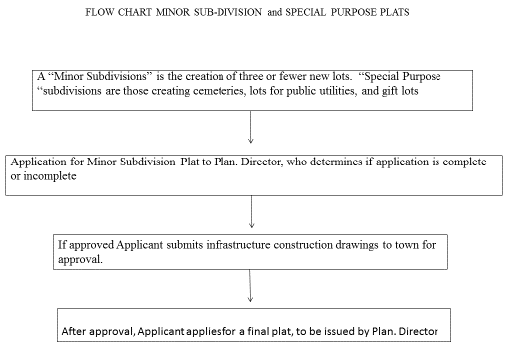
Sec. 17-653. - Minor subdivision approval.
A.
The Planning Director shall approve or disapprove minor subdivision final plats in accordance with the provisions of this section.
B.
Restrictions on the Use of Minor Subdivision Approval Process.
1.
The minor subdivision process may not be used a second time within three (3) years on any property less than one thousand five hundred (1,500) feet from the original property boundaries by anyone who had an option on or any legal interest in the original subdivision at the time the plat received preliminary or final plat approval. Furthermore, the minor subdivision process may not be used within three (3) years on any property less than one thousand five hundred (1,500) feet from the original property boundaries by any subsequent owner, individual having an adoption on or individual having any legal interest in the original subdivision at the time the subdivision received preliminary or final plat approval. If a subdivision is disqualified from the minor subdivision approval process by this subsection, the major approval process must be used instead.
2.
Not more than a total of three (3) lots (or two (2) new lots plus the remainder of the original lot for a total of three (3) lots) may be created out of one (1) tract using the minor subdivision plat approval process, regardless of whether the lots are created at one (1) time or over an extended period of time.
C.
The applicant for minor subdivision plat approval, before complying with subsection D., shall submit a sketch plan (i.e., a preliminary plan) to the Planning Director for a determination of whether the approval process authorized by this section can be and should be utilized. The Planning Director may require the applicant to submit whatever information is necessary to make this determination, including, but not limited to, a copy of the tax map showing the land being subdivided and all lots previously subdivided from that tract of land within the previous five (5) years.
D.
Applicants for minor subdivision approval shall submit to the Planning Director two (2) copies of a plat conforming to the requirements set forth in Sections 17-655B. and C., except that a minor subdivision plat shall contain the following certificates in lieu of those required in Section 17-655:
1.
Certificate of Ownership.
"I hereby certify that I am the owner of the property described hereon, which property is within the subdivision regulation jurisdiction of the Town of Selma, North Carolina, and that I freely adopt this plan of subdivision."
2.
Certificate of Approval for Minor Subdivision.
"I hereby certify that the minor subdivision shown on this plat does not involve the creation of new public streets or any change in existing public streets, that the subdivision shown is in all respects in compliance with Selma Code of Ordinance Chapter 17, and that therefore this plat has been approved by the Town of Selma Planning & Economic Development Director, subject to its being recorded in the Johnston County Registry within thirty (30) days of the date below."
3.
A Certificate of Survey and Accuracy, in the form stated in Section 17-655C.
4.
Notice to homeowners to connect to public utility system.
In subdivisions that provide a public water distribution system and/or a public sewage collection system, other than that provided by the Town of Selma, a note shall be placed on the final plat indicating that all homeowners are required to connect to the public utility system prior to the issuance of a certificate of occupancy for their principal structure.
5.
Certification of approval of individual water supply and sewage disposal systems.
For lots utilizing an individual drinking water supply and/or sewage disposal system the following shall be placed on the final plat:
I hereby certify that the water supply, sewage disposal systems installed, or proposed for installation for the property shown on this plat, meet the necessary public health requirements.
_____
County Health Officer or Authorized Representative
Date: _______
6.
Plat Review Officer Certificate (as required by G.S. § 47-30.2).
State of North Carolina
County of Johnston
I, _______, Review Officer of Johnston County, certify that the map or plat to which this certification is affixed meets all statutory requirements for recording.
E.
The Planning Director shall take expeditious action on an application for minor subdivision plat approval. However, either the Planning Director or the applicant may at any time refer the application to the major subdivision approval process.
F.
Subject to subsection E., the Planning Director shall approve the proposed subdivision unless the subdivision is not a minor subdivision as defined in Section 17-200 "Definitions," the proposed subdivision is disqualified as a minor subdivision pursuant to subsection B., or the application for subdivision fails to satisfy any other applicable requirement of this chapter.
G.
If the subdivision is disapproved, the Planning Director shall promptly furnish the applicant with a written statement of the reasons for disapproval.
H.
Approval of any plat is contingent upon the plat being recorded in the Johnston County Registry within sixty (60) days after the date the Certificate of Approval for Minor Subdivision is signed by the Planning Director or his or her designee.
I.
Review of Decision. Any party aggrieved by the Planning Director's administrative decision to approve or disapprove a request for minor subdivision plat approval pursuant to this section may seek to have the decision reviewed by filing an action in Johnston County Superior Court seeking appropriate declaratory or equitable relief. Such action must be filed within the time frame specified in G.S. § 160A-1405(D)) and Section 152-117 of this ordinance for petitions in the nature of certiorari.
(Ord. No. 2021-64-R, 7-13-21)
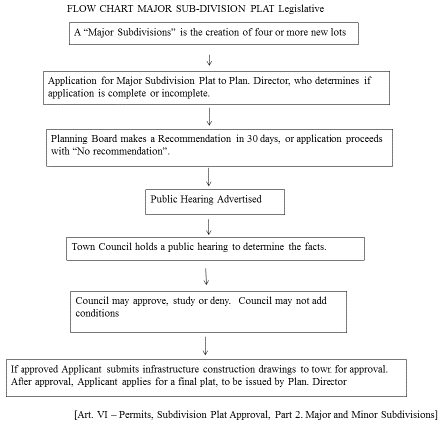
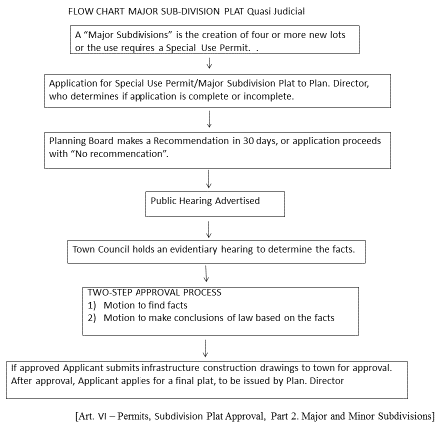
Sec. 17-654. - Major subdivision approval process.
A.
The applicant (or developer) shall submit a special use permit application with an application for a site plan/preliminary plat containing all the information listed in Appendix A. The Planning Director shall process the application as provided in Section 17-608 et seq.
B.
If the site plan and special use permit are approved by the Town Council following Planning Board review, then the applicant may submit construction drawings. Construction drawings will be reviewed by the Technical Review Committee. (See Article XVI, Administrative Mechanisms, Part 6. Staff.) The applicant/developer may install the infrastructure as provided on the site plan and special use permit and then apply for a final major subdivision plat.
C.
Planning Director shall approve or disapprove major subdivision final plats. Notwithstanding the foregoing, if, at the time the special use permit was issued for the subdivision pursuant to Part 1 of this article, the Town Council requested that the final plat be reviewed by it, then the Town Council shall approve or disapprove the major subdivision final plat.
D.
The applicant for major subdivision plat approval shall submit to the Administrator the following: (i) one (1) copy of the plat either in original ink on polyester film (mylar) or a reproduced drawing, transparent and archival (as defined by the American National Standards Institute), (ii) two (2) paper copies of the plat, and (iii) one (1) digital copy of the plat. When more than one (1) sheet is required to include the entire subdivision, all sheets shall be made of the same size and shall show appropriate match marks on each sheet and appropriate references to other sheets of the subdivision. The scale of the plat shall be at one (1) inch equals not more than one hundred (100) feet.
E.
In addition to the appropriate endorsements, as provided in Section 17-655 "Endorsements on Major Subdivision Plats," the final plat shall contain the following information:
1.
The name of the subdivision, which name shall not duplicate the name of any existing subdivision as recorded in the Johnston County Registry;
2.
The name of the subdivision owner or owners;
3.
The township, county, and state where the subdivision is located;
4.
The name of the surveyor and his registration number and the date of survey;
5.
The scale according to which the plat is drawn in feet per inch or scale ratio in words or figures and bar graph; and
6.
All the additional information required by G.S. § 47-30.
F.
The applicable final approval authority shall approve the proposed plat unless it is found that the plat or the proposed subdivision fails to comply with one (1) or more of the requirements of this ordinance or that the final plat differs substantially from the plans and specifications approved in conjunction with the special use permit that authorized the development of the subdivision.
G.
If the final plat is disapproved by the Planning Director, the applicant shall be furnished with a written statement of the reasons for the disapproval.
H.
Approval of a final plat is contingent upon the plat being recorded within sixty (60) days after the approval certificate is signed by the Planning Director or his or her designee.
(Ord. No. 2021-64-R, 7-13-21)
Sec. 17-655. - Endorsements on major subdivision plats.
All major subdivision plats shall contain the endorsements listed in subsections A., B. and C. herein and in Section 17-653D.6. The endorsements listed in subsection D. and F. shall appear on plats of all major subdivisions located outside the corporate limits of the Town but within the planning and development regulation jurisdiction. Endorsement E. shall be affixed only if the Town Council accepts dedication. The following endorsements from Section 17-653 shall be affixed applicable: subsections D.4. and D.5. Other endorsements may be required to comply with State or Federal law.
A.
Certificate of Approval.
I hereby certify that all streets shown on this plat are within the Town of Selma's planning jurisdiction, all streets and other improvements shown on this plat have been installed or completed or that their installation or completion (within twelve (12) months after the date below) has been assured by the posting of a performance guarantee and that the subdivision shown on this plat is in all respects in compliance with Selma Code of Ordinance Chapter 17, and therefore this plat has been approved by the Selma Town Council subject to its being recorded in the Johnston County Register of Deeds within sixty (60) days of the date below.
B.
Certificate of Ownership and Dedication.
I hereby certify that I am the owner of the property described hereon, which property is located within the subdivision regulation jurisdiction of the Town of Selma , that I hereby freely adopt this plan of subdivision and dedicate to public use all areas shown on this plat as streets, alleys, walks, greenways, parks, open space, and easements, except those specifically indicated as private, and that I will maintain all such areas until the offer of dedication is accepted by the appropriate public authority. All property shown on this plat as dedicated for a public use shall be deemed to be dedicated for any other public use authorized by law when such other use is approved by the Selma Town Council in the public interest.
C.
Certificate of Survey and Accuracy.
I, _______ certify that this map was drawn under my supervision from an actual survey map under my supervision (deed description recorded in Johnston County Registry at Book _______ Page _______); that the boundaries not surveyed are clearly indicated as shown as drawn from information found in Johnston County Registry at Book _______, Page _______; that the ratio of precision or positional accuracy as calculated is 1: _______; that this map was prepared in accordance with G.S. 47-30 as amended. Witness my original signature, license number and seal _______ day of _______, 2017.
Seal or Stamp
Professional Land Surveyor___________
License Number
D.
Division of Highways District Engineer Certificate.
I hereby certify that the public streets shown on this plat have been completed, or that a performance guarantee has been posted to guarantee their completion, in accordance with at least the minimum specifications and standards of the N.C. State Department of Transportation for acceptance of subdivision streets on the State highway system for maintenance.
E.
Optional Acceptance of Offer of Dedication.
NOTE: To be used only if Town Council accepts the offer of dedication at the time the final plat is approved.
"I hereby certify that all streets and sidewalks, parks and greenways, potable water, sanitary sewer, and/or stormwater infrastructure (or any other easements, lots and/or infrastructure) shown on this plat were accepted by the Town Council by a resolution adopted at the meeting held on ___, 2___."
F.
Optional Certification that Town of Selma Ordinances Apply.
NOTE: To be used only where a (i) portion of a property lies outside of the Town's jurisdiction and a portion of the property is within the Town's jurisdiction and (ii) the property owner wishes to have the entire property developed under the Town's ordinances and standards. The Town must enter a mutual agreement with the governing body of the adjacent jurisdiction and obtain the written consent of the landowner in order to hold exclusive planning and development regulation jurisdiction for the entire property.
"We hereby certify that the application or enforcement of the Town's ordinances to the property shown on this plat is not under coercion or otherwise based upon any representation by the Town that the Town's approval of any land use planning would be withheld from the property owner without the application or enforcement of the Town's ordinance outside the territorial jurisdiction of the Town.
(Ord. No. 2021-64-R, 7-13-21)
Sec. 17-656. - Plat approval not acceptance of dedication offers.
Approval of a plat does not constitute acceptance by the town of the offer of dedication of any streets, sidewalks, parks, or other public facilities shown on a plat. The town may, however, accept any such offer of dedication by resolution of the Town Council or by exercising control over and maintaining such facilities.
(Ord. No. 2021-64-R, 7-13-21)
Sec. 17-657. - Protection against defects.
A.
Acceptance of Facilities and Improvements Prior to Completion. When, pursuant to Section 17-615 "Authorizing Use, Occupancy, or Sale Before Completion of Development Under Special Use Permits," occupancy, use or sale is allowed before the completion of any engineered stormwater control facilities or "best management practices" (BMPs) intended for dedication, then the performance guarantee that is posted pursuant to Section 17-615 shall warrant that any defects in such improvements or facilities that appear within one (1) year after the dedication of such facilities or improvements is accepted shall be corrected by the developer.
1.
Whenever any engineered stormwater control facilities or "best management practices" (BMPs) intended for dedication are installed before occupancy, use, or sale is authorized, then the developer shall provide a performance guarantee to the permit-issuing authority to guarantee that he or she will correct all defects in such facilities or improvements that occur within one (1) year after the offer of dedication of such facilities or improvements is accepted.
2.
An architect or engineer retained by the developer shall certify to the Town that all facilities and improvements to be dedicated to the Town have been constructed in accordance with the requirements of this chapter. This certification shall be a condition precedent to acceptance by the Town of the offer of dedication of such facilities or improvements.
B.
Defects. For purposes of this section, the term "defects" refers to any condition in publicly dedicated facilities or improvements that requires the Town to make repairs in such facilities over and above the normal amount of maintenance that they would require. If such defects appear, the guaranty may be enforced regardless of whether the facilities or improvements were constructed in accordance with the requirements of this ordinance.
(Ord. No. 2021-64-R, 7-13-21)
Sec. 17-658. - Maintenance of dedicated areas until acceptance.
As provided in Article V., Design Standards, Part 4., Section 17-592, "Maintenance of Common Areas and Facilities," all facilities and improvements, including streets, with respect to which the owner makes an offer of dedication to public use shall be maintained by the owner until such offer of dedication is accepted by the appropriate public authority.
(Ord. No. 2021-64-R, 7-13-21)
Sec. 17-659. - Other subdivision requirements.
A.
Suitability of Land for Subdivision.
1.
Land which has been determined by the permit-issuing authority, based on engineering surveys or other expert reports, to pose an ascertainable danger to life or property because of its unsuitability for the use proposed shall not be platted for that purpose, unless and until the subdivider demonstrates that the necessary measures to eliminate said dangers will be taken. The permit-issuing authority may accept a sealed report from an engineer or other qualified expert as conclusive evidence of the adequacy of any proposed measure.
2.
Land that has been used for disposal of solid waste shall not be subdivided unless tests by the Johnston County Health Department, a structural engineer or a soils expert determine that the land is suitable for the purpose proposed.
B.
Consistent with Article X, "Flood Damage Prevention," all subdivision proposals shall minimize the likelihood of property damage from flooding and dangerous conditions that result from flooding.
C.
Blocks shall have sufficient width to allow for two (2) tiers of lots of minimum depth except where single tier lots are necessary to separate residential development from vehicular through traffic; or in nonresidential subdivisions, planned developments and mixed use developments, to separate a residential area from another type of use; or where abutting a body of water.
(Ord. No. 2021-64-R, 7-13-21)
Sec. 17-680. - Vested rights.
A.
Purpose. The purpose of this section is to implement the provisions of G.S. §§ 160D-108 and 160D-108.1, pursuant to which a statutory zoning vested right is established upon the approval of a site-specific vesting plan.
B.
Definition. For the purposes of this section, the following definitions shall apply, unless the context clearly indicates or requires a different meaning:
1.
Approval Authority. The Town Council, Planning Board, Board of Adjustment or other board or official designated by ordinance or this section as being authorized to grant the specific zoning or land use permit or approval that constitutes a site-specific vesting plan.
2.
Site-Specific Vesting Plan. A plan of land development submitted to the town for purposes of obtaining one (1) of the following zoning or land use permits or approvals: special use permit, conditional zoning approval, and subdivision approval. Notwithstanding the foregoing, neither a variance, a sketch plan nor any other document that fails to describe with reasonable certainty the type and intensity of use for a specified parcel or parcels of property shall constitute a site-specific vesting plan.
3.
Zoning Vested Right. A right pursuant to G.S. §§ 160D-108 and 160D-108.1 to undertake and complete the development and use of property under the terms and conditions of an approved site specific vesting plan.
C.
Establishment of a Zoning Vested Right.
1.
A zoning vested right shall be deemed established upon the valid approval, or conditional approval, by the Town Council, Planning Board, the Board of Adjustment or other board or official designated by ordinance or this section of a site-specific vesting plan following notice and public hearing. For the purposes of this section, approval of a conditional zoning district shall constitute the approval of a site-specific vesting plan.
2.
The approving authority may approve a site-specific vesting plan upon such terms and conditions as may reasonably be necessary to protect the public health, safety and welfare. (The contents of site specific development plans are listed in Appendix A.)
3.
Notwithstanding subsections 1. and 2. above, approval of a site-specific vesting plan with the conditions that a variance be obtained shall not confer a zoning vested right unless and until the necessary variance is obtained.
4.
A site-specific vesting plan shall be deemed approved upon the effective date of the approval authority's action or ordinance related thereto.
5.
The establishment of a zoning vested right shall not preclude the application of overlay zoning that imposes additional requirements but does not affect the allowable type or intensity of use, or ordinances or regulations that are general in nature and are applicable to all property subject to land-use regulation by the town, including, but not limited to, building, fire, plumbing, electrical and mechanical codes. Otherwise, applicable new or amended regulations shall become effective with respect to property that is subject to a site-specific development plan upon the expiration or termination of the vested right in accordance with this section.
6.
A zoning vested right is not a personal right, but shall attach to and run with the applicable property. After approval of a site-specific vesting plan, all successors to the original landowner shall be entitled to exercise such right while applicable.
D.
Approval Procedures and Approval Authority.
1.
Except as otherwise provided in this subsection, an application for site specific vesting plan approval shall be processed in accordance with the procedures established by ordinance and shall be considered by the designated approval authority for the specific type of zoning or land use permit or approval for which application is made.
2.
Following approval or conditional approval of a site-specific vesting plan, nothing in this section shall exempt such a plan from subsequent reviews and approvals to ensure compliance with the terms and conditions of the original approval, if such reviews and approvals are not inconsistent with the original approval.
3.
Nothing in this section shall prohibit the revocation of the original approval or other remedies for failure to comply with applicable terms and conditions of such approval or other town ordinances.
E.
Duration.
1.
A zoning right that has been vested as provided in this section shall remain vested for a period of two (2) years unless specifically and unambiguously provided otherwise pursuant to subsection 2. below. This vesting shall not be extended by any amendments or modifications to a site-specific vesting plan unless expressly provided by the approval authority at the time the amendment or modification is approved.
2.
Notwithstanding the provisions of subsection E.1., above, the approval authority may provide that rights shall be vested for a period exceeding two (2) years, but not exceeding five (5) years, where warranted considering all relevant circumstances including, but not limited to, the size of the development, the level of investment, the need for or desirability of the development, economic cycles and market conditions. These determinations shall be in the sound discretion of the approval authority at the time the site-specific vesting plan is approved.
3.
Multi-phased developments of 25 acres or more are vested with the land development regulations in place at the time a site plan approval is granted for the initial phase of the development and remain vested for a period of seven years from the time site plan approval is granted.
4.
Upon issuance of a building permit, the expiration provisions of G.S. § 160D-1111 and the revocation provisions of G.S. §§ 160D-403(F) and 160D-1115 shall apply, except that a building permit shall not expire or be revoked because of the running of time while a zoning vested right under this section is outstanding.
F.
Termination. A zoning right that has been vested as provided in this section shall terminate:
1.
At the end of the applicable vesting period with respect to buildings and uses for which no valid building permit applications have been filed;
2.
With the written consent of the affected landowner;
3.
Upon findings by the Town Council, by ordinance after notice and a legislative public hearing, that natural or manmade hazards on or in the immediate vicinity of the property, if uncorrected, would pose a serious threat to the public health, safety and welfare if the project were to proceed as contemplated in the site-specific vesting plan;
4.
Upon payment to the affected landowner of compensation for all costs, expenses and other losses incurred by the landowner including, but not limited to, all fees paid in consideration of financing and all architectural, planning, marketing, legal and other consultant's fees incurred after approval by the town, together with interest thereon at the legal rate until paid. Compensation shall not include any diminution in the value of the property, which is caused by such action;
5.
Upon findings by the Town Council, by ordinance after notice and legislative hearing, that the landowner or his representative intentionally supplied inaccurate information or made material misrepresentations which made a difference in the approval by the approval authority of the site-specific vesting plan; or
6.
Upon the enactment or promulgation of a state or federal law or regulation that precludes development as contemplated in the site-specific vesting plan, in which case the approval authority may modify the affected provisions, upon a finding that the change in state or federal law has a fundamental effect on the plan, by ordinance after notice and a legislative hearing.
G.
Voluntary Annexation. A petition for annexation filed with the town under G.S. §§ 160A-31 or 160A-58.1 shall contain a signed statement declaring whether any zoning vested right with respect to the properties subject to the petition has been established under G.S. §§ 160D-108 and 160D-108.1. A statement that declares that no zoning vested right has been established under G.S. §§ 153A-344.1 or 160A-385.1 shall be binding on the landowner, and any such zoning vested right shall be terminated.
H.
Limitations. Nothing in this section is intended or shall be deemed to create any vested right other than those established pursuant to G.S. §§ 160D-108 and 160D-108.1.
I.
Repealer. In the event that G.S. §§ 160D-108 and 160D-108.1 is repealed, this section shall be deemed repealed and the provisions hereof no longer effective.
J.
Effective Date. This section shall be effective March 31, 2017 and shall only apply to site specific development plans approved on or after March 31, 2017.
(Ord. No. 2021-64-R, 7-13-21)
Sec. 17-681. - Permit Choice.
A.
Purpose. If a land development regulation is amended between the time a development permit application was submitted and a development permit decision is made or if a land development regulation is amended after a development permit decision has been challenged and found to be wrongfully denied or illegal, the development permit applicant may choose which adopted version of the rule or ordinance will apply to the permit and use of the building, structure, or land indicated on the permit application.
B.
Applicability. This section applies to all development permits issued by the State and by local governments.
C.
Conditions. If the development permit applicant chooses the version of the rule or ordinance applicable at the time of the permit application, the development permit applicant shall not be required to await the outcome of the amendment to the rule, map, or ordinance prior to acting on the development permit. If an applicable rule or ordinance is amended after the development permit is wrongfully denied or after an illegal condition is imposed, as determined in a proceeding challenging the permit denial or the condition imposed, any provision of the development permit applicant's chosen version of the rule or ordinance that is determined to be illegal for any reason shall not be enforced upon the applicant without the written consent of the applicant.
D.
Multiple Permits for Development Projects. Where multiple local development permits are required to complete a development project, the development permit applicant may choose the version of each of the local land development regulations applicable to the project upon submittal of the application for the initial development permit. This provision is applicable only for those subsequent development permit applications filed within 18 months of the date following the approval of an initial permit. For purposes of the vesting protections of this subsection, an erosion and sedimentation control permit or a sign permit is not an initial development permit.
E.
Expiration. If a permit application is placed on hold at the request of the applicant for a period of six consecutive months or more, or the applicant fails to respond to comments or provide additional information reasonably requested by the local or State government for a period of six consecutive months or more, the application review is discontinued and the development regulations in effect at the time permit processing is resumed apply to the application.
F.
Definitions. For purposes of this section, the following definitions apply:
1.
Development. Without altering the scope of any regulatory authority granted by statute or local act, any of the following:
a.
The construction, erection, alteration, enlargement, renovation, substantial repair, movement to another site, or demolition of any structure.
b.
Excavation, grading, filling, clearing, or alteration of land.
c.
The subdivision of land as defined in G.S. § 160D-802.
d.
The initiation of substantial change in the use of land or the intensity of the use of land.
2.
Development permit. An administrative or quasi-judicial approval that is written and that is required prior to commencing development or undertaking a specific activity, project, or development proposal, including any of the following:
a.
Zoning permits.
b.
Site plan approvals.
c.
Special use permits.
d.
Variances.
e.
Certificates of appropriateness.
f.
Plat approvals.
g.
Development agreements.
h.
Building permits.
i.
Subdivision of land.
j.
State agency permits for development.
k.
Driveway permits.
l.
Erosion and sedimentation control permits.
m.
Sign permit.
3.
Land development regulation. Any State statute, rule, or regulation, or local ordinance affecting the development or use of real property, including any of the following:
a.
Unified development ordinance.
b.
Zoning regulation, including zoning maps.
c.
Subdivision regulation.
d.
Erosion and sedimentation control regulation.
e.
Floodplain or flood damage prevention regulation.
f.
Mountain ridge protection regulation.
g.
Stormwater control regulation.
h.
Wireless telecommunication facility regulation.
i.
Historic preservation or landmark regulation.
j.
Housing code. (2014-120, s. 16(a); 2015-246, s. 5(a); 2019-111, s. 1.1; 2020-25, s. 2.)
4.
Definition of Submitted Application. A submitted application is defined as one that is complete and ready to undergo the development review process at the time of submittal.
G.
Appeals. Any person aggrieved by the failure of a State agency or local government to comply with this section or G.S. § 160D-108(b) may apply to the appropriate division of the General Court of Justice for an order compelling compliance by the offending agency or local government, and the court may issue that order. Actions brought pursuant to any of these sections shall be set down for immediate hearing, and subsequent proceedings in those actions shall be accorded priority by the trial and appellate courts.
(Ord. No. 2021-64-R, 7-13-21)

