
Selma City Zoning Code
ARTICLE XVII
AMENDMENTS
Sec. 17-1700. - Amendments in general; non-substantive errors.
A.
Amendments. Amendments to the text of this chapter (i.e., Selma Municipal Code Chapter 17, "Unified Development Ordinance") or to the Zoning Map may be made in accordance with the provisions of this part, or in the case of non-substantive editorial changes, may be made administratively by the Administrator, as described in subsection B.
B.
Non-Substantive Errors. The Administrator may correct typographical errors, numerical reference errors, spelling errors and errors in section or page numbering and may make other non-substantive editorial changes to the text of this ordinance without formal adoption by the Town Council, provided the changes necessary to correct such errors do not change the meaning of the ordinance. Any correction made pursuant to this section must be documented to the Town Council and made a part of the Town Council's regular meeting minutes.
(Ord. No. 2021-64-R, 7-13-21)
Sec. 17-1701. - Initiation of amendments.
A.
A request to amend this chapter may be initiated by:
1.
The Town Council on its own motion;
2.
The Planning Board, Board of Adjustment, Historic Preservation Commission, Appearance Commission or Town Manager on the submittal of a request to the Town Council;
3.
Any other person on submittal of an application to the Planning Director. The application, among the information deemed relevant by the Planning Department:
(a)
The name, address and phone number of the applicant;
(b)
A description of the land affected by the amendment if a change in zoning district classification is proposed;
(c)
A description of the proposed map changes or a summary of the specific objective(s) of any proposed change in the text of this chapter; and
(e)
A concise statement of the reasons why the petitioner believes the proposed map or text amendment would be reasonable and in the public interest and explain how the request is consistent with the Comprehensive Plan. If the request is not consistent with the Comprehensive Plan, a statement explaining why the Plan should be amended and how it is reasonable and in the public interest to do so.
(f)
Any other information deemed relevant by the Planning Department and the fee set by the Town Council.
B.
Upon receipt of an application as provided in subsection A. above, the Planning staff shall prepare an amendment to the text (if one is requested) and a written report on the effects of the proposed text or map amendment to the Planning Board; unless the application:
1.
Is from a private person under subsection A.3. above; and
2.
The Planning Director believes the proposed text amendment does not have significant merit and would not benefit the general public interest; and/or
3.
The application requires the expenditure of significant staff time and resources or an amendment to the Planning Department's budget in order to analyze and prepare an amendment or report. In this case the Planning Director will forward the application to the Town Council with or without written comment for a determination of whether an ordinance should be drafted and a legislative public hearing set in accordance with subsection C. below.
C.
Upon initiation of a proposed ordinance as provided in subsection A.1. above, the Town Council may establish a date for a legislative public hearing on it. Upon receipt of a petition for an ordinance amendment as provided in subsection A.2. or B. above, the Council may summarily deny the petition, or set a date for a public hearing on the requested amendment and order the attorney or the Planning staff to draft an appropriate ordinance and submit it to the Planning Board.
(Ord. of 2-14-17(2); Ord. of 11-14-17(1))
Sec. 17-1702. - Planning board consideration of proposed amendments.
A.
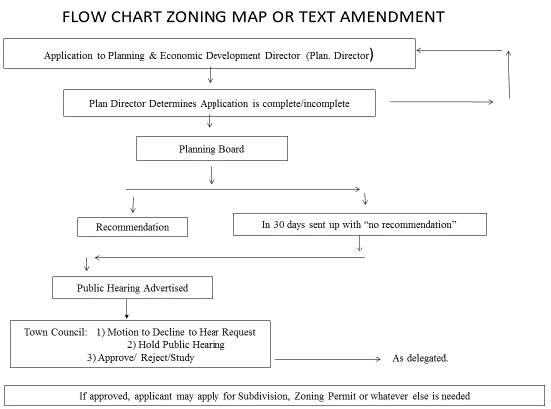
If the Town Council sets a date for a public legislative hearing on a proposed amendment as provided in Section 17-1701, it shall also refer the proposed amendment to the Planning Board for its consideration.
B.
If the Planning Director receives an application directly as provided in Section 17-1701A.3., the Planning Director shall refer the proposed amendment to the Planning Board and request that a public hearing date be set.
C.
The Planning Board shall endeavor to review the proposed amendment in such a timely fashion that any recommendations it may have can be presented to the Town Council at the legislative public hearing on the amendment. However, if the Planning Board is not prepared to make recommendations at the public hearing, it may request the Town Council to delay final action on the amendment until such time as the Planning Board can present its recommendations.
D.
Prior to consideration by the Town Council of the proposed amendment (zoning map or text amendment), the Planning Board shall advise and comment on whether the proposed amendment is consistent with the Comprehensive Plan and any other officially adopted plan that is applicable. The Planning Board shall provide a written recommendation to the Town Council that addresses plan consistency and other matters as deemed appropriate by the Planning Board, but a comment by the Planning Board that a proposed amendment is inconsistent with the Comprehensive Plan shall not preclude consideration or approval of the proposed amendment by the Town Council.
E.
If no written report is received from the Planning Board within thirty (30) days of referral of the amendment to that board, the Town Council may proceed in its consideration of the amendment without the Planning Board report. The Town Council is not bound by the recommendations, if any, of the Planning Board.
F.
A member of the Planning Board may not vote on any advisory or legislative decision where the outcome of the matter being considered is reasonably likely to have a direct, substantial, and readily identifiable financial impact on the member. A member shall not vote on any zoning amendment if the landowner of the property subject to a rezoning petition or the applicant for a text amendment is a person with whom the member has a close familial, business, or other associational relationship.
(Ord. of 2-14-17(2); Ord. of 11-14-17(1))
Sec. 17-1703. - Hearing required, notice.
A.
The Town Council has the discretion to decline to take any legislative action including holding a legislative public hearing. However, no ordinance that amends any of the provisions of this chapter may be adopted until a public hearing has been held on such ordinance. The City Council delegates setting the public hearing to the Town Manager or his designee for all applications received directly by the Planning Director under Section 17-1701B.3.
B.
The Planning staff shall publish a notice of the legislative public hearing on any ordinance that amends the text of this chapter or the zoning map(s) once a week for two (2) successive weeks in a newspaper having general circulation in the Selma area. The notice shall be published for the first time not less than ten (10) days nor more than twenty-five (25) days before the date fixed for the hearing. This period is to be computed in accordance with G.S. § 160D-601 and Section 17-110, which provide that the date of publication is not counted but the date of the hearing is.
C.
With respect to all map amendments, the Planning staff shall mail, by certified mail, written notice of the public hearing to the record owners of all properties whose zoning classification would be changed by the proposed amendment as well as the owners of all parcels of land abutting the property rezoned by the amendment. For purposes of this section, the term "owners" shall mean the persons shown as owners in the Johnston County tax records. This notice shall be deposited in the mail at least ten (10) but not more than twenty-five (25) days prior to the date of the public hearing. The staff member mailing such notices shall certify to the Town Council that the notices have been mailed, and such certification shall be deemed conclusive in the absence of fraud.
D.
With respect to all map amendments, the Planning staff shall prominently post a notice of the legislative public hearing on the site proposed for rezoning or on an adjacent public street or highway right-of-way. The notice shall be posted within the same time period specified for mailed notices of the hearing. When multiple parcels are included within a proposed zoning map amendment, a posting on each individual parcel is not required, but the Planning staff shall post sufficient notices to provide reasonable notice to interested persons.
E.
The planning staff may take any other action deemed by the Planning Director to be useful or appropriate to give notice of the legislative public hearing on any proposed amendment.
F.
The notice required or authorized by this section shall:
1.
State the date, time and place of the public hearing;
2.
Summarize the nature and character of the proposed change;
3.
If the proposed amendment involves a change in zoning district classification, reasonably identify the property whose classification would be affected by the amendment;
4.
State that the full text of the amendment can be obtained from the Planning staff; and
5.
State that substantial changes in the proposed amendment may be made following the public hearing.
G.
The Planning staff shall make every reasonable effort to comply with the notice provisions set forth in this section. However, it is the Town Councils' intention that no failure to comply with any of the notice provisions, except those set forth in Section 17-1703B. above, shall render any amendment invalid.
H.
Alternative Notice for Zoning Map Change if More Than Fifty (50) Property Owners Affected. The certified mail notice required under subsection C. of this section shall not be required if the zoning map amendment directly affects more than fifty (50) properties, owned by a total of at least fifty (50) different property owners and the town elects to use the expanded published notice provided for in this subsection. In this instance, the town may elect to either make the mailed notice provided for in subsection C. of this section or may as an alternative elect to publish notice of the legislative hearing as required by G.S. § 160D-601, but provided that each advertisement shall not be less than one-half of a newspaper page in size. The advertisement shall only be effective for property owners who reside in the area of general circulation of the newspaper which publishes the notice. Property owners who reside outside of the newspaper circulation area, according to the address listed on the most recent Johnston County land records system listing for the affected property, shall be notified by certified mail according to the provisions of subsection C. of this section. The person or persons mailing the notices shall certify to the Town Council that fact, and such certification shall be deemed conclusive in the absence of fraud.
I.
Fee. A fee shall be paid to the town for each application for an amendment. The fee shall be adopted and periodically amended by the Town Council as needed to cover the costs of advertising and other administrative expenses. A copy of the fee schedule shall be posted in the office of the Planning Department. If the Town Council, Planning Board, Board of Adjustment, Historic Preservation Commission, Appearance Commission, or town Administration initiate a change, they are exempt from this fee.
J.
Zoning Amendments Initiated by Someone Other than the Town or the Property Owner.
1.
Except for a town-initiated zoning map amendment, when an application is filed to request a zoning map amendment and that application is not made by the owner of the parcel of land to which the amendment would apply, the applicant shall certify to the staff that the owner of the parcel of land as shown on the Johnston County tax listing has received actual notice of the proposed amendment and a copy of the notice of legislative public hearing. The Planning staff shall present the certification to the Town Council at the public hearing.
2.
Actual notice of the proposed amendment and a copy of the notice of public hearing required under subsection J.1. of this section shall be by any manner permitted under G.S. § 1A-1, Rule 4(j). If notice cannot with due diligence be achieved by personal delivery, registered or certified mail, or by a designated delivery service authorized pursuant to 26 U.S.C. § 7502(f)(2), notice may be given by publication consistent with G.S. § 1A-1, Rule 4(j1). This subsection applies only to an application to request a zoning map amendment where the application is not made by the town or the owner of the parcel of land to which the amendment would apply.
3.
No map or text amendment that down-zones property shall be initiated nor shall it be enforceable without the written consent of all property owners whose property is the subject of the down-zoning amendment unless the down-zoning amendment is initiated by the town. "Down-zoning" means:
A)
decreasing the development density of the land to be less dense than was allowed under its previous usage; and/or
B)
reducing the permitted uses of the land that are specified in a zoning ordinance or land development regulation to fewer uses than were allowed under its previous usage.
(Ord. No. 2021-64-R, 7-13-21)
Sec. 17-1704. - Town council action on amendments.
A.
At the conclusion of the legislative public hearing on a proposed amendment, the Town Council may proceed to vote on the proposed ordinance, refer it to a committee for further study, or take any other action consistent with its usual rules of procedure.
B.
Prior to adopting or rejecting any zoning map or text amendment, the Council shall adopt one of the following statements, which shall not be subject to judicial review:
1.
A statement approving the zoning amendment (zoning map amendment or text amendment) and describing its consistency with an adopted Comprehensive Plan explaining why the action taken is reasonable and in the public interest;
2.
A statement rejecting the zoning amendment (zoning map amendment or text amendment) and describing its inconsistency with an adopted Comprehensive Plan and explaining why the action taken is reasonable and in the public interest.
3.
A statement approving the zoning amendment (zoning map or text amendment) and containing at least all of the following:
a)
A declaration that the approval is also deemed an amendment to the Comprehensive Plan. If a zoning map amendment is adopted and the action was deemed inconsistent with the adopted plan, the zoning amendment shall have the effect of also amending any future land-use map in the approved plan. The Selma Town Council shall not require any additional request or application for amendment to the Comprehensive Plan,
b)
An explanation of the change in conditions by the governing board, the Selma Town Council, took into account in amending the zoning ordinance to meet the development needs of the community.
c)
Why the action was reasonable and in the public interest.
4.
As used in this section "Comprehensive Plan" refers to the Town of Selma 2040 Land Use Plan.
C.
A Council member shall not vote on any zoning map or text amendment where the outcome of the matter being considered is reasonably likely to have a direct, substantial, and readily identifiable financial impact on the member. A member shall not vote on any zoning amendment if the landowner of the property subject to a rezoning petition or the applicant for a text amendment is a person with whom the member has a close familial, business, or other associational relationship.
(Ord. No. 2021-64-R, 7-13-21)
Sec. 17-1705. - Ultimate issue before the council on amendments.
In deciding whether to adopt a proposed amendment to this chapter, the central issue before the Town Council is whether the proposed amendment advances the public health, safety or welfare. All other issues are irrelevant, and all information related to other issues at the legislative public hearing may be declared irrelevant by the mayor and be excluded. In particular, when considering proposed general district rezonings:
A.
The Council shall not consider any representations made by the petitioner that, if the change is granted, the rezoned property will be used for only one of the possible range of uses permitted in the requested classification. Rather, the Council shall consider whether the entire range of permitted uses in the requested classification is more appropriate than the range of uses in the existing classification; and
B.
The Council shall not regard as controlling any advantages or disadvantages to the individual requesting the change but shall consider the impact of the proposed change on the public at large.
(Ord. No. 2021-64-R, 7-13-21)
Sec. 17-1706. - Reconsideration of zoning map amendments.
Whenever the Town Council holds a legislative public hearing on an application for a zoning map amendment initiated by a party other than the town itself (i.e., the Town Council, the Planning Board, Board of Adjustment or Town Administration), and on the day of or after the public hearing either the applicant withdraws the application or the Town Council approves or denies the rezoning, then the town will not accept an application for a zoning map amendment affecting the same property or any portion thereof submitted by any party other than the town itself within one (1) year from the date such application was withdrawn, approved or denied.
(Ord. No. 2021-64-R, 7-13-21)
Sec. 17-1707. - Public comments.
Written statements received from the public by the Town Clerk prior to a legislative public hearing for a text or map amendment shall be provided to the Town Council.
(Ord. No. 2021-64-R, 7-13-21)
Sec. 17-1750. - Plans and other information to accompany petition.
A.
Property may be rezoned to a conditional zoning district only in response to and consistent with a petition submitted by the owners of all of the property to be included in the district. A petition for conditional zoning must include a site plan that complies with the requirements of appendix A and a master plan that specifies any proposed rules, regulations, and conditions and any proposed ordinances that will govern the development and use of the property in conjunction with the requirements of this Unified Development Ordinance and/or in lieu of specified portions of this Unified Development Ordinance.
B.
The Town Council may require more information to be submitted according to the needs of a particular application, but the applicant may rely in the first instance on the recommendations of the Administrator as to whether more or less information than that set forth in appendix A should be submitted.
C.
In the course of evaluating the proposed use, the Administrator, Planning Board or the Town Council may request additional information from the petitioner. This information may include the following:
1.
Proposed number and general location of all structures;
2.
Proposed screening, buffers and landscaping over and above that required by these regulations, as well as proposed treatment of any existing natural features;
3.
Existing and approximate proposed topography, if available, at ten (10) foot contour intervals or less;
4.
Scale of buildings relative to abutting property;
5.
Height of structures;
6.
Exterior features of proposed development;
7.
Proposed number and location of signs; and
8.
Any other information needed to demonstrate compliance with this chapter.
D.
The site plan and any supporting text shall constitute part of the petition for all purposes under this part.
E.
The Administrator or his or her designee may require the petitioner to submit more than one copy of the petition and site plan in order to have enough copies available to circulate to other town departments or other government agencies for review and comment.
(Ord. No. 2021-64-R, 7-13-21)
Sec. 17-1751. - Approval of conditional zoning district.
A.
Conditional zoning district decisions are a legislative process subject to judicial review using the same procedures and standard of review as apply to general use district zoning decisions.
B.
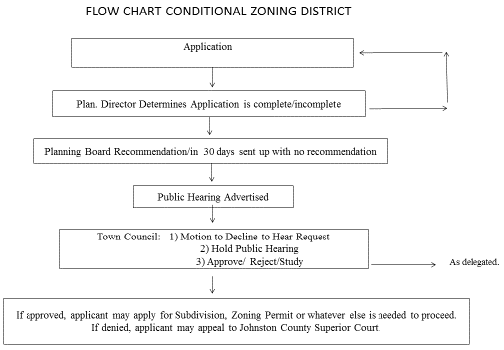
In considering any petition for a conditional zoning district, Sections 17-1700 "Amendments in General; Non-Substantive Errors" and 17-1702 through 17-1706 shall apply. Section 17-1707 "Public Comments" shall apply to conditional zoning district petitions to the extent permitted by G.S. § 160D-603.
(Ord. No. 2021-64-R, 7-13-21)
Sec. 17-1752. - Conditions on approval of petition.
A.
In approving a petition for the reclassification of property to a conditional zoning district, the Planning Board may recommend and the Town Council may request that reasonable and appropriate conditions be attached to approval of the petition.
B.
Conditions and site-specific standards shall be limited to those that address the conformance of the development and use of the site to town ordinances and all relevant officially adopted plans. Conditions and site-specific standards may also address the impacts reasonably expected to be generated by the development or use of the site. Any such conditions should relate to the relationship of the proposed use to surrounding property, proposed support facilities such as parking areas and driveways, pedestrian and vehicular circulation systems, screening and buffer areas, the timing of development, street and right-of-way improvements, water and sewer improvements, storm water drainage, the provision of open space, and other matters that the Town Council may find appropriate or the petitioner may propose. Such conditions to approval of the petition may include dedication to the town, county or State, as appropriate, of any rights-of-way or easements for streets, water, sewer, or other public utilities necessary to serve the proposed development. The Town Council may approve conditions that vary or impose higher standards than those that would ordinarily apply were the property at issue rezoned to something other than a conditional zoning district.
C.
The petitioner shall have a reasonable opportunity to consider and respond to any such conditions prior to final action by the Town Council. Only those conditions mutually approved by the Town Council and the petitioner in writing may be incorporated into the petition.
(Ord. No. 2021-64-R, 7-13-21)
Sec. 17-1753. - Effect of approval
A.
If a petition for conditional zoning is approved, the development and use of the property shall be governed by the predetermined ordinance requirements applicable to the district's category, the approved site plan for the district, and any additional approved rules, regulations, and conditions, all of which shall constitute the zoning regulations for the approved district and are binding on the property as an amendment to these regulations and to the town Zoning Map.
B.
If a petition is approved, the petitioner shall comply with all requirements of the Selma Town Code and General Statutes, including those for obtaining a zoning permit and a building permit and a certificate of occupancy or a certificate of compliance. Only those uses and structures indicated in the approved petition and site plan shall be allowed on the subject property. The location of structures may be changed pursuant to Section 17-1754, "Modification of Approval," provided that changes to the site plan layout will not increase the number of structures.
C.
Following the approval of the petition for a conditional zoning district, the subject property shall be identified on the town Zoning Map by the appropriate district designation. A parallel conditional zoning shall be identified by the same designation as the underlying general district followed by the letter "C" (for example a General Commercial Conditional Zoning District would be designated as "GC-C").
(Ord. No. 2021-64-R, 7-13-21)
Sec. 17-1754. - Modification of approval.
A.
Changes to an approved petition for conditional zoning or to the conditions attached to an approved petition for conditional zoning shall be treated the same as amendments to the text of this ordinance or to the official Zoning Map and shall be processed in accordance with the requirements of this article. Notwithstanding the foregoing, the Town Council may, as part of the conditions imposed on the conditional zoning district, include the list of minor modifications in subsection B. that may be approved by the Administrator or other appropriate town staff without further review by the Town Council.
B.
List of Minor Modifications:
1.
Increases in the number of parking spaces and vehicular use areas of no more than 10%. (Staff may not change any impervious surface ratio that changes a development from a low density to a high density development on any property in a Water Supply Watershed Overlay District.); or
2.
Changes to the amount or kind of landscaping, including the designated species; or
3.
Changes to the facade of buildings or structures (except in a designated Historical District.)
(Ord. No. 2021-64-R, 7-13-21)
Sec. 17-1755. - Authorization.
A.
The Town of Selma may enter into development agreements with developers, subject to the procedures of Article 10 of G.S. 160D. In entering into such agreements, the Town may not exercise any authority or make any commitment not authorized by general or local act and may not impose any tax or fee not authorized by otherwise applicable law.
B.
This provision is supplemental to the powers conferred upon the Town and does not preclude or supersede rights and obligations established pursuant to other law regarding development approvals, site-specific vesting plans, or other provisions of law. A development agreement shall not exempt the property owner or developer from compliance with the State Building Code or State or local housing codes that are not part of the Town's development regulations. When the Town Council approves the rezoning of any property associated with a development agreement executed and recorded pursuant to this section, the plan consistency requirements of 17-1704(B) apply.
C.
Development authorized by a development agreement shall comply with all applicable laws, including all ordinances, resolutions, regulations, permits, policies, and laws affecting the development of property, including laws governing permitted uses of the property, density, intensity, design, and improvements.
(Ord. No. 2021-64-R, 7-13-21)
Sec. 17-1756. - Definitions.
The following definitions apply in this section:
A.
Development. The planning for or carrying out of a building activity, the making of a material change in the use or appearance of any structure or property, or the dividing of land into two or more parcels. When appropriate to the context, "development" refers to the planning for or the act of developing or to the result of development. Reference to a specific operation is not intended to mean that the operation or activity, when part of other operations or activities, is not development. Reference to particular operations is not intended to limit the generality of this item.
B.
Public facilities. Major capital improvements, including, but not limited to, transportation, sanitary sewer, solid waste, drainage, potable water, educational, parks and recreational, and health systems and facilities.
(Ord. No. 2021-64-R, 7-13-21)
Sec. 17-1757. - Approval of Town Council required.
A.
The Town may establish procedures and requirements, as provided in Article 10 of G.S. 160D, to consider and enter into development agreements with developers. A development agreement must be approved by the Town Council following the procedures specified in section 17-1759.
B.
The development agreement may, by ordinance, be incorporated, in whole or in part, into any development regulation adopted by the Town. A development agreement may be considered concurrently with a zoning map or text amendment affecting the property and development subject to the development agreement. A development agreement may be concurrently considered with and incorporated by reference with a sketch plan or preliminary plat required under a subdivision regulation or a site plan or other development approval required under a zoning regulation. If incorporated into a conditional district, the provisions of the development agreement shall be treated as a development regulation in the event of the developer's bankruptcy.
(Ord. No. 2021-64-R, 7-13-21)
Sec. 17-1758. - Size and duration.
The Town may enter into a development agreement with a developer for the development of property as provided in this section for developable property of any size. Development agreements shall be of a reasonable term specified in the agreement.
(Ord. No. 2021-64-R, 7-13-21)
Sec. 17-1759. - Hearing.
Before entering into a development agreement, the Town shall conduct a legislative hearing on the proposed agreement. The notice provisions applicable to zoning map amendments shall be followed for this hearing. The notice for the hearing must specify the location of the property subject to the development agreement, the development uses proposed on the property, and must specify a place where a copy of the proposed development agreement can be obtained.
(Ord. No. 2021-64-R, 7-13-21)
Sec. 17-1760. - Content and modification.
A.
A development agreement shall, at a minimum, include all of the following:
1.
A description of the property subject to the agreement and the names of its legal and equitable property owners.
2.
The duration of the agreement. However, the parties are not precluded from entering into subsequent development agreements that may extend the original duration period.
3.
The development uses permitted on the property, including population densities, and building types, intensities, placement on the site, and design.
4.
A description of public facilities that will serve the development, including who provides the facilities, the date any new public facilities, if needed, will be constructed, and a schedule to assure public facilities are available concurrent with the impacts of the development. In the event that the development agreement provides that the local government shall provide certain public facilities, the development agreement shall provide that the delivery date of such public facilities will be tied to successful performance by the developer in implementing the proposed development, such as meeting defined completion percentages or other performance standards.
5.
A description, where appropriate, of any reservation or dedication of land for public purposes and any provisions agreed to by the developer that exceed existing laws related to protection of environmentally sensitive property.
6.
A description, where appropriate, of any conditions, terms, restrictions, or other requirements for the protection of public health, safety, or welfare.
7.
A description, where appropriate, of any provisions for the preservation and restoration of historic structures.
B.
A development agreement may also provide that the entire development or any phase of it be commenced or completed within a specified period of time. If required by ordinance or in the agreement, the development agreement shall provide a development schedule, including commencement dates and interim completion dates at no greater than five-year intervals; provided, however, the failure to meet a commencement or completion date does not, in and of itself, constitute a material breach of the development agreement pursuant to G.S. 160D-1008 but must be judged based upon the totality of the circumstances. The developer may request a modification in the dates as set forth in the agreement.
C.
If more than one local government is made party to an agreement, the agreement must specify which local government is responsible for the overall administration of the development agreement. A local or regional utility authority may also be made a party to the development agreement.
D.
The development agreement also may cover any other matter, including defined performance standards, not inconsistent with this Chapter. The development agreement may include mutually acceptable terms regarding provision of public facilities and other amenities and the allocation of financial responsibility for their provision, provided any impact mitigation measures offered by the developer beyond those that could be required by the local government shall be expressly enumerated within the agreement, and provided the agreement may not include a tax or impact fee not otherwise authorized by law.
E.
Consideration of a proposed major modification of the agreement shall follow the same procedures as required for initial approval of a development agreement. What changes constitute a major modification may be determined by ordinance adopted pursuant to G.S. 160D-1003 or as provided for in the development agreement.
F.
Any performance guarantees under the development agreement shall comply with G.S. 160D-804.1
(Ord. No. 2021-64-R, 7-13-21)
Sec. 17-1761. - Vesting.
A.
Unless the development agreement specifically provides for the application of subsequently enacted laws, the laws applicable to development of the property subject to a development agreement are those in force at the time of execution of the agreement.
B.
Except for grounds specified in G.S. 160D-108(c) or G.S. 160D-108.1(f), the Town may not apply subsequently adopted ordinances or development policies to a development that is subject to a development agreement.
C.
In the event State or federal law is changed after a development agreement has been entered into and the change prevents or precludes compliance with one or more provisions of the development agreement, the local government may modify the affected provisions, upon a finding that the change in State or federal law has a fundamental effect on the development agreement.
D.
This section does not abrogate any vested rights otherwise preserved by law.
(Ord. No. 2021-64-R, 7-13-21)
Sec. 17-1762. - Breach and cure.
A.
Procedures established pursuant to G.S. 160D-1003 may include a provision requiring periodic review by the zoning administrator or other appropriate officer of the local government, at which time the developer shall demonstrate good-faith compliance with the terms of the development agreement.
B.
If the Town finds and determines that the developer has committed a material breach of the agreement, the Town shall notify the developer in writing setting forth with reasonable particularity the nature of the breach and the evidence supporting the finding and determination and providing the developer a reasonable time in which to cure the material breach.
C.
If the developer fails to cure the material breach within the time given, then the Town unilaterally may terminate or modify the development agreement, provided the notice of termination or modification may be appealed to the board of adjustment in the manner provided by G.S. 160D-405.
D.
An ordinance adopted pursuant to G.S. 160D-1003 or the development agreement may specify other penalties for breach in lieu of termination, including, but not limited to, penalties allowed for violation of a development regulation. Nothing in this Article shall be construed to abrogate or impair the power of the local government to enforce applicable law.
E.
A development agreement shall be enforceable by any party to the agreement notwithstanding any changes in the development regulations made subsequent to the effective date of the development agreement. Any party to the agreement may file an action for injunctive relief to enforce the terms of a development agreement.
(Ord. No. 2021-64-R, 7-13-21)
Sec. 17-1763. - Amendment or termination.
Subject to the provisions of G.S. 160D-1006(e), a development agreement may be amended or terminated by mutual consent of the parties.
(Ord. No. 2021-64-R, 7-13-21)
Sec. 17-1764. - Change of jurisdiction.
A.
Except as otherwise provided by this Article, any development agreement entered into by a local government before the effective date of a change of jurisdiction shall be valid for the duration of the agreement or eight years from the effective date of the change in jurisdiction, whichever is earlier. The parties to the development agreement and the local government assuming jurisdiction have the same rights and obligations with respect to each other regarding matters addressed in the development agreement as if the property had remained in the previous jurisdiction.
B.
A local government assuming jurisdiction may modify or suspend the provisions of the development agreement if the local government determines that the failure of the local government to do so would place the residents of the territory subject to the development agreement or the residents of the local government, or both, in a condition dangerous to their health or safety, or both.
(Ord. No. 2021-64-R, 7-13-21)
Sec. 17-1765. - Recordation.
The developer shall record the agreement with the Johnston County register of deeds within 14 days after the local government and developer execute an approved development agreement. No development approvals may be issued until the development agreement has been recorded. The burdens of the development agreement are binding upon, and the benefits of the agreement shall inure to, all successors in interest to the parties to the agreement.
(Ord. No. 2021-64-R, 7-13-21)
Sec. 17-1766. - Applicability of procedures to approve debt.
In the event that any of the obligations of the Town constitute debt, the Town shall comply, at the time of the obligation to incur the debt and before the debt becomes enforceable against the Town, with any applicable constitutional and statutory procedures for the approval of this debt.
(Ord. No. 2021-64-R, 7-13-21)

