
Selma City Zoning Code
ARTICLE XI
SIGNS
Sec. 17-1100.- Purpose.
The purposes of this section are as follows:
A.
To allow businesses, institutions, and individuals to exercise their right to free speech by displaying an image on a sign, and to allow audiences to receive such information.
B.
To promote and maintain visually attractive residential, agricultural, retail, commercial, historic, open space and industrial districts.
C.
To provide for reasonable and appropriate communication and identification for on-premises signs in commercial and industrial districts to foster successful businesses.
D.
To encourage the use of creative and visually attractive signs.
E.
To ensure that signs are located and designed to reduce sign distraction and confusion that may be contributing factors in traffic congestion and accidents, and maintain a safe and orderly pedestrian, bicycle and vehicular environment.
F.
To protect property values.
G.
To promote public health, safety, and welfare by avoiding conflicts between signs and traffic control devices, avoiding traffic hazards, and reducing visual distractions and obstructions.
H.
To enable maintenance of rights-of-way and public property.
I.
To protect and preserve the aesthetic quality and physical appearance of the town.
(Ord. No. 2021-64-R, 7-13-21)
Sec. 17-1101. - Permit required, permitting procedures.
A.
No sign shall be constructed, erected, placed or replaced until a zoning permit has been issued by the administrator. In addition to the procedures and requirements of Article VI, Part 1, the applicant shall submit a sign plan showing the location, size, height, style and method of illumination (if any). No permit shall be issued by the Administrator until the applicant can provide the proper state permits have been obtained from the NCDOT (if required).
B.
Common Sign Plan. Where multiple building-mounted signs of the same type (including wall, ground and awning signs) are proposed for display on a building or group of buildings situated upon the same property or within a common development, such as a shopping center, the owner or developer shall submit a common signage plan that details a uniform approach to the permitted sign material(s), type of illumination and style of signage. Following the submission of the common signage plan, all signs installed within the area covered by the plan shall conform to the submitted plan. Common signage plans may only be altered following their submission if the original applicant or their successor agrees to modify all affected signage within the area covered by the plan to meet the new standard.
C.
Revocation of Permit. Any valid permit issued for a lawful outdoor advertising structure may be revoked by the planning director or town council for any one (1) of the following reasons:
1.
Mistake of material facts by the issuing authority for which had the correct facts been made known, the zoning permit in question would not have been issued.
2.
Issuance of a permit based on an error of law.
3.
Misrepresentation of material facts by the applicant on the zoning permit application.
4.
Failure to pay all applicable fees.
5.
Failure to construct a sign and affix the permanent permit tag within one hundred eighty (180) days from the date of issuance of the zoning permit.
6.
Any alteration of a sign for which a permit has previously been issued which would cause that sign structure to fail to comply with the provisions of this chapter or the N.C. General Statutes or Administrative Code (if applicable).
7.
Any alteration of a nonconforming sign not made in accordance with the provisions of Article XIII, "Nonconformities."
8.
Unlawful destruction of trees or shrubs or other growth located on a right-of-way to increase or enhance the visibility of a sign. This includes destruction of plants without authorization from the Town of N.C. D.O.T.
9.
Unlawful violation of the control of access on interstate, freeway and other controlled-access facility. Failure to maintain a sign such that it reaches a state of dilapidation, disrepair or disuse. Such determination shall be made by the Town.
10.
Abandonment, discontinuance or destruction of a sign.
(Ord. No. 2021-64-R, 7-13-21)
Sec. 17-1102. - Definitions.
As used in this article and chapter, the following words, except where the context clearly indicates otherwise, are defined as follows. Where a sign type could be considered a subset of another type of sign, the most specific definition will control the regulatory standards that are applied. The definitions in this section are not repeated in Article II.
A.
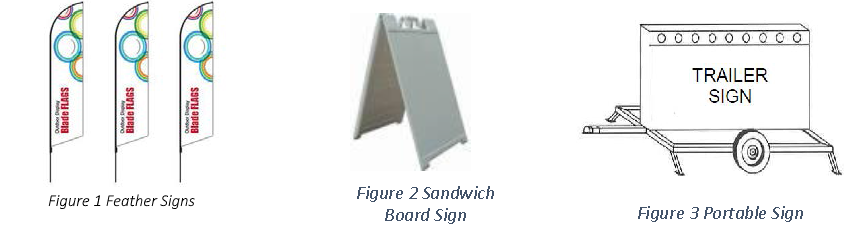
Air-Activated Signs, Moving Signs: Any temporary sign which in part or in total rotates, revolves or other-wise is in motion that is not a flag or feather sign.
B.
Animated Signs: Any electronic sign displaying flashing, intermittent or color changing light or lighting.
C.
Awning: An architectural projection that provides weather protection, identity or decoration and is wholly supported by the building to which it is attached. An awning is comprised of a lightweight, rigid skeleton structure over which a covering is attached.
D.
Balloon Signs, Inflatable Signs: Any air or gas-filled balloon, figure, or object attached to a definite or fixed location.
E.
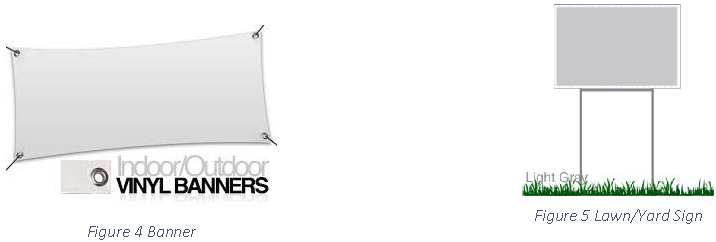
Banner Signs: A temporary sign made of flexible materials and supported along more than one (1) side or at two (2) or more corners by staples, tape, wires, ropes, strings or other materials that are not fixed or rigid.
F.
Reserved.
G.
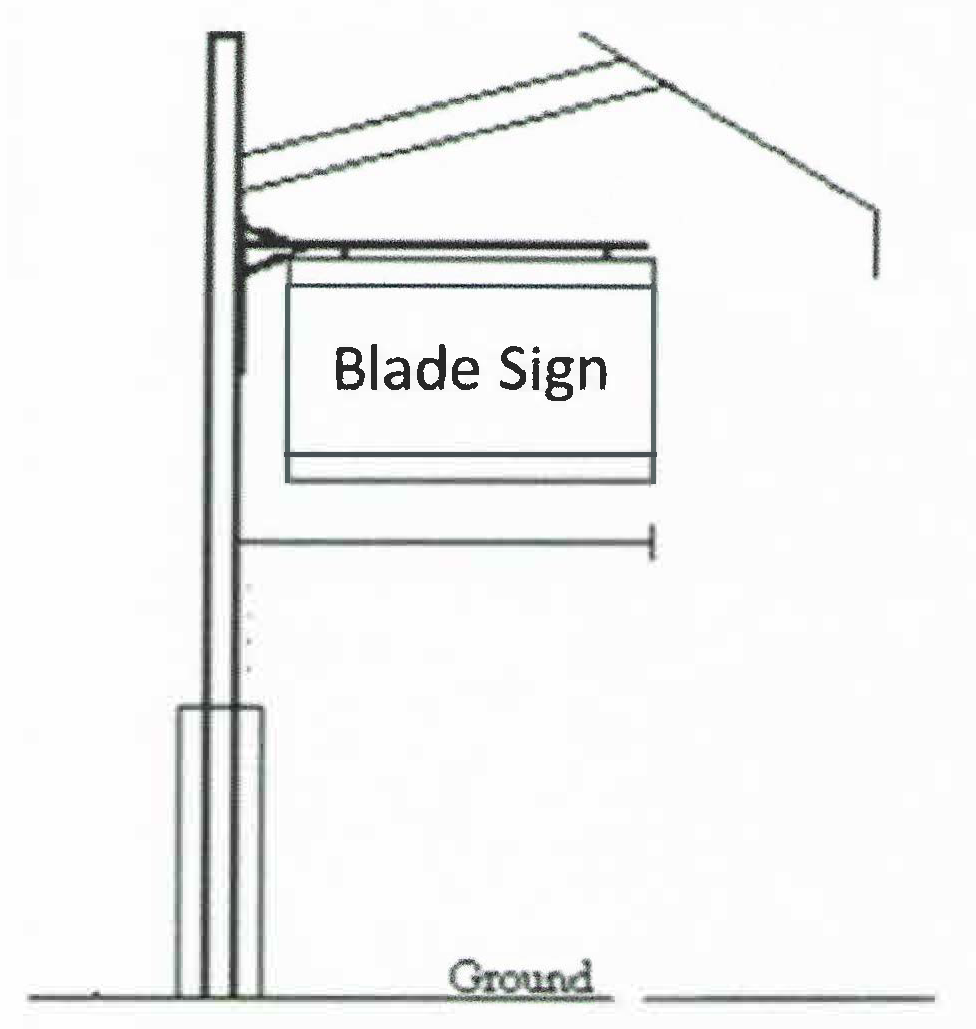
Blade Signs: A permanent projecting sign mounted on a building facade that is perpendicular to the normal flow of traffic.
H.
Canopy: An architectural projection that provides weather protection, identity or decoration and is supported by the building to which it is attached and at the outer end by one or more stanchions attached to the ground. It is comprised of a rigid structure over which a covering is attached. If the stanchions are attached to the building, "Canopy" is indistinguishable from "Awning."
I.
Canopy Sign: A wall sign that is located on the roof, fascia, soffit or ceiling of a canopy.
J.
Cornerstone: A ceremonial masonry stone (block) or replica set into a prominent location in the exterior wall of a building. The cornerstone is considered a structural component of the building and is not a sign.
K.
Electronic Changeable Message: A permanent electronic sign with changeable copy, is programmable, and has a digital display.
L.
Feather Signs: A vertical portable sign that contains a harpoon-style pole or staff driven into the ground for support or supported by means of an individual stand which may be air-activated.
M.
Flags: Any fabric or other flexible material attached to or designed to be flown from a flagpole or similar device. May include federal, state and local flags as well as nongovernmental flags, but does not include temporary signs such as feather or flags signs.
N.
Freestanding Permanent Signs: Any permanent sign supported wholly or in part by some structure other than a building. Pole signs and ground-mounted signs are types of permanent signs.
O.
Glare: The sensation produced by luminance within the visual field that are sufficiently greater than the luminance to which eyes are adapted which causes loss in vision or visibility.
P.
Government Signs: A government sign is a sign that is constructed, placed or maintained by the federal, state or local government or a sign that is required to be constructed, placed or maintained by the federal, state or local government either directly or to enforce a property owner's rights.
Q.
Ground Sign: A sign entirely attached to and supported by the earth. Ground signs include pole signs and monument signs. Ground signs may be temporary or permanent.
R.
Marquee: A permanent, roofed structure attached to and supported by the building and projecting over public property. Marquees are part of the building. They are distinct from canopies and awnings as those structures are attached to the building but are not structurally part of the building.
S.
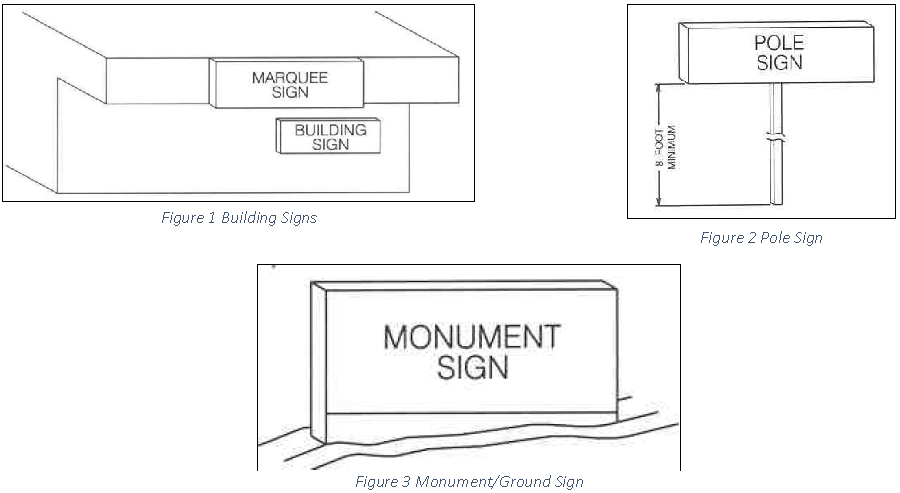
Marquee Sign: A wall sign mounted flat against the front face of the marquee and projecting no more than twelve (12) inches from the face.
T.
Monument Signs: A freestanding sign where the base of the sign structure is on the ground. A pole mounted sign where the sign is within twelve (12) inches of adjacent grade shall be considered a monument sign.
U.
Moving Signs: See air-activated signs and animated signs.
V.
Off-Premises Sign: A sign on a property on which there is no building.
W.
Outdoor Advertising Sign: Any permanent outdoor sign which is designed, intended or used to advertise or inform which is visible from any place on the main-traveled way of Interstate highway 95 or U.S. Highway 70. Such signs are also known as billboards. See G.S. § 136-128 (3)
X.
People Sign, Human Billboard, Sign Walker, Sign Twirler: A person who applies a sign to his or her person, or costume, who wears a sandwich board sign, who carries a sign, and who may wear a costume.
Y.
Pole Signs: A sign that is mounted on a freestanding pole or other support so that the bottom edge of the sign face is eight (8) feet or more above grade.
Z.
Political Sign: Any sign that advocates for political action. The term does not include a commercial sign.
AA.
Portable Message Sign: A sign whose principal supporting structure is intended, by design and construction, to be used by resting upon the ground for support and may be easily moved or relocated for reuse. Portable signs shall include but are not limited to signs mounted upon a trailer, bench, wheeled carrier, or other non-motorized mobile structure with or without wheels.
BB.
Projected Image Signs: Visual images projected against structures by an external projection device, typically visible at night.
CC.
Reserved.
DD.
Roof Signs: Signs placed on or above rooflines of buildings. Permanent building projections below the top roofline of a building are considered marquees. Signs attached below the roofline on a projection are considered canopies, awnings, or marquee signs.
EE.
Sandwich Board Sign, A-Sign: A type of portable message sign constructed in such a manner as to form an "A".
FF.
Sign: A name, identification, description, display or illustration, which is affixed to, painted or represented directly or indirectly upon a building, or other outdoor surface which directs attention to or is designed or intended to direct attention to the sign face or to an object, product, place, activity, person, institution, organization or business. Signs not exposed to view from a street or public access area are not signs for the purpose of these regulations.
GG.
Snipe Signs: Signs placed upon or attached to any curb, sidewalk, utility pole, post, fence, hydrant, bridge, another sign or other surface, bench, street light, mailbox, or natural objects such as trees or rocks, located on, over or across any public street or public property.
HH.
Temporary Signs: Signs for which the entire structure is temporary or portable. Signs not intended as a permanent installation.
II.
Utility Pole Signs: A type of snipe sign, typically made of cardboard, attached to public utility such as light poles.
JJ.
Vehicle Message Sign: A type of portable message sign that is attached to or painted on a vehicle that is parked on or adjacent to any property where the principal use of the vehicle is to display the sign and not to be used for transportation.
KK.
Wall Signs: A sign mounted flat against and projecting no more than twelve (12) inches from the wall. Canopy, awning and marquee signs are considered to be types of wall signs.
LL.
Window Signs: A sign affixed to the interior or exterior of a window, excluding merchandise to attract the attention of persons outside the building.
MM.
Yard Signs (also known as road signs, lawn signs, election signs, real estate signs): A temporary sign generally designed with metal or wood supports designed to be inserted into a grassed or dirt surface.
NN.
Examples of Temporary Signs:
OO.
Examples of Permanent Sign Designs:
(Ord. No. 2021-64-R, 7-13-21; Ord. No. 2024-010-O, § 1, 6-11-24)
Sec. 17-1103. - Substitution clause.
Signs containing noncommercial speech are permitted anywhere that commercial signs are permitted, subject to the same regulations applicable to such signs.
(Ord. No. 2021-64-R, 7-13-21)
Sec. 17-1104. - Severability clause.
If any part, section, subsection, paragraph, subparagraph, sentence, phrase, clause, term, or word in this code is declared invalid, such invalidity shall not affect the validity or enforceability of the remaining portions of the code.
(Ord. No. 2021-64-R, 7-13-21)
Sec. 17-1105. - Prohibited signs.
Unless such signs serve a governmental purpose as identified in Section 17-1106, the following signs are prohibited in the Town of Selma.
A.
Roof signs.
B.
Snipe signs, including utility pole signs.
C.
Simulated or unofficial public safety, warning or traffic signs.
D.
Animated and Electronic Message Signs that change more frequently than every eight (8) seconds.
E.
Motion signs including air-activated and balloon signs but not including temporary feather signs or signs allowed in residential districts.
F.
Vehicle message signs, permanent or temporary.
G.
Signs located within sight triangles of intersections.
H.
Signs emitting glare that causes discomfort or pain or reduces visibility.
I.
Flags consecutively strung together.
J.
Obscene signs and hate-speech signs.
K.
Off-premises signs greater than thirty-two (32) square feet.
L.
Projecting signs less than eighty-four (84) inches (seven (7) feet) in height.
M.
Portable message signs.
(Ord. No. 2021-64-R, 7-13-21; Ord. No. 2024-010-O, § 1, 6-11-24)
Sec. 17-1106. - Government signs.
These regulations are not intended to and do not apply to signs erected, maintained or otherwise posted, owned or leased by this State, the federal government, Johnston County or the Town of Selma or any other government agency or entity. The inclusion of "government" in describing some signs does not intend to subject the government to regulation, but instead helps illuminate the type of sign that falls within the immunities of the government from regulation.
(Ord. No. 2021-64-R, 7-13-21)
Sec. 17-1107. - Calculations and measurements necessary to determine sign dimensions.
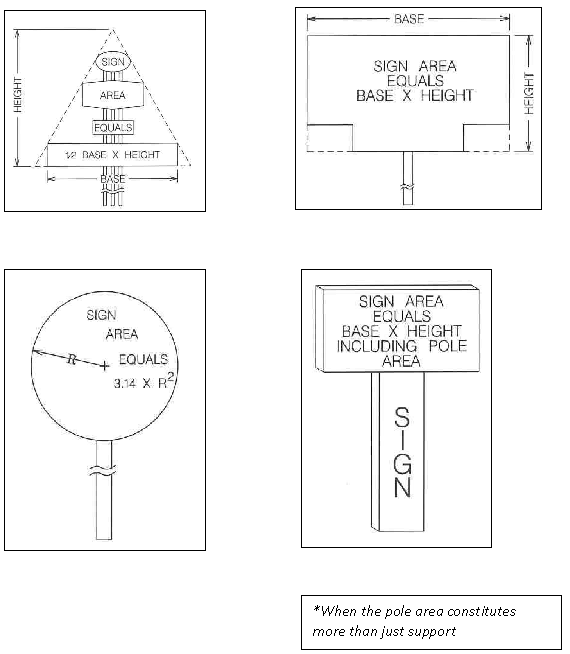
A.
Sign areas shall be computed as follows.
B.
The measurement of frontage necessary to determine the area of freestanding signs is the horizontal distance between the side lot lines as measured at the front setback. When a corner lot allows for two (2) freestanding signs, the calculations shall be based off each frontage. If a corner lot elects to place one (1) sign at the corner, the sign size may be based off the longest side.
C.
The measurement of building frontage necessary to determine allowable wall signage shall be based off the frontage of the building dedicated to the particular use for which the sign is requested.
D.
Sign height for freestanding signs shall not extend above twenty-five (25) feet from grade, unless otherwise permitted by this article.
(Ord. No. 2021-64-R, 7-13-21)
Sec. 17-1108. - Temporary sign regulations by district.
A.
The following table reflects temporary signs allowed by district subject to time and manner regulations. "P" denotes the sign type is allowed. "X" denotes the sign type is not allowed. Sign types not included in the table are presumed to be disallowed unless addressed elsewhere in this article.
Table 11.1 Temporary Sign Types By Zoning District
B.
Number, duration and location of temporary signs. For the purposes of this section, the following districts are deemed to be residential districts: RA, R-20, R-10, R-8, TR, MHP and Residential Planned Unit Developments. All remaining zoning districts are deemed to be non-residential districts.
C.
Residential Districts: The following numbers of signs and their allowed duration is identified below. Temporary signs not listed below are not allowed.
Table 11.2
* See footnote following next table.
D.
Non-residential Districts. The following numbers of signs and their allowed duration is identified below. Temporary signs not listed below are not allowed.
1 Fence wraps displaying signage when affixed to perimeter fencing at a construction site are exempt from zoning regulation pertaining to signage under this article until the certificate of occupancy is issued for the final portion of any construction at that site for twenty-four (24) months from the time the fence wrap was installed, whichever is shorter. If construction is not completed at the end of twenty-four (24) months from the time the fence wrap was installed, the town may regulate the signage but must continue to allow fence wrapping materials to be affixed to the perimeter fencing. No fence wrap affixed pursuant to this subsection may display any advertising other than advertising sponsored by a person directly involved in the construction project and for which monetary compensation for the advertisement is not paid or required. G.S. §160D-908.
2 Windows of non-residential buildings that do not contain an operating permanent or temporary use or business may have one hundred (100) percent window coverage by signs or blank materials such as paper, wood, fabric or others.
E.
Temporary yard signs, (feather) signs and flags may not be placed in rights-of-way. Signs must be placed at least thirty (30) feet from the centerline of the road that divides the lane of traffic closest to the property boundary. The purpose is to ensure that the signs are not in the way of vehicles mowing rights-of-way.
(Ord. No. 2021-64-R, 7-13-21; Ord. No. 2024-010-O, § 1, 6-11-24)
Sec. 17-1109. - Permanent signs.
A.
Permanent signs in all non-residential districts and permanent ground-mounted signs for subdivisions, apartment complexes, mobile home parks or neighborhoods are required to have a permit prior to installation. All other permanent signs are not required to have a permit.
B.
All freestanding signs located within parking or vehicular use areas, and not in yard areas, shall stand in a bed of landscaping at least thirty (30) square feet in area. This area shall contain low growing materials such as ground covers, perennials, and shrubs, and shall be bordered by acceptable curbing materials as specified in this ordinance.
C.
Residential Districts. The following permanent signs are permissible in the RA, R-20, R-10, R-8, TR, MHP and Residential PUD districts.
1.
Wall Signs. One (1) wall sign per structure is allowed maximum of one (1) square foot in size. No permit is required.
2.
Ground-Mounted Signs. One (1) ground-mounted sign is allowed per lot, maximum of two (2) square feet in size. No permit is required.
3.
Ground-Mounted: Subdivision, Apartments, Mobile Home Parks or Neighborhood. One (1) ground-mounted sign to be placed at the entrance to subdivisions, apartment complexes, mobile home parks or established neighborhoods not to exceed thirty-two (32) square feet in size per side per face, for a total of sixty-four (64) square feet. Pole signs are not permitted.
4.
Residential Districts—Electronic Message Signs.
a.
Electronic Message Signs are permissible only for non-residential uses. Non-residential uses in the residential zoning districts include, but are not limited to, churches and schools; and
b.
A Special Use Permit issued by Town Council is required; and
c.
The maximum size of electronic message signs is thirty-two (32) square feet or fifty (50) percent of the permitted sign area, whichever is less; and
d.
No sequential messages are permitted.
e.
The standards of Section 17-1111 "Illumination" must be met.
f.
Electronic message signs must be turned off between 11:00 p.m. and 6:00 a.m.
D.
Non-residential Districts. The non-residential zoning districts are the IN, NB, CB, GB, IB, I-1, I-2 and non-residential PUDS. The following table reflects permanent signs allowed by non-residential district. "PwP" denotes the sign type is allowable with a permit. "P" denotes the sign type is allowable without a permit. "X" denotes the sign type is not allowed. Sign types not included in the table are presumed to be disallowed unless addressed elsewhere in this article.
Table 11.4 Sign Types by Non-Residential Zoning District
* Animation and special effects shall not be used when changing the message on an electronic message sign.
1.
Wall Signs.
a)
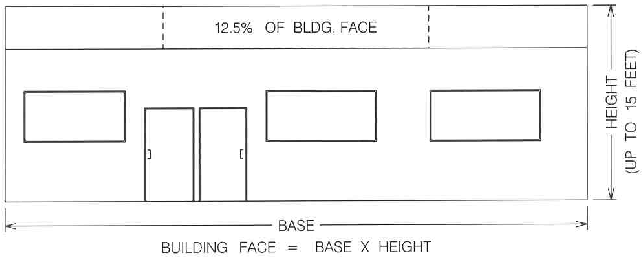
The total square footage of signage allowed on a building shall not exceed an aggregate sign area equal to twelve and one-half (12.5) percent of the square footage of the first fifteen (15) feet in height of the wall face upon which the sign is located. In the event the height of the wall is less than fifteen (15) feet, the allowable building sign area is equal to twelve and one-half (12.5) percent of the square footage of the actual height of the wall face upon which the sign is located. Buildings designed to contain more than one (1) business shall have allocated a wall sign for each business such that the aggregate total area may still be achieved, but not exceeded.
b)
Whenever a sign permit is requested for a property that includes more than one (1) business, the owner or applicant shall identify the total amount of signage in use per business.
2.
Blade Signs.
a)
When allowed by zoning district, a business may apply for a blade sign permit. Each business is only permitted one (1) blade sign, which is to be placed at or near the business's entrance. The maximum square footage allowed is six (6) feet.
b)
It shall be located a minimum of nine (9) feet and a maximum of fifteen (15) feet above sidewalks and other pedestrian ways.
c)
It may be internally or externally illuminated provided that cabinet signs are prohibited.
3.
Ground-Mounted Signs. Ground-mounted signs shall be based on the frontage of the property on which they are located
Table 11.5
a)
Each property is allowed one (1) principal sign that is a monument, pole or electronic message sign (except as provided in subsection c. below).
b)
In addition to the maximum sign area listed above for the principal ground sign, additional square footage is allocated as shown in Table 11.5 above is allowed for other signs. Examples of this type of signage are directional signs, entrance, exit, etc.
c)
A second ground sign per frontage is allowed for properties with two (2) street frontages subject to the Table 11.5 above.
d)
A second ground sign is permitted for lots having one hundred (100) or more feet of street frontage; if the total area of both signs is no more than eighty (80) square feet.
4.
Alternative Pole Signs in the IB District. Each property in the IB zoning district may have one (1) monument sign meeting the standards of subsection b. above and one (1) pole sign meeting the standards of this section.
Table 11.6
a)
Additional square footage is allocated as shown in Table 11.6 above is allowed for other signs. Examples of this type of signage are directional signs, entrance, exit, etc.
b)
Illumination of the alternate pole sign is limited to internal illumination, lighted from behind to silhouette letters and figures.
(Ord. No. 2021-64-R, 7-13-21; Ord. No. 2024-010-O, § 1, 6-11-24)
Sec. 17-1110. - Outdoor advertising sign overlay district.
A.
Location: Outdoor advertising signs are permitted on any property zoned I-1, I-2, IB or GB within three hundred (300) feet of the nearest edge of the rights-of-way of I-95, U.S. 70 and Buffalo Rd. between Hwy 70 and Old Beulah Rd.
B.
Standards:
1.
NCDOT outdoor advertising permit is required; if applicable.
2.
All outdoor advertising signs shall be visible from the rights of way of U.S. 70, I-95; and Buffalo Rd.
3.
The standards of Table 11.7 shall be met; and
Table 11.7
3 Provided that V-type signs are connected at one (1) point and no more than fifteen (15) feet apart at the furthest point of separation.
4 Spacing from other outdoor advertising signs is measured along the same side of the highway, the measurement is made by measuring along the main traveled way in which the sign is intended to be oriented to.
5 Outdoor Advertising on controlled routes says max height of sign thirty (30) feet, maximum length sixty (60) ft., maximum height of sign structure excepting "cut outs" is fifty (50) ft. 19A NCAC 02E.0203
6 Only monopole signs are allowed on U.S. 70 and Buffalo Rd.
7 Outdoor Advertising on controlled routes says three hundred (300) feet. 19A NCAC 02E.0203
8 Id.
4.
Signs shall not obscure or physically interfere with the view of a government sign, signal or device, nor obstruct or physically interfere with a driver's view of traffic or a road; and
5.
No sign may be located closer than one thousand (1,000) feet from any parcel of land containing a residential structure that is zoned in a residential zoning district. On Buffalo Rd no sign may be located closer than one thousand (1,000) feet from any parcel of land containing a residential structure that is zoned in a residential zoning district.
6.
Double-decking of sign faces so that one (1) is on top of the other is prohibited.
(Ord. No. 2021-64-R, 7-13-21; Ord. No. 2024-011-O, § 1, 8-13-24)
Sec. 17-1111. - Illumination.
A.
Illuminated signs are permitted only in non-residential zoning districts or where approved as part of unified signage in a non-residential Planned Unit Development.
B.
Illuminated signs erected in a non-residential district contiguous to a residential district shall be so shielded or directed so that light brightness shall not exceed one (1) footcandle at the property boundary.
C.
No illumination or glare shall be emitted directly onto a public street or roadway so as to constitute a hazard or impediment to motorist or public safety.
D.
No revolving or rotating beam or beacon of light shall be permitted as part of any sign.
E.
Flashing signs and flashing lighting shall not be permitted upon a sign.
F.
Electronic message signs are allowed where permitted provided the message does not change more frequently than every eight (8) seconds and the message completes the change within two (2) seconds. Only one (1) electronic message sign per lot is allowed.
G.
No exposed reflective or incandescent bulb which exceeds eleven (11) watts shall be used on the exterior surface of any sign so as to expose the face of the bulb, light or lamp to any public street or adjacent property.
H.
Tube lights on the outside of windows are not allowed. Tube lights on the inside of windows are allowed, but are limited to the maximum window coverage of twenty-five (25) percent. They may not flash.
(Ord. No. 2021-64-R, 7-13-21)
Sec. 17-1112. - Signs regulated by other agencies.
It is the responsibility of the sign owner to ensure that the requirements of signs regulated by other agencies, such as but not limited to NCDOT and the Johnston County Board of Elections, are satisfied. It is not the intent of this ordinance to regulate the standards of those agencies.
(Ord. No. 2021-64-R, 7-13-21)
Sec. 17-1113. - Election or political signs in the rights-of-way.[4]
A.
Political Signs Permitted. During the period beginning on the thirtieth day before the beginning date of "one-stop" early voting under G.S. 163-227.2 and ending on the tenth day after the primary or election day, persons may place political signs in the right-of-way of the Town or State highway system as provided in this section. Signs must be placed in compliance with subsection B. of this section and must be removed by the end of the period prescribed in this subsection.
B.
Sign Placement. Signs must be placed in accordance with the following:
1.
No sign shall be permitted in the right-of-way of a fully controlled access highway.
2.
No sign shall be closer than three (3) feet from the edge of the pavement of the road.
3.
No sign shall obscure motorist visibility at an intersection.
4.
No sign shall be higher than forty-two (42) inches above the edge of the pavement of the road.
5.
No sign shall be larger than eight hundred sixty-four (864) square inches.
6.
No sign shall obscure or replace another sign.
C.
Permission. Persons placing signs must obtain the permission of any property owner of a residence, business, or religious institution fronting the right-of-way where a sign would be erected. Persons must obtain permission to place signs on private property.
(Ord. of 2-14-17(2))
G.S. Ann. § 136-32(f) Application Within Municipalities.—Pursuant to Article 8 of Chapter 160A of the General Statutes, a city may by ordinance prohibit or regulate the placement of political signs on rights-of-way of streets located within the corporate limits of a municipality and maintained by the municipality. In the absence of an ordinance prohibiting or regulating the placement of political signs on the rights-of-way of streets located within a municipality and maintained by the municipality, the provisions of subsections (b) through (e) of this section shall apply.
Sec. 17-1114. - Discontinuation of use.
When a sign ceases use, the support structure may remain as long as it is in good condition and does not present a threat to public health, safety or welfare. Electronic signs are to be turned off. Sign faces shall either be reversed to the blank side or painted a solid color. A boot or sock may be used to cover the sign face for a period not to exceed six (6) months.
(Ord. No. 2021-64-R, 7-13-21)

