Shasta Lake City Zoning Code
CHAPTER 17
86 - OFF-STREET PARKING AND LOADING REGULATIONS
17.86.010 - Purpose.
This chapter specifies off-street parking and loading spaces for all land uses. The following standards are intended to minimize street congestion and traffic hazards; provide safe and convenient access to residences, businesses, public services and places of public assembly; and make the appearance of parking areas aesthetically pleasing and compatible with surrounding land uses.
(Ord. 97-99 § 1 (part))
17.86.020 - Application.
All uses shall be provided with regularly maintained off-street parking and loading facilities in accordance with the provisions of this chapter.
(Ord. 97-99 § 1 (part))
17.86.030 - When required.
Every building or mobile home hereafter installed, constructed, enlarged or structurally altered and every use of property hereafter inaugurated or expanded, shall be required to provide off-street parking and loading facilities, as specified by this chapter. The spaces shall be improved and installed prior to final building inspection or occupancy. When justified, a deferral of the required parking improvements may be approved, as set forth in the city development standards. All required off-street parking and loading spaces shall be maintained in good condition for the duration of the use that they are intended to serve.
(Ord. 97-99 § 1 (part))
17.86.040 - Parking facilities location.
Required parking shall be located on the same lot or parcel as the use which the spaces serve, except as otherwise provided in this chapter.
(Ord. 97-99 § 1 (part))
17.86.050 - Joint use.
The joint use of off-street parking areas may be authorized by use permit for the following uses or activities under the following conditions:
A.
The joint use of off-street parking for "nighttime" uses, such as theaters, bowling alleys, bars or restaurants, may be supplied by the parking area provided for "daytime" uses, such as banks, offices, retail and personal service establishments.
B.
Up to fifty (50) percent of the off-street parking for "daytime" uses may be supplied by the parking area provided by "nighttime" uses.
C.
Up to fifty (50) percent of the parking for churches or auditoriums may be supplied by the parking facilities provided by "daytime" uses.
D.
Parking in commercial or industrial zones may be located offsite, but must be located within five hundred (500) feet of the use which it serves.
E.
A use permit application for joint use of off-street parking shall contain information which will substantiate that there will be no conflict between the principal operating hours of the buildings or uses for which joint parking or off-street parking is proposed and that all other requirements of this section will be met. In addition, a conveyance or an agreement shall be signed by the affected landowners or their duly authorized agents guaranteeing that joint parking or off-street parking will be available for the use which it serves during the term of the permit. The agreement or conveyance shall be approved as to form by the city attorney, recorded with the county recorder and a copy submitted to the planning division, prior to issuance of the use permit.
(Ord. 97-99 § 1 (part))
17.86.060 - Compact car parking.
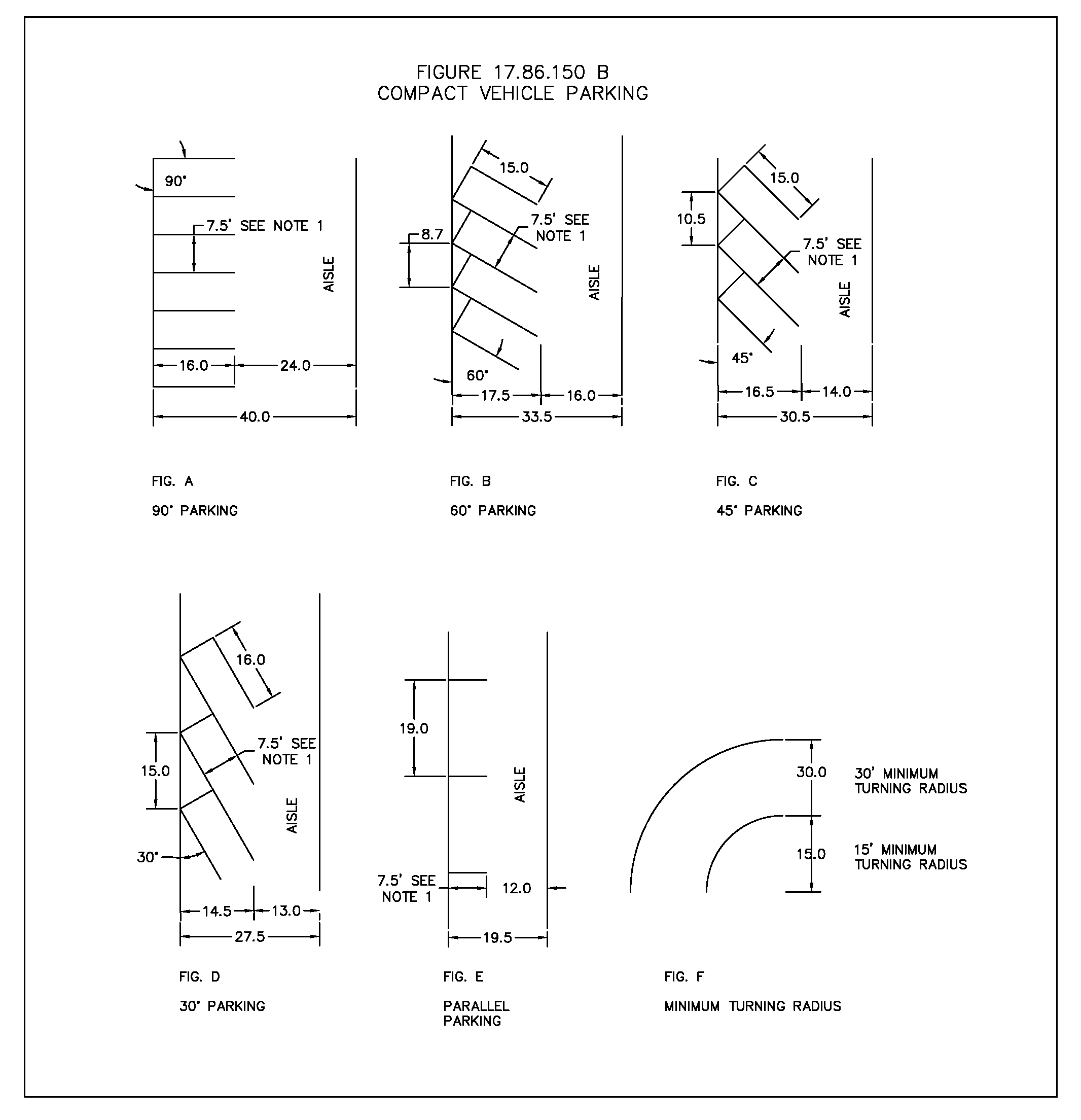
Compact vehicle parking may be provided at the following rate:
(Ord. 97-99 § 1 (part))
17.86.070 - Parking within front and street side yards.
Off-street parking spaces for one-family and two- family residences and residential accessory uses shall not be located in required front or street side yard areas. Off-street parking spaces for other uses may be located in front or street side yard areas, except in required landscape areas.
(Ord. 97-99 § 1 (part))
17.86.080 - Parking within interior side and rear yards.
Interior side and rear yards may be used for vehicle parking and access, except in required landscape area.
(Ord. 97-99 § 1 (part))
17.86.090 - Tandem parking.
Except in mobile home parks, or as provided by a use permit, tandem parking (parking where a car or cars have to be moved in order to allow a car to back from a parking space) shall count only as one parking space. To meet off-street parking requirements, each car must be able to enter and exit a parking space independently of the movement of any other vehicle.
(Ord. 97-99 § 1 (part))
17.86.100 - Surfacing.
For all uses required to provide five or more parking spaces, the parking areas and driveways shall be paved in accordance with city development standards unless modified or delayed by issuance of a use permit.
(Ord. 97-99 § 1 (part))
17.86.110 - Controlled access.
Except for a one-family or two-family residence and residential accessory uses, access to required parking spaces shall be designed in such a manner that vehicles leaving a parking space do not back directly onto any public street. Parking lots shall be designed and improved to prevent entrance or exit at any point other than designated driveways.
(Ord. 97-99 § 1 (part))
17.86.120 - Off-street loading spaces.
Loading space requirements are as follows:
A.
No building or part thereof having a floor area of ten thousand (10,000) square feet or more, which will be occupied by a hospital, institution, hotel, commercial or industrial use or other similar uses shall be erected, structurally altered or allowed to house a change in use unless at least one off-street parking space, plus one additional loading space for each additional twenty thousand (20,000) square feet of floor area is provided. On-site driveways and maneuvering areas may be used in lieu of providing off-street loading space, as long as maneuvering areas for delivery vehicles are provided.
B.
Each off-street loading space shall not be less than twelve (12) feet in width, thirty (30) feet long (exclusive of driveways and maneuvering areas), and if covered, a minimum of fifteen (15) feet high.
C.
A loading space which does not adjoin a street or alley shall have a minimum twenty (20) foot wide access.
D.
Loading space(s) shall be improved to the same standard as required for parking areas.
E.
No off-street loading space shall be closer than fifty (50) feet to any lot in a residential district unless the space is wholly within a building or enclosed on three sides by a wall not less than eight feet in height.
(Ord. 97-99 § 1 (part))
17.86.130 - Parking plan.
All parking required by this section shall be installed and maintained in accordance with a parking plan. The plan shall be submitted to and approved by the development services director or his or her designee prior to issuance of a building permit or use permit, and shall show the layout of the parking spaces, access, interior aisles and other pertinent improvements. This plan may be combined with a landscaping plan.
(Ord. 97-99 § 1 (part))
17.86.140 - Off-street parking standards.
The following parking schedule applies in all zone districts. The required parking spaces are in addition to company operated vehicles. When computing the required number of off-street parking or loading spaces, a remaining fraction of one-half or more shall be deemed a whole unit of measurement; a remaining fraction of less than one-half will be disregarded.
A.
Parking Requirements.
Off-Street Parking
B.
Drive-Up Facilities. In addition to the required off-street parking, drive-up facilities shall provide twenty (20) foot long stacking or vehicle reservoir spaces, in addition to the space where the service is being provided, in accordance with the following schedule:
Off-Street Parking
(Ord. 97-99 § 1 (part))
(Ord. No. 17-261, § 1, 8-15-2017)
17.86.150 - Parking lot design and striping standards.
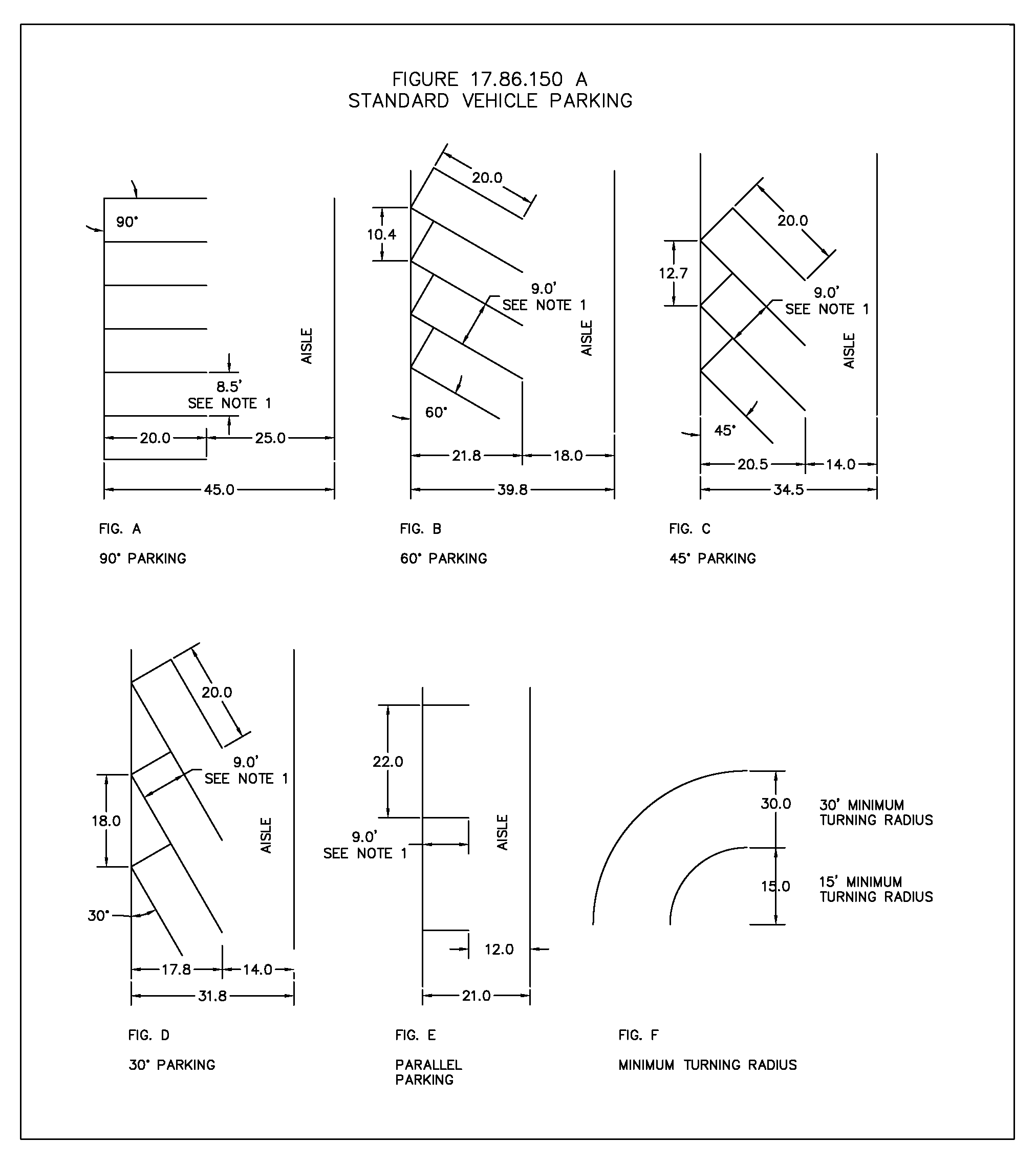
Parking lot design and striping standards for this chapter are set out in Figures 17.86.150A and B.
(Ord. 97-99 § 1 (part))
17.86.160 - Exceptions.
Any portion of Sections 17.86.010 through 17.86.120 and Section 17.86.150 of this chapter may be modified for a particular use if a use permit is obtained. The approving body must find, based upon information submitted by the applicant, that the proposed modified arrangement and design will meet the intent of the parking regulations and will provide adequate parking or loading for the intended use. Exceptions to Section 17.86.140 of this chapter may be made if a use permit is first obtained, provided that the building or use existed prior to July 2, 1993, and does not conform to the off-street parking and loading provisions within this chapter and the approving body finds that it is not feasible, due to space constraints or other reasons, to provide the required parking and improvements. In approving an exception, the approving body may condition the permit to comply with the provisions of this chapter or part thereof within a reasonable time limit in addition to other appropriate conditions.
(Ord. 97-99 § 1 (part))