
Shawnee City Zoning Code
CHAPTER 17
70 - OFF-STREET PARKING AND LOADING
Sections
NOTE: Included herein are provisions adopted by Ord. 2975, 2010; Ord. 3064, 2013; Ord. 3131, 2015; Ord. 3143, 2015; Ord. 3154, 2016; Ord. 3175, 2016; and Ord. 3213, 2018.
17.70.005 - Intent and Purpose.
The parking regulations established herein are included:
A.
To provide adequate, convenient and safe off-street parking areas for residents and employees and business patrons of the City of Shawnee;
B.
To enhance the visual integrity of the community by encouraging the use of vegetation and open space areas to soften the impact of hard paved surfaces;
C.
To encourage efficient development of a site for commercial purposes as opposed to underutilized paved surfaces;
D.
To promote sustainable development by encouraging parking lot design that utilizes best management practices (BMP) for enhanced stormwater collection and water quality.
17.70.010 - Applicability.
In any zoning district, all structures and uses established hereafter, shall provide accessory off-street parking in accordance with the following regulations. When an existing structure or use is expanded, accessory off-street parking shall be provided in accordance with the following regulations for the area of capacity of such expansion.
17.70.020 - General Provisions.
A.
Utilization. Required accessory off-street parking facilities provided for the uses hereafter listed shall be solely for the parking of motor vehicles in operating condition of patrons, occupants, or employees of such uses.
B.
Access. Each required off-street parking space shall be open directly upon an aisle or driveway of such width or design as to provide safe and efficient means of vehicular access to such parking space.
C.
Open and Enclosed Parking.
1.
Off-street parking spaces open to the sky must have a minimum setback from the property line when abutting street rights-of-ways thirty (30) feet in PO district, twenty (20) feet in CH district and PI district, fifteen (15) feet in CN and RGA district, ten (10) feet in TSQ district so long as they do not create a conflict with vision clearance requirements on corner lots. All parking stalls abutting a residential district shall provide a minimum setback of thirty (30) feet from the property line. Parking setback areas shall be reserved for green areas and plantings.
2.
Enclosed buildings and carports containing off-street parking shall be subject to the yard requirements applicable to the district in which it is located.
3.
Tracts or lots developed prior to June 7, 1974, or the effective date the property was annexed into the City, may be permitted a lesser parking setback if the Planning Commission finds that the parking setback as specified would not allow the proper redevelopment of the lot, adequate parking could not be possible without a lesser setback, and the existing lesser setback would be in keeping with the spirit and intent of this article.
D.
Design and Maintenance.
1.
Design. Off-street parking spaces shall comply with such design standards relating to curb length, stall depth, island width, barriers, ingress and egress, and setbacks as contained in the off-street parking standards of this article. No parking shall be designed for ingress or egress directly on to major entry aisles. Off-street parking spaces may be opened to the sky or enclosed in a building.
2.
Surfacing. All open off-street parking areas, except those required off-street parking spaces accessory to a single-family dwelling in the agricultural zoning district constructed under building permits issued prior to June 1, 2001, shall be graded and paved along with the driveway with asphalt, concrete or paver brick.
3.
Screening. All open off-street parking areas for other than duplex or single-family uses shall be effectively screened on each side that adjoins any property situated in the agricultural or residential zoning districts by a wall, fence, or densely planted evergreen hedge, not less than six (6) feet in height. Parking areas shall be arranged and designed so as to prevent damage to, or intrusion into, such wall, fence, or hedge.
4.
Perimeter Improvements. The perimeter of all parking/loading areas and their access drives shall be curbed, with the exception of driveways for single-family and duplex residences. Landscaped islands, or other interior parking features shall also be protected by a curb or other method of protection as indicated on the approved stormwater management plan.
5.
Exterior and Interior Landscaping. Landscaping shall be provided both at the perimeter and on the interior of the parking lot when in excess of a double row of parking, as provided in Section 17.57.040.
6.
Lighting. All fixtures used for illuminating paved areas (off-street parking stalls, driving aisles, storage areas, and other paved surfaces on the site) shall be non- adjustable and have a cutoff that shields the light source at an angle of ninety (90) degrees from vertical. All fixtures shall be arranged to deflect light away from any adjoining property or street. The height of the poles or standards shall be of a height no less than nineteen (19) feet, but no greater than twenty-four (24) feet measured from grade of paved surface. The Planning Commission may allow a higher height not to exceed the height of the roof line of the building perpendicular to the light fixture, and in no event higher than thirty-three (33) feet, where the lights are not adjacent to residential property, or where commercial, office and/or industrial property is separated from residential property by a divided four-lane highway. In order to allow for this higher standard to be considered, the applicant shall submit with consideration of site plan approval, a photometric chart to show compliance with lighting standards. The calculation shall be made at grade for lighting levels in paved areas. A cut sheet of the proposed fixtures, which includes a candlepower distribution curve, is required to be submitted, as well as a vertical plan foot-candle calculation for property and streets, to assure that the standard of one-half (0.5) foot-candle is maintained at the property line. The maximum maintained luminary measured at an adjoining residential property line shall be one-half (0.5) foot-candles. The maximum average maintained luminance for all paved area lighting shall be three (3) foot-candles, and the minimum average maintained foot-candles shall be one (1) foot-candle. For the City's calculation, the average maintained luminance shall be calculated at eighty percent (80%) of the initial foot-candle rating. All wall pack lighting systems used to illuminate paved areas or sides of buildings shall be shielded on all three (3) exposed sides to prevent off-site glare and focus light downward.
7.
Repair and Service. No motor vehicle repair work or service of any kind shall be permitted in association with any off-street parking facilities.
8.
Computation. When determination of the number of off-street parking spaces required by this chapter results in a requirement of a fractional space, the fraction of one-half (½) or less may be disregarded, and a fraction in excess of one-half (½) shall be counted as one (1) parking space.
9.
Collective Provisions. Off-street parking facilities for separate uses may be provided collectively if the total number of spaces so furnished is not less than the sum of the separate requirements for each such use, and provided that all regulations covering the locations of accessory parking spaces in relation to the use served are adhered to.
10.
Location. All parking spaces required to serve buildings or uses shall be provided on the same zoning lots as the structure or use served, or within six hundred (600) feet of a main entrance to the structure served, provided no off-street parking facilities for a structure or use in a commercial, industrial or office zoning district shall be located in a residential district.
11.
Employee Parking. Parking spaces required on an employee basis shall be based on the maximum number of employees on duty or residing, or both, on the premises at any one time.
12.
Maximum Number of Spaces. The total number of accessory parking spaces provided for multifamily, commercial, industrial, institutional, recreational, and office uses are subject to the requirements of Section 17.70.030.
13.
Exempt Zone. Notwithstanding any other provision of this regulation, in the Townsquare District, minimum required off-street parking spaces for uses permitted by right or by special use permit shall be determined by the Planning Commission. In making their determination, the Planning Commission shall consider the amount of parking which would be required for the use proposed if it were located in a different zoning district. Then the Planning Commission shall take into account the volume of parking to be provided on site, parking available in close proximity to the site in public lots, on street right-of-way, and in any joint parking facility provided by any downtown business organization or shared with neighboring businesses.
14.
Plans and Approval Required. Plans showing the layout and design of all required off-street parking and loading areas shall be submitted and approved by the Planning Commission. Planning staff shall review and be satisfied that the spaces provided are usable and meet the standards design criteria. All required off-street parking spaces shall be clearly marked prior to occupancy.
15.
Drainage. All parking areas shall be designed to not increase stormwater runoff onto adjoining properties or streets. Drainage plans shall be reviewed by the City Engineer prior to Planning Commission review of a site plan.
16.
Plots Divided by District Boundaries. When a plot is located partly in one (1) zoning district, and partly in another, the regulations for the district requiring the greater number of parking spaces or loading berths shall apply to all of the plot. Parking spaces or loading berths on such a plot may be located without regard to district lines, provided that no such parking spaces or loading berths shall be located in any residential district, unless the use to which they are accessory is permitted in such district.
17.
Access Near Street Corners. No entrance or exit for any accessory off-street parking area with four (4) or more spaces, or any loading berth shall be located within one hundred twenty-five (125) feet of the intersection of any two (2) streets.
18.
Minimum Standards for Driveway Entrances to Parking Areas.
a.
Commercial Driveway Approach. The width of commercial driveway approaches shall not exceed thirty-one (31) feet or be less than twenty-five (25) feet measured parallel to the centerline of the street at the property lines for two-way driveway approaches; provided, however, that commercial property may be allowed to have a driveway approach not exceeding fifty-three (53) feet, if the driveway approach does not exceed twenty percent (20%) of the length of the real property abutting the adjacent City street and a four-foot raised median is placed within such driveway approach to divide the entrance and exit lane(s). The minimum width of a one-way driveway shall be seventeen (17) feet, back-to-back.
b.
Industrial Driveway Approach Offset. The width of industrial driveway approaches shall not exceed sixty-five (65) feet or be less than twenty-five (25) feet measured parallel to the centerline of the street at the property lines from back-of-curb to back-of-curb for two-way driveway approaches; provided that the minimum width for a one-way driveway shall be seventeen (17) feet.
c.
Curb Openings. A curb cut shall not exceed beyond a side property line and not be closer to an intersecting street than twenty-five (25) feet in a residential district, or one hundred twenty-five (125) feet in a commercial or industrial district. The measurement shall be from the curb line to the nearest edge of the driveway throat. Curb openings for commercial driveway approaches shall not exceed seventy (70) feet unless otherwise approved by the City Engineer.
d.
The radius of the driveway curb return shall not be less than fifteen (15) feet and not more than twenty-five (25) feet.
e.
The driveway should intersect the street at right angles; however, driveways may intersect at an angle no less than sixty (60) degrees nor exceed one hundred twenty (120) degrees maximum.
E.
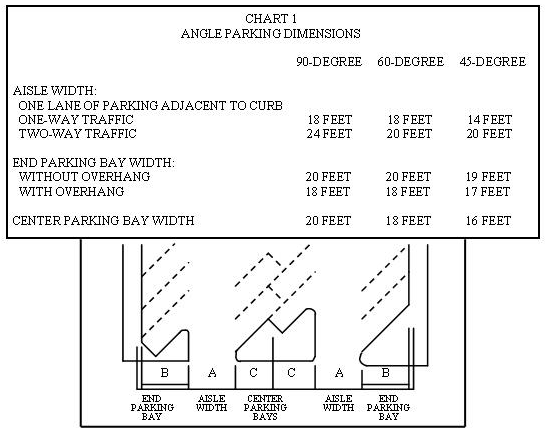
Size of Parking Spaces. Generally, a required off-street parking space shall be at least nine (9) feet in width and at least twenty (20) feet in length exclusive of access drives or aisles, ramps and columns. The minimum width of a one-way aisle shall be fourteen (14) feet. The minimum width of a two-way aisle shall be twenty-four (24) feet, measured from back of stall to back of stall, or from face of curb to face of curb where parking islands exist. Angle parking may allow for different dimension requirements as indicated in Chart 1. Minimum dimensions for a parallel parking space shall be nine (9) feet by twenty-three (23) feet.
17.70.030 - Required Spaces.
Off-street parking spaces accessory to the uses hereinafter designated shall be provided as follows (ADA accessible stalls, if required count toward the minimum required).
A.
Agricultural Zoned Land.
1.
Farming operations, other than family operated farms: One (1) space, plus one (1) per employee;
2.
Residential use: Two (2) spaces per dwelling unit;
3.
Retail sales: One (1) space per six hundred (600) square feet devoted to retail sales;
4.
Other uses: Refer to specific use listed elsewhere in this section.
B.
Residential Uses.
1.
Single-family, duplex, multiple-family and mobile home parks: Two (2) spaces per dwelling unit;
2.
Age restricted housing: One and one-third (1.3) spaces per unit;
3.
Lodging house (such as a homeless shelter): One (1) space for each two (2) units;
4.
Dormitories, fraternities, sororities and other housing for unmarried students: Two (2) spaces for each three (3) occupants based on design capacity.
C.
Commercial and Office Uses. In the TownSquare (TSQ) district the minimum required off-street parking spaces for uses permitted by right or by special permit shall be as determined by the Planning Commission. In making their determination, the Planning Commission shall consider the amount of parking which would be required for the use proposed if it were located in a different zoning district. Then, the Planning Commission shall take into account the volume of parking to be provided on-site, parking available in close proximity to the site in public lots, on street right-of-way, and in any joint parking facility provided by any downtown business organization or shared with neighboring business. In all other zoning districts:
1.
Automobile car washes: Four (4) spaces per stall for self-service bays, or three (3) spaces for each twenty (20) feet of street frontage for attendant operated facilities;
2.
Automobile service station: One (1) space per one hundred fifty (150) square feet of floor area, plus one (1) per employee;
3.
Banks and other financial institutions: One (1) space for each one hundred fifty (150) square feet floor area for that part used for banking operations, and one (1) space for each two hundred fifty (250) square feet of floor area for other leasable space;
4.
Bowling alleys: Four (4) spaces per lane;
5.
Car lots (new and used), motor vehicle show rooms: One (1) space per two hundred fifty (250) square feet of floor areas, plus one (1) space per two thousand five hundred (2,500) square feet of open lot area devoted to sale and display of motor vehicles;
6.
Catering and Banquet Facilities: Two (2) spaces for each three (3) employees, plus one (1) space for each one hundred (100) square feet of floor area devoted to enclosed meeting rooms and banquet space, including entry areas, foyers, and restrooms for use by the general public. Such a facility may contract with another business for overflow parking spaces located within two hundred (200) feet of the property line of the facility provided the number of spaces provided under the contract are in excess of the number required by that business, or during times that the contract business is not in operation.
7.
Commercial wholesale business: One (1) space per four hundred fifty (450) square feet floor area, plus two (2) spaces for each three (3) employees;
8.
Convenience stores: One (1) space per one hundred fifty (150) square feet of floor area;
9.
Dental clinics: One (1) space per two hundred (200) square feet of floor area;
10.
Dry cleaners and coin-operated laundries: One (1) space per one hundred fifty (150) square feet of floor area;
11.
Furniture and appliance stores: One (1) space per two hundred fifty (250) square feet floor area;
12.
Home Improvement Stores: One (1) space per three hundred (300) square feet of floor area.
13.
Hotels and motels: One (1) space per rental room, plus two (2) spaces for each three (3) employees, plus one (1) for each one hundred fifty (150) square feet floor area devoted to meeting rooms, restaurants and private clubs;
14.
Lawn and tree services: One (1) per two hundred (200) square feet of floor area;
15.
Medical clinics: One (1) space per one hundred fifty (150) square feet of floor area;
16.
Office, professional service and public administration buildings: One (1) space per two hundred fifty (250) square feet of floor area;
17.
Research and development firms: One space per four hundred fifty (450) square feet or gross floor area, provided there are not less than two (2) stalls for each three (3) employees during largest shift;
18.
Restaurants and cafeterias which do not sell alcoholic beverages: One (1) space for each three (3) persons based on maximum design capacity including employees, provided drive-in/drive-thru restaurants shall have a minimum of ten (10) parking spaces.
19.
Restaurants with a license to sell alcoholic beverages; taverns, private clubs, and drinking establishments: One (1) space for each employee plus one (1) space for each two (2) persons based on the maximum design capacity calculated by building code standards, provided establishments with drive-in/drive-thru restaurants shall have a minimum of ten (10) parking spaces;
20.
Retail sales not specifically listed, and not located in a shopping center with at least twenty-five thousand (25,000) square feet of gross floor area: One (1) space per two hundred fifty (250) square feet of gross floor area;
21.
Shopping centers:
a.
With twenty-five thousand (25,000) to four hundred thousand (400,000) square feet gross floor area, four (4) spaces per one thousand (1,000) square feet gross floor area;
b.
With four hundred thousand (400,000) to five hundred ninety-nine thousand, nine hundred ninety-nine (599,999) square feet gross floor area, four and one-half (4.5) spaces per one thousand (1,000) square feet gross floor area;
c.
Greater than six hundred thousand (600,000) square feet gross floor area, five (5) spaces per one thousand (1,000) square feet gross floor area;
22.
Telephone exchanges, radio and television stations and communication towers, both transmitting and receiving: One (1) space per employee;
23.
Theaters: One (1) space per three (3) seats;
24.
Undertaking establishments and funeral parlors: One (1) space for each four (4) seats based on maximum capacity of parlor, plus one (1) per employee and each vehicle maintained on the premises;
25.
Veterinary clinics and animals hospitals: One (1) space per three hundred (300) square feet floor area.
D.
Industrial Uses.
1.
Cartage, express, parcel delivery and freight terminal establishments: One (1) space per two thousand five hundred (2,500) square feet of gross floor area, plus one (1) space for each two (2) employees based on maximum design capacity;
2.
Manufacturing, production, processing, assembly, disassembly, cleaning, servicing, testing or repairing of goods, materials or products: One (1) space per one thousand (1,000) square feet of gross floor area, or one (1) space for each two (2) employees based on maximum design capacity, whichever is larger;
3.
Research and development firms: see requirements under commercial uses;
4.
Warehouses, storage and wholesale establishments: One (1) space for each two (2) employees based on the largest shift capacity, one (1) space per one thousand (1,000) square feet or gross floor area, whichever is greater;
5.
Flex buildings that may be converted to office use, or are initially constructed with the intent to contain office uses, shall provide three (3) spaces per one thousand (1,000) square feet of gross floor area (or portion thereof). If a use is allowed by special use permit as provided in Section 17.46.030(M), the office user shall provide adequate documentation that the parking requirement for the office use can be satisfied independently of the remaining uses of the building.
E.
Institutional and Recreational Uses.
1.
Schools.
a.
Day camps and summer camps on plots of five (5) acres or more: One (1) space for each five (5) persons for which there are accommodations,
b.
Nursery schools, group day care centers: One (1) space per employee, based on maximum present during largest shift,
c.
Rehabilitation centers for the functionally, mentally and physically handicapped: One (1) space for each four hundred (400) square feet of floor space,
d.
Primary and junior high schools: Two (2) per classroom, but not less than one (1) per teacher and staff,
e.
Secondary school: Two (2) spaces for each three (3) faculty, plus one (1) for each six (6) students at maximum design capacity,
f.
Trade and commercial schools, post-secondary: One (1) for each four (4) students based on maximum design capacity;
2.
Health Care.
a.
Hospitals: One (1) space for each two (2) employees plus one (1) space for each doctor assigned to staff,
b.
Nursing and convalescent homes: One (1) space for each two (2) beds based on maximum design capacity, plus one (1) for each employee and staff member;
3.
Churches and Lodges:
a.
Churches, temples and synagogues: One (1) space for each three (3) seats;
b.
Private lodges: One (1) space for each three (3) persons based on maximum design capacity;
4.
Auditoriums, Libraries and Municipal and Civic Buildings:
a.
Auditoriums, gymnasiums and other places of assembly without fixed seats: One (1) space for each three (3) persons based on maximum design capacity;
b.
Auditoriums, gymnasiums, and other places of assembly with fixed seats: One (1) space for each four (4) seats;
c.
Libraries: One (1) space for each three hundred (300) square feet of floor area;
d.
Civic buildings: One (1) space for each three hundred (300) square feet of floor area;
5.
Airports and heliports including landing fields and auxiliary facilities: One (1) space for each five (5) stalls;
6.
Country clubs, swimming and tennis clubs: One (1) space for each three (3) members.
F.
Other Uses. Uses not specifically categorized above shall provide parking stalls as determined by the Planning Commission with respect to the number of spaces that are required to serve employees and/or the visiting public at each such use.
G.
Reduction in Minimum Number of Stalls. An applicant may request a reduction in the number of stall to be constructed provided the total reduction does not exceed twenty percent (20%) of the required stalls, a parking analysis is submitted showing documentation that the number of stalls to be provided meets the needs of the intended use, and land is shown on the site plan to provide at least the total number of required stalls that will be required to be improved if parking problems arise. This reduction allowance shall not apply to restaurants, churches, and schools.
17.70.040 - Criteria for Excess Parking Areas.
Additional parking stalls may be provided, which exceed the required number of spaces as listed under Section 17.70.030, provided these additional standards are met:
A.
Small scale parking lots, defined as those parking areas containing forty (40) or less total spaces including parking for persons with disabilities, shall be exempt from the standards set forth in this section;
B.
Churches, schools, and, free-standing restaurants, shall be exempted from the standards set forth in this section;
C.
For large scale parking lots containing more than forty (40) spaces, the following parking criteria will be used to establish open space requirements for these parking areas that exceed the required number of spaces:
17.70.050 - ADA Accessible Stalls.
All public parking areas developed after the adoption of these standards shall provide for the provision of ADA accessible stalls pursuant to these regulations, and the Americans with Disabilities Act (ADA).
A.
Location. ADA accessible stalls shall be located as near as is feasible to the nearest accessible entrance on an accessible route to the facilities they serve. The total number of accessible parking spaces may be distributed among common parking areas if greater accessibility is achieved. This includes the provision of accessible parking facilities to pad sites.
B.
Signage. Parking stalls for persons with disabilities shall be clearly marked by painting the international handicapped symbol in the pavement of the stall, and placing an ADA compliant sign above grade level at the front of the parking stall.
C.
Size. Parking spaces for persons with disabilities shall be at least eight (8) feet wide and twenty (20) feet in length and shall have an adjacent access aisle five (5) feet wide minimum. Two (2) accessible parking spaces may share a common access aisle.
D.
Number of Stalls. Parking spaces provided for employees or the general public shall be provided in each such parking area in conformance with the following table:
17.70.055 - Applicability.
Off-street loading berths open or enclosed are allowed as an accessory use to any building except residences for one (1) or two (2) families.
17.70.060 - General Provisions.
A.
Locations. All required loading spaces or berths shall be located on the same lot as the use served. All motor vehicle loading berths which abut or are adjacent to a residential district shall be completely screened there from by building walls or a solid fence at least six (6) feet in height or no more than eight (8) feet in height. Loading and delivery facilities or docks shall be oriented away from public streets and shall be screened from their view. No entrance or exit for any loading spaces or berths shall be located within one hundred twenty-five (125) feet of the intersection of the pavement edge of any two (2) streets.
B.
Size. Each required loading berth shall be at least twelve (12) feet wide, thirty-three (33) feet long, with the height determined by the needs of the applicants.
C.
Access. Unobstructed access, at least ten (10) feet wide, to and from a street, shall be provided. Such access may be combined with access to a parking lot.
D.
Joint Facilities. Permitted or required loading berths, open or enclosed, may be provided in spaces designed to serve jointly two (2) or more adjacent establishments, provided that the number of the required berths in such joint facilities shall not be less than the total required for all such establishments, and that:
1.
Each zoning lot served shall have direct access to the central loading area without crossing streets or alleys at grade; although no zoning lot served shall be more than five hundred (500) feet from the central loading area;
2.
Total berths provided shall meet the requirements based on the sum of the several types of uses served. The area and types of uses may be totaled before computing the number of loading berths;
3.
The tunnel or ramp connecting the central loading area with the zoning lot served shall not be less than seven (7) feet in width and have a clearance of not less than sixteen (16) feet.
E.
Surfacing. All off-street loading spaces shall be improved in at least the same manner as the parking lot, however a concrete surface may be used rather than asphalt.
F.
Repair and Service. No motor vehicle repair work or service of any kind shall be permitted in conjunction with any off-street loading facilities.
G.
Floodlighting. If floodlighting is used it shall be arranged so as to prevent the glare of lights toward any contiguous plot or street.
H.
Minimum Facilities. Uses for which off-street loading facilities are required by this section but which are located in buildings that have a floor area that is less than the minimum above which off-street loading facilities are required shall be provided with adequate receiving facilities, accessible by motor vehicles from any adjacent service drive or parking area on the same lot.
I.
Plots Divided by District Boundaries. When a plot is located partly in one (1) district and partly in another district, the regulations for the district requiring the greater number of parking spaces or loading berths shall apply for all of the plot. Parking spaces or loading berths on such a plot may be located without regard to district lines, provided that no such parking spaces or loading berths shall be located in any residential district, unless the use to which they are accessory is permitted in such district.
17.70.070 - Off-Street Loading and Berth Requirements.
A.
Public library, museum, art gallery, public building, community facility, recreational buildings, schools, hospitals, sanitariums and homes for the aged: One (1) berth for the first ten thousand (10,000) square feet of floor area and one (1) additional berth for each twenty-five thousand (25,000) square feet or fraction thereof of additional floor area.
B.
Multiple-family residential buildings: One (1) off-street berth for buildings containing ten thousand (10,000) to two hundred thousand (200,000) square feet of floor area, plus one (1) additional loading berth for each additional two hundred thousand (200,000) square feet or fraction thereof.
C.
Hotels and motels: One (1) berth for each twenty-five thousand (25,000) square feet of floor area.
D.
Office and retail service establishments: One (1) berth for the first eight thousand (8,000) to twenty-five thousand (25,000) square feet of floor area, and one (1) additional berth for each additional twenty-five thousand (25,000) square feet of floor area or fraction thereof so used.
E.
Wholesale and storage uses dry cleaners, laundries and rug cleaning establishments: One (1) berth for each five thousand (5,000) square feet to ten thousand (10,000) square feet of floor area in such use.
F.
Undertakers: One (1) berth for each chapel. Such berths shall be at least twelve (12) feet wide, twenty (20) feet long and eight (8) feet high.
G.
Industrial zoning districts: One (1) berth with minimum dimensions of fifteen feet width, forty (40) feet in length, and sixteen (16) feet in height, if covered, for the first ten thousand (10,000) square feet of gross floor area or major portion thereof plus one (1) berth for each additional twenty thousand (20,000) square feet or major portion thereof.

