
Shawnee City Zoning Code
CHAPTER 17
05 - SIGN CODE
Sections:
17.05.010 - Purpose and Findings.
The purpose of this Chapter is to create a comprehensive and balanced system to regulate signs of all types (temporary and permanent) in a manner that:
A.
Protects state and federal constitutional rights to free speech by providing ample opportunities for expression through signs, while avoiding regulatory triggers or distinctions based on content, and providing clear standards for approval;
B.
Protects public health and safety by:
1.
Minimizing visual traffic hazards, distractions and obstructions for motorists, cyclists and pedestrians, or signs causing confusion by virtue of visual similarity to traffic control signs;
2.
Reducing hazards caused by signs overhanging or projecting over public right-of-way; and
3.
Encouraging the upgrading, updating, or removal of signs that are poorly maintained, out of character with their surroundings, or do not conform to this Chapter, and preventing signs that are potentially dangerous due to structural deficiencies and disrepair.
C.
Promotes the community's appearance, character, quality, and business climate by encouraging signs that are attractive and functional for their intended purpose, and that are in scale and architectural harmony with the development site and building(s) and with surrounding buildings and developments;
D.
Enhances and protects the community's physical appearance and property values and prevents visual clutter or potential deterioration of the community's appearance and attractiveness that might promote blight; and
E.
Implements the goals and policies of the Comprehensive Plan by establishing uniform standards and procedures to regulate the size, type, number, design, placement, illumination, timeframe for display, and maintenance of signs.
(Ord. 3409, 2022)
17.05.020 - Applicability.
A.
Generally.
1.
This Chapter applies prospectively to permit applications for sign construction and to existing signs and sign structures within the corporate limits of the City of Shawnee, Kansas.
2.
This Chapter does not prohibit signs required by state or federal law and does not authorize signs that state or federal law prohibits.
3.
A person may not erect, operate, display, or otherwise use any sign that this Chapter prohibits.
4.
A person may not erect, operate, display, or otherwise use any sign at a time, place, or manner that this Chapter prohibits.
B.
Exemptions. This Chapter does not apply to:
1.
Indoor Signs.
2.
Government Signs.
3.
Traffic Control Devices.
C.
Message Neutrality.
1.
Content Neutrality. Despite any other provision of this Chapter, no sign is subject to any limitation based on the content of its message.
2.
Substitution Allowed. Any sign authorized in this Chapter may contain any non-commercial copy or messages instead of a commercial or another noncommercial message.
D.
Planned Unit Developments (PUDs).
1.
Applicability. This Chapter applies to signs within a PUD and to master sign plans. To the extent that a master sign plan does not address the type, area, height, design features, or other sign requirements, this Chapter applies to those features.
2.
Master Sign Plans. The master sign plan for a PUD must comply with the number, area, height, and design requirements for the applicable sign district that applies at the time of application for approval of the PUD. The master sign plan may include modifications allowed by Section 17.05.110 (Master Sign Plans).
E.
Design Guidelines. Where there is a conflict between the regulations in this Chapter and the design guidelines for a district that is subject to Planning Commission review, the design guidelines prevail. The Downtown Design Guidelines for the Pedestrian Zone and the South Nieman Zone provide additional sign design standards for sign alterations, sign improvements, and new signs for parcels located within the Townsquare Zoning District (TSQ).
(Ord. 3409, 2022)
17.05.030 - Prohibited Signs.
A person may not erect, operate, display, or otherwise use the following types of signs unless this Chapter specifically allows the sign:
A.
Abandoned signs;
B.
Billboards;
C.
Digital billboards;
D.
Moving signs;
E.
Pole signs;
F.
Portable signs;
G.
Roof signs;
H.
Signs in the right-of-way;
I.
Snipe signs; and
J.
Any other sign or device not expressly allowed by this Chapter.
(Ord. 3409, 2022)
17.05.040 - General Requirements.
A.
Construction, Installation, and Removal.
1.
Signs and sign structures shall comply with the Building Code (Title 15, Shawnee Municipal Code) and all other regulatory requirements. An applicant must obtain all applicable permits before installing a sign.
2.
The supporting members of the sign (such as angle iron, guy wires, cable, bracing, and other hardware) must be covered so that they appear as an integral or architectural part of the sign.
3.
For wall signs, the sign installation area on the face of the building must be cleaned, patched, and painted upon removal of a sign.
B.
Maintenance. The property owner or sign owner shall keep all signs, together with all their supports, braces, guys and anchors, and face color, in good repair and properly maintained. The property owner or sign owner shall replace any defective or damaged parts or components and shall keep the adjacent land free of debris, weeds, trash, or other public nuisances. The Director may enforce the maintenance standards as provided in Section 17.05.150 (Inspections, Enforcement, and Penalties).
C.
Clearance for Projecting Signs, Awning Signs, Canopy Signs, and Other Signs Extending over Sidewalks and Driveways.
1.
The bottom edge of any projecting sign, awning sign, canopy sign, and any other sign that extends over a sidewalk or driveway must be at least eight (8) feet above grade as shown in Figure 17.05.040-1.
2.
Projecting signs, awning signs, canopy signs, and any other sign that extends over public sidewalks may not extend into or occupy more than two-thirds (⅔) the width of the sidewalk or six (6) feet (whichever is less), as measured from the building.
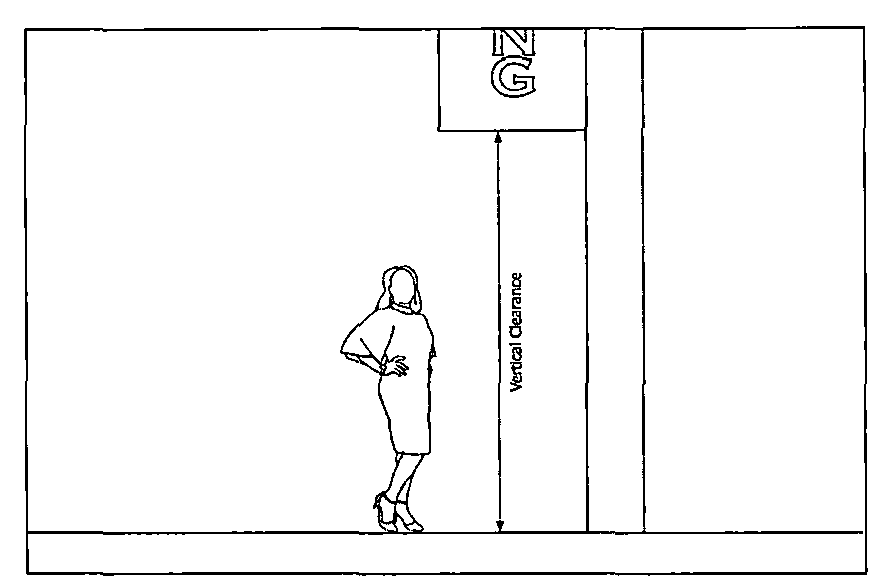
Figure 17.05.040-1. Vertical Clearance
D.
Right-of-Way and Sight Distances.
1.
Signs Prohibited in Right-of-Way. No person may place or install a sign within the right-of-way of any public road except as provided in Section 17.05.040.D.2.c, below.
2.
Signs in the Sight Distance Triangle.
a.
In General. No person may place or install a sign in the required sight distance triangle at the intersection of any public or private road with another public or private road or a driveway except as provided in Section 17.05.040.D.2.c, below.
b.
Sight Distance Triangle Defined. The required sight distance triangle is a setback area located at the intersection of two (2) public or private roads or a road and a driveway. The setback area forms a triangle extending from the intersection for twenty-five (25) feet along the edge of the curb or the edge of the pavement for each road or driveway. Figure 17.05.040-2 illustrates the sight distance triangle.
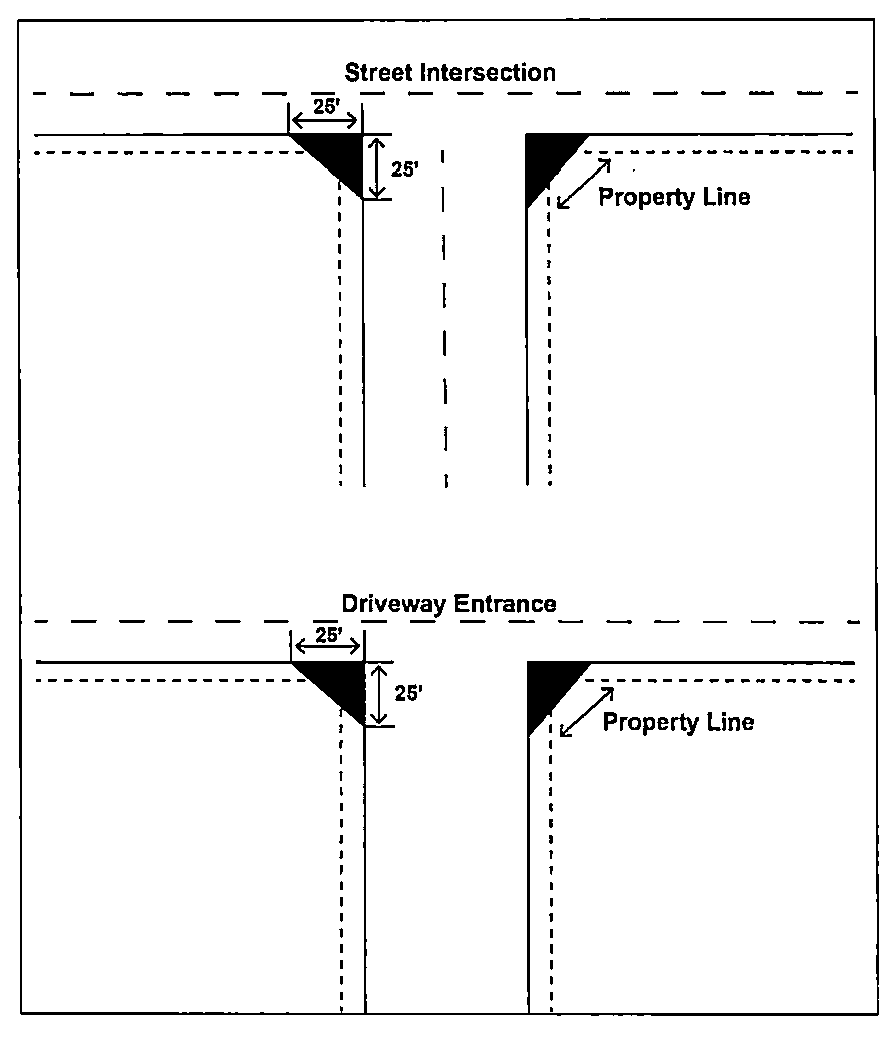
Figure 17.05.040-2. Sight Distance Triangle
c.
Inspection for Placement of Sign. The Director may approve a sign application for placement of a sign in a required sight distance triangle if this Chapter allows the sign type, and the sign cannot be placed outside the sight distance triangle due to unusual circumstances. The Director will perform an on-site inspection and determine that a safe and adequate sight distance exists based on the following factors:
i.
Generally accepted traffic engineering principles, including Section 9.5 of the American Association of State Highway and Transportation Officials, A Policy on Geometric Design of Highways and Streets (2018);
ii.
Sign design;
iv.
Traffic conditions; and
v.
Driveway or street design.
(Ord. 3409, 2022)
17.05.050 - Sign Types and District Allocations.
A.
Purpose and Findings.
1.
Sections 17.05.060 through 17.05.090 of this Chapter establish standards and overall allowances for signs by number and area for four (4) major sign categories:
a.
Freestanding signs;
b.
Attached signs;
c.
Vehicle signs; and
d.
Incidental and temporary signs.
2.
This system provides flexibility for persons and businesses who display signs, avoids sign distinctions that depend on a sign's message, supports the communities' aesthetic goals, and avoids potential traffic hazards and clutter. The City finds that the typical sign allowances in this Chapter are consistent with established methodologies in the sign industry for visibility, legibility, and placement needed for effective communication that allows motorists, pedestrians, and other consumers to receive and respond to a sign's information content, allowing for adequate viewer reaction time and distance.
3.
Because this Chapter does not regulate sign content, applicants and property owners may allocate signs by message type (for example, onsite advertising, directional, and opinion messages) in any manner within the number and area limits established in this Chapter.
B.
Generally. Sections 17.05.060 through 17.05.090 of this Chapter establish standards for individual sign types. A subsection on each sign type addresses the following standards:
1.
An initial paragraph that defines the sign type;
2.
Images that illustrate the sign type;
3.
A table summarizing the standards that apply to the sign type, including:
a.
Whether the sign type is allowed in the designated areas defined in Subsection C, below;
b.
Whether a sign permit is required;
c.
The maximum number of signs of each type, which includes:
i.
Number per street frontage;
ii.
Number per each business or institution (occupying a multi-tenant building) which has its own ground floor entryway or storefront;
iii.
Number per single-tenant building or multi-tenant building with a single entry; or
iv.
The total number of that sign type on a single lot or parcel.
4.
Maximum sign dimensions, which includes:
a.
Sign area;
b.
Height;
c.
Location;
d.
Property line setback; or
e.
Spacing between other signs.
5.
Design characteristics, including whether the following design features are allowed or required:
a.
Electronic message centers;
b.
Illumination features; and
c.
Changeable copy.
C.
Sign Districts. This Chapter regulates sign characteristics by area. The City currently regulates use, setbacks, building dimensions, site and building design, and land use designations by zoning districts in the Zoning Code, which is contained in Title 17, Shawnee Municipal Code. Many of these zoning districts have common characteristics for the purposes of sign regulations and are combined into common sign districts for the purposes of applying this Chapter. The districts are as follows:
1.
Agricultural (AG) means the Agricultural District (AG) zoning district;
2.
Residential Low Intensity (RLI) means the Country Estates Residential District (CE), Residential Estates District (RE), Residential Suburban District (RS), Single-Family Residential District (R-1), Planned Single-Family District (PSF), Planned Single-Family District (PSF), and Planned Single-Family-Age Restricted District (PSF-AR) zoning districts;
3.
Residential High Intensity (RHI) means the Duplex District (DU), Residential Garden Apartment District (RGA), Residential Multiple Dwelling District (RMD), Residential High Rise District (RHR), and Planned Unit Development Mixed Residential District (PUDMR) zoning districts;
4.
Commercial (C) means the Professional Office District (PO), Neighborhood Commercial District (CN), Highway Commercial District (CH), Planned Unit Development Office Commercial District (PUDOC), Planned Unit Development Business Park District (PUDBP), Planned Unit Development General Use District (PUDGU), and the Commercial Highway Overlay District (CH(O)) zoning districts;
5.
Urban/Commercial (UC) means the TownSquare Commercial District (TSQ) and the Planned Unit Development Mixed Use District (PUDMX) zoning districts; and
6.
Industrial (I) means the Planned Industrial District (PI) zoning district.
D.
Sign Permit Requirements by District. Table 17.05.050-1 summarizes this Chapter's permitting requirements for each permanent sign type by district and references the applicable subsection governing that sign type.
Table 17.05.050-1. Sign Permit Requirements by District.
(Ord. 3409, 2022)
17.05.060 - Freestanding Signs.
A.
Monument Signs.
B.
Definition. A permanent freestanding sign with a low profile and having a base and support structure with a solid appearance that is at least as wide as the width of the widest part of the sign's face.
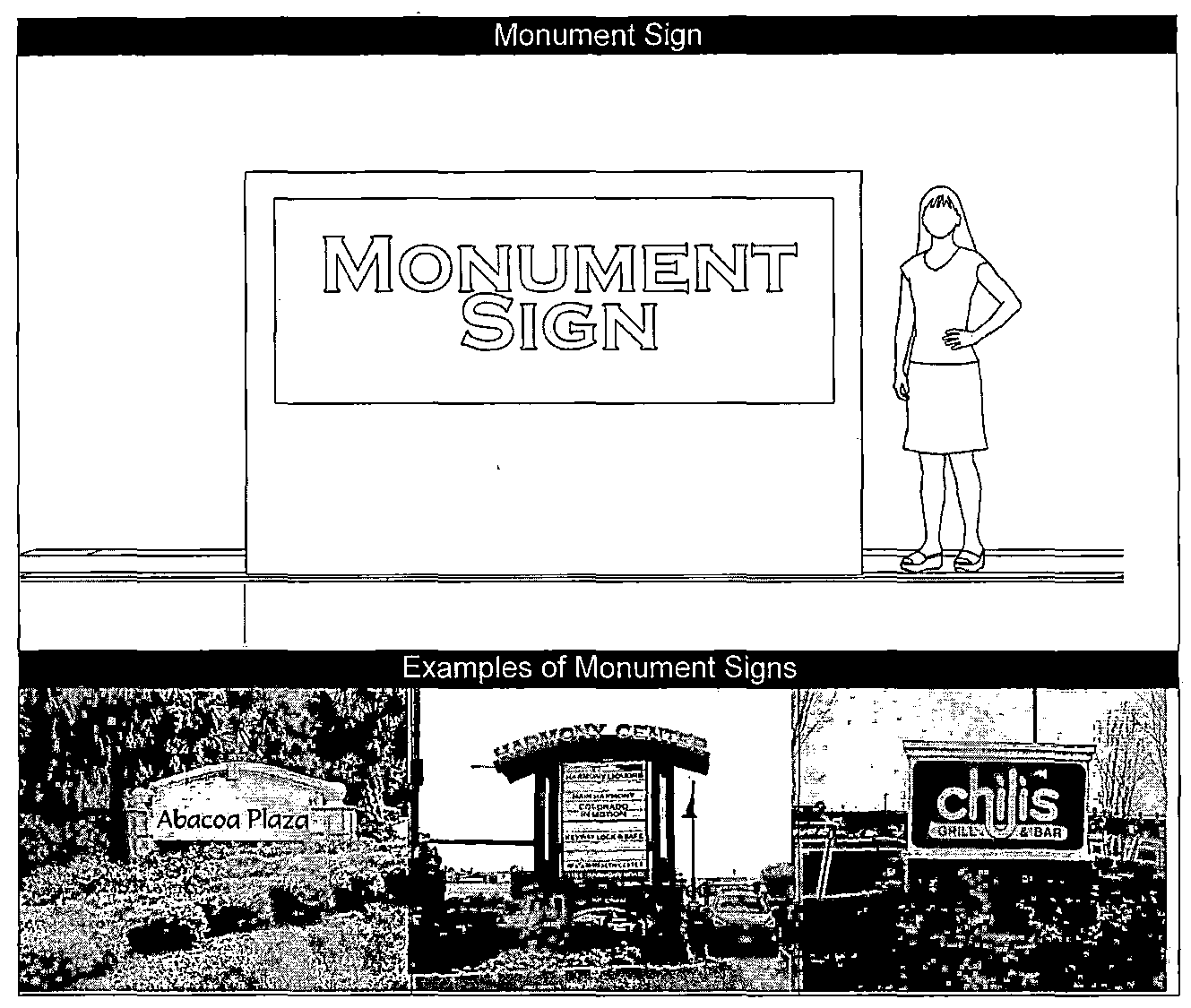
Figure 17.05.060-1. Illustrations of Monument Signs
1.
Dimension and Location Standards. Table 17.05.060-1 states the standards for monument signs.
a.
Number. This Section generally allows one (1) double-sided monument sign for each street frontage for the districts shown in Table 17.05.060-1 unless this Section provides additional monument sign allowances.
b.
General Dimension Standards.
Table 17.05.060-1. Monument Sign Standards.
i.
Height. Height limits include the combined height of the sign face and monument base.
ii.
Area. Area limits control the sign area per face for a sign with two (2) faces.
c.
Standards for Multi-Tenant Plots with More than one hundred thousand (100,000) Square Feet in Floor Area.
i.
Multi-tenant plots that contain more than one hundred thousand (100,000) square feet in floor area and that are located on a street frontage that is not adjacent to or opposite a zoning district that allows single- family or duplex dwellings may qualify for increased sign allowances under this Subsection.
ii.
Signs on multi-tenant plots that do not meet the area and location standards must comply with the sign limitations for buildings smaller than one hundred thousand (100,000) square feet (see Table 17.05.05.060-1 [Monument Sign Standards] above).
iii.
For plots with a floor area larger than one hundred thousand (100,000) square feet but not larger than one hundred fifty thousand (150,000) square feet, the maximum sign face area increases from one hundred (100) square feet by one (1) square foot for every additional one thousand (1,000) square feet of building area, up to a maximum of 150 square feet in area per face for a one hundred fifty thousand-square foot building.
d.
Multi-tenant Plots with more than one hundred fifty thousand (150,000) Square Feet in Floor Area. Multi-tenant plots that contain more than one hundred fifty thousand (150,000) square feet in floor area qualify for taller monument signs as shown in Table 17.05.060-1. The Planning Commission may authorize increases in sign height up to thirty (30) feet pursuant to Section 17.05.140 (Modifications), provided:
i.
The sign is set back two (2) feet from the property line for each additional one (1) foot in sign height per street frontage on street frontages that face properties zoned for uses other than single-family residences or duplexes; or
ii.
The sign is more than two hundred (200) feet from properties zoned for uses other than single-family residences or duplexes.
e.
Multi-tenant Plots with Multiple Frontages.
i.
For multi-tenant plots with two (2) or more street frontages, up to two (2) monument signs may be located on one (1) of the frontages instead of a monument sign on another frontage that would be allowed under this Chapter.
ii.
The total number of signs on the plot must not exceed the number of street frontages.
f.
Alternative Sign Allowance for Multi-Tenant Plots. Occupants of multi-tenant plots that contain more than one hundred thousand (100,000) square feet may display up to three (3) smaller monument signs on one (1) frontage in lieu of one (1) sign with a larger sign face area, provided:
i.
The cumulative face area of the signs on a frontage does not exceed the face area per frontage that this Section allows for one (1) larger sign;
ii.
All monument signs on the same frontage are separated by at least three hundred (300) feet;
iii.
An applicant who proceeds under this Subsection on a street frontage may not also display multiple signs on the same frontage under Section 17.05.060.A.2.e; and
iv.
An applicant who proceeds under this Subsection must bring all signs on the plot into conformity with the standards of this Chapter.
g.
Monument Signs in the Urban/Commercial Sign District. In the Urban/Commercial sign district, only multi-tenant developments over one hundred thousand (100,000) square feet in floor area may display a monument sign as indicated in Table 17.05.060-1.
2.
Design and Maintenance Standards.
a.
Proportions. Monument signs must be attached to a proportionate enclosed base with an area that is at least as wide as the area of the sign face area and that does not exceed the width of the sign face area by more than ten percent (10%).
b.
Materials. Monument signs shall be constructed with stone, brick, concrete, metal, routed wood planks or beams, or similar durable, weatherproof materials which harmonize with the architectural style of the principal building on the same lot. Monument signs shall match the aesthetics of the principal structure.
c.
Landscaping.
i.
If not located within a landscaped setback from the right-of-way, the sign base shall be located within a landscaped area, extending at least three (3) feet on all sides from the sign base.
ii.
The landscape area around the base of the sign shall include plant materials such as shrubs, grasses, perennials, and/or annuals.
iii.
Landscaping surrounding the monument sign shall be maintained in a neat, clean, and healthy condition.
iv.
Required maintenance includes proper pruning, mowing of grass, weeding, and removal of litter.
v.
The property owner shall immediately replace landscape plantings that perish. If weather conditions prohibit immediate replacement, the plantings shall be replaced during the next planting season.
3.
Changeable Copy and Electronic Message Centers. A portion of the sign face area of monument signs may be composed of changeable copy or an electronic message center based on the standards of Section 17.05.100 (Sign Features), and the sign face percentage allowances for these features stated in Table 17.05.060-1.
C.
Subdivision Entry Signs.
1.
Definition. A monument sign located at the entry to a residential subdivision or multi-family development.
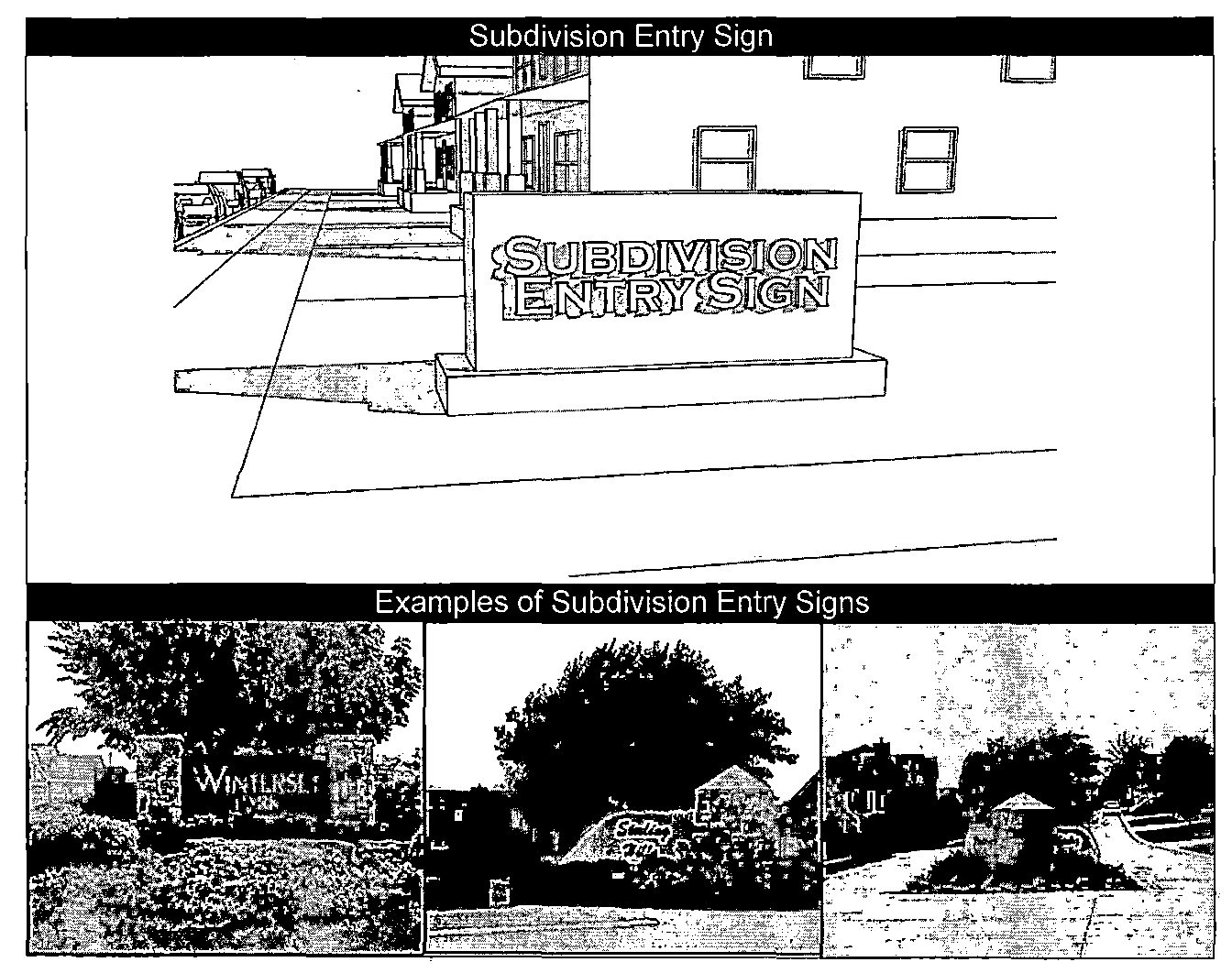
Figure 17.05.060-2. Illustrations of Subdivision Entry Signs
2.
Dimension and Location Standards. Table 17.05.060-2 states the standards for subdivision entry signs.
a.
Number and Locations. Up to two (2) entry signs may be located at the intersection of a collector or arterial road and an entry road or private driveway into a residential subdivision or multi-family development. The signs must be configured as follows:
i.
Two (2) signs with one (1) sign face each located on opposite sides of the entry road or private driveway;
ii.
One (1) sign with two (2) faces located within a landscaped area dividing two (2) one-way entry roads or private driveways; or
iii.
One (1) sign located on one (1) side of the entry road or private driveway.
Table 17.05.060-2. Subdivision Entry Sign Standards.
b.
Dimension Standards. Subdivision entry signs must conform to the dimension standards for monument signs described in this Section and to the allowances stated in Table 17.05.060-2.
3.
Design Standards.
a.
In General. Subdivision entry signs must comply with the design and maintenance standards for monument signs in subsection 17.05.060.A.3, above, except as provided in Subsection b below.
b.
Materials. Subdivision entry signs will be constructed with stone, brick, concrete, metal, routed wood planks or beams, or similar durable, weatherproof materials which harmonize with the architectural style of the residential subdivision or multi-family development.
(Ord. 3409, 2022)
Note— This Section adds an alternative allowance to allow more (total of three per frontage) for multi-tenant developments. This number can be modified based on feedback from staff.
17.05.070 - Attached Signs.
A.
In General.
1.
Calculation of Sign Allowance. This Section generally expresses allowances for attached signs as a percentage that the sign face area bears to the wall area of a building. Sign face area and wall area are both defined in more detail in Section 17.05.180 (Measurements and Rules of Interpretation).
2.
Location.
a.
An attached sign shall not extend above the eaves of a pitched roof or the top of the parapet for other types of roofs.
b.
No more than fifty percent (50%) of an attached sign may extend onto a parapet above the primary roofline of the building or structure to which it is attached.
3.
Architectural Features. Attached signs shall not obscure window or door openings or architectural features such as arches, columns, eaves, cornices, moldings, dormers, pediments, or ornamental materials such as metal, glass, or woodwork, except for:
a.
Window signs, to the extent allowed by this Section; and
b.
Signs located on an awning, canopy, or marquee to the extent allowed by this Section.
B.
Wall Signs.
1.
Definition. A permanent attached sign (other than an awning or attached canopy sign, a projecting sign, a marquee, a window sign, or an incidental sign) that:
a.
Is fastened or affixed on an exterior wall of a building or other structure so that the wall becomes the supporting structure for, or forms the background surface of, the sign;
b.
Has its exposed face oriented in a plane parallel to the exterior wall on which it is affixed; and
c.
Extends less than eighteen (18) inches from the surface of the wall to which it is attached.
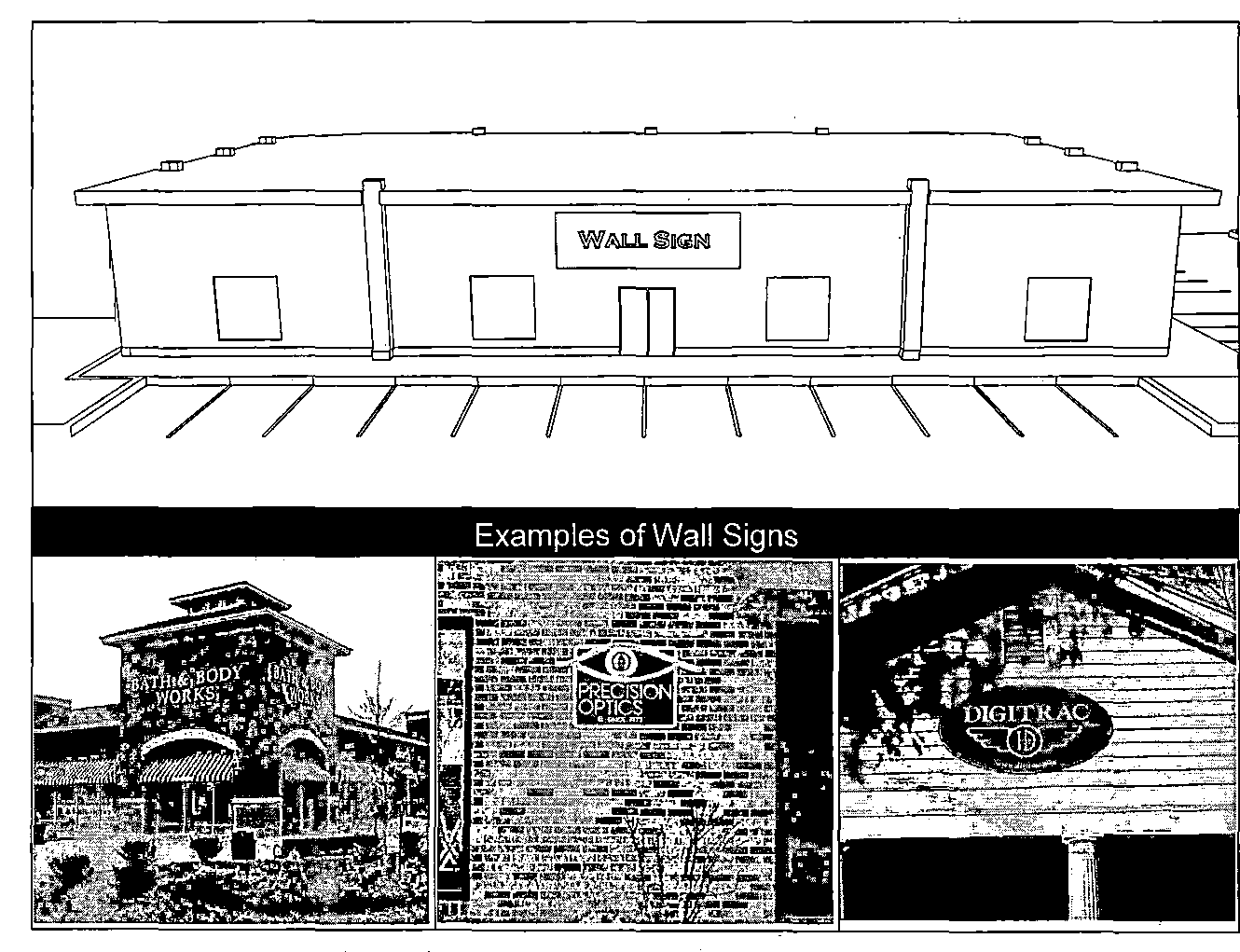
Figure 17.05.070-1. Illustrations of Wall Signs
2.
Dimension and Location Standards. Table 17.05.070-1 states the general standards for wall signs.
Table 17.05.070-1. Wall Sign Standards.
a.
Wall Signs for Multi-Tenant Buildings with Separate Entrances. Tenants in multi-tenant buildings with separate entrances may each display one (1) wall sign on the frontage where the primary public entrance is located.
b.
Additional Wall Signs for Buildings with Entrances Facing a Driveway and Parking Area.
i.
A building with a public entrance on an exterior wall facing a parking area or a one- or two-way driveway in a side yard may display one (1) additional sign on that frontage that complies with the general dimension standards of this Section.
ii.
This allowance does not apply to walls that face adjacent lots in single-family or duplex zoning districts or existing single family, duplex, townhome, or condominium residences, regardless of the zoning district.
3.
Design Standards.
a.
Installation.
i.
A wall sign shall affix flush against the wall of the building or as flush as possible while allowing the plane of the face of the sign to remain perpendicular to the ground.
ii.
The wall sign's face shall not extend more than eighteen (18) inches from the surface of the wall to which it is attached.
b.
Signs Painted on Walls. In general, wall signs shall not be painted directly on a wall or façade. However, wall signs may be painted directly on a wall or façade in the TownSquare (TSQ) and the Planned Unit Development Mixed-Use (PUDMX) Districts based on the standards for murals and painted wall signs set out in Subsection H of this Section.
4.
Exemption for Integral Signs. The regulations for wall signs do not apply to integral signs less than four (4) square feet in sign area that are embedded, extruded, or carved into the material of a building façade or are made of bronze, brushed stainless steel or aluminum, or similar material that is permanently attached to the building façade.
C.
Awning Signs.
1.
Definitions.
a.
Awning. An architectural projection from an exterior wall of a building that provides weather protection, identity, or decoration, and is partially or wholly supported by the building to which it is attached. An awning is comprised of a lightweight frame structure over which a covering is attached.
b.
Awning Sign. A sign painted, printed, attached, or otherwise applied to any facet of the covering or frame structure of an awning.
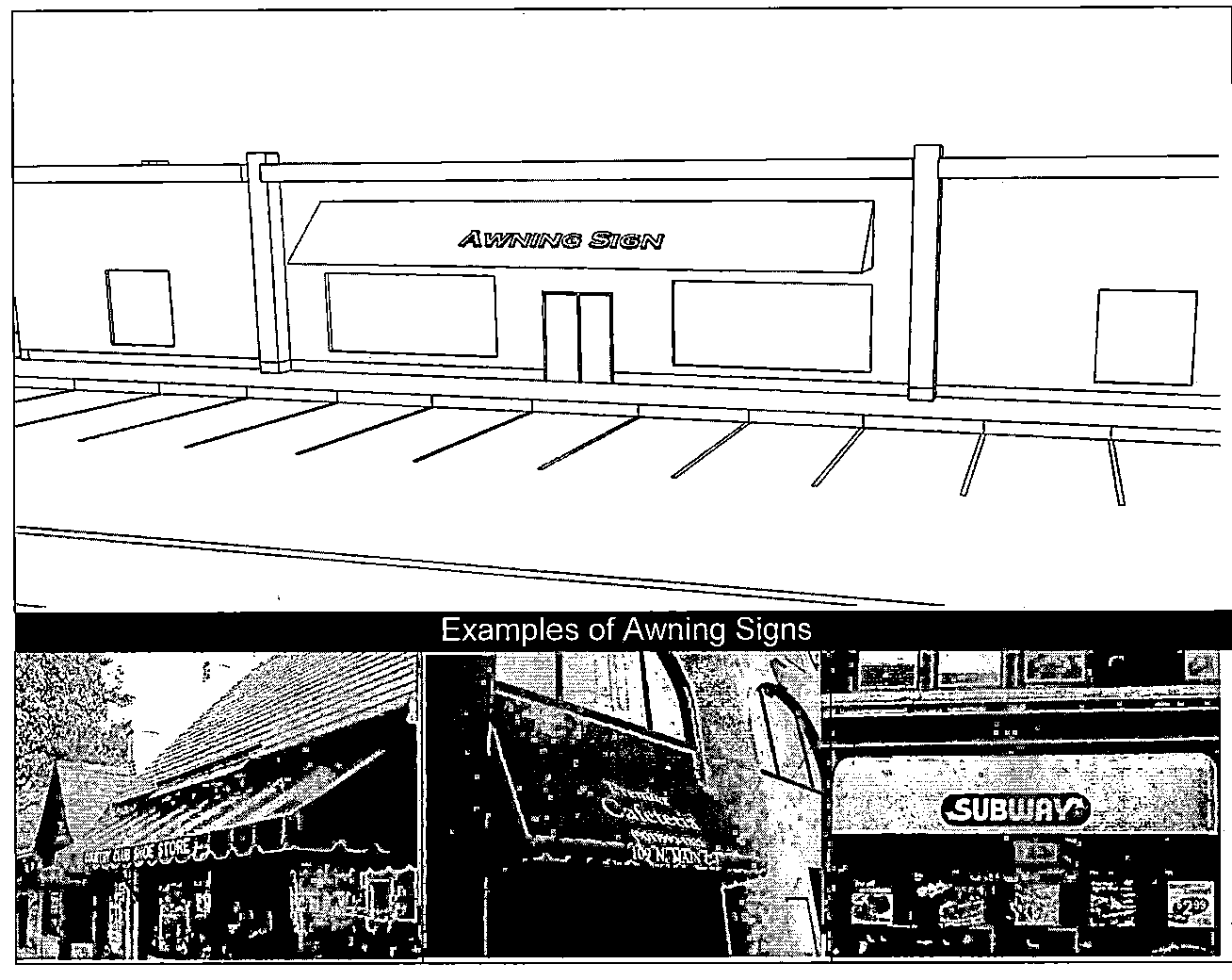
Figure 17.05.070-2. Illustrations of Awning Signs
2.
Dimension and Location Standards. Table 17.05.070-2 states the standards for awning signs. Awning signs may be displayed in lieu of a wall sign on any exterior wall on which a wall sign is allowed under this Section. An awning sign may not be displayed on the same wall as a wall sign or attached canopy sign.
3.
Design Standards. Awning signs may be painted, printed, attached, or directly applied to the surface of the awning covering. An awning sign must not extend from the surface of the awning to which it is affixed.
Table 17.05.070-2. Awning Sign Standards.
D.
Attached Canopy Signs.
1.
Definitions.
a.
Attached Canopy. An architectural projection from an exterior wall of a building that is of rigid construction, is supported by attachment to a building on one or more sides, and over which a covering is attached that provides weather protection, identity, or decoration.
b.
Attached Canopy Sign. A permanent attached sign that is affixed to an attached canopy.
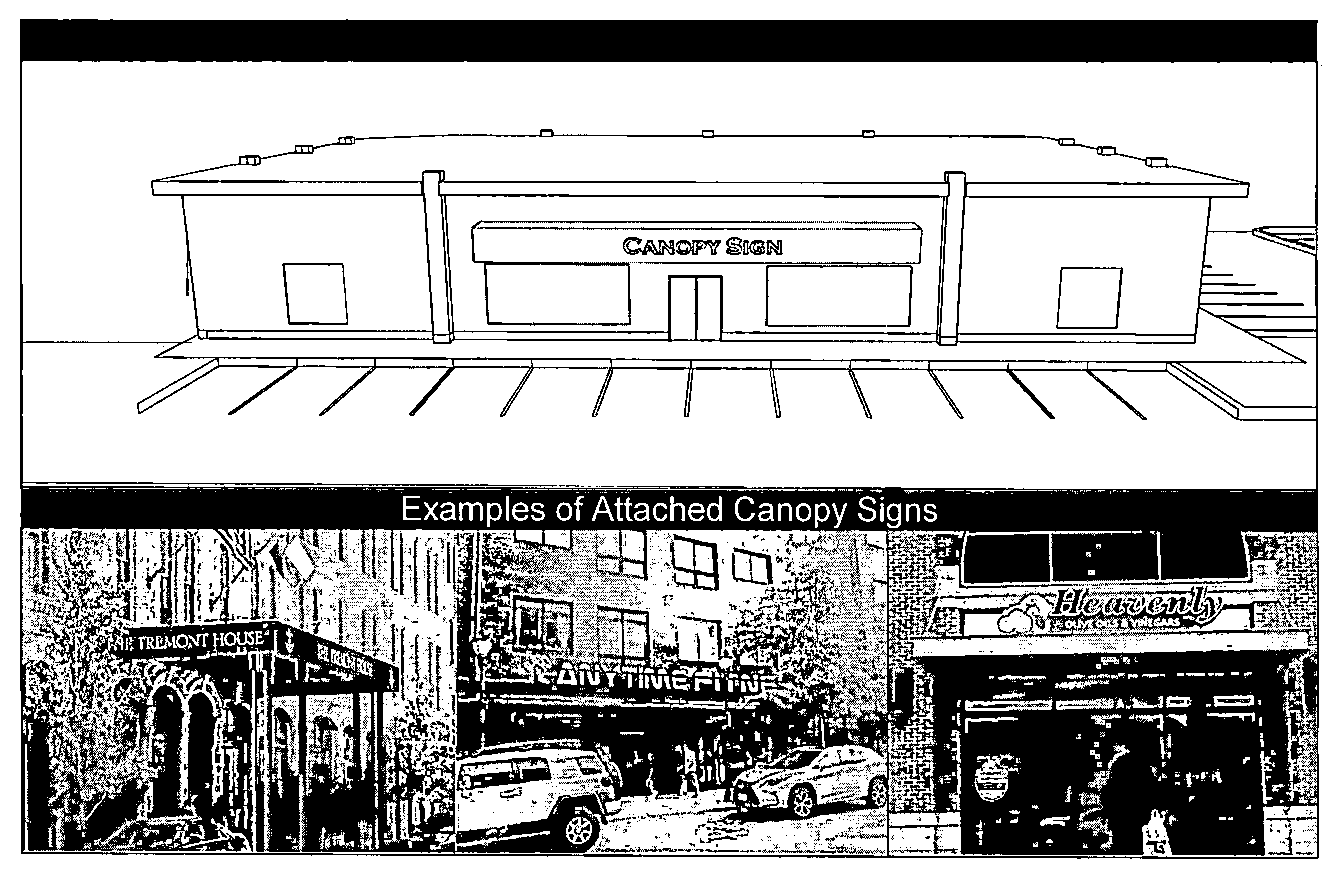
Figure 17.05.070-3. Illustrations of Attached Canopy Signs
2.
Location and Dimension Standards. Table 17.05.070-3 states the standards for attached canopy signs. Attached canopy signs may be displayed in lieu of a wall sign on any exterior wall on which a wall sign is allowed under this Section. An attached canopy sign may not be displayed on the same wall as a wall sign or awning.
Table 17.05.070-3. Attached Canopy Sign Standards.
3.
Design Standards.
a.
An attached canopy sign shall affix to the surface of the canopy facing the street frontage so that the face of the sign remains perpendicular to the ground.
b.
A canopy sign may be located on the face of, above, or below the canopy but may not extend above the roofline.
c.
The face of a canopy sign cannot extend more than eighteen (18) inches from the face surface of the canopy to which it is attached.
E.
Freestanding Canopy Sign.
1.
Definitions.
a.
Freestanding Canopy. A permanent structure that is structurally independent of a building, that is of rigid construction, and over which a covering is attached that provides weather protection, identity, or decoration.
b.
Freestanding Canopy Sign. A permanent attached sign that is affixed to a freestanding canopy.
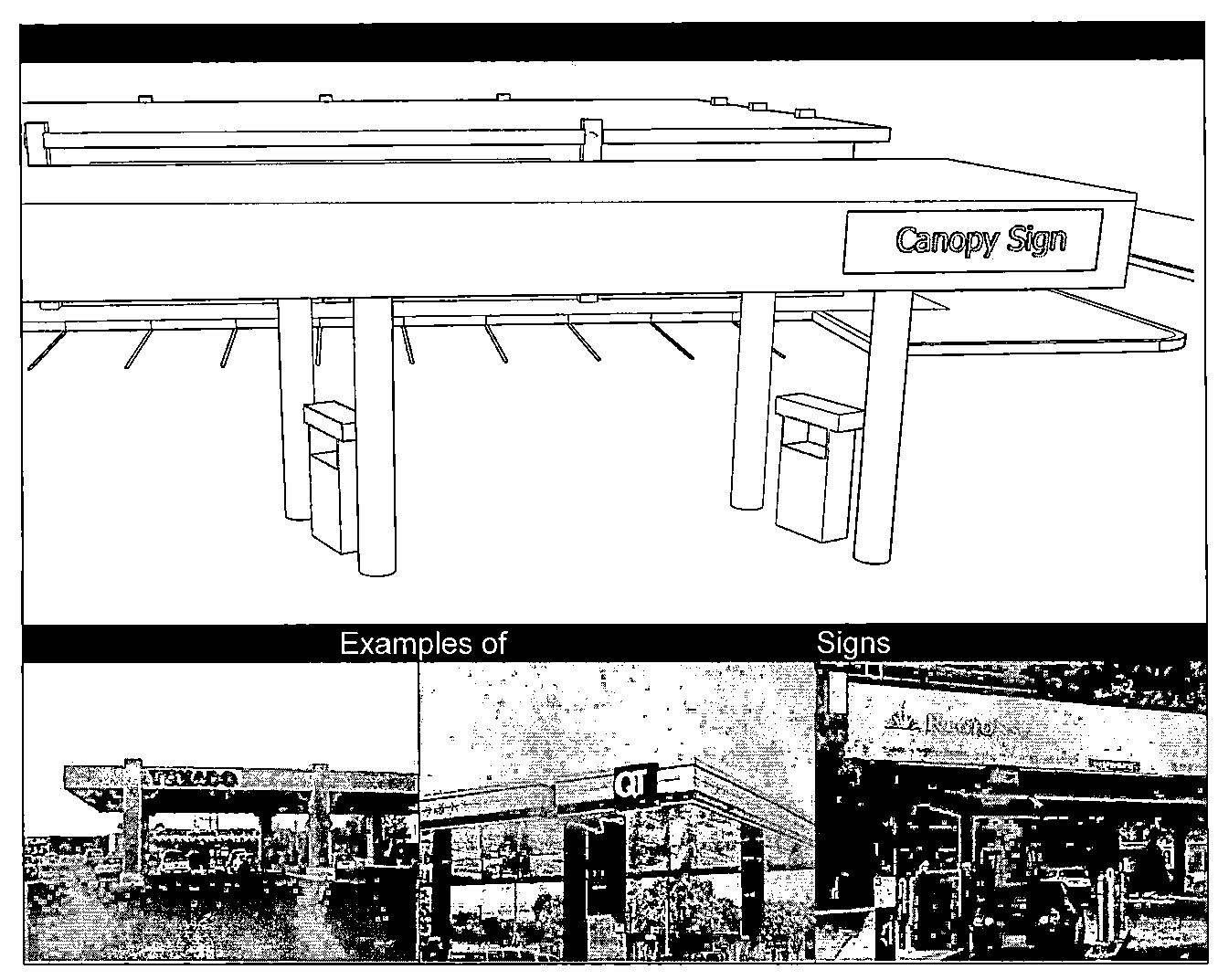
Figure 17.05.070-4. Illustrations of Freestanding Canopy Signs
2.
Freestanding Canopy Sign Standards. Table 17.05.070-4 states the standards for freestanding canopy signs.
a.
Number. If a freestanding canopy is allowed for the zoning district, one (1) sign may be displayed on each frontage. Freestanding canopy signs are in addition to the allowance for wall signs provided by this Section.
Table 17.05.070-4. Freestanding Canopy Sign Standards.
b.
General Dimension Standard. The sign face area of a freestanding canopy sign must not exceed ten percent (10%) of the surface area of the face of the canopy on which it is located.
3.
Design Standards.
a.
Installation. A freestanding canopy sign shall affix flush against the surface of the face of the canopy or as flush as possible while still allowing the plane of the face of the sign to remain perpendicular to the ground. The face of a canopy sign cannot extend above the top surface of the face of the canopy and cannot extend more than eighteen (18) inches from the surface of the canopy to which it is attached.
b.
Signs Painted on Canopies. Signs shall not be painted directly on a freestanding canopy.
F.
Marquee Sign.
1.
Definitions.
a.
Marquee sign. A permanent attached sign affixed to a marquee.
b.
Marquee. A type of attached canopy that has a top surface which is sloped less than twenty-five (25) degrees from the horizontal, is located less than ten (10) feet above the top of an operable exterior doorway, and frequently includes panels for changeable copy.
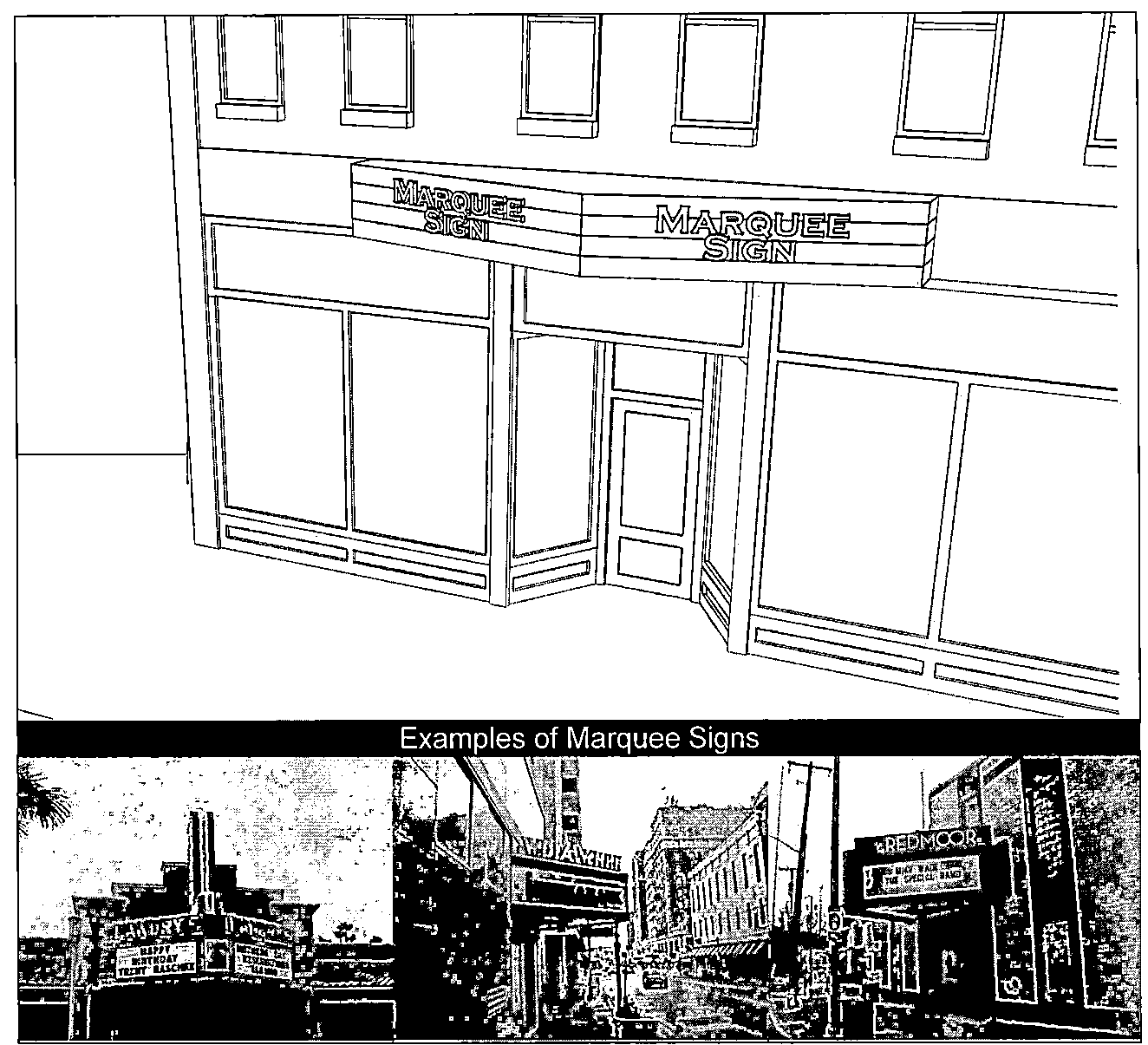
Figure 17.05.070-5. Illustrations of Marquee Signs
2.
Dimension and Location Standards. Table 17.05.070-5 states the standards for marquee signs. One (1) marquee sign may be displayed in addition to other signs allowed in this Section.
3.
Planning Commission Approval. Due to the review framework for the allowed districts and their unique design elements, marquee signs require Site Plan Approval of the Planning Commission based on the criteria in Chapter 17.56 for Site Plan Approval. The applicant must obtain Planning Commission approval for the marquee before a sign permit may be issued. The structural elements of marquee signs also require the approval of a building permit before the issuance of a sign permit.
4.
Design Standards. A marquee must be located above the primary public entrance of a building.
Table 17.05.070-5. Marquee Sign Standards.
G.
Projecting Signs.
1.
Definition. A permanent attached sign type that is affixed to and projects twelve (12) inches or more from the wall of a building and is generally perpendicular to the building façade. A projecting sign does not include signs located on a canopy, awning, or marquee.
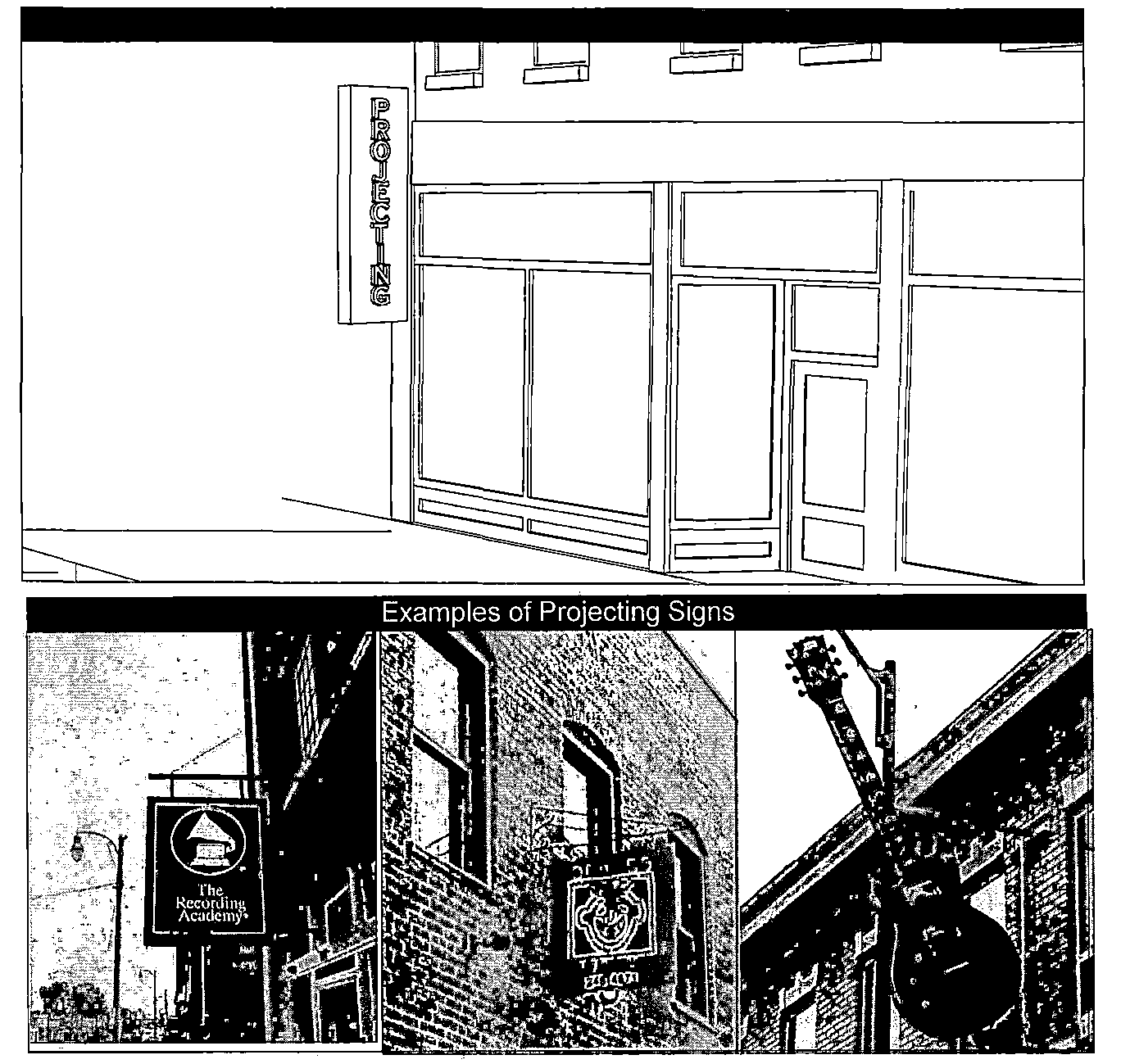
Figrure 17.05.070-6. Illustrations of Projecting Signs
2.
Dimension and Location Standards. Table 17.05.070-6 states the standards for projecting signs for multi-tenant developments.
Table 17.05.070-6. Projecting Sign Standards.
a.
Projecting Sign in Lieu of Wall Sign.
i.
Applicability and Number. A multi-tenant development may display one (1) projecting sign in lieu of a wall sign for each storefront allocated to a distinct tenant with a separate public entrance on any exterior wall on which a wall sign would be allowed under this Section.
ii.
General Dimension Standard. The sign face area of a projecting sign in lieu of a wall sign must not exceed seven percent (7%) of the wall area for the wall area on which it is located.
b.
Projecting Sign in Addition to Wall Sign.
i.
Applicability. A multi-tenant development may display one (1) projecting sign in addition to a wall sign for each ground-floor frontage allocated to a distinct tenant with a separate public entrance (a "secondary projecting sign") on the same wall as a wall sign, canopy sign, awning sign, or marquee sign.
ii.
General Dimension Standard. The sign face area for a secondary projecting sign must not exceed twelve (12) square feet, and the width must not exceed eighteen (18) inches.
iii.
Location. Secondary projecting signs must be within eight (8) feet of a public entrance to the building.
c.
Projecting Signs for Multi-Tenant Developments with Common Entrances. Multi-tenant developments with common entrances must comply with the general standards for number and sign face area for wall signs and projecting signs provided for in this Section.
d.
Projecting Signs for Mixed-Use Buildings. Mixed-use buildings that are at least three (3) stories in height may display one (1) additional projecting sign for an upper-floor multi-family use per street frontage in addition to the standard allowances for the development based on the ground floor uses as provided by this Section.
3.
Design Standards.
a.
A projecting sign may be installed under an awning or an attached canopy, and the awning or canopy may also contain signs.
b.
Projecting signs that extend above the roofline of the building require approval from the Planning Commission.
H.
Murals and Painted Wall Signs.
1.
Definition. A hand-produced work in which paint is applied by hand directly on an exterior wall of a building or structure. A mural or painted wall sign does not include:
a.
Mechanically produced or computer-generated prints or images, including digitally printed vinyl sheets and wraps;
b.
Works containing electrical or mechanical components; or
c.
Works that involve changing or moving images or components.
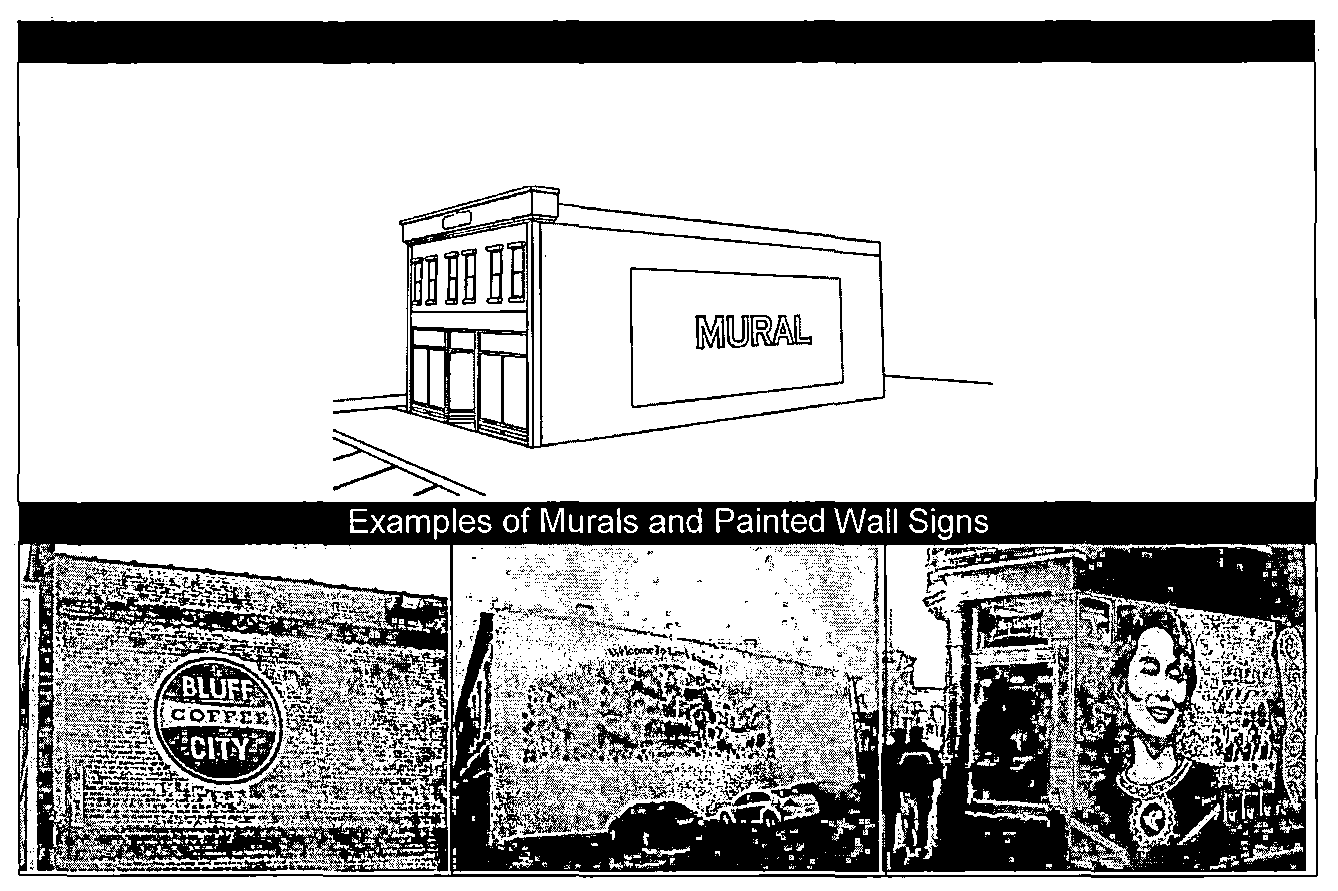
Figure 17.05.070-7. Illustrations of Murals and Painted Wall Signs
2.
Dimension and Location Standards. Table 17.05.070-7 states the standards for murals and painted wall signs. One (1) mural or painted wall sign may be displayed on a building in addition to other signs allowed in this Section.
Table 17.05.070-7. Mural and Painted Wall Sign Standards.
3.
Location and Orientation.
a.
Placement on Secondary Wall. A mural or painted wall sign located on an exterior wall or structure that does not have direct street frontage requires a sign permit approved by the Director.
b.
Placement on Primary Wall. Due to the review framework for the allowed districts and their unique design elements, murals and painted wall signs on a wall with direct street frontage requires Site Plan Approval from the Planning Commission based on the criteria in Chapter 17.56 and Subsection 3.c., below, followed by a sign permit approved by the Director.
c.
In its review of proposed murals and painted wall signs, the Planning Commission and the Director will review an application based on the following factors:
i.
The sign uses durable, exterior grade paints and materials and weatherproof and ultraviolet-protective coatings;
ii.
The sign uses colors that coordinate with the colors of the building;
iii.
The sign is directed at and scaled to pedestrians;
iv.
The sign does not overwhelm or hide character-defining features of a building;
v.
The sign is placed and sized to reinforce the building's architecture and its surroundings; and
vi.
The sign is placed at the same height and similar façade locations as adjacent tenants, if possible, to provide an integrated block appearance.
I.
Window Signs.
1.
Definition. A temporary or permanent sign posted, painted, placed, or affixed to a window or glass door. A window sign includes any sign that is located inside a building, that is three (3) feet or less from a window or glass door, and that is clearly visible from outside the building.
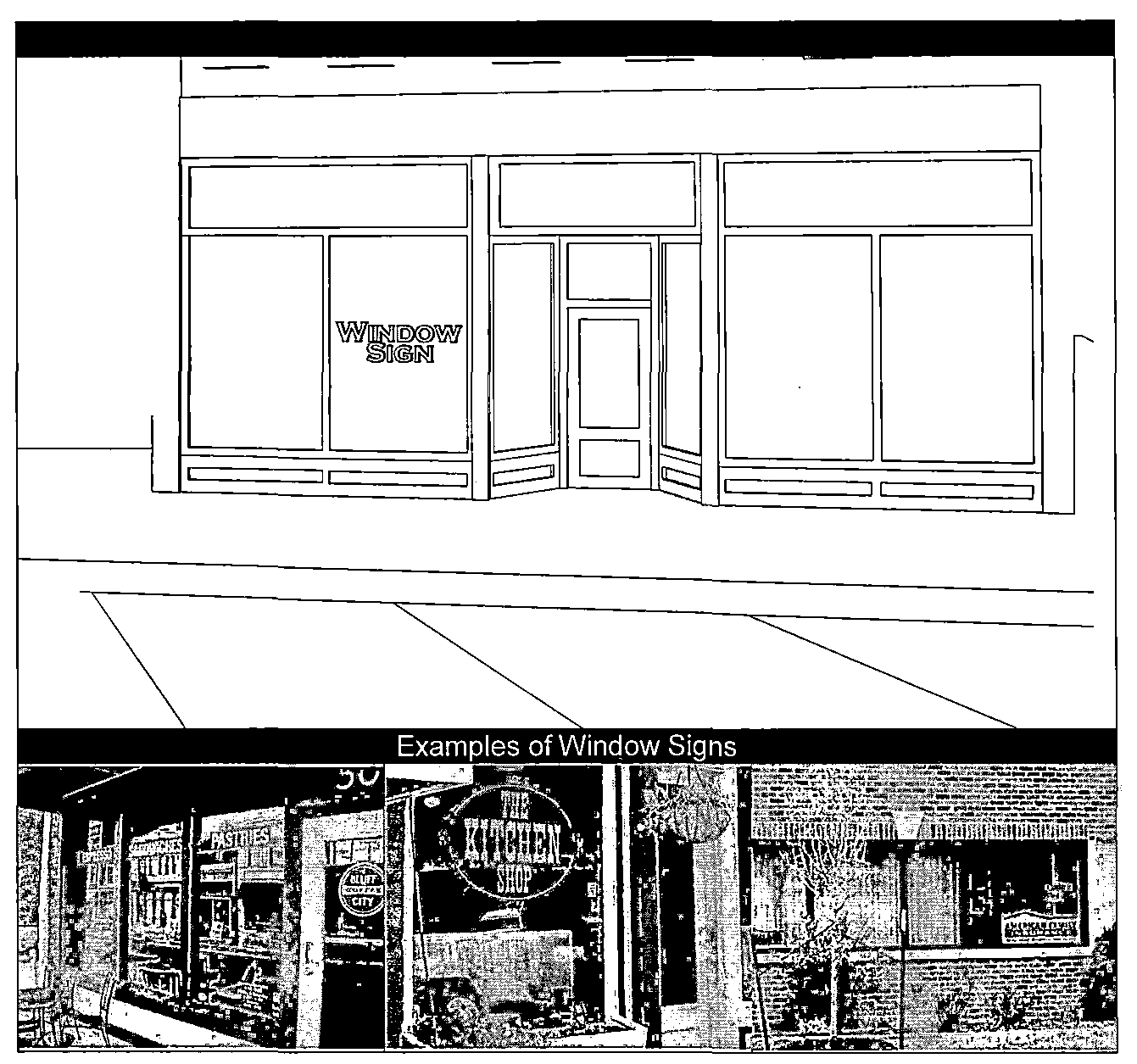
Figure 17.05.070-8. Illustrations of Window Signs
2.
Dimension and Location Standards. Table 17.05.070-8 states the standards for window signs.
a.
Number. The number of window signs is not limited, but the cumulative area of all signs in each window may not exceed the dimension standards for the sign area.
b.
Dimension Standards. Table 17.05.070-8 expresses the sign area as the percentage of sign coverage per windowpane or per window if it does not contain separate panes.
Table 17.05.070-8. Window Sign Standards.
3.
Design Standards.
a.
Interior Placement. Window signs must be posted, affixed, or painted to the window.
b.
Application of Area Requirement. The total sign area within each individual pane, or within each frame if the window is not divided into separate panes, must not exceed the percentage for the applicable area requirement.
c.
Measurement. The sign face area will be measured based on the outside margins of the sign as provided by Section 17.05.180 (Measurements and Rules of Interpretation). Transparent and perforated elements count toward the sign face area.
(Ord. 3409, 2022)
17.05.080 - Vehicle Used as a Sign.
A.
Permit not Required. Signs on vehicles do not require a sign permit but must comply with this Section.
B.
Vehicle Used as a Sign. No vehicle (including trailers or other non-motorized wheeled vehicles carrying signs) shall be parked so that it functions primarily as a sign.
C.
Factors. Factors to determine whether a vehicle is being used primarily as a sign include, but are not limited to the following:
1.
Is the vehicle parked at a prominent location on the lot?
2.
Is the sign easily read by a person in the right-of-way?
3.
Is the vehicle parked at the same or similar locations for several hours during the same day or for several days during the same week?
4.
Are there any stated or apparent reasons, other than its function as a sign, that justify the presence of the vehicle at that location?
D.
Presumption of Use as a Sign. While other factors may also establish a violation, a vehicle presumptively violates this provision if the first three (3) questions are affirmative and there is no compelling answer to the fourth question to justify the parking location as opposed to some less conspicuous location.
E.
Limitations on Vehicle Signs. Vehicles (including trailers) may have signs subject to the following limitations.
1.
Paper signs, electronic message signs, fabric signs, changeable copy signs, or signs with a scrolling mechanism to change messages are not allowed.
2.
A vehicle displaying a sign may be parked within twenty (20) feet of any public right- of-way on a plot for no more than twenty-four (24) consecutive hours during any thirty-day period. Otherwise, a vehicle displaying a sign must be parked behind the principal structure if possible.
3.
If Subsection E.2. creates clear practical difficulties regarding the availability of appropriate parking spaces or the functional requirements of the use, the Director may authorize an alternate parking location that is reasonably inconspicuous and lessens the practical difficulties.
17.05.090 - Incidental and Temporary Signs.
A.
Sign Setback. This Section regulates the location and size of incidental and temporary signs based on a sign setback that varies by sign district. Figure 17.05.090-1 illustrates the sign setback for incidental and temporary sign locations.
1.
Measurement. The sign setback is the setback from any property line and regulates the location and size of incidental and temporary signs. Tables 17.05.090-1 and 17.05.090-2 define the applicable setback for each district.
2.
Perimeter Signs. Perimeter signs are signs that may be located between the property line and the applicable sign setback.
3.
Interior Signs. Interior signs must be located within a plot and may not be located within the sign setback.
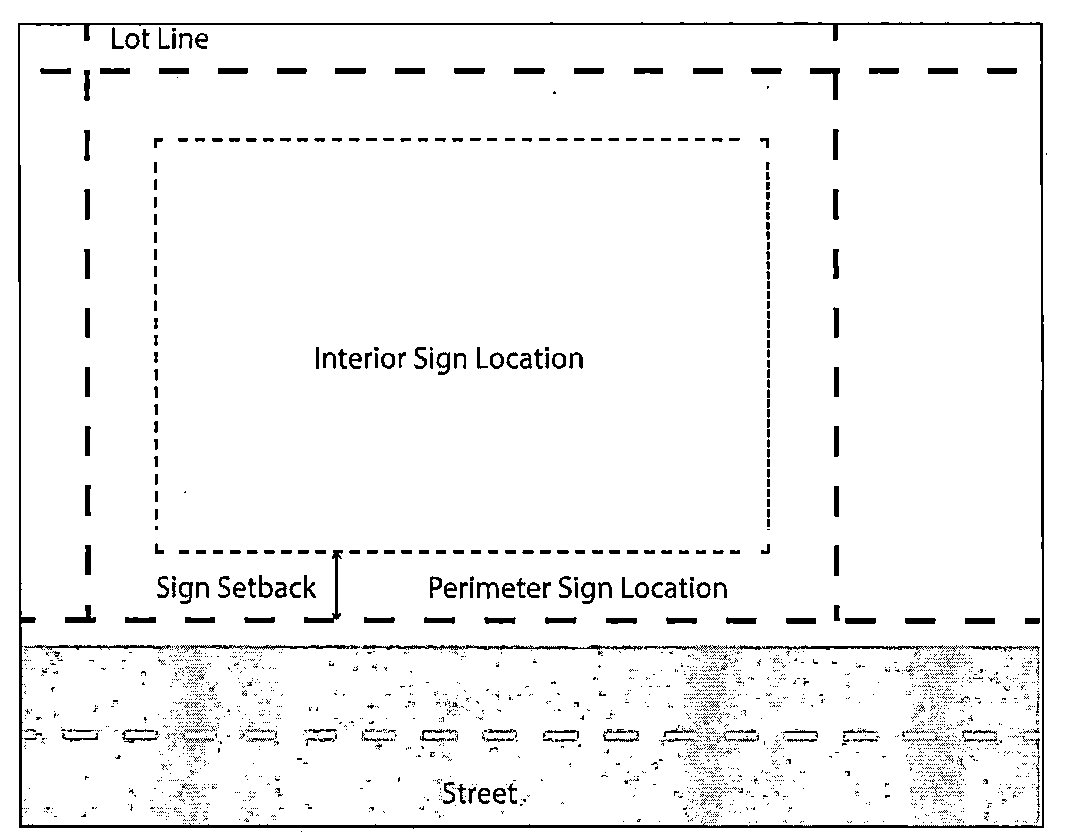
Figure 17.05.090-1. Illustration of Sign Setback
B.
Incidental Signs. [1]
1.
Definition. A small permanent sign that is freestanding or attached to a building that is in addition to the primary sign types for the property, such as wall signs and monument signs, and that has a height and scale that is subordinate to the primary sign types allowed for the property. Examples of typical incidental signs include house numbers, occupant directories, directional signs, flags, and parking signs. The list of examples is provided to clarify the regulations and does not limit the content of incidental signs. The City will not review the content of incidental signs.
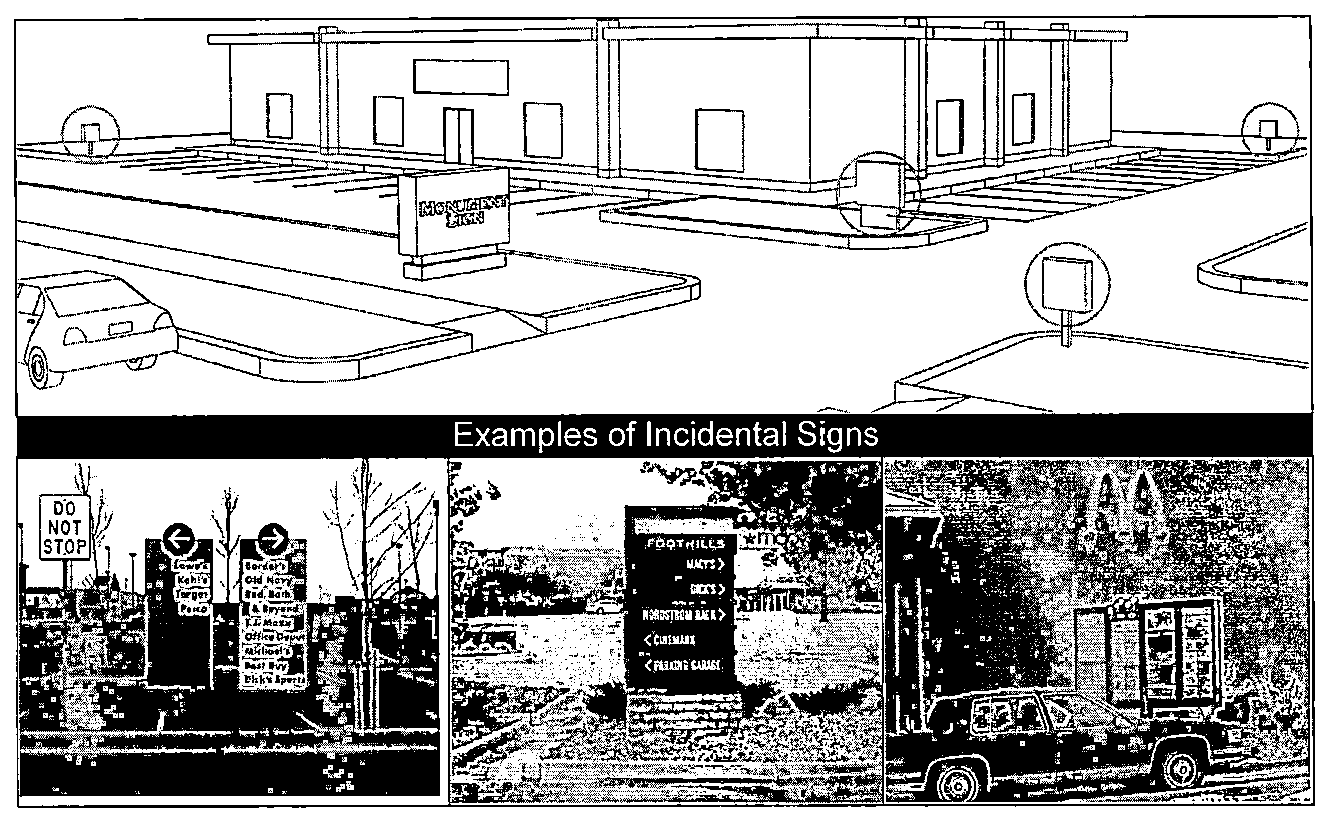
Figure 17.05.090-2. Illustrations of Incidental Signs
2.
Dimension and Location Standards. Table 17.05.090-1 states the standards for incidental signs.
Table 17.05.090-1. Incidental Sign Standards.
3.
Number and Location.
a.
Table 17.05.090-1 defines the maximum number of perimeter incidental signs per entrance to a public street. All perimeter signs must be located within fifteen (15) feet of an entrance to a public street.
b.
Table 17.05.090-1 defines the maximum limit for interior incidental signs based on the number of signs per acre.
4.
Design Standards.
a.
Installation. An incidental sign on a wall shall affix flush against the wall of the building.
b.
Freestanding Signs. Freestanding signs must have an enclosed base.
c.
Screening of Larger Incidental Signs. An incidental sign larger than twenty (20) square feet must be located along the sides or rear of the building and directed away from adjacent residential uses. Whenever a sign larger than twenty (20) square feet is visible from a public street, additional landscaping or fencing must be used in order to screen the sign from view from the public street.
d.
Painted Signs not Allowed. Incidental signs must not be painted on an exterior wall.
5.
Flags. Flags must conform with the following allowances:
a.
One- and Two-Family Dwellings: Two (2) flags and one (1) flagpole per premises. Flagpole height is limited to the lesser of 25 feet or the highest point of the principal building's roof.
b.
Nonresidential Zoning Districts and Other Residential Uses: Three (3) flags and three (3) flagpoles per premises. Each flag shall not exceed twenty-four (24) square feet. Flagpole heights are limited to thirty (30) feet.
C.
Temporary Signs. [2]
1.
Definition. A sign constructed of cloth, canvas, light fabric, cardboard, wood, wallboard, metal, or other light materials, with or without frames, which is intended to be displayed for a limited period of time only. Temporary sign includes banners, feather signs, inflatable devices, stake signs, and A- and T-frame signs. Examples of common temporary signs include political signs, public demonstrations, grand opening signs, contractor signs, real estate signs, and signs that announce an event such as a carnival, circus, or similar event. The list of examples is provided to clarify the regulations and does not limit the content of temporary signs. The City will not review the content of temporary signs.
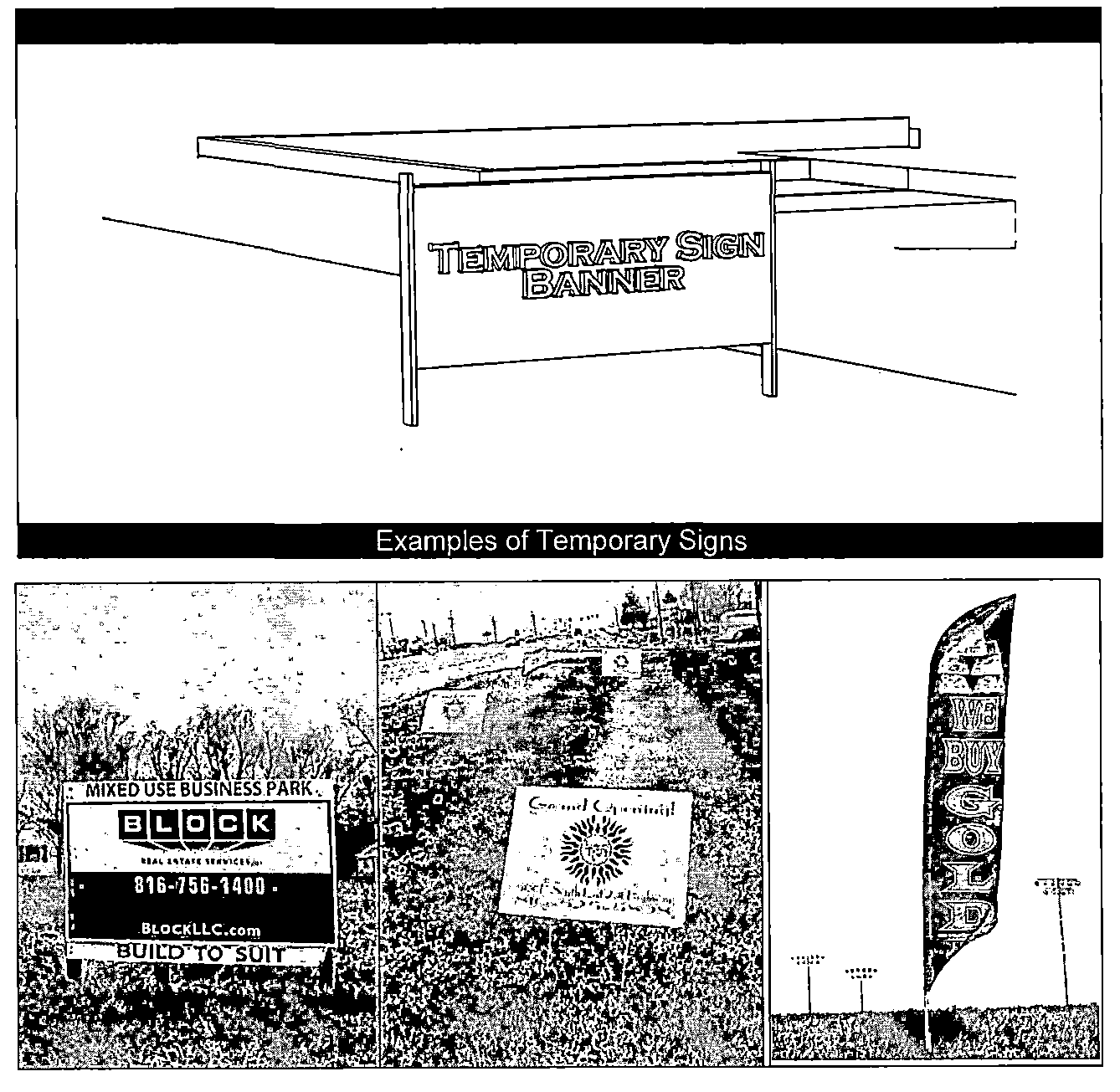
Fugre 17.05.090-3. Illustrations of Temporary Signs
2.
Dimension and Location Standards. Table 17.05.090-2 states the standards for temporary signs.
Table 17.05.090-2. Temporary Sign Standards.
a.
Number.
i.
Table 17.05.090-2 defines the maximum number of perimeter temporary signs per tenant or user.
ii.
Table 17.05.090-2 defines the maximum limit for interior temporary sign per tenant or user in number per acre.
b.
Dimension Standards. Table 17.05.090-2 defines the maximum sign face area and height for perimeter and interior temporary signs.
c.
Temporary Sign Allowances for Industrial Districts. Industrial occupants are allowed a temporary sign that is no more than fifteen (15) feet in height and three hundred (300) square feet in area. All other temporary signs in an industrial district must be no more than eight (8) feet in height and thirty-two (32) square feet in area.
d.
Duration Sign May be Displayed. One (1) interior temporary sign may be displayed on each plot without any time limitation. All other temporary signs may only be displayed for ninety (90) days or less per calendar year, measured cumulatively per sign.
e.
Owner Consent Required. A person must obtain the consent of the property owner before placing a sign on that person's property.
3.
Design Standards.
a.
Temporary signs should be implanted or anchored in the ground or affixed to the wall of a building or other permanent structure.
b.
Temporary signs must not be anchored to the ground by temporary measures such as using sandbags or other weighted objects.
Editor's note— This Section attempts to regulate incidental signs based on a setback from the right-of-way. Signs in the setback are limited to entrance locations. The number of signs behind the setback line is relatively large, which creates some risk on several large incidental signs per lot. The numbers can be modified to accommodate the types of signs that users and staff would expect.
--- (2) ---
Editor's note— This Section attempts to regulate temporary signs based on a setback from the right-of-way and with a 90-day time limitation for all but one sign, which is allowed indefinitely. The numbers can be modified to accommodate the types of signs that users and staff would expect.
17.05.100 - Sign Features.
A.
Illumination. Permanent signs may be illuminated by static and continuous internal, external, halo, and direct illumination configurations as indicated in the tables of dimensions and standards for each sign type. Temporary signs must not be illuminated. The following rules apply to all illuminated signs:
1.
Illuminated signs may not operate at brightness levels of more than 0.3 foot-candles above ambient light conditions at the property line, as measured using a foot-candle meter. Illumination levels shall be measured in foot-candles with a meter sensor in a horizontal position at an approximate height of three (3) feet above grade;
2.
Rotating beams and flashing beacon lights must not be used on any sign or sign structure;
3.
Illuminated signs must not blink, flash, display intermittent lighting sequences, or lighting sequences that simulate motion;
4.
Illuminated signs must not be illuminated by flashing, intermittent, or moving lights, or lights that consist of an image projected upon a stationary object;
5.
Except as provided in Section 17.05.070 for direct illumination of certain signs in the TownSquare (TSQ) and the Planned Unit Development Mixed-Use (PUDMX) Zoning Districts, the illumination source for a sign or building must be shielded from view from any point on the ground by either an opaque or translucent material; and
6.
In the TownSquare (TSQ) and the Planned Unit Development Mixed-Use (PUDMX) Zoning Districts, direct illumination requires a modification approved by the Planning Commission as allowed in Section 17.05.140 (Modifications).
B.
Changeable Signs. Permanent signs may incorporate changeable copy as indicated in the tables of dimensions and standards for each sign type. The following rules apply to changeable signs:
1.
Where allowed, each sign is limited to a percentage of the sign face area that may be a changeable sign.
2.
Changeable signs may be illuminated if the dimensions and standards allow illumination for the sign type in the district.
C.
Electronic Message Centers. Electronic message centers may be displayed as indicated in the tables of dimensions and standards for each sign type.
1.
The sign standards express the maximum portion of the sign face area that may consist of an electronic message center as a percentage of the sign face.
2.
Electronic message centers shall only display static content. The static display shall remain in a fixed position for at least one (1) minute. An interval change time of two (2) seconds or less is required.
3.
Each static display may not include any flashing or the varying of light intensity, and the display shall not scroll.
4.
The background color for electronic message centers may not be white.
5.
Electronic message centers shall have ambient light monitors to automatically adjust the brightness of the sign so that it does not exceed five thousand (5,000) Nits during daylight hours and five hundred (500) Nits from dusk to dawn.
6.
Electronic message centers must incorporate an automatic shut-off that turns off the sign in the event of a malfunction.
7.
In the case of a malfunction, an electronic message center must be turned off until repaired.
(Ord. 3409, 2022)
17.05.110 - Master Sign Plans.
A.
Master Sign Plans Optional. Master sign plans are not required for planned unit developments or other land development projects. However, an owner or developer may present a master sign plan for review and comment by the Planning Commission as part of the Site Plan Approval. The Commission's review will be based on the criteria in Chapter 17.56.
B.
Effect of Previously Approved Master Sign Plan.
1.
The City will not enforce any requirements or limitations of any master sign plans approved before January 1, 2022. However, all applicants should be aware that compliance with a sign plan may be required under a lease, restrictive covenant, or other private, legally enforceable obligation.
2.
The owners of plots that are subject to previously approved master sign plans may voluntarily rescind, withdraw, or amend any requirements that tenants or property owners comply with the master sign plan to the extent allowed by applicable law.
3.
The City will evaluate all sign applications using the requirements and standards of this Chapter.
4.
The City will evaluate all enforcement matters involving signs that are subject to a previously approved master sign plan based on conformity with the plan, so that signs that comply with a previously approved master sign plan will not be deemed nonconforming under this Chapter.
(Ord. 3409, 2022)
17.05.120 - Nonconforming and Abandoned Signs.
A.
Nonconforming Signs. Permanent signs that were allowed before January 1, 2022, are allowed to remain and may be maintained and repaired as necessary. Signs that this Chapter prohibits shall be modified to conform, replaced with a conforming sign, or removed according to the following:
1.
If the plot on which the nonconforming sign is located requires any approval or permit that is subject to the Site Plan Approval process;
2.
If there is a change in business ownership, tenant, name, or type of business;
3.
If any maintenance, repair, or alteration exceeds fifty percent (50%) of the current value of the sign as of the date of alteration or repair; or
4.
If the use of the lot on which the sign is located has been discontinued for thirty (30) days or longer.
B.
Exception for Nonconforming Subdivision Entry Signs. A nonconforming subdivision entry sign that was first installed or erected before January 1, 2022, may continue to be maintained in the current configuration unless the sign requires any maintenance, repair, or alteration that exceeds fifty percent (50%) of the current value of the sign as of the date of alteration or repair.
C.
Exception for Signs with Nonconforming Electronic Message Centers. A sign with an electronic message center that does not conform with the area limitations or technological standards of this Chapter that was first installed or erected before January 1, 2022, may continue to be maintained, repaired, altered, or replaced so long as the modifications do not enlarge the area of the electronic message center or make it more nonconforming under the standards of this Chapter.
D.
Removal of Abandoned Signs.
1.
If a building, structure, or premises is vacant for a six-month period of time, the owner of the premises shall remove any permanent sign or signs located on the premises. Additionally, the facade of the building, structure, or premises shall be restored to its condition before the sign's installation.
2.
If the owner has not removed an abandoned sign after six (6) months, the Director will notify the property owner in writing that the sign must be removed within thirty (30) days. The notice will be mailed to the owner or agent of the property by certified mail, return receipt requested, or by personal service. If the property is unoccupied and the owner is a nonresident, then the notice may be served by certified mail, return receipt requested, to the last known address of the owner. The property owner may appeal the decision to the Board of Zoning Appeals pursuant to Section 17.05.160 (Appeals). If the owner does not remove the sign or appeal within thirty (30) days after the notice is mailed, the City may remove the sign and assess the cost of removal to the owner of the property on which the sign was placed.
3.
The City Clerk will mail a statement of the costs for the removal of an abandoned sign or signs to the last known address of the owner of record of the property. The statement of costs will be mailed to the owner or agent of the property by certified mail, return receipt requested, or by personal service. If the property is unoccupied and the owner is a nonresident, then the statement of costs may be served by certified mail, return receipt requested, to the last known address of the owner. If the costs are not paid within sixty (60) days of the date the notice is mailed, the Governing Body may adopt an ordinance levying a special assessment for the cost of removal against the parcel, and the City Clerk shall certify that assessment to the County Clerk for collection and payment to the City in the same way that other assessments and taxes are collected and paid to the City.
(Ord. 3409, 2022)
17.05.130 - Sign Permits.
A.
Applicability. A person shall not construct, alter, or relocate any sign within the City without first obtaining a permit, except as provided for in this Chapter. Sections 17.05.060 through 17.05.090 state permitting requirements for each sign type in each district.
B.
Applications. Each sign permit requires a separate application. The application must be filed on a form furnished by the Director and include a non-refundable permit fee set by resolution of the Governing Body and listed in the latest City of Shawnee Policy Statement (PS-56).
C.
Review.
1.
The Director will review a sign permit application to determine if it is complete. If the application is incomplete, the Director will provide a list of items necessary to complete the application within seven (7) business days after the application was submitted.
2.
Based on the type of sign and district as provided in Table 17.05.130-1, the Director will review a complete sign permit application for compliance with this Chapter and:
a.
Render an administrative decision, or
b.
Schedule the application for Planning Commission review and a decision.
3.
The Director will act on an application by approving, approving with conditions, denying the application, or placing the matter on the Planning Commission's agenda within thirty (30) days of the date the Director deems the application complete.
4.
Complete applications that are subject to Planning Commission review and approval will be placed on the next available agenda. The Planning Commission will review the application and render a decision no more than sixty (60) days from the date the application is deemed complete.
D.
Approval Criteria. A permit will be issued if the proposed sign conforms with all applicable provisions of this Chapter and any conditions or stipulations of any applicable rezoning, special use permit, site plan, or development plan (preliminary, final, or other).
E.
Expiration. A sign permit becomes null and void if installation does not commence within one hundred twenty (120) days from the date of permit approval. If work authorized by the permit is suspended or abandoned for one hundred twenty (120) days from the date the work commences, a new permit is required to complete the installation work, even if no changes are made to the original sign plan.
F.
Revocation. The Director may revoke a sign permit if:
1.
It is issued in error, or
2.
The sign or sign supporting structure is installed contrary to the approved plans or in violation of this Chapter.
Table 17.05.130-1. Summary of Permitting Requirements.
G.
Repairs and Maintenance. The repair, routine maintenance, or repainting of an existing sign deemed conforming or allowed to continue as a nonconforming sign by Section 17.05.120 (Nonconforming and Abandoned Signs) does not require a sign permit.
(Ord. 3409, 2022)
17.05.140 - Modifications.
A.
Application. Any person who seeks to deviate from the terms of this Chapter must first apply for a modification permit. The application must be filed on forms furnished by the Director and include a non-refundable application fee set by resolution of the Governing Body and listed in the latest City of Shawnee Policy Statement (PS-56).
B.
Review.
1.
The Director will review a modification application to determine if it is complete.
2.
If the application is incomplete, the Director will provide a list of items necessary to complete the application within fifteen (15) working days from the date the applicant filed the application.
3.
When the Director deems the application complete, the Director will place it on the next available Planning Commission agenda. The Planning Commission will review applications within sixty (60) days from the date the application is deemed complete.
C.
Approval. The Planning Commission may authorize a modification from the standards of this Chapter with regard to the size, color, location, illumination, and number of signs. For any modification provided by this Chapter, the Planning Commission will consider whether the proposed modification:
1.
Complies with the general purpose and intent of this Chapter;
2.
Arises from a condition which is unique to the property in question and which is not ordinarily found in the same zone or district;
3.
Presents a situation where the strict application of the provisions of this Title for which a modification is requested will constitute unnecessary hardship upon the property owner/tenant represented in the application;
4.
Adversely affects neighboring property owners or residents, and whether it is consistent or compatible with the image and aesthetics of the area as a whole;
5.
Adversely affects the public health, safety, or welfare, including, but not limited to, traffic on adjacent streets. Monument signs must not adversely affect a safe sight-distance, and the sign location must not encroach upon potential future right-of-way needs. The proposed modification shall not significantly distract traffic on adjacent streets;
6.
Significantly clutters or negatively impacts the visual landscape of the area. This review will consider the addition of all existing or potential future signs in the surrounding area;
7.
Adequately accounts for topography, landscaping, existing buildings, number of tenants, or unusual building designs that would otherwise substantially block or impair the visibility of the proposed sign. A modification may be appropriate to provide reasonable visibility of an entity's main sign;
8.
Has any lighting that will disturb residents of nearby residential properties or adversely affects traffic on adjacent streets; and
9.
Is of high quality and is compatible and integrates aesthetically with the daytime/nighttime color, lighting, signs and architecture of the development and adjacent buildings. Wall signs may include unique copy design, including integration into canopies/awnings, shapes, materials, lighting, and other design features compatible with the architecture of the development of the surrounding area.
D.
Particular Standards. The Planning Commission may grant modifications regarding the following standards, in addition to standards listed in other portions of this Chapter:
1.
The sign face area, up to twenty-five percent (25%) of the general allowance;
2.
The sign height, up to twenty-five percent (25%) of the general allowance;
3.
No more than two (2) permanent attached signs may be located on the same façade;
4.
The location of the sign on the plot or the configuration of a sign on a building; and
5.
Pole signs which cannot be replaced by a monument sign due to a unique situation in which there is no location on the property for a monument sign that will not cause a traffic hazard.
(Ord. 3409, 2022)
17.05.150 - Inspections, Enforcement, and Penalties.
A.
Inspections and Enforcement. The Director is the enforcement officer for this Chapter. As the enforcement officer, the Director has the authority:
1.
To inspect any sign, building, structure, or land to determine whether any violations of this Chapter exist; and
2.
To issue and post notices of violations and stop orders, revoke sign permits, and order the correction of any condition or omission that violates this Chapter or where there is presumptive evidence that a violation exists.
B.
Removal of Permanent Signs on Private Property.
1.
Removal of Permanent Signs on Private Property.
a.
If the Director determines a permanent sign is prohibited, unsafe, unsecure, a menace to the public, or otherwise constructed or maintained in violation of this Chapter, the Director will issue a written notice of violation to the property owner stating that the owner must remove the sign or bring it into compliance. The notice will be mailed to the owner or agent of the property by certified mail, return receipt requested, or by personal service. If the property is unoccupied and the owner is a nonresident, then the notice may be served by certified mail, return receipt requested, to the last known address of the owner.
b.
If the property owner does not remove the sign or bring it into compliance within thirty (30) days of the notice, the City may remove the sign and assess the costs to the owner using the assessment process in Section 17.05.120.D. (Removal of Abandoned Signs).
c.
The City will revoke any permit for the noncomplying sign and will not issue further sign permits for the property until the owner has paid the removal costs.
d.
The property owner may appeal the Director's decision to the Board of Zoning Appeals pursuant to Section 17.05.160 (Appeals).
2.
Immediate Removal of Signs.
a.
City Removal. The City may immediately remove without notice any sign that is:
i.
In the right-of-way or on City-owned land without City authorization; or
ii.
An immediate peril to persons or property.
b.
The City may assess the removal costs using the assessment process in Section 17.05.120.D (Removal of Abandoned Signs).
3.
Removal by Property Owner. A property owner may remove unauthorized signs placed by others on the owner's private property without notice or compensation to the sign owner.
C.
Violation and Penalties. [3]
1.
Violations of Chapter. Any person who violates any of the provisions of this Chapter is guilty of a Municipal Ordinance violation punishable under this Section and will be subject to the penalties provided in this Section.
2.
Penalties. A person convicted of violating this Chapter shall be subject to a term of confinement and/or a fine determined by the number of prior violations:
a.
Upon conviction of a violation, shall be punished as a Class C offense, the sentence for which shall be a definite term of confinement in the city or county jail which shall be fixed by the court and shall not exceed one (1) month; instead of or in addition to imprisonment a person may be punished by a fine not exceeding five hundred dollars ($500.00);
b.
Upon a third conviction within a two-year period of the first violation, shall be punished as a Class B offense, the sentence for which shall be a definite term of imprisonment which shall be fixed by the court and shall not exceed six (6) months; instead of or in addition to imprisonment a person shall be punished by a fine not exceeding one thousand dollars ($1,000.00); and
c.
Upon a fourth or subsequent conviction for a violation within a two-year period of the first violation, shall be punished as a Class A offense, the sentence for which shall be a definite term of imprisonment which shall be fixed by the court and shall not exceed one (1) year; instead of or in addition to imprisonment a person shall be punished by a minimum fine of one thousand dollars ($1,000.00) and not exceeding two thousand five hundred dollars ($2,500.00).
3.
Continuing Violation. Each day that a violation continues is a separate offense, and each offense is punishable under this Section.
(Ord. 3409, 2022)
Editor's note— This Section removes the advance notice requirement for violations. The Section creates a tiered penalty based on recurring offenses.
17.05.160 - Appeals.
A.
An applicant who contends there is an error in any order, requirement, decision, or determination by the Director for an application, decision, or interpretation of this Chapter may appeal the matter to the Board of Zoning Appeals pursuant to the procedures of Chapter 17.96.
B.
An applicant who contends there is an error in any order, requirement, decision, or determination by the Planning Commission for an application, decision, or interpretation of this Chapter may appeal the decision pursuant to an existing appeal procedure for decisions by the Commission under this Title. This Chapter does not create a new remedy for appeal if one is not provided by this Title.
(Ord. 3409, 2022)
17.05.170 - Severability.
The sections, subsections, sentences, and phrases of this Chapter are declared to be severable. If any section, subsection, sentence, or phrase is declared unconstitutional or otherwise invalid by any court of competent jurisdiction, that unconstitutionality or invalidity does not affect any of the remaining sections, subsections, sentences, or phrases of this Chapter.
(Ord. 3409, 2022)
17.05.180 - Measurements and Rules of Interpretation.
A.
Interpretation. All images are for illustrative purposes only as a guide to help understand the sign regulations. The images do not create sign standards or modify any substantive sign standard required by this Chapter.
B.
Measurement.
1.
Sign Face Area. Measured in square feet ("s.f.") and calculated as the width multiplied by the height of a single rectangle, parallel with the ground, that contains all sign elements, including decorative embellishments, and any internally illuminated or backlit panel, fabric, or similar material not approved as an architectural design element of the building in the final development plan approval.
a.
Sign area includes cabinets, background panels, or colors that are part of the sign installation and not part of the building architecture or the sign support.
b.
Sign Configurations. Figure 17.05.180-1: Illustration of Sign Face Area Measurement illustrates sign face area measurement for different sign configurations.
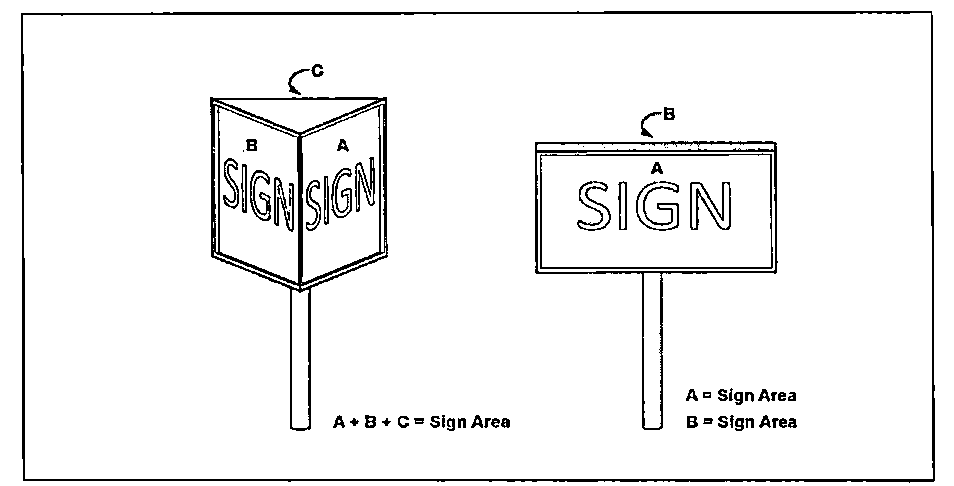
Figure 17.05.180-1. Illustrations of Sign Face Area
Measurement
i.
Only one (1) side of a multi-faced sign is considered when determining the sign area, if the faces are equal in size, the interior angle formed by the faces is less than forty-five (45) degrees, and the two (2) faces are not more than eighteen (18) inches apart.
ii.
Where two (2) faces of a multi-faced sign are not equal in size, but the interior angle formed by the faces is less than forty-five (45) degrees and the two (2) faces are no more than eighteen (18) inches apart, the larger sign face is used to calculate sign area.
iii.
When the interior angle formed by the faces of a multi-faced sign is greater than forty-five (45) degrees, or the faces are greater than eighteen (18) inches apart, all sides of the sign are considered in calculating sign area.
c.
For irregularly shaped signs, sign area is calculated as the sum of two (2) or more separate rectangles that completely contain all parts of the sign elements.
d.
The calculation of sign area for a single sign includes all related sign elements on the same facade or structure. Sign elements are related if they are all constructed in a similar manner and are located no more than five (5) feet apart, horizontally or vertically. Additionally, to be considered a single sign, the facade on which the elements of the sign are mounted can be offset by up to five (5) feet.
e.
Where two (2) or more signs are allowed on a facade, the separate sign face area rectangles for each sign are added together to determine the total amount of sign face area on that building facade.
2.
Sign Height. Measured from the average finished grade to the highest point of the sign, including any cabinets, trim, or attachments. The average grade is calculated by measuring the difference in elevation between the grade at one (2) lateral edge of the sign face and the elevation at the other lateral edge of the sign face, divided by two (2).
3.
Wall Area. Where sign size is prescribed as a percent of wall area, the "wall area" is a continuous portion of a building facade, as viewed by a person approaching the building from the public right-of-way, consisting of a plane surface.
(Ord. 3409, 2022)
Appendix - Definitions.[4]
1.
A-Frame Sign. A temporary, portable, freestanding sign that is in the shape of the letter "A" with back-to-back sign faces, an easel, or a similar configuration.
2.
Abandoned Sign. A monument sign, wall sign, awning sign, canopy sign, projecting sign, or painted wall sign located on a plot in a commercial or industrial zoning district where the premises has been vacant for at least six months.
3.
Applicant. A person applying for a sign permit, modification, or other approval under this Chapter.
4.
Attached Canopy. Section 17.05.070.D. defines this term and includes all standards.
5.
Attached Canopy Sign. Section 17.05.070.D. defines this term and includes all standards.
6.
Attached Sign. A sign that is permanently affixed to a building or structure.
7.
Awning. Section 17.05.070.C. defines this term and includes all standards.
8.
Awning Sign. Section 17.05.070.C. defines this term and includes all standards.
9.
Banner. A temporary, generally flexible, sign constructed of cloth, plastic, vinyl, or fabric of any kind intended to be hung either with or without a frame.
10.
Billboard. A permanent freestanding sign or sign structure with a height of more than twenty (20) feet and one (1) or more faces that have an area greater than one hundred fifty (150) square feet upon which copy is placed on a poster or panel and mounted on a pole or metal structure, typically as follows:
a.
Wood posts or pole supports with dimensional lumber as the secondary support (A-frame) with a wood or metal catwalk and a single display panel;
b.
Steel A-frame constructed with angle iron or steel supports with metal framing, catwalk, and a single display panel;
c.
Multi-mast structure constructed with steel poles, I-beam or equivalent as primary support, with a catwalk, and a single display panel; or
d.
Monopole structure constructed with tubular steel support, tubular steel framing, metal catwalk and a single display panel with a concrete foundation.
11.
Changeable Sign. A sign that is designed so that characters, letters, or illustrations can be manually changed or rearranged without altering the face or surface of the sign.
12.
Digital Billboard. A type of billboard where the content or graphic display is animated or is designed to be controlled or changeable by electronic, electro-mechanical or optical means.
13.
Director. The Community Development Director or the Director's designee.
14.
Electronic Message Center. A sign or part of a sign capable of displaying content or visual displays that can be electronically or mechanically changed by remote or automatic means.
15.
Feather sign. A banner in the shape of a feather, quill, sail, blade, or teardrop that is mounted on a solid or flexible pole or cord. These are sometimes referred to as "quill signs" or "sail banners."
16.
Flag. A piece of fabric or other flexible material, with distinctive colors and patterns, customarily mounted on a pole or similar freestanding structure, or on a pole mounted on a building.
17.
Freestanding Canopy. Section 17.05.070.E. defines this term and includes all standards.
18.
Freestanding Canopy Sign. Section 17.05.070.E. defines this term and includes all standards.
19.
Freestanding Sign. A structure, device, or object that is structurally independent of a building, that is anchored firmly to or below the ground surface, and that is a sign itself or is the support structure for a sign.
20.
Frontage, Street. A plot, parcel, or lot with a property line adjacent to or bordering on a public street or road or a public right-of-way.
21.
Government Signs. Signs erected, maintained, or displayed by the State or Federal governments, the City of Shawnee, a public school district, or another subdivision of the State of Kansas.
22.
Illumination.
a.
Illuminated Sign. "Illuminated sign" means any sign whose design or installation incorporates artificial light, including direct illumination, halo illumination, indirect illumination, or internal illumination.
b.
Direct Illumination. A source of illumination of a sign, such as, but not limited to, an incandescent bulb, LED bulb, neon tube, or fluorescent tube, that is visible to a person standing on the ground.
c.
Halo Illumination. A source of illumination entirely within an individual letter, cabinet or structure which makes the sign visible at night by means of lighting the background upon which the individual letters are mounted. The letters are typically opaque, and thus are silhouetted against the background. The source of illumination is not visible. Also called "internal indirect" or "reverse channel" lighting.
d.
Indirect Illumination. Partial or complete illumination of a sign at any time by a light source which is shielded as to not be visible at eye level.
e.
Internal Illumination (or "backlighted"). A sign which is illuminated from a light source located inside or behind the sign face and where light is transmitted through a translucent material that is part of the sign face or surface surrounding the sign face.
23.
Incidental Sign. Section 17.05.090.A. defines this term and includes all standards.
24.
Indoor Signs. A sign within a structure that is not visible from any point outside the structure (for example, inside a shopping center mall).
25.
Inflatable Device. A sign that is a cold air inflated object, which may be of various shapes, made of flexible fabric, resting on the ground or structure, and equipped with a portable blower motor that provides a constant flow of air into the device. Inflatable devices are restrained, attached, or held in place by a cord, rope, cable, or similar method.
26.
Integral Sign. A permanent attached sign that is embedded, extruded, or carved into the material of a building façade or that is made of bronze, brushed stainless steel or aluminum, or similar material that is permanently attached to the building façade in such a way that it is an architectural detail of the building.
27.
Marquee. Section 17.05.070.F. defines this term and includes all standards.
28.
Marquee Sign. Section 17.05.070.F. defines this term and includes all standards.
29.
Master Sign Plan. A document or series of documents that provide for uniform standards for signs on a plot, generally for a planned unit development or large commercial development. These standards frequently include matters such as materials, colors, and illumination methods to create a uniform aesthetic appearance for the development.
30.
Monument Sign. Section 17.05.060.A. defines this term and includes all standards.
31.
Moving Sign. A sign or part of a sign that changes physical position by any movement or rotation. "Movement" includes any visible moving, revolving, or rotating parts or visible mechanical movement, or any apparent visible movement achieved by electrical, electronic, or mechanical means. Moving signs also include environmentally activated sign and windblown devices such as pennants, streamers, spinners, and inflatable devices.
32.
Multi-Tenant Building, Development, or Plot. A building or a plot or parcel with multiple buildings that is under common ownership, management, and control and whose occupants are distinct users that each occupy a portion of the multi-tenant building, plot, or development.
33.
Mural. Section 17.05.070.H. defines this term and includes all standards.
34.
NIT. A unit of illuminative brightness equal to one (1) candle per square meter, measured perpendicular to the rays of the source.
35.
Nonconforming Sign. A sign that does not meet the requirements of this Code.
36.
Painted Wall Sign. Section 17.05.070.H. defines this term and includes all standards.
37.
Parapet or Parapet Wall. The portion of a building wall that rises above the roof level.
38.
Premises. An area of land with its appurtenances and buildings which, because of its unity of use, may be regarded as the smallest conveyable unit of real estate.
39.
Permanent Sign. A sign constructed from durable materials that is affixed to a building, a structure, or the ground so that the sign resists environmental loads, such as wind, and that precludes ready removal or movement of the sign.
40.
Person. Any natural person or an entity created by law, such as a corporation (profit or nonprofit), partnership, or association, and includes a trustee, receiver, assignee, or personal representative of a person.
41.
Pole Sign. A permanent freestanding sign that is more than six (6) feet in height with one (1) or more vertical sign supports that does not meet the definition of a "monument sign," is not attached to a building, and where the bottom edge of the sign face is located at least three (3) feet above the average finished grade at the base of the sign. A "pole sign" does not include a flag mounted on a flagpole, where allowed by this Chapter.
42.
Portable Sign. Any sign structure without a permanent foundation or otherwise permanently attached to a fixed location, which can be carried, towed, hauled, or driven and is primarily designed to be moved rather than be limited to a fixed location regardless of modifications that limit its movability. Examples of portable signs include:
a.
Portable signs with the wheels removed;
b.
Portable signs with a chassis or support constructed without wheels;
c.
Signs designed to be transported by trailer or on wheels;
d.
A- or T-frame signs and sandwich boards;
e.
Signs attached temporarily or permanently to the ground, structure, or other signs; and
f.
Searchlight stands.
43.
Projecting Sign. Section 17.05.070.G. defines this term and includes all standards.
44.
Roof Sign. A sign located on the roof of the building and having the roof as a principal means of sign support. Signs mounted on the upper edge of an awning or canopy are not considered roof signs.
45.
Repair and Routine Maintenance. Includes all care and minor repair needed to maintain a safe, attractive, and finished structure, frame, brackets, or surface and which does not enlarge or materially alter any face or display portion of the sign. Replacing a damaged or structurally unsound structure or frame with another structure or frame of the same size and height is considered repair and maintenance.
46.
Sign. A visual display of an object or device that includes elements such as colors, lights, motion, symbols, images, icons, letters, numerals, figures, characters, or combines any of those elements, that is intended to communicate, advertise, identify, announce, direct, inform, or attract attention and that is visible from a public right-of-way. The term "sign" includes a structure used to support or display a sign.
47.
Sign Copy. Words, numbers, symbols, images, icons, letters, numerals, figures, characters, and other symbolic representations displayed on or by a sign.
48.
Sign Support or Sign Structure. The supporting members of the sign such as frame poles, brackets, or structures by which a sign is mounted on or affixed to a building or the ground.
49.
Snipe Sign. A small sign, generally of a temporary nature, made of any material, when such sign is tacked, nailed, posted, pasted, glued, or otherwise attached to a tree, utility pole, stake, fence, or other object not erected, owned, and maintained by the owner of the sign.
50.
Stake Sign. A temporary, rigid sign constructed of plastic, vinyl, metal, or wood.
51.
Subdivision Entry Sign. Section 17.05.060.B. defines this term and includes all standards.
52.
T-Frame Sign. A temporary, portable, freestanding sign that is in the shape of the letter "T" with a rectangular face for the placement of temporary copy supported by a thin vertical supporting structure attached to a small, moveable base.
53.
Tenant. A distinct user that occupies a portion of a multi-tenant building, plot, or development, regardless of the legal arrangement allowing occupancy between the owner of the building, plot, or development and the user.
54.
Temporary Sign. Section 17.05.090.C. defines this term and includes all standards.
55.
Traffic Control Devices. A sign, signal, or device placed on private or public property that must be erected and maintained to comply with the Manual on Uniform Traffic Control Devices adopted in the State of Kansas or by the Federal Highway Administration.
56.
Vehicle Sign. Any sign attached to or displayed on a vehicle.
57.
Wall Sign. Section 17.05.070.B. defines this term and includes all standards.
58.
Window. An opening constructed in an exterior which admits light or air to a building or structure, is framed and spanned with one (1) or more panes of glass, and which may be mounted to permit opening and closing.
59.
Window Sign. Section 17.05.070.I. defines this term and includes all standards.
(Ord. 3409, 2022)
Note— As part of the integration with the Zoning Code, all sign definitions have been moved to Chapter 17.04. They are included as an appendix here for reference.

