
Sierra Madre City Zoning Code
CHAPTER 17
28 - R-3-13 MEDIUM/HIGH DENSITY RESIDENTIAL ZONE4
Sections:
Editor's note— Ord. No. 1389, Exh. A, § 15, adopted July 11, 2017, repealed Ch. 17.28 in its entirety and enacted new provisions to read as herein set out. Former Ch. 17.28, §§ 17.28.010—17.28.330 pertained to the R-3 Multiple Family Residential Zone, and derived from prior code, §§ 9350—9358; Ord. No. 973, § 3, adopted in 1980; Ord. No. 1031, § 1(part), adopted in 1987; Ord. No. 1084, § 1(part), adopted in 1992; Ord. No. 1234, § 3, adopted in 2005; Ord. No. 1352, § 6, adopted Feb. 11, 2014; and Ord. No. 1377, § 1, adopted July 12, 2016.
Editor's note— Ord. No. 1466, § 50, adopted March 28, 2023, amended the title of Ch. 17.28 to read as herein set out. The former Ch. 17.28 title pertained to R-3 Medium/High Density Residential Zone.
17.28.010 - Purpose.
The purpose of the R-3-13 zone is to classify and set standards for orderly development of residential-medium/high density areas in a manner that will be compatible with Sierra Madre's residential character and general community image. It is intended that this zone be utilized in areas where the city's circulation system will serve adequately these higher densities and most importantly in locations adjacent to the commercial facilities of the downtown area.
(Ord. No. 1389, Exh. A, § 15, 7-11-17; Ord. No. 1466, § 51, 3-28-23)
17.28.020 - Legal, nonconforming R-3-13 sites.
Parcels, structures and land uses on R-3-13 lots which were legally established under previous zoning and building codes may be continued indefinitely unless otherwise deemed to be discontinued or found to be in violation of public safety codes. (Also see Chapter 17.20 Nonconformities)
(Ord. No. 1389, Exh. A, § 15, 7-11-17; Ord. No. 1466, § 52, 3-28-23)
Editor's note— Ord. No. 1466, § 52, adopted March 28, 2023, amended the title of § 17.28.020 to read as herein set out. The former § 17.28.020 title pertained to legal, nonconforming R-3 sites.
17.28.030 - Rezoned, newly created or reconfigured lots.
A.
The city retains the authority to initiate a rezoning of any parcel of land in order to comply with the land use element of the general plan.
B.
Every lot in the R-3-13 zone which is not being rezoned pursuant to subsection A and is hereafter created or reconfigured by lot line adjustment or otherwise, or rezoned to R-3-13, shall have:
1.
Minimum lot dimensions/size: ninety feet in width; one hundred forty feet in depth; twelve thousand six hundred square feet;
2.
Location. Medium/high density-multiple family development shall be located with primary access to either the major or collector streets and in such an area that traffic generations attributed to such developments do not severely conflict with other community functions;
3.
Housing Need/Compliance with the General Plan. A demonstrated public need shall be established based upon determined demand, existing vacancy factor, and availability of land as determined by the city's adopted housing element;
4.
Utilities. It shall be determined if the existing utilities systems (water, sewer, drainage, electrical, gas and communications facilities) are adequate or new systems shall be constructed to adequately serve medium/high density multiple family residential developments.
(Ord. No. 1389, Exh. A, § 15, 7-11-17; Ord. No. 1466, § 53, 3-28-23)
17.28.040 - Development of lots or parcels with existing single-family structures.
A.
Reuse of existing single-family homes for single or multiple units on R-3-13 zoned parcels is encouraged.
B.
Preservation: Preservation and renovation of existing single-family units of historical character or of quality design is encouraged. Where existing homes are preserved and incorporated into the development, the design of the development should respect the character and siting of the home to minimize impact on the neighborhood. The planning commission may consider some relaxation of setback and other zoning requirements for developments that incorporate existing units, providing that the development is not materially detrimental to adjoining properties.
(Ord. No. 1389, Exh. A, § 15, 7-11-17; Ord. No. 1466, § 54, 3-28-23)
17.28.050 - Permitted uses.
A.
In the R-3-13 zone only such uses are permitted as are hereinafter specifically provided and allowed:
1.
Dwelling units (attached or detached) according to the following maximum number of units per lot as follows:
a.
Tier 1: Lot area of up to six thousand seven hundred fifty square feet - one dwelling unit;
b.
Tier 2: Lot area if six thousand seven hundred fifty-one to eight thousand five hundred square feet - two dwelling units;
c.
Tier 3: Lot area of eight thousand five hundred one to eleven thousand square feet - three dwelling units;
d.
Tier 4: Lot area of eleven thousand one square feet and over - four dwelling units plus one unit for every three thousand three hundred fifty square feet of lot area in excess of eleven thousand square feet.
2.
One-story accessory buildings and uses customarily incidental to residential uses allowed in the R-3-13 zone, such as parking garages for residents, recreational facilities, guest houses, laundry-rooms, storage sheds, gazebos, etc.;
3.
A trailer used as a construction office or as a residence of the owner and his/her family during construction, but only while a building permit for the construction of one or more permanent residences is in full force and effect and in no event longer than one year.
4.
Transitional and supportive housing.
5.
Residential care facilities (up to six residents).
6.
Modular and manufactured homes as a type of dwelling unit, one per dwelling unit.
7.
Family daycare homes, one per dwelling unit.
8.
Accessory dwelling units in accordance with Chapter 17.22.
(Ord. No. 1389, Exh. A, § 15, 7-11-17; Ord. No. 1441, §§ 2—4(Exh. B), 5-11-21; Ord. No. 1454, § 4(Exh. 3), 5-24-22; Ord. No. 1466, § 55, 3-28-23)
17.28.060 - Conditional use permit required.
A.
The following uses shall only be permitted with a conditional use permit, obtained in accordance with Chapter 17.60:
1.
Public parking areas not serving residential uses at the same site;
2.
Residential care facility, including drug and alcohol rehabilitation, recovery and treatment services (seven or more residents); and
3.
In R-E overlay zone only, small entrepreneurial businesses, service and professional offices.
B.
The following uses shall only be permitted with a minor conditional use permit, obtained in accordance with the procedures listed in Chapter 17.60:
1.
Swimming pools and sport courts; and
2.
Conversion of existing structures from fewer to more units.
(Ord. No. 1389, Exh. A, § 15, 7-11-17; Ord. No. 1441, § 2(Exh. B), 5-11-21; Ord. No. 1466, § 56, 3-28-23)
17.28.070 - Design review permit required.
A.
The following construction activities shall only be permitted with a design review permit, obtained in accordance with Chapter 17.60:
1.
For sites with fewer than two full dwelling units (i.e., with one dwelling unit or with one dwelling unit and a second unit), projects that result in aggregate floor area of all structures exceeding three thousand square feet (including new construction and additions);
2.
New construction or addition of one or more dwelling units that result in a site with three or more dwelling units (in other words, construction of three or more dwelling units on a vacant site, addition of two or more dwelling units on a site with one existing dwelling unit, or addition of any dwelling units on a site with two or more existing dwelling units);
3.
For sites with three or more existing dwelling units, additions of floor area in excess of one thousand square feet; and
4.
In R-E overlay zone only, new construction of primary structures for small entrepreneurial businesses, service and professional offices.
B.
The following construction activities shall only be permitted with an administrative design review permit, obtained in accordance with Chapter 17.60:
1.
Construction in excess of either one story or eighteen feet in height;
2.
New construction or addition of one or more dwelling units that result in a site with two full dwelling units (in other words, construction of two dwelling units on a vacant site, or addition of one dwelling unit to a site with one existing dwelling unit); and
3.
For sites with two or more existing dwelling units, additions of floor area in excess of five hundred square feet.
(Ord. No. 1389, Exh. A, § 15, 7-11-17; Ord. No. 1466, § 57, 3-28-23)
17.28.075 - Other uses and construction activities.
In addition to those specified in this chapter, a number of other uses and construction activities are allowed in the R-3-13 zone pursuant to, and in accordance with, other provisions of this title. Such uses and construction activities may be permitted of right or require discretionary review and approval in accordance with such other provisions. A subset of such uses and construction activities and their corresponding code references are listed below for reference purposes only.
1.
Demolitions — Section 15.04.115 and Section 17.60.056;
2.
Certain conditionally permitted uses — Section 17.60.030;
3.
Signs — Chapter 17.72;
4.
Bed and breakfast inns in historic landmarks — Section 17.82.065 (Note that except for the foregoing, tenancies shorter than thirty days are not permitted in the R-3-13 zone.);
5.
Home occupations — Chapter 17.85;
6.
Temporary uses — Chapter 17.88;
7.
Wireless communication facilities - Chapter 17.93; and
8.
Supportive housing, as defined in Government Code Section 65650, shall be a use by right under Government Code Section 65651.
(Ord. No. 1389, Exh. A, § 15, 7-11-17; Ord. No. 1441, § 5(Exh. B), 5-11-21; Ord. No. 1466, § 58, 3-28-23)
17.28.080 - Standards of development.
A.
Floor Area Ratio:
1.
On lots with a gross lot area of less than ten thousand square feet or street frontage of less than fifty feet, the floor area of all above-ground buildings and structures (including garages and other non-habitable areas, but excluding basements and other fully subterranean areas) shall be limited to fifty-five percent of the gross lot area.
2.
On lots with a gross lot area of ten thousand square feet or greater and with a street frontage of fifty feet or greater, the floor area of all above-ground building and structures (including garages and other non-habitable areas, but excluding basements and other fully subterranean areas) shall be five thousand five hundred square feet plus seventy percent of gross lot area in excess of ten thousand square feet.
3.
Notwithstanding paragraphs 1 and 2 above, on lots with (i) one dwelling unit, the floor area of all above-ground buildings and structures (including garages and other non-habitable areas, but excluding basements and other fully subterranean areas) shall be limited to thirty-five percent of the gross lot area, (ii) one dwelling unit and one second unit, the floor area of all above-ground buildings and structures (including garages and other non-habitable areas, but excluding basements and other fully subterranean areas) shall be limited to forty percent of the gross lot area, and (iii) two dwelling units, the floor area of all above-ground buildings and structures (including garages and other non-habitable areas, but excluding basements and other fully subterranean areas) shall be limited to forty-five percent of the gross lot area.
B.
Maximum Building Coverage.
1.
Building coverage shall not exceed an aggregate of forty-five percent of the lot area. Covered area shall be considered to be the total amount of land covered by residential structures, garages, driveways, and other impermeable surfaces.
2.
Decks, permeable patios, porous paving areas, vegetated roof areas, recreational areas, pedestrian walkways and terraces shall not be considered covered areas for the purpose of this standard. An additional fifteen percent in covered area may be added to the aggregate, increasing it to sixty percent with the use of porous surfaces and/or vegetated roof areas.
C.
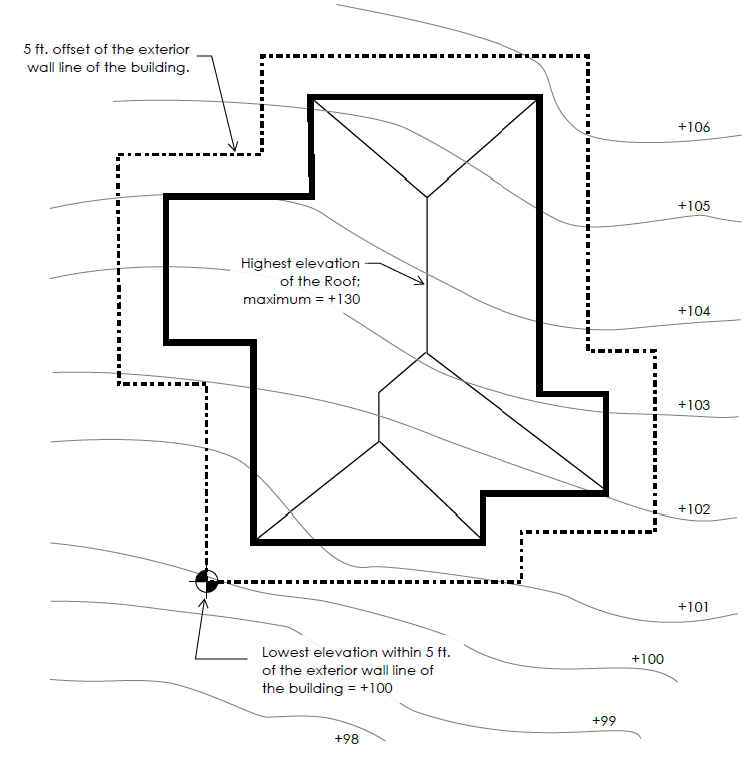
Maximum Building Height. No building shall exceed either thirty feet in height or two stories above grade (see illustration below).
D.
Yard and Building Setbacks:
E.
Encroachments into setback areas:
1.
Garages and other one-story accessory structures may be constructed within three feet of a side or rear property line where the difference between adjoining grades does not exceed one foot and is not adjoining an R-1 zoned property.
2.
Walls and fences in accordance with Section 17.48.130.
3.
Balconies and Exterior Stairways. No more than one-half of the balconies and exterior stairways shall be permitted to project more than fifty percent of the minimum setback requirement into any required setback areas. The minimum setback from any property line abutting R-1 zoned property shall be ten feet.
4.
Swimming pools, hot tubs, spas and similar recreational facilities may be located no closer than five feet from the rear or side property lines, or twenty-five feet from the front property line.
5.
Other projections as allowed in accordance with Section 17.48.120.
F.
Site Design Requirements.
1.
Siting: Building siting should:
a.
Maximize privacy through placement of windows, balconies, landscaping, and design of outdoor spaces;
b.
Be related to nearby buildings as well as adjacent parcels;
c.
Be oriented to face the street, avoiding views from the street of parking garages and alleys;
d.
Minimize negative impact on views from adjacent properties;
e.
Be oriented to encourage use of outdoor areas and to be compatible with adjoining building orientation; and
f.
Cluster buildings and modulate architectural elements to provide pleasing and useful ground level and above ground spaces.
2.
Utilities: All utilities shall be placed underground.
3.
Landscaping: Landscaping should be designed to minimize impact of development on surrounding properties. Tree preservation and landscaping with specimen trees are encouraged.
4.
Contextual design: Building forms and details should be in keeping with adjacent neighborhood character, where appropriate. Where possible, existing single-family houses should be preserved.
5.
Building materials: Materials, colors and textures generally should be compatible with those of adjacent and other nearby buildings and the overall character of the neighborhood.
6.
Paving: Use of decorative and permeable materials is encouraged.
7.
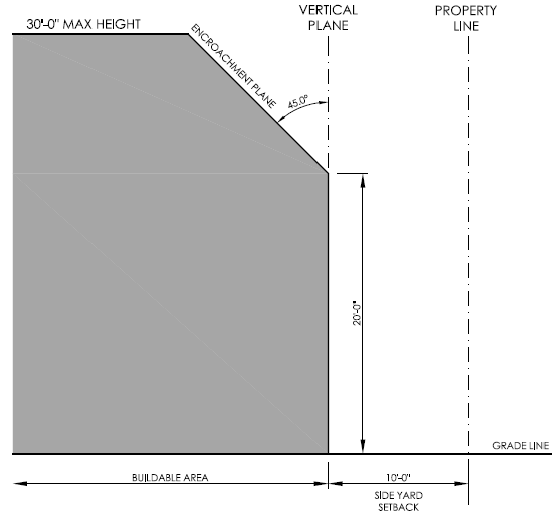
Angle-plane: For yards abutting an R-1 zoned lot, an encroachment limit shall be established which is determined at a point twenty feet above the existing ground level at the setback line as required by subsection D above, and using a forty-five-degree angle inwards toward the property to create additional setback (see illustration below).
8.
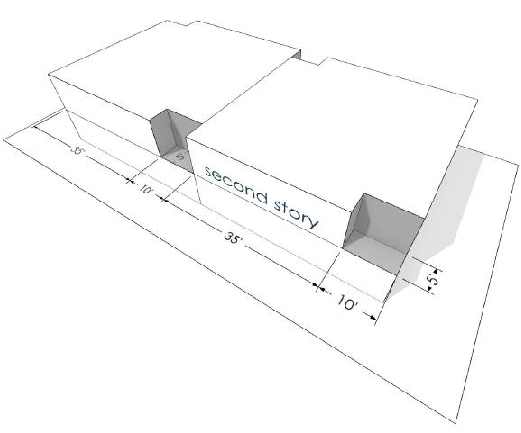
Articulation: Articulation of exterior walls is encouraged. In no event shall a linear wall of a second story extend longer than thirty-five feet without an offset of a minimum of five feet for a minimum linear distance of ten feet (see illustration below).
9.
Screening: Parking areas, refuse storage, mechanical equipment and the like shall be screened by some combination of walls, plantings or earthworks.
10.
Design guidelines: From time to time, the planning commission may promulgate and maintain site design and massing guidelines for use by applicants and the city to guide appropriate development in the R-3-13 zone.
(Ord. No. 1389, Exh. A, § 15, 7-11-17; Ord. No. 1455, § 3(Exh. B), 5-24-22; Ord. No. 1466, §§ 59—61, 3-28-23)
17.28.090 - Open space.
Five hundred square feet per dwelling unit of on-site open space shall be provided for use by residents. Such open space may be located on the ground floor or above, and may be met with a combination of common open space and private open space. In order to be counted toward the open space requirement, the minimum width and length of each space shall be ten feet for common spaces and five feet for private spaces. Driveways and other vehicular access areas shall not count toward the open space requirement.
(Ord. No. 1389, Exh. A, § 15, 7-11-17)
17.28.100 - Off-street parking requirements.
A.
Off-street parking shall be provided as follows:
1.
One enclosed or covered space for each studio or one-bedroom unit;
2.
Two enclosed or covered spaces for all units with two or more bedrooms;
3.
For sites with five or more dwelling units, guest parking shall be required at a ratio of one unenclosed parking space for every increment of five units;
4.
On-street parking shall not be used to satisfy any of the above open parking requirements.
B.
Parking and Vehicular Storage. The following standards shall apply to automobile parking facilities and vehicular storage:
1.
Automobile parking facilities:
a.
Fully enclosed garages shall be provided for any required covered parking space that is entered directly from any public alley.
b.
Open parking compounds shall be screened from adjacent property lines.
c.
The arrangement of garage facilities shall be such that they do not face toward any public street or that they shall be screened from view.
d.
Each dwelling unit shall have an assigned, enclosed parking space within five hundred feet walking distance of such unit.
2.
Paving. A minimum of fifty percent of those areas normally covered with an impermeable surface shall be required to be covered or paved with a permeable surface.
C.
Except as herein specified, parking shall be designed in accordance with Chapter 17.68 generally and Chapter 17.22 for second units.
D.
Driveway Requirements.
1.
Each driveway to a garage or parking space shall be at least twelve feet uniform width and shall be totally unobstructed from the pavement upward.
a.
If any driveway serves as access to more than twelve dwelling units, such driveway shall be not less than twenty feet uniform width and shall be totally unobstructed from the pavement upward; provided, however, that utility poles, guy wires and anchors may be located within two feet of the property line.
b.
Eaves, no portion of which are less than thirteen feet above the pavement, may overhang any such driveway a distance of not more than three feet; and utility pole cross-arms and utility service wires may be located not less than thirteen feet in height above the paved surface of any driveway.
c.
Two, twelve-foot driveways may be provided in lieu of a required twenty-foot driveway, in which event one shall be marked "entrance" and one "exit" and all regulations herein before provided with respect to ten and one-half foot driveways shall apply to each of such driveways.
d.
Every driveway shall be surfaced in a manner that is acceptable to the Fire Department.
e.
On shared driveways, "No Parking" signs with lettering not less than two inches in height shall be placed conspicuously at the entrance to and at intervals of not less than one hundred feet along every required driveway.
2.
No person shall park, stand, or leave any vehicle in any portion of a shared driveway except for the purpose of and during the process of loading or unloading passengers or merchandise, and then only while such vehicle is attended by the operator thereof.
3.
Parking height: Structures used principally for parking shall not be higher than one story. Parking shall not be permitted above ground level.
(Ord. No. 1389, Exh. A, § 15, 7-11-17)
17.28.110 - Landscaping.
A.
All open areas with the exception of vehicular accessways and parking areas, pedestrian walkways and paved and/or covered recreational facilities shall be landscaped and permanently maintained in an attractive manner. For new construction, on-site trees equivalent to one, fifteen-gallon tree for each dwelling unit shall be provided. Additional trees and shrubs shall also be planted to provide a well-balanced landscape plan. For the purpose of this section other specimen material as approved by the planning department may be considered as equivalent to a fifteen-gallon tree.
B.
Landscaping must adhere to the city's adopted water efficient landscape standards pursuant to Chapter 15.60.
C.
Street trees shall be provided to city standards and in accordance with the master plan for street trees, or with current practices established by the director of public works.
D.
For all projects that are required to comply with water efficient landscape standards, a conceptual landscape plan prepared by a licensed landscape architect shall be submitted to the planning department together with the project's first application and shall be drawn to a scale of not less than one inch equals twenty feet. Said plan shall include the following information:
1.
Square footage of each landscaped area;
2.
Total square footage of all landscaped areas;
3.
Percentage of the total site devoted to landscaping;
4.
Type of plant materials, i.e., the botanical and common names;
5.
Location of all plant materials;
6.
Container size and number of all plant materials;
7.
A tree inventory and tree protection report prepared by a licensed arborist shall be submitted. No protected tree shall be removed or substantially trimmed, except as authorized by Chapter 12.20. Specimen trees shall be replaced within the submitted landscaping plan with a minimum of twenty-four-inch box trees.
8.
The project approval may include additional landscape requirements. Final plans, including irrigation and required usage calculations will be reviewed during construction plan check.
(Ord. No. 1389, Exh. A, § 15, 7-11-17)
17.28.120 - Lighting.
All lighting of the buildings, structures, landscaping, yards, parking areas, or similar facilities shall be in compliance with the city's "Dark Sky" objectives and policies. Lighting shall be shielded and directed downward to reflect away from adjoining properties.
(Ord. No. 1389, Exh. A, § 15, 7-11-17; Ord. No. 1413, § 1, 5-28-19)
17.28.130 - Submittal requirements and plan review process.
Projects in the R-3-13 zone require submittal of an application and additional materials as listed on the application. The plan review process for discretionary permits such as conditional use permits, minor conditional use permits, design review permits, and administrative design review permits is set forth in Chapter 17.60.
(Ord. No. 1389, Exh. A, § 15, 7-11-17; Ord. No. 1466, § 62, 3-28-23)
17.28.140 - Development or construction site standards.
The following standards apply to development or construction in the R-3-13 zone:
A.
Construction sites shall be maintained free and clear of attractive nuisances and debris and/or fences as determined by the building inspector.
B.
The residential character of neighborhood to be maintained during construction as to not to become an attractive or public nuisance, due to storage of material, parking or activities of the contractor employees.
C.
Temporary services on-site, shall be ten feet behind the property line, i.e., portable toilet facilities.
D.
Rubbish and refuse service with city contractor shall be required at the time the building permit is issued. Service may be weekly pickup service if accessible by a public street, or by scout or commercial service as otherwise authorized.
E.
Contractors, subcontractors shall be required to have a completed subcontractors list for all services and trades and business licenses obtained prior to any construction or request for inspection. Where work for which a permit is required wherein the work has started or has proceeded prior to obtaining said permits or business licenses, the permit fees shall be doubled pursuant to Chapter 15.04 of this code.
F.
Use of the public right-of-way for storage, work, staging, or off-loading requires a permit and approval in advance of any activity pursuant to Chapter 12.12 of this code.
G.
The public right-of-way, if improved and in place, or at the entry to the project from an existing street, shall be cleaned each evening by the contractor. Clean up shall include, but not be limited to, streets, roadways, gutters, sidewalks, and parkways.
H.
Violation of subsections (A) through (G) of this section may result in the issuance of a stop work order by the building inspector. Work so halted shall have the right of due notice and an administrative hearing upon request.
(Ord. No. 1455, § 3(Exh. B), 5-24-22; Ord. No. 1466, § 63, 3-28-23)

