
Sierra Madre City Zoning Code
CHAPTER 17
20 - R-1 ONE-FAMILY RESIDENTIAL ZONE2
Sections:
Editor's note— Ord. No. 1336, § 1(Exh. A), adopted April 9, 2013, amended Ch. 17.20 in its entirety to read as herein set out. Former Ch. 17.20, §§ 17.20.010—17.20.170, pertained to similar subject matter, and derived from prior code §§ 9250—9254; Ord. 973, § 4(part), adopted 1980; Ord. 996, §§ 2—4, adopted 1982; Ord. 1024, § 3, adopted 1986; Ord. 1035, § 2, adopted 1987; Ord. 1037, § 5, adopted 1988; Ord. 1038, § 1, adopted 1988; Ord. 1047, §§ 1, 2, adopted 1988; Ord. 1051, § 4(part), adopted 1989; Ord. 1066, § 1, adopted 1990; Ord. 1084, § 1(part), adopted 1992; Ord. 1098, § 1, adopted 1993; Ord. 1107, § 1, adopted 1993; Ord. 1115, §§ 6—14, adopted 1995; Ord. 1161, § 2B, adopted 1998; Ord. 1177, § 2(part), adopted 2000; Ord. 1179 § 1, adopted 1999; Ord. 1184, § 3, adopted 2000; and Ord. 1247, §§ 3, 4, adopted 2006.
17.20.010 - Purpose.
In order to maintain the historical, architectural and ecological integrity and quality of the existing single-family residential areas within the city, the following purpose is set forth:
A.
To encourage development that preserves the small town, mountainous flavor of this closely-knit foothill community;
B.
To encourage preservation of historical structures;
C.
To encourage architectural diversity while maintaining architectural accord with the character of the existing neighborhood;
D.
To promote design in accordance with recognized principles of architecture. Individual designs should reflect only one style of architecture, avoiding the mixture or combined use of several different ones. Classically defined styles would include Craftsman, Victorian, Tudor, Classic Box, Mediterranean, Board and Batten, California Ranch House, etc.
E.
To promote consideration of one another's valley and mountain views:
1.
Designs should consider, to the extent reasonably practicable, the neighbors' existing view,
2.
Plan should consider the existing and finished grades of the site to be improved in relation to adjacent properties encouraging retention of building heights, mass, scale, orientation, configuration and colors that blend in with the character of the neighborhood;
F.
To ensure adequate light, air, privacy, and open space for each dwelling and in relation to adjacent dwellings;
G.
To encourage appropriate scale and size of new construction and reconstruction that is compatible with the existing neighborhood and surroundings.
(Ord. No. 1336, § 1(Exh. A), 4-9-13)
17.20.015 - Definitions.
In addition to the definitions contained elsewhere in this title, the words and phrases set forth below shall be given the following meanings for the purposes of this chapter:
"Attic" means the area located between the uppermost plate and the roof or ridge of a structure.
"Basement, full" means basements that do not extend more than twelve inches above adjacent grade at any point around the perimeter of the structure as measured from the ceiling of the basement to the adjacent grade.
"Basement, partial" means basements that do not extend more than an average of three feet above the lower of natural, pre-existing or finish grade, and not more than eight feet at any point around the perimeter of the structure, as measured from the ceiling of the basement to the adjacent lower of natural, pre-existing or finished grade.
"Driveway" means an area of pavement or other pervious or impervious surface that provides vehicular access from an alley, public or private street to a parking area, garage or carport on a parcel.
"Flag lot" means a lot in the approximate configuration of a flag pole or sign post, with the pole or post functioning primarily as an access corridor or way to the main body of the lot from the street of access.
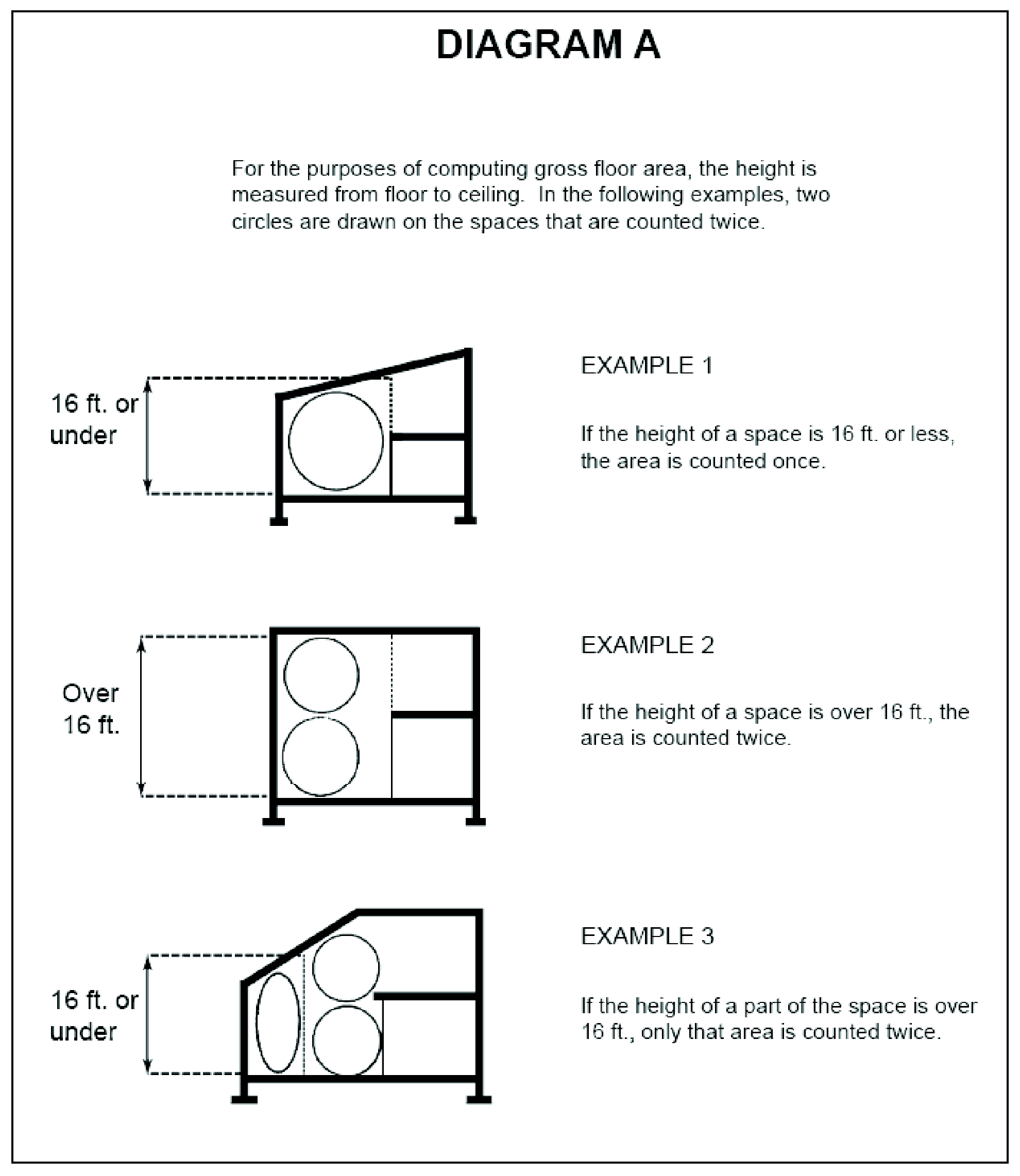
"Gross floor area" means the sum of all horizontal areas of floors covered by solid roof including first and second floors, attic spaces over 7.5 feet in height, basements, lofts, guest houses, garages, carports, patios, porches, balconies, barns, gazebos, and raised decks which are higher than 7.5 feet from natural or pre-existing grade as measured from the perimeter of the structure. Further, the area of interior spaces over sixteen feet in height shall be counted as double the floor area (see Diagram A), except for stairways and elevator shafts, which shall only be counted once. The horizontal floor area of vents, shafts, and courts shall be included in the calculation of gross floor area.
Gross floor area shall be measured from the exterior face of exterior walls. In cases where there is no wall, the measurement should be from the exterior face of the supporting posts; for cantilever-covered areas, the gross floor area shall be measured from the edge of the roof eaves excepting any roof eave exemptions, as provided below. The following shall not be computed towards floor area:
1.
Roof eaves up to four feet in projection. Roof eaves that exceed four feet in projection but not more than six feet in projection may be excluded from the total floor area calculation subject to approval of an administrative design review permit pursuant to Chapter 17.60.
2.
Full basements.
3.
Partial basements, subject to the approval of an administrative design review permit pursuant to the requirements of Chapter 17.60.
4.
Attic areas that meet all the following requirements:
(i)
Areas with vertical clearance of five feet or greater that are less than sixty percent of the surface of the building footprint, including dormer areas;
(ii)
Areas which do not include any doorway entrance that leads to an adjacent rooftop deck, patio attachment and/or exterior staircase;
(iii)
Areas which do not include an individual dormer which has a width greater than seven feet;
(iv)
The combined width of all dormers along a roofline do not exceed fifty percent of the width of the roofline; and
(v)
No portion of any dormer is higher than the main roofline of the house.
5.
Porches on the ground floor that are attached to the primary residence, face the street (not fronting on common side or rear property lines), and are not enclosed between the heights of three feet and seven feet, with the exception of posts and building face or faces to which the porch is attached.
"Habitable attic space" means an attic space with an occupiable floor area of at least seventy square feet, a minimum vertical clearance of seven feet and an average height of 7.5 feet, and which meets minimum lighting, heating, ventilation and access requirements.
"Lot coverage" means the area of land covered by solid roofed structures, whether habitable or nonhabitable, including, but not limited to: building footprints of a single-family dwelling, detached garages, barns, covered patios, and other solid roofed accessory structures constructed on a foundation whether above, below, or at grade level. Raised decks which are over seven feet six inches from grade shall be included in the lot coverage calculation.
"Lot line, front." "Front lot line" means a lot line parallel to, and abutting, the right-of-way providing primary access to the property, except in the case of nonstandard lot configurations such as flag lots, irregularly shaped lots, reverse corner lots, or properties where access is provided by easements or private roads. In such nonstandard instances, the front lot line or lines shall be determined by the director, or his/her designee, based on the character of other improvements in the vicinity; however, in no case, may the front lot line fall within any portion of any recorded easement or access corridor.
(Ord. No. 1336, § 1(Exh. A), 4-9-13; Ord. No. 1354, § 1, 6-10-14; Ord. No. 1389, Exh. A, §§ 2, 3, 7-11-17; Ord. No. 1432, § 2(Exh. A), 10-27-20; Ord. No. 1466, § 48, 3-28-23)
17.20.020 - Permitted uses.
No person shall use, nor shall any property owner permit the use of any property or lot located in any R-1 zone for any use other than the following:
A.
One-family dwellings of a permanent character; not more than one per lot (except for second units in compliance with Chapter 17.22); placed in a permanent location, containing not more than one kitchen; used by but one family; and not used for commercial purposes other than home occupations.
B.
Home occupations, pursuant to the provisions of Chapter 17.85 of this title.
C.
Accessory Buildings and Uses. The following accessory buildings and uses are permitted:
1.
Detached accessory structures, such as garages, open carports, gazebos, workshops and similar uses;
2.
Residential communication facilities and devices intended for the noncommercial use and enjoyment of the resident of the property on which the use is located, as provided in Chapter 17.93 of this code;
3.
Walls and fences pursuant to the provisions of Section 17.48.130.
4.
Miscellaneous structures and uses measuring less than one hundred twenty square feet, such as trash enclosures, barbecues, tool sheds and similar structures and uses.
D.
Dogs and cats as household pets not to exceed three adults (four months or older) in number in any combination for each dwelling unit.
E.
A trailer used as the residence of the owner and his/her family during construction by such owner of a permanent residence, but only while a building permit for the construction of such residence is in full force and effect and in no event longer than six months.
F.
Servants' quarters and guest houses may be maintained on any lot; provided, that such quarters and guest houses are used as an accessory to the single dwelling unit and also provided no cooking facilities are maintained therein.
G.
Agricultural crops, greenhouses, fruit trees, vines and nurseries for producing trees, vines and other horticultural stock and including the wholesale and retail sale thereof; provided, that no signs, displays or stands are maintained in conjunction therewith and that all structures maintained on the property conform to the yard requirements herein specified.
H.
Public parks, playgrounds and other public recreation facilities.
I.
Signs in accordance with the regulations contained in this title.
J.
Garage and Yard Sales.
1.
Purpose. The purpose of this subsection is to provide regulation of garage and yard sales within the city.
2.
Definitions. The phrase "garage or yard sale" means any sale of personal property on residentially zoned property to which the public is invited or encouraged to attend. "City" means the city of Sierra Madre.
3.
Permit Required. No person shall conduct a sale regulated by this section until such a person has applied for and received a permit from the city. The permit shall be issued for a fee, as established by resolution of the city council. A copy of the permit shall be displayed at the site of the sale. Failure to apply for a permit, prior to the day of the sale, will subject the violator to a penalty as established by resolution of the city council.
4.
Frequency of Sales and Hours of Operation. No more than three garage or yard sales shall be conducted in any calendar year at any single address. No such sale shall exceed two consecutive days in duration. All such sales shall commence no earlier than eight a.m. and shall conclude no later than six p.m.
5.
Merchandise. No merchandise to be sold shall be placed or displayed on public property or in the public right-of-way. All goods offered for sale shall be the property of the owner, tenant or occupant of the residence. No new merchandise shall be offered for sale.
6.
Garage and Yard Sale Signs. Garage sale signs shall not be posted in public view before six a.m. the day of the sale and shall be removed by eight p.m. on the final day of the sale. Signs put up prior to or left after these times may be removed by the city, and the permit holder will be subject to paying the cost of removing these signs. Temporary garage and yard sale signs may be displayed in the following manner:
a.
A single sign, not greater than five square feet in sign area, may be placed on a stake, or similar method, within the parkway portion of the public right-of-way directly in front of the property where the permitted garage or yard sale event is to be conducted. In no case shall the subject sign be maintained within the paved street.
b.
A sign, not greater than five square feet in sign area, may be placed on, or within, a vehicle parked within the public right-of-way, for the purposes of advertising a garage or yard sale event. There shall not be more than four vehicles used to display a garage or yard sale sign, and not more than one sign may be located on or within each vehicle.
c.
In no case shall any temporary garage or yard sale sign be placed or affixed to a tree, light pole, utility pole or traffic control/information sign post, or similar item.
K.
Swimming Pools. Swimming pools, hot tubs, spas, and similar recreational facilities pursuant to the provisions of Section 17.20.065.
L.
Vehicle Parking. The use of unimproved lots or parcels for temporary, and/or ongoing, vehicle parking may be permitted as follows:
1.
Subject to the approval by the director of a minor conditional use permit pursuant to the provisions of Section 17.60.055.
2.
That each vehicle parking site shall only be utilized for noncommercial residential vehicle parking. No vehicle parking fee shall be collected by the property owner;
3.
There shall be no storage of recreational vehicles, including, but not limited to, motorhomes, recreational and equipment trailers, boats and watercraft and similar items.
M.
Transitional and supportive housing.
N.
Modular and manufactured homes as a type of dwelling unit, one per dwelling unit (except for second units in compliance with Chapter 17.22).
O.
Family daycare homes, one per dwelling unit (except for second units in compliance with Chapter 17.22).
(Ord. No. 1336, § 1(Exh. A), 4-9-13; Ord. No. 1352, § 4, 2-11-14; Ord. No. 1441, §§ 2—4(Exh. B), 5-11-21; Ord. No. 1466, § 49, 3-28-23)
17.20.025 - Conditionally permitted uses.
The following uses shall be allowed subject to the granting of a conditional use permit pursuant to the provisions of Chapter 17.60 of this title:
A.
Conditional uses allowed under Section 17.60.030.
B.
Swimming Pools. Swimming pools, hot tubs, spas and similar recreational facilities which are located within twenty-five feet, and is visible to or from a public or private street or alley pursuant to the provisions of Chapter 17.60 of this title. If the swimming pool, hot tub, spa and similar recreational facility are enclosed by a six-foot-tall, which on sloping terrain may deviate a maximum of eight inches above or below the six-foot height, solid fence or wall, then the provisions of Section 17.20.060 shall apply.
(Ord. No. 1336, § 1(Exh. A), 4-9-13; Ord. No. 1364, § 1, 5-12-15; Ord. No. 1389, Exh. A, § 4, 7-11-17)
17.20.027 - Design review permit.
The following projects shall be allowed subject to the granting of a design review permit pursuant to the provisions of Chapter 17.60 of this title:
A.
Houses requiring additional height to accommodate an architectural feature (such as a roof), that is characteristic of the style of architecture that is used for the house or for other particular design purposes with a maximum height of thirty feet, zero inches pursuant to the findings listed in Section 17.60.040.
B.
Except for replacement of an existing two-story structure lost due to a fire or other casualty event, any second-story addition to an existing single-family house or any new construction proposed to include a second story.
C.
Allowable gross floor area for all structures on a single lot that exceeds, either by addition or new construction, the amounts indicated below:
1.
Lot areas up to seven thousand five hundred square feet: two thousand five hundred square feet of floor area;
2.
Lot areas from seven thousand five hundred one to eleven thousand square feet: three thousand square feet of floor area;
3.
Lot areas from eleven thousand one and up: three thousand five hundred square feet of floor area.
(Ord. No. 1389, Exh. A, § 5, 7-11-17)
17.20.030 - Standards of development—Generally.
All premises in the R-1 zone shall comply with the standards of development set forth in the following sections.
(Ord. No. 1336, § 1(Exh. A), 4-9-13)
17.20.040 - Height.
A.
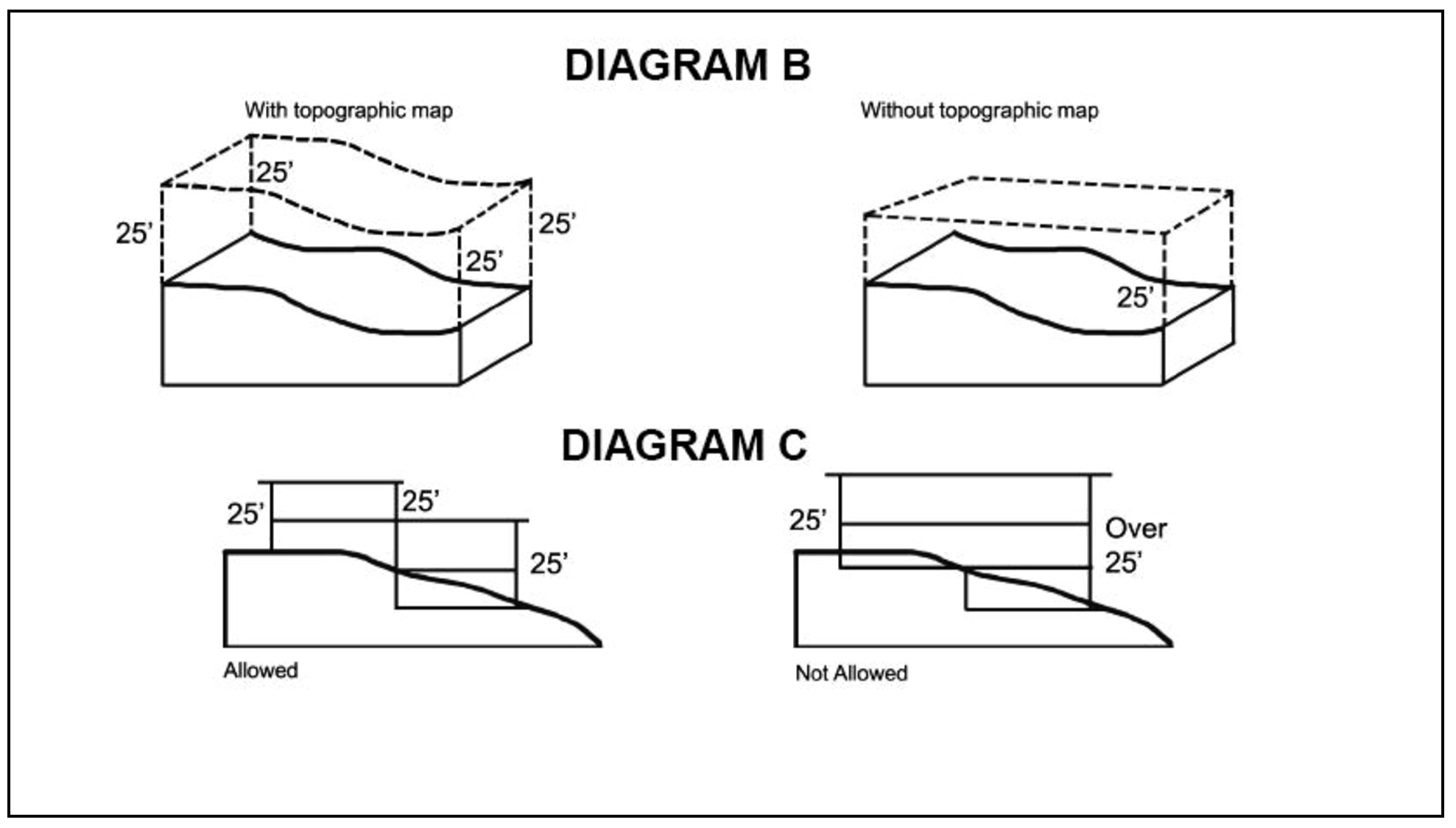
Establishing the Maximum Building Envelope. A building envelope shall be established twenty-five feet as measured from a warped plane defined by the adjoining natural or pre-existing grade, or finished grade, whichever is lower, around a five-foot perimeter of the building. If an applicant does not submit a topographic map that enables the warped plane to be established, then, the building envelope shall be established twenty-five feet as measured from a single point determined to be the lowest point of natural grade or pre-existing grade and establishing a flat plane which intersects the point as shown in Diagram B.
B.
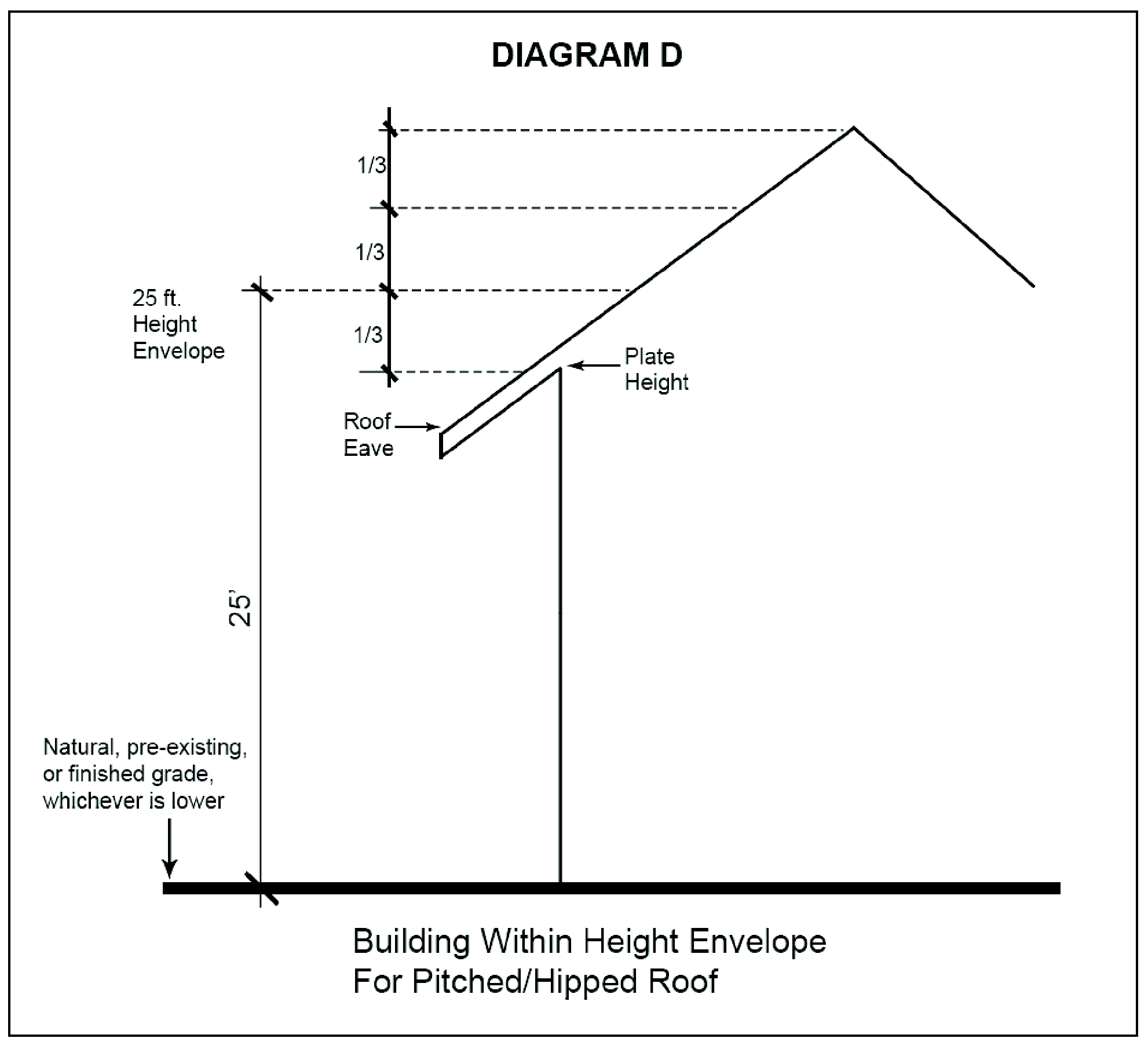
Placing Building Within Height Envelope. A building shall be placed within the envelope so that at no point does the height exceed the envelope as shown in Diagram B. Further, the height shall be measured from the lowest point of adjoining natural or pre-existing grade, or finished grade, whichever is lower, around the perimeter of the building to the highest point of the coping of a flat roof or to a point one-third of the height of a pitched or hipped roof, as shown in Diagram D. If a structure includes a basement that either can be entered at any point of the grade, or, where the floor line above the grade is greater than six feet at any point, then the height limit shall be measured from the floor of the basement at every point where this occurs as shown on Diagram C. The intent of this provision is to eliminate the appearance of three stories and shall not be circumvented.
C.
Applicant's Submittal. The applicant's submittal shall clearly show the location of the pre-existing or natural grade, as well as finished grade, on the site and on the adjacent properties and building placement on all four elevations. The roof line must be within twenty-six feet of a level graded area of at least ten feet in depth over twenty-five percent of the perimeter of the building.
(Ord. No. 1336, § 1(Exh. A), 4-9-13)
17.20.050 - Primary structures.
The following development standards shall apply to all primary structures within the R-1 zone as follows:
A.
Front Yards. The following standards shall apply to all R-1 zoned property:
1.
Standard Front Yard Setback. Every lot in the R-1 zone shall have a front yard of at least twenty-five feet, except as provided in this chapter.
2.
Front Yard Setbacks Greater than Thirty Feet—Prevailing Setback. Whenever fifty percent, or greater, of the properties on the same side of the street in the linear block where the project site is located have front yard setbacks that are greater than thirty feet, the minimum required front yard setback for all building and/or structures thereafter constructed, enlarged, erected or established shall be the prevailing setback for the linear block. The prevailing setback shall be calculated by adding all of the front yard setbacks, except for the smallest and largest setbacks, and dividing the total by the number of lots included in the calculation, as illustrated in Diagram E. The Prevailing Setback may be reduced to no less than required by subsection (A)(1) subject to the approval of an administrative design review permit pursuant to the requirements of Chapter 17.60.
3.
Projections Into the Front Yard. Projections into the required front yard setback may occur as follows:
a.
A nonhabitable covered front porch, with or without supports, may encroach a maximum of six feet into the required front yard setback. In no case may the encroachment be closer than ten feet to the front property line.
b.
An open, uncovered balcony (not covered by a roof or similar structural feature) may project into the required front yard setback a maximum of forty-eight inches.
c.
An open balcony, covered only with a roof feature and supports, may extend into the required front yard setback a maximum of forty-eight inches, pursuant to the approval of an administrative design review permit pursuant to the provisions of Chapter 17.60.
B.
Side Yards. The following side yard setback standards shall apply to all R-1 zoned property:
1.
New Construction. Except as otherwise provided, all construction of new primary structures on all property shall conform to the following side yard setback standards:
a.
Lots or Parcels of Sixty Feet or Less in Width. Lots or parcels measuring sixty feet or less, as defined in this title, shall have a minimum side yard setback of not less than five feet, on each side. However, in no case shall any structure exceed a total width of forty-two feet.
b.
Lots or Parcels Greater than Sixty Feet in Width. Except as otherwise provided in this chapter, lots or parcels measuring greater than sixty feet in width, as defined in this title, shall have a cumulative side yard setback dimension (both side yard setbacks combined) of not less than thirty percent of the width of the lot or parcel, with a minimum required side yard setback of any one side of not less than five feet or ten percent of the width of the lot or parcel width, whichever is greater, up to a maximum side yard setback of ten feet on that side.
c.
Reverse Corner Lots or Parcels. Lots or parcels which have a "reverse corner" configuration, as defined in this title, shall have an interior side yard setback as set forth in subsection (B)(1) of this section. The "reverse corner" lot or parcel shall have a minimum twenty-five foot setback adjacent to the secondary street frontage.
d.
Attached Open Structures. Open single story attached structures, such as porte cocheres, patio covers, porch covers and similar structures which are attached to the primary structure may encroach into the required cumulative side yard setback dimension, as set forth in subsection (B)(1)(b) of this section, where the attached open structure is located no closer to the side yard property line than a minimum of five feet or ten percent of the width of the lot or parcel, whichever is greater.
2.
Additions Onto Existing Primary Structures. Additions onto existing primary structures shall conform to the provisions of subsection (B)(1) of this section, except as provided as follows:
a.
Single Story Additions of Less than Fifty Percent. Single story additions onto existing primary structures, which results in an increase in gross floor area of fifty percent or less of the original structure, and which is consistent in height and character with the original structure, may be aligned with the existing legally constructed side yard setback of the primary structure, subject to the approval by the director of an administrative design review permit, pursuant to Section 17.60.025.
b.
Single Story Additions Greater than Fifty Percent. Single story additions onto existing primary structures, which result in an increase in gross floor area of greater than fifty percent of the original structure, may be aligned with existing legally constructed side yard setback of the primary structure, subject to the approval of a design review permit pursuant to the provisions of Chapter 17.60 of this title.
3.
Reduced Cumulative Setback Dimensions. The cumulative required setback dimensions may be reduced from thirty percent to twenty percent pursuant to the following provisions:
a.
New Construction. New construction of primary structures may have a reduced cumulative side yard setback dimension (both side yard setbacks combined) of not less than twenty percent of the width of the lot or parcel, with a minimum required side yard setback of any one side of not less than five feet or ten percent of the width of the lot or parcel width, whichever is greater, up to a maximum side yard setback of ten feet on that side, provided that the total lot coverage does not exceed forty percent and pursuant to the approval of a design review permit subject to the provisions of Chapter 17.60.
DIAGRAM E
Example of Calculation of Prevailing Front Yard Setback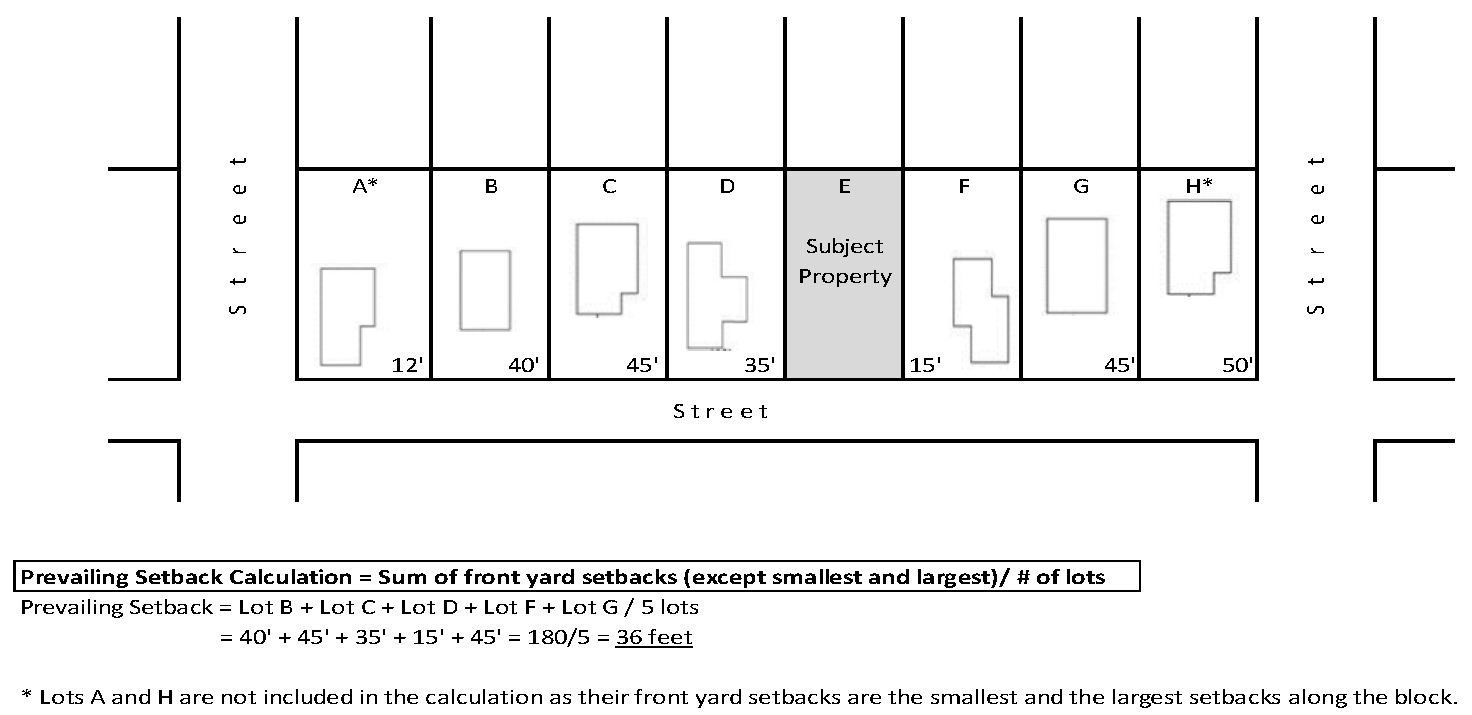
b.
One or Two Story Additions of Fifty Percent or Less. One or two story additions onto existing primary structures, where the floor area of the addition does not exceed fifty percent of the gross floor area of the existing primary structure, may be constructed with cumulative side yard setback dimension (both side yard setbacks combined) of not less than twenty percent of the width of the lot or parcel, with a minimum required side yard setback of any one side of not less than five feet or ten percent of the width of the lot or parcel width, whichever is greater, up to a maximum side yard setback of ten feet on that side, pursuant to the approval of an administrative design review permit pursuant to the provisions of Chapter 17.60.
c.
One or Two Story Additions of Greater than Fifty Percent. One or two story additions onto existing primary structures, where the floor area of the addition is greater than fifty percent of the gross floor area of the existing primary structure, may be constructed with cumulative side yard setback dimension (both side yard setbacks combined) of not less than twenty percent of the width of the lot or parcel, with a minimum required side yard setback of any one side of not less than five feet or ten percent of the width of the lot or parcel width, whichever is greater, up to a maximum side yard setback of ten feet on that side, pursuant to the approval of a design review permit pursuant to the provisions of Chapter 17.60.
C.
Rear Yards. The minimum rear yard setback shall be fifteen feet from the rear property line.
(Ord. No. 1336, § 1(Exh. A), 4-9-13; Ord. No. 1364, §§ 2, 3, 5-12-15; Ord. No. 1375, § 2, 2-9-16; Ord. No. 1389, Exh. A, §§ 6—11, 7-11-17; Ord. No. 1455, § 2(Exh. A), 5-24-22)
17.20.053 - Angle plane.
Notwithstanding the provisions under Section 17.20.050(B) ("Side yards"), no portion of a building, except a chimney but only to the extent necessary to meet code and no higher than six feet from the point where it penetrates the roof, shall exceed the height of a forty-five-degree plane drawn from a height of ten feet above existing ground level at the side lot line boundaries of the lot (see Diagram F), provided the second floor shall not be required to be located further than twice the required setback, whichever is less. Roof eaves projecting a maximum four feet out from the vertical plane of the exterior wall surface are exempted. Existing ground level shall be the grade elevation of the subject site at the side lot line boundaries prior to start of construction. Encroachments exceeding the angle plane height by not more than ten linear feet may be allowed subject to the approval of an administrative design review permit; encroachments exceeding ten linear feet may be allowed pursuant to the approval of a design review permit pursuant to the provisions of Chapter 17.60. Linear feet shall mean the total combined linear feet of encroachment area(s) measured horizontally along the side face of the building.
DIAGRAM F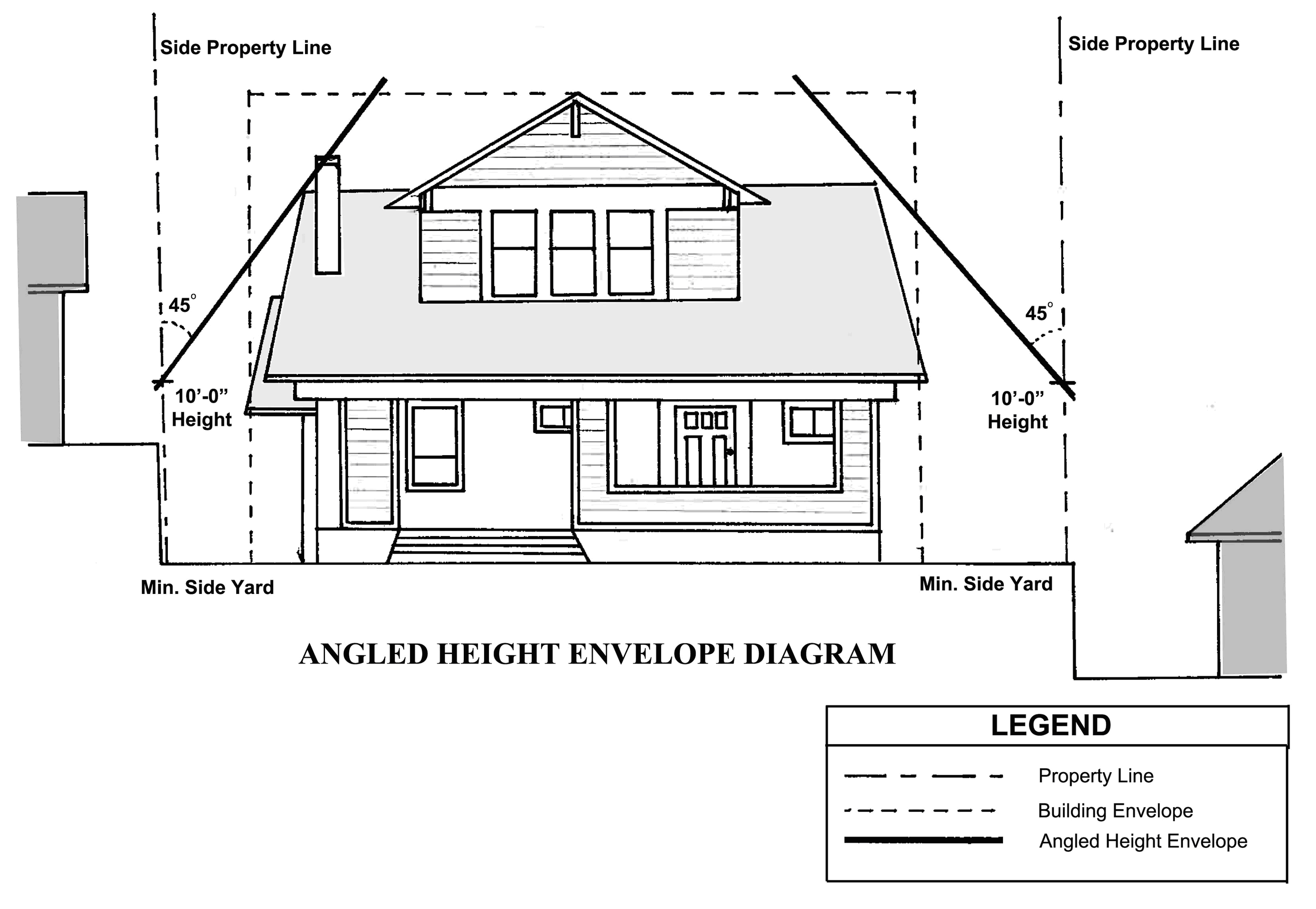
(Ord. No. 1336, § 1(Exh. A), 4-9-13; Ord. No. 1375, § 1, 2-9-16; Ord. No. 1389, Exh. A, § 12, 7-11-17)
17.20.055 - Off-street parking requirements for new construction, additions and/or remodeling.
New construction, or additions and/or remodeling which results in an increase to the number of bedrooms of the existing primary structures, shall be subject to the required off-street parking requirements as set forth in Section 17.68.020(A) and shall be covered by a solid roof in either a garage or carport.
(Ord. No. 1336, § 1(Exh. A), 4-9-13; Ord. No. 1455, § 2(Exh. A), 5-24-22)
17.20.060 - Accessory structures.
The following standards shall apply to all accessory structures:
A.
Detached Accessory Structures. Workshops and storage sheds shall be located behind the street-facing building line of the primary structure on the property, unless authorized with the approval of an administrative design review use permit pursuant to Chapter 17.60. Single-story detached accessory structures, such as gazebos, workshops, storage sheds and similar uses which measure six hundred square feet or less, and with a maximum height of fifteen feet from finished grade to top of ridge as follows:
1.
Administrative Design Review Permit. May be located five feet from the side and/or rear property lines subject to the approval of an administrative design review permit pursuant to Chapter 17.60.
2.
Permitted. When in conformance with the provisions of Section 17.20.050 (Primary structures) and located behind the street-facing building line of the primary structure on the property. Detached accessory structures which exceed six hundred square feet and/or are two stories or greater shall conform to the provisions of Section 17.20.050 (Primary structures).
B.
Detached Garages. Detached garages may be located as follows:
1.
Single-Story Detached Garages. Single-story detached garages, measuring six hundred square feet or less, with a maximum height of fifteen feet as measured from lowest point of adjoining natural or pre-existing grade, or finished grade, whichever is lower, around the perimeter of the garage, to the highest point of the coping of a flat roof or to a point one-third of the height of a pitched or hipped roof, as shown in Diagram B of Section 17.20.040 (height), may be located a minimum of three feet from the side or rear property line if the detached garage is located behind the primary structure.
2.
Detached accessory garages, which exceed six hundred square feet, are greater than fifteen feet in height as described in [subsection] 2.C.1 above, are two stories or greater, or are located in front of the primary structure shall conform to the provisions of Section 17.20.050 (primary structures).
C.
Detached Open Carports. For single-story detached carports, which are open on at least two sides, measuring six hundred square feet or less, and with a maximum height of fifteen feet as follows:
1.
Minor Conditional Use Permit. May be located a minimum of three feet from the side and rear property lines subject to the granting of a minor conditional use permit pursuant to the provisions of Section 17.60.055.
2.
Permitted. When in conformance with the setback provisions as set forth in Section 17.20.050 (primary uses).
D.
Miscellaneous Structures and Uses. Miscellaneous structures and uses, such as trash enclosures, barbecues, tool sheds, water heaters, air conditioning units, ground-mounted solar equipment and similar uses, measuring less than one hundred twenty square feet as follows:
1.
Minor Conditional Use Permit. May be located a minimum of five feet from the side and rear property lines subject to the granting of a minor conditional use permit pursuant to the provisions of Section 17.60.055 (Minor conditional use permits);
2.
Permitted. When in conformance with the setbacks provisions as set forth in Section 17.20.050 (primary structures).
E.
Fences. The provisions of Section 17.48.130 shall apply.
F.
Non-commercial Communication Facilities. Communication facilities that meet the requirements of Chapter 17.93, and which are intended for the noncommercial use and enjoyment by a resident of the property on which the device is located (e.g., television antenna, satellite dishes, and amateur ham radio towers) are either permitted or conditionally permitted as follows:
1.
Permitted. The following such facilities are permitted:
a.
Facilities that are exempt from Chapter 17.93 pursuant to Section 17.93.030.
b.
Facilities for which a permit has been issued consistent with Chapter 17.93.
c.
Satellite dish antennas which are not exempt under Chapter 17.93, but which are ground mounted or which are mounted on a mast which is not greater than twelve feet in height as measured from the point of existing adjoining grade.
2.
Minor Conditional Use Permit. Any noncommercial communication device which is not exempt from Chapter 17.93, which does not require a permit to be issued consistent with Chapter 17.93, and which does not conform to the provisions of subsection (E)(1) of this section may be established, subject to the approval of a minor conditional use permit pursuant to the provisions of Section 17.60.055.
(Ord. No. 1336, § 1(Exh. A), 4-9-13; Ord. No. 1389, Exh. A, §§ 13, 14, 7-11-17)
17.20.065 - Swimming pools.
Swimming pools, hot tubs, spas, pool/spa equipment and/or similar recreational facilities as follows:
A.
Adjacent to a Public or Private Street or Alley. For swimming pools, hot tubs, spas, pool/spa equipment or similar recreational facilities located adjacent to a public or private street or alley, the following provisions shall apply:
1.
Conditional Use Permit. The facility may be located within twenty-five feet of a public or private street or alley, and visible to the adjoining public or private street or alley, with the approval of a conditional use permit pursuant to the provisions of Chapter 17.60 of this title.
2.
Permitted. Where the facility is enclosed by a solid fence or wall of six feet in height (Note: On sloping terrain, the solid fence or wall may deviate a maximum eight inches above or below the six-foot height). In such case, the facility shall be located no closer than five feet to the property line. In no case shall the facility be visible to an adjoining public or private street or alley.
3.
Minor Conditional Use Permit. Where the facility is located greater than twenty-five feet from a public or private street or alley, but is visible to or from the adjoining public or private street or alley.
B.
Side or Rear Property Lines. Five feet from the side or rear property line.
(Ord. No. 1336, § 1(Exh. A), 4-9-13)
17.20.080 - Lot area generally.
A.
The minimum required lot area in the R-1 zone shall be seven thousand five hundred square feet unless otherwise designated on the zoning map.
B.
When property has been classified and designated on the zoning map as R-1-9, the minimum required lot area shall be nine thousand square feet.
C.
When property has been classified and designated on the zoning map as R-1-11, the minimum required lot area shall be eleven thousand square feet.
D.
When property has been classified and designated on the zoning map as R-1-15, the minimum required lot area shall be fifteen thousand square feet.
(Ord. No. 1336, § 1(Exh. A), 4-9-13)
17.20.090 - Lot area per dwelling.
Lot area per primary dwelling unit in the R-1 zone shall be not less than the minimum required lot area. This section shall not apply to second units in compliance with Chapter 17.22.
(Ord. No. 1336, § 1(Exh. A), 4-9-13)
17.20.100 - Newly created or reconfigured lots—Width and street frontage.
Every lot in the R-1 zone hereafter created or reconfigured by lot line adjustment or otherwise, shall have:
A.
A width at the rear line of a twenty-five-foot front yard setback of not less than the following:
1.
Lots required to have a minimum lot area of less than nine thousand square feet: sixty feet;
2.
Lots required to have a minimum lot area from nine thousand up to but not including eleven thousand square feet: seventy feet;
3.
Lots required to have a minimum lot area from eleven thousand square feet up to but not including fifteen thousand square feet: eighty feet;
4.
Lots required to have a minimum area of or in excess of fifteen thousand square feet: ninety feet.
B.
An average width of not less than ten feet less than the required width appertaining to such lot, as set forth in subsection A. above.
C.
Frontage on a public street (or private street created in accordance with Section 16.32.030 of this code) of not less than the required width appertaining to such lot, as set forth in subsection A. above, except:
1.
For lots at the end of a cul-de-sac; or
2.
Lots accessed by a shared private driveway (whether shared access easement or jointly-owned roadway lot) when all of the following are met:
a.
The shared private driveway shall be at least fifteen feet wide, or wider if required by fire code, and shall meet all other fire code requirements;
b.
To the extent feasible and compliant with fire and other applicable codes, the shared private driveway shall be constructed of permeable materials and/or have a rainwater catchment and detention system;
c.
The shared private driveway shall be the sole means of vehicular access to the lots it crosses, and no such lot may have a separate driveway;
d.
Historic resources shall be preserved in accordance with Section 16.04.060 of this code, and to the extent practicable, all other existing primary structures shall be preserved;
e.
Public access to the shared driveway be maintained at all times, and such driveway shall not be gated or closed in any manner;
f.
The lot fronting the public street (or private street created in accordance with Section 16.32.030 of this code) shall have minimum frontage thereon as required above, and each lot shall have minimum frontage on the shared private driveway as required above as if the same where a public street, except for lots at the end of the shared private driveway;
g.
The shared private driveway shall be named and a street sign shall be installed where the same intersects a public street;
h.
All such shared private driveways shall be made subject to maintenance agreements, which shall be approved by the city and shall be recorded as to all properties having a maintenance responsibility therefor; and
i.
The city shall not be responsible for the maintenance of any shared private driveways.
The front of lots created by subdivisions using a shared private driveway in accordance with subsection C.2. above shall face the shared public driveway and the lot with frontage on a public street (or private street created in accordance with Section 16.32.030 of this code) shall be considered a reverse corner lot; provided however, that the front yard setback for such lots shall be at least fifteen feet from the edge of the shared public driveway, and for purposes of applying standards for walls and fences along the secondary street frontage, the same shall be treated as a primary front yard. Lot orientation and setbacks are illustrated on Diagram G.
DIAGRAM G
Example of Shared Private Driveway Subdivision on 320' X 105' Lot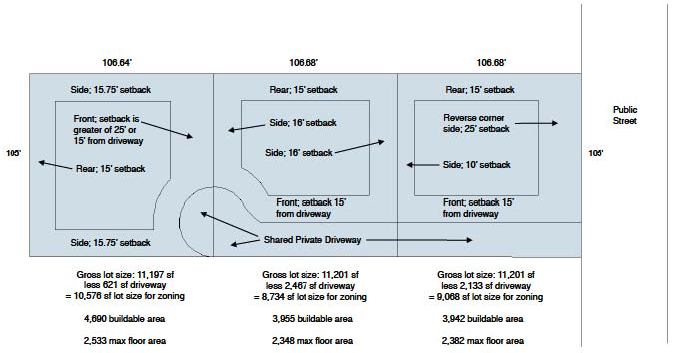
By way of illustration and not limitation of the foregoing, flag lot configurations and exclusive access easements for access to landlocked properties are prohibited in the R-1 zone for newly created lots and for newly configured lots resulting from lot line adjustments. Additionally, Diagram H is provided with examples of permissible and prohibited lot configurations.
DIAGRAM H
Lot Split Example Diagram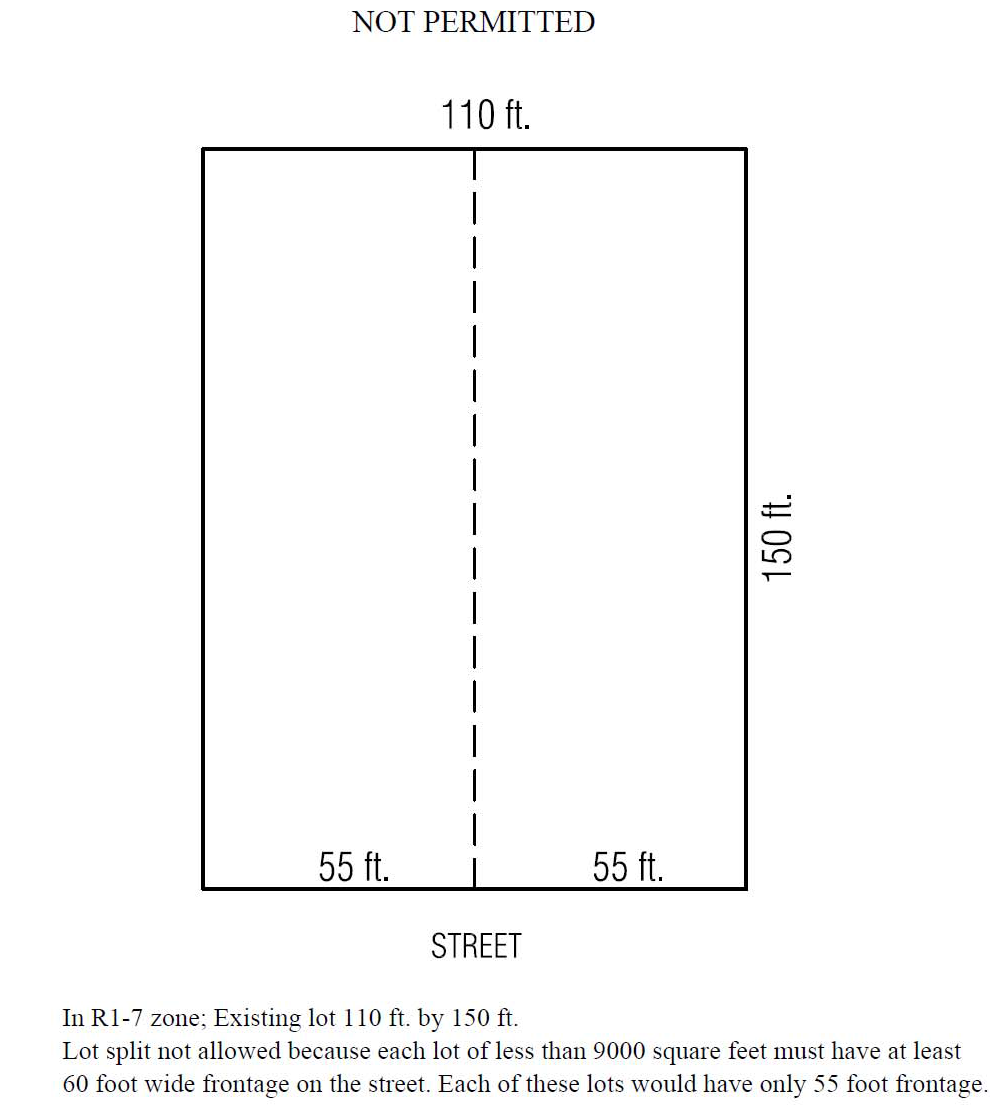
Lot Split Example Diagram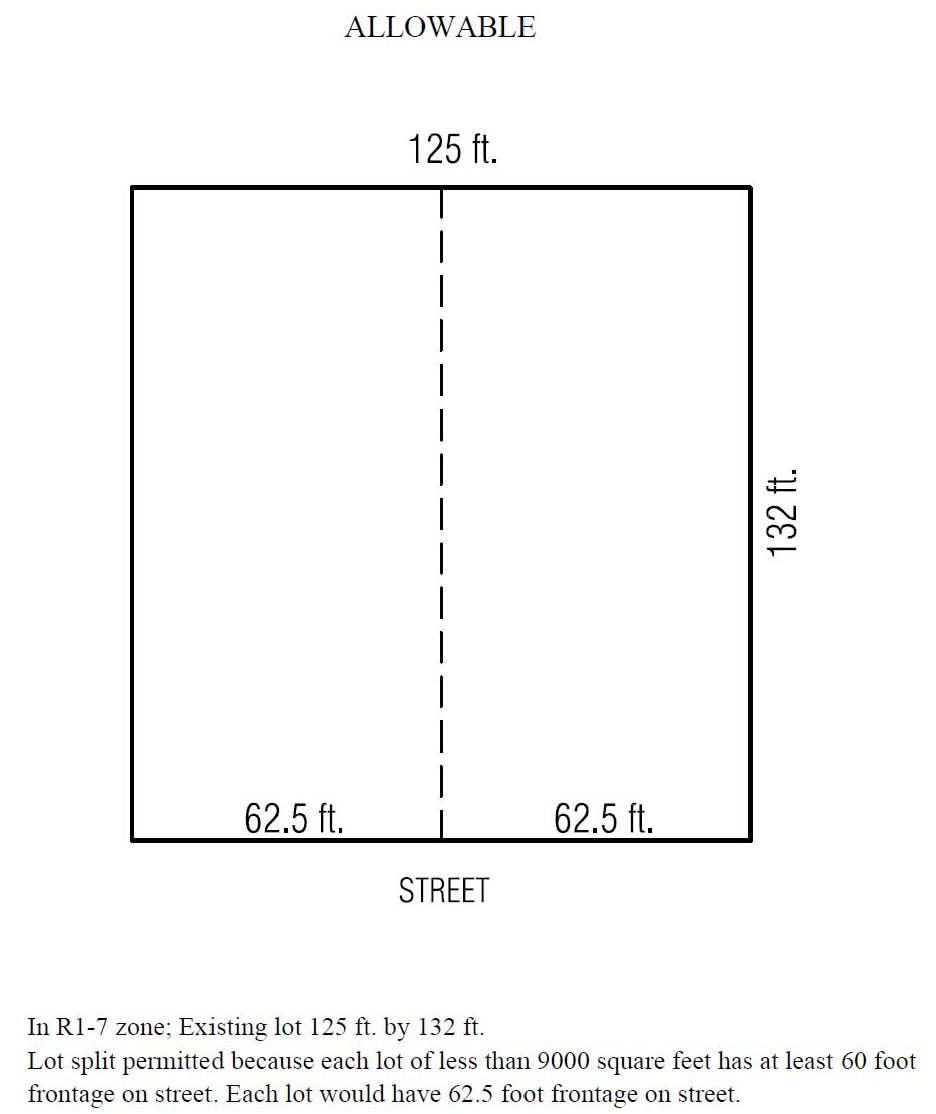
Lot Split Example Diagram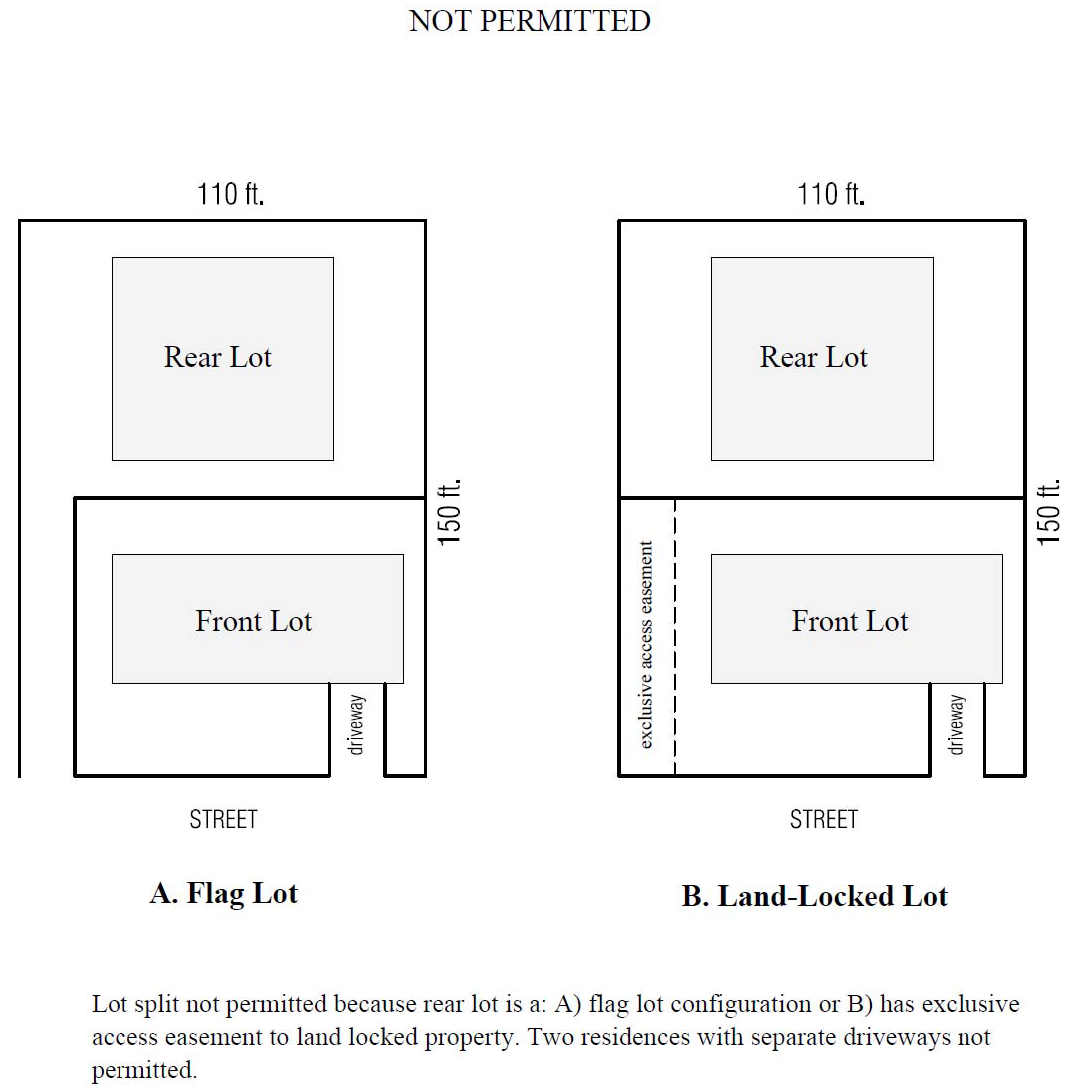
Lot Split Example Diagram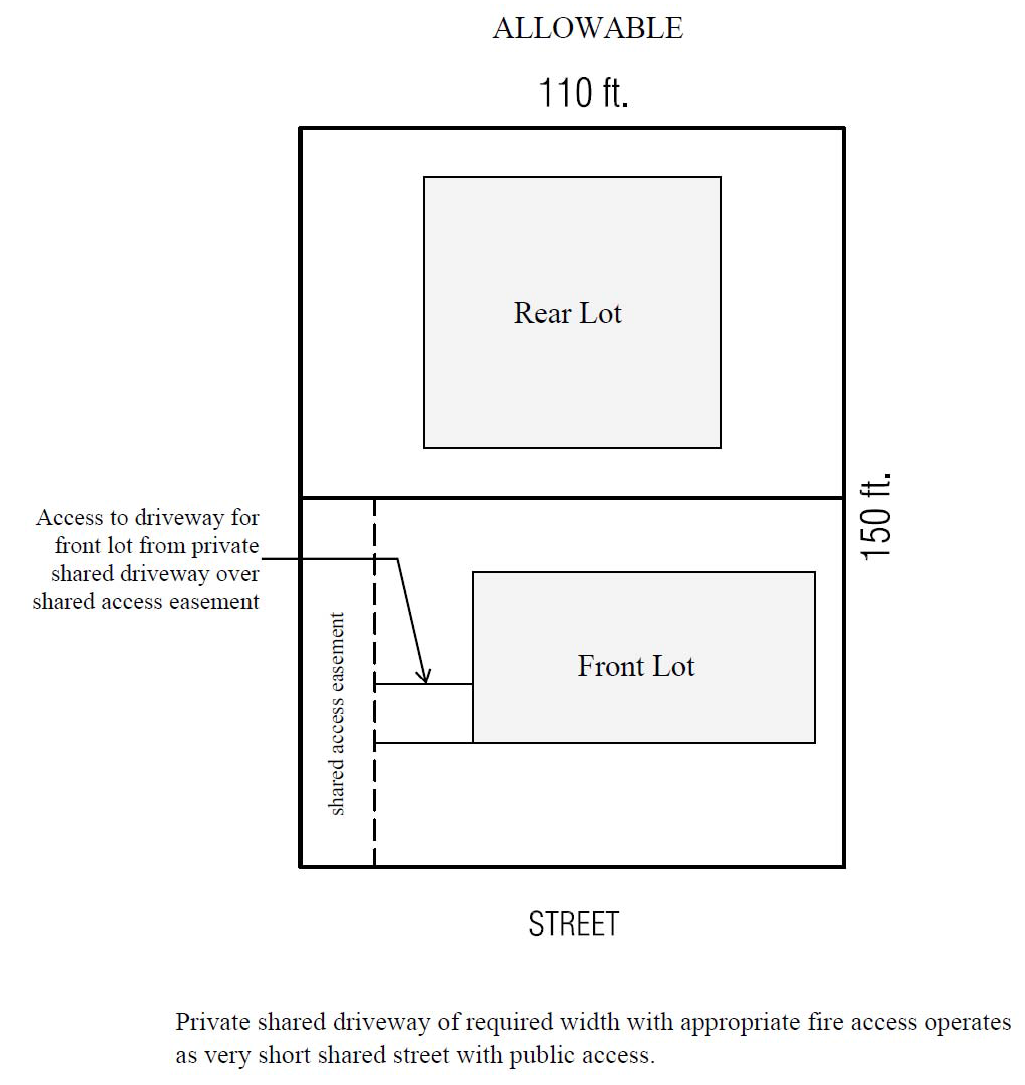
(Ord. No. 1336, § 1(Exh. A), 4-9-13; Ord. No. 1379, §§ 2, 3, 9-27-16)
Editor's note— Section 2 of Ord. No. 1379, adopted Sept. 27, 2016, changed the title of § 17.20.100 from "Newly created lots—Rear line width" to read as herein set out.
17.20.110 - Minor lot line adjustments.
Notwithstanding Section 17.20.100, a lot line adjustment may be approved by the director of planning and community preservation through a minor conditional use permit process in accordance with Section 17.60.055, provided that for each affected lot none of the (i) width at setback, (ii) average lot width, or (iii) street frontage are altered by more than ten percent.
(Ord. No. 1379, § 5, 9-27-16)
Editor's note— Section 3 of Ord. No. 1379, adopted Sept. 27, 2016, repealed former § 17.20.110, and section 5 of said ordinance enacted new provisions to read as herein set out. Former § 17.20.110 pertained to newly created lots—minimum average width, and derived from Ord. No. 1336, § 1(Exh. A), adopted April 9, 2013.
17.20.115 - Reserved.
Editor's note— Section 4 of Ord. No. 1379, adopted Sept. 27, 2016, repealed former § 17.20.115 which pertained to flag lots and exclusive access easements—prohibited, and derived from Ord. No. 1375, § 3, adopted Feb. 9, 2016.
17.20.120 - Permissible lot coverage.
All buildings in the R-1 zone, including accessory buildings and enclosed porches, shall have a maximum lot coverage of forty percent of the area of the lot, and must also be within the allowable floor area as defined in Section 17.20.125.
(Ord. No. 1336, § 1(Exh. A), 4-9-13)
17.20.121 - Landscaping and paving in front yard.
A.
Landscaping. A minimum of fifty percent of the front yard area shall be landscaped. Landscaping shall include plant materials such as trees, shrubs, vines, ground covers, flowers, and lawn, and shall exclude areas such as driveways, walkways, landings, porches, patios and similar areas.
B.
Standard Driveway Width. The standard width of a driveway serving a residential use shall be in accordance with Section 17.68 "Parking."
(Ord. No. 1336, § 1(Exh. A), 4-9-13; Ord. No. 1412, § 3(Exh. A), 5-14-19)
17.20.122 - Lighting.
All lighting of the buildings, structures, landscaping, yards, parking areas, or similar facilities shall be in compliance with the city's "Dark Sky" objectives and policies. Lighting shall be shielded and directed downward to reflect away from adjoining properties.
(Ord. No. 1413, § 2, 5-28-19)
17.20.125 - Allowable gross floor area.
A.
For lots created or reconfigured by lot line adjustment or otherwise after October 27, 2016, allowable gross floor area on a single lot shall not exceed, either by addition or new construction, the amounts indicated in the following table:
B.
For all other lots, allowable gross floor area on a single lot shall not exceed, either by addition or new construction, the amounts indicated in the following table:
*For smaller lots where the maximum building floor area allows less than one thousand square feet, a maximum one thousand square feet is permissible if all other zoning standards can be met.
C.
The calculation of allowable gross floor area shall include all areas that are considered gross floor area under Section 17.20.015 of this title.
(Ord. No. 1336, § 1(Exh. A), 4-9-13; Ord. No. 1364, § 4, 5-12-15; Ord. No. 1379, § 6, 9-27-16)
17.20.130 - Reserved.
Editor's note— Section 5 of Ord. No. 1364, adopted May 12, 2015, repealed former § 17.20.130, which pertained to minimum dwelling floor area and derived from Ord. No. 1336, § 1(Exh. A), adopted April 9, 2013.
17.20.135 - Reserved.
Editor's note— Section 6 of Ord. No. 1364, adopted May 12, 2015, repealed former § 17.20.135, which pertained to gross floor area and derived from Ord. No. 1336, § 1(Exh. A), adopted April 9, 2013.
17.20.140 - Minimum dwelling width.
No dwelling in the R-1 zone shall have a width less than fifteen feet.
(Ord. No. 1336, § 1(Exh. A), 4-9-13)
17.20.150 - Limitations on uses.
The following regulations are limitations on, and are applicable to all uses in, the R-1 zone:
A.
Vehicles.
1.
Parking of Vehicles. No person shall park any vehicle or any component thereof, for any purpose, in any front or side yard area on any lot, except in driveway areas.
2.
Repair, Dismantling or Storage of Vehicles. No person shall assemble, repair, dismantle or store any vehicle, other than as herein provided, on any part of any lot, unless such work is done:
a.
Within an enclosed building; or
b.
In an open area which is completely enclosed by view-obscuring walls, not less than six feet in height, or by exterior walls of a building or buildings.
3.
Exception. The prohibition imposed by subsection (A)(2) of this section shall not be deemed to apply to the occasional and incidental assembly or repair of vehicles owned by the persons in possession of the premises on which such takes place; provided, that a disabled vehicle which is being repaired or assembled shall not be stored except as provided in subsection (A)(2) of this section for a period longer than seven consecutive days within any thirty-day period.
B.
Tents and canopies pursuant to the provisions of Section 15.04.050 of Title 15.
(Ord. No. 1336, § 1(Exh. A), 4-9-13)
17.20.160 - Single-family residence construction requirements for pre-fabricated homes.
Pre-fabricated (i.e. modular) homes in the R-1 zone shall be subject to the following standards:
A.
Every single-family dwelling shall have exterior walls of brick, wood, stucco, metal, concrete or other similar material. Reflective, roll-formed type metal siding is prohibited.
B.
Landscaping. All open areas visible from a street shall be appropriately landscaped. Such landscaping may include grass, flowers, shrubs, trees and ground cover. All landscaped areas and materials shall be regularly and properly maintained.
(Ord. No. 1336, § 1(Exh. A), 4-9-13)
17.20.170 - Development or construction site standards.
The following standards apply to development or construction in the R-1 zone:
A.
Construction sites shall be maintained free and clear of attractive nuisances and debris and/or fences as determined by the building inspector.
B.
The residential character of neighborhood to be maintained during construction as to not to become an attractive or public nuisance, due to storage of material, parking or activities of the contractor employees.
C.
Temporary services on-site, shall be ten feet behind the property line, i.e., portable toilet facilities.
D.
Rubbish and refuse service with city contractor shall be required at the time the building permit is issued. Service may be weekly pickup service if accessible by a public street, or by scout or commercial service as otherwise authorized.
E.
Contractors, subcontractors shall be required to have a completed subcontractors list for all services and trades and business licenses obtained prior to any construction or request for inspection. Where work for which a permit is required wherein the work has started or has proceeded prior to obtaining said permits or business licenses, the permit fees shall be doubled pursuant to Chapter 15.04 of this code.
F.
Use of the public right-of-way for storage, work, staging, or off-loading requires a permit and approval in advance of any activity pursuant to Chapter 12.12 of this code.
G.
The public right-of-way, if improved and in place, or at the entry to the project from an existing street, shall be cleaned each evening by the contractor. Clean up shall include, but not be limited to, streets, roadways, gutters, sidewalks, and parkways.
H.
Violation of subsections (A) through (G) of this section may result in the issuance of a stop work order by the building inspector. Work so halted shall have the right of due notice and an administrative hearing upon request.
(Ord. No. 1336, § 1(Exh. A), 4-9-13)

