
Sierra Madre City Zoning Code
CHAPTER 17
68 - PARKING
Sections:
17.68.010 - Required parking spaces.
The standards hereinafter set forth shall be complied with at the time of construction of either new facilities or additions to existing facilities. In the case of additions to existing facilities, the increased parking requirement shall be based only on the area of the addition. Parking spaces required hereby shall be continuously maintained as parking spaces and shall not be used for other purposes.
(Ord. 1119B § 5, 1995: prior code § 9650)
(Ord. No. 1432, § 2(Exh. A), 10-27-20)
17.68.015 - Destruction of structure nonconforming due to parking.
A commercial building nonconforming due to parking that is involuntarily damaged (as such term is defined in Section 17.56.070(B)), may be reconstructed without providing additional parking provided that reconstruction is permitted by the building code and that a building permit for the reconstruction is issued within twenty-four months after the date of involuntary damage (as such term is defined in Section 17.56.070(B)) and the construction is diligently pursued to completion.
(Ord. 1119B § 6, 1995)
(Ord. No. 1432, § 2(Exh. A), 10-27-20)
17.68.020 - Parking spaces required.
A.
The number of off-street parking spaces required for residential uses shall be as follows:
1.
For each dwelling unit with a floor area (not counting parking area) up to one thousand square feet: one parking space.
2.
For each dwelling unit with a floor area (not counting parking area) greater than one thousand and up to three thousand five hundred square feet: two parking spaces.
3.
For each dwelling unit with a floor area (not counting parking area) greater than three thousand five hundred square feet: three parking spaces.
4.
For multi-family projects, guest parking shall be required at a ratio of one parking space per five dwelling units, rounded to the nearest whole number; provided however, that no guest parking shall be required for the first four dwelling units in each multi-family project. For example, a multi-family project with fifteen dwelling units would require two guest parking spaces (as the project would have eleven dwelling units subject to the guest parking requirement, multiplied by 0.2 equals 2.2, which would be rounded down to two).
5.
For each affordable unit, the number of required parking spaces shall be one fewer per dwelling unit than required by subsections 1 through 3 above, and no guest parking shall be required for a multi-family project that includes one or more affordable units.
6.
Parking for second units shall be provided in accordance with Chapter 17.22.
7.
Required parking for group living facilities subject to a conditional use permit shall be determined by the planning commission. In addition to other findings required in order to approve any such application, the planning commission shall also find the proposed group living facility will not unreasonably overload street parking or public parking facilities nor create a nuisance.
8.
Emergency shelters shall accommodate all staff working in the emergency shelter. One parking space for each employee or volunteer on duty, plus one space for every vehicle operated by the facility, provided that the standards do not require more parking for emergency shelters than other residential or commercial uses within the same zone.
B.
The number of off-street parking spaces required for non-residential uses shall be as follows:
1.
For new floor area, either by addition or new construction, (i) three parking spaces per one thousand square feet of prime storefront area, and (ii) one and one-half parking spaces per one thousand square feet of floor area outside the prime storefront area.
2.
No new parking shall be required for uses occupying an existing structure or portion thereof.
3.
Required parking for institutional uses subject to a conditional use permit or master plan shall be determined by the planning commission. In addition to other findings required in order to approve any such application, the planning commission shall also find the proposed institutional use will not unreasonably overload street parking or public parking facilities nor create a nuisance. Required parking for institutional uses that do not require a conditional use permit nor master plan shall be determined in accordance with subsections 1 and 2 above.
C.
In the following circumstances, a use that provides fewer than the number of off-street parking spaces required above or otherwise by this code may nonetheless be approved with a minor conditional use permit in accordance with Chapter 17.60 upon the additional finding by the reviewing authority that such parking deficit will not unreasonably overload street parking or public parking facilities nor create a nuisance:
1.
A mixed-use project with uses that demand parking at different times or days, such as office and restaurant, retail and residential guest parking, or church and mid-week uses;
2.
Shared parking arrangements similar to above, but involving separate properties located within five hundred feet of each other, provided that such arrangement is memorialized in a written agreement satisfactory to the reviewing authority and city attorney, which agreement shall be recorded if required by the city attorney;
3.
Live/work or similar situations when a business operator or employee lives at the premises, and requiring separate parking for such person's commercial and residential uses would be redundant;
4.
Sidewalk or outdoor dining that enhances the downtown's dining and shopping experience and encourages pedestrian engagement;
5.
Projects that incorporate specialty retail, including stores selling products of local artisans and craftsmen, and other uses encouraged by the general plan;
6.
Adaptive reuse of existing structures, especially those that have historic significance;
7.
Projects that incorporate uses with significantly fewer occupants or employees than typical, such as warehouses, storage buildings, or electrical stations; and
8.
Other unique situations where requiring strict compliance with parking requirements would be inequitable.
In order to support the above finding, the reviewing authority may require a parking demand study prepared at the applicant's cost by an independent licensed traffic engineer and/or other reasonable materials and evidence.
D.
In certain other circumstances, Section 17.56.090(B) provides relief from required parking in connection with the reuse of existing structures and residential additions.
(Ord. 1119B § 7, 1995; prior code § 9651)
(Ord. No. 1336, § 2, 4-9-13; Ord. No. 1441, § 6(Exh. B), 5-11-21)
17.68.030 - Reserved.
Editor's note— Ord. No. 1432, § 2(Exh. A), adopted Oct. 27, 2020, repealed § 17.68.030 which pertained to parking requirements for uses not specified, and derived from prior code § 9652.
17.68.040 - Reserved.
Editor's note— Ord. No. 1432, § 2(Exh. A), adopted Oct. 27, 2020, repealed § 17.68.040 which pertained to parking provisions may be waived by commission, and derived from prior code § 9653.
17.68.045 - Reserved.
Editor's note— Ord. No. 1432, § 2(Exh. A), adopted Oct. 27, 2020, repealed § 17.68.045 which pertained to shared parking provisions, and derived from Ord. 1119B § 9, adopted in 1995.
17.68.050 - Reserved.
Editor's note— Ord. No. 1318, § 1, adopted Feb. 8, 2011, repealed § 17.68.050, which pertained to off-street parking districts derived from Prior Code § 9654; and Ord. 1119B § 8, adopted 1995.
17.68.055 - Reserved.
Editor's note— Ord. No. 1318, § 1, adopted Feb. 8, 2011, repealed § 17.68.055, which pertained to temporary suspension of § 17.68.050 and derived from Ord. 12228U § 1, adopted 2005.
17.68.060 - General requirements.
The following general requirements shall apply:
A.
Vehicular Access. There shall be vehicular access from a dedicated and improved street or alley to required off-street parking facilities on the property where the off-street parking facilities are located, and the design of such access shall be approved by the city engineer to withstand traffic commensurate with usage. When planning commission review of an application is required, the planning commission, by conditions established at the time of such review shall specify the location and number of means of ingress and egress to property.
B.
Location. Off-street parking facilities shall be located as hereinafter specified, and further provided that when a parking lot is located on a site other than that on which the facility being served is located, an agreement approved by the city attorney reserving the site for parking purposes shall be recorded in the office of the Los Angeles County Recorder. Where a distance is specified, such distance shall be the walking distance measured from the nearest point of the building that such facility is required to serve:
1.
For single-family dwellings, parking facilities shall be located on the same lot or building site as the buildings they are required to serve.
2.
For duplexes and multi-family dwellings, parking facilities for residents shall be located on the same or immediately adjacent lot or building site as the buildings they are required to serve, and guest parking shall be located not more than five hundred feet therefrom. Uncovered parking areas (including those with unwalled carports) should be screened and otherwise incorporate attractive and appropriate landscaping.
3.
For group living facilities subject to a conditional use permit, parking facilities shall be located and designed as determined by the planning commission.
4.
For uses other than those specified above, parking facilities shall be located not more than five hundred feet from the building they are required to serve. Parking for non-residential uses should generally be located behind or under buildings, rather than in the front yard. Above-ground parking areas should be screened and otherwise incorporate attractive and appropriate landscaping. In addition to street access, businesses should provide pedestrian-friendly access from parking areas. Where possible, projects are encouraged to improve pedestrian access from public parking areas to commercial uses, particularly access from the parking lot on Mariposa Avenue to the commercial uses on the south side of Sierra Madre Boulevard, and to encourage the use of available public parking.
C.
Mixed Occupancies in a Building. In the case of mixed uses in a building or on a lot, the total requirements for the various uses are computed separately. Off-street parking facilities for one use shall not be considered as providing required parking facilities for any other use except as specified in Section 17.68.020.
D.
Encouraged elements. In addition to auto parking provided and designed as required hereunder, the following parking-related items are encouraged: bicycle parking, other trip reduction programs, permeable paving and other water retention features, electric charging stations, short-term standing for delivery/car-share services, other car-sharing facilities, connecting pedestrian access ways and signage, and bus stop improvements. The reviewing authority may condition approval of requests for reduced parking pursuant to Section 17.68.020(C) on the provision of such encouraged items to the extent the reviewing authority finds that doing so is necessary to make the additional finding required under Section 17.68.020(C).
E.
Common Facilities. Common parking facilities may be provided in lieu of the individual requirements contained herein, but such facilities shall be approved by the planning commission as to size, shape and relationship to business sites to be served, provided the total of such off-street parking spaces, when used together, shall not be less than sum of the various uses computed separately except as specified in Section 17.68.020.
(Prior code § 9655)
(Ord. No. 1432, § 2(Exh. A), 10-27-20)
17.68.070 - Standards of development—Generally.
The development standards set out in the following sections shall be applicable to all newly created parking facilities and to facilities which are being substantially improved or altered.
(Prior code § 9656 (part))
17.68.080 - Design.
A.
Design and development of all parking facilities shall also conform to the parking lot development design standards on file in the office of the city engineer. Parking facilities shall also have the following minimum dimensions:
1.
Each surface lot parking space: eighteen by nine feet (or eighteen by ten feet abutting a building, wall, or other obstruction);
2.
One-car garage: interior clearance of twenty by ten feet;
3.
Two-car garage: interior clearance of twenty by twenty feet;
4.
Three-car garage: interior clearance of twenty by thirty feet; and
5.
Width of parking lot drive aisle perpendicular to parking stalls: twenty feet.
B.
Unless otherwise provided in this code, no parking space either required or otherwise shall be located in any required front yard or side yard. Covered spaces shall conform to yard requirements for accessory buildings.
C.
Subject to subsections (D) and (N) below and other applicable safety requirements and standards, surface parking shall be screened by some combination of walls, plantings or earthworks appropriate in size and design to the setting. Special care should be afforded where large or commercial parking areas abut residential zones.
D.
Whenever a wall is located within ten feet of a street or alley or would interfere with safe egress from said property, that portion of the wall shall not exceed three feet in height.
E.
Except for parking facilities with less than six spaces, parking spaces shall be arranged so that vehicles need not back onto or across any public sidewalk for ingress to, or egress from, said spaces.
F.
All parking areas subject to vehicular traffic shall be paved with an all-weather surface, such as brick, special stones, asphaltic or concrete pavement. Permeable/pervious surfaces are encouraged.
G.
All parking areas shall be graded and drained to prevent the collection of water. Water from parking areas containing six or more parking spaces which drain to the street must be collected in a catch basin of adequate size and drained under the sidewalk and through the curb in a manner to be approved by the city engineer. Where practicable, catch basins should provide for water infiltration or reuse of captured rainwater.
H.
The planned circulation of vehicles in parking areas shall be arranged to permit vehicles to move into and out of the parking area without backing on to a public right-of-way. Parking areas may use a public alley for maneuvering provided sufficient aisle clearance to the opposite side of the alley is maintained.
I.
Circulation within the parking areas shall not require re-entering a public street to reach another portion of the same parking facility. Connection shall be provided between adjacent aisles within a parking facility.
J.
All circulation within a parking area must be adequately marked and posted at all times with signs and painted arrows together with any other necessary directional device to indicate one way travel and direction to exit.
K.
Pedestrian access, having a minimum clear width of five feet, shall be provided between a required parking area and a normal entrance to any structure for which the parking is furnished. Said access shall be as direct as reasonably practical.
L.
All pedestrian walkways shall be constructed of material equal to concrete or better in quality, such as brick, exposed and polished aggregate and inlaid stone. Timber inlays are prohibited.
M.
Appropriate entrance, exit and directional signs shall be posted and maintained.
N.
Each entrance and exit to the parking lot shall be constructed and maintained so that any vehicle entering or leaving the parking lot shall be clearly visible at a distance of not less than ten feet to a person approaching such entrance or exit on any pedestrian walk or foot path.
O.
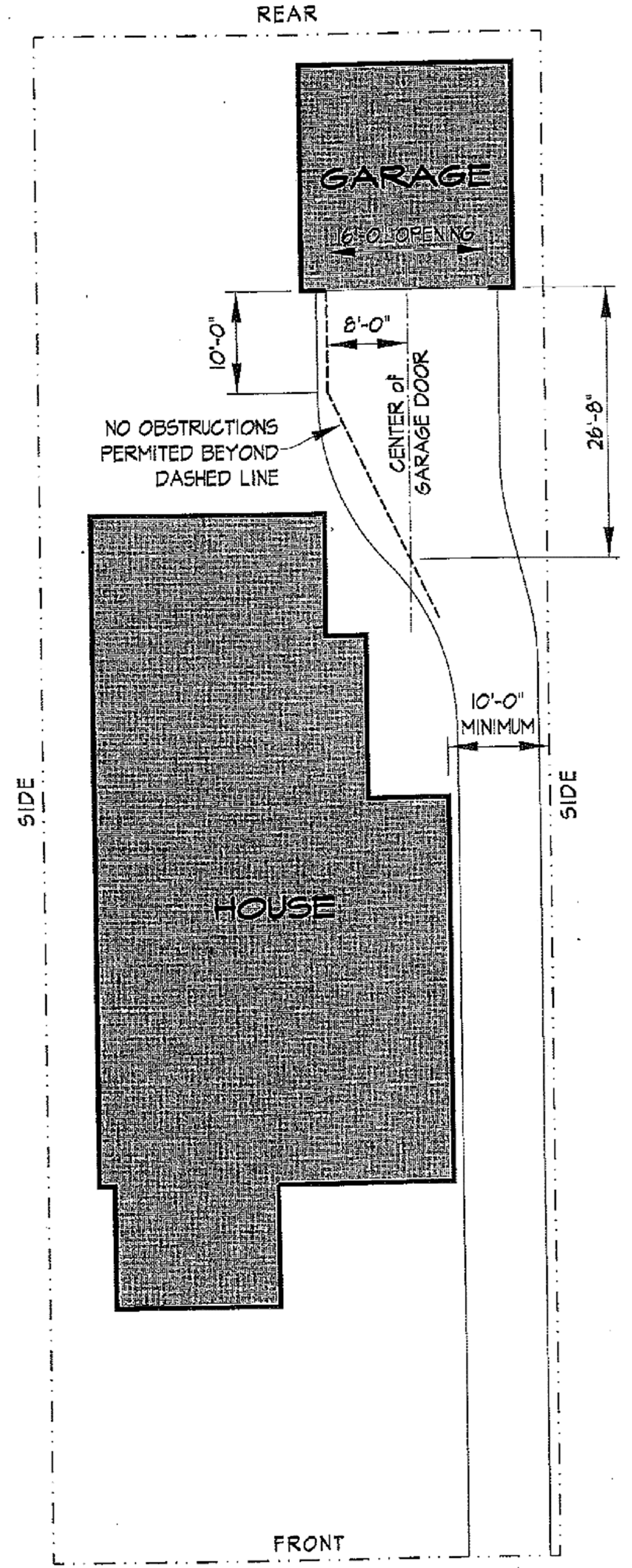
Properties subject to the R-1 zoning standards: The planned circulation of vehicles in parking areas shall be arranged to permit vehicles to move into and out of the parking area. For residential parking spaces, a minimum twenty feet of unobstructed back-up distance shall be provided; the back-up distance shall include the combination of private property and public right-of-way (street or alley) to allow for sufficient maneuvering. For garages that are located at the rear of the lot, minimum back-up clearance shall be provided as shown on Exhibit A.
P.
Unless otherwise noted in this chapter, a tandem parking arrangement shall not satisfy the required off-street parking requirements for properties subject to the R-1 zoning standards.
Q.
Subject to fire code and other applicable health and safety requirements and standards, the standard width of a driveway serving residential uses in the R-1 and R-2 zones shall be as follows: (i) the minimum width for a driveway serving a garage at the rear of a lot shall be not less than ten feet uniform, unobstructed width; (ii) the maximum width for a driveway serving a one-car garage shall be twelve feet; and (iii) the maximum width for a driveway serving a two-car garage shall be twenty feet.
(Prior code § 9656(a))
(Ord. No. 1336, § 3, 4-9-13; Ord. No. 1412, §§ 9, 10(Exh. A), 5-14-19; Ord. No. 1432, § 2(Exh. A), 10-27-20; Ord. No. 1466, § 91, 3-28-23)
17.68.090 - Planting.
Parking areas shall incorporate attractive and appropriate landscaping. To the extent practicable, planting in parking lots shall conform with the following guidelines:
A.
Where more than twelve automobile spaces exist or are required on a lot or parcel of land, no less than three percent of the interior lot area shall be landscaped. At least one tree for every ten spaces or major fraction thereof shall be included in the development of landscaping. Planting along the perimeter of a parking lot will not be considered as a part of the three percent interior landscaping. All open areas between any wall and the property line shall be permanently landscaped and maintained.
B.
Where driveways or parking areas abut private property there shall be provided a landscaped border three feet in width and in addition there shall be provided therein large trees spaced fifty feet on center.
C.
Landscaping should adhere to the city's adopted water efficient landscape standards pursuant to Chapter 15.60, including, as appropriate, incorporating drought-tolerant plants, water-efficient irrigation systems, and water capture/infiltration features.
D.
A five-foot minimum width landscaped planter bed is required on all sides of the parking lot bounded by public street or alley, except those areas devoted to walks or driveways running perpendicular to said street or alley.
E.
Planting areas should be distributed throughout the entire lot as evenly as possible. Any plot plans showing the three percent landscaping in one or two large planting beds or concentrated on only one portion of the parking lot shall not be acceptable. Variations from this pattern may be granted when a different pattern would result in an overall aesthetic improvement of the project. Innovation in design of the parking spaces shall be used for planting purposes.
F.
An irrigation system shall be installed in all landscaped areas to insure proper maintenance of planting and landscaping. Hose bibs within one hundred feet of all landscaped areas may be substituted for an irrigation system.
G.
Where trees already exist on the property, the design should make the best use of this growth and shade. Such trees shall be protected by a tree well with a diameter sufficient to insure their continued growth. The three percent interior lot area landscaping standard included in this section may be reduced to compensate for the retention of such trees.
H.
Wherever a center divider separates parking stalls facing each other, tree wells shall be established not more than fifty feet apart for large trees nor more than thirty feet for small and medium size trees.
I.
Hose bibs shall be located in not more than two hundred-foot intervals to allow for hose watering reinforcement to the system.
(Prior code § 9656(b))
(Ord. No. 1432, § 2(Exh. A), 10-27-20)
17.68.100 - Maintenance.
A.
All planting shall be permanently and regularly maintained free of debris and shall be maintained in accordance with a program outlined and accepted by the planning commission.
B.
All parking areas shall be kept clean and free of dust, mud or trash.
C.
All outdoor trash, garbage and refuse storage areas shall be screened on all sides from public view.
(Prior code § 9656(c))
(Ord. No. 1432, § 2(Exh. A), 10-27-20)
17.68.110 - Lighting.
A.
All commercial or professional facility parking areas used after dark, containing six or more spaces, shall have ample lighting.
B.
No lighting standards shall exceed the height of twelve feet to the bottom of the reflector. Lighting shall be hooded and so arranged and controlled so as not to cause a nuisance either to street traffic or to the living environment, and shielded and directed away from adjoining properties and the night sky, and shall otherwise comply with the with the city's "Dark Sky" program and the relevant provisions of the general plan.
(Prior code § 9656(d))
(Ord. No. 1432, § 2(Exh. A), 10-27-20)
17.68.120 - Reserved.
Editor's note— Ord. No. 1432, § 2(Exh. A), adopted Oct. 27, 2020, repealed § 17.68.120, which pertained to permissible alternates, and derived from prior code § 9656(e).
17.68.130 - Parking lot permit.
To insure compliance with the standards set out in this section and established traffic engineering practices, anyone constructing or substantially improving or altering a parking lot containing five stalls or more, whether separate or in conjunction with a structure, shall obtain a parking lot permit from the director of planning. Prior to issuance of a parking lot permit, the following administrative procedures in plot plan requirements shall be met:
A.
Submit plot plan containing:
1.
Owner's name, current address and phone number;
2.
Scale of the plot plan, not smaller than one inch equals twenty feet;
3.
North point at top of page;
4.
All adjacent streets, alleys, buildings, parking areas, landscaping and walls;
5.
Sidewalks, curbs, gutters, driveways, and street trees;
6.
Location, dimension and height of buildings and structures and number of stores or feet in total floor area;
7.
Complete dimensional parking lot layout;
8.
All parking spaces, wheel bumpers and directional arrows clearly marked;
9.
The type and thickness of the paving for parking areas and walkways;
10.
A complete grading and drainage plan;
11.
Proposed lighting system;
12.
The botanical names and common names of the plants and trees to be used and the size, quantity, and spacing of each tree, plant or shrub to be planted;
13.
A satisfactory method of irrigation for all planted areas. This may be manual or automatic irrigation system but consideration of laying out the watering system shall be given to water pressure, pipe sizes, types of irrigation, sprinkler heads, hose bibs, and volume of water required for areas to be irrigated;
14.
All industrial or commercial plot plans shall include maximum number of employees on largest shift, number and type of company vehicles and loading docks and doors on buildings;
15.
Landscape and irrigation plans must be prepared and signed by a registered landscape architect or qualified landscape contractor;
16.
Submit in detail a complete schedule of maintenance of all landscaping, i.e., state how many days of the month a gardener will attend to landscaping;
17.
Submit a schedule of parking lot surface maintenance including types of sweeping equipment to be used.
B.
Administrative regulations and information:
1.
The fee for a parking lot permit is set by city council resolution.
2.
A parking lot permit may be approved by the reviewing authority of the associated land use application, or if none, by the planning director.
3.
Staff level decisions may be appealed to the planning commission.
4.
Diagrams of typical parking lot landscaping layouts are on file in the office of the city planner.
(Prior code § 9656(f))
(Ord. No. 1432, § 2(Exh. A), 10-27-20)
17.68.140 - Temporary parking lots.
Permits for temporary parking lots which need not meet the full standards for permanent lots may be issued and renewed on a six-month basis to cover a period not to exceed three years; provided, that a plot plan is submitted as required above; and provided, that the facility is surfaced and continuously maintained dirt, dust and weed free; that existing plant and materials are maintained; and that a bond in an amount to be determined by the city engineer be posted to insure the full compliance of the lot to the standards of this section or its removal at the end of the temporary permit period.
(Prior code § 9656(g))
17.68.150 - Relation to other zoning provisions.
This chapter is intended to be complementary to the other parking provisions of this title, and the provisions thereof and hereof are meant to be read and interpreted together; provided however, that to the extent of any inconsistency (i) regarding the number of parking spaces required, Section 17.68.020 shall control, and (ii) regarding provisions other than the number of parking spaces required (such as enclosure, lighting, landscaping, or screening), the provisions of the underlying zone shall control over this chapter.
(Ord. No. 1432, § 2(Exh. A), 10-27-20)
Editor's note— Ord. No. 1432, § 2(Exh. A), adopted Oct. 27, 2020, changed the title of § 17.68.150 from "Comprehensive planned facilities" to read as herein set out.
EXHIBIT "A"
MINIMUM BACKUP DISTANCE FOR GARAGES AT REAR OF LOT
(Ord. No. 1432, § 2(Exh. A), 10-27-20)

