
Sierra Madre City Zoning Code
CHAPTER 17
30 - R-C RESIDENTIAL CANYON ZONE
Sections:
17.30.010 - Purpose.
The purposes of the city council in enacting the provisions of this chapter are to:
A.
Facilitate residential canyon preservation through single-family development standards as set forth in this chapter;
B.
Maintain the environmental equilibrium unique to the residential canyon consistent with the aesthetic of its rustic and historic character; and
C.
Establish dwelling size, lot coverage, building massing, and floor area ratios which are consistent with the smaller homes and lots in the canyon area.
(Ord. No. 1313, § 2(Exh. B), 3-22-11)
17.30.020 - Creation of residential canyon zone.
The residential canyon zone is hereby created. The designation on the city's official zoning map for the canyon zone shall be R-C.
(Ord. No. 1313, § 2(Exh. B), 3-22-11)
17.30.030 - Permitted uses.
No person shall use, nor shall property owners permit, the use of any property or lot located in any R-C zone for any use other than the following:
A.
One-family dwellings of a permanent character; not more than one per lot; placed in a permanent location, containing not more than one kitchen; used by but one family; and not used for commercial purposes other than home occupations or as small family day care homes.
B.
Home occupations, pursuant to the provisions of Chapter 17.85 (Home Occupations).
C.
Public utility facilities, for which either no building permit is required for the facility, or which is authorized by a city-granted franchise.
D.
Second units, as provided in Chapter 17.22 (Second Units) except that references in Chapter 17.22 to R-1 shall include references to R-C, and the reference in Section 17.22.050 (Allowable floor area) to Section 17.20.125 (Allowable floor area) shall mean Section 17.30.130 (Permissible floor area).
E.
Transitional and supportive housing.
F.
Modular and manufactured homes as a type of dwelling, one per dwelling unit.
G.
Family daycare homes, one per dwelling unit.
(Ord. No. 1313, § 2(Exh. B), 3-22-11; Ord. No. 1352, § 7, 2-11-14; Ord. No. 1441, §§ 2—4(Exh. B), 5-11-21)
17.30.040 - Conditionally-permitted uses.
Notwithstanding Section 17.60.030 (Conditional use permits - When required) to the contrary, the following are the only conditionally permitted uses:
A.
Swimming Pools. Swimming pools, hot tubs, spas and similar recreational facilities, subject to the approval of a minor conditional use permit pursuant to Section 17.60.055 (Minor conditional use permit). Swimming pools, hot tubs, spas and similar recreational facilities shall be located no closer than five feet to the property lines.
B.
Utilities. Public utilities or utilities operated by mutual agencies consisting of water wells, or power boosters with the necessary buildings, apparatus, or appurtenances incident thereto.
C.
Wireless communications facilities, as provided in Chapter 17.93 (Standards and Criteria for Wireless Communications Facilities).
(Ord. No. 1313, § 2(Exh. B), 3-22-11; Ord. No. 1389, Exh. A, § 16, 7-11-17; Ord. No. 1441, § 2(Exh. B), 5-11-21)
17.30.045 - Design review permit.
The following projects shall be allowed subject to the granting of a design review permit pursuant to the provisions of Chapter 17.60 of this title:
A.
Encroaching Second Stories. A second story addition to a single-family house which does not meet setback requirements contained herein, but does align with existing side yard setbacks.
B.
Three Thousand Square Feet. Floor areas that exceed three thousand square feet on a single lot.
(Ord. No. 1389, Exh. A, § 17, 7-11-17)
17.30.050 - Standards of development—Generally.
All lots and structures in the R-C zone shall comply with the standards of development set forth in this chapter.
(Ord. No. 1313, § 2(Exh. B), 3-22-11)
17.30.060 - Height.
A.
R-1 Height Standards Apply. The standards set forth in Section 17.20.040 (Height) of Chapter 17.20 (R-1 One-Family Residential Zone) shall apply throughout the R-C zone.
B.
Angle Plane Height. No portion of a building, except a chimney, shall exceed the height of a forty-five degree plane drawn from a height of ten feet above existing natural or pre-existing grade at the side lot line boundaries of the lot (see Diagram A). Roof eaves projecting a maximum four feet out from the vertical plane of the exterior wall surface are exempted. Any other encroachments exceeding the angle plane height are allowed only if authorized by an administrative design review issued pursuant to Chapter 17.60. This section shall not prevent the applicability of Section 17.48.120 (Permissible projection of structures into yards).
Diagram A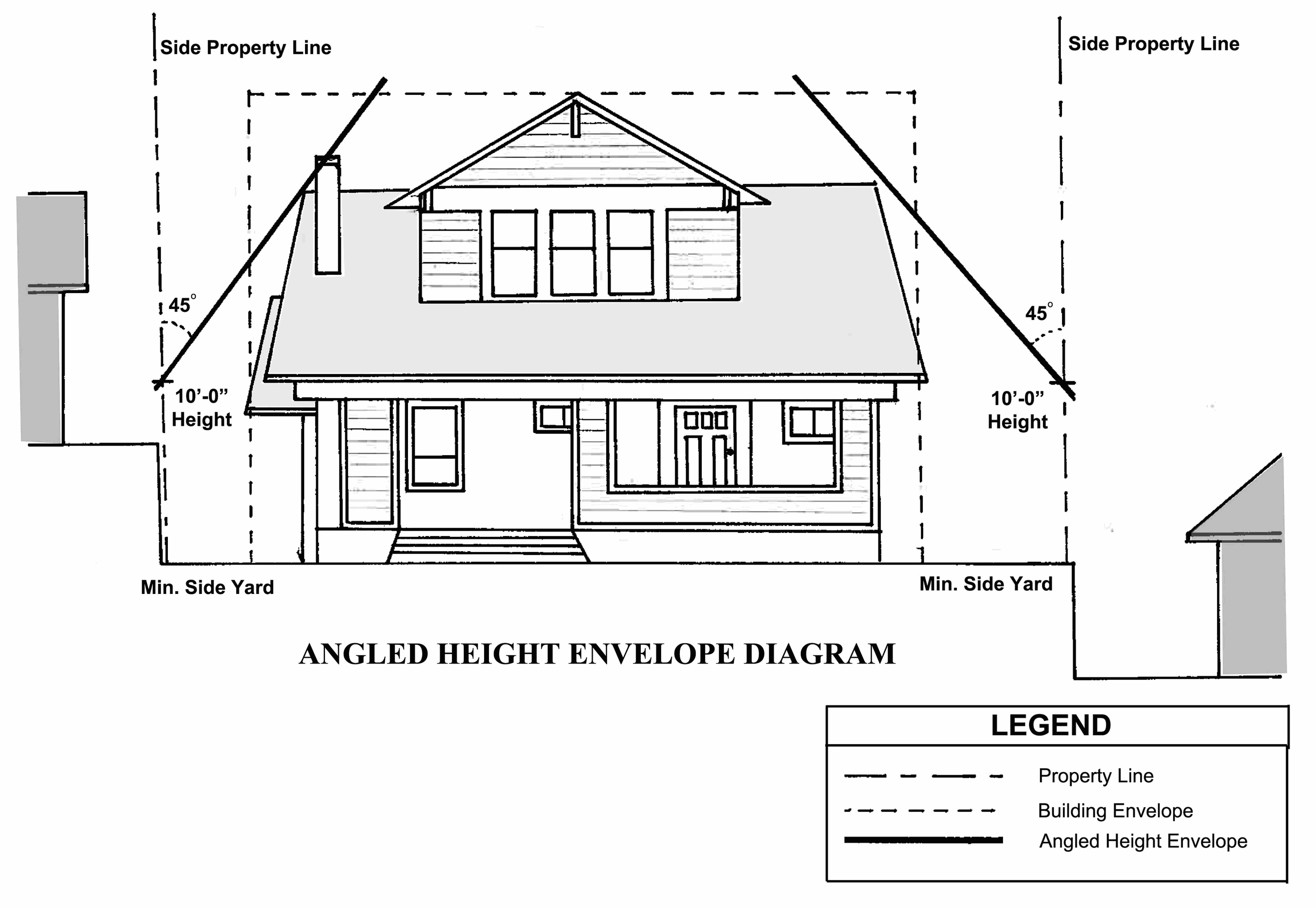
(Ord. No. 1313, § 2(Exh. B), 3-22-11; Ord. No. 1389, Exh. A, § 18, 7-11-17)
17.30.070 - Setbacks for primary structures.
The following development standards apply to primary structures.
A.
Front and Rear Setbacks.
1.
Front and Rear Setbacks. Each lot shall have a minimum combined front and rear yard setback of thirty-five feet. The front yard setback must be at least fifteen feet. The rear yard setback must be at least ten feet, unless an administrative design review permit is obtained, in which case the minimum required setback shall be as stated in the administrative design review permit, which amount shall be no less than five feet.
2.
Projections into the Front Yard Setback. Projections into the required front yards may occur as follows:
i.
Porches. A porch on the ground floor that is covered by a solid roof or similar structural feature, attached to the primary residence, and is not enclosed by vertical surfaces between the heights of three feet and seven feet, with the exception of posts and building face or faces to which the porch is attached, may encroach a maximum of five feet into the required front yard setback if the encroachment is not closer than ten feet to the front property line.
ii.
Balconies. A balcony may project into the required front yard setback a maximum of forty-eight inches if a deed restriction that meets the approval of the city attorney is recorded on the title of the parcel to restrict owners from enclosing the balcony unless the enclosure would not exceed the maximum building floor area set forth in Section 17.30.130.
B.
Side Yard. The following side yard setback standards shall apply to all R-C zoned property:
1.
Lots or Parcels of Sixty Feet or Less in Width. Lots or parcels measuring sixty feet or less, as defined in this title, shall have a minimum side yard setback of not less than five feet, on each side. However, in no case shall a structure exceed a total width of forty feet.
2.
Lots or Parcels Greater than Sixty Feet in Width. Except as otherwise provided in this chapter, lots or parcels measuring greater than sixty feet in width, as defined in this title, shall have a cumulative side yard setback dimension (both side yard setbacks combined) of not less than thirty percent of the lot width of the lot or parcel, with a minimum required side yard setback of any one side of not less than five feet or ten percent of the lot or parcel width, whichever is greater, up to a maximum side yard setback requirement of ten feet on that side.
3.
Reverse Corner Lots or Parcels. Lots or parcels which have a "reverse corner" configuration, as defined in this title, shall have an interior side yard setback as set forth in subsection (B)(1) of this section. The "reverse corner" lot or parcel shall have a minimum fifteen foot setback adjacent to the secondary street frontage.
4.
Attached Open Structures. Open single story attached structures, such as porte cocheres, patio covers and similar structures which are attached to the primary structure may encroach into the required cumulative side yard setback dimension, as set forth in subsection (B)(1)(b) of this section, where the attached open structure is located no closer to the side yard property line than a minimum of five feet or ten percent of the width of the lot or parcel, whichever is greater.
(Ord. No. 1313, § 2(Exh. B), 3-22-11; Ord. No. 1389, Exh. A, § 19, 7-11-17)
17.30.080 - Setbacks for detached accessory structures.
A.
Detached Accessory Structures. Single-story detached accessory structures, such as gazebos, workshops, storage sheds and similar uses which measure six hundred square feet or less, and with a maximum height of fifteen feet from natural or pre-existing grade to top of ridge as follows:
1.
Administrative Design Review Permit. May be located five feet from the side and/or rear property lines subject to the approval of an administrative design review permit pursuant to Chapter 17.60.
2.
Permitted. When in conformance with the provisions of Section 17.30.070 (Setbacks for primary structures). Detached accessory structures which exceed six hundred square feet and/or are two stories or greater shall conform to the provisions of Section 17.30.070 (Setbacks for primary structures).
Accessory structure standards in the RC zone shall be pursuant to provisions in Section 17.20.060 in Chapter 17.20, R-1 One-Family Residential Zone.
Setbacks for detached garages and carports are subject to the provisions in Section 17.30.200(C), (D), and (E).
(Ord. No. 1313, § 2(Exh. B), 3-22-11; Ord. No. 1389, Exh. A, § 20, 7-11-17)
17.30.090 - Walls and fences.
Walls and fences shall be regulated pursuant to Chapter 17.48.130.
(Ord. No. 1313, § 2(Exh. B), 3-22-11)
17.30.100 - Lot area.
The minimum required lot area in the R-C zone shall be fifteen thousand square feet. Lot area per dwelling unit in the R-C zone shall be not less than the minimum required lot area. However, this provision shall not prohibit enlarging an existing lot that is less than fifteen thousand square feet by lot merger, lot line adjustment or other action, so long as the action does not increase the degree of non-conformity of any lot.
(Ord. No. 1313, § 2(Exh. B), 3-22-11)
17.30.110 - Newly created lots—Minimum widths.
Every lot created in the R-C zone shall have a width at the rear of a twenty-five foot front yard setback of not less than seventy feet. Each lot in the R-C zone shall have an average lot width of sixty feet.
(Ord. No. 1313, § 2(Exh. B), 3-22-11)
17.30.120 - Permissible lot coverage.
All buildings in the R-C zone, including accessory buildings, garages, guest houses, porches, carports, decks, patios, bridges, balconies, barns, gazebos, sheds and other similar structures, and parking pads, which are covered by solid roof, shall result in a maximum lot coverage of fifty percent of the area of the lot. By way of example, for a traditional two story house, only the extent of the roof plan area counts toward lot coverage.
(Ord. No. 1313, § 2(Exh. B), 3-22-11)
17.30.130 - Building floor area.
A.
"Floor area" means the sum of all horizontal areas of floors covered by solid roof including first and second floors, attic spaces over seven feet six inches in height, basements, lofts, guest houses, garages, carports, patios, porches, bridges, balconies, barns, gazebos, and raised decks which are higher than seven feet six inches from natural or pre-existing grade as measured from the perimeter of the structure. Further, the area of interior spaces over sixteen feet in height shall be counted as double the floor area. The following shall not be computed towards floor area:
1.
Roof eaves up to four feet in projection.
2.
Basement areas that are entirely submerged below pre-existing grade.
3.
Attic areas that are seven feet six inches or less in height. Attic ceilings may exceed seven feet six inches in height provided that structural ties less than seven feet six inches in height are installed and their spacing does not exceed forty-eight inches on center.
4.
Front Yard Porches. Porches on the ground floor that are attached to the primary residence, face the street (not fronting on common side or rear property lines) and are not enclosed by vertical surfaces between the heights of three feet and seven feet, with the exception of posts and building face or faces to which the porch is attached.
B.
Maximum Floor Area. All buildings in the R-C zone are limited to a maximum floor area as defined below and must also be within the permissible lot coverage as defined in Section 17.30.120. The area which serves as an access easement to any other lot or building site shall not be included in the lot area used to calculate the allowable floor area.
*For smaller lots where the maximum building floor area allows less than one thousand square feet, a maximum one thousand square feet is permissible if all other zoning standards can be met.
C.
Minimum Floor Area. No dwelling in the R-C zone shall contain less than five hundred square feet of floor area.
(Ord. No. 1313, § 2(Exh. B), 3-22-11)
17.30.140 - New construction and additions onto existing structures.
Where the floor area of all structures is greater than three thousand square feet, a design review permit pursuant to the provisions of Chapter 17.60 shall be required.
(Ord. No. 1313, § 2(Exh. B), 3-22-11; Ord. No. 1389, Exh. A, § 21, 7-11-17)
17.30.150 - Conversion of existing non-habitable floor area.
A.
The conversion of existing non-habitable floor area to habitable floor area shall not be permitted unless the dwelling will not exceed the allowable floor area as defined in subsection A of Section 17.30.130 (Building floor area), and the area in question is not located within a required setback.
B.
For purposes of this section "habitable floor area" means that the floor area is designed and used primarily for indoor residential use by persons and not primarily for storage or exterior uses. Examples of "habitable floor areas" include: kitchens, bathrooms, bedrooms, living rooms, hallways, dining rooms, and similar areas. Examples of "non-habitable floor area" include: garages, sleeping porches, patios, closets, storage space, utility space, mechanical space, and similar areas.
(Ord. No. 1313, § 2(Exh. B), 3-22-11)
17.30.160 - Minimum dwelling width.
No dwelling in the R-C zone shall have a width at the ground floor level less than fifteen feet.
(Ord. No. 1313, § 2(Exh. B), 3-22-11)
17.30.170 - Development or construction site standards.
The permit applicant or builder-owner of record shall submit a construction parking and hauling plan prior to the issuance of a building permit(s), to be reviewed and approved by the director, or his or her assignee, subject to the following minimum standards, and any other standards as deemed appropriate by the director of development services, or his or her assignee, including limitations on permissible delivery times:
A.
Construction sites shall be maintained free and clear of nuisances, debris and fences as determined by the building inspector.
B.
The residential character of the neighborhood shall be maintained during construction so as to avoid becoming a public nuisance due to the storage of construction material, parking or activities of the contractor and employees.
C.
Temporary services on-site, such as portable toilet facilities, shall be located a minimum of ten feet behind the property line.
D.
Rubbish and refuse service provided by city contractor shall be required at the time the building permit is issued. Service may be weekly pickup service if accessible by public street, or by scout or commercial service as otherwise authorized.
E.
Contractors and subcontractors shall be required to have a completed subcontractor's list for all services, trades and business licenses obtained prior to any construction or request for inspection. Where work for which a permit is required wherein the work has started or has proceeded prior to obtaining said permits or business licenses, the permit fees shall be doubled pursuant to Chapter 15.04 (Building Code and Permits).
F.
Use of the public right-of-way for storage or staging is prohibited in the R-C zone. Off-loading requires providing twenty-four-hour prior notice to the public works director. All such off loading shall comply with Chapter 12.12 (Obstruction of Streets, Sidewalks, and Public Places) of this code. The construction parking and hauling plan shall designate the locations for off-street storage and staging of construction-related vehicles and construction materials, including hauling routes.
G.
The public right-of-way, if improved and in place, or at the entry to the project from an existing street, shall be cleaned each evening by the contractor. Clean up shall include, but not be limited to streets, roadways, gutters, sidewalks, and parkways.
H.
All contractor's and subcontractor's vehicles must be parked on-site. No construction vehicles may be parked in the public right-of-way.
I.
Violations of the approved construction parking and hauling plan, including the minimum standards under subsections (A) through (H) of this section, may result in the issuance of a stop-work order by the building official. Work so halted shall be given written notice to comply with the provisions of this section.
(Ord. No. 1313, § 2(Exh. B), 3-22-11; Ord. No. 1466, § 66, 3-28-23)
17.30.180 - Tents and canopies.
Tents and canopies shall be regulated pursuant to the provisions of Section 15.04.050 (Tents and canopies) of Title 15 (Buildings and Construction).
(Ord. No. 1313, § 2(Exh. B), 3-22-11)
17.30.190 - Vehicle repair.
A.
General Rule. No person shall allow any vehicle that is in any stage of being assembled, repaired, dismantled, or abandoned, to be on any lot, unless the vehicle is:
1.
Located within an enclosed building; or
2.
In open area which is completely enclosed by view-obscuring walls, not less than six feet in height, or by exterior walls of a building or buildings; or
3.
Both of the following:
a.
At all times when the vehicle is not being assembled, repaired, or dismantled, the vehicle is covered with a cover manufactured and designed to cover the vehicle. Boats and similar vehicles must be at least fifty percent covered with a cover manufactured and designed to cover a boat, whereas automobiles, motorcycles, trucks, recreational vehicles, trailers intended for use on streets, jet skis and all other vehicles must be at least eighty percent covered with a cover manufactured and designed to cover that type of vehicle.
b.
Located at least fifteen feet from the front property line.
B.
Exception. The prohibition imposed by subsection (A) of this section shall not apply to the occasional and incidental assembly or repair of vehicles in the possession of the persons in possession of the premises on which such takes place; provided, that a disabled vehicle which is being repaired or assembled shall not be stored in violation of subsection (A) of this section for more than seven consecutive days within any thirty-day period.
(Ord. No. 1313, § 2(Exh. B), 3-22-11)
17.30.200 - Garages and carports—Use and location.
A.
Garages shall be used for the parking of vehicles and incidental storage.
B.
Garages may not be converted to habitable space unless other parking is provided on-site for two vehicles consistent with Section 17.30.210 (On-site parking) and the conversion does not exceed the allowable floor area as defined in subsection (A) of Section 17.30.130 (Building floor area). For permissible garage conversions, a deed restriction shall be recorded on the title of the parcel to require that at all times, at least two parking spaces be accessible on the property. For purposes of this section "habitable" means that the space is designed and used primarily for indoor residential use by persons and not primarily for storage or exterior uses. Examples of habitable space include: kitchens, bathrooms, bedrooms, living rooms, hallways, dining rooms, and similar areas.
C.
Single-story detached garages, measuring four hundred square feet or less, and with a maximum height of fifteen feet as measured from the adjoining natural or pre-existing grade around a five-foot perimeter of the garage structure, may be located within five feet from the front property line, and three feet from the side or rear property lines.
D.
Two-story detached garages, which exceed four hundred square feet, are greater than fifteen feet in height as measured from the adjoining natural or pre-existing grade around a five-foot perimeter of the garage structure, or are located in front of the primary structure, shall conform to the setback provisions of Section 17.30.070 (Setbacks for primary structures).
E.
Attached or detached open carports, which are open on at least two sides, measuring four hundred square feet or less, and with a maximum height of fifteen feet as measured from the adjoining natural or pre-existing grade, may be located within five feet from the front, side and rear property lines.
(Ord. No. 1313, § 2(Exh. B), 3-22-11)
17.30.210 - On-site parking.
A.
Design and Number of Spaces. Two off-street, on-site parking spaces shall be required for each R-C zone parcel. Parking pads must be a minimum of four hundred square feet. Carports and garages must have a minimum interior floor area of two hundred square feet per vehicle. Tandem parking is allowed in the R-C zone. All parking pads must be a permeable surface, must be located a minimum of five feet from the front property line and three feet from all property lines, and shall have a clear and unobstructed back-out distance of at least ten feet, which can include a combination of private property and public right-of-way. For these purposes a "permeable surface" shall mean a surface where the surfacing material itself is impermeable to the inflow of rainwater, but the surface has inlets or holes through it which water enters the soil or construction below. Depending on design, permeable surfaces may include (but are not limited to) bricks, gravel and pavers.
B.
Deed Restriction. A deed restriction shall be recorded on the title of the parcel to require that at all times, at least two parking spaces be accessible on the property.
C.
Location. Parking pads may be located in the front yard setback areas.
D.
Bedroom. For those properties which are nonconforming with regard to the on-site parking space requirements of this chapter, the addition of a bedroom(s) will require that the property conforms to such parking requirements, pursuant to the following definition of bedroom:
The following rooms which regularly make up a standard dwelling unit shall not be considered a bedroom: one kitchen, one living room, one family or recreation room, one dining room, and bathrooms.
(Ord. No. 1313, § 2(Exh. B), 3-22-11; Ord. No. 1354, § 3, 6-10-14)
17.30.220 - Parking of recreational vehicles and boats.
No recreational vehicles, trailers intended for use on streets, or any vehicle commonly stored on trailers (including boats and jet skis) that are visible from any public right-of-way may be stored within fifteen feet of the front property line.
(Ord. No. 1313, § 2(Exh. B), 3-22-11)
17.30.221 - Lighting.
All lighting of the buildings, structures, landscaping, yards, parking areas, or similar facilities shall be in compliance with the city's "Dark Sky" objectives and policies. Lighting shall be shielded and directed downward to reflect away from adjoining properties.
(Ord. No. 1413, § 4, 5-28-19)
17.30.230 - Supporting materials for project applications.
For all permit applications within the R-C zone, the director may require the applicant to provide all information the director reasonably believes necessary to assist the director in determining compliance with the purposes of this code. Such materials may include, but are not limited to, the materials listed in this section. It is the applicant's burden to include sufficient documentation to demonstrate how the proposed project will comply with general plan policies, goals, and objectives, including, but not limited to, standards for hillside development, erosion control, seismic and geologic hazards, stormwater management, flooding and fire hazard.
A.
Site Plan, Topography. A topographic map prepared by a licensed land surveyor or qualified registered civil engineer, showing the building site, existing slopes, and the location of all trees on the site, at a minimum scale of one inch equals ten feet, with a maximum contour interval of two feet for all areas of the site where grading, other construction, or vegetation removal will occur.
B.
Grading Plan. A conceptual grading plan for all access and lot improvements showing existing and proposed contours, cuts, fills and gradients.
C.
Protected Tree Report. A report prepared by a city-qualified arborist, including a topographic plot that includes, but is not limited to, the following elements: (1) natural grade plan indicating genus, location, diameter, orientation, health and regeneration status of trees which are intended to be removed, transplanted or altered; and (2) finished grade plan indicating genus, location, diameter orientation, registration number of trees which have been planted or transplanted.
D.
Hydrology Report. A hydrologic data and hydraulic analysis report, indicating if the proposed changes in natural grades, drainage, impervious surface, and removal of vegetation could potentially result in drainage impact on the site and other properties. If adverse drainage problems are identified, a mitigation plan may also be required.
E.
Geology and Soils Report. A geology and soils report providing an assessment of site conditions that would contribute to the potential for damage of proposed development from a seismic or other geological event, or the potential for development to create adverse effects upon existing development because of identified geologic hazards. The conditions assessed are to include, where applicable, soils, slopes, potential for slope failure, water table, bedrock geology, and any other substrate conditions that may affect seismic response, landslide risk or liquefaction potential. The report shall include recommendations for mitigating the effects of any adverse conditions identified.
(Ord. No. 1313, § 2(Exh. B), 3-22-11; Ord. No. 1466, § 67, 3-28-23)
17.30.250 - Tree removal.
No protected tree shall be removed or substantially trimmed, except as authorized by Chapter 12.20 (Tree Preservation and Protection).
(Ord. No. 1313, § 2(Exh. B), 3-22-11)
17.30.260 - Legal nonconforming.
All legal non conforming uses shall be regulated pursuant to Chapter 17.56 (Nonconforming Uses).
(Ord. No. 1313, § 2(Exh. B), 3-22-11)

