
Silverton City Zoning Code
ARTICLE 11
Definitions and Measurements
Sec. 15-11-10. - Rules of construction.
The following rules shall apply for construing or interpreting the terms and provisions of this Code.
(a)
Meanings and Intent. All provisions, terms, phrases, and expressions contained in this Code shall be construed according to the general purposes set forth in this Section and the specific purpose statements set forth throughout this Code.
(b)
Headings, Illustrations, and Text. In the event of a conflict or inconsistency between the text of this Code and any heading, caption, figure, illustration, table, or map, the text shall control.
(c)
Lists and Examples. Unless otherwise specifically indicated, lists of items or examples that use terms such as "for example," "including," and "such as," or similar language are intended to provide examples and are not exhaustive lists of all possibilities.
(d)
Computation of Time. The time in which an act is to be done shall be computed by excluding the first day and including the last day. If a deadline or required date of action falls on a Saturday, Sunday, or holiday observed by the Town, the deadline or required date of action shall be the next day that is not a Saturday, Sunday or holiday observed by the Town. References to days are calendar days unless otherwise stated.
(e)
References to Other Regulations/Publications. Whenever reference is made to a resolution, ordinance, statute, regulation, or document, it shall be construed as a reference to the most recent edition of the regulation, resolution, ordinance, statute, or document, unless otherwise specifically stated.
(f)
Delegation of Authority. Any act authorized by this Code to be carried out by a specific official of the Town may be carried out by a designee of the official.
(g)
Technical and Non-Technical Terms. Words and phrases shall be construed according to the common and approved usage of the language, but technical words and phrases that may have acquired a peculiar and appropriate meaning in law shall be construed and understood according to the common meaning.
(h)
Public Officials and Agencies. All public officials, bodies, and agencies to which references are made are those of the Town of Silverton unless otherwise indicated.
(i)
Mandatory and Discretionary Terms. The words "shall," "must," and "will" are mandatory in nature, establishing an obligation or duty to comply with the particular provision. The words "may" and "should" are permissive in nature.
(j)
Conjunctions. Unless the context clearly suggests the contrary, conjunctions shall be interpreted as follows: "And" indicates that all connected items, conditions, provisions, or events apply; and "Or" indicates that one or more of the connected items, conditions, provisions, or events apply.
(k)
Tenses and Plurals. Words used in the present tense include the future tense. Words used in the singular number include the plural number and the plural number includes the singular number, unless the context of the usage clearly indicates otherwise.
(Ord. No. 2025-01, § 2(Exh. A), 1-27-2025)
Sec. 15-11-20. - Measurements and associated terms.
(a)
Building Footprint Measurement. The total gross area of the ground level footprint of the primary building on a lot measured to the exterior faces of the building, including any enclosed projection as well as porches, decks, and balconies.
(b)
Clear Vision Triangle Measurement. The clear vision triangle is the area that is included between the lines of an intersecting public street or private driveway, extended to the point where the lines intersect, and, at points on each line 20 feet distant from that point for a public street or ten feet distant for a private driveway, a straight line connecting them.
(c)
Gross Floor Area Measurement. The total gross area on all floors of a structure, including finished basement, as measured to the outside surfaces of existing walls, excluding crawl spaces, carports, ventilation shafts, courts, breezeways, open porches, balconies and terraces.
(d)
Fence Height.
(1)
The height of all fences will be measured from finished grade at the base of the fence to the highest point of the fence, excluding strands of wire strung above a wood, metal, or other synthetic material fence.
(2)
The height of all fences built on berms or retaining walls shall include the height of the berm or wall.
(e)
Floor Area Ratio. The total gross floor area divided by the total gross lot area. For the purpose of calculating floor area ratio, gross floor area shall include accessory structures such as sheds, accessory dwelling units, attached and detaches garages, or other structures that are roofed and enclosed on more than two sides whether or not they include habitable space.
(f)
Height Measurement.
(1)
Height shall be measured as the vertical distance from the highest point on a structure or building, excluding any chimney, antenna, cupola or steeple, to the average ground level of the grade.
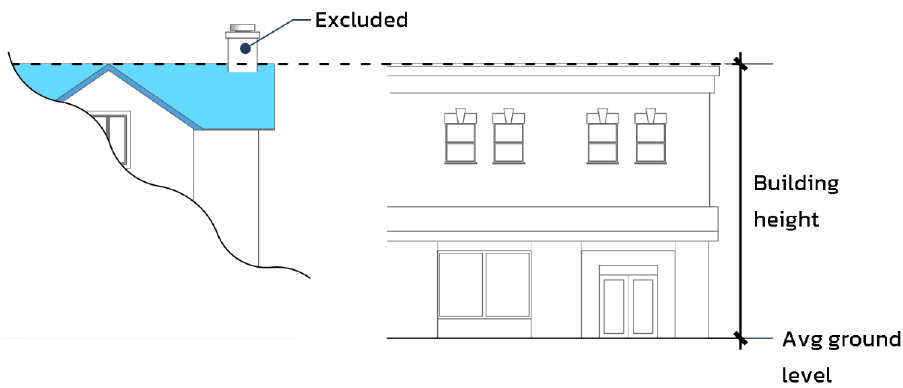
Figure Sec. 15-11-1: Height Measurement
Average ground level shall be calculated as the mean (average) ground level at the four principal corners of the subject structure where the walls or other structural elements intersect the ground.
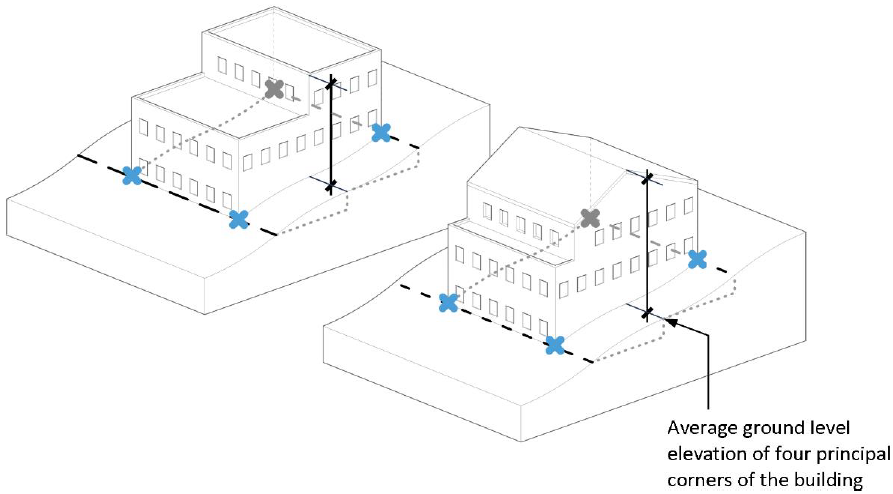
Figure Sec. 15-11-2: Average Ground Level Calculation
(g)
Lot Terms and Measurements.
(1)
Lot. A parcel of real property as shown with a separate and distinct number or letter on a plat recorded with the San Juan County Clerk and Recorder or when not platted in a recorded subdivision, a parcel of real property abutting upon at least one public street.
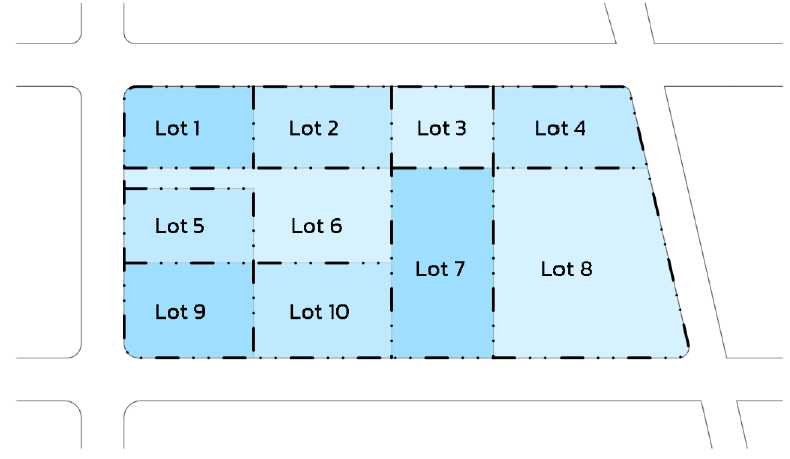
Figure Sec. 15-11-3: Lot Examples
(2)
Lot Line.
a.
A line marking the boundary of a lot or parcel.
b.
Front lot line means a boundary line separating a lot or parcel of land from any front street.
c.
Rear lot line means a boundary line opposite the front lot line.
d.
Side lot line means any lot line that is not a front, street-side, or a rear lot line abutting an interior lot.
e.
Street side lot line means the lot line abutting any non-front street.
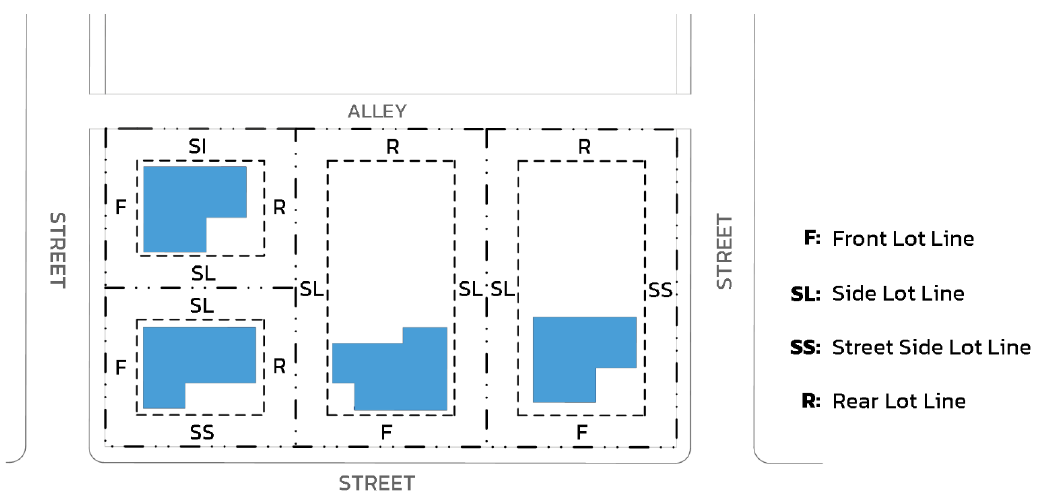
Figure Sec. 15-11-4: Lot Line Types
(3)
Lot Area. The net area of the lot, excluding portions of streets and alleys.
(4)
Lot Width. The horizontal distance between the side lot lines, measured at the front lot line adjacent to the street or public right-of-way.
(5)
Zoning Lot. A portion or parcel of land, including a portion of a platted subdivision, occupied or intended to be occupied by a building or use and its accessories, that is an integral unit of land held under unified ownership in fee or co-tenancy, or under legal control tantamount to the ownership.
(h)
Setback Measurement. Setback means the required distance between the farthest protrusion of a building or structure and any lot line of the lot or parcel on which it is located.
(i)
Sign Measurements. See Section 15-7-40, Measurement and Calculation.
(Ord. No. 2025-01, § 2(Exh. A), 1-27-2025)
Sec. 15-11-30. - General terms.
A
Accessory dwelling unit (ADU). A residential dwelling unit, but not a mobile home or recreation vehicle, located on the same lot as a principal dwelling unit or commercial unit, either within the same building or in a detached building. The unit includes its own independent living facilities with provisions for sleeping, cooking, and sanitation, and is designed for residential occupancy independent of the principal dwelling unit or commercial unit.
Adaptive controls. Devices such as timers, motion-sensors, and light-sensitive switches used to actively regulate the emission of light from light fixtures.
Administrative adjustment. See Section 15-8-30(a).
Affordable housing.
1.
Rental housing that is affordable to a household with an annual income at or below 80 percent of the area median income, and for which the rent payment costs the household less than 30 percent of its monthly income.
2.
For-sale housing that could be purchased by a household with an annual income at or below 140 percent of the area median income, for which the mortgage payment costs the household less than 30 percent of its monthly income.
Animal services. Any place or premise used in whole or in part to provide care and service for animals, including grooming, training, day care, and veterinary facilities where animals or pets are given medical or surgical treatment and are cared for during the time of their treatment.
Annexation and disconnection. See Section 15-8-40(a).
Appeal of an administrative decision. See Section 15-8-40(b).
Appeal of a planning commission or historic review committee decision. See Section 15-8-40(c).
Arcade. A covered passageway, typically found at street level, often comprised of a series of arches supported by columns.
Area median income (AMI). The median family income of a household of a given size within a given geographic area that is calculated on an annual basis by the Department of Housing and Urban Development (HUD).
Artisan industrial. Application, teaching, making, or fabrication of crafts or products by an artist, artisan, or craftsperson either by hand or with minimal automation and may include direct sales to consumers, in a facility not exceeding 10,000 square feet in gross floor area. This definition includes uses such as small-scale fabrication, manufacturing, and other industrial uses and processes typically not permitted in non-industrial zoning districts such as welding and sculpting.
Artwork. Works of art that in no way identify, advertise, or display, directly or indirectly, a product or business. This shall include wall murals, yard art, or other public mosaics or sculptures.
Assembly. A facility for social, educational, worship, or recreational purposes that is open to the public or a designated part of the public, usually owned and operated by a public or nonprofit group or agency. Accessory uses may include but are not limited to offices, meeting areas, food preparation areas, concessions, parking, nonpublic schools, and maintenance facilities.
Avalanche hazard-related definitions. When used in the context of avalanche hazard regulations in Section 15-5-10, Avalanche Hazard Areas, the following terms shall have the following meanings:
Afforestation. The act or process of planting and establishing a dense timber forest stand on a tract of land.
Avalanche. A mass of snow, ice and debris flowing and sliding across mountainous terrain and also includes the design avalanche, which is an avalanche of potential size and destructive force so as to have one percent mathematical probability of occurring in any one year.
Avalanche hazard permit, major. See Section 15-8-40(d).
Avalanche hazard permit, minor. See Section 15-8-30(b).
Avalanche path. The terrain boundaries of known or potential avalanches, to include the starting zone, the avalanche track and the runout zone.
Catching structure. An earthen berm or other physical structure built perpendicular to the direction of avalanche flow for the purpose of stopping the avalanche and thereby reducing the avalanche runout distance.
Deflecting structure. An earthen berm or other physical structure built at an angle to the direction of avalanche flow for the purpose of directing the avalanche away from areas to be protected.
Deforestation. The act or process of cutting and removing a dense timber forest stand from a tract of land.
Direct-protection structure. Detached or internal splitting wedges and walls; direct reinforcement of structures; and avalanche sheds for the purpose of protecting individual structures or areas by diverting avalanches around or over the objects or areas to be protected.
High hazard red zone. A geographical land area impacted by snow avalanche activity producing a total avalanche impact pressure in excess of 600 pounds per square foot on a flat surface normal to the direction of avalanche flow and/or having a return interval of less than 30 years.
Moderate hazard blue zone. A geographical land area impacted by snow avalanche activity, producing a total avalanche impact pressure of less than 600 pounds per square foot on a flat surface normal to the direction of avalanche flow and having a return interval in excess of 30 years.
Retarding structure. Earthen mounds or other physical structures built in an avalanche path to create additional friction between the avalanche and the ground, spread the avalanche laterally and reduce the effective flow height and runout distance of the avalanche.
Snow drift fence. Wind fences installed in and adjacent to avalanche starting zones to reduce the amount of snow blowing into the starting zone or to distribute snow lower on the slope, thus reducing the frequency and size of avalanches.
Snow support structure. Continuous or closely spaced fences, vertical rakes, wire-rope nets or other structures built in rows across avalanche slopes to anchor the snow in the starting zone, thereby preventing release.
B
Bar or tavern. An establishment providing or dispensing by the drink for on-site consumption fermented malt beverages, and/or malt, special malt, vinous or spirituous liquors, and in which the sale of food products is secondary.
Bed and breakfast. A single-unit detached dwelling used as a lodging establishment for transient guests staying 30 days or less, and that has a common guest area, contains no more than five guest rooms and is operated by the on-site owner or resident manager.
Block. A parcel of land bounded on all sides by a street or alley.
Block face. The properties abutting on one side of a block.
C
Car wash. A facility for the cleaning of automobiles, providing either self-serve facilities, automated machines, or employees to perform washing operations.
Cemetery. A facility or area used or intended to be used for the burial of the dead, including crematories, mausoleums, and mortuaries when operated in conjunction with, and within the boundaries of the cemetery.
Common open space. A type of open space reserved for the use of the residents of a development and their guests for passive and/or active recreation.
Condominium. A building, or buildings, consisting of separate fee simple estates to individual units of a multiunit property, together with an undivided fee simple interest in common elements.
Consumer. Any person contacted as a potential purchaser, lessee or renter, as well as one who actually purchases, leases or rents property in a subdivision.
Convention or conference center. A private or publicly operated venue for the gathering of professionals, associations or other groups in a single location. The facility may or may not be attached to another use, such as a hotel or restaurant, and may include any offices directly related to the primary activity of the facility.
Continuing care facility. A facility or integrated group of facilities that provides retirement-age persons a continuum of accommodations and care, from independent living to convalescence care and long-term skilled nursing care. This use typically includes a full range of living arrangements from independent living, congregate housing, residential care and skilled nursing and sometimes hospice care. It also provide a range of ancillary facilities and services such as health care, meals with common dining facilities, physical therapy, education, recreation, and other social and cultural activities.
Cottage industry. An individual or firm that manufactures, fabricates, creates, or assembles goods for on-site sales to the general public for personal or household consumption. The goods may also be sold at wholesale to other outlets or firms, but on-site, retail sales is a significant component of the operation. The use operates on a small scale, in keeping with the surrounding neighborhood, with no impact in terms of noise, and no discernible impact in terms of vibration, dust, or odor. This use includes but is not limited to artisanal fabrication of craft or custom home goods, furniture, or other products; artist studios; and small-scale food or beverage production such as a bakery. As used in this Code, cottage industry is a use definition and is not identical to the Colorado Cottage Food Act.
Cottage food operations. The preparation and packaging of food products that are eligible to be prepared and sold following the requirements of the Colorado Cottage Foods Act codified at C.R.S. 25-4-1614 in a private home kitchen, or a commercial, private, or public kitchen, when the kitchen is not licensed, inspected, or regulated.
Craft alcohol. The production of small batches of wine, hard cider, beer, or distilled alcoholic beverage as licensed by Colorado law.
D
Day care center, adult. A nonresidential, protective facility specializing in providing activities and socialization for the elderly and/or disabled adults. Care is generally provided during daytime hours, but less than a 24-hour consecutive period, with a variety of planned program activities.
Day care center, child. A facility that meets the definition of child care center as set forth in C.R.S. 26-6-102(1.5).
Dedication. A grant by the owner to the public in general of a right to use land involving a transfer of property rights and an acceptance of the dedicated property by the appropriate public agency.
Detention facility. A facility established by a law enforcement agency for the detention of adult or juvenile persons while being processed for arrest or detention, awaiting trial, or for punishment and/or counseling as a result of sentencing by a court of jurisdiction for criminal or antisocial behavior.
Distribution services and facility. The intake of goods and merchandise, individually or in bulk, the short-term holding or storage of those goods or merchandise, and/or the breaking up into lots or parcels and subsequent shipment off-site of those goods and merchandise. Distribution may be provided to an entity with an identity of interest with the distribution facility or to businesses and individuals unrelated to the distributor.
Drive-through facility. A site design or site feature that, by design, physical facilities, service, or packaging procedures, encourages or permits customers to receive services or obtain goods while remaining in their vehicles. This use includes but is not limited to drive-by and drive- up pickup facilities for parcels, goods, food, or beverages.
Dwelling, cottage court. A residential development, including co-housing developments, that combines a group of small individually owned or rented single-unit dwelling units, including tiny homes, on a single parcel of land that are oriented around a shared open space for communal use by the residents of the development and may include a shared parking area and/or a shared community building.
Dwelling, duplex. A single building containing two dwelling units where each dwelling includes a separate bathroom and kitchen. The two units shall be able to function as dwelling units independently of each other, but may be located side-by-side, in front and behind, or above and below each other.
Dwelling, live/work. A dwelling unit combining both a residential living space and also an integrated work space principally used by one or more of the residents. The unit typically has a storefront, workspace or studio, and public display area on the ground floor, with residential located either on the upper floor or in the back of the workspace.
Dwelling, mixed-use. One or more dwelling units that are located in the a building with space for a principal nonresidential use. The residents of the dwelling units are not required to use or operate the nonresidential space.
Dwelling, multiunit. One or more buildings or portion of buildings on a single lot that contains five or more individual dwelling units, where each unit is occupied by one household regardless of whether the dwelling units are owned or rented or condominium units.
Dwelling, single-unit attached. Two or more dwelling units attached side by side under one roof, or in a townhouse or row house layout in which each unit:
1.
Shares one or two interior common vertical side or rear walls reaching from the building foundation to the roof structure;
2.
Has an entrance facing and giving direct entrance from the dwelling unit to at least one street fronting the lot on which the unit is located; and
3.
Is designed for use and occupancy for one household.
Dwelling, single-unit detached. A residential building designed for use and occupancy by no more than one household. This use shall include manufactured homes and tiny homes.
Dwelling, triplex or fourplex. A single building on a single lot containing three or four dwelling units under one roof, each of which is designed for use and occupancy by one household.
Dwelling unit. An IBC standard constructed structure or portion of a structure that is designed, occupied, or intended to be occupied exclusively by one household and includes facilities for cooking, sleeping, and sanitation.
E
Educational facilities. A public or private facility, including any offices directly related to the primary purpose of the facility, of which that purpose is to provide education, conduct research or otherwise serve to increase or disseminate academic knowledge.
Easement. A dedication of land for a specified use, such as providing access for maintenance of utilities.
Electric vehicle charging station. A facility in which electric vehicle charging services are made available to the public or to members or to a group of occupants or users of the property or development, including structures, machinery, and equipment necessary and integral to support an electric vehicle, including battery charging stations, rapid charging stations, and battery exchange stations.
Equestrian operation. A facility where horses, donkeys, or mules are sheltered, fed, trained, or kept for sale or hire to the public.
Expedited review for affordable housing. See Section 15-8-30(c).
F
Family child care home. A type of family care home that provides less than 24 hour care at any time for two or more children that are unrelated to each other or the provider, and are cared for in the provider's place of residence.
Farm stand. A temporary structure used for the sale and display of agricultural or horticultural products such as vegetables, fruits, dairy products, eggs, grains, meat, poultry, fish, honey, hay, bedding plants, herbs, and wool.
Farmer's market. An occasional or periodic market held in an open area or structure where groups of individual sellers offer for sale to the public items such as fresh produce, seasonal fruits, fresh flowers, arts and crafts items, and food and beverages dispensed from booths located on site.
Final plat for condominium or townhome. See Section 15-8-30(d).
Financial institution. A facility that provides financial and banking services to individuals and businesses. These services may include deposit banking and closely related functions such as making loans, investments, check cashing, and fiduciary activities.
Finished grade. The final elevation of the ground surface after completion of authorized development and associated man-made alterations of the ground surface such as grading, grubbing, fillings, or excavating.
Flood hazard-related definitions. When used in the context of flood hazard regulations in Section 15-5-20, Flood Hazard Areas, the following terms shall have the following meanings:
Area of special flood hazard. The land in the floodplain within a community subject to a one-percent or greater change of flooding in any given year; i.e., the 100-year floodplain.
Base flood. A flood having a one-percent change of being equaled or exceeded in any given year.
Base flood elevation (BFE). The elevation shown on a FEMA Flood Insurance Rate Map for Zones AE, AH, A1-A30, AR, AR/A, AR/AE, AR/A1-A30, AR/AH, AR/AO, V1-V30 and VE that indicates the water surface elevation resulting from a flood that has a one-percent chance of equaling or exceeding that level in any given year.
Basement. Any area of a building having its floor sub-grade (below ground level) on all sides.
Conditional letter of map revision (CLOMR). FEMA's comment on a proposed project, which does not revise an effective floodplain map, that would, upon construction, affect the hydrologic or hydraulic characteristics of a flooding source and thus result in the modification of the existing regulatory floodplain.
Critical facility. A structure or related infrastructure, but not the land on which it is situated, as specified in Section 15-5-20(f), Standards for Critical Facilities, that, if flooded, may result in significant hazards to public health and safety or interrupt essential services and operations for the community at any time before, during and after a flood.
Critical feature. An integral and readily identifiable part of a flood protection system, without which the flood protection provided by the entire system would be compromised.
Development. Any man-made change in improved and unimproved real estate, including but not limited to buildings or other structures, mining, dredging, filling, grading, paving, excavation or drilling operations or storage of equipment or materials.
Flood or flooding. A general and temporary condition of partial or complete inundation of normally dry land areas from the unusual and rapid accumulation or runoff of surface waters from any source.
Flood fringe. The portion of the land lying outside of the floodway adjoining a stream or river which would be covered by floodwaters upon the occurrence of a 100-year flood.
Flood hazard development permit. See Section 15-8-30(e).
Flood hazard variance. See Section 15-8-40(e).
Flood insurance rate map (FIRM). An official map on which the Federal Emergency Management Agency has delineated both the areas of special flood hazard and the insurance risk premium zones applicable to the community.
Flood insurance study (FIS). The official report provided by the Federal Emergency Management Agency that includes flood profiles, as well as the Flood Boundary-Floodway Map, and the water surface elevation of the base flood.
Floodway (Regulatory Floodway). The channel of a river or other watercourse and adjacent land areas that must be reserved in order to discharge the base flood without cumulatively increasing the water surface elevation more than a designated height. The statewide standard for the designated height to be used for all newly studied reaches shall be one-half foot (six inches). Letters of Map Revision to existing floodway delineations may continue to use the floodway criteria in place at the time of the existing floodway delineation.
Historic structure. Any structure that is:
1.
Listed individually in the National Register of Historic Places (a listing maintained by the Department of Interior) or preliminarily determined by the Secretary of the Interior as meeting the requirements for individual listing on the National Register;
2.
Certified or preliminarily determined by the Secretary of the Interior as Contributing to the historical significance of a registered historic district or a district preliminarily determined by the Secretary of the Interior to qualify as a registered historic district;
3.
Individually listed on a state inventory of historic places in states with historic preservation programs which have been approved by the Secretary of the Interior; or
4.
Contributing Property within the Historic District Overlay.
Letter of map revision (LOMR). FEMA's official revision of an effective Flood Insurance Rate Map (FIRM) or Flood Boundary and Floodway Map (FBFM), or both. LOMRs are generally based on the implementation of physical measures that affect the hydrologic or hydraulic characteristics of a flooding source and thus result in the modification of the existing regulatory floodway, the effective Base Flood Elevations (BFEs) or the Special Flood Hazard Area (SFHA).
Letter of map revision based on fill (LOMR-F). FEMA's modification of the Special Flood Hazard Area (SFHA) shown on the Flood Insurance Rate Map (FIRM) based on the placement of fill outside the existing regulatory floodway.
Levee. A man-made embankment, usually an earthen embankment, designed and constructed in accordance with sound engineering practices to contain, control or divert the flow of water so as to provide protection from temporary flooding.
Levee system. A flood protection system which consists of a levee or levees and associated structures, such as closure and drainage devices, which are constructed and operated in accordance with sound engineering practices.
Lowest floor. The lowest floor of the lowest enclosed area (including basement). An unfinished or flood-resistant structure, usable solely for the parking of vehicles, building access or storage of non-floatable materials in an area other than a basement area, is not considered a building's lowest floor.
Manufactured home. Any wheeled vehicle, exceeding either eight feet in width or 32 feet in length, excluding towing gear and bumpers, without motive power, which is designed and commonly used for occupancy by persons for residential purposes, in either temporary or permanent locations, and which may be drawn over the highways by a motor vehicle.
Manufactured home park or manufactured home subdivision. A parcel or contiguous parcels of land divided into two or more manufactured home lots for rent or sale.
Mean sea level. For purposes of the National Flood Insurance Program, the National Geodetic Vertical Datum (NGVD) of 1929, or other datum, to which Base Flood Elevations shown on a community's Flood Insurance Rate Map are referenced.
New construction. A structure for which the start of construction commenced on or after the effective date of the initial ordinance codified herein.
No-rise certification. A record of the results of an engineering analysis conducted to determine whether a project will increase flood heights in a floodway. A no-rise certification must be supported by technical data and signed by a registered Colorado professional engineer. The supporting technical data should be based on the standard step-backwater computer model used to develop the 100-year floodway shown on the Flood Insurance Rate Map (FIRM) or Flood Boundary-Floodway Map (FBFM).
Physical map revision (PMR). FEMA's action whereby one or more map panels are physically revised and republished. A PMR is used to change flood risk zones, floodplain and/or floodway delineations, flood elevations and/or planimetric features.
Program deficiency. A defect in a community's floodplain management regulations or administrative procedures that impairs effective implementation of those floodplain management regulations or of the NFIP standards in 60.3, 60.4, 60.5 or 60.6.
Recreational vehicle. A vehicle that is:
1.
Built on a single chassis;
2.
Four hundred square feet or less when measured at the largest horizontal projections;
3.
Designed to be self-propelled or permanently towable by a light duty truck; and
4.
Designed primarily not for use as a permanent dwelling but as temporary living quarters for recreational, camping, travel or seasonal use.
Remedy a violation. To bring the structure or other development into compliance with the state or local floodplain management regulations or, if this is not possible, to reduce the impacts of its noncompliance. Ways that impacts may be reduced include protecting the structure or other affected development from flood damages, implementing the enforcement provisions of this Section or otherwise deterring future similar violations or reducing federal financial exposure with regard to the structure or other development.
Start of construction. Start of construction includes substantial improvement and means the date the building permit was issued, provided that the actual start of construction, repair, reconstruction, placement or other improvement was within 180 days of the permit date. The actual start means the first placement of permanent construction of a structure on a site, such as the pouring of slab or footings, the installation of piles, the construction of columns or any work beyond the stage of excavation; or the placement of a manufactured home on a foundation. Permanent construction does not include land preparation, such as clearing, grading and filling; nor does it include the installation of streets and/or walkways; nor does it include excavation for a basement, footings, piers or foundations or the erection of temporary forms; nor does it include the installation on the property of accessory buildings, such as garages or sheds not occupied as dwelling units or not part of the main structure.
Structure. Any constructed or erected material or combination of materials in or upon the ground, including but not limited to buildings, manufactured homes, mobile homes, radio towers, sheds, decks, storage bins and walls and fences over six feet high, but excluding sidewalks and patios.
Substantial improvement. Any repair, reconstruction or improvement of a structure, the cost of which equals or exceeds 50 percent of the market value of the structure either:
1.
Before the improvement or repair is started; or
2.
If the structure has been damaged and is being restored as before the damage occurred.
For the purpose of this definition, substantial improvement is considered to occur when the first alteration of any wall, ceiling, floor or other structural part of the building commences, whether or not that alteration affects the external dimensions of the structure. The term does not, however, include either:
1.
Any project for improvement of a structure required to comply with existing state or local health, sanitary or safety code specifications which are solely necessary to assure safe living conditions; or
2.
Any alteration of a structure listed on the National Register of Historic Places or a State Inventory of Historic Places.
Variance. A grant of relief from the requirements of this Section, which permits construction in a manner that would otherwise be prohibited by this Code.
Violation. The failure of a structure or other development to be fully compliant with the community's floodplain management regulations. A structure or other development without the elevation certificate, other certifications or other evidence of compliance required in NFIP standards 60.3(b)(5), (c)(4), (c)(10), (d)(3), (e)(2), (e)(4) or (e)(5) is presumed to be in violation until documentation is provided to prove otherwise.
Water surface elevation. The height, in relation to the National Geodetic Vertical Datum (NGVD) of 1929, or other datum, where specified, of floods of various magnitudes and frequencies in the floodplains of coastal or riverine areas.
Fowl or domestic animals. Small animals including dogs, cats, ferrets, rodents, birds, reptiles, fish, rabbits, hares, fowl (e.g., chicken, geese or turkeys), or any other species of animal that is sold or retained as a household pet.
Fully shielded. A light source screened, and its light directed in such a way that none is emitted above the horizontal plane passing through its lowest light-emitting part.
G
Government or public facility. An office of a governmental agency that provides administrative and/or direct services to the public, such as, but not limited to: post offices, employment offices, public assistance offices, or motor vehicle licensing and registration services.
Greenhouse. A building or structure in which the temperature and humidity can be regulated for the cultivation of fragile or out-of-season plants for personal enjoyment.
Greenhouse or nursery. An establishment, including a building, part of a building, or open space, for the growth, display, and/or sale of plants, shrubs, trees, flowers and other materials used in indoor or outdoor planting for retail sales.
Group home. A structure in which housing is provided for a group of unrelated individuals or related and unrelated individuals pursuant to state statute.
H
Hardship. The property in question cannot be put to reasonable use under existing regulations and the plight of the landowner is due to circumstances unique to the property and not created by the landowner. Economic considerations alone shall not constitute a hardship.
Highway. Any main road or public passage, existing or proposed.
Historic review-related definitions.
Colorado State Register of Historic Properties. The official listing of state designated cultural resources.
Compatible or compatibility. Consistent or harmonious with location, design, setting, materials, workmanship, feeling, or association of an individual building or site or of surrounding properties.
Contributing property. A building or site that reflects the historic or architectural character within the Historic District Overlay as determined by the Town's historic resource survey. Prior to the Town completing the historic resource survey, all property within the Historic District Overlay will be considered Contributing Property unless the property is determined to be Non-Contributing by a historic resource survey completed by a preservation professional.
Design guidelines. A standard of appropriate activity that will preserve the historic and architectural character of a Contributing Property or the Historic District Overlay.
Historic district.
1.
A geographically definable area including a concentration, linkage, or continuity of properties within a specified Period of Significance and may include within its geographic boundaries one or more Contributing Properties, which has been designated by the Board of Trustees.
2.
A Historic District is related by a pattern of either physical elements or social activities. Historic Significance is determined by applying eligibility and integrity criteria to the pattern(s) and unifying element(s).
3.
Historic District boundaries will be defined by visual changes, historical documentation of different associations or patterns of development, or evidence of changes in property type, density, or Integrity.
Properties that do not contribute to the Historic Significance of the Historic District may be included within its boundaries.
Historic district overlay designation. See Section 15-8-40(f).
Historic district overlay review, major. See Section 15-8-40(g).
Historic district overlay review, minor. See Section 15-8-30(f).
Historic significance. The meaning or value ascribed to a building, site, or district based on criteria established for Historic District Overlay Designation.
National Register of Historic Places. The list of significant buildings, structures, sites, objects, or districts in American history, architecture, archaeology, engineering, or culture maintained by the U.S. Secretary of the Interior.
Non-contributing property. A building or site that does not reflect the historic or architectural character within the Historic District Overlay because of age or lack of integrity as determined by the Town's historic resource survey. Prior to the Town completing the historic resource survey, all property within the Historic District Overlay will be considered Contributing Property unless the property is determined to be Non-Contributing by a historic resource survey completed by a preservation professional.
Period of significance. Span of time during which significant events and activities occurred.
Preservation. The act or process of applying measures to sustain the existing form, integrity, and materials of a building or structure. It may include initial stabilization work, where necessary, as well as ongoing maintenance of the historic building or materials.
Rehabilitation. The act or process of returning property to a state of utility through repair, which makes possible a contemporary use while preserving those portions or features of the property which are significant to its historical, architectural and cultural value.
Relocation or relocate. Moving a building, structure, or object on its site or to another site to another site, either temporarily or permanently.
Secretary of the Interior's Standards for the Treatment of Historic Properties. The preservation, rehabilitation, restoration, and reconstruction standards adopted by the U.S. Department of the Interior.
Town's historic register. The historic register established pursuant to Section 15-2-80(a), Historic District Overlay.
Home occupation. A business, profession, occupation, or trade that is conducted within a residential dwelling unit for the economic gain or support of a resident of the dwelling and is incidental and secondary to the residential use of the lot.
Hospital. An establishment that provides diagnosis and treatment, both surgical and nonsurgical, for patients who have any of a variety of medical conditions through an organized medical staff and permanent facilities that include inpatient beds, medical services, and continuous licensed professional nursing services.
Hotel or Motel. An establishment in which lodging is provided and offered to the public for compensation for periods of time not exceeding 30 days and that customarily provides services such as maid service, the furnishing and laundering of linen, telephone and secretarial or desk service, and the use and upkeep of furniture. This use may provide ancillary uses such as conference and meeting rooms, restaurants, bars, gift shops, and recreational facilities.
Household. Any individual, or two or more persons related by blood or marriage or between whom there is a legally recognized relationship, or a group of unrelated persons, occupying the same dwelling unit, including but not limited to any group of persons whose right to live together or without undue restrictions are protected by the provisions of the federal Fair Housing Act Amendments of 1988, as defined in that Act and interpreted by the courts, or by any similar legislation of the State of Colorado.
I
Impervious Surface. Any surface artificially covered or hardened so as to prevent or impede the percolation or absorption of water into the ground, including but not limited to asphalt, concrete, roofing material, brick, plastic, and gravel.
J
Junk. Any manufactured goods, appliance, fixture, furniture, machinery, vehicle, personal property, or any other thing or part thereof, whether of value or valueless, that is demolished, discarded, dismantled, partially dismantled, dilapidated, or so worn and deteriorated that it would not be normally usable in its current state for its original manufactured use.
K
Horse and livestock keeping. The keeping of horses, mules, burros, asses, cattle, sheep or goats for the use of the occupants of the lot and their guests.
Kennel. A facility licensed to house dogs, cats, or other household pets and/or where grooming, breeding, boarding, or training or selling of animals occurs.
L
Landscaping professional. An individual employed by a company that engages in landscaping activities as a primary or substantial source of revenue.
Land use code interpretation. See Section 15-8-30(g).
Land use code text amendment. See Section 15-8-40(h).
Library. A facility for storing and loaning books, periodicals, reference materials, audio and video media, and other similar media. A library may also include meeting rooms, offices for library personnel, and similar support facilities.
Lot. A parcel of land intended for transfer of ownership or building development, having its full frontage on a public street.
M
Manufactured home. A factory-built structure that is manufactured or constructed in compliance with the National Manufactured Housing Construction and Safety Standards Act of 1974, that became effective July 15, 1976 (HUD Code).
Manufactured or tiny home park. Any parcel of land designed for the placement of two or more manufactured homes or tiny homes, located and maintained for dwelling purposes on a permanent or semi-permanent basis on individual lots, pads, or spaces; whether those lots, pads, or spaces be individually owned, leased, or rented.
Manufacturing and assembly, heavy. An establishment or use of land that includes the assembly, fabrication, or processing of goods and materials using processes that ordinarily have impacts on the environment or significant impacts on the use and enjoyment of surrounding properties in terms of noise, smoke, fumes, odors, glare, or health or safety hazards, or any use where the area occupied by outside storage of goods and materials used in the assembly, fabrication, or processing exceeds 25 percent of the floor area of buildings on the lot. Examples include but are not limited to: battery, chemicals, machinery, and plastics manufacture; mushroom plant; batching plant; beverage bottling and distribution, packaging plant; slaughterhouse; and rendering plant. This use does not include any use that meets the definition of "light manufacturing" or "hazardous or special manufacturing", or a solid waste disposal site, or a yard waste compost facility, and does not include any use that constitutes a public nuisance.
Manufacturing and assembly, light. A facility or area used for the assembly, fabrication, or processing of goods and materials using processes that ordinarily do not create noise, smoke, fumes, odors, glare, or health or safety hazards outside of the building or lot where assembly, fabrication, or processing takes place, where the processes are housed entirely within a building, or where the area occupied by outside operations or storage of goods and materials used in the assembly, fabrication, or processing does not exceed 25 percent of the floor area of buildings on the lot. Examples include but are not limited to: Food processing, electronic equipment assembly and manufacturing and assembly from finished products.
Market garden. The commercial (for profit) production of vegetables, fruits, flowers, and other plants on an area of land not more than one acre. This may be accomplished using one or more greenhouses. Any greenhouse on properties zoned residential shall be considered an accessory use.
Master plan. A plan for guiding and controlling the physical development of land use and circulation facilities in the Town and any amendment or extension of the plan.
Master plan amendment. See Section 15-8-40(i).
Maximum extent practicable. The Town Administrator has determined that no feasible or prudent alternative exists, that all possible efforts to comply with the standards or regulation or minimize potential harmful or adverse impacts have been undertaken by an applicant, and that the costs of complying with a Code standard or criteria clearly outweigh the benefits to the public of complying with the standard or criteria. Economic considerations may be taken into account, but shall not be the overriding factor determining whether compliance with a standard or criteria in this Code is impracticable.
Medical or dental clinic. A facility for a group of one or more medical professionals for the examination and treatment of human patients, primarily engaged in providing, on an outpatient basis, chiropractic, dental, medical, surgical, medical imaging, or other services to individuals. Patients are not kept overnight except under emergency conditions. Ancillary laboratory facilities may be included.
Membership club. Meeting, recreational, or social facilities of a private or nonprofit organization primarily for use by members or guests. This classification includes union halls, social clubs and youth centers, fraternal and veteran's organizations.
Minor plat amendment. See Section 15-8-30(h).
Mobile home. Any vehicle or similar portable structure having no foundation other than wheels or jacks or skirtings and so designed or constructed as to permit occupancy for dwelling or sleeping purposes. Mobile home includes any structure that otherwise meets this description, but that was not subject to the National Manufactured Home Construction and Safety Standards (generally known as the HUD Code), established in 1976 pursuant to 42 U.S.C. Sec. 5403, at the time it was manufactured.
Museum. A facility open to the public, with or without charge, for the collection of nature, scientific, or literary objects of interest or works of art, not including the regular sale or distribution of the objects collected. Museums may include incidental retail and food and beverage sales.
N
Nonconforming lot. A lot, the area, dimensions, or location of which was lawful when the lot was created but that was rendered noncompliant with this LUC by its adoption or the adoption of an amendment to it.
Nonconforming structure. A structure or building that was lawful prior to the adoption, revision, or amendment of this Code, but that fails by reason of the adoption, revision, or amendment, to conform to the present requirements for a conforming or compliant structure in the zoning district in which the structure or building is located.
Nonconforming use. A use or activity that was lawful prior to the adoption, revision, or amendment of this Code, but that by reason of adoption, revision, or amendment, is no longer permitted in the zoning district in which the use or activity is located.
O
Obsolete structure. A building or structure which is no longer usable because of its physical condition.
Office. Establishments providing executive, management, administrative, professional services, consulting, record keeping, or a headquarters of an enterprise or organization.
Outdoor commercial storage. The storage of items used in connection with a nonresidential principal use outside of an enclosed structure, including but not limited to the storage of goods in trade, bunks of lumber, pallets of material, unassembled products, baled cardboard, defective/old appliances, scrap material, or loose materials such as gravel, mulch or discarded materials, storage pods, trailers, sheds, and similar material.
Outdoor light fixture. An outdoor electrically powered illuminating lamp or similar devise used for lighting structures, parking areas, pathways, sidewalks, streets, alleys, service canopies, recreational areas, signs, or other similar outdoor lighting uses.
Outdoor residential storage. The storage of items used in connection with a residential principal use outside of an enclosed structure, including but not limited to the storage of gardening tools, bicycles, outdoor furniture, and similar personal belongings
P
Parks and open space. Outdoor areas designed and used for public recreation, exercise, sports, education, rehabilitation, or similar activities, or a land area intended to enhance the enjoyment of natural features or natural beauty. This may include paved greenways, natural surface trails, open fields, arboreta, botanical gardens, sports fields, dog parks, skate parks, plazas, splash pads, playgrounds, picnic areas, and similar amenities.
Person. An individual, partnership, corporation, association, unincorporated organization, trust or any other legal or commercial entity, including a joint venture or affiliated ownership. The word person also means a municipality or state agency.
Personal services. A facility that provides individualized services generally related to personal or business needs including but not limited to laundry, including cleaning and pressing service, beauty shops, barbershops, shoe repair, personal copying/shipping services, health and fitness facilities, photographic studios, tailor/sewing shop, indoor equipment/party/event rental, tanning salon, bicycle and sports equipment repair, small appliance repair, tattoo parlors and similar uses.
Plat. A map, drawing or chart upon which the subdivider presents proposals for the physical development of a subdivision, and which he or she submits for approval and intends to record in final form.
Portable storage unit. A transportable unit designed and used primarily for temporary storage of building materials, household goods, personal items, and other materials, and uniquely designed for ease of loading to and from a transport vehicle.
Portable waste trailer. A portable utility trailer that contains a trash or recycling enclosure.
Primary building or structure. A structure or building in which the principal use of the lot on which the building is located is conducted.
Principal outdoor storage. As a principal use, a property or area used for the long term (more than 24 hours) storage of materials, merchandise, products, stock, supplies, machines, operable vehicles, equipment, manufacturing materials, or other items not kept within a structure having at least four walls and a roof.
Principal use. The primary or predominant use of any lot, building, or structure.
Propane tank. A cylindrical storage tank that contains liquefied propane under high pressure.
Public safety facilities. The conduct of publicly owned safety and emergency services, such as, but not limited to fire stations, police stations, and emergency medical and ambulance service.
Q
R
Reasonable timeframe. A timeframe in which the review of an application will take place, determined by staff, related to the complexity of the application, staff's current workload, and the Internal Application Processing Policy.
Recreation and entertainment, indoor. A building or part of a building devoted to providing amusement, entertainment, or recreation for a fee, including movie theaters and theatrical space for dramatic, musical, or live performances, bowling, billiards, arcades, skating, swimming, tennis, teen clubs, escape rooms, archery and axe-throwing, trampolines, and similar indoor activities taking place inside an enclosed building.
Recreation and entertainment, outdoor. Commercial entertainment, recreation, or games of skill where any portion of the activity takes place outside of a building. Activities include, but are not limited to ball parks (baseball, football, soccer, tennis), water parks, batting cages, miniature golf, go-cart tracks, amusement parks, golf driving ranges, swimming pools, and other similar uses.
Recreational vehicle. Vehicle type unit primarily designed as temporary living quarters for recreational, camping, or travel use, which either has its own motive power or is mounted on or drawn by another vehicle. The basic types are:
1.
Travel Trailer: A vehicular portable unit, mounted on wheels, of such a size or weight as not to require special highway movement permits when drawn by a motorized vehicle, and of a body width of no more than eight feet and six inches (8'6"), excluding awnings, and a body length of no more than 35 feet when factory equipped for the road.
2.
Tent recreational vehicle: A portable unit mounted on wheels and constructed with collapsible partial side walls which fold for towing by another vehicle.
3.
Truck recreational vehicle: A portable unit, designed to be loaded onto, or affixed to, the bed or chassis of a truck. Truck recreational vehicles are of two basic types:
a.
Slide-in recreational vehicle - A portable unit designed to be loaded onto and unloaded from the bed of a pickup truck.
b.
Chassis-mount recreational vehicle - A portable unit designed to be affixed to a truck chassis.
4.
Motorhome: A vehicular unit built on a self-propelled motor vehicle chassis.
Recreational Vehicle Park. A parcel of land on which two or more recreational vehicle sites and/or camping sites are located, established, or maintained for occupancy by recreational vehicles or camping units of the general public as temporary living quarters for vacation or recreation purposes.
Redevelopment.
1.
For the purpose of prohibitions on nonfunctional turf, artificial turf, and invasive plant species, redevelopment requires both of the following:
a.
A disturbance of more than 50 percent of the aggregate landscape area, and
b.
Activity that requires a building permit or Site Plan.
2.
For all other purposes, redevelopment includes any activity that requires a building permit or Site Plan. This shall not include basic maintenance and repair of existing structures or interior structural improvements.
Repair, high impact. An establishment primarily engaged in the repair or maintenance of motor vehicles, trailers, and similar large mechanical equipment, including paint, bodywork, upholstery, muffler, transmission work and major engine and engine part overhaul.
Repair, low impact. An establishment primarily engaged in the repair or maintenance of motor vehicles, trailers, and similar mechanical equipment, including brake, muffler, tire repair and change, lubrication, and tune ups, provided it is conducted within a completely enclosed building.
Reservation. A legal obligation to keep property free from development for a stated period of time, not involving any transfer of property rights.
Restaurant. An establishment that sells food or beverages in a ready-to-consume state, in individual servings, that the customer consumes while seated at tables or counters located in or immediately adjacent to the building in which the use is located, and that may include carry-out service. This includes any portion of an establishment used for seating for the consumption of food on the premises that sells prepared food or beverages, such as a bakery, delicatessen, cafes, and coffee shops.
Retail sales. Retail sales uses are private enterprises involved in the sale, lease, or rent of new or used products directly to the general public. This use does not include food service, personal service, or recreation uses. No outdoor display or outdoor storage is permitted unless specifically authorized by this by-law. Accessory uses may include offices, parking, storage of goods, assembly, repackaging, or repair of goods for on-site sale.
Right-of-way. The width between property lines of a street.
S
School, elementary or secondary. An educational institution that satisfies the compulsory education laws of the State of Colorado for students in the elementary grades, middle school grades, or high school grades. This definition includes public, private, non-profit, and charter non-boarding schools.
School, university or college. A public or private institution for higher learning (beyond grade 12) providing instruction as approved by the Colorado Department of Education or a national collegiate or university accreditation agency. This definition also includes higher learning facilities for religious institutions.
School, vocational. A vocational or technical school, trade school, language school, business school, training center, beauty school, culinary school, and comparable advanced or continuing education facilities.
Service station. A facility limited to retail sales to the public of gasoline, biodiesel, electricity, ethanol fuel blends, hydrogen, natural gas, or other fuels for motor vehicles, as well as motor oil, lubricants, travel aides, and minor automobile accessories. Accessory use may include restaurants, and convenience food and beverage sales.
Sign-related definitions.
Flag. Any fabric or bunting containing distinctive colors, patterns, symbols or graphic depictions or text that is attached to a pole or similar staff.
Sign. Any identification, illustration, means of communication, or device, illuminated or non-illuminated, that is visible from any public place or is located on private property and exposed to the public and that is intended to direct attention, advertise, announce, communicate, declare, demonstrate, or display a particular use, product, service, idea, interest, or message.
Sign, awning. A sign that is a part of or attached to an awning, canopy, or other fabric, plastic, or structural protective cover over a door, entrance, window, or outdoor service area.
Sign, electronic. A sign that is internally lit to display messages and images that are changed electronically. The lit sign area may be of various types, including but not limited to flat screen, active display matrix, or a board with a single or multiple lines of text or graphics. The light source may vary but is typically Light Emitting Diodes (LED).
Sign, freestanding. A sign anchored directly to the ground or supported by one or more posts, columns, or other vertical structures or supports; and not attached to or dependent for support from any building.
Sign, nonconforming. Any sign lawfully constructed prior to the Effective Date that fails to conform to the provisions of this Code.
Sign, off-premise. A sign that carries a message of any kind or directs attention to a business, commodity, service, or entertainment conducted, sold, or offered elsewhere than upon the premises where the sign is located, or to which it is affixed.
Sign permit. See Section 15-8-30(i).
Sign plan, coordinated. See Section 15-8-30(j).
Sign, projecting. A sign attached to and projecting out from a building face or wall, generally at right angles to the building.
Sign, public. A sign erected by or on the order of a public officer in the performance of a public duty, such as signs to promote safety or traffic signs; signs to indicate transit stops; memorial plaques; or signs of historic interest.
Sign, roof. A business sign erected upon or above a roof or parapet of a building or structure. Mansard roof signs shall be considered wall signs.
Sign, sandwich board. A movable sign not secured or attached to the ground or surface upon which it is located and constructed in such a manner as to form an "A" or a tent-like shape, hinged or not hinged at the top; each angular face held at an appropriate distance by a supporting member.
Sign, temporary. A sign that is placed for display during a limited period of time only. A temporary sign is generally constructed of lightweight materials and installed in a manner so as to be easily removed.
Sign, temporary banner. A temporary sign composed of lightweight material secured or mounted so as to allow movement caused by wind.
Sign, vacation rental. A sign located on the same lot as a legally permitted vacation rental.
Sign, vehicle. A sign or other advertising device painted on or otherwise permanently affixed to a car, truck, trailer, or other similar vehicle.
Sign, wall. A sign painted on or attached flat and parallel to the exterior wall or surface of a building or other structure, and that projects not more than 12 inches from that wall or surface.
Sign, wind. Any sign consisting of one or a series of two or more banners, flags, pennants, ribbons, spinners, streamers, captive balloons or other objects or material fastened in such a manner as to move, upon being subjected to pressure by wind or breeze.
Sign, window. Any sign or advertising device affixed to the interior or exterior of a window or placed immediately behind a window frame so as to be seen from persons outside the building.
Sign, yard. A type of temporary sign that is constructed of paper, vinyl, plastic, wood, metal or other comparable material, which is mounted on a stake or a frame structure (often made from wire) that includes one or more stakes.
Simple subdivision. See Section 15-8-30(k).
Site plan. See Section 15-8-30(l).
Slope hazard development permit. See Section 15-8-30(m).
Solar energy system, ground- or roof-mounted (accessory). A device, array of devices, or structural design feature, the purpose of which is to provide for generation or storage of electricity from sunlight, or the collection, storage, and/or distribution of solar energy for space heating or cooling, electricity generation, or water heating. Ground-mounted systems are mounted on a rack or pole that is ballasted on, or is attached to, the ground. Roof-mounted systems are mounted on a rack that is ballasted on, or is attached to, the roof of a building or structure.
Special use permit. See Section 15-8-40(j).
Street. A way for vehicular traffic, further classified and defined as follows:
1.
Arterial streets are those which permit the relatively rapid and unimpeded movement of large volumes of traffic from one part of the community to another.
2.
Collector streets are those which collect traffic from local streets and carry it to arterial streets or to local traffic generators, such as neighborhood shopping centers and schools. Collector streets include the principal entrance streets to a residential development, those linking adjacent developments, and those streets providing circulation within the developments.
3.
Local streets are those used primarily for direct access to properties abutting the right-of-way. Local streets carry traffic having an origin or destination within the development and do not carry through traffic.
4.
Alley means a minor way which is used primarily for vehicular service access to the rear or side of properties otherwise abutting on a street.
Subdivider or developer. Any person, individual, firm, partnership, association, corporation, estate, trust or any other group or combination acting as a unit, dividing or proposing to divide land as to constitute a subdivision as herein defined, including any agent of the subdivider.
Subdivision.
1.
The division of a parcel of land into two or more parcels, sites or lots for the purpose, whether immediate or future, of transfer of ownership or building development; or
2.
The improvement of one or more parcels of land for residential, commercial or industrial structures or groups of structures involving the division or allocation of land for the opening, widening or extension of any street or streets, except private streets serving industrial structures; and/or the division or allocation of land as open spaces for common use by owners, occupants or lease holders, or as easements for the extension and maintenance of public sewerage, water, storm drainage or other public utilities or facilities.
Subdivision, major. See Section 15-8-40(k).
Subdivision design modification. See Section 15-8-40(l).
Substantial damage. Damage of any origin sustained by a structure whereby the cost of restoring the structure to its before damaged condition would equal or exceed 50 percent of the market value of the structure before the damage occurred
T
Temporary event or sales. A temporary outdoor use on private property including, but not limited to outdoor entertainment, educational and cultural events, art shows, sidewalk sales, or seasonal sales (e.g., fireworks or Christmas trees). This use does not include events held on Town property or Town-owned public right-of-way that require a Special Events Permit from the Town.
Temporary use permit. See Section 15-8-30(n).
Tiny home. A structure that:
1.
Is permanently constructed on a vehicle chassis;
2.
Is designed for long-term residency;
3.
Includes electrical, mechanical, or plumbing services that are fabricated, formed, or assembled at a location other than the site of the completed home;
4.
Is not self-propelled; and
5.
Has a square footage of not more than 400 square feet.
In order to meet this definition, a tiny home must be built to the International Residential Code as adopted by the Building Codes and Standards program within the Division of Housing. Colorado tiny homes will receive a metal plate insignia that certifies the tiny home is built to the codes and standards of the program. This use does not include manufactured homes, recreational park trailers, or recreational vehicles.
Transportation facilities. Any structure or transit facility that is primarily used as part of a local or regional transit system for the purpose of loading, unloading, or transferring of passengers or accommodating the movement of passengers from one mode of transportation to another. This includes bus or rail terminals/stations, transfer points, and depots.
U
Utility, major. A facility providing an important regional utility service, such as water, sewer, or drainage, that normally entails construction of new buildings or structures, and that typically has employees on the site on an ongoing basis. Examples include but are not limited to: utility-scale solar, water works, sewage treatment plants, reservoirs, regional storm water detention ponds and other similar facilities.
Utility, minor. Utility facilities that are necessary to support legally established uses and involve utility structures such as water and sewage pump stations, electrical substations, telephone exchanges, poles or cables, switch boxes, transformer boxes, cap banks, and underground water and sewer lines.
V
Vacation of right-of-way (row vacation). See Section 15-8-40(m).
Vacation rental. A residential dwelling unit, including either a single-unit or multiunit dwelling, assessed and taxed as a residential dwelling unit, rented for the purpose of transient lodging or transient living accommodations for a maximum period not to exceed 30 consecutive days to the same renter, with tenancies defined per zoning district, per month. Hotels, motels, lodges, inns, bed and breakfasts, recreational vehicle spaces and campsites are not vacation rentals. Individual bedrooms within a single-unit dwelling or multiunit dwelling are prohibited from being used as vacation rentals.
Variance. See Section 15-8-40(n).
Vehicle and equipment sales, leasing, and rental. The sale, display, lease, rental, or storage of light motor vehicles, including automobiles, vans, light trucks, light trailers, boats, motorcycles, all-terrain vehicles, snowmobiles, personal watercraft, and recreational vehicles. This use does not include salvage operations, scrap operations, vehicle impound yards, or commercial parking lots available for short-term use.
W
Warehousing and storage facility. An establishment whose primary activity is the storage of residential, commercial, industrial, or other goods, including inventory and/or finished products, and where no goods are sold either at wholesale or at retail.
Wireless communications facility (WCF)-related definitions
Eligible facilities request. Any request for modification of an existing WCF that involves the collocation of new transmission equipment, removal of transmission equipment, or replacement of transmission equipment.
Eligible support structure. Any WCF as defined in this UDC that is existing at the time an application is filed.
Existing. A constructed WCF that was reviewed and approved in accordance with all requirements of applicable law as of the time of an eligible facilities request.
Substantial change. A modification that substantially changes the physical dimensions of an eligible support structure that meets any of the following criteria:
1.
For ground-mounted WCFs, an increase in the height of the facility by more than ten percent or by the height of one additional antenna array with separation from the nearest existing antenna not to exceed 20 feet, whichever is greater; for roof- and building-mounted WCFs, it increases the height of the structure by more than ten percent or more than ten feet, whichever is greater. Changes in height should be measured from the original support structure in cases where deployments are or will be separated horizontally, such as on buildings' rooftops; in other circumstances, changes in height should be measured from the dimensions of the WCF, inclusive of originally approved appurtenances and any modifications that were approved prior to the passage of the Spectrum Act.
2.
For ground-mounted WCFs, it involves adding an appurtenance to the body of the facility that would protrude from the edge of the facility more than 20 feet, or more than the width of the facility at the level of the appurtenance, whichever is greater for eligible support structures, it involves adding an appurtenance to the body of the structure that would protrude from the edge of the structure by more than six feet;
3.
For any eligible support structure, it involves installation of more than the standard number of new equipment cabinets for the technology involved, but not to exceed four cabinets; or roof- and building-mounted WCFs, it involves installation of any new equipment cabinets on the ground if there are no pre-existing ground cabinets associated with the structure, or else involves installation of ground cabinets that are more than ten percent larger in height or overall volume than any other ground cabinets associated with the structure;
4.
For any eligible support structure, it entails any excavation or deployment outside the current site; or would impair the concealment elements of the eligible support structure;
5.
It entails any excavation or deployment outside of the current site, except that, for ground-mounted WCFs, it entails any excavation or deployment of transmission equipment outside of the current site by more than 30 feet in any direction. The site boundary from which the 30 feet is measured excludes any access or utility easements currently related to the site;
6.
It would defeat the camouflaging elements of the eligible support structure; and
7.
For any eligible support structure, it does not comply with conditions associated with the siting approval of the construction or modification of the eligible support structure or WCF equipment, unless the non-compliance is due to an increase in height, increase in width, addition of cabinets, or new excavation that would not exceed the thresholds identified in provisions 1., 2., and 3. of this definition.
Transmission equipment. Equipment that facilitates transmission for any Federal Communications Commission-licensed or authorized wireless communication service, including, but not limited to, radio transceivers, antennas, coaxial or fiber-optic cable, and regular and backup power supply. The term includes equipment associated with wireless communications services including, but not limited to, private, broadcast, and public safety services, as well as unlicensed wireless services and fixed wireless services such as microwave backhaul.
Wireless communication facility (WCF). A facility used to provide personal wireless services as defined at 47 U.S.C. Section 332(c)(7)(C); or wireless information services provided to the public or to the classes of users as to be effectively available directly to the public via licensed or unlicensed frequencies; or wireless utility monitoring and control services. A wireless communications facility includes an antenna or antennas, including without limitation, directional, omni-directional and parabolic antennas, support equipment and their permitted supporting structure, but does not include the support structure to which the wireless communications facility or its components are attached if the use of the structure for the wireless communications facility is not the primary use. The term does not include mobile transmitting devices used by wireless service subscribers, such as vehicle or hand held radios/telephones and their associated transmitting antennas.
Building-mounted WCF. An antenna that is mounted on a building with a primary purpose to be a use other than as an antenna support structure.
Roof-mounted WCF. An antenna that is mounted on a structure that is located on the roof of a building
Ground-mounted WCF. An antenna that is mounted on a freestanding support structure, such as a monopole or tower.
X
[Reserved]
Y
[Reserved]
Z
Zoning Map Amendment (Rezoning). See Section 15-8-40(o).
(Ord. No. 2025-01, § 2(Exh. A), 1-27-2025)

