
Silverton City Zoning Code
ARTICLE 7
Signs
Sec. 15-7-10. - Purpose.
The purpose of this Section is to:
(a)
Provide signs that do not present a safety hazard to the public;
(b)
Promote aesthetics in the community by encouraging signs that are compatible with their surroundings;
(c)
Protect and encourage local tourist-related businesses for the general economic wellbeing of Silverton;
(d)
Provide a reasonable balance between the need to advertise businesses and the need to protect the public from the effects of unsafe signs; and
(e)
Establish procedures and regulations that control the location, size, type, and number of signs permitted.
(Ord. No. 2025-01, § 2(Exh. A), 1-27-2025)
Sec. 15-7-20. - Applicability.
(a)
This Section shall apply to all signs within the Town of Silverton, unless specifically exempted by Section 15-7-50.
(b)
No sign shall be located, erected, modified, or maintained except in compliance with the regulations contained in this Article.
(Ord. No. 2025-01, § 2(Exh. A), 1-27-2025)
Sec. 15-7-30. - Permit required.
All signs subject to the regulations in this Article shall obtain a Sign Permit as set forth in Section 15-8-30(i).
(Ord. No. 2025-01, § 2(Exh. A), 1-27-2025)
Sec. 15-7-40. - Measurement and calculation.
(a)
Building Frontage. The building frontage shall be measured as the length in feet of the wall, including all windows, doors, and other openings, of the primary building that faces the street abutting the property. If the primary building is located on a corner lot, the frontage shall be the wall of the primary building that contains the primary entrance to the building.
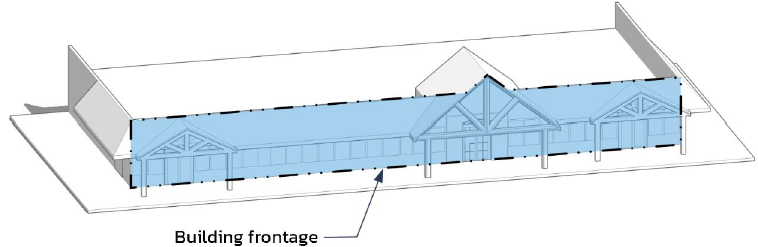
Figure Sec. 15-7-1: Building Frontage
(b)
Sign Area.
(1)
The area of a two-dimensional sign is measured by encompassing the advertising display surface area within any combination of geometric figures (e.g., rectangles, squares, triangles, parallelograms, circles, or ellipses), having no more than eight sides, that would enclose all parts of the sign.
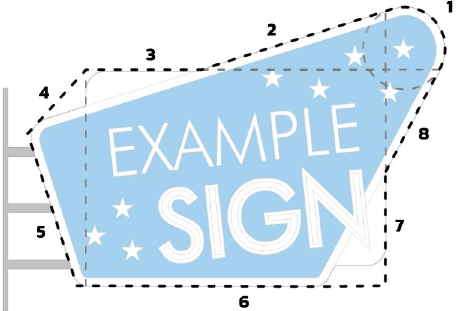
Figure Sec. 15-7-2: Sign Area Measurement
(2)
The sign area of three-dimensional free-form or sculptural (non-planar) signs is calculated as 50 percent of the sum of the area of the four vertical sides of the smallest cube that will encompass the sign.
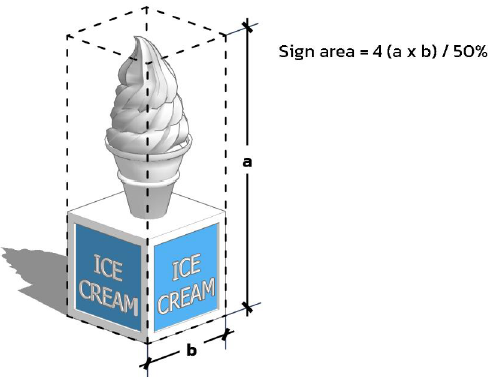
Figure Sec. 15-7-3: 3-D Sign Area Measurement
(3)
If elements of a sign are movable or flexible, such as a flag or banner, or if the sign includes any permitted copy extensions, the measurement is taken when the elements or extensions are fully extended and parallel to the plane of view.
(4)
Only structural components shall be excluded in computing the total allowable area.
(c)
Freestanding Sign Height.
(1)
The height of a freestanding sign shall be computed as the distance from the base of the sign at existing finished grade to the top of the highest attached component of the sign.
(2)
When the existing finished grade at the point of measurement is lower than the average elevation of the adjacent street finished grade parallel to the location where the sign will be installed, that portion of the sign below the street shall not be included in determining the sign's overall height.
(3)
The height of any monument sign base or other structure erected to support or adorn the sign is measured as part of the sign height.
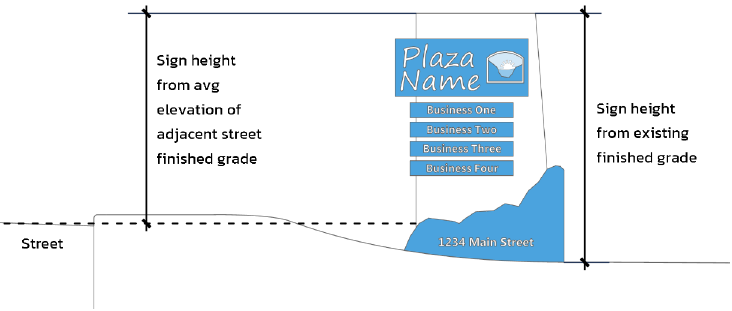
Figure Sec. 15-7-4: Freestanding Sign Height Measurement
(4)
If a sign is located on a mound, berm, or other raised area for the sole purpose of increasing the height of the sign, the height of the mound, berm, or other raised area shall be included in the height of the sign.
(Ord. No. 2025-01, § 2(Exh. A), 1-27-2025)
Sec. 15-7-50. - Exempt signs.
The following signs, items, and activities do not require a Sign Permit, but shall comply with the requirements identified below.
(a)
Internal and Integral Signs.
(1)
Signs not intended for view or readily legible from the public right-of-way.
(2)
Integral signs that are carved into stone, concrete, or similar material or made of metal or other permanent-type construction and made an integral part of the structure. Integral signs shall not exceed four square feet in area.
(3)
Signs that do not exceed two square feet per face or four square feet in total surface area that are affixed to machines, equipment, fences, gates, walls, gasoline pumps/electric vehicle charging units, or utility cabinets.
(4)
Signs or banners on fences and structures within a Town park or recreational area, provided the signs or banners face inward to the Town park or recreational area.
(b)
Flags or Insignia. Entryway flags shall not exceed three feet by five feet, or 15 square feet in size. All other flags, crests, or banners shall be 24 square feet or less and affixed to a permanent flagpole or building.
(1)
Entryway flags shall be a minimum of eight feet and a maximum of 20 feet above grade and shall not extend more than six feet over any public right-of-way.
(2)
Each business may display one entryway flag during business hours.
(3)
Each building is limited to two flags.
(4)
When applicable, flags shall comply with Chapter 10 of Title 36 of the United States Code named "The Flag Code," as it pertains to all rules and regulations to the official Flag of the United States of America.
(c)
Public Signs.
(1)
Official public signs or plaques approved by a governmental or quasi-governmental body, Town department, or special district (collectively "governmental organizations") for structures used by the governmental organization and signs related to issues that the governmental organization has jurisdiction over, such as traffic safety, pedestrian safety, construction safety, schools, legal and public notices, railroad crossings, health, historic matters, hazards, parking, swimming, or dumping. Traffic signs shall follow the Manual on Uniform Traffic Control Devices for Streets and Highways issued by the Federal Highway Administration.
(2)
Signs and notices required to be maintained by law or governmental order, rule, or regulation, provided that the content and size of the sign does not exceed the requirements of the law, order, rule, or regulation.
(3)
Town-sponsored, Town-owned, and Town-maintained signs and temporary banners that are displayed and erected above Greene Street and/or Blair Street, at or near the Visitor's Center, on the fence surrounding the ballpark located at Greene Street and 4th Street and at the Kendall Mountain Recreation Center, provided that any sign or banner erected above and over a public right-of-way or thoroughfare shall meet the minimum and maximum height requirement by state or federal law. All banners must obtain and be in compliance with the standards for a public banner permit.
(d)
Artwork. Works of art that in no way identify, advertise, or display, directly or indirectly, a product or business. This shall include wall murals, yard art, or other public mosaics or sculptures.
(e)
Menu-Sized Sign Boxes and Changeable Sign Boards. Each restaurant or bar may display one menu-sized sign box attached to the building in which they are located. Menu-sized sign boxes may not exceed two feet in height, two feet in width, and three inches in depth. Each restaurant and/or bar may display one pedestrian-oriented changeable sign board of chalk, dry-erase, or similar nature, attached to the building in which it is located. Changeable sign boards may not exceed two feet in height, two feet in width, and three inches in depth.
(f)
Residential and Vacation Rental Signs. Non-illuminated signs (either freestanding or wall signs only), provided that they are located on the same lot as the dwelling unit with which they are associated, there is not more than one sign displayed on any street frontage, and the sign does not exceed two square feet in sign area per dwelling unit.
(g)
Temporary Signs. See Section 15-7-90, Standards for Temporary Signs.
(h)
Vehicle Signs. The vehicle shall be owned by the business or employee of the business, operable and properly licensed, and regularly used in the normal conduct of business, such as delivering or transporting goods or providing services related to the business.
(i)
Window Signs.
(1)
Window signs may be affixed directly to the inside or outside window or hung/mounted inside the window from the top, side, or bottom of the window frame or similar architectural element.
(2)
Each sign shall be no more than four square feet in area.
(3)
Signs in windows visible from public rights-of-way are limited to 20 percent of the total area of each architecturally distinct ground floor window area.
(4)
In buildings with multiple tenants, these provisions shall be applied to each individual tenant based on the size of the windows located within that portion of the facade adjacent to the tenant's leased premises.
(Ord. No. 2025-01, § 2(Exh. A), 1-27-2025)
Sec. 15-7-60. - Prohibited signs and sign locations.
(a)
Improper Location. Signs shall not be installed or located so that they:
(1)
Obstruct the driver's vision of a moving vehicle;
(2)
Create conflict with traffic control signs, signals, or various private signs resulting in vehicular or pedestrian safety hazards, including any sign placed at any location where it may, by reason of its size, shape, design, location, content, coloring, or manner of illumination, constitute a traffic hazard or a detriment to traffic safety by obstructing the vision of drivers, by obscuring or otherwise physically interfering with any official traffic control device, or that may be confused with an official traffic control device;
(3)
Create a danger to the public during periods of inclement weather or high winds due to their location or the manner in which they are placed;
(4)
Create a hazard due to collapse, fire, collision, decay, abandonment, or other safety considerations; or
(5)
Are improperly mounted or installed, such as signs attached to a standpipe, gutter drain, unbraced parapet wall, or fire escape, unless the safety of the sign and the mounting have been verified in writing by a structural engineered licensed to practice in the state.
(b)
Prohibited Sign Types. The following types of signs shall not be permitted in any zoning district:
(1)
Off-premise signs or signs in the public right-of-way, unless approved by Public Works and the Town Administrator;
(2)
Electronic signs and signs that have blinking, flashing or fluttering lights or other illuminating devices that have a changing light intensity, brightness, or color;
(3)
Signs that move in any mechanical manner, have structural moving part(s) powered by a motor, or swing because of their design or by the manner of their suspension or attachment as a result of wind pressure, mechanically-driven apparatus, electrically-driven apparatus, or any combination;
(4)
Neon signs;
(5)
Roof signs; and
(6)
Wind signs (pennants, streamers, balloons, whirligigs, or similar devices) or flutter flags, unless otherwise allowed by this Article.
(Ord. No. 2025-01, § 2(Exh. A), 1-27-2025)
Sec. 15-7-70. - Standards for permanent signs.
(a)
Sign Materials. Exterior signs shall be constructed of durable materials able to withstand Silverton's climate and shall not be constructed of paper, cloth, canvas, cardboard, wallboard, or other similar nondurable material.
(b)
Requirements by Sign Type. All signs shall comply with the following standards, as applicable.
(Ord. No. 2025-01, § 2(Exh. A), 1-27-2025)
Sec. 15-7-80. - Allowable signage by zoning district.
(a)
Residential Districts.
(1)
The maximum total signage permitted per property is 32 square feet per sign and 16 square feet per sign face.
(2)
Each property is limited to one permanent sign per street frontage.
(3)
Freestanding signs shall be limited 12 feet in height.
(b)
Mixed-Use, Commercial, and Public Districts.
(1)
The total sign area for all signs for which permits are required shall not exceed 1.25 square foot per lineal foot of building frontage. For buildings with multiple tenants, the calculation shall be based on the length of the leased space of the frontage for each individual tenant. The aggregate sign area square footage allowance may include any desired combination of sign styles and types, but in no event shall any sign or combination of all signs on a building be greater than the maximum aggregate sign area computed using the above restrictions.
(2)
Buildings with more than one frontage on a public street, such as a corner lot, may have the maximum total sign area on each frontage, but only one frontage per lot may include a freestanding sign.
(3)
In addition to the total sign area allowed in Subsection (1), above, any building or property with multiple lots or buildings or one building with multiple tenants shall be allowed one additional sign, not to exceed the maximum limitations for the particular sign type in Table Sec. 15-7-1.
(4)
Buildings or businesses that have no actual frontage on a public street because other buildings or businesses on the same lot capture the allowed frontage shall be entitled to erect signage at the building's location that is equal to the signage allowed if they did have actual street frontage.
(Ord. No. 2025-01, § 2(Exh. A), 1-27-2025)
Sec. 15-7-90. - Standards for temporary signs.
(a)
General Standards for All Temporary Signs.
(1)
No temporary sign shall be erected, re-erected, or maintained for more than a cumulative 30 days per year, unless otherwise permitted by this Section.
(2)
Temporary signs are subject to the prohibited sign locations identified in Section 15-7-60(a).
(3)
Temporary signs shall not be illuminated.
(4)
Temporary signs shall not contain any electronic components or display any digital or electronically projected copy on the sign face.
(5)
All temporary signs shall be made of durable materials.
(b)
Sandwich Boards and Signboards.
(1)
Each building having at least one licensed and authorized business may display one sandwich board or signboard per building entrance. The sandwich board or signboard shall be located on the sidewalk within ten feet of the building entrance and located so that it does not disrupt pedestrian movement. Sandwich boards and signboards shall be removed when the use is closed or during severe weather.
(2)
No sandwich board or signboard shall be greater than two feet in width and four feet in height.
(3)
A sandwich board or signboard shall not impede or block pedestrian traffic in any way or be located within any right-of-way.
(4)
Signboards shall not be greater than eight square feet in total sign area.
(c)
Temporary Banner Signs.
(1)
Design Standards.
a.
Temporary banners shall not exceed 40 square feet in total sign area.
b.
Banners shall be firmly attached to a wall or fence on all four corners.
(2)
Construction Site Banners.
a.
Construction site banners shall not be erected prior to the issuance of a building permit for the project to which the sign pertains and shall be removed prior to the issuance of a certificate of occupancy.
b.
Active construction sites shall be limited to one temporary banner per street frontage. For a lot with multiple street frontages, the banners may be placed on separate frontages or grouped together on one frontage.
(3)
All Other Banners.
a.
Any nonresidential establishment may display one banner sign, not to exceed 40 square feet, for a maximum of 60 consecutive days at the same location, one time during the first three months after the issuance of a Certificate of Occupancy or change in ownership.
b.
Each lot shall be limited to one temporary banner sign per tenant.
(d)
Yard Signs.
(1)
Each yard sign shall not exceed 12 square feet in area (or six square feet per side if double-sided) and four feet in height.
(2)
Yard signs up to an aggregate area of 12 square feet may be displayed for an unlimited amount of time.
(3)
An aggregate area of up to 48 square feet is allowed 60 days prior to and 15 days following an election.
(4)
A minimum of four feet of sidewalk width clearance shall be available for pedestrian use.
(Ord. No. 2025-01, § 2(Exh. A), 1-27-2025)
Sec. 15-7-100. - Nonconforming signs.
All nonconforming signs shall be subject to the standards in Section 15-9-70, Nonconforming Signs.
(Ord. No. 2025-01, § 2(Exh. A), 1-27-2025)
Sec. 15-7-110. - Coordinated sign plan.
(a)
Applicability. The owner of any building or property with multiple lots or multiple tenants may apply for a Coordinated Sign Plan for the property per Section 15-8-30(j).
(b)
Standards.
(1)
Prohibited signs and sign elements are not eligible for inclusion in a Coordinated Sign Plan.
(2)
All signs included in the Coordinated Sign Plan shall be architecturally integrated into or complementary to the design of the building(s) and character of the site, and shall use similar and coordinated design features, materials, and colors.
(3)
The Town Administrator may approve a deviation in one or more dimensional or numerical standards including sign area, sign height, and number of individual signs, based on the following criteria:
a.
The overall size of the development site and the scale of the use or uses located or anticipated to be located there;
b.
Access and visibility to the site;
c.
Intended traffic circulation pattern and the need for wayfinding;
d.
Relationship between the site and adjacent uses; or
e.
The desired function of the site.
(Ord. No. 2025-01, § 2(Exh. A), 1-27-2025)
Sec. 15-7-120. - Abandoned signs.
(a)
Any sign that is located on property that becomes vacant or is unoccupied for a period of 12 months or more, any sign that was erected for an occupant or business unrelated to the present occupant or business, or any sign that pertains to a time, event or purpose that no longer exists or has passed, shall be determined to be abandoned, and no person shall maintain or permit to be maintained any abandoned sign upon their property, building, structure, or business.
(b)
Any sign that has been determined to be abandoned must be removed by the property owner. If the property owner fails to remove an abandoned sign, upon a public hearing before the Board of Trustees on the matter, the Town may cause the sign to be removed and charge to the property owner all costs which are incurred in the sign removal.
(Ord. No. 2025-01, § 2(Exh. A), 1-27-2025)

