
Silverton City Zoning Code
ARTICLE 8
Administration and Procedures
Sec. 15-8-10. - Review and decision-making bodies.
(a)
San Juan Regional Planning Commission.
(1)
Creation. The San Juan Regional Planning Commission has been created pursuant to Article 28 of Title 30 and Article 23 of Title 31, C.R.S., ("Planning Commission").
(2)
Powers and Duties. The Planning Commission is authorized to perform each and all of the duties specified by Article 28 of Title 30 and Article 23 of Title 31, C.R.S., together with any other duties or authority conferred upon it by the laws of the state, including:
a.
Making and adopting a master plan for the physical development of the county and town; and
b.
Recommending the boundaries of the various zoning districts and appropriate regulations to be enforced in the districts.
(3)
Membership.
a.
The Planning Commission shall consist of seven members as follows:
(i)
Two members of the Board of Trustees appointed by the Board of Trustees, who shall be ex officio members of the Planning Commission and shall serve during their respective official tenures;
(ii)
One member of the Board of County Commissioners, appointed by the Board of County Commissioners, who shall be an ex officio member of the Planning Commission and shall serve during their official tenure; and
(iii)
Four members at large appointed by the Planning Commission, who shall serve for a term of three years, or until a successor takes office.
b.
All members of the Planning Commission shall reside within the Town of Silverton or San Juan County, and, if any member ceases to reside in the town or county, that membership shall immediately terminate.
c.
All members of the Planning Commission shall serve without compensation.
d.
The appointing authority shall have the power to remove any member of the Planning Commission with just cause.
(4)
Officers and Procedures.
a.
The Planning Commission shall elect a chairperson and vice chairperson from among the members, whose terms shall be for one year, with eligibility for reelection. The chairperson shall preside at all meetings and perform the other duties as may be necessary, and the vice chairperson shall act in the absence of the chairperson.
b.
The Planning Commission shall adopt by-laws, operating policies, and other rules of procedure as deemed appropriate; provided, however, that the rules are not inconsistent with this Code or statutes of the state.
c.
The Town Administrator shall keep a record of the Planning Commission's resolutions, transactions, findings and determinations, which record shall be a public record. The public record shall show the action of the Planning Commission and the vote of each member upon each item considered.
d.
Four voting members of the Planning Commission shall constitute a quorum, and the affirmative vote of a majority of the members in attendance shall be necessary to pass any motion.
e.
The Planning Commission shall hold at least one regular meeting per month unless there are no items for the agenda. Agenda items may be added and special meetings and/or workshops may be called as deemed necessary or desired by either the Town Administrator, the County Administrator, or Planning Commission chairperson.
(b)
Board of Adjustment.
(1)
Creation. The Board of Adjustment has been created pursuant to C.R.S. § 31-23-307.
(2)
Powers and Duties. The Board of Adjustment shall be empowered and required to:
a.
Meet at the call of the chairperson, by their request, by petition from an aggrieved party or an applicant for Variance, or by order of the Board of Trustees; and
b.
Hear and decide on granting of certain Variances, reviews of Variances, and certain appeals.
(3)
Membership.
a.
The Board of Trustees shall act as the Board of Adjustment.
b.
All members of the Board of Adjustment shall serve without compensation, unless otherwise compensated as a member of the Board of Trustees or Board of County Commissioners.
(4)
Officers and Procedures.
a.
The Town Administrator shall keep a record of the meetings showing the action of the Board of Adjustment and the vote of each member upon each question considered, which record shall be a public record.
b.
Four members of the Board of Adjustment shall constitute a quorum, and a concurring vote of the majority of the members of the Board of Adjustment in attendance shall be necessary to decide on most matters. The concurring vote of four members shall be necessary to:
(i)
Reverse any administrative order, requirement, decision, or determination, or
(ii)
Approve any variance.
c.
The Board of Adjustment shall hold one regular meeting per month unless there are no items for the agenda. Special meetings and/or workshops may be called by as deemed necessary by the Town Administrator.
d.
Appeals from the Board of Trustees acting as the Board of Adjustment may be made to the County District Court pursuant to the Colorado Rules of Civil Procedure.
(c)
Historic Preservation Committee.
(1)
Creation. There is hereby created the Historic Preservation Committee.
(2)
Powers and Duties. The Historic Preservation Committee shall advise the Board of Trustees and staff on the following:
a.
Conduct surveys and create inventories of properties and areas for the purpose of defining those of historic significance;
b.
Review and determine qualifications of buildings, structures, objects, sites, and districts nominated for designation and recommend that the Board of Trustees designate by ordinance the buildings, structures, objects, sites, or districts qualifying for designation;
c.
Recommend to the Board of Trustees the establishment of construction and design guidelines, consistent with the Secretary of the Interior's Standards for The Treatment of Historic Properties, for review of proposals to alter, relocate, or demolish historic properties;
d.
Hear and decide on Historic District Overlay Review, Major.
e.
Participate in review of National Register of Historic Places nominations;
f.
Maintain online data base of resources related to physical and financial aspects of preservation, rehabilitation, restoration, and reconstruction, including nomination to the Town's Historic Register, The Colorado State Register of Historic Properties, and The National Register of Historic Places;
g.
Develop and assist in public education programs on history, archaeology, and historic preservation;
h.
Advise the Board of Trustees on matters related to preserving the historic character and substance of the town and recommend easements, covenants, licenses, and other methods which will implement the completion of the purposes of this Code;
i.
Participate in federal Section 106 review as requested by the Board of Trustees or the Town Administrator; and
j.
Identify and advise the Board of Trustees regarding the implementation of economic incentives for the preservation of historic properties.
(3)
Membership.
a.
The Historic Preservation Committee shall be appointed by the Board of Trustees and comprised of the following members:
b.
One year-round resident of the Town of Silverton and owner of property in the Historic District Overlay, voting member;
(i)
One year-round resident of the Town of Silverton, voting member;
(ii)
One member of the Board of Trustees, voting member;
(iii)
One member of the San Juan Regional Planning Commission who is not also on the Board of Trustees, voting member;
(iv)
One member of the Historical Society or Member of San Juan County Historic Impact Assessment Review Committee, voting member;
(v)
One high school student (when available), non-voting member; and
(vi)
One Town staff member, non-voting member.
c.
The five voting members shall have demonstrated interest in, competence with or knowledge of preservation. At least 40 percent of voting members shall be professionals or shall have extensive expertise in a preservation-related discipline, including but not limited to history, architecture, landscape architecture, American studies, American civilization, cultural geography, cultural anthropology, planning, archaeology, building trades, real estate, or law.
d.
The five voting members shall serve for a term of three years and may serve an unlimited number of terms. Terms shall be staggered.
e.
All members shall be residents of the Town of Silverton, unless approved by the Board of Trustees. If any member ceases to reside in the town, that membership shall immediately terminate, unless approved by the Board of Trustees.
f.
All members of the Historic Preservation Committee shall serve without compensation.
g.
The Board of Trustees shall have the power to remove any member of the Historic Preservation Committee with just cause.
(4)
Officers and Procedures.
a.
The five voting members shall elect a chairperson and vice chairperson from among the members, whose terms shall be for one year, with eligibility for reelection. The chairperson shall preside at all meetings and perform the other duties as may be necessary and the vice chairperson shall act in the absence of the chairperson.
b.
The Town Administrator shall keep a record of the meetings showing the action of the Historic Preservation Committee and the vote of each member upon each question considered, which record shall be a public record.
c.
The Historic Preservation Committee may draft and recommend for adoption by the Board of Trustees by-laws, operating policies, and other rules of procedure as deemed appropriate; provided, however, that the rules are not inconsistent with this Code or statutes of the state.
d.
A quorum shall consist of a majority, or 51 percent, of the members. For a committee of five members, three members shall be in attendance to establish a quorum. A quorum is necessary to conduct business, including holding a public hearing. A roll call vote shall be taken upon the request of any member. A tie vote shall be deemed a denial of the motion or recommended action.
e.
The Historic Preservation Committee shall meet at least four times a year. Meetings shall be held monthly unless there are no items for the agenda. Special meetings and/or workshops may be called as deemed necessary by the Town Administrator.
(d)
Floodplain Administrator.
(1)
Designation of Flood Hazard Administrator. The Town Administrator is hereby appointed the Flood Hazard Administrator to administer and implement this Section by granting or denying Flood Hazard Development Permit applications. The Building Official may delegate this responsibility to a Town staff representative or qualified consultant hired by the Town.
(2)
Duties and Responsibilities of Flood Hazard Administrator.
a.
Permit Review. The Flood Hazard Administrator shall:
(i)
Review all Flood Hazard Development Permits to determine that the requirements of this Section have been satisfied;
(ii)
Review all Flood Hazard Development Permits to determine that all necessary permits have been obtained from those federal, state, or local governmental agencies from which prior approval is required;
(iii)
Review all Flood Hazard Development Permits to determine if the proposed development adversely affects the flood-carrying capacity of the area of special flood hazard. For the purpose of this Section, adversely affects means damage to adjacent properties because of rises in flood stages attributed to physical changes of the channel and the adjacent overbank areas.
1.
If it is determined that there is no adverse effect and the development is not a structure, then the permit shall be granted without further consideration.
2.
If it is determined that there is an adverse effect, then technical justification prepared by a Colorado registered professional engineer for the proposed development shall be required.
3.
If the development is a structure, then all other requirements set forth in this Section must be complied with; and
(iv)
Review all Flood Hazard Development Permits to determine if the proposed development or structure is located in the floodway. If it is located in the floodway, all relevant encroachment provisions contained in this Section must be met.
b.
Use of Other Base Floodplain Data. In the event of a conflict, or if base floodplain data is not available, the Flood Hazard Administrator may obtain, review, and reasonably use any base flood elevation and floodway data available from a federal, state, or other source, in order to administer this Section.
c.
Information to be Obtained and Maintained. The Flood Hazard Administrator shall:
(i)
Obtain and record the actual elevation (in relation to mean sea level) of the lowest floor (including basement) of all new or substantially improved structures;
(ii)
For all new or substantially improved floodproofed structures:
1.
Verify and record the actual elevation to which the structure has been floodproofed; and
2.
Maintain all floodproofing certifications required in this Section; and
(iii)
Maintain for public inspection all records pertaining to the provisions of this Section.
d.
Alterations of Watercourses. The Flood Hazard Administrator shall:
(i)
Notify downstream communities, the Colorado Conservation Board and the U.S. Army Corps of Engineers prior to any alteration or relocation of a watercourse and submit evidence of the notification to the Federal Emergency Management Agency; and
(ii)
Require that the maintenance be provided within the altered or relocated portion of the watercourse to preclude diminishing the flood-carrying capacity.
e.
Interpretation of Flood Insurance Rate Map boundaries. The Flood Hazard Administrator shall special flood hazards (for example, where there appears to be a conflict between mapped boundary and actual field conditions). The person contesting the location of the boundary shall be given a reasonable opportunity to appeal the interpretation as provided in this Section.
(Ord. No. 2025-01, § 2(Exh. A), 1-27-2025)
Sec. 15-8-20. - Development review procedures.
(a)
Summary Table of Development Review Procedures. Table Sec. 15-8-1 summarizes the procedural steps that are applicable for each specific application or action, and in the case of recommendation and decision hearings, which decision-making body has authority.
(b)
Common Review Procedures Described.
(1)
This Article establishes the Common Review Procedures for development application review and decision-making. The following procedures are standard and generally apply to all, or most, types of applications as shown in Table Sec. 15-8-1.
(2)
Sections 15-8-30 and Sec. 15-8-30(o) establish additional provisions for specific procedures. Where these Common Review Procedures conflict with specific procedure provisions, the specific procedures provisions shall apply.
(c)
Preapplication Meeting.
(1)
Purpose. Preapplication meetings are established to:
a.
Provide the applicant and Town an opportunity to discuss the following prior to application submission:
(i)
The application concept;
(ii)
General compliance with the LUC and Building Regulations; and
(iii)
Any potentially significant issues regarding compliance;
b.
Determine the applicable process(es) and estimated timing; and
c.
Assist the applicant in understanding the submittal requirements and review procedures.
(2)
When Required. This meeting is required prior to the formal submission of an application, as identified in Table Sec. 15-8-1. This step is optional for all other applications.
(3)
Information and Effect.
a.
The applicant shall bring supporting documentation such as a narrative explaining the project, plans, diagrams, plats, or other information sufficient to allow a conceptual review of the proposed application.
b.
The informal evaluation provided at the preapplication meeting is not binding upon the applicant or the Town. The Town will create and share a meeting summary letter with the applicant that identifies applicable code sections and recommends next steps. The meeting summary letter shall be submitted with the formal application submission.
(d)
Informational Meeting.
(1)
Purpose. Informational meetings are established to allow residents, business, and community members a pre-submission opportunity to learn from the applicant about a proposed development project, including but not limited to land uses, size, height, and layout, at an early stage of the development process and to communicate directly with the applicant about their issues, concerns, or comments.
(2)
When Required.
a.
Generally. This meeting is required prior to the submittal of an application as identified in Table Sec. 15-8-1. This step is optional for all other applications.
b.
Informational Meeting Requirement or Waiver.
(i)
The Town Administrator may require, or the Planning Commission or Board of Trustees may request, an informational meeting when the proposed development may impact neighboring properties more than the typical development allowed on the site.
(ii)
At an applicant's request, the Town Administrator may waive a required informational meeting when, in the Town Administrator's opinion, the proposed development will not have any impact on neighboring properties. The Town Administrator shall provide the applicant with a written confirmation that the informational meeting has been waived and generally describe the reasons for the waiver.
(3)
Scheduling and Notice.
a.
The Town Administrator and the applicant shall coordinate meeting time, place, and notice to the community.
b.
The applicant shall be responsible for:
(i)
Notifying all property owners and residents within 300 feet of the property line by mail and publishing notice of the meeting in the newspaper at least 15 days prior to the meeting;
(ii)
Conducting and facilitating the meeting;
(iii)
Covering all expenses of the meeting including but not limited to facility costs and the cost of the meeting notice; and
(iv)
Preparing a written report of meeting comments and submit the report with the development application. The applicant may elect to make changes to the proposal based on comments to improve the project outcome.
c.
A representative from the Town of Silverton may be in attendance to listen but will not provide information about project specifics or facilitate the meeting.
(e)
Application Submittal and Acceptance.
(1)
Application Requirements.
a.
Applications may be filed by the property owner(s) with title to the entire property subject to the application or their authorized representative, unless specified otherwise under each specific procedure in Sections 15-8-30 and Sec. 15-8-30(o).
b.
The applicant shall prepare and submit an application(s) that meets all requirements of this Code.
c.
The Town Administrator is authorized to establish and amend application forms based on the requirements of this Code and Colorado law. All applications shall include, at a minimum, the following, in addition to any submittal requirements listed under each specific procedure in Sections Sec. 15-8-30 and Sec. 15-8-30(o):
(i)
Completed application form;
(ii)
Application fee, any required deposits, and Agreement for Payment of Development Review Expenses per Section 15-8-20(e)(3);
(iii)
If a specific property is involved in the application:
1.
Proof of ownership or authorization to submit the application on behalf of the owner(s);
2.
A list of all mineral interest owners with interests severed from the subject property; and
3.
Vicinity map showing the project area with all applicable lot and parcel lines and abutting roads; and
4.
Written narrative explaining the project and the request, exact Section(s) of the Code involved in the request, and a detailed description of how the requests complies with the generally applicable review criteria and the review criteria for the specific procedure.
d.
All applications shall be submitted electronically to the Town Administrator. Hard copies of plats, site design surveys, construction plans, and other similar documents may be required as determined by the Town Administrator once the application is determined to be complete.
(2)
Concurrent Application. Where multiple applications are submitted for the same property, the Town Administrator may allow concurrent review of applications for efficiency and practicality.
(3)
Fees. The Board of Trustees may adopt and amend from time to time a fee schedule for all applications and proceedings under this Code.
a.
Town Cost Reimbursement. All applicants shall comply with the following at the time of application:
(i)
The applicant shall pay all required fees for the purpose of the Town's review and processing of the application. Where the application will require additional staff or Town consultant time or services (such as but not limited to notice, recording fees, subject matter expert review, or legal services), the Town Administrator will prepare an estimate of fees and establish a deposit amount for the applicant to submit to the Town.
(ii)
The applicant shall enter into an Agreement for Payment of Development Review Expenses ("Reimbursement Agreement").
1.
The final form of an Agreement shall be subject to the Town Attorney's review and revision, based on the particular circumstances of the proposed development.
2.
The Town Administrator may, at their discretion, execute the Agreement on behalf of the Town or forward the agreement to the Board of Trustees for consideration.
b.
Expenses.
(i)
The Town shall maintain separate accounts of all monies expended as a result of the review of an application. Statements of expenses incurred will be made available to the applicant upon reasonable request.
(ii)
In the event the Town incurs expenses for the review of the applicant's request greater than the deposit monies collected from the applicant, the applicant shall reimburse the Town for the additional expenses. The Town will invoice the applicant for the additional fees and applicant shall reimburse the Town within ten days of receipt of the invoice. If the applicant fails to pay the invoice on time, the Town Administrator may instruct the Planning Department to cease processing the application or deny approval of the application.
(iii)
All unused funds will be returned to the applicant within 30 days after final action on the application.
c.
Waivers and Modification of Fees and Expenses. When a project specifically addresses an identified community need, the applicant may submit a written request to the Board of Trustees to refund any portion of a fee or expense associated with the processing of any application. The written request shall be submitted with the associated application. If approved, the applicant will be reimbursed and required to enter into a development agreement or record a covenant on the property ensuring the community need will be secured for a specified period of time.
(4)
Completeness Review.
a.
The Town Administrator shall review an application within a reasonable timeframe to determine whether the application is complete.
b.
If the application is missing required information, including information necessary or sufficient to decide on the application, it will be determined to be incomplete, and the Town Administrator shall inform the applicant in writing of what materials are missing or insufficient.
c.
The application will not be processed further until the application is determined to be complete.
d.
No application shall be deemed complete unless accompanied by a properly executed Reimbursement Agreement.
e.
Once the application is determined to be complete, the Town Administrator shall process the application for review.
(f)
Administrative Review and Action.
(1)
Referral Agency Review. The Town Administrator shall distribute the complete application to Town staff and agencies or entities outside of the Town that may be affected by the application. Referral of applications shall be for a time frame of 14 days unless extended by the Town Administrator for applications that present technical issues requiring additional review or for modified applications. Referral agencies may include:
a.
Town employees or contractors including but not limited to Public Works staff and the Town Attorney;
b.
County employees;
c.
Fire district;
d.
Utility providers and districts;
e.
School district;
f.
State of Colorado agencies including the Department of Transportation, Department of Health and Environment, State Forest Service, Parks and Wildlife, Colorado Geological Survey, Division of Water Resources, Division of Reclamation, Mining and Safety; and
g.
Federal land management agencies including the Bureau of Land Management, U.S. Army Corps of Engineers, Environmental Protection Agency, and U.S. Forest Service.
(2)
Readiness for Decision.
a.
Following completion of any referral agency review, the Town Administrator shall determine if the application is ready for a decision.
b.
If not, the Town Administrator shall request, in writing, additional information or corrections from the applicant. New and revised materials shall be reviewed in a reasonable timeframe.
c.
Once the application is ready for a decision, the Town Administrator shall proceed to make the decision per Subsection (5) below or prepare the application for decision by a decision-making body per Subsection (6) below.
(3)
Inactive Applications.
a.
Criteria.
(i)
The Town Administrator may notify an applicant that an application will be considered inactive unless corrective action is taken within 45 days, if at any point in a development review process the following have occurred:
1.
The applicant fails to attend any scheduled mandatory meeting, meeting with the Town Administrator, meeting or hearing before the Planning Commission, Board of Trustees, Board of Adjustment, or Historic Preservation Committee; or
2.
The applicant has not responded to a staff request for information, has not agreed to a date for a meeting or hearing, or has not taken some other affirmative step within a reasonable timeframe that is within the applicant's control and is necessary to advance the application for a final determination.
(ii)
If an applicant is no longer reasonably able to be reached, the Town Administrator may publish inactive application notice on the Town's website.
b.
Application Terminated.
(i)
No further processing of any inactive application shall occur until the deficiencies are corrected.
(ii)
If the applicant does not correct the deficiencies within the 45 day correction period, the application shall be considered withdrawn and terminated with no further action by the Town. Any resubmittal of the application by the applicant will be treated as a new application for purposes of review, scheduling, and payment of application fees.
(4)
Withdrawal. The applicant may choose to withdraw the application for any reason by providing written notice, through email or hard copy, to the Town Administrator at least one day prior to the hearing. An applicant is not entitled to a refund of application fees for withdrawn applications.
(5)
Administrative Decisions.
a.
Where the Town Administrator has the authority to decide an application, the application shall be reviewed against the applicable provisions of this Code, which may include review criteria in Section 15-8-20(h)(4), Generally Applicable Review Criteria or Sec. 15-8-30, Specific Procedures - Administrative Decisions.
(i)
To be approved, the application shall be fully consistent with the standards of this Code unless an Administrative Adjustment is concurrently approved.
(ii)
Administrative approvals shall not be conditioned, but instructions may be provided to ensure compliance with this Code.
(iii)
Applications found to be inconsistent with the standards of this Code shall be denied.
b.
A Notice of Decision per Sec. 15-8-20(i)(1) shall be provided to the applicant and Board of Trustees within a reasonable timeframe.
c.
The Town Administrator may refer any administrative decision to the Planning Commission that, in their opinion, presents issues that require Planning Commission attention.
(6)
Preparation for Decisions by Decision-Making Bodies. For procedures where the Planning Commission, Board of Trustees, Board of Adjustment, or Historic Preservation Committee has authority to make a recommendation or decide an application, the Town Administrator shall:
a.
Set the date, time, and location of the public hearing within a reasonable timeframe;
b.
Notify, in writing, the applicant and any staff involved of the hearing date, time, and location; and
c.
Prepare a staff report including:
(i)
All applicable provisions of this Code and an analysis of how each is satisfied or not, including the review criteria;
(ii)
A recommendation whether to approve, approve with conditions, or deny the application. If approval with conditions is recommended, a list of suggested conditions; and
(iii)
Any additional information pertinent to the review of the application.
(g)
Public Notice. When an application requires a public hearing as specified in Section 15-8-40, each public hearing shall be noticed in accordance with Table Sec. 15-8-1.
(1)
Published Notice. The Town Administrator shall publish the date, time, place, and purpose of the public hearing in a newspaper of general circulation of the town at least 15 days prior to the meeting.
(2)
Mailed Notice. The Town Administrator shall send mailed notice, describing the date, time, place, and purpose of the public hearing to all property owners within a 300 foot radius from the center point of the subject property at least 15 days prior to the public hearing.
(3)
Mineral Estate Notice. The applicant shall provide mailed notice to any mineral estate owner that has a severed mineral interest within the proposed development not less than 30 days before the initial public hearing for the application. The notice shall be sent by certified mail, return receipt requested, or by a nationally recognized overnight courier and shall contain the date, time, place, and purpose of the public hearing as well as the location of the property and name of the applicant. A copy of the notice, including the names and addresses of where notices were sent along with the applicant's certification of compliance with these notification requirements shall be submitted to the Town.
(h)
Decision-Making Review and Action.
(1)
All Meetings.
a.
All Planning Commission, Board of Trustees, Board of Adjustment, and Historic Preservation Committee meetings shall be open to the public unless otherwise allowed by law.
b.
The applicant shall bear the burden of presenting sufficient competent evidence at the public hearing to prove compliance with the applicable standards and criteria.
c.
Any decision by the reviewing body shall be based upon consideration of all evidence presented during the public hearing. Where evidence presented is contradictory, the reviewing body shall weigh the evidence and judge the credibility and sufficiency of the evidence prior to rendering a decision.
d.
The decision-making body may continue or postpone the public hearing or any other action at any time to a specified date in order to allow for the preparation of additional information for further review by the decision-making body.
(2)
Recommendation Hearing.
a.
The reviewing body shall review the application for conformance with the applicable procedure, review criteria, and the staff report. The reviewing body shall issue a recommendation whether to approve, approve with conditions, or deny the application within a reasonable timeframe.
b.
The recommendation shall be forwarded to the appropriate decision-making body.
(3)
Decision Hearing.
a.
The decision-making body shall host a public hearing to review the application for conformance with the applicable procedure and review criteria within this Code, staff report, and recommendation from the reviewing body, if applicable.
b.
The decision-making body shall approve, approve with conditions, or deny the application within a reasonable timeframe. If the application is denied, the written notification shall include the reasons for denial.
(4)
Generally Applicable Review Criteria. The decision-making body shall consider the following generally applicable review criteria:
a.
Conformance with prior approvals, if applicable;
b.
Compliance with applicable provisions of this Code;
c.
Compliance with the Development Standards and Specifications;
d.
Conformance with the Master Plan and other applicable Town plans and policy guides; and
e.
Compliance with review criteria for the specific procedure identified in Sections Sec. 15-8-30 and Sec. 15-8-30(o).
(5)
Conditions.
a.
The decision-making body may impose conditions on an approval to safeguard the welfare and protection of the town and adjacent property.
b.
All conditions of approval shall be reasonably related to the anticipated impacts of the proposed use or development and implementing the requirements of this Code and the intent of the Master Plan.
c.
The decision-making body may place specific time limits on the satisfaction of any condition of approval. If a time limit is not specified in the approval or in the specific provisions of this Code then a one year time limit shall apply.
d.
The Town Administrator shall determine when conditions have been met.
(6)
Guarantee of Completion for Required Improvements.
a.
When public improvements are required by this LUC or as a condition of approval, the applicant shall enter into a written Development Improvement Agreement with the Town to guarantee construction of all required improvements, including streets, curbs and gutters, driveways, sidewalks, storm drainage system, sanitary sewerage, potable water system, street lights, street name signs and all other improvements covered by Article 4, Subdivision Design and Improvement.
b.
The Development Improvement Agreement shall include terms for required improvements, construction specifications in compliance with the Development Standards and Specifications and other applicable regulations, the date for completion of the improvements, and the terms and conditions upon default by the subdivider or acceptance of the improvements by the Town.
c.
Under the agreement, the applicant shall post a performance bond, letter of credit, or certified check, prior to commencing construction, which bond or check shall be drawn in favor of the Town in an amount equal to the estimated cost of construction of improvements required as enumerated.
d.
The performance bond, letter of credit, or certified check posted by the applicant shall not be released until final construction of improvements has been completed, inspected at the applicant's expense and approved and accepted by the Town.
e.
If the Town determines that the applicant will not construct any or all of the improvements in accordance with the Development Improvement Agreement, the Town shall have the power to annul the agreement and apply all or part of the financial guarantee to the construction or completion of any or all of the specified improvements in accordance with the agreed specification.
f.
The Development Improvement Agreement shall be reviewed with the specific procedure that requires public improvements and by the Town Attorney based on the particular circumstances of the proposed improvements.
(7)
Call Up of Administrative Decisions.
a.
The Board of Trustees may exercise review over an application decided by the Town Administrator, Planning Commission, or Historic Preservation Committee by calling-up the application for addition to the Board of Trustee's agenda. The purpose of the call-up process is to allow the Board of Trustees to exercise oversight of administrative, Planning Commission, and Historic Preservation Committee approvals as it deems necessary, not to provide an applicant with an unofficial appeal.
b.
Any member of the Board of Trustees may call-up decisions made by the Town Administrator, Planning Commission, or Historic Preservation Committee within 15 days of the Notice of Decision being issued.
c.
Called-up applications shall be reviewed at the next regularly scheduled Board of Trustees meeting. A vote of the majority of the members present to review the application is required prior to any action on the application.
d.
The Town Administrator shall notify the applicant that the decision has been called-up, which requires they do not take any action on the application, and the meeting date. The Board of Trustees shall review the application as it was submitted to the Town. An applicant who wishes to submit additional information regarding an application shall first submit the additional information through a new application.
(i)
Post-Decision Actions and Obligations.
(1)
Notice of Decision. For all final decisions requiring a Notice of Decision in Table Sec. 15-8-1 after a decision is made, the Town Administrator shall prepare and send to the applicant and Board of Trustees a Notice of Decision that identifies the decision, any conditions attached to the approval, and all applicable timeframes.
(2)
Appeals.
a.
Appeals of any administrative determination shall be made per Section 15-8-40(b).
b.
Appeals of any decision of the Planning Commission or the Historic Preservation Committee shall be made per Section 15-8-40(c).
c.
Appeals of any decision of the Board of Adjustment and the Board of Trustees may be scheduled for a rehearing by the decision-making body. Following a rehearing or rehearing denial, further appeal shall be made to the District Court, as provided by state statute.
(3)
Limitation on Resubmission. Whenever the Town Administrator, Planning Commission, Board of Trustees, Board of Adjustment, or Historic Preservation Committee decides an application or an appeal of an application, no person shall submit an application that is the same, or substantially the same, for at least one year from the date of the final action on the application. The Town Administrator shall determine whether a new application or reapplication is limited by this provision.
(4)
Final Documents and Recordation.
a.
The applicant shall submit all final documents reflecting any conditions of approval to the Town for final review and acknowledgement.
b.
Ordinances, plats, vacation of plats, and other processes that require the recording of documents as specified in the specific procedures listed in Section 15-8-30(o), shall be required to be recorded with the San Juan County Clerk and Recorder. These documents shall be fully executed by the applicant and submitted for execution and recording by the Town within 60 days from the date of approval by the decision-making body. The approval expires if documents are not properly recorded within 60 days. The Town Administrator may provide one 60-day extension for good cause.
c.
No person shall record a plat of a subdivision nor prepare or execute any documents that purport to create or creates a new lot or airspace unit, nor record or execute a deed of trust or a mortgage descriptive of the property other than all of a lot unless the plat, deed, deed of trust or mortgage has been approved by the Town and unless it conforms to all of the provisions of this Code.
(5)
Termination of Approval.
a.
Expiration. Except for Rezoning approvals or as otherwise specified in Sections Sec. 15-8-30 and Sec. 15-8-30(o), an approval granted under this Code shall lapse and become void one year following the date of the final decision unless, prior to the expiration date, a building permit based upon the approval is issued and construction is commenced and diligently pursued without expiration toward completion.
b.
Extension.
(i)
An approval may be extended by up to one year by the Town Administrator. The request for extension shall be submitted in writing to the Town Administrator prior to the expiration of the original approval.
(ii)
All additional requests for extensions shall be approved by the decision-making body that issued the original approval. The request shall be submitted to the Town Administrator in writing at least 30 days prior to the expiration of approval. An extension request shall include payment of required fees and written description of the reasons for the applicant's inability to comply with the specified deadlines, listing any changes to the Master Plan or this Code that have occurred since approval of the permit/plan as these changes affect the permit/plan, and the anticipated time schedule for completing the approval process or project.
(iii)
The decision-making body shall review the request for compliance. This review for extension may result in additional conditions.
(iv)
If the extension is denied, the applicant may resubmit a new application, subject to the fees and regulations in effect at the time of resubmittal, for the same project.
(6)
Revocation of Approval. The Town Administrator may recommend that the approving body review and revoke an approval that was granted with conditions. The matter will be scheduled for review in the same manner as it was originally heard, at either a regular meeting or public hearing. The approving body will determine whether the development fails to comply with applicable conditions in a manner that is detrimental to the site or surrounding area such that the approval should be revoked. The burden to show compliance with approval conditions is on the approval holder.
(7)
Amendments or Modifications to Approvals. All changes, modifications, removal, or release of the provisions of an approval that do not qualify for an Administrative Adjustment per Section 15-8-30(a) or Site Plan per Section 15-8-30(l) shall be considered an amendment. For purposes of review and scheduling, proposed amendments are treated as new applications subject to the applicable procedures and review criteria set forth in this Article.
(Ord. No. 2025-01, § 2(Exh. A), 1-27-2025)
Sec. 15-8-30. - Specific procedures—Administrative decisions.
(a)
Administrative Adjustment.
(1)
Purpose. Administrative Adjustments allow the modification of an existing numeric dimensional standard such as lot area, setbacks, and building height to accommodate site-specific or minor construction issues.
(2)
Applicability.
a.
Permitted Types of Adjustments. Applications for Administrative Adjustments that are not related to a request for reasonable accommodation under the Federal Fair Housing Act or the Religious Land Use and Institutionalized Persons Act may only be considered for the adjustments listed below.
b.
Limitations on Administrative Adjustment. Administrative Adjustment may not be used to:
(i)
Create, intensify, or expand any nonconformity with maximum or minimum requirements of the zoning district;
(ii)
Modify standards not listed in or modify any standard outside this Code;
(iii)
Permit uses other than those permitted in the zoning district; or
(iv)
Modify a standard that has already been modified through a separate Variance pursuant to Section 15-8-40(n).
(3)
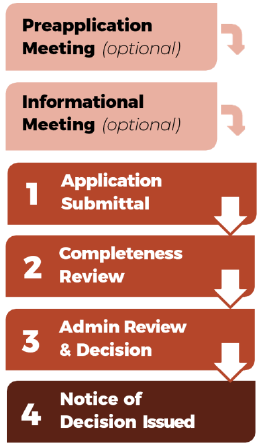
Common Review Procedures. The Common Review Procedures in Section 15-8-10(d)(1) apply, as shown in the flow chart, with the modifications listed below.
(4)
Application Submittal.
a.
Any requests for an Administrative Adjustment shall be submitted concurrently with any applicable application.
b.
Mailed public notice shall be completed per Section 15-8-20(g)(2) except that the notice shall contain the application and provide a method in which notified property owners can submit comments on the application before a decision is made.
(5)
Review and Decision-Making.
a.
Review and Decision. Administrative Adjustment applications are reviewed and decided on by the Town Administrator per Section 15-8-20(f)(5).
b.
Review Criteria. In addition to the generally applicable review criteria in Section 15-8-20(h)(4), the following criteria shall be met when deciding on an Administrative Adjustment:
(i)
The proposed use, structure, or activity is permitted in the underlying zoning district;
(ii)
There are special circumstances existing on the property for which the application is made related to size, shape, area, topography, surrounding conditions, and location that do not apply generally to other property in the same area and zoning district;
(iii)
The special circumstances have not been created by the applicant; and
(iv)
The impact of the Administrative Adjustment is internal to the subject property.
(b)
Avalanche Hazard Permit, Minor.
(1)
Purpose. The purpose a Minor Avalanche Hazard Development Permit is to regulate the approval of certain substantive building and construction activities within the Moderate Hazard Blue Zone.
(2)
Applicability. Minor Avalanche Development Permits are required for the following development in the Moderate Hazard Blue Zone:
a.
New single-unit detached dwellings and detached accessory dwellings units (ADUs);
b.
Parks and open space uses, as defined in this LUC;
c.
Minor utilities, as defined in this LUC;
d.
Accessory buildings and structures;
e.
Any seasonal development activity or land use not occurring between November 1 and May 1 of any year, including the placement of temporary structures; and
f.
Outdoor recreation and entertainment uses that involve no structures being built or situated within the Moderate Hazard Blue Zone from November 1 to May 1 of any year.
(3)
Common Review Procedures. The Common Review Procedures in Section 15-8-10(d)(1) apply, as shown in the flow chart, with the modifications listed below.
(4)
Application Submittal. In addition to the general application submittal requirements, the application shall contain the following:
a.
A two-part, site specific engineering study report that contains:
(i)
The complete study and report (as prepared by a qualified professional civil or geotechnical engineer licensed in Colorado or qualified professional geologist in the field of avalanche occurrence, force and behavior) documenting avalanche impact pressures present at any and all proposed building and construction sites on the applicant's property; and
(ii)
Complete construction plans and specifications for all proposed buildings and structures (as prepared by a qualified structural engineer licensed to practice in the State of Colorado), including the structural engineer's certification that the buildings and structures, if constructed in accordance with the submitted plans and specifications, will withstand the avalanche impact pressures as documented in the study and report.
b.
All investigations, studies, and reports shall be prepared at the applicant's expense. The investigations, studies, and reports must specifically answer the following:
(i)
Whether the site specific conditions are such that the property can or cannot be developed for the specific structures or proposed uses with or without on-site protective measures and, if protective measures are necessary, what those specific measures are, including site and construction plans for the protective measures; and
(ii)
Whether the on-site protective measures will increase the hazard to other properties, structures, roads, rights-of-way, easements, utilities, or construction located adjacent to or downslope from the applicant's property.
c.
Certification by the design engineer that the on-site protective measures, if constructed as designed, will withstand the documented avalanche impact pressures and protect the subject properties without adversely impacting adjoining and/or downslope properties.
d.
A vegetation protection and removal plan that demonstrates compliance with Section 15-5-10(d)(5), Vegetation Removal Prohibited.
(5)
Review and Decision-Making.
a.
Minor Avalanche Hazard Development Permit applications are reviewed and decided on by the Town Administrator per Section 15-8-20(f)(5).
b.
In addition to the generally applicable review criteria in Section 15-8-20(h)(4), the following criteria shall be met when deciding on a Minor Avalanche Hazard Development Permit:
(i)
The application shall comply with all standards set forth in Section 15-5-10.
(ii)
The applicant has submitted sufficient proof that the site can be developed for the proposed use because the danger posed by an avalanche can be reduced or mitigated to a reasonable level.
(iii)
The public health, safety, and welfare hazards associated with developing and occupying property are maximally reduced to a reasonable and acceptable level, including specific findings that establishment of the proposed improvements and/or land uses will not increase the potential avalanche hazard or public health, safety and welfare hazards associated with avalanches on adjoining properties, both within and outside of the Moderate Hazard Blue Zone, especially downslope of the subject property.
(iv)
The applicant does not have the opportunity to build outside the hazard and chooses, with substantial hardship reason, to develop within the avalanche hazard area boundaries.
(6)
Post Decision Actions and Obligations.
a.
Prior to issuance of any building permit for construction within the Moderate Hazard Blue Zone, the applicant shall sign a release and indemnification agreement and the agreement shall be properly recorded in the office of the County Clerk and Recorder, at the expense of the applicant, by the Town.
b.
All plans submitted with a building permit application for property within a Moderate Hazard Blue Zone shall be stamped "Construction in Avalanche Hazard Area," together with the applicable sub-zone designation.
(c)
Expedited Review for Affordable Housing.
(1)
Purpose. This procedure allows for expedited review of certain procedures for qualified affordable housing projects to help facilitate the creation of affordable housing within the Town of Silverton and to comply with Colorado Proposition 123.
(2)
Applicability.
a.
This procedure may be requested by an applicant for the following procedures except when related to a procedure in Subsection b below:
(i)
Administrative Adjustment;
(ii)
Avalanche, Flood, and Slope Hazard Permits;
(iii)
Historic District Overlay Review, Major and Minor;
(iv)
Special Use Permit;
(v)
Site Plan;
(vi)
Variance; and
(vii)
Building permits.
b.
This process may not be requested or applied to the following procedures:
(i)
Annexations/Disconnections;
(ii)
Appeals;
(iii)
Historic District Overlay Designation;
(iv)
LUC Text Amendments;
(v)
Master Plan Amendments;
(vi)
Plat Amendments and Final Plats for Condos or Townhomes;
(vii)
Subdivisions, Simple and Major;
(viii)
Subdivision Design Modifications;
(ix)
Planned Unit Development;
(x)
Temporary Use Permits;
(xi)
Vacation of Right-of-way; and
(xii)
Zoning Map Amendments.
c.
In order to qualify for Expedited Review, at least 50 percent of the residential units in the development must qualify as affordable housing, as defined by this LUC, and those units will remain affordable for a period of at least 99 years.
(3)
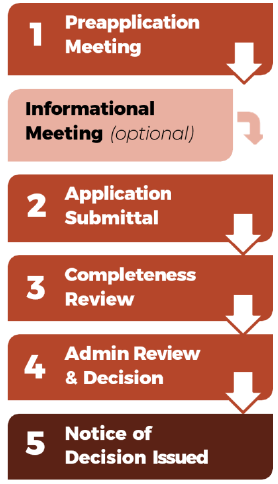
Common Review Procedures. The Common Review Procedures in Section 15-8-20 apply, as shown in the flow chart, with the modifications listed below.
(4)
Application Submittal.
a.
The application must specifically request Expedited Review.
b.
Development for the purpose of affordable housing may formally request the Board of Trustees allow a reduction in application fees.
(5)
Review and Decision-Making.
a.
Review and Decision.
(i)
The Expedited Review shall be reviewed and decided on by the Town Administrator per Section 15-8-20(f)(5).
(ii)
The Town Administrator may refer any Expedited Review application to the decision-making body identified for the specific procedure that, in their opinion, presents issues that require additional attention.
(iii)
Upon determination of a complete application by the Town, a final decision on the application shall occur not more than 90 days after the determination. This shall include all required public hearings, as appropriate.
(iv)
Qualified affordable housing expedited review projects will be given first priority for scheduling of all meetings, as applicable, including but not limited to preapplication meetings and public hearings.
(v)
The 90 day review timeframe may be extended in the following circumstances:
1.
At the request of the applicant, a one-time 90 day extension may be provided for the applicant to address comments on the application from an agency that has approval authority like a state agency.
2.
At the discretion of the Town, a 30 day extension may be provided. The Town shall notify the applicant of the intent to extend the process. These extensions should be utilized to provide additional time for the developer and local government to review address submittal materials and comments.
(vi)
The requirements of this Section do not preclude the Town from processing an application in less than 90 days.
b.
Review Criteria. In addition to the generally applicable review criteria in Section 15-8-20(f)(5), the review criteria within each specific procedure shall be considered.
(6)
Post Decision Actions and Obligations. See specific procedures.
(d)
Final Plat for Condominium or Townhome.
(1)
Purpose. A Final Plat for Condominium or Townhome is a mechanism to ensure that condominium and townhome subdivisions and conversions comply with this Code.
(2)
Applicability.
a.
This process is applicable to existing buildings converting into condominiums or townhomes and as the final step for new condominiums or townhomes. A new condominium or townhouse subdivision shall first be processed as a Simple Subdivision per Section 15-8-30(k)or as a Major Subdivision per Section 15-8-40(k).
b.
Approval is required before any sale of individual units in a multiunit dwelling, or of individual commercial or other space within a larger building, whether or not there is tenancy in common.
(3)
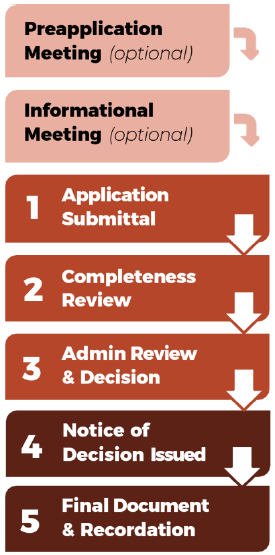
Common Review Procedures. The Common Review Procedures in Section 15-8-10(d)(1) apply, as shown in the flow chart, with the modifications listed below.
(4)
Application Submittal. In addition to the application requirements in Section 15-8-20(e)(1), the application shall contain a plat map as required for a Final Plat in Section 15-8-40(k)(4).
(5)
Review and Decision-Making.
a.
Final Plats for Condominium or Townhome applications are reviewed and decided on by the Town Administrator per Section 15-8-20(f)(5).
b.
No requirement for public improvements, dedication of land to public use or cash-in-lieu, or other subdivision requirement shall be imposed as a condition of approval for a condominium subdivision or common interest community which would not be imposed upon a physically identical development under a different form of ownership. This provision shall not be construed to prevent the Town from imposing the review requirements of this Code upon any change of use, expansion of use, increase in intensity of use, or other change in a condominium or common interest community unrelated to its form of ownership.
c.
In addition to the generally applicable review criteria in Section 15-8-20(h)(4), the following criteria shall be met when deciding on a Final Plat for a Condominium or Townhome:
(i)
The proper dedications have been made; and
(ii)
The plat accurately depicts the completion of the improvements in a manner that is substantially consistent with the approved Final Plat.
(6)
Post-Decision Actions. An approved plat map shall be recorded per Section 15-8-20(i)(4).
(e)
Flood Hazard Development Permit.
(1)
Purpose. Flood Hazard Development Permits ensure development does not affect flooding or flood damage and minimize public and private losses due to flooding.
(2)
Applicability. A Flood Hazard Development Permit is required before construction, substantial improvement or development begins within any area of special flood hazard. Any structure or nonstructural activity or development that may affect flooding or flood damage must have a permit.
(3)
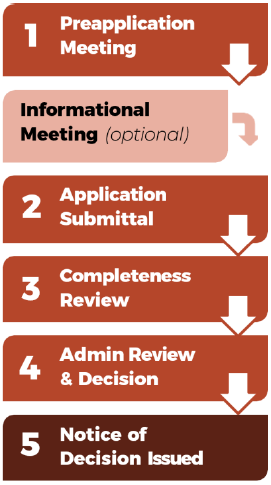
Common Review Procedures. The Common Review Procedures in Section 15-8-10(d)(1) apply, as shown in the flow chart, with the modifications listed below.
(4)
Application Submittal. In addition to the general application submittal requirements, the application shall include plans drawn to a scale legible for reasonable review and interpretation by the Town Administrator showing the nature, location, dimensions and elevations of the area in question; existing or proposed structures; fill; storage of materials; drainage facilities; and the location of the foregoing. Specifically, the following information is required:
a.
Elevation in relation to mean sea level of the lowest floor (including basement) of all structures;
b.
Elevation in relation to mean sea level to which any structure has been floodproofed;
c.
Certification by a Colorado registered professional engineer or architect that the floodproofing methods for any nonresidential structure meet the relevant floodproofing criteria set forth in Section 15-5-20; and
d.
Description of the extent to which any watercourse will be altered or relocated as a result of proposed development.
(5)
Review and Decision-Making.
a.
Flood Hazard Development Permit applications are reviewed and decided on by the Town Administrator per Section 15-8-20(f)(5).
b.
In addition to the generally applicable review criteria in Section 15-8-20(h)(4), the following criteria shall be met when deciding on a Flood Hazard Development Permit:
(i)
The application shall comply with all standards set forth in this Section 15-5-20;
(ii)
The uses, activities, and structures included in the application:
(iii)
Are likely to have little or no effect on lands upstream, downstream and in the immediate vicinity of the development covered under the Flood Hazard Development Permit including, without limitation, utility and transportation facilities;
(iv)
Will not result in an unreasonable risk of harm to people or property both on site and in the surrounding area from natural hazards;
(v)
Are likely to have little or no effect on any tributaries to the main stream, drainage ditches, water supply and irrigation ditches, storm drainage facilities, reservoirs, or any other drainage or irrigation facilities or systems; and
(vi)
Are likely to have little or no effect on the safety of access to property in times of flood for ordinary and emergency vehicles.
(vii)
The heights and velocities of the floodwaters expected at the site shall not adversely affect the development of surrounding property.
(f)
Historic District Overlay Review, Minor.
(1)
Purpose. Minor Historic District Overlay Review allows for the regulation of minor exterior building and construction activities within the Historic District Overlay.
(2)
Applicability. Historic District Overlay Review is required for all new construction, exterior alterations, relocations, and demolitions on any property within the Historic District Overlay. Minor Alterations include all alterations of building exteriors that do not have a significant or detrimental impact on the historic building or the district, excluding signs. This includes, but is not limited to:
a.
Building repairs and maintenance, including painting;
b.
In kind replacement of exterior building elements;
c.
Alterations that are not viewable by the public from a public right-of-way, except from alleys;
d.
Reroofing with the same materials and colors;
e.
Utility modifications that do not impact the exterior of the building or increase mass of the building; and
f.
Artwork painted on or attached to the exterior of the building.
(3)
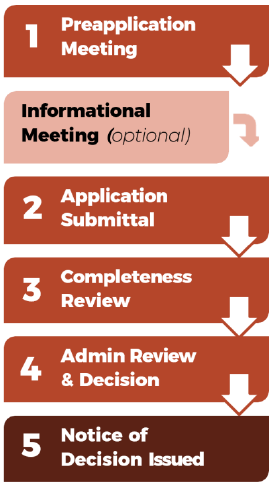
Common Review Procedures. The Common Review Procedures in Section 15-8-20 apply, as shown in the flow chart, with the modifications listed below.
(4)
Application Submittal. In addition to the application requirements in Section 15-8-20(e)(1), the application shall contain:
a.
An explanation of the how the project will affect or impact the Historic District Overlay within the written narrative;
b.
A site plan including existing and proposed easements, buildings, and utilities; and
c.
Building design plans including detailed elevations showing exterior materials, finishes, design detail, and the proposed structure alongside the adjacent structures.
(5)
Review and Decision-Making.
a.
Minor Alteration applications are reviewed and decided on by the Town Administrator. The Town Administrator may refer any application to the Historic Preservation Committee that, in their opinion, presents issues that require Historic Preservation Committee attention.
b.
In addition to the generally applicable review criteria in Section 15-8-20(h)(4), the following criteria shall be met when deciding on a Historic District Overlay Review:
(i)
The following criteria apply to all applications:
1.
Compliance with Section 15-2-80(a)(7), Design Standards for All Development in the Historic District Overlay.
(ii)
The following criteria apply to Non-Contributing Property:
1.
Compatibility with the property's current design, materials, features, size, scale and proportion, and massing; or
2.
Compatibility with the Historic District Overlay's design, materials, features, size, scale and proportion, and massing.
(iii)
The following criteria apply to total demolition of Contributing Property:
1.
The property proposed for demolition is not structurally sound, despite evidence of the owner's efforts to properly maintain it;
2.
The property cannot be preserved, restored, rehabbed, or reused on site to provide for any reasonable, beneficial use of the property regardless of any proposed development plan for the property's site or adjacent properties; and
3.
The property cannot be practically moved to another site in Town.
(iv)
The following criteria apply to partial demolition of Contributing Property:
1.
The partial demolition is required for the preservation, restoration, or rehabilitation of the property.
(6)
Post-Decision Actions. If the application is denied, the applicant may request a Variance as outlined in Section 15-8-40(n).
(g)
LUC Interpretation.
(1)
Purpose. An LUC Interpretation request allows a code user to ask the Town to clarify how a specific provision(s) of this LUC is interpreted.
(2)
Applicability.
a.
An applicant, any person affected by an action proposed pursuant to this Code, or any Town department or other governmental agencies that may be subject to the provisions of this Code may request an LUC Interpretation.
b.
Interpretations may be requested for a provision of this LUC subject to a proposed or current application, hearing, or appeal.
c.
The Town Administrator may also provide a property-specific LUC Interpretation in the form of a LUC clarification that identifies whether specific regulations in this LUC are applicable to the subject property.
(3)
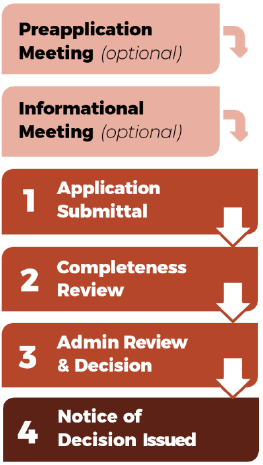
Common Review Procedures. The Common Review Procedures in Section 15-8-10(d)(1) apply, as shown in the flow chart, with the following exceptions and the modifications listed below:
a.
Section 15-8-20(e)(3)a, Town Cost Reimbursement, is not required.
b.
Section 15-8-20(f)(1) Referral Agency Review, is not required.
(4)
Review and Decision-Making.
a.
LUC Interpretation applications are reviewed and decided on by the Town Administrator per Section 15-8-20(f)(5).
b.
Interpretations shall be made in accordance with the following review criteria:
(i)
The intent or purpose statement of the specific regulation;
(ii)
Context of related regulations;
(iii)
Implementation of the Master Plan and other applicable Town plans; and
(iv)
Individual and community life, safety, and public health.
(5)
Post-Decision Actions.
a.
The Town Administrator shall maintain an official record of all interpretations, which shall be available for public inspection during normal business hours.
b.
LUC Interpretations do not expire. The Town Administrator, in their discretion, may reconsider and revise a previous interpretation.
(h)
Minor Plat Amendment.
(1)
Purpose. A Minor Plat Amendment allows specific adjustments to approved plats, vacation of easements, or the vacation of a plat of record.
(2)
Applicability. This procedure may be used for the following changes to an approved plat:
a.
Correct an error or omission;
b.
Indicate monument changes or corrections;
c.
Correct an error in courses and distances of lot lines between two adjacent lots if:
(i)
Both lot owners join in the application for amending the plat;
(ii)
Neither lot is abolished;
(iii)
The amendment does not attempt to remove recorded covenants or restrictions; and
(iv)
The amendment does not have a material adverse effect on the property rights of the owners in the plat;
d.
Relocate a lot line to eliminate an inadvertent encroachment of a building or other improvement on a lot line or easement;
e.
Relocate or remove one or more lot lines between one or more adjacent lots if all of the following have been met:
(i)
The owners of all those lots join in the application;
(ii)
The amendment does not attempt to remove recorded covenants or restrictions; and
(iii)
The amendment does not increase the number of lots;
f.
Consolidate no more than three previously platted lots into fewer lots;
g.
Vacate an easement; or
h.
Vacate a previously recorded plat of record.
(3)
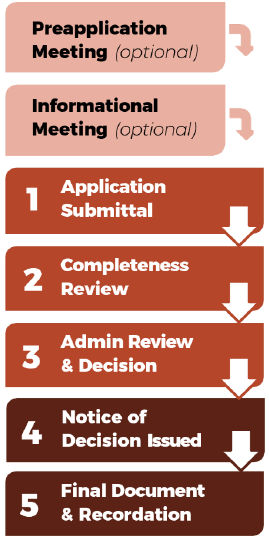
Common Review Procedures. The Common Review Procedures in Section 15-8-10(d)(1) apply, as shown in the flow chart, with the modifications listed below.
(4)
Application Submittal.
a.
In addition to the application requirements in Section 15-8-20(e)(1), the application shall be prepared in the form of an affidavit or, where deemed necessary by the Town Administrator, a revised plat certified by a land surveyor licensed with the State of Colorado and shall be recorded per Section 15-8-20(i)(4).
b.
Vacation of a utility easement shall be accomplished by letters of acquiescence from all interested utility companies.
(5)
Review and Decision-Making.
a.
Minor Plat Amendment applications are reviewed and decided on by the Town Administrator per Section 15-8-20(f)(5).
b.
In addition to the generally applicable review criteria in Section 15-8-20(h)(4), the following criteria shall be met when deciding on a Minor Plat Amendment:
(i)
There is no increase the number of lots and the amendment does not create new lots;
(ii)
The amendment does not affect a recorded easement without approval of the easement holder;
(iii)
Street locations will not be changed; and
(iv)
The amendment will not create any nonconformities or increase the degree of nonconformity of any existing structure, use, or development standards.
(6)
Post-Decision Actions. The approved minor plat amendment, a plat map or text description, shall be recorded per Section 15-8-20(i)(4).
(i)
Sign Permit.
(1)
Purpose. All signs, temporary or permanent, shall require the issuance of a Sign Permit.
(2)
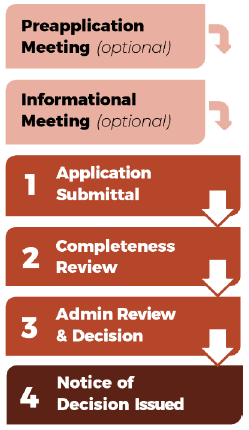
Common Review Procedures. The Common Review Procedures in Section 15-8-10(d)(1) apply, as shown in the flow chart, with the modifications listed below.
(3)
Application Submittal.
a.
An application may be submitted by the owner, occupant, or lease holder.
b.
An application may include all signs to be installed at a single building location, including multiple tenants, but may not include more than one business location at a different building.
(4)
Review and Decision-Making. Sign Permit applications are reviewed and decided on by the Town Administrator per Section 15-8-20(f)(5).
(5)
Post-Decision Actions. Sign Permits do not expire.
(j)
Sign Plan, Coordinated.
(1)
Purpose. A Coordinated Sign Plan may be developed for buildings or properties with multiple lots, buildings, or multiple tenants to determine how sign area will be allocated among the lots, buildings, or tenants and to develop a cohesive plan for lot or building signage.
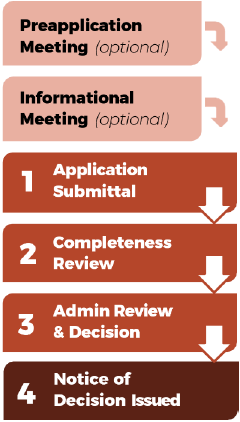
(2)
Common Review Procedures. The Common Review Procedures in Section 15-8-10(d)(1) apply, as shown in the flow chart, with the modifications listed below.
(3)
Application Submittal. In addition to the application requirements in Section 15-8-20(e)(1), the application shall identify all proposed signage for an entire lot or development site and shall include the following information:
a.
Sign dimensions and approximate locations;
b.
Materials and colors;
c.
Proposed illumination, including illumination levels;
d.
Maximum numbers of tenant signs per sign face;
e.
A design theme with illustrative examples of each sign type and the proposed general locations of each sign type;
f.
A demonstration that the Coordinated Sign Plan will improve the aesthetics of the development and will not have an adverse impact on the use, enjoyment, or value of adjacent properties; and
g.
Other maps, drawings or materials as required by the Town Administrator.
(4)
Review and Decision-Making.
a.
Coordinated Sign Plans applications are reviewed and decided on by the Town Administrator per Section 15-8-20(f)(5).
b.
In addition to the generally applicable review criteria in Section 15-8-20(f)(5), the standards in Section 15-7-110(b) shall be met when deciding on a Coordinated Sign Plan.
(5)
Post-Decision Actions. Coordinated Sign Plans do not expire.
(k)
Simple Subdivision.
(1)
Purpose. This procedure can be used to:
a.
Create up to four additional lots or condominium/townhouse units where no new infrastructure or public improvements are required;
b.
Relocate or remove one or more lot lines, that does not qualify as a Minor Plat Amendment; or
c.
Change a plat beyond the amendments allowed under a Minor Plat Amendment.
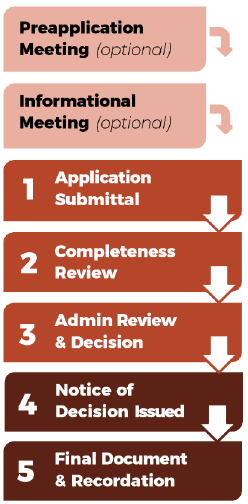
(2)
Common Review Procedures. The Common Review Procedures in Section 15-8-10(d)(1) apply, as shown in the flow chart, with the modifications listed below.
(3)
Application Submittal.
a.
A Simple Subdivision application may be filed by any property owner with title to the entire property subject to the application.
b.
In addition to the application requirements in Section 15-8-20(e)(1), the application shall contain the following information:
(i)
A plat map as required for a Final Plat in Section 15-8-40(k)(4);
(ii)
A site plan of the property at a scale legible for reasonable review and interpretation by the Town Administrator showing:
1.
Existing and proposed lot or unit and parcel boundaries;
2.
Existing zoning; and
3.
The location and dimensions of existing conditions including, but not limited to, improvements such as buildings, easements, parking areas, sidewalks, streets, drives, alleys and roads on or adjoining the property. Other significant conditions existing on the property, including but not limited to watercourses, marshes, rock outcrops, major rock formations, groves of trees, major vegetation categories, and potential geologic hazard; and
(iii)
Other materials necessary to show compliance with Article 4, Subdivision Design and Improvement and this Code.
(4)
Review and Decision-Making.
a.
Simple Subdivision applications are reviewed and decided on by the Town Administrator per Section 15-8-20(f)(5).
b.
In addition to the generally applicable review criteria in Section 15-8-20(h)(4), the following criteria shall be met when deciding on a Simple Subdivision:
(i)
The resulting lots or units comply with all applicable requirements of this Code;
(ii)
Any changes to existing easements or right-of-way have been completed in accordance with this Code or otherwise allowed by law (additional easements or right-of-way may be dedicated);
(iii)
The existing right-of-way is not changed;
(iv)
If a new lot(s) is being created, the total number of new lots on the property created through Simple Subdivision within the preceding ten years does not exceed four; and
(v)
If vacating a plat, the result of the vacation will not interfere with development or deny access via public right-of-way to adjoining properties, utility service, or other improvements.
(5)
Post-Decision Actions. Once approved, the plat map shall be recorded per Section 15-8-20(i)(4).
(l)
Site Plan.
(1)
Purpose. Site Plan review provides a visual representation of a proposed development to ensure compliance with the standards of this Code and to encourage quality development reflective of the goals, policies, and objectives of the Master Plan.
(2)
Applicability. This procedure is required for:
a.
All new construction, except those that are part of an application for Subdivision or PUD.
b.
Placing a built or partially built building on a property including accessory structures greater than 150 square feet in area.
c.
The following applications or requests:
(i)
Temporary uses and structures;
(ii)
Change of use into a new category as set forth in Table Sec. 15-3-1: Use Table; and
(iii)
Special Use Permit;
d.
Any proposed redevelopment that meets the definition in this Code; and
e.
Requests for amendments or modifications to approvals that do not qualify for an Administrative Adjustment including:
(i)
Relocation of development pads, buildings, or dwelling units for some practical reasons such as topography, road alignment or easements provided that the modification does not significantly alter the site design in terms of parking layouts, vehicular circulation, landscape design, and other similar components of the development plans;
(ii)
A modification to a recreation area or open space design, but not elimination or more than a ten percent reduction;
(iii)
A change in the parking layout or vehicular circulation;
(iv)
Any change that may affect an adjoining development;
(v)
Any request that would significantly alter the design of the site or building(s); and
(vi)
A request to change or delete a condition of approval established by the decision-making body.
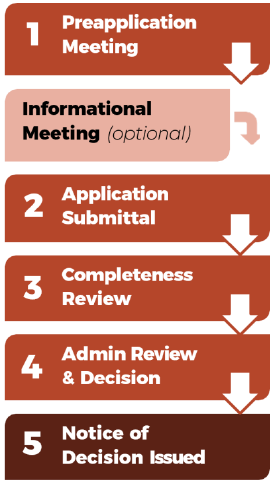
(3)
Common Review Procedures. The Common Review Procedures in Section 15-8-10(d)(1) apply, as shown in the flow chart, with the modifications listed below.
(4)
Application Submittal.
a.
In addition to the application requirements in Section 15-8-20(e)(1), the application shall contain a site plan of the property at a scale legible for reasonable review and interpretation by the Town Administrator including, but not limited to, the following:
(i)
Lot and parcel boundaries and dimensions;
(ii)
Existing easements and natural features;
(iii)
Abutting roads;
(iv)
Location and dimensions of vehicular and pedestrian access and circulation on the property;
(v)
Location and dimensions of all existing and proposed uses and structures, including any proposed temporary uses;
(vi)
Distance of all structures from property lines;
(vii)
Parking layout with dimensions;
(viii)
Landscaping;
(ix)
Outdoor lighting;
(x)
Layout of recreational vehicle or manufactured home spaces and utilities, if applicable;
(xi)
Proposed Administrative Adjustment, if applicable;
(xii)
A phasing plan, if applicable; and
(xiii)
Any other information necessary to show the requirements of this Code and the review criteria have been met
(5)
Review and Decision-Making.
a.
Site Plan applications are reviewed and decided on by the Town Administrator per Section 15-8-20(f)(5).
b.
In addition to the generally applicable review criteria in Section 15-8-20(h)(4), the following criteria shall be met when deciding on a Site Plan:
(i)
Any significant adverse impacts reasonably anticipated to result from the Site Plan application will be mitigated or offset to the maximum extent practicable;
(ii)
The development proposed and its general location is, or will be, compatible with the character of surrounding land uses and structures; and
(iii)
The development can be adequately served by Town services including, but not limited to roads, water, and wastewater.
(6)
Post-Decision Actions.
a.
Approved Site Plan documents shall be binding upon the applicants and their successors and assigns.
b.
When Site Plan review is required, structures and uses may be established and building permits may be issued only after a Site Plan showing the proposed development or redevelopment has been approved in accordance with the procedures and requirements of this Section.
c.
The construction, location, use or operation of all land and structures within the site shall conform to all conditions and limitations set forth in the documents.
d.
No structure, use, or other element of approved Site Plan documents shall be eliminated, altered, or provided in another manner unless an amended Site Plan is approved. Requests for amendments of approved Site Plans shall be processed in accordance with the procedures for an initial Site Plan submittal.
(m)
Slope Hazard Development Permit.
(1)
Purpose. Slope Hazard Development Permits regulate the approval of certain building and construction activities within the slope hazard areas.
(2)
Applicability. Slope Hazard Development Permits are required for any development that meets the standards in Section 15-5-30, Slope Hazard Areas.
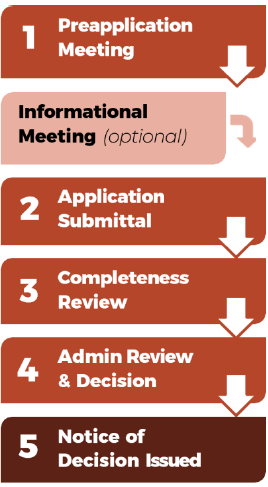
(3)
Common Review Procedures. The Common Review Procedures in Section 15-8-10(d)(1) apply, as shown in the flow chart, with the modification listed below.
(4)
Application Submittal.
a.
In addition to the general application submittal requirements, the application shall contain:
(i)
A topographic map or maps showing the location, nature and dimensions of the proposed development at a scale legible for reasonable review and interpretation by the Town Administrator;
(ii)
A detailed site plan showing:
1.
The location of all existing and proposed structures and paved surfaces on the applicant's property and any existing septic systems and wells on the property;
2.
The location of the proposed area of disturbance on the applicant's property and its relation to neighboring properties' structures, roads, and watercourses;
3.
The location on the applicant's property of all existing watercourses, marshes, wooded areas, rock outcrops, single trees with a diameter of eight inches or more measured three feet above the base of the trunk, and all other significant existing land features; and
4.
The existing grades on the applicant's property with contour lines at two-foot intervals and proposed grades within the area of the proposed construction or alteration.
(iii)
A drainage plan submitted by a licensed professional engineer showing:
1.
All existing and proposed natural and artificial drainage courses and other features for the control of drainage, erosion, and water.
2.
The calculated volume of water runoff from the slope(s) and from the lot in question, as unimproved.
3.
The calculated volume of water runoff from the slope(s) and from the lot in question, as improved.
4.
The existence, location and capacity of all natural and artificial drainage courses and facilities within 500 feet of the lot which are or will be used to carry or contain the water runoff from the slope(s) and the lot; and
5.
A geologist's or registered geotechnical engineer's report explaining the maps and cross sections required in this Section with particular emphasis on evaluating and predicting the impact of the slope hazard areas on the proposed developments. It shall also include recommended mitigating procedures to be employed in meeting the standards of this Section.
(iv)
A vegetation protection plan that demonstrates compliance with Section 15-5-30(d)(3), Removing Vegetation.
(5)
Review and Decision-Making.
a.
Slope Hazard Development Permit applications are reviewed and decided on by the Town Administrator per Section 15-8-20(f)(5).
b.
In addition to the generally applicable review criteria in Section 15-8-20(h)(4), application shall comply with all standards set forth in this Section.
(n)
Temporary Use Permit.
(1)
Purpose. Temporary Use Permits ensure that a proposed temporary use or structure complies with the applicable regulations in this LUC.
(2)
Applicability. This procedure is required for any use listed as a temporary use in Table Sec. 15-3-1: Use Table.
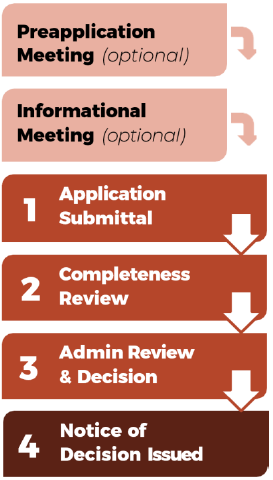
(3)
Common Review Procedures. The Common Review Procedures in Section 15-8-10(d)(1) apply, as shown in the flow chart, with the modifications listed below.
(4)
Review and Decision-Making.
a.
Temporary Use Permit applications are reviewed and decided on by the Town Administrator per Section 15-8-20(f)(5).
b.
In addition to the generally applicable review criteria in Section 15-8-20(h)(4), the following criteria shall be met when deciding on a Temporary Use Permit:
(i)
Requirements for vehicular ingress/egress and corresponding traffic safety provisions, parking requirements and facilities, and hours of operation;
(ii)
Regulation of public nuisance factors (e.g., light glare, noise, vibration, smoke, dust, dirt, odors, gases, and heat); and
(iii)
Regulation of maintenance and site restoration during, and after termination of the temporary use or expiration of the Temporary Use Permit.
(5)
Post-Decision Actions. Expiration is as stated in an approved permit.
(o)
Vacation Rental Permit.
(1)
Purpose. Vacation Rental Permits ensure that a proposed vacation rental complies with the applicable regulations in this LUC.
(2)
Applicability. This procedure is required for any vacation rental as defined in Section 15-11-30, General Terms.
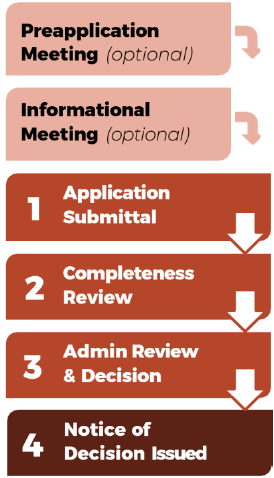
(3)
Common Review Procedures. The Common Review Procedures in Section 15-8-10(d)(1) apply, as shown in the flow chart, with the modifications listed below.
(4)
Application Submittal. In addition to the application requirements in Section 15-8-20(e)(1), the application shall contain:
a.
Required Maps and Plans.
(i)
Graphic Bar Scale Required. All maps and plans listed in this Section shall include a graphic bar scale legible for reasonable review and interpretation by the Town Administrator.
(ii)
Vicinity Map. Provide a vicinity map or aerial photo that clearly identifies, with text labels, the property, local blocks, lots, streets, and alleys.
(iii)
Adjacent Land Owner Map. Provide a map with a 300 foot radius circle from the center-point of the vacation rental property that indicates the adjacent land owner notification area. Indicate neighboring properties by name or other indicator tied to notification mailing list.
(iv)
Site Plan. Provide a drawn-to-scale site plan of the property, indicating with text labels all existing buildings, decks, walkways, trash bin, propane tanks, snow storage areas, on-site parking space(s), and other relevant site features, and any proposed improvements within the property boundaries.
(v)
Parking Plan. Indicate the availability of guest parking, both on street and onsite parking, provided for evaluation of tenant capacity. Indicate a proposed parking area for one passenger pickup with attached trailer.
(vi)
Floor Plans. Sketch the residential unit's existing floor plans that includes all habitable areas, including but not limited to: the number of bedrooms, baths, and other rooms, and their use names, and fire extinguisher location(s).
(vii)
Proposed Improvements Plan. Sketch any changes which are proposed in the use of all habitable areas of the structure, including but not limited to: the number of bedrooms, baths, kitchen and other rooms and their use names, and any modification or additions that are proposed to the interior or exterior of the structure. Any structural changes or additions to the residential unit require a building permit per the provisions of the building code.
b.
Adjacent Land Owner List. Provide a list of adjacent land owners (according to the current records of the San Juan County Assessor) within a 300 foot radius of the center point of the proposed vacation rental property.
c.
Manager Contact Information for Adjacent Land Owners. Inside each of the envelopes, the applicant shall place business card(s), or a one page flyer, providing each of the adjacent land owners with the names and phone numbers of the proposed primary and secondary managers of the proposed vacation rental.
d.
Proof of Ownership. Deed proof of the applicant's current ownership of the vacation rental per a legally recorded document.
e.
Proof of Insurance. Insurance proof of the Town-required property and liability insurance for operation of the vacation rental.
f.
Signage and Lighting Drawing. Drawing showing existing and proposed signage and lighting at the site based on the standards set forth in Article 7, Signs, and Section 15-6-40, Outdoor Lighting.
g.
Management Information. Listing of individual(s), owner, manager, management firm, local contact, back-up contact; and all description of all other management requirements per the provisions of this Section.
h.
Additional Information. Additional reasonable submittal items may be required by the Town Staff, to allow for the proper evaluation of the vacation rental application.
(5)
Review and Decision-Making. Vacation Rental Permit applications are reviewed and decided on by the Town Administrator per Section 15-8-20(f)(5).
(6)
Post-Decision Actions. Vacation Rental Permits are valid for the calendar year in which the permit is approved. Application for a vacation rental permit shall be submitted each calendar year in accordance with application requirements. Annual permits expire on December 31. Annual renewal applications are due by January 31. The Town Administrator may administratively approve, modify, amend or deny renewal permits based on the renewal application and review of documented violations and complaints. Applicants may appeal administrative decisions to the Board of trustees.
Sec. 15-8-40. - Specific procedures—Public hearing required.
(a)
Annexation and Disconnection.
(1)
Purpose. Annexation and Disconnection establishes a procedure to bring land under the jurisdiction of the Town or to remove land from the jurisdiction of the Town.
(2)
Applicability. This procedure is required to add or remove land from the Town of Silverton's jurisdiction.
(3)
Review Procedures. Procedures for review and decision of Annexations are established in the Colorado Municipal Annexation Act of 1965, as amended. See Title 31, Article 12 C.R.S.
(b)
Appeal of an Administrative Decision.
(1)
Purpose. This process allows the review of administrative decisions made by Town staff.
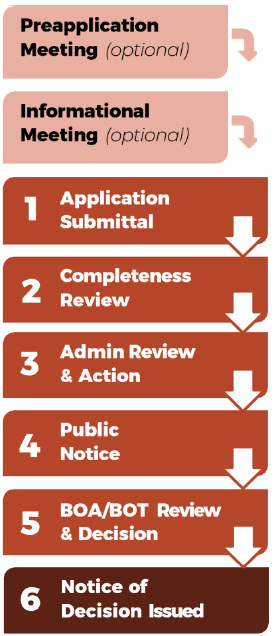
(2)
Common Review Procedures. The Common Review Procedures in Section 15-8-10(d)(1) apply, as shown in the flow chart, with the modifications listed below.
(3)
Application Submittal.
a.
Appeals may be requested by an affected party aggrieved by an administrative decision made under this Code. For purposes of this Section, an affected party is:
(i)
The applicant for the decision being appealed;
(ii)
The owner or tenant of a lot or parcel of land located within 1,000 feet of the subject property; or
(iii)
Any resident of the Town who has submitted written comments prior to the public hearing on the application.
b.
Recommendations to another decision-making body cannot be appealed.
c.
All requests shall be submitted within 30 days following issuance of the Notice of Decision being appealed.
d.
In addition to the application requirements in Section 15-8-20(e)(1), the application shall contain a written narrative that includes an explanation of the appeal and how it meets the approval criteria in Section 15-8-40(b)(5).
e.
The Town Administrator shall notify, in writing, the applicant, any administrative official involved, and the Board of Trustees of all appeal public hearings scheduled.
f.
The published notice of the public hearing shall be in accordance with Section 15-8-20(g)(1).
(4)
Stay of Proceedings.
a.
An appeal stays all proceedings in furtherance of the action appealed from except as provided in Section 4.b below. No further action will be taken by the Town on the initial application or request while the administrative decision is being appealed.
b.
The Town may decide not to stay activities related to the application while the administrative decision is being appealed where a stay would cause imminent peril to life or property, determined as follows:
(i)
The staff member from whom the appeal is taken certifies to the Planning Commission that by reason of facts stated in the appeal, a stay would, in that officer's opinion, cause imminent peril to life or property.
(ii)
In these cases, proceedings shall not be stayed other than by a court of record upon application to same and notice to the officer from whom the appeal is taken and on due cause shown.
(5)
Review and Decision-Making.
a.
Appeals of Administrative Decisions, except for vacation rental permit renewals, shall be made to the Board of Adjustment. Decisions on Appeals of vacation rental permit renewals shall be made to the Board of Trustees. Both types of appeal shall require a public hearing.
b.
The Board of Adjustment or Board of Trustees may reverse or modify the action.
c.
The decision being appealed may only be reversed upon finding all of the following criteria have been met:
(i)
The administrative officer acted in a manner inconsistent with the provisions of this LUC; or
(ii)
Made erroneous findings of fact based on the evidence and testimony on the record.
(c)
Appeal of a Planning Commission or Historic Preservation Committee Decision.
(1)
Purpose. This process allows the review of Planning Commission and Historic Preservation Committee decisions.
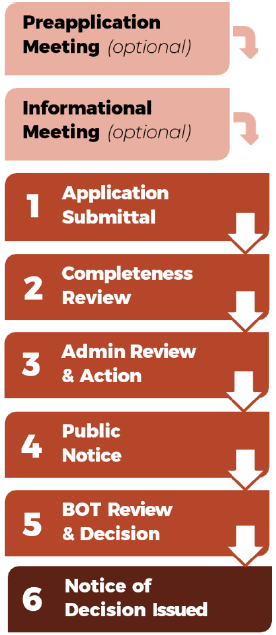
(2)
Common Review Procedures. The Common Review Procedures in Section 15-8-10(d)(1) apply, as shown in the flow chart, with the modifications listed below.
(3)
Application Submittal.
a.
Appeals may be requested by an affected party aggrieved by a Planning Commission or Historic Preservation Committee decision made under this Code. For purposes of this Section, an affected party is:
(i)
The applicant for the decision being appealed;
(ii)
The owner or tenant of a lot or parcel of land located within 1,000 feet of the subject property; or
(iii)
Any resident of the Town who has submitted written comments prior to the review hearing on the application.
b.
Recommendations to another decision-making body cannot be appealed.
c.
All requests shall be submitted within 30 days following issuance of the Notice of Decision being appealed.
d.
In addition to the application requirements in Section 15-8-20(e)(1), the application shall contain a written narrative that includes an explanation of the appeal and how it meets the approval criteria in Section 15-8-40(b)(5).
e.
The Town Administrator shall notify, in writing, the applicant, any administrative official involved, and the Board of Trustees of all appeal public hearings scheduled.
f.
The published notice of the public hearing shall be in accordance with Section 15-8-20(g)(1).
(4)
Stay of Proceedings.
a.
An appeal stays all proceedings in furtherance of the action appealed from except as provided in Section 4.b below. No further action will be taken by the Town on the initial application or request while the decision is being appealed.
b.
The Town may decide not to stay activities related to the application while the decision is being appealed where a stay would cause imminent peril to life or property, determined as follows:
(i)
A staff member certifies to the Board of Trustees that by reason of facts stated in the appeal, a stay would, in that officer's opinion, cause imminent peril to life or property.
(ii)
In these cases, proceedings shall not be stayed other than by a court of record upon application to same and notice to the officer from whom the appeal is taken and on due cause shown.
(5)
Review and Decision-Making.
a.
Appeals of Planning Commission and Historic Preservation Committee Decisions shall be made to the Board of Trustees in a public hearing.
b.
The Board of Trustees may reverse or modify the action.
c.
The decision being appealed may only be overturned upon finding all of the following criteria have been met:
(i)
The Planning Commission or Historic Preservation Committee acted in a manner inconsistent with the provisions of this LUC; or
(ii)
Made erroneous findings of fact based on the evidence and testimony on the record.
(d)
Avalanche Hazard Permit, Major.
(1)
Purpose. Major Avalanche Hazard Development Permits regulate the approval of certain substantive building and construction activities within the Moderate Hazard Blue Zone or High Hazard Red Zone.
(2)
Applicability. Major Avalanche Development Permits are required for the following development:
a.
All development activity or land use not expressly allowed through a Minor Avalanche Development Permit including development in the High Hazard Red Zone; and
b.
Avalanche control structures, including deflecting berms and structures, mounds and structures, direct-protection structures, catching structures, snow drift fences, snow support structures and similar facilities designed to inhibit, block, divert, split, or otherwise control the release, extent or direction of avalanche runs.
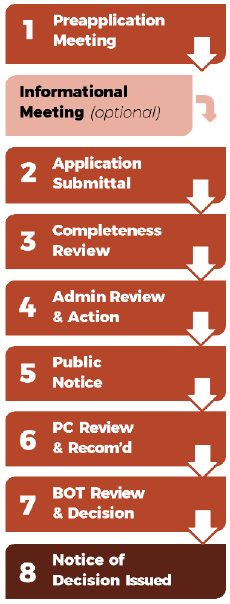
(3)
Common Review Procedures. The Common Review Procedures in Section 15-8-10(d)(1) apply, as shown in the flow chart, with the modifications listed below.
(4)
Application Submittal. In addition to the general application submittal requirements, the application shall contain the following:
a.
A two-part, site specific engineering study report that contains:
(i)
The complete study and report (as prepared by a qualified professional civil or geotechnical engineer licensed in Colorado or qualified professional geologist in the field of avalanche occurrence, force and behavior) documenting avalanche impact pressures present at any and all proposed building and construction sites on the applicant's property; and
(ii)
Complete construction plans and specifications for all proposed buildings and structures (as prepared by a qualified structural engineer licensed to practice in the State of Colorado), including the structural engineer's certification that the buildings and structures, if constructed in accordance with the submitted plans and specifications, will withstand the avalanche impact pressures as documented in the study and report.
b.
All investigations, studies, and reports shall be prepared at the applicant's expense. The investigations, studies, and reports must specifically answer the following:
(i)
Whether the site specific conditions are such that the property can or cannot be developed for the specific structures or proposed uses with or without on-site protective measures and, if protective measures are necessary, what those specific measures are, including site and construction plans for the protective measures; and
(ii)
Whether the on-site protective measures will increase the hazard to other properties, structures, roads, rights-of-way, easements, utilities, or construction located adjacent to or downslope from the applicant's property.
c.
Certification by the design engineer that the on-site protective measures, if constructed as designed, will withstand the documented avalanche impact pressures and protect the subject properties without adversely impacting adjoining and/or downslope properties.
d.
A vegetation protection and removal plan that demonstrates compliance with Section 15-5-10(d)(5), Vegetation Removal Prohibited.
(5)
Review and Decision-Making.
a.
Review and Decision. Major Avalanche Hazard Development Permits are reviewed and recommended by the Planning Commission and decided on by the Board of Trustees, both in a public hearing.
b.
Review Criteria. In addition to the generally applicable review criteria in Section 15-8-20(h)(4), the following criteria shall be met when deciding on a Major Avalanche Hazard Development Permit:
(i)
The application shall comply with all standards set forth in Section 15-5-10.
(ii)
The applicant has submitted sufficient proof that the site can be developed for the proposed use because the danger posed by an avalanche can be reduced or mitigated to a reasonable level.
(iii)
The public health, safety, and welfare hazards associated with developing and occupying property are maximally reduced to a reasonable and acceptable level, including specific findings that establishment of the proposed improvements and/or land uses will not increase the potential avalanche hazard or public health, safety and welfare hazards associated with avalanches on adjoining properties, both within and outside of the High Hazard Red Zone and Moderate Hazard Blue Zone, especially downslope of the subject property.
(iv)
The applicant does not have the opportunity to build outside the hazard and chooses, with substantial hardship reason, to develop within the avalanche hazard area boundaries.
(6)
Post Decision Actions and Obligations.
a.
Prior to issuance of any building permit for construction within the High Hazard Red Zone or Moderate Hazard Blue Zone, the applicant shall sign a release and indemnification agreement and the agreement shall be properly recorded in the office of the County Clerk and Recorder, at the expense of the applicant, by the Town.
b.
All plans submitted with a building permit application for property within a High Hazard Red or Moderate Hazard Blue Zone shall be stamped "Construction in Avalanche Hazard Area," together with the applicable sub-zone designation.
(e)
Flood Hazard Variance.
(1)
Purpose. Flood Hazard Variances allow for deviations from requirements of Section 15-5-20, relative to flood damage prevention.
(2)
Applicability.
a.
Flood Hazard Variances may be issued for new construction and substantial improvements to be erected on a lot contiguous to and surrounded by lots with existing structures constructed below the base flood level, provided that the criteria set forth in Subsection d. below have been fully considered.
b.
Variances may be issued for the repair or rehabilitation of structures upon a determination that the proposed repair or rehabilitation will not preclude the structure's continued designation as a historic structure and the variance is the minimum necessary to preserve the historic character and design of the structure.
c.
Variances shall not be issued within any floodway if any increase in flood levels during the base flood discharge would result.
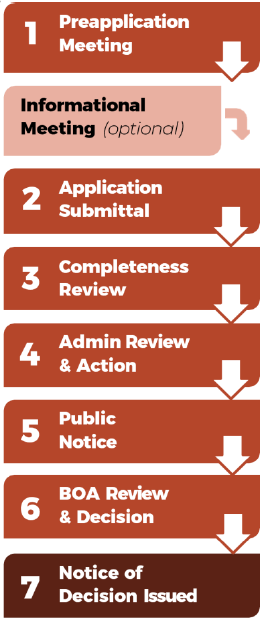
(3)
Common Review Procedures. The Common Review Procedures in Section 15-8-10(d)(1) apply, as shown in the flow chart, with the modifications listed below.
(4)
Application Submittal. In addition to the general application submittal requirements, the application shall contain the following:
a.
A contour map of existing and proposed contours prepared by a Colorado registered land surveyor showing the subject property and at least 300 feet of the area outside the perimeter of the subject property;
b.
A drainage study prepared by a Colorado registered professional engineer which utilizes the criteria presented in this Section, which is supplemented by other reliable source material (e.g., Corps of Engineers, Housing and Urban Development), and contains the engineer's recommendations; and
c.
An appendix to the drainage study that addresses each of the subjects cited by Subsection (4) below.
(5)
Review and Decision-Making.
a.
Review and Decision. Flood Hazard Variances shall be reviewed and decided on by the Board of Adjustment in a public hearing.
b.
Review Criteria. In addition to the generally applicable review criteria in Section 15-8-20(h)(4), the following considerations shall be made when deciding on a Flood Hazard Variance:
(i)
All technical evaluations and all relevant factors and standards specified in Section 15-5-20 have been met;
(ii)
The danger that materials may be swept onto other lands to the injury of others;
(iii)
The danger to life and property due to flooding or erosion damage;
(iv)
The susceptibility of the proposed facility and the contents to flood damage and the effect of flood damage on the individual owner;
(v)
The importance of the services provided by the proposed facility to the community;
(vi)
The availability of alternative locations for the proposed use which are not subject to flooding or erosion damage;
(vii)
The compatibility of the proposed use with existing and anticipated development;
(viii)
The relationship of the proposed use to the comprehensive and flooding management program for the area;
(ix)
The safety of access to the property in times of flood for ordinary and emergency vehicles;
(x)
The cost of providing governmental services during and after flood conditions, including maintenance and repair of public utilities and facilities such as sewer, gas, electrical and water systems, and streets and bridges;
(xi)
Variances shall only be issued upon a determination that the variance is the minimum necessary, considering the flood hazard, to afford relief; and
(xii)
Variances shall only be issued upon:
1.
A showing of sufficient cause;
2.
A determination that failure to grant the variance would result in exceptional hardship to the applicant; and
3.
A determination that failure to grant the variance will not result in increased flood heights, additional threats to public safety or extraordinary public expense, or create nuisances, cause fraud on or victimization of the public, or conflict with existing local laws or ordinances.
(6)
Post Decision Actions and Obligations. Any applicant to whom a variance is granted shall be given written notice that the requested structure will be permitted and that the cost of flood insurance will be commensurate with increased risk from the reduced lowest floor elevation.
(f)
Historic District Overlay Designation.
(1)
Purpose. This procedure is required to make any changes to the Historic District Overlay, the Town's Historic Register, including adding or removing property.
(2)
Applicability. Once an application for Historic District Overlay Designation has been submitted, the Town will not issue a building or demolition permit until a final decision on the application is issued.
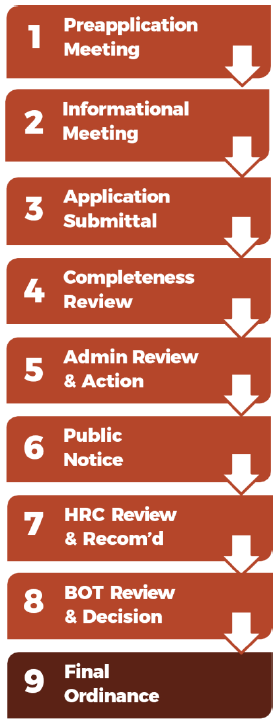
(3)
Common Review Procedures. The Common Review Procedures in Section 15-8-20 apply, as shown in the flow chart, with the modifications listed below.
(4)
Application Submittal.
a.
Historic District Overlay Designation may be initiated by:
(i)
The owner(s) of the property to be designated;
(ii)
A member(s) of the Historic Preservation Committee, Planning Commission, and/or Board of Trustees, and/or
(iii)
Any person residing, owning, or leasing property in the Town.
b.
Where nominated by someone other than the property owner, the Town Administrator shall contact the owner(s) in writing outlining the reasons and effect of Historic District Overlay Designation.
c.
Applications for designation shall not be considered complete if more than 25 percent of the property owners oppose in writing or though ballot prepared and administered by the Town.
d.
In addition to the application requirements in Section 15-8-20(e)(1), the application shall contain the following:
(i)
A description of the land area, including lot and block numbers to be added, removed, or otherwise modified;
(ii)
A drawing drawn to a scale legible for reasonable review and interpretation by the Town Administrator showing boundaries of the area requested to be added, removed, or otherwise modified; and
(iii)
Identification of Contributing and Non-Contributing Property within the land area to be added, removed, or otherwise modified.
(5)
Review and Decision-Making.
a.
Review and Decision. Historic District Overlay Designations are reviewed and recommended on by the Historic Preservation Committee and decided on by the Board of Trustees, both in a public hearing.
b.
Review Criteria. In addition to the generally applicable review criteria in Section 15-8-20(h)(4), the following criteria shall be met when deciding on Historic District Overlay Designation:
(i)
Eligibility Criteria.
1.
Properties shall be at least 50 years old and meet one or more of the following criteria:
a.
Association with an event or events that have made a significant contribution to history;
b.
Connection with persons significant in history;
c.
Distinctive characteristics of a type, period, method of construction, or artisan;
d.
Geographic importance; and/or
e.
Possibility to yield important information related to prehistory or history.
2.
A property may be exempted from the age standard if the Board of Trustees finds it to be exceptionally important in other criteria.
(ii)
Integrity Criteria. All properties shall be evaluated for their physical integrity. At least two of the following criteria shall be met:
1.
Location: The place where the property was constructed or the place where the historic event occurred.
2.
Design: The combination of elements that create the form, plan, space, structure, and style of a property.
3.
Setting: The physical environment of a property.
4.
Materials: The physical elements that were combined or deposited during a particular period of time and in a particular pattern or configuration to form a property.
5.
Workmanship: The physical evidence of the crafts of a particular culture or people during any given period in history or prehistory.
6.
Feeling: A property's expression of the aesthetic or historic sense of a particular period of time.
7.
Association: The direct link between an important historic event or person and a property.
(iii)
Removal Criteria. The property has been altered to a degree that it no longer retains its historic integrity.
(6)
Post-Decision Actions.
a.
Historic District Overlay Designations must be completed by Ordinance in accordance with Chapter 1, Article 3, Division 2 of the Municipal Code.
b.
Historic District Overlay Designations do not expire.
(g)
Historic District Overlay Review, Major.
(1)
Purpose. Major Historic District Overlay Review allows for the regulation of major exterior building and construction activities within the Historic District Overlay.
(2)
Applicability. Historic District Overlay Review is required for all new construction, exterior alterations, relocations, and demolitions on any property within the Historic District Overlay. Major alterations include all alterations of building exteriors that do not qualify as a Minor Alteration as well as new construction, additions, relocation, and partial and full demolition. This includes, but is not limited to:
a.
Creating new openings and changing exiting openings, unless the openings are located along an alley;
b.
Modifying exterior materials;
c.
Any alteration that changes size or mass of building; and
d.
Removal of building elements.
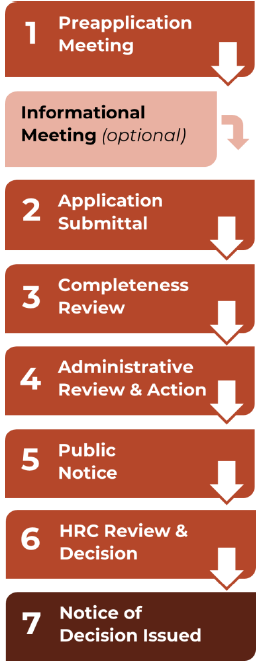
(3)
Common Review Procedures. The Common Review Procedures in Section 15-8-20 apply, as shown in the flow chart, with the modifications listed below.
(4)
Application Submittal. In addition to the application requirements in Section 15-8-20(e)(1), the application shall contain:
a.
An explanation of the how the project will affect or impact the Historic District Overlay within the written narrative;
b.
A site plan including existing and proposed easements, buildings, and utilities; and
c.
Building design plans including detailed elevations showing exterior materials, finishes, design detail, and the proposed structure alongside the adjacent structures.
(5)
Review and Decision-Making.
a.
Major Alterations are reviewed and decided on by the Historic Preservation Committee at a public meeting that is not required to be a public hearing.
b.
In addition to the generally applicable review criteria in Section 15-8-20(h)(4), the following criteria shall be met when deciding on a Historic District Overlay Review:
(i)
The following criteria apply to all applications:
1.
Compliance with Section 15-2-80(a)(7), Design Standards for All Development in the Historic District Overlay.
(ii)
The following criteria apply to Non-Contributing Property:
1.
Compatibility with the property's current design, materials, features, size, scale and proportion, and massing; or
2.
Compatibility with the Historic District Overlay's design, materials, features, size, scale and proportion, and massing.
(iii)
The following criteria apply to total demolition of Contributing Property:
1.
The property proposed for demolition is not structurally sound, despite evidence of the owner's efforts to properly maintain it;
2.
The property cannot be preserved, restored, rehabbed, or reused on site to provide for any reasonable, beneficial use of the property regardless of any proposed development plan for the property's site or adjacent properties; and
3.
The property cannot be practically moved to another site in Town.
(iv)
The following criteria apply to partial demolition of Contributing Property:
1.
The partial demolition is required for the preservation, restoration, or rehabilitation of the property.
(6)
Post-Decision Actions. If the application is denied, the applicant may request a Variance as outlined in Section 15-8-40(n).
(h)
Land Use Code Text Amendment.
(1)
Purpose. This procedure is required to amend, supplement, change, modify, or repeal any portion of this Code, excluding the zoning map.
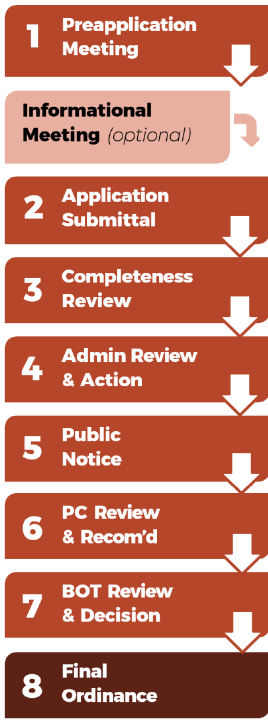
(2)
Common Review Procedures. The Common Review Procedures in Section 15-8-10(d)(1) apply, as shown in the flow chart, with the modifications listed below.
(3)
Application Submittal.
a.
Text Amendments may be initiated by the Board of Trustees, the Planning Commission, the Town Administrator, or by the application of any person residing, owning, or leasing property in the Town.
b.
Text Amendments initiated by the Town Administrator, Planning Commission, or Board of Trustees are exempt from preapplication meetings and application submittal and acceptance steps of the Common Review Procedures.
(4)
Review and Decision-Making.
a.
Review and Decision.
(i)
The Text Amendment shall be reviewed and recommended by the Planning Commission and decided on by the Board of Trustees, both in a public hearing.
(ii)
Approval of a Text Amendment requires a favorable vote of a majority of the Board of Trustees unless a protest is filed.
(iii)
A favorable vote of two-thirds of all the members of the Board of Trustees shall also be required when an amendment or change has not been recommended by the Planning Commission or in the event of the repeal of all or part of this Code.
b.
Review Criteria. In addition to the generally applicable review criteria in Section 15-8-20(h)(4), the proposed LUC Text Amendment shall meet at least one of the following specific reasons:
(i)
To address trends in development or regulatory practices;
(ii)
To expand, modify, or add requirements for development in general or to address specific development issues;
(iii)
To add, modify, or expand zoning districts; or
(iv)
To clarify or modify procedures for processing development applications.
(5)
Post-Decision Actions.
a.
Text Amendments must be completed by Ordinance in accordance with Chapter 1, Article 3, Division 2 of the Municipal Code.
b.
Text Amendments do not expire.
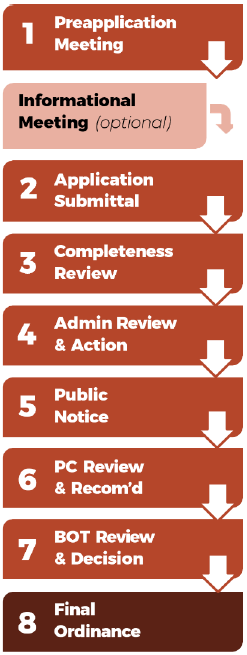
(i)
Master Plan Amendment.
(1)
Purpose. Master Plan Amendments provide standards and requirements for amending the Master Plan and other adopted Town plans. The amendment process is established in order to provide flexibility in response to changing circumstances, to reflect changes in public policy, and to advance the general welfare of the Town.
(2)
Common Review Procedures. The Common Review Procedures in Section 15-8-10(d)(1) apply, as shown in the flow chart, with the following and below modifications:
a.
Before processing an application, the Town Administrator shall determine whether it is in the best interests of the Town to devote staff and Planning Commission resources to a full review of the Master Plan Amendment application.
b.
Master Plan Amendments requested by the Town Administrator, Planning Commission, or Board of Trustees are exempt from preapplication meetings and application submittal and acceptance steps of the Common Review Procedures in Section 15-8-20.
(3)
Application Submittal.
a.
Master Plan Amendment may be initiated by the Town Administrator, Planning Commission, Board of Trustees, or any Silverton property owner, resident, or tenant.
b.
The Town Administrator may limit the timing and frequency of when Master Plan Amendments are considered to better ensure a holistic review process and avoid small or piecemeal amendments.
(4)
Review and Decision-Making.
a.
Review and Decision. The Master Plan Amendment shall be reviewed and recommended by the Planning Commission and decided on by the Board of Trustees, both in a public hearing.
b.
Review Criteria. In addition to the generally applicable review criteria in Section 15-8-20(h)(4), the following criteria shall be met when deciding on a Master Plan Amendment:
(i)
The amendment is consistent with the overall intent of the Master Plan;
(ii)
The existing Master Plan and any related element thereof is in need of the proposed amendment;
(iii)
It is necessary or desirable because of changing social values, new planning concepts, or other social or economic conditions and strict adherence to the Master Plan will result in a situation neither intended nor in keeping with other key elements and policies of the plan;
(iv)
The proposed amendment will not have a negative effect on the immediate areas or on transportation, services, and facilities;
(v)
The proposed amendment will have minimal effect on service provision, including adequacy or availability of public facilities and services, and is compatible with existing and planned service provision and future development of the area;
(vi)
The proposed amendment, if for an area that is outside of the Town's current municipal boundaries, is consistent with the Town's ability to annex the property; and
(vii)
The proposed amendment will promote the public health, safety, and general welfare of the people of Silverton.
(5)
Post-Decision Actions.
a.
Master Plan Amendments must be completed by Ordinance in accordance with Chapter 1, Article 3, Division 2 of the Municipal Code.
b.
Master Plan Amendments do not exp ire.
(j)
Special Use Permit.
(1)
Purpose.
a.
Special uses are land uses that are generally not allowed in a zoning district because they have the potential for causing adverse impacts on other uses due to factors such as location, method of operation, scale or intensity of activity, or traffic generated. Because of their unusual or special characteristics, special uses require individual review and evaluation so that they may be located properly with respect to their effects on surrounding properties and the town at large.
b.
Special Use Permits are required for:
(i)
All uses listed as special uses in Table Sec. 15-3-1: Use Table; and
(ii)
Any change or expansion of a special use shall require a new Special Use Permit.
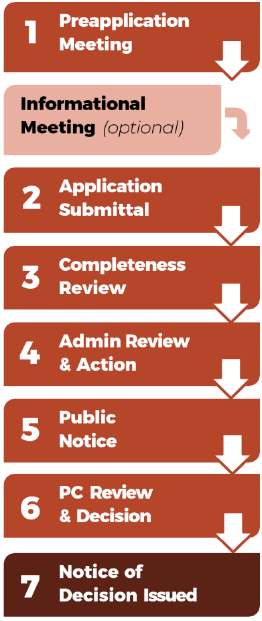
(2)
Common Review Procedures. The Common Review Procedures in Section 15-8-10(d)(1) apply, as shown in the flow chart, with the modifications listed below.
(3)
Application Submittal.
a.
Special Use Permit applications may be filed by any property owner.
b.
In addition to the application requirements in Section 15-8-20(e)(1), the application shall include a Site Plan that also identifies the time schedule for any contemplated new construction or uses.
(4)
Review and Decision-Making.
a.
Review and Decision. The Special Use Permit shall be reviewed and decided on by the Planning Commission in a public hearing.
b.
Review Criteria. In addition to the generally applicable review criteria in Section 15-8-20(h)(4), the following criteria shall be met when deciding on a Special Use Permit:
(i)
The use will not be contrary to public health, safety, or welfare.
(ii)
The use will not have an adverse effect upon surrounding property values.
(iii)
The use will not generate light, noise, odor, vibration, or other effects which would unreasonably interfere with the reasonable enjoyment of other property in the area.
(iv)
The use is compatible with existing uses in the area and other allowed uses in the zoning district.
(v)
Streets, access points, and pedestrian facilities are adequate or will be adequate to handle traffic generated by the use with safety and convenience.
(vi)
The use and site layout will be compatible with the mass and scale of adjacent properties, or compatible with the mass and scale of properties in the area generally.
(vii)
If needed, the visual impact of the use will be mitigated by means of design, landscaping, berming, or other methods of site treatment.
(5)
Post-Decision Actions. Special Use Permits run with the land. The approved permit may be revoked upon failure to comply with conditions associated with the original approval.
(k)
Subdivision, Major.
(1)
Purpose and Description.
a.
The Major Subdivision process is to ensure that proposed subdivisions are compliant with the standards and requirements of this Code and to:
(i)
Assist orderly, efficient, and integrated development;
(ii)
Ensure conformance of land subdivision plans with the plans of the town, county, and state;
(iii)
Improve land survey monuments and records by establishing minimal standards for survey and plats;
(iv)
Safeguard the interests of the public, the homeowner, and the applicant;
(v)
Secure equitable handling of all subdivision plans by providing uniform procedures; and
(vi)
Ensure the proposal will not impose hardship or substantial inconvenience to nearby landowners or residents.
b.
This procedure shall apply to all subdivisions that do not meet the criteria for a Simple Subdivision. Applications for a Major Subdivision shall include the following steps:
(i)
Sketch Plan.
(ii)
Preliminary Plan.
(iii)
Final Plat.
c.
There shall be no sales, agreements to sell, leases or rentals of any lots in a subdivision, and the Town shall not issue building permits for structures within the subdivision until the Final Plat has been recorded in the office of the San Juan County Clerk and Recorder.
(2)
Sketch Plan.
a.
Purpose. Sketch Plan review provides the Town the opportunity to describe the community's vision to the applicant. It also gives the applicant an opportunity to discuss the proposed subdivision, explain how it will further the community's vision, and obtain input and direction from the Planning Commission early in the process. The ultimate goal of this process is to help the applicant develop a subdivision plan that fosters the community's vision and is in line with this Code.
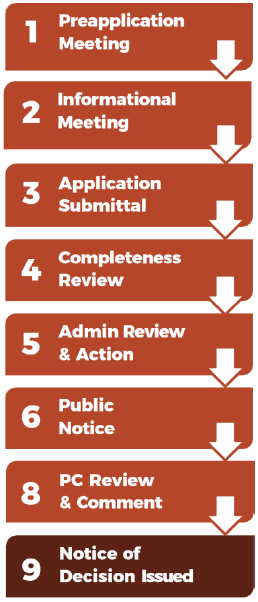
b.
Common Review Procedures. The Common Review Procedures in Section 15-8-10(d)(1) apply, as shown in the flow chart, with the modifications listed below.
c.
Application Submittal. In addition to the application requirements in Section 15-8-20(e)(1), the application shall contain the following information:
(i)
Location map: The location map shall indicate clearly the relationship of the proposed subdivision to the surrounding area within one-quarter mile of the subdivision's boundaries. The map shall show existing development, including all streets, utilities, and zoning on and adjacent to the proposed subdivision. The location map shall include a title, scale, total acreage of the tract, north arrow and date. The map shall be drawn at a scale legible for reasonable review and interpretation by the Town Administrator.
(ii)
Sketch subdivision plan: The plan shall be at a scale legible for reasonable review and interpretation by the Town Administrator, in a legible medium, and shall clearly show the following: the proposed name of the subdivision; date of preparation; north arrow; the proposed layout of streets and lots in relation to topographic conditions and natural landscape features on the site; the proposed location and extent of major open surfaces and public sites; general location of utilities, easements and installations; proposed land uses; and indication of building types, with approximate location of major buildings, exclusive of single-unit residential dwellings.
(iii)
General development information: This information shall describe or outline the existing conditions of the site and proposed development as necessary to supplement the drawings required in Subsections (i) and (ii) above, and shall include information on existing covenants and land characteristics and information describing the development proposal, such as the number of residential lots or dwelling units, typical lot width and depth, price range for lots and dwelling units, proposed utilities and street improvements.
d.
Review and Decision-Making.
(i)
Planning Commission Comments.
1.
The Planning Commission shall review the Sketch Plan and provide non-binding comments for applicant consideration in preparation of the Preliminary Plan.
2.
The public meeting to review the application is not required to be a public hearing.
(ii)
Review Considerations. In addition to the generally applicable review criteria in Section 15-8-20(h)(4), the Planning Commission may comment on any of the following criteria:
1.
How the proposed subdivision complies conceptually with the Master Plan, and the applicable requirements of this Code;
2.
How the proposed subdivision will be connected to and integrated with surrounding natural and developed areas;
3.
How the project will impact neighboring properties (i.e., water drainage, traffic circulation, environmental impacts); and
4.
How the proposal promotes the efficient use of land and public streets, utilities, and governmental services.
e.
Post-Decision Actions. Sketch Plan comments are valid for a period of one year.
(3)
Preliminary Plan.
a.
Purpose. The Preliminary Plan procedure provides a mechanism for the Town to review an overall plan for a proposed subdivision to ensure compliance with this Code, the Master Plan, and the adequate provision of facilities and services in the town.
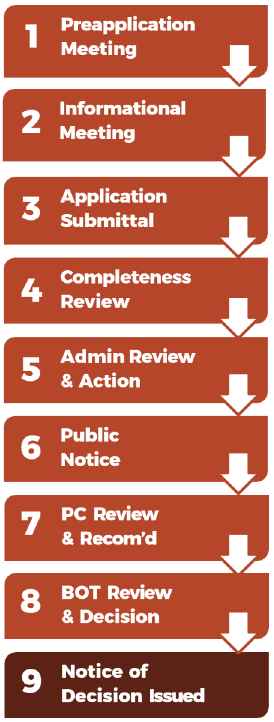
b.
Common Review Procedures. The Common Review Procedures in Section 15-8-10(d)(1) apply, as shown in the flow chart, with the modifications listed below.
c.
Application Submittal.
(i)
A Preliminary Plan application may be filed by an applicant after a completed Sketch Plan review.
(ii)
In addition to the application requirements in Section 15-8-20(e)(1), the application shall contain the following information:
1.
A preliminary plat map at a scale legible for reasonable review and interpretation by the Town Administrator containing at least the following information:
a.
Outer boundary lines of the tract(s) to be subdivided by reference to a permanent survey monument;
b.
Location and dimensions of all existing streets, alleys, easements, drainage areas, irrigation ditches and laterals, 100 year floodplain, and all other significant features;
c.
Location and dimension of all proposed streets, alleys, easement, drainage areas, irrigation ditches and laterals and all other significant features. For all rights-of-way, include the name, width, type, and elevation of surfacing;
d.
Location and dimension of proposed lot lines, lot numbers, and block numbers;
e.
Location, dimensions, and purpose of all other proposed easements and areas to be reserved or dedicated for public use, such as schools, parks, playgrounds or open space, or of all facilities or open space to be commonly held or maintained;
f.
Location and full description of all monuments as required by Title 38, Article 51, C.R.S.;
g.
Site data, including gross acreage of the subdivision, number of lots, and size of each lot;
h.
Name of the proposed subdivision; names and addresses of owners, subdividers, designers and engineers; date; scale; north arrow; and legal description of tract;
i.
Vicinity map; and
j.
Standard certificate blocks and plat notes as provided by the Town Administrator;
2.
A site plan of the subdivision at a scale legible for reasonable review and interpretation by the Town Administrator showing at least the following:
a.
Existing and proposed lot and parcel boundaries;
b.
Existing zoning;
c.
The location and dimensions of existing conditions including but not limited to improvements such as buildings, easements, parking areas, sidewalks, streets, drives, alleys and roads on or adjoining the property. Other significant conditions existing on the property, including but not limited to watercourses, marshes, rock outcrops, major rock formations, groves of trees, major vegetation categories, and potential geologic hazard; and
d.
Other data or conditions on immediately adjacent land, including but not limited to names and addresses of all adjoining property owners; character and location of buildings, power lines, railroad or common carrier facilities, towers and other nearby land uses or possible adverse influences; and analysis of wildfire hazard potential, influences on wildlife and relationship to known historic or archaeological sites of value;
3.
A grading and drainage plan showing at least the following information:
a.
A topographic map of ground elevations on the tract based on the United States Geological Survey datum plane or an approved datum plane by the Town Administrator, showing contours at two-foot intervals and showing the outer boundary lines of the tract;
b.
Cut and fill requirements;
c.
A map showing the method of moving runoff water through the subdivision. The map should show runoff concentrations in acres of drainage area on each street entering each intersection (this may be combined with the topographic map). Flow arrows should clearly show the complete runoff flow pattern at each intersection. For storm drainage facilities not on or adjacent to the tract, indicate the direction and distance to, size and invert elevation or nearest extension of the utilities; and
d.
Snow removal patterns and any major snow storage areas, and the relationship to the drainage patterns;
4.
Draft infrastructure and utilities plan in compliance with the Development Standards and Specifications showing the following:
a.
Location and size of existing utilities within and adjacent to the subdivision, including water, sewer, electricity, and communication;
b.
Location, plan, and profile of all proposed utilities, including water mains, fire hydrants, sewers, other utility mains or routes (electricity, communication) and any other services that shall supply the subdivision. All utilities must be within approved easements;
c.
Letter of commitment from all utility providers and data as may be required to show the capability and commitment of utility provision;
d.
Location and dimensions of all existing roads, sidewalks, curb, gutter or other pedestrian facilities; and
e.
Location, plan, and profile of all proposed roads, driveways, off-street parking spaces, sidewalk, curb, and gutter; and
5.
Supplemental data, as follows:
a.
Subsurface conditions on the tract: location and results of tests to ascertain subsurface soil, rock and groundwater conditions;
b.
Draft of proposed covenants whereby the applicant proposes to regulate land use in the subdivision and otherwise protect the proposed development, if applicable;
c.
Application for rezoning, if applicable;
d.
Application for annexation, if applicable; and
e.
Other materials necessary to show compliance with Article 4, Subdivision Design and Improvement and this Code.
d.
Review and Decision-Making.
(i)
Review and Decision. The Preliminary Plan shall be reviewed and recommended by the Planning Commission and decided on by the Board of Trustees, both in a public hearing.
(ii)
Review Criteria. In addition to the generally applicable review criteria in Section 15-8-20(h)(4), the following criteria shall be considered when deciding on a Preliminary Plan:
1.
The Preliminary Plan is substantially consistent with the Sketch Plan comments;
2.
The Preliminary Plan will not have an adverse effect on the surrounding area or create an unsafe or hazardous condition;
3.
The Preliminary Plan will not cast an undue burden on public utilities and community facilities; and
4.
The Preliminary Plan proposes reasonable project phasing in terms of infrastructure capacity, transportation connections, provision of parks and recreation areas and public facilities, and any other aspect of the development that will be developed across multiple phases.
e.
Post-Decision Actions.
(i)
Any conditions assigned with an approval of a Preliminary Plan must be met before submittal of the Final Plat.
(ii)
Preliminary Plan approval is valid for two years. Filing of a Final Plat for all or some of the area within the Preliminary Plan extends the approval by two more years with each Final Plat. The Town Administrator may grant an extension of time for up to two additional years if requested by the applicant.
(4)
Final Plat.
a.
Purpose. Final Plats ensure compliance with the approved Preliminary Plan and applicable standards of this Code.
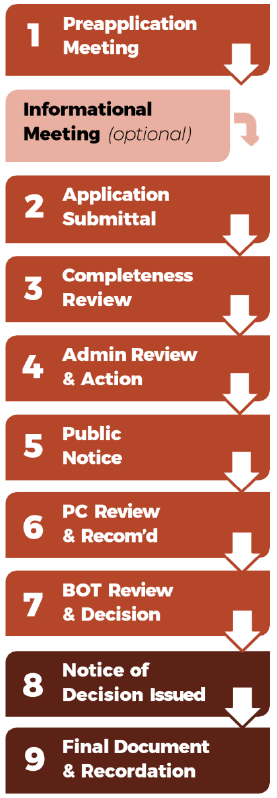
b.
Common Review Procedures. The Common Review Procedures in Section 15-8-10(d)(1) apply, as shown in the flow chart, with the modifications listed below.
c.
Application Submittal.
(i)
The Final Plat shall conform substantially with the Preliminary Plan as approved and address all conditions of approval.
(ii)
The approved Preliminary Plan may be completed through application for one or more Final Plats. Each area subject to Final Plat shall conform to all requirements of this Code.
(iii)
In addition to the application requirements in Section 15-8-20(e)(1), the application shall contain the following information:
1.
A Final Plat map at a scale legible for reasonable review and interpretation by the Town Administrator containing at least the following:
a.
All information required for a preliminary plan map;
b.
Primary control points, or descriptions, and "ties" to the control points to which all dimensions, angles, bearings and similar data on the plat shall be referred, to include at least one permanent survey monument;
c.
Tract boundary lines, right-of-way lines of streets, easements and other rights-of-way, and property lines of residential lots and other sites, with accurate dimensions, bearing or deflection angles and radii, arcs and central angles of all curves. All dimensions, both linear and angular, shall be determined by an accurate control survey in the field which must balance and close within a limit of one in 10,000. No Final Plat showing plus or minus dimensions will be approved;
d.
Surveyed legal description of the subdivision, and area of each lot;
e.
Location and description of all monuments, both found and set;
f.
Names of record owners of all adjoining land;
g.
Reference to recorded subdivision plats of adjoining platted land by record name, date, and number;
h.
Signature and seal of land surveyor registered in the State, certifying to the accuracy of the survey and plat, including a statement explaining how bearings, if used, were determined;
i.
Statement by the land owner dedicating streets, rights-of-way, easements and public sites. A warranty deed to the Town shall be required for conveyance of any public lands other than streets;
j.
Title under which the subdivision is to be recorded; and
k.
If the subdivision is within avalanche hazard areas, applicable sub-zone (High Hazard Red or Moderate Hazard Blue) designation for each lot, or portion of a lot by a stamp or other written note;
2.
Final grading and drainage plans;
3.
Final infrastructure and engineering plans and specifications in compliance with the Development Standards and Specifications for all required improvements per Section 15-4-30. The Town Administrator shall submit to the Planning Commission a staff report for the Final Plat public hearing;
4.
Agreements with ditch companies, if applicable;
5.
A Development Improvement Agreement and performance bond drawn and posted in favor of the Town, which bond shall be of sufficient amount to assure completion of all required improvements, as further defined in Section 15-4-30, Required Improvements;
6.
Final covenants in a form suitable for recording, if applicable;
7.
A title commitment no older than 30 days; and
8.
Other materials necessary to show compliance with Article 4, Subdivision Design and Improvement and this Code.
(iv)
In no case shall additions, corrections, or modifications of any kind be made to the Final Plat other than signatures required after the Board of Trustees have approved the Final Plat, unless necessary to comply with any conditions of approval.
d.
Review and Decision-Making.
(i)
Review and Decision. The Final Plat shall be reviewed and recommended by the Planning Commission and decided on by the Board of Trustees, both in a public hearing.
(ii)
Review Criteria. In addition to the generally applicable review criteria in Section 15-8-20(h)(4), the following criteria shall be met when deciding on a Final Plat:
1.
The Final Plat is substantially consistent with the Preliminary Plan approval and any conditions assigned;
2.
Status of all fees paid to the Town;
3.
Proof of any required land dedication including rights-of-way, parks and recreation areas, and public facilities; and
4.
Provision of adequate guarantee of completion and financial security through a Development Improvement Agreement.
e.
Post-Decision Action.
(i)
Recordation. Once approved, the Final Plat map shall be recorded per Section 15-8-40(k)(4).
(ii)
Expiration.
1.
If the public improvements for a subdivision have not been constructed and accepted by the Town or provision for public improvements has not been accounted for in a Development Improvement Agreement, and the corresponding Final Plat for the subdivision not recorded within three years from the date of Final Plat approval by the Town, the Final Plat shall be lapsed and deemed to be withdrawn, without further action by the Town; provided however, that this provision shall not apply to Final Plats approved by the Town prior to the adoption of this Code.
2.
The Board of Trustees may grant an extension of time up to an additional one year at a time at the request of the applicant.
(l)
Subdivision Design Modification.
(1)
Purpose. A Subdivision Design Modification is intended to allow specific changes to the provisions Article 4, Subdivision Design and Improvement where there are conditions on the site that require design modification to protect a natural feature or environmentally sensitive area or improve the subdivision design.
(2)
Applicability. An applicant may request a Subdivision Design Modification to specific regulations for projects that meet the requirements of the review criteria below.
(3)
Common Review Procedures. The Common Review Procedures in Section 15-8-20 apply, as shown in the flow chart, with the following and below modifications:
a.
A Subdivision Design Modification request shall be made and reviewed concurrently with the Preliminary Plan.
b.
The provisions of Article 4, Subdivision Design and Improvement, but not the Development Standards and Specifications, may be modified by the Planning Commission for a Planned Unit Development without a separate application for a Subdivision Design Modification.
(4)
Review and Decision-Making.
a.
Review Criteria. In addition to the generally applicable review criteria in Section 15-8-20(h)(4), the following criteria shall be met when deciding on a Subdivision Design Modification:
(i)
There exists on the site exceptional topographical, soil, or other subsurface condition, or other extraordinary conditions peculiar to the site or existing buildings or lot configuration such that strict application of the requirement of the regulation from which the design modification is requested would result in peculiar and exceptional practical difficulties to or exceptional and undue hardship upon the applicant or owner of the property in question.
(ii)
A Subdivision Design Modification shall not be granted if granting it would impair the intent and purposes of this LUC.
(m)
Vacation of Right-of-Way (ROW Vacation).
(1)
Purpose. Vacation of Right-of-Way provides a mechanism for the Town to evaluate requests to vacate public rights-of-way.
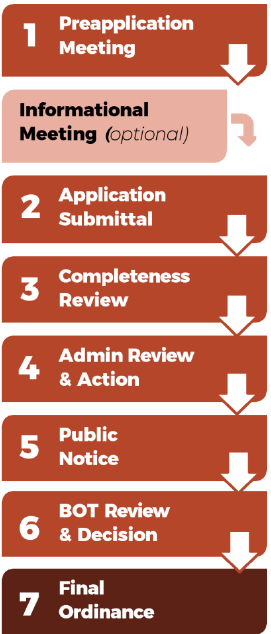
(2)
Common Review Procedures. The Common Review Procedures in Section 15-8-10(d)(1) apply, as shown in the flow chart, with the modifications listed below.
(3)
Application Submittal. A ROW Vacation may be requested by the owner of the property on both sides of the right-of-way to be vacated or at the joint request of both or all owners of property on both sides of the right-of-way.
(4)
Review and Decision-Making.
a.
Review and Decision. The Vacation of Right-of-Way application shall be reviewed and decided on by the Board of Trustees in a public hearing.
b.
Review Criteria. In addition to the generally applicable review criteria in Section 15-8-20(h)(4), the following criteria shall be considered when deciding on a Vacation of Right-of-Way:
(i)
The public use, convenience, and necessity no longer require the use of the portions of rights-of-way, as shown by decreased or non-use over time.
(ii)
No lot or parcel shall be landlocked as a result of the vacation.
(iii)
Access to any lot or parcel shall not be restricted to the point where access is unreasonable, economically prohibitive, or reduces or devalues any property affected by the proposed vacation.
(iv)
There shall be no adverse impacts on the health, safety, and/or welfare of the general community, and the quality of public facilities and services provided to any lot or parcel of land shall not be reduced, including, but not limited to, police and fire protection and utility services.
(v)
The proposal shall not hinder public and Town functions.
(5)
Post-Decision Actions. Vacation of a public right-of-way must be completed by Ordinance in accordance with Chapter 1, Article 3, Division 2 of the Municipal Code.
(n)
Variance.
(1)
Purpose. A variance is a deviation from the standards of this Code, including deviations that exceed what may be allowed as an Administrative Adjustment.
(2)
Applicability.
a.
Variances may be applied for when an applicant seeks to deviate from the standards of this Code or an application for Historic District Overlay Review is denied.
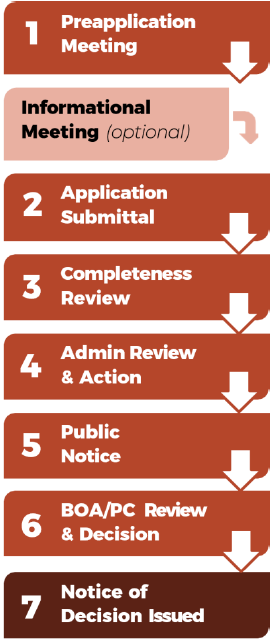
b.
This process also includes requests for reviews of Variances by the holder of the Variance and requests for reviews of Variances based upon a signed written complaint submitted to the Town.
c.
The use tables and use standards in Section 15-2-80(a), Use Standards, are not subject to Variance. This prohibition includes Variances for the purpose of allowing a proposed vacation rental where prohibited by this Code.
(3)
Common Review Procedures. The Common Review Procedures in Section 15-8-10(d)(1) apply, as shown in the flow chart, with the modifications listed below.
(4)
Application Submittal. In addition to the application requirements in Section 15-8-20(e)(1), the application shall contain supporting evidence such as maps, diagrams, and notations to help show compliance with the review criteria.
(5)
Review and Decision-Making.
a.
Review and Decision.
(i)
A request for Variance is reviewed and decided on by the Board of Adjustment except Variances to subdivision standards which are reviewed and decided on by the Planning Commission, both in a public hearing.
(ii)
In granting variances, the Planning Commission and Board of Adjustment may require conditions, submissions, reports, affidavits, maps, plats or documents as will, in their judgment, secure substantially the objectives of the requirements and standards so varied and modified.
b.
Review Criteria. In addition to the generally applicable review criteria in Section 15-8-20(h)(4), the following criteria shall be met when deciding on a Variance:
(i)
Strict compliance with the regulations would result in an extraordinary hardship defined as a condition of the property related to the land that makes it exceptionally challenging or impossible to meet the requirements of this LUC;
(ii)
Exceptional conditions exist, such as unusual topography;
(iii)
Granting the variance will not have the effect of nullifying the intent and purpose of these regulations; and
(iv)
That the spirit of this Code is observed, public safety, and welfare secured, and substantial justice done.
(v)
For a Variance to Historic District Overlay Review, the following criteria shall be considered:
1.
Economic hardship, including:
a.
The structural soundness of any buildings or structures on the property and their potential for rehabilitation.
b.
The economic feasibility of rehabilitation or reuse of the existing property in the case of a proposed demolition.
c.
For investment or income producing properties, the ability to obtain a reasonable rate of return on the property in its present condition, or in a rehabbed condition pursuant to the requirements for the Historic District Overlay.
d.
For non-income producing properties consisting of owner-occupied single-unit dwellings and/or non-income producing institutional properties not solely operating for profit, the ability to maintain or to convert the property to a reasonable residential or institutional use in its present condition or in a rehabbed condition pursuant to the requirements of the Historic District Overlay or the ability to transfer the property for a reasonable rate of return.
e.
The consideration for economic hardship shall not include any of the following:
i.
Willful or negligent acts by the owner;
ii.
Purchase of the property for substantially more than its market value;
iii.
Failure to perform normal maintenance and repairs;
iv.
Failure to diligently solicit and retain tenants;
v.
Failure to prescribe a rental amount which is reasonable; or
vi.
Failure to provide normal tenant improvements; or
2.
Undue hardship in which the application of the criteria creates a situation that is substantially inadequate to meet the applicant's needs because of specific health and/or safety issues.
(o)
Zoning Map Amendment (Rezoning).
(1)
Purpose. This procedure is required to make any change to the zoning map including the boundary of a zoning district, the assignment of a lot a different zoning district, or to assign a zoning district to land annexed to the Town of Silverton.
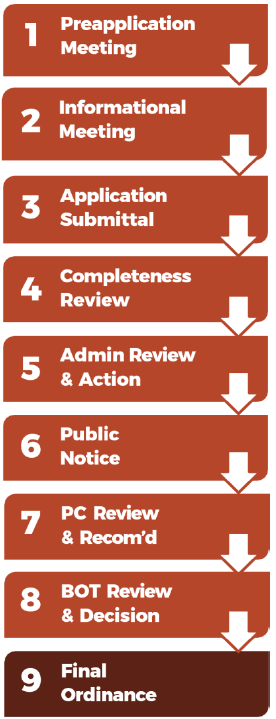
(2)
Common Review Procedures. The Common Review Procedures in Section 15-8-10(d)(1) apply, as shown in the flow chart, with the following and below modifications:
a.
Zoning Map Amendments initiated by the Town Administrator, Planning Commission, or Board of Trustees are exempt from preapplication meetings and application submittal and acceptance steps in the Common Review Procedures in Section 15-8-10(d)(1).
(3)
Application Submittal.
a.
Rezoning to Base Zoning District.
(i)
A Zoning Map Amendment (Base District) may be initiated by:
1.
The Board of Trustees, Planning Commission, or Town Administrator; or
2.
Any person residing, owning, or leasing property in the Town.
(ii)
In addition to the application requirements in Section 15-8-20(e)(1), the application shall contain a description of land area, including lot and block numbers to be rezoned, and requested new classification, along with a drawing to scale legible for reasonable review and interpretation by the Town Administrator showing boundaries of the area requested to be rezoned.
b.
Rezoning to PUD.
(i)
A Zoning Map Amendment (PUD) may be initiated on lots under single unified ownership or control.
(ii)
In addition to the general application submittal requirements in Section 15-8-20(e)(1), the application shall contain an Overall Development Plan that includes the following information:
1.
Description of land area, including lot and block numbers to be rezoned, and requested new classification, along with a drawing to scale legible for reasonable review and interpretation by the Town Administrator showing boundaries of the area requested to be rezoned;
2.
General land uses proposed for each portion of the property;
3.
Time schedule for any contemplated new construction or uses;
4.
Hazard areas including slope, flood, and avalanche hazard areas;
5.
Conceptual points of connection for any streets, and for on-street bicycle and pedestrian connections through the property and to adjacent properties;
6.
Conceptual open space, trail, and wildlife habitat areas and corridor connections through the property and to adjacent properties; and
7.
Other details as required by the Town Administrator.
(4)
Review and Decision-Making.
a.
Review and Decision.
(i)
All Zoning Map Amendment applications shall be reviewed and recommended by the Planning Commission and decided on by the Board of Trustees, both in a public hearing.
(ii)
The adoption of any Zoning Map Amendment shall require favorable vote of a majority of the Board of Trustees; however, a favorable vote of two-thirds of all members of the Board of Trustees shall be required when a protest is filed with the Town Administrator at least 24 hours prior to the vote of the Board of Trustees on the change and is signed by the owners of 20 percent or more of the area of land which is subject to the proposed change, or 20 percent or more of the land extending a radius of 100 feet from the land which is subject to the proposed change, disregarding intervening public streets and alleys. A favorable vote of two-thirds of all the members of the Board of Trustees shall also be required when an amendment or change has not been recommended by the Planning Commission.
b.
Review Criteria. In addition to the generally applicable review criteria in Section 15-8-20(h)(4), the following criteria shall be considered when deciding on a Zoning Map Amendment; however, comprehensive review and reenactment of all or a significant portion of the Zoning Map shall be a legislative action and shall not be required to meet the following criteria:
(i)
The rezoning is not adverse to the public health, safety, and welfare.
(ii)
The rezoning presents the Town with an opportunity for an appropriate site, at an appropriate location, for the particular type of land use or development proposed and will help the Town achieve a balance of land use, tax base, or housing types consistent with the Town's goals.
(iii)
The following additional criteria shall be met when deciding on a Zoning Map Amendment (PUD):
(iv)
The PUD meets the eligibility criteria of Section 15-2-70(c); and
(v)
The proposed development cannot be accomplished by the use of any combination of base and overlay zoning districts of this Code.
(5)
Post-Decision Actions.
a.
General.
(i)
All Zoning Map Amendments must be completed by Ordinance in accordance with Chapter 1, Article 3, Division 2 of the Municipal Code.
(ii)
Rezonings do not expire.
b.
Modification of Previous PUD Approval.
(i)
PUD amendments are classified as major or minor. Minor amendments do not exceed the criteria of Subsection (ii) below. All other changes are considered major amendments and require the review and approval of a new PUD pursuant to Section 15-8-40(o), Zoning Map Amendment (Rezoning).
(ii)
Minor amendments to an approved PUD Overall Development Plan may be approved by the Town Administrator if the proposed amendment complies with the following criteria:
1.
The number of residential units shall not be increased by more than 20 percent. The Board of Trustees may approve an increase of up to 40 percent if at least ten percent of the units provided are affordable housing.
2.
The gross square footage of nonresidential building area shall not be increased by more than 20 percent.
3.
The number or location of vehicular access points shall not be changed in a way that negatively impacts public safety or the flow of traffic onto public streets.
4.
The numeric standards in the PUD shall not be revised by more than would be allowed through the administrative adjustment procedure in Section 15-8-30(a).
(iii)
The Town Administrator may determine an amendment meeting the criteria in Subsections 1.—4. Above should be processed as a major amendment because of the size or complexity of the proposed amendment or to allow for community input.
(Ord. No. 2025-01, § 2(Exh. A), 1-27-2025)

