
Silverton City Zoning Code
ARTICLE 6
Site Development Standards
Sec. 15-6-10. - Mobility, connectivity, and parking.
(a)
Purpose. The purpose of this Section is to:
(1)
Provide for safe and convenient interaction between vehicles, bicycle, and pedestrians;
(2)
Encourage multi-modal transportation options and enhanced pedestrian safety; and
(3)
Ensure the quality of life of the community will not be impeded by off-street parking requirements when adequate on-street parking is available.
(b)
Applicability. This Section shall apply to new development or redevelopment of three or more single-unit attached dwellings, triplex or fourplex dwellings, multiunit dwellings, mixed-use development, and nonresidential development.
(c)
Mobility.
(1)
Sidewalks designed to Town standards are required along all public streets. The Town Administrator may approve a walkway that is surfaced in pavers, bricks, colored or patterned concrete, gravel, or other methods approved by the Town to enhance pedestrian safety and the attractiveness of the walkway.
(2)
All development in the MU-1, C-1 and C-2 districts shall provide a pedestrian walkway system as follows:
a.
There shall be a walkway from the perimeter public sidewalk or street to the primary building entrance. Walkways shall be constructed with using firm, stable, and slip resistant surface.
b.
Pedestrian walkways or sidewalks shall connect all primary building entrances and must be provided along any building wall featuring an entrance that exits into a parking area or public right-of-way.
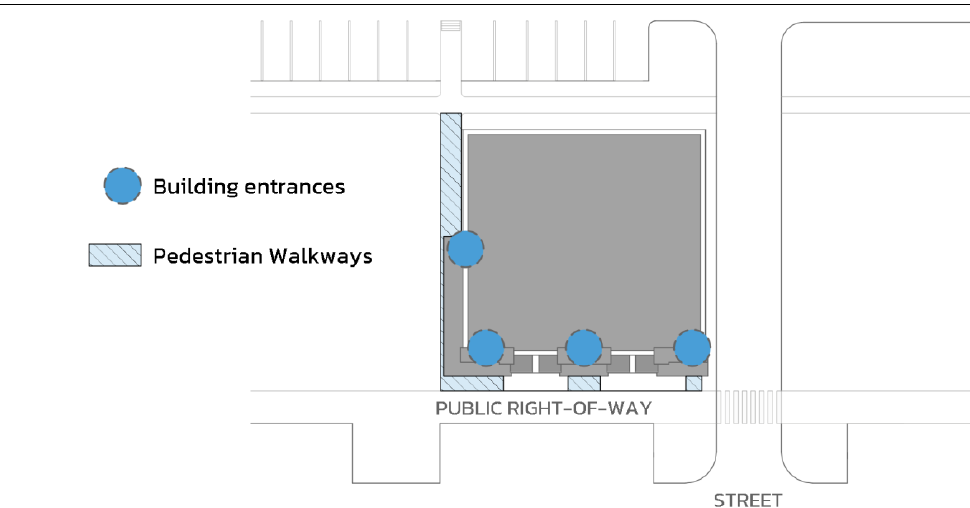
Figure Sec. 15-6-1: Pedestrian Walkway Requirements
(d)
Connectivity.
(1)
Every mixed-use, commercial, and industrial lot shall have sufficient access providing reasonable means of ingress and egress for emergency vehicles, trucks supplying necessary services, and for those needing access to the property for its intended use.
(2)
All driveway entrance and other openings onto streets shall be constructed so that:
a.
Vehicles may safely enter and exit the property; and
b.
Interference with the free and convenient flow of traffic in abutting or surrounding streets is minimized.
(e)
Parking For Those Experiencing Disabilities. Where ADA-compliant parking is required, it shall be consistent with the ADA design requirements, including but not limited to providing a firm, stable, and slip resistant surface, the minimum number of spaces for automobiles, van-accessible spaces, location of spaces relative to building entrances, accessible routes between parking areas and building entrances, identification signs, lighting, and other design and construction requirements.
(f)
Bicycle Parking. Multiunit dwellings, including five or more dwellings within a mixed-use building, are encouraged to provide a minimum of one short- or long-term bicycle space per dwelling unit. A combination of short- and long-term spaces may be provided.
(g)
Parking Area Design. Where provided, parking areas shall meet the following standards.
(1)
Vehicle Parking.
a.
Each off-street parking space shall consist of an open area measuring at least nine feet wide by 18 feet long and seven feet high; provided, however, parallel parking spaces shall measure at least nine feet wide by 23 feet long and seven feet high.
b.
Off-street parking shall be free of weeds, properly drained, and surfaced with concrete, asphalt, sealed pavers, cobbles, sealed brick, gravel or rock a minimum depth of four inches to ensure a dust-free surface or any other material with similar characteristics and uses and shall be maintained in a usable condition at all times.
c.
The Town Administrator may prohibit the use of gravel or rock for parking areas when deemed necessary for erosion control, drainage, or other ecological considerations.
(2)
Bicycle Parking. Where provided, short- and long-term bicycle parking shall meet the following standards.
a.
Short-Term Bicycle Spaces. Short-term bicycle racks shall be located so that they:
(i)
Are easily accessed from the street and protected from motor vehicles;
(ii)
Are visible to passers-by to promote usage and enhance security;
(iii)
Do not impede or interfere with pedestrian traffic or routine maintenance activities;
(iv)
Do not block access to buildings; and
(v)
Allow reasonable clearance for opening of passenger-side doors of parked cars.
b.
Long-Term Bicycle Spaces. Long-term bicycle parking shall be enclosed and secured to the maximum extent practicable. Enclosed bicycle parking includes but is not limited to: an area enclosed by a secure fence with a lockable entrance or a secure and accessible room in a building.
(Ord. No. 2025-01, § 2(Exh. A), 1-27-2025)
Sec. 15-6-20. - Landscaping and screening.
(a)
Applicability. This Section shall apply to new development or redevelopment of three or more single-unit attached dwellings, triplex or fourplex dwellings, multiunit dwellings, mixed-use development, and nonresidential development unless otherwise specified.
(b)
Nonfunctional Turf, Artificial Turf, And Invasive Plant Species.
(1)
On or after January 1, 2026, all new development and redevelopment, as defined below, of nonresidential principal uses are prohibited from installing, planting, or placing any nonfunctional turf, artificial turf, or invasive plant species as defined in Colorado Statutes.
(2)
Redevelopment, for the purposes of this Section, requires both of the following:
a.
A disturbance of more than 50 percent of the aggregate landscape area, and
b.
Activity that requires a building permit or Site Plan.
(c)
Screening.
(1)
Fences and Walls.
a.
Maximum Fence Height. The maximum height for fences or walls shall be six feet, unless otherwise approved through an Administrative Adjustment in Section 15-8-30(a).
b.
Setbacks. Fences and walls, including those over six feet in height, are not considered structures and therefore not required to meet the principal or accessory building setbacks for the underlying zoning district.
c.
Clear Vision Triangle. No obstructions above 42 inches in height are permitted within the clear vision triangle as defined in Section 15-11-20(b), Clear Vision Triangle Measurement.
(2)
Roof-mounted Mechanical and Utility Equipment. Roof-mounted mechanical and utility equipment, excluding solar panels, shall be an integral part of the building's overall architectural design and shall be screened from view to the maximum extent practicable from public rights-of-way, residential land uses, public parking areas, and/or adjacent properties using parapet walls or other means of screening. When reviewing the type and amount of screening, the Town Administrator shall consider the following:
a.
The proximity of the development to surrounding residential land uses and the visual impact that roof-mounted equipment may have upon those surrounding residential land uses;
b.
The number and size of roof-mounted equipment. The greater the number and/or size, the more screening may be warranted; and
c.
Roof-mounted equipment shall maintain a color and finish that are compatible with the primary building facade.
(Ord. No. 2025-01, § 2(Exh. A), 1-27-2025)
Sec. 15-6-30. - Site and building design standards.
(a)
Purpose. The purpose of this Section is to:
(1)
Establish design and development standards that foster high-quality development;
(2)
Enhance the human and pedestrian scale of commercial developments and ensure compatibility between residential neighborhoods and adjacent nonresidential uses; and
(3)
Balance the community's economic and aesthetic concerns.
(b)
Townwide Design Standards.
(1)
Applicability. This Section shall apply to all new residential and nonresidential development or redevelopment that requires a Site Plan.
(2)
Roofs, Eaves, and Parapets. Roofs, eaves, and parapets shall be designed to withstand the Town's variable mountain climate by using appropriate pitch, drainage, R-value, and materials.
(3)
Climatic Conditions.
a.
Local climatic conditions shall be considered when designing the orientation of new buildings. For example, north-facing facades are especially susceptible to winter snow and ice accumulation, and entries may require special treatment.
b.
Adequate solar access shall be considered when planning outdoor spaces, with shade and relief from glare provided by landscaping and overhead structures.
(4)
Reflective Materials Prohibited. No glare-producing material including, but not limited to, unpainted metal or reflective glass, shall be used on the exterior of structures. The light reflectance value (LRV) of any material shall not exceed 60 percent.
(5)
On-Site Snow Shedding and Storage. Each application for a Site Plan or a Special Use Permit shall submit a snow shedding and storage plan that demonstrates compliance with the following requirements.
a.
Snow Storage.
(i)
In all districts except the MU-1 district, a minimum snow storage area equaling ten percent of the impervious surface on the lot, either located in one location or distributed across multiple areas, shall be provided for the removal, management, and storage of snow removed from pedestrian and vehicular ways, driveways, parking, and loading spaces.
(ii)
In all districts, adequate drainage shall be provided for the snow storage area to accommodate snowmelt and to ensure it does not drain onto adjacent property.
b.
Snow Shedding.
(i)
Sites and structures shall be designed so that snow does not shed across the property line onto an adjacent property.
(ii)
Snow shall not be allowed to shed freely into building entrances. The buildup of ice and snow within pedestrian areas shall be minimized to the maximum extent practicable.
(iii)
Any roof that may shed snow onto walkways and entries shall include rooftop snow retention techniques including snow guards, snow fences, or other mechanism approved by the Building Official designed in accordance with adopted building codes to prevent injury, as deemed necessary by the Building Official. The Town Administrator may waive this requirement if the snow shedding plan shows that the standards of this Section can be met without using retention techniques.
(6)
Refuse Containers.
a.
Dumpsters and refuse containers shall be animal resistant. Animal resistant containers are fully enclosed containers that may be constructed of pliable materials reinforced to deter access by wildlife. The containers must employ sturdy lids that have a latching mechanism that prevent access to their contents by wildlife.
b.
Enclosures shall be located to minimize view and odors from public locations at the primary street frontage and neighboring properties and uses to the maximum extent practicable.
(7)
Mechanical.
a.
Underground utility connection is required unless otherwise provided by the Building Official.
b.
Risers, utility meters, panel boxes, or similar, are encouraged to be covered with the same or compatible material as the siding material where the connection meets the building, unless prohibited by utility company regulations.
(8)
Small Lot Development Bulk Plane. The following standards shall apply to lots less than 5,000 square feet in area, excluding those lots in the MU-1 district.
a.
A bulk plane analysis shall be applied to define the three-dimensional area to which development will be limited. The bulk plane extends up 12 feet from all four lot lines and angles in at 45 degree angles from the side lot lines until it reaches the maximum building height in the zoning district or intersects with the plane that is created by the lot line on the opposite side of the lot. The buildable area, or area in which development may occur, consists of the area within the required front, side and rear yard setback and the defined bulk plane.
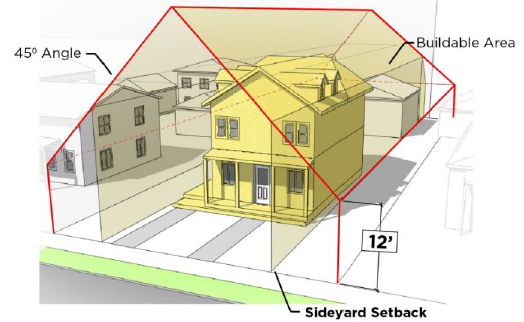
Figure Sec. 15-6-2: Bulk Plane Analysis
b.
Individual dormers (shed or gable) may extend up to six feet beyond the buildable area, with a maximum width of eight feet. The portion(s) that extend beyond the buildable area shall have a combined width no greater than 50 percent of the length of the roof upon which they are located. The width of the dormer shall be measured at the point that it intersects the bulk plane.
c.
The end(s) of a shed roof may extend up to five feet beyond the buildable area.
d.
The end(s) of a side-gabled roof may extend up to five feet beyond the buildable area with a maximum width of 20 feet or no more than 50 percent of the length of the home, whichever is less. The width of the side-gabled roof shall be measured at the point that it intersects the bulk plane.
e.
A rooftop solar system, that is flush-mounted to the roof or mounted at up to a 15 degree angle measured from a horizontal plane may extend beyond the buildable area provided that the roof structure supporting the solar system does not extend beyond the bulk plane limit.
(c)
Historic District Overlay Standards. All lots within the Historic District Overlay shall be subject to Section 15-2-80(a)(7), Design Standards for All Development in the Historic District Overlay.
(d)
Additional Greene Street Standards.
(1)
Applicability. In addition to the standards set forth in Subsection(b) above, this Section shall apply to any new development or redevelopment on lots abutting Greene Street outside of the Historic District Overlay.
(2)
Referral to Historic Preservation Committee. The Town Administrator may refer any application subject to the Greene Street standards to the Historic Preservation Committee for review and comments regarding the structure's compatibility with nearby historic buildings, the original and historic facade of existing buildings, and the aesthetics as viewed from the main heritage tourism thoroughfares.
(3)
Building Orientation. The facade containing the primary entry way shall parallel the street. Building entrances shall be visible and accessible from the pedestrian right-of-way along the building's primary street.
(4)
Building Mass and Form.
a.
The following elements shall be used to provide relief and contrast in the facade and delineate individual units. A minimum of three elements shall be incorporated:
(i)
Balconies;
(ii)
Overhangs;
(iii)
Covered patios;
(iv)
Prominent entry features;
(v)
Window variations;
(vi)
Door opening variations;
(vii)
Variations in materials with an alternative material use for at least 20 percent of the structure;
(viii)
Variations in building height with differing levels of height provided for at least 20 percent of the total height;
(ix)
Variation in roof form, with differing roof forms provided for at least 20 percent of the total room;
(x)
Projected or recessed building walls that vary from the primary vertical plane by at least six inches; or
(xi)
Another architectural feature as approved by the Town Administrator.
b.
Entries and stairwells shall be an integral part of the building design. Exterior stairwells shall be protected from the weather and partially screening or designed with architectural treatments that are integrated into the overall building elevation.
(5)
Building Materials. New additions and new buildings shall be designed with building materials that preserve or complement exterior building materials characteristic of the Town's history. Applicants are encouraged to use History Colorado's Field Guide to Historic Architecture and Engineering as a reference document.
(6)
Roof Form.
a.
Roofs should be similar in scale to those used historically on comparable buildings. Typical primary roof shapes are gabled, hipped, and shed.
b.
Bowed or curved roof forms are prohibited.
(7)
Parking. If on-site parking is provided, parking shall be located to the side or rear of the primary structure to the maximum extent practicable.
(Ord. No. 2025-01, § 2(Exh. A), 1-27-2025)
Sec. 15-6-40. - Outdoor lighting.
(a)
Purpose. The purpose of this Section is to:
(1)
Preserve and protect the natural dark sky resource;
(2)
Minimize light pollution, glare, light trespass, and sky glow;
(3)
Promote energy conservation;
(4)
Maintain nighttime visibility for safety and security;
(5)
Prevent unnecessary or inappropriate outdoor lighting;
(6)
Minimize nighttime lighting impacts on wildlife;
(7)
Maintain the rural atmosphere and character of the town; and
(8)
Make the town an attractive place for residents and tourists.
(b)
General Provisions.
(1)
All outdoor light fixtures permanently or temporarily installed outdoors, except for those listed under Subsection (d), shall:
a.
Be the minimum necessary to provide for safety and functionality;
b.
Be turned off when no one is present to use the light;
c.
Be fully shielded; and
d.
Be directed such that illumination is within the property boundary where the outdoor light fixture is located. This provision does not apply to publicly owned outdoor light fixtures.
(2)
The correlated color temperature of each lamp shall not exceed 3,000 Kelvins.
(3)
The following lumen per net acre values are an upper limit and not a design goal:
a.
All uses except single-unit detached dwellings are limited to 15,000 lumens per net acre and fixtures are limited to 1,600 lumens each.
b.
Single-unit detached dwellings are limited to 10,000 lumens per net acre and fixtures are limited to 850 lumens each.
(c)
Specialized Outdoor Lighting.
(1)
Canopies. Canopies for service stations and other overhangs may be illuminated provided all light fixtures are mounted on the undersurface of the canopy and all light fixtures are full cutoff. Except for directed beam lighting, merely placing the fixtures on the underside of the canopy does not qualify as fully shielding the light fixture. Directed beam lighting mounted under the canopy is allowed, provided the light source cannot be seen from outside the property boundaries.
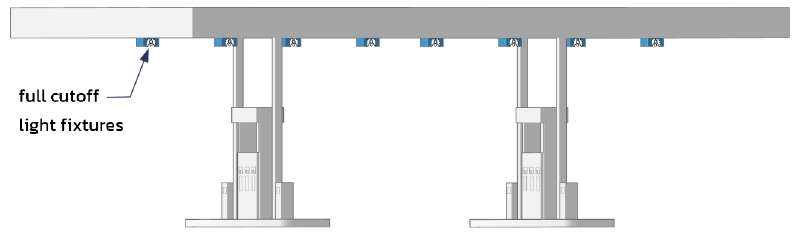
Figure Sec. 15-6-3: Canopy Lighting for Fuel Station
(2)
Outdoor Recreational Facilities. Lighting for sporting and/or athletic facilities do not have to be fully shielded or be limited to 3,000 Kelvins if all the following are met:
a.
Illuminating Engineering Society (IES) lighting guidelines (RP-6) are followed according to the appropriate class of play.
b.
Field lighting is provided exclusively for illumination of the surface of play and viewing stands, and not for any other applications.
c.
Illuminance levels are adjustable based on the task (e.g., active play versus field maintenance).
d.
Off-site impacts of the lighting are limited to the maximum extent practicable.
e.
Lights are extinguished by 10:00 p.m. or one hour after the end of play, whichever is later.
f.
Timers are installed to prevent lights being left on accidentally overnight by automatically extinguishing them.
(3)
Publicly Owned Outdoor Lighting.
a.
New publicly owned outdoor light fixtures shall only be installed where needed for safety and functionality.
b.
All new publicly owned outdoor light fixtures installed six months or more after the adoption of these regulations shall incorporate adaptive controls.
(4)
Signs.
a.
Luminance levels for operation between sunset and sunrise shall not exceed 100 nits (100 candelas per square meter, cd/m2) as measured under conditions of a full white display.
b.
During the first hour after sunset and during the last hour immediately preceding sunrise, sign luminance shall not exceed 100 nits (100 candelas per square meter, cd/m2).
c.
Sign illumination shall be extinguished completely during the hours the business is closed.
d.
The luminous/illuminated surface area of an individual sign shall not exceed 40 square feet.
(d)
Exemptions. The following are exempt from this Section:
(1)
Temporary emergency lighting in use by law enforcement or government agencies or at their direction;
(2)
Temporary lighting for events that do not create issues of light trespass or safety as approved by the Town Administrator for a period of up to seven days;
(3)
Temporary holiday decorative lights from November 15 through January 15 and one other seven-day period a year. Lights shall be extinguished by 10:00 p.m. and remain off until one hour before sunrise. Holiday decorative lights may blink, so long as the safety of any moving vehicle is not impacted;
(4)
String, bistro, and similar lighting, provided the emission of no individual lamp exceeds 50 lumens and no installation of lighting exceeds, in the aggregate, 6,000 lumens. These lights must be rated at or below 2,700 Kelvin. Lights shall be extinguished by 10:00 p.m. and remain off until one hour before sunrise;
(5)
Low voltage LED lights and solar lights used to illuminate pathways in residential areas, provided the lights are installed not more than 18 inches above the adjacent ground level;
(6)
The lighting of artwork that is outdoors and on publicly owned property. Lighting shall not exceed 850 lumens per artwork nor more than 3000 Kelvin. Lights shall be extinguished by 10:00 p.m. and remain off until one hour before sunrise;
(7)
Lighting on structures or signs for buildings on the National Register of Historic Places in which the lighting contributes to the historical significance of the building. Efforts shall be made to comply with the outdoor lighting standards where it does not compromise the historic integrity;
(8)
The lighting of federal or state flags, provided that the light is above the flag and faces downward;
(9)
Traffic control signals and devices; and
(10)
Lighting required by federal, state, county, or Town ordinance and regulations.
(e)
Prohibited Outdoor Lighting. The following are prohibited:
(1)
Searchlights, sky beams, and similar lighting except as required by response personnel during emergency conditions;
(2)
Blinking, flashing, rotating, or moving lights, including those used for signage. This does not apply to holiday-type decorative lights as exempted above;
(3)
Lighting which produces any glare or distraction for any passing motorist;
(4)
Neon or luminous tube lighting including any sign, except "open/closed" or "vacancy/no vacancy" type signs; and
(5)
Mercury vapor lighting.
(f)
Nonconforming Outdoor Lighting.
(1)
All existing outdoor lighting that was legally installed before the adoption of this Section but does not meet the requirements of this Section shall be considered nonconforming.
(2)
Nonconforming outdoor lighting is allowed to remain in use unless any of the following occurs:
a.
Replacement of the fixture;
b.
Non-use of the fixture for a period of six months; and/or
c.
Damage to the light fixture such that the cost or repair is 50 percent or more of the cost to replace the fixture with a conforming fixture.
(3)
No alteration may be made to outdoor lighting which would increase the amount of degree of the nonconformity.
(4)
After ten years from the date of adoption of this Section, all nonconforming outdoor light fixtures shall be brought into compliance with this Section.
(g)
Plan Submission and Compliance Review.
(1)
All applications for business permits, building permits, Sign Permits, Site Plan, Historic District Overlay Review, Planned Unit Development, Special Use Permit, and Simple and Major Subdivisions shall submit a lighting plan showing compliance with this Section. The lighting plan shall include the following information:
a.
The manufacture's cut sheet for each proposed outdoor light fixture;
b.
A site plan with property boundaries including all existing and proposed light fixture locations and their light spill;
c.
A table showing the total lumens by fixture and a calculation explaining the total lumens per net acre;
d.
Total Kelvin for each proposed lamp; and
e.
Other materials necessary to show compliance with this Section.
(2)
Review of lighting plans shall be by the Town Administrator who may refer review to the Planning Commission if that, in their opinion, issues are present that require Planning Commission attention.
(Ord. No. 2025-01, § 2(Exh. A), 1-27-2025)

