
Silverton City Zoning Code
ARTICLE 4
Subdivision Design and Improvement
Sec. 15-4-10. - General provisions.
(a)
Purpose. The purpose of this Section is to provide for:
(1)
Efficient circulation through the proper arrangements of streets in relation to other existing or planned streets;
(2)
Adequate and convenient open spaces for traffic circulation, utilities, emergency access, recreation, light, air, snow, and drainage; and
(3)
Adequate infrastructure through the establishment of standards for the design and construction of improvements.
(b)
Applicability. This Section shall apply to the subdivision of all land located within the legal boundaries of the Town and, when in reference to an adopted major street plan, all land located within three miles of the corporate limits of the Town.
(c)
Compliance with LUC.
(1)
The general layout of lots, streets, driveways, utilities, drainage facilities, and other services within all proposed subdivisions shall be designed in a way that minimizes the amount of land disturbance, maximizes the amount of open space in the development, and otherwise accomplishes the purpose and intent of this LUC and of the zoning district in which the subdivision is located.
(2)
Applicants shall apply these standards in the design and creation of lots or patterns of lots to ensure compliance with applicable development standards to the maximum extent practicable.
(d)
Design Standards and Specifications.
(1)
Required improvements shall be designed in accordance with this Article and the Development Standards and Specifications.
(2)
No improvements shall be made until all engineering plans, profiles, and specifications have been reviewed and approved by the Town.
(e)
Suitability of Land for Development. Land subject to natural hazards such as flooding, wildfire, falling rock, landslides, and avalanches shall be considered unsuitable for any occupancy that may impair the health, safety, or welfare of the inhabitants, unless otherwise permitted by this LUC. Where hazardous conditions exist on or adjacent to lands proposed for subdivision, the application shall meet the applicable standards of Article 5, Environmentally Sensitive Lands.
(Ord. No. 2025-01, § 2(Exh. A), 1-27-2025)
Sec. 15-4-20. - Subdivision design standards.
(a)
Lots and Blocks.
(1)
Lot size, width, depth, shape, orientation, and minimum building setback lines shall be appropriate for the location of the subdivision and for the type of development and use contemplated and shall conform to the dimensional standards for the zoning district.
(2)
Lots and blocks shall be designed to afford the maximum solar access to each building site.
(3)
Double frontage and reverse frontage lots are prohibited except where essential to provide separation of residential properties from arterial streets or commercial uses, or to overcome specific disadvantages of topography and orientation.
(4)
A statement relinquishing right of access from individual lots to Highway 550 and/or an arterial road shall be included in the Final Plat.
(5)
Side lot lines shall be substantially at right angles to street lines, unless otherwise approved by the Board of Trustees.
(6)
The maximum block length between intersecting streets shall be 600 feet.
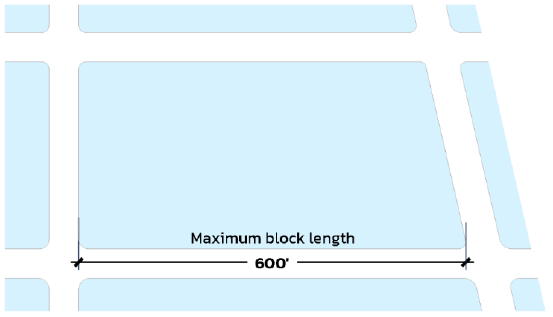
Figure Sec. 15-4-1: Maximum Block Length
(b)
Streets.
(1)
Minimum Design Standards. All streets, alleys, bridges, sidewalks, curbs, gutters, and public right-of-way shall meet the minimum design standards as set forth in the Development Standards and Specifications.
(2)
Arrangements of Streets.
a.
Adequate local streets shall be provided to accommodate the subdivision and provide access to lots.
b.
New streets and extensions of existing streets must bear a logical relationship to the topography and to the location of existing or planned streets on adjacent properties, unless otherwise approved by the Town. The arrangement of streets in a subdivision shall either:
(i)
Provide for the continuation or appropriate projection to existing principal streets in surrounding areas; or
(ii)
Conform to a plan for a neighborhood or Planned Unit Development approved by the Planning Commission to meet a particular situation where topographical or other conditions make continuance or conformance to existing streets impracticable or where neighborhood design makes a varied plan appropriate.
c.
Any development requiring access onto a State highway shall obtain a permit for access from the Colorado Department of Transportation before the issuance of any Town development permit. State or federal highways shall not be intersected by local streets.
d.
Any development requiring access onto a County road shall obtain a permit for access from San Juan County before the issuance of any Town development permit.
(3)
Access Easement or Alley.
a.
The use of an easement or alley for principal access to a lot shall be allowed where:
1.
Alleys currently exist;
2.
Alleys are part of an overall project design; or
3.
An alley can be used to provide access in a manner that corresponds to surrounding site design and allows maneuvering that is safe for vehicles, pedestrians, and bicyclists.
(4)
Closed-end Streets.
a.
Closed-end streets should only be used when topography, the presence of natural features, and/or vehicular safety factors make a vehicular connection impractical. Closed-end streets are prohibited when street connection across adjacent property is possible. Ordinarily, closed-end streets shall be discouraged as they do not result in a continuation or conformance to existing streets or streets pattern.
b.
Closed-end streets shall be designed in compliance with the Development Standards and Specifications.
c.
An alternative design may be approved by the Fire Department and Public Works.
(5)
Intersections.
a.
Streets shall intersect as nearly as possible at right angles.
b.
All streets shall intersect at right angles for a minimum of 50 feet from the edge of the intersection.
c.
More than two streets intersecting at a point shall be avoided.
(6)
Half-streets. Half streets are prohibited, except where essential to the reasonable development of the subdivision and where the Board of Trustees finds that it will be practicable to require the dedication of the other half of a street when the adjoining property is subdivided.
(7)
Street Names.
a.
Names of new streets shall not duplicate names of existing streets, except for new streets that are extensions of, or that are in alignment with, existing or platted streets.
b.
Street names shall not be named for a living individual.
(8)
Sight Distance. All portions of the grade line must meet sight distance requirements for the design speed. The minimum stopping sight distance is the distance required by the driver of a vehicle, traveling at the design speed, to bring the vehicle to a stop after an object on the road becomes visible.
(c)
Utility Easements.
(1)
Where necessary for installation and/or maintenance of utility systems, easements of at least ten feet in width shall be reserved along rear lot lines of each lot, or at other locations which will not interfere with the siting of buildings.
(2)
In general, utility systems shall be arranged and located to avoid cross-connections, minimize trenching, and adequately separate incompatible systems.
(Ord. No. 2025-01, § 2(Exh. A), 1-27-2025)
Sec. 15-4-30. - Required improvements.
(a)
Water and Sewer Service Extensions. Extension of the municipal water and sewer services to serve every existing or proposed structure in any subdivision within or seeking to be annexed to the Town is mandatory. Fees and procedures for municipal utility extensions and services shall be governed by Chapter 13 of the Silverton Municipal Code and shall be payable as provided in Chapter 13.
(b)
Storm Drainage System. The following criteria shall be followed in the design of all drainage systems:
(1)
The storm drainage system shall consist of natural drainage courses whenever possible and/or surface drainage structures, catch basins, and other underground drainage structures. The storm drainage system shall be of sufficient size and design to carry off all predictable surface water runoff within the subdivision or development and stormwater drainage which enters the development from adjacent areas based on a 25-year frequency storm.
(2)
Catch basins shall be provided at all low points, at street intersections and at intermediate locations as necessary to prevent overloading of the street gutters. Catch basins provided shall be connected to collection mains of adequate size with outfalls approved by Public Works.
(3)
Storm drainage shall not be permitted to empty into any sanitary sewerage system.
(c)
Sanitary Sewerage System.
(1)
The sanitary sewerage system shall be connected to an existing public sanitary sewer system and shall consist of a closed system of sanitary sewer mains and lateral branch connections to each structure or lot upon which a structure is to be built.
(2)
The sanitary sewerage system shall be of sufficient size and design to collect all sewage from all proposed or probable structures within the subdivision or development and comply with the requirements in the Development Standards and Specifications with review and acceptance by the Public Works Director.
(d)
Potable Water System.
(1)
The potable water system provided shall connect to an existing public water system and shall consist of water mains directly connected to using structures by means of lateral branches.
(2)
The water system shall be of sufficient size and design to supply potable water to each structure or lot upon which a structure is to be built and comply with the requirements in the Development Standards and Specifications with review and acceptance by the Public Works Director.
(e)
Fire Hydrants. Fire hydrants shall be installed pursuant to applicable Fire Code requirements.
(f)
Utilities. All new electric utilities shall be installed underground. Above-ground facilities associated with new installations (e.g., pedestals, transformers, and transmission lines of 50kv capacity or greater) may be allowed if deemed necessary by Public Works.
(g)
Street Lights.
(1)
Ornamental street lighting and associated underground street lighting supply circuits shall be installed. Street lights shall maintain maximum spacing of 400 feet, with lighting at each intersection.
(2)
All street lighting shall meet the requirements of Section 15-6-40, Outdoor Lighting.
(3)
The street lighting plan specifying the number, line and approximate location of street lights must be included with the Final Plat application.
(h)
Arterial Roads. An applicant for a subdivision that is access from Highway 550 or an arterial road may be required to submit a traffic impact analysis that considers the following factors: street capacity and level of service; vehicle access and loading; on-street parking impacts; impacts on adjacent neighborhoods; and traffic safety including pedestrian safety.
(i)
Street Improvements. All street improvements shall meet the standards of Section 15-4-20(b) including the minimum design standards set forth in the Development Standards and Specifications.
(Ord. No. 2025-01, § 2(Exh. A), 1-27-2025)
Sec. 15-4-40. - Public land dedication.
(a)
Dedication or Cash in Lieu Requirement.
(1)
Every Major Subdivision and PUD shall include a dedication of land to the Town, or other entity, as determined by the Board of Trustees, to be used for parks and recreation, open space, school sites, municipal facilities, or cash in lieu of the dedication in an amount established by this Section.
(2)
The applicant shall dedicate a minimum of ten percent of the gross land area, exclusive of streets, alleys, and utility easements for one or more of the public purposes listed above.
(b)
Cash in Lieu.
(1)
If the Board of Trustees finds that the park and recreational needs of a proposed development would be better served by a park in a different location or the expansion or improvement of an existing park or recreational area, the Board of Trustees may substitute a cash payment or other equivalent conveyance in lieu of land dedication.
(2)
The amount of cash payment shall be calculated based on the land area that would be required as a dedication. The Board of Trustees shall establish by resolution the per-square foot fee based on the current fair market value for raw lands within the corporate limits of the Town.
(3)
The equivalent cash valuation, when used, shall be based upon an appraisal by a competent, independent appraiser selected by the Town and the applicant. The applicant shall pay one-half the total cost of the services of the appraiser, with payment to be deposited to the General Fund of the Town prior to approval of the Final Plat by the Board of Trustees.
(c)
Acceptance.
(1)
All land dedicated to the Town shall be formally accepted by the Town through the adoption of an appropriate ordinance if it chooses to accept the dedication and the dedication conforms to the requirements of this Section.
(2)
The proceeds of any equivalent cash payment under this Section shall be placed in a separate Town fund and shall be used only for the acquisition or improvement of land for public park and recreation areas or other public facilities.
(d)
Reservations.
(1)
Reservation by covenant, in lieu of dedication, may be permitted in some cases, such as a Planned Unit Development where land is to be used for recreational or amenity purposes by the property owners.
(2)
Reservation of land within a subdivision may be required for the duration of the Preliminary Plan approval in order to afford the appropriate public agency the opportunity to coordinate its acquisition of public land with the development of the subdivision. An agreement shall be entered into between the subdivider and the public agency regarding the timing and method of acquisition.
(Ord. No. 2025-01, § 2(Exh. A), 1-27-2025)

