
Springfield City Zoning Code
DIVISION 1
INTENT, PURPOSE, AND GENERAL PROVISIONS
Sec. 36-300.- Title.
This article, which has been adopted as article III of the Land Development Code as contained in Chapter 36, Community Development, Springfield City Code, and the official zoning map made a part hereof, shall be known and may be cited and referred to, as the Springfield Zoning Ordinance.
(Zoning Ord., § 1-1000; G.O. 10-29-01)
Sec. 36-301. - Purpose.
This article is adopted in order to regulate and restrict the location and use of buildings, structures, and land for trade, industry, residential, or other purposes by dividing the City of Springfield into residential, business, commercial, industrial, and other districts, each with their own regulations and restrictions with respect to the use and development of land within the city; to regulate and restrict the height, number of stories, size, and bulk of buildings and other structures; to restrict the percentage of a lot that may be occupied by buildings or structures; to require setbacks from highways and streets, and to specify the size of yards and open spaces and the spacing of buildings and structures; to regulate the density of population; to conserve and protect the value and economic use of property within the city; to preserve buildings and structures and features thereof, that have historical significance; to prevent or ameliorate traffic congestion; and to preclude or mitigate adverse environmental impacts from the conduct of business, commercial, and industrial enterprises.
(Zoning Ord., § 1-1100)
Sec. 36-302. - Regulated activities.
(1)
Territorial application of regulations. The regulations and restrictions in this article shall apply to all buildings, structures, land, and uses within the corporate limits of the City of Springfield.
(2)
Application to building, structures, and uses. All buildings, structures, and uses shall comply with all of the regulations of this article, unless otherwise exempted or grandfathered by other provisions of this article.
(3)
Application to new uses of existing structures. If a use of any building or structure is hereafter changed to another use, then the new use must comply with the use regulations of this article, but the establishment of a new use does not require an existing building or structure to conform to the lot size or open space requirements or the bulk regulations of this article.
(4)
Application for expansion or enlargement. If any building or structure is expanded or enlarged after the effective date of this article:
(a)
The entire building or structure shall comply with the use regulations of this article; and
(b)
Any expansions or enlargements of a building or structure shall comply with the bulk and open space regulations of this article; and
(c)
The off-street parking facilities shall not be reduced below the requirements applicable to a similar new building, structure, or use.
(5)
Application to existing uses, buildings, and structures. Any use, building, or structure that does not conform to the regulations and restrictions in this article, but which was lawful and conforming when established or constructed, may be continued subject to the restrictions and limitations of section 36-457, nonconformities, of this article.
(6)
Application to existing variances, special exceptions, and use permits. Variances granted prior to the date of this article shall remain valid provided the use authorized by such variance has been established. Any building, structure, or use for which a special exception or use permit has been granted prior to the effective date of this article shall be deemed to be a lawful use and shall have the same status as that of a special exception or conditional use authorized pursuant to this article; provided, however, no such building, structure or use shall be altered, changed, or expanded unless a conditional use permit, therefore, has been granted pursuant to section 36-363, conditional use permits, of this article. Buildings, structures, or uses allowed by variances, special exceptions, or conditional use permits which are not permitted under this article may continue subject to the provisions of section 36-457, nonconformities, of this article.
(7)
Application to open land uses. If any use of open land is established or if any use of open land is changed to another use after the effective date of this article, such new use shall comply with all of the regulations of this article.
(Zoning Ord., § 1-1200)
Sec. 36-303. - General provisions.
(1)
Permitted uses. No building or structure shall be built, moved, expanded, or enlarged after the effective date of this article, and no building, structure, or land shall be used, occupied, or designed for use or occupancy after the effective date of this article except in a manner which is permitted by this article.
(2)
Conditional uses. No use of a building, structure or land that is designated as a conditional use in any zoning district shall be established after the effective date of this article and no existing conditional use shall be changed to another conditional use in such district after the effective date of the article unless a conditional use permit has been secured in accordance with the provisions of section 36-363, conditional use permits, of this article.
(3)
Use limitations. No permitted or conditional use established, altered, modified, or enlarged after the effective date of this article shall be operated or designed so as to conflict with the use limitations for the zoning district in which such use is, or will be, located. No permitted or conditional use already established on the effective date of this article shall be altered, modified or enlarged so as to conflict with, or further conflict with, the use limitations for the zoning district in which such use is located.
(4)
Lot size requirements.
(a)
Except as permitted by subsection 36-457(2), no building or structure, or part thereof existing on the effective date of this article, shall be built, moved, expanded, or enlarged, and no land that is vacant on the effective date of this article, shall be used, occupied, or designed for use or occupancy:
1.
On a lot which is smaller in area than the minimum lot area, or minimum lot area per dwelling unit, required in the zoning district in which the building, structure, or land is located; or
2.
On a lot which is narrower than the minimum lot width required in the zoning district in which the building, structure, or land is located; or
3.
On a lot which is shallower than the minimum lot depth required in the zoning district in which the building, structure, or land is located.
(b)
No existing building shall be expanded or enlarged after the effective date of this article so as to conflict, or further conflict, with the lot area requirements for the zoning district in which the building is located.
(5)
Bulk regulations. In this article, bulk regulations are expressed in terms of maximum height, minimum setbacks and minimum front, side and rear yards. No building or structure, or part thereof existing at the effective date of this article, shall be built, moved, expanded, or enlarged and no land vacant at the effective date of this article shall be used, occupied, or designed for use or occupancy:
(a)
So as to exceed the maximum height specified for the zoning district in which the building or structure is located; or
(b)
So as to provide any setback or front, side or rear yard that is less than that specified for the zoning district in which such building or structure or use of land is located or maintained.
(6)
Spacing and open space requirements. All buildings, structures, and uses shall observe the spacing and open space requirements in the zoning district in which such building, structure, or use is located.
(7)
Design requirements. All buildings, structures, and uses shall comply with the design requirements in the zoning district in which such building, structure, or use is located.
(8)
Bufferyard requirements. All buildings, structures, and uses shall provide and landscape the bufferyards required in the zoning district in which such building, structure, or use is located.
(9)
Accessory structures or uses. No accessory building, structure, or use, as defined in section 36-450, accessory structures and uses, shall hereafter be built, moved, established, or enlarged unless such accessory building, structure, or use is permitted by section 36-450, accessory structures and uses, of this article.
(10)
Home occupations. No home occupation, as defined by section 36-451, home occupations, shall hereafter be established, altered or enlarged in any residential district unless such home occupation:
(a)
Is allowed as a permitted home occupation in accordance with section 36-451, home occupations; and
(b)
Complies with the conditions and restrictions imposed by section 36-451, home occupations.
(11)
Temporary structures and uses. No temporary building, structure, or use shall be built, established, moved, or remodeled, altered or enlarged after the effective date of this article unless such temporary building, structure, or use is permitted by section 36-452, temporary uses, of this article.
(12)
Signs. No sign shall be built after the effective date of this article, and no existing sign shall be moved or remodeled, unless such sign complies, or will thereafter comply, with the restrictions imposed by section 36-454, signs.
(13)
Off-street parking and loading. No building or structure shall be built or moved after the effective date of this article, and no building, structure, or land shall be used, occupied, or designed for use or occupancy after the effective date of this article unless the minimum off-street parking and off-street loading spaces required by sections 36-455, off-street parking requirements, and 36-456, off-street loading requirements, are provided. No building, structure, or use already established on the effective date of this article shall be enlarged unless the minimum off-street parking and loading spaces which would be required by section 36-455, off-street parking requirements, and section 36-456, off-street loading requirements, for such enlargements are provided.
(14)
Number of structures and uses on a lot.
(a)
In the R-SF, R-TH and R-MHC (except in mobile home parks) districts, not more than one principal residential building shall be located on a single lot, nor shall a principal residential building be located on the same lot with any other principal building.
(b)
More than one townhouse per lot is prohibited.
(c)
In mobile home parks, multifamily districts and nonresidential districts, any number of buildings or structures and uses may be constructed or established on a single lot.
(15)
Driveways for nonresidential districts. No land which is located in a residential district shall be used for a driveway or vehicular access to any land which is located in any nonresidential district.
(16)
Residential occupancy.
(a)
Intent. This section is intended to reasonably regulate the number of persons who can live in a residential dwelling unit. Such regulation is needed to provide density control; preserve and enhance residential neighborhoods as stable, quiet places for citizens to live and raise children; protect safety and welfare; and maintain property values. Such limits are also needed to insure that there are adequate public and private facilities including adequate off-street parking, utilities, and adequate lot size to accommodate the residents of each dwelling unit without impairing the character of the neighborhood. The city also finds there are a number of residential living arrangements other than the traditional biological family arrangement. This section is intended also to accommodate those alternative living arrangements.
(b)
Occupancy. A dwelling unit may not be occupied by more persons than one of the following family living arrangements:
1.
One or more persons related by blood, marriage, adoption, or guardianship living as a single housekeeping unit, in any district.
2.
Three or less unrelated persons or two unrelated persons, plus their biological, adopted or foster children, or other minors for whom they have legally established custodial responsibility, living as a single housekeeping unit, in any district.
3.
Four persons or less living as a single housekeeping unit in the R-LD, R-MD, R-HD districts and nonresidential districts which permit multifamily dwellings provided the off-street parking requirements of this article are met, otherwise three persons or less are permitted.
(c)
[Exclusions.] A single housekeeping unit shall not be construed to mean a fraternity, sorority, club, or institutional group.
(17)
Measurement of setbacks.
(a)
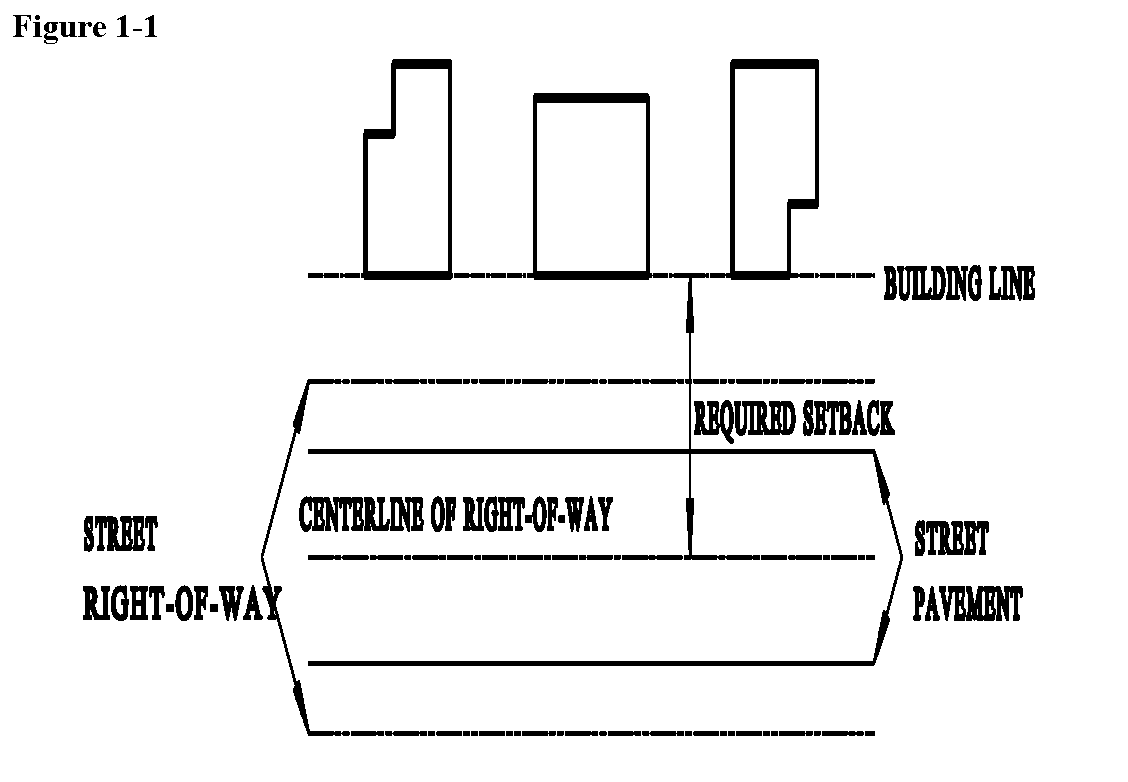
Notwithstanding any other provision of this article, the following setbacks, measured from the center line of the right-of-way (Figure 1-1), shall be maintained along the following streets and highways:
(b)
Reduction in setbacks. If the required right-of-way for a street has been reduced below the adopted standards of the city by a preliminary plat or a plan adopted by city council after the effective date of this article, the setback requirement specified above may be reduced by a corresponding amount.
(c)
Private streets. Notwithstanding any other provision of this article, the minimum setback shall be one-half the width of the private street easement plus 25 feet for private residential local streets and 30 feet for private commercial/industrial local streets, measured from the center line of the easement for the private street.
(d)
Vehicular use area. Notwithstanding any other provisions of this article, the minimum setback for a vehicular use area shall be the total of either one-half of the required rights-of-way for the classifications of adjacent public streets, as measured from the streets, centerlines, or one-half of the required private street easement, as measured from the easements' centerlines, but as may be modified by subsection (b), plus any required perimeter landscaping or bufferyard area.
(18)
Restrictions on allocation and disposition of required yards or open space.
(a)
No part of required lot area, yards, open space, or off-street parking or loading space provided in connection with any building, structure or use shall be included as part of the minimum lot area, yards, open space, or off-street parking or loading space required for any other building, structure or use, except as specifically provided herein.
(b)
All required lot area, yards, open space, off-street parking or loading space and septic systems provided in connection with any building, structure, or use shall be located on the same lot as such building, structure or use except as specifically provided by subsection 36-455(4).
(c)
No part of the lot area, yards, open space, or off-street parking or loading space provided in connection with any structure or use (including, but not limited to, any building, structure or use existing on the effective date of this article or of any amendment thereof) shall be subsequently reduced below the minimum requirements of this article for equivalent new construction unless a variance is granted.
(19)
Reserved.
(20)
Exceptions to height regulations. The following structures are not subject to the height limitations in this article:
(a)
When they are an integral part of a building: elevator machinery, stairways, tanks, ventilating fans, or similar equipment required to operate and maintain the buildings, and fire or parapet walls, skylights, towers (excluding radio, television and telecommunication towers), steeples, flagpoles, chimneys, and smokestacks. No space above the height limit shall be used to provide additional floor space for the use being conducted on the premises.
(b)
When they are a separate structure: water standpipes, water ground storage tanks, or similar structures.
(21)
Established frontage on street. All lots to be used for building sites must abut by their full frontage on a public street as shown on the official street survey, except for lots fronting on private streets approved by city council through the subdivision process or other ordinances or where such lots have been approved under section 36-463, requirements for common open space and common improvements, of this article.
(22)
No public water or public sewer. No use, which requires potable water or sewage disposal to operate, shall be established on a parcel of less than three acres unless both public water and public sewer are provided.
(23)
Travel trailer, camper, recreational vehicle, and other trailer parking. The parking of a travel trailer, camper, or recreational vehicle for overnight accommodations or dwelling purposes in any district shall be prohibited except when such travel trailer, camper, or recreational vehicle is located in a licensed campground or recreational vehicle park. The parking or storing of a travel trailer, camper or recreational vehicle other than a mobile home in any district not in a licensed campground or recreational vehicle park, shall be permitted provided that no living quarters shall be maintained while such travel trailer, camper or recreational vehicle is parked or stored. No travel trailer, camper, recreational vehicle or any other trailer shall be parked in the required front yard of a lot or tract of land in any residential district or a lot or tract of land used for residential purposes in any other district except in a driveway leading to a required off-street parking space for a single-family detached, single-family semi-detached, duplex or townhouse dwelling unit or mobile home on an individual lot.
(24)
Commercial vehicle parking. The storage or parking of a van, bus, truck, tractor or trailer or other vehicle used for commercial purposes with a gross vehicle weight of more than 19,500 pounds, or any single unit with more than one drive axle, in a residential district is prohibited. Any vehicle shall be exempted from this provision while providing repairs, deliveries or other services to the premises in the district. Also exempted shall be all emergency vehicles, utility company vehicles, and vehicles on city or official government business.
(25)
Substandard structures. No structure shall be constructed, erected or moved in or onto any location in the City of Springfield, if such structure does not conform with the building code or sanitary and health regulations of the city. Manufactured homes are not required to conform with the building code of the City of Springfield, but shall bear the seal of the State of Missouri public service commission, U.S. Department of Housing and Urban Development, or its agents.
(26)
Animals. The purpose of this subsection is to regulate the districts in which household, farm and non-domestic animals are permitted. It is also the intent of this subsection to minimize potential adverse effects on adjoining property, the neighborhood, and persons in the vicinity from the improper management of such animals.
(a)
Household animals (pets). Household animals which are normally and customarily kept as household pets shall be allowed in any district. Household animals shall not be raised for commercial purposes or consumption in any district where such use is not specifically permitted by the district regulations.
(b)
Farm animals. Farm animals shall only be allowed in conjunction with an agricultural use as permitted by subsection (31).
(c)
Non-domestic animals. Non-domestic animals shall only be allowed in any lawfully established school, zoological garden, wildlife sanctuary, or other place where such animals are kept for treatment, exhibition, or amusement purposes.
(27)
Newly-annexed territory.
(a)
Zoning classification. Whenever any territory shall be annexed to the City of Springfield after the effective date of this article, said territory so annexed shall maintain the zoning classification designated by the county in which the property is located until the city council has had an opportunity to classify the territory properly after its annexation.
(b)
Building permits. The owner, lessee, or any other person, firm or corporation owning, controlling, constructing, supervising or directing the construction of any building or structure in the process of construction and which is incomplete at the time the land upon which it is situated is annexed to the City of Springfield may proceed with the construction, alteration or completion thereof without obtaining a building permit from the department of building development services of the City of Springfield provided a building permit has been legally obtained from the county in which the property is located and all conditions and requirements of the permit are met. If construction has not commenced prior to annexation, a permit shall be obtained from the department of building development services of the City of Springfield.
(28)
Moratorium on designated development activities for public purposes in plan areas. The city council may place a moratorium on designated development activities in all or a specific area of the city when a proposed or adopted plan or study recommends changes that will affect the designated development activities.
(29)
Exemptions in railroad rights-of-way. Railroad track, signals, bridges and similar facilities and equipment located on a railroad right-of-way, and maintenance and repair work on such facilities and equipment are exempt from the regulations of this article. This exemption shall not include railroad terminals and locomotive service and storage facilities, railroad switching and classification yards, and railroad car and locomotive repair shops.
(30)
Utilities.
(a)
Utility distribution facilities. Utility distribution facilities shall be exempt from the requirements of this article except as follows:
1.
In new subdivisions, electric power lines of 13,200 volts or less, telephone lines, fiber optic cables, or any other wires, cables or conduits for conveyance of electrical power or the communications of messages, data or signals, and appurtenant equipment shall be placed underground. Utility providers may grant waivers from the requirement for placing utilities underground if economic or technological factors found to exist on a site make placement underground not practically feasible. It is the intent of this subsection that all utility providers develop policies and programs to promote the placement of utilities underground. Temporary poles, overhead wires, and associated overhead structures, to be used in conjunction with construction projects or to provide emergency service shall be exempt from the requirements of this article.
2.
All other new and relocated electric power lines of 13,200 volts or less, telephone lines, fiber optic cables, or any other wires, cables or conduits for conveyance of electrical power or the communications of messages, data or signals, and appurtenant equipment, shall, according to the utilities policies, be placed underground to the maximum extent practical.
3.
Utility poles utilized for the support of electrical, telephone, cable television or other video services, street lighting, or other similar cables, and located within the rights-of-way or utility easements that serve as support structures for wireless telecommunications facilities. No attachment for wireless communications devices shall be attached on a pole closer than 400 feet from another pole attachment for wireless communications devices as measured along either side of the easement or rights-of-way. Such utility poles shall be placed in accordance with the following matrix based on the zoning classification in which the utility pole is located.
POLE HEIGHT
(1) Any easement utilized must adjoin rights-of-way.
4.
Any equipment placed on the utility pole must be located at a sufficient height to meet any federal or state requirements or occupy no more than a 20-square foot area on the ground adjacent to the pole and not occupy any sight restrictions for adjacent driveways, access points and rights-of-way.
5.
Existing poles exceeding the matrix height criteria shall be considered conforming and may be replaced as needed with another pole of like size.
6.
This section 36-303 shall not apply to wireless telecommunications facilities used for internal utility operations.
(b)
Utility substation facilities. Utility substation facilities shall be permitted in any district and shall comply with the following requirements:
1.
All utility substation facilities are exempt from the height requirements of this article but shall meet all other lot size, bulk, and open space requirements of this article.
2.
When the facility is not contained within an enclosed building, a fence or wall at least eight feet high shall be provided. The fence or wall shall meet the front setback requirements of the district up to a maximum of 25 feet. If a chainlink security fence is provided and a front setback is required, a vegetative screen that will reach the height of the fence within three years after planting shall be planted between the fence and the street. A vegetative screen is not required if the chainlink security fence is more than 100 feet from the property line.
(c)
Utility transmission facilities. Utility transmission facilities shall be exempt from the requirements of this article.
(d)
Other facilities.
1.
Exemptions. The following utility uses are exempt from the requirements of this article provided the use meets the design requirements of the City of Springfield and its location is approved by the City of Springfield.
a.
Facilities for the detention or collection of stormwater.
b.
Civil defense warning sirens.
2.
Lot size requirements and bulk regulations. Notwithstanding any other provision of this article, none of the following public utility or public service uses shall be required to comply with the lot size requirements or bulk regulations of the zoning district in which they are located.
a.
Water standpipes, and elevated, and ground-level, water storage tanks.
b.
Stormwater detention, retention, and treatment facilities.
(31)
Agricultural uses. Agricultural uses, as defined in this article, shall be permitted in any district provided:
(a)
The uses are located on at least 20 acres of land; and
(b)
No structure, other than a residence, that is accessory to or used in connection with an agricultural use, is located closer than 300 feet to the lot boundary of a church, a school or a property zoned residential and used for residential purposes or platted for a residential subdivision; and
(c)
No agricultural use other than growing crops in the open is located closer than 300 feet to the lot boundary of a church, a school or a property zoned residential and used for residential purposes or platted for a residential subdivision.
(d)
Exemptions. The following uses are exempt from this subsection provided such use is in compliance with other city codes and state and federal laws:
1.
The keeping or raising of six or less chicken hens as an accessory use.
2.
Beekeeping (domestic honey bees, Apis Mellifera) as an accessory use in any district provided:
a.
No more than two hives, with only one colony in each hive, are allowed on lots of 5,000 square feet or larger. One additional hive is permitted on each additional 5,000 square feet.
b.
Hives shall only be located in the rear yard. Hives shall be located at least five feet from all property lines.
c.
Hives shall be located within a fenced enclosure. Said fence shall be at least 42 inches high.
d.
Hives that are located within 20 feet of a property line shall be screened at the property line by a six-foot solid fence, wall or other barrier, which may be vegetative. The screen shall extend at least 20 feet in both directions from the point on the property line, or lines, where the hive is the closest to the property line. Vegetative screening shall be planted or maintained so as to form a continuous, unbroken, solid screen prior to the establishment of the hive.
3.
Marijuana and medical marijuana facilities as defined in this article.
(32)
Transitional housing. Transitional housing is permitted in any district that allows residential uses provided it meets the same criteria for the residential use permitted in the district.
(33)
Overnight shelters.
(a)
Overnight shelters may exceed their bed capacity as permitted under chapter 36 of the Springfield City Code, when the Springfield-Greene County Health Department issues a heat or cold advisory or warning provided that said shelters shall not permit an occupancy for sleeping greater than permitted by City of Springfield building and safety codes.
(b)
Any overnight shelter, soup kitchen, transitional service shelter or combination of these three uses may exercise a transfer of development right to relocate all overnight shelter, soup kitchen or transitional service shelter uses from one location to another location that would be within the separations of such uses called for in said ordinance provided that city council finds, following a recommendation by planning and zoning commission, that:
1.
Such relocation is not being made to the center city or COM district; and
2.
The relocation of said use or uses will reduce the intensity of similar uses in the area of the original location; and
3.
That the relocation will not pose any greater impact on the area to be relocated to than is present at the original location from such uses; and
4.
The use will be no closer to a soup kitchen, overnight shelter, or transitional shelter or any combination thereof than said use is presently to such facilities.
(34)
Economic and housing access calamity.
(a)
During such time that an economic and housing access calamity for the working poor and unemployed within the City of Springfield, Missouri, is declared by city council; individuals, agencies, or churches that are able to meet building, safety, and health codes for such a use, may establish facilities during the pendency of the calamity to provide food and lodging to the unemployed and working poor, who are without a permanent residence or dwelling, and such shall not be considered "shelters" as that term is defined in section 36-321 of the land development code, and are excepted from the general requirements of the city's building, zoning, health and fire codes herein.
(b)
The departments of fire, health, and building development services shall determine the applicability of the various city codes and whether a facility meets such code provisions, as well as whether any codes may be adjusted administratively on a site-by-site basis to meet the intent of this article.
(c)
In accordance with the goals and intent of this subsection, the director of building development services together with the departments of fire and health may exempt, modify or adjust existing codes after due consideration for (including, but not limited to) venue, density of population, intensity of use, ingress-egress, exit travel, fire safety, hours of operation, sanitary services and adjacent properties.
(d)
Any individuals, agencies or churches desiring to operate a facility under this subsection shall apply to the director of building development services for a certificate of occupancy at no cost and showing compliance or exceptions from certain code requirements. Such certificate must be renewed annually. Such applications shall be made on a form provided by the director of building development services.
(e)
Under no event shall a certificate of occupancy be issued for a shelter herein if it is less than 1,000 feet from an elementary or secondary school, unless said shelter is given written consent of the governing body of such school.
(f)
Upon the expiration of the declared economic and housing access calamity, all permitted shelters shall cease operations within 90 days.
(Zoning Ord., § 1-1300; G.O. 4570, 11-27-95; G.O. 4763, 12-15-97; G.O. 4775, 1-20-98; G.O. 5094, 7-9-04; G.O. 5127, 10-29-01; G.O. 5425, 11-15-04; G.O. 5652, 2-12-07; G.O. 5665, 4-9-07; G.O. 5978, 3-26-12; G.O. 6058, 6-17-13; G.O. 6128, 7-21-14; G.O. 6136, § 1(exh. A), 9-8-14; G.O. 6315, § 1, 11-14-16; G.O. 6335, § 1, 1-23-17; G.O. 6467, § 1(Exh. A), 7-16-18; G.O. 6484, § 1, 12-10-18; G.O. 6528, § 1, 5-20-19; G.O. 6775, § 1, 1-31-23)
Sec. 36-304. - Other laws and regulations.
The provisions of this article shall be considered the minimum requirements for the promotion of the public health, safety, comfort, morals, and general welfare. Where the provisions of this article impose greater restrictions than those of any statute, other ordinance or regulation, the provisions of this article shall be controlling. Where the provisions of any statute, other ordinance or regulation impose greater restrictions than this article, the provisions of such statute, other ordinance or regulation shall be controlling.
(Zoning Ord., § 1-1400)
Sec. 36-305. - Establishment of districts.
The City of Springfield is hereby divided into the following zoning districts, the location and boundaries of which are shown on the official zoning map, which map is incorporated in this article by this reference. The descriptions of the zoning districts set forth below are for explanation only. The regulations for each district are contained in division 4 of this article.
(1)
R-SF - Single-family residential district. A zone designed to accommodate single-family residential development at a maximum density of seven dwelling units per acre.
(2)
R-TH - Townhouse residential district. A district designed for single-family detached, single-family semi-detached, duplex and townhouse residences at a maximum density of 11 dwelling units per acre.
(3)
R-LD - Low-density multifamily residential district. A zone designed for townhouse and garden apartment development with a maximum density of 18 dwelling units per acre.
(4)
R-MD - Medium-density multifamily residential district. A zone designed for multifamily dwelling units (apartments) with a maximum density of 29 dwelling units per acre.
(5)
R-HD - High-density multifamily residential district. A zone designed for multifamily dwelling units (apartments) with a maximum density of 40 dwelling units per acre.
(6)
R-MHC - Manufactured home community district. A zone designed for manufactured home communities at a maximum density of eight units per acre.
(7)
O-1 - Office district. A zone designed for low-intensity office development.
(8)
O-2 - Office district. A zone designed to accommodate office uses in the vicinity of the center city district or other high-intensity use areas.
(9)
GI - Government and institutional district. A zone designed for governmental buildings, major medical facilities and colleges and universities.
(10)
UN - University combining district. A zone designed to be used in combination with multifamily residential zones that adjoin a college or university. Uses traditionally associated with such institutions are permitted.
(11)
UC - Urban conservation district. A zone designed to provide regulations that will encourage the conservation and enhancement of urban environments.
(12)
L - Landmarks. A designation to ensure the preservation of historically and architecturally significant structures and the ambience and character of areas of the city which are historically significant because of the architecture of the buildings or because the buildings are associated with persons and events that are historically significant.
(13)
PD - Planned development district. A zone in which the land use regulations and restrictions are designed to provide flexibility in development while ensuring that such development will not adversely impact nearby property or the planning policies of the city.
(14)
AO - Airport overlay districts. Zones designed to be used in combination with other zoning districts to regulate the development of noise-sensitive land uses in the vicinity of the Springfield Regional Airport.
(15)
LB - Limited business district. A zone designed to accommodate individual retail stores and personal service businesses that offer convenience goods and services that are normally a frequent or even daily necessity for residents of the surrounding neighborhood.
(16)
GR - General retail district. A zone designed for uses that provide community-wide personal and business services, shopping centers and specialty shops.
(17)
HC - Highway commercial district. A zone designed to accommodate business and commercial uses that depend upon high visibility and convenient sites on arterial streets in order to attract customers.
(18)
CS - Commercial service district. A zone designed to accommodate non-retail commercial and services uses.
(19)
CC - Center city district. A zone designed to accommodate the existing mix of uses in the Springfield Central Business District and Commercial Street area.
(20)
RI - Restricted industrial district. A zone designed to accommodate industrial uses that are conducted entirely within a building and that have no external impact whatsoever.
(21)
LI - Light industrial district. A zone designed to accommodate industrial uses that have no outdoor operations except storage.
(22)
GM - General manufacturing district. A zone designed to accommodate industrial development that should be effectively buffered from all but other industrial and heavy commercial uses because of the potential such uses may have for affecting the use and enjoyment of nearby property.
(23)
HM - Heavy manufacturing district. A zone designed to accommodate railroad terminal and yard facilities and intensive manufacturing uses that may have adverse impacts on nearby property unless properly located and buffered.
(24)
IC - Industrial commercial district. A zone designed to allow a combination of industrial and commercial uses in those areas where the combination of such uses is consistent with adopted policies and plans.
(Zoning Ord., § 1-1500; G.O. 6467, § 1(Exh. A), 7-16-18)
Sec. 36-306. - Official zoning map and rules for interpretation.
(1)
Incorporation of official zoning map by reference. The city is hereby divided into the districts listed in section 36-305, establishment of districts, of this article as shown on the official zoning map which, together with all explanatory matter thereon, is hereby adopted by reference and declared to be a part of this article.
The official zoning map shall be prepared, maintained and archived in a form approved by the city council and attested by the city clerk, and bearing the seal of the city under the following words: "This is to certify that this is the Official Zoning Map referred to in Section 36-306, Article III, Chapter 36, Springfield City Code." The official zoning map shall be adopted or readopted in its entirety by city council annually following an advertised public hearing. Prior to its adoption by council, planning and zoning commission shall review said map after conducting a public hearing in accordance with subsection 36-350(4) of this article. Notice of such hearing shall be given in accordance with subsection 36-368(2)(b). Amendments to the district boundaries occurring between the annual adoptions of the official zoning map shall be maintained in the office of the city clerk. The district boundaries in the ordinances amending the official zoning map shall control over what appears on the map.
It shall be the duty of the secretary of the planning and zoning commission to facilitate the updating of the map.
No changes of any nature shall be made to the official zoning map or matters shown thereon except in conformity with the procedures set forth in this article. Any unauthorized change of whatever kind by any person or persons shall be considered a violation of this article.
Regardless of the existence of copies of the official zoning map which may from time to time be made or published, the official zoning map with amendments made to the district boundaries occurring between the annual adoptions which shall be located in the office of the secretary of the planning and zoning commission and shall be the final authority as to the current zoning status of land and water areas, buildings and other structures in the city.
(2)
Rules for interpretation of district boundaries. Where uncertainty exists as to the boundaries of zoning districts as shown on the official zoning map, the following shall apply:
(a)
Boundaries indicated as approximately following the centerlines of streets, highways, or alleys shall be construed to follow centerlines.
(b)
Boundaries indicated as approximately following platted lot lines shall be construed as following lot lines.
(c)
Boundaries indicated as following city limit lines shall be construed as following such city limits.
(d)
Boundaries indicated as following railroad lines shall be construed to be midway between the main tracks.
(e)
Boundaries indicated as following shorelines of bodies of water shall be construed to follow such shorelines, and in the event of change in the shoreline shall be construed as moving with the actual shoreline; boundaries indicated as approximately following the center lines of streams, rivers, canals, lakes or other bodies of water shall be construed to follow such center lines.
(f)
Boundaries indicated as parallel to or extensions of features indicated in paragraphs (a) through (e) above shall be so construed. Distances not specifically indicated on the official zoning map shall be determined from the scale of the map.
(g)
Where physical or cultural features existing on the ground or the city's geographic information system (GIS) are at variance with those shown on the official zoning map, or in other circumstances not covered by paragraphs (a) through (f) above, the board of adjustment shall interpret the district boundaries.
(3)
Classification of vacated streets and alleys. Whenever any street, alley or other public way is vacated by official action of the planning and zoning commission, the zoning district adjoining each side of such street, alley or public way or to the new property line created by the vacation of the street, alley or public way shall be automatically extended to the center of such vacated street, alley or public way and all areas included in the vacated street, alley or public way shall then and thence forth be subject to all regulations of the extended district.
(Zoning Ord., § 1-1600; G.O. 6069, 8-12-13)
Sec. 36-307. - Effect on existing building permits and applications.
(1)
Nothing in this article shall be deemed to require any change in the plans, construction, or designated use of any building or structure if:
(a)
A building permit for such building or structure was lawfully issued prior to the effective date of this article or the effective date of any amendment thereto;
(b)
Such permit had not by its own terms expired prior to such effective date; and
(c)
Such permit was issued on the basis of an application showing complete plans, when required, for the proposed construction.
(2)
When a building or structure is completed under a permit to which this section applies, an occupancy certificate shall be issued in accordance with the zoning and building regulations in effect at the time the building permit was issued.
(Zoning Ord., § 1-1700)
Sec. 36-308. - Separability.
It is hereby declared to be the intention of the city council that the several provisions of this article are separable, in accordance with the following rules:
(a)
If any court of competent jurisdiction shall adjudge any provision of this article to be unconstitutional, invalid, or illegal, such judgment shall not affect any other provisions of this article.
(b)
If any court of competent jurisdiction shall adjudge the application of any provision of this article to a particular property, building or structure to be unconstitutional, invalid, or illegal, such judgment shall not affect the application of said provision to any other property of structure.
(Zoning Ord., § 1-1800)
Sec. 36-309. - Effective date.
This article shall be in full force and effect as Chapter 36, Article III, Springfield City Code, from and after its passage and approval in the manner required by law.
(Zoning Ord., § 1-1900)
Sec. 36-310. - Establishment of use groups.
(1)
Purpose. This section classifies land uses and activities into use groups on the basis of common functional, product, or physical characteristics. Characteristics include the type and amount of activity, the type of customers or residents, how goods or services are sold or delivered, and certain site factors. The use groups provide a systematic basis for assignment of present and future uses to zones. The decision to allow or prohibit the use groups in the various zones is based on the goals and policies of the comprehensive plan.
(2)
Use group titles. The names of the use groups start with capital letters throughout this article.
(3)
Classification of uses.
(a)
Considerations.
1.
Uses are assigned to the group whose description most closely describes the nature of the primary use. The "characteristics" subsection of each use group describes the characteristics of each use group. Developments may have more than one primary use. Developments may also have one or more accessory uses. Developments with more than one primary use are addressed in paragraph (b) below. Accessory uses are addressed in paragraph (c) below.
2.
The following items will be considered to determine what use group the use is in, and whether the activities constitute primary uses or accessory uses:
a.
The description of the activity in relationship to the characteristics of each use group;
b.
The relative amount of site or floor space and equipment devoted to the activity;
c.
Relative amounts of sales from each activity;
d.
The customer type for each activity;
e.
The relative number of employees in each activity;
f.
Hours of operation;
g.
Building and site arrangement;
h.
Vehicles used with the activity;
i.
The relative number of vehicle trips generated by the activity;
j.
Signs;
k.
How the use advertises itself; and
l.
Whether the activity would be likely to be found independent of the other activities on the site.
(b)
Developments with multiple primary uses. When all of the primary uses of a development fall within one use group, then the development is assigned to that use group. For example, a development that contains a retail bakery and a café would be classified in the retail sales use group because all the primary uses are in that group. When the primary uses of a development fall within different use groups, each primary use is classified in the applicable group and is subject to the regulations for that group.
(c)
Accessory uses. Accessory uses are allowed by right in conjunction with the use unless stated otherwise in the regulations. Also, unless otherwise stated, they are subject to the same regulations as the primary use. Common accessory uses are listed as examples with the groups.
(d)
Use of examples. The "examples" subsection of each use group provides a list of examples of uses that are included in the use group. The names of uses on the lists are generic. They are based on the common meaning of the terms and not on what a specific use may call itself. For example, a use whose business name is "Wholesale Liquidation" but that sells mostly to consumers, would be included in the retail sales group rather than the wholesale sales group. This is because the actual activity on the site matches the description of the retail sales group.
(e)
Administration. The director of building development services shall determine the appropriate classification of uses. The decision of the director may be appealed to the administrative review committee.
(4)
Residential use groups. (Reserved.)
(5)
Office use group.
(a)
Characteristics. Office uses are characterized by activities conducted in an office setting that focus on the provision of goods and services, usually by professionals. General office uses are characterized by activities that generally focus on business, government, professional, or financial services. General office uses also include some activities that are less service-oriented and focus on the development, testing, production, processing, packaging, or assembly of goods and products, which may include digital products such as internet home pages, media content, designs and specifications, computer software, advertising materials, and others. The medical office use group includes medical and dental offices and clinics and is listed separately from general office because these uses tend to generate higher traffic counts and require more off-street parking.
(b)
Accessory uses. Accessory uses may include cafeterias, health facilities, parking or other amenities primarily for the use of employees in the firm or building.
(c)
Examples. Examples include uses from the two subgroups listed below:
1.
General office: Professional services such as lawyers or accountants; financial businesses such as lenders, brokerage houses, banks, or real estate agents; sales offices; government offices and public utility offices; blood collection facilities; software and internet content development and publishing; computer systems design and programming; graphic and industrial design; engineers, architects; telecommunications service providers; data processing; television, video, radio, internet, and recording studios and broadcasting; scientific and technical services; and medical and dental labs.
2.
Medical office: Medical and dental offices and clinics.
(d)
Exceptions.
1.
Offices that are part of and are located with a firm in another category are considered accessory to the firm's primary activity. Headquarters offices, when in conjunction with or adjacent to a primary use in another category, are considered part of the other category.
2.
Contractors and others who perform services off-site are included in the general office category if equipment and materials are not stored on the site and fabrication, services, or similar work is not carried on at the site.
3.
Medical and dental laboratories and research facilities do not include the manufacture of pharmaceutical or other products for general sale or distribution. In addition, no toxic substances, explosives, radioactive material, highly flammable substances or other materials that pose a threat to public health and safety, due to their quantities or location, shall be utilized in the research operations.
(6)
Commercial and services use groups.
(a)
Retail sales use group.
1.
Characteristics. Retail sales firms are involved in the sale lease or rent of new or used products to the general public. They may also provide personal services or entertainment or provide product repair or services for consumer and business goods.
2.
Accessory uses. Accessory uses may include offices, storage of goods, manufacture or repackaging of goods for on-site sale, and parking. Restricted production and repair of goods sold on site or similar goods is also permitted as an accessory use.
3.
Examples. Examples include, but are not limited to, pawn shops, stores selling, leasing or renting consumer, home, and business goods, including art, art supplies, bicycles, clothing, dry goods, electronic equipment, fabric, furniture, garden supplies, gifts, groceries, hardware, home improvements, household products, jewelry, pets, pet food, pharmaceuticals, plants, printed material, stationary, and videos; food sales, and sales or leasing of consumer vehicles including passenger vehicles, motorcycles, light and medium trucks, and other recreational vehicles if outdoor activities are permitted by the district.
4.
Exceptions.
a.
Lumber yards and other building material sales that sell primarily to contractors and do not have a retail orientation are classified as wholesale sales.
b.
Sales, rental, or leasing of heavy trucks and equipment is classified as wholesale sales.
(b)
Personal services use group.
1.
Characteristics. Personal service uses are establishments for the sale of personal services or establishments engaged in providing services involving the care of a person of his or her personal goods or apparel, but not including personal storage.
2.
Accessory uses. Accessory uses may include offices, storage of goods and parking.
3.
Examples. Examples include, but are not limited to, locksmiths; laundromats; photographic studios; photocopy and blueprint services; hair, tanning, and personal care services; dance or music classes; and animal grooming.
(c)
Eating and drinking establishments use group.
1.
Characteristics. The eating and drinking establishments use group includes uses that are involved in the preparation and sale of food and drink primarily for consumption as a meal on premises; however this use group also includes uses that offer the sale of food for consumption off premises. This use group includes drive-in, pick-up window and drive-thru facilities unless restricted by the district.
2.
Accessory uses. Accessory uses may include offices, storage of goods, manufacture or repackaging of goods for on-site sale, and parking.
3.
Examples. Examples include, but are not limited to, restaurants, cafes, delicatessens, taverns, bars and coffee shops.
(d)
Entertainment-oriented use group.
1.
Characteristics. Service firms involved in providing entertainment-type activities to the general public.
2.
Accessory uses. Accessory uses may include food and liquor sales for on-site consumption; parking.
3.
Examples. Examples include, but are not limited to, the following uses: bowling alleys; dance halls; video game arcades; billiard parlors; roller skating and ice skating arenas; in-door movie theaters; athletic clubs; fitness centers; miniature golf if outdoor activities are permitted by the district; and other small-scale sports facilities.
4.
Exceptions.
a.
Major event venues, such as stadiums, arenas and fairgrounds, are classified as major event entertainment.
b.
Drive-in movie theaters, golf driving ranges, archery ranges and similar uses are classified as commercial outdoor recreation.
(e)
Temporary lodging use group.
1.
Characteristics. The temporary lodging use group includes facilities where tenancy of all rooms may be arranged for periods of less than one month. The facility may or may not have food preparation facilities, and shower or bath facilities may or may not be shared.
2.
Accessory uses. Accessory uses may include offices, food and liquor sales for on-site consumption, and recreational facilities for occupants, and parking.
3.
Examples. Examples include, but are not limited to, hotels, motels, inns and hostels.
4.
Exceptions.
a.
If the facility is managed by a public or non-profit agency to provide short-term housing, with or without a fee, the facility shall not be considered temporary lodging.
b.
Boarding house, lodging house, fraternity house and sorority house uses shall not be considered temporary lodging.
c.
Bed and breakfast uses shall not be considered temporary lodging.
(f)
Major event entertainment use group.
1.
Characteristics. Major event entertainment uses are characterized by activities and structures that draw large numbers of people to specific events or shows. Activities are generally of a spectator nature.
2.
Accessory uses. Accessory uses may include restaurants, bars, concessions, parking, and maintenance facilities.
3.
Examples. Examples include, but are not limited to, stadiums, sports arenas, coliseums, race tracks (auto, horse, dog, etc), auditoriums, exhibition and meeting areas and fairgrounds.
4.
Exceptions.
a.
Exhibition and meeting areas with less than 20,000 square feet of total event area are classified as retail sales.
b.
Banquet halls and meeting areas that are part of hotels or restaurants are accessory to those uses, which are included in the retail sales and temporary lodging categories.
c.
Drive-in theaters are classified as commercial outdoor recreation.
(g)
Commercial outdoor recreation use group.
1.
Characteristics. Commercial outdoor recreation uses are large, generally commercial uses that provide continuous recreation or entertainment oriented activities. They generally take place outdoors. They may take place in a number of structures which are arranged together in an outdoor setting.
2.
Accessory uses. Accessory uses may include concessions, restaurants, parking, caretaker's quarters, and maintenance facilities.
3.
Examples. Examples include, but are not limited to, amusement parks, theme parks, golf driving ranges, drive-in movie theaters and archery ranges.
4.
Exceptions.
a.
Uses which draw large numbers of people to periodic events, rather than on a continuous basis, are classified as major event entertainment.
(7)
Industrial use groups.
(a)
Wholesale sales.
1.
Characteristics. Wholesale sales firms are involved in the sale, lease, or rent of products primarily intended for industrial, institutional, or commercial businesses. The uses emphasize on-site sales or order taking and often include display areas. Businesses may or may not be open to the general public, but sales to the general public are limited as a result of the way in which the firm operates. Products may be picked up on site or delivered to the customer.
2.
Accessory uses. Accessory uses may include offices; product repair; warehouses; parking, minor fabrication services; and repackaging of goods.
3.
Examples. Examples include sale or rental of machinery, equipment, heavy trucks, building materials, special trade tools, welding supplies, machine parts, electrical supplies, janitorial supplies, restaurant equipment, and store fixtures; mail order houses; and wholesalers of food, clothing, auto parts, building hardware, and office supplies.
4.
Exceptions.
a.
Firms that engage primarily in sales to the general public are classified as retail sales.
b.
Firms that engage in sales on a membership basis are classified as either retail sales or wholesale sales, based on a consideration of the characteristics of the use.
(8)
Storage use groups. (Reserved)
(9)
Institutional use groups. (Reserved)
(10)
Other use groups. (Reserved)
(Zoning Ord., § 1-2000; G.O. 5879, 7-26-10)

