
Springfield City Zoning Code
DIVISION 4
DISTRICT REGULATIONS
Sec. 36-380. - R-SF - Single-family residential district.
(1)
Purpose. This district is intended primarily for single-family detached dwellings at low residential densities of approximately seven units per acre. Certain other structures and uses necessary to serve governmental, educational, religious, recreational, and other needs of neighborhood areas are allowed as permitted or conditional uses subject to restrictions intended to preserve and protect the single-family residential character of the district. Internal stability, harmony, attractiveness, order, and efficiency are encouraged by providing for adequate light, air, and open space for dwellings and related facilities and by consideration of the proper functional relationship and arrangement of the different uses permitted in this district.
(2)
Permitted uses.
(a)
Single-family detached dwellings.
(b)
Single-family semi-detached dwellings, in accordance with section 36-361, cluster developments.
(c)
Accessory apartments in owner-occupied single-family detached dwellings, in accordance with section 36-464, accessory apartments.
(d)
Accessory uses, as permitted by section 36-450, accessory structures and uses.
(e)
Churches and other places of worship, including parish houses and Sunday schools, but excluding overnight shelters.
(f)
Community gardens without retail or wholesale sales on-site in accordance with the performance standards of section 36-470, community gardens.
(g)
Day care homes, in accordance with chapter 36, article XI, Springfield City Code.
(h)
Duplex dwellings legally conforming at the time the district is mapped. As a conforming use, a duplex dwelling can be expanded or, if destroyed, replaced with another duplex within 18 months of being destroyed.
(i)
Group homes, residential, in accordance with section 36-465, residential group homes.
(j)
Home occupation uses, as permitted by section 36-451, home occupations.
(k)
Noncommercial, not-for-profit residential neighborhood facilities, including indoor and outdoor recreational facilities, community centers, offices of property owners associations and maintenance facilities operated by a neighborhood or community organization or a property owners association in accordance with the provisions of section 36-467, noncommercial not-for-profit neighborhood facilities.
(l)
Police and fire stations.
(m)
Public and private parks, playgrounds, and golf courses, excluding miniature golf courses and driving ranges.
(n)
Schools, elementary and secondary, and schools or development centers for elementary and secondary school-age children with handicaps or development disabilities, on a minimum of five acres of land.
(o)
Short-term rental type 1 or 2 in accordance with section 36-473.
(p)
Temporary uses, as permitted by section 36-452, temporary uses.
(q)
Tier I and II wireless facilities in accordance with section 36-466, telecommunication towers.
(r)
Transitional housing for single-family use.
(s)
Zero-lot-line construction, in accordance with section 36-362, zero-lot-line construction.
(3)
Conditional uses. The following conditional uses may be permitted provided they meet the provisions of, and a conditional use permit is issued pursuant to, section 36-363, conditional use permits, of this article.
(a)
Adaptive use of nonresidential structures in accordance with subsection 36-363(10)(b)4.
(b)
Bed and breakfasts in accordance with subsection 36-363(10)(b)2.
(c)
Cemeteries on a minimum of ten acres of land.
(d)
Clubhouses associated with any permitted use.
(e)
Community centers, non-profit.
(f)
Nurseries in relatively undeveloped sections of the city, limited to the propagation and cultivation of plants, provided no retail or wholesale business is conducted on the premises.
(g)
Public museums and libraries on a minimum of two acres of land.
(h)
Public service and public utility uses, as follows:
1.
Other towers and related facilities existing at the time the district is mapped, provided any modifications are made in accordance with subsection 36-363(10)(b)1; and
2.
Water reservoirs, water standpipes, and elevated and ground-level water storage tanks.
(4)
Use limitations.
(a)
All uses shall operate in accordance with the noise standards contained in section 36-485, noise standards.
(b)
No use shall emit an odor than creates a nuisance as determined by chapter 2A, article X, Springfield City Code.
(5)
Lot size requirements.
(a)
Minimum lot area: 6,000 square feet.
(b)
Minimum lot width: 50 feet.
(c)
Minimum lot depth: 80 feet.
(6)
Bulk and open space requirements.
(a)
Maximum structure height:
1.
When side yards are less than 15 feet in width: 35 feet or two and one-half stories above the finished grade.
2.
When side yards are 15 feet in width or greater: 45 feet or three stories above the finished grade.
(b)
Minimum yard requirements (additional bufferyard may be required by subsection (9):
1.
Front yard:
a.
Twenty-five feet along a street classified as a collector or higher classification street or as required by section 36-453.
b.
Fifteen feet along a street classified as a local street or as required by section 36-453 (garages shall be set back a minimum of 20 feet).
c.
The front yard setback may be reduced below the minimum required above if a conditional use permit is approved in accordance with section 36-363, conditional use permits, or with an approved preliminary plat in accordance with the city's subdivision regulations.
2.
Side yard: Five feet or as required by section 36-453, supplemental open space and yard regulations.
3.
Rear yard: Ten percent of the lot depth, but may not be less than ten feet nor shall more than 20 feet be required.
However, in no event may a structure be erected closer to the centerline of an existing or planned street than as prescribed below, except as permitted by subsection 36-303(17)(b) and subsection 36-303(17)(d).
(c)
Minimum open space: Not less than 30 percent of the total lot area shall be devoted to open space including required yards and bufferyards unless modified in accordance with subsection 36-482(15). Open space shall not include areas covered by buildings, structures, parking areas, driveways and internal streets. Open space shall contain living ground cover and other landscaping materials.
(d)
Maximum impervious area: The combined area occupied by all main and accessory buildings or structures, parking areas, driveways and any other surfaces which reduce and prevent absorption of stormwater shall not exceed 70 percent of the total lot area unless modified in accordance with subsection 36-482(15).
(7)
Density requirements. The maximum density shall be 6,000 square feet per dwelling unit provided the requirements of subsection 36-303(22) are met.
(8)
Design requirements.
(a)
A site plan meeting the requirements of section 36-360, site plan review, shall be submitted and approved for all uses except single-family detached dwellings.
(b)
A plot plan meeting the requirements of subsection 36-331(3) shall be submitted and approved for all single-family detached dwellings.
(c)
A landscaping plan meeting the requirements of section 36-482, landscaping and bufferyards, and 36-483, off-street parking and loading area design standards, shall be submitted and approved for all uses except single-family-detached dwellings.
(d)
All off-street parking lots and vehicular use areas for permitted nonresidential uses shall be screened from all residential uses in accordance with section 36-480, screening and fencing.
(e)
Refuse storage areas for permitted nonresidential uses shall be screened from view in accordance with section 36-480, screening and fencing.
(f)
Required front yards shall be landscaped with grass, ground cover, plants, shrubs, or trees. Decorative landscaping materials such as rock, bark, and mulch are also permitted. Impervious surfaces in required front yards shall be minimized and, unless otherwise meeting the provisions of subsection 36-483(2), shall be limited to driveways leading to off-street parking areas located outside the required front yard and walkways necessary for access to structures on the property. Circular driveways are permitted if sufficient frontage is available and if approved by the traffic engineer.
(g)
Storage of maintenance or other equipment incidental to any permitted or conditional use except a single-family detached dwelling shall be screened from view in accordance with the provisions of section 36-480, screening and fencing.
(h)
Mechanical and electrical equipment, including air conditioning units, shall be screened from view in accordance with section 36-480, screening and fencing.
(i)
Accessory buildings and structures shall meet the requirements of section 36-450, accessory structures and uses.
(9)
Bufferyard requirements. Whenever any nonresidential development in an R-SF district is located adjacent to a residential use in the R-SF district or a different zoning district, screening, and a bufferyard shall be provided in accordance with sections 36-480, screening and fencing, and 36-482, landscaping and bufferyards.
(Zoning Ord., § 4-1000; G.O. 4570, 11-27-95; G.O. 4759, 11-10-97; G.O. 4763, 12-15-97; G.O. 4852, 11-23-98; G.O. 5094, 7-9-01; G.O. 5127, 10-29-01; G.O. 5345, 1-26-04; G.O. 5355; 3-15-04; G.O. 5425, 11-15-06; G.O. 5471, 6-27-05; G.O. 5652, 2-12-07; G.O. 5665, 4-9-07; G.O. 5843, 11-9-09; G.O. 5882, 7-26-10; G.O. 5928, 4-18-11; G.O. 6032, 1-28-13; G.O. 6058, 6-17-13; G.O. 6094, 1-13-14; G.O. 6173, Exh. A, 3-9-15; G.O. 6497, § 1, 1-28-19)
Sec. 36-381. - R-TH - Residential townhouse district.
(1)
Purpose. This district is intended to accommodate a variety of housing types, including single-family detached, single-family semi-detached, duplex, and townhouse dwellings, at low to moderate residential densities (approximately 11 units per acre). This district is also intended to function as a transition between the less intense single-family district and more intense multifamily districts. Certain other structures and uses necessary to serve governmental, educational, religious, recreational, and other needs of neighborhoods are allowed as permitted or conditional uses subject to restrictions intended to preserve and protect the residential character of the district.
(2)
Permitted uses.
(a)
Single-family detached dwellings.
(b)
Single-family semi-detached dwellings, such as patio-court homes and twin houses.
(c)
Accessory apartments in owner-occupied single-family-detached dwellings, in accordance with section 36-464, accessory apartments.
(d)
Accessory uses, as permitted by section 36-480, accessory structures and uses.
(e)
Churches and other places of worship, including parish houses and Sunday schools, but excluding overnight shelters.
(f)
Cluster subdivisions, in accordance with section 36-361, cluster developments.
(g)
Community gardens without retail or wholesale sales on-site in accordance with the performance standards of section 36-470, community gardens.
(h)
Day care homes, in accordance with chapter 36, article XI, Springfield City Code.
(i)
Duplexes.
(j)
Group homes, residential, in accordance with section 36-465, residential group homes.
(k)
Home occupation uses, as permitted by section 36-451, home occupations.
(l)
Noncommercial, not-for-profit residential neighborhood facilities, including indoor and outdoor recreational facilities, community centers, offices of property owners associations and maintenance facilities operated by a neighborhood or community organization or a property owners association in accordance with the provisions of section 36-467, noncommercial not-for-profit neighborhood facilities.
(m)
Police and fire stations.
(n)
Public and private parks, playgrounds, and golf courses, excluding miniature golf courses and driving ranges.
(o)
Schools, elementary and secondary, and schools or development centers for elementary and secondary school-age children with handicaps or development disabilities, on a minimum of five acres of land.
(p)
Short-term rental type 1 or 2 in accordance with section 36-473.
(q)
Temporary uses, as permitted by section 36-452, temporary uses.
(r)
Tier I and II wireless facilities in accordance with section 36-466, telecommunication towers.
(s)
Townhouses.
(t)
Transitional housing for single-family or low to moderate residential density.
(u)
Zero-lot-line construction, in accordance with section 36-362, zero-lot-line construction.
(3)
Conditional uses. The following conditional uses may be permitted provided they meet the provisions of, and a conditional use permit is issued pursuant to, section 36-363, conditional use permits, of this article.
(a)
Adaptive use of nonresidential structures in accordance with subsection 36-363(10)(b)4.
(b)
Bed and breakfasts in accordance with subsection 36-363(10)(b)2.
(c)
Cemeteries on a minimum of ten acres of land.
(d)
Clubhouses associated with any permitted use.
(e)
Community centers, non-profit.
(f)
Nurseries in relatively undeveloped sections of the city, limited to the propagation and cultivation of plants, provided no retail or wholesale business is conducted on the premises.
(g)
Public museums and libraries on a minimum of two acres of land.
(h)
Public service and public utility uses, as follows:
1.
Other towers and related facilities existing at the time the district is mapped, provided any modifications are made in accordance with subsection 36-363(10)(b)1; and
2.
Water reservoirs, water standpipes, and elevated and ground-level water storage tanks.
(4)
Use limitations.
(a)
There shall be a separate platted lot of record for each single-family semi-detached or townhouse dwelling unit.
(b)
All uses shall operate in accordance with the noise standards contained in section 36-485, noise standards.
(c)
No use shall emit an odor that creates a nuisance as determined by chapter 2A, article X, Springfield City Code.
(5)
Lot size requirements.
(a)
Minimum lot area:
1.
Single-family detached dwellings and residential group homes: 5,000 square feet.
2.
Duplexes: 7,500 square feet.
3.
Each single-family semi-detached dwelling on a separate platted lot: 3,750 square feet.
4.
Each townhouse on a separate platted lot:
a.
End lots: 4,000 square feet.
b.
Interior lots: 3,000 square feet.
5.
All other uses: 7,500 square feet.
(b)
Minimum lot width:
1.
Single-family detached and duplex dwellings and residential group homes: 45 feet.
2.
Townhouses:
a.
End lots: 40 feet.
b.
Interior lots with driveway in front yard: 30 feet.
c.
Interior lots without driveway in front yard: 24 feet.
3.
Single-family semi-detached dwelling units: 30 feet.
4.
All other uses: 45 feet.
(c)
Minimum lot depth: 80 feet.
(6)
Bulk and open space requirements.
(a)
Maximum structure height:
1.
When side yards are less than 15 feet in width: 35 feet or two and one-half stories above the finished grade.
2.
When side yards are 15 feet in width or greater: 45 feet or three stories above the finished grade.
(b)
Minimum yard requirements (additional bufferyard may be required by subsection (9)):
1.
Front yard:
a.
Twenty-five feet along a street classified as a collector or higher classification street or as required by section 36-453.
b.
Fifteen feet along a street classified as a local street or as required by section 36-453 (garages shall be set back a minimum of 20 feet).
c.
The front yard setback may be reduced below the minimum required above if a conditional use permit is approved in accordance with section 36-363, conditional use permits, or with an approved preliminary plat in accordance with the city's subdivision regulations.
2.
Side yards:
a.
Townhouses: Six feet or as required by section 36-453, supplemental open space and yard regulations, provided that no side yard is required for a townhouse or attached single-family dwelling when a common wall is located on the lot line.
b.
All other uses: Five feet.
3.
Rear yard: Ten percent of the lot depth but may not be less than ten feet nor will more than 20 feet be required.
However, in no event may a structure be erected closer to the centerline of an existing or planned street than as prescribed below, except as permitted by subsection 36-303(17)(b) and subsection 36-303(17)(d).
(c)
Minimum open space: Not less than 20 percent of the total lot area shall be devoted to open space including required yards and bufferyards unless modified in accordance with subsection 36-482(15). Open space shall not include areas covered by buildings, structures, parking areas, driveways and internal streets. Open space shall contain living ground cover and other landscaping materials.
(d)
Maximum impervious area: The combined area occupied by all main and accessory buildings or structures, parking areas, driveways and any other surfaces which reduce and prevent absorption of stormwater shall not exceed 80 percent of the total lot area unless modified in accordance with subsection 36-482(15).
(7)
Density requirements. The maximum density shall be 3,750 square feet per dwelling unit provided the requirements of subsection 36-303(22) are met.
(8)
Design requirements.
(a)
A site plan meeting the requirements of section 36-360, site plan review, shall be submitted and approved for three or more townhouse dwelling units and all nonresidential uses.
(b)
A plot plan meeting the requirements of subsection 36-331(3) shall be submitted and approved for all single-family detached, duplex, and single-family semi-detached dwellings.
(c)
A landscaping plan meeting the requirements of section 36-482, landscaping and bufferyards, and 36-483, off-street parking and loading area design standards, shall be submitted and approved for structures containing three or more townhouse dwelling units.
(d)
Storage of maintenance or other equipment incidental to any permitted or conditional use except a single-family detached, duplex, and single-family semi-detached dwellings shall be screened from view in accordance with the provisions of section 36-480, screening and fencing.
(e)
The maximum length of any cluster of townhouse dwelling units shall not exceed six units, or 200 linear feet.
(f)
Buildings shall be designed to prevent the appearance of straight, unbroken lines in their horizontal and vertical surface. There shall be no more than two continuous townhouse dwelling units without break in the horizontal and vertical elevations of at least three feet.
(g)
All off-street parking lots for permitted nonresidential uses shall be screened from all residential uses in accordance with the provisions of section 36-480, screening and fencing.
(h)
Refuse storage areas for permitted nonresidential uses shall be screened from view in accordance with section 36-480, screening and fencing.
(i)
Required front yards shall be landscaped with grass, ground cover, plants, shrubs or trees. Decorative landscaping materials such as rock, bark and mulch are also permitted. Impervious surfaces in required front yards shall be minimized and, unless otherwise meeting the provisions of subsection 36-483(2), shall be limited to driveways leading to off-street parking areas located outside the required front yard and walkways necessary for access to structures on the property. Circular driveways are permitted if sufficient frontage is available and if approved by the traffic engineer.
(j)
Mechanical and electrical equipment, including air conditioning units, shall be screened from view in accordance with section 36-480, screening and fencing.
(k)
Accessory buildings and structures shall meet the requirements of section 36-450, accessory structures and uses.
(9)
Bufferyard requirements. Whenever any development in an R-TH district is located adjacent to a different zoning district or a nonresidential use in the R-TH district is located adjacent to a residential use in the R-TH district, screening, and a bufferyard shall be provided in accordance with sections 36-480, screening and fencing, and 36-482, landscaping and bufferyards.
(Zoning Ord., § 4-1100; G.O. 4570, 11-27-95; G.O. 4759, 11-10-97; G.O. 4763, 12-15-97; G.O. 4852, 11-23-98; G.O. 5094, 7-4-01; G.O. 5127, 10-29-01; G.O. 5345, 1-26-04; G.O. 5355, 3-15-04; G.O. 5425, 11-15-04; G.O. 5471, 6-27-05; G.O. 5652, 2-12-07; G.O. 5665, 4-9-07; G.O. 5843, 11-9-09; G.O. 5882, 7-26-10; G.O. 5928, 4-18-11; G.O. 6032, 1-28-13; G.O. 6058, 6-17-13; G.O. 6094, 1-13-14; G.O. 6173, Exh. A, 3-9-15; G.O. 6497, § 1, 1-28-19)
Sec. 36-382. - R-LD - Low-density multifamily residential district.
(1)
Purpose. The R-LD district is intended to accommodate multifamily developments at densities up to approximately 18 units per acre and is intended to serve as a transition between lower density and higher density residential districts. This district is intended for areas that have access for vehicular traffic from collector or higher classification streets without traversing minor streets in adjoining residential neighborhoods. New single-family dwellings are not permitted to ensure that vacant land set aside for multifamily development is not preempted by less intense development. Certain other structures and uses necessary to serve governmental, educational, religious, recreational, and other needs of neighborhoods are allowed as permitted or conditional uses subject to restrictions intended to preserve and protect the residential character of this district. Applications for residential use after August 27, 2007, shall include sufficient information for staff to complete analysis under the multifamily development location and design guidelines.
(2)
Permitted uses.
(a)
Single-family detached dwellings in accordance with section 36-469, single-family-detached dwellings in alternative districts.
(b)
Duplexes.
(c)
Single-family semi-detached dwellings, such as patio court homes and twin homes.
(d)
Multifamily dwellings.
(e)
Townhouses.
(f)
Accessory apartments in owner-occupied single-family detached dwellings, in accordance with section 36-464, accessory apartments.
(g)
Accessory uses, as permitted by section 36-450, accessory structures and uses.
(h)
Churches and other places of worship, including parish houses and Sunday schools, but excluding overnight shelters.
(i)
Clubhouses associated with any permitted use.
(j)
Community gardens without retail or wholesales on-site in accordance with the performance standards of section 36-470, community gardens.
(k)
Day care homes in accordance with chapter 36, article XI, Springfield City Code.
(l)
Group homes, custodial.
(m)
Home occupation uses, as permitted by section 36-451, home occupations.
(n)
Noncommercial, not-for-profit residential neighborhood facilities, including indoor and outdoor recreational facilities, community centers, offices of property owners associations and maintenance facilities operated by a neighborhood or community organization or a property owners association in accordance with the provisions of section 36-467, noncommercial not-for-profit neighborhood facilities.
(o)
Police and fire stations.
(p)
Public and private parks, playgrounds, and golf courses, excluding miniature golf courses and driving ranges.
(q)
Schools, elementary and secondary, and schools or development centers for elementary and secondary school-age children with handicaps or development disabilities, on a minimum of five acres of land.
(r)
Short-term rental type 3 in accordance with section 36-473, and subject to conditions in subsection (2)(a), if applicable.
(s)
Temporary uses, as permitted by section 36-452, temporary uses.
(t)
Tier I and II wireless facilities in accordance with section 36-466 telecommunication towers.
(u)
Transitional housing for multifamily use or for single-family use if existing at the time the district was mapped.
(v)
Zero-lot-line construction, in accordance with section 36-362, zero-lot-line construction.
(3)
Conditional uses. The following conditional uses may be permitted provided they meet the provisions of, and a conditional use permit is issued pursuant to, section 36-363, conditional use permits, of this article.
(a)
Adaptive use of nonresidential structures in accordance with subsection 36-363(10)(b)4.
(b)
Bed and breakfasts in accordance with subsection 36-363(10)(b)2.
(c)
Cemeteries on a minimum of ten acres of land.
(d)
Community centers, non-profit.
(e)
Day care centers in accordance with chapter 36, article XI, Springfield City Code.
(f)
Nurseries in relatively undeveloped sections of the city, limited to the propagation and cultivation of plants, provided no retail or wholesale business is conducted on the premises.
(g)
Public museums and libraries on a minimum of two acres of land.
(h)
Public service and public utility uses, as follows:
1.
Tier III wireless facilities in accordance with section 36-466, telecommunication towers, provided wireless towers 60 feet or greater in height allow collocation of at least one additional provider's facilities; and
2.
Other towers and related facilities existing at the time the district is mapped, provided any modifications are made in accordance with subsection 36-363(10)(b)1; and
3.
Water reservoirs, water standpipes, and elevated and ground level water storage tanks.
(4)
Use limitations.
(a)
Single-family detached dwellings are not permitted unless they exist at the time the district is mapped.
(b)
All uses shall operate in accordance with the noise standards contained in section 36-485, noise standards.
(c)
No use shall emit an odor that creates a nuisance as determined by chapter 2A, article X, Springfield City Code.
(5)
Lot size requirements.
(a)
Minimum lot area:
1.
Each townhouse on a separate platted lot: 2,400 square feet.
2.
Existing single-family detached dwellings: 5,000 square feet.
3.
Duplexes: 6,500 square feet.
4.
Single-family semi-detached dwellings: 3,750 square feet.
5.
All other uses: 8,250 square feet.
(b)
Minimum lot width:
1.
Each townhouse on a separate platted lot.
a.
End lots: 30 feet.
b.
Interior lots with driveway in front yard: 26 feet.
c.
Interior lots without driveway in front yard: 20 feet.
2.
Single-family semi-detached dwelling units: 30 feet.
3.
All other uses: 45 feet.
(c)
Minimum lot depth:
1.
Each townhouse on a separate platted lot: 75 feet.
2.
All other uses: 80 feet.
(6)
Bulk and open space requirements.
(a)
Maximum structure height:
1.
When side yards are less than 15 feet in width: 35 feet or two and one-half stories above the finished grade.
2.
When side yards are 15 feet in width or greater: 45 feet or three stories above the finished grade.
3.
No portion of a multifamily dwelling shall be higher than allowed by a 45-degree bulk plane where the property adjoins an R-SF district. Any multifamily dwelling for which a building permit has been issued prior to July 1, 2009, that does not conform to the 45-degree bulk plane shall be considered conforming with regard to the 45-degree bulk plane.
(b)
Minimum yard requirements (additional bufferyard may be required by subsection (9)):
1.
Front yard:
a.
Twenty-five feet along a street classified as a collector or higher classification street or as required by section 36-453.
b.
Fifteen feet along a street classified as a local street or as required by section 36-453 (garages shall be set back a minimum of 20 feet).
c.
The front yard setback may be reduced below the minimum required above if a conditional use permit is approved in accordance with section 36-363, conditional use permit, or with an approved preliminary plat in accordance with the city's subdivision regulations.
2.
Side yards: Six feet or as required by section 36-453, supplemental open space and yard regulations, provided that no side yard is required for any building that has a common wall on a lot line.
3.
Rear yard: Ten percent of the lot depth but may not be less than ten feet nor will more than 20 feet be required.
However, in no event may a structure be erected closer to the centerline of an existing or planned street than as prescribed below, except as permitted by subsection 36-303(17)(b) and subsection 36-303(17)(d).
(c)
Minimum open space: Not less than 20 percent of the total lot area shall be devoted to open space including required yards and bufferyards unless modified in accordance with subsection 36-482(15). Open space shall not include areas covered by buildings, structures, parking areas, driveways and internal streets. Open space shall contain living ground cover and other landscaping materials.
(d)
Maximum impervious area: The combined area occupied by all main and accessory buildings or structures, parking areas, driveways and any other surfaces which reduce and prevent absorption of stormwater shall not exceed 80 percent of the total lot area unless modified in accordance with subsection 36-482(15).
(7)
Maximum density requirements. The maximum density shall be 2,450 square feet per dwelling unit provided the requirements of subsection 36-303(22) are met. Density for property zoned after August 27, 2007, will be limited to 11 dwelling units per acre except when additional density is authorized in accordance with section 36-407, conditional use overlay.
(8)
Design requirements.
(a)
A site plan meeting the requirements of section 36-330, zoning administration, shall be submitted and approved for all uses except improvements to duplex and single-family semi-detached dwellings and existing single-family detached dwellings.
(b)
A plot plan meeting the requirements of subsection 36-331(3) shall be submitted and approved for improvements to all duplex and single-family semi-detached dwellings and existing single-family detached dwellings.
(c)
A landscaping plan meeting the requirements of sections 36-482, landscaping and bufferyards, and 36-483, off-street parking and loading area design standards, shall be submitted and approved for all uses except improvements to duplex and single-family semi-detached dwellings and existing single-family detached dwellings.
(d)
Off-street parking lots and vehicular use areas for permitted nonresidential uses shall be screened from all residential uses in accordance with section 36-480, screening and fencing.
(e)
Storage of maintenance or other equipment incidental to any permitted or conditional use except for duplex and single-family semi-detached and existing single-family detached dwellings shall be screened from view in accordance with the provisions of section 36-480, screening and fencing.
(f)
The maximum length of any cluster of townhouse dwelling units shall not exceed 240 linear feet.
(g)
Buildings shall be designed to prevent the appearance of straight, unbroken lines in their horizontal and vertical surface. There shall be no more than two continuous townhouse dwelling units without a break in the horizontal and vertical elevations of at least three feet.
(h)
Lighting shall be designed to reflect away from any adjacent residential area and in accordance with section 36-484, lighting standards.
(i)
Refuse storage areas shall be screened from view in accordance with section 36-480, screening and fencing.
(j)
Required front yards shall be landscaped with grass, ground cover, plants, shrubs, or trees. Decorative landscaping materials such as rock, bark, and mulch are also permitted. Impervious surfaces in required front yards shall be minimized and shall be limited to driveways leading to off-street parking areas located outside the required front yard and walkways necessary for access to structures on the property. Circular driveways are permitted if sufficient frontage is available and if approved by the traffic engineer.
(k)
Mechanical and electrical equipment, including air conditioning units, shall be screened from view in accordance with section 36-480, screening and fencing.
(l)
Accessory buildings and structures shall meet the requirements of section 36-450, accessory structures and uses.
(9)
Bufferyard requirements. Whenever any development in an R-LD district is located adjacent to another zoning district or a nonresidential use in an R-LD district is located adjacent to a residential use in an R-LD district, screening and a bufferyard shall be provided in accordance with sections 36-480, screening and fencing, and 36-482, landscaping and bufferyards.
(Zoning Ord., § 4-1200; G.O. 4519, 6-12-95; G.O. 4570, 11-27-95; G.O. 4759, 11-10-97; G.O. 4763, 12-15-97; G.O. 4852, 11-23-98; G.O. 5094, 7-9-01; G.O. 5127, 10-29-01; G.O. 5345, 1-26-04; G.O. 5355, 3-15-04; G.O. 5425, 11-15-04; G.O. 5471, 6-27-05; G.O. 5652, 2-12-07; G.O. 5665, 4-9-07; G.O. 5701, 8-27-07; G.O. 5815, 4-6-09; G.O. 5843, 11-9-09; G.O. 5843, 11-9-09; G.O. 5868, 4-5-10; G.O. 5882, 7-26-10; G.O. 5928, 4-18-11; G.O. 6032, 1-28-13; G.O. 6058, 6-17-13; G.O. 6094, 1-13-14; G.O. 6173, Exh. A, 3-9-15; G.O. 6497, § 1, 1-28-19)
Sec. 36-383. - R-MD - Medium-density multifamily residential district.
(1)
Purpose. The R-MD district is intended to accommodate multifamily developments at densities up to approximately 29 units per acre, and would accommodate typical garden apartment development. This district is intended to serve as a transition between major streets or commercial areas and lower density residential areas. This district is intended for areas that have access for vehicular traffic from collector or higher classification streets without traversing minor streets in adjoining residential neighborhoods. New single-family dwellings are not permitted to ensure that vacant land set aside for multifamily development is not preempted by less intense development. Certain other structures and uses necessary to serve governmental, educational, religious, recreational, and other needs of neighborhoods are allowed as permitted or conditional uses subject to restrictions intended to preserve and protect the residential character of this district. Applications for residential use after August 27, 2007, shall include sufficient information for staff to complete analysis under the multifamily development location and design guidelines.
(2)
Permitted uses.
(a)
Duplexes.
(b)
Multifamily dwellings.
(c)
Single-family detached dwellings in accordance with section 36-469, single-family detached dwellings in alternative districts.
(d)
Single-family semi-detached dwellings existing at the time the district is mapped. As a conforming use, single-family semi-detached dwellings can be expanded or, if destroyed, replaced with another single-family detached dwelling within 18 months of being destroyed.
(e)
Townhouses.
(f)
Accessory apartments in owner-occupied single-family detached dwellings, in accordance with section 36-464, accessory apartments.
(g)
Accessory uses, as permitted by section 36-450, accessory structures and uses.
(h)
Churches and other places of worship, including parish houses and Sunday schools, but excluding overnight shelters.
(i)
Clubhouses associated with any permitted use.
(j)
Community gardens without retail or wholesale sales on-site in accordance with the performance standards of section 36-470, community gardens.
(k)
Day care homes in accordance with chapter 36, article XI, Springfield City Code.
(l)
Group homes, custodial.
(m)
Home occupation uses, as permitted by section 36-451, home occupations.
(n)
Noncommercial, not-for-profit residential neighborhood facilities, including indoor and outdoor recreational facilities, community centers, offices of property owners associations and maintenance facilities operated by a neighborhood or community organization or a property owners association in accordance with the provisions of section 36-467, noncommercial not-for-profit neighborhood facilities.
(o)
Police and fire stations.
(p)
Public and private parks, playgrounds, and golf courses, excluding miniature golf courses and driving ranges.
(q)
Schools, elementary and secondary, and schools or development centers for elementary and secondary school-age children with handicaps or development disabilities, on a minimum of five acres of land.
(r)
Short-term rental type 3 in accordance with section 36-473, and subject to conditions in subsection (2)(a), if applicable.
(s)
Temporary uses, as permitted by section 36-452, temporary uses.
(t)
Tier I and II wireless facilities in accordance with section 36-466, telecommunication towers.
(u)
Transitional housing for multifamily use.
(v)
Zero-lot-line construction, in accordance with section 36-362, zero-lot-line construction.
(3)
Conditional uses. The following conditional uses may be permitted provided they meet the provisions of, and a conditional use permit is issued pursuant to, section 36-363, conditional use permits of this article.
(a)
Adaptive use of nonresidential structures in accordance with subsection 36-363(10)(b)4.
(b)
Bed and breakfasts in accordance with subsection 36-363(10)(b)2.
(c)
Boarding, rooming, and lodging houses.
(d)
Cemeteries on a minimum of ten acres of land.
(e)
Community centers, non-profit.
(f)
Day care centers in accordance with chapter 36, article XI, Springfield City Code.
(g)
Nursing and retirement homes.
(h)
Orphanages.
(i)
Public museums and libraries on a minimum of two acres of land.
(j)
Public service and public utility uses, as follows:
1.
Tier III wireless facilities in accordance with section 36-466, telecommunication towers, provided wireless towers 60 feet or greater in height allow collocation of at least one additional provider's facilities; and
2.
Other towers and related facilities existing at the time the district is mapped, provided any modifications are made in accordance with subsection 36-363(10)(b)1; and
3.
Water reservoirs, water standpipes, and elevated and ground-level water storage tanks.
(k)
Transitional service shelters.
(4)
Use limitations.
(a)
Single-family detached and single-family semi-detached dwellings are not permitted unless they exist at the time the district is mapped.
(b)
All uses shall operate in accordance with the noise standards contained in section 36-485, noise standards.
(c)
No use shall emit an odor than creates a nuisance as determined by chapter 2A, article X, Springfield City Code.
(5)
Lot size requirements.
(a)
Minimum lot area:
1.
Each townhouse on a separate platted lot: 2,000 square feet.
2.
Existing single-family detached dwellings: 5,000 square feet.
3.
Duplexes: 5,500 square feet.
4.
Existing single-family semi-detached dwellings: 3,750 square feet.
5.
All other uses: 8,250 square feet.
(b)
Minimum lot width:
1.
Each townhouse on a separate platted lot.
a.
End lots: 30 feet.
b.
Interior lots with driveway in front yard: 26 feet.
c.
Interior lots without driveway in front yard: 20 feet.
2.
Existing single-family semi-detached dwelling units: 30 feet.
3.
All other uses: 45 feet.
(c)
Minimum lot depth:
1.
Each townhouse on a separate platted lot: 75 feet.
2.
All other uses: 100 feet.
(6)
Bulk and open space requirements.
(a)
Maximum structure height:
1.
Thirty-five feet plus one additional foot for each additional two feet of setback provided on each side of the structure up to 75 feet. Above 75 feet, no additional setback is required.
2.
No portion of a multifamily dwelling shall be higher than allowed by a 45-degree bulk plane where the property adjoins an R-SF district. Any multifamily dwelling for which a building permit has been issued prior to July 1, 2009, that does not conform to the 45-degree bulk plane shall be considered conforming with regard to the 45-degree bulk plane.
(b)
Minimum yard requirements (additional bufferyard may be required by subsection (9)):
1.
Front yard:
a.
Twenty-five feet along a street classified as a collector or higher classification street or as required by section 36-453.
b.
Fifteen feet along a street classified as a local street or as required by section 36-453 (garages shall be set back a minimum of 20 feet).
c.
The front yard setback may be reduced below the minimum required above if a conditional use permit is approved in accordance with section 36-363, conditional use permits, or with an approved preliminary plat in accordance with the city's subdivision regulations.
2.
Side yards: Six feet or as required by section 36-453, supplemental open space and yard regulations, provided that no side yard is required for any building that has a common wall on a lot line.
3.
Rear yard: Ten percent of the lot depth but may not be less than ten feet nor will more than 20 feet be required.
However, in no event may a structure be erected closer to the centerline of an existing or planned street than as prescribed below, except as permitted by subsection 36-303(17)(b) and subsection 36-303(17)(d).
(c)
Minimum open space: Not less than 20 percent of the total lot area shall be devoted to open space including required yards and bufferyards unless modified in accordance with subsection 36-482(15). Open space shall not include areas covered by buildings, structures, parking areas, driveways and internal streets. Open space shall contain living ground cover and other landscaping materials.
(d)
Maximum impervious area: The combined area occupied by all main and accessory buildings or structures, parking areas, driveways and any other surfaces which reduce and prevent absorption of stormwater shall not exceed 80 percent of the total lot area unless modified in accordance with subsection 36-482(15).
(7)
Maximum density requirements. The maximum density shall be 1,500 square feet per dwelling unit provided the requirements of subsection 36-303(22) are met. Density for property zoned after August 27, 2007, will be limited to 11 dwelling units per acre except when additional density is authorized in accordance with section 36-407, CO - conditional overlay district.
(8)
Design requirements.
(a)
A site plan meeting the requirements of section 36-330, zoning administration, shall be submitted and approved for all uses except improvements to existing single-family detached, duplex, and single-family semi-detached dwellings.
(b)
A plot plan meeting the requirements of subsection 36-331(3) shall be submitted and approved for improvements to all existing single-family detached, duplex, and single-family semi-detached dwellings.
(c)
A landscaping plan meeting the requirements of sections 36-482, landscaping and bufferyards, and 36-483, off-street parking and loading area design standards, shall be submitted and approved for all uses except improvements to existing single-family detached, duplex, and single-family semi-detached dwellings.
(d)
Off-street parking lots and vehicular use areas for permitted nonresidential uses shall be screened from all residential uses in accordance with section 36-480, screening and fencing.
(e)
Storage of maintenance or other equipment incidental to any permitted or conditional use except for existing single-family detached, duplex, and single-family semi-detached dwellings shall be screened from view in accordance with the provisions of section 36-480, screening and fencing.
(f)
The maximum length of any cluster of townhouse dwelling units shall not exceed 240 linear feet.
(g)
Buildings shall be designed to prevent the appearance of straight, unbroken lines in their horizontal and vertical surface. There shall be no more than two continuous townhouse dwelling units without a break in the horizontal and vertical elevations of at least three feet.
(h)
Lighting shall be designed to reflect away from any adjacent residential area and in accordance with section 36-484, lighting standards.
(i)
Refuse storage areas shall be screened from view in accordance with section 36-480, screening and fencing.
(j)
Required front yards shall be landscaped with grass, ground cover, plants, shrubs, or trees. Decorative landscaping materials such as rock, bark, and mulch are also permitted. Impervious surfaces in required front yards shall be minimized and shall be limited to driveways leading to off-street parking areas located outside the required front yard and walkways necessary for access to structures on the property. Circular driveways are permitted if sufficient frontage is available and if approved by the traffic engineer.
(k)
Mechanical and electrical equipment, including air conditioning units, shall be screened from view in accordance with section 36-480, screening and fencing.
(l)
Accessory buildings and structures shall meet the requirements of section 36-450, accessory structures and uses.
(9)
Bufferyard requirements. Whenever any development in an R-MD district is located adjacent to another zoning district or a nonresidential use in an R-MD district is located adjacent to a residential use in an R-MD district, screening and a bufferyard shall be provided in accordance with sections 36-480, screening and fencing, and 36-482, landscaping and bufferyards.
(Zoning Ord., § 4-1300; G.O. 4570, 11-27-95; G.O. 4759, 11-10-97; G.O. 4763, 12-15-97; G.O. 4793, 12-15-97; G.O. 4852, 11-23-98; G.O. 5094, 7-9-01; G.O. 5127, 10-29-01; G.O. 5345, 1-26-04; G.O. 5355, 3-15-04; G.O. 5425, 11-15-04; G.O. 5471, 6-27-05; G.O. 5701, 8-27-07; G.O. 5815, 4-6-09; G.O. 5843, 11-9-09; G.O. 5868, 4-5-10; G.O. 5882, 7-26-10; G.O. 5928, 4-18-11; G.O. 6032, 1-28-13; G.O. 6058, 6-17-13; G.O. 6173, Exh. A, 3-9-15; G.O. 6497, § 1, 1-28-19; G.O. 6521, § 1, 4-22-19)
Sec. 36-384. - R-HD - High-density multifamily residential district.
(1)
Purpose. The R-HD district is intended to accommodate multifamily developments at densities up to approximately 40 units per acre. The R-HD district is intended for high-rise apartment development, located primarily in and around the center city or other high-intensity use areas specified in the comprehensive plan. This district is intended for areas that have access for vehicular traffic from collector or higher classification streets without traversing minor streets in adjoining residential neighborhoods. New single-family dwellings are not permitted to ensure that vacant land set aside for multifamily development is not preempted by less intense development. Certain other structures and uses necessary to serve governmental, educational, religious, recreational, and other needs of neighborhoods are allowed as permitted or conditional uses subject to restrictions intended to preserve and protect the residential character of this district. Applications for residential use after August 27, 2007, shall include sufficient information for staff to complete analysis under the multifamily development location and design guidelines.
(2)
Permitted uses.
(a)
Duplexes.
(b)
Multifamily dwellings.
(c)
Single-family detached dwellings in accordance with section 36-469, single-family detached dwellings in alternative districts.
(d)
Single-family semi-detached dwellings existing at the time the district is mapped. As a conforming use, single-family semi-detached dwellings can be expanded or, if destroyed, replaced with another single-family detached dwelling within 18 months of being destroyed.
(e)
Townhouses.
(f)
Accessory apartments in owner-occupied single-family-detached dwellings, in accordance with section 36-464, accessory apartments.
(g)
Accessory uses, as permitted by section 36-450, accessory structures and uses.
(h)
Bed and breakfasts.
(i)
Boarding, rooming, and lodging houses.
(j)
Churches and other places of worship, including parish houses and Sunday schools, but excluding overnight shelters.
(k)
Clubhouses associated with any permitted use.
(l)
Community gardens without retail or wholesale sales on-site in accordance with the performance standards of section 36-470, community gardens.
(m)
Day care homes in accordance with chapter 36, article XI, Springfield City Code.
(n)
Group homes, custodial.
(o)
Home occupation uses, as permitted by section 36-451, home occupations.
(p)
Noncommercial, not-for-profit residential neighborhood facilities, including indoor and outdoor recreational facilities, community centers, offices of property owners associations and maintenance facilities operated by a neighborhood or community organization or a property owners association in accordance with the provisions of section 36-467, noncommercial not-for-profit neighborhood facilities.
(q)
Orphanages.
(r)
Police and fire stations.
(s)
Public and private parks, playgrounds, and golf courses, excluding miniature golf courses and driving ranges.
(t)
Schools, elementary and secondary, and schools or development centers for elementary and secondary school-age children with handicaps or development disabilities, on a minimum of five acres of land.
(u)
Short-term rental type 3 in accordance to section 36-473, and subject to conditions in subsection (2)(c), if applicable.
(v)
Temporary uses, as permitted by section 36-452, temporary uses.
(w)
Tier I and II wireless facilities in accordance with section 36-466, telecommunication towers.
(x)
Transitional housing for multifamily use.
(y)
Zero-lot-line construction, in accordance with section 36-362, zero-lot-line construction.
(3)
Conditional uses. The following conditional uses may be permitted provided they meet the provisions of, and a conditional use permit is issued pursuant to, section 36-363, conditional use permits of this article.
(a)
Adaptive use of nonresidential structures in accordance with subsection 36-363(10)(b)4.
(b)
Cemeteries on a minimum of ten acres of land.
(c)
Community centers, non-profit.
(d)
Day care centers in accordance with chapter 36, article XI, Springfield City Code.
(e)
Nursing and retirement homes.
(f)
Public museums and libraries on a minimum of two acres of land.
(g)
Public service and public utility uses, as follow
1.
Tier III wireless facilities in accordance with section 36-466, telecommunication towers, provided wireless towers 60 feet or greater in height allow collocation of at least one additional provider's facilities; and
2.
Other towers and related facilities existing at the time the district is mapped, provided any modifications are made in accordance with subsection 36-363(10)(b)1; and
3.
Water reservoirs, water standpipes, and elevated and ground-level water storage tanks.
(h)
Transitional service shelters.
(4)
Use limitations.
(a)
Single-family-detached and single-family-semi-detached dwellings are not permitted unless they exist at the time the district is mapped.
(b)
All uses shall operate in accordance with the noise standards contained in section 36-485, noise standards.
(c)
No use shall emit an odor that creates a nuisance as determined by chapter 2A, article X, Springfield City Code.
(5)
Lot size requirements.
(a)
Minimum lot area:
1.
Each townhouse on a separate platted lot: 2,000 square feet.
2.
Existing single-family detached dwellings: 5,000 square feet.
3.
Duplexes: 4,500 square feet.
4.
Existing single-family semi-detached dwellings: 3,750 square feet.
5.
All other uses: 8,250 square feet.
(b)
Minimum lot width:
1.
Each townhouse on a separate platted lot.
a.
End lots: 30 feet.
b.
Interior lots with driveway in front yard: 26 feet.
c.
Interior lots without driveway in front yard: 20 feet.
2.
Existing single-family semi-detached dwelling units: 30 feet.
3.
All other uses: 45 feet.
(c)
Minimum lot depth.
1.
Each townhouse on a separate platted lot: 75 feet.
2.
All other uses: 100 feet.
(6)
Bulk and open space requirements.
(a)
Maximum structure height:
1.
None, except no structure shall exceed 35 feet plus one additional foot for each one foot of setback provided on each side of the structure when the property adjoins an R-TH or R-MHC district.
2.
No portion of a multifamily dwelling shall be higher than allowed by a 45-degree bulk plane where the property adjoins an R-SF district. Any multifamily dwelling for which a building permit has been issued prior to July 1, 2009, that does not conform to the 45-degree bulk plane shall be considered conforming with regard to the 45-degree bulk plane.
(b)
Minimum yard requirements (additional bufferyard may be required by subsection (9)):
1.
Front yard:
a.
Twenty-five feet along a street classified as a collector or higher classification street or as required by section 36-453.
b.
Fifteen feet along a street classified as a local street or as required by section 36-453 (garages shall be set back a minimum of 20 feet).
c.
The front yard setback may be reduced below the minimum required above if a conditional use permit is approved in accordance with section 36-363, conditional use permits, or with an approved preliminary plat in accordance with the city's subdivision regulations.
2.
Side yard: Six feet or as required by section 36-453, supplemental open space and yard regulations, provided that no side yard is required for any building that has a common wall on a lot line.
3.
Rear yard: Ten percent of the lot depth but may not be less than ten feet nor will more than 20 feet be required.
However, in no event may a structure be erected closer to the centerline of an existing or planned street than as prescribed below, except as permitted by subsection 36-303(17)(b) and subsection 36-303(17)(d).
(c)
Minimum open space: Not less than 20 percent of the total lot area shall be devoted to open space including required yards and bufferyards unless modified in accordance with subsection 36-482(15). Open space shall not include areas covered by buildings, structures, parking areas, driveways and internal streets. Open space shall contain living ground cover and other landscaping materials.
(d)
Maximum impervious area: The combined area occupied by all main and accessory buildings or structures, parking areas, driveways and any other surfaces which reduce and prevent absorption of stormwater shall not exceed 80 percent of the total lot area unless modified in accordance with subsection 36-482(15).
(7)
Maximum density requirements. The maximum density shall be 1,100 square feet per dwelling unit provided the requirements of subsection 36-303(22) are met. Density for property zoned after August 27, 2007, will be limited to 11 dwelling units per acre except when additional density is authorized in accordance with section 36-407, CO - conditional overlay district.
(8)
Design requirements.
(a)
A site plan meeting the requirements of section 36-330, zoning administration, shall be submitted and approved for all uses except improvements to existing single-family detached, duplex, and single-family semi-detached dwellings.
(b)
A plot plan meeting the requirements of subsection 36-331(3) shall be submitted and approved for improvements to all existing single-family detached, duplex, and single-family semi-detached dwellings.
(c)
A landscaping plan meeting the requirements of sections 36-482, landscaping and bufferyards, and 36-483, off-street parking and loading area design standards, shall be submitted and approved for all uses except improvements to existing single-family detached, duplex, and single-family semi-detached dwellings.
(d)
Off-street parking lots and vehicular use areas for permitted nonresidential uses shall be screened from all residential uses in accordance with section 36-480, screening and fencing.
(e)
Storage of maintenance or other equipment incidental to any permitted or conditional use except for existing single-family detached, duplex, and single-family semi-detached dwellings shall be screened from view in accordance with the provisions of section 36-480, screening and fencing.
(f)
The maximum length of any cluster of townhouse dwelling units shall not exceed 240 linear feet.
(g)
Buildings shall be designed to prevent the appearance of straight, unbroken lines in their horizontal and vertical surface. There shall be no more than two continuous townhouse dwelling units without a break in the horizontal and vertical elevations of at least three feet.
(h)
Lighting shall be designed to reflect away from any adjacent residential area and in accordance with section 36-484, lighting standards.
(i)
Refuse storage areas shall be screened from view in accordance with section 36-480, screening and fencing.
(j)
Required front yards shall be landscaped with grass, ground cover, plants, shrubs, or trees. Decorative landscaping materials such as rock, bark, and mulch are also permitted. Impervious surfaces in required front yards shall be minimized and shall be limited to driveways leading to off-street parking areas located outside the required front yard and walkways necessary for access to structures on the property. Circular driveways are permitted if sufficient frontage is available and if approved by the traffic engineer.
(k)
Mechanical and electrical equipment, including air conditioning units, shall be screened from view in accordance with section 36-480, screening and fencing.
(l)
Accessory buildings and structures shall meet the requirements of section 36-450, accessory structures and uses.
(9)
Bufferyard requirements. Whenever any development in an R-HD district is located adjacent to another zoning district or a nonresidential use in an R-HD district is located adjacent to a residential use in an R-HD district, screening and a bufferyard shall be provided in accordance with sections 36-480, screening and fencing, and 36-482, landscaping and bufferyards.
(Zoning Ord., § 4-1400; G.O. 4519, 6-12-95; G.O. 4570, 11-27-95; G.O. 4759, 11-10-97; G.O. 4763, 12-15-97; G.O. 4852, 11-23-98; G.O. 5094, 7-9-01; G.O. 5127, 10-29-01; G.O. 5345, 1-26-04; G.O. 5355, 3-15-04; G.O. 5425, 11-15-04; G.O. 5471, 6-27-05; G.O. 5652, 2-12-07; G.O. 6556, 4-9-07; G.O. 5701, 8-27-07; G.O. 5815, 4-6-09; G.O. 5843, 11-9-09; G.O. 5868, 4-5-10; G.O. 5882, 7-26-10; G.O. 5928, 4-18-11; G.O. 6032, 1-28-13; G.O. 6058, 6-17-13; G.O. 6094, 1-13-14; G.O. 6173, Exh. A, 3-9-15; G.O. 6497, § 1, 1-28-19; G.O. 6521, § 1, 4-22-19)
Sec. 36-385. - R-MHC - Manufactured home community district.
(1)
Purpose. The R-MHC manufactured home community district is established for manufactured homes in manufactured housing communities, which include manufactured housing developments and manufactured housing subdivisions, at low residential densities of approximately eight units per acre unless associated with a tiny home community. It is intended that such manufactured housing communities shall be so located, designed, and improved as to provide:
(a)
A desirable residential environment;
(b)
Protection from potentially adverse neighboring influences;
(c)
Protection for adjacent residential properties;
(d)
Principal access for vehicular traffic to collector or higher classification streets; and
(e)
Accessibility equivalent to that for other forms of permitted residential development to public facilities, places of employment and facilities for meeting commercial and service needs not met within the manufactured housing community. Other residential and supporting uses may also be permitted in such district.
(2)
Permitted uses.
(a)
Single-family detached dwellings, including mobile homes, on individual building lots.
(b)
Single-family semi-detached dwellings, in accordance with section 36-361, cluster developments.
(c)
Manufactured housing developments (mobile home parks).
(d)
Accessory apartments in owner-occupied single-family detached dwellings, in accordance with section 36-464, accessory apartments.
(e)
Accessory uses, as permitted by section 36-450, accessory structures and uses.
(f)
Churches and other places of worship, including parish houses and Sunday schools, but excluding overnight shelters.
(g)
Community gardens without retail or wholesale sales on-site in accordance with the performance standards of section 36-470, community gardens.
(h)
Day care homes, in accordance with chapter 36, article XI, Springfield City Code.
(i)
Group homes, residential, in accordance with section 36-465, residential group homes.
(j)
Home occupation uses, as permitted by section 36-451, home occupations.
(k)
Noncommercial, not-for-profit residential neighborhood facilities, including indoor and outdoor recreational facilities, community centers, offices of property owners associations and maintenance facilities operated by a neighborhood or community organization or a property owners association in accordance with the provisions of section 36-467, noncommercial not-for-profit neighborhood facilities.
(l)
Outdoor storage areas in mobile home parks, including storage areas for recreational vehicles. Such areas shall be screened from adjoining uses and shall occupy, in total, not more than five percent of the area of the mobile home park. Use of such storage area shall be limited to the occupants of the mobile home park.
(m)
Police and fire stations.
(n)
Campground and recreational vehicle park in a manufactured housing development with direct access to a collector or higher classified roadway.
(o)
Schools, elementary and secondary, and schools or development centers for elementary and secondary school-age children with handicaps or development disabilities, on a minimum of five acres of land.
(p)
Short-term rental type 3 in accordance with section 36-473.
(q)
Temporary uses, as permitted by section 36-452, temporary uses.
(r)
Tiny home, park model recreational vehicle, or tiny home communities provided such use is in full accordance with the provisions of section 36-475 and notwithstanding the provisions of section 36-385.
(s)
Tier I and II wireless facilities in accordance with section 36-466, telecommunication towers.
(t)
Transitional housing for single-family use.
(u)
Zero-lot-line construction, in accordance with section 36-362, zero-lot-line construction.
(3)
Conditional uses. The following conditional uses may be permitted provided they meet the provisions of, and a conditional use permit is issued pursuant to, section 36-363, conditional use permits, of this article.
(a)
Adaptive use of nonresidential structures in accordance with subsection 36-363(10)(b)4.
(b)
Cemeteries on a minimum of ten acres of land.
(c)
Clubhouses associated with any permitted use.
(d)
Community centers, non-profit.
(e)
Nurseries in relatively undeveloped sections of the city, limited to the propagation and cultivation of plants, provided no retail or wholesale business is conducted on the premises.
(f)
Public museums and libraries on a minimum of two acres of land.
(g)
Public service and public facility uses, as follows:
1.
Other towers and related facilities existing at the time the district is mapped, provided any modifications are made in accordance with subsection 36-363(10)(b); and
2.
Water reservoirs, water standpipes, and elevated and ground-level water storage tanks.
(4)
Use limitations.
(a)
In manufactured housing communitties, manufactured home sales lots shall not be permitted.
(b)
All uses shall operate in accordance with the noise standards contained in section 36-485, noise standards.
(c)
No use shall emit an odor that creates a nuisance as determined by chapter 2A, article X, Springfield City Code.
(5)
Minimum area requirements for R-MHC districts and for individual manufactured home communities; minimum number of lots or spaces to be available in manufactured housing development at time of opening. Where the district is established, the minimum area shall be ten acres. In a manufactured housing development, the minimum number of lots or spaces completed and ready for occupancy before first occupancy is permitted shall be 30.
For manufactured housing developments, the tract shall comprise a single plot except where the site is divided by public streets or alleys or where the total property includes separate parcels for necessary utility plants, maintenance or storage facilities, or the like, with appropriate access from the manufactured housing development, provided that all lands involved shall be so dimensioned as to facilitate efficient design and management.
(6)
Lot size requirements on individual lots.
(a)
Minimum lot area: 5,000 square feet.
(b)
Minimum lot width: 45 feet.
(c)
Minimum lot depth: 75 feet.
(7)
Maximum density and lot size requirements in manufactured housing development. Maximum density in any manufactured housing development shall not exceed eight units per gross acre provided the requirements of subsection 36-303(22) are met. For purposes of these regulations, gross acreage is to be computed as all area within the exterior boundaries of the property, including streets, common open space, lands occupied by management offices and community buildings, lands occupied by manufactured home lots, and lands occupied by utilities installations. Lots for placement of manufactured homes in manufactured housing developments shall be at least 4,000 square feet in area with no dimension less than 40 feet. The limits of each manufactured home lot shall be shown on the site plan and shall be clearly marked on the ground by permanent flush stakes, markers, or other suitable means.
(8)
Bulk and open space regulations on individual lots.
(a)
Maximum structure height:
1.
When side yards do not exceed 15 feet in width: 35 feet or two and one-half stories above the finished grade.
2.
When side yards exceed 15 feet in width: Three stories above the finished grade.
(b)
Minimum yard requirements (additional bufferyard may be required by subsection (13)):
1.
Front yard:
a.
Twenty-five feet along a street classified as a collector or higher classification street or as required by section 36-453.
b.
Fifteen feet along a street classified as a local street or as required by section 36-453 (garages shall be set back a minimum of 20 feet).
c.
The front yard setback may be reduced below the minimum required above if a conditional use permit is approved in accordance with section 36-363, conditional use permits, or with an approved preliminary plat in accordance with the city's subdivision regulations.
2.
Side yards: Five feet, or as required by section 36-453, supplemental open space and yard regulations.
3.
Rear yard: Ten percent of the lot depth, but may not be less than ten feet nor shall more than 20 feet be required.
However, in no event may a structure be erected closer to the centerline of an existing or planned street than as prescribed below, except as permitted by subsection 36-303(17)(b) and subsection 36-303(17)(d).
(c)
Minimum open space: Not less than 30 percent of the total lot area shall be devoted to open space including required yards and bufferyards unless modified in accordance with subsection 36-482(15). Open space shall not include areas covered by buildings, structures, parking areas, driveways and internal streets. Open space shall contain living ground cover and other landscaping materials.
(d)
Maximum impervious area: The combined area occupied by all main and accessory buildings or structures, parking areas, driveways and any other surfaces which reduce and prevent absorption of stormwater shall not exceed 70 percent of the total lot area unless modified in accordance with subsection 36-482(15).
(9)
Bulk and open space requirements in manufactured housing developments.
(a)
Maximum structure height: Thirty-five feet or two and one-half stories above the finished grade.
(b)
Minimum yard along exterior boundaries (additional bufferyard may be required by subsection 36-385(13): Twenty-five feet. Where a manufactured housing development adjoins a public street or a residential district, including a R-MHC district, without an alley or other permanent open space at least 25 feet in width, the required yard shall not contain garages, carports, recreational shelters, storage structures, or any other structure generally prohibited in yards adjacent to streets or in residential districts. No direct vehicular access to individual lots shall be permitted through such yards and no group parking facilities or active recreation areas shall be allowed therein. Where the adjoining district is nonresidential, such yards may be used for group or individual parking; active recreation facilities; or carports, recreational shelters, or storage structures.
However, in no event may a structure be erected closer to the centerline of an existing or planned street than as prescribed below:
(c)
Minimum open space: Not less than 20 percent of the total area of the manufactured housing development shall be devoted to open space including required yards and bufferyards unless modified in accordance with subsection 36-482(15). Open space shall not include areas covered by buildings, structures, parking areas, driveways and internal streets. Open space shall contain living ground cover and other landscaping materials.
(d)
Maximum impervious area: The combined area occupied by all main and accessory buildings or structures, parking areas, driveways and any other surfaces which reduce and prevent absorption of water shall not exceed 80 percent of the total area of the manufactured housing development unless modified in accordance with subsection 36-482(15).
(10)
Reserved.
(11)
Design requirements on individual lots.
(a)
A site plan meeting the requirements of section 36-360, site plan review, shall be submitted and approved for all uses except single-family detached dwellings and manufactured homes on individual lots.
(b)
A plot plan meeting the requirements of subsection 36-363(3) shall be submitted and approved for all single-family detached dwellings and manufactured homes on individual lots.
(c)
A landscaping plan meeting the requirements of section 36-482, landscaping and bufferyards, and 36-483, off-street parking and loading area design standards, shall be submitted and approved for all uses except single-family detached dwellings and manufactured homes on individual lots.
(d)
All off-street parking lots and vehicular use areas for permitted nonresidential uses shall be screened from all residential uses in accordance with section 36-483, off-street parking and loading area design standards.
(e)
Refuse storage areas for permitted nonresidential uses shall be screened from view in accordance with section 36-480, screening and fencing.
(f)
Required front yards shall be landscaped with grass, ground cover, plants, shrubs or trees. Decorative landscaping materials such as rock, bark and mulch are also permitted. Impervious surfaces in required front yards shall be minimized and, unless otherwise meeting the provisions of subsection 36-483(2), shall be limited to driveways leading to off-street parking areas located outside the required front yard and walkways necessary for access to structures on the property. Circular driveways are permitted if sufficient frontage is available and if approved by the traffic engineer.
(g)
Storage of maintenance or other equipment incidental to any permitted or conditional use except a single-family detached dwelling or manufactured home on an individual lot shall be screened from view in accordance with the provisions of section 36-480, screening and fencing.
(h)
Skirting shall be placed around manufactured homes that are not placed on a permanent foundation. Such skirting shall be similar in appearance to materials used for permanent foundations or the siding of the manufactured home to which it is to be attached.
(i)
Mechanical and electrical equipment, including air conditioning units, shall be screened from view in accordance with section 36-480, screening and fencing.
(j)
Accessory buildings and structures shall meet the requirements of section 36-450, accessory structures and uses.
(12)
Design requirements in manufactured housing developments.
(a)
A site plan meeting the requirements of section 36-360, site plan review, shall be submitted and approved.
(b)
A landscaping plan meeting the requirements of sections 36-482, landscaping and bufferyards, and 36-483, off-street parking and loading area design standards, shall be submitted and approved.
(c)
There shall not be less than 15 feet between manufactured homes or any other buildings located in a manufactured housing development, and location on the lot shall be suitable for the type of manufactured home proposed, considering size, and manner of support, and any improvements necessary on the lot for the support or anchoring of the type of manufactured home proposed shall be provided to the manufactured home so supported and/or anchored before occupancy. Parking spaces for each manufactured home do not have to be provided on each lot, however one of the two parking spaces required shall be located within 100 feet of the lot served.
(d)
Storage of maintenance or other equipment incidental to any permitted or conditional use shall be screened from view in accordance with section 36-480, screening and fencing.
(e)
Refuse storage areas shall be screened from view in accordance with section 36-480, screening and fencing.
(f)
Lighting shall be designed to reflect away from any adjacent residential areas and in accordance with section 36-484, lighting standards.
(g)
Mechanical and electrical equipment, including air conditioning units, shall be screened from view in accordance with section 36-480, screening and fencing.
(h)
Skirting shall be placed around manufactured homes that are not placed on a permanent foundation. Such skirting shall be similar in appearance to materials used for permanent foundations or the siding of the manufactured home to which it is to be attached.
(i)
Accessory buildings and structures shall meet the requirements of section 36-480, accessory structures and uses.
(13)
Bufferyard requirements. Whenever any development in an R-MHC district is located adjacent to a different zoning district or a nonresidential use in an R-MHC district is located adjacent to a residential use in an R-MHC district, screening and a bufferyard shall be provided in accordance with sections 36-480, screening and fencing, and 36-482, landscaping and bufferyards.
(Zoning Ord., § 4-1500; G.O. 4519, 6-12-95; G.O. 4570, 11-27-95; G.O. 4763, 12-15-97; G.O. 4852, 11-23-98; G.O. 5094, 7-9-01; G.O. 5127, 10-29-01; G.O. 5355, 3-15-04; G.O. 5425, 11-15-04; G.O. 5471, 6-27-05; G.O. 5652, 2-12-09; G.O. 5843, 11-9-09; G.O. 5882, 7-26-10; G.O. 5928, 4-18-11; G.O. 6032, 1-28-13; G.O. 6058, 6-17-13; G.O. 6094, 1-13-14; G.O. 6173, Exh. A, 3-9-15; G.O. 6182, Exh. A, 4-13-15; G.O. 6497, § 1, 1-28-19; G.O. 6592, § 2, 5-4-20)
Sec. 36-400. - O - Office districts.
(1)
Purpose. Two office districts are established by said ordinance. The uses permitted in the two districts are the same, but they differ in the intensity of the development that is permitted. The O-1 district is designed to be a restrictive district for low intensity office or professional uses which may be located outside the center city adjacent to any of the residential districts, with appropriate buffers and landscaping so as not to create an adverse effect on adjacent residential areas. The O-2 district is designed to allow more intense use of land that is in close proximity to the central city district or other high intensity use areas specified in the Springfield Comprehensive Plan.
(2)
Permitted uses.
(a)
Accessory uses, as permitted by section 36-450, accessory structures and uses.
(b)
Any residential dwellings existing at the time the district is mapped. As a conforming use, such a dwelling can be expanded or, if destroyed, replaced with another dwelling of the same type within 18 months of being destroyed.
(c)
Cemeteries.
(d)
Churches and other places of worship, including parish houses and Sunday schools and overnight shelters for 50 or fewer residents and soup kitchens as accessory uses.
(e)
Colleges, universities, and business colleges.
(f)
Community centers, nonprofit.
(g)
Community gardens without retail or wholesale sales on-site in accordance with the performance standards of section 36-470, community gardens.
(h)
Day care centers in accordance with chapter 36, article XI, Springfield City Code.
(i)
Educational, religious, cultural, public, or nonprofit institutions such as churches, museums, art galleries and libraries, but not including correctional institutions or hospitals.
(j)
Entertainment-oriented use group.
(k)
General office use group.
(l)
Medical office use group.
(m)
Nursing and retirement homes.
(n)
Personal services use group.
(o)
Police and fire stations.
(p)
Public and private parks, playgrounds, and golf courses, excluding miniature golf courses and driving ranges.
(q)
Public service and public utility uses, as follows:
1.
Water reservoirs, water standpipes, and elevated and ground-level water storage tanks.
(r)
Residential uses provided such uses are located above the first floor or behind nonresidential uses so as to create a continuous nonresidential facade, on the first-floor level. When a lot has multiple street frontages, first-floor nonresidential uses will be required on the street with the highest classification. All other street frontages may contain residential uses.
(s)
Retail sales use group located in an office building provided the total floor area of such uses does not exceed ten percent of the gross floor area of all the office buildings on the same lot.
(t)
Schools, business.
(u)
Schools, elementary and secondary.
(v)
Schools or development centers for persons with handicaps or development disabilities.
(w)
Short-term rental type 3 in accordance with section 36-473, and subject to contions in subsections (2)(b) or (r), if applicable.
(x)
Substance abuse treatment facilities for 50 or fewer residents, provided the facility:
1.
Is located at least 2,000 feet from any other substance abuse treatment facility, emergency shelter, soup kitchen, transitional service shelter, substance abuse treatment facility, or any community corrections facility, jail, prison, or detention facility, as measured from property lines; and
2.
A plan of operation, including, but not limited to, administration contact information, patron access requirements, hours of operation and security measures, is on file with the City of Springfield Planning and Development Department.
(y)
Temporary uses, as permitted by section 36-452, temporary uses.
(z)
Tier I and II wireless facilities in accordance with section 36-466, telecommunication towers.
(3)
Conditional uses. The following conditional uses may be permitted provided they meet the provisions of, and a conditional use permit is issued pursuant to, section 36-363, conditional use permits, of this article.
(a)
Bed and breakfast.
(b)
Funeral homes and mortuaries (crematoriums are permitted as accessory uses).
(c)
Heliports.
(d)
Temporary lodging use group.
(e)
Tier III wireless facilities in accordance with section 36-466, telecommunication towers, provided wireless towers 60 feet or greater in height allow collocation of at least one additional provider's facilities.
(f)
Tier IV wireless facilities in accordance with section 36-466, telecommunication towers, provided wireless towers are set back from any residential district at least two feet for every one foot of tower height and allow collocation of at least one additional provider's facilities or at least two additional providers' facilities if the tower height is 120 feet or greater.
(g)
Other towers, exceeding 100 feet in height, and related facilities, provided the maximum height does not exceed 200 feet; only one tower is permitted on a lot; and all other provisions of subsection 36-363(10)(b)1 are met.
(4)
Use limitations.
(a)
All activities and permitted uses except off-street parking and loading facilities, drive-thru facilities and day care activities shall be conducted entirely within a completely enclosed building.
(b)
All uses shall operate in accordance with the noise standards contained in section 36-485, noise standards.
(c)
No use shall emit an odor that creates a nuisance as determined by chapter 2A, article X, Springfield City Code.
(d)
Uses on parcels not served by public water and public sewer shall meet the requirements of subsection 36-303(22).
(5)
Bulk and intensity of use restrictions.
(a)
Maximum structure height:
1.
Principal buildings and parking garages:
a.
O-1: Thirty-five feet, except that all structures shall remain below a 45-degree bulk plane as measured from the boundary of any R-SF or R-TH district.
b.
O-2: None.
(b)
Minimum yard requirements (additional bufferyard may be required by subsection 36-400(8)):
1.
Front yard:
a.
Twenty-five feet along a street classified as a collector or higher classification street or as required by section 36-453, supplemental open space and yard regulations.
b.
Fifteen feet along a street classified as a local street or as required by section 36-453, supplemental open space and yard regulations.
c.
The front yard setback may be reduced below the minimum required above if a conditional use permit is approved in accordance with section 36-363, conditional use permits, or an approved preliminary plat in accordance with the city's subdivision regulations.
2.
Side yard: Ten feet on each side of a lot or as required by section 36-453, supplemental open space and yard regulations, provided that no side yard is required for any building that has a common wall on a lot line.
3.
Rear yard: Twenty percent of the lot depth, but may not be less than ten feet nor more than 25 feet be required.
However, in no event may a structure be erected closer to the centerline of an existing or planned street than as prescribed below, except as permitted by subsection 36-303(17)(b) and subsection 36-303(17)(d).
(6)
Open space requirements.
(a)
Minimum open space. Not less than 20 percent of the total lot area shall be devoted to open space including required yards and bufferyards unless modified in accordance with subsection 36-482(15). Open space shall not include areas covered by buildings, structures, parking, loading and other paved areas and internal streets. Open space shall contain living ground cover and other landscaping materials.
(b)
Maximum impervious surface. The combined area occupied by all main and accessory buildings or structures, parking, loading and other paved areas and any other surfaces which reduce and prevent absorption of stormwater shall not exceed 80 percent of the total lot area unless modified in accordance with subsection 36-482(15).
(7)
Design requirements.
(a)
A site plan meeting the requirements of section 36-360, site plan review, shall be submitted and approved.
(b)
A landscape plan meeting the requirements of sections 36-482, landscaping and bufferyards, and 36-483, off-street parking and loading area design standards, shall be submitted and approved.
(c)
All off-street parking lots and vehicular use areas shall be screened from all residential uses in accordance with section 36-480, screening and fencing.
(d)
Refuse storage areas shall be screened from view in accordance with section 36-480, screening and fencing.
(e)
Mechanical and electrical equipment, including air conditioning units, shall be screened from view in accordance with section 36-480, screening and fencing.
(f)
Lighting shall be designed to reflect away from any adjacent residential area and in accordance with section 36-484, lighting standards.
(g)
Accessory buildings and structures shall meet the requirements of section 36-450, accessory structures and uses.
(8)
Bufferyard requirements. Whenever any development in an O district is located adjacent to a different zoning district, screening and a bufferyard shall be provided in accordance with sections 36-480, screening and fencing, and 36-482, landscaping and bufferyards.
(Zoning Ord., § 4-2000; G.O. 4763, 12-15-97; G.O. 5094, 7-9-01; G.O. 5127, 10-29-01; G.O. 5343, 1-12-04; G.O. 5425, 11-15-04; G.O. 5585, 7-24-06; G.O. 5652, 2-12-07; G.O. 6556, 4-9-07; G.O. 5861, 2-8-10; G.O. 5858, 2-8-10; G.O. 5879, 7-26-10; G.O. 5928, 4-18-11; G.O. 5952, 10-3-11; G.O. 6058, 6-17-13; G.O. 6094, 1-13-14; G.O. 6413, § 1, 12-11-17; G.O. 6497, § 1, 1-28-19)
Sec. 36-401. - GI - Government and institutional use district.
(1)
Purpose. The government and institutional use district is established to apply to those lands where federal, state or local government activities are conducted, where governments hold title to such lands, and to major public and private educational and medical facilities. This district is also intended to classify land that is vacant but has been designated for the activities listed above in an adopted plan. It is not intended to classify all lands owned by government into this district, but only those uses that are comparatively intensive or which require substantial buildings. Park and recreational facilities would not ordinarily be placed in this zone. Certain nongovernmental and non-institutional uses are permitted to provide necessary services to governmental and institutional uses.
(2)
Permitted uses.
(a)
Accessory uses, as permitted by section 36-450, accessory structures and uses.
(b)
Airports.
(c)
Any residential dwellings existing at the time the district is mapped. As a conforming use, such a dwelling can be expanded or, if destroyed, replaced with another dwelling of the same type within 18 months of being destroyed.
(d)
Art galleries, libraries, and museums.
(e)
Cemeteries.
(f)
Churches and other places of worship, including parish houses and Sunday schools and overnight shelters for 50 or fewer residents and soup kitchens as accessory uses.
(g)
Civic, convention, and cultural centers.
(h)
Colleges and universities.
(i)
Commercial off-street parking lots and structures.
(j)
Community centers, nonprofit.
(k)
Community gardens without retail or wholesale sales on-site in accordance with the performance standards of section 36-470, community gardens.
(l)
Day care centers in accordance with chapter 36, article XI, Springfield City Code.
(m)
Developed open space including arboreta and botanical and zoological gardens.
(n)
Entertainment-oriented use group.
(o)
Fraternities and sororities.
(p)
General office use group.
(q)
Hospitals with ambulance services as accessory uses.
(r)
Major event entertainment use group.
(s)
Medical office use group.
(t)
Multifamily dwellings.
(u)
Nursing and retirement homes.
(v)
Orphanages.
(w)
Police and fire stations.
(x)
Public and private parks, playgrounds, and golf courses, excluding miniature golf courses and driving ranges.
(y)
Public service and public utility uses, as follows:
1.
Water reservoirs, water standpipes, and elevated and ground-level water storage tanks.
(z)
Retail sales, personal services and eating and drinking establishments use groups provided the total floor area devoted to the uses does not exceed ten percent of the total floor area permitted on the lot.
(aa)
Schools, businesses.
(bb)
Schools, elementary and secondary.
(cc)
Short-term rental type 3 in accordance with section 36-473, and subject to subsection (2)(c), if applicable.
(dd)
Substance abuse treatment facilities for 50 or fewer residents, provided the facility:
1.
Is located at least 2,000 feet from any other substance abuse treatment facility, emergency shelter, soup kitchen, transitional service shelter, substance abuse treatment facility, or any community corrections facility, jail, prison, or detention facility, as measured from property lines; and
2.
A plan of operation, including but not limited to: administration contact information, patron access requirements, hours of operation and security measures, is on file with the City of Springfield Planning and Development Department.
(ee)
Temporary uses, as permitted by section 36-452, temporary uses.
(ff)
Tier I wireless facilities in accordance with section 36-466, telecommunication towers.
(gg)
Tier III wireless facilities in accordance with section 36-466, telecommunication towers, provided wireless towers 60 feet or greater in height allow collocation of at least one additional provider's facilities.
(hh)
Tier IV wireless facilities in accordance with section 36-466, telecommunication towers, provided wireless towers are setback from any residential district at least two feet for every one foot of tower height and allow collocation of at least one additional provider's facilities or at least two additional providers' facilities if the tower height is 120 feet or greater.
(ii)
Other towers, less than 100 feet in height, and related facilities provided telecommunication towers comply with section 36-466, telecommunication towers.
(3)
Conditional uses. The following conditional uses may be permitted provided they meet the provisions of, and a conditional use permit is issued pursuant to, section 36-363, conditional use permits, of this article.
(a)
Bed and breakfast.
(b)
Heliports.
(c)
Reserved.
(d)
Jails, prisons and detention facilities, in accordance with subsection 36-363(10)(b)3.
(e)
Retail sales, personal service establishments and eating and drinking establishments use groups exceeding ten percent of the total floor area permitted on the lot are permitted with a conditional use permit provided they are not disruptive to the overall development of the GI district. These uses should be allowed if they primarily provide goods or services to and in support of other uses permitted in the district.
(f)
Sanitary landfills on a minimum of 160 acres of land.
(g)
Sewage treatment facilities.
(h)
Stormwater treatment facilities.
(i)
Temporary lodging use group.
(j)
Tier V wireless facilities in accordance with section 36-466, telecommunication towers.
(k)
Other towers, exceeding 100 feet in height, and related facilities, provided the maximum height does not exceed 200 feet; only one tower is permitted on a lot; and all other provisions of subsection 36-363(10)(b)1 are met.
(l)
Water treatment facilities.
(4)
Use limitations.
(a)
No landfill activities shall occur within 1,000 feet of a residential district.
(b)
All uses shall operate in accordance with the noise standards contained in section 36-485, noise standards.
(c)
No use shall emit an odor than creates a nuisance as determined by chapter 2A, article X, Springfield City Code.
(d)
Uses on parcels not served by public water and public sewer shall meet the requirements of subsection 36-303(22).
(5)
Bulk and intensity of use restrictions.
(a)
Maximum structure height: None, except that all structures shall remain below a 30-degree bulk plane as measured from the boundary of any R-SF or R-TH district.
(b)
Yard requirements: None, except as required by section 36-453, supplemental open space and yard regulations, and the bufferyard requirements in subsection (8), and, in no event may a structure be erected closer to the centerline of an existing or planned street than as prescribed below, except as permitted by subsection 36-303(17)(b) and subsection 36-303(17)(d).
(6)
Open space requirements.
(a)
Minimum open space:
1.
Not less than 20 percent of the total lot area shall be devoted to open space including required yards and bufferyards unless modified in accordance with subsection 36-482(15). Open space shall not include areas covered by buildings, structures, parking, loading and other paved areas and internal streets. Open space shall contain living ground cover and other landscaping materials.
2.
Not less than ten percent of the total lot area, with an approved conditional use permit in accordance with section 36-363, conditional use permits, shall be devoted to open space including required yards and bufferyards unless modified in accordance with subsection 36-482(15). Open space shall not include areas covered by buildings, structures, parking, loading and other paved areas and internal streets. Open space shall contain living ground cover and other landscaping materials.
(b)
Maximum impervious surface:
1.
The combined area occupied by all main and accessory buildings or structures, parking, loading and other paved areas and any other surfaces which reduce and prevent absorption of stormwater shall not exceed 80 percent of the total area unless modified in accordance with subsection 36-482(15).
2.
The combined area occupied by all main and accessory buildings or structures, parking, loading and other paved areas and any other surfaces which reduce and prevent absorption of stormwater shall not exceed 90 percent of the total area, with an approved conditional use permit in accordance with section 36-363, conditional use permits, unless modified in accordance with subsection 36-482(15).
(7)
Design requirements.
(a)
A site plan meeting the requirements of section 36-360, site plan review, shall be submitted and approved.
(b)
A landscape plan meeting the requirements of sections 36-482, landscaping and bufferyards, and 36-483, off-street parking and loading area design standards, shall be submitted and approved.
(c)
All off-street parking lots and vehicular use areas shall be screened from all residential uses in accordance with section 36-480, screening and fencing.
(d)
Refuse storage areas shall be screened from view in accordance with section 36-480, screening and fencing.
(e)
Mechanical and electrical equipment, including air conditioning units, shall be screened from view in accordance with section 36-480, screening and fencing.
(f)
Lighting shall be designed to reflect away from any adjacent residential area and in accordance with section 36-484, lighting standards.
(g)
Accessory buildings and structures shall meet the requirements of section 36-450, accessory structures and uses.
(8)
Bufferyard requirements. Whenever any development in a GI district is located adjacent to a different zoning district, screening and a bufferyard shall be provided in accordance with sections 36-480, screening and fencing, and 36-482, landscaping and bufferyards.
(Zoning Ord., § 4-2100; G.O. 4763, 12-15-97; G.O. 4829, 9-8-98; G.O. 5094, 7-9-01; G.O. 5127, 10-29-01; G.O. 5343, 1-12-04; G.O. 5425, 11-15-04; G.O. 5665, 4-9-07; G.O. 5773, 8-11-08; G.O. 5829, 7-13-09; G.O. 5879, 7-26-10; G.O. 5843, 11-9-09; G.O. 5928, 4-18-11; G.O. 5952, 10-3-11; G.O. 6058, 6-17-13; G.O. 6094, 1-13-14; G.O. 6467, § 1(Exh. A), 7-16-18; G.O. 6497, § 1, 1-28-19)
Sec. 36-402. - UN - University combining district.
(1)
Purpose. This district is an overlay district intended to be used in combination with any one of the multifamily residential districts. The principal function of this district is to permit in multifamily residential zones abutting colleges and universities the establishment of the types of uses which ordinarily cluster about a university, but which are not located on university property. This district permits increased densities for student housing in multifamily residential districts when they are related to a university without disturbing density in those multifamily residential districts when they are located elsewhere. Moreover, it preserves the lot size requirements and bulk regulations that would be applicable to private residential uses.
(2)
Permitted uses. In addition to the uses allowed in the multifamily residential district with which this district is combined, the following uses are permitted:
(a)
Art galleries, libraries, and museums.
(b)
Boarding, rooming, and lodging houses.
(c)
Civic, convention, and cultural centers.
(d)
Community gardens without retail or wholesale sales on-site in accordance with the performance standards of section 36-470, community gardens.
(e)
Dormitories.
(f)
Fraternities and sororities.
(g)
Noncommercial athletic fields and facilities.
(h)
Offices, meeting rooms, and other facilities for educational, fraternal, professional, religious and research organizations and institutions.
(i)
Parking lots and structures for passenger automobiles accessory to uses permitted in the GI district.
(j)
Private clubs for alumni, educational, and university/college related activities.
(3)
Conditional uses. None, except such conditional uses as could otherwise be allowed in any multifamily residential district with which this district is combined.
(4)
Use limitations.
(a)
Fraternities, sororities, private clubs, lodging houses and other permitted uses may have dining facilities, provided such facilities do not offer restaurant service to the general public.
(b)
Uses on parcels not served by public water and public sewer shall meet the requirements of subsection 36-303(22).
(5)
Lot size requirements.
(a)
Minimum lot area:
1.
Buildings providing lodging rooms for students as permitted in subsection 36-402(2): 500 square feet of lot area per resident provided no lot shall be less than the minimum lot area required in the multifamily residential district with which this district is combined.
2.
All other permitted uses shall comply with the minimum lot area required in the multifamily residential district with which the UN district is combined.
(b)
Minimum lot width: All permitted uses shall comply with the minimum lot width required in the multifamily residential district with which the UN district is combined.
(c)
Minimum lot depth: All permitted uses shall comply with the minimum lot depth required in the multifamily residential district with which the UN district is combined.
(6)
Bulk regulations. All buildings shall comply with the bulk regulations in the multifamily residential district with which the UN district is combined.
(7)
Spacing and open space requirements. None, other than those applicable in the multi-family residential district with which the UN district is combined.
(8)
Design requirements.
(a)
A site plan, meeting the requirements of section 36-360, site plan review, shall be submitted and approved.
(b)
A landscape plan, meeting the requirements of section 36-482, landscaping and bufferyards, and 36-483, off-street parking and loading area design standards, shall be submitted and approved.
(c)
Any other design requirements applicable in the multifamily residential district with which the UN district is combined.
(d)
The bicycle parking reduction allowance permitted by subsection 36-455(2)(i) may be increased to allow up to 20 percent of the required automobile parking be substituted with bicycle parking at the same rate and in compliance with all other requirements of subsection 36-455(2)(i).
(9)
Bufferyard requirements. All developments in the UN district shall comply with the bufferyard requirements in the multifamily residential district with which the UN district is combined.
(Zoning Ord., § 4-2200; G.O. 5843, 11-9-09; G.O. 6093, 1-13-14)
Sec. 36-403. - UC - Urban conservation district.
(1)
Authority. Establishment of an urban conservation district shall be in accordance with provisions set forth in this section. The UC district contemplates general notice of intent to designate the area under consideration, development of a plan for the area and implementing ordinances including zoning with formal designation of the area and other regulatory ordinances, if necessary.
(2)
Purpose. The urban conservation plan and district, used in combination with another district or districts, are intended to promote the health, safety, economic, cultural, and general welfare of the public by encouraging the conservation and enhancement of the urban environment. The urban conservation plan and district are enacted pursuant to Article VI, Sections 19 and 21 of the Constitution of the State of Missouri and are intended to encourage urban conservation as further described in this section. The purpose of the plan and the district include but are not limited to the following:
(a)
To identify physical, social and economic resources within the urban environment that are worthy of conservation;
(b)
To maintain neighborhood character and integrity by focusing special attention on the maintenance of the physical environment; the enhancement of physical, social and economic resources and the accommodation of desirable change;
(c)
To prevent economic obsolescence and to promote reinvestment by fostering stable property values through a high level of economic activity, maintenance of essential urban services and by focusing financial assistance and other economic development programs;
(d)
To promote the efficient use of urban lands, including the encouragement of compatible infill development on vacant and passed-over parcels;
(e)
To encourage and to support rehabilitation of the physical environment and programs for the conservation and revitalization of urban areas;
(f)
To foster harmonious, orderly and efficient growth, development and redevelopment; and
(g)
To aid in the prevention or elimination of slums or blight.
(3)
Procedure. Designation of an area as a UC district shall be accomplished as follows:
(a)
Adoption of city council resolution;
(b)
Preparation and adoption of urban conservation plan; and
(c)
Adoption of urban conservation district.
(4)
Initiation of urban conservation plan. The initiation of a proposal for UC district consideration may be made by the Springfield City Council, the planning and zoning commission or by application of property owners and/or residents in the area or site to be designated. If the application is made by property owners and/or residents in the area, such application must contain signatures of property owners representing at least 50 percent of the property within the proposed UC district boundary area.
(5)
City council resolution. The commission shall not prepare an urban conservation plan for an area unless the city council has first declared by resolution that the area is to be considered for UC district designation. The purpose of such resolution shall be solely for describing generally the area under consideration and to generally provide notice that formal hearings will thereafter be held before the commission and the city council in accordance with procedures set forth herein which may lead to the adoption of a plan for the area and adoption of UC district zoning and other regulatory ordinances. Such resolution shall be adopted only after published notice in accordance with the provisions of section 36-368, publication and posting of notices.
(6)
Urban conservation plan. The commission shall, after the adoption of a resolution by city council, cause a UC plan to be prepared for the described area.
(a)
The UC plan shall be sufficiently complete to indicate objectives as set forth in subsection 36-403(2) and its relationship to appropriate land uses, preservation of historic sites and districts, improved traffic, public transportation, public utilities, recreation and community facilities, and other public improvements and proposed land uses and building requirements in the UC area and shall include without being limited to:
1.
The boundaries of the UC district, with a map showing the existing uses and condition of the real property therein;
2.
A land use plan showing proposed uses of the area;
3.
Information showing the standards of population densities, land coverage and building intensities in the area after redevelopment or urban renewal;
4.
A statement of the proposed changes, if any, in zoning ordinances or maps, street layouts, street levels or grades, building codes and ordinances;
5.
A statement as to the kind and number of additional public facilities or utilities which will be required in the area; and
6.
A statement of needs for urban conservation in the area and the relationship of the plan to urban conservation and the prevention of urban blight and decay as defined in Section 99.320 RSMo. 1978.
(b)
The plan for the UC area shall conform with the general plan for the development of the community as a whole. The commission shall, upon adoption of the plan after public hearing, submit its recommendations with respect to the proposed UC plan to the city council for its consideration with its recommendations for zoning and other regulatory ordinances.
(c)
Prior to recommending a UC plan to the city council for approval, the commission shall consider whether the proposed land uses and building requirements in the area are designed with the general purpose of accomplishing, in conformance with the general plan, a coordinated, adjusted and harmonious development of the community and its environs which, in accordance with present and future needs, will promote health, safety, morals, order, convenience, prosperity and the general welfare, as well as efficiency and economy in the process of development; including, among other things, adequate provision for traffic, vehicular parking, the promotion of safety from fire, panic and other dangers, adequate provision for light and air, the promotion of the healthful and convenient distribution of population, the provision of adequate transportation, water, sewerage and other public utilities, schools, parks, recreational and community facilities and other public requirements, the promotion of sound design and arrangement, the wise and efficient expenditure of public funds, the prevention of the recurrence of insanitary or unsafe dwelling accommodations or insanitary areas, or conditions of blight or deterioration, and the provision of adequate, safe and sanitary dwelling accommodations.
(d)
One of the following minimum criteria shall be satisfied before a UC plan or district may be adopted:
1.
The area is blighted by reason of the predominance of defective or inadequate street layout, insanitary or unsafe conditions, deterioration of site improvements, improper subdivision or obsolete platting, or the existence of conditions which endanger life or property by fire and other causes, retards the provision of housing accommodations or constitutes an economic or social liability or a menace to the public health, safety, morals or welfare in its present condition and use; or
2.
The area is insanitary by reason of a predominance of buildings and improvements which due to dilapidation, deterioration, age or obsolescence, inadequate provision for ventilation, light, air sanitation or open spaces, high density of population and overcrowding of buildings, overcrowding of land, or the existence of conditions which endanger life or property by fire and other causes or any combination of such factors is conducive to ill health, transmission of disease, infant mortality, juvenile delinquency, and crime or constitutes an economic or social liability and is detrimental to the public health, safety, morals and welfare; or
3.
The area is not yet blighted or insanitary but is or may become detrimental to the public safety, health, morals or welfare because of a combination of any of the following factors: Dilapidation, obsolescence, deterioration, illegal use of structures; illegal conversion of residential structures; presence of structures below minimum code standards; abandonment, excessive vacancies, overcrowding of structures; overcrowding or excessive burdens on community facilities, lack of ventilation, light or sanitary facilities in structures, particularly residential structures, inadequate utilities, excessive land coverage, deleterious land use or layout, and depreciation of physical maintenance. Such an area shall be a conservation area; or
4.
If the area contains vacant land, two or more of the following factors shall be present: Obsolete platting, diversity of ownership preventing land assemblage, tax or special assessment delinquencies, deterioration of structures or site improvements, or immediately prior to becoming vacant the area would have qualified as a blighted, insanitary, or conservation area.
(e)
The recommendation of a UC plan by the commission to the city council shall be accompanied by the recommendations, if any, of the commission, concerning zoning and other regulatory ordinances.
(f)
The city council shall hold a public hearing on such plan or substantial modification thereof recommended by the commission, after public notice in accordance with the provisions of section 36-368, publication and posting of notices.
(g)
Following the hearing, the city council may approve a UC plan if it finds that the plan is feasible and in conformity with the general plan for the development of the community as a whole. A UC plan which has not been approved by the city council when recommended by the commission may be recommended again to the council with any modifications deemed advisable.
(h)
A UC plan may be modified at any time by the commission, provided however, if such modification substantially changes the UC plan as previously approved by the city council, the modification shall be approved by the city council in accordance with procedures for adopting the original plan.
(7)
Urban conservation district zoning. Simultaneously with the adoption of the UC plan for the area or thereafter, the city council may change the zoning in the area to a UC district. Such zoning change shall be in accordance with procedures established for modifying zoning set out in section 36-367, amendments.
(a)
The zoning amendment shall identify the district boundaries and the property located therein.
(b)
The UC district may include specific standards and controls to regulate the district, including provisions governing:
1.
The use of land;
2.
Density and/or intensity of land use such as minimum lot size, maximum floor area, number of dwelling units per acre, minimum lot area per dwelling unit and other related provisions;
3.
Area and bulk restrictions, including setbacks, height controls, open space requirements, and other related provision;
4.
Accessory uses and yard utilization regulations such as landscaping, fencing, carports, access regulations, sidewalks, home occupations, animal regulations, signs and other related provisions;
5.
Parking regulations such as number of required spaces per type of car, the location and design of parking areas, restrictions concerning recreational vehicles, trailers, boats, large trucks, and other related provisions;
6.
Historic buildings, districts and regulations designed to protect the same; and
7.
Planned development in whole or in part for the area as set forth in section 36-405, planned development district.
(8)
Other regulations. Simultaneously with the adoption of the UC plan or thereafter, the city council may adopt other ordinances in order to implement the plan to provide for urban conservation which ordinances may include, but shall not be limited to, the following:
(a)
Regulation of the conversion of existing structures including provisions governing the use of converted structures, parking and/or other related provisions;
(b)
Special provisions, procedures and techniques relating to the city's building, electrical, fire, mechanical and plumbing codes and sewer, stormwater and street improvement requirements;
(c)
Procedures, techniques and devices for implementation and enforcement of this section, including the delegation of certain responsibility and authority to duly constituted commissions, boards, committees, associations, or officials; and
(d)
Other regulations as may be necessary to promote and protect the public health, safety, and welfare in the UC area.
Such regulations may be specifically directed to the prevention of the characteristics of blight and urban decay and may apply only in urban conservation districts.
(Zoning Ord., § 4-2300; G.O. 6467, § 1(Exh. A), 7-16-18)
Sec. 36-404. - L - Landmarks.
(1)
Purpose. The purpose of this section is to:
(a)
Promote the creation and use of historic sites, historic landmarks, interior landmarks, and historic districts for the educational, cultural, economic, and general welfare of the public through the preservation, protection, and regulation of buildings, sites, monuments, structures, interiors, and areas of historic interest or importance within the City of Springfield;
(b)
Safeguard the city's historic, aesthetic, and cultural heritage as embodied and reflected in such improvements, landscape features, and districts;
(c)
Preserve and enhance the aesthetic quality of neighborhoods;
(d)
Stabilize, improve, and sustain property values;
(e)
Strengthen the city's economic base by the stimulation of conservation and reuse of historic structures;
(f)
Insure the harmonious, orderly, and efficient growth and development of the municipality;
(g)
Foster civic pride in the beauty and the noble accomplishments of the past; and
(h)
Establish a visual archive of buildings, sites, monuments, structures, interiors, and areas of historic interest or importance within the City of Springfield which are slated to be removed from the landscape.
(2)
Designation of a historic site, historic landmark, interior landmark, or historic district.
(a)
Criteria for selection of a historic site, historic landmark, interior landmark, or historic district. The landmarks board shall recommend to the city council that a site, structure, object, or district be designated if the proposed feature(s) meets one or more of the following criteria:
1.
Has significant character, interest, or value as part of the city, region, state or nation's history; or is associated with the life of a personality significant to the past; or
2.
Is the site of a historic event with a significant effect upon the development, heritage or cultural characteristics of the city, region, state, or nation; or
3.
Exemplifies the cultural, political, economic, social, or historic heritage of the community; or
4.
Portrays the environment in the era of history characterized by a distinctive architectural style; or
5.
Embodies those distinguishing characteristics of an architectural type or engineering specimen; or
6.
Is the work of a designer or architect or contractor whose individual work has influenced the development of the city, region, state, or nation; or
7.
Contains elements of design, detail, materials, or craftsmanship which represent a style unique to the past; or
8.
Is a part of or related to a square, park or other distinctive area and thus should be developed and preserved; or
9.
Represents an established and familiar visual feature of the neighborhood, community, or skyline, owing to its unique location or singular physical characteristics; or
10.
Is part of or related to a distinctive, geographical area which should be developed or preserved according to a plan based on cultural, historic or architectural motif; or
11.
Has yielded, based upon physical evidence, or is likely to yield information important to history or prehistory;
12.
In addition, the landmarks board shall consider the site, structure, object, or district in light of its integrity of:
a.
Location,
b.
Design,
c.
Setting,
d.
Materials,
e.
Workmanship,
f.
Feeling,
g.
Association, and
h.
Its suitability for preservation and reuse.
(b)
Nomination procedure. Nomination of a site, structure, object, interior, or district for historic site, historic landmark, interior landmark, or historic district designation may be filed by any of the following methods:
1.
Nomination by resolution of either the city council, the landmarks board, or the planning and zoning commission.
2.
Nomination by the owner or owners of all fee interests in the property, or their authorized agent(s).
3.
For a historic district, nomination by a verified petition of the owners or authorized agents of at least 30 percent of the property within the proposed district as measured by the land area of such property.
Prior to submitting the nomination application to the planning and development department, applicant shall notify property owners 15 days in advance by certified mail of the nominated site, landmark or district. The notification shall be made on forms established by the planning and development department and will detail the nomination process and regulations which result from such designation. The mailing shall be performed by the planning and development department; however, the letters and envelopes themselves must be prepared, and postage placed on the same by the applicant.
Nominations shall be filed with the planning and development department and shall be made on forms or pursuant to standards established by the landmarks board for this purpose. Nominations for historic landmarks, interior landmarks, or historic districts initiated by property owners shall be accompanied by fees as required by section 36-334, fees, and to cover any advertising, notification of property owners, filing and other costs. The landmarks board shall notify property owners, ten days prior to the public hearing by certified mail, of the pending nomination and invite their comments. Owner consent is not, however, a requirement prior to listing on the Springfield Historic Register. The landmarks board may call witnesses to present testimony or documentary evidence to establish a record regarding the historical, architectural, cultural, or archaeological importance of the proposed historic site, historic landmark, interior landmark, or historic district.
(c)
Landmarks board action on nominations. The landmarks board shall make a decision regarding its designation recommendation within a reasonable time, preferably at the close of the hearing, provided that if the matter is not decided at the close of the hearing and is taken under advisement, no more than 28 days shall elapse before a decision is rendered.
If the landmarks board determines that the property does not meet the criteria for designation, the nomination will not be forwarded to the city council unless the applicant so requests within ten days of denial by the landmarks board.
For properties meeting the criteria for designation or for properties not meeting the criteria but for which the decision has been appealed by the applicant to city council, the landmarks board shall prepare and forward to city council a written recommendation concerning the nomination. The recommendation will include, at a minimum, the following items:
1.
A statement that the nominated property does or does not meet the criteria for designation;
2.
A statement of the attributes of the area or site as such attributes relate to and comply with the designation criteria;
3.
A statement of the significant exterior architectural features of the nominated historic site or historic landmark or interior landmark or types of significant exterior architectural features of structures within a nominated historic district that should be protected;
4.
A statement of whether or not, in the board's review, the designation is in compliance with prior actions of the city council approving plans and programs. It shall be the duty of the director of planning and development to report to the landmarks board as to the existence of such plans and programs which might have application to the property proposed for designation and further, to offer a professional opinion as to whether or not the proposed designation is in accordance with such plans and programs;
5.
A statement of the relationship of the nominated historic site, historic landmark, interior landmark, or historic district to the ongoing effort of the landmarks board to identify and nominate all potential areas and structures that meet the criteria for designation;
6.
A map showing the location of the nominated historic site, historic landmark, interior landmark, or the boundaries of the nominated historic district;
7.
A picture or pictures of the nominated historic site, historic landmark, interior landmark, or historic district;
8.
A list of property owners of the historic site, historic landmark, interior landmark, or historic district and a statement that all owners of record have been notified of the landmarks board's consideration of the property for designation. Any correspondence - pro or con - concerning property owners' stance on designation shall also be attached; and
9.
A recommendation that the property should or should not be listed as a historic site, historic landmark, interior landmark, or historic district.
(d)
Historic sites designation and declaration of intent to designate historic landmarks or historic districts. Upon receipt of the landmarks board's recommendations, the city council shall consider the nomination at their next regularly scheduled meeting. The city council shall:
1.
Deny the nomination; or
2.
By resolution, designate the property as a historic site; or
3.
By resolution, declare their intent to designate the property as a historic landmark or historic district; or
4.
Table the nomination.
The landmarks board's recommendation required in subsection 36-404(2)(c) will be attached and made a part of the historic site designation or declaration of intent to designate resolutions.
In case of a protest against such nomination, notarized by the owners of the proposed historic site or 30 percent or more, either of the area of the land (exclusive of streets and alleys) included in such proposed, historic landmark or historic district or within 185 feet distance from the nominated site, landmark, or district, such resolution shall not become effective except by the favorable vote of two-thirds of all members of city council.
(e)
Effect of historic site designation. Properties designated as historic sites under the provisions of this section shall not be altered or demolished in whole or in part unless an application for a building or demolition permit is filed with the director of building development services and a certificate of appropriateness and/or certificate of economic hardship as provided for in subsections 36-404(3) and 36-404(4) is granted by the landmarks board. Upon approval of a certificate of appropriateness and/or certificate of economic hardship, or upon the expiration of 60 days from the date of the application for a certificate of appropriateness, the department of building development services shall grant the building or demolition permit, subject to the requirements of any applicable provisions of the code or regulations. This provision shall not apply to interior alterations.
The provisions of this section shall not apply to the alteration, construction or demolition of any structure or feature on a historic site where a permit for the performance of such work was issued prior to the day that the city council passed a resolution designating the historic site and where such permit has not expired or been cancelled or revoked, provided that construction or demolition is started and diligently prosecuted to completion in accordance with the building code.
(f)
Effect of declaration of intent to designate a historic landmark or historic district. No building or demolition permit shall be issued by the department of building development services for alteration, construction, demolition, or removal of a nominated historic landmark or of any property or structure within a nominated historic district from the date a resolution declaring intent to designate is passed by city council until the final disposition of the nomination by the city council unless such construction, alteration, removal, or demolition is determined necessary for public health, safety and welfare and is approved by the procedures prescribed in subsections 36-404(4) and 36-404(5). In no event shall this interim control be in place for more than 180 days. This provision shall not apply to interior alterations.
The provisions of this section shall not apply to the alteration, construction or demolition of any structure or other feature on a historic landmark site or within a historic district where a permit for the performance of such work was issued prior to the day the city council passed a resolution declaring their intent to designate the historic landmark or historic district and where such permit has not expired or been cancelled or revoked, provided that construction or demolition is started and diligently prosecuted to completion in accordance with the building code.
(g)
Action required after declaration of intent to designate a historic landmark or historic district. Upon declaration of their intent to designate a historic landmark or historic district, the city council's resolution concerning the property shall be forwarded to the planning and zoning commission for their consideration. Designation of sites, structures, objects, or districts for historic landmark or historic district status shall then be made in the same manner prescribed for the designation of other zoning districts by this code and subject to compliance with this article.
Notice of consideration of a historic landmark or historic district designation shall be the same as is required for consideration of the adoption or amendment of zoning district boundaries by the planning and zoning commission as prescribed in section 36-367, amendments. As part of such notice, the director of planning and development shall notify the owner or owners of record of affected properties by mail of the proposed designation, including a copy of the proposed designation ordinance, a letter outlining the basis for the designation, and the obligations and restrictions which result from such designation.
The planning and zoning commission shall consider the nomination at their next regularly scheduled meeting and shall forward the nomination with its recommendations to the city council. The resolution declaring the city council's intent to designate and all exhibits pertaining thereto will be attached and made a part of the designating ordinance.
(h)
Effect of designation as a historic landmark or historic district. Designation of a site or tract as a historic landmark or historic district is intended to be an overlay zoning district and the regulations imposed by such district shall be in addition to the regulations of the underlying zoning district applicable to the subject parcel. All provisions of this section shall be applicable to this district.
Tracts, structures, or sites designated by the city council as being a historic landmark or historic district shall be so noted on the official zoning map of the city.
(i)
Notification of designation of historic landmark or historic district. Upon designation by the city council, the city clerk shall inform the owner or owners of all fee interests in the property or properties designated of the designation by registered letter and shall also provide proper notice to the landmarks board and the directors of the departments of planning and development, public works and building development services of the City of Springfield. The city clerk shall also file a notarized certificate of notification or affidavit verifying the designation with the Greene County Recorder of Deeds to provide proper chain of title notice of such designation.
(j)
Authority to amend or rescind decision. The landmarks board shall have the authority to effect the amendment or repeal of any designation of a site, structure, object, or district in the same manner and according to the same procedure as provided herein for the original designation.
(3)
Certificate of appropriateness.
(a)
When required. A certificate of appropriateness shall be required in the following instances before the commencement of exterior work upon any new or existing structure or outside work on any site or parcel designated as a historic landmark or as being within a historic district except for ordinary maintenance and repair:
1.
Any construction, alteration, or removal affecting the exterior of a site or structure that requires a building or demolition permit from the City of Springfield including, but not limited to, the construction of new structures;
2.
A material change to the exterior appearance of existing structures including but not limited to additions, reconstruction or alterations, which affects a significant exterior feature of a structure as specified in the materials attached to the ordinance designating the historic landmark or historic district;
3.
Any action resulting in the application of paint to a previously unpainted brick or masonry exterior surface or the application of stucco or siding;
4.
The construction or enlargement of a driveway or parking area or erection of fencing;
5.
Work by the City of Springfield or any of its agencies or departments which would require a certificate of appropriateness if undertaken by a private citizen and any public improvement project, which, in the opinion of the director of planning and development would affect a historic landmark or historic district;
6.
The placement or construction of any building 100 square feet or less in size upon the premises of a historic landmark or within any historic landmarks district, with the exception of animal enclosures, gazebos, children's playhouses, and green houses, and structures associated with the temporary use of street festivals so long as said structures are removed at the expiration of the applicable use permit issued by the director of building development services as established by section 36-452, temporary uses; and
7.
A material change to the interior appearance of existing structures, including, but not limited to, additions, reconstruction, or alterations, if a significant interior feature of a structure was listed in the nomination for the historic landmark or historic district.
(b)
Administrative review. A person who is required to obtain a certificate of appropriateness shall submit an application to the director of planning and development, hereinafter referred to as director. Persons desiring to perform work on structures or parcels designated as historic landmarks or located within a historic district are required to contact the director in order to determine if a certificate is required. If the application is for work that will have no effect on exterior architectural details or is one of any number of items that the landmarks board has designated for action, then the director shall review the application and issue or deny a certificate of appropriateness. Such certificate shall be in addition to all other permits required by the city. If the request is within the director's jurisdiction and is denied by the director, the applicant may appeal such decision to the landmarks board. Permits required by the city involving items requiring a certificate of appropriateness shall not be issued by the city until the director has issued said certificate, has issued a certificate of economic hardship, or in the event of demolition being refused, the requisite time period has expired. If the director determines that the application is for action not designated for administrative review, then the director shall submit the application to the landmarks board. The director may require as a condition of processing the application that the applicant submit information as determined by the director. The director shall also have the authority to refer any building or demolition permit application for structures on a lot contiguous to any historic landmark or historic district to the landmarks board for the sole purpose of review and comment when, in his opinion, the proposed improvements would have a significant adverse impact on the historic landmark or historic district.
(c)
Landmarks board review and action on certificates of appropriateness. Applications for certificates of appropriateness must be complete and be received in the director's office no later than 15 days prior to a scheduled landmarks board meeting. Signs indicating the proposed action and the time, date, and place of the hearing shall be posted by the applicant on the property being considered not less than ten days prior to the hearing. The applicant must comply with standards and procedures provided and approved by the director of the planning and development department and on file in the city clerk's office, regarding compliance with this section. The landmarks board shall review the application and approve, approve subject to specific conditions, or disapprove the certificate based on the guidelines set forth in this section.
If the certificate is denied, no permit for the work shall be issued and the applicant shall not proceed with the work. The landmarks board shall state the reasons for denial in writing to the applicant and shall also make suggestions in regard to appropriate changes.
(d)
Review criteria. The landmarks board in considering whether or not to issue a certificate of appropriateness shall be guided by the general purpose of this section and the following:
1.
The secretary of interior's standards for rehabilitation as listed below.
a.
A property shall be used for its historic purpose or be placed in a new use that requires minimal change to the defining characteristics of the building and its site and environment.
b.
The historic character of a property shall be retained and preserved. The removal of historic materials or alteration of features and spaces that characterize a property shall be avoided.
c.
Each property shall be recognized as a physical record of its time, place, and use. Changes that create a false sense of historical development, such as adding conjectural features or architectural elements from other buildings, shall not be undertaken.
d.
Most properties change over time; those changes that have acquired historic significance in their own right shall be retained and preserved.
e.
Distinctive features, finishes, and construction techniques or examples of craftsmanship that characterize a property shall be preserved.
f.
Deteriorated historic features shall be repaired rather than replaced. Where the severity of deterioration requires replacement of a distinctive feature, the new feature shall match the old in design, color, texture, and other visual qualities and, where possible, materials. Replacement of missing features shall be substantiated by documentary, physical, or pictorial evidence.
g.
Chemical or physical treatments, such as sandblasting, that cause damage to historic materials shall not be used. The surface cleaning of structures, if appropriate, shall be undertaken using the gentlest means possible.
h.
Significant archaeological resources affected by a project shall be protected and preserved. If such resources must be disturbed, mitigation measures shall be undertaken.
i.
New additions, exterior alterations, or related new construction shall not destroy historic materials that characterize the property. The new work shall be differentiated from the old and shall be compatible with the massing, size, scale, and architectural features to protect the historic integrity of the property and its environment.
j.
New additions and adjacent or related new construction shall be undertaken in such a manner that if removed in the future, the essential form and integrity of the historic property and its environment would be unimpaired.
2.
Any design guidelines or standards that the landmarks board may establish and adopt.
3.
For new construction, the landmarks board shall also consider the extent to which the building or structure would be harmonious with or incongruous to the old and historic aspects of the surroundings. It is not the intent of this section to discourage contemporary architectural expression or to encourage the emulation of existing buildings or structures of historic or architectural interest in specific detail. Harmony or incompatibility shall be evaluated in terms of the appropriateness of materials, scale, size, height, and placement of a new building or structure in relationship to existing buildings and structures and to the setting thereof.
4.
For demolitions, the landmarks board shall also consider the following:
a.
The degree to which the proposed removal would serve to destroy the integrity and continuity of the historic landmark or historic district of which it is part.
b.
The nature of the resource as a representative type or style of architecture, socio-economic development, historical association or other element of the original designation criteria applicable to such structure or site.
c.
The condition of the resource from the standpoint of structural integrity and the extent of work necessary to stabilize the structure.
d.
The ability of the subject structure or site to produce a reasonable economic return on investment to its owner, provided, however, that it is specifically intended that this factor shall not have exclusive control and effect, but shall be considered along with all other criteria contained in this section.
e.
The post-demolition plans for the site and the relation of those plans to the surrounding area.
In the event the landmarks board concludes that the request, if granted, will have a detrimental effect upon the historic landmark or historic district or any adverse impact on an historical or architectural resource, then the landmarks board shall deny the request for a certificate.
(e)
Certificate of appropriateness applications affecting archeological resources. With regard to the development of a property containing a designated archaeological resource, a certificate of appropriateness shall be required prior to the issuance of the permit for which the applicant has applied; and further, the following requirements shall be satisfied:
1.
The applicant shall consult with the state historic preservation officer concerning the effect of the proposed action on the site and what action(s) should be undertaken to record and/or preserve the site.
2.
All development affecting the designated archeological resource shall provide for the permanent preservation of the resources or provide for recordation of the site as advised by the state historic preservation officer.
3.
Prior to the hearing by the landmarks board for issuance of the certificate of appropriateness, the applicant shall cause to have presented the comments and recommendations of the state historic preservation officer with respect to the resource under consideration and the application which would affect it.
(f)
Work required to conform with certificate of appropriateness. Work performed pursuant to the issuance of a certificate shall conform to the requirements of such certificate, if any. The director of building development services shall inspect from time to time any work performed pursuant to a certificate to assure such compliance. In the event that such work is not in compliance, the director of building development services shall issue a stop work order. A certificate shall become void unless construction is commenced within 180 days of date of issue. All city licenses shall be issued on condition that the person owning or occupying the premises will comply with conditions, if any, in the certificate.
(g)
Applicant's action if application is denied. In the event that a certificate is denied, the applicant may:
1.
Not resubmit a denied application without substantial change, but may change the original proposal and resubmit the application within 15 days of denial by the landmarks board; or
2.
Apply for a certificate of economic hardship; or
3.
File an appeal to the board of adjustment within 15 days of the denial by the landmarks board; or
4.
If the request is for a demolition permit to a historic landmark or within a historic district, the applicant may also wait 180 days, at which time said demolition permit shall be issued unless the city council has extended the time for demolition. The landmarks board may request that the demolition be delayed for an additional 120 days by action of the city council. The city council may, after receipt of such request, hold a public hearing and delay the demolition for an additional 120 days.
5.
If the request is for a demolition permit to a historic site, the applicant may wait 60 days from the date of the application of the certificate of appropriateness before the demolition permit is issued.
(h)
Board's action during demolition delay. In the event the demolition is delayed as provided in subsection 36-404(g)(5), the board shall take such steps as it deems necessary to preserve the structure concerned in accordance with the purposes of this section. Such steps shall include, but shall not be limited to, consultation with civic groups, public agencies, and interested citizens, recommendations for acquisition of property by public or private bodies or agencies and exploration of the possibility of moving one or more structures or other features to an appropriate location with respect to the integrity of the structure or features.
(4)
Certificate of economic hardship.
(a)
Application procedure. Application for a certificate of economic hardship shall be submitted to the director of planning and development. Applications for certificates of economic hardship must be complete and received in the director's office no later than 15 days prior to a scheduled landmarks board meeting. Signs indicating the proposed action and the time, date and place of the hearing shall be posted by the applicant on the property being considered not less than ten days prior to the hearing. The applicant must comply with standards and procedures provided and approved by the director of the planning and development department and on file in the city clerk's office, regarding compliance with this section.
(b)
Review criteria. The landmarks board will review the application at a public hearing and may solicit expert testimony or require that the applicant for a certificate of economic hardship make submissions concerning any or all of the following information before it makes a determination on the application:
1.
Estimate of the cost of the proposed construction, alteration, demolition, or removal and an estimate of any additional cost that would be incurred to comply with the recommendations of the landmarks board for changes necessary for the issuance of a certificate of appropriateness.
2.
A report from a licensed engineer or architect with experience in recognized historic property rehabilitation, as to the structural soundness of any structures on the property and their suitability for rehabilitation.
3.
A report from a state-certified real estate appraiser as to the estimated market value of the property in its current condition, after completion of the proposed construction, alteration, demolition or removal, after any changes recommended by the landmarks board and, in the case of a proposed demolition, after renovation of the existing property for continued use.
4.
In the case of a proposed demolition, an estimate from an architect, developer, real estate consultant, appraiser or other real estate professional, experienced in recognized historic property rehabilitation, as to the economic feasibility of rehabilitation or reuse of the existing structure on the property.
5.
If the property is income-producing, the annual gross income from the property for the previous two years, itemized operation and maintenance expenses for the previous two years, and depreciation deduction and annual cash flow before and after debt service, if any, during the same period.
6.
All appraisals obtained within the previous two years by the owner or applicant in connection with the purchase, financing, or ownership of the property.
7.
Any listing of the property for sale or rent, price asked and offers received, if any, within the previous two years.
8.
Assessed value of the property according to the two most recent assessments.
9.
Real estate taxes for the previous two years.
10.
Form of ownership or operation of the property, whether sole proprietorship, for profit or not-for-profit corporation, limited partnership, joint venture, or other.
11.
Amount paid for the property, date of purchase, and the party from whom purchased, including a description of the relationship, if any, between the owner of record or applicant and the person from whom the property was purchased, and any terms of financing between the seller and buyer.
12.
Annual debt service, if any, for the previous two years.
13.
Any consideration by the owner as to profitable adaptive uses for the property.
14.
Replacement construction plans for the property in question. Post-demolition plans shall include, but are not limited to, drawings or sketches with sufficient detail to show the exterior appearance and architectural design of the proposed building or use, but does not require construction documents to be completed.
15.
Financial proof of the ability to complete the replacement project, which may include, but not be limited to, a performance bond, a letter of credit, a trust for completion of improvements, or a letter of commitment from a financial institution.
16.
Any other information considered necessary by the landmarks board to a determination as to whether the property does yield or may yield a reasonable return to the owners.
(c)
Landmarks board review and action. The landmarks board shall review all information and shall either approve, approve subject to conditions, or deny the application for a certificate of economic hardship. A certificate of economic hardship shall be issued when the structure or part thereof has degenerated beyond feasible limits for rehabilitation or rehabilitation is impracticable and there is an economic hardship.
If approved, the director of the department of building development services will be instructed to issue a building or demolition permit, as requested, for the proposed work unless an appeal of the decision to the board of adjustment is filed within 15 days of the decision. If denied, the applicant shall have the right to appeal the decision to the board of adjustment. The board of adjustment shall conduct a full and impartial hearing on the matter before rendering a decision. The same standards shall be applied by the board of adjustment as established herein. The board of adjustment may affirm, reverse, or modify the decision of the landmarks board in whole or in part.
(5)
Public safety. Nothing in this section shall be construed to prevent the construction, alteration, or demolition of any site, building, structure, object, or district, or part thereof, deemed necessary or ordered by the city council or the director of building development services to ensure public safety. The director of building development services shall notify the landmarks board prior to issuing any such order affecting a designated historic site or historic landmark or property within a historic district to ensure that all alternatives have been considered. When it reasonably appears that an immediate danger to the health, safety, and welfare of any person exists, the director of building development services may take emergency measures to vacate, repair, or demolish such a building or structure.
(6)
Enforcement and penalties. Enforcement and penalties shall be as required by section 36-335, zoning enforcement, of this article.
(7)
Responsibility. Any person who shall own a designated site or landmark or site or structure within a historic district shall be jointly and severally responsible for compliance with the provisions of this section and is expected to inform any purchaser of the designation.
(8)
Interpretation. Questions of interpretation of this section may be referred to the administrative review committee.
(Zoning Ord., § 4-2400; G.O. 4519, 6-12-95; G.O. 4570, 11-27-95; G.O. 4592, 4-1-96; G.O. 4736, 9-2-97; G.O. 5125, 10-15-01; G.O. 5886, 8-9-10; G.O. 5954, 11-14-11; G.O. 6583, § 1(Exh. A), 4-6-20)
Sec. 36-405. - PD - Planned development district.
(1)
Authority. Upon enactment of an ordinance by the city council, a development plan for a planned development district may be approved in any district in the City of Springfield, subject to the procedures and standards in this section.
(2)
Purpose. The intent of the planned development (PD) district is to encourage more creative and imaginative design than generally is possible under conventional zoning regulations.
It is intended to permit upon application and upon approval of site and use plans, the creation of PD districts. Suitability of such tracts for the PD district designation shall be determined by and shall be made in accordance with the comprehensive plan and designed to lessen congestion in the streets, to secure safety from fire, panic and other dangers, to promote health and the general welfare, to provide adequate light and air, to prevent the over-crowding of land, to avoid undue concentration of population, to preserve features of historical significance, to facilitate the adequate provision of transportation, water, sewerage, schools, parks, other public requirements, and with a reasonable consideration being given to among other things, the character of the district and its peculiar suitability for particular uses and with a view to conserving the land throughout the city.
The procedures herein established are intended to substitute procedural protections for substantive regulations in recognition of the fact that traditional density, bulk, spacing, and use regulations, which may be useful in protecting the character of substantially developed areas, may impose inappropriate and unduly rigid restrictions upon the development or redevelopment of parcels which lend themselves to an individual, planned approach. In addition, a development plan should be designed to ensure that the following general goals will be achieved:
(a)
The proposed development shall be of such design that it will promote achievement of the stated purposes of the Springfield Comprehensive Plan.
(b)
The development will efficiently utilize the available land, and will protect and preserve to the extent possible, natural features of the land such as trees, streams and topographic features.
(c)
The development shall provide for harmonious and coherent site and building design that creates a sense of place.
(d)
The development will be located in an area in which transportation, police and fire protection, other public facilities and public utilities, including sewerage, are or will be available and adequate for the uses proposed; provided, however, that the applicant may make provision for such facilities or utilities which are not presently available.
(e)
In determining whether a proposed PD district should be approved, the planning and zoning commission and the city council should consider the extent to which the proposed development plan is consistent with the Springfield Comprehensive Plan and the other adopted plans and policies of the city.
(f)
To achieve these purposes, the requirements for a PD district may vary from, and be either more or less restrictive than, the requirements of other district regulations in this article.
(3)
Effect of planned development district approval. Approval of a PD district shall constitute an amendment to the zoning ordinance. Designation of a property as a PD district in accordance with an approved development plan shall supersede all existing and prior zoning classifications. Such property shall for zoning purposes be identified by the letters PD followed by an identifying number.
(4)
Uses and densities permitted. The development plan shall specify both for the project as a whole and/or for sub-areas within the project, as appropriate, those principal and accessory uses and development densities that are to be permitted. The city council may include or exclude uses from the development plan or include uses with attached conditions as appropriate to achieve the intent of these provisions. In making its determination of the uses and development densities to be permitted within the PD district, the council may consider the compatibility and relationship of uses within the project, the compatibility and relationship of permitted uses adjoining or in proximity to the PD district, the appropriateness of permitted uses for the area in general and their overall impact on the community, and the consistency of the permitted uses with the Springfield Comprehensive Plan and other adopted plans and policies. Applications for any residential uses over 11 dwelling units per acre after August 27, 2007, shall include sufficient information for staff to complete analysis under the multifamily development location and design guidelines, and the density can exceed the maximum densities within other multifamily zoning districts.
(5)
Application. An application for approval of a development plan may be filed by the owner of, or any person having a contractual interest in, the property which is the subject of the application.
(6)
Procedure. Applications for PD district designation shall be processed pursuant to a three-step review process as specified in this section. The three-step process shall include:
(a)
A sketch plan;
(b)
A preliminary development plan; and
(c)
A final development plan.
(7)
Sketch plan. Prior to filing a preliminary development plan, the applicant shall prepare a sketch plan of the proposed planned development for review by the director of planning and development, or his deputy, and such other city department heads, or their deputies, as may be desirable. The director of planning and development shall coordinate sketch plan review of the proposed planned development. Upon completion of the sketch plan review, the director of planning and development shall provide the applicant with written comments with respect to the proposed planned development and shall also provide such recommendations as may inform and assist the applicant in preparing an application for approval of a PD district.
(8)
Preliminary development plan.
(a)
Purpose and effect. The preliminary development plan is intended to provide the applicant with an opportunity to submit a plan showing the basic concept, character, and nature of the entire proposed planned development without becoming involved in the preparation of detailed development plans or engineering drawings. In order to permit the city and the applicant to proceed with some assurance, approval of the preliminary development plan binds the applicant and the city with respect to the following development constraints:
1.
Categories of uses to be permitted;
2.
Overall maximum density of residential uses and intensity of nonresidential uses;
3.
General location of vehicular and pedestrian circulation systems;
4.
General location and extent of public and private open space;
5.
General location of residential and nonresidential land uses; and
6.
Staging of development.
(b)
Application. Upon completion of the sketch plan requirements, an application for a preliminary development plan may be submitted. Five copies of applications for approval of a preliminary development plan shall be submitted to the director of planning and development.
The application for a preliminary development plan shall be in such form and shall contain such information and documentation as shall be prescribed from time to time by the director of planning and development in written rules but shall in all instances contain at least the following information and documentation, which information and documentation, taken together, shall constitute a preliminary development plan:
1.
The applicant's name and address and his interest in the subject property.
2.
The owner's name and address, if different than the applicant, and the owner's signed consent to the filing of the application.
3.
The names and addresses of all professional consultants advising the applicant with respect to the proposed planned development.
4.
The legal description of the subject property.
5.
The names and addresses, provided on legal-size envelopes and on a list, for all owners of real property, as shown on the records of the county assessor, adjacent to, or within 185 feet of the subject property. The names and addresses shall be compiled by an abstract company, title company, county assessor's office, City of Springfield or attorney at law. These names shall be used for a letter as well as other mailings.
6.
The zoning district classification and present use of the subject property.
7.
One or more maps at a scale of not less than one inch to 200 feet delineating the existing physical characteristics of the site, including:
a.
Topography at contours not more than five feet;
b.
Slopes of 15 percent or more;
c.
Property boundary lines and dimensions; available utilities; and easements, roadways, rail lines and public rights-of-way crossing and adjacent to the subject property;
d.
Water courses, drainage ways, sinkholes, groundwater recharge areas, ponds, lakes and bodies of water;
e.
A generalized description of vegetation and tree cover;
f.
Marshes and floodplains, including the delineation of the 100-year floodplain, where applicable;
g.
Drainage patterns;
h.
Other physical features that may affect the development of the property that the applicant may wish to delineate.
8.
A map depicting both the existing development of the subject property and appropriate adjacent property and showing the approximate location of existing streets, property lines, easements, water mains and storm and sanitary sewers.
9.
A written statement, with supporting graphics, generally describing the overall concept of the proposed planned development, the market which it is intended to serve, and its relationship to the Springfield Comprehensive Plan; the uses included and any limitations upon uses; a description of the general architectural design or theme to be employed; building types and prototypical site layouts, if appropriate; any proposed agreement, dedications or easements; any proposed private covenants and restrictions; and any other information required by this article or pertinent to a determination of compliance with this article.
10.
One or more maps at a scale of not less than one inch to 200 feet and a written description of the proposed planned development describing the following features of the project:
a.
A general land use plan with a description of the type, location, and nature of land use within each area of the development;
b.
A proposed traffic circulation concept which illustrates both external and internal trafficways related to the development, including proposed right-of-ways, travel lanes and other transportation improvements;
c.
A generalized layout and description of water service, sanitary sewerage, utilities, refuse collection, management of stormwater runoff and similar essential services;
d.
A generalized landscape plan for the development, including the buffer and perimeter areas;
e.
A delineation and description of the minimum open space areas, including the buffer and perimeter area;
f.
A description of screening and berming adjacent to existing residential areas; and
g.
A sign plan that coordinates the size, location, illumination, and relation to surrounding uses of signs within the proposed planned development.
11.
A tabulation of the following information:
a.
The approximate total number of dwelling units proposed by type of structure and approximate number of bedrooms for multifamily units;
b.
The approximate total square feet of building floor area proposed for nonresidential uses by general type of use;
c.
The total land area, expressed in acres and as a percent of the total development area, proposed to be devoted to residential and nonresidential uses, by type of structure; streets; and off-street parking and loading areas; and
d.
The proposed number of off-street parking and loading spaces for each proposed type of land use.
12.
If the planned development is proposed for construction in phases during a period extending beyond a single construction season, a proposed and tentative schedule for the development of such phases shall be submitted, stating the approximate beginning and completion date for each phase, the proportion of the total public and private open space and the proportion of each type of proposed land use to be provided or constructed during each such phase; and the overall chronology of development to be followed from phase to phase. All public improvements directly related to each phase shall be completed at the time the phase is developed and improvements serving the proposed planned development as a whole and any adjoining area in the planned development shall be completed in a sequence assuring full utility of the planned development as a whole and all areas within the planned development. All public improvements shall also be completed so that future public improvements required by this article and other applicable ordinances of the city are not compromised or rendered unduly difficult.
13.
Evidence that the applicant has sufficient control over the subject property to effectuate the proposed planned development, including a statement of all legal, beneficial, tenancy and contractual interests held in or affecting the subject property and including a current certified abstract of title or commitment for title insurance.
14.
A traffic impact analysis indicating the relationship of the proposed development to traffic and road use and plans in the immediate surrounding area.
(c)
Public notice and hearing before planning and zoning commission. After giving the notice required by section 36-368, publication and posting of notices, a public hearing on the development plan shall be set, advertised and conducted by the planning and zoning commission within 28 days of the filing of a complete application in accordance with the provisions of this section.
(d)
Action by planning and zoning commission. Within 30 days following the conclusion of the public hearing, unless a delay is requested by the applicant, the planning and zoning commission shall transmit to the city council its recommendation that the preliminary development plan either be approved, be approved subject to modifications, or not be approved. In considering the preliminary development plan and formulating its recommendation, the planning commission shall be guided by the standards made applicable to proposed planned developments by subsection 36-405(2).
The failure of the planning and zoning commission to act within 30 days following the conclusion of such hearing, or such longer period as may be agreed to by the applicant, shall be deemed a recommendation for the denial of the preliminary development plan as submitted.
(e)
Public notice and hearing before city council. After giving the notice required by section 36-368, publication and posting of notices, a public hearing on the proposed development plan shall be set, advertised and conducted by city council within 45 days of action or failure to act by planning and zoning commission in accordance with the provisions of this section.
(f)
Action by city council. Within 30 days following the conclusion of the public hearing, unless a delay is requested by the applicant, the city council shall either refuse to approve the preliminary development plan; shall refer it back to the planning and zoning commission for further consideration of specified matters; or shall, by ordinance duly adopted, approve the preliminary development plan, with or without modifications to be accepted by the applicant as a condition of such approval; provided, however, that if such plan is approved with modifications, no application for approval of a final development plan shall be filed or considered until the applicant has filed with the director of planning and development his written consent to such modifications. In the event the city council shall fail to act within the time limit herein specified, the preliminary development plan shall be deemed finally denied.
Within seven days of the city council's action, or its failure to act as above provided, the secretary of the planning and zoning commission shall mail notice thereof to all parties entitled thereto.
(g)
Action by applicant. When a preliminary development plan has been approved, or approved with modifications acceptable to the applicant, the applicant shall proceed to file a final development plan in accordance with the provisions of subsection (8) below.
(h)
Effect of preliminary development plan approval. Unless the applicant shall fail to meet time schedules for filing a final development plan or plans or shall fail to proceed with development in accordance with the plans as approved or shall in any other manner fail to comply with any condition of this section or any approval granted pursuant to it, a preliminary development plan which has been approved, or approved with modifications which have been accepted by the applicant, shall not be modified, revoked or otherwise impaired, pending the application for approval of a final development plan or plans, by any action of the city without the consent of the applicant.
(i)
Standards for approval of a preliminary development plan. A preliminary development plan shall contain at least the following provisions:
1.
For nonresidential development, the intensity of development may be regulated:
a.
Reserved;
b.
By specifying maximum square footage or gross leasable area;
c.
By specifying setbacks, height and bulk restrictions; or
d.
By a combination of such restrictions for the project as a whole or for components or sub-areas within the project. In addition, nonresidential preliminary development plans may specify performance standards to be imposed on the project and restrictions regarding the location and nature of industrial, commercial, and other nonresidential activities. In making its determination regarding the intensity of development and appropriate performance standards, the city council may consider the character and scale of similar development, the character and scale of surrounding development and the area in general, the real or anticipated impact on public facilities and services.
2.
The maximum number of dwelling units permitted shall be computed based on the requirements of subsection 36-405(4)(b). The permitted number of dwelling units may be distributed in any manner over the residential portion of the project consistent with the intent and provisions of this section. The preliminary development plan shall specify distribution of residential density for the project as a whole or for subareas within the project. In making its determination regarding the distribution of residential densities, the city council may consider the compatibility of residential densities with other uses within the district as well as outside the district, the impact of residential densities on public facilities and services.
(j)
Uses permitted. For nonresidential development, the specific uses shall be listed. For residential uses, the types of dwellings shall be listed.
(k)
Bulk, area, and height requirements. The preliminary development plan shall specify bulk, area, and height restrictions for the project as a whole or for sub-areas and/or components of the project. In making its determination regarding such restrictions, the council may consider the character and scale of the proposed development as it relates to other uses and structures both within the district and outside the district, and the general character and scale of similar development within the area of the proposal.
(l)
Public facilities. The preliminary development plan shall specify conditions, restrictions, and standards relating to the timely provision of necessary public facilities. In making its determination regarding such conditions, restrictions and standards, the council may consider the adequacy of existing facilities, the timely provision of adequate facilities, the impact of the proposed development on existing and/or planned facilities and the overall cost to the community.
(m)
Access to public thoroughfares. The preliminary development plan shall specify the location and general design of ingress and egress to the project along with any proposed access restrictions. The city council may impose such access standards and restrictions as are necessary to protect the integrity and function of the city's thoroughfare system and to insure the safe and efficient circulation of vehicles and pedestrians within the PD district. In making its determination regarding such access standards and restrictions, the council may consider the classification and function of the thoroughfare system, existing and projected volumes, the condition and design of the affected thoroughfares, the effect of the proposed development on traffic flow and circulation patterns and the consistency with the Springfield Comprehensive Plan and other adopted plans and policies.
(n)
Off-street parking and loading requirements. Unless specifically modified by the preliminary development plan, the off-street parking and loading requirements imposed by this article shall apply. Reductions in off-street parking and loading standards may be approved only if it can be demonstrated that parking demand will be less due to design and/or occupancy characteristics of the project and/or the availability of public transportation.
(o)
Sign requirements. The sign plan shall be approved only if the general intent of the sign regulations, section 36-454, signs, regarding size, location, illumination, structural integrity, and relation to surrounding uses is satisfied.
(p)
Landscaping and perimeter treatment. The preliminary development plan shall specify the design and arrangement of landscaping on all open space areas in the PD district, and on all buffer and perimeter areas provided to mitigate the impact of the project upon adjoining properties and/or to achieve an appropriate transition between land uses and densities. The city council may impose such standards and requirements for perimeter treatment it deems necessary to protect adjoining properties from adverse effects and to achieve an appropriate transition of land uses and densities.
(9)
Final development plan.
(a)
Purpose. The final development plan is intended to particularize, refine, and implement the preliminary development plan. A final development plan may be submitted for the entire planned development or in phases as approved in the preliminary development plan.
When approving the preliminary development plan, the city council may permit review and approval of the final development plan in its entirety or for specified portions of the project by the planning and zoning commission or the administrative review committee. Administrative review and approval shall be granted only if the preliminary development plan offers sufficient detail and assurances to adequately safeguard the public interest, or review procedures normally required by other regulations would offer adequate review to safeguard the public interest. Administrative review and approval shall not be construed to waive review procedures otherwise required by city ordinances.
(b)
Application. Upon approval of the preliminary development plan, the applicant shall submit an application for final development plan approval to the director of planning and development. The application for final development plan may include the entire area included in the approved preliminary development plan or one or more stages or units thereof in accordance with a staging plan approved as part of the preliminary development plan. The application shall contain a plan which refines, implements and is in substantial conformity with the approved preliminary development plan, and shall contain such information and documentation as shall be prescribed from time to time by the planning and zoning commission but shall in all instances contain at least the following information and documentation, which information and documentation, taken together, shall constitute a final development plan:
1.
The applicant's name and address and his interest in the subject property.
2.
The owner's name and address, if different than the applicant, and the owner's signed consent to the filing of the application.
3.
A legal description of the property for which final development plan approval is sought.
4.
The date on which preliminary development plan approval was granted.
5.
A preliminary plat of subdivision that includes a survey certified by a registered land surveyor. A survey shall be required even if a plat is not necessary.
6.
A tabulation of the following information with respect to the area included in the final development plan:
a.
The total number of dwelling units proposed, by type of structure and number of bedrooms for multifamily;
b.
The total square feet of building floor area proposed for nonresidential uses by general type of use;
c.
The total land area, expressed in acres and as a percent of the total development area, proposed to be devoted to residential uses, by type of structure; nonresidential uses; public and private open space; streets; and off-street parking and loading areas; and
d.
The proposed number of off-street parking and loading spaces for each proposed type of land use.
7.
A landscape plan specifying the design, description and arrangement of landscaping for all open space, buffer and perimeter areas in the PD district, including materials and techniques to be used. A statement and plan of the proposed treatment of the buffer and perimeter areas of the proposed planned development, including materials and techniques to be used. The plan shall be approved only if the general intent of the screening and fencing regulations, section 36-480, screening and fencing, and landscaping and bufferyard regulations, section 36-482, landscaping and bufferyards, is satisfied.
8.
When the proposed planned development, or stage thereof, includes provisions for public or private open space or service facilities, a statement describing the provision that is to be made for the dedication or care and maintenance of such open space or service facilities. If it is proposed that such open space be owned or maintained by any entity other than a governmental authority, copies of the proposed articles of incorporation and by-laws of such entity shall be submitted.
9.
Copies of any restrictive covenants that are to be recorded with respect to property included in the final development plan.
10.
Utility plans, indicating placement of water mains, sanitary and storm sewerage, gas, electric and telephone lines, and related facilities.
11.
A statement summarizing all changes which have been made in any document, plan, data, or information previously submitted, together with revised copies of any such document, plan, or date.
12.
Proof of recording any easements and restrictive covenants prior to the sale of any land or structure or portion thereof within the planned development and of the establishment and activation of any entity that is to be responsible for the management and maintenance of any public or private common open space or service facility.
13.
All certificates, seals, and signatures required for the dedication of land and recordation of documents.
14.
Such other and further information as the planning and zoning commission and city council shall find necessary to a full consideration of the entire proposed planned development or any stage or unit thereof.
(c)
Substantial conformity defined. A final development plan shall be deemed not to be in substantial conformity with an approved preliminary development plan if it:
1.
Increases by more than five percent from the maximum density, approved in the preliminary development plan, except that in no event shall the maximum density exceed the density permitted for the underlying district by subsection (4)(b);
2.
Increases by more than five percent the maximum floor area to be devoted to any residential or nonresidential use;
3.
Increases height by more than five percent;
4.
Decreases by more than five percent the area approved for public and private open space or changes the general location of such areas;
5.
Relocates approved circulation elements to any extent that would decrease the ability of such elements to function efficiently, adversely affect their relation to surrounding lands and circulation elements, or would reduce their effectiveness as buffers or amenities;
6.
Significantly alters the arrangement of land uses within the planned development;
7.
Violates any provision of the codes and ordinances applicable to the proposed planned development; or
8.
Departs from the preliminary development plan in any other manner which the planning and zoning commission or city council shall, based on stated findings and conclusions, find to materially alter the plan or concept for the proposed planned development.
(d)
Action by administrative review committee. When administrative review and approval has been granted in the preliminary development plan, within 30 days following the submission of a complete application for the final development plan, or such longer period as may be agreed to by the applicant, the administrative review committee shall review the plan with respect to its conformity to the approved preliminary development plan; with respect to the merit or lack of merit of any departure of the final development plan from substantial conformity with the preliminary development plan; and with respect to compliance of the final development plan with any conditions imposed by approval of the preliminary development plan, and with the provisions of this article and all other applicable federal, state and city codes, ordinances and regulations.
If the administrative review committee finds that there is substantial conformity between such plans and shall further find the final development plan to be in all other respects complete and in compliance with any conditions imposed by approval of the preliminary development plan, and with the provisions of this article and all other applicable, federal, state and city codes, ordinances and regulations, it shall approve the final development plan. Administrative review committee action shall constitute final approval of the final development plan.
If the administrative review committee shall find that the final development plan lacks substantial conformity to the preliminary development plan but merits approval notwithstanding such lack of conformity, it shall transmit such plan to the planning and zoning commission together with its recommendation that the final development plan be approved.
In any case, where the administrative review committee finds that the final development plan lacks substantial conformity to the preliminary development plan and does not merit approval, it shall transmit such plan to the planning and zoning commission, together with its recommendation that the final development plan not be approved.
(e)
Action by planning and zoning commission. Within 45 days following the submission by the applicant or referral from the administrative review committee of a complete application for the final development plan, or such longer period as may be agreed to by the applicant, the planning and zoning commission shall review the plan with respect to its conformity to the approved preliminary development plan; with respect to the merit or lack of merit of any departure of the final development plan from substantial conformity with the preliminary development plan; and with respect to compliance of the final development plan with any conditions imposed by approval of the preliminary development plan, and with the provisions of this article and all other applicable federal, state and city codes, ordinances and regulations.
If the planning and zoning commission finds that there is substantial conformity between such plans and shall further find the final development plan to be in all other respects complete and in compliance with any conditions imposed by approval of the preliminary development plan, and with the provisions of this article and all other applicable, federal, state and city codes, ordinances and regulations, it shall approve the final development plan. Planning and zoning commission action shall constitute final approval of the final development plan.
If the planning and zoning commission shall find that the final development plan lacks substantial conformity to the preliminary development plan but merits approval notwithstanding such lack of conformity, it shall transmit such plan to the city council together with its recommendation that the final development plan be approved.
In any case, where the planning and zoning commission finds that the final development plan lacks substantial conformity to the preliminary development plan and does not merit approval, it shall transmit such plan to the city council, together with its recommendation that the final development plan not be approved. The failure of the commission to act within the aforesaid time period shall be deemed a recommendation to the city council to deny the final development plan as submitted.
(f)
Action by city council. Within 45 days, or such longer period as may be agreed to by the applicant, following the action of the planning and zoning commission, or its failure to act as provided, the city council shall either refuse to approve the final development plan, shall refer it back to the planning commission for further consideration of specified matters; or shall, by ordinance duly adopted, approve the final development plan, with or without modifications to be accepted by the applicant, as a condition of such approval. The failure of the city council to act within the aforesaid time period shall be deemed a final denial of final development plan approval.
(g)
Notice and recording of final development plan. Within seven days following the final disposition of an application for final development plan approval, the secretary of the planning and zoning commission shall mail notice thereof to the applicant and to all city officials, departments, bureaus, boards and commissions whose duties might be affected by such disposition. When a final development plan is approved, the secretary shall, within ten days of its approval, file a copy of the entire final development plan in the permanent records of the planning and zoning commission.
(10)
Building and other permits. Upon, but not before, receiving notice from the secretary of the planning and zoning commission that the final development plan has been approved, and upon application by the applicant, all appropriate officials of the city may issue building and other permits to the applicant for development, construction and other work in the area encompassed by the approved final development plan; provided, however, that no such permit shall be issued unless the appropriate official is first satisfied that the requirements of any codes or ordinances of the city have been met which are applicable to the permit sought.
(11)
Adjustments to plan during development. During the construction of a planned development, the administrative review committee may authorize minor adjustments to the final development plan when such adjustments appear necessary in light of technical or engineering considerations first discovered during actual development.
(12)
Amendments to final development plan. In addition to the minor adjustments authorized by subsection (11) above, an approved final development plan may be amended, varied, or altered in the same manner, and subject to the same limitations, as any other regulation established by this article. In addition, an approved final development plan may be amended or altered pursuant to the procedures established by this section for its original approval.
(13)
Compliance with final development plan. The construction and operation of a planned development shall be in compliance with the approved final development plan at all times.
(Zoning Ord., § 4-2500; G.O. 4519, 6-12-95; G.O. 5127, 10-29-01; G.O. 5701, 8-27-01; G.O. 5813, 4-6-09; G.O. 6467, § 1(Exh. A), 7-16-18)
Sec. 36-406. - AO - Airport overlay district.
(1)
Purpose. The airport overlay districts are intended to regulate the development of noise-sensitive land uses, to promote compatibility between the Springfield-Branson National Airport and the surrounding land uses, to protect the Springfield-Branson National Airport from incompatible development and to promote the health, safety, and general welfare of property users.
(2)
Airport overlay zoning districts. The airport overlay zoning districts shall be known and designated as AO-1 and AO-3 and shall be shown on the official zoning map. The AO-2 designation is not currently used.
(3)
Overlay district boundaries. The AO district boundaries shall include (Figure 4-1);
(a)
AO-1 district: All areas within 2,000 feet of any airport runway centerline extending out 10,000 feet from both ends of any airport runway.
(b)
AO-2 district: Not currently used.
(c)
AO-3 district: All areas encompassing the airport zones defined in the Airport Zoning Law, Chapter 305 RSMo, defined as follows:
Beginning at a point on the end of any runway and on the centerline of the runway; thence to the right a distance of 500 feet on a course perpendicular to said centerline to a point; thence to a point 2,000 feet to the right of and perpendicular to the centerline extended which point is directly opposite a point 10,000 feet from the end of the runway on the said centerline extended away from the runway; thence to a point 2,000 feet to the left of and perpendicular to the centerline extended which point is directly opposite a point 10,000 feet from the end of the runway on the said centerline extended away from the runway; thence to a point 500 feet to the left of the point of beginning and perpendicular to the said centerline; thence to the point of beginning.
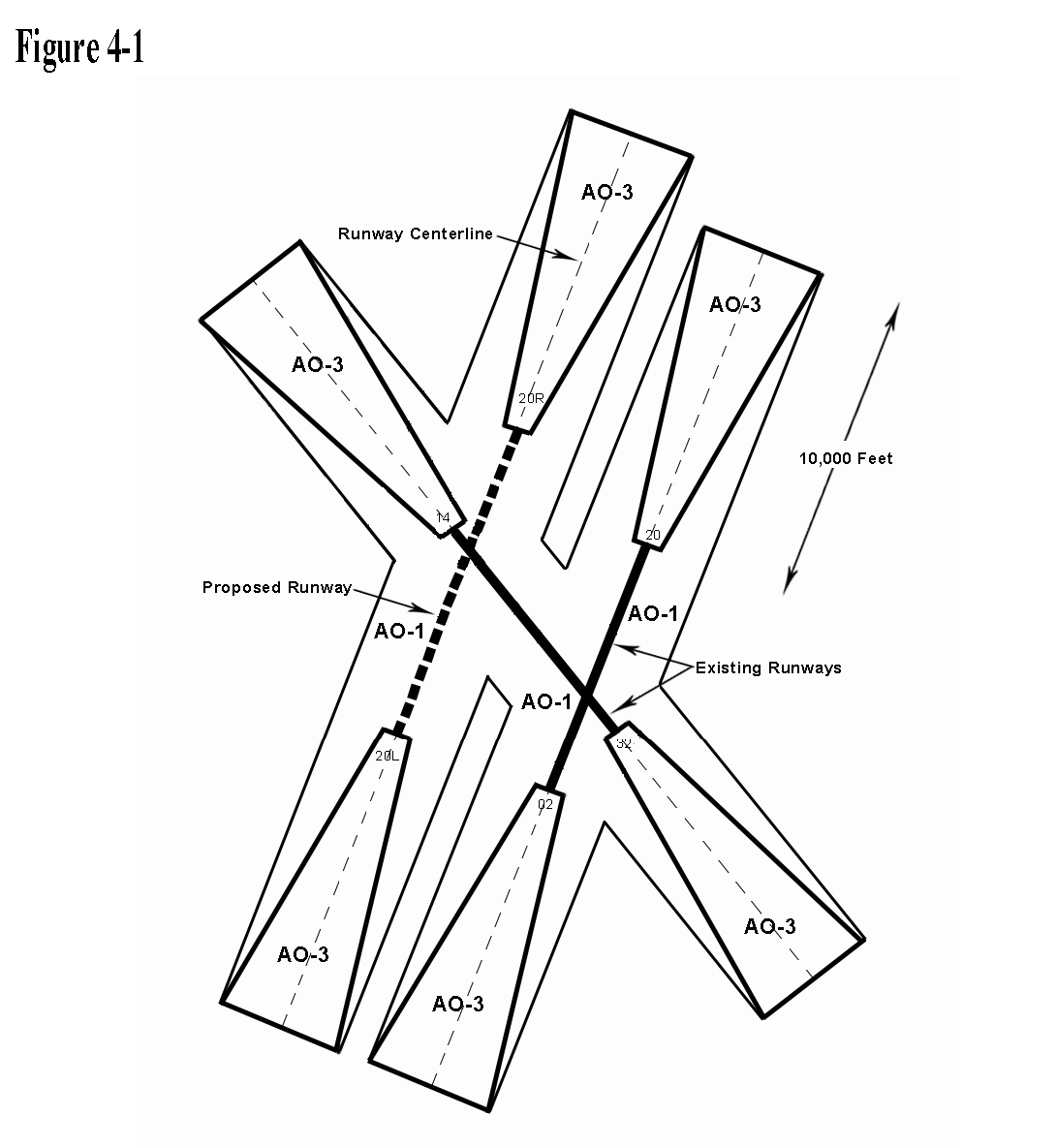
(4)
Split-zoned tracts and structures.
(a)
Where a part of a tract of land lies within an airport overlay zoning district, the district requirements shall only apply within the part of the tract located in the district. The AO-3 district shall take precedence over the AO-1 district.
(b)
A structure which is located partly within an airport overlay zoning district and partly outside shall be considered to be entirely within an airport overlay zoning district. The AO-3 district shall take precedence over the AO-1 district.
(5)
Allowed uses.
(a)
Within the airport overlay zoning districts as defined herein, no land shall be used and no structure or other object shall hereafter be erected, altered, converted, or modified other than for those compatible land uses permitted by the underlying zoning districts.
1.
The following land uses are prohibited in the AO-1 district, regardless of underlying zoning district, except as modified by the AO-3 district:
a.
Residential:
Single-family residential, including mobile homes
Two-family, town houses and multifamily residential
Manufactured housing developments
Rooming, boarding and lodging houses
b.
Public use:
Schools/colleges
Hospitals/clinics
Churches, auditoriums, and concert halls
Community center
Day care center/preschool
Libraries/museums
Group homes
Day care homes
c.
Recreational:
Outdoor carnival/circus
Stadium
Drive-in theater
2.
In the AO-3, no dwellings shall be permitted to be constructed other than single-family dwellings, including manufactured homes, each of which shall be on a lot or parcel of land of ten acres or more. When these uses are allowed within the AO-3 district, measures to achieve outdoor to indoor noise level reduction (NLR) as outlined in subsection 36-406(8) are required. If a lot of less than ten acres lawfully existed at the effective date of this article, a single-family dwelling or manufactured home may be placed on the lot provided:
a.
An avigation easement has been granted to the city; and
b.
Outdoor to indoor noise level reduction (NLR) as outlined in subsection 36-406(8) is installed during construction of the dwelling.
3.
The following land uses are prohibited in the AO-3 district, regardless of underlying zoning district:
a.
Hotels and motels or enclosed off-street parking facilities in a building or structure. Accessory off-street parking lots or facilities open to the sky are allowed.
(b)
Subsection 36-406(5) does not apply to property within the official boundaries of the Springfield-Branson National Airport.
(c)
Conditional uses.
1.
The following conditional use may be permitted in the AO-1 and AO-3 districts provided it is no closer than one and one-half miles (7,920 feet) from the ultimate end of any existing or planned runway shown on the most current airport layout plan as approved by the Federal Aviation Administration, and provided it meets the provisions of, and a conditional use permit is issued pursuant to, section 36-363, conditional use permits, of this article:
a.
Playfields.
2.
Upon receiving an application for a conditional use permit in the AO-1 or AO-3 districts, the department of planning and development shall forward the application to the Springfield-Branson National Airport Board. In considering such an application, the Springfield-Branson National Airport Board shall review potential impacts to the airport and shall make its recommendation(s) to the planning and zoning commission, including any factual findings and reasoning upon which the recommendation was based, prior to a public hearing on the application. The airport board shall consider factors such as, but not limited to:
a.
Federal Aviation Regulations (FAR Part 77).
b.
Published instrument approach and departure procedures.
c.
Outdoor lighting.
d.
Radio signal or electronic emissions.
e.
Noise sensitive concerns.
f.
Public safety.
(6)
Additional land use regulations.
(a)
When a subdivision plat or building permit is required for any property within an airport overlay zoning district, the property owner shall dedicate an avigation easement to the city over and across that property. This easement shall establish a height restriction on the use of the property and hold the public harmless from any damages caused by noise, vibration, fumes, dust, fuel, fuel particles, or other effects that may be caused by the operation of aircraft taking off, landing, or operating on or near the Springfield-Branson National Airport.
(b)
Notwithstanding any other provisions of this article or other sections of the Springfield City Code, no use may be made of land, water, or structures within any zoning district established by this article in such a manner as to create electrical interference with navigational signals or radio communication between the airport and aircraft, make it difficult for pilots to distinguish between airport lights and others, or result in glare in the eyes of pilots using the airport; impair visibility in the vicinity of the airport; create bird strike hazards, or otherwise in any way endanger or interfere with the landing, taking off, or flight operations of aircraft utilizing the airport.
(c)
No building or structure shall be constructed nor shall any landscaping growth be maintained which exceeds 50 feet in height in an airport overlay zoning district.
(7)
Certification of plans.
(a)
The director of building development services shall not issue a building permit for any structure within the zones set forth in subsections (2) and (3) unless the plans and specifications accompanying the application for said building permit have been certified by a registered professional engineer or registered professional architect in the State of Missouri as meeting the noise level reduction (NLR) standards specified in subsection (8).
(b)
The registered professional architect or engineer must certify that said plans and specifications shall reduce the noise impact from outdoor to indoor noise level, at least the minimum specified in this section, using commonly accepted engineering and architectural acoustical practices.
(8)
Noise level reduction (NLR) standards.
(a)
In an airport overlay zoning district, allowed residential land uses shall meet minimum construction standards to achieve a minimum outdoor to indoor NLR of 30 decibels. Customary residential construction can be expected to provide an NLR of 20 decibels, which assumes mechanical ventilation and closed windows year round. Therefore, the minimum outdoor to indoor NLR shall be ten decibels over standard construction. A base airport noise level of 70 Ldn is assumed until such time as a different base airport noise level is established based on completion of a noise study prepared by the Springfield-Branson National Airport or other individuals authorized by the board of such airport and filed with the office of the director of aviation of the City of Springfield, Missouri.
(b)
This subsection (8) shall not apply to property located within the official boundaries of the Springfield-Branson National Airport as established in the airport layout plan submitted to and on file with the Federal Aviation Administration and as amended from time to time.
(Zoning Ord., § 4-2600; G.O. 5471, 6-27-05; G.O. 5763, 6-30-08; G.O. 5833, 7-27-09; G.O. 6633, § 1, 1-25-21)
Sec. 36-407. - CO - Conditional overlay district.
(1)
Purpose. The conditional overlay district is intended to allow a floating zone to be established as an overlay to a base zoning district, which limits the particular uses to be established in accordance with specific standards and conditions. There are circumstances in which a base zoning district designation allowing such a use by right would not be appropriate for a particular property even though the use itself could, if properly planned, be appropriate for the property consistent with the objectives of these regulations and the comprehensive plan.
(2)
Application. The applicant may apply for an amendment to the base zoning classification and jointly apply for conditional overlay district. Property may be rezoned to a conditional overlay district only in response to and consistent with a petition submitted by the owners of all of the property to be included in the district. A petition for a conditional overlay district must specify the use or uses of the base zoning district that are intended for the property and any conditions that, in addition to all general zoning ordinance requirements, will govern the development and use of the property. A conditional overlay district can only reduce the uses of the base zoning district and not allow any uses not permitted in the base zoning district. If additional uses are desired that are not permitted in the base zoning district, a rezoning to a different base zoning district or a planned development is required. A conditional overlay district may also be used to set density in accordance with the multifamily development location and design guidelines for R-LD, R-MD and R-HD districts and for planned developments, when multi-family uses are requested.
(3)
Required conditions. A conditional overlay district may include some conditions from the following list or such other special restrictions as approved by city council:
(a)
Increased bufferyards.
(b)
Reduced height.
(c)
Increased setbacks.
(d)
Increased open space.
(e)
Restrictions on operation of the use, including but not limited to, limitations on days of operation, noise level, intensity of use, lighting, and signage.
(f)
Increased minimum lot area and dimensions.
(g)
Reduced building coverage.
(h)
Off-site improvements related directly to the intensity of development.
(i)
Modified design requirements.
(j)
Increases in the allowed density for multifamily uses not to exceed those stated in the following table:
(4)
Mapping. Upon approval, a conditional overlay district shall be noted on the official map by the base zoning district designation with the addition of "-CO.
(Zoning Ord., § 4-2700; G.O. 5608, 10-30-06; G.O. 5701, 8-27-07)
Sec. 36-408. - LWO - Live/work overlay district.
(1)
Purpose. This district is an overlay district intended to be used in combination with any residential zoning district (R-SF, R-TH, R-LD, R-MD, R-HD or R-MHC) that permits single-family, duplex, townhouse or other types of dwelling units, i.e., multifamily units, where the work area can be established on the first or main floor or in an accessory building. The primary purpose of this district is to permit live/work units as defined and regulated by the building code as adopted, and in effect, by the City of Springfield. Specific work uses, standards, and conditions are established when a specific live/work overlay district is approved.
(2)
Application. The live/work overlay district is intended to be applied to a residential neighborhood; sub-area of a neighborhood; or a multiunit, residential development that may be on a single property; and not to a single property containing one or two dwelling units.
(3)
Permitted uses. In addition to all other uses allowed in the residential district with which this district is combined, live/work units are permitted. The uses permitted in the nonresidential area of the live/work units shall be established when the specific live/work overlay district is approved. A live/work unit is considered a residential use and does not have to comply with any requirements for nonresidential uses in the underlying residential district.
(4)
Use limitations. The following use limitations may be established for the live/work unit that are more restrictive than the limitations established by the building code as adopted, and in effect, by the City of Springfield.
(a)
Maximum floor area of the live/work unit;
(b)
Maximum percentage of nonresidential floor area; and
(c)
Maximum number of nonresidential workers or employees permitted to occupy the nonresidential area at any one time.
(5)
Signage. One sign may be permitted for each live/work unit.
(a)
The following sign requirements shall be established when the specific live/work overlay district is approved:
1.
Type of sign (detached or attached);
2.
Maximum effective sign face area;
3.
Maximum sign height; and
4.
Illumination.
(b)
Signs may be required to be removed during times of day when the business is not open.
(c)
Signs with ineffective sign face area of six square feet or less, and not illuminated, shall not require a sign permit.
(6)
Parking. Additional off-street parking may be required based on the number of employees, floor area of the work area or some other standard. Off-street parking requirements may vary in the specific live/work overlay district by sub-area. All off-street parking areas shall meet the design standards of the residential district.
(7)
Design standards. Design standards may be adopted to protect the character of the specific live/work overlay district.
(8)
Mapping. Upon approval, a live/work overlay district shall be noted on the official map by the base zoning district designation with the addition of "-LWO."
(Zoning Ord., § 4-2800; G.O. 6071, 8-12-13)
Sec. 36-409. - WC - West College Street district.
(1)
Purpose. This district is intended to be a mixed-use, urban district that accommodates a variety of residential and commercial uses. The three sub-areas established by this section are intended to encourage an eclectic mix of businesses, artist studios, architecture and residents consistent with the adopted College Street Corridor Plan. WC-1, the mixed-use sub-area, is designed to accommodate a mix of commercial and residential uses. WC-2, the live/work sub-area, is designed to provide for a transition between the higher intensity mixed-use area on the north side of the street and residential uses on Walnut Street. This sub-area will provide for employment opportunities in conjunction with a dwelling. WC-3, the residential sub-area, is designed to provide for a variety of residential uses including single-family, and townhouses. This sub-area permits multi-family and nonresidential uses on the first-floor frontage along College Street with the approval of a conditional use permit.
(2)
WC-1, Mixed-use sub-area.
(a)
Permitted uses.
1.
Office use group (this group would include medical and dental clinics).
2.
Retail sales use group (this use group would include pet stores).
3.
Personal services use group (this use group would include pet grooming).
4.
Eating and drinking establishments use group.
5.
Automobile service garages, including body and fender repair and paint shops if a legally conforming use at the time of the passage of this ordinance provided a conditional use permit is obtained for any expansion of the structure for said use.
6.
Churches and other places of worship, including parish houses and Sunday schools, but excluding overnight shelters.
7.
Commercial gardens and/or farmers market.
8.
Bed and breakfast.
9.
Colleges, universities and business colleges.
10.
Funeral homes and mortuaries, excluding crematoriums.
11.
Educational, cultural, public or nonprofit institutions such as museums, art galleries and libraries.
12.
Community centers, nonprofit.
13.
Upholstery shops.
14.
Glass and mirror sales.
15.
Single-family detached dwellings.
16.
Single-family semi-detached dwellings, such as patio-court homes and twin houses.
17.
Duplexes.
18.
Townhouses.
19.
Multifamily dwellings.
20.
Any establishment which provides supplies and/or services such as janitorial services, sign shops, packaging or shipping service, locksmith or printing, lithographing, engraving, photocopying, blueprinting, publishing and binding establishments.
21.
Short-term rental type 3 in accordance with section 36-473.
(b)
Use limitations.
1.
All activities and permitted uses except for the following shall be conducted entirely within a completely enclosed building:
a.
Occasional outdoor sales on private property.
b.
Off-street parking and loading facilities.
c.
Outdoor eating and drinking facilities.
2.
All uses shall operate in accordance with the noise standards contained in section 36-485, noise standards.
3.
No use shall emit an odor that creates a nuisance as determined by chapter 2A, article X, Springfield City Code.
(c)
Bulk regulations.
1.
Maximum structure height:
a.
Two and one-half stories or 35 feet above the finished street grade.
b.
Maximum of four stories, or 55 feet above the finished street grade with the approval of a conditional use permit in accordance with section 36-363, conditional use permits.
2.
Maximum density for residential uses shall not exceed 29 dwelling units per acre.
3.
Yard requirements.
a.
Front yard: None.
b.
Side yard: None.
c.
Rear yard: None.
(d)
Open space requirements.
1.
Minimum open space: Not less than ten percent of the gross site area shall be devoted to open space unless modified in accordance with subsection 36-482(15). Open space shall not include areas covered by buildings, structures, parking, loading and other paved areas and internal streets or areas containing plants for display or sale. Open space shall contain living ground cover and other landscaping materials.
2.
Maximum impervious surface: The combined area occupied by all main and accessory buildings or structures, parking, loading and other paved areas and any other surfaces which reduce and prevent absorption of stormwater shall not exceed 90 percent of the total area unless modified in accordance with subsection 36-482(15).
(e)
Design requirements.
1.
A site plan meeting the requirements of section 36-360, site plan review, shall be submitted and approved.
2.
A landscape plan meeting the requirements of section 36-483, off-street parking and loading area designs standards, shall be submitted and approved.
3.
Refuse storage areas shall be screened from view in accordance with section 36-480, screening and fencing.
4.
Mechanical and electrical equipment, including air conditioning units shall be screened from view in accordance with section 36-480, screening and fencing.
5.
Lighting shall be designed to reflect away from any adjacent residential area and in accordance with section 36-484, lighting standards.
6.
Accessory buildings and structures shall meet the requirements of section 36-450, accessory structures and uses.
7.
The maximum length of the frontage of any building along College Street shall not exceed 100 linear feet. The length of a building may exceed 100 feet with the approval of a conditional use permit if it can be shown the design of the building incorporates the scale and other features consistent with the intent of this district and the College Street Corridor Plan.
8.
Any new structure within this district shall adhere to the following: Facades that face streets or connecting pedestrian frontage that are greater than 25 feet in length shall be subdivided and proportioned using at least one or more of the following features: windows, entrances, arcades, arbors, awnings (over windows or doors), changes in color or materials, distributed along the façade at least once every 25 feet. Site plan elevations of buildings shall be approved by the administrative review committee.
(f)
Bufferyard requirement. None.
(g)
Parking requirements. There shall be at least one off-street parking space for each dwelling unit.
(3)
WC - 2, live/work sub-area. Purpose. A live/work is a business conducted within a dwelling unit by occupants of the dwelling unit. A live/work is distinguished from a home occupation primarily in that a live/work use can include employees who are not residents of the home and involve a greater number of customers.
(a)
Live/work standards.
Development within this district shall comply with the live/work unit provisions of the International Building Code.
Live/work unit: A dwelling unit or sleeping unit in which a significant portion of the space includes a nonresidential use that is operated by the tenant.
Commercial vehicles: Commercial vehicles accessory to the business activity may be kept at the dwelling site provided off-street parking for the vehicles can be accommodated on site.
Off-site effects: No live/work use activity shall result in offsite dust, electrical interference, fumes, gas, glare, light, noise, odor, smoke, toxic/hazardous materials, vibration, or other hazardous or nuisances as determined by the director of building development services.
Signage: Signage shall be in accordance with section 36-454, signs.
(b)
Permitted uses.
1.
Art and craft work such as ceramics, painting, photography, sculpture, woodwork, and similar cottage industries that may involve minor use of hazardous or flammable substances as regulated by the International Building Code and the International Fire Code; or operations which generate noise, dust, or odors provided they are determined to be compatible with the surrounding land uses.
2.
Office uses by architects, attorneys, consultants, engineers, writers and owners of electronic commerce businesses, computer programming and data processing, and similar uses.
3.
One-on-one and group services such as music, art, and dance lessons, tutors, licensed counseling and massage therapy, etc.
4.
Tailoring, sewing, washing and ironing.
5.
Churches and other places of worship, including parish houses and Sunday schools, but excluding overnight shelters.
6.
Direct sale product distribution (Amway, Avon, Tupperware, etc.).
7.
Furniture refinishing/antique restoration.
8.
Hair salons and day spas.
9.
Mail order, not including retail sales from site.
10.
Renting sleeping rooms and serving meals to not more than two persons not members of the family occupying the dwelling unit for more than 30 days provided one off-street parking space is provided for each person.
11.
Telephone answering services.
12.
"Work at home" activities where employees of a business, located at another location, perform work for the business in their own residence, provided all physical contact between the business and the employee occurs at the place of business and not the residence, other than the initial installation of any equipment or other work facilities. The work activities of the employee shall conform with all other requirements of this district.
13.
Other live/work uses determined by the administrative review committee to be of a similar and compatible nature to those uses described herein.
14.
Single-family detached dwellings.
15.
Single-family semi-detached dwellings, such as patio court homes and twin houses.
16.
Accessory apartments in owner-occupied single-family detached dwellings, in accordance with section 36-464, accessory apartments.
17.
Accessory uses, as permitted by section 36-450, accessory structures and uses.
18.
Noncommercial, not-for-profit residential neighborhood facilities, including indoor and outdoor recreational facilities, community centers, offices of property owners associations and maintenance facilities operated by a neighborhood or community organization or property owners association in accordance with the provisions of section 36-467, noncommercial not-for-profit neighborhood facilities.
19.
Townhouses.
20.
Zero-lot-line construction, in accordance with section 36-362, zero-lot-line construction.
21.
Any use that is existing at the time this ordinance is adopted and is a permitted use within the live/work district can continue as a stand-alone use on the lot provided that a conditional use permit is obtained for any expansion of said use.
22.
Short-term rental type 3 in accordance with section 36-473.
(c)
Conditional uses.
1.
Adaptive use of nonresidential structures in accordance with subsection 36-363(10)(b)4.
2.
Bed and breakfasts in accordance with subsection 36-363(10)(b)2.
3.
Stand-alone nonresidential use. Any of the permitted uses within this district may be permitted as a stand-alone use provided a conditional use permit is approved in conformance with subsection 36-363(10).
(d)
Use limitations.
1.
There shall be a separate platted lot of record for each single-family semi-detached or townhouse dwelling unit.
2.
All uses shall operate in accordance with the noise standards contained in section 36-485, noise standards.
3.
No use shall emit an odor that creates a nuisance as determined by chapter 2A, article X, Springfield City Code.
4.
Refuse storage areas shall be screened from view in accordance with section 36-480, screening and fencing.
5.
All activities and permitted uses except for the following shall be conducted entirely within a completely enclosed building:
a.
Occasional outdoor sales on private property.
b.
Off-street parking and loading facilities.
c.
Outdoor eating and drinking facilities.
(e)
Bulk regulations.
1.
Maximum structure height: 35 feet or two and one-half stories above the finished street grade.
2.
Minimum yard requirements:
a.
Front yard: 15 feet. The front yard setback maybe reduced below the minimum required if a conditional use permit is approved in accordance with section 36-363, conditional use permits, or an approved preliminary plat in accordance with the city's subdivision regulations.
b.
Side yard: None.
c.
Rear yard: Ten feet.
3.
Minimum lot area:
a.
Single-family detached dwelling: 5,000 square feet.
b.
Each single-family semi-detached dwelling on a separate platted lot: 3,750 square feet.
c.
Each townhouse on a separate platted lot:
i.
End lots: 4,000 square feet.
ii.
Interior lots: 3,000 square feet.
d.
All other uses: 7,500 square feet.
4.
Minimum lot width:
a.
Single-family detached dwellings: 45 feet.
b.
Townhouses:
i.
End lots: 40 feet.
ii.
Interior lots with driveway in front yard: 30 feet.
iii.
Interior lots without driveway in front yard: 24 feet.
c.
Single-family semi-detached dwelling units: 30 feet.
d.
All other uses: 45 feet.
5.
Minimum lot depth: 80 feet.
(f)
Open space requirements.
1.
Minimum open space: Not less than ten percent of the total lot area shall be dedicated to open space including required yards and bufferyards unless modified in accordance with subsection 36-482(15). Open space shall not include areas covered by buildings, structures, parking areas, driveways and internal streets. Open space shall contain living ground cover and other landscaping materials.
2.
Maximum impervious area: The combined area occupied by all main and accessory buildings or structures, parking areas, driveways and any other surfaces which reduce and prevent absorption of stormwater shall not exceed 90 percent of the total lot area unless modified in accordance with subsection 36-482(15).
(g)
Design requirements.
1.
A site plan meeting the requirements of section 36-360, site plan review, shall be submitted and approved for three or more townhouse dwellings units, live work uses and all nonresidential uses.
2.
A plot plan meeting the requirements of subsection 36-331(3) shall be submitted and approved for all single-family detached and single-family semi-detached dwellings.
3.
A landscaping plan meeting the requirements of section 36-483, off-street parking and loading area design standards shall be submitted and approved for structures containing three or more townhouse dwelling units, live/work uses and all nonresidential uses.
4.
Storage of maintenance or other equipment incidental to any permitted or conditional use except single-family detached and single-family semi-detached dwellings shall be screened from view in accordance with the provisions of section 36-480, screening and fencing.
5.
The maximum length of any cluster of townhouse dwelling units shall not exceed six units, or 200 linear feet.
6.
Façades that face streets or connecting pedestrian frontage that are greater than 25 feet in length shall be subdivided and proportioned using at least one or more of the following features: windows, entrances, arcades, arbors, awnings (over windows and doors), changes in color or materials, distributed along the façade at least once every 25 feet. Site plan elevations of the building shall be approved by the administrative review committee.
7.
All off-street parking lots for permitted live/work uses and nonresidential uses shall be screened from all residential uses in residential districts in accordance with the provisions of section 36-480, screening and fencing.
8.
Required front yards shall be landscaped with grass, ground cover, plants, shrubs, or trees. Decorative landscaping materials such as rock, bark and mulch are also permitted. Impervious surfaces required in front yards shall be minimized and, unless otherwise meeting the provisions of subsection 36-483(2), shall be limited to driveways leading to off-street parking areas located outside the required front yard and walkways necessary for access to structures on the property. Circular driveways are permitted if sufficient frontage is available and if approved by the traffic engineer.
9.
Accessory buildings and structures shall meet the requirements of section 36-36-450, accessory structures and uses.
(h)
Bufferyard requirements. None.
(i)
Parking requirements. There shall be at least one off-street parking space for each dwelling unit.
(4)
WC - 3, residential sub-area.
(a)
Permitted uses.
1.
Single-family detached dwellings.
2.
Single-family semi-detached dwellings, in accordance with section 36-361, cluster developments.
3.
Accessory apartments in owner-occupied single-family detached dwellings, in accordance with section 36-464, accessory apartments.
4.
Accessory uses, as permitted, as permitted by section 36-450, accessory structures and uses.
5.
Churches and other places of worship, including parish houses and Sunday schools, but excluding overnight shelters.
6.
Cluster subdivisions, in accordance with section 36-361, cluster subdivisions.
7.
Community gardens without retail or wholesale sales on-site in accordance with the performance standards of section 36-470, community gardens.
8.
Duplexes.
9.
Group homes, residential, in accordance with section 36-465, residential group homes.
10.
Home occupation uses, as permitted by section 36-451, home occupations.
11.
Noncommercial, not-for-profit residential neighborhood facilities, including indoor and outdoor recreational facilities, community centers, offices of property owners associations and maintenance facilities operated by a neighborhood or community organization or a property owners association in accordance with the provisions of section 36-467, noncommercial not-for-profit neighborhood facilities.
12.
Police and fire stations.
13.
Public and private parks, and playgrounds, excluding golf courses, miniature golf courses and driving ranges.
14.
Short-term rental type 3 in accordance with section 36-473.
15.
Temporary uses, as permitted by section 36-452, temporary uses.
16.
Townhouses.
17.
Zero-lot-line construction, in accordance with section 36-362, zero-lot-line construction.
(b)
Conditional uses.
1.
Adaptive use of nonresidential structures in accordance with subsection 36-363(10)(b)4.
2.
Bed and breakfasts in accordance with subsection 36-363(10)(b)2.
3.
Clubhouses associated with any permitted use.
4.
Community centers, non-profit.
5.
Nonresidential uses on the first floor frontage of buildings that front on College Street provided there is at least one residential unit above or behind the nonresidential use. Nonresidential uses include the office, retail sales, personal services and eating and drinking establishments use groups.
6.
Multifamily dwellings provided it can be shown the unusual configuration of the lot will support a greater density without overpowering the surrounding development and the proposed development conforms to the intent of the College Street Corridor Plan.
(c)
Use limitations.
1.
There shall be a separate platted lot of record for each single-family semi-detached or townhouse dwelling unit.
2.
All uses shall operate in accordance with the noise standards contained in section 36-485, noise standards.
3.
No use shall emit an odor that creates a nuisance as determined by chapter 24, article X, Springfield City Code.
4.
All activities and permitted uses except for the following shall be conducted entirely within a completely enclosed building:
a.
Occasional outdoor sales on private property.
b.
Off-street parking and loading facilities.
c.
Outdoor eating and drinking facilities.
(d)
Bulk regulations.
1.
Maximum structure height:
a.
Two and one-half stories or 35 feet above the average elevation of the depth of the lot.
b.
Maximum of four stories, or 55 feet above the finished street grade with the approval of a conditional use permit in accordance with section 36-363, conditional use permits.
2.
Minimum yard requirements:
a.
Front yard: None, provided there is at least 30 feet from the centerline of College Street.
b.
Side yards: None.
c.
Rear yard: Minimum 15 feet.
3.
Minimum lot area:
a.
Single-family detached dwellings: 5,000 square feet.
b.
Duplexes: 7,500 square feet.
c.
Each single-family semi-detached dwelling on a separate platted lot: 3,750 square feet.
d.
Each townhouse on a separate platted lot:
i.
End lots: 4,000 square feet.
ii.
Interior lots: 3,000 square feet.
e.
All other uses: 7,500 square feet.
4.
Minimum lot width:
a.
Single-family detached and duplex dwellings and residential group homes: 45 feet.
b.
Townhouses:
i.
End lots: 40 feet.
ii.
Interior lots with driveway in front yard: 30 feet.
iii.
Interior lots without driveway in front yard: 24 feet.
c.
Single-family semi-detached dwelling units: 30 feet.
d.
All other uses: 45 feet.
5.
Minimum lot depth: 80 feet.
6.
Maximum density for multifamily development: Shall be limited to 18 dwelling units per acre.
(e)
Open space requirements.
1.
Minimum open space: Not less than ten percent of the total lot area shall be devoted to open space including required yards and bufferyards unless modified in accordance with subsection 36-482(15). Open space shall not include areas covered by buildings, structures, parking areas, driveways and internal streets. Open space shall contain living ground cover and other landscaping materials.
2.
Maximum impervious area: The combined area occupied by all main and accessory buildings or structures, parking areas, driveways and any other surfaces which reduce and prevent absorption of stormwater shall not exceed 90 percent of the total lot area unless modified in accordance with subsection 36-482(15).
(f)
Design requirements.
1.
A site plan meeting the requirements of section 36-360, site plan review, shall be submitted and approved for three or more townhouse dwelling units and all nonresidential uses.
2.
A plot plan meeting the requirements of subsection 36-331(3) shall be submitted and approved for all single-family detached, duplex, and single-family semi-detached dwellings.
3.
A landscaping plan meeting the requirements of section 36-483, off-street parking and loading area design standards, shall be submitted and approved for structures containing three or more townhouse dwelling units.
4.
Storage of maintenance or other equipment incidental to any permitted or conditional use except a single-family detached, duplex, and single-family semi-detached dwellings shall be screened from view in accordance with the provisions of section 36-480, screening and fencing.
5.
The maximum length of any cluster of townhouse dwelling units shall not exceed six units, or 200 linear feet.
6.
All off-street parking lots for permitted nonresidential uses shall be screened from all residential uses in residential districts in accordance with the provisions of section 36-480, screening and fencing.
7.
Refuse storage areas for permitted nonresidential uses shall be screened from view in accordance with section 36-480, screening and fencing.
8.
Mechanical and electrical equipment, including air conditioning units, shall be screened from view in accordance with section 36-480, screening and fencing.
9.
Accessory buildings and structures shall meet the requirements of section 36-450, accessory structures and uses.
(g)
Bufferyard requirements. None.
(h)
Parking requirements. There shall be at least one off-street parking space for each dwelling unit.
(Zoning Ord., § 4-2900; G.O. 4759, 11-10-97; G.O. 5355, 3-15-04; G.O. 5425, 11-15-04; G.O. 5843, 11-9-09; G.O. 4882, 7-26-10; G.O. 6077, 9-9-13; G.O. 6091, 12-16-13; G.O. 6156, § 1(exh. A), 11-24-14; G.O. 6467, § 1(Exh. A), 7-16-18; G.O. 6497, § 1, 1-28-19; G.O. 6520, § 1, 4-22-19)
Sec. 36-420. - LB - Limited business district.
(1)
Purpose. This district is intended for uses that provide convenience goods or personal services primarily to people residing in adjacent residential areas. It also includes selected retail and service uses that are similar in land use intensity and physical impact to the neighborhood sales and service uses permitted in this district. This district is designed to accommodate compact, freestanding commercial centers or to function as a transition between more intense commercial uses and residential neighborhoods. Because the permitted retail and personal service uses may be an integral part of the neighborhood, more restrictive requirements for light, air, open space, building design and landscaping are made than are provided in other commercial districts. This district should be located along or at the intersections of collector or higher classification streets.
(2)
Permitted uses.
(a)
Accessory uses, as permitted by section 36-450, accessory structures and uses.
(b)
Any residential dwellings at the time the district is mapped and any single-family detached dwelling subject to subsection 36-469(3). As conforming uses, such a dwelling can be expanded or, if destroyed, replaced with another dwelling of the same type within 18 months of being destroyed.
(c)
Churches and other places of worship, including parish houses, Sunday schools but excluding overnight shelters.
(d)
Community centers, nonprofit.
(e)
Community gardens without retail or wholesale sales on-site in accordance with the performance standards of section 36-470, community gardens.
(f)
Day care centers in accordance with chapter 36, article XI, Springfield City Code.
(g)
Eating and drinking establishments use group, excluding drive-in, pick-up window, or drive-thru facilities.
(h)
General office use group, excluding banks and financial institutions with automatic teller machines and drive-thru facilities.
(i)
Personal services use group.
(j)
Police and fire stations.
(k)
Public and private parks, playgrounds, and golf courses, excluding miniature golf courses and driving ranges.
(l)
Residential uses provided such uses are located above the first floor or behind nonresidential uses so as to create a continuous nonresidential facade, on the first-floor level. When a lot has multiple street frontages, first-floor nonresidential uses will be required on the street with the highest classification. All other street frontages may contain residential uses.
(m)
Retail sales use group, excluding convenience stores with gas pumps.
(n)
Short-term rental type 3 in accordance with section 36-473, and subject to conditions in subsection (2)(b) or (i), if applicable.
(o)
Temporary uses, as permitted by section 36-452, temporary uses.
(p)
Tier I and II wireless facilities in accordance with section 36-466, telecommunication towers.
(q)
Water reservoirs, water standpipes, and elevated and ground-level water storage tanks.
(3)
Conditional uses. The following conditional uses may be permitted provided they meet the provisions of, and a conditional use permit is issued pursuant to, section 36-363, conditional use permits, of this article.
(a)
Eating and drinking establishments use group, including drive-in, pick-up window, or drive-thru facilities.
(b)
Funeral homes and mortuaries (crematoriums are permitted as accessory uses).
(c)
General office use group, including banks and financial institutions with automatic teller machines and drive-thru facilities.
(d)
Medical office use group.
(e)
Public service and public utility uses, as follows:
1.
Tier III wireless facilities in accordance with section 36-466, telecommunication towers, provided wireless towers 60 feet or greater in height allow collocation of at least one additional provider's facilities; and
2.
Other towers and related facilities existing at the time the district is mapped, in accordance with subsection 36-363(10)(b)1.
(f)
Residential uses on the first floor frontage of a building.
(g)
Retail sales use group, including convenience stores with gas pumps.
(4)
Use limitations.
(a)
All activities and permitted uses except off-street parking and loading facilities, drive-thru facilities, and day care activities shall be conducted entirely within a completely enclosed building.
(b)
No individual retail store, personal service establishment or other permitted use shall have a gross floor area greater than 5,000 square feet.
(c)
All uses shall operate in accordance with the noise standards contained in section 36-485, noise standards.
(d)
No use shall emit an odor that creates a nuisance as determined by chapter 2A, article X, Springfield City Code.
(e)
Uses on parcels not served by public water and public sewer shall meet the requirements of subsection 36-303(22).
(f)
Streets through adjacent residential areas shall not be used to provide principal access for truck traffic to any nonresidential use in this district except on streets classified as expressways, arterials, or collectors.
(5)
Bulk and intensity of use restrictions.
(a)
Maximum structure height:
1.
Principal building: 25 feet.
2.
Except that all structures shall remain below a 30-degree bulk plane as measured from the boundary of any R-SF or R-TH district.
(b)
Minimum yard requirements (additional bufferyard may be required by subsection (8)):
1.
Front yard:
a.
Twenty-five feet along a street classified as a collector or higher classification street or as required by section 36-453, supplemental open space and yard regulations.
b.
Fifteen feet along a street classified as a local street or as required by section 36-453, supplemental open space and yard regulations.
c.
The front yard setback may be reduced below the minimum required above if a conditional use permit is approved in accordance with section 36-363, conditional use permits, or an approved preliminary plat in accordance with the city's subdivision regulations.
2.
Side yard: None, except as required by section 36-453, supplemental open space and yard regulations.
3.
Rear yard: 20 percent of the lot depth or ten feet whichever is greater. No more than 25 feet shall be required.
However, in no event may a structure be erected closer to the centerline of an existing or planned street than as prescribed below, except as permitted by subsection 36-303(17)(b) and subsection 36-303(17)(d).
(6)
Open space requirements.
(a)
Minimum open space: Not less than 20 percent of the total lot area shall be devoted to open space including required yards and bufferyards unless modified in accordance with subsection 36-482(15). Open space shall not include areas covered by buildings, structures, parking, loading and other paved areas and internal streets. Open space shall contain living ground cover and other landscaping materials.
(b)
Maximum impervious surface: The combined area occupied by all main and accessory buildings or structures, parking, loading and other paved areas and any other surfaces which reduce and prevent absorption of stormwater shall not exceed 80 percent of the total area unless modified in accordance with subsection 36-482(15).
(7)
Design requirements.
(a)
A site plan, meeting the requirements of section 36-363, site plan review, shall be submitted and approved.
(b)
A landscape plan, meeting the requirements of section 36-482, landscaping and bufferyards, and 36-483, off-street parking and loading area design standards, shall be submitted and approved.
(c)
All structures in the LB district shall be constructed using materials, surface textures, and colors similar in nature to surrounding residential development. Consideration shall also be given to the scale, orientation, and proportion of surrounding development. Design review shall be performed as part of the site plan review required by section 36-360.
(d)
All off-street parking lots and vehicular use areas shall be screened from all residential uses in accordance with section 36-480, screening and fencing.
(e)
Refuse storage areas shall be screened from view in accordance with section 36-480, screening and fencing.
(f)
Mechanical and electrical equipment, including air conditioning units, shall be screened from view in accordance with section 36-480, screening and fencing.
(g)
Lighting shall be designed to reflect away from any adjacent residential area and in accordance with section 36-484, lighting standards.
(h)
Accessory buildings and structures shall meet the requirements of section 36-450, accessory structures and uses.
(8)
Bufferyard regulations. Whenever any development in a LB district is located adjacent to a different zoning district, screening and a bufferyard shall be provided in accordance with sections 36-480, screening and fencing, and 36-482, landscaping and bufferyards.
(Zoning Ord., § 4-3000; G.O. 4570, 11-27-95; G.O. 4852, 11-23-98; G.O. 5127, 10-29-01; G.O. 5345, 1-26-04; G.O. 5425, 11-15-04; G.O. 5665, 4-9-07; G.O. 5843, 11-9-09; G.O. 5879, 7-26-10; G.O. 5861, 2-8-10; G.O. 5881, 7-26-10; G.O. 5928, 4-18-11; G.O. 5094, 7-9-01; G.O. 5952, 10-3-11; G.O. 6058, 6-17-13; G.O. 6094, 1-13-14; G.O. 6413, § 1, 12-11-17; G.O. 6497, § 1, 1-28-19)
Sec. 36-421. - GR - General retail district.
(1)
Purpose. This district is intended for uses that provide community-wide personal and business services, shopping centers and specialty shops. This district is also intended for on-site production of handcrafted items in conjunction with retail sales. Commercial uses permitted in this district are generally required to conduct business activities indoors. The need for community-wide accessibility dictates that this district be located along or at the intersection of two or more arterial or higher classification streets. Areas zoned GR are intended to be at least five acres in size unless the zoning is based on an adopted plan or comprehensive zoning scheme.
(2)
Permitted uses.
(a)
Accessory uses, as permitted by section 36-450, accessory structures and uses.
(b)
Any residential dwellings existing at the time the district is mapped. As conforming uses, such a dwelling can be expanded or, if destroyed, replaced with another dwelling of the same type within 18 months of being destroyed.
(c)
Art galleries, libraries, and museums.
(d)
Bed and breakfast.
(e)
Catering businesses.
(f)
Churches and other places of worship, including parish houses and Sunday schools but excluding overnight shelters.
(g)
Commercial gardens and/or farmers markets with retail and/or wholesale sales on-site.
(h)
Commercial off-street parking lots and structures.
(i)
Community gardens without retail or wholesale sales on-site in accordance with the performance standards of section 36-470, community gardens.
(j)
Day care centers in accordance with chapter 36, article XI, Springfield City Code.
(k)
Eating and drinking establishments use group.
(l)
Entertainment-oriented use group.
(m)
Flea markets entirely within enclosed buildings.
(n)
Funeral homes and mortuaries (crematoriums are permitted as accessory uses).
(o)
General office use group.
(p)
Household resource recovery collection centers, screened from all residential districts and public rights-of-way in conformance with section 36-480, screening and fencing.
(q)
Medical, comprehensive or microbusiness marijuana dispensary facility. No facility shall be located within 1,000 feet of an existing elementary or secondary school or within 200 feet of an existing child day care center or church and as prescribed and subject to all other requirements in section 36-474, marijuana and medical marijuana facilities.
(r)
Medical or comprehensive marijuana-infused products manufacturing type 2 post-extraction facility. No facility shall be located within 1,000 feet of an existing elementary or secondary school or within 200 feet of an existing child day care center or church, and as prescribed and subject to all other requirements in section 36-474, marijuana and medical marijuana facilities.
(s)
Medical office use group.
(t)
Personal services use group.
(u)
Police and fire stations.
(v)
Private clubs and lodges.
(w)
Public and private parks, playgrounds, and golf courses, including miniature golf courses and driving ranges.
(x)
Public service and public utility uses, as follows:
1.
Tier I wireless facilities in accordance with section 36-466, telecommunication towers;
2.
Tier III wireless facilities in accordance with section 36-466, telecommunication towers, provided wireless towers 60 feet or greater in height allow collocation of at least one additional provider's facilities;
3.
Tier IV wireless facilities in accordance with section 36-466, telecommunication towers, provided wireless towers are setback from any residential district at least two feet for every one foot of tower height and allow collocation of at least one additional provider's facilities or at least two additional providers' facilities if the tower height is 120 feet or greater; and
4.
Water reservoirs, water standpipes, and elevated and ground-level water storage tanks.
(y)
Residential uses provided such uses are located above the first floor or behind nonresidential uses so as to create a continuous nonresidential facade, on the first-floor level. When a lot has multiple street frontages, first-floor nonresidential uses will be required on the street with the highest classification. All other street frontages may contain residential uses.
(z)
Retail sales use group.
(aa)
Schools or development centers for persons with handicaps or development disabilities.
(bb)
Schools, business.
(cc)
Seasonal outdoor sales and related storage as permitted by section 36-452, temporary uses.
(dd)
Short-term rental type 3 in accordance with section 36-473, and subject to conditions in subsection (2)(b) or (y) if applicable.
(ee)
Taxidermists.
(ff)
Temporary lodging use group.
(gg)
Temporary uses, as permitted by section 36-452, temporary uses.
(hh)
Temporary vendors as permitted under subsection 36-452(3)(b)2.
(ii)
Towers other than wireless facilities, less than 100 feet in height, and related facilities provided telecommunication towers comply with section 36-466, telecommunication towers.
(jj)
Veterinary clinics, animal hospitals, pet daycare services, pet grooming facilities and kennels. No outside activities shall be permitted for kennels. Veterinary clinics, animal hospitals, pet daycare services and pet grooming facilities may have supervised outside activities, which are defined as having a single animal under the physical control of an individual. All outside activity spaces shall be fully enclosed and screened from adjacent residential uses, districts and all public rights-of-way with a six-foot tall barrier that is in conformance with subsection 36-480(3). No outside activity spaces shall be located within 25 feet of any residential use or district, and all animal waste shall be collected and disposed of on a daily basis.
(3)
Conditional uses. The following conditional uses may be permitted provided they meet the provisions of, and a conditional use permit is issued pursuant to, section 36-363, conditional use permits, of this article.
(a)
Automobile service garages.
(b)
Automobile service stations.
(c)
Automobile washing businesses, including automatic, coin-operated, and moving-line facilities.
(d)
Reserved.
(e)
Residential uses on the first floor frontage of a building.
(f)
Self-service storage facilities.
(g)
Tier V wireless facilities in accordance with section 36-466, telecommunication towers.
(h)
Towers other than wireless facilities, exceeding 100 feet in height, and related facilities, provided:
1.
The maximum height does not exceed 200 feet; and
2.
Only one tower is permitted on a lot; and
3.
All other provisions of subsection 36-363(10)(b)1. are met.
(4)
Use limitations.
(a)
All outdoor automobile parking areas used for the purpose of retail or wholesale storage or sale of motorized or commercial vehicles shall be prohibited. Other outdoor activities that are not specifically permitted may only be allowed as an accessory use to the permitted uses as provided in subsection 36-421(2), permitted uses, as follows:
1.
If any portion of the premises abuts any residential zoning district, the outdoor activities may be permitted, provided they meet the provisions of, and a conditional use permit is issued pursuant to section 36-363, conditional use permits, of this article. A building permit(s) showing compliance with all applicable codes and ordinances may be required as determined by the director of building development services.
2.
If the premises abuts only nonresidential zoning districts, the outdoor activities may be permitted. A conditional use permit will not be required. A building permit(s) showing compliance with all applicable codes and ordinances may be required as determined by the director of building development services.
(b)
No outdoor storage except as provided in subsection 36-421(2), permitted uses, and subsection 36-421(3), conditional uses.
(c)
All uses shall operate in accordance with the noise standards contained in section 36-485, noise standards.
(d)
No use shall emit an odor that creates a nuisance as determined by chapter 2A, article X, Springfield City Code.
(e)
Uses on parcels not served by public water and public sewer shall meet the requirements of subsection 36-303(22).
(f)
Streets through an adjacent residential area shall not be used to provide principal access for truck traffic to any nonresidential use in this district except on streets classified as expressways, arterials, or collectors.
(5)
Bulk and intensity of use.
(a)
Maximum structure height: None, except that all structures shall remain below a 30-degree bulk plane as measured from the boundary of any R-SF or R-TH district.
(b)
Minimum yard requirements (additional bufferyard may be required by subsection 36-421(8)):
1.
Front yard:
a.
Twenty-five feet along a street classified as a collector or higher classification street or as required by section 36-453, supplemental open space and yard regulations.
b.
Fifteen feet along a street classified as a local street or as required by section 36-453, supplemental open space and yard regulations.
c.
The front yard setback may be reduced below the minimum required above if a conditional use permit is approved in accordance with section 36-363, conditional use permits, or an approved preliminary plat in accordance with the city's subdivision regulations.
2.
Side and rear yards: None, except as required by section 36-453, supplemental open space and yard regulations, and the bufferyard requirements in subsection 36-421(8).
However, in no event may a structure be erected closer to the centerline of an existing or planned street than as prescribed below, except as permitted by subsection 36-303(17)(b) and subsection 36-303(17)(d).
(6)
Open space requirements.
(a)
Minimum open space: Not less than 20 percent of the gross site area shall be devoted to open space including required yards and bufferyards unless modified in accordance with subsection 36-482(15). Open space shall not include areas covered by buildings, structures, parking, loading and other paved areas and internal streets or areas containing plants for display and sale. Open space shall contain living ground cover and other landscaping materials.
(b)
Maximum impervious surface: The combined area occupied by all main and accessory buildings or structures, parking, loading and other paved areas and any other surfaces which reduce and prevent absorption of stormwater shall not exceed 80 percent of the total area unless modified in accordance with subsection 36-482(15).
(7)
Design requirements.
(a)
A site plan, meeting the requirements of section 36-363, site plan review, shall be submitted and approved.
(b)
A landscape plan, meeting the requirements of sections 36-482, landscaping and bufferyards, and 36-483, off-street parking and loading area design standards, shall be submitted and approved.
(c)
All off-street parking and vehicular use areas shall be screened from all residential uses, in accordance with section 36-480, screening and fencing.
(d)
Refuse storage areas shall be screened from view in accordance with section 36-480, screening and fencing.
(e)
Mechanical and electrical equipment, including air conditioning units, shall be screened from view in accordance with section 36-480, screening and fencing.
(f)
Lighting shall be designed to reflect away from any adjacent residential area and in accordance with section 36-484, lighting standards.
(g)
Accessory buildings and structures shall meet the requirements of section 36-450, accessory structures and uses.
(8)
Bufferyard requirements. Whenever any development in a GR district is located adjacent to a different zoning district, screening and a bufferyard shall be provided in accordance with sections 36-480, screening and fencing, and 36-482, landscaping and bufferyards.
(Zoning Ord., § 4-3100; G.O. 4519, 6-12-95; G.O. 4570, 11-27-95; G.O. 4852, 11-23-98; G.O. 4925, 9-27-99; G.O. 5094, 7-9-01; G.O. 5127, 10-29-01; G.O. 5585, 7-24-06; G.O. 5665, 4-9-07; G.O. 5744, 3-24-08; G.O. 5773, 8-11-08; G.O. 5843, 11-9-09; G.O. 5861, 2-8-10; G.O. 5879, 7-26-10; G.O. 5880, 7-26-10; G.O. 5928, 4-18-11; G.O. 5952, 10-3-11; G.O. 6001, 6-4-12; G.O. 6048, 5-3-13; G.O. 6058, 6-17-13; G.O. 6094, 1-13-14; G.O. 6413, § 1, 12-11-17; G.O. 6467, § 1(Exh. A), 7-16-18; G.O. 6497, § 1, 1-28-19; G.O. 6528, § 1, 5-20-19; G.O. 6775, § 1, 1-31-23)
Sec. 36-422. - HC - Highway commercial district.
(1)
Purpose. This district is intended for commercial uses which depend upon high visibility, generate high traffic volumes, or cater to the traveling public. These characteristics dictate that this district be located along or at the intersections of arterial classification streets or along frontage roads adjacent to the interstate or other limited-access streets. This district is also intended for on-site production of handcrafted items in conjunction with retail sales. Areas zoned HC are intended to be at least five acres in size unless the zoning is based on an adopted plan or comprehensive zoning scheme.
(2)
Permitted uses.
(a)
Accessory uses, as permitted by section 36-450, accessory structures and uses.
(b)
Ambulance services.
(c)
Any residential dwellings existing at the time the district is mapped. As conforming uses, such a dwelling can be expanded or, if destroyed, replaced with another dwelling of the same type within 18 months of being destroyed.
(d)
Art galleries, libraries, and museums.
(e)
Auction sales and flea markets entirely within enclosed buildings.
(f)
Automobile service garages.
(g)
Automobile service stations.
(h)
Automobile washing businesses, including automatic, coin-operated, and moving-line facilities.
(i)
Awning and canvas sales and rental.
(j)
Bed and breakfast.
(k)
Boarding, rooming, and lodging houses.
(l)
Bus stations.
(m)
Campgrounds and recreational vehicle parks.
(n)
Catering businesses.
(o)
Cemeteries.
(p)
Churches and other places of worship, including parish houses, and Sunday schools.
(q)
Civic, convention, and cultural centers.
(r)
Commercial gardens and/or farmers markets with retail and/or wholesale sales on-site.
(s)
Commercial off-street parking lots and structures.
(t)
Commercial outdoor recreation use group.
(u)
Day care centers in accordance with chapter 36, article XI, Springfield City Code.
(v)
Eating and drinking establishments use group.
(w)
Entertainment-oriented use group.
(x)
General office use group.
(y)
Household resource recovery collection centers, screened from all residential districts and public rights-of-way in conformance with section 36-480, screening and fencing.
(z)
Manufactured housing (mobile home) and trailer sales, leasing and service with no storage.
(aa)
Major event entertainment use group.
(bb)
Medical or comprehensive marijuana cultivation facility or microbusiness marijuana wholesale facility when not located adjacent to or across the street from any residential district. No facility shall be located within 1,000 feet of an existing elementary or secondary school, child day care center or church as prescribed and subject to all other requirements in section 36-474, marijuana and medical marijuana facilities.
(cc)
Medical, comprehensive or microbusiness marijuana dispensary facility. No facility shall be located within 1,000 feet of an existing elementary or secondary school or within 200 feet of an existing child day care center or church and as prescribed and subject to all other requirements in section 36-474, marijuana and medical marijuana facilities.
(dd)
Medical or comprehensive marijuana-infused products manufacturing type 2 post-extraction facility. No facility shall be located within 1,000 feet of an existing elementary or secondary school or within 200 feet of an existing child day care center or church and as prescribed and subject to all other requirements in section 36-474, marijuana and medical marijuana facilities.
(ee)
Medical office use group.
(ff)
Nurseries, greenhouses, and garden stores.
(gg)
Other towers other than wireless facilities, less than 100 feet in height, and related facilities.
(hh)
Personal services use group.
(ii)
Police and fire stations.
(jj)
Private clubs and lodges.
(kk)
Public and private parks, playgrounds, and golf courses, including miniature golf courses and driving ranges.
(ll)
Public or private vehicle and boat storage garages, yards or lots.
(mm)
Public service and public utility uses, as follows:
1.
Tier I wireless facilities in accordance with section 36-466, telecommunication towers.
2.
Tier III wireless facilities in accordance with section 36-466, telecommunication towers, provided wireless towers 60 feet or greater in height allow collocation of at least one additional provider's facilities.
3.
Tier IV wireless facilities in accordance with section 36-466, telecommunication towers, provided wireless towers are setback from any residential district at least two feet for every one foot of tower height and allow collocation of at least one additional provider's facilities or at least two (additional providers' facilities if the tower height is 120 feet or greater.
4.
Water reservoirs, water standpipes, and elevated and ground-level water storage tanks.
(nn)
Residential uses provided such uses are located above the first floor or behind nonresidential uses so as to create a continuous nonresidential facade, on the first-floor level. When a lot has multiple street frontages, first-floor nonresidential uses will be required on the street with the highest classification. All other street frontages may contain residential uses.
(oo)
Retail sales use group.
(pp)
Schools, business.
(qq)
Schools or development centers for persons with handicaps or development disabilities.
(rr)
Self-service storage facilities.
(ss)
Short-term rental type 3 in accordance with section 36-473, and subject to conditions in subsection (2)(c) or (nn), if applicable.
(tt)
Swimming pool sales and displays.
(uu)
Taxi dispatch yards and offices.
(vv)
Taxidermists.
(ww)
Temporary lodging use group.
(xx)
Temporary uses, as permitted by section 36-452, temporary uses.
(yy)
Temporary vendors as permitted under subsection 36-452(3)(b)2.
(zz)
Overnight shelters or transitional service shelters for 50 or fewer residents, which are located at least 500 feet from a residential district, as measured from property lines provided that no overnight shelter or transitional service shelter shall locate within a 2,000-foot radius of another transitional service shelter, soup kitchen, overnight shelter, substance abuse treatment facility or community correctional facility as measured from property lines, in accordance with subsection 36-363(10)(b)5. In no event shall a certificate of occupancy be issued for a transitional service shelter herein if it is less than 1,000 feet from an elementary or secondary school as measured from property lines.
(aaa)
Upholstery shops.
(bbb)
Veterinary clinics, animal hospitals, pet daycare services, pet grooming facilities, and kennels. No outside activities shall be permitted for kennels. Veterinary clinics, animal hospitals, pet daycare services, and pet grooming facilities may have supervised outside activities, which are defined as having a single animal under the physical control of an individual. All outside activity spaces shall be fully enclosed and screened from adjacent residential uses, districts and all public rights-of-way with a six-foot tall barrier that is in conformance with subsection 36-480(3). No outside activity spaces shall be located within 25 feet of any residential use or district, and all animal waste shall be collected and disposed of on a daily basis.
(ccc)
Wholesale sales.
(3)
Conditional uses. The following conditional uses may be permitted provided they meet the provisions of, and a conditional use permit is issued pursuant to, section 36-363, conditional use permits, of this article.
(a)
Body and fender repair and paint shops.
(b)
Overnight or transitional service shelters for 50 or fewer residents, which are located within 500 feet from a residential district, as measured from property lines provided that no overnight shelter, transitional service shelter or soup kitchen may locate within 2,000 feet of any other overnight shelter, transitional service shelter, soup kitchen, substance abuse treatment facility or community corrections facility, as measured from property lines, in accordance with subsection 36-363(10)(b)5.
(c)
Go-cart tracks.
(d)
Medical or comprehensive marijuana cultivation facility or microbusiness marijuana wholesale facility when located adjacent to or across the street from any residential district. No facility shall be located within 1,000 feet of an existing elementary or secondary school, child day care center or church and as prescribed, and subject to all other requirements in section 36-474, marijuana and medical marijuana facilities.
(e)
Pest control services with a retail component provided that at least 50 percent of the floor area of the business is devoted to retail sales and related support areas and that all service vehicles associated with the business are located behind the front building line.
(f)
Reserved.
(g)
Residential uses on the first floor frontage of a building.
(h)
Soup kitchens.
(i)
Tier V wireless facilities in accordance with section 36-466, telecommunication towers.
(j)
Towers other than wireless facilities, exceeding 100 feet in height, and related facilities, provided:
1.
The maximum height does not exceed 200 feet;
2.
Only one tower is permitted on a lot; and
3.
All other provisions of subsection 36-363(10)(b)1. are met.
(k)
Truck stops.
(4)
Use limitations.
(a)
Streets through adjacent residential areas shall not be used to provide principal access for truck traffic to any nonresidential use in this district except on streets classified as expressways, arterials, or collectors.
(b)
No motor vehicle repair or maintenance work shall take place outdoors within 150 feet of the boundary of any residential district.
(c)
All sales, display or outdoor storage areas that would be routinely disturbed because of the nature of the activity being conducted or because of vehicular traffic, except those areas of nurseries and garden centers where living plants are located, shall be paved or otherwise improved with an all-weather, dust-free surface.
(d)
All uses shall operate in accordance with the noise standards contained in section 36-485, noise standards.
(e)
No use shall emit an odor that creates a nuisance as determined by chapter 2A, article X, Springfield City Code.
(f)
Uses on parcels not served by public water and public sewer shall meet the requirements of subsection 36-303(22).
(5)
Bulk and intensity of use restrictions.
(a)
Maximum structure height: None, except that all structures shall remain below a 30-degree bulk plane as measured from the boundaries of R-SF or R-TH districts.
(b)
Minimum yard requirements (additional bufferyard may be required by subsection (8):
1.
Front yard:
[a.]
[Reserved.]
b.
Twenty-five feet along a street classified as a collector or higher classification street or as required by section 36-453, supplemental open space and yard regulations.
c.
Fifteen feet along a street classified as a local street or as required by section 36-453, supplemental open space and yard regulations.
d.
The front yard setback may be reduced below the minimum required above if a conditional use permit is approved in accordance with section 36-363, conditional use permits, or an approved preliminary plat in accordance with the city's subdivision regulations.
2.
Side yard: None, except as required by section 36-453, supplemental open space and yard regulations, and the bufferyard requirements in subsection (8).
3.
Rear yard: None, except as required by the bufferyard requirements in subsection (8).
However, in no event may a structure be erected closer to the centerline of an existing or planned street than as prescribed below, except as permitted by subsection 36-303(17)(b) and subsection 36-303(17)(d).
(6)
Open space requirements.
(a)
Minimum open space: Not less than 20 percent of the gross site area shall be devoted to open space including required yards and bufferyards unless modified in accordance with subsection 36-482(15). Open space shall not include areas covered by buildings, structures, parking, storage, loading and other paved areas and internal streets or areas containing plants for display and sale. Open space shall contain living ground cover and other landscaping materials.
(b)
Maximum impervious surface: The combined area occupied by all main and accessory buildings or structures, parking, loading and other paved areas and any other surfaces which reduce and prevent absorption of stormwater shall not exceed 80 percent of the total area unless modified in accordance with subsection 36-482(15).
(7)
Design requirements.
(a)
A site plan, meeting the requirements of section 36-360, site plan review, shall be submitted and approved.
(b)
A landscape plan, meeting the requirements of sections 36-482, landscaping and bufferyards, and 36-483, off-street parking and loading area design standards, shall be submitted and approved.
(c)
Off-street parking and vehicular use areas shall be screened from all residential uses, in accordance with section 36-480, screening and fencing.
(d)
Refuse storage areas shall be screened from view in accordance with section 36-480, screening and fencing.
(e)
Mechanical and electrical equipment, including air conditioning units shall be screened from view in accordance with section 36-480, screening and fencing.
(f)
Lighting shall be designed to reflect away from any adjacent residential area and in accordance with section 36-484, lighting standards.
(g)
Accessory buildings and structures shall meet the requirements of section 36-450, accessory structures and uses.
(8)
Bufferyard requirements. Whenever any development in an HC district is located adjacent to a different zoning district, screening and a bufferyard shall be provided in accordance with sections 36-480, screening and fencing, and 36-482, landscaping and bufferyards.
(Zoning Ord., § 4-3200; G.O. 6413, § 1, 12-11-17; G.O. 6467, § 1(Exh. A), 7-16-18; G.O. 6497, § 1, 1-28-19; G.O. 6528, § 1, 5-20-19; G.O. 6775, § 1, 1-31-23)
Sec. 36-423. - CS - Commercial service district.
(1)
Purpose. This district is intended for business uses which provide essential commercial services and support activities but which do not necessarily require high visibility and may have higher environmental impacts in terms of noise, dust, glare, etc., which make them incompatible with the office or retail character of the other business districts. This district is intended for on-site production of handcrafted items in conjunction with retail sales. This district is also intended for businesses that combine wholesale and retail sales and that conduct extensive outdoor activities. This district is intended to function as a transition between industrial development and commercial development. Areas zoned CS are intended to be at least five acres in size unless the zoning is based on an adopted plan or comprehensive zoning scheme.
(2)
Permitted uses.
(a)
Accessory uses, as permitted by section 36-450, accessory structures and uses.
(b)
Any residential dwellings existing at the time the district is mapped. As conforming uses, such a dwelling can be expanded or, if destroyed, replaced with another dwelling of the same type within 18 months of being destroyed.
(c)
Ambulance services.
(d)
Any establishment which provides supplies and/or services primarily to commercial and industrial customers, such as janitorial services, sign shops, packaging or shipping service, locksmith or printing, lithographing, engraving, photocopying, blueprinting, publishing and binding establishments.
(e)
Auction sales, flea markets entirely within enclosed buildings, and swap meets.
(f)
Automobile service garages, including body and fender repair and paint shops.
(g)
Automobile service stations.
(h)
Automobile washing businesses, including automatic, coin-operated, and moving-line facilities.
(i)
Awning and canvas sales and rental.
(j)
Bus stations.
(k)
Campgrounds and recreational vehicle parks.
(l)
Carpenter and cabinet shops.
(m)
Catering businesses.
(n)
Cemeteries.
(o)
Churches and other places of worship, including parish houses, and Sunday schools.
(p)
Commercial gardens and/or farmers markets with retail and/or wholesale sales on-site.
(q)
Commercial laundry and dry cleaning establishments.
(r)
Commercial off-street parking lots and structures.
(s)
Commercial outdoor recreation use group.
(t)
Construction equipment storage yards.
(u)
Day care centers in accordance with chapter 36, article XI, Springfield City Code.
(v)
Eating and drinking establishments use group.
(w)
Entertainment-oriented use group.
(x)
Feed stores.
(y)
Frozen food lockers, for use by the general public.
(z)
Funeral homes, mortuaries, and crematoriums.
(aa)
General office use group.
(bb)
General or medical office/retail sales/warehouse combinations, provided however, that if more than 85 percent of the gross building floor area for each establishment is used for warehouse purposes, a use permit shall be required.
(cc)
Glass and mirror sales.
(dd)
Household resource recovery collection centers, screened from all residential districts and public rights-of-way in conformance with section 36-480, screening and fencing.
(ee)
Linen, towel, and diaper services.
(ff)
Manufactured housing (mobile home) and trailer sales, leasing, service and storage.
(gg)
Medical or comprehensive marijuana cultivation facility or microbusiness marijuana wholesale facility when not located adjacent to or across the street from any residential district. No facility shall be located within 1,000 feet of an existing elementary or secondary school, child day care center, church and as prescribed and subject to all other requirements in section 36-474, marijuana and medical marijuana facilities.
(hh)
Medical, comprehensive or microbusiness marijuana dispensary facility. No facility shall be located within 1,000 feet of an existing elementary or secondary school or within 200 feet of an existing child day care center or church and as prescribed and subject to all other requirements in section 36-474, marijuana and medical marijuana facilities.
(ii)
Medical or comprehensive marijuana-infused products manufacturing type 2 post-extraction facility. No facility shall be located within 1,000 feet of an existing elementary or secondary school or within 200 feet of an existing child day care center or church and as prescribed and subject to all other requirements in section 36-474, marijuana and medical marijuana facilities.
(jj)
Medical office use group.
(kk)
Monument sales.
(ll)
Newspaper and magazine distribution agencies.
(mm)
Nurseries, greenhouses and garden stores.
(nn)
Personal services use group.
(oo)
Pest control services.
(pp)
Police and fire stations.
(qq)
Private clubs and lodges.
(rr)
Public and private parks, playgrounds, and golf courses, including miniature golf courses and driving ranges.
(ss)
Public or private vehicle and boat storage garages, yards or lots.
(tt)
Public service and public utility uses, as follows:
1.
Tier I wireless facilities in accordance with section 36-466, telecommunication towers.
2.
Tier III wireless facilities in accordance with section 36-466, telecommunication towers, provided wireless towers 60 feet or greater in height allow collocation of at least one additional provider's facilities.
3.
Tier IV wireless facilities in accordance with section 36-466, telecommunication towers, provided wireless towers are setback from any residential district at least two feet for every one foot of tower height and allow collocation of at least one additional provider's facilities or at least two additional providers' facilities if the tower height is 120 feet or greater.
4.
Water reservoirs, water standpipes, and elevated and ground-level water storage tanks.
(uu)
Retail sales use group.
(vv)
Repair shops, home appliance.
(ww)
Repair shops, small-engine.
(xx)
Schools or development centers for persons with handicaps or development disabilities.
(yy)
Schools, business and industrial.
(zz)
Self-service storage facilities.
(aaa)
Short-term rental type 3 in accordance with section 36-473 and subject to conditions in subsection (2)(b), if applicable.
(bbb)
Substance abuse treatment facilities for 50 or fewer residents, provided the facility:
1.
Is located at least 2,000 feet from any other substance abuse treatment facility, or 2,000 feet from any emergency shelter, soup kitchen, transitional service shelter or community corrections facility, as measured from property lines; and
2.
A plan of operation, including, but not limited to: administration contact information, patron access requirements, hours of operations and security measures, is on file with the City of Springfield Planning and Development Department.
(ccc)
Swimming pool sales and display.
(ddd)
Taxi dispatch yards and offices.
(eee)
Taxidermists.
(fff)
Temporary uses, as permitted by section 36-452, temporary uses.
(ggg)
Temporary vendors as permitted under subsection 36-452(3)(b)2.
(hhh)
Towers other than wireless facilities, less than 100 feet in height and related facilities.
(iii)
Overnight shelters or transitional service shelters for 50 or fewer residents, which are located at least 500 feet from a residential district, as measured from property lines provided that no overnight shelter or transitional service shelter shall locate within a 2,000-foot radius of another transitional service shelter, soup kitchen, overnight shelter, substance abuse treatment facility or community correctional facility as measured from property lines, in accordance with subsection 36-363(10)(b)5. In no event shall a certificate of occupancy be issued for a transitional service shelter herein if it is less than 1,000 feet from an elementary or secondary school as measured from property lines.
(jjj)
Truck stops.
(kkk)
Upholstery shops.
(lll)
Veterinary clinics, animal hospitals and outdoor kennels provided that at the time the use is established any outdoor activities are clearly accessory to the primary use and provided that no outdoor activities are located closer than a 300-foot radius from a building used for a church, school, hotel, motel, or restaurant, or from a property zoned residential or a building used for residential purposes.
(mmm)
Wholesale sales use group.
(3)
Conditional uses. The following conditional uses may be permitted provided they meet the provisions of, and a conditional use permit is issued pursuant to, section 36-363, conditional use permits, of this article:
(a)
Overnight or transitional service shelters for 50 or fewer residents, which are located within 500 feet from a residential district, as measured from property lines provided that no overnight shelter, transitional service shelter or soup kitchen may locate within 2,000 feet of any other overnight shelter, transitional service shelter, soup kitchen, substance abuse treatment facility or community corrections facility, as measured from property lines, in accordance with subsection 36-363(10)(b)5.
(b)
Go-cart tracks.
(c)
Medical or comprehensive marijuana cultivation facility or microbusiness marijuana wholesale facility when located adjacent to or across the street from any residential district. No facility shall be located within 1,000 feet of an existing elementary or secondary school, child day care center or church and as prescribed and subject to all other requirements in section 36-474, marijuana and medical marijuana facilities.
(d)
Soup kitchens.
(e)
Tier V wireless facilities in accordance with section 36-466, telecommunication towers.
(f)
Towers other than wireless facilities, exceeding 100 feet in height, and related facilities, in accordance with subsection 36-363(10)(b)1.
(g)
Veterinary clinics, animal hospitals and outdoor kennels provided that at the time the use is established any outdoor activities are clearly accessory to the primary use and provided that no outdoor activities are located closer than a 300-foot radius from a building used for a church, school, hotel, or motel, or from a property zoned residential or a building used for residential purposes, or closer than a 100-foot radius from a building used for a restaurant.
(h)
Warehouses, storage and distribution centers.
(4)
Use limitations.
(a)
No motor vehicle repair or maintenance work shall take place outdoors within 200 feet of the boundary of any residential district.
(b)
All sales, display or outdoor storage areas that would be routinely disturbed because of the nature of the activity being conducted or because of vehicular traffic, except those areas of nurseries and garden centers where living plants are located, shall be paved or otherwise improved with an all-weather, dust-free surface.
(c)
No vibration, glare, or heat shall be detectable at the district boundary line.
(d)
All uses shall operate in accordance with the noise standards contained in section 36-485, noise standards.
(e)
No use shall emit an odor that creates a nuisance as determined by chapter 2A, article X, Springfield City Code.
(f)
Uses on parcels not served by public water and public sewer shall meet the requirements of subsection 36-303(22).
(g)
Streets through adjacent residential areas shall not be used to provide principal access for truck traffic to any nonresidential use in this district except on streets classified as expressways, arterials, or collectors.
(5)
Bulk and intensity of use regulations.
(a)
Maximum structure height: None, except that all structures shall remain below a 30-degree bulk plane as measured from the boundaries of R-SF or R-TH districts.
(b)
Minimum yard requirements:
1.
Front yard: None.
2.
Side yard: None, except as required by the bufferyard requirements in subsection (8).
3.
Rear yard: None, except as required by the bufferyard requirements in subsection (8).
However, in no event may a structure be erected closer to the centerline of an existing or planned street than as prescribed below, except as permitted by subsection 36-303(17)(b) and subsection 36-303(17)(d).
(6)
Open space requirements.
(a)
Minimum open space: Not less than 15 percent of the gross site area shall be devoted to open space including required yards and bufferyards unless modified in accordance with subsection 36-482(15). Open space shall not include areas covered by buildings, structures, parking, storage, loading and other paved areas and internal streets or areas containing plants for display and sale. Open space shall contain living ground cover and other landscaping materials.
(b)
Maximum impervious area: The combined area occupied by all main and accessory buildings or structures, parking, loading and other paved areas and any other surfaces which reduce and prevent absorption of stormwater shall not exceed 85 percent of the total lot area unless modified in accordance with subsection 36-482(15).
(7)
Design requirements.
(a)
A site plan, meeting the requirements of section 36-360, site plan review, shall be submitted and approved.
(b)
A landscape plan, meeting the requirements of sections 36-482, landscaping and bufferyards, and 36-483, off-street parking and loading area design standards, shall be submitted and approved.
(c)
All off-street parking and vehicular use areas shall be screened from all residential uses in accordance with section 36-480, screening and fencing.
(d)
Refuse storage areas shall be screened from view in accordance with section 36-480, screening and fencing.
(e)
Mechanical and electrical equipment, including air conditioning units shall be screened from view in accordance with section 36-480, screening and fencing.
(f)
Lighting shall be designed to reflect away from any adjacent residential area and in accordance with section 36-484, lighting standards.
(g)
Accessory buildings and structures shall meet the requirements of section 36-450, accessory structures and uses.
(8)
Bufferyard requirement. Whenever any development in a CS district is located adjacent to a different zoning district, screening and a bufferyard shall be provided in accordance with sections 36-480, screening and fencing, and 36-482, landscaping and bufferyards.
(Zoning Ord., § 4-3300; G.O. 4763, 12-15-97; G.O. 4852, 11-23-98; G.O. 5094, 7-9-01; G.O. 5127, 10-29-01; G.O. 5343, 1-12-04; G.O. 5471, 6-27-05; G.O. 5585, 7-26-06; G.O. 5665, 4-9-07; G.O. 5702, 8-27-07; G.O. 5744, 3-24-08; G.O. 5773, 8-11-08; G.O. 5843, 11-9-09; G.O. 5861, 2-8-10; G.O. 5879, 7-26-10; G.O. 5880, 7-26-10; G.O. 5928, 4-18-11; G.O. 5952, 10-3-11; G.O. 6026, 12-17-12; G.O. 6048, 5-6-13; G.O. 6053, 6-3-13; G.O. 6058, 6-17-13; G.O. 6093, 6-3-13; G.O. 6094, 1-13-14; G.O. 6467, § 1(Exh. A), 7-16-18; G.O. 6497, § 1, 1-28-19; G.O. 6528, § 1, 5-20-19; G.O. 6775, § 1, 1-31-23)
Sec. 36-424. - CC - Center city district.
(1)
Purpose. This district is intended to be a mixed-use district that accommodates a variety of residential, commercial, and light industrial uses. It is intended for older commercial and light industrial areas, particularly the central business district and commercial street area that tend to accommodate a wide variety of uses. These areas generally developed early in the city's history and do not display the characteristics typical of modern suburban development. These areas may also be experiencing or be in need of rehabilitation or redevelopment. This district is intended to accommodate the transition that must occur if these areas are to contribute to the vitality of the city.
(2)
Permitted uses.
(a)
Accessory uses, as permitted by section 36-450, accessory structures and uses.
(b)
Auction sales and flea markets entirely within enclosed buildings.
(c)
Awning and canvas sales and rental.
(d)
Bed and breakfasts.
(e)
Boarding, rooming, and lodging houses.
(f)
Bus garages.
(g)
Bus stations.
(h)
Catering businesses.
(i)
Cemeteries.
(j)
Churches and other places of worship, including parish houses and Sunday schools.
(k)
Civic, convention, and cultural centers.
(l)
Colleges, universities, and business colleges.
(m)
Commercial gardens and/or farmers markets with retail and/or wholesale sales on-site.
(n)
Commercial off-street parking lots and structures.
(o)
Community center, nonprofit.
(p)
Day care centers in accordance with chapter 36, article XI, Springfield City Code.
(q)
Eating and drinking establishments use group.
(r)
Educational, cultural, public, or nonprofit institutions such as museums, art galleries, libraries and elementary and secondary schools, but not including correctional institutions.
(s)
Overnight shelters and soup kitchens legally conforming at the time of the passage of said ordinance provided that a use permit is obtained for any expansion of said use.
(t)
Entertainment-oriented use group.
(u)
Funeral homes and mortuaries (crematoriums are permitted as accessory uses).
(v)
General office use group.
(w)
Glass and mirror sales.
(x)
Group homes, custodial.
(y)
Hospitals with ambulance services as accessory uses.
(z)
Household resource recovery collection centers, screened from all residential districts and public rights-of-way in conformance with section 36-480, screening and fencing.
(aa)
Major event entertainment use group.
(bb)
Medical, comprehensive or microbusiness marijuana dispensary facility. No facility shall be located within 1,000 feet of an existing elementary or secondary school, or within 200 feet of an existing child day care center or church and as prescribed and subject to all other requirements in section 36-474, marijuana and medical marijuana facilities.
(cc)
Medical or comprehensive marijuana-infused products manufacturing type 2 post-extraction facility. No facility shall be located within 1,000 feet of an existing elementary or secondary school, or within 200 feet an existing child day care center or church and as prescribed and subject to all other requirements in section 36-474, marijuana and medical marijuana facilities.
(dd)
Medical office use group.
(ee)
Personal services use group.
(ff)
Police and fire stations.
(gg)
Private clubs and lodges.
(hh)
Public and private parks, playgrounds and golf courses, including miniature golf courses and driving ranges.
(ii)
Public service and public utility uses, as follows:
1.
Tier I wireless facilities in accordance with section 36-466, telecommunication towers.
2.
Tier III wireless facilities in accordance with section 36-466, telecommunication towers, provided wireless towers 60 feet or greater in height allow collocation of at least one additional provider's facilities.
3.
Tier IV wireless facilities in accordance with section 36-466, telecommunication towers, provided wireless towers are setback from any residential district at least two feet for every one foot of tower height and allow collocation of at least one additional provider's facilities or at least two additional providers' facilities if the tower height is 120 feet or greater.
4.
Water reservoirs, water standpipes, and elevated and ground-level water storage tanks.
(jj)
Repair shops, home appliance.
(kk)
Residential uses except those which require a conditional use permit in accordance with subsection 36-424(3).
(ll)
Retail sales use group.
(mm)
Schools or development centers for persons with handicaps or development disabilities.
(nn)
Schools, business.
(oo)
Schools, elementary and secondary.
(pp)
Short-term rental type 3 in accordance with section 36-473, and subject to conditions in subsection (2)(kk), if applicable.
(qq)
Substance abuse treatment facilities for 50 or fewer residents, provided the facility:
1.
Is located at least 2,000 feet from any other substance abuse treatment facility, or 2,000 feet from any emergency shelter, soup kitchen, transitional service shelter or community corrections facility, as measured from property lines; and
2.
A plan of operation, including, but not limited to: Administration contact information, patron access requirements, hours of operations and security measures, is on file with the City of Springfield Planning and Development Department.
(rr)
Taxi dispatch yards and offices.
(ss)
Temporary uses, as permitted by section 36-452, temporary uses.
(tt)
Temporary lodging use group.
(uu)
Towers other than wireless facilities, less than 100 feet in height, and related facilities.
(vv)
Veterinary clinics. Facilities may have supervised outside activities, which are defined as having a single animal under the physical control of an individual. All outside activity spaces shall be fully enclosed and screened from adjacent residential uses, districts and all public rights-of-way with a six-foot tall barrier that is in conformance with subsection 36-480(3). No outside activity spaces shall be located within 25 feet of any residential use or district, and all animal waste shall be collected and disposed of on a daily basis.
(ww)
Wholesale sales.
(3)
Conditional uses. The following conditional uses may be permitted provided they meet the provisions of, and a conditional use permit is issued pursuant to, section 36-363, conditional use permits, of this article:
(a)
Any manufacturing, production, processing, cleaning, servicing, testing, repair, or storage of materials, goods or products which is not allowed as a permitted use.
(b)
Automobile service garages.
(c)
Automobile service stations.
(d)
Residential uses on first floor frontage of buildings that front on Commercial Street or front on Olive, Park Central, McDaniel and Walnut Streets between Campbell and Jefferson Avenues or front on Campbell, South, Boonville and Jefferson Avenues between Water Street and Pershing Street.
(e)
Tier V wireless facilities in accordance with section 36-466, telecommunication towers.
(f)
Towers other than wireless facilities, exceeding 100 feet in height, and related facilities, in accordance with subsection 36-363(10)(b)1.
(g)
Transitional service shelter.
(h)
Warehouses, storage and distribution centers.
(4)
Use limitations.
(a)
All activities and permitted uses except the following shall be conducted entirely within a completely enclosed building.
1.
Automobile servicing, but not repair.
2.
Drive-in, pick-up window, or drive-thru facilities.
3.
Occasional sidewalk sales.
4.
Off-street parking and loading facilities.
5.
Outdoor eating and drinking facilities.
6.
Outdoor live or amplified music provided a permit for such activity has been obtained from the city manager pursuant to chapter 2, article I, section 2-10, permits for outdoor music and any regulations promulgated by the city manager and on file with the city clerk.
7.
Playgrounds associated with a school or day care center.
8.
Street vendors licensed by the City of Springfield.
(b)
No vibration, glare, or heat shall be detectable at the lot line.
(c)
No dust, particulate matter, or noxious or toxic matter of any sort shall be emitted or discharged at any time.
(d)
All uses shall operate in accordance with the noise standards contained in section 36-485, noise standards.
(e)
All flammable petroleum products and petrochemicals shall be stored in a fireproof enclosure and no more than 50 gallons of such products shall be so stored except at automobile service stations.
(f)
No use shall emit an odor that creates a nuisance as determined by chapter 2A, article X, Springfield City Code.
(g)
Uses on parcels not served by public water and public sewer shall meet the requirements of subsection 36-303(22).
(5)
Bulk regulations.
(a)
Maximum structure height: None.
(b)
Yard requirements (additional bufferyard may be required by subsection (8)):
1.
Front yard: None.
2.
Side yard: None.
3.
Rear yard: None.
However, in no event may a structure be erected closer to the centerline of an existing or planned street than as prescribed below, except as permitted by subsection 36-303(17)(b) and subsection 36-303(17)(d).
(6)
Open space requirements. None.
(7)
Design requirements.
(a)
A site plan meeting the requirements of section 36-360, site plan review, shall be submitted and approved.
(b)
If required, a landscape plan, meeting the requirements of sections 36-482, landscaping and bufferyards, and 36-483, off-street parking and loading area design standards, shall be submitted and approved.
(c)
All off-street parking and vehicular use areas shall be screened from all residential uses in accordance with section 36-480, screening and fencing.
(d)
Refuse storage areas shall be screened from view in accordance with section 36-480, screening and fencing.
(e)
Mechanical and electrical equipment, including air conditioning units shall be screened from view in accordance with section 36-480, screening and fencing.
(f)
Lighting shall be designed to reflect away from any adjacent residential area and in accordance with section 36-484, lighting standards.
(g)
Accessory buildings and structures shall meet the requirements of section 36-450, accessory structures and uses.
(8)
Bufferyard requirement. Whenever any development in a CC district is located adjacent to a different zoning district, screening and a bufferyard shall be provided in accordance with sections 36-480, screening and fencing, and 36-482, landscaping and bufferyards.
(Zoning Ord., § 4-3400; G.O. 4763, 12-15-97; G.O. 4825, 8-17-98; G.O. 4852, 11-23-98; G.O. 4915, 7-19-99; G.O. 5094, 7-9-01; G.O. 5127, 10-29-01; G.O. 5343, 1-12-04; G.O. 5425, 11-15-04; G.O. 5471, 6-27-05; G.O. 5665, 4-9-07; G.O. 5773, 8-11-08; G.O. 5843, 11-9-09; G.O. 5880, 7-26-10; G.O. 5855, 7-26-10; G.O. 5879, 7-26-10; G.O. 5952, 10-3-11; G.O. 5928, 4-18-11; G.O. 6058, 6-17-13; G.O. 6094, 1-13-14; G.O. 6497, § 1, 1-28-19; G.O. 6528, § 1, 5-20-19; G.O. 6775, § 1, 1-31-23)
Sec. 36-425. - COM - Commercial street district.
(1)
Purpose. This district is intended to be a mixed-use district that accommodates a variety of residential, commercial, and light industrial uses. It is intended for the older commercial and light industrial areas fronting and adjacent to a commercial street that tend to accommodate a wide variety of uses. This area initially developed early in the city's history and does not display the characteristics typical of modern suburban development. The city has approved a commercial street redevelopment plan and has approved financing mechanisms to implement that plan. Uses proposed in this district are consistent with the redevelopment strategy. This area is experiencing rehabilitation and redevelopment. This district is intended to accommodate the transition that must occur if this area is to contribute to the vitality of the city while protecting the historic character of the area.
Two sub-zones are established by this section. The uses permitted in the two districts are the same, but they differ in the design requirements. The COM-1 district is designed to permit new construction that is more compatible with the existing historic buildings within the landmarks district along Commercial Street. The COM-2 district is designed to allow new construction that is consistent with more recent commercial development along Commercial Street.
(2)
Permitted uses.
(a)
The following uses are permitted on any floor unless the development project is greater than 10,000 square feet in total floor area, which requires a conditional use permit.
1.
Accessory uses, as permitted by section 36-450, accessory structures and uses.
2.
Athletic clubs, fitness centers, and indoor sports facilities.
3.
Auction sales and flea markets entirely within enclosed buildings.
4.
Banks and financial institutions, including automatic teller machines.
5.
Catering businesses.
6.
Colleges, universities, and business colleges.
7.
Commercial amusements, including bowling alleys, dance halls, video game arcades, billiard parlors, roller skating and ice skating arenas, and motion picture theaters, excluding drive-in theaters.
8.
Day care centers in accordance with chapter 36, article XI, Springfield City Code.
9.
Educational, cultural, public, or nonprofit institutions such as museums, art galleries, and libraries, but not including elementary and secondary schools and correctional institutions.
10.
Overnight shelters and soup kitchens legally conforming at the time of the passage of said ordinance provided that a use permit is obtained for any expansion of said use.
11.
Glass and mirror sales.
12.
Governmental buildings and uses.
13.
Medical, comprehensive or microbusiness marijuana dispensary facility. No facility shall be located within 1,000 feet of an existing elementary or secondary school, or within 200 feet of an existing child day care center or church and as prescribed and subject to all other requirements in section 36-474, marijuana and medical marijuana facilities.
14.
Medical or comprehensive marijuana-infused products manufacturing type 2 post-extraction facility. No facility shall be located within an existing elementary or secondary school, or within 200 feet of a then-existing child day care center or church and as prescribed and subject to all other requirements in section 36-474, marijuana and medical marijuana facilities.
15.
Offices, administrative, business, finance, and professional.
16.
Offices, medical and dental.
17.
Personal service establishments including beauty parlors, barbershops, dry cleaning and laundry pick-up window, shoe repair, self-service laundromats, express or mailing offices and hearing aid and eye glass shops.
18.
Pet stores and pet grooming.
19.
Police and fire stations.
20.
Recording studios.
21.
Restaurants, excluding drive-in, vehicular pick-up window, and drive-thru facilities.
22.
Retail sales use group excluding convenience stores with gas pumps.
23.
Schools and studios for art, dancing, drama, music, photography, interior decorating, or similar courses of study.
24.
Schools, business.
25.
Taverns and cocktail lounges.
26.
Temporary uses, as permitted by section 36-452, temporary uses.
27.
Veterinary clinics. Facilities may have supervised outside activities, which are defined as having a single animal under the physical control of an individual. All outside activity spaces shall be fully enclosed and screened from adjacent residential uses, districts and all public rights-of-way with a six-foot tall barrier that is in conformance with subsection 36-480(3). No outside activity spaces shall be located within 25 feet of any residential use or district, and all animal waste shall be collected and disposed of on a daily basis.
28.
Churches and other places of worship, including parish houses and Sunday schools, but excluding overnight shelters.
(b)
The following uses are only permitted above the first floor or in the second layer of the first floor unless the development project is greater than 10,000 square feet in total floor area, which requires a conditional use permit for the use set out in this subsection. The first layer of the first floor is the first 50 feet of lot depth measured from the front of the lot. The second layer is located behind the first 50 feet of lot depth measured from the front of the lot. An entrance and hallway through the first layer to provide access to the second layer or upper floors is permitted.
1.
Any commercial establishment that provides supplies and/or services primarily to commercial customers, such as janitorial services, sign shops, packaging or shipping service, locksmith or printing, lithographing, engraving, photocopying, blueprinting, publishing and binding establishments.
2.
Bed and breakfasts.
3.
Commercial off-street parking lots and structures.
4.
Community center, nonprofit.
5.
Cultural centers.
6.
Medical and dental clinics.
7.
Medical and dental laboratories and research facilities, not including the manufacture of pharmaceutical or other products for general sale or distribution, provided no toxic substances, explosives, radioactive material, highly flammable substances or other materials that pose a threat to public health and safety, due to their quantities or location, are utilized in the research operations.
8.
Office equipment repair.
9.
Private clubs and lodges.
10.
Repair shops, home appliance.
11.
Residential uses.
12.
Restricted production and repair establishments (for retail sale on the premises only), including the following types of activities: Custom tailoring and alteration of clothing, jewelry from precious metals, watches, dentures, and optical lenses.
13.
Churches and other places of worship, including parish houses and Sunday schools, but excluding overnight shelters.
14.
Short-term rental type 3 in accordance with section 36-473, and subject to conditions in subsection (2)(b), if applicable.
(3)
Conditional uses.
(a)
The following conditional uses may be permitted provided they meet the provisions of, and a conditional use permit is issued pursuant to, section 36-363, conditional use permits, of this article and the requirements of this subsection 36-425(3):
1.
Any manufacturing, production, processing, cleaning, servicing, testing, repair, or storage of materials, goods or products which is not allowed as a permitted use.
2.
Automobile service garages.
3.
Automobile service stations.
4.
Awning and canvas sales and rental.
5.
Banks and financial institutions, including automatic teller machines, with drive-thru facilities.
6.
Boarding, rooming, and lodging houses.
7.
Bus stations.
8.
[Repealed by G.O. 6173.]
9.
Construction equipment storage yards or other outdoor storage in COM-2 district only.
10.
Convenience stores with gas pumps.
11.
Reserved.
12.
Funeral homes and mortuaries.
13.
Group homes, custodial.
14.
Hospitals with ambulance services as accessory uses.
15.
Hotels, motels, and inns.
16.
Household resource recovery collection centers, screened from all residential districts and public rights-of-way in conformance with section 36-480, screening and fencing.
17.
Public service and public utility uses, as follows:
a.
Tier I wireless facilities in accordance with section 36-466, telecommunication towers.
b.
Tier III wireless facilities in accordance with section 36-466, telecommunication towers, provided wireless towers 60 feet or greater in height allow collocation of at least one additional provider's facilities.
c.
Tier IV wireless facilities in accordance with section 36-466, telecommunication towers, provided wireless towers are setback from any residential district at least two feet for every one foot of tower height and allow collocation of at least one additional provider's facilities or at least two additional providers' facilities if the tower height is 120 feet or greater. Repair shops, home appliance, located in the first layer of the floor of buildings that front on Commercial Street and Boonville Avenue.
d.
Tier V wireless facilities in accordance with section 36-466, telecommunication towers.
18.
Restaurants with drive-in, vehicular pick-up window, and drive-thru facilities.
19.
Schools or development centers for persons with handicaps or development disabilities.
20.
Structures greater than three stories in height.
21.
Substance abuse treatment facilities for 50 or fewer residents, provided the facility:
a.
Is located at least 2,000 feet from any other substance abuse treatment facility, or 2,000 feet from any emergency shelter, soup kitchen, transitional service shelter or community corrections facility, as measured from property lines; and
b.
A plan of operation, including, but not limited to: Administration contact information, patron access requirements, hours of operations and security measures, is on file with the City of Springfield Planning and Development Department.
22.
Television and radio studios with transmitting facilities.
23.
Towers, other than wireless facilities, and related facilities, in accordance with subsection 36-363(10)(b)1.
24.
Transitional service shelter.
25.
Warehouses, storage and distribution centers.
26.
The following uses located in the first layer of the first floor of buildings that front on Commercial Street and Boonville Avenue:
a.
Any commercial establishment that provides supplies and/or services primarily to commercial customers, including janitorial services, sign shops, packaging or shipping service, locksmith or printing, lithographing, engraving, photocopying, blueprinting, publishing and binding establishments.
b.
Bed and breakfasts.
c.
Cultural centers.
d.
Medical and dental clinics.
e.
Medical and dental laboratories and research facilities, not including the manufacture of pharmaceutical or other products for general sale or distribution, provided no toxic substances, explosives, radioactive material, highly flammable substances or other materials that pose a threat to public health and safety, due to their quantities or location, are utilized in the research operations.
f.
Office equipment repair.
g.
Private clubs and lounges.
h.
Residential uses.
i.
Restricted production and repair establishments (for retail sale on the premises only), including the following types of activities: custom tailoring and alteration of clothing, jewelry from precious metals, watches, dentures, and optical lenses.
27.
Any use allowed in the district and involved in development projects greater than 10,000 square feet of total building floor area, whether new construction, rehabilitation of an existing structure or a combination of new construction and rehabilitation. A development project is typically a development where the property is under single ownership or management. A development project may include a single use or multiple uses and may be in a single building or multiple buildings, on one lot or multiple lots. The ARC shall determine if a development project with multiple uses meets the criteria to require a conditional use permit. Expansion of a development project, existing at the date of adoption of this district, shall not require a conditional use permit provided the expansion does not involve more than 2,000 square feet of total building floor area.
(b)
In addition to all other requirements for review and approval of a conditional use permit, the following shall apply:
1.
The proposed use shall generally conform to the goals and policies of the commercial street strategy for success and any other plans or polices in place at the time of approval of the conditional use permit.
2.
For development projects greater than 10,000 square feet, the applicant shall submit plans to provide parking and security for customers/occupants of the development project. City council may waive the requirement for one or both plans, at the time of approval, if one or both plans are deemed unnecessary.
3.
The following organizations, and similar organizations that may be formed in the future, shall be notified of a conditional use permit application in conformance with the notification requirements of section 36-368, publication and posting of notices:
a.
Commercial club.
b.
Commercial Street community improvement district board.
c.
Midtown neighborhood association.
d.
Grant Beach neighborhood association.
e.
Woodland Heights neighborhood association.
f.
Urban districts alliance.
(4)
Use limitations.
(a)
All activities and permitted uses except for the following shall be conducted entirely within a completely enclosed building.
1.
Automobile servicing, but not repair.
2.
Drive-in, pick-up window, or drive-thru facilities.
3.
Occasional sidewalk sales.
4.
Off-street parking and loading facilities.
5.
Outdoor eating and drinking facilities.
6.
Outdoor live or amplified music provided a permit for such activity has been obtained from the city manager pursuant to chapter 2, article I, section 2-10, permits for outdoor music and any regulations promulgated by the city manager and on file with the city clerk.
7.
Playgrounds associated with a school or day care center.
8.
Street vendors licensed by the City of Springfield.
(b)
No vibration, glare, or heat shall be detectable at the lot line.
(c)
No dust, particulate matter, or noxious or toxic matter of any sort shall be emitted or discharged at any time.
(d)
All uses shall operate in accordance with the noise standards contained in section 36-485, noise standards.
(e)
All flammable petroleum products and petrochemicals shall be stored in a fireproof enclosure and no more than 50 gallons of such products shall be so stored except at automobile service stations.
(f)
No use shall emit an odor that creates a nuisance as determined by chapter 2A, article X, Springfield City Code.
(g)
Uses on parcels not served by public water and public sewer shall meet the requirements of subsection 36-303(22).
(5)
Bulk regulations.
(a)
Maximum structure height: Three stories unless a conditional use permit for more stories is approved.
(b)
Yard requirements (additional bufferyard may be required by subsection (8)):
1.
Front yard: None.
2.
Side yard: None.
3.
Rear yard: None.
(6)
Open space requirements. None.
(7)
Design requirements.
(a)
A site plan meeting the requirements of section 36-360, site plan review, shall be submitted and approved.
(b)
If required, a landscape plan, meeting the requirements of sections 36-482, landscaping and bufferyards, and 36-483, off-street parking and loading area design standards, shall be submitted and approved.
(c)
All off-street parking and vehicular use areas shall be screened from all residential uses in accordance with section 36-480, screening and fencing.
(d)
Refuse storage areas shall be screened from view in accordance with section 36-480, screening and fencing.
(e)
Mechanical and electrical equipment, including air conditioning units shall be screened from view in accordance with section 36-480, screening and fencing.
(f)
Lighting shall be designed to reflect away from any adjacent residential area and in accordance with section 36-484, lighting standards.
(g)
Accessory buildings and structures shall meet the requirements of section 36-450, accessory structures and uses.
(h)
The COM-1 district's purpose is to protect the unique nature and architectural character of the existing historic structures, and to protect it from infringing influences that may diminish or dilute the historic ambience. The COM-1 district should also promote new uses and development within the zoning district that provide an element of consistency and similarity of intensity, use, building heights, and materials used with the existing structures. These elements are described as follows:
1.
Building façades. All sides of buildings visible to the public, whether viewed from the public right-of-way or a nearby property, shall display a similar level of quality and architectural finish. This shall be accomplished by integrating architectural variations and treatments such as windows and other decorative features into all sides of a building design. Two or more of the following design elements shall be incorporated for each 40 horizontal feet of a building façade or wall:
a.
Changes in color, texture, and material; or
b.
Projections, recesses and reveals expressing structural bays, entrances, or other aspects of the architecture; or
c.
Groupings of windows or fenestration.
2.
On each lot, the building façade shall be built to the district minimum setback line for at least 80 percent of the street frontage. This does not include Blaine Street frontage.
3.
The building façade shall be built to the district minimum setback line within 30 feet of a block corner. This does not include Blaine Street frontage.
4.
The portions of the building façade required to be built at the district minimum setback line may include jogs of not more than 18 inches in depth except as otherwise necessary to allow bay windows, shop fronts and balconies.
5.
Blank lengths of wall exceeding 20 linear feet are prohibited on all street frontages.
6.
Fenestration on the ground floor facades shall comprise at least 40 percent, but not more than 90 percent of the façade area, measured as a percentage of the façade between floor levels.
7.
Fenestration on the upper floor facades shall comprise at least 20 percent, but not more than 60 percent of the façade area, measured as a percentage of the façade between floor levels.
8.
The ground floor shall have at least 12 feet of clear interior height (floor to ceiling) contiguous to the required building line frontage for a minimum depth of at least 25 feet.
9.
The maximum story height for the ground story is 20 feet.
10.
The maximum floor-to-floor story height for stories other than the ground floor is 12 feet.
11.
Building materials and colors.
a.
Metal shall not be used as a primary exterior surface material, except for metal roofs. Metal trim can be used but not to exceed 15 percent of the exterior surface. The following exterior finishes shall be allowed on all exterior walls of the building:
(i)
Customary brick masonry;
(ii)
Natural or cast stone;
(iii)
Oversized brick;
(iv)
Split-faced block;
(v)
Architectural pre-cast concrete; and
(vi)
Accent materials such as glass block and ceramic tiles.
b.
Façade colors shall have low reflectance. High-intensity, metallic, black or fluorescent colors are prohibited. Natural and recycled materials may be utilized to enhance the building façade and promote sustainable development.
12.
The use of galvanized chain link fencing shall be prohibited. The use of vinyl-coated chain-link fencing shall be allowed in green, black, and brown. No fencing shall be allowed in the front yard of the building.
(8)
Bufferyard requirement. Whenever any development in the COM district is located adjacent to a different zoning district, screening and a bufferyard shall be provided in accordance with sections 36-480 and 36-482.
(Zoning Ord., § 4-3500; G.O. 4763, 12-15-97; G.O. 5094, 7-9-01; G.O. 5343, 1-12-04; G.O. 5471, 6-27-05; G.O. 5585, 7-24-06; G.O. 5843, 11-9-09; G.O. 5879, 7-26-10; G.O. 5880, 7-26-10; G.O. 5881, 7-26-10; G.O. 6025, 12-17-12; G.O. 6026, 12-17-12; G.O. 6043, 4-8-13; G.O. 6048, 5-6-13; G.O. 6058, 6-17-13; G.O. 6094, 1-13-14; G.O. 6173, Exh. A, 3-9-15; G.O. 6290, 7-11-16; G.O. 6467, § 1(Exh. A), 7-16-18; G.O. 6497, § 1, 1-28-19; G.O. 6528, § 1, 5-20-19; G.O. 6775, § 1, 1-31-23)
Sec. 36-430. - RI - Restricted industrial district.
(1)
Purpose. This district is intended primarily for uses engaged in light manufacturing, assembling, and fabrication, warehousing, wholesaling, and service operations which conduct all activities within a building with no external impact or effect. Such uses would include but not be limited to the manufacture or servicing of business machines, cloth or leather products, medical appliances, musical instruments, non-alcoholic beverages, novelties, optical and photographic equipment, pharmaceuticals and plastic products. This district is intended to serve as a transition between more intense industrial development and commercial, office, or multi-family residential development.
(2)
Permitted uses.
(a)
Accessory uses, as permitted by section 36-450, accessory structures and uses.
(b)
Any manufacturing, production, processing, cleaning, servicing, testing, repair or storage of materials, goods or products, and business and sales offices accessory thereto.
(c)
Any residential dwellings existing at the time the district is mapped. As a conforming use, such a dwelling can be expanded or, if destroyed, replaced with another dwelling of the same type within 18 months of being destroyed.
(d)
Auction sales, flea markets, and swap meets.
(e)
Automobile service garages including body and fender repair and paint shops.
(f)
Awning and canvas sales and rental.
(g)
Cemeteries.
(h)
Churches and other places of worship, including parish houses and Sunday schools, but excluding overnight shelters.
(i)
Commercial off-street parking lots and structures.
(j)
Commercial gardens and/or farmers markets with retail and/or wholesale sales on-site.
(k)
Day care centers in accordance with chapter 36, article XI, Springfield City Code.
(l)
Entertainment-oriented use group.
(m)
Funeral homes, mortuaries, and crematoriums.
(n)
General office/retail sales/warehouse combinations provided not more than 25 percent of the gross building floor area shall be used for retail activities.
(o)
General office use group.
(p)
Household resource recovery collection centers, screened from all residential districts and public rights-of-way in conformance with section 36-480, screening and fencing, (non-household resource recovery collection centers are permitted by (c) above).
(q)
Medical or comprehensive marijuana cultivation facility or microbusiness marijuana wholesale facility when not located adjacent to or across the street from any residential district. No facility shall be located within 1,000 feet of an existing elementary or secondary school, child day care center or church and as prescribed and subject to all other requirements in section 36-474, marijuana and medical marijuana facilities.
(r)
Medical, comprehensive or microbusiness marijuana dispensary facility. No facility shall be located within 1,000 feet of an existing elementary or secondary school, or within 200 feet of an existing child day care center or church and as prescribed and subject to all other requirements in section 36-474, marijuana and medical marijuana facilities.
(s)
Marijuana or comprehensive marijuana-infused products manufacturing type 2 post-extraction facility. No facility shall be located within 1,000 feet of an existing elementary or secondary school, or within 200 feet of an existing child day care center or church and as prescribed and subject to all other requirements in section 36-474, marijuana and medical marijuana facilities.
(t)
Marijuana testing facility. No facility shall be located within 1,000 feet of an existing elementary or secondary school, child day care center or church and as prescribed and subject to all other requirements in section 36-474, marijuana medical marijuana facilities.
(u)
Pest control services.
(v)
Police and fire stations.
(w)
Public and private parks, playgrounds, and golf courses, including miniature golf courses and driving ranges.
(x)
Public service and public utility uses, as follows:
1.
Tier I wireless facilities in accordance with section 36-466, telecommunication towers.
2.
Tier III wireless facilities in accordance with section 36-466, telecommunication towers, provided wireless towers 60 feet or greater in height allow collocation of at least one additional provider's facilities.
3.
Tier IV wireless facilities in accordance with section 36-466, telecommunication towers, provided wireless towers are setback from any residential district at least two feet for every one foot of tower height and allow collocation of at least one additional provider's facilities or at least two additional providers' facilities if the tower height is 120 feet or greater.
4.
Water reservoirs, water standpipes, and elevated and ground-level water storage tanks.
(y)
Retail sales use group provided the sale of products is related to the principal use and provided that the gross amount of floor area devoted to sales and display does not exceed 25 percent of the gross floor area of the structure or 10,000 square feet, whichever is less. Products related to the principal use include products produced, distributed or sold wholesale on-site by the principal use.
(z)
Schools or development centers for persons with handicaps or development disabilities.
(aa)
Schools, industrial and business.
(bb)
Self-service storage facilities.
(cc)
Short-term rental type 3 in accordance with section 36-473, and subject to conditions in subsection (2)(c), if applicable.
(dd)
Swimming pool sales and display.
(ee)
Taxidermists.
(ff)
Temporary uses, as permitted by section 36-452, temporary uses.
(gg)
Towers other than wireless facilities, less than 100 feet in height, and related facilities.
(hh)
Upholstery shops.
(ii)
Veterinary clinics, animal hospitals, and kennels, with no outside activities.
(jj)
Warehouses, storage and distribution centers.
(kk)
Wholesale sales.
(3)
Conditional uses. The following conditional uses may be permitted provided they meet the provisions of, and a conditional use permit is issued pursuant to, section 36-363, conditional use permits, of this article.
(a)
Medical or comprehensive marijuana cultivation facility or microbusiness marijuana wholesale facility when located adjacent to or across the street from any residential district. No facility shall be located within 1,000 feet of an existing elementary or secondary school, child day care center or church and as prescribed and subject to all other requirements in section 36-474, marijuana and medical marijuana facilities.
(b)
Overnight shelters or transitional service shelters for 50 or fewer residents in accordance with subsection 36-363(10)(b)5.
(c)
Soup kitchens.
(d)
Tier V wireless facilities in accordance with section 36-466, telecommunication towers.
(e)
Towers other than wireless facilities, exceeding 100 feet in height, and related facilities, in accordance with subsection 36-363(10)(b)1.
(4)
Use limitations.
(a)
All activities and permitted uses, except off-street parking and loading facilities and household resource recovery collection centers, shall be conducted entirely within a completely enclosed building.
(b)
No outdoor storage of products, materials, or supplies, except refuse disposal areas, shall be permitted.
(c)
All uses shall operate in accordance with the noise standards contained in section 36-485, noise standards.
(d)
No building shall be used for residential purposes, except that a guard, caretaker or other person employed on the premises, and their family, may reside on the premises in conformance with subsection 36-450(3)(b)6. Existing nonconforming residential uses may be expanded up to ten percent of the floor area existing at the time the district is mapped to provide enlarged cooking and sanitary facilities but not bedrooms or other living space.
(e)
No use shall emit an odor that creates a nuisance as determined by chapter 2A, article X, Springfield City Code.
(f)
Uses on parcels not served by public water and public sewer shall meet the requirements of subsection 36-303(22).
(5)
Bulk regulations.
(a)
Maximum height: 40 feet.
(b)
Minimum yard requirements (additional bufferyard may be required by subsection (8)):
1.
Front yard:
a.
Twenty-five feet along a street classified as a collector or higher classification street or as required by section 36-453, supplemental open space and yard regulations.
b.
Fifteen feet along a street classified as a local street or as required by section 36-453, supplemental open space and yard regulations.
c.
The front yard setback may be reduced below the minimum required above if a conditional use permit is approved in accordance with section 36-363, conditional use permits, or an approved preliminary plat in accordance with the city's subdivision regulations.
2.
Side yard: Ten feet or as required by section 36-453, supplemental open space and yard regulations.
3.
Rear yard: Ten feet.
However, in no event may a structure be erected closer to the centerline of an existing or planned street than as prescribed below, except as permitted by subsection 36-303(17)(b) and subsection 36-303(17)(b).
(6)
Open space requirements.
(a)
Minimum open space: Not less than 20 percent of the total lot area shall be devoted to open space including required yards and bufferyards unless modified in accordance with subsection 36-482(15). Open space shall not include areas covered by buildings, structures, parking, loading and other paved areas and internal streets. Open space shall contain living ground cover and other landscaping materials.
(b)
Maximum impervious surface: The combined area occupied by all main and accessory buildings or structures, parking, loading and other paved areas and any other surfaces which reduce and prevent absorption of stormwater shall not exceed 80 percent of the total lot area unless modified in accordance with subsection 36-482(15).
(7)
Design requirements.
(a)
A site plan meeting the requirements of section 36-360, site plan review, shall be submitted and approved.
(b)
A landscape plan meeting the requirements of sections 36-482, landscaping and bufferyards, and 36-483, off-street parking and loading area design standards, shall be submitted and approved.
(c)
All off-street parking and vehicular use areas shall be screened from all residential uses in accordance with section 36-480, screening and fencing.
(d)
Refuse storage areas shall be screened from view in accordance with section 36-480, screening and fencing.
(e)
Mechanical and electrical equipment, including air conditioning units, shall be screened from view in accordance with section 36-480, screening and fencing.
(f)
Lighting shall be designed to reflect away from any adjacent residential area and in accordance with section 36-484, lighting standards.
(g)
Accessory buildings and structures shall meet the requirements of section 36-450, accessory structures and uses.
(8)
Bufferyard regulations. Whenever any development in a RI district is located adjacent to a different zoning district, screening and a bufferyard shall be provided in accordance with sections 36-480, screening and fencing, and 36-482, landscaping and bufferyards.
(Zoning Ord., § 4-4000; G.O. 4519, 6-12-95; G.O. 4763, 12-15-97; G.O. 5094, 7-9-01; G.O. 5127, 10-29-01; G.O. 5425, 11-15-04; G.O. 5471, 6-27-05; G.O. 5516, 1-26-06; G.O. 5585, 7-24-06; G.O. 5665, 4-9-07; G.O. 5758, 6-2-08; G.O. 5843, 11-9-09; G.O. 5861, 2-8-10; G.O. 5880, 7-26-10; G.O. 5928, 4-18-11; G.O. 6042, 4-8-13; G.O. 6058, 6-17-13; G.O. 6094, 1-13-14; G.O. 6173, Exh. A, 3-9-15; G.O. 6497, § 1, 1-28-19; G.O. 6528, § 1, 5-20-19; G.O. 6775, § 1, 1-31-23)
Sec. 36-431. - LI - Light industrial district.
(1)
Purpose. The LI Light industrial district is intended to allow industrial operations and activities that do not create applicable nuisances or hazards. All industrial operations and activities are permitted provided they are conducted inside a building, although related outdoor storage is permitted. Areas zoned LI are intended to be at least five acres in size unless they adjoin a GM, general manufacturing, or HM, heavy manufacturing district or the zoning is based on an adopted plan or comprehensive zoning scheme.
(2)
Permitted uses.
(a)
Accessory uses, as permitted by section 36-450, accessory structures and uses.
(b)
Any manufacturing, production, processing, cleaning, servicing, testing, repair or storage of materials, goods or products, and business and sales offices accessory thereto.
(c)
Any residential dwellings existing at the time the district is mapped. As a conforming use, such a dwelling can be expanded or, if destroyed, replaced with another dwelling of the same type within 18 months of being destroyed.
(d)
Auction sales, flea markets, and swap meets.
(e)
Automobile service garages including body and fender repair and paint shops.
(f)
Cemeteries.
(g)
Churches and other places of worship, including parish houses and Sunday schools, but excluding overnight shelters.
(h)
Commercial off-street parking lots and structures.
(i)
Commercial gardens and/or farmers markets with retail and/or wholesale sales on-site.
(j)
Construction equipment storage yards.
(k)
Day care centers in accordance with chapter 36, article XI, Springfield City Code.
(l)
Entertainment-oriented use group.
(m)
Funeral homes, mortuaries, and crematoriums.
(n)
General office use group.
(o)
Household resource recovery collection centers, screened from all residential districts and public rights-of-way in conformance with section 36-480, screening and fencing, (non-household resource recovery collection centers are permitted by (c) above).
(p)
Medical or comprehensive marijuana cultivation facility or microbusiness marijuana wholesale facility when not located adjacent to or across the street from any residential district. No facility shall be located within 1,000 feet of an existing elementary or secondary school, child day care center or church and as prescribed and subject to all other requirements in section 36-474, marijuana and medical marijuana facilities.
(q)
Medical, comprehensive or microbusiness marijuana dispensary facility. No facility shall be located within 1,000 feet of an existing elementary or secondary school, or within 200 feet of an existing child day care center or church and as prescribed and subject to all other requirements in section 36-474, marijuana and medical marijuana facilities.
(r)
Medical or comprehensive marijuana-infused products manufacturing type 2 post-extraction facility. No facility shall be located within 1,000 feet of an existing elementary or secondary school, or within 200 feet of an existing child day care center or church and as prescribed and subject to all other requirements in section 36-474, marijuana and medical marijuana facilities.
(s)
Marijuana testing facility. No facility shall be located within 1,000 feet of an existing elementary or secondary school, child day care center or church and as prescribed and subject to all other requirements in section 36-474, marijuana and medical marijuana facilities.
(t)
Pest control services.
(u)
Police and fire stations.
(v)
Public and private parks, playgrounds, and golf courses, including miniature golf courses and driving ranges.
(w)
Public service and public utility uses, as follows:
1.
Tier I wireless facilities in accordance with section 36-466, telecommunication towers.
2.
Tier III wireless facilities in accordance with section 36-466, telecommunication towers, provided wireless towers 60 feet or greater in height allow collocation of at least one additional provider's facilities.
3.
Tier IV wireless facilities in accordance with section 36-466, telecommunication towers, provided wireless towers are setback from any residential district at least two feet for every one foot of tower height and allow collocation of at least one additional provider's facilities or at least two additional providers' facilities if the tower height is 120 feet or greater.
4.
Water reservoirs, water standpipes, and elevated and ground-level water storage tanks.
(x)
Retail sales use group provided the sale of products is related to the principal use and provided that the gross amount of floor area devoted to sales and display does not exceed 25 percent of the gross floor area of the structure or 10,000 square feet, whichever is less. Products related to the principal use include products produced, distributed or sold wholesale on-site by the principal use.
(y)
Schools, industrial and business.
(z)
Self-service storage facilities.
(aa)
Short-term rental type 3 in accordance with section 36-473, and subject to conditions in subsection (2)(c), if applicable.
(bb)
Substance abuse treatment facilities for 50 or fewer residents, provided the facility:
1.
Is located at least 2,000 feet from any other substance abuse treatment facility, or 2,000 feet from any emergency shelter, soup kitchen, transitional service shelter or community corrections facility, as measured from property lines; and
2.
A plan of operation, including but not limited to: administration contact information, patron access requirements, hours of operations and security measures, is on file with the City of Springfield Planning and Development Department.
(cc)
Swimming pool sales and display.
(dd)
Temporary uses, as permitted by section 36-452, temporary uses.
(ee)
Towers other than wireless facilities, less than 100 feet in height, and related facilities.
(ff)
Upholstery shops.
(gg)
Veterinary clinics, animal hospitals and outdoor kennels provided that at the time the use is established any outdoor activities are clearly accessory to the primary use and provided that no outdoor activities are located closer than a 300-foot radius from a building used for a church, school, hotel, motel, or restaurant, or from a property zoned residential or a building used for residential purposes.
(hh)
Warehouses, storage and distribution centers.
(ii)
Wholesale sales and distribution.
(jj)
Wholesale sales use group.
(3)
Conditional uses. The following conditional uses may be permitted provided they meet the provisions of, and a conditional use permit is issued pursuant, to section 36-363, conditional use permits, of this article:
(a)
Medical or comprehensive marijuana cultivation facility or microbusiness marijuana wholesale facility when located adjacent to or across the street from any residential district. No facility shall be located within 1,000 feet of an existing elementary or secondary school, child day care center or church and as prescribed and subject to all other requirements in section 36-474, marijuana and medical marijuana facilities.
(b)
Overnight shelters or transitional service shelters for 50 or fewer residents in accordance with subsection 36-363(10)(b)5.
(c)
Motor freight terminals.
(d)
Soup kitchens.
(e)
Tier V wireless facilities in accordance with section 36-466, telecommunication towers.
(f)
Towers other than wireless facilities, exceeding 100 feet in height, and related facilities, in accordance with subsection 36-363(10)(b)1.
(g)
Veterinary clinics, animal hospitals and outdoor kennels provided that at the time the use is established any outdoor activities are clearly accessory to the primary use and provided that no outdoor activities are located closer than a 300-foot radius from a building used for a church, school, hotel or motel, or from a property zoned residential or a building used for residential purposes, or closer than a 100-foot radius from a building used for a restaurant.
(4)
Use limitations.
(a)
All uses shall operate in accordance with the noise standards contained in section 36-485, noise standards.
(b)
All activities and permitted uses, except off-street parking and loading facilities and storage, shall be conducted wholly inside a building, or buildings.
(c)
Storage may be maintained outside a building in side yards or rear yards if such storage area is screened from public streets, designated arterials or greater street classifications, and from other property, except property located in a LI, GM, or HM district.
(d)
All outdoor storage shall be at least 100 feet from any residential district boundary.
(e)
No use shall emit an odor that creates a nuisance as determined by chapter 2A, article X, Springfield City Code.
(f)
No building shall be used for residential purposes, except that a guard, caretaker or other person employed on the premises, and their family, may reside on the premises in conformance with subsection 36-450(3)(b)6. Existing nonconforming residential uses may be expanded up to ten percent of the floor area existing at the time the district is mapped to provide enlarged cooking and sanitary facilities but not bedrooms or other living space.
(g)
Uses on parcels not served by public water and public sewer shall meet the requirements of subsection 36-303(22).
(5)
Bulk regulations.
(a)
Maximum structure height: 50 feet.
(b)
Minimum yard requirements (additional bufferyard may be required by subsection 4-410(8)).
1.
Front yard:
a.
Twenty-five feet along a street classified as a collector or higher classification street or as required by section 36-453, supplemental open space and yard regulations.
b.
Fifteen feet along a street classified as a local street or as required by section 36-453, supplemental open space and yard regulations.
c.
The front yard setback may be reduced below the minimum required above if a conditional use permit is approved in accordance with section 36-363, conditional use permit, or an approved preliminary plat in accordance with the city's subdivision regulations.
2.
Side yards: Ten feet or as required by section 36-453, supplemental open space and yard regulations.
3.
Rear yards: Ten feet.
However, in no event may a structure be erected closer to the centerline of an existing or planned street than as prescribed below, except as permitted by subsection 36-303(17)(b) and subsection 36-303(17)(d).
(6)
Open space requirements.
(a)
Minimum open space: Not less than 15 percent of the total lot area shall be devoted to open space including required yards and bufferyards unless modified in accordance with subsection 36-482(15). Open space shall not include areas covered by buildings, structures, parking, loading and other paved areas and internal streets. Open space shall contain living ground cover and other landscaping materials.
(b)
Maximum impervious surface: The combined area occupied by all main and accessory buildings or structures, parking, storage, loading and other paved areas shall not exceed 85 percent of the total lot area unless modified in accordance with subsection 36-482(15).
(7)
Design requirements.
(a)
A site plan meeting the requirements of section 36-360, site plan review, shall be submitted and approved.
(b)
A landscape plan meeting the requirements of sections 36-482, landscaping and bufferyards, and 36-483, off-street parking and loading area design standards, shall be submitted and approved.
(c)
All off-street parking and vehicular use areas shall be screened from all residential uses in accordance with section 36-480, screening and fencing.
(d)
All outdoor storage and refuse storage areas shall be screened from view in accordance with section 36-480, screening and fencing.
(e)
Mechanical and electrical equipment, including air conditioning units, shall be screened from view in accordance with section 36-480, screening and fencing.
(f)
Lighting shall be designed to reflect away from any adjacent or nearby residential area and in accordance with section 36-484, lighting standards.
(g)
Accessory buildings and structures shall meet the requirements of section 36-450, accessory structures and uses.
(8)
Bufferyard regulations. Whenever any development in a LI light industrial district is located adjacent to a different zoning district, screening and a bufferyard shall be provided in accordance with sections 36-480, screening and fencing, and 36-482, landscaping and bufferyards.
(Zoning Ord., § 4-4100; G.O. 4763, 12-15-97; G.O. 4570, 11-27-95; G.O. 5094, 7-9-01; G.O. 5127, 10-29-01; G.O. 5343, 1-12-04; G.O. 5425, 11-15-05; G.O. 5471, 6-27-05; G.O. 5516, 1-23-06; G.O. 5585, 7-26-06; G.O. 5652, 2-12-07; G.O. 5758, 6-2-08; G.O. 5843, 11-9-09; G.O. 5861, 2-8-10; G.O. 5864, 3-8-10; G.O. 5879, 7-26-10; G.O. 5880, 7-26-10; G.O. 5928, 4-18-11; G.O. 6042, 4-8-13; G.O. 6058, 6-17-13; G.O. 6094, 1-13-14; G.O. 6173, Exh. A, 3-9-15; G.O. 6497, § 1, 1-28-19; G.O. 6528, § 1, 5-20-19; G.O. 6775, § 1, 1-31-23)
Sec. 36-432. - GM - General manufacturing district.
(1)
Purpose. The GM general manufacturing district is designed as the basic manufacturing district for Springfield. The use limitations for this district are set so that most industrial uses that are reasonably careful with respect to housekeeping and external impacts will be able to comply. Areas zoned GM are intended to be at least ten acres in size unless they adjoin an HM, heavy manufacturing district, or the zoning is based on an adopted plan or comprehensive zoning scheme.
(2)
Permitted uses.
(a)
Accessory uses, as permitted by section 36-450, accessory structures and uses.
(b)
Airports.
(c)
Any manufacturing, production, processing, cleaning, servicing, testing, repair or storage of materials, goods or products, and business and sales offices accessory thereto.
(d)
Any residential dwellings existing at the time the district is mapped. As a conforming use, such a dwelling can be expanded or, if destroyed, replaced with another dwelling of the same type within 18 months of being destroyed.
(e)
Auction sales, flea markets, and swap meets.
(f)
Automobile service garages including body and fender repair and paint shops.
(g)
Bus garages.
(h)
Cemeteries.
(i)
Churches and other places of worship, including parish houses and Sunday schools, but excluding emergency shelters.
(j)
Commercial off-street parking lots and structures.
(k)
Commercial gardens and/or farmers markets with retail and/or wholesale sales on-site.
(l)
Commercial outdoor recreation use group.
(m)
Construction equipment storage yards.
(n)
Overnight shelters or transitional service shelters for 50 or fewer residents, or soup kitchens, and located at least 500 feet from a residential district, as measured from property lines provided that no overnight shelter, transitional service shelter or soup kitchen may locate within 2,000 feet of any other overnight shelter, transitional service shelter, soup kitchen, substance abuse treatment facility or community corrections facility as measured from property lines, in accordance with subsection 36-363(10)(b)5. In no event shall a certificate of occupancy be issued for any overnight shelters, transitional service shelters or soup kitchens herein if it is less than 1,000 feet from an elementary or secondary school as measured from property lines.
(o)
Entertainment-oriented use group.
(p)
Feed stores.
(q)
General office use group.
(r)
Heliports.
(s)
Household resource recovery collection centers, screened from all residential districts and public rights-of-way in conformance with section 36-480, screening and fencing (non-household resource recovery collection centers are permitted by (d) above).
(t)
Medical or comprehensive marijuana cultivation facility or microbusiness marijuana wholesale facility when not located adjacent to or across the street from any residential district. No facility shall be located within 1,000 feet of an existing elementary or secondary school, child day care center or church and as prescribed and subject to all other requirements in section 36-474, marijuana and medical marijuana facilities.
(u)
Medical, comprehensive or microbusiness marijuana dispensary facility. No facility shall be located within 1,000 feet of an existing elementary or secondary school, or within 200 feet of an existing child day care center or church and as prescribed and subject to all other requirements in section 36-474, marijuana and medical marijuana facilities.
(v)
Medical or comprehensive marijuana-infused products manufacturing type 1 extraction facility when not located adjacent to or across the street from any residential district. No facility shall be located within 1,000 feet of an existing elementary or secondary school, child day care center or church and as prescribed and subject to all other requirements in section 36-474, marijuana medical marijuana facilities.
(w)
Medical or comprehensive marijuana-infused type 2 post-extraction facility. No facility shall be located within 1,000 feet of an existing elementary or secondary school, or within 200 feet of an existing child day care center or church and as prescribed and subject to all other requirements in section 36-474, marijuana and medical marijuana facilities.
(x)
Marijuana testing facility. No facility shall be located within 1,000 feet of an existing elementary or secondary school, child day care center or church and as prescribed and subject to all other requirements in section 36-474, marijuana and medical marijuana facilities.
(y)
Motor freight terminals.
(z)
Pest control services.
(aa)
Police and fire stations.
(bb)
Public and private parks, playgrounds, and golf courses, including miniature golf courses and driving ranges.
(cc)
Public service and public utility uses, as follows:
1.
Tier I wireless facilities in accordance with section 36-466, telecommunication towers.
2.
Tier III wireless facilities in accordance with section 36-466, telecommunication towers provided wireless towers 60 feet or greater in height allow collocation of at least one additional provider's facilities.
3.
Tier IV wireless facilities in accordance with section 36-466, telecommunication towers provided wireless towers are setback from any residential district at least two feet for every one foot of tower height and allow collocation of at least one additional provider's facilities or at least two additional providers' facilities if the tower height is 120 feet or greater.
4.
Water reservoirs, water standpipes, and elevated and ground-level water storage tanks.
(dd)
Recycling centers.
(ee)
Retail sales use group provided the sale of products is related to the principal use and provided that the gross amount of floor area devoted to sales and display does not exceed 25 percent of the gross floor area of the structure or 10,000 square feet, whichever is less. Products related to the principal use include products produced, distributed or sold wholesale on-site by the principal use.
(ff)
Schools, industrial and business.
(gg)
Self-service storage facilities.
(hh)
Short-term rental type 3 in accordance with section 36-473, and subject to conditions in subsection (2)(d), if applicable.
(ii)
Substance abuse treatment facilities for 50 or fewer residents, provided the facility:
1.
Is located at least 2,000 feet from any other substance abuse treatment facility, or 2,000 feet from any emergency shelter, soup kitchen, transitional service shelter or community corrections facility, as measured from property lines; and
2.
A plan of operation, including but not limited to: Administration contact information, patron access requirements, hours of operations and security measures, is on file with the City of Springfield Planning and Development Department.
(jj)
Swimming pool sales and display.
(kk)
Temporary uses, as permitted by section 36-452, temporary uses.
(ll)
Towers other than wireless facilities, less than 100 feet in height, and related facilities.
(mm)
Upholstery shops.
(nn)
Vehicle rental, towing and storage services.
(oo)
Veterinary clinics, animal hospitals and outdoor kennels provided that at the time the use is established any outdoor activities are clearly accessory to the primary use and provided that no outdoor activities are located closer than a 300-foot radius from a building used for a church, school, hotel, motel, or restaurant, or from a property zoned residential or a building used for residential purposes.
(pp)
Warehouses, storage and distribution centers.
(qq)
Wholesale sales use group.
(3)
Conditional uses. The following conditional uses may be permitted provided they meet the provisions of, and a conditional use permit is issued pursuant to, section 36-363, conditional use permits, of this article:
(a)
Bulk storage of flammable liquids for wholesale, subject to the provisions of the City and State Fire Codes.
(b)
Overnight shelters or transitional service shelters for 50 or fewer residents, or soup kitchens, which are located within 500 feet from a residential district, as measured from property lines provided that no overnight shelter, transitional service shelter or soup kitchen may locate within 2,000 feet of any other overnight shelter, transitional service shelter, soup kitchen, substance abuse treatment facility or community corrections facility as measured from property lines, in accordance with subsection 36-363(10)(b)5.
(c)
Increase permitted floor area ratio to 1.5 for all permitted and conditional uses in the GM district.
(d)
Junk yards and automobile wrecking yards (no limitation on floor area for retail sales), in accordance with section 36-462, scrap, salvage, junk and automobile wrecking yards.
(e)
Medical or comprehensive marijuana cultivation facility or microbusiness marijuana wholesale facility when located adjacent to or across the street from any residential district. No facility shall be located within 1,000 feet of an existing elementary or secondary school, child day care center or church and as prescribed and subject to all other requirements in section 36-474, marijuana medical marijuana facilities.
(f)
Medical or comprehensive marijuana-infused products manufacturing type 1 extraction facility when located adjacent to or across from any residential district. No facility shall be located within 1,000 feet of an existing elementary or secondary school, child day care center or church and as prescribed and subject to all other requirements in section 36-474, marijuana and medical marijuana facilities.
(g)
Scrap and salvage yards, in accordance with section 36-462, scrap, salvage, junk and automobile wrecking yards.
(h)
Towers other than wireless facilities, exceeding 100 feet in height, and related facilities, in accordance with subsection 36-363(10)(b)1.
(i)
Tier V wireless facilities in accordance with section 36-466, telecommunication towers.
(j)
Veterinary clinics, animal hospitals and outdoor kennels provided that at the time the use is established any outdoor activities are clearly accessory to the primary use and provided that no outdoor activities are located closer than a 300-foot radius from a building used for a church, school, hotel or motel, or from a property zoned residential or a building used for residential purposes, or closer than a 100-foot radius from a building used for a restaurant.
(4)
Use limitations.
(a)
Storage may be maintained outside a building in side yards or rear yards if such storage area is screened from public streets, designated arterials or greater street classifications, and from other property, except property located in an LI, GM, or HM district.
(b)
All outdoor storage shall be at least 100 feet from any residential district boundary.
(c)
No junk, scrap, salvage or automobile wrecking yard shall be located within 500 feet of any residential district.
(d)
No building shall be used for residential purposes, except that a guard, caretaker or other person employed on the premises, and their family, may reside on the premises in conformance with subsection 36-450(3)(b)6. Existing nonconforming residential uses may be expanded up to ten percent of the floor area existing at the time the district is mapped to provide enlarged cooking and sanitary facilities but not bedrooms or other living space.
(e)
All uses shall operate in accordance with the noise standards contained in section 36-485, noise standards.
(f)
No use shall emit an odor that creates a nuisance as determined by chapter 2A, article X, Springfield City Code.
(g)
Uses on parcels not served by public water and public sewer shall meet the requirements of subsection 36-303(22).
(5)
Bulk regulations.
(a)
Maximum height: None.
(b)
Minimum yard requirements (additional bufferyard may be required by subsection (8)):
1.
Front yard:
a.
Offices, as a principal use, athletic clubs, fitness centers, indoor sports facilities and recording, television and radio studios:
(i)
Twenty-five feet along a street classified as a collector or higher classification street or as required by section 36-453, supplemental open space and yard regulations.
(ii)
Fifteen feet along a street classified as a local street or as required by section 36-453, supplemental open space and yard regulations.
(iii)
The front yard setback may be reduced below the minimum required above if a conditional use permit is approved in accordance with section 36-363, conditional use permits, or an approved preliminary plat in accordance with the city's subdivision regulations.
b.
All other uses: None.
2.
Side yard:
a.
Offices, as a principal use, athletic clubs, fitness centers, indoor sports facilities, and recording, television and radio studios: Ten feet or as required by section 36-453, supplemental open space and yard regulations.
b.
All other uses: None.
3.
Rear yard:
a.
Offices, as a principal use, athletic clubs, fitness centers, indoor sports facilities, and recording, television, and radio studios: Ten feet.
b.
All other uses: None.
However, in no event may a structure be erected closer to the centerline of an existing or planned street than as prescribed below, except as permitted by subsection 36-303(17)(b) and subsection 36-303(17)(d).
(6)
Open space requirements.
(a)
Offices, as a principal use, athletic clubs, fitness centers, indoor sports facilities, and recording, television, and radio studios.
1.
Minimum open space: Not less than 15 percent of the total lot area shall be devoted to open space including required yards and bufferyards unless modified in accordance with subsection 36-482(15). Open space shall not include areas covered by buildings, structures, parking, loading and other paved areas and internal streets. Open space shall contain living ground cover and other landscaping materials.
2.
Maximum impervious surface: The combined area occupied by all main and accessory buildings or structures, parking storage, loading and other paved areas shall not exceed 85 percent of the total lot area unless modified in accordance with subsection 36-482(15).
(b)
All other uses.
1.
Minimum open space: None.
2.
Maximum impervious surface: None.
(7)
Design requirements.
(a)
A site plan, meeting the requirements of section 36-360, site plan review, has been approved.
(b)
A landscape plan, meeting the requirements of section 36-482, landscaping and bufferyards, and 36-483, off-street parking and loading area design standards, has been approved.
(c)
All off-street parking and vehicular use areas shall be screened from all residential uses in accordance with section 36-480, screening and fencing.
(d)
Refuse storage areas shall be screened from view in accordance with section 36-480, screening and fencing.
(e)
Mechanical and electrical equipment, including air conditioning units, shall be screened from view in accordance with section 36-480, screening and fencing.
(f)
Lighting shall be designed to reflect away from any adjacent or nearby residential area and in accordance with section 36-480, lighting standards.
(g)
Accessory buildings and structures shall meet the requirements of section 36-450, accessory structures and uses.
(8)
Bufferyard regulations. Whenever a development in a GM district is located adjacent to a different zoning district, screening and a bufferyard shall be provided in accordance with sections 36-480, screening and fencing, and 36-482, landscaping and bufferyards.
(Zoning Ord., § 4-4200; G.O. 4519, 6-12-95; G.O. 4570, 11-27-95; G.O. 4763, 12-15-97; G.O. 4792, 4-13-98; G.O. 5094, 7-9-01; G.O. 5127, 10-29-01; G.O. 5343, 1-12-04; G.O. 5425, 11-15-04; G.O. 5471, 6-27-05; G.O. 5516, 1-23-06; G.O. 5585, 7-24-05; G.O. 6555, 4-9-07; G.O. 5758, 6-2-08; G.O. 5773, 8-11-08; G.O. 5879, 7-26-10; G.O. 5843, 11-9-09; G.O. 5861, 2-8-10; G.O. 5880, 7-26-10; G.O. 5928, 4-18-11; G.O. 6042, 4-8-13; G.O. 6058, 6-17-13; G.O. 6094, 1-13-14; G.O. 6173, Exh. A, 3-9-15; G.O. 6497, § 1, 1-28-19; G.O. 6528, § 1, 5-20-19; G.O. 6775, § 1, 1-31-23)
Sec. 36-433. - HM - Heavy manufacturing district.
(1)
Purpose. This district is intended for heavy industrial uses and other uses not otherwise provided for in the other industrial districts. The intensity of uses permitted in this district makes it necessary to separate it from all residential districts wherever possible with good accessibility provided to major rail, air facilities and highways. Areas zoned HM are intended to be at least 20 acres in size unless the zoning is based on an adopted plan or comprehensive zoning scheme.
(2)
Permitted uses.
(a)
Accessory uses, as permitted by section 36-450, accessory structures and uses.
(b)
Airports.
(c)
Any manufacturing, production, processing, cleaning, servicing, testing, repair or storage of materials, goods or products, and business and sales offices accessory thereto.
(d)
Any residential dwellings existing at the time the district is mapped. As a conforming use, such a dwelling can be expanded or, if destroyed, replaced with another dwelling of the same type within 18 months of being destroyed.
(e)
Auction sales, flea markets, and swap meets.
(f)
Automobile service garages including body and fender repair and paint shops.
(g)
Battery recycling and reprocessing.
(h)
Bulk storage of flammable liquids for wholesale, subject to the provisions of the city and state fire codes.
(i)
Bus garages.
(j)
Cemeteries.
(k)
Central mixing plants for cement, asphalt, or paving material.
(l)
Churches and other places of worship, including parish houses, and Sunday schools.
(m)
Commercial off-street parking lots and structures.
(n)
Commercial gardens and/or farmers markets with retail and/or wholesale sales on-site.
(o)
Commercial outdoor recreation use group.
(p)
Construction equipment storage yards.
(q)
Electric and steam power plants.
(r)
Overnight shelters or transitional service shelters for 50 or fewer residents, or soup kitchens, and located at least 500 feet from a residential district, as measured from property lines provided that no overnight shelter, transitional service shelter or soup kitchen may locate within 2,000 of any other overnight shelter, transitional service shelter, soup kitchen, or substance abuse treatment facility or community corrections facility as measured from property lines, in accordance with subsection 36-363(10)(b)5. In no event shall a certificate of occupancy be issued for an overnight or transitional service shelter herein if it is less than 1,000 feet from an elementary or secondary school as measured from property lines.
(s)
Entertainment-oriented use group.
(t)
Feed stores.
(u)
General office use group.
(v)
Grain elevators.
(w)
Heliports.
(x)
Household resource recovery collection centers, screened from all residential districts and public rights-of-way in conformance with section 36-480, screening and fencing, (non-household resource recovery collection centers are permitted by (d) above).
(y)
Junk yards and automobile wrecking yards (no limitation on floor area for retail sales), in accordance with section 36-462, scrap, salvage, junk and automobile wrecking yards.
(z)
Manufacturing and production of paving, roofing and other construction materials, using asphaltic and petroleum based coatings and preserving materials.
(aa)
Medical or comprehensive marijuana cultivation facility or microbusiness marijuana wholesale facility when not located adjacent to or across the street from any residential district. No facility shall be located within 1,000 feet of an existing elementary or secondary school, child day care center or church and as prescribed and subject to all other requirements in section 36-474, marijuana and medical marijuana facilities.
(bb)
Medical, comprehensive or microbusiness marijuana dispensary facility. No facility shall be located within 1,000 feet of an existing elementary or secondary school, or within 200 feet of an existing child day care center or church and as prescribed and subject to all other requirements in section 36-474, marijuana and medical marijuana facilities.
(cc)
Medical or comprehensive marijuana-infused products manufacturing type 1 extraction facility when not located adjacent to or across the street from any residential district. No facility shall be located within 1,000 feet of an existing elementary or secondary school, child day care center or church and as prescribed and subject to all other requirements in section 36-474, marijuana and medical marijuana facilities.
(dd)
Medical or comprehensive marijuana-infused products manufacturing type 2 post-extraction facility. No facility shall be located within 1,000 feet of an existing elementary or secondary school, or within 200 feet of an existing child day care center or church and as prescribed and subject to all other requirements in section 36-474, marijuana and medical marijuana facilities.
(ee)
Marijuana testing facility. No facility shall be located within 1,000 feet of an existing elementary or secondary school, child day care center or church and as prescribed and subject to all other requirements in section 36-474, marijuana and medical marijuana facilities.
(ff)
Motor freight terminals.
(gg)
Pest control services.
(hh)
Police and fire stations.
(ii)
Primary and secondary metal industries that manufacture, produce, smelt or refine ferrous and non-ferrous metals.
(jj)
Public and private parks, playgrounds, and golf courses, including miniature golf courses and driving ranges.
(kk)
Public service and public utility uses, as follows:
1.
Tier I wireless facilities in accordance with section 36-466, telecommunication towers.
2.
Tier III wireless facilities in accordance with section 36-466, telecommunication towers, provided wireless towers 60 feet or greater in height allow collocation of at least one additional provider's facilities.
3.
Tier IV wireless facilities in accordance with section 36-466, telecommunication towers, provided wireless towers are setback from any residential district at least two feet for every one foot of tower height and allow collocation of at least one additional provider's facilities or at least two additional providers' facilities if the tower height is 120 feet or greater.
4.
Water reservoirs, water standpipes, and elevated and ground-level water storage tanks.
(ll)
Railroad terminals, railroad switching and classification yards, and railroad cars and locomotive repair shops.
(mm)
Recycling centers.
(nn)
Retail sales use group provided the sale of products is related to the principal use and provided that the gross amount of floor area devoted to sales and display does not exceed 25 percent of the gross floor area of the structure or 10,000 square feet, whichever is less. Products related to the principal use include products produced, distributed or sold wholesale on-site by the principal use.
(oo)
Schools, industrial and business.
(pp)
Scrap and salvage yards, in accordance with section 36-462, scrap, salvage, junk and automobile wrecking yards.
(qq)
Self-service storage facilities.
(rr)
Short-term rental type 3 in accordance with section 36-473, and subject to conditions in subsection (2)(d), if applicable.
(ss)
Stockyards or feed lots.
(tt)
Substance abuse treatment facilities for 50 or fewer residents, provided the facility:
1.
Is located at least 2,000 feet from any other substance abuse treatment facility, or 2,000 feet from any emergency shelter, soup kitchen, transitional service shelter or community corrections facility, as measured from property lines; and
2.
A plan of operation, including, but not limited to: Administration contact information, patron access requirements, hours of operations and security measures, is on file with the City of Springfield Planning and Development Department.
(uu)
Swimming pool sales and display.
(vv)
Temporary uses, as permitted by section 36-452, temporary uses.
(ww)
Towers other than wireless facilities, less than 100 feet in height, and related facilities.
(xx)
Upholstery shops.
(yy)
Vehicle rental, towing and storage services.
(zz)
Veterinary clinics, animal hospitals and outdoor kennels provided that at the time the use is established any outdoor activities are clearly accessory to the primary use and provided that no outdoor activities are located closer than a 300-foot radius from a building used for a church, school, hotel, motel, or restaurant, or from a property zoned residential or a building used for residential purposes.
(aaa)
Warehouses, storage and distribution centers.
(bbb)
Wholesale sales.
(ccc)
Wood preserving operations using formulations of Chrome-Copper-Arsenate (CCA), pentachlorophenol (PENTA), creosote, and related chemicals.
(3)
Conditional uses. The following conditional uses may be permitted provided they meet the provisions of, and a conditional use permit is issued pursuant to, section 36-363, conditional use permits, of this article:
(a)
Collection and transfer facilities for hazardous wastes, solid wastes that contain hazardous substances from off-site sources and radioactive substances.
(b)
Community corrections facilities in accordance with subsection 36-363(10)(b)6.
(c)
Overnight shelters or transitional service shelters for 50 or fewer residents, or soup kitchens, which are located within 500 feet from a residential district, as measured from property lines provided that no overnight shelter, transitional service shelter or soup kitchen may locate within 2,000 feet of any other overnight shelter, transitional service shelter, soup kitchen, substance abuse treatment facility or community corrections facility, as measured from property lines, in accordance with subsection 36-363(10)(b)5.
(d)
Medical or comprehensive marijuana cultivation facility or microbusiness marijuana wholesale facility when located adjacent to or across the street from any residential district. No facility shall be located within 1,000 feet of an existing elementary or secondary school, child day care center or church and as prescribed and subject to all other requirements in section 36-474, marijuana and medical marijuana facilities.
(e)
Medical or comprehensive marijuana-infused products manufacturing type 1 extraction facility when located adjacent to or across the street from any residential district. No facility shall be located within 1,000 feet of an existing elementary or secondary school, child day care center or church and as prescribed and subject to all other requirements in section 36-474, marijuana and medical marijuana facilities.
(f)
Jails, prisons or detention facilities in accordance with subsection 36-363(10)(b)3.
(g)
Permanent storage or disposal of hazardous substances, (as defined under the Federal Resource Conservation and Recovery Act, Subpart D, 40 C.F.R. 261.30; 261.31; 261.32; 261.33), industrial or municipal sludges.
(h)
Processing, reprocessing and storage of PCB containing oils.
(i)
Quarries and mining operations. Quarries existing at the effective date of this article shall only be required to apply for a use permit if the property is enlarged and the use is expanded onto the new property.
(j)
Solid waste transfer station as defined in this article provided the city council shall make a determination that the issuance of a use permit is consistent with the integrated solid waste management system plan of the city as defined in said plan.
(k)
Tier V wireless facilities in accordance with section 36-466, telecommunication towers.
(l)
Towers other than wireless facilities, exceeding 100 feet in height, and related facilities, in accordance with subsection 36-363(10)(b)1.
(m)
Veterinary clinics, animal hospitals and outdoor kennels provided that at the time the use is established any outdoor activities are clearly accessory to the primary use and provided that no outdoor activities are located closer than a 300-foot radius from a building used for a church, school, hotel, or motel, or from a property zoned residential or a building used for residential purposes, or closer than a 100-foot radius from a building used for a restaurant.
(4)
Use limitations.
(a)
No building shall be used for residential purposes, except that a guard, caretaker or other person employed on the premises, and their family, may reside on the premises in conformance with subsection 36-450(3)(b)6. Existing nonconforming residential uses may be expanded up to ten percent of the floor area existing at the time the district is mapped to provide enlarged cooking and sanitary facilities but not bedrooms or other living space.
(b)
No junk, scrap, salvage, or automobile wrecking yard shall be located within 500 feet of any residential district.
(c)
All uses shall operate in accordance with the noise standards contained in section 36-485, noise standards.
(d)
No use shall emit an odor that creates a nuisance as determined by chapter 2A, article X, Springfield City Code.
(e)
Uses on parcels not served by public water and public sewer shall meet the requirements of subsection 36-303(22).
(5)
Bulk regulations.
(a)
Maximum height: None.
(b)
Minimum yard requirements (additional bufferyard may be required by subsection (8)):
1.
Front yard:
a.
Offices, as a principal use, athletic clubs, fitness centers, indoor sports facilities and recording, television and radio studios:
(i)
Twenty-five feet along a street classified as a collector or higher classification street or as required by section 36-453, supplemental open space and yard regulations.
(ii)
Fifteen feet along a street classified as a local street or as required by section 36-453, supplemental open space and yard regulations.
(iii)
The front yard setback may be reduced below the minimum required above if a conditional use permit is approved in accordance with section 36-363, conditional use permits, or an approved preliminary plat in accordance with the city's subdivision regulations.
b.
All other uses: None.
2.
Side yard:
a.
Offices, as a principal use, athletic clubs, fitness centers, indoor sports facilities and recording, television and radio studios: Ten feet or as required by section 36-453, supplemental open space and yard regulations.
b.
All other uses: None.
3.
Rear yard:
a.
Offices, as a principal use, athletic clubs, fitness centers, indoor sports facilities, and recording, television, and radio studios: Ten feet.
b.
All other uses: None.
However, in no event may a structure be erected closer to the centerline of an existing or planned street than as prescribed below, except as permitted by subsection 36-303(17)(b) and subsection 36-303(17)(d).
(6)
Open space requirements.
(a)
Offices, as a principal use, athletic clubs, fitness centers, indoor sports facilities, and recording, television, and radio studios.
1.
Minimum open space: Not less than 15 percent of the total lot area shall be devoted to open space including required yards and bufferyards unless modified in accordance with subsection 36-482(15). Open space shall not include areas covered by buildings, structures, parking, loading and other paved areas and internal streets. Open space shall contain living ground cover and other landscaping materials.
2.
Maximum impervious surface: The combined area occupied by all main and accessory buildings or structures, parking storage, loading and other paved areas shall not exceed 85 percent of the total lot area unless modified in accordance with subsection 36-482(15).
(b)
All other uses.
1.
Minimum open space: None.
2.
Maximum impervious surface: None.
(7)
Design requirements.
(a)
A site plan, meeting the requirements of section 36-360, site plan review, has been approved.
(b)
A landscape plan, meeting the requirements of section 36-482, landscaping and bufferyards, and 36-483, off-street parking and loading area design standards, has been approved.
(c)
All off-street parking and vehicular use areas shall be screened from all residential uses in accordance with section 36-480, screening and fencing.
(d)
Refuse storage areas shall be screened from view in accordance with section 36-480, screening and fencing.
(e)
Mechanical and electrical equipment, including air conditioning units, shall be screened from view in accordance with section 36-480, screening and fencing.
(f)
Lighting shall be designed to reflect away from any adjacent or nearby residential area and in accordance with section 36-484, lighting standards.
(g)
Accessory buildings and structures shall meet the requirements of section 36-450, accessory structures and uses.
(8)
Bufferyard regulations. Whenever any development in an HM district is located adjacent to any other district, screening, and a bufferyard shall be provided in accordance with sections 36-480, screening and fencing, and 36-482, landscaping and bufferyards.
(Zoning Ord., § 4-4300; G.O. 4570, 11-29-95; G.O. 4763, 12-15-97; G.O. 4792, 4-13-98; G.O. 4829, 9-9-98; G.O. 5094, 7-9-01; G.O. 5127, 10-29-01; G.O. 5343, 1-12-04; G.O. 5425, 11-15-04; G.O. 5471, 6-27-05; G.O. 5516, 1-23-06; G.O. 5585, 7-24-06; G.O. 5665, 4-9-07; G.O. 5758, 6-2-08; G.O. 5773, 8-11-08; G.O. 5834, 8-24-09; G.O. 5843, 11-9-09; G.O. 5861, 2-8-10; G.O. 5879, 7-26-10; G.O. 5880, 7-26-10; G.O. 5928, 4-18-11; G.O. 6042, 4-8-13; G.O. 6058, 6-17-13; G.O. 6094, 1-13-14; G.O. 6467, § 1(Exh. A), 7-16-18; G.O. 6497, § 1, 1-28-19; G.O. 6528, § 1, 5-20-19; G.O. 6775, § 1, 1-31-23)
Sec. 36-434. - IC - Industrial commercial district.
(1)
Purpose. This district is intended to allow industrial operations and activities in combination with commercial uses in those areas where the combination of such uses is consistent with adopted policies and plans. This district is designed primarily to accommodate land that both meets the above intent and was zoned for industrial uses prior to the enactment of said ordinance. All industrial operations are permitted provided they are conducted inside a building, although related outdoor storage is permitted. Areas zoned IC are intended to be located primarily at major intersections in or adjacent to industrial areas and on land that is designated as a mixed industrial/commercial use area in the comprehensive plan. Areas zoned IC are intended to be at least five acres in size unless they adjoin a LI, light industrial, GM, general manufacturing, or HM, heavy manufacturing district, or the zoning is based on an adopted plan or comprehensive zoning scheme.
(2)
Permitted uses.
(a)
Accessory uses, as permitted by section 36-450, accessory structures and uses.
(b)
Ambulance services.
(c)
Any manufacturing, production, processing, cleaning, servicing, testing, repair or storage of materials, goods or products, and business and sales offices accessory thereto.
(d)
Any residential dwellings existing at the time the district is mapped. As a conforming use, such a dwelling can be expanded or, if destroyed, replaced with another dwelling of the same type within 18 months of being destroyed.
(e)
Auction sales, flea markets, and swap meets.
(f)
Automobile service garages including body and fender repair and paint shops.
(g)
Automobile service stations.
(h)
Automobile washing businesses, including automatic, coin-operated, and moving-line facilities.
(i)
Awning and canvas sales and rental.
(j)
Bus stations.
(k)
Catering businesses.
(l)
Cemeteries.
(m)
Churches and other places of worship, including parish houses, Sunday schools, and ovenight shelters.
(n)
Commercial gardens and/or farmers markets with retail and/or wholesale sales on-site.
(o)
Commercial off-street parking lots and structures.
(p)
Commercial outdoor recreation use group.
(q)
Construction equipment storage yards.
(r)
Day care centers in accordance with chapter 36, article XI, Springfield City Code.
(s)
Eating and drinking establishments use group.
(t)
Entertainment-oriented use group.
(u)
Funeral homes, mortuaries, and crematoriums.
(v)
General office use group.
(w)
Household resource recovery collection centers, screened from all residential districts and public rights-of-way in conformance with section 36-480, screening and fencing, (non-household resource recovery collection centers are permitted by (c) above).
(x)
Manufactured housing (mobile home) and trailer sales, leasing and service with no storage.
(y)
Medical or comprehensive marijuana cultivation facility or microbusiness marijuana wholesale facility when not located adjacent to or across the street from any residential district. No facility shall be located within 1,000 feet of an existing elementary or secondary school, child day care center or church and as prescribed and subject to all other requirements in section 36-474, marijuana and medical marijuana facilities.
(z)
Medical, comprehensive or microbusiness marijuana dispensary facility. No facility shall be located within 1,000 feet of an existing elementary or secondary school, or within 200 feet of an existing child day care center or church and as prescribed and subject to all other requirements in section 36-474, marijuana and medical marijuana facilities.
(aa)
Medical or comprehensive marijuana-infused products manufacturing type 2 post-extraction facility. No facility shall be located within 1,000 feet of an existing elementary or secondary school, or within 200 feet of an existing child day care center or church and as prescribed and subject to all other requirements in section 36-474, marijuana and medical marijuana facilities.
(bb)
Marijuana testing facility. No facility shall be located within 1,000 feet of an existing elementary or secondary school, child day care center or church and as prescribed and subject to all other requirements in section 36-474, marijuana and medical marijuana facilities.
(cc)
Medical office use group.
(dd)
Nurseries, greenhouses and garden stores.
(ee)
Upholstery shops.
(ff)
Personal services use group.
(gg)
Pest control services.
(hh)
Police and fire stations.
(ii)
Private clubs and lodges.
(jj)
Public and private parks, playgrounds, and golf courses, including miniature golf courses and driving ranges.
(kk)
Public or private vehicle and boat storage garages, yards, or lots.
(ll)
Public service and public utility uses, as follows:
1.
Tier I wireless facilities in accordance with section 36-466, telecommunication towers.
2.
Tier III wireless facilities in accordance with section 36-466, telecommunication towers, provided wireless towers 60 feet or greater in height allow collocation of at least one additional provider's facilities.
3.
Tier IV wireless facilities in accordance with section 36-466, telecommunication towers, provided wireless towers are setback from any residential district at least two feet for every one foot of tower height and allow collocation of at least one additional provider's facilities or at least two additional providers' facilities if the tower height is 120 feet or greater.
4.
Water reservoirs, water standpipes, and elevated and ground-level water storage tanks.
(mm)
Retail sales use group.
(nn)
Schools, professional, commercial, industrial and trade.
(oo)
Schools or development centers for persons with handicaps or development disabilities.
(pp)
Self-service storage facilities.
(qq)
Short-term rental type 3 in accordance with section 36-473 and subject to conditions in subsection (2)(d), if applicable.
(rr)
Swimming pool sales and display.
(ss)
Taxi dispatch yards and offices.
(tt)
Taxidermists.
(uu)
Temporary lodging use group.
(vv)
Temporary uses, as permitted by section 36-452, temporary uses.
(ww)
Towers other than wireless facilities, less than 100 feet in height, and related facilities.
(xx)
Upholstery shops.
(yy)
Veterinary clinics, animal hospitals and outdoor kennels provided that at the time the use is established any outdoor activities are clearly accessory to the primary use and provided that no outdoor activities are located closer than a 300-foot radius from a building used for a church, school, hotel, motel, or restaurant, or from a property zoned residential or a building used for residential purposes.
(zz)
Warehouses, storage and distribution centers.
(aaa)
Wholesale sales use group.
(3)
Conditional uses. The following conditional uses may be permitted provided they meet the provisions of, and a conditional use permit is issued pursuant, to section 36-363, conditional use permits, of this article.
(a)
Overnight shelters and transitional service shelters for 50 or fewer residents, in accordance with subsection 36-363(10)(b)5.
(b)
Go-cart tracks.
(c)
Medical or comprehensive marijuana cultivation facility when located adjacent to or across the street from any residential district. No facility shall be located within 1,000 feet of an existing elementary or secondary school, child day care center or church and as prescribed and subject to all other requirements in section 36-474, marijuana medical marijuana facilities.
(d)
Motor freight terminals.
(e)
Soup kitchens.
(f)
Tier V wireless facilities in accordance with section 36-466, telecommunication towers.
(g)
Towers other than wireless facilities, exceeding 100 feet in height, and related facilities, in accordance with subsection 36-363(10)(b)1.
(h)
Truck stops.
(i)
Veterinary clinics, animal hospitals and outdoor kennels provided that at the time the use is established any outdoor activities are clearly accessory to the primary use and provided that no outdoor activities are located closer than a 300-foot radius from a building used for a church, school, hotel, or motel, or from a property zoned residential or a building used for residential purposes, or closer than a 100-foot radius from a building used for a restaurant.
(4)
Use limitations.
(a)
No dust, particulate matter, or noxious or toxic matter of any sort shall be emitted or discharged at any time.
(b)
All uses shall operate in accordance with the noise standards contained in section 36-485, noise standards.
(c)
All industrial operations and activities, except off-street parking and loading facilities and storage, shall be conducted wholly inside a building, or buildings.
(d)
Storage may be maintained outside a building in side yards or rear yards if such storage area is screened from public streets, designated arterials or greater street classifications, and from other property, except property located in an IC, LI, GM, or HM district.
(e)
All outdoor storage shall be at least 100 feet from any residential district boundary.
(f)
No use shall emit an odor that creates a nuisance as determined by chapter 2A, article X, Springfield City Code.
(g)
No building shall be used for residential purposes except that a watchman or custodian may reside on the premises.
(h)
Uses on parcels not served by public water and public sewer shall meet the requirements of subsection 36-303(22).
(5)
Bulk regulations.
(a)
Maximum structure height: None, except that all structures shall remain below a 30-degree bulk plane as measured from the boundaries of any R-SF or R-TH district.
(b)
Minimum yard requirements (additional bufferyard may be required by subsection (8)).
1.
Front yard:
a.
Twenty-five feet along a street classified as a collector or higher classification street or as required by section 36-453, supplemental open space and yard regulations.
b.
Fifteen feet along a street classified as a local street or as required by section 36-453, supplemental open space and yard regulations.
c.
The front yard setback may be reduced below the minimum required above if a conditional use permit is approved in accordance with section 36-363, conditional use permits, or an approved preliminary plat in accordance with the city's subdivision regulations.
2.
Side yards: None, except as required by section 36-453, supplemental open space and yard regulations, and the bufferyard requirements in subsection (8).
3.
Rear yards: None, except as required by the bufferyard requirements in subsection (8)).
However, in no event may a structure be erected closer to the centerline of an existing or planned street than as prescribed below, except as permitted by subsection 36-303(17)(b) and subsection 36-303(17)(d).
(6)
Open space requirements.
(a)
Minimum open space: Not less than 15 percent of the total lot area shall be devoted to open space including required yards and bufferyards unless modified in accordance with subsection 36-482(15). Open space shall not include areas covered by buildings, structures, parking, loading and other paved areas and internal streets. Open space shall contain living ground cover and other landscaping materials.
(b)
Maximum impervious surface: The combined area occupied by all main and accessory buildings or structures, parking, storage, loading and other paved areas shall not exceed 85 percent of the total lot area unless modified in accordance with subsection 36-482(15).
(7)
Design requirements.
(a)
A site plan meeting the requirements of section 36-360, site plan review, shall be submitted and approved.
(b)
A landscape plan meeting the requirements of section 36-482, landscaping and bufferyards, and 36-483, off-street parking and loading area design standards, shall be submitted and approved.
(c)
All off-street parking and vehicular use areas shall be screened from all residential uses in accordance with section 36-480, screening and fencing.
(d)
All outdoor storage and refuse storage areas shall be screened from view in accordance with section 36-480, screening and fencing.
(e)
Mechanical and electrical equipment, including air conditioning units, shall be screened from view in accordance with section 36-480, screening and fencing.
(f)
Lighting shall be designed to reflect away from any adjacent or nearby residential area and in accordance with section 36-484, lighting standards.
(g)
Accessory buildings and structures shall meet the requirements of section 36-450, accessory structures and uses.
(8)
Bufferyard regulations. Whenever any development in an IC industrial commercial district is located adjacent to a different zoning district, screening and a bufferyard shall be provided in accordance with sections 36-480, screening and fencing, and 36-482, landscaping and bufferyards.
(Zoning Ord., § 4-4400; G.O. 4329, 4-5-93; G.O. 4763, 12-15-97; G.O. 4852, 11-23-98; G.O. 5094, 7-9-01; G.O. 5127, 10-29-01; G.O. 5425, 11-15-04; G.O. 5471, 6-27-05; G.O. 5516, 1-23-06; G.O. 5585, 7-26-06; G.O. 5665, 4-9-07; G.O. 5773, 8-11-08; G.O. 5861, 2-8-10; G.O. 5879, 7-26-10; G.O. 5843, 11-9-09; G.O. 5888, 7-26-10; G.O. 5928, 4-18-11; G.O. 6042, 4-8-13; G.O. 6058, 6-17-13; G.O. 6076, 9-9-13; G.O. 6082, 10-7-13; G.O. 6094, 1-13-14; G.O. 6173, Exh. A, 3-9-15; G.O. 6467, § 1(Exh. A), 7-16-18; G.O. 6497, § 1, 1-28-19; G.O. 6528, § 1, 5-20-19; G.O. 6775, § 1, 1-31-23)

