
Springfield City Zoning Code
DIVISION 5
SUPPLEMENTAL DISTRICT REGULATIONS
Sec. 36-450.- Accessory structures and uses.
(1)
Purpose. This section is designed to collect in one place the regulations with respect to accessory structures and uses and to list those common accessory structures and uses that are specifically allowed.
(2)
Definition. An accessory structure or use serves a principal structure or a principal use by contributing to the comfort, convenience or needs to the occupants, business, or industry of the principal structure or use and is located on the same lot as the principal structure or use served.
(3)
Permitted accessory structures and uses. Any structure or use that meets the definition in section 36-452 may be allowed as an accessory structure or use.
(a)
Accessory structures include, but are not limited to, the following list of examples:
1.
Buildings or structures incidental to a principal structure, such as storage buildings, workshops, studios, carports or garages incidental to a permitted use.
2.
Children's playhouses.
3.
Private swimming pools and bath houses.
4.
Guest houses or servant's quarters in any residential district or rooms for guests in an accessory structure provided such facilities:
a.
Are used for the occasional housing of guests or servants of the occupants of the principal structure; and
b.
Are not used as rental units or for permanent occupancy as housekeeping units; and
c.
Are on a lot which exceeds 10,000 square feet in area.
5.
Greenhouses.
6.
Guard stations.
7.
Food lockers.
(b)
Accessory uses include, but are not limited to, the following list of examples:
1.
Storage of boats, boat trailers, camping trailers, small house trailers, and recreational vehicles provided the equipment is not used for living, sleeping or housekeeping purposes when parked or stored.
2.
Restaurants, drug stores, gift shops, cocktail lounges, news stands and other similar uses located in a permitted office building provided that the total floor area devoted to accessory uses does not exceed ten percent of the gross floor area on the lot.
3.
Employee restaurants and cafeterias when located in a permitted business or manufacturing building.
4.
A day care center located in a permitted business or manufacturing building, providing day care for children of employees employed on the premises, and as permitted by chapter 36, article XI, Springfield City Code.
5.
A day care center, hourly care center, preschool, nursery school or kindergarten located on the same lot as a church or school and as permitted by chapter 36, article XI, Springfield City Code.
6.
An apartment or living quarters for a guard, caretaker or other person employed on the premises, and their family, and which is clearly secondary to the commercial or manufacturing use of the property.
7.
Automobile service and repair when operated as part of a variety, discount, or department store which sells automobile parts and accessories.
8.
Home occupation uses as permitted by section 36-451, home occupations.
9.
Outdoor dining with permitted restaurants in the general retail zoning district provided the additional required parking for the outdoor dining area is met and the food and drink served outdoors are prepared inside the permitted restaurant.
10.
Personal gardens when accessory to a residential use.
11.
On-site storage in storage trailers and storage containers shall be permitted if in compliance with subsection 36-450(6).
12.
The keeping of six or fewer chicken hens, but no roosters, in all districts.
13.
Fundraising activities for non-profit organizations.
14.
Garage sales or yard sales as permitted by the City Code.
15.
Street festivals.
16.
Hot air balloon launchings provided the launch site is at least 1,000 feet from an occupied dwelling that is zoned for residential use.
17.
An outdoor carnival or circus provided there is a dust-free or paved area for off-street parking for not less than 300 cars.
18.
Temporary seasonal outdoor sales and related storage necessary to a permitted use.
(c)
None of the following shall be permitted as an accessory use:
1.
The storage or overnight parking of a commercial truck, van, bus or vehicle, with a gross volume vehicle weight of more than three-fourths ton, in a residential district. Church and school buses are permitted provided they are parked on church or school property.
2.
Outdoor storage, except as specifically permitted by the district regulations.
3.
Living quarters in any district other than a residential district unless specifically permitted.
(4)
Use limitations. All accessory structures and uses shall comply with the use limitations applicable in the zoning district in which they are located and with the following additional use limitations:
(a)
No accessory structure shall be constructed or occupied on any lot prior to the time of the completion of the construction of the principal structure to which it is accessory.
(b)
No accessory use shall be permitted in any required front yard unless it is permitted by section 36-453, supplemental open space and yard regulations.
(c)
An existing accessory structure may remain as a nonconforming structure following the destruction, or removal, of the principal structure provided it is not injurious, noxious, or offensive to the neighborhood and also provided it is not used for any illegal purpose.
(d)
A subdivision which results in an existing accessory structure on a lot without a principal structure may be approved by the planning and zoning commission provided a principal structure is constructed on the same lot as the existing accessory structure within a period of 18 months from the date of commission's approval provided the accessory structure is not used for any purpose during this time period. The accessory structure shall be removed from the lot if a new principal structure is not constructed and issued a certificate of occupancy under section 36-333, certificate of occupancy, during this time.
(5)
Bulk, setback, and spacing regulations. All accessory structures shall comply with the following regulations:
(a)
Residential districts.
1.
Minimum yard requirements, except clubhouses in subsection 36-450(5)(a)2.c. below:
a.
Rear and side: Three feet. An accessory structure may be located on the lot lines provided the abutting residential zoned property also has an accessory structure abutting the common lot line and provided both accessory structures abut one another for the entire length of their abutting walls.
b.
Front: No accessory structure shall be permitted in any front yard unless it is permitted by section 36-453, supplemental open space and yard regulations.
c.
On a corner lot, no accessory structure shall project beyond the front yard of adjacent lots to the rear of the corner lot.
2.
Maximum structure height, except as permitted by subsection 36-366(1)(e):
a.
The height limit for hip or gable roofs shall be 16 feet.
b.
The height limit for flat, single slope or mansard roofs shall be 12 feet.
c.
Clubhouses in a permitted multifamily development shall not exceed the height limit of any multi-family structure within the same development and also provided the clubhouse structure shall remain below a 45-degree bulk plane as measured from the boundary of any R-SF, single-family residential or R-TH, residential townhouse district.
3.
Maximum floor area:
a.
No more than four accessory structures are permitted on a lot, and
b.
No single accessory structure may exceed two-thirds of the principal structure's footprint square footage.
c.
None of the above shall result in authorization to exceed the permitted maximum impervious surface area allowed per lot.
4.
If vehicular access is provided to the accessory structure, it shall be done in such a manner that will not result in any portion of the vehicle extending into or blocking a public way or having to access any neighboring property to enter the accessory building.
(b)
All other districts.
1.
Minimum yard requirements.
a.
Rear and side: Same yards as is required for principal structures located on the lot.
b.
Front: No accessory structure shall be permitted in any front yard unless it is permitted by section 36-453, supplemental open space and yard regulations.
c.
On a corner lot, no accessory structure shall project beyond the front lot lines on the adjacent lots.
2.
Maximum structure height, except as permitted by subsection 36-366(1)(e):
a.
In office and limited business districts: Fifteen feet.
b.
In all other districts: The same height as allowed for principal structures.
(6)
On-site storage in storage trailers and storage containers.
(a)
General provisions.
1.
It shall be unlawful for any person to place a storage trailer or storage container on any property except in compliance with this section.
2.
Storage trailers and storage containers used as construction site offices, or for the storage of tools or building supplies needed for a construction project, or personal property of the owner or tenant of a building which is being remodeled, during the course of a project on a lot for which a valid building permit exists, are permitted until the expiration of 30 days after a certificate of use and occupancy has been issued by the city. The director of building development services may authorize the placement of a storage trailer or storage container used for a construction project on property other than the property where the construction project is located upon determining that the location is necessary and reasonable under the circumstances.
3.
Storage trailers and storage containers located on railroad property or right-of-way; or in a rail terminal, whether owned by a railroad or some other entity, shall be exempt from the requirements of this subsection.
(b)
Nonresidential zoning districts. Storage trailers and storage containers are permitted in nonresidential zoning districts subject to the following restrictions, requirements, and limitations.
1.
No storage trailer or storage container shall be located on property in such a manner so as to occupy any required:
a.
Parking space;
b.
Open space;
c.
Sight triangle;
d.
Circulation aisle;
e.
Setback;
f.
Easement;
g.
Detention area;
h.
Bufferyard; or
i.
Perimeter landscaping areas
as defined in this article or in the design standards for public improvements for the City of Springfield. No storage trailer or storage container shall be located within ten feet of the right-of-way of a public street.
2.
No storage trailer or storage container shall be located on property so as to be in conflict with the Fire Code of the City of Springfield or any other provisions of this article.
3.
Hazardous materials shall not be stored in storage trailers and storage containers unless in compliance with the fire code and building code of the City of Springfield.
4.
Storage trailer or storage container used for the purpose of storing quantities of hazardous materials shall be properly labeled on the exterior in accordance with National Fire Protection Agency (NFPA) guidelines indicating the level of health, flammability, and reactivity of the materials contained therein, or placarded with the appropriate United States Department of Transportation (US DOT) placard if the materials stored are regulated by the US DOT. If in the opinion of the fire chief or his representative the on-site storage of these materials pose a significant threat to the health, welfare, and safety of any person, he may order the immediate removal or disposal of said materials, or both. Every storage trailer and storage container shall be clearly marked so that it is clear to all emergency response personnel what hazard(s) may exist.
5.
No storage trailer or storage container shall be used for the storage, production, or manufacture of any controlled substance as defined by state and federal law.
6.
No utility services shall be provided to a storage trailer or storage container unless it has been converted into a building and meets all provisions of this article and all applicable building codes. Providing temporary attachment or electricity for the purposes of loading and unloading shall not be considered a violation.
7.
No storage trailer or storage container shall be physically connected, in any manner, to any structure or building or another storage trailer or storage container. When transfer facilities utilizing trailers for temporary hazardous materials storage are not occupied, the door between the facility and the trailer, as well as the door to the trailer, shall be properly closed and secured in order to create a separation.
8.
Merchandise, pallets, furniture, tires, equipment, fixtures, products, trash, debris, or other materials shall not be stacked under or on top of any storage trailer or storage container. Such items shall also not be placed in a fire lane or within ten feet of a storage trailer or storage container.
9.
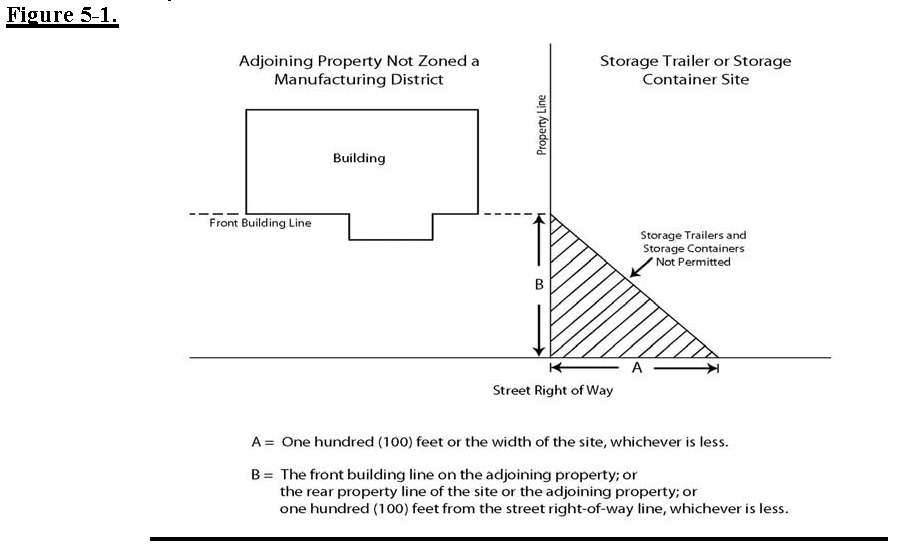
No storage trailer or storage container shall be used, maintained, or placed in a manner so as to negatively impact access or visibility from a major street for any properties adjoining the site. Conformance with the requirement of maintaining visibility for the adjoining property shall only be required when the adjoining property is not zoned a manufacturing district. The visibility requirement shall be met by not placing storage trailers or storage containers on the site within a triangle defined by (Figure 5-1):
a.
The common property line with the adjoining property;
b.
The street right-of-way line; and
c.
A line that originates on the street right-of-way line 100 feet from the common property line with the adjoining property, or the width of the site, whichever is less; and ends where the front building line on the adjoining property intersects the common property line, or at the rear property line of the site or the adjoining property, or 100 feet from the street right-of-way line, whichever is less. The front building line is defined using the longest plane of the front building facade and excludes minor projections such as entry ways, porches, and bays.
10.
No storage trailer or storage container shall be stacked on top of another storage trailer or storage container, or on top of any building. Storage trailers and storage containers may be stacked when stored on the sites where the provision of such storage trailers or storage containers is a principle use if the trailers and containers are empty and properly secured based on accepted industry standards.
11.
No storage trailer or storage container shall be used, maintained, or placed in a manner so as to constitute a public nuisance under any provision of the City Code.
(c)
Residential districts. Storage trailers and storage containers are permitted in all residential zoning districts subject to the following restrictions, requirements and limitations.
1.
Short-term loading and unloading.
a.
Up to three trailers or containers may be placed on a property to be loaded or unloaded at the same time.
b.
The trailers or containers shall not be on the property for a period of more than 72 hours.
c.
The trailers or containers shall be sited on a hard surface and meet all other requirements for placement of containers.
d.
The use of trailers or containers for loading and unloading shall not be counted towards the 60-day limitation set below.
2.
Short-term storage.
a.
Only one storage trailer or storage container may be located on a property at any given time.
b.
No storage trailer or storage container shall be located on a property for a period of more than 60 consecutive days. No property shall be permitted to have a storage trailer or storage container for more than two 60-day periods in any 12-month period.
c.
The storage trailer or storage container shall be located in a legal parking space on the property.
d.
No storage trailer or storage container shall be located within 15 feet of the edge of pavement or back of curb of any street.
e.
No storage trailer or storage container shall be located in any sight triangle of intersecting rights-of-way as defined in this article.
f.
No storage trailer or storage container shall be used in conjunction with, or associated with, a home occupation.
g.
No hazardous materials shall be stored in a storage trailer or storage container placed on the property.
(d)
Construction projects not requiring a building permit. Storage trailers and storage containers are permitted in conjunction with construction projects subject to the following restrictions, requirements, and limitations.
1.
The use of storage trailers and storage containers is limited to the storage of tools or building supplies needed for a construction project or personal property of the owner or tenant of the building on the property that is being built on or remodeled.
2.
All storage trailers and storage containers shall be located on the property where the work is being performed.
3.
In nonresidential zoning districts, storage trailers and storage containers used in conjunction with construction projects must be located on the property in such a manner so as to not occupy:
a.
Open space;
b.
Sight triangles;
c.
Easements;
d.
Detention facilities;
e.
Bufferyard;
f.
Perimeter landscaping areas; or
g.
Required parking as defined in this article and in the design standards for public improvements for the City of Springfield. If located in residential zoning districts, the location shall be as stipulated in paragraph (c).
4.
No storage trailer or storage container may be stacked one on top of another storage trailer or storage container or on top of any building.
5.
All storage trailers or storage containers shall be removed from the property within 14 days of completing the construction project.
6.
No hazardous materials shall be stored in the storage trailer or storage container placed on the property.
(e)
Recycling containers. Storage trailers and storage containers used as recycling containers are permitted in all nonresidential zoning districts subject to the following restrictions, requirements, and limitations.
1.
The use of the storage trailer and storage containers is limited exclusively to materials to be recycled.
2.
All storage trailers and storage containers shall be located on the property in such a manner so as to not occupy setback, required parking spaces, open space, sight triangle, easement, detention facilities, bufferyard or perimeter landscaping areas as defined in this article and in the design standards for public improvements for the City of Springfield.
3.
No storage trailer or storage container may be stacked one on top of another storage trailer or storage container or on top of any building.
4.
Each storage trailer or storage container must be located on the property in a location that is in compliance with the fire code and this article.
5.
No storage trailer or storage container may be located in the required front yard. All storage trailers and storage containers must be a minimum of 25 feet from any street and a minimum of 50 feet from any residential district.
6.
The storage trailer or storage container shall not be used for any purpose other than that of recycling as specified in this subsection.
(f)
Signage. For the purpose of this section, all signage on storage containers and storage trailers shall be in accordance with subsection 36-454(4)(h) of this article.
(g)
Nonconforming storage trailers and storage containers. Storage trailers and storage containers that are not lawfully conforming at the time of the adoption of this subsection must come into compliance or be removed by March 20, 2011.
(Zoning Ord., § 5-1000; G.O. 4733, 8-18-97; G.O. 5127, 10-29-01; G.O. 5425, 11-15-04; G.O. 5533, 4-3-06; G.O. 5671, 4-23-07; G.O. 5842, 11-9-09; G.O. 5895, 9-20-10; G.O. 5900, 10-4-10; G.O. 6195, Exh. D, 5-11-15; G.O. 6467, § 1(Exh. A), 7-16-18)
Sec. 36-451. - Home occupations.
(1)
Purpose. This section is designed to define what constitutes a home occupation and to enumerate the particular home occupations that are permitted. A home occupation is a privilege granted to a resident which should not be a nuisance to other residents. A home occupation may be continued for only so long as it is conducted lawfully and does not produce a condition which causes a nuisance including, but not limited to, those enumerated in chapter 74, Springfield City Code. Violations of this section may result in the loss of the ability to operate the home occupation. No home occupation shall be permitted if it:
(a)
Changes the outside appearance of the dwelling or is visible from the street;
(b)
Generates traffic, parking, sewage, water use, or noise in excess of what is normal in a residential neighborhood;
(c)
Creates a hazard to person or property, results in electrical interference or becomes a nuisance; or
(d)
Results in outside activities, storage, or display.
(2)
Definition. An activity carried out for compensation in a residential dwelling unit.
(3)
Home occupations permitted. Home occupations include, but are not limited to, the following occupations:
(a)
Home offices for architects, engineers, lawyers, realtors, insurance agents, brokers, ministers, rabbis, priests, salesmen, sales representatives, manufactures representatives, home builders, home repair contractors, trash haulers and similar occupations.
(b)
Artists, sculptors, authors, photographers and composers.
(c)
Computer programming and data processing.
(d)
Direct sale product distribution (Amway, Avon, Tupperware, etc.) provided parties for the purpose of selling merchandise or taking orders shall not be held more than once a month, shall be limited to ten customers and shall be held between the hours of 9:00 a.m. and 10:00 p.m.
(e)
Dressmakers, seamstresses, and tailors.
(f)
Home crafts, such as model making, rug weaving, woodworking, ceramics (with a kiln up to six cubic feet) and similar activities, provided that no machinery or equipment shall be used or employed other than that which would customarily be found in the home, including machinery or equipment that would ordinarily be employed in connection with a hobby or avocation not conducted for gain or profit.
(g)
Mail order, not including retail sales from site.
(h)
Music and art teachers or other tutoring services.
(i)
Renting sleeping rooms and serving meals to not more than two persons not members of the family occupying the dwelling unit for more than 30 days provided on off-street parking space is provided for each person.
(j)
Telephone answering.
(k)
Washing and ironing.
(l)
"Work at home" activities where employees of a business, located at another location, perform work for the business in their own residence, provided all physical contact between the business and the employee occurs at the place of business and not the residence, other than the initial installation of any equipment or other work facilities. The work activities of the employee shall conform with all other requirements of this section.
(m)
Performing any acts of cosmetology or acupuncture for compensation, provided:
1.
Only one customer is allowed in the home at a time; and
2.
Hours of operation for this home occupation shall be limited to 7:00 a.m. to 7:00 p.m.; and
3.
Use is limited to single-family homes; and
4.
The use complies with all building and other applicable city codes and State of Missouri regulations and standards.
(n)
Preparation of food for sale, operating in compliance with Springfield-Greene County Health Department and adopted Missouri Food Code with the following restrictions:
1.
Only non-potentially hazardous processed food may be sold, sampled, or served, including, but not limited to breads, cookies, fruit pies, jams, jellies, preserves, fruit butters, honey, sorghum, cracked nuts, packaged spices and spice mixes, dry cookie, cake, bread, and soup mixes, but excluding low acid canned and/or acidified foods as specified in the Code of Federal Regulations, Title 21, Part 113 and 114 respectively;
2.
Only the individual actually producing the food, or an immediate family member residing in the producer's household with extensive knowledge about the food, may sell, sample or serve food;
3.
Food may only be sold, sampled or served directly to the end customer;
4.
All processed packaged foods shall bear a label stating the name and address of the manufacturer/processor preparing the food, common name of the food, name of all the ingredients in the food in order of predominance, the net weight of the food in English or metric units, and a statement that the product is prepared in a kitchen that is not subject to inspection by the Springfield-Greene County Health Department. It is recommended that honey manufacturers/processors include this additional statement to their product label: "Honey is not recommended for infants less than twelve (12) months of age"; and
5.
The consumer is informed by a clearly visible placard at the sales or service location that the food is prepared in a kitchen that is not subject to inspection by the Springfield-Greene County Health Department if the foods specified in subsection 36-451(3)(n)1., are sold, sampled or served in unpackaged, individual portions. The Springfield-Greene County Health Department shall have final authority in determining whether a food is non-potentially hazardous and may enjoin individuals who violate the provisions of this subparagraph from selling, sampling or serving these foods.
(4)
Use limitations.
(a)
No person other than someone related by blood, marriage, adoption, or custodial relationship to the person conducting the home occupation and who also resides in the dwelling unit shall be employed in the home occupation.
(b)
The home occupation shall be conducted entirely within the principal residential building or in a permitted accessory building.
(c)
No manufacturing or processing of any sort whatsoever shall be done, except as permitted by subsection 36-451(3)(f).
(d)
No sign shall advertise the presence or conduct of the home occupation.
(e)
No stock in trade shall be displayed or sold.
(f)
No stock in trade, except articles produced by members of the family residing on the premises, shall be stored on the premises.
(g)
No alteration of the principal residential building shall be made which changes the character thereof as a dwelling, including the creation of a separate entrance to the dwelling or utilization of an existing entrance exclusively for the home occupation unless specifically required by state licensing provisions.
(h)
The home occupation shall not produce offensive noise, vibration, smoke, electrical interference, dust, odors or heat. Any noise, vibration, smoke, electrical interference, dust odors, or heat detectable beyond the property lines or beyond the walls of the dwelling unit, if the unit is part of a multifamily structure, shall constitute a violation of this section.
(i)
No mechanical or electrical equipment other than normal domestic or household equipment shall be used.
(j)
There shall be no outdoor storage of equipment or materials used in the home occupation.
(k)
The receipt or delivery of merchandise, goods, or supplies for use in a home occupation shall be limited to the United States mail, similar parcel delivery service, or private vehicles with a gross vehicle weight rating of 10,000 pounds or less.
(l)
Not more than one vehicle shall be utilized in the business.
(m)
No customer waiting areas shall be provided.
(n)
No vehicles shall be parked and no equipment or materials shall be stored for trash haulers, home builders, home repair contractors, and similar occupations.
(o)
A business license shall be obtained, if required, by other ordinances.
(p)
No more than 20 percent of the total floor area of the dwelling unit and garage shall be devoted to the home occupation. A garage shall not be used for a home occupation if such use has the effect of eliminating required parking.
(q)
Appropriate plans, showing conformance with this section, shall be approved by the director of building development services.
(5)
Particular home occupations prohibited. Permitted home occupations shall not in any event be deemed to include the following types of activities and uses:
(a)
Animal hospitals, stables, or kennels.
(b)
Auto repairing and painting.
(c)
Boarding and lodging houses, unless specifically permitted by the district regulations.
(d)
Dancing schools and studios.
(e)
Dispatching of transfer and moving vans.
(f)
Furniture repairing and refinishing.
(g)
Medical offices for doctors, dentists, and veterinarians.
(h)
Nursery schools and day care centers, unless specifically permitted by the district regulations.
(i)
Palm reading or fortune telling.
(j)
Photofinishing.
(k)
Portrait studios.
(l)
Preparation of food for sale, except as permitted by section 36-451(3).
(m)
Private clubs.
(n)
Radio and television repair shops.
(o)
Raising animals for sale.
(p)
Restaurants.
(q)
Shops for contractors and tradesmen, such as electricians, plumbers, and carpenters.
(r)
Sign painting.
(s)
Trash hauler operations other than a home office.
(t)
Escort services.
(Zoning Ord., § 5-1100; G.O. 4781, 3-2-08; G.O. 5594, 8-21-06; G.O. 6497, § 1, 1-28-19; G.O. 6520, § 1, 4-22-19; G.O. 6574, § 1, 2-24-20; G.O. 6624, § 1, 11-30-20; G.O. 6703, § 2, 1-24-22)
Sec. 36-452. - Temporary uses.
(1)
Purpose. This section is designed to gather into one section regulations regarding those land uses and structures which are needed, or are in place, for only short periods of time. Some of such uses are permitted in all zoning districts either because they are useful or necessary or because they do not adversely impact surrounding property. Other temporary uses that may substantially impact nearby properties are permitted only in districts in which they are compatible with the permanent permitted uses. Such temporary uses, except temporary vendors, shall be permitted without requiring additional off-street parking. Temporary vendors shall be permitted only if the required parking for the uses on the subject property, including temporary vendors, is not reduced.
(2)
Site plan review not required. Site plan review, under the requirements of section 36-360, site plan review, is not required for temporary uses regulated by this section because of the temporary nature of such uses.
(3)
Temporary uses permitted.
(a)
The following temporary uses of land are permitted in any zoning district subject to the specific regulations and time limits which follow, and to the other applicable regulations of the district in which the use is permitted:
1.
Contractor's office and equipment trailers and sheds (containing no sleeping or cooking accommodations) accessory to a construction project are permitted only during the duration of such project and shall be located on the same property or on property in a district in which the use being constructed is allowed.
2.
Real estate offices (containing no sleeping or cooking accommodations unless located in a model dwelling unit) incidental to a new housing or other development to continue only until the sale or lease of all dwelling units in the development.
3.
Mixing plants for cement, asphalt or paving material, staging areas and materials storage areas subject to the following restrictions:
a.
The temporary use is accessory to a project for the construction of streets or other public improvements.
b.
The temporary use is located on the same property or right-of-way, or directly adjacent to the same property or right-of-way, as the construction project.
c.
The temporary use shall be removed upon completion of the construction project.
d.
The applicant shall provide a plan for controlling traffic between the temporary use and the construction project, approved by the traffic engineer, and adequate evidence that said plan will be implemented.
e.
The applicant shall provide a plan for adequately ensuring that during actual operations there will be no adverse environmental impact on adjacent and nearby properties. Said plan shall include provisions for noise abatement, sanitary needs, dust, and litter controls. Any violation of said plan shall provide grounds for an immediate revocation of a permit granted under the provisions of this section.
f.
A permit for such use has been issued by the director of building development services finding that all of the foregoing conditions have been, or will be, satisfied.
4.
Temporary wireless facilities towers for special events provided the temporary tower does not exceed 60 feet in height and a permit shall not be issued for a period of time exceeding two days preceding and following the special event. Temporary towers may also be located on the same site as an approved permanent tower during the period that the permanent tower is being constructed.
5.
Farmers' markets, subject to the following restrictions:
a.
The farmers' market may only be located on the same site as a legally established nonresidential use(s).
(i)
A site plan shall be submitted to, and approved by, the building development services department showing conformance with the requirements of the zoning ordinance, adopted standards, and other city codes;
(ii)
All farmers' market uses shall be in compliance with all applicable codes and standards of the Springfield City Code; and
(iii)
A permit for such use has been issued by the director of building development services finding that all of the standards have been, or will be, satisfied. The director of building development services is authorized to issue a cease and desist order to any party violating the adopted standards along with any other enforcement measures available to the director or the city.
b.
Every farmers' market vending site shall be required to have a building or site permit issued by the director of building development services prior to commencement of operation. The property owner shall apply for the building or site permit.
6.
Automated teller machines (ATMs), subject to the following restrictions:
a.
Must be located on ten acres or more; and
b.
Must be located along and have access to a secondary arterial or higher classified roadway; and
c.
A site plan shall be submitted to, and approved, showing conformance with the requirements of the zoning ordinance, adopted standards, and other city codes; and
d.
Such use shall cease to exist no later than 24 months from the issuance of the building permit; and
e.
No more than one ATM is allowed per site; and
f.
Issuance of this permit shall not give any legal nonconforming status to the site, and under no circumstance shall the use exist longer than 24 months as set forth in subsection d.
(b)
The following uses of land are permitted in the specific zoning districts listed, subject to the restrictions in this section and the other applicable restrictions in the district or districts in which the temporary use is permitted:
1.
In residential districts. Non-profit, fund-raising events on residential properties, such as, the Springfield Symphony Guild's Designer's Showcase, subject to the following restrictions:
a.
No more than one permit shall be issued on the same property in a 36-month period, and the permit shall not exceed a period of 21 days exclusive of a reasonable period to prepare the property prior to the event and restore the property after the event is complete.
b.
Activities related to the event shall be limited to a daily period extending from 9:00 a.m. to 10:00 p.m.
c.
Lighting, activities, noise, or increased traffic associated with an event shall not unreasonably disturb surrounding residential neighborhood.
d.
The applicant shall provide a reasonable plan for traffic control and parking approved by the traffic engineer and adequate evidence that said plan will be implemented.
e.
The applicant shall provide a plan for adequately ensuring that during actual operations there will be no adverse environmental impact on adjacent and nearby properties. Said plan shall include provisions for noise abatement, sanitary needs, dust, and litter controls. Any violation of said plan shall provide grounds for an immediate revocation of a permit granted under the provisions of this section.
f.
A permit for such event has been issued by the director of building development services finding that all of the foregoing conditions have been, or will be, satisfied.
2.
Temporary vendors, sites in the GR, HC, CS, GI, CC, COM, LI, GM, HM and IC districts, subject to the following restrictions:
a.
A site plan providing the following information shall be submitted to, and approved by, the building development services department showing conformance with the requirements and standards of the zoning ordinance and other city codes;
(i)
The legal description of the site.
(ii)
A full site plan showing the proposed location of the temporary vendor site and showing that the site does not encroach into the required setbacks of site triangles.
(iii)
Show that the vendor site location will not encroach into the required parking spaces.
(iv)
Submit a parking schedule indicating the total number of parking spaces for the site, the total spaces required for the permanent business and the use of the permanent business.
(v)
Show the location of the accessible restroom facilities for each gender. They must be located within 500 feet of the temporary vendor site and within a permanent structure.
b.
All temporary vendor uses shall be in compliance with all applicable codes and standards of the Springfield City Code.
3.
In the GI, GR, HC, CS, LI, GM, HM, and IC districts.
a.
Christmas tree sales for a period not to exceed 60 days. Display of Christmas trees need not comply with the yard and setback requirements of this article, provided, that no tree shall be displayed within 30 feet of the intersection of the curb line of any two streets or any sight triangle required by subsection 36-453(6).
b.
Temporary promotional activities subject to the following restrictions:
(i)
No permit shall be granted for a period exceeding six days exclusive of a reasonable period during which the promotional uses are erected or taken down.
(ii)
No more than two permits for a temporary promotional use for the same property shall be issued during any six-month period.
(iii)
Temporary promotional uses shall be limited in number to not more than five carnival rides, amusement rides, or other similar amusements, and no games, side shows, tents shelters, concessions, or other similar uses shall be employed or associated therewith. Carnival rides, amusement rides, and other similar amusements shall not be located within 400 feet of the lot line of occupied residential property except as permitted by [paragraph] (viii) below.
(iv)
Reserved.
(v)
Retail businesses may display merchandise that is for sale within the building in the area immediately adjacent to the building subject to the following conditions:
A.
No portion of the display shall be on publicly owned property unless the applicant shall first have obtained approval for such use from the director of building development services.
B.
No food or drink may be displayed outside the building except in accordance with standards and prior written approval of the department of public health and welfare.
C.
These provisions shall in no way be deemed to authorize the outdoor display or the sale of used furniture, appliances, housewares, or other second-hand merchandise in those districts which do not otherwise permit such uses.
(vi)
In granting a permit for a temporary promotional use, the director of building development services shall determine that pedestrian and vehicular traffic will not be impaired by such temporary use. The director of building development services must also determine that the applicant has a reasonable plan for traffic control approved by the traffic engineer and has provided adequate evidence that said plan will be implemented.
(vii)
No permit shall be granted where the lighting, promotional activities, noise or increased traffic associated therewith will unreasonably disturb the surrounding residential neighborhoods.
(viii)
No temporary promotional use shall be located within 300 feet of the lot line of occupied residential property, except for the display of goods and merchandise where a building is located between the temporary promotional use and the occupied residential property so that the occupied residential property is completely shielded from the temporary promotional use.
(ix)
Each temporary promotional use shall cease its daily operation for more than one-half hour after the closing of the associated commercial uses, except in no event shall the promotional use operate after 10:00 p.m. or prior to 8:00 a.m.
(x)
Reserved.
(xi)
A permit for such activity has been issued by the director of building development services finding that all of the foregoing conditions have been, or will be, satisfied.
(4)
Temporary and mobile vendor requirements. All temporary and mobile vendors must be located on an approved temporary vendor site and shall not occupy an approved vendor site for a period of time greater than 180 days in a calendar year.
(Zoning Ord., § 5-1200; G.O. 4925, 9-27-99; G.O. 5019, 10-23-00; G.O. 5127, 10-29-01; G.O. 5823, 6-15-09; G.O. 5094, 7-9-01; G.O. 5880, 7-26-10; G.O. 6010, 8-27-12; G.O. 6195, Exh. D, 5-11-15; G.O. 6495, § 1, 1-14-19)
Sec. 36-453. - Supplemental open space and yard regulations.
(1)
Front yard regulations. All property shall have a front yard of not less than prescribed by this article unless otherwise permitted within this section:
(a)
On interior lots, a new building other than garages or carports may be erected, structurally altered, or enlarged within the minimum required front yard setback only if both adjacent lots fronting the same street are developed and the existing front yard setback on both lots is less than the minimum front yard setback required by the zoning district. In such case, the front yard setback line shall not be less than the setback of the two adjacent developed lots fronting the same street.
(b)
On corner lots, a new building other than garages or carports may be erected, structurally altered, or enlarged within the minimum required front yard setback only if the adjacent lot fronting the same street is developed and the existing front yard setback on the lot is less than the minimum front yard setback required by the zoning district. In such case, the front yard setback line shall not be less than the setback of the adjacent developed lot fronting the same street; nor, shall the building be located in any area formed by a triangle measured 25 feet along the right-of-way lines from the intersection of adjacent right-of-way lines.
(c)
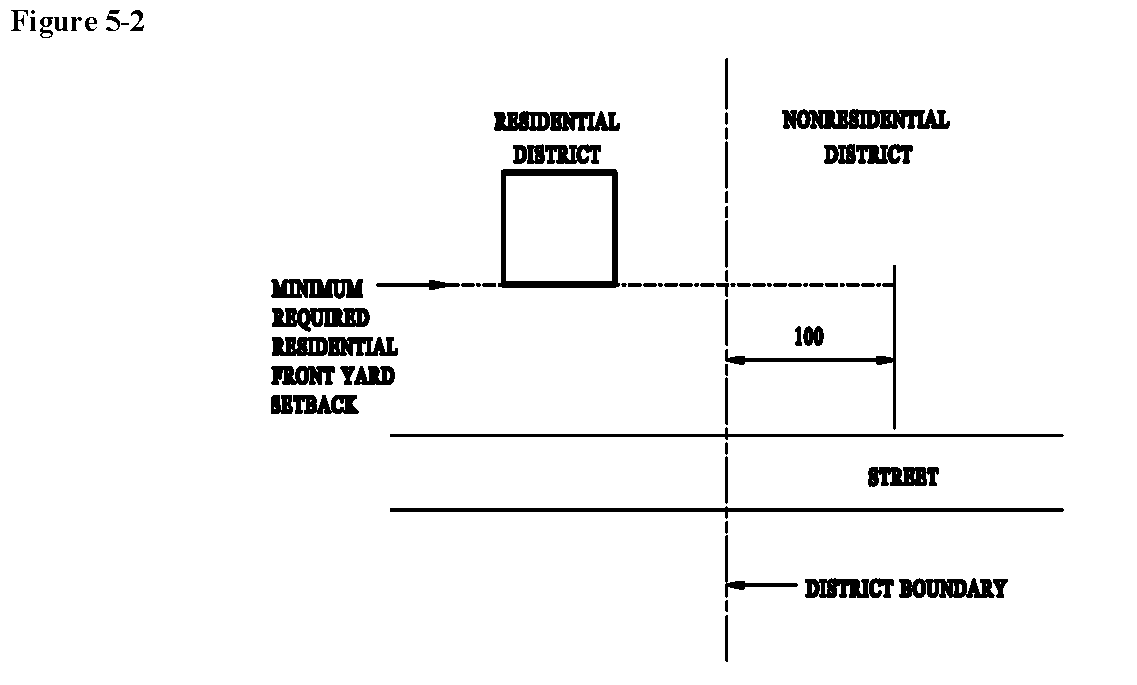
Where property on one side of the street between two intersecting streets, is located in a nonresidential district and a residential district, the front yard setback required in the residential district shall apply to the nonresidential district. This requirement shall not apply beyond the first 100 feet of frontage zoned nonresidential (Figure 5-2). No parking is permitted within the required front yard setback.
(d)
On cul-de-sacs, the front yard setback line shall be located on the lot so that it is parallel to a line drawn tangent to the cul-de-sac right-of-way line at the center of the lot frontage. The front yard setback line shall be located at a distance from the cul-de-sac right-of-way line where the length of the front yard setback line is equal to the minimum lot width required in the zoning district and the resulting front yard setback is at least equal to the minimum required in the zoning district.
(2)
Side yards—Corner lots.
(a)
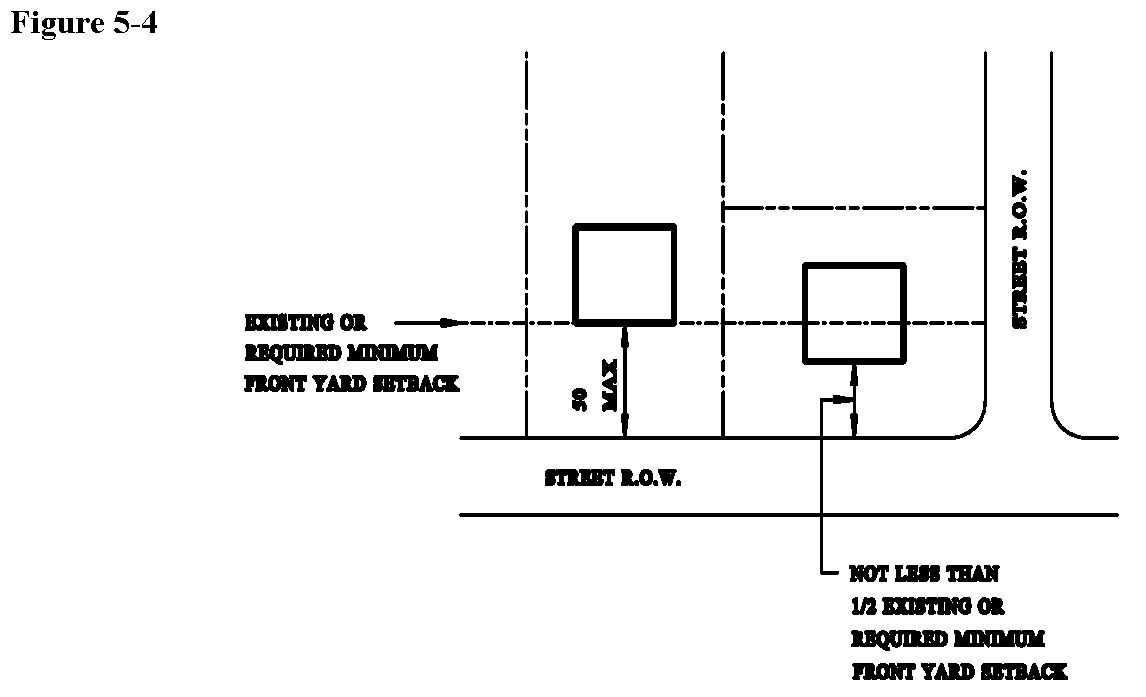
On a corner lot, the side yard requirement shall be the same as for interior lots except when the lot to the rear of the corner lot faces the street adjacent to the side of the corner lot, in which case the corner lot shall have a side yard, adjacent to the street, equal to not less than one-half the existing or required front yard setback of the lot to the rear of the corner lot, whichever is greater. However, existing buildings with a front yard setback greater than 50 feet shall be figured at 50 feet when determining the average setback line (Figure 5-4).
(b)
Garage doors for residential uses shall be located a minimum of 20 feet from the side lot line, unless the required setback is greater, when the vehicular access to a lot is from a street adjacent to the side lot line and the garage door is generally parallel to the side lot line.
(3)
Yards open. Except as specified in this section, yards required by this article shall be open and unobstructed to the sky.
(4)
Exceptions as to yard regulations. The following exceptions shall be made as to yard and area regulations:
(a)
Peculiar shape of yard. Where the yard regulations cannot reasonably be complied with or their application determined on lots of peculiar shape or location on hillside lots, such regulations may be modified or determined by the board of adjustment, as provided in section 36-365, variances.
(b)
Variations from major thoroughfare plan. Where the city council has adopted right-of-way of greater or lesser width from those established by the major thoroughfare plan of the city, the right-of-way as established by the city council shall apply. That right-of-way width shall be used in determining yard requirements.
(c)
Lot width regulation modified. Where an odd-shaped lot has more than the required area for its particular district, the width of such lot may be computed in the most buildable portion having minimum area requirements; provided it complies with all bulk and open space requirements for the particular district.
(d)
Parking area in rear yard. A parking area may occupy a required rear yard or any part thereof if in conformance with sections 36-480, screening and fencing, and 36-482, landscaping and bufferyards.
(e)
Loading space in rear yard. A loading space may occupy a required rear yard or any part thereof provided the adjacent rear lot is designated the same or a more intense zoning classification and if in conformance with sections 36-480, screening and fencing, and 36-482, landscaping and bufferyards.
(f)
Building line established on approved final plat. If a building line, on an approved final plat, establishes a setback greater than required by this article, the setback on the final plat shall be required.
(5)
Permitted projections and structures in required yards. The following shall not be considered to be obstructions when located in a required yard:
(a)
In all yards.
1.
Cornices, eaves, gutters, belt courses, sills, awnings, canopies or other similar architectural features, shall not extend or project into a required side yard more than two feet and shall not extend or project into a required front or rear yard more than three feet.
2.
Open, unenclosed fire escapes shall not extend or project into any front, side or rear yard more than four feet.
3.
Open, unenclosed stairways or balconies, not covered by a roof or canopy, shall not extend or project into a required rear yard more than three feet, and such balconies shall not extend into a required front yard more than three feet.
4.
Enclosing or temporary enclosing of open porches, steps, platforms, carports or landing places and outside open stairways which extend into minimum required yards is prohibited.
5.
Any retaining wall shall be permitted in any required yard.
6.
Any fence or hedge, in the front yard shall comply with the provisions of subsection 36-453(6).
7.
Fixed awnings, canopies, and marquees shall be located at least eight feet above the sidewalk and shall not project closer than two feet to the curb line.
8.
Attached or detached pump island canopies and customer service shelters in commercial and industrial districts may extend to the vertical plane of the front and side property lines subject to the following conditions:
a.
The minimum height from the underside of the roof to the average ground level shall be 13½ feet.
b.
No portion of the structure shall be located in or over any existing or required utility easement without prior written approval of the appropriate agency.
c.
No portion of the structure shall be located in or over the required right-of-way of an adjacent street based on the classification of the street (subsection 36-303(17)).
d.
The area beneath the roof shall be open and unobstructed to the ground level except for pump islands, fuel pumps, tables, chairs, and trash receptacles.
e.
Decorative boxes and plantings shall not exceed three feet above ground level.
f.
Attendant service booths located on the service island may be permitted and shall not be located closer to the front property line than the minimum required building setback line.
g.
Advertising signs shall be prohibited on any portion of the roof and supporting posts or columns.
h.
Two vertical clearance signs and two customer directional signs not exceeding one and one-half square feet in area and located at least eight feet above ground level shall be permitted.
i.
Structures shall not occupy more than 50 percent of the area between the required building setback line and the vertical plane of the front property line.
9.
Open terraces, not including permanently roofed-over terraces or porches, shall not extend more than ten feet into a required yard provided said terrace is at least ten feet from the rear or front lot line, three feet from the side lot line on interior lots and five feet from the side lot line adjacent to the street on corner lots and not over four feet above the average level of the adjoining lot.
10.
One-story bay windows shall not project more than 30 inches into a yard.
11.
Chimneys may project 18 inches or less into the yard, provided that such projection does not reduce the width of a side yard to less than three feet.
12.
Statuary, arbors and trellises.
13.
Flag poles.
14.
Signs, when permitted by section 36-454, signs.
15.
Open porches, platforms, landing places and carports that do not extend above the first floor of the building shall not project more than ten feet into any yard provided, and said projection shall be at least ten feet from the rear or front lot line, three feet from the side lot line on interior lots and five feet from the side lot line adjacent to the street on corner lots.
16.
Air conditioning machinery located on an exterior pad.
17.
Surface parking in an office, institutional, business, commercial or industrial zoning district.
18.
Automatic teller machines (ATMs).
19.
Telephone booths.
(b)
In any yard except a front yard:
1.
A child's playhouse or a storage building not exceeding 100 square feet in gross floor area and ten feet in height.
2.
Recreational equipment and clotheslines.
3.
Fences not exceeding seven feet in height and which comply with the provisions of subsection (6).
(6)
Vision obstruction restrictions.
(a)
Front yards.
1.
No obstructions in front yards. On any lot on which a front yard is required by this article, no wall, fence or other structure shall be erected and no hedge, tree, shrub, or other growth or object of any kind shall be maintained in such location within such required front yard so as to obstruct the view, except as permitted by this subsection.
2.
Fences in front yards.
a.
Open fences not exceeding 50 percent screening and four feet in height above yard grade shall not be deemed to obstruct the view.
b.
The square footage of the open voids shall be measured by taking the total square footage of an area defined by the length of the fence and a height of four feet above yard grade, and subtracting the total square footage of screening within the fence. The percent of open voids shall then be derived by dividing the total square footage of the open voids by the total square footage of the area calculated above, and multiplying this figure by 100. The fence's framing (the vertical posts supporting the fence from the ground and no more than two horizontal cross bars between the posts) shall not be included in the calculation of the total square footage of screening, provided the framing posts and cross bars do not exceed a four-inch width and the posts are spaced at least eight feet apart. If the fencing is placed between brick or stone pillars, these pillars shall be included in the calculation of the total square footage of screening.
c.
Questions regarding the yard grade shall be resolved by the director of the department of building development services.
d.
A building permit, at no charge, shall be required to construct a fence in any required front yard.
3.
Vegetation in front yards. Hedges, shrubbery, flowers, or other similar vegetation planted to form a continuous line of growth shall not exceed a height of four feet.
(b)
Sight triangles.
1.
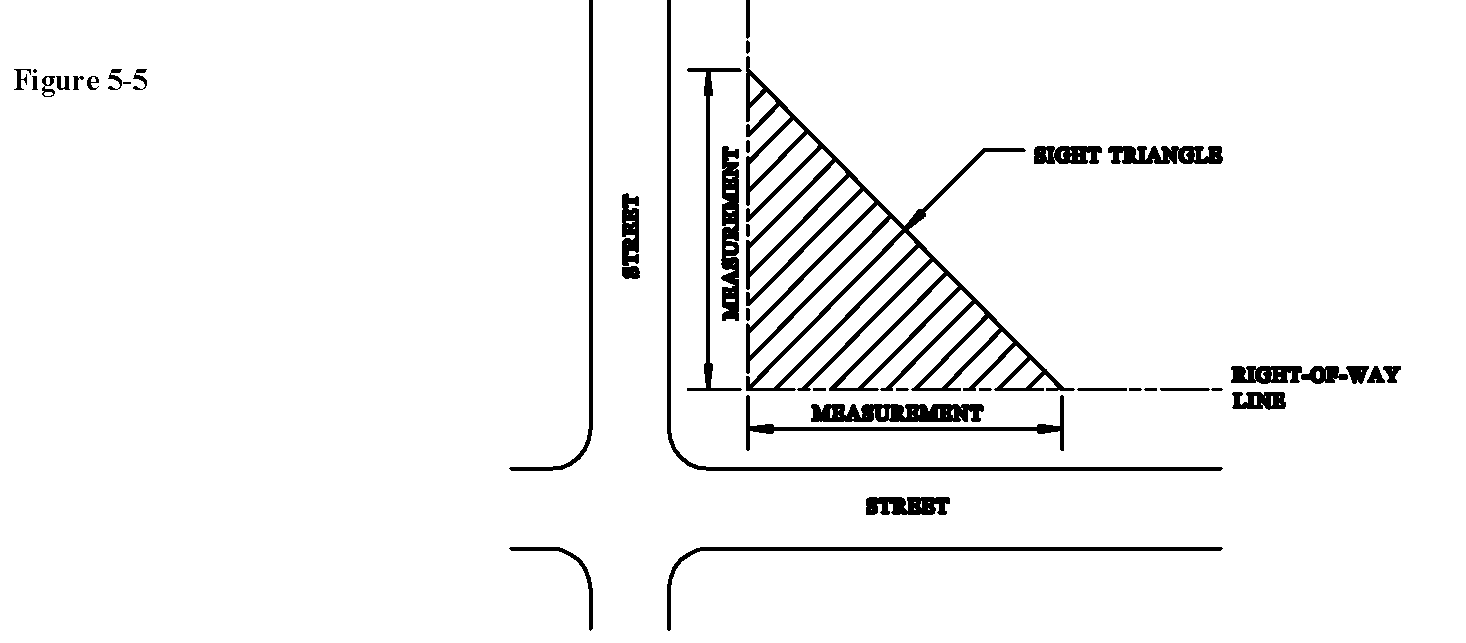
Street intersections. Standards for street intersection sight triangles shall reflect the street classification as identified in the major thoroughfare plan. The conditions below indicate the minimum requirements for sight triangles as measured along the required right-of-way (Figure 5-5). The city traffic engineer may require additional triangle area for clear sight and safety as determined by a traffic study for special conditions. The administrative review committee may, upon concurrence of the city traffic engineer, modify the sight triangle requirements if it can be demonstrated to the satisfaction of the administrative review committee that the modified sight triangle will provide clear sight and safety.
Sight Triangle Requirements
2.
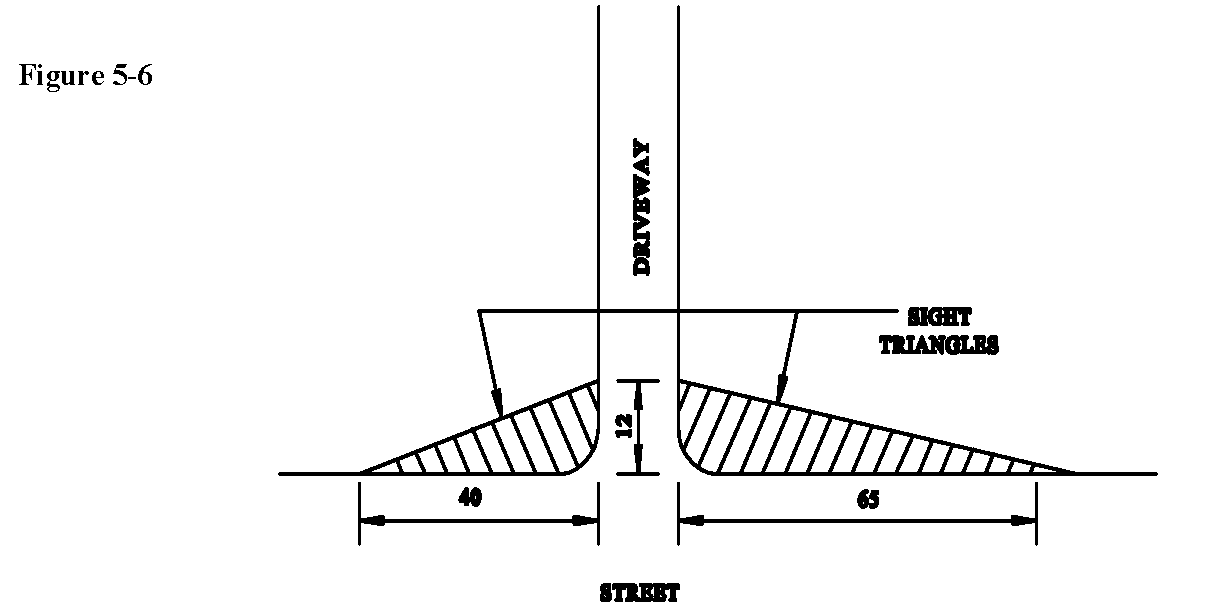
Street/driveway intersections. A street/driveway sight triangle is the triangle formed by the intersection of a public street and a driveway where the triangle area is that area encompassed within two intersecting lines formed by the edge of the pavement, curb, roadway, or projection thereof, and extending 40 feet down the street from the right edge of the driveway when standing in the driveway facing the street, and extending 12 feet from the edge of the street up the driveway pavement, and a third imaginary line connecting the extremities of the other two without overlaying the pavement. On the left side of the driveway, the triangle shall be calculated by measuring 65 feet down the street pavement from the edge of the driveway and measuring 12 feet down the driveway pavement from the edge of the street, and a third imaginary line connecting the extremities of the other two without overlaying the pavement (Figure 5-6). The administrative review committee may, upon concurrence of the city traffic engineer, modify the sight triangle requirements of this section if it can be demonstrated to the satisfaction of the administrative review committee that the modified sight triangle will provide clear sight and safety.
3.
No obstructions permitted. No wall, fence, other structure, hedge, tree, shrub, flower, other vegetation, or landscaping materials over two feet in height shall be placed within the sight triangle formed by the intersection of two public streets, as defined in subsection (6)(b)1. or within the sight triangle formed by the intersection of a public street and a driveway, as defined in subsection (6)(b)2. However, a single tree having a single trunk shall be allowed in a sight triangle provided the tree is pruned to a height of eight feet above the lowest grade of such intersecting streets.
(7)
Yard requirements for open land. If a lot is, or will be, occupied by a permitted use without buildings or structures, then the minimum front, side and rear yards that would otherwise be required for such lot shall be provided and maintained unless some other provision of this article requires or permits a different minimum front, side or rear yard. Front, side, and rear yards shall not be required on lots used for garden purposes without structures, or on lots used for open public recreation areas.
(Zoning Ord., § 5-1300; G.O. 5127, 10-29-01; G.O. 5345, 1-26-04; G.O. 5846, 12-14-09; G.O. 5928, 4-18-11; G.O. 6284, 6-13-16; G.O. 6576, § 1, 3-9-20)
Sec. 36-454. - Signs.
(1)
Purpose. Signs use private land and the sight line created by public rights-of-way to inform and persuade the general public by publishing a message. This section provides standards for the erection and maintenance of signs. All signs shall be erected and maintained in accordance with these standards. The general purpose of these standards is to promote, preserve, and protect the health, safety, general welfare, convenience, and enjoyment of the public, to preserve and protect the aesthetic quality of Springfield, and to achieve the following:
(a)
Safety. To promote the safety of persons and property by providing that signs:
1.
Create a hazard due to collapse, fire, collision, decay, abandonment, or other safety considerations;
2.
Obstruct firefighting or police surveillance;
3.
Impair the driver's ability to see pedestrians, obstacles, or other vehicles, or to read traffic signs and signals; and
4.
Otherwise interfere with or detract from the safety of persons or property.
(b)
Communications efficiency. To promote the efficient transfer of information in sign messages by providing that:
1.
Customers and other persons may locate a business or service;
2.
No person or group is arbitrarily denied the use of the sight lines from the public right-of-way for communication purposes; and
3.
The messages in signs may otherwise be communicated efficiently.
(c)
Landscape quality and preservation. To protect the public welfare and to enhance the appearance and economy of the city, by providing that signs:
1.
Do not interfere with scenic views;
2.
Do not create a nuisance to persons using the public rights-of-way;
3.
Do not constitute a nuisance to occupancy of adjacent property by their brightness, size, height, or movement;
4.
Do not overwhelm people by the number of messages presented, and do not interfere with the exercise of freedom of choice to observe or ignore said messages, according to the observer's purpose;
5.
Do not negatively affect the city's tourism industry;
6.
Do contribute to the special character of particular areas or districts within the city, helping the observer to understand the city and be oriented within it;
7.
Do otherwise protect and preserve a quality landscape in the city; and
8.
Do otherwise enhance the appearance and economy of the city.
(2)
Definitions. Words in the text or tables of this article shall be interpreted in accordance with the provisions set forth in this section. Where words have not been defined within this article, the standard dictionary definition shall prevail.
Animation: Any action or motion other than flashing lights, automatic changeable copy, or indexing that attempts to develop a pictorial scene through the movement of lights or parts of a sign.
Attached sign: Any sign substantially and permanently attached to, applied to, applied on, structurally connected to, painted on, engraved on, etched on, or supported by, any part of a building.
Business area: Any premises that is not defined as a non-business area.
Copy: The letters, figures, characters, representation, pictures or wording on a sign, including any identification, description, symbol, trademark, object, design, logo, illustration, or device illuminated or non-illuminated which directs attention to a product, service, place, activity, person, institution, business, or solicitation, including any permanently installed or situated merchandise; or, any emblem or painting designed to advertise, communicate, identify, or convey information.
Detached sign: Any sign other than an attached sign, including any inoperable vehicle or any trailer located for the primary purpose of advertising.
Directional sign: Any sign which serves solely to designate the location of, or direction to, any premises or area.
Electronic message sign: A sign that can be electronically or mechanically changed by remote or automatic means.
Flag: A single piece of flexible material displaying a design, symbol or script that signifies a nation, state, political subdivision, or entity.
Flashing: A pattern of changing light illumination where the sign illumination alternates suddenly between fully illuminated and fully non-illuminated for the purpose of drawing attention to the sign.
Frame effect: A visual effect on an electronic-message-center sign applied to a single frame to transition from one message to the next.
Inflatable display object: A device designed to be inflated and erected to attract public attention.
Non-business area: A premises which is zoned as R-SF, R-TH, R-LD, R-MD, R-HD, R-MH.
Off-premises sign: A sign advertising goods and services not located on the premises where the sign is located.
On-premises sign: A sign advertising goods and services located on the premises where the sign is located.
Sign: Any words, numbers, figures, devices or trademarks (by which anything is made known) used to designate an individual, a professional firm, a business, or a commodity, visible from any public street.
Sign structure: Any device which supports, or is designed to support a sign, including any decorative cover, exclusive of any copy.
Streamers: Multiple pieces of fabric, plastic, tinsel or other material designed to either flap, move, wiggle or spin in the wind, which are suspended outdoors from a single structure, pole, rope, wire or string, for the purpose of attracting public attention to the site where they are displayed.
Street grade: The highest altitude of the street vertically under any portion of the sign or its supports.
(3)
General sign provisions. The provisions of this section shall apply to all signs in the city, without regard to their location in a residential or commercial zoning district.
(a)
General prohibition. All signs are prohibited except as allowed by this article.
(b)
Public areas. No sign other than a government sign or a neighborhood identification sign reviewed and approved by the director of public works shall be allowed within or over public property or right-of-way. This section shall not be construed to prohibit the placement of signage and markings on encroachment authorized pursuant to article VII of chapter 98 of the City Code, provided that said signage and markings must comply with all other applicable provision of this section. No such signs are allowed in the right-of-way of any thoroughfare designated as a part of the Federal Aid Urban (FAU) system. When the building is located on or within three feet of the right-of-way line and the director of public works grants consent, signs may project into the right-of-way as follows:
1.
A horizontal separation of two feet from the inside curb line to the closest edge of the sign shall be maintained.
2.
The sign shall be at least ten feet above the highest level of the ground under the sign's lowest point.
3.
A license agreement shall be executed between the sign owner and/or the property owner and the City of Springfield.
(c)
Parking spaces. No detached sign shall occupy a parking space necessary to satisfy the minimum off-street parking requirements nor shall it project over the rooftop or wall of a building.
(d)
Prohibited signs. The following signs are prohibited, which:
1.
Concern unlawful activity;
2.
Operate or employ any motion picture projection in conjunction with any advertisements;
3.
Employ any searchlights or strobe lights;
4.
May be confused with or construed as a traffic control sign, signal, or device, or the light of an emergency or road equipment vehicle by reason of their size, location, movement, content, coloring, or manner of illumination;
5.
Hide from the view of those to whom the device is directed, any traffic or street sign or signal or similar device;
6.
Are temporary, except as specifically allowed in this Code.
(e)
Compliance with building codes. All signs shall be erected or affixed and maintained in compliance with the building codes and this article. In the case of conflict, the more restrictive article or code shall apply.
(f)
Streamers. Streamers are prohibited regardless of color, design, or script displayed on the streamers.
(g)
Wall signs. Wall signs do not include signs on the inside of a window.
(h)
Any sign permitted in this article may contain ideological or noncommercial copy in lieu of any other copy.
(i)
A detached sign may be located over an internal drive aisle provided a minimum of 17 feet of clearance is maintained from the bottom of the sign to the drive aisle pavement.
(j)
Off-premises signs requiring a state permit shall be separated from all other state permitted off-premises signs by 1,500 feet measured radially on all state controlled routes except I-44 which shall be 2,500 feet.
(k)
All detached signs shall be located no closer to the centerline of a street than that allowed by the right-of-way line established by the major thoroughfare plan.
Street Classification Centerline of Right-of-Way to Setback Line
Residential local .....20 feet
Commercial/industrial local .....30 feet
Collector .....30 feet
Secondary arterial .....35 feet
Primary arterial .....50 feet
Expressway .....65 feet
Freeway .....150 feet
(l)
A detached sign cannot be located in or above a utility easement unless permission is granted by director of public works or board of public utilities or the utility owning the easement.
(m)
Additional setback requirements may be mandated by the director of public works or board of public utilities if a public improvement project is scheduled to be implemented within a two-year timeline after the issuance of a sign permit.
(n)
Signs containing off-premises advertising along a state controlled route must have a valid state permit before submitting for the required city sign permit.
(o)
Detached signs located in a non-business area shall advertise only as an on-premises sign.
(p)
Detached signs located in a business area on a route not controlled by the state shall be permitted to advertise on-premises advertising only.
(q)
Detached signs located on a state controlled route as permitted by the state are permitted to advertise both on and off-premises advertising.
(r)
Detached signs located on a state controlled route that do not require a state permit but do require a city permit shall advertise only on-premises advertising.
(s)
No portion of detached sign requiring a state permit shall be located within 125 feet from any non-business area as measured radially from any portion of the sign or sign structure.
(t)
A detached sign requiring a state permit shall be located a minimum of 25 feet from all rights-of-way.
(u)
A detached sign requiring a state permit shall only be permitted within 660 feet along interstate and primary highways where the city is mandated by state law to allow off-premises signs as defined in RSMo Chapter 226.500 to 226.000. If the intersecting street is not a state controlled route the state permitted sign shall not be located within an area created by a 660-foot right triangle. One side if the right triangle shall be located along the street that is not a state controlled route and the adjoining side of the triangle shall be located 660 feet from the state controlled route right-of-way.
(v)
Any sign permitted under this article may contain ideological or non-commercial copy in lieu of any other copy.
(4)
Exempt signs. The following signs do not require a sign permit, but must conform to all other sign regulations and the building code. These signs are allowed in all zoning districts in addition to all other signs allowed under this article.
(a)
Political signs.
1.
The maximum effective area allowed in a non-business area shall be six square feet. For purposes of this section, non-business areas are properties zoned residential (R-SF, R-TH, R-LD, R-MD, R-HD, R-MHC WC3 or PD with areas designated as residential uses). A premises that has 250 feet or more frontage along one street or five acres or more, may have a sign up to 34 square feet in size.
2.
The maximum effective area allowed in a business area shall be 34 square feet. Business areas are those properties with zoning other than residential.
3.
Signs are prohibited in the city's right-of-way.
4.
Sign illumination is prohibited.
5.
Signs shall not be located within the required sight triangles.
6.
Signs must be removed within 48 hours after the election to which they were directed.
(b)
Directional signs. Detached directional signs shall not exceed five square feet in effective area. No part of the sign shall exceed four feet in height above street grade. If the grade level at the base of the sign is greater than 12 inches above the street grade, the sign shall not exceed four feet in height. Any logo, business name, product, or service identification, or other advertising shall not exceed 20 percent of the effective area.
(c)
Flag. Flags may be displayed to show allegiance, respect, or patriotism to the particular symbol or person displayed on the flag. They may not be displayed for advertising or to attract attention of the public to a particular site.
(d)
Government signs. Any sign erected or maintained by or for any agency for any governmental function or required or authorized by law, ordinance, or governmental regulation.
(e)
Internal signs. Any premises sign, the copy of which is not legible from a street right-of-way or adjoining residential property, but excluding mall signs as covered by the building codes. The sign copy shall be considered legible if the sign content exceeds one inch per 30 feet of distance from the public right-of-way.
(f)
Real estate sale, lessee, and construction signs. A non-illuminated, temporary, sign pertaining to the construction, sale, or lease, of that premises is allowed as follows:
1.
The sign shall not exceed 34 square feet in effective area in all zoning districts except the residential, single-family zoning district (R-SF).
2.
The sign shall not exceed six square feet in effective area in the residential, single-family zoning district (R-SF).
3.
All signs shall be removed within 14 days after the closing of the sale or lease or within 30 days after the issuance of an occupancy permit or erection of a permanent sign, whichever occurs first.
4.
The sign must be located on the premises of the sale, lessee or construction.
(g)
[Now hiring signs.] "Now hiring" signs shall not exceed six square feet in size.
(h)
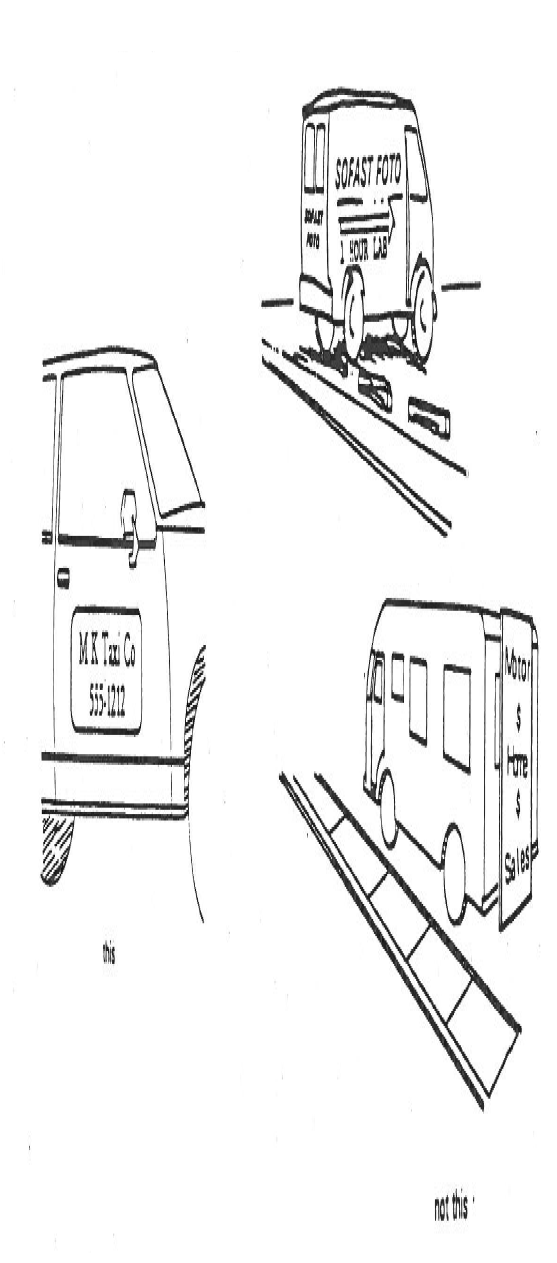
Vehicular signs. Vehicular signs must not contain any flashing or blinking lights, nor any animation. The sign may not increase the size of the surface area or alter the shape of the motor vehicle, except that a roof sign not to exceed two square feet in effective area shall be allowed. This exemption shall not include signs in transit to a site of permanent use. Provided, however, nothing in this section shall limit the use, size, or shape of political signs on vehicles.
(i)
Machinery and equipment signs. A sign located on machinery or equipment that is necessary or customary to the business, including such devices as gasoline pumps or vending machines, which devices do not increase the size of the surface area or alter the shape of the machine or equipment. Such signage shall advertise products sold on the premises where the machines are located.
(j)
Parking lot light pole banners. Parking lot light pole banners shall be located a minimum of 50 feet from any public right-of-way, and not exceed a total of ten square feet in effective area. The bottom of the banner shall be a minimum of ten feet above the parking lot grade.
(k)
City park sign. A sign on facilities located in city parks that provides information incidental to a sponsored activity, such as scoreboards, time clocks, benches, or signs in concessions stands.
(l)
Special event, temporary sign. A temporary sign not exceeding ten square feet (residential districts) and 34 square feet (commercial districts) in background area advertising drives, grand openings, or events of a civic, philanthropic, educational, religious, political or similar nature, provided that said sign is posted only during said drive or event for no more than 30 days per year and is removed within 24 hours after an event.
(m)
Attached, incidental signs. Signs that pertain to goods, products, services, or facilities available on the premises where the sign is located, but only tangentially related to the main activities or purposes of the business. These signs may not exceed a total of four square feet in effective area per business.
(n)
Window signs. Lettering on the exterior face of a window stating the days and times that the business is open.
(5)
Temporary signs.
(a)
Temporary signs in non-business areas—General provisions. Any premises in a non-business area may display one non-illuminated, temporary sign of up to four square feet in effective area for up to two consecutive days twice each calendar year. No permit is required for this sign. No other temporary signs may be used in non-business areas except those specifically allowed under subsection 36-454(4).
(b)
Temporary signs in business areas—General provisions.
1.
Any premises in a business area may use a banner sign composed of highly flexible, lightweight material, up to four square feet in effective area for not more than 30 days per calendar year, without obtaining a permit.
2.
Except for exempt signs under subsection (4), a permit is required for each temporary sign. A permit allows a temporary sign to be displayed for 15 or 30 days. Each premises containing more than one business, and each business, may have up to six permits each calendar year.
3.
Each business may display one temporary sign of no more than 35 square feet in effective area.
4.
All temporary signs shall either be attached to a building as an attached sign or be attached at each side or corner within the supports of the sign structure for a permanent sign.
5.
No person shall erect, maintain, or display an inflatable-display object with or without sign copy outdoors for commercial purposes at the same site in any three month period for more than seven days. The inflatable display object shall be located on grade and appropriately anchored. A temporary sign permit is required.
(c)
Temporary signs in business areas—Unusual situations.
1.
In business areas, a temporary business with a valid business license and a temporary building permit may apply for and obtain a special permit to allow the use of a temporary sign for the period of the building permit. Such sign must be attached to a temporary or permanent structure.
2.
In business areas, a temporary business with a valid business license but no structure may apply for and obtain a special permit to allow the use of a temporary sign. Such sign must be attached to a nearby temporary or permanent structure, or attached to the business' vehicle. This attachment to the permanent sign structure or to the vehicle must be done in a workmanlike manner, with adequate bolting, welding, and strapping to support the sign with clearance from grade so that the support is totally gained from the permanent structure or from the vehicle.
3.
In the event a sign or business is substantially damaged through fire, flood, act of God, insurrection, riot, or similar emergency beyond the control of the business owner or occupant, a temporary sign shall be allowed for a period of time not to exceed 60 days, unless the time period is extended by the director of building development services for a continuing hardship.
4.
In business areas, a temporary business located on a temporary vendor site may have temporary signs when the vendor is on the site. The signs must be located on the temporary vendor site. No permit will be required for these signs.
(6)
Sign measurement effective area criteria. These criteria may be subject to the specific type of sign and location restrictions.
(a)
Sign copy mounted, affixed or painted on a background panel or area distinctively painted, textured, or constructed as a background for the sign copy, is measured as that area contained within the sum of the smallest rectangle(s) that will enclose both the sign copy and the background, excluding the frame material that secures the copy panel. A registered trademark element that is not a part of the sign copy panel shall be considered as copy.
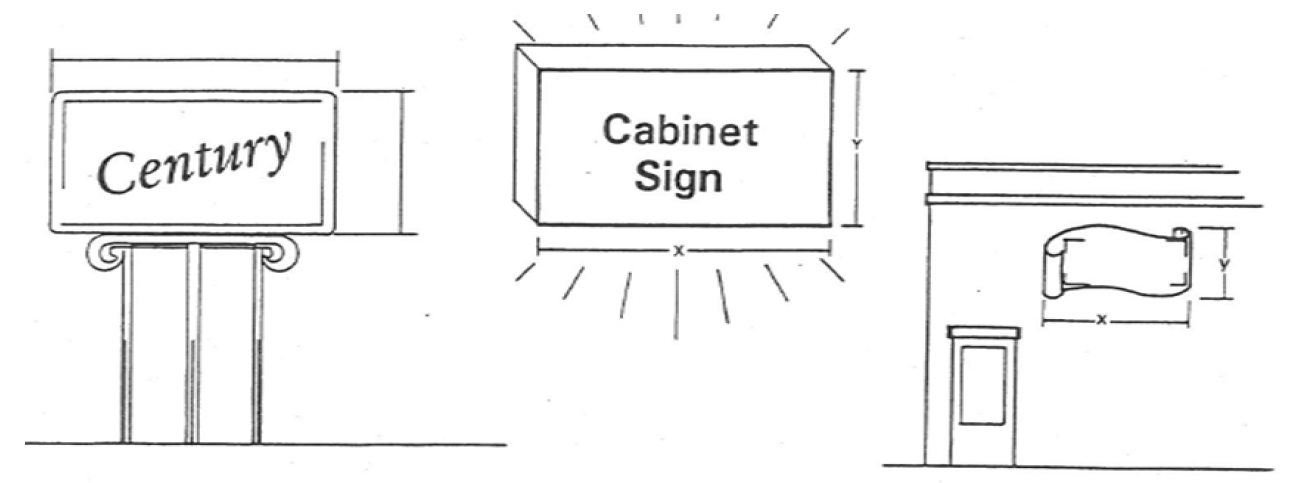
(b)
Sign copy mounted as individual letters or graphics against a wall, fascia, mansard, or parapet of a building or surface of another structure, that has not been painted, textured, or otherwise altered to provide a distinctive background for a sign copy, is measured as a sum of the smallest rectangle(s) that will enclose each word and each graphic in the total sign.
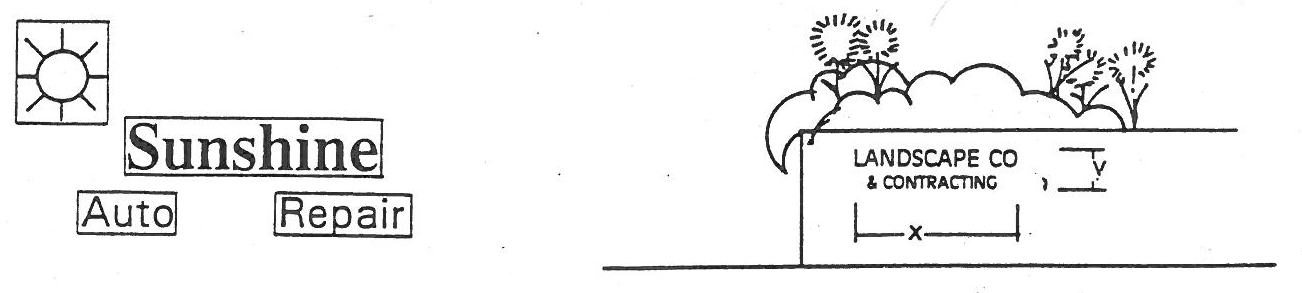
(c)
Sign copy mounted, affixed, or painted on an illuminated surface or illuminated element of a building or structure, is measured as the entire illuminated surface or illuminated element which contains copy. Such elements may include, but are not limited to, lit canopy fascia signs, spanner board signs, and/or interior lit awnings.
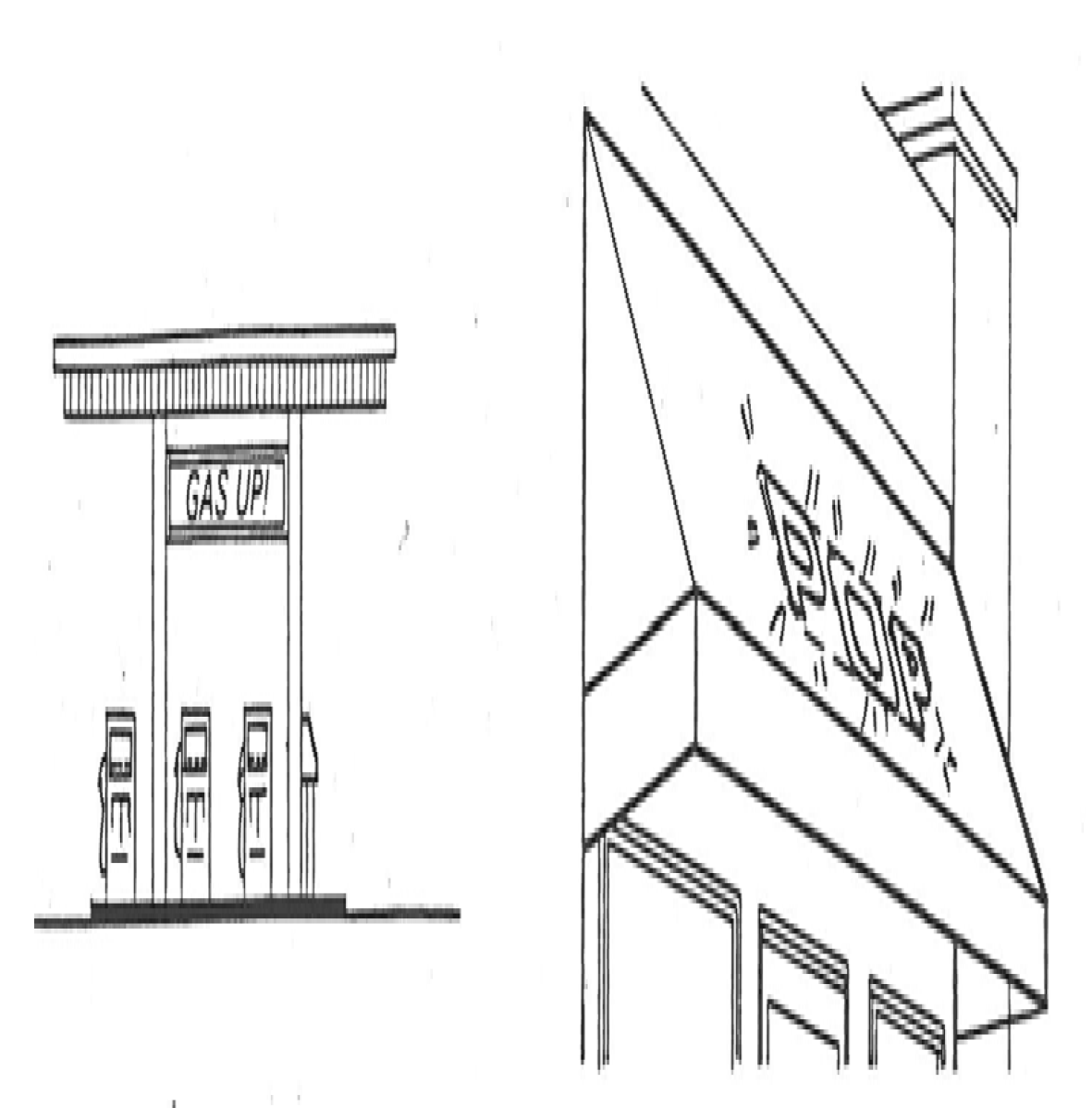
(d)
Multi-face signs are measured as follows:
1.
If the interior angle between the two sign faces is 45 degrees or less, the sign area has only one face. If the angle of the two sign faces is over 45 degrees, the sign area is the sum of the areas of the two sign faces.
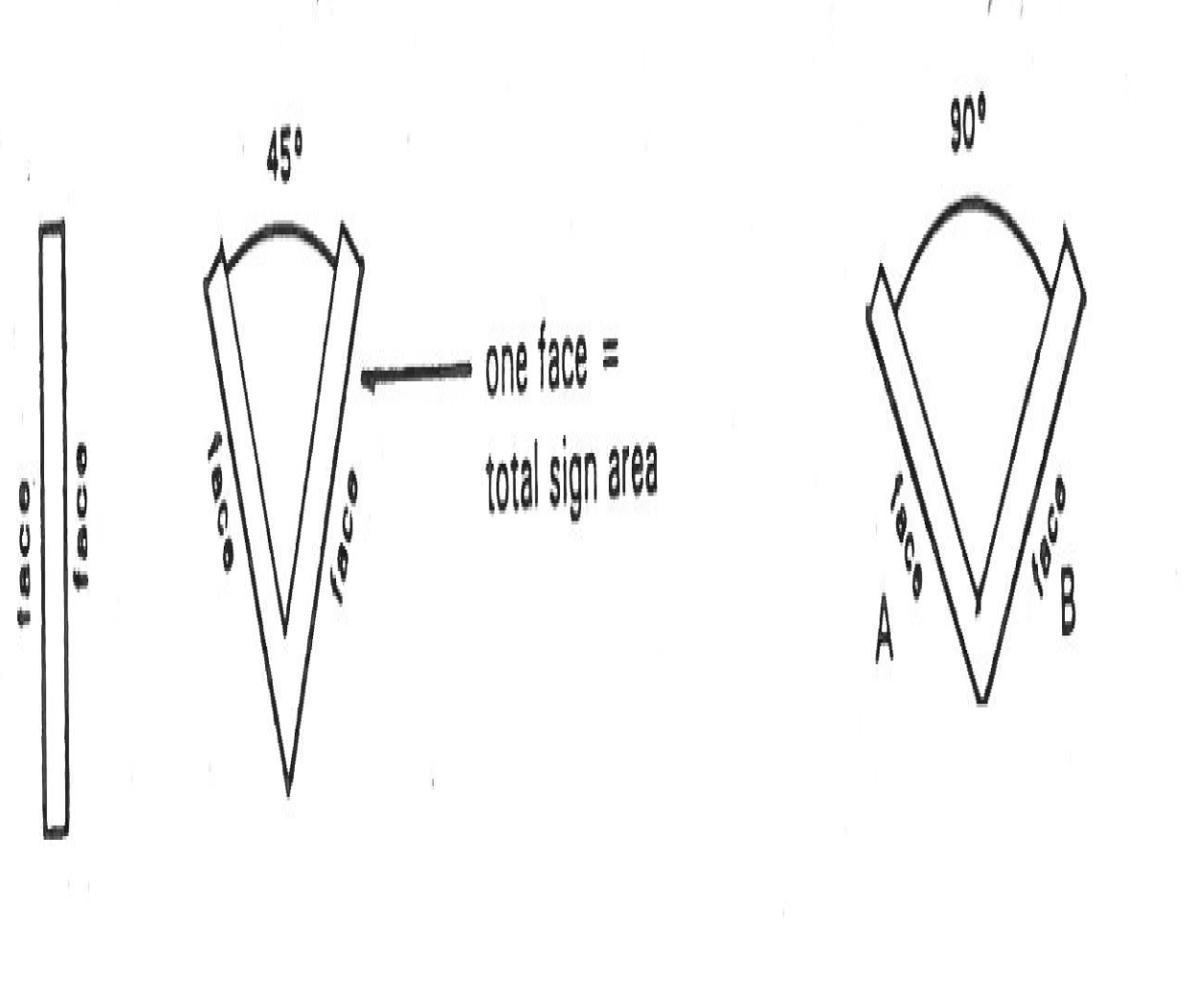
2.
For three or four face signs, the sign area shall be calculated at 50 percent of all sign faces.
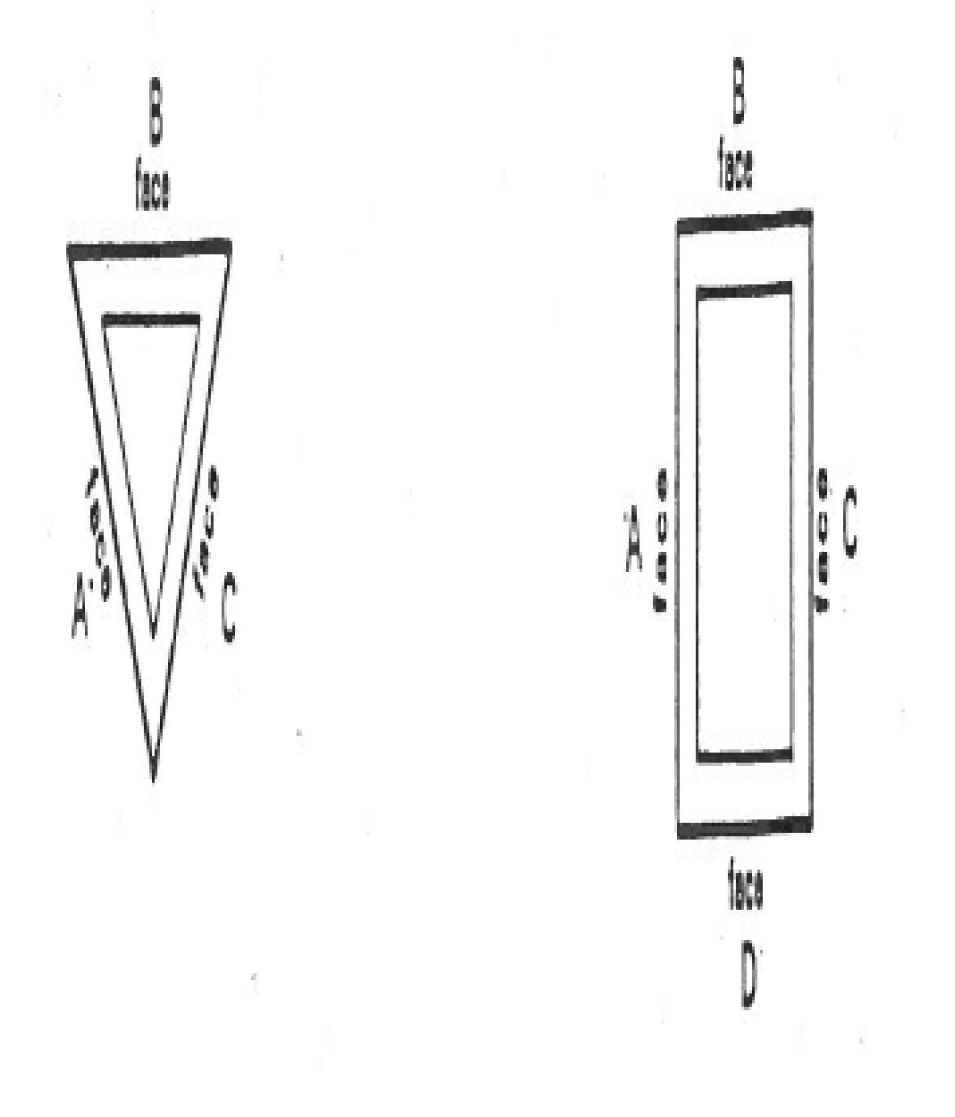
3.
Spherical, free-form, sculptural, or other non-planar sign area is 50 percent of the sum of the areas using only the four vertical sides of the smallest four-sided polyhedron that will encompass the sign structure. Signs with greater than four faces are prohibited.
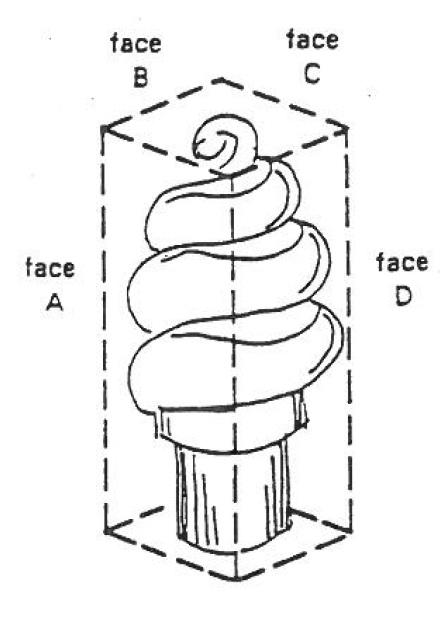
(7)
Sign height criteria. These criteria may be subject to sign and location restrictions.
(a)
Sign height is the distance measured from grade at the base of a sign to the topmost portion of a sign excluding decorative embellishments as permitted in subsection 36-454(7)(e). The height of any monument sign base or other structure erected to support or adorn the sign shall be measured as part of the sign height.
(b)
Exit and entrance ramps from a freeway or expressway are part of a freeway or expressway. For purposes of determining the sign height, the elevation of the right-of-way line nearest to the sign shall be utilized.
(c)
The minimum height to the bottom of a detached sign over an on-site drive aisle or required parking space shall be 16 feet above the finished pavement.
(d)
No part of a detached sign or sign structure shall exceed the height shown below as determined by the street classification from the grade of the highest paved portion of right-of-way adjacent to the property where the sign is installed or located. Where the natural grade of the sign structure location is more than 20 feet higher than the adjacent street grade, no part of the sign or sign structure shall exceed a height of 20 feet from natural grade.
•
Local, collector and secondary arterial .....25 feet
•
Primary arterial, expressway and freeway .....40 feet
(e)
A detached sign may extend above the allowable height and the design width for the purposes of sign structure enhancement or embellishment only if such extension does not exceed 12 inches on any side.
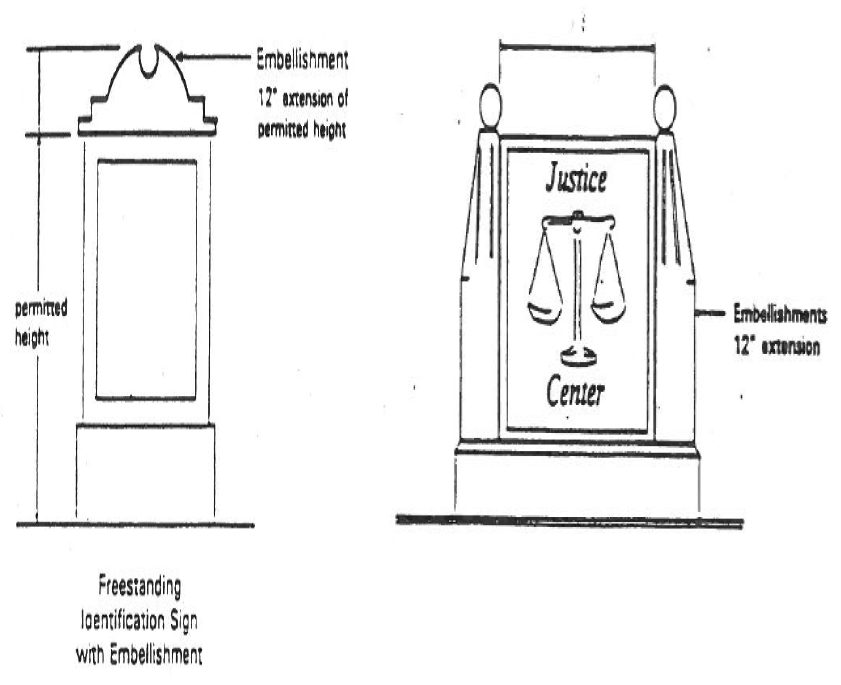
(8)
Sign illumination. Illuminated signs shall be designed, located, and constructed to eliminate or significantly reduce glare.
(a)
Provisions for non-business areas.
1.
Electronic message center signs fronting on a local or collector street shall be subject to a conditional use permit for nonresidential uses, subject to the following limitations:
a.
Such signs shall be limited to static images only. Such static images shall hold on the display for a period of at least eight seconds before transitioning to another static image. The uses of frame effects and animation are prohibited.
b.
The use of flashing is specifically prohibited in all locations.
c.
Such signs shall come equipped with automatic dimming technology that automatically adjusts the sign's brightness in direct correlation with ambient light conditions.
d.
No such signs shall exceed a brightness level of 0.3 foot-candles above ambient light as measured using a foot-candle meter at a preset distance depending on sign size. The measuring distance shall be determined using the following equation: the square root of the product of the sign copy area and 100. (Example using a 12-square-foot sign: square root of the product 12 × 100 equals 34.6 feet measuring distance.)
e.
The electronic message center portion of the detached sign shall not exceed 40 percent of the proposed sign copy area.
(b)
Provisions for signs in business areas.
1.
Electronic message center signs shall be permitted in all business areas subject to all applicable provisions of this ordinance as well as the following provisions:
a.
Animated, electronic message center signs shall be limited to at least ten feet above street grade and shall not be utilized within 125 linear feet of a non-business area.
b.
Electronic message center signs within 100 linear feet of a non-business area shall display static copy that stays on the display for at least three seconds per copy frame, but may utilize frame effects to transition from one static image to the next. Transitions shall last no longer than two seconds.
c.
All electronic message center signs placed less than ten feet above street grade shall be limited to static images only. Such static images shall hold on the display for a period of at least eight seconds before transitioning to another static image. The uses of frame effect and animation are prohibited.
d.
The use of flashing is specifically prohibited in all locations.
e.
All electronic message center signs shall come equipped with automatic dimming technology that automatically adjusts the sign's brightness in direct correlation with ambient light conditions.
f.
No electronic message center sign shall exceed a brightness level of 0.3 foot-candles above ambient light as measured using a foot candle meter at a preset distance depending on sign size. The measuring distance shall be determined using the following equation: the product of the square root of the sign copy area times 100.
(9)
Sign maintenance. No person shall maintain or allow to be maintained on any premises owned or controlled by that person, any dangerous or defective sign.
(a)
All signs, together with all their supports, braces, connections, or anchors, shall be kept in good repair.
(b)
Unsafe signs, damaged, or deteriorated signs, or signs in danger of breaking apart or falling, shall be removed or repaired by their owner.
(c)
Any fading, chipping, peeling, or flaking of paint, plastic, or glass; or any mechanical, electrical, or structural defect shall be corrected upon written notice by the director of building development services.
(d)
Abandoned or discontinued, which occurs whenever:
1.
A detached sign and sign structure is not removed within six months of the removal of the structure and a new building permit has not been issued.
2.
The sign faces have been removed for a period of six months.
(10)
Legal nonconforming signs.
(a)
Any sign which was lawfully erected or affixed prior to such time as it came within the purview of this article and which sign complied with all regulations in force at the time it was erected or affixed, but which fails to conform to all applicable regulations and restrictions of this article, shall be considered a legal nonconforming sign. A legal nonconforming sign may be continued and shall be maintained in good condition, but shall not be:
1.
Structurally altered (except to meet safety requirements) to prolong the life of the sign. Sign composition materials may not be changed after the date the sign becomes a nonconforming sign;
2.
Altered so as to increase the degree of nonconformity of the sign;
3.
Expanded in size or effective area;
4.
Relocated;
5.
Repaired if materials and labor repair costs in any continuous 12-month period would exceed 75 percent of the depreciated value of the sign. Upon written request, the sign owner must submit to the director of building development services specified substantiating information or documentation sufficient for the director of building development services to determine the percentage of value expended for repair;
6.
Signs that are nonconforming because of their illumination shall be brought into compliance with this article within 60 days after the effective date of this article. Nonconforming, temporary signs shall also be brought into compliance within 60 days.
7.
A legal nonconforming sign may be structurally altered if the:
a.
Height of the sign is reduced to meet the requirements of section 36-454, which will make it a conforming sign.
b.
If the nonconformity is the size of the effective area of the sign, the effective area shall be reduced in size to meet the requirements of section 36-454. If this is done, the sign shall be classified as a conforming sign.
c.
If the nonconformity is the spacing between signs, number of signs on the premises, or location of the sign, the sign shall be relocated to meet the requirements of section 36-454 or the effective area shall be reduced to 75 percent of the allowable effective area of a conforming sign, or shall be reduced by 30 percent of the current sign's effective area, whichever is greater. If the effective area of the sign is reduced to 75 percent of the allowable effective area of a conforming sign, or 30 percent of the current sign's effective area, the sign continues to be classified as a nonconforming sign, but structural alterations shall be permitted. All structural alterations must meet the requirements of section 36-454.
(11)
Signs at street intersections and driveways. Standards for sight triangles at street intersections shall reflect the street classification as identified in the major thoroughfare plan. The conditions below indicate the minimum requirements for sight triangles as measured along the required right-of-way. The city traffic engineer may require additional triangle area for clear sight and safety as determined by a traffic study or special condition.
With the approval of said engineer, signs may be erected in the:
(a)
Street intersection sight triangles only if such sign is at least ten feet above street grade, except for supports, which may not exceed one foot in width or diameter or be spaced less than ten feet apart from any other stationary object; or
(b)
Street/driveway sight triangles. Any sign must be at least ten feet above street grade except for supports, which may not exceed one foot in width or diameter or be spaced less than ten feet apart from any other stationary object.
Sight Triangle Requirements
(c)
Exit and entrance ramps. Exit and entrance ramps from a freeway or expressway shall be treated as part of a freeway or expressway. For purposes of determining the elevation, the elevation of the right-of-way line which is nearest to the sign shall be utilized.
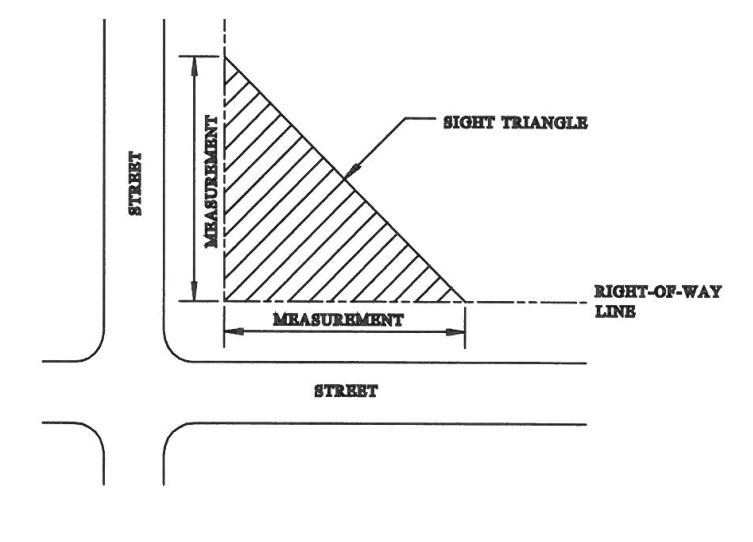
(d)
On the right side of a driveway a street/driveway-sight triangle has these three sides:
1.
The edge of the pavement, curb, roadway, or projection extending 40 feet down the street from the right edge of the driveway when facing the street;
2.
The edge of the driveway moving 12 feet towards the house from the same spot as one; and
3.
A third, imaginary line connecting the extremities of the other two without overlaying the pavement.
(e)
On the left side of a driveway, the triangle has the same three sides, except the side along the street is 65 feet.
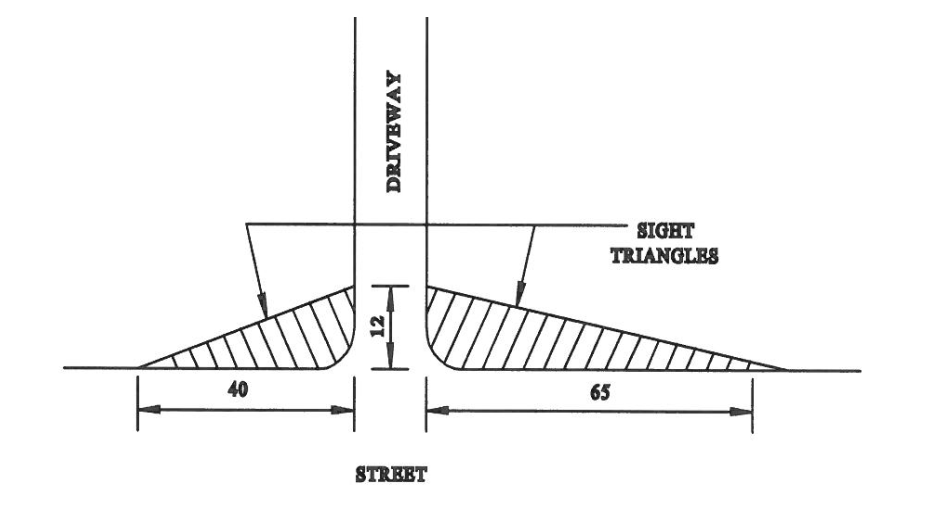
(12)
Historic landmark signs. One free-standing or façade-mounted sign identifying a premises of historical significance located in any locally or nationally designated historic district in the City of Springfield and at any duly-designated historic site, historic landmark or interior landmark located elsewhere within the City of Springfield. All such signs shall, at a minimum, identify the original owner, the current owner, and circa the year the house was built. No such sign may be more or less than two square feet in sign area. Lettering styles, logos, and design motifs should be black on a white background and in keeping with the character of the era in which the building was constructed.
(a)
All signage illumination must be provided from the exterior, and the lighting should be done in a manner which does not result in any glare (either directly from the light fixture or indirectly off the sign), and which minimizes the visibility of the light fixture used to illuminate the subject sign.
(b)
Façade-mounted signs must be in harmony with the design of the corresponding façade and should not obscure any significant architectural elements. Such signs shall not extend completely to the edge of any façade.
(c)
Free-standing signs are only permitted for structures having a front year setback of 20 feet or more. Such signs must have a minimum setback of two feet from the public right-of-way line or any lot line, may not interfere with sight distances at street intersections, and may not have a height greater than 30 inches.
(13)
Neighborhood identification signs. A neighborhood identification sign shall be a detached sign, masonry wall, landscaping or similar material or features that are combined to form a display for neighborhood or tract identification, provided that the legend of such display shall identify the neighborhood, tract or historic district.
(a)
These signs may only be located in R-SF and R-TH zoning districts.
(b)
The maximum effective area of the sign shall be 50 square feet.
(c)
The maximum height of the sign shall be five feet. The maximum height may exceed five feet if the sign is mounted on a wall being used as a retaining wall for the site.
(14)
Directional signs. Detached, directional signs in excess of five square feet of effective area shall be allowed in any area, provided such signs do not name or advertise any product, service, or business, and the total allowable effective area of detached signs on the premises is not exceeded. A site plan locating all detached signs, including existing and proposed directional or instructional signs, shall be required prior to issuance of a sign permit.
(15)
Landscape wall signs. A landscape wall sign shall consist of individual letters mounted on a screen or perimeter wall which may be attached or detached from a building, but which is architecturally integrated with the overall development.
Multiple signs are permitted, however, the percentage of wall surface area occupied by the sign or signs, shall not exceed 40 percent of the background area provided on the landscape wall. All such signs are counted in the aggregate, building-mounted-wall signs allowed.
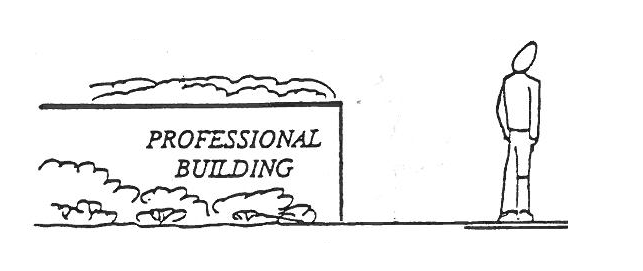
(16)
Provisions for non-business areas.
(a)
General provisions. These provisions shall apply to permanent signs in non-business areas:
1.
Dwelling units in the R-SF and R-TH zoning districts shall be allowed to utilize any non-business sign described in subsection 36-454(4), but shall not be allowed to display any other sign.
2.
Flashing lights and animation are not allowed.
(b)
Detached signs. Detached signs are allowed in non-business areas as follows:
1.
Each premises containing a multifamily use, permitted nonresidential use, or legal nonconforming use shall be allowed one detached sign.
a.
Premises which are used as a church or school with more than 425 feet of frontage along a single public street may have one additional detached sign.
b.
A minimum of 300 feet of separation, measured radially, shall be maintained between signs.
c.
A minimum setback of 25 feet from adjacent property line shall be maintained for all signs.
d.
No sign shall exceed 25 feet in height above street grade.
2.
The size of the detached sign shall be based on one square foot of effective area per linear foot of street frontage on which the sign is located, with the following limitations: the maximum permitted size shall be as designated by the city's major thoroughfare plan.
a.
One hundred square feet on local and collector streets;
b.
Two hundred square feet on secondary arterial streets;
c.
Two hundred fifty square feet on primary arterial streets.
d.
In the case where the street adjacent to the sign is a frontage street between the site and a freeway, as designated by the city's major thoroughfare plan, the maximum size sign permitted shall be 250 square feet.
(c)
Attached signs. Attached signs are allowed in non-business areas as follows:
Each premises containing a multifamily use, permitted nonresidential use, or a legal nonconforming use shall be allowed one wall sign per wall.
1.
The sign may contain the name and logo of the establishment, business, or use and nothing else.
2.
The sign shall project no further than 18 inches from the wall.
3.
A wall sign shall not project beyond the wall edge.
4.
When the premises has no detached sign, the total effective area of all wall signs shall not exceed two square feet per lineal foot of the wall length along the street or streets upon which the business fronts.
5.
When the premises has a detached sign, the total effective area of all wall signs shall not exceed one square foot per lineal foot of the wall length along the street or streets upon which the business fronts.
6.
Roof signs shall be prohibited.
(17)
Provisions for signs in business areas.
(a)
General provisions. These provisions shall apply to all permanent signs in business areas as defined in the article.
1.
A sign in a business area that does not require a state permit shall conform to regulations for a sign in a non-business area if any part of the sign or sign structure is within 25 feet of a non-business area.
2.
Animation or flashing lights shall be located a minimum of ten feet above street grade.
3.
Sign regulations enforced by the Missouri Highways and Transportation Commission along the interstate and primary highway system in the city shall take precedence over any less restrictive requirements of this article.
4.
Each premises with frontage on any street shall be allowed at least one permanent detached sign.
5.
Premises which have more than 425 feet of frontage along a primary arterial, expressway or freeway street, where the first sign is located, may have one additional detached sign for each additional 425 feet of frontage, provided a minimum of 300 feet of separation is maintained between all detached signs on a given premises. Each sign shall be located a minimum of 25 feet from the adjacent property line. The 300-foot spacing of all detached signs on a given premises shall be measured radially from the center of the sign.
6.
A premises with frontage along both an expressway and an arterial, an expressway and a freeway, a freeway and an arterial, two expressways, two freeways or two arterials as designated by the major thoroughfare plan, shall be allowed one detached sign per street provided such location meets the separation requirements of subsection (17)(a)5 above. In the event a second detached sign is permitted by the application of subsection (17)(a)5 above, this subsection shall not be construed to allow any additional detached signs.
7.
All sign illumination shall conform to subsection (8), sign illumination.
8.
In the center city (CC) and Commercial Street (COM1) zoning districts and along College Street between Grant and Nettleton Avenue, each premises which has multiple businesses located on the ground floor with direct exterior public access shall be allowed a projecting sign not to exceed ten square feet in size per business, provided it meets the provisions of subsection (3)(b) regardless of detached signs that are allowed on the premises. If the premises consist of only one business located on the ground floor with direct public access, a projection sign not to exceed 30 square feet in size may be permitted. The minimum clearance shall be ten feet above the highest level of the ground below the sign.
9.
Signs that are located on a designated historic building or are located in a designated historic district must be approved by building development services before submittal and approval by the landmarks board.
10.
One- and two-family dwelling units located in a business area shall be allowed to utilize any non-business sign described in subsection (4), but shall not be allowed to display any other sign.
(b)
Detached signs. Detached signs are allowed in business areas, based upon the classification of the street they front upon as designated in the major thoroughfare plan, as follows:
1.
A premises fronting on a local, collector, or secondary arterial street shall be allowed a detached sign with an effective area determined by adding 50 square feet to a ratio of one square foot of effective area per lineal foot of frontage along the local, or collector or secondary arterial street. In the case of a double-frontage premises, only the frontage on which the sign is placed shall be used in calculating the effective area.
2.
A premises fronting on a primary arterial, expressway, or freeway shall be allowed a detached sign with an effective area determined by adding 100 square feet to a ratio of two square feet of effective area per lineal foot of frontage along the arterial expressway or freeway. In the case of a double-frontage lot, only the frontage on which the sign is placed shall be used in calculating the effective area.
3.
If the premises is a corner lot and the sign is located an equal distance from the edges of two intersecting streets, the street with the highest classification as defined by the major thoroughfare plan shall be used to size the effective area of the sign. If the streets are of the same classification, the street with the longest frontage shall be used to size the effective area of the sign.
4.
The maximum effective area, based on the street classification, for any detached business sign shall be as follows:
•
Local, collector, or secondary arterial: 250 square feet.
•
Primary arterial, expressway, or freeway: 400 square feet.
5.
A tract identification sign shall be considered the same as a detached sign.
6.
If the premises is located on a state-controlled route and contains a state-allowed, detached, off-premises sign or signs, as defined by the state and as originally permitted, one additional detached sign advertising the on-site businesses shall be permitted.
a.
The sign shall be located a minimum of 100 feet from the off-premises sign.
b.
The maximum height shall be 25 feet.
c.
The maximum effective area shall be 250 feet.
7.
If the premises is located on a non-state-controlled route and contains an existing legal, nonconforming, detached off-premises sign or signs, as originally permitted as a state defined off-premises sign, one additional detached sign advertising the on-site businesses shall be permitted.
a.
The sign shall be located a minimum of 100 feet from the off-premise sign or signs.
b.
The maximum height shall be 25 feet.
c.
The maximum effective area shall be 250 feet.
(c)
Attached signs. Attached signs are allowed in business areas in accordance with the following provisions:
1.
Each business shall be allowed wall signs on any wall. In the event the business does not front on a street, it shall be allowed signage as if it fronted on a local street.
a.
These signs shall extend no further than 18 inches from the wall.
b.
A wall sign shall not extend beyond the wall edge.
c.
Wall signs do not include signs on the inside of windows.
d.
Wall signs on the exterior face of windows are not permitted. Lettering on the exterior face of a window stating the days and times that the business is open is permitted.
[2.]
[Reserved.]
3.
The total effective area of all wall signs allowed for a business shall be calculated based upon the lineal footage of each wall having frontage on a public or private street. The effective area shall not exceed three square feet per lineal foot of the wall length.
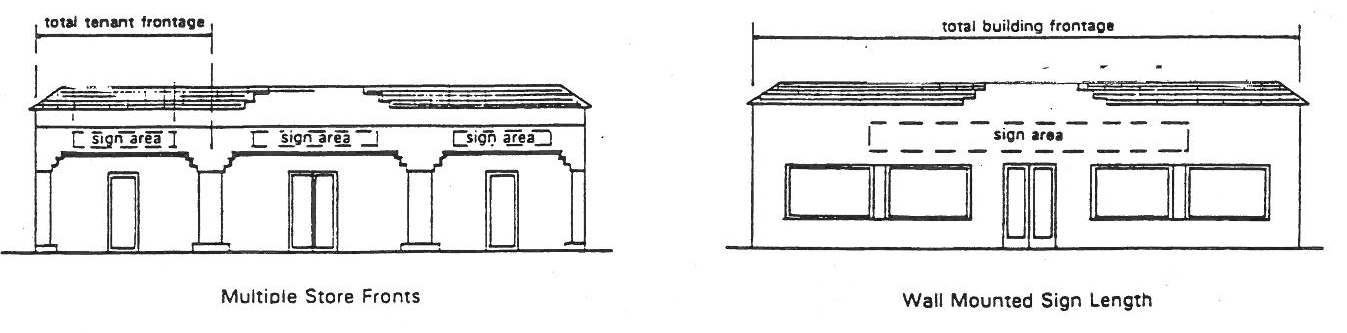
4.
Individual channel letters located along a roof edge, which is not the primary roof of a structure, shall be considered a wall sign. If a sign bar is utilized it shall be located at the base of the letters and shall not exceed six inches in height. The maximum allowable height of the individual letters shall not exceed 12 inches.
5.
A premises may have a roof sign only if it does not have a detached or projecting sign. A roof sign is any sign erected upon, against or directly above a roof. Roof signs shall be set back from the outside walls of the building no less than four feet and no part of the sign shall extend beyond any roof edge. The methodology used to determine the effective area allowed for detached signs shall be used to calculate the effective area allowed for roof signs. All roof signage shall comply with appendix H of the adopted edition of the International Building Code.
6.
A business may have a projecting sign only if it does not have a roof sign or a maximum number of allowable detached signs for that premises. A projecting sign is a sign which is attached to and projects from a surface or building face. Where a premises frontage would allow the use of two or more detached signs, a projecting sign may be substituted for one of the detached signs. Projecting signs shall have a minimum clearance of ten feet above the highest level of the ground under the sign at the sign's lowest point and shall not exceed 20 square feet in effective area.
7.
A sign mounted on the lower one-third of a mansard roof shall be considered a wall sign. The sign shall not project above the top of the roof feature on which it is placed.
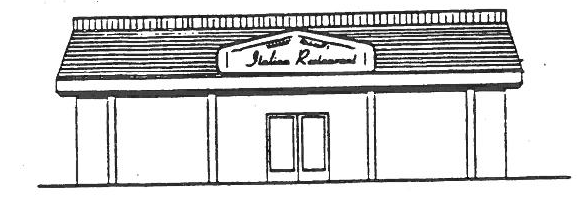
(d)
Suspended signs. A sign attached to the underside of a lintel, arch or other overhead spanning member of a porch or walkway, and which is hung either perpendicular or parallel to a vertical wall surface shall have a minimum clearance of seven feet above the walking surface
(18)
Relocating signs due to public improvement projects. Detached signs that must be removed because of a public-improvement project may be relocated provided that a permit is issued at the discretion of the administrative review committee (ARC) upon a finding that the requirements of this section are met. If the detached sign is located in a business area, the sign may be considered for relocation whether the sign is currently a conforming or nonconforming sign. If the detached sign is located in a non-business area, the sign may only be considered for relocation if it is a conforming sign. Relocation of a detached sign may only be approved if:
(a)
The sign will be relocated on the same lot of record; and
(b)
Its effective area is altered only to conform to the requirements of this section; and
(c)
No electronic or digital media is included as a part of the sign, other than that existing at the time of relocation; and
(d)
The sign is lighted only with lighting that existed prior to the relocation; and
(e)
Any lighting from the sign in the relocated site does not create a nuisance for any residentially zoned properties; and
(f)
The sign pole is replaced only if ARC determines that to be necessary in order to accomplish sign relocation; and
(g)
The relocated sign height does not exceed the originally located sign height in relation to the roadway grade, as measured from the roadway the sign is oriented towards. The height is to be determined from the roadway as rebuilt or the state or city's approved, engineered design for a roadway under construction, if such roadway is not already in place at the time of relocation; and
(h)
There has been no determination by the city that the sign in question is a dangerous structure or should be removed due to blighting of adjacent properties, unrelated to the public improvement project.
The administrative review committee (ARC) shall review all proposed sign relocations for conformance with this subsection. A conforming sign may become legal nonconforming as a result of such relocation. The creation of any additional nonconformity on the lot of record as a result of such relocation, such as reduced parking or perimeter landscaping, should be minimized to the greatest extent practical in the determination of the ARC. A relocated sign shall be considered legal nonconforming if it does not conform to the provisions of this section. If the ARC determines that it is in the best interest of the community that the sign should not be relocated under this subsection, the sign shall not be relocated without approval of the planning and zoning commission. The decision of the planning and zoning commission shall be final, subject only to city council review. If the sign is allowed to be relocated, the provision of subsection 36-454(21) shall not apply to the sign, except as provided in this subsection. This subsection does not accrue property rights for individual property owners or owners of signs affected by the public-improvement project to require relocation of any sign, but shall only provide an opportunity for review and possible relocation if, in the discretion of the ARC, or planning and zoning commission, or city council, when the issue is before one of those bodies, the requirements of this subsection are met.
(19)
Freeway commercial sign district.
(a)
Purpose. The purpose of the "freeway commercial sign district" is to permit detached signs in proximity to the intersection of qualifying major commercial streets with a freeway or interstate highway. Larger and taller detached signs are deemed appropriate in these areas due to the orientation of the commercial activity located at these intersections. This does not include freeways within the scenic corridor overlay district is subsection (20).
(b)
General provisions. All signs located in the freeway commercial sign districts shall conform to subsection (17) except as set forth in (c) below.
(c)
Locations and exceptions. The following exceptions to subsection (17) shall apply in the following areas, which are designated as "freeway commercial sign districts:"
1.
Property within a 660-foot radius from the intersection of the following rights-of-way of nterstate 44 (I-44) and Kansas Expressway; Kearney Street and Schoolcraft Freeway (U.S. Highway 65); Sunshine Street and Schoolcraft Freeway (U.S. Highway 65); Southwest quadrant of Chestnut Expressway and Schoolcraft Freeway (U.S. Highway 65); and Interstate 44 (I-44) and Mulroy Road.
a.
The maximum height for any detached sign in a business area shall be 70 feet in height above street grade of the closest street to the sign. The maximum effective area for any detached sign in a business area shall be 600 square feet.
2.
Property with frontage on Glenstone Avenue between the northern right-of-way of Kearney Street and 100 feet north of the northern right-of-way of McClernon Street, and property within a 1,800-foot radius from the center of the intersection of the rights-of-way of Interstate 44 (I-44) and Glenstone Avenue.
a.
The maximum height for any detached sign in a business area shall be 70 feet in height above street grade of the closest street to the sign. The maximum effective area for any detached sign in a business area shall be 600 square feet; or
b.
Any premises in this area may erect two detached signs, provided one sign is over 50 feet in height but not higher than 70 feet and the other is not more than 25 feet in height. The total effective area permitted for the premises shall not be considered in reviewing the shorter sign, which may have an effective area up to 100 square feet.
3.
Property at the southwest quadrant of Interstate 44 (I-44) and Schoolcraft Freeway (U.S. Highway 65) within a 1,800-foot radius from the center of the intersection of the rights-of-way of these two highways.
a.
The maximum height for any detached sign in a business area shall be 70 feet in height above street grade of the closest street to the sign. The maximum effective area for any detached sign in a business area shall be 600 square feet; or
b.
Any premises having frontage along Schoolcraft Freeway (U.S. Highway 65) in the Schoolcraft Freeway/I-44 freeway commercial sign district is permitted to erect two detached signs with a maximum height of 60 feet above adjacent street grade with a maximum combined effective area of 450 square feet. This provision shall not apply to any additional premises or lot created as the result of any subdivision action taken after the passage of General Ordinance No. 5777 on August 25, 2008.
(20)
Scenic corridor overlay district.
(a)
Purpose. The scenic corridor overlay district is intended to promote the health, safety, and general welfare of the public by encouraging the conservation, preservation and enhancement of the scenic qualities and landscape of scenic roadway areas. The purposes of this district are to:
1.
Preserve the scenic character of designated roadways and, where possible, preserve scenic views from the roadways and to implement the parkway concept as set forth in the city's comprehensive plan;
2.
Maintain the natural beauty of the landscape as it currently exists along designated roadways;
3.
Encourage development this is compatible with and, where possible, enhances such natural beauty; and
4.
Encourage safe and efficient traffic flow along designated scenic roadways for all modes of travel.
(b)
General provisions. Off-premises signs located within a scenic overlay district shall conform to the standards and regulations set forth in subsections (17)(a) and (d) unless such regulations are in conflict with the regulations set forth in this section. In the event of a conflict in regulations, the regulations contained in this section shall control. No off-premises advertizing shall be oriented toward James River Expressway.
(c)
Location. These regulations shall apply to any property within 660 feet off the nearest edge of the right-of-way of the designated scenic roadway, notwithstanding any other provision of this article. Off-premises detached signs that would be oriented towards streets other than the designated scenic corridor are permitted only if the signs surface containing copy is not visible or oriented towards the designated scenic corridor. The ARC, in consultation with the Missouri Highway and Transportation Department, shall publish a map showing those properties falling within the 660 feet of the right-of-way within the scenic corridors.
1.
No off-premises sign along any scenic corridor shall be closer than 2,500 feet from any other off-premises sign including those outside the scenic corridor overlay district as measured radially from the nearest portion of the signs or sign structures.
2.
The maximum effective area of the sign shall be 128 square feet.
3.
The maximum height of the sign and sign structure along any designated scenic corridor shall be 20 feet above the highest paved portion of right-of-way adjacent to the property where the sign is installed.
4.
These roadways where the city is mandated by state law to allow off-premises signs shall be included in the "scenic corridor overlay district:"
a.
James River Freeway and U.S. 60;
b.
West By-Pass and U.S. 160; and
c.
Kansas Expressway north of the nearest paved area of I-44 and south of the nearest paved area of the James River Freeway and U.S. 60.
(d)
Exceptions.
1.
Off-premises signs oriented towards streets not within the "scenic corridor overlay district" shall be permitted within any scenic corridor overlay district. The administrative review committee shall review all proposed off-premises detached signs within the "scenic corridor overlay district" to determine whether the requirements of this section are met. An off-premises detached sign shall be permitted if it is oriented generally perpendicular to a street not within the "scenic corridor overlay district" and the sign cannot be read from a roadway within the "scenic corridor overlay district" down its length for an extended distance.
2.
The city shall have the option to allow the relocation of existing off premises detached signs impacted by a state or city highway improvement project within the "scenic corridor overlay district," irrespective of the provisions of subsection (21), based on the requirements of subsection (18). If the sign is allowed to be relocated, the provisions of subsection (21) shall not apply to the sign, except as provided in subsection (17).
(21)
Master sign plans.
(a)
Purpose. A master sign plan application may be approved for the purpose of establishing consistent, logical, and equitable signage for:
1.
Multiple uses on a single property;
2.
A building group of a single use or multiple uses that may involve multiple properties; or
3.
A large tract that contains a single use with multiple services.
The main intent of a master sign plan is to provide clarity of communication regarding tenants and services to users of the premises or building group. A master sign plan is not intended to provide special or additional signage allowance in terms of total effective area than would otherwise be permitted by this section 36-454, signs.
(b)
General provisions.
1.
The planning and zoning commission may, by resolution, approve the establishment of a master sign plan for:
a.
Two or more commercial, office, or industrial uses on a single property;
b.
An identifiable building group, such as a medical, university or college campus, industrial or office park, or shopping center; or
c.
Any other site containing at least five acres of land area.
2.
Except for specifically permitted variations from the spacing and number of signs in the approved master sign plan, all other signs within the area defined within the plan shall comply with all provisions of this article.
3.
Master sign plans shall prescribe the size, number, and types of signage permitted. No other signs shall be permitted, except exempt signs, which are listed under subsection (4).
4.
No detached sign shall exceed the maximum effective area permitted by this section 36-454, signs, nor shall the total effective area of detached, projecting, and roof signs exceed what this section 36-454, signs, would otherwise permit.
5.
No sign shall exceed the maximum 40-foot height permitted by this section 36-454, signs. If signs are spaced closer than 300 feet, the first sign may be up to 40 feet high and additional signs must comply with this table:
No more than five additional signs are permitted within a distance of 300 feet.
6.
The provisions of this subsection only apply to signs relating to activities within the area that the master sign plan is to serve.
7.
The support structure for detached signs shall be constructed of similar materials or be of a similar design if the construction materials are coordinated with the buildings the signs serve. Detached signs supported by a pole are not permitted unless the pole is concealed. Different types of signs, as identified by the specific master sign plan (development identification, tenant identification, directional, etc.), may be constructed of different materials.
8.
Any electronic message center sign shall be subject to all applicable provisions for the area in which it is placed.
(c)
Contents of application. All applications shall be filed at least 31 days prior to a regularly scheduled, public meeting where the application will be reviewed by the planning and zoning commission. The application shall contain the following information as well as such additional information as may be described by rule of the planning and zoning commission or the director of planning and development:
1.
The applicant's name and address and his legal interest in the subject property;
2.
The owner's name and address, including trustees, and, if different than the applicant, the owner's signed consent to the filing of the application and authorization for the applicant to act in his behalf;
3.
The street address(es) (or common description) and a copy of the deed of record or legal description(s) of the property as prepared by a certified land surveyor or attorney;
4.
The zoning classification(s) of the subject property(ies);
5.
The current and proposed use of the subject property(ies);
6.
A statement from the applicant describing how the proposed master sign plan:
a.
Addresses the eight review criteria listed in paragraph (d), below; and
b.
Provides more consistent, logical, and equitable signage than would be permitted by applying the sign requirements of this section 36-454, signs.
7.
A scaled site plan showing:
a.
Location of the buildings, parking lots, property lines, easements, driveways and landscaped areas on the subject property(ies);
b.
Any additional information necessary to address the eight review criteria listed in paragraph (d), such as significant natural topographic or physical features of the site; and
c.
The proposed location of each current and proposed sign of type.
8.
The standards of consistency among all signs with regard to:
a.
General location of each sign on buildings and structures;
b.
Effective area limitations, which may be based on length of street frontage, area of building, or some other form of calculation; and
c.
Materials to be used for detached, sign support structures.
(d)
Review of master sign plan application. The planning and zoning commission shall review and either approve, deny, or amend all applications for master sign plans. No review of a master sign plan application shall be done by the planning and zoning commission unless the director of planning and development, or his duly designated delegate, has certified to the planning and zoning commission that the application is complete (based on the information required by paragraph (c), above) and does not contain or reveal violations of this article or other applicable regulations. The planning and zoning commission in considering whether or not to approve, deny or amend an application for a master sign plan shall be guided by the general purpose of this section and the following:
1.
The proposed master sign plan will be consistent with the adopted policies of the Springfield Comprehensive Plan;
2.
The proposed master sign plan has the potential to improve the safety and convenience of the motoring public and of pedestrians using the property and the area immediately surrounding the property;
3.
The location, lighting and type of signs proposed and the relationship of signs to traffic control is appropriate for the property;
4.
The proposed signs will be constructed, arranged and operated so as not to dominate the immediate vicinity or to interfere with the development and use of neighboring property in accordance with the applicable district regulations;
5.
The proposed signs, as shown by the application, will not destroy, damage, detrimentally modify, or interfere with the enjoyment or function of any significant natural topographic or physical features of the site;
6.
The proposed signs will not result in the destruction, loss, or damage of any natural, scenic, or historic feature of significant importance;
7.
The proposed signs, as shown by the application, will not interfere with any easements, roadways, rail lines, utilities, and public or private rights-of-way;
8.
The proposed signs will not have any substantial or undue adverse effect upon, or will not lack amenity or be incompatible with, the use or enjoyment of adjacent and surrounding property, the character of the neighborhood, traffic conditions, parking, utility facilities, and other matters affecting the public health, safety, and general welfare; and,
9.
Review and approval by building development services must be granted before review by the planning and zoning commission.
(e)
Conditions and restrictions. In approving a master sign plan application, the planning and zoning commission may impose conditions and safeguards to comply with the requirements of this article or to avoid, minimize, or mitigate any potentially adverse or injurious effect of such master sign plan upon other property in the neighborhood, and to carry out the general purpose and intent of this article. Such conditions shall be set out in the resolution approving the master sign plan application.
(f)
Decisions and records. The planning and zoning commission shall, within 30 days after the public hearing is concluded, approve by resolution, or deny, an application for a master sign plan. If the application is denied, the planning and zoning commission shall state the reasons for denial in writing to the applicant and shall also make suggestions in regard to appropriate changes. In the event that an application is denied, the applicant may:
1.
Resubmit a revised application within ten working days of denial by the commission for reconsideration by the commission; or
2.
File an appeal to the city council within 15 days of the denial by the planning and zoning commission.
The secretary of the planning and zoning commission shall maintain complete records of all actions of the commission with respect to applications for master sign plans.
(g)
Effect of approval of a master sign plan application.
1.
After approval of a master sign plan application, no sign shall be erected, placed, reconstructed, structurally altered, or moved except in conformance with the master sign plan.
2.
ARC may approve new signs not specifically identified on the master sign plan provided the new signs comply with all standards established by the master sign plan. If a new sign involves expansion of a master sign plan to include additional property, the master sign plan must first be amended as prescribed below.
3.
The approval of a master sign plan application shall not authorize the erection, placement, reconstruction, structural alteration, or moving of any sign, but shall merely authorize the preparation, filing, and processing of applications for any permits or approvals, which may be required by the codes and ordinances of the city, including, but not limited to, a building or sign permit. Each sign shall be required to have a separate permit.
4.
In case of any conflict between the provisions of a master sign plan and any other provisions of this article, the article shall prevail.
(h)
A master sign plan may be amended by filing a new master sign plan application that conforms to all requirements of this article.
(22)
Sign permits and inspection.
(a)
Permits required.
1.
Except as otherwise provided in this code, it shall be unlawful for any person to erect, repair, improve, maintain or convert, any sign, or cause the same to be done, without first obtaining a sign permit for each such sign from the director of building development services. No sign permit shall be issued except to a person licensed to do business in the City of Springfield or to a person exempt from the city licensing provisions.
2.
Every sign permit issued by the director of building development services shall become null and void if work on the sign is not commenced within 180 days from the date of such permit. If work authorized by such permit is suspended or abandoned for 90 days after the work is commenced, the sign shall be considered abandoned unless a new permit shall be first obtained to proceed with the work on the sign, and the fee will be one-half of the original fee, provided that no changes have been made in the original plans.
(b)
License. No person shall perform any work or service for any person or for any government entity in connection with the erection, repair, improvement, maintenance, or conversion, of any sign in the city, or any work or service in connection with causing any such work to be done, unless such person shall first have obtained a business license and paid the license fees provided for by the city, or shall be represented by a duly-licensed person.
(c)
Application for permit. Application for a permit shall be made to the director of building development services upon a form provided by the director of building development services, and shall be accompanied by such information as may be required to insure compliance with all appropriate laws and regulations of the city.
The director of building development services shall issue a permit for work to be done on a sign when an application therefore has been properly made and the sign complies with all appropriate laws and regulations of the city.
(d)
Denial or revocation. The director of building development services may, in writing, suspend, deny, or revoke a permit issued under provisions of this section whenever the permit is issued on the basis of a misstatement of fact, fraud, or noncompliance with this article.
When a sign permit is denied by the director of building development services, he shall give written notice of the denial to the applicant, together with a brief written statement of the reason for the denial. Such denials shall refer to the section of the sign code or other pertinent code used as the basis of denial.
(e)
Exempt operations. The following operations shall not require the issuance of a sign permit:
1.
Changing of the copy describing products or services on an existing permitted sign which is specifically designed for the use of manually or automatically changeable copy including billboard panels and posters; but, not including changes in the structure, size, placement, or location of the sign.
2.
Maintenance, including repainting, cleaning, or other normal repair of a sign not involving structural changes. Maintenance includes all face changes, but does not include changes in the structure, size, placement, materials, or location of the sign.
(Zoning Ord., § 5-1400; G.O. 4592, 4-1-96; G.O. 6120, 5-12-14; G.O. 6502, § 2, 2-11-19; G.O. 6543, § 3, 8-12-19; G.O. 6694, § 1(Exh. B, Att. 2), 11-29-21)
Sec. 36-455. - Off-street parking requirements.
(1)
Applicability. In all zoning districts except the CC, GI and COM-1 districts, all uses established after the effective date of this article shall provide off-street parking solely for the parking of motor vehicles in operating condition of patrons, occupants, or employees in accordance with the following regulations. In all zoning districts, all uses, unless otherwise exempted in subsection (8), shall provide facilities for the parking of bicycles. When an existing structure or use is expanded, or an existing use is changed to a new use, off-street parking shall be provided in accordance with the following regulations for the area or capacity of such expansion.
(2)
Required spaces.
(a)
Residential and lodging uses.
(b)
Business and commercial uses.
(c)
Industrial and warehouse uses.
(d)
Schools, institutions, and places of assembly.
(e)
Other uses. The number of parking spaces for any use not listed above shall be determined by the administrative review committee taking into account the number of employees, the number of spaces reasonably required by the visiting public, the number required for the most nearly comparable use and nationally accepted standards.
(f)
Computation. When determination of the number of off-street parking spaces required by this article results in a requirement of a fractional space, the fraction shall be counted as one parking space.
(g)
Shared parking areas. The parking spaces required of two or more uses located on the same lot may be combined and used jointly, provided, however:
1.
Where off-street parking space is combined and used jointly by two or more uses having different standards for determining the amount of off-street parking space required, the parking space shall be adequate in area to provide the aggregate number of off-street parking spaces required for all such uses.
2.
Where off-street parking space is combined and used jointly by two or more uses having the same standard for determining the amount of off-street parking space required, all such uses, for the purposes of this section, shall be considered as a single use and the gross floor area of all such uses in all structures on the same lot or the number of employees of all such uses in all structures on the same lot as fixed by the applicable standard, shall be taken as a single total for the purpose of determining the number of off-street parking spaces required.
(h)
Employee parking. Parking spaces required on an employee basis shall be based on the maximum number of employees on duty or residing, or both, on the premises at any one time.
(i)
Bicycle parking reduction allowance. Up to ten percent of required automobile parking may be substituted with bicycle parking at a rate of two bicycle spaces for each required automobile space. The reduction allowance is applicable only to those land uses that are required by subsection 36-455(8) to provide bicycle parking; and to parking lots that contain at least ten or more automobile spaces.
(3)
Exceptions.
(a)
The off-street parking requirements in this section shall not apply to structural changes in existing buildings which do not expand the building horizontally or vertically or increase the usable floor space or to changes in occupancy of a building unless the use is changed.
(b)
When a building or structure is located within an established public parking benefit district and there is sufficient parking available for all uses within the district as determined by provisions of the ordinances establishing the public parking benefit district such public parking established by the benefit district shall be deemed to meet the parking requirements of this section.
(c)
Buildings and structures in a zone that has been designated as a historic district that do not have the number of accessory off-street parking spaces required by this section shall not be required to provide any additional parking that would otherwise be required by a change in use, an expansion of the building or structure, or reconstruction after the building or structure has been destroyed or damaged by fire or other casualty, provided:
1.
The number of existing off-street parking spaces is not diminished;
2.
An attempt has been made to provide all required spaces, but more parking would significantly change the character of the site as viewed from the street or another historical perspective; and
3.
A certificate of appropriateness is issued by the landmarks board pursuant to subsection 36-404(3) of this article.
(4)
Cooperative parking facilities.
(a)
Shared parking. Not less than one for each 250 square feet of total building floor area or one for each 200 square feet of net usable building floor area, whichever requires less parking spaces shall be provided onsite if a cooperative parking plan has been approved in accordance with this section. Two or more uses may share the same off-street parking spaces and each of such uses may be considered as having provided such shared spaces individually. Such shared parking spaces, however, shall not be considered as having been provided individually unless the schedules of operation of all such uses are such that they are not normally open, used, or operated during the principal operating hours of the other use or facility. The use of shared parking shall not be a matter of right, it being intended that the city shall have the discretion to give credits of the required number of parking spaces for shared parking based upon review of plans and information submitted by the applicant in light of off-street parking needs. Uses sharing a parking facility do not need to be contained on the same lot, but each use shall be a maximum of 500 feet from a point of access to the structure measured from the closest parking space in the lot providing the shared spaces.
(b)
Mixed uses or joint uses. In the case of mixed uses or joint uses, the total number of off-street parking spaces required shall be the sum of the requirements of the various uses computed separately in accordance with the table in subsection (2) and off-street parking spaces for one use shall not be considered as providing required parking facilities for any other use except as herein specified for joint use. Persons providing off-street parking for joint use or mixed uses shall have an approved cooperative parking plan.
(c)
Cooperative parking plan. The arrangement for sharing of off-street parking spaces as described in this section shall be known as a cooperative parking plan.
(d)
Application for approval of cooperative parking plan. An application for approval of a cooperative parking plan shall be filed with the director of building development services by the owner or owners of the entire land area to be included in and served by the cooperative parking plan, the owner or owners of all buildings and structures then existing on such land area, and all parties having a legal interest in such land area and structures. Evidence establishing the status of applicants as owners or parties in interest shall be provided. The application shall include plans showing the location of the use, buildings, or structures for which shared off-street parking spaces are to be provided, or the location of the off-street parking spaces, and a parking demand schedule. Where joint use is based on hours of operations, an affidavit shall be filed, signed by all property owners, certify the hours of operation of each tenant and their understanding that the hours of operation for each tenant cannot change unless the cooperative parking agreement is amended.
(e)
Parking demand schedule. The parking demand schedule required by this section shall contain the following information:
1.
The hours of operation of each building, structure, or use which is to be a party to the cooperative parking plan.
2.
The projected parking demand for each building, structure, or use during each hour of each day. Hourly parking demand may be averaged for weekdays, but shall be separately stated for Saturday and Sunday.
(f)
Review of application. The application shall be reviewed by, and approved or disapproved by the director of building development services.
(g)
Registration of cooperative parking plan. Upon approval of a cooperative parking plan, a copy of such plan shall be registered on the permanent records of the director of building development services, recorded in the land records of Greene County, Missouri, and shall thereafter be binding upon the applicants, their heirs, successors and assigns. Such registration shall limit and control the issuance and validity of permits and certificates and shall restrict, limit and control the use and operation of all land and structures included within such cooperative parking plan. Applicant shall pay the cost of the recording fee charged by the Greene County Recorder.
(h)
Amendment or withdrawal of cooperative parking plan. Pursuant to the same procedure and subject to the same limitations and requirements by which the cooperative parking plan was approved and registered, any such plan may be amended or withdrawn, either partially or completely, if all parties to the cooperative parking plan consent, if all land and structures remaining under such plan comply with all the conditions and limitations of the plan and all land and structures withdrawn from such plan comply with the regulations of this section.
(5)
Special exception for off-street parking. The board of adjustment may grant a special exception from the minimum off-street parking requirements if it can be shown that, due to unique circumstances, a particular activity would not reasonably be expected to generate parking demand sufficient to justify the parking requirement. Any special exception granted by the board of adjustment shall not allow a greater building area than would have been possible had the original parking requirement been enforced. The board of adjustment may place conditions upon the granting of a special exception, and may require that the parking area not required upon the granting of the special exception be landscaped.
(6)
Change in intensity of use. Additional off-street parking spaces, to conform with the requirements of subsection (2), shall be provided for a use, structure or building whenever a change takes place which requires 15 percent more off-street parking spaces than were required prior to the change. Such change requiring additional off-street parking be provided may include increases in:
(a)
The number of employees within 12 months of the date of completion of the building or structure;
(b)
The floor area of the building or structure; or
(c)
Any other unit of measurement specified in subsection (2) to calculate the required off-street parking.
(7)
Motor vehicles and trailers on a residential lot. As used in this section, the face of a principal structure shall be any and all portions of the structure fronting on a street. For purposes of determining the prohibited yard area, a line shall be established for each side of the structure fronting a street.
(a)
Portions of a yard where motor vehicles and trailers are prohibited. Motor vehicles shall not be parked in that portion of a yard, on a lot or a tract of land in any residential district or a lot or tract of land used primarily for residential purposes in any other district, in the open space between the street right-of-way and a line, as established in this section, extending from one side of the lot to the opposite side of the lot.
As viewed from the street, the line shall start at a point on the left lot line, and shall extend parallel to the street to the nearest corner of the principal structure and then along the face of the principal structure to the right corner, and from that point on a line parallel to the street to a point on the right lot line (Figure 5-8).
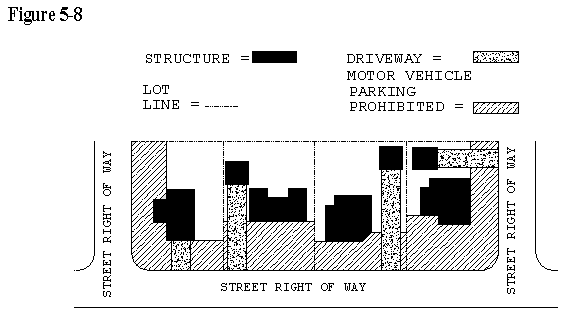
(b)
Portions of a yard where motor vehicles and trailers are permitted. Notwithstanding the provisions in this subsection, motor vehicles or trailers in any residential district or a lot or tract of land used primarily for residential purposes in any other district may be located in all portions of a yard where not otherwise prohibited and if accessed in a manner that does not result in the creation of dust, mud, silt or standing water within those areas described in subsection 36-455(7)(a).
(c)
Other portions of a residential lot where motor vehicles and trailers are permitted. Motor vehicles and trailers may be located in any portion of a residential lot, including those areas otherwise prohibited by subsection 36-455(7)(a), if said motor vehicles and trailers are on one of the following:
1.
An area excluding the front yard visually screened from adjacent streets by a solid fence or wall, not less than six feet in height and meeting the requirements of subsection 36-453(6), and if accessed in a manner that does not result in the creation of dust, mud, silt or standing water within those areas described in subsection 36-455(7)(a).
2.
An off-street parking area for residential uses meeting the requirements of subsection 36-483(2).
(d)
Legal nonconforming parking in the yard. Parking or storage use for motor vehicles and trailers that are previously established in a residential district or a lot or tract of land used primarily for residential purposes in any other district, and made nonconforming by the adoption of the provisions in subsections (7)(a) and (b), may be permitted to continue under one of the following circumstances:
1.
The off-street parking space, and driveway leading thereto, does not meet the provisions of subsections 36-455(7)(a)—(c) but adheres to the surfacing requirement in subsection 36-483(1)(f).
2.
The off-street parking space, and driveway leading thereto, meets the locational provisions of subsections 36-455(7)(a)—(c) but does not adhere to the surfacing requirement in subsection 36-483(1)(f).
(e)
Abatement of violation. No person shall allow a motor vehicle or trailer to remain on property in violation of this section.
(8)
Off-street bicycle parking.
(a)
Purpose. Off-street bicycle parking spaces shall be required in order to promote effective traffic circulation, reduce congestion, encourage a reduction of impervious automobile parking area, provide facilities that promote alternative transportation options and endorse a healthy lifestyle.
(b)
Required bicycle parking spaces. Unless otherwise exempted by subsection 36-455(8)(d), bicycle parking spaces shall be required for all uses in all zoning districts whenever off-street automobile parking is provided; or, for existing structures in all zoning districts, except the center city district, where the floor area is increased.
(c)
Center city district bicycle parking requirements. Within the CC district, off-street bicycle parking shall be provided for new structures containing the following uses regardless of whether off-street automobile parking is provided: Auditoriums, stadiums, gymnasiums, and convention halls. The number of off-street bicycle parking spaces required shall be based on the number of off-street automobile parking spaces that would typically be required for said uses in other zoning districts by subsection 36-455(2) unless provisions for bicycle parking are made in accordance with subsection 36-455(8)(e).
(d)
Uses exempted from bicycle parking requirements. Bicycle parking spaces shall not be required for single-family dwellings, townhouses, duplexes, and mobile homes.
(e)
Multi-level parking structures. When multi-level parking structures are provided in order to meet one or more uses for off-street automobile parking space requirements as established in subsection 36-455(2), said structure shall be designed to include the applicable established off-street bicycle parking requirement. Bicycle parking spaces within a multi-level parking structure that serve any combination of uses, may be used to satisfy up to 50 percent of the off-street bicycle parking requirements for each of the uses that it is intended to serve.
(Zoning Ord., § 5-1500; G.O. 4519, 6-12-95; G.O. 5127, 10-29-01; G.O. 5165, 3-25-02; G.O. 5355, 3-15-04; G.O. 5412, 10-18-04; G.O. 5671, 4-23-07; G.O. 5829, 7-13-09; G.O. 5881, 7-26-10; G.O. 6025, 12-17-12; G.O. 6092, 1-13-14; G.O. 6234, § 1(exh. A), 10-12-15; G.O. 6326, § 1, 12-12-16)
Sec. 36-456. - Off-street loading requirements.
(1)
Applicability. In any zoning district, all structures built and all uses established hereafter, shall provide necessary accessory off-street loading facilities. When an existing structure is expanded, accessory off-street loading facilities shall be provided in accordance with the following regulations for the area of such expansion.
(2)
Off-street loading berth requirements.
(a)
Schools, elementary and secondary, shall provide at least one off-street loading space for passenger automobiles for each 50 students and one queuing space for each ten students based upon the designed maximum capacity of the school. Queuing spaces may be provided in the driving aisles of parking lots associated with the facility.
(b)
Churches and other places of assembly shall also provide at least one off-street loading space for passenger automobiles for each 50 people and one queuing space for each ten people based upon the designed maximum capacity of the facility. Queuing spaces may be provided in the driving aisles of parking lots associated with the facility.
(c)
On the same lot with every building, or part thereof, erected hereafter in any office, commercial or industrial district, adequate space shall be provided on the lot for motor vehicles to load and unload in order to avoid interference with traffic in the public streets or alleys in accordance with the design standards in section 36-483, off-street parking and loading area design standards.
(Zoning Ord., § 5-1600)
Sec. 36-457. - Nonconformities.
(1)
Purpose. Within the districts established by this article, there exist buildings and uses that could not be built or established under this article but that were lawful when built or established under the provisions of a prior ordinance. Future amendments to this article may be expected to create additional such nonconformities.
The purpose of this section is to recognize the legitimate interests of those who have lawfully established structures or uses which are nonconforming by permitting such nonconformities to be continued. However, nonconformities do substantially and adversely affect the orderly development, maintenance, use, and taxable value of other property in their vicinity, property that is itself subject to the zoning regulations. Therefore, it is necessary to subject nonconforming buildings and uses to restrictions that are designed to prevent the expansion or extension of such buildings and uses and to enhance the probability that such buildings and uses will eventually be converted into conforming buildings and uses.
(2)
Nonconforming lots of record.
(a)
In the R-SF, R-TH, and R-MHC residential districts.
1.
In the R-SF, R-TH, and the R-MHC residential districts, notwithstanding the regulations imposed by any other provision of this article, a single-family-detached dwelling which complies with the restrictions in subsection 36-457(2)(b) may be erected on a lot that:
a.
Is shown by a recorded plat or deed to have been created prior to December 5, 1956, when the creation of a lot of such dimensions at such location would not have been prohibited by this article; and
b.
Fronts on a local or collector street or can be provided with vehicular access via an alley or an access easement.
Off-street parking shall not be required when on-street parking is available within 300 feet of the subject property on a street with a minimum pavement width of 24 feet.
2.
Construction permitted by subsection 36-457(2)(a) shall comply with all of the regulations (except lot area, width and depth) applicable to single-family dwellings in the zoning district in which the lot in question is located; provided, however, that the following side yard requirements shall apply in place of the side yard requirements otherwise applicable.
a.
The dwelling shall be placed on the lot so as to provide a yard on each side of the dwelling.
b.
The sum of the widths of the two side yards on each lot shall be not less than the smaller of:
(i)
Twenty-five percent of the width of the lot, or
(ii)
The minimum total for both side yards prescribed by the bulk regulations for said zoning district.
c.
No side yard shall be less than ten percent of the width of the lot, and in no case less than three feet.
(b)
In other districts.
1.
In any district other than those listed in subsection 36-457(2)(a), notwithstanding the regulations imposed by any other provision of this article, a building designed for any permitted use may be erected on a lot of the type described in subsection 36-457(2)(a)1.
2.
Construction permitted by subsection 36-457(2)(b)1 shall comply with all of the regulations (except lot area, width and depth) applicable in the zoning district in which the lot in question is located; provided, however, that if the zoning district requires a minimum lot width, the width of any side yard need not be greater than that derived by applying the following formula (wherein the width of any side yard required = X):

(3)
Nonconforming buildings and structures.
(a)
Authority to continue. Any building or structure which is devoted to a use which is permitted in the zoning district in which it is located but which does not comply with applicable bulk regulations, or which is located on a lot which does not comply with the applicable lot size requirements and/or the applicable bulk regulations, may be continued, so long as it remains otherwise lawful, subject to the restrictions in subsections 36-457(3)(b) through 36-457(3)(d) of this article.
(b)
Maintenance, repair, remodeling and structural alterations. Any building or structure described in subsection 36-457(3)(a) may be maintained, repaired or remodeled, or structurally altered. Any such maintenance, repair, remodeling or structural alteration shall conform to all requirements of the zoning district and shall not increase the nonconformity of the existing building or structure except that for buildings or structures located on a lot that does not comply with the applicable lot size requirements, the side yard requirements shall be determined by subsection 36-457(2)(a)2. or 36-457(2)(b)2., whichever is applicable.
(c)
Expansion or enlargement. Any building or structure described in subsection 36-457(3)(a) may be expanded or enlarged provided such expansion or enlargement conforms to all requirements of the zoning district and does not increase the nonconformity of the existing building or structure unless it is required by the codes and ordinances of the City of Springfield and except that for buildings or structures located on a lot that does not comply with the applicable lot size requirement, the side yard requirements shall be determined by subsection 36-457(2)(a)2. or 36-457(2)(b)2., whichever is applicable. Any building or structure described in subsection 36-457(3)(a) shall not be required to conform to the requirements of the article as a condition for expansion or enlargement.
(d)
Damage or destruction. In the event that any building or structure described in subsection 36-457(3)(a) is damaged or destroyed, by any means, to the extent of more than 75 percent of the replacement cost of the building or structure at the time such damage occurred, such building or structure shall not be restored unless it shall thereafter conform to the regulations for the zoning district in which it is located. Structures located on a lot that does not comply with the applicable lot size requirements shall not in any event be required to provide a side yard that exceeds the yard requirements in subsection 36-457(2)(a)2. or 36-457(2)(b)2., whichever is applicable. When a building or structure is partially damaged to the extent of 75 percent or less, no repairs or restoration shall be made unless a zoning certificate is obtained and restoration is actually begun within 12 months after the date of such partial destruction and is diligently pursued to completion.
(e)
Moving. No building or structure described in subsection 36-457(3)(a) shall be moved in whole or in part for any distance whatever, to any other location on the same or any other lot unless the entire building or structure shall thereafter conform to the regulations of the zoning district in which it is located after being moved.
(4)
Nonconforming uses.
(a)
Authority to continue. Any lawfully existing nonconforming use of part or all of a building or structure or any lawfully existing nonconforming use of land, not involving a building or structure or only involving a building or structure which is accessory to such use of land, may be continued, so long as it is otherwise lawful, subject to the regulations contained in subsections 36-457(4)(b) through 36-457(4)(l).
(b)
Ordinary repair and maintenance.
1.
Normal maintenance and incidental repair, or replacement, installation or relocation of nonbearing walls, nonbearing partitions, fixtures, wiring or plumbing, may be performed on any building or structure that is devoted in whole or in part to a nonconforming use; provided, however, that this subsection 36-457(4)(b)1. shall not be deemed to authorize any violation of subsections 36-457(4)(c) through 36-457(4)(i) of this article.
2.
Nothing in this article shall be deemed to prevent the strengthening or restoring to a safe condition of a structure in accordance with an order of a public official who is charged with protecting the public safety and who declares such structure to be unsafe and orders its restoration to a safe condition (where such restoration will not be in violation of subsection 36-457(4)(f) of this article).
(c)
Remodeling. No building or structure that is devoted in whole or in part to a nonconforming use shall be remodeled, if structural alteration is required, unless the entire building or structure and the use thereof shall thereafter conform to all regulations of the zoning district in which it is located.
(d)
Extension. A nonconforming use shall not be extended, expanded, enlarged, or increased in intensity. Such prohibited activities shall include, without being limited to:
1.
Extension of such use to any building or structure or land area other than one occupied by such nonconforming use on the effective date of this article (or on the effective date of a subsequent amendment hereto that causes such use to become nonconforming) except as permitted by subsection 36-457(4)(e);
2.
Extension of such use within a building or structure to any portion of the floor area that was not occupied by such nonconforming use on the effective date of this article (or on the effective date of a subsequent amendment hereto that causes such use to become nonconforming) except as permitted by subsection 36-457(4)(e) and provided, however, that such use may be extended throughout any part of such building or structure that was lawfully and manifestly designed or arranged for such use on such effective date; and
3.
Operation of such nonconforming use in such manner as to conflict with any performance standards established for the zoning district in which such use is located. Nor shall a nonconforming use be operated in such a manner so that it further conflicts with any performance standards established for the district in which such use is located if it already conflicts on the effective date of this article (or on the effective date of a subsequent amendment hereto that results in such use becoming nonconforming).
(e)
Exemptions. Notwithstanding the provisions of this section, where a use is conforming but is made nonconforming on the effective date of this article, such use may be increased by 25 percent in terms of building floor area, number of employees or other measure of intensity provided the use conforms to all other regulations of this article.
(f)
Enlargement. No building or structure that is devoted in whole or in part to a nonconforming use shall be enlarged or added to in any manner unless such building or structure and the use thereof shall thereafter conform to the regulations of the district in which it is located.
(g)
Damage or destruction. In the event that any building or structure that is devoted in whole or in part to a nonconforming use is damaged or destroyed by any means, to the extent of more than 75 percent of its replacement cost at the time of such damage, such building or structure shall not be restored unless such building or structure and the use thereof shall thereafter conform to all regulations of the zoning district in which it is located. When such damage or destruction is 75 percent or less, no repairs or restoration shall be made unless a zoning certificate is obtained, and restoration is actually begun within one year after the date of such partial destruction and is diligently pursued to its completion.
(h)
Moving. No building or structure that is devoted in whole or in part to a nonconforming use, shall be moved in whole or in part for any distance whatever, to any other location on the same or any other lot, unless the entire building or structure and the use thereof shall thereafter conform to all regulations of the zoning district in which it is located after being so moved.
(i)
Change in use.
1.
The board of adjustment may grant a special exception to permit a nonconforming use to be changed to any other use permitted in the zoning district in which the nonconforming use is allowed provided the proposed use is not more intense than the existing use in terms of activity, traffic generation, and other impacts on surrounding property.
2.
When a nonconforming use has been changed to any conforming use allowed in the district in which the property is located, it shall not thereafter be changed back to a nonconforming use.
(j)
Abandonment or discontinuance. When a nonconforming use of land or of a building or structure is discontinued or abandoned for a period of 12 consecutive months (regardless of any reservation of an intent not to abandon or to resume such use except as provided in (g) above), such use shall not thereafter be reestablished or resumed, and any subsequent use or occupancy of such land, building or structure shall comply with the regulations of the zoning district in which it is located.
(k)
Nonconforming accessory uses. No use which is accessory to a principal nonconforming use shall continue after such principal use shall cease or terminate.
(l)
Termination of nonconforming use for nuisance or illegality. The right to continue a nonconforming use is conditional and may be continued for only so long as the nonconforming activity is conducted lawfully and does not produce a condition which constitutes a nuisance. The use of any building, structure or land in a manner set forth below shall constitute constructive abandonment of the use, shall terminate the right to continue the nonconforming use, and nothing contained in subsection 36-457(4)(j) shall be construed to require such constructive abandonment to continue for 12 consecutive months:
1.
Use in any manner which produces a condition constituting a nuisance subject to chapter 74, Springfield City Code, prohibiting the creation of a nuisance.
2.
Use for any activity which is in violation of law or ordinance.
(5)
Status of existing conditional uses. Where a use exists at the effective date of this article, or on the effective date of a subsequent amendment hereto that causes such use to become a conditional use, and is permitted by this article only as a only as a conditional use in the zoning district in which it is located, such use shall not be deemed to be a nonconforming use, but shall, without further action, be deemed a lawful conforming and duly authorized conditional use in such zoning district.
(6)
Occupancy certificates for nonconforming uses.
(a)
Survey. As soon as practicable after the adoption of this article, or after the adoption of any other ordinance which renders nonconforming any previously lawful use or structure, the city council shall use its best efforts to survey potential legal nonconforming uses for the purpose of making a permanent record of the existence and extent of such uses.
(b)
Notice. The owners of record of all properties containing a use or structure that are deemed to be nonconforming shall be given written notice of that fact by the director of building development services. Within 90 days after the receipt of such notice said owners of record shall submit applications, on forms made available in the office of the director of building development services for a certificate of occupancy for any nonconforming use or structure.
(c)
Application information. The application for such certificate shall designate the location, nature, and extent of such nonconforming use or structure; information sufficient to document the fact that the nonconforming use was a lawful use at the time it was commenced: and such other details as may be necessary for the issuance of the certificate of occupancy.
(d)
Effect of occupancy certificate. Issuance of a certificate of occupancy pursuant to subsection 36-457(6)(c) shall be deemed to establish conclusively that the use in question was a legal nonconforming use, and the extent thereof, as of the date of the occupancy certificate.
(e)
Failure to apply. If any owner of a nonconforming use or structure fails to apply for a certificate of occupancy in the manner set out above, such use shall be presumed to be illegal until such time as the property owner establishes the legality of the nonconforming use in a proper procedure before the board of adjustment.
(f)
Certificate recorded. A copy of the certificate of occupancy for a nonconforming use or structure shall be recorded by the city with the recorder of deeds of Greene County against the property in question.
(g)
Determination of legal nonconformity. Within 60 days after the receipt of an application, the director of building development services shall determine whether or not a use is legal nonconforming. If a use is not found to be legal nonconforming, the owners of record shall have 90 days to discontinue the illegal use. The owners of record may appeal the decision of the director of building development services as provided in section 36-364, appeals.
(Zoning Ord., § 5-1700; G.O. 4748, 1-15-97; G.O. 5127, 10-29-01; G.O. 5345, 1-26-04; G.O. 5471, 6-27-05; G.O. 5901, 10-4-10)
Sec. 36-458. - Redevelopment areas.
The city council may permit, in an area where there is an approved redevelopment plan, a modification of the requirements of this article as the council may deem necessary to encourage the conservation and preservation of urban resources, to promote the stabilization and economic development of urban areas and to provide for housing especially for the elderly and for low and moderate income families, provided the following conditions are satisfied:
(a)
The project complies with an approved redevelopment plan;
(b)
The project complies with all ordinances except those provisions which are to be modified;
(c)
The project does not interfere with easements, roadways, rail lines, utilities, and public or private rights-of-way;
(d)
The project does not destroy, damage, detrimentally modify, or interfere with the enjoyment of significant natural, topographic, or physical features of the site;
(e)
The project is not injurious or detrimental to the use and enjoyment of surrounding property;
(f)
The circulation elements of the project do not create hazards to safety on or off the site; dependence on automobile travel; or interferences and inconveniences to pedestrian travel;
(g)
The project makes adequate provision for the creation or preservation of open space and for its continued maintenance;
(h)
The project does not create drainage or erosion problems;
(i)
A site plan and a description of the project has been submitted to the planning and zoning commission for its recommendations and approved by city council. The site plan and description shall make specific reference to the provisions of this article to be modified.
(j)
The city council may impose any conditions to achieve the intent of the city ordinances and the redevelopment plan, to safeguard surrounding properties, to minimize any adverse impact on services and facilities, and to achieve other public purposes. The city council must find that the applicant has complied or has provided adequate assurances that he will comply with any conditions set forth by city council.
(Zoning Ord., § 5-1800)
Sec. 36-459. - Special regulations for retail liquor sales.
(1)
Applicability. No license shall be issued for the sale of intoxicating liquor at retail in any form notwithstanding that the proposed establishment is within the zone appropriate therefore under this article nor shall any such use be conducted in any zone of the city unless the following procedures shall be followed.
(2)
Location with regard to R-SF, R-TH, R-MHC, or PD districts. Whenever any application shall be received by the city for the establishment of a place for the sale of intoxicating liquor at retail in any form, it shall be determined by the officer charged with the responsibility of issuing such licenses whether or not the proposed establishment is located within 200 feet of any property zoned R-SF, R-TH, R-MHC or designated for single-family or two-family residential use in a PD district under this article. In the event there shall be no such property within 200 feet from the proposed location and the application shall otherwise be appropriate and authorized by the laws of the city, then the license may be issued.
(3)
Application fee. If the proposed establishment is within 200 feet of property zoned R-SF, R-TH, R-MHC, or designated for single-family or two-family residential use in a PD district, then the person charged with the responsibility of accepting applications for such establishments on behalf of the city shall require to be filed therewith a fee of $107.00 plus the actual costs of publication and other legal notices required by law for the processing of said application, which fee is in addition to the license fee required by ordinances of the city. The additional fee shall be for the costs of processing the application and providing the necessary notifications described herein.
(4)
Public notice. Thereupon, the applicant shall cause to be posted in four places in the vicinity of the property which is so zoned R-SF, R-TH, R-MHC or designated for single-family or two-family residential use in a PD district, and which is within 200 feet of the proposed establishment a notice setting forth the proposed application and advising that persons within said 200 feet owning or occupying property zoned R-SF, R-TH, R-MHC or designated for single-family or two-family residential use in a PD district, shall have the right within 21 days from the date that the notice shall first be posted in which to protest the granting of a license for the establishment and the use of the land therefore, including instructions for filing said protest. In addition, said notice shall be mailed to all persons within said 200 feet owning or occupying property zoned R-SF, R-TH, R-MHC or designated for single-family or two-family residential use in a PD district, said mailing to occur by first-class mail no later than three days prior to the posting described herein. Deposit in the United States mail, with postage prepaid, shall constitute proof of compliance with the mailing notice requirement. In addition, said notice shall be advertised in an official newspaper or a newspaper of general circulation in the City of Springfield, Missouri, said notice to be given for at least five straight consecutive issues and the time to protest shall commence with the date of the first said publication and shall terminate on the twenty-first day thereafter.
(5)
Protest requirements. If within the 21 days aforesaid there shall be filed with the officer of the city charged with receiving applications for liquor licenses a protest to granting the license for the proposed establishment signed by at least 50 percent of the owners and/or occupants of the land so zoned R-SF, R-TH, R-MHC or designated for single-family or two-family residential use in a PD district, and located within 200 feet of the proposed establishment, then the application shall be forwarded to city council for its resolution in favor or against said application. If, however, no such protest shall be filed within 21 days or if the same shall be insufficient, thereupon the license may issue, all other requirements of the law of the City of Springfield having been met and complied with.
For the purpose of this section, only one signature per land parcel, whether property owner or occupant, shall be counted in determining whether the 50-percent threshold for protest has been satisfied. In the event of conflict between the owner and occupant, the owner shall prevail. In the event that an occupant files a protest, but the owner does not, the owner shall be notified of said protest. The notice shall be mailed by first-class mail no later than three days after the deadline to file a protest. Deposit in the United States mail, with postage prepaid, shall constitute proof of compliance with this notice requirement. The owner shall have seven days from the date of mailing to file with the officer of the city charged with receiving applications for liquor licenses a withdrawal of the occupant's protest.
The official of the City of Springfield charged with the responsibility of accepting applications for licenses for the sale of intoxicating liquor at retail shall have the authority from time to time to prepare forms to implement this section including protest forms, application forms, and forms for notice, forms for proof of ownership and/or occupancy, and other appropriate requirements. Forms of protest shall in any event be acknowledged by some person other than a protesting owner or occupant located within the 200 feet area acknowledging the signatures of the persons contained thereon to be the free act and deed of the persons so signing. In determining those persons entitled to be counted in such protest, only those persons who are owners or occupants of the land of record on the date that the application shall have been filed shall be entitled to protest.
Notwithstanding the provisions of this section, the director of finance may issue a license for the same location to any purchaser of a retail liquor establishment which was duly licensed at the time of the purchase providing the purchaser makes proper application and is qualified and eligible to hold a license and providing that the provisions of section 10-36 [of the] Springfield City Code shall have been complied with; nor shall the provisions of this section prohibit the reissuance of licenses for previously existing duly licensed establishments.
(6)
Exemption from notice. The applicant shall be exempted from the notice and publication requirements herein, and only those requirements, if 100 percent of all owners and occupants of residential property as set forth herein, file a notarized waiver of protest setting forth the case or license number, address of establishment, and indicating they have no opposition to the proposed use, and the license may issue providing the applicant has complied with all other applicable requirements.
(Zoning Ord., § 5-1900; G.O. 6034, 2-11-13; G.O. 6851, § 1, 5-6-24)
Sec. 36-460. - Adult entertainment.
(1)
Purpose. The purpose of these regulations is to protect residential property values by restricting the location of adult entertainment businesses. Local and national studies indicate that such businesses are perceived to have a negative impact on residential property values. Dispersion of adult businesses is also required in order to avoid concentration of uses that have a negative impact on adjoining property values.
(2)
Location. An adult motion picture theater, adult store, or cabaret, as defined in section 36-301, definitions, may locate only in GR, HC, CS, RI, LI, GM and HM zoning districts. Such uses are prohibited within the area circumscribed by a circle which has a radius of 2,000 feet from any residential zoning district, school, park, or church, or any legally platted subdivision in which 75 percent or more of the developed lots are used for residential purposes. A developed lot shall be defined as a lot upon which a habitable building or dwelling house is constructed. No more than one such use may locate in each 1,000 feet.
(3)
Distances. The distances provided in this section shall be measured by following a straight line, without regard to intervening structures or objects, from the adult motion picture theater, adult store, or cabaret to the nearest point of the parcel of property containing a school, park, or church, or the residential zoning district boundary line.
(Zoning Ord., § 5-2000; G.O. 4691, 4-14-97)
Sec. 36-461. - Special regulations relating to vehicle repair activities.
(1)
No person shall perform repair activity upon any vehicle, engine, or components thereof, upon property located within any district where vehicle repair is not specifically permitted. Provided, however, that a person may perform repair activity upon his own vehicle, engine, or components thereof, so long as the repair activity is not undertaken for compensation. Repair activity includes the maintenance, repair, disassembling or reassembling of a vehicle, engine, or components thereof in any manner.
(2)
A presumption that a violation of this section has been committed by the person or persons in possession of property is created when there is evidence that establishes that repair activity has taken place upon a vehicle that does not display a license plate, or upon a vehicle that is not registered in the name of the person or persons in possession of the property.
(Zoning Ord., § 5-2100)
Sec. 36-462. - Scrap, salvage, junk, and automobile wrecking yards.
(1)
Purpose. The purpose of these regulations is to protect the health, safety, aesthetics, and economic well-being of the community from the adverse impacts of salvage yards. These uses involve the outside storage of junk and salvage materials. Although these uses may be beneficial to the economic life of the community, the clutter of junk and salvage materials, poorly constructed and maintained fences, the storage of hazardous materials, noise, dust, and lack of separation between storage areas and residential uses create a negative image for the community, endanger the health and safety of residents and reduce the value of adjoining properties.
(2)
No salvage yard shall operate at any location unless the salvage yard is operated in accordance with the following provisions:
(a)
A minimum setback of 35 feet shall be maintained from the right-of-way of any street. Off-street parking may be provided in the area between the street right-of-way and the storage area, provided all off-street parking requirements of this article are met.
(b)
A minimum bufferyard of 35 feet shall be maintained from any adjacent residential zoning district or from any adjacent lot used for residential purposes, located in any zoning district. Such bufferyard shall not be required adjacent to a lot in a nonresidential zoning district used for mixed residential and nonresidential purposes, unless the nonresidential use is a bona fide customary home occupation, nor shall it be required so long as the owner of the land where the salvage yard is located also owns the residential property. The bufferyard shall be landscaped with at least five canopy trees, eight understory trees, 32 shrubs and 16 evergreen/conifers per 100 linear feet of common property line. The bufferyard also shall be seeded with lawn unless ground cover is already established and shall be kept neat, clean and free from litter, debris, and noxious weeds. All plant material shall be tended and maintained in a healthy growing condition and replaced when diseased, irreparably damaged, or dead. The bufferyard shall be located between the business' fence and the residential zoning district or the residential use.
(c)
Items to be stored shall be limited to those which do not create a nuisance as defined by the laws of the State of Missouri or the City of Springfield. All salvage yards shall comply with the provisions of chapter 29C, article II, Springfield City Code.
(d)
The requirements of paragraphs (a) and (b) of this subsection shall not apply to businesses exempt from the provisions of section 29C-21, Springfield City Code.
(Zoning Ord., § 5-2200)
Sec. 36-463. - Common open space and common improvement regulations.
(1)
General provisions. The regulations set forth in this section shall apply in all developments where the following features are held in common ownership by persons owning property within a development.
(a)
All lands in common open space, not a part of individual lots, designed for the mutual benefit of a group of persons owning property within a development, where such lands are not dedicated to or conveyed for public use whether or not such lands are required by the provisions of this article; and
(b)
All private streets, driveways, parking facilities, and buildings or portions thereof, as may be provided for the common use, benefit and/or enjoyment of the occupants of the development; whether or not such improvements are required by the provisions of this article.
(2)
Condominium Property Act. Except where it can be demonstrated that the provisions of this section can be satisfied by other means, all lands and improvements, as set forth in this section, shall be established and maintained in accordance with the Condominium Property Act, Chapter 448, Missouri State Statutes or subsequent amendments.
(3)
Subdivision approval required. All subdivision of property containing common open space and common improvements shall be subject to review in accordance with the provisions of chapter 36, article II, subdivision regulations.
(4)
Property owners' association. If common open space and common improvements are not dedicated to and accepted for public use, they shall be protected by legal arrangements, satisfactory to the planning and zoning commission and city council city attorney sufficient to assure their maintenance and preservation for whatever purpose they are intended. Covenants or other legal arrangements shall specify ownership of the common open space and common improvements; method of maintenance, responsibility for maintenance; maintenance taxes and insurance; compulsory membership and compulsory assessment provisions; guarantees that any association formed to own and maintain common open space and common improvements will not be dissolved without the consent of the city; and other specifications deemed necessary by the city attorney, planning and zoning commission and city council.
(5)
Covenants, rules and by-laws. The director of planning and development and the city attorney shall review and approve the restrictive covenants, rules and by-laws of the unit ownership, as prepared in accordance with this section and Chapter 448, Missouri State Statutes. This approval shall be obtained before any final plat is recorded or final site plan approved. Such documents, once approved, shall become part of the recorded subdivision plat or approved site plan.
(6)
Content of covenants and restrictions. The covenants and restrictions, when submitted, shall specify the ownership of the common open space and common improvements, shall be prepared in accordance with this section and Chapter 448, Missouri State Statutes, shall provide: for establishment of the condominium or property owners' association or trust prior to the sale of any part of the property; for the method of maintenance; that open space restrictions and maintenance shall be permanent; that the property owners are liable for the payment of maintenance fees and capital assessments; that unpaid property owners' fees and assessments will be a lien on the property of the delinquent property owners; that the association or trustee shall be responsible for liability insurance, taxes and perpetual maintenance; that membership shall be mandatory for each property owner and any successive buyer; that each property owner, at the time of purchase, shall be furnished with a copy of the approved restrictions or conditions; and that any association or trust formed to own and maintain common open space and common improvements will not be dissolved without the consent of the city. In addition, such covenants and restrictions shall provide that in the event the association fails to maintain the common areas, opens space/improvements, or should be dissolved for any reason and the common areas and space/improvements are not maintained in reasonable condition, the city may enter and maintain same in accordance with the procedure set forth in subsection 36-463(7), and assess the costs ratably against the properties within the development that have a right to enjoy or use the common area or open space/improvements, which assessment shall constitute a lien against such properties.
(7)
Maintenance of common open space and common improvements.
(a)
If the planning and zoning commission and city council determines that the public interest requires assurance concerning adequate maintenance of common open space areas and improvements, the planning and zoning commission and city council may require that the restrictive covenants, rules and by-laws creating the unit ownership shall provide that if the unit owners establish and maintain such common open space improvements, or any successor unit owners, shall at any time after establishment of the development fail to maintain the common open space/improvements in reasonable order and condition in accordance with the approved plans, the city may serve a notice in writing upon such unit owners. Said notice shall describe how the unit ownership has failed to maintain the common open space/improvements in reasonable condition, shall require that such deficiencies of maintenance be remedied within 30 days thereof, and shall state the date and place of a public hearing. Said hearing shall be held within 20 days of notice.
(b)
At such hearing the city council may modify the terms of the original notice concerning the deficiencies and may grant an extension of time to remedy these deficiencies.
(c)
If said deficiencies are not corrected, the city may enter upon said common open space and maintain the same for one year in order to preserve the taxable values of the properties within the development and to prevent the common open space/improvement from becoming a public nuisance.
(d)
Said entry and maintenance shall not grant the public any rights to use the common open space/improvements unless the owners voluntarily dedicate the same to the public and such dedication is accepted by the city.
(e)
Before the expiration of said one-year period and upon its initiative or upon the request of the unit owners theretofore responsible for the maintenance of the common open space/improvements, the city council shall call a public hearing upon notice in writing to such organization or to owners of the unit ownership. At said hearing, the unit owners shall show cause why such maintenance by the city shall not, at the election of the city council, continue for a succeeding one-year period.
(f)
If the city council determines that said unit ownership is ready and able to maintain the common open space/improvements in reasonable condition, the city shall cease to maintain the common open space/improvements at the end of said one-year period or at an earlier date prescribed by the city council.
(g)
If the city council determines that such organization is not ready and able to maintain the common open space/improvements in a reasonable condition, the city council may, at its discretion, continue to maintain the common open space improvements during the next succeeding year, subject to a similar hearing and determination in each year thereafter.
(h)
The rules and by-laws creating the unit ownership shall further provide that the cost of such maintenance by the city shall be assessed ratably against the individual properties within the development that have a right of enjoyment of the common open space/improvements. This assessment shall become a charge on said properties, and such charge shall be paid by the owners of said properties within 30 days after receipt of same. Such assessments shall constitute a lien against all properties within the unit ownership.
(8)
Maintenance responsibility.
(a)
Except as provided in subsection 36-463(7), the city shall not be responsible for the maintenance of any common open space/improvements required by this article.
(b)
Initial maintenance of the common open space/improvements within a development shall be the responsibility of the developer. The restrictive covenants, rules, and bylaws of the unit ownership may prescribe a method for transfer of maintenance responsibility to a duly constituted property owners' association. In the event no method for transfer or maintenance responsibility is prescribed, the developer shall retain this responsibility until 50 percent of the development has been sold to the unit owners or other clients. When at least 50 percent of the development has been sold, the established unit ownership, comprised of the development's unit owners shall be deeded the common open space/improvements and such owners shall become fully responsible for its maintenance and upkeep.
(c)
The maintenance responsibilities of the developer listed in this section shall be specifically indicated in a letter of agreement between the developer and the city. The developer shall submit said letter to the planning and zoning commission and the director of planning and development at the time of final plat review. All principal access shall be from an arterial highway or street and no truck traffic shall be routed through any adjacent residential areas. Streets through adjacent residential areas shall not be used to provide principal access for truck traffic to any nonresidential use in this district except on streets classified as expressways, arterials, or collectors.
(Zoning Ord., § 5-2300; G.O. 5425, 11-15-04; G.O. 5770, 7-28-08)
Sec. 36-464. - Accessory apartments.
(1)
Purpose. The purpose of allowing accessory apartments is to improve the ability of homeowners to maintain and remain in their homes by permitting a portion of a home to be rented as an apartment. It is also the intent to allow accessory apartments in historic carriage houses to encourage their preservation. The requirements of this section are also designed to protect the single-family character of the neighborhood in which a home or carriage house containing an accessory apartment is located.
(2)
Accessory apartment requirements. Only one accessory apartment shall be permitted on a lot in an R-SF or R-MHC district in accordance with the following regulations.
(a)
Owners wishing to create an accessory apartment shall submit an application and site plan to the administrative review committee demonstrating that the following conditions have been met or provisions made therefore:
1.
The accessory apartment or the single-family-detached dwelling located on the lot where the accessory apartment is located shall be actually and physically occupied by at least one owner of record who possesses at least an estate for life or a 50 percent fee simple ownership interest. Under no circumstances shall the owner receive compensation for the occupancy of more than one unit.
2.
One additional off-street parking space for each bedroom in the accessory apartment, located behind the building setback line, shall be provided.
3.
The accessory apartment shall be clearly incidental to the principal dwelling and meet the following criteria:
a.
An accessory apartment may be created only in a single-family dwelling or in an existing carriage house if the carriage house was constructed prior to January 1, 1940, and the lot on which the carriage house is located is designated a historic site, landmark, or district.
b.
An accessory apartment may be created only on a lot of 6,000 square feet or more. The zoning district within which the lot is located may require a greater minimum lot size.
c.
If the accessory apartment is to be located in a dwelling, the single-family detached dwelling shall have a floor area of 2,000 square feet or more, excluding garage space and any other space that is not habitable.
d.
If the accessory apartment is to be located in a dwelling, no more than 30 percent of the single-family detached dwelling shall be used for the accessory apartment.
e.
Other than historic carriage houses, no accessory buildings such as garages and sheds shall be used for an accessory apartment.
f.
The accessory apartment shall contain complete cooking and sanitary facilities.
g.
If the accessory apartment is to be located in a dwelling, any additional entrance resulting from the creation of an accessory dwelling unit may face the side of the lot fronting on the street only if such entrance is adequately and appropriately screened in a manner that does not substantially detract from the single-family appearance of the dwelling.
h.
No historic carriage house shall be expanded or enlarged or its exterior appearance altered in a manner that detracts from its historic character in order to create an accessory apartment.
i.
Accessory apartments must meet applicable city codes.
4.
No accessory apartment shall be established concurrent with the customary home occupation of renting rooms.
(b)
Accessory apartments shall be registered annually with the city finance director. In addition to the requirements of chapter 18, Springfield City Code, the owner shall verify that the conditions noted in subsection 36-464(2)(a) are still being met.
(Zoning Ord., § 5-2400)
Sec. 36-465. - Residential group homes.
(1)
Purpose. It is necessary and desirable to provide suitable sites for residential group homes, as defined in section 36-321, definitions, in single-family residential areas provided that, in furtherance of the goals of de-institutionalization of handicapped persons and allowing residential group homes to be integrated throughout the community, residential group homes are not concentrated in particular neighborhoods.
(2)
Residential group home location requirement. Residential group homes are permitted in the R-SF, R-TH, and R-MHC districts provided that no residential group home shall locate within a one-quarter mile radius of another residential or custodial group home.
(Zoning Ord., § 5-2500)
Sec. 36-466. - Telecommunication towers.
(1)
Legislative findings. On February 8, 1996, Congress enacted the federal Telecommunications Act of 1996, P.L. No. 104-458. The purpose of the Act is to deregulate the telecommunications industry, providing a more competitive environment for wired and wireless telecommunication services in the United States.
(a)
A concomitant effect of increased competition in the market for wireless telecommunications services is an increased demand for antenna sites on towers and other antenna support structures necessary for providing wireless service.
(b)
New personal wireless telecommunications technologies, such as personal communications systems, or (PCS) require antenna sites to be denser than previous technologies required. However, due to the uniqueness of the wireless telecommunications industry and constantly changing technology, local regulatory efforts must be sufficiently flexible to allow for the continuing development of the wireless telecommunications industry.
(c)
The Telecommunications Act of 1996 preserves the authority of the city to regulate the placement, construction, and modification of towers, antenna support structures and telecommunications facilities and to protect the health, safety and welfare of the public and which is granted to the city under the Constitution and statutes of the State of Missouri and the Charter.
(d)
Consistent with the Telecommunications Act of 1996, regulation of towers and telecommunications facilities in certain areas of the City of Springfield as provided in this article, will not have the effect of prohibiting any person from providing wireless telecommunications services.
(e)
The Federal Communications Commission (FCC) has exclusive jurisdiction over:
1.
The regulation of the environmental effects of radio frequency emissions from telecommunications facilities.
2.
The regulation of radio signal interference among users of the radio frequency spectrum.
(f)
The uncontrolled proliferation of towers in the City of Springfield could diminish property values, the aesthetic quality of the city, and could otherwise threaten the health, safety, and welfare of the public.
(G)
The presence of telecommunications towers, large enclosures, satellite dishes and other large unmovable objects other than standard wood utility poles on the rights-of-way, rather than on private utility easements or fee simple title interests are a danger to the traveling public and an interference with the use and enjoyment of the rights-of-way by abutting landowners and members of the public.
(2)
Legislative purposes. The general purpose of this section 36-466, telecommunication towers, is to regulate the placement, construction, and modification of towers and telecommunications facilities in order to protect the health, safety, and welfare of the public, while at the same time not unreasonably interfering with the development of the competitive wireless telecommunications marketplace in Springfield.
Specifically, the purposes of this section 36-466, telecommunication towers, are:
(a)
To direct the location of towers and telecommunications facilities in the city;
(b)
To protect residential areas and land uses from potential adverse impacts of towers and telecommunications facilities;
(c)
To minimize adverse visual impacts of towers and telecommunications facilities through careful design, sitting, landscaping, and innovative camouflaging techniques;
(d)
To promote and encourage shared use/collocation of towers and antenna support structures as a primary option rather than construction of additional single-use towers;
(e)
To avoid potential damage to adjacent properties caused by towers and telecommunications facilities by ensuring such structures are soundly and carefully designed, constructed, modified, maintained and removed.
(f)
To the greatest extent feasible, ensure that towers and telecommunications facilities are compatible with surrounding land uses.
(g)
To the greatest extent feasible, ensure that proposed towers and telecommunications facilities are designed in harmony with natural settings and in a manner consistent with current development patterns.
(h)
To create a licensing process which allows the city to more efficiently administer this section 36-466, telecommunication towers.
(3)
Applicability.
(a)
All towers, antenna support structures and telecommunications facilities, any portion of which are located within the City of Springfield, are subject to this article. All towers within the City of Springfield, Missouri at the time of passage of said ordinance, or are annexed at a later date, shall be registered with the city finance director within 60 days from the effective date hereof together with the height, width and location thereof and a registration fee of $50.00. Failure to register an existing tower shall raise a presumption that said tower, was not a legal nonconforming use on the date of passage of said ordinance. However, said ordinance shall not apply to tower structures used, or to be used, solely for services provided pursuant to a broadcast radio or television license issued by the Federal Communications Commission or to towers and antennas used for private telecommunications services when the equipment is located on the premises of the entity using said private telecommunication service, or the towers and antennas, support structure or masts are located on the primary business premises of a provider of communications services if used to monitor the provider's services and the equipment used by the broadcaster, private telecommunicator or provider is in compliance with any federal, state or local laws, and does not encroach on the public rights-of-way.
(b)
Except as provided in this section 36-466, telecommunication towers, any current legal use being made of an existing tower or antenna support structure on the effective date of this section 36-466, telecommunication towers, (herein "nonconforming structures") shall be allowed to continue, even if in conflict with the terms of this section 36-466, telecommunication towers. Any tower site that has received city approval in the form of either a conditional use permit or building permit, but has not yet been constructed or located, shall be considered a nonconforming structure so long as such approval is current and not expired.
(4)
Definitions. For the purposes of this article, the following terms, phrases, words, and their derivations shall have the meaning given herein. When not inconsistent with the context, words in the singular number include the plural number. The word "shall" is always mandatory and not merely directory. The word "may" is directory and discretionary and not mandatory.
(a)
Act means the federal Communications Act of 1934 as amended by the Telecommunications Act of 1996 and as may, from time to time, be amended.
(b)
Antenna support structure means any building or other structure other than a tower which can be used for location of wireless telecommunications facilities.
(c)
Applicant means any person that applies for a tower license pursuant to subsection 36-466(8) of this article.
(d)
Application means the process by which an applicant submits a request and indicates a desire to be granted a license to construct, own, or operate a tower within the city. An Application includes all written documentation made by an applicant to the city concerning such a request.
(e)
City means the City of Springfield, a municipal corporation, in the State of Missouri, acting by and through its city manager or his designee.
(f)
Code means the City of Springfield Code of Ordinances.
(g)
Communications or telecommunications means the transmission, between or among points as specified by the user, of information of the user's choosing, without change in the form or content of the information as sent or received, by wire, radio, optical cable, electronic impulses, or other similar means. As used in this definition, "information" means knowledge or intelligence represented by any form of writing, signs, signals, pictures, sounds, or any other symbols.
(h)
Council means the Springfield, Missouri, City Council.
(i)
Director means the director of department of building development services.
(j)
Engineer means any engineer licensed by the State of Missouri.
(k)
FCC means the Federal Communications Commission and any legally appointed, designated, or elected agent or successor.
(l)
Licensee means any person who has lawfully obtained a tower license pursuant to subsection 36-463(8).
(m)
Person is any natural person, firm, partnership, association, corporation, company, or other legal entity, private or public, whether for profit or not-for-profit.
(n)
Site means the actual location of a tower and may be only part of a larger parcel or premises.
(o)
Stealth means any tower or telecommunications facilities which are designed to blend into the surrounding environment.
(p)
Telecommunications facilities means any cables, wires, lines, wave guides, antennas and any other equipment or facilities associated with the wireless transmission or reception of wireless telecommunications as authorized by the FCC which a person seeks to locate or has installed upon a tower or antenna support structure. However, the term telecommunications facilities shall not include:
1.
Any satellite earth station antenna two meters in diameter or less which is located in an area zoned and used for industrial or commercial purposes;
2.
Any satellite earth station antenna one meter or less in diameter, regardless of zoning category;
3.
Any satellite earth station in excess of two meters in diameter which is utilized for the reception of broadcast television, video or radio signals and which is an ancillary use to a structure on the premises of the holder of the broadcast license.
(q)
Tower means a self-supporting lattice, guyed or monopole structure constructed from grade which supports wireless telecommunications facilities. The term "tower" shall not include amateur radio operators' equipment, as licensed by the Federal Communications Commission. The "term" tower does not include utility poles that are owned by a utility provider and are primarily utilized for the support of electrical, telephone, cable television, street lighting, or other similar cables or wireless telecommunications facilities, are located on public rights-of-way or easements for that purpose and are a part of a system of such utility poles throughout the City of Springfield, Missouri.
(5)
Permitted, conditional, and accessory uses.
(a)
Generally. The allowable use of towers and placement of telecommunications facilities as either permitted uses or conditional uses in the several zoning districts shall be as set forth in this article based on the following table except that no telecommunications towers shall be allowed on any right-of-way. All other utility facilities, regardless of type, shall meet the standards and requirements of the zoning district in which they are located. Any utility facility, equipment, or structure that is to be located above ground on the public right-of-way or private easement with a length or width in excess of 47 inches must receive approval of the council prior to installation. Multiple locations may be approved in one application process.
(b)
Telecommunications facilities. Any telecommunications facilities which are not attached to a tower shall be a permitted accessory use to any commercial, industrial, professional, institutional, or multifamily structure, regardless of the zoning restrictions applicable to the zoning district where the structure is located and without having to obtain any prior authorization from the city; provided that the person making such accessory use files a written certification with the city establishing the following:
1.
That the total height of the antenna support structure and telecommunications facilities do not exceed the structural height limitations in the applicable zoning district under this article by more than 20 feet;
2.
That the antenna support structure and telecommunications facilities comply with the city building code and any applicable state law, does not encroach on the public rights-of-way, and a building permit has been obtained from the department of building development services; and
3.
That any telecommunications facilities and antennas located on the roof of a building shall comply with setbacks required by the city building code, if any, and do not extend more than 50 inches in the horizontal plane from the side of such an antenna support structure unless the purpose of said protrusion is to permit signal coverage in an area that will not receive such coverage but for an extension beyond 50 inches. Any extension beyond 50 inches must be approved by the administrative review committee of the city prior to construction of said antenna and such approval shall be dependent upon a showing that coverage is unavailable but for the extension, the extension does not violate any other building code of the city, state or federal law that is applicable, encroach upon public rights-of-way and does not pose any danger to the traveling public.
4.
That the telecommunications facilities will utilize camouflaging techniques or will be side-mounted to an antenna support structure in order that the telecommunications facilities harmonize with the character and environment of the area in which they are located if technically feasible and such techniques will not degrade or distort the service signal. Antennas and support structures shall be painted to blend with the color of the building if such painting will not interfere with functioning of the antenna or support structure.
(6)
Collocation.
(a)
Collocation of facilities. New towers constructed within the city with height in excess of 60 feet should be capable of accommodating two additional carriers or telecommunications facilities for more than one other provider of communications services (hereinafter referred to as "additional capacity"). Such additional capacity, if any, shall be designated on the application and site plans presented to the city prior to construction of the tower.
(b)
Collocation or installation.
1.
Any licensee whose tower in excess of 60 feet which is constructed after the effective date of this section and which has been built in accordance with setbacks and special conditions granted to towers with collocation capabilities under this Article, and has available additional capacity for installation or collocation of telecommunications facilities as demonstrated at the time the application for construction was granted, shall agree to allow other persons to install or collocate telecommunications facilities on such a tower subject to reasonable terms and conditions negotiated between the parties including the suitability of the proposed tenant, the credit worthiness and technical abilities of the proposed tenant. However, in no event shall a licensee be required to allow collocation of facilities if to do so would result in technical interference with the delivery of licensee's service. Failure to permit collocation or joint use on a tower which has been built in accordance with setbacks and special conditions permitted for towers designed for collocation may result in any enforcement action as permitted in subsections 36-335(2), 36-335(3), 36-335(4), 36-335(5), 36-335(6) and 36-355(7) or termination of utilities following a hearing as permitted in subsection 36-466(6)(f) hereof.
2.
For the purpose of collocation of antennas, a legal nonconforming tower may be used.
3.
Failure to comply with the provisions of this subsection 36-466(6)(b) constitutes a material violation of this section 36-466, telecommunication towers, et seq., for the purposes of subsection 36-466(9).
(c)
Exception from height and bufferyards/requirements for collocation.
1.
A licensee of an existing tower may modify the height of its tower to accommodate collocation of additional telecommunications facilities as long as the total height of the tower and telecommunications facilities attached thereto do not exceed the maximum height allowed in the applicable zoning district under the code by more than 20 feet.
2.
Permission to exceed the maximum permitted height pursuant to this section shall not require an additional distance separation as set forth in subsection 36-466(7)(c)5, nor additional buffer yards or landscaping above that required for the original tower. The tower's premodification height shall be used to calculate such distance separations.
(d)
Same tower type. A tower which is modified to accommodate the collocation of additional telecommunications facilities shall be of the same tower type as the existing tower. However, a different type of tower may be permitted by the approval of the administrative review committee if it is demonstrated that permitting a different tower type will not exceed the height permitted in subsection 36-466(6)(c), and will permit the collocation of more carriers than could be accomplished by the modification of the same tower type as the existing tower.
(e)
Movement of tower.
1.
A tower which is being rebuilt to accommodate the collocation of additional telecommunications facilities may be moved on the same premises as it was constructed on, or an adjacent premises, within 50 feet of its existing location as long as required setbacks and buffer yards are maintained.
2.
A tower that is relocated pursuant to subsection 36-466(6)(e)1 hereof shall continue to be measured from the original tower site for the purpose of calculating the separation distances between towers pursuant to subsection 36-466(7)(c)5. The relocation of a tower under this subsection shall in no way be deemed to cause a violation of subsection 36-466(7)(c)5.
3.
A tower that is relocated on the same premises it was constructed on which comes within the separation distances established in subsection 36-466(7)(c)5 shall only be permitted when notarized written consent is obtained from affected residential property owners.
(f)
Appeal process. Any applicant who is denied a tower application, or who is determined by the director of building development services to be in violation of this section shall have the right of a hearing before an administrative hearing examiner appointed by the city manager and mutually agreeable to the applicant or tower owner. Said hearing examiner shall set the hearing date no later than 20 days following the denial of an application, or the determination of a violation and shall consider, in addition to a determination of whether or not a violation exists or the application was improperly denied, the question of the technical or economic feasibility of compliance with this section. In the event the hearing examiner finds that the tower was constructed in accordance with setback and other provisions relating to towers designed for collocation, and said tower is not being made available for joint use or collocation as indicated at the time of application, the hearing examiner shall order utilities disconnected until such time as the tower is used jointly for collocation as originally stated in the application. The hearing examiner's final decision shall be subject to review pursuant to Chapter 536, RSMo. Any appeal under said chapter shall be filed within 30 days from the date of the hearing examiner's decision. Enforcement of the decision of the hearing examiner may be stayed by the posting of a supersedes bond in an amount determined by the hearing examiner to be sufficient under the facts of the case to protect the interests of the public and any third party in the matter whose rights would be adversely affected by such a stay as demonstrated during any hearing on a request for said bond.
(7)
Construction standards.
(a)
Setbacks.
1.
All towers shall be set back a distance equal to:
a.
Fifty percent of the height of the tower up to 100 feet, plus one foot for each foot over 100 feet in height; or
b.
The distance between the tower base and guy wire anchors, whichever is greater, with the guy wire anchors set back at least 25 feet from adjoining residential districts, public property or a street or at least the rear yard setback from adjoining land in other districts, unless the tower is designed for collocation.
In the event a tower is capable of being used for collocation for at least two additional carriers, the setbacks for structures in the zoning district where the tower is located shall be complied with for the tower base and any guy wire anchors.
2.
Setback requirements for towers shall be measured from the center of the tower to the property line of the parcel on which it is located.
(b)
Structural requirements. All towers must be designed and certified by an engineer to be structurally sound and, at minimum, in conformance with the city's building code, any applicable state and federal laws, and other standards outlined in the City Code. A building permit must be obtained before construction may begin.
(c)
Separation or buffer requirements.
1.
Towers shall be separated from the types of areas and comply with the minimum standards established in the table set forth below unless: (1) constructed on the same site as another tower designed for the same purpose, (2) the second tower is permitted by the zoning district, and (3) the height of the second tower does not exceed the height permitted in the zoning district where the tower is to be located:
1
Includes modular homes and mobile homes used for living purposes. Separation from a unit for purposes of this chart is to be measured from the edge of the building or structure itself.
2
Separation measured from the center of the tower to closest building setback line.
3
Includes any unplatted residential use properties without a valid preliminary plat or valid development plan approval and any multifamily residentially zoned land greater than duplex.
2.
The minimum tower separation distances above listed shall be calculated and applied irrespective of city and county jurisdictional boundaries.
3.
Measurement of tower separation distances for the purpose of compliance with this section 36-466, telecommunication towers, shall be measured from the center of a tower to the closest point of a designated area as specified in the table above set forth.
4.
Separation distances from other uses set forth in this subsection may be reduced for towers designed for the collocation of telecommunications facilities of other carriers by obtaining a conditional use permit which will require demonstrating that the separation distances will:
a.
Have the effect of preventing service to an area of the city; or
b.
Constitute a barrier to entry into the market place by the applicant; or
c.
Will constitute a technical or economic hardship on the applicant.
Additionally the applicant must demonstrate that (1) the location, shape, appearance or nature of use of the proposed tower will not substantially detract from the aesthetics of the area nor change the character of the neighborhood in which the tower is proposed to be located, and that landscaping techniques will be used to screen the tower from any adjacent residential use, and (2) the proposed tower will accommodate at least two additional carriers of various telecommunications services.
The city council shall consider the information presented by the applicant and determine if a special exception would conflict with the purposes of this section, would create a blight on adjacent property, or interfere with adjacent uses, within the separation area. If the tower requires a use permit, then said showing shall be made to the planning and zoning commission and city council as a part of the conditional use permit process.
5.
Proposed towers must meet the following minimum separation requirements from towers existing at the time a license is granted pursuant to section 36-466, telecommunication towers, unless constructed for the purpose of providing collocation capacity on the same site as another tower designed for the same purpose, the second tower is permitted by the zoning district, and the height of the second tower does not exceed the height permitted in the zoning district where the tower is to be located. However, an exception from separation distances between towers may be obtained from city council if the applicant can demonstrate that such an exception is necessary for the engineering design of the system the tower is to be a part of, or that no other option is available to provide coverage for the service area. An exception to the separation requirements shall be approved or denied by ordinance.
For the purpose of this subsection, the separation distances shall be measured by drawing or following a straight line between the center of the existing tower and the center, of the proposed tower.
(d)
Method of determining tower height. The height of the tower shall be measured as follows: The vertical distance between the highest point of the tower and the natural grade below this point.
(e)
Illumination. Towers shall not be artificially lighted except as required by the Federal Aviation Administration (FAA) and provisions of the City Code except that seasonal lighting may be permitted as approved by the city. At time of construction of a tower, dual mode lighting shall be requested from the FAA in cases where there are residential uses located within a distance from the proposed tower which is equal to three times the proposed height of the tower.
(f)
Finished color and tower markings. Towers not requiring FAA painting or marking shall have either a galvanized steel finish or be painted an off-white, light gray, silver or white finish. No commercial signs or advertising shall be allowed on any towers or telecommunications facilities.
(g)
Fencing and screening. Fences must be constructed around or upon parcels containing towers, antenna support structures or telecommunications facilities and shall be constructed in accordance with section 36-480, screening and fencing, of this article.
(h)
Bufferyard and landscape. All landscaping on parcels containing towers, antenna support structures or telecommunications facilities shall be in accordance with the applicable buffer yard requirements in the zoning district where the tower, antenna support structure of telecommunications facilities are located. Existing vegetation shall be maintained to the extent possible. However, the city may require additional landscaping if to do so would make the tower, antenna support structure or telecommunications facility more reasonably compatible with the surrounding area, but in no event shall additional landscaping exceed any bufferyard requirements as set out in sections 36-482, landscaping and bufferyards, et seq., and, if a conditional use permit is required, subsection 36-363(10)(b)1. All vegetation used in the landscaping shall be located outside any fenced area.
(i)
Security. All towers must be secured to protect against trespass or unauthorized use of the property, tower, or telecommunications facilities.
1.
If high voltage is necessary for the operation of a tower or telecommunications facilities and it is presented in a ground grid or in the tower, warning signs shall be permanently attached to the exterior side of the perimeter fence and located every 25 feet. The signs shall display in bold letters at least eight inches high the following: "HIGH VOLTAGE: DANGER"
2.
Identification tags or signs shall be posted on all communications towers and telecommunications facilities in accordance with FCC and OSHA requirements. The tags shall include the FCC tower registration number, the latitude and longitude of the tower, and the name, address, and telephone number of the tower owner. The identification tags shall be posted on the perimeter fence and shall be constructed of durable materials.
(j)
Access. All parcels upon which towers are located must provide access to at least two vehicular parking spaces located within 100 feet of the tower. Traffic associated with the facility shall not adversely affect traffic on adjacent streets.
(k)
Interference with public safety radio services. In order to ensure that the city's public safety radio services will be free from objectionable technical interference, all applicants requesting a permit to site a tower or telecommunications facilities shall agree:
1.
To demonstrate compliance with good engineering practices;
2.
To provide the city a copy of all intermodulation studies submitted to the FCC;
3.
Not to induce objectionable technical interference to the city's public safety radio services;
4.
To comply with FCC regulations regarding susceptibility to radio frequency interference, frequency coordination requirements, general technical standards for power, antenna, bandwidth limitations, frequency stability, transmitter measurements, operating requirements, and any and all other federal statutory and regulatory requirements relating to radio frequency interference (RFI);
5.
In the case of co-location of telecommunications facilities either in the same location or on the same tower as the city's, to not cause or permit to be caused by its transmissions or other activities on the premises, objectionable technical inference of any kind whatsoever to the broadcasting transmission, reception, or electromagnetic communications of the city;
6.
To pay for any studies requested by the city manager to determine if the applicant's telecommunications facilities are causing objectionable technical interference;
7.
Upon notification by the city manager, if the operations of the applicant are causing objectionable technical interferences, to immediately undertake all steps necessary to determine the cause of and eliminate such interference at the cost of the applicant. If said interference continues for a period in excess of 48 hours after notice from the city manager, the city shall have the right to cause the applicant to cease operating the equipment that is causing the objectionable technical interference or to reduce the power sufficiently to ameliorate the objectionable technical interference until the condition causing said interference has abated.
(l)
Certifications and inspections.
1.
All towers shall be certified by a structural engineer to be structurally sound and in conformance with the requirements of the city building code and all other construction standards set forth by the City's Code and federal and state law. For new monopole towers, such certification shall be submitted with an application pursuant to subsection 36-466(8)(b)1 and every ten years thereafter; for existing monopole towers, such certification shall be submitted within 60 days of the effective date of said ordinance and then every ten years thereafter; for new lattice or guyed towers, such certification shall be submitted with an application pursuant to subsection 36-466(8)(b)1 and every ten years thereafter; and for existing lattice or guyed towers, such certification shall be submitted within 60 days of the effective date of said ordinance and then every ten years thereafter. The tower owner may be required by the city to submit more frequent certifications should there be reason to believe that the structural and electrical integrity of the tower is or has been jeopardized.
2.
The city and its agents shall have authority to enter onto the property upon which a tower is located, between the inspections and certifications required above, to inspect the tower for the purpose of determining whether it complies with the city's building code and all other construction standards provided by the City's Code and federal and state law.
3.
The city reserves the right to conduct such inspections at any time, upon reasonable notice to the tower ordinance. All expenses related to such inspections by the city shall be borne by the tower owner.
(m)
Maintenance.
1.
Licensees shall at all times employ ordinary and reasonable care and shall install and maintain in use nothing less than commonly accepted methods and devices for preventing failures and accidents which are likely to cause damage, injuries, or nuisances to the public.
2.
Licensees shall install and maintain towers, telecommunications facilities, wire, cables, fixtures, and other equipment in compliance with the requirements of the National Electric Safety Code and all FCC, state and local regulations, and in such manner that will not interfere with the use of other property.
3.
All towers, telecommunications facilities and antenna support structures shall at all times be kept and maintained in good condition, order, and repair so that the same shall not menace or endanger the life or property of any person.
(n)
Drainage. All parcels upon which towers are located must contain adequate drainage facilities, which are approved by the director of public works.
(o)
Stealth design. All licensees shall make every reasonable effort to design and construct new towers and telecommunications facilities to blend into the character and environment of the area in which they are located, including the use of camouflage techniques, path array antennas and side mounting antennas unless such use shall create a hazard for the traveling public or it is not technically feasible to use such design and collocate other facilities on the tower.
(8)
Licensing requirement.
(a)
License required. No person may own or operate a tower, or place wireless telecommunications facilities on a tower, without first obtaining from the city a license to do so pursuant to this section (herein referred to as "tower license" or "license"). This requirement applies both to new towers and to existing towers or nonconforming structures on the date of passage of this section. Unless otherwise expressly provided elsewhere in this section 36-466, telecommunication towers, the license required by this section is in addition to the procedures and approval required pursuant to this article of the City Code pertaining to zoning and development and the requirement for a building permit to construct the tower itself. A license may be denied if the applicant is not in compliance with section 20-146 or any other provision of the Springfield City Code regarding the use or provision of towers, telecommunications services or public property, health or safety. The license required under this section shall not be in lieu of a license to conduct business in the City of Springfield, Missouri. Owners of existing towers shall have six months from passage of said ordinance to obtain a license as required by this subsection. A license shall be for a term of not more than five years. A renewal must be made in compliance with this section 36-466, telecommunication towers, and an applicant must demonstrate an existing tower or telecommunications facilities are needed and reasonable alternatives will not meet their needs for continued service capability.
(b)
Applications. In order to construct and operate a tower after the effective date of this section, a person must file the following applications:
The application shall also provide the following:
1.
License application. Prior to the construction of any tower, a license application and fee in the amount of $200.00 shall be submitted to the director of finance. This is an initial license application fee and an additional fee shall be due from the applicant should the city's actual costs of approval of the license exceed the fee of $200.00. The city reserves the right to employ an outside consultant to review any application. The applicant shall submit a fee in the amount of the city's estimated expense related to such review as an additional application fee prior to the city incurring such expenses. All tower license applications shall include the following information and documentation:
a.
The name, address, and telephone number of the applicant. If the applicant is not the owner of the parcel of land upon which the tower is situated, the written consent of the owner, and the name, address, telephone number of the owner, shall be evidenced in the application. The application shall also contain an affirmative statement indicating that both the owner and applicant are aware of and agree to comply with the provision of subsection 36-466(11) regarding abandonment.
b.
An affirmative statement of whether or not the applicant will be developing the tower for its own use or for the use of others.
(i)
If for applicant's use, the following is required:
A.
A description of the use.
B.
A description of the network the proposed tower will be part of.
C.
A description of the technological design proposed and description of alternatives.
D.
Evidence of drive-by tests or other studies relating to the proposed tower which support location on the proposed property.
E.
Construction date or schedule.
(ii)
If the applicant is developing the proposed tower for the use of another, in addition to the information required in paragraph "a", the applicant will identify whether or not the intended tower use is based on a lease or other contract or for speculation. The city may require evidence of the schedule for implementing the use of a tower and commitments for its use.
c.
The legal description, parcel identification number, and address of the parcel of land upon which the tower is to be situated.
d.
The names, addresses and telephone numbers of all owners of other towers or useable antenna support structures which are capable of providing a location to construct the telecommunications facilities that are planned to be housed or located on the tower within a 3,000-foot radius of the proposed new tower site, including city-owned property.
e.
Written documentation that the applicant made diligent, but unsuccessful efforts for permission to install or collocate the applicant's telecommunications facilities on city-owned towers or useable antenna support structures or made diligent, but unsuccessful efforts to install or collocate the applicant's telecommunications facilities on towers or useable antenna support structures owned by other persons.
f.
Written documentation containing the following information:
(i)
Whether the applicant's telecommunications facilities are technically capable of being installed or collocated on another person's tower or useable antenna support structure.
(ii)
If the applicant asserts that its telecommunications facilities are economically or technically infeasible of being installed or collocated on another person's tower or useable antenna support structure, a written statement from the applicant setting forth in detail the reason(s) with regard to each person contacted, why such installation or collocation is technically or economically infeasible. "Technically infeasible" for the purpose of this subsection means that the collocation or installation of applicant's telecommunications facilities on another person's tower or useable antenna support structure would not comply with sound engineering principles, would materially degrade or unreasonably impair the tower or useable antenna support structure's current or planned use, or interfere operationally with applicant's planned use. City may require additional evidence of collocation being technically infeasible if, in the opinion of the administrative review committee that additional information is necessary to determine that collocation is technically infeasible. "Economic infeasibility" for purposes of this section shall mean that the cost of collocation is not a reasonable business decision from an economic standpoint when all factors are considered.
(iii)
If the tower is designed to accommodate one or more additional carriers or capacity for the location of telecommunications facilities other than that of the applicant and, if so, the application shall designate the nature, quality, and location of the collocation that will be accommodated.
(iv)
An affidavit submitted with written technical evidence from a radio frequency engineer that the proposed tower or telecommunications facilities cannot be installed or collocated on another person's tower or usable antenna support structure located within the search area and must be located at the proposed site in order to avoid prohibiting or effectively prohibiting the provision of personal wireless service by the applicant.
(v)
Written technical evidence from a structural engineer that the proposed structure meets the standards set forth in this section 36-466, telecommunication towers, and the applicable requirements of the department of building development services.
(vi)
A certification submitted with written technical evidence from a qualified agent of the applicant that the proposed facilities meet the standards set forth in this section 36-466, telecommunication towers, and the applicable requirements of the department of building development services.
(vii)
A certification submitted with written technical evidence from a qualified agent of the applicant that the proposed site of the tower or telecommunications facilities does not pose a risk of explosion, fire, or other danger due to its proximity to volatile, flammable, explosive, or hazardous materials such as LP gas, propane, gasoline, natural gas, or corrosive or other dangerous chemicals.
(viii)
Written technical documentation of any Federal Aviation Administration (FAA) approvals and lighting requirements and, if applicable, documentation of approval or denial of dual mode lighting as provided in this section 36-466, telecommunication towers, and a statement whether an FAA "Determination of No Hazard to Aviation" is required by 47 C.F.R. part 17 of the tower. If such a determination is required, no building permit for the tower shall be issued until a copy of the determination is filed with the city.
g.
A map of the city and the first half-mile of all bordering communities showing the design of the applicant's entire existing or proposed wireless telecommunications network. Such map shall, at minimum, indicate the exact location of all proposed or existing tower and antenna sites, their dimensions, specifications, and signal area coverage.
h.
A site plan drawn to scale specifying the location of tower(s), its planned height, guy anchors (if any), transmission building(s), all telecommunications facilities, accessories, parking access plans, landscaping plans (specifying size, spacing and plant material proposed), fences and zoning designation of adjacent land.
i.
Two alternative camouflaging techniques or stealth designs for the proposed tower and all associated telecommunications facilities if technically feasible and any explanation as to why the use of same would be technically or economically infeasible.
j.
Color photo simulations showing the proposed site of the tower with a photo-realistic representation of the proposed tower as it would appear viewed from the closest residential property or properties and from adjacent roadways.
k.
The identity of all adjacent property owners.
l.
If the proposed tower is sited within Central Springfield, evidence that:
(i)
Sites outside Central Springfield will not accommodate the proposed tower, considering size, topography and physical features; or
(ii)
The proposed equipment or its equivalent on a tower outside Central Springfield cannot function effectively or at least in parity with other similar equipment in place or approved by the Springfield City Council.
(iii)
For the purposes of these restrictions, Central Springfield is defined as the area of Springfield containing the central business district and most of the historically and architecturally significant resources of the city, specifically defined by the south boundary of the railroad right-of-way north of Commercial Street on the north, Glenstone Avenue on the east, Grand Street on the south, and Kansas Expressway on the west.
m.
A maintenance bond in the amount of ten percent of the cost of construction of the tower to ensure that the tower is maintained in a condition that complies with all applicable building standards and regulations, including, but not limited to, the provisions of said ordinance.
n.
A bond or irrevocable letter of credit in an amount determined by the city manager to ensure that, should the tower be abandoned pursuant to this section 36-466, telecommunication towers, removal of said tower will be guaranteed.
o.
An applicant shall only be required to maintain one maintenance bond pursuant to subparagraph m. and one removal bond pursuant to subparagraph n for all of the applicant's towers in the city; provided, however, the applicant must maintain the initial level of such bonds if drawn upon by the city for any reason.
p.
Proof of general liability insurance for claims for injury or death and property damage in an amount approved by the city, but not less than $300,000.00 per occurrence for personal injury and $300,000.00 per occurrence for property damage with the city listed as an additional insured.
q.
A statement that the applicant has no outstanding and overdue debt to the city.
r.
An acknowledgment that, by signing a permit application, the applicant agrees to indemnify and hold harmless the city consistent with indemnification language in the application.
s.
The tower and/or landowner shall promptly notify the city by certified or registered mail of the sale, transfer, or assignment of any tower or telecommunications facility. Each sublease shall be conditioned upon the sublease obtaining the necessary approvals for the subject facility or site from the city prior to sitting such facility.
Within 45 days after a license application for a tower not requiring a conditional use permit or a tower other than a Tier II tower is filed with the director of finance, the director shall approve or deny the application if the director of finance determines that the applicant meets all the requirements of subsection 36-466(8)(b). If the application is for a Tier II tower or a tower requiring a use permit, the license application shall be approved or denied within 14 days of the granting of a Tier II or conditional use permit for said tower. If the application is approved, the director of finance shall issue the license itself after all requirements for the tower are complete.
2.
Conditional use permit application. If the zoning district in which the tower is proposed to be located requires a conditional use permit, a conditional use permit application and fee shall be submitted to the director of planning and development in accordance with subsection 36-363(10)(b) of this article.
3.
Tier II tower permit application. An application for a Tier II tower shall be reviewed by the city council and approved or denied by ordinance following a publication of notice in the same manner as for a conditional use permit application and a public hearing before council. The application shall include the stealth technology being used, a site plan showing the location of the tower(s) on the premises in relation to existing structures and adjacent residential uses, the landscaping plan, and demonstrate that the granting of a permit will not have any adverse impact on adjacent property uses or functions. No public hearing shall be held before city council until a complete application containing all required information and a $100.00 deposit for costs has been filed. No Tier II permit shall be issued until the costs to the city of review of such permit is paid by the applicant. The city council may grant a Tier II tower application upon the applicant demonstrating to the satisfaction of the city council that:
a.
The tower is to be located on a premises or parcel where public buildings, facilities or structures, school buildings or facilities, church buildings or a noncommercial, not-for-profit residential neighborhood facilities are located; and
b.
The tower height will not exceed 60 feet; and
c.
The stealth design blends into the surrounding area and the structures existing on the premises where the tower is to be located; and
d.
The site plan minimizes the impact of the presence of the tower on adjacent uses; and
e.
If there is to be more than one tower on a premises, the presence of more than one tower structure (if more than one is to be built) on the same site or premises is a part of the overall stealth design to be utilized on the premises such as, but not limited to, a series of light standards utilized as tower structures; and
f.
A request for reduction of the separation requirements of subsection 36-566(7)(c)5 for towers on the same premises is a part of the stealth design to be utilized on said site; and
g.
A request for reduction of the separation requirements of subsection 36-466(7)(c)5 for towers not located on the same premises is necessary for providing service to an area of the city, the separation requirements constitute a barrier to entry into the market place by the applicant, or will constitute a technical or economic hardship on the applicant; and
h.
Any light or noise from the tower will not violate light and noise standards of the land development code or other codes of the city; and
i.
The landscaping plan minimizes the impact of the tower location on the appearance of the premises or site on which the tower is to be located.
4.
Building permit application. After a conditional use or tier II tower permit has been approved or if such a permit is not required, a building permit application and fee shall be submitted to the director of building development services. The application shall include sealed plans prepared by an engineer licensed in the State of Missouri for the tower construction and site. The tower site plan included with the building permit application shall show the design for, or present existence of, adequate drainage facilities which have been approved by the director of public works. The applicant shall also provide evidence that the applicant has all required licenses. The application shall also include items a through s listed above under subsection 36-466(8)(b). The application shall also include items (a) through (s) listed above.
(c)
Applications for wireless facilities on towers. No person shall construct or maintain a wireless facility on a tower without first obtaining a license from the director of finance for such wireless facilities. An application shall include the name and address of the applicant, a statement by a qualified engineer or other professional that the addition of such wireless facilities meets all conditions of the City Code, the location of the tower and the location on the tower itself where the wireless facilities will be located, the location on the site for any supporting equipment and utility for said wireless facility, and the approximate length of time the applicant plans to use the tower to locate its wireless facilities. The fee for this license shall be $50.00 and shall be renewable every five years in accordance with subsection 36-466(8)(g).
(d)
Inspections. By applying for a conditional use permit, Tier II permit, building permit, or tower license, an applicant grants the city authority to enter onto its property to inspect the tower for the purpose of determining whether it complies with the applicable state law and all other construction standards provided by the City Code and federal law. The city reserves the right to conduct such inspections at any time.
(e)
Filing requirement. A licensee shall certify in writing that its tower is structurally sound and conforms to the requirements of the applicable state law and all other construction standards set forth by the City Code, federal and state law every five years by filing, by January 1 of every fifth year following the date of the grant of its tower license a sworn statement by the licensee or his representative to that effect. All licensees or owners of towers in existence on the effective date of this section 36-466, telecommunication towers, shall submit a statement by December 15, 1997, and by January 1 every five years thereafter that said tower is free from hazards and that the tower does not pose an imminent threat to the surrounding area or public health and safety. Together with this statement, every licensee shall provide a certificate of liability insurance for no less than $300,000.00 coverage for injury to persons or and an additional $300,000.00 coverage for property as a result of any tower failure or malfunction or defect which lists the city as an additional insured. Licensee shall list city as a party who must be notified should this insurance be canceled or discontinued for any reason 30 days before the expiration of coverage.
(f)
Discontinuance of use. In the event the licensed use of a tower is discontinued by the licensee, the licensee shall provide written notice to the city of its intent to discontinue use and the date when the use shall be discontinued.
(g)
License renewal fee. On or by January 1 of every fifth year following the granting of an initial tower or wireless telecommunications facilities license for a new or existing tower or facilities placed on a new or existing tower, each licensee shall submit license renewal fee of $50.00. In no event shall a license be revoked or considered expired for failure to pay the fee unless the licensee has received at least 30 days' written notice of the proposed action.
(9)
Revocation of license. The city may at any time revoke a tower license for failure to comply with the provisions of this section 36-466, telecommunication towers, or any other city code or state or federal law. To properly revoke a tower license, the city must comply with the procedures set forth below:
(a)
The director of finance shall provide licensee with written notice of all causes for revocation and the intent to revoke and shall allow licensee 60 days subsequent to receipt of the notice in which to correct the violations or to provide adequate assurance of performance in compliance with said ordinance. Together with the notice required herein, the director of finance shall provide licensee with written findings of fact which are the basis of the revocation.
(b)
The city shall provide the licensee with the right to a public hearing before the hearing examiner appointed for that purpose by the city manager and mutually agreed to by the parties, which public hearing shall follow the 60-day notice required in subsection 36-466(9)(a). All interested parties shall be allowed an opportunity to be heard at the public hearing and present evidence.
(c)
After the public hearing, the hearing examiner shall, within 30 days after the public hearing date, issue a written order setting forth his findings of fact and conclusions of law forming the basis for his decision.
(d)
Upon written determination by the hearing examiner to revoke a license, the licensee may appeal the decision to a court of competent jurisdiction pursuant to Chapter 536, RSMo. The hearing examiner may provide for a supersedes bond in an amount deemed by said examiner to be sufficient to protect the interests of the public, and such third parties whose interests were identified during any hearing on such a request to post a bond, to permit the stay of enforcement of any revocation or enforcement action by the city.
(e)
Upon satisfactory correction by licensee of the violation upon which said notice was given as determined in the director of finance's sole discretion, the initial notice shall become void.
(f)
Upon licensee's failure to correct a violation as found by the hearing examiner, the city manager or his designee may issue an order to disconnect utilities to said tower to any utility company providing same unless a supersedeas bond in an amount determined by the hearing examiner under subsection 36-466(9)(d) is provided. As long as said bond is in full force and effect, and an appeal is pending under Chapter 536, RSMo, no order to disconnect utilities shall be made. Said order shall not be issued prior to 30 days from the date of the hearing examiner's written determination. Said order shall be served upon the chief executive officer thereof, together with the licensee at the last known address, and have attached to it the findings of the hearing examiner.
(10)
Transfer of license. A tower license may not be sold, transferred, leased, or assigned to any other person, without the consent of the director of finance, such consent not to be unreasonably withheld.
(11)
Abandonment of tower.
(a)
In the event the use of any tower has been discontinued for a period of one year, or in the event that a licensee has taken no action within 180 days after the revocation of a tower license pursuant to subsection 36-466(9) to appeal the decision of the hearing examiner or to remedy or correct the violations resulting in the revocation, such tower shall be deemed abandoned.
(b)
The city shall provide the tower owner three months' notice and an opportunity to be heard before a hearing examiner appointed by the city manager for the purpose and agreeable to the tower owner if he/she may be located, before initiating such action. After such notice has been provided, the city shall have the authority to initiate proceedings to either acquire the tower and any appurtenances attached thereto at the then fair market value, to approve the sale of the tower to a third party or in the alternative, order the demolition of the tower and all appurtenances.
(c)
The city shall provide the tower owner with the right to a public hearing before the hearing examiner, which public hearing shall follow the three-month notice required in subsection 36-466(11)(b). All interested parties shall be allowed an opportunity to be heard at the public hearing.
(d)
After a public hearing is held pursuant to subsection 36-466(11)(a)2, the hearing examiner may order the forfeiture to the city or demolition of the tower. The city may draw upon any maintenance bond as provided in subsection 36-466(8)(b)1.n. or performance bond or letter of credit filed pursuant to subsection 36-466(14) or may otherwise require licensee to pay for all expenses necessary to acquire or demolish the tower. The tower owner may stay such a draw or enforcement of an order of abandonment if he/she posts a supersedeas bond in an amount set by the hearing examiner sufficient to protect the interests of the public. However, in no event shall the removal of a tower which is determined to create a danger to the public or adjacent property be stayed due to the filing of such a bond.
(12)
Variances and special exceptions. Any request to deviate from any of the requirements of this section shall require either a variance approval in conformance with the procedures set forth in this article or the granting of a special exception under subsection 36-466(7)(c)4.
(13)
Location of towers on city-owned property. The city manager or his designee may authorize any person to locate a tower, antenna support structure or telecommunications facilities on publicly owned property, subject to the application process set forth in subsection 36-466(8), and subject to the terms and conditions of any lease agreement executed between the city and such person, provided no tower shall be permitted on public right-of-way.
(14)
Miscellaneous.
(a)
Dangerous structures. All towers within the city limits of Springfield, Missouri shall be subject to the procedure set forth in chapter 26, article III of the Springfield City Code. Should the city have to take action under said code provision to remove a dangerous structure or abate a nuisance or health hazard, then a tax bill may be assessed in the same manner as for a building that is demolished or for the abatement of a nuisance. In addition, the city may draw upon any bond or letter of credit on file with the city for payment of the costs of such abatement or removal.
(b)
Non-waiver. Nothing in this section shall preclude the city from exercising any right or remedy it may have in law or equity to enforce the terms and conditions of this section.
(15)
Enforcement and reservation of rights.
(a)
The provisions of this section 36-466, telecommunication towers, shall be enforced against all owners as operators of towers or telecommunications facilities within the city and all owners of land upon which towers or telecommunications facilities are sited within the city. The city shall have the right to withhold any approvals with respect to any application by any such party in the event that it shall find that the party is not in compliance with the provision of this section 36-466, telecommunication towers, until such noncompliance has been cured.
(b)
The city reserves the right to impose any other reasonable conditions it determines are necessary for the proper placement, construction, or modification of towers or telecommunications facilities, and to impose any other reasonable conditions on the issuance of a permit or conditional use permit issued by the city for placement, construction, or modification of a tower or telecommunications facilities.
(Zoning Ord., § 5-2600; G.O. 4740, 9-2-97; G.O. 5094, 7-9-01; G.O. 6136, § 1(exh. A), 9-8-14)
Sec. 36-467. - Noncommercial, not-for-profit neighborhood facilities.
(1)
Purpose. The purpose of these requirements is to provide opportunities for necessary and desirable noncommercial, not-for-profit neighborhood facilities while minimizing any possible adverse effects of such facilities on the surrounding neighborhood.
(2)
Noncommercial, not-for-profit neighborhood facilities standards. An application and seven copies of a site plan shall be submitted to the administrative review committee demonstrating that the following standards have been met or provisions made for:
(a)
The application shall describe the neighborhood, the membership of the organization or association and describe the proposed intensity of use.
(b)
The application shall describe how the maintenance of these facilities shall remain the responsibility of the developer or an organization or association meeting the requirements of section 36-463, common open space and common improvement regulations.
(c)
The proposed structures will not be located within any front or rear yards required by this article or within ten feet of the property lines adjacent to the side yards of the lot on which the structures are located, unless section 36-453, supplemental open space and yard regulations, requires a greater side yard. Swimming pool pump and filter operations will adhere to these standards but in no event will they be located closer than 20 feet to a side or rear property line.
(d)
Any outdoor swimming pool will be enclosed by a fence or wall with a minimum height of six feet to prevent uncontrolled access to the pool by children. All gates shall be self-closing and latching.
(e)
Outdoor facilities will not be used for any purposes between the hours of 10:00 p.m. and 8:00 a.m.
(f)
There will be no outside storage of equipment or materials or outdoor operations except as specifically authorized by the approval by the administrative review committee.
(g)
The screening, fencing, landscaping, and bufferyard requirements of sections 36-480, screening and fencing, and 36-482, landscaping and bufferyards, shall be met.
(3)
Review procedure. No approval for a noncommercial, not-for-profit neighborhood facility can be given by the administrative review committee unless the following procedures are followed:
(a)
Notification. Owners of all real property, as shown on the records of the county assessor, adjacent to, or within 185 feet of the subject property shall be sent a notice by first class mail at least 15 days prior to the hearing held by the administrative review committee about the proposed neighborhood facility. The names and addresses shall be compiled by an abstract company, title company, county assessor's office, City of Springfield or attorney at law. These owners shall have the right to protest its development. If no protest is received, the administrative review committee may approve the application if the committee finds that the provisions of this section have been met.
(b)
Result of protest. If any record owner notifies the administrative review committee in writing of their protest to the proposed facility, the committee shall not approve the application.
(c)
Appeal. If the administrative review committee cannot approve the application, either as a result of a finding that the provisions of this section have not been met by the application, or as a result of a protest, the applicant may file a conditional use permit application following the requirements and standards of section 36-363, conditional use permits, in addition to the standards in this section.
(Zoning Ord., § 5-2700; G.O. 4759, 11-10-97; G.O. 5813, 4-6-09)
Sec. 36-468. - Gates across private streets.
(1)
Purpose. This section is designed to gather into one section regulations regarding the approval, construction, maintenance, and operation of gates across private street or vehicular access points to public streets and which serve residential dwelling units.
(2)
Applicability. All gates across private streets established or approved after the effective date of said ordinance shall adhere to the following regulations whether the gate is to be constructed in a new or existing subdivision or development containing more than one residential dwelling unit, or any other area of the city where vehicular public access to more than one residential dwelling unit will be restricted by a gate. Any private gate approved by council through grant of a permit, license, or preliminary plat shall comply with all building code provisions applicable to gates across private streets or vehicular access points to public streets not in conflict with previously approved preliminary or final plats. Any gate across the vehicular access point to a public street for more than one residential dwelling unit, which are not served by a private street must receive a positive recommendation by the chiefs of the fire and police departments, and directors of building development services and public works in accordance with applicable building, fire and City Code provisions, and turning radius requirements for emergency vehicles prior to any issuance of a permit. In the event a gate design or placement shall be denied, the reasons therefore shall be provided to the applicant in writing within ten days of notification of the denial.
(3)
Gates across private streets permitted when. No gate may be permitted across any private street serving more than one residential dwelling unit without the consent of the city council. City council shall have sole discretion to determine when a gate may be permitted across any private street and exclusive jurisdiction to grant any variance from the conditions of this article. Such consent or variance shall only be granted by approval of a preliminary plat for a new development showing the gate(s placement, or the passage of a resolution when the development or subdivision pre-exists the request for a gate or gates. Council may review a request for a variance in accordance with the procedures and standards set forth in section 36-365, variances, but shall not be bound by the provisions of said section in its determination or exercise of its discretion.
(4)
Public works standards. All gates across vehicular or access points to the public street system from private streets or driveways covered by this article must meet standards adopted by the director of public works and on file with the city clerk's office. No such standard shall become effective until on file with the city clerk's office at least 30 days prior to its effective date. The first set of standards to be used by the city in the implementation of this section are attached hereto as Exhibit A [on file with the city] and incorporated herein as though fully set forth. Such standards shall become effective upon passage of said ordinance.
(5)
[Deeds and restrictive covenants.] Deeds and restrictive covenants to contain the following conditions:
(a)
All gated private streets shall be deemed to be common areas and subject to all requirements set forth in section 36-463, common open space and common improvement regulations. Additionally, a property owners' association shall be required for all lots or residential units served by a gated private street or vehicular access point to the public street system. The property owners association may not be dissolved without the consent of the city.
(b)
Each owner of any lot or part thereof within the subdivision or development area to be served by the gated private street shall be jointly and severally liable to indemnify and hold harmless, the City of Springfield, Missouri, any governmental entities, medical providers and public utilities, their agents, officers and all employees for all sums for which such persons and entities shall be obligated to pay by reason of liability imposed by law and expenses and costs of defense for any and all claims arising out of the existence of a gate on a private street including, but not limited to, damages of all kinds. This obligation may be enforced as a personal debt of the property owner, or through a lien on the property itself, or both, at the discretion of the city council. This requirement for indemnity shall be contained in the covenants of any gated community and shall be written in such a way as to make each lot subject to the terms of this subsection. This portion of the covenants may not be altered without the consent of the city.
(c)
A covenant running with the land containing the language of the requirement to indemnify and hold harmless the city, its officers, agents and employees, other governmental entities, medical personnel and public utilities, in addition to language complying with the specific requirements of subsection 36-463(8), required to be on the final plat by subsection 36-468(6), shall be recorded. Nothing herein shall require the city to enter and repair any portions of the gated subdivision or development and the city does not assume a duty to do so by approval of any gate.
(d)
The covenant referred to in subsection 36-468(5)(c) shall also contain a requirement that for a gate to continue to be operational across a private street, the owners of the benefitted lots shall pay to the city a user fee set by the city council for the additional costs, if any, of providing services within the gated area such as police, fire, dispatch and rescue operations, utility or sewer service, which are the direct result of the gate's presence. This fee shall be set by the city council in the same manner as other fees for recovery of costs.
(6)
Requirements of plat.
(a)
Hold harmless. On the subdivision final plat shall be language whereby the property owners' association, as owner of the private streets and appurtenances, and the individual lot owners agree to release, indemnify, defend and hold harmless, from liability imposed by law, the city, governmental entity, medical services provider or public utility, and their respective employees, officials and agents, for damages and injury (including death), arising from the condition or use or the existence of a restricted access or gates across private streets; for damages and injury (including death) arising out of the use by the city, governmental entity or public utility, their respective employees, officials and agents, or emergency medical personnel of any restricted access gate or entrance; and for damages and injury (including death) arising out of the use of the subdivision by the city, governmental entity, medical personnel or public utility of any restricted access gate or entrance. Further, such language shall provide that all lot owners shall release the city, governmental entities, public utilities, their respective employees, officials and agents, and medical personnel for such damages and injuries. The indemnifications contained in this paragraph apply regardless of whether or not such damages and injury (including death) are caused by the negligent act or omission of the city, governmental entity, medical personnel or public utility, or their representatives, officers, employees or agents.
(b)
Waiver of service. The subdivision final plat, property deeds, and property owner association documents shall note that certain city services shall not be provided on private streets. Among the services which will not be provided are: routine police patrols, enforcement of traffic and parking ordinances and preparation of accident reports. All private traffic regulatory signs shall conform to the City of Springfield Standards for Traffic Control Devices. Depending on the characteristic of the proposed development, other services may not be provided.
(Zoning Ord., § 5-2800; G.O. 5116, 9-17-01)
Sec. 36-469. - Single-family detached dwellings in alternative districts.
(1)
Purpose. It is necessary and desirable to promote the continued use or re-use of single-family detached dwellings to ensure that the housing stock is maintained in areas of older neighborhoods that are in transition. Many of the center city neighborhoods were rezoned in the past to higher-intensity zoning districts to encourage redevelopment to higher-intensity uses around the center business district when it was the economic center of the city. In recent years, significant portions of many of these older neighborhoods have been rezoned to R-SF, single-family residential, districts to reflect the dominant use of those neighborhoods, but many neighborhood areas that are in transition continue to be zoned higher-intensity districts. While it may not be appropriate at this time to rezone these areas to R-SF, it is appropriate to attempt to maintain the older housing stock, particularly if it has historic significance. Older single-family detached dwelling units are at greater risk of deterioration or demolition when the zoning allows more intense use because of the adverse effects of overcrowding. Overcrowding of former single-family structures also has an adverse effect on the surrounding neighborhood. Typically, the higher-intensity zoning districts have not permitted reversion of single-family detached structures back to their originally intended use after the structure has been used for a more intense use permitted in the zoning district. The purpose of this section is to allow single-family detached dwellings in the R-LD, R-MD, R-HD, and LB districts to be preserved and to promote their intended use in spite of land use patterns that are in transition.
(2)
Existing single-family detached dwellings. Structures that are being utilized as single-family detached dwellings at the time an R-LD, R-MD and R-HD district is mapped, shall be considered a permitted use. As a conforming use, a single-family detached dwelling can be expanded or, if destroyed, replaced with another single-family detached dwelling within 18 months of being destroyed.
(3)
Existing single-family detached structures. Structures within an R-LD, R-MD, R-HD, and LB district may be converted to single-family dwellings, and shall be considered a permitted use, if such structure was originally constructed as a single-family detached structure. As a conforming use, a single-family detached dwelling can be expanded or, if destroyed, replaced with another single-family detached dwelling within 18 months of being destroyed.
(Zoning Ord., § 5-2900; G.O. 5345, 1-26-04)
Sec. 36-470. - Community gardens.
(1)
Purpose. The purpose of these requirements is to enable community gardens while minimizing any possible adverse effects of such uses on the surrounding neighborhood.
(2)
Community garden performance standards. Community gardens as defined shall follow the regulations of this article except as modified herein.
(a)
The property owner shall file an application with director of building development services to establish the community garden use. A no cost permit is required to be issued. The property owner has the responsibility to follow all performance standards. Community gardens shall adhere to all performance standards and shall not create any adverse impact on adjoining properties. The director of building development services is authorized to issue a cease and desist order to any party violating the performance standards listed heretofore along with any other enforcement measures available to the director or the city.
(b)
Structures utilized for community gardens shall be permitted subject to the accessory structure requirements of section 36-450, accessory structures and uses. If no principal structure is located on the lot, the combined area of all structures shall not exceed 40 percent of the lot area.
(c)
No structures may be located in the required front and side yard setbacks as defined in each zoning district of this article. The rear yard setback shall be a minimum of three feet for structures.
(d)
Retail and wholesale sales to the general public shall be prohibited on-site, except fundraising sales limited to no more than two events in a calendar year and no more than two consecutive days are allowed.
(e)
The hours of operation shall be limited to one-half hour before sunrise until one-half hour after sunset daily.
(f)
Signage shall conform to section 36-454, signs, of this article.
(g)
The city's storm water, sediment and erosion control standards shall apply.
(h)
No use shall emit an odor that creates a nuisance in compliance with Springfield City Code.
(i)
The community garden site shall be maintained free of high weeds and grass in compliance with Springfield City Code.
(j)
Compost bins and other material storage areas shall be maintained in such a manner as to not attract insects, vermin, reptiles and other animals or create a nuisance.
(k)
All uses shall operate in accordance with the lighting standards contained in section 36-484, lighting standards, of this article.
(l)
All uses shall operate in accordance with the noise standards contained in section 36-485, noise standards, of this article.
(m)
Community gardens shall be subject to the vision obstruction restrictions as defined in subsection 36-453(6) of this article.
(n)
No parking is required unless the cultivated area exceeds one acre in size. Then a minimum of two off-street parking spaces shall be provided. An additional two parking spaces shall be provided for each additional acre of cultivated area.
(o)
No bufferyards shall be required.
(p)
All other City Codes shall apply.
(3)
Review procedure for community gardens. No approval for a community garden may be given by the director of building development services unless the following procedures are followed:
(a)
Application. The director of building development services upon receipt of a complete application, and agreement by the applicant to follow and adhere to all performance standards contained herein shall permit a community garden.
(b)
Denial or revocation. The director of building development services may, in writing, suspend, deny or revoke a permit issued under provisions of this section whenever the permit is issued on the basis of a misstatement of fact, fraud, or noncompliance with this article.
When a community garden permit is denied by the director of building development services, written notice shall be given of the denial to the owner, together with a brief written statement of the reason for the denial. Such denials shall have referenced the section of this article or other pertinent code used as a standard for the basis of denial.
(c)
Appeal. If the director of building development services denies, suspends or revokes the application, the owner may file an appeal request with the city's board of adjustment.
(Zoning Ord., § 5-3000; G.O. 5843, 11-9-09; G.O. 6166, Exh. A, 2-9-15)
Sec. 36-471. - Sidewalk/pedestrian walkways.
(1)
Purpose. The purpose of these requirements is to ensure continuity in the existing sidewalk system and compliance with the following goals:
(a)
Promoting the safety of pedestrian access, movement and protection for the physically able, physically challenged, children and seniors within the community;
(b)
Promoting that minimum ADA guidelines being met for all sidewalk or pathway installations, existing and proposed;
(c)
Promoting attractive and well-constructed sidewalks or pathways that correspond to the character, aesthetic qualities, natural, environmental and historical features of developing or existing neighborhood;
(d)
Connecting to existing and projected sidewalks or pathways whenever the opportunity arises to insure an interconnected pedestrian system;
(e)
Insuring that all development actively implements the building of sidewalks for new construction, reconstruction or rehabilitation.
(2)
Pedestrian access required. Pedestrian walkways shall be required in accordance with the current adopted Building Codes of the City of Springfield for accessible routes between passenger loading zones, public streets and sidewalks and accessible building entrance served.
(3)
General requirements. The following general requirements shall apply for the construction of sidewalks within the City of Springfield;
(a)
Residential development.
1.
Sidewalks shall be constructed along public street frontage of all new primary building construction sites.
2.
Public improvement plans are not required for sidewalk construction that does not require other infrastructure improvements. Sidewalk plans may be included in building or plot plans submitted to building development services for approval by public works.
3.
Public improvement plans are required for sidewalk construction if it is part of a project that includes other infrastructure improvements and must be submitted to public works for approval.
4.
Sidewalks will be required at the time of platting or subdivision if new streets are involved. If no new streets are involved, sidewalks will be required at development.
5.
Developers may escrow funds for sidewalk construction if more than one lot is being platted. Construction shall be completed within three years or the city will retain escrowed funds and construct sidewalks as required.
(b)
Commercial development.
1.
Sidewalks shall be constructed along public street frontage of all new construction and any redevelopment of a site with existing uses or structures involving site work including but not limited to parking lot changes or additions or landscaping that require a building permit.
2.
Public improvement plans are not required for sidewalk construction that does not require other in public infrastructure improvements. Sidewalk plans can be included in building plans submitted to building development services for approval by public works.
3.
Public improvement plans are required for sidewalk construction if it is part of a project that includes other infrastructure improvements and must be submitted to public works for approval.
4.
Sidewalk required at subdivision may be escrowed to receive plat approval and constructed at development. However, if development does not occur within three years of the final plat, the city will retain the escrowed funds and construct sidewalks as required by this article when a public infrastructure project is undertaken that may include such work.
5.
Sidewalk may be constructed at the time of development or issuance of a building permit for a lot. A right-of-way permit under the City Code will be required and may be applied for prior to construction.
6.
An occupancy permit will not be granted until sidewalk as required is constructed and accepted by the City of Springfield unless funds have been escrowed in a form and amount approved by the director of public works and the city attorney.
7.
If a developer can show that unusual circumstances associated with redevelopment of or modifications to an existing building or site warrant a reduction or waiver from the requirement of constructing sidewalks or paying the fee in lieu of constructing sidewalks, a letter may be submitted to the director of public works for consideration. If the director of public works determines unusual circumstances exist, the property owner shall apply to the ARC for approval of a reduction or waiver of the sidewalk requirement or fee in lieu of constructing sidewalks. If the director of public works or ARC denies the request, the property owner may then appeal to the planning and zoning commission within ten days of the decision. The commission shall review the denial only on a claim that the denial was arbitrary and capricious and a submission of sufficient facts and evidence to establish that the director or the ARC has acted in such fashion. If the commission finds by an affirmative vote of five that the director or the ARC did act in an arbitrary and capricious fashion, a reduction or waiver of the sidewalk requirement or fee in lieu of constructing sidewalks may be granted by the commission.
(4)
Sidewalk placement. When sidewalks are required to be constructed, they shall be located as determined by the director of public works. Sidewalks are required as follows:
(a)
In residential zoning districts and planned development districts permitting residential uses:
1.
On one side of a street:
a.
Classified as local where the design density is five dwelling units or less per net acre; or
b.
All cul-de-sacs in R-SF and R-TH districts fronted by six or less dwelling units regardless of the design density of the subdivision.
2.
On two sides of a street:
a.
Classified as local where the design density is more than five dwelling units per net acre except on cul-de-sacs in R-SF and R-TH districts fronted by six dwelling units or less; or
b.
Classified as collector or arterial; or
c.
Classified as local and is not defined in subsection 36-471(4)(a)1.a.
(b)
In nonresidential zoning districts, except CC and GI, COM-1, COM-2 and within planned development districts permitting nonresidential uses;
1.
On one side of a street:
a.
Classified as local;
b.
Classified as collector within RI, LI, GM and HM zoning districts.
2.
On two sides of a street:
a.
Classified as a collector except within RI, LI, GM, and HM zoning districts;
b.
Classified as an arterial:
(c)
In CC, COM-1, COM-2, and GI zoning districts and within planned development districts permitting non-residential uses found within the CC and GI zoning districts:
1.
On two sides of a street for all street classification.
(5)
Cul-de-sac. Where a sidewalk is required only on one side of a cul-de-sac street, the sidewalk shall either be extended until it intersects with the bulb of the cul-de-sac, with a wheelchair ramp constructed to the street, or extended until it intersects with the first driveway within the bulb of the cud-de-sac.
(6)
Sidewalks on freeways. A sidewalk is not required on that portion of a public or private street whose right-of-way directly abuts a State of Missouri controlled or MoDOT route classified as a freeway by the major thoroughfare plan unless specifically required by a state agency or MoDOT.
(7)
Assurance of completion and maintenance of improvements. Whenever any sidewalk is required to be constructed in a subdivision and the sidewalk has not been completed at the time of recording of the final plat for the subdivision, the subdivider shall submit to the city, in cash or cashier's check, security or escrow as allowed by City Code or approved by the city attorney's office for the cost of construction of such sidewalks in an amount estimated by the director of public works as necessary to complete such work. The city shall construct the sidewalks at such time as deemed reasonable and appropriate. Provided, however, that the director of public works may authorize any subdivider to construct sidewalks, and upon acceptance of the sidewalks, the city will return the funds deposited by the subdivider in accordance with section 31-4.3 of the Springfield City Code.
(8)
Optional fee in lieu of construction.
(a)
If the property owner feels a hardship exists that hinders the construction of a sidewalk, the property owner may submit a request to pay a fee in lieu of construction of sidewalks together with such information and studies as the administrative review committee (ARC) may deem necessary to consider the request. Upon filing a complete application, this request will be reviewed and approved or denied by the ARC based on the following criteria:
1.
No sidewalks exist on adjoining properties or in the neighboring area; or
2.
The city plans to construct public improvements in the area which would result in damage or destruction of the proposed sidewalk; or
3.
The cost to construct the proposed sidewalk would be at least 25 percent greater than the average cost of sidewalk construction; or
4.
The street is edged by a shoulder and ditch rather than a curb and gutter.
If the ARC denies the request, the property owner may then appeal to the planning and zoning commission within ten days of the decision. The commission shall review the denial only on a claim that the denial was arbitrary and capricious and a submission of sufficient facts and evidence to establish that the ARC has acted in such fashion. If the commission finds by an affirmative vote of five that the ARC did act in an arbitrary and capricious fashion, a fee in lieu shall be allowed.
(b)
The fee shall be calculated as a fixed amount per linear foot as approved by city council.
(c)
The fee shall be held by the City of Springfield Finance Department in an account to be used for sidewalk construction only.
(9)
Use of fees paid in lieu of sidewalk construction. At a time to be determined by the city manager and/or director of public works, collected fees in lieu of shall be used to construct sidewalk in the same city council zone as the property from where the fee was collected if it is not used to construct sidewalk adjacent to said property.
(10)
Design standards. Design standards shall comply with the most current version of the City of Springfield Department of Public Works Design Standards and standard drawing details on file in the office of the city clerk and all current federal, state and local regulations in regards to accessibility.
(Zoning Ord., § 5-3100; G.O. 6094, 1-13-14; G.O. 6224, § 1(exh. A), 9-14-15)
Sec. 36-472. - Stream buffers and water quality.
Stream buffers and water quality stormwater control measures may eb used for open space and/or bufferyards when they exist in the same location and are in conformity with chapter 36 [of the Springfield Code of Ordinances], open space and bufferyard standards, and chapter 96 [of the Springfield Code of Ordinances], stream buffer and water quality standards. In the event the minimum requirements of chapter 96 [of the Springfield Code of Ordinances] stream buffer standards, or water quality standards for redevelopment sites, as defined in the Flood Control and Water Quality Protection Manual, are otherwise infeasible on a proposed site plan, the lot will be considered conforming if approved by the administrative review committee ("ARC") using the following design requirements.
(a)
Design requirements.
1.
For stream buffer standards only, the height of buildings may be increased above maximum height restrictions for the district provided it does not exceed any required bulk plane restriction or density requirement. Additional building square footage/floor area is allowed in building height in direct proportion to the area (square footage) that is being used for the stream buffer, provided the height is not increased more than one story above the required height limit; or
2.
Off-street parking area may be reduced in direct proportion to the area that is being used for the stream buffer and/or water quality stormwater control measure for redevelopment, not to exceed a 20-percent reduction in required parking. For every 167 square foot area of stream buffer or water quality stormwater control measure, a reduction of one parking space will be allowed.
(G.O. 6446, § 2, 4-9-18; G.O. 6716, § 1(Exh. B, att. 2), 4-4-22)
Sec. 36-473. - Short-term rentals.
(1)
Short-term rental type 1.
(a)
This section (1) shall apply to a short-term rental use that:
1.
Is rented for periods of less than 30 consecutive days;
2.
Is located within a R-SF or R-TH zoning district; and
3.
Is a residential dwelling that is the primary residence of the short-term rental owner or operator.
(b)
The following provisions shall apply to a short-term rental type 1:
1.
A short-term rental type 1 shall only be located in the primary structure or a historic carriage house per section 36-464;
2.
Annual business license shall be obtained;
3.
It shall be a violation of this section for an owner to advertise or promote or to use a third-party intermediary to advertise or promote a short-term rental type 1 which is not in compliance with the provisions of this section.
(2)
Short-term rental type 2.
(a)
This section (2) shall apply to a short-term rental use that:
1.
Is rented for periods of less than 30 consecutive days;
2.
Is located within a R-SF or R-TH zoning district; and
3.
Is not a residential dwelling that is the primary residence of the short-term rental owner or operator.
(b)
The following provisions shall apply to a short-term rental type 2:
1.
Density limitations: No short-term rental type 2 shall be located within 500 feet of another short-term rental type 2, as measured by the shortest distance between the two closest property lines;
2.
A short-term rental type 2 shall only be located in the primary structure or a historic carriage house per section 36-464;
3.
No exterior alterations that would change the single-family character of the short-term rental type 2, other than those necessary to ensure the safety of the structure, shall be made;
4.
No residential structure shall be removed for parking or to expand the short-term rental type 2;
5.
A short-term rental type 2 shall not be rented for receptions, parties, weddings, or any similar activities on the property;
6.
The owner of a short-term rental type 2 shall provide notification as required by subsection 36-47(4);
7.
A certificate of occupancy shall be obtained in accordance with section 36-333, certificate of occupancy;
8.
Annual business lincese shall be obtained; and
9.
It shall be a violation of this section for an owner or operator to advertise or promote or to use a third-party intermediary to advertise or promote a short-term rental type 2 which is not in compliance with the provisions of this section.
(c)
A short-term rental type 2 permit shall be required for short-term rental type 2 uses.
1.
Application fee. A fee of $350.00 or as set forth in the schedule of fees, shall accompany any short-term rental type 2 application and is in addition to the permit and certificate of occupancy fee required by this section. The additional fee shall be for the costs of processing the application.
2.
Applicant(s) shall hold a neighborhood meeting at the property involved in the application or in the immediate vicinity. Notice of the meeting shall be sent by first-class mail, postage paid, at least 10 days prior to the meeting, to the owner of each real property within 500 feet of the short-term rental property, as shown on the records of the county assessor, to the occupant of each real property within 500 feet of the short-term rental property, which may be addressed to "occupant" and mailed to the physical address, and to the president or other association officer(s) of any neighborhood association(s) as on file with the director of planning and development.
3.
Notice of the neighborhood meeting shall be posted by the applicant at least 10 days prior to the meeting and 21 days after for a total of at least 31 days in conspicuous places on or in the immediate vicinity of the property which is the subject of the short-term rental type 2. One sign shall be posted on each street frontage of the subject property. Additional signs or alternate posting locations may be required at the discretion of the director of the planning and development department. Such notice shall be at least 18 inches in height and 24 inches in width and shall contain the words "NEIGHBORHOOD MEETING" and in addition the date, time, and place of the public meeting, and a telephone number where additional information can be secured.
4.
It is recommended the meeting be held early enough to provide time for the applicant to consider any neighborhood input, allow any changes to be evaluated by staff, and to resolve any issues if possible. The meeting shall be scheduled from 4:00 p.m. to 6:30 p.m.
5.
The mailing shall be performed by the planning and development department; however, the letters and envelopes themselves must be prepared, and postage placed on same by the applicant. The neighborhood letters shall be submitted to the planning and development department for mailing, in sufficient time to allow for mailing for at least 10 days prior to the date of the neighborhood meeting. A file copy of the letter shall be provided to the planning and development department. The notice letter shall contain the following at a minimum and any additional information as required by the director of planning and development:
a.
Description and details of proposed short-term rental operation including number of days per month to be rented and any other proposed changes;
b.
Meeting date, time and location;
c.
Applicant or their representative's contact information; and
d.
Information sheet provided by the city, including notice that an owner of residential real property within 500 feet of the short-term rental property has 10 days from the date of the neighborhood meeting to submit a letter objecting to the short-term rental.
6.
No more than 10 days following the neighborhood meeting, the applicant shall submit a summary of the meeting to the planning and development department using the following format as set forth below (meeting summary"):
a.
Meeting date, time and location;
b.
Number of attending owners of residential real property within 500 feet of the short-term rental property with an attached sign-in sheet;
c.
List of issues raised, and any verbal comments from attending owners of residential real property within 500 feet of the short-term rental property and how the applicant plans to respond; and
d.
Additional information, such as comment cards and letters from owners of residential real property within 500 feet of the short-term rental property neighbors shall be attached to the summary.
7.
If the applicant does not submit a complete meeting summary within 10 days of the neighborhood meeting, the application shall be considered incomplete and the applicant will be required to conduct a new meeting.
8.
It at least two or at least 30 percent, whichever is greater, of adjacent owners of residential real property, including those adjoining and immediately across the street, submit a letter of objection, the application shall be denied. If the application is denied for this reason, an applicant may file an appeal to the planning and zoning commission for a resolution to approve the application. An appeal must be filed within 10 days of denial. The decision of the planning and zoning commission shall be final for the purposes of Chapter 536, RSMo.
9.
If the applicant submits a complete meeting summary and less than two or less than 30 percent, whichever is greater, of adjacent owners of residential real property, including those adjoining and immediately across the street, submit a letter of objection, the application shall be approved, provided that all other requirements have been satisfied.
10.
The city shall have the authority from time to time to prepare forms to implement this section including, application forms, forms for notice, forms for proof of ownership, and other appropriate requirements.
(3)
Short-term rental type 3.
(a)
This section (3) shall apply to a short-term rental use that:
1.
Is rented for a period of less than 30 consecutive days; and
2.
Is not located in an R-SF or R-TH zoning district, but in a zoning district that allows residential uses.
(b)
The following provisions shall apply to a short-term rental type 3:
1.
No more than two short-term rental type 3 units are allowed on a premises;
2.
A short-term rental type 3 unit shall not be rented for receptions, parties, weddings, or any similar activities on the property;
3.
A short-term rental type 3 shall provide notification as required by subsection 36-47(4);
4.
A certificate of occupancy shall be obtained in accordance with section 36-333, certificate of occupancy;
5.
Annual business license shall be obtained; and
6.
It shall be a violation of this section for an owner or operator to advertise or promote or to use a third-party intermediary to advertise or promote a short-term rental type 3 which is not in compliance with the provisions of this section.
(4)
Short-term rental notification requirements.
(a)
The owner of a short-term type 2 or short-term type 3 rental shall post, conspicuously in each rental unit the following information:
1.
The names and contact information of the person or persons responsible for the day-to-day operations of the short-term rental;
2.
The certificate of occupancy and business license number;
3.
The restrictions on noise applicable under section 36-485, noise standards, including limitations on the use of amplified sound;
4.
Any applicable parking restrictions;
5.
Trash collection schedule; and
6.
That the short-term rental unit may not be rented for receptions, parties, weddings or other similar activities on the property.
(5)
Short-term rental revocation, suspension or denial of a permit.
(a)
The director of planning and development may immediately revoke or suspend a permit, or deny either the issuance or renewal thereof, if it is found that:
1.
The owner or operator failed to comply with the short-term rental requirements in this section or any other city codes and ordinances. The director may suspend, revoke or deny an application to renew a short-term rental permit for a period of 12 months. During that time, another short-term rental may be established pursuant to this section and cause the revoked or denied short-term rental from being re-established due to the density limitation.
2.
The director of planning and development may, in writing, suspend, deny or revoke a permit issued under provisions of this section whenever the permit is issued on the basis of a misstatement of fact, fraud, or noncompliance with this article.
3.
When a short-term rental permit is denied by the director of planning and development, written notice shall be given of the denial to the owner, together with a brief written statement of the reason for the denial. Such denials shall have referenced the section of this article or other pertinent code used as a standard for the basis of denial.
4.
If the director of planning and development denies, suspends, or revokes a permit, the owner may file an appeal request to the planning and zoning commission. The decision of the planning and zoning commission shall be final for the purposes of Chapter 536, RSMo.
(6)
Transferability.
(a)
The owner of a permitted short-term rental may transfer the property along with the permitted use to another, subject to the transferee completing an application and providing all required information to the city. This transfer does not trigger a new certificate of occupancy inspection by virtue of the transfer alone.
(7)
Implementation.
(a)
For the purpose of the implementation of the short-term rental uses and fairness in dealing with potential conflicts based on density limitations. Applications for short-term rentals shall commence two weeks after the passage of this ordinance.
(b)
Implementation and suspension of density limitations. Applicants filing an application for a short-term rental type 2 within the first 30 days following passage of this ordinance shall not be subject to the density limitations set forth in subsection 36-473(2)(b)(1). Applications received after this initial period will be subject to this density.
(8)
Hosting platform responsibilities.
(a)
Definitions.
1.
Booking transaction. Any reservation or payment service provided by a person who facilities a short-term rental transaction between a short-term rental licensee and a transient guest.
2.
Hosting platform. A person who participates in the rental of short-term rental by collecting or receiving a fee, directly or indirectly through an agent or intermediary, for conducting a booking transaction.
3.
Person. Any natural person, joint venture, joint stock company, partnership, association, club, company, corporation, business trust, limited liability company, or organization of any kind.
4.
Short-term rental. See section 36-321.
5.
Short-term rental licensee. A person who holds a business license for a short-term rental.
6.
Transient guest. A person who occupies a room or rooms in a short-term rental for less than 30 days during any calendar quarter.
(b)
Hosting platforms shall be responsible for collecting all applicable city taxes and remitting the same to the city. The hosting platform shall be considered an agent of the short-term rental licensee for tax collection and remittance responsibilities as set forth in Chapter 70, Article V of this Code.
(c)
Subject to applicable laws, hosting platforms shall disclose to the city on a regular basis each short-term listing located in the city, the names of the persons responsible for each such listing, the address of each such listing, the length of stay for each such listing, and the price paid for each stay.
(d)
Hosting platforms shall not complete any booking transaction for any property subject to this section unless it is licensed as a short-term rental at the time the hosting platform receives a fee for the booking transaction.
(9)
Penalties.
(a)
Any violation of this section shall be punishable by a fine of not more than $1,000.00 or by imprisonment in jail for a period not exceeding 180 days, or both such fine and imprisonment. The court shall not suspend imposition of sentence for any violation of this section.
(b)
Each day a violation continues shall be deemed a separate offense.
(c)
Any person found guilty of a violation of this section shall be sentenced to a minimum fine of $500.00.
(d)
Any person found guilty of a violation of this section who has previously been found guilty of a violation of this section shall be sentenced to a minimum fine of $1,000.00.
(G.O. 6497, § 1, 1-28-19; Ord. No. 6894, § 2, 11-18-24)
Sec. 36-474. - Marijuana and medical marijuana facilities.
(1)
Purpose. The purpose of these requirements is to allow marijuana and medical marijuana facilities while minimizing any possible adverse effects of such uses on the surrounding neighborhood.
(2)
Marijuana and medical marijuana facility standards. Marijuana and medical marijuana facilities as defined shall follow the regulations of this article.
(a)
A business license shall be obtained annually, and the marijuana and medical marijuana license issued by the State of Missouri shall be displayed in an open and conspicuous place on the premises.
(b)
Facilities must develop, implement, and maintain an odor control plan, which shall address odor mitigation practices including, but not limited to, engineering controls, such as system design and operational processes, which shall be reviewed and certified by a professional engineer or a certified industrial hygienist as sufficient to effectively mitigate odors for all odor sources. No use shall emit an odor that creates a nuisance in violation of City Code.
(c)
Unless otherwise permitted, no new marijuana or medical marijuana facility shall be sited, at the time of application for zoning approval, within 1,000 feet of any existing elementary or secondary school, child day care center, or church.
1.
In the case of a freestanding facility, the distance between the facility and the school, day care, or church shall be measured from the external wall of the facility structure closest in proximity to the school, child day center or church to the closest point of the property line of the school, child day care center, or church.
2.
If the school, day care, or church is part of a larger structure, such as an office building or strip mall, the distance shall be measured to the entrance or exit of the school, day care, or church closest in proximity to the facility. In the case of a facility that is part of a larger structure, such as an office building or strip mall, the distance between the facility and the school, day care, or church shall be measured from the property line of the school, day care, or church to the facility's entrance or exit closest in proximity to the school, day care, or church. If the school, day care, or church is part of a larger structure, such as an office building or strip mall, the distance shall be measured to the entrance or exit of the school, day care, or church closest in proximity to the facility.
3.
Measurements shall be made along the shortest path between the demarcation points that can be traveled by foot.
4.
For purposes of this section, a "child day care center" means a child care facility, as defined by Section 210.201 RSMo., or its successor provisions, that is licensed by the State of Missouri.
5.
For purposes of this section, a "church" means a permanent building primarily and regularly used as a place of religious worship.
6.
For purposes of this section, an "elementary or secondary school" means any public school, as defined in Section 160.011 RSMo., or any private school giving instruction in a grade or grades not higher than the twelfth grade, but does not include any private school in which education is primarily conducted in private homes.
(d)
No marijuana or medical marijuana facility shall be located in a building that contains a residence.
(e)
All marijuana and medical marijuana facilities shall be closed to the public between the hours of 10:00 p.m. and 6:00 a.m., no persons not employed by the business shall be on the premises, and no sales or distribution of marijuana shall occur upon the premises during that time.
(f)
No marijuana may be smoked, ingested, or otherwise consumed on the premises of a marijuana or medical marijuana facility.
(g)
All operations and all storage of materials, products, or equipment shall be within a fully enclosed building. No outdoor operations or storage shall be permitted.
(h)
If multiple licenses are issued for one location, then restrictions for the highest intensity use shall apply.
(i)
All other City Codes shall apply.
(G.O. 6528, § 1, 5-20-19; G.O. 6775, § 1, 1-31-23)
Sec. 36-475. - Tiny home communities.
(1)
Purpose. The purpose of this section to allow for tiny homes and park model recreational vehicles in planned development districts and manufactured home community districts so as to facilitate the creation of a diverse housing type.
(2)
Tiny home general standards. A tiny home community, for purposes of section 36-475, is defined as two or more tiny homes or park model recreational vehicles on a single lot. Such tiny home communities shall be subject to the following:
(a)
Allowed. Tiny home communities shall only be allowed in planned development districts (PD), in full compliance with the provisions of section 36-405 and 36-475, where said planned development district has specifically identified that tiny home communities are allowed as a permitted use in such district, and in a manufactured home community district (R-MHC) in full compliance with section 36-475 and notwithstanding the provisions of section 36-385.
(b)
Maximum density. The maximum density for a tiny home community shall not exceed 11 dwelling units per acre, unless the increased density is permitted by an approved planned development and in compliance with section 36-405.
(c)
Site plan—Required. A site plan meeting the requirements of section 36-360 shall be submitted and approved as a part of any application to engage in a tiny home community use.
(d)
Parking. A minimum of 0.8 off-street parking space shall be provided for each tiny home or park model recreational vehicle. This minimum off-street parking requirement shall be rounded to the nearest whole number in the event of a fractional total. All off-street parking lots and vehicular use areas for permitted nonresidential uses shall be screened from all residential uses in accordance with section 36-483. Any other uses in the tiny home community shall comply with the off-street parking requirements of section 36-455.
(e)
Setback. All structures within a tiny home community shall provide a building setback of at least 25 feet from the property line along a street classified as a collector or higher classification street or 15 feet along a street classified as a local street and ten feet from other property lines along the outer perimeter of the tiny home community site.
(f)
Separation standards. Each tiny home or park model recreational vehicle shall be at least ten feet away from any other home or structure located in the tiny home community.
(g)
Minimum open space. Not less than 20 percent of the total area of a tiny home community shall be devoted to open space including required yards and bufferyards. Open space shall not include areas covered by buildings, structures, parking areas, driveways and internal streets. Open space shall contain living ground cover and other landscaping materials. The maximum impervious combined area occupied by all main and accessory buildings or structures, parking areas, driveways and any other surfaces which reduce and prevent absorption of water shall not exceed 80 percent of the total area of the tiny home community.
(h)
Maximum structure height. Thirty-five feet above the finished grade.
(i)
Bufferyard and landscaping. A bufferyard and landscaping plan meeting the requirements of section 36-385 shall be provided as required for a R-MHC district.
(j)
Accessory structures. Any accessory buildings and structures located in the tiny home community shall meet the requirements of section 36-450.
(3)
Exception. Notwithstanding any other provision to the contrary, tiny home communities shall be permitted in any legal nonconforming manufactured housing development or manufactured housing subdivision which existed on the date of passage of this ordinance [G.O. 6592]. The use allowed by this exception shall comply with all the provisions of sections 36-457 and 36-475.
(G.O. 6592, § 3, 5-4-20)

