
Springfield City Zoning Code
DIVISION 6
DESIGN AND DEVELOPMENT STANDARDS
Sec. 36-480.- Screening and fencing.
(1)
Purpose. To encourage the most appropriate use of land and conserve and protect the privacy and value of adjacent permitted uses, regulations are prescribed herein for the location and type of various screening devices to be used when required by this article.
(2)
Location and height of required screening. The following shall be required in addition to any bufferyard required by section 36-482, landscaping and bufferyards, unless a screening structure is provided as a part of the bufferyard design.
(a)
Off-street parking and vehicular use areas.
1.
Where an open off-street parking or vehicular use area for a residential use contains four or more off-street parking spaces and is in or adjacent to an R-SF, R-TH, or R-MHC district, screening of not less than four feet in height and meeting the requirements of subsection 36-453(6), shall be erected separating the use from the adjacent residential district or residential use. Screening is also required for open off-street parking or vehicular use areas adjacent to a street or alley if the right-of-way width is 70 feet or less.
2.
Where an open off-street parking or vehicular use area for a nonresidential use is in or adjacent to any residential district or residential use, screening of not less than four feet in height and meeting the requirements of subsection 36-453(6) shall be erected separating the use from the adjacent residential district or residential use. Screening is required for open off-street parking or vehicular use areas adjacent to a street or alley if the right-of-way width is 70 feet or less.
(b)
Refuse storage areas. For all uses other than single-family, two-family and townhouse dwellings, refuse storage areas visible from the property line shall be visually screened by a solid fence or wall, not less than the height of the refuse storage containers, on all sides except the side used for refuse pick-up service. Such side shall not be required to be screened.
(c)
Household resource recovery collection centers. Unless inside a building, collection containers and any equipment for household resource recovery collection centers shall be visually screened by a solid fence or wall six feet high on all sides except the side used for drop-off of resources. Such side shall not be required to be screened. The collection containers and equipment shall be arranged so that they are screened from residential districts and public rights-of-way. Signs, advertising the collection center and materials collected, may be placed on the fence or wall in addition to any freestanding signs on the property.
(d)
Mechanical and electrical equipment. Mechanical and electrical equipment, such as air conditioning units, shall be screened from public view.
1.
Screening of mechanical and electrical equipment for single-family detached and duplex dwellings meets the screening requirements of this section if the equipment is located behind the front building line of the main structure.
2.
Mechanical or electrical equipment for other residential and nonresidential uses shall be visually screened from all residential districts, when the equipment is located within 200 feet of a residential district, and public rights-of-way by a wall, fence or landscaping not less than the height of the mechanical or electrical equipment. Screening is required whether the equipment is located on the ground or on the roof of a structure. For the purpose of this article, mechanical and electrical equipment includes equipment that provides service to building, such as air conditioning units and does not include industrial processing equipment, such as conveyors and dust collectors.
3.
Window-mounted air conditioning units are exempt from these requirements.
(e)
Maintenance and other equipment. Unless stored in an enclosed building, maintenance and other equipment shall be visually screened from adjoining property and public rights-of-way if required by the zoning district in which the property is located.
(3)
Screening standards. Any of the following types of screening will satisfy the requirements of subsection 36-480(2).
(a)
Screening alternate A. Screening alternate A shall consist of a solid masonry or concrete wall.
(b)
Screening alternate B. Screening alternate B shall consist of a landscaped earthen berm. Side slopes of berms shall have a minimum of two feet of horizontal distance for each one foot of height. Berms shall contain such drainage provisions as may be required by the ordinances of the city.
(c)
Screening alternate C. Screening alternate C shall consist of a solid wood fence.
(d)
Screen alternative D. Screening alternative D shall consist of an evergreen hedge at least two-thirds the minimum height required at the time of planting and shall be planted and maintained so as to form a continuous, unbroken, solid, visual screen which shall be at least the minimum height required within two years after time of planting.
(4)
Maintenance. The owner of the property shall be responsible for maintaining, in a neat and orderly manner at all times, all required screening materials. Plant materials which die shall be replaced with healthy plant material of similar variety and meeting the size requirement of this section.
(5)
Additional screening and fencing. The planning and zoning commission may recommend and the city council may require screening and fencing requirements in any zoning case in addition to or in lieu of screening or fencing requirements set out specifically in each use district when the nature and character of surrounding or adjacent property dictate a need to require such devices in order to protect such property and to further provide protection for the general health, welfare and morals of the community in general.
(6)
Buffer areas. Whenever section 36-482, landscaping and bufferyards, of this article requires the installation of a buffer area, the screening required by this section should be construed to be an additional requirement.
(Zoning Ord., § 6-1000; G.O. 5127, 10-29-01; G.O. 6365, § 2, 5-15-17)
Sec. 36-482. - Landscaping and bufferyards.
(1)
Purpose. It is the purpose of this section to establish certain regulations pertaining to the landscaping that must be provided in connection with the open space, buffer area and landscape plan requirements of this article. These regulations provide standards and criteria for landscaping which are intended to enhance the value of property, provide buffers between dissimilar uses, improve the physical appearance of the city, and maintain an ecological balance. Maintaining and re-creating an ecological balance is of increasing concern because of land coverage of pavement and structures. These impervious surfaces create an increase in air temperatures, water runoff, flooding, erosion, water pollution, and ground water depletion. Vegetation effectively alters these imbalances through oxygen replenishment, water absorption, and abatement of noise, glare, and heat. Landscape methods which conserve water through the use of drought-tolerant plants and planting techniques are encouraged.
(2)
Applicability. The standards and criteria contained within this section are deemed to be minimum standards and shall apply to all new construction occurring within the city except that single-family detached and duplex dwellings shall be exempt because such uses rarely fail to comply with the requirements set forth in this section.
(3)
Enforcement.
(a)
The provisions of this section shall be administered and enforced by the director of building development services or his designee.
(b)
If, at any time after the issuance of a certificate of occupancy, the director of building development services determines that the approved landscaping does not conform to the standards and criteria in this section, the director shall issue a notice to the owner and to any known tenant or agent, citing the violation and describing what action is required to comply with this section., The owner, tenant, or agent shall have 30 days from date of said notice to restore the landscaping as required. If the landscaping is not restored within the allotted time or arrangements have not been made in conformance with subsection 36-482(4), such person shall be in violation of this article. It is the responsibility of the owner of the property that these requirements are complied with.
(4)
Permits.
(a)
No permits shall be issued for the improvement of any site, the construction of any building, or the establishment of any use for which a landscaping plan is required by this article until such plan has been submitted to and approved by the director of building development services.
(b)
Prior to the issuance of a certificate of occupancy for any building or structure, all screening and landscaping shall be in place in accordance with the landscape plan required in subsection 36-482(5).
(c)
In any case in which a certificate of occupancy is sought at a season of the year or at any time the prevailing weather conditions (including, but not limited to, drought, heat, rain) which the director of building development services determines that it would be impractical to plant trees, shrubs or grass, or to lay turf, or a water emergency exists as set forth in chapter 110, article IV, division 2, sections 110-131 through 110-139 Springfield City Code; a temporary occupancy certificate may be issued, notwithstanding the fact that the landscaping required by the landscape plan has not been completed, provided the applicant posts a letter of credit or deposits cash in an escrow account in the amount of the estimated cost of such landscaping. Such letter of credit or escrow deposit shall be conditioned upon the installation of all landscaping required by the landscape plan within six months of the date of the application, as determined by the city, and shall give the city the right to draw upon the letter of credit or escrow deposit to complete the said landscaping if the applicant fails to do so. Such period may be extended once at the sole discretion of the director of building services, provided that the letter of credit or escrow deposit likewise is extended.
(5)
Landscape plans.
(a)
The landscape plan may be submitted concurrently with the site plan, if required by section 36-360, site plan review, to the department of building regulations. The director of building development services, or his designee, shall review such plans and shall approve them if the plans are in accordance with criteria in this section. If the plans are not in accord, they shall be disapproved and shall be accompanied by a written statement setting forth the changes necessary to bring the plans into compliance.
(b)
Landscape plans shall contain the following information:
1.
A minimum scale of one inch equal to 50 feet;
2.
The location of all trees to be preserved;
3.
The location of all plant and landscaping materials to be used including plants, paving, or other landscape features;
4.
The type of all plant material (canopy, understory, ornamental or evergreen tree; shrub; grass; etc.) to be used;
5.
The size of all plant material to be used;
6.
The spacing of plant material where appropriate; and
7.
The person or persons responsible for the preparation of the landscape plan.
(c)
The landscape plan shall provide, to the maximum extent practicable, for the preservation of existing trees. It is the intent to discourage the practice of removing all existing trees in the improvement or development of properties within the city. A landscape plan which provides for clear cutting of existing trees shall be approved by the director of building development services only if the developer or contractor establishes by clear and convincing evidence that the prohibition of clear cutting substantially and unreasonably restricts his ability to develop the property, and that the development will not be economically viable unless clear cutting is permitted.
(d)
Landscape methods which conserve water through the use of drought-tolerant plants and planting techniques (known as xeriscape) are encouraged. Landscape design standards for xeriscape are contained in the arborcultural design guidelines of the City of Springfield.
(6)
Maintenance. The owner of the property shall be responsible for maintaining, in a neat and orderly manner at all times, the landscaping required by this article. Plant materials shall be maintained in a healthy and growing condition that is appropriate for the season of the year. Plant materials which die shall be replaced with healthy plant material of similar variety and meeting the size requirement of this section.
(7)
General standards. The following criteria and standards shall apply to landscape materials and installation. More specific criteria and standards are contained in the arborcultural design guidelines of the City of Springfield.
(a)
Quality. All trees and shrubs used in conformance with the provisions of this article shall have well-developed leaders and tops, and roots characteristic of the species, cultivar or variety and shall show evidence of proper nursery pruning. All plant materials must be free of insects, diseases, mechanical injuries and other objectionable features at the time of planting.
(b)
Coverage. Grass, ground cover, shrubs, and other living landscape materials shall be used to cover all open ground. Landscaping materials, such as mulch, bark, etc., can be incorporated into a landscape plan where appropriate.
(c)
Trees. Trees referred to in this section shall be of a species common to or adapted to this area of Missouri, on a tree list provided by the city forester or director of building development services or as approved by the city forester or director of building development services. Caliper measurements shall be taken six inches above grade. Trees shall have the following characteristics:
1.
Canopy trees shall be deciduous trees that have a minimum height of 30 feet at maturity. All canopy trees shall have a minimum caliper width of one and one-half inches at time of planting.
2.
Under-story trees shall be deciduous trees that have a maximum height of less than 30 feet at maturity. All under-story trees shall have a minimum caliper width of one inch at time of planting.
3.
Ornamental trees shall be flowering deciduous trees. All ornamental trees shall have a minimum caliper width of one inch at time of planting.
4.
Evergreen or conifer trees shall have a minimum height of 20 feet at maturity. All evergreen or conifer trees shall be at least six feet high at time of planting.
(d)
Shrubs and hedges. Shrubs shall be a minimum of 18 inches in height when measured immediately after planting. Hedges, where installed, shall be planted and maintained so as to form a continuous, unbroken, solid, visual screen which will be at least three feet high within one year after time of planting.
(e)
Ground cover. Ground covers used in lieu of grass in whole and in part shall be planted in such a manner as to present a finished appearance and reasonably complete coverage within one year after time of planting.
(f)
Lawn grass. Grass areas may be sodded, plugged, sprigged, or seeded except that solid sod shall be used in swales, berms or other areas subject to erosion.
(g)
Credit for existing trees. Any trees preserved on a site in required bufferyards and perimeter landscaping areas and meeting the specifications in this section may, at the discretion of the director, be credited toward meeting the tree requirements of any landscaping provision of this section. Any tree for which credit is given shall be in a condition that encourages long-term survival and in a location that conforms to the intent and standards of this section.
1.
Trees of exceptional quality due to size, large canopy cover, trunk diameter, rareness, age or species located anywhere on the site may, at the discretion of the director, be credited as four trees in computing the minimum requirements in bufferyards and perimeter landscaping areas.
2.
Existing trees which are preserved and receive credit shall be marked on the landscape plan and the amount of credit shall be indicated. Any trees which receive credit and are later removed shall be replaced with the number of trees for which credit was received.
3.
Existing trees that are to receive credit for preservation shall be protected during construction as follows:
a.
A temporary fence shall be constructed around the root zone of each tree to be preserved prior to any grading or construction on the property.
b.
No heavy equipment shall be used or stored within the area enclosed by the temporary fence.
c.
No building materials or soil shall be stored within the area enclosed by the temporary fence.
d.
Installation of underground utilities should be avoided within the area enclosed by the temporary fence. If installation of underground utilities is necessary, tunneling shall be used as soon as roots one inch or greater in diameter are encountered, except that in the vicinity of trees less than six inches in diameter at six inches above grade, tunneling shall be used under the entire canopy. Tunneling must occur below the main lateral level of roots or at least two feet below the surface, whichever is greater. Tunneling shall be done from both directions. Soil shall be backfilled in the tunnels to the same compactness as before removal. Fertilizer shall be added to the backfill in tunnels.
e.
Road and grade cuts (for basements and foundations) shall be outside the area enclosed by the temporary fence and at least one foot away from the tree bole (trunk) for each one foot of depth of the cut.
f.
No grading shall be done that impounds water during wet periods or increases the drainage rate so that water tables are lowered.
g.
Fill may be placed within the area enclosed by the temporary fence provided the fill material consists of good topsoil, high in organic matter and of loamy texture, and does not exceed six inches of depth.
(h)
Substitution of smaller plantings. Relocation of plantings may be approved by the director of building development services where the applicant establishes that the location of driveways or unique physical characteristics of the property would not allow the plantings required.
(i)
[Waiver of rules.] The director may waive rules regarding setbacks and bufferyards to preserve trees of exceptional quality due to size, large canopy cover, trunk diameter, rareness, age, or species when written consent has been received from all owners of abutting property. Where such written consent is not filed, waiver may be granted by the board of adjustment, as a variance according to standards, notice requirements, and procedures pertaining to variances.
(8)
Minimum open space requirements.
(a)
In general. All property shall comply with the minimum open space requirements of the district in which the property is located, except as exempted by subsection 36-482(15). The open space requirement includes, and is not in addition to, the areas of the property containing bufferyards and interior and perimeter landscaping for parking and vehicular use areas. The district open space requirements are not the maximum open space that may be required. In rare instances, extensive bufferyards may be required that could result in open space that exceeds the minimum district open space requirement. Also, properties in all districts, except lots in the center city district which are two acres or less, are required to provide interior and perimeter landscaping for parking and vehicular use areas even if there is no minimum open space required.
(b)
Substitutions for required open space. Up to 25 percent of the required open space area may be substituted by the following. The substitution shall be on a one square foot for one square foot basis.
1.
Green roof, in conformance with the department of public works public improvement design standards.
2.
Pervious pavement system, in conformance with the department of public works public improvement design standards.
The administrative review committee may approve other alternatives that achieve the same result as the alternatives listed above. These other alternatives shall only be approved after a proposed alternative is posted on the city's web site and the public is allowed 30 days to comment.
(9)
Minimum requirements for off-street parking and vehicular use areas. The interior and perimeter of parking lots and vehicular use areas, for uses requiring site plans, shall be landscaped in accordance with the following criteria. Areas used for parking or vehicular storage which are under, on, or within buildings are exempt from these standards. These standards shall only apply to parking lots and vehicular use areas constructed after the effective date of this article.
(a)
Interior landscaping. In all districts except the CC, center city district, sites containing parking and vehicular use areas totaling 30 or more parking spaces or the gross area is 12,000 or more square feet shall provide interior landscaping. In the CC district, interior landscaping shall be required if the site contains 50 or more parking spaces or the gross area is 20,000 or more square feet. A minimum of five percent of the parking or vehicular use area shall be devoted to living landscaping which includes grass, ground cover, plants, shrubs, and trees. Gross parking area shall be determined by calculating the total area used for parking, including circulation aisles. The following additional criteria shall apply to the interior of parking and vehicular use areas:
1.
A landscaped area must abut paved areas on at least three sides or more than 75 percent of the landscaped area perimeter to qualify as an interior landscape area.
2.
Interior landscape areas shall be protected from vehicular encroachment or overhang through appropriate wheel stops or curbs.
3.
There shall be a minimum of two understory trees or one canopy tree planted for each 30 parking spaces or 12,000 square feet of parking or vehicular use area, or fraction thereof.
4.
Interior areas of parking and vehicular use areas shall contain planting islands located so as to best relieve the expanse of paving. Interior planting areas shall be a minimum of 100 square feet for each understory tree and 200 square feet for each canopy tree dimensioned in such a way as to provide a suitable area for planting.
(b)
Perimeter landscaping.
1.
Perimeter landscaping shall be provided where a parking lot or vehicular use area is within 50 feet of a public right-of-way, excluding alleys, and there is not an intervening building. Perimeter landscaping areas shall be protected from vehicular encroachment or overhang through appropriate wheel stops or curbs.
2.
All districts except CC, center city district. The perimeter landscape treatment shall consist of the following. The location of the perimeter landscaping shall be based on the existing street right-of-way or the street right-of-way standard for the street functional classification, whichever is greater.
a.
A landscape area located within 30 feet of the adjacent street right-of-way containing at least ten square feet of open space for each one foot of street frontage. The landscape area shall be arranged to create a strip at least five feet wide directly adjacent to the street right-of way and to accommodate the required plantings. Preference shall be given to massing landscape areas at access drives to the site. The perimeter landscape area shall not be counted towards the required interior landscaping area for the parking or vehicular use area.
b.
The plantings within the perimeter landscape area shall consist of at least one canopy tree, one understory, ornamental, or evergreen tree and four shrubs per 100 linear feet of street frontage.
c.
The landscape area located directly adjacent to the street right-of-way may be reduced to less than five feet in width but not less than two feet in width when at least 12 square feet of open space for each one foot of street frontage is provided. At least 75 percent of the required landscape area shall be located within 30 feet of the adjacent street right-of-way. The remaining 25 percent of the required open space shall be provided elsewhere on the site. In addition to the landscaping required above, four shrubs hall be planted on the site with preference given to locations within or adjacent to the parking area.
d.
Necessary accessways from the public right-of-way shall be permitted through all such landscaping. All accessways shall comply with chapter 31, article III, Springfield City Code.
3.
CC, center city district. The perimeter of parking lots and vehicular use areas shall be designed and constructed to create an edge along street rights-of-way that minimize the disruption of the urban environment created by the wide expanse of parking lots and vehicular use areas. The perimeter treatment shall be consistent with any adopted streetscape plans for adjacent rights-of-way and with the materials and colors of the existing streetscape and surrounding structures. The perimeter treatment shall consist of one of the following:
a.
A perimeter landscape area located adjacent to the street right-of-way, at least six feet in width and containing one understory tree and ten shrubs per 50 linear feet of street frontage; or
b.
A perimeter landscape area located adjacent to the street right-of-way, at least three feet in width and containing ten shrubs plus one understory tree in the sidewalk on the public right-of-way per 50 linear feet of street frontage; or
c.
A decorative wall or fence at least 30 inches high located adjacent to the street right-of-way, plus one understory tree in the sidewalk on the public right-of-way per 50 linear feet of street frontage.
Alternatives b. and c. are only permitted if the sidewalk is at least ten feet wide to accommodate the planting of trees or the curb along the street is modified to extend out into the street to create suitable areas for planting trees and maintain adequate pedestrian circulation. Tree openings in the sidewalk should be a minimum of five by five and contain an accessible tree grate or surfacing around the tree sufficient to allow pedestrian circulation while protecting the tree and the opening. Examples include cast iron tree grates, dry-laid brick or pavers and seat walls. Alternative b. may be permitted by the city traffic engineer for sidewalks less than ten feet in width if the trees are planted partially in the three-foot perimeter landscape area so that the accessible tree grates or surfacing do not create unacceptable impediments to pedestrian circulation.
Solid decorative walls or fences shall not exceed a height of 42 inches, although railings and decorative elements are permitted above the solid wall or fence provided they contain at least 50 percent open voids and the overall height does not exceed seven feet. Walls and fences shall also be designed and constructed to ensure adequate visibility of pedestrian and vehicular traffic at all driveways.
(c)
Reduction in interior and perimeter landscaping due to public improvement projects. On existing developed properties where a public improvement project has resulted in the elimination of required interior landscaping, perimeter landscaping or open space due to the acquisition of street right-of-way, the property shall not be considered nonconforming with regard to the interior landscaping, perimeter landscaping or open space requirements. If additional development is proposed on the property, the interior landscaping, perimeter landscaping and open space shall not be further reduced. If the buildings on the property are removed and the property is proposed to be redeveloped, the interior landscaping, perimeter landscaping and open space requirements shall be met.
(10)
Alternative method for determining open space and landscaping requirements.
(a)
Purpose. The purpose of these requirements is to provide some flexibility in providing open space and landscaping on a site due to the unique characteristics of the site and the design of the proposed use. It is not the intent of these requirements to allow a reduction in the width, intensity of plantings or screening requirement of a required bufferyard.
(b)
Zoning district minimum open space and landscaping requirements. When a site plan is submitted it shall meet the minimum open space requirements of the district in which the property is located and the landscaping requirements of subsection 36-482(9) or achieve the minimum total points for the district, as listed below, using the design standards of this subsection. This method is not applicable in districts that do not have an open space requirement.
(c)
Design standards.
1.
Open space. Points for open space shall be awarded as shown in the table below. No points shall be awarded for more than 20 percent open space.
2.
Interior landscaping of parking and vehicular use areas. Points for interior landscaping of parking and vehicular use areas shall be awarded as shown in the table below. The maximum intensity of plantings for which points shall be awarded shall be three canopy trees or six understory, ornamental or evergreen trees per 30 parking spaces or 12,000 square feet of parking or vehicular use area. If the parking and vehicular use areas on the site total less than 30 spaces or 12,000 square feet, no plantings are required and 16 points shall be awarded.
3.
Perimeter landscaping of parking and vehicular use areas. Points for perimeter landscaping of parking and vehicular use areas shall be awarded as shown in the table below. The maximum intensity of plantings for which points shall be awarded is two canopy trees or four understory, ornamental or evergreen trees and 12 shrubs per 100 feet of street frontage. If all or part of the perimeter landscaping is not required because the parking lot or vehicular use area is more than 50 feet from a public right-of-way, 18 points shall be awarded for the front yard, 12 points for the side and rear yards and 12 points for plantings.
( ) Bufferyard required when permitted nonresidential use locates adjacent to residential use or vacant land except park property and community gardens.
* No bufferyard required.
1 For mobile home subdivisions, bufferyard requirements of the R-TH District shall apply.
2 Bufferyard shall be waived between abutting properties in different districts if a joint access agreement between the properties is established and six additional evergreen shrubs per 100 linear feet of street frontage are planted in the perimeter landscape strip. The waiver shall be approved by the director of building development services.
(11)
Bufferyards.
(a)
Bufferyards shall be required as shown on the table of bufferyard requirements where different zoning classifications abut or are separated by an alley. A bufferyard required by the table shall be provided by the proposed development when it is located in a zoning district listed in the left-most column of the table and the development abuts or is separated by an alley from a zoning district listed across the top of the table.
(b)
Where a proposed development is located adjacent to a planned development district, a bufferyard shall be required based on the existing uses in the area adjacent to the proposed development or the most intense uses permitted by the PD district if the area adjacent to the proposed development is vacant. The bufferyard required shall be based on the table of bufferyard requirements using the zoning district in which the existing or proposed uses permitted in the PD district are first permitted.
(c)
A bufferyard shall be required adjacent to a street (excluding alleys) for nonresidential uses in residential districts and all uses in nonresidential districts as shown on the table below, when:
1.
The property across the street is zoned residential and is vacant or developed with residential uses; and
2.
The right-of-way width of the street is 70 feet or less.
(d)
A bufferyard is not required when there is an intervening public street with a right-of-way width greater than 70 feet or railroad rights-of-way (does not include railroad spurs on private property) between two districts.
(e)
Plantings shall be located so as not to conflict with the requirements of subsection 36-453(6).
(f)
A driveway is permitted to traverse a bufferyard to provide access between adjoining properties provided the driveway is:
1.
Generally perpendicular to the property line;
2.
Not more than 27 feet in width; and
3.
Separated by at least 150 feet from another driveway located in the same bufferyard.
Driveways shall also be located a sufficient distance from any access driveways to a public or private street, on the subject property or the adjoining property, so as to not create traffic operational problems at the access driveways to the public or private street. The administrative review committee may approve a driveway greater than 27 feet in width where an applicant demonstrates projected traffic volumes require additional lanes or the size of vehicles require wider turning radii. Required plantings from the area where the driveway is located shall be planted in other areas of the bufferyard through which the driveway passes.
(g)
Where an access easement is dedicated along the common property line between properties in different zoning districts, the required bufferyard shall be relocated directly adjacent to the access easement for the length of the access easement. The bufferyard is not required where a driveway traverses a bufferyard to access the easement. Driveways that traverse bufferyards shall generally not exceed 27 feet in width, and there shall be at least 150 feet of separation between driveways that traverse a bufferyard. The administrative review committee may approve a driveway greater than 27 feet in width where an applicant demonstrates projected traffic volumes require additional lanes or the size of vehicles require wider turning radii. Required plantings from the area where the driveway is located shall be planted in other areas of the bufferyard through which the driveway passes.
(h)
A private walkway is permitted to traverse a bufferyard to provide access to an adjoining property, provided such walkway is:
1.
Generally perpendicular to the property line;
2.
Not more than five feet in width; and
3.
Separated by at least 100 feet from another walkway located in the same bufferyard.
If a private walkway is placed generally parallel to and within a bufferyard and said bufferyard is less than 20 feet in width, the width of the entire bufferyard shall be increased by the same amount as the width of the sidewalk. Planting requirements shall not be reduced as a result of a private walkway in a bufferyard.
(12)
Bufferyard standards. Bufferyard standards are stated in terms of the width of the bufferyard and the number of plant units required per 100 linear feet. The requirements of a bufferyard may be satisfied by any of the options illustrated. The "plant unit multiplier" is a factor by which the basic number of plant materials required for a given bufferyard is determined given a change in width of that yard. The number of plant materials required shall be rounded up when a fraction is calculated. The type and quantity of plant materials required by each bufferyard, and each bufferyard option, are specified in this section. These standards are minimum requirements. More plantings, wider bufferyards, or higher structures may be provided.
If a bufferyard listed below does not require a solid screen, the width of the bufferyard may be reduced by five feet if a solid screen at least six feet in height is provided the length of the bufferyard where the width is reduced. If the resulting width of the bufferyard is less than 15 feet, each required canopy tree shall be replaced by two understory or evergreen trees.
If a solid screen at least six feet in height is provided along the property line the length of the bufferyard, understory, or evergreen trees may be substituted for shrubs at a rate of one understory or evergreen tree for each five shrubs. The substitution is not permitted when the plantings are to be placed between the solid screen and the adjoining property line.
(a)
Bufferyard A.
One canopy tree per lot for lots 40 feet wide or greater.
One understory tree per lot for lots less than 40 feet wide.
Trees must be planted within 20 feet of the lot line adjoining the adjacent zoning district.
(b)
Bufferyard B.
| Required Plantings per 100 Linear Feet | |
|---|---|
|
1 Canopy Tree
1 Understory Trees 1 Evergreen Tree 6 Shrubs | 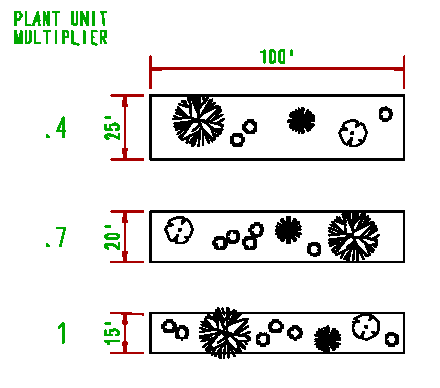 |
(c)
Bufferyard C.
| Required Plantings per 100 Linear Feet | |
|---|---|
|
1 Canopy Trees
2 Understory Trees 2 Evergreen Trees 10 Shrubs | 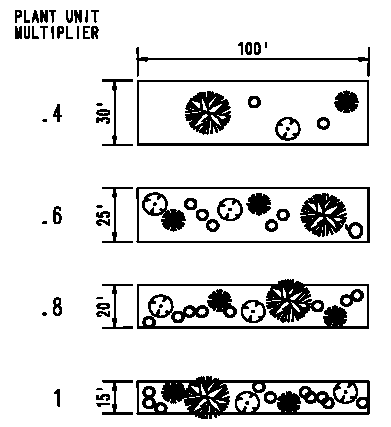 |
(d)
Bufferyard D.
| Required Plantings per 100 Linear Feet | |
|---|---|
|
2 Canopy Trees
2 Understory Trees 2 Evergreen Trees 14 Shrubs | 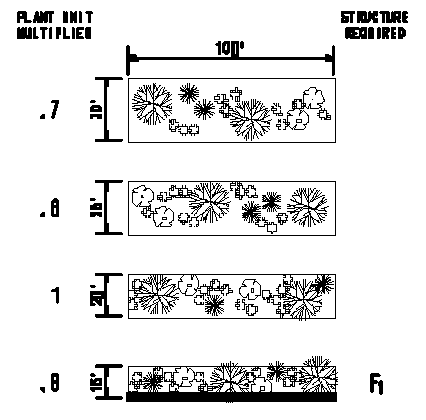 |
| Required Structure | |
| F 1 Six-foot solid wood fence or six-foot solid masonry/brick wall or six-foot solid evergreen hedge | |
(e)
Bufferyard E.
| Required Plantings per 100 Linear Feet | |
|---|---|
|
3 Canopy Trees
2 Understory Trees 2 Evergreen Trees 16 Shrubs | 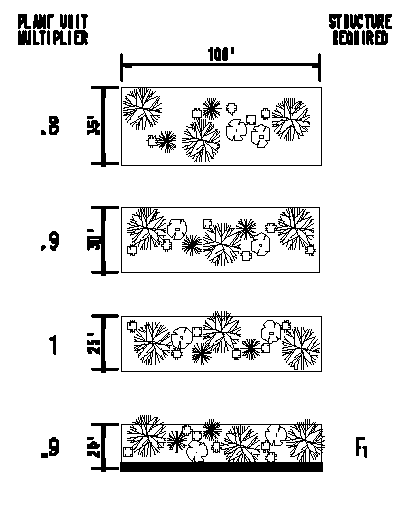 |
| Required Structure | |
| F 1 Six-foot solid wood fence or six-foot solid masonry/brick wall or six-foot solid evergreen hedge | |
(f)
Bufferyard F.
| Required Plantings per 100 Linear Feet | |
|---|---|
|
3 Canopy Trees
3 Understory Trees 4 Evergreen Trees 20 Shrubs | 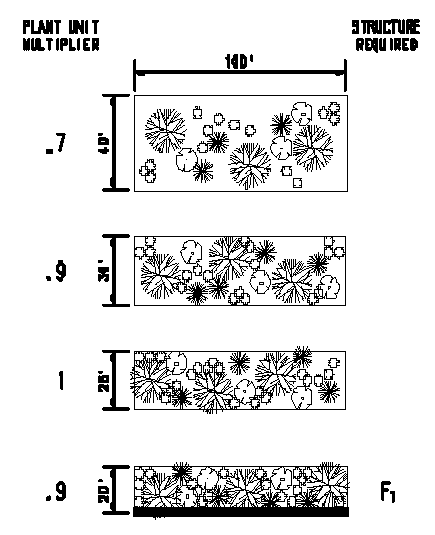 |
| Required Structure | |
| F 1 Six-foot solid wood fence or six-foot solid masonry/brick wall or six-foot solid evergreen hedge. | |
(g)
Bufferyard G.
| Required Plantings per 100 Linear Feet | |
|---|---|
|
4 Canopy Trees
3 Understory Trees 4 Evergreen Trees 24 Shrubs | 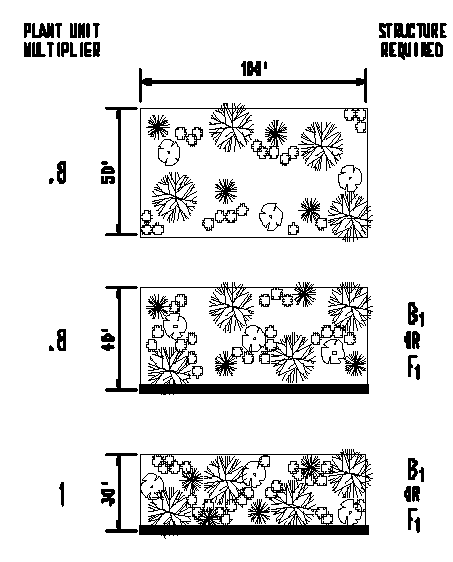 |
| Required Structure | |
| F 1 Six-foot solid wood fence or six-foot solid masonry/brick wall or six-foot solid evergreen hedge. | |
| B 1 Three-foot earthen berm with required plantings and perennial groundcover sown on the berm. | |
(h)
Bufferyard H.
| Required Plantings per 100 Linear Feet | |
|---|---|
|
4 Canopy Trees
4 Understory Trees 5 Evergreen Trees 28 Shrubs | 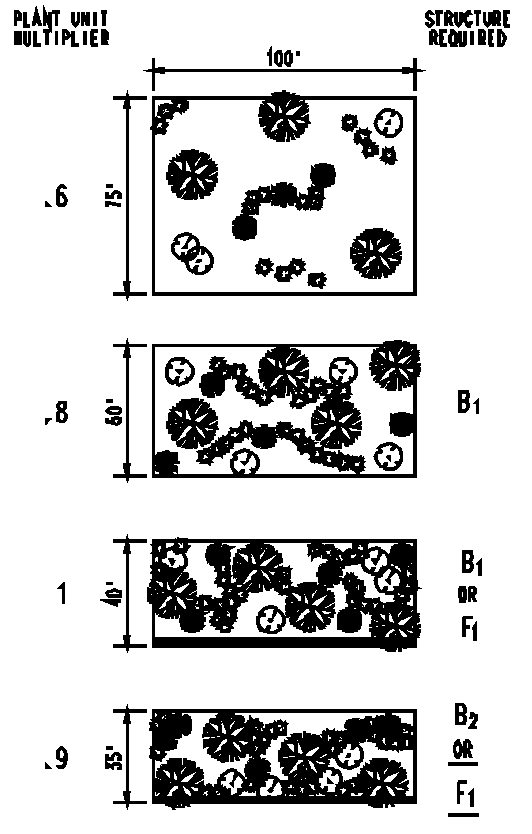 |
| Required Structure | |
| F 1 Six-foot solid wood fence or six-foot solid masonry/brick wall or six-foot solid evergreen hedge. | |
| B 1 Three-foot earthen berm with required plantings and perennial groundcover sown on the berm. | |
| B 2 Five-foot earthen berm with required plantings and perennial groundcover sown on the berm. | |
(i)
Bufferyard I.
| Required Plantings per 100 Linear Feet | |
|---|---|
|
5 Canopy Trees
4 Understory Trees 5 Evergreen Trees 34 Shrubs | 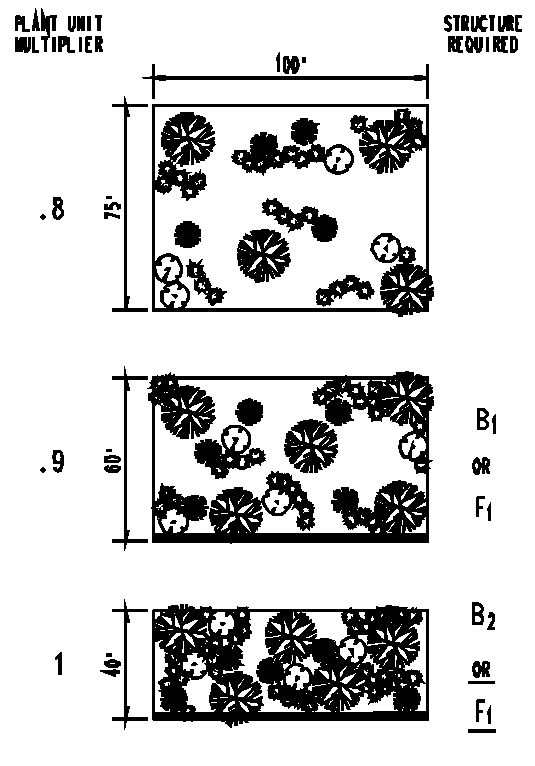 |
| Required Structure | |
| F 1 Six-foot solid wood fence or six-foot solid masonry/brick wall or six-foot solid evergreen hedge. | |
| B 1 Three-foot earthen berm with required plantings and perennial groundcover sown on the berm. | |
| B 2 Five-foot earthen berm with required plantings and perennial groundcover sown on the berm. | |
(j)
Bufferyard J. Unless a building is located on the property line, a six-foot solid wood fence or six-foot solid masonry/brick wall or six-foot solid evergreen hedge shall be provided.
(k)
Bufferyard S1.
| Required Plantings per 100 Linear Feet | |
|---|---|
|
1 Canopy Tree
1 Understory Tree 3 Shrubs | 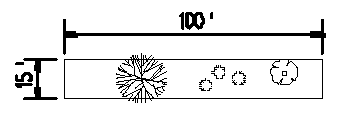 |
(l)
Bufferyard S2.
| Required Plantings per 100 Linear Feet | |
|---|---|
|
1 Canopy Tree
2 Understory Trees 4 Shrubs | 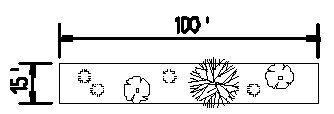 |
(m)
Bufferyard S3.
| Required Plantings per 100 Linear Feet | |
|---|---|
|
1 Canopy Tree
3 Understory Trees 6 Shrubs | 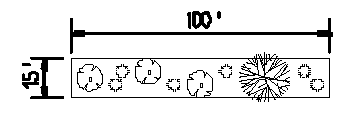 |
(13)
Sight distance and visibility.
(a)
Strict compliance with these landscaping requirements shall not be required if it would cause visibility obstructions and/or blind corners at intersections. Whenever an accessway intersects a public right-of-way or when the subject property abuts the intersection of two or more public rights-of-way, a sight triangle shall be required in conformance with subsection 36-453(6).
(b)
Landscaping, except required grass and low ground cover, shall not be located closer than five feet from the edge of any accessway pavement.
(c)
In the event other visibility obstructions are apparent in the proposed landscape plan, as determined by the director of public works, the requirements set forth herein shall be modified to the extent necessary to remove the conflict.
(14)
Utility easements. Utility easements shall be agreed to with the affected utility prior to submission of landscape plans. Within utility construction requirements, easements shall be provided at locations that minimize their impact on required bufferyards and perimeter landscaping. Plantings on utility easements shall be limited to ornamental trees, shrubs and hedges, ground cover, and lawn grass. Each required canopy tree may be replaced by two understory or ornamental trees to reduce conflicts with overhead utilities. Plantings in or adjacent to a utility easement shall be coordinated with the utility.
(15)
Existing developed areas—Nonconformance, compliance required. All property with existing development, on the effective date of this article, which is not in compliance with the provisions of this section shall be considered nonconforming uses and allowed to continue so long as all of the requirements of section 36-457, nonconformities, are met or until a building permit is issued for enlargement of a structure or building. At such a time, the following requirements shall be met. If enlargement of an existing structure or building requires open space be provided, it is the intent of this subsection that the bufferyard, parking lot and perimeter landscaping requirements be met to the maximum extent feasible without requiring existing structures or buildings to be removed or moved and that existing pavement only be removed as a last recourse. It is also the intent that the open space be widely distributed throughout the site and not concentrated in only a few locations.
(a)
No open space or bufferyard, except screening as required by paragraph (h) below, shall be required if existing buildings and structures are replaced with new buildings and structures with the same total floor area provided a building permit for replacement is applied for within one year after the existing buildings are removed.
(b)
No additional open space or bufferyard shall be required if a use expands into or is established in existing floor area that was previously unfinished or otherwise not available for occupancy.
(c)
No open space or bufferyard, except screening as required by paragraph (h) below, shall be required if:
1.
The lot is enlarged by less than 25 percent or by less than 20,000 square feet, whichever is greater; and
2.
The floor area, whether all new floor area or a combination of existing and new floor area, is enlarged by less than 25 percent or by less than 2,000 square feet, whichever is greater.
(d)
Fifty percent of the open space required for the entire property by the zoning district shall be provided on the property in such a way as to meet the bufferyard, parking lot and perimeter landscaping requirements of this section if:
1.
The lot is enlarged by 25 percent or by 20,000 square feet, whichever is greater; or
2.
The floor area, whether all new floor area or a combination of existing and new floor area, is enlarged by 25 percent or by 2,000 square feet, whichever is greater.
If a bufferyard is required on the property by subsection 36-482(11), the open space shall be distributed to attempt to provide at least 50 percent of the bufferyard width required by subsection 36-482(11). Plantings may also be reduced proportional to the width or as permitted by paragraph (f) below.
(e)
One hundred percent of the open space required for the entire property by the zoning district shall be provided on the property in such a way as to meet the bufferyard, parking lot and perimeter landscaping requirements of this section if:
1.
The lot is enlarged by 50 percent or by 45,000 square feet, whichever is greater; or
2.
The floor area, whether all new floor area or a combination of existing and new floor area, is enlarged by 50 percent or by 5,000 square feet, whichever is greater.
If a bufferyard is required on the property by subsection 36-482(11), the open space shall be distributed to attempt to provide 100 percent of the bufferyard width and plantings as required by subsection 36-482(11). Exemptions are provided by paragraph (f) below.
(f)
Open space shall be provided on the property in such a way as to substantially meet the bufferyard, parking lot and perimeter landscaping requirements of this section. The priorities for open space distribution shall be in the following order:
1.
Bufferyards;
2.
Perimeter parking lot landscaping; and
3.
Interior parking lot landscaping.
To meet the bufferyard, parking lot and perimeter landscaping requirements, existing buildings are not required to be removed or moved and removal of existing paving should be minimized. If the resulting bufferyard is less than 15 feet wide, screening shall be provided in accordance with paragraph (h) below and plantings shall be provided as follows:
If during site plan review the location of open space cannot be agreed upon between the director of building development services and the applicant, the location of open space areas shall be determined by the administrative review committee as part of the site plan review.
(g)
Enlargements of the lot or floor area shall be cumulative, and when the above thresholds are reached, the required open space shall be provided.
(h)
If a bufferyard is required on the property by subsection 36-482(11), a six-foot solid wood fence, masonry/brick wall or evergreen hedge shall be provided if the minimum bufferyard required by subsection 36-482(11) is not provided as a result of the enlargement or replacement of floor area.
(16)
Exemption for narrow or shallow properties. Properties are not required to provide a bufferyard greater than specified below, regardless of the requirement in subsection 36-482(11)(d) provided:
(a)
The property dimension, perpendicular to the property line where the bufferyard is required, does not exceed D at any point (Figure 6-1); and
(b)
The property dimension, perpendicular to the property line where the bufferyard is required, has not been reduced since the effective date of this article or since the adjoining property was rezoned so as to require a greater bufferyard.
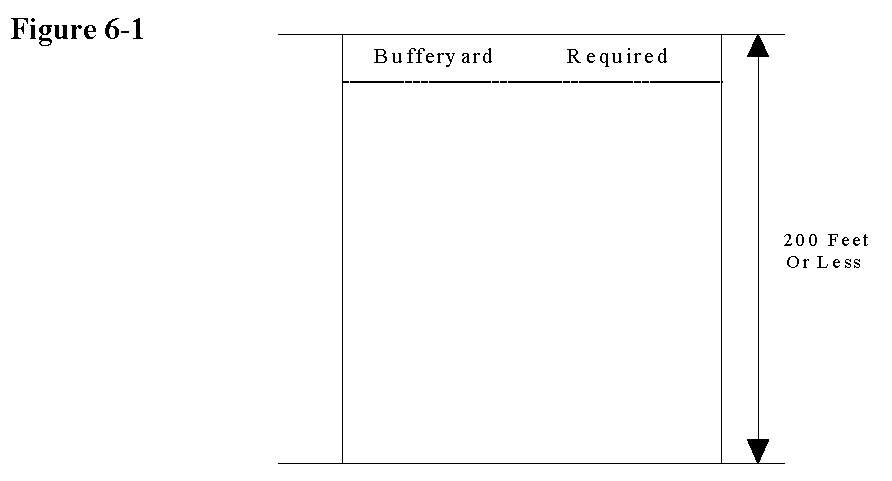
A six-foot solid wood fence, masonry/brick wall or evergreen hedge shall also be provided if the minimum bufferyard required by subsection 36-482(11) is not provided as a result of the provisions of this subsection.
(17)
Maximum bufferyard area required. In order to ensure that the development of smaller properties in the industrial districts (RI, restricted industrial; LI, limited industrial; GM, general manufacturing; HM, heavy manufacturing; and IC, industrial commercial) is not unreasonably restricted by the bufferyard requirements of this section, the required bufferyard area provided on a property may be modified as follows:
(a)
In districts that require a minimum open space of 20 percent or greater, the required bufferyard area shall not be required to exceed 20 percent of the total property area.
(b)
In districts that require a minimum open space of less than 20 percent, the required bufferyard area shall not be required to exceed 15 percent of the total property area.
(c)
A six-foot solid wood fence, masonry/brick wall or evergreen hedge shall be provided if the minimum bufferyard required by subsection 36-482(11) is not provided as a result of the provisions of this subsection.
(d)
The administrative review committee (ARC) shall review and approve the modified bufferyard, including the width and plantings based on the total property area calculations. The ARC shall evaluate the width and bufferyard plantings that are most similar to the required bufferyard standard as in subsection 36-482(12), provided:
1.
No bufferyard width shall be less than ten feet unless permitted by subsection 36-482(16); and
2.
The proposed bufferyard plantings per 100 linear feet shall be based on the most similar bufferyard standard width but not greater than the calculated width.
(Zoning Ord., § 6-1200; G.O. 4519, 6-12-95; G.O. 4685, 3-17-97; G.O. 5127, 10-29-04; G.O. 5652, 2-12-07; G.O. 5858, 2-8-10; G.O. 6025, 12-17-12; G.O. 6047, 5-6-13; G.O. 6112, 3-24-14; G.O. 6126, 7-7-14; G.O. 6134, 8-18-04)
Sec. 36-483. - Off-street parking and loading area design standards.
(1)
Off-street parking area design standards.
(a)
Location of required parking. All off-street parking spaces required by this section shall observe the following requirements with respect to location:
1.
In all residential districts, all required off-street parking spaces shall be located on the same lot as the principal structure or use requiring such parking.
2.
In all other districts, the following requirements shall apply. All required parking spaces shall be located on the same lot occupied by the principal structure or use requiring such parking unless a co-operative parking plan has been approved pursuant to subsection 36-455(5).
a.
In all office, business and commercial districts, and the government and institutional district, all off-street parking spaces shall be located on the same lot as the structure or use requiring such parking or within 300 feet of a point of access to such structure or use.
b.
In all industrial and manufacturing districts, off-street parking spaces shall be located on the same lot as the structure or use requiring such parking or within 600 feet of a point of access to such building.
c.
No off-street parking facilities for a building, structure, or use permitted only in office, government and institutional, business and commercial, and industrial and manufacturing districts shall be permitted to locate as a matter of right in any residential district.
3.
In all districts, no required parking or required perimeter landscaping shall be located in the required right-of-way of an adjacent street based on the classification of the street in accordance with subsection 36-303(17).
(b)
Size. A standard off-street parking space shall be at least nine feet in width, at least 18.5 feet in length, exclusive of access drives or aisles, ramps, or columns, and shall have a vertical clearance of at least eight feet. A compact car off-street parking space shall be at least eight feet in width, at least 16 feet in length, exclusive of access drives or aisles, ramps, or columns, and shall have a vertical clearance of at least eight feet. For employee parking only, not more than 40 percent of the required off-street parking spaces, after the first 100 standard size, off-street parking spaces have been provided, may be compact car spaces. All compact car spaces shall be designated by signs on poles or walls. The parking lot layout and distribution of standard and compact spaces shall comply with standards as established by the director of the public works.
(c)
Access. Each required off-street parking space shall open directly upon an aisle or driveway of such width and design as to provide safe and efficient means of vehicular access to such parking space. All driveways shall comply with chapter 31, article III, division 3, Springfield City Code.
(d)
Open and enclosed parking. Off-street parking facilities may be open to the sky or enclosed in a building or structure. Off-street parking facilities open to the sky may be located in any yard except that in residential districts no such parking facilities, including circulation lanes, shall be permitted in a required front yard or a required side yard adjacent to a street only if meeting the provisions of subsection 36-483(2). Enclosed or semi-enclosed buildings and structures, and carports containing off-street parking facilities shall be subject to the setback and yard requirements applicable in the district in which they are located.
(e)
Design. Off-street parking facilities shall comply with such design standards relating to curb length, stall depth, aisle width, island width, barriers, and ingress and egress as may be established from time to time by the director of public works, and adopted by the planning and zoning commission. Turn-arounds shall be provided in multifamily (three or more units) and nonresidential parking lots to allow vehicles to enter and exit the parking lot without backing from or onto a public street.
(f)
Surfacing. All off-street parking areas, shall be graded for proper drainage, provided with an all-weather, hard surface; and maintained in a condition to retain the original surface and to prevent the release of dust, mud or silt; and to be free of dust, mud, silt, standing water, trash and debris. The following materials constitute an acceptable all-weather hard surface material.
1.
Asphalt.
2.
Concrete.
3.
Pervious or permeable pavement such as pervious concrete, permeable interlocking concrete and brick pavers, and other pervious or permeable paving systems capable of withstanding the normal wear and tear associated with the parking and maneuvering of vehicles and which is appropriate for traffic loads and frequency of use. All materials shall be designated, installed, and maintained per current industry standards. Appropriate soils and site conditions shall exist for the pervious or permeable pavement to function. When designed to meet stormwater requirements for flood control detention or water quality, pervious or permeable pavement systems must be designed in accordance with the City Code, including chapter 96.
4.
Ribbon driveways that consist of two wheel tracks with a median are allowed for each drive lane for single-family detached, single-family semi-detached, duplex or townhouse dwelling units or mobile homes. Each wheel track shall meet the surfacing requirements of this section and shall be at least three feet in width. The median shall not exceed three feet in width with a surface of grass, gravel, or other approved pervious materials.
(g)
Screening. Off-street parking areas, open to the sky, shall be screened in accordance with the requirements of section 36-480, screening and fencing. Parking areas shall be arranged and designed so as to prevent damage to, or intrusion into any wall, fence, or hedge built or planted as screening.
(h)
Landscaping. Off-street parking areas, open to the sky, shall be landscaped in accordance with section 36-482, landscaping and bufferyards.
(i)
Lighting. Any lighting used to illuminate off-street parking areas shall comply with section 36-484, lighting standards.
(2)
Supplemental off-street parking area design standards for residential uses.
(a)
General provisions. In addition to the provisions of subsection 36-483(1), these provisions shall apply only to single-family detached, single-family semi-detached, duplex or mobile home dwellings.
(b)
Design. In addition to the requirements of subsection 36-483(1)(d), a driveway may be widened and utilized as impervious parking area where the widened portion of the driveway aisle does not lead to a required off-street parking space. Such widened driveways shall not exceed a total width of 18 feet and shall be permitted except under the following conditions:
1.
The property can be provided with additional vehicular access via a public alley; or
2.
The property is located on a public street with curb and gutter where 24 hour on-street parking is permitted on at least one side of the street. Properties shall be determined to have access to such on-street parking if it is located within 100 feet of the front door of a home as measured along the path of travel.
(c)
Modification of existing driveways. All portions of any existing driveway that is modified as provided within this subsection, or is otherwise expanded, shall be required to meet the surfacing requirements of subsection 36-483(1)(f), except that gravel driveways which existed prior to March 7, 1995, or which existed at the time the property served by such driveway was annexed into the city, may include similar materials as that used to gravel such driveway provided that;
1.
There is a defined edge provided and maintained to contain the gravel material from migrating outside both the existing and expanded vehicular parking area into other areas of the yard;
2.
A permit is obtained for such modification from the director of building development services; and
3.
Parking occurs only in the area permitted for vehicular parking.
(3)
Off-street bicycle parking design standards.
(a)
Location.
1.
Unless located within a multi-level parking structure, off-street bicycle parking spaces shall be located and positioned so that they are in close proximity to and within sight of a public entry but do not impede pedestrian traffic. Bicycle parking spaces may alternatively be installed within the structure that they serve if located in a common or public space within sight of a public entry.
2.
Bicycle parking spaces are not required to be located on impervious areas. Bicycle parking spaces may be located within interior common areas and landscaping treatments so long as all required planting materials are provided and the bicycle parking space dimensions established in subsection 36-483(3)(b) can be met.
3.
Where a structure or use has multiple public entries, bicycle parking spaces shall be distributed among said entries. A portion of bicycle parking spaces may also be distributed to designated employee entries when such entries are separate from any public entry.
4.
If located within or directly adjacent to an automobile parking area, bicycle parking spaces shall be separated by a physical barrier in the form of curbs, wheel stops, poles or other similar features.
(b)
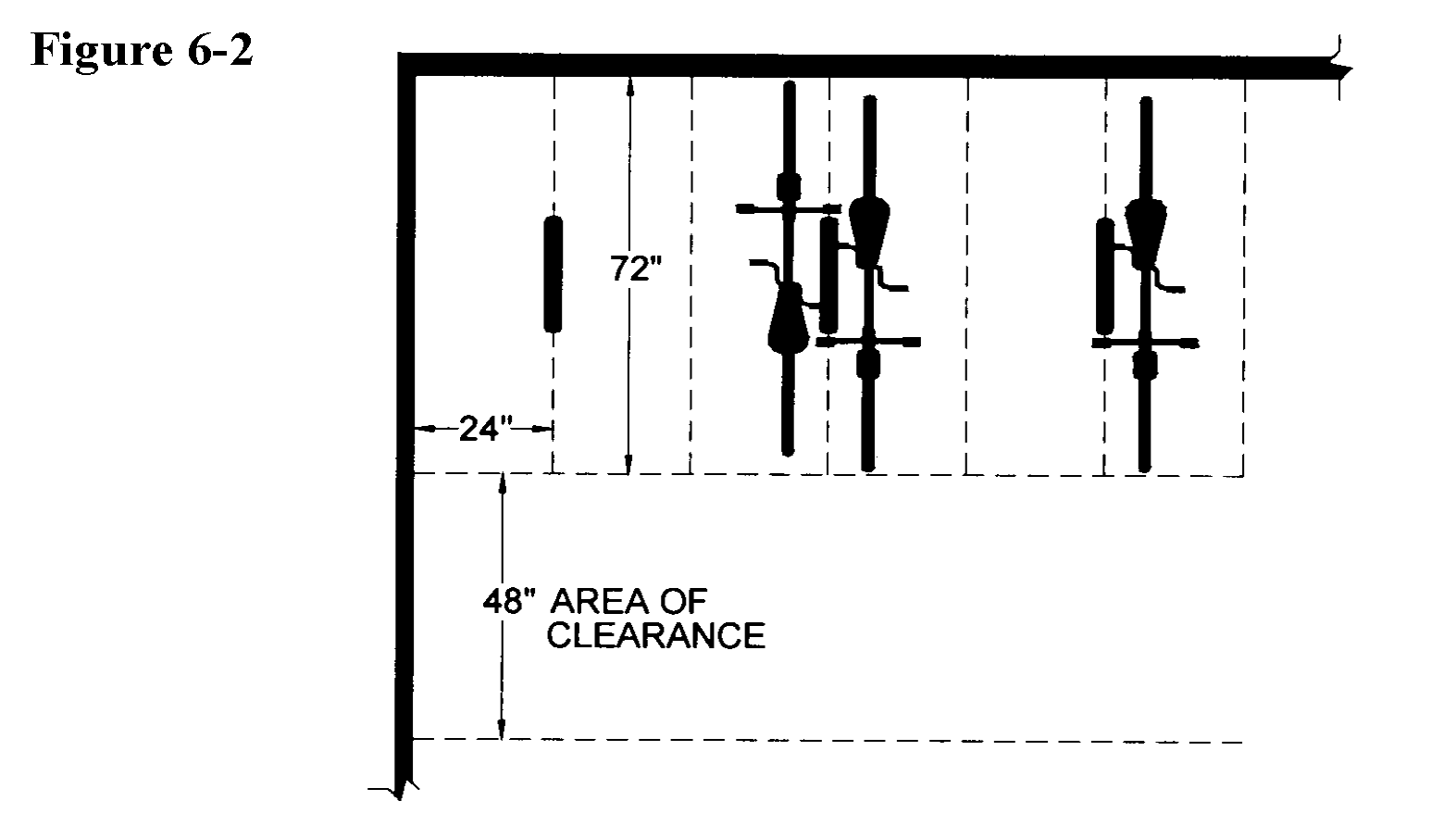
Design of bicycle parking spaces. Bicycle parking spaces shall be arranged as illustrated in Figure 6-2. Each bicycle parking space shall be at least 24 inches in width and six feet in length. In addition, bicycle parking spaces shall be accessed on at least one side via an area of clearance not less than 48 inches.
(c)
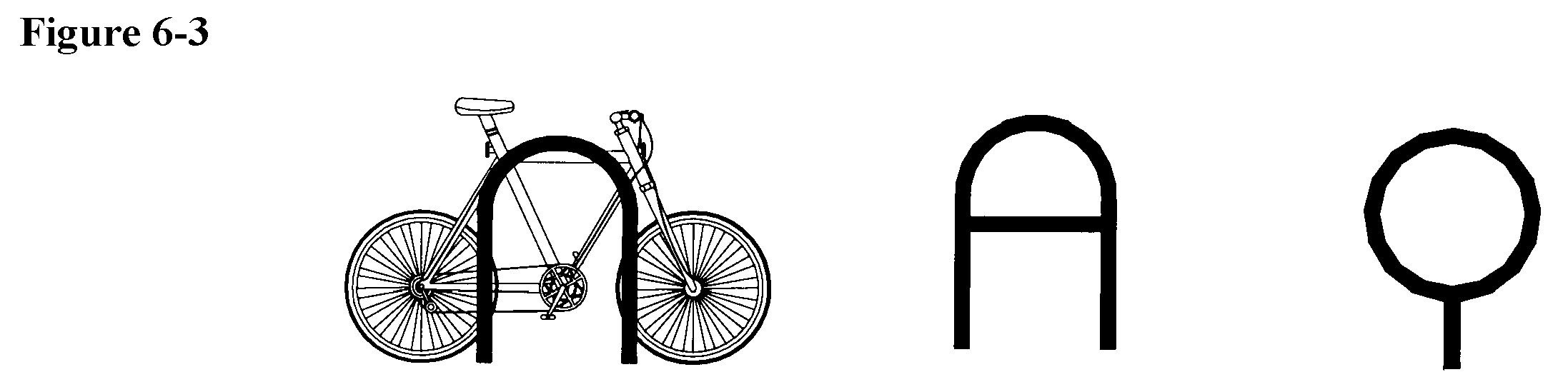
Bicycle parking rack. Each bicycle rack shall be designed to support a bicycle by its frame in two places and allow the use of a cable lock or U shaped lock. The bicycle rack shall be anchored so they cannot be easily removed, vandalized, or stolen. Permitted individual rack elements include those types illustrated in Figure 6-3 except that an alternative rack or bike locker may be approved by the director of building development services.
(4)
Off-street loading area design standards.
(a)
Location. Off-street loading areas may occupy all or any part of any required yard space, other than a required front yard or a side yard adjoining a street or the required setback from the right-of-way center line of a street in accordance with subsection 36-303(17).
(b)
Access. Except in the center city district, all off-street loading areas shall be accessed without requiring any backing from or onto a public street and without any portion of a vehicle projecting onto a public street while being loaded. Off-street loading areas shall be provided with driveways that comply with chapter 31, article III, division 3, Springfield City Code.
(c)
Grading and surfacing. All off-street loading areas shall be graded for proper drainage, provided with an all-weather, dust-free surfacing material and maintained at all times in such a manner as to prevent the release of dust and to be free of dust, trash, and debris.
(d)
Screening. All off-street loading areas on property located adjacent to a residential district shall comply with the screening requirements in section 36-480, screening and fencing.
(e)
Landscaping. All off-street loading areas shall be landscaped in accordance with section 36-482, landscaping and bufferyards.
(f)
Lighting. Any lighting used to illuminate off-street loading areas shall comply with section 36-484, lighting standards.
(Zoning Ord., § 6-1300; G.O. 5165, 3-25-02; G.O. 5355, 3-15-04; G.O. 5412, 10-18-04; G.O. 6302, § 1, 9-6-16)
Sec. 36-484. - Lighting standards.
(1)
Purpose. The purpose of this section is to regulate the placement and arrangement of lighting. These regulations are intended to:
(a)
Protect the public health, safety, and general welfare;
(b)
Enable the fair and consistent enforcement of these regulations;
(c)
Control light spillover and glare;
(d)
Encourage lighting systems which conserve energy and costs;
(e)
Preserve community character; and
(e)
Provide for nighttime safety, utility, security, and productivity.
(2)
Exterior lighting objectives. Lighting arrangements shall be arranged in the following manner:
(a)
To minimize light spillover onto any adjacent premises; and
(b)
So that light from any illuminated source shall be so shaded, shielded or directed that the light intensity or brightness will not adversely affect adjoining property.
(3)
Exterior lighting standards. All exterior lighting upon any premises, regardless of zoning classification, shall be subject to the following conditions and limitations:
(a)
When a light source or luminary does not have a cutoff the following standards shall be met:
1.
Maximum mounting or pole height of the light source or luminary: Fifteen feet.
2.
Maximum permitted lumination:
a.
Three-tenths footcandle at any point along the perimeter of the property where it adjoins a residential zoning district or is separated from a residential zoning district by a right-of-way of 70 feet or less.
b.
One footcandle at any other point along the perimeter of the property.
(b)
When a light source or luminary has total cutoff of light at an angle so that the bare bulb, lamp, or light source is completely and opaquely shielded from the direct view of an observer at ground level at the perimeter of the property, the following standards shall be met:
1.
Maximum mounting or pole height of the light source or luminary: Sixty feet.
2.
Maximum permitted lumination:
a.
One-half footcandle at any point along the perimeter of the property where it adjoins a residential zoning district or is separated from a residential zoning district by a right-of-way of 70 feet or less.
b.
One footcandle at any other point along the perimeter of the property.
c.
There are no maximum lamination limits at the common property line of a premises.
(c)
Building and landscape light fixtures, including ground lighting for signs, flagpoles and statues, shall be equipped with shields or shutters to minimize spillover. The maximum permitted lumination as a result of reflected light resulting from such fixtures shall be:
1.
One-half footcandles at any point along the perimeter of the property where it adjoins a residential zoning district or is separated from a residential zoning district by a right-of-way of 70 feet or less; and
2.
One footcandle at any other point along the perimeter of the property.
(d)
The maximum permitted average lumination of all parking lots shall be five footcandles.
(e)
There shall be no lighting of a blinking, flashing, rotating or fluttering nature, including changes in light intensity, brightness, or color except for public safety purposes.
(f)
Light sources or luminary shall not be located within bufferyard areas except on pedestrian walkways.
(g)
A site lighting plan for uses requiring site plan review shall be submitted and shall provide the following information:
1.
Proposed location on premises of all exterior light fixtures;
2.
Description of illumination devices, fixtures, lamps, supports, reflectors and lens, mounting height and wattage;
3.
Photometric design layout for the site of all illuminated vertical and horizontal surfaces showing the design footcandle levels.
(h)
For uses requiring site plan review, lighting shall be significantly reduced during non-operational building hours, allowing only lighting necessary for security purposes. The lighting plan submitted for review shall note where this distinction occurs.
(4)
Existing lighting. Any existing lighting fixture that is moved or replaced shall meet the requirements of this section.
(5)
Exemptions.
(a)
Outdoor recreational uses. Because of their unique requirements for nighttime visibility and their limited hours of operation, ball diamonds, playing fields, and tennis courts shall be exempt from the exterior lighting standards of subsection 36-484(3) above. These outdoor recreational uses must meet all other requirements of this section and of this article.
(b)
Private outdoor lights. Private outdoor lights installed by a public utility on private property for security purposes are exempt from the exterior lighting standards of subsection 36-484(3) above, provided the installation is approved by all property owners of residential property from which the light source can be viewed directly.
(c)
Emergency warning lights. Safety signal and warning device lighting shall be exempt from the exterior lighting standards of subsection 36-484(3) above.
(d)
Temporary seasonal/holiday lighting. Temporary seasonal/holiday lighting is exempt from the exterior lighting standards of subsection 36-484(3) above.
(e)
Search lights. Search lights for promotional purposes and special events shall be exempt from the exterior lighting standards of subsection 36-484(3) above provided the lights are not located in a residential zoning district and the lights are directed so that they do not illuminate any structure that is not located on the same property as the lights.
(Zoning Ord., § 6-1400; G.O. 5127, 10-29-01; G.O. 5425, 11-15-04; G.O. 6223, § 1(exh. A), 9-14-15)
Sec. 36-485. - Noise standards.
(1)
Purpose. The purpose of these noise standards is to provide measurable criteria to ensure that noise resulting from an activity does not have an adverse impact on adjoining properties.
(2)
Applicability.
(a)
New uses. All uses hereafter established shall comply with the noise standards of this section.
(b)
Existing conforming uses. Any existing use which, on the effective date of this article, complies with the applicable noise standards of this section shall continue to so comply. If, at such time, the operations of any lawful existing use violates the noise standards of the section, such operations shall not be varied or changed in such a way as to increase the degree of violation. The fact that the operations of a lawful existing use violate the noise standards of this section shall not of itself make such use subject to the requirements of section 36-457, nonconformities, of this article relating to nonconformities.
(c)
Existing nonconforming uses. Any use that is located in a zoning district in which such use is not permitted but which is a lawful nonconforming use and which complies, on the effective date of this article, with all of the noise standards for the use shall continue to comply. If, at such time, the operations of such lawful nonconforming uses violate such standards, then such operations shall not be varied or changed in such a way as to increase the degree of such violation.
(d)
Nuisance not permitted. Notwithstanding the provisions of paragraphs (b) and (c) above, any noise source that exceeds the applicable noise standards of this section and, in the opinion of the director, constitutes a nuisance shall be abated. Nothing contained herein shall be construed to overrule provisions of other city noise ordinances which shall be harmonized and enforced by the court to the fullest extent in order to prevent unnecessary noise.
(3)
Noise standards.
(a)
Maximum noise level. No operation or activity shall cause or create noise in excess of the sound levels prescribed below.
(b)
Sound level standards. The maximum permitted sound level shall be at a volume so as to not unreasonably and knowingly disturb or alarm another person or persons by loud noise.
(c)
Variations and exemptions.
1.
The following uses and activities shall be exempt from the sound level standards:
a.
Noises not directly under the control of the property user;
b.
Noises emanating from construction and maintenance activities between 7:00 a.m. and 11:00 p.m.;
c.
The noises of safety signals, warning devices, emergency pressure relief valves and emergency electric generators; and
d.
Noises from moving sources such as automobiles and trucks on public right-of-way, railroad equipment on railroad right-of-way and railroad spurs on private property, and airplanes.
(Zoning Ord., § 6-1500; G.O. 4855, 12-14-98; G.O. 5475, 7-11-05; G.O. 6195, Exh. D, 5-11-15)

