
Springfield City Zoning Code
DIVISION 2
RULES OF INTERPRETATION AND DEFINITIONS
Sec. 36-320.- Rules of interpretation.
When referring to this article, the following rules of interpretation shall be applied, except when the context clearly requires otherwise.
(a)
The particular shall control the general.
(b)
In the case of any difference of meaning or implication between the text of this article and any chart, graph, illustration or table, the text shall control.
(c)
The word "shall" is always mandatory and not discretionary. The word "may" is permissive.
(d)
Words used in the present tense shall include the future and words used in the singular include the plural and the plural the singular, unless the context clearly indicates the contrary.
(e)
The use of the male pronoun includes the use of the female pronoun.
(f)
The word "person" includes individuals, firms, corporation, associations, and any other similar entities.
(g)
The words "parcel, site," or "tract" are synonymous and are general terms for the description of land.
(h)
The word "city" means the area of jurisdiction of the City of Springfield, Missouri.
(i)
All public officials, bodies, and agencies to which reference is made are those of the City of Springfield, Missouri.
(Zoning Ord., § 2-1000)
Sec. 36-321. - Definitions.
Words in the text or tables of this article shall be interpreted in accordance with the provisions set forth in this section. Where words have not been defined, the standard dictionary definition shall prevail.
Accessory apartment: A separate, complete dwelling unit that is substantially contained within the structure of a single-family-detached dwelling.
Accessory building: See "Accessory structure.
Accessory structure: An accessory structure serves a principal structure or a principal use by contributing to the comfort, convenience or needs to the occupants, business, or industry of the principal structure or use and is located on the same lot as the principal structure or use served.
Accessory use: An accessory use serves a principal structure or a principal use by contributing to the comfort, convenience or needs to the occupants, business, or industry of the principal structure or use and is located on the same lot as the principal structure or use served.
Acre: A measure of land area containing 43,560 square feet.
Acupuncture: The use of needles inserted into the body by piercing of the skin and related modalities for the assessment, evaluation, prevention, treatment or correction of any abnormal physiology or pain by means of controlling and regulating the flow and balance of energy in the body so as to restore the body to its proper functioning and state of health.
Adult day care: The care, other than residential care, of an adult away from his own home on either a commercial or noncommercial basis for custodial purposes for only part of a 24-hour day.
Adult motion picture theater: An establishment, which shall be in an enclosed building, and which presents motion picture films, video cassettes, cable television, or any other such visual media, distinguished or characterized by an emphasis on matter depicting, describing or relating to specified sexual activities or specified anatomical areas as hereinafter defined, for observation by patrons therein.
Adult store: An establishment having as a substantial or significant portion of its stock in trade, books, photographs, pictures, magazines, and other periodicals or materials which are distinguished or characterized by their emphasis on matter depicting, describing or relating to specified sexual activities or specified anatomical areas, as defined under cabaret.
Agricultural use: The production, keeping or maintenance, for sale, lease or personal use, of plants and animals, including, but not limited to: Forages and sod crops; grains and seed crops; dairy animals and dairy products, poultry and poultry products; livestock, including beef cattle, sheep, swine, horses, ponies, mules, or goats, or any mutations or hybrids thereof, including the breeding and grazing of any or all of such animals; bees and apiary products; fur animals; trees and forest products; fruits of all kinds, including grapes, nuts and berries; vegetables; nursery, floral, ornamental and greenhouse products; or lands devoted to a soil conservation or forestry management program but excluding: feed lots, stockyards, and animal slaughter houses. Not to include marijuana or medical marijuana facilities.
Airport runway: A surface used for landing or taking off of aircraft which is shown on a duly adopted airport master plan of the City of Springfield and includes all such runways shown thereon, whether existing or proposed, including extension of such runways.
Alley: A public way which extends only secondary means of access to abutting property.
Alteration (historic structure): Any act or process that changes one or more of the exterior architectural features of a structure, including, but not limited to, the erection, construction, reconstruction, or removal of any feature of the structure.
Alteration, structural: Any change in a load-bearing member of a structure.
Animal, farm: Any livestock or other domesticated animal raised for commercial or agricultural purposes.
Animal, household (pets): Any animal normally and customarily kept by domestic households for pleasure and companionship, excluding poultry, pheasants, cows, livestock, chinchillas, horses, goats, sheep, monkeys and other similar animals and fowl.
Animal, non-domestic: Any feline (other than a domestic house cat), nonhuman primate, bear, wolf, coyote, fox, venomous reptile, or any other animals or crossbreed of such animals which have similar characteristics of the animals specified herein or are dangerous or unsafe for contact with humans.
Animation: Refer to subsection 36-454(2) for the definition of this term.
Archaeological significance: Importance as an area, site, place, or landscape that has yielded or is likely to yield information concerning past patterns of human settlement, or artifacts or information concerning previous cultures in Missouri or previous periods of the present culture. Areas, sites, or landscapes of archaeological significance may include, but are not limited to, aboriginal mounds, forts, earthworks, burial grounds, historic or prehistoric ruins, locations of villages, mine excavations, or tailings, or other locations.
Architectural significance: Embodying the distinctive characteristics of a type, period, style, or method of construction or use of indigenous construction, or representing the work of an important builder, designer, architect, or craftsman who has contributed to the development of the community, county, state, or country.
Attached sign: Refer to subsection 36-454(2) for the definition of this term.
Automobile sales: The use of any building, land area or other premises, or portion thereof, for the display and sale of new or used automobiles, panel trucks or vans, trailers, or recreation vehicles and including any warranty repair work and other repair service conducted as an accessory use.
Automobile service garage: An establishment primarily engaged in automotive repair and services, including lubrication establishments.
Automobile service station: Any building, land area or other premises, or portion thereof, used or intended to be used for the retail dispensing or sales of vehicular fuels; and including as an accessory use the sale and installation of lubricants, tires, batteries and similar accessories.
Automobile wrecking yard: The dismantling or wrecking of used motor vehicles or trailers, or the storage, sale, or dumping of dismantled or wrecked vehicles or their parts. The presence on any lot or parcel of land of two or more motor vehicles, which, for a period exceeding 30 days, have not been capable of operating under their own power and from which parts have been or are to be removed for reuse or sale, shall constitute prima-facie evidence of an automobile wrecking yard.
Bar: See "Tavern.
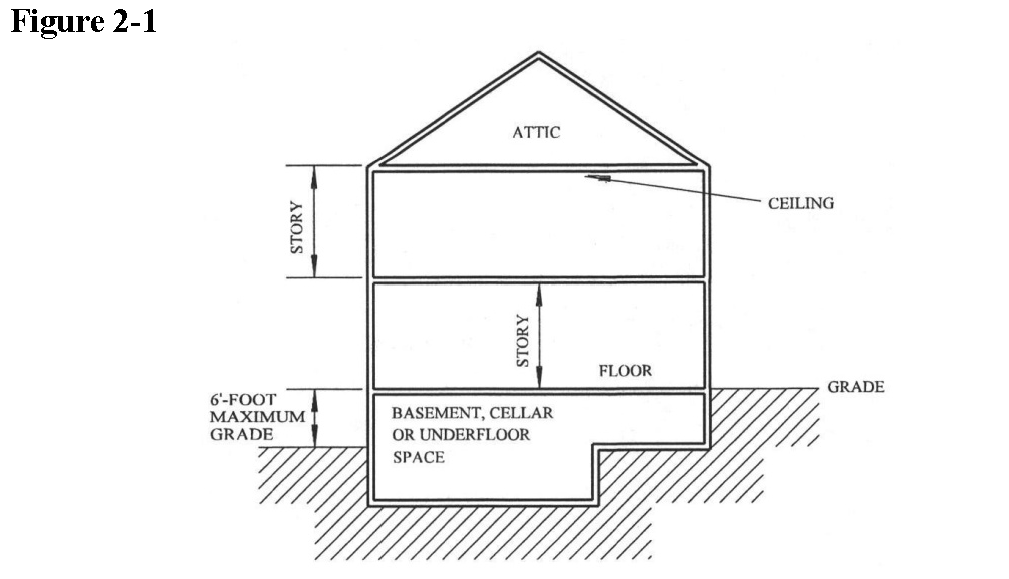
Basement: A story partly or wholly below grade. For purposes of height measurement, a basement shall be counted as a story when the finished surface of the floor above the basement is (Figure 2-1):
(a)
More than six feet above the average grade.
(b)
More than six feet above the finished grade for more than 50 percent of the total building perimeter.
(c)
More than 12 feet above the finished grade at any point.
Bed and breakfast: A dwelling, or portion thereof, that contains guest rooms where short-term lodging, with or without meals, is provided for compensation.
Berm: A mound of earth, typically located in a bufferyard to shield or block noise, lights or other nuisances.
Bicycle locker: An enclosure capable of being locked that can be rented or reserved for the storage of one or more bicycles and serves as a parking facility that protects bicycles from theft and weather.
Bicycle rack: A bicycle parking facility that is fastened to a mounting surface, can accommodate up to two bicycles, can support each bicycle by its frame in two places and allows the use of a cable lock or U-shaped lock to protect bicycles from theft.
Bicycle space: An area that includes a bicycle rack and is free of obstructions to allow for the convenient and accessible parking of a bicycle.
Block: A unit of land bounded by streets or by a combination of streets and public land, railroad rights-of-way, waterways or any other barrier to the continuity of development.
Boarding house: An establishment or part thereof, in which lodging and meals is provided by the owner or operator for at least three but not more than 11 persons for compensation whether the compensation is paid directly or indirectly.
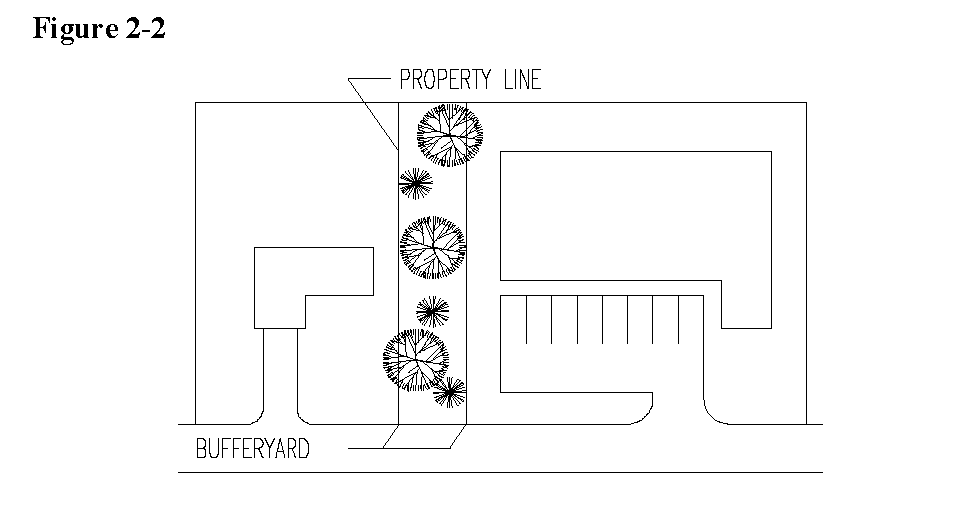
Bufferyard: Land area typically containing trees, shrubs and other plants, berms, fences or walls and used to visibly separate one use from another or to block noise, lights or other nuisances (Figure 2-2).
Buildable area: The area of a lot remaining after the minimum yard and open space requirements of the zoning ordinance have been met.
Building: Any structure having a roof supported by columns or walls and intended for the shelter, housing or enclosure of any individual, animal, process, equipment, goods, or materials of any kind or nature.
Building codes: The building code of the City of Springfield, Missouri, together with the electrical code, plumbing code, fire code, and any related code(s) adopted by the Springfield City Council, and any regulations adopted in conformance therewith.
Building coverage: The horizontal area measured within the exterior walls of the ground floor of all principal and accessory buildings on a lot divided by the gross area of the lot.
Building floor area, gross leasable: In multitenant buildings, the total building floor area excluding non-leasable areas such as hallways, lobbies, malls, and rest rooms.
Building floor area, net usable: For office, government, institutional and commercial uses, the total building floor area used for or intended to be used for a service to the public, including areas occupied by fixtures and equipment used for display or sale of merchandise, for show windows, or for offices incidental to the management or maintenance of stores or buildings. Floors or parts of floors used principally for rest rooms or for utilities or for fitting rooms, dressing and alteration rooms, halls, storage rooms, file rooms, stairways, elevators shall be excluded.
Building floor area, total: The total floor area of all floors of a building measured from the exterior face of exterior walls, but not including interior parking spaces, loading space for motor vehicles or any space where the floor to ceiling height is less than six feet.
Building materials: The physical characteristics which create the aesthetic and structural appearance of the resource, including, but not limited to, a consideration of the texture and style of the components and their combinations, such as brick, stone, shingle, wood, concrete, or stucco.
Building, principal: A building in which the primary use of the lot, on which the building is located, is conducted.
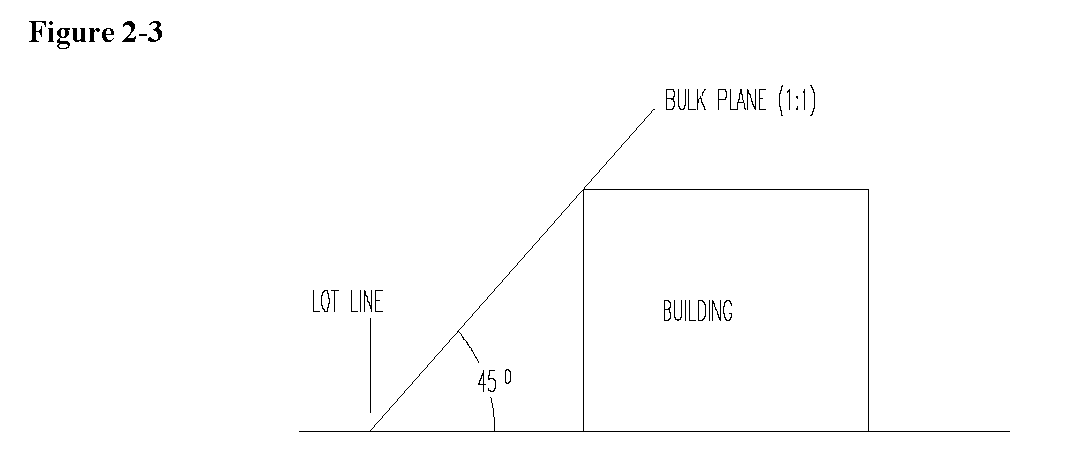
Bulk plane: A theoretical plane beginning at a lot line, or other locations as set forth in this Article, and rising over a slope determined by an acute angle measured up from the horizontal as set forth in this Article. The bulk plane defines the relationship of the height of a structure and the structure's setback from the lot line (Figure 2-3).
Bulk requirements: Standards that control the height, intensity, and location of structures.
Bulk storage: The storage of chemicals, petroleum products and other materials in above-ground containers for subsequent resale (wholesale) to distributors or retail dealers or outlets.
Business area: Refer to subsection 36-454(2) for the definition of this term.
Cabaret: An establishment which features topless dancers, go-go dancers, exotic dancers, strippers, male or female impersonators, or similar entertainers, distinguished or characterized by an emphasis on matter depicting, describing or relating to specified sexual activities or specified anatomical areas as defined below.
Specified anatomical areas:
(a)
Less than completely and opaquely covered human genitals, pubic region, buttock and female breast below a point immediately above the top of the areola; and
(b)
Human male genitals in a discernibly turgid state, even if completely and opaquely covered.
Specified sexual activities:
(a)
Human genitals in a state of sexual stimulation or arousal;
(b)
Acts of human masturbation, sexual intercourse or sodomy; and
(c)
Fondling or other erotic touching of human genitals, pubic region, buttock, or female breast.
Campground and recreational vehicle park: Any property, including buildings or other structures, where one or more camping or recreational vehicle sites are rented or provided to recreational users for temporary or seasonal occupancy. Any action toward removal of wheels of a recreational vehicle other than a park model recreational vehicle (PMRV), or placement of the unit on a foundation, except for temporary purposes of repair, is prohibited. The owner shall designate a manager or operator who shall be responsible for any violation of the provisions of this article which may occur in the operation of such development. No owner, manager or operator of a campground and recreational vehicle park shall authorize or allow any person to occupy one or more recreational vehicles or PMRVs in a campground and recreational vehicle park for more than 180 days in any one-year period unless that person is a caretaker or host of the campground and recreational vehicle park. Notwithstanding the foregoing, a recreational vehicle located in a campground and recreational vehicle park, a manufactured home community or a manufactured home subdivision, which is used as a dwelling unit and existed on the date of passage of this ordinance [G.O. 6592], shall be considered a legal nonconforming use subject to section 36-457 despite the 180-day occupancy limitation contained herein. This legal nonconforming status shall expire and cease to be in effect 36 months after final passage of this ordinance [G.O. 6592]. Thereafter, no owner, manager or operator of a campground and recreational vehicle park shall authorize or allow any person to occupy one or more recreational vehicles or PMRVs in a campground and recreational vehicle park for more than 180 days in any one-year period unless that person is a caretaker or host of the campground and recreational vehicle park.
Candlepower: The amount of light that will illuminate a surface one foot distant from a light source to an intensity of one footcandle. Maximum (peak) candlepower is the largest amount of candle power emitted by any lamp, light source, or luminaire.
Carnival or circus: An amusement enterprise consisting of rides, acts, shows, games, amusement devices, or other similar devices or any combination of such devices.
Cemetery: Property used for the interring of the dead, including mausoleums.
Central business district: The commercial, office, and industrial area of Springfield centered on Park Central Square.
Central Springfield: The area of Springfield containing the central business district and most of the historically and architecturally significant resources of the city, specifically defined by the south boundary of the railroad right-of-way north of Commercial Street on the north, Glenstone Avenue on the east, Grand Street on the south and Kansas Expressway on the west.
Certificate of appropriateness: The official document issued by the landmarks board or the director of building development services, as provided for in subsection 36-404(3), approving any application for permission to construct, erect, demolish, relocate, reconstruct, restore, or alter any structure designated by the authority of this article.
Certificate of economic hardship: A certificate issued by the landmarks board, as provided for in subsection 36-404(4), authorizing an alteration, construction, removal or demolition even though a certificate of appropriateness has previously been denied or may be denied.
Child day care: The care of a child away from his own home on either a commercial or noncommercial basis for custodial purposes for only part of a 24-hour day.
Church: A building or structure, or groups of buildings or structures primarily intended for the conducting of organized religious services and accessory uses associated therewith.
Clinic, medical or dental: An establishment where human patients are admitted for examination and/or treatment by one or more physicians, dentists, psychologists or social workers and where overnight lodging is limited to one night for minor surgery. Not to include marijuana or medical marijuana facilities.
Clinic, veterinary: An establishment where animals are admitted for examination and treatment by one or more veterinarians and where animals are not lodged overnight.
Clubhouse: A structure accessory to a public or private noncommercial recreation area or facility and providing services to the patrons of such area or facility.
Cluster: A development design technique that concentrates buildings in specific areas on a site to allow the remaining land to be used for recreation, common open space, and preservation of environmentally sensitive features.
Cluster housing development: A form of residential development that permits a reduction in lot area and bulk requirements.
Cocktail lounge: See "Tavern".
College: An educational institution that provides a post-secondary instructional program, including classroom, laboratory and administration buildings, lecture halls, libraries, dormitories, dining halls, student centers, auditoriums, chapels, gymnasiums, stadiums, fraternities, sororities and other similar buildings and structures.
Commercial: Relating to the sale of goods or services.
Commercial garden: The growing and cultivation of fruits, flowers, herbs, vegetables and/or ornamental plants by an individual or group of individuals for personal or group use, consumption, donation, subscription, shares and for on-site distribution or sale to the general public. Commercial gardens may be divided into separate plots for cultivation by one or more individuals or may be cultivated collectively by members of the group and may include common areas maintained and used by group members. Not to include marijuana or medical marijuana facilities.
Community treatment center: Definition deleted.
Commercial off-street parking lot or structure: A parking lot or structure where a fee must be paid for use of the parking spaces.
Commercial vehicle: Any vehicle designed, maintained, or used primarily for the transportation of property or persons for hire.
Commission: The Springfield Planning and Zoning Commission.
Community center: A place, structure, area, or other facility for social, educational, and recreational activities of a neighborhood or community or subdivision, provided any such use is not operated for commercial gain.
Community corrections facility: A facility licensed by the State of Missouri for the housing, supervision, counseling, rehabilitation of and job training for individuals in need of care necessary to return them to a productive role in society who are criminal offenders on probation, whose probation or parole has been revoked, who are within 120 days of their release from a prison, jail sentence or custody from the state department of corrections, or who are under supervision of state probation or parole or a similar agency, and who reside under the supervision of trained staff.
Community garden: The growing and cultivation of fruits, flowers, herbs, vegetables and/or ornamental plants by an individual or group of individuals for personal or group use, consumption, donation, subscription or shares, but not for on-site distribution or sale to the general public. Community gardens may be divided into separate plots for cultivation by one or more individuals or may be cultivated collectively by members of the group and may include common areas maintained and used by group members. Not to include marijuana or medical marijuana facilities.
Compensation: The receiving of goods, services, or money in exchange for or as a result of a service performed.
Comprehensive facility: A comprehensive marijuana cultivation facility, comprehensive marijuana dispensary facility, or a comprehensive marijuana-infused products manufacturing facility.
Comprehensive marijuana cultivation facility: A facility licensed by the state to acquire, cultivate, process, package, store on-site or offsite, transport to or from, and sell marijuana, marijuana seeds, marijuana vegetative cuttings (also known as clones) to a medical facility, comprehensive facility, or marijuana testing facility. A comprehensive marijuana cultivation facility need not segregate or account for its marijuana products as either non-medical marijuana or medical marijuana. A comprehensive marijuana cultivation facility's authority to process marijuana shall include the creation of prerolls, but shall not include the manufacture of marijuana-infused products.
Comprehensive marijuana dispensary facility: A facility licensed by the state to acquire, process, package, store on site or off site, sell, transport to or from, and deliver marijuana, marijuana seeds, marijuana vegetative cuttings (also known as clones), marijuana-infused products, and drug paraphernalia used to administer marijuana to a qualifying patient, primary caregiver, or consumer, as set forth and defined in Article XIV of the Missouri State Constitution, anywhere on the licensed property or to any address as directed by the patient, primary caregiver, or consumer, and consistent with the limitations in Article XIV of the Missouri State Constitution and Springfield City Code, to a comprehensive facility, a marijuana testing facility, or a medical marijuana facility. Comprehensive dispensary facilities may receive transaction orders at the dispensary directly from the consumer in person, by phone, or via the internet, including from a third party. A comprehensive marijuana dispensary facility need not segregate or account for its marijuana products as either non-medical marijuana or medical marijuana, but shall collect all appropriate tangible personal property sales tax for each sale, as set forth in Article XIV of the Missouri State Constitution and Springfield City Code. A comprehensive marijuana dispensary facility's authority to process marijuana shall include the creation of prerolls.
Comprehensive marijuana-infused products manufacturing facility: A facility licensed by the state to acquire, process, package, store, manufacture, transport to or from a medical facility, comprehensive facility, or marijuana testing facility, and sell marijuana-infused products, prerolls, and infused prerolls to a marijuana dispensary facility, a marijuana testing facility, or another marijuana-infused products manufacturing facility. A comprehensive marijuana-infused products manufacturing facility need not segregate or account for its marijuana products as either non-medical marijuana or medical marijuana.
a.
Type 1 extraction facility: A facility which uses combustible gases, CO2 or other hazardous substances in the marijuana extraction process.
b.
Type 2 post-extraction facility: A facility which uses marijuana extractions to incorporate into edibles, ointments, etc., and does not use combustible gases, CO2 or other hazardous substances. This would be permitted in the GR, HC, CS, CC, COM, RI, LI, GM, HM, and IC districts as either a retail sales use or manufacturing use depending upon its scope and volume of production, facility capacity and the primary customer (retail or wholesale).
Comprehensive plan: The master plan, and its associated elements, of the City of Springfield, adopted by the planning and zoning commission and city council, containing analysis, recommendations, and policies for the community's population, economy, housing, transportation, community facilities and land use.
Conditional use: A use permitted in a particular zoning district only upon showing that such use in a specific location will comply with all the conditions and standards for the location or operation of such use as specified in this article and authorized by the city council.
Condominium: A building, group of buildings or property in which units are owned individually and the common elements are owned by all the owners on a proportional, undivided basis.
Construction: The act of adding an addition to an existing structure or the erection of a new principal or accessory structure on a lot or property.
Copy: Refer to subsection 36-454(2) for the definition of this term.
Council: The city council of the City of Springfield.
Curb grade: The elevation of the top of the established curb in front of the building measured at the center of the building front. Where no curb grade has been established, the director of public works shall establish such curb grade or its equivalent for the purpose of this article.
Cutoff: The point at which all light rays emitted by a lamp, light source, or luminaire are completely eliminated (cutoff) at a specific angle above the ground.
Cutoff angle: The angle formed by a line drawn from the direction of light rays at the light source and a line perpendicular to the ground from the light source, above which no light is emitted.
Cutoff-type luminaire: A luminaire with elements such as shields, reflectors, or refractor panels which direct and cut off the light at a cutoff angle that is less than 90 degrees.
Day care center: A facility other than the provider's permanent residence, where child or adult day care is provided for only part of a 24-hour day.
Day care home: A dwelling, occupied as a permanent residence by the child or adult day care provider, in which care is given to no more than ten children or five adults not related to the day care provider for only part of a 24-hour day.
Daylight hours: The hours between sunrise and sunset.
Degenerated beyond feasible limits for rehabilitation: When the conditions of the structure are such that the economics of restoration preclude the landowner from making any reasonable economic use of the property if restored, or the restoration is infeasible from a technical or mechanical standpoint.
Demolition (historic structure): Any act or process which destroys in part or in whole any building or structure or any act or process which threatens to destroy a historic site or historic landmark or a structure within a historic district by failure to maintain it in a condition of good repair and maintenance.
Density: The number of dwelling units per unit of land.
Detached sign: Refer to subsection 36-454(2) for the definition of this term.
Detail: Architectural aspects which, due to particular treatment, draw attention to certain parts or features of a structure.
Detention facility: See "Jail.
Directional sign: Refer to subsection 36-454(2) for the definition of this term.
Director: The director of building development services of the City of Springfield, Missouri, or his or her designated representative.
District: A part, zone, or geographic area within the City of Springfield, within which certain zoning regulations apply and are uniform.
Drive, circular: A driveway having two access points to a street.
Driveway, shared: A driveway which provides access to a street for more than one parcel of land.
Drive-in facility: A facility, typically accessory to a principal use, which encourages or permits customers to order, receive and consume services and goods, or be entertained while remaining in their motor vehicles.
Duplex: A structure on a single lot containing two dwelling units, each of which is totally separated from the other.
Dwelling: A building or portion thereof designed and used exclusively by individuals for no less than 30-day residential occupancy with complete cooking and sanitary facilities, excluding hotels; motels; boarding, rooming, and lodging houses; and institutional care facilities.
Dwelling, multifamily: A dwelling on a single lot containing three or more dwelling units each of which is totally separated from the others.
Dwelling, patio-court home: See "Dwelling, single-family semi-detached.
Dwelling, single-family detached: A dwelling unit entirely surrounded by open space on the same lot.
Dwelling, single-family semi-detached: A dwelling unit attached to one or more dwelling units by common vertical walls and each dwelling unit is located on a separate lot. This definition may include the term zero lot line house, twin house, or patio court house.
Dwelling, townhouse: A dwelling unit in a row of at least three such units in which each unit has its own front and rear access to the outside, no unit is located over another unit, and each unit is separated from any other unit by one or more common walls.
Dwelling, twin house: See "Dwelling, single-family semi-detached.
Dwelling, two-family: See "Duplex.
Dwelling unit: One or more rooms located within a dwelling that creates an independent housekeeping establishment for occupancy by one family with separate toilets and facilities for cooking and sleeping.
Dwelling unit, efficiency: A dwelling unit consisting of not more than one habitable room.
Dwelling unit, micro-efficiency multifamily: A dwelling unit with a total floor area of 400 square feet or less.
Economic and housing access calamity: For purposes of subsection 36-303(4), a state of economic and housing access calamity exists only during such time as declared by the city council.
Economic and housing access calamity shelter: A shelter available during a declared economic and housing access calamity and operating under a certificate of occupancy which provides only lodging, or lodging and meals, but does not provide other services, is not located in a residential structure, and meets all other requirements of subsection 36-303(4).
Economic hardship: When the landowner cannot economically utilize the property and it is impractical to sell or lease it or no market exists for it at a reasonable price.
Effective area (signs): Effective area means the area enclosed by the minimum imaginary rectangle, or combination of contiguous rectangles, composed of vertical and horizontal lines which fully contain all extremities of the sign. This rectangle, or combination of contiguous rectangles, is to be calculated from an orthographic projection of the sign viewed horizontally. The viewpoint for an orthographic projection shall be rotated horizontally around the sign to give the largest rectangle. For flat signs, this viewpoint is directly opposite the face. For cubic signs, this viewpoint is opposite a corner. If elements of the sign are movable or flexible, as a flag or string of lights, the measurement shall be taken when the elements are fully extended and parallel to the plane of view. The sign seen from this viewpoint is then enclosed within the smallest rectangle, or combination of contiguous rectangles, which fully contains the sign. The area of the rectangle, or combination of contiguous rectangles, is the effective area of the sign. A combination of contiguous rectangles may be used with more than one surface containing copy. Any wireless facilities mounted on a sign shall be excluded when determining the effective area of a sign.
Electronic-message sign: Refer to subsection 36-454(2) for the definition of this term.
Erect: This term shall mean attach, alter, build, construct, reconstruct, enlarge, or move.
Establishment: An economic unit, generally at a single physical location, where business is conducted or services or industrial operations performed.
Exceptional tree: A tree which meets the minimum qualifications for size, location, condition, and species as defined below.
(a)
Size: The tree must equal or exceed 80 percent of the mature size for that species as defined by Michael A. Dirr in Manual of Woody Landscape Plants: Their Identification, Ornamental Characteristics, Culture, Propagation and Uses, current edition, as amended from time to time.
(b)
Location: The tree must serve some specific function in the landscape as measured by the following criteria. A minimum of 14 of 20 total points must be scored from the following categories of the tree and landscape appraiser's guide for plant appraisal, eighth edition, as amended from time to time.
Three points each:
Sun radiation and reflection control;
Wind control;
Privacy; and
Noise attenuation.
Two points each:
Erosion control; and
Light and glare shield.
One point each:
Drifting snow;
Safety barrier;
Air purification; and
Traffic control.
(c)
Condition: Tree must score a minimum of 85 percent using the analysis of condition factors judging form developed by the Council of Tree and Landscape Appraisers and found in the Guide for Plant Appraisal, eighth edition, as amended from time to time.
(d)
Species: Tree must score a minimum of 80 percent using the values currently accepted by the Missouri Consulting Forester's Association.
Expressway: A limited-access highway with some grade crossings and signals at major intersections. Intended for high-volume, moderate- to high-speed traffic movement across the metropolitan area with minimal access to adjacent land.
Family: The following living arrangements shall constitute a family for the purposes of this article:
(a)
One or more persons related by blood, marriage, adoption or custodial relationship living as a single housekeeping unit; or
(b)
Three or less unrelated persons living as a single housekeeping unit; or
(c)
Two unrelated persons, plus their biological, adopted or foster children or other minors for whom they have legally established custodial responsibility, living as a single housekeeping unit.
Domestic servants, employed on the premises, may be housed on the premises without being counted as part of the family. The term family shall not be construed to mean a fraternity, sorority, club, or institutional group.
Farmers' market: A market held in an open area or in a structure where groups of individual sellers offer for sale to the public such items as agricultural produce, seasonal fruits, fresh flowers, meat, eggs, and items customarily sold or dispensed at farmers markets from booths or vehicles located on-site. A farmers market may be conducted year-round in the same fixed location, or may be operated on an occasional or periodic basis as a seasonal, temporary use. Not to include marijuana or medical marijuana facilities.
Feedlot: A confined land area for fattening cattle or other animals or temporarily holding such animals for shipping.
Fitness centers: Athletic facilities, which are primarily indoors, including, but not limited to, gyms, health and exercise clubs and martial arts centers.
Flag: Refer to subsection 36-454(2) for the definition of this term.
Flashing light: Refer to subsection 36-45(2) for the definition of this term.
Flea markets: An indoor establishment, not including shopping centers, individual retail operations or sales conducted by a nonprofit or charitable organization, that is open to the general public and composed of five or more stalls, rooms, stands or spaces used for the purpose of display and sale, exchange or barter of merchandise and where a fee may be charged to prospective buyers for admission and a fee may be charged for the privilege of offering or displaying such merchandise.
Floor area, gross: The sum of the gross horizontal areas of the several floors of a building measured from the exterior face of exterior walls, or from the centerline of a wall separating two buildings, but not including interior parking spaces, loading space for motor vehicles, or any space where the floor-to-ceiling height is less than six feet.
Floor area, net usable: The total of all floor areas of a building, excluding stairwells and elevator shafts, equipment rooms, interior vehicular parking or loading, storage areas, and all floors below the first or ground floor, except when used or intended to be used for human habitation or service to the public.
Floor area ratio (FAR): The gross floor area of all buildings on a lot divided by the lot area. For the purposes of this article, parking decks are not included in calculating the floor area ratio (Figure 2-4).
Figure 2-4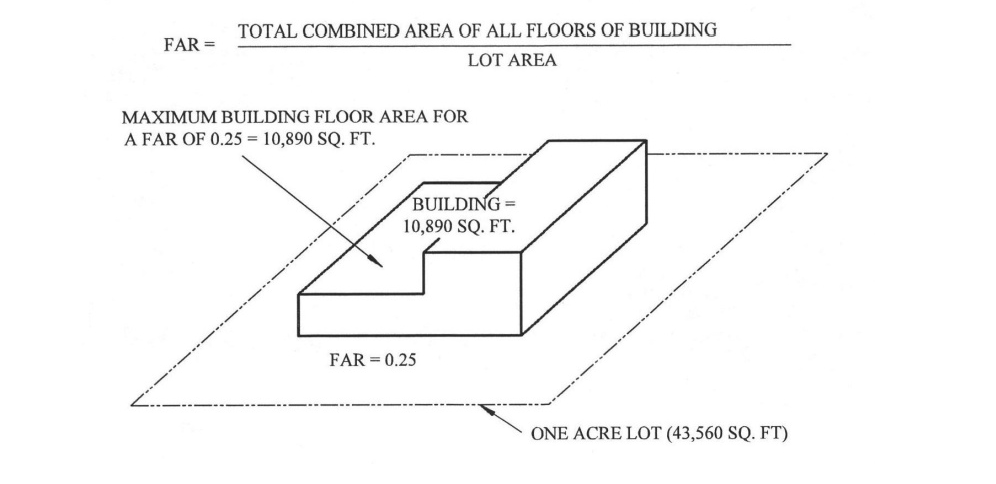
Flowering marijuana plant: A marijuana plant from the time it exhibits the first signs of sexual maturity through harvest.
Footcandle: A unit of illumination produced on a surface, all points of which are one foot from a uniform point source of one candle.
Frame effect: Refer to subsection 36-454(2) for the definition of this term.
Fraternal organization: A group of people formally organized for a common interest, usually cultural, religious or entertainment, with regular meetings, rituals, and formal written membership requirements.
Fraternity house: A dwelling maintained exclusively for fraternity members and their guests or visitors and affiliated with an academic or professional college, university or other institution of higher learning.
Freeway: A limited-access highway with no traffic stops and with grade-separated interchanges at major thoroughfares. Intended for high-volume, high-speed traffic movement between cities and across the metropolitan area, and not intended to provide direct access to adjacent land.
Frontage: That part of a lot or premises immediately adjacent to a street or streets without regard to access to, or elevation of, the street or streets.
Funeral home: A building used for the preparation of the deceased for burial and the display of the deceased and ceremonies connected therewith before burial or cremation, but shall not include facilities for cremation.
General public: Any and all individuals without any prior qualifications.
Glare: The effect produced by brightness sufficient to cause annoyance, discomfort, or loss in visual performance and visibility.
Greenhouse: A building whose roof and sides are made largely of glass or other transparent or translucent material and in which the temperature and humidity can be regulated for the cultivation of delicate or out-of-season plants for subsequent sale or for personal enjoyment. Not to include marijuana or medical marijuana facilities.
Group home, custodial: A dwelling in which unrelated mentally or physically handicapped, or otherwise mentally or physically impaired persons reside with houseparents or guardians.
Group home, residential: A single-family-detached dwelling in which no more than ten people reside, comprised of the following: eight or fewer unrelated mentally or physically handicapped persons, no more than two persons acting as houseparents or guardians who need not be related to each other or to any of the mentally or physically handicapped persons, residing in the dwelling, and the children of the houseparents or guardians.
Hazardous substance:
(a)
Any material or waste which poses a present or potential hazard to human health or the environment when improperly treated, stored, transported, disposed of, or otherwise managed;
(b)
Any material which is hazardous within the meaning of any federal, state, or local law, regulation or ordinance, including, but not limited to:
(1)
The federal Resource Conservation and Recovery Act, as amended, 42 USC 6901, et seq.; or
(2)
Substances regulated under the federal Toxic Substances Control Act, as amended, 15 USC 2601, et seq.; or
(3)
Substances described or regulated as hazardous or toxic under Missouri state statutes or regulations; or
(4)
Substances described or regulated as hazardous or toxic under the ordinances or regulations of the City of Springfield.
Height: The vertical distance of a structure measured from the average established grade at the street lot line or from the average natural ground level, if higher; or if no street grade has been established to the highest point of the roof's surface if a flat surface; to the deck line of mansard roofs; and to the mean height level between eaves and ridge for hip or gable roofs. In measuring the height of a building, the following structures shall be excluded: chimneys, cooling towers, telecommunication towers, ornamental cupolas, domes, or spires, elevator bulk heads, penthouses, tanks, water towers, and parapet walls not exceeding four feet in height (Figure 2-5).
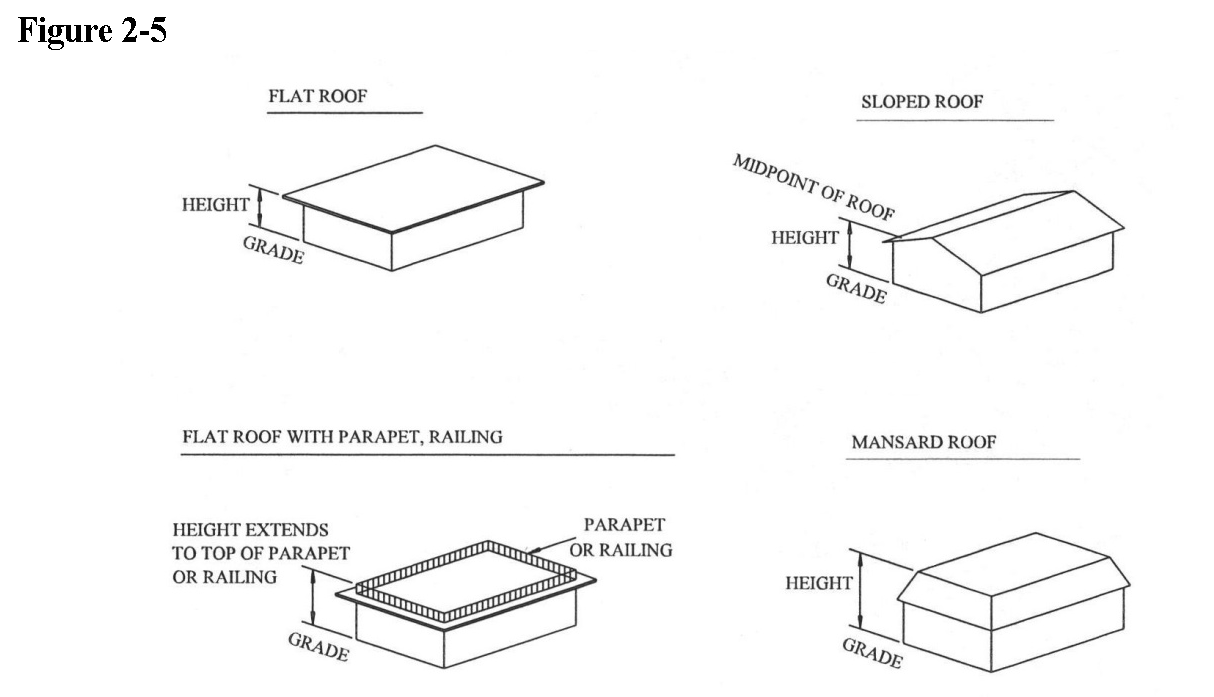
Height limit: The vertical distance measured from the average ground level at the base of a structure above which no part of any structure shall extend.
Height of tower above grade or ground: The vertical distance between the highest point of the tower and the natural grade directly below this point.
Historic design guideline: A standard of appropriate activity that will preserve the historic architectural character of a structure or area.
Historic designation ordinance: An ordinance enacted by the city council pursuant to this article that provides for the nomination, designation, and protection of a historic landmark and/or historic district and that contains, at a minimum, the elements required by subsection 36-404(2)(c) of this article.
Historic district: An area designated as a historic district by ordinance of the city council, pursuant to procedures prescribed herein, and which is a geographically definable area possessing a significant concentration, linkage, or continuity of sites or structures united by past events, plan or physical development. A district may comprise individual elements separated geographically but linked by association, plan, design, or history. Designation as a historic district will be considered an overlay zoning district and binding review of exterior alterations and demolitions by the Springfield Landmarks Board, as provided for in section 36-404, landmarks, will be required.
Historic landmark: A property or structure designated as a historic landmark by ordinance of the city council, pursuant to procedures prescribed herein, which is worthy of rehabilitation, restoration, and preservation because of its historic and/or architectural significance to the city. Historic landmark status will be reserved for those properties displaying exemplary historic or architectural significance. Designation as a historic landmark will be considered an overlay zoning district and binding review of exterior alterations and demolitions by the Springfield Landmarks Board, as provided for in section 36-404, landmarks, will be required.
Historic significance: Character, interest or value as part of the development, heritage, or culture of the community, county, state or country; as the location of an important local, county, state or national event; or through identification with a person or persons who made important contributions to the development of the community, county, state or country.
Historic site: A property or structure designated as a historic site by resolution of city council, pursuant to procedures prescribed herein, which is worthy of rehabilitation, restoration and preservation because of its historic and/or architectural significance to the city but which is of insufficient significance to merit historic landmark status.
Home occupation: An activity carried out for compensation in a residential dwelling unit.
Hospital: An institution providing primary health services and medical or surgical care to persons, primarily in-patients suffering from illness, disease, injury, deformity and other abnormal physical or mental conditions, and including, as an integral part of the institution, related facilities such as laboratories, outpatient facilities or training facilities. Not to include marijuana or medical marijuana facilities.
Hospital, animal: An establishment where animals are admitted for examination and treatment by one or more veterinarians and where there are facilities to lodge animals that are being treated.
Hotel: A facility offering transient lodging accommodations to the general public. Such facilities may contain suites with cooking facilities for extended lodging accommodations.
Ideological and noncommercial sign: A sign which does not name or advertise a product, service, or business but only expresses a viewpoint, noncommercial message, opinion or idea. This includes commemorative plaques, historic markers, holiday decorations, political signs, political or fraternal flags or emblems, or protective signs which are commonly associated with safeguarding the permitted uses of a premises, including, but not limited to, vicious dog, no trespassing, neighborhood watch, and authorized parking only.
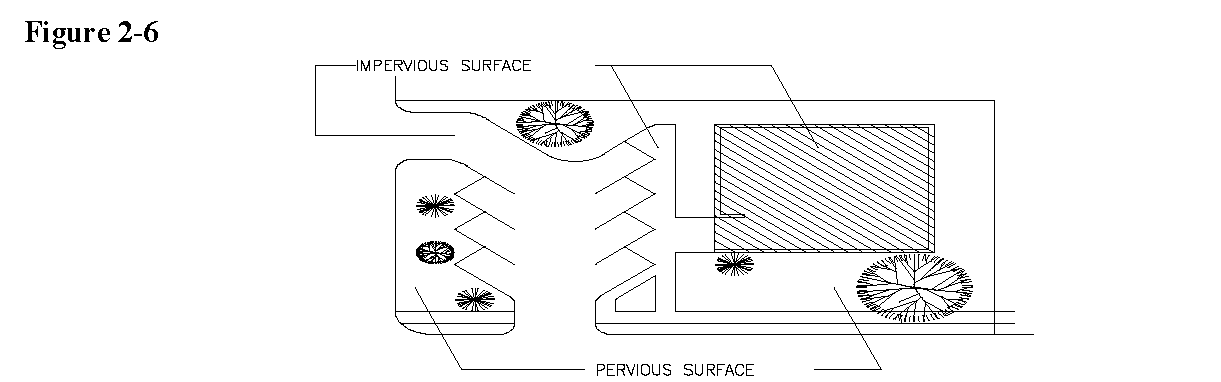
Impervious surface: Any part of a lot that is covered by buildings, structures, parking areas, driveways and any other surfaces which reduce or prevent absorption of stormwater (Figure 2-6).
Inflatable display object: Refer to subsection 36-454(2) for the definition of this term.
Infused preroll: A consumable or smokeable marijuana product, generally consisting of:
(1)
A wrap or paper;
(2)
Dried flower, buds, and/or plant material; and
(3)
A concentrate, oil or other type of marijuana extract, either within or on the surface of the product. Infused prerolls may or may not include a filter or crutch at the base of the product.
Interior landmark: An interior, or part thereof, designated as an interior landmark by ordinance of the city council, pursuant to procedures prescribed herein, which is worthy of rehabilitation, restoration and preservation because of its historic and/or architectural significance to the city and which remains substantially intact in terms of (1) original configuration, (2) original volume, (3) original architectural ornamentation and decoration; and which exhibits surviving original historical finishes or has the potential for research which could aid in the accurate restoration of such finishes. Interior landmark status will be reserved for those interiors displaying exemplary historic or architectural significance which are customarily open or accessible to the public, or to which the public is customarily invited (not including interiors utilized as places of religious worship). Each designation of an interior landmark shall specify in some detail which interior features are to be protected, and shall be accompanied by a file of photographs which permanently document such features. Designation as an interior landmark will be considered an overlay zoning district and binding review of alterations and demolitions by the Springfield Landmarks Board, as provided for in section 36-404, landmarks, will be required. Protected features may be covered temporarily or removed and placed into protected storage only if a certificate of appropriateness has been issued for the work.
Jail: Facilities in which persons accused or convicted of offenses are held in custody, confined or housed prior to or during trial or for incarceration after trial and conviction, excluding community corrections facilities and individuals confined to their own home by means of electronic surveillance or an equivalent thereto.
Kennel: An establishment licensed to operate a facility housing dogs, cats, or other household pets and where grooming, breeding, boarding, training, or selling of animals is conducted as a business.
Kindergarten: See "Preschool."
Landscaping materials: Landscape materials include lawns, trees, plants, and other natural and decorative features. In addition, it can include non-living materials such as mulch, brick, concrete, stone, cobbles, wood blocks, gravel, and sand.
Layer: A range of depth of a lot within which certain elements are permitted as defined in each district.
Loading space: An off-street space or berth on the same lot with a building or contiguous to a group of buildings, for the temporary parking of a commercial vehicle while loading or unloading merchandise or materials.
Lodging house: An establishment or part thereof, in which lodging is provided by the owner or operator for at least three but not more than 11 persons for compensation, whether the compensation is paid directly or indirectly.
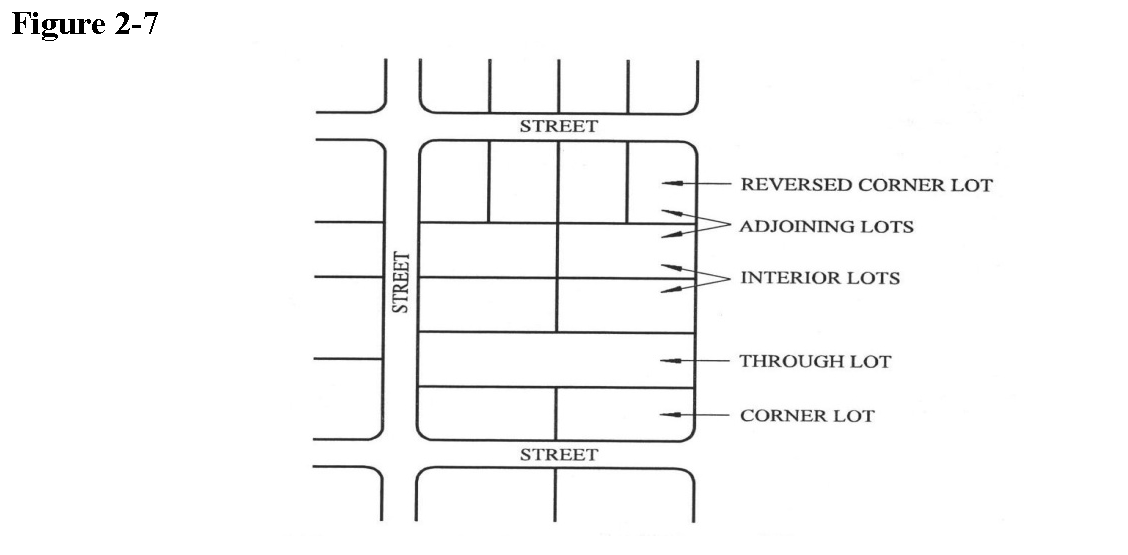
Lot: A parcel of land approved in accordance with the procedures set forth by chapter 36, article II, subdivision regulations, intended to be separately owned, developed, and otherwise used as a unit (Figure 2-7).
Lot area: The total horizontal area within the lot lines of a lot.
Lot, corner: A lot situated at the intersection of two or more streets (Figure 2-7).
Lot depth: The horizontal distance between the front and rear lot lines measured along the median between the two side lot lines.
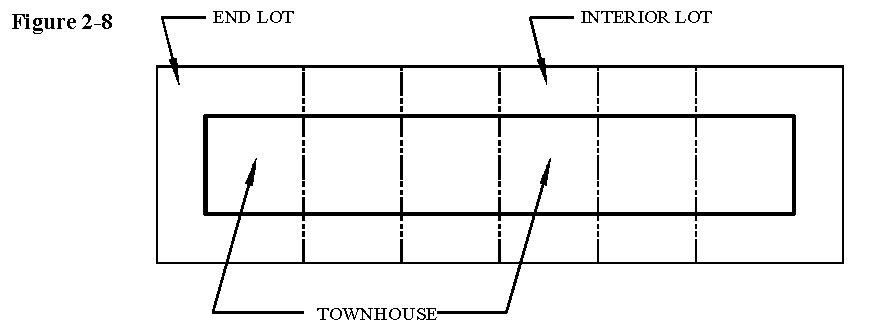
Lot, end: A lot on either end of a row of lots and intended for a townhouse attached on one side to another townhouse and with a yard on the opposite side. (Figure 2-8).
Lot, front of: The front of a lot shall be considered to be that side of the lot which fronts on a street. In the case of a corner lot, unless specifically noted otherwise on the final plat, the narrowest side fronting on the street shall be considered to be the front of the lot. In case the corner lot has equal frontage on two or more streets, unless specifically noted otherwise on the final plat, the lot shall be considered to front on that street with the greatest number of lots fronting between the closest intersecting streets.
Lot, interior: A lot other than a corner lot (Figures 2-7 and 2-8).
Lot line: A boundary line of a lot.
Lot line, front: The lot line separating a lot from the street. On a corner lot, unless specifically noted otherwise on the final plat, the shortest lot line abutting a street is the front lot line; on a through lot, both lot lines abutting the streets are the front lot lines; on a flag shaped lot, the front lot line is also that lot line most parallel to the front lot line abutting the street (Figure 2-9).
Lot line, rear: Any lot line not a front or side lot line. The rear lot line for a triangular shaped lot shall be a line ten feet long drawn between the lot's side lot lines and parallel to the front lot line (Figure 2-9).
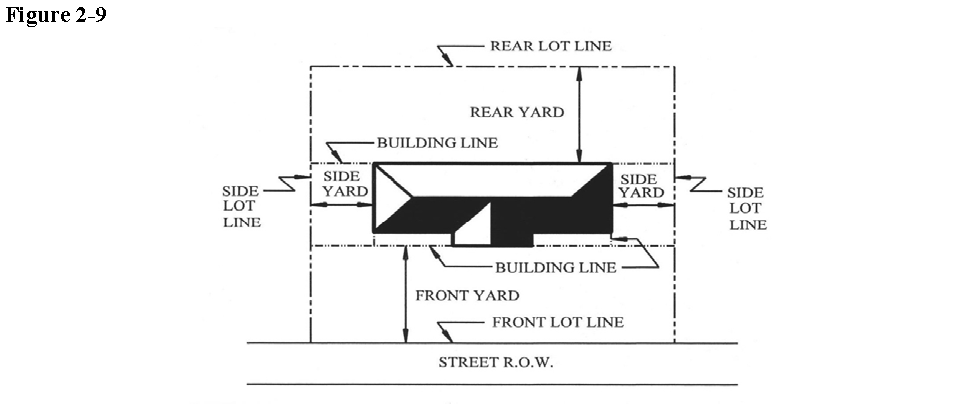
Lot line, side: The lot lines that intersect with a lot's front lot line (Figure 2-9).
Lot of record: A lot which exists as shown or described on a plat or deed in the records of the appropriate county recorder of deeds and as approved by chapter 36, article II, subdivision regulations.
Lot, reversed corner: A corner lot with a side street line which is substantially a continuation of the front lot line of the lot to its rear (Figure 2-7).
Lot, through: A lot having frontage on two parallel streets, or which fronts upon two streets which do not intersect at the boundaries of the lot (Figure 2-7). On a through lot, both lot lines abutting the streets are the front lot lines.
Lot width: The horizontal distance between the side lot lines, measured at right angles to the lot depth along a line parallel to the front lot line at the minimum required building setback line.
Luminaire: A complete lighting unit consisting of a light source and all necessary mechanical, electrical, and decorative parts.
Manufactured home: A factory-built structure which bears the seal of the State of Missouri public service commission, U.S. Department of Housing and Urban Development, or its agent, and which, in the traveling mode, is eight body feet or more in width or 40 body feet or more in length, or, when erected on-site, contains 320 or more square feet, equipped with the necessary service connections and made so as to be readily movable as a unit on its own running gear and designed to be used as a dwelling unit with or without a permanent foundation.
Manufactured housing development: A site with required improvements and utilities for the long-term placement of manufactured homes or park model recreational vehicles for dwelling purposes. Services and facilities for residents of the development may also be included on the site.
Manufactured housing subdivision: A development containing lots intended primarily for the individual placement of manufactured homes or park model recreational vehicles for dwelling purposes.
Marijuana or marihuana: Cannabis indica, Cannabis sativa, and Cannabis ruderalis, hybrids of such species, and any other strains commonly understood within the scientific community to constitute marijuana, as well as resin extracted from the marijuana plant and marijuana-infused products. "Marijuana" or "marihuana" do not include industrial hemp as defined by Missouri statute, or commodities or products manufactured from industrial hemp.
Marijuana facility: A comprehensive marijuana cultivation facility, comprehensive marijuana dispensary facility, marijuana testing facility, comprehensive marijuana-infused products manufacturing facility, microbusiness wholesale facility, microbusiness marijuana dispensary facility, or any other type of marijuana-related facility or business licensed or certified by the state pursuant to Article XIV, Section 2 of the Missouri State Constitution. Marijuana facilities do not include medical marijuana facilities licensed pursuant to Article XIV, Section 1 of the Missouri State Constitution.
Marijuana-infused products: Products that are infused, dipped, coated, sprayed, or mixed with marijuana or an extract thereof including, but not limited to, products that are able to be vaporized or smoked, edible products, ingestible products, topical products, suppositories, and infused prerolls.
Marijuana microbusiness facility: A facility licensed by the state as a microbusiness marijuana dispensary facility or microbusiness wholesale facility, as defined in this section.
Marijuana testing facility: A facility certified by the state to acquire, test, certify, and transport marijuana, including those originally licensed as a medical marijuana testing facility.
Master plan: See "Comprehensive plan."
Maximum permitted lumination: The maximum lumination measured in footcandles at the interior bufferyard line, or property line if no bufferyard is required, at ground level in accordance with the standards of subsection 36-484(2).
Medical marijuana: Marijuana allowed for the limited legal production, distribution, sale and purchase for medical use as governed by Article XIV of the Missouri State Constitution.
Medical marijuana cultivation facility: A facility licensed by the state to acquire, cultivate, process, package, store onsite or off-site, transport to and from, and sell marijuana, marijuana seeds, and marijuana vegetive cuttings (also known as clones) to a marijuana dispensary facility, marijuana testing facility, medical marijuana cultivation facility, or to a medical marijuana-infused products manufacturing facility. A medical marijuana cultivation facility's authority to process marijuana shall include the production and sale of prerolls, but shall not include the manufacture of marijuana-infused products.
Medical marijuana dispensary facility: A facility licensed by the state to acquire, process, package, store onsite or off-site, sell, transport to or from, and deliver marijuana, marijuana seeds, marijuana vegetative cuttings (also known as clones), marijuana-infused products, and drug paraphernalia used to administer to a qualifying patient, a primary caregiver, as set forth and defined in Article XIV of the Missouri Constitution, anywhere on the licensed property or to any address as defined by the patient or primary caregiver, so long as the address is a location allowing for the legal possession of marijuana, another medical marijuana dispensary facility, a marijuana testing facility, a medical marijuana cultivation facility, or a medical marijuana-infused products manufacturing facility. Dispensary facilities may receive transaction orders at the dispensary in person, by phone, or via the internet, including from a third party. A medical marijuana dispensary facility's authority to process marijuana shall include the production and sale of prerolls, but shall not include the manufacture of marijuana-infused products.
Medical marijuana facility: Any medical marijuana cultivation facility, medical marijuana dispensary facility, or medical marijuana-infused products manufacturing facility, as governed by Article XIV, Section 1, of the Missouri State Constitution.
Medical marijuana-infused products manufacturing facility: A facility licensed by the state to acquire, process, package, store onsite or off-site, manufacture, transport to or from, and sell marijuana-infused products to a medical marijuana dispensary facility, a marijuana testing facility, a medical marijuana cultivation facility, or to another medical marijuana-infused products manufacturing facility.
a.
Type 1 extraction facility: A facility which uses combustible gases, CO2 or other hazardous substances in the marijuana extraction process.
b.
Type 2 post-extraction facility: A facility which uses marijuana extractions to incorporate into edibles, ointments, etc., and does not use combustible gases, CO2 or other hazardous substances. This would be permitted in the GR, HC, CS, CC, COM, RI, LI, GM, HM, and IC districts as either a retail sales use or manufacturing use depending upon its scope and volume of production, facility capacity and the primary customer (retail or wholesale).
Microbusiness marijuana dispensary facility: A facility licensed by the state to acquire, process, package, store on site or off site, sell, transport to or from, and deliver marijuana, marijuana seeds, marijuana vegetative cuttings (also known as clones), marijuana-infused products, and drug paraphernalia used to administer marijuana to a consumer, qualifying patient, or primary caregiver, as set forth and defined in Article XIV of the Missouri State Constitution, anywhere on the licensed property or to any address as directed by the consumer, qualifying patient, or primary caregiver and, consistent with state and local law, a microbusiness wholesale facility or a marijuana testing facility. Microbusiness marijuana dispensary facilities may receive transaction orders at the dispensary directly from the consumer in person, by phone, or via the internet, including from a third party. A microbusiness marijuana dispensary facility's authority to process marijuana shall include the creation of prerolls.
Microbusiness wholesale facility: A facility licensed by the state to acquire, cultivate, process, package, store on site or off site, manufacture, transport to or from, deliver, and sell marijuana, marijuana seeds, marijuana vegetative cuttings (also known as clones), and marijuana-infused products to a microbusiness marijuana dispensary facility, other microbusiness wholesale facility, or marijuana testing facility. A microbusiness wholesale facility may cultivate up to 250 flowering marijuana plants at any given time. A microbusiness wholesale facility's authority to process marijuana shall include the creation of prerolls and infused prerolls.
Mobile home: A transportable, factory-built home, designed to be used as a year-round residential dwelling and built prior to the enactment of the Federal Manufactured Housing Construction and Safety Standards Act of 1974, which became effective June 16, 1976.
Mobile home park: See "Manufactured housing development."
Mobile vendor: A food or vendor service operation that operates from a motorized vehicle.
Modular home: A factory-built transportable structure which bears the seal of the State of Missouri public service commission or is built to the building code as adopted by the City of Springfield and which does not have its own running gear and is designed to be used as a dwelling unit with a permanent foundation.
Motel: An establishment providing transient accommodations on a daily rate to the general public with at least 25 percent of all rooms having direct access to the outside without the necessity of passing through the main lobby of the building.
Noise level reduction (NLR): The reduction of outside noise transmitted inside a structure achieved through the incorporation of noise attenuation into the design and construction of the structure.
Non-business area: Refer to subsection 36-454(2) for the definition of this term.
Nonconforming building: Any structure that does not meet the limitations on structure size and location on a lot for the district in which such structure is located and for the use to which such structure is being put at the time the structure was established.
Nonconforming use: A use of land that does not comply with the use regulations for its zoning district, but which complied with applicable regulations at the time the use was established.
Nursery: A place where trees, shrubs, or flowering plants are raised for commercial purposes from seed or otherwise in order to be transplanted or propagated. Not to include marijuana or medical marijuana facilities.
Nursery school: See "Preschool."
Nursing home: An extended or intermediate care facility licensed or approved to provide full-time convalescent or chronic care to individuals who, by reason of advanced age, chronic illness or infirmity, are unable to care for themselves.
Off-premises sign: Refer to subsection 36-454(2) for the definition of this term.
Office, administrative: An establishment primarily engaged in management and general administrative functions such as executive, personnel, finance and sales activities performed centrally for other establishments of the same company.
Office, business: An office for conducting the affairs of business or an establishment engaged in rendering services to business establishments such as advertising; data processing; employment service; management and consulting services and protective services.
Office, medical: An office for a physician, physical therapist, chiropractor, surgeon or any other medical professional of the same general character. Medical offices do not include significant diagnostics, testing or out-patient surgery facilities normally associated with medical clinics or hospitals. Not to include marijuana or medical marijuana facilities.
Office, professional: An office of a member or members of a recognized profession such as an accountant, architect, attorney, engineer, insurance agent, real estate agent, personal or family counselor, public stenographer or any other profession which is of the same general character.
Office, sales: An office accessory to a manufacturing, production, processing, cleaning, servicing, testing, repair or storage activity where sales are primarily generated by telephone or off site by salespersons with only incidental retail sales on site.
Office/retail/warehouse combination: A facility that provides combined office, retail, and warehouse facilities for one or more small establishments.
On-premises sign: Refer to subsection 36-454(2) for the definition of this term.
Open space: Any occupied space on a lot that is unobstructed to the sky except for the ordinary projection of cornices and eaves. Open space shall not include areas covered by structures, decks, porches, parking areas, driveways, internal streets and other forms of impervious surface (Figure 2-6). Water bodies that are not subject to public ownership shall also be included as open space.
Ordinary maintenance and repair: Where the purpose of the work is stabilization or is normal, customary, and routine affecting the exterior of the structure or the outside of the site, except for items specifically requiring a certificate of appropriateness.
Orphanage: An institution licensed by the state for the care of orphans or other abandoned children placed in the institution by a court order or a state agency.
Overnight shelter: A shelter that provides lodging and meals; whose services are available for up to 30 days at any one time to any one resident.
Owner of record: The person, corporation, trustee, or other legal entity listed as owner of a lot in the records of the county recorder of deeds.
Package liquor store: An establishment where alcoholic beverages are sold for consumption off the property.
Park model recreational vehicle ("PMRV"): Also know as a "recreational park trailer", is a dwelling unit that has a floor area of 400 square feet or less and meets the American National Standards Institute (ANSI) recreational standard A119.5 park model recreational vehicle standard. For purposes of this definition, a park model recreational vehicle shall not be considered a recreational vehicle.
Paving: Brick, stone, concrete, asphalt, or other impervious dustless material placed on the surface of the land.
Pawn shop: Any establishment that loans money on deposit of personal property or deals in the purchase or possession of personal property on condition of selling the same back again to the pledger or depositor, or loans or advances money on personal property by taking chattel mortgage security thereon, and takes or receives such personal property. This classification does not include secondhand motor vehicles, parts, or accessories.
Peak hour trips: Total number of trip ends generated by a site during the hour when the adjacent street carries the maximum number of trips or during the hour when the site generates the maximum number of trip ends.
Permanent sign: Any sign which is not a temporary sign.
Person: Any individual, corporation, association, firm, partnership, institution, or other legal entity, singular or plural.
Personal garden: The growing and cultivation of fruits, flowers, herbs, vegetables and/or ornamental plants by the owner or occupant primarily for personal use.
Personal service establishment: An establishment for the sale of non-medically related personal services or an establishment primarily engaged in providing services involving the care of a person of his or her personal goods or apparel, but not including personal storage.
Pervious surface: Any material that allows the absorption of stormwater (Figure 2-6).
Pick-up window: A facility typically accessory to a commercial establishment designed solely for the distribution of goods to the customer in a motor vehicle.
Porch: A roofed, open area usually attached to or part of and with direct access to or from a building. A porch becomes a room when the space enclosed is heated or air conditioned or, if glazed, when the percentage of window area to wall area of the porch, not attached to the building, is less than 75 percent.
Porch, open: A porch where at least 75 percent of the sides of the porch not attached to the building are empty voids and whose voids are neither glazed nor screened.
Power/communications conduits: Electric power lines, telephone lines, fiber optic cables, or any other wires, cables or conduits for the conveyance of electric power or the communication of messages, data or signals, and appurtenant equipment.
Premises: A premises is any tract of land, consisting of one or more lots, under single or multiple ownership, which operates as a functional unit. When developed, a premises shall also possess one or more of the following criteria:
(a)
Shared parking;
(b)
Common management;
(c)
Common identification;
(d)
Common access; or
(e)
Shared circulation.
Preroll: A consumable or smokable marijuana product, generally consisting of:
(1)
A wrap or paper;
(2)
Dried flower, buds, and/or plant material; and
(3)
A concentrate, oil or other type of marijuana extract, either within or on the surface of the product.
Preschool: A facility where educational services are provided for children below first grade not otherwise a part of the school system. For purposes of this article, such educational services and facilities shall be considered as child day care centers.
Preservation: The act or process of sustaining the form and extent of a structure essentially as it now exists.
Principal building: See "Principal structure."
Principal structure: A structure, or group of structures, in which the principal use of the lot on which it is located is conducted.
Principal use: The primary or predominant use of any lot.
Printing establishment: A large-scale establishment that utilizes printing presses and other equipment to print material and/or bind books.
Print shop: A typically small-scale retail establishment that provides duplicating or document production services using photocopy, blueprint, word processing or offset printing equipment or small printing presses, to include collating of booklets and reports.
Prison: See "Jail."
Private club: An organization of persons for special purposes or for the promulgation of sports, arts, literature, politics, or the like.
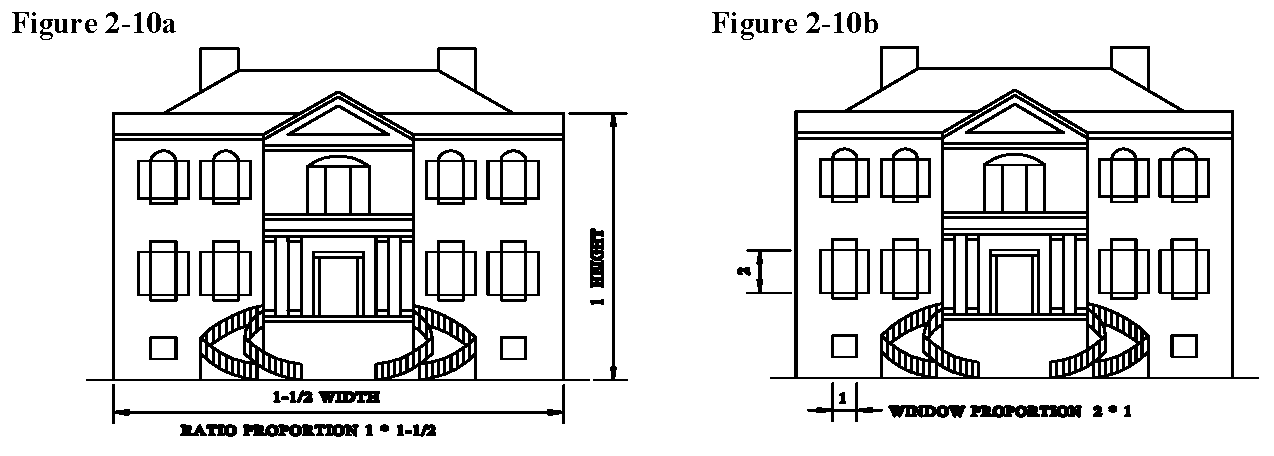
Proportion: The relative physical sizes within and between buildings and building components (Figures 2-10a and 2-10b).
Protection: The act or process of applying measures designed to affect the physical condition of a property by defending or guarding it from deterioration, loss, or vandalism, or to cover or shield the property from danger. In the case of structures, such treatment is generally temporary and anticipates future treatment; in the case of archaeological sites, the measure may be temporary or permanent.
Public: Maintained for or used by the people of the City of Springfield on a noncommercial basis.
Public improvement project: An action by the City of Springfield or any of its departments or agencies involving major modification or replacement of streets, sidewalks, curbs, street lights, street or sidewalk furniture, landscaping, or other portions of the public infrastructure.
Reconstruction: The act or process of reproducing by new construction the exact form and detail of a vanished structure, or part thereof, as it appeared at a specific period of time.
Recreational vehicle: A motorized or towable vehicle that is designed to provide temporary living quarters for recreational, camping or travel use and is of such size or weight as not to require special highway movement permits when drawn by a motorized vehicle. Such units are commonly described as RVs, travel trailers, campers, motor homes, tiny home on wheels, or other similar units.
Recycling center: A facility where recyclable material is collected or is separated and processed prior to shipment to other facilities.
Rehabilitation: The act or process of returning a property or structure to a state of utility, through repair or alteration, which makes possible an efficient contemporary use, while preserving those portions or features of the property that are significant historically, architecturally, or culturally.
Rehabilitation impracticable: Infeasibility of rehabilitation not only because of physical condition but also inability to turn the property or structure to use or account profitably.
Relocation: Any relocation of a structure, object, or artifact on its site or to another site.
Remodel: Any interior or exterior change to a structure not including a change in load-bearing member of a structure.
Resource recovery collection center, household: A facility incidental to a principal use where households deposit recyclable materials, such as cans, newspaper, plastic, and glass, for transportation to other locations for storage or processing. Limited processing of materials, such as material compacting, baling and grinding, to reduce the volume of material for shipment may occur.
Restaurant: An establishment where food and drink is prepared and served for consumption on or off the property. If alcoholic beverages are served, more than 50 percent of gross income must be derived from the sale of food and non-alcoholic beverages, for consumption on the property, for the establishment to be classified a restaurant.
Restoration: The act or process of accurately recovering the form and details of a structure or property as it appeared at a particular period of time by removing later work and/or replacing missing original work.
Retail establishment: An establishment that provides goods and/or services directly to the consumer or where an order may be placed by the consumer for such goods and/or services and where such goods and/or services are available for immediate purchase and removal from the premises by the purchaser.
Retail trade: Establishments engaged in selling goods or merchandise to the general public for personal or household consumption and rendering services incidental to the sale of such goods.
Retirement home: A facility designed to meet the needs of, and exclusively for, the residence of senior citizens and which may include convalescent care facilities.
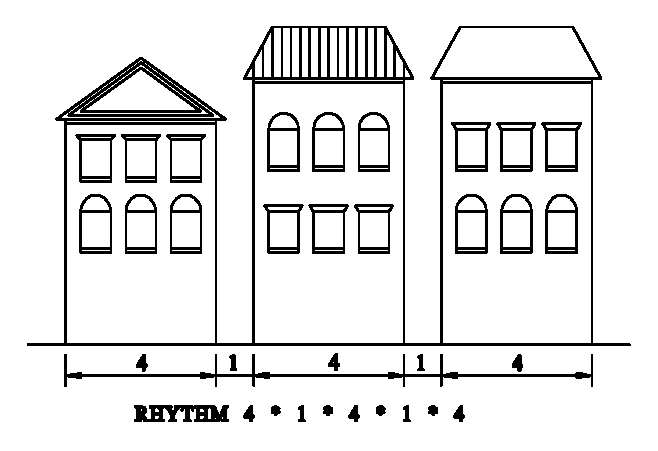
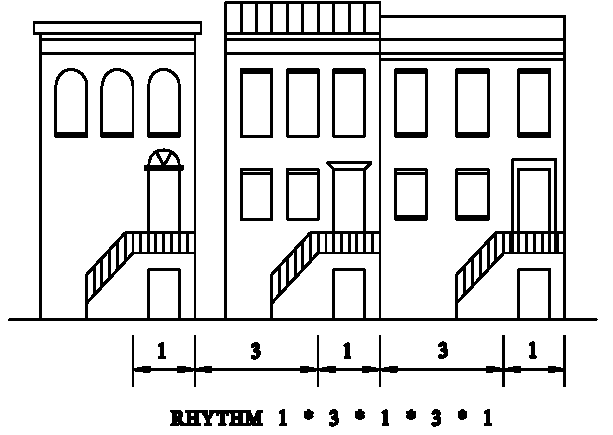
Rhythm: A regular pattern of shapes including, but not limited to, windows, doors, projections, and heights, within a building, structure, or group of the same (Figures 2-11a, 2-11b, and 2-11c).
Figure 2-11c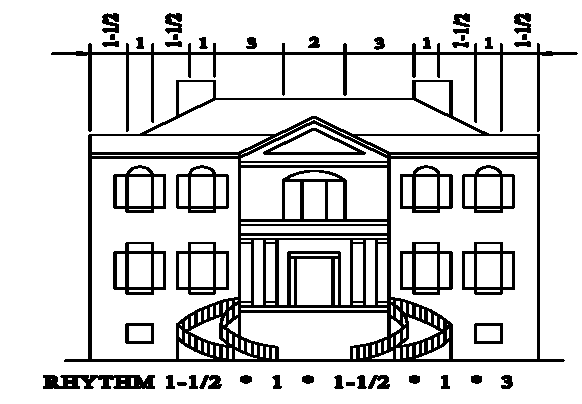
Rooming house: See "Lodging house.
Routinely disturbed: Ground surface that is traversed continuously throughout the course of daily business.
Satellite dish antenna: A device commonly parabolic in shape, typically mounted at a fixed point, usually on the ground, for the purpose of transmitting and/or receiving radio or radio or electromagnetic waves to and from satellite and earthbound communications facilities and serving the same or similar function as the common television antenna.
Scale: The harmonious proportion of parts of a building or structure to one another and to the human figure.
School, business: An establishment which provides instruction and training in office, clerical, managerial, sales, information technology, administrative skills or trades such as beauty school, barber college, beautician school or similar skills or trades.
School, industrial: An establishment which provides instruction and training in a skilled trade such as mechanics, carpentry, plumbing, service, construction, industrial or other skill related to assembling, processing, manufacturing, repair or similar skills or trades.
School system: A public or private school which provides education in at least the first through the sixth grades.
Secondhand store: Retail sales establishment of previously used merchandise, such as clothing, household furnishings or appliances, sports/recreational equipment. This classification does not include secondhand motor vehicles, parts, or accessories.
Septic system: An underground system with a septic tank used for the decomposition of domestic wastes.
Septic tank: A water-tight receptacle that receives the discharge of sewage from a building, sewer or part thereof, and is designed and constructed so as to permit settling of solids from this liquid, digestion of the organic matter, and discharge of the liquid portion into a disposal area.
Setback: The required minimum horizontal distance between the lot line and the nearest front, side or rear line of the building, as the case may be.
Shelter: A building or other structure where lodging, or lodging and meals, are provided to a person or persons, unrelated by family to the provider, at no cost or at a charge that is less than the full cost of providing same, whether or not additional services are provided at that location. Such additional services may include, but are not limited to, counseling and drug or alcohol rehabilitation, except that "shelter" shall not include any of the following:
(a)
Residential or custodial group homes as defined in this section of the zoning ordinance;
(b)
Temporary lodging for non-Greene County resident families of patients, or patients themselves, of state-licensed health facilities within Greene County;
(c)
University or educational institution residence halls;
(d)
Fraternity or sorority houses;
(e)
State and city licensed nursing homes and day care centers;
(f)
Foster homes licensed under Chapter 210, RSMo;
(g)
Hospitals, mental institutions, residential care facility or institution that is licensed by the State of Missouri under Chapters 197, 198, and 630, RSMo.;
(h)
Emergency shelters as certified and identified by the American Red Cross, Regional Mass Care Provider, that may provide lodging, meals and services related to relocation and are available during or after a fire or natural disaster for a limited duration. Any spacing requirements and maximum occupancies in this article shall not apply to emergency shelters; and
(i)
Facilities for victims of domestic violence.
Short-term rental: The rental of an entire dwelling, or any portion thereof, for a period of less than 30 consecutive days, where the owner is engaged in a contract for the rental of that specific dwelling, or any portion thereof. Short-term rentals are further categorized as Type 1, 2, or 3 and subject to the conditions set forth in this Code.
Sign: Refer to subsection 36-454(2) for the definition of this term.
Sign structure: Refer to subsection 36-454(2) for the definition of this term.
Significant exterior architectural feature: Those features which are important to or expressive of the architectural quality and integrity of the structure and its setting and which include, but are not limited to, building material, detail, proportion, rhythm, scale, setting, shape, and workmanship.
Site, historic: The traditional, documented or legendary location of an event, occurrence, action or structure significant in the life or lives of a person, persons, group, or tribe, including, but not limited to, cemeteries, burial grounds, campsites, settlements, estates, gardens, groves, river crossings, routes, trails, caves, quarries, mines or significant trees or other plant life.
Solid screening: A device or materials used to conceal one element of a development from other elements or from adjacent or contiguous development. Screening may include one or a combination of the following materials of sufficient mass to be opaque or that shall become opaque after 12 months and which shall be maintained in an opaque condition: solid fences, walls, berms, plantings, or other features. A chain link fence with plastic or wooden inserts shall not be considered solid screening.
Solid waste transfer station: A site or facility that is licensed by the city and permitted by the Missouri Department of Natural Resources, which accepts solid waste for temporary storage, or consolidation and further transfer of solid waste to a landfill.
Sorority house: A dwelling unit maintained exclusively for sorority members and their guests or visitors and affiliated with an academic or professional college, university or other institution of higher learning.
Soup kitchen: An establishment where meals are provided to a person or persons unrelated by family to the provider at no cost or at a charge that is less than the full cost of providing same and that the provision of such meals is the principal service of the establishment, whether or not additional services are provided; however, lodging is prohibited.
Specified anatomical areas: See "Cabaret."
Specified sexual activities: See "Cabaret."
Stabilization: The act or process of applying measures to halt deterioration and to establish the structural stability of an unsafe or deteriorated structure while maintaining the essential form as it presently exists without noticeably changing its exterior appearance.
Storage container: A container, including what is sometimes referred to as storage "pods" or "portable on demand storage units"; any box van that has been disconnected from a chassis; and similar intermodal type shipping/cargo containers that are:
(a)
Designed and commonly used for storing, shipping or transporting products and materials, and
(b)
Typically transported by a separate motorized vehicle or upon a trailer.
Storage, self-service: A building or group of buildings, commonly referred to as mini-storage, consisting of individual, small, self-contained units that are available on a rental basis for the storage of business and household goods or contractors supplies.
Storage trailer: Includes any dry freight van, semi-trailer, tractor trailer, refrigerated van, or similar type trailer, whether connected to a chassis or trailer or not, used for storage and/or warehousing purposes or any purpose or intent other than that for which the container or trailer was originally designed, that being for the shipping and transporting of products and materials.
Story: That portion of a building included between the surface of any floor and the surface of the next floor above it, or if there is no floor above it, then the space between such floor and ceiling next above it (Figure 2-1).
Streamers: Refer to subsection 36-454(2) for the definition of this term.
Street: A public or private way used, or intended to be used, for passage or travel by motor vehicles. Streets are further classified by the functions they perform as follows (Figure 2-13).
(a)
Local—Residential;
(b)
Local—Commercial/industrial;
(c)
Collector—Local;
(d)
Collector;
(e)
Secondary arterial;
(f)
Primary arterial;
(g)
Highway access;
(h)
Downtown street.
Street, collector: A street which collects and distributed traffic to and from local and arterial street systems and is primarily intended to provide for low- to moderate-volume, low-speed and short length trips while also providing access to abutting property (Figure 2-13).
Street, collector, local: A street which collects and distributes residential traffic between local streets and collector and arterial streets and is primarily intended for low- to moderate-volume, low-speed and short length trips while also providing access to abutting properties.
Street, commercial/industrial local: A street for low-volumes, low-speeds, and short-length trips to and from abutting properties in commercial and industrial areas.
Street, downtown: A street within the area bounded by a line 990 feet north of the south section line of Sections 13 and 14 of Township 29 North, Range 22 West on the north, John Q. Hammons Parkway/Sherman Avenue on the east, Harrison/State Streets on the south, Grant Avenue on the west, and a line 990 feet west of the east section line of Sections 14 and 24 of Township 29 North, Range 22 West on the west, except the following street segments:
(a)
Tampa Street east of Benton Avenue;
(b)
Phelps Street east of Washington Avenue;
(c)
Market Avenue between Mount Vernon and State Streets;
(d)
Main Avenue between Walnut and State Streets;
(e)
Mount Vernon Street between Grant and Campbell Avenues; and
(f)
Harrison Avenue between Grant and Market Avenues, and classified as designated by the major thoroughfare plan.
Street grade: Refer to subsection 36-454(2) for the definition of this term.
Street, highway access: A minor street parallel and adjacent to a freeway, expressway, or arterial which provides access to abutting properties and protection from through traffic.
Street, local: A street primarily providing direct access to abutting properties and designed to accommodate low-volume, low-speed traffic (Figure 2-13).
Street, primary arterial: A street primarily intended to provide for high-volume, moderate-speed traffic, and moderate- to extended-trip length traffic movement between major activity centers. Access to abutting property is subordinate to major traffic movement and is subject to the necessary control of entrances and exits (Figure 2-13).
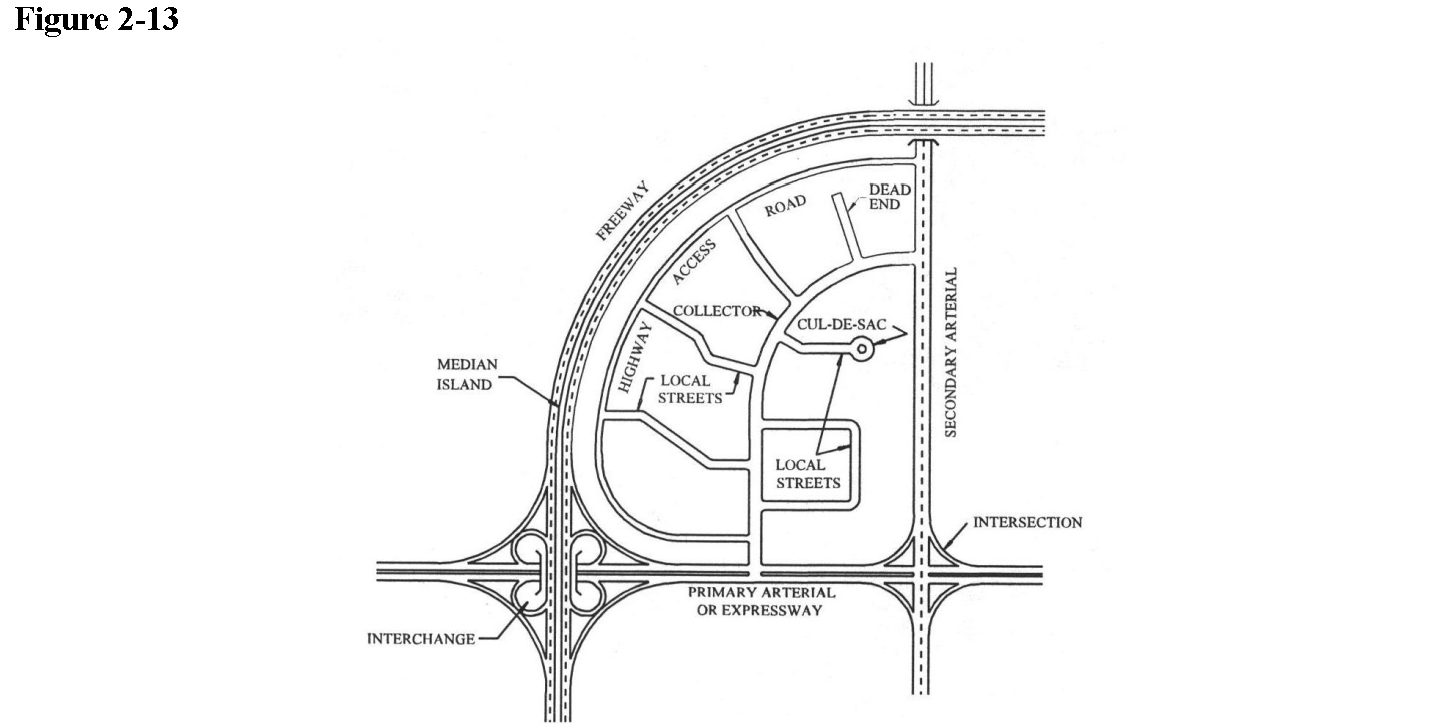
Street, residential connector: A street which provides a vehicular and pedestrian connection between two generally parallel local residential streets designed to accommodate very low volume and very low speed traffic within residential subdivisions.
Street, residential local: A street for low-volumes, low-speeds, and short-length trips to and from abutting properties in residential neighborhoods (Figure 2-13).
Street, secondary arterial: A street which interconnects with and augments and feeds the primary arterial system and is intended for moderate-volume, moderate-speed traffic, and short- to moderate-trip lengths. Access to abutting property is partially controlled (Figure 2-13).
Street width: The horizontal distance between the outside edges of a street's pavement, including any curbing and guttering, measured at right angles to the street's centerline.
Structural alteration: See "Alteration, structural."
Structure: Anything constructed or erected, the use of which requires permanent or temporary location on or in the ground, including, but without limiting the generality of the foregoing, houses, buildings, barns, backstops for tennis courts, bridges, fences, pergolas, parking lots, gazebos, radio and television antennae, signs, solar collectors, microwave antennae including supporting towers, roads, ruins or remnants (including foundations), swimming pools, walkways, septic systems or any similar item.
Substance abuse treatment facility: A facility, not accessory to a hospital, for treatment of alcohol or other substance abuse, with or without the use of drugs or other medical intervention, for one or more patients who are provided with care, meals and lodging and that is accredited by the State of Missouri, the Joint Chief Hospitals Operations Administration (JCHOA) or CARF. Additional services and programs may also be performed such as:
(a)
Outpatient substance abuse treatment;
(b)
Outreach to target populations to inform and facilitate access to services;
(c)
Prevention programs;
(d)
Support services including, but not limited to, vocational training, education, psychological or psychiatric services, child development and placement services.
Survey, historic: The systematic gathering of information on the architectural, historical, or archaeological significance of buildings, sites, structures, objects, or areas through visual assessment in the field and historical research for the purpose of identifying historic sites, historic landmarks, and historic districts worthy of preservation.
Swap meet: Any indoor or outdoor activity where new or used goods or secondhand personal property is offered for sale or exchange to the general public by a multitude of individual licensed vendors, usually in compartmentalized spaces; and where a fee may be charged to prospective buyers for admission and a fee may be charged for the privilege of offering or displaying such merchandise.
Tavern: An establishment where 50 percent or more of gross income is derived from the sale of alcoholic beverages by the drink, for consumption on the property, and where the serving of food and non-alcoholic beverages, for consumption on the property, and the sale of package liquors may be accessory uses.
Tea room: An establishment used primarily for the serving of non-alcoholic beverages by the drink for consumption on the premises with the sale of food for consumption on the premises is accessory to the primary use.
Temporary promotional use: An activity for the purposes of promoting business sales and/or raising funds for community service organizations or for the purpose of promoting any special event, any community educational campaign, any membership drive, or any other similar promotion and which activity is established for a fixed period of time with the intent to discontinue such activity upon the expiration of the time period.
Temporary sign (portable signs): A sign which either:
(a)
Is not permanently attached to any structure building, motor vehicle, or the ground; or
(b)
Is intended for a limited display period covering a special event; or
(c)
Is designed and constructed to be movable from one location to another.
Temporary vendor: A merchant selling merchandise (excluding the provision of services) and not located inside a permanent building or structure on private property.
Terrace: A level, landscaped or area directly adjacent to a principal building at or within three feet of the finished grade and not covered by a permanent roof or enclosed by temporary or permanent walls.
Tiny home: A principal residential dwelling constructed on or off-site that is 400 square feet or less, is built to the building code as adopted by the City of Springfield, and is designed to be used as a dwelling unit with a permanent foundation.
Tower: A structure with a fixed location which is designed primarily with the objective of obtaining an elevation above other objects to support an antenna or other device for receiving or transmitting radio, television, microwave or other telecommunications or signals. This definition does not apply to utility poles.
Transitional housing: A shelter which provides only lodging, or lodging and meals, for longer than 30 days at any one time for residents, but does not provide other services on a continuing basis.
Transitional service shelter: A shelter whose services are available for longer than 30 days at any one time to a resident, and which provides services in addition to lodging and meals, or lodging alone, in a group setting on the same premises, including, but not limited to, job counseling, life or parenting skill courses, drug or alcohol rehabilitation, money management, or job training. Such shelter may include office for staff of the providers and for counselors.
Trip ends: The total number of all trips entering plus all trips leaving a designated site over a given period of time.
Tutoring: The provision of instruction.
Undeveloped land: Land in its natural state before development.
Usable open space: An area that is intended to provide light and air, and is designed for either environmental, scenic, or recreational purposes. Open space may include, but is not limited to, lawns, decorative plantings, walkways, active and passive recreation areas, playgrounds, fountains, swimming pools, wooded areas, and water courses. Open space shall not be deemed to include driveways, parking lots, or other surfaces designed or intended for vehicular travel.
Use: The purpose for which land or a building is arranged, designed, or intended, or for which either land or a building is or may be occupied or maintained.
Utility distribution facilities: Utility facilities that provide retail utility services to customers. These facilities include distribution lines that route electrical, gas, telephone, water, sewer, cable TV, and similar services throughout neighborhoods and connect or provide the capability to connect with each customer. Distribution facilities consist of wires, cables, conduits, laterals, mains, and pipes with limited capacity and diameter, and associated hardware: poles, vaults, valves, transformers, relays, and similar equipment. Small substation facilities located within public rights-of-way or utility easements shall be considered distribution facilities.
Utility substation facilities: Utility facilities that reduce the strength, amount, volume, or configuration of utility flow from a bulk quantity in large-size, long-distance transmission facilities to small quantities in distribution facilities. Substation facilities include electrical substations, gas regulator stations, telephone switching and relay facilities, water and sewage pumps and lift stations.
Utility transmission facilities: Utility facilities that transfer large utility flows between generating or treatment facilities and substation facilities. Transmission facilities consist of wires, cables, conduits, vaults, laterals, pipes, mains, valves, poles, and similar equipment to convey large volumes of electricity, communications, gas, water, sewer, or slurry. Transmission facilities may serve local distribution facilities or be part of an intrastate or interstate utility system.
Vehicle: The same meaning as the term is given in chapter 22, of the Springfield City Code.
Vehicle repair activity: The maintenance, repair, painting, disassembling, or reassembling of a vehicle, engine, or components thereof in any manner.
Vehicle towing and storage service: A facility where towed or impounded vehicles are stored until they are claimed by their owners or otherwise disposed.
Vehicle use area: That portion of a lot that is used by vehicles for access, circulation, parking, and loading and unloading. It comprises the total of circulation areas, loading and unloading areas, and parking areas.
Vehicular sign: Any sign on a vehicle which is traveling or lawfully parked where the primary purpose of such parking is not the display of any sign.
Vibration: The effect produced by any physical process characterized by a periodic, and usually rapid, oscillatory motion sufficient to cause annoyance or discomfort, however, excluding blasting operations for quarries and temporary construction activities.
Wall sign: A sign in a parallel plane to and attached, installed, painted, engraved or etched upon a structure's wall, awning, canopy, marquee, parapet, sun shield, window, door or similar item.
Wholesale trade: Establishments or places of business primarily engaged in selling merchandise to retailers; to industrial, commercial, institutional, or professional business users, or to other wholesalers; or acting as agents or brokers and buying merchandise for, or selling merchandise to, such individuals or companies.
Working days: The days of the week, excluding Saturdays, Sundays and recognized holidays, during which normal business is conducted by the City of Springfield. If only days are stated then Saturdays, Sundays and holidays shall be included.
Yard: An open space located on the same lot as and that lies between the principal or accessory building or buildings and the nearest lot line. Such yard is unoccupied and unobstructed from the ground upward except as otherwise provided herein (Figure 2-9).
Yard, front: An open space extending the full width of the lot between the nearest principal building and the front lot line, and measured perpendicular to the front lot line. The minimum front yard required in each district of this article shall be unoccupied and unobstructed from the ground upward except as otherwise provided herein (Figure 2-9).
Yard, rear: An open space extending the full width of the lot between the nearest principal building and the rear lot line, and measured perpendicular to the rear building line. The minimum rear yard required in each district of this article shall be unoccupied and unobstructed from the ground upward except as otherwise provided herein (Figure 2-9).
Yard, side: An open space extending from the front yard to the rear yard between the nearest principal building and the side lot line, and measured perpendicular from the side lot line. The minimum side yard required in each district of this article shall be unoccupied and unobstructed from the ground upward except as otherwise provided herein (Figure 2-9).
Zero lot line: The location of a building on a lot in such a manner that one or more of the building's sides rests directly on a lot line (Figure 2-14).
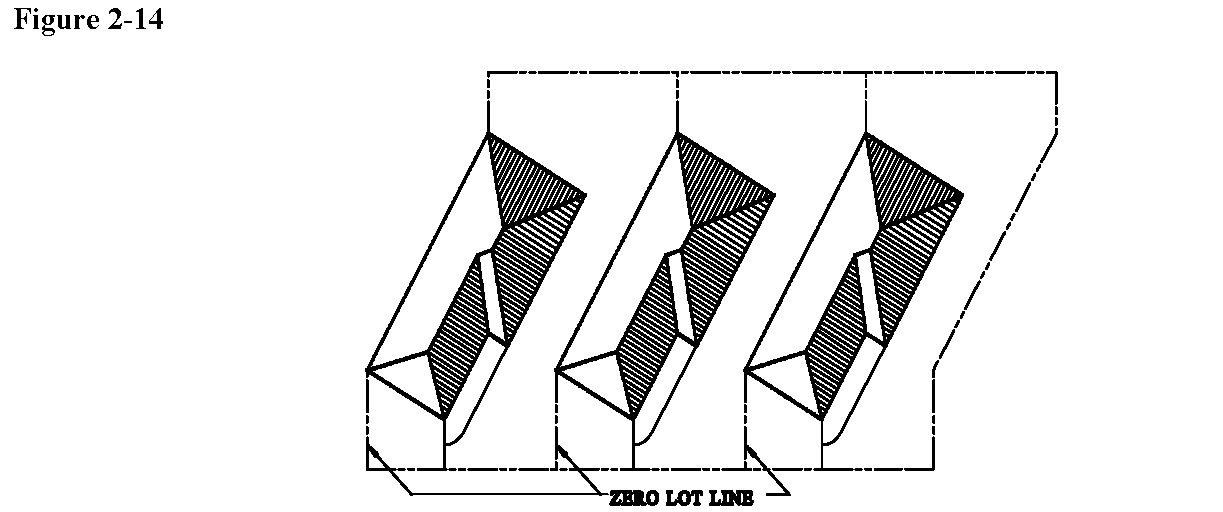
(Zoning Ord., § 2-1100; G.O. 4570, 11-27-95; G.O. 4685, 3-17-97; G.O. 4763, 12-15-97; G.O. 4828, 9-8-98; G.O. 4829, 9-8-98; G.O. 4925, 9-27-99; G.O. 5019, 10-23-00; G.O. 5094, 7-9-01; G.O. 5127, 10-29-01; G.O. 5165, 3-25-02; G.O. 5343, 1-12-04; G.O. 5355, 3-15-04; G.O. 5412, 10-18-04; G.O. 5425, 11-15-04; G.O. 5533, 4-3-06; G.O. 5585, 7-24-06; G.O. 5652, 2-12-07; G.O. 5665, 4-9-07; G.O. 5763, 6-30-08; G.O. 5811, 4-6-09; G.O. 5823, 6-15-09; G.O. 5834, 8-24-09; G.O. 5843, 11-9-09; G.O. 5866, 3-22-10; G.O. 5880, 7-26-10; G.O. 5881, 7-26-10; G.O. 5978, 3-26-12; G.O. 5895, 9-20-10; G.O. 5960, 12-12-11; G.O. 6010, 8-27-12; G.O. 6058, 6-17-13; G.O. 6092, 1-13-14; G.O. 6120, 5-12-14; G.O. 6195, Exh. D, 5-11-15; G.O. 6497, § 1, 1-28-19; G.O. 6528, § 1, 5-20-19; G.O. 6592, § 1, 5-4-20; G.O. 6703, § 1, 1-24-22; G.O. 6775, § 1, 1-31-23; Ord. No. 6894, § 1, 11-18-24)

