
St Cloud City Zoning Code
ARTICLE 15
- ON-SITE DEVELOPMENT STANDARDS
15.1 - PURPOSE
The purpose of this Article is to address the regulation of those other site improvements within a zoning lot other than the regulations for the principal building. This includes site design standards, exterior lighting, accessory structures and uses, permitted obstructions and environmental performance standards.
15.2 - USE OF LAND AND BUILDINGS
A.
Number of Buildings on a Lot
Zoning lots with single-family or two-family dwellings are limited to a maximum of one (1) principal building on the lot.
B.
Applicability of Bulk Requirements
All structures erected after the effective date of this Code must meet the requirements for the zoning district in which the structure is located. No existing structure may be enlarged, altered, reconstructed or relocated in such a manner that conflicts with the requirements of the zoning district in which the structure is located.
C.
Required Yards
No lot may be reduced in area so that the yards are less than required by this Code. The yards of a structure are not considered yard space for any other structure. All yards allocated to a structure must be located on the same zoning lot as such structure.
D.
Open Space Requirements
A yard, court or other open space provided for any structure for the purpose of complying with the provisions of this Code must not again be used as a yard, court or other open space for another building.
E.
Building Height Appurtenances
Chimneys, cooling towers, elevator bulkheads, fire towers, stacks, stage towers, scenery lofts, tanks, ornamental towers and spires, wireless towers, or necessary mechanical appurtenances may be erected to any height, not subject to zoning district maximum height requirements but subject to other ordinances of the City.
F.
View Obstruction
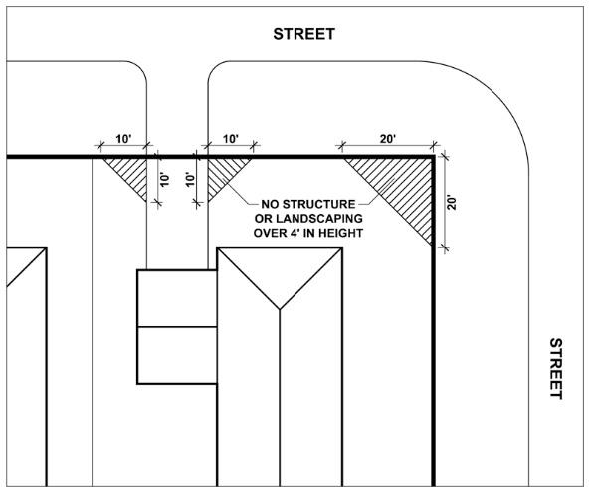
No fence, structure, building, hedge, berm or planting may rise over four (4) feet in height above the level of the public sidewalk within twenty (20) feet of any street right-of-way corner and ten (10) feet of any front property line where it will interfere with traffic or pedestrian visibility across the driveway, alley or street. See Figure 15-1: View Obstruction. This provision does not apply to buildings within the C-3, C-4 and C-6 Districts. However, all landscaping and signs within the C-3, C-4 and C-6 Districts must comply with view obstruction requirements.
FIGURE 15-1: VIEW OBSTRUCTION
G.
Applicability of Use Restrictions
No structure or land may be used for any use other than one allowed as either a permitted or conditional use in the zoning district in which such structure or land is located. Structures or land may also be used for a temporary use or accessory use, in accordance with the requirements of Section 14.4 (Temporary Uses) and Section 15.4 (Accessory Structures and Uses).
H.
Different Uses
When a use could be classified under two (2) similar but different types of uses, the most restrictive or specific classification for that type of use will govern.
I.
All Activities within an Enclosed Building
Within all districts, all activities must be conducted entirely within an enclosed building, unless specifically permitted by this Code.
J.
Street Closure
Whenever any street, alley or other public way is vacated by official action of the City, the zoning district adjoining each side of such street, alley or public way must be automatically extended to the center of such vacation, and all area included in the vacation is then subject to all appropriate regulations of the extended districts.
K.
Areas Underwater
All areas within the corporate limits of the City, which are underwater, are subject to all of the regulations of the zoning district, which immediately adjoins the water area. If the water area adjoins two (2) or more zoning districts, the boundaries of each district are construed to extend into the water area in a straight line until they meet the other district at a halfway point.
15.3 - LOT CONFIGURATION
A.
Frontage on a Public or Private Street
All lots must front on a public or private street. Parcels that do not front on a public or private street require a Common Interest Community Plat, in accordance with Section 5.10 (CIC Plats for Lots Held in Separate Ownership), to meet street frontage and access requirements.
B.
Lot Size and Dimensions
1.
All lots must have a minimum of forty (40) foot width required frontage on a public street.
2.
All lots must have a minimum of thirty (30) foot width at the minimum lot depth mark.
3.
An existing through lot must have a front yard, as required in the zoning district, along each street lot line. Through lots, with frontage on two (2) parallel streets, are permitted only under the following circumstances:
a.
Where vehicular and pedestrian access between the lots and an arterial street is prohibited.
b.
Where topographic or other conditions render subdividing of at least twenty (20) feet necessary in order to allow space for screen planting.
4.
Side lot lines must be substantially at right angles or radial to the street line.
5.
Lots abutting on a water course, drainage way, channel or stream must have an additional depth or width, as required, to assure house sites that are not subject to flooding at the level of the one hundred (100) year flood return period as determined by the City Engineer and U.S. Army Corp of Engineer records.
6.
In all residential districts, the floor area in principal buildings used for parking is exempt from the floor area ratio (FAR) limitations.
7.
The setback requirements must be observed on each street side of a corner lot provided, however, that the buildable width of a lot must not be reduced to less than twenty-one (21) feet.
15.4 - EXTERIOR LIGHTING
A.
Light Trespass
1.
No exterior lighting may glare into, or upon, the surrounding area or any residential premises. In addition, no exterior lighting may be used in any manner that could interfere with the safe movement of motor vehicles on public thoroughfares. The light level must be no greater than one-half (0.5) foot candle at a residential property line and one (1) foot candle at any non-residential property line or public right-of-way line.
2.
Specifically, the following types of light trespass are prohibited:
a.
Any light not designed for roadway illumination that produces direct or reflected glare that could disturb the operator of a motor vehicle.
b.
Any light that may be confused with, or construed as, a traffic control device, except as authorized by state, federal or local government.
B.
Unshielded Lighting
The use of unshielded lighting, including incandescent light bulbs hung or strung on poles, wires, or any other type of support, to illuminate buildings, structures, outdoor sales areas, or outdoor storage or display areas are prohibited, except on a temporary basis in areas where special events, carnivals, fairs or other similar activities are held and only when such activities are taking place.
C.
Light Pole Heights
The maximum height of light poles on private property, as measured from grade at the base to the bottom of the luminaire, are specified below. Building-mounted fixtures may exceed these height limitations, provided that they are fully shielded. These standards do not apply to roadway lighting. Permitted light pole heights are as follows:
1.
Non-Residential Districts
Lights poles and building-mounted fixtures must be designed with fully shielded luminaires. Such poles or mounts may not exceed sixteen (16) feet in height. The Zoning Administrator may approve, in appropriate circumstances, a pole or mount of up to twenty-four (24) feet.
2.
Residential Districts
Light poles for single- and two-family dwellings may not exceed ten (10) feet in height. Light poles for non-residential, multi-family and townhouse uses may not exceed fourteen (14) feet in height.
Lighting, including under-soffit lighting mounted upon a single-family, two-family or townhouse residential dwelling may not be mounted higher than twenty (20) feet above grade, as defined in this Code. Light poles on school sites or that light outdoor recreational facilities may not exceed twenty-four (24) feet in height.
15.5 - ACCESSORY STRUCTURES AND USES
A.
Accessory Structure
1.
Principal Structure Required
No detached accessory structure may be constructed on any residentially zoned lot prior to the time of construction of the principal building to which it is accessory.
2.
Detached Accessory Structure Height
Detached accessory buildings are limited to a maximum height of seventeen (17) feet.
3.
Shared Accessory Structure
In residential districts, a two (2) stall garage may be used jointly and solely by the families living on two (2) adjacent lots and may be built so as to place one (1) stall on each side of rear lot line, provided that the two (2) stalls are separated by a fire wall.
4.
Maximum Accessory Structure Size
The maximum size accessory structures are dependent upon the land use and zoning district and must comply with the requirements found in Table 15-1: Maximum Accessory Structure Size.
FOOTNOTES TABLE 15-1:
1 No detached accessory structures can exceed the total lot coverage of the principal structure. Detached accessory structures located in an AG District may be up to three (3) times the total lot coverage of the principal structure if the lot area is five (5) acres or greater. All detached accessory structures are still subject to the remaining provisions of Table 15-1.
2 Doghouses, children's play houses, fish houses, tree houses and other similar buildings that are less than fifty (50) square feet in total area are not included in the maximum number of detached accessory buildings allowed, nor in lot coverage requirements; however, total building area of all doghouses, children's play houses, fish houses, tree houses and other similar buildings on a zoning lot may not exceed one hundred (100) square feet.
5.
Detached Accessory Structure Setbacks
a.
Detached accessory structures located in a front, interior side or street side setback must meet the principal building setbacks.
b.
All detached accessory buildings or structures must be located a minimum of ten (10) feet from the principal building on a lot. The distance is measured from the walls of the building or structure.
c.
Detached accessory structures located in the rear yard may be located within the required rear setback but must comply with the setback from lot line requirements of Table 15-2: Detached Accessory Structure Setback.
FOOTNOTES TABLE 15-2:
1 If a detached garage is accessed from an alley, a 10-foot setback is required or if a garage fronts onto a side street, the minimum setback must be twenty (20) feet. (See figure 8-4: Street Side Setback—Side Street Garage Access.)
6.
Detached Accessory Structure Design
a.
Accessory building less than 120 square feet in area are permitted to be constructed out of materials such as non-architectural metal, fiberglass, vinyl resin, and plastic panels. Prohibited building materials include tarps made of plastic, canvas, or vinyl; unpainted corrugated metal panels; and non-exterior grade plywood or similar products.
b.
Accessory buildings 120 square feet in area or greater shall be constructed out of materials similar and/or compatible to those utilized on the principal building in a matching color. Prohibited building materials include panels made of non-architectural metal, fiberglass, vinyl resin, plastic; tarps made of plastic, canvas, or vinyl; unpainted corrugated metal panels; and non-exterior grade plywood or similar products. Metal roofs are allowed provided they are constructed with standing seams and concealed or exposed fasteners.
7.
Land Use/Zoning Permits
A property owner or their designated agent must submit plans consistent with the requirements found in Appendix B of the Land Development Code to the St. Cloud Planning and Zoning Department for the following structures:
a.
Detached accessory structures between one hundred (100) square feet and two hundred (200) square feet.
b.
Decks and/or platforms more than seven (7) inches and less than thirty (30) inches in height about the adjacent grade and is not attached to a structure with footings.
B.
Fences and Hedges
The following regulations apply to fences and hedges within the residential districts.
1.
Fences in residential districts located within the required setback must comply with the height and setback requirements of Table 15-3: Fence Height in Residential Districts.
FOOTNOTES TABLE 15-3:
1 Unless otherwise permitted by Paragraphs 2, 3 and 4 of this section.
2.
Tennis court fences are permitted a maximum height of twelve (12) feet. The fence must not exceed twenty-five percent (25%) opacity.
3.
The maximum height of a fence or hedge may be increased to eight (8) feet in the front, rear or street side setback, so long as the fence or hedge complies with the view obstruction provisions of Section 15.2.F and the following conditions are met:
a.
The fence or hedge is located adjacent to a principal or minor arterial street.
b.
Access to the property is prohibited from the principal or minor arterial street.
c.
The fence or hedge is located within the rear yard.
4.
For a through lot, the maximum height of a fence or hedge may be increased to six (6) feet in the front setback, so long as the fence or hedge complies with the view obstruction provisions of Section 15.2.F and the following conditions are met:
a.
Access to the property is prohibited from the street where the fence or hedge is located.
b.
The fence or hedge is located within the rear yard.
5.
Fences around the perimeter of a permanent swimming pool are permitted to be up to ten (10) feet in height for multiple family properties.
C.
Home Occupations
The following regulations apply to all home occupations:
1.
The occupation or profession is carried on by a member of a family, residing on the premises, and is conducted entirely within the dwelling or within a detached garage.
2.
Only one (1) non-illuminated nameplate may be used to advertise the business, which is not more than one (1) square foot in area and attached to the building entrance.
3.
No commodity is sold upon the premises.
4.
No more than twenty-five percent (25%) of the gross floor area of any one (1) story is used for the home occupation or professional services.
D.
Gazebo
Gazebos are permitted in the rear yard, provided they comply with the following:
1.
Each surface of the gazebo is at least twenty-five percent (25%) open.
2.
Gazebos are limited to twelve (12) feet in height, as measured to the peak of the roof. The gazebo platform must be no higher than four (4) feet above grade. Gazebos are limited to one hundred twenty (120) square feet in area.
3.
The gazebo must be set back a minimum of five (5) feet from any lot line.
E.
Outdoor Storage
Commercial and industrial uses are permitted outdoor storage in accordance with the following provisions:
1.
All manufacturing, assembly, repair or work activity must take place inside an enclosed building.
2.
No required off-street parking area may be used as outdoor storage.
3.
No materials stored or displayed outdoors shall be of a greater height than that of the required screening.
4.
Within the commercial districts, all outdoor storage must be on a paved surface. Within the industrial districts, outdoor storage may be on a paved or gravel surface. Nurseries are exempted from this provision and may include the growing of plants in the open.
F.
Satellite Dish Antennas
1.
General Requirements
a.
Satellite dish antennas must be permanently installed on a building, in the ground or on a foundation, and cannot be mounted on a portable or movable structure.
b.
Subject to operational requirements, the dish must be of a neutral color, such as white or grey, and blend with the surroundings as best as possible. No additional signs or advertising are permitted on the satellite dish itself, aside from the logos of the satellite dish service provider or dish manufacturer.
c.
Cables and lines serving ground-mounted satellite dish antennas must be located underground.
d.
All federal, state and local regulations must be followed in the construction, installation and operation of satellite dish antennas.
e.
All exposed surfaces of the antenna must be kept clean, and all supports must be painted to maintain a well-kept appearance. Antennas no longer in use must be removed.
2.
Small Satellite Dish Antennas (One Meter or Less in Diameter)
Small satellite dish antennas are subject to the general requirements of Paragraph 1 above. Every effort must be made to install small satellite dish antennas in locations that are not readily visible from neighboring properties or from the public right-of-way.
3.
Large Satellite Dish Antennas (One Meter or More in Diameter)
a.
Residential Districts
i.
Large satellite dish antennas must be located in the rear yard and set back a distance from all lot lines that is at least equal to the height of the dish, but in no case less than five (5) feet from any lot line.
ii.
The overall height of a large satellite dish antenna must not exceed twelve (12) feet.
iii.
A large satellite dish antenna must be located and screened so that it cannot be readily seen from public streets or adjacent properties. Screening includes fences, plant materials and/or earth berms located to conceal the sides and rear of the antenna and its support structure.
b.
Commercial Districts
i.
A large satellite dish antenna must be located in the rear or side yard and set back a distance from all lot lines that is at least equal to the height of the dish, but in no case less than five (5) feet from any lot line.
ii.
Roof-mounting is permitted only if the satellite dish antenna is in scale with the overall building mass and location and must be screened by an architectural feature. The visible portion of the dish should not comprise more than twenty-five percent (25%) of the corresponding height or width of the screen.
iii.
Ground-mounted satellite dish antenna must be screened, which includes fencing, berming or landscaping to accomplish the following:
(1)
All ground-mounted accessory equipment and the lower part of the support structure are completely screened.
(2)
Where feasible, trees must be installed to the side and rear of the antenna and at a height/elevation equal to the tallest portion of the dish.
G.
Swimming Pools and Spas
1.
Swimming Pools
The following standards apply to all outdoor permanent swimming pools containing twenty-four (24) inches or more of water:
a.
One of the following physical barriers must be provided for permanent pools. A barrier is not required for temporary pools.
i.
A safety fence surrounding the pool must meet the following standards:
(1)
Fencing must measure six (6) feet in height. Fences around the perimeter of a permanent swimming pool on multiple-family properties may measure up to ten (10) feet in height;
(2)
Fencing must be constructed of durable materials;
(3)
Fencing must extend to within 4 inches of ground level;
(4)
Gates must be self-closing/self-latching with latch mechanisms located at the top of the gate; or
ii.
A properly maintained automatic pool cover complying with ASTM (American Society of Testing and Materials) F1346-91 certification, or successor standard, is in use at all times the pool area is not attended.
b.
Pools are permitted in the rear yard only and must be located at least five (5) feet from any lot line.
2.
Spas
a.
All outdoor spas require a safety cover but do not require a safety fence.
b.
Spas are permitted in the rear and side yards only and must be located at least five (5) feet from any lot line.
H.
Water Features and Man-Made Ponds
1.
Water features must not be designed for, nor may an owner allow, any swimming, wading or water-related recreation use.
2.
No water feature may be located within the required front and side yard setbacks for single and two-family dwellings. Water features located on parcels occupied by a multiple-family dwelling must maintain a minimum five (5) foot setback from all property lines.
I.
Wireless Telecommunications
1.
Purpose
In order to accommodate the communication needs of residents and businesses, while protecting the public health, safety and general welfare of the community, the City finds that these regulations are necessary in order to:
a.
Facilitate the provision of wireless telecommunication services to the residents and businesses of the City.
b.
Minimize adverse visual effects of towers through careful design and siting standards based on the established tower hierarchy.
c.
Avoid potential damage to adjacent properties from tower failure.
d.
Maximize the use of existing and approved towers and buildings to accommodate new wireless telecommunication antennas in order to reduce the number of towers needed to serve the community.
e.
Encourage clustering of self-support/lattice and guyed towers in appropriate locations.
2.
Siting Requirements
a.
All Towers
Tower facilities may be permitted as provided in Table 15-4: Siting Requirements for Wireless Telecommunications Towers.
FOOTNOTES TABLE 15-4:
Subject to co-location requirements found in Paragraph b below.
b.
Shared Use/Collection
An application for a new monopole, self-support/lattice or guyed tower may not be approved unless the City finds that the equipment plans for the proposed tower cannot be accommodated by an existing or approved tower or building within a one-half (½) mile search radius of the proposed tower due to one (1) or more of the following reasons:
i.
The planned equipment would exceed the structural capacity of the existing or approved tower, as documented by a qualified and licensed professional engineer, and the existing or approved tower cannot be reinforced, modified or replaced to accommodate planned or equivalent equipment at a reasonable cost.
ii.
The planned equipment would cause interference materially impacting the usability of other existing or planned equipment at the tower as documented by a qualified professional, and the interference cannot be prevented at a reasonable cost.
iii.
Existing or approved towers and buildings within the search radius cannot accommodate the planned equipment at a height necessary to function reasonably as documented by a qualified professional.
iv.
Other unforeseen reasons that make it infeasible to locate the planned equipment upon an existing or approved tower or building.
A proposed tower must be designed (structurally and electronically) in all respects, to accommodate both the applicant's antennas and equipment together with the antennas and equipment for at least one (1) additional user. The tower must be designed to allow for future rearrangement of antennas upon the tower and to accept antennas mounted at various heights.
c.
Additional Standards
i.
One non-commercial tower and antennas is allowed as an accessory use to a Permitted or Conditional use in the applicable zone. Bulk standards are established as identified in Table 15-3: Siting Requirements for Wireless Communications Towers.
ii.
Communication towers may be located on lots containing another principal use, including another communication tower. Separation between communication towers and other uses on the lot must comply with applicable building and fire codes. Towers may occupy a leased parcel.
iii.
Any structure accessory to communication towers, other than peripheral supports and guy anchors, must conform to the setback requirements for the district in which it is located.
iv.
The separation distance between an existing and a proposed tower is measured at grade in a direct lineal fashion between the closest points of the base of the existing and the base of proposed towers.
v.
A fence or wall, a minimum of eight (8) feet in height measured from finished grade, must be constructed around each guy anchor. Access to the tower must be through a locked gate. The fence material must blend with and suit the character of the neighborhood or surrounding property.
vi.
Landscaping and buffering is required around the perimeter of the tower, accessory structures and guy anchors, unless waived by the Zoning Administrator when the proposed landscaping would not be visible from adjacent lots or rights-of-way. Landscaping must be installed along the exterior side of the required fence. Landscaping must include, at minimum, evergreen type trees with a separation between trees of a maximum of twenty (20) feet. Trees must have a minimum trunk diameter of two (2) inches at one (1) foot above the ground at time of planting. Trees are only required on that side of the tower property adjacent to a residential district or right-of-way. Trees as a landscaping element are not required when the use of trees is shown to be incompatible with the proposed antenna and tower design (i.e., a series-fed AM directional antenna array) as documented by a qualified professional. Non-vegetation landscape design may be chosen where it better suits the architectural character of the surrounding neighborhood with the agreement of the Zoning Administrator. Stealth and camouflage towers are not subject to the perimeter buffering requirements of this section.
vii.
All abandoned or unused towers, or portions of towers, and associated above-ground facilities must be removed within twelve (12) months of the cessation of operations of an antenna facility at the site unless a time extension is approved by the Zoning Administrator. Any ordinary time extension must not exceed sixty (60) days. In the event that a tower is not removed after twelve (12) months, the City may remove the tower and associated facilities, and the costs or removal must be assessed against the property. Tower operators must provide, at the time of application, a copy of the lease or other instrument obligating them to remove tower(s) and associated facilities upon ceasing of operations at any site.
viii.
In addition to the required review processes, a building permit is required for all towers, support and accessory structures, and antenna attachments, except as otherwise provided by State or local law.
ix.
The placement of any signs or appurtenances for advertising or business purposes on any tower, including the company name, is prohibited.
x.
Towers, and the antennas they support, must be designed to blend into the surrounding environment to the maximum extent possible through the use of color, except in instances where the color is dictated by federal or state authorities such as the Federal Aviation Administration.
xi.
Towers must comply with Federal Communications Commission (FCC) standards for non-ionizing electromagnetic radiation (NIER). All appurtenances and accessory equipment or structures must comply with FCC standards for NIER.
xii.
Towers must not be a hazard to air navigation, as determined by the Federal Aviation Administration (FAA).
xiii.
A tower may not be illuminated by artificial means and may not display strobe lights unless such lighting is specifically required by the FAA or other state or federal authority for a particular tower. When lighting is required, the least intensive nighttime method of illumination acceptable to the FAA or other authority may be utilized. All required lighting must be maintained on an as-needed basis by the owner of the tower.
xiv.
All towers must be inspected in compliance with FCC regulations or as required by the Building Inspector.
xv.
As provided by the FCC, towers may not interfere with the normal operation of electrical or mechanical equipment located within surrounding properties.
xvi.
No new or existing telecommunications service may interfere with public safety or private telecommunications including, but not limited to, radio, television and personal communications, in accordance with rules and regulations of the FCC. Before the introduction of a new service, or change in existing service, telecommunication providers must notify the City at least ten (10) days in advance of such changes and allow the City to monitor interference levels during the testing process.
xvii.
All towers shall be designed as such to inhibit climbing by unauthorized person(s) at all times.
d.
Accessory Structures
The size of an accessory structure(s) may be increased to accommodate co-location. The expansion is subject to review through the building permit process and approval by the Zoning Administrator.
15.6 - PERMITTED OBSTRUCTIONS
An obstruction is the extension or placement of any structure or building, or component of such, into a required setback. Additional restrictions on permitted obstruction, including additional setback requirements and bulk regulations, can be found in Section 15.5 (Accessory Structures and Uses) above. Permitted obstructions are found in Table 15-5: Permitted Obstructions.
15.7 - PERFORMANCE STANDARDS
All uses must comply with the performance standards established in this section unless any federal, state, county or local law, ordinance or regulation establishes a more restrictive standard, in which case, the more restrictive standard will apply.
In order to assure compliance with the performance standards set forth above, the City Council may require the owner or operator of any permitted use to have made such investigations and tests as may be required to show compliance with these performance standards. Such investigation and tests as are required to be made may be carried out by an independent testing organization as may be agreed upon by all parties concerned, or if there is failure to agree, by such independent testing organization as may be selected by the City Council after thirty (30) days' notice. The costs incurred in having such investigations or tests conducted will be shared equally by the owner or operator and the City, unless the investigation and tests disclose non-compliance with the performance standards, in which event the entire investigation or testing cost will be paid by the owner or operator. The procedure stated above does not preclude the City from making any tests and investigations it finds appropriate to determine compliance with these performance standards.
A.
Landscaping
All open areas of any zoning lot must be graded to provide proper drainage and, except for areas used for parking, drives or storage, landscaped with trees, shrubs or planted groundcover in accord with Article 17 (Landscaping, Buffering and Screening). It is the owner's responsibility to see that this landscaping is maintained in an attractive and well-kept condition. All vacant lots must be properly maintained.
B.
Noise
Noise will be measured on any property line of the zoning lot on which the operation is located. Noise must be muffled so as not to become objectionable due to intermittence, beat frequency, shrillness or intensity.
C.
Vibration
Vibration must not be discernible at any property line to the human sense of feeling for three (3) minutes or more in duration in any one (1) hour.
D.
Wastes
All solid waste material, debris, refuse or garbage must be kept within a completely enclosed building or properly contained in closed containers and stored in racks designed for such purpose. All liquid wastes containing any organic or toxic matter must be discharged in the manner prescribed by the Health Department.
E.
Air Pollution
Any activity or operation must conform with the City and state regulations relating to ambient air quality standards and air pollution control regulations.

