
St Cloud City Zoning Code
ARTICLE 8
- RESIDENTIAL DISTRICTS
8.1 - PURPOSE
A.
Purpose of RR Rural Residential District
The purpose of the RR Rural Residential District is to establish and preserve areas within the City where agriculture, very low density development or open space is a current and proper use, but which, in the future, may gradually be required for expansion of urban development as urban facilities and services become available, and preserve said land in agricultural or open space usage and in large parcels until capital funds for the extension of urban facilities and services are committed in an adopted capital improvement program. Although the predominant use within the RR District is intended to be agriculture, other quasi-urban uses are also permitted, including scattered non-farm residences facilitating an orderly transition from agricultural and rural uses to urban uses.
B.
Purpose of R-1 Single-Family Residential District
The purpose of the R-1 Single-Family Residential District is to provide for and preserve single-family residential development on larger lots within the City. The R-1 District provides for limited non-residential uses that are compatible with surrounding residential neighborhoods.
C.
Purpose of R-1A Single-Family Residential District
The purpose of the R-1A Single-Family Residential District is to provide for and preserve single-family residential development within the City on traditionally smaller lots. The R-1A District provides for limited non-residential uses that are compatible with surrounding residential neighborhoods.
D.
Purpose of R-2 Single-Family and Two-Family Residential District
The purpose of the R-2 Single-Family and Two-Family Residential District is to provide for, and preserve, two-family residential development, as well as single-family dwellings. The R-2 District also provides for limited non-residential uses that are compatible with surrounding residential neighborhoods.
E.
Purpose of R-3 Lodging House, Fraternity and Sorority House Residential District
The purpose of the R-3 Lodging House, Fraternity and Sorority House Residential District is to accommodate multi-tenant residences in those areas, such as the university neighborhood, where there is demand for these housing types, as well as single-family and two-family residential development. The R-3 District also provides for limited non-residential uses that are compatible with surrounding residential neighborhoods.
F.
R-3A General Residential and Lodging House District
The purpose of the R-3A General Residential and Lodging House District is to accommodate multi-tenant residences, as well as single-family, two-family and multi-family residential development. The R-3A District also provides for limited non-residential uses that are compatible with surrounding residential neighborhoods.
G.
Purpose of R-4 Townhouse Residential District
The purpose of the R-4 Townhouse Residential District is to provide for, and preserve, single-family, two-family and townhouse residential development, as well as low-rise multi-family dwellings. The R-4 District also provides for limited non-residential uses that are compatible with surrounding residential neighborhoods.
H.
Purpose of R-5 General Multi-Family Residential District
The purpose of R-5 Multi-Family Residential District is to provide for, and preserve, quality high density residential development including multi-family dwellings up to four (4) stories. The R-5 District also provides for limited non-residential uses that are compatible with surrounding residential neighborhoods.
I.
Purpose of R-6 Multi-Family Residential District
The purpose of the R-6 Multi-Family Residential District is to create a higher density environment of single-family homes, two-family dwellings, townhomes and multi-family dwellings, including limited multi-tenant housing like dormitories. Limited non-residential uses that are compatible with surrounding residential neighborhoods may be permitted.
J.
Purpose of R-7 High Rise Multi-Family Residential District
The purpose of the R-7 High-Rise Multi-Family Residential District is to accommodate the highest density residential environment of multi-family dwellings, of significant height, within the City. Limited non-residential uses that are compatible with surrounding residential neighborhoods may be permitted.
(Ord. of 12-2-24(1))
8.2 - PERMITTED AND CONDITIONAL USES
Table 8-1: Residential Districts Permitted and Conditional Uses lists permitted and conditional uses for the residential districts. A "P" indicates that a use is considered permitted within that district. A "C" indicates that a use is considered a conditional use in that district and must obtain a conditional use permit as required in Section 4.3 (Conditional Use Permit). No letter (i.e., a blank space), or the absence of the use from the table, indicates that use is not permitted within that district.
FOOTNOTES TABLE 8-1:
1 All properties with livestock must have a Waste Utilization Plan (according to NRCS Standard 633) approved by the applicable county soil and water conservation district and comply with all MPCA permitting requirements.
2 Subject to species approved by City Park Department. The sale or display of a product or commodity that is readily visible and accessible by non-residents of the property or building are prohibited.
3 In the R-1, R-1A and R-3A, temporary shelter facilities are limited to serving 4 or fewer persons. In the R-2 District, temporary shelter facilities are limited to serving 6 or fewer persons.
4 In the R-1 District, a golf course may include an accessory miniature golf course. Unless noted, miniature golf courses are not permitted as part of a golf course.
5 Maximum building area of three thousand (3,000) square feet of gross floor area.
6 Allowed only on institutional properties with a Conditional Use Permit. Systems may not exceed 10 kw.
7 WECS with a rated capacity of 1.8 kw or less are permitted on parcels occupied by a residential or institutional use. WECS between 1.9 kw and 10 kw are allowed on institutional properties with a Conditional Use Permit.
(Ord. of 12-2-24(1))
8.3 - BULK AND SETBACK REGULATIONS
Table 8-2: Residential Districts Bulk and Setback Regulations establishes bulk and setback regulations for the residential districts.
FOOTNOTES TABLE 8-2:
1 Animal density allowances are calculated using gross acreage of all substantially contiguous property owned or leased by the same property owner regardless of jurisdictional boundary and rounded up to the nearest whole number.
2 All properties with livestock must have a Waste Utilization Plan (according to NRCS Standard 633) that is approved by the applicable county soil and water conservation district and comply with all MPCA permitting requirements.
3 Setbacks in the residential districts are subject to the requirements of Section 8.4.
4 Includes civic and cultural buildings.
5 Principal structures containing a lodging house and fraternity or sorority houses constructed prior to July 1, 1990 are permitted to use the existing setbacks. Any addition must comply with the setback requirements of Table 8-2.
(Ord. of 12-2-24(1))
8.4 - ADDITIONAL SETBACK REQUIREMENTS
A.
Front Setback
1.
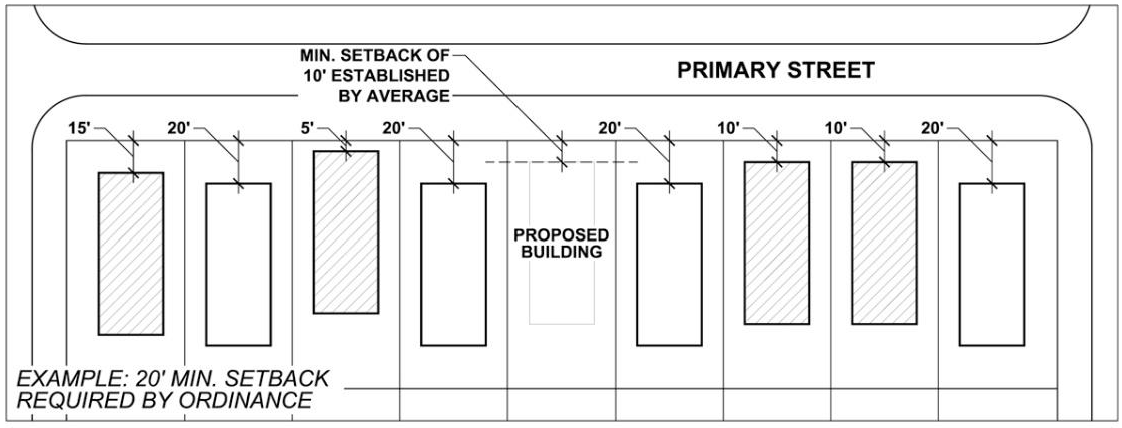
When more than twenty-five percent (25%) of the block face on the side of the street between intersections is occupied by structures having setbacks less than the minimum setback required by this Code, the minimum required setback for all new or relocated structures is the average of all existing buildings on the block face. See Figure 8-1: Front Setback Averaging.
FIGURE 8-1: FRONT SETBACK AVERAGING
2.
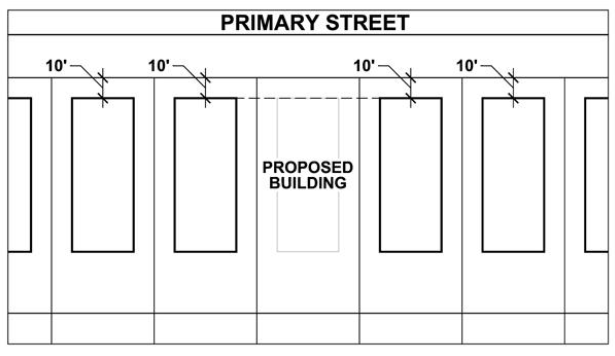
For new structures, when there is an established setback different from the minimum required setback, and there are existing buildings on both sides, the front setback will be no greater than that which would be established by connecting a straight line between the forward-most portions of the adjacent building on either side. This provision does not apply to multi-family dwellings, lodging houses, and fraternity and sorority houses in the R-3 District. See Figure 8-2: Established Front Setback.
FIGURE 8-2: ESTABLISHED FRONT SETBACK
B.
Street Side Setback
1.
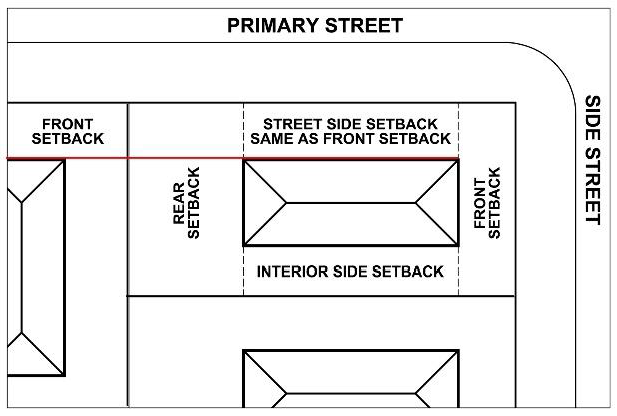
When there is an adjoining lot facing onto the side street, the side street setback must be increased from the required minimum setback to that of the required front setback (See Figure 8-3: Street Side Setback—Reverse Corner Lot).
FIGURE 8-3: STREET SIDE SETBACK—REVERSE CORNER LOT
2.
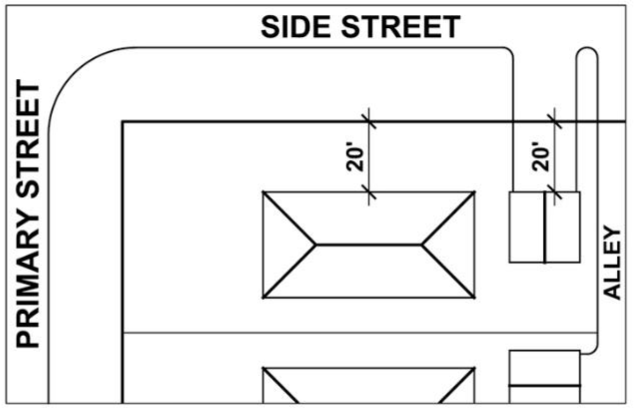
In residential districts, where a garage fronts onto a side street, the minimum setback must be twenty (20) feet. (See Figure 8-4: Street Side Setback—Side Street Garage Access)
FIGURE 8-4: STREET SIDE SETBACK—SIDE STREET GARAGE ACCESS
C.
Interior Side Setback
1.
Substandard Lot of Record
For a substandard lot of record with a single-family or two-family dwelling, the minimum interior side setback may be reduced to twenty percent (20%) of the lot width, except for single-family dwellings in the R-2 District where the interior side yard setback must be a minimum of five (5) feet. However, in no case, the interior side setback must be no less than five (5) feet and the street side setback must be no less than ten (10) feet.
2.
Building Height Setback
If the structure is greater than seventeen (17) feet in height, the interior side setback requires an additional foot of setback for each two (2) feet of structure height over seventeen (17) feet. In the case where a lot is occupied by a single-family or two-family dwelling with a side yard setback less than what is required in this section, the existing dwelling unit structure establishes the side yard setback, except, in no case, the interior side setback must be no less than five (5) feet.
D.
Rear Setback
1.
Substandard Lot of Record
Where a lot of record has less than the minimum depth required, thirty-three percent (33%) of the total lot depth is required as rear yard.
2.
Building Height Setback
In such case where a multi-family structure exceeds thirty-five (35) feet in height, an additional rear setback of one-half (0.5) foot is required for each foot of vertical building height over thirty-five (35) feet.
E.
Pipeline Setback
1.
The purpose of this provision is to increase public safety by requiring that new development be set back from pipeline locations. This requirement applies to new residential and other development. It does not apply to development that has occurred or for which development permits have been issued before the effective date of this requirement.
2.
Buildings and places of assembly may not be constructed closer to the pipeline than the boundary of the pipeline easement.
(Ord. of 12-2-24(1))
8.5 - GENERAL STANDARDS OF APPLICABILITY
A.
Accessory Structures and Uses
See Section 15.5 (Accessory Structures and Uses) for standards governing accessory structures and uses.
B.
Temporary Uses
See Section 14.4 (Temporary Uses) for standards governing temporary uses.
C.
On-Site Development Standards
See Article 15 (On-Site Development Standards) for on-site development standards.
D.
Off-Street Parking and Loading
See Article 16 (Off-Street Parking and Loading) for standards governing off-street parking and loading.
E.
Landscaping and Screening
See Article 17 (Landscaping, Buffering and Screening) for standards governing landscaping and screening.
F.
Signs
See Article 18 (Signs) for standards governing signs.
G.
Design Standards
See Article 13 (Design Standards) for standards governing landscaping, architecture, and site design within zoning districts, overlay districts, and designated areas.
(Ord. of 12-2-24(1))

