
St Cloud City Zoning Code
ARTICLE 16
- OFF-STREET PARKING AND LOADING
16.1 - PURPOSE
The off-street parking and loading regulations of this Article are intended to provide accessible, attractive, secure and well-maintained off-street parking and loading areas with the appropriate number of spaces in proportion to the needs of the proposed use, increase public safety by reducing congestion of public streets, and encourage the use of alternative modes of transportation where appropriate.
(Ord. of 12-2-24(1))
16.2 - GENERAL PROVISIONS
The provisions of this Article apply as follows:
A.
Existing Facilities
1.
The existing number of off-street parking and loading spaces cannot be reduced below the requirements of this Article. If the number of such existing spaces is already less than the requirements of this Article, it may not be further reduced.
2.
Existing off-street parking and loading areas which do not conform to the requirements of this Article but were in conformance with the requirements of this Code at the time the parking or loading facilities were established, are permitted to continue as a legal nonconforming structure.
3.
If a building permit for a building or structure was lawfully issued prior to the effective date of this Code, the number of off-street parking and loading spaces must be provided in the amount required for the issuance of said building permit, regardless of what may be required by this Article.
B.
Damage or Destruction
When a building is reconstructed or repaired after being damaged or destroyed, off-street parking and loading facilities must be restored or maintained in an amount equivalent to that at the time of such damage or destruction. However, it is not necessary to restore or maintain parking and loading facilities in excess of the applicable requirements of this Section.
C.
Change in Land Use
When the existing use of a building, structure or parcel of land is changed to a new use, parking and loading spaces must be provided as required for the new use. Additional parking or loading spaces are required in the amount by which the requirements for the new use exceed the requirements for the existing use.
D.
Change in Intensity of Use
1.
When the intensity of use of any building, structure or parcel of land is increased, additional parking and loading spaces must be provided. The number of additional parking and loading spaces is based on the increase in the number of dwelling units, gross floor area, seating capacity, or other unit of measurement used to calculate the number of required number of parking or loading spaces.
2.
When the intensity of use of any building, structure or parcel of land is decreased, the number of parking and loading spaces may be reduced so long as the parking requirements of this Article are met for the entire building, structure or parcel of land as modified.
E.
Provision of Additional Spaces
Nothing in this Article is deemed to prevent the voluntary establishment of off-street parking or loading facilities, provided that all regulations governing the location, design and control of such facilities must be in accordance with this Article.
F.
Limitations on Use
No motor vehicle repair work of any kind is permitted in conjunction with exposed off-street parking facilities, except for minor repair on vehicles owned by the occupant or resident of the principal use for which the parking space is intended. In that case, all such minor repair work must be done within an enclosed garage. No temporary use may occupy required off-street parking areas.
G.
Site Plan
All plans submitted for a building permit requiring parking spaces or loading facilities must show or designate the area, number of spaces, type of surfacing, screening, and drainage to be performed. Such site plan is a part of the building permit, and no certificate of occupancy will be issued until all items shown on the site plan for parking and loading facilities have been completed.
(Ord. of 12-2-24(1))
16.3 - COMPUTATION
The total number of required parking and loading spaces is based upon the requirements for the principal use(s) of the lot. When more than one (1) use occupies the same lot, the number of required spaces is to be the sum of the separate requirements for each use. All off-street parking facilities must be completed before occupancy of the building or structure served. In computing the number of off-street parking or loading spaces required by this Section, the following standards for computation apply:
A.
Space allocated to any off-street loading space cannot be used to satisfy the requirement for any off-street parking space or access aisle, or portion thereof. Conversely, the area allocated to any off-street parking space must not be used to satisfy the replacement for any off-street loading space or portion thereof.
B.
A fraction of less than one-half (½) may be disregarded, and a fraction of one-half (½) or more is counted as one (1) parking or loading space.
C.
In places of assembly in which patrons or spectators occupy benches, pews or similar seating facilities, each twenty (20) inches of such seating facility is counted as one (1) seat for the purpose of determining the requirement for off-street parking facilities.
D.
Except as otherwise specified, parking or loading spaces required on an employee basis is based on the maximum number of employees normally present on the premises at any one time. When the determination of the number of parking spaces is based on the number of employees, the owner and/or manager is counted as an employee(s).
(Ord. of 12-2-24(1))
16.4 - COLLECTIVE PROVISIONS
A.
Off-street parking spaces for separate uses may be provided collectively if the aggregate number of spaces provided is not less than the sum of the spaces required for each use separately. No parking space may serve as the required space for more than one (1) use with the exception of the following shared parking arrangement described in Paragraph B below.
B.
An off-street parking facility may be shared between two (2) or more uses, provided that use of such facility by each user does not occur at the same time. No shared use of parking spaces are permitted unless:
1.
The users of the shared parking facility sign an agreement, approved by the City Attorney, expressing the intent to share parking facilities and file this agreement with the City.
2.
Approval is obtained from the Zoning Administrator that confirms that the use of such facility by each user does not take place at the same hours during the same days of the week.
3.
The location and design requirements of this section are met.
4.
Any subsequent change in use requires proof that the minimum parking requirements, per this Article, have been met for each use. The owner of a building or use has one hundred eighty (180) days within which to accommodate all required off-street parking or to apply for a variance. As an alternative to a variance, a new shared parking agreement may be arranged in accordance with this Article.
(Ord. of 12-2-24(1))
16.5 - LAND BANKED FUTURE PARKING
The Zoning Administrator may permit land banking of up to twenty-five percent (25%) of the required parking spaces.
A.
Sufficient evidence must be provided by the applicant that supports the reduced parking needs.
B.
The area proposed for land banking of parking spaces must be an area suitable for parking at a future time.
C.
Landscaping of the land banked area must be in full compliance of the zoning regulations and at a minimum landscaped with turf. The Zoning Administrator may require additional landscaping of the land-banked area.
D.
The land banked area cannot be used for any other use. The landscaped area reserved for parking is not counted as part of the total site area required to be landscaped, if such a provision is applicable.
E.
The applicant must show the area to be banked on the site plan and marked as "Land Banked Future Parking."
F.
The Zoning Administrator, on the basis of increased parking demand for the use, can require the conversion of all or part of the land-banked area to off-street parking spaces. Land banked area must be converted within ninety (90) days of receipt of the Zoning Administrator's written order.
(Ord. of 12-2-24(1))
16.6 - EXEMPTION FROM OFF-STREET PARKING REQUIREMENTS
A.
In any commercial or industrial district, an establishment that has paid a special assessment or special tax for the provision of off-street City parking lot is exempt from providing the required number of off-street parking.
B.
The "Central Business District," as defined in this Code, is exempt from providing the required number of off-street parking, so long as municipal off-street parking is provided to serve the area.
(Ord. of 12-2-24(1))
16.7 - LOCATION OF OFF-STREET PARKING SPACES
A.
All required parking spaces for residential uses must be located on the same lot as the building or use served. For non-residential uses, off-street parking areas provided on a site other than the lot upon which the principal use is located, must be within one hundred fifty (150) feet of the site of the principal use. The users and owners of the off-site parking area must sign an agreement, approved by the City Attorney, expressing the intent to accommodate required off-street parking at the site and file this agreement with the City.
B.
Tuck-under parking within the principal structure of a multi-family residential structure, lodging house, or fraternity or sorority house that would require ingress/egress to the parking area through the front yard is prohibited.
C.
In all residential districts, MD, C-1 and C-2 Districts, required front and interior or street side setbacks may not be used for parking or storing of motor vehicles, recreational camping vehicles, recreational equipment and/or trailers.
D.
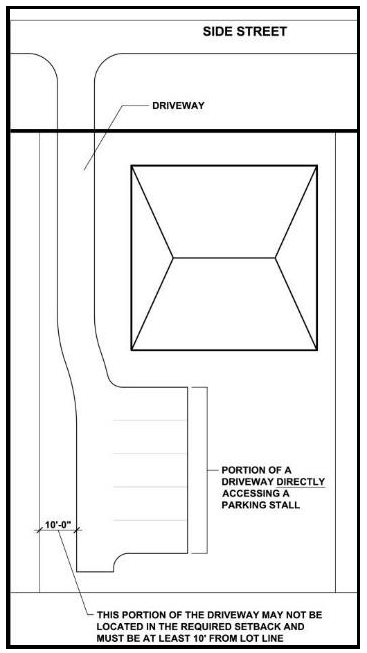
In all residential districts, that portion of a driveway that directly accesses a parking stall may not be located within the required interior or street side setback and must be at least five (5) feet from the side lot line. See Figure 16-1: Residential Driveway Setback.
FIGURE 16-1: RESIDENTIAL DRIVEWAY SETBACK
E.
Driveways for places of worship in residential districts may not be located within the required front, interior or street side setbacks.
F.
In the C-3, C-4, C-5, I-1, I-2 and I-3 Districts, parking and outdoor storage may be located in all required setback areas, except where the district boundary is within at least one hundred fifty (150) feet of a residential district, MD, C-1 or C-2 District, in which case no parking or storage may be located within what would be the required setback of the residential district, MD, C-1 or C-2 District.
G.
No parking, obstructions or driveway intersections are allowed within twenty (20) feet of any street intersection and ten (10) feet from any alley intersection, except in the C-3 and C-4 Districts.
H.
Tandem parking spaces are permitted in residential zoning districts if they can meet the minimum parking space dimensions and do not stack more than two vehicles in a row.
(Ord. of 12-2-24(1))
16.8 - DESIGN STANDARDS
All off-street parking facilities must comply with the following standards:
A.
Dimensions
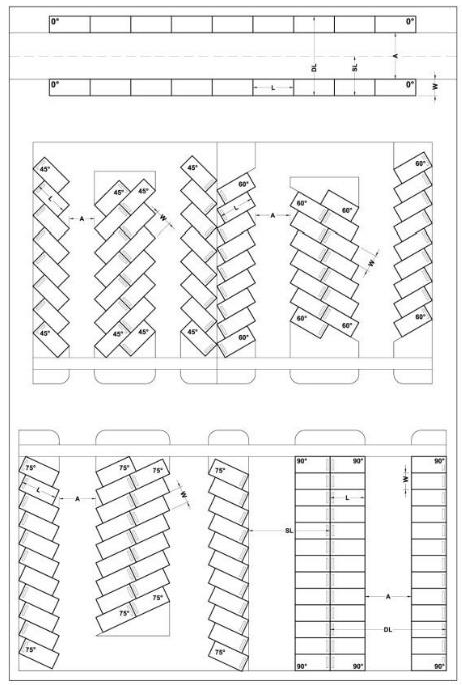
Off-street parking spaces must be designed in accordance with Figure 16-2: Off-Street Parking Dimensions.
B.
Construction of Parking Area
All off-street parking areas, except uses in the AG District, must be surfaced using one (1) or more of the following materials: asphalt, concrete, interlocking brick, pervious pavers, or mortared stone or brick. All parking areas including driveways must be well drained and maintained in a sightly and well-kept condition.
C.
Striping
All non-residential and multi-family off-street parking areas where four (4) or more spaces are required must be marked by a durable painted stripe designating the parking spaces.
D.
Landscaping and Screening
All parking lots must be landscaped in accordance with Article 17 of the Land Development Code.
E.
Bumper/Tire Barriers
Bumper/tire stops or similar barriers must be placed so as to prevent encroachment along property lines for parking lots, loading areas, or the storage of motor vehicles, campers, boats, etc. that abut a public street or avenue where three (3) or more encroachment violation notices are issued within a two (2) year period.
(Ord. of 12-2-24(1))
16.9 - OFF-STREET PARKING ACCESS
A.
The driveway and curb cut restrictions in Table 16-1: Driveway and Curb Cut Size apply to all off-street parking facilities. Any changes to these requirements require approval by the Engineering Department and the Planning Division. The full width of an alley, but no part of a public street, shoulder or sidewalk, may be used in calculating access aisle width.
B.
Off-street parking must not be designed so that backing movements are necessary for ingress or egress, with the exception of entering or exiting an individual parking space.
C.
The top of a driveway apron must be no less than five (5) feet from any property line.
D.
The public right-of-way cannot be used for circulation within off-street parking facilities.
E.
One-way driveways must be clearly marked with appropriate entrance and exit signs and/or pavement marking. If traffic conditions warrant the restriction of turning movements or access, additional signs and access/circulation modifications may be necessary. The Engineering Department and the Planning and Zoning Department may also impose additional restrictions based upon state and/or federal requirements or good engineering practice.
FIGURE 16-2: OFF-STREET PARKING DIMENSIONS
FOOTNOTES FIGURE 16-2 DIMENSIONS:
1 A module is defined as a drive aisle with automobiles parked on at least one side of the drive aisle.
F.
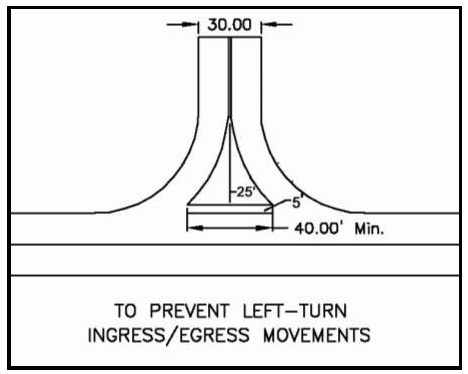
The City may require driveways designed to prohibit left turns in and out. Such must have a channelizing island, as shown in Figure 16-3: Channelizing Island. Limited turn driveways are subject to the following requirements:
1.
Channelizing island width, measured parallel to the street: Forty (40) feet
2.
Channelizing island length: Twenty-five (25) feet
3.
Channelizing island offset: Five (5) feet
4.
Driveway Width: Thirty (30) feet
FIGURE 16-3: CHANNELIZING ISLAND
G.
Commercial or office developments that possess dedicated parking areas are encouraged to provide a cross-access drive to allow circulation between sites. For new commercial uses, a system of joint use driveways and cross-access easements is encouraged where feasible. If cross-access will be provided, the Zoning Administrator may require that the owner provide documentation that adjacent property owners have been contacted, in writing, regarding the provision of cross-access. Joint use driveways and cross-access easements must incorporate the following:
1.
A minimum width of twenty-four (24) feet to ensure two-way travel aisles to accommodate automobiles, service vehicles and loading vehicles.
2.
Bump-outs and other design features to make it visually obvious that the abutting properties are tied together.
3.
A unified access and circulation plan for coordinated or shared parking areas.
(Ord. of 12-2-24(1))
16.10 - ACCESSIBLE PARKING
A.
Required Number of Spaces
The number of accessible parking spaces must be included in the total number of required parking spaces. The number of accessible spaces is as required in Table 16-2: Ratio of Accessible Spaces, and in accordance with the applicable requirements of the Americans with Disabilities Act of 1990 and the Minnesota State Building Code, as amended from time to time, and all additional governing codes and applicable laws.
FOOTNOTES TABLE 16-2:
1 Accessible Spaces include van accessible spaces. Van spaces are not restricted to vans.
B.
Dimensions and Design
1.
Such spaces must comply with the design standards of the Americans with Disabilities Act of 1990 and the Minnesota State Building Code, as amended from time to time.
2.
Such spaces must be identified by a sign and pavement markings indicating parking for the disabled only.
3.
Such spaces must be the spaces located on the shortest accessible route of travel to the main entrance of the building or structure and connected by a paved surface designed to provide safe and easy access.
4.
Accessible parking must not be located on slopes exceeding 1:50.
(Ord. of 12-2-24(1))
16.11 - STACKING SPACES FOR DRIVE-THROUGH FACILITIES
A.
Design
1.
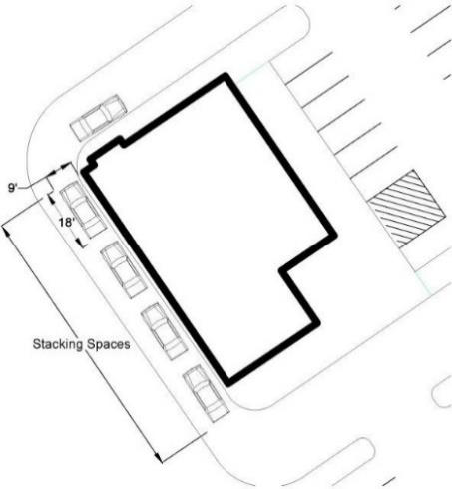
Stacking spaces provided for drive-through uses must be a minimum of nine (9) feet in width, as measured from the outermost point of any service window to the edge of the driveway, and nineteen (19) feet in length. (See Figure 16-4: Measurement of Drive-Through and Figure 16-5: Stacking Spaces.)
FIGURE 16-4: MEASUREMENT OF DRIVE-THROUGH
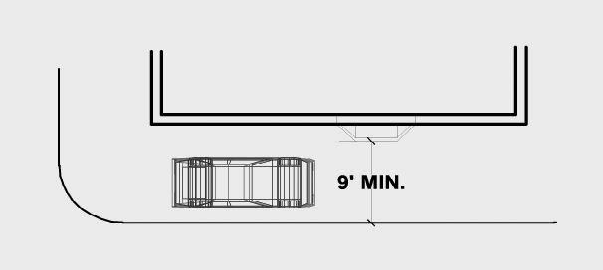
FIGURE 16-5: STACKING SPACES
2.
Stacking spaces provided for drive-through uses must be placed in a single line behind the drive-through facility and located so that, when in use, they do not obstruct ingress or egress to the site and do not obstruct access to required parking or loading spaces.
3.
Stacking spaces begin behind the vehicle parked at a last point of service, such as a window or car wash bay.
B.
Required Spaces
Every drive-through facility must provide a minimum of two (2) stacking spaces per bay.
C.
Reduction of Required Stacking Spaces
The number of required stacking spaces may be reduced by the Zoning Administrator if the petitioner presents a study done by a traffic engineer with quantifiable evidence (e.g., comparable information) which demonstrates that a different requirement should be imposed. The approval of a reduced number of stacking spaces applies only to the specific business for which the study was conducted.
(Ord. of 12-2-24(1))
16.12 - PARKING AND STORAGE OF RECREATIONAL VEHICLES AND OVERSIZED VEHICLES
A.
Storage in all Zoning Districts
The following provisions apply to the storage and parking of recreational vehicles in all zoning districts:
1.
Recreational vehicles and equipment shall not be used for living, sleeping or housekeeping while parked or stored. Recreational vehicles shall not be used for commercial storage or other non-residential purposes.
2.
Except on properties which are valid motor vehicle dealers, recreational vehicles shall have a current license and registration.
3.
Recreational vehicles shall be in operable condition. No recreational vehicle shall be parked or stored in a location other than a building unless it is in a condition for the safe and effective performance of its intended function. No recreational vehicle which is in a state of visible external disrepair shall be parked or stored outside of a building.
B.
Storage in Residential Zoning Districts
The following provisions, in addition to those cited by Article 16.12A, will apply to the storage of recreational vehicles in residential districts:
1.
Number
The maximum number of recreational vehicles permitted to be parked or stored outside of a building in a residential district will be two (2). No more than one (1) recreational vehicle may be parked or stored in the front yard. No more than one Class A motorhome may be parked or stored on a residentially zoned property. Class A motorhomes typically resemble a bus, are entirely constructed on a specially designed motorhome chassis, and often include multiple slide-out sections, living space, kitchens, bathrooms, and entertainment centers.
2.
Size
a.
No recreational vehicles greater than 45 feet in length shall be permitted on any residential lot in the city.
b.
The total lot coverage of all recreational vehicles stored outside may not exceed 10% of the lot area.
3.
Location
Recreational vehicles may be parked or stored on a parcel which contains a permitted principal use in a residential zoning district, subject to the following regulations:
a.
Surfaces
All recreational vehicles shall be parked or stored on the following surfaces:
i.
Recreational vehicles must be stored upon an improved surface within the front yard.
ii.
Recreational vehicles stored in the side or rear yard may be on a landscaped surface, including a maintained gravel surface.
b.
Location
All recreational vehicles shall be parked or stored in accordance with the following:
i.
Recreational vehicles may be parked or stored in the front yard, interior side yard, street side yard, and rear yard provided that a five (5) foot setback is maintained.
ii.
Recreational vehicles may not be parked or stored within twenty feet (20') of any street right-of-way corner where it will interfere with traffic or pedestrian visibility across the driveway, alley or street.
4.
General Regulations
a.
Ownership and Guest Parking
All recreational vehicles parked or stored shall be owned or leased by an occupant of the premises where parked or stored. Guests of the occupant of the premises may park on a driveway on the premises for a period not exceeding seven (7) days in any 30 consecutive day period. No nuisances, including noise, light and odor created by such guest parking are permitted.
b.
Repairs
No major mechanical overhaul or repair shall be performed on recreational vehicles unless conducted within a completely enclosed building.
C.
Prohibited Vehicles in Residential Districts
The following vehicles and/or equipment shall not be permitted to be stored or parked in any residentially zoned property:
1.
Licensed vehicles with a license decal greater than "D" or in excess of 6,000 pounds as described in Minn. Stats. § 188.013. Examples are cargo (step) vans, buses, boom trucks, dump trucks, tank trucks, construction equipment, truck-tractor semi-trailer combinations, and any other such similar equipment/vehicles.
2.
Unlicensed commercial vehicles or equipment such as race cars, farm implement backhoes, bobcats, drilling and/or landscaping equipment, and any other such similar equipment/vehicles.
D.
Oversized Vehicles Allowed in Residential Districts
The following vehicles and/or equipment may be parked on a residentially zoned property in accordance with the following:
1.
Any licensed vehicle with a license decal greater than "D" or in excess of 6,000 pounds as described in Minn. Stats. § 188.013 being used in conjunction with a legitimate service being provided to the residential property.
2.
Any number of oversized vehicles/equipment are allowed if parked or stored in a completely enclosed building subject and related to a home occupation as defined by this ordinance.
(Ord. of 12-2-24(1))
16.13 - REQUIRED OFF-STREET PARKING SPACES
A.
Table 16-3: Required Off-Street Parking lists parking requirements for the uses listed within the districts. The minimum number of off-street parking spaces to be provided for the designated uses is described in Table 16-3.
B.
In some cases, more specific uses which are considered part of a permitted or conditional use category are listed with specified parking requirements. These specific uses are listed only for the purposes of this Article to delineate specific parking requirements and do not indicate whether such uses are permitted or conditional uses within any district.
C.
For uses not specifically listed in this table, the Zoning Administrator will determine the number of required parking spaces based upon the most similar use listed in Table 16-3.
D.
The off-street parking requirement for residential and commercial uses listed in Table 16-3 are reduced by 25% within the C4, Fringe Central Business District.
(Ord. of 12-2-24(1))
16.14 - DESIGN OF OFF-STREET LOADING
A.
Location
All required loading or unloading into or out of trucks in excess of three-quarter (¾) ton capacity, or railroad cars, must be conducted at facilities specifically designed or designated for that purpose. These facilities must be located upon the zoning lot of the principal use requiring them. One (1) berth may be located within areas used for off-street parking. Any additional berths must be separated from areas used for off- street parking.
B.
Access
Each required off-street loading berth must be designed to avoid undue interference with other vehicular or rail access, or use of public streets, alleys or other public transport system.
C.
Surfacing
All off-street loading areas, including loading berths and maneuvering areas, must be surfaced with asphalt, concrete, interlocking brick, mortared stone, or brick as the surfacing material, and be well drained, landscaped and maintained in a sightly and well-kept condition.
D.
Design
Tractor-trailer loading berths must be sixty (60) feet in length and twelve (12) feet in width. All loading areas must consist of a maneuvering area in addition to the berth and may not use any of that portion of the site containing parking stalls. Maneuvering areas must be of such size as to permit the backing out of truck tractors and coupled trailers into a berth, without blocking the use of other berths, drives or maneuvering areas.
(Ord. of 12-2-24(1))
16.15 - REQUIRED OFF-STREET LOADING SPACES
Off-street loading spaces must be provided for a building, structure or use which requires the receipt or distribution of materials or merchandise by trucks or other vehicles in accordance with Table 16-4: Off-Street Loading Requirements.
(Ord. of 12-2-24(1))

