
Stillwater City Zoning Code
ARTICLE XIII
- OVERLAY DISTRICTS
DIVISION 4. - RESERVED[3]
Editor's note—Ord. No. 3425, § 1, adopted Dec. 3, 2018, repealed Div. 4, §§ 23-276.1—23-276.12, which pertained to 12th Avenue Neighborhood Conservation Overlay District and derived from Ord. No. 3393, § 1, adopted Jan. 8, 2018.
DIVISION 5. - RESERVED[4]
Editor's note—Ord. No. 3426, § 1, adopted Dec. 3, 2018, repealed Div. 5, §§ 23-277.1—23-277.14, which pertained to 12th Avenue Neighborhood Mixed-Use Overlay District and derived from Ord. No. 3394, § 1, adopted Jan. 8, 2018.
Sec. 23-265. - Purpose; regulations; procedures for review.
(a)
Definition. The term "overlay district" means the application of an additional layer of regulations or exceptions that modifies existing land use regulations.
(b)
Purpose. The regulations set forth in this article are established and designed to promote the special purpose of the specific area.
(c)
Documents required for review. The following documents and information are required for adequate review of a proposed special purpose overlay designation:
(1)
Detailed development plan for the property that conforms to the regulations for the special purposes overlay with respect to light, air, view, privacy, access, density or intensity, height, bulk, parking and loading;
(2)
Building plans and elevation drawings;
(3)
Maps indicating the relation of the proposed development to surrounding or affected property in terms of location, amount, character, and continuity of open space;
(4)
Means of protection of desired views;
(5)
Convenience of access through and between buildings in the vicinity;
(6)
Separation of pedestrian and vehicular traffic;
(7)
Sign location, size and material;
(8)
Lighting location, type, lumens;
(9)
Floor area ratios;
(10)
Open space;
(11)
Pedestrian access and space;
(12)
Mixture of uses;
(13)
Off-premises signs are permitted under the conditions that:
a.
The signs are limited to one per lot or parcel;
b.
The signs are no larger than four square feet; and
c.
The signs only advertise other businesses/activities that are located within the specific special purpose overlay (SPO) area.
(d)
Procedure. The application for overlay district designation can be initiated by the property owners within the proposed overlay area or by the city council. Each overlay district shall be established by separate ordinance as set forth by the city council.
(e)
Notice requirement. Prior to any overlay district map amendment being made, a public hearing shall be conducted by the city council in accordance with the notice and procedural requirements herein. Public notice shall be published in a newspaper of general circulation in the city. Notice shall also be given in writing by mail to all owners of property within a 300-foot radius of the exterior boundary of the subject property, excluding public rights-of-way. Required notices shall be published and mailed at least 20 days prior to the date of a public hearing to be held by the city council and shall contain at a minimum the following information:
(1)
Legal description of the subject property and the street address or approximate location in the city;
(2)
The present zoning of the property and the zoning sought by the applicant; and
(3)
The date, time, and place of the public hearing;
(4)
For property owner notification, a map showing the location of the subject property with respect to surrounding lots, and identifying abutting streets, railroads, and waterways as applicable.
(Ord. No. 3023, § 1(23.265), 3-3-2008)
Sec. 23-270. - Requirements.
The regulations in this division are designed to facilitate the specific purposes for and within the special purpose zoning overlay. The special purpose overlay district designation shall be applied exclusively to those areas of the city located inside the boundaries of a duly created and established business improvement district.
(Ord. No. 3023, § 1(23.270), 3-3-2008)
Sec. 23-271. - Permitted uses.
The following are permitted uses in the special purpose overlay district:
(1)
Accommodations. Establishments that provide customers with lodging on a transient basis, including hotels, motels, bed and breakfasts, group homes, and shelters.
(2)
Arts and entertainment. A wide range of establishments that operate facilities or provide services to meet varied cultural and entertainment interests of their patrons. Such uses are comprised of establishments that are involved in producing, promoting, or participating in live performances, events or exhibits intended for public viewing; establishments that preserve and exhibit objects and sites of historical, cultural, or educational interest.
(3)
Beverage services. Establishments that provide customers with beverages for immediate on-premises consumption; the primary revenue source of such use is from the sale of beverages.
(4)
Educational services. Establishments that provide instruction and training on a wide variety of subjects and by specialized establishments such as schools, colleges, universities and training centers, which may be privately owned and operated for profit or not for profit, or publicly owned and operated.
(5)
Financial institutions and services. Establishments engaged in financial transactions (transactions involving the creation, liquidation, or change in ownership of financial assets) and/or in facilitating financial transactions.
(6)
Food services. Establishments that provide customers with meals or snacks for immediate on-premises consumption; the primary revenue source of such use is from the sale of food. This category includes sidewalk cafes and other open-air venues that serve customers from facilities located on public sidewalks and rights-of-way. It does not include transient food service vendors operating from vehicles or movable facilities such as pushcarts or trailers.
(7)
Health care and social assistance. Establishments providing health care and social assistance for individuals on a continuum starting with those establishments providing medical care exclusively, continuing with those providing health care and social assistance, and finally with those providing only social assistance. This category includes nursing and residential care facilities, ambulatory surgical care facilities and hospitals.
(8)
Information. Establishments engaged in printing and publishing industries and in telecommunications.
(9)
Mixed use. One or more dwelling units located, in the rear or upper floors, in a building wherein the first floor is occupied primarily by a commercial use at the building front/storefront, provided such commercial use is permitted in the primary zoning district.
(10)
Personal and laundry services, excluding industrial laundering services. Establishments engaged in personal and/or laundry services such as health and beauty parlors, massage parlors, and dry cleaning.
(11)
Professional and administrative offices and services. Establishments that specialize in providing professional, scientific, administrative, management, employment, real estate or technical activities or services.
(12)
Retail trade. Establishments engaged in retailing merchandise, generally without transformation and rendering services incidental to the sale of merchandise; organized to sell merchandise in small quantities to the general public with extensive displays of merchandise and utilizing mass-media advertising to attract customers.
(13)
Public administration and services. Federal, state and local government agencies that administer, oversee and manage public programs and have executive, legislative and/or judicial authority over other institutions within a designated jurisdiction. This category includes police and fire services.
(14)
Other permitted uses. Any commercial activity located within an entirely enclosed structure is permitted.
(Ord. No. 3023, § 1(23.271), 3-3-2008; Ord. No. 3051, § 41, 12-15-2008)
Sec. 23-272. - Specific use permit required for certain uses.
A specific use permit is required for establishments engaged in activities or services not permitted in the overlay as a matter of right, including, but not limited to, churches and other religious institutions, advocacy services, package delivery services, funeral homes, mortuaries, pet care services, animal keeping and veterinary services, photofinishing service, and drive-in or drive-through food service establishments.
(Ord. No. 3023, § 1(23.272), 3-3-2008)
Sec. 23-273. - Development standards.
The following development standards are required in the special purpose overlay district:
(1)
At least ten percent of a building face along an exterior property line abutting a public street (excluding a public alley) must be on the property line and none of the building face shall be more than 15 feet from a property line abutting a public street. This standard shall not apply to any remodel of a building whenever there is no external structural alteration.
(2)
Metal facades are prohibited.
(3)
Renovation or alteration of existing buildings shall comply with the city existing building code; new construction shall comply with the International Residential Code and International Building Code as adopted and modified by the city.
(4)
Landscaping is permitted in the right-of-way throughout the district. Alternative treatments including, but not limited to, flower pots or hanging baskets, movable planters, sculptures, canopies, brick pavers or tile walkways, murals, commercial scale benches and trash receptacle, or water features are identified as acceptable landscape (hardscape) features and recognized as acceptable substitutes to existing landscaping standards. Such hardscape features shall be indicated on any site plan required by existing codes.
(5)
Minimum lot size: None.
(6)
Maximum height requirement: None.
(7)
Signs. Signs may be mounted or painted on a building below the roof parapet. Signs may also be painted or otherwise placed on storefront windows, provided that any such sign does not exceed 50 percent coverage of the total window space per wall. No more than one sign type per street frontage per business shall be allowed. "Off-site" advertising is permitted provided that no such signage shall exceed eight square feet in size and dimension and complies with other requirements set forth in this section.
(8)
Special community events signage is permitted.
(9)
Off-street parking requirement: parking on the individual property is not required.
(10)
Sidewalk cafes are permitted in this overlay district, provided that such operations comply with the following:
a.
All such operations shall be located in an area immediately adjacent to and contiguous with the food service enterprise operating it;
b.
Facilities, including tables and chairs, shall not extend beyond the frontage of the building wherein the food service enterprise operating the sidewalk café is located; provided, however, if the property line provides more space, such operations shall not extend beyond these boundaries;
c.
All such operations shall be maintained on a concrete or similar hard, all-weather surface;
d.
Operations located on public sidewalks or rights-of-way must be configured to ensure that six feet of space remains completely clear of obstructions for pedestrian travel;
e.
Decorative wrought iron fencing is permitted when identified on a site plan approved by the development services department;
f.
Awnings or canopies extending over the sidewalk café shall be supported by internal or external connections to the building face. If ground support poles are necessary, the poles shall comply with all applicable building and structural requirements;
g.
The owner/operator of a sidewalk café operated on a public sidewalk or right-of-way must carry general liability insurance in an amount sufficient to fully indemnify the city in case of personal injury or property damage. Such insurance coverage shall be in amounts equal to the liability limits for political subdivisions set forth in the Oklahoma Governmental Tort Claims Act, 51 O.S. § 151 et seq., and shall name the city as an additional insured in amounts equal to such liability limits.
h.
Prior to commencing such operations, a scaled site plan showing the location of the building, right-of-way, sidewalks, curbs, utility poles, awnings or canopies, and all proposed fencing, seating and tables, as well as proof of insurance shall be submitted to development services for review. A sidewalk café permit will be granted upon approval.
(Ord. No. 3023, § 1(23.273), 3-3-2008; Ord. No. 3051, § 42, 12-15-2008; Ord. No. 3221, § 17, 2-21-2013)
Sec. 23-274. - Duration of designation.
The term of this overlay zoning district shall end upon the expiration or dissolution of the underlying business improvement district; provided, however, that all development rights acquired by an owner of a parcel or tract of land located within the boundaries of the overlay zoning designation during the term of the overlay zoning district shall remain vested and shall continue in full force and effect until such time as the use is discontinued for a period of 12 consecutive months.
(Ord. No. 3023, § 1(23.274), 3-3-2008)
Sec. 23-275.1. - Created.
There is hereby created the Westwood Neighborhood Conservation Overlay District.
(Ord. No. 3142, § 1, 7-18-2011)
Sec. 23-275.2. - Legal description.
The Westwood Neighborhood Conservation Overlay District shall consist of all areas within the corporate limits of the City of Stillwater situated within the legal description set forth below:
ALL of DONALDSON & MANNING 1 ST ADDITION, ALL of WEST SUNSET HEIGHTS ADDITION, Lots Nineteen (19) through Thirty-six (36), Block Two (2), Lots Nineteen (19) through Thirty-six (36), Block Three (3), Lots One (1) through Thirty-six (36), Block Four (4), Lots One (1) through Thirty-six (36), Block Five (5), Lots One (1) through Twelve (12), Block Seven (7), Lots One (1) through Twelve (12), Block Eight (8), Lots One (1) through Twelve (12), Block Nine (9), Lots One (1) through Seven (7), Block Ten (10), Lots One (1) through Four (4), Block Eleven (11), ALL in SUNSET HEIGHTS ADDITION, Lots One (1) through Nine (9), Block Six (6), SUNSET HEIGHTS ADDITION (REPLAT LOTS 1-5), ALL of BROWN MOORE ADDITION, ALL of INGHAM'S ADDITION, Lots One (1) through Eighteen (18), Block One (1), Lots One (1) through Twenty-four (24), Block Two (2), Lots One (1) through Fifteen (15) & Lot Thirty (30), Block Three (3), Lots One (1) through Thirteen (13), Block Five (5), Lots One (1) through Twenty-two (22), Block Six (6), Lots One (1) through Seven (7), Block Seven (7), Lots One (1) through Five (5), Block Eight (8), ALL in COLLEGE GARDENS ADDITION 1 ST SECTION REPLAT, Lots Sixteen (16) through Thirty A (30A), Block Three (3), Lots Eight (8) through Fifteen (15), Block Seven (7), Lots One (1) through Twenty-six (26), Block Nine (9), Lots Twenty-eight (28) through Fifty-four (54), Block Ten (10), Lots One (1) through Seventeen (17), Block Eleven (11), Lots One (1) through Seven (7) and Lots Seventeen (17) through Twenty (20), Block Twelve (12), Lots Eighteen (18) through Twenty-seven (27), Block Eleven-A (11-A), ALL in COLLEGE GARDENS ADDITION 2 ND SECTION, Lots One (1) through (16), Block Twenty-two (22), Lots One (1) through Eight (8), Block Twenty-three (23), ALL in COLLEGE GARDENS ADDITION 3 RD SECTION, ALL of KING'S HIGHWAY ADDITION, Lots One (1) through Four (4), Block Twenty-four (24), Lots One (1) through Four (4), Block Twenty-five (25), Lots One (1) through Four (4), Block Twenty-six (26), Lots One (1) through Four (4), Block Twenty-seven (27), ALL in COLLEGE GARDENS ADDITION 4 TH SECTION, Lots One (1) through Nine (9), Block One (1), Lots One (1) through Five (5), Block Two (2), Lots One (1) through Sixteen (16), Block Three (3), Lots One (1) through Sixteen (16), Block Four (4), Lots One (1) through Sixteen (16), Block Five (5), All of Block Six (6), Lots One (1) through Eighteen (18), Block Seven (7), Lots One (1) through Eight (8), Block Eight (8), Lots One (1) through Eight (8), Block Nine (9), Lots One (1) through Eleven (11), Block Ten (10), Lots One (1) through Thirteen (13), Block Eleven (11), Lots One and Two (2), Block Twelve (12), ALL in DUCK ADDITION, A tract of land in Section 15, Township 19 North, Range 2 East Beginning 856 feet West & 254.6 feet North SE/C NE/4 SW/4; West 137.2 feet; North 89.6 feet; East 137.2 feet; South 89.6 feet to Point of Beginning, and A tract of land in Section 15, Township 19 North, Range 2 East Beginning 856 feet West & 165 feet North SE/C NE/4 SW/4; West 137.2 feet; North 89.6 feet; East 137.2 feet; South 89.6 feet to Point of Beginning, and A tract of land in Section 15, Township 19 North, Range 2 East Beginning 25 feet North SW/C E/2 SW/4 NE/4 SW/4; North 140 feet; East 70 feet; South 140 feet; West 70 feet to Point of Beginning, and A tract of land in Section 15, Township 19 North, Range 2 East Beginning 856 feet West SE/C NE/4 SW/4; West 67.8 feet; North 165 feet; East 67.8 feet; South 165 feet to Point of Beginning.
(Ord. No. 3142, § 1, 7-18-2011)
Sec. 23-275.3. - Purpose.
The purpose of the Westwood Neighborhood Conservation Overlay District is to facilitate preservation of an existing single-family residential neighborhood by establishing limitations and special requirements on property uses within said area that are inconsistent with the underlying zoning and original construction thereof by providing a mechanism for making such inconsistent uses compatible when practicable and further providing for the amortization and elimination of such inconsistent uses when not practicable.
(Ord. No. 3142, § 1, 7-18-2011)
Sec. 23-275.4. - Applicability; conflict with other provisions.
The requirements set forth in this Code division shall only apply to Residential Single Family-Small Lot (RSS) zoned property located within the boundaries of the Westwood Neighborhood Conservation Overlay District. These requirements shall be applicable in addition to any other requirement set forth in Chapter 23 or any other section of the Stillwater City Code or state statute. Should a requirement set forth in this Code division conflict with another requirement set forth in Chapter 23, the requirement set forth in this division shall supersede the Chapter 23 requirement to the extent of such inconsistency.
(Ord. No. 3142, § 1, 7-18-2011)
Sec. 23-275.5. - Definitions.
For purposes of the Westwood Neighborhood Conservation Overlay District, the following terms shall have the meaning ascribed thereto herein.
Bedroom means a private room intended for sleeping, separable from other rooms by a door opening directly to a hallway or open interior of the dwelling and having at least one code compliant window to the outdoors. A room which provides the only means of access from the interior of the dwelling to a bedroom shall not be considered a separate bedroom.
Boarding/rooming house a building where, for compensation and by prearrangement for definite periods, sleeping and living quarters, are provided to four or more unrelated persons.
Family unit means a group of two or more people who reside together and who are directly related by birth, marriage, adoption or other official action.
Unrelated persons means all persons other than members of the same family unit.
(Ord. No. 3142, § 1, 7-18-2011)
Sec. 23-275.6. - Use regulations.
(a)
A boarding/rooming house, as specially defined herein, is permitted in the Westwood Neighborhood Conservation Overlay District by special occupancy permit only.
(b)
No more than three unrelated persons may occupy a single dwelling unit in the Westwood Neighborhood Conservation Overlay District unless the owner has first obtained a special occupancy permit to use the property as a boarding/rooming house. When counting the number of unrelated persons occupying a single dwelling unit, one family unit shall count as one unrelated person, provided, all other persons, whether or not they may constitute a separate family unit, shall each count as one unrelated person.
(c)
There must be a separate bedroom for each unrelated person occupying a single dwelling unit in the Westwood Neighborhood Conservation Overlay District.
(Ord. No. 3142, § 1, 7-18-2011)
Sec. 23-275.7. - Procedure for obtaining a special occupancy permit.
Owners of real property located within the Westwood Neighborhood Conservation Overlay District being used as a boarding/rooming house as of June 1, 2011, may continue such use on a temporary basis in accord with the amortization schedule set forth in section 23-275.8 by obtaining a special occupancy permit on or before February 28, 2012. Application for a special occupancy permit shall be made by submitting to the development services department a completed application on a form approved for such purpose by the development services director. A special occupancy permit shall limit occupancy to the demonstrated preexisting density up to a maximum of one unrelated person per separate bedroom. All special occupancy permits shall expire in accord with the amortization schedule set forth in section 23-275.8 of this chapter.
(Ord. No. 3142, § 1, 7-18-2011)
Sec. 23-275.8. - Amortization schedule.
All special occupancy permits shall expire on May 31, 2022; provided that a special occupancy permit to operate a boarding/rooming house for five or more unrelated persons shall expire on May 31, 2017, and become a special occupancy permit to operate a boarding/rooming house for a maximum of four unrelated persons.
(Ord. No. 3142, § 1, 7-18-2011)
Sec. 23-275.9. - Permits revocable.
Special occupancy permits shall be revocable by the planning commission for failure to comply with the terms and conditions on which the permit approval was based. No special occupancy permit shall be revoked until the property owner is given notice and an opportunity to be heard by the planning commission.
(Ord. No. 3142, § 1, 7-18-2011)
Sec. 23-275.10. - Discontinuance of special or non-conforming uses.
If a use existing and permitted by special occupancy permit only or other non-conforming use of a building or structure in the Westwood Neighborhood Conservation Overlay District is discontinued for a period of eight consecutive months, it shall not thereafter be renewed, and any subsequent use of the building or structure shall conform, in all other respects, to the remaining use regulations of this division and the underlying RSS zoning.
(Ord. No. 3142, § 1, 7-18-2011)
Sec. 23-275.11. - Appeals.
Any suit to challenge any final action, decision, ruling or order of the planning commission regarding the revocation of special occupancy permits under the provisions of this division shall be filed with the district court within 30 business days from the action, decision, ruling or order.
(Ord. No. 3142, § 1, 7-18-2011)
Sec. 23-275.12. - Offense, penalty for violation.
Beginning on March 1, 2012, it shall be an offense, punishable by a fine not to exceed $750.00 for an owner of real property within the Westwood Neighborhood Conservation Overlay District to permit the property to be used as a boarding/rooming house without first obtaining a special occupancy permit authorizing such use or in violation of the terms and conditions of any such permit. Each day the property is used as a boarding/rooming house without, or in violation of the terms and conditions of, a special occupancy permit shall constitute a separate offense.
(Ord. No. 3142, § 1, 7-18-2011)
Sec. 23-275.13. - Off-street parking.
Off-street parking shall be permitted in the required front yard (see Front Yard Area Graphic below) subject to the following restrictions:
Front Yard Area Graphic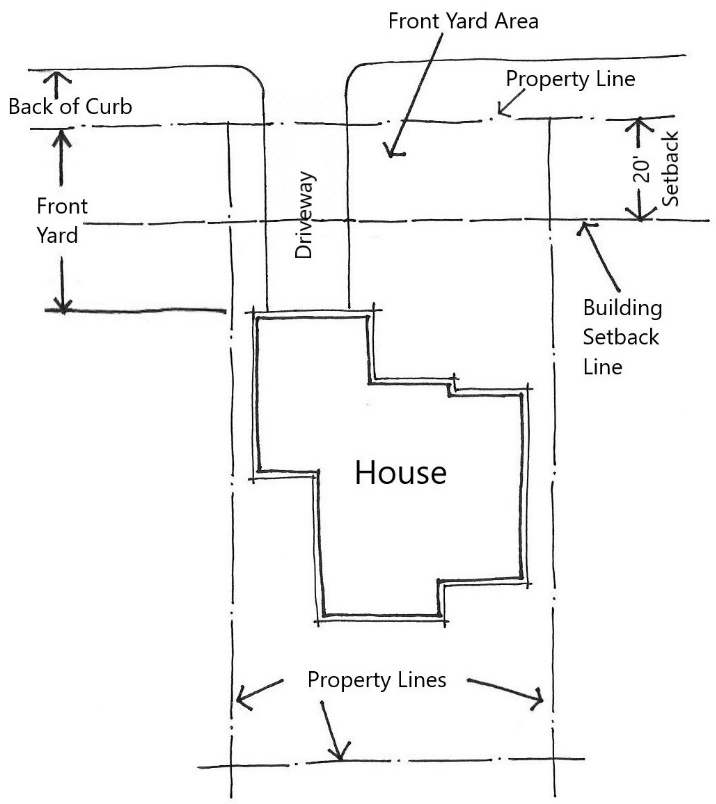
(1)
No motor vehicle shall park upon any surface that is not paved with concrete, asphalt, or when expressly permitted by the City Code or City of Stillwater Standards, gravel or similar pervious material;
(2)
No less than two paved off-street parking spaces shall be provided on each property.
(3)
If the subject property is a permitted boarding/rooming house as set forth in this division, one additional paved off-street parking space shall be provided on-site for each bedroom in excess of three. Any additional concrete or asphalt parking area shall be constructed immediately adjacent to and be accessible from the driveway on the property. If the number of occupants of such boarding/rooming house is subject to amortization under [section] 23-275.8, gravel or similar pervious material authorized by the City Code or City of Stillwater Standards may be used to construct additional temporary parking spaces as required herein in side or rear yards, provided that such materials are removed and such area is restored at the expiration of the applicable amortization period.
(4)
The total paved area of all required front yard parking shall not exceed the maximum percentage coverage as indicated herein. The area of any existing driveway outside of the right-of-way shall be included in this calculation. Off-street parking is allowed on the driveway between the right-of-way line and the front face of the house. Parking within the right-of-way is not permitted, unless parallel parking is currently allowed.
(5)
All impervious material in place at the time this section is enacted can be replaced as needed. New paving along the front of the house shall meet the maximum front yard impervious coverage percentage.
Notwithstanding any other provision contained in this section, the repair, replacement, removal, modernizing, or maintenance of existing impervious surface(s) as defined in this section shall not adversely impact impervious surface areas permitted at the enactment of Ordinance 3148.
(6)
Consistent with the intention of the previous section, minor amounts of additional impervious surface may be added if it does not exceed ten square feet and does not expand any existing parking area.
(Ord. No. 3148, § 1, 8-22-2011; Ord. No. 3445, § 1, 2-24-2020)

