
Stuart City Zoning Code
CHAPTER XII
DEFINITIONS
The following words, terms and phrases, when used in this Land Development Code, shall have the meanings ascribed to them in this chapter, except where the context clearly indicates a different meaning:
Abandoned signs means a sign located on a property where the use advertised on the sign is unlicensed; has failed to pay its local business taxes or which use is no longer located on the premises.
(Ord. No. 2145-07, § 4, 11-26-07)
Accessory dwelling unit, detached means a second dwelling unit located on the same property as the primary dwelling unit but in a separate structure. Outside the Creek District and the East Stuart Neighborhood, an accessory dwelling unit and the primary dwelling unit shall be occupied by members of a single family as "family" is defined herein. An accessory dwelling unit shall use the same street address as the primary dwelling unit. May include a garage apartment as defined below.
(Ord. No. 1827-02, § 3, 1-28-02; Ord. No. 2498-2023, § 1(Exh. A), 2-13-23)
Accessory structure (or building) means a subordinate building or structure detached from, but located on the same lot as the principal structure, the use of which is incidental and accessory to that of the principal building or structure. Examples of accessory buildings and structures include detached garages, cabanas, and gazebos (screened or open walled). Accessory structures shall not include pool screen enclosures, a porch, or a screened porch.
(Ord. No. 1720-00, 3-27-00)
Accessory uses means a subordinate use which is not an integral part of the principle structure; a use that is commonly or customarily incidental to the principal use; a secondary use that is located on the same premises as the principal use, such as garages, parking lots, or maintenance structures.
Addition to an existing building means any walled and roofed expansion to the perimeter of a building in which the addition is connected by a common load-bearing wall other than a fire wall. Any walled and roofed addition which is connected by a fire wall or is separated by independent perimeter load-bearing walls is new construction.
Adjacent means the condition of being near to or close to but not necessarily having a common dividing line. Two properties which are separated by only a street or alley shall be considered as adjoining one another.
Adult business means individually or in combination an adult arcade, adult bookstore, adult dancing establishment, adult motel, adult motion picture theater or massage establishment as the terms are defined herein and any other establishment whose employees display or expose specified anatomical areas as defined herein.
Adult arcade means an establishment where, for any form of consideration, one or more motion picture projectors, slide projectors, or similar machines, for viewing are used to show films, motion pictures, video cassettes, slides, or other photographic reproductions which are characterized by emphasis upon the depiction or description of specified sexual activities or specified anatomical areas.
Adult bookstore means an establishment including a video store which sells or rents adult materials in any form to the public, the revenues of which represent more than ten percent of the gross revenues of the establishment over the same period, or that comprise more than 25 percent of the individual materials displayed within the establishment as its stock-in-trade.
Adult dancing establishment means an establishment whose employees display or expose specified anatomical areas while dancing.
Adult materials means books, magazines, periodicals, or other printed matter, or photographs, films, motion pictures, video cassettes, slides, or other visual representations or recordings which have as their primary or dominant theme matter depicting, illustrating, describing or relating to specified sexual activities or specified anatomical areas, or instruments, devices or paraphernalia which are designed for use in connection with specified sexual activities.
Adult motel means any hotel or motel, boardinghouse, roominghouse, or other lodging used predominantly for transient customers which provides motion pictures and other film material which has as its primary or dominant theme matters depicting, illustrating or relating to specified sexual activities for observation by the occupants thereof.
Adult motion picture theater means an establishment designed to permit the viewing of motion pictures and other film material which has as its primary or dominant theme matters depicting, illustrating or relating to specified sexual activities for observation by the patrons thereof.
Adult massage establishment means an establishment in which an employee thereof manipulates the skin and muscle tissues of the body of another person with any part of the hand, but not including an establishment licensed under F.S. ch. 480, whose employees practicing massage are licensed under ch. 480, or an establishment exempted under F.S. § 480.034, or a physician or nurse engaged in the practice of their professions, or a licensed health care facility.
Adult business premises means an enclosed building or a portion of an enclosed building which is physically occupied by an adult business.
Adult day care center means any building, buildings, or part of a building, whether operated for profit or not, in which is provided through its ownership or management, for a part of a day, basic services to three or more persons who are 18 years of age or older, who are not related to the owner or operator by blood or marriage, and who require such services, as defined in F.S. § 429.901(1), amended time to time, as defined in F.S. § 429.65(2), amended time to time.
Assisted living facility orfacility means, for purposes of this Code, any building or buildings, section of a building or distinct part of a building, residence, private home, boarding home, home for the aged, or other place, whether operated for profit or not, which undertakes through its ownership and staff, to provide, for a period exceeding 24 hours, housing, food service, and one or more personal services, for adults who are not related to the owner or administrator by blood or marriage and who require such services, as defined in F.S. § 429.02(5), amended time to time. The term, as defined herein, shall specifically exclude centers or facilities which are primarily intended as treatment centers for individuals suffering from chemical dependency (alcohol or drugs) or mental illness.
(Ord. No. 1879-02, § 1, 7-22-02)
Adverse effects means any modifications, alterations, or effects on waters, associated wetlands, or shorelands, including their quality, quantity, hydrology, surface area, species composition, or usefulness for human or natural uses which are or may potentially be harmful or injurious to human health, welfare, safety or property, to biological productivity, diversity, or stability or which unreasonably interfere with the reasonable use of property, including outdoor recreation. The term includes secondary and cumulative as well as direct impacts.
Advertising structure means any structure erected for advertising purposes, with or without any advertisement display thereon, situated upon or attached to real property, upon which any poster, bill printing painting, device, or other advertisement of any kind whatsoever may be placed, posted, painted, tacked, nailed or otherwise fastened, affixed or displayed; provided that the term shall not include buildings.
Affected person means the owner, resident or other occupant of the real property which is the subject of a quasi-judicial proceeding, or an "aggrieved or adversely affected party" as the term is defined at F.S. § 163.3215(2).
(Ord. No. 1941-03, § 1, 6-9-03)
Aggregate sign area means total area of all permanent signs on the premises.
(Ord. No. 2145-07, § 4, 11-26-07)
Allowable discharge means the peak runoff rate which may be approved from a site or parcel such that no adverse impacts to existing off-site properties will result. Allowable discharge is limited to the predevelopment rates and patterns or rates or patterns determined in a previous approved surface water management permit or plan.
Alter or alteration means to cut, remove, defoliate or destroy by any means.
Alteration of a watercourse means a dam, impoundment, channel relocation, change in channel alignment, channelization, or change in cross-sectional area of the channel or the channel capacity, or any other form of modification which may alter, impede, retard or change the direction and/or velocity of the riverine flow of water during conditions of the base flood. (As referenced in chapter 5 - Floodplain Management.)
(Ord. No. 2303-2015, 2-9-15)
Amenity space means and includes open space and public plaza areas which may be open or covered and permanently available for use as public gathering areas, fountains and water features, streetscaped areas with benches and landscape, and areas with required landscaping that are at minimum, 150 percent above the Code specifications at section 6.04.06 of the Land Development Code.
(Ord. No. 2077-06, § 3, 7-10-06)
Animated sign means a sign which uses movement or change of lighting to depict action or to create a special effect or scene.
(Ord. No. 2145-07, § 4, 11-26-07)
Antenna means a transmitting or receiving device used for personal wireless or other communications services that radiates or captures electromagnetic waves, including directional antennas, panel and microwave dish antennas, and omni-directional antennas such as whips, but excluding radar antennas, amateur radio antennas and satellite earth stations.
Antenna support structure means any building or other structure, other than a tower, which can be used for location of wireless telecommunications facilities.
Appeal means a request for a review of the Floodplain Administrator's interpretation of any provision of this ordinance or a request for a variance. (As referenced in chapter 5 - Floodplain Management.)
(Ord. No. 2303-2015, 2-9-15)
Appliance stores means establishments primarily engaged in retailing an array of new household appliances, such as refrigerators, dishwashers, ovens, irons, coffeemakers, hair dryers, electric razors, room air-conditioners, microwave ovens, sewing machines, and vacuum cleaners, or retailing new appliances in combination with appliance repair services.
Approved pain specialist means a physician, or group of physicians licensed under either F.S. ch. 458 or 459 and who comply with F.A.C. 64B8-9.0131 (medical doctors) or F.A.C. 64B15-14.005 and F.A.C. 64B15-14.009 (osteopathic physicians), as each is amended from time to time.
(Ord. No. 2212-10, 9-13-10)
Appurtenances means that which is an accessory to another structure, including, but not limited to, stonewalls, fences, light fixtures, steps, paving, sidewalks, shutters, and signs.
(Ord. No. 2145-07, § 4, 11-26-07)
Arbor means an open, lightweight structure that may have a horizontal element spanning over a walkway, deck, or garden area, intended primarily to provide shade and support the growth of vegetation such as vines and climbing plants.
Arcade means a covered walkway located on private property along the street facade of a building, except where specifically designated to occur on public property. Arcades are open to the adjacent street between columns, which may be either load-bearing or cosmetic. "Arcade" as used herein is not meant to imply that the columns must carry arches; horizontal lintels may be used to span between columns. Interior building space may be constructed above an arcade.
Architectural character means the basic detailing, architectural rhythm, architectural style, appearance and historic period of a building or group of buildings or structures, including site and landscape development.
Architectural feature means a structural or ornamental feature of a building or structure, including, but not limited to, balconies, chimneys, bay windows, cornices, coping, parapets, steps, staircases, screened utilities, and tower structures, other than telecommunications towers.
Area of copy (to be used when copy is on facia or wall sign only) means the entire area within a single, continuous perimeter composed of squares or rectangles, which enclose the extreme limits of the advertising message, announcement or decoration on a facia or wall sign.
Area of sign (to be used only when area of copy is not applicable) means the area of the largest single face of the sign within a perimeter which forms the outside shape including any frame, and which forms an integral part of the display, but excluding the necessary supports or uprights on which the sign may be placed, if the sign consists of more than one section or module, all areas will be totalled.
Art shop/galleries means an establishment engaged in the sale, loan, or display of art books, paintings, sculpture, or other works of art. This clarification does not include libraries, museums, or non-commercial art galleries.
Artisanal use means premises for the manufacture and sale of artifacts employing only handwork and/or table mounted electrical machinery emitting no odors or noise beyond the immediate premises.
Artist means an individual or group of individuals whose vocation or avocation is the creation of visual art; or who possesses a university degree in visual art; or who has exhibited visual art publicly in galleries or museums; or who has published critical reviews of visual art; or who has been commissioned for works of art for public places.
ASCE 24 means a standard titled Flood Resistant Design and Construction that is referenced by the Florida Building Code. ASCE 24 is developed and published by the American Society of Civil Engineers, Reston, VA. (As referenced in chapter 5 - Floodplain Management.)
(Ord. No. 2303-2015, 2-9-15)
Automatic amusement center and game room means a place of business having at least 50 coin-operated amusement games or machines on premises, which are operated for the entertainment of the general public and tourists as a bona fide amusement facility, as defined in F.S. § 849.161, amended from time to time.
Automobile rental/leasing establishment means leasing or renting of automobiles, motorcycles, and light load vehicles.
Automobile repair services, major, means the replacement of engine parts, body work, tire or exhaust system repair or replacement, or the installation of any electrical device within an enclosed facility. If located within Industrial zoned district, repairs are not limited to within an enclosed facility.
Automobile repair services, minor, means an enclosed facility where motor vehicles are serviced and where minor repairs to vehicles are made but not including major auto repair. If located within Industrial zoned district, repairs are not limited to within an enclosed facility.
(Ord. No. 1685-99, 7-26-99)
Automobile sales means a retail business primarily housed in a structure and characterized by a mixture of related uses upon a commercial site; however, the principal use of the site shall be the marketing of new or used automobiles, whether by sale, rent, lease, or other commercial or financial means. Secondary supporting uses may also exist upon the same site, such as maintenance, repair and service areas, parts storage areas, and financial service areas.
Availability/available, with regard to the provision of facilities and services concurrent with the impacts of development, means that at a minimum the facilities and services will be provided in accordance with the standards set forth in F.S. § 163.3180.
Avoidance means taking action so there is no adverse impact to environmentally sensitive resources.
Awning sign means letters or characters placed upon an awning or awning valance.
(Ord. No. 2145-07, § 4, 11-26-07)
Bakery, retail, means a place for preparing, cooking, baking, and selling of products on the premises.
Bakery, warehouse, means a place for preparing, cooking, baking, and selling of products intended for off-premises distribution.
Balcony means a structural platform, surrounded by a railing or other retaining device that projects from the street facade of a building at an elevated floor without direct support from the ground.
Balloon means a lighter than air sign or display tethered to the ground or a structure.
Banks/financial institutions means provision of financial and banking services to consumers or clients. Walk-in and drive-in services to consumers are generally provided on site. Typical uses include banks, savings and loan associations, savings banks, credit unions, lending establishments, and automatic teller machines (ATMs).
Banner means a temporary sign having the characters, letters, illustrations, or ornamentations applied to cloth, paper, or fabric of any kind with only the material for a backing. "Banner" shall include any animated or fluttering devices designed to attract attention.
(Ord. No. 2145-07, § 4, 11-26-07)
Bars means a commercial establishment whose principal business is the sale of drinks, especially alcoholic drinks, and sometimes food which is served to the customer in a ready to consume state on premises. Bars may include beer gardens, pubs, taverns, night clubs, private clubs, and similar facilities serving alcohol.
Barbershop means any place of business wherein the practice of barbering is carried on, as defined in F.S. § 473.034, amended from time to time.
Base flood means a flood having a one percent chance of being equaled or exceeded in any given year. [Also defined in FBC, B, Section 1612.2.] The base flood is commonly referred to as the "100-year flood" or the "1-percent-annual chance flood." (As referenced in chapter 5 - Floodplain Management.)
(Ord. No. 2303-2015, 2-9-15)
Base flood elevation means the elevation of the base flood, including wave height, relative to the National Geodetic Vertical Datum (NGVD), North American Vertical Datum (NAVD) or other datum specified on the Flood Insurance Rate Map (FIRM). [Also defined in FBC, B, Section 1612.2.] (As referenced in chapter 5 - Floodplain Management.)
(Ord. No. 2303-2015, 2-9-15)
Basement means that portion of a building having its floor sub grade (below ground level) on all sides. A basement shall not be considered a story.
(Ord. No. 1979-04, § 1, 6-28-04)
Basement means the portion of a building having its floor subgrade (below ground level) on all sides. [Also defined in FBC, B, Section 1612.2.] (As referenced in chapter 5 - Floodplain Management.)
(Ord. No. 2303-2015, 2-9-15)
Beauty salon means any establishment where cosmetology services are provided including hair care, nail care, and skin care on a regular basis for compensation.
Bed and breakfast inn means a family home structure, with no more than 15 sleeping rooms, which has been modified to serve as a transient public lodging establishment, which provides the accommodation and meal services generally offered by a bed and breakfast inn, and which is recognized as a bed and breakfast inn in the community in which it is situated or by the hospitality industry, as defined in F.S. 509.242(1)(f), amended time to time.
Beer garden means a permanent establishment which includes any area out-of-doors and not completely contained within a building in which alcoholic beverages or food are served.
Below grade means occurring or situated below the surface of the ground.
Beneficial functions of a protected environmentally sensitive area means those functions, described in the conservation element of the Stuart Comprehensive Plan, that justify designating an area as environmentally sensitive.
Berm means mounding of soil which is planted with living plant material designed as a natural landscape feature or buffer to screen incompatible land uses or to absorb or otherwise reduce undesirable impacts, such as noise, smoke, glare, or similar nuisances.
Bicycle parking means an area intended for secure bicycle parking, with appropriate racks and storage areas, located within required parking areas.
Billboard means a flat surface (such as a panel, wall or fence) on which bills are placed; specifically, a large panel designed to carry outdoor advertising, particularly for an off-premises sale.
(Ord. No. 2145-07, § 4, 11-26-07)
Board means the city commission, the board of adjustment and the planning advisory board, all of the City of Stuart.
Boat sales and service means a retail business where the principal use of the site shall be the marketing of new or used boats, whether by sale, rent, lease, or other commercial or financial means. Secondary supporting uses may also exist upon the same site, such as maintenance, repair and service areas, parts storage areas, and financial service areas.
Boat storage, dry, means any building, structure or area in which boats are stored, out of water, by placing them in racks, trailers or other devices.
Book and stationary store means a retail establishment that, as its primary business, engages in the sale, rental, or other charge-for-use of books, magazines, newspapers, greeting cards, postcards, videotapes, computer software, or any other printed or electronically conveyed information or media, excluding any "adult bookstore," "adult theater," "theater," or "studio theater."
Bower means a leafy shelter or recess; arbor.
Bowling alley means a place of business having at least 12 bowling lanes on the premises which are operated for the entertainment of the general public for the purpose of engaging in the sport of bowling, as defined in F.S. § 849.141(2)(b), amended time to time.
Breakaway wall means a wall that is not part of the structural support of the building and is intended through its design and construction to collapse under specific lateral loading forces without causing damage to the elevated portion of the building or the supporting foundation system.
Buffer means a landscape area which may include walls, fences, berms, trees, shrubs, hedges, ground cover and other plant materials.
Buffer screen means that portion of a buffer which includes a six-foot high, opaque vegetative landscape screen designed and maintained to visually screen a development or portion thereof from adjacent property within one year of construction and planting.
Build-to line means that a building must be built to the specified line set forth in the Urban Code.
Build-to zone means that a building's facade must be built to the specified zone or the area between the minimum and maximum setbacks within which the building's facade is to be located.
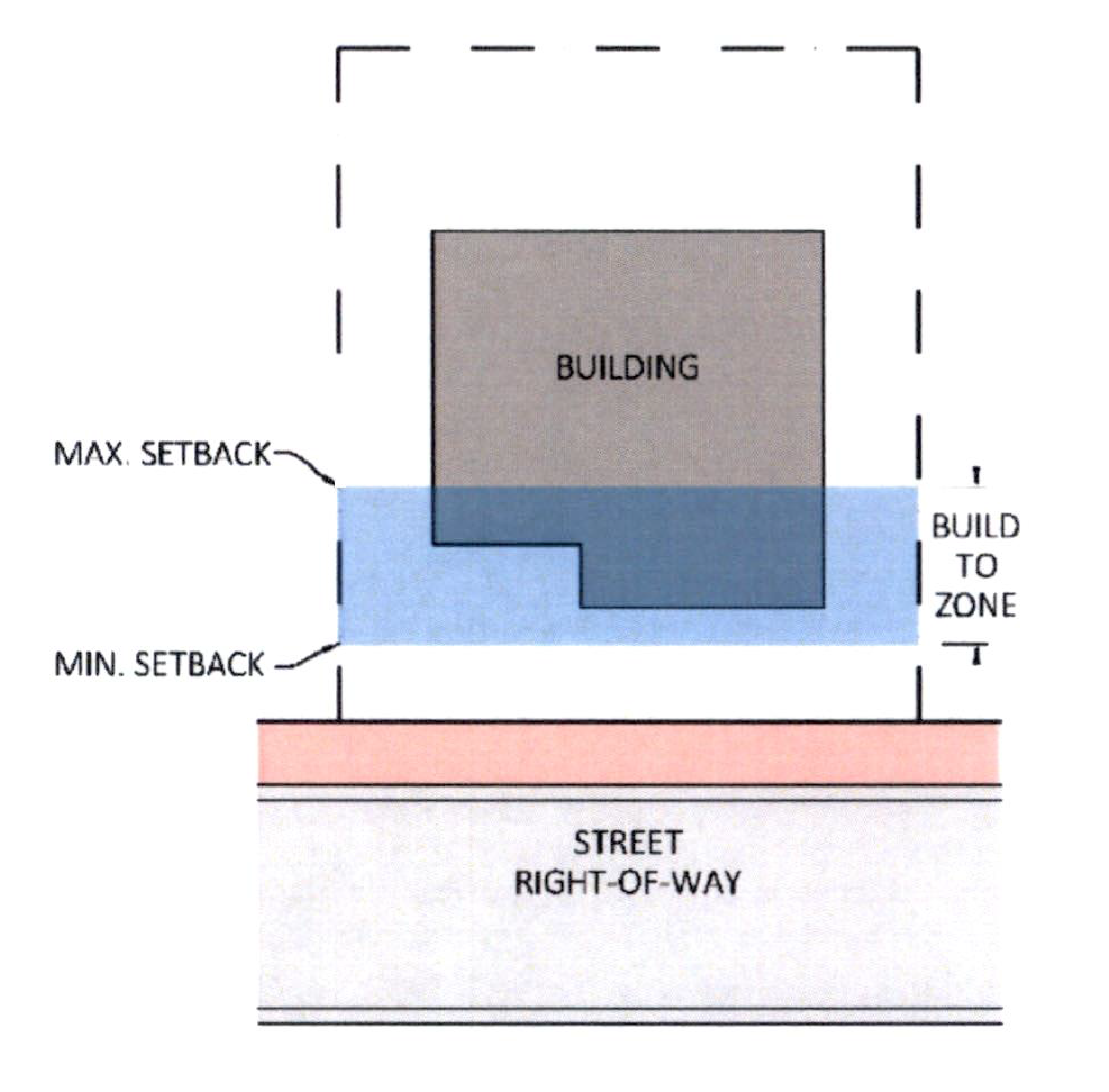
(Ord. No. 2498-2023, § 1(Exh. A), 2-13-23; Ord. No. 2520-2023, § 1(Exh. A), 10-23-23)
Building face means the total area of the exterior walls of a building that generally faces one direction. For example, a rectangular building has four building faces.
(Ord. No. 2206-10, 7-12-10)
Building footprint means the area of land covered by the building foundation, including the area contained within a line three feet from the foundation around the entire perimeter of the building (as referenced in chapter 6).
Building footprint means the area of land covered by the building foundation to the outside of the exterior walls (as referenced in chapter 3).
Building frontage means:
(a)
The building frontage for an interior lot is the portion of the lot abutting the primary street minus the required side setbacks.
(b)
The building frontage for the primary street side of a corner lot is the portion of the lot abutting the primary street minus the required side setbacks.
(c)
The building frontage for the secondary street side of a corner lot is the portion of the lot abutting the secondary street minus the required front and rear setbacks.
(d)
Building frontage is expressed in percentages and may vary from floor to floor.
(Ord. No. 2145-07, § 4, 11-26-07)
Building height means the vertical distance from grade to the highest finished roof surface of a flat roof or to the mean level between eaves and ridge for gable, hip, or gambrel roofs.
(Ord. No. 1841-02, § 2, 6-10-02; Ord. No. 1979-04, § 1, 6-28-04; Ord. No. 2145-07, § 4, 11-26-07)
Building height means the vertical distance measured from the lowest permissible finished first-floor elevation to the surface of a flat roof and to the eave of a pitched roof. The peak of a pitched roof may not exceed 15 feet above the maximum building height. A parapet wall shall not be counted in the calculation of building height (as referenced in chapter 3).
Bulletin board means a board for posting notices.
Bus and train (passenger) station means a facility for the transfer, pickup, or discharge of people or goods without the long-term storage of such items.
Bus and train (passenger) terminal means any premises for the transient housing or parking of motor-driven buses or trains, and may or may not include the loading and unloading of passengers.
Buttocks means the area of the rear of the body which lies between two imaginary lines running parallel to the ground when a person is standing, the top such line drawn at the top of the cleavage of the nates and the bottom line drawn at the lowest visible point of the cleavage, and between two imaginary lines perpendicular to the ground drawn at the point at which each nate meets the outer side of each leg.
Cabana room means a rigid porch, metal Florida room and other similar permanent unit installed or constructed as home adjuncts, totally or partially enclosed with sidewalls made of metal or other approved rigid material.
Cabinet sign means a sign incorporating a rigid frame which supports and retains the sign face panel(s) and/or background constructed of plastic or similar material, and which has an internal light source. Cabinet signs do not include signs composed of individually-mounted and individually-illuminated letters, or logos no larger than the lettering to which they relate.
(Ord. No. 2145-07, § 4, 11-26-07)
Canopy means a covered structure projecting from the face of the principal building. Canopies may be cantilevered or self-supporting and include awnings.
Car wash means the primary use of a site for washing and cleaning of passenger vehicles, recreational vehicles, or other light duty equipment.
Caregiver means a person who is at least 21 years old who has agreed to assist with a qualifying patient's medical use of marijuana and has qualified for and obtained a caregiver identification card issued by the Florida Department of Health, or any successor agency authorized by the State of Florida.
(Ord. No. 2531-2024, § 1, 10-14-24)
Carport means an open structure that shelters a parking area. Carports may be detached from the principal building; when attached, they are typically of a contrasting architectural character from the principal building (as opposed to a porte cochere, which is considered part of the building.)
Catering shop means an establishment whose principal use is the preparation and provision of food served to the customer at a location off the premises. A catering shop may be accessory to a restaurant.
Cells-on-wheels means a temporary, transportable wireless telecommunications facility (WTCF) used to provide emergency or temporary transmission capacity.
Cemetery means land used or intended to be used for the burial of the human dead and dedicated for cemetery purposes, including, mausoleums and funeral homes, if operated in connection with and within the boundaries of such cemetery.
Changeable copy sign means a sign with informational content that can be changed or altered by manual or electronic means to display a message.
(Ord. No. 2145-07, § 4, 11-26-07)
Child care center means a child care facility or arrangement which provides child care for more than five children not related to the operator excepting schools, summer day camps, bible schools normally conducted during vacation periods and transient establishments, as defined in F.S. § 402.302(2), amended time to time. All facilities of this size must be licensed with the Florida Department of Children and Family Services unless determined to be exempt.
(Ord. No. 1935-03, § 2, 4-28-03)
City development director means the administrative head of the city development department of the City of Stuart or his/her designee.
Civil plan means a document providing detailed engineering and construction features including all underground construction, storm water management structures, utilities, curb cuts, driveway cuts, work within a public right-of-way, and site lighting and complying with the reasonable design criteria contained in Appendix A.
Clinic. See Pain management clinic.
Clothiers means stores selling or accepting for sale clothing at retail.
Clubs, lodges, and fraternal organizations means an establishment providing meeting, recreational, or social facilities for a private or non-profit association, primarily for use by members and guests. Typical uses include private social clubs and fraternal organizations.
Coastal construction control line means the line established by the State of Florida pursuant to F.S. § 161.053 and recorded in the official records of the community, which defines that portion of the beach-dune system subject to severe fluctuations based on a 100-year storm surge, storm waves or other predictable weather conditions. (As referenced in chapter 5 - Floodplain Management)
(Ord. No. 2303-2015, 2-9-15)
Coastal high hazard area means a special flood hazard area extending from offshore to the inland limit of a primary frontal dune along an open coast and any other area subject to high velocity wave action from storms or seismic sources. Coastal high hazard areas are also referred to as "high hazard areas subject to high velocity wave action" or "V Zones" and are designated on Flood Insurance Rate Maps (FIRM) as Zone V1-V30, VE, or V. [Note: The FBC,B defines and uses the term "flood hazard areas subject to high velocity wave action" and the FBC, R uses the term "coastal high hazard areas."] (As referenced in chapter 5 - Floodplain Management)
(Ord. No. 2303-2015, 2-9-15)
Coastal wetlands and shorelines consist of the following: water and submerged lands of oceanic water bodies or estuarine water bodies; shorelines adjacent to oceanic waters or estuaries; coastal barriers; living marine resources; marine wetlands; water-dependent facilities or water-related facilities on oceanic or estuarine waters; or public access facilities to oceanic beaches or estuarine shorelines; and all lands adjacent to such occurrences where development activities would impact the integrity or quality of the above.
Coldframes means a frame with a glass or plastic top in which small plants are grown and protected without artificial heat.
Cold storage means the storage of things in an artificially cooled place for preservation.
Combustible sign means any sign or sign structure which has an internal electrical circuit which may ignite or support flames and which has a low flame point. Prime examples of combustible signs would be wood, cloth, and the like.
(Ord. No. 2145-07, § 4, 11-26-07)
Commercial nursery or tree farm means a licensed plant or tree nursery or farm in relation to those trees planted and growing on the premises of said licensee, which are so planted and growing for the sale or intended sale to the general public in the ordinary course of said licensee's business.
Commercial planned unit development (CPUD) means an alternative means of development and an alternative zoning procedure for predominately commercial purposes, in accordance with section 2.07.00.E and with the planning and development objectives of the City.
Commercial cruise boats means any boat used for sightseeing or excursion purposes. "Commercial" shall mean that a charge is made on a per-passenger or per-trip basis.
Common area, with respect to an ACLF, means that interior, under roof area of the facility open to all residents for common usage (not including hallways), which shall include, but not be limited to, such uses as dining and recreation.
Common elements means lands, structures and facilities whose ownership or use is shared by all owners or occupants within the PUD. Common elements may include, but are not limited to, open space, recreation facilities, water bodies, private streets and roads, utility systems, and joint parking or loading provisions.
Community center means a building used for recreational, social, educational and cultural activities, owned and operated by a public or nonprofit group or agency.
Community redevelopment agency (CRA) means a public agency that was created by the city commission on May 12, 1986 in accordance with the provisions of Florida statutes and encompasses approximately 700 acres of land, including those areas with an Urban Code, The Creek District, and East Stuart Neighborhood zoning designations.
(Ord. No. 2498-2023, § 1(Exh. A), 2-13-23)
Community residential home means a dwelling unit licensed to serve residents who are clients of the Department of Elderly Affairs, the Agency for Persons with Disabilities, the Department of Juvenile Justice, or the Department of Children and Family Services or licensed by the Agency for Health Care Administration, which provides a living environment for seven to 14 unrelated residents who operate as the functional equivalent of a family, including such supervision and care by supportive staff as may be necessary to meet the physical, emotional, and social needs of the residents, as defined in F.S. § 419.001(1)(a), amended time to time.
Community garden means an area of land managed and maintained for the use of one or more individuals to grow and harvest food crops, non-food ornamental crops, such as flowers, or both solely for the use, consumption or donation by two or more persons maintaining the community garden.
Comparable zoning district means to the most closely similar zoning district based upon the land use designation, the Comprehensive Plan, proposed uses, densities and lot sizes.
Comprehensive Plan text amendment means any amendment to the text of the comprehensive plan that does not include an amendment to the future land use map and that does not include amendments that change the actual list of permitted, conditional or prohibited uses in a land use category.
Concept plan means a document containing a verbal or graphic depiction, or both verbal and graphic depictions (specifications and/or drawings) providing the generalized arrangement of land and structures including buildings, tenancies or premises, landscape, storm water management, utilities, paved surfaces, sidewalks, parking areas, and open space, and complying with the reasonable design criteria contained in appendix B.
Concurrency means that the necessary public facilities and services to maintain the adopted level of service standards are available when the impacts of development occur.
Concurrency management system (CMS) means the procedures and/or process that the City of Stuart uses to assure that development orders and permits are not issued unless the necessary facilities and services are available concurrent with the impacts of development.
Concurrency service area (CSA) means the geographic subsection of the school district within which school concurrency is measured.
Conditional use means a use or occupancy of a structure which because of the unique nature of the use, size, location, or various characteristics particular to the zoning district, is permitted only upon issuance of a major conditional use approval and subject to the limitations and conditions specified therein.
Construction permit means a permit as that term is used in the Florida Building Code.
Construction plan means one or more detailed and specific written, graphic and pictorial documents depicting a proposed or completed construction, and the term in synonymous with construction documents, as that term is used in the Florida Building Code to describe the design, location and physical characteristics of the elements of a project necessary for obtaining a building permit.
Contiguous lots means lots which are included in a unified development plan that are either abutting or separated by a public right-of-way.
Copy services and duplicating services means a retail establishment that provides duplicating services using photocopying, blueprint, and offset printing equipment and may include the collating and binding of booklets and reports.
Corps means the United States Army Corps of Engineers.
Cottage lot means an individual parcel of real property, individually platted or otherwise "of record" on December 10, 2007, which does not meet the minimum lot requirements within its land use (zoning) district.
(Ord. No. 2146-07, § 2, 12-10-07)
Cottage lot application form means the form submitted to the development department containing details of the development requesting consideration under section 2.05.00, pertaining to cottage lots.
(Ord. No. 2146-07, § 2, 12-10-07)
Craft distillery means a licensed distillery that produces 75,000 or fewer gallons per calendar year of distilled spirits on its premises and has notified the Florida Division of Alcoholic Beverages and Tobacco in writing of its decision to qualify as a craft distillery, as defined in F.S. § 565.03, amended time to time.
Crematorium means a location containing properly installed, certified apparatus intended for use in the act of cremation.
Curb cut means an area designated on a property for ingress and egress.
Day means a calendar day unless a working day is indicated.
(Ord. No. 1899-02, 11-18-02)
Debilitating medical condition means cancer, epilepsy, glaucoma, positive status for human immunodeficiency virus (HIV), acquired immune deficiency syndrome (AIDS), post-traumatic stress disorder (PTSD), amyotrophic lateral sclerosis (ALS), Crohn's disease, Parkinson's disease, multiple sclerosis, or other debilitating medical conditions of the same kind or class as or comparable to those enumerated, and for which a physician believes that the medical use of marijuana would likely outweigh the potential health risks for a patient.
(Ord. No. 2531-2024, § 1, 10-14-24)
Decorative paving materials means materials used in/for sidewalks and other forms of pedestrian accessways and shall include paver blocks, bricks and stamped concrete. Decorative paving materials shall not include asphalt or smooth or broom-finished concrete.
(Ord. No. 1719-00, 4-10-00)
Demolition means the intended destructive removal of a building, in whole or in part, from its site.
(Ord. No. 2091-06, § 1, 12-11-06)
Demolition by neglect means neglect in the maintenance of any building or structure resulting in one or more of the following:
A.
The deterioration of a building(s) or structure, to the extent that it creates or permits a hazardous or unsafe condition as determined by the building official; and
B.
The deterioration of a building or structure, as determined by the building official, characterized by one or more of the following:
1.
Parts that may fall and injure persons or property;
2.
Deteriorated or inadequate foundation;
3.
Defective or deteriorated floor supports or floor supports insufficient to carry imposed loads safely;
4.
Walls or other vertical supports that split, lean, list or buckle due to defective material or deterioration;
5.
Walls or other vertical supports that are insufficient to carry imposed loads safely;
6.
Ceilings, roofs, ceiling and roof supports, or other horizontal parts of a structure which sag, split, or buckle due to defective material or deterioration or are insufficient to carry imposed loads safely;
7.
Any fault, defect or condition in the building which renders the building or structure structurally unsafe or not properly water-tight;
8.
Unsafe electrical, plumbing or mechanical (HVAC) systems;
9.
Water intrusion causing water damage to the interior of the building or structure caused by broken or missing windows, broken or missing doors and/or deterioration of roofing material; or
10.
Excessive damage to exterior and interior wood framing, flooring systems, and finishes caused by termites, to the extent that the building or structure may be unsafe.
(Ord. No. 2091-06, § 1, 12-11-06)
Density bonus means additional residential density may be approved for a RPUD in accordance with the City of Stuart's comprehensive plan and land development regulations provided the total density does not exceed 30 dwelling units per acre. A density bonus may only be granted at the discretion of the city commission as an incentive for developments to provide greater public amenities or housing opportunities which enhance the city, such as affordable housing, new housing stock, or housing types that are in demand.
(Ord. No. 2332-2017, § 1, 8-28-17)
Department means the Florida Department of Environmental Protection. For the purposes of section 2.06.23, "department" means the Florida Department of Health or its successor agency.
(Ord. No. 2531-2024, § 1, 10-14-24)
Depth means a lineal dimension of a site or building measured on a line perpendicular to the line of the street frontage.
Depth means a lineal dimension of a site or building measured on a line perpendicular to the line of the lot frontage (as referenced in chapter 3).
Design flood means the flood associated with the greater of the following two areas: [Also defined in FBC, B, Section 1612.2.]
(1)
Area with a floodplain subject to a one percent or greater chance of flooding in any year; or
(2)
Area designated as a flood hazard area on the community's flood hazard map, or otherwise legally designated.
(As referenced in chapter 5 - Floodplains Management.)
(Ord. No. 2303-2015, 2-9-15)
Design flood elevation means the elevation of the "design flood," including wave height, relative to the datum specified on the community's legally designated flood hazard map. In areas designated as Zone AO, the design flood elevation shall be the elevation of the highest existing grade of the building's perimeter plus the depth number (in feet) specified on the flood hazard map. In areas designated as Zone AO where the depth number is not specified on the map, the depth number shall be taken as being equal to two feet. [Also defined in FBC, B, Section 1612.2.] (As referenced in chapter 5 - Floodplain Management.)
(Ord. No. 2303-2015, 2-9-15)
Developer means any person or entity, including a governmental agency, undertaking any development as defined in this Code.
Development means any activity that:
(a)
Produces a material change in the function, use or appearance of a parcel of land or of any structure, including, but not limited to, tree removal, landscaping, environmental maintenance or remediation, demolition, excavation, earth moving, land grading, construction, underground construction, renovation, or structural alterations;
(b)
Any activity that results in or is intended to result in a change in the intensity or use of land; or
(c)
The subdivision of land.
Development means any manmade change to improved or unimproved real estate, including, but not limited to, buildings or other structures, tanks, temporary structures, temporary or permanent storage of equipment or materials, mining, dredging, filling, grading, paving, excavations, drilling operations or any other land disturbing activities. (As referenced in chapter 5 - Floodplain Management.)
(Ord. No. 2303-2015, 2-9-15)
Development order means any order granting, denying, or granting with conditions an application for a development permit as defined in this Code.
Development permit means a document issued by the city authorizing the physical development, redevelopment or alteration of real property, including any one or more of the following permits: construction (including underground construction), demolition, environmental remediation, excavation, filling land or submerged land, grading, land clearing, landscaping, paving, or tree removal. A development permit does not include a site plan, concept plan, sketch plan, civil plan, or plat.
Diameter at breast height or DBH means the trunk diameter of a tree measured at 4½ feet above ground level at the base of the Tree, provided however, if the tree trunk forks below 4½ feet above ground level, each trunk shall be considered a tree.
Directional sign means an on-premises, incidental sign designed to guide or direct pedestrians or vehicular traffic. No commercial message shall be placed on directional signs.
(Ord. No. 2145-07, § 4, 11-26-07)
Directory sign means a sign listing the tenant's names, locations, buildings or group of buildings.
(Ord. No. 2145-07, § 4, 11-26-07)
District means the South Florida Water Management District.
Division means the division of hotels and restaurants of the State of Florida Department of Business and Professional Regulation. (As referenced in chapter 2 - Dog-friendly restaurants.)
(Ord. No. 2216-10, 10-18-10)
Dog means an animal of the subspecies Canis lupus familiaris. (As referenced in chapter 2 - Dog-friendly restaurants.)
(Ord. No. 2216-10, 10-18-10)
Dog day care means a facility providing such services as canine day care for all or part of a day, obedience classes, training, grooming, or behavioral counseling, provided that overnight boarding is not permitted.
Dog-friendly restaurant means a public food service establishment, which allows patrons' dogs within certain designated outdoor areas, as permitted by this Code and F.S. § 509.233, as amended from time to time.
Drip line means an imaginary, perpendicular line that extends downward from the outermost tips of the tree branches (i.e., crown) to the ground.
Drive-through facility means an establishment which provides parking facilities and service to those facilities in order that patrons may utilize on-site goods or services without leaving their vehicles. Said drive-in service may be in conjunction with, or exclusive of, any other form of service, including drive-through or conventional seating.
Drycleaning establishment means an establishment or business maintained for the pickup and delivery of dry cleaning and/or laundry with or without the maintenance or operation of any laundry or dry-cleaning equipment or machinery on the premises.
Drycleaning plant means a building, portion of a building, or premises used or intended to be used for cleaning fabrics, textiles, wearing apparel, or articles of any sort by immersion and agitation, or by immersions only, in volatile solvents including, but not by way of limitation, solvents of the petroleum distillate type, and/or the chlorinated hydrocarbon type, and the processes incidental thereto.
Duplex dwelling units means a structure containing two dwelling units, each of which has direct access to the outside.
Dwelling unit means a room or group of rooms connected together that forms a single independent habitable unit used or intended to be used for living for one housekeeping unit, and containing independent sleeping, sanitation, and cooking facilities. A dwelling unit may be used for owner occupancy, rental, lease, or other occupancy on a weekly or longer basis.
East Stuart Neighborhood conditional use means the granting of relief from the provisions of this Code relating to permitted uses, density, structures, conflicts with utilities, historic buildings, and architectural requirements within the East Stuart Neighborhood Code.
(Ord. No. 2498-2023, § 1(Exh. A), 2-13-23)
Elevated building means a building which is partially or wholly supported more than four feet above the ground by pilings, columns, posts or piers.
(Ord. No. 1979-04, § 1, 6-28-04)
Elevated building means a building which is partially or wholly supported more than four feet above the ground by pilings, columns, posts or piers, which does not have parking beneath (as referenced in chapter 3).
Emitters means the devices used to control the applications of irrigation water. This term is used to refer to the low flow rate devices used in micro-irrigation systems.
Employee means a person who works or performs in an adult business regardless of compensation or the manner of compensation, specifically including an independent contractor.
Enclosed building means a building with a roof, and four sides, two of which shall be fixed walls.
Encroachment means the placement of fill, excavation, buildings, permanent structures or other development into a flood hazard area which may impede or alter the flow capacity of riverine flood hazard areas. (As referenced in chapter 5 - Floodplain Management.)
(Ord. No. 2303-2015, 2-9-15)
Engineer means a person registered as a professional engineer in the State of Florida.
Environmentally sensitive area means an area encompassing any one or more of the following resources as identified in the conservation element map series; coastal wetlands and shorelines, estuaries (including the St. Lucie estuary), living marine resources, native upland vegetative communities, wildlife habitats, (including threatened and endangered species) surface waters, wellfields and cones of influence, historical and archaeological resources, natural recharge areas, and 100-year floodplains.
Environmentally sensitive lands means those lands designated to be viable and functioning wetlands as determined by the South Florida Water Management District and native upland vegetative communities that provide wildlife habitat necessary for the survival of listed species as determined by the Florida Fish and Wildlife Conservation Commission and/or U.S. Fish and Wildlife Service.
Environmentally sensitive resources or resource areas means wetlands, native vegetation, protected and endangered species, mangroves, shorelines, trees, floodplains, well fields, and historic resources.
Estuary means a semi-enclosed, naturally existing coastal body of water in which saltwater is naturally diluted by freshwater and which has an open connection with oceanic waters. Estuaries include bays, embayments, lagoons, sounds and tidal streams. Principal among these is the St. Lucie Estuary.
Exfiltration means an underground system designed for retention of limited volumes by promoting runoff to exfiltrate into the ground via a porous media. Design of underground exfiltration systems shall be in accordance with South Florida Water Management District Permit Information Manual, Volume IV or most recent volume.
Existing building and existing structure. Any buildings and structures for which the "start of construction" commenced before August 15, 1978. [Also defined in FBC, B, Section 1612.2.] (As referenced in chapter 5 - Floodplain Management.)
(Ord. No. 2303-2015, 2-9-15)
Existing manufactured home park or subdivision means a manufactured home park or subdivision for which the construction of facilities for servicing the lots on which the manufactured homes are to be affixed (including, at a minimum, the installation of utilities, the construction of streets, and either final site grading or the pouring of concrete pads) is completed before August 15, 1978. (As referenced in chapter 5 - Floodplain Management.)
(Ord. No. 2303-2015, 2-9-15)
Expansion to an existing manufactured home park or subdivision means the preparation of additional sites by the construction of facilities for servicing the lots on which the manufactured homes are to be affixed (including the installation of utilities, the construction of streets, and either final site grading or the pouring of concrete pads). (As referenced in chapter 5 - Floodplain Management.)
(Ord. No. 2303-2015, 2-9-15)
Ex-parte communication means a private communication made to a member of a board which pertains to a quasi-judicial matter then pending before that board.
Fabric, hobby and handicraft shop means a retail establishment specializing in fabrics, sewing and quilting tools and accessories, and related craft items.
Facade means an exterior wall of a building.
Family means one or more persons who occupy a single dwelling unit, all of whom are related by blood, marriage, or adoption, or a group of persons all of whom are not somehow related which does not exceed two persons in number. This term shall not include the occupants of a roominghouse, a group home/congregate living facility, a fraternity or sorority house or other similar use with shared cooking or sanitary facilities. This definition shall be construed to include those individuals protected as a family unit by the Fair Housing Act or other applicable laws that do not result in a fundamental alteration of the City's local land use regulations
Family day care home (F.S. § 402.302(8)) means an occupied residence in which child care is regularly provided for children from at least two unrelated families and which receives a payment, fee, or grant for any of the children receiving care, whether or not operated for profit. Household children under 13 years of age, when on the premises of the family day care home or on a field trip with children enrolled in child care, shall be included in the overall capacity of the licensed home. A family day care home shall be allowed to provide care for one of the following groups of children, which shall include household children under 13 years of age:
(a)
A maximum of four children from birth to 12 months of age.
(b)
A maximum of three children from birth to 12 months of age, and other children, for a maximum total of six children.
(c)
A maximum of six preschool children if all are older than 12 months of age.
(d)
A maximum of ten children if no more than five are preschool age and, of those five, no more than two are under 12 months of age.
Farm equipment and supplies sales establishment means establishments selling, renting, or repairing agricultural machinery, equipment, and supplies for use in soil preparation and maintenance, the planting and harvesting of crops, and other operations and processes pertaining to farming and ranching.
Federal Emergency Management Agency (FEMA) means the federal agency that, in addition to carrying out other functions, administers the National Flood Insurance Program.
Final development order means a development permit.
Finished grade means the final elevation of the ground surface after completion of all site preparation and development, and conforming to the approved plans, but not including berms or artificial fills to elevate signs above the surrounding finished grade.
(Ord. No. 2145-07, § 4, 11-26-07)
Fire station means a building used for fire equipment and firefighters.
Fixed projection sign means any sign projecting at an angle from the outside wall of any building and rigidly affixed thereto.
Flag means a piece of cloth usually attached at one edge to a staff/pole or cord.
(Ord. No. 2145-07, § 4, 11-26-07)
Flat wall sign means a sign erected parallel to the building to which it is attached, and supported entirely by the facade.
(Ord. No. 2145-07, § 4, 11-26-07)
Flea market means a building or open area in which stalls or sales areas are set aside and rented, or otherwise provided, and which are intended for use by individuals to sell articles that are either homemade, home grown, hand crafted, used, obsolete, or antique, and may include the selling of goods at retail by businesses or individuals who are generally engaged in retail trade.
Flood or flooding means a general and temporary condition of partial or complete inundation of normally dry land from:
(1)
The overflow of inland or tidal waters.
(2)
The unusual and rapid accumulation or runoff of surface waters from any source.
[Also defined FBC, B, Section 1612.2.]
(As referenced in chapter 5 - Floodplain Management.)
(Ord. No. 2303-2015, 2-9-15)
Flood damage-resistant materials means any construction material capable of withstanding direct and prolonged contact with floodwaters without sustaining any damage that requires more than cosmetic repair. [Also defined in FBC, B, Section 1612.2.] (As referenced in chapter 5 - Floodplain Management.)
(Ord. No. 2303-2015, 2-9-15)
Flood hazard area means the greater of the following two areas: [Also defined in FBC, B, Section 1612.2.]
(1)
The area within a floodplain subject to a one percent or greater chance of flooding in any year.
(2)
The area designated as a flood hazard area on the community's flood hazard map, or otherwise legally designated.
(As referenced in chapter 5 - Floodplain Management.)
(Ord. No. 2303-2015, 2-9-15)
Flood insurance rate map (FIRM) means the official map of the community on which the Federal Emergency Management Agency has delineated both special flood hazard areas and the risk premium zones applicable to the community. (As referenced in chapter 5 - Floodplain Management.)
(Ord. No. 2303-2015, 2-9-15)
Flood insurance study (FIS) means the official report provided by Federal Emergency Management Agency that contains the flood insurance rate map, the flood boundary and floodway map (if applicable), the water surface elevations of the base flood, and supporting technical data. [Also defined in FBC, B, Section 1612.2]. (As referenced in chapter 5 - Floodplain Management.)
(Ord. No. 2303-2015, 2-9-15)
Floodplain administrator means the office or position designated and charged with the administration and enforcement of the floodplain management ordinance (may be referred to as the floodplain manager). (As referenced in chapter 5 - Floodplain Management.)
(Ord. No. 2303-2015, 2-9-15)
Floodplain development permit or approval means an official document or certificate issued by the community, or other evidence of approval or concurrence, which authorizes performance of specific development activities that are located in flood hazard areas and that are determined to be compliant with this ordinance. (As referenced in chapter 5 - Floodplain Management.)
(Ord. No. 2303-2015, 2-9-15)
Floodway means the channel of a river or other riverine watercourse and the adjacent land areas that must be reserved in order to discharge the base flood without cumulatively increasing the water surface elevation more than one (1) foot. (As referenced in chapter 5 - Floodplain Management.)
(Ord. No. 2303-2015, 2-9-15)
Floodway encroachment analysis means an engineering analysis of the impact that a proposed encroachment into a floodway is expected to have on the floodway boundaries and base flood elevations; the evaluation shall be prepared by a qualified Florida licensed engineer using standard engineering methods and models. (As referenced in chapter 5 - Floodplain Management.)
(Ord. No. 2303-2015, 2-9-15)
Floor means the top surface of an enclosed area in a building (including basement), i.e., top of slab in concrete slab construction or top of wood flooring in wood frame construction. The term does not include the floor of a garage used solely for parking vehicles.
Floor area means, for purposes of this Code, the floor area is the sum of the enclosed areas on all floors of a building measured from the outside faces of the exterior walls, including halls, lobbies, arcades, stairways, elevator shafts, enclosed porches and balconies, and any below grade floor areas used for access and storage. Not countable as floor area are open terraces, patios, balconies, atriums, breezeways and parking.
(Ord. No. 1879-02, § 1, 7-22-02)
Floor area, maximum permitted, means the maximum floor area permitted for any specific development or use in certain zoning districts. It is calculated by multiplying the gross lot square footage by the floor area ratio contained in section 2.03.00 of this Code, then dividing by ten.
(Ord. No. 1879-02, § 1, 7-22-02)
Floor area ratio, basic, means the relationship of floor area to the area of the lot.
(Ord. No. 1879-02, § 1, 7-22-02)
Floor area ratio, maximum permitted, means the floor area ratio permitted as of right in the several districts, excluding any bonus or transferred floor area.
(Ord. No. 1879-02, § 1, 7-22-02)
Florida Building Code means the family of codes adopted by the Florida Building Commission, including: Florida Building Code, Building; Florida Building Code, Residential; Florida Building Code, Existing Building; Florida Building Code, Mechanical; Florida Building Code, Plumbing; Florida Building Code, Fuel Gas. (As referenced in chapter 5 - Floodplain Management.)
(Ord. No. 2303-2015, 2-9-15)
Florist means retail business whose principal activity is the selling of plants which are not grown on the site and conducting business within an enclosed building.
Formula business means a retail business establishment, including a restaurant, which is one of not less than six or more similar establishments located elsewhere which as a group satisfy two or more of the following criteria:
1.
They have the same or a similar name, trade name, trademark or logo;
2.
They maintain a standardized menu, food ingredients or food preparation;
3.
They maintain a standardized array of merchandise;
4.
They have the same or similar building appearance;
5.
They benefit from common advertising of the group of businesses as opposed to a single business;
6.
They utilize common or similar signage; and
7.
If the group is comprised of restaurants:
a.
They provide for the sale of food or beverages to the customer in a ready-to-consume state, or
b.
The design of the building or the principal method of operation is that of a fast-food or drive-in restaurant offering quick food service, or
c.
Food where orders are generally not taken at the customer's table, or
d.
Food is generally served in disposable wrapping or containers, or
e.
Where food and beverages may be served directly to the customer in a motor vehicle.
(Ord. No. 2010-05, § 5, 2-14-05)
Freestanding sign means a freestanding sign is not affixed to any other structure and is limited to no more than two faces. All signs supported by one or two posts, with the top edge of the sign no more than six feet above the finished grade, shall have a pole cover. All free-standing signs shall contain the street number.
Example:
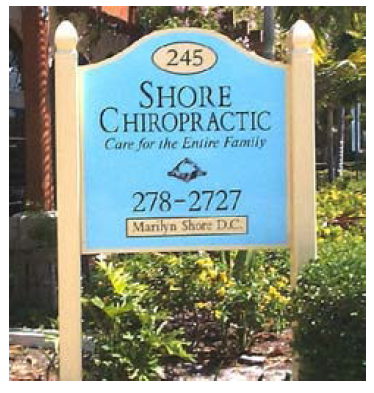
(Ord. No. 2145-07, § 4, 11-26-07)
Frontage means a lot boundary adjoining a street.
(Ord. No. 2145-07, § 4, 11-26-07)
Frontage wall face means the building facade, including parapet and fascia, excluding soffit, mansard, and roof, which faces the frontage of the premises.
(Ord. No. 2145-07, § 4, 11-26-07)
Fuel production facility means any establishment engaged in the manufacturing, processing, distilling, refining, transporting, or distributing of petrochemicals, ethanol or biodiesel fuels, or any liquid or gaseous hydrocarbon products, including the conversion of products to fuel, and including the storage of any materials associated therewith. This definition shall not include gasoline of other motor fuel stations, nor shall it apply to research and development activities involving incidental volumes of materials, as determined by the City Development Director, which are stored in accordance with all applicable laws and regulations.
Functionally dependent use means a use which cannot perform its intended purpose unless it is located or carried out in close proximity to water, including only docking facilities, port facilities that are necessary for the loading and unloading of cargo or passengers, ship building or ship repair facilities; the term does not include long-term storage or related manufacturing facilities. (As referenced in chapter 5 - Floodplain Management.)
(Ord. No. 2303-2015, 2-9-15)
Funeral home means a building used for the preparation of the deceased for burial and display of the deceased and rituals connected therewith before burial or cremation.
Future land use amendment (FLUA) means a change in the land use designation of a parcel or parcels of land indicated on the city future land use map on "small scale."
(Ord. No. 1929-03, § 1, 3-24-03)
Garage apartment means an accessory or subordinate building, not a part of or attached to the main building, where a portion thereof contains a dwelling unit for one family only and the enclosed space for at least one automobile is attached to such dwelling unit.
Garage, residential, means an accessory building or a portion of a main building (including a carport) designed and used for the parking or storage of vehicles owned or used by the occupants of the building to which it is an accessory use.
Garish means too bright or gaudy; showy, glaring; also cheaply brilliant or involving excessive ornamentation.
(Ord. No. 2145-07, § 4, 11-26-07)
Gasoline or other motor fuel service station means property where flammable or combustible liquids or gases used as fuel are stored and dispersed from fixed equipment into the fuel tanks of motor vehicles. Such an establishment may offer for sale at retail other convenience items as a clearly secondary activity and may also include a freestanding automatic car wash.
Gasoline or other motor fuel service station, including bulk storage, means the same definition as above, plus bulk storage tanks of flammable and combustible liquids, compressed gases or liquefied petroleum gas (LP gas) for business use, retail sale, wholesale, or wholesale distributing.
Gender. Words importing the masculine gender shall be construed to include the feminine and neuter.
Gift shop means a retail store that sells a wide variety of relatively small and inexpensive items.
Golf course means a use providing private or public golf recreation services and support facilities, excluding miniature golf facilities. A golf course may include a clubhouse, restrooms, driving range, and shelters as accessory use.
Golf course, miniature means a novelty version of golf played with a putter and a golf ball on a miniature course, typically with artificial playing surfaces, and including obstacles such as bridges and tunnels.
Golf driving range means a limited area on which golf players do not walk, but onto which they drive golf balls from a central driving tee.
Governmental buildings means a building or structure owned, operated, or occupied by governmental agency to provide a governmental service to the public.
Green development means the use of sustainable building and development planning methods utilized in a way that results in minimum impact on natural resources, energy consumption, use of water, use of raw materials, and waste generation, thereby affording inhabitants a potentially higher quality of life.
(Ord. No. 2113-07, § 1, 7-23-07)
Greenhouse means a building with transparent walls and roof, usually of glass, for the cultivation and exhibition of plants under controlled conditions.
Greenway means a corridor of native vegetation managed for conservation purposes with a minimum average width of at least 100 feet, and no width less than 50 feet.
Grocery stores/supermarkets means stores where most of the floor area is devoted to the sale of food products for home preparation and consumption, which typically also offer other home care and personal care products, and which are substantially larger and carry a broader range of merchandise than convenience stores.
Gross area means all that area of land included in a development application as defined by a certified legal survey.
Gross density means the gross density of any development application shall be calculated by dividing the total number of units to be constructed in the project by the gross area of the project.
Gross floor area means the area within the inside perimeter of the exterior walls of a building with no deduction for corridors, stairs, closets, thickness of walls, elevator shafts, columns, or other features. Areas open and unobstructed to the sky, including terraces, patios, atriums, arcades, open balconies and porches, breezeways, and parking areas are not included. As an incentive to encourage more generous public areas within a building and to encourage a higher architectural quality, arcades, porches and balconies, common public bathrooms, public lobbies, common mail rooms, common janitorial storage rooms, and open stairs contiguous to ground floor lobbies, which function as publicly accessible common space, are not included in the gross floor area for purposes of calculating parking requirements.
Ground cover means plants of species which normally reach an average height of 24 inches upon maturity, installed in such a manner as to form a continuous cover over the ground. Sod shall not be considered ground cover.
Ground level means the lowest elevation of ground abutting each building.
Ground sign means a sign affixed to the ground and supported by a masonry foundation with posts, uprights, or braces extending from the ground, or a permanently mounted object on the ground, but not attached to any part of a building.
(Ord. No. 2145-07, § 4, 11-26-07)
Group home or housing means facilities which provide short-term or long-term lodging, meals, and resident support services, such as counseling, guidance, and varying levels of medical care.
Guyed tower means a telecommunications tower that is supported, in whole or in part, by guy wires and ground anchors.
Habitable floor means any floor usable for living purposes, which includes working, sleeping, eating, cooking or recreation, or a combination thereof. A floor used only for storage purposes is not a "habitable floor."
Hardware store means a facility of 30,000 or fewer square feet gross floor area, primarily engaged in the retail sale of various basic hardware lines, such as tools, builders' hardware, plumbing and electrical supplies, paint and glass, housewares and household appliances, garden supplies, and cutlery; if greater than 30,000 square feet, such a facility is a home improvement center.
Hatracked means otherwise known as topping or heading, refers to the removal of major portions of a tree crown by cutting (pruning) branches back to stubs and/or to the trunk (section 6.04.04.A.4).
Health club means an establishment that provides exercise facilities such as running, jogging, aerobics, weight lifting, court sports, and swimming, as well as locker rooms, showers, massage rooms, saunas and related accessory uses.
Health spa means a nurturing, safe, clean commercial establishment, which employs professional, licensed therapists whose services include massage and body or facial treatments. Private treatment rooms are provided for each client receiving a personal service. Treatments may include body packs and wraps, exfoliation, cellulite and heat treatments, electrolysis, body toning, waxing, aromatherapy, cleansing facials, medical facials, non-surgical face lifts, electrical toning, and electrolysis. Hydro-therapy and steam and sauna facilities, nutrition and weight management, spa cuisine, and exercise facilities and instruction may be provided in addition to the massage and therapeutic treatment services. Full service hair salons, make-up consultation and application and manicure and pedicure services may be provided as additional services.
Hedge means a row of closely planted shrubs or other vegetative screening forming a boundary or restrictive barrier which shall be 80 percent opaque within one year thereafter. At planting, hedge shrubs shall be not less than 24 inches in height with an 18-inch spread and shall be "full" specimens which are fully rooted in three-gallon containers. Hedge shrubs shall be planted 24 inches on center. Hedges shall be maintained at a minimum height of 30 inches.
Height (of a sign) means the vertical distance measured from the highest point of the sign, to the finished grade at the base of the sign.
(Ord. No. 2145-07, § 4, 11-26-07)
Highest adjacent grade means the highest natural elevation of the ground surface, prior to construction, next to the proposed walls or foundation of a structure. (As referenced in chapter 5 - Floodplain Management.)
(Ord. No. 2303-2015, 2-9-15)
Historic structure means any building identified in the City of Stuart's update to the 1991 historic property survey dated April 2003 and any subsequent amendments thereof; or any other structure which has local architectural, historical, or cultural significance that is later identified and placed within such survey, using recognized criteria for designation as "historic," including, but not limited to, structure age of 50 years or more, cultural significance, notoriety of former occupants, and architecture.
(Ord. No. 2091-06, § 1, 12-11-06)
Historic structure means any structure that is determined eligible for the exception to the flood hazard area requirements of the Florida Building Code, Existing Building, chapter 11 Historic Buildings. (As referenced in chapter 5 - Floodplain Management.)
(Ord. No. 2303-2015, 2-9-15)
Historic tree means a tree which has been identified by the city commission to have special historic significance or that has achieved at least 50 percent of the DBH of the species as identified in the Florida Champion Trees of Florida database, maintained by the Forest Service, as amended, excluding invasive plant species as defined in this Code.
Home improvement center (without major storage areas and manufacturing) means a facility of more than 30,000 square feet gross floor area, engaged in the retail sale of various basic hardware lines, such as tools, builders hardware, paint and glass, housewares and household appliances, garden supplies, and cutlery. This use is considered a retail, non-intensive sales and services as defined below.
Home occupation means an occupation conducted as an accessory use in a dwelling unit in a manner clearly incidental and accessory to the residential use.
Hoophouse means a structure used as a greenhouse or a season extender and is characterized by a half-round "hoop" shape. Hoop houses are typically constructed of lengths of PVC pipe, which is both flexible and sturdy.
Hospital means an institution requiring a certificate of need that:
(1)
Offers services more intensive than those required for room, board, personal services and general nursing care;
(2)
Offers facilities and beds for use beyond 24 hours by individuals requiring diagnosis, treatment, or care for illness, injury, deformity, infirmity, abnormality, disease, or pregnancy; and
(3)
Regularly makes available at least clinical laboratory services, diagnostic X-ray services, and treatment facilities for surgery or obstetrical care, or other definitive medical treatment of similar extent.
A hospital may include auxiliary uses such as offices for medical and dental personnel, central service facilities such as pharmacies, medical laboratories, child care centers for employees, and other related uses.
Hospital auxiliary uses means health care services provided exclusive of room and board that can be classified into three categories such as diagnostic (e.g., laboratory tests), therapeutic (e.g., physical therapy), and custodial (e.g., nursing home). These uses can be located in hospitals, medical offices and free-standing sites.
Hotel or motel means a public lodging establishment licensed by the State of Florida which offers transient or permanent lodging accommodations to the general public, and may provide additional services, such as restaurants, meeting rooms, and recreation facilities.
Identification card means a document issued by the State of Florida that identifies a qualifying patient or a caregiver.
(Ord. No. 2531-2024, § 1, 10-14-24)
Identification sign means a sign, indicating the name of the primary use.
(Ord. No. 2145-07, § 4, 11-26-07)
Illegal sign means a sign which does not meet the requirements of this Code and which has not received legal nonconforming status.
(Ord. No. 2145-07, § 4, 11-26-07)
Illuminated sign means a sign with an internal or external artificial light source.
(Ord. No. 2145-07, § 4, 11-26-07)
Impact means damage to an upland or wetland caused by any means.
Impervious surface coverage means any surface which has been altered, covered or controlled resulting in the virtual elimination of the infiltration and percolation of water to the underlying soils. The term includes most conventionally surfaced streets, roofs, buildings and structures, sidewalks, parking lots and similar facilities.
Industrial, high-impact, means characterized by intense industrial activities that may have impacts on surrounding areas, including, but not limited to, noise, odor or aesthetic impacts. Commercial, residential and recreational uses are discouraged, except for small-scale secondary uses serving the industrial area. Activities could include the manufacturing, producing, processing, repairing, altering recycling, storing, distributing, transferring, treating of products and have one or more of the following attributes:
•
Potential for significant impacts on sensitive land uses due to offsite emissions including aerosol, fume, particle, smoke, odor and noise;
•
Potential for significant offsite impacts in the event of fire, explosion or toxic release;
•
Generates high heavy vehicle usage in the context of the locality or the road network;
•
Generates a significant demand on the local infrastructure network;
•
The use may involve night time and outdoor activities;
•
Onsite controls are required for emissions and dangerous goods risks.
Industrial, low-impact, means intended for industrial businesses that need industrial resources, but that do not have the potential impacts on surrounding areas that high-impact industrial users do. Low-impact industrial sites may have a special emphasis and attention given to aesthetics, landscaping and community compatibility. Low-impact industrial sites are comprised of predominantly industrial uses but may incorporate office and neighborhood-sized commercial uses that support and compliment the industrial site. Residential use is generally discouraged except for master planned industrial developments that provide residences intended to house employees of the planned industrial use. Activities could include the manufacturing, producing, processing, repairing, altering, recycling, storing, distributing, transferring, treating of products and have one or more of the following attributes:
•
Negligible impacts on sensitive land uses due to offsite emissions including aerosol, fume, particle, smoke, odor and noise;
•
Minimal heavy-vehicle usage;
•
Demands imposed upon the local infrastructure network consistent with surrounding uses;
•
The use generally operates during the day (e.g., 7:00 a.m. to 6:00 p.m.);
•
Offsite impacts from storage of dangerous goods are negligible;
•
The use is primarily undertaken indoors.
Industrial planned unit development (IPUD) means an alternative means of development and an alternative zoning procedure for predominately industrial purposes, in accordance with section 2.07.00.G and with the planning and development objectives of the city.
Infill development means development on a site of prior development or a site which is located between two developed parcels.
Installation and maintenance guarantee means a document which binds the developer or property owner of a major development or a minor development to guarantee the amount, installation, and maintenance of required landscape and irrigation materials. The guarantee document shall include a listing of the required landscape and irrigation materials and shall guarantee the installation of irrigation devices and the survival of 100 percent of the living materials in perpetuity. The guarantee shall specifically provide that if all required landscaping does not remain in a healthy, growing condition after one year after planting, such landscaping shall be replaced and thereafter maintained in a healthy, growing condition.
Interior decorating establishment means a commercial establishment from where professional home interior decorating services are provided. The on-site retail sale of furniture and other home furnishings to the general public shall not be offered; however, cloth, wallpaper, and paint samples may be provided.
Interlocal agreement for school facilities planning and siting means the interlocal agreement between Martin County, the City of Stuart, and the School Board of Martin County, signed by the School Board on February 19, 2008, by Martin County on March 11, 2008, and by the City of Stuart on February 25, 2008, which details the responsibilities and coordination processes necessary to implement joint planning, school siting procedures, and school concurrency.
Invasive plant species means a native or non-native plant species that is able to spread on its own, causing environmental or economic harm.
Irrigation system means a permanent, supplemental watering system designed to transport and distribute water to plants.
Jewelry store means shops that sell new merchandise primarily and some used merchandise from estate sales or reconstitute precious metals they purchase into jewelry forms that are sold at retail on the premises.
Junked or inoperative motor vehicle means a vehicle or conveyance propelled by or intended to be propelled by internal or external combustion, electricity or similar means, intended or designed to be operated on the public streets, roadways, waterways, or highways which does not display current license tags, inspection decal (if required), or which is not legally equipped or which is in such a state of disrepair whereby it cannot be driven or propelled under its own power.
Kennel means an indoor facility used for the temporary boarding of domestic animals, such as dogs and cats, not owned by the occupants of the premises.
Land clearing means any development or other activity which alters the land upon which it is located, except for normal sodding and placement of signs.
Landmark or historic sign means a sign designated as a landmark or having historic value as determined by the city. A sign may be designated as a landmark sign when it is associated with one or more historic figures, events, or places, or is considered significant as evidence of the history of the product, business, or service advertised.
(Ord. No. 2145-07, § 4, 11-26-07)
Landscape plan means a plan prepared in accordance with professional standards that meets the requirements set forth in this landscape code.
Landscaping means any combination of living plants such as grass, ground cover, shrubs, vines, hedges, or trees and non-living landscape material such as rocks, pebbles, sand, mulch, walls, fences, or decorative paving materials.
Large scale commercial development means any commercial or other non-residential development of greater than 20,000 square feet in gross building area. In the case of multiple buildings within the same commercial or other non-residential development, including planned unit developments, phased developments and outparcels in different ownership than the primary parcel, the total square footage of all buildings shall comprise the gross building area. When making a determination as to whether or not a particular development constitutes a LCD, the city development director shall consider the inclusion of facilities and site components which are likely to be shared with other developments, including, but not limited to, parking areas, drainage and stormwater management, vehicular access, native preservation and common areas.
(Ord. No. 1678-99, 6-28-99)
Large scale comprehensive plan amendment means a proposed amendment to the city comprehensive plan that either changes the land use designation of certain property on the future land use map on a large scale or that changes the actual list of permitted, conditional or prohibited uses within a land use category.
Laundry establishment (self-service) means a business that provides washing, drying, and/or ironing machines for hire to be used by customers on the premises.
LEED® means the Leadership in Energy and Environmental Design (LEED) Green Building Rating System TM latest edition, as promulgated by the U.S. Green Building Council.
(Ord. No. 2113-07, § 1, 7-23-07)
Letter of map change (LOMC) means an official determination issued by FEMA that amends or revises an effective flood insurance rate map or flood insurance study. Letters of map change include:
Letter of map amendment (LOMA) means an amendment based on technical data showing that a property was incorrectly included in a designated special flood hazard area. A LOMA amends the current effective Flood Insurance Rate Map and establishes that a specific property, portion of a property, or structure is not located in a special flood hazard area.
Letter of map revision (LOMR) means a revision based on technical data that may show changes to flood zones, flood elevations, special flood hazard area boundaries and floodway delineations, and other planimetric features.?
Letter of map revision based on fill (LOMR-F) means a determination that a structure or parcel of land has been elevated by fill above the base flood elevation and is, therefore, no longer located within the special flood hazard area. In order to qualify for this determination, the fill must have been permitted and placed in accordance with the community's floodplain management regulations.?
Conditional letter of map revision (CLOMR) means a formal review and comment as to whether a proposed flood protection project or other project complies with the minimum NFIP requirements for such projects with respect to delineation of special flood hazard areas. A CLOMR does not revise the effective flood insurance rate map or flood insurance study; upon submission and approval of certified as-built documentation, a letter of map revision may be issued by FEMA to revise the effective FIRM. (As referenced in chapter 5 - Floodplain Management.)
(Ord. No. 2303-2015, 2-9-15)
Library means a facility in which literary, musical, artistic, or reference materials such as, but not limited to, books, manuscripts, computers, recordings, or films are kept for use by or loaning to patrons of the facility, but are not normally offered for sale.
Licensed sign electrician means a person who possesses the necessary qualifications, training, and technical knowledge to plan, build lay out, and supervise the installation of all types of electrical signs.
(Ord. No. 2145-07, § 4, 11-26-07)
Light-duty truck means as defined in 40 CFR 86.082-2, any motor vehicle rated at 8,500 pounds gross vehicular weight rating or less which has a vehicular curb weight of 6,000 pounds or less and which has a basic vehicle frontal area of 45 square feet or less, which is:
(1)
Designed primarily for purposes of transportation of property or is a derivation of such a vehicle, or
(2)
Designed primarily for transportation of persons and has a capacity of more than 12 persons; or
(3)
Available with special features enabling off-street or off-highway operation and use.
(As referenced in chapter 5 - Floodplain Management.)
(Ord. No. 2303-2015, 2-9-15)
Lighted sign means any sign which is illuminated by any type of light from an artificial or man-made source, whether separate and apart from or contained within or on the sign, which is intended and used to make the sign visible or readable.
Listed species means those plants or animals listed as threatened species, endangered species, or species of special concern by the F.A.C. chs. 62 and 68 or F.S. ch. 379 or listed as endangered or threatened by the U.S. Fish and Wildlife Service in accordance with the federal Endangered Species Act, as either may be amended from time to time.
Littoral zones means areas located waterward of the mean high water line (natural systems) or control elevation (man-made systems) in natural and manmade bodies of water including retention areas.
Living marine habitat means an area where living marine resources naturally occur, such as mangroves, seagrass beds, algal beds, salt marshes, transitional wetlands, marine wetlands, rocky shore communities, hard bottom communities, oyster bars or flats, mud flats, coral reefs, worm reefs, artificial reefs, offshore springs, nearshore mineral deposits, and offshore sand deposits.
Living marine resources means oceanic or estuarine plants or animals, such as mangroves, seagrasses, algae, coral reefs, and living marine habitat; fish, shellfish, crustacea and fisheries; and sea turtles and marine mammals.
Lot means a parcel or tract of land, distinguished from surrounding parcels by ownership boundaries and excluding public rights-of-way.
Lot, corner means a lot located at the intersection of two or more streets.
Lot frontage means the smallest (narrowest) portion of the lot abutting a public right-of-way.
Lot, through means a lot (with the exception of a corner lot) that has frontage on two public streets.
Lot width means the diameter of the largest circle that can be inscribed within the side lot lines at any point on a continuous line from the frontage of the lot to the front line of the principal structure of the lot.
Lowest floor means the lowest floor of the lowest enclosed area of a building or structure, including basement, but excluding any unfinished or flood resistant enclosure, other than a basement, usable solely for vehicle parking, building access or limited storage, provided that such enclosure is not built so as to render the structure in violation of the non-elevation requirements of the Florida Building Code or ASCE 24. [Also defined in FBC, B, Section 1612.2.] (As referenced in chapter 5 - Floodplain Management.)
(Ord. No. 2303-2015, 2-9-15)
Maintenance agreement means a legal constituted maintenance agreement for improving, perpetually operating, and maintaining the common facilities, including streets, drives, parking areas, and open space and recreation facilities that are to remain private or such documents as are necessary to show how the said common areas are to be improved, operated and maintained. Such documents shall be subject to the approval of the city attorney.
Major conditional use approval means an authorization granted by the city commission to use property or structures located in a particular zoning district that would otherwise be prohibited in that district by this Code but, because of the precise location of the subject property or the configuration of the planned use on the subject property, may with certain conditions be appropriate on the subject property. No use or structure shall be approved for a major conditional use approval unless the use or structure is specifically authorized as a conditional use in the district by this Code. Major conditional use approvals are issued for uses of land and may be transferable from one owner of the land to another given the conditions of the approval have not changed. Major conditional use approvals also include the granting of relief from certain provisions of the Urban Code not related to uses.
Major development means a single-family, multi-family or duplex residential project of greater than 35 units, a non-residential development over 50,000 square feet of floor area; a mixed use development over 50,000 square feet of floor area; and a public or private institutional development more than one acre in size.
(Ord. No. 1346-94, 3-28-94)
Major planned unit development (PUD) amendment means any major changes in or amendments to a PUD master development plan, a PUD final development plan or PUD agreement approved as part of a rezoning to a PUD district shall be processed as a new application for a PUD district zoning. Major changes or amendments shall include:
a.
A change of two percent or more in the area of any land use designations shown on the final development plan;
b.
Any change in the list of proposed uses;
c.
An increase in residential density of five percent or more;
d.
An increase in nonresidential building square footage of ten percent or more;
e.
A change in the boundary of the PUD district;
f.
A change in the final development plan or approval regarding any area(s) set aside and designated for future development;
g.
Any other change determined by the city development director to have a potentially significant impact on city services or the surrounding neighborhood.
Major Urban Code District conditional use means the granting of relief from the provisions of the Urban Code relating to density, permitted uses, setbacks, location of parking, location of buildings and structures, conflicts with utilities, curb cuts, historic buildings, pitched roofs in the Old Downtown District, parking located within a building envelope, number of stories, building height but not to exceed 45 feet, and architectural requirements.
Mangrove stand means an assemblage of mangrove trees.
Mangroves means any specimen of the species Avicennia germinans (black mangrove), Laguncularia racemosa (white mangrove), Rhizophora mangle (red mangrove) and Conocarpus erectus (buttonwood mangrove).
Manual changeable copy sign. See Changeable copy sign.
(Ord. No. 2145-07, § 4, 11-26-07)
Manufactured home means a structure, transportable in one or more sections, which is eight feet or more in width and greater than 400 square feet, and which is built on a permanent, integral chassis and is designed for use with or without a permanent foundation when attached to the required utilities. The term "manufactured home" does not include a "recreational vehicle" or "park trailer." [Also defined in 15C-1.0101, F.A.C.] (As referenced in chapter 5 - Floodplain Management.)
(Ord. No. 2303-2015, 2-9-15)
Manufactured home park or subdivision means a parcel (or contiguous parcels) of land divided into two or more manufactured home lots for rent or sale. (As referenced in chapter 5 - Floodplain Management.)
(Ord. No. 2303-2015, 2-9-15)
Marijuana means all parts of any plant of the genus Cannabis and shall have the meaning given cannabis in F.S. § 893.02(3), and, in addition, "Low-THC cannabis" as defined in F.S. § 381.986(1)(b), shall also be included in the meaning of the term "marijuana" to the extent that such definition does not include those THC concentrations that contain no more than 0.3 percent THC on a dry weight basis and/or that are approved by the U.S. Food and Drug Administration and in accordance with the laws of the State of Florida.
(Ord. No. 2531-2024, § 1, 10-14-24)
Marijuana accessories means any equipment, product, or material of any kind that are used for inhaling, ingesting, topically applying, or otherwise introducing marijuana products into the human body for personal use.
(Ord. No. 2531-2024, § 1, 10-14-24)
Marijuana products means marijuana or goods containing marijuana.
(Ord. No. 2531-2024, § 1, 10-14-24)
Marina, commercial, means a facility with three or more wet and/or dry slips for the commercial docking, launching, mooring or storage of vessels and which may include accessory retail and service uses, such as, but not limited to, the sale, lease or rental of boats, bait and tackle shops, off-loading and processing of commercial seafood products and marine equipment sales.
Marina slip which requires a utilities agreement means a marina as defined above which meets one or more of the following definitions:
a)
"Live-aboard" means any vessel used solely as a residence and not for navigation.
b)
Any vessel represented as a place of business or a professional or other commercial enterprise; any vessel for which a declaration of domicile has been filed pursuant to section 222.17.
c)
"Floating structure" means a floating entity, with or without accommodations built thereon, which is not primarily used as a means of transportation on water but which serves purposes or provides services typically associated with a structure or other improvement to real property. The term "floating structure" includes, but is not limited to, each entity used as a residence, place of business or office with public access, hotel or motel, restaurant or lounge, clubhouse meeting facility, storage or parking facility, mining platform, dredge, dragline, or similar facility or entity represented as such. Floating structures are expressly excluded from the definition of the term vessel provided in this section. Incidental movement upon water or resting partially or entirely on the bottom shall not in and of itself, preclude an entity from classification as a floating structure.
d)
"Homemade vessel" means any vessel built after October 31, 1972, for which a federal hull identification number is not required to be assigned by the manufacturer pursuant to federal law, or any vessel constructed or assembled prior to November 1, 1972, by other than a licensed manufacture for his or her own use or the use of a specific person. A vessel assembled from a manufacturer's kit or constructed from an unfinished manufactured hull shall be considered to be a homemade vessel if such a vessel is not required to have a hull identification number assigned by the United States Coast Guard. A rebuilt or reconstructed vessel shall in no event be construed to be a homemade vessel.
e)
"Houseboat" means any vessel which is used primarily as a residence for a minimum of 21 days during any 30 day period, in a county of this state, and this residential use of the vessel is to be the preclusion.
f)
A continuing use of a boat as a residence for living purposes, including sleeping, eating, bathing and other indication of habitation, badness or professional association; or the occupancy of the vessel to sleep or maintain residency for three or more days 72 hours) in a one-week period, with a maximum of nine days in a 30-day period, and does not apply to casual overnight or weekend occupancy, provided the vessel has adequate sanitation facilities.
Market value means the price at which a property will change hands between a willing buyer and a willing seller, neither party being under compulsion to buy or sell and both having reasonable knowledge of relevant facts. As used in this ordinance, the term refers to the market value of buildings and structures, excluding the land and other improvements on the parcel. Market value may be established by a qualified independent appraiser, actual cash value (replacement cost depreciated for age and quality of construction), or tax assessment value adjusted to approximate market value by a factor provided by the property appraiser. (As referenced in chapter 5 - Floodplain Management.)
(Ord. No. 2303-2015, 2-9-15)
Marquee means a canopy or covered structure projecting from and supported by a building, when such canopy or covered structure extends beyond the building, building line or property line.
Marquee sign means a sign attached to or supported by a marquee structure, which is a permanent roof-like structure or canopy extending from the facade of the building.
(Ord. No. 2145-07, § 4, 11-26-07)
Massage therapy establishment means an establishment licensed under F.S. ch. 480, whose employees practicing massage are licensed under F.S. ch. 480, unless exempt under F.S. § 480.034. This definition does not include an athletic club, health club, school, gymnasium, reducing salon, spa, or similar establishment where massage or similar manipulation of the human body is offered as an incidental or accessory service.
Medical marijuana treatment center (MMTC) means an entity that is authorized to acquire, cultivate, possesses, processes (including development of related products such as food, tinctures, aerosols, oils, or ointments), transfers, transports, sells, distributes, dispenses, or administers marijuana, products containing marijuana, related supplies, or educational materials to qualifying patients or their caregivers and is registered pursuant to F.S. § 381.986 and the provisions set forth by the department.
(Ord. No. 2531-2024, § 1, 10-14-24)
Medical use means the acquisition, possession, use, delivery, transfer, or administration of an amount of marijuana not in conflict with department rules, or of related supplies by a qualifying patient or caregiver for use by the caregiver's designated qualifying patient for the treatment of a debilitating medical condition.
(Ord. No. 2531-2024, § 1, 10-14-24)
Memorial signs or tablets means a marker set at the head of a grave or crypt.
Menu board sign means a changeable copy sign for displaying a menu selection and pricing of the items for sale.
(Ord. No. 2145-07, § 4, 11-26-07)
Microbrewery means a brewery that produces no more than 15,000 barrels of beer in a year. Microbreweries may or may not include an on-site tasting room and retail space, and may or may not operate in conjunction with a bar or restaurant.
Micro-irrigation means the frequent application of small quantities of water directly on or below the soil surface, usually as discrete drops, tiny streams, or miniature sprays through emitters placed along water delivery pipes.
Minimization means lessening impacts by reducing the degree or magnitude of the proposed action prior to and during site alteration and construction.
Minor conditional use approval means an authorization issued by the city community redevelopment board granting relief from the provisions of the Urban Code relating to paint colors, fence requirements, public art, and architecture materials.
Minor development means a single-family, multi-family or duplex residential project of between three and 35 units, inclusive; a non-residential development under 50,000 square feet of floor area; a mixed use development under 50,000 square feet of floor area; a public or private institutional development less than one acre in size; and commercial tenant finishes.
(Ord. No. 1665-99, 4-26-99; Ord. No. 1357-94, 8-8-94)
Minor planned unit development (PUD) amendment means any minor changes in or amendments to a PUD master development plan, a PUD final development plan or PUD agreement approved as part of a rezoning to a PUD district shall be processed as a new application for a PUD district zoning. Minor changes or amendments shall include:
a.
A change of two percent or less in the area of any land use designations shown on the final development plan;
b.
An increase in residential density of less than five percent;
c.
An increase in nonresidential building square footage of less than ten percent;
d.
An amendment to an originally approved timetable of development. Such an amendment may only be approved upon good cause shown to the city commission. Any contributions conditioned as part of the original PUD agreement shall be revisited upon application for timetable extension. A timetable extension of 180 days or less may be granted by administrative variance in accordance with section 8.05.08 and does not require a new traffic concurrency review in accordance with section 4.04.03 of this Code.
Minor Urban Code District conditional use means the granting of relief from the provisions of the Urban Code relating to paint colors, fence requirements, public art, and architectural materials.
Mixed use planned unit development (MXPUD) means an alternative means of development and an alternative zoning procedure for combinations of two or more integrated residential, commercial, hospital, governmental and light industrial uses, in accordance with section 2.07.00.H and with the planning and development objectives of the City.
Mobile home means a structure as defined in F.S. § 320.01.
Monopole tower means a telecommunications tower consisting of a single pole or spire self-supported by a permanent foundation and constructed without guy wires or ground anchors.
Monument sign means a freestanding low-profile sign with the sign area at the top of a solid base.
(Ord. No. 2206-10, 7-12-10).
Example:
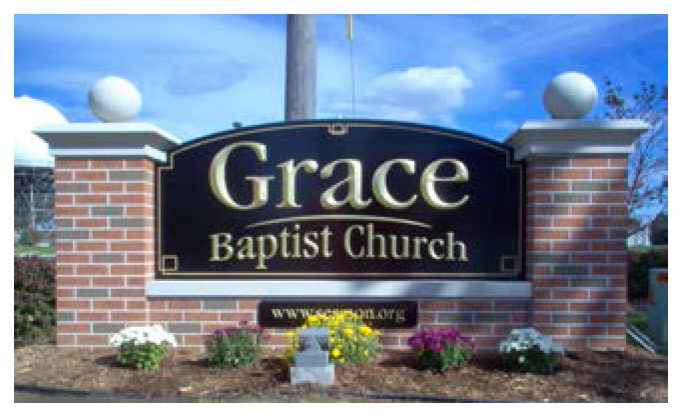
Mulch means non-living, organic or synthetic materials used in landscape design to retard erosion and retain moisture.
Multi-family dwelling unit means a building containing three or more individual dwellings with separate cooking and toilet facilities for each dwelling.
Multi-story building means a building that has one or more floors above ground.
(Ord. No. 2206-10, 7-12-10).
Mural means a painting, drawing, or mural painted or drawn on an external wall which is considered generic art, and which does not graphically contain a message or logo, or depict a product or service of a particular business being offered to the public.
(Ord. No. 2206-10, 7-12-10).
Mural sign means a painting or drawing on an external wall which contains a message, or logo, or depiction of a product or service of a particular business being offered to the public.
(Ord. No. 2206-10, 7-12-10).
Museum means an establishment either publicly or privately owned where objects of art or objects of historical, educational, or cultural value are displayed.
(Ord. No. 1686-99, 7-26-99)
Nameplate sign means a non-electric, on-premises identification sign giving only the name, address and/or occupation of the occupants.
(Ord. No. 2145-07, § 4, 11-26-07)
Native uplands means those land areas that consist of vegetation in which 50 percent or more of the vegetative cover is native vegetation.
Native upland vegetative community means a concentration of plant species indigenous to the region. These communities such as coastal hammocks, sandhills, and scrub are classified based on the presence of certain soils, vegetation and animals.
Native vegetation means vegetation comprised of those vegetative species that were present in Florida at the time of European contact including threshold wetlands. Any species introduced to Florida thereafter is non-native vegetation. Descriptions of species considered non-native vegetation are contained in the latest version of the Florida Exotic Pest Plant Council list of exotic and invasive plants.
Native vegetation preserve area means that portion of a property in which no development activity is permitted including threshold wetlands, upland buffers, greenways, and habitat of listed species or areas of native vegetation.
Neighborhood retail establishments means establishments primarily engaged in the provision of frequently or recurrently needed goods for household consumption, such as prepackaged food and beverages and limited household supplies and hardware. Convenience stores shall not include fuel pumps or the selling of fuel for motor vehicles. Typical uses include neighborhood markets and country stores.
Net density means the net density of a project shall be computed by dividing the total number of units to be constructed by the net residential acreage of the parcel. The net residential acreage of a parcel shall be the acreage devoted to residential lots, rights-of-way, common areas, landscape buffers and retention areas less all bodies of water and required protected environmentally sensitive areas.
(Ord. No. 2332-2017, § 1, 8-28-17)
New construction means construction of a new building or structure. (As referenced in chapter 3.)
New construction means, for the purposes of administration of this ordinance and the flood-resistant construction requirements of the Florida Building Code, structures for which the "start of construction" commenced on or after August 15, 1978, and includes any subsequent improvements to such structures. (As referenced in chapter 5 - Floodplain Management.)
(Ord. No. 2303-2015, 2-9-15)
New development means the construction of a building or structure on unimproved real property.
New manufactured home park or subdivision means a manufactured home park or subdivision for which the construction of facilities for servicing the lots on which the manufactured homes are to be affixed (including at a minimum, the installation of utilities, the construction of streets, and either final site grading or the pouring of concrete pads) is completed on or after August 15, 1978. (As referenced in chapter 5 - Floodplain Management.)
(Ord. No. 2303-2015, 2-9-15)
Newspaper or publishing plant means a commercial printing operation involving a process that is considered printing, imprinting, reproducing, or duplicating images and using printing methods, including, but not limited to, offset printing, lithography, web offset, flexographic, and screen process printing.
Newsrack means any type of unmanned device, whether a self-service or coin-operated box, container, storage unit or other dispenser, installed, used or maintained for the display, sale, vending, or free distribution of, newspapers, news periodicals, or commercial handbills.
Night club means an establishment that is a stand-alone bar, bottle club, or restaurant that:
(1)
Serves or allows the consumption of alcoholic beverages on the premises; and
(2)
Provides or permits entertainment; and
(3)
Which is open for business later than 12:00 a.m. at least one evening per week.
Nonconforming development means development that does not conform to the use regulations in chapter II and/or the development standards in chapter VI.
Non-commercial sign means a temporary sign erected for purposes other than advertising a commercial business.
Non-conforming sign means a sign which was erected legally but no longer complies with the current sign code regulations.
(Ord. No. 2145-07, § 4, 11-26-07)
Non-medical marijuana dispensary shall mean any entity or facility licensed under state law to dispense non-medical marijuana for recreational and personal use.
(Ord. No. 2531-2024, § 1, 10-14-24)
Non-native uplands means those land areas that are either devoid of vegetation or consist of vegetation of which less than 50 percent is native vegetation.
Non-native vegetation means any vegetation that is not native vegetation.
Non-roadway banner sign. See Special event banner sign.
(Ord. No. 2145-07, § 4, 11-26-07)
Novelty and curio shop means a retail establishment specializing in items valued for its oddness or rareness and sometimes valued as a collector's item.
Nuisance species means plant species which have the potential to dominate disturbed or created mitigation areas and form large vegetative colonies (e.g., cattail, spatterdock, Carolina willow). These species can be native to the geographical area.
Number. Words in the singular shall include the plural and words in the plural shall include the singular.
Nursing home means an extended or intermediate care state licensed facility approved to provide full-time convalescent or chronic care to individuals who, by reason of advanced age, chronic illness or infirmity, are unable to care for themselves.
Occupiable space means the gross area of a building excluding parking areas and vehicle access thereto and storage space.
Office, business or professional, means an establishment used for the provision of advice, information, or consultation of a professional nature, including, but not limited to, medical, veterinary, insurance, real estate, banking, and financial services, executive management and administrative services, but excluding as a principal use commercial storage of goods for the purpose of sale.
(Ord. No. 1904-02, 12-9-02)
Office equipment and supplies store means an establishment primarily engaged in one or more of the following:
(1)
Retailing new stationery, school supplies, and office supplies;
(2)
Retailing a combination of new office equipment, furniture, and supplies; and
(3)
Retailing new office equipment, furniture, and supplies in combination with selling new computers.
Office, low-intensity medical, means an establishment used by licensed acupuncturists, chiropractors, clinical social workers, marriage and family therapists, occupational therapists, optometrists, physical therapists, psychologists, and psychiatrists or similar medical professionals. These medical professionals serve a narrower client base, tend to require appointments, offer one-on-one consultations with clients and tend to have minimal support staff. Because such low-intensity medical services do not demand high parking requirements, generate fewer trips and disperse these trips more evenly throughout the day, fewer parking spaces are required than more intensive medical uses such as clinics and dentists' offices.
Office, medical, means an establishment used for the provision of therapeutic, preventive, or other corrective personal treatment services by physicians, dentists, and other licensed medical practitioners, as well as the provision of medical testing and analysis services on an outpatient basis.
(Ord. No. 1904-02, 12-9-02)
Office, veterinary, means an establishment used for the care, grooming, diagnosis, and treatment of sick, ailing, infirm, or injured animals, and those animals in need of medical or surgical attention but not including an outdoor kennel.
(Ord. No. 1904-02, 12-9-02)
Off-premises sign means a sign advertising a business which is not located on the property where the sign is located.
(Ord. No. 2145-07, § 4, 11-26-07)
Open and public means a place open to the general public, which includes a place to which the public or a substantial number of the public has access without restriction, including, but not limited to, highways, streets and sidewalks, transportation facilities, places of amusement, parks, playgrounds, waterways, and the common areas of public buildings and facilities that are generally open or accessible to members of the public without restriction.
(Ord. No. 2531-2024, § 1, 10-14-24)
Open space means an area not occupied by any structures or impervious surfaces. A body of water is considered impervious.
Optical store means an establishment primarily engaged in one or more of the following:
(1)
Retailing and fitting prescription eyeglasses and contact lenses;
(2)
Retailing prescription eyeglasses in combination with the grinding of lenses to order on the premises; and
(3)
Selling nonprescription eyeglasses.
Outbuilding means a secondary building, other than a storage shed, located in the rear yard of the principal building.
Outdoor area means an area adjacent to a public food service establishment that is predominantly or totally free of any physical barrier on all sides and above. (As referenced in chapter 2 - Dog-friendly restaurants.)
(Ord. No. 2216-10, 10-18-10)
Outdoor storage area means an area not within an enclosed building which is used for the outdoor storage of any materials, goods, merchandise or equipment used in conjunction with and ancillary to the primary use on the property.
(Ord. No. 1683-99, 7-26-99)
Outstanding resource wetland means a wetland that is naturally connected to the St. Lucie River, to Poppleton Creek, to Frazier Creek, to Haney Creek, to Krueger Creek, to Willoughby Creek, or to the tributaries thereto. To constitute an outstanding resource wetland, the connection must be natural and not manmade.
Overflow parking means off-street parking which is provided in addition to the number of off-street parking spaces required for specific uses which occur on a development site as required by section 6.03.00, Parking, of this Code.
(Ord. No. 1678-99, 6-28-99)
Pain management clinic orclinic means the same as the definition found in F.S. § 458.3265(1)(a) (2012), as may be amended from time to time. Such definition shall not include any of the following:
1.
A clinic that is licensed as a facility pursuant to chapter 395; or
2.
A majority of the physicians who provide services in the clinic primarily provide surgical services; or
3.
The clinic is owned by a publicly held corporation whose shares are traded on a national exchange or on the over-the counter market and whose total assets at the end of the corporation's most recent fiscal quarter exceeded $50,000,000.00; or
4.
The clinic is affiliated with an accredited medical school at which training is provided for medical students, residents, or fellows; or
5.
The clinic does not prescribe controlled substances for the treatment of pain; or
6.
The clinic is owned by a corporate entity exempt from federal taxation under 26 USC 501(c)(3); or
7.
The clinic is wholly owned and operated by one or more board-eligible or board-certified anesthesiologists, physiatrists, rheumatologists, or neurologists; or
8.
The clinic is wholly owned and operated by a physician multispecialty practice where one or more board-eligible or board-certified medical specialists who have also completed fellowships in pain medicine approved by the Accreditation Council for Graduate Medical Education, or who are also board-certified in pain medicine by the American Board of Pain Medicine or a board approved by the American Board of Medical Specialties, the American Association of Physician Specialists, or the American Osteopathic Association and perform interventional pain procedures of the type routinely billed using surgical codes.
(Ord. No. 2212-10, 9-13-10)
Painted wall sign means a sign applied with paint or similar substance on the face of a wall.
(Ord. No. 2145-07, § 4, 11-26-07)
Parapet wall means a wall which serves as a guard at the edge of a balcony or roof. A parapet shall not exceed 24 inches in height, provided, however, a greater height of up to ten feet may be permitted by the city development director if necessary to conceal rooftop utilities such as stairway and elevator bulkheads and other roof equipment. No height of greater than 24 inches shall be permitted for more than 40 percent of any facade of a building. A parapet wall shall be designed to be consistent and compatible with the design and treatment of the facade of the structure.
(Ord. No. 1841-02, § 2, 6-10-02; Ord. No. 1979, § 1, 6-28-04)
A Parcel of Record/Parcel is a piece or portion of land that is identified and delineated for ownership or administrative purposes through the assignment of a "Parcel Identification Number" (PIN) by the Martin County Property Appraiser.
(Ord. No. 2539-2025, § 2, 4-16-25)
Park trailer means a transportable unit which has a body width not exceeding 14 feet and which is built on a single chassis and is designed to provide seasonal or temporary living quarters when connected to utilities necessary for operation of installed fixtures and appliances. [Defined in F.S. § 320.01.] (As referenced in chapter 5 - Floodplain Management.)
(Ord. No. 2303-2015, 2-9-15)
Parking intensive vessel slip means a location where a vessel is docked at a facility and inhabited by a person or persons for five consecutive days or a total of ten days within a 30-day period.
Parking garage means a private or government provided public structure or portion thereof composed of one or more levels or floors used exclusively for the parking or storage of motor vehicles. A parking structure may be totally below grade (as in underground parking garage) or either partially or totally above grade with those levels being either open or enclosed. Notwithstanding the four story limit provided for in section 1.04.02, a parking garage, as defined herein, may be built without regard to the number of stories provided all Florida Building Code and Life Safety Code requirements are met and the structure does not exceed 45 feet in height to the top surface of the uppermost roof deck, which may be used for parking.
Parking lot means all private or government provided public property used for off-street parking, vehicular aisles and accessways, loading zones, interior and perimeter landscaping, and other outdoor vehicular use areas.
Party means the petitioner, the city and any affected person who files a notice of intent to be a party as provided in this article.
Patron means the same as guest as provided in F.S. § 509.013. (As referenced in chapter 2 - Dog-friendly restaurants.)
(Ord. No. 2216-10, 10-18-10)
Personal use means the possession, purchase, or use of marijuana products or marijuana accessories by an adult 21 years of age or older for non-medical personal consumption by smoking, ingestion, or otherwise.
(Ord. No. 2531-2024, § 1, 10-14-24)
Pervious concrete means a concrete paving surface designed to permit the percolation of a percentage of stormwater through its surface. Pervious concrete may receive a credit towards impervious surface coverage if it is installed and maintained according to manufacturer's specifications and this Code.
Petition means an application made by a petitioner to initiate a quasi-judicial proceeding.
Petitioner means the individual, corporation or other entity which files a petition.
Pharmacy means the same as the definition in F.S. § 465.003 (2012), as may be amended from time to time, and includes community pharmacy, internet pharmacy, and special pharmacy, but does not include institutional pharmacy or nuclear pharmacy, as each of those terms are used in that section.
(Ord. No. 2212-10, 9-13-10)
Photo supplies and studios means a facility primarily engaged in the retail sale, lease, and service of photography equipment and supplies, including limited on-site processing or development. This also includes establishments known as portrait studios primarily engaged in providing still, video, or digital portrait photography services.
Physician means a person who is licensed to practice medicine in Florida.
(Ord. No. 2531-2024, § 1, 10-14-24)
Physician certification means a written document signed by a physician, stating that in the physician's professional opinion, the patient suffers from a debilitating medical condition, that the medical use of marijuana would likely outweigh the potential health risks for the patient, and for how long the physician recommends the medical use of marijuana for the patient. A physician certification may only be provided after the physician has conducted a physical examination and a full assessment of the medical history of the patient. In order for a physician certification to be issued to a minor, a parent or legal guardian of the minor must consent in writing.
(Ord. No. 2531-2024, § 1, 10-14-24)
Place of public assembly means a place designed to accommodate the assembly of persons attending athletic events, musical performances, dramatic or dance performances, speeches or ceremonies, and other entertainment events, including stadiums, convention centers, coliseums, athletic centers, concert halls, amphitheaters, and arenas.
Plan document means a verbal or graphic depiction or both verbal and graphic depictions (specifications and/or drawings) of a proposed or completed development, and includes concept plans, site plans, sketch plans and plats as may be appropriate for the proposal.
Planned unit development (PUD) means
(a)
Is land under unified control, planned and developed as a whole, a single development operation or an approved programmed series of development operations by multiple developers.
(b)
Includes principal and accessory uses and structures substantially related to the character of the development itself and the surrounding area of which it is a part.
(c)
Is ultimately developed according to comprehensive and detailed plans which include not only streets, utilities, lots, or building sites and the like, but also site plans, floor plans, an elevation for all buildings as intended to be located, constructed, used and related to each other, and detailed plans for other uses and improvements on the land as related to the buildings.
(d)
Is ultimately developed according to an officially approved final development plan which does not necessarily correspond to property zoning district in which the property was previously or would otherwise be placed.
Point of purchase sign means any structure, device, display board, screen, surface or wall with characters, letters or illustrations placed thereto, thereon or thereunder by any method or means whatsoever, where the matter displayed is used for advertising on the premises a product actually or actively offered for sale or rent or services rendered thereon.
Pole sign means any sign erected upon a pole or poles with the exception of freestanding signs or billboards and which is wholly or partially independent of any building for support.
(Ord. No. 2145-07, § 4, 11-26-07)
Political sign means any advertising structure or banner used in connection with a local, state or national election campaign, or other political activities.
Pool hall and billiard parlor means a primary commercial entertainment land use containing one or more pool or billiard tables.
Porch means an open, roofed-over space, with the roof impervious to weather, attached to the outside of an exterior wall of a building which exists without window sash or any other form of permanent enclosure other than the exterior wall of the attached building. Open mesh screening with a roof impervious to weather shall not be considered an enclosure. See Screened porch.
(Ord. No. 1720-00, 3-27-00)
Porch means an open-air roofed structure attached to the exterior wall of a building, supported by columns or piers, located along the facade of a building at any level, and enclosed by a low railing or other retaining device, when necessary for safety purposes (as referenced in chapter 3.)
Portable sign means any sign designed to be easily moved, such as a sidewalk or sandwich boards sign, and is not permanently affixed to the ground or to a building.
(Ord. No. 2145-07, § 4, 11-26-07)
Porte-cochere means a covered structure attached to and part of the principal building used to provide a sheltered loading area for the automobile and its occupants. Porte-cocheres may carry a second story of habitable space. A porte-cochere is considered a part of the building and may count as parking.
Practicable means available and capable of being done after taking into consideration cost, existing technology, and logistics in light of overall project purposes. In order to be practicable, an alternative must be both available to the permit applicant and capable of fulfilling the overall project purpose.
Preliminary development order means one of the following: rezoning; conditional use approvals; and preliminary plat approval.
Preserve area means that portion of a property in which no development activity is permitted and has been set aside to satisfy the native habitat and wetland protection requirements.
Preserve area maintenance plan (PAMP) means a document required of all applicants for site plan approval on sites which contain native habitat preserve areas (upland and wetland). The preserve area maintenance plan shall include provisions for the protection, maintenance, and monitoring requirements of preserve areas prior to, during and subsequent to, completion of the approved development, pursuant to section 5.04.03.
Primary facade means any facade which is visible from public right-of-way.
(Ord. No. 1678-99, 6-28-99)
Principal building (or structure) means a building in which is conducted the principal use of the property on which such building is located.
Principal use means the main use of a lot or structure, as distinguished from an accessory use.
Principally above ground means that at least 51 percent of the actual cash value of the structure is above ground. (As referenced in chapter 5 - Floodplain Management.)
(Ord. No. 2303-2015, 2-9-15)
Program deficiency means a defect in the community's floodplain management regulations or administrative procedures that impairs effective implementation of those floodplain management regulations or of the standards required by the National Flood Insurance Program. (As referenced in chapter 5 - Floodplain Management.)
(Ord. No. 2303-2015, 2-9-15)
Projecting sign means a sign which is attached at a right angle to the outside wall of the building.
Example:

(Ord. No. 2145-07, § 4, 11-26-07)
Prop roots means the structures originating below the lowest limbs of red mangroves, which are also known as stilt roots.
Protected environmentally sensitive area means an environmentally sensitive area designated for protection in the conservation element of the Stuart Comprehensive Plan and in accordance with chapter V, Resource Protection, of this Code.
Protective barrier means a physical structure limiting access to a protected area, composed of wooden or other suitable materials which assures compliance with the intent of this chapter.
Public approved means Indicates acceptance by a majority vote of the city commission.
Public art means an artistic work that is an expression of a historic person, place or event or an expression of an important local theme that is represented in good taste and craftsmanship. The work may be a fountain, mural, sculpture, painting or other generally acceptable art form as directed by the community redevelopment board. The work must be original, not reproducible, and must be created individually by an artist or team of artists. Public art may be displayed in a public venue including public lobbies as approved by the community redevelopment board.
Public art location means a location accessible to the general public or is clearly visible to the general public from another public space such as city park or public right-of-way.
Public courtyard means a landscaped space or plaza on private property that has at least one side open to a public street, and is intended for public use. Building facades that face onto a public courtyard are subject to the same requirements as if facing a street.
Public facilities and services means those covered by the City of Stuart Comprehensive Plan required by F.S. § 163.3177, and for which levels of service standards must be adopted pursuant to F.S. § 163.3180. These are: roads, sanitary sewer, schools, solid waste, drainage, potable water, and parks and recreation.
Public food service establishment means the same as the meaning given it by F.S. § 509.013. (As referenced in chapter 2 - Dog-friendly restaurants.)
(Ord. No. 2216-10, 10-18-10)
Public parks means any and all outdoor and covered grounds and facilities owned, operated or designed by the city for the purpose of recreational, sports or leisure activities.
Public safety and nuisance means anything which is injurious to safety or health of the entire community or a neighborhood, or any considerable number of persons, or unlawfully obstructs the free passage or use, in the customary manner, of any navigable lake, or river, bay, stream, canal, or basin. (As referenced in chapter 5 - Floodplain Management.)
(Ord. No. 2303-2015, 2-9-15)
Public service planned unit development (PSPUD) means an alternative means of development and an alternative zoning procedure for predominately public service purposes, in accordance with section 2.07.00.F and with the planning and development objectives of the city.
Public utility means and includes, but is not limited to, telephone, electric, and cable television lines, poles, equipment, and structures; water or gas pipes, mains, valves or structures; sewer pipes, valves or structures; pumping stations, stormwater systems, telephone exchanges and repeater stations; and all other facilities, equipment and structures necessary for conducting a service by a government or a public utility.
Publicly dedicated means meeting the following criteria:
1.
Be in compliance with standards for the facility/service in question as adopted by the city; and
2.
Having ownership of the facility/service transferred to the city through a legal instrument approved by the city attorney.
Publicly maintained means this term means that the city shall responsible the facility/service for a period of time as stipulated by the city commission or by any applicable service agreement.
Pylon sign means an advertising structure projecting from the wall or extending over the roof of any building comprising a framework and display surface, the structural members of which are an integral part of the building upon which such sign is erected.
Qualifying patient means a person who has been diagnosed to have a debilitating medical condition, who has a physician certification, and a valid qualifying patient identification card authorized by the State of Florida.
(Ord. No. 2531-2024, § 1, 10-14-24)
Quasi-judicial matter means a matter which involves the application of a land use standard established by local law to specific real property and its impact upon the owners, residents and other occupants thereof and upon other affected persons, and includes, but is not limited to, a site specific land use amendment or rezoning, a major development site plan review, a variance, a conditional use approval and a plat review.
Quasi-judicial proceeding means the process which comports with constitutional due process requirements whereby a board adjudicates the private rights of the parties thereto in a quasi-judicial matter.
Radio and/or television broadcast stations means establishments primarily engaged in the provision of broadcasting and other information relay services accomplished through the use of electronic and telephonic mechanisms. Excluded are facilities classified as major utility services or broadcasting or communication towers. Typical uses include television studios, telecommunication service centers, telegraph service offices, or film and sound recording facilities.
Railroad freight station/terminal means a heavy rail facility for freight pick-up or distribution; may include intermodal distribution facilities for truck or shipping transport.
Rain sensor device means a low voltage electrical or mechanical component placed in the circuitry of an automatic lawn irrigation system which is designed to turn off a sprinkler controller when precipitation has reached a pre-set quantity.
Real estate sign means any temporary sign advertising the real estate where the sign is placed, stating as being for sale, rent or lease.
(Ord. No. 2145-07, § 4, 11-26-07)
Recreational marijuana means any and all non-medical marijuana products manufactured, distributed, possessed, and sold at retail for personal use.
(Ord. No. 2531-2024, § 1, 10-14-24)
Recreational vehicle means a vehicle, including a park trailer, which is [see F.S. § 320.01]:
(1)
Built on a single chassis;
(2)
400 square feet or less when measured at the largest horizontal projection;
(3)
Designed to be self-propelled or permanently towable by a light duty truck; and
(4)
Designed primarily not for use as a permanent dwelling but as temporary living quarters for recreational, camping, travel, or seasonal use.
(As referenced in chapter 5 - Floodplain Management.)
(Ord. No. 2303-2015, 2-9-15)
Registered landscape architect means a person who holds a license to practice landscape architecture as defined in and in accordance with F.S. ch. 481.
Religious institution means a building, together with its accessory buildings and use, where persons regularly assemble for religious purposes and related social events and which building, together with its accessory buildings and uses, is maintained and controlled by a religious body organized to sustain religious ceremonies and purposes.
Remove or removal means the actual removal by digging up or cutting down, or the effective removal through damage or other means.
Remove or removal means actual or effective removal through killing, damaging or destroying of any trees which are not exempt trees (as referenced in chapter 6).
Renovation means work which changes or modifies the original size, location, materials or exterior finish of the components of a building. The change may include expansion or upgrading of a building.
Renovation development means a development which includes:
1.
Additions to existing buildings or structures totaling 30 percent or more of the total gross floor area of all existing buildings or structures on the site inclusive of any additions made during the previous three years; or
2.
Improvements to existing buildings and site improvements consisting of any combination of repairs, reconstruction and alteration to a building or site the cumulative costs of which, according to most current edition of the Marshall and Swift Cost Estimator, equal or exceed 25 percent of the market value of the buildings on the site and site improvements, not including the market value of the land, prior to improvement.
Repair services means establishments within enclosed buildings with no outdoor storage, primarily engaged in the provision of repair services to individuals and households, rather than businesses, but excluding automotive and equipment repair use types. Typical uses include appliance repair shops, furniture repair, shoe repair, watch or jewelry repair shops, or repair of musical instruments.
Replication means the replacement of a historical building in the original footprint and building envelope using the original facade, materials, and architectural design.
Research facility and scientific laboratories means an establishment which is designed for research, development and testing related to such fields as biological, chemical, pharmaceutical, medical, electrical, transportation, and engineering, providing such activities are conducted within entirely enclosed buildings and produce no noise, smoke, glare, vibration, or odor detectable outside the buildings. Considered an "industrial, low-impact" use.
Residential floor area means the floor space of a building which is used primarily as a dwelling unit for human habitation. A dwelling unit shall contain not less than 450 square feet of gross floor area.
Residential PUD means an alternative means of development and an alternative zoning procedure for predominately residential purposes, in accordance with section 2.07.00.D and with the planning and development objectives of the city.
Residential units combined with non-residential uses means a building containing residential in addition to non-residential uses permitted in the zone.
Restaurant, convenience means an establishment where the principal business is the sale of food and beverages to the customer in a ready-to-consume state where the design or principal method of operation is that of a fast-food or drive-in restaurant offering quick food service, where orders are generally not taken at the customer's table, where food is generally served in disposable wrapping or containers, and where food and beverages may be served directly to the customer in a motor vehicle.
Restaurant, general means an establishment where the principal business is the sale of food and beverages in a ready-to-consume state and where the design or principal method of operation includes one or more of the following:
•
As sit-down restaurant where customers, normally provided with an individual menu, are generally served in non-disposable containers by a restaurant employee at the same table or counter at which said items are consumed; or
•
A cafeteria or cafeteria-type operation where foods and beverages generally are served in non-disposable containers and consumed within the restaurant building.
Restaurants, limited means an establishment intended to serve businesses in the local vicinity with a maximum seating capacity of not more than 30 patrons.
Retail, bulk merchandise means a retail establishment engaged in selling goods or merchandise to the general public as well as to other retailers, contractors, or businesses, and rendering services incidental to the sale of such goods. Bulk retail involves a high volume of sales of related and/or unrelated products in a warehouse setting and may include membership warehouse clubs (i.e., "big box" retail). Bulk retail is differentiated from general retail by any of the following characteristics: items for sale include large, categorized products (e.g., lumber, appliances, household furnishings, electrical and heating fixtures and supplies, wholesale and retail nursery stock, etc.) and may also include a variety of carry-out goods (e.g., groceries, household, and personal care products).
Retail, department store means a business which is conducted under a single owner's name wherein a variety of unrelated merchandise and services are housed enclosed and are exhibited and sold directly to the customer for whom the goods and services are furnished.
Retail, furniture store means a commercial establishment wherein home or office furnishings and related accessories are sold to the ultimate consumer.
Retail, intensive sales and service means shops and stores limited to retail sales of frequently needed convenience items or services typically needed on a recurring basis. This definition includes shops with:
(1)
Limited inventory;
(2)
A household market area in the immediate vicinity;
(3)
A specialized market with customized service demand; or
(4)
A tourist oriented market area in the immediate vicinity.
This definition includes, but is not limited to, the following:
•
Art shops/galleries.
•
Book and stationary stores.
•
Building trade shops with no outside storage.
•
Candy and ice cream stores.
•
Clothiers.
•
Copy services and duplicating services.
•
Dog day care.
•
Pharmacies.
•
Fabric, hobby and handicraft shops.
•
Florists.
•
Gift shops.
•
Hardware stores.
•
Interior decorating establishment.
•
Jewelry stores.
•
Neighborhood retail establishment.
•
Newsracks.
•
Novelty and curio shops.
•
Optical stores.
•
Photo supplies and studios.
•
Tailors or seamstresses.
•
Tobacco shops.
•
Shops for making articles of an artisanal use to be sold on the premises, provided such manufacturing is incidental to the retail business or service.
Retail, non-intensive sales and service means a location or building which provides retail sale or rental from the premises of goods and/or services and highway oriented sales and services that generally cater to a market area in excess of three miles, excluding establishments with significant wholesaling, warehousing, outside storage, and distribution functions. Uses include, but are not limited, to the following:
•
Appliance stores without major warehousing.
•
Farm equipment and supplies sales, without outdoor storage.
•
Grocery stores/supermarkets.
•
Home improvement centers without major storage areas and manufacturing.
•
Office equipment and supplies.
Retail, regional mall means a large commercial development with retail, entertainment, and service uses of a scale and function to serve a regional market, that:
(i)
Has primary and ancillary structures in an integrated development with an overall site plan;
(ii)
Contains at least 50,000 square feet of floor area within the primary structure;
(iii)
Provides vehicular and pedestrian access from ancillary structures within the complex to the primary structure; and
(iv)
Is adjacent and accessible to a major or minor arterial roadway.
Retail, strip shopping center means two or more adjoining business establishments in sequence, the underlying ownership of land and building(s) being in a single entity.
Rezoning means the initial zoning of a parcel or parcels of land within the city as well as a change in the zoning classification of a parcel or parcels of land indicated on the city zoning map.
(Ord. No. 1927-03, § 1, 3-24-03)
Right-of-way means land dedicated, deeded, used, or for a street, alley, walkway, boulevard, drainage facility, access for ingress and egress, or other purpose by the public, certain designated individuals, or governing bodies.
(Ord. No. 2520-2023, § 1(Exh. A), 10-23-23)
Rigid awning means a unit designed to protect a window or door against sun or weather supported entirely from the walls to which it is attached, constructed of metal, wood, or other approved rigid material and capable of being securely anchored in that position and being lowered readily and easily within a few minutes time to function as a shutter or to close the protected opening.
Rigid canopy and canopy-shutter means a unit designed to protect a window or door, or a group of windows or doors, against sun or weather supported by the mobile home or building to which it is attached or by separate metal or other rigid columns supported by the ground.
Roadway banner sign means a temporary sign that is constructed with a standard vinyl awning material that drapes above the roadway, attached to city installed poles on both sides of the road.
(Ord. No. 2145-07, § 4, 11-26-07)
Roof peak means the highest point of a pitched roof.
(Ord. No. 1841-02, § 2, 6-10-02)
Roof sign means a sign which projects above the roof line or is located on the roof of the building structure.
(Ord. No. 2145-07, § 4, 11-26-07)
Rooftop dining means the use of a rooftop area by a restaurant for assembly or the consumption of food or beverages. The term "restaurant" shall have the same meaning as set forth in this chapter.
Roominghouse and boardinghouse means any public lodging establishment that may not be classified as a hotel, motel, nontransient apartment, bed and breakfast inn, vacation rental, or transient apartment under this section. A roominghouse includes, but is not limited to, a boardinghouse [F.S. § 509.242(1)(f), as amended from time to time].
Sand dune means naturally occurring accumulations of sand in ridges or mounds landward of the beach. (As referenced in chapter 5 - Floodplain Management.)
(Ord. No. 2303-2015, 2-9-15)
Sandwich sign. See Sidewalk sign.
(Ord. No. 2145-07, § 4, 11-26-07)
Satellite television antenna system means any system of equipment, usually including a dish antenna, designed to receive television, radio and other communication signals, primarily from orbiting satellites. The term does not apply to any community antenna or cable television system that is governed by a separate city franchise.
School means a public, parochial, or private institution of learning for children which offers instruction in those courses of study required by F.S. chs. 1000—1013, or which is maintained pursuant to standards set by the state board of education including a day care facility, nursery school, pre-school, kindergarten, elementary school, middle school, junior high school, senior high school, junior college, college and any special institution of learning under the jurisdiction of the state department of education.
Screened porch means a roofed-over porch, portico, piazza, veranda, or structure attached to a building, at least two exterior walls or facades of which porch is constructed principally of screen or mesh material pervious to air. A screened porch is characterized by the fact that at least two of its sides consist primarily of broad expanses of uncovered screen material through which air circulates freely, and visibility is not significantly impeded.
(Ord. No. 1720-00, 3-27-00)
Search light means any intensified light used for identification, advertising or promotional purposes.
Secretary of the board means the city clerk for the city commission, for the planning advisory board and for the board of adjustment, is the employee appointed by the city manager to act in such capacity.
Self-supported or lattice tower means a telecommunications tower that is constructed without guy wires and ground anchors.
S.E. Ocean Boulevard Overlay Zone major conditional use means the granting of relief from the provisions of this Code relating to permitted uses, setbacks, building height, location of parking, location of buildings and structures, conflicts with utilities, historic buildings, and architectural requirements within the S.E. Ocean Boulevard Overlay Zone.
Setback means the minimum required front yard, side yard, and rear yard distances between a building or structure and the property line. Excluding streetwalls and fences, a setback must be free of structures that are higher than four feet. Any recorded easements that increase the required minimum setback take precedence over the dimensions established in this Code.
Shade tree means a hardwood tree that locally reaches a minimum height of 25 feet at maturity, provides relief from direct sunlight for at least six months of the year and is included in the recommended tree list in the landscape code.
Shall, may. The word "shall" is mandatory; "may" is permissive.
Shooting range, indoor, means a facility, entirely enclosed in a building, designed for the safe discharge of firearms at targets.
Shoreline protection zone means the land adjacent to the shoreline, including the shoreline of, the St. Lucie River and Poppleton Creek, Frazier Creek, Haney Creek, Krueger Creek and Willoughby Creek. Except as otherwise provided in section 5.06.02.B.4, no development shall be permitted within the shoreline protection zone.
Shrub means any woody perennial plant of low height, characterized by multiple stems and branches continuous from the base. Shrubs shall be a minimum of 24 inches in height and have a minimum 12-inch spread or be a three-gallon container size at planting.
Sidewalk sign means a temporary, movable sign, made of metal and/or wood, having not more than two faces, and not permanently attached to the public sidewalk, but stable enough to support its own weight.
(Ord. No. 2145-07, § 4, 11-26-07)
Sign means any device, structure or fixture using graphics, symbols or written copy designed to advertise, or identify an establishment, product, goods or services.
(Ord. No. 2145-07, § 4, 11-26-07)
Sign area means the sign area shall be the area of a rectangle enclosing all lettering, illustrations, ornamentation and logos which form an integral part of the display, or differentiates the display area from the background on which it is placed.
(Ord. No. 2145-07, § 4, 11-26-07)
Signs confusing to vehicular drivers means a sign erected at the intersection of any streets or in any street right-of-way in a manner as to obstruct free and clear vision; or at any location where, by reason of the position, shape, or color, it may interfere with, obstruct the view of, or be confused with any authorized traffic sign, a traffic signal, or traffic device; or which makes use of the words "stop," "look," "danger," or any other word, phrase, symbol, or character in a manner as to interfere with, mislead, or confuse vehicular drivers.
(Ord. No. 2206-10, 7-12-10).
Sign manufacturing/painting shops means establishments primarily engaged in manufacturing signs and related displays of all materials.
Significant adverse effect means any modification, alteration, or effect upon a protected environmentally sensitive area which measurably reduces the zone's beneficial functions as delineated in the conservation element of the Stuart Comprehensive Plan.
Single-family dwelling unit means a building consisting of a single dwelling unit only, separated from other dwelling units by open space.
Single-family estate means detached housing designed to house one family and to maximize usable open space through the use of adequate building separation, the variance of building setbacks and landscape designed feature, such as courtyards and patios.
Site plan means a plan document providing the detailed and specific arrangement of land and structures including buildings, tenancies or premises, landscape, storm water management, utilities location, paved surfaces, including sidewalks and parking areas, and open space, prepared by a design professional, and complying with the reasonable design criteria contained in appendix C.
Skating rink, roller or ice, means an establishment that provides facilities for participant skating.
Sketch plan means a plan document providing the generalized arrangement of land and structures including buildings, landscape, utilities location, paved surfaces, including sidewalks and parking areas, and complying with the reasonable design criteria contained in appendix D.
Small-scale future land use amendment (FLUA) is defined at F.S. § 163.3187 as the same may be hereafter from time to time. A "small scale" FLUA may be considered at any time by the city without any limit on frequency.
(Ord. No. 1929-03, §1, 3-24-03)
Snipe sign means any sign located in the public right-of-way or placed in the ground for commercial purposes, excluding garage sales, yard sales, homeowners and civic meeting signs.
(Ord. No. 2145-07, § 4, 11-26-07)
Special event banner sign means a sign which announces a special event or function which is of general benefit to the community at large.
(Ord. No. 2145-07, § 4, 11-26-07)
Special flood hazard area means an area in the floodplain subject to a one percent or greater chance of flooding in any given year. Special flood hazard areas are shown on FIRMs as Zone A, AO, A1-A30, AE, A99, AH, V1-V30, VE or V. [Also defined in FBC, B section 1612.2.] (As referenced in chapter 5 - Floodplain Management.)
(Ord. No. 2303-2015, 2-9-15)
Special landscape treatment means Landscaping that creates a park-like setting or plaza, opposed to the landscaping requirements normally associated with siting of a development project and has at least one side open to a public street which is intended for public use.
Specialty salon means any place of business wherein the practice of one or all of the following specialties are engaged in or carried on:
(a)
Manicuring, or the cutting, polishing, tinting, coloring, cleansing, adding, or extending of the nails, and massaging of the hands. This term includes any procedure or process for the affixing of artificial nails, except those nails which may be applied solely by use of a simple adhesive.
(b)
Pedicuring, or the shaping, polishing, tinting, or cleansing of the nails of the feet, and massaging or beautifying of the feet.
(c)
Facials, or the massaging or treating of the face or scalp with oils, creams, lotions, or other preparations, and skin care services.
Species of special status means a species that can be either endangered or threatened as listed by the City of Stuart in the conservation element of the Comprehensive Plan. An endangered species is any species of fish, wildlife or plants which have been designated as such by the Secretary of the U.S. Department of the Interior, the Florida Fish and Wildlife Conservation Commission, or the Florida Department of Environmental Protection, or successor agencies. Designation occurs when the continued existence of these species as viable components of the State's resources are determined to be in jeopardy. A threatened species is one which is likely, within the foreseeable future, to become endangered. A species of special concern is a species which does not clearly fit into the endangered, threatened, or rare categories yet which, for certain reasons, warrants special attention.
Specified anatomical areas means the human genitals, pubic region, anus, anal cleft, buttocks, and that portion of the female breast below the top of the areola.
Specified sexual activities means any sexual act which is prohibited by state statute law as a criminal act, and acts of sexual intercourse, oral and anal copulation, masturbation, flagellation, and the touching, caressing or fondling of breasts, buttocks, anus or genitals, or the simulation of any of the foregoing.
Specimen tree means a Slash Pine which has achieved a DBH of ten inches; or any other tree as referenced in chapter V of this Code which has achieved a DBH of 4.5 inches which is listed on the City of Stuart tree list in this Code; or any other tree which has achieved a DBH of 6 inches which is listed on the City of Stuart flowering tree list; or any other tree which has achieved the lesser of a DBH of ten inches or at least 25 percent of the DBH of a species identified in the Florida Champion Trees of Florida database, maintained by the Forest Service, as amended, excluding all invasive plant species as defined in this chapter.
(Ord. No. 1788-01, § 1, 6-25-01)
Start of construction means the date of issuance for new construction and substantial improvements to existing structures, provided the actual start of construction, repair, reconstruction, rehabilitation, addition, placement, or other improvement is within 180 days of the date of the issuance. The actual start of construction means either the first placement of permanent construction of a building (including a manufactured home) on a site, such as the pouring of slab or footings, the installation of piles, the construction of columns.
Permanent construction does not include land preparation (such as clearing, grading, or filling), the installation of streets or walkways, excavation for a basement, footings, piers, or foundations, the erection of temporary forms or the installation of accessory buildings such as garages or sheds not occupied as dwelling units or not part of the main buildings. For a substantial improvement, the actual "start of construction" means the first alteration of any wall, ceiling, floor or other structural part of a building, whether or not that alteration affects the external dimensions of the building. [Also defined in FBC, B section 1612.2.] (As referenced in chapter 5 - Floodplain Management.)
(Ord. No. 2303-2015, 2-9-15)
State of Florida means the Department of Environmental Protection and the South Florida Water Management District, as well as any other state agencies, but not including counties.
Stealth telecommunications facility (STF) means any telecommunications facility which is not readily identifiable as a tower and is harmonious, complementary and blends into the proposed site location and surrounding environment as determined by the city development director. Examples of stealth facilities include architecturally screened roof-mounted antennas, antennas integrated into architectural elements, and telecommunications towers designed to look like light poles, power poles, ball-field lights or trees.
Storage shed means a structure which has a maximum size of 200 square feet of gross floor area and a maximum height of ten feet.
Storage yard means those areas intended for the regular, consistent, or long-term placement, keeping, storage, or location, of any type of industrial, construction, or agricultural machinery, supplies, equipment or vehicles which are not on the premises in connection with a properly allowed project. Such items shall include, but not be limited to, concrete mixers, asphalt and tar heaters, trucks, cranes, tractors, bulldozers, backhoes, scaffolding materials, welding machines, concrete blocks or bricks, cement, lumber, angle iron, and other related items.
Story means the portion of a building included between the surface of any floor and the surface of the floor next above it, or if there is no floor above it, then the space between the floor and the ceiling next above it.
(Ord. No. 1979-04, § 1, 6-28-04)
Street facade means that facade of a building which is nearest an adjacent street.
(Ord. No. 1678-99, 6-28-99)
Streetwall means an opaque freestanding wall built on the front property line, or on the line of a facade, with the purpose of screening parking from the street. Streetwalls shall be between three and four feet in height without fenestration or architectural opening and four to eight feet in height if grilled windows provide the fenestration. Streetwalls may either be constructed of a material matching the adjacent building or be a continuous, maintained hedge. Streetwalls may have openings to allow automobile and pedestrian access. Landscaping which is irrigated and maintained by the private property owner is required on the public side of the streetwall.
Structure, principal, means a structure or, where the context so indicates, a group of structures in or on which is conducted the principal use of the lot on which the structure is located.
(Ord. No. 1827-02, § 3, 1-28-02)
Studio (art, dance, music, exercise) means an establishment where classes in the various arts (e.g., dance, painting, sculpting, singing) are taught to four or more persons at a time. Exercise studios shall be limited to those activities such as martial arts, yoga, Pilates, etc., which do not require equipment typical of a health club.
Subdivision means the platting of real property into two or more lots, parcels, tracts, tiers, blocks, sites, units, or any other division of land; and includes establishment of new streets and alleys, additions, and resubdivisions; and when appropriate to the context, relates to the process of subdividing or to the lands or area subdivided.
Subdivision entrance sign means an entrance sign identifying the name of the subdivision or residential development.
(Ord. No. 2145-07, § 4, 11-26-07)
Subject property means the real property which is the subject matter of a quasi-judicial proceeding.
Substantial damage means damage of any origin sustained by a structure whereby the cost of restoring the structure to its before-damaged condition would equal or exceed 50 percent of the market value of the structure before the damage occurred.
(Ord. No. 2303-2015, 2-9-15; Ord. No. 2498-2023, § 1(Exh. A), 2-13-23)
Substantial improvement means any repair, reconstruction, rehabilitation, alteration, addition, or other improvement of a building or structure, the cost of which equals or exceeds 50 percent of the market value of the structure before the improvement or repair is started. If the structure has sustained substantial damage, any repairs are considered substantial improvement regardless of the actual repair work performed. The term does not, however, include either:
1.
Any project for improvement of a building required to correct existing health, sanitary, or safety code violations identified by the building official and that are the minimum necessary to assure safe living conditions.
2.
Any alteration of a historic structure provided that the alteration will not preclude the structure's continued designation as a historic structure.
(Ord. No. 2303-2015, 2-9-15; Ord. No. 2498-2023, § 1(Exh. A), 2-13-23)
Substantial renovation means a development that includes one of the following:
1.
Improvements to existing buildings, and site improvements consisting of any combination of repairs, reconstruction and alteration to a building or site the cumulative costs of which, according to the latest edition of the Marshall and Swift Cost Estimator, equal or exceed 50 percent of the assessed value from the Martin County property appraiser. Cumulative cost includes improvement during the previous three years.
2.
Additions to existing buildings or structures totaling 50 percent or more of the gross floor area of all existing buildings or structures on the site inclusive of any additions made during the previous three years.
(Ord. No. 2498-2023, § 1(Exh. A), 2-13-23)
Swimming pool (public) means a swimming pool to which the general public has access through the payment of a fee or admission charge.
Swinging projection sign means any sign projecting at an angle from the outside wall of any building, which is supported by only one rigid support, irrespective of the number of guy wires used in connection therewith.
Swinging sign means a flexible swinging sign hanging from the outside wall or walls of any building or any pole structure which is not rigidly affixed thereto.
(Ord. No. 2145-07, § 4, 11-26-07)
Tailor orseamstress means one that makes, repairs, and alters garments such as suits, coats, and dresses.
Tank farm means an open-air facility containing a number of aboveground, large containers for the bulk storage in liquid form of petroleum products.
Telecommunications tower means a guyed tower, monopole tower, or self-supported or lattice tower constructed as a free-standing structure containing one or more antennas used in the provision of personal wireless or other communications services.
Temporary construction storage container means a container or trailer typically carried by a semi-tractor truck, usually constructed of steel, utilizing one door at one end and having no windows, used for the temporary storage of tools, equipment and building materials during construction of a permanent building or structure.
(Ord. No. 1684-99, 7-26-99)
Temporary sign means any sign erected for a limited time period not to exceed six months per year.
(Ord. No. 2206-10, 7-12-10)
Tenant means a person who pays rent to occupy or use, but who acquires no interest in, land, a building, dwelling, or dwelling unit.
(Ord. No. 2145-07, § 4, 11-26-07)
Theater means any structure used for showing motion pictures or live performances, including video and film presentations in conjunction with live performances with a minimum seating capacity of 25.
Threshold wetland means a wetland that is less than one-half acre or is not otherwise regulated by the State of Florida. A threshold wetland is considered to be native vegetation.
Tobacco shop means a tobacco retailer whose business exclusively or primarily involves the sale of tobacco products and related goods.
Townhouse means an attached dwelling unit not exceeding three stories in height constructed in a group of three or more attached units with property lines separating such units in which each unit extends from the foundation to roof and with a yard or public way on not less than two sides.
(Ord. No. 2498-2023, § 1(Exh. A), 2-13-23)
Trailer sign means an advertising structure mounted on wheels or skids; the entire structure being designated primarily for portable use and constructed for the purpose of advertising, whether licensed or unlicensed as a trailer.
Transplant means the digging up by a property owner or professional contractor of a tree from one place on a property, and the planting of the same tree in another place on the same property.
Tree means any self-supporting, woody plant which normally grows to a minimum height of 15 feet or greater with a mature crown spread of 15 feet or greater and having trunks which can be maintained with over five feet of clear wood. No provision relating to trees in this landscape code shall include invasive plant species.
Tree location map means a current aerial photograph not more than three years old with a minimum scale of one inch = 200 feet that indicates the trunk location of all specimen and historic trees plotted with the common or scientific name and DBH of all such trees.
Tree survey means a survey consisting of field flagging and identification of all historic and specimen trees within the proposed development area of a project. The tree locations shall be tied into a boundary survey of the site. Tree locations in a preserve area and wetland, and any other area that will not be filled or affected by the proposed construction, are not required to be surveyed.
Trellis means an open, lightweight, decorative structure, suitable as a landscaping and architectural element, which can be utilized as a support for vines or other vegetation, intended primarily as a semi-transparent screen or shading device, not as a cover or shelter.
Truck terminal means a facility for the receipt, transfer, short-term storage, and dispatching of goods transported by truck. Included in the use type would be express and other mail and package distribution facilities.
Ultimate right-of-way means the area claimed by the city, county or state as required for a planned road right-of-way within the ensuing five-year period, as reflected in the city's capital improvement program, or the county's or state's five-year roadway plan.
(Ord. No. 2145-07, § 4, 11-26-07)
Under-canopy sign means a sign attached or suspended under the canopy or roof of a walkway.
Example:
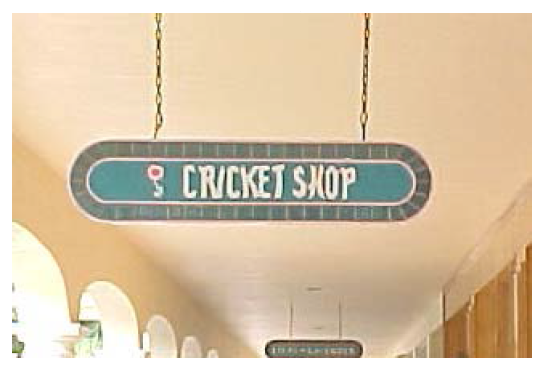
(Ord. No. 2145-07, § 4, 11-26-07)
Unified control means all land included for purposes of development within a planned unit development district owned or under control of the applicant for such designation with a commitment made under present ownership binding future owners to comply with all planned unit development standards and provisions. The applicant may proceed with development only after recording of the subdivision plat, in the case of a parcel of land five or more lots, sites or parcels, or two acres or more in area, and after certification by the city development director that the submitted items above required are in substantial conformance with all documents submitted and approved at the time of zoning to PUD. The applicant must produce evidence that would bind his successors in title to any commitments made upon approval of PUD.
Unified signage plan means a graphic and narrative representation of the signage to be utilized on the site. The unified signage plan shall include colors, construction materials and method, illumination method, copy style, and sign type(s) and location(s). The unified signage plan may be amended and resubmitted for approval to reflect style change or changing tenant needs.
(Ord. No. 2206-10, 7-12-10)
Unit, with respect to mobile homes, means any section or plot of ground for the accommodation of a single mobile home.
Unit, with respect to assisted living facility (ALF), means the area or room within the facility which is designated for the private, personal use and occupancy of specific resident(s), which use shall include, but not be limited to, such functions as sleeping, dressing, or any other functions normally performed in the privacy of a private residence. No more than two persons may occupy a unit at the same time.
Unlawful sign means a sign which does not meet the requirements of this Code and which has not received legal nonconforming status.
(Ord. No. 2145-07, § 4, 11-26-07)
Untrimmed mangrove means a mangrove that has not been trimmed over two successive growing seasons (years).
Urban agriculture means the use of land for the production, distribution and marketing of food. Urban agriculture comprises of community and school gardens; backyard and rooftop horticulture; and other innovative food production methods that maximize production in a small area that may have the ability to supply urban farmers markets and community supported agriculture.
Upland buffer means an area of undisturbed or appropriately managed vegetation surrounding a wetland that will minimize disturbances to the wetland during and after development.
Urban Code District Overlay Zone orurban district means that area of the city which is coterminous with the boundary of the community redevelopment area as established in Ordinance No. 1059 adopted to take effect on May 12, 1986, by the city commission of the City of Stuart, Florida.
Urban Code Subdistrict means that particular subdistrict of the Urban Code District for which a specific set of regulations apply, as described in this Code such as urban center and urban general.
Urban farm means an area of land managed and maintained by an individual or group of individuals growing and harvesting food crops and/or non-food, ornamental crops, such as flowers, for commercial sale, frequently sold directly to consumers and restaurants. Urban farms may be divided into separate plots for cultivation by one or more individuals or may be farmed collectively by members of the group and may include common areas maintained and used by group members. It is distinguishable from other types of farming by the diversity of crops grown on a small area of land, typically from under one acre to a few acres, or sometimes in greenhouses grown on site, including, but not limited to, using growing methods such as hydroponics.
Vacant development means a building or buildings which comprise a single development and have remained unoccupied for not less than 365 days, or for which there has been no active occupational license issued for more than 365 days, or for which there has been no active electric, water, or sanitation utility service for more than 365 days.
(Ord. No. 1678-99, 6-28-99)
Value of work of art means the total actual cost to create and install a work of art on a project site as determined by the city development director. The value of the work of art may only include a maximum of 15 percent to artist representatives, gallery dealers or art consultants to assist in the selection and procurement of required art work. Artists representatives, gallery dealers, and art consultants shall have no financial relationship with the artists or any ownership interest in art work purchased by the developer.
Variance means a grant of relief from the requirements of this ordinance, or the flood resistant construction requirements of the Florida Building Code, which permits construction in a manner that would not otherwise be permitted by this ordinance or the Florida Building Code. (As referenced in chapter 5 - Floodplain Management.)
(Ord. No. 2303-2015, 2-9-15)
Vehicular sign means a sign placed on vehicles or trailers that are parked in the public right-of-way or on private property for the primary purpose of displaying the sign.
(Ord. No. 2206-10, 7-12-10)
Verified wetland delineation means a determination of the extent of wetlands within a site that has been verified in writing by the State of Florida.
Vertical construction cost means the total actual construction costs, not including planning, surveying, appraisal, legal, architecture, permitting, site preparation or other so-called "soft" development costs, incurred in the construction of a building or buildings on a project site as determined by the city development director.
Via means a pedestrian walkway or passageway, which is located either between two buildings or within an individual building.
Vine means any ornamental plant requiring physical support to grow upwards.
Violation means the failure of a structure or other development to be fully compliant with the requirements of this ordinance. A structure or other development without the elevation certificate, other certifications, or other evidence of compliance required in this ordinance is presumed to be in violation until such time as that documentation is provided. (As referenced in chapter 5 - Floodplain Management.)
(Ord. No. 2303-2015, 2-9-15)
Visibility triangle means the area of land described as either of the following:
1.
The triangular area of property on each side of a driveway formed by the intersection of the driveway and the public right-of-way line with two sides of each triangle being ten feet in length from the point of intersection and the third side being a line connecting the ends of the two other sides; or
2.
The triangular area of property located at a corner formed by the intersection of two or more public rights-of-way with two sides of the triangular area being 30 feet in length along the abutting public right-of-way lines, measured from their point of intersection, and the third side being a line connecting the ends of the two other sides.
Vista means a visual corridor at ground level with an unobstructed view from any public right-of-way to the St. Lucie River or its tributaries such as Haney Creek and Frazier Creek.
V-shape sign means a sign containing two faces of approximately equal size erected upon common or separate structures, positioned in a "V" shape with an interior angle between faces of not more than 90 degrees.
(Ord. No. 2206-10, 7-12-10)
Walk-through facilities means an establishment which sells at retail certain food readily prepared for immediate consumption without facilities and services customarily incidental to a restaurant operation, including, but not limited to, waiter service. "Walk-up business" also means and includes other forms of retail business which are conducted with the customers being situated outside the structure in which the business is located, such as, but not limited to, exterior automatic tellers or exterior walk-up teller (banking) windows and the like; and ice cream or frozen dessert facilities.
Wall sign means a sign painted or attached parallel to the outside of a building.
Example:
(Ord. No. 2145-07, § 4, 11-26-07)
Warehouse, general storage, means an establishment whose principal use is the bulk storage of merchandise, products, or materials for distribution to other locations operated by the same business or establishment and may have an area within warehouse facility or in adjacent building for commercial and/or retail use, with minor traffic impacts This type of warehouse shall not include mini-storage. A residence may be located on the premise and occupied only by a caretaker or guard employed on the premises, and his or her family.
Warehouse, mini-storage, means a building or group of buildings in a controlled access or fenced area that contains varying sizes of individual compartmentalized and controlled access stalls or lockers for the dead storage of consumer goods or wares. For purposes of this category, "Dead storage" shall mean the storage of items not used on a day-to-day basis. A residence may be located on the premise and occupied only by a caretaker or guard employed on the premises, and his or her family.
Warehouse, wholesale and distribution, means any building designed, arranged, or used exclusively for the sale or distribution of goods, merchandise and commodities in gross, primarily for purposes of resale of these items. Wholesale sales are generally sold to retailers rather than directly to the consumer, or the products may be sold to industrial or institutional customers.
Waterborne sign means a sign displayed on a vessel plying the waterways, excluding those required by law for the identification of the vessel.
(Ord. No. 2206-10, 7-12-10)
Watercourse means a river, creek, stream, channel or other topographic feature in, on, through, or over which waters flow at least periodically. (As referenced in chapter 5 - Floodplain Management.)
(Ord. No. 2303-2015, 2-9-15)
Watershed means that area that has been identified in studies or adopted plans to drain into the St. Lucie River basin and includes those tributaries of the St. Lucie River being Poppleton Creek, Frazier Creek, Haney Creek, Willoughby Creek and Krueger Creek.
Water surface elevation means the height, in relation to the National Geodetic Vertical Datum (NGVD) of 1929 or the North American Vertical Datum (NAVD) of 1988, of floods of various magnitudes and frequencies in the floodplains of coastal or riverine areas. (As referenced in chapter 5 - Floodplain Management.)
(Ord. No. 2303-2015, 2-9-15)
Wayfinder sign means an off-premises sign designed to guide or direct pedestrians or vehicular traffic.
(Ord. No. 2145-07, § 4, 11-26-07)
Wetland means an area that is inundated or saturated by surface water or ground water at a frequency and a duration sufficient to support, and under normal circumstances does support, a prevalence of vegetation typically adapted for life in saturated soils and which is verified to be a "wetland" by the State of Florida, as defined in F.A.C. ch. 62-340.200(19), as amended from time to time.
Wetland delineation means the process by which wetlands are mapped and located within a project site.
Wetland mitigation means the creation of wetland values and functions to offset direct and indirect development impacts to existing wetlands resulting from a proposed project.
Whip antenna means a cylindrical antenna that transmits in all directions.
Width means a lineal dimension of a site or building measured on a line parallel to the line of the street frontage.
Wind sign means a sign consisting of banners, pennants, ribbons, spinners, streamers, balloons, or other objects or material fastened in such a manner as to move upon being subjected to pressure by natural or artificial wind.
(Ord. No. 2145-07, § 4, 11-26-07)
Window sign means any sign placed on the inside or outside of any window of any building or door and which is visible from any public right-of-way. This does not include merchandise on display.
Works of art or urban public art or public art or art work or art (as variously used within this Code) means an object or objects created or produced according to aesthetic principles by a professional artist, including, but not limited to, sculptures, fountains, engravings, carvings, murals, collages, mosaics, statues, special landscape treatments and collaborative design projects between architects or landscape architects and artists that may include a public courtyard and/or a special landscape treatment. To constitute a public work of art, the object must be readily visible to the public. Not more than 50 percent of the total art displayed on private property may be interior to a building. Art within a building must be displayed in an unrestricted public venue such as a public lobby and must be accessible to the general public during normal business hours, at least eight hours per day, five days per week.
Written or in writing means and includes any representation of words, letters or figures, whether by printing or otherwise.
Xeriscape landscaping means a set of design and maintenance principles which promote good horticultural practice and the economic and efficient use of water.
Yard means that area which lies between the principal or accessory building or buildings and the nearest lot line. Such yard is unoccupied and unobstructed from the ground upward, except as may be specifically provided in this Code.
Yard means a building setback area of open space in which no structure of a height greater than four feet may be located except as provided herein. (As referenced in chapter 3.)
Yard, front, means a yard extending between the side lot lines across the portion of a lot adjacent to a street. On corner lots, the front yard shall be provided facing the street on which each lot of record or lots of record involved have their lesser dimension.
Yard, rear, means a yard extending across the rear of a lot between the side yard lines. The rear yard shall be at the opposite end of the lot from the front yard, excepting in the case of through lots.
Yard, side, means a yard extending along the side of a lot between the rear line of the front yard and the rear lot line.
(Ord. No. 1841-02, § 1, 6-10-02; Ord. No. 1872-02, § 1, 10-10-02; Ord. No. 1978-04, § 1, 6-28-04); Ord. No. 2010-05, § 2, 2-14-05; Ord. No. 2014-05, § 1, 2-14-05)
Year means a calendar year, unless otherwise indicated.
Zoning in progress means the city intends to make a text amendment or district map change to the Land Development Code, and apply that change to development applications submitted following the declaration of zoning in progress. Additionally, zoning in progress allows a temporary hold on development orders, permits and licenses already in progress, if there is a pending change in the Land Development Code that would affect the development order, permit or license.
(Ord. No. 2056-05, § 2, 11-28-05)
Zoning in progress period orfreeze period means the period of time allowed in the Land Development Code, beginning with public notice of a proposed zoning measure, and continuing through final consideration of such zoning measure by the city commission, plus any applicable appeal periods, or periods tolled by developer postponements, but not longer than permitted in the Land Development Code.
(Ord. No. 2056-05, § 2, 11-28-05)

