Stuart City Zoning Code
CHAPTER IV
CONCURRENCY DETERMINATIONS
4.01.00. - PURPOSE AND INTENT
It is the purpose of this chapter to describe the requirements and procedures for determination of concurrency of proposed development projects with the City of Stuart Comprehensive Plan. Specifically, this chapter is intended to ensure the availability of public facilities and services and the adequacy of those facilities at adopted levels of service concurrent with the issuance of certificates of occupancy. This intent is implemented by means of a concurrency management system which shall measure the potential net change of impact by a proposed development upon the adopted level of service for potable water, sewer, solid waste, drainage, parks and recreation, transportation facilities and public educational facilities as provided in the capital improvements element of the Stuart Comprehensive Plan.
4.03.00. - LEVELS OF SERVICE
The following levels of service for each public facility and service type are hereby adopted by the city:
The following level-of-service (LOS) standards have been adopted by the City of Stuart and are reflected in the capital improvements element of the city's comprehensive plan.
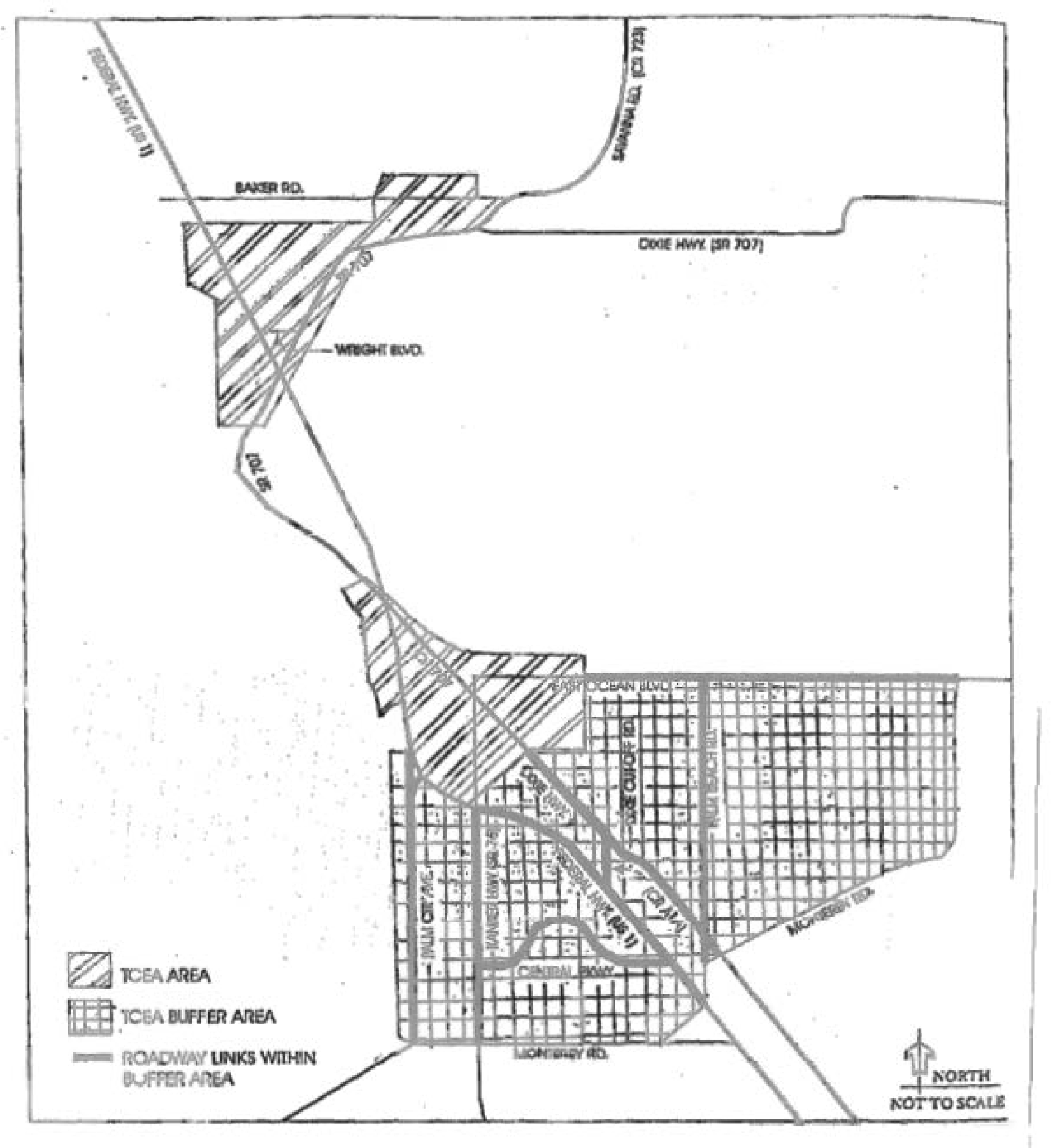
Both the TCEA and TCEA buffer area are illustrated on the map located at the end of chapter IV.
4.06.00. - STRATEGIES TO RECTIFY LACK OF CONCURRENCY
Strategies which may be considered in order to rectify the lack of concurrency include, but are not limited to, the following list. In all cases, these strategies may be considered effective only if one of the standards listed in sections 4.05.03.1.a., b.; 4.05.03.2.b.(1), (2); or 4.05.05A; and 4.09.00 as they pertain to specific facilities and services is achieved.
1.
A plan amendment which lowers the adopted level of service standard for the affected facilities and/or services.
2.
A renegotiated binding executed contract between the City of Stuart and the applicant and which would include the Martin County School Board if public school concurrency is in question.
3.
A renegotiated enforceable development agreement, which may include, but is not limited to, development agreements pursuant to F.S. § 163.3220.
4.
A change in the funding source.
5.
A reduction in the scale or impact of the proposed development.
6.
Phasing of the proposed development.
7.
In the case of deficient roadway capacity a proportionate share agreement in accordance with the provisions of section 4.05.06.
(Ord. No. 1811-02, § 1, 5-13-02; Ord. No. 2089-06, § 2, 11-27-06)
4.07.00. - RENEGOTIATION OF CERTIFICATE OF CONCURRENCY AND/OR PROPORTIONATE SHARE AGREEMENT
After the issuance of a concurrency reservation certificate, should any of the conditions provided for in section 4.05.03.1.a., b., 4.05.03.2.b.(1), (2), or 4.05.05A. not be satisfied, specifically:
1.
If there was a valid, unexpired act of an agency or authority of government upon which the applicant reasonably relied in good faith; and/or
2.
If the applicant, in reliance upon the valid, unexpired act of government, has made a substantial change in position or has incurred extensive obligations or expenses; then upon demonstration of one or both of the above conditions by the applicant, there shall be a meeting of the parties to renegotiate the conditions of the concurrency reservation certificate and/or the proportionate share agreement.
(Ord. No. 1811-02, § 1, 5-13-02; Ord. No. 2089-06, § 3, 11-27-06)
Sec. 4.02.01. - Concurrency reservation certificate required
A binding concurrency reservation certificate shall be required prior to the issuance of a building permit. If a development will require more than one building permit, the issuance of a concurrency reservation certificate shall occur prior to the issuance of the initial building permit.
Sec. 4.02.02. - Initial determination of concurrency
As part of the required site plan review, an initial determination of concurrency shall be performed, and a concurrency reservation certificate issued for the subject development. This concurrency reservation certificate shall not be binding upon the city. The concurrency reservation certificate only becomes binding when a developer receives site plan approval, receives building permits to commence construction, and pays all applicable impact and permit fees for the subject development.
(Ord. No. 1811-02, § 1, 5-13-02)
Sec. 4.02.03. - Expiration of certificate of concurrency
A concurrency reservation certificate shall automatically expire simultaneously with the expiration of the development permit to which it applies. Unless otherwise stated, development permits expire in six months. In the event that a time extension is granted prior to the expiration of the development permit, then the accompanying concurrency reservation certificate shall be automatically renewed for up to one year after the date of the issuance of the initial development permit. Should the extension equal or exceed one year from the date of the issuance of the initial development permit, a new concurrency review shall be performed for which a reasonable fee shall be assessed in order to defray the cost of the new review.
A proposed development which has received a development permit and a concurrency reservation certificate but has not pulled building permits by the end of the allowed time period will be considered non-vested, and a new traffic study will be required.
Upon the written request of the applicant, both the concurrency reservation certificate and the site plan approval may be extended in increments of six months; however, in no case shall the concurrency reservation exceed a total of 18 months. In the event that construction does not commence on an approved development within 18 months, a new traffic study shall be required. If any collected roadway impact fees have not been expended or encumbered, then the applicant may apply for a refund as provided in section 32-69 of the City Code.
(Ord. No. 1811-02, § 1, 5-13-02)
Sec. 4.02.04. - Burden of proof.
The burden of showing concurrency with the adopted levels of service shall be upon the applicant. The city development director or his/her designee will direct the applicant to the appropriate staff to assist in the preparation of the necessary documentation and information.
Sec. 4.04.01. - Properties within the traffic concurrency exception area.
Except for proposed developments which do not require major development plan approval or planned unit development approval, development which is proposed on properties located within the boundaries of the transportation concurrency exception area and which is consistent with the city's community redevelopment plan shall be exempt from concurrency review. A concurrency review exception certificate shall be issued for such developments. For proposed development within the TCEA that requires major development plan approval or planned unit development approval, the following shall be required.
1.
A traffic statement shall be required for proposed developments that have the potential to generate 19 or fewer peak-hour trips; and
2.
A traffic study shall be required for proposed developments that have the potential to generate 20 or more new peak-hour trips.
3.
On-site and off-site mitigation of traffic impacts (e.g., traffic signals, turn lanes, curb cuts) may be required for either type of development.
Sec. 4.04.02. - De minimis.
If a proposed development relates to land use in such a low intensity as to have a de minimis effect, if any, upon the levels of service as adopted, the development shall be exempt from concurrency review. A concurrency review exception certificate shall be issued for the de minimis development. The following types of development shall be considered to have a de minimis effect:
1.
New single-family or new duplex residential construction on a legal lot of record existing prior to July 23, 1990; and
2.
Development proposals which do not require major site plan approval or planned unit development approval and which do not have the potential to create 20 or more net peak-hour trips.
(Ord. No. 1811-02, § 1, 5-13-02)
Sec. 4.04.03. - Vested projects.
Nothing in this chapter shall be construed or applied to constitute a temporary or permanent taking of private property without the just compensation or abrogation of vested rights.
Any applicant for a building permit who alleges that this chapter, as applied, constitutes or would constitute a temporary or permanent taking of private property or an abrogation of vested rights must affirmatively demonstrate the legal requisites of the claim by meeting all three of the following conditions:
1.
A development permit has been issued on or prior to July 23, 1990;
2.
Development has commenced; and
3.
Development is continuing in good faith.
Upon demonstrating that all three conditions are met, the applicant will be issued a concurrency review exception certificate by the city development director or his/her designee.
Sec. 4.04.04. - Pre-approved service areas.
A.
Generally. Pre-approved service areas may be designated by the city in an effort to identify specific areas in which a surplus of capacity exists and to which the city would like to direct growth.
B.
Designated areas. The following pre-approved service areas have been designated by the city:
1.
All properties that are located within the boundaries of the Stuart Community Redevelopment Area (CRA) and for which proposed development is consistent with the community redevelopment plan.
C.
Annual re-evaluation. The city, as part of its annual concurrency report, will re-evaluate the existing capacity within pre-approved service areas to ascertain that there continues to exist adequate capacity to meet future demand.
(Ord. No. 1811-02, § 1, 5-13-02)
Sec. 4.04.05. - Public transit facilities.
Public transit facilities, as defined in F.S. § 163.3180(5)(h)2, are exempt from concurrency requirements.
Sec. 4.05.01. - Generally.
In order to implement a concurrency management system for roadway capacity, a traffic study is required for any proposed development which has the potential of generating 20 or more net peak hour trips.
Proposed developments with the potential to generate less than 20 or more net peak hour trips should prepare a traffic statement estimating daily trip generation.
Sec. 4.05.02. - Calculation of project demand; traffic study criteria.
For all non-exempt proposed developments that have the potential of generating 20 or more net peak hour trips, an approved traffic study shall be required prior to the issuance of a concurrency reservation certificate as part of development approval. The methodology to be used in a traffic study shall include the following criteria:
1.
General. The traffic study shall be performed by a professional engineer licensed in the State of Florida who is practicing in the field of traffic engineering or transportation, shall utilize commonly-accepted traffic engineering principles, and shall be signed and sealed by a professional engineer.
2.
Trip generation. Unless otherwise noted, trip generation from a proposed development shall be estimated using the information available in the latest edition of the Institute of Transportation Engineers trip generation report. In instances where local trip generation rates have been developed, such rates may be used in the traffic study subject to the approval of the city development director.
3.
Net trip generation. The potential trip generation from a proposed development may be reduced due to passers-by or internal capture. Subject to the approval of the city development director, the use of "vehicle miles traveled" (VMT) may be incorporated into the analysis to provide justification for trip capture. If any of these factors are included in the traffic study, they shall utilize accepted traffic engineering principles. The resulting trip generation or net trip generation shall be used to distribute and assign traffic in the study area.
4.
Trip distribution and assignment. Total traffic generated by the proposed development shall be assigned to each roadway link and intersection on the Stuart Concurrency Roadway Network within the study area based on accepted traffic engineering principles.
5.
Study area. At a minimum, the traffic study shall analyze directly accessed links on first accessed roadways within the Stuart Concurrency Roadway Network. All roadway links within the Stuart Concurrency Roadway Network where project traffic is estimated to consume five percent or greater of the adopted level-of-service volume shall also be included in the study. Project traffic that creates an impact greater than five percent of the adopted level-of service volume on any roadway shall be analyzed for traffic concurrency. Roadway sections shall be determined using the latest edition of the Highway Capacity Manual (prepared by the Transportation Research Board). All signalized intersections within a roadway link where project traffic is estimated to consume five percent or greater of the adopted level-of-service volume of the roadway link shall be included in the traffic study. At the direction of the city development director, additional un-signalized intersections may be required as part of the traffic study.
6.
Buildout period. For phased projects, the projected build out period of the proposed development, as defined by the issuance of the final certificate of occupancy for the project, shall be included in the traffic study and subject to the review and approval of the city development director.
7.
Background traffic. It is assumed that existing traffic is likely to increase or decrease during the build out period of the development. This potential increase/decrease shall be included in the traffic study as background traffic. The city will utilize the growth projections prepared annually by the University of Florida's Bureau of Economic and Business Research. Historical growth as well as approved, but not yet built, developments need to be included as part of background traffic. Any un-built project which is projected to add more trips than ten percent of the adopted level-of-service volume within the proposed development's study area shall be added as background growth. Accepted traffic engineering principles shall be used when estimating background traffic to assure there is no double-counting of traffic.
8.
Project driveways. An analysis of all driveways into the project shall be performed which includes, at a minimum, projected turning movements in and out of the project during the a.m. and the p.m. peak hours. A capacity analysis of the proposed driveways shall be performed to determine the need for separate turning lanes and/or any other necessary improvement. In addition, projects which are not located along the Stuart Concurrency Roadway Network shall include an analysis of the first intersection within the Stuart Concurrency Roadway Network. This analysis shall include capacity and operation of the intersection at build out of the project.
9.
Level-of-service volumes. Level-of-service volumes shall be determined based on one of the following sources as chosen by the applicant:
a.
The generalized tables included in the latest version of the Florida Department of Transportation (FDOT) Level of Service Manual; or
b.
The ART PLAN analysis included in the latest version of the FDOT Level of Service Manual.
10.
Analysis time period. The traffic study shall be performed on a.m. and p.m. peak-hour/peak-direction conditions.
11.
Existing traffic. For calculating existing traffic, the traffic study shall utilize current traffic counts as well as approved but un-built developments which required major plan approval or planned unit development approval. The city will prepare or provide maps or tables with existing traffic counts which will be updated annually or as data becomes available.
12.
Existing roadway improvements. Roadway improvements which are scheduled for construction in the first three years of the capital improvement programs of the city and Martin County and the Florida Department of Transportation Adopted Work Program, shall be considered as existing improvements for purposes of the traffic study.
13.
Existing use. For a proposed development on a property upon which there is an existing use, the traffic study shall address the net change of the proposed development, or the change in peak-hour traffic above that which is generated by the existing use. For purposes of the traffic study, any structure which has been vacant or abandoned for more than two years shall not be considered an existing use. Occupancy of the structure shall be proved by electric or water bills, leases, certificates of occupancy, and other indicia deemed sufficient by the city development director.
14.
Applicability. The standards and methodology described herein shall apply to the whole study area of the proposed development, within and outside the city limits.
(Ord. No. 2089-06, § 1, 11-27-06; Ord. No. 2114-07, § 1, 7-23-07)
Sec. 4.05.03. - Evaluation of available capacity.
1.
For sanitary sewer, solid waste, drainage, and potable water. The available capacity (K) shall be determined by adding together:
a.
The total of the existing excess capacity, if any; and
b.
The total future capacity of any proposed construction or expansion that meets the following requirements:
(1)
The necessary public facilities and services are in place at the time the building permit is issued; or
(2)
The building permit is issued subject to the condition that the necessary public facilities and services shall be in place when the impacts of the development occur; or
(3)
The necessary public facilities and services are under construction at the time the permit is issued; or
(4)
The necessary public facilities and services are guaranteed in an enforceable development agreement, pursuant to F.S. §§ 163.3220 through 163.3243.
2.
For parks and recreation. The available capacity (K) shall be determined by adding together:
a.
The total of the existing excess capacity of existing facilities, if any; and
b.
The total future capacity of any proposed construction or expansion that meets one of the requirements of section 4.05.03.1.b.(1) through (4) of this chapter or one of the following requirements:
(1)
At the time the building permit is issued, the necessary facilities and services are the subject of a binding executed contract which provides for the commencement of the actual construction of the required facilities or the provision of services within one year of the issuance of the building permit; or
(2)
The necessary facilities and services are guaranteed in an enforceable development agreement that required facilities or the provision of services within one year of the issuance of the applicable development building permit. An enforceable development agreement may include, but is not limited to, development agreements pursuant to F.S. § 163.3220, or an agreement or building permit issued pursuant to F.S. ch. 380.
3.
For roads. Evaluation of available capacity for roads is found in section 4.05.05.
(Ord. No. 2089-06, § 1, 11-27-06; Ord. No. 2114-07, § 1, 7-23-07)
Sec. 4.05.04. - Concurrency test.
The methodology for determining whether the levels of service of city facilities and services are adequate to support the impact of proposed developments shall be the application of a concurrency test. The concurrency test shall compare the available capacity to the demand of the proposed development. For each facility, with the exception of roads, the test is described as follows:
Available Capacity (K) - Project Demand (L) =
Surplus(+) or Deficiency(-) (M)
A concurrency reservation certificate shall be issued only if the available capacity meets or exceeds the demand of the proposed development.
(Ord. No. 2089-06, § 1, 11-27-06; Ord. No. 2114-07, § 1, 7-23-07)
Sec. 4.05.05. - Transportation analysis.
A.
Generally. The concurrency test for roads shall compare the existing level of service for the affected roads to the level of service standards, as adopted, for the same. The existing level of service shall be based upon existing roads, including any proposed improvements to these roads, meeting the minimum requirements set forth in subsections 4.05.03.1.b.(1) through (4) or 4.05.03.2.b.(1) and (2) or of the requirement that the five-year schedule of capital improvements demonstrates that the actual construction of the road facility or service will be scheduled to commence in or before the third year.
B.
Test. As part of the traffic study, the following test shall be applied to all arterial and collector road segments in the city:
1.
Where:
C = capacity for affected road segments (link) at LOS E (peak-hour/peak-direction).
V = existing volume on affected road segment, (peak-hour/peak-direction).
B = background traffic.
D = demand placed upon road segment by proposed project, using latest edition of ITE Trip Generation.
V/C = existing volume-to-capacity ratio.
2.
Then: V + B + D = N
Where: N = future total volume upon road segment.
3.
The future total volume (N) is then used to calculate a new volume-to-capacity ratio, N/C.
4.
If N/C < 1.0 then this shall signify that the proposed development does not result in a degradation of the affected roads below the adopted level of service, and a concurrency reservation certificate shall be issued.
If the city determines that a concurrency reservation certificate cannot be issued, that determination shall be reduced to writing, signed by the official making the determination, and sent by U.S. mail to the applicant.
C.
Notification of a lack of capacity to satisfy transportation concurrency.
1.
The applicant shall be notified in writing of the determination that a concurrency reservation certificate cannot be issued together with notification of the opportunity to satisfy transportation concurrency through the proportionate share program pursuant to the requirements of subsection 4.05.06.B.
2.
Prior to submitting a proposal for a proportionate share agreement, a pre-application meeting shall be held to discuss eligibility, additional submittal requirements, potential mitigation options, and related issues.
3.
Within ten working days of the provision of all submittal requirements, the applicant shall be notified in writing of the sufficiency of the proportionate share mitigation proposal.
4.
A proposed proportionate share obligation and binding agreement will be prepared by the applicant with direction from the City of Stuart and delivered to the appropriate parties for review, no later than 60 days from the date at which the applicant received the notification of a sufficient application.
5.
No proportionate share agreement will be effective until approved by the city commission, or pursuant to staff approval for agreements below $10,000.00.
(Ord. No. 2089-06, § 1, 11-27-06; Ord. No. 2114-07, § 1, 7-23-07)
Sec. 4.05.06. - Proportionate share transportation program.
A.
Purpose and intent. Pursuant to F.S. § 163.3180, it is the intent of the Legislature to provide a method by which the impacts of development on transportation facilities can be mitigated by the cooperative efforts of the public and private sectors through a proportionate share program.
B.
Applicability. The proportionate share program shall be available for any development in the City of Stuart that has been notified of a lack of capacity to satisfy transportation concurrency on a transportation facility in the City of Stuart Concurrency Management System, including transportation facilities maintained by FDOT or another jurisdiction that are relied upon for concurrency determinations. The proportionate share program does not apply to developments exempted from concurrency as provided in section 4.04.00 of this Code, the City of Stuart's Comprehensive Plan, or F.S. § 163.3180, regarding exceptions and de minimis impacts.
1.
An applicant may choose to satisfy all transportation concurrency requirements by contributing or paying proportionate share mitigation if transportation facilities or facility segments identified as mitigation for traffic impacts are specifically identified for funding in the five-year schedule of capital improvements adopted by the capital improvement element of the comprehensive plan. Only transportation facilities or facility segments specifically identified for funding in the five-year schedule of capital improvements shall be eligible for the proportionate share program; or
2.
An applicant may choose to satisfy all transportation concurrency requirements by contributing or paying proportionate share mitigation if such contributions or payments to such facilities or segments are reflected in the five-year schedule of capital improvements in the next regularly scheduled update of the capital improvement element of the comprehensive plan.
C.
Mitigation for development impacts to facilities on the strategic intermodal system requires the concurrence of the department of transportation.
D.
In the event the funds in the adopted five-year schedule of capital improvements which is adopted by the capital improvement element of the comprehensive plan are insufficient to fully fund construction of a transportation improvement required by the city's concurrency management system, the city commission and a developer may still enter into a binding proportionate share agreement authorizing the developer to construct that amount of development on which the proportionate share is calculated if the proportionate share amount in such agreement is sufficient to pay for one or more improvements which will in the opinion of the city commission significantly benefit the impacted transportation system. The improvement or improvements funded by the proportionate share component must be adopted into the five-year schedule of capital improvements at the next annual capital improvement element update.
E.
Design standards. Any improvement project proposed to meet the developer's proportionate share obligation must meet design standards of the City of Stuart for locally maintained roadways, Martin County for county maintained roadways and those of the Florida Department of Transportation (FDOT) for the state highway system.
F.
Determining proportionate share obligation.
(1)
Proportionate share mitigation for concurrency impacts may include, without limitation, separately or collectively, private funds, contributions of land, and construction and contribution of facilities.
(2)
The methodology used to calculate an applicant's proportionate share obligation shall be as provided for in F.S. § 163.3180(5)(h)2, as set forth below:
The number of trips from the proposed development expected to reach roadways during the peak hour from the stage or phase being approved, divided by the change in the peak hour maximum service volume of roadways resulting from construction of an improvement necessary to maintain or achieve the adopted level of service, multiplied by the construction cost, at the time of development payment, of the improvement necessary to maintain or achieve the adopted level of service.
This methodology is expressed by the following formula:
(3)
Reserved.
(4)
For the purposes of determining proportionate -share obligations, the City of Stuart shall determine improvement costs based upon the actual and/or anticipated cost of the improvement in the year that construction would occur as determined by the city engineer or an engineer appointed by the city commission to do so.
(5)
If the City of Stuart has accepted an improvement project proposed by the applicant, then the value of the improvement shall be determined by the city engineer or an engineer appointed by the city commission to do so.
(6)
If the City of Stuart has accepted right-of-way dedication for the proportionate -share payment, credit for the dedication of the right-of-way shall be established by an appraisal. If the value of the right-of-way is over $500,000.00, two appraisals shall be required. Said appraisal(s) shall be at no cost to the city and performed by an MAI designated appraiser approved by the city. The appraisal shall assume no approved development plan for the site and the right-of-way shall be valued at fair market value at no cost to the city, the applicant shall provide a title commitment and title policy acceptable to the city, three original surveys certified to the city and the title company and a phase 1 environmental site assessment acceptable to the City of Stuart. If the estimated value of the right-of-way dedication proposed by the applicant is less than the applicant's proportionate fair-share mitigation obligation, the applicant shall pay the difference.
H.
City of Stuart impact fee credit for proportionate share mitigation.
(1)
Proportionate share mitigation shall be applied as a credit against impact fees. Credits will be given for that portion of the applicant's transportation impact fees that would have been used to fund the improvements on which the proportionate fair-share contribution is calculated. If the proportionate share contribution is based on only a portion of the development's traffic, the credit will be limited to that portion of the impact fees on which the proportionate share contribution is based. The credit shall be reduced up to 20 percent by the percentage share that the project's traffic represents of the added capacity of the selected improvement.
(2)
Impact fee credits for the proportionate share contribution will be determined when the transportation impact fee obligation is calculated for the proposed development. If the applicant's proportionate share obligation is less than the development's anticipated road impact fee for the specific stage or phase of development under review, then the applicant or its successor must pay the remaining impact fee amount to the City of Stuart pursuant to the requirements of the City of Stuart impact fee ordinance.
(3)
The proportionate share obligation is intended to mitigate the transportation impacts of a proposed development at a specific location. As a result, any road impact fee credit based upon proportionate share contributions for a proposed development cannot be transferred to any other location.
I.
Proportionate share agreements.
(1)
Upon execution of a proportionate share agreement (agreement) the applicant shall receive a city certificate of concurrency approval. Should the applicant fail to apply for a building permit within 12 months of the execution of the agreement, then the agreement shall be considered null and void, and the applicant shall be required to reapply. Once a proportionate share payment for a project is made, no refunds shall be given unless the provisions of section 4.07.00 are met. All payments, however, shall run with the land.
(2)
Payment of the proportionate share contribution is due in full prior to issuance of building permit or recording of the final plat and shall be nonrefundable. If the payment is submitted more than 12 months from the date of execution of the agreement, then the proportionate share cost shall be recalculated at the time of payment based on the best estimate of the construction cost of the required improvement at the time of payment, pursuant to section G and adjusted accordingly.
(3)
All improvements accepted as proportionate share contributions must be completed as established within the proportionate share agreement and be accompanied by a security instrument that is sufficient to ensure the completion of all required improvements.
(4)
Dedication of necessary right-of-way for facility improvements accepted as proportionate share contributions must occur as established within the proportionate share agreement.
(5)
Any requested change to a development project subsequent to issuance of a development order shall be subject to additional proportionate share contributions to the extent the change would increase project costs or generate additional traffic that would require mitigation.
(6)
Applicants may submit a letter to withdraw from the proportionate share agreement at any time prior to the execution of the agreement. The application fee and any associated advertising costs to the city will be nonrefundable.
(7)
The city may enter into proportionate share agreements for selected corridor improvements to facilitate collaboration among multiple applicants on improvements to a shared transportation facility.
J.
Appropriation of share revenues.
1.
Proportionate share revenues shall be placed in the appropriate project account for funding of scheduled improvements as adopted in the city's capital improvement element (CIE), or as otherwise established in the terms of the proportionate share agreement.
2.
In the event a scheduled facility improvement is removed from the Capital Improvement Element (CIE) then the revenues collected for its construction may be applied toward the construction of another improvement within that same corridor or sector that would mitigate the impacts of development pursuant to the requirements on the congested roadway(s) for which the original proportionate share contribution was made.
(Ord. No. 2089-06, § 1, 11-27-06)
Sec. 4.08.01. - Contents.
The City of Stuart shall prepare an annual report as part of the concurrency management system and during the annual budget exercise that includes:
1.
An evaluation of each facility and service reflecting: (a) total capacity available, (b) percentage of total capacity being used at the time the report is prepared, and (c) reserved capacity as reflected by concurrency reservation certificates.
2.
An identification of all facility and service planned improvements and capacity expansion as reflected by the capital improvement element which will also be updated annually as part of the annual budget cycle.
3.
The School Board staff shall monitor the level of service standards for public school facilities within each concurrency service area to determine whether any deficiencies exist. In the event that one or more deficiencies are identified in the level of service standards for public school facilities, the school board shall initiate action to cure the deficiency by no later than the time of the next annual update of the public school facilities element.
Sec. 4.09.01. - Purpose and intent.
The intent of school concurrency is to ensure that the public school facilities necessary to maintain the adopted level of service for schools are in place before or concurrent with the school impacts of new residential development.
Sec. 4.09.02. - Application for school concurrency review.
A public school impact statement shall be completed by the applicant as part of the development application for the following:
(a)
Amendments to the Comprehensive Plan future land use map;
(b)
Residential rezonings;
(c)
Developments of Regional Impact; and
(d)
Site plan applications which include residential units.
The public school impact statement form shall be provided to the school district staff pursuant to the development review procedures of the city.
Sec. 4.09.03. - Determination of capacity.
Within 30 days after the school district staff receives a completed public school impact form for amendments to the Comprehensive Plan future land use map, rezonings, developments of regional impact, and site plans which include residential units, the school district staff shall provide the city with a general capacity analysis which indicates the generalized capacity for all applicable school facilities. This analysis shall be used in the evaluation of the development proposals, but shall not provide a guarantee of availability of services or facilities.
Sec. 4.09.04. - Final concurrency review.
Upon receipt of a completed public school impact form for site plans which include residential units, the School District staff shall provide the city with a school concurrency review report that states whether adequate school capacity exists for a proposed development as follows. The school concurrency review report shall be based on the level of service standards as set forth in chapter 10, Public Schools Facilities Element, Level of Service standards, of the city's Comprehensive Plan.
1.
Calculate the aggregate permanent capacity and temporary capacity for each type of school facility within the CSA within which the project is proposed to be located, and the CSA's which are adjacent thereto. For purposes of this calculation, permanent and temporary capacities shall include the capacities of both existing school facilities, as well as those which are planned to be operational by no later than the conclusion of the third year of the school board's Five Year Capital Improvement Plan. For purposes of this calculation, CSA's which are separated by rivers or other bodies of water shall only be deemed "adjacent" if connected by a publicly owned bridge accommodating vehicular traffic.
2.
Calculate available school capacity, by type of school and relevant CSA, by subtracting from the sums determined above:
a.
Current student enrollment (determined by the district's October count) for each type of school facility within the CSA within which the project is proposed to be located, and the CSA's which are adjacent thereto;
b.
Reserved capacity for student enrollment projected to be developed within three years from projects previously determined to have met school concurrency, and having met the requirements for a reservation of capacity for each type of school facility within the CSA, within which the project is proposed to be located, and the CSA's which are adjacent thereto;
c.
The demand on school facilities created by the proposed development shall be projected at the county-wide student generation rates specified in the school district's latest educational impact fee report, as the same may be amended from time to time upon request of the school board; provided that projects granted educational impact fee waivers pursuant to county ordinance shall be deemed to generate no students.
Sec. 4.09.05. - Public school facilities determination and exemptions.
The city shall approve site plans, which include residential units, only after the receipt of a school concurrency review report from the school district staff determining that adequate school capacity exists for the proposed development pursuant to the requirements of the Comprehensive Plan.
The following residential uses shall be exempt from the requirements of school concurrency.
a.
Single-family lots of record, existing as of August 25, 2008.
b.
Any new residential development that has development approval prior to September 25, 2008.
c.
Any amendment to any previously approved residential development that does not increase the number of dwelling units or changes the type of dwelling units (single-family to multi-family, etc.).
d.
Age restricted communities with no permanent residents under the age of 18. Exemption of an age restricted community will be subject to a restrictive covenant limiting the age of permanent residents to 55 years and older.
Sec. 4.09.06. - Mitigation.
In the event that the school board reports that mitigation may be accepted in order to offset the impacts of a proposed development, where the level of service standards otherwise would be exceeded, the following procedure shall be used.
The applicant shall initiate in writing a mitigation negotiation period with the school board in order to establish an acceptable form of mitigation, pursuant to F.S. § 163.3180(6)(h)2, the school concurrency ordinances of the county and the Interlocal Agreement for School Facilities Planning and Siting.
A.
Acceptable forms of mitigation may include:
1.
The donation of funding for the construction and/or acquisition of school facilities sufficient to offset the demand for public school facilities to be created by the proposed development;
2.
The creation of mitigation banking based on the funding of the construction of a public school facility in exchange for the right to sell excess capacity credits;
3.
Charter schools may also be accepted by the school board as mitigation under the provisions of this Agreement provided they meet the following operational and design standards:
a.
The school has a charter approved by the school board.
b.
The charter school's facilities to be accepted as mitigation shall be built according to the SREF standards set forth in Florida Administrative Code.
c.
The charter school's facilities to be accepted as mitigation adhere to the building policies and practices of the school board, including, but not limited to, architecture, building materials, and structural hardening.
d.
The core facilities for all charter schools, including, but not limited to, cafeteria, media center, administrative offices, and land area available for recreational uses, parking areas, and storm water retention, shall be sized to accommodate the standard educational facility sizes established by policy of the school board as follows:
Elementary school: 750 student stations.
Middle school: 1,200 student stations.
High school: 1,800 student stations.
e.
All charter schools shall be located along publicly-owned roadways and accessible to any member of the general public.
4.
Other mitigation as permitted by state law, including the donation of land and payment for land acquisition.
5.
Any mitigation funds provided as a result of the school concurrency system shall be directed by the school board toward a school capacity improvement identified in a financially feasible 5-year district work plan and which satisfies the demands created by that development in accordance with a binding developer's agreement.
B.
The following standards apply to any mitigation accepted by the school board:
1.
Proposed mitigation must be directed toward a permanent school capacity improvement which satisfies the demands created by the proposed development.
2.
Relocatable classrooms will not be accepted as mitigation.
C.
In accordance with F.S. § 163.3180(6)(h)1.c, the applicant's total proportionate-share mitigation obligation to resolve a capacity deficiency shall be based on the following formula, for each school level: multiply the number of new student stations required to serve the new development by the average cost per student station. The average cost per student station shall include both school site and central facility costs, and be as reported in the school district's latest educational impact fee report, as the same may be amended from time to time upon request of the school board; except that if the latest educational impact fee report is more than 12 months old then the reported average cost per student shall be increased or decreased annually in the same proportion as any annual percentage increases or decreases in the state-wide cost for new student station established pursuant to F.S. § 1013.64. Pursuant to F.S. § 163.3180(6)(h)2.b, , the applicant's proportionate-share mitigation obligation will be credited toward any other impact fee or exaction imposed.
D.
If the applicant and the school board are able to agree to an acceptable form of mitigation, a legally binding mitigation agreement shall be executed, which sets forth the terms of the mitigation, including such issues as the amount, nature, and timing of donations, construction, or funding to be provided by the developer, and any other matters necessary to effectuate mitigation. The mitigation agreement shall specify the amount and timing of any impact fee credits or reimbursements that will be provided by the city as required by state law.
E.
If the applicant and the school board are unable to agree to an acceptable form of mitigation, the school board will report an impasse to the city in writing and the school district staff will not issue a school concurrency review report confirming that the project is in compliance with the terms of the school concurrency ordinance.