
Sugar Land City Zoning Code
CHAPTER 10
DEFINITIONS
Sec. 10-1.- Application.
This Chapter contains definitions of words used in the Development Code. Words not defined in this Development Code shall have the meaning as defined in the Code of Ordinances, if any. When a word is defined in a separate Chapter of this Development Code, the definition used therein shall govern over any conflicting definition of this Chapter. Words not expressly defined in this Development Code are to be determined in accordance with customary usage.
Sec. 10-2. - Computation of Time.
In computing any period of time prescribed in this Code, the day of the event from which the period of time begins to run is not included. The last day of the period is included, unless it is Saturday, Sunday or a legal holiday. When the period of time is less than 7 days, Saturdays, Sundays and legal holidays are used in the computation. A "legal holiday" is any day designated as a holiday by the City. Whenever a notice, petition, or other document is required to be filed within a specified time period, it must be filed with the appropriate City office not later than 5:00 p.m. on the last day of the computed period.
Sec. 10-3. - Definitions.
A
Access Easement means an easement designated on the Final Plat or by separate instrument that provides access to platted Lots. Access easements may include Cross Access, Joint Access, or Primary Access Easements.
1.
Cross Access means access between reserves or lots within a development for the purpose of providing connections from 1 lot or reserve to another without re-entering Public Streets, Nonresidential Private Streets or Primary Access Easements.
2.
Joint Access means a shared driveway or drive aisle providing access from a Public Street, Nonresidential Private Street, or Primary Access Easement into or through a parking lot.
3.
Primary Access Easements means privately owned and maintained route that provides access from a Public or Private Street to 1 or more lots or reserves. Primary Access Easements serve as the primary access route to lots or reserves without direct access to a Public or Private Street.
Accessory Building or Structure means a building or structure that serves a use customarily incidental to and located on the same lot occupied by the principal building. Common accessory buildings or structures include Private Garages and carports, farm structures, tool houses, greenhouses, home workshops, children's playhouses, storage houses, and garden shelters.
Accessory Use means a use of a building or land which serves an incidental function to the principal use of a building, structure, or land.
Advertising means to convey information to, seek the attraction of or to direct the attention of the public to any location, event, person, activity, goods, services or merchandise.
Alley means a minor street not intended to provide the primary means of access to abutting lots, that is used primarily for vehicular service access to the back or sides of lots.
Alternative Tower Structure means man-made structures such as clock towers, bell towers, church steeples, water towers, light poles and similar alternative-design mounting structures that camouflage or conceal the presence of antennas and towers.
Amateur Radio Station means the apparatus used by an "amateur operator" to operate a licensed "amateur radio service", as those terms are defined by federal law or regulations.
Ancillary Use means certain retail uses, as specified in the land use matrix, that are permitted uses in an office building under the conditions specified in these zoning regulations.
Antenna means any exterior apparatus designed for telephonic, radio, or television communications through the sending or receiving of electromagnetic waves.
Arbor (see Pergola)
Arcade means a covered passageway, typically found at street level, often comprised of a series of arches supported by columns.
Arterial Street means an arterial street as defined by the City's adopted Master Thoroughfare Plan or plans for streets.
Awning means a cover that projects from a wall of a building over a window or entrance to provide weather protection and architectural spatial definition. The top surface of an awning is typically sloped. An awning may be fixed in place or retractable. An awning is completely supported by the building.
B
Bicycle ParkingSpace means a single space provided for locking a single bicycle to a Bicycle Rack.
Bicycle Rack means a device consistent with industry standards that is capable of supporting a bicycle in a stable position where it may be locked securely.
Blank Wall means a wall which has few or no windows or doors, and has no decoration or visual interest.
Block Length means the total length of continuous street or primary access easement uninterrupted by intersecting streets or primary access easements.
Board means the City's Zoning Board of Adjustment.
Breezeway means a porch or roofed passageway open on the sides, for connecting 2 buildings, as a house and a garage.
Build-to Zone means the area between the minimum and maximum setbacks.
Building means any structure built for the support, shelter, and enclosure of persons, animals, chattel, or movable property of any kind.
Building Line means a line parallel or approximately parallel to the front, side, or rear lot line that marks the minimum distance from the front, side, or rear lot line that buildings on the lot must be located, as determined by the required front, rear, and side yards for the lot or as specified on the plat for the lot. On lots or alleys with access from an Access Easement, the building line is measured from the nearest edge of curb rather than from the property line (see Figure 10-3.A).
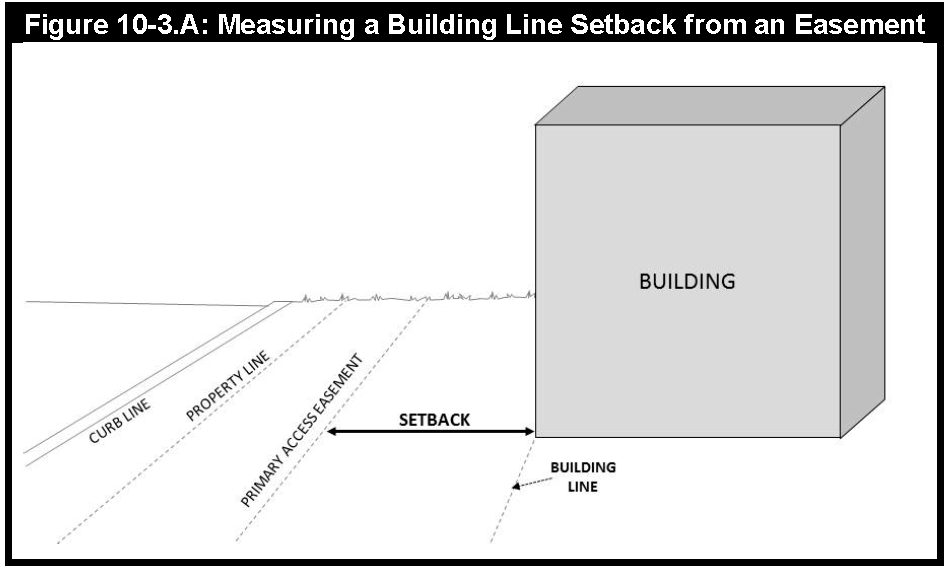
Figure 10-3.A
Bulk Plane means an imaginary inclined plane rising over the developable portion of the lot at a specified ratio for that district beyond which no portion of a building may extend. The method for establishing a Bulk Plane is as follows (see Figure 10-3.B):
1.
Start at building line of the property;
2.
Locate a point 24 feet above the ground at the building line;
3.
From that point, draw a line that rises over the lot at a specified ratio from the building line as specified in the required "Bulk Plane ratio" for that district.
4.
The line extending from the vertical line establishes the bulk plane over the lot, as illustrated.
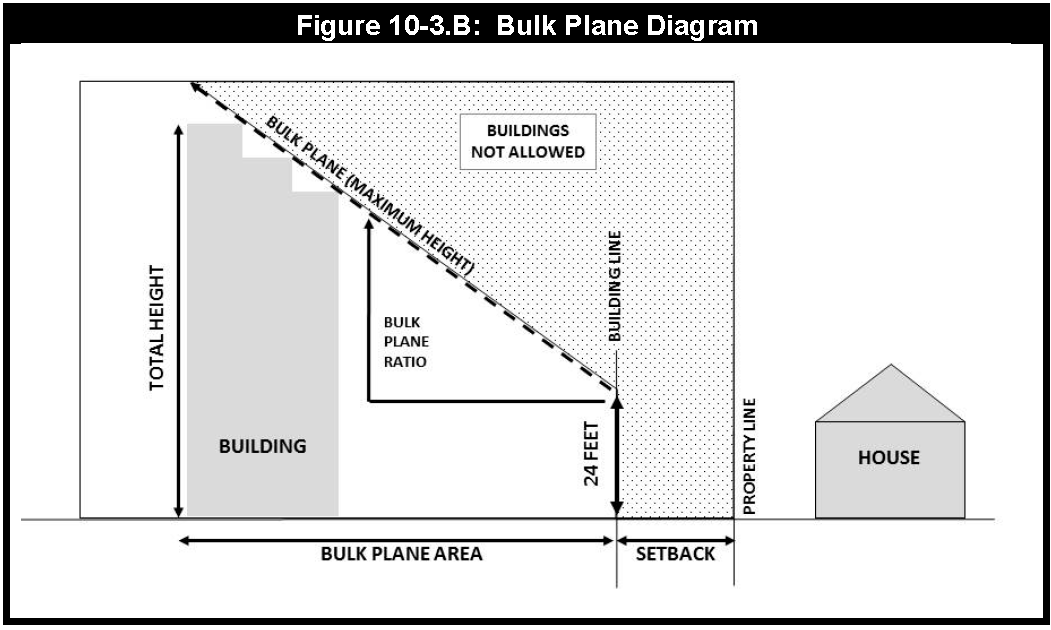
Figure 10-3.B
C
Canopy means a permanent, flat-roof shelter covering a sidewalk, driveway, or other similar area, that may be wholly supported by a building or may be wholly or partially supported by columns, poles, or braces extended from the ground.
Carport means a structure open on a minimum of 3 sides designed or used to shelter vehicles.
Certificate of Occupancy means a document issued by the City allowing for occupancy or use of a building, and certifying that the structure or use has been constructed or will be used in compliance with all applicable ordinances and codes of the City of Sugar Land.
City means the City of Sugar Land, Texas.
City Council or Council means the City Council of the City.
Civic Space means an enhanced pedestrian space available to the public. May include parks, squares, plazas, playgrounds, trails adjacent to natural geographic features, boardwalks, or other open spaces for public use which may be privately or publicly owned and operated.
Clear Zone means a component of the Pedestrian Realm intended to provide a clear path of travel for pedestrian movement, also known as a sidewalk.
Collector Street means a collector street as defined by the City's adopted Master Thoroughfare Plan.
Commission means the Planning and Zoning Commission of the City.
D
Design Standards means the currently adopted document which provides the general requirements for the design of public improvements, private improvements that connect to or affect the public infrastructure and the supporting documents for approval in the City and its extraterritorial jurisdiction. Specific design criteria are included in the document. The Design Standards are incorporated into the Development Code as Chapter 6.
Detached means a building that does not have a wall in common or in contact with another building.
Development Review Committee means a committee of City staff members from various departments, such as Planning, Engineering, Building Permits and Inspections, and Public Works, tasked with reviewing and processing development applications.
Director means the person designated or assigned by the City Manager to administer the zoning regulations or any other provisions of this Code. Director includes any person authorized to perform the duties of the Director.
Dwelling means a building designed exclusively for residential use, other than motels or hotels.
Dwelling, Live/Work. See Live/Work Dwelling.
Dwelling, Multi-Family. See Multi-Family Dwelling.
Dwelling, Multiplex. See Multiplex Dwelling.
Dwelling, Single-Family Attached (Townhome). See Single-Family Attached Dwelling (Townhome).
Dwelling, Single-Family Detached. See Single-Family Detached Dwelling.
Dwelling, Sixplex See Sixplex. Dwelling.
Dwelling, Triplex or Fourplex. See Triplex or Fourplex Dwelling.
Dwelling, Two-Family (Duplex). See Two-Family Dwelling (Duplex).
Dwelling Unit means a building or portion of a building designed to provide independent living facilities for not more than 1 family and that contains bathroom facilities and not more than 1 kitchen.
Dwelling, Urban Home. See Urban Home Dwelling.
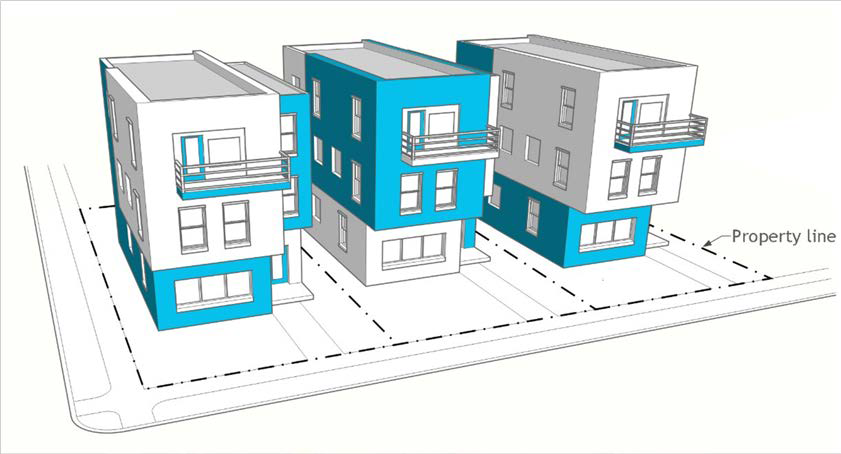
Dwelling, Urban Home
E
Effective Area means the largest imaginary rectangle that encloses all extremities of a sign, calculated from an orthographic projection of the sign viewed horizontally as the viewpoint is rotated horizontally around the sign. Measuring the Effective Areas of signs is described in Chapter 4: Sign Regulations.
F
FAA means the Federal Aviation Administration.
FAA Form 7460 means a form provided by the Federal Aviation Administration as a requirement for applicants proposing construction or alteration to buildings near aviation facilities.
F.A.R. means the floor to area ratio of a Premises zoned R-1E, R-1R, R-1, HR-1, or R-1Z, and is calculated by dividing the sum of the total square feet of the climate controlled areas of a Dwelling plus the total square feet of all Accessory Buildings located on the same lot as the Dwelling by the lot's total square feet. This definition does not apply to any Premises:
1.
Platted as PUD prior to the date the lot was annexed into the City; or
2.
Zoned as Planned Development District (PD).
FAR Part 77 means a section of the Federal Regulations that establishes:
1.
Requirements to provide notice to the FAA of certain proposed construction or alteration of existing structures,
2.
Standards used to determine obstructions to air navigation and communication facilities,
3.
The process for aeronautical studies of obstructions to air navigation to determine the effect on the safe and efficient use of navigable airspace, and
4.
The process to petition the FAA for discretionary review of determinations.
FCC means the Federal Communications Commission.
Family means:
1.
One or more persons who are related by blood, marriage, adoption or guardianship, including foster children, exchange students, and servants, together with not more than 2 additional persons not related by blood, marriage, or adoption to the previously identified individuals or group, living together as a single housekeeping unit; or
2.
The persons living together in a Dwelling Unit that meet the definition, qualifications, and restrictions of a "community home", as set forth in chapter 123 of the Texas Human Resources Code, as amended.
Fence means a freestanding structure typically constructed of wood, brick, stone, concrete or other similar building materials and erected to enclose or visually screen a premises.
Filed or Filing Date means the date when an application, along with any required information, plans, documents and fees have been received by and acknowledged in writing by the City as being complete for purposes of processing the application. Filed may also refer to the date on which a document is recorded with the county clerk or received by TCEQ or another government entity.
Floor Area means the total square feet of floor space within the exterior walls of a building, including each floor level, but excluding carports, porches, residential Private Garages, and breezeways.
Freeway means a freeway as defined by the City's adopted Master Thoroughfare Plan.
G
Garage, Parking refers to a building designed and used for the storage of motor vehicles either operated as a business enterprise or in conjunction with a business that may or may not have a service charge or fee being paid to the owner or operator for parking or storage of privately owned vehicles.
Garage, Private refers to a building for private use of the owner or occupant of a principal building (situated on the same lot as the principal building) for the storage of motor vehicles.
Governmental Entity means the United States, the State of Texas, Fort Bend County, the City or an independent school district, or agency thereof.
H
Height means:
1.
In measuring the height of a building, the vertical distance from the average ground level abutting a building to the highest point of the coping of a flat roof, the deck line of a mansard roof, or the average height of the highest gable of a pitched or hipped roof. (See Figure 10-3.C)
2.
In measuring the height of a structure, other than a building, the vertical distance from the average ground level abutting the structure to the highest point of the structure.
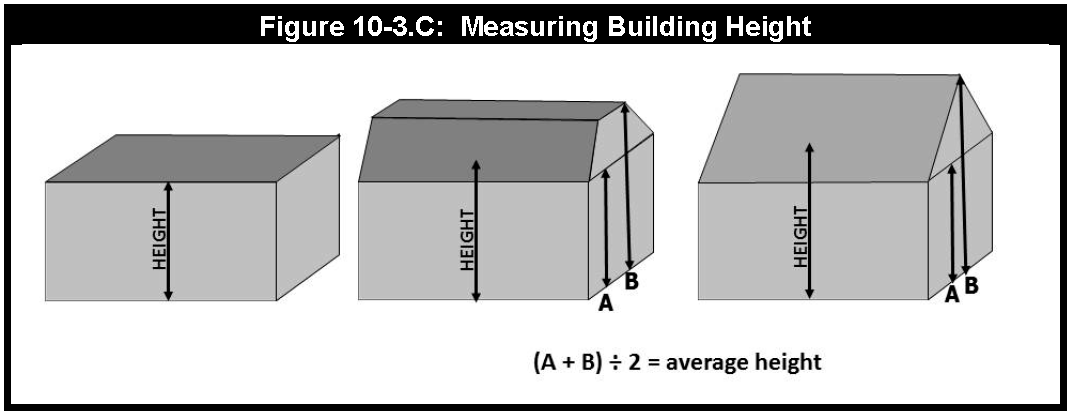
Figure 10-3.C
Highway means a highway as defined by the City's adopted Master Thoroughfare Plan.
Home Occupation means a business activity carried on in a dwelling in compliance with the provisions of the zoning regulations.
Housekeeping Unit means persons living together in 1 Dwelling Unit as a single entity, sharing and having access to the kitchen and all common living facilities in the Dwelling Unit.
HUD-Code Manufactured Home means a structure constructed on or after June 15, 1976, according to the rules of the United States Department of Housing and Urban Development; built on a permanent chassis; designed for use as a dwelling with or without a permanent foundation when the structure is connected to the required utilities; transportable in 1 or more sections; in the traveling mode, at least 8 body feet in width or at least 40 body feet in length or, when erected on site, at least 320 square feet; includes the plumbing, heating, air conditioning, and electrical systems of the home; and is not a recreational vehicle as defined by 24 C.F.R. Section 3282.8(g).
I
Indigenous Plants are native to the locale or grow naturally, may have existed in the area for many years, and require minimal effort to grow and maintain. Indigenous plants are often drought-resistant or tolerant of low-water conditions.
K
Kitchen means any single room that contains a cooking oven (other than a microwave oven) or gas or electric burners for cooking food, and 2 or more of the following items:
1.
A microwave oven.
2.
An electrical supply of more than 110 volts.
3.
A sink with a drain 1 in diameter or larger.
4.
A garbage disposal.
5.
A dishwasher.
6.
A refrigerator or freezer.
L
Lake Pointe Regional Activity Center means the area delineated and defined by the Comprehensive Plan.
Landscaped,Landscaped Area, means that portion of a lot covered by grass, groundcover, shrubs, trees, and other vegetation which is installed and maintained as part of the design and use of the premises. The Landscape Area may serve as a buffer and include driveways, sidewalks or similar improvements required for access to the property.
Live/Work Dwelling means a building that contains 1 or more Dwelling Units that maintain integrated living and working space in different areas of the unit, either horizontally or vertically stacked.
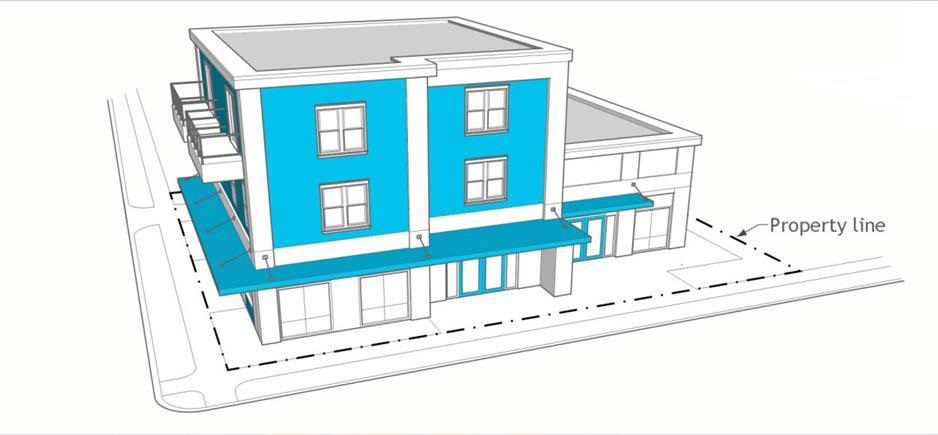
Live/Work Dwelling
Living Space means the interior space within a building designed for occupancy by 1 or more persons for living and/or sleeping.
Loading Space means an off-street space or berth used for the loading or unloading of vehicles.
Lot means a platted parcel of land having frontage upon a public street or dedicated access to a public street, the plat of which lot is recorded in the appropriate property records of Fort Bend County.
Lot Area means the total area of the lot contained within the lot lines.
Lot, Corner means a lot abutting upon 2 or more streets at their intersection.
Lot Coverage means the percentage of the lot area occupied by all enclosed areas of buildings on that lot, including primary and accessory structures, as determined at ground level.
Lot Depth means the average horizontal distance between the front and rear lot lines.
Lot Width means the horizontal distance between the side lot lines of a lot measured at the front building line.
Lot Line means the boundary dividing 1 lot from another lot or a lot from a street or place.
Lot Line, Front means the lot line that separates the front yard of the lot from the street.
Lot Line, Rear means the platted lot line farthest from and most parallel to the front lot line.
Lot Line, Side means any lot line which is not the front, rear, or street side lot line.
Lot Line, Street Side means the lot line separating the street side yard from the abutting street.
M
Maintenance Easement means an area of a parcel of land free of structures reserved to allow access for repair and maintenance of infrastructure or an adjacent structure.
Manufactured Home or "manufactured housing" means a HUD-code manufactured home or a mobile home.
Manufactured Home Park means an area approved for occupancy of Manufactured homes and accessory structures related thereto.
Master Thoroughfare Plan means a plan adopted by the City Council which identifies the general routing and classification of proposed streets and thoroughfares. The plan may also establish the function and capacity of the various thoroughfares as they relate to the land uses they are proposed to serve.
Maneuvering Area means the area within a parking lot, other than the area included in the parking spaces, used for maneuvering cars in and out of parking spaces.
Merchandise means the commodities or goods that are bought and sold in business.
Mews means a designated public green space with frontage on a public street that provides paved pedestrian access from adjoining lots to the street. Mews shall be owned and maintained by a homeowner's association or other perpetual entity and may include utilities.
Mezzanine means the intermediate level or levels between the floor and ceiling of any story.
Middle Housing refers to the following residential use types as defined in the Development Code: Urban Home Dwelling, Single-Family Attached Dwelling (Townhome), Two-Family Dwelling, Triplex or Fourplex Dwelling, Sixplex Dwelling, and Live/Work Dwelling.
Mixed-Use means a combination of both residential and nonresidential uses in close proximity or in the same development area. Occurs in the context of a walkable, pedestrian-friendly environment.
Mobile Home means a structure constructed before June 15, 1976; built on a permanent chassis; designed for use as a dwelling with or without a permanent foundation when the structure is connected to the required utilities; transportable in 1 or more sections; in the traveling mode, at least 8 body feet in width or at least 40 body feet in length or, when erected on site, at least 320 square feet; and includes the plumbing, heating, air conditioning, and electrical systems of the home.
Multi-Family Dwelling means 7 or more Dwelling Units within a building on 1 platted lot.
Multiplex Dwelling means any of the following residential use types as defined in the Development Code: Triplex Dwelling, Fourplex Dwelling, or Sixplex Dwelling.
N
Natural Ground means the proposed grade of the site in accordance with an approved site plan or the existing grade of the land adjacent to the Right-of-Way.
Non-accessory Building or Structure means a building or structure in the Mixed Use Conservation (MUC) District that is:
1.
Located at the rear of the lot; and
2.
Occupied by the operator of the commercial business located in the Principal Building.
Nonconformity, Legal or Legal Nonconforming Use or Legal Nonconforming Building means a building, structure, condition, or use of land that does not comply with these zoning regulations but:
1.
Did comply with regulations at the time the building or structure was constructed or when the condition or use was established and has since been in regular and continued existence or use; or
2.
Lawfully existed immediately before it was annexed into the City and has since been in regular and continued existence or use.
Nonresidential District means a B-O, B-1, B-2, M-1, M-2, or BR district.
Nonresidential Use means a use of a premises for other than for single, two-family, or multi-family dwellings.
O
Open Space means an area without buildings.
Outdoor Kitchen means a secondary cooking area located outside a home that is typically equipped with a counter, grill, refrigerator, and/or sink.
P
Park means an area developed for active play and recreation that may include, but is not limited to, open space, sports courts, play equipment, trails, restrooms, and maintenance structures. The area may be owned by a public entity and used to provide recreational activities to the general public; or the area may be owned by a private, nonprofit, or homeowner's association and used to provide recreational activities to the members of the association.
Parking Lot means an off-street portion of a lot designed and used for the temporary parking or storage of motor vehicles, but not including the driveways and Private Garages serving single-family or two-family dwellings.
Parking Space means an area on a lot or site or within a building, other than on a public street or alley, used or intended for use for parking a motor vehicle.
Parking, Structured means a structure designed to accommodate vehicular parking spaces that are fully or partially enclosed or located on the deck surface of a building. This definition includes Parking Garages, deck parking, and underground or under-building Parking Lots.
Patio Cover means a structure with a solid roof that is unenclosed and not climate controlled.
Pedestrian Enhancement Zone means a component of the Pedestrian Realm intended for the placement of street trees, street furniture, and other fixtures in a manner that does not obstruct pedestrian access or motorist visibility. This includes, but is not limited to seating, streetlights, waste receptacles, fire hydrants, traffic signs, bus shelters, transit stops, bicycle racks, public utility equipment such as electrical transformers and water meters, and similar elements.
Pedestrian Realm means the space behind the curb of the street that provides physical space for pedestrian activity, buffering from the vehicular and bicycle traffic along the street, and space for shade and other elements that affect pedestrian comfort.
Pergolaor Arbor means a permanent structure consisting of vertical posts with connected crossbeams at the top providing an open framework. Pergolas may extend from a building or be freestanding, and are typically constructed of wood, metal or similar material and are typically covered with trained climbing plants to provide shade.
Planned Development (PD) District means a customized zoning district that allows a specific set of uses, bulk regulations, and alternative standards that would not otherwise comply with the regulations of the primary zoning districts, but offer special benefits to the community.
Plat means a plan creating 1 or more lots that has been approved by the City as required by law and filed in the plat records of Fort Bend County.
Porch means a covered platform extending from a building, typically at an entrance with a separate roof. Porches may be an open or enclosed room attached to the outside of a building. A covered walkway or breezeway is not a porch.
Premises means a tract of land, including any building or structure on that tract.
Primary Entrance means the main point of access for pedestrians from the Pedestrian Realm into a building or tenant space.
Primary Façade means the front or principal face of a building which generally contains the Primary Entrance and can be distinguished from the other faces by its architectural details and orientation toward Streets and Civic Spaces.
Principal Building or Use means the primary use and chief purpose of a premises or building.
Protected Tree means a hardwood tree having a minimum caliper size of 8 inches or greater, as measured 4½ feet above ground level.
Public Utility means an entity engaged in the business of providing water, sewer, telephone, communication, cable television, natural gas, or electric services to the general public.
R
Recreational Vehicle (RV) means a portable vehicle designed primarily for temporary occupancy or use for travel, recreation, and vacation use, and includes boats, travel and tent trailers, pickup campers and shells, motorized travel homes and similar vehicles.
Reference Standard Zoning District means in a PD district the comparable zoning district that provides regulations not specified in the PD ordinance. All PDs identify a reference standard zoning district.
Residential District means a R-1E, R-1, HR-1, R-1R, R-1Z, R-2, R-3, R-4, or MUC zoning district.
Residential Use means a premises used for 1 or more dwellings for ordinary domestic use, and does not include any commercial, industrial, or institutional uses except as specifically permitted under the zoning regulations.
S
Satellite Dish Antenna means a device, usually parabolic in shape, designed and intended to be used for transmitting or receiving television, radio or microwave signals.
Setback refers to the required distance a structure or improvement must be placed from another specified structure, improvement, or location.
Shade Tree means a tree listed on the Approved Landscape Materials list in Chapter 2. Shade trees have mature crown spread that provides a canopy of shade for human comfort.
Shared Parking means parking spaces used by 2 or more uses on the same site or on separate sites with parking demands occurring at different times.
Shrub means a self-supporting, woody, evergreen species normally grown in the Texas Gulf Coast Region.
Single-Family Attached Dwelling (Townhome) means a building that contains Dwelling Units located on separately platted lots that are joined to other Dwelling Units on 1 or both sides by a common wall that is located along the side lot line and separates the individual Dwelling Units, commonly referred to as a townhouse.
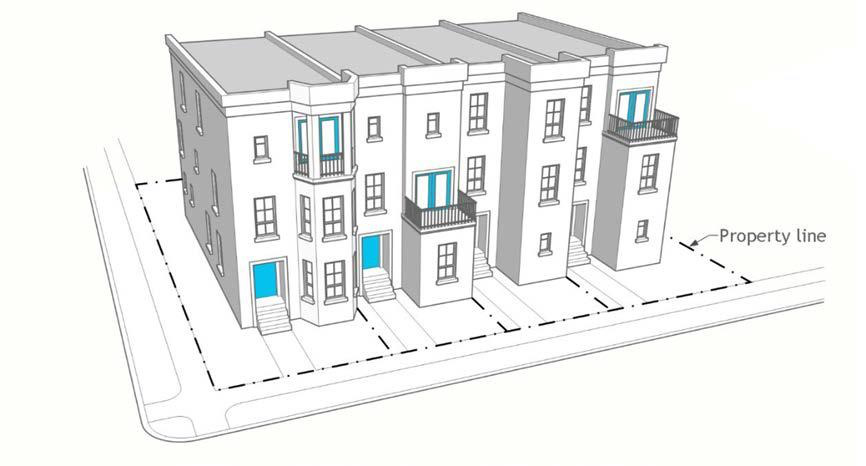
Single-Family Attached Dwelling
Single-Family Detached Dwelling means a building that contains only 1 Dwelling Unit and has open space on all sides of the building.
Sixplex Dwelling means a building on 1 platted lot that contains 5 or 6 Dwelling Units either horizontally or vertically stacked.
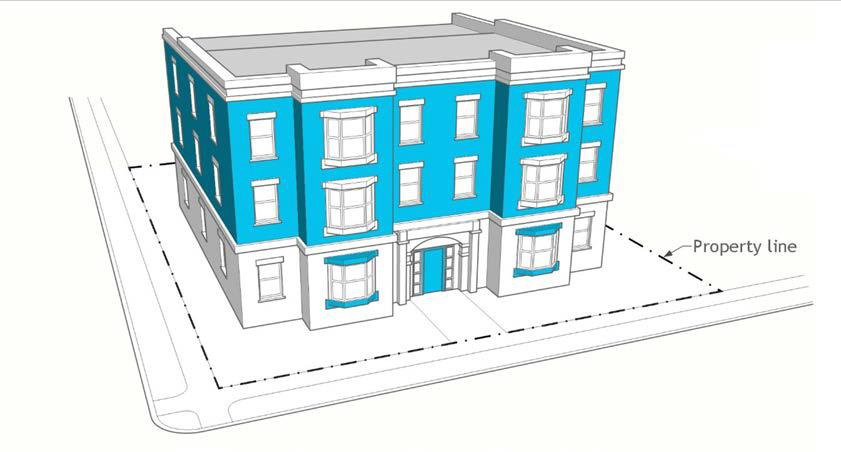
Sixplex Dwelling
Story means the height between the successive floors of a building or from the top floor to the roof. For the purpose of computing building height, the average height for a story shall be defined as 12 feet.
Story, Half means a story under a gable, hip or gambrel roof of which the wall plates on at least 2 opposite exterior walls are not more than 2 feet above the floor of such story.
Street means any public or private thoroughfare, other than an alley, designed to be used by motor vehicles.
Structure means anything which is constructed or erected upon, under, or above the ground or water.
T
Tower means a structure constructed as a free-standing structure or in association with a Building, other permanent structure or equipment, on which is located 1 or more Antennas intended for transmitting or receiving television, AM/FM radio, digital, microwave, cellular, telephone, or similar forms of electronic communication. The term includes radio and television transmission towers, microwave towers, common carrier towers, and cellular telephone towers.
Traffic Impact Analysis (TIA) means a study intended to 1) coordinate the land use and transportation facility development, 2) assess adequately the traffic-related impacts of a development proposal on the existing and planned thoroughfare system, and 3) identify strategies and solutions to current and future traffic problems.
Tree means a self-supporting woody plant which typically grows to an overall minimum height of 15 feet in the Texas Gulf Coast region.
Tree, Protected. See Protected Tree.
Trellis means an architectural structure, usually made from an open framework or lattice of interwoven or intersecting pieces of wood, metal or similar material that is normally made to support and display climbing plants. A trellis is typically installed as a vertical wall panel.
Triplex or Fourplex Dwelling means a building on 1 platted lot that contains 3 or 4 Dwelling Units either horizontally or vertically stacked.
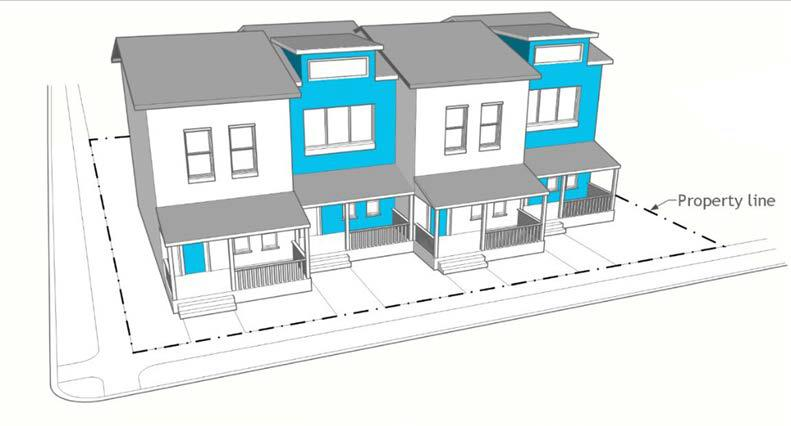
Triplex or Fourplex Dwelling
Two-Family Dwelling (Duplex) means a building on 1 platted lot that contains only 2 Dwelling Units, either horizontally or vertically stacked, and has open space on all sides of the building, commonly referred to as a duplex.
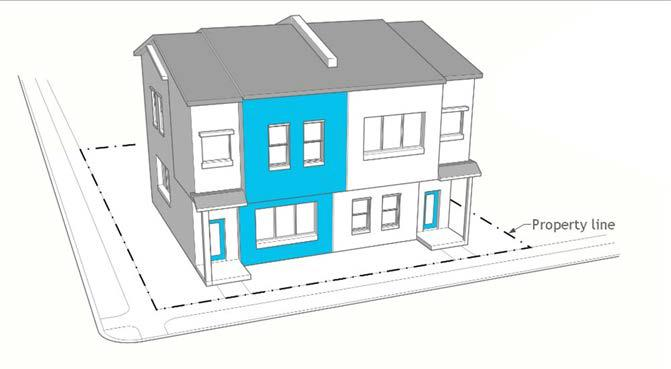
Two-Family Dwelling
U
Urban Home Dwelling means a building that contains only 1 Dwelling Unit and is larger in height than in width and located on a lot no wider than 40 feet, commonly referred to as a detached townhome.
V
Vehicle Use Area means an outside improved area on a nonresidential premises that is used for the temporary parking of vehicles to provide services to the vehicles or its occupants, including the service areas of gasoline service stations and car washes and the drive-through areas of fast food restaurants and banks and similar uses.
Vines means plants with a flexible stem that climbs, twines, clings to, or creeps along a surface for support.
Y
Yard means the open space of a lot at grade that lies between the lot lines and the required building setback.
Yard, Front means the Yard extending across the front of the lot between the side lot lines.
Yard, Rear means the Yard extending across the rear of the lot between the side lot lines.
Yard, Side means the Yard extending along the side lot line from the Front Yard to the Rear Yard.
Yard, Street Side means a Side Yard that fronts upon a street.
(Ord. No. 2149, §§ 15, 16, 2-19-19; Ord. No. 2247, § 5, 10-5-21; Ord. No. 2325, § 6, 12-19-23; Ord. No. 2339, §§ 16, 17, 6-6-24; Ord. No. 2373, § 11, 5-9-25)

