
Sugar Land City Zoning Code
CHAPTER 4
SIGN REGULATIONS
Sec. 4-1. - Purpose.
This Chapter is enacted to provide uniform standards for the location, spacing, height, lighting, and other regulation of Signs within the City. The purpose of this Chapter is to protect the health, safety, welfare, and enjoyment of the general public and to protect the public from injury that may be caused by the unregulated construction of Signs. The regulations in this Chapter intend to:
1.
Enhance the economic value of the landscape by avoiding visual clutter, which is potentially harmful to property values and business opportunities;
2.
Promote the safety of persons and property by providing that signs do not create a hazard, due to collapse, fire, collision, weather or decay;
3.
Protect the safety and efficiency of the City's transportation network by reducing the confusion or distraction to motorists and enhancing motorists' ability to see pedestrians, obstacles, other vehicles and traffic signs;
4.
Protect adjacent and nearby properties from the impact of lighting, size, height and location of Signs; and
5.
Preserve, protect and enhance areas of historical, architectural, scenic and aesthetic value.
Sec. 4-2. - Application.
This Chapter applies to all Signs within the City's corporate limits and to Off-premises Freestanding Signs located within the City's extraterritorial jurisdiction.
Sec. 4-3. - Definitions.
A.
In this Chapter:
Abandoned Sign means a Sign that advertises or directs persons to any business, commercial transaction or activity, goods, products or services that were once, but are no longer, offered, available, or located at the advertised premises.
Balloon Sign means an inflatable bag made of nonporous material that is filled with air or gas. Balloon Signs are a type of Wind Device Sign.
Banner Sign means a Sign with or without characters, letters, illustrations, or ornamentations applied to cloth, paper, flexible plastic, or fabric of any kind with only such material for backing. Banner Signs are a type of Wind Device Sign and includes pennants and streamers.
Curbline means an imaginary line drawn along and parallel to the back of curb edge of the pavement of a Street or Primary Access Easement.
Electronic Sign means a Sign with the ability to have a fixed or changing display or message composed of a series of lights that may be changed through electronic means.An Electronic Sign is also referred to as a digital sign and is not considered an Illuminated Sign.
Flagpole means a freestanding pole with an attached lanyard that is permanently affixed to the ground or a building and is designed for and is intended to be used for the display of 1 or more flags.
Flag Sign means a flexible fabric material, usually rectangular in shape, that is specifically designed for display by attaching it to the lanyard of a flagpole.
Freestanding Sign means a detached Sign anchored in or attached to the ground. Freestanding Signs include Monument Signs, Temporary Freestanding Signs (Type I), and Temporary Freestanding Signs (Type II).
Human Sign means a Sign held by or attached to a human or living being for the purposes of advertising or otherwise drawing attention to a business, commodity, service or product. This may also include a person dressed in costume for the purpose of advertising or drawing attention to a business, commodity, service or product.
Illuminated Sign means a Sign internally lighted by any electrical light source behind the Sign face. Illuminated Signs do not include Signs illuminated by an exterior light source shining upon the Sign.
Off-Premises Sign means any Sign advertising a business, commercial transaction or activity, goods, products or services not located on the premises where the Sign is located or which directs persons to any premises other than where the Sign is located.
Pennant Sign means any lightweight plastic, fabric, or other material, whether or not containing a message of any kind, suspended from a rope, wire, string, stake or temporary pole, usually in a series, designed to move in the wind. Pennants also include streamers and are a type of Banner Sign.
PortableSign means a Sign whose principal supporting structure is intended, by design, use or construction to be used by resting upon the ground for support and which may be easily moved or relocated or reused. Portable Signs shall include, but not be limited to, signs mounted upon or designed to be mounted upon a trailer, bench, wheeled carrier or other non-motorized mobile structure, with or without wheels, and A-frame and other similar Signs, resting or leaning on the ground or other structures, but not permanently attached thereto.
Premises means:
1.
For any developed property, the area of real property which encompasses all the Buildings, Structures, appurtenances and contiguous land devoted to a common use and not separated by a public Street, such as a shopping center; or
2.
For undeveloped property, the area of real property designated as a Lot on a Plat approved in accordance with law and filed with the County Clerk's Office, or an unplatted tract of land as conveyed by deed or operation of law and recorded in the deed records of the county.
Right-of-Way (ROW) means a strip of land that allows for the passage of people or goods. Right-of-Way includes passageways such as freeways, streets, bike paths, alleys, and walkways. A public Right-of-Way is dedicated or deeded to the public for public use.
Sign means any surface, material or device used for advertising a business, commercial transaction or activity, goods, products or services with or without the display of letters, words, characters, designs, pictures or other information.
Sign Base means the area of the sign that does not contain letters, words, characters, designs, pictures or other information and serves as the structure or support for the Sign Face. A Sign base must be a solid form; poles are not a permitted sign Base.
Sign Face means the display area of a sign that includes the Effective Area of the sign.
StakeSign means a Sign whose supporting structure is so designed and shaped, usually by making 1 end pointed, so as to be erected and used by pushing, pounding, hammering or forcing it into the ground so as to allow quick and easy placement, removal or relocation. Examples of Stake Signs include real estate, contractor services, and event signs.
Subdivision Entrance Sign means a Sign identifying an entrance or exit of a neighborhood or subdivision.
Temporary Freestanding Sign means a Freestanding Sign located on a property temporarily. Temporary Freestanding Signs are classified as either Type I or Type II as defined in this Chapter.
WallSign means any Sign wholly affixed to, supported by or painted upon the exterior wall or window of any Building. Signs on permanent awnings attached to Buildings are classified as Wall Signs.
Window and Door Sign means a sign affixed to or mounted behind the interior surface of a window or door or placed immediately behind a window pane.
Wind Device Sign means any Banner, Pennant, Balloon or similar Sign made of cloth, canvas, plastic or other flexible material, with or without a frame or other supporting structure, that moves or is designed or intended to move or blow in the wind.
B.
General definitions may be found in Chapter 10.
Sec. 4-4. - Exemptions.
This Chapter does not apply to the following types of Signs, which may be erected or constructed without a permit:
1.
Governmental Signs. Any Sign that is:
a.
Erected or maintained pursuant to and in discharge of any governmental function;
b.
Required by law, ordinance or governmental regulation; or
c.
Located on property owned, leased or under the control of a Governmental Entity.
2.
Private traffic control. Signs on private property, containing no advertising, that direct the movement of traffic, warn of obstacles or overhead clearances, or control parking, including entrance and exit Signs.
3.
Railways Signs. Any Sign on railway property placed or maintained in reference to the operation of the railway.
4.
Utility and hazard Signs. Signs marking utility or underground communication or transmission lines and hazards.
5.
Plaques. Historical and commemorative plaques of recognized historical societies and organizations, if the Signs are less than 15 square feet in Effective Area.
6.
Mailboxes and addresses. Addresses, address markers, and names located on mailboxes.
7.
Vehicle Signs. Signs displayed or used upon vehicles and trailers, unless the vehicle or trailer is permanently stationed or regularly used at a fixed location to serve the same or similar purpose of a permanent or Portable Sign.
8.
Athletic field signs. Signs located on the field side of scoreboards and Fences of athletic fields.
9.
Signs not visible from Street. Any Sign not visible from a public Street.
10.
Holiday Signs. Temporary Signs, including holiday lights, containing only holiday messages and no commercial advertising.
11.
Unused Signs. Signs being manufactured or transported and not used for advertising.
12.
Signs on outdoor machines, devices, and equipment. Signs located on outdoor machines, devices or equipment which display the trademark, trade name, manufacturer, cost, or operating or service instructions or similar information but do not advertise the business where located. This exemption includes Signs on coin-operated vending machines, fuel-dispensing pumps, telephone facilities, automatic teller machines, automotive vacuum cleaners, amusement rides, and similar machines, devices, or equipment.
13.
Political signs. Signs that contain primarily a political message and that are located on private real property with the consent of the property owner. For purposes of this exemption:
a.
A political sign may not:
1)
Have an Effective Area greater than 36 square feet;
2)
Be more than 8 feet high;
3)
Be Illuminated or Electronic; or
4)
Have any moving element.
b.
"Private real property" does not include real property subject to an easement or other encumbrance that allows the City to use the property for a public purpose.
c.
"Effective area" means the surface area of a sign face or panel, but does not include the supporting structure of a sign.
14.
Signs permitted by court order.
Sec. 4-5. - Prohibited Signs.
It is unlawful for any person to erect, install, construct, display, maintain, reconstruct, place, locate, relocate or make use of any of the following Signs for Advertising purposes:
1.
Revolving or moving Signs.
2.
Portable Signs.
3.
Signs located on a roof or attached to a Building if it projects above the highest point of the facade or parapet.
4.
Signs that are deteriorated, dilapidated, or unsafe.
5.
Signs located on or attached to a Street light, utility pole, hydrant, bridge, traffic-control device, Street Sign, or other City-owned Building, facility, Structure, or equipment, without the consent of the City.
6.
Signs that do not comply with this Chapter or other City ordinances.
7.
Signs located on Trees and Shrubs.
8.
Signs located or illuminated so that they obscure or interfere with the effectiveness of an official traffic Sign, signal, or device, or obstruct or interfere with the view of approaching, emerging or intersecting traffic, or prevent any traveler on any Street from obtaining a clear view of approaching vehicles.
9.
Signs, illuminated from within or without, which:
a.
Are illuminated to such intensity or without proper shielding so as to constitute a hazard to the operation of motor vehicles upon a public Street or substantially interfere with the reasonable enjoyment of residential property; or
b.
Have any type of intermittent illumination, including flashing, fading, revolving or blinking lights, or any type of moving, traveling or changing message by means of lights or illumination.
10.
Electronic Signs.
11.
Any Sign that violates any sight visibility regulations of the City.
12.
Off-premises Wall Signs.
13.
A Freestanding Sign located on any railroad Right-of-Way that is not used for or related to railroad operations.
14.
Any Sign which is located on or is part of an awning if the awning is translucent and contains any form of interior illumination that is intended to or has the effect of making the Sign more readily visible from a public Street.
15.
Human Signs.
Sec. 4-6. - Conflicts.
Any regulation governing Signs contained in the zoning regulations govern over any conflicting provision contained in this Chapter.
Sec. 4-11. - Application and Permits.
The application for a Sign permit and the applicable fee, as identified in Chapter 2 of the Code of Ordinances, must be submitted on such forms provided by the City and must be accompanied by the information, drawings and descriptive data required by the Director to ensure proper regulation of the Sign and to ensure compliance with this Chapter.
Sec. 4-12. - Issuance of Permits.
If the plans and specifications for a Sign set forth in any application for a permit conform to all of the requirements of this Chapter and other City regulations, the Director will issue the appropriate permit. The City shall review and respond to a completed Sign permit application within 30 days.
Sec. 4-13. - Revocation.
A Sign permit may be revoked for a violation of this Chapter. The Director shall give prior written notice of a proposed revocation to the permittee and an opportunity to respond to the reasons for revocation prior to making a decision thereon.
Sec. 4-14. - Appeals.
Any person aggrieved by a decision of the Director in the application of this Chapter may appeal the decision to the Zoning Board of Adjustment in accordance with the procedures applicable to appeals of decisions under the City's zoning regulations (Chapter 2). The Board is not authorized to hear or grant variances to the provisions of this Chapter.
Sec. 4-23. - Classification of Signs.
A.
For purposes of applying these regulations, all Signs are defined and classified, as follows:
1.
Freestanding Signs.
a.
Monument Signs;
b.
Temporary Freestanding Signs (Type I); and
c.
Temporary Freestanding Signs (Type II).
2.
Wall Signs.
3.
Window and Door Signs.
4.
Stake Signs.
5.
Wind Device Signs.
a.
Banner Signs; and
b.
Balloon Signs.
6.
Flags and Flagpoles.
Sec. 4-24. - Freestanding Signs.
A.
Manner of Measurement.
1.
Size. The size of a Sign is determined by its Effective Area.
a.
For Monument Signs, the Effective Area includes the entire Structure on which the Sign is placed or mounted, including only the portion of the Sign Base that extends directly below the Sign Face (see Figure 4-24.A).
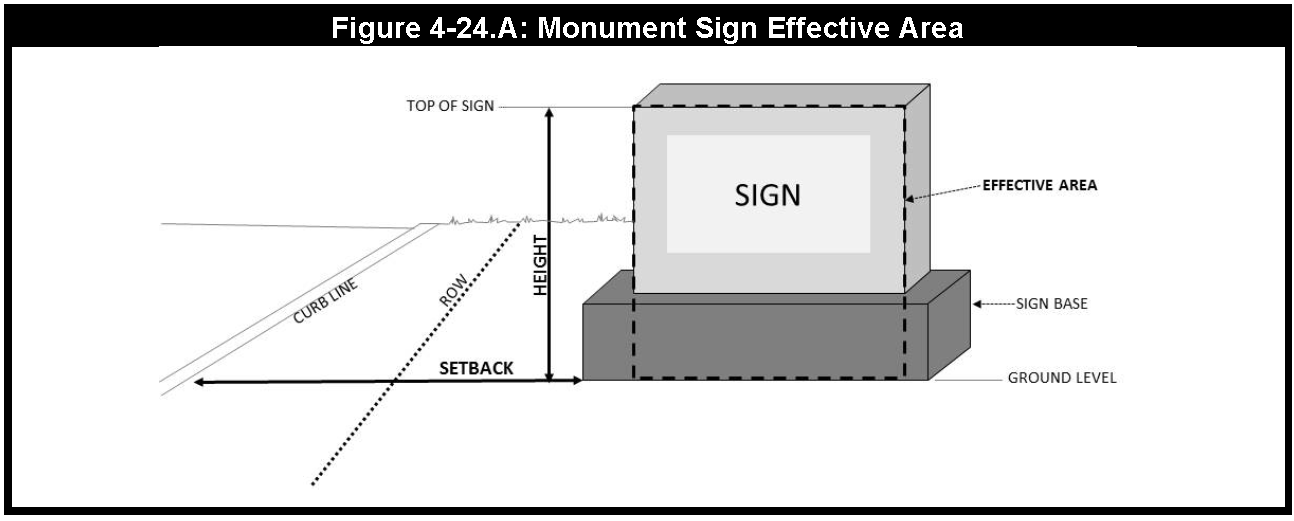
Figure 4-24.A
b.
Temporary Freestanding Signs (Type I and II) and Subdivision Entrance Signs are measured by the length and height of the Sign Face or display area only, not including the measurements of the support structure (see Figure 4-24.B and Figure 4-24.C).
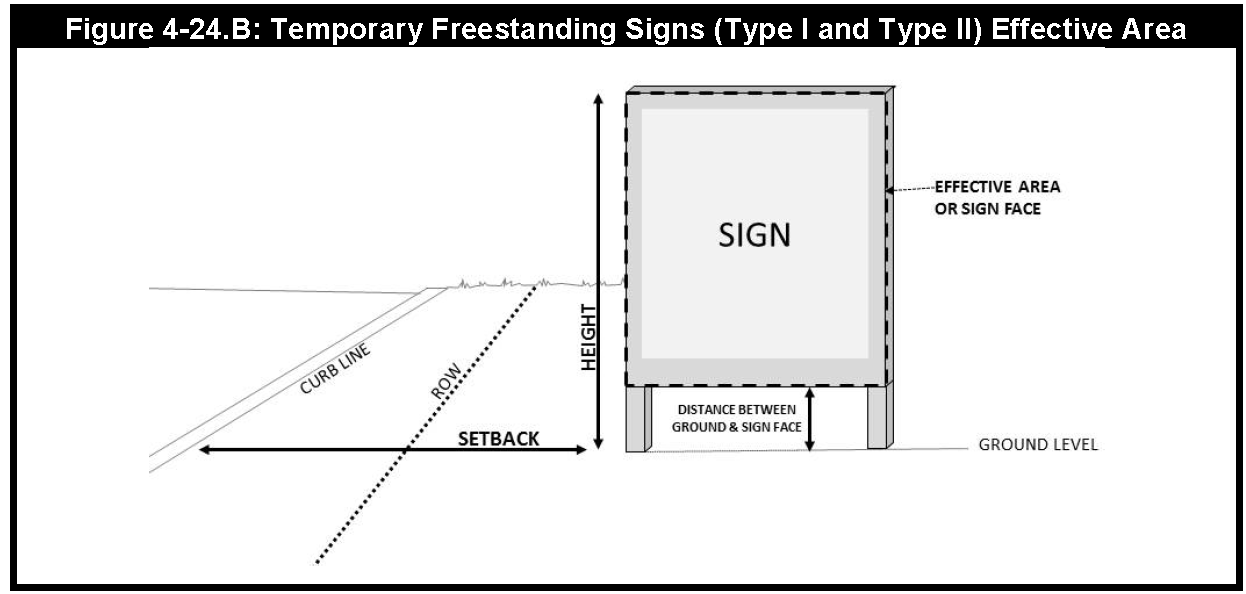
Figure 4-24.B
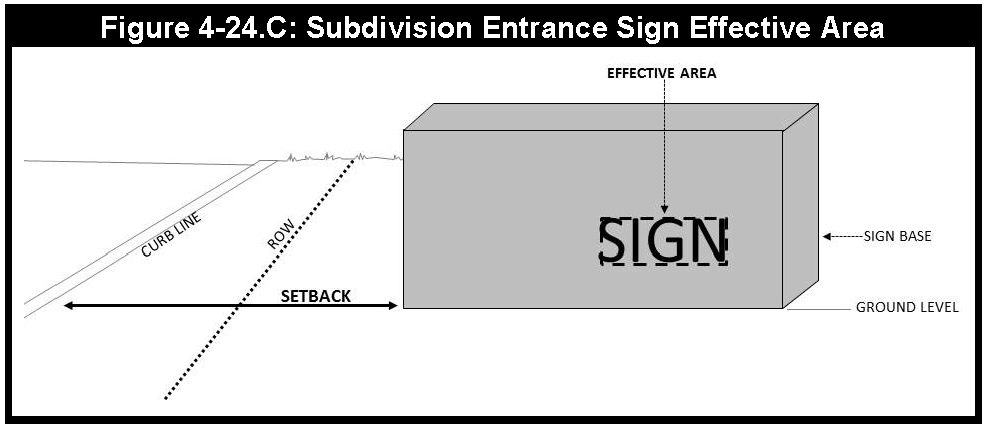
Figure 4-24.C
2.
Setback. The Setback is measured perpendicularly from the curbline to the closest point of the Sign.
3.
Height. The Height of a Freestanding Sign is measured from the natural ground level at the base of the Sign to the highest point of the Sign.
4.
Width. The width of a Freestanding Sign is measured along a line drawn from the outermost edges of the Sign, parallel to the ground.
B.
Abandoned Freestanding Signs.
1.
Any Abandoned Freestanding Sign must be removed within 1 year of the date the Sign becomes an Abandoned Sign.
2.
Any Abandoned Freestanding Sign located on leased property must be removed within 2 years of the date the Sign becomes an Abandoned Sign.
3.
Within 60 days of the date a Freestanding Sign becomes an Abandoned Sign, the message portion of the Sign must be painted over, covered, removed, or modified so that the remaining sign structure is left visually unobtrusive, presents a solid facade, and does not appear to be in disrepair or dismantled, as approved or required by the Director.
C.
Monument Signs. Except as otherwise provided in this section, Monument Signs must comply with the following requirements:
1.
Size. The following table details size requirements for Monument Signs:
Table 4-24.1: Requirements for Monument Signs
2.
Location.
a.
Additional Spacing Requirements.
1)
A Monument Sign may not be located within 50 feet of another Freestanding Sign on another premises.
2)
A Monument Sign may not be located within 125 feet of another Freestanding Sign on the same premises.
3)
An Off-premises Monument Sign may not be located within 2,000 feet of another Off-premises Freestanding Sign.
4)
A Monument Sign may not be placed or located within the public Right-of-Way unless the City gives its written consent to the encroachment.
3.
Materials. All Monument Signs must be designed and constructed to substantially appear as a solid mass, such as a cylinder, block, rectangle, or square, from ground level to the highest portion of the Sign. All Monument Signs must be made of masonry, metal, routed wood planks or beams, or durable plastic.
4.
Number. All Signs [with] 1 common supporting Structure are counted together as 1 Sign for purposes of applying the regulations on the number of Monument Signs allowed on any 1 Premises.
5.
Permit.
a.
It is unlawful for any person to place, locate, relocate, erect, construct, replace or alter the size or shape of any part of a Monument Sign, including the face or other integral part, or to thereafter make use of a Sign without having first secured a Sign permit from the City as required, except as otherwise provided in this Chapter.
b.
A Sign permit is not required to repaint a Sign or to restore a conforming Sign to its original condition if the Sign otherwise complies with this Chapter, or to periodically change only the letters, numbers or message portion of a conforming Sign.
c.
Unless earlier revoked, a Sign permit to construct, erect or place a Monument Sign is valid for 180 days from the date of issuance.
6.
Additional Regulations.
a.
Size Exception for Monument Signs in M-1 Districts. Any real property located in an M-1 zoning district that would be allowed to have 3 or more Monument Signs under Table 4-24.1 of this Chapter, may choose to have 1 Monument Sign with a maximum Effective Area of 100 feet and another Monument Sign with a maximum Effective Area of 60 square feet, in lieu of all other Monument signs allowed under Table 4-24.1 of this Chapter.
b.
Off-Premises Signs in the ETJ. The regulations of Table 4-24.1 applicable to Nonresidential Zoning Districts apply to all Off-Premises Monument Signs located in the City's extraterritorial jurisdiction regardless of land use.
c.
Subdivision Entrance Signs must meet the requirements for Monument Signs in this Chapter but have a different method of calculating the maximum Effective Area, see Sec. 4-24.A: Manner of Measurement.
D.
Temporary Freestanding Sign (Type I).
1.
Size. A Temporary Freestanding Sign (Type I) must have a maximum Effective Area of 32 square feet and a maximum Height of 10 feet.
2.
Location. A Temporary Freestanding Sign (Type I) must comply with the following requirements:
a.
Setbacks. Temporary Freestanding Sign (Type I) must be setback from the curb a minimum of 10 feet.
b.
Spacing Requirements:
1)
For properties in residential zoning districts, spacing requirements are 1 per 500 feet.
2)
For properties in nonresidential zoning districts, spacing requirements are 1 for the first 125 feet and 1 for each additional 125 feet.
3)
A Temporary Freestanding Sign (Type I) may not be located within 50 feet of any Freestanding Sign on other premises.
4)
A Temporary Freestanding Sign (Type I) may not be located within 125 feet of any Freestanding Sign on the same premises.
5)
A Temporary Freestanding Sign (Type I) may not be placed or located within the public Right-of-Way unless the City gives its written consent to the encroachment.
3.
Materials. A Temporary Freestanding Sign (Type I) must be made of plywood, fiber cement board, or durable plastic. Temporary Freestanding Signs (Type I) may not be lighted or illuminated and may not be an Electronic Sign.
4.
Permit. A Sign permit is not required to erect and maintain 1 Temporary Freestanding Sign (Type I) on any 1 Premises for a maximum of 75 days in any 1 calendar year. If locating a Temporary Freestanding Sign (Type I) for more than 75 days, the Sign is a Temporary Freestanding Sign (Type II) and shall comply with regulations applicable to a Temporary Freestanding Sign (Type II).
5.
Additional Regulations. A Temporary Freestanding Sign (Type I) shall not contain Off-Premises Advertising.
E.
Temporary Freestanding Sign (Type II).
1.
Size. A Temporary Freestanding Sign (Type II) must have dimensions of 4 feet in width and 8 feet, 6 inches in Height. The plywood face of the Sign must be 4 feet by 8 feet where no part of the frame or posts extend beyond the Sign faces at the sides or top of the Sign. The face of the Sign must extend down to within 6 inches of the ground.
2.
Location. A Temporary Freestanding Sign (Type II) shall comply with the following Setback and spacing requirements:
a.
Setbacks. Temporary Freestanding Sign (Type II) must be setback from the curb a minimum of 10 feet.
b.
Spacing Requirements:
1)
For properties in residential zoning districts, spacing requirements are 1 Sign per 500 feet of frontage.
2)
For properties in nonresidential zoning districts, spacing requirements are 1 Sign for the first 125 feet of frontage and 1 Sign for each additional 125 feet of frontage.
3)
A Temporary Freestanding Sign (Type II) may not be located within 50 feet of any Freestanding Sign on another premise.
4)
A Temporary Freestanding Sign (Type II) may not be located within 125 feet of any Freestanding Sign on the same premises.
5)
An Off-premises Temporary Freestanding Sign (Type II) may not be located within 2,000 feet of another Off-premises Freestanding Sign.
6)
A Temporary Freestanding Sign (Type II) may not be placed or located within the public Right-of-Way unless the City gives its written consent to the encroachment.
3.
Materials.
a.
The Sign Face must be fabricated of ½ inch thick medium density overlay plywood of treated wood or fiber cement board mounted on both sides of a frame;
b.
A Temporary Freestanding Sign (Type II) may not be electronic, lighted or illuminated;
c.
A Temporary Freestanding Sign (Type II) must be anchored by 2 "4 × 4" treated wood posts anchored in sand filled holes extending down at least 2 feet in the ground; and
d.
The plywood face must be securely held to the frame by galvanized nails or screws installed with the heads flush to the surface; all seams are tight; all holes are filled and sanded smooth; and all surfaces are coated with primer and painted with good quality exterior grade semi-gloss paint.
4.
Permit.
a.
It is unlawful for any person to place, locate, relocate, erect, construct, replace or alter the size or shape of any part of a Temporary Freestanding Sign (Type II), including the face or other integral part, or to thereafter make use of a Sign without having first secured a Sign permit from the City as required, except as otherwise provided in this Chapter.
b.
A Sign permit, valid for 1 year and renewable for 1 additional year, may be issued for 1 Temporary Freestanding Sign (Type II) on any 1 premises.
c.
Unless earlier revoked, a Sign permit to construct, erect or place a Temporary Freestanding Sign (Type II) is valid for 180 days from the date of issuance.
(Ord. No. 2357, § 4, 1-7-25)
Sec. 4-25. - Wall Signs.
A.
Manner of Measurement.
1.
Size. The size of a Sign is determined by its Effective Area. For Wall Signs, the Effective Area includes the entire area enclosing the extreme limits of the Sign display, excluding any adjacent parts of the Sign structure (see Figure 4-25.A).
2.
Height. The Height of a Wall Sign is measured between the lowest and highest vertical extremes of the Sign display.
3.
Width. The Width of a Wall Sign is measured between the right-most and left-most horizontal extremes of the Sign display.
4.
Illustration.
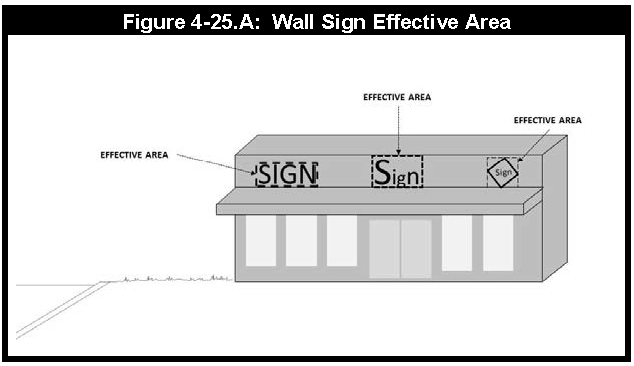
Figure 4-25.A
B.
Abandoned Wall Signs.
1.
Within 60 days of the date a Wall Sign becomes an Abandoned Sign, the message portion of the Sign must be painted over, covered, removed, or modified so that the remaining sign structure is left visually unobtrusive, presents a solid facade, and does not appear to be in disrepair or dismantled, as approved or required by the Director.
C.
Wall Signs.
1.
Size. The following regulations apply:
a.
Maximum Effective Area.
1)
Principal Buildings. The Effective Area of all Wall Signs located on a Principal Building devoted to a Residential Use may not exceed 1% of the area of the wall or facade upon which they are located. The Effective Area of all Wall Signs located on a Principal Building serving as a Nonresidential Use may not exceed 15% of the area of the wall or facade upon which they are located, or 300 square feet, whichever is less.
2)
Accessory Buildings and Structures. Wall Signs are prohibited on Accessory Buildings serving a single-family or two-family residential use. The Effective Area of all Wall Signs located on an Accessory Building or Structure serving a Nonresidential Use may not exceed 5% of the area of the wall or facade upon which they are located, or 100 square feet, whichever is less.
3)
Measurements. In measuring the area of the wall or facade of a Principal Building or an Accessory Building or Structure in this Section, the area of all doors and windows are included. In measuring the area of a wall or facade of an Accessory Structure that contains open space (i.e., not occupied by walls, glass, or other material used to permanently enclose the interior space) such as a canopy or porte-cochere, the area of the open space is not included (see Figure 4-25.B and Figure 4-25.C).
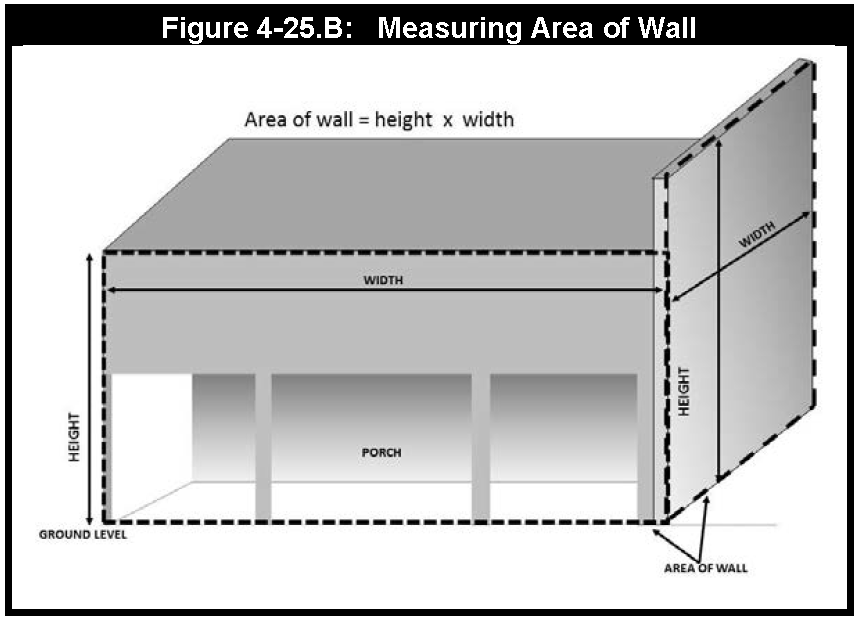
Figure 4-25.B
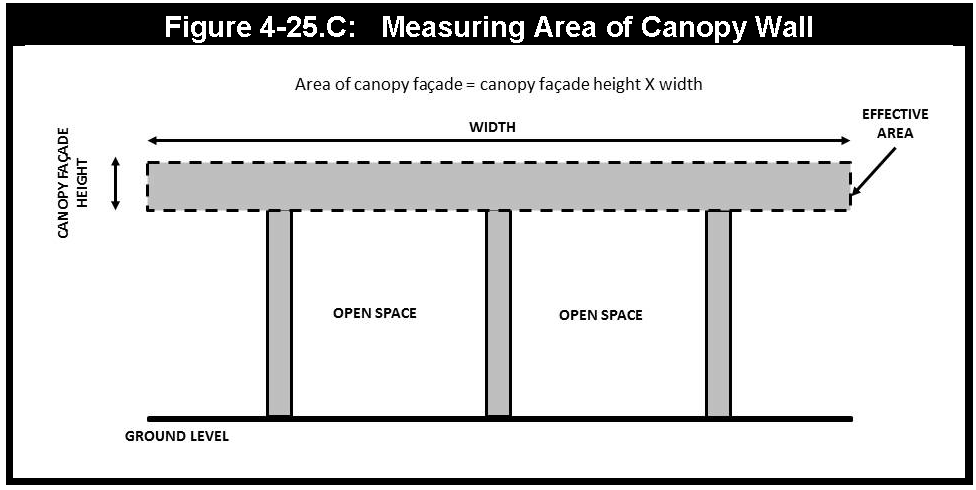
Figure 4-25.C
b.
Multi-tenant Buildings. For multi-tenant Buildings, the Effective Area regulations apply to that portion of the Building facade leased by each tenant.
2.
Height.
a.
For Buildings containing 10,000 square feet or more of floor space, the maximum height of the Wall Sign is 2 inches in height for every 1 foot of height of the wall to which it is attached.
b.
For Buildings containing less than 10,000 square feet in Floor Area, the maximum height of the Wall Sign is 1½ inches for every 1 foot of height of the wall to which it is attached. Under this provision, the height of the wall is measured from the base of the wall vertically to the highest point of the wall to which the sign is affixed.
c.
For wall signs on motor vehicle canopies, such as drive-throughs or gas sales, the maximum height of the sign shall be 2 inches in height for every 1 foot of height of the canopy. Under this provision, the height of the canopy is measured from ground level to the top of the vertical canopy façade. In no case shall the sign extend below or above the vertical façade of the canopy (see Figure 4-25.D).
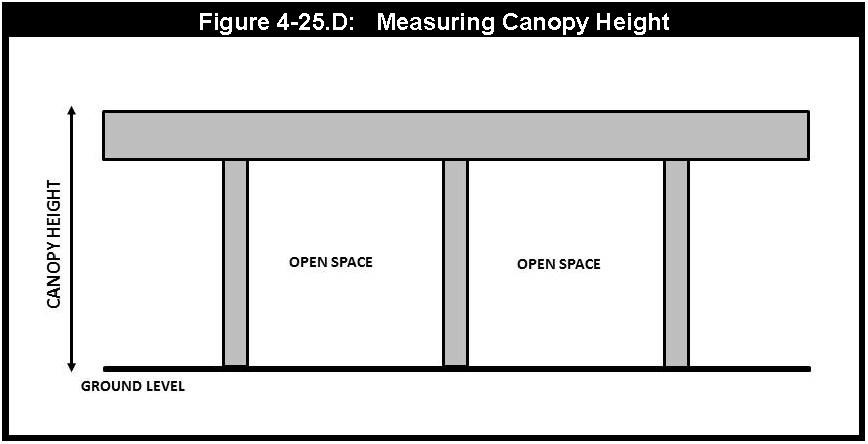
Figure 4-25.D
3.
Location.
a.
A Wall Sign may not extend beyond the perimeter of any part of the wall to which it is attached. A Wall Sign may be placed on a canopy or roof if there is a solid wall of the same building visible behind the entire sign.
b.
Wall Signs may be illuminated; however, illuminated Wall Signs on rear building facades shall be prohibited if facing a residential zoning district or use.
4.
Materials.
a.
Wall Signs should be constructed of durable, weather-resistant materials such as metal, plastic, or other durable materials approved by the Director.
b.
Wall Signs must be attached to the wall of a Building in accordance with current building code.
5.
Permit.
a.
It is unlawful for any person to place, locate, relocate, erect, construct, replace or alter the size or shape of any part of a Wall Sign, including the face or other integral part, or to thereafter make use of a Sign without having first secured a Sign permit from the City, except as otherwise provided in this Chapter.
b.
Unless earlier revoked, a Wall Sign permit to construct, erect or place a Wall Sign is valid for 180 days from the date of issuance.
(Ord. No. 2031, § 1, 10-20-15)
Sec. 4-26. - Window and Door Signs.
A.
Manner of Measurement.
1.
Size. The size of a Sign is determined by its Effective Area. For Window and Door Signs, the Effective Area includes the entire area enclosing the extreme limits of the Sign display, excluding any adjacent parts of the Sign structure (see Figure 4-26.A).
2.
Height. The Height of a Window and Door Sign is measured between the lowest and highest vertical extremes of the Sign display.
3.
Width. The Width of a Window and Door Sign is measured between the right-most and left-most horizontal extremes of the Sign display.
4.
Illustration.
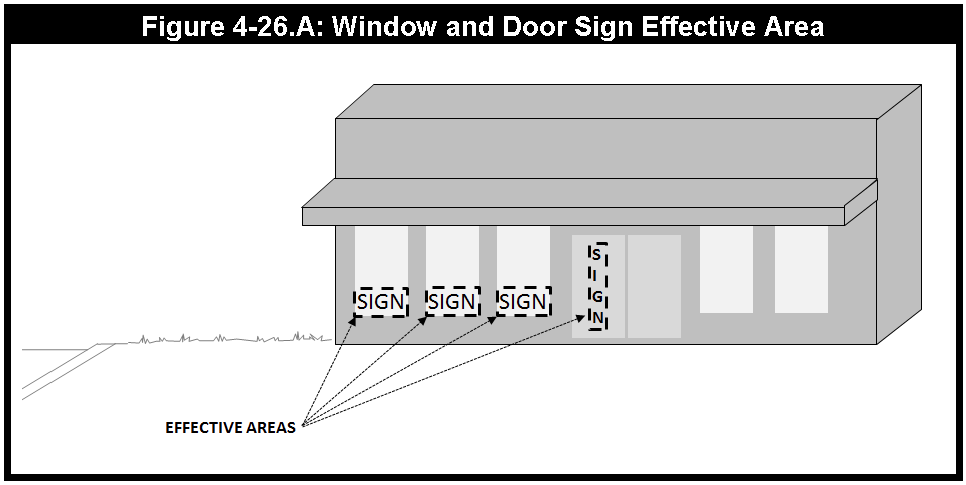
Figure 4-26.A
B.
Abandoned Window and Door Signs.
1.
Within 60 days of the date a Window and Door Sign becomes an Abandoned Sign, the Sign must be removed.
C.
Window and Door Signs.
1.
Size. Window and Door Signs shall not exceed 25% of the total window and door area of the Building elevation identified for placement of the Sign.
2.
Location. Window and Door Signs are limited to the ground floor of a building. Window and Door Signs must be affixed to the interior face of the window surface. Signs affixed to the exterior face of a window or door are Wall Signs.
3.
Materials. Window and Door Signs include any material painted, etched, or affixed to the interior side of a window or door. Window and Door Signs include Electronic and Illuminated Signs hanging within the interior space and viewable from the public Street through the window or door.
4.
Permits. A Sign permit is not required for the placement or use of Window and Door Signs.
Sec. 4-27. - Stake Signs.
A.
Manner of Measurement.
1.
Size. The size of a Sign is determined by its Effective Area. For Stake Signs, the Effective Area includes the entire Structure on which Signs are placed or mounted. (See Figure 4-27.A)
2.
Setback. The Setback is measured perpendicularly from the curbline to the closest point of the Sign.
3.
Height. The Height of a Sign is measured from the natural ground level at the base of the Sign to the highest point of the Sign.
4.
Width. The width of a Sign is measured along a line drawn from the outermost edges of the Sign, parallel to the ground.
5.
Illustrations.
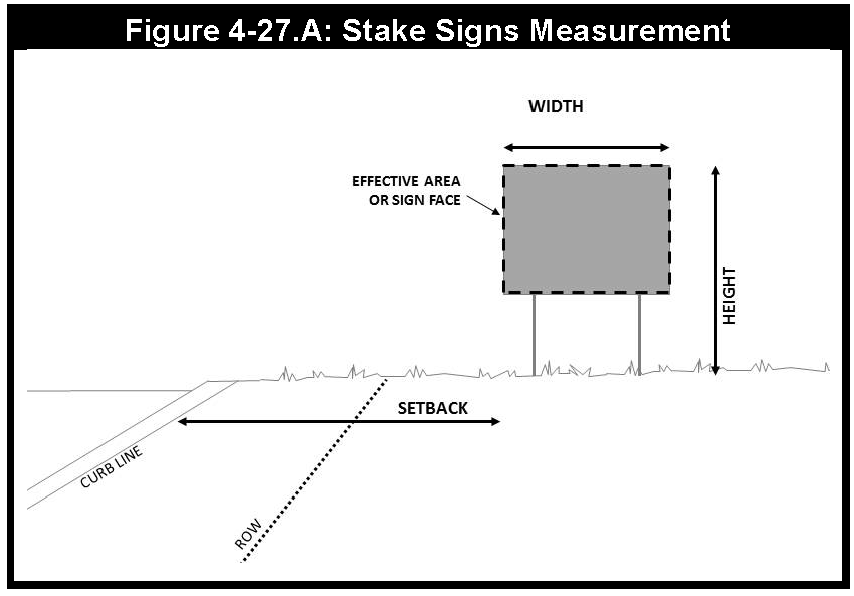
Figure 4-27.A
B.
Stake Signs.
1.
Size. A Stake Sign may not have an Effective Area in excess of 9 square feet or a Height in excess of 4 feet.
2.
Location. A Stake Sign may not be located within the Right-of-Way of a public Street or within a railroad Right-of-Way.
3.
Materials. Stake Signs may include materials such as wood or metal stakes with a wood, plastic or metal Sign Face.
4.
Number. No more than 2 Stake Signs are permitted on a nonresidential property at any time. Stake Signs may not be located within 25 feet of another Sign on the same Premises or on an adjacent Premises. However, every property is permitted at least 1 Stake Sign.
5.
Permit. A Sign permit is not required for the placement or use of a Stake Sign. A Stake Sign that advertises a particular event or happening must be removed within 3 days after the conclusion of the event by the owner of the Premises on which it is located.
Sec. 4-28. - Wind Device Signs.
A.
Manner of Measurement.
1.
Size. The size of a Sign is determined by its Effective Area. For Wind Device Signs, the Effective Area includes the entire Sign display area or Sign Face, excluding the Structure on which Signs are placed (see Figure 4-28.A).
2.
Setback. The Setback is measured perpendicularly from the curbline to the closest point of the Sign.
3.
Height. The Height of a Wind Device Sign is measured from the natural ground level below the Sign to the highest point of the Sign.
4.
Width. The width of a Sign is measured along a line drawn from the outermost edges of the Sign, parallel to the ground.
5.
Illustrations.
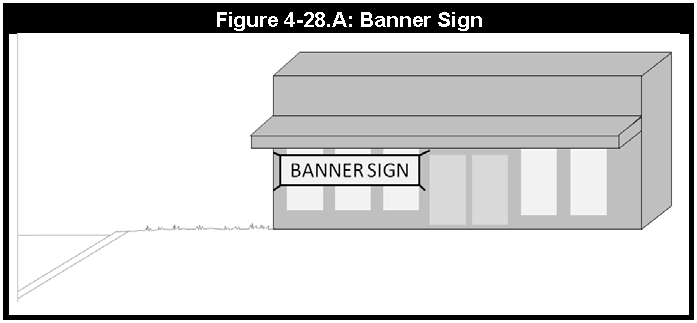
Figure 4-28.A
B.
Banner Signs. Banner Signs are a type of Wind Device Sign and include Pennant Signs. The following regulations apply to Banner Signs:
1.
Size. A Banner Sign may not project above the roofline or parapet walls of a Building. Banner Signs may not extend to a greater Height than the maximum Height of the Building on the Premises. Banner Signs on vacant Premises may not exceed 10 feet in Height.
2.
Location. Banner Signs may not extend beyond the property lines of the Premises where located or over any Public Highway, Street or sidewalk.
3.
Materials. A Banner Sign must be constructed of weather-resistant materials, be unlighted and may not be not an Illuminated Sign or Electronic Sign.
4.
Permit.
a.
It is unlawful for any person to place, erect or make use of a Banner Sign on a Premises devoted to a Nonresidential Use without having first secured a Sign permit from the City. For Buildings leased to multiple tenants, the permit applies to each leased Premises.
b.
A permit to make use of 1 or more Wind Device Signs on a Premises devoted to a nonresidential use may not exceed a period of use of 28 consecutive days in 1 calendar year or 2 periods of use of 14 consecutive days in 1 calendar year.
C.
Balloon Signs. Balloon Signs are a type of Wind Device Sign and the following regulations apply:
1.
Size. A Balloon Sign may not project above the roofline or parapet walls of a Building. Balloon Signs may not exceed or be a greater Height than the maximum Height of the building on the Premises. Balloon Signs on vacant properties may not exceed 10 feet in Height.
2.
Location. Balloon Signs may not extend beyond the property lines of the Premises where located, or over any Public Highway, Street or sidewalk.
3.
Permit.
a.
It is unlawful for any person to place, erect or make use of a Balloon Sign on a Premises devoted to a Nonresidential Use without having first secured a Sign permit from the City. For Buildings leased to multiple tenants, the permit applies to each leased Premises.
b.
A permit to make use of 1 or more Balloon Signs on a Premises devoted to a Nonresidential Use may not exceed a period of use of 28 consecutive days in 1 calendar year or 2 periods of use of 14 consecutive days in 1 calendar year.
c.
A permit is not required for up to 3 Balloon Signs less than 24 inches in diameter displayed for less than 3 days.
Sec. 4-29. - Flags and Flagpoles.
A.
Manner of Measurement.
1.
Size.
a.
In a Nonresidential District: A Flag's Effective Area may not exceed 60 square feet and a Flagpole may not exceed 50 feet in Height.
b.
In a Residential District: A Flag's Effective Area may not exceed 40 square feet and a Flagpole may not exceed 25 feet in Height.
2.
Location. A Flagpole may be placed adjacent to the public Right-of-Way provided it does not encroach on the sight visibility triangle as identified in the Code of Ordinances and is setback a minimum of 10 feet from the curb.
3.
Materials. Flags must be made of a flexible fabric material such as polyester, cotton, or a synthetic blend. Flagpoles must be constructed of a metal material.
4.
Number.
a.
In a Nonresidential District: A lot may not have more than 3 Flags and 3 Flagpoles.
b.
In a Residential District: A lot may not have more than 1 Flag and 1 Flagpole.
B.
Permit.
1.
It is unlawful for any person to place, erect or make use of Flagpoles on a Premises devoted to a Nonresidential Use without having first secured a Sign permit from the City. For Buildings leased to multiple tenants, the permit applies to each leased Premises. Flags mounted to a permitted Flagpole do not require a permit. No permit is required for Flagpoles located on Residential Premises.
Sec. 4-31. - Definition.
A Sign is nonconforming if it does not comply with a regulation of this Chapter, and:
1.
Was erected in compliance with the regulations then in effect; or
2.
Was lawfully in place at the time it was annexed to the City.
Sec. 4-32. - Registration.
The owner of a nonconforming Sign must register the Sign with the City by completing a form provided for that purpose by the City.
Sec. 4-33. - Portable Signs.
A nonconforming Portable Sign that is removed from a Premises loses its nonconforming status.
Sec. 4-34. - Destruction; Repair.
A.
Any nonconforming Sign, including its supporting Structure, which is destroyed, damaged, dilapidated or deteriorated may not be replaced, repaired or renovated, in whole or in part, if such replacement, repair or renovation would require an expenditure of monies in excess of 60% of the reproduction cost of a new Sign, including its supporting Structure, which is substantially the same or similar to the nonconforming Sign destroyed, damaged, dilapidated or deteriorated, unless such alteration or repair makes the Sign conforming. A person may not repair, renovate or alter a nonconforming Sign without first receiving a Sign permit. A permit is not required to repaint a Sign.
B.
The Director may, whenever he or she deems necessary to reasonably determine the applicability of subsection A. of this Section, require the owner of the nonconforming Sign to submit 2 or more independent estimates from established Sign companies of the cost of replacing, repairing or renovating, in whole or in part, the existing nonconforming Sign and 2 or more independent estimates from established Sign companies of the reproduction cost of a new Sign, including its supporting Structure, which is substantially the same or similar to the nonconforming Sign destroyed, damaged, dilapidated or deteriorated.
C.
Any part of a Sign or the supporting structure of a Sign that is a nonconforming use may be repaired or renovated only by the use of the types of materials and dimensions of materials that are the same as the parts of the Sign or supporting structure being repaired or renovated.
Sec. 4-35. - Relocation.
The State may relocate a nonconforming Freestanding Sign, including its supporting structure, that is located in a railroad Right-of-Way to another location within the same railroad Right-of-Way so that the State may widen, construct, or reconstruct a public roadway under the State's jurisdiction. The Sign and its supporting structure, as relocated, must be placed within 250 feet of its original location and may not be increased in size or height or otherwise altered to increase or add any nonconforming characteristic to the Sign.

