
Sugar Land City Zoning Code
CHAPTER 7
BUILDING REGULATIONS
ARTICLE VII. - PROPERTY MAINTENANCE[2]
Editor's note— Ord. No. 1635, § 1, adopted July 17, 2007, amended Art. VII, in its entirety, to read as herein set out. Prior to inclusion of said ordinance, Art. VII pertained to similar subject matter. See also the Table of Amendments.
Sec. 7-1. - General Amendments to Codes.
Any provision of the code herein adopted that refers to the Construction Board of Adjustment and Appeals means the Building Standards Commission as established by the Code of Ordinances.
(Ord. No. 1130, § 3, 8-18-98; Ord. No. 2027, § 1, 9-15-15)
Sec. 7-2. - Residential Driveways.
Concrete driveways on single-family and duplex residential lots shall be constructed with a minimum thickness of 4½ inches and be reinforced with a minimum of number three grade 60 deformed steel bar conforming to ASTM A615, spaced at 18 inches on center each way with a minimum of 2-inch sand cushion. The concrete must be able to achieve a minimum compressive strength of 3,000 pounds per square inch in 28 days. Driveways shall include doweled expansion joints at maximum 40-foot spacing and contraction (crack control) joints at maximum 20-foot spacing.
(Ord. No. 1130, § 3, 8-18-98)
Sec. 7-3. - Reserved.
Editor's note— Ord. No. 2320, § 1, adopted Dec. 19, 2023, repealed § 7-3, which pertained to Wind Speed Design and derived from Ord. No. 2027, § 2, adopted Sept. 15, 2015.
Sec. 7-4. - Moderate-Hazard Storage, Group S-1.
Storage Group S-1 moderate-hazard storage occupancies shall require a rating of not less than the Building and Fire Code requirements for Group S-2 low hazard storage occupancy.
(Ord. No. 2027, § 2, 9-15-15)
Sec. 7-14. - Code Adopted.
Except as amended in this Article, the International Building Code, 2021 edition, as published by the International Code Council, is adopted.
(Ord. No. 1536, § 1, 12-20-05; Ord. No. 1790, § 1, 8-3-10; Ord. No. 2027, § 3, 9-15-15; Ord. No. 2320, § 2, 12-19-23)
Sec. 7-14.1. - Appendix Adopted.
Except as amended in this Article, Appendix K of the International Building Code, 2021 edition, is adopted.
(Ord. No. 1790, § 1, 8-3-10; Ord. No. 2027, § 3, 9-15-15; Ord. No. 2320, § 2, 12-19-23)
Sec. 7-15. - Code Deletions.
The following parts of the International Building Code are deleted:
Paragraph 105.1.1
Paragraph 105.1.2
Section 113
Subsection 114.2
Subsection 114.3
Subsection 116.3
Subsection 116.4
Subsections 1102.1-1112.5.2
Subsection 1507.8
Subsection 1507.9
(Ord. No. 1536, § 1, 12-20-05; Ord. No. 1790, § 1, 8-3-10; Ord. No. 2027, § 3, 9-15-15; Ord. No. 2320, § 2, 12-19-23)
Sec. 7-16. - Code Amendments.
The following sections of the 2021 International Building Code are amended as follows:
Subsection 101.1 is amended to read as follows:
101.1 Title. These regulations shall be known as the Building Code of the City of Sugar Land, hereinafter referred to as "this code."
Subsection 103.1 is amended to read as follows:
103.1. Enforcement authority. The official in charge of the implementation, administration, and enforcement of this code will be known as the building official.
Subsection 104.3 is amended to read as follows:
104.3. Notices and orders. The building official may issue necessary notices or orders to ensure compliance with this code.
Subsection 105.2 is amended to read as follows:
105.2. Work exempt from permit. Exemptions from permit requirements of this code shall not be deemed to grant authorization for any work to be done in any manner in violation of the provisions of this code or any other laws or ordinances of the city. Permits shall not be required for the following:
Building:
1.
Oil derricks.
2.
Painting, papering, tiling, carpeting, cabinets, counter tops and similar finish work.
3.
Temporary motion picture, television and theater stage sets and scenery.
4.
Prefabricated swimming pools accessory to a Group R-3 occupancy that are less than 24 inches (610 mm) deep, are not greater than 5,000 gallons (18,925 L) and are installed entirely above ground.
5.
Shade cloth structures constructed for nursery or agricultural purposes, not including service systems.
6.
Swings and other playground equipment accessory to detached one- and two-family dwellings.
7.
Non-fixed and movable fixtures, cases, racks, counters and partitions not over 5 feet 9 inches (1,753 mm) in height.
8.
Solar pergolas.
Electrical:
Repairs and maintenance: Minor repair work, including the replacement of lamps or the connection of approved portable electrical equipment to approved permanently installed receptacles.
Radio and television transmitting stations: The provisions of this code shall not apply to electrical equipment used for radio and television transmissions, but do apply to equipment and wiring for a power supply and the installations of towers and antennas.
Temporary testing systems: A permit shall not be required for the installation of any temporary system required for the testing or servicing of electrical equipment or apparatus.
Gas:
1.
Portable heating appliance.
2.
Replacement of any minor part that does not alter approval of equipment or make such equipment unsafe.
Mechanical:
1.
Portable heating appliance.
2.
Portable ventilation equipment.
3.
Portable cooling unit.
4.
Steam, hot or chilled water piping within any heating or cooling equipment regulated by this code.
5.
Replacement of any part that does not alter its approval or make it unsafe.
6.
Portable evaporative cooler.
7.
Self-contained refrigeration system containing 10 pounds (4.54 kg) or less of refrigerant and actuated by motors of 1 horsepower (0.75 KW) or less.
Plumbing:
1.
The stopping of leaks in drains, water, soil, waste or vent pipe, provided, however, that if any concealed trap, drain pipe, water, soil, waste or vent pipe becomes defective and it becomes necessary to remove and replace the same with new material, such work shall be considered as new work and a permit shall be obtained and inspection made as provided in this code.
2.
The clearing of stoppages or the repairing of leaks in pipes, valves or fixtures and the removal and reinstallation of water closets, provided such repairs do not involve or require the replacement or rearrangement of valves, pipes or fixtures.
Section 105 is amended by adding Subsection 105.8 to read as follows:
105.8. Insurance Required. As a condition to the issuance of the permit, the contractor shall certify that the contractor has: Workers' Compensation insurance as required by law; general liability insurance of at least $100,000.00 for any one accident for property damage and $300,000.00 for any one person for injuries or death; and $5,000.00 for medical expenses for any one person.
Subsection 1101.1 is amended to read as follows:
1101.1. Scope. Buildings and facilities shall be designed and constructed to be accessible in accordance with Chapter 469 of the Texas Government Code, the Texas Architectural Barriers Act, and the Texas Accessibility Standards.
Subsection 1612.3 is amended to read as follows:
1612.3 Establishment of flood hazard areas. To establish flood hazard areas, the City Council shall adopt a flood hazard map(s) and supporting data. The flood hazard map(s) shall include, at a minimum, areas of special flood hazard as set forth in section 8-12 of the Development Code. The flood hazard map(s) and supporting data adopted pursuant to section 8-12 of the Development Code are adopted and declared to be part of this section.
Subsection K110.1 is amended to read as follows:
K110.1. Authority to condemn electrical systems. Wherever the building official determines that any electrical system, or portion thereof, regulated by this code has become hazardous to life, health or property, the building official may order in writing that such electrical systems either be removed or restored to a safe condition. A time limit for compliance with such order may be specified in the written notice. A person shall not use or maintain a defective electrical system or equipment after receiving such notice. In cases of immediate danger to life or property, such disconnection shall be made immediately without such notice.
(Ord. No. 1536, § 1, 12-20-05; Ord. No. 1790, § 1, 8-3-10; Ord. No. 1950, § 3, 3-18-14; Ord. No. 2027, § 3, 9-15-15; Ord. No. 2303, § 2, 5-2-23; Ord. No. 2320, § 2, 12-19-23)
Sec. 7-17. - Code Adopted.
Except as amended in this Article, the International Existing Building Code, 2021 edition, as published by the International Code Council, is adopted.
(Ord. No. 2027, § 4, 9-15-15; Ord. No. 2320, § 3, 12-19-23)
Sec. 7-18. - Code Deletions.
The following sections of the International Existing Building Code are deleted:
Section 112
Subsection 113.2
Subsection 113.4
Subsection 115.3
Subsection 115.4
Subsection 117.2
(Ord. No. 2027, § 4, 9-15-15; Ord. No. 2320, § 3, 12-19-23)
Sec. 7-19. - Code Amendments.
The following sections of the International Existing Building Code are amended as follows:
Subsection 101.1 is amended to read as follows:
101.1. Title. These regulations shall be known as the Existing Building Code of the City of Sugar Land, hereinafter referred to as "this code."
Subsection 103.1 is amended to read as follows:
103.1. Enforcement authority. The official in charge of the implementation, administration, and enforcement of this code will be known as the code official.
Subsection 104.3 is amended to read as follows:
104.3. Notices and orders. The code official may issue necessary notices or orders to ensure compliance with this code.
Section 105 is amended by adding Subsection 105.8 to read as follows:
105.8. Insurance Required. As a condition to the issuance of the permit, the contractor shall certify that the contractor has: Workers' Compensation insurance as required by law; general liability insurance of at least $100,000.00 for any one accident for property damage and $300,000.00 for any one person for injuries or death; and $5,000.00 for medical expenses for any one person.
(Ord. No. 2027, § 4, 9-15-15; Ord. No. 2320, § 3, 12-19-23)
Sec. 7-21. - Code Adopted.
Except as amended in this Article, the National Electrical Code, 2020 edition, as published by the National Fire Protection Association is adopted.
(Ord. No. 1536, § 2, 12-20-05; Ord. No. 1790, § 2, 8-3-10; Ord. No. 2027, § 5, 9-15-15; Ord. No. 2320, § 4, 12-19-23)
Sec. 7-22. - Code Amendments.
The following parts of 2020 National Electrical Code are amended:
Subsection 230.30 is amended to read as follows:
230.30. Installation.
(A)
All direct buried cables and conductors shall be installed in an approved conduit or raceway.
(B)
Insulation. Underground service conductors shall be insulated for the applied voltage.
Exception: A grounded conductor shall be permitted to be uninsulated as follows:
(1)
Bare copper used in a raceway
(2)
Bare copper for direct burial where bare copper is approved for the soil conditions
(3)
Bare copper for direct burial without regard to soil conditions where part of a cable assembly identified for underground use
(4)
Aluminum or copper-clad aluminum without individual insulation or covering where part of a cable assembly identified for underground use in a raceway or for direct burial
(C)
Wiring Methods. Underground service conductors shall be installed in accordance with the applicable requirements of this Code covering the type of wiring method used and shall be limited to the following methods:
(1)
RMC conduit
(2)
IMC conduit
(3)
Type NUCC conduit
(4)
HDPE conduit
(5)
PVC conduit
(6)
RTRC conduit
(7)
Type IGS cable
(8)
Type USE conductors or cables
(9)
Type MV or Type MC cable identified for direct burial applications
(10)
Type MI cable where suitably protected against physical damage and corrosive conditions
(11)
Type TC-ER cable where identified for service entrance use and direct burial applications
Paragraph 300.5(D) is amended to read as follows:
(D)
Protection from Damage. Direct buried conductors and cables shall be installed in an approved conduit or raceway.
Table 300.5 is amended to read as follows:
Table 300.5 Minimum Cover Requirements, 0 to 1000 Volts, Burial in Inches
a. A lesser depth shall be permitted where specified in the installation instructions of a listed low-voltage lighting system.
b. A depth of 6 inches shall be permitted for pool, spa, and fountain lighting that is installed in a nonmetallic raceway, limited to not more than 30 volts and part of a listed low-voltage lighting system.
c. Direct buried cables or conductors shall be installed in an approved conduit or raceway.
Notes:
1. Cover is defined as the shortest distance in inches measured between a point on the top surface of any direct-buried conductor, cable, conduit or other raceway and the top surface of finished grade, concrete, or similar cover.
2. Raceways approved for burial only where encased concrete shall require concrete envelope not less than 2 inches thick.
3. Lesser depths shall be permitted where cables and conductors rise for terminations or splices or where access is otherwise required.
4. Where one of the wiring method types listed in Columns 1 through 3 is combined with one of the circuit types in Columns 4 and 5, the shallower depth of burial shall be permitted.
5. Where solid rock prevents compliance with the cover depths specified in this table, the wiring shall be installed in metal or nonmetallic raceway permitted for direct burial. The raceways shall be covered by a minimum of 2 inches of concrete extending down to the rock.
(Ord. No. 1536, § 2, 12-20-05; Ord. No. 2027, § 5, 9-15-15; Ord. No. 2320, § 4, 12-19-23)
Sec. 7-26. - Code Adopted.
Except as amended in this Article, the International Fuel Gas Code, 2021 edition, as published by the International Code Council, is adopted.
(Ord. No. 1536, § 3, 12-20-05; Ord. No. 1790, § 3, 8-3-10; Ord. No. 2027, § 6, 9-15-15; Ord. No. 2320, § 5, 12-19-23)
Sec. 7-27. - Code Deletions.
The following section of the International Fuel Gas Code is deleted:
Section 113
Section 114
Subsection 115.2
Subsection 115.3
Subsection 115.4
Subsection 115.5
(Ord. No. 1536, § 3, 12-20-05; Ord. No. 2027, § 6, 9-15-15; Ord. No. 2320, § 5, 12-19-23)
Sec. 7-28. - Code Amendments.
The following sections of the International Fuel Gas Code are amended as follows:
Subsection 101.1 is amended to read as follows:
101.1. Title. These regulations shall be known as the Fuel Gas Code of the City of Sugar Land, hereinafter referred to as "this code."
Subsection 103.1 is amended to read as follows:
103.1. Enforcement authority. The official in charge of the implementation, administration, and enforcement of this code will be known as the code official.
Section 104.6 is amended to read as follows:
104.6. Notices and orders. The code official may issue all necessary notices or orders to ensure compliance with this code.
Section 106 is amended by adding Subsection 106.6 to read as follows:
106.6. Insurance Required. As a condition to the issuance of the permit, the contractor shall certify that the contractor has: Workers' Compensation insurance as required by law; general liability insurance of at least $100,000.00 for any one accident for property damage and $300,000.00 for any one person for injuries or death; and $5,000.00 for medical expenses for any one person.
Paragraph 115.6.1 is amended to read as follows:
115.6.1. Authority to condemn installations. Whenever the code official determines that any installation, or portion thereof, regulated by this code has become hazardous to life, health or property, he or she may order in writing that such installations either be removed or restored to a safe condition. A time limit for compliance with such order may be specified in the written notice. A person shall not use or maintain a defective installation after receiving such notice. In cases of immediate danger to life or property, such disconnection shall be made immediately without such notice.
Paragraph 115.6.3 is amended to read as follows:
115.6.3. Connection after order to disconnect. A person shall not make energy source connections to installations regulated by this code that have been disconnected or ordered to be disconnected by the code official, or the use of which has been ordered to be discontinued by the code official until the code official authorizes the reconnection and use of such installations. Where an installation is maintained in violation of this code, the code official may institute appropriate action to prevent, restrain, correct or abate the violation.
Subsection 406.4 is amended to read as follows:
406.4. Test pressure measurement. Test pressure shall be measured with a manometer or with a pressure-measuring device designed and calibrated to read, record or indicate a pressure loss caused by leakage during the pressure test period. Spring type test gauges are not permitted. The source of pressure shall be isolated before the pressure tests are made. Mechanical gauges used to measure test pressures shall have a range such that the highest end of the scale is not greater than five times the test pressure.
(Ord. No. 1536, § 3, 12-20-05; Ord. No. 2027, § 6, 9-15-15; Ord. No. 2320, § 5, 12-19-23)
Sec. 7-31. - Code Adopted.
Except as amended in this Article, the International Mechanical Code, 2021 edition, as published by the International Code Council is adopted.
(Ord. No. 1536, § 4, 12-20-05; Ord. No. 1790, § 4, 8-3-10; Ord. No. 2027, § 7, 9-15-15; Ord. No. 2320, § 6, 12-19-23)
Sec. 7-32. - Code Deletions.
The following sections of the International Mechanical Code are deleted:
Section 113
Section 114
Subsection 115.2
Subsection 115.3
Subsection 115.4
Subsection 115.5
(Ord. No. 1536, § 4, 12-20-05; Ord. No. 2027, § 7, 9-15-15; Ord. No. 2320, § 6, 12-19-23)
Sec. 7-33. - Code Amendments.
The following section of the International Mechanical Code is amended as follows:
Subsection 101.1 is amended to read as follows:
101.1 Title. These regulations shall be known as the Mechanical Code of the City of Sugar Land, hereinafter referred to as "this code."
Subsection 103.1 is amended to read as follows:
103.1. Enforcement authority. The official in charge of the implementation, administration, and enforcement of this code will be known as the code official.
Subsection 104.6 is amended to read as follows:
104.6. Notices and orders. The code official may issue all necessary notices or orders to ensure compliance with this code
Section 106 is amended by adding Subsection 106.6 to read as follows:
106.6. Insurance Required. As a condition to the issuance of the permit, the contractor shall certify that the contractor has: Workers' Compensation insurance as required by law; general liability insurance of at least $100,000.00 for any one accident for property damage and $300,000.00 for any one person for injuries or death; and $5,000.00 for medical expenses for any one person.
Paragraph 115.6.1 is amended to read as follows:
115.6.1. Authority to condemn mechanical systems. Where the code official determines that any mechanical system, or portion thereof, regulated by this code has become hazardous to life, health, property, or has become insanitary, the code official may order in writing that such system either be removed or restored to a safe condition. A time limit for compliance with such order may be specified in the written notice. A person shall not use or maintain a defective mechanical system after receiving such notice. In cases of immediate danger to life or property, such disconnection shall be made immediately without such notice.
Paragraph 115.6.3 is amended to read as follows:
115.6.3 Connection after order to disconnect. A person shall not make energy source connections to mechanical systems regulated by this code that have been disconnected or ordered to be disconnected by the code official, or the use of which has been ordered to be discontinued by the code official until the code official authorizes the reconnection and use of such mechanical systems. Where a mechanical system is maintained in violation of this code, the code official may institute appropriate action to prevent, restrain, correct or abate the violation.
Subparagraph 506.3.2.5 is amended to read as follows:
506.3.2.5. Grease duct test. Prior to the use or concealment of any portion of a grease duct system, a leakage test shall be performed. Ducts shall be considered to be concealed where installed in shafts or covered by coatings or wraps that prevent the ductwork from being visually inspected on all sides. The permit holder shall be responsible for providing the necessary equipment and performing the grease duct leakage test. A duct leakage test, in accordance with this section, shall be performed for the entire duct system, including the hood-to-duct connection. The duct work may be tested in sections, provided that every joint is tested.
To determine the tightness of the grease duct construction, a smoke test shall be made in accordance with the following conditions and requirements:
1.
The test shall be performed in the presence of the building inspector.
2.
The grease duct shall be filled with a thick penetrating smoke produced by one or more smoke machines, or smoke bombs. The test shall be applied for a length of time sufficient to permit the inspection of the grease duct.
3.
If the test shows any evidence of leakage or other defects, such defects shall be corrected in accordance with the requirements of this chapter, and the test shall be repeated until there is no visible smoke observed.
(Ord. No. 1536, § 4, 12-20-05; Ord. No. 2027, § 7, 9-15-15; Ord. No. 2320, § 6, 12-19-23)
Sec. 7-36. - Code Adopted.
Except as amended in this Article, the International Plumbing Code, 2021 edition, as published by the International Code Council, is adopted.
(Ord. No. 1536, § 5, 12-20-05; Ord. No. 1790, § 5, 8-3-10; Ord. No. 2027, § 8, 9-15-15; Ord. No. 2320, § 7, 12-19-23)
Sec. 7-37. - Code Deletions.
The following sections of the International Plumbing Code are deleted:
Section 113
Section 114
Subsection 115.2
Subsection 115.3
Subsection 115.4
Subsection 115.5
(Ord. No. 1536, § 5, 12-20-05; Ord. No. 2027, § 8, 9-15-15; Ord. No. 2320, § 7, 12-19-23)
Sec. 7-38. - Code Amendments.
The following sections of the International Plumbing Code are amended as follows:
Section 101.1 is amended to read as follows:
101.1. Title. These regulations shall be known as the International Plumbing Code of the City of Sugar Land, hereinafter referred to as "this code".
Subsection 103.1 is amended to read as follows:
103.1. Enforcement authority. The official in charge of the implementation, administration, and enforcement of this code will be known as the code official.
Section 104.6 is amended to read as follows:
104.6. Notices and orders. The code official may issue all necessary notices or orders to ensure compliance with this code.
Section 106 is amended by adding Subsection 106.6 to read as follows:
106.6. Insurance Required. As a condition to the issuance of the permit, the contractor shall certify that the contractor has: Workers' Compensation insurance as required by law; general liability insurance of at least $100,000.00 for any one accident for property damage and $300,000.00 for any one person for injuries or death; and $5,000.00 for medical expenses for any one person.
Paragraph 115.6.1 is amended to read as follows:
115.6.1. Authority to condemn equipment. Where the code official determines that any plumbing, or portion thereof, regulated by this code has become hazardous to life, health or property or has become unsanitary, the code official may order in writing that such plumbing either be removed or restored to a safe or sanitary condition. A time limit for compliance with such order may be specified in the written notice. A person shall not use or maintain defective plumbing after receiving such notice. In cases of immediate danger to life or property, such disconnection shall be made immediately without such notice.
Paragraph 115.6.3 is amended to read as follows:
115.6.3. Connection after order to disconnect. A person shall not make connections from any energy, fuel, power supply or water distribution system or supply energy, fuel or water to any equipment regulated by this code that has been disconnected or ordered to be disconnected by the code official or the use of which has been ordered to be discontinued by the code official until the code official authorizes the reconnection and use of such equipment. Where any plumbing is maintained in violation of this code, the code official may institute any appropriate action to prevent, restrain, correct or abate the violation.
Paragraph 504.7.2 is amended to read as follows:
504.7.2. Pan drain termination. The pan drain shall extend full size and terminate over a suitably located indirect waste receptor or floor drain or extend to the exterior of the building and terminate not less than 6 inches (152 mm) and not more than 24 inches (610 mm) above the adjacent ground surface. Where a pan drain was not previously installed, a pan drain shall not be required for a replacement water heater installation if a water leak detection device with an audible alarm is installed inside the pan.
Subsection 705.10.2 is amended by deleting the enumerated exception, to read as follows:
705.10.2. Solvent cementing. Joint surfaces shall be clean and free from moisture. A purple primer that confirms to ASTM F656 shall be applied. Solvent cement not purple in color and conforming to ASTM D2564, CSA B137.3, CSA B181.2 or CSA B182.1 shall be applied to all joint surfaces. The joint shall be made while the cement is wet and shall be in accordance with ASTM D2855. Solvent-cement joints shall be permitted above or below ground.
(Ord. No. 1536, § 5, 12-20-05; Ord. No. 1790, § 5, 8-3-10; Ord. No. 2027, § 8, 9-15-15; Ord. No. 2320, § 7, 12-19-23)
Sec. 7-41. - Code and Appendix Adopted.
Except as amended in this Article, the International Property Maintenance Code, 2021 edition, and Appendix A of said code, as published by the International Code Council, are adopted.
(Ord. No. 1635, § 1, 7-17-07; Ord. No. 1790, § 6, 8-3-10; Ord. No. 2027, § 9, 9-15-15; Ord. No. 2320, § 8, 12-19-23)
Sec. 7-42. - Code Deletions.
The following sections of the International Property Maintenance Code are deleted:
Section 107
Section 108
Subsection 109.2
Subsection 109.3
Subsection 109.4
Subsection 109.5
Section 111
Section 112
Section 113
(Ord. No. 1635, § 1, 7-17-07; Ord. No. 2027, § 9, 9-15-15; Ord. No. 2320, § 8, 12-19-23)
Sec. 7-43. - Code Amendments.
The following sections of the International Property Maintenance Code are amended as follows:
Subsection 101.1 is amended to read as follows:
101.1. Title. These regulations shall be known as the Property Maintenance Code of the City of Sugar Land, hereinafter referred to as "this code".
Subsection 103.1 is amended to read as follows:
103.1. Enforcement Authority. The official in charge of the implementation, administration, and enforcement of this Code will be known as the code official.
Subsection 105.5 is amended to read as follows:
105.5. Notices and orders. The code official may issue all necessary notices or orders to ensure compliance with this code.
Section 202 definition of Inoperable motor vehicle is amended to read as follows:
Junked motor vehicle. A motor vehicle that is self-propelled and displays an expired license plate or does not display a license plate; and is wrecked, dismantled or partially dismantled, or discarded or inoperable and has remained inoperable for more than seventy-two consecutive hours, if the vehicle is on public property or [for] thirty consecutive days, if the vehicle is on private property. A junked motor vehicle may also be an aircraft that does not have lawfully printed on the aircraft an unexpired federal aircraft identification number registered under Federal Aviation Administration aircraft registration regulations in 14 C.F.R. Part 47. A junked motor vehicle may also be a watercraft that does not have lawfully on board an unexpired certificate number and is not a watercraft described by V.T.C.A. § 31.055, Parks and Wildlife Code.
Subsection 302.4 is amended to read as follows:
Subsection 302.4. Weeds. Premises and exterior property shall be maintained free from weed or plant growth in excess of 9 inches except as provided for in other regulations. Noxious weeds shall be prohibited. Weeds shall be defined as all grasses, annual plants and vegetation, other than trees or shrubs provided; however, this term shall not include cultivated flowers and garden.
Subsection 302.8 is amended to read as follows:
302.8. Junked motor vehicle. Except as provided for in other regulations, no junked motor vehicle shall be parked, kept, or stored on any premises. Painting of vehicles is prohibited unless conducted inside an approved spray booth.
Exception: A vehicle of any type is permitted to undergo major overhaul, including body work, provided that such work is performed inside a structure or similarly enclosed area designed and approved for such purposes. The activity must be compliant with zoning regulations.
Subsection 304.14 is amended to read as follows:
304.14. Insect screens. During the period from January 1 st to December 31 st , every door, window and other outside opening required for ventilation of habitable rooms shall be supplied with approved tightly fitting screens of minimum 16 mesh per inch (16 mesh per 25 mm), and every screen door used for insect control shall have a self-closing device in good working condition.
Subsection 602.3 is amended to read as follows:
602.3. Heat Supply. Every owner and operator of a building who rents, leases or lets one or more dwelling units or sleeping units on terms, either expressed or implied, to furnish heat to the occupants thereof shall supply heat during the period from November to March to maintain a minimum temperature of 68°F (20°C) in all habitable rooms, bathrooms, and toilet rooms.
Subsection 602.4 is amended to read as follows:
602.4. Occupiable work spaces. Indoor occupiable work spaces shall be supplied with heat during the period from November to March to maintain a minimum temperature of 65°F (18°C) during the period the spaces are occupied.
Paragraph 704.6.1 is amended to read as follows:
704.6.1. Where Required. Existing Group I-1 and R occupancies shall be provided with single-station smoke alarms in accordance with Sections 704.6.1.1 through 704.6.1.4. Interconnection and power sources shall be in accordance with Sections 704.6.2 and 704.6.3.
Exception: Where smoke detectors connected to a fire alarm system have been installed as a substitute for smoke alarms.
Appendix A is amended to read as follows:
A101.1 General. Windows and doors shall be boarded in an approved manner to prevent entry by unauthorized persons and shall be painted with exterior grade paint to correspond to the color of the existing structure.
A101.2 Maintenance. Boarding materials shall be maintained in good condition. Any peeling, flaking and/or chipped paint shall be eliminated and the surfaces repainted.
A103.1 Boarding installation. The boarding installation shall be in accordance with Figures A103.1(1) and A103.1(2) and sections A103.2 through A103.5.
Exception: Alternative methods of installation may be used upon prior approval from the City of Sugar Land.
(Ord. No. 1635, § 1, 7-17-07; Ord. No. 1790, § 6, 8-3-10; Ord. No. 2027, § 9, 9-15-15; Ord. No. 2320, § 8, 12-19-23)
Sec. 7-46. - Code Adopted.
Except as amended in this Article, the International Residential Code, 2021 edition, as published by the International Code Council, is adopted.
(Ord. No. 1536, § 7, 12-20-05; Ord. No. 1790, § 7, 8-3-10; Ord. No. 2027, § 10, 9-15-15; Ord. No. 2320, § 8, 12-19-23)
Sec. 7-47. - Code Deletions.
The following sections of the International Residential Code are deleted.
Section R112
Subsection R113.2
Subsection R113.3
Section R313
Subsection R905.7
Subsection R905.8
Section P2904
(Ord. No. 1536, § 7, 12-20-05; Ord. No. 1790, § 7, 8-3-10; Ord. No. 2027, § 10, 9-15-15; Ord. No. 2320, § 8, 12-19-23)
Sec. 7-48. - Code Amendments.
The following parts of the International Residential Code are amended:
Subsection R101.1 is amended to read as follows:
R101.1. Title. These regulations shall be known as the Residential Code for One and Two Family Dwellings of the City of Sugar Land, and shall be cited as such and will be referred to hereinafter as "this code."
Subsection R103.1 is amended to read as follows:
R103.1. Enforcement authority. The official in charge of the implementation, administration, and enforcement of this code will be known as the building official.
Subsection R104.3 is amended to read as follows:
R104.3. Notices and orders. The building official may issue necessary notices or orders to ensure compliance with this code.
Subsection R105.2 is amended to read as follows:
R105.2. Work exempt from permit. Exemptions from permit requirements of this code shall not be deemed to grant authorization for any work to be done in any manner in violation of the provisions of this code or any other laws or ordinances of the city. Permits shall not be required for the following:
Building:
1.
Painting, papering, tiling, carpeting, cabinets, counter tops and similar finish work.
2.
Prefabricated swimming pools that are less than 24 inches (610 mm) deep.
3.
Swings and other playground equipment.
4.
Decks not exceeding 200 square feet (18.58 m 2) in area, that are not more than 30 inches (762 mm) above grade at any point, are not attached to a dwelling do not serve the exit door required by Section R311.4.
5.
Solar pergolas.
Electrical:
1.
Listed cord-and-plug connected temporary decorative lighting.
2.
Reinstallation of attachment plug receptacles but not the outlets therefor.
3.
Replacement of branch circuit overcurrent devices of the required capacity in the same location.
4.
Electrical wiring, devices, appliances, apparatus or equipment operating at less than 25 volts and not capable of supplying more than 50 watts of energy.
5.
Minor repair work, including the replacement of lamps or the connection of approved portable electrical equipment to approved permanently installed receptacles.
Gas:
1.
Portable heating, cooking or clothes drying appliances.
2.
Replacement of any minor part that does not alter approval of equipment or make such equipment unsafe.
3.
Portable-fuel-cell appliances that are not connected to a fixed piping system and are not interconnected to a power grid.
Mechanical:
1.
Portable heating appliances.
2.
Portable ventilation appliances.
3.
Portable cooling units.
4.
Steam, hot- or chilled-water piping within any heating or cooling equipment regulated by this code.
5.
Replacement of any minor part that does not alter approval of equipment or make such equipment unsafe.
6.
Portable evaporative coolers.
7.
Self-contained refrigeration systems containing 10 pounds (4.54 kg) or less of refrigerant or that are actuated by motors of 1 horsepower (746 W) or less.
8.
Portable-fuel-cell appliances that are not connected to a fixed piping system and are not interconnected to a power grid.
Plumbing:
1.
The stopping of leaks in drains, water, soil, waste or vent pipe; provided, however, that if any concealed trap, drainpipe, water, soil, waste or vent pipe becomes defective and it becomes necessary to remove and replace the same with new material, such work shall be considered as new work and a permit shall be obtained and inspection made as provided in this code.
2.
The clearing of stoppages or the repairing of leaks in pipes, valves or fixtures and the removal and reinstallation of water closets, provided such repairs do not involve or require the replacement or rearrangement of valves, pipes or fixtures.
Section 105 is amended by adding Subsection 105.10 to read as follows:
105.10. Insurance Required. As a condition to the issuance of the permit, the contractor shall certify that the contractor has: Workers' Compensation insurance as required by law; general liability insurance of at least $100,000.00 for any one accident for property damage and $300,000.00 for any one person for injuries or death; and $5,000.00 for medical expenses for any one person.
Subsection R302.2 is amended to read as follows:
R302.2. Townhouses. Common walls separating townhouses shall be assigned a fire-resistance rating in accordance with Section R302.2. The common wall shared by two townhouses shall be constructed without plumbing or mechanical equipment, ducts or vents in the cavity of the common wall. The wall shall be rated for fire exposure from both sides and shall extend on and be tight against exterior walls and the underside of the roof sheathing. Electrical installations shall be in accordance with Chapters 34 through 43. Penetrations of the membrane of common walls for electrical outlet boxes shall be in accordance with Section R302.4.
Exception: Where a fire sprinkler system in accordance with NFPA 13D is required, the common wall shall not be less than 2-hour fire resistance rated wall assembly tested in accordance with ASM or UL.
Section E3803 is amended by amending Table E3803.1 to read as follows:
TABLE E3803.1 (Table 300.5) MINIMUM COVER REQUIREMENTS, BURIAL IN INCHES a, b, c, d, e,
For SI: 1 inch = 25.4 mm.
a. Raceways approved for burial only where encased concrete shall require concrete envelope not less than 2 inches thick.
b. Lesser depths shall be permitted where cables and conductors rise for terminations or splices or where access is otherwise required.
c. Where one of the wiring method types listed in columns 1 to 3 is combined with one of the circuit types in columns 4 and 5, the shallower depth of burial shall be permitted.
d. Where solid rock prevents compliance with the cover depths specified in this table, the wiring shall be installed in metal or nonmetallic raceway permitted for direct burial. The raceways shall be covered by a minimum of 2 inches of concrete extending down to the rock.
e. Cover is defined as the shortest distance in inches (millimeters) measured between a point on the top surface of any direct-buried conductor, cable, conduit or other raceway and the top surface of finished grade, concrete, or similar cover.
f. A lesser depth shall be permitted where specified in the installation instructions of a listed low-voltage lighting system.
g. A depth of 6 inches shall be permitted for pool, spa, and fountain lighting that is installed in a nonmetallic raceway, limited to not more than 30 volts and part of a listed low-voltage lighting system.
h. Direct buried cables and conductors shall be installed in an approved conduit or raceway.
Paragraph R315.2.2 is amended to read as follows:
R315.2.2. Alterations, repairs and additions. Where alterations, repairs or additions requiring a permit occur, the individual dwelling unit shall be equipped with carbon monoxide alarms located as required for new dwellings.
Exceptions:
1.
Work involving the exterior surfaces of dwellings, such as the replacement of roofing or siding, or the addition or replacement of windows or doors, or the addition of a porch or deck.
2.
Installation, alteration or repairs of plumbing systems that are not fuel fired.
3.
Installation, alteration or repairs of mechanical systems that are not fuel fired.
Subsection G2417.4 is amended to read as follows:
G2417.4(406.4) Test pressure measurement. Test pressure shall be measured with a manometer or with a pressure-measuring device designed and calibrated to read, record, or indicate a pressure loss caused by leakage during the pressure test period. Spring type test gauges are not permitted. The source of pressure shall be isolated before the pressure tests are made. Mechanical gauges used to measure test pressures shall have a range such that the highest end of the scale is not greater than five times the test pressure.
Paragraph P2801.6.1 is amended to read as follows:
P2801.6.1 Pan size and drain. The pan shall be not less than 11/2 inches (38 mm) deep and shall be of sufficient size and shape to receive dripping or condensate from the tank or water heater. The pan shall be drained by an indirect waste pipe of not less than 3/4-inch (19 mm) diameter. Piping for safety pan drains shall be of those materials indicated in Table P2906.5.
Where a pan drain was not previously installed, a pan drain shall not be required for a replacement water heater installation if a water leak detection device with an audible alarm is installed inside the pan.
(Ord. No. 1536, § 7, 12-20-05; Ord. No. 1790, § 7, 8-3-10; Ord. No. 2027, § 10, 9-15-15; Ord. No. 2320, § 8, 12-19-23)
Sec. 7-51. - Code Adopted.
Except as amended in this Article, the International Swimming Pool and Spa Code, 2021 edition, as published by the International Code Council, is adopted.
(Ord. No. 2027, § 11, 9-15-15; Ord. No. 2320, § 9, 12-19-23)
Sec. 7-52. - Code Amendments.
The following sections of the International Swimming Pool and Spa Code are amended as follows:
Subsection 101.1 is amended to read as follows:
101.1. Title. These regulations shall be known as the Swimming Pool and Spa Code of the City of Sugar Land, hereinafter referred to as "this code."
Subsection 103.1 is amended to read as follows:
103.1 Enforcement Authority. The official in charge of the implementation, administration, and enforcement of this Code will be known as the code official.
Paragraph 113.6.1 is amended to read as follows:
113.4.1. Authority to condemn a system. Where the code official determines that any system, or portion thereof, regulated by this code has become hazardous to life, health or property or has become insanitary, the code official may order in writing that such system either be removed or restored to a safe or sanitary condition. A time limit for compliance with such order may be specified in the written notice. A person shall not use or maintain a defective system after receiving such notice. In cases of immediate danger to life or property, such disconnection shall be made immediately without such notice.
Paragraph 113.6.3 is amended to read as follows:
113.6.3. Connection after order to disconnect. A person shall not make connections from any energy, fuel, power supply or water distribution system, or supply energy, fuel or water to any equipment regulated by this code that has been disconnected or ordered to be disconnected by the code official or the use of which has been ordered to be discontinued by the code official until the code official authorizes the reconnection and use of such equipment. When any system is maintained in violation of this code, the code official may institute any appropriate action to prevent, restrain, correct or abate the violation.
(Ord. No. 2027, § 11, 9-15-15; Ord. No. 2320, § 9, 12-19-23)
Sec. 7-53. - Code Deletions.
The following sections of the International Swimming Pool and Spa Code are deleted:
Section 111
Section 112
Subsection 113.2
Subsection 113.3
Subsection 113.4
Subsection 113.5
(Ord. No. 2027, § 11, 9-15-15; Ord. No. 2320, § 9, 12-19-23)
Sec. 7-56. - Reserved.
Editor's note— Ord. No. 2027, § 12, adopted Sept. 15, 2015, repealed § 7-56, which pertained to arson reward and derived from Ord. No. 1536, § 8, adopted Dec. 20, 2005.
Sec. 7-57. - Code Adopted.
Except as amended in this Article, the International Fire Code, 2021 edition, as published by the International Code Council, is adopted.
(Ord. No. 1536, § 8, 12-20-05; Ord. No. 1790, § 8, 8-3-10; Ord. No. 2027, § 13, 9-15-15; Ord. No. 2320, § 10, 12-19-23)
Sec. 7-57.1. - Appendix Adopted.
Except as amended in this Article, Appendix B, C, and D of the International Fire Code, 2021 edition, are adopted.
(Ord. No. 1536, § 8, 12-20-05; Ord. No. 1790, § 8, 8-3-10; Ord. No. 2027, § 13, 9-15-15; Ord. No. 2320, § 10, 12-19-23)
Editor's note— Ord. No. 1790, § 8, adopted Aug. 3, 2010, amended § 7-57.1 title to read as herein set out. Former § 7-57.1 title pertained to code deletions.
Sec. 7-57.2. - Reserved.
Editor's note— Ord. No. 2320, § 10, adopted Dec. 19, 2023, repealed § 7-57.2, which pertained to Code Deletions and derived from Ord. No. 2027, § 14, adopted Sept. 15, 2015.
Sec. 7-58. - Code Amendments.
The following sections of the International Fire Code are amended:
Subsection 101.1 is amended to read as follows:
101.1. Title. These regulations shall be known as the Fire Code of the City of Sugar Land, hereinafter referred to as "this code."
Subsection 103.1 is amended to read as follows:
103.1. General. The department of fire prevention is established within the city under the direction of the fire marshal, hereafter referred to in this code as the fire code official. The function of the department shall be the implementation, administration and enforcement of the provisions of this code.
Subparagraph 105.5.53 is added to read as follows:
105.5.53. Places of Custodial Care. An operational permit is required for Group R-3 and R-4 Occupancies that provide custodial care. Occupancies include care facilities, congregate care, congregate living facilities, alcohol and drug centers, assisted living facilities, group homes and halfway houses.
Paragraph 105.6.25 is added to read as follows:
105.6.25. Electronic Access Control Device. A construction permit is required for the installation of or modification to electronic access control device or related equipment. Maintenance performed in accordance with this code is not considered to be a modification and does not require a construction permit.
Subsection 106.4 is amended to read as follows:
106.4. Retention of construction documents. One set of construction documents shall be retained by the fire code official for a period of not less than 180 days from the date of completion of the permitted work, or as required by state or local laws. One hard paper copy of approved construction documents shall be returned to the applicant. The size of the documents will be relative to the scope and size of the work. The hard copy must remain present at the construction throughout the duration of the authorized work, to allow for verification and inspection by the fire code official.
Subsection 112.4 is amended to read as follows:
112.4. Violation penalties. Persons who knowingly violate a provision of this code or fail to comply with any of the requirements thereof or who erect, install, alter, repair or do work in violation of the approved construction documents or directive of the fire code official, or of a permit or certificate used under the provisions of this code, shall be guilty of a misdemeanor and will be punished as authorized in section 1-9 of the Development Code, as amended therein and thereafter.
Section 202 is amended by adding a definition for "electronic access control device" to read as follows:
ELECTRONIC ACCESS CONTROL DEVICE. An electronic or computer-based device, including a telephone entry system, that allows access or controls egress in any occupancy classification.
Paragraph 307.6 is added to read as follows:
307.6. Rubbish burning. The burning of rubbish shall be prohibited. For the purposes of this section, rubbish includes plastic, rubber, and other materials defined as rubbish in section 202 of this code.
Subsection 307.2 is amended to read as follows:
307.2. Permit required. A permit must be obtained from the fire code official in accordance with Section 105.5 prior to kindling a fire for recognized silvicultural or range wildlife management practices, prevention or control of disease or pests, bonfire, recreational fire or controlled burning as allowed by the Texas Commission on Environmental Quality.
Subparagraph 308.1.6.3 is amended to read as follows:
308.1.6.3 Sky lanterns. Sky lanterns are prohibited.
The Exceptions to Paragraph 503.1.1 is amended by adding Subparagraphs (1.4) and (1.5) to read as follows:
(1.4)
Group U and other accessory use buildings, five hundred (500) square feet or less, may be located more than fifty (50) feet but not more than five hundred (500) feet from an access roadway, provided the code official determines that the conditions are such that firefighting operations will not be obstructed.
(1.5)
The width of access roadways accessing one- and two-family dwellings, which are located more than one hundred fifty (150) feet but less than five hundred (500) feet from a public street, shall not be less than twelve (12) feet wide.
Subsection 503.3 is amended to read as follows:
503.3. Marking. Where required by the fire code official, approved signs or other approved notices shall be provided for fire apparatus access road to identify such roads or prohibit the obstruction thereof. Signs or notices shall be maintained in a clean and legible condition at all times and be replaced or repaired when necessary to provide adequate visibility. Fire lane markings shall be in accordance with Appendix D of this chapter. It is unlawful for any person to occupy, continue to occupy, or make use of any building until the requirements for fire lane markings applicable to the real property where the building is located have been met.
Subsection 503.4 is amended to read as follows:
503.4. Obstruction of fire apparatus access roads. Fire apparatus access roads shall not be obstructed in any manner. The minimum widths and clearances established in Paragraphs 503.2.1 and 503.2.2 shall be maintained at all times. For any unattended motor vehicle that is stopped or parked in a fire apparatus access road, it is presumed that the registered owner of the vehicle is the person who stopped or parked the vehicle at the time and place the offense occurred.
Paragraph 603.5.2 is amended by deleting the enumerated exceptions, to read as follows:
603.5.2. Application and use. Relocatable power taps and current taps shall be directly connected to a permanently installed receptacle.
Subsection 903.2 is amended to read as follows:
903.2. Where required. Approved automatic fire sprinkler systems shall be provided in new buildings and structures and in existing buildings and structures in the locations listed below and where otherwise described in this code.
1.
All new buildings where the fire area exceeds five thousand (5,000) square feet. For the purposes of this provision, a fire wall does not delineate a separate building.
2.
In existing buildings, if any addition results in a gross fire area of more than five thousand (5,000) square feet or raises the building height beyond two stories. For the purposes of this provision, the addition of a fire wall does not delineate a separate building.
3.
In existing buildings where the fire area exceeds five thousand (5,000) square feet, when thirty (30) percent or more of the building undergoes renovation in one or more phases.
Subparagraphs 903.2.1.1 through 903.2.1.4 are amended to read as follows:
903.2.1.1. Group A-1. An automatic sprinkler system shall be provided throughout stories containing Group A-1 occupancies and throughout all stories from the Group A-1 occupancy to and including the levels of exit discharge serving that occupancy where one of the following conditions exists:
1.
The fire area exceeds 5,000 square feet (464.5 m2) or the building is greater than one story in height.
2.
The fire area has an occupant load of 300 or more.
3.
The fire area is located on a floor other than a level of exit discharge serving such occupancies.
4.
The fire area contains a multiple-theater complex.
903.2.1.2. Group A-2. An automatic sprinkler system shall be provided throughout stories containing Group A-2 occupancies and throughout all stories from the Group A-2 occupancy to and including the levels of exit discharge serving that occupancy where one of the following conditions exists:
1.
The fire area exceeds 5,000 square feet (464.5 m2) or the building is greater than one story in height.
2.
The fire area has an occupant load of 100 or more.
3.
The fire area is located on a floor other than a level of exit discharge serving such occupancies.
903.2.1.3. Group A-3. An automatic sprinkler system shall be provided throughout stories containing Group A-3 occupancies and throughout all stories from the Group A-3 occupancy to and including the levels of exit discharge serving that occupancy where one of the following conditions exists:
1.
The fire area exceeds 5,000 square feet (464.5 m2) or the building is greater than two stories in height.
2.
The fire area has an occupant load of 300 or more.
3.
The fire area is located on a floor other than a level of exit discharge serving such occupancies.
903.2.1.4. Group A-4. An automatic sprinkler system shall be provided throughout stories containing Group A-4 occupancies and throughout all stories from the Group A-4 occupancy to and including the levels of exit discharge serving that occupancy where one of the following conditions exists:
1.
The fire area exceeds 5,000 square feet (464.5 m2) or the building is greater than two stories in height.
2.
The fire area has an occupant load of 300 or more.
3.
The fire area is located on a floor other than a level of exit discharge serving such occupancies.
Paragraph 903.2.4 is amended to read as follows:
903.2.4. Group F-1. An automatic sprinkler system shall be provided throughout all buildings containing a Group F-1 occupancy where the fire area exceeds 5,000 square feet (464.5 m2).
Paragraph 903.2.7 is amended to read as follows:
903.2.7. Group M. An automatic sprinkler system shall be provided throughout buildings containing a Group M occupancy where the Group M fire area exceeds 5,000 square feet (464.5 m2).
Paragraph 903.2.9 is amended to read as follows:
903.2.9. Group S-1. An automatic sprinkler system shall be provided throughout all buildings containing a Group S-1 occupancy where the fire area exceeds 5,000 square feet (464.5 m2).
Subparagraph 903.2.9.1 is amended to read as follows:
903.2.9.1. Repair garages. An automatic sprinkler system shall be provided throughout all buildings used as repair garages where the fire area exceeds 5,000 square feet (464.5 m2), in accordance with Section 406.8 of the Building Code.
Paragraph 903.2.10 is amended to read as follows:
903.2.10. Group S-2 enclosed parking garages. An automatic sprinkler system shall be provided throughout buildings classified as enclosed parking garages in accordance with Section 406.6 of the Building Code whether either of the following conditions exist:
1.
Where the fire area of the enclosed parking garage, subject to Section 406.6 of the Building Code, exceeds 5,000 square feet (464.5 m2).
2.
Where the enclosed parking garage is located beneath and/or attached to other occupancy groups.
3.
Where the open parking garage, subject to Section 406.5 of the Building Code, exceeds 48,000 square feet (4460m2).
Subparagraph 903.2.11.3 is amended to read as follows:
903.2.11.3 Buildings 35 feet or more in height. An automatic sprinkler system shall be installed throughout buildings that have one or more stories located 35 feet (10668 mm) or more above the lowest level of fire department vehicle access, measured to the finished floor.
Clause 903.3.1.2.3 is amended to read as follows:
903.3.1.2.3 Attics. Attic protection shall be provided as follows:
1.
Attics that are used or intended for living purposes or storage shall be protected by an automatic sprinkler system.
2.
Where fuel-fired equipment is installed in an unsprinklered attic, not fewer than one quick-response intermediate temperature sprinkler shall be installed above the equipment.
3.
Where located in a building of Type III, Type IV or Type V construction designed in accordance with Section 510.2 or 510.4 of the International Building Code, attics not required by Item 1 to have sprinklers shall comply with one of the following if the roof assembly is located more than 55 feet (16 764 mm) above the lowest level of fire department vehicle access needed to meet the provisions in Section 503:
3.1.
Provide automatic sprinkler system protection.
3.2.
Construct the attic using noncombustible materials.
3.3.
Construct the attic using fire-retardant-treated wood complying with Section 2303.2 of the International Building Code.
3.4.
Fill the attic with noncombustible insulation. The height of the roof assembly shall be determined by measuring the distance from the lowest required fire vehicle access road surface adjacent to the building to the eave of the highest pitched roof, the intersection of the highest roof to the exterior wall, or the top of the highest parapet, whichever yields the greatest distance. For the purpose of this measurement, required fire vehicle access roads shall include only those roads that are necessary for compliance with Section 503.
4.
Group R-4, Condition 2 occupancy attics not required by Item 1 to have sprinklers shall comply with one of the following:
4.1.
Provide automatic sprinkler system protection.
4.2.
Provide a heat detection system throughout the attic that is arranged to activate the building fire alarm system.
4.3.
Construct the attic using noncombustible materials.
4.4.
Construct the attic using fire-retardant-treated wood complying with Section 2303.2 of the International Building Code.
4.5.
Fill the attic with noncombustible insulation.
5.
Group R-2 occupancy attics not required by Item 1 to have sprinklers shall comply with one of the following:
5.1.
Provide automatic sprinkler system protection.
5.2.
Provide a heat detection system throughout the attic that is arranged to activate the building fire alarm system.
Paragraph 903.4.2 is amended to read as follows:
903.4.2. Alarms. Approved audible devices shall be connected to every automatic sprinkler system. Such sprinkler water flow alarm devices shall be activated by water flow equivalent to the flow of a single sprinkler of the smallest orifice size installed in the system. An electric/water bell shall be provided on the exterior of the building, in an approved location. When water flow supervision is provided, alarm devices shall be located within the interior of the building to provide an internal evacuation signal throughout the building in all common areas and areas accessible to the public. Group R-1, R-2 and condominiums shall be provided with an alarm signal device in each unit to provide an internal evacuation signal separate and distinct from the security system. Where a fire alarm system is installed, actuation of the automatic sprinkler system shall actuate the building fire alarm system.
5608.1.1. Fireworks. The possession, manufacture, storage, sale, handling and use of fireworks are prohibited within the city limits of Sugar Land, Texas. It shall be unlawful for any person to manufacture or sell fireworks within the City of Sugar Land corporate limits. Except as herein provided, it shall be unlawful for any person to assemble, possess, store, transport, receive, keep, sell, offer or have in his or her possession with the intent to sell, use, discharge, ignite, detonate, fire or otherwise put in action any fireworks of any description.
Exception: The use of approved fireworks for display as permitted in Section 5608.
Subsection 5608.2 is amended to read as follows:
5608.2. Permit application. Prior to issuing permits for fireworks display, plans for the display, inspections of the display site and demonstrations of the display operations shall be approved and all applicable state and federal permits shall have been obtained. The applicant for the display shall, at the time of making application, furnish proof that he or she carries compensation insurance for his employees as provided for by laws of this state and he or she shall file with the code official, for approval, a certificate of insurance evidencing the carrying of public liability insurance, including bodily injury liability, in limits of not less than one hundred thousand dollars ($100,000.00) for each person and one million dollars ($1,000,000.00) for each accident, issued by an insurance company authorized to conduct business in this state for the benefit of the person named therein as insured as evidence of ability to respond in damages in at least the above amounts. For each display of fireworks under this section, standby personnel and equipment from the Sugar Land Fire Department shall be required. The number of personnel and equipment to be in attendance shall be determined by the Fire Marshal. The expense of such personnel and equipment at the display shall be paid in advance by the applicant prior to the issuance of the permit. The fee charged for each standby fire engine and crew shall be as specified in the appropriate fee schedule of the City of Sugar Land. Fees for other required personnel shall be based on actual cost.
Subsections D103.1, D103.5, D103.6, and D107.1 of Appendix D are amended to read as follows:
D103.1 Access road width with a hydrant. Where a fire hydrant is located on a fire apparatus access road, the minimum road width shall be 24 feet, exclusive of shoulders.
Figure D103.1 Dead-End Fire Apparatus Access Road Turnaround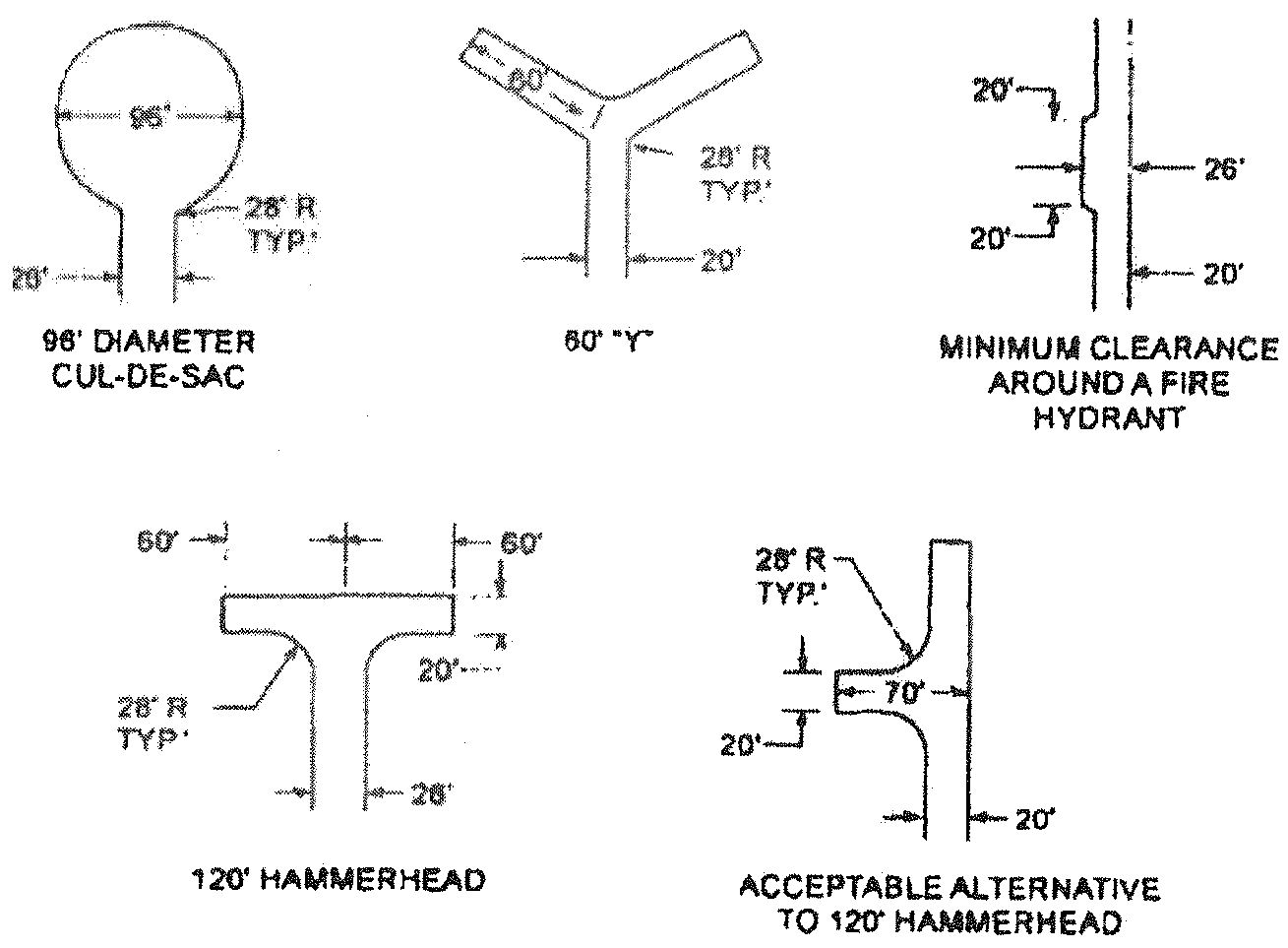
D103.6 Signs. Where required by the fire code official, fire apparatus access roads shall be marked in one of the following manners:
1.
CURB PAINTING - Curbs along fire lanes shall be painted red with white letters stating "FIRE LANE TOW AWAY ZONE" and/or "FIRE LANE NO PARKING" painted at intervals not exceeding every 50' feet. The letters shall not be less than four inches tall.
2.
FLAT SURFACE (NO CURB) - A red six (6) inch stripe, with markings indicated in Paragraph 1 above, shall be placed along the outer edges of the pavement along the fire lane.
3.
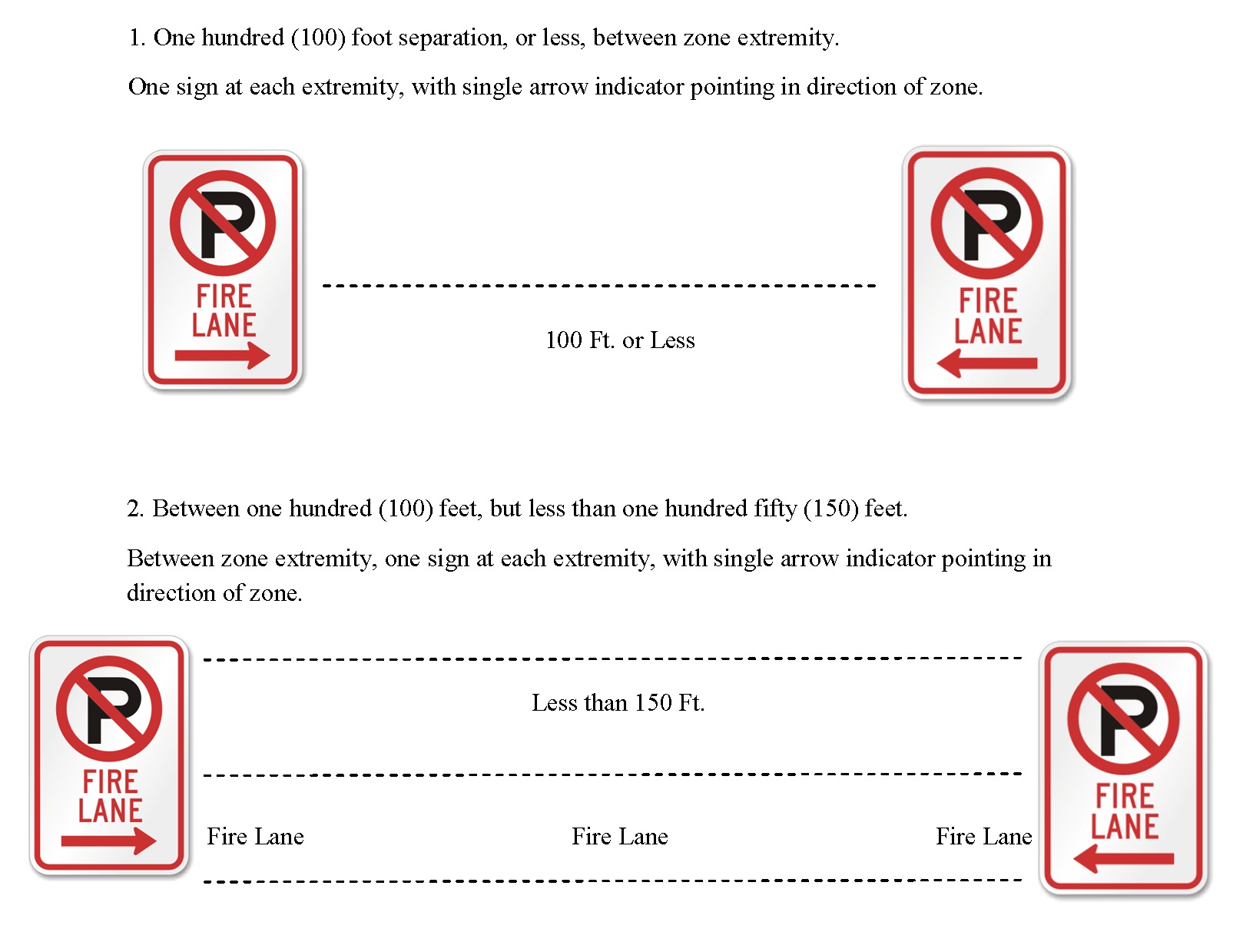
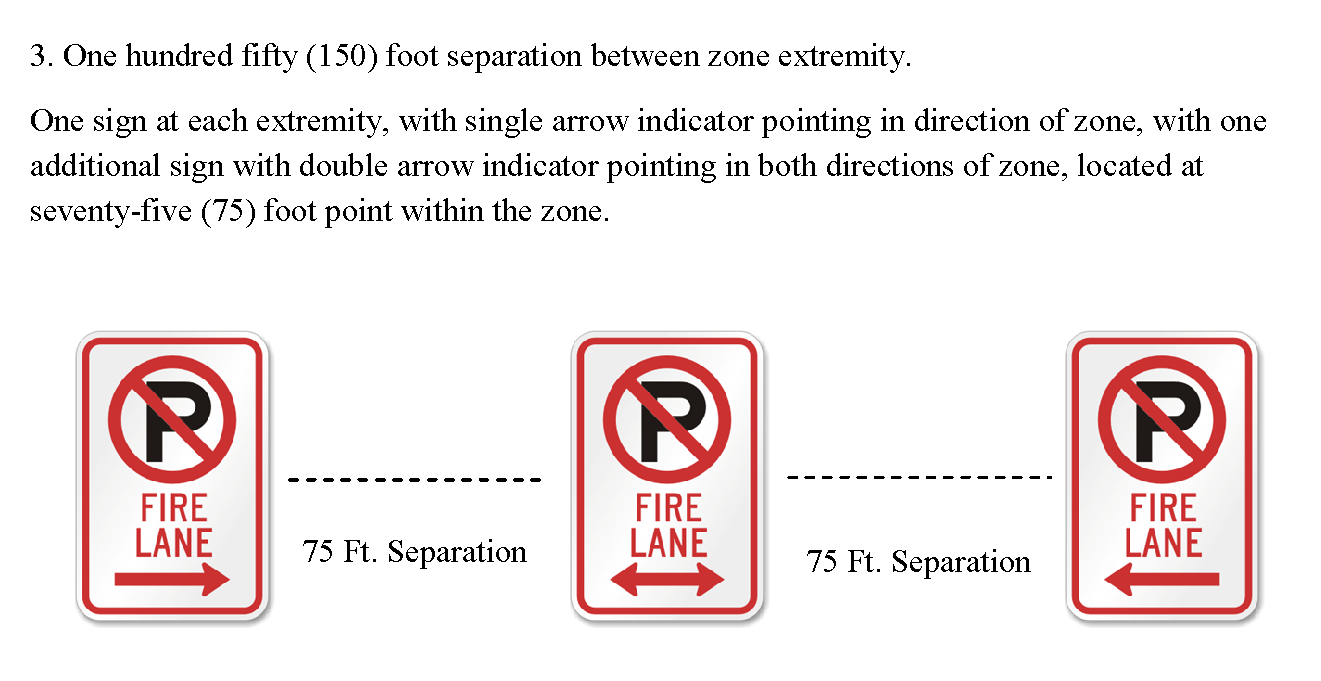
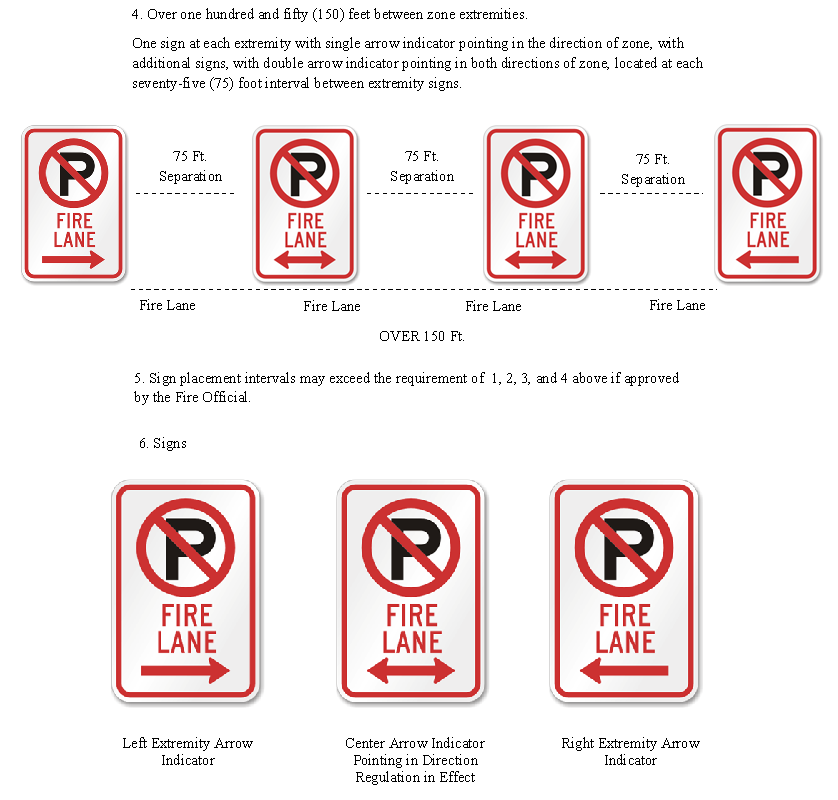
Free standing signs placed along the fire lane. The design and placement of signs shall be in accordance with figure D 103.6. Signs shall have a minimum dimension of 12 inches wide by 18 inches high and have red letters on a white reflective background. Signs shall be posted on one or both sides of the fire apparatus road as required by Paragraphs D103.6.1 or D103.6.2.
Figure D103.6
Fire Lane Marking Standard Signage
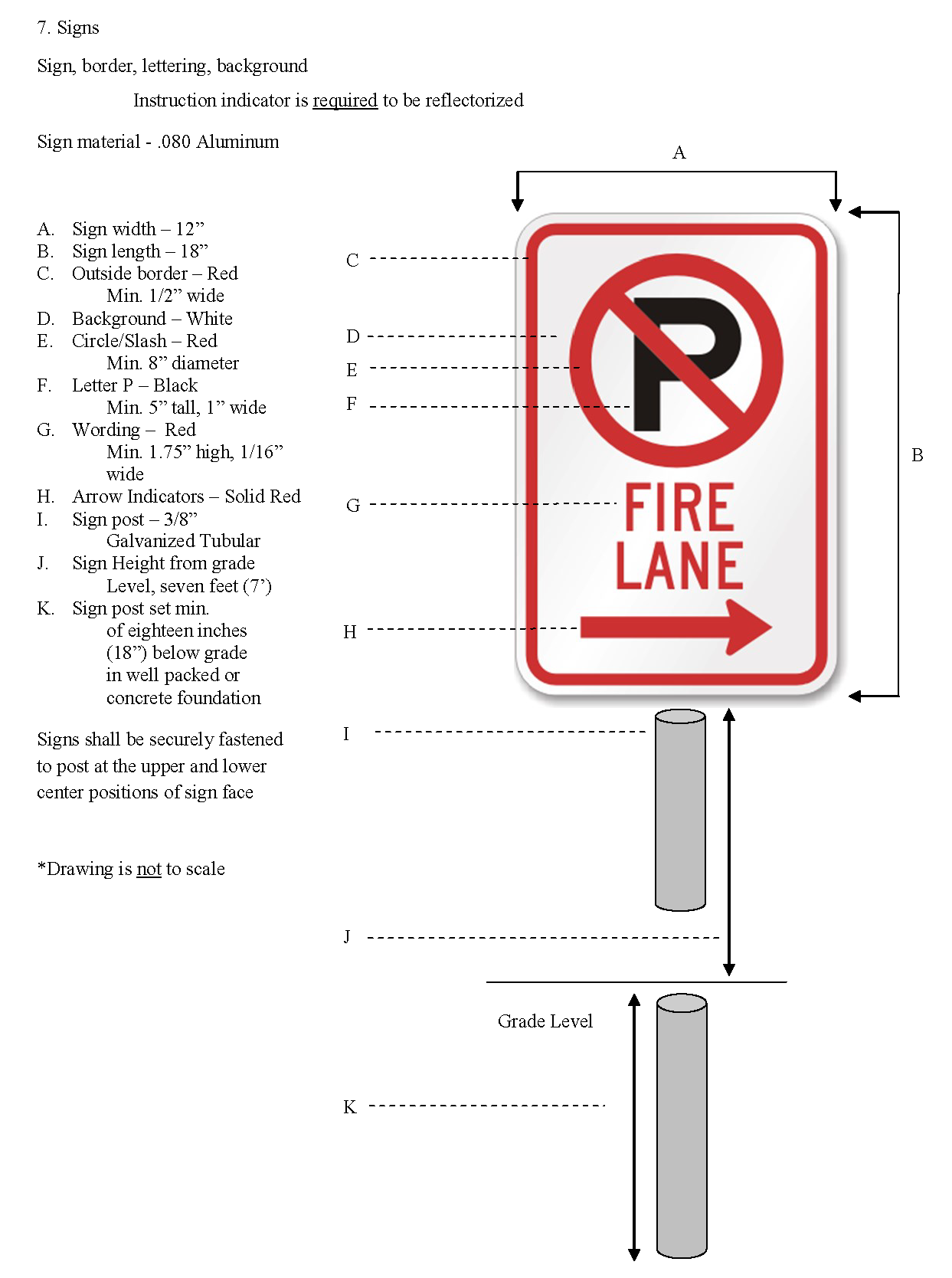
D107.1 One- or two-family dwelling residential developments. Developments of one- or two- family dwellings where the number of dwelling units exceeds 75 shall be provided with separate and approved fire apparatus access roads and shall meet the requirements of Section D104.3.
Exceptions:
1.
Where there are more than 75 dwelling units on a single public or private fire apparatus access road and all dwelling units are equipped throughout with an approved automatic sprinkler system in accordance with Subparagraphs 903.3.1.1, 903.3.1.2 or 903.3.1.3 of the International Fire Code, access from two directions shall not be required.
2.
The number of dwelling units on a single fire apparatus access road shall not be increased unless fire apparatus access roads will connect with future development, as determined by the fire code official.
(Ord. No. 1536, § 8, 12-20-05; Ord. No. 1790, § 8, 8-3-10; Ord. No. 2027, § 13, 9-15-15; Ord. No. 2320, § 10, 12-19-23)
Sec. 7-59.5. - Code Adopted.
Except as amended in this Article, the International Energy Conservation Code, 2021 edition, as published by the International Code Council, is adopted.
(Ord. No. 1790, § 9, 8-3-10; Ord. No. 2027, § 15, 9-15-15; Ord. No. 2320, § 11, 12-19-23)
Sec. 7-59.6. - Code Deletions.
The following sections of the International Energy Conservation Code are deleted:
Section C110
Section R110
Section R404.2
Section R404.3
(Ord. No. 1790, § 9, 8-3-10; Ord. No. 2027, § 15, 9-15-15; Ord. No. 2320, § 11, 12-19-23)
Sec. 7-59.7. - Code Amendments.
The following sections of the International Energy Conservation Code are amended as follows:
Subsection 101.1 is amended to read as follows:
101.1. Title. These regulations shall be known as the International Energy Conservation Code of the City of Sugar Land, hereinafter referred to as "this code."
Paragraph C102.1.2 is added to read as follows:
C102.1.2. Alternative compliance. A building certified by a national, state, or local accredited energy efficiency program and determined by the Energy Systems Laboratory to be in compliance with the energy efficiency requirements of this section may, at the option of the code official, be considered in compliance. The United States Environmental Protection Agency's Energy Star Program certification of energy code equivalency shall be considered in compliance.
Paragraph R102.1.2 is added to read as follows:
R102.1.2. Alternative compliance. A building certified by a national, state, or local accredited energy efficiency program and determined by the Energy Systems Laboratory to be in compliance with the energy efficiency requirements of this section may, at the option of the code official, be considered in compliance. The United States Environmental Protection Agency's Energy Star Program certification of energy code equivalency shall be considered in compliance. Regardless of the program or the path to compliance, each 1- and 2-family dwelling shall be tested for air and duct leakage as prescribed in Section R402.4.1.2 and R403.3.3 respectively.
Subsection R405.2 is amended by amending Table R405.2 to read as follows:
TABLE R405.2
REQUIREMENTS FOR TOTAL BUILDING PERFORMANCE
a. Reference to a code section includes all the relative subsections except as indicated in the table.
Subsection 406.2 is amended by amending Table R406.2 to read as follows:
TABLE R406.2
REQUIREMENTS FOR ENERGY RATING INDEX
a. Reference to a code section includes all of the relative subsections except as indicated in the table.
Paragraph R402.4.6 is amended to read as follows:
R402.4.6. Electrical and communication outlet boxes (air-sealed boxes). Electrical and communication outlet boxes installed in the building thermal envelope shall be sealed to limit air leakage between conditioned and unconditioned spaces.
(Ord. No. 1790, § 9, 8-3-10; Ord. No. 2027, § 15, 9-15-15; Ord. No. 2320, § 11, 12-19-23)
Sec. 7-60. - Definitions.
The following words and terms, when used in this Article have the following meanings, unless the context clearly indicates otherwise:
Air Gap means complete physical separation between the free flowing discharge end of a potable water supply pipeline and an open or nonpressure receiving vessel.
Atmospheric Vacuum Breaker means an assembly containing an air inlet valve, a check seat, and an air inlet port. The flow of water into the body causes the air inlet valve to close the air inlet port. When the flow of water stops, the air inlet valve falls and forms a check against back-siphonage. At the same time, it opens the air inlet port allowing air to enter and satisfy the vacuum. Also known as an Atmospheric Vacuum Breaker Back-Siphonage Prevention Assembly.
Backflow Prevention means the mechanical prevention of reverse flow, or back siphonage, of nonpotable water from an irrigation system into the potable water source.
Backflow Prevention Assembly means any assembly used to prevent backflow into a potable water system. The type of assembly used is based on the existing or potential degree of health hazard and backflow condition.
Completion of Irrigation System Installation means when the landscape irrigation system has been installed, all minimum standards met, all tests performed, and the irrigator is satisfied that the system is operating correctly.
Consulting means the act of providing advice, guidance, review or recommendations related to landscape irrigation systems.
Cross-Connection means an actual or potential connection between a potable water source and an irrigation system that may contain contaminates or pollutants or any source of water that has been treated to a lesser degree in the treatment process.
Design means the act of determining the various elements of a landscape irrigation system that will include, but not be limited to, elements such as collecting site specific information, defining the scope of the project, defining plant watering needs, selecting and laying out emission devices, locating system components, conducting hydraulics calculations, identifying any local regulatory requirements, or scheduling irrigation work at a site. Completion of the various components will result in an irrigation plan.
Design Pressure means the pressure that is required for an emission device to operate properly. Design pressure is calculated by adding the operating pressure necessary at an emission device to the total of all pressure losses accumulated from an emission device to the water source.
Double Check Valve means an assembly that is composed of 2 independently acting, approved check valves, including tightly closed resilient seated shutoff valves attached at each end of the assembly and fitted with properly located resilient seated test cocks. Also known as a Double Check Valve Backflow Prevention Assembly.
Emission Device means any device that is contained within an irrigation system and that is used to apply water. Common emission devices in an irrigation system include, but are not limited to, spray and rotary sprinkler heads, and drip irrigation emitters.
Employed means engaged or hired to provide consulting services or perform any activity relating to the sale, design, installation, maintenance, alteration, repair, or service to irrigation systems. A person is employed if that person is in an employer-employee relationship as defined by Internal Revenue Code, 26 United States Code Service, §3212(d) based on the behavioral control, financial control, and the type of relationship involved in performing employment related tasks.
Head-to-Head Spacing means the spacing of spray or rotary heads equal to the manufacturer's published radius of the head.
Health Hazard means a cross-connection or potential cross-connection with an irrigation system that involves any substance that may, if introduced into the potable water supply, cause death or illness, spread disease, or have a high probability of causing such effects.
Hydraulics means the science of dynamic and static water; the mathematical computation of determining pressure losses and pressure requirements of an irrigation system.
Inspector means a licensed plumbing inspector, water district operator, other governmental entity, or irrigation inspector who inspects irrigation systems and performs other enforcement duties for a municipality or water district as an employee or as a contractor.
Installer means a person who actually connects an irrigation system to a private or public raw or potable water supply system or any water supply, who is licensed according to Title 30, Texas Administrative Code, Chapter 30 (relating to Occupational Licenses and Registrations).
Irrigation Inspector means a person who inspects irrigation systems and performs other enforcement duties for a municipality or water district as an employee or as a contractor and is required to be licensed under Title 30, Texas Administrative Code, Chapter 30 (relating to Occupational Licenses and Registrations).
Irrigation Plan means a scaled drawing of a landscape irrigation system which lists required information, the scope of the project, and represents the changes made in the installation of the irrigation system.
Irrigation Services means selling, designing, installing, maintaining, altering, repairing, servicing, permitting, providing consulting services regarding, or connecting an irrigation system to a water supply.
Irrigation System means an assembly of component parts that is permanently installed for the controlled distribution and conservation of water to irrigate any type of landscape vegetation in any location, and/or to reduce dust or control erosion. This term does not include a system that is used on or by an agricultural operation as defined by Texas Agricultural Code, §251.002.
Irrigation Technician means a person who works under the supervision of a licensed irrigator to install, maintain, alter, repair, service or supervise installation of an irrigation system, including the connection of such system in or to a private or public, raw or potable water supply system or any water supply, and who is required to be licensed under Title 30, Texas Administrative Code, Chapter 30 (relating to Occupational Licenses and Registrations).
Irrigation Zone means a subdivision of an irrigation system with a matched precipitation rate based on plant material type (such as turf, shrubs, or trees), microclimate factors (such as sun/shade ratio), topographic features (such as slope) and soil conditions (such as sand, loam, clay, or combination) or for hydrological control.
Irrigator means a person who sells, designs, offers consultations regarding, installs, maintains, alters, repairs, services or supervises the installation of an irrigation system, including the connection of such system to a private or public, raw or potable water supply system or any water supply, and who is required to be licensed under Title 30, Texas Administrative Code, Chapter 30 (relating to Occupational Licenses and Registrations).
Irrigator-in-Charge means the irrigator responsible for all irrigation work performed by an exempt business owner, including, but not limited to obtaining permits, developing design plans, supervising the work of other irrigators or irrigation technicians, and installing, selling, maintaining, altering, repairing, or servicing a landscape irrigation system.
Landscape Irrigation means the science of applying the necessary amount of water to promote or sustain healthy growth of plant material or turf.
License means an occupational license that is issued by the Texas Commission on Environmental Quality under Title 30, Texas Administrative Code, Chapter 30 to an individual that authorizes the individual to engage in an activity that is covered by Title 30, Texas Administrative Code, Chapter 30.
Mainline means a pipe within an irrigation system that delivers water from the water source to the individual zone valves.
Maintenance Checklist means a document made available to the irrigation system's owner or owner's representative that contains information regarding the operation and maintenance of the irrigation system, including, but not limited to: checking and repairing the irrigation system, setting the automatic controller, checking the rain or moisture sensor, cleaning filters, pruning grass and plants away from irrigation emitters, using and operating the irrigation system, the precipitation rates of each irrigation zone within the system, any water conservation measures currently in effect from the water purveyor, the name of the water purveyor, a suggested seasonal or monthly watering schedule based on current evapotranspiration data for the geographic region, and the minimum water requirements for the plant material in each zone based on the soil type and plant material where the system is installed.
Major Maintenance, Alteration, Repair, or Service means any activity that involves opening to the atmosphere the irrigation main line at any point prior to the discharge side of any irrigation zone control valve. This includes, but is not limited to, repairing or connecting into a main supply pipe, replacing a zone control valve, or repairing a zone control valve in a manner that opens the system to the atmosphere.
Master Valve means a remote control valve located after the backflow prevention device that controls the flow of water to the irrigation system mainline.
Matched Precipitation Rate means the condition in which all sprinkler heads within an irrigation zone apply water at the same rate.
New Installation means an irrigation system installed at a location where one did not previously exist.
Pass-Through Contract means a written contract between a contractor or builder and a licensed irrigator or exempt business owner to perform part or all of the irrigation services relating to an irrigation system.
Potable Water means water that is suitable for human consumption.
Pressure Vacuum Breaker means an assembly containing an independently operating internally loaded check valve and an independently operating loaded air inlet valve located on the discharge side of the check valve. Also known as a Pressure Vacuum Breaker Back-siphonage Prevention Assembly.
Reclaimed Water means domestic or municipal wastewater which has been treated to a quality suitable for beneficial use, such as landscape irrigation.
Records of Landscape Irrigation Activities means the irrigation plans, contracts, warranty information, invoices, copies of permits, and other documents that relate to the installation, maintenance, alteration, repair, or service of a landscape irrigation system.
Reduced Pressure Principle Backflow Prevention Assembly means an assembly containing 2 independently acting approved check valves together with a hydraulically operating mechanically independent pressure differential relief valve located between the 2 check valves and below the first check valve.
Static Water Pressure means the pressure of water when it is not moving.
Supervision means the on-the-job oversight and direction by a licensed irrigator who is fulfilling his or her professional responsibility to the client and/or employer in compliance with local or state requirements. Also a licensed installer working under the direction of a licensed irrigator or beginning January 1, 2009, an irrigation technician who is working under the direction of a licensed irrigator, to install, maintain, alter, repair or service an irrigation system.
TCEQ means the Texas Commission on Environmental Quality or its successor agency.
Water Conservation means the design, installation, service, and operation of an irrigation system in a manner that prevents the waste of water, promotes the most efficient use of water, and applies the least amount of water that is required to maintain healthy individual plant material or turf, reduce dust, and control erosion.
Zone Flow means a measurement, in gallons per minute or gallons per hour, of the actual flow of water through a zone valve, calculated by individually opening each zone valve and obtaining a valid reading after the pressure has stabilized. For design purposes, the zone flow is the total flow of all nozzles in the zone at a specific pressure.
Zone Valve means an automatic valve that controls a single zone of a landscape irrigation system.
(Ord. No. 1725, § 1, 2-17-09)
Sec. 7-61. - Valid License Required.
Any person who connects an irrigation system to the water supply within the City or the City's extraterritorial jurisdiction, commonly referred to as the ETJ, must hold a valid license, as defined by Title 30, Texas Administrative Code, Chapter 30 and required by Chapter 1903 of the Texas Occupations Code, or as defined by Chapter 365, Title 22 of the Texas Administrative Code and required by Chapter 1301 of the Texas Occupations Code. A property owner is not required to be licensed if he or she is performing irrigation work in a building or on a premises owned or occupied by the person as the person's home. A home or property owner who installs an irrigation system must meet the standards contained in this Article as well as the provisions of Title 30, Texas Administrative Code, Chapter 344 regarding spacing, water pressure, spraying water over impervious materials, rain or moisture shut-off devices or other technology, backflow prevention and isolation valves.
(Ord. No. 1725, § 1, 2-17-09)
Sec. 7-62. - Permit Required.
Any person installing an irrigation system within the territorial limits or extraterritorial jurisdiction of the City is required to obtain a permit from the City. Any plan approved for a permit must be in compliance with the requirements of this Chapter. The following types of systems are exempt from the permit requirement of this Section:
A.
An irrigation system that is an on-site sewage disposal system, as defined by Section 355.002, Health and Safety Code; or
B.
An irrigation system used on or by an agricultural operation as defined by Section 251.002, Agriculture Code; or
C.
An irrigation system connected to a groundwater well used by the property owner for domestic use.
(Ord. No. 1725, § 1, 2-17-09)
Sec. 7-63. - Permit Application.
A.
Permit applications must be submitted to the City, signed, and accompanied with the application fees.
B.
For a permit to be issued, the applicant must hold a valid installer's license issued by the Texas Commission on Environmental Quality ("TCEQ"), under Chapter 1903 of the Texas Occupations Code, as amended.
C.
For an irrigation inspection to be performed, an irrigation plan that is sealed, signed and dated by a Texas Professional Engineer, a licensed irrigation installer, or a licensed landscape architect that complies with the requirements of this Article and State law, must be onsite at the time of the inspection.
D.
The City's Uniform Permit Procedures in Chapter 4 of this Code apply to permits issued under this Article.
(Ord. No. 1725, § 1, 2-17-09; Ord. No. 2303, § 3, 5-2-23)
Sec. 7-64. - Backflow Prevention Methods and Devices.
A.
Any irrigation system that is connected to the potable water supply must be connected through a backflow prevention method approved by the Texas Commission on Environmental Quality (TCEQ). The backflow prevention device must be approved by the American Society of Sanitary Engineers; or the Foundation for Cross-Connection Control and Hydraulic Research, University of Southern California; or the Uniform Plumbing Code; or any other laboratory that has equivalent capabilities for both the laboratory and field evaluation of backflow prevention assemblies. The backflow prevention device must be installed in accordance with the laboratory approval standards or if the approval does not include specific installation information, the manufacturer's current published recommendations.
B.
If conditions that present a health hazard exist, 1 of the following methods must be used to prevent backflow:
1.
An air gap may be used if:
a.
There is an unobstructed physical separation; and
b.
The distance from the lowest point of the water supply outlet to the flood rim of the fixture or assembly into which the outlet discharges is at least 1 inch or twice the diameter of the water supply outlet, whichever is greater.
2.
Reduced pressure principle backflow prevention assemblies may be used if:
a.
The device is installed at a minimum of 12 inches above ground in a location that will ensure that the assembly will not be submerged; and
b.
Drainage is provided for any water that may be discharged through the assembly relief valve.
3.
Pressure vacuum breakers may be used if:
a.
No back-pressure condition will occur; and
b.
The device is installed at a minimum of 12 inches above any downstream piping and the highest downstream opening. Pop-up sprinklers are measured from the retracted position from the top of the sprinkler.
4.
Atmospheric vacuum breakers may be used if:
a.
No back-pressure will be present;
b.
There are no shutoff valves downstream from the atmospheric vacuum breaker;
c.
The device is installed at a minimum of 6 inches above any downstream piping and the highest downstream opening. Pop-up sprinklers are measured from the retracted position from the top of the sprinkler;
d.
There is no continuous pressure on the supply side of the atmospheric vacuum breaker for more than 12 hours in any 24-hour period; and
e.
A separate atmospheric vacuum breaker is installed on the discharge side of each irrigation control valve, between the valve and all the emission devices that the valve controls.
C.
Backflow prevention devices used in applications designated as health hazards must be tested upon installation and annually thereafter.
D.
If an irrigation system is connected to a potable water supply through a double check valve, pressure vacuum breaker, or reduced pressure principle backflow assembly and includes an automatic master valve on the system, the automatic master valve must be installed on the discharge side of the backflow prevention assembly.
E.
The irrigator shall ensure the backflow prevention device is tested by a licensed Backflow Prevention Assembly Tester prior to being placed in service and the test results provided to the local water purveyor and the irrigation system's owner or owner's representative within 10 business days of testing of the backflow prevention device.
(Ord. No. 1725, § 1, 2-17-09)
Sec. 7-65. - Specific Conditions and Cross-Connection Control.
A.
Before any chemical is added to an irrigation system connected to the potable water supply, the irrigation system must be connected through a reduced pressure principle backflow prevention assembly or air gap.
B.
Connection of any additional water source to an irrigation system that is connected to the potable water supply can only be done if the irrigation system is connected to the potable water supply through a reduced-pressure principle backflow prevention assembly or an air gap.
C.
Irrigation system components with chemical additives induced by aspiration, injection, or emission system connected to any potable water supply must be connected through a reduced pressure principle backflow device.
D.
If an irrigation system is designed or installed on a property that is served by an on-site sewage facility, as defined in Title 30, Texas Administrative Code, Chapter 285, then:
1.
All irrigation piping and valves must meet the separation distances from the on-site sewage facilities system as required for a private water line in Title 30, Texas Administrative Code, Section 285.91(10);
2.
Any connections using a private or public potable water source that is not the City's potable water system must be connected to the water source through a reduced pressure principle backflow prevention assembly as defined in Title 30, Texas Administrative Code, Section 344.50; and
3.
Any water from the irrigation system that is applied to the surface of the area utilized by the on-site sewage facility system must be controlled on a separate irrigation zone or zones so as to allow complete control of any irrigation to that area so that there will not be excess water that would prevent the on-site sewage facilities system from operating effectively.
(Ord. No. 1725, § 1, 2-17-09)
Sec. 7-66. - Water Conservation.
All irrigation systems shall be designed, installed, maintained, altered, repaired, serviced, and operated in a manner that will promote water conservation, as defined in section 7-60. Ordinance No. 910, adopted October 24, 1994, adopted a Water Conservation Plan for the City. The Plan consists of, among others, a utility evaluation, a system audit, a water conservation element, a drought contingency plan and various appendices containing maps, conservation tips and the water rate structure. The Water Conservation Plan is on file with the City and available for public inspection through the City Secretary's Office.
(Ord. No. 1725, § 1, 2-17-09)
Sec. 7-67. - Irrigation Plan Design; Minimum Standards.
A.
An irrigator shall prepare an irrigation plan for each site where a new irrigation system will be installed. A paper or electronic copy of the irrigation plan must be on the job site at all times during the installation of the irrigation system. A drawing showing the actual installation of the system is due to each irrigation system owner after all new irrigation system installations. During the installation of the irrigation system, variances from the original plan may be authorized by the licensed irrigator if the variance from the plan does not:
1.
Diminish the operational integrity of the irrigation system;
2.
Violate any requirements of this ordinance; and
3.
Go unnoted in red on the irrigation plan.
B.
The irrigation plan must include complete coverage of the area to be irrigated. If a system does not provide complete coverage of the area to be irrigated, it must be noted on the irrigation plan.
C.
All irrigation plans used for construction must be drawn to scale. The plan must include, at a minimum, the following information:
1.
The irrigator's seal, signature, and date of signing;
2.
All major physical features and the boundaries of the areas to be watered;
3.
A North arrow;
4.
A legend;
5.
The zone flow measurement for each zone;
6.
Location and type of each:
a.
Controller; and
b.
Sensor (for example, but not limited to, rain, moisture, wind, flow, or freeze);
7.
Location, type, and size of each:
a.
Water source, such as, but not limited to a water meter and point(s) of connection;
b.
Backflow prevention device;
c.
Water emission device, including, but not limited to, spray heads, rotary sprinkler heads, quick-couplers, bubblers, drip, or micro-sprays;
d.
Valve, including but not limited to, zone valves, master valves, and isolation valves;
e.
Pressure regulation component; and
f.
Main line and lateral piping.
8.
The scale used; and
9.
The design pressure.
(Ord. No. 1725, § 1, 2-17-09)
Sec. 7-68. - Design and Installation; Minimum Requirements.
A.
No irrigation design or installation shall require the use of any component in a way which exceeds the manufacturer's published performance limitations for the component.
B.
Spacing.
1.
The maximum spacing between emission devices must not exceed the manufacturer's published radius or spacing of the device(s). The radius or spacing is determined by referring to the manufacturer's published specifications for a specific emission device at a specific operating pressure.
2.
New irrigation systems shall not utilize above-ground spray emission devices in landscapes that are less than 48 inches not including the impervious surfaces in either length or width and which contain impervious pedestrian or vehicular traffic surfaces along 2 or more perimeters. If pop-up sprays or rotary sprinkler heads are used in a new irrigation system, the sprinkler heads must direct flow away from any adjacent surface and shall not be installed closer than 4 inches from a hardscape, such as, but not limited to, a building foundation, fence, concrete, asphalt, pavers, or stones set with mortar.
3.
Narrow paved walkways, jogging paths, golf cart paths or other small areas located in cemeteries, parks, golf courses or other public areas may be exempted from this requirement if the runoff drains into a landscaped area.
C.
Water Pressure. Emission devices must be installed to operate at the minimum and not above the maximum sprinkler head pressure as published by the manufacturer for the nozzle and head spacing that is used. Methods to achieve the water pressure requirements include, but are not limited to, flow control valves, a pressure regulator, or pressure compensating spray heads.
D.
Piping. Piping in irrigation systems must be designed and installed so that the flow of water in the pipe will not exceed a velocity of 5 feet per second for polyvinyl chloride (PVC) pipe.
E.
Irrigation Zones. Irrigation systems shall have separate zones based on plant material type, microclimate factors, topographic features, soil conditions, and hydrological requirements.
F.
Matched Precipitation Rate. Zones must be designed and installed so that all of the emission devices in that zone irrigate at the same precipitation rate.
G.
Irrigation systems shall not spray water over surfaces made of concrete, asphalt, brick, wood, stones set with mortar, or any other impervious material, such as, but not limited to, walls, fences, sidewalks, streets, etc.
H.
Master Valve. When provided, a master valve shall be installed on the discharge side of the backflow prevention device on all new installations.
I.
PVC Pipe Primer Solvent. All new irrigation systems that are installed using PVC pipe and fittings shall be primed with a colored primer prior to applying the PVC cement in accordance with the Uniform Plumbing Code (Section 316) or the International Plumbing Code (Section 605).
J.
Rain or Moisture Shut-Off Devices or Other Technology. All new automatically controlled irrigation systems must include sensors or other technology designed to inhibit or interrupt operation of the irrigation system during periods of moisture or rainfall. Rain or moisture shut-off technology must be installed according to the manufacturer's published recommendations. Repairs to existing automatic irrigation systems that require replacement of an existing controller must include a sensor or other technology designed to inhibit or interrupt operation of the irrigation system during periods of moisture or rainfall.
K.
Isolation Valve. All new irrigation systems must include an isolation valve between the water meter and the backflow prevention device.
L.
Depth Coverage of Piping. Piping in all irrigation systems must be installed according to the manufacturer's published specifications for depth coverage of piping.
1.
If the manufacturer has not published specifications for depth coverage of piping, the piping must be installed to provide minimum depth coverage of 6 inches of select backfill, between the top of the pipe and the natural grade of the topsoil. All portions of the irrigation system that fail to meet this standard must be noted on the irrigation plan. If the area being irrigated has rock at a depth of 6 inches or less, select backfill may be mounded over the pipe. Mounding must be noted on the irrigation plan and discussed with the irrigation system owner or owner's representative to address any safety issues.
2.
If a utility, manmade structure, or roots create an unavoidable obstacle, which makes the 6-inch depth coverage requirement impractical, the piping shall be installed to provide a minimum of 2 inches of select backfill between the top of the pipe and the natural grade of the topsoil.
3.
All trenches and holes created during installation of an irrigation system must be backfilled and compacted to the original grade.
M.
Wiring Irrigation Systems.
1.
Underground electrical wiring used to connect an automatic controller to any electrical component of the irrigation system must be listed by Underwriters Laboratories as acceptable for burial underground.
2.
Electrical wiring that connects any electrical components of an irrigation system must be sized according to the manufacturer's recommendation.
3.
Electrical wire splices which may be exposed to moisture must be waterproof as certified by the wire splice manufacturer.
4.
Underground electrical wiring that connects an automatic controller to any electrical component of the irrigation system must be buried with a minimum of 6 inches of select backfill.
N.
Water contained within the piping of an irrigation system is deemed to be non-potable. No drinking or domestic water usage, such as, but not limited to, filling swimming pools or decorative fountains, shall be connected to an irrigation system. If a hose bib (an outdoor water faucet that has hose threads on the spout) is connected to an irrigation system for the purpose of providing supplemental water to an area, the hose bib must be installed using a quick coupler key on a quick coupler installed in a covered purple valve box and the hose bib and any hoses connected to the bib must be labeled "non potable, not safe for drinking." An isolation valve must be installed upstream of a quick coupler connecting a hose bib to an irrigation system.
O.
Beginning January 1, 2010, either a licensed irrigator or a licensed irrigation technician shall be on-site at all times while the landscape irrigation system is being installed. When an irrigator is not onsite, the irrigator shall be responsible for ensuring that a licensed irrigation technician is on-site to supervise the installation of the irrigation system.
(Ord. No. 1725, § 1, 2-17-09)
Sec. 7-69. - Completion of Irrigation System Installation.
Upon completion of the irrigation system, the irrigator or irrigation technician who provided supervision for the on-site installation shall be required to complete 4 items:
A.
A final "walk through" with the irrigation system's owner or the owner's representative to explain the operation of the system;
B.
The maintenance checklist on which the irrigator or irrigation technician shall obtain the signature of the irrigation system's owner or owner's representative and shall sign, date, and seal the checklist. If the irrigation system's owner or owner's representative is unwilling or unable to sign the maintenance checklist, the irrigator shall note the time and date of the refusal on the irrigation system's owner or owner's representative's signature line. The irrigation system owner or owner's representative will be given the original maintenance checklist and a duplicate copy of the maintenance checklist shall be maintained by the irrigator. The items on the maintenance checklist shall include but are not limited to:
1.
The manufacturer's manual for the automatic controller, if the system is automatic;
2.
A seasonal (spring, summer, fall, winter) watering schedule based on either current/real time evapotranspiration or monthly historical reference evapotranspiration (historical ET) data, monthly effective rainfall estimates, plant landscape coefficient factors, and site factors;
3.
A list of components, such as the nozzle, or pump filters, and other such components; that require maintenance and the recommended frequency for the service; and
4.
The statement, "This irrigation system has been installed in accordance with all applicable state and local laws, ordinances, rules, regulations or orders. I have tested the system and determined that it has been installed according to the Irrigation Plan and is properly adjusted for the most efficient application of water at this time."
C.
A permanent sticker which contains the irrigator's name, license number, company name, telephone number and the dates of the warranty period shall be affixed to each automatic controller installed by the irrigator or irrigation technician. If the irrigation system is manual, the sticker shall be affixed to the original maintenance checklist. The information contained on the sticker must be printed with waterproof ink.
D.
The irrigation plan indicating the actual installation of the system must be provided to the irrigation system's owner or owner representative.
(Ord. No. 1725, § 1, 2-17-09)
Sec. 7-70. - Maintenance, Alteration, Repair, or Service of Irrigation Systems.
A.
The licensed irrigator is responsible for all work that the irrigator performed during the maintenance, alteration, repair, or service of an irrigation system during the warranty period. The irrigator or business owner is not responsible for the professional negligence of any other irrigator who subsequently conducts any irrigation service on the same irrigation system.
B.
All trenches and holes created during the maintenance, alteration, repair, or service of an irrigation system must be returned to the original grade with compacted select backfill.
C.
Colored PVC pipe primer solvent must be used on all pipes and fittings used in the maintenance, alteration, repair, or service of an irrigation system in accordance with the Uniform Plumbing Code (Section 316) or the International Plumbing Code (Section 605).
D.
When maintenance, alteration, repair or service of an irrigation system involves excavation work at the water meter or backflow prevention device, an isolation valve shall be installed, if an isolation valve is not present.
(Ord. No. 1725, § 1, 2-17-09)
Sec. 7-71. - Reclaimed Water.
Reclaimed water may be utilized in landscape irrigation systems if:
A.
There is no direct contact with edible crops, unless the crop is pasteurized before consumption;
B.
The irrigation system does not spray water across property lines that do not belong to the irrigation system's owner;
C.
The irrigation system is installed using purple components;
D.
The domestic potable water line is connected using an air gap or a reduced pressure principle backflow prevention device, in accordance with Title 30, Texas Administrative Code, Section 290.47(i) (relating to Appendices);
E.
A minimum of an 8-inch-by-8-inch sign, in English and Spanish, is prominently posted on/in the area that is being irrigated, that reads, "RECLAIMED WATER - DO NOT DRINK" and "AGUA DE RECUPERACIÓN - NO BEBER"; and
F.
Backflow prevention on the reclaimed water supply line shall be in accordance with the regulations of the City's water provider.
G.
In the event that the installation and/or operation of a system using reclaimed water is subject to more stringent standards under State or Federal law, those more stringent standards shall control over the provisions of this Article.
(Ord. No. 1725, § 1, 2-17-09)
Sec. 7-72. - Advertisement Requirements.
A.
All vehicles used in the performance of irrigation installation, maintenance, alteration, repair, or service must display the irrigator's license number in the form of "LI_______" in a contrasting color of block letters at least 2 inches high, on both sides of the vehicle.
B.
All forms of written and electronic advertisements for irrigation services must display the irrigator's license number in the form of "LI_______." Any form of advertisement, including business cards, and estimates which displays an entity's or individual's name other than that of the licensed irrigator must also display the name of the licensed irrigator and the licensed irrigator's license number. Trailers that advertise irrigation services must display the irrigator's license number.
C.
The name, mailing address, and telephone number of the commission must be prominently displayed on a legible sign and displayed in plain view for the purpose of addressing complaints at the permanent structure where irrigation business is primarily conducted and irrigation records are kept.
(Ord. No. 1725, § 1, 2-17-09)
Sec. 7-73. - Contracts.
A.
All contracts to install an irrigation system must be in writing and signed by each party and must specify the irrigator's name, license number, business address, current business telephone numbers, the date that each party signed the agreement, the total agreed price, and must contain the statement, "Irrigation in Texas is regulated by the Texas Commission on Environmental Quality (TCEQ), MC-178, P.O. Box 13087, Austin, Texas 78711-3087. TCEQ's website is: www. tceq.state.tx.us." All contracts must include the irrigator's seal, signature, and date.
B.
All written estimates, proposals, bids, and invoices relating to the installation or repair of an irrigation system(s) must include the irrigator's name, license number, business address, current business telephone number(s), and the statement: "Irrigation in Texas is regulated by the Texas Commission On Environmental Quality (TCEQ) (MC-178), P.O. Box 13087, Austin, Texas 78711-3087. TCEQ's web site is: www.tceq.state.tx.us."
C.
An individual who agrees by contract to provide irrigation services as defined in Title 30, Texas Administrative Code, Section 344.30 (relating to License Required) shall hold an irrigator license issued under Title 30, Texas Administrative Code, Chapter 30 (relating to Occupational Licenses and Registrations) unless the contract is a pass-through contract as defined in Title 30, Texas Administrative Code, Section 344.1(36) (relating to Definitions). If a pass-through contract includes irrigation services, then the irrigation portion of the contract can only be performed by a licensed irrigator. If an irrigator installs a system pursuant to a pass-through contract, the irrigator shall still be responsible for providing the irrigation system's owner or through contract, the irrigator shall still be responsible for providing the irrigation system's owner or owner's representative a copy of the warranty and all other documents required under this chapter. A pass-through contract must identify by name and license number the irrigator that will perform the work and must provide a mechanism for contacting the irrigator for irrigation system warranty work.
D.
The contract must include the dates that the warranty is valid.
(Ord. No. 1725, § 1, 2-17-09)
Sec. 7-74. - Warranties for Systems.
A.
On all installations of new irrigation systems, an irrigator shall present the irrigation system's owner or owner's representative with a written warranty covering materials and labor furnished in the new installation of the irrigation system. The irrigator shall be responsible for adhering to terms of the warranty. If the irrigator's warranty is less than the manufacturer's warranty for the system components, then the irrigator shall provide the irrigation system's owner or the owner's representative with applicable information regarding the manufacturer's warranty period. The warranty must include the irrigator's seal, signature, and date. If the warranty is part of an irrigator's contract, a separate warranty document is not required.
B.
An irrigator's written warranty on new irrigation systems must specify the irrigator's name, business address, and business telephone number(s), must contain the signature of the irrigation system's owner or owner's representative confirming receipt of the warranty and must include the statement: "Irrigation in Texas is regulated by the Texas Commission on Environmental Quality (TCEQ), MC-178, P.O. Box 130897, Austin, Texas 78711-3087. TCEQ's website is: www.tceq.state.tx.us."
C.
On all maintenance, alterations, repairs, or service to existing irrigation systems, an irrigator shall present the irrigation system's owner or owner's representative a written document that identifies the materials furnished in the maintenance, alteration, repair, or service. If a warranty is provided, the irrigator shall abide by the terms. The warranty document must include the irrigator's name and business contact information.
(Ord. No. 1725, § 1, 2-17-09)
Sec. 7-75. - Enforcement.
A.
Any person, firm, corporation or agent who shall violate a provision of this Article, or fails to comply therewith, or with any of the requirements thereof, is subject to suit for injunctive relief as well as prosecution for criminal violations. Any violation of this Article is declared to be a nuisance.
B.
Any person violating any provision of Article shall, upon conviction, be fined a sum not exceeding $2,000.00. Each day that a provision of this Article is violated shall constitute a separate offense. An offense under this Article is a Class C misdemeanor.
C.
Nothing in this Article shall be construed as a waiver of the City's right to bring a civil action to enforce the provisions of this Article and to seek remedies as allowed by law, including, but not limited to the following:
1.
Injunctive relief to prevent specific conduct that violates this Article or to require specific conduct that is necessary for compliance with this Article; and
2.
Other available relief.
(Ord. No. 1725, § 1, 2-17-09)
Sec. 7-76. - Reference to State Law.
A reference to a State law, rule, or regulation includes amendments made after the enactment of this Article.
(Ord. No. 1725, § 1, 2-17-09)
Sec. 7-77. - Conflicts with Other Ordinances.
If any provision of this Article conflicts with a provision in Chapter 5, Article VIII, Water and Wastewater, of this Code, the more restrictive provision will control.
(Ord. No. 1725, § 1, 2-17-09)

