
Summit County Unincorporated
City Zoning Code
City Zoning Code
CHAPTER 9
SIGN REGULATIONS
9300: - MAINTENANCE
A.
All signs and sign support structures, together, with all of their supports, braces, guys and anchors, shall be kept in repair and in proper state of preservation. The display surfaces of all signs shall be kept neatly painted or posted at all times. The Planning Commission or Planning Department shall have the authority to request the painting, repair or removal of a sign which constitutes a blight on the visual landscape, and if the request is not addressed by the owner of the sign, the County may follow the zoning enforcement process as provided for by the provisions of this Code and State Statutes.
B.
The provision of sign maintenance does not apply to signs installed by a governmental entity for the purposes of traffic regulation. However, it is acknowledged that in certain instances, a developer may desire a higher level of design for the signage than required for basic signs and, in that instance, the County may require the developer to install and/or maintain such signs provided those signs are approved by the Engineering and Road and Bridge Departments and at a minimum meets the requirements set forth in the Manual on Uniform Traffic Control Devices.
9400: - REVIEW PROCEDURES FOR SIGN PROGRAMS
Sign programs are strongly encouraged for all property owners in order to foster a creative and cohesive signage system.
9500: - PERMIT AUTHORITY FOR SIGNS UNDER SIGN PROGRAMS
The Planning Department may issue permits for individual signs once a sign program has been approved if: 1) a proposed sign meets all requirements of the approved sign program; and 2) the applicable requirements of this Code are met.
9700: - DEFINITIONS
The following definitions are provided herein for the sole purpose of interpreting, administering and implementing the County's Sign Regulations. For the purposes of these Sign Regulations only, the definitions set forth herein shall control and take precedence over any definitions set forth in Chapter 15 or other chapters of this Code:
1.
Awning: A roof-like cover that projects from the exterior wall of a building.
2.
Banners: Any temporary sign made of fabric or any non-rigid material with no enclosing framework, excluding pennants and streamers.
3.
Changeable copy sign, automatic: A sign on which the copy changes automatically on a lamp bank or through mechanical means, e.g., electrical or electronic time and temperature units.
4.
Changeable copy sign, manual: A sign on which copy is changed manually in the field, e.g. reader boards with changeable letters.
5.
Construction project identification sign: A sign identifying an architect, contractor, financier, subcontractor and/or material supplier participating in construction on the property and a general description of the project on which the sign is located, limited to the duration of such construction.
6.
Commercial Sign: A permanent or temporary sign advertising the manufacture, sale, or availability of products, accommodations, services, attractions, events, or activities offered for sale or for hire. Commercial signs include real estate signs and temporary banners.
7.
Copy: The wording, symbols or numbers on a sign surface in either permanent or removable form.
8.
Directional sign: Any sign that solely directs the movement or placement of pedestrian or vehicle traffic to generalized locations and areas and shall not be utilized for business identification purposes.
9.
Directory: A sign listing the businesses within a project and where they are located.
10.
Flashing sign: A sign which contains an intermittent or sequential flashing light source used primarily to attract attention.
11.
Government sign: Any temporary or permanent sign erected and maintained by the County, State or Federal government for traffic direction or for designation of or direction to any school, hospital, historical site, public service, property or facility.
12.
Height of sign: The vertical distance measured from the highest point of the sign to the natural surface grade beneath the sign.
13.
Holiday lighting: Temporary lighting, in the nature of decorations, clearly incidental to and customarily and commonly associated with a holiday.
14.
Illuminated sign: A sign that is lighted by either an external or internal light source.
15.
Inflatable Sign: Any sign or display intended to be expanded by air or gas, including air or gas blown devices that wave in an irregular manner.
16.
Institutional Sign: A permanent or temporary sign advertising an institutional use or event.
17.
Institutional Uses: A nonprofit, public or quasi-public use, such as a church, library, public or private school, hospital including associated medical office facilities, or government-owned or operated structure or land used for public purpose, along with customary accessory uses.
18.
Lighting, external: The illumination of a sign where the source of illumination is external and reflected off the surface of the sign.
19.
Lighting, internal: The illumination of a sign where the source of illumination is inside the sign and light emanates through the message of the sign, rather than being reflected off the surface from an external source.
20.
Lighting, reverse pan channel or halo: A type of internally illuminated sign where the light source is hidden behind and glows around the edges of opaque letters or symbols giving the effect of a light halo.
21.
Noncommercial Sign: All other signs except commercial or institutional signs.
22.
Off-premise sign: A sign structure advertising an establishment merchandise, service or entertainment, that is not sold, produced, manufactured or furnished on the property where the sign is located.
23.
Owner: An individual, firm, association, syndicate, partnership or corporation having sufficient proprietary interest to seek development of land.
24.
Pennants and streamers: Pieces of fabric or flexible material, often multicolored, hung either alone or in a series in order to attract attention to a particular business or event.
25.
Permanent signs: Any sign that is not a temporary sign.
26.
Public right-of-way: An area or strip of land that is owned by the government or upon which a public right of passage has been recorded.
27.
Premises: A lot, parcel, tract or plot of land together with the buildings and structures thereon.
28.
Shopping center: A commercial complex consisting of five (5) or more separate businesses or 5000 square feet of commercial space.
29.
Sign: Any object, display, structure, or part thereof situated outdoors or indoors, which is used to advertise, identify, display, direct or attract attention for advertising purposes to an object, person, institution, organization, business, product, service, event or location by any means, including words, letters, figures, design, symbols, fixtures, colors, illumination or projected images.
30.
Sign area: The entire face of a sign including the advertising surface and any framing trim or molding, but not including the supporting structure. On a two (2)-sided sign where the faces are parallel to each other and separated be less than one (1) foot, only one (1) face is counted in computing the sign's area.
31.
Signable area: The facade of a building up to the eave line or parapet wall which is unbroken by windows, doors or other major architectural details and is suitable to accommodate a wall sign.
32.
Temporary sign: A sign that:
a.
Is used in connection with a circumstance, situation or event that is expected to take place or be completed within a reasonably short or definite period after the erection of such sign; or,
b.
Is intended to remain on the location where it is erected for a period of not more than 15 calendar days. If a sign display area is permanent but the message displayed is subject to periodic changes, that sign shall not be regarded as temporary; or
c.
Is a Construction Project Identification Sign that is in compliance with all applicable standards as set forth in these regulations.
33.
Wall sign: Any sign painted on, incorporated in or affixed to a building wall, window or other similar structure, or any sign consisting of cutout letters or devices affixed to such wall or window with or without a defined background.
34.
Window sign: Any sign, pictures, symbol, window graphics, posters, event flyers, brochures or combination thereof, designed to communicate information about an activity, business, commodity, sale, or service, that is applied or attached to the exterior or interior of a window or located within three (3) feet of the window and that can be seen from the exterior of the structure through a window.
Figure 9-2.1
Sign Area Management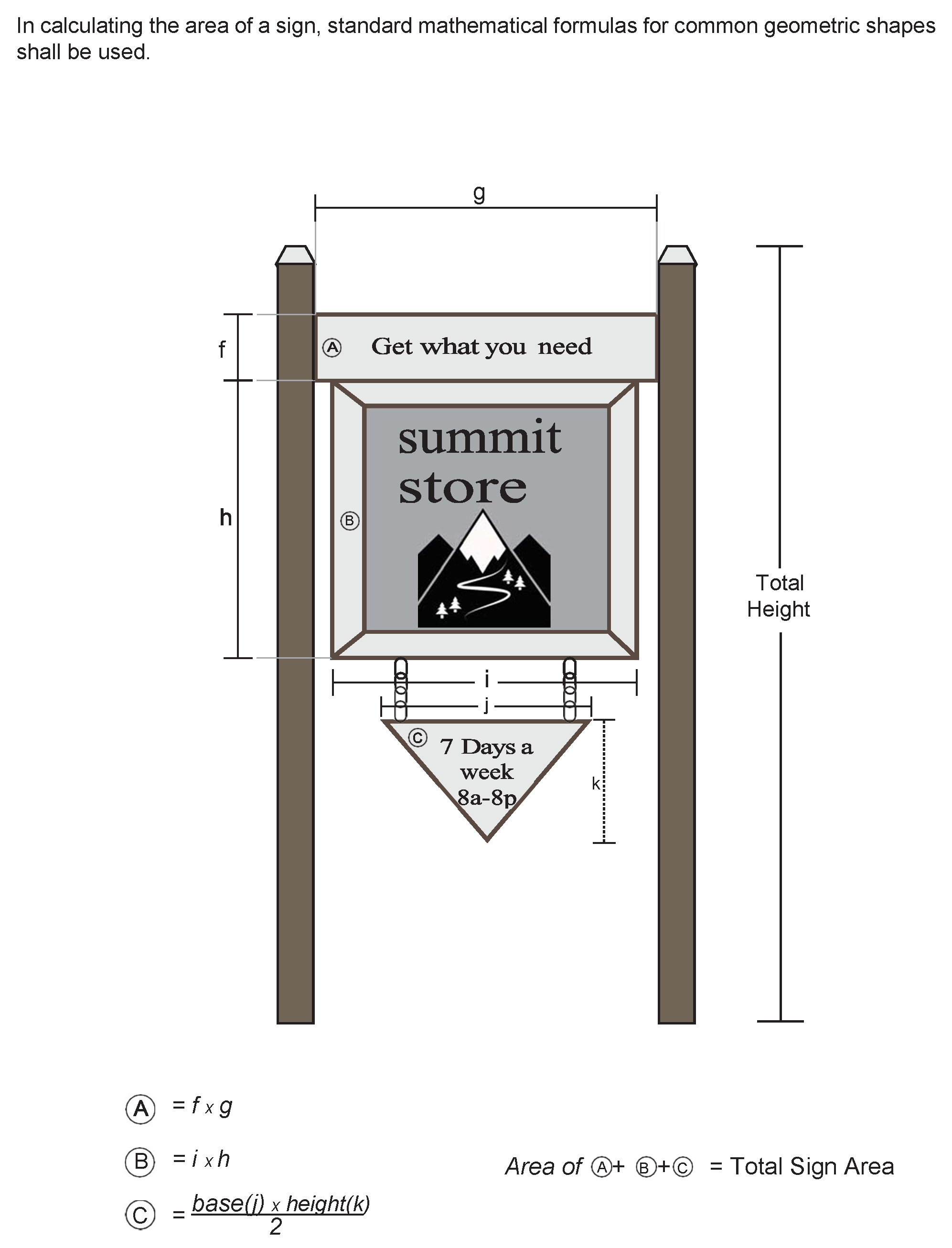
Figure 9-2.2
Sign Area Measurement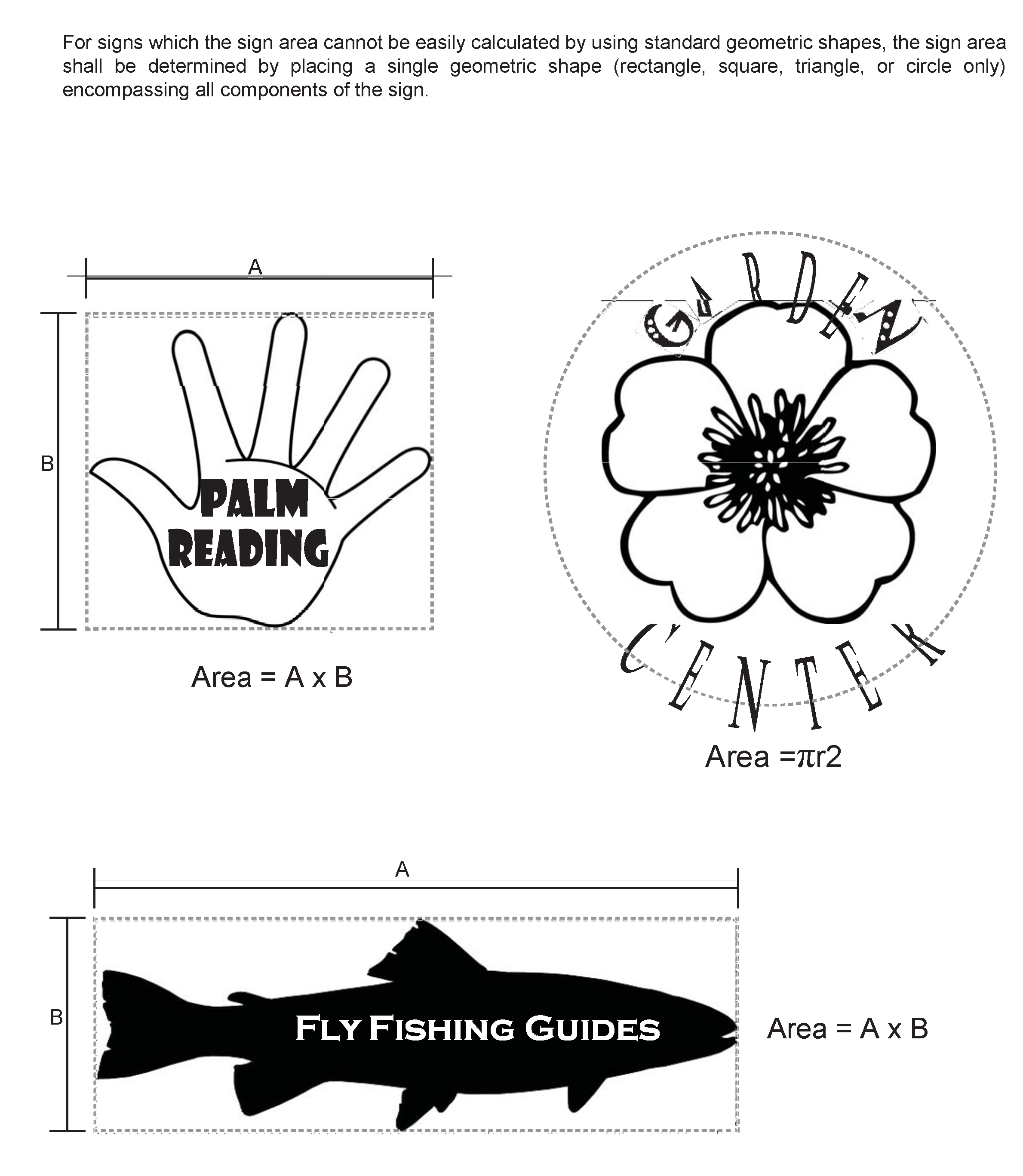
9001: - Purpose and Intent
Summit County's economy is dependent in large part on the attractiveness of its natural environment and the availability of recreational opportunities within its borders. Visitors come from across the country and from outside the United States to experience and enjoy the beauty of the Colorado Rockies and such activities as camping, hiking, fishing, hunting, bicycling and skiing. It is necessary that the County's natural assets and scenic beauty be protected for the County's economy to continue to prosper. Signs affect the visual environment, and therefore, have an effect on the County's overall appearance. Signs also perform the vital function of informing both residents and visitors of the location of businesses and of other facilities and services needed by the public. It is recognized that the County's prosperity depends on the success of local businesses and such businesses need signage to flourish.
The purpose and intent of the Sign Regulations is to: 1) establish minimum standards to safeguard public health, safety and welfare, and preserve the proper use and enjoyment of property by effectuating reasonable standards to guide and control the design, quality of materials, construction, location, illumination and maintenance of all signs and sign structures not located within a building; 2) prevent visual clutter, disruption of important scenic corridors and vistas and confusion among motorists and pedestrians; and, 3) encourage signs which facilitate communication, promote the safety of motorists and pedestrians and encourage economic development by identifying businesses and other land uses in a manner compatible with the surrounding environment.
9002: - Authority
These regulations are adopted pursuant to Colorado State Statutes 30-28-111 through 30-28-116, 30-28-114, 29-20-101 et seq. and 43-1-416.
9003: - Applicability
These regulations apply to all signs that are visible from out-of-doors, which are either located out-of-doors, painted on any part of a building or placed within a building except as provided in Section 9006 et seq. and as allowed in an approved sign program.
9004: - Compliance with Sign Regulations
A.
Compliance with Sign Regulations: A sign shall not be erected, constructed, illuminated or altered, except as provided by the Sign Regulations.
B.
Need for Sign Permit: Signs listed in Section 9006 et seq. as exempt from these regulations or listed in Figure 9-1 as not needing a sign permit are not required to obtain a sign permit. Where a sign permit is required by the provisions of the Sign Regulations or a separate Sign Program adopted pursuant to such regulations, a sign permit shall be obtained from the Planning Department prior to any sign being erected, constructed, illuminated or altered.
C.
Compliance with the Building Code: Whether or not a sign permit is required, a building permit shall be obtained prior to installation of a sign, if required by the Building Code.
D.
Compliance with the MUTCD Regulations: All directional and road signs shall be in compliance with the Manual on Uniform Traffic Control Devices ("MUTCD"), where applicable.
E.
Submittal Requirements and Review Procedures: Where a sign permit is required, an applicant shall follow the Class 2 development review process outlined in Section 12000 et seq.
9005: - Sign Programs
Sign programs may be required by the Planning Commission at the time of site plan review for mixed-use developments or any development having two (2) or more structures or businesses on the same parcel or under one (1) development plan or site plan. Sign programs are recommended and encouraged for developments on contiguous parcels. Sign programs are intended to assure that the color scheme, lettering style and type of materials used in signs are coordinated within a given project or area. Sign programs also are intended to specify the type, number, size, method of illumination and location of signs allowed in a development. The basic sign requirements contained in Section 9100 et seq. are to be used as guidelines in development of sign programs, with creativity and internal consistency encouraged. The basic sign requirements may be altered as part of an approved sign program. The Review Authority, submittal requirements and review procedures for sign programs are stated in Section 9400 et seq. A sign program must be approved prior to the installation, display, alteration, relocation or reconstruction of any sign in developments required to have a sign program by these regulations.
9006: - Exempt Signs
The following devices are exempt from the requirement that a sign permit be obtained and from all requirements of the Sign Regulations except as otherwise stated herein. The Board of County Commissioners ("BOCC") finds that such devices do not require regulation because they either do not create safety hazards or aesthetic disruption or that they promote public safety or the dissemination of public information or are otherwise permissible as a matter of course for good cause:
A.
Government signs posted by local, state or federal governments for the purpose of regulating or directing traffic,or for the benefit of public health, safety and welfare.
B.
Scoreboards on athletic fields.
C.
Flags of any nation or government, meeting all height requirements of the zoning district in which they are located.
D.
Gravestones.
E.
Holiday lighting and decorations as provided in Section 9104.
F.
Signs displayed on vehicles as provided in Section 9105.
G.
Any work of art as defined in Chapter 15 of this Code.
H.
Window displays of merchandise that are not affixed to the window surface.
I.
Signs on County owned/leased transit vehicles.
J.
Noncommercial signs in all zone districts and PUDs.
9007: - Prohibited Signs
The following signs are prohibited as described:
A.
Any sign not in accordance with the provisions of the Sign Regulations.
B.
Signs constituting a traffic or pedestrian hazard.
C.
A sign erected in a manner that would simulate, imitate, conflict, confuse or obstruct the view or interpretation of any official traffic sign, signal or device.
D.
Signs with internal illumination, unless allowed in accordance with the provisions of Section 9103.
E.
Signs which have moving objects or flashing lights, unless included in a Sign Program approved by the Planning Commission for the basin where the proposal is located.
F.
Signs that use luminescent paint, mirrors or other reflective materials, unless included in a Sign Program approved by the Planning Commission for the basin where the proposal is located.
G.
Signs within five (5) feet of a highway or road right-of-way unless a sign would otherwise be obscured. In such cases, the Planning Department may allow for signs closer to a right-of-way, but not within a right-of-way if it determines that the sign would be obscured by some on-site or off-site feature. Signs may only be allowed in the County Rights of Way upon the prior express approval of the Office of the County Engineer and the County Road and Bridge Department. Such approval shall not be granted in any circumstances unless the following criteria are satisfied:
1.
The proposed sign is for identification purposes only;
2.
The proposed sign shall be located directly in front of and adjacent to the property identified by such sign;
3.
The sign shall not impede maintenance activities;
4.
The sign shall not present a threat to the public health, safety, and welfare, including but not limited to any unsafe impediments or distractions to drivers or pedestrians on the right of way;
5.
Permission for such location of the sign within the right of way shall only be granted after the applicant has executed and delivered a signed license and indemnity agreement with the County for such purposes.
H.
Off-premise signs, except directional signs included in a Sign Program approved by the Planning Commission for the basin where the proposal is located.
I.
Signs displayed on vehicles not in accord with Section 9105.
J.
Signs which do not advertise an operative business.
K.
All temporary signs except those expressly permitted.
L.
Vehicles used as signs.
M.
Pennants, streamers, or inflatable signs.
9101: - Sign Regulations
A.
Matrix of Sign Regulations: Figure 9-1 identifies, in matrix format, what types of temporary and permanent signs are allowed in the County's zoning districts and for particular types of uses, except for signage in the B-3 Zoning District, which has the sign regulations contained within the text of the B-3 Zoning District. Figure 9-1 also indicates the maximum area, height and number permitted for each type of sign allowed; where they may be located; and how they may be illuminated. Whether or not a permit is required for each type of sign and who is responsible for issuing it is also listed in Figure 9-1.
B.
Sign Programs: After a sign program is adopted as either a free-standing document or as a part of a Planned Unit Development ("PUD") designation, the sign regulations stated in the sign program or PUD designation shall supersede the Sign Regulations of this Code if the sign regulations and standards are specifically covered in the sign program or the PUD. Where an adopted sign program or PUD designation does not address a specific standard or requirement covered by the Sign Regulations, the specific provisions contained in the Code shall apply as determined by the Planning Department. In making this determination, the Planning Department shall consider the original intent of the sign program or sign provisions contained in a PUD, the type of use, intensity of use, type of structure and similar factors to identify the situation covered by the Sign Regulations of this Code closest in comparison to the situation in the sign program or PUD.
9102: - Sign Area
A.
Sign Area
1.
Maximum Sign Area for All Zoning Districts Except B-3:
a.
The maximum sign areas for signs as permitted by the Sign Regulations are listed in Figure 9-1. In some instances, Figure 9-1 refers to the maximum sign area listed in Section 9102.A.4.
b.
The maximum area for signs on properties with an approved sign program shall be as stated in any sign program, whether such sign program is incorporated as a free-standing document or in a PUD, unless the sign program does not provide for a specific type of sign. In this case, the Planning Director may determine if a sign type is permitted for a development and the corresponding sign area per the provisions of Section 9101.B.
2.
Measuring Sign Area: The entire face of a sign shall be measured in determining the sign area, including all letters, writing, symbols, characters, and representations on the advertising surface and any framing trim or molding. See Figure 9-2.1 for example illustrations.
a.
In calculating the area of a sign, standard mathematical formulas for common geometric shapes shall be used.
b.
For signs which the sign area cannot be easily calculated by using standards geometric shapes, the sign area shall be determined by placing a single geometric shape (rectangle, square, triangle, or circle only) encompassing all components of the sign. See Figure 9-2.2
c.
Sign area shall include vertical and horizontal spacing between letters, characters, symbols, etc. and the edge of the advertising surface or frame trim or molding.
d.
The area of a freestanding sign supported by a post, or posts, that does not contain any lettering, symbols, or other sign copy shall not include the area of the supporting post(s).
3.
Measuring the Sign Area of a Two-sided Sign: On a two (2)-sided sign where the faces are parallel to each other and separated by less than one (1) foot, only one (1) face is counted in computing the sign's area.
4.
Maximum Sign Area for Commercial Identification Signs:
a.
The maximum sign area for commercial identification signs as required by Figure 9-1 is:
b.
For ground mounted commercial identification signs, only one (1) such sign is permitted per site or project. The allowable sign area as provided for in this section is the maximum size of such a ground-mounted sign regardless of the number of businesses (e.g. four (4) businesses within one (1) project abutting a four (4)-lane road with a speed limit of 40 mph are limited to one (1) 32 square foot ground mounted sign).
c.
Each business within a site or project can have a total wall or arcade mounted sign area that equates to 30 percent ("%") of the allowable sign area permitted for a ground mounted sign (e.g., if a 32 square foot ground mounted is permitted, each business is permitted to have 9.6 square feet of total sign area per business).
9103: - Lighting or Illumination
All external lighting of signs shall be installed using full cut-off luminaries so that the light source is obscured from view to the maximum extent possible and so that all direct rays are confined to the site on which the lighting is located. With the exception of reverse pan channel (or halo) lighting, the internal lighting of signs is not permitted unless included in a Sign Program approved by the Planning Commission for the basin where the proposal is located.
In no event shall any illuminated sign interfere with motorist vision.
9104: - Seasonal Decorations
Holiday lighting and other decorations may be displayed during a holiday season for the purpose of setting a seasonal ambiance.
9105: - Signs Displayed on Vehicles
Licensed vehicles used on a daily basis as part of a business operation for the transport of goods or the delivery of services may display signs that relate to that business. Parked vehicles are prohibited from being used as signs (i.e. placement of the vehicles so as to draw attention to the business) or from being used to support signs.
9106: - Special Events Banner
Special event banners are intended to inform the public of a unique commercial or civic occasion, such as an artist's fair or an athletic competition on the premises. The BOCC finds that special event banners promote the public good through the dissemination of information of benefit to an entire community. Any business or organization is permitted to display a banner for four (4) events per year, with each display being limited to 14 calendar days prior to the event and shall be removed within two (2) calendar days after the event. A sign permit for a Temporary Commercial Banner, approved by the Planning Department, is required before such a banner is displayed.
9201: - Sign Materials
All permanent signs shall be made of either 1) natural materials, such as wood or stone; or 2) non natural materials that emulate such natural materials.
9202: - Quality of Construction
All signs shall be made by a commercial sign manufacturer or be of similar professional quality as determined by the Planning Department. All signs shall be completed and erected in a professional, workmanlike manner.
9203: - Sign Readability
Signs shall be readable, with letters large enough to be legible, and with adequate contrast between the letters and the background.
9401: - Submittal Requirements for Sign Programs
A.
New Sign Programs: New sign program applications shall follow the Class 4 development review process listed in Section 12000 et seq. An applicant who desires to include a sign program into a PUD shall do so either concurrent with the zoning amendment development review process or by a PUD modification development review process as provided for in this Code.
B.
Non-substantial Amendments to Existing Sign Programs: Amendments to free-standing sign programs shall follow the Class 2 development review process listed in Section 12000 et seq.
C.
Substantial Amendments to Free-Standing Sign Programs: Substantial amendments to free-standing sign programs shall be the same process as required for new sign programs listed in Section 9401.A.
9402: - Criteria for Approval
A.
New Sign Programs: The Planning Commission may approve a new sign program or a substantial amendment to an existing sign program only if the application meets all relevant County regulations and standards and provided the Planning Commission makes the following findings:
1.
The proposed sign program is consistent with the County's Zoning Regulations, and other applicable regulations of this Code and any PUD on the property.
2.
The proposed program assures that the color scheme, lettering style and type of materials used in signs within the sign program are consistent with and coordinated within a given project and/or area.
3.
The proposed sign program specifies, as applicable, the type, number, size, method of illumination and location of signs allowed in a development.
4.
The proposed sign program generally conforms to the basic sign requirements contained in Section 9100 et seq., unless unique circumstances or special design or development objectives warrant standards that differ from the Sign Regulations of the Code.
5.
The proposed sign program prevents visual clutter and the disruption of important scenic corridors or vistas.
6.
The proposed sign program facilitates communication in a manner compatible with the surrounding environment.
7.
The proposed sign program protects the safety of motorists and pedestrians in a manner compatible with the surrounding environment.
8.
The proposed sign program is compatible with surrounding land uses and the neighborhood and will not create a substantial adverse impact on adjacent properties or infrastructure.
9.
The proposed sign program is in general conformance with any applicable goals, policies/actions and provisions of the Countywide Comprehensive Plan and any applicable basin or subbasin master plan.
B.
Amendments to Free Standing Sign Programs:
1.
Non-substantial Amendments: The Planning Department can review and act on non-substantial amendments to sign programs. For the purposes of these regulations, an amendment to a free-standing sign program is considered non-substantial if the Planning Department finds a proposed amendment:
a.
If applicable, does not increase the number of signs permitted by the sign program by more than five percent (5%) of the total approved by the Review Authority.
b.
Does not increase the total sign area of one designated sign type by more than ten percent (10%).
c.
Does not propose a new sign type along the County rights-of-way or State Highways (Modifications to existing sign types that may be permitted by a sign program in these locations are permitted).
d.
Complies with Zoning Regulations including use regulations and development regulations and standards.
e.
Does not increase the level of environmental impact caused by the proposed amendment.
f.
Is consistent with the public health, safety and welfare.
2.
Substantial Amendments: If the Planning Department determines that an amendment to a sign program does not meet the criteria contained in Section 9402.B.1, such an amendment shall be considered a substantial amendment and be reviewed in accordance with the regulations for New Sign Programs set forth in Section 9401.A.
9501: - Enforcement of Sign Programs
Enforcement of sign programs shall be as provided in Section 9600 et seq. of these regulations.
9502: - Variances
The Board of Adjustment ("BOA") shall have the authority to grant variances from the Sign Regulations. Variances are to be granted only in cases where unusual circumstances exist which result in a particular property being unusually disadvantaged by the Sign Regulations. A variance is not meant to correct or compensate for poor building or site design. Distance from the road is not usually considered an unusual circumstance or disadvantage for the purpose of variances. The following findings must be made by the BOA to approve a variance:
A.
The strict application of the County's Sign Regulations would result in peculiar and exceptional practical difficulties to, or exceptional and undue hardship upon, the property owner in the use of the property because of special circumstances applicable to the property such as topography, road curvature, line of sight, obstructions or other extraordinary or exceptional physical conditions.
B.
The variance can be granted without substantial detriment to the public health, safety and welfare.
C.
The variance can be granted without substantial impairment of the intent of the County's Sign Regulations.
D.
Granting the variance does not constitute a grant of special privilege in excess of that enjoyed by other property owners in similar circumstances.
Applications for variances shall be submitted and processed according to the variance regulations contained in Section 12500 et seq.
9601: - Nonconforming Signs
A sign is considered nonconforming if it complied with the sign regulations in effect at the time it was erected, but no longer meets the requirements of the regulations because they have been amended. No expansion, modification or alteration to a nonconforming sign is permitted except with the express approval of the Planning Department.
9602: - Illegal Signs
When, in the opinion of the Planning Director or the Zoning Enforcement Officer, a violation of the Sign Regulations or a sign program exists, the zoning enforcement process will be pursued to enforce the applicable requirements of the Sign Regulations or a sign program.
9603: - Removal of Hazardous Signs
When a sign presents a hazard to public health, safety or welfare, the Planning Department may remove the sign without notice.

