Summit County Unincorporated
City Zoning Code
City Zoning Code
CHAPTER 2
MASTER PLAN PROCEDURES
1 The Sections referenced above were the Sections in effect at the time the Development Code was amended. Subsequent amendments to the Development Code may have resulted in section numbers being modified and may no longer be applicable.
2000: - PURPOSE AND INTENT
A.
Master plans are intended to provide general policy guidance for decisions related to land use, growth and a number of related issues in the unincorporated area of Summit County ("County"). Master plans are advisory documents against which certain development proposals must be evaluated to ensure such proposals are in general conformance with respective goals and policies/actions. The goals and policies/actions contained in master plans shall be seriously considered when reviewing applicable development proposals, with the appropriate Review Authority exercising discretion in the application and balancing of the numerous goals and policies contained therein. Master plans also provide direction for possible future actions (e.g., Code changes or housing plan) that could be taken to more fully implement the community's vision or interests. However, any direction for potential future action shall not delay the application of the policies, regardless of whether such potential future action ever occurs.
B.
The preparation of master plans is intended to promote and protect the interest of the general public and present and future populations of the County. Moreover, master plans establish a framework to guide recommendations and decisions regarding future development, and help make better use of the land and its resources, provide needed facilities and services, protect the environmental quality of the County, and establish a realistic strategy for realizing established vision, goals and policies. Master Plans may also include maps depicting such items as the general location and extent of the community's envisioned land uses, environmentally sensitive areas, visually important lands, Transferable Development Rights ("TDR") sending and receiving areas and significant summer and winter routes. This is accomplished through taking a comprehensive view of development patterns, service needs and the County's ecology. Master plans are intended to coordinate development in areas where there is a significant diversity of land ownership, characteristics of the land, and other such considerations.
C.
It is recognized that over time master plans may need to be amended as community goals and factors affecting land use change. To ensure that master plans keep current with the community's vision and the overall public interest, master plans shall be reviewed, modified as appropriate, and adopted or readopted in accordance with the provisions of this Chapter.
D.
The various master plans, including specifically the Countywide Comprehensive Plan, are all intended to be adopted, interpreted, and applied in a harmonious fashion. No conflicts, direct or indirect, within such plans or between such plans, or the goals and policies therein, shall be considered to exist if there exists any reasonable interpretation that would allow all the provisions of such plans at issue to remain in effect.
2200: - CONTENTS OF MASTER PLANS
Each master plan shall have text and may have maps delineating such items as land uses, environmentally sensitive areas, location of potential affordable workforce housing sites, visually important lands, TDR sending and receiving areas, and significant summer and winter routes.
2400: - PUBLICATION AND FILING OF MASTER PLANS
Upon approval of a master plan or master plan amendment, a copy, including all maps referred to in the master plan, shall be kept on file in the Office of the Clerk and Recorder and in the Planning Department. Within 30 calendar days from the date a master plan or master plan amendment is certified pursuant to Section 2306.04, the Planning Department shall make copies available to the public and shall send a copy to each branch of the Summit County Library.
2500: - VALIDITY OF MASTER PLANS
A.
A master plan shall be in effect upon adoption by the basin planning commission and certification as required by Section 2306.04.
B.
Technical noncompliance with the procedures and criteria stated in this chapter (Chapter 2) shall not invalidate an adopted master plan.
2600: - AMENDMENTS TO MASTER PLANS
Amendments to master plans shall be reviewed and action taken using the same procedures for original adoption of master plans, except that an additional finding is required (see Section 2306.02).
2700: - UPDATE OF MASTER PLANS
Master plans adopted by the County shall be updated by the Countywide Planning Commission or a basin planning commission on a periodic basis. The Countywide Planning Commission or basin planning commission shall determine if revisions are needed because of changing conditions and circumstances or modifications in the County's overall development policy. It shall be the goal for the Countywide Planning Commission and the basin planning commissions to update master plans every seven (7) years. At a minimum, master plans should be updated every ten (10) years.
The Countywide Planning Commission or a basin planning commission may initiate amendments to the master plan as a result of the update process or, as an alternative, may readopt the master plan in its existing form. Such amendments shall be reviewed and action taken using the same procedures for original adoption of master plans, except that an additional finding is required (see Section 2306.02). The failure to adopt or readopt a master plan shall not affect the validity of such plans.
2800: - STANDARDS OF INTERPRETATION OF MASTER PLAN GOALS & POLICIES
In making interpretations of various master plan goals and policies, and in making a determination as to the issue of general conformity with master plan policies in any quasi-judicial review of a particular land use application, the following standards of interpretation shall be applied:
A.
All terms and language utilized in such plans shall be accorded meaning, and the party making such interpretation shall not presume that the drafter used language idly and with no intent that meaning should be given to its language.
B.
If a general provision conflicts with a special or local provision, it shall be construed, if possible, so that effect is given to both. If the conflict between the provisions is irreconcilable, the special or local provision prevails as an exception to the general provision, unless the general provision is the later adoption and the manifest intent is that the general provision prevails.
C.
The various master plans, including specifically the Countywide Comprehensive Plan, are all intended to be adopted, interpreted, applied in a harmonious fashion, and no conflicts, direct or indirect, within such plans or between such plans, or the goals and policies therein, shall be considered to exist if there exists any reasonable interpretation that would allow all the provisions of such plans at issue to remain in effect.
D.
No specific master plan policy may be considered mandatory, and thus attributed greater weight in consideration of the general conformity of any application on that basis alone, unless expressly provided for.
2900: - SEVERABILITY OF MASTER PLANS
All master plans adopted by the County are considered to be severable in nature. Accordingly, invalidation of any of the provisions of any basin or subbasin master plan or Countywide Comprehensive Plan, including any goal, policy, or recommended action set forth therein, or invalidation of the application thereof in any given circumstance, shall not be interpreted to affect the validity of any other provision of that master plan or any other master plan if avoidable to any degree.
2101: - Countywide Comprehensive Plan
Summit County's Countywide Comprehensive Plan is intended to accomplish the following:
A.
Provide direction as to the location, type and intensity of future growth.
B.
Enable the County to anticipate needs for public services and facilities that accompany growth.
C.
Make better use of the County's natural resources.
D.
Encourage a well-balanced, prosperous economy.
E.
Preserve and enhance the County's unique mountain character and protect its natural environment.
F.
Act as a guide to decision makers in reviewing development proposals.
This plan applies to all unincorporated areas of the County. This scope is intended to set forth only the general conceptual framework within which all master plans shall function, and is not intended to restrict the ability of any basin or subbasin master plan to set more specific guidelines, which may include a higher degree of restriction on the intensity of the development of property.
2102: - Basin Master Plans
Basin master plans are intended to provide more detailed guidelines or specific direction for individual basins than is contained in the Countywide Comprehensive Plan. Basin master plans recognize that each basin has a distinct character. Such basin master plans shall apply to the entire area within the basin and may address those issues as set forth in Section 2202.
Basin master plans are intended to set more specific development guidelines and direction or otherwise may create a higher degree of restriction on the development of property, including the density related thereto. Basin master plans shall not be deemed to be in direct or indirect conflict with the Countywide Comprehensive Plan merely because they may recommend more restrictive conditions or limitations on development including density.
2102.01: Establishment of Basins
The County has been divided into four (4) basins for planning purposes. These basins are illustrated in Figures 2-1 through 2-5 and are described below:
A.
Lower Blue Basin: The Lower Blue Basin occupies the northern portion of the County, extending from Dillon Dam on the south to the Grand County-Summit County line on the north. The basin incorporates the Town of Silverthorne and Heeney/Green Mountain Reservoir area in the southern and northern sections respectively. Geographically, the Ptarmigan and Williams Fork mountains on the east, and the Gore Range on the west flank the basin. The basin is approximately 171,927 acres in size, making it the largest in the County, and elevations range from a low of 7,448 feet, where the Blue River enters Grand County, to a high point of 13,572 feet at the summit of Mount Powell in the Gore Range.
Boundary Description: Encompassing the northern portion of the County bound by the County Line on the north, west and east, and bound on the southeast by a line beginning at Ptarmigan Peak and continuing in a southwesterly direction following the ridge line that separates the Hamilton Creek drainage from the Straight Creek drainage to the point of intersection with the northern boundary of Township 5 South, Range 77 West, then west to the northeast corner of the Northwest Quarter of Section 6, Township 5 South, Range 77 West, then continuing south along the quarter section line through Section 6 and into Section 7 until it intersects with Interstate 70 (I-70). At that point, it follows the center of I-70 until it intersects the Silverthorne Town boundary, then south following the Silverthorne/Dillon Town boundary, then the Dillon Town boundary to the Dillon Reservoir, then to a point in the center of Section 18, Township 5 South, Range 77 West, then southwest to the southwest corner of Section 18, then west to a cove on the shore of Dillon Reservoir which is approximately ¼ mile due south of the Old Dillon Reservoir, then north-northeast to the top of the ridge and following the ridge to the west that divides the Ryan Gulch drainage and the Meadow Creek drainage to the southern most peak of Buffalo Mountain, then along the ridge line to the west to Eccles Pass and continuing along the ridge line to the west to the County line.
B.
Snake River Basin: The Snake River Basin occupies the eastern portion of the County and is dominated by mountains. Ten miles of I-70 runs through the northwestern portion of the basin extending from the western edge of the Eisenhower Tunnel down to the Town of Silverthorne. Colorado Highway 6 bisects the heart of the basin extending east to west from Loveland Pass, through the Keystone corridor, around a portion of Dillon Reservoir and into the Town of Dillon. The basin's most distinguishing feature—the Continental Divide, demarcates the majority of its northern and eastern boundaries, and is characterized by a series of prominent peaks. These peaks include Grizzly, Torrey's, Grays, Argentine, Santa Fe and Geneva Peaks. The basin (home to both Keystone Resort Ski Area and Arapahoe Basin Ski Area) is approximately 74,015 acres in size and ranges in elevation from a low of 8,786 feet at the bottom of the Dillon Dam to a high of 14,270 feet atop Gray's Peak.
Boundary Description: Encompassing the southeast portion of the County bound by the County line on the southeast, and on the north by a line beginning at Ptarmigan Peak and continuing in a southwesterly direction following the ridge line that separates the Hamilton Creek drainage from the Straight Creek drainage to the point of intersection with the northern boundary of Township 5 South, Range 77 West, then west to the northeast corner of the Northwest Quarter of Section 6, Township 5 South, Range 77 West, then continuing south along the quarter section line through Section 6 and into Section 7 until it intersects with I-70. At that point, it follows the center of I-70 until it intersects the Silverthorne Town boundary, then south following the Silverthorne/Dillon Town boundary, then the Dillon Town boundary to the Dillon Dam, then to a point in the center of Section 18, Township 5 South, Range 77 West, then south to the center of Section 19, then southeast to the shore line of the Dillon Reservoir, then following the ridge line that divides the Snake River drainage from the Swan River drainage to the County line.
C.
Ten Mile Basin: The Ten Mile Basin encompasses that portion of the County that extends from the Gore Range on the north to the Lake County line (just north of Fremont Pass) on the south. The east and west boundaries are a portion of the Tenmile Range and the Eagle County line respectively. Located in the southwestern portion of the County, the basin includes the Town of Frisco and Copper Mountain Ski Resort. The basin is approximately 69,901 acres in size and ranges in elevation from a low of 9,017 feet at Lake Dillon (elevation of the Glory Hole) to a high point of 13,951 feet at the summit of Fletcher Mountain in the Tenmile Range.
Boundary Description: Encompassing the southwestern portion of the County bound by the County line on the west and south, and the ridge line of the Tenmile Range from the southern boundary north to Peak 5, then northeast along a ridge line to a point marked as 11,934 feet on the Frisco Quadrangle, then following a ridge line to the east and then northeast separating the North Barton Gulch drainage and the Miner's Creek drainage to an unnamed peak marked as 10,315 feet on the Frisco Quadrangle, then north along the ridge line to Ophir Mountain, then north and east following the ridge line just to the north of Iron Springs, then northeast to a point marked 9,205 feet on the Frisco Quadrangle, then to the center of the south edge of Section 30, Township 5 South, Range 77 West, then north to the center of Section 18, then southwest to the southwest corner of Section 18, then west to a cove on the shore of Dillon Reservoir which is approximately ¼ mile due south of the Old Dillon Reservoir, then north-northeast to the top of the ridge and following the ridge to the west that divides the Ryan Gulch drainage and the Meadow Creek drainage to the southern most peak of Buffalo Mountain, then along the ridge line to the west to Eccles Pass and continuing along the ridge line to the west to the County line.
D.
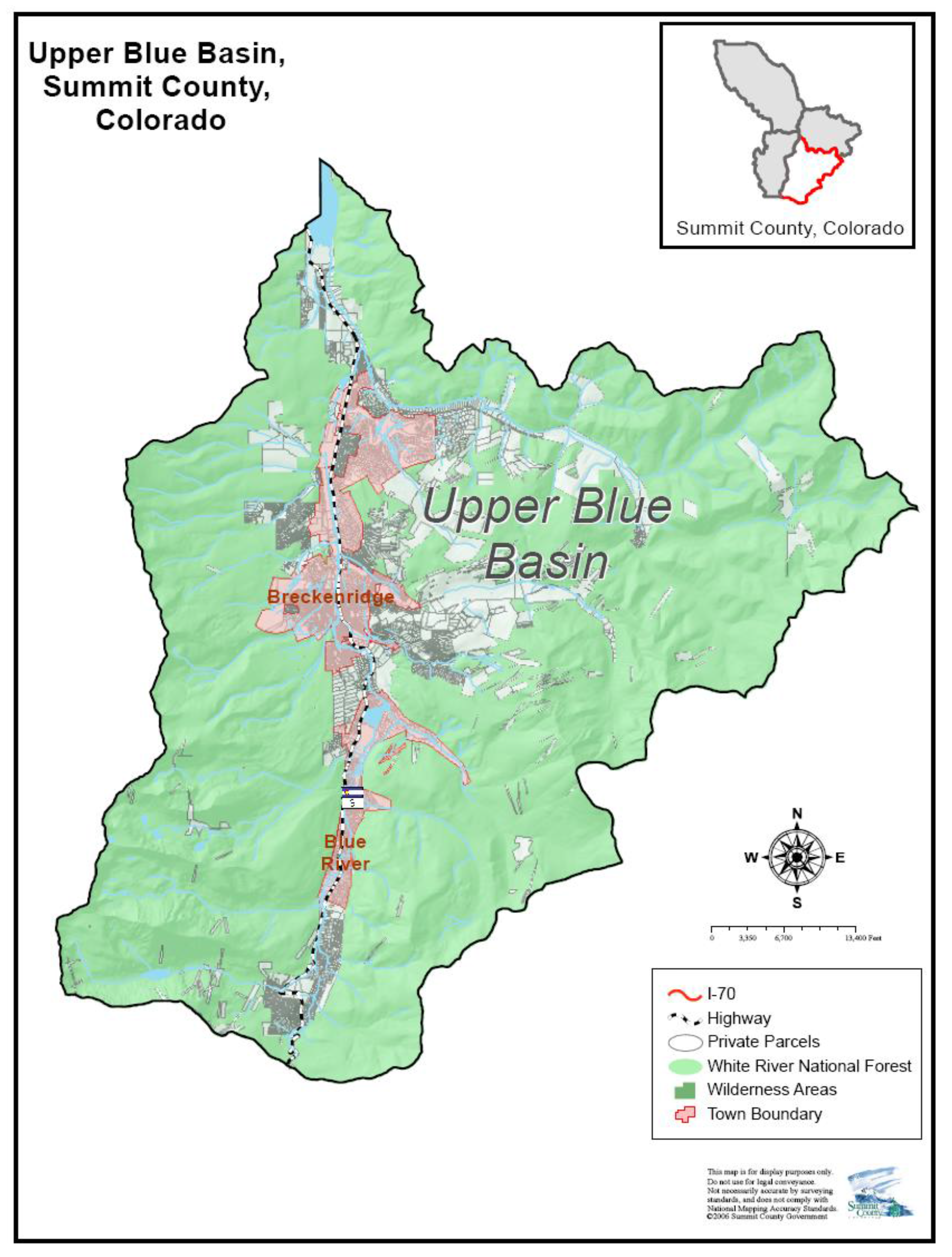
Upper Blue Basin: The Upper Blue Basin begins near the southern shores of Lake Dillon, in the Farmers Korner [sic] area, and extends southward through the towns of Breckenridge and Blue River to the summit of Hoosier Pass. The easternmost portions of the basin extend to the crest of the Continental Divide and the westernmost portions reach the crest of the Tenmile Range. The basin (home to the Breckenridge Ski Area) is approximately 80,400 acres in size and elevations range from a low of 9,017 feet (elevation of the Glory Hole) at Lake Dillon to a high of 14,265 feet at the summit of Quandary Peak.
Boundary Description: Encompassing the south central portion of the County bound by the County line on the southeast and south, and the ridge line of the Tenmile Range from the southern boundary north to Peak 5, then northeast along a ridge line to a point marked as 11,934 feet on the Frisco Quadrangle, then following a ridge line to the east and then northeast separating the North Barton Gulch drainage and the Miner's Creek drainage to an unnamed peak marked as 10,315 feet on the Frisco Quadrangle, then north along the ridge line to Ophir Mountain, then north and east following the ridge line just to the north of Iron Springs, then northeast to a point marked 9,205 feet on the Frisco Quadrangle, then to the center of the south edge of Section 30, Township 5 South, Range 77 West, then north to the center of Section 19, then southeast to the shore line of the Dillon Reservoir, then following the ridge line that divides the Snake River drainage from the Swan River drainage to the County line.
2103: - Subbasin Master Plans
Within each basin, specific areas may require the preparation of a subbasin master plan to address development pressures and unique circumstances, ensure a coordinated approach to land use and the provision of services and facilities, and to better define the ultimate character of an area prior to review of specific development proposals. Historically, the County has also adopted neighborhood and community plans that serve the same general purpose as a subbasin plan.
For the purposes of this chapter, neighborhood and community plans shall be considered subbasin plans. Areas suitable for preparation of subbasin plans shall be defined by the respective basin planning commission, and the boundary of the area shall be clearly illustrated in the plan. Subbasin plans shall be incorporated into basin master plans, thereby eliminating the need to have separate stand-alone subbasin plan documents. Notwithstanding the foregoing, subbasin master plans that remain in effect shall be subject to the application of the same principals of harmonious adoption, interpretation, and application with basin master plans as set forth in Sections 2000 and 2100, et. seq., above, regarding the relationship between the Countywide Comprehensive Plan and basin master plans.
2201: - Countywide Comprehensive Plan Contents
A.
The Countywide Comprehensive Plan provides the vision of overall community character for the County and provides direction for planning efforts within the County, dictating the shape of future regulatory revisions, programmatic efforts and the basic framework for basin and subbasin plans. It is the general intent that countywide issues of broad community interest are to be addressed in the Countywide Comprehensive Plan. Basin and subbasin plans are intended to better define the unique character of specific geographic locations. Moreover, such plans are intended to set more specific development guidelines and direction, which may include a higher degree of restriction on the development of property, including the density related thereto. Issues specific to basins should be addressed in basin master plans and subbasin specific issues should be addressed in subbasin plans. Another intent of the Countywide Comprehensive Plan is to eliminate redundancy and duplication of policies in different master plans, recognizing that a more elaborate or stringent policy on the same topic in a basin plan is not redundant but rather intended to be more specific. Master plans should be presented in a clear, concise and easily understood manner.
B.
The Countywide Comprehensive Plan shall, at a minimum, include the following sections or elements:
1.
Community Vision.
2.
Land Use Element (including discussion of extractive natural resources).
3.
Environment Element.
4.
Transportation Element.
5.
Housing Element.
6.
Community and Public Facilities Element (including Infrastructure).
7.
Design and Visual Resources Element.
8.
Historic and Cultural Resources Element.
9.
Open Space Element.
10.
Recreation and Trails Element.
11.
Economic Element.
C.
The Countywide Comprehensive Plan shall provide policy guidance on issues related to the above elements or other elements deemed important to address by the planning commission (e.g., energy or sustainability plans). Each plan element shall contain germane background data, goals, policies/actions, and realistic implementation strategies to carry forth the goals and policies/actions and pertinent sustainability measures. No such information or policy guidance shall operate in any manner to limit the ability of any basin or subbasin master plan to more specifically or stringently regulate development.
2202: - BASIN MASTER PLAN CONTENTS
2202.01: Required Contents of Basin Master Plans
Basin master plans shall focus on issues that are unique to basins and, at a minimum, include the following:
A.
Land use maps and accompanying text that describes appropriate land uses for the different geographic locations in the basin.
B.
Identification and mapping of significant summer and winter routes for various recreational purposes and, where applicable, accompanying text that outlines strategies to protect those significant recreational routes.
C.
Incorporation of unique or specific trail and trailhead issues.
D.
Identification, prioritization and mapping of visually important lands and accompanying text that describes strategies to maintain the visual character of those lands.
E.
Identification of TDR sending and receiving areas.
F.
Identification of locations where development should be encouraged in order to minimize fiscal impacts on service providers.
G.
Analysis of implications on issues of broader community interest (e.g., housing, transportation, renewable and nonrenewable natural resource extraction) as a result of basin master plan policies.
H.
Consideration of environmental risks and hazards including but not limited to wildfire, flooding, and geologic conditions in the basin.
Such mandatory inclusions shall not imply that other issues or policies are not appropriate considerations for basin master plans.
2202.02: Optional Contents of Basin Master Plans
Basin master plans may include the following issues unique to the basin, at the discretion of the applicable basin planning commission:
A.
Goals and policies/actions related to basin specific issues that are not already addressed in the Countywide Comprehensive Plan.
B.
Implementation strategies to enact the above goals and policies/actions.
C.
Unique or specific community facility, institutional use or infrastructure issues (e.g., parking).
D.
Identification and mapping of "high-quality" wetlands and development of basin specific wetland strategies.
E.
Identification of appropriate locations for a diversity of employee or affordable workforce housing and permanent resident housing types.
F.
Identification of needs and appropriate locations for different types of dispersed and developed recreational uses or new recreational facilities (e.g., neighborhood parks).
G.
Identification of appropriate winter uses (e.g., motorized, non-motorized) for winter trails and trailheads.
H.
Site specific conservation strategies.
I.
Infill, redevelopment, rehabilitation or adaptive reuse of properties.
J.
Any other considerations related to issues of development or growth in the relevant basin.
2202.03: Contents not to be Included in Basin Master Plans
Basin master plans typically should not include the following:
A.
Goals or policies/actions that address issues that are countywide (and not basin specific) in nature and are similar in intent to goals or policies/actions already addressed in the Countywide Comprehensive Plan. This limitation shall be interpreted narrowly to only address policies, which are directly redundant with the Countywide Comprehensive Plan.
B.
Goals or policies/actions that can only be interpreted to unavoidably and directly conflict with the Countywide Comprehensive Plan. The term direct in this clause narrows the realm of such conflict to those circumstances where the conflict is unavoidable and irreconcilable. Moreover, this limitation shall be strictly construed in a narrow manner and must be considered in light of the overall policy to determine a harmonious construction within and between the various master plan policies set forth in all plans. In this regard, a direct conflict shall only exist where a basin master plan expressly prohibits that which the Countywide Comprehensive Plan expressly permits, or expressly permits that which the Countywide Comprehensive Plan expressly prohibits. Basin master plan policies that serve to set more specific development guidelines, which may include a higher degree of restriction on the development of property, including the density related thereto, shall not be considered to directly conflict as contemplated herein.
2203: - Subbasin Master Plans
Subbasin plans may include issues specific to subbasins that are not addressed in basin master plans or the Countywide Comprehensive Plan, in accordance with the standards set forth in §2103 above. Whenever possible, subbasin plans should be incorporated into basin master plans, eliminating the need to have separate stand-alone documents.
2204: - Use of Master Plans
A.
It is the intent of the Board of County Commissioners ("BOCC") that certain development proposals must be found to be in general conformance with the advisory goals and policies/actions contained in the Countywide Comprehensive Plan, and applicable basin and subbasin master plans.
B.
A determination of general conformance with master plans must be made by the applicable Review Authority for any particular land use proposal in light of the facts and circumstances, evidence and considerations present in relation to that particular application. In this regard, a finding of general conformance with the master plans shall be based on a quasi-judicial weighting and balancing of various master plan goals and policies. The Review Authority shall exercise its discretion based upon the factual considerations pertaining to the particular application.
C.
In reviewing a proposal a wide array of community issues, goals and policies, as reflected in master plans, may be considered or implicated. Thus, determining the proper balance to various master plan goals and polices, and the attribution of weight to such goals and policies for any particular proposal, is essential in determining if general conformity is achieved for that proposal. It is within the sound discretion of the Review Authority in this process to consider all such concerns, goals and policies in relation to the application, in its entirety. Therefore, the Review Authority has the ability to determine the proper balance of impacts, goals and policies in ascertaining if proper conformity with such master plan, in general, has been attained.
D.
In rendering a decision on a proposal the Review Authority should reference relevant portions of master plans considered. Such master plan provisions should support the basis for the Review Authority's reasoning and decision regarding the proposal, particularly in relation to a determination on general conformity with the master plans.
2205: - Implementation of Master Plans
A.
It is the intent of the BOCC to pursue the implementation of master plans in order to make the community's vision or interest a reality. In order to accomplish master plan implementation, the BOCC will consider priority implementation strategies identified in master plans on an annual basis and direct the Planning Department on which strategies should be worked on in the upcoming year. Prior to this review by the BOCC, the Planning Department will receive recommendations from each of the Basin Planning Commissions and the Countywide Planning Commission regarding the highest priorities for implementation in the upcoming year. These recommendations shall be forwarded to the BOCC as part of the annual master plan implementation prioritization process.
B.
Each master plan shall include a list of implementation strategies that outlines the manner in which goals and policies/actions in the master plan will be accomplished. Each implementation strategy should be prioritized based on its relative importance to other implementation strategies in the master plan. Parties responsible for implementation should also be identified.
C.
Implementation strategies and priorities contained within a master plan shall be advisory only. The BOCC shall determine which, if any, implementation strategies and priorities are pursued as Planning Department work plans are approved, subject to budgetary constraints and other Planning Department project demands (e.g., need to update master plans).
2301: - Authority to Initiate
Any member of the BOCC or a basin planning commission, the Planning Director or a property owner owning land within the area to be included in the master plan has the ability to request preparation or amendment of a master plan. If the request involves the preparation or amendment of a Countywide Comprehensive Plan, the Countywide Planning Commission shall decide whether or not a master planning effort is undertaken. If the request involves the preparation or amendment of a basin or subbasin master plan, the appropriate basin planning commission shall make a recommendation to the BOCC on whether a master planning effort should be undertaken. The BOCC will subsequently determine if a master planning effort is pursued. The appropriate timing for initiating preparation or amendment of a master plan will be determined by the BOCC, in the exercise of its sole discretion, based on available staffing resources and other work project priorities.
2302: - Responsibility of Planning Department
The Planning Department shall prepare comprehensive studies and surveys on existing conditions and probable future growth in the area under consideration. In particular, research and analysis shall address topics of concern to the Countywide Planning Commission, respective basin planning commission and BOCC in developing the master plan.
2303: - Citizen Participation
It is essential that residents and property owners from the area affected by a master planning project be involved in the project's development. Master planning processes should be structured so as to afford adequate opportunity for community residents and property owners to effectively shape the future of their community. Every effort shall be made to encourage participation by citizens during development of a master plan. The method by which this is to be accomplished shall be decided at the time a master planning project is initiated, and may include formation of a citizens advisory committee (including a thorough mix of land ownership interests such as various parcel sizes), public meetings or bona fide citizen surveys.
2304: - Submittal Requirements
If a property owner is requesting preparation of a master plan or master plan amendment, the property owner shall submit the information listed below to the Planning Department, except for items waived by the department based on the type of amendment proposed. If the BOCC, basin planning commission, Countywide Planning Commission or Planning Director is initiating a master planning project, the information required shall be prepared by the Planning Department.
A.
Written Material.
1.
Application Form.
2.
Information addressing the following issues:
a.
Proposed land uses, including types and densities.
b.
Environmentally sensitive areas.
c.
Wildlife habitat and species.
d.
Significant natural features and views.
e.
Availability of services and utilities.
f.
Significant summer and winter recreation trails/routes.
g.
Historic and cultural resources.
h.
Other issues deemed important or necessary by the Planning Director.
3.
Proposed development policies.
4.
Statement describing the consistency of the proposal with existing master plans and policies.
5.
Statement justifying the proposal.
6.
Statement describing how the proposal meets the Findings for Adoption of Master Plans (Section 2306.02).
B.
Graphic Material.
1.
Vicinity Map.
2.
Map depicting the boundary of the area proposed for master planning.
3.
Locations of proposed land uses.
4.
Proposed circulation system.
5.
Proposed and existing trail system.
6.
Environmentally sensitive areas.
7.
Wildlife habitat.
8.
Significant natural features and views.
9.
Topography.
10.
Other maps and plans necessary to illustrate the proposal.
C.
Information required for a public hearing (see Section 13100 et seq.).
D.
Fee as required by resolution of the BOCC.
E.
Other information deemed necessary by the Planning Director.
2305: - Referral of Master Plans
2305.01: Referral to Agencies
The Planning Department shall be responsible for referring master plan proposals to the agencies listed below, unless determined by the Planning Director to be unnecessary. Concerns raised by referral agencies shall be addressed by the Planning Department in preparing its report to the Basin Planning Commission or Countywide Planning Commission. Referrals shall be sent to agencies prior to the first hearing on a master plan or master plan amendment. Referrals to the Colorado Department of Local Affairs (Division of Local Government) Office of Smart Growth, or its successor, should be sent at least 35 days prior to final consideration of a master plan or master plan amendment.
A.
Fire district.
B.
Sanitation district.
C.
Utilities.
D.
Water district.
E.
Summit County School District.
F.
Summit Water Quality Committee.
G.
Engineering Department.
H.
Open Space and Trails Department
I.
Colorado State Forest Service.
J.
Colorado Division of Wildlife.
K.
U.S. Army Corps of Engineers.
L.
Summit Combined Housing Authority
M.
Municipalities in the County and any municipality within three miles of any boundary of the County.
N.
Homeowners associations in the vicinity.
O.
Colorado Department of Local Affairs Office of Smart Growth, or its successor.
P.
Adjacent counties.
Q.
Other agencies deemed necessary by the Planning Director.
2305.02: Referral to Board of County Commissioners
A.
The Basin Planning Commission or Countywide Planning Commission shall refer draft master plans or master plan amendments to the BOCC, at least once, occurring after a draft of the entire plan or plan amendments has been completed.
B.
Additional feedback between the BOCC and the basin planning commission or Countywide Planning Commission is encouraged as goals and policies/actions are developed. For purposes of this section, referral shall be interpreted to mean memorandums from the Planning Department to the BOCC outlining progress on a master plan, along with copies of any proposed draft master plan amendments completed to date. Work sessions involving the Planning Department and the BOCC may be scheduled in conjunction with periodic referrals. As necessary, joint meetings between the BOCC and the basin planning commission or Countywide Planning Commission may also be scheduled.
2306: - Adoption and Certification of Master Plans
2306.01: Public Hearing on Master Plans
Prior to taking any action on a master plan or master plan amendment, the basin planning commission or Countywide Planning Commission shall hold a public hearing for the purpose of considering recommendations from the Planning Department, County departments, and other agencies and considering testimony from the applicant and from the public. A minimum of two (2) public hearings shall be required for the creation of new master plans and a minimum of one (1) public hearing shall be required for master plan amendments. The Planning Department shall give notice of hearings as set forth in Section 13100 et seq.
2306.02: Findings for Adoption of Master Plans
The following findings shall be made by a basin planning commission or the Countywide Planning Commission to approve a master plan or master plan amendment:
A.
The plan fulfills the general purpose of creating coordinated and harmonious development of the area under study and of the County as a whole.
B.
The plan promotes the health, safety, prosperity and general welfare of the County's residents, as well as efficiency and economy in the use of land and its natural resources.
C.
The plan encourages a well-balanced, prosperous economy for the County.
D.
The plan preserves and enhances the County's unique mountain character, and protects its natural environment.
E.
If the plan concerns a basin or subbasin, the plan's provisions are consistent with the Countywide Comprehensive Plan.
F.
If the plan is an amendment to an existing master plan, the amendment is consistent with the other provisions of the plan to which it will become a part.
The adoption of a master plan in accordance with this section of the Code shall serve as presumptive evidence that the considerations presented herein have been determined in the affirmative.
2306.03: Action on Master Plans
A.
The responsibility for adoption of master plans is as follows:
1.
If an action concerns the Countywide Comprehensive Plan, then the Countywide Planning Commission shall take action to adopt, adopt with modifications or decline to adopt master plan provisions and amendments.
2.
If an action concerns a basin or subbasin master plan, the basin planning commission having jurisdiction over the area under study shall take action to adopt, adopt with modifications or decline to adopt master plan provisions and amendments.
B.
The Countywide Planning Commission or basin planning commission may adopt a master plan as a whole by a single resolution or, as the work or preparation of the master plan progresses, may adopt parts of the plan that correspond to functional subsets of the subject matter included in the plan. The Countywide Planning Commission or basin planning commission may amend, extend or add to the plan or carry any part of it into greater detail from time to time, consistent with Section 2200 et seq. The Countywide Planning Commission or Basin Planning Commission shall endeavor to adopt a master plan within the timeframe agreed upon at the initiation of the master plan project, unless extenuating circumstances require additional time to complete the master plan project.
C.
The adoption of a master plan or any part or any amendment shall be by resolution carried by the affirmative votes of not less than a majority of the membership of the Countywide Planning Commission or basin planning commission responsible for action. The resolution shall refer expressly to the text and maps intended by the Countywide Planning Commission or basin planning commission to form the whole of the plan, and shall include the required findings. If a master plan or master plan amendment is approved, the number of the Countywide Planning Commission or basin planning commission resolution and the signature of the commission's chairman shall be affixed to the face sheet of the text and to any map included in the plan.
2306.04: Certification of Master Plans
After adopting a master plan or master plan amendment, the Countywide Planning Commission or basin planning commission shall certify a copy to the BOCC and to all municipalities within the County. For purposes of this section, certification shall be interpreted as delivering a copy of the master plan or master plan amendment along with a letter signed by the commission chairman indicating the adoption action taken on the master plan or master plan amendment.
Figure 2-1 - Summit County, Colorado
Figure 2-1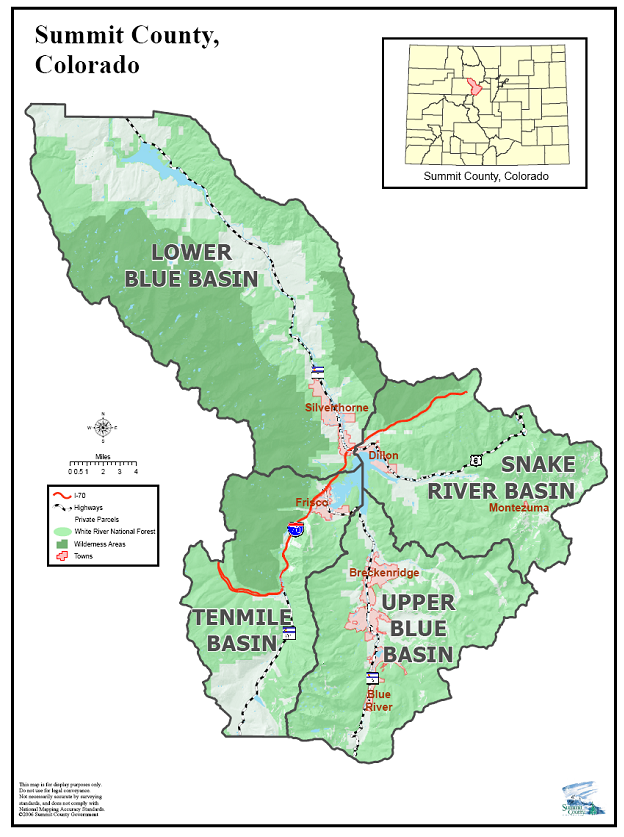
Figure 2-2 - Lower Blue Basin, Summit County, Colorado
Figure 2-2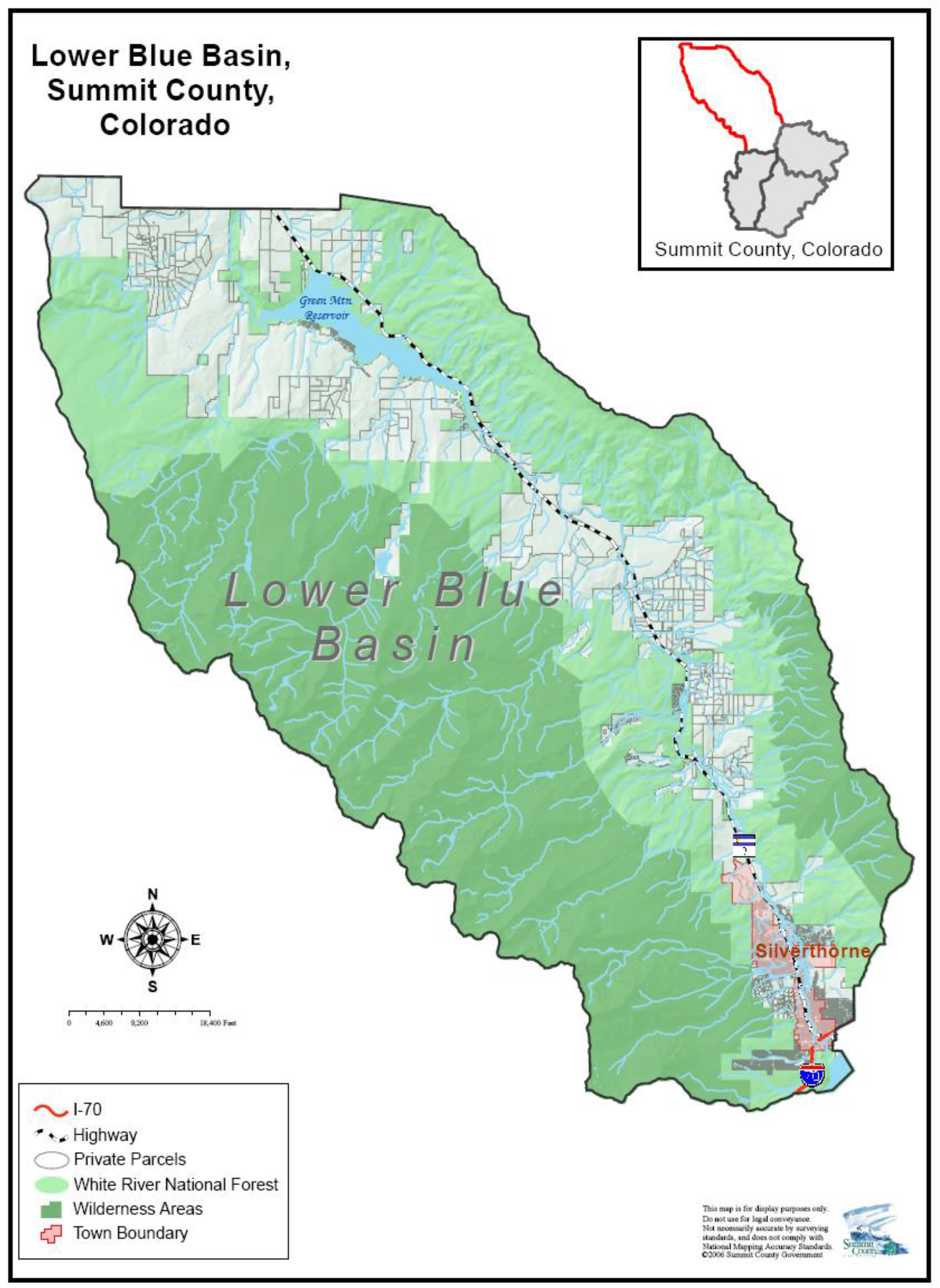
Figure 2-3 - Snake River Basin, Summit County, Colorado
Figure 2-3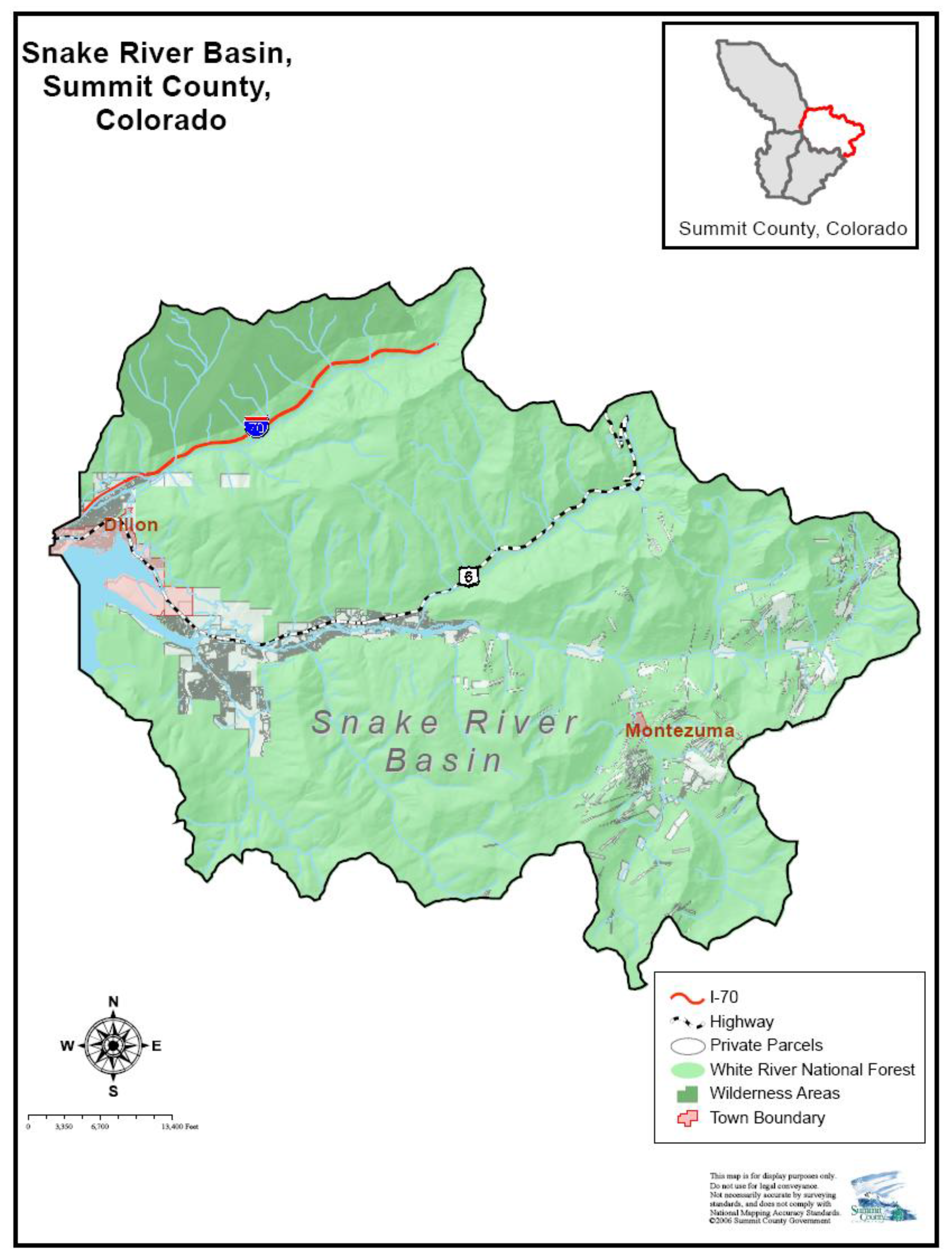
Figure 2-4 - Ten Mile Basin, Summit County, Colorado
Figure 2-4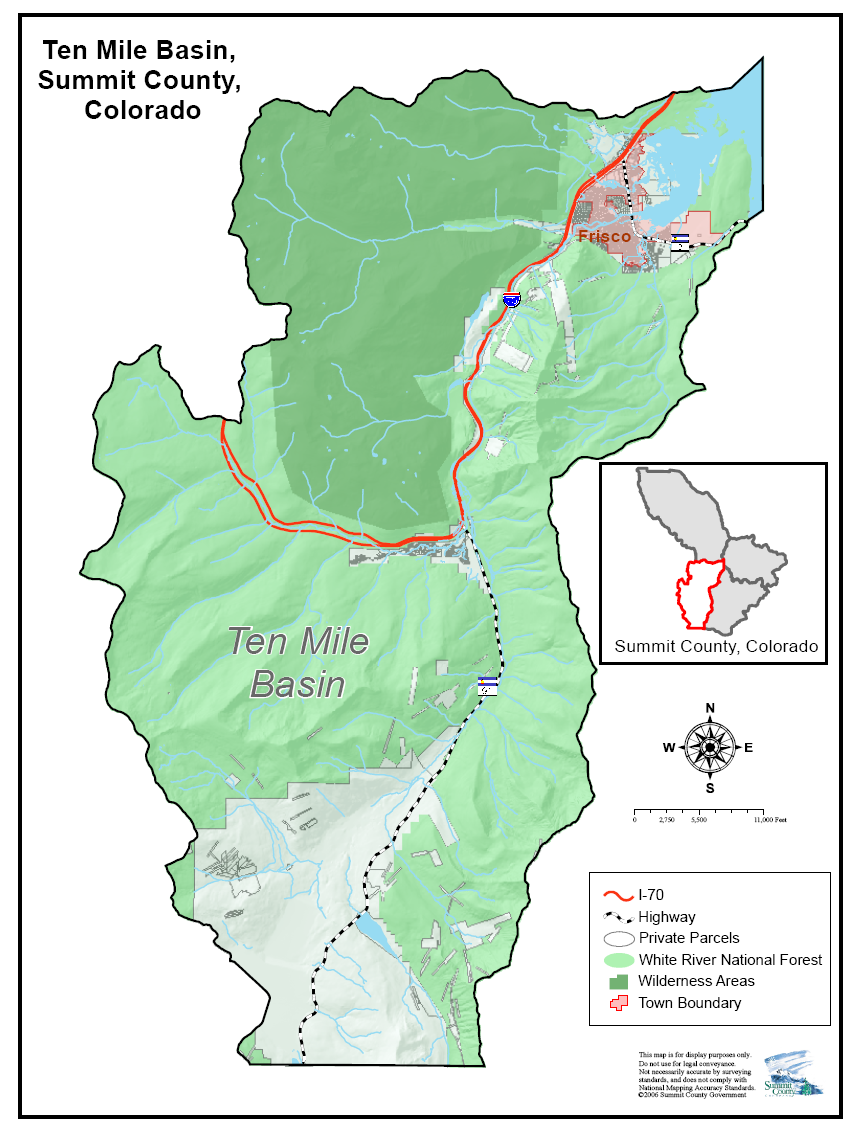
Figure 2-5 - Upper Blue Basin, Summit County, Colorado
Figure 2-5