
Summit County Unincorporated
City Zoning Code
City Zoning Code
CHAPTER 3
ZONING REGULATIONS
1 The Sections referenced above were the Sections in effect at the time the Development Code was amended. Subsequent amendments to the Development Code may have resulted in section numbers being modified and may no longer be applicable.
3000: - PURPOSE AND INTENT
Summit County's Zoning Regulations divide the unincorporated area of the County into a series of zoning districts and specify land uses which are permitted, conditional, temporary, accessory or not allowed in each zoning district. Additionally, the regulations include standards for non-conforming lots, uses and structures, and home occupations. They also regulate such items as the location, height, bulk and size of buildings, signs, lot sizes, setbacks, amount of area allowed to be developed, open space, parking and landscaping. The purpose and intent of these regulations is to insure compatibility of land uses, efficient and economical use of land and adequate light and air in development projects. They are also intended to prevent development in areas subject to environmental hazards and encourage development projects that are functional, exhibit good design and aesthetics and protect the County's natural resources and scenic beauty.
3100: - APPLICABILITY
Summit County's Zoning Regulations apply to the use of all public and private lands situated within the unincorporated portions of the County. With respect to Federal lands, it is the intent of the County government to regulate the use of Federal lands to the extent allowed by Federal law and to work in cooperation with the Federal agencies administering such lands. With respect to State-owned lands, the Colorado Land Board has agreed to require State land leases to abide by local land use regulations if the State Land Board and local jurisdiction have executed a memorandum of understanding to this effect. The Summit County Board of County Commissioners ("BOCC") adopted Resolution 84-72 establishing a memorandum of understanding with the State Land Board that the State Land Board will abide by local land use regulations in the leasing of State-owned land. In those areas where the County's Zoning Regulations apply, no buildings or structures shall be erected, constructed, used or maintained and no existing building or structure shall be moved, altered, enlarged, reconstructed or used, nor shall any land, building, structure or premises be used for any purpose other than in accordance with these regulations.
3300: - ESTABLISHMENT OF ZONING DISTRICTS
The zoning districts established by this Code are named and described in Sections 3301 and 3302 below. The zoning districts have been divided into two categories, basic zoning districts and overlay zoning districts, both of which are considered zoning districts for the purposes of this Code. The relationship between the zoning districts established by this Code and zoning districts established under previous enactments of County Zoning Regulations is stated in Section 3305.
3800: - REGULATIONS AND STANDARDS FOR SPECIFIC LAND USES
This section contains regulations and standards that apply to specific land uses. Not all land uses have special regulations, but where regulations have been established, they are stated in this section and compliance is required. Figure 3-2 states in which zoning districts these uses are allowed and whether they are allowed as permitted, conditional, accessory or temporary uses. If a conflict exists between the provisions of this section and the provisions of Figure 3-2 with regard to how a use is allowed, Figure 3-2 shall prevail. The review procedure to be followed and the findings which shall be made for issuance of conditional use permits are stated in Section 12300 et seq. The review procedures to be followed and the findings which shall be made for the issuance of temporary use permits are stated in Section 12400 et seq.
FIGURE 3-1 - DEVELOPMENT CONSTRAINTS COUNTY CONCERNS AND MITIGATION MEASURES
FIGURE 3-2 - LAND USE MATRIX
BOOKNOTES:
1.
Uses shall be permitted as specified in the State or Federal approved authorization.
2.
Uses shall be permitted as specified in a County approved PUD designation.
3.
The keeping of livestock animals in the R-1 and RC40,000 zoning district is a conditional use; construction of a barn/stable is also a conditional use, and requires the concurrent approval of a CUP for the keeping of livestock.
4.
Only the sale of products produced on the property is allowed. The sale of products produced offsite is not allowed. Regulations on outdoor vendors are stated in Section 3816 et seq.
5.
The wholesale sales of products produced on the property, and as a part of a wholesale nursery operation are allowed on property zoned A-1. In the A-1 Zoning District, a wholesale nursery may only sell products grown, raised or manufactured from products grown or raised on site.
6.
Only industrial or manufacturing businesses, meeting the performance standards in Section 3512 et seq., are permitted.
7.
The outdoor display of merchandise in residential zoning districts is limited to garage sales. See Section 3814 et seq.
8.
The provision for certain types of residential subdivisions does not preclude subdivisions for other types of development, provided such subdivisions comply with County Subdivision Regulations (Chapter 8).
9.
Recreational vehicles may be used as a residence for the caretaker or mine operator on a seasonal basis where an active mining operation is underway, provided the recreational vehicle is in compliance with Section 3809.04.F et seq. and is subject to a Class 2 review.
10.
A recreational vehicle may be used as a residence for a caretaker on parcels of 35 acres or more, provided the recreational vehicle is in compliance with Section 3809.04.F et seq.
11.
In the CG and CN zoning districts, affordable workforce housing cannot be located on the ground floor level, and the amount of floor area for affordable workforce housing cannot exceed the total commercial floor area on the property.
12.
Home businesses in the RP zoning district are restricted to areas at densities of six or less dwelling units per acre. See Section 3810 et seq.
13.
Allows for the establishment of areas for the storage of equipment associated with farming, ranching, or an active mining operation. Such areas are not required to be screened except as required by Section 3505.11.
14.
"Recreational Vehicle" listed under "Residential"-"Primary Dwelling" refers to the occupancy of the recreational vehicle as a primary dwelling, see sections 3815.08 and 3819; "Recreational Vehicle" listed under "Residential"-"Local Resident Housing"-"Housing for On-Site Employees"-"Caretaker Unit" refers to occupancy of the recreational vehicle as a caretaker unit; "Recreational Vehicle" listed under "Storage and Disposal Uses" refers to the storage of a recreational vehicle; "Rec Vehicle" listed under "Storage and Disposal Uses"-"Storage Yards" refers to the storage yards used for the storage of vehicles used for recreational purposes such as snowmobiles, four-wheelers, motorcycles, etc.
15.
Bed and breakfasts may only be established in single family dwellings, and a short-term rental license is required in residential zone districts and A-1. They may not be established in duplex or multifamily dwellings. See Section 3803 et seq.
16
Any activity or structure subject to a 1041 permit is exempt from any requirement for a Conditional Use Permit pursuant to Figure 3-2.
17.
Figure 3-2 is designated as the County Land Use Matrix. Figure 3-3 lists land uses allowed by zoning district and is included in this Code for informational purposes only. It is the intent of this Code that Figures 3-2 and 3-3 be consistent. Where an inconsistency occurs, Figure 3-2 shall govern.
18.
In the RC-5000 zone these accessory uses are allowed on a lot, or lots, within 500 feet, or directly across a local access or low volume road, from the lot where the primary use is located. In such cases the lot, or lots, where the accessory use is located shall be deed restricted or tied to the primary lot in such a way that sale separate from the primary lot is prohibited, except that the accessory lot, or lots, may be transferred to the owner of an adjacent lot with a primary use. If the accessory lot is transferred, the same deed restriction and covenant requirements shall apply.
19.
Parcels created through the rural land use subdivision process may have additional restrictions on use. Please refer to Section 8424 to determine use restrictions that may apply.
20.
These uses shall only be allowed in a PUD where a rezoning has been approved that allows for such use.
FIGURE 3-3 - LAND USE BY DISTRICT
FOOTNOTES:
1.
Figure 3-2 is designated as the County Land Use MatriX. Figure 3-3 lists land uses allowed by zoning district and is included in this Code for information purposes only. It is the intent of this Code that Figures 3-2 and 3-3 be consistent. Where an inconsistency occurs, Figure 3-2 shall govern.
2.
Parcels created through the rural land use subdivision process may have additional restrictions on use. Please refer to Section 8424 to determine use restrictions that may apply.
3.
A recreational vehicle may be used as a residence for a caretaker on parcels of 35 or more acres if the recreational vehicle is in compliance with Section 3809.04.F et seq.
4.
Only the sale of products produced on the property is allowed. The sale of productsproduced offsite is not allowed. Regulations on outdoor vendors are stated in Section 3816 et seq.
5.
Allows for the establishment of areas for the storage of equipment associated with farming, ranching, or an active mining operation. Such areas are not required to be screened eXcept as required by Section 3505.11.
6.
The wholesale retail sales of products produced on the property, and as a part of a wholesale nursery operation are allowed on property zoned A-1. In the A-1 Zoning District, a wholesale nursery may only sell products grown, raised or manufactured from products grown or raised on site.
7.
Only industrial or manufacturing businesses meeting the performance standards in Section 3512 et seq. are permitted.
8.
Allows for the establishment of an owner's residence as a conditional use to an active mining operation.
9.
A recreational vehicle may be used as a residence for a caretaker or mine operator on a seasonal basis where an active mining operation is underway, if the recreational vehicle is in compliance with Section 3809.04.F et seq.
10.
Outdoor display of merchandise in residential districts is limited to garage sales. See Section 3814 et seq.
11.
A bed and breakfast may only be established in single family dwellings. They may not be established in dupleX or multifamily dwellings. See Section 3803 et seq.
12.
The keeping of livestock animals in the R-1 zoning district is a conditional use; the construction of a barn/stable is also a conditional use, and requires concurrent approval of a CUP for keeping livestock.
13.
Wildfire Mitigation is allowed in all zoning districts. If a G/E Permit is required, a Fire Mitigation/Forest Management plan will also need to be submitted and approved in conjunction with the permit unless waived by the Review Authority.
FIGURE 3-4 - SERVICES MATRIX
(1) Figure 3-4 provides a summary of requirements for the availability of access and services at each stage in the development process. Section 3504 provides further explanation of these requirements. It is important to note the information in this figure is not all inclusive, nor binding and must be used in conjunction with the text of the regulations to identify the requirements applicable to a development. Where there is a conflict between the text of the Code and this figure, the specific requirements outlined in the text of the Code shall prevail.
FIGURE 3-5 - DEVELOPMENT STANDARDS MATRIX
FOOTNOTES
1.
Figure 3-5 provides a summary of development standards pertaining to density, height limits, site area, site coverage, and walls and fences for County zoning districts. Section 3505 provides further explanation of these requirements including important definitions and methods of calculation. It is important to note that the information in this figure is not all-inclusive. It must be used in conjunction with the text in Section 3505 to identify the requirements applicable to a development. Figure 3-6 provides a summary of required setbacks for the various County zoning districts.
2.
Additional regulations pertaining to density are stated in Section 3505.02. The maximum zoned density limits listed in Figure 3-5 represent the theoretical maximum or absolute ceiling of density allowed on a property in a given zoning district. The ultimate zoning density that can be achieved on any given lot may be further restricted by: application of master plan goals or policies, subdivision regulations, development standards, other provisions in the Code, or any other laws, rules, or regulations.
3.
Additional regulations pertaining to height limits are stated in Section 3505.06.
4.
Additional regulations pertaining to site area are stated in Section 3505.14.
5.
Additional regulations pertaining to site coverage are stated in Section 3505.15.
6.
Maximum Zoned Density excludes residential uses. One caretaker unit and bunkhouses for employees are allowed as a conditional use in association with an active mining operation in accordance with Section 3809.04 et. al.
7.
Additional regulations pertaining to walls and fences are stated in Section 3505.17
8.
Height limits as stated under General are applicable to residential and other buildings/structures as noted.
9.
These standards shall be established as part of the CUP approved for the community facility.
10.
No exceptions allowed in minimum lot size requirement for these uses. These uses shall not be established on nonconforming lots, whether deemed legal or illegal.
11.
Height limits to be established through conditional use permit, location and extent approval, or 1041 permit, whichever is applicable.
12.
Exemption from site area requirements is not an exemption from the requirement to plat the site.
13.
Site area requirements are not intended to preclude the creation of phasing or footprint lots which are smaller than the minimum required, as long as requirements of Section 3505.14 are met.
14.
Parcels created through the rural land use subdivision process may have additional restrictions on use. Please refer to Section 8424 to determine use restrictions that may apply.
15.
Requirements listed under general for a district apply to all land uses in the district unless a different requirement is listed for a specific land use.
16.
Allowance is made for lots of less than the minimum site area when subdividing a lot developed with a duplex; see Section 3505.14.
17.
Variation of site area and site coverage requirements in the R-P and R-25 zoning districts may be allowed by the Review Authority upon submission and approval of a detailed site plan.
18.
Density and dimensional requirements, other than building height, shall be determined as part of required site plan review for any properties in the SU-1 and RP zoning districts.
19.
Additional regulations pertaining to tower mounted wind turbines are stated in Section 3507.02.
20.
The height limit for a detached or caretaker unit, as applicable, ADU is 35' as stated in Section 3809.03.E.1.b.ii
FIGURE 3-6 - MINIMUM SETBACKS REQUIREMENTS
Footnotes
1.
Figure 3-6 provides a summary of the building and structure setback requirements for County zoning districts. Section 3505.13 provides further information on setback requirements including methods of measuring and exceptions. It is important to note that the information in this figure is not all-inclusive. It must be used in conjunction with the text in Section 3505.13 to identify the requirements applicable to a development. Where the road setback is greater than the property line setback, the road setback shall prevail.
2.
Where commercial, industrial or multi-family residential sites include more than one parcel, setback requirements along interior property lines may be reduced or eliminated if the requirements of Section 3505.13 are met.
3.
Where a lot line is to be established along a common wall shared by two units in a duplex, side setback requirements on either side of this lot line may be reduced or eliminated.
4.
See Section 3514 for additional information regarding setback requirements in the BC zoning district.
5.
Where a collector road has an 80 foot right-of-way that is all inclusive, then the road setback may be administratvely reduced to the applicable property line setback upon approval by the County Engineer in accordance with the criteria for a road setback variance as set forth in Chapter 5.
FIGURE 3-7 - TABLE OF PARKING REQUIREMENTS
FIGURE 3-8 - NUMBERS OF ANIMALS ALLOWED
FOOTNOTES
1.
Parcels of 35 acres or more in the A-1 and BC zoning district are exempt from regulations on the numbers of dogs and cats provided that the keeping of such animals does not constitute the operation of a boarding or breeding kennel. Approval of a conditional use permit is required for the establishment of a boarding or breeding kennel in the A-1 district. Kennels are prohibited in the BC district. For the A-1 and BC districts, a) the number of dogs and cats stated in Figure 3-8 shall apply to parcels of 20 acres, up to 35 acres; and b) for parcels of less than 20 acres, the number of dogs and cats allowed to be kept shall comply with the number per zoning district having parcel sizes comparable to the size of the parcel on which the dogs and cats are proposed to be kept.
2.
The keeping of dogs or cats in the CG, CN, B-1, B-3, I-1 and M1 zoning districts is permitted as an accessory use to an on-site employee housing unit, and in the CG and CN districts the keeping of dogs or cats is permitted as an accessory use to an affordable workforce housing unit. In addition, up to two dogs per commercial or industrial site may be kept.
3.
The keeping of animals shall be permitted as specified in the State or Federal approved authorization.
4.
The keeping of animals shall be permitted as specified in a County approved PUD designation, and as provided for in Section 3802. The number of dogs and cats kept in the RP district shall comply with the number allowed for the residential district of comparable size to the size of the parcel in the RP district.
5.
Parcels of 35 acres or more in the A-1 district are exempt from regulations on the numbers of livestock and such use does not require approval of a conditional use permit. The limits on the numbers of livestock animals stated in the A-1 zoning district apply to parcels of 20 acres, up to 35 acres. On parcels of less than 20 acres in the A-1 zoning district, the number of livestock animals allowed to be kept shall comply with the number per zoning district having parcel sizes comparable to the size of the parcel on which the livestock is proposed to be kept, and provided a Nonconforming Parcel Plan Review has been approved for the property.
6.
Parcels of 35 acres or more in the A-1 district are exempt from regulations on the numbers of poultry and chickens stated in Figure 3-8. For the A-1 and BC districts, a) the number of poultry and chickens stated in Figure 3-8 shall apply to parcels of 20 acres, up to 35 acres; and b) for parcels of less than 20 acres, the number of poultry and chickens allowed to be kept shall comply with the number per zoning district having parcel sizes comparable to the size of the parcel on which the poultry and chickens are proposed to be kept.
7.
Permitted as an accessory use to residential uses.
8.
Goats shall be included in the maximum number of dogs and cats allowed in the R-1 and and RC-40000 zoning districts. For example, the maximum number of dogs and cats allowed in these zoning disctricts is 3, without a conditional use permit. If there are 2 goats on the property, then only one other dog or cat may be allowed.
9.
The only livestock permitted in the R-1 and RC-40,000 zoning districts are Miniature, Pygmy, and Dwarf goats in accordance with Section 3802.02.D. Properties shall be a minimum of 40,000 square feet. A maximum of 3 goats are permitted and a minimum of two goats are required.
10.
Where expressly permitted by a PUD, Miniature, Pygmy, and Dwarf goats are permitted in accordance with Section 3809.02.D.
3201: - General
3201.01: Purpose and Intent
Summit County has established policies (referred to herein as "Rezoning Policies") that apply whenever a rezoning is proposed in the unincorporated area of the County. These Rezoning Policies are intended to ensure that land with development constraints is avoided in accordance with the policies contained herein, and that development contemplates and is designed in a manner consistent with the terrain and natural features of the site and is compatible with existing development in the vicinity. The Rezoning Policies are also intended to ensure that:
1.
there is adequate infrastructure to accommodate a proposed rezoning;
2.
a project site can accommodate the necessary improvements; and,
3.
the available infrastructure and services, in combination with the natural features and location of the site, are sufficient to mitigate wildfire, flooding, and geological hazards to the maximum extent feasible.
3201.02: Application of Rezoning Policies
The Rezoning Policies in Section 3202 et seq. shall be applied by the Review Authority to all rezoning applications. Notwithstanding the foregoing, if an applicant is seeking a Planned Unit Development ("PUD") modification, and the Review Authority finds that 1) the PUD was previously evaluated per the Rezoning Policies, and that there have not been any substantial changes to such policies, and 2) the proposed PUD modification is not changing the intensity of use for a development parcel or the PUD as a whole or changing the development plan of the adopted PUD, then the Rezoning Policies shall not apply, except that the policies identified under Section 3202.05, Wildfire Hazard Areas, shall apply to all rezoning applications unless waived by the Planning Director based on such factors as slope, aspect, vegetation types, availability of firefighting infrastructure, and other relevant factors as identified in the Summit County Community Wildfire Protection Plan (CWPP), or if such application is to rezone a property to the Open Space zone district as described in Section 3301.18.
3202: - Specific Rezoning Policies
The following specific policies apply to zoning amendments, subject to the application standard outlined in Section 3201.02.
3202.01: Site Characteristics
In determining appropriate densities for a particular property, the Review Authority will take into account: 1) the property's physical characteristics; 2) the location of the property relative to available infrastructure, including but not limited to roads, water, wastewater and other utility services, police protection and fire protection; 3) the degree and intensity of development in the vicinity; 4) the character of the surrounding neighborhood; and 5) applicable master plan and TDR policies (e.g. preserving backcountry areas, preserving land with development constraints such as wildfire, flooding, and geological hazards, or protecting water quality). A proposed zoning amendment will ensure that the proposed land uses, density and overall development plan will be consistent with such standards to the satisfaction of the Review Authority.
3202.02: Development Constraints
A.
General Provisions:
1.
It is the BOCC's intent to obtain the best possible harmony between the physical characteristics of a site and the type and intensity of development proposed for the site. Accordingly, land having development constraints shall be reasonably avoided, and if development of such land cannot be reasonably avoided, it may be allowed by the County only if the impacts to land with development constraints are justified based on the implementation of a master plan policy, and the impacts to land with development constraints are mitigated to the satisfaction of the BOCC (Potential development constraints are described below).
2.
If it can be demonstrated that areas with development constraints were previously graded and/or disturbed and do not exist in a natural state, then the BOCC may allow disturbance of such areas for development, provided the applicable provisions of this Code are met (e.g. Wetland and Floodplain Regulations) and such impacts are mitigated to the satisfaction of the BOCC. Figure 3-1 contains elaboration on the basis for the County's concerns regarding development constraints.
3.
Notwithstanding the foregoing, isolated areas or pockets of naturally occurring land with development constraints, determined to provide limited functional preservation value, may also be used for development provided the applicable provisions of this Code are met (e.g. Wetland and Floodplain Regulations) and such impacts are mitigated to the satisfaction of the BOCC.
B.
Identification of Development Constraints: An applicant requesting a zoning amendment that may impact land with development constraints shall provide a surveyed existing conditions plan depicting all of the following constraints, unless the Planning Department waives mapping such environmental constraints:
1.
Slopes of greater than 30 percent (%).
2.
Areas subject to geologic hazards including avalanches, landslides, rock falls, mud flows, unstable slopes or soils, seismic effects, ground subsidence or radioactivity.
3.
Any regulatory floodway or flood fringe area as depicted on the County's Floodplain Overlay District Maps.
4.
Tundra as defined by Chapter 15.
5.
Wetlands as defined by Chapter 15.
6.
Areas where development has the potential to cause a significant adverse impact on wildlife habitat or wildlife species as defined in Section 4204.05.
7.
Areas subject to wildfire hazards due to slope, aspect, vegetation, and/or availability of fire protection infrastructure (e.g. access, firefighting water supply).
The applicant shall provide an estimate of acreage contained in each of these areas, considered subject to development constraints and outside of the areas listed above.
C.
Treatment of Development Constraints: If avoiding lands with development constraints is not reasonably possible, applicants proposing a zoning amendment that would impact land with development constraints shall provide an analysis of how 1) it is impractical to avoid land with development constraints; and 2) the proposed development plan meets the general provisions contained in Section 3202.02.A. An applicant proposing development on land with development constraints shall propose mitigation measures to reduce hazards or make development on such lands more compatible with the physical conditions on the property. Figure 3-1 contains a list of potential mitigation measures for the different types of development constraints. This list is not all-inclusive. An applicant may propose other methods of mitigation. Proposed mitigation measures shall be included in the applicant's zoning amendment submittal.
3202.03: Natural Features
To the extent reasonable, the arrangement of land uses shall preserve or complement the natural features of the site, such as but not limited to wetlands, streams, slopes 30% or greater and significant trees.
3202.04: On Site Accommodation of Necessary Requirements
A zoning amendment proposal shall provide for the required parking, landscaping, open space, snow storage, drainage and all other land use requirements as provided for in this Code. Such uses shall not be placed off-site in order to make more land available for development.
3202.05: Wildfire Hazard Areas
In determining appropriate densities and/or uses for a particular property, the Review Authority shall take into account: 1) the wildfire hazard potential based on such factors as slope, aspect, vegetation types, availability of firefighting infrastructure, and other relevant factors as identified in the Summit County Community Wildfire Protection Plan (CWPP); 2) the potential impact to the public health, safety and welfare; 3) wildfire mitigation measures as required and/or allowed by the County; and 4) the proximity of the proposed development site to existing fire stations and the corresponding response zone and its inclusion in a designated fire protection district. Development projects seeking a rezoning shall ensure that wildfire hazard areas do not pose an undue risk to the public health, safety and welfare. As a part of a rezoning application, the following is required however the County may waive these requirements if deemed unnecessary by the Review Authority:
A.
The submittal of a forest management plan, fuels reduction plan, or defensible space plan that includes proposed mitigation for any wildfire hazard area shall be reviewed by the Colorado State Forest Service ("CSFS") as well as the US Forest Service, and local fire protection districts as deemed appropriate pursuant to the Review and Referral process per Section 12000.06 unless such a rezoning application involves rezoning a property to the Open Space zone district per Section 3301.18. A forest management plan is typically required for properties of 20 acres or more with significant wildlife values. A fuels reduction plan or defensible space plan is typically required for properties less than 20 acres. When a required Fuels Reduction Plan also meets the requirements of a defensible space plan, only the more comprehensive shall be required. At a minimum, all such plans shall include the following unless deemed unnecessary by the Review Authority:
1.
A purpose statement.
2.
Maps showing property boundaries, existing and proposed roads, existing and proposed building envelopes, defensible space zones, and prescription areas.
3.
An inventory of current fuels. Except when active silviculture activities are a part of a forest management plan, this may be a qualitative statement rather than a quantitative assessment.
4.
The location of subdivision wide shaded fuel or fire breaks.
5.
Identification of overhead power lines and prescriptions for removing hazardous trees in close proximity.
6.
Provision of approved secondary fire apparatus access and emergency water supply (e.g. fire hydrants; cisterns).
7.
Methods and timetables for controlling, changing, or modifying areas on the property. Elements of the plan shall include removal of slash, snags, other ground fuels, ladder fuels and dead trees, and the thinning of live trees.
8.
A plan for maintaining proposed fuel reduction measures.
B.
Inclusion in a fire protection district or other arrangements for fire protection as evidenced by a Can and Will Serve letter or its equivalent from the appropriate fire protection district except for rezonings that would not result in an increase in density or intensity or use or to Open Space District as described in Section 3301.18.
C.
Other measures as deemed necessary to reduce the wildfire hazard including consideration of the goals and policies set forth in the CWPP.
3301: - Basic Zoning Districts
The descriptions of each of the basic zoning districts below are intended to provide a brief summary of the intent of the district in terms of general characteristics, typical uses permitted and overall densities. These descriptions are provided for illustrative purposes only and do not represent the full range of standards and regulations applicable to each zoning district.
3301.01: A-1 (Agricultural)
It is the intent of the Agricultural Zoning District to preserve agricultural and ranching uses. The uses, densities and standards established for this zoning district are intended to protect existing agricultural character, while providing for low intensity use of natural resources, limited residential and recreational development and other compatible uses. Residential densities are limited to no more than one (1) primary dwelling unit/20 acres, unless greater densities are allowed through a rural land use subdivision (see Section 8420 et seq.). With the exception of approved rural land use subdivisions, each primary dwelling unit shall be located on a separate lot of at least 20 acres.
3301.02: CG (General Commercial)
It is the intent of the General Commercial Zoning District to provide for general retail, service and recreation-oriented commercial business intended to serve the county as a whole. Coordination and clustering of business development in centers is encouraged. Development standards and review criteria are specifically intended to discourage strip development and encourage low-scale, low-impact commercial areas. Large-scale commercial business development is not considered appropriate in the unincorporated areas of Summit County, except in areas contiguous to major ski resorts.
3301.03: CN (Neighborhood Commercial)
It is the intent of the Neighborhood Commercial Zoning District to provide for a limited range of commercial uses needed to meet the shopping needs of residents in the adjacent neighborhoods. Businesses are to be oriented to the neighborhood and compatible with surrounding residential uses.
3301.04: I-1 (Industrial)
It is the intent of the Industrial Zoning District to provide appropriate locations for light industrial uses, which are compatible with existing land uses in the County. Performance standards for industrial uses have been established to eliminate impacts beyond the boundaries of an industrial zoning district. Heavy industrial uses are not considered appropriate in the unincorporated areas of Summit County.
3301.05: M-1 (Mining)
It is the intent of the Mining Zoning District to allow for the extraction and processing of minerals, along with customary accessory uses such as offices, caretaker unit, employee housing, stockpiling of materials, operation and storage of equipment. Residential uses shall solely be an accessory use to active mining/milling operations. It is also the intent of the M-1 Zoning District to allow conditional uses where those uses meet the criteria listed in Section 12300 et seq.
3301.06: MHP (Manufactured Home Park)
It is the intent of the Manufactured Home Park Zoning District to allow for developments where spaces are either sold or rented for the placement of manufactured homes in a park-like setting, where these homes are used as seasonal or permanent residences.
3301.07: NR-2 (Natural Resources)
It is the intent of the Natural Resources Zoning District to regulate Federal and State lands to the extent allowed by Federal and State law; to prevent unzoned land from coming under County jurisdiction as the result of conveyance from Federal or State ownership; and to allow for the continuing use of NR-2 lands for public outdoor recreation and the appropriate use of natural resources including minerals, water, wildlife, vegetation and open space in an environmentally sound manner. The provisions of this zoning district are applied to Federal and State land to the extent allowed by State and Federal law. This zoning district is applied to public lands owned by the State of Colorado and the Federal Government. When such public lands are exchanged, sold or transferred from state or Federal ownership, the NR-2 zoning designation shall remain on the property unless and until a rezoning is approved by the County.
For those Federal or State lands within this zoning district, any uses permitted or otherwise approved by the State of Colorado or the Federal Government are allowed in this zoning district. It is anticipated that some lands within this zoning district may be traded, sold or otherwise conveyed in accordance with Federal or State law to become privately owned or owned by agencies other than the State of Colorado or the Federal Government. The legal uses in existence on such lands at the time of transfer from the State of Colorado or Federal Government ownership may continue subject to the conditions in existence prior to transfer and the provisions of Section 14100 et seq. regarding nonconforming parcels, uses and structures and other applicable requirements of this Code. Nothing in this section shall guarantee or require that a request to expand or modify a nonconforming use or structure will be approved. Any such request will be considered and evaluated based on the use specific standards and review criteria contained in this Code. Expansions or changes to non-conforming uses or structures shall first require rezoning to a new zone district, unless a finding is made that the expansion or change is minor in nature; and may require a master plan amendment.
Nothing in this section shall guarantee or require that a zoning amendment to any specific zoning classification will be approved. A zoning amendment will be considered and evaluated based on the provisions and criteria for a zoning amendment contained in Chapter 12 of this Code.
3301.08: PUD (Planned Unit Development)
It is the intent of the PUD Zoning District to encourage innovation and flexibility in planning the development of land so that development is compatible with the site's physical and environmental characteristics and makes more beneficial use of open space and the site's natural assets. The PUD Zoning District provides an opportunity for the development of a mixture of uses and housing types in a coordinated manner. New residential zoning at any density exceeding six (6) dwelling units/acre shall necessitate approval of a PUD Zoning District.
3301.09: RU (Rural Residential)
It is the intent of the Rural Residential Zoning District to maintain the rural character of outlying areas while providing the opportunity for low-density residential development. Permitted residential densities range from one (1) primary dwelling unit/five (5) acres to one (1) primary dwelling unit/less than 20 acres. Each primary dwelling unit shall be located on a separate lot of at least five (5) acres.
3301.10: RE (Rural Estate)
It is the intent of the Rural Estate Zoning District to provide for low-density residential areas as a transition between established urban growth centers and the rural areas of the County. Permitted residential densities range from one (1) primary dwelling unit/two (2) acres to one (1) primary dwelling unit/less than five (5) acres. Each primary dwelling unit shall be located on a separate lot of at least two (2) acres.
3301.11: R-1 (Single-family Residential)
It is the intent of the R-1 Zoning District to provide for single-family residential neighborhoods at a density of no more than one (1) primary dwelling unit/acre, with no more than one (1) primary dwelling unit per lot. Land in this zoning district is usually located adjacent to established urban growth centers. One (1) acre lots are the minimum size on which onsite wastewater treatment is allowed.
3301.12: R-2 (Single-family Residential)
It is the intent of the R-2 Zoning District to provide for single-family residential neighborhoods at a density of no more than two (2) dwelling units/acre, with no more than one (1) dwelling unit per lot. Land in this zoning district is usually located adjacent to established urban growth centers and shall have access to central wastewater treatment systems.
3301.13: R-3 (Single-family Residential)
It is the intent of the R-3 Zoning District to provide for single-family residential neighborhoods at a density of no more than three (3) dwelling units/acre with no more than one (1) dwelling unit per lot. Land in this district shall be located within or adjacent to established urban growth centers where utilities, central water and wastewater treatment services and other necessary services are readily available.
3301.14: R-4 (Single-family Residential)
It is the intent of the R-4 Zoning District to provide for single-family residential neighborhoods at a density of no more than four (4) dwelling units/acre, with no more than one (1) dwelling unit per lot. Land in this zoning district shall be located within or adjacent to established urban growth centers where utilities, central water and wastewater treatment services and other necessary services are readily available.
3301.15: R-6 (Single-family/Duplex Residential)
It is the intent of the R-6 Zoning District to provide for residential neighborhoods having a mixture of both single-family and duplex dwelling units at a density of no more than six (6) units/acre, with no more than two (2) dwelling units per lot. Land in this zoning district shall be located within or adjacent to established urban growth centers where utilities, central water and wastewater treatment services and other necessary services are readily available.
3301.16: RC-40000 (Rural Community)
It is the intent of the RC-40000 Zoning District to provide for single-family residential neighborhoods at a density of one (1) unit per acre, with no more than one (1) dwelling unit per lot. Recreational vehicles may be placed on the lots and used as seasonal residences under certain conditions in accordance with the provisions set forth in Section 3819 and if approved under a Class 2 Conditional Use Permit in accordance with the provisions set forth in Section 12300. This zoning district shall only be used for residential neighborhoods in rural unincorporated communities that have a recreational orientation.
3301.17: BC (Backcountry)
The purpose and intent of the BC Zoning District is to retain the relatively undeveloped character of backcountry areas in the County while allowing for very low-impact development, consistent with the type of development that historically occurred in the area. Backcountry areas can loosely be defined as more remote areas typified by lack of maintained and improved roads, little or no utilities or infrastructure and very limited or sparse development. Characteristics that may be present include sensitive environmental areas (i.e. wetlands, steep slopes, sub-alpine forest or tundra), historic mining remnants, high ridges and alpine peaks and areas that provide scenic views. Development in many of these areas can be difficult due to limited access, steep terrain and other site constraints. The BC Zoning District is intended to provide for development patterns, intensity, scale and impact that are harmonious with the characteristics and constraints in backcountry areas. Specific standards for uses in the BC Zoning District are listed in Section 3514 et seq.
3301.18: OS (Open Space)
The intent of the Open Space Zoning District is to protect and preserve lands in a predominantly undeveloped state while providing one (1) or more of the following community benefits: extensions to existing undeveloped open space lands; buffers to developed areas; view corridors; access to trails, trailheads, water bodies or National Forest areas; passive recreation uses including trails; unique ecological habitats and historic sites.
3302: - Overlay Zoning Districts
Overlay zoning districts are zoning districts that are superimposed over the basic zoning districts described above. The County has established overlay zoning districts to address development constraints which require special attention and treatment regardless of the underlying land use allowed by the County's Zoning Regulations. Overlay zoning districts are intended to alert developers to issues they need to address in preparing an application for development. Regulations have been established for each overlay zoning district that specify what additional information is needed at the time of submittal and what special development standards must be met by development within the overlay zoning district. The regulations for overlay zoning districts shall be regarded as supplementary to the regulations of any underlying basic zoning district. When the regulations of the overlay zoning district and the basic zoning district conflict, the more restrictive provision shall apply. Regulations for the overlay zoning districts are found in Chapter 4. Zoning districts which have been established include the floodplain overlay district and the wildlife habitat overlay district.
3302.01: Floodplain Overlay District
The Floodplain Overlay Zoning District includes lands subject to inundation as a result of a 100-year flood, i.e. a flood having a one percent (1%) chance of being equaled or exceeded in any given year. Regulations which apply to the Floodplain Overlay Zoning District are stated in Section 4100 et seq.
3302.02: Wildlife Habitat Overlay District
The Wildlife Habitat Overlay Zoning District includes all wildlife habitats within the county as defined on the Official Wildlife Overlay Zoning District Map adopted pursuant to Section 4203.01, and establishes a review procedure to identify impacts and to encourage mitigation of impacts. Regulations which apply to the Wildlife Habitat Overlay Zoning District are stated in Section 4200 et seq.
3303: - Zoning District Maps
A.
The boundaries of the basic zoning districts and overlay zoning districts are depicted on maps marked as Official Zoning Maps of Summit County and are included as part of this Code by this reference. Such maps shall carry the signature of the Chairman of the BOCC in office at the time of adoption.
B.
No change shall be made in the Official Zoning Maps without adoption of a resolution by the BOCC authorizing the change. The resolution shall be accompanied by a map illustrating how any Official Zoning Map is to be changed, and this map shall be signed by the Chairman of the BOCC if the change is approved. Changes to the Official Zoning Maps shall be made promptly after the date of approval by the BOCC. The date of revision, the nature of the change and the BOCC resolution number approving the change shall be noted on the map. Copies of the official zoning maps shall be filed in the Office of the Clerk and Recorder, the Planning Department and such other places as designated by the BOCC.
C.
The zoning map is intended to illustrate the effective zoning designation upon all properties in unincorporated Summit County, based upon all information available to the Planning Department at the time of adoption of such map. Unless otherwise stated in the BOCC resolution approving the zoning map change, changes to the map do not constitute a rezoning of any specific property.
D.
In the event of a mapping error occurring in an adopted zoning map, such errors to the zoning district maps may be corrected by means of a zoning map amendment, as set forth in Chapter 12 of this Code, and such errors shall have no bearing on the proper zoning designation for any affected property.
3304: - Interpretation of District Boundaries
Unless otherwise defined on the Official Zoning Maps, district lines are property lines; the center lines of roads, streets, alleys or such lines extended; section lines; city limit lines; center lines of streambeds, ridge lines or other natural topographic features; or other lines drawn to scale on the Official Zoning Maps. In situations where a zoning district boundary is in dispute, the Board of Adjustment ("BOA") is authorized by State statute to interpret the boundary location from the Official Zoning Maps.
3305: - Zoning Districts Established Under Prior Code Enactments
Certain zoning districts that were established by County zoning regulations in effect prior to the 1988 reenactment of this Code have been retained in subsequent versions of this Code under various limitations as established in this Section. Such preexisting zoning districts have been retained as either Antiquated Zoning Districts or Modified Zoning Districts, as provided below.
3305.01: Antiquated Zoning Districts Remaining in Effect
The regulations for zoning districts listed in this section shall remain in effect as stated in Section 3500 of this Code. Any property contained within an Antiquated Zoning District shall be governed by such regulations, subject to the provisions of Section 3305.03, unless such zoning designation is later repealed or amended by the BOCC. Property in the County cannot be rezoned by a zoning amendment to an Antiquated Zoning District, but must instead be rezoned to one of the zoning districts listed in Section 3301. Antiquated Zoning Districts include: 1) RME (Residential Mountain Estates); 2) R-2, R-4 and R-6 with plans [Where an R-2, R-4, or R-6 Zoning District has been adopted with a plan for the distribution of densities, or for modifications to minimum lot sizes, lot widths or setbacks, the adopted plan shall remain in effect.]; 3) SU-1 (Special Use); 4) R-P (Residential with Plan); 5) B-1 (Highway Business); 6) B-3 (Business); 7) R-25 (High Density); and 8) RC-5000.
3305.02: Modified Zoning Districts
The regulations for the zoning districts listed in this section have been modified by the 1988 and subsequent reenactments of this Code and shall remain in effect as modified ("Modified Zoning Districts"). Property in the County may be rezoned by a zoning amendment to a Modified Zoning District. Modified Zoning Districts include but are not limited to: 1) A-1 (Agricultural); 2) I-1 (Industrial); 3) M-1; (Mining); 4) R-M [Land zoned R-M shall comply with the same Zoning Regulations as land zoned MHP (Manufactured Housing Park)]; 5) R-1 (Residential); 6) R-2 (Residential); 7) R-4 (Residential); 8) R-6 (Residential); and, 9) PUD (Planned Unit Development). Land included in a Modified Zoning District shall be governed by the regulations for such zoning district as set forth in this Code. Where a PUD zoning district was approved prior to the 1988 reenactment of this Code, the PUD approval or designation in effect as of such date shall remain in effect unless amended, provided, however, such PUD shall be subject to the provisions of this Code as provided in Sections 3505.01 and 12200.02.C.
3305.03: Relationship of Regulations for Antiquated Zoning Districts Remaining in Effect and Modified Zoning Districts to the Regulations of this Code
Where the regulations for an Antiquated Zoning District or Modified Zoning District do not address a provision listed in this Code, the provisions contained within this Code shall be applied as determined by the applicable Review Authority acting on the development application. In applying this Code's standards, the Review Authority shall consider the type of use, intensity of use, the type of structure and other characteristics of the proposed development to identify the standards covered by this Code that are closest in comparison to the situation, and shall use such regulations that apply to that situation.
3401: - General
This section regulates the establishment of land uses in each of the basic zoning districts and overlay zoning districts. Uses have been divided into seven (7) types, which are listed below and described in Section 3402:
A.
Accessory
B.
Conditional
C.
Permitted
D.
Temporary
E.
Not Allowed
F.
Non-conforming
G.
Home Occupations
3402: - Types of Uses
Figure 3-2 lists the types of land uses allowed in certain zoning districts in Summit County as provided for in this section. When there is a conflict between Figure 3-2 and the text of this Code, the more restrictive provision, as determined by the Planning Director, shall apply.
3402.01: Accessory Uses
Accessory uses are land uses, which are clearly incidental and subordinate to the primary use of a property, and cannot be established unless the primary use is also established. Accessory uses may be contained in the same structure as the primary use or in a separate structure, unless otherwise prohibited by this code. Accessory uses must be located on the same lot or on a common lot serving the primary use. Buildings and structures that contain such uses must meet the development regulations and plan review requirements established in this Code. Accessory uses are indicated in the land use matrix in Figure 3-2 by the letter "A".
3402.02: Conditional Uses
Conditional uses are land uses, which have the potential to cause adverse impacts on other uses because of such factors as location, method of operation, scale or intensity of activity or traffic generated. As a consequence, they require special review in which conditions may be imposed to insure compatibility and a conditional use permit must be obtained before a conditional use is established (see Section 12300 et seq.). Conditional uses may also be denied if it is not possible to mitigate adverse impacts. Conditional uses are indicated in the land use matrix in Figure 3-2 by the letter "C".
3402.03: Permitted Uses
Permitted uses are land uses allowed in a given zoning district without special review because they are considered to be compatible with the intent of the zoning district. However, the buildings or structures that contain such uses and the site development necessary for their establishment must meet the development regulations and plan review requirements established in this Code. Permitted uses are indicated in the land use matrix in Figure 3-2 by the letter "P".
3402.04: Temporary Uses
Temporary uses are land uses which do not require any new permanent structures or improvements for their operation, may use existing buildings or improvements, are active only on a seasonal or short term basis and do not result in any long term impact on surrounding properties. Examples include summer stables or a Nordic ski center. Temporary uses require special review in which conditions may be imposed to ensure limited tenure and compatibility and a temporary use permit must be obtained before a temporary use is established (see Section 12400 et seq.). Temporary uses may also be denied if it is not possible to mitigate adverse impacts. Temporary uses are indicated in the land use matrix in Figure 3-2 by the letter "T".
3402.05: Uses Not Allowed; Uses Not Listed
A.
Uses Not Allowed: The land use matrix in Figure 3-2 indicates those uses not allowed in specific zoning districts by means of designation with the letters "NA". Those uses so designated as not allowed are land uses that, in consideration of the essential function and invariable impacts associated with said use, are deemed to be fundamentally incompatible with the intent of the zoning district.
B.
Uses Not Listed: Uses that are not listed in the land use matrix are not allowed in a given zoning district unless indicated otherwise using the procedure for making use determinations (see Section 3403).
3402.06: Non-conforming Lots, Uses and Structures
Non-conforming parcels, uses and structures shall comply with the applicable requirements of this Code, as set forth in Chapter 14 and elsewhere.
3402.07: Home Occupations
Home occupation uses are allowed as an accessory use in any residential zoning district, including PUDs, only if established in accordance with the standards set forth in Section 3810, or as expressly approved and provided for in a PUD Designation.
3403: - Use Determinations
The purpose of a use determination is to verify if a proposed use, which is not listed in the land use matrix for a given zoning district, may be established in that zoning district. The use determination procedure shall not be used as a substitute for a zoning amendment or code amendment. Uses not listed may be allowed as follows:
3403.01: Criteria for Use Determinations
A.
Permitted or Conditional: The Planning Director shall, upon written request, determine whether a use not listed in the land use matrix is to be considered a permitted or conditional use in a particular zoning district based on its similarity to the uses listed.
B.
Temporary: Uses not listed for a given zoning district may be established as temporary uses if they meet the criteria stated and obtain a permit as provided in Section 12400 et seq.
C.
Accessory: Uses not listed for a given zoning district may be established as accessory uses whenever the Planning Director determines that they are clearly incidental and subordinate to a primary use allowed in that zoning district, are associated with its operation and will not have an adverse impact on adjacent properties. In PUDs, uses that are not listed in the PUD designation may be permitted if determined by the Planning Director to be accessory to and compatible with allowed uses.
3403.02: Review of Use Determinations
A request for a use determination shall be accompanied by the following information:
A.
Written Material:
1.
Detailed description of the proposed use.
2.
Proposed location.
3.
Current zoning district at this location.
B.
Other information deemed necessary by the Planning Director (see Section 12003).
A use determination shall be made by the Planning Director, except that the Planning Director may request that the BOA make the use determination. Promptly following the decision, notice of the Planning Director's decision shall be 1) published at least once in a newspaper of general circulation; and 2) sent to the BOCC via written correspondence. The decision of the Planning Director may be appealed to the BOA within seven (7) calendar days after the decision is published in the newspaper as required above. The appeal shall be filed at the Planning Department, and be heard by the BOA using the procedures stated in Section 13200 et seq. The Planning Department may post notice of its decision on properties affected by the use determination.
3404: - Land Use Matrix
Figure 3-2 is hereby designated as the County land use matrix. The land use matrix contains a list of land uses and indicates if a given land use is allowed as a permitted, conditional, accessory or temporary use or is not allowed in most County zoning districts. However, there are specific land use allowances for antiquated zoning districts remaining in effect; as such zoning districts are provided for in Section 3305.01, and Sections 3515-3520. Figure 3-3 lists land uses allowed by zoning district and is included for information purposes only. It is the intent of this Code that Figures 3-2 and 3-3 are consistent. Where an inconsistency occurs, Figure 3-2 shall govern. It is also intended that Figures 3-2 and 3-3 be consistent with the text of this Code. Where an inconsistency occurs, the text of the regulations shall govern. Where regulations and standards for specific land uses have been established, the regulations and standards appear in Section 3800 et seq. Special restrictions on land uses in overlay zoning districts are stated in Chapter 4. If a land use is not listed in the matrix, Section 3403 establishes a procedure for determining whether a use is allowed as permitted, conditional, temporary or accessory in a given zoning district.
3501: - General
This section includes regulations and standards for development in all zoning districts, except as otherwise provided. Regulations in this section address the following items:
A.
Availability of access and services: Section 3504.
B.
Building and site design standards: Section 3505.
C.
Maintenance of common areas: Section 3508.
D.
Environmental impact: Section 3510.
E.
Industrial/commercial performance standards: Section 3512.
F.
Manufactured home park development standards: Section 3513.
3502: - Purpose and Intent
The purpose of this section is to establish requirements that developers must meet to insure, as development occurs:
A.
Impacts on services and infrastructure are mitigated.
B.
Development is at an appropriate scale for the project site and its surroundings.
C.
Adjacent land uses are compatible with each other.
D.
Summit County's natural beauty is protected and enhanced.
E.
Development is attractive and in keeping with Summit County's mountain character.
F.
Hazard areas are avoided.
G.
Public health, safety and welfare is protected.
3503: - Additional Development Regulations and Standards
The County has adopted additional development standards and regulations as part of its Zoning Regulations that are not part of this section. These include:
A.
Landscaping Requirements: Section 3600.
B.
Parking Requirements: Section 3700.
C.
Regulations and standards for Specific Land Uses: Section 3800.
D.
Regulations and standards for Overlay Zoning Districts: Chapter 4.
E.
Road & Bridge Standards: Chapter 5.
F.
Grading and Excavation Regulations: Chapter 6.
G.
Water Quality Control Regulations: Chapter 7.
H.
Subdivision Regulations: Chapter 8.
I.
Sign Regulations: Chapter 9.
J.
Areas and Activities of State Interest: Chapter 10.
K.
Community Appearance, Maintenance and Safety: Chapter 11.
L.
Development Review Procedures: Chapter 12.
M.
Public Hearings, Appeals, Takings/Vested Rights and Administrative Relief: Chapter 13.
N.
Administration; Nonconforming Parcels, Uses and Structures; Illegal Parcels, Uses and Structures and General Provisions: Chapter 14.
These regulations and standards apply to all zoning districts in the County unless noted otherwise in the specific provisions of a section or chapter.
3504: - Availability of Access and Services
3504.01: Services Matrix
The services matrix in Figure 3-4 lists the types of information required at each stage in the development process on availability of access, fire protection and emergency medical services, the need for public use areas and availability of water, wastewater treatment and utilities. The sections that follow provide further explanation of these requirements. It is important to note that the information in the matrix is not all-inclusive. It must be used in conjunction with the text in this section to identify the requirements applicable to a development.
3504.02: Major Development Projects
A.
Purpose and Intent: The introduction of urban intensities in undeveloped, outlying areas or a significant increase in density in areas already developed at urban intensities often causes a demand for the extension or expansion of services at a much higher cost to taxpayers. The BOCC is concerned with such development projects. It is the intent of the BOCC to consider development projects to be major developments when, by virtue of their location, intensity, scope or scale, they are considered to have major impact and/or demand on such services and facilities.
B.
It is a requirement of this Code that a developer proposing a major development project provide for:
1.
Improvements to roads and other transportation facilities;
2.
Additional fire, police and emergency medical services and facilities;
3.
Water and wastewater treatment capacity needed by the development project;
4.
Other infrastructure and maintenance such that, in light of the anticipated demand upon such infrastructure and maintenance generated by the development, it will not overload existing services and facilities in the county; and,
5.
The cost of extending or providing services is proportionately addressed by the developer, including ongoing costs (i.e., operating, maintenance, etc.).
C.
Definition of Major Development Project: A development project is classified as major if it has a combination of characteristics which would result in either introducing higher-intensity or larger scale uses in areas where the current land use pattern is rural in character and where urban services are lacking or causing a significant increase in density or larger scale uses in existing developed areas. The Planning Director shall make the determination if a proposed development project is major using the criteria stated in this section. An applicant may appeal this determination to the BOCC. The final decision as to whether or not a proposed development project is major shall be made by the BOCC during a work session. In determining whether or not a development project is to be considered major, the following criteria are to be considered:
1.
Would cause urbanization of an otherwise rural area.
2.
Could have an urbanizing impact upon surrounding properties such as an increase in traffic, noise, or lighting.
3.
Would add at least 100 new dwelling units or lodging rooms.
4.
Would add at least 25,000 square feet of new commercial space.
5.
Would result in commercial uses in an otherwise rural area.
6.
Would require the formation of a special district.
7.
Would require the extension of water or wastewater treatment systems outside existing service area boundaries or require a significant expansion of existing water and wastewater treatment services or create significant increase in demand for other public infrastructure or services.
8.
Any other development proposal having a similar level of significant impact in terms of intensity or scope of use proposed, demand on infrastructure, or other comparable major development characteristics.
D.
Preparation of Study: An impact study ("Study") shall be prepared for major development projects as part of either: 1) the preliminary review of a zoning amendment (preliminary zoning); or 2) a major PUD modification. The Study shall analyze the cumulative and proportional demand for services and facilities that would result from the development project and estimate any initial and ongoing cost of providing the services and facilities. The Study shall take into account existing infrastructure and how such may provide services and facilities for the proposed major development project. The Study shall also estimate the proportional cost of such facilities and services that are the responsibility of the applicant to provide that are proportional to and designed to offset the impacts of the zoning amendment. The Study shall also provide an estimated and rational timeline for providing any needed services and/or facilities. The Study may also provide a mechanism for payment of "in lieu" fees for services and/ or facilities. The Study shall be prepared by a consultant or other qualified person selected by mutual agreement of the County and the developer. The cost of the Study shall be paid by the developer prior to the first public hearing on an application or such other mutually agreeable time that occurs prior to final action on a development review application by the BOCC. The Study shall include, but not be limited to the following elements, unless the Planning Director waives such items as unnecessary:
1.
Emergency Communications:
a.
Estimate of number of emergency calls which would be received by the Emergency Communications Center.
b.
Analysis of need for communications equipment needed to handle increased volume of calls and to maintain existing level of service.
c.
Estimate of cost for additional communications equipment.
2.
Emergency Services:
a.
Estimate of number of emergency calls expected from the development.
b.
Analysis of need for emergency equipment and services that would result from increased volume of calls.
c.
Analysis of development's location on the logistics of maintaining existing response times for the Summit County Ambulance Service or its successor.
d.
Estimate of cost for additional emergency equipment and services and for facilities needed to maintain existing response times.
3.
Fire Protection:
a.
Estimate of number of calls for fire protection expected from the development.
b.
Analysis of need for additional firefighting equipment and facilities that would result from increased volume of calls.
c.
Analysis of development's location on the logistics of maintaining existing response times for the fire district that would provide service to the development.
d.
Estimate of cost for additional firefighting equipment and facilities needed to provide protection to the development and to maintain existing response times.
4.
Police Protection:
a.
Estimate of number of calls for police protection expected from the development.
b.
Analysis of need for additional equipment and facilities that would result from increased volume of calls.
c.
Analysis of development's location on the logistics of maintaining existing response times for the Summit County Sheriff's Department.
d.
Estimate of cost for additional equipment and facilities needed to provide protection to the development and to maintain existing response times.
5.
Roads:
a.
Estimate of traffic volumes expected from the development.
b.
Analysis of need for additional road capacity, upgrading the condition or design of existing roads, traffic signals and signs, striping, guard rails and other road improvements which would result from increased traffic in accordance with standards established in the County Road Standards (see Chapter 5).
c.
Estimate of cost of road improvements.
d.
Estimated cost of operation and maintenance of existing and proposed roads, and road facilities such as traffic control devices, including an analysis on the proposed assumption or distribution of said costs.
6.
Transportation and Transit:
a.
Estimate of traffic impacts/transit needs expected from the proposal.
b.
Estimate of cost of associated infrastructure improvements.
c.
Estimated cost of operating and maintenance of existing and proposed transit facilities, infrastructure, and services, including an analysis on the proposed assumption or distribution of said costs.
7.
Water and Wastewater Treatment Service:
a.
Estimate of need for additional water or wastewater treatment capacity, upgrading the condition or design of existing water or wastewater lines or associated systems or treatment plants or other system improvements which would result from the increased water or wastewater treatment capacity.
b.
Estimate of cost of water or wastewater treatment system improvements.
c.
Estimated cost of maintenance.
8.
Other Infrastructure:
a.
Estimate of the need for any other additional infrastructure and upgrading the condition or design of affected infrastructure. Other infrastructure includes, but is not limited to, electric lines or electric distribution systems and telecommunication lines or telecommunication systems.
b.
Estimate of cost of other infrastructure improvements.
c.
Estimated cost of maintenance.
9.
Schools and Child Care:
a.
Estimate of number of school age children expected from the development.
b.
Analysis of need for additional school and child care facilities which would result from increased school attendance.
c.
Estimate of cost for additional school and child care facilities.
10.
Affordable Workforce Housing:
a.
Estimate of the number of employees and residents generated by the new proposed development.
b.
Analysis of the need for affordable workforce housing generated by the new proposed development.
c.
Analysis of the affordable workforce housing component, if any, proffered in conjunction with the new proposed development.
11.
Fiscal Impact Analysis: The Study shall also include an analysis of the positive and negative fiscal impacts to the County and any special districts associated with the major development project.
12.
Proposed Schedule: The Study shall include a schedule, acceptable to the BOCC, for the construction of improvements or facilities, the provision of services, the payment of in lieu fees, or a combination thereof, such that the impacts of a major development would be accommodated without a disproportionate burden on existing improvements, facilities or services.
13.
Analysis of Past Improvements: The Study may address the provisions of past services or facilities provided by a developer and the developer may be given credit for such improvements, to the extent that such improvements or facilities offset the impact and/or demand being generated by the new zoning amendment. It is acknowledged that the existing status and sufficiency of current facilities and services already needs to be addressed as specified in this section and that it is not necessary to have a separate section addressing past improvements if already addressed in each section of the Study.
14.
Additional Considerations: The Planning Director may, in the reasonable exercise of their discretion, request any additional information or factors be considered and analyzed in the study if deemed relevant to the nature and impacts of the development proposed.
E.
Revisions to Study: If substantive changes are made to a major development project during the review of the project, the Study shall be revised to take into account changes in the project such that an accurate Study is available prior to final action on the zone change for the development project. The revisions shall be prepared by a consultant or other qualified person selected by mutual agreement of the County and the developer. The cost of revisions shall be paid by the developer prior to the final public hearing on the zoning amendment application.
F.
Review and Acceptance of Study: Results of the study and proposed requirements for the construction of improvements or facilities, the provision of services or the payment of in lieu fees based on the study shall be reviewed by the Planning Commission and the BOCC with the developer as part of the zoning amendment process for a major development project. The developer shall have an opportunity to propose changes in the Study's suggested requirements and alternative methods of addressing any impacts. The BOCC shall act to accept the Study prior to taking final action on a zoning amendment application for a major development project. The BOCC may request revisions to the Study prior to finding it acceptable. The applicant shall pay the cost for any Study revisions prior to the final public hearing on a zoning amendment application.
G.
Conditions of Approval: Approval of a zoning amendment for a major development project shall include 1) requirements determined by the BOCC for the construction of improvements or facilities, the provision of services or the payment of in lieu fees identified as needed in the Study accepted by the BOCC, and 2) a proposed schedule for implementing the requirements. The allowance for payment of fees in lieu of construction of improvements or facilities or in lieu of the provision of services shall be at the discretion of the BOCC. The conditions of approval may include provision for a payback agreement where future developments become beneficiaries of the improvements or facilities provided by the developer. The purpose of such conditions shall be to allow the BOCC to require an applicant to provide facilities, services or fees that are designed to offset the impacts of the zoning amendment.
3504.03: Access
Every lot shall have access that is sufficient to afford a reasonable means of ingress and egress for emergency vehicles as well as for all traffic needing or desiring access to the property and its intended use. Unless otherwise provided for in a PUD, such access shall be provided either by a public or private street meeting the requirements of the County Road Standards (see Chapter 5) and as follows:
A.
Residential Uses: Access for up to four (4) single-family detached dwelling units or two (2) duplexes may be provided by a common driveway that then connects to either a public or private street. Easements for proposed common driveways shall be either platted or provided by another legal mechanism of record approved by the County. Access for multi-family developments shall be provided by individual driveways that provide access to common parking areas, which then connect to either a public or private street. If the units in a multi-family development are offered for individual sale (i.e. condominiums or townhouses), any common parking areas and driveways shall be owned and maintained by an owners association or by a special or metropolitan district. Provisions for maintenance shall be stated in covenants on the property or by an alternative method accepted by the County Attorney as providing sufficient enforceability. Driveways and parking areas shall meet the requirements of the County Road Standards (see Chapter 5) and the Parking Regulations contained in Section 3700 et seq.
B.
Nonresidential Uses: Access to lots zoned or developed for commercial, industrial, community or institutional uses shall be provided either by driveways or by parking areas which then connect by driveways to either a public or private street. Driveways and parking areas shall meet the requirements of the County's Road Standards (see Chapter 5). Where these uses are located in a commercial center or a business or industrial park, access may be provided by common parking areas and driveways that may also be shared by more than one development project, subject to approval by the Planning Commission. Easements for common parking areas and driveways shall be platted or provided by another legal mechanism of record approved by the County.
C.
Emergency Access:
1.
Definition: Emergency access is provided if at least two (2) different routes for emergency vehicles are available from the County highway system to a specific structure. For the purposes of this section, the County highway system consists of the arterial and collector street system.
2.
Provision for Emergency Access: Emergency access may be required by the Review Authority based on the nature and scope of a proposed development and feasibility. The requirement for emergency access shall not apply to subdivisions in the A-1 and BC Zoning Districts consisting of lots of 20 or more acres in size unless necessary to reduce the wildfire hazard due to the property's slope, aspect, vegetation, availability of firefighting infrastructure or other relevant factors as identified in the CWPP. In assessing feasibility, consideration shall be given to the cost of road construction, ability to obtain easements from adjacent property owners and the amount of environmental damage that would occur. In order for a road to qualify as providing emergency access, the County must receive an adequate guarantee that the road will be maintained on a year round basis.
3.
Design Considerations: The County Road Standards limit the length of cul-de-sacs (see Chapter 5). A variance from County Road Standards must be obtained to use cul-de-sacs in excess of these standards.
4.
Alternatives: Where provision of emergency access is not required by the Review Authority, the County may require other mitigation measures to ensure public health and safety.
D.
Requirements for Zoning Amendment Approval:
1.
Preliminary Review: Prior to preliminary approval of a zoning amendment, the applicant shall identify the intended means of providing access from the existing County road system to the proposed development. If the means of access involves the acquisition of easements or rights-of-way across intervening property and the Planning Department anticipates problems with such acquisition, the applicant shall provide evidence acceptable to the County that such easements or rights of way have been acquired or an option agreement for their acquisition has been executed. If a development project is determined to be a major development project in accordance with Section 3504.02.B, an analysis of the impact of the development on roads shall be prepared in accordance with Section 3504.02 as part of the preliminary zoning request for the development.
2.
Final Review: Prior to final approval of a zoning amendment, the applicant shall have established a means of access from the existing County road system to the development. The extent of the easements or rights-of-way acquired shall be sufficient to construct an access road meeting the requirements of the County's Road Standards for the type of development proposed (see Chapter 5). If a development project is determined to be major, final approval of a zoning amendment may include requirements for the construction of road improvements identified as needed in the impact study accepted by the BOCC or payment of in lieu fees and a schedule therefore as provided in Section 3504.02.
E.
Requirements for Subdivision Approval: Requirements for access shall be as stated in the County Subdivision Regulations (see Chapter 8). These requirements are summarized in Figure 3-4. Where a conflict exists between the County Subdivision Regulations and Figure 3-4, the Subdivision Regulations shall govern.
F.
Requirements for Site Plan, Conditional Use Permit and Temporary Use Permit and Other Development Review Approvals Requiring Access: Requirements for access shall be as stated in applicable regulations contained in this Code.
3504.04: Fire Protection and Emergency Services
A.
Requirements for Zoning Amendment Approval:
1.
Preliminary Review: Each request for preliminary approval of a zoning amendment change shall be referred to the fire district, which would provide service to the development. The fire district may make recommendations regarding emergency access and mitigation measures for potential fire hazards as part of its review. The Review Authority may impose conditions regarding emergency access and mitigation of potential fire hazards deemed by the Review Authority, to be reasonable on its approval of a preliminary zoning request based on such factors as slope, aspect, vegetation types, availability of firefighting infrastructure, and other relevant factors as identified in the Summit County Community Wildfire Protection Plan (CWPP). If a development project is determined to be major, an analysis of the impact of the development on the need for fire protection and emergency medical equipment and facilities, and on maintaining existing response times shall be prepared in accordance with Section 3504.02 as part of the preliminary review of the zone change for the development.
2.
Final Review: Each request for final approval of a zoning amendment shall be referred to the fire district, which would provide service to the development. The fire district may make recommendations regarding emergency access and mitigation measures for potential fire hazards as part of its review. The BOCC may include requirements regarding emergency access and mitigation of potential fire hazards deemed reasonable by the BOCC as part of its approval of a PUD designation. If a development project is determined to be a major development project in accordance with Section 3504.02.B, approval of a final zoning amendment change may include requirements for the provision of fire protection and emergency medical equipment and facilities identified as needed in the impact study accepted by the BOCC, or payment of in lieu fees, and a schedule therefore as provided in Section 3504.02.
B.
Requirements for Subdivision Approval: Prior to approval of any final plat map, the applicant shall be required to provide sign-offs from the agencies responsible for providing fire protection and emergency services for the proposed subdivision if required by the Review Authority.
C.
Requirements for Site Plan and Other Development Reviews Approvals Necessitating Fire Protection or Emergency Medical Services: Prior to approval of any site plan, the applicant shall provide sign-offs from the agencies responsible for providing fire protection and emergency medical services for the proposed development if required by the Review Authority.
3504.05: Police Protection
A.
Preliminary Zoning Amendment: If a development project is determined to be a major development project in accordance with Section 3504.02.B, an analysis of the impact of the development on the need for equipment and facilities for police protection and on maintaining existing response times shall be prepared in accordance with Section 3504.02 as part of the preliminary review of the zoning amendment for the development.
B.
Final Zoning Amendment: If a development project is determined to be major, approval of a final zoning amendment may include requirements for the provision of equipment and facilities for police protection identified as needed in the impact study accepted by the BOCC, or payment of in lieu fees, and a schedule therefore as provided by Section 3504.02.
3504.06: Reserved
3504.07: Water, Wastewater Treatment and Utilities
A.
Requirements for Zoning Amendment Approval:
1.
Preliminary Review: Prior to preliminary approval of any zoning amendment, the applicant shall identify the source they propose to use for the provision of water, wastewater treatment and utilities and the feasibility of its use. If the applicant proposes to provide water and wastewater treatment through other than a central system, and the area proposed for development has a history of soil or water quality problems, the Public Health Department anticipates problems with the proposed technique or the Planning Department anticipates problems with water rights, the applicant shall provide the information listed below, depending on the situation:
a.
Source of water rights.
b.
Test well data.
c.
Proposed location of leach fields and soil absorption beds.
d.
Soil types and suitability for use in leach fields and soil absorption beds.
e.
Engineering feasibility study.
2.
Final Review: Prior to final approval of any zone change, the applicant shall provide evidence that water, wastewater treatment and utilities are available to serve the development. With respect to utilities, the utility company expected to provide service to the development shall signify that capacity is available and the extension of lines is feasible. If the applicant proposes to provide water or wastewater treatment through a central system, the purveyor expected to provide the service shall signify that capacity is available to serve the proposed development. If the applicant proposes to provide water or wastewater treatment through other than a central system, the applicant shall provide the following to the County:
a.
Sign-off from the State Engineer's Office that adequate water rights are available.
b.
Evidence that water quality is acceptable.
c.
Evidence that the onsite wastewater treatment system is feasible.
B.
Requirements for Subdivision Approval: Requirements for water, wastewater treatment and utilities, which shall be met prior to approval of any preliminary plat and of any final plat shall be as stated in the County Subdivision Regulations (see Chapter 8). These requirements are summarized in Figure 3-4. Where a conflict exists between the County Subdivision Regulations and Figure 3-4, the Subdivision Regulations shall govern.
C.
Requirements for Site Plan Approval: Prior to approval of any site plan, the applicant shall provide sign-offs from the purveyors responsible for providing water and wastewater treatment for the development, if such services will be provided by a central system, and sign-offs from the utility companies indicating that utility services are available. If water and wastewater treatment services will be provided from other than a central system, the applicant shall provide evidence acceptable to the County that:
1.
Adequate water rights have been acquired to supply the proposed development.
2.
Data on the quality, dependability and quantity of water available meet the requirements of the Public Health Department.
3.
Soil study data meet the requirements of the Public Health Department. Notwithstanding the foregoing, an applicant for a site plan for a single family residence may propose to use a cistern to store water and the water may be hauled to the site from an off-site location if: 1) the Public Health Department determines that there is a hardship, such as but not limited to inability to drill a producing well or non-potable water quality; and 2) the applicant provides a cistern system design that is reviewed and approved by the Public Health Department.
3505: - Building and Site Design Standards
3505.01: General Provisions
A.
Development Standards Matrices: The development standards matrices in Figures 3-5 and 3-6 are summaries of certain building and site design standards and are provided for ease of reference. The requirements included in the matrices are the most basic and the easiest to state in numerical terms. They include:
1.
Density .....Figure 3-5
2.
Height limits .....Figure 3-5
3.
Site area .....Figure 3-5
4.
Site coverage .....Figure 3-5
5.
Wall and fence height limits .....Figure 3-5
6.
Minimum Setback Requirements .....Figure 3-6
Sections in the Code that provide further explanation of these requirements, including important definitions and calculating methods, are cross-referenced in the matrices. Additional sections in the Code state other building and site design standards that do not appear in the matrices. It is important to note that the information in the matrices is not all-inclusive. It must be used in conjunction with the Code to identify the requirements applicable to a development project.
B.
Applicability to PUDs: Where a PUD Zoning District is proposed, the provisions in this section shall be used as guidelines in formulating the PUD designation. Building and site design standards that differ from those stated in this section may be adopted as part of a PUD designation because of special circumstances or in order to achieve certain development or design objectives. It is the County's intent in providing for PUD Zoning Districts to allow such flexibility in building and site design standards where an overall benefit to the County is achieved. After a PUD designation is adopted, the development regulations and standards stated in the PUD designation shall supersede the provisions of this section. Where an adopted PUD designation does not address a building or site design standard covered by this section, the provisions contained in this section shall apply as determined by the Planning Director. The Planning Director shall consider the type of use, intensity of use, type of structure and similar factors to identify the standard covered by this section closest in comparison to the situation in the PUD and shall use the regulations that apply to that situation.
C.
Applicability to the NR-2 Zoning District: The building and site design standards for properties in the NR-2 Zoning District shall be as established in the State or Federal approved authorization. Where a State or Federal authorization does not address a building or site design standard covered by this section, the provisions contained in this section shall apply as determined by the Planning Director. The Planning Director shall consider the type of use, intensity of use, type of structure and similar factors to identify the standard covered by this section closest in comparison to the situation and shall use the regulations that apply to that situation.
D.
Applicability to R-P, B-3, R-25, B-1 and All Other Zoning Districts Remaining in Effect Listed in Section 3305.01: Where a plan approved for an R-P Zoning District or the regulations for a zoning district remaining in effect do not address a building or site design standard covered by this section, the provisions contained in this section shall apply as determined by the Planning Director. The Planning Director shall consider the type of use, intensity of use, type of structure and similar factors to identify the standards covered by this section that are closest in comparison to the situation and shall use such regulations that apply to that situation.
E.
Relationship to Covenants: Section 1202 of the Code establishes the relationship of the Code to private covenants.
3505.02: Density
Compliance with Density Limits: Density limits for the different zoning districts are stated in Figure 3-5. Such density limits do not set an absolute level of density that will be permitted for any particular property or development proposal. Rather the density limits set forth the theoretical, maximum or absolute ceiling of density allowed. The ultimate density that can be achieved on any given lot may be further restricted by: application of master plan goals or policies, subdivision regulations, development standards, other provisions in the Code, or any other applicable laws, rules or regulations. The provisions of this section apply to all development in the unincorporated portions of the County, unless an alternative method is outlined for a specific zoning district. The density limits for specific zoning districts are calculated and applied as follows:
A.
Residential Zoning Districts: Unless explicitly allowed in the applicable zone district, a maximum of one primary use is permitted on any individual lot with a size of less than 80 acres. For any parcel with a size of less than 80 acres, additional primary uses shall be reviewed through a Class 4 conditional use permit.
1.
A-1 and BC Zoning Districts: Figure 3-5 states the density limits for specific uses allowed in these zoning districts. For residential uses in these zoning districts, the limit stated is the minimum amount of land required for the establishment of a primary dwelling unit. In determining compliance with the limit on residential density, gross site area shall be used. In the A-1 zoning district, where a subsidiary residence (i.e. accessory dwelling unit or caretaker unit) is permitted, the minimum land area requirement need only be met for the primary dwelling unit and need not be increased for the establishment of a subsidiary residence.
2.
RU, RE, R-1, R-2, R-3, R-4, R-6, R-251, RME1, RC-5000, RC-40000 and SU-11Zoning Districts: The density limit stated in Figure 3-5 is the minimum amount of land required for each parcel containing a primary single-family or duplex dwelling unit. Net site area shall be used as the foundation for determining compliance with the limits established in Figure 3-5. In zoning districts where a subsidiary residence (i.e. accessory dwelling unit) is permitted or conditional, the minimum land area requirement need only be met for the primary dwelling units and need not be increased for the establishment of a subsidiary residence.
3.
Planned Unit Developments and R-P2Zoning Districts: Density limits and maximum floor area for PUD and R-P Zoning Districts shall be stated in the PUD designation or R-P plan. To the extent a PUD or R-P Zoning District does not address, state or represent density limits, the methodology to calculate such density or floor area limits similar to those contained in this section, the provisions as provided for in this section (Section 3505 et seq.) shall be applied.
4.
MHP Zoning District: Limitations on density for the MHP zoning district is provided for in Figure 3-5. In the MHP zoning district, where a subsidiary residence (i.e. employee housing) is permitted, the minimum land area requirement need only be met for the primary dwelling units and need not be increased for the establishment of a subsidiary residence.
B.
Commercial and Industrial Zoning Districts and Non-residential Development in Other Zoning Districts:
1.
Density limits in Figure 3-5 for the CG, CN, B-1, B-3, I-1 or M-1 Zoning districts are calculated through the use of a floor area ratio (FAR). FAR is calculated by dividing the floor area by the net site area. Calculating density based on multiple site acreage, rather than parcel-by-parcel, is allowed if all owners of lots within the site are parties to the development application and an overall development plan for the entire site is approved.
2.
Additional limitations on density for the B-3 zoning district is as provided for in Section 3515 et seq.
C.
Calculating Density for Zoning Districts That Permit Multi-family Development:
1.
Density: Density for multi-family residential development shall be calculated in two different ways, neither of which can be exceeded:
a.
Dwelling Units Per Acre;
The total number of multi-family residential dwelling units built can be equal to the density permitted by the underlying zoning and as stated in Figure 3-5.
b.
Total Floor Area:
The maximum total floor area allowed shall be calculated using the following formula:
Number of Multi-family Residential Dwelling Units Permitted per the Underlying Zoning District × (multiplied by) 1,400 square feet = Total Floor Area Allowed
2.
Dwelling Unit Size: If fewer residential dwelling units are proposed or constructed than allowed per the underlying zoning, the size of the dwelling units can exceed an average of 1,400 square feet of floor area, provided the total floor area allowed is not exceeded.
3.
Additions: A property owner may apply for an addition to a dwelling unit in a multi-family development if the floor area of the proposed addition does not exceed the total floor area allowed for the property as a whole. The County does not regulate how any remaining floor area on a given property is allocated.
4.
Other Code Requirements: When calculating the dwelling units per acre or total floor area allowed on any given property, all other development standards in the Code shall be evaluated and met, including but not limited to: height, site area, site coverage, setback, snow storage, parking requirements.
5.
Where Guest Houses are allowed by a PUD, such units are not units of density capable of being transferred per the TDR provisions set forth in Section 3506 nor are they considered units of density for subdivision purposes.
D.
Lock-off and Lodge Rooms:
1.
Permitted Zoning Districts and Density: Density associated with lock-off or lodge rooms shall comply with the density limits permitted by the underlying zoning district.
a.
Lock-off rooms are permitted in the R-6, R-6 w/Plan, R-25 and R-P zoning districts. Lock-off rooms may be permitted in a PUD as an allowed use if such use is requested as a part of the creation or modification of a PUD per the zoning amendment process.
b.
Lodge rooms are permitted in the B-1 and CG zoning districts. Lodge rooms may be permitted in a PUD as an allowed use if such use is requested as a part of the creation or modification of a PUD per the zoning amendment process.
2.
Calculating Density: For the purpose of calculating allowable density: one (1) lock-off or lodge room is equal to one-third (⅓) of a multifamily dwelling unit.
a.
Lock-off room: If approved, a multifamily dwelling unit can have a separate lock-off room(s). If a lock-off room is proposed or constructed as part of one multifamily dwelling unit, the density shall be considered to increase by ⅓ of a dwelling unit. Therefore, the density of a multifamily dwelling unit that has a lock-off room would be 1.3 dwelling units (instead of one (1) dwelling unit).
b.
Lodge room: Each lodge room within a lodge shall count as one-third (⅓) of a dwelling unit.
3.
Allowable Room Size/Total Floor Area: The total floor area allowed for a lock-off or lodge room shall not exceed an average per building of 467 square feet of floor area each.
E.
Density Requirements and Subdivision Exemptions: If a proposed project/development meets the density requirements of the underlying zoning, such residential dwelling units or non-residential structures on the lot may be platted in accordance with this Code's subdivision exemption requirements listed in Section 8400 et seq. Duplex, townhouse or multi-family dwellings or non-residential structures may be subdivided into parcels that do not meet required density provisions provided: 1) the site continues to be developed as one (1) entity according to an approved or modified development plan in accordance with the requirements of this Code; 2) the overall site development adheres to the site area requirements of the underlying zoning district; 3) the property continues to meet and adhere to all requirements of any townhouse plat or condominium map, or other applicable documents of record; and, 4) any subdivision plat for the development site includes a plat note stating the development of the parcels is subject to an overall development plan.
F.
Open Space Reservations: If part of a project site is reserved as open space and retaining this area in open space is necessary to comply with density limits, this area shall be restricted from development by the PUD designation (if the property is part of a PUD), by a plat note if the property is subdivided or by an alternative method acceptable to the County. The purpose of the restriction shall be to make certain that development is prohibited regardless of the property's ownership, unless this restriction is removed by a subsequent zoning amendment action approved by the BOCC. Open space areas reserved to assure compliance with density limits cannot be used to comply with the requirement in the County Subdivision Regulations for public use areas (see Chapter 8).
3505.03: Dumpsters
A.
Allowance for Dumpsters: Dumpsters may be used for trash or recycling collection in:
1.
Any multi-family residential, commercial or industrial development.
2.
Manufactured home parks.
3.
A single-family residential subdivision so long as the dumpster is approved as a part of the subdivision or a majority of the homeowners in the subdivision have given permission for a central trash handling and recycling facility.
4.
Any community or institutional facility.
5.
Dumpsters may be used for trash and recycling collection on a temporary basis on a single-family residential lot for a) trash and recycling collection associated with construction as evidenced by an active building permit, or, b) clearing the lot of accumulated rubbish.
When centralized trash collection is utilized, space for centralized recycling shall also be provided. A dumpster enclosure may also be utilized for the limited storage of maintenance equipment associated with a project.
B.
Consultation with Trash Hauler: Developers proposing the use of permanent dumpsters shall consult with the entity responsible for trash collection prior to preparing any site plan or subdivision application for submittal to the County in order to obtain recommendations from the trash hauler on the number of dumpsters needed and on the placement and design of dumpster enclosures. The Review Authority shall consider the recommendations of the trash hauler and shall determine the number and capacity of dumpsters needed, the proposed locations for dumpsters and the design of enclosures as part of site plan or subdivision review.
C.
Placement: Based on the consultation with the trash hauler, proposed locations for dumpsters shall be approved as part of site plan or subdivision review. Placement of dumpsters shall be coordinated with the number, size and distribution of buildings on the site and the distances between buildings and dumpsters shall be as close as practical.
D.
Capacity: The number of dumpsters and frequency of collection shall be sufficient to prevent containers from overflowing. Based on the consultation with the trash hauler, the number of dumpsters to be provided shall be determined by the Review Authority as part of site plan or subdivision review.
E.
Enclosures Required: Dumpsters shall be placed in dumpster enclosures. The Review Authority shall determine the design of the enclosures at the time of site plan or subdivision review. At a minimum, dumpster enclosures shall have three (3) sides of at least six (6) feet in height. The Review Authority may require, as a condition of site plan or subdivision approval, the addition of doors or roofs to dumpster enclosures where a dumpster enclosure can be seen from a public way or where a building may overlook a dumpster.
F.
Location in the Required Setback: Dumpster enclosures that have a roof cannot be located in a required setback. Otherwise, a dumpster that is enclosed by a six (6) foot high fence may be located in the setback provided the other applicable requirements of the Code are met, such as but not limited to required site distance and landscape buffering.
G.
Animal Resistant Construction: Where food debris is a part of the waste stream for the dumpster, such dumpster shall be covered and capable of excluding unwanted animals such as rodents, bears, birds, etc.
3505.04: Drainage Improvements
Summit County has adopted drainage standards as part of the County Subdivision Regulations (Chapter 8). Compliance with the drainage standards in Chapter 8 shall be required as part of site plan or subdivision review. Where a drainage design has been approved at the time of subdivision and the drainage design is adequate to address site drainage issues, the Engineering Department may waive the requirement for submittal of a drainage design at the time of site plan review.
3505.05: Building Architectural Design Standards
A.
General Provisions:
1.
Purpose and Intent: This section provides design standards for certain development in Summit County to ensure that the community's character is protected and the overall community vision regarding design expectations is achieved. These standards are intended to accomplish the following goals:
a.
To encourage the design of buildings that will be compatible in terms of scale, materials and forms with the mountain setting in which the buildings are being established. Buildings should promote a sense of place, by respecting the existing context in which they are being placed. Architectural detailing and materials should be used to complement and enhance the perception of the local mountain environment.
b.
To ensure that buildings are designed to convey a human scale and provide interest to pedestrians, particularly along the edges of large commercial, industrial and multi-family structures.
c.
To provide variations in building mass and scale.
2.
Applicability: The provisions of this section apply to duplex, multi-family, commercial, industrial and other non-residential development. Single-family development has to only comply with the Building Material and Color section outlined below (Section 3505.05.D). Please refer to Section 12600 et seq. for the site plan process and for information on how these design requirements will be evaluated.
3.
Alternative Methods of Compliance: It is the County's intent to encourage high quality design in development without dictating specific architectural styles. This is accomplished by the establishment of the design objectives that follow below. It is the County's desire to provide flexibility to applicants in building design. Applicants may propose, and the County may approve, alternative methods for building design, provided the applicant can demonstrate that the alternative will meet or exceed the level of design that is expressed in the following objectives.
B.
Building Mass and Scale: Variations in building mass and scale shall be provided in order to provide architectural interest and a sense of human scale. Achieving a human scale can be accomplished by using familiar building forms and architectural elements that can be interpreted in human dimensions. Buildings accordingly shall be designed to have a significant variation in wall planes, roof lines and roof forms and to have projecting elements, such as dormers, bay windows, decks, etc.
C.
Primary Building Entrance: The primary entrance to a building shall be clearly defined and should orient to a public way in order to convey a human scale, encourage pedestrian activity and provide visual interest.
D.
Building Material and Color Design Standard: Unless otherwise approved by the Review Authority, or restricted by the Building or Fire codes, natural or naturally appearing building materials and colors shall be used in a manner which causes the structure to blend into the surrounding environment to the maximum extent reasonably practicable. Fluorescent and neon colors are prohibited.
E.
Design Standards for Commercial and Mixed-Use Development:
1.
Parking Lot Design: Parking lots shall be designed in accordance with the applicable Landscaping Regulations contained in Section 3600 et seq. Wherever possible, provision shall be made for vehicular circulation between parking lots on adjacent properties. When deemed feasible and appropriate by the Review Authority, provisions shall also be made for pedestrian access through a parking lot by a sidewalk separated from the parking areas and driveways. Where a mass transit stop is provided adjacent to a project or where a sidewalk or other pedestrian way is provided adjacent to such project, a pedestrian connection shall be provided from such areas to an entrance of the commercial or mix-use facility. Where necessary, easements shall be granted to the public for this purpose. Additional requirements for parking lot design are contained in Section 3700 et seq. and in Chapter 5.
2.
Coordination of Development Between Parcels: The Review Authority may require the submittal of a master site plan for each commercial area prior to approving site plans for individual parcels in the area. The reason for requiring a master site plan is to encourage property owners in the area to coordinate parking areas and drives, pedestrian access, building locations, landscaping, snow storage and other Code-required components between parcels and to obtain an overall development plan for an area. Whenever practicable, property owners are encouraged to assemble parcels so coordinated planning is facilitated. A master site plan may be amended from time-to-time, with such changes reviewed and acted on by the Review Authority pursuant to the site plan modification provisions contained in Section 12600 et seq.
3.
Coordination of Access Points: The Review Authority may require the submittal of an access plan for each commercial area prior to approving site plans for individual parcels in the area. The reason for requiring a master access plan is to minimize the number of access points into the commercial area by creating an internal circulation system between parcels in the commercial area using parking areas and drives.
4.
Commercial Façade Design: Commercial or mixed-use buildings with a ground floor commercial facade that faces a public way shall provide a minimum of 60% of the linear frontage along the base of the building with a combination of two (2) or more of the following elements that will create interest for pedestrians and help to establish a human scale:
a.
Display windows;
b.
Architectural details that are integrated into the design of the building;
c.
Awnings or canopies.
Site features, such as a patio, courtyard, planter or site walls may be used in addition to (not instead of) one of the above-listed elements to create pedestrian interest.
F.
Cross-Referencing Code and PUD Design Standards in Subdivision Covenants:
1.
Purpose and Intent: The County regards the establishment and maintenance of attractive residential neighborhoods as important to creating a quality living environment for its residents and visitors, maintaining property values, preserving aesthetic values and complementing the County's considerable natural assets. It is the County's intent to encourage high quality design in residential neighborhoods that complements the natural environment and gives a sense of cohesiveness to the neighborhood, without dictating specific architectural styles.
2.
Establishment of Design Criteria: As part of the submittal for any residential subdivision or any zoning amendments, the developer shall submit design criteria that refer to the applicable design standards of this Code and, in cases where a subdivision is located in a PUD, the applicable design standards of the PUD. The criteria shall be in the form of covenants and the covenants shall include a mechanism for the enforcement of the design criteria. The covenants shall be recorded in conjunction with the recordation of the subdivision plat.
G.
Application of Design Standards to PUD Zoning Districts: The building design standards for development in any PUD Zoning District shall be established as part of the PUD designation or as a part of the PUD modification process and shall be reflected in covenants recorded against the property. The standards contained in this section shall be used as guidelines in the formulation of design standards for a PUD. Where design standards for buildings are established in a PUD, these design standards shall be applied as provided for in Section 3505.01.A. Where a specific building design standard is not stated in the PUD designation, the Planning Director shall determine the building design standards which apply in accordance with Section 3505.01.
3505.06: Height Limit
A.
Compliance with Height Limits: Height limits for the different zoning districts, except PUD Zoning Districts, are stated in Figure 3-5. Height limits for approved PUD Zoning Districts shall be stated in the PUD designation. If height limits are not stated in a PUD, the Planning Director shall determine the building height requirements which apply in accordance with Section 3505.01. The height limits in Figure 3-5 apply to both buildings and structures. In regards to Figure 3-5, where a height limit pertaining to a particular use in a zoning district differs from the general height limit for the zoning district, the specific height shall apply to any structures or buildings intended for that use. An information sheet further explaining how building height is measured, the plan submittal requirements and Site Improvement Location Certificate requirements is available in the Planning Department. Heights of buildings and structures are calculated as follows:
B.
Measuring Height:
1.
Building Height: The distance measured vertically from any point on a proposed or existing roof or eave (including but not limited to the roofing material) to the natural or finished grade (whichever is more restrictive) located directly below said point of the roof or eaves. Within any building footprint, height shall be measured vertically from any point on a proposed or existing roof (including but not limited to the roofing material) to the natural grade directly below said point on a proposed or existing roof.
a.
This methodology for measuring height limitations can best be visualized as an irregular surface located above the building site at the height limit permitted by the underlying zoning district, having the same shape as the natural or finished grade of the building site (whichever is more restrictive).
b.
Where there are minor irregularities in the natural grade (as determined by the Planning Department), these areas shall not be used in determining compliance with the height limitation set forth herein and the surrounding typical natural grade shall be used.
c.
Window wells and similar building appurtenances installed below grade, as approved by the Planning Department, shall not be counted as the finished grade for the purposes of calculating building height.
2.
Plan Submittal Requirements: All development reviews subject to the height limits established by this Code shall submit the following information to ensure the requirements set forth herein are met:
a.
A certified topographic survey of the building site with one (1) or two (2) foot contour intervals in a United States Geological Survey ("USGS") datum prepared by a Colorado Professional Land Surveyor (other provisions of this Code require a topographic survey of all areas to be disturbed). Such survey shall be prepared to ensure that the County can certify elevations, floorplans and overall height based on reliable site plan datum. The USGS datum shall be indicated as a note on the topographic survey stating what datum was used and how it was derived. Notwithstanding the foregoing, the Planning Department may waive the submission of existing topographic data if a proposed building is: 1) located on slopes that are ten percent (10%) or less, and 2) the proposed building or structure and any associated roof appendages are not within five (5) feet of the maximum height allowed by the underlying zoning district.
b.
A plan view (i.e., bird's eye view) of the building site that shows the 1) natural grade; 2) finished grade; 3) outline of the building; 4) outline of the roof dripline and the corresponding mean sea elevation for all horizontal eaves; 5) a roof plan showing roof ridgelines and the corresponding mean sea level elevations in a USGS datum; and 6) the roof appendages and the corresponding mean sea level elevations in a USGS datum. The above-mentioned information shall be depicted using differing line weights so as to be clearly differentiated.
c.
Elevation drawings of all facades of a proposed building or structure that show: 1) the maximum roof or structure height in mean sea level elevation in a USGS datum based on the certified topographic survey datum as specified above; 2) the natural grade of the site; 3) the finished grade of the site; and, 4) the ridgeline elevations in mean sea elevation (other submittal requirements contained in this Code also require the submission of additional details on building elevations to ensure compliance with other Code design provisions).
3.
Site Improvement Location Certificates: To ensure compliance with the height limits, whenever a structure or building is proposed to be within one (1) foot of the maximum height limit established by the underlying zoning district, the County shall require an SILC prior to the Building Department's framing inspection. This SILC shall show the mean sea level elevation in the USGS datum (used for the topographic survey as required in 3505.06.B.2) of all ridgelines and eaves within one (1) foot of the maximum height limit established by the underlying zoning district, based on the site datum described above. Roof appendages, as described in Subsection C below do not have to be reflected on the SILC. The Planning Department may also require a SILC be submitted prior to the Building Department's footing inspection, and such SILC shall show the mean sea level elevation in the USGS datum (used for the topographic survey as required in 3505.06.B.2) of the top of all footings.
C.
Exceptions to Height Limits: The following exceptions to height limits are allowed:
1.
Appendages: Chimneys, vents, television or radio antennas or other roof appendages may exceed the maximum height allowance by ten percent (10%).
2.
Utility facilities: Minor utility facilities shall be exempt from height limits. Height limits for major utility facilities may be established by the County as part of its approval of a conditional use permit for the facility (see Section 12300 et seq.), its approval of an installation's location and extent (see Section 121000 et seq.) or as part of a permit or agreement for an Area or Activity of State Interest (see Chapter 10).
3505.07: Lighting Regulations
A.
Design Objective: The purpose of this section is to establish regulations for all exterior lighting in the County, including but not limited to parking area lighting, walkway lighting, building lighting, signage lighting, pathway lighting and street lighting as necessary for safety, function and user awareness. The intent of these regulations is to allow for such lighting while minimizing or eliminating the lighting impacts caused by development, including but not limited to the amount of glare, and overall light pollution that brightens the night time skies, which are an integral feature of the mountain environment. The purpose of this section is to provide appropriate controls for exterior lighting that will preserve the dark nighttime skies of Summit County, while allowing adequate site lighting for public safety.
B.
Alternative Methods of Compliance: It is the County's intent to encourage high quality design in developments without dictating specific architectural styles. This is accomplished by the establishment of the design objectives and standards below. These standards are intended to be minimum requirements for the exterior lighting design for all development in the County. These standards provide specific measures for development that, if complied with, will be deemed sufficient proof that the requirements of this section have been met. However, these standards may not be the only method by which the County's goals can be achieved and it is the County's desire to provide flexibility to applicants in building design. Applicants may propose, and the County may approve, alternative methods for lighting design, provided the applicant can demonstrate that the alternative will meet or exceed the level of design that is expressed in the following objectives and standards.
C.
Applicability: The requirements of this section shall apply to all developments that are required to provide outdoor lighting by the provisions of this Code, and any development that desires to use exterior lighting or replace existing exterior lighting. When modifications are proposed to residential structures, and such modifications require a building permit, any existing non-compliant exterior lighting which is adjacent to or reasonably associated with the proposed modification shall be replaced with fixtures that comply with these provisions.
D.
Standards: Exterior lighting shall comply with the following standards:
1.
Required Lighting Fixture: All exterior fixtures shall be full cut off fixtures.
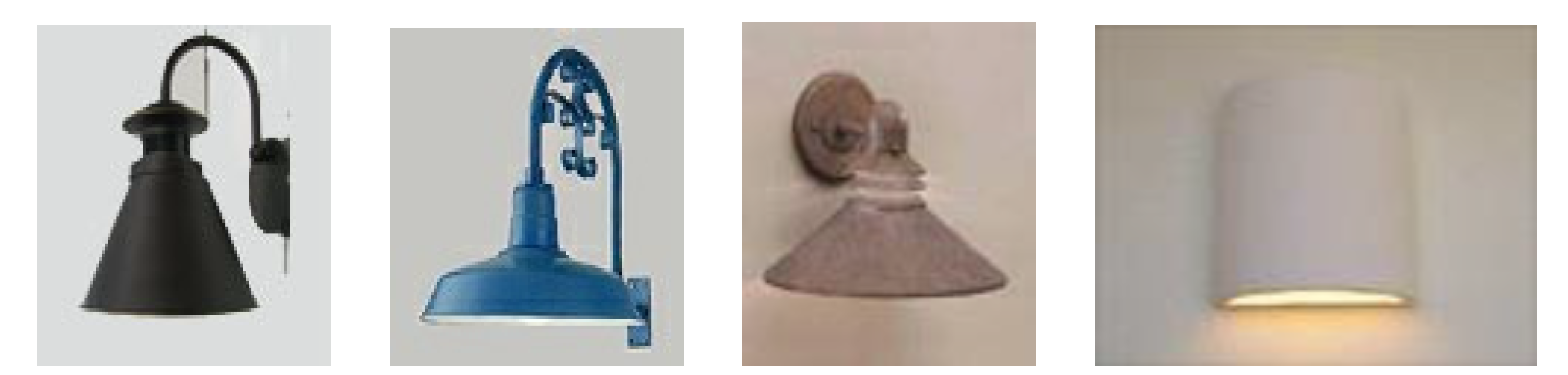
2.
Where Lighting Must Be Provided: For multi-family residential, commercial, lodging developments, mobile home parks, other non-residential development and other development with common parking areas or walkways, exterior lighting shall be provided in parking areas and along walkways, as deemed necessary by the Review Authority.
3.
Confining Direct Rays to a Site: All direct rays shall be confined to the site on which the lighting is located.
4.
Flood lamps: Flood lamps shall have full cut off fixtures so that the light sources are not visible off-site. Spotlights that do not have shielding devices are prohibited.
5.
Other Lighting: Lighting that illuminates any element of a building or structure, landscaping, signs, flags or outdoor artwork, shall be aimed at the object to be illuminated, be in full cut off fixtures and shall minimize light spill.
6.
Maximum Height Limitations for Exterior Lighting: The following lists maximum heights of lighting standards and fixtures and may be limited by the more restrictive requirements listed in this section:
a.
The maximum height of parking lot luminaries shall be 18 feet, measured from finished grade. A luminary may be installed to a height of up to 24 feet if the applicant can demonstrate that the visual impacts of the lighting that is emitted from the proposed luminary will be less than that from a luminary that complies with the 18-foot height limitation.
b.
Exterior light fixtures mounted on buildings or other structures shall be mounted no more than 15 feet in height above finished grade unless such lighting is located at a building or dwelling unit entrance or exit or located on a building next to a deck entry.
c.
Lamps lighting pedestrian ways shall not exceed 18 feet in height.
d.
Wall mounted light fixtures shall not extend above the height of the wall to which they are mounted.
7.
Lighting Limitations for Canopies and Awnings:
a.
Awnings shall not be internally illuminated.
b.
Lights shall not be mounted on the top, sides or fascia of a canopy or awning, unless such lighting is needed for an approved sign that is attached to the canopy or awning.
c.
If a luminary is to be installed in any canopy that is designated for pedestrian use, loading or service, then the luminary shall be recessed into the canopy structure.
d.
Decorative lamps housing incandescent light sources that are hung under portals are not subject to these limitations on lighting of canopies and awnings.
8.
Additional Design Standards for Exterior Lighting:
a.
If an exposed unfinished concrete base is used as a support for a light standard, the height of the base may not exceed two (2) feet above finished grade. The base may exceed two (2) feet in height if it is covered with textured concrete, colored concrete, rock or similar material.
b.
All parking lot light fixtures in a single parking lot shall be similar in design.
E.
Lighting Plan Submission Requirements: An applicant subject to a development review as required by this Code shall submit a lighting plan that includes the following information:
1.
The location of all exterior lights within the development shall be shown on the site plan and building elevation drawings, including but not limited to entrance lighting, security lighting and architectural lighting. The plans shall illustrate the location of the lights, the height of the lights, describe the type of lighting devices, fixtures, lamps and wattage, and supports that will be employed. For projects that have a common parking area or walkways that must be lit, the proposed height of all lighting standards and fixtures shall be identified.
2.
Photographs, cut sheets or other illustrations shall be provided that show the proposed full cut-off fixtures, including but not limited to cut sheets showing the design and finishes of all fixtures.
F.
Prohibited Lighting:
1.
The installation or erection of any lighting that simulates, imitates or conflicts with warning signals, emergency signals or traffic signals is prohibited.
2.
Blinking or flashing lights and exposed strip lights used to illuminate building facades or to outline buildings are prohibited, except that temporary decorative lights are allowed for a period of up to eight (8) weeks during a calendar year.
3.
Lighting that causes off-site glare.
4.
Lighting that is not in a full cut-off-fixture (excludes seasonal holiday lighting).
3505.08: Manufactured and Modular Structures
A.
A-1, BC, RU, RE, RME, R-25, R-1, R-2, R-3, R-4, R-6 and R-P:
1.
Criteria for Manufactured Homes: Manufactured homes are permitted in these zoning districts for use as residences provided the following criteria are met:
a.
Certification: The home shall have certification pursuant to the "National Manufactured Housing Construction and Safety Standards Act of 1974" (42 U.S.C. 5401 et seq., as amended).
b.
Size and Design:
i.
The dimensions shall be at least 24 feet by 36 feet.
ii.
Exterior shall be of brick, wood or cosmetically equivalent siding and roof shall be pitched.
iii.
Prior to delivery to the site the home shall meet, on an equivalent performance engineering basis, unique public safety requirements of the Building Code such as snow load, wind shear and energy conservation factors.
c.
Site Preparation, Delivery and Installation:
i.
A permanent, engineered foundation approved by the Building Department shall be constructed prior to delivery of any portion of the home to the site.
ii.
The home shall be complete including sanitary, heating and electrical systems and be ready for occupancy when delivered to the site except for minor assembly.
iii.
Home shall be installed on a foundation meeting the requirements of this section.
iv.
Installation shall be complete, including any minor assembly, and the home ready for occupancy within 14 calendar days of delivery.
2.
Criteria for Modular Homes: Modular homes are permitted in these zoning districts for use as residences provided the following criteria are met:
a.
Certification and Design: The home shall meet the "Factory-Built Housing Construction Code of the State of Colorado" and shall be so certified by the Colorado Division of Housing prior to delivery to the site.
b.
Site Preparation, Delivery and Installation: Home shall be installed on a permanent, engineered foundation approved by the Building Department. The foundation shall be constructed prior to delivery of any portion of the home to the site.
3.
Modular Structures as Temporary Offices: Modular structures are permitted in these zoning districts for use as temporary real estate or construction offices with approval of a temporary use permit or for any nonresidential use permitted by the zoning district if the criteria stated in Section 3505.08 are met.
B.
MHP:
1.
Criteria for Manufactured Homes: Manufactured homes are permitted in this zoning district for use as residences provided the following criteria are met:
a.
Certification: Manufactured homes first occupied in Summit County after September 21, 1983 shall have affixed a data plate and heating certificate stating in substance that:
i.
The home is designed to comply with Federal mobile or manufactured home construction and safety standards in force at the time of manufacture.
ii.
The home is designed for Colorado structural and wind zone requirements.
iii.
The home is designed for Colorado outdoor winter design temperature zones.
iv.
Heating equipment installed in the home has capacity to maintain an average 70 degrees Fahrenheit temperature inside the home with an outdoor temperature of -20 degree Fahrenheit.
b.
Site Preparation, Delivery and Installation:
i.
Permanent or non-permanent foundations approved by the Building Department shall be constructed prior to delivery of any portion of the home to the site.
ii.
The home shall be complete including sanitary, heating and electrical systems and be ready for occupancy when delivered to site except for minor assembly.
iii.
The home shall be installed on a foundation meeting the requirements of Section 3505.08.A.1.c.
iv.
Installation shall be complete, including any minor assembly, and the home ready for occupancy within 14 calendar days of delivery.
2.
Modular homes are permitted in this zoning district for use as residences provided the criteria in Section 3505.08.A.2 are met.
C.
CG, CN, B-3, B-1, R-25, PUD and I-1: Modular structures are permitted for any use allowed by the zoning district regulations as long as the following criteria are met:
1.
Compliance with Building Code: The structure shall meet the requirements of the Building Code including unique public safety requirements such as snow load, wind shear and energy conservation factors.
2.
Design: Exterior treatment shall meet the requirements of any design criteria in effect for the zoning district where the building is to be located and the applicable requirements pertaining to exterior materials contained in Section 3505.05 et seq.
3.
Site Preparation, Delivery and Installation: The structure shall be installed on a permanent, engineered foundation approved by the Building Department. The foundation shall be constructed prior to delivery of any portion of the structure to the site.
D.
M-1:
1.
Manufactured or modular homes are permitted for use as a caretaker unit or employee housing subject to meeting the applicable criteria in Section 3505.08 et seq.
2.
Modular structures are permitted for use as a mining company's business office subject to meeting the applicable criteria in Section 3505.08 et seq.
E.
Temporary Offices: Manufactured structures may be used for temporary construction or real estate offices with approval of a temporary use permit. The criteria for approval of permits for these types of temporary offices are stated in Sections 3806 et seq. and 3817 et seq.
F.
Storage of Unassembled Structures: The storage of unassembled manufactured or modular structures for longer than 14 calendar days is prohibited in all zoning districts except for the I-1 Zoning District. Assembly consists of the placement of the manufactured or modular structure on its foundation, the fastening together of preassembled sections and connection to utilities such that the structure is ready for occupancy.
3505.09: Off-Street Loading Areas
The number of spaces, location and design of loading and unloading areas shall comply with the requirements in Section 3705.02.E and shall be determined as part of site plan review.
3505.10: Open Space Area
Requirement for Open Space Area: Open Space Areas may be required as part of a rezoning, PUD rezoning, PUD amendment, or other types of applications where open space areas are an integral part of the proposed development or otherwise required by the Code. Open space areas facilitate numerous community benefits such as providing extensions to existing undeveloped open space lands, buffers to developed areas, view corridors, access to trails, trailheads, water bodies, National Forest areas, passive recreation uses including trails, unique ecological habitats and historic sites.
A.
Where open space areas are proposed or required, such designated areas shall comport with the purpose and intent of providing such, including provisions related to Public Use Area Fees (Section 3509 et seq.), Density (Section 3505.02 et seq.), Subdivision Regulations (Section 8000 et seq.), Zoning Amendments (Section 12100 et seq.), Planned Unit Developments (Section 12200 et seq.), and Site Plans (Section 12600 et seq.).
B.
In development applications that have requirements for dedicated open space areas, only land dedicated as public or common private open space may be counted towards meeting that requirement and private property on individual lots left in an undeveloped state may not be counted.
3505.11: Outdoor Storage Areas and Yards
Regulations on the location and screening of outdoor storage areas and yards, including outdoor storage of motor vehicles and recreational vehicles, are stated in Section 3815 et seq. and are intended to be used in evaluating the design of development projects. Regulations on the types of materials or items allowed to be stored in County zoning districts are also stated in Section 3815 et seq. The requirement for the provision of storage yards for recreational vehicles is stated in Section 3505.12.
3505.12: Recreational Vehicle Storage Yards
A.
Requirement for Storage Yard: Multi-family residential developments and manufactured home parks receiving site plan approval shall provide a yard for the storage of recreational vehicles equivalent to 25 square feet per dwelling unit or manufactured home, except that this requirement may be waived or reduced for a multi-family development if the Review Authority determines, based on the intended use of the development, that the provision for storage of recreational vehicles needs to be modified.
B.
Design of Storage Yard: A storage yard shall be graveled or paved and shall be enclosed by an opaque wall or fence at least six (6) feet in height. Where the wall or fence includes a gate, the gate shall be constructed of solid materials so as to be opaque.
3505.13: Setbacks
A setback is an undeveloped open area of fixed width within a parcel along the front, side or rear property line which shall remain free of any development and no building, structural improvement or paving is to be placed in any required setback except as provided in Section 3505.13.F. and G.
A.
Setback Requirements: The setback requirements for each zoning district, except for R-P and PUD zoning districts, are stated in Figure 3-6. Setback Requirements for R-P and PUD zoning districts shall be as stated in the R-P plan or PUD Designation. If setbacks are not stated in the R-P plan or PUD designation, the Code Administrator shall determine the setback requirements which apply in accordance with Section 3505.01.
B.
Measuring Setbacks: Setbacks are measured perpendicular from the lot or parcel boundary that borders the setback area to be measured. In addition, in those zone districts that require improvements to be setback from trails, such setbacks shall be measured perpendicular from the trail easement boundaries, not the edge of pavement, tread or shoulder.
C.
Building to Building Setbacks: Building to building setbacks are subject to the provisions set forth in the applicable building code unless otherwise stated in a PUD. If the building to building setbacks required per the applicable building code are more restrictive than those required by a PUD, then those restrictions in the building code shall prevail.
D.
Road Setbacks: Road setbacks are listed in Figure 3-6 and are based on the adjacent road classification. Where the road setback is greater than the property line setback, the road setback shall prevail. In PUDs and RP where no road setback is listed, the property line setbacks shall be used.
1.
For properties containing roads within prescriptive rights-of-ways or prescriptive easements, the setback shall be measured from the edge of the maintained roadway, or the travelled portion of the roadway for roads that are not maintained by Summit County. A request for an exception to this requirement will be considered pursuant to the provisions for administrative relief in Section 13400 et seq. In order to grant administrative relief from this requirement, the Code Administrator must consult with the Summit County Road and Bridge Department and make the following findings: 1) that adequate space is available for necessary road maintenance and snow removal operations, including an indemnification agreement for these activities; 2) that public health, safety and welfare will not be significantly negatively impacted; and 3) that one of the following exists:
a.
The strict application of this setback requirement would result in peculiar and exceptional practical difficulties to, or exceptional and undue hardship upon, the property owner in the development of the property because of special circumstances applicable to the property such as size, shape, topography or other extraordinary or exceptional physical conditions; or
b.
Reasonable use of the property is not otherwise available without granting of administrative relief, and the relief being granted is the minimum necessary to allow for reasonable use.
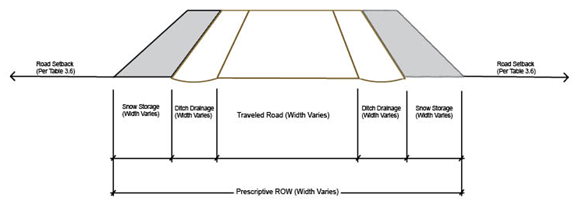
E.
Trail Setbacks: Setback distances from hard and soft surface trail easements or right-of-way shall be ten (10) feet. Setbacks from hard and soft surface recreational pathways may be reduced if approved by the Open Space and Trails Department and if one (1) or more of the following exists: 1) topography or natural vegetation that provides a visual separation such that any buildings or improvements on the site (driveways excepted) cannot be seen from the recreational pathway; or 2) if lot dimensions, preexisting structures or other physical site attributes preclude the ability of individuals to meet established setbacks.
F.
Open Parking Areas: Open parking area setback requirements are as follows:
1.
For Single-Family Detached and Duplex Dwelling Units, Including But Not Limited to Single-Family and Duplex Dwelling Units in R-P and PUD Zoning Districts: Where it is not possible to build a driveway to County standards because of the steepness of the lot, a parking area or parking platform may be constructed adjacent to the road right-of-way and within the required setback, subject to approval by the County Engineer per the applicable requirements of this Code.
2.
For CG, CN, B-1, B-3, I-1, M-1, Multi-family Residential Uses in R-P or PUD Zoning Districts, Commercial or Industrial Uses in PUD Zoning Districts and Other Non-residential Development:
a.
Front and Street Side: Within ten (10) feet of the property line, except that no parking areas are allowed within 20 feet of property lines abutting highway or arterial rights-of-way.
b.
Side and Rear: Within five (5) feet of the property line, except that no parking areas are allowed within 15 feet of a property line where that line is a boundary between:
i.
A single-family and a multi-family residential zoning district.
ii.
An area(s) of a PUD Zoning District and an area(s) of an R-P Zoning District where single-family and multi-family residential development abut.
iii.
A residential zoning district (including an area of a PUD allowing residential development) and either a commercial or industrial zoning district, community or institutional facility or an area of a PUD allowing commercial or industrial development or development of a community or institutional facility.
iv.
A mining zoning district and either a residential or commercial zoning district, community or institutional facility or an area of a PUD allowing residential or commercial development or development of a community or institutional facility.
v.
Community and institutional facilities: Regulations regarding the placement of open parking areas serving community or institutional facilities shall be as stated for commercial uses in D.2 of this Section.
3.
For Residential Development in All Zoning Districts in the County: Parking areas for single-family and duplexes and accessory dwelling units (ADU) should be located outside of the setback unless meeting the exceptions below:
a.
The parking is located in a driveway that is compliant with Chapter 5 of the Code and has not been expanded beyond the width permitted by this Code;
b.
On a single-family lot with a permitted ADU, one parking space may be located within the setback provided it is a minimum of 5' from all property lines.
G.
Exceptions to Setback Requirements:
1.
Duplex Units: Where a lot line is to be established along the common wall shared by two (2) dwelling units in a duplex, the side setback requirement on either side of this internal lot line may be reduced or eliminated.
a.
Notwithstanding the establishment of a reduced or eliminated setback to the internal lot line of a duplex lot, a detached ADU shall comply with the applicable setback of the zoning district.
2.
Interior Property Lines: Where a manufactured home park, multi-family residential, commercial, industrial or mixed-use development is proposed for a site consisting of two (2) or more contiguous parcels, setback requirements along the interior property lines may be reduced or eliminated if:
a.
An overall development plan has been approved for the site and the site continues to be developed as one entity according to the approved development plan.
b.
Structures do not cross parcel lines.
c.
The Placement of structures complies with building-to-building setback requirements and with the requirements of the Building Code.
3.
Minor Structures and Uses: The following minor structures and uses are allowed in any required setback, but shall not obstruct motorist's vision at access points.
a.
Bus shelters used as a part of a community transit system.
b.
Uncovered decks and patios within 18 inches of finished grade.
c.
Driveways, including driveways that must be elevated due to topographic conditions.
d.
Flagpoles that do not exceed the maximum height limit established in the underlying zoning district.
e.
Mailboxes and newspaper tubes.
f.
Landscape planters.
g.
Play equipment.
h.
Signs, with an approved sign permit.
i.
Walkways.
j.
Walls and fences, as provided in Section 3505.17.
k.
Minor utility facilities.
l.
Light bollards/fixtures.
m.
Sheds provided that 1) the sheds are located in the rear or side yard and are located a minimum of five (5) feet from all property lines (including the driplines of the shed); and 2) the maximum size of such shed shall not exceed 200 square feet of floor area nor shall the maximum height exceed eight (8) feet. Sheds larger than 200 square feet must be located outside of the required setbacks.
n.
Ranch signs and similar entry structures for parcels greater than five (5) acres.
o.
Signs as permitted by this Code, subject to any sign setbacks established in the Sign Regulations.
p.
Hot tubs, provided that 1) the hot tubs are located in the rear yard, 2) a minimum setback of five (5) feet to all property lines is maintained, and 3) buffering or screening is provided to the adjoining property or properties.
q.
Railings for walkways, patios, decks, stairs or driveways as required to meet code requirements.
r.
Stairs less than 18 inches above finished grade.
s.
Any structure if it is buried below natural grade if 1) the finished grade provides a smooth transition into the unaltered natural grade, and 2) the setback area retains its open character.
t.
Typical non-structural residential recreational amenities including play sets, sandboxes, tree houses, benches, picnic tables, grills, dog houses and other similar non-structural residential recreational amenities that do not adversely impact the open character of the setback area.
u.
Art.
v.
Solar energy systems as indicated in Section 3507.01.
w.
Raised garden beds.
4.
Variable Setbacks to Facilitate Wetland Protection: To facilitate the protection of wetlands as defined in Chapter 15 and their corresponding 25-foot buffer, a property owner may apply for administrative relief from the applicable zone district property line setback standards pursuant to Section 13400 et seq. of this Code.
H.
Verifying Setbacks: A Site Improvement Location Certificate ("SILC") shall be required to verify setbacks when structures or improvements, which are not listed as an exception in Section G above, are within ten feet of a setback unless otherwise verified by the Planning Department.
3505.14: Site Area
Site area requirements for the different zoning districts are stated in Figure 3-5. In certain cases, Figure 3-5 lists specific site area requirements for particular uses. Where a specific site area required for a particular use differs from the general requirement for the zoning district, the specific requirement shall apply when a site is created for that use. Compliance with minimum site area requirements is determined as follows:
A.
A-1 and BC Zoning Districts: Minimum site area is synonymous with the minimum parcel size allowed, except for approved rural land use subdivisions (see Section 8420 et seq.). In determining compliance with site area requirements where the requirement is for 20 or more acres, gross site area shall be used.
B.
RU, RE, R-1, R-2, R-3 and R-4 Zoning Districts: Minimum site area is synonymous with the minimum parcel size allowed. In determining compliance with the minimum size required, net site area shall be used.
C.
R-6 and R-25 Zoning Districts: Minimum site area is synonymous with the minimum parcel size allowed. In determining compliance with the minimum size required for one (1) dwelling unit, net site area shall be used. A duplex lot shall contain sufficient square footage of lot area to allow the development of a duplex (two (2) dwelling units) unless other applicable zoning regulations, plat notes or documents allow for the development of a duplex.
D.
R-P Zoning District: A site consists of a parcel or group of contiguous parcels included in an overall plan for development approved by the County. Site area requirements may vary for different planning areas under the overall plan. The overall plan shall specify site area requirements of each planning area and may include a map illustrating site area requirements. If site area requirements are not stated for an R-P Zoning District, the Planning Director shall determine the site area requirements which apply in accordance with Section 3505.01.
E.
MHP, CG, CN, B-1, I-1, and M-1 Zoning Districts: A site consists of a parcel or group of contiguous parcels that are planned and developed as a unit, and the following site area requirements apply:
1.
MHP Zoning District: Each manufactured home park shall contain a minimum of ten (10) acres.
2.
CG Zoning District: Each area having this zoning designation shall contain a minimum of five (5) acres.
3.
CN Zoning District: Each area having this zoning designation shall contain a minimum of one (1) acre.
4.
I-1 Zoning District: Each area having this zoning designation shall contain a minimum of five (5) acres.
5.
PUD Zoning District: Where established, site area requirements for PUDs shall be stated in the PUD designation. If site area requirements are not stated in a PUD, the Planning Director shall determine the site area requirements which apply in accordance with Section 3505.01.
F.
B-3 Zoning District: 20,000 sq. ft., except that any lot platted prior to an area being zoned B-3 shall be considered to meet the required minimum lot area. The minimum lot area for a residential-only subdivision is stated in Section 3515.
G.
R-4 with Plan, R-6 with Plan and PUD Zoning Districts and Multi-family Development That may be Permitted in Other Zoning Districts: A site may consists of a parcel or group of contiguous parcels included in an overall plan for development approved by the County. Site area requirements may vary for different planning areas under the overall plan approved by the County. If site area requirements are not stated for one of these zoning districts, the Planning Director shall determine the site area requirements which apply in accordance with Section 3505.01.
H.
Site Area Requirements and Subdivision Exemptions: If a duplex lot or multi-family lot meets the minimum site area requirements of the underlying zoning, such lots may be platted in accordance with this Code's subdivision exemption requirements listed in Section 8400 et seq. Duplex dwellings, townhouse dwellings or multi-family dwellings may be subdivided into parcels that do not meet required site area provisions provided 1) the site continues to be developed as one (1) entity according to an approved or modified development plan in accordance with the requirements of this Code; 2) the overall site development adheres to the site area requirements of the underlying zoning district; 3) the property continues to meet and adhere to all requirements of any townhouse plat or condominium map, or other applicable documents of record; and, 4) any subdivision plat for the development site includes a plat note stating the development of the parcels is subject to an overall development plan. Notwithstanding the foregoing, a duplex dwelling subdivision exemption shall be divided so that the lot for one (1) dwelling unit contains no less than 40% of the total land area in the original lot unless other site areas are approved by the Planning Department that allow for each lot to have approximately 30 to 50% of the land area in each resultant duplex lot.
I.
Waiver of Site Area Requirements for Replatting Legal Non-conforming Lots: The Review Authority may approve the replatting and establishment of lots that do not meet the minimum site area requirements if the following criteria are met during the required subdivision development review process:
1.
At least two (2) legal non-conforming lots are being platted through a preliminary/final plat or subdivision exemption development review process.
2.
There is no increase or decrease in the pre-existing site area of the non-conforming parcels or lots involved in the subdivision process and all lots retain the same or greater area as exists prior to the subdivision review process.
3.
The proposed reconfiguration is to either a) create better development sites per the policies contained in applicable master plans, or b) to achieve other broader community goals or objectives that further the public interest, or c) to resolve some lot or parcel boundary dispute, including but not limited to structural encroachments, setback encroachments of structures or encroachments of wells or septic system components.
4.
A nonconforming parcel plan review has been or will be obtained prior to establishing any new uses on a parcel, if deemed necessary by the Review Authority, or such review is not required by the provisions of this Code.
3505.15: Site Coverage
Site coverage limitations are required to ensure that a certain portion of each development site remains undeveloped in order to provide relief from large expanses of building mass and pavement.
A.
Application of Coverage Requirement: The maximum amount of building and impervious site coverage (as defined in Chapter 15) permitted for each zoning district, and for specific uses in each zoning district, are stated in Figure 3-5. Coverage requirements are applied as follows:
1.
A-1, BC, RU, RE, RME, R-1, R-2, R-3, R-4, R-6 and R-25 Zoning Districts: Maximum coverage limits are calculated based on net site area, except for approved rural land use subdivisions (see Section 8420 et seq.).
2.
MHP, CG, CN, B-1, B-3, I-1 and M-1 Zoning Districts: A site consists of a lot or group of contiguous parcels which are planned and developed as a unit. Each parcel shall meet the maximum coverage requirements as outlined in Figure 3-5.
3.
For PUD Zoning Districts: Where established, coverage limits for PUDs shall be stated in the PUD designation. If site coverage limits are not stated in the PUD designation, the Planning Director shall determine the site coverage limits which apply in accordance with Section 3505.01.B.
4.
R-4 with Plan, R-6 with Plan and PUD Zoning Districts and Multi-family Development That May Be Permitted in Other Zoning Districts: A site may consist of a parcel or group of contiguous parcels included in an overall plan for development approved by the County. Site coverage requirements may vary for different planning areas under the overall plan approved by the County. If site area requirements are not stated for one of these zoning districts, the Planning Director shall determine the site area requirements which apply in accordance with Section 3505.01.D.
5.
Site Coverage Requirements and Subdivision Exemptions: If a duplex dwelling or multi-family dwelling meets the site coverage requirements of the underlying zoning, such units may be platted in accordance with this Code's subdivision exemption requirements listed in Section 8400 et seq. Duplex dwellings, townhouse dwellings or multi-family dwellings may be subdivided into parcels that do not meet required site coverage provisions provided 1) the site continues to be developed as one (1) development application according to an approved or modified development plan in accordance with the requirements of this Code; 2) the overall site development adheres to the site coverage requirements of the underlying zoning district; 3) the property continues to meet and adhere to all requirements of any townhouse plat or condominium map, or other applicable documents of record; and, 4) any subdivision plat for the development site includes a plat note stating the development of the parcels is subject to an overall development plan.
B.
Compliance with Requirement:
1.
Types of areas: Areas which are not counted towards site coverage shall either be:
a.
Undisturbed areas left in a natural state; or
b.
Landscaped and revegetated areas having a permeable surface.
3505.16: Street, Driveway and Parking Areas
Summit County has adopted Road Standards. Any streets, driveways or parking areas constructed in conjunction with a development project shall comply with the standards in Chapter 5 and the other required provisions of this Code, including but not limited to the design requirements stated in Section 3600 et seq. and Section 3700 et seq.
3505.17: Walls and Fences
The height, location and design of walls and fences are regulated by this Code as provided in this section. Berm design standards are addressed separately in the Landscaping Regulations of this Code (see section 3600).
A.
Wall and Fence Heights: The maximum heights for walls or fences are stated below and summarized in the development standards matrix, except as provided in Section 3505.17.B. No wall or fence shall obstruct visibility at access points.
1.
A-1 Zoning District: On parcels having 20 or more acres, wall and fence heights are not regulated except that they shall not cause a visual obstruction at access points. On parcels of less than 20 acres, fences shall comply with requirements for residential zoning districts (see Section 3505.17.A.2).
2.
RU, RE, RME, R-1, R-2, R-3, R-4, R-6, R-25, R-P and MHP Zoning Districts:
a.
Front: Fences and walls in the front setback shall be no higher than four (4) feet above grade at the property line, and shall not cause a visual obstruction at access points. Fences or walls in the front yard but not in the front setback may exceed four (4) feet up to a maximum of six (6) feet above grade.
b.
Street side: Fences or walls in any setback abutting street right-of-way shall comply with the height limits on fences and walls in front setbacks except where there is no vehicular access to the site from that side. In that case, the height of the fence or wall may be six (6) feet above grade at the property line.
c.
Maximum height: Fences and walls in areas other than the front or street side setbacks shall be no higher than six feet (6) above grade.
3.
CG, CN, B-1 and B-3 Zoning Districts and Other Commercial Development as May be Allowed in Other Zoning Districts:
a.
Front: Fences and walls in the front setback shall be no higher than four (4) feet above grade at the property line, and shall not cause a visual obstruction at access points. Fences or walls in the front yard but not in the front setback may exceed four (4) feet up to a maximum of eight feet (8) above grade.
b.
Street Side: Fences or walls in any setback abutting street right-of-way shall comply with the height limits on fences and walls in front setbacks except where there is no vehicular access to the site from that side. In that case, the height of the fence or wall may be eight (8) feet at the property line.
c.
Maximum Height: Fences and walls in areas other than the front or street side shall not be higher than eight (8) feet at the property line.
4.
I-1 and M-1 Zoning Districts:
a.
Front: Fences and walls in the front setback shall be no higher than six (6) feet above grade at the property line and shall not cause a visual obstruction at access points. Fences or walls in the front yard but not in the front setback may exceed six (6) feet up to a maximum of ten (10) feet above grade at the property line.
b.
Street Side: Fences and walls in any setback abutting street right-of-way shall comply with the height limits on fences and walls in front setbacks except where there is no vehicular access to the site from that side. In that case, the height of the fence or wall may be ten (10) feet above grade at the property line.
c.
Maximum Height: Fences and walls in areas other than the front or street side shall be no higher than ten (10) feet above grade.
5.
For Planned Unit Developments: Where limits on heights of fences or walls are established in a PUD, these limits shall apply as provided for in Section 3505.01. Where height limits for fences or walls are not stated in the PUD designation, the Planning Director shall determine the height limits for fences or walls which apply in accordance with Section 3505.01.
6.
BC Zoning District:
a.
Wildlife and Fencing: All fences or walls shall be constructed to effectively hold livestock while allowing for the passage of wildlife. Areas that may be fenced shall be limited to the immediate area of site disturbance around the principal structure and areas for livestock. Fencing areas for livestock shall be limited to a size equal to the area required for the number of livestock animals physically kept on a property, subject to the requirements of Section 3802 et seq. and Figure 3-8. For example, if two (2) horses are kept on the property, a maximum of four (4) acres may be fenced.
b.
Maximum Heights: The maximum height for fences and walls shall be the same as for residential zoning districts as outlined in Section 3505.17.A.2 provided that such fencing shall also comply with the requirement regarding wildlife friendly fencing outlined above.
B.
Exceptions to Wall and Fence Heights: The following exceptions to limits on wall and fence heights apply in all zoning districts:
1.
Height limits specified in this section do not apply to retaining walls or construction fencing (up to 12 feet) for large-scale projects or projects with significant safety concerns as determined by the Planning Department.
2.
The maximum height of a fence or wall shall be three and one-half (3½) feet above grade within the sight triangle of any street intersection.
3.
Sports and recreation facilities may have wall and fence heights that exceed the requirements of this section provided such heights are based on industry accepted standards.
C.
Wall and Fence Design: All fences or walls shall be constructed to be wildlife friendly and to not ensnare or otherwise cause injury to wildlife. All fences or walls enclosing an area of one (1) acre or greater shall be designed to allow for the safe passage of wildlife. See Colorado Parks and Wildlife guidelines for wildlife friendly fencing (Fencing with Wildlife in Mind, Colorado Division of Wildlife, 2009, as may be updated or amended); examples are included below. The design of fences, including the types of material used for construction, shall comply with the following requirements except that retaining walls do not have to meet the following standards (refer to Section D below for the design standards for retaining walls). A request for an exception to these requirements will be considered pursuant to the provisions for administrative relief in Section 13400 et seq. In order to grant administrative relief from this requirement, the Code Administrator and property owner must consult with the Colorado Parks and Wildlife to review the specifics details of the property, the reason for the request, and to identify the appropriate fencing that will minimize impacts to wildlife.
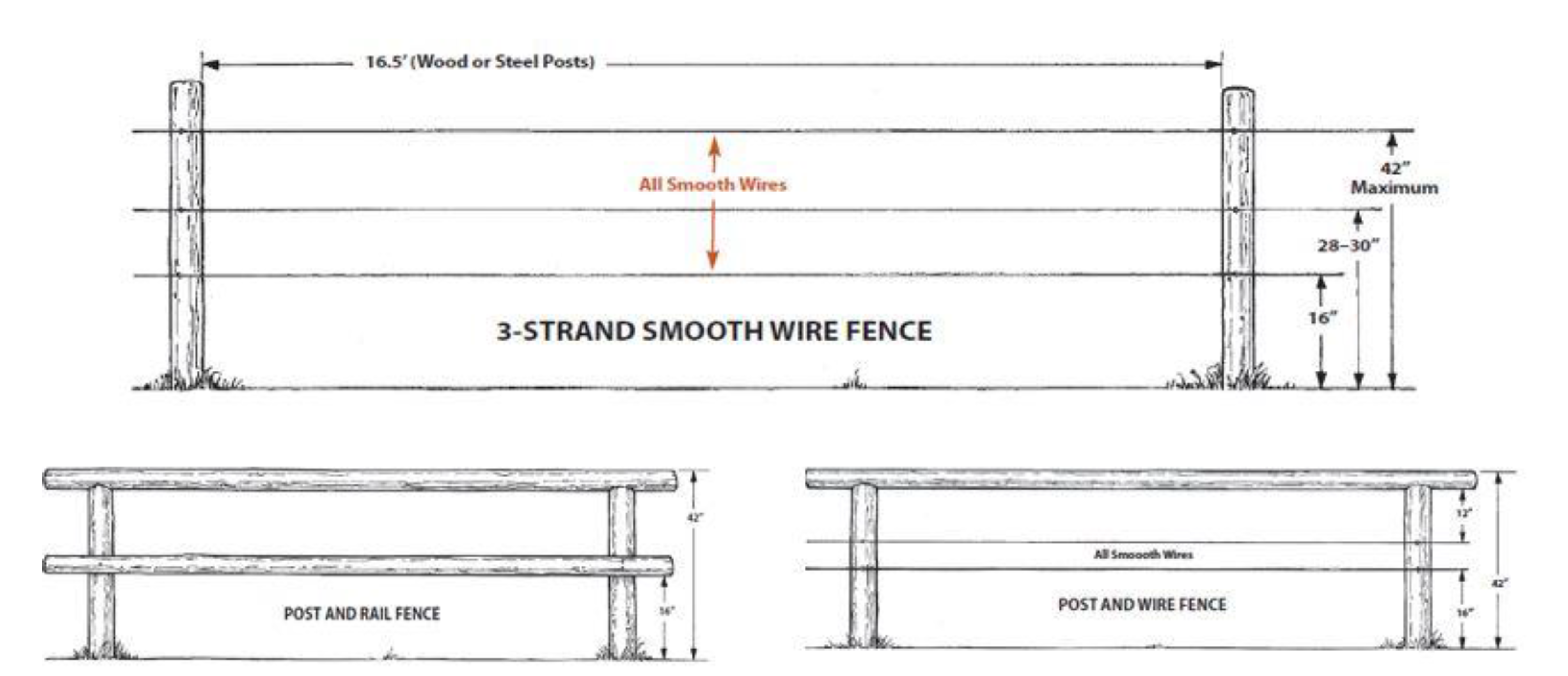
1.
Use of Natural Materials: Walls and fences constructed as part of multi-family, mixed-use or commercial development shall be constructed of natural materials such as wood, river rock or stone or naturally appearing materials approved by the Planning Department. For all new construction and/or additions in excess of 25% of the value of the existing structure, permissible fencing materials shall include a section of five (5) lineal feet of non-combustible material within 10-feet of any structure. Compliance shall be verified as part of any required defensible space inspection. This requirement may be waived by the Review Authority when the specific conditions and individual circumstances (i.e. slope, aspect, vegetation types, availability of firefighting infrastructure, and other relevant factors as identified in the CWPP) of a given project do not warrant imposition of this standard. Concrete fences are not permitted unless faced with a material as required above.
2.
Barbed Wire, Wire Strand and Electric Fences: Barbed wire, wire strand and electric-charged fences are regulated as follows:
a.
Permitted in A-1, BC (as may be limited in Section A.6 above), M-1, RU, RME and RE zoning districts and in other zoning districts where a conditional use permit has been approved for the keeping of livestock.
b.
Permitted as specified in the National Electric Code, as amended or as deemed necessary and appropriate by the Review Authority to promote demonstrated security concerns and the public health, safety and welfare.
c.
Prohibited in all other zoning districts except as provided for above unless a specific allowance has been made in a PUD designation.
d.
Electric fences may be used in accordance with Section 3802.02.E.4 et seq. specifically in association with beekeeping.
3.
Chain Link: Chain link fences are permitted except that in the RU, RME, RE, R-1, R-2, R-3, R-4, R-6, R-P and MHP zoning districts, chain link fences shall not be used for purposes of enclosing storage areas where such storage must be screened from view in accordance with Section 3815 et seq. Chain link fences are permitted to be used in the I-1 and M-1 zoning districts for enclosing storage areas, provided that such fences shall be equipped with slats in order to create an opaque screen as required by Section 3815 et seq.
4.
Storage Yards: Walls and fences enclosing storage yards and gates in such fences and walls shall be opaque if so required by this Code.
5.
PUDs: Where design standards for fences are established in a PUD, these design standards shall be applied as provided for in Section 3505.01. Where height limits for fences are not specifically stated in the PUD designation, the Planning Director shall determine the height limits for fences that apply in accordance with Section 3505.01.
D.
Retaining Walls:
1.
Design:
a.
Colorado Licensed Professional Engineer Design: All retaining walls in excess of four (4) feet in total height, whether in a single line or in steps, shall be designed and stamped certified by a Colorado Licensed Professional Engineer.
b.
Maximum Height: To the extent practicable, large retaining walls shall be broken up by steps. The maximum height of a retaining wall shall be eight (8) feet, and if more retaining is necessary above that height, a four (4) foot step in the wall shall be required. All stepping of retaining walls shall require a setback for each step with a minimum of one-half the height of the wall preceding it.
c.
Landscaping: Landscaping shall be provided on any steps in the retaining wall and at the base of the wall to soften the appearance of a retaining wall.
d.
Visual Impacts: Attention shall be given to the visual impact of retaining walls as viewed from off-site. Every reasonable effort shall be made to reduce visual impact through the color and type of materials used and height of retaining walls.
2.
Materials: Retaining walls shall be constructed from such materials as concrete, reinforced earth rock, gabions or other decay resistant materials. If gabions are used, large rocks shall be used to fill the gabions, and they shall be faced with treated timbers. The appearance of retaining walls shall be softened through the architectural finish on the surface and with landscaping.
3.
Drainage: All retaining walls shall have adequate subsurface drainage.
4.
PUDs: Where design standards for retaining walls are established in a PUD, these design standards shall be applied as provided for in Section 3505.01. Where design standards for retaining walls are not specifically stated in the PUD designation, the Planning Director shall determine the design standards that apply in accordance with Section 3505.01.
3505.18: Garages
A.
Size Limits: The maximum size for a garage associated with a single-family dwelling shall be as follows:
1.
BC Zoning District: Total floor area of garages (and all other accessory structures) in the BC zoning District shall not exceed 600 square feet.
2.
All Other Zoning Districts: 1,500 sq. ft. of floor area in a single-family dwelling that contains up to 3,000 square feet of floor area. For single-family dwellings that contain more than 3,000 square feet, maximum garage size is a function of the floor area contained in the dwelling, with the maximum garage size allowed at 50% of the floor area contained in the dwelling up to a maximum of 2,000 square feet of in garage floor area.
3.
There shall be no size limit for a garage on a parcel greater than 35 acres located within the A-1 Zoning District.
B.
Location: Except as provided in the RC-5000 and RC-40000 zoning districts, a garage associated with a residential use must be located on the same parcel as the residential use. The garage may be either attached to or detached from the primary residential structure. Both attached and detached garages are allowed on the same parcel provided the size of both garages combined does not exceed the maximum size limit as stated above.
C.
Exceptions to Size Limits: Areas which are located within the garage area of a dwelling or the garage structure, but are separated from the actual parking areas, such as but not limited to workshop areas or rooms, storage areas and utility areas, shall not be counted in the size of the garage if such areas are designed as one of the following areas:
1.
An area that has a floor elevation at least six (6) inches higher or lower than the garage floor elevation.
2.
An area that is physically separated by a wall from the garage parking area (i.e., utility or storage rooms, a workshop area, etc.) that clearly cannot accommodate the parking of a vehicle.
3.
An area that has a maximum door opening of less than six (6) feet in width.
D.
Other Uses Permitted in Garages: Garages may contain workshops, storage areas, dog washes, chemical washouts (for residential uses only in residential zoning districts), utility sinks, offices, artist studios, and other similar uses. In detached garages, bedrooms not associated with an approved accessory dwelling unit are prohibited. Bathrooms are permitted in detached garages but are limited to a sink and a toilet. Wet bars are not permitted in or above a detached garage.
3505.19: Snow Storage and Snow Shedding Standards
A.
Applicability: The provisions of this section apply to duplex, multi-family, commercial, industrial and other non-residential development. Single-family development is exempt from the following requirements so long as snow storage is provided adjacent to paved areas in accordance with the provisions of subsection B below.
B.
Provision for Snow Storage: Snow storage areas shall be provided on each site adjacent to paved areas and other areas to be plowed subject to the standards of this section. The size of these areas shall be equivalent to at least 25% of paved or graveled surfaces on the site and shall be located to provide convenient access for snowplows. Uphill slopes of five to ten percent (5-10%) shall count at 75% of their area towards this requirement. Uphill slopes of eleven to twenty percent (11—20%) shall count at 50% of their area. Uphill slopes greater than 20% are not appropriate for snow storage, and shall not be counted in determining compliance with snow storage requirements. The area provided by downhill slopes used for snow storage shall be calculated at the time of development review. Heat traced or mechanically snow melted areas may be required by the Review Authority where high pedestrian traffic is anticipated and such areas do not receive adequate sun exposure in order to avoid ice buildup or other safety hazards. Where required by a review authority, adjacent snow storage areas do not have to be provided for heat traced or snow melt areas. Such areas, including pedestrian walkways, courtyards and driveways shall not be counted in the total area used to determine the minimum snow storage requirement so long as the heat tracing system is maintained and operated.
C.
Off-premise Snow Storage: Removal of snow to storage areas off-site in lieu of providing on-site snow storage may be permitted with approval of the Review Authority, if one of the following criteria is met:
1.
Evidence is provided showing that the property would otherwise comply with the minimum snow storage requirements described in Subsection B above, and that the area that would have been used as on-site snow storage will remain in open space rather than used to increase the density of the project.
2.
Placement of the snow storage off-site will achieve important design objectives such as consolidating or better coordinating snow storage areas, increasing landscaped areas and buffering of buildings or reducing visual obstructions caused by snow stacking on the project site.
3.
The off-site snow storage area has provisions for buffering, screening, access and water quality.
D.
Proximity to Paved Areas: Snow storage shall be (1) provided adjacent to paved areas if not being stored off-site; and (2) setback a minimum of ten (10) feet from buildings to ensure emergency access to a building is not impeded.
E.
Snowmelt and Drainage Requirements: Snow storage areas shall be located in a manner that maximizes snowmelt and drainage opportunities. In addition, the following related criteria shall be met to the extent practicable:
1.
Location: To the extent practicable, snow storage areas shall be located in:
a.
Sunny areas to help speed the snow melting process.
b.
Revegetated areas to help with slowing the absorption of runoff, and prevent ponding.
2.
Drainage: Drainage from snowmelt areas shall be designed to:
a.
Divert snowmelt away from walks, driveways, parking areas and other paved surfaces.
b.
Divert snowmelt away from shaded areas to avoid freezing and subsequent ice hazards.
c.
Protect waterways and neighboring properties by providing methods for filtering runoff before such drainage enters a waterway.
d.
Minimize erosion.
F.
Other Design Standards:
1.
Sight Distance: Snow storage shall not interrupt pedestrian path sight distance or auto circulation sight distance as required by this Code.
2.
Protection of Road and Driveway Edges: Road and driveway edges shall be designed to be protected from snow removal activities by 1) reducing or eliminating traditional curb and gutter; 2) utilizing concrete pans adjacent to the driveway; or 3) utilizing other common engineering or BMPs to reduce damage to the edges of roads and driveways.
3.
Protection of Landscaping: Landscaping adjacent to snow storage areas that may be damaged or destroyed by snow storage activities shall be protected by the use of planters, elevated landscaping elements, timber walls or other mechanisms approved by the County.
4.
Protection of Buildings or Structures: Protective measures such as planters, retaining walls and bollards shall be used where it is deemed necessary by the County to prevent snow removal damage to buildings or structures.
G.
Snow and Ice Shedding Standards:
1.
Protection of Public Spaces: Public spaces, such as walkways, decks, balconies and entrances shall not be located below snow and ice shedding areas of roofs, wherever practicable. Where it is not practicable to avoid locating public spaces below snow shedding and icicle fall areas, such areas shall be protected by appropriate mechanisms, including but not limited to the use of architectural treatments such as dormers, shed roofs and canopies; the use of snow and ice stopping devices on the roof; and/or, the use of heat-traced roof and gutter systems.
2.
Protection of Landscaping: Existing vegetation, landscaped areas, parking, drives and buildings shall be protected from snow shedding, removal and storage activities by:
a.
Setting parking and drive areas back ten (10) feet from buildings so that these areas may be protected from snow shedding if the roof design indicates snow shedding onto such areas.
b.
Trees, delicate shrubs and other landscaping that may be damaged or destroyed by snow or ice shedding shall not be located below the roof of a building where snow and ice shedding can occur.
3505.20: Solar Access and Orientation
Summit County has a severe winter climate but a high number of days with sunshine. It is the County's policy to encourage the design of developments such that solar access is reasonably preserved for each building site and for adjacent properties. It is the County's intent to encourage the use of passive and active solar energy systems in both homes and businesses, and also to ensure developments do not negatively impact the solar access of neighboring properties to a significant degree.
A.
Shading: Developments have the potential to shade and decrease the solar access of adjacent properties. Developments shall be designed to preserve the solar access of adjacent properties to the extent practicable. The Planning Department may require a shade analysis for developments that could significantly affect the solar access of neighboring properties.
B.
Solar Design: The high number of sunny days in Summit County provides the opportunity to significantly increase the energy efficiency of structures through the use of effective passive solar design. Developments are encouraged to maximize the use of passive solar design. In addition, properly oriented roof areas allow for the installation of efficient solar energy systems. The County encourages roof areas to be designed to allow for the installation of efficient solar energy systems.
C.
Landscaping: Incorrectly designed landscaping has the potential to decrease the solar access of on and off-site development. The County encourages landscaping be designed to minimize impacts to solar access of on and off-site development while maintaining compliance with Section 3600 et seq.
3505.21: Outbuildings
A.
Outbuildings include, but are not limited to, sheds, workshops, detached structures, and barns. Outbuildings do not include garages. The size of outbuildings is limited as follows:
1.
The size of barns is not regulated on any parcels where the use is permitted, except that all structures on such parcels shall not exceed the site coverage limitations as set forth in Figure 3-5.
2.
On parcels less than 40,000 square feet, the cumulative size of all outbuildings, excluding barns where permitted, shall not exceed 1,000 square feet.
3.
On parcels greater than 40,000 square feet, there is no limitation on the individual or cumulative size of the outbuildings. However, such structures shall not exceed the site coverage limitations of the underlying zoning district as set forth in Figure 3-5.
B.
Outbuildings shall not contain bedrooms and shall not be used as a dwelling unit, except that detached historic structures may be used as an accessory dwelling unit if approved in accordance with Section 3809.03.M of the Code. Where outbuildings 200 square feet or larger contain electricity and running water, a covenant prohibiting the structure from being used as a dwelling unit or separate living quarters shall be required to be recorded prior to the issuance of a certificate of occupancy for such structure.
C.
Except for barns, doors on outbuildings shall not exceed six (6) feet in width.
3506: - Transferable Development Rights (TDRs) Program Regulations
3506.01: Purpose and Intent:
The transferable development rights program provides a means to help achieve the community's common vision for the future, and identified goals and objectives, such as but not limited to the protection of: backcountry and rural areas, lands with important resource protection or open space value, natural features, scenic vistas or visually important lands, environmentally sensitive areas, land with development constraints, and community character. Furthermore, these regulations are intended to:
• Implement key goals and policies/actions of the Countywide Comprehensive Plan, and respective basin master plans and subbasin plans.
• Provide a mechanism to compensate landowners who voluntarily participate in the TDR Program by giving up certain development/subdivision rights, thereby providing opportunities to preserve resources valued by the community.
• Encourage new development to occur in areas that have adequate infrastructure and services capable to accommodate growth or additional development.
• Moderate activity levels and the rate of growth in traffic volume to maintain acceptable levels of service. Particularly, reduce the amount of residential and vehicular activity associated with ultimate build-out allowed per zoning on backcountry or rural properties.
3506.02: TDR Regulations:
The Review Authority analyzing and approving a formal development project proposal determines whether a particular property is suitable to utilize the TDR program. Therefore, in cases where it is determined appropriate, utilization or acquisition of development rights is a condition supplemental to the successful approval of a County development project/application. The TDR program regulations are intended to be uniform and consistent between planning basins. However, portions of the regulations contained herein were developed in a manner to reflect unique characteristics or issues of each respective basin; therefore, the TDR regulations may vary depending on where a property is located. The transfer of development rights within the respective planning basins is allowed pursuant to the regulations contained in this subsection.
A.
Applicability: To carry forward the purpose and intent of the TDR program, the following regulations shall be applicable to all development that undertakes any of the following actions, except for actions listed under the exemptions set forth in subsection 3 below and 3506.04. No development project that seeks to utilize the TDR program regulations shall be approved by the County unless the provisions of this section are met. TDR program regulations are applied to various development projects in two ways: (1) utilization of the TDR program is mandatory for rezoning/upzonings; and (2) the TDR program may voluntarily be utilized in other types of development projects to mitigate issues.
1.
Rezonings/Upzonings: An application for a zoning amendment or PUD modification that would increase the development rights (or equivalent thereof) associated with the zoning of the property (with such zoning to specifically exclude any permitted or previously-approved conditional uses) in any one or more of the following ways shall transfer development rights accordingly:
a.
Residential Density: Increases the residential density of development beyond the maximum permitted by the existing zoning district; and/or
b.
Floor Area: Increases the permitted residential, commercial or industrial floor area beyond that permitted by the existing zoning district or this Code; and/or,
c.
Vehicle Trips: Increases the total number of vehicle trips generated by commercial or industrial development beyond that permitted by the existing zoning district; and/or,
d.
Mixed Uses/Combination of New Uses: Increases the overall activity levels beyond the maximum permitted by the existing zoning district. For example, where a combination of new uses are proposed on a property (e.g., mix of residential and commercial), it shall be shown that overall activity levels (i.e. residential density, floor area or vehicle trips) increase.
2.
Other Types of Applications:
a.
Any applicant may voluntarily propose to utilize the TDR program regulations provided that the applicant makes such an express proposal in writing, or on the record, and presents the same directly to the Review Authority. The voluntary transfer of a development right or development rights may be accepted as a means of mitigation if the Review Authority deems it is a reasonable and appropriate method to ameliorate concerns related to a proposed development project. Examples of types of issues that may be mitigated, including without limitation, are as follows:
i.
Attaining general conformance with master plans and applicable master plan goals and policies/actions;
ii.
Mitigating issues related to subdivisions (whether new subdivision, resubdivision or platted lots or reestablishing lot lines);
iii.
Mitigating impacts related to increased floor area or vehicle trips;
iv.
Mitigating impacts to the immediate neighborhood or community (e.g., traffic, noise or visual impacts);
v.
Offsetting taxation and assessment issues or homeowner association concerns;
vi.
Addressing other important development or planning concerns, policies, and/or unusual impacts.
b.
Utilization of the TDR program for a particular development project shall consider the following:
i.
Regulations or policies that are of sufficient exactitude so that proponents of new development are afforded due process, and the basis for the County's decision is clear for purposes of reasoned judicial review.
ii.
Rough proportionality in both nature and extent to the level of impact considered in utilizing and implementing the TDR program.
iii.
Maintaining an essential nexus to the concerns which precipitated the utilization of the TDR program for that application.
3.
Exemptions: The following types of development, TDR Banks and Planned Unit Developments (PUDs) are exempt from the provisions of these regulations:
a.
Local Resident Housing: Development of housing which meets the specifications for Affordable Workforce Housing set forth in Section 3809.02 et. seq., the specifications for Accessory Dwelling Units set forth in Section 3809.03 et. seq., or the specifications for Housing for On-Site Employees set forth in Section 3809.04 et. seq. of this Code.
b.
Community Facilities and Institutional Uses: Development applications or portions of development applications where the proposed land use is restricted to community facilities and institutional uses as defined by this Code.
c.
Blight Placer TDR Bank: The development rights located in the Blight Placer TDR Bank are not eligible to take advantage of the bonus density as specified in Section 3506.02.D.1.d.ii. However, the 2-units allowed to be located on the Blight Placer PUD property may take advantage of this provision.
d.
Keystone Resort PUD: Where upzonings are proposed within the existing boundaries of the Keystone Resort PUD, development rights may be transferred from other parcels within the neighborhood, from parcels in other neighborhoods of the PUD, or from identified TDR sending areas, in accordance with the specific requirements of the PUD. When a zoning amendment request would exceed the overall density allocated to the Keystone Resort PUD, new density will only be allowed if it is transferred from a designated TDR Sending Area.
i.
For any future rezonings of the NR-2 zoning district land known as "the Soda Ridge Triangle" into the Keystone Resort PUD, up to 14 actual TDR units (35 equivalent units) for the requested rezoning may originate from the Keystone "PUD-wide Density Bank".
ii.
For rezoning requests of land designated NR-2 that is contiguous to the Keystone Resort PUD, the proportion of development rights transferred or originating from either the Keystone Resort PUD, PUD-wide Density Bank or designated TDR Sending Area shall be determined at the time of the individual request. The BOCC shall make the final determination with input from the Snake River Planning Commission.
e.
Copper Mountain Resort PUD: Where upzonings are proposed within the existing boundaries of the Copper Mountain Resort PUD, equivalent unit density may be transferred from other parcels within the neighborhood or from parcels in other neighborhoods of the PUD in accordance with the specific Density Transfer requirements contained in the PUD. When a zoning amendment request would exceed the overall density allocated to the Copper Mountain Resort PUD, new density will only be allowed if it is transferred from a designated TDR Sending Area.
B.
Mapping and Designation of TDR Sending, Receiving, Optional and Neutral Areas:
1.
Official TDR Maps: The properties designated as Sending, Receiving, Optional and Neutral Areas are depicted on maps marked as Official Transferable Development Rights Maps for each of the respective planning basins. These maps are included as part of this Code by this reference and shall be kept on file in the Planning Department and available for public inspection. The BOCC may amend these maps from time-to-time (see Section 3506.02.C).
2.
Sending Areas: Parcels suitable to transfer development rights from shall be identified as Sending Areas and shown on the respective basin's Official Transferable Development Rights Map. In order to be eligible to be utilized as a sending area, all such parcels shall meet the following criteria to the satisfaction of the County:
a.
The Sending Area is a legal parcel in accordance with all the applicable provisions of this Code, and, if applicable, is in compliances with the merger of nonconforming parcels requirements specified in Section 14101.02.F.
b.
The applicant has an ownership interest in the property sufficient to proceed with transfer of development rights as proposed, including clear title and no encumbrances or restraints, private or otherwise, on the title that would preclude its eligibility to be used for transfer of development rights. Examples of encumbrances that could restrict the availability and sale of development rights from a particular property include, but are not limited to, existing conservation easements, access or utility easements, plat notes, or property purchased with GOCO (Great Outdoors Colorado) funds.
c.
No significant environmental or other liabilities exist on the property, such as but not limited to extensive environmental remediation needs that would preclude the County from accepting title to the property. In the Snake River, Ten Mile or Upper Blue basins, in rare instances where the County does not want to accept title to the property, the transfer of development rights from the property could still be recognized as specified in Section 3506.02.F. below.
d.
In the Upper Blue Basin, properties containing wetlands of "high importance" or wetlands of "concern", as defined in the "Final Report on Enhancement of Wetlands Management in Summit County", February, 2003 (copy on file at the County Planning Department), may also qualify to serve as TDR Sending Areas. In order to qualify, 50 percent or more of the property must be covered by wetlands of "high importance" or wetlands of "concern". The Official Transferable Development Rights Map for the Upper Blue Basin does not identify the location of such lands; therefore, a site-specific delineation of wetlands will be required in order to confirm that a parcel is covered 50 percent or more by wetlands of "high importance" or wetlands of "concern". Such wetlands shall be delineated to the satisfaction of the County Engineer that the wetlands meet the criteria to be classified as wetlands of "high importance" or wetlands of "concern," a site-specific delineation may not be required.
In accordance with Sections 3506.02.A.2. and 3506.02.C., Sending Areas may be eligible to utilize and retire development rights to offset the impacts of other types of applications without necessitating an amendment to the Official Transferable Development Rights Map.
3.
Receiving Areas: Parcels determined to be potentially suitable for the receipt of development rights shall be identified as Receiving Areas and shown on the respective basin's Official Transferable Development Rights Map. A parcel may not be used as a Receiving Area unless it receives approval for a zoning amendment, PUD, PUD amendment, or is otherwise authorized through an official BOCC approval. Receiving Areas identified on Official TDR Sending and Receiving Areas Maps represent areas that could "possibly" serve as sites for additional density or more intense development. Receiving areas represent properties where it is felt adequate infrastructure and services capable to accommodate growth or additional development might be available. However, just because a property is identified as a "receiving area" on an Official TDR Sending and Receiving Areas Map does not imply, grant or vest the right to actually utilize or receive TDRs. The Review Authority analyzing and approving a formal development project/application determines whether a particular property is suitable to utilize or receive TDRs. Therefore, utilization or acquisition of TDRs is a condition supplemental to the successful approval of a County development project/application. The following areas have specific requirements related to receiving TDRs:
a.
Lower Blue Basin: In the Lower Blue Basin a Receiving Area parcels located in the "Rural Area" of the basin seeking to utilize development rights shall only receive such development rights from identified Sending Areas also located in the "Rural Area" of the basin.
b.
NR-2 Zoned Properties: Properties with a NR-2 Zoning District designation, but not identified as TDR Receiving Areas on Official Transferable Development Rights Maps, may be allowed to serve as TDR Receiving Areas provided that the zoning amendment Review Authority determines (i) that the uses and densities proposed are in general conformity with the applicable master plan policies and applicable master plan land use designations; (ii) that any specific restrictions on the use of the property are given consideration, and (iii) that the Receiving Area receives approval for a zoning amendment subject to the provisions of this Code.
4.
Optional Areas: Optional areas are only identified in the Lower Blue Basin. Those parcels that have been determined to be suitable for sending or receiving development rights shall be identified as an Optional Area, and therefore eligible to send or receive density. However, designation as an Optional Area only enables a parcel to send or receive development rights, it does not enable the parcel to do both. A parcel identified as an Optional Area may not be used as a Receiving Area unless it receives the necessary approval as described above in Section 3506.02B.3.When a property becomes designated as either a Sending or Receiving area, through affirmative action such as requesting approval to send or receive a TDR from the property, the Official Transferable Development Rights Map for the Lower Blue Basin shall be amended accordingly (reference Section 3506.02.C. below).
5.
Neutral Areas: Those parcels that have been determined to not be suitable for sending or receiving density, and therefore not eligible to participate in the transfer of development rights, have been identified as Neutral Areas and shown on the respective basin's Official Transferable Development Rights Map. In order to encourage sensitive site design and minimize environmental, visual or other impacts, properties identified as Neutral Areas may be allowed to cluster density on contiguous properties. The clustering of density may be allowed provided the properties: are held in common ownership, there is no increase in density, and the proposal to cluster density is approved through the applicable development review process (e.g. rezoning, subdivision).
C.
Amendments to the Official Transferable Development Rights Maps:
Modifications to the TDR designations reflected on the respective basin Official Transferable Development Rights Maps may be warranted based on changing conditions, such as: growth and development patterns, land use approvals, availability of infrastructure, community sentiments, conservation easements, land trades or purchases, etc.
1.
TDR Receiving Situations Requiring an Amendment to the Official TDR Maps:
Only designated TDR Receiving Areas can accept and use development rights in conjunction with a rezoning. If a property proposed for rezoning is not identified as a TDR Receiving Area on the Official Basin TDR Map, an application to amend the applicable TDR Map to change the property's TDR designation to a Receiving Area shall be submitted concurrently with the rezoning application.
2.
TDR Receiving Situations Not Requiring an Amendment to the Official TDR Maps:
When a transfer of development rights is approved to offset impacts in conjunction with "Other Types of Applications", per the provisions of Section 3506.02.A.2, the property does not need to be identified as a TDR Receiving Area, and an amendment to the Official Basin TDR Map is not required to enable utilization and retirement of development rights to occur.
3.
Review Process, Submittal Requirements and Criteria for Approval:
An applicant seeking an amendment to an Official Transferable Development Rights Map shall follow the Class 5 development review process outlined in Section 12000 et seq. The following shall be submitted to the Planning Department as part of the application to enable evaluation by the Review Authority:
a.
Description of the property location, statement of interest in the property, and the request to change the TDR designation.
b.
A written narrative describing how the subject property meets the applicable criteria outlined below:
i.
For requests to change a TDR Receiving or Neutral Area designation to a TDR Sending Area designation, the following criteria shall be met:
aa.
The property has a master plan rural land use designation or other County development policy/action or regulation that specifically contemplates sending development rights.
ba.
The property is in an area not readily served by urban facilities and services (e.g., public wastewater and water).
ca.
Surrounding properties primarily have a TDR Sending Area designation.
da.
Designation of the property as a TDR Sending Area would be consistent with the overall philosophy of protecting rural areas, backcountry areas or environmentally sensitive areas, or would be consistent with accomplishing other important master plan goals and policies/actions.
ii.
For requests to change a TDR Sending or Neutral Area designation to a TDR Receiving Area designation, the following criteria shall be met:
aa.
The property has the ability, based on master plan land use designation or other County development policy/action or regulation, to accommodate additional development densities.
ba.
Designation of the property as a TDR Receiving Area would be consistent with the overall philosophy of directing development to urbanized locations or with accomplishing other important master plan goals and policies/actions.
iii.
In the Lower Blue Basin, for requests to change from either a TDR Sending, Receiving or Neutral Area designation to an Optional Area designation, the subject property must have inherent site characteristics (e.g., size, available infrastructure or visually important lands) that support and demonstrate the property is suitable for both sending and receiving additional development rights/densities as set forth in Sections C.2 and C.3 above.
iv.
For requests to change a TDR Sending, Receiving or Optional Area to a Neutral Area designation, the following criteria shall be met:
aa.
The property has a master plan land use designation or other County development policy that supports the Neutral Area designation; and/or
ba.
It is demonstrated that the property is not suitable for transferring development rights from or to, and therefore should not be eligible to send or receive density.
4.
Administrative Changes to the Official TDR Maps: Administrative changes to the Official Transferable Development Rights Maps shall be allowed to correct mapping errors or to reflect actions that have occurred, which have affected the density on a particular property (e.g., land trades, rezonings to the open space zone district, recordation of a conservation easement or restrictive covenants placed on sending areas). Determination of whether a proposed change is administrative shall be made by the Code Administrator. Administrative changes to the Official TDR Maps shall follow the Class 6 development review process outlined in Section 12000 et seq.
D.
Development Rights Sending Area Value, TDR Banks and Sales Price: Once a request for a TDR transfer has been approved, either the development right shall be purchased from a TDR Bank or transferred from identified Sending Areas (including Optional Areas that have become a Sending Area) using the following formula:
1.
Sending Area Value:
a.
Vacant Property: Twenty (20) acres of vacant property in an identified Sending Area equals one (1) development right. Fractions of a development right shall be recognized for Sending Area properties less than or exceeding twenty (20) acres in size. For example, 5 acres equals one-fourth (¼) of a development right, 25 acres equals one and one-fourth (1¼) development rights, and 35 acres equals one and three-quarters (1¾) development rights.
b.
Accessory Units and Guest Houses: An accessory unit or guest house use on a property, if already allowed by the underlying zoning designation, shall not be considered as additional density that could be utilized as a transferable development right.
c.
Developed Property and the Transfer of Residual Development Rights or Square Feet of Floor Area: Unused or residual development right value associated with a property shall not be sold or transferred as a development right or fraction of a development right.
i.
The transfer of unused or residual square feet of floor area to another property, to increase structure size, shall not be allowed. For example, if an owner of a 20-acre BC zoned property in the Ten Mile Basin chooses to build a 950 sq. ft. home instead of the maximum 1,650 sq. ft. home as allowed per the BC Zoning District regulations, the unused or residual development rights or square feet of floor area cannot be sold or transferred, but will remain on the property and be available to the existing or future property owner for potential additions or expansions of the structure on the property. Also reference Section 3514 et seq.
ii.
Lower Blue Basin: Properties zoned A-1 in the Lower Blue Basin and identified as Sending Areas have one (1) development right per 20 acres, provided the portion of the property being used as a Sending Area contains only the permitted uses allowed within designated open space tracts in rural land use subdivisions, as set forth in Section 8426.04 of this Code.
d.
Exceptions: Exceptions to the development right values of one (1) development right per twenty (20) acres of property, are as follows:
i.
Platted lots in a Sending Area shall have a value of one (1) development right per platted lot. In the Upper Blue Basin, lots which are not located in identified Sending Areas shall qualify to have a value of one (1) development right per platted lot, provided that at least 50 percent of the total area of the lot is covered by wetlands of high importance or wetlands of concern, as set forth in Section 3506.02.B.2.
ii.
For those properties identified as "Sending Areas—Significant Wildlife Value" on the Official Transferable Development Rights Sending and Receiving Areas Map for the Snake River Basin, the development right shall have a value of 2:1 (including the 2-units allowed to be located on the Blight Placer PUD). For example, 20 acres of property equals two (2) TDRs, instead of one (1) TDR.
iii.
An individual, un-platted parcel two acres or less in size is equal to one-tenth (1/10) of a development right.
iv.
In the Lower Blue Basin, if a rural cluster subdivision is reviewed and approved, then the Sending Area development rights available on that property will be equal to the density recognized per the approval.
2.
TDR Banks and Sales Value of a Development Right: TDR banks serve as a known location to purchase and facilitate the sale of development rights. The County currently administers two TDR Banks: a) Countywide TDR Bank and b) Joint Upper Blue TDR Bank.
a.
Countywide TDR Bank: The Countywide TDR Bank contains separate accounts for the Lower Blue, Snake River, Ten Mile and Upper Blue basins. The value of a development right sold by the Countywide TDR Bank is determined as follows:
i.
Lower Blue Basin Account: No set value has been established for development rights sold from the Lower Blue Basin account. The value of development rights sold by the Lower Blue Basin account is determined by the County on a case-by-case basis and is the fair market value of a development right.
ii.
Snake River, Ten Mile and Upper Blue Basins Accounts: The value of development rights sold from these respective accounts is calculated by the Summit County Planning Department on an annual basis in accordance with the Summit County TDR Price Calculation Methodology. The documented TDR Price Calculation Methodology used to annually determine the price of a development right is approved by the Board of County Commissioners and kept on file in the Planning Department.
b.
Joint Upper Blue TDR Bank: The Joint Upper Blue TDR Bank facilitates the sale of development rights as part of the Upper Blue TDR program and the Intergovernmental Agreement ("IGA") Between Summit County and Town of Breckenridge ("Town") Concerning Transferable Development Rights in the Upper Blue Basin. The price of a development right sold by the Joint Upper Blue TDR Bank shall be determined pursuant to the IGA and such documentation of the annually adjusted price shall be kept on file in the Planning Department.
E.
Utilization of Development Rights: Based on approval by the County, development rights can be utilized a number of ways in conjunction with different kinds of development projects. The following identifies how development rights can be used when accepted or transferred to a property in conjunction with a rezoning approval. These conversions shall be used as a guide in evaluating the utilization and acceptance of development rights in other types of applications.
1.
Actual Unit and Floor Area: When transferring development rights the following standards shall be equal to one (1) development right:
a.
One (1) single-family residential or duplex dwelling unit not to exceed 4,356 square feet of floor area;
b.
One (1) multi-family dwelling unit not to exceed 1,400 square feet of floor area (i.e. townhouses and condominiums); or not to exceed an average per dwelling unit of 1,400 square feet of floor area;
c.
Three (3) lock-off or lodge rooms (no kitchen), not to exceed an average per building of 467 square feet of floor area each; or,
d.
One thousand (1,000) square feet of non-residential gross floor area (e.g., commercial, industrial, etc.).
These conversions shall be used as a guide in evaluating the utilization and acceptance of development rights in other types of applications (reference section 3506.02.A.2).
Residual Floor Area: If the maximum permitted size of a dwelling unit is not built, unused or residual floor area cannot be sold or transferred, but will remain on the property and be available to the existing or future property owner for potential additions or expansions of the structure on the property. In no event shall unused or residual floor area be used for more dwelling units or density than allowed per zoning.
Additional Floor Area: Additional floor area or fractions of development rights shall be transferred if additional floor area, above the maximum permitted through the above development right conversions, is requested. For example, 1.25 development rights would need to be transferred to build a 5,445 square foot single-family residence; or one (1) development right would need to be transferred to build 1,000 square feet of additional non-residential gross floor area. In no event shall additional floor area or fractions of development rights purchased allow for the actual number of dwelling units or density permitted per zoning to be exceeded.
Floor Area Backcountry (BC) Zoned Parcels and TDR banks: BC Zoning District properties shall not be eligible to acquire development rights, or fractions thereof, from TDR banks to increase structure size (i.e. meet or maximize BC Zoning District acreage thresholds and formulas). Properties zoned BC shall be eligible to utilize only the Parcel Assemblage process in Section 3514.04.B.7 to increase allowed structure size.
2.
Increase in Vehicle Trips: For proposed changes in commercial or industrial use, not involving changes in floor area modification, but that would increase the average daily vehicle trips ("ADT") over and above the number of trips that would be generated by the most intense use(s) that could occur under the existing zoning or PUD approval, the applicant shall transfer development rights (based on the formula under Section 3506.02.D) in a quantity sufficient to reach a rate equal to the expected increase in vehicle trips. Vehicle trips shall be determined based on the formula of one (1) development right transferred equaling the vehicle trips generated by a single-family dwelling unit, as specified in the most recent version of Trip Generation manuals prepared by the Institute of Transportation Engineers.
F.
Recordation of Transfer of Development Rights: All transactions involving the use of the TDR program regulations and the transfer of development rights shall be filed with the Planning Department. In order to effectuate the transfer of development rights a Transferable Development Rights Certificate shall be issued by the Planning Department and recorded in the Office of the Clerk and Recorder. TDR Certificates shall be issued for 1) development rights purchased, transferred or retired from County properties or established TDR banks, 2) in exchange for TDR Sending Area properties deeded to the County or 3) private party transfers. For properties deeded to the County, TDR Certificates shall be issued in values established in Section 3506.02.D above. Issuance and recordation of a TDR Certificate are subject to the specific provisions and applicable guidelines below.
1.
Schedule/Timeline for Recordation: For zoning amendments or other types of applications involving development rights, the applicant shall obtain a development rights certificate as specified in the approval within 18 months of the approval (also reference 12105.04, 12201.02 and 12202.06). If the applicant fails to complete the recordation of development rights within the 18 month time period, the respective approval shall become null and void, unless the approval is renewed per Section 12002 et seq. If a zoning amendment, PUD or PUD amendment is considered to be a "substantial development" (i.e. 15 or more development rights), an alternative time period or schedule to transfer development rights may be approved by the Review Authority and shall be stated in the resolution of approval (reference Section 3506.04).
2.
Snake River and Ten Mile Basins: In the Snake River and Ten Mile basins, title to all TDR Sending Area properties shall be transferred to Summit County via an instrument recorded in the Office of the Summit County Clerk and Recorder. However, in unique or rare situations the County may determine that it is not appropriate to transfer title/ownership of a property to the County, but instead may be retained by the current owner or transferred to another party (e.g., U.S. Forest Service). Under these circumstances a Transferable Development Rights Certificate shall still be issued. However, a perpetual restrictive covenant or other document enforceable by the County and in a form acceptable to the County shall be recorded in the Office of the Clerk and Recorder. Such restrictive covenant or document shall clearly describe the disposition of the property and shall prevent development or uses inconsistent with the TDR program regulations.
3.
Upper Blue Basin: In the Upper Blue Basin, title to all TDR Sending Area properties used to seed the Joint Upper Blue TDR Bank or used in conjunction with rezonings/upzonings in the Upper Blue Basin shall be transferred jointly to Summit County and the Town of Breckenridge via an instrument recorded in the Office of the Summit County Clerk and Recorder. However, if development rights are transferred into the Upper Blue Basin via an interbasin transfer, title to the TDR Sending Area property shall not be transferred jointly to the County and Town but to the County alone, unless as identified Section F.2 above. In the Upper Blue Basin, in certain situations, it may be determined that it is not appropriate to transfer title/ownerships of a property to the County and Town, but instead may be retained by the current owner or transferred to another party. In such a situation a perpetual restrictive covenant or other document would need to be mutually developed by the County and Town, enforceable by both parties, and recorded in the Office of the Clerk and Recorder.
4.
Lower Blue Basin and Restrictive Covenant: In the Lower Blue Basin the sale of development rights shall occur between private entities or the County. In certain instances, a property owner may want to transfer fee title of a TDR Sending Area property to the County. This may occur so long as the Sending Area property is legally subdivided and title recorded via an instrument in the Office of the Summit County Clerk and Recorder. In the Lower Blue Basin a property owner may retain ownership of the property subject to the issuance of a Transferable Development Right Certificate and recording document identifying residual and permitted uses. Under these circumstances the property owner shall work with the County to develop a perpetual restrictive covenant or other document enforceable by the County, and in a form acceptable to the County, which shall be placed on the Sending Area property and recorded in the Office of the Clerk and Recorder. In light of the TDR program's purpose and intent, the restrictive covenant or document shall identify uses which align with both the property owner's and County's goals to protect the rural character and identity of the Lower Blue Basin (e.g., by preserving ranching and agricultural uses and other natural resource values unique to the property).
Such restrictive covenant or document shall clearly:
a.
Describe the disposition of the property.
b.
Describe that portion of the land intended to serve as a Sending Area. If less than all development rights are transferred off a TDR Sending Area parcel, then an area shall be defined on the Sending Area parcel, equaling the acreage/development right value transferred.
c.
Describe the residual and permitted uses allowed which may reflect, among other things: historic use of the property, preservation of open space, or uses typically consistent and associated with past agricultural operations and normal expansion thereof. If mutually consented to by the property owner and County, these uses could include:
i.
Agricultural operations, with the following provision applicable to lumber operations: Lumber operations shall only be permitted when timber harvest is for resource management purposes (i.e. maintaining forest health) in conjunction with a forest management plan approved by the CSFS.
ii.
Animal keeping (see Section 3802).
iii.
Existing agricultural buildings and barns.
iv.
Reconstruction/replacement of damaged structures or existing agricultural buildings and barns. Where an existing structure is damaged or destroyed, the structure may be restored or repaired to not more than its original size (bulk, mass and height); provided the restoration occurs within generally the same footprint as the original structure and architectural designed to demonstrate rural character/exhibit similar character of the previous building or structure.
v.
Fences—repair, replacement and new fences when used for agricultural or resource protection purposes (i.e. keeping cattle out of a stream), provided the fences shall be constructed to effectively hold livestock while allowing for the passage of wildlife.
vi.
Minor utilities—maintenance of existing minor utilities and placement of new minor utilities when underground and when the disturbed area is restored and re-vegetated.
vii.
Roads:
- Existing public or private roads and the maintenance of the roads.
- New construction of roads for purposes of providing access to agricultural structures and/or operations, fire mitigation or similar purpose, or other uses allowed by this section.
viii.
Stormwater detention facilities for on-site agricultural operations and drainage.
ix.
Recreation trails and pathways.
x.
Leach fields for septic systems provided any ground disturbance is restored.
xi.
Wellheads/well houses and developed springs.
xii.
Wetlands, stream and wildlife enhancement projects.
xiii.
Repair and replacement of existing irrigation ditches, headgates, water diversion structures, dikes and construction of new irrigation or water structures for the purposes of reasonable and customary management of irrigation water for agriculture.
xiv.
Other uses consistent with protection of open space values, preserving rural/agricultural character, and other goals of the Lower Blue Master Plan or County development policies, as approved in the final restrictive covenant. For example, construction of a building necessary for legitimate agricultural operations (i.e. loafing shed).
5.
Subsurface Mineral Rights: Where the property owner holds an interest in subsurface mineral rights, the subsurface mineral rights shall also be deeded to the County, or in the Upper Blue Basin, jointly to Summit County and the Town of Breckenridge, unless the BOCC makes a finding that the open space values of the property are important enough to accept the property without subsurface mineral rights and further provided that the applicant demonstrates the ability to access such rights from other lands by ownership or a lease of adjacent property, or other methods approved by the County. In making such findings, the BOCC shall use the Selection Criteria in the Summit County Open Space Protection Plan. If the County decides to take ownership of a Sending Area property without obtaining ownership of the subsurface mineral rights, an agreement shall be recorded acknowledging that access to the subsurface mineral estate shall not be allowed from the surface of said property.
6.
Private Party Transfer of Development Rights: The transfer of development rights between private persons shall be subject to all provisions of the TDR program regulations. Nothing shall preclude the sale of a development right between private entities so long as the sale is: registered with the County, a Transferable Development Rights Certificate is issued, and is in full compliance with the provisions as provided in Section 3506 et seq.
(Res. No. 25-51, 6-24-2025)
3506.03: Interbasin Transfers
The preferred method of complying with the TDR program regulations is to acquire development rights from within the basin where they are proposed to be utilized. However, the Review Authority for the basin which is proposed to receive the development rights may consider an allowance for interbasin TDRs to occur between individual planning basins as a part of a zoning amendment or other type of application. Allowing for the interbasin transfer of development rights supports the idea of helping to facilitate a cohesive and uniform Countywide TDR Program and can increase creative opportunities for the use of development rights.
A.
Process: An applicant shall specify the reason and nature of such an interbasin transfer in its development project proposal. During the review of a development project proposal the planning commission retains the ability to accept or deny a proposed interbasin transfer, and can require an applicant to indicate the portion of development rights proposed to be transferred from other basins. The resolution approving an interbasin transfer of development rights shall specify the basin and parcels from which the development rights (or portion of development rights) will be obtained.
B.
Review Criteria: In order for a basin planning commission to approve the proposed interbasin development rights transfer, the following criteria shall be evaluated in conjunction with a proposed development project:
1.
The proposed transfer of development rights is in general conformance with the applicable master plan goals and policies/actions, provided such goals and policies do not contradict the provisions of this Code.
2.
Evidence that the proposed development rights, or a portion of the development rights, are not readily available within the respective basin where the proposed development project is located.
3.
The proposal will further the preservation or protection of environmental, conservation, visual or historic resource values.
4.
The proposal will demonstrate legal, physical or financial viability.
5.
A referral or recommendation from the basin planning commission(s) where the development rights are proposed to be transferred from.
C.
Transfer Ratios: Interbasin transfers shall be consistent with the Development Right Values for Sending Areas established in Section 3506.02.D. For interbasin transfer purposes, specific provisions and exceptions include:
1.
Lower Blue Basin: No development rights shall be transferred from other basins of the County into the "Rural Area" of the Lower blue Basin, but may be transferred into the "Urban/Silverthorne Area".
2.
Snake River Basin: Per Section 3506.02.D1.d.ii, the development right value for properties identified as "Sending Areas—Significant Wildlife Value" on the Official Transferable Development Rights Map for the Snake River Basin, shall be 2:1 (including the 2-units allowed to be located on the Blight Placer PUD property).
3.
Upper Blue Basin: No development rights shall be transferred from other basins of the County into the Upper Blue Basin until development rights have first been transferred out of the Upper Blue Basin to other basins of the County, according to the following ratio: For every four (4) development rights transferred out of the Upper Blue Basin, three (3) development rights shall be allowed to be transferred from other basins into the Upper Blue Basin. This ratio is established to accomplish the goal of the Joint Upper Blue Master Plan to reduce overall density and activity levels in the basin. The Planning Department shall be responsible for tracking development rights transferred into and out of the basin to ensure that the above provisions are complied with. Nothing in this section shall prohibit additional development rights (beyond the established four-out/three-in ratio) from being transferred out of the Upper Blue Basin to other basins of the County.
4.
Backcountry (BC) Zoned Properties and Floor Area Assemblage: Backcountry zoned properties may not transfer or receive development rights from other basins in order to meet the BC Zoning District acreage assemblage thresholds or formulas to increase structure size. Also reference Section 3514.
3506.04: Voluntary and Alternative Measures of Compliance with TDR Program Regulations
The regulations contained in this subsection are only applicable to development project proposals in the Lower Blue, Snake River and Ten Mile basins. In consideration of the key goals, policies and strategies contained in the Joint Upper Blue Master Plan, the following provisions are not applicable to the Upper Blue Basin. Additionally, the following regulations shall be applicable only to a zoning amendment or PUD modification that qualifies as a "substantial development" proposal and would increase the development rights (or equivalent thereof) associated with the zoning of the property (with such zoning to specifically exclude any permitted or previously approved conditional uses). A substantial development is any development project proposal of fifteen (15) or more development rights (or equivalent thereof). The utilization of the TDR program regulations remains the preferred alternative to account for new development rights involved in a zoning amendment application for substantial developments. The decision as to whether or not to accept an offered alternative to full utilization of the TDR program regulations and transfer of development rights is a discretionary decision within the sole province of the Review Authority for any given zoning amendment application. A full release of an applicant's TDR program regulation requirements and obligations shall only be granted under exceptional circumstances, and in no circumstance shall any such alternative be required of any applicant.
A.
Purpose and Intent:
The County has determined that in some cases applicants should be afforded flexibility to propose or provide sufficient benefits in lieu of development rights. The intent of providing voluntary and alternative measures to the TDR program regulations is to mitigate the impacts of increasing development rights through furthering other related legitimate community interests and objectives as specifically promoted by master plan goals and policies or other County development policies. By offering such alternatives, the voluntary compliance measures are intended to increase flexibility in the application of the TDR program by allowing applicants a second, voluntary means of attaining compliance and approval of development applications in a manner that continues to promote specific Countywide Comprehensive Plan or respective basin master plans' goals and policies/actions. In accordance with the Countywide Comprehensive Plan TDR policies, as presently located in the Land Use Element, Goal C. policies/actions 1 and 2, and subject to change from time to time, an applicant may propose an alternative means to the transfer of development rights to meet the applicable TDR program regulation requirements. Additionally, it is recognized that in rare instances the amount of development rights required by a project might not be readily available for purchase or transfer. In light of such considerations an applicant may propose certain alternatives to the TDR program regulation requirements using one or a combination of the alternative measures as set forth below. The following types of proposals should be evaluated as an alternative measure of compliance, in part or in whole, to meet TDR program regulation requirements.
B.
Alternative Programs and Projects:
An alternative program or project proposal shall be made by an applicant to satisfy, in whole or in part, a numerical TDR program regulation requirement. Such proposal shall proportionally offset the impacts of the requested development rights in a manner that promotes, establishes or supports a program or project that substantially furthers other legitimate community interests and objectives as depicted by master plan goals and policies/actions or other County development policies.
1.
Examples of such projects or programs that may be proposed by the applicant, and may in turn be considered by the Review Authority, include, but are not limited to, the following:
a.
Dedication of land for purposes of open space, development of community facilities, provision of deed-restricted affordable workforce housing, or other legitimate community interests and objectives.
b.
Construction of facilities for purposes of public recreation and transportation, or public health, safety and welfare purposes.
c.
Provision of deed-restricted affordable workforce housing that meets the specifications set forth in Section 3809.02 of this code.
d.
Donation of funds for purposes of promotion, establishment or support of a program or project that substantially furthers other legitimate community interests and objectives.
e.
Commitment to the provision of services for purposes of promotion, establishment or support of a program or project that substantially furthers other legitimate community interests and objectives.
2.
No such proposal may be approved by the Review Authority unless the following criteria are evaluated and satisfied:
a.
The application is for a substantial development.
b.
The applicant has certified that the program or project at issue is offered on a completely voluntary basis, pursuant to the exercise of a viable choice by such applicant, and that the applicant understands that it is not required to make such a proposal under any circumstance.
c.
The applicant has demonstrated, based upon substantial evidence presented at relevant public hearing(s), and by means of a professional, empirical study, that such density bonus proposal is roughly proportional to the impact of the proposed increase in density, pursuant to County regulations, goals and policies related to such increase in density.
d.
The applicant has demonstrated, based upon substantial evidence presented at relevant public hearing(s), and by means of a professional, empirical study, that an essential nexus exists between the legitimate community interests and objectives advanced by such program or project and the impacts of the increase in development rights from the development project.
e.
The applicant has proposed an alternative to the TDR program regulations requirements that advances legitimate community interests and objectives as specifically promoted by master plan goals and policies, other County development policies, or otherwise in this Code.
f.
The program or project shall be roughly proportional to the total value of a specific TDR program regulation requirement that would otherwise apply to the applicant's development project proposal. The rough proportionality shall be based upon the calculated fair market value of development rights as determined in accordance with Section 3506.02.D.2. In the Lower Blue Basin values shall be considered on a case-by-case basis based on detailed information submitted by the applicant.
In the event an interbasin transfer is proposed as part of a substantial development application, the process, criteria and ratios established in Section 3506.03 shall be referenced.
C.
Payment in Lieu of Utilizing the TDR Program Regulations:
1.
In instances where development rights are not available for purchase or transfer, or the utilization of such otherwise present substantial practical difficulties, a financial contribution in lieu of transferring development rights may be allowed as an option to offset TDR program regulation requirements, in whole or in part, that have been identified as a result of a development project proposal.
2.
If the applicant elects to propose an in lieu payment, the applicant shall be required to articulate the legitimate concerns which justify the proposal. Any in lieu proposal shall be evaluated by the Review Authority, and the Review Authority may refuse a payment in lieu of transferring development rights and require that development rights be transferred, in accordance with the provisions of this Section.
3.
Under no circumstances shall any payment in lieu of utilizing the TDR program regulations exceed the total value of any specific development right requirement that would otherwise apply to the applicant's development project proposal, based upon the calculated fair market value of such development rights as determined in accordance with Section 3506.D.2 (TDR Banks and Sales Price of a Development Right).
4.
All payments in lieu allowed herein shall be deposited into a specified account expressly authorized to retain such payments. Such monies shall be utilized to sustain the County's efforts to provide funding for the acquisition of development rights from properties identified as TDR Sending Areas on the Official Transferable Development Rights Maps. Any payment in lieu of utilizing the TDR program regulations shall occur prior to recordation of the applicable zoning amendment or PUD designation documents, unless an alternative time period is approved by the Review Authority and stated in the resolution of approval for the zoning amendment, PUD, or PUD amendment.
(Res. No. 25-51, 6-24-2025)
3507: - Renewable Energy System Standards
Increased energy costs, government rebates and incentives, and a greater awareness of sustainability issues and human impacts on our planet have created an increased interest in renewable energy systems for homes and businesses. It is the County's intent to allow for and encourage such systems in locations that minimize impacts on the environment and the surrounding area.
3507.01: Solar Energy Systems
A.
Small Scale Solar Energy Systems: Small scale solar energy systems shall be used primarily for on-site, private purposes. Ground mounted systems in commercial, industrial, and multi-family developments shall be reviewed through the Class 2 review process. All other systems shall be reviewed through the Class 1 review process.
1.
Location:
a.
Roof Mounted: Allowed in all Zoning Districts, including PUD's as an accessory use.
b.
Ground Mounted: Allowed in all Zoning Districts, including PUD's, as an accessory use in accordance with the following provisions:
i.
Systems may be ground mounted in the front, side, or rear yard. Systems may not be mounted in the front setback area.
ii.
Ground mounted systems may be located within side and rear setback areas a minimum of 10 feet from the lot line, but may not be located within any road setbacks unless:
aa.
There are no public health, safety, or welfare issues with the proposed location.
ba.
The Road and Bridge and Engineering Departments have approved the location and the property owner has completed an indemnification agreement releasing the County from any liability associated with allowing a structure within the road setback area.
ca.
The applicant has demonstrated, to the satisfaction of the Planning Department, that there is no alternative location on the property or on an existing or proposed structure that is viable without: i) removing significant numbers of healthy trees, or ii) reducing the efficiency of the system by 15% or more.
iii.
Ground mounted systems shall comply with applicable stream and wetland setbacks.
iv.
All building and disturbance envelope restrictions shall apply to ground mounted solar energy systems.
v.
If deemed necessary by the review authority to adequately buffer the system, landscaping, berms and/or an alternative location may be required.
vi.
Ground mounted systems in the BC zoning district must also be in conformance with Section 3514.04.D.
2.
Height:
a.
Roof Mounted: Roof mounted systems may exceed the permitted height by a maximum of ten percent (10%).
b.
Ground Mounted: Ground mounted systems may be a maximum of 25 feet tall. The permitted height of systems located in side and rear setback areas shall not be greater than the distance from the system to the nearest property line.
3.
Legal Nonconforming Structures: Solar energy systems may be roof mounted on legal nonconforming structures. Systems located on portions of the building that are nonconforming cannot extend above the ridgeline of the roof the system is mounted on and cannot extend more than one foot above the roof surface, measured perpendicularly from the roof surface.
4.
Shared Systems: Solar Energy systems shared by up to 10 property owners may be allowed with approval of a conditional use permit following the Class 4 development review process per Section 12300. Such systems may be located on vacant lots. Such systems must comply with the location and height regulations for small scale solar energy systems.
B.
Large Scale Solar Energy Systems: Large scale solar energy systems are primarily used to produce power for use off-site, and may be allowed in the A-1, M-1, CG, CN, B-1, B-3, and I-1 zoning districts, and within areas of PUDs allowing uses consistent with these zoning districts, with approval of a conditional use permit following the Class 4 development review process per Section 12300.
3507.02: Wind Energy Systems
A.
Small Scale Wind Energy Systems: Small scale wind energy systems shall be used primarily for on-site, private purposes. Systems shall be reviewed through the Class 1 review process unless otherwise indicated in this Section.
1.
Horizontal Axis Wind Turbines ("HAWT")
a.
A-1 and M-1: HAWTs are permitted on parcels of 20 acres or more. On parcels less than 20 acres, HAWTs shall be reviewed through a class 4 conditional use permit. Maximum height shall be 80 feet. Setbacks to any property line shall be two times the height of the turbine.
b.
R-U, R-E, RME, OS, and BC: HAWTs shall be reviewed through a class 4 conditional use permit. Maximum height shall be 80 feet. Setbacks to any property line shall be two times the height of the turbine.
c.
R-1, R-2, R-3, R-4, R-6, R-25, R-P, RC-40000, RC-5000, CG, CN, B-1, B-3, and I-1: Not permitted.
d.
PUD: Systems shall be permitted within PUDs as stated in the PUD as an accessory use. If a PUD does not specifically state that a small scale wind energy system is allowed, then such systems shall be allowed in accordance with the most similar zoning district allowing uses and having lot sizes most similar to the use and lot size permitted in the PUD, as determined by the Planning Department.
2.
Vertical Axis Wind Turbines ("VAWT")
a.
All Zoning Districts: Roof mounted VAWTs are permitted up to a maximum of ten percent (10%) above the permitted height.
b.
VAWTs that are tower mounted shall be permitted in accordance with the regulations for HAWTs, as indicated in Section 3507.02.A.1.
3.
Noise: Except during severe wind storms, wind turbines shall not cause a sound level exceeding fifty (50) dba, as measured at the nearest lot line.
4.
Colors: Towers, turbines, and blades or vanes shall be a color that blends with the background of the structure, and shall be nonreflective.
5.
Height: Height for horizontal axis turbines is measured to the center of the turbine shaft. Vertical axis turbines shall be measured to the top of the blades or vanes. Height shall be measured as indicated in Section 3505.06.
B.
Large Scale Wind Energy Systems: Large scale wind energy systems are primarily used to produce power for use off-site, and may be allowed in the A-1 and M-1 zoning districts with approval of a conditional use permit following the Class 4 development review process per Section 12300.
3507.03: Hydroelectric Energy Systems
A.
Small Scale Hydroelectric Energy Systems: Small scale hydroelectric energy systems are allowed in all zoning districts, including PUDs, as an accessory use and shall be reviewed through the Class 2 application process. Small scale hydroelectric energy systems shall be used primarily for on-site, private purposes and shall comply with the following standards:
1.
Wheel turbines, generators, and other mechanical equipment shall be enclosed in a wheelhouse/pumphouse structure.
2.
The system shall be designed to blend in with its surrounding environment. All system components, including the structure and pipes shall not create visual or auditory impacts, or create impediments or other unnatural hazards or impacts upon wildlife. If deemed necessary by the review authority to adequately buffer the system and associated buildings, landscaping and/or berms may be required.
3.
The system shall be designed to minimize the length of the diversion to the maximum extent practicable in order to minimize impacts to the stream section with reduced flows. Systems shall be designed to minimize construction disturbance and permanent disturbance to streams.
4.
Dams are not permitted for any small scale hydroelectric system. Partial diversion structures such as weirs or head gates are allowed with proper permitting.
5.
The system shall comply with all applicable water quality control regulations contained in Chapter 7, and other applicable portions of the Code.
6.
Equipment housing structures shall be permitted within setback areas in accordance with Section 3505.13.G.3.L.
B.
Large Scale Hydroelectric Energy Systems: Large scale hydroelectric energy systems are primarily used to produce power for use off-site, and may be allowed in the A-1, M-1, and I-1 zoning districts with approval of a conditional use permit following the Class 4 development review process per Section 12300.
3507.04: Wood Burning Energy Systems
A.
Small Scale Wood Burning Energy Systems: Small scale wood burning energy systems are allowed as an accessory use on lots which are a minimum of 5 acres in all residential Zoning Districts, including PUDs, and shall be used primarily for on-site, private purposes. Small scale wood burning energy systems shall be reviewed through the Class 1 application process. Only clean untreated wood or pellets shall be burned. Systems located within structures other than the primary structure or garage shall comply with the following standards.
1.
Smoke: Systems must be outdoor wood-fired hydronic heater devices, or similar as approved by the Public Health and Building Inspection Departments in accordance with the current adopted Building Codes.
2.
Location: Systems may be located in the side or rear yard. Systems are not permitted within setback areas.
3.
Height: Structure height may not exceed the permitted building height. The chimney height may exceed the permitted height by up to a maximum of ten (10) percent.
4.
Unless otherwise approved by the Review Authority, natural colors shall be used.
B.
Large Scale Wood Burning Energy Systems: Large scale wood burning energy systems are primarily used to produce power for use off-site, and may be allowed in the A-1, M-1, and I-1 zoning districts with approval of a conditional use permit following the Class 4 development review process per Section 12300.
3508: - Maintenance of Common Areas
Whenever a development project includes streets, common open space, common driveways (except common driveways serving two (2) or fewer residential units), parking areas or pathways or common recreational facilities, the developer shall provide for the continued maintenance and repair of such land and improvements through the formation of an owners association. The articles of incorporation, association bylaws and Covenants, Conditions & Restrictions ("CC&Rs") shall be submitted to the Planning Department with submittal of the first plat for the development. No plat shall be approved unless the BOCC determines that the CC&Rs contain adequate provisions for maintenance and repair of common areas. The articles of incorporation, association bylaws and CC&Rs shall be recorded prior to or concurrent with recordation of the plat. The CC&R's shall, at minimum, address the maintenance of such common elements, including, but not limited to:
• Common driveway construction and maintenance;
• Road Maintenance, including but not limited to construction, maintenance, and snow removal;
• Detention pond maintenance;
• Maintenance of open space and other common areas, public or private;
• Forest management per an approved forest management plan;
• Trash and recycling collection, including limitations on placing containers outside overnight;
• Common area landscaping and noxious weed management.
For all such common area maintenance provisions included in the CC&R's, the developer shall execute an "Agreement for the Preservation of Association Maintenance Responsibilities", or other County approved agreement or covenant, between the homeowner's association and the Board of County Commissioners to be recorded concurrently with the CC&R's. The agreement or covenant shall ensure that, in lieu of the County acting as a party to the declaration, that such maintenance responsibilities persist pursuant to the scope and standards set forth in the declarations, and that the association agrees that no modifications to those maintenance provisions in the declarations shall be adopted without the advance written notice to and express consent of Summit County. Whenever a development project includes a community water or wastewater treatment system, the developer shall provide for the continued operation, maintenance and repair of such systems through the annexation of the property to an existing water, sanitation or metropolitan district or through an alternative method acceptable to the County. Current County policies regarding acceptable methods of managing water and wastewater treatment systems are located in the County Subdivision Regulations (Chapter 8).
3509: - Public Use Areas
3509.01: General
A.
Authority: Summit County is authorized by law to require the payment of development charges and/or the reservation or dedication of sites and land areas for schools and parks when such requirements are reasonably necessary to serve new development and the future residents, occupants, patrons and beneficiaries thereof.
B.
Purpose and Intent:
1.
The need for public use areas in a particular county is generally proportionate to its population, including residents, seasonal workers, visitors, and travelers. As population increases, so also does the need for recreational lands and facilities and other related public amenities increase. In addition, Summit County's economy is highly dependent on tourism generated by the County's recreational amenities, and such tourist use also generates a high demand on those recreational amenities.
2.
The BOCC accordingly finds it is reasonable that any new development that generates increases in either population, commercial traffic and customers, demands on public use areas, public amenities, or other public resources by means of land development, be required to satisfy the respective needs for public use areas that said developments may create.
3.
Public use areas, in the context of this section, shall include: parks, recreational open space lands, paved pathways, trails, recreational facilities, school sites, historic sites and structures or other necessary and desirable services or facilities accessible to the general public. Such sites, services and facilities do not include streets, roads or motor vehicle transportation facilities and the like.
4.
Development, for the purposes of this section, shall encompass any residential, commercial or industrial use of property, and "new development" as used in this section shall mean any proposal for preliminary or final approval of an application for rezoning, planned unit development, conditional use permit, subdivision, subdivision exemption, development agreement, site specific development agreement, site plan, or similar types of application for new construction associated with any residential, commercial or industrial use where it is determined that a proportional public use area fee has not been collected through a previous approval.
5.
All public use area requirements as set forth herein are intended to be roughly proportionate and directly related to the impacts posed by the subject development.
3509.02: Requirements for Public Use Areas
All new development, as such term is defined herein, shall be required to provide for public use areas in accordance with the provisions of this Section 3509 et seq., as a condition of permit or application approval. Notwithstanding the foregoing, the following proposals for new development are exempt from these public use area requirements:
A.
Deed-restricted dwelling units that are permanently restricted to affordable workforce housing or housing for on-site employees, in accordance with Section 3809 et seq. of the Code, and accepted as such by the County.
B.
Community facilities and institutional uses.
C.
Any proposal for new development that does not present any additional impacts in terms of demand upon or impacts to public use areas, provided the subject property in such development has previously satisfied the public use area requirements of this Code during any prior development approval which did properly address considerations reflective of the existing level of development in accordance with the following criteria:
1.
The application does not propose to increase the floor area of the present structure;
2.
The application does not substantially alter the building foot print, or;
3.
The application proposes to maintain or decrease the existing activity level and intensity of uses on the property.
D.
Any commercial or industrial application for new development that meets the following parameters may be exempted, in whole or in part, from public use area fees if the Review Authority finds such exemption to be appropriate in light of the circumstances:
1.
The application does not propose to increase the floor area of the present structure;
2.
The application does not substantially alter the building foot print or;
3.
The application does not potentially increase overall impacts of the existing commercial or industrial uses on the property; and,
4.
The application proposes to maintain or decrease the existing activity level and intensity of uses on the property.
The Review Authority shall make specific findings in support of any such exemption, and such findings shall address the considerations articulated herein.
3509.03: Methods of Compliance
A.
The requirement for public use areas in any application should be satisfied through the dedication of appropriate property interests to protect the recreational character and/or provide public access to public use areas, in a manner roughly proportionate to the potential impacts presented by such development. Notwithstanding the foregoing, the Review Authority for any application shall have the right to consider and accept or reject any proposed dedication based on considerations of the utility, function, and value of such property.
B.
If the requirement cannot reasonably be satisfied by means of the dedication of property interests, the applicant may propose to satisfy the same by means of construction of paved pathways, trails, and other recreational facilities.
C.
If the requirement cannot reasonably be satisfied by means of either the dedication of property interests or construction of recreational facilities, as set forth above, then the applicant may propose to satisfy the same by the payment of public use area fees in lieu of such required dedication, in a sum empirically deemed to be proportionate and directly related to the potential impacts posed by such development.
D.
Applications for approval of new development shall include a statement as to how the applicant proposes to comply with the requirement for public use areas. At the time of the development application review, a determination shall be made by the applicable Review Authority as to what proposed method or combination of methods may be deemed acceptable to meet the requirements of this section.
E.
Public use area requirements shall be met prior to the recordation of a plat for subdivisions and prior to the issuance of a building permit for other types of development, whichever comes first.
3509.04: Evaluation Standards for Proposed Methods of Compliance
Specific requirements related to each method of compliance are as follows:
A.
Property Interest Dedication or Reservations: Property interest dedications shall be evaluated by the following criteria in determining whether such a dedication is acceptable:
1.
A minimum of five (5) acres is typically required for park dedications. Nonetheless, open space features of smaller size may be acceptable if it is determined by the Open Space and Trails Director that all other remaining criteria are met.
2.
School sites must be in compliance with any master plan for school facilities and must meet the following minimum acreage requirements:
a.
Elementary schools 10 acres.
b.
Junior high schools 30 acres.
c.
Senior high schools 45 acres.
3.
The proposed property interest dedication must address an important function in the broad scope of the County's open space, paved pathway, trail, and recreation systems in terms of proximity and utility to the recreational needs addressed.
4.
The degree to which the proposed property interest dedication fosters the continuity of open space links, trails and other major components of the County's open space, paved pathway, trail, and recreation systems shall be considered in any proposal.
5.
The degree to which natural features, scenic vistas, watersheds, habitat and wildlife species, historic, archeological and paleontological resources will be preserved and utilized in a manner which furthers the goals and policies of this section shall be considered in any proposal.
6.
An analysis as to whether the land proposed for dedication is suitable for use for schools, parks or recreational facilities shall be based on the following considerations:
a.
Location.
b.
Access.
c.
Size.
d.
Shape.
e.
Topography.
f.
Geology and soil conditions.
g.
Vegetation.
h.
Drainage.
i.
Availability of water, wastewater treatment and utilities.
7.
The degree to which the park and recreation facilities offered relate to the demographic characteristics of the population to be generated by the subdivision shall be considered in any proposal.
The applicant shall submit information on the value of the land to be dedicated. In the case of a disagreement between the County and the applicant as to the value of the land, an independent appraisal of the value of the land or easement to be dedicated shall be performed by a qualified professional real estate appraiser. The appraisal shall determine the amount of credit toward the required fees that will be granted. The applicant shall pay for the appraisal, which shall be performed by an independent appraiser mutually agreed upon by the County and the applicant.
B.
Credit/Exemption for Public Recreational Facilities: A credit toward the dedication requirement may be granted for provision of public paved pathways, trails, and recreational facilities. The amount of credit will be determined based on the cost of recreational facilities provided versus the value of land dedication that would be required, or the calculation total for fees in lieu if proposed.
C.
Credit for Existing Residential Units or Lots, or Floor Area for Industrial or Commercial Uses: Existing legally established residential lots shall be given one credit per residential lot or unit. Existing and legally established industrial and commercial uses shall be allocated one credit for every 1,000 square feet of floor area. Credits shall be deducted from the public use area dedication required of any specific development as set forth above. This credit allowance is to be distinguished from the exemption considerations addressed in Section 3509.02 above. Moreover, this credit shall only be allowed if it is confirmed that either of the two following standards have been satisfied:
1.
The residential lot or unit, or floor area for industrial or commercial uses was in legal existence prior to the County's adoption of public use area requirements in 1976.
2.
The residential lot or unit, or floor area for industrial or commercial uses has previously complied with the public use area requirements. Previous compliance, as used in this section, shall only pertain to any lot, unit, or floor area that has already generated and provided a requisite public use area dedication or fee in lieu of the same. Existing lots, units, or floor area that are included in a new development shall not be afforded said credit if no such public use area considerations were addressed in prior approvals. A public use area credit provided for in this subsection (C) shall be equal to the current per unit public use area fee provided for in subsection (D) below.
D.
Public Use Area Fee: The public use area fee shall be assessed as $1,500.00 per residential unit and/or 1,000 square feet of floor area for new buildings with commercial or industrial type uses. The public use area fee has been established on an empirical basis, in consideration of the per capita development costs of parks, trails, and other facilities within the boundaries of Summit County, Colorado as of the date of adoption of these regulations, in proportional relation to the anticipated demands and impacts generated by new development. The method for determining the fee may be reviewed and revised from time to time as deemed necessary by the BOCC, and may be addressed periodically every two years from the date of adoption of these regulations if deemed appropriate by the BOCC.
3509.05: Land Dedications or Reservations
A.
Relationship to Zoning Regulations: Land dedicated or reserved for the purpose of meeting requirements for public use areas may not include the following types of land areas:
1.
Land necessary to meet the requirements for open space area or the limits on density in the County Zoning Regulations.
2.
Land designated as public or private open space by means of any previous development approval, including without limit land so designated in any Planned Unit Development.
3.
Land previously designated as a right of way area, utility easement area, common driveway or other easement that would unreasonably interfere with the use and enjoyment of the area for public recreation purposes.
B.
Restrictive Mechanism: Land for which credit is requested for public use area requirements must be prohibited from development for other than recreational purposes using one of the following methods:
1.
Dedication to Summit County.
2.
Prohibited from development by either a plat note, covenant or deed restriction and the instrument restricting the use of the property requires Summit County's consent to any change in the restriction.
3.
Other method acceptable to the Planning and Open Space and Trails Departments.
3510: - Environmental Impact
3510.01: Air Quality
Woodstoves and fireplaces shall meet all Federal, State and County requirements in effect at the time building permits are issued.
3510.02: Grading and Excavation
All development projects shall comply with the requirements of the County Grading and Excavation Regulations (Chapter 6). A grading permit shall be obtained from the County Engineering Department prior to conducting any earth disturbing activity, except as provided in Chapter 6.
3510.03: Erosion Control
All development projects shall be designed and constructed to minimize erosion during and after construction and shall comply with the erosion control and revegetation requirements contained in Chapter 7.
3510.04: Water Quality
All development projects shall comply with the requirements of the County's Water Quality Control Regulations contained in Chapter 7.
3510.05: Waterways and Wetlands
A.
Compliance with 404 Permit Requirements: Any person proposing to conduct earth disturbing activities in any waterways or wetlands in the unincorporated area of Summit County shall comply with requirements for permits under Section 404 of the Federal Clean Water Act ("CWA"). Prior to final action on any final plat or site plan which includes areas in waterways or wetlands, and prior to the issuance of any grading or building permit, the applicant shall provide evidence that a 404 permit has been issued (unless otherwise exempted from such permits, including but not limited to properly exempted agricultural activities), CPW has granted approval for the work to be done under the auspices of the Division's nationwide 404 permit in accordance with Chapter 7 or that no permit is needed.
B.
Compliance with Water Quality Control Regulations: Summit County has adopted Water Quality Control Regulations that appear in Chapter 7. Any development application that includes areas in waterways or wetlands shall comply with these Water Quality Control Regulations.
These regulations specify requirements for the following:
1.
Streamside setbacks.
2.
Stream crossings by roads and utilities.
3.
Limitations on construction in wetlands areas.
C.
Rehabilitation of Waterways and Wetlands: Where a proposed PUD includes waterways or wetlands that have been disturbed by such activities as dredge mining, the issue of rehabilitation or restoration of the waterway or wetlands shall be addressed during the review of the PUD. The Planning Department shall consult with CPW on improvements needed for rehabilitation or restoration and what benefits would be derived. Approval of a PUD may include a requirement that rehabilitation or restoration work be done on waterways or wetlands, where the PUD would allow higher intensity development than is permitted by the existing zoning, as a method of mitigating the impact of the higher intensity development. The Planning Commission or BOCC may require a financial guarantee from the developer or issuance of grading or building permits may be phased to insure adequate progress toward completion of required improvements to waterways and wetlands.
3512: - Industrial/Commercial Performance Standards
The following performance standards apply to all uses located in the B-1, B-3, CG, CN and I-1 and to industrial and commercial uses established outside these zoning districts.
3512.01: Fire and Explosive Hazards
Materials or products that decompose by detonation shall be handled, sorted and utilized in accord with the National Fire Protection Association ("NFPA") Standards, the Fire Code, and the standards of applicable State and Federal agencies.
3512.02: Glare and Heat
Any operation producing intense glare or heat shall be conducted within an enclosed building or with other effective screening in such a manner as to make glare or heat imperceptible from any point along the property line.
3512.03: Lighting
Whenever exterior lighting is installed in a commercial or industrial development, it shall be designed and installed so that all direct rays are confined to the site and adjacent properties are protected from glare. Additional requirements for lighting are stated in Section 3505.07.
3512.04: Noise
A.
Noise Levels: Noise produced by a commercial or industrial operation shall not exceed the levels established in C.R.S. § 25-12-101 et seq. as maximum permissible noise levels for commercial and light industrial zones, respectively.
B.
Construction Noise: Noise from construction operations is prohibited on Sundays, and from 7:00 p.m. to 6:59 a.m. on weekdays and Saturdays except as provided in a County approved temporary or conditional use permit or in a County approved PUD designation, or when construction work is required to make emergency repairs. Construction noise shall not exceed the maximum permissible noise levels for industrial zones as specified in C.R.S. § 25-12-101 et seq.
C.
Snowmaking: Noise from snowmaking equipment is exempt from regulation.
3512.05: Odors
No industrial or commercial use shall cause or allow the emission of odorous air contaminants from any single source such as to result in detectable odors that exceed the following limits:
A.
For areas located so that all abutting properties are zoned for either commercial or industrial purposes, it is a violation if odors are detected after the odorous air has been diluted with seven (7) or more volumes of odor free air.
B.
For all other areas, it is a violation if odors are detected after the odorous air has been diluted with fifteen (15) or more volumes of odor free air, except if the source is an agricultural operation.
C.
When the source is an agricultural operation, the emission of odorous air contaminants shall not be considered a violation of this regulation provided the best practical treatment, maintenance and control available shall be utilized in order to maintain the lowest possible emission of odorous gases.
3512.06: Particulate Emissions
No particles of fly ash shall exceed two-tenths (0.2) grain per cubic foot of flue gas at a stack temperature of 500 degrees Fahrenheit.
3512.07: Radioactivity
A.
Releases: Release of radioactivity shall be subject to State and Federal regulations and any other agency having jurisdiction over such releases. Where conflicts between regulations exist, the most restrictive provisions shall apply.
B.
Storage: Radioactive materials shall be stored in fireproof containers made of steel or concrete. Radioactive materials shall not be stored in containers made of lead or other low melting metals or alloys unless such containers are encased in steel.
C.
Use of Radioactive Materials: Medical sources of radiation residues, such as x-ray machines, gamma and neutron sources and pharmaceutical isotopes which are used for diagnostic and therapeutic purposes, shall be permitted when located within a hospital, clinic, medical or dental office or medical research facility. Smoke alarms are also allowed. Other uses of radioactive materials shall be limited to measuring, gauging and calibration devices, such as tracer elements in x-ray and similar apparatus.
3512.08: Smoke
No industrial or commercial use shall emit any air contaminant that is of such a shade or density as to obscure an observer's vision in excess of 20% opacity. This requirement shall not apply to: 1) fires authorized or administered by a regulatory agency with jurisdiction, including but not limited to general open burns or planned ignition fires; or 2) start-up, any process modification or adjustment or occasional cleaning of control equipment, the shade or appearance of which does not obscure an observer's vision in excess of 40% opacity for a period totaling no more than three (3) minutes in any one (1) hour. This requirement shall not apply to fugitive dust, or uses associated with forest management, forest health and agricultural uses.
3512.09: Vibration
No industrial or commercial use shall result in vibration perceptible to a person without instruments at any point along the property boundaries.
3512.10: Fencing
All unimproved areas that are not landscaped or that are not in a natural, undisturbed state may be required to be screened from view by opaque fencing.
3513: - Manufactured Home Park Development Standards
3513.01: General
Manufactured home parks offer an opportunity to live in a detached residence but often on a much smaller lot and at higher densities than more conventional single-family neighborhoods. Such parks are also unique in that residents usually own their manufactured home, but rent the space it occupies so they have only partial control over the quality of their living environment. If manufactured home parks are developed without attention to layout, landscaping and screening and adequate space for storage, they may have an adverse impact on adjacent properties and on the general appearance of the County. On the other hand, manufactured home parks provide one of the few sources of lower cost housing in the County. For these reasons, manufactured home parks are viewed as an important and unique land use that requires particular standards for park design and development. These standards are intended to:
A.
Promote the health and safety of the manufactured home park residents.
B.
Provide for adequate open space, space for storage, landscaping and screening to serve the needs of the residents and to create a pleasing, aesthetic appearance when the park is viewed from off-site.
C.
Create a high quality living environment through encouraging varied layouts, layouts that reflect the natural terrain, provision of landscaping and recreational facilities. Notwithstanding the provision of this section, manufactured home parks shall also meet applicable development regulations and standards in this Code.
3513.02: Certification
All manufactured homes placed in or relocated to a manufactured home park in Summit County after adoption of this Code shall meet the certification requirements stated in Section 3505.08.
3513.03: Density and Dimensional Requirements
Restrictions on density, height, site area, site coverage, height of walls and fences and setbacks for manufactured home parks are indicated in Figures 3-5 and 3-6, with further standards provided in Section 3505. Manufactured homes shall be parked so that the front hitch shall not protrude onto any sidewalk or street or into any required setback.
3513.04: Design and Maintenance
A.
Improvements to Individual Spaces:
1.
Foundation and Anchors: Each manufactured home space shall be improved to include an adequate foundation for the placement and anchoring of a manufactured home, thereby securing the manufactured home against uplift, sliding, rotation and overturning. Each space shall be provided with ground anchors and tie downs placed at least at each corner of the manufactured home foundation and be able to sustain a minimum tensile strength of 2,800 pounds.
2.
Skirting: Skirting shall be installed and shall be provided with doors to permit convenient access to wastewater, water and gas connections. Skirting material shall be weatherproof, fire-resistant and durable. The inspection panels shall be not less than four (4) square feet in area and having no less than 18 inches in the least dimension.
3.
Storage Areas and Buildings:
a.
Area below manufactured home: The space below each manufactured home shall be kept clean and free from refuse. Such space may be used for storage provided the ground is covered with an impervious material and the area is maintained to prevent the harboring of rodents. No combustible materials shall be stored beneath a manufactured home.
b.
Outdoor storage: Outdoor storage in manufactured home parks shall comply with the requirements of Section 3815 et seq. In addition, firewood stored outdoors shall not encroach into the minimum separation area required to be maintained between manufactured homes to protect against fire hazards.
c.
Storage buildings: Storage buildings shall be designed in a manner that enhances the appearance of the manufactured home and shall be constructed in a professional manner from durable materials. The area occupied by any storage buildings shall be included in calculating maximum impervious coverage allowances (see Figure 3-5).
d.
Liquid propane tanks: Liquid propane tanks shall be stored in accordance with National Fire Protection Association (NFPA) standards and the Fire Code.
4.
Utility Riser: Each manufactured home space shall have provided a utility riser located and installed so as not to be damaged during placement of a manufactured home.
B.
Maintenance of Individual Spaces: Manufactured home park residents shall be responsible for keeping their individual spaces free from debris and refuse and shall keep landscaping trimmed, mowed and in a thriving condition.
C.
Park Layout: Whenever possible, the layout of manufactured homes spaces shall follow variations in natural terrain and preserve unique natural features of the site such as tree stands, watercourses and rock outcrops. Where sites are flat and with few distinguishing features, every effort shall be made to create curvilinear or clustered patterns of mobile home spaces rather than regimented rows. Interspersing open spaces is also encouraged.
3513.05: Fire Protection
Fire protection requirements shall be in accordance with NFPA Standards and the Fire Code.
3513.06: Landscaping
A.
In manufactured home parks where lots are offered for sale, the developer shall be responsible for the landscaping of the front yard of each mobile home site after roads, parking areas and pads for manufactured homes have been constructed and for the maintenance of landscaping for one (1) year or until a manufactured home is purchased or installed by an individual owner, whichever is longer. In manufactured home parks where title to the land is retained by the developer or operator of the manufactured home park, the developer or operator shall be responsible for the installation and maintenance of landscaping in the park in accordance with the County approved landscaping plan.
B.
Additional landscaping may be required to provide screening, buffering and to soften the visual appearance of a manufactured home park. Such requirements shall be established at the time of site plan review and shall be made a condition of approval.
C.
In manufactured home subdivisions where lots are planned to be sold to individual owners, the developer shall provide for the formation of an owners association which will have responsibility for maintenance of any common area landscaping (see Section 3508).
3513.07: Utilities
Each manufactured home space shall be connected to a central water and wastewater treatment system and shall be provided with adequate hookups to water, wastewater treatment, electric power, telephone and fuel supplies. All utility lines, including service lines, shall be underground.
3514: - Backcountry (BC) Zoning District Standards
3514.01: Purpose and Intent
The Purpose and Intent of the BC Zoning District is outlined in Section 3301.17, establishing the BC Zoning District and is further defined in this Section.
A.
A primary intent of the BC Zoning District is to limit improvements to backcountry roads as a means of maintaining the area's existing historic character and as a means of preserving historic access methods. Property owners in the BC Zoning District must recognize that access to their property may not be legally perfected, access may be restricted in the winter, and that allowed improvements to roads used for summer access may be limited. Because of these limitations, emergency vehicle access to properties in the BC Zoning District may not be feasible. Public services and facilities will typically not be provided in the BC Zoning District. Persons interested in owning land with ready access to public services and facilities are advised to seek out the more developed/urban areas of the County.
B.
The BC Zoning District provides tradeoffs to backcountry property owners. There are limitations on the size of structures. However, property owners are no longer required to improve roads accessing their properties to County standards, as is typically required under existing laws. The road improvement requirement was a significant obstacle to backcountry property owners who wished to build a small cabin/structure on their property.
C.
Development in the BC Zoning District shall be subject to the site plan review provisions contained in Section 12600 et seq. Structures built in the BC Zoning District shall be designed in a manner and constructed with materials that are compatible with the character of the backcountry areas of Summit County.
D.
Development in the BC Zoning District is intended to be harmonious with the characteristics of backcountry areas and these areas may have limited access to public services and facilities and for emergency vehicles; therefore commercial uses are limited to those which have been determined to be compatible with the character of the BC zoning district. Uses that are typically more compatible with developed areas such as but not limited to Short-term Rental and Bed and Breakfast operations are not permitted on BC zoned properties.
3514.02: Use Standards
Uses allowed in the BC Zoning District are identified in Figure 3-2. For some of these uses, additional standards apply, as identified below:
A.
Mining: Mining shall be limited to mining as defined in Chapter 15 that has been permitted through a limited impact permit (i.e.110 permit) issued by the Division of Reclamation, Mining, and Safety (DRMS) and applicable County regulations. At the discretion of the Planning Director, mining operations not covered by a section 110 permit may be permitted in the BC Zoning District with a conditional use permit (Class 4) when such operations are specifically tied to the purposes of reclaiming historic mining impacts and/or improving habitat or the natural environment.
B.
Single Family Dwellings: Single-family dwellings are limited to a maximum of 2,400 square feet of floor area. Actual dwelling size is determined according to Section 3514.04 et seq.
C.
Nordic Ski Huts: Nordic ski huts may be allowed subject to a conditional use permit up to a maximum size of 2,400 square feet. Size of the hut shall be determined in accordance with the standards for single-family dwellings, as outlined in Section 3514.04 et seq.
D.
Packing and Outfitting Operations: Packing and outfitting operations may be allowed subject to a conditional use permit serving no more than 20 persons per day, up to a maximum size of 2,400 square feet. Size of the packing and outfitting facilities shall be determined in accordance with the standards for single-family dwellings, as outlined in Section 3514.04 et seq.
E.
Commercial Timber Harvest and Extensive Tree Clearing: Commercial timber harvesting and / or extensive tree clearing in excess of one-half acre may be allowed subject to a Class 2 conditional use permit (see Section 12300 et. seq.). Tree clearing for the purposes of site clearing to accommodate structures, roads or driveways, leach field areas and utilities, as allowed in the site disturbance and vegetation removal standards of this section, is exempt from the requirement to obtain a conditional use permit, even when the timber is sold by the property owner. In addition to the review criteria listed in Section 12300 of the Code, the Review Authority shall also consider the following criteria in reviewing a commercial timber harvest or extensive tree clearing conditional use permit application:
1.
Commercial timber harvesting and extensive tree clearing activities shall utilize best management practices ("BMPs") for timber harvesting, as specified in the Colorado Forest Stewardship Guidelines or most recent similar publication as prepared by Colorado State Forest Service (CSFS). The applicant shall provide a site plan (not required to scale) showing the proposed harvest activities and indicating the BMPs being employed. A forest management plan may substitute for this site plan. The Planning Department shall consult with the CSFS to determine that BMPs, at a minimum, meet the Guidelines specified above.
2.
Where new roads are constructed for commercial timber harvesting and tree clearing purposes, the roads shall be temporary. Once the timber harvest or tree clearing is complete, the road surface shall be regraded, revegetated and reclaimed to a state substantially equivalent to its preexisting condition, which shall be weed free, as determined by the County Engineer, unless it is determined that the road may remain to allow access for fire mitigation or for other public purposes.
3.
Reclamation and/or revegetation of areas disturbed by timber harvest activities and tree clearing is required, including noxious weed management. The applicant shall provide a bond to cover reclamation costs as a condition of approval.
F.
Trails and Trailheads: The Construction of new trails and trailheads in the Backcountry ("BC") Zoning District shall require a Class 2 Conditional Use Permit review utilizing the criteria contained in Section 12302.04.
G.
Storage: Outdoor Storage is permitted only in accordance with the provisions in Section 3815.02, with the additional requirement that regardless of parcel size, all outdoor storage in the BC Zoning District shall be screened as described in Section 3815.02.B. Motor vehicle storage is permitted in accordance with Section 3815.07, and Recreational Vehicle, Boat or Trailer storage is permitted in accordance with Section 3815.08.B.
3514.03: Road and Driveway Limitations, Standards and Regulations
Improvements to roads and driveways not meeting the standards established under these regulations are prohibited. To the maximum extent practicable, roads and driveways shall be located in a manner that reduces site disturbance and the visibility of the structure and associated improvements. In order to achieve the foregoing, access roads and/or driveways shall access the structure from the least impactful location, whether that is from above, to the side, or below the structure. Structures shall be located on the site and driveway length shall be minimized in a manner that reduces the amount of site disturbance and visual impacts. The standards in this Section are the maximum improvements allowed; roads and driveways in the Backcountry zone are intended to maintain the historic level of improvements and not intended to promote increased usage by passenger vehicles.
A.
Improvements to Existing Roads and Driveways: Improvements to existing roads shall not be allowed, unless a conditional use permit is approved by the Review Authority. Improvements to existing driveways shall not exceed the standards specified in this section and should occur within the existing alignment. Road and driveway realignments may in certain cases be allowed in conjunction with a conditional use permit if the County Engineer determines that the realignment would more effectively mitigate potential environmental impacts (e.g. erosion, wetland protection). In the case of an inconsistency with the standards in Chapter 5 of the Code, the standards in this section shall prevail. If required by the County, access easements or evidence of allowances across private property and/or National Forest System lands must be provided for any road realignments.
B.
Construction of New Road and Driveway Improvements: Construction of new roads, driveways and bridges/stream crossings may be allowed, provided there is no existing access to the property determined to be adequate by the County Engineer and provided the new road or driveway complies with the road/driveway standards and the site disturbance/design standards of this section. New temporary roads, for private timber harvesting or mining purposes only, may also be allowed subject to the standards of this section, provided that the road surface is regraded, revegetated and reclaimed to a state substantially equivalent to its preexisting condition, which shall be weed free, as determined by the County Engineer, unless it is determined that the road may remain to allow access for fire mitigation or for other public purposes once the logging or mining is discontinued.
1.
Where permitted under these regulations, road and driveway construction in the BC Zoning District shall comply with the following guidelines and the site disturbance standards:
a.
Travelway Width: Ten (10) feet maximum for roads and 8 foot maximum for driveways, with turnouts provided at specified distances as determined by the County Engineer.
b.
Grade: Twelve percent (12%) maximum.
c.
Design Capacity: 100 ADT
d.
Surface: Gravel or natural surface, no pavement or asphalt is allowed. Use of materials imported from off-site is discouraged and shall be minimized.
2.
All roads and driveways shall be designed and constructed using best management practices ("BMPs") to ensure adequate erosion control.
3.
Recognition of Access Across Private Property:
a.
When a proposed or existing road or driveway crosses through private property or National Forest System lands, an Applicant shall make reasonable efforts to obtain all necessary easements related to such access, and if deemed necessary by the County, the Applicant shall dedicate necessary rights-of-way related to such access to the County.
b.
Notwithstanding the foregoing, if an Applicant is unable to secure such rights of access despite appropriate diligent efforts to accomplish the same, the County may, in the exercise of its sole discretion, recognize such allegedly established historic access and allow the construction of a home in the BC Zoning District. The County may allow this, provided the Applicant provides an appropriate combination of the following: (1) bona fide affidavits of prescriptive use of such road or driveway crossing private lands in a form acceptable to the County, or such other form of tangible and demonstrative evidence regarding such claimed historic use; (2) in cases where a new road or driveway alignment is necessitated and approved, express easements across such intervening property shall be required; and (3) in cases where a road or driveway crosses National Forest System lands, evidence of a special use permit, an express acknowledgement or allowance of access from the USFS, or other appropriate demonstration of legal right to cross such National Forest System lands deemed acceptable by the County. The County may also require a license and maintenance agreement outlining items including but not limited to: maintenance responsibility and standards for construction in the right-of-way, winter access limitations, and documenting the over the snow access route to be used by the applicant.
4.
Variances. Deviations from these regulations may be allowed with the primary purpose to minimize land disturbance, subject to obtaining a variance from the Design and Construction Standards pursuant to Section 5600 et seq.; including a finding that the proposed roadway will minimize environmental impacts and not create a hazardous or unsafe condition. As part of the review of the variance, the Planning Director shall make a recommendation to the County Engineer regarding consistency of the request with the intent of the Backcountry zone district. In addition to the criteria in Section 5600, variances should be allowed in order to:
a.
Minimize cuts and fills. Backcountry roads typically follow terrain and have variable grades rather than significant cut and fill.
b.
Avoid environmental and visual impacts that would otherwise be caused by strict adherence to the road standards.
C.
Winter Plowing: Winter access to Backcountry zoned parcels is generally limited to over the snow access. Any winter plowing of roads and driveways in the BC Zoning District (between November 1 and April 30), including plowing that existed at the time these regulations were initially adopted, is required to obtain a conditional use permit. The Review Authority may approve a conditional use permit provided the plowing is consistent with the following criteria:
1.
A minimum amount of snow (approximately 4 inches) shall be required to be left on the road surface to allow for over-snow use, where necessary to accommodate other users. The minimum amount of snow left on the road surface shall be determined by the Review Authority, based on site characteristics and effects on travel.
2.
If the road is considered a significant winter route as designated in a County master plan or receives documented substantial current and historic use as a recreational route, and when deemed necessary by the Review Authority, alternative access for other road uses (i.e. skiers) shall be required to be provided for safety purposes.
3.
Plowing of the existing road shall not create a potentially hazardous and unsafe condition for vehicles. If a conditional use permit for winter plowing is denied, the applicant and County shall endeavor to cooperate to identify adequate parking at or near the location where existing plowing terminates, subject to land ownership constraints at that location.
4.
Driveways are exempt from the requirement to obtain a conditional use permit for winter plowing if they are used exclusively to provide access to a residence (not used as a travel way for other users).
3514.04: Development Standards
A.
Density and Minimum Parcel Sizes:
For the purposes of subdivision or rezoning, the following standards shall apply:
1.
Density: Maximum density for any parcel shall be one (1) unit per 20 acres.
2.
Minimum Parcel Size: Minimum parcel size shall be 20 acres, except for parcels created through approved rural land use subdivisions. Legally created parcels less than 20 acres in size in the BC Zoning District existing as of August 14, 2007 are considered legal nonconforming parcels and shall not require a nonconforming parcel plan review, provided, however, that all parcels are subject to the County's merger provisions as established in Section 14101.02 F.
B.
Structure/Dwelling Size:
1.
Base Allowance:
a.
Upper Blue and Ten Mile Basins: For any parcel of two (2) acres or less a maximum of 750 square feet of floor area shall be allowed.
b.
Snake River Basin: For any parcel of two (2) acres or less a maximum of 900 square feet of floor area shall be allowed.
2.
Additional Allowance: For each additional acre of land in excess of two (2) acres, an additional 50 square feet of floor area is allowed up to a maximum of 2,400 square feet. Additional square footage shall be granted for fractional acreage (e.g., 2.75 acres would allow for 787.5 sq. ft. of floor area in the Ten Mile and Upper Blue Basins and 937.5 sq. ft. of floor area in the Snake River Basin).
3.
Accessory Structures: Accessory structures including but not limited to garages, carports, storage sheds, and greenhouses are allowed up to a maximum total size of all accessory structures of 600 square feet. For structures without walls such as covered porches and carports which have one or more open side, the structure size shall be the entire area beneath the roof structure, in accordance with the Summit County Building Code. Accessory structures can be attached or incorporated into the primary residence, or can be detached provided that the structures are sited in close proximity to the primary residence so that site disturbance is minimized. Accessory uses are encouraged to be attached or incorporated into the primary residence whenever possible, in order to reduce site disturbance and visual impacts.
4.
Mechanical and Equipment Rooms: The area of mechanical and/or equipment rooms shall be considered as part of the floor area of the type of structure they are serving (i.e. a mechanical room in a dwelling shall be considered part of the dwelling floor area). The floor area of a mechanical room serving a dwelling and an attached accessory structure may count towards either the dwelling or accessory structure size limits.
5.
Decks and Covered Porches: Decks are limited to a maximum of thirty percent (30%) of the allowed residential structure size. E.g., a 7-acre parcel in the Upper Blue Basin would be allowed up to 1000 sq. ft. of residential structure, and therefore up to 300 sq. ft. of deck. Deck areas are an additional structural allowance and are specifically recognized as an additional allowance to the dwelling and accessory structure size limitations described herein. Up to 30% of the allowed deck area may be covered; deck or porch areas in excess of the allowance shall be considered as part of the dwelling floor area or accessory structure size depending on the classification of the structure to which they are attached.
6.
Eaves and Overhangs: Eaves and roof overhangs for all structures shall be limited to a maximum of three (3) feet measured from the exterior wall to the outer edge of the eave. An entryway cover of up to three feet from the exterior wall shall be permitted for each exterior door on a structure. Eaves and overhangs in excess of these limits shall be counted as either covered deck, dwelling floor area or accessory structure size depending on the classification of the structure. Eaves in excess of three feet that are part of an engineered passive solar design shall not be counted as structure size.
7.
Parcel Assemblages: Parcels can be assembled to meet the acreage thresholds and formulas described above in Section 3514.04.B.2. Parcels do not have to be contiguous, but all parcels involved in the assemblage must be located within the BC Zoning District. This provision allows for property owners to voluntarily transfer floor area allowances from one (1) or more parcel(s) to another in the BC Zoning District to allow a larger structure size. For the purposes of this section, the parcel proposed for development is referred to as the "developed" parcel, and all other parcels involved in the parcel assemblage are referred to as the "protected" parcel(s).
a.
Base Allowance for Other Parcels: For non-contiguous parcels used to assemble additional acres to increase the structure size, an additional 50 sq. ft. of floor areas is allowed per acre (as described in these regulations). Said non-contiguous parcels involved in the transfer do not have a base allowance of 750 sq. ft. or 900 sq. ft. (as described in these regulations) for assemblage purposes. The square footage that can be transferred is based on the total acreage of all parcels assembled (e.g., if a property owner in the Snake River Basin assembles two 2.5-acre parcels, the property on which the owner chooses to build would get the base allowance of 900 sq. ft. for the first two acres plus 25 sq. ft. for the 0.5 acre. Additionally, the property owner can transfer 50 sq. ft. per acre from the other 2.5 acre parcel (2.5 acres × 50 sq. ft. = 125 sq. ft. for a total house size of 1,050 sq. ft.).
b.
Disposition of Parcels Used in Assemblage: Where parcels are assembled to increase structure size, title to all parcels used for the assemblage (except the parcel where a structure is proposed) shall be transferred to Summit County via an instrument recorded in the Office of the Summit County Clerk and Recorder. However, in unique or rare situations the County may determine that it is not appropriate to transfer title/ownership of a property to the County, but instead title/ownership may be retained by the current owner or transferred to another party (e.g., the U.S. Forest Service). Under these circumstances, a perpetual restrictive covenant or other document enforceable by the County and in a form acceptable to the County shall be recorded in the Office of the Clerk and Recorder. Such restrictive covenant or document shall clearly describe the disposition of the property and shall prevent development or uses inconsistent with the Open Space Zoning District. The transfer of title/ownership or other approved restriction shall be approved by the County and recorded prior to issuance of a building permit.
c.
Review Process and Criteria for Approval: All applications for a proposed parcel assemblage are required to obtain approval from the BOCC and shall follow the Class 6 development review process (refer to Section 12000 et. seq.) In addition, all applications shall be referred to the applicable basin planning commission for review and comment, and legal notice of the Class 6 development review process shall be sent to all property owners within 300 feet of the property boundary, as specified in Section 13103.01.B.5. The following criteria must be met for the BOCC to approve a parcel assemblage:
i.
All properties included in the proposed parcel assemblage are legal parcels in accordance with the applicable provisions of this Code, and, if applicable, are in compliance with the merger of nonconforming parcels requirements specified in Section 14101.02.F.
ii.
The applicant and/or authorizing property owner(s) have an ownership interest in all involved parcels sufficient to proceed with the proposed parcel assemblage, including clear title and no encumbrances or restraints, private or otherwise, on the title that would preclude its eligibility to be used for parcel assemblage.
iii.
The applicant has provided certification from the County Treasurer's office that all ad valorem taxes applicable to the proposed parcel assemblage, for years prior to the year in which approval is under consideration, have been paid in accordance with all applicable requirements for collection of property taxes.
iv.
All known environmental or safety concerns or issues on the protected parcel(s) shall be disclosed by the property owner. The County shall have reasonable access to the property to evaluate it for environmental concerns. In the event the County or landowner identifies potentially hazardous materials or conditions or other significant environmental concerns, the owner shall provide sufficient studies, including but not limited to, a Phase I Environmental Assessment for the County to determine if it can accept title to the parcel(s).
aa.
If the County is accepting title to the protected parcel(s), no significant environmental or other liabilities exist on the parcel(s), such as but not limited to extensive environmental remediation needs that may preclude the County from accepting title to the property.
ba.
If the County determines that title to the protected parcel(s) shall be retained by the current owner or transferred to a third party, a perpetual restrictive covenant shall be recorded against the protected parcel(s), as specified in Section 3514.04.B.4.b. above, to the satisfaction of the County.
v.
The proposed parcel assemblage is consistent with the overall philosophy of minimizing development within rural backcountry areas and/or environmentally sensitive areas, and is consistent with accomplishing other master plan goals and policies/actions. The cumulative impact of the proposed parcel assemblage, taking into account both the developed and protected parcels and potential development thereon, results in the minimization of disturbance within the following areas, to the satisfaction of the Review Authority:
aa.
Environmentally sensitive areas, including but not limited to wetlands and wetland setback areas, streams, floodplains, slopes 30 percent or greater, avalanche hazard areas and other geologic hazards, critical fish and wildlife habitat, and alpine tundra.
ba.
Lands of highest visual importance as primarily identified on the Visually Important Lands Map in the respective basin master plan.
vi.
When evaluating the suitability of protected parcels, protection of the following areas is encouraged whenever possible:
aa.
Lands adjacent to publicly owned property which meet the County's open space criteria guidelines and which can combine with other open space properties to enlarge and/or connect existing open space parcels.
ba.
Lands with significant recreational value, as described in the County's open space criteria guidelines, particularly those with value for non-motorized passive recreational uses not requiring intensive maintenance or management (i.e., lands containing trails or trailheads, or that provide access or extensions thereto; and/or lands that provide opportunities for dispersed passive recreation.)
vii.
The proposed parcel assemblage is consistent with the purpose and intent of the BC Zoning District and all provisions for BC Zoning District parcel assemblages set forth in Section 3514.04.B.4 of the Development Code.
d.
Interbasin Transfer Parcel Assemblage: BC Zoning District properties shall not be eligible to transfer development rights, or square foot equivalents, to other basins to take advantage of the BC Zoning District acreage assemblage thresholds or formulas to increase structure size.
e.
TDR Banks: BC Zoning District properties shall not be eligible to acquire development rights, or square foot equivalents, from TDR banks to increase structure size (i.e., meet or maximize BC Zoning District acreage thresholds and formulas). Properties zoned BC shall be eligible to utilize only the Parcel Assemblage process to increase allowed structure size.
f.
Transfer of Residual Development Rights or Square Footage: Unused, residual or remnant development right value associated with a BC Zoning District property shall not be sold or transferred as a development right or fraction of a development right. Additionally, the transfer of unused or residual square footage to another BC Zoning District property, to be used as part of a parcel assemblage to increase structure size, shall not be allowed (e.g., if an owner of a 20-acre BC zoned parcel in the Upper Blue Basin chooses to build a 950 sq. ft. home instead of a maximum 1,650 sq. ft. home as allowed per the BC Zoning District, the unused or residual development rights or square footage cannot be sold or transferred, but will remain on the property and be available to the existing or future property owner for potential additions or expansions of the structure on the property).
8.
Reconstruction of Damaged Structures: Where a legal nonconforming structure in the BC Zoning District is damaged or destroyed, the structure may be restored or repaired to not more than its original size, provided the restoration occurs within generally the same footprint as the original structure occupied.
C.
Parking: A minimum of two (2) parking spaces are required for each residential structure, with a gravel or natural surface; pavement or asphalt is not allowed. If off-site parking is proposed, an adequate parking plan shall be identified as part of the application submittal.
D.
Utilities: All of the utilities discussed under this subsection shall conform to the site disturbance and design standards of Section 3514.04 and the other applicable requirements of this Code. Wherever possible, environmentally-friendly alternatives (e.g., solar power, composting or incinerator toilets) to traditional utility services are encouraged.
1.
Water: A potable water supply shall be provided. Where practicable, wells shall be located in close proximity to the residence so that minimal site disturbance is caused by placement of the water lines, provided the County's Onsite Wastewater Treatment System ("OWTS") regulations for well separation are complied with. Site disturbance from the drilling and placement of the well shall be minimized.
2.
Wastewater Treatment: A means of wastewater treatment which complies with the County's OWTS requirements is required. Where a traditional septic system and leach field is proposed, the leach field shall utilize a trench design as opposed to a bed design, if practicable. Where the County determines that it is impractical to access a property with a septic system cleaning vehicle, the Public/Environmental Health Department may require the use of composting or incinerator toilets.
a.
It is preferred to maintain a hillside's natural character and minimize impacts of septic system design. Therefore, to the maximum extent practicable, septic systems shall be installed in a manner that 1) effectively treats wastewater; 2) minimizes site disturbance; and 3) does not purposely or "incidentally" remove trees to accommodate views and aesthetics as seen from the proposed residence. Installation of a septic system and subsequent clearing of trees immediately adjacent to a proposed structure shall be done only out of "necessity" if no other practicable alternatives exist for septic system design and location. The purpose of this provision is not to prevent a property owner from installing a septic system close to the residence. Rather, the purpose of the provision is to prevent a property owner from clear cutting trees to accommodate views.
b.
Septic systems shall be designed in the most environmentally and visually sensitive manner possible. The design shall incorporate methods to reduce site disturbance. The Planning Department, in conjunction and cooperation with the Public/Environmental Health Department, shall review the design of the septic system to ensure that disturbance is reduced. For example, trench design may be required as opposed to bed design, if such design mitigates visual impacts and effective treatment of the wastewater can still be achieved. The review of the final septic system design by the Public/Environmental Health Department shall occur concurrently with the Planning Department's review to ensure that site disturbance and visual impacts are mitigated and minimized per the provisions of this section.
c.
Methods to reduce site disturbance for septic systems shall include, but are not limited to, the utilization of small machinery, selective cutting versus clear cutting. Where septic systems and leach fields are proposed, the disturbance area associated with the septic system and leach field, including any disturbance for access by machinery, shall be outlined in the site plan.
3.
Other Utilities (electric, gas, phone, cable): Utilities shall be installed underground (below access roads or driveways), unless the applicant can demonstrate to the satisfaction of the Planning Department that other alternatives for placement of utilities would have less impacts.
4.
Generators: Where generators are used on a BC Zoning District property, the generators shall be placed in a fully enclosed, four-side storage building that minimizes noise impacts. Noise shall not exceed the standards for residential noise as established in Summit County Ordinance 12.
5.
Small Scale Renewable Energy Systems:
As a means of providing renewable energy, the installation of small scale renewable energy systems for residential use is encouraged on backcountry properties. Small scale renewable energy systems that are incidental and subordinate to a principal use established and located on a property shall be permitted as a use-by-right on BC zoned properties. These systems shall be installed on an individual property and used to provide energy for the principal use established on the property (i.e., on-site use, not off-site use). Small scale renewable energy systems as defined by the Code include, but are not limited to: small scale hydroelectric, small scale wind turbines, and small scale solar energy systems.
a.
Installation of Renewable Energy Systems: When small scale renewable energy systems are installed on BC zoned properties, the systems shall be designed and placed in a manner that 1) exhibits environmental sensitivity, and 2) satisfactorily minimizes impacts to the backcountry character and resources. Significant site grading shall be avoided in the installation and location of such renewable energy systems. The design of such renewable energy systems shall be reviewed on a case-by-case basis when installed on property zoned BC.
b.
The efficient functioning of solar energy systems is of primary importance, and the standards listed in this section are not intended to preclude the installation of solar energy systems on backcountry properties.
c.
Careful consideration shall be given to the integration of solar energy equipment into buildings, whether during construction of a new structure or retrofitting of an existing structure. While recognizing solar strategies to optimize placement and performance, the following standards shall be addressed in the design, approval and installation of solar energy systems:
i.
Integrated Installations: It is preferred that solar be integrated into the design and construction of a new building. For example, integrate solar energy techniques and other mechanical equipment into the overall design of a building, to ensure that the equipment is visually compatible with existing roof pitches and materials.
ii.
Location of Separate Structures/Ground Mounting: When solar is not integrated into the design of a building and is separate from the primary structure, the following issues shall be addressed: compatibility with the architecture of the primary structure, location of equipment, visual continuity and screening. A ground mounted solar array does not count towards the maximum permitted accessory structure size, unless the array is subsequently used to shelter vehicles, or for other storage or other purposes.
iii.
Height: Small scale renewable energy systems placed on roofs may exceed the maximum permitted building height (25 feet) by 10%. Systems placed on the roof of a legal, non-conforming structure, which exceeds 25 feet in height, may exceed the existing roof height by 10%. Ground mounted solar panels shall not exceed 25 feet in height.
aa.
Administrative Relief: A request for an exception to these height restrictions may be considered pursuant to the provisions for administrative relief in Section 13400 et seq. Administrative relief may be granted if a property owner demonstrates that a functional solar energy system cannot be installed in accordance with these height limits, due to special circumstances applicable to the property such as topography, limited solar access or other unique physical conditions.
iv.
Site Grading: Significant site grading shall be avoided in the installation and location of solar equipment.
E.
Site Disturbance and Design Standards:
1.
Site Disturbance and Vegetation Removal: No earth-disturbing activity (unless involving less than 500 square feet of surface area) shall be allowed unless approved by a building, and associated grading and excavation permit, which have been approved for the property and such plans comply with the plans approved as a part of the required development review process. Earth-disturbance and tree removal other than that indicated on the official plans is prohibited unless such plans are approved in accordance with Section 12001, Minor Revisions or Modifications. All grading permits shall identify the disposal location for any excess materials.
Development, including structures, roads or driveways, leach field areas and utilities, shall minimize the need for earth-moving and site disturbance to the maximum extent practicable. Site disturbance, including vegetation removal, shall be confined to that area needed to reasonably accommodate the footprint of the building, driveways or roads, leach fields, utilities and defensible space for fire mitigation. Structures, driveways, parking areas and utilities shall be located in a manner that reduces site disturbance to the greatest extent practicable. Areas proposed to be undisturbed shall be fenced during construction or otherwise protected from site disturbance to the satisfaction of the Planning Department. Fencing shall include orange construction fencing or a similar alternative approved by the Planning Department. The fencing shall remain in place until a Certificate of Occupancy ("CO") is issued or until the Planning Department determines the fencing can be removed. Additional site disturbance may be permissible for mining and forestry activities as permitted under these regulations.
2.
Slopes: Where practical and consistent with the other standards of this subsection, structures shall be sited on the portion of the parcel that has lesser slopes. The maximum slope for building sites shall be 30%. Where site conditions would preclude development based on the above standards, the County may allow for some disturbance of sloped areas in excess of 30%, consistent with the slope limitation provisions of Section 7102. Other components of the development including roads, driveways, leach fields and utilities shall not be located on slopes greater than 15%. Existing roads located in areas with grades exceeding 15% may be utilized if approved by the County Engineer. Retaining walls shall be used to minimize earth disturbance on steep slopes. Retaining walls shall be constructed in compliance with Section 3505.17.D of the Code.
3.
Streams/Water Bodies/Wetlands: Soil disturbance and structures shall be setback a minimum of 25 feet from any stream, water body or wetland, and meet all other applicable requirements as set forth in Chapters 7 and 12 of the Code.
4.
Building Design, Materials, and Colors: Structures shall be of a design that is consistent with the character of the backcountry areas of Summit County. Primary building materials and colors, including materials used for accessory structures, shall to the extent practicable mimic and blend with those found in the surrounding natural landscape. Use of wood, stone and other natural looking materials is encouraged. Colors shall be earth-tone, dark and/or subdued. The applicant shall provide a color board to the Planning Department showing proposed colors as part of the site plan application. Highly reflective glass or metal surfaces are prohibited (with the exception of solar energy systems), and instead the use of glass with 15% or less reflectance and non-reflective metal surfaces is encouraged. Windows shall be limited to a maximum of 40% of a wall plane. Fire retardant materials shall be allowed, provided these materials have a natural appearance, and are approved by the Planning Department during the building permit review process. The Planning Department shall maintain and make available a "Backcountry Design Reference Guide" as adopted March 27, 2018 to aid in determining whether a proposed structure meets these design criteria.
5.
Fencing: Permanent fencing is strongly discouraged. All fences shall be constructed to comply with specific BC Zoning District requirements for fencing as identified in Section 3505.17.A.
6.
Exterior Lighting: Exterior lighting shall utilize full cut off fixtures so that all direct rays are confined to the site and so that adjacent properties are protected from glare as required by Section 3505.07. An exterior lighting detail sheet indicating the types of fixtures shall be required for all building permit applications.
7.
Tree Removal: For regulations pertaining to "Commercial Timber Harvest" or any clearing of trees in excess of ½ acre, refer to Section 3514.02, and for "Fire Mitigation" for new construction refer to Section 3514.04.F. Due to the location, high visibility and unique characteristics of BC Zoning District properties, tree removal shall be given special consideration. It is important on BC Zoning District properties to assess and balance the relationship between: maintaining view corridors or visually important lands, protecting or sustaining forest health, and applicable wildfire risk and appropriate mitigation measures. Therefore, it is recognized it is often necessary and appropriate for property owners to conduct selective felling and/or thinning of trees. However, arbitrary or extensive cutting of trees for purposes other than protecting and sustaining forest health or mitigating wildfire risk (e.g., removing trees just to accommodate views and aesthetics) shall be prohibited:
a.
Non-Permissible Tree Removal
i.
No tree removal shall be allowed outside of the disturbance envelope (as identified on the site plan), except as required for utility installation, driveway construction, fire mitigation, and forest management.
ii.
Tree removal within a temporary construction staging area is not permitted, unless the tree removal is done for fire mitigation or forest management, in accordance with a County approved fire mitigation or forest management plan.
b.
Permitted Tree Removal & Notification Requirements
i.
Tree removal deemed necessary for fire mitigation and forest management may be permitted outside of the disturbance envelope upon written approval from the Planning Department, after review and approval of a tree removal plan prepared by a certified forester or fire mitigation officer.
ii.
Removal of trees that are diseased or dead and are located within the Immediate and Intermediate defensible space zones around a structure may occur without written notification to the Planning Department.
c.
Tree Replacement
For any trees that need to be replaced due to illegal tree clearing, the owner shall submit a Site Plan Improvements Agreement and a performance bond. The replacement trees shall have a two-year warranty period, to be secured by said bond, in order to ensure their successful establishment.
8.
Setbacks: Setback requirements for properties in the BC Zoning District are identified in Figure 3-6. In addition to the standard setbacks from property lines, setbacks of 100 feet are required from both roads and trails that have been identified as significant winter or summer routes in an adopted master plan. The 100 foot setback requirement from roads and trails in the BC zoning district shall be measured from the edge of the road or trail surface. Setbacks from roads and trails may be reduced pursuant to an administrative review by the Planning Department if one or more of the following exists:
a.
topography or natural vegetation provides a visual separation such that any buildings or improvements on the site (driveways excepted) do not have a significant visual impact as seen from public roads or trails;
b.
if an existing access road serves the building site;
c.
if lot dimensions preclude the ability to meet the 100 foot setback;
d.
or if reducing the setback would, based on existing site conditions (i.e., steep slopes, wetlands), avoid significant environmental impacts that would otherwise be caused by strict adherence to the setback requirement.
F.
Fire Mitigation: All development shall comply with the County fire hazard mitigation requirements for new construction.
G.
Geologic, Mining & Environmental Hazards: Parcels or areas subject to geologic hazards shall not be developed for any use that might endanger health and safety, life or property unless the hazards can be eliminated or mitigated in a manner acceptable to the County. Geologic hazards include, but are not limited to: avalanches, landslides, rock falls, mud flows, unstable slopes or soils, ground subsidence, radioactivity, or other environmental hazards such as prospect pits, adits and shafts due to historic mining, etc.
If there is evidence to believe geologic hazards exist on the site, a geotechnical report shall be submitted to the Planning Department with a building permit application, and the proposed site plan shall be referred to the Colorado Geologic Survey for an evaluation of those geologic factors, which would have a significant impact on the proposed use of the land. Site plans and construction shall be designed or conducted in accordance with the recommendations of the Colorado Geologic Survey, unless an Applicant provides evidence acceptable to the County that an alternative design is in accord with sound engineering and planning principles.
3514.05: Public Trails/Recreation Access
A.
Public access on existing public roads, identified as significant winter or summer routes in adopted master plans, or that receive documented substantial current and historic use, shall be preserved or acquired to the maximum extent possible for both summer and winter use. The County shall work cooperatively with owners of property in the BC Zoning District to ensure that through-access on such roads is preserved or acquired.
B.
Public access on existing trails, pathways and other established routes and trailhead areas for both summer and winter use, identified as significant winter or summer routes in adopted master plans, or that receive documented substantial current and historic use, should be preserved or acquired to the maximum extent possible. Landowners are encouraged to work cooperatively with the County Open Space and Trails Department to address recreational access issues on their properties. The Open Space and Trails Department shall work cooperatively with landowners to attempt to secure access to important trails and established routes.
C.
Trails shall be kept in their historic alignments to the greatest extent possible. Road and driveway crossings of trails shall be avoided and minimized wherever possible.
3514.06: Site Plan Review Procedures
All developments in the BC Zoning District that require a building permit or disturb more than 500 feet of surface area shall be subject to administrative site plan review of the Planning Department. The site plan shall comply with all requirements of Section 12600 et seq. and shall also comply with all requirements of this section. As part of the site plan submittal, a vicinity map of the area, a boundary survey (if required by the Planning Department to evaluate compliance with Section 14101.02.F) and a topographic survey of the area proposed to be disturbed (shown in one (1) or two (2) foot contour intervals) shall be included. Where snow conditions preclude the ability to perform a field visit to a backcountry site, the Planning Department may extend the review period until such time that the site can be reasonably accessed and evaluated. In order to determine if a conditional use permit is needed for winter plowing, the site plan shall include: 1) a statement regarding whether an Applicant intends to plow snow, or 2) a statement that access inhibited by snow will be by other means (snowshoes, skis, snowmobiles, etc.).
3514.07: Transferable Development Rights
Pursuant to Section 3506.02 et seq., where development rights from BC Zoning District properties in designated Sending Areas are transferred to designated Receiving Areas, restrictions on development rights that exist on the Sending Area property as a result of the BC Zoning District designation (e.g., use limits, limited structure size, site disturbance and design standards, road and driveway construction or maintenance standards, etc.) shall not apply to the Receiving Area property the development rights are transferred to.
3515: - B-3 Zoning District
3515.01: Purpose and Intent
A.
The B-3 Zoning District was established to encourage the coordination and clustering of mixed-use development in centers from five (5) to 30 acres in size. The intent is to create a village containing a mix of land uses, although the village need not be self-sufficient. Development standards and review criteria are specifically intended to discourage strip development and encourage a low-scale, low impact village area.
B.
The B-3 Zoning District is an antiquated zoning district remaining in effect per Section 3305.01. A property in the County cannot be rezoned to B-3, but must instead rezone to one of the zoning districts listed in Section 3301.
3515.02: Permitted Uses
The following land uses are permitted uses pursuant to the procedures and general review criteria set forth in this Code:
A.
Animal clinic (small animals only).
B.
Reserved.
C.
Games Arcades.
D.
Office, administrative/business/professional.
E.
Office, government.
F.
Restaurant, standard (no carry-out or drive-through).
G.
Service commercial.
H.
Wholesale sales.
I.
Bus shelter.
J.
Clinic.
K.
Museum.
L.
Public safety and emergency services, including fire or police stations and emergency medical services.
M.
Utility facility, minor.
N.
Residential units integrated into a commercial structure, provided that the residential square footage does not exceed the commercial square footage.
O.
Medical Marijuana Center, Optional Premise Cultivation Operation, and Infused Products Manufacturing in accordance with the provisions set forth in Section 3804 et seq.
3515.03: Conditional Uses
The following conditional uses may be permitted within the B-3 Zoning District pursuant to the procedures and general review criteria set forth in Section 12300 et seq. In addition, where specific conditions or standards are set forth in the B-3 regulations, the proposed conditional use shall satisfy both those specific conditions and standards and the general review criteria set forth in Section 12300 et seq.
A.
Animal hospital (small animals only).
B.
Bar/tavern.
C.
Business, retail and service (unless specifically listed as a permitted use in Subsection 3515.02. above), provided the following requirements are met in addition to the general conditional use review criteria set forth in Section 12300 et seq.:
1.
Average Daily Trips (ADT) generated by the use shall not exceed 130 ADT per 1, 000 square feet of floor area, according to the Trip Generation Manual (Institute of Transportation Engineers, current edition); and
2.
Where applicable, access to the site shall be provided through the use of shared entry drives, secondary access/frontage roads, or other means. Primary access shall not be via Highway 9; and,
3.
The use is consistent with the purpose of this zoning district and any applicable master or subbasin plans.
D.
Childcare center.
E.
Church.
F.
Community center.
G.
Convalescent home.
H.
Convenience market, provided the following conditions are satisfied:
1.
Where applicable, access to the site shall be provided through the use of shared entry drives, secondary access/frontage road or other means and direct access from a State Highway shall not be relied upon.
2.
The total square footage of all convenience markets within a 5,000 foot diameter the B-3 Zoning District shall not exceed 3,500 square feet of floor area and shall not provide more than eight (8) gas pumps.
I.
Fraternal/service club.
J.
Light industrial uses.
K.
Outdoor display of artwork, subject to the standards set forth in Sections 3813 et seq.
L.
Nursery/greenhouse.
M.
Outdoor storage.
N.
Retirement home.
O.
Warehouses and mini-warehouses/storage facilities.
P.
Bed & Breakfast with an STR License.
Q.
Residential uses that comprise no more than of 50% of the square footage of a mixed-use structure.
R.
Residential-only structures, provided that:
1.
No more than four (4) residential units shall be permitted in a structure.
2.
Units must be a minimum of 1,200 square feet and a maximum of 1,800 square feet, excluding all garages and accessory buildings. In multi-unit developments, ten percent (10%) of the units may be smaller than 1,200 square feet, and up to ten percent (10%) of the units may be larger than 1,800 square feet.
3.
Restrictive covenants must be in place prohibiting short-term rentals.
4.
The Planning Commission must determine that an all-residential development is in keeping with the village character and function of the area.
5.
Permitted density for all-residential projects shall be calculated as provided for in this section, except that proposed rights-of-way and easements for a residential-only subdivision or project are included in the total site area in determining the maximum permitted floor area (existing rights-of-way are excluded). In figuring FAR for residential projects, the FAR methodology outlined in Section 3515.05.A prevails over the FAR definition contained in Chapter 15.
6.
Outdoor residential storage, including snowmobiles, boats and recreational vehicles shall be prohibited.
7.
Maximum height of residential buildings shall be no more than 30 feet above existing grade. Appendages such as chimneys, vents and television or radio antennas, or architectural accents approved by the Review Authority, may exceed the height allowance by ten percent (10%).
8.
There are no minimum lot area or lot frontage requirements for a residential-only subdivision. The minimum lot size and minimum lot frontage shall be proposed by an applicant and reviewed and approved by the Planning Commission based on input from key referral agencies such as a fire department, the County Engineer, the Planning Department and the County Public Health Department. Proposed lot sizes and lot frontages shall ensure adequate access, permeable area and area for ensuring a buildable lot per the provisions of this section and other applicable provisions of this Code.
3515.04: Accessory Uses
Local resident housing, subject to the standards set forth in Section 3809.
3515.05: Density
A.
Maximum Density: One to twelve (1:12) FAR except as provided for in the B-3 regulations. For the purposes of the B-3 Zoning District, FAR shall be measured as the ratio of all enclosed floor area, expressed in square feet permitted on a site to the gross site area.
B.
Permitted Density: Permitted density in the B-3 Zoning District is one to twelve (1:12) FAR.
C.
Density Bonus: The criteria and required development standards for increases in density in excess of one to twelve (1:12) FAR are stated in Table 3-1.
TABLE 3-1: Density Bonus System for the B-3 Zoning District
*A site is considered jointly planned and developed if an overall development plan for the entire site is submitted and all owners within the site are parties to the development application. Parcels within the site must either be contiguous or separated by a right-of-way, except that parcels separated by a highway or arterial right-of-way, as defined in Section 5102 of the County Road Standards, cannot be considered part of the same site. To receive a density bonus, applicants must fulfill both minimum site area and landscaping/open space requirements. To achieve higher density than one to eleven (1:11), applicants must fulfill all the landscaping/open space requirements listed for less dense bonuses, in addition to the requirement for the density desired. Only areas designated as public or private open space shall be counted towards fulfilling the landscaping/open space requirements. Landscaped or open areas included in the individual lots shall not be counted towards meeting the landscaping/open space requirements.
3515.06: Other Requirements
All development will be required to comply with the following site plan criteria:
A.
Access, Circulation and Parking:
1.
Prior to approval of a site plan for a parcel which fronts on a major collector road, arterial highway or State highway, a master plan for access and circulation between the parcel being planned and adjacent parcels must be approved by the appropriate Planning Commission.
2.
Provision shall be made for vehicular and non-motorized and pedestrian circulation between adjacent parcels. Where necessary, easements shall be granted to the public for these purposes.
3.
Parking areas must be located and improved so that views of parked cars from adjacent streets or highways are screened either through building placement or landscaping. Berms may be used in screening if the design is approved by the Planning Commission. Natural undulations and landscaping should be emphasized in berm design.
B.
Drainage, Grading and Utility Plans: Plans shall be submitted as part of site plan review showing how grading and drainage improvements will be accomplished. Where practicable, these plans must be coordinated with adjacent parcels and if it is not possible to make these improvements without affecting adjacent parcels, appropriate easements and cooperative agreements must be obtained.
C.
Area and Architectural Character: Site plans in the B-3 Zone are subject to the provisions of any design guidelines, standards or overlay zoning districts in place for the subject area. If no such design guidance exists, the following standards shall apply:
1.
Area Character: The character of the area should be of a human scale, compatible with residential surroundings. Spacing and orientation of buildings should be coordinated with and proportionate to adjacent development. Development should take advantage of the natural backdrop and should be compatible with the rural character.
2.
Signage: Temporary signage is regulated by the provisions of the County's Sign Regulations contained in Chapter 9. Permanent signage shall be subdued and must be compatible with residential surroundings. Each commercial building is allowed one (1) 20 square foot sign (to be permitted through the County sign permit review process) unless an overall sign program is approved for a project by the Basin Planning Commission for the basin where the proposal is located. In review of a signage program, signs shall achieve:
a.
Subdued character;
b.
Coordination between buildings and between businesses in one (1) building; and,
c.
One (1) principal sign per building with one (1) smaller identification sign per business or leasable space.
3.
Building Character: Building character shall be one (1) to two (2) stories in height with third stories primarily as accents. Architectural designs shall be coherent and create interest through varied rooflines, building façade treatments, structural openings, covered walkways and entrances. Architecture shall create rustic, historical mountain buildings of simple style. Roof forms shall be similar to those of traditional rural buildings, such as simple gable and shed forms.
4.
Exterior Materials: Exterior building materials should be compatible with the mountain environment. Appropriate primary building materials include painted wood clapboard and board and batten siding. Masonry, including brick, shall be used only as secondary materials. Stone buildings may be appropriate. The following materials are not allowed as primary building materials: concrete, concrete block or unrelieved stucco. Metal panels and asphalt shingles are appropriate roofing materials.
D.
Walls and Fences:
1.
Materials: The following fence or wall materials are prohibited: concrete or concrete block, solid board, vinyl, chain link or plywood. Chain link fencing may be allowed to the extent needed to comply with the non-combustible fencing provisions within ten (10) feet of a structure pursuant to Section 3505.17.C(1). Natural materials such as wood, river rock or stone must be used, unless a specific exemption is granted by the Review Authority.
2.
Height: Fences and walls in the front setback shall be no higher than four (4) feet above grade at the property line and shall not cause a visual obstruction at access points. Fences or walls in the front yard but not in the front setback may be a maximum of eight (8) feet above grade. Height limits shall be the same in street-side setbacks, except where there is no vehicular access to the site from that side. When no access exists on a side, the height of the fence or wall may be eight (8) feet at the property line. Fences and walls in other areas shall not exceed eight (8) feet at the property line.
E.
Open Space/Landscaping: The primary purpose of landscaping and provision of open space is to screen development in order to maintain the rural character of the highway corridor. 40% of a site shall remain in a landscaped or undisturbed state and as dedicated open space. A detailed open space/landscape plan shall be submitted at the site plan review stage that indicates types, sizes, and quantities of landscape material and methods of planting. Plant materials native to the immediately surrounding area must be used. Parking areas shall incorporate landscaping as a method of breaking up the lineal appearance of asphalt areas. The ten (10) foot front setback between roads and parking areas shall be landscaped and not used as snow storage. To meet the minimum open space requirement, the intended land must be dedicated as public or private open space. Undisturbed land on individual lots may not be used to count towards meeting the open space requirement.
F.
Lighting: Exterior lighting shall be placed to light only the site being developed and so as not to produce glare. Exterior lighting must be full cut-off fixtures.
3516: - RME: Residential Mountain Estates
3516.01: Purpose and Intent
A.
The RME Zoning District was established to provide a zoning district to accommodate larger lot development in the rural areas of the County.
B.
The RME Zoning District is an antiquated zoning district remaining in effect per Section 3305.01. A property in the County cannot be rezoned to RME, but must instead rezone to one of the zoning districts listed in Section 3301.
C.
If a property was rezoned to RME after 1969, it is recognized in some instances that the BOCC may have limited density on parcels zoned RME beyond the mathematic limits of the actual parcel size via limits stated in the resolution of approval to ensure the parcel met the criteria for decision. Owners of property zoned RME are thus hereby advised that they remain responsible to accurately ascertain the limitations on density set forth in any such resolutions, which may or may not be of record.
3516.02: Permitted Uses
A.
Single-family dwelling.
B.
Manufactured home per the requirements of this Code.
C.
Modular home per the requirements of this Code.
3516.03: Accessory Uses
A.
Private garage.
B.
Private barn or stable to shelter horses, kept and/or used by the occupants of the property.
C.
Home occupation per the requirements of this Code.
D.
Storage building.
E.
Minor utility facilities.
F.
Accessory dwelling uit per the requirements of this Code.
3516.04: Conditional Uses
Church, school, college, public library, public museum, community building, pump house water storage tank, public utility regulator or substation.
3516.05: Dimensional Requirements
Lot width or frontage: 125 feet.
3517: - R-P: Residential with Plan
3517.01: Purpose and Intent
A.
Due to the geographical location of Summit County and being a major domestic watershed for the State of Colorado, particular attention must be paid to location the of high density development. The R-P Zoning District was established to accommodate this development under appropriate conditions as set forth in this Code.
B.
The R-P Zoning District is an antiquated zoning district remaining in effect per Section 3305.01. A property in the County cannot be rezoned to R-P, but must instead rezone to one of the zoning districts listed in Section 3301.
3517.02: Permitted Uses
In general, the following uses may be permitted uses in the R-P zone, however, the actual R-P plan approved by the County establishes the final permitted uses, density and overall development plan. After R-P zoning is established on a parcel, the permitted uses, density and overall development plan shall prevail, provided however the accessory and conditional uses outlined below may be requested per the applicable development review process of this Code.
A.
Single-family dwelling.
B.
Multi-family dwelling.
C.
Home for the aged or nursing home.
D.
Well, pump house, public utility facilities serving the immediate neighborhood.
3517.03: Accessory Uses
A.
Private garage.
B.
Storage building.
C.
Management or rental office for use within a project.
D.
Accessory dwelling unit per the requirements of this Code.
E.
Minor utility facilities.
3517.04: Conditional Uses
Church, school, public library.
3517.05: Density and Dimensional Requirements
Lot Width: 125 feet (variation of lot width may be approved by the Review Authority upon submission and approval of a detailed site plan).
3518: - R-25 Zoning District
3518.01: Purpose and Intent
A.
Due to the geographical location of Summit County and being a major domestic watershed for the State of Colorado, particular attention must be paid to the location of high density development. The R-25 Zoning District was established to accommodate this development under appropriate conditions as set forth in this Code.
B.
The R-25 Zoning District is an antiquated zoning district remaining in effect per Section 3305.01. A property in the County cannot be rezoned to R-25, but must instead rezone to one of the zoning districts listed in Section 3301.
3518.02: Permitted Uses
A.
Single-family dwelling.
B.
Multi-family dwelling.
C.
Home for the Aged or nursing home.
D.
Well, pump house, public utility, facilities serving the immediate neighborhood.
3518.03: Accessory Uses
A.
Private garage.
B.
Storage building.
C.
Management or rental office for use within a project.
D.
Accessory dwelling unit per the requirements of this Code.
E.
Minor utility facility.
3518.04: Conditional Uses
Church, school, public library.
3519: - SU-1: Special Use
3519.01: Purpose and Intent
A.
The SU-1 Zoning District was established to provide a zoning district to accommodate special and unique uses in the County.
B.
The SU-1 Zoning District is an antiquated zoning district remaining in effect per Section 3305.01. A property in the County cannot be rezoned to SU-1, but must instead be rezoned to one of the zoning districts listed in Section 3301.
C.
If a property was rezoned to SU-1, it is recognized in some instances that the BOCC may have limited density and uses via the zoning amendment process via (i) limits stated in the resolution of approval to ensure the parcel met the criteria for decision; or (ii) the analysis of the zoning amendment and the ensuing findings made by the Review Authority. Owners of property zoned SU-1 are thus hereby advised that they remain responsible to accurately ascertain the limitations on density or uses set forth in any such resolutions, which may or may not be of record.
3519.02: Permitted Uses
The following are permitted uses in the SU-1 Zoning District. However, such uses are only permitted to the extent that the County specifically permitted a use pursuant to the zoning amendment or other resolution of approval. It is acknowledged and understood that each SU-1 Zoning District in the County cannot have all of these uses and that the specific uses permitted are necessarily limited by the County's approval.
A.
Campground, public and private.
B.
Cemetery, mausoleum.
C.
Fair ground, race track.
D.
Outdoor theater.
E.
Riding stable or academy.
F.
Mobile home park.
3519.03: Conditional Uses
A.
Rifle, pistol, archery, trap, skeet range.
B.
Mortuary when accessory to a cemetery or mausoleum.
3519.04: Accessory Uses
A.
Minor utility facility.
B.
Restroom, shower and laundry facilities.
C.
Stables.
D.
Concession stands.
E.
Grandstand, clubhouse, locker rooms.
F.
Such other accessory uses and structures as are customarily required to conduct the principal uses permitted in this zoning district.
3519.05: Density and Dimensional Requirements
Density and dimensional requirements, other than building height, shall be determined as part of site plan review.
3520: - B-1: Highway Business
3520.01: Purpose and Intent
The B-1 Zoning District was established to provide a commercially oriented highway business zoning district in the county.
3520.02: Permitted Uses
A.
Auto accessory parts and repair.
B.
Auto sales and service, not including auto salvage or wrecking.
C.
Auto service station and garage.
D.
Auto wash and polish service.
E.
Bowling alley.
F.
Restaurant, standard (no carry-out or drive-through).
G.
Hotel, motel, restaurant, bar and lounge.
H.
Insurance, real estate offices.
I.
Laundry and cleaning services.
J.
Liquor, drug, food store.
K.
Novelty, curio and souvenir shop.
L.
Outdoor entertainment facilities.
M.
Sporting goods.
N.
Tourist home.
O.
Medical Marijuana Center, Optional Premise Cultivation Operation, and Infused Products Manufacturing in accordance with the provisions set forth in Section 3804 et seq.
3520.03: Accessory Uses
A.
Dwelling unit, provided that it is occupied by the owner, operator or caretaker of the permitted use.
B.
On-site employee housing for a commercial/industrial business per the applicable requirements of this Code.
3521: - RC-5000 Rural Community
3521.01: Purpose and Intent
It is the intent of the RC-5000 Zoning District to provide for single-family residential neighborhoods on lots which were platted prior to enactment of County Zoning Regulations in 1969, which are located in existing unincorporated communities and which allow for a higher-density, more intense development pattern than is typical of residential neighborhoods since Zoning Regulations were enacted. Such areas have developed as village-like rural communities. Recreational vehicles may be placed on the lots and used as seasonal residences under certain conditions in accordance with the provisions set forth in Section 3819 and if approved under a Class 2 Conditional Use Permit in accordance with the provisions set forth in Section 12300. This zoning district shall not be utilized for the creation of new communities in undeveloped areas. Development standards and uses allowed for this zoning designation are set forth in the Figures in this Code.
3601: - Purpose and Intent
The purpose of this section is to provide landscaping standards for sites undergoing development and for the continued maintenance of landscaping in Summit County. It is the County's goal that landscape design improve the general appearance of the community and enhance its aesthetic appeal. Landscaping should complement both the built and natural environments, while retaining the integrity and character of the surrounding mountain environment.
It is the County's intent that developments meet the following landscape design objectives:
A.
Provide adequate and appropriate plant materials on a project site that comply with the standards of this section, in order to enhance the relationship of the project to its site and context.
B.
Preserve existing significant trees and existing vegetation on a site and protect significant trees and existing vegetation during the construction process.
C.
Conserve water by requiring landscaping plans to utilize xeriscape concepts.
D.
Maximize the use of native species in landscape design, so that native species continue to dominate the County's mountain environment. Acclimated plant materials that have adapted to the mountain climate, such as drought-tolerant species, may also be used, but plant species that the County has determined to be invasive, noxious or otherwise a nuisance, shall be avoided.
E.
Mitigate the impacts of site development with landscape designs that will buffer or screen the development from abutting properties and from the public way. Design buffering and screening features so they complement the existing natural character and context of the site and blend with the setting.
F.
Provide landscaped parking islands and peninsulas along the edges and within the interiors of parking lots that establish a sense of smaller parking areas and provide visual interest to the driver and from the public way. Consider the size and path of snow removal equipment when designing parking islands and peninsulas.
G.
Promote the long-term health and success of required landscaping through appropriate maintenance practices, including replacing landscaping that may have perished and keeping irrigation systems operable.
H.
For resort core areas in the ski resort PUDs, provide appropriate landscaping to ensure that the development retains the county's natural mountain character, recognizing that resort cores often have more intensively developed, higher site coverage areas within village centers that are offset by open space areas elsewhere within the PUD.
I.
Recognize and implement defensible space requirements to mitigate wildfire hazards around homes and structures.
Landscaping plans shall provide for the installation of plant materials consistent with the purpose and intent of this section and the revegetation of any disturbed areas that will be left in an unimproved state.
3602: - Applicability of Landscaping Requirements
A.
The provisions of these regulations shall apply to the following types of development:
1.
Duplex, multi-family, mixed-use, commercial, industrial, hotel/lodge and other development subject to site plan review per the requirements of Section 12600 et seq. (see Subsection 4 below for application to single-family dwelling development).
2.
Any modifications to existing landscaping on a duplex, multi-family, mixed-use, commercial, industrial, hotel/lodge other development where a landscaping plan was previously required by the County. Such modification shall need to be reviewed and approved by the applicable Review Authority per the site plan modification process outlined in this Code.
3.
Paving or construction of parking lots associated with all development, excluding single-family development.
4.
Unless otherwise provided for in a PUD or required through another development review approval, single-family development, or other site work associated with single-family development, is only required to meet the mandatory landscaping design standards listed in Section 3604, including defensible space requirements unless waived by the Review Authority when the specific conditions and individual circumstances (i.e. slope, aspect, vegetation types, availability of firefighting infrastructure, and other relevant factors as identified in the Summit County Community Wildfire Protection Plan (CWPP), of a given project do not warrant imposition of this standard. Xeriscape requirements in Section 3604 do not have to be met for single-family development. However, it is encouraged that a person landscaping a single-family lot use the xeriscape concepts listed in Section 3604. It is the responsibility of a property owner to ensure that single-family development meets the mandatory landscaping design standards and defensible space requirements listed in Section 3604 even though there may not be a formal review by the County (review may be required by a PUD or other development review process). If single-family development is subject to review per the Landscaping Regulations due to a PUD provision or a subdivision requirement or because a property owner is seeking a higher intensity use subject to a development review (e.g. conditional use permit, etc.), then all the provisions of the Landscaping Regulations may be applied based on the discretion of the Planning Department, including but not limited to providing buffering for accessory dwelling units or home occupations, defensible space requirements, and the need to secure an improvements agreement and an associated financial guarantee.
5.
For existing single family development, any proposed exterior improvement requiring a building permit shall be required to implement full defensible space requirements pursuant to Section 3604 of this Code unless waived by the Review Authority when the specific conditions and individual circumstances (i.e. slope, aspect, vegetation types, availability of firefighting infrastructure, and other relevant factors as identified in the CWPP), of a given project do not warrant imposition of this standard.
B.
Developments that are exempt from the Landscaping Regulations may not be exempt from the requirement to obtain a grading permit or protect water quality (see Grading and Excavation Regulations and Water Quality Control Regulations in Chapters 6 and 7). The Grading and Excavation Regulations require all disturbed areas to meet certain requirements, including but not limited to revegetation with a weed-free native grass mix.
C.
Landscaping plans shall be submitted for all development subject to these regulations for review and action concurrent with the applicable development review (site plan review, grading permit review, home occupations where outdoor buffering or screening is being required, etc.). The Review Authority responsible for evaluating a landscaping plan is outlined in Chapter 12.
D.
Where there is a conflict between the provisions of the Landscaping Regulations and the County's water augmentation plan, which plan shall be deemed incorporated herein, the provisions of the County's water augmentation plan shall prevail but only to the extent the subject property is subject to such augmentation plan.
3603: - Flexible Landscaping Design Standards
These standards are not applied to single-family development unless a PUD requires compliance with the landscaping regulations or a higher intensity use is sought.
A.
Alternative Methods of Compliance: The standards in this subsection provide measures for development that, if complied with, will be deemed sufficient proof that the design standards of this section have been met. However, these standards may not be the only method by which the County's landscaping objectives listed above in Section 3601 can be achieved and it is the County's intent to provide flexibility to applicants in landscape design in order to avoid landscaping requirements that are inconsistent with the natural environment. By way of example, development in a sage meadow may not necessitate the planting of trees when no trees existed in the meadow prior to development of the site, but may necessitate the planting of alternative vegetation more reflective of the natural environment. Applicants may propose, and the County may approve, alternative methods for landscaping a site, provided the applicant can demonstrate, and the Review Authority determines, that the alternative will meet or exceed the level of design that is expressed in the objectives listed above in Section 3601 while complying with all applicable defensible space requirements unless waived by the Review Authority when the specific conditions and individual circumstances (i.e. slope, aspect, vegetation types, availability of firefighting infrastructure, and other relevant factors as identified in the Summit County Community Wildfire Protection Plan (CWPP)), of a given project do not warrant imposition of this standard.
B.
Minimum Planting Requirements: In addition to any landscaping that may be required for buffering (see Section 3603.D below), new development or modifications to existing development shall meet the following minimum planting requirements:
1.
A minimum of three (3) trees and two (2) shrubs shall be provided for each actual unit. For projects containing commercial or other nonresidential development, a minimum of three (3) trees and two (2) shrubs shall be provided for every 1,000 square feet of Floor Area. At least one (1) of the three (3) trees shall be a conifer. Trees shall comply with the minimum plant size requirements stated in Section 3606.B. Trees and shrubs meeting the minimum planting requirements in Section 3606.B that are preserved outside of the building setbacks in the developable area can be counted in meeting the minimum planting requirement. Trees are allowed within the Intermediate defensible space zone provided that the horizontal distance between tree crowns at maturity and any other trees, structures, chimneys, and/or overhead utility lines is no less than 10-feet. When a conflict between these minimum planting requirements and applicable defensible space requirements cannot be avoided due to the physical constraints of the project site, alternatives such as integration of bioswales, xeriscaping, and preservation of significant trees as part of the required landscape plan may be allowed so long as such alternatives are determined by the Review Authority to meet the design standards set forth under this section of the Code.
2.
Plantings shall be clustered to reflect the patterns found in nature, as opposed to being thinly distributed throughout the site.
3.
Buildings often have the strongest visual impact on a site and often are the visually dominant vertical element. Plantings around buildings shall be used to soften their appearance, tie them to the site and reduce their perceived bulk and mass. The Review Authority may require taller trees than established in Section 3606 adjacent to buildings to soften their appearance, tie them to the site and reduce their perceived bulk and mass, but such plantings must meet the defensible space prescriptions set forth in the Summit County Building Code unless waived by the Review Authority when the specific conditions and individual circumstances of (i.e. slope, aspect, vegetation types, availability of firefighting infrastructure, and other relevant factors as identified in the Summit County Community Wildfire Protection Plan (CWPP)), a given project do not warrant imposition of this standard.
C.
Preservation of Significant Trees:
1.
For sites where there are trees present, a site survey shall be conducted to inventory the significant trees. For the purposes of this Code, significant trees are defined as conifers with a caliper of eight (8) inches or greater and deciduous trees with a caliper of four (4) inches or greater. In no event is any developer expected to survey trees on an adjoining parcel. The survey of existing significant trees shall be depicted on an existing conditions plan that shows the site's topography, property lines and other existing features as required by the site plan review process. The Planning Department may reduce the amount of area to be surveyed for large development sites.
2.
All of the significant trees located in between the property lines and a line established ten (10) feet from the required setback lines (as measured from the setback line towards the property line) shall be preserved unless removal is necessary due to: 1) forest management; 2) fire mitigation and defensible space requirements; 3) construction of driveways, detention ponds or limited site grading work; 4) necessary utilities; or 5) other improvements as may be approved by the Review Authority. The ten (10) foot area extending out from the setback lines to the area of trees to be preserved is to allow for room for construction equipment, site grading and other construction activities. Utilities shall be placed in driveway cuts where practicable to preserve vegetation on a site. The amount of site grading work allowed in the setbacks shall be limited by the use of retaining walls, stepped foundations and other similar engineering practices.
3.
Vegetation to be preserved shall be protected by the following methods:
a.
During construction, significant trees that are to be preserved shall be protected for an area two (2) feet beyond their drip lines (i.e., the area the branches spread). Adequate protection devices shall be installed to ensure that trunks, branches and root structures are not damaged by construction equipment.
b.
No equipment shall be driven or parked within the vegetation to be preserved or within two (2) feet of the dripline of trees to be preserved.
c.
Vegetation to be preserved shall also be protected by temporary fencing that is maintained throughout the construction process.
d.
If a significant tree that has been identified for preservation is damaged or destroyed during construction or does not survive during the 24 month warranty period following completion of the landscaping improvements, it shall be replaced with a tree of comparable (though not necessarily identical) size based on a caliper-for-caliper basis (e.g. a 24 inch caliper tree is replaced with three (3) eight (8) inch caliper trees). The new trees shall be planted in the same location as the damaged tree if the County determines that the new trees can survive in this location.
e.
If vegetation to be preserved is damaged or destroyed, such damaged or destroyed area shall be replanted to a natural state.
4.
No vegetation or tree removal can occur on a lot until the applicable Review Authority reviews and approves of such removal in accordance with these regulations except that dead or diseased trees, such as those infested with the Mountain Pine Beetle, may be removed without prior County approval.
5.
If required by the Planning Department, a forest management/fuels reduction plan consistent with the requirements set forth pursuant to Section 8101.D et seq. shall be submitted for any project that has significant areas of trees or forested areas to be preserved, as determined by the Planning Department. It is the intent of this requirement to ensure that diseased trees are removed and trees are thinned to ensure a healthy growing condition and to ensure adequate fire mitigation measures are implemented on site in a timely manner. The forest management/fuels reduction plan shall identify forest management practices in accordance with the defensible space zones as set forth in the Summit County Building Code and shall include a phasing plan for implementing the recommendations of the forest management/fuels reduction plan. The obligation to carry out the recommendations shall be included in a Site Plan Improvements Agreement and through a financial guarantee. Additionally, all such forest management/fuels reduction activities shall be included in the Covenants, Conditions, and Restrictions ("CC&Rs") governing the property in accordance with Section 3508.
D.
Buffering and Screening: Landscaped buffers and fences or walls shall be provided to buffer or screen development from abutting properties and the public way as provided for below. Such buffers or screens shall be designed to complement the natural character of the site by using natural materials and land forms that follow the natural undulations or other natural forms of the land. The scale and density of any buffers and screens that are provided shall have an appropriate relationship to the building and its setting.
1.
Buffering:
a.
Landscaped buffers shall be designed to soften the view and edge of a site, so that it blends into its surrounding context. The specifications for landscaped buffers are provided below. Such buffers shall be installed in the following areas:
i.
At the edges (perimeter) of a parking lot and between parking lots;
ii.
At the edges of snow storage areas;
iii.
Between building development and recreational trails or open space;
iv.
Between multi-family development and a road or other public spaces;
v.
Between industrial uses and residential or commercial uses; and,
vi.
Between commercial and residential areas.
b.
The following represent three (3) acceptable buffering standards to ensure compliance with Section 3603.D:
i.
One (1) deciduous tree with a minimum caliper of one and one-half (1 ½) inches for every two (2) lineal feet of buffering; or,
ii.
One (1) collected or nursery grown conifer with an average height of eight (8) feet for every six (6) lineal feet of buffering; or,
iii.
One (1) nursery grown conifer with an average height of eight (8) feet for every ten (10) lineal feet of buffering.
2.
Screens shall be installed around the following areas:
a.
Service areas, including dumpsters;
b.
Storage areas;
c.
Utility boxes and gas meters provided such landscaping meets any written utility provider requirements;
d.
Service entrances; and,
e.
Ground level heating, ventilating and other related equipment.
3.
Any fence or wall installed as a screen shall:
a.
Be built of natural or naturally appearing materials and be constructed of durable materials, such as stone, masonry, wood, or non-reflective metal.
b.
Have muted colors that blend in with the natural environment.
c.
Incorporate architectural treatments on the side(s) of the fence that abuts a public right-of-way, recreational pathway or other access way. Architectural treatments may include, but are not limited to, stamped concrete, stucco, or natural or cultured stone.
d.
Incorporate columns and offsets to break up long expanses.
e.
Not exceed eight (8) feet in height when screening a dumpster, provided that this height limit may be exceeded, to a maximum height of 16 feet, if the screening device is a roofed structure.
f.
Comply with the provisions of Section 3505.17.
E.
Parking Area Landscaping: Landscaping shall be incorporated into any parking lot that contains 30 or more parking spaces.
1.
A minimum of 15 square feet of landscaped area shall be provided per parking space. This landscaped area shall be integrated into the parking lot in the form of landscaped islands and peninsulas.
2.
Each individual parking island or peninsula shall be a minimum of 360 square feet in size.
3.
Either of the following amounts of landscaping shall be installed for every 360 square feet (or fraction thereof) of area in a parking island or peninsula:
a.
Two (2) conifer trees and eight (8) shrubs; or
b.
Four (4) deciduous trees and eight (8) shrubs.
Trees and shrubs shall comply with the minimum plant size requirements stated in Section 3606.B and the defensible space requirements set forth in Section 3604.P below.
4.
A landscaped island or peninsula may be used for snow storage. The area used for snow storage may count toward the minimum snow storage area required by the Parking Regulations. Planting installed in the area shall be compatible with its snow storage function.
5.
The size and path of snow removal equipment shall be considered when locating the landscaped islands and peninsulas. Landscaping installed adjacent to a snow storage area that can be damaged by snow shall be protected by large boulders, planters or similar protective mechanisms.
6.
Landscaping located next to snow storage areas shall be protected by boulders, planters, raised elevation or other approved methods. Snow storage may be allowed next to mature trees if it is determined that such trees will not be damaged or destroyed by snow storage activities.
3604: - Mandatory Landscaping Design Standards
The following landscaping design standards shall be met:
A.
Maximum Site Coverage: The Development Standards Matrix (see Figure 3-5) includes the maximum site coverage area for each of the County's zoning districts (see Section 3505 et seq.). The area that is required to be left in a permeable state shall either be landscaped or be left in natural vegetation. Acceptable landscape materials include living trees, shrubs and groundcovers.
B.
Xeriscape Requirements: Xeriscape is a landscape concept which promotes water conservation by minimizing the amount of native vegetation removed, limiting new vegetation to native or drought tolerant vegetation, limiting the amount and type of irrigation and other related measures to conserve water and create a native landscape. The following specific requirements shall be met for all development subject to the mandatory landscaping requirement, unless specifically exempted by another part of the Landscaping Regulations:
1.
Protection of Existing Vegetation: When existing natural plant communities occur on a parcel of land to be developed, existing vegetation in the required setback areas shall be saved in accordance with Section 3603.C.3 and in accordance with the defensible space requirements as set forth in the Summit County Building Code.
2.
Maximum Amount of Lawn Area: The maximum amount of lawn area that can be irrigated cannot exceed ten percent (10%) of the open area on a site. All other areas disturbed by grading or construction shall be revegetated in accordance with the provisions listed in Section 3604.J below.
3.
Maximum Amount of Irrigated Area: The maximum amount of irrigated area cannot exceed 20% of the open area on a site, with such systems designed in accordance with Subsection 5 below. For planting areas allowed to have spray-type irrigation, the total planting areas irrigated shall be included in the calculation. If trees and shrubs are drip irrigated, the area of the tree or shrub well shall be included in the calculation.
4.
Planting Requirements: Summit County has a harsh environment and careful plant selection and installation of landscape materials is essential to successful establishment of the landscaping. All new plant materials shall use species from the required plant list included in the Required Plant Materials List (see Table 3-2) unless other plant materials are approved by the County based on the ability to survive a semi-arid high mountain environment. The following further limits the type of planting that can occur on a site:
a.
Trees, shrubs or other plants within an irrigated area shall be limited to species shown as either a X or XX plant in Table 3-2, unless other plants are approved by the County for location in irrigated areas (X: Thrives in slightly dry conditions, and once established, generally requires about one (1) inch of water per week; XX: Thrives in dry conditions, and once established, generally requires about one-half (½) inch of water per week).
b.
Trees, shrubs or other plants outside of an irrigated area shall be limited to a species shown as a XXX plant in Table 3-2, unless other plants are approved by the County for location outside of irrigated areas (XXX: thrives in dry conditions, and once established, generally requires one-half (½) inch of water every two (2) weeks).
c.
Planting of Firewise plant materials, as noted in Table 3-2 is encouraged.
TABLE 3-2: ALLOWED PLANT MATERIALS LIST
Due to the high altitude and limitations on growing conditions in Summit County (semi-arid environment, short growing season, short frost-free period, etc.), a list of allowed plant materials and seed mixes is included to aid in selecting plants that have proven appropriate for this area. However, if wetland setbacks or wetland areas are approved for either soil disturbance or mitigation, wetland areas dictate a different group of plants not covered by this list.
X = Thrives in slightly dry conditions. Once established, these plants generally require about 1" of water per week.
XX = Thrives in dry conditions. Once established, these plants generally require about ½" of water per week.
XXX = Thrives in very dry conditions. Once established, these plants generally require about ½" of water every two weeks.
5.
Water Conservation:
a.
Irrigation systems for trees and shrubs that are X or XX as allowed by these regulations shall be designed as a drip irrigation system. XXX plants may only have irrigation systems at the discretion of the County to ensure successful plant establishment.
b.
Irrigation systems that use sprinkler heads or spray type systems are only allowed to water the maximum amount of lawn area as established above and for planting beds for flowers.
c.
Irrigation as limited by these regulations is only allowed if: 1) a site lies within an area served by a central water system; 2) a site to be watered has a well permit that allows for outdoor use; or 3) a proponent for irrigation provides a letter from a water supplier or other legal document that provides for outdoor watering.
d.
Where irrigation systems are not being installed, the County encourages an applicant to provide temporary, supplemental watering beyond natural precipitation for new plants and revegetation for the first few years to ensure successful plant establishment as required by these regulations. Revegetation can be established without supplementing natural precipitation if the revegetation procedures outlined below are followed.
e.
Watering of new trees and reseeded areas by a temporary system is allowed during the first two (2) years of plant establishment provided outside irrigation is not curtailed by a water district or the State.
f.
Outside irrigation with sprinkler or spray-type irrigation systems can only occur between the hours of 6:00 p.m. to 9:00 a.m. Drip irrigation or hand watering may occur at any time.
g.
No outside irrigation is allowed if a property is served by a well that restricts water to indoor use only, and water has not been leased from another entity allowing outside watering. If there is no water available to the site and the Review Authority does not feel that the site should be landscaped in light of such fact, then the site shall be landscaped in accordance with 3604.C.
h.
All irrigation systems shall be designed with at least two (2) zones to control the amount of water to planting areas and the lawn area so that water can be applied at differing rates based on species need.
i.
All irrigation systems shall be designed with a rain sensor that prevents irrigation if it is raining or if the soils and plants are moist. All irrigation systems shall be maintained per the provisions listed in Section 3609.
j.
All irrigation systems shall have timers. All townhouse projects shall have a separate water meter for the irrigation system.
k.
Mulching: To help with moisture retention, all areas to be planted or revegetated shall be mulched in accordance with the provisions of Section 3604.J.2 below prior to applying the required topsoil or planting trees or shrubs, whichever situation is applicable. Shredded rubber, pine needles and shredded western red cedar are prohibited within five (5) feet of any structure and discouraged from being used within the intermediate defensible space zone as mulch due to their higher level of combustibility. This requirement may be waived by the Review Authority when the specific conditions and individual circumstances (i.e. slope, aspect, vegetation types, availability of firefighting infrastructure, and other relevant factors as identified in the Summit County Community Wildfire Protection Plan (CWPP)), of a given project do not warrant imposition of this standard. Non-living landscaping materials such as gravel, pavers, or bricks are encouraged within five-feet of any structure.
l.
Other Alternatives: The Review Authority may consider other alternatives to these xeriscape provisions so long as the overall goal of water conservation will be met, and the overall objectives of the landscaping regulations is achieved.
C.
Non-living Landscaping Materials: Non-living landscape materials, such as wood chips, river rock and boulders, may be used as landscaping provided such materials shall not exceed 15% of the open area, unless the Review Authority makes a finding that a higher percentage of such other landscaping material is appropriate due to such factors as lack of water for outside watering, topography, soil conditions or achievement of design objectives established by this Code.
D.
Slopes: To minimize erosion, all disturbed slopes within a project site shall be landscaped or revegetated to insure stability. The maximum slope allowed is two to one (2:1). Slopes of two to one (2:1) shall be treated with erosion control material after they have been seeded or otherwise treated to ensure stability. Retaining walls can be used to ensure that a slope does not exceed a two to one (2:1) grade, except where rock escarpments serve as natural retaining walls.
E.
Reseeding of Cut and Fill Slopes: Construction of buildings, parking areas and driveways often results in cut and fill slopes, as developers work to fit such improvements into Summit County's mountainous terrain. All cut and fill slopes shall be revegetated or landscaped in accordance with Section 3604.J to prevent erosion. In areas where a single plane cut would result in a slope too steep for successful reseeding to occur, alternative techniques such as benching, terracing or slope rounding shall be used. The tops of cuts shall be rounded to blend back into the existing landscape.
F.
Retaining Walls: Design and construction of retaining walls shall comply with the provisions of Section 3505.17 and Section 3603.D.3 of the Landscaping Regulations.
G.
Sight Distance Triangle: For safety and visibility purposes, a sight distance triangle shall be maintained at street intersections and where driveways intersect streets. The length of the legs and the method of measurement shall be as stated in the County Road Standards (Chapter 5). No landscape materials, earth berming or other visual obstructions between three and one-half (3 ½) feet and seven (7) feet shall be allowed in this sight distance triangle. This regulation is not intended to prohibit the planting of trees or retention of existing trees in the sight distance triangle, if they are pruned so branches are higher than seven (7) feet.
H.
Berm Design Standards: To the maximum extent practicable, all berms within the unincorporated area of Summit County shall be designed in accordance with the following provisions of the Grading and Excavation Regulations outlined in Chapter 6 and the following specific standards:
1.
Maximum height of berms shall not exceed eight (8) feet, as measured from existing grade to the top of the crown of the berm.
2.
Maximum slope of a berm shall not exceed three to one (3:1) unless a specific design that varies from such standard is deemed acceptable in light of all the standards and criteria contained in this section.
3.
Berms shall be designed with both horizontal and vertical undulations so that the top of the berm undulates and so that the sides of the berm undulate to form a serpentine-like pattern. Vertical undulations shall be at least 50% of the maximum height. Horizontal undulations shall be at least 25% of the maximum width. The County shall review berm plans to ensure that there are enough horizontal and vertical undulations to make the berm naturally appearing.
4.
Berms shall be tied into existing grades at their perimeter to ensure berms are naturally appearing.
5.
Berms along property lines may not be longer than two-thirds (⅔) the length of the property line. This length is measured only along portions of the berm over two (2) feet in height. Adjacent property owners may propose to build one (1) longer berm along the length of the adjacent properties provided the overall length does not exceed two-thirds (⅔) of the length of the combined lots.
6.
A site plan, subdivision, conditional use or other development review applicant may request a berm that does not meet these specific berm design standards during a development review subject to meeting the applicable criteria for decision.
7.
Berms shall be compacted prior to planting landscaping or revegetation.
I.
Utility Locations: Property owners installing landscaping shall be responsible for verifying all utility locations and protecting the utilities from damage during the landscaping process.
J.
Landscaping of Finished Grades:
1.
For single-family development, unless otherwise provided for in a PUD or required by the provisions of this Code, finished grades shall be bought back to a natural state that was present on the development site prior to development. Examples of this include, but are not limited to: a) if building in a rocky area, the finished grade around development may be rocks; b) development in a forested area may landscape the finished grade with vegetation and other elements found on the forest floor prior to development; and, c) development of a grassy site may be revegetated with grass in accordance with the provisions listed below. Notwithstanding the foregoing, the County encourages the installation of a weed prevention fabric when non-living plant materials are used to ensure the site is landscaped in a weed-free state as required by this subsection.
2.
For all other development and all single-family development required to comply with the Landscaping Regulations by a PUD or the provisions of this Code a site shall be revegetated using the following provisions:
a.
Application of Topsoil or Mulching: Topsoil shall be saved on site during construction. Stockpiled soil shall be stored at least two (2) feet outside the drip line of any existing trees to prevent damage to the root systems. Finished grades shall be set such as to include the application of a minimum of two (2) inches of topsoil in meeting spot elevations on contours shown on the submitted plans. An applicant may mulch a site in accordance with the provisions listed in below in lieu of providing topsoil. Slopes shall be smooth and free of rocks and the worked soil shall not be left in clumped form. A Review Authority may approve a more naturalized landscape in the periphery of a project or in more natural areas that includes rocks, logs and other natural elements. If a minimum of two (2) inches of topsoil is not utilized, an applicant may also apply a natural mulch (certified weed free straw, hay, wood cellulose, etc.) provided the earth is tilled in accordance with Section 3604.J.2b below. A site only needs either topsoil or mulching and tilling. Certified weed free hay mulch shall consist of clean field or marsh hay. Certified weed free straw or hay in an advanced stage of decomposition that will smother or retard the normal growth of grass or that is not State Certified as free of noxious weed seed will not be accepted. If dry straw breaks in the crimping process, it shall not be accepted.
b.
Soil Preparation: Preparatory to seeding, the top four (4) inches of the surface shall be tilled into an even and loose seedbed four (4) inches deep, free of clods in excess of four inches in diameter, or a minimum of two (2) inches of topsoil shall be applied to establish the desired line and grade. Planting of grass seed shall be done immediately following, and not more than ten (10) calendar days following surface preparation.
c.
Required Seed Mix: All seeding shall be done with one of the seed mixes listed in Table 3-2 unless another seed mix is approved by the Review Authority based on its similarity to native vegetation and drought tolerance. Sod may be used in areas provided it is approved by the Review Authority in accordance with these regulations. The seed mix purity shall be a minimum of 95% pure live seed (PLS). The specified application rate per total mix shall be 80 pounds per acre broadcast, and 15-20 pounds per acre drilled.
d.
No water to supplement natural precipitation shall be required if a well permit or water provider prohibits outdoor watering: However, a person desiring to revegetate a site is encourage to utilize supplemental water to establish vegetation if such is available by a well permit, central water systems or other water provider using tank trucks.
e.
Timing of Seeding: Where outside watering is not a practicable option, seeding shall be done in the fall after September 15, so that the seeds can germinate in the spring due to the spring melt and spring precipitation.
f.
Establishment of Revegetation: Revegetation or ground cover shall be considered established if, when viewed from above, it covers 80% or more of the ground surface in a uniform manner with no sizeable bare spots. The ground cover growth shall be such that it is effective in controlling erosion and sedimentation.
g.
Weed-free Revegetation: Landscaping and revegetation shall be free from weeds as identified by the County as invasive, noxious or otherwise nuisance weed species.
K.
Site Cleanup: After all planting operations are completed, all trash, excess soil, empty plant containers and rubbish shall be removed from the site. Any scars, ruts or other marks in the ground caused by this work shall be repaired. All construction debris from other construction on site shall be removed from all landscaped areas, especially gypsum board and similar materials that are toxic to plant life. The ground shall be left in a neat and orderly condition throughout the site.
L.
Responsibility: It is a developer's responsibility to provide for the short-term two (2) to three (3) year success of the landscaping unless such responsibility is transferred to a property owner or a homeowners association as evidenced by the submission of legal documents that provide for the maintenance of the landscaping areas and a clearly defined written plan on how landscaping needs to be maintained (irrigation schedule, irrigation system maintenance, pruning, weeding, etc.). It is a property owner's or homeowners association's responsibility to provide for the long-term success of landscaping. Recommendations pertaining the landscaping design and installation are provided in the Landscaping Guide. Where a developer is in doubt as to how to accomplish these goals, professional advice should be sought.
M.
Landscaping and Snow Storage: Landscaping shall be designed to be protected from snow storage areas and from snow shedding off of roofs. Hardy landscaping plants that will not be damaged by snow storage may be located in snow storage or snow shedding areas.
N.
Required Sight Distance: No landscaping shall block the required sight distance at driveway or road intersections per the specific requirements contained in Chapter 5.
O.
Establishment of Finished Grade: All disturbed areas within approved grading areas as shown on the official plans shall be re-graded to blend into the natural undisturbed grade. Such regrading shall occur within the disturbance envelope unless grading was approved outside of the disturbance envelope on the official plans.
P.
Defensible Space Requirements: All landscaping shall meet the defensible space requirements set forth in the Summit County Building Code unless waived by the Review Authority when the specific conditions and individual circumstances (i.e. slope, aspect, vegetation types, availability of firefighting infrastructure, and other relevant factors as identified in the Summit County Community Wildfire Protection Plan (CWPP)), of a given project do not warrant imposition of this standard. The property shall be divided into three zones as depicted below:
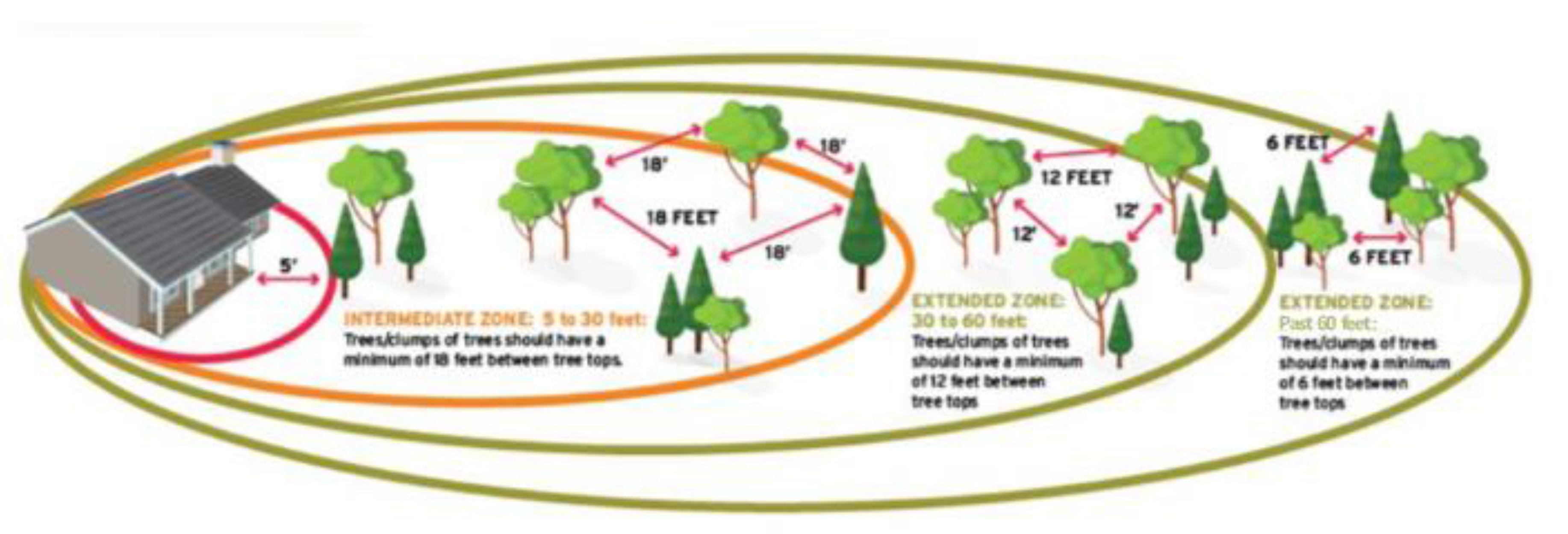
1.
The Immediate Zone. 0 to 5 feet from the furthest attached exterior point of the home. All vegetation and combustible and flammable materials shall be moved away from exterior walls, under the eaves, and/or decks. This includes: mulch, shredded rubber, ground fuels, flammable plants, leaves, needles, and firewood piles.
2.
The Intermediate Zone. 5 to 30 feet from the furthest attached exterior point of the home. This is the landscaping/hardscaping zone of the defensible space through the use of careful landscaping or creating breaks that can help influence and decrease fire behavior. All dead and diseased trees, shrubs, and other landscaping materials shall be removed. Removal of ladder fuels (vegetation under trees) shall occur so a surface fire cannot reach the crowns of the trees. Limb up trees to a height of 10 feet. For shorter trees, trim to a height of 1/3 the overall tree height. Trees shall be spaced to have a minimum of eighteen feet between the crowns with the distance increasing with the percentage of slope. trees and shrubs in this zone should be limited to small clusters of a few each to break up the continuity of the vegetation across the landscape. Irrigated trees, shrubs, and other landscaping material shall be preserved if they are limbed to remove dead branches and well-spaced to reduce the risk of a fire spreading to other vegetation or structures.
3.
The Extended Zone up to 60 Feet. 30 to 60 feet and 60 feet to the property line from the furthest attached exterior point of the home. This zone focuses on interrupting a fire's path and keeping the flames smaller and on the ground. All dead and diseased trees, shrubs, and other landscaping materials shall be removed. The accumulation of ground litter and debris shall be disposed of or dispersed. Small conifers growing between mature trees shall be removed. Vegetation adjacent to storage or other outbuildings shall be removed. Trees shall be spaced to have a minimum of twelve feet between the crowns with the distance increasing with the percentage of slope.
4.
The Extended Zone Over 60 Feet. This zone focuses on interrupting a fire's path and keeping the flames smaller and on the ground. All dead and diseased trees, shrubs, and other landscaping materials shall be removed. The accumulation of ground litter and debris shall be disposed of or dispersed. Small conifers growing between mature trees shall be removed. Vegetation adjacent to storage or other outbuildings shall be removed. Trees shall be spaced to have a minimum of six feet between the crowns with the distance increasing with the percentage of slope.
3605: - Plan Requirements for Landscaping
Landscape plans shall provide for the installation of plant materials, grading and other site work that complies with the requirements of this section. Landscape plans shall be prepared by a landscape architect, landscape contractor, horticulturist, or other qualified professional or individual. The landscaping plan shall include the following:
A.
North arrow and scale. Scale shall be one to ten (1" = 10') to one to 30 (1" = 30') or larger for sites of two (2) acres or less, two to 50 (2" = 50') or larger for sites larger than two (2) acres.
B.
Topographic contours at two (2) foot intervals or other appropriate intervals as approved by the Planning Department.
C.
Location of the following items:
1.
Existing vegetation, including Significant Trees;
2.
Significant physical site features such as watercourses;
3.
Property lines and easements;
4.
Utilities, existing and proposed;
5.
Structures, existing and proposed;
6.
Driveways, roads, parking areas, walkways, dumpster enclosures, gas or electric boxes or meters and areas to be paved, graveled or covered by decks;
7.
Snow storage areas;
8.
Retaining walls, with top of wall and bottom of wall heights in mean sea elevation;
9.
Detention ponds and drainageways;
10.
Areas to be revegetated;
11.
Proposed grading and drainage plan;
12.
Proposed plant materials drawn to scale illustrating growth at approximately ten (10) years;
13.
Rough irrigation plan if an irrigation system is proposed, including but not limited to the provisions required by these regulations and a calculation of irrigated area (coniferous tree irrigates approximately six (6) square feet, deciduous tree irrigates approximately four (4) square feet, a shrub irrigates approximately two (2) square feet);
14.
General notes that reflect the site preparation and plant installation requirements of this Code (see Section 3604 et seq.);
15.
Reseeding plan;
16.
Topsoil or mulching plan per the applicable landscaping requirements; and
17.
Significant trees and other vegetation to be retained and a fencing plan showing how such areas will be protected;
18.
Defensible space zones as described in the Summit County Building Code.
D.
Plant list, including botanical and common plant names, plant sizes and quantities; seed mixes, application rates and quantities.
E.
Plan for how water is to be supplied to landscaping and proof of adequate water rights or water availability.
F.
Documentation of adequate water rights to implement plan if located outside of a special district that provides central water service.
Additional plans and details may be required by the Planning Department depending on the development proposal.
3606: - Plant Installation
A.
Quality Standards for Plant Materials: Plant materials not originating from the project site shall comply with State and Federal laws relating to inspection for plant diseases and insect infestations. Plant materials shall be of standard quality, true to name and type and in accordance with the specifications of the American Association of Nurserymen. All plants shall have a normal habit of growth and shall be sound, healthy, vigorous and free of sunscalds, excessive abrasions or other adverse disfigurements. Tree trunks shall be sturdy and free of excessive scares or abrasions. All trees and shrubs shall have vigorous, fibrous root systems and shall be hardened off (i.e., acclimatized to high altitude) prior to planting.
B.
Minimum Plant Sizes: The minimum sizes of acceptable plant materials shall be:
1.
Deciduous Trees: One and one-half (1½) inch caliper. If at least 80% are two (2) inch caliper or larger, 20% may be one (1) inch caliper.
2.
Coniferous Trees: 40% shall be a minimum height of eight (8) feet. The remaining 60% shall be a minimum height of six (6) feet.
3.
Shrubs: At least 50% shall be five (5) gallon container or larger. The remaining 50% shall be one (1) gallon container or larger.
Trunk caliper shall be measured at four (4) feet (48 inches) above ground level.
3607: - Inspection of Landscaping
Upon completion of landscape improvements, the developer shall request final inspection by the Planning Department. The number, size and species of plant materials, their approximate location in accordance with the approved landscape plan and defensible space requirements, and all site work shall be completed in accordance with the approved or modified landscape plan for the project. Where the plans indicate a range in the number of plants in a particular location, at least the minimum number shall be provided. No occupancy permits shall be issued for a project until the Planning Department has inspected and approved the landscape installation, except as provided in Section 3608.01.
3608: - Landscape Guarantee
A Site Plan Improvements Agreement ("SPIA") and associated financial guarantee per the requirements contained in Section 12607 shall be submitted to ensure compliance with the Landscaping Regulations. In addition to the provisions contained in Section 12607, the following provisions shall apply:
3608.01: Guarantee Prior to Issuance of Occupancy Permit
A.
Completion of Required Landscaping Prior to the Issuance of Certificate of Occupancy: All of the required landscape improvements for a development project shall be completed, inspected and determined to be acceptable by the Planning Department before the County shall issue either a CO or a Temporary Certificate of Occupancy ("TCO") for a development project except as provided in this section.
B.
When Occupancy Permits May be Issued: Occupancy permits may be issued for all or part of a development project prior to completion of landscaping if all of the following conditions are met:
1.
The developer is requesting a CO between October 1 st and June 1 st .
2.
The developer has provided a new, or revised, SPIA committing to complete the required improvements no later than July 15 th of the following growing season.
3.
The developer has provided a financial guarantee in the form of a Letter of Credit ("LOC"), cash bond or cash deposit equal to 115% of the estimated cost of the incomplete improvements, including labor and materials, to assure completion of the improvements. The term of the financial guarantee shall cover to time necessary to complete the improvements and any required warranty period.
C.
When Occupancy Permits May Not be Issued: During the growing season, from June 1 to October 1, no CO shall be issued for a building unless the landscaping associated with that building is completed in accordance with the approved plans. However, a TCO can be issued during this time period if the other provisions of this subsection are met and the developer has qualified for a TCO through the Building Department.
3608.02: Landscape Guarantee After Installation
A.
Length of Guarantee Period: In order to insure that successful, stable plant establishment is achieved, all landscape planting shall be subject to a guarantee period of two (2) years from the date installation is inspected and declared complete except, where planting, seeding or revegetation is done on three and one-third to one (3.33:1) or greater slopes, the initial guarantee period shall be three (3) years (these guarantee periods are also required by the Water Quality Control Regulations in Chapter 7.) If a site inspection shows plantings on three and one-third to one (3.33:1) or greater slopes are established earlier than three (3) years, the Planning Department may grant partial or full release of the guarantee or reduce the length of the guarantee period.
B.
Requirement for Financial Guarantee: No CO shall be issued for a development project unless the developer first posts a financial guarantee for the landscaping improvements and associated site work for the required guarantee period. The purpose of this guarantee is to assure that the site work associated with the landscaping is completed and plant materials that do not survive are replaced and the site is revegetated in a weed-free state as required by these regulations. If the landscaping work is not completed, the financial guarantee shall be in an amount sufficient to cover the cost of materials and labor needed to replace the required plant materials, landscaping site work and other costs associated with the landscaping as outlined in the required improvements agreement per Section 12607. If the landscaping work is completed, the financial guarantee shall be 50% of the costs of landscaping-related line items outlined in the site improvements agreement, including any contingency as mandated by Section 12607. The financial guarantee shall be based on the costs shown in the required improvements agreement and in accordance with subsection C below. The term of the financial guarantee shall cover the guarantee period as outlined in these regulations. Where a developer is requesting a CO prior to completion of landscaping in accordance with Section 3608.01, the financial guarantee for completion of the landscaping must be posted prior to issuance of a CO. The term of the financial guarantee for the period following installation shall be long enough to cover the time that will elapse before the landscaping is installed and end of the required guarantee period.
C.
Criteria for Successful Plant Establishment: For plant establishment to be considered successful, plants shall have a healthy appearance and be free of diseases and insects. All disturbed areas shall be completed in accordance with the approved landscaping plan and have topsoil applied or be mulched in accordance with the design standards set forth in Section 3604. Such areas shall also be reseeded in accordance with Section 3604 or covered with ground cover vegetation.
D.
Site Inspection During Guarantee Period; Use of Guarantee: The Planning Department may at its sole discretion inspect a development site on a periodic basis during the guarantee period. Following each inspection, the Planning Department shall provide a written report to the developer of the results of the inspection and if plant materials need to be replaced. At such time that the Planning Department determines that 100% of the required landscape improvements have been installed in accordance with Section 3600, the County may authorize the release of up to 50% of that portion of the financial guarantee designated to secure landscaping improvements. The developer shall be responsible for replacement plantings. Prior to the end of the growing season (June 1 through October 1) in which replacement plantings are installed, the developer may request a reduction in the financial guarantee by an amount corresponding to the replacement work done. The Planning Department shall decide, based on the health of the replacement plantings, whether a full financial guarantee is still required or if it may be reduced. If the developer fails to install replacement plantings, the Planning Department may use the developer's financial guarantee to do such corrective work as is needed, or assign the financial guarantee to a property owner or a homeowners association affiliated with the landscaping provided such entity is willing to complete the work and signs an agreement with the County concerning the completion of the work.
E.
Weed-free Revegetation: Prior to the release of any financial guarantee for landscape improvements, the County must determine that revegetation of the site is essentially free from weeds as identified by the County as invasive, noxious or otherwise nuisance weed species.
3609: - Landscape Maintenance After Completion of Construction
All landscaped areas shall be maintained in a healthy and growing condition. Maintenance shall include but not be limited to watering, fertilizing, weeding, repairing (fences and other structures), cleaning, pruning, trimming, thinning, spraying and cultivating. In multi-family residential, commercial and other nonresidential developments, property owners are responsible for replacing landscape materials that have died, where these materials were required by the approved landscape plan on file for the development. Where irrigation systems have been installed, these systems shall be kept operable, including adjustments, replacements, repairs and cleaning needed as part of regular maintenance. All landscaping installed after the final certificate of occupancy/certificate of completion is issued, or after the warranty period is over, shall meet the defensible space requirements set forth in the Summit County Building Code unless waived by the Review Authority when the specific conditions and individual circumstances (i.e. slope, aspect, vegetation types, availability of firefighting infrastructure, and other relevant factors as identified in the CWPP) of a given project do not warrant imposition of this standard. Landscaping installed after completion of construction in conflict with defensible space requirements shall be considered a zoning violation.
3701: - Pupose and Intent
The purpose and intent of the Parking Regulations is to:
A.
Ensure adequate off-street parking is provided to meet the parking demand of land uses;
B.
Ensure their usefulness;
C.
Mitigate adverse impacts on adjacent land uses;
D.
Allow for convenient access by the handicapped; and,
E.
Protect the public health, safety and welfare.
3702: - Applicability of Parking Requirements
3702.01: New Structures, Land Uses, Remodeling and Occupancies
Off-street parking spaces or lots shall be provided by the developer for the following:
A.
New single-family, duplex, multi-family or other residential development;
B.
New commercial, industrial, mixed-use or non-residential development;
C.
New land uses established for a development that requires parking lots or parking spaces;
D.
Change in land use that requires additional parking lots or parking spaces;
E.
Remodeling, additions to or enlargement of existing structures that require additional parking spaces or lots; and
F.
Changes in the occupancy of an existing building or the manner in which a use is conducted that would result in additional parking spaces being required.
3702.02: Enlargements and Additions
Additional parking spaces or lots required by the provisions of Section 3702.01 or any enlargements of, or additions to existing structures or existing uses shall meet the applicable provisions of this Code for any such enlargement, addition or change in uses.
3702.03: Planned Unit Developments
Where a PUD Zoning District is proposed, the provisions of this section shall be used as guidelines in formulating the PUD designation. Parking requirements that differ from those stated in this section may be adopted as part of a PUD designation because of special circumstances or as the result of a parking study. It is the County's intent in providing for PUD Zoning Districts to allow for such flexibility in parking standards. After a PUD designation is adopted, the parking standards stated in the PUD designation shall supersede the provisions of this section. Where an adopted PUD designation does not address parking requirements, the provisions in this section shall apply.
3702.04: Temporary, Conditional and Other Land Uses
The requirements of this section shall apply to temporary, conditional and other land uses.
3703: - Parking Requirements for Previously Approved Development
A.
Lawfully Established Land Uses: Development projects for which a development review was approved by the County Code must only meet the requirements of the Parking Regulations in effect on the date the development review was approved. Projects previously approved by the County that have expired and are requested to be renewed, shall meet the requirements of this section.
B.
Development or Uses Established Prior to County Adoption of Zoning Regulations: No building or use of land lawfully approved by the County through prior development reviews shall be considered nonconforming solely because of the lack of off-street parking facilities required by this Code.
3704: - Parking Requirements
3704.01: Table of Parking Requirements
A.
Figure 3-7 contains the minimum parking requirements for land uses in Summit County. Special requirements for certain land uses are stated in notes. Where the application of these requirements results in a fractional space, the fraction shall be rounded to the next whole number.
B.
For multi-family developments, a minimum of an additional one-half (½) space per dwelling unit of common parking area shall be provided if either 1) the required parking is provided in private individual garages, or 2) some portion of the required parking is provided in private individual garages and the other portion is approved as tandem parking.
3704.02: Uses Not Listed
Parking requirements for uses not specifically listed in Figure 3-7 shall be determined by the Review Authority based on either 1) the similarity between the uses listed in Figure 3-7 and the proposed use, or on a parking study; 2) parking requirements for such uses used in other applicable jurisdictions; or 3) parking requirements created by professional organizations, such as the Institute of Transportation Engineers and the American Planning Association.
3704.03: Combination of Uses
For developments with a combination of uses, parking requirements shall be determined by adding the requirements for each of the different land uses. The parking necessary for each use shall be provided unless approval is obtained for joint use of required parking as provided in Section 3704.04.
3704.04: Joint Use of Required Parking
Parking lots may contain required spaces for several different uses. Parking spaces assigned to one use may not be credited to another use except as provided in this section.
A.
Proposals for Joint Use Parking: Project proponents may request a reduction in parking requirements where the uses anticipated in a development project are expected to operate at different times. For example, a project that includes a use that operates only on weekends and a use that operates only on weekdays may utilize the same parking area as long as the parking area is sized for the larger of the two (2) uses. A project proponent seeking approval of joint use parking shall provide information on the operation of uses proposed for their development as part of their project submittal. A parking study may be required if deemed necessary by the Review Authority.
B.
Action on requests for Joint Use Parking: The Review Authority shall take action on requests for joint use parking included in a development review application. A request for joint use parking shall not be approved by the Review Authority if it would result in substantial detriment to public health, safety and welfare or substantial impairment of the intent of the County Parking Regulations (Section 3700 et seq.).
3704.05: Off-Premise Parking
For all development other than single-family, required parking shall be provided within the boundaries of the site except as provided in this section. Off premise parking may be permitted by the Review Authority if:
A.
Sufficient area is available for the required parking to be provided on the project site and this area will remain in open space rather than used to increase the density of the project.
B.
The applicant has provided a plan illustrating how the parking could be accommodated on the project site.
C.
Placement of the parking off-site will achieve important design objectives such as consolidating or better coordinating parking areas, increasing landscaped areas and buffering of buildings or creating a garden-like atmosphere on the project site.
D.
The off premise parking is no more than 150 feet from the building or use to be served by the parking, or valet or transit service will be provided between the building or use and the off premise parking.
3704.06: Flexibility Statement
The County recognizes that the strict application of parking requirements may not meet the intent of the County Parking Regulations. Flexibility in the requirements of County's Parking Regulations may be granted if the following conditions are met:
A.
The purpose and intent of the Parking Regulations are preserved.
B.
The parking provided will be sufficient to serve the use for which it is intended.
C.
The modification will not be detrimental to the public health, safety and welfare.
A project proponent wishing to obtain flexibility from the requirements of the County's Parking Regulations shall submit evidence which shows that the proposed standards are more appropriate and will better meet the needs of the development. A parking study may be required if deemed necessary by the Planning Department. The Review Authority shall make the final determination of parking requirements, except when the decision of the Review Authority is appealed to the BOCC, the BOCC shall make the final determination of parking requirements.
3704.07: Handicapped Parking Requirements
Parking spaces for the handicapped shall be no less than the Americans with Disabilities Act requirements currently in effect or hereinafter amended. Fractions of required spaces shall be rounded up to the next highest whole number. Spaces designated for handicapped use shall count toward fulfilling the parking requirements for a development and shall not be considered additional requirements. All existing and proposed handicapped parking spaces located in a project site shall be identified on site plans for the project. This parking requirement shall not relieve an applicant from the need to comply with any State and/or other Federal laws, regulations or standards.
3705: - Design Requirements and Guidelines
3705.01: Location of Spaces
A.
General: Off-street parking spaces for residential dwelling units shall be located as conveniently as possible to the dwelling units. Parking spaces for nonresidential uses shall be located as conveniently as possible to the uses they serve. All parking spaces proposed to be located further than 150 feet from the building or use they serve, measured in a straight line from the building entrance, shall first be approved by the Planning Commission as part of the site plan approval.
B.
Parking in Open Space is Not Allowed: No off-street parking space shall be located on a portion of the site that is required to be open space.
C.
Spaces for Handicapped: Any required parking spaces for the handicapped shall be located as close as is practical to the entrance to the uses they are intended to serve and oriented so that a user of the handicapped space does not have to go past the rear of automobile parking spaces or cross driveways in order to reach a building entrance.
3705.02: Layout of Parking
A.
Dimensions of Parking Spaces:
1.
Angled Parking: Parking spaces which are angled between 30 degrees and 90 degrees to a driving lane shall be a minimum of nine (9) feet in width and 19 feet in length, measured rectangularly.
2.
Parallel Parking: Parking spaces parallel to the driving lane shall be a minimum of nine (9) feet by 22 feet.
3.
Compact Car Spaces: Up to a maximum of 20% of the parking spaces in a covered parking garage may be designed as compact car spaces, except that compact car spaces shall not be permitted in a garage for 20 or fewer cars, or in a garage where the spaces will be assigned or sold. Compact car spaces shall be a minimum of eight (8) feet in width and 16 feet in length, measured rectangularly and they shall be clearly marked.
4.
Spaces for Handicapped: Parking spaces for handicapped shall be a minimum of 14 feet in width and 19 feet in length measured rectangularly. The requirement for 14 foot wide spaces allows for a five foot wide loading area. Two adjacent handicapped spaces may be a total of 23' in width, sharing a five foot loading area between them.
B.
Aisle Widths: For perpendicular parking, aisles in outdoor parking lots shall be a minimum of 22 feet in width unless an aisle is functioning as a fire apparatus access road, in which case the required width shall be 24 feet. Aisles in parking garages shall be a minimum of 22 feet in width.
C.
Driveway Widths: The width of all driveways shall comply with the County Road Standards (Chapter 5) and with the requirements of the Fire Code.
D.
Design and Arrangement of Parking Areas:
1.
General: Parking areas shall be designed such that vehicles cannot extend beyond the perimeter of such areas onto adjacent properties or public rights-of-way. Parking spaces, aisles and turning areas shall be entirely within lot lines and shall not encroach on any road or other public right-of-way. No parked vehicle shall overhang any road or public right-of-way. Such areas shall also be designed so that vehicles do not extend over sidewalks or come in contact with or damage any building wall, fence, vegetation or other obstruction.
2.
Access to Parking Spaces: Each required parking space shall have unobstructed access from a road or alley or from an aisle or drive connecting with a road or alley, without moving another vehicle. Notwithstanding the foregoing, tandem parking is permitted in a driveway for single-family, duplex and accessory dwelling unit development subject to meeting the other applicable provisions of this Code (setbacks, grade, width of driveways, etc.).
3.
Driving Lanes: Driving lanes shall be designed such that vehicles can proceed safely without posing a danger to pedestrians or other vehicles and without interfering with parking areas.
4.
Backing Movements: Unless no other practicable alternative is available, parking areas shall be designed so that, without resorting to extraordinary movements, vehicles may exit such areas without backing onto a public street. This requirement shall not apply to parking areas consisting of driveways serving two (2) or fewer dwellings where such driveways connect to collector or lesser streets. Backing onto collector streets is discouraged. Backing onto arterials is prohibited regardless of use.
5.
Allowance for Emergency Vehicles: Parking areas shall be designed so that sanitation, emergency and other public service vehicles can serve such developments without the necessity of backing unreasonable distances or making other dangerous or hazardous turning movements. Parking areas shall be designed in accordance with the Fire Code.
6.
Striping: All paved parking areas serving commercial or industrial land uses, community facilities or institutional uses or serving twelve (12) or more residential units shall be striped. Handicapped parking spaces shall be designated by a sign centered on each parking space and with a sign mounted on a post at the head of each space in accordance with the Manual of Uniform Traffic Control Devices ("MUTCD"). Striping and markings in parking areas shall be repainted as frequently as is necessary so striping and markings are clearly visible.
E.
Loading and Unloading: Loading and unloading areas shall be provided in a safe and convenient manner for all developments whose normal operation requires routine shipments or deliveries. Loading and unloading areas shall be of sufficient size to accommodate the number and type of vehicles likely to use them, given the nature of the development in question.
1.
Number of Spaces Required: The Review Authority shall determine the number of required spaces for loading and unloading at the time of site plan review. Consideration shall be given to floor area, the number of tenant spaces and types of businesses proposed for the development. The following numbers shall be used as guidelines in determining the requirement for loading and unloading spaces:
Spaces shall be a minimum of twelve (12) feet in width by 55 feet in length, with 14 feet of overhead clearance from street level, unless otherwise indicated.
2.
Location and Design: Loading and unloading areas shall be located and designed such that the vehicles intended to use them can:
a.
Maneuver safely and conveniently to and from public right-of-way.
b.
Complete the loading and unloading operations without obstructing or interfering with any public right-of-way or any parking space or parking lot aisle.
3.
No Overlap of Requirements: No area allocated to loading and unloading facilities may be used to satisfy the area requirements for off-street parking, nor shall any portion of any off-street parking area be used to satisfy the area requirements for loading and unloading facilities.
3705.03: Engineering Requirements
Engineering requirements for parking areas are listed in the Road Standards (Chapter 5) of the Code.
3705.04: Lighting
Lighting in parking areas shall meet the requirements for lighting under basic development regulations and standards (see Section 3505.07).
3705.05: Landscaping Requirements
Parking areas present a major visual impact on the land, especially in the mountains. Parking areas shall be landscaped to help screen them and reduce negative visual impacts. Such landscaping shall be in accordance with the Landscaping Regulations of this Code.
3706: - Use of Parking Areas
Required parking spaces shall be used only for the parking of operable passenger vehicles of residents, guests, customers, patrons and employees and shall not be used for the storage of unlicensed or inoperable vehicles, nor for the storage of materials except as otherwise provided by this Code.
3707: - Provision and Maintenance of Parking Areas
It shall be the responsibility of the developer to provide a mechanism for the maintenance of the required parking areas.
3801: - Community Gardens
A Community Garden is a shared land area which is planned, designed, built and maintained by community members, governmental entities, or other non-profit entities for individual or community use and enjoyment. Community Gardens may be solely used to raise food for gardeners and/or the surrounding community, or may be a decorative formal garden, an educational facility, or a rehabilitative facility. Community Gardens may consist of one community plot, multiple plots, individual plots, and greenhouses. The intent of a Community Garden is to provide fresh food to those caring for and participating in the garden and to the immediately surrounding community.
3801.01: Zoning Districts Where Permitted
Community Gardens are permitted in zoning districts with a Class 2 site plan review as designated in Figure 3-2. Community Gardens may be allowed in designated open space areas which are bordered by more developed areas if covenants, easements, or any other encumbrances do not prohibit such use and if the addition of any structures does not exceed the maximum impervious area allowed on that property or within the subdivision as a whole, whichever is applicable.
3801.02: Types of Community Gardens
Community gardens shall be categorized as follows:
A.
Local Neighborhood Community Gardens on Private Property: These community gardens are located on private property and are intended to serve the surrounding neighborhood(s). Retail sales from these gardens are prohibited.
B.
Community Gardens on Public Property: These community gardens are located on publicly owned property and are intended to serve the surrounding neighborhoods as well as the broader community.
C.
Community Gardens with Retail Sales: These community gardens are located either on public or private property, are intended to serve the surrounding neighborhoods and broader community, and offer the produce grown on site for retail sale from the property. Fifty percent (50%) of the products sold, based upon either gross annual sales or annual volume, must be grown on site. The remaining 50% of the products sold may be produce grown off site. One hundred percent (100%) of all products sold shall be food and contribute to increasing the supply of and access to fresh food in the community.
3801.03: Setbacks and Easements
All community gardens are subject to the following setback requirements:
A.
All structures shall comply with setbacks in accordance with Section 3505.14 of the Code, including but not limited to greenhouses and sheds.
B.
Compost piles or bins shall meet all setback requirements and shall be located a minimum of 15 feet from any property line.
C.
Community gardens and related structures shall not be located in any easement unless expressly approved by the grantee of the easement.
3801.04: Sale of Produce from Community Gardens with Retail Sales
Produce may be sold from a community garden subject to the following provisions:
A.
A Class 2 Site Plan with public notice as required by Section 12000.10.B is required for Community Gardens on Public Property and Community Gardens with Retail Sales as defined above in Section 3801.02 in all zoning districts.
B.
Operators of Community Gardens with Retail Sales shall not be for-profit or commercial entities. All proceeds from the sale of produce shall be directed first to facilitate improvements to or the operation of the community garden and any excess may be directed to facilitate other community benefits.
C.
Adequate parking shall be provided on site and shall meet the standards for "Low Intensity Retail" as set forth in Figure 3-7. However, in determining the number of spaces, it shall be based upon the required number per 1,000 square feet of garden rather than floor area. Parking in the Right-of-Way is prohibited.
D.
Sales from the property may only occur during growing season and shall not exceed 180 days per year.
E.
Produce Stands may not exceed 120 square feet of floor area and must meet all setback requirements for the property.
F.
For Community Gardens with Retail Sales, the area used to sell produce may not exceed 500 square feet.
3801.05: Property Maintenance
All community gardens shall be maintained in an orderly and neat condition and shall not cause visual clutter. No trash or debris shall be stored or allowed to remain on the property. Tools and supplies shall be stored indoors or removed from the property daily. Vegetative material, compost, additional soil, and other bulk supplies shall be stored in an orderly manner in the rear of the property and shall not create a negative visual impact or offensive odors. The community garden shall be designed and maintained to prevent any chemical pesticide, fertilizer or other garden waste from draining off the property. Pesticides and fertilizers may only be stored on the property in a locked building and must comply with any other applicable requirements for hazardous materials. Only equipment used in a typical residential garden may be utilized except during the initial construction of the community garden and related structures. During winter months, when community gardens are not in use, all materials, equipment, and supplies shall be stored in an enclosed building or off of the property or shall be screened from public view in accordance with the non-residential outdoor storage regulations set forth in Section 3815 et seq.
3801.06: Management Plan
Each community garden shall have a management plan that addresses any probable impacts of the use and includes any proposed mitigation measures. The plan shall include, without limitation:
A.
A designated community garden coordinator.
B.
Documentation of liability insurance or other insurance as determined by the County to be appropriate.
C.
A site plan drawn to scale, including but not limited to the location of the garden area, any structures associated with the garden, produce stands and produce sales areas, animal keeping facilities, a parking area, and the location of fences.
D.
Description of the type of equipment necessary or intended for use in each season and the frequency and duration of the anticipated use.
E.
Disclosure of any intent to spray or otherwise apply agricultural chemicals or pesticides, frequency and duration of the application, and the plants, diseases, pests, or other purposes they are intended for.
F.
Proposed sediment and erosion control plan to ensure that water and fertilizer will not drain onto adjacent property.
G.
Water supply plan including the source of adequate water rights or proof of secured taps.
H.
Impacts of irrigation run-off on adjacent properties, water bodies, and environmentally sensitive areas, and proposed sediment and erosion control measures.
I.
A traffic and parking plan showing a designated parking area and the anticipated number of cars per day.
J.
If beekeeping is a part of the community garden, the management plan shall include the parties responsible and their roles in the beekeeping activities.
3801.07: Hours of Operation and Noise Limitations
Activities at a community garden shall not take place before sunrise or after sunset. All community gardens are subject to the noise limitations as set forth in C.R.S. § 25-12-101 et seq. and in accordance with the most similar zone for the location of the community garden.
3801.08: Signs
Upon approval of a sign permit, in accordance with Chapter 9, each community garden is permitted one sixteen square foot sign displaying the name of the community garden. Art work depicting food, flowers, or other agriculturally related products is not considered signage but shall not cause visual clutter.
3801.09: Abandonment of Community Garden Use
If a community garden use is discontinued for three consecutive seasons, then all structures shall be removed from the site and the site shall be revegetated with native grasses and returned to a natural state.
3802: - Animal Keeping
Intent and Application: It is the intent of this section to limit the type and number of animals kept by individuals on property in County zoning districts. In determining compliance with these regulations, only animals, which have passed the age of six (6) months shall be counted except for chickens which are counted regardless of age. Parcels of 35 acres or larger in the A-1 Zoning District are exempt from regulations on the numbers of animals allowed, except as otherwise provided in this section. Except in the A-1 Zoning District, animal keeping is allowed only as an accessory use in accordance with the specific regulations set forth herein.
3802.01: Types of Animals Permitted
A.
Domesticated Species (Regulated): The following types of domesticated animals may be kept in the unincorporated area of Summit County subject to the limitations on numbers of animals stated in Section 3802.02 and in Figure 3-8:
1.
Cats
2.
Cattle
3.
Dogs
4.
Equines
5.
Goats
6.
Llamas
7.
Poultry
8.
Sheep
9.
Swine
10.
Chickens
11.
Goats
12.
Bees
B.
Domesticated Species (Unregulated): The keeping of small-sized animals under 15 pounds, other than the types of animals listed in 3802.01.A. where it is customary to keep such animals as pets and they are not being raised for commercial purposes, is not regulated by this section. Examples include guinea pigs, hamsters, rabbits, parakeets and tropical fish.
C.
Wildlife Species: Keeping of wildlife species in the unincorporated area of the county shall comply with the provisions of this Code. (Under State statutes, the keeping in captivity of wild vertebrates, mollusks and crustaceans native to Colorado, or any wild species introduced or released in Colorado by CPW is prohibited except with permission of CPW. Failure to comply with State statutes shall not constitute a violation of this Code.
1.
Nursing Sick or Injured Wildlife: People proposing to provide nursing care to sick or injured wildlife prior to returning them to the wild shall first obtain a license from CPW. Rehabilitation of wildlife is permitted on parcels of thirty-five (35) or more acres in the A-1 Zoning District and is allowed with the approval of a conditional use permit per Section 12300 et seq. following the Class 4 development review process outlined in Section 12000 et seq. on parcels of less than 35 acres in the A-1 Zoning District.
2.
Wild Game Ranches: Persons proposing to raise wildlife species for commercial purposes shall first obtain a license from CPW. Wild game ranches are permitted on parcels of thirty (35) or more acres in the A-1 Zoning District. Only herbivorous species are permitted to be raised on wild game ranches.
D.
Exotic Species: The keeping of wild animal species not native to Colorado (i.e. exotic animals) is prohibited in Summit County, except for circus animals where the owner or operator of the circus has obtained an exhibitor's license from the United States Department of Agriculture ("USDA") and has obtained approval of a temporary use permit from the Planning Commission. (Under State statutes, the release of an exotic animal into the wild without a letter of authority from CPW is prohibited. If an exotic animal escapes into the wild, the owner of the animal is required by State regulations to report the escape within four (4) hours to CPW and to local law enforcement authorities. CPW is responsible for recapturing, or if necessary destroying, or requiring the animal's owner to either recapture or destroy, any exotic animal which is a threat to native wildlife species. Failure to comply with State statutes shall not constitute a violation of this Code).
3802.02: Zoning Districts Where Animals Allowed; Numbers Allowed
A.
Dogs and Cats:
1.
A-1 Zoning District: The number of dogs and cats kept as pets on parcels of 35 or more acres in the A-1 and BC zoning districts is not regulated. Figure 3-8 indicates the number of dogs and cats permitted on parcels of less than 35 acres but not less than 20 acres in these districts. On parcels of less than 20 acres in the A-1 and BC zoning districts, the numbers of dogs or cats allowed to be kept as pets shall comply with the number permitted in the residential zoning district which allows parcel sizes comparable to the size of the parcel in the A-1 or BC zoning districts. The operation of breeding or boarding kennels in the A-1 Zoning District requires approval of a conditional use permit by the Planning Commission per Section 12300 et seq. following the Class 4 development review process outlined in Section 12000 et seq. (see definition of kennel in Chapter 15).
2.
PUD Zoning Districts: The keeping of dogs and cats in PUDs shall be regulated by the County adopted PUD designation for the particular PUD. If an adopted PUD designation includes residential development and contains no regulations of the keeping of dogs and cats, the regulations contained in Figure 3-8 for the residential densities which approximate the densities allowed in the PUD shall apply. The determination as to what limits apply in PUDs without specified limits shall be made by the Planning Director. The keeping of animals in nonresidential areas of a PUD is prohibited unless the adopted PUD designation specifies that they are permitted.
3.
Zoning Districts Other Than A-1, BC, and PUD: Figure 3-8 indicates, for each County zoning district other than the PUD zoning district, the maximum number of cats and dogs which may be kept as a permitted use and with approval of a conditional use permit per Section 12300 et seq. by the Planning Department per the Class 2 development review process outlined in Section 12000 et seq. Criteria for the review of conditional use permits for animal keeping are also contained in Section 3802.05. When a zoning district is not listed in Figure 3-8, the Planning Director shall determine the number of dogs and cats permitted in such a zoning district based on the similarities to other zoning districts listed in Figure 3-8, such as, but not limited to, lot size.
B.
Livestock:
Livestock shall include cattle, equines, goats (except for miniature, dwarf, and pygmy), llamas, poultry, sheep and swine. Chickens are not regulated as poultry, except in the A-1 Zoning District, and instead regulations for such use are listed in Section C. below and Figure 3-8. Regulations pertaining to miniature, dwarf, and pygmy goats are listed in Section D below and Figure 3-8. Livestock may be kept in the A-1, BC, RU, RE, RME, R-1, PUD, and R-P zoning districts subject to the following limitations:
1.
A-1, BC, RU, RE, RME and R-1: For the A-1, BC, RU, RME, RE and R-1 zoning districts, Figure 3-8 states the maximum number of livestock animals which may be kept as a permitted use, and with the approval of a conditional use permit per the Class 2 development review process outlined in Section 12000 et seq. by the Planning Department. Criteria for the review of conditional use permits for animal keeping are also contained in Section 3802.05. The limit on numbers of livestock animals applies to the operation of boarding, community, and stables or barns where such stables are a permitted use. Parcels of 35 or more acres in the A-1 Zoning District are exempt from regulation on numbers of livestock animals allowed, except for uses involving the keeping of animals such as animal clinics, animal feedlots or sales yards or fur farms which are listed as conditional uses in Figure 3-2. On parcels of less than 20 acres in the A-1 Zoning District, the number of livestock animals permitted shall comply with the number allowed for the residential zoning district having parcel sizes comparable to the size of the parcel in the A-1 Zoning District, and provided a Nonconforming Parcel Plan Review has been approved for the property which authorizes the number of animals determined by this section.
2.
PUD: The keeping of livestock may be permitted in a particular PUD if allowed by the County adopted PUD designation. The keeping of livestock is prohibited where the PUD designation contains no allowance for this use.
3.
R-P: In R-P Zoning Districts where the individual lot size is 80,000 square feet or greater, the keeping of livestock animals shall be permitted in individual lots in accordance with the ratios established for the residential zoning district having a comparable lot size in Sections B.1, B.2, of Figure 3-8. In R-P Zoning Districts where the individual lot size is 40,000 to 80,000 square feet, the keeping of livestock animals is subject to approval of a conditional use permit by the Planning Department per the Class 2 development review process outlined in Section 12000 et seq. The number of livestock animals to be allowed in individual lots shall be in accordance with the ratios established for the R-1 Zoning District in Section B.2 and of Figure 3-8.
a.
In R-P Zoning Districts having individual lots of 40,000 or more square feet, where the property subject to the R-P Plan includes common open space, in addition to the allowance for the keeping of livestock animals on individual lots, the keeping of livestock animals in a common animal keeping facility may be allowed as provided in Section 3802.03.
b.
In R-P Zoning Districts where the individual lot size is less than 40,000 square feet, the keeping of livestock animals on individual lots is not permitted, however, the keeping of livestock animals may be allowed in a common animal keeping facility in accordance with Section 3802.03.
C.
Chickens: The definition of "Chickens" includes chicken hens and roosters of any age and is further defined in Chapter 15. See Section C.2 below for additional limitations on roosters. Chickens are permitted in the A-1, BC, B-3, PUD, RU, RE, RME, R1, R2, R3, R4, R6, R25, RC-40,000, and RC-5,000 Zoning Districts subject to the following limitations:
1.
Number of Animals Permitted:
a.
Figure 3-8 sets forth the maximum number of chickens which may be kept as a permitted use for each zoning district, so long as they are kept in accordance with the applicable regulations below. Criteria for review of conditional use permits for animal keeping are also contained in Section 3802.05.
b.
In a PUD, the keeping of chicken hens is a permitted use unless the PUD specifically prohibits the use. The number of chickens permitted shall be based on the terms of the PUD, or, if not addressed in the PUD, the number allowed in the most closely related zoning district.
c.
For multi-family developments, chickens may be kept on private property and in the common area of the development subject to review and approval of a Class 2 site plan. A maximum of two chicken hens per family is permitted and up to a maximum of twelve chicken hens per project. Additional chickens may be allowed in a multi-family project if approved by the Class 2 CUP process. The application shall include:
i.
Written authorization from the Homeowner's Association.
ii.
A plan for managing and maintaining the chicken facility.
iii.
The name, address, and phone number for all persons or families intent on raising chickens in the common chicken facility.
iv.
Documentation of adequate water rights.
2.
Prohibited Animals: Roosters are prohibited on any parcel less than 80,000 square feet and are prohibited in the B-3, R1, R2, R3, R4, R6, R25, RC-40,000 and RC-5,000 zoning districts regardless of parcel size.
3.
Setbacks:
a.
There are no setback requirements for chicken facilities on Parcels zoned A-1 over 20 acres.
b.
Chickens shall only be kept in the rear yard of a property unless otherwise approved through a Class 2 Site Plan review.
c.
Chicken coops shall meet all property line setback requirements set forth per the applicable zoning districts, except that all coops shall be located at least 15 feet from any property line (e.g. in the R6 Zoning District, the side setback is 7.5 feet, but the coop must be located at least 15 feet from this property line). Fenced areas for chickens may be located in the setbacks.
d.
Compost bins containing poultry manure shall be located in the rear of the property, are not permitted in setbacks and must be a minimum of 15 feet from any property line.
4.
Chicken Coops and Runs:
a.
All chickens must be provided with a covered, predator-resistant chicken coop that is constructed with a solid top, properly ventilated, designed to be easily accessed, cleaned and maintained. The chickens shall be further protected from predators by being enclosed in the coop from dusk until dawn.
b.
The chicken coop shall be well-constructed with natural or naturally appearing materials.
c.
Chicken Facilities, which include the chicken coop, runs, food storage areas, and other enclosures designated for the keeping of chickens, shall be regularly maintained to control dust, odor, and waste and in a manner that does not constitute a nuisance, safety or health hazard to adjacent properties. All waste materials shall be properly disposed of and not allowed to accumulate on the property.
d.
The coop shall provide a minimum of 4 square feet per chicken. The coop shall not exceed 10 feet in height. A building permit for a coop over 120 square feet is required.
e.
Chicken runs are allowed in the rear of the property, but the area must be fenced to contain the chickens on the intended property.
f.
All chicken feed must be kept in an airtight, rodent and wildlife proof container.
5.
Slaughtering of Chickens:
a.
The slaughtering of chickens is permitted outside of the public view.
6.
Sale of Chickens and Eggs:
a.
In the B-3, R1, R2, R3, R4, R6, R25, RC-40,000 and RC-5,000 Zoning Districts, the commercial sale of chickens or eggs is prohibited, except in a retail establishment in the B-3 Zoning District. On properties of 80,000 square feet or more in the A-1, BC, RU, RE, RME Zoning Districts, eggs produced by chickens may be sold off-site (i.e. at a farmer's market, local markets, etc.). The on-site commercial sale of chickens is only allowed on parcels zoned A-1, and that are a minimum of 20 acres, in accordance with approved agricultural operations.
b.
Any commercial sale of chickens or eggs must be with the approval of the Public Health Department.
D.
Goats
1.
Maximum Number Allowed: The maximum number of goats permitted in each zoning district is set forth in Figure 3-8. The following provisions provide further clarification regarding the maximum number of goats allowed.
a.
On all lots where goats are permitted, the lot size must be a minimum of 40,000 square feet.
b.
In the A-1, BC, RU, RE, and RME Zoning Districts, the number of goats permitted shall be based on the number of Livestock allowed per parcel size. The type and gender of goats, as well as intact male goats, are not regulated in these Zoning Districts.
c.
In the PUD (on lots a minimum of 40,000 square feet in size), R1, and RC-40000 Zoning Districts, only female and altered male miniature goats are allowed (i.e. the types of goats commonly known as Pygmy, Dwarf, and Miniature goats). A minimum of two goats and a maximum of three goats are permitted per property not including nursing kidlets belonging to does on the property, until weaned or up to 16 weeks maximum age per lot or contiguous lot under common ownership.
2.
Shelter and Fenced Areas:
a.
Shelter and fenced areas for goats are not regulated in the A-1 Zoning District.
b.
In the PUD, R1, and RC-40000 Zoning Districts, a minimum of 15 square feet of sheltered area per goat and 200 square feet of fenced outdoor area per goat is required. Shelters shall be a fully enclosed, well ventilated and constructed with durable materials and shall meet the setbacks of the underlying zoning designation. Enclosures and shelters shall be kept in a neat and sanitary condition at all times and must be cleaned on a regular basis to prevent the attraction of pests and offensive odors. Enclosures, including shelters, shall be located in the rear yard.
c.
Fence height shall be a minimum of four feet.
3.
Additional Provisions:
a.
Feed shall be kept in a bear and rodent proof container if located outdoors.
b.
No slaughtering of animals is allowed on any property except in the A-1 Zoning District.
c.
Except in the A-1, RU, RE, and RME Zoning Districts, goats and products derived from goat's milk may not be used for commercial purposes.
E.
Beekeeping:
1.
Definitions:
a.
Apiary: a place where one or more beehives are kept.
b.
Bee: the adult stage of a common domestic honey bee, apis mellifera species.
c.
Beekeeper: any person who owns or maintains a bee colony.
d.
Colony: a hive and its equipment and appurtenances, including bees, comb, honey, pollen, and brood.
e.
Hive: a structure intended for the housing of one bee colony. A hive, including the attached honey supers, shall not exceed 12 cubic feet in size.
2.
Maximum Number of Colonies: Beekeeping is allowed as an accessory use in all zoning districts where the primary residential use has been established.
a.
In all Zoning Districts, the maximum number of colonies is based on the size of the lot as follows:
i.
On lots one-quarter (¼) acre or less, two colonies are permitted.
ii.
On lots more than one-quarter (¼) acre but less than one-half (½) acre, four colonies are permitted.
iii.
On lots one-half (½) acre or more, but less than one (1) acre, six colonies are permitted.
iv.
On lots one (1) acre or larger, eight colonies are permitted.
v.
On lots greater than one acre, where all hives are situated at least two hundred (200) feet in any direction from all property lines on the lot which the apiary is located, there shall be no limit to the number of colonies.
b.
Community Gardens: Beekeeping shall be allowed in all classifications of community gardens in accordance with this Section and provided that there is a management plan indicting the responsible parties and their roles in the beekeeping activities.
c.
For each two colonies authorized under the maximum number of colonies allowed, one nucleus colony in a hive may be maintained upon the same lot. The hive structure may not exceed one standard nine and five-eighths (9 5/8) inch depth ten frame hive body with no supers attached as required from time to time for management of swarms. Each such nucleus colony shall be disposed of or combined with an authorized colony within forty-five days after the date it is acquired.
3.
Hives: All bee colonies shall be kept in hives with removable combs, which shall be maintained in a sound and usable condition.
4.
Protection of Hives from Bears and other Wildlife:
a.
All hives shall be protected by an electric fence or ratchet straps in accordance with the following provisions:
i.
Fences should be solar charged or 110 volt electric fencing.
ii.
Electric fences must be well grounded, sufficiently charged at all times, and maintained on a regular basis. Maintenance includes clipping or applying herbicide to vegetation growing under the fence and ground mat, recharging the battery, and checking wire voltage with a voltmeter.
iii.
Wire strands on a permanent electric fence should be no more than 8 inches apart, and no more than 12 inches apart on a temporary electric fence. For both permanent and temporary electric fences, the bottom wire should be no more than 8 inches above the ground. The top wire does not need to be more than 3½ feet high.
iv.
Hives should be located at least 3 feet from the electric fence.
5.
Setbacks: All hives shall be located at least five (5) feet from any adjoining property with the back of the hive facing the nearest adjoining property.
6.
Fencing of Flyways: Where a colony is located within twenty-five feet of a developed public or private property line, as measured from the nearest point on the hive to the property line, the beekeeper shall establish and maintain a flyway barrier at least six feet in height consisting of a solid wall or fence, which may be vegetative, parallel to the property line and extending ten feet beyond the colony in each direction so that all bees are forced to fly at an elevation of at least six feet above ground level over the property lines in the vicinity of the apiary.
7.
Water: Each property owner or beekeeper shall ensure that a convenient source of water is available at all times.
8.
Maintenance: Each property owner or beekeeper shall ensure that no bee comb or other materials that might encourage robbing are left upon the grounds of the apiary site. Upon their removal from the hive, all such materials shall promptly be disposed of in a sealed container or placed within a building or other bee-proof enclosure.
9.
Aggressive Colony: In any instance in which a colony exhibits unusually aggressive characteristics by stinging or attempting to sting without due provocation or exhibits an unusual disposition towards swarming, it shall be the duty of the beekeeper to relocate the colony.
10.
Prohibited: The keeping of bee colonies not in strict compliance with this section is prohibited. Any bee colony not residing in a hive structure intended for beekeeping, or any swarm of bees, or any colony residing in a standard or homemade hive which, by virtue of its condition, has obviously been abandoned by the beekeeper, is unlawful and may be subject to zoning enforcement action, including removal, as set forth in Chapter 14.
3802.03: Common Animal Keeping Facilities
A.
Allowance for Common Facilities: Where a residential subdivision is located in a zoning district where the keeping of livestock is permitted and the subdivision includes common open space, the property owners in the subdivision may propose a common pasture, stable or barn to be located in the common area. In order for a common animal keeping facility to be established, the amount of land within the boundaries of the subdivision, excluding rights-of-way and easements prohibiting the surface use of the land, when divided by the number of residential units permitted, must equal or exceed 40,000 square feet per unit. A common animal keeping facility shall not be used for the keeping of poultry. Establishing a common animal keeping facility requires approval of a conditional use permit per Section 12300 et seq. by the Planning Commission per the Class 4 development review process outlined in Sections 12000 et seq. regardless of the number of animals proposed. The number of livestock animals allowed to be kept in the common facility shall be established in the permit and shall be determined in accordance with Section 3802.03.B.
B.
Number of Animals Permitted:
1.
Lots Less than 40,000 Square Feet:
a.
Where the lots allowing residential development are less than 40,000 square feet in size, the keeping of livestock animals shall be limited to the common area and shall not be permitted on individual residential lots. The number of livestock animals permitted to be kept in the common area shall not exceed the number allowed by B.2 in Figure 3-8 using the acreage in the common area that would be fenced for use by the livestock.
b.
The Planning Commission may determine that the number of livestock animals to be kept in the common area must be further reduced if necessary to avoid adverse impacts on adjacent properties. The actual number allowed to be kept in the common area shall be stated in the conditional use permit approving the common animal keeping facility.
2.
Lots of 40,000 or More Square Feet: Where the lots allowing residential development are 40,000 or more square feet in size, the keeping of livestock animals on individual residential lots is permitted if in accordance with this section and Figure 3-8. If a conditional use permit for a common animal keeping facility is approved such that a facility is established in the common area, livestock animals may be kept either on individual residential lots or in the common animal keeping facility provided the number of livestock animals which could be kept in the subdivision if the ratios in B.2 of Figure 3-8 were applied to the residential lots in the subdivision is not exceeded.
C.
Application Requirements: Property owners proposing a common animal keeping facility shall submit the following information as part of any application for a conditional use permit for such facility, in addition to usual submittal requirements per the Class 4 development review process outlined in Section 12000 et seq.:
1.
Written material.
a.
Names of all property owners participating in the application.
b.
Names of all property owners in the subdivision.
c.
Proposed maintenance and operations plan for a common animal keeping facility, including applicable provisions from the property owner's association articles of incorporation, bylaws, and covenants, conditions and restrictions.
d.
Evidence of approval from the property owners association for use of the common area for a common animal keeping facility.
2.
Graphic material.
a.
Map showing the location of and acreage of the lots in the subdivision.
b.
Map showing the location of and acreage of the common area to be used for common animal keeping facility.
c.
Site plan showing the layout of common animal keeping facility including fence lines.
d.
Floor plans and elevations of any structures proposed to be used in the common animal keeping facility.
D.
Criteria to Be Met: The following criteria shall be met in establishing common animal keeping facilities.
1.
The common open space to be used for the common animal keeping facility shall be under the ownership and management of a property owners association having the authority to conduct maintenance and operation of the facility. The property owners association shall have responsibility for insuring that the condition of the common animal keeping facility is in compliance with Section 3802.04 and any requirements imposed as a condition of permit approval.
2.
The common animal keeping facility shall be for private and not for commercial purposes. The allowance for such facilities shall not result in the establishment of a boarding or commercial stable.
3.
The property owners association shall be responsible for determining which property owners may put livestock animals in the common animal keeping facility.
3802.04: Conditions Under Which Animals Shall Be Kept
A.
Keeping of Livestock in Fenced Area: Persons keeping livestock shall provide a fenced area to contain the animals, except where such livestock is being kept on parcels of 35 acres or greater in the A-1 Zoning District. On such parcels, State Statutes regarding fencing shall apply (C.R.S. § 35-46-101 et seq.). Persons keeping livestock on BC zoning district parcels shall limit fencing to areas as specified in 3505.17.A.6.
B.
Keeping of Uncastrated Male Livestock Animals: Persons keeping uncastrated male livestock animals on parcels of less than 35 acres shall keep them in a pen, corral or run area enclosed by at least a six (6) foot chain link fence or by a material equal or greater in strength, except when it is necessary to remove them for training, breeding or other similar purposes.
C.
Storage and Disposal of Manure: Persons keeping livestock in enclosed corrals or barns, rather than in open pasture, shall remove and store or dispose of manure to prevent unsanitary conditions and breeding of flies. Manure shall not be allowed to accumulate so as to cause a hazard to the health, welfare or safety of humans and animals or contamination of surface or subsurface water quality.
D.
Drainage: Where livestock are kept in enclosed corrals or barns, provision shall be made for proper drainage and control of runoff to prevent stagnant, standing water or the flow of contaminated water into surface or subsurface water supplies.
3802.05: Conditional Use Permits for Animal Keeping
Figure 3-8 indicates when a conditional use permit is required for keeping domestic pets and livestock animals in County zoning districts. The general procedures for review and action on conditional use permits, as stated in Section 12300 et seq., shall be used to review requests for permits for animal keeping. The following criteria shall be used in evaluating applications for conditional use permits for animal keeping:
A.
Size of lot in relation to numbers of animals requested.
B.
Amount of land area to be made available for use by animals.
C.
Need for buffering between the area to be used for animal keeping and any adjacent uses.
D.
Need to mitigate the impact on neighboring properties of odors and noise resulting from animal keeping.
E.
If the applicant is a group of property owners proposing a common pasture, stable or barn for the keeping of livestock, the criteria stated in Section 3802.03 shall be met.
3802.06: Responsibility for Enforcement of Animal Regulations
Whenever an individual is required to obtain a license from CPW for the keeping of animals, CPW shall be responsible for enforcing such requirements. Whenever a conditional use permit is required by County regulations for the keeping of animals, the County Planning Department shall be responsible for enforcing such requirements.
3803: - Bed and Breakfasts
Bed and breakfast establishments are allowed as permitted uses in the CG and CN zoning districts, subject to the standards set forth herein, and as conditional uses requiring an STR license in any residential zoning district including A-1. The procedures for review and action on conditional use permits are stated in Section 12300 et seq. The following standards shall be met before approval of a bed and breakfast may be granted unless the Review Authority determines that a condition requiring compliance with a specific criterion is more appropriate, such as the need to provide adequate water or wastewater treatment or have a structure comply with Building Code or Fire Code requirements.
3803.01: Type of Establishment
An establishment is considered a bed and breakfast if it provides lodging available to the general public in a single-family residence where the owner of the residence lives on the premises. The Planning Commission may require as a condition of approval recordation of a covenant requiring that the bed and breakfast establishment be owner occupied as long as it is operated as a bed and breakfast. A bed and breakfast may not be established in a duplex or multi-family residential building.
3803.02: Size of Establishment
A.
Size Limits:
1.
A-1 Zoning District: On parcels of 20 or more acres in the A-1 Zoning District, bed and breakfast establishments shall conform to the size limits established for small scale resorts (see definition of resort, small scale in Section 3808). On parcels of less than 20 acres, bed and breakfast establishments shall conform to the regulations for the residential zoning district that would allow lot sizes comparable to the size of the parcel in the A-1 Zoning District.
2.
RU, RE, R-1, R-2 Zoning Districts: Three (3) lodging rooms
3.
R-4, R-6, R-P and Other Residential Zoning Districts: Two (2) lodging rooms
4.
PUD: Bed and breakfasts must be allowed by the provisions of a PUD as either a permitted or conditional use. Bed and breakfasts are not permitted in a PUD if a PUD designation does not list them as a permitted or conditional use. Where a PUD lists a bed and breakfast as an allowed use, the provisions of this section shall be applied as provided for in Section 12200 et seq.
B.
Compliance with Limits: In determining the number of rooms available for lodging, at least one (1) bedroom shall be designated for use by the owner of the residence and not counted. The number of lodging rooms allowed shall be stated as part of the conditional use permit issued for the bed and breakfast. The number of lodging rooms allowed may be less than the maximum number permitted by this section if, in the judgment of the Planning Commission, the size of the lot or the location of the residence is such that allowing the maximum number would result in an adverse impact on surrounding properties. The number allowed may also be reduced from the maximum permitted if the necessary parking cannot be accommodated on the parcel where the bed and breakfast is proposed to be located. The Planning Commission may require as a condition of approval recordation of a covenant limiting the number of lodging rooms to a specified number within the limits stated in this section.
3803.03: Parking
Parking for bed and breakfasts shall be provided in accordance with the County parking regulations (see Figure 3-7). Guest parking shall be either graveled or paved and shall be kept free of snow to discourage on-street parking. The parking area shall be designed so that cars are not required to back onto the road providing access to the parcel where the bed and breakfast is located.
3803.04: Compliance with Building and Fire Codes
Where an applicant is requesting a conditional use permit for a bed and breakfast, all portions of the residence shall be in compliance with the applicable requirements of the Building and Fire Codes.
3803.05: Signs
Any sign for a bed and breakfast shall comply with the County Sign Regulations for home occupations (see Chapter 9).
3803.06: Impact on Neighborhood
A.
A bed and breakfast shall be operated in a manner that preserves the residential character of the neighborhood where it is located. The amount of traffic and noise from lodging guests shall not cause an adverse impact on surrounding properties.
B.
Relationship to STR License: In residential and A-1 zone districts, STR licenses are required to operate a Bed and Breakfast; that STR license shall be obtained at least one year immediately prior to application for the establishment of a Bed and Breakfast.
C.
As part of the determination of neighborhood compatibility set forth in Section 12302.04, the Review Authority shall consider the record of operations of the STR.
3804: - Medical and Retail Marijuana
A.
Purpose and Intent: It is the purpose and intent of these regulations to govern the uses and activities associated with medical marijuana and retail marijuana and ensure that such uses and activities all operate in a safe manner that does not endanger the public welfare.
1.
As used herein, the following terms are defined as follows and collectively referred to as "Marijuana Businesses":
a.
Medical Marijuana Centers, Optional Premises Cultivation Operations, and Medical Marijuana Infused Products Manufacturing Facilities as defined in Chapter 15 and under C.R.S. 12-43.3-104 and collectively referred to as "Medical Marijuana Businesses".
b.
Retail Marijuana Stores, Retail Marijuana Cultivation Facilities, Retail Marijuana Products Manufacturing Facilities, and Retail Marijuana Testing Facilities, as defined under the "Colorado Department of Revenue, Marijuana Enforcement Division Permanent Rules Related to the Colorado Retail Marijuana Code" (CDR-MED Rules) and as may be amended from time to time or as may be defined in related and adopted Colorado Revised Statutes and collectively referred to as "Retail Marijuana Establishments".
2.
As used herein, the residential cultivation of medical and personal use marijuana is collectively referred to as "residential cultivation of marijuana".
B.
It is further intended that the purpose and intent of these regulations is to:
1.
Regulate the conduct of persons owning, operating, and using marijuana businesses in order to protect the public health, safety, and welfare.
2.
Establish a nondiscriminatory mechanism by which the County appropriately regulates the location and operation of marijuana businesses within the County.
3.
Mitigate potential negative impacts that the residential cultivation of marijuana may cause on surrounding properties and persons.
C.
Adoption of State Statutory Provisions and State Administrative Regulations: Except where the provisions set forth under Section 3804 et al. are inconsistent with or differ from the Colorado Medical Marijuana Code, the Colorado Retail Marijuana Code, or the state administrative regulations relating to both medical and retail marijuana, all of the provisions of the Colorado Medical Marijuana Code, the Colorado Retail Marijuana Code, and the state administrative regulations relating to both medical and retail marijuana are adopted by reference, and apply to all applications received and licenses issued by the local licensing authority. If there is a conflict between the provision of this section and the Colorado medical marijuana code or the state administrative regulations, the provisions of this Section control to the fullest extent permitted by applicable law.
D.
Specific Authorization of Marijuana Business: Only Marijuana Businesses specifically authorized under these provisions are permitted. All other marijuana related businesses are prohibited.
3804.01: Licensing and Permitting Requirements
A.
License Required: No person may operate a Marijuana Business without a valid license issued by the Local Licensing Authority and the State Licensing Authority. A person seeking to obtain a license from the Local Licensing Authority shall file an application with the County Planning Department in accordance with the requirements set forth in this section of the Code and Resolutions 13-68 and 13-67 setting forth the licensing requirements for Retail Marijuana Establishment operations and Medical Marijuana Businesses, respectively. The Planning Department is the supervising agency for all Marijuana Business License applications and is responsible for providing application forms and assisting the applicant with the application process. The County is authorized to issue licenses for: a.) a Medical Marijuana Center; b.) an optional Premises Cultivation Operation; c.) a Medical Marijuana Infused Products Manufacturing Facility; d.) a Retail Marijuana Store; e.) a Retail Marijuana Products Manufacturing Facility; f.) a Retail Marijuana Cultivation Facility; and g.) a Retail Marijuana Testing Facility.
B.
Permit Required: Any person wishing to cultivate marijuana in their home for personal use or as a caregiver as permitted in accordance with Section 3804.04 et seq. shall apply for and be issued a permit by the Planning Department for such residential cultivation of marijuana and such activities shall be conducted in accordance with the provisions set forth in Section 3804.04 et seq. below.
C.
Review Authority: An application for a marijuana business license or a residential cultivation permit shall be reviewed as a Class 2 application in accordance with the applicable process outlined in Chapter 12. All applications that include the cultivation of marijuana, including residential cultivation, shall be reviewed as a Class 2 administrative review and the location of the cultivation shall be kept confidential except that such locations shall be disclosed to the Building Department, Sheriff's Office, local fire authority and any other governing agency with review authority.
1.
Additional Referral Agencies: In addition to the referral agencies required to review applications in accordance with Chapter 12, all applications for marijuana businesses shall be referred to the Sheriff's Office. Upon the receipt of a completed application, the Sheriff's Office shall obtain and review a criminal background records search on the applicant(s). The Planning Department shall also, at minimum, send a referral to the Office of the Clerk and Recorder, the Building Department and the local fire authority for review and comment.
2.
Additional Conditions: The Review Authority may impose such reasonable terms and conditions on a license or permit as may be necessary to protect the public health, safety, and welfare, and obtain compliance with the requirements of this Code, the Colorado Medical Marijuana Code, the Building Code, and other applicable laws.
3.
Decision by Local Licensing Authority: The decision by the local licensing authority shall be in accordance with C.R.S. § 12-43.3-301 et seq. for Medical Marijuana Businesses and in accordance with CDR-MED Rules for Retail Marijuana Businesses. All applications shall be processed within the timeframes for Class 2 applications as set forth in Chapter 12.
4.
Inspection of Premises: After approval of an application for a Marijuana Business license, the license shall not be issued until the building in which the business to be conducted is ready for occupancy with such furniture, fixtures, and equipment shown in the approved plans as are necessary to comply with the applicable provisions of C.R.S. § 12-43.3 et seq., C.R.S. § 12-43.4-101 et seq., and CDR-MED Rules, whichever is applicable, and then only after the local licensing authority has inspected the premises to determine that the applicant has complied with the architect's drawings and related plans for the interior of the building which was submitted with the application. Additionally, prior to the issuance of a license, the premises shall be inspected by the Building Official to determine compliance with the County's building and technical codes. No license shall be issued if the proposed licensed premises do not comply with the County's building and technical codes. Throughout the term of the license, the Building Official may inspect the licensed premises to determine continuing compliance with the building and technical codes.
D.
Transfer of Ownership/Change in Location: The ownership of a license may be transferred and the permanent location of a licensed premises may be changed in accordance with the Colorado Medical Marijuana Code, the Colorado Retail Marijuana Code, the CDR-MED Rules, the state administrative regulations, and this Code.
E.
No County Liability: By operating a Marijuana Business pursuant to a license issued by the local licensing authority, or by cultivating marijuana in a residential dwelling, a licensee or permit holder releases the County, its officers, elected officials, employees, attorney's and agents from any liability for injuries, damages, or liabilities of any kind that result from any arrest or prosecution of the licensee or permit holder, its owners, operators, employees, clients, or customers for a violation of any state or federal law, rule or regulation related to marijuana or medical marijuana, or from forced closure of the licensed premises or residential cultivation because the Colorado medical marijuana code, the CDR-MED Rules and/or if Section 3804 et seq. is found to be invalid under any applicable law, including but not limited to Federal law. As a part of any application for a marijuana business license, an applicant shall sign and submit a waiver that states the following:
1.
By applying for and accepting a license issued by the Local Licensing Authority, the licensee waives and releases the County, its officers, elected officials, employees, attorneys and agents from any liability for injuries, damages or liabilities of any kind that result from any arrest or prosecution of business owners, operators, employees, clients or customers for a violation of state or federal laws, rules or regulations.
2.
By applying for and accepting a license, all licensees, jointly and severally if more than one (1), agree to indemnify, defend, and hold harmless the County, its officers, elected officials, employees, attorneys, and agents against all liability, claims and demands on account of any injury, sickness, disease, death, property loss or damage, or any other loss of any kind whatsoever arising out of or in any manner connected with the operation of the medical marijuana business that is the subject of the license.
F.
Other Laws Remain Applicable: Before issuing a license, the Local Licensing Authority shall obtain written confirmation from the licensee that it understands and agrees to the following:
1.
Neither Section 3804 et seq. nor the act of obtaining a license from the local licensing authority protects licensees, or the owners, operators, employees, customers, and clients of licensed premises, from criminal prosecution pursuant to any law that prohibits the cultivation, sale, use, or possession of controlled substances, including but not limited to marijuana and/or medical marijuana.
2.
Applicants for permits and licenses from the County shall either 1) request concurrent review with any necessary state licensing requirements per C.R.S. §12-43.3-302(5) for a Medical Marijuana Business or 2) have already completed the state application process and received any necessary state licenses or permissions.
G.
Annual Renewals: All licensed Marijuana Businesses and residential cultivation activities shall apply for a license or permit renewal annually to ensure continued compliance with Section 3804 et seq. and any other applicable regulations. All annual renewals shall follow the Class 2 process and at a minimum, shall be referred to the Sheriff's Office, the Building Department, and the local Fire Authority, which may conduct inspections of the licensed premises, along with the Planning Department if feasible. The County shall give the permit holder or licensee at least 24 hours notice prior to inspections.
3804.02: General Provisions
A.
Zoning Districts Where Medical Marijuana Centers, Medical Marijuana Infused Products Manufacturing Facilities, Retail Marijuana Stores, Retail Marijuana Products Manufacturing Facilities, and Retail Marijuana Testing Centers are Permitted: Medical marijuana centers, medical marijuana infused products manufacturing facilities, retail marijuana stores, retail marijuana products manufacturing facilities, and retail marijuana testing centers are only permitted in the I-1, CG, CN, B1, and B3 Zoning Districts as well as on commercially zoned property within PUDs in accordance with all applicable provisions set forth in Section 3804 et al, state law, and all other applicable codes and regulations, including but not limited to the Building Code.
B.
Zoning Districts Where Optional Premise Cultivation Operations and Retail Marijuana Cultivation Facilities are Permitted: Optional Premise Cultivation Operations and Retail Marijuana Cultivation Facilities are only permitted in the I-1, CG, CN, B1, and B3 Zoning Districts as well as on properties with property commercial use designation in a PUD in accordance with the provisions set forth in Section 3804.03 below.
C.
Co-location of Medical Marijuana Centers and Retail Marijuana Stores: Medical Marijuana Centers and Retail Marijuana stores may co-locate on the same property or within the same licensed establishment in accordance with all State laws.
D.
Marijuana Businesses-Proximity to Other Land Uses: The distance limitations established by this section shall control over the distance limitations set forth in C.R.S 12-43.3-308 et seq., C.R.S. §12-43.4-101 et seq., and the CDR-MED Rules. Distances shall be computed by direct measurement from the nearest property line of the land use listed below to the nearest portion of the building of the marijuana business. Distances shall be verified by the applicant and confirmed by the Local Licensing Authority via a method deemed acceptable by the County. At a minimum, no marijuana business shall be located within the following distances from the specified land uses listed below:
1.
50 feet of property being used for a residential use, property in a residential zoning district, and a property with a residential use in a PUD;
2.
1,000 feet of a licensed childcare facility or residential childcare facility;
3.
1,000 feet of any elementary school, middle school, high school, college or university either public or private;
4.
500 feet of a halfway house or correctional facility;
5.
500 feet of another marijuana business.
E.
Home Occupations: A Marijuana Business license shall not be issued for a home occupation. Marijuana may not be sold from any residential unit nor shall marijuana be grown in a residence with the intent to sell. Residential cultivation of marijuana shall be conducted in accordance with Section 3804.04 et seq.
F.
Hours of Operation: A marijuana business may open no earlier than 8:00 a.m. and shall close no later than 7:00 p.m. on the same day, Monday through Sunday.
G.
Alcohol: The sale or consumption of alcohol on licensed premises is prohibited, except for the sale of tinctures, which is permitted provided all products sold on site comply with applicable State rules and regulations.
H.
On-site Consumption: The on-site consumption of marijuana at a licensed facility is prohibited, unless conducted at a properly licensed Retail Marijuana Testing Facility and in compliance with all rules and regulations regarding such facilities.
I.
Disposal of Marijuana: Marijuana waste shall be stored, secured, and managed in accordance with applicable state laws, including but not limited to rules promulgated by the Colorado Medical Marijuana Enforcement Division and the CDR-MED in effect and as amended from time to time hereinafter.
J.
Security Systems: All marijuana businesses shall provide adequate security on the premises which meets the minimum security standards set forth by the Colorado Medical Marijuana Enforcement Division Rules and the CDR-MED Rules, whichever are applicable, in effect and amended from time to time hereinafter.
K.
Signage: All signs shall comply with the sign provisions set forth in Chapter 9 and/or any sign program in effect for the property. In addition, no signage associated with a marijuana business shall use the word "marijuana", "cannabis", or any other word or phrase commonly understood to refer to marijuana, nor shall any images of the marijuana plant be used in signage.
L.
Paraphernalia: Equipment or apparatus used for the inhaling or consumption of marijuana, including but not limited to rolling papers, water pipes, pipes, and vaporizers may be sold at a marijuana center to persons authorized by law to purchase medical marijuana at the medical marijuana center or by persons 21 years of age or older at a Retail Marijuana Store.
M.
Display of Marijuana and Related Paraphernalia: Marijuana plants, products, and paraphernalia shall be screened from view from any exterior windows.
N.
Annual Inspection: As a condition of any approval for a Marijuana Business, an annual inspection of such business shall be conducted by the County Planning Department and any other regulatory agencies with jurisdiction.
O.
Parking Requirements: Parking for Marijuana Centers or Retail Marijuana Stores shall be based on the parking requirements for a general retail business, per Figure 3-7 of the Code. As long as there is no retail space associated with a Medical Marijuana Infused Products Manufacturing Facility or a Retail Marijuana Products Manufacturing Facility, the parking provisions for such uses shall be in accordance with a low-retail business, per Figure 3-7. Parking for an Optional Premises Cultivation Operation, a Retail Marijuana Cultivation Facility, and a Retail Marijuana Testing Facility shall be in accordance with manufacturing/warehousing facilities, per Figure 3-7.
3804.03: Commercial Cultivation of Marijuana
A.
The commercial cultivation of marijuana may only take place in a licensed marijuana business, an optional premise cultivation operation or a retail marijuana cultivation facility.
B.
Direct Relationship to a Medical Marijuana Center or Medical Marijuana Infused Products Manufacturing Facility: Any Optional Premise Cultivation Operation shall be directly associated with a licensed Medical Marijuana Center or Medical Marijuana Infused Products Manufacturing Facility located either in the unincorporated area of the County or within a town located in Summit County. Seventy percent of the product grown, cultivated, and/or processed at the Optional Premise Cultivation Operation shall be sold at a licensed Medical Marijuana Center or used at a licensed Medical Marijuana Infused Products Manufacturing Facility located within the County or within a town located in Summit County. At least annually and upon request by the County, any licensed Optional Premise Cultivation Operation shall submit documentation demonstrating compliance with this section.
C.
Ventilation: All licensed Optional Premise Cultivation Facilities and Retail Marijuana Cultivation Facilities shall be equipped with a proper ventilation system that filters out the odor of marijuana so that the odor is not capable of being detected by a person with a normal sense of smell at the exterior of the premises.
D.
Water Rights: For any marijuana business that proposes the cultivation of medical or retail marijuana, proof of adequate water rights shall be submitted with the application.
E.
Hazardous Chemicals: Storage and disposal of fertilizers, pesticides, herbicides, and any other hazardous chemicals associated with the cultivation of marijuana shall comply with all local, state, and federal laws. An application for review of any marijuana business that includes the cultivation of marijuana shall include a floor plan showing the location of the storage of such chemicals and shall be subject to review and approval by the Fire Authority.
3804.04: Residential Cultivation of Marijuana
This section provides regulations associated with the growing, cultivating, and processing of marijuana in a residential dwelling unit. Marijuana may not be grown, cultivated, or processed in a residential unit except in compliance with this subsection. Any marijuana growing, cultivation or processing that does not meet the provisions of this subsection shall be considered a business or commercial activity as regulated above in this Section 3804 and/or other provisions of this Code.
A.
The growing, cultivation, or processing of medical marijuana shall be done in full compliance with all applicable provisions of Amendment 20, the Colorado Medical Marijuana Code, the Medical Marijuana Program, and other applicable State laws, rules and regulations.
B.
The growing, cultivation, or processing of retail marijuana shall be done in full compliance with all applicable provisions of Amendment 64, C.R.S. §12-43.4-101 et seq., the CDR-MED Rules, and other applicable State laws, rules and regulations.
C.
Marijuana may be grown, cultivated, or processed only within the primary residence of the person growing, cultivating, or processing marijuana. Marijuana may not be grown, cultivated, or processed in the yard, outbuildings, or other area outside of such primary residence except as provided for in this section.
D.
Medical marijuana may be grown, cultivated, or processed within a primary residence only by a primary caregiver for his or her patients, or by a patient for himself or herself. A primary caregiver may not lawfully grow, cultivate, or process medical marijuana for a patient who does not reside at the primary residence where the growing, cultivating, or processing occurs.
E.
Commercial sale of marijuana grown, cultivated, or processed pursuant to this Section 3804.04 is prohibited.
F.
Not more than six marijuana plants may be grown, cultivated, or processed within any primary residence; provided, however, up to twelve marijuana plants may be grown, cultivated, or processed within a primary residence if more than one patient, primary caregiver, or other person over 21 years of age resides within the primary residence.
G.
The growing, cultivation, and processing of marijuana plants shall be limited to the following areas within the primary residence:
1.
Within a detached single-family dwelling unit, marijuana may be grown, cultivated, or processed only within a secure, defined, contiguous area not to exceed 150 square feet;
2.
Within any residential dwelling unit other than a detached single-family dwelling unit, marijuana may be grown, cultivated, or processed only within a secure, defined, contiguous area not to exceed 100 square feet;
3.
Marijuana shall not be grown, cultivated, or processed within the common area or limited common area of any real property that is devoted to a residential use, and;
4.
Marijuana may be grown, cultivated, or processed in an outbuilding or a garage associated with a residential structure provided that the area is secure, defined, and limited in size in accordance with the provisions above.
H.
For purposes of this section, the term "secure" shall be defined as an area within the primary residence that is able to be locked and is accessible only to the patient, primary caregiver or adult 21 years of age or older. Secure premises shall be located or partitioned off to prevent access by children, visitors, passersby, thieves, or anyone else not licensed to possess medical marijuana or whom is not 21 years of age or older.
I.
The growing, cultivation, and processing of marijuana shall not be perceptible from the exterior of the primary residence, including, but not limited to:
1.
Common visual observation;
2.
Light pollution, glare, or brightness that disturbs the repose of another;
3.
Undue vehicular or foot traffic, including unusually heavy parking in front of the primary residence; and,
4.
Noise from an exhaust fan in excess of the maximum permissible noise level per C.R.S. §25-12-103(1).
J.
The smell or odor of marijuana growing within the primary residence shall not be capable of being detected by a person with a normal sense of smell from any adjoining lot, building unit, parcel or tract of land not owned by the owner of the primary residence, or from any adjoining public right of way.
K.
The space within the primary residence where marijuana is grown, cultivated, or processed shall meet all applicable requirements of the County's building, zoning, and other technical codes adopted in the Code.
L.
If a patient, primary caregiver or other person grows, cultivates, or processes marijuana within a primary residence that he or she does not own, such person shall obtain the written consent of the property owner before commencing to grow, cultivate or process medical marijuana on the property.
M.
No chemical shall be used by a patient, primary caregiver or other person to enhance or extract tetrahydrocannabinol (THC) from marijuana that is grown in a primary residence.
N.
The residential cultivation of marijuana may commence only after a permit for such activity has been approved in accordance with the provisions set forth in Section 3804.01 et al.
3804.05: Inspections and Compliance
Subject to the requirements and limitations of this section and pursuant to Chapter 14, Section 14300 of the Code, the County shall have the right to request entrance into any structure within the County where marijuana is being sold, grown, cultivated, or processed during reasonable hours for the purpose of conducting a physical inspection of the premises to determine if the premises complies with the requirements of this Section 3804 et seq. and all other applicable regulations. If such entry is refused, the County shall have recourse to every remedy provided by law to secure entry and take such other enforcement action as may be deemed appropriate.
3804.06: Definitions
The definitions contained in Amendment 20, the Colorado Medical Marijuana Code, the Colorado Medical Marijuana Program, and any regulations promulgated by the Colorado Department of Public Health and the Environment and the Colorado Department of Revenue, as amended from time to time, are incorporated into this Section by reference. All other applicable definitions are as defined in Chapter 15 of this Code.
3805: - Telecommunication Facilities
A.
Purpose and Intent: This section is drafted to regulate and control the location and impacts of certain telecommunication facilities, including communication towers, antennas and small wireless facilities, throughout the unincorporated area of Summit County, Colorado. The provisions of this section are intended to be in compliance with the provisions of the Federal Telecommunications Act of 1996, are not intended to prohibit or have the effect of prohibiting the provision of personal wireless services and shall be implemented accordingly.
B.
General: Communication towers, antennas and small wireless facilities shall be allowed or prohibited as provided for in this section and in Figure 3-2. Where a conditional use permit is required, the procedures for review and action on conditional use permits shall be as stated Section 12300 et seq. Communication towers, antennas and small wireless facilities shall conform to the requirements of this section and the other applicable requirements of this Code.
3805.01: Classification of Communication Towers and Antennas
A.
Commercial Communication Towers:
1.
Primary: Communication towers used by businesses for commercial purposes such as radio or television stations, cellular companies and companies other than public utilities or public agencies where voice, data or other transmissions are directed to the general public are classified as commercial towers.
2.
Accessory: Communication towers used by businesses, other than public utilities or public agencies, for the sole purpose of dispatching personnel and equipment, where transmission are not commercial in nature and are not directed to the general public are classified as commercial towers and are considered an accessory use.
B.
Noncommercial Communication Towers: Communication towers used by public utilities and public agencies for such purposes as dispatching personnel and equipment, for emergency communications or for controlling, diagnosing and obtaining data on the operation of equipment, where transmissions are not directed to the general public or used for advertising purposes, are classified as noncommercial communication towers.
C.
Commercial Communication Antennas (Not Mounted on a Communication Tower):
1.
Primary: Communication antennas that are mounted to a building, utility structure (not including a communication tower) or other non-communication tower structure used by businesses for commercial purposes such as radio or television stations, cellular companies, internet connections and companies other than public utilities or public agencies where voice, data or other transmissions are directed to the general public are classified as commercial antennas.
2.
Accessory: Communication antennas that are mounted to a building, utility structure (not including a communication tower) or other non-communication tower structure used by businesses, other than public utilities or public agencies, for the sole purpose of dispatching personnel and equipment, where transmissions are not commercial in nature and are not directed to the general public, are classified as commercial antennas and are considered an accessory use so long as such are located on the site of the commercial activity.
D.
Small Cell Facilities (Mounted or Not Mounted to a Communication Tower): A wireless service facility that meets both of the following qualifications:
1.
A wireless communication facility where each antenna is located inside an enclosure of no more than three cubic feet in volume, or, in the case of an antenna that has exposed elements, the antenna and all of its exposed elements that could fit within an imaginary enclosure of no more than three cubic feet; and
2.
Primary equipment enclosures are not larger than seventeen cubic feet in volume. The following associated equipment may be located outside of the primary equipment enclosure and, if so located, is not included in the calculation of equipment volume: electric meter, concealment, telecommunications demarcation box, ground-based enclosure, back-up power systems, grounding equipment, power transfer switch and cut-off switch. All associated equipment, even if located outside of the primary equipment enclosure, shall be included within the definition of Small Cell Wireless Facility.
E.
Noncommercial Communication Antennas (Not Mounted to a Communication Tower): Communication antennas that are mounted to a building, utility structure (not including a communication tower) or other non-communication tower structure used by public utilities and public agencies for such purposes as dispatching personnel and equipment, for emergency communications, or for controlling, diagnosing and obtaining data on the operation of equipment, where transmissions are not directed to the general public or used for advertising purposes, are classified as noncommercial antennas.
F.
Private Antennas: Antennas used as an accessory use to a dwelling unit used solely for private or home occupation use are classified as private antennas. Notwithstanding the foregoing, it is acknowledged that private antennas may be used by a commercial business as a primary commercial antenna to rebroadcast provided that 1) the antenna is still used for private use and the antenna is not just used to rebroadcast, 2) applicable Federal laws concerning low power wireless telecommunication are met, and 3) the provisions of this section are met.
G.
Private Towers: Private towers used for non-commercial, residential proposes, such as HAM Radio towers, CB Towers, or other such uses, which service only the residence or structure on the property where they are located are classified as private towers. Private towers may not be more than 20 feet in height.
3805.02: Permit Requirements for Communication Towers and Antennas
A.
Commercial Communication Towers:
1.
Primary: Primary commercial communication towers are permitted in all zoning districts with approval of a conditional use permit. Antennas mounted to an approved commercial communication tower do not require additional approvals as long as the mounting of such antennas does not increase the height of the communication tower beyond that which is permitted.
2.
Accessory: Accessory commercial communication towers no more than 35 feet in height are permitted in the A-1, CG, CN, I-1 and M-1 and ski resort PUD zoning districts without approval of a conditional use permit provided the requirements of this section are met. Accessory commercial towers more than 35 feet in height require approval of a conditional use permit.
B.
Noncommercial Towers: Noncommercial communication towers require approval of a conditional use permit in the BC zoning district and shall not exceed 35 feet in height. Noncommercial communication towers no more than 35 feet in height are permitted in any other zoning district without approval of a conditional use permit provided the requirements of this section are met. Noncommercial communication towers more than 35 feet in height require approval of a conditional use permit. Where a facility of a public utility includes a communication tower and both the facility and the tower require conditional use permits, a combined permit may be issued. Antennas mounted to an approved non-commercial tower do not require additional approvals as long as the mounting of such antennas does not increase the height of the communication tower beyond that which is permitted.
C.
Commercial Antennas:
1.
Primary: Primary commercial communication antennas that are mounted to an existing utility structure (not including a communication tower), a multi-family building, commercial building, mixed-use building or other non-residential structure (excluding communication towers) are permitted in all zoning districts with approval of a Class 2 development review application per the provisions of Section 12000 et seq.
2.
Accessory: Accessory antennas that are mounted to a building, utility structure (not including a communication tower) or other non-communication tower structure are a permitted use in all zoning districts without any formal County approval, provided that; 1) the area of the antenna does not exceed ten (10) square feet in surface area, and 2) the other applicable provisions of this section are met (aesthetics, maximum height, location, etc.).
D.
Small Cell Facilities:
1.
Application Review. Applications for Small Cell Facilities shall be reviewed and approved or denied by the Code Administrator for conformance with this Code. Small Cell Facilities are a permitted use in all zoning districts subject to all requirements of the zoning district in which they are proposed to be located, and with approval of a Class 2 development review application per the provisions of Section 12000 et seq.
2.
Submittal Requirements. In addition to an application form and submittal fees, each Applicant shall submit the following, unless not applicable as determined by the Planning Department: a scaled site plan, photo simulation, scaled elevation view and other supporting drawings and calculations, showing the location and dimension of all improvements, including information concerning topography, tower height, materials and colors of poles and equipment, setbacks, adjacent uses, drainage, a signal interference letter pursuant to section 3805.05 of this Code, fencing and landscaping, and other information deemed by the Planning Department to be necessary to assess compliance with this Section.
3.
Decision. Within 90 days of the date upon which an Applicant submits an application deemed complete by the Code Administrator, the County shall render a decision on the application for a Small Cell Facility(ies) under this Code. Any decision to approve, approve with conditions, or deny an application for a Small Cell Facility under this Code, shall be in writing and supported by substantial evidence in a written record. The Applicant shall receive a copy of the decision. The foregoing shall apply only to applications for Small Cell Facility under this Code and shall not apply to any building, right-of-way, or any other permit issued by the County pursuant to the provisions of this Code.
E.
Noncommercial Communication Antennas: Non-commercial communication antennas that are mounted to a building, utility structure (not including a communication tower), or other non-communication tower structure are permitted in all zoning districts provided that; 1) the area of the antenna does not exceed ten (10) square feet in surface area, and 2) the other applicable provisions of this section are met (aesthetics, maximum height, location, etc.).
F.
Private Antennas: Private antennas are a permitted use in all zoning districts in the County and no administrative review by the Planning Department is required, provided 1) the area of the antenna does not exceed ten (10) square feet in surface area, and 2) the other applicable provisions of this section are met (aesthetics, maximum height, location, etc.). Notwithstanding the foregoing, private antennas established prior to the adoption of these regulations may remain in place until such time as they are rendered functionally non-operational.
G.
Private Towers: Private towers may be allowed pursuant to all applicable standards for design, impacts, and placement, and all other zoning standards, as set forth in this Code are met.
H.
Permit Processing: All permit applications for telecommunications towers shall be processed in accordance with the standards set forth for all similarly categorized applications pursuant to Chapter 12 of this Code.
3805.03: Dimensional Requirements for Communication Towers
A.
Minimum Lot Size:
Commercial and noncommercial communication towers and small cell facilities are permitted in any zoning district and are exempt from minimum lot size requirements. (The exemption from minimum lot size requirements does not exempt the business, public utility or public agency from the requirement to plat the lot proposed for use for a communication tower.) The required lot size shall be determined as a condition of permit approval, when a permit is required, and shall be of sufficient size to meet the criteria stated in this section.
B.
Minimum Setbacks: Setbacks for both primary facilities and accessory structures, excluding small cell facilities located in the right-of-way, shall be established by the Review Authority based on the following considerations:
1.
Requirements generally applicable to the zoning district in which the tower is located.
2.
Similarities to surrounding zoning districts.
3.
Mitigation of visual impacts.
4.
Protection of the public health and safety.
C.
Maximum Height:
1.
35 feet where permitted without approval of a conditional use permit.
2.
Where approval of a conditional use permit is required, maximum height shall be determined as a condition of approval except that no tower shall exceed 300 feet.
3805.04: Visual and Other Aesthetic Design Standards and Mitigation for Communication Towers, Antennas and Small Cell Facilities
A.
Communication Towers: A plan for mitigation of visual impact or other appropriate aesthetic impacts of the proposed tower, and associated telecommunication support facilities, shall be submitted. Visual simulations and renderings may be required by the Planning Department as a part of the submittal materials. Visual mitigation techniques such as coloring, screening and landscaping shall be used whenever possible. The level of mitigation required will depend on the location of the proposed facility in relation to topographic features, important visual features, major public thoroughfares, public recreational areas, residential neighborhoods and other sensitive visual areas. Implementation of a visual mitigation plan shall be included as a condition of final plat or conditional use permit approval. The environmental effects of radio frequency emissions shall not be considered an appropriate aesthetic mitigation concern provided such tower complies with the regulations of the Federal Communications Commission regarding such concern.
B.
Antennas:
1.
Primary: Primary commercial antennas mounted to an existing utility structure (not including a communication tower), a multi-family building, commercial building, mixed-use building or other non-residential structure (excluding communication towers) shall meet the following design standards:
a.
The design of antennas and associated telecommunication support facilities shall use materials, colors textures and screening that create compatibility with the surrounding built and natural environment. A plan for mitigation of visual impacts or other appropriate aesthetic impacts of the proposed antenna shall be submitted with any required development review application.
b.
Signs shall be limited to those signs required for cautionary or advisory purposes only and not for any advertising.
c.
The antenna shall not exceed a surface area of ten (10) square feet.
d.
Antennas mounted to a structure or building shall not be more than ten percent (10%) higher than the actual, as-built building or structure height to which such antenna is mounted. For example, a building that is of 40 feet high can have an antenna that extends no more than four (4) feet above the roof.
e.
Antennas may not be located within any setbacks as established in the underlying zoning district without approval of a conditional use permit. Notwithstanding the foregoing, antennas may be placed on existing utility structures (not communication tower) or other existing buildings and other structures that are located in the setback.
2.
Accessory: Accessory antennas that are mounted to a building, utility structure or other non-communication tower structure shall have the same design requirements as for primary commercial antennas.
3.
Noncommercial Communication Antennas: Non-commercial communication antennas that are mounted to a building, utility structure or other non-communication tower structure shall have the same design requirements as for primary commercial communication antennas.
4.
Private Antennas: Private antennas shall have the same design requirements as for primary commercial communication antennas, except that, it is the responsibility of the property owner to ensure that the private antenna include materials, colors textures, screening and landscaping that create compatibility with the surrounding built and natural environment.
5.
Conditional Use Permit: An applicant that desires to install an antenna that does not meet the requirements of this section may submit for a conditional use permit per the provisions of Section 12300 et seq.
C.
Small Cell Facilities
1.
The requirements set forth in this Section shall apply to the location and design of all Small Cell Facilities governed by this Chapter. Small Cell Facilities shall be designed and located to minimize the impact on the surrounding neighborhood and to maintain the character and appearance of the County, consistent with other provisions of this Code.
a.
Camouflage/Concealment. All Small Cell Facilities and any Transmission Equipment shall, to the extent possible, use Camouflage Design Techniques including, but not limited to the use of materials, colors, textures, screening, undergrounding, or other design options that will blend the Small Cell Facility to the surrounding natural setting and built environment. Design, materials and colors of Small Cell Facilities shall be compatible with the surrounding environment, including structures and vegetation located in the Public Right-of-Way and on adjacent parcels.
i.
Camouflage design may be of heightened importance where findings of particular sensitivity are made (e.g. proximity to historic or aesthetically significant structures, views, and/or community features). Should the Review Authority determine that a Small Cell Facility is located in an area of high visibility, it shall (where possible) be designed (e.g., camouflages, placed underground, depressed, or located behind earth berms) to minimize the facility profile.
ii.
The camouflage design may include the use of Alternative Tower Structures should the Review Authority determine that such design meets the intent of this Code and the community is better served thereby.
iii.
All Small Cell Facilities, shall be constructed out of or finished with non-reflective materials (visible exterior surfaces only).
b.
Hazardous Materials. No hazardous materials shall be permitted in association with Small Cell Facilities, except those necessary for the operations of the Small Cell Facility and only in accordance with all applicable laws governing such materials.
c.
Lighting. Small Cell Facilities shall not be artificially lighted, unless required by the FAA or other applicable governmental authority, or the Small Cell Facility is mounted on a light pole or other similar structure primarily used for lighting purposes. If lighting is required, the County may review the available lighting alternatives and approve the design that would cause the least disturbance to the surrounding views. Lighting shall be shielded or directed to the greatest extent possible so as to minimize the amount of glare and light falling onto nearby properties, particularly residences.
d.
Noise. Noise generated on the site must not exceed the levels permitted in Section 3512.04 of this Code, except that a Small Cell Facility owner or operator shall be permitted to exceed Code noise standards for a reasonable period of time during repairs, not to exceed two hours without prior authorization from the County.
e.
Adjacent to Single Family Residential Uses. Small Cell Facilities shall be sited in a manner that minimizes the proximity of the facility to residential structures and residential district boundaries. When placed near residential property, the Small Cell Facility shall be placed adjacent to the common side yard property line between adjoining residential properties, such that the Small Cell Facility minimized visual impacts equitably among adjacent properties. In the case of a corner lot, the Small Cell Facility may be placed adjacent to the common side yard property line between adjoining residential properties, or on the corner formed by two intersecting streets.
f.
Additional design requirements shall be applicable to the various types of Small Cell Facilities as specified below with the intent of reducing or eliminating visual obtrusiveness:
i.
Alternative Tower Structures.
(1)
The color of the Alternative Tower Structures shall be compatible with the colors of other towers or poles in the right-of-way in the immediate vicinity. For example, if the Alternative Tower Structures are near traffic signals at an intersection, the color of new towers should match the color of the traffic signals. If the Alternative Tower Structures are near, or are replacing light poles in the right-of-way, the color of the new Alternative Tower Structures should be the same, or similar to, the color of existing light poles in the area;
(2)
Alternative Tower Structures shall be compatible with the surrounding topography, tree coverage and foliage and should use existing land forms, vegetation, and structures to aid in screening the facility from view or blending in with the surrounding built and natural environment;
(3)
Alternative Tower Structures shall be architecturally compatible with the surrounding area;
(4)
Height and size of the Alternative Tower Structures should be minimized as much as possible, and in no event shall any tower be higher than 35 feet;
ii.
Alternative Tower Structures and Small Cell Facilities. In addition to the design requirements applicable to Towers, above, Alternative Tower Structures in the Right-of-Way shall be designed and constructed to look like a facility or utility pole typically found in the Public Right-of-Way and shall:
(1)
With respect to a Pole-mounted Small Cell Facility, be located on, or within, an existing utility pole serving another utility;
(2)
Be camouflaged/concealed consistent with other existing natural or manmade features near the location where the Alternative Tower Structure will be located;
(3)
With respect to a Pole-mounted Small Cell Facility, be located within, or if not feasible, on a new utility pole where other utility distribution lines are aerial; or if there are no reasonable alternatives, and the Applicant is authorized to construct the new utility poles, within such new poles;
(4)
To the extent reasonably feasible, be consistent with the size and shape of the pole-mounted equipment installed by communications companies on utility poles near the Alternative Tower Structure;
(5)
Be sized to minimize the negative aesthetic impacts to the Public Right-of-Way and adjacent property;
(6)
Be designed such that Antenna installations on traffic signal standards are placed in a manner so that the size, appearance, and function of the signal will not be materially altered, as determined by the County in its sole discretion;
(7)
Be designed such that any ground mounted equipment shall be located in a manner necessary to address both public safety and aesthetic concerns in the reasonable discretion of the Review Authority, and may, where appropriate and reasonably feasible based upon technical, construction and engineering requirements, require a flush-to-grade underground equipment vault;
(8)
Not alter vehicular circulation or parking within the Public Right-of-Way or impede vehicular, bicycle, or pedestrian access or visibility along the Public Right-of-Way. The Alternative Tower Structure must comply with the Americans with Disabilities Act and all other local, state, and federal law and regulations. No Alternative Tower Structure may be located or maintained in a manner that causes unreasonable interference. Unreasonable interference means any use of the Public Right-of-Way that disrupts or interferes with its use by the County, the general public, or other person authorized to use or be present upon the Public Right-of-Way, when there exists an alternative that would result in less disruption or interference. Unreasonable interference includes any use of the Public Right-of-Way that disrupts vehicular or pedestrian traffic, any interference with utilities, and any other activity that will present a hazard to public health, safety, or welfare;
(9)
Any such Monopole or Alternate Tower Structure shall in no case be higher than 35 feet, unless such pole is already existing at a greater height, nor shall a Monopole or Alternative Town Structure be more than ten feet higher (as measured from the ground to the top of the pole) than any existing utility or traffic signal within 500 feet of the pole or structure. Transmission Equipment placed on an existing Monopole or Alternate Tower Structure shall not extend more than 5 feet above such pole;
(10)
No freestanding Small Cell Facility shall be within 600 feet of another freestanding Small Cell Facility in the public right-of-way. These separation requirements do not apply to attachments made to existing Alternative Tower Structures. The Review Authority may exempt an Applicant from these requirements if the Applicant demonstrates the need for the Small Cell Facility and cannot satisfy these requirements.
(11)
Collocations are strongly encouraged and the number of poles within the Public Right-of-Way should be limited as much as possible; and
(12)
Equipment enclosures shall be located out of view as much as possible.
iii.
Accessory Equipment and Transmission Equipment. Accessory Equipment and Transmission Equipment for all Small Cell Facilities shall meet the following requirements:
(1)
All Transmission Equipment and Accessory Equipment shall be grouped as closely as technically possible;
(2)
Any ground mounted Transmission Equipment shall be located in a manner necessary to address both public safety and aesthetic concerns in the reasonable discretion of the County, and the County may, where appropriate and reasonably feasible based upon technical, construction and engineering requirements, require a flush-to-grade underground equipment vault;
(3)
Transmission Equipment and Accessory Equipment shall be located out of sight whenever possible by locating within equipment enclosures. Where such alternate locations are not available, the Transmission Equipment and Accessory Equipment shall be camouflaged or concealed; and
(4)
Transmission Equipment and Accessory Equipment shall be of a neutral, non-reflective color that is identical to, or closely compatible with, the color of the supporting structure or uses other camouflage/concealment design techniques so as to make the equipment as visually unobtrusive as possible, including, for example, painting the equipment to match the structure.
2.
Variance Procedure
a.
The Planning Director may exempt an applicant from any of the design or location requirements if:
i.
the applicant demonstrates through technical network documentation that the requirement cannot be satisfied for technical reasons; OR
ii.
the Planning Director determines, when considering the surrounding topography, the nature of adjacent uses and nearby properties, and the height of of existing structures in the vicinity, that placement of a WCF at the location requested by the applicant will meet the intent of reducing visibility and visual clutter of vertical structures, and not result in any significant adverse impacts to the adjacent properties.
3805.05: Signal Interference for Communication Towers
Evidence shall be submitted to demonstrate that a proposed communication tower complies with all specifications of the Federal Communications Commission with respect to preventing signal interference with other systems or facilities in the area. After operation of the tower commences, the tower operator shall be required to investigate any electrical disturbances affecting operation of equipment beyond the boundaries of the tower site and to resolve such disturbances if the disturbances are attributable to the use of the tower.
3805.06: Statement of Need for Communication Towers
A statement of need for a proposed communication tower and a description of the proposed service area shall be submitted by an applicant at the time a conditional use permit development review application is filed. Said statement of need shall address relevant considerations including, but not limited to, customer and business demand in the location sought, alternative tower sites considered and opportunities for co-location available in the general proximity of the proposed tower. The applicant shall document that sharing space on an existing tower is not practical or feasible. The practicality or feasibility of shared use shall be assessed using the criteria in Section 3805.07, as well as any other considerations established as appropriate in light of the circumstances. This Section shall not apply to applications for small cell facilities.
3805.07: Shared Use for Communication Towers
The County may require an existing or proposed tower be made available for shared use (collocation) of other telecommunication providers as a condition of approval to the extent reasonably feasible based upon construction, engineering and design standards. Shared use shall not be required if the Review Authority determines that:
A.
Uses proposed by an applicant seeking to share an existing tower would interfere with the use of the tower by the tower owner.
B.
Shared use would interfere with the security of the tower owner's operation or facilities.
C.
The applicant and the tower owner are unable to reach agreement on how the applicant is to reimburse the tower owner for a proportionate share of construction and maintenance costs or is otherwise unable to come to terms with such owner on a reasonable, market reflective rate for such use, after good faith negotiations on such matters of co-location.
D.
Collocation is not reasonably feasible based upon construction, engineering and design standards provided by applicant.
3805.08: Compliance with Regulations
All Wireless Communication Facilities shall comply with all applicable Federal, State and County regulations. At the time application is made for a conditional use permit, site plan or final plat approval, the applicant shall submit evidence showing he has obtained any required approvals or permits for commercial communication towers from these agencies.
3805.09: Denial of Communication Tower Development Review Applications
Any decision by a Review Authority denying an application for a telecommunications tower shall be in writing and supported by substantial evidence contained in a written record.
3805.10: Reclamation and Abandonment
A financial guarantee for reclamation or removal of a communication tower or antenna can be secured through appropriate mechanisms by the County. Notwithstanding the foregoing, any communication tower or antenna that is not operated for a continuous period of twelve (12) months shall be considered abandoned, and the owner of the property where such tower is located shall remove the same within 90 calendar days of the issue date of the notice to remove the tower or antenna.
3805.11: Review Procedures for Eligible Facilities Requests
A.
An Eligible Facilities Request is any request for modification of an Existing Tower or Base Station that does not Substantially Change the physical dimensions of such Tower or Base Station, involving 1) Collocation of new Transmission Equipment, 2) removal of Transmission Equipment, or 3) replacement of Transmission Equipment.
B.
In all zoning districts, Eligible Facilities Requests shall be considered a permitted use, subject to administrative review. The County shall prepare, and from time to time revise, and make publicly available, an application form which shall include the information necessary for the County to consider whether an application is an Eligible Facilities Request. Such information may include, without limitation, whether the project:
1.
Would constitute a Substantial Change;
2.
Violates a generally applicable law, regulation, or other rule codifying objective standards reasonably related to public health and safety; and
3.
The application may not require the applicant to demonstrate a need or business case for the proposed modification or Collocation.
C.
Upon receipt of an application for an Eligible Facilities Request pursuant to this Section, the Planning Department shall review such application to determine whether the application so qualifies.
D.
Timeframe for Review. Subject to the tolling provisions of subparagraph d. below, within 60 days of the date on which an applicant submits an application seeking approval under this Section, the County shall approve the application unless it determines that the application is not covered by this Subsection, or otherwise in non-conformance with applicable codes.
E.
Tolling of the Timeframe for Review. The 60-day review period begins to run when the application is filed, and may be tolled only by mutual agreement of the County and the applicant, or in cases where the Community Development Department determines that the application is incomplete:
1.
To toll the timeframe for incompleteness, the County must provide written notice to the applicant within 30 days of receipt of the application, specifically delineating all missing documents or information required in the application;
2.
The timeframe for review begins running again when the applicant makes a supplemental written submission in response to the County's notice of incompleteness; and
3.
Following a supplemental submission, the County will notify the applicant within ten (10) days that the supplemental submission did not provide the information identified in the original notice delineating missing information. The timeframe is tolled in the case of second or subsequent notices pursuant to the procedures identified in paragraph (d)(1). In the case of a second or subsequent notice of incompleteness, the County may not specify missing information or documents that were not delineated in the original notice of incompleteness.
F.
Failure to Act. In the event the County fails to act on a request seeking approval for an Eligible Facilities Request under this Section within the timeframe for review (accounting for any tolling), the request shall be deemed granted. The request becomes effective when the applicant notifies the County in writing after the review period has expired (accounting for any tolling) that the application has been deemed granted.
G.
Interaction with Telecommunications Act Section 332(c)(7). If the County determines that the applicant's request is not an Eligible Facilities Request as delineated in this Chapter, the presumptively reasonable timeframe under Section 332(c)(7) of the Telecommunication Act, as prescribed by the FCC's Shot Clock order, will begin to run from the issuance of the County's decision that the application is not a covered request. To the extent such information is necessary, the County may request additional information from the applicant to evaluate the application under Section 332(c)(7) reviews.
3805.12: Definitions
All Definitions under this subsection shall be applicable to Section 3805 only. In the event of any conflict between definitions in this subsection 3805.11 and Chapter 15 as applied to the provisions of Section 3805, the definitions in this subsection shall prevail.
ACCESSORY EQUIPMENT. Any equipment serving or being used in conjunction with a WCF, including, but not limited to, utility or transmission equipment, power supplies, generators, batteries, cables, equipment buildings, cabinets and storage sheds, shelters or other structures.
ALTERNATIVE TOWER STRUCTURE. Man-made trees, clock towers, bell steeples, light poles, traffic signals, buildings, and similar alternative design mounting structures that are compatible with the natural setting and surrounding structures, and camouflage or conceals the presence of antennas or towers so as to make them architecturally compatible with the surrounding area pursuant to this Division. This term also includes any antenna or antenna array attached to an Alternative Tower Structure. A stand-alone Monopole (including a Replacement Pole) in the Public Right-of-Way that accommodates Small Cell Wireless Facilities is considered an Alternative Tower Structure to the extent it meets the camouflage and concealment standards of this Chapter.
ANTENNA. Any device used to transmit and/or receive radio or electromagnetic waves such as, but not limited to panel antennas, reflecting discs, microwave dishes, whip antennas, directional and non-directional antennas consisting of one or more elements, multiple antenna configurations, or other similar devices and configurations, and exterior apparatus designed for telephone, radio, or television communications through the sending and/or receiving of wireless communications signals.
APPLICANT. Any person that submits an application to the City to site, install, construct, collocate, modify and/or operate a Wireless Communications Facility in the Public Right-of-Way. BASE STATION. A structure or equipment at a fixed location that enables FCC-licensed or authorized wireless communications between user equipment and a communications network. The definition of Base Station does not include or encompass a Tower as defined herein or any equipment associated with a Tower. Base Station includes, without limitation:
i.
Equipment associated with wireless communications services such as private, broadcast, and public safety services, as well as unlicensed wireless services and fixed wireless services such as microwave backhaul that, at the time the relevant application is filed with the County under this Chapter, has been reviewed and approved under the applicable zoning or siting process, or under another State or local regulatory review process, even if the structure was not built for the sole or primary purpose of providing such support.
ii.
Radio transceivers, antennas, coaxial or fiber-optic cable, regular and backup power supplies, and comparable equipment, regardless of technological configuration (including Distributed Antenna Systems ("DAS") and small-cell networks) that, at the time the relevant application is filed with the County under this Chapter, has been reviewed and approved under the applicable zoning or siting process, or under another State or local regulatory review process, even if the structure was not built for the sole or primary purpose of providing such support.
The definition of Base Station does not include any structure that, at the time the relevant application is filed with the County under this Chapter, does not support or house equipment described in paragraphs (i)-(ii) of this definition.
CAMOUFLAGE, CONCEALMENT, OR CAMOUFLAGE DESIGN TECHNIQUES. A Wireless Communication Facility is camouflaged or utilizes Camouflage Design Techniques when any measures are used in the design and siting of Wireless Communication Facilities with the intent to minimize or eliminate the visual impact of such facilities to surrounding uses. A WCF site utilizes Camouflage Design Techniques when it (i) is integrated in an outdoor fixture such as a flagpole, or (ii) uses a design which mimics and is consistent with the nearby natural, or architectural features (such as an artificial tree) or is incorporated into (including, without limitation, being attached to the exterior of such facilities and painted to match it) or replaces existing permitted facilities (including without limitation, stop signs or other traffic signs or freestanding light standards) so that the presence of the WCF is not readily apparent.
COLLOCATION. The mounting or installation of transmission equipment on an Eligible Support Structure for the purpose of transmitting and /or receiving radio frequency signals for communications purposes.
ELIGIBLE FACILITIES REQUEST. Any request for modification of an Existing Tower or Base Station that does not Substantially Change the physical dimensions of such Tower or Base Station, involving:
i.
Collocation of new Transmission Equipment;
ii.
removal of Transmission Equipment; or
iii.
replacement of Transmission Equipment.
ELIGIBLE SUPPORT STRUCTURE. Any Tower or Base Station as defined in this Chapter, provided that it is existing at the time the relevant application is filed with the County under this Chapter.
MONOPOLE. A single, freestanding pole-type structure supporting one or more Antennas.
POLE-MOUNTED SMALL CELL WIRELESS FACILITY. A Small Cell Facility with antenna that are mounted and supported on an Alternative Tower Structure, which includes a Replacement Pole.
PUBLIC RIGHT-OF-WAY or RIGHT-OF-WAY. Any public highway, street, way, alley, sidewalk, median, parkway, or boulevard that is available to public use. Public Right-of-Way does not include paths or trails.
REPLACEMENT POLE. A newly constructed and permitted traffic signal, utility pole, street light, flagpole, electric, light poles or transmission line support tower or other similar structure of proportions and of equal height or such other height that would not constitute a Substantial Change to a pre-existing pole or structure in order to support a WCF or Small Cell Facility or to accommodate collocation and remove the pre-existing pole or structure.
SITE. The area comprising the base of the structure and other related Accessory Equipment deployed on the ground. For WCFs in the public rights-of-way, a Site is further restricted to that area comprising the base of the structure and to other related Transmission Equipment already deployed on the ground.
SMALL CELL WIRELESS FACILITY. A Wireless Communication Facility where each antenna is located inside an enclosure of no more than three cubic feet in volume, or, in the case of an antenna that has exposed elements, the antenna and all of its exposed elements that could fit within an imaginary enclosure of no more than three cubic feet; and primary equipment enclosures are not larger than seventeen cubic feet in volume. The following associated equipment may be located outside of the primary equipment enclosure and, if so located, is not included in the calculation of equipment volume: electric meter, concealment, telecommunications demarcation box, ground-based enclosure, back-up power systems, grounding equipment, power transfer switch and cut-off switch. All associated equipment, even if located outside of the primary equipment enclosure, shall be included within the definition of Small Cell Wireless Facility. Small Cell Wireless Facility includes Alternate Tower Structures, Monopoles and Pole-mounted Small Cell Facilities to which Small Cell Wireless Facilities are attached.
SUBSTANTIAL CHANGE FOR ELIGIBLE SUPPORT STRUCTURES. A modification Substantially Changes the physical dimensions of an Eligible Support Structure if after the modification, the structure meets any of the following criteria: (i) for Towers other than Alternative Tower Structures or Towers in the Right-of-Way, it increases the height of the Tower by more than 10 percent or by the height of one additional antenna array with separation from the nearest existing antenna not to exceed twenty feet, whichever is greater; for other Eligible Support Structures, it increases the height of the structure by more than 10 percent or more than ten feet, whichever is greater; (ii) for Towers other than Towers in the Right-of-Way, it involves adding an appurtenance to the body of the Tower that would protrude from the edge of the Tower more than twenty feet, or more than the width of the Tower Structure at the level of the appurtenance, whichever is greater; for Eligible Support Structures, it involves adding an appurtenance to the body of the structure that would protrude from the edge of the structure by more than six feet; (iii) for any Eligible Support Structure, it involves installation of more than the standard number of new equipment cabinets for the technology involved, but not to exceed four cabinets; or for Towers in the Right-of-Way and Base Stations, it involves installation of any new equipment cabinets on the ground if there are no pre-existing ground cabinets associated with the structure, or else involves installation of ground cabinets that are more than 10 percent larger in height or overall volume than any other ground cabinets associated with the structure; (iv) for any Eligible Support Structure, it entails any excavation or deployment outside the current Site; (v) for any Eligible Support Structure, it would undermine the concealment elements of the Eligible Support Structure; or (vi) for any Eligible Support Structure, it does not comply with conditions associated with the siting approval of the construction or modification of the Eligible Support Structure or Base Station equipment, unless the non-compliance is due to an increase in height, increase in width, addition of cabinets, or new excavation that would not exceed the thresholds identified in paragraphs (i), (ii), and (iii) of this definition. For purposes of determining whether a Substantial Change Exists, changes in height are measured from the original support structure in cases where deployments are or will separated horizontally, such as on buildings' rooftops; in other circumstances, changes in height are measured from the dimensions of the Tower or Base Station, inclusive of originally approved appurtenances and any modifications that were approved prior to February 22, 2012.
SUPPORT STRUCTURE. A structure designed to support Facilities including, but not limited to, Monopoles, Alternative Tower Structures, and other freestanding self-supporting structures.
COMMUNICATION TOWER. Any structure that is designed and constructed primarily built for the sole or primary purpose of supporting one or more any FCC-licensed or authorized antennas and their associated facilities, including structures that are constructed for wireless communications services including, but not limited to, private, broadcast, and public safety services, as well as unlicensed wireless services and fixed wireless services such as microwave backhaul, and the associated site. The term includes self-supporting lattice towers, guy towers or monopole towers, radio and television transmission towers, microwave towers, common carrier towers, cellular telephone towers, Alternative Tower Structures and the like.
TRANSMISSION EQUIPMENT. Equipment that facilitates transmission for any FCC licensed or authorized wireless communication service, including, but not limited to, radio transceivers, antennas, coaxial or fiber-optic cable, and regular and backup power supply. The term includes equipment associated with wireless communications services including, but not limited to, private, broadcast, and public safety services, as well as unlicensed wireless services and fixed wireless services such as microwave backhaul.
WIRELESS COMMUNICATIONS FACILITY OR WCF. A facility used to provide personal wireless services as defined at 47 U.S.C. Section 332 (c)(7)(C); or wireless information services provided to the public or to such classes of users as to be effectively available directly to the public via licensed or unlicensed frequencies; or wireless utility monitoring and control services. A WCF does not include a facility entirely enclosed within a permitted building where the installation does not require a modification of the exterior of the building; nor does it include a device attached to a building, used for serving that building only and that is otherwise permitted under other provisions of the Code. A WCF includes an Antenna or Antennas, including without limitation, direction, omni-directional and parabolic antennas, support equipment, Alternative Tower Structures, and Towers. It does not include the support structure to which the WCF or its components are attached if the use of such structures for WCFs is not the primary use. The term does not include mobile transmitting devices used by wireless service subscribers, such as vehicle or hand held radios/telephones and their associated transmitting Antennas, nor does it include other facilities specifically excluded from the coverage of this Chapter.
3806: - Construction Offices
Construction offices are allowed in any zoning district with approval of a temporary use permit. The procedures for review and action on temporary use permits are stated in Section 12400 et seq. Temporary use permits for a construction office shall conform to the requirements of this section and the other applicable requirements of this Code.
3806.01: Time When Allowed
A temporary construction office may be established at a project site upon issuance of a grading permit or, if no grading permit is required, upon issuance of a building permit for a development project. A temporary construction office shall be removed upon issuance of CO for the final phase of a project or if construction work is suspended or abandoned for a period of 180 calendar days.
3806.02: Use of Mobile Structure
A temporary construction office may be established in a mobile structure if the structure meets the following criteria:
A.
The structure shall be installed on a permanent or a non-permanent foundation approved by the Building Department prior to occupancy or use.
B.
Any electrical, plumbing and mechanical connections shall be approved by the Building Department prior to occupancy or use.
C.
The structure shall be skirted so that the foundation, water, wastewater and utility connections are screened from view.
D.
No signs shall be painted or posted on the exterior of the structure except signs permitted by the County Sign Regulations (Chapter 9).
3806.03: Parking
A graveled or paved parking area shall be provided for construction staff and visitors. The size of the parking area shall be determined as a condition of permit approval.
3807: - Special Events
A special event is an organized event or a group activity including, but not limited to a performance, live music, broadcast music, commercial entertainment, assembly, contest, exhibit, ceremony, athletic competition, reading, or other similar gatherings where anything of value is exchanged in return for attendance or entry into the event. Special events do not include wedding events. Special events governed under this section are commercial in nature.
3807.01: Applicability
The Special Event provisions set forth in this section are only applicable to special events held on property interests not held by Summit County Government. Special events on Summit County roads or property are subject to the regulations set forth in Resolution 2004-90 and herein after amended and such events are administered by the County Open Space and Trails Department.
3807.02: Temporary Use Permits for Special Events
Special Events are only permitted on properties zoned A-1, and which are a minimum of 20 acres, and in PUDs where authorized in the PUD. Commercial Special Events on properties zoned A-1 with less than 75 people require a Class 2 TUP and for more than 75 people a Class 4 TUP is required. Special Events in PUDs shall be permitted in accordance with the applicable provisions of the PUD. In the event of conflict between these regulations and PUD provisions, the more stringent requirements shall apply. Where the requirements of this section differ from the requirements of Section 12400 et seq., the requirements of this section shall prevail.
3807.03: Noise
All special events are subject to the noise limitations as set forth in C.R.S. § 25-12-101 et seq. and in accordance with the most similar zone for the location of the special event.
3807.04: Parking Plan
Parking for special events shall be accommodated on the property where the special event is being held or in a designated and approved parking area. Where parking is proposed off-site, shuttle service shall be provided. The on or off-site parking plan must be approved by the applicable fire protection district or authority.
3807.05: Trash Control and Removal
Trash receptacles shall be provided in sufficient number and shall be distributed on the event site in order to prevent the accumulation of uncontained rubbish. All outdoor trash receptacles shall either be bear proof or located in an area inaccessible to bears when not being used for the special event. All special events greater than 75 guests shall utilize zero-waste strategies.
3807.06: Security
The sponsor of a special event shall cooperate with the necessary County agencies, as determined by the Planning Department and including but not limited to the Sheriff's Office, to ensure adequate safety for the participants. The sponsor may be required, depending on the nature of the event, to arrange for law enforcement or private security personnel to be in attendance and to compensate the law enforcement agency or private security company.
3808: - Dude Ranches and Resorts
Small scale and medium scale dude ranches and resorts are allowed in the A-1 Zoning District with approval of a conditional use permit. The procedures for review and action on conditional use permits are stated in Section 12300 et seq. Small and medium scale dude ranches and resorts shall conform to the requirements of this section, the definitions in Chapter 15, and the other applicable requirements of this Code. If special events are proposed for the property, the limits of such potential special events (i.e. type of event, number of participants, frequency of events, etc.) shall be identified as part of the conditional use permit application, and each individual event will require a special event permit per Section 3807 of this Code, or an alternative permitting plan as otherwise provided for in the CUP.
3808.01: Classification of Resorts
A.
Small Scale: A small scale dude ranch resort shall be located on a parcel of at least 20 acres. On parcels having a minimum of 20 acres, no more than ten (10) guests are permitted. On parcels in excess of 20 acres, an additional one-half (0.5) guest/acre for every acre over 20 acres are permitted up to a maximum of 20 guests.
B.
Medium Scale: A medium scale dude ranch resort shall be located on a parcel of at least 20 acres. A maximum of one-half (0.5) guest/acre is permitted.
3808.02: Required Parking
Small and medium scale dude ranches and resorts shall be provided with parking in accordance with County parking requirements (see Figure 3-7).
3808.03: Access to Public Land
Where activities require use of public lands or waterways the dude ranch or resort shall abut these lands or have access to them by either a written access agreement or easement across any intervening land, or a public road.
3808.04: Cooking and Dining Facilities
Full service cooking or dining facilities shall be provided. Full service, central dining facilities shall be provided for all dormitory or lodging room guests and shall only be available for lodging guests of the resort. Individual cabins may be served by kitchens contained within the cabins or by a central dining hall; however cabins shall not be offered for short-term rental separate from the dude ranch operation.
3808.05: Limitations on Occupancy
Lodging rooms or individual cabins shall not be used for long term seasonal or longer occupancy. Full-time residents shall be limited to the dude ranch or resort owner or manager and their family, or employees.
3808.06: Compliance with Building and Fire Codes
Where an applicant is requesting a conditional use permit for a dude ranch or resort and the structures proposed to be used were in existence prior to the effective date of this Code, the unit shall be inspected and shall comply with applicable requirements of the Building and Fire Codes prior to issuance of a certificate of occupancy. Where a dude ranch or resort is proposed to be built after the effective date of this Code and a conditional use permit is required for its establishment, the structures to be used shall be constructed in accordance with the Building and Fire Codes and shall receive a CO for the conditional use permit to be valid.
3808.07: Compatibility with Adjacent Uses
Approval of a conditional use permit for a dude ranch or resort may include conditions as to the location, layout and operation of facilities necessary to ensure compatibility with, and to mitigate adverse impacts on, adjacent properties.
3809: - Local Resident Housing
3809.01: Purpose and Intent
The availability and attainability of housing for local residents and employees is critical to the health, functionality, economy and spirit of the County. Having an adequate supply of suitable and affordable housing options for local residents and employees is important to sustain working-class professionals, year-round service and seasonal resort workers. Therefore, this section of the Code is intended to provide regulations that facilitate the provision of a variety of suitable and affordable housing options for persons residing and working in the County.
This section includes regulations on, and requirements for three categories of housing for local residents and employees: 1) affordable workforce housing, 2) accessory dwelling units, and 3) housing for on-site employees. Housing for on-site employees includes on-site employee housing for commercial/industrial businesses and multifamily residential developments, on-site employee housing for ranching, farming and mining operations in rural areas, and on-site caretaker units. Affordable workforce housing and accessory dwelling units have been broken out separately because they each provide a distinct type of housing for persons generally employed within Summit County, rather than employees working on a particular property or for a particular business.
To ensure that each type of local resident housing is used in the manner intended by this Code, the regulations pertaining to each type of local resident housing, as set forth below, include restrictions unique to that type of housing, and require a deed restriction or restrictive covenant to be recorded restricting the use and occupancy of each housing type in accordance with the applicable regulations.
3809.02: Affordable Workforce Housing
A.
Purpose and Intent
This section of the Code is intended to provide regulations that facilitate the provision of moderately priced housing to help meet the needs of the locally employed residents of Summit County, and to ensure that such housing is used for its intended purpose. Affordable workforce housing is restricted in ownership, occupancy and/or sale to provide, in a perpetual manner, moderately priced housing to be occupied by local residents. Affordable workforce housing is intended to provide ownership or rental housing for individuals and families residing and employed in Summit County who would otherwise face significant fiscal obstacles in their ability to purchase or rent a market-rate unit in Summit County. Accordingly, such housing is not intended to be occupied by persons who own other real estate or investment properties, and is not intended to serve as a real estate investment. Affordable workforce housing may be permitted on properties that have been authorized for such use through an approval of the County. This section includes regulations on, and requirements for, affordable workforce housing. Affordable workforce housing shall conform to the requirements of this section and the other applicable requirements of this Code.
B.
Diversity Goals in Affordable Workforce Housing Developments
An appropriate mix of housing prices and/or rental rates, building types, home sizes, and bedroom configurations are needed to create diverse neighborhoods, which accommodate a variety of residents, in terms of income, family size and household composition. Therefore, developers are encouraged to provide diversity in affordable workforce housing developments, including:
1.
A range of housing prices and/or rental rates for local residents.
2.
A diverse mix of building types to create variety in architecture (i.e. a mixture of detached single family homes, duplexes, townhouses, etc.).
3.
A variety of home sizes, floor plans and bedroom configurations (i.e. 1-bedroom, 2-bedroom, and 3-bedroom units) to serve a diverse mix of households.
4.
Variety in architecture by using different façade treatments on buildings with similar floor plans.
5.
For development projects that include both market-rate residential units and deed-restricted affordable workforce housing units, the blend of market rate units and affordable workforce housing units may vary according to the design and goals of the development. In some instances it is preferable for market-rate units to be compatible in regards to building materials and exterior style, as well as interspersed throughout the development. However, in other developments it may be appropriate to provide for separation between the market-rate units that do not contain a local residency requirement and deed-restricted affordable housing. Standards for common expenses for affordable workforce housing units included within a project that contains market-rate residential units are set forth in Section 3809.02.F.
C.
Restrictions on Affordable Workforce Housing Units
1.
Deed Restriction Required: Restrictions on the sale, resale, rental (when authorized) and occupancy of affordable workforce housing units must be guaranteed in perpetuity through a deed restriction, or other mechanism acceptable to the County. Prior to County approval of any development containing an affordable workforce housing unit, such deed restriction shall be submitted to the Planning Department for review and approval. Recordation of the approved deed restriction shall occur prior to issuance of a certificate of occupancy for the affordable workforce housing unit. The deed restriction shall be drafted in accordance with the provisions of the Summit County Affordable Workforce Housing Deed Restriction Guidelines, which have been adopted by the Board of County Commissioners and are kept on file in the Housing Department.
D.
Affordability Limits for Affordable Workforce Housing and Exemption from TDR Requirements
Density Calculation for Affordable Workforce Housing Units and Relationship to Transferable Development Rights (TDR) Regulations: Affordable workforce housing, which meets the following criteria shall be exempt from the requirements to bring Transferable Development Rights (TDR) to a site as provided for in Section 3506 of this Code:
1.
The dwelling unit(s) are deed restricted in accordance with the Summit County Affordable Workforce Housing Deed Restriction Guidelines, which are on file in the Housing Department; and,
2.
The dwelling units(s) comply with the following affordability limits for average sales price or rental rate (when authorized) of affordable workforce housing, which are set forth in this Section. The sales price or rental rate (when authorized) shall be calculated in accordance with the methodology set forth in the Summit County Affordable Workforce Housing Deed Restriction Guidelines:
a.
Ownership Housing: Baseline Average Sales Price Maximum of 110% AMI: The average sales price of the units shall not exceed affordability limits (as most recently determined by the U.S. Department of Housing and Urban Development (HUD) specifically for Summit County) for families and individuals at or below 110% of area median income (AMI). While the sales price of individual units may vary, the average sales price of the project, as a whole, shall be set so as to be affordable to households earning no more than 110% of AMI.
b.
Ownership Housing: Average Sales Price to Exceed 110% AMI:
A developer may propose to utilize any of the following options to increase the average sales price:
i.
Provision of a Variety of Price Points: In order to incentive developers to construct units priced at a variety of AMI levels, developers may proposed to price units at an average of up to 120% AMI. In order be considered for this increase in average sales price, a minimum of 50% of the units shall be priced to be affordable to households earning 110% AMI or below, and a minimum of 20% of the required 50% shall be priced at 100% AMI or below.
Projects Furthering County Goals: While the provision of Affordable Workforce Housing is a goal, some Affordable Workforce Housing projects may also further other County goals as stated in Master Plans, proclamations, resolutions, or as otherwise publicly declared by the Board of County Commissioners. As an example, a developer may propose units that exceed the current sustainable building code, and may accordingly be granted the ability to set the sales price for these units above 110% AMI to recoup these costs while also furthering County sustainability goals. A developer proposing an increase in the average sales price above that which is affordable to households making 110% of AMI will be required to demonstrate to the satisfaction of the Review Authority that 1) the increase in AMI is proportional to the increased cost of the project resulting from meeting additional County goals, and 2) the meeting of any additional County goal provides a proportional benefit to the County that outweighs the impact of raising the average sales price.
c.
Rental Housing: Baseline Average Maximum Rental Rate of 100% AMI: The average rental rate of the units (when authorized) shall not exceed affordability limits (as most recently determined by the U.S. Department of Housing and Urban Development (HUD) specifically for Summit County) for households at or below 100% of area median income (AMI). While the rental rates of individual units may vary, the average rental rate of the project, as a whole, shall be set so as to be affordable to households earning no more than 100% of AMI.
d.
Rental Housing: Average Rental Rate to Exceed 100% AMI:
A developer may propose to utilize any of the following options to increase the average rental rate:
i.
Provision of a Variety of Rental Price Points: In order to incentivize developers to construct units offered for rent at a variety of affordability levels, the average rental rate of the units may increase to 110% AMI provided a minimum of 50% of the units are priced to be affordable to households at 100% AMI or below, and a minimum of 20% of the required 50% are priced at 90% AMI or below.
ii.
Provision of Lower AMI Housing: In order to incentivize housing at lower affordability levels, the project may average up to 110% AMI provided a minimum of 30% of the units are priced to be affordable to households at 80% AMI or below.
iii.
Projects Furthering County Goals: While the provision of Affordable Workforce Housing is a goal, some Affordable Workforce Housing projects may also further other County goals as stated in Master Plans, proclamations, resolutions, or as otherwise publicly declared by the Board of County Commissioners. As an example, a developer may propose units that exceed the current sustainable building code, and may accordingly be granted the ability to set the rental rate for these units above 100% AMI to recoup these costs while also furthering County sustainability goals. A developer proposing an increase in the average rental rate above that which is affordable to households making 100% of AMI will be required to demonstrate to the satisfaction of the Review Authority that 1) the increase in AMI is proportional to the increased cost of the project resulting from meeting additional County goals, and 2) the meeting of any additional County goal provides a proportional benefit to the County that outweighs the impact of raising the average rental rate.
3.
The dwelling unit(s) complies with all other applicable regulations of this Code.
E.
Minimum Floor Area Requirements for Affordable Workforce Housing Units
To ensure that a reasonable amount of living space is provided, the following minimum floor area requirements shall be met. Unfinished spaces, such as unfinished basements, shall not be counted toward meeting the minimum floor area requirements. An applicant may request a reduction in minimum floor area requirements in accordance with the chart and criteria below.
The applicant must meet the following requirement:
1.
Significant storage outside the unit must be provided, which shall at a minimum constitute five percent of the size of the unit. However, for some units, particularly larger ownership units, it is encouraged to provide storage in excess of this minimum; and
In addition to the above requirement, the applicant must meet one of the two following requirements:
1.
Design features that improve a home's livability (e.g. an efficient and flexible layout with limited space used for hallways and staircases, ample storage within a unit, laundry within a unit, high ceilings and windows that provide above average natural light); or
2.
Common area amenities such as a community room or workshop space.
F.
Common Expenses within Development Projects and/or Common Interest Communities
The governing documents for any proposed development project or common interest community that contains affordable workforce housing units shall include provisions outlining the property owners association's responsibilities for maintaining the development project in good condition. These provisions shall address the property owners association's responsibility to: (i) provide ongoing maintenance and operational services (i.e. snow plowing, trash removal, lawn care, and insurance) that are funded by monthly dues, and (ii) establish a reserve account to provide for the cost of long term maintenance (i.e. roof replacement, painting, parking lot paving). The establishment of a reserve account to provide for the cost of long term maintenance is critical to prevent undue special assessments that would cause the affordable workforce housing units to be untenable or no longer affordable for local residents. While it is important that development projects be maintained in good condition, it is also recognized that monthly dues and other special assessments can make otherwise affordably priced units unaffordable for locals, particularly in resort areas. In consideration of this issue, when affordable workforce housing units are included within a proposed project that contains predominantly market-rate residential units, the governing documents of the project and/or common interest community shall include a procedure or mechanism to maintain the affordability of assessments for common expenses (i.e. monthly dues and any periodic special assessments) for the affordable workforce housing units. The governing documents for any proposed development project containing affordable workforce housing units shall be reviewed and approved by the County at the time of development review to ensure that the documents contain the provisions and protections required by this section.
3809.03: Accessory Dwelling Units
A.
Where Permitted: Accessory dwelling units (ADU) are allowed as an accessory use to single-family and duplex dwelling units in County zoning districts as specified in Figure 3-2, and residential PUDs unless prohibited by such PUD. When requested on a lot containing a duplex, the lot must be owned in fee simple by the duplex owner requesting the ADU. Accessory dwelling units are also permitted in single-family dwelling and duplex development in the antiquated zoning districts remaining in effect, including but not limited to the RME and R-25 zoning districts.
1.
Review Process: ADUs shall be evaluated per the Class 1 development review process for single-family lots, and Class 2 development review process for duplex lots, as outlined in Chapter 12. If a PUD allows a ADU, Caretaker Unit, or Accessory Apartment through a Conditional Use Permit Review, unless otherwise stated, the request shall be reviewed through a Class 2 CUP.
B.
Detached Historic Structures: If an applicant is requesting an ADU in a detached historic structure as provided for in this section, the Review Authority must find that the detached ADU meets the criteria to determine the historic nature of the structure as outlined herein.
C.
Other Code Requirements: ADUs shall conform to the requirements of this section and the other applicable requirements of this Code and PUDs (where applicable). An ADU shall not be allowed on the same parcel as a caretaker unit. All other restrictions of this Code, including animal restrictions, shall apply as if to one single-family dwelling. For example, if the zoning district restricts a single-family dwelling to two dogs, the dwelling and the accessory apartment combined shall not have more than two dogs.
D.
Use of Primary and Accessory Units:
1.
General: Either the ADU or the primary residence shall be restricted to long-term rental to Qualified Occupant(s) as defined in the Summit County Housing Deed Restrictions Guidelines (Guidelines) as duly adopted and amended from time to time, long-term occupancy by relatives of the property owner, or persons meeting the retirement eligibility criteria in the Guidelines. Long-term rental shall mean for a period of at least six consecutive (6) months as the sole residence of the occupant. Short-term rental of the restricted unit on the property is expressly prohibited, and the property owner shall not be permitted to occupy the restricted unit. Rental Procedures for Primary and Accessory Units:
a.
At such time that an approved restricted unit becomes vacant, the property owner must immediately make reasonable good faith efforts to rent the unit to a Qualified Occupant.
b.
In the event that the County discovers the restricted unit is not being rented according to the requirements of this section, the property owner shall have 30 days to lease the unit to a Qualified Occupant, and submit a copy of such lease to the County along with the name(s) of the tenants and their places of employment, or show cause as to why such unit has not been leased in accordance with these regulations.
c.
The property owner shall be allowed reasonable, good faith discretion in determining if any prospective tenants are suitable, provided that such discretion is not exercised intentionally or inadvertently in a manner to circumvent the intent of these regulations. However, in making such determination, no discrimination in terms of race, creed, gender, sexual orientation or other protected classifications will be tolerated.
d.
Any restricted unit not properly leased in accordance with these requirements shall be deemed a violation of the ADU approval and a breach of the covenant restricting the unit. The County shall have the ability to pursue any and all remedies necessary to enforce the requirements of this Section, including revocation of the ADU approval, and the County shall be entitled to all costs, including reasonable attorney's fees, incurred in enforcing the same.
2.
Recordation of Covenant: All permits issued for an ADU shall include the requirement that the property owner record a covenant restricting the use and occupancy of the property in accordance with the requirements outlined in this section. The covenant shall grant enforcement power to Summit County or an authorized designee.
E.
Design Regulations.
1.
Where allowed in County zoning districts, an ADU shall be either incorporated into the primary residence on the property or detached from the primary residence, as either a stand-alone structure or associated with a garage or outbuilding. ADUs may also be located in an existing historic detached structure meeting the criteria outlined in Section 3809.03.I; such structures shall be exempt from the design criteria set forth in this subsection.
a.
Building Form: When incorporated into the residence, the exterior shall not resemble a duplex design (i.e., a structure containing two identical, side-by-side primary dwelling units).
b.
Size, Location, and Height of Units: In calculating the floor area of an ADU to determine compliance with this section, any garage space associated with the ADU shall be excluded. When determining if an ADU is incorporated into the primary residence, the ADU must have the same general roof enclosure and/or architecture as the primary residence and be attached to the primary residence through shared walls.
(i)
Incorporated in the Primary Residence: When an ADU is incorporated into the primary residence on lots less than 5 acres, the maximum size of the ADU shall not exceed 1,000 square feet. On lots 5 acres or more in size, the maximum size of the ADU shall not exceed 1,400 square feet.
i.
Exception: When the basement or lower level of an existing home is proposed for conversion to an ADU, the size of the ADU shall not exceed the footprint of the existing basement area.
(ii)
Detached ADUs: When the ADU is detached from the primary residence, the following shall apply:
i.
Size: On lots less than 5 acres, detached ADUs may not exceed 1,000 square feet. On lots greater than 5 acres, ADUs may not exceed 1,400 square feet.
ii.
Location of Detached ADU: In order to ensure that detached ADUs appear subordinate to the primary residence, rather than two single-family homes on one lot, development shall be clustered in close proximity.
iii.
Height: When an ADU is incorporated into the primary residence or an existing detached structure, the height limit is that of the underlying zone district; however when the unit is detached, the height limit for the ADU is restricted to 35 feet.
iv.
Duplex Lot ADU Setback: A detached ADU on a duplex lot shall have a minimum setback of 7.5 feet from the internal or shared lot line.
2.
An ADU shall have a separate kitchen, with cooking appliances consisting of, at a minimum, a fixed cooktop.
F.
Number of Units Allowed.
In zoning districts where ADUs are permitted, no more than one (1) ADU shall be permitted on each parcel.
G.
Water and Sewer.
1.
Central Water and Sewer: If a proposed ADU is located within an area served by central water and sewer, the property owner shall pay additional water and sewer tap fees or other charges for an ADU if so required by the supplier of the water and sewer service. Such tap fees and any charges shall be paid prior to the issuance of a building permit for an ADU.
2.
Well Water: When an ADU is proposed to be served by a well, the applicant shall identify the source they propose to use for the provision of water and, if water augmentation, water leasing or some other legal form of additional water right for the apartment in necessitated, the applicant shall also provide written confirmation from the entity to provide water that the water augmentation will occur. If a proposed ADU does not have an existing water right (as evidenced by a valid well permit, or court approved water augmentation plan), prior to the issuance of a building permit, the applicant shall submit documentation that they have submitted an application or request for either: 1) a final court decreed water augmentation plan; 2) a water lease; or, 3) some other legal document providing evidence of additional water right for the apartment. Final evidence of adequate water provision shall be provided prior to issuance of Certificate of Occupancy.
3.
On-site Wastewater Treatment System (OWTS): When an ADU is proposed to be served by an OWTS system, the applicant shall ensure that the proposal complies with the requirements set forth by the County's Public Health Department.
H.
Parking.
1.
Required Parking: One parking space is required for studio and one bedroom ADUs. Two parking spaces are required for ADUs with two or more bedrooms. Parking shall be provided only in a designated, paved or graveled area. Parking may be tandem, (outside or in a garage) and no administrative relief from the parking requirements is necessary to allow tandem parking.
2.
Relief from Setbacks: On a single-family lot, one of the required parking spaces may be located within the setback provided it is a minimum of five feet from all property lines and in compliance with Section 3505.13 et seq. of the Code.
I.
Compliance with Building and Fire Codes:
Where an applicant is requesting a Class 1 permit for an ADU and the apartment was in existence prior to 1988, the unit shall be inspected and shall comply with applicable requirements of the Building and Fire Codes prior to occupancy of the ADU. The Review Authority may add a condition that an existing ADU be brought into compliance with the applicable Building Code and Fire Code by a date certain, not to exceed one (1) year after the date of any approval. If this condition is not met, the Review Authority's approval shall be void.
J.
Findings for Approval for ADUs Requiring a Class 2 Review:
An ADU shall be established and occupied in a manner that preserves the residential character of the neighborhood where it is located. To reach this intent, the Review Authority may approve an ADU requiring a Class 2 review only if the application meets all relevant regulations and standards set forth in Section 3809.03 et seq. and provided the Review Authority makes the following findings:
a.
The proposed ADU is in harmony and compatible with surrounding land uses and the neighborhood, and would not create a substantial adverse impact on adjacent properties or on services and infrastructure.
K.
Historic Structures Used as ADUs.
Purpose and Intent: Detached older structures used as ADUs can provide benefits. Permitting older detached structures and using them as ADUs can encourage their rehabilitation, preserve the County's heritage and promote the preservation of structures that might have architectural, historical or cultural significance. Moreover, enhancement of property values and the stabilization of historic neighborhoods, farms, ranches and sites can be achieved.
1.
Proof of Historic Nature of Detached, Historic ADUs.
Proof of Historic Nature: An applicant must provide proof of the historic nature of a proposed detached structure for use as an ADU to be exempt from the size maximums in 3809 et seq.; criteria to determine the historic nature of the structure are as follows:
a.
The structure was built prior to 1960; had previously been or is currently being used as a residence; the original, distinctive character is well preserved; and the integrity of setting and materials is retained. Determination as to the date the proposed structure was built and used as a place of residence shall be based on conclusive evidence. Conclusive evidence can be provided through a combination of at least two (2) of the following:
1.
County Assessor data.
2.
Historic records provided by the applicant.
3.
Dated photographs (e.g., aerial or historical).
4.
Official designation on a national, state or local historic registry (e.g., National Register of Historic Places, Colorado State Register of Historic Properties, Summit County Historic Preservation Advisory Board, Summit Historic Society).
5.
Sworn affidavit from someone with personal knowledge of the property.
6.
Other evidence deemed credible by the Reviewing Authority.
2.
Alterations or Rehabilitation to Preserve Character.
Any proposed addition, alteration or rehabilitation to a detached ADU shall generally preserve the original, distinctive character of the building and its site. However, the Review Authority may allow for reasonable changes of the original, distinctive character if such change is being caused by the application of applicable Code requirements, including but not limited to Building Code and Fire Code requirements.
3.
Additional Submittal Requirements.
In addition to the requirements contained in Section 3809.03, a request for a detached ADU shall also be subject to the following requirements:
a.
Presubmittal Meeting: A presubmittal meeting shall be held jointly between a project proponent and the Planning and Building Departments prior to submittal of an application for a detached ADU per the provisions of Section 12000 et seq. The purpose of the meeting is to discuss issues that need to be addressed, appropriate building Code requirements and the review schedule.
b.
Building and Fire Code Reports: A report or analysis regarding appropriate Building and Fire Code requirements shall be submitted by a Colorado licensed design professional. The report or analysis shall indicate the potential need and extent of modifications necessary to the detached ADU to make it habitable per the Building and Fire Codes.
c.
Narrative on How Original, Distinctive Character Will be Maintained: A detailed narrative of how the owner will upgrade the appearance of the proposed detached ADU to preserve the historical integrity and original, distinctive character of the existing building and site shall be submitted.
L.
Relationship to Previous Approvals for Accessory Apartments and Length of Validity.
The County's previous approval of a permit for an accessory apartment is valid so long as the use is authorized under Figure 3-2 and so long as the accessory apartment continues to meet the specific conditions or requirements that were in force or specifically applied to the project by the County's previous approval. The Review Authority's approval of an accessory apartment can be revoked in accordance with the provisions of the recorded covenant and/or Section 12000.19, depending on how the Accessory Apartment was originally processed and approved.
3809.04: Housing for On-Site Employees
A.
Purpose and Intent
Much of Summit County's economy is tied to the ski industry in the wintertime and conference and convention business, outdoor recreation and construction in the summertime. The work force employed in these industries is typically seasonal, with peak demand in the winter months. Most of the jobs are in the service industry, which has a tradition of being lower paid. At the same time, housing costs in the county tend to be high and choices on housing limited at certain times of the year. Summit County's economy also includes ranching, which employs a lower paid, seasonal work force. It is the intent of the BOCC to encourage the provision of housing for on-site employees by allowing this use in zoning districts and in types of development projects where employees are to be expected. Where housing for on-site employees is provided, it is the BOCC's intent to insure that such housing is used for its intended purpose. On-site employee housing is allowed in County zoning districts as specified in Section 3809.04.B. below and also as listed in Figure 3-2. This section includes regulations on, and requirements for, the following types of housing for on-site employees:
1.
Caretaker units for on-site caretakers in agricultural areas on lots of 20 acres or more, or if allowed in a PUD.
2.
On-site employee housing for commercial/industrial businesses, multifamily residential developments, ranching and farming operations, and mining operations.
3.
Employee housing for ski resorts.
On-site employee housing shall conform to the requirements of this section and the other applicable requirements of this Code.
B.
Types of Housing For On-Site Employees
1.
Caretaker Units for On-site Caretakers: Caretaker units are residential dwelling units occupied by relatives or employees of the owner of the property where the unit is located, who provide security and/or caretaking services on the property. Caretaker units are allowed as either a permitted or accessory use in County zoning districts as specified in Figure 3-2 and may be permitted in a PUD as an allowed use if such use is requested as a part of the creation or modification of a PUD per the zoning amendment process. Caretaker units are also permitted on lots zoned Agricultural (A-1) meeting minimum lot size. Caretaker units shall conform to the requirements of Section 3809.04.F. below and the other applicable requirements of this Code.
2.
On-site Employee Housing for:
a.
Commercial and Industrial Businesses: An on-site employee housing unit for a commercial/industrial business is an accessory dwelling unit, located on the same property as the commercial or industrial business, which is used to house persons employed by the owner of that business. On-site employee housing units for commercial and industrial businesses are permitted in County zoning districts that allow commercial and industrial development, as specified in Figure 3-2. These units are also permitted in commercial and industrial developments in the antiquated zoning districts remaining in effect, including but not limited to the B-1 and B-3 zoning districts, and in PUDs where commercial or industrial development is allowed. These on-site employee housing units can either be incorporated into a commercial/industrial building or located in a separate, freestanding structure on the same property as the commercial/industrial business.
b.
Multifamily Residential Developments: An on-site employee housing unit for a multifamily residential development is a residential dwelling unit within a multifamily development, which is occupied by person(s) who provide on-site management and/or maintenance services for the development (i.e. building and landscape maintenance, housekeeping, etc.) On-site employee housing units for multifamily residential developments are allowed as a permitted use in County zoning districts that allow multifamily development, as specified in Figure 3-2. This type of employee housing unit is also permitted in multifamily developments in the antiquated zoning districts remaining in effect, including but not limited to the R-25 zoning district, and in PUDs where multifamily development is allowed.
c.
Ranching and Farming Operations: On-site employee housing for ranching and farming operations are bunkhouses or hired hand quarters that are provided for temporary, seasonal harvesting crews on a farm or ranch property. On-site employee housing for ranching and farming operations is allowed as a permitted use on A-1 zoned parcels of 35 acres or more and as a conditional use on A-1 zoned parcels less than 35 acres, provided the employee housing is accessory to an active ranching or farming operation.
d.
Active Mining/Milling Operations: On-site employee housing is permitted as an accessory use to active mining/milling operations on parcels in the M-1, I-1 and A-1 zoning districts. On-site employee housing for active mining/milling operations are limited to bunkhouses providing sleeping quarters for employees working for an active mining/milling operation on the property where the bunkhouse is located.
3.
Employee Housing for Ski Resorts: The provisions for employee housing at each of the major ski areas located in the unincorporated area of the County are stated in the PUD designation for the ski resort (i.e. the Copper Mountain and Keystone Resort PUDs).
C.
Incentives for Provision of Housing for On-Site Employees
To encourage the provision of housing for on-site employees, dwelling units which have been restricted by covenant to use as housing for on-site employees in accordance with Section 3809.04.D. below, shall not be counted in calculating the density of a development project (including both dwelling units per acre and total floor area).
D.
Restrictions on On-Site Employee Units
1.
Covenant Required: Prior to issuance of any building permit for an on-site employee housing unit, a covenant restricting the unit to use as housing for on-site employees shall be submitted to the Planning Department for review and recordation, except as provided in this section. On-site employee housing units shall be occupied on a long term basis by on-site employees only and shall not be rented on a short term basis or rented to the general public under any circumstances, except as provided in this section. In the event the on-site units are utilized by occupants that are not employees of the property or PUD, the applicable AMI rental restrictions as defined by this Code shall be utilized. The requirement for long term occupancy by on-site employees and other key requirements of this section shall be stated in the covenant recorded against an on-site employee housing unit.
2.
Exceptions:
a.
Units for Seasonal Agricultural Labor and Activities: Where employee housing has been provided on a farm or ranch for the purpose of housing harvesting crews, such units need not be restricted to long term occupancy, but shall not be used for short-term vacation rental or utilized as a guest unit. When not utilized for seasonal agricultural labor, the unit may be rented long-term to a Qualified Occupant(s).
b.
Removal of Restrictions:
Where a dwelling unit has been restricted by covenant to use as housing for on-site employees, the covenant may be removed by mutual consent of the BOCC, the property owner and any lien holder subject to the following findings:
1.
The retention of the covenant will result in peculiar and exceptional practical difficulties to or exceptional and undue hardship upon the property owner.
2.
If the employee housing unit becomes an unrestricted unit and is added to the unit count in the project, it will not cause the project to exceed its density limits.
F.
Caretaker Units for On-Site Caretakers
Caretaker units are allowed as either an accessory use in the Agricultural (A-1) zone and as a conditional use in the Mining (M-1) zone districts, and may be allowed if listed as a permitted use in a PUD. Caretaker units shall conform to the requirements of this section and the other applicable requirements of this Code, including review process as set forth in Chapter 12.
1.
Use of Primary and Caretaker Unit
a.
General: Caretaker units shall be occupied on a full-time basis for a minimum of six consecutive months by relatives or employees of the owner of the property where the unit is located, who provide security and/or caretaking services on the property, Qualified Occupant(s) as defined in the Summit County Housing Deed Restrictions Guidelines (Guidelines) as duly adopted and amended from time to time, long-term occupancy by relatives of the property owner, or persons meeting the retirement eligibility criteria in the Guidelines. Caretaker units shall not be used as guest quarters, occupied by the property owner, or rented on a short-term basis.
b.
Recordation of Covenant: Approval of a caretaker unit shall include the requirement that the property owner record a covenant restricting use of the unit in accordance with this section. The covenant shall grant enforcement power to Summit County.
2.
Design Regulations
a.
A-1 Zoning District:
(i)
Caretaker Units are not allowed on non-conforming A-1 parcels less than 20 acres in size.
(ii)
On A-1 parcels between 20 and 35 acres, Caretaker Units shall follow the design regulations for ADUs on lots in excess of five acres as outlined in Section 3809.03.E.
(iii)
On A-1 parcels of 35 or more acres, a caretaker unit may additionally be located in a recreational vehicle, where the recreational vehicle is located at least 300 feet from any property line and, where practical, is screened from view from any street or highway abutting the property.
b.
M-1 Zoning District: A caretaker unit may be located on a parcel in the M-1 Zoning District where an active mining operation is being conducted. The size of the caretaker unit is not prescribed; however, an active mining operation must be established prior to construction of any caretaker unit. The caretaker unit may be located in a freestanding residence, or where the mining operation is seasonal, in a recreational vehicle provided the recreational vehicle is not located on the property for more than six months each year.
c.
PUDs That Allow Such Units: Unless otherwise specified by the PUD designation, Caretaker Units shall conform to the design standards for ADUs as stated in Section 3809.03.E.
3.
Number of Units Allowed
a.
A-1 Zoning District: No more than one caretaker unit shall be permitted for each primary dwelling unit allowed.
b.
M-1 Zoning District: No more than one caretaker unit shall be permitted for each mining operation.
c.
PUD Zoning District: The number of caretaker units allowed shall be governed by the PUD designation, and in no event will the number exceed more than one unit per parcel.
d.
Other Zoning Districts: In other zoning districts where caretaker units are permitted, no more than one caretaker unit shall be permitted on each parcel.
e.
Relationship to ADUs or Accessory Apartments: A caretaker unit shall not be allowed on the same parcel as an ADU or Accessory Apartment.
4.
Water and Sewer Service
Prior to approval of a caretaker unit, the property owner shall pay additional water and sewer tap fees and charges for a caretaker unit if so required by the supplier of the water and sewer service. If a well and septic system are proposed to serve a caretaker unit, the provisions of Sections 3809.03.E.2 and 3 shall be applied to the caretaker unit.
5.
Parking
Each caretaker unit shall be provided with parking in accordance with County parking requirements (see Figure 3-7).
6.
Compliance with Building and Fire Codes
Where an applicant is requesting a caretaker unit per the provisions of this Code or a PUD and the unit was in existence prior to the effective date of this Code, the unit shall be inspected and shall comply with applicable requirements of the Building and Fire Codes prior to any Certificate of Occupancy if so required by the Review Authority. Where the caretaker unit is proposed to be built after the effective date of this Code, the unit shall be constructed in accordance with the Building and Fire Codes and shall receive a CO for the conditional use permit to be valid.
3810: - Home Occupations
The purpose and intent of this section of the Code is to allow for certain home occupations within the county based on specific limits and requirements. These regulations are also intended to (1) provide for economic development, (2) increase the availability of childcare, and (3) facilitate community development. These regulations are also intended to ensure that home occupations are compatible with the residential development in the surrounding neighborhoods and to protect the overall community character.
A.
Zoning Districts Where Permitted:
1.
Figure 3-2 demonstrates where home occupations may be allowed in various County zoning districts. Home occupations are also allowed in the antiquated zoning districts remaining in effect listed in Section 3305.01.
2.
PUDs: A home occupation may be permitted in a specific PUD, without necessitating a PUD modification, provided such use meets the standards and criteria of Section 3810 for Accessory Use or Low Impact Home Occupations . However, for any home occupation which may fall within the category of a Moderate Impact Home Occupation, as defined in Section 3810 et seq., a home occupation may only be approved as an expressly allowed use through the PUD modification process.
3.
If a specific land use is listed in Figure 3-2 as "not allowed" or as a conditional use, a property owner may still apply for a home occupation permit as provided for in this section, and approval may be granted if the proposed use meets the criteria for approval stated in Section 3810.05. Notwithstanding the foregoing, it is understood that some land uses in Figure 3-2 or other land uses that may be desired as a home occupation may not be permitted by the County due to the inability to meet the required criteria for home occupations including, without limitation, home occupations which involve high intensity manufacturing, overtly commercial operations for the sale of goods or products, any activity utilizing highly combustible or hazardous materials for commercial purposes, or other high level commercial uses in a residential setting.
B.
Requirements: A home occupation, as may be permitted in the underlying zoning districts, shall conform to the criteria and requirements stated in this section and other applicable requirements of this Code in order to be established, and must continue to comply with these criteria for the entire duration of such use.
3810.01: Categories of Home Occupations
A.
Definition: Home occupations, for the purpose of this section, are certain limited commercial enterprises that are conducted by a person in his or her residence, or on the same lot as his or her residence.
B.
Types of home occupations: Home occupations, for the purpose of this section 3810, are separated into three main categories, as follows:
1.
Accessory Use Home Occupations: Home occupations that comply with the criteria listed in sections 3810.05.A and 3810.05. B are classified as Accessory Use Home Occupations.
Examples of accessory use home occupations may include, but are not limited to such uses as:
a.
Computer software developer/consultant;
b.
Internet web page designer; and,
c.
Telemarketer.
2.
Low impact home occupations: Home occupations that comply with the criteria listed in sections 3810.05.A and 3810.05.C are classified as Low Impact Home Occupations.
Examples of low impact home occupations may include, but are not limited to such uses as:
a.
Portrait photographer/artist;
b.
Architect;
c.
Electrician or Plumber;
d.
Civil, electrical or mechanical engineer; and,
e.
Home childcare (limited to not more than nine (9) children, including infants and the children of the residents of the premises). Notwithstanding the foregoing, these regulations neither expressly not implicitly exempt any home childcare operation from any permitting process required by Summit County, the State of Colorado, or any other applicable jurisdiction, as the same applies specifically to child care operations.
3.
Moderate Impact Home Occupations: Home occupations that comply with the criteria listed in sections 3810.05.A and 3810.05.D are classified as Moderate Impact Home Occupations.
Examples of moderate impact home occupations may include, but are not limited to such uses as:
a.
Furniture repair;
b.
Small equipment repair;
c.
Doctor or Dentist; and,
d.
Any home childcare operation consisting of more than nine (9) children at any time, including infants and the children of the residents of the premises is considered a moderate impact home occupation and subject to conditional use permit review. Notwithstanding the foregoing, these regulations neither expressly not implicitly exempt any home childcare operation from any permitting process required by Summit County, the State of Colorado, or any other applicable jurisdiction, as the same applies specifically to child care operations.
3810.02: Application for Home Occupation Approval
If a home occupation is operated as an accessory use home occupation, in compliance with Sections 3810.05. A and B, a permit is not required. All home occupations that do not meet the criteria to be classified as an accessory use home occupation, Sections 3810.05. A and B, must apply for approval to the Planning Department. For those accessory use home occupations meeting the requirements of Sections 3810.05. A and B for which a business license is required, the review of the home occupation will be performed in conjunction with the business license review. Home occupations classified as low impact home occupations meeting the criteria in Sections 3810.05.A and C will be reviewed through the Class 2 review process. Home occupations classified as moderate impact home occupations meeting the criteria in Sections 3810.05.A and D will be reviewed through the Class 4 CUP review process. An applicant may request approval under any of the three types of home occupations stated in Section 3810.01.B. The Planning Department shall make the final determination regarding the appropriate type of home occupation being requested. Appeals of this determination shall be processed in accordance with section 13200 of this Code.
3810.03: Administrative Planning Approval
A.
The Planning Department may approve any low impact home occupation on an administrative basis. Low impact home occupations may be subject to any additional conditions of approval as a part of the Planning Department's administrative approval in order to ensure that the criteria set forth herein, and the purpose and intent of this section 3810, are met and adhered to.
B.
All home occupations approved on an administrative basis by the Planning Department shall maintain such operation in accordance with the category status for such activities which approval was premised upon. Any failure to maintain such limitations on the scope and impact of the operation shall be considered a violation of this Code and subject the operating party to Code enforcement action.
3810.04: Conditional Use Permit
A.
In order for any moderate impact activity to be recognized as a valid and legal home occupation, the person conducting this home occupation must first file a home occupation application with the Planning Department and obtain a conditional use permit per Section 12300 of this Code.
B.
All conditional use permits shall be issued contingent upon continued compliance with the standards set forth in this section 3810, and all other applicable Code requirements, and shall be issued for an initial duration of five years, with the opportunity for administrative renewal as set forth below in section 3810.06. Nevertheless, the Review Authority may impose a shorter duration of approval to determine if the applicant maintains compliance with the conditions and criteria of approval.
3810.05: Performance Standards
A.
General: In order for any accessory use home occupation activity to be recognized as valid and permissible, the following performance standards shall be met in addition to those specific to the type of home occupation permit being applied for:
1.
The home occupation activity shall not result in any objectionable noise, fumes, dust or electrical disturbance, as shall be determined by the Planning Department in its sole discretion.
2.
No motor vehicles equal to or greater than thirty three (33) feet in length, or 15,000 pounds gross vehicle weight, nor any tractor trailer vehicle containing more than fourteen (14) surface tires, are permitted to enter, leave, or be stored on any property where a home occupation is conducted. The location of the home occupation shall not interfere with the provision of mandatory parking spaces for that property, pursuant to the Code.
3.
No home occupation may be operated as a center for retail sales, and no such activity may include any display of goods or advertisement for sale meant to entice the public to pursue such retail sales, any stock in trade, or any other commodities.
4.
All primary home occupation activities shall be contained within an enclosed building, and all associated activities may be subject to effective screening and mitigation as determined appropriate by the Planning Department or other Review Authority.
5.
The person(s) conducting the home occupation must reside in his or her primary residence, and all home occupation activities must remain incidental and secondary to the use of the property for residential purposes.
6.
The amount of space used for the home occupation activity shall at no time exceed 25% of the total building square footage contained on the property, inclusive of all structures located thereon. This provision does not apply to home day care.
7.
The Review Authority, if applicable, in its sole discretion, may impose any additional conditions of approval upon any conditional use permit in order to ensure that the criteria set forth herein, and the purpose and intent of this section 3810, are met and adhered to.
B.
Accessory Use Home Occupation:
The following performance standards must be met in addition to the performance standards for an accessory use home occupation:
1.
The use is conducted entirely within the interior walls of the premises.
2.
The use involves no employees other than the occupant(s) of the residence.
3.
There are no customer visits to the premises.
4.
The use does not generate additional traffic impacts, parking impacts, or impacts on adjacent properties other than what would normally be expected in a residential development.
5.
The use does not include any nonresidential outdoor storage associated with the home occupation.
6.
The use does not include any signage for the home occupation.
C.
Low Impact Home Occupation Permit:
The following performance standards must be met in addition to the performance standards for a low impact home occupation permit to be approved:
1.
The use is conducted entirely within the interior walls of the premises. This provision does not apply to home day care.
2.
The use involves only the residents of the premises as employees, and not more than one additional individual at any time, regardless of whether such individual is acting as an employee, independent contractor, officer, agent, partner, volunteer, or any person serving in any other capacity for the direct furtherance of and performance of the home occupation activity.
3.
The use generates no traffic volumes exceeding that produced by the dwelling unit by more than 16 average daily trips or a maximum of 30 trips during any 24-hour period. This provision does not apply to home day care.
4.
In platted subdivisions, no more than one vehicle associated with the use, registered as a passenger vehicle, light truck, recreational truck, or farm truck may be parked outside on the property.
5.
The use may include the provision of products or services to clients on site, but shall not allow for the point of sale conveyance of any goods or products to any customer on site per section 3810.05.A.4.
6.
Any low impact home occupation seeking the allowance for non-residential outdoor storage, in accordance with §3815 of this Code, shall apply for a Class 2 application concurrently with and contingent upon approval of the home occupation application.
7.
Any signs advertising a home occupation activity must first be reviewed and approved in accordance with the Summit County sign regulations contained in Chapter 9 of this Code.
D.
Moderate Impact Home Occupation Permit:
The following performance standards must be met in addition to the performance standards for a moderate impact home occupation conditional use permit to be approved:
1.
All primary home occupation activities shall be contained within an enclosed building, and all associated activities may be subject to effective screening and mitigation as determined appropriate by the Planning Department or other Review Authority.
2.
The use involves only the residents of the premises as employees, and not more than one additional individual at any time, regardless of whether such individual is acting as an employee, independent contractor, officer, agent, partner, volunteer, or any person serving in any other capacity for the direct furtherance of and performance of the home occupation activity.
3.
The use may generate traffic volumes which exceed that produced by the dwelling unit by more than 16 average daily trips or 30 trips during any 24-hour period but shall not be so significant it will not result in significant adverse impacts to the adjacent neighborhood.
4.
Any moderate impact home occupation seeking the allowance for non-residential outdoor storage, in accordance with §3815 of this Code, shall apply for a Class 2 application concurrently with and contingent upon approval of the home occupation application.
5.
In platted subdivisions, no more than two vehicles associated with the use, registered as a passenger vehicle, light truck, recreational truck, or farm truck may be parked outside on the property.
6.
The use may provide services to clients on site, and the point of sale conveyance of goods or products to a customer on site, subject to the limitations on such sales set forth in section 3810.05.A.4 of the Code.
7.
Any signs advertising a home occupation activity must first be reviewed and approved in accordance with the Summit County sign regulations contained in Chapter 9 of this Code.
3810.06: Length of Validity/Permit Renewal
Permit validity for any home occupation permit shall be in accordance with Section 12000.17. Upon a permit holder's demonstration, to the satisfaction and approval of the Planning Department, that all conditions and performance standards set forth in the initial permit have been complied with for the duration of said permit, permits for home occupation activities may be renewed for a period of up to five (5) years. Renewal of such permits may be approved pursuant to the standards and procedures set forth in Section 12000 of the Code.
3810.07: Permit Transferability
No conditional use permit for a home occupation may be transferred upon sale or lease of the subject property, nor may such permit be otherwise assigned or sold to another person and/or business. Any new landowner or lessee desiring to continue the home occupation activity at issue must apply for a new conditional use permit.
3810.08: Permit Revocation of Home Occupation Permits
A.
If, upon review at any time, the Planning Department determines that the permit holder has failed to comply with any of the performance standards, conditions or restrictions imposed by this section 3810, by the home occupation permit itself, or by the representations and assertions made by the applicant in his or her initial permit application, the Planning Department may take such action as is deemed necessary to remedy the noncompliance, including but not limited to revocation of the permit.
B.
The administrative decision to revoke such permit shall be made only after the issuance of notice to the permit holder regarding the asserted noncompliance, and the provision of an opportunity for the permit holder to make a formal response, within ten (10) days of receipt of notice, to the Planning Department regarding any asserted noncompliance. Any decision by the Planning Department to revoke the permit may be appealed to the Summit County Board of County Commissioners within 10 days of receipt of written notice of such revocation, otherwise that decision shall be final and not subject to appeal. All appeals shall be heard at the first public hearing of the Summit County Board of County Commissioners that is scheduled no less than fourteen days after an appeal is filed by the permit holder.
3810.09: Appeal Procedure for Denial of Permit
If the application for a conditional use permit is denied, the applicant may appeal that decision to the Board of County Commissioners within 10 days of receipt of written notice of such denial, otherwise the permit denial shall be final and not subject to appeal. All decisions by the Planning Commission may be appealed to the Summit County Board of County Commissioners, pursuant to the applicable appeal procedures set forth in section 13200 of the Code.
3812: - Mining/Milling
Purpose and Intent:
A.
It is the intent of the BOCC to allow mining operations and/or milling operations ("mining/milling operations") in Summit County provided that significant adverse impacts of such operations on the health, safety, and welfare of the inhabitants and environment of Summit County are avoided or adequately mitigated, particularly as to those properties in the vicinity of, or along transportation routes to, the mining/milling operation.
B.
Extractive natural resource uses, such as mining/milling operations, come in many forms and have a variety of impacts associated with those activities, including noise, dust, traffic, visual impacts and land use compatibility concerns. Establishing limited land use development criteria by which to evaluate and/or regulate mining/milling operations can help mitigate possible adverse impacts. Mining/milling operations shall conform to the requirements of this section.
3812.01: Nonconforming Mining/Milling Activities (Grandfathered)
A.
Legal, Non-conforming Mining or Milling: Mining and/or milling operations conducted pursuant to a permit that was issued by the State of Colorado Mined Land Reclamation Board under the following regulations prior to the adoption of the County's Mining Regulations on January 26, 2004, or pursuant to amendments of such a permit even if the date of the amendment is subsequent to January 26, 2004, are deemed to be legal nonconforming uses for which a permit under this section 3812 is not required: the Mineral Rules and Regulations for Hard Rock/Metal and Designated Mining Operations (2 CCR 407-1) governing Section 110, Section 111, Section 112, and Designated Mining Operations; Coal Mining Regulations (2 CCR-407-2); and Construction Materials Regulations (2 CCR-407-4).
B.
Illegal, Non-conforming Mining or Milling: Any mining/milling operation that does not satisfy the requirements of Section A above, or any expansion that constitutes a material modification of a preexisting, legal nonconforming mining/milling operation that has not been permitted, whether pursuant to the original permit or an amendment thereof, by the State of Colorado pursuant to the regulations listed in subsection A above, shall be an illegal nonconforming use. Any such illegal uses shall be subject to an immediate enforcement action, including but not limited to the mitigation of any adverse impacts in accordance with the County's Mining Regulations, land use development criteria, and any other applicable law, rule or regulation.
3812.02: Zoning Designations for Mining Operations
A.
M-1 Zoning District: Mining operations are permitted in the M-1 Zoning District.
B.
BC Zoning District: Mining operations in the BC Zoning District are only permitted pursuant to a Section 110 limited impact permit ("110 Permit") issued by the State Mined Land Reclamation Board ("MLRB"). At the discretion of the Planning Director, mining operations not covered by a Section 110 permit may be permitted in the BC Zoning District with a conditional use permit when such operations are specifically tied to the purposes of reclaiming historic mining impacts and/or improving habitat or the natural environment.
C.
A-1 and I-1 Zoning Districts: Mining operations are permitted in the A-1 and I-1 zoning districts with approval of a conditional use permit.
3812.03: Zoning Designations for Milling Operations
A.
Milling operations are permitted in the M-1 Zoning District.
B.
Milling operations are not allowed in the BC Zoning District.
C.
Milling operations are permitted in the A-1 and I-1 zoning districts with approval of a conditional use permit.
3812.04: Applications for Mining/Milling Permits
The following regulations and criteria are not intended to conflict with, or supersede reclamation activities as permitted by and governed under the Mined Land Reclamation Act. Rather, all mining and/or milling operations shall be subject to a land use review by the appropriate Review Authority to ensure, to the extent authorized by law, and in concert with the MLRA, that such operations are located and conducted in such a manner as to prevent significant adverse impacts on the public health, safety, and welfare of Summit County. All new mining/milling operations and illegal, non-conforming operations as defined above in Section 3812.01B shall submit an application for a permit.
A.
Application Procedures:
1.
Application for a Mining/Milling Permit where mining/milling is a permitted use shall be processed as a Class 2 Review.
2.
Applications for a Mining/Milling Permit where mining/milling is allowed as a conditional use shall be processed per the review procedures generally applicable to the issuance of conditional use permits as set forth in Section 12300 et seq., and include the criteria as set forth in Section 3812.04(C), below.
The words and terms used in this section shall have the meanings as may be expressly defined in this Code.
B.
Application Requirements:
1.
All applications for mining and/or milling permit shall demonstrate compliance with all applicable State and Federal regulatory schemes applicable to the proposed operation. In order to achieve efficiency and to avoid duplicative efforts, to the extent practicable applications should be processed concurrently with other permit applications required by other jurisdictions. Such compliance will include:
a.
Permit approval from the Colorado Division Reclamation, Mining, and Safety; including, as needed, the Permit application and exhibits submitted to the DRMS as required per the rules and regulations implementing the Colorado Mined Land Reclamation Act, the Colorado Land Reclamation Act for the Extraction of Construction Materials, the Colorado Surface Coal Mining Reclamation Act, and any other applicable rules or regulations;
b.
As needed, evidence of compliance with all requisite Federal and State air quality rules and regulations;
c.
As needed, evidence of compliance with all requisite Federal, State, and local water quality rules and regulations.
2.
For mining/milling operations a forest management/fuels reduction plan shall be prepared pursuant to the requirements of Section 8101.D et seq. of this Code unless waived by the Planning Director when the specific conditions and individual circumstances (i.e. slope, aspect, vegetation types, availability of firefighting infrastructure, and other relevant factors as identified in the Summit CWPP), of a given project do not warrant imposition of this requirement.
3.
Appropriate fees, as determined by the adopted development review fee schedule, for review of a mining/milling operation conditional use permit request shall be applied to the applicant. If the time required for review of a particular submittal exceeds the typical rate because it is especially complex or because of delays caused by the applicant, the Planning Director may levy an additional fee to cover the County's cost of review and the Planning Director may require payment of such fees prior to consideration of the case by the decision-making body.
C.
Criteria to be Met:
1.
Any application for a mining and/or milling operation permit may only be approved if the specific and cumulative impacts of the proposed operations will have no significant adverse impact on the health, safety, and welfare of Summit County and also satisfy the general criteria for a conditional use permit as provided for in Section 12302.04. In addition, the proposed mining and/or milling permit application shall meet the following specific criteria.
2.
The proposed operation shall be compatible with adjacent residential, commercial, industrial, agricultural, public or recreational land uses.
3.
The proposed operation will have no significant adverse impact on the environment, including any areas containing significant environmental resources or attributes, with specific emphasis on the following:
a.
Air quality
b.
Surface and ground water quality
c.
Visual and scenic quality
d.
Noise
e.
Terrestrial and aquatic animal life or plant life
f.
Wetlands and riparian areas
g.
Areas of paleontological, historic or archaeological importance
4.
The proposed operation will not degrade any substantial sector of the local economy in the vicinity of the operation, including any recreational opportunities or experience.
5.
The proposed operation is not subject to or will not subject others to significant risk from natural hazards including soil stability, geologic hazards, or wildfires.
D.
Mitigation:
1.
In the event the Review Authority determines that the proposed operation will result in significant adverse impacts on the health, safety, and welfare of Summit County, the proposal may nonetheless be approved if adequate mitigation measures or conditions can be imposed that adequately abate such impacts, so long as such measures do not conflict with applicable state and Federal regulatory authorities.
E.
Bond Requirements:
1.
Prior to issuance of a conditional use permit, the operator shall post an acceptable financial guarantee in an amount to be determined by the Planning or Engineering Department sufficient to ensure the following:
2.
Reclamation or revegetation of areas outside the state permit boundaries which have been disturbed or impacted by mining/milling operations. Reclamation of areas permitted through the DRMS per C.R.S. §34-32-109(3), 34-32.5-109(3), or 34-33-113 are not subject to any financial guarantee under this section of the Code.
3.
Repair of damage to infrastructure such as private or public roads and associated drainage facilities, water, sewer and utility lines, or irrigation ditches located outside the state permit boundaries where the mining operation is located.
3812.05: Prospecting
For the purposes of this section, prospecting shall be defined as the act of searching for or investigating a mineral deposit. "Prospecting" includes, but is not limited to, sinking shafts, tunneling, drilling core and bore holes and digging pits or cuts and other works for the purpose of extracting samples prior to commencement of development or extraction operations, and the building of roads, access ways, and other facilities related to such work.
A.
All prospecting activities resulting in a net disturbance of more than 500 sq. ft. shall be submitted to the Review Authority for a determination that the proposed activities will be performed in a manner that will not result in significant adverse impacts on the health, safety, and welfare of Summit County, as set forth in and in compliance with Section 3812.04 above. A grading and excavating permit shall be required per Section 6200 et seq. for any operation subject to this subsection A.
B.
Prospecting activities noticed, and authorized under the MLRA shall not be subject to the above review and determination of impact by Summit County.
3812.06: Compliance and Enforcement
A.
Compliance: All mining/milling operations and/or activities shall comply with all other applicable provisions of this Code and the Building Codes.
B.
Violations and Revocation: Upon the occurrence of any violation of; 1) the Development Code, 2) the Building Code, 3) a condition, land use development criteria, safeguard, commitment of record required by the Review Authority as a part of mining/milling conditional use permit, 4) Federal or State permit requirement or regulation, or 5) a permit suspension by the MLRB, the County may institute an enforcement action. Prior to any permit revocation, suspension, or other action as provided for in this section, an Owner/Operator deemed to be in violation of any provision of this Code may be afforded the opportunity for a public hearing before the BOCC after due notice and an opportunity to address the allegation of the violation. The enforcement remedies of this section shall be in addition to any other remedy or action as may be authorized by law.
3812.07: Amendments, Revisions and Conversions
In the lifespan of a mining/milling operation, additional improvements and/or expanded activities may be proposed by an operator that were not included or considered in the original permit or in a grandfathered (legal nonconforming) operation and thereby constitute a material modification of the original permitted or legal nonconforming operations. Prior to commencing any such improvements or activities, the Owner/Operator shall provide notice to the Planning Department that such improvements and/or expanded activity are being proposed. Approved permit amendments to state permits shall be submitted to the review authority to ensure that the expanded activity and/or improvements are in compliance with the Code; provided, however, that a new permit shall not be required for amendments of permits for grandfathered mining and/or milling operations governed by Section 3812.01A.
3812.08: Exemptions
The following types of excavations and operations are not considered mining or milling operations and are exempt from these mining/milling regulations; provided, however they are not exempt from any other regulations in this Code:
A.
Construction materials: Extraction and use of construction materials within a defined project area that is subject to a development approval from Summit County for the purpose of constructing a residential, commercial or industrial structure not otherwise associated with mining or milling operations. Examples include building or subdivision developments, foundation excavations, utility or roadwork, water or road tunnel developments and landfill sites.
B.
Agricultural excavations: Extractions or excavations related to bona fide agricultural operations are not considered mining or milling operations.
C.
Dredge spoils:
1.
Extraction of dredge spoils two (2) feet or more above ground water.
2.
Screening of such dredge spoils on site.
3.
Trucking of dredge spoils off site.
3813: - Outdoor Display of Artwork
Artwork is defined as a man-made work that exhibits a sense of design and aesthetics, including but not limited to, sculpture, mobiles, mosaics, murals, crafts, paintings or works using mixed media. Works containing words, letters, figures, designs, symbols, fixtures, colors, illumination or projected images where these items are used for advertising purposes to identify, display, direct or attract attention to an object, person, institution, organization, business, product, service, event or location by any means shall be considered signs and shall meet the requirements of the County Sign Regulations (Chapter 9). Outdoor display of art is the placement of an artwork in an area outside of a building or enclosed structure so that it is visible from adjacent properties or from street rights-of-way. The allowance for the outdoor display of artwork shall not be construed to permit the storage of equipment, construction materials, rubbish or other such items contrary to this Code. If a property owner or tenant proposes to display artwork outdoors, the following regulations shall apply.
3813.01: Zoning Districts Permitting Outdoor Display of Art
The installation and display of outdoor artwork is a permitted use in any of the County's zoning districts with the following limitations:
A.
A-1, BC, and All Residential Zoning Districts:
1.
Size and Height Limitations: For lots of less than 35 acres, a work of art shall not exceed one-half (½) the height limit for residences for the zoning district where the work is to be located and may be placed in required setbacks. The ground area covered by a work of art shall be determined by drawing vertical lines from the most outward extensions of the artwork to the ground level, and then connecting these points. The square footage contained in the ground area shall not exceed ten percent (10%) of building the coverage limitation on the parcel where the artwork is to be located. Parcels of 35 or more acres in the A-1 Zoning District are exempt from any regulation of outdoor artwork, except that such artwork shall not exceed one-half (½) the height limits for residences for the zoning district.
2.
Safety Requirements: Placement of a work of art shall not obstruct vehicular or pedestrian traffic patterns, and shall not interfere with traffic control or snowplowing. The location and method of installation shall not threaten public safety. The property owner shall assume all responsibility for meeting safety requirements and shall assume all liability associated with the installation and display of artwork on their property.
B.
CN, CG and I-1 Zoning Districts: In commercial and industrial zoning districts, placement of outdoor artwork shall be subject to approval of a conditional use permit by the Planning Commission. The size, location and extent of the artwork shall be determined as part of the approval of the conditional use permit. In reviewing conditional use permit applications for outdoor artwork, the Planning Commission shall use the criteria stated in Section 3813.02.
3813.02: Conditional Use Permits for Artwork
The general procedures for review and action on conditional use permits are stated in Section 12300 et seq. The following criteria shall be used in reviewing conditional use permit applications for outdoor display of artwork.
A.
Effect of Display: The outdoor display of art, especially in commercial and industrial zoning districts, shall have the effect of adding to the aesthetics of the property.
B.
Location of Display: Placement of outdoor artwork in areas that are pedestrian oriented is encouraged. Outdoor artwork shall not be placed so as to cause a hazard to pedestrian or vehicular traffic.
C.
Size and Scale: Attention shall be given to the size and scale of an outdoor artwork in relation to the scale of buildings on the site where it is to be located, and in relation to surrounding land uses. An outdoor artwork shall not overwhelm its location or create a significant visual impact.
D.
Method of Installation: Outdoor artwork shall be placed on a permanent base that has a finished appearance and is compatible in terms of materials and design with the structures on the property where it is located.
E.
Compliance with Other Code Requirements: The outdoor display of art shall comply with all applicable requirements of this Code, including but not limited to the design and safety provisions contained in Section 3813.01.
3814: - Outdoor Display of Merchandise
The outdoor display of merchandise is the placement of goods outside a building or enclosed structure so they are visible to the public, where such goods are available for sale on the premises. This section applies to the outdoor display of merchandise at special events such as sidewalk sales, parking lot sales, garage sales, craft fairs or flea markets where the merchandise made available is not normally sold outdoors or where merchandise is moved outdoors during business hours but stored indoors outside business hours. This section does not apply to merchandise usually displayed or stored outside such as automobiles at auto dealerships and nursery stock. The allowance for the outdoor display of merchandise shall not be construed to permit the storage of equipment, construction materials, rubbish or other such items contrary to the provisions of this Code. The following regulations shall apply to the outdoor display of merchandise.
3814.01: Zoning Districts Permitting Outdoor Display of Merchandise
Outdoor display of merchandise is permitted in the CG and CN zoning districts only, except as otherwise provided in this section.
3814.02: Scope of Display
The outdoor display of merchandise shall show customers samples of products available and shall not display the merchant's entire line or supply of goods.
3814.03: Location of Display
Outdoor merchandise displays shall not be placed in required setbacks, driveways, parking spaces required to be provided by these regulations or in landscaped areas. Such displays shall not cause a hazard to pedestrian or vehicular traffic.
3814.04: Method of Display
The arrangement of merchandise shall be in an organized fashion. Signs shall be in accordance with County Sign Regulations (Chapter 9).
3814.05: Time Limits
Merchandise shall be displayed only during hours in which the business is open to the public. During hours when the business is closed, merchandise shall be returned to its customary location in an enclosed structure or storage yard.
3814.06: Zoning Districts Other than Commercial
The outdoor display of merchandise in zoning districts other than CG and CN is permitted as follows:
A.
Garage or Yard Sales: The outdoor displays of merchandise associated with garage or yard sales are permitted on any parcel containing a residence in the A-1, BC, RU, RE, R-1, R-2, R-3, R-4, R-6, R-P and PUD zoning districts, where the garage or yard sale is conducted by the owner or tenant residing on the property and the sale is not conducted as a regular event.
B.
Community Events: The outdoor displays of merchandise at community events such as craft fairs, heritage days or festivals are permitted in any zoning district where such events are permitted. To qualify as a community event, the primary sponsor shall be a community or nonprofit organization rather than a business or merchants association.
C.
Outdoor Vendors: The display of merchandise by an outdoor vendor is permitted in the A-1 Zoning District as provided in Section 3816.
3815: - Storage Regulations
Regulations on the location and screening of outdoor storage areas, the types of materials allowed to be kept in storage areas and on the storage of motor vehicles, recreational vehicles, boats and utility trailers are stated in this section. These regulations are intended to be used in evaluating the design of development projects as well as for continuing enforcement. Storage shall conform to the requirements of this section and the other applicable requirements of this Code. Storage is classified as follows: (1) residential outdoor storage (see Section 3815.02); (2) non-residential outdoor storage in residential zoning districts (see Section 3815.03); (3) commercial, industrial and other non-residential outdoor storage in nonresidential zoning districts (see Section 3815.04); (4) outdoor storage in the M-1 Zoning District (see Section 3815.05); (5) outdoor storage for community facilities and institutional uses in any zone district (see Section 3815.06); (6) outdoor storage of motor vehicles (see Section 3815.07); and (7) outdoor storage of recreational vehicles, boats and utility trailers (see Section 3815.08). A primary use must be established prior to allowing the accessory use of outdoor storage.
3815.01: Definitions
The following definitions are provided herein for the sole purpose of interpreting, administering and implementing the County's Storage Regulations. For the purposes of these Storage Regulations only, the definitions set forth herein shall control and take precedence over any definitions set forth in Chapter 15 or other chapters of this Code:
A.
Boat: A vessel for transport by water, constructed to provide buoyancy by excluding water, and shaped to give stability and permit propulsion, and registered as a boat with the State of Colorado. Includes motor and power boats and sailboats.
B.
Eyesore: A motor vehicle that is unlicensed and exhibits one of the following characteristics:
1.
Is partly or completely disassembled.
2.
Has a rusting exterior.
3.
Has missing doors, roof, hood, windshield, bumpers, headlights or tail lights.
4.
Has its engine removed.
5.
Has wheels or tires removed.
C.
Motor Vehicle: A vehicle which is used to transport passengers and goods which is less than 33 feet in length and 15,000 pounds gross vehicle weight and is not designed for use as living quarters on either a temporary, seasonal or permanent basis. Includes automobiles, pickup trucks and vans. Excludes recreational vehicles and park homes.
D.
Nonresidential Storage: The keeping of materials or other items which are not incidental to normal residential use of property including but not limited to merchandise, goods, supplies and equipment related to a business or other nonresidential use.
E.
Park Home: A vehicle having similar characteristics to a recreational vehicle as defined in this section except it is 33 or more feet in length and, unlike other types of recreational vehicles, is often placed on a permanent or semi-permanent basis for extended periods of time in the same location for use as a second home rather than used for travel purposes. Park homes are similar in appearance and function to a manufactured home but do not meet the required length of 40 feet to qualify as a manufactured home.
F.
Recreational Vehicle: A vehicle that is:
1.
Built on a single chassis.
2.
400 square feet or less when measured at the largest horizontal projections.
3.
Self-propelled or designed to be towed.
4.
Less than 33 feet in length.
5.
Not designed primarily for use as a permanent dwelling, but as temporary living quarters for recreational, camping, travel or seasonal use. Recreational vehicles include motor homes, travel trailers, camper trailers and truck campers. For the purpose of this section, recreational vehicle shall not include park homes or manufactured homes.
G.
Residential Outdoor Storage: The keeping of any equipment, materials or other items outdoors on property in a residential zoning district where the material or items are incidental to normal residential use of property and are owned by the owner or tenant residing on the property, including but not limited to lawn and garden equipment, snowmobiles, motor bikes, bicycles, snow blowers and other household items, excepting all items defined as rubbish pursuant to Chapter 11.
H.
Utility Trailer: A structure on wheels which can be towed or hauled by another vehicle and used for carrying goods, materials or other items. Includes horse trailers but does not include temporary office trailers.
3815.02: Residential Outdoor Storage
The regulations in this section are only applicable to residential outdoor storage on parcels of less than 35 acres in the A-1 Zoning District and all parcels in the BC, RU, RE, RME, R-1, R-2, R-3, R-4, R-6, R-25, R-P and MHP zoning districts and areas in PUD, B-1 and B-3 zoning districts allowing residential uses.
A.
Location: On parcels of less than 35 acres but not less than 20 acres in all single-family residential development in the County, areas used for residential outdoor storage shall not be in any required setback. On parcels of less than 20 acres in all single-family residential development in the County, areas used for residential outdoor storage other than for the storage of firewood shall be restricted to the side or rear yard of the property. Use of front yards or required setbacks is prohibited except that firewood may be stored in the front yard other than in the front setback if stacked in an orderly manner. Firewood shall not be stored in unenclosed spaces beneath buildings or structures, or on decks or under eves, canopies, or other projections or overhangs from May 1st until November 1st of each year without being covered by a certified flame-retardant covering. Unenclosed/uncovered storage of firewood shall be located a minimum of 30-feet from any structure between May 1st and November 1st of each year unless waived by the Review Authority when the specific conditions and individual circumstances (i.e. slope, aspect, vegetation types, availability of firefighting infrastructure, and other relevant factors as identified in the CWPP), of a given project do not warrant imposition of this requirement.
B.
Screening: Residential outdoor storage on parcels of 40,000 square feet or less in all single-family residential development and on all parcels in a BC zone district in the County shall be screened, except that firewood that is stacked in an orderly manner shall not be required to be screened. Screening shall be such that items placed in the storage area are not visible from any adjacent lot, road right-of-way, common open space, park or other public area when viewed from the same grade as the area where the storage is to be located by a person of normal adult height (six (6) feet) and of normal visual acuity. Methods of screening may include placing stored items inside a garage or storage shed, using an opaque fence to enclose the storage area or any method approved by the Planning Department which would provide the same degree of screening as an opaque fence. The types and durability of the materials and method used for screening shall be consistent with the character of construction in the neighborhood.
3815.03: Nonresidential Outdoor Storage in Residential Zoning Districts
The regulations in this section are applicable to the storage of nonresidential items and materials in residential zoning districts.
A.
All Single-family and Duplex Residential Development in the County: The Planning Department shall review and act on the establishment of a nonresidential storage area on any parcel in any zoning district in the County. Nonresidential storage is prohibited on parcels of less than 10,000 square feet in all single-family residential development in the County. Non-residential outdoor storage shall be administratively evaluated by the Planning Department per the applicable requirements of this Code per the Class 2 development review process outlined in Section 12000 et seq. of this Code.
B.
Design Requirements for Non-residential Storage Areas: The regulations in this section shall be met prior to the Review Authority's approval for a nonresidential storage area.
1.
Location: Areas used for nonresidential outdoor storage shall be restricted to the rear yard of the property outside of required setbacks. Use of front or side yards or setbacks is prohibited.
2.
Maximum Area: The maximum area utilized for nonresidential storage, whether contained within a building or structure or outdoors, shall not exceed two percent (2%) of the net site area, up to a maximum of 2,000 square feet, whichever is less.
3.
Maximum Size of Equipment or Materials: No vehicles or equipment stored shall exceed 33 feet in length or 15,000 lbs. gross vehicle weight.
4.
Ownership of Items: All items stored shall either be owned by an owner of the property where they are located or by a tenant residing on the property where they are located. If the items are used in a business, the business shall be owned or operated either by an owner of the property or by a tenant residing on the property where the items are stored.
5.
Screening: All nonresidential storage shall be screened so as not to be visible from any adjacent lot, road right-of-way, common open space, park or other public area when viewed from the same grade as the area where the storage is to be located by a person of normal adult height (six (6) feet) and of normal visual acuity. Methods of screening may include using an opaque wall or fence to enclose the storage area or any other method approved by the Planning Department that would provide the same degree of screening as an opaque wall or fence. The types and durability of the materials and method used for screening shall be consistent with the character of construction in the neighborhood. The height of any fence used to screen an outdoor storage area shall comply with the limits on heights of fences and walls stated in this Code.
6.
Prohibited Materials: The storage of live animals, commercial explosives, flammable liquids, gases or other hazardous materials is prohibited, except that limited storage of fuel may be permitted by the County as a part of a home occupation.
7.
Neighborhood Impact: The establishment or use of a storage area for nonresidential items shall not cause any disruption to the residential character of the neighborhood in which the storage area is located. Neighborhood disruption shall consist of excessive noise, dust, odor, fumes, traffic, adverse visual impact or any other impact that is not compatible with the residential use of surrounding property.
8.
Commercial firewood storage is prohibited in the Immediate and Intermediate defensible space zones and shall be separated from any trees by a minimum horizontal distance of 15 feet at all times unless waived by the Review Authority when the specific conditions and individual circumstances (i.e. slope, aspect, vegetation types, availability of firefighting infrastructure, and other relevant factors as identified in the Summit County Community Wildfire Protection Plan (CWPP), of a given project do not warrant imposition of this requirement.
3815.04: Commercial, Industrial and Other Non-residential Outdoor Storage in Non-Residential Zoning Districts
A.
Location: In commercial, industrial and other non-residential zoning districts, outdoor storage areas shall be located in the side or rear yard and not in any required setbacks, except that outdoor storage areas may be located in the front yard if no other location is feasible because of structures in place at the time this Code became effective.
B.
Screening: Outdoor storage areas shall be enclosed by an opaque fence. Where the fence around an outdoor storage area includes a gate, the gate shall be constructed of solid materials so as to be opaque. Chain link fences and gates are permitted in the I-1 Zoning District if equipped with wooden slats to create an opaque screen.
C.
Types of Materials: Any type of material or equipment, other than hazardous substances or items defined as rubbish in Chapter 11, may be stored in an outdoor storage area if the storage area meets the location and screening requirements stated in this section.
D.
Commercial firewood storage is prohibited in the Immediate and Intermediate defensible space zones and shall be separated from any trees by a minimum horizontal distance of 15 feet at all times unless waived by the Review Authority when the specific conditions and individual circumstances (i.e. slope, aspect, vegetation types, availability of firefighting infrastructure, and other relevant factors as identified in the Summit County Community Wildfire Protection Plan (CWPP)), of a given project do not warrant imposition of this requirement.
3815.05: Outdoor Storage in the M-1 Zoning District
A.
Location: Outdoor storage areas shall not be located in any required setbacks. Where property in the M-1 Zoning District abuts property in any residential zoning district or an area of a PUD allowing residential development, storage areas shall be placed at least 100 feet from the boundary between the two zoning districts unless no other location is feasible given the dimensions of the parcel in the M-1 Zoning District.
B.
Screening: Where property in the M-1 Zoning District abuts property in any residential zoning district or an area of a PUD allowing residential development and the outdoor storage area is within 150 feet of the boundary between the two zoning districts, the storage area shall be screened as required for the I-1 Zoning District.
C.
Types of Materials: Any type of material or equipment, other than hazardous substances or items defined as rubbish in Chapter 11, may be stored in an outdoor storage area if the storage area meets the location and screening requirements stated in this section.
3815.06: Outdoor Storage for Community Facilities and Institutional Uses in Any Zoning District
A.
Location: Outdoor storage areas shall be located in the side or rear yard and not in any required setbacks.
B.
Screening: Outdoor storage areas shall be enclosed by an opaque fence. Where the fence around an outdoor storage area includes a gate, the gate shall be constructed of solid materials so as to be opaque.
C.
Types of Materials: Any type of material or equipment, other than hazardous substances or items defined as rubbish in Chapter 11, may be stored in an outdoor storage area if the storage area meets the location and screening requirements stated in this section.
3815.07: Outdoor Storage of Motor Vehicles
A.
Parcels of 20 or More Acres: Outdoor parking and storage of motor vehicles on parcels of 20 or more acres is not regulated by this Code, provided that no motor vehicle shall be parked or stored in any required setback except where a parking area or driveway is located within the setback.
B.
Parcels of Less Than 20 Acres: Outdoor parking and storage of motor vehicles is permitted on all parcels that contain less than 20 acres provided the following criteria are met.
1.
Ownership of Vehicles: Stored motor vehicles shall be owned by the property owner, by a guest or relative of the property owner or by a tenant residing on the property.
2.
Size and Weight Limits: Motor vehicles parked or stored shall not exceed 33 feet in length and 15,000 pounds gross vehicle weight.
3.
Condition: Vehicles parked or stored shall be licensed, operable and meet minimum requirements for safety pursuant to C.R.S. § 42-4-202 et seq., except if disabled because of sudden mechanical failure or as otherwise provided in this section. Disabled vehicles shall be removed within 48 hours.
4.
Appearance: If a motor vehicle does not meet the requirements as stated in B.3 of this section, outdoor parking or storage is permitted only if the motor vehicle:
a.
Is covered with a car cover designed and made to fit the vehicle; or,
b.
Is enclosed within a fenced area so as not to be visible from any adjacent lot, road right-of-way, common open space, park or other public area.
5.
Location: Motor vehicles stored or parked outdoors shall be placed in a paved or graveled parking area or driveway. Storage in unsurfaced areas of yards is prohibited. Motor vehicles shall not be stored or parked within any required setback except where a parking area or driveway is located within the setback.
C.
CN, CG, I-1 Zoning Districts and Areas of PUDs and Other Zoning Districts Allowing Commercial or Industrial Uses: Outdoor parking and storage of motor vehicles is permitted in commercial and industrial zoning districts if the following criteria are met.
1.
Location: Motor vehicles stored or parked outdoors shall be placed in a paved or graveled parking area or driveway. Storage in unsurfaced areas on a property is prohibited. Motor vehicles shall not be stored or parked within any required setback except where a parking area or driveway is located within the setback.
2.
Condition: Motor vehicles parked or stored shall be licensed, operable and meet minimum requirements for safety pursuant to C.R.S. § 42-4-202 et seq., except for vehicles:
a.
Awaiting repair at a service station or auto repair shop.
b.
Part of the stock available for sale at an auto dealership.
c.
Located in an enclosed storage yard screened by an opaque fence.
d.
Located in an enclosed building.
e.
Disabled because of sudden mechanical failure.
Disabled vehicles not awaiting repair shall be removed within 48 hours.
D.
M-1 Zoning District:
1.
Location: Motor vehicles stored or parked outdoors shall be placed in a paved or graveled parking area or driveway. Storage in unsurfaced areas on a property is prohibited. Motor vehicles shall not be stored or parked within any required setback except where a parking area or driveway is located within the setback.
2.
Condition: Motor vehicles parked or stored shall be licensed, operable and meet minimum requirements for safety pursuant to C.R.S. § 42-4-202 et seq.
3815.08: Outdoor Storage of Recreational Vehicles, Boats and Utility Trailers
A.
Occupancy: Occupancy of utility trailers and boats is prohibited, except for boats when launched on a body of water where boating is permitted. Occupancy of recreational vehicles is prohibited except when:
1.
The vehicle is located in an approved recreational vehicle park.
2.
The vehicle is located in the A-1 Zoning District and is being used as a caretaker unit in compliance with the requirements of Section 3809.04.
3.
The vehicle is located in an M-1 Zoning District and is being used as living quarters by a caretaker for an active mining operation in compliance with the requirements of Section 3809.04 et seq.
4.
The vehicle is located on a single-family or duplex lot and is owned and occupied by guests of persons residing on the property provided the recreational vehicle is parked for no more than 30 consecutive days. This provision is only applicable to properties without a short-term vacation rental license; occupancy of recreational vehicles is prohibited on properties with an STR license.
B.
A-1 and BC Zoning Districts: A primary use must be established prior to allowing the accessory use of outdoor parking of recreational vehicles, boats and utility trailers. Outdoor parking and storage of recreational vehicles, boats and utility trailers on parcels of 35 or more acres shall not be parked on stored in any required setback. Recreational vehicles, boats or utility trailers on parcels of less than 20 acres shall comply with the requirements for the residential zoning district, which would allow lot sizes comparable to the size of the parcel in the A-1 or BC zoning districts.
C.
Residential Zoning Districts: A primary use must be established prior to allowing the accessory use of outdoor parking of recreational vehicles, boats and utility trailers. Outdoor parking and storage of recreational vehicles, utility trailers and boats is permitted in the all zoning districts allowing residential development if the following criteria are met.
1.
Ownership of Vehicles: Stored recreational vehicles, utility trailers and boats shall be owned by the property owner, or by a guest, relative, or tenant of the property owner or by a tenant residing on the property.
2.
Size and Weight Limits: Recreational vehicles, utility trailers and boats parked or stored shall not exceed 33 feet in length and 15,000 pounds gross vehicle weight.
3.
Condition: Recreational vehicles, utility trailers and boats parked or stored on a residentially zoned property, shall be licensed, operable and meet minimum requirements for safety, except if disabled because of sudden mechanical failure. The license required shall be appropriate to the type of vehicle. Disabled vehicles shall be removed within 48 hours.
4.
Location:
a.
Single-family and Duplex Lots: Recreational vehicles, utility trailers and boats shall be placed in a paved or graveled parking area or driveway. Storage in unsurfaced areas of yards is prohibited. Storage areas shall not be in front yards or in required setbacks.
b.
Multi-family Developments: Recreational vehicles, utility trailers and boats shall be placed in either a paved or graveled parking area or paved or graveled storage yard. Storage in unsurfaced areas is prohibited. The following standards also apply to the placement of recreational vehicles, utility trailers and boats in multi-family developments:
i.
Use of Parking Spaces: The parking or storage of a recreational vehicle in a parking space is permitted if such use does not interfere with the availability of spaces for motor vehicles. The number of motor and recreational vehicles associated with a unit in a multi-family residential development and parked or stored in the parking area for the development shall not exceed the number of parking places provided for the unit.
ii.
Storage Yards: Storage yards shall be located outside of front yards and required setbacks. Placement of any storage yard shall not conflict with required parking, vehicular and emergency access, pedestrian access, snow storage, drainage, and landscaping or other required site design elements. Storage yards shall be enclosed by an opaque fence, which is a minimum of six (6) feet in height.
D.
CN, CG, B-1, B-3 and I-1 Zoning Districts and Areas of PUDs Allowing Commercial or Industrial Uses or Other Zoning Districts Allowing Non-residential Development: The outdoor parking and storage of recreational vehicles, utility trailers and boats is permitted if the following criteria are met.
1.
Location: Recreational vehicles, utility trailers and boats stored or parked outdoors shall be placed in a paved or graveled storage area or in a paved or graveled storage yard. Parking or storing recreational vehicles, utility trailers and boats in unsurfaced areas on a property is prohibited. Recreational vehicles, utility trailers and boats shall not be parked within any required setback except where a parking area is located within the setback. Storage yards shall not be located in the front yard or in any required setback.
2.
Time Allowed: Recreational vehicles, utility trailers and boats shall remain in place for no longer than 48 hours, except if they are:
a.
Awaiting repair at a service station or repair shop.
b.
Part of the stock available for sale at a dealership.
c.
Located in an enclosed storage yard screened by an opaque fence.
d.
Located in an enclosed building.
3.
Condition: Recreational vehicles, utility trailers and boats parked or stored outside of an enclosed storage yard or enclosed building shall be licensed, operable and meet minimum requirements for safety pursuant to C.R.S. § 42-4-202 et seq., except vehicles awaiting repair at a service station or auto repair shop or if disabled because of sudden mechanical failure. Disabled vehicles not awaiting repair shall be removed within 48 hours.
E.
M-1 Zoning District: The parking or storage of a recreational vehicle on property where an active mining or milling operation is occurring is permitted to provide living quarters for a caretaker or mine operator on a seasonal basis as provided in Section 3809 et seq. The parking or storage of additional recreational vehicles is prohibited.
3816: - Outdoor Vendors
Outdoor vendors are permitted as an accessory use in the A-1 Zoning District and with approval of a temporary use permit in the CG and CN zoning districts and in the B-1, B-3 and PUD zoning districts that have commercial development. Notwithstanding the foregoing, a ski resort or commercial PUD may have specific provisions regarding outdoor vendors that supersede the requirements of this section. An outdoor vendor in the A-1 Zoning District is considered accessory when the products sold are agricultural in nature and originated on the property where the vendor is located. Outdoor vendors shall conform to the requirements of this section and the other applicable requirements of this Code.
3816.01: Location of Vendor
An outdoor vendor shall locate on property owned or leased by the vendor or where he has obtained permission of the property owner. An outdoor vendor shall not locate within any street or highway right-of-way, driveway or aisle way, within 35 feet of a property boundary in the A-1 Zoning District, within a required setback in other zoning districts where outdoor vendors are a temporary use, in any landscaped area or in any parking spaces required by this Code. An outdoor vendor shall not obstruct pedestrian or vehicular traffic or obstruct motorists' vision at access points.
3816.02: Advertising
Any signs advertising an outdoor vendor shall comply with the County Sign Regulations (Chapter 9).
3816.03: Parking
Where an outdoor vendor proposes to locate on a site having no existing parking, the outdoor vendor shall be responsible for providing a graveled or paved parking area for customers. The use of gravel is encouraged rather than paving where a vendor will be in operation for only a limited period of time so it is possible to restore the site to its unimproved state when the vendor ceases to operate.
3816.04: Design of Structure
Any stand, push cart or structure used by an outdoor vendor shall have a finished appearance and be compatible in terms of materials and design with any structures on the property where it is located. The materials and design of structures used by outdoor vendors in the A-1 Zoning District is not regulated by these regulations except that the structure shall be constructed in a workmanlike manner.
3816.05: Use of Vehicles
The sale of goods from vehicles as provided for in this section is not permitted in any zoning district except on parcels of 35 or more acres in the A-1 Zoning District.
3816.06: Trash Control
Where an outdoor vendor is distributing products where trash may result, such as the sale of food in disposable containers where the food is intended for immediate consumption, the outdoor vendor shall provide trash containers and make adequate provision for trash control and removal. An outdoor vending site shall be maintained in a clean and sanitary condition.
3816.07: Temporary Use Permit for Outdoor Vendors
The procedures for review and action on temporary use permits are stated in Section 12400 et seq. Additionally the following criteria shall be used in reviewing temporary use permit applications for outdoor vendors:
A.
Placement relative to existing structures, pedestrian and vehicular circulation or parking areas.
B.
Adequacy of parking.
C.
Adequacy of trash control.
D.
Design of any stand, pushcart, or structure to be used by an outdoor vendor.
E.
Permission of property owner.
F.
Evidence that any required State or local permits, such as Colorado Department of Health permits for food service, have been obtained.
3817: - Temporary Real Estate Sales Offices
Temporary real estate sales offices are allowed in all zoning districts in the County with approval of a temporary use permit. The procedures for review and action on temporary use permits are stated in Section 12400 et seq. Temporary real estate sales offices shall conform to the requirements of this section and the other applicable requirements of this Code.
3817.01: Time When Allowed
A.
Sale of Lots: For projects where lots are to be sold, a temporary real estate sales office may be established at the project site upon recordation of the subdivision plat creating the lots offered for sale.
B.
Unit or Space Sales: For projects where units or floor space are to be sold, a temporary real estate sales office may be established at the project site upon issuance of building permits for the structures in which the units or spaces for sale are to be located.
C.
Removal of Office: A temporary real estate sales office shall be removed if no transfers have occurred during the previous twelve (12) months as shown in the record of document fees maintained by the County Clerk and Recorder. A temporary sales office cannot be reestablished without approval of a new temporary use permit by the Planning Commission. The applicant shall provide evidence of an active marketing program promoting the development and of buyer interest for a new temporary use permit to be issued.
3817.02: Use of Mobile Structure
A temporary real estate sales office may be established in a mobile structure if the structure meets the following criteria:
A.
Exterior Materials: All exterior materials shall be natural or naturally appearing materials. Where the office is to be used for unit or space sales, exterior materials shall be consistent with the design and finish treatment of the buildings in the project.
B.
Roof Form: Roofs shall be pitched.
C.
Foundation Design: Structures shall be installed on permanent or non-permanent foundations approved by the Building Department prior to occupancy or use.
D.
Required Building Department Inspections: Any electrical, plumbing and mechanical connections shall be approved by the Building Department prior to occupancy or use.
E.
Skirting: Structures shall be skirted so that foundation, water, wastewater and utility connections are screened from view.
F.
Landscaping: The area used for the sales office, parking area and entry drive shall be landscaped in accordance with a plan approved by the Review Authority.
G.
Handicap Accessible: The sales office shall be handicap accessible in accordance with the Building Code and any State or Federal regulations.
H.
Lighting: Lighting shall be designed and installed in accordance with the Lighting Regulations of this Code (Section 3505.07).
I.
Setbacks: The sales trailer and the required parking spaces can be located in the required setbacks provided that allowing such uses does not cause the removal of significant trees that were to be preserved per the Landscaping Regulations and such uses are compatible with present area development.
3817.03: Parking
A graveled or paved parking area shall be provided for sales staff and customers. The size of the parking area shall be determined by the Review Authority as a condition of permit approval.
3817.04: Signs
Any sign for a temporary real estate sales office shall comply with the County Sign Regulations (Chapter 9).
3817.05: Separation from Construction Area
The permit holder shall insure the safety of persons coming to the sales office by creating a separation between the area to be used by the public and the area under construction. Such separation may be established by the installation of fencing or by other methods approved by the Review Authority that provides the same degree of protection as fencing.
3818: - Sludge Disposal
Sludge disposal is allowed as a permitted use in the M-1 Zoning District, an accessory use in the OS District and as a conditional use in the A-1 Zoning District with approval of a conditional use permit. The procedures for review and action on conditional use permits are stated in Section 12300 et seq. Sludge disposal shall conform to the requirements of this section and the other applicable requirements of this Code.
3818.01: Compatibility
Sludge disposal or temporary storage of sludge shall be compatible with surrounding land uses. To ensure compatibility, approval of a conditional use permit for sludge disposal may include conditions concerning the following:
A.
Season when sludge is to be disposed.
B.
Daily hours of operation.
C.
Method of operation during high wind conditions.
D.
Rate of application.
E.
Method of disposal.
F.
Design of storage facility.
G.
Length of time sludge is stored.
3818.02: Compliance with Regulations
Sludge disposal or temporary storage of sludge shall comply with all applicable Federal, State and County regulations. At the time application is made for a conditional use permit, the applicant shall submit evidence showing he has obtained any required approvals or permits for sludge disposal from these agencies.
3818.03: Size and Distribution of Sites
The use of small, scattered sites for sludge disposal or temporary storage shall be avoided unless the operator has demonstrated their ability to meet generally accepted standards of management for such operations.
3818.04: Qualifications of Operator
The management capability of an operator of a sludge disposal site shall be evaluated and conditional use permits shall only be issued to operators who have demonstrated their ability to meet generally accepted standards for the management of sludge disposal sites or who post a financial guarantee acceptable to the County as to its enforceability and liquidity.
3818.05: Annual Review
Conditional use permits for sludge disposal shall be reviewed by the Planning Commission on an annual basis to ensure continuing compliance with the criteria in this section and any conditions of approval.
3819: - Recreational Vehicle Use in RC Zoning Districts
Long term recreational vehicle use is allowed in the RC-5000 and RC-40000 zoning districts with approval of a Class 2 conditional use permit. The procedures for review and action on conditional use permits are stated in Section 12300 et seq. Recreational vehicle use in the RC Zoning District shall conform to the requirements of this section and the other applicable requirements of this Code:
A.
If one exists, the property owner shall join a homeowners association that has jurisdiction over the property where the recreational vehicle use is located and shall abide by the controls established by the homeowners association.
B.
The recreational vehicle use of the property may occur for a maximum of 50 weeks per calendar year. The recreational vehicle shall be removed from the property for at least two (2) weeks per calendar year.
C.
The recreational vehicle shall have a self-contained sanitation system or be connected to an approved wastewater treatment system.
D.
The recreational vehicle shall have current licensing and registration and be in an operable road worthy condition.
E.
The recreational vehicle shall be placed on a paved or graveled parking area.
3820: - Adult-oriented Businesses
This section regulates the location of adult entertainment and nude entertainment establishments, which includes, but is not limited to, adult arcades, bookstores, novelty stores, video stores, motels, cabarets, motion picture theaters or peep booths, collectively known as adult-oriented uses. Definitions specific to this section are provided in Chapter 15. Adult-oriented businesses shall conform to the requirements of this section and the other applicable requirements of this Code.
3820.01: Applicability
The content of this section applies to the opening of any type of adult-oriented business or any similar business, including but not limited to the following:
A.
The opening or commencement of any sexually oriented business as a new business.
B.
The conversion of an existing business, whether or not an adult-oriented business, to an adult-oriented business.
C.
The relocation of any adult-oriented business.
3820.02: Applicant Requirements
Applicants for a conditional use permit to construct and/or operate an adult-oriented business must meet the following requirements:
A.
Any individual applicant must be at least 21 years of age.
B.
Any false statement or information put forth by the applicant will be grounds for denial of a conditional use permit for an adult-oriented business.
C.
If the applicant or any holder of ten percent (10%) or more of any class or stock, or a director, officer, partner or principal of the applicant has had an adult-oriented business license or permit revoked or suspended anywhere in the State of Colorado or has operated an adult-oriented business that was determined to be a public nuisance under State law or this Code, within one (1) year prior to the application, a conditional use permit for an adult-oriented business cannot be approved.
D.
A corporate applicant must be in good standing or authorized to do business in the State.
E.
All taxes imposed against the applicant in relation to an adult-oriented business must be paid prior to approval of any new application for an adult-oriented business.
F.
The applicant must be free of any conviction or nolo contendere plea to any crime involving pandering, prostitution, obscenity or any other crime of a sexual nature, committed in any other jurisdiction, within the five (5) years prior to the date of such application, which would reasonably bring into question the applicant's ability to own and/or operate a sexually oriented business.
3820.03: Verification of Applicant Information
The County Sheriff's Office shall be responsible for fingerprints and photographs and for investigation of the background of each individual applicant, the partners of a partnership or the officers, directors, holders of ten percent (10%) or more of the stock of a corporation and all managers of the proposed adult business. The investigation conducted by the Sheriff's Office shall verify the accuracy of all information provided by all applicants, as required to be disclosed by Section 3820.02. Each applicant shall pay a non-refundable investigation fee at the time the application is filed in the amount then charged by the State Department of Public Safety for each person who will be investigated. At the conclusion of its investigation, the Sheriff's Office shall indicate whether the required information has been verified via a written, signed and dated communication to the Planning Department.
3820.04: Length of Validity
Conditional use permits for adult-oriented businesses shall be granted for a period of two (2) years.
3820.05: Revocation
A conditional use permit for an adult-oriented business may be revoked in accordance with Section 12000.19 if any conditions imposed with approval of the permit are violated. In addition, the revocation process may be initiated upon a finding of any of the following factors:
A.
That repeated disturbances of public peace have occurred within the establishment or upon any parking areas, sidewalks, access ways or grounds within the neighborhood of the establishment involving patrons, employees of the applicant or the applicant him/herself.
B.
That the applicant or any employees thereof have illegally offered for sale or illegally allowed to be consumed or possessed upon the premises or upon any parking areas, sidewalks, walkways, access ways or grounds immediately adjacent to the premises, narcotics, dangerous drugs, fermented malt beverages or any malt vinous or spirituous liquors.
C.
That the applicant or manager or his or her designee is not upon the premises at all times that adult entertainment is being provided.
D.
That adult entertainment was offered at the establishment during prohibited hours.
E.
That the applicant, manager or an employee has allowed patrons to engage in public displays of indecency or has allowed patrons or employees to engage in acts of prostitution or negotiations for acts of prostitution within the establishment or upon any parking areas, sidewalks, access ways or grounds immediately adjacent to the establishment, when the applicant, manager or employee knew or should have known such displays or acts were taking place.
F.
That the applicant is delinquent in payment to the County or State for any taxes or fees past due.
G.
That the applicant, manager or an employee has knowingly allowed any act of sexual intercourse, sodomy, oral copulation or masturbation to occur within the premises.
H.
That on two (2) or more occasions within a twelve-month period, a person or persons committed a crime involving pandering, prostitution, obscenity or any other crime that is connected with operating a sexually oriented business, in any jurisdiction, in which a conviction or plea of nolo contendere has been obtained, and the person or persons were employees of the adult business at the time the offenses were committed.
3820.06: Transferability
A.
Permits issued under this section shall not be transferable except as provided herein. Any change in the partners of the partnership or in officers, directors or holders of ten percent (10%) or more of the stock of a corporate licensee holding a conditional use permit for an adult-oriented business shall result in termination of the permit unless the applicant files a written notice of change to the Planning Department within 30 calendar days of any such change. The written notice shall include the names of all new partners, officers, directors and all holders of ten percent (10%) or more of the corporate stock who were not previously holders of such amount of stock.
B.
When a permit has been issued to a husband and wife or to general or limited partners, the death of a spouse or partner shall not require the surviving spouse or partner to obtain a new permit. All rights and privileges granted under the original permit shall continue in full force and effect to such survivors for the balance of the permit.
C.
Each permit issued under this section is separate and distinct and no person shall exercise any of the privileges granted under any permit other than that which he or she holds. A separate permit shall be issued for each specific business or business entity and geographical location.
3820.07: Zoning Districts Where Allowed
Adult-oriented uses are allowed with the approval of a conditional use permit in the CG, CN, I-1, B-1 and B-3 zoning districts or in any PUD on parcels designated for commercial or retail use, as long as the conditions of this section can be met.
3820.08: Compatibility with Adjacent Land Uses
A.
No adult-oriented business shall be operated or maintained within 1,000 feet of any residentially zoned or used property, school property, church property, licensed day care facility or public park, measured in a straight line, without regard for intervening structures, from the closest property line of the adult-oriented business to the closest wall of any structure housing a residence, school, licensed day care facility or church or the closest property line of a public park
B.
Notwithstanding the distance separations that adult-oriented businesses must follow as set forth in Section A above, any person may apply to the BOCC for a hardship variance. The BOCC may, at its sole discretion, decrease the distance requirement and grant the operation of an adult-oriented business if it determines that a person proposing such an establishment in a particular location cannot meet one or all separation requirements and finds that sufficient buffering protections exist to separate the adult-oriented use from any school, licensed day care facility, public park, church property or any other adult-oriented use so that (a) the impacts of the establishment on adjacent properties is not increased as a result of the granting of the variance; (b) the granting of a variance will not cause substantial detriment to the public health, safety and welfare; and (c) the granting of the variance will not substantially impair the purpose and intent of this Code or any other County ordinance or regulation.
C.
Any adult-oriented business lawfully operating on November 8, 1999, that is in violation of this section shall be deemed a nonconforming use as provided in Chapter 12 of the Summit County Land Use and Development Code.
D.
If two (2) or more adult-oriented businesses are within 1,000 feet of one another and otherwise in a permissible location, the adult-oriented business that was first established and continually operating at the particular location will be deemed to be in compliance with this section and the later established business(es) will be deemed to be in violation of this section.
E.
An adult-oriented business lawfully operating is not rendered in violation of this section by the subsequent location of a residence, school, licensed day care facility, church, public park or residential zoning district within 1,000 feet of the adult-oriented business.
3820.09: Hours of Operation
No adult-oriented use may be open for business on Sunday. Monday through Saturday operations are restricted to between 4:00 p.m. and 12:00 midnight.
3820.10: Age Restrictions
Admission to adult-oriented businesses is restricted to persons of the age of 21 years or more during the hours adult entertainment is being presented. This minimum age limitation also applies to any employees, agents, servants or independent contractors working on the premises during the hours such adult-oriented business is open for operation.
3820.11: Establishment Manager
A.
A registered manager or his or her designee shall be on the premises of an adult-oriented business at all times that adult entertainment is being provided. It shall be unlawful for any person to work as a manager of an adult-oriented business without first registering with the Planning Department. The registration form shall require the applicant to provide his or her legal name and any aliases, home address, telephone number and satisfactory proof that he or she is 21 years of age.
B.
In the event a permit holder changes the manager of an adult-oriented business, the permit holder shall immediately report such change and register the new manager on forms provided by the Planning Department within fourteen (14) calendar days of such change.
3820.12: Standards of Conduct
A.
The following standards of conduct must be adhered to by employees of any adult-oriented business that offers, conducts or maintains live adult entertainment:
1.
No employee or entertainer mingling with the patrons or serving food or drinks shall be unclothed or in such attire, costume or clothing so as to expose to view any portion of the female breast below the top of the areola or of any portion of the pubic hair, anus, cleft of the buttocks, vulva or genitals or display male genitals in a discernibly turgid state even if completely and opaquely covered.
2.
No employee or entertainer shall encourage or knowingly permit any person upon the premises to touch, caress or fondle the breasts, buttocks, anus or genitals of any other person.
3.
No employee or entertainer shall wear or use any device or covering exposed to view that simulates the breasts, genitals, anus, pubic hair or any portion thereof.
4.
State of dress:
a.
No employee or entertainer shall be unclothed or in such attire, costume or clothing so as to expose any portion of the female breasts below the top of the areola, or any portion of the pubic hair, anus, cleft of the buttocks, vulva or genitals of any person, except upon the stage at least 18 inches above the immediate floor level and removed at least six (6) feet from the nearest patron or behind a solid, uninterrupted physical barrier that completely separates the entertainer from any patrons. This barrier must be a minimum of one-fourth (¼) inch thick and have no openings between the entertainer and any patrons. The stage shall be fixed and immovable.
b.
No employee or entertainer shall perform while nude or semi-nude any obscene acts or obscene acts that simulate:
i.
Sexual intercourse, masturbation, sodomy, bestiality, oral copulation, flagellation or any sexual acts that are prohibited by law;
ii.
The touching, caressing or fondling of the breasts, buttocks, anus or genitals.
5.
No employee or entertainer shall use artificial devices or inanimate objects to depict any of the prohibited activities described in this section.
6.
There shall be posted and conspicuously displayed in the common areas of each place offering adult entertainment a list of food and drink prices.
7.
Any tips for entertainers shall be placed by a patron into a tip box that is permanently affixed in the adult-oriented business and no tip may be handed directly to an entertainer. A licensee that desires to provide for such tips from its patrons shall establish one or more containers to receive tips. Any physical contact between a patron and an entertainer is strictly prohibited.
8.
An adult-oriented business that provides tip boxes shall conspicuously display in the common area of the premises one (1) or more signs in letters at least one inch high to read as follows:
ADULT-ORIENTED BUSINESSES ARE REGULATED BY SUMMIT COUNTY.
ALL TIPS ARE TO BE PLACED IN TIP BOX AND NOT HANDED DIRECTLY TO THE
ENTERTAINER.
PHYSICAL CONTACT BETWEEN PATRONS AND ENTERTAINERS IS STRICTLY PROHIBITED.
9.
No adult entertainment occurring on the premises shall be visible at any time from outside of the premises.
B.
Any operator who offers, conducts or maintains live adult entertainment or an adult arcade that exhibits, in a viewing room of less than 150 square feet of floor area, a film, videocassette or other video reproduction, shall comply with the following requirements in addition to those set forth in Subsection A:
1.
It is the duty of the operator of the premises to ensure that at least one (1) employee is on duty and situated in each manager's station at all times that any patron is present inside the premises.
2.
It is the duty of the licensee and operator of the premises to ensure that any doors to public areas on the premises remain unlocked during business hours.
3.
The interior of the premises shall be configured in such a manner that there is an unobstructed view from at least one (1) manager's station to every area of the premises where patrons are permitted access for any purpose, excluding rest rooms. Rest rooms may not contain video reproduction equipment. The view required in this subsection must be by direct line of sight from the manager's station.
4.
A manager's station may not exceed 32 square feet of floor area. No alteration to the configuration or location of a manger's station may be made without the prior approval of the Building Official.
5.
It shall be the duty of the permit holder, and his or her agents and employees present on the premises to ensure that the view area specified in Subsection B.3 remains unobstructed by any doors, curtains, drapes, walls, merchandise, display racks or other materials at all times and to ensure that no patron is permitted access to any area of the premises that has been designated as an area where patrons will not be permitted access on the building plans.
6.
No viewing room may be occupied by more than one (1) person at any one (1) time.
7.
Viewing rooms must be separated from other viewing rooms by a solid, uninterrupted physical divider that is a minimum of one-quarter (¼) inch thick and serves to prevent physical contact between patrons.
C.
Nothing in this section shall be construed to permit any act on the premises of an adult-oriented business in violation of C.R.S. § Title 12, Article 46 or 47, or the State Department of Revenue rules and regulations issued pursuant thereto.
3820.13: Right of Entry
The application for a conditional use permit for an adult-oriented business license shall constitute consent of the permittee and his or her agents or employees to permit the Sheriff's Department or any other agent of the County to conduct routine inspections of any permitted adult-oriented business during the hours the establishment is conducting business.
3820.14: Lighting Requirements
A.
All off-street parking areas and premises entries of adult-oriented businesses shall be illuminated from dusk to closing hours of operation with a lighting system that provides an average maintained horizontal illumination of one foot-candle of light on the parking surface and/or walkways. This required lighting level is established in order to provide sufficient illumination of the parking area and walkways serving the adult-oriented business to help ensure the personal safety of patrons and employees and to reduce the incidence of vandalism and other criminal conduct.
B.
The premises of all adult-oriented businesses, except adult motion picture theaters, shall be equipped with overhead lighting fixtures of sufficient intensity to illuminate every place where patrons are permitted access to provide an illumination of not less than two (2) foot-candles of light as measured at the floor level.
C.
Adult motion picture theaters shall be equipped with overhead lighting fixtures of sufficient intensity to illuminate every place where patrons are permitted access to provide an illumination of not less than one (1) foot-candle of light as measured at the floor level.
3820.15: Required Parking
Eight spaces per 1,000 square feet of floor area or three-tenths (0.3) spaces per persons allowed at maximum capacity must be provided for each establishment. Parking area design and location must meet all applicable County requirements.
3820.16: Exemptions
It is an affirmative defense to prosecution under this Code that a person appearing in a state of nudity or semi-nudity did so in a modeling class operated by:
A.
A proprietary school, licensed by the State, a college, community college or university supported entirely or partly by taxation;
B.
A private college or university that maintains and operates educational programs in which credits are transferable to a college, community college or university supported entirely or partly by taxation; or,
C.
In a structure that has no sign visible from the exterior of the structure and no other advertising that indicates a nude person is available for viewing and where, in order to participate in a class, a student must enroll at least five (5) calendar days in advance of the class.
3821: - Short-term Vacation Rentals
A Short-Term Vacation Rental/Short-Term Rental (STR) property, for the purpose of this Section, is defined as a residential dwelling unit, or any room therein, available for lease or exchange for a term of less than thirty (30) consecutive days..
3821.01: Purpose and Applicability
A.
The purpose and intent of this section of the Code, together with the Short Term Rental (STR) Ordinance No. 20 is to establish comprehensive licensing regulations to safeguard the public health, safety and welfare by regulating and controlling the use, occupancy, location and maintenance of short-term vacation rental properties within the unincorporated areas of Summit County.
B.
These regulations are also intended to ensure that short-term vacation rentals are operated in a manner that is compatible with the surrounding neighborhood and protects the overall community character.
C.
The regulations set forth in this Code section shall apply to short-term vacation rental property only, as defined herein. This Code section shall not apply to the furnishing of lodging services in hotels, motels, lodges, or units within a building operating akin to that of a hotel / motel with a central check-in located within such facility, or to units with leases in excess of 30 days.
D.
This Code section shall not supersede any private covenants or deed restrictions prohibiting short-term vacation rental property.
E.
In addition to the requirements set forth herein, short-term vacation rentals shall abide by all other applicable sections in this Code, the STR Ordinance, and other applicable Summit County laws, rules, and regulations.
3821.02: Zoning Districts Where Permitted
A.
Figure 3-2 identifies where short-term vacation rentals may be allowed in various County zoning districts. Short-term vacation rentals are also allowed in the antiquated residential zoning districts remaining in effect listed in Section 3305.01, unless specifically prohibited in that zoning district.
B.
PUDs: A short-term vacation rental may be permitted in specific PUDs that allow residential uses, without necessitating a PUD modification, provided such use complies with the licensing requirements of the STR Ordinance and Section 3821 et seq. A PUD may be amended to provide for standards and criteria that differ from those of the STR Ordinance and Section 3821 et seq. provided the purpose and intent of the STR Ordinance and Section 3821 continues to be met. Short-term vacation rentals shall not be permitted in a PUD which specifically prohibits such use.
C.
Short-term vacation rentals of deed restricted affordable workforce housing or employee housing properties is prohibited unless specifically authorized by the deed restriction for the property.
D.
Unless approved as a Bed and Breakfast per Section 3803. STRs may only be rented to one booking party at a time.
3821.03: License and Review
A.
License Required: A license issued by the Local Licensing Authority is required for each short-term vacation rental property in unincorporated Summit County. A person seeking to obtain a license shall file an application with the County Planning Department in accordance with the requirements set forth in this section of the Code and Summit County Ordinance No. 20 setting forth the licensing requirements for short-term vacation rentals.
B.
Additional Review Process for STRs Requesting a Conditional Use Permit: For any short-term vacation rental which proposes an occupancy of 20 or more persons, or outdoor parking of 6 or more vehicles, the application shall be reviewed as a Class 2 Conditional Use Permit as further described in Section 3821.05.
3821.04: Overlay Zone Districts and License Types
Overlay Zone Districts: In order to distinguish between traditional Resort areas and Neighborhood areas, two overlay zone districts have been established per Section 4300 of the Code for the purposes of regulating short-term vacation rentals, an STR Resort Overlay Zone and a STR Neighborhood Overlay Zone. STR License types allowed in each Overlay Zone District are set forth in Ordinance No. 20, as amended from time to time.
3821.05: Criteria for Review for Conditional Use Permit
A.
STR Resort Overlay Zone: A Class 2 administrative conditional use permit application shall be required for any proposed short-term vacation rental in the STR Resort Overlay Zone which proposes an occupancy of 20 or more people or outdoor parking of 6 or more vehicles.
B.
The conditional use permit application shall be reviewed in the context of the property and neighborhood to consider whether the types of uses in the neighborhood, the home size, lot size and distance to neighboring properties can potentially enable these properties to accommodate higher occupancies, where possible to request, higher number of nights rented as an STR, and/or additional cars parked on site. Applications shall be referred to referral agencies such as the water and sanitation districts (or State Engineer and Environmental Health Department for units on well and septic), fire department, Building Inspection Department, Engineering Department, etc., in order to evaluate whether the unit is able to adequately accommodate the proposed intensity, given the capacity of the existing services and infrastructure and the potential impacts to the adjacent residents. Criteria for review of the application shall include the following:
1.
The proposed use and occupancy of the STR property does not exceed the applicable building and fire code requirements for maximum occupancy of the structure, and protects the public health, safety and welfare.
2.
The existing services and infrastructure (e.g., water supply, sewage disposal capacity, access, on-site parking spaces) can support the proposed use and occupancy of the property, or the applicant has obligated himself/herself to provide the necessary services and infrastructure in sufficient time to serve the proposed use.
3.
The proposed operation of the STR will ensure preservation of the residential character of the neighborhood where it is located. The amount of traffic and noise from lodging guests will not result in significant adverse impacts to the adjacent neighborhood.
4.
There is adequate separation and buffering of the STR use from adjacent residences and public rights-of-way to mitigate potential impacts on the surrounding neighborhood, including traffic, additional parking and noise. Standards for demonstrating adequate separation and buffering include but are not limited to: orientation of the STR unit on the property away from nearby residential structures; linear separation from other residential structures; separation from other structures by an intervening right-of-way; topographic features such as rock formations or grade differences; and mature vegetation or fencing.
5.
There is not a history of STR complaints on the property, if an STR was already in existence on the property, the owner has adequately addressed the conditions that lead to the complaints, to the satisfaction of the Review Authority.
6.
The property is in compliance with all other applicable laws, rules and regulations, including but not limited to standards concerning driveways and parking areas as found in Chapters 3 and 5 of this Code.
C.
Public Noticing for a Class 2 conditional use permit shall consist of a public notice sign posted at the property, in accordance with Section 12000.10.
D.
Length of Validity
1.
The length of validity of a CUP shall not exceed 5 years.
2.
Revocation of an STR license will automatically void the CUP approval.

