
Sun Prairie City Zoning Code
CHAPTER 17
40 - SIGNAGE2
Editor's note— Ord. 512, adopted Nov. 20, 2012, repealed and recreated Ch. 17.40, Signage Regulations, to read as herein set out. Former Ch. 17.40 was comprised of §§ 17.40.010—17.40.130 and derived from prior code §§ 13-10-1—13-10-13. The amendatory history for former Ch. 17.40 can be found in the Ordinance List at the back of this code.
17.40.010 - Purpose.
The purpose of this chapter is to set forth the city's standards for signs as herein defined to provide adequate opportunities for communication while maintaining and enhancing the attractive visual appearance of the city and protecting the public health, safety, morals, comfort, convenience and general welfare particularly relating to pedestrian and traffic safety and protection of property values. No sign may be constructed, erected, painted, modified, enlarged, reconstructed, replaced, placed or maintained for any purpose, nor in any manner that is not in conformance with the provisions of this chapter and all other applicable codes, ordinances and regulations. This chapter is designed to ensure the implementation of the comprehensive plan of the city, particularly in regard to the implementation of the desired overall character of the community, and its constituent zoning districts.
(Ord. 512, § 1, 11-20-2012)
17.40.020 - Signage definitions.
A.
The majority of definitions for terms used in this title are included in Chapter 17.08. Definitions specific to this chapter are included herein for ease of use.
B.
The following definitions shall be used by this chapter to assist in the establishment of well-defined signage regulations:
1.
"Abandoned sign" refers to Section 17.40.090.
2.
"Address" and/or "nameplate" means an accessory wall sign containing only the name and/or address of the premises on which it is located.
3.
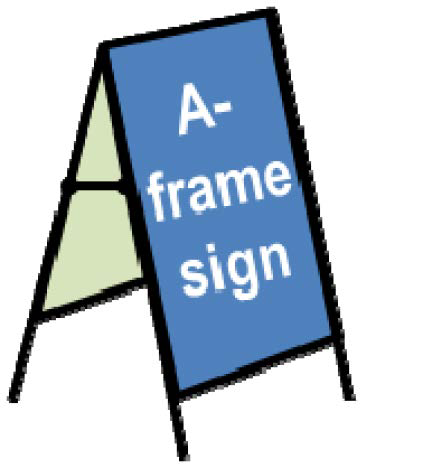
"A-frame sign" means a temporary, non-illuminated sign supported by its own frame in a manner that forms an "A" when in use; also referred to as a "sandwich board" or "tent" sign.
4.
"Artwork" means a sculpture, monument, mural, or structure erected solely for aesthetic purposes which in no way identifies a product or business or is used for commercial purposes.
5.
"Athletic scoreboard" means a sign accessory to an athletic playing field and/or its associated fences and walls, used to report scores and often to promote businesses to viewers of the events.
6.
"Auxiliary sign" means an accessory wall or freestanding sign or portion thereof which provides special information necessary, integral and unique to the type of business conducted on the premises and which does not include brand names, or information regarding product lines or services for advertising purposes. Examples of such signs include freestanding or wall-mounted restaurant menu boards and government mandated gasoline price signs or church services signs used as a wall sign or designed as part of an otherwise permitted freestanding sign.
7.
"Banner" means a sign of lightweight fabric, paper, plastic or similar material mounted either with or without a frame, usually rectangular in shape, which allows slight movement by air and contains characters, letters, illustrations or ornamentation.
8.
"Beacon" means a light with one or more beams directed into the atmosphere or directed at one or more points not on the same lot as the light source; also any light with one or more beams that rotate or move.
9.
"Billboard" means an off-premises outdoor sign, typically located along a major transportation route, which advertises goods, products, facilities, or services.
10.
"Business sign" means a sign which directs attention to a business, commodity, service, or entertainment conducted, sold, offered, or manufactured upon the premises where the sign is located.
11.
"Canopy sign" means a sign that is part of, or attached to an awning, canopy, marquee or other fabric, plastic, or structural protective cover over a door, entrance, window, or outdoor service area. Canopy signs are considered wall signs. (See also "under-canopy sign".)
12.
"Changeable copy sign" means a sign or portion thereof with characters, letters, or illustrations that can be physically changed or rearranged without altering the face or the surface of the sign. (See also "electronic message sign" for digital messages.)
13.
"Community information sign" means an officially designated permanent sign which is limited to the display of information of interest to the general community such as community welcome signs and semi-permanent greeting banners commonly erected on light poles.
14.
"Construction sign" means a sign indicating the name of the contractors, engineers, architect, financiers and related companies or products being used in construction on the lot.
15.
"Digital billboard" means a billboard capable of displaying multiple static images controlled by electronic means or communications.
16.
"Directional sign" means a sign intended to direct the public to a location or destination and displays only the name, direction, address, logo and/or distance of a business or activity.
17.
"Directory sign" means a wall sign indicating only the names and locations of the tenants in a building or group of buildings. A directory sign is regulated as a wall sign.
18.
"Electronic message sign" means a sign or portion thereof with characters, letters, or illustrations that can be electronically changed or rearranged without altering the face or the surface of the sign, excluding time and temperature signs.
19.
"Flag" means any fabric, plastic or similar material which may or may not contain distinctive colors, patterns, or symbols used as a symbol or emblem of any corporation, business, nation, organization of nations, state, city, or religious, fraternal, educational or civic organization, and which is displayed for either commercial or noncommercial purposes. (See also definition of "pennants".)
20.
"For sale or for rent sign" means an on-premises wall or freestanding sign indicating only a unit for sale, lease or rent and the phone number, name and/or address of the premises.
21.
"Freestanding sign" means a self-supporting sign resting on or supported by means of poles, standards, or any other type of base on the ground. This type of sign includes ground signs and pylon signs.
22.
"Government sign" means a sign established by, or by order of, any governmental agency.
23.
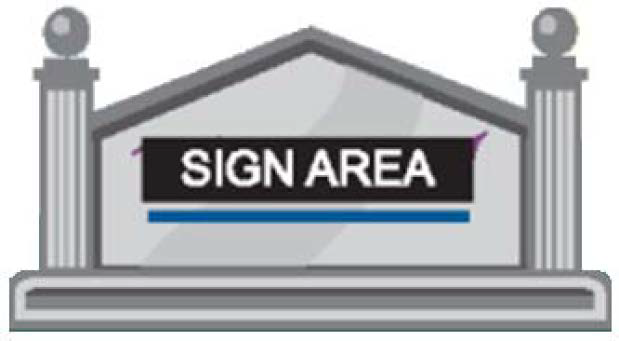
"Ground sign" means a freestanding sign whose bottom edge of the sign frame is entirely located at or within one foot of the ground, base or berm on which it is located.
Ground Sign
24.
"Group sign" means a freestanding sign displaying the collective name of a group of two or more uses such as the title of a shopping center, office park, or industrial park and its tenants. No sales or price information shall be permitted.
25.
"Holiday signs and decorations" means signs or other decorations and/or materials displayed during traditionally accepted civic, patriotic, or religious holidays.
26.
"Instructional sign" means a sign which provides instruction to the public regarding the use of a facility and which does not include brand names, or information regarding product lines or services for advertising purposes. Examples of such signs include accepted credit cards, loading area locations, vending and ice machine signs, nonresidential address plates, warning and emergency signs, public and legal notices, no trespassing, motor club affiliations, public restroom, accessibility for the disabled signs, telephone signs, and parking lot signs.
27.
"Interchange sign" means a freestanding sign located in an interchange sign district, whose height may exceed eight feet if a pylon sign or fourteen (14) feet if a ground or covered pole sign.
28.
"Interior signs" means a sign fully located within any building, arena, stadium or courtyard.
29.
"Memorial sign" means a sign, grave marker, memorial plaque, building marker or other remembrances of people or events which are cut into a masonry surface or made of bronze or similar material usually permanently embedded into a wall, structure, or the ground and which are noncommercial in nature.
30.
"Menu board sign" means an auxiliary sign providing menu items and prices associated with a drive-through window or walk-up service window.
31.
"Off-premises sign" means a sign which directs attention to a business, commodity, service, or entertainment conducted, sold, or offered elsewhere than upon the lot where the sign is displayed. Off-premises signs include billboards but do not include permitted directional signs located off-premises.
32.
"Painted sign" means a sign which is painted directly on a building facade or other permanent structure. A painted sign is considered a wall sign. (See also "window sign".)
33.
"Pennant" means a sign made of fabric, plastic or similar material which may or may not contain distinctive colors, patterns, or symbols of a corporation or business, typically displayed in a series along a string or wire, and hung from poles and/or structures to allow movement by air. Such attention-getting displays not specifically defined as flags or banners are considered pennants.
34.
"Political sign" means a sign erected in relation to an upcoming election or expressing political speech or viewpoints.
35.
"Portable sign" means a sign mounted on a frame or chassis designed to be easily relocated and sometimes referred to as a mobile sign.
36.
"Prohibited sign" means a sign which is not allowed to be erected within the corporate limits of the city of Sun Prairie.
37.
"Projecting sign" means a sign, other than a wall sign which is attached to and projects generally perpendicular from a structure or building face.
38.
"Promotional event sign" means a business sign erected on a temporary basis used to advertise a grand opening, going out of business sale, or unusual promotional event as distinguished from a seasonal or regular sale or one of several special offers normally offered throughout the year.
39.
"Pylon sign" means a freestanding sign erected upon pylon(s) or post(s) whose bottom edge of any portion of the sign frame is more than one foot above the ground, base or berm on which the sign is located.

Pylon Sign
40.
"Real estate group sign" means a temporary on-premises wall or freestanding sign indicating a unit or building for lease or sale in a group development or multi-tenant building and containing the phone number, name, contact person and/or address of the premises.
41.
"Real estate subdivision sign" means a temporary development sign identifying the name, location, and/or developer of an ongoing subdivision development. (See also "construction sign".)
42.
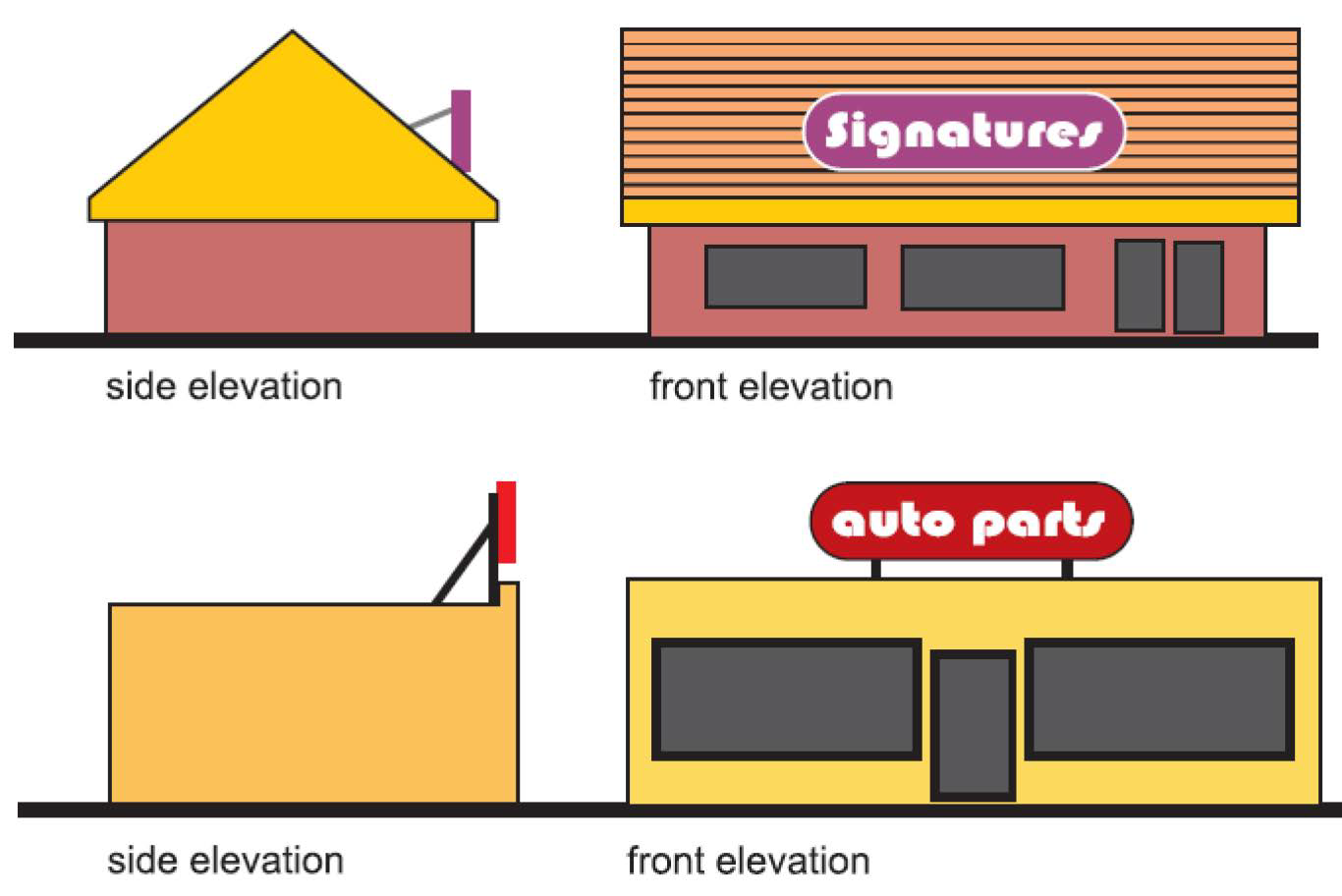
"Roof sign" means a sign erected or constructed wholly on and over the roof of a building, supported by the roof structure, and either extending vertically above the highest portion of the roof or separated from the rest of the roof by more than twelve (12) inches.
Roof Sign (sloped roof and flat roof example)
43.
Roof Sign, Integral. "Integral roof sign" means a sign erected or constructed as an integral or essentially integral part of a normal roof structure of any design, such that no part of the sign extends vertically above the highest portion of the roof and such that no part of the sign is separated from the rest of the roof by a space of more than twelve (12) inches. An integral roof sign is considered a wall sign.
44.
"Sign" means any object, device, display, structure, or part thereof, situated outdoors, which is used to advertise, identify, display, direct or attract attention to an object, person, institution, organization, business, product, service, event, or location by any means, including words, letters, figures, designs, symbols, fixtures, colors, illumination, or projected images. Corporate colors and bright accents on the building shall be considered part of a sign and fall within the wall sign parameters of the zoning ordinance.
45.
"Sign area" means the entire surface area of the sign on which copy could be placed and viewed simultaneously.
46.
"Sign face" means the surface(s) of a sign used for display purposes.
47.
"Special event signs and banners" means a nonbusiness sign erected on a temporary basis for a temporary event of public interest such as a fundraiser, church fair, carnival, festival, concert, parade, or similar event.
48.
"Statuary sign" means a sign with more than two surfaces having height, width, and depth, which can be viewed from all sides usually designed as an object related to the operation or activity on the premises.
49.
"Temporary sign" means a nonpermanent sign or advertising display intended to be displayed for a short, usually fixed period of time generally not exceeding thirty (30) consecutive days unless in conjunction with an approved temporary seasonal use or as outlined in Section 17.40.060. Temporary signs include wall, freestanding, and banner signs mounted on walls. A mobile or portable sign shall not be considered a temporary sign or used for such a purpose and beacons, pennants, streamers, balloons, and similar displays shall only be allowed as promotional event signs. (See also "promotional event sign".)
50.
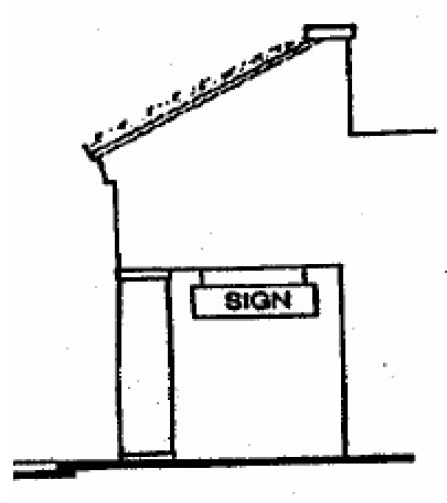
"Under-canopy sign" means a sign suspended from the underside of a canopy, door or other framework, to inform pedestrians of the name or address of a building or tenant or of an entrance.
Under-Canopy Sign
51.
"Vehicle sign" means a sign painted on or affixed to vehicles or trailers where the sign is incidental to the primary use of the vehicle or trailer.
52.
"Wall sign" means a sign mounted on and/or parallel to a building facade or other vertical building surface. Wall signs include awning, canopy, marquee, directory, painted, and integral roof signs.
53.
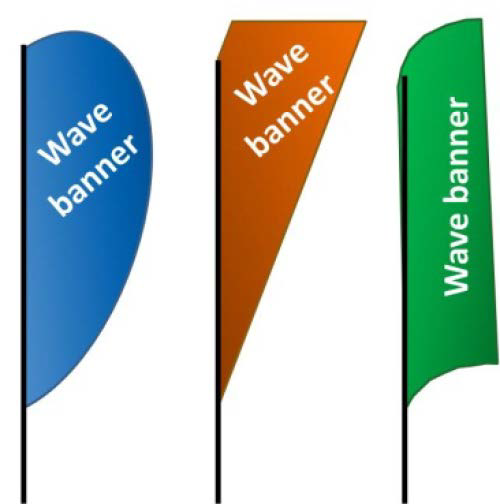
"Wave banner" means a self-supported wing, feather, blade, cone, tear drop, rectangular or similarly shaped flag, with or without a commercial message, mounted on a flexible pole.
54.
"Window display" shall mean any collection of merchandise or artifacts, arranged in a three-dimensional display behind a window, typically intended to provide pedestrians with a visual display of the items or services available for sale. The term "window display" excludes "window sign" as defined by this section, but may include incidental price labels on the items being displayed.
55.
"Window sign" shall mean any sign, including pictures, used for advertising purposes that is painted on, affixed to, or placed adjacent to, a window, door or opening or located inside within a distance of two feet or less from a window, door or opening. The term "window sign" excludes "window display" as defined by this section.
56.
"Yard/rummage/garage sale signs," refer to Section 5.36.030 for standards related to yard/rummage/garage sale signs.
(Ord. 512, § 1, 11-20-2012)
17.40.030 - Permits, construction and maintenance.
A.
Sign Permit.
1.
General Requirements. No person shall erect, alter, or relocate within the city any sign without first obtaining a sign permit except the following:
a.
Signs which do not require a permit, under Section 17.40.050;
b.
The repainting, changing of parts, and preventive maintenance of existing signs.
2.
Application Requirements. All applications for sign permits shall be made in writing on a form supplied by the city building inspector. Such application shall be submitted with all required information provided and shall contain or have attached thereto the following information:
a.
The approved site plan for the subject property (per Section 17.44.070), (or if not previously required, a site plan for the subject property with requirements as determined by the building inspector), showing the location and dimensions of all buildings, structures, and signs on the subject property; such subject property boundaries; and the locations of all proposed signs;
b.
Characteristics of the proposed sign including: the configuration of the proposed sign, the height, width, total square footage, setback distance from property lines and back of curb, method of attachment, method of illumination, sign materials, and colors;
c.
The subject property's zoning designation;
d.
The total area and number of all signs by type on the subject property both before and after the installation of the proposed sign.
3.
Procedure. Per subsection A.2 of this section, upon the receipt of a complete application, the building inspector shall review such application for compliance with the requirements of this title, and shall approve or deny a sign permit based on the submitted application within five working days of the acceptance of the complete application.
4.
Fee. The fee for all permanent signs for which a permit is required shall be as established by resolution of the common council.
B.
Construction. The base or support(s) of any and all freestanding signs shall be securely anchored to a concrete base or footing. All signs shall be constructed and mounted so as to withstand a wind speed of ninety (90) miles per hour.
C.
Maintenance. All signs, including nonconforming signs, shall be maintained in good condition. Any signs that are deemed unsafe or in a state of disrepair shall be repaired or removed upon notice of the zoning code enforcement officer.
(Ord. 512, § 1, 11-20-2012)
17.40.040 - General design, illumination, and placement.
The following standards relate to the design and appearance of all signs permitted within all zoning districts unless specifically exempted elsewhere in this title.
A.
Illumination. No illuminated sign, whether by external or internal illumination, shall be permitted unless the illumination of the sign is so designed that the sign does not serve to illuminate adjoining residential uses in residential zoning districts per the illumination levels set forth in Section 17.36.070. All illuminated signs shall comply with the State Electrical Code and all applicable local codes and regulations.
B.
Sign Area Calculation.
1.
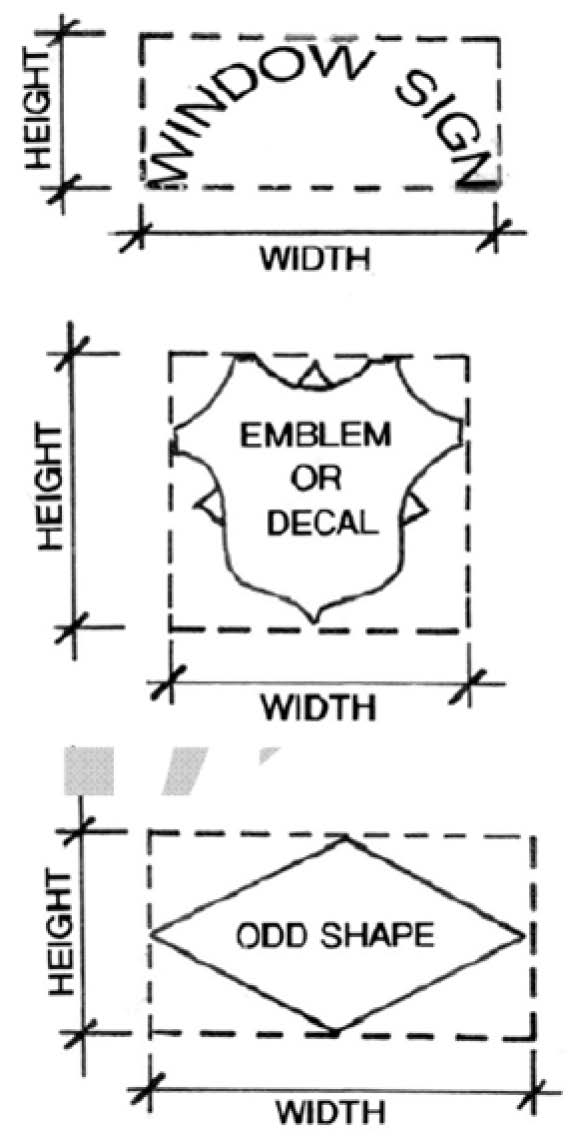
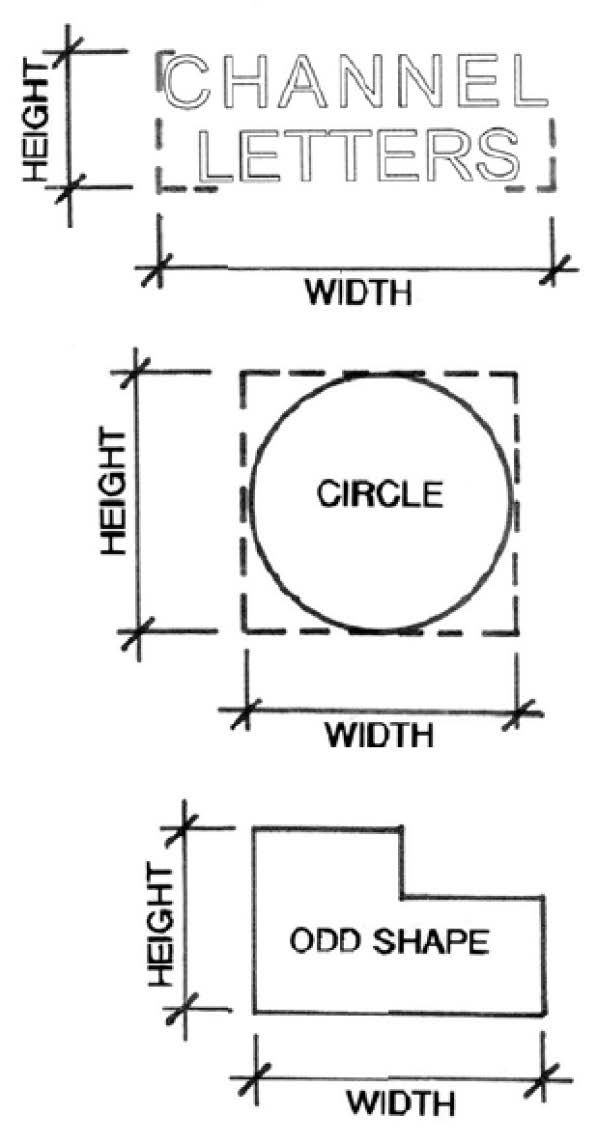
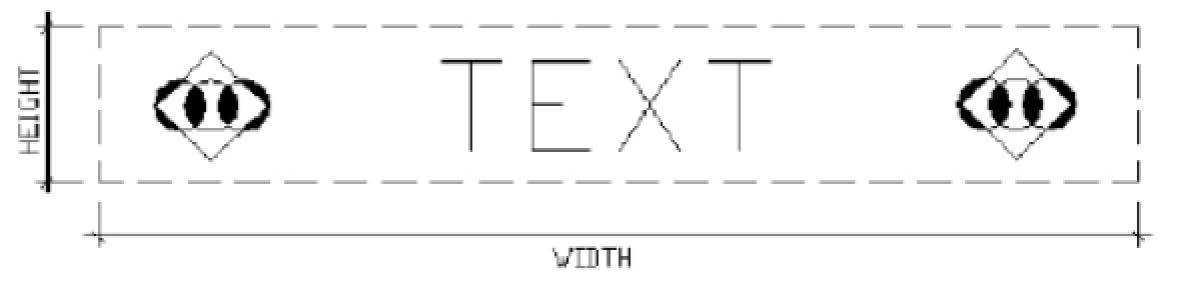
Freestanding and Multiple-Faced Signs. Sign area for all freestanding, projecting and similar signs with multiple faces consists of the entire surface area of the sign on which copy could be placed and viewed simultaneously. The supporting structure or bracing of a sign shall not be counted as a part of the sign face area unless such structure or bracing is made a part of the sign's message. Where a sign has two display faces back to back, the area of only one face shall be considered the sign face area. Where a sign has more than one display face not back to back, including statuary signs, the maximum area which can be viewed simultaneously from any point shall be considered the sign face area.
Sign Computation
These diagrams illustrate how sign area is measured.
2.
Wall Signs.
a.
Background or Bordered Signs. Sign area for all wall signs with borders or backgrounds shall be the total area of the entire background which borders or frames that message.
b.
Individual Letter Signs. Sign area for all individual letter wall signs shall be the area of the smallest rectangle which can encompass all words, letters, figures, emblems, and other elements of the sign message.
C.
Placement.
1.
Setbacks for Freestanding Signs. All freestanding signs shall be located a minimum of five feet from the right-of-way line and a minimum of ten (10) feet from the back of curb of such right-of-way and shall abide by the regulations for sight triangles and other visibility standards per Section 17.36.030.
2.
Location of Wall and Projecting Signs. No wall or projecting sign shall extend above the facade to which it is attached or encroach upon a window or doorway or architectural feature.
3.
Placement Within or On a Frame. All signs designed for a pre-existing structure or frame shall be designed to fit the frame or structure as though it were the original sign. Any portion of any sign or unused remaining frame or structure shall be subject to removal under the conditions for abandoned signs, Section 17.40.090.
4.
Additions to Existing Signs. No sign over four square feet in area may be attached to another sign without being designed as an integral part of the original sign. No signs may be attached to, or cover up, any portion of a sign's frame, structure or base unless originally designed or subsequently redesigned for that purpose.
D.
Maximum Sign Height. No wall or projecting sign shall be higher than the building on which it is mounted. When residential uses are located on the second story, projecting signs shall not extend beyond the height of the bottom of any second story window. Unless otherwise provided in this chapter, all freestanding signs shall be a maximum height of eight feet above ground level. If the centerline of the nearest local, county, or state roadway is higher than ground level, the height of the sign shall be measured from the centerline of the roadway.
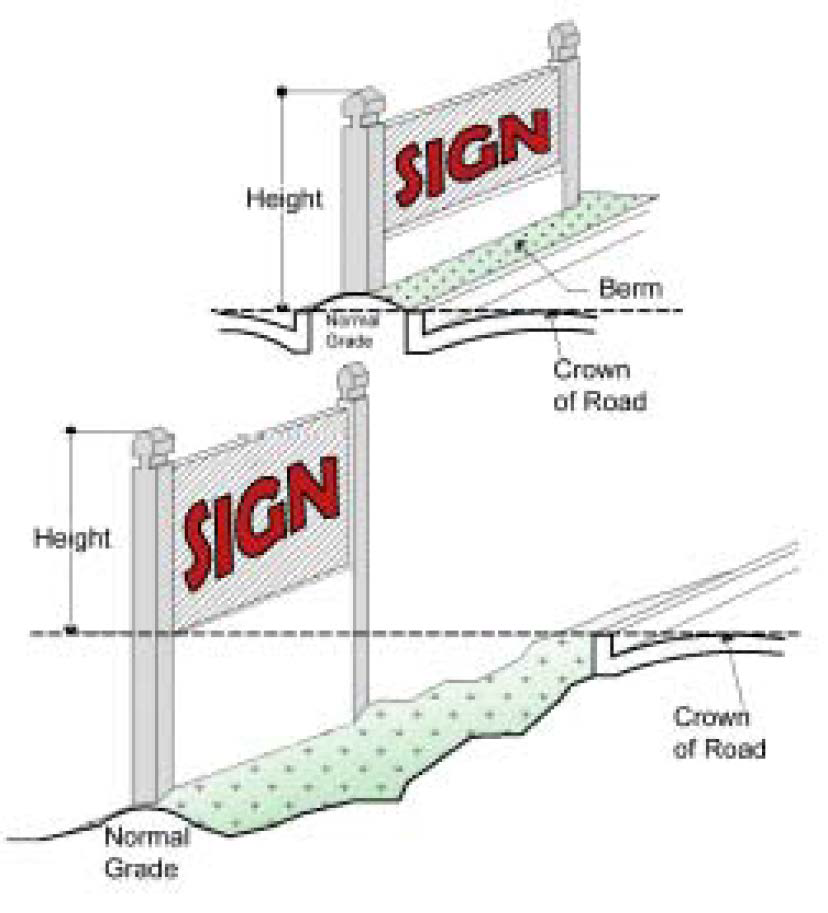
Sign height is measured from the ground level or the centerline of the nearest street.
E.
Common Sign Design—Multi-Tenant Buildings, Multi-Building Developments and Group Developments. All buildings containing two or more tenants or complexes containing two or more buildings shall install all tenant and group signs according to a sign design plan approved by the zoning code enforcement officer in accordance with this title. A sign design plan shall contain detailed requirements for the lettering, illumination, colors, materials, location and sign type to be used within the development. All new developments shall submit a sign design plan prior to issuance of the first sign permit. All existing developments shall submit a sign design plan concurrently with any new requests for a sign permit by a tenant or the owner. After approval of the sign design plan by the zoning code enforcement officer as to its conformance with this chapter, all signs shall be installed in accordance with the approved plan.
F.
Multi-Tenant Sign Design Plan. For nonresidential buildings containing two or more tenant spaces, the zoning code enforcement officer may approve a sign design plan that allocates allowable wall sign area among the various tenant spaces as desired by the building owner, provided the maximum overall sign area is not exceeded for the building as a whole. Said sign design plan shall include sign locations and establish maximums or ranges in sizes for each tenant space, as well as calculations demonstrating compliance with the overall sign area limits. As sign permits for the individual tenant spaces are requested, the sign design plan shall be updated by the applicant accordingly and submitted to the zoning code enforcement officer to clearly demonstrate compliance. A sign design plan may be requested to be altered as tenants change over time, provided the maximum sign area limit is adhered to.
(Ord. 600, § 1, 5-19-2015; Ord. 512, § 1, 11-20-2012)
17.40.050 - Signs that do not require a sign permit.
Signs are permitted in all zoning districts for the following uses and purposes without the need for a sign permit. Such signs shall not count as part of the maximum permitted sign area, maximum number of signs per lot or building, but shall comply with general sign setback requirements. No sign permitted in this section shall be displayed in a manner which would otherwise cause it to be prohibited. All signs permitted in this Section shall comply with Section 17.40.040 and other applicable codes and ordinances. The following types of signs are permitted without a permit provided that they meet the standards associated with each sign type as listed below. Signs that do not meet these standards are not allowed.
A.
Address and Name Plates. One identification sign containing name and/or address not exceeding two square feet in area is permitted for each single-family lot or for each unit on a multifamily lot containing four or fewer units.
B.
Home Occupations. One home occupation name sign may be installed for an approved home occupation. Refer to Section 17.16.140(19) for additional home occupation regulations. No permit or filing fee is required for such signs, however no such sign shall be allowed unless a home occupation permit is approved and the sign is two square feet or less in area.
C.
Artwork. Meets the requirements per the definition of artwork.
D.
Athletic Scoreboards. Provided that any ancillary advertising is not oriented to be viewed from outside the event area.
E.
Construction Signs. For construction on or development of a lot, one sign not more than forty-eight (48) square feet in area and a maximum of eight feet in height. Construction signs shall be removed within thirty (30) days of the completion of construction.
F.
Directional Signs. Directional signs shall be permitted as follows:
1.
Except as provided herein for emergency medical facilities and emergency medical campuses, for each permitted or required parking area that has a capacity of more than five cars, one sign, not more than four square feet in area, designating each entrance and/or exit which may include a logo covering up to two of the four square feet. No more than three other on-premises directional signs per lot a maximum of four square feet each shall be allowed. No directional sign shall exceed five feet in height if an individual freestanding sign rather than a wall sign or attached to an otherwise permitted freestanding sign.
2.
For emergency medical facilities and emergency medical campuses, the maximum size of directional signs may be increased to twenty-four (24) square feet, and up to twelve (12) additional directional signs, in addition to those permitted for parking areas as described above, shall be permitted in order to identify and expedite access to emergency medical care and avoid congestion along said access routes.
3.
Directional signs may be located off-premises if erected by a government agency, nonresidential institutional land use, or as a special event sign. Only those directional signs erected by a government agency or approved by the public works director may be located in a public right-of-way.
G.
Flags. Except for lots containing institutional or residential uses, a maximum of three flags per lot shall be permitted. One additional flag for every two hundred (200) feet of street frontage may be permitted per the approval of the zoning code enforcement officer upon verification of lot frontage.
H.
For Sale or for Rent Signs. For each lot: one "For Sale" or "For Rent" sign, not more than twelve (12) square feet in area.
I.
Government Signs. As established by government agencies.
J.
Holiday Signs and Decorations. Temporary displays as part of a holiday or civic event.
K.
Instructional Signs. Instructional signs four square feet or less and parking lot signs up to nine square feet in area. Instructional signs for emergency medical facilities or emergency medical campuses may be increased up to twelve (12) square feet or less and shall be considered exempt.
L.
Interior Signs. Inside a building and not a window sign.
M.
Memorial Signs. Memorial signs, plaques, or grave markers that are noncommercial in nature.
N.
Political Signs.
1.
Political signs shall not exceed thirty-two (32) square feet in area.
2.
Political signs shall not be displayed on any building or grounds that are owned, operated or maintained by any public agency, or on any city-owned post or traffic control device or on any pole, post or appurtenance owned or operated by any utility. Political signs shall be placed only on private property in accordance with Chapter 12, Wisconsin Statutes. Political signs shall not be placed on vacant private property without the consent of the property owner.
3.
Any illegal signs or unusable signs due to wear, tear or damage may be removed without notice by the city.
O.
Real Estate Group Signs. For each group development or multi-tenant building, a maximum of two signs, one per each street frontage, may be permitted up to a maximum of thirty-two (32) square feet in area for each sign to advertise the initial sale and leasing of the premises. Real estate group signs shall be permitted only for the initial lease/sale period and shall be removed when eighty percent (80%) of the structure or lands are initially sold or leased. Signs advertising sale or lease after such time shall conform to the requirements of for sale and for rent signs per subsection (G) of this section.
P.
Real Estate Subdivision Signs. For each real estate subdivision that has been approved in accordance with the city of Sun Prairie land division regulations, a maximum of two temporary development project identification signs are permitted to be located on some portion of the subject subdivision. Each such sign shall be not more than thirty-two (32) square feet in area. One additional similar sign shall be permitted for each one hundred (100) lots in the subdivision in excess of one hundred (100) lots. These signs shall comply with the visibility standards of Section 17.36.030. These signs shall be permitted to remain within the subject subdivision until a time at which building permits have been issued for eighty percent (80%) of the lots in the subdivision. (See also "For Sale" and "For Rent" signs in subsection G of this Section.)
Q.
Under-Canopy Signs. Under-canopy signs shall not require a permit if four square feet in area or less. If located within the right-of-way, such signs shall meet the requirements of Section 12.16.020.
R.
Vehicle Signs. Vehicle signs do not require a permit. Signs affixed to a vehicle so as to be visible from a public right-of-way whose purpose is to advertise a product or direct persons to a business are however, prohibited except when approved as a temporary sign.
S.
Wave Banners.
1.
A wave banner shall have a maximum height of fourteen (14) feet and a maximum width (at its widest point) of three feet.
2.
A maximum of three wave banners per lot shall be permitted. One additional wave banner for every two hundred (200) feet of street frontage may be permitted per the approval of the zoning code enforcement officer upon verification of frontage.
3.
Wave banners shall have a minimum setback of five feet from the right-of-way or ten (10) feet from the curb, whichever is greater.
4.
Wave banners shall be maintained in good condition per the requirements of Section 17.40.030(C).
5.
Wave banners shall meet the visibility standards contained in Section 17.36.030.
T.
Window Signs and Window Displays.
1.
Signs only for windows, doors or openings as set forth in the definition of "window sign" that are located on the first and second floors of the building frontage.
2.
Signs shall be mounted on the inside of or painted on windows, doors or openings as set forth in the definition of "window sign."
3.
No permanent and/or temporary window sign shall occupy more than fifty percent (50%) of the area of any windows along the same building plane. Window displays as defined by this Section, shall not be considered "window signs" for the purpose of determining compliance with this subsection.
U.
Repainting or Copy Change. Repainting or changing the message of a sign provided the height and copy area of the sign comply with the provisions set forth in this chapter, and the original sign face complies with all provisions of this ordinance.
V.
Nonbusiness Special Event Signs. Nonbusiness special event signs that comply with Section 17.40.060(B) do not require a permit.
(Ord. 512, § 1, 11-20-2012)
17.40.060 - Temporary signs.
A.
Temporary Signs for Businesses. Temporary signs for businesses include signs for regular events, promotional events, temporary uses, and removable A-frame/sandwich board signs. Table 17.40.060(A) summarizes the standards for each temporary business sign type with detailed standards provided in the remainder of this section.
* Statuary signs must comply with standards found in Section 17.40.070(C)(9).
1.
Temporary Signs for Business Regular Events. Temporary signs for business regular events include signs for regular sales or similar activities that occur throughout the calendar year and are permitted as follows:
a.
Number. Only one temporary sign for business regular events may be displayed on a lot at any one time.
b.
Frequency. Any one business is limited to a maximum of four temporary signs for business regular events in any calendar year.
c.
Duration. A lot or individual tenant is permitted to display a temporary sign for business regular events for a maximum of sixty (60) days within any calendar year.
d.
Size. Temporary signs for business regular events shall not exceed forty-eight (48) square feet including signs for approved temporary seasonal uses such as Christmas tree sales, fireworks stands, flower sales, and vegetable stands.
e.
Type. Temporary signs for business regular events may be wall signs, freestanding signs, or banners mounted on walls. No changeable copy, sandwich board or similar signs are permitted.
f.
Height. Freestanding temporary signs for business regular events shall not exceed eight feet in height.
g.
Permit Required. A permit is required for all temporary signs for business regular events.
2.
Temporary Signs for Business Promotional Events. Promotional events signs as herein defined are temporary business signs used for going out of business sales, grand openings, and other out of the ordinary unique sales and promotional events such as sidewalk sales or sales including outdoor entertainment and are permitted as follows:
a.
Number. Any one business is limited to a maximum of two promotional event sign displays.
b.
Frequency. Any one business is limited to a maximum of two (2) promotional event sign displays in any calendar year. Such displays may include more than one sign or display at a time subject to review by the zoning code enforcement officer to ensure that all visibility corners and traffic and pedestrian movement areas are not impeded.
c.
Duration. Any one business is permitted to display a promotional event sign(s) for a maximum of thirty (30) days within any calendar year.
d.
Size. Promotional event signs, such as wall signs, freestanding signs, signs on hot and cold air balloons, and banners shall not exceed forty-eight (48) square feet. The area of streamers, balloons and similar displays shall not be limited or included within this maximum square footage.
e.
Type. Promotional event signs may be wall signs, freestanding signs, banners, beacons, pennants, statuary signs provided they comply with standards found in Section 17.40.070.C.9, streamers, flags or similar displays. No flashing signs, changeable copy signs, electronic message signs, portable signs, sandwich boards or similar signs are permitted. Special lighting and beacons are subject to regulation as a conditional use per Section 17.44.050 and subject to the requirements in Section 17.36.070.D.
f.
Height and Location. Freestanding promotional event signs including hot and cold air balloons shall not exceed the height of the principal structure. Promotional event signs in the form of small balloons, wall signs, banners, pennants or similar displays shall also not exceed the height of the principal structure nor be erected upon or above the roof including when hung from poles or other accessory structures, although promotional event signs may be attached to or suspended from the roof's edge.
g.
Permit Required. A permit is required for all promotional event signs.
3.
Signs for Approved Temporary Uses (Including Seasonal). Temporary uses are land uses that are in place for a short period of time. Typically such uses include seasonal activities such as outdoor display and sales of Christmas trees, fireworks, etc. Signage for an approved temporary use shall meet the same standards as "temporary signs for businesses regular event," item 1 of this subsection, except that the sign associated with a temporary use may remain in place for the same period of time that the temporary use is permitted to remain, typically one hundred eighty (180) days.
4.
Temporary, Removable A-Frame or Sandwich Board Signs. An A-frame sign is a temporary, non-illuminated sign supported by its own frame in a manner that forms an "A" when in use. This sign type may be placed in the public right-of-way in front of a business on a daily basis and are permitted as follows:
a.
Number. One temporary, removable A-frame or sandwich board sign is allowed per business. Businesses with more than one frontage on a public street are allowed one such sign per frontage up to a maximum of two signs.
b.
Daily Duration. Sandwich board signs can only be displayed from dawn to dusk.
c.
Size and Construction. Overall dimensions of the sandwich board sign cannot exceed two feet in width by four feet in height, as measured from grade.
d.
Zoning. A-frame or sandwich board signs are permitted only in commercial zoning districts (NC, SC, UC, CC) or in approved commercial and mixed-use areas in planned development (PD) districts.
e.
Location. Signs are restricted to the lot of the business establishment to which a permit has been issued or to the abutting sidewalk frontage of the same. A-frame or sandwich board signs are permitted within the public right-of-way only where the sidewalk is wide enough to adequately accommodate both the usual pedestrian traffic in the area and the sign. Signs must be placed so as to leave not less than four and one-half consecutive feet of sidewalk width at every point, which is clear and unimpeded for pedestrian traffic. All sandwich board signs must also comply with vision standards contained in Section 17.36.030. In times of excessive snow accumulation, the permit holder must use discretion in placing the sandwich board sign on the sidewalk, considering visibility, access, and safety.
f.
Placement. The holder of the sandwich board sign is responsible for securing the sandwich board sign and daily removal of the sandwich board sign. Signs may not be attached, chained or in any manner affixed to public property including street trees. In no event shall the placement of a sandwich board sign on the public sidewalk obstruct access to any crosswalk, mailbox, curb cut, public parking space or any other public property. In no event shall an A-frame or sandwich board sign be placed on any bicycle path. The sign shall not obstruct access to any fire hydrant, fire escape or fire door, or obstruct the clear view of any traffic signal, regulatory sign or street sign. Whether the placement of said sign obstructs access to any of the foregoing shall be the determination of the building inspector.
g.
Enforcement. It shall be assumed that A-frame or sandwich board signs located within the public right-of-way are a privilege and not a right. The city shall have the right to require their removal at any time because of anticipated or unanticipated problems or conflicts. To the extent possible, the permittee shall be given prior notice of any time period during which the placement of A-frame or sandwich board signs is prohibited. Furthermore, the sign permit may be revoked by the building inspector following notice of the permittee. The permit may be revoked if one or more conditions outlined in this Section have been violated, or if the sign is determined to constitute a public nuisance not specifically outlined in this Section. Following the revocation of the sign permit, no application for the same site shall be filed within one hundred eighty (180) days from the date of revocation. The permittee has a right to appeal the decision of the building inspector within thirty (30) days of issuance of a revocation notice. Appeals must follow the procedures outlined in Chapter 17.48, Administration and Enforcement.
h.
Indemnification. Where a temporary, removable A-frame or sandwich board sign is permitted in the public right-of-way, the owner/lessee/lessor of the business to which a permit has been issued and the property owner shall agree in writing to hold the city harmless for any personal injury or property damage resulting from the existence or operation of said sign, and shall furnish evidence of general liability insurance in the amount of fifty thousand dollars ($50,000.00) with the city as additional named insured or otherwise as determined by the city administrator or their designee.
i.
Permit Fee. The permit fee for a sandwich board sign shall be as established by resolution of the common council and must be renewed annually on the first of January.
B.
Nonbusiness Special Event Signs. Temporary signs for nonbusiness special events include signs for public interest such as a fundraiser, church fair, carnival, festival, concert, parade, or similar event. Both on-site and off-sites signs of this type are permitted. Table 17.40.060(B) summarizes the standards for each nonbusiness special event sign type, with detailed standards provided in the remainder of this section.
1.
On-Site Identification Sign. For a temporary event of public interest such as a fundraiser, church fair, carnival, festival, concert, parade, or similar event two wall, banner or freestanding signs, not over forty-eight (48) square feet in area for each such sign nor over eight feet in height, located upon the site of the event shall be permitted. Such sign shall not be erected more than thirty (30) days before the event and shall be removed not more than five days after the event.
2.
Off-Premises Directional Signs. A maximum of four off-premises directional signs located outside the public right-of-way and four square feet in area or less shall be permitted to be erected a maximum of seven days before the event and shall be removed within forty-eight (48) hours after the event. Such signs shall be either wall signs, banners, or freestanding signs a maximum of eight feet in height.
3.
No Permit Required. No permit or filing fee is required for a special event sign.
4.
Garage Sales. Refer to Chapter 5.36 for signage and other standards related to garage sales, yard sales and similar merchandise sales.
(Ord. 512, § 1, 11-20-2012)
17.40.070 - Permanent signs.
A.
Residential Zoning Districts. In all residential zoning districts only wall and ground signs are permitted. Table 17.40.070(A) summarizes the maximum number, area, and height allowed for permanent signs permitted in residential zoning districts. Detailed standards are provided in the remainder of this section.
1.
Multiple-Family or Institutional Residential Lots with More Than Four Dwelling Units. For each multifamily or institutional residential lot containing more than four dwelling units, one identification sign, not to exceed twelve (12) square feet in area, is permitted per lot. The sign shall indicate nothing more than the name, telephone number, address, and/or the name of the management company.
2.
Subdivision Identification Signs. Subdivision identification signs containing only the name of the subdivision and/or street or address are permitted and shall not exceed thirty-two (32) square feet in area. A maximum of two such signs are permitted per entrance and then only from a business, collector or arterial roadway as designated on the official map. Such signs shall comply with the visibility standards of Section 17.36.030.
3.
Nonresidential Land Use Identification Signs in Residential Districts For any permitted nonresidential principal use in a residential district, one sign, not to exceed thirty-two (32) square feet in area, is permitted per lot.
B.
Nonresidential Zoning Districts. Permanent signs permitted in nonresidential zoning districts are listed in this subsection. Table 17.40.070(B) summarizes the maximum number, area, and height. Detailed standards are provided in the balance of this section.
* See Section 17.40.070.C for additional provisions related to height and area requirements
1.
Maximum Number of Signs. The maximum permitted number of permanent signs per lot is computed with a total allowable number of freestanding signs and a total allowable number of wall and projecting signs calculated independently. The maximum number of signs per lot is defined as the sum of these two calculations.
a.
Freestanding Signs. A maximum of one freestanding sign is allowed per continuous street frontage up to a maximum of two per lot. A maximum of one sign per lot shall be allowed to exceed the maximum eight feet in height and then only when permitted as a group sign, ground sign, or interchange sign. One additional freestanding sign per street frontage may be allowed for any street frontage over one thousand (1,000) linear feet.
b.
Wall and Projecting Signs. Maximum of two wall signs, one of which may be a projecting sign if located in the central commercial zoning district or Main Street overlay zoning district, are allowed per each facade facing a nonresidential lot frontage. For buildings greater than one hundred (100) feet in length, one additional wall sign may be allowed on each facade facing a nonresidential lot frontage. One additional wall or projecting sign, up to a maximum of ten (10) square feet, or up to twenty (20) square feet for emergency medical facilities and emergency medical campuses, containing only the name of the business may be erected to identify a building entrance on a facade facing a residential lot frontage. Wall signs shall not extend beyond the edge of any wall or other surface to which they are mounted, nor shall a flush-mounted wall sign project more than eighteen (18) inches from the wall's surface.
2.
Maximum Sign Area of Individual Signs. The maximum permitted sign area of an individual sign is computed based on the type of sign as follows:
a.
Freestanding Signs. The maximum permitted area of individual freestanding signs shall be equal to one and one-half square feet of sign area for every one linear foot of nonresidential lot frontage up to a maximum of one hundred fifty (150) square feet per sign. Sign area not used along one street frontage shall not be assigned to another lot frontage. See sign area calculations, Section 17.40.040(B).
b.
Wall and Projecting Signs. The maximum permitted area of an individual wall or projecting sign for an individual tenant or building facade shall be equal to seven percent (7%) of the building facade, or up to ten percent (10%) of the portion thereof assigned to a tenant of a multi-tenant building in a nonresidential district, up to a maximum of four hundred fifty (450) square feet per facade for wall signs and sixteen (16) square feet for projecting signs. This may be increased to a maximum of twelve percent (12%) or up to four hundred fifty (450) square feet for emergency medical facilities and emergency medical campuses. These maximums also apply to the two allowable signs per facade or tenant, therefore only one such sign will be allowed if the maximum allowable sign area is used in a single sign. Multi-tenant buildings shall be computed on an individual tenant basis with the sign area percentage calculated based on the tenant's facade. Sign area not used by one tenant shall not be assigned to another tenant or building unless outlined in an approved sign design plan per Section 17.40.040(E). The area of projecting signs is further regulated under Section 17.40.070(C)(4). See also sign area calculation, Section 17.40.040(C).
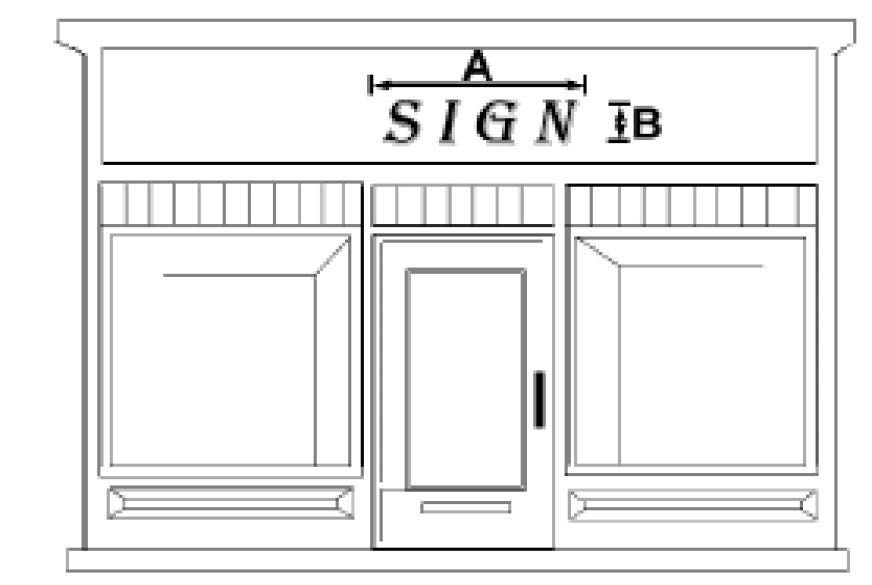
Wall sign area = A x B
3.
Maximum Sign Height. No wall or projecting sign shall be higher than the building on which it is mounted. When residential uses are located on the second story, projecting signs shall not extend beyond the height of the bottom of any second story window. (See also definition of "roof sign" and "integral roof sign.") Unless otherwise provided in this chapter, freestanding signs shall be a maximum height of eight feet above ground level. If the centerline of the nearest local, county, or state roadway is higher than ground level, the height of the sign shall be measured from the centerline of the roadway. A freestanding sign may exceed the eight-foot height maximum only if it meets the definition of an interchange sign, group sign, or ground sign, and meets the specific standards for such sign as stated in Section 17.40.070.C.
C.
Other Sign Regulations. Interchange signs, group signs, projecting signs, changeable copy signs, electronic message signs, auxiliary signs, community information signs, and flags (more than three on a lot) are signs which by their design or purpose require special regulations in addition to those for typical wall or freestanding signs. These special signs are considered permanent signs on nonresidential property except that auxiliary signs and community information signs may be allowed in any zoning district.
1.
Interchange Sign Overlay District. Interchange signs may be erected only within the Interchange Sign overlay district, as established on the official zoning map. One interchange sign is allowed on any lot within the Interchange Sign overlay district, and only in association with a legally conforming commercial, office or industrial use. Interchange signs shall not exceed thirty-five (35) feet, unless a greater height up to a maximum of fifty (50) is approved through the conditional use process per Section 17.44.050. Such increases shall be granted only upon a finding by the city that the petitioner has justified the need for the increase in the height due to unique conditions of the property. Interchange signs shall comply with all other requirements of freestanding business signs in this chapter. The Sun Prairie business park, due to existing covenants, is not included within the interchange sign overlay district.
2.
Group Signs.
a.
Group signs are freestanding signs used to identify the name of a multi-tenant building, a lot containing two or more uses, a group development, or commercial planned development. Such signs may contain the group name of the development and/or the individual names of the tenants in the development. Such signs are regulated under the common sign design plan of Section 17.40.040.E. Group signs shall comply with all of the requirements of freestanding business signs except that group signs may be erected up to a maximum height equal to the height of the principal building on the lot as measured from ground level. Group signs shall be permitted in lieu of freestanding business signs, not in addition to such signs.
b.
Recognizing that some amount of flexibility is sometimes needed to address unusual or unique circumstances, group signs may exceed the maximum height and sign area standards through the approval of a conditional use permit provided the city determines that the following standards are met:
i.
Maximum sign height may be increased by up to fifteen percent (15%).
ii.
On lots that exceed one hundred (100) linear feet of street frontage on a single street, the maximum sign area of a group sign may be increased up to a maximum of two hundred (200) square feet.
iii.
The base of the sign must be constructed of high quality materials, such as brick or stone. The height of the base shall be in a proportion appropriate to the sign and principal building.
iv.
Streetscaping features, such as garden walls, benches, planters or other decorative features, shall be added within the front yard as a means of defining the street edge and creating an aesthetically pleasing view from the street.
v.
The proposed sign shall be compatible in scale and architectural character with the building or property on which the sign will be located.
vi.
Shall comply with Section 17.44.050, standards and procedures applicable to all conditional uses.
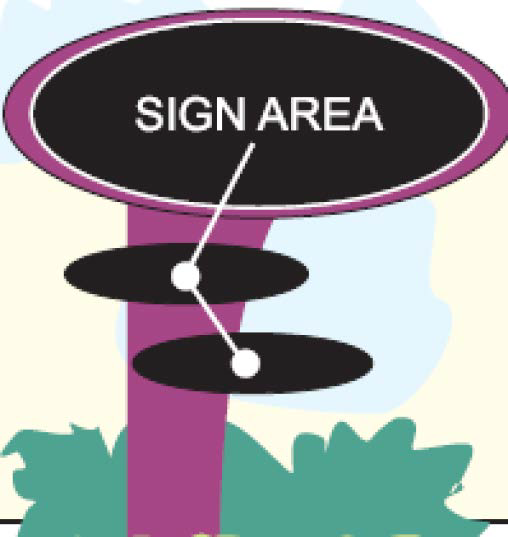
Group Sign
3.
Ground Signs. Ground signs are freestanding signs with decorative masonry, plastic, or wood bases.
a.
Ground signs may be erected up to a maximum height of fourteen (14) feet above ground level or above the centerline elevation of the nearest local, county or state roadway if the roadway is higher than ground level.
b.
For emergency medical facilities and emergency medical campuses, ground signs may be erected up to a maximum of sixteen (16) feet above ground level or above the centerline elevation of the nearest local, county or state roadway if the roadway is higher than ground level.
c.
Recognizing that some amount of flexibility is sometimes needed to address unusual or unique circumstances, ground signs may exceed the maximum height and sign area standards through the approval of a conditional use permit provided the city determines that the following standards are met:
i.
Maximum sign height may be increased to twenty (20) feet.
ii.
On lots that exceed one hundred (100) linear feet of street frontage on a single street, the maximum sign area of a ground sign may be increased up to a maximum of two hundred (200) square feet.
iii.
The base of the sign must be constructed with high quality materials, such as brick or stone. The height of the base shall be in a proportion appropriate to the sign and principal building.
iv.
Streetscaping features, such as garden walls, benches, planters or other decorative features, shall be added within the front yard as a means of defining the street edge and creating an aesthetically pleasing view from the street.
v.
The proposed sign shall be compatible in scale and architectural character with the building or property on which the sign will be located.
vi.
Shall comply with Section 17.44.050, standards and procedures applicable to all conditional uses.
4.
Projecting Signs. Projecting signs are permitted only within the Central Commercial (CC) zoning district and the Main Street overlay (MSO) district. Projecting signs shall be erected according to the regulations applicable to wall signs unless herein amended. Individual projecting signs shall not exceed sixteen (16) square feet in area. The entire bottom edge of such sign shall be located a minimum of ten (10) feet above the ground level directly under the sign. Such sign shall be mounted in a fixed or stationary position, with no swinging parts. In no instance shall a projecting sign be located directly over a public or private street, drive, or parking area.
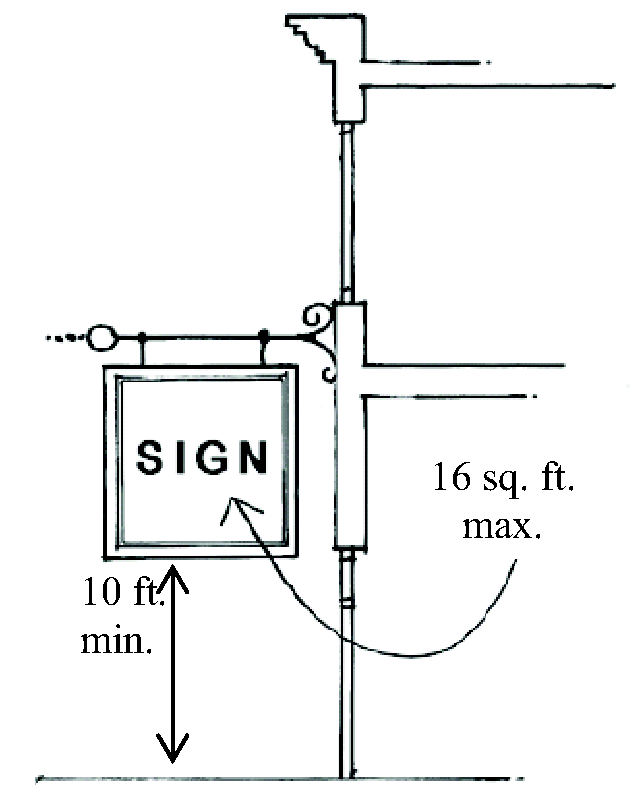
Projecting sign minimum height and maximum area.
5.
Changeable Copy Signs. Changeable copy signs may only be allowed as permanent wall, projecting or freestanding signs designed as either an individual sign or part of another permanent sign. Changeable copy signs when part of another sign shall be designed as an integral part of the sign and not added to the same pole or structure without being designed as part of the original sign. Such signs shall adhere to all other requirements of this chapter.
6.
Electronic Message Signs. Electronic message signs may only be allowed as permanent signs designed as either an individual sign or part of another permanent sign. Each message shall be displayed for a time frame of not less than five seconds. A maximum of one message shall be displayed during each time frame. No continuous or rolling displays shall be permitted. A special use permit will be required for such signs. Such signs shall adhere to Section 17.44.040, procedures applicable to all special uses, and all other requirements of this chapter.
7.
Auxiliary Signs. Auxiliary signs, such as menu boards, shall only be permitted subject to the review and written approval by the zoning code enforcement officer as to whether the sign meets the definition of an auxiliary sign. Such signs shall be calculated independently of the requirements of Section 17.40.070.B, and shall not exceed fifty (50) square feet per lot or use. Such signs shall conform to all height, design, location and other applicable regulations. In the case of menu board signs, the sign area shall not exceed 50 square feet per drive through lane.
8.
Community Information Signs.
a.
Such sign shall be permitted as a conditional use within all zoning districts and upon any property within the jurisdiction of this title (see Section 17.04.080). As such, the review of a request for the erection of a community information sign shall comply with the requirements of Section 17.44.050. The proposed size, configuration, and design of the sign shall be described as part of the conditional use requirements. As a conditional use, the city may revoke the designation of an approved community information sign if such sign fails to comply with the requirements of this title. Such action shall proceed per the requirements of Section 17.44.050.H. Upon revocation, the owner of such sign shall have thirty (30) days to remove the sign at the owner's expense.
b.
Such sign shall only display information regarding events and information of general interest to the residents of Sun Prairie. Copy which may be considered as advertising a product, private or restricted participation event, or activity for private profit shall be prohibited.
c.
Such sign may be located on private or public property.
d.
Such sign shall conform to the visibility standards of Section 17.36.030.
e.
Such sign shall not be counted as adding to the area of signage on the subject property.
9.
Statuary signs. Statuary signs may be allowed in nonresidential zoning districts through the approval of a conditional use permit provided the city determines that the following standards are met:
a.
A maximum of one statuary sign per lot will be allowed.
b.
All such signs shall be set on a decorative base at a minimum of two feet above the average grade and may not exceed fourteen (14) feet in total height.
c.
The maximum permitted area of statuary signs shall be equal to one and one-half square feet of sign area for every one linear foot of nonresidential lot frontage up to a maximum of one hundred fifty (150) square feet per sign face. The sign face for all statuary signs shall be the area of the smallest rectangle which can encompass all words, letters, figures, emblems, and other elements of the sign message.
d.
Statuary signs or parts of signs shall not move or rotate.
e.
Shall comply with Section 17.44.050, standards and procedures applicable to all conditional uses.
(Ord. 600, §§ 2, 3, 5-19-2015; Ord. 512, § 1, 11-20-2012)
17.40.080 - Prohibited signs.
The following signs shall be prohibited except as noted herein or elsewhere in this chapter.
A.
Flashing Signs. No flashing signs shall be allowed except as exempt holiday decorations and displays.
B.
Moving Signs. Except for electronic message signs, no fluttering, undulating, swinging, rotating, or otherwise moving signs, lights or decorations, shall be permitted except as special event signs.
C.
Off-Premises Signs. No off-premises advertising signs shall be permitted except: as provided within the right-of-way of U.S. Highway 151 per applicable State of Wisconsin Statutes, as permitted on the public sidewalk abutting a business to which an A-frame or sandwich board sign permit has been issued in conformance with the standards outlined in Section 17.40.060.A.4, or per the standards outlined in Section 17.40.080.C.1. Off-premises directional signs erected by a government agency or nonresidential institutional land use, or as a nonbusiness temporary sign four square feet in area or less, meeting the definition of a directional sign are permitted off-site.
Rationale: The restriction regarding off-premises signs above, reflects a formal finding of fact on the part of the city of Sun Prairie Plan Commission and City Council that the prohibition of off-premises advertising signage furthers two compelling government interests: (1) the general public interest of reducing visual clutter caused by off-premises advertising signage which the city has determined is a significant cause of unsafe traffic conditions; and (2) the public interest served by furthering the implementation of the purposes of this title and the city of Sun Prairie Comprehensive Plan in terms of limiting the further spread of strip commercial development, of which off-premises advertising signs are a primary contributor. Furthermore, the city advocates that this regulation leaves ample and adequate alternative channels of commercial speech communication for the messages portrayable on such off-premises advertising signs, namely distributed print media, broadcast media, and point-of-purchase display, and is narrowly defined so as to limit such prohibition to commercial speech on exterior signage.
1.
Billboard Replacement Program. An owner of a legally nonconforming billboard sign existing upon the effective date of this chapter may apply for a conditional use permit to replace an existing billboard sign with a digital billboard sign within the following parameters:
a.
The sign shall comply with the standards contained in Section 84.30(4), Wisconsin Statutes.
b.
The area of the digital billboard sign may be equal to or less than the billboard(s) being replaced. Multiple billboards may be removed and the sign area of the eliminated billboards may be added together when calculating the maximum sign area allowable for the digital billboard. In addition, the replacement ratio may be increased to allow the digital billboard to be up to one and one-half times the sign area of the billboard sign(s) to be removed, provided the following standards are met and the city determines that the increase is acceptable in the proposed location. In any instance, the total area of the digital billboard sign shall not exceed the maximum allowable area established in Section 84.30(4), Wisconsin Statutes.
i.
The proposed digital billboard sign incorporates a monopole support with a decorative base;
ii.
Landscaping or other decorative treatment, such as a decorative wall or masonry feature, is provided at the base of the digital billboard in such a manner as to provide an aesthetically pleasing view from any adjacent public streets or highways;
iii.
The digital billboard is made available for periodic messages of public interest as a benefit to the community. The conditions and frequency of such messages shall be determined as part of the conditional use review and approval.
c.
No portion of the digital billboard shall be located closer to the public road right-of-way than the sign it is replacing, nor shall it be located within fifteen (15) feet of any public road right-of-way as calculated by the shortest measurable distance between the nearest point of the sign to the edge of the right-of-way.
d.
The illumination of an off-premises digital billboard sign shall not exceed a brightness level of 0.3 footcandles above ambient light, as measured using a footcandle meter at the following pre-set distances from the base of the sign structure:
300—375 square feet sign face .....150 feet
376—475 square feet sign face .....200 feet
476—672 square feet sign face .....250 feet
The measurement of the brightness level shall be taken with the meter aimed directly at the billboard sign face from the applicable pre-set distance.
f.
No embellishments or cutouts may be utilized on off-premises digital billboard signs.
g.
Shall comply with Section 17.44.050, standards and procedures applicable to all conditional uses.
D.
Portable and Mobile Signs. Portable and mobile signs except those permitted as A-frame or sandwich board signs in Section 17.40.060.A.4.
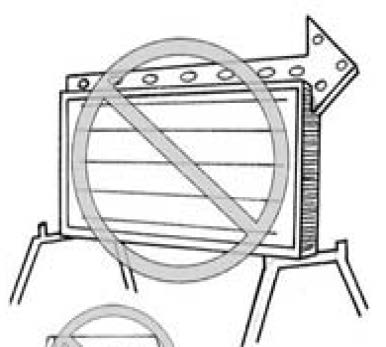
Portable or mobile sign prohibited.
E.
Right-of-Way Signs and Signs on Public Property. No sign unless erected by, or required by, a government agency or temporarily erected to protect the health and safety of the general public such as emergency or warning signs, or A-frame or sandwich board signs permitted under Section 17.40.060.A.4 shall be located within or across any public right-of-way, or on any public property or utility pole. A conditional use permit for any such sign whether permanent or temporary by other than a governmental agency, shall first be approved by the city council upon recommendation from the plan commission per Section 17.44.050.
F.
Roof Signs. Does not apply to signs meeting the definition of integral roof sign.
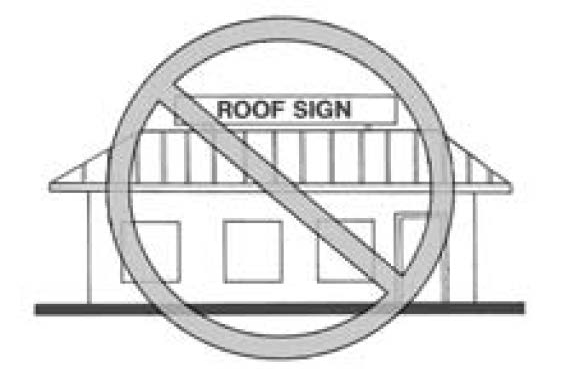
Roof sign prohibited.
G.
Traffic Imitating or Interfering Devices or Signs. No sign shall be erected or maintained at any location where by reason of its position, wording, illumination, size, shape, or color it may obstruct, impair, obscure, interfere with the view of, or be confused with, any authorized traffic control sign, signal or device. No sign shall use any word, phrase, symbol, shape, form, or character in such manner as to interfere with moving traffic, including signs which incorporate typical street-type and/or traffic control-type signage designs and colors.
(Ord. 512, § 1, 11-20-2012)
17.40.090 - Abandonment of business signs.
A.
Abandoned Signs Defined. When the zoning code enforcement officer determines that a business sign is no longer being used in connection with an ongoing business on the lot, the property owner shall be notified in writing that the business sign shall be deemed to be abandoned if, after ninety (90) days for nonconforming signs, or after one hundred eighty (180) days for conforming signs from the date of receipt of the notice, the sign continues to be abandoned.
B.
Removal of Abandoned Signs. All abandoned signs and all associated structural sign supports shall be removed and the grass or pavement restored by the owner of the property within thirty (30) days from the date the sign is deemed by the zoning code enforcement officer to be abandoned.
C.
Extension of Deadline for Removal. If the property owner demonstrates to the satisfaction of the zoning code enforcement officer through documentary evidence that an imminent sale or lease of the property is pending, the zoning code enforcement officer may stay the finding of abandonment and may extend the time for removing the sign and related structures for a period up to ninety (90) days.
(Ord. 512, § 1, 11-20-2012)
17.40.100 - Nonconforming signs.
Nonconforming signs shall not be required to adhere to the general regulations for other nonconforming structures under the zoning ordinance, but shall comply with the following regulations:
A.
Nonconforming Temporary Signs. All signs allowed as temporary signs found not to be in conformance with the provisions of this chapter regardless of when erected shall be removed within thirty (30) days of receiving written notice of noncompliance and removal from the zoning code enforcement officer.
B.
Nonconforming Permanent Signs.
1.
Intent. This section is intended to encourage the eventual elimination of signs which do not comply with this title. The elimination of nonconforming signs is important to the purpose stated in Section 17.40.010. However, it is also the intent of the Ordinance to avoid unreasonable invasion of property rights while accomplishing removal of nonconforming signs.
2.
Compliance. A legally nonconforming sign not complying with this title, but in place on the effective date of this title, shall be brought into compliance with the requirements of this title if one of the following occurs or conditions exist:
a.
The sign is replaced or relocated.
b.
The sign's frame or structural support are replaced or altered in any manner excluding normal maintenance, sign face change, or aesthetic enhancement which does not extend, enlarge or intensify the nonconformity. The "enhancement" of a sign such as the addition of pole covers, or a monument base are permitted as they do not alter the sign's area, height, etc.
c.
No sign which is nonconforming in one respect may be altered even if such change is permitted herein (e.g., if a sign exceeds the maximum height permitted), said sign shall not be enlarged even if such increase in sign area is permitted within this title.
d.
The sign becomes abandoned per Section 17.40.090.
3.
Continuance. A nonconforming sign may be continued if it is maintained in good condition however, it shall not be replaced by another nonconforming sign. It may not be structurally altered so as to prolong the life of the sign, except as otherwise provided in the title. If damaged or destroyed, it may be replaced within one year after the calamity to the size, location, and use that it had immediately before the damage or destruction occurred, if the damage or destruction was caused by violent wind, vandalism, fire, flood, ice, snow, mold, or infestation. The replacement of a sign face of a nonconforming sign shall not be considered the replacement of a sign.
(Ord. 512, § 1, 11-20-2012)

