
Sun Prairie City Zoning Code
CHAPTER 17
36 - PERFORMANCE STANDARDS
17.36.010 - Purpose.
The purpose of this chapter is to indicate the requirements for access, visibility, off-street parking, off-street loading, exterior storage, exterior lighting, vibration, noise, air pollution, odors, electromagnetic radiation, glare and heat, fire and explosion, toxic and noxious materials, waste materials, drainage, exterior construction materials, and hazardous materials for all development occurring within the jurisdiction of this title (see Section 17.04.080). (Prior code § 13-9-1)
17.36.020 - Access standards.
A.
Purpose. The purpose of this section is to alleviate or prevent congestion of public rights-of-way so as to promote the safety and general welfare of the public by establishing minimum requirements for the provision of access to public rights-of-way in accordance with the utilization of various sites.
B.
Permit Required. Each access point onto a public street or right-of-way shall have a permit issued by the city engineer per Wisconsin Statutes 86.07(2).
C.
Number of Access Points.
1.
Each lot shall be permitted up to two access points per street frontage except as provided herein or in subsection 2. Access may be limited for lots on collector or arterial streets, or where traffic safety or congestion concerns exist, as determined by the city engineer. Additional access points may be permitted for lots with more than five hundred (500) feet of frontage where said access would not negatively affect public safety and/or inhibit traffic operations, as determined by the city engineer. All access shall be designed by a registered engineer and shall require approval by the city engineer.
2.
In no instance shall any lot be permitted more than one access point on any one street if its frontage on such street is less than one hundred (100) linear feet (as measured along the right-of-way line).
D.
Residential Uses. Residential uses shall not have access points onto a nonresidential collector or arterial street unless such street has the only available frontage.
E.
Nonresidential Uses. Nonresidential uses shall not have access points onto a residential street unless such street has the only available frontage.
F.
Access Near Street Intersections. At its intersection with the street right-of-way line on an arterial or nonresidential collector street, no access point shall be located closer than one hundred (100) feet from the intersection of any two street rights-of-way unless such street is the only available frontage on the subject property. In all cases, access points shall be located as far from an intersection as the lot size permits.
G.
Distance Between Access Drives. The minimum distance between access drives shall be twenty-five (25) feet (edge to edge), as measured at the property line. A distance in excess of such twenty-five (25) feet may be required if, in the opinion of the city engineer, present or projected traffic factors warrant a greater distance.
H.
Angle of Intersection with Public Right-of-Way. All access drives shall intersect with any public right-of-way at an angle of not less than seventy-five (75) degrees, and shall intersect at an angle of ninety (90) degrees wherever possible.
I.
Distance from Property Line. The distance from an access drive to the property line of an adjacent property shall not be less than five feet, as measured along the right-of-way line.
J.
Width of Driveways. All access drives shall have a maximum width of twenty-four (24) feet for residential uses or forty (40) feet for nonresidential uses, as measured along the right-of-way line and between the curb faces of the access drive.
K.
Traffic Control. The traffic generated by any use shall be channelized and controlled in a manner which avoids congestion on public streets and other safety hazards. Traffic into and out of all off-street parking, loading and traffic circulation areas serving six or more parking spaces shall be forward moving, with no backing into streets or pedestrian ways. Traffic control devices shall be required as determined by the city engineer.
L.
Depiction of Required Site Plan. Any and all proposed access drives on the subject property shall be depicted as to their location and configuration on the site plan required for the development of the subject property. (Refer to Section 17.44.070.)
M.
Paving of Access. All access approach areas located within a street right-of-way shall be paved to the satisfaction of the city engineer with a hard, all-weather surface, and shall be maintained so as to prevent the transport of gravel, dirt, or other eroded material from the subject property into the right-of-way.
(Ord. 745, § 1, 9-18-2018; Ord. 2001-17 (part), 2001; Prior code § 13-9-2)
17.36.030 - Visibility standards.
A.
Purpose. The purpose of this section is to alleviate or prevent congestion of public rights-of-way so as to promote the safety and general welfare of the public by establishing minimum requirements for the provision of vehicular visibility.
B.
Requirement. In order to provide a clear view of intersecting streets to motorists there shall be a triangular area of clear vision formed by the two intersecting streets and a chord connecting such centerlines, as determined by the city engineer. Within such triangular area, no signs, parking spaces, structures, or earthwork in excess of thirty (30) inches, and no vegetation, fencing, nor other such obstructions between thirty (30) inches and eight feet in height which exceeds an opacity of 0.2 shall be permitted which exceeds thirty (30) inches in height above either of the centerline elevations of such two streets.
C.
Depiction of Required Site Plan. Any and all visibility triangles located on the subject property shall be depicted as to their location and configuration on the site plan required for the development of the subject property. (Refer to Section 17.44.070.) (Prior code § 13-9-3)
17.36.040 - Off-street parking and traffic circulation standards.
A.
Purpose. The purpose of this section is to alleviate or prevent congestion of public rights-of-way so as to promote the safety and general welfare of the public by establishing minimum requirements for the provision of off-street parking and circulation in accordance with the utilization of various sites.
B.
Depiction of Required Site Plan. Any and all parking and traffic circulation areas proposed to be located on the subject property shall be depicted as to their location and configuration on the site plan required for the development of the subject property. (Refer to Section 17.44.070.) Each and every parking space designed to serve as required parking shall not be located farther than five hundred (500) feet from the access to all of the various areas it is designated to serve. A garage stall, meeting the access requirements of subsection (F)(4) of this section shall be considered a parking space. Parking spaces for any and all vehicles exceeding eighteen (18) feet in length, shall be clearly indicated the site plan.
C.
Use of Off-Street Parking Areas. The use of all off-street parking areas shall be limited to the parking of operable vehicles which are not for lease, rent, or sale. Within residential zoning districts, such parking spaces shall not be utilized by a trailer, unless such use is designated on the approved site plan for the subject property.
D.
Traffic Circulation and Traffic Control. Site circulation shall be designed to provide for the safe and efficient movement of all traffic entering, exiting, and on the site. Circulation shall be provided to meet the individual needs of the site through a specific mixing of access and through movements. Circulation patterns shall be designed to conform with the general rules of the road and all traffic control measures shall meet the requirements of the Manual of Uniform Traffic Control Devices.
E.
Maintenance of Off-Street Parking and Traffic Circulation Areas. All off-street parking and traffic circulation areas shall be maintained in a dust-free condition at all times. In no instance or manner shall any off-street parking or traffic circulation area be used as a storage area, except as provided for by Section 17.36.060(C)(2).
F.
Off-Street Parking and Traffic Circulation Design Standards.
1.
Surfacing and Marking. All off-street parking and traffic circulation areas (including residential driveways, except those within the RH-35ac or CR-5ac districts) shall be paved with a hard, all-weather surface, to the satisfaction of the city engineer. Such surfaces intended for six or more parking stalls shall be marked in a manner which clearly indicates required parking spaces.
2.
Curbing. All off-street parking areas designed to have head-in parking along any lot line shall provide a tire bumper or curb (as determined by the city engineer) of adequate height and which is properly located to ensure that no part of any vehicle will project beyond the required setbacks of this title (See Chapter 17.24). Curbing within off-street parking areas shall also be required to fully separate required landscaped areas from the parking lot, (See Section 17.32.060(D)).
3.
Lighting.
a.
All off-street parking and traffic circulation areas serving six or more cars shall be lit so as to ensure the safe and efficient use of such areas during the hours of use. An illumination level between 0.4 and 1.0 footcandles is recommended for such areas.
b.
All off-street parking and traffic circulation areas shall be lit so as to not exceed the standards of Section 17.36.070. An illumination level between 0.4 and 1.0 footcandles is recommended for such areas.
4.
Access. Each required off-street parking space shall open directly upon an aisle or driveway that is wide enough and designed to provide a safe and efficient means of vehicular access to the parking space without backing or maneuvering a vehicle into a public right-of-way. All off-street parking and traffic circulation facilities shall be designed with an appropriate means of vehicular access to a street or alley, in a manner which least interferes with traffic movements. No driveway across public property, or requiring a curb cut, shall exceed a width of twenty-four (24) feet for residential uses and forty (40) for nonresidential uses. (See also Table 17.36.040(F)(10).)
5.
Fire Lanes. A fire lane shall be required to provide access to any portion of any structure equal to or less than forty (40) feet tall which is more than one hundred fifty (150) feet from the nearest street right-of-way, and to any portion of any structure greater than forty (40) feet tall which is more than fifty (50) feet from the nearest street right-of-way.
The zoning administrator may also require the provision of a fire lane or lanes to any part of any structure upon a determination that the distance of the structure from the nearest hydrant, the configuration of development on the site, or other special characteristics of the site otherwise inhibit effective fire extinguishment. All fire lanes shall: provide clear, unobstructed access for vehicles and apparatus at all times through a combination of pavement marking and signage; shall be a minimum of eighteen (18) feet wide; and shall be surfaced as an all-weather roadway.
6.
Signage. All signage located within, or related to, required off-street parking or traffic circulation shall comply with the requirements of Chapter 17.40.
7.
Handicapped Parking Spaces. Parking for the handicapped shall be provided at a size, number, location, and with signage as specified by state and federal regulations.
8.
Parking Space Design Standards. Other than parking required to serve the handicapped, every and all provided off-street parking space shall comply with the minimum requirements of Table 17.36.040(F)(10). The minimum required length of ninety (90) degree parking spaces shall be reduced to seventeen (17) feet, including wheel stop, if additional space of one and one-half feet in length is provided for the front overhang of the vehicle. All parking spaces shall have a minimum vertical clearance of at least seven feet.
9.
Snow Storage. Required off-street parking and traffic circulation areas shall not be used for snow storage.
10.
Parking Lot Design Standards. Horizontal widths for parking rows, aisles, and modules shall be provided at widths no less than listed in the following table and shown on the following diagram:
Table 17.36.040(F)(10)
Typical Parking Layout Dimensions
* This dimension represents (D) for one-way traffic. For two-way traffic, add 8.0
feet (D), up to a minimum required (D) of 24.0 feet.
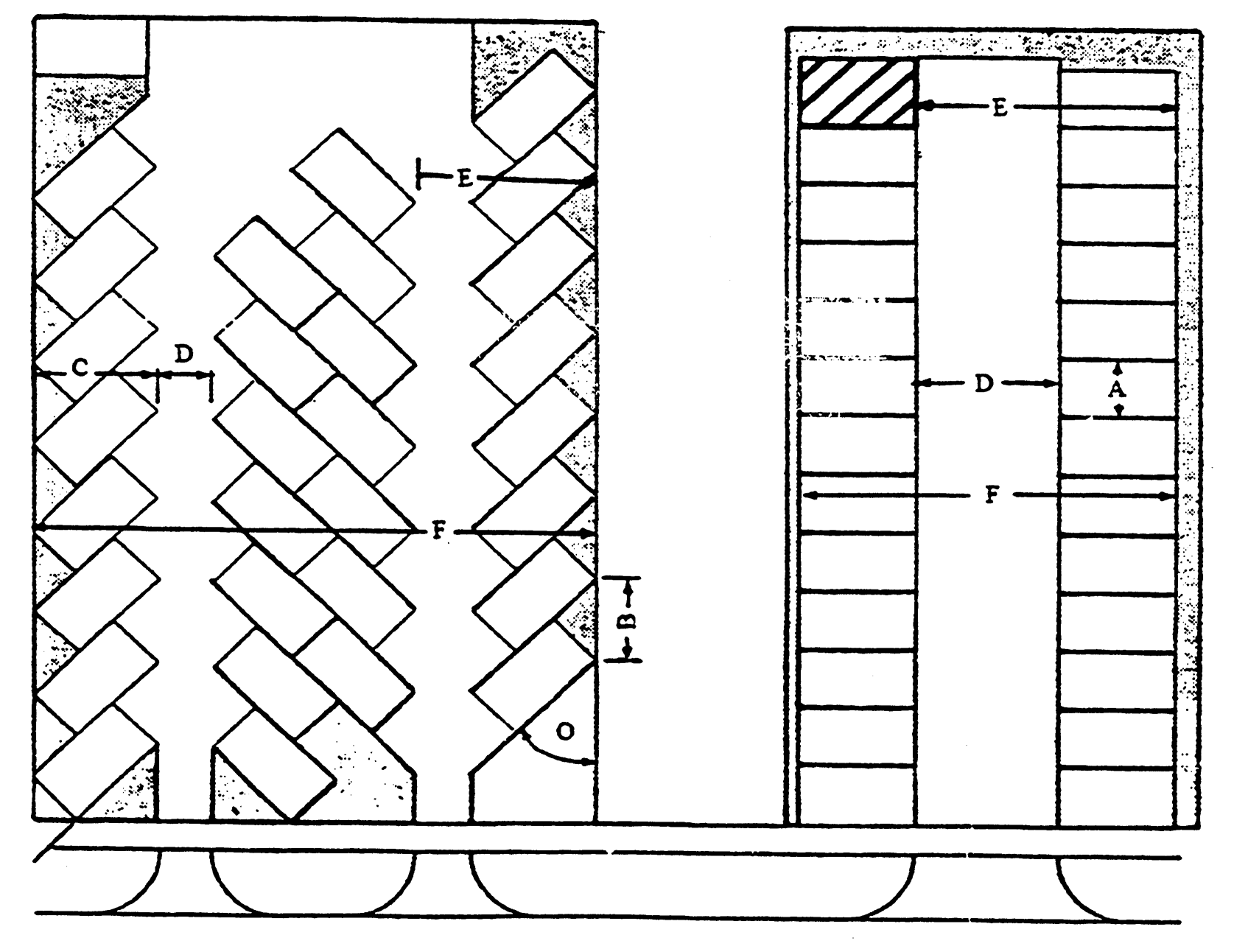
Traffic dimensions
G.
Calculation of Minimum Required Parking Spaces.
1.
General Guidelines for Calculating Required Parking Spaces. The requirements of subsection (G)(3) of this section shall be used to determine the minimum required number of off-site parking spaces which must be provided on the subject property. Requirements are generally tied to the capacity of the use; the gross floor area of the use; or the number of employees which work at the subject property during the largest work shift. The term "capacity" as used herein means the maximum number of persons that may be accommodated by the use as determined by its design or by state Building Code regulations, whichever number is greater. References herein to "employee(s) on the largest work shift" means the maximum number of employees working at the facility during a single given day, regardless of the time period during which this occurs, and regardless of whether any such person is a full-time employee. The largest work shift may occur on any particular day of the week or during a lunch or dinner period in the case of a restaurant. In all cases, one reserved parking space shall be provided for each vehicle used by the operation during business hours. Such spaces shall be in addition to those required by subsection (G)(3) of this section. Where such parking needs of any land use exceed the minimum requirements of this title, additional parking spaces sufficient to meet the average maximum weekly peak-hour parking space demand shall be provided by such land use.
2.
Joint Parking Facilities.
a.
Parking facilities which have been approved by the city engineer to provide required parking for one or more uses, shall provide a total number of parking spaces which shall not be less than the sum total of the separate parking needs for each use during any peak hour parking period when such joint parking facility is utilized at the same time by such uses.
b.
Each parking space designed to serve as joint parking shall not be located farther than five hundred (500) feet from the access to all of the various areas it is designated to serve.
c.
The applicant(s) for approval of a joint parking facility shall demonstrate to the city engineer's satisfaction that there is no substantial conflict in the demand for parking during the principal operating hours of the two of more uses for which the joint parking facility is proposed to serve.
d.
A legally binding instrument, approved by the city administrator, shall be executed by any and all parties to be served by such joint parking facility. This instrument shall be recorded with the register of deeds office, and filed with the city clerk. A fee shall be required to file this instrument (see Section 17.48.050(A)(12)).
3.
Minimum Off-Street Parking Requirements for Land Uses. Each land use shall provide sufficient off-street parking spaces to accommodate average weekly peak hour parking demand. The following requirements shall be the minimum for each land use:
a.
Residential Land Uses. Refer to the specific requirements for each dwelling unit type in Section 17.24.030. Institutional residential uses are presented in subsection (G)(3)(c)(vii) of this section.
i.
Covered parking. When covered parking is required for residential uses, it shall be provided under the building or within a garage, carport, or other suitable covered structure that is compatible with the principal building in terms of architecture. Other parking spaces may be uncovered.
ii.
Senior housing. Senior housing consists of multifamily dwellings that are specifically designed for and occupied exclusively by persons fifty-five (55) years of age or older. The city council may reduce the total number of parking spaces required for senior housing by up to fifty percent (50%) based upon a finding that the proposed development is located within close proximity to services such as grocery, pharmacy, etc., or is adequately served by public transportation. The number of spaces which are required to be covered may be reduced by up to fifty percent (50%) based upon evidence submitted by the developer that the reduction is directly related to parking demand. In no instance shall the number of covered parking spaces be fewer than one per two dwelling units.
b.
Agricultural Land Uses. One space per employee on the largest work shift. (Note: Agricultural land uses are made exempt from the surfacing requirements of subsection (F)(1) of this section.)
c.
Institutional Land Uses.
i.
Passive Outdoor Public Recreational. One space per four expected patrons at maximum capacity for any use requiring over five spaces;
ii.
Active Outdoor Public Recreation. One space per four expected patrons at maximum capacity for any use requiring over five spaces;
iii.
Indoor Institutional. Generally, one space per three expected patrons at maximum capacity. See additional specific requirements below:
(A)
Church. One space per five seats at the maximum capacity,
(B)
Community or Recreation Center. One space per two hundred fifty (250) square feet of gross floor area, or one space per four patrons to the maximum capacity, whichever is greater, plus one space per employee on the largest work shift,
(C)
Funeral Home. One space per three patron seats at the maximum capacity, plus one space per employee on the largest work shift,
(D)
Hospital. Two spaces per three patient beds, plus one space per staff doctor and each other employee on the largest work shift,
(E)
Library or Museum. One space per square feet of gross floor area or one space per four seats to the maximum capacity, whichever is greater, plus one space per employee on the largest work shift;
iv.
Schools.
(A)
Elementary and Junior High. One space per teacher and per staff member, plus one space per two classrooms,
(B)
Senior High. One space per teacher and per staff member on the largest work shift, plus one space per five nonbused students,
(C)
College. One space per staff member on the largest work shift, plus one space per two students of the largest class attendance period,
(D)
Commercial or Trade. One space per three students, plus one space per employee (including faculty) at capacity class attendance period;
v.
Outdoor Institutional. Generally, one space per three expected patrons at maximum capacity. See additional specific requirements below:
(A)
Cemetery. One space per employee, plus one space per three patrons to the maximum capacity of all indoor assembly areas,
(B)
Golf Course. Thirty-six (36) spaces per line nine holes, plus one space per employee on the largest work shift, plus fifty percent (50%) of spaces otherwise required for any accessory uses (e.g., bars, restaurant),
(C)
Swimming Pool. One space per seventy-five (75) square feet of gross water area,
(D)
Tennis Court. Three spaces per court;
vi.
Public Service or Utility. One space per employee on the largest work shift, plus one space per company vehicle normally stored or parked on the premises, plus one space per five hundred (500) square feet of gross square feet of office area;
vii.
Institutional Residential.
(A)
Monastery or Convent. One space per six residents, plus one space per employee on the largest work shift, plus one space per five chapel seats if the public may attend,
(B)
Nursing Home. One space per six patient beds, plus one space per employee on the largest work shift, plus one space per staff member and per visiting doctor;
viii.
Community Living Arrangement (one to eight residents). Same as most similar residential use;
ix.
Community Living Arrangement (nine to fifteen (15) residents). Same as most similar residential use;
x.
Community Living Arrangement (sixteen (16) plus residents). Same as most similar residential use.
d.
Commercial Land Uses.
i.
Office. One space per three hundred (300) square feet of gross floor area;
ii.
Personal or Professional Service. One space per three hundred (300) square feet of gross floor area;
iii.
Indoor Sales or Service. One space per three hundred (300) square feet of gross floor area;
iv.
Permanent Outdoor Display and Sales. Generally, one space per six hundred (600) square feet of display area exceeding fifteen percent (15%) of indoor display on a lot or in a group development. See additional specific requirements below:
Vehicle and equipment sales and rental, and manufactured housing sales as a primary or principal use: two spaces for the first five thousand (5,000) square feet of outdoor display area or portion thereof, and one space for each additional five thousand (5,000) square feet or portion thereof;
v.
Indoor Maintenance Service. One space per three hundred (300) square feet of gross floor area;
vi.
Outdoor Maintenance Service. One space per three hundred (300) square feet of gross floor area;
vii.
In-Vehicle Sales or Service. One space per fifty (50) square feet of gross floor area. Each drive-up lane shall have a minimum stacking length of one hundred (100) feet behind the pass through window and forty (40) feet beyond the pass through window;
viii.
Indoor Commercial Entertainment. One space per every three patron seats or lockers (whichever is greater); or one space per three persons at the maximum capacity of the establishment (whichever is greater);
ix.
Outdoor Commercial Entertainment. One space for every three patron seats at the maximum capacity of the establishment;
x.
Commercial Animal Boarding. One space per every one thousand (1,000) square feet of gross floor area;
xi.
Commercial Indoor Lodging. One space per bedroom, plus one space for each employee on the largest work shift;
xii.
Bed and Breakfast Establishment. One space per bedroom, plus one space for each employee on the largest work shift;
xiii.
Group Day Care Center. One space per seven students, plus one space for each employee or volunteer on the largest work shift, plus one space for each business vehicle;
xiv.
Campground. One and one-half spaces per campsite;
xv.
Boarding or Rooming House. One space per room for rent, plus one space per each employee on the largest work shift;
xvi.
Sexually-Oriented Use. One space per three hundred (300) square feet of gross floor area, or one space per person at the maximum capacity of the establishment (whichever is greater).
xvii.
Commercial Dog Day Care. One space per seven dogs, plus one space for each employee or volunteer on the largest work shift, plus one space for each business vehicle.
xviii.
Household Pet Boarding Facility. One space per seven household pets, plus one space for each employee or volunteer on the largest work shift, plus one space for each business vehicle.
e.
Storage or Disposal Land Uses.
i.
Indoor Storage or Wholesaling. Two spaces for the first ten thousand (10,000) square feet of floor area, one space for every ten thousand (10,000) square feet of floor area above ten thousand (10,000) square feet, plus one space for each employee on the largest work shift for whom a parking requirement has not already been calculated for another use on the site.
ii.
Outdoor Storage or Wholesaling. One space per ten thousand (10,000) square feet of lot area devoted to outdoor storage or wholesaling use, plus one space for every employee on the largest work shift for whom a parking requirement has not already been calculated for another use on the site.
iii.
Personal Storage Facility. One space for each employee on the largest work shift;
iv.
Junkyard or Salvage Yard. One space for every twenty thousand (20,000) square feet of gross storage area, plus one space for each employee on the largest work shift;
v.
Waste Disposal Facility. One space for each employee on the largest work shift;
vi.
Composting Operation. One space for each employee on the largest work shift.
f.
Transportation Land Uses.
i.
Off-Site Parking Lot. No requirement;
ii.
Airport/Heliport. One space per each employee on the largest work shift, plus one space per every five passengers based on average daily ridership;
iii.
Freight Terminal. One space per each employee on the largest work shift;
iv.
Distribution Center. One space per each employee on the largest work shift.
g.
Industrial Land Uses.
i.
Light Industrial. One space per each employee on the largest work shift;
ii.
Heavy Industrial. One space per each employee on the largest work shift;
iii.
Commercial Communication Tower. One space per employee on the largest work shift;
iv.
Extraction Use. One space per each employee on the largest work shift.
H.
Central Commercial District Parking Requirements.
1.
No on-site parking shall be required for nonresidential uses in the central commercial district, unless specifically imposed as a condition of approval associated with a unique or unusual use or situation, as determined by the city council. Parking for the central commercial district is intended to be provided through a combination of on-street parking, municipal parking lots, and private on-site parking facilities. Property owners/applicants are encouraged to provide on-site parking to the extent possible as site conditions permit.
2.
Commercial apartments (allowed through conditional use approval) shall be required to provide parking per the options provided in Section 17.16.140(1)(c).
I.
Locational Prohibitions for Off-Street Parking Areas.
1.
Within any zoning district, no vehicle shall be parked on a property which has no land use relationship to such vehicle.
2.
Off-street parking shall not be located between the principal structure on a residential lot and a street right-of-way, except within residential driveways and parking lots designated on the approved site plan (see Section 17.44.070).
3.
No parking shall occur on street terraces, driveways, or any other areas located within a public right-of-way.
J.
Minimum Permitted Throat Length. The following table shall be used to determine the minimum permitted throat length of access drives serving parking lots, as measured from the right-of-way line along the centerline of the access drive:
_____
K.
Bicycle Parking Development Standards
1.
Purpose. These standards ensure that required bicycle parking is designed so people of all ages and abilities can access bicycle parking and securely lock their bicycle without undue inconvenience. The standards allow for a variety of bicycle types, including but not limited to standard bicycles, tricycles, hand cycles, tandems, cargo bicycles, and electric bicycles. Bicycle parking should be in areas that are reasonably safeguarded from theft and accidental damage. These standards and requirements are designed to promote and encourage the safety and general welfare of the community by:
a.
Encouraging energy efficient modes of transportation.
b.
Encouraging an efficient transportation network.
c.
Encouraging a healthy lifestyle by promoting and accommodating the use of bicycles.
d.
Providing safe and adequate facilities for the short term or long-term storage of bicycles, ensuring that objects such as poles, trees and signs are not used as primary bike parking options.
2.
Application
a.
Bicycle parking outlined in these standards shall be provided for any new building for which a zoning permit application is applied for after the effective date of this section other than those categorically deemed exempt in Table 1: Minimum Number of Bicycle Parking Spaces.
b.
After the effective date of this section, bicycle parking shall also be provided on all sites when an addition to an existing building is constructed that results in an increase of at least twenty percent (20%) in the number of residential units on a lot or an increase of at least twenty percent (20%) in the amount of non-residential gross floor area on a lot. The bicycle parking requirements shall apply to the whole site, inclusive of the twenty-percent (20%) addition.
3.
Exceptions to applicability.
a.
Any land use type not listed in Table 1: Minimum Number of Bicycle Parking Spaces may be required to provide bike parking at the discretion of city staff, if deemed necessary during plan review and approval. If bicycle parking is provided, those facilities shall still meet the bike parking requirements outlined in this section.
i.
Staff may deem long-term bicycle parking necessary as part of development review. In this circumstance, standards for long-term parking should follow the guidelines established in Bicycle Parking Guidelines, 2nd Edition: A set of recommendations from the Association of Pedestrian and Bicycle Professionals.
b.
Specific types of developments that are exempt include, but are not limited to:
i.
Residential buildings containing four or more dwelling units which provide each dwelling a private garage or secure storage space meeting the requirements outlined in K.4.d.
ii.
Residential buildings containing one through three dwelling units.
_____
4.
Standards for all bicycle parking:
a.
Number of Bicycle Parking Spaces. The minimum number of required bicycle parking spaces can be found in Table 1: Minimum Number of Bicycle Parking Spaces.
Table 1: Minimum Number of Bicycle Parking Spaces
b.
Bicycle Parking Area Standards. The area devoted to bicycle parking must be hard surfaced.
c.
Bicycle Racks. Where bicycle parking is provided in racks, the racks must meet the following standards:
i.
The rack must be designed so that the bicycle frame and one wheel can be locked to a rigid portion of the rack with a U-shaped shackle lock, when both wheels are left on the bicycle.
ii.
If the rack is a horizontal rack, it must support the bicycle at two points, including the frame.
iii.
The rack must be securely anchored with tamper-resistant hardware.
d.
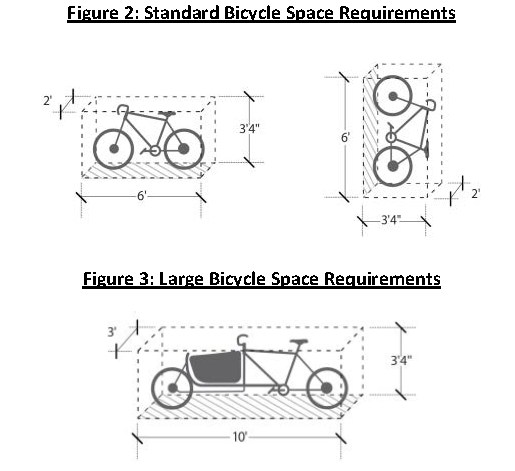
Bicycle parking space, maneuvering area, and clearance dimensions. Bicycle parking spaces, aisles and clearances must meet the minimum dimensions found in Table 2: Minimum Dimensions for Bicycle Parking Spaces and illustrated in Figures 2 and 3.
i.
Standard bicycle parking space requirements:
(A)
The standard required bicycle space is 2-ft wide, 6-ft long and 3-ft, 4-in tall (see Figure 2).
(B)
There must be at least 5-ft behind all bicycle parking spaces (floor racks, or vertical wall mount) to allow room for bicycle maneuvering. Where short term bicycle parking is adjacent to a sidewalk, the maneuvering area may extend into the right of way, but not past the curb line.
(C)
A clearance of 2.5-ft must be provided between the rack and any wall, vegetation, or other object or surface for floor racks.
(D)
Vertical bicycle spacing requirements are 1-ft, 5-in wide, 3-ft, 4-in long, and 6-ft tall (see Figure 2).
ii.
Large bicycle parking space requirements:
(A)
Large bicycle spacing requirements are 3-ft wide, 10-ft long, and 3-ft, 4-in tall (see Figure 3).
Table 2: Minimum Dimensions for Bicycle Parking Spaces
Notes:
[1] The alternative spacing allowed for vertical bicycle parking spaces requires a minimum vertical stagger of 8-in between each space.
.e
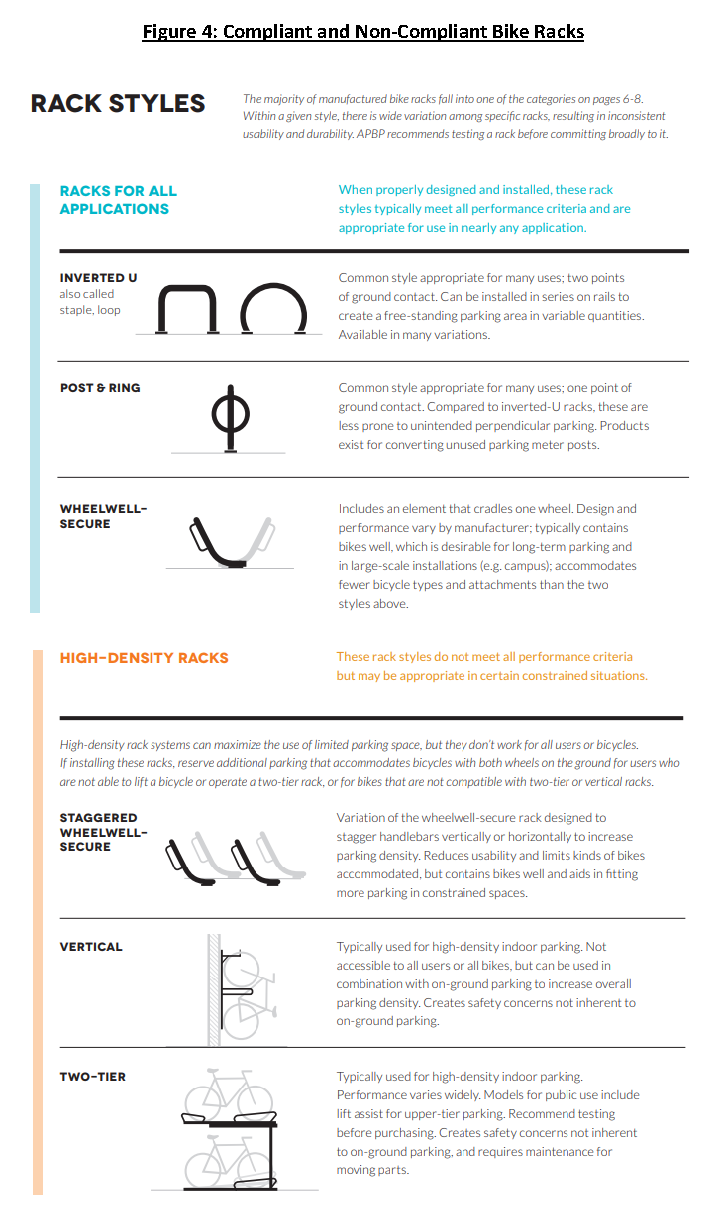
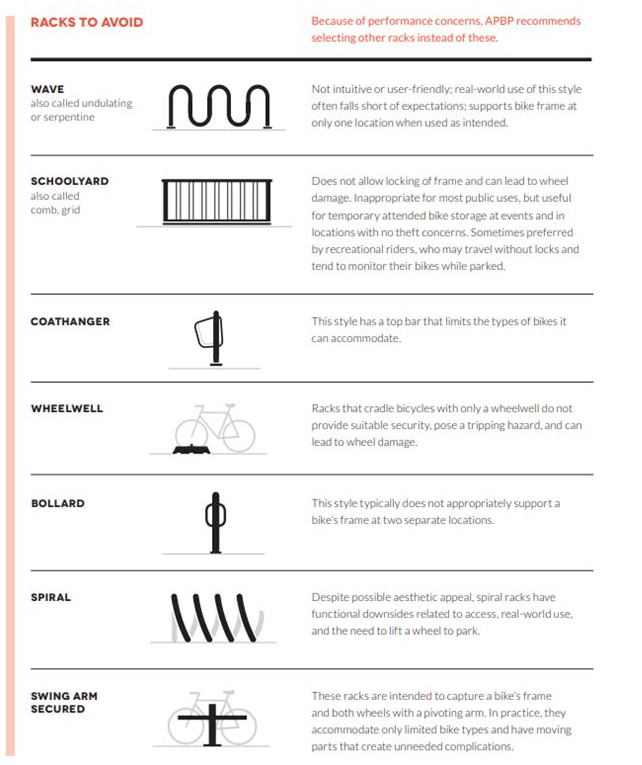
Bicycle parking area standards shall, whenever possible, follow the guidelines established in Bicycle Parking Guidelines, 2 nd Edition: A set of recommendations from the Association of Pedestrian and Bicycle Professionals. General standards from the Association of Pedestrian and Bicycle Professionals are illustrated in Figure 4: Compliant and Noncompliant Bike Racks.
f.
Long-Term Bicycle Parking Standards.
i.
Long-term bicycle parking shall be:
(A)
Covered and protected from the elements.
(B)
Either within the building footprint or located within 15-ft of the entrance to the dwelling unit or a parking structure.
(C)
Designed for use for a period of 2-hrs or more.
ii.
Acceptable forms of long-term bicycle parking include, but are not limited to:
(A)
Bicycle racks within a parking garage with user-only access.
(B)
Bicycle storage lockers capable of being locked by private or building provided lock.
(C)
A storage locker outside of the dwelling unit that has a floor area at least as large as a bicycle storage locker, which is capable of being locked by private or building provided lock.
g.
Short-Term Bicycle Parking Standards.
i.
Short term bicycle parking must meet the following standards:
(A)
Location:
(I)
On-site, outside a building.
(II)
At the same grade as the sidewalk or path or at a location that can be reached by an accessible route.
(III)
Within 50-ft from a main entrance as measured along the most direct pedestrian access route.
(1)
Exceptions to this may be at shared bike parking sites, in which case distance from all entrances must be met per section K.5.a.
(B)
Should be publicly accessible, and designed for use for a period of less than 2-hrs.
h.
Large Bicycle Parking.
i.
Large bicycle parking is not required in this ordinance. However, land uses such as daycares, elementary schools, grocery stores, or other land uses where families are expected to frequent, are encouraged to use the dimensions in Figure 3 for some portion of their short-term bike parking spaces.
5.
Shared Bicycle Parking Facilities.
a.
For sites containing multiple uses or tenants, a single bicycle parking area may be provided as long as the total number of bicycle parking spaces provided is not less than the sum of all the primary uses combined. The shared facility shall be located within 100-ft of each participating building entrance.
(Ord. No. 885, § 1, 3-15-2022; Ord. 395, § 2, 1-20-2009; Ord. 385, § 1, 11-18-2008; Ord. 262, § 1, 6-20-2006; Ord. 154, § 4, 8-3-2004; Ord. 2003-95 § 1, 2003; Ord. 2002-48 § 1, 2002; Ord. 2001-18, 2001; Ord. 2001-17 (part), 2001; Ord. 563, 2001; prior code § 13-9-4)
_____
17.36.050 - Off-street loading standards.
A.
Purpose. The purpose of this section is to alleviate or prevent congestion of public rights-of-way and private lots so as to promote the safety and general welfare of the public by establishing minimum requirements for the provision of loading facilities on various sites.
B.
Applicability. Any use which has a gross floor area of six thousand (6,000) square feet or more, and which requires deliveries or makes shipments, shall provide off-street loading facilities in accordance with the regulations of this section.
C.
Location. All loading berths shall be located twenty-five (25) feet or more from the intersection of two street right-of-way lines. Loading berths shall not be located within any required front yard setback area, or within any street side yard setback area. Access to the loading berth shall be located in conformance with Section 17.36.020. All loading areas shall be located on the private lot and shall not be located within, or so as to interfere with, any public right-of-way.
D.
Size of Loading Area. The first required loading berth shall be designed in accordance with Table 17.36.050(D). All remaining required loading berths shall be a minimum of twenty-five (25) feet in length. All required loading berths shall have a minimum vertical clearance of fourteen (14) feet.
The following standards shall be the minimum used to design loading areas:
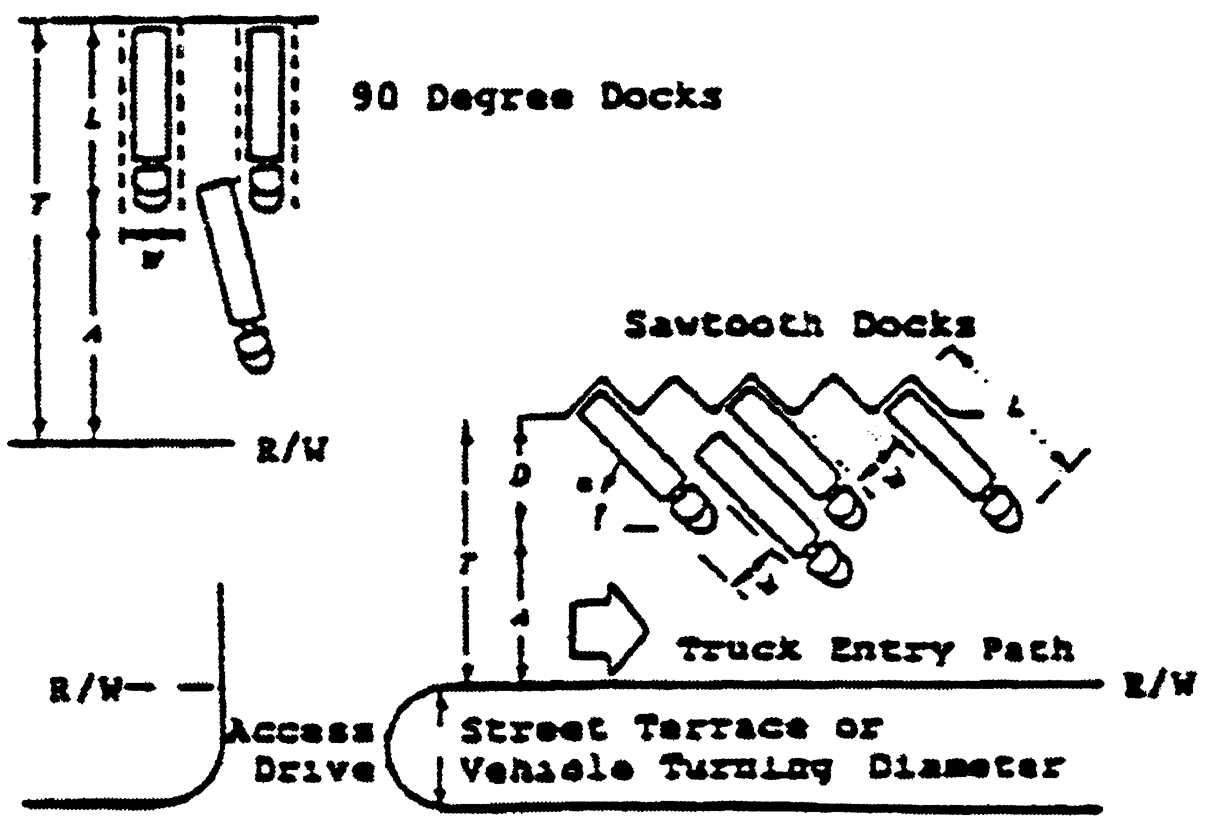
Table 17.36.050
E.
Access to Loading Area. Each loading berth shall be located so as to facilitate access to a public street or alley, and shall not interfere with other vehicular or pedestrian traffic per Section 17.36.040, and shall not interfere with the function of parking areas. In no instance shall loading areas rely on backing movements into public rights-of-way.
F.
Surfacing and Marking. All required loading areas shall be paved and maintained in a dust-free condition at all times. Such surface shall be marked in a manner which clearly indicates required loading areas.
G.
Use of Required Loading Areas. The use of all required loading areas shall be limited to the loading and unloading of vehicles. Such area shall not be used to provide minimum required parking spaces.
H.
Lighting. All loading areas shall be lit so as to not exceed the standards of Section 17.36.070.
I.
Signage. All signage located within, or related to, loading areas shall comply with the requirements of Chapter 17.40.
J.
Minimum Permitted Throat Length. The following table shall be used to determine the minimum permitted throat length of access drives serving parking lots, as measured from the right-of-way line along the centerline of the access drive:
K.
Calculation of Required Loading Spaces.
1.
Indoor Institutional Land Uses. One loading berth shall be required for each building having a gross floor area of six thousand (6,000) square feet to twenty-nine thousand nine hundred ninety-nine (29,999) square feet. For such uses located in buildings having a gross floor area of thirty thousand (30,000) square feet or greater, two loading berths shall be required.
2.
Commercial (except Offices), Storage/Disposal, Transportation, and Industrial Land Uses. One loading berth shall be required for each building having a gross floor area of six thousand (6,000) square feet to twenty-nine thousand nine hundred ninety-nine (29,999) square feet. For such uses located in buildings having a gross floor area of thirty thousand (30,000) square feet or greater, an additional loading berth shall be required for any portion of each fifty thousand (50,000) square feet of gross floor area in addition to the original twenty-nine thousand nine hundred ninety-nine (29,999) square feet.
3.
Office Land Uses. One loading berth shall be required for each building having a gross floor area of six thousand (6,000) square feet to ninety-nine thousand nine hundred ninety-nine (99,999) square feet. For such uses located in buildings having a gross floor area of one hundred thousand (100,000) square feet or greater, an additional loading berth shall be required for any portion of each one hundred thousand (100,000) square feet of gross floor area in addition to the original ninety-nine thousand nine hundred ninety-nine (99,999) square feet. (Ord. 2004-125; prior code § 13-9-5)
17.36.060 - Exterior storage standards for residential, office and commercial districts.
A.
Purpose. The purpose of this section is to control the use of residential, office and commercial property for off-street parking and exterior storage of passenger vehicles, commercial vehicles, commercial equipment, materials, recreational vehicles and oversize vehicles so as to promote the safety and general welfare of the public. For exterior storage in agricultural and industrial districts, refer to Sections 17.16.060 through 17.16.160.
B.
Requirements for the Off-street Parking and Exterior Storage of Materials, Equipment, and Commercial Equipment in Residential Zoning Districts.
1.
In all residential zoning districts (see Section 17.12.020 for a listing of these districts), all materials, equipment, and commercial equipment and implements shall be prohibited except for firewood, landscaping materials associated with active on-site landscaping projects, and construction materials and related equipment connected with on-site construction. These items shall not be located within any front yard or required street yard, except for the duration of an active landscaping or construction project, and shall not be stored closer than five feet from a property line. Commercial equipment is allowed to be parked and stored on residential property provided that it is temporarily parked for the purpose of loading and unloading, but only for the time it takes to load and unload, the equipment is engaged in the performance of a service on the property for a period of time reasonably necessary to complete the service and/or such equipment is parked, placed, or stored in a legally constructed fully enclosed structure which meets the requirements of the zoning district.
C.
Requirements for Exterior Storage and/or Off-Street Parking of Passenger Vehicles, Commercial Vehicles, Recreational Vehicles, and Oversize Vehicles in Residential Zoning Districts.
1.
In all residential districts, passenger vehicles, commercial vehicles, and recreational vehicles that do not exceed twenty-two (22) feet in length and/or have a gross vehicle weight of less than ten thousand (10,000) pounds, are permitted to be parked and stored outdoors on a residential property provided that the parking and storage complies with each of the following:
a.
There is no limit to the number of passenger, commercial, and recreational vehicles parked or stored provided that they are parked or stored within a completely enclosed building that meets the standards of this title;
b.
The total number of vehicles parked and stored outside shall not exceed four vehicles per residence;
c.
No more than two of the vehicles parked and stored outside on a single-family or two-family lot can be trailers, commercial vehicles or recreational vehicles;
d.
Parking or storage is allowed in the front yard or required street yard as long as it occurs on a paved surface such as a driveway leading to the garage of the residence or other space adjacent to the driveway that is designated for such purpose and having a like surface treatment or paved with asphalt, concrete, or paving blocks;
e.
Vehicles must be parked perpendicular to the street except where they are parked on a curved or circular driveway;
f.
A minimum two-foot setback shall be maintained between the sidewalk and any part of the vehicle including the hitch or tongue of a trailer. If there is not a sidewalk, the vehicle may be parked up to the right-of-way line or ten (10) feet from the back edge of the curb, whichever is greater; and
g.
The parked and stored vehicles shall comply with subsections (C)(5) through (C)(11), below.
h.
Exemptions include occasional gatherings where the maximum number of vehicles parked outside is exceeded for a short period of time, and occasional delivery trucks, service vehicles, or moving vans parked on the property for short periods of time.
2.
Parking and Storage of Oversized Commercial Vehicles. In all residential districts, the parking and storage of oversized commercial vehicles, (commercial vehicles that exceed twenty-two (22) feet in length and/or have a gross vehicle weight of greater than ten thousand (10,000) pounds) is prohibited.
3.
Parking and Storage of Oversized Recreational Vehicles. In all residential districts, the storage of oversized recreational vehicles (i.e., recreational vehicles that exceed twenty-two (22) feet in length and/or have a gross vehicle weight of greater than ten thousand (10,000) pounds) is allowed only with the approval of a conditional use permit. Parking of oversized recreational vehicles is prohibited in residential districts except as seasonal parking as provided in Section 17.36.060(C)(4). A conditional use permit may be granted if the request meets each of the following standards:
a.
No more than one oversized vehicle shall be stored outside on a residential property at any given time.
b.
Storage shall take place in the rear yard or in the side yard. If parked in the side yard, no portion of the vehicle shall extend in front of the residence. The vehicle shall be at least five feet from the rear and side property lines.
c.
The oversized vehicle shall be stored on a parking pad designated for such purpose and having a surface treatment of asphalt, concrete, paving blocks, decorative stone, or other surface treatment approved through the conditional use permit.
d.
Any oversized vehicle stored on a residential property shall be reasonably screened from adjacent residential properties and the public street. Screening shall consist of evergreen vegetation, a fence, or some combination thereof. The evergreen vegetation shall take into account the mature spread of the plantings and the space within which they are intended to grow, as well as the soil and light conditions present. The trees shall be at a minimum four feet tall when planted and shall be planted in accordance with the spacing recommendation for the species selected. The plan shall be reviewed as part [of] the conditional use permit. If unique circumstances suggest the need for an alternative screening method, the alternative method may be reviewed as part of the conditional use permit.
e.
The storage vehicle must comply with subsections (C)(5) through (C)(10), below.
f.
Shall comply with Section 17.44.050, standards and procedures applicable to all conditional uses.
4.
Exception for Seasonal Parking of Oversized Recreational Vehicles. In all residential districts, oversized recreational vehicles, that exceed twenty-two (22) feet in length and/or have a gross vehicle weight of greater than ten thousand (10,000) pounds) may be parked outdoors on a residential property between April 1 and November 30 each year, provided that the parking complies with the following:
a.
No more than one oversized recreational vehicle may be parked outside on a residential property at any given time.
b.
Parking is allowed in the front yard or required street yard as long as it occurs on a paved surface such as a driveway leading to the garage of the residence or other space adjacent to the driveway that is designated for such purpose and having a like surface treatment or paved with asphalt, concrete, or paving blocks. No part of the vehicle shall be closer than five feet from the side lot line.
c.
Parking is also allowed in locations which have been approved for storage during the off-season.
d.
The vehicle must be parked perpendicular to the street except where they are parked on a curved or circular driveway.
e.
A minimum two-foot setback shall be maintained between the sidewalk and any part of the vehicle including the hitch or tongue of a trailer. If there is no sidewalk, the vehicle can be parked up to the right-of-way line or ten (10) feet from the back of the curb, whichever is greater.
f.
Such seasonal parking shall comply with subsections (C)(6) through (C)(10), below.
5.
Temporary Off-Season Loading and Unloading. An oversized recreational vehicle may be temporarily parked on a residential property for loading and unloading purposes for a period not to exceed forty-eight (48) hours prior to and forty-eight (48) hours subsequent to a vacation, trip, or other extended use of the vehicle during the off-season (December 1 to March 31 each year). Temporary parking for this purpose shall comply with the provisions for seasonal parking contained in subsection (C)(4).
6.
Recreational vehicles stored or parked on residential property must be owned by the resident who is occupying the property on which the vehicle is being parked or stored.
7.
All stored or parked vehicles must display current vehicle registration tags.
8.
Stored or parked vehicles shall not be used for dwelling purposes, sleeping or for permanent living, and shall not be used for storage of goods, material, or equipment, other than those items considered to be part of the vehicle or essential for its immediate use.
9.
Permanent connection to water, gas, electric, or sanitary sewer services is prohibited. Temporary utility hook-ups shall be permitted for a period not to exceed seventy-two (72) hours for loading and unloading.
10.
All areas around the vehicles shall be kept weed-free and free of other accumulated storage material.
11.
Commercial vehicles less than twenty-two (22) feet in length shall be owned by the resident of the property or the resident's employer.
D.
Requirements for Exterior Storage in Office and Commercial Districts. In all office and commercial zoning districts (see Section 17.12.020 for a listing of these districts), all materials and equipment shall be stored within a completely enclosed building except for the following which shall not be located within any front yard or required street yard (except for vehicles in designated parking spaces) and shall be stored a minimum of five feet from any and all property lines: screened refuse containers; construction materials, landscape materials and related equipment connected within on-site construction; and off-street parking of passenger vehicles and commercial vehicles not defined as commercial equipment and implements.
E.
Inoperative Motor Vehicles and Junk. Refer to Section 10.28.080 of the city code of ordinances.
(Ord. 593, § 2, 3-17-2015; Ord. 459, § 2, 3-15-2011; Ord. 442, § 1, 9-21-2010; prior code § 13-9-6)
17.36.070 - Exterior lighting standards.
A.
Purpose. The purpose of this section is to regulate the spill-over of light and glare on operators of motor vehicles, pedestrians, and land uses in the vicinity of a light source in order to promote traffic safety and to prevent the creation of nuisances.
B.
Applicability. The requirements of this section apply to all private exterior lighting within the jurisdiction of this title, except for lighting within public rights-of-way and/or lighting located on public property.
C.
Depiction of Required Site Plan. Any and all exterior lighting shall be depicted as to its location, orientation and configuration on the site plan required for the development of the subject property. (Refer to Section 17.44.070.)
D.
Requirements.
1.
Orientation of Fixture. In no instance shall an exterior lighting fixture be oriented so that the lighting element (or a transparent shield) is visible from a property located within a residential zoning district. The use of shielded luminaires and careful fixture placement is encouraged so as to facilitate compliance with this requirement.
2.
Intensity of Illumination. In no instance shall the amount of illumination attributable to exterior lighting, as measured at the property line, exceed 0.50 footcandles.
3.
Location. Light fixtures shall not be located within required bufferyards.
4.
Flashing, Flickering and Other Distracting Lighting. Flashing, flickering and/or other lighting which may distract motorists are prohibited. (Refer to Section 17.40.080(G).)
5.
Minimum Lighting Standards. All areas designated on required site plans for vehicular parking, loading, or circulation and used for any such purpose after sunset shall provide artificial illumination in such areas at a minimum intensity of 0.4 footcandles.
6.
Nonconforming Lighting. All lighting fixtures existing prior to the effective date of this title shall be considered as legal conforming uses. (Refer to Section 17.16.170.)
7.
Special Events Lighting. Any temporary use using exterior lighting which is not in complete compliance with the requirements of this section shall secure a conditional use permit. (Refer to Section 17.44.050.)
(Ord. 513, § 3, 11-20-2012; prior code § 13-9-7)
17.36.080 - Vibration standards.
A.
Purpose. The purpose of this section is to regulate the creation of vibration which adversely effects adjoining properties in order to prevent the creation of nuisances and to promote the general welfare of the public.
B.
Applicability. The requirements of this section apply to all uses and activities which create detectable vibrations, except that these standards shall not apply to vibrations created during the construction of the principal use on the subject property.
C.
Depiction of Required Site Plan. Any activity or equipment which create detectable vibrations outside the confines of a building shall be depicted as to its location on the site plan required for the development of the subject property. (Refer to Section 17.44.070.)
D.
Requirements.
1.
No vibration shall be produced which is discernible through the air or through the ground without the aid of instruments at any point beyond the boundaries of the subject property.
2.
No earthborne vibration in excess of the displacement values set forth in this subsection. Such vibration shall comply with all three of the given maximum permitted displacement levels. Vibration shall be measured for displacement, with an instrument capable of simultaneously measuring in three mutually perpendicular directions. The maximum vector resultant shall be less than the maximum level of permitted displacement. Such maximum permitted displacement levels shall be determined by the following formula:
D = k/f where:
Constant k by type of vibration:
(Prior code § 13-9-8)
17.36.090 - Noise standards.
A.
Purpose. The purpose of this section is to regulate the creation of noise which adversely effects adjoining properties in order to prevent the creation of nuisances and to promote the general welfare of the public.
B.
Applicability. The requirements of this section apply to all uses and activities which create detectable noise, except that these standards shall not apply to noise created during the construction of the principal use on the subject property, or by incidental traffic, parking, loading, maintenance or agricultural operations.
C.
Requirements. All noise shall be muffled so as not be objectionable due to intermittence, beat frequency or shrillness. In no event shall the sound-pressure level of noise radiated continuously from a facility exceed at the lot line of the subject property the values given in Table 17.36.090(C)(1) (set out hereafter) as measured by a sound meter, where such lot abuts property within any residential, office, commercial zoning district, or the suburban industrial (SI) district. (See Section 17.12.020.)
Table 17.36.090(C)(1)
Maximum Permitted Noise Level at Lot Line for Noise Radiated Continuously*
* If the noise is not smooth and continuous or is present only during daytime hours, one or more of the corrections, in Table 17.36.090(C)(2) below, shall be added to or subtracted from each of the decibel levels given above in Table 17.36.090(C)(1).
Table 17.36.090(C)(2)
Adjustment Factors for Maximum Noise Levels
* Apply one of these corrections only.
(Prior code § 13-9-9)
17.36.100 - Air pollution standards.
A.
Purpose. The purpose of this section is to regulate the creation of air pollution which adversely effects adjoining properties in order to prevent the creation of nuisances and to promote the general welfare of the public.
B.
Applicability. The requirements of this section apply to all land uses and activities, except that these standards shall not apply to air pollution created during the construction of the principal use on the subject property, or by incidental traffic, parking, loading, or maintenance operations.
C.
Standards.
1.
The emission, from all sources within any lot, of particulate matter containing a particle diameter larger than forty-four (44) microns is prohibited.
2.
Emission of smoke or particulate matter of density equal to, or greater than Number 2 on the Ringelmann Chart (US Bureau of Mines) is prohibited at all times.
3.
Dust and other types of air pollution borne by the wind from such sources as storage areas, yards, and roads within the boundaries of any lot shall be kept to a minimum by appropriate landscaping, paving, oiling or other acceptable means. (Prior code § 13-9-10)
17.36.110 - Odor standards.
A.
Purpose. The purpose of this section is to regulate the creation of odor which adversely effects adjoining properties in order to prevent the creation of nuisances and to promote the general welfare of the public.
B.
Applicability. The requirements of this section apply to all land uses and activities, except that these standards shall not apply to odors created during the construction of the principal use on the subject property, or by incidental traffic, parking, loading, or maintenance operations. Public landfills and public sanitary sewage treatment plants shall be exempted from the requirements of this section as essential public services.
C.
Standards. Except for food preparation and cooking odors emanating from residential land uses, and odors associated with property development and maintenance (such as construction, lawn care, and the painting and roofing of structures), no odor shall be created for periods exceeding a total of fifteen (15) minutes per any day which are detectable (by a healthy observer such as the zoning administrator or a designee who is unaffected by background odors such as tobacco or food) at the boundary of the subject property, where such lot abuts property within any residential, office, commercial zoning district, or the suburban industrial (SI) district. (See Section 17.12.020.) (Prior code § 13-9-11)
17.36.120 - Electromagnetic radiation standards.
A.
Purpose. The purpose of this section is to regulate the creation of electromagnetic radiation which adversely effects adjoining properties in order to prevent the creation of nuisances and to promote the general welfare of the public.
B.
Applicability. The requirements of this section apply to all land uses and activities.
C.
Standards. It is unlawful to operate or cause to be operated any planned or intentional source of electromagnetic radiation for such purposes as communication, experimentation, entertainment, broadcasting, heating, navigation, therapy, vehicle velocity measurement, weather survey, aircraft detection, topographical survey, personal pleasure, or any other use directly or indirectly associated with these purposes which does not comply with the then current regulations of the Federal Communications Commission regarding such sources of electromagnetic radiation. Further, such operation in compliance with the Federal Communications Commission is unlawful if such radiation causes an abnormal degradation in performance of other electromagnetic radiators or electromagnetic receptors of quality and proper design because of proximity, primary field, blanketing, spurious radiation, harmonic content, modulation or energy conducted by power or telephone lines. The determination of "abnormal degradation in performance" and "of quality and proper design" shall be made in accordance with good engineering practices as defined in the latest principles and standards of the American Institute of Electrical Engineers, the Institute of Radio Engineers, and the Electronic Industries Association. In case of any conflict between the latest standards and principles of the above groups, the following precedence in the interpretation of the standards and principles shall apply: (1) American Institute of Electrical Engineers, (2) Institute of Radio Engineers, and (3) Electronic Industries Association. (Prior code § 13-9-12)
17.36.130 - Glare and heat standards.
A.
Purpose. The purpose of this section is to regulate the creation of glare or heat which adversely effects adjoining properties in order to prevent the creation of nuisances and to promote the general welfare of the public.
B.
Applicability. The requirements of this section apply to all land uses and activities, except that these standards shall not apply to glare created during the construction of the principal use on the subject property, or by incidental traffic, parking, loading, or maintenance operations.
C.
Standards. No direct or sky-reflected glare, whether from floodlights or from temperature processes such as combustion or welding or otherwise, so as to be visible at the lot line of the subject property shall be permitted. (See also, Section 17.36.070.) Furthermore, there shall be no transmission of heat or heated air so as to be discernible (by a healthy observer such as the zoning administrator or a designee) at the lot line. Solar systems regulated by Wisconsin Statutes 66.03 shall be entitled to the protections of its provisions. (Prior code § 13-9-13)
17.36.140 - Fire and explosion standards.
A.
Purpose. The purpose of this section is to regulate the creation of fire and/or explosion hazards which adversely effect adjoining properties in order to prevent the creation of nuisances and to promote the general welfare of the public.
B.
Applicability. The requirements of this section apply to all land uses and activities.
C.
Standards. Any use involving materials which could decompose by detonation shall locate such materials not less than four hundred (400) feet from any residential or office zoning district (see Section 17.12.020), except that this standard shall not apply to the storage or usage of liquefied petroleum or natural gas for normal residential or business purposes. All activities and storage of flammable and explosive materials at any point shall be provided with adequate safety and fire fighting devices in accordance with all fire prevention codes of the state of Wisconsin. (Prior code § 13-9-14)
17.36.150 - Toxic or noxious material standards.
A.
Purpose. The purpose of this section is to regulate the handling of toxic or noxious material which adversely effects adjoining properties in order to prevent the creation of nuisances and to promote the general welfare of the public.
B.
Applicability. The requirements of this section apply to all land uses and activities.
C.
Standards.
1.
No use shall discharge across the boundaries of the subject property, or through percolation into the subsoil, toxic or noxious material in such concentration as to be detrimental to, or endanger, the public health, safety, comfort, or welfare, or cause injury or damage to the property or business.
2.
No use shall discharge at any point into any public or private sewage disposal system or stream, or into the ground, any liquid or solid materials except in accordance with the regulations of the Wisconsin Department of Public Health. (Prior code § 13-9-15)
17.36.160 - Waste material standards.
A.
Purpose. The purpose of this section is to regulate the handling of waste material which adversely effects adjoining properties in order to prevent the creation of nuisances and to promote the general welfare of the public.
B.
Applicability. The requirements of this section apply to all land uses and activities.
C.
Standards.
1.
No use shall discharge across the boundaries of the subject property, or through percolation into the subsoil, toxic or noxious material in such concentration as to be detrimental to, or endanger, the public health, safety, comfort, or welfare, or cause injury or damage to the property or business.
2.
No use shall discharge at any point into any public or private sewage disposal system or stream, or into the ground, any liquid or solid materials except in accordance with the regulations of the Wisconsin Department of Natural Resources. (Prior code § 13-9-16)
17.36.170 - Drainage standards.
A.
Purpose. The purpose of this section is to regulate the creation of drainage which adversely effects adjoining properties in order to prevent the creation of nuisances and to promote the general welfare of the public.
B.
Applicability. The requirements of this section apply to all land uses and activities.
C.
Standards. No land shall be developed and no use shall be permitted that results in water runoff which causes property damage, a nuisance, and/or erosion on adjacent properties. Such runoff shall be properly conveyed to a public storm drain, drainageway or other such public drainage facility per the approval of the city engineer. (Prior code § 13-9-17)
17.36.180 - Exterior construction material standards.
A.
Purpose. The purpose of this section is to regulate the use of certain exterior construction materials creation so as to attain a degree of uniformity in exterior appearance, and thus maintain and enhance the attractiveness and property value of certain zoning districts.
B.
Applicability. The requirements of this section apply to all land uses and activities.
C.
Standards: All Residential, Office and Commercial Zoning Districts. Except for exposed foundations not to exceed three feet in height, no buildings or structures located within a residential, office, or commercial zoning district (see Section 17.12.020) shall employ nondecorative concrete block or nonresidential-type metal siding on its visible exterior in the following portions of the structure or building: (1) any portion of the building or structure visible from adjacent residentially zoned property; (2) any portion of the building or structure located within fifty (50) feet of a public right-of-way; or (3) any other portion of the building or structure situated at an angle of sixty (60) degrees or less: from a line which is parallel to the nearest right-of-way (for uncurved rights-of-way); or from a line which is parallel to a chord connecting the right-of-way boundary on the inside side of the curve at points located at, or opposite from, the two outer boundaries of the subject property along the right-of-way line (for curved rights-of-way). (Prior code § 13-9-18)
17.36.190 - Hazardous materials standards.
A.
Purpose. The purpose of this section is to provide information to the city regarding the nature of land uses which involve research, production, storage, disposal, handling, and/or shipment of hazardous materials.
B.
Applicability. The requirements of this section apply to all land uses and activities involving any one or more of the following:
1.
Micro-organism cultures subject to Wisconsin Statutes 94.65;
2.
Pesticides subject to Wisconsin Statutes 94.67(25);
3.
Biological products subject to Wisconsin Statutes 95.39;
4.
Hazardous substances subject to Wisconsin Statutes 100.37(1)(c);
5.
Toxic substances subject to Wisconsin Statutes 101.58(2)(j);
6.
Infectious agents subject to Wisconsin Statutes 101.58(2)(f);
7.
Any material for which the state of Wisconsin requires notification of a local fire department;
8.
Any other uses, activities, or materials which are subject to county, state, or federal hazardous, or related, materials regulations.
C.
Standards. All land uses involving such hazardous materials shall submit a written description of such materials and the operations involving such materials conducted on their property as part of the required site plan submittal (see Section 17.44.070). (Prior code § 13-9-19)
17.36.200 - Fencing standards.
A.
Purpose. The purpose of this section is to regulate the materials, location, height, and maintenance of fencing, landscaping walls and decorative posts in order to prevent the creation of nuisances and to promote the general welfare of the public.
B.
Applicability. The requirements of this section apply to all fencing, landscape walls and decorative posts equal to, or exceeding, thirty (30) inches in height, for all land uses and activities.
C.
Standards.
1.
Materials.
a.
Residential Districts. Acceptable materials for constructing fencing, landscape walls, and decorative posts include wood, stone, brick, wrought iron, chain link, and wire mesh, except that chain link or wire mesh fencing is not permitted within required front yard or street yard areas. An exception for the use of chain link fencing within a required front or street yard to replace an existing chain link fence around an existing school playground may be approved where deemed to be appropriate by the zoning administrator, provided all other standards contained in this section are adhered to.
b.
Nonresidential Districts. Acceptable materials for constructing fencing, landscape walls, and decorative posts include wood, stone, brick, wrought iron, chain link, and wire mesh. Barbed wire fencing is permitted on security fences at heights equal to or greater than five and one-half feet (66").
c.
Temporary Fencing. Temporary fencing, including the use of wood or plastic snow fences for the purposes of limiting snow drifting, protection of excavation and construction sites, and the protection of plants during grading and construction is permitted.
d.
Snow Fences. Snow fences constructed of wood and wire, and/or plastic shall be permitted only as temporary fences.
e.
Alternative fencing materials not listed above in subsections (C)(1)(a) through (d) of this section may be considered with the approval of a conditional use permit per Section 17.44.050. A sample of the proposed fencing material and design shall be provided by the applicant for evaluation at the time of application filing. In addition, the applicant must demonstrate and the city council, after hearing the recommendation of the plan commission, must determine that the following conditions are being met prior to the approval of the conditional use permit.
i.
The proposed fence is decorative in appearance and appropriate for use in its proposed setting;
ii.
The proposed fence will be constructed of appropriately durable materials for its intended use and setting; and
iii.
The proposed fencing is determined to be equal to or higher in aesthetic quality than what would otherwise be permitted in its proposed location as per subsections (C)(1)(a) through (d) above.
2.
Location. On all properties, no fence, landscape wall, or decorative post shall be located closer than two feet to the front yard or street yard property line. Fences may be located on any property line abutting a side or rear yard.
3.
Maximum Height. The maximum height of any fence, landscape wall, or decorative post shall be the following:
a.
Four feet when located within a required front yard or required street yard on any residentially zoned property;
b.
Six feet when located on any residentially zoned property, but not within a required front yard or a required street yard;
c.
Six feet when located on any nonresidentially zoned property, except that security fences may exceed this height per subsection (C)(3)(d) of this section and fences for outdoor storage or wholesaling in the HI zoning district per Section 17.16.090(B) as a special use;
d.
The maximum heights listed for subsection (C)(3)(a) through (c) of this section may be exceeded with the approval of a conditional use permit per Section 17.44.050 when located within a required front yard, or with the approval of a special use permit when located beyond a required front yard but within a required street per Section 17.44.040. The following conditions (at a minimum) shall be established for such requests:
i.
The increase in height shall in no way further obstruct vision for intersecting streets, driveways, sidewalks or other traffic areas,
ii.
The fence shall be screened on its external side with adequate plants so as to maintain an attractive appearance to such side,
iii.
The fence shall be setback from the property line beyond the requirement of subsection (C)(2) of this section such distance as appropriate to contain adequate landscaping per subsection (C)(3)(d)(ii) of this section, and so as to maintain an attractive relationship to fence's external side.
iv.
Conditions in (ii) and (iii) above may be waived for fencing associated with school playground areas if deemed appropriate by the city council.
4.
Orientation. Any and all fences, landscape walls, or decorative posts shall be erected so as to locate visible supports and other structural components toward the subject property.
5.
Maintenance. Any and all fences, landscape walls, or decorative posts shall be maintained in a structurally sound and attractive manner.
(Ord. No. 880, § 1, 2-15-22; Ord. 2003-79 §§ 1—3, 2003; Prior code § 13-9-20)
17.36.210 - Administration and enforcement of performance standards.
A.
Determinations necessary for administration and enforcement of performance standards set forth herein range from those which can be made with satisfactory accuracy by a reasonable person using normal senses and no mechanical equipment, to those requiring great technical competence and complex equipment for precise measurement. It is the intent of this title that:
1.
Where determinations can be made by the zoning administrator using equipment normally available to the city or obtainable without extraordinary expense, such determinations shall be so made before notice of violations is issued.
2.
Where technical complexity or extraordinary expense makes it unreasonable for the city to maintain the personnel or equipment necessary for making difficult or unusual determinations, procedures shall be available for causing corrections or apparent violations of performance standards, for protecting individuals from arbitrary, capricious, and unreasonable administration and enforcement of performance standard regulations, and for protecting the general public from unnecessary costs for administration and enforcement.
a.
The zoning administrator shall give written notice, by certified mail or other means, ensuring a signed receipt for such notice to the person or persons responsible for the alleged violations. The notice shall describe the particulars of the alleged violation and the reasons why the zoning administrator believes there is a violation in fact, and shall require an answer or correction of the alleged violation to the satisfaction of the zoning administrator.
b.
The notice shall state, and it is declared, that failure to reply or to correct the alleged violation to the satisfaction of the administrative official within the time limit set constitutes admission of violation of the terms of this title. The notice shall further state that upon request of those to whom it is directed, technical determination as described in this title will be made, and that if violations as alleged are found, costs of such determinations shall be charged against those responsible for the violation, in addition to such other penalties as may be appropriate, but that if it is determined that no violation exists, the cost of the determination will be paid by the city.
B.
Enforcement of the provisions of this chapter shall be per Section 17.48.060.
(Prior code § 13-9-21)
17.36.220 - Design standards and conditional use permit requirement for large developments in the suburban commercial (SC) and urban commercial (UC) zoning districts.
A.
Applicability. The following design standards and conditional use permit requirement for large developments shall apply to all new buildings and uses in the city that are located within the suburban commercial (SC) and urban commercial (UC) zoning districts and the building footprint are in excess of twenty-five thousand (25,000) gross square feet. The design standards and conditional use permit requirement for large developments in the suburban commercial (SC) and urban commercial (UC) zoning districts are required in addition to the general performance standards of Chapter 17.36 of the zoning ordinance. In the event of conflicting provisions, the more restrictive shall control. The design standards and conditional use permit requirement for large developments in the suburban commercial (SC) and urban commercial (UC) zoning districts shall also be applied to all building additions to an existing building within the suburban commercial (SC) or urban commercial (UC) zoning district which brings the total building footprint size to over twenty-five thousand (25,000) gross square feet. This twenty-five thousand (25,000) square foot building footprint limit shall apply to individual freestanding buildings including any future additions or buildings and to group developments including any future additions to buildings or future buildings in which the combined total of the footprints of all structures within a development (regardless of diverse lotting, use or tenancy) combine to more than twenty-five thousand (25,000) square feet. The words "within a development" shall mean single building or multi-building projects including any buildings additions or future buildings that share a common theme, share common ingress and egress, share common parking areas and/or other aspects that bind them together as a unified project.
B.
Definition. "Large development" means individual freestanding buildings including any future additions or buildings and group developments including any future additions to buildings or future buildings in which the combined total of the footprint area of all structures within a development (regardless of diverse lotting, use or tenancy) combine to more than twenty-five thousand (25,000) square feet.
C.
Purpose. These standards and the conditional use permit requirement are intended to ensure that all large development is compatible with the surrounding area and contributes to the unique character of Sun Prairie.
D.
Development Standards.
1.
Aesthetic Character.
a.
Facades and Exterior Walls.
i.
Facades (all sides of building) greater than one hundred (100) feet in length, measured horizontally, shall incorporate wall plane projections or recesses having a depth of at least three percent (3%) of the length of the facade and extending at least twenty percent (20%) of the length of the facade. No uninterrupted length of any facade shall exceed one hundred (100) horizontal feet (see Figure 1 at the end of this section).
ii.
Ground floor facades that face public streets shall have arcades, display windows, entry areas, awnings or other such features along no less than sixty percent (60%) of their horizontal length (see Figure 1).
b.
Small Retail Stores. Where principal buildings contain additional, separately owned stores that occupy footprint areas of less than twenty-five thousand (25,000) square feet, with separate, exterior customer entrances, the street level facade of such stores shall be transparent (e.g. windows) between the height of three feet and eight feet above the walkway grade for no less than sixty percent (60%) of the horizontal length of the building facade of such additional stores.
c.
Detail Features. Building facades must include:
i.
A repeating pattern that includes no less than three of the following elements:
(A)
Color change;
(B)
Texture change;
(C)
Material module change;
(D)
An expression of architectural or structural bays through a change in plane no less than twelve (12) inches in width, such as an offset, reveal, or projecting rib (see Figure 2 at the end of this section).
Note: At least one of elements (A), (B) or (C) above shall repeat horizontally. All elements shall repeat at intervals of no more than thirty (30) feet, either horizontally or vertically.
d.
Roofs. Roofs shall have no less than two of the following features with the exception that subsection (D)(1)(d)(i) of this section shall be required for all structures:
i.
Parapets concealing flat roofs and rooftop equipment such as HVAC units from public view. The average height of such parapets shall not exceed fifteen percent (15%) of the height of the supporting wall and such parapets shall not at any point exceed one-third of the height of the supporting wall. Such parapets shall feature three dimensional cornice treatment (see Figure 3 at the end of this section);
ii.
Overhanging eaves, extending no less than three feet past the supporting walls (see Figure 3);
iii.
Sloping roofs that do not exceed the average height of the supporting walls, with an average slope greater than or equal to one foot of vertical rise for every three feet of horizontal run and less than or equal to one foot of vertical rise for every one foot of horizontal run;
iv.
Three or more roof slope planes.
e.
Materials and Colors.
i.
Predominant exterior building materials shall be high quality materials, including, but not limited to, brick, stone, and tinted/textured concrete masonry units.
ii.
Facade colors shall be low reflectance, subtle, neutral or earth tone colors. The use of high intensity colors, metallic colors, black or fluorescent colors shall be prohibited.
iii.
Building trim and accent areas may feature brighter colors, including primary colors, but neon tubing shall not be an acceptable feature for building trim or accent areas.
iv.
Exterior building materials shall not include smooth faced concrete block, tilt-up concrete panels, or prefabricated steel panels.
2.
Entryways.
a.
Each principal building on a site shall have clearly defined, highly visible customer entrances featuring no less than three of the following:
i.
Canopies or porticos;
ii.
Overhangs;
iii.
Recesses/projections;
iv.
Arcades;
v.
Raised corniced parapets over the door;
vi.
Peaked roof forms;
vii.
Arches;
viii.
Outdoor patios;
ix.
Display windows;
x.
Architectural details such as tile work and moldings which are integrated into the building structure and design;
xi.
Integral planters or wing walls that incorporate landscaped areas and/or places for sitting.
b.
Where additional stores will be located in the principal building, each such store shall have at least one exterior customer entrance, which shall conform to the above requirements.
3.
Site Design and Relationship to Surrounding Community.
a.
Entrances. All sides of a principal building that directly face an abutting public street shall feature at least one customer entrance. Where a principal building directly faces more than two abutting streets, this requirement shall apply only to two sides of the building, including the side of the building facing the primary street, and another side of the building facing a second street.
b.
Parking Lot Location. No more than fifty percent (50%) of the off street parking area for the lot, tract, or area of land devoted to the large retail establishment shall be located between the front facade of the principal building(s) and the abutting streets.
c.
Back Sides of Buildings. The minimum setback for any building facade shall be thirty-five (35) feet from the nearest property line. Where the facade faces adjacent residential uses, an earthen berm, no less than six feet in height, containing at a minimum evergreen trees planted at intervals of twenty (20) feet on center, or in clusters or clumps shall be provided.
d.
Connectivity. The site design must provide direct connections and safe street crossings to adjacent land uses.
4.
Pedestrian Circulation.
a.
Sidewalks at least eight feet wide in width shall be provided along all sides of the lot that abuts a public street.
b.
Continuous internal pedestrian walkways, no less than eight feet in width, shall be provided from the public sidewalk or right-of-way to the principal customer entrance of all principal buildings on the site. At a minimum, walkways shall connect focal points of pedestrian activity such as, but not limited to, transit stops, street crossings, building and store entry points, and shall feature adjoining landscaped areas that include trees, shrubs, benches, flower beds, ground covers, or other such materials for no less than fifty percent (50%) of the length of the walkway.
c.
Sidewalks, no less than eight feet in width, shall be provided along the full length of the building along any facade featuring a customer entrance, and along any facade abutting public parking areas. Such sidewalks shall be located at least six feet from the facade of the building to provide planting beds for foundation landscaping, except where features such as arcades or entryways are part of the facade.
d.
Internal pedestrian walkways provided in conformance with subsection (D)(4)(b) of this section shall provide weather protection features such as awnings or arcades within thirty (30) feet of all customer entrances.
e.
All internal pedestrian walkways shall be distinguished from driving surfaces through the use of durable, low maintenance surface materials such as pavers, bricks, or scored concrete to enhance pedestrian safety and comfort, as well as the attractiveness of the walkways.
5.
Delivery/Loading Operations. No delivery, loading, trash removal or compaction, or other such operations shall be permitted between the hours of ten p.m. and seven a.m. unless the applicant submits evidence that sound barriers between all areas for such operations effectively reduce noise emissions to a level of forty-five (45) decibels, as measured at the lot line of any adjoining property.
6.
Central Features and Community Space. Each large development subject to these standards shall contribute to the establishment or enhancement of community and public spaces by providing at least two of the following: patio seating area, pedestrian plaza with benches, transportation/transit center, window shopping walkway, outdoor playground area, kiosk area, water feature, clock tower, or other such deliberately shaped area and/or a focal feature or amenity that, in the judgment of the city council, adequately enhances such community and public spaces. Any such areas shall have direct access to the public sidewalk network and such features shall not be constructed of materials that are inferior to the principal materials of the building and landscape.
7.
Landscaping Standards. Note: In addition to the landscaping and bufferyard standards described in Chapter 17.32, Sections 17.32.010 through 17.32.030 and 17.32.070 through 17.32.130 of the city of Sun Prairie zoning ordinance, the following landscaping standards shall apply to all large developments in the suburban commercial (SC) and urban commercial (UC) zoning districts. In the event of conflicting provisions, the more restrictive shall control.
a.
One two and one-half inch to three inch caliper canopy shade tree shall be required for every twelve (12) parking spaces. In addition, one two and one-half inch to three inch caliper canopy shade tree shall be required for the first eleven (11) parking spaces. To calculate the number of trees required, divide the number of parking stalls by twelve (12) and add one.
b.
In parking lots containing fifty (50) spaces or more with two drive aisles or more, or two or more parking bays, at least fifty percent (50%) of the required canopy shade trees shall be planted in interior landscape islands, each having a minimum area of eighty (80) square feet of ground area per tree.
c.
At least ten percent (10%) of the interior space of all parking lots shall be landscaped areas.
d.
Each landscaped island shall include one or more canopy shade trees. Each landscaped island shall be of length greater than eight feet in its smallest dimension. All landscaped islands shall have raised concrete curbs.
e.
The required trees contribute no points toward the required landscape plan total of six landscaping points for every parking space. The required six landscaping points per parking space shall be accumulated on the basis of the following landscaping point values for individual landscape elements:
Six Landscaping Points Per Parking
Space Requirement
Note: required trees (as described in (D)(7)(a) of this section) are not included in the six landscape points per parking stall point count.
f.
Street Frontages and Side Lot Lines. Canopy shade trees shall be provided at a ratio of one tree per twenty lineal feet along a public street and one tree per forty (40) lineal feet along a side lot line parking setback area. Perimeter landscaping along a street may be located in and should be integrated with the streetscape in the street right-of-way. Trees required along street frontages shall not contribute to the point total of six points per parking stall.
g.
Parking Lot Screening. All parking lots shall be screened from adjacent uses and from the street through the use of decorative fences or walls, earthen berms, dense hedges, or a combination thereof. Where street screening is required, plans submitted for city review shall include a graphic depiction of the parking lot screening as seen from the street. Plant materials used for screening shall achieve effective visual screening of the parking areas during all seasons of the year.
h.
Driveway and Drive Aisle Screening. Driveways through or to parking lots shall have one canopy shade tree per forty (40) lineal feet of and along each side of such driveway or drive aisle, in landscape areas within five feet of such driveway or drive aisle.
i.
Screening of Visually Intrusive Site Elements. Landscape and building elements shall be used to screen areas of low visual interest or visually intrusive site elements (such as trash collection, open storage, service areas, loading docks, and blank walls) from off-site view. Such screening shall be established on all sides of such elements except where an opening is required for access. If access is possible only on a side that is visible from a public street, a removable or operable screen shall be required.
j.
Screening Materials. Required screening shall be provided in the form of new or existing plantings, decorative walls and fences, topographic changes, buildings or a combination of these techniques.
k.
Building Foundation Screening. Exposed sections of building walls that are in high use or high visibility areas of the building exterior shall have planting beds at least five feet wide placed directly along at least fifty percent (50%) of such walls.
Note: See Figures 1, 2 and 3.
E.
Conditional Use Permit Requirement for Large Developments. Large developments within the suburban commercial (SC), and urban commercial (UC) zoning districts are only allowed if a conditional use permit is granted to the applicant for such large development by the city. (Refer to Section 17.44.050 for conditional use permit review and approval requirements.)
(Ord. 164, §§ 1—3, 11-16-2004)
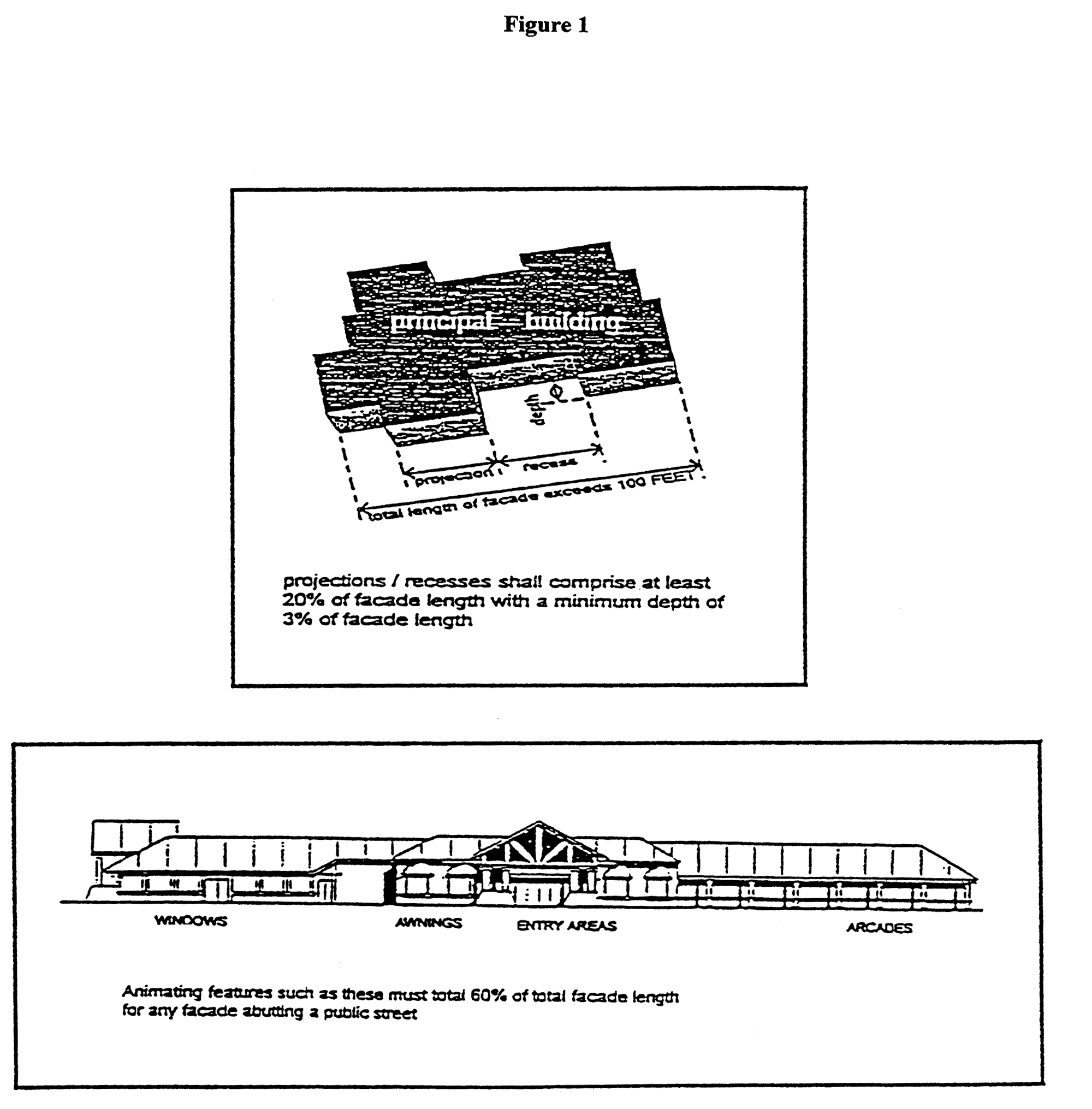
Figure 1
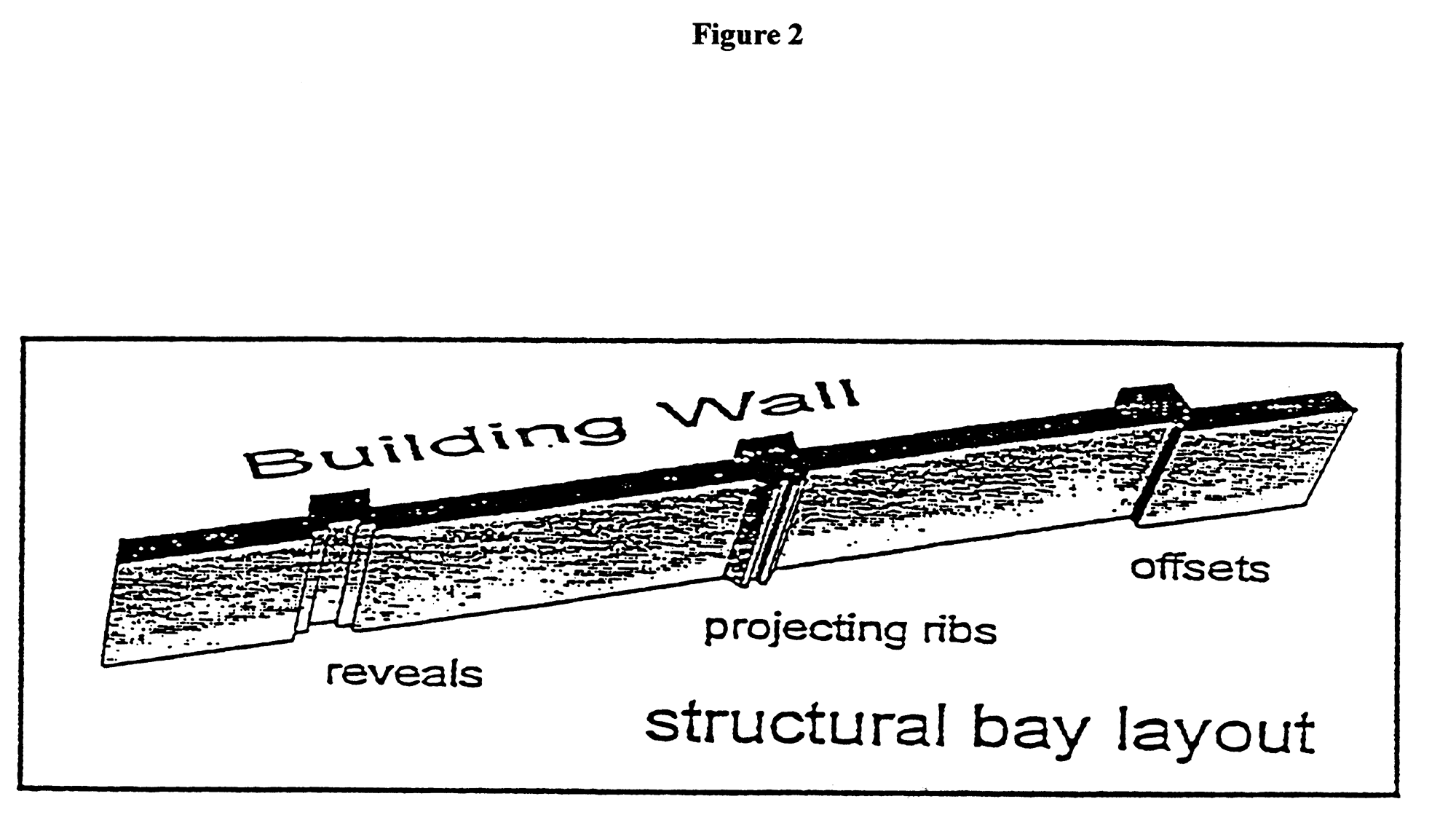
Figure 2
Expression of Architectural or Structural Bay.
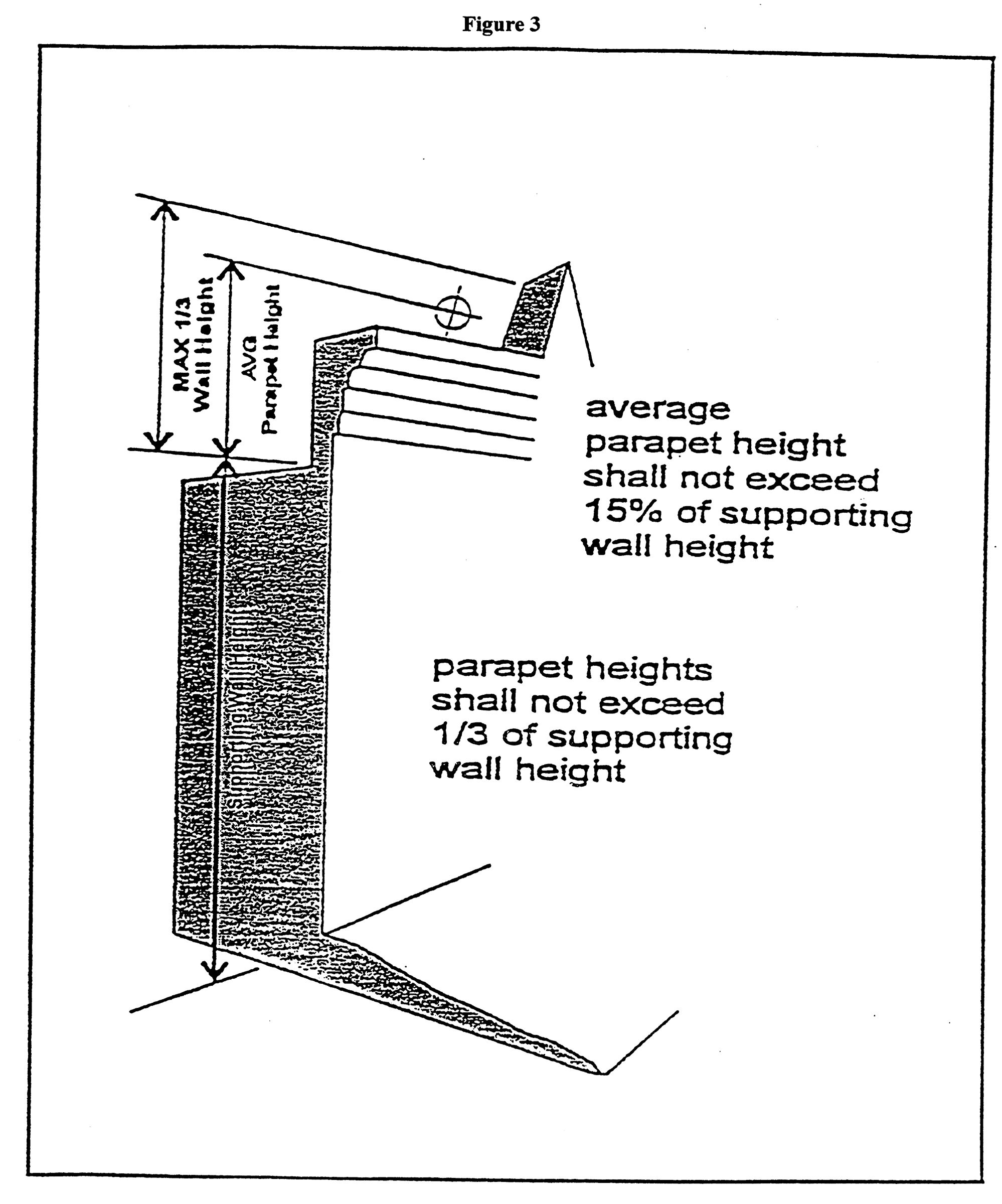
Parapet Standards.
(Ord. 511, 2000; prior code § 13-9-22)
17.36.230 - Design standards for developments in the suburban industrial (SI) zoning district.
A.
Purpose. The purpose of this chapter is to establish standards to guide the appearance of development (i.e., new construction, building additions and site alterations) occurring within the suburban industrial (SI) zoning district, so that areas zoned for suburban industrial use, including the Sun Prairie Business Park, have a consistently high quality and character.
B.
Applicability. The following design standards shall be met for any of the following activities that occur on properties located within the suburban industrial (SI) zoning district:
1.
New development,
2.
Redevelopment,
3.
Expansions or alterations of buildings greater than 2,500 SF, or
4.
Expansion or reconfiguration of loading or parking areas
Review for compliance will occur at the time of application for special use permit, conditional use permit, zoning permit, or any other review that is required under this title for the development activities being proposed. Compliance with these design standards is required in addition to the general performance standards of Chapter 17.36 of the zoning ordinance. In the event of conflicting provisions, the more restrictive shall control.
C.
Request for Relief. Applicants who cannot meet one or more of these standards due to space constraints or other conditions, or proposed to meet the intent of a standard by other means, may seek relief through the approval of a conditional use permit. A conditional use permit may be approved provided that the city determines that the following standards are met:
1.
The requested use is compatible with existing or planned surrounding land uses;
2.
Exceptions or reductions from landscape bufferyard and screening standards are kept to a minimum;
3.
The public benefit resulting from flexibility in design standards are justified; and
4.
The standards for all conditional use permits contained in Section 17.44.050 are met.
D.
Site Design Standards. It is the intent of this section to ensure safe vehicle and pedestrian circulation patterns, encourage an aesthetically pleasing, high quality setting, and to mitigate visual and environmental impacts associated with on-site activities, such as parking and storage.
1.
Internal Circulation & Parking (NOTE: See Section 17.36.040 for additional requirements).
a.
Concrete curb shall be required in all parking, circulation drives, islands, between principal building and street frontage, except in cases of breaks for pedestrian or bicycle paths, stormwater runoff per an approved stormwater management plan.
b.
All sites shall provide safe pedestrian or bicycle connections to the public right-of-way. Sidewalks shall be a minimum of five feet wide, or ten (10) feet for multi-use paths.
c.
The minimum throat length of access drives shall be 25-feet, unless a greater length required by Section 17.36.040(J).
d.
Landscaped islands shall be provided within parking areas at a rate of not less than one island per each linear row of twenty (20) spaces. All tree islands shall be a minimum of eight feet wide, measured from inside the curb.
e.
Parking areas shall not extend into required setbacks or bufferyard areas.
2.
Loading, Storage and Service Areas (NOTE: See Sections 17.36.050, 17.36.060 and 17.16.110 for additional requirements).
a.
Loading dock(s) shall not face or be highly visible from a public street or residentially-zoned property. Where this requirement is infeasible due to situations such as multiple street frontages or limited lot size, the loading dock(s) shall be sited and/or screened (per Section 17.36.230(E)) to mitigate undesirable views, noise and light associated with the loading dock and its use.
b.
Below-grade doors providing access to underground parking are allowed on any facade.
c.
At-grade garage doors designed for vehicular entry to the building, excluding those identified in (b) of this section, shall not face the primary street frontage.
d.
At-grade garage doors, excluding those identified in (b) of this section, along the side of a building visible from a public street shall meet at least two of the following criteria:
i.
Overhead door panels shall be one hundred (100) percent clear glass.
ii.
Pavement providing access to the garage door shall not exceed thirty (30) feet in length from the door, excluding a drive aisle.
iii.
Views of this pavement area and the garage door(s) shall be partially obscured from the street with screening and/or landscaping at least three feet in height, consistent with the standards of Section 17.36.230(F).
e.
Dumpsters, trash and recycling containers, street-level mechanical equipment (e.g, gas meters, air conditioners, etc.), and any permitted outdoor storage shall be located or screened, per Section 17.36.230(F), so that they are substantially hidden from view from any adjacent public street, highway corridor, and/or residentially zoned property. This provision does not apply to solar panels or fixtures, which are encouraged.
3.
Utilities.
a.
Utility appurtenances, such as transformers, telecommunications devices, equipment switching boxes and other utility cabinets, shall be located and oriented to allow visual screening from public rights-of-way, neighboring parcels and pedestrian walkways on the same parcel, while allowing maintenance access. This provision does not apply to solar panels or fixtures, which are encouraged.
4.
Signs and Graphics (NOTE: See Section 17.40 for additional requirements).
a.
Roof signs, interchange signs, pole/pylon signs, and projecting signs are prohibited.
E.
Building Design Standards. It is the intent of this section to promote quality design and material selections while allowing for flexibility to avoid rigid uniformity of design.
1.
Design Form, Massing and Articulation.
a.
All buildings on a property, including accessory buildings, shall utilize a consistent design style, materials and color palette.
b.
Any facade greater than one hundred (100) feet in length, measured horizontally, shall incorporate at least two of the following techniques.
i.
Wall plane projections or recesses having a depth of at least one foot and extending at least twenty (20) percent of the length of the facade.
ii.
Height variations, with a minimum of twenty (20) percent of the facade differ in height from the rest of the façade by at least four feet, measured eave to eave or parapet to parapet.
iii.
Variation in building material and/or color.
iv.
The establishment of repeating patterns of building articulation along the full length of the façade.
v.
Landscaping at intervals along the façade that incorporates conifer trees of at least six feet in height at time of installation.
2.
Building Entrances.
a.
Buildings shall have clearly defined, highly visible customer entrances featuring architectural elements, such as canopies or porticos, overhangs, arcades, raised parapets, arches or roof forms.
3.
Rooftop Equipment & Venting Systems.
a.
Rooftop mechanical equipment, including powered vents, but not including solar panels or fixtures, shall be substantially hidden from view from any adjacent public street, highway corridor, and/or residentially zoned property using one the following techniques:
i.
On pitched roofs equipment shall be located on the least visible side of the roof.
ii.
On flat roofs there shall be a parapet wall to hide equipment. Installation of equipment that extends higher than the parapet will be allowed if that equipment is set back from the wall a sufficient distance so as not to be visible from any adjacent public street.
iii.
Where equipment cannot be hidden through siting and building design, the equipment shall be screened with a solid fence or panel that matches the color of the nearest wall (when on a flat roof) or the color of the roof (when on a pitched roof). Such screening should generally be several times wider than the equipment, but no taller than the equipment, to avoid the effect of creating simply a larger vertical protrusion. The screening system shall be considered as part of overall building design and review.
b.
If still partially visible from adjacent public street, rooftop mechanical equipment and venting systems (including passive vents) shall match the color of the roof or corresponding façade (whichever is visible with the equipment).
4.
Building Colors and Materials.
a.
The following exterior cladding materials are permitted: face brick, precast/poured concrete panels, concrete masonry units, cut stone, metal wall panel and siding systems, EIFS, stucco, and clear or lightly tinted glass.
b.
For any facade facing the public street, the following exterior cladding materials shall not cover more than forty (40) percent of said façade, either individually or in aggregate of: smooth-faced concrete masonry units, and metal wall and siding panel systems.
c.
The following exterior cladding materials are prohibited: vinyl, wood, corrugated metal, gravel aggregate or horizontal seam metal siding.
d.
Building materials susceptible to damage by vehicles or maintenance equipment, including metal siding/panels and EIFS are prohibited on the lower three (3) feet above grade adjacent to a paved and/or lawn area.
e.
Exterior cladding finishes and colors are subject to the following requirements:
i.
All materials and finishes shall be low reflectance.
ii.
Colors shall be subtle, neutral and/or earth tone on ninety (90) percent of each facade.
iii.
Brighter colors, including primary colors, may be used as an accent, covering no more than ten (10) percent of any building façade.
iv.
High intensity, metallic or fluorescent finishes are prohibited.
v.
The use of corporate colors on exterior cladding is permitted, within the preceding limitations.
F.
Landscape Design Standards. It is the intent of this section to encourage high quality of environmental sensitivity and landscape design. The standards below are supplemental to the city's landscaping and bufferyard regulations (Section 17.32) and Fencing Standards (Section 17.36200).
1.
Landscaping (NOTE: See Section 17.32 for additional requirements).
a.
All areas not covered by structures or impervious surface shall be planted and/or preserved with permanent vegetation to include turf, ground covers, shrubs, trees and associated mulch or decorative stone.
b.
All required parking islands shall include a canopy tree not less than two inch caliper.
c.
Landscape islands and medians shall be a minimum of eight [feet] with a tree or four feet wide with no tree, measured from inside the curb.
d.
Use of native plantings is encouraged.
2.
Screening & Fencing (NOTE: See Section 17.36.200 (fencing) for additional requirements).
a.
All screening, if required by Section 17.36.230(C)(2), shall use one of the techniques described below. Alternative screening methods can be proposed and may be considered in lieu of the techniques listed below.
i.
Architectural design of the building, such as a parapet, wall reveal, or decorative wall extension.
ii.
Decorative solid fencing, of sufficient height, including wood, vinyl, or metal.
iii.
Coated chain link fencing in either dark green or black, in combination with evergreen landscaping.
iv.
Decorative wall (excludes smooth-faced CMU) of sufficient height.
v.
Evergreen vegetation, at least three feet tall when planted with a mature height greater than six feet, and planted in accordance with the spacing recommendation for the species selected, such that the specimens will grow together to form a solid screen at maturity.
vi.
Earth berm with supplemental landscaping, minimum of three feet at mature height, or
vii.
Combination of the above techniques.
b.
Fencing and decorative walls shall complement the style and color of the primary building.
c.
Fencing and decorative walls greater than one hundred (100) feet in length along a street frontage shall incorporate supplemental landscaping along the street side of the screening element.
3.
Maintenance. All required landscaping and screening/fencing shall be continuously maintained and replaced as necessary over time.
(Ord. No. 700, § 1, 10-17-2017)

