
Tarboro City Zoning Code
CHAPTER 17
- DEFINITIONS
17.1 - INTENT
For the purposes of interpreting this Ordinance, certain words, concepts, and ideas are defined herein. Except as defined herein, all other words in this Ordinance shall have their everyday meaning as determined by the dictionary definition.
17.2 - MEANING OF WORDS AND PHRASES
The words and phrases in this chapter shall have their customary meanings or shall be as defined in a standard dictionary, except for the specific words and phrases defined in this chapter.
•
Tense: Words used in the present tense include the future tense.
•
Number: The singular number includes the plural number and the plural number includes the singular number.
•
Person: The word person includes a firm, association, partnership, trust, company, corporation, or any other entity usually defined in legal usage as a person.
•
Shall and May: The words "shall", "must", and "will" are mandatory in nature. The word "may" is permissive in nature.
•
Used or Occupied: The words "used" and "occupied" include the words "intended, designed, or arranged to be used or occupied."
•
Lot: The word "lot" includes the words "plot" and/or "parcel."
•
Structure: The word "structure" includes the word "building."
•
On the Premises of: The phrase "on the premises of," as applied to accessory uses or structures, shall be interpreted to mean "on the same lot."
•
Adjacent and Adjoining: The words "adjacent" and "adjoining" shall be considered to have the same meaning. For determining when a landscape buffer is required, "adjacent" and "adjoining" shall not include properties located across a public or private street from a proposed use. For the purposes of determining if a subject property is entitled to receive notification of neighborhood meetings or public hearings, properties located across a public or private street shall be considered "adjoining" or "adjacent."
•
The parenthetical notation "(Floodplain Development)" shall indicate defined terms that apply only to the application or administration of the Flood Damage Prevention provisions of this Ordinance.
•
The parenthetical notation "(WTF)" shall indicate defined terms that apply only to the application and administration of the Wireless Telecommunications Facility provisions of this Ordinance.
17.3 - DEFINITIONS OF PARTICULAR USES
ACCESSORY DWELLING. A dwelling unit either detached or attached, such as a garage apartment or cottage, located on a lot with an existing single-family dwelling.
ACCESSORY USE OR STRUCTURE. A use or structure that is clearly incidental to and customarily found in connection with a principal building or use, is located on the same parcel and serves a principal building or use, and is subordinate in area, extent, and purpose to the principal building or principal use served.
ADULT ESTABLISHMENT. Any establishment having a substantial portion of materials or entertainment characterized by an emphasis on sexual activities, anatomical genital areas, or the female breast as listed and defined in NCGS § 14-202.10 (or any successor thereto).
AIRSTRIP. A paved or other surface used for take-off and landing of aircraft.
ALCOHOLIC BEVERAGE SALES (ABC) STORE. The retail sales of beer, wine, and/or other alcoholic beverages for off-premises consumption as a primary use.
ALLEY. A public way which affords only a secondary means of access to abutting property and is not intended for general traffic circulation.
ANIMAL PRODUCTION. Industries in the Animal Production subsector raise or fatten animals for the sale of animals or animal products. The subsector comprises establishments, such as ranches, farms, and feedlots primarily engaged in keeping, grazing, breeding, or feeding animals. These animals are kept for the products they produce or for eventual sale. The animals are generally raised in various environments, from total confinement or captivity to feeding on an open range pasture. Establishments primarily engaged in the farm raising and production of aquatic animals or plants in controlled or selected aquatic environments are included in this subsector. ATM Computerized, self-service machines used by banking customers for financial institutions, including deposits, withdrawals and fund transfers, without face-to-face contact with financial institution personnel. These machines may be located at or within banks, or in other locations.
ATM. Computerized, self-service machines used by banking customers for financial institutions, including deposits, withdrawals, and fund transfers without face-to-face contact with financial institution personnel. These machines may be located at or within banks or in any other location, where permitted.
BACKYARD PENS/COOPS. The long-term keeping of fowl, rabbits, and other similar small creatures in backyards as accessory uses to existing residential structures.
BAIL BONDS OPERATIONS. Establishments providing documents that ensure to the court system that a person facing charges will appear in future court appointments, if necessary, as defined in NCGS § 58-71.
BANKS, CREDIT UNIONS, FINANCIAL SERVICES. Establishments that engage in financial transactions that create, liquidate, or change ownership of financial services. Banks, credit unions, and savings institutions may perform central banking functions, accept deposits, and lend funds from these deposits. In addition to banks and credit unions, financial services institutions may include: credit agencies, trust companies, holding companies, savings and loan institutions, check cashing services, securities/commodity contract brokers and dealers, security and commodity exchanges, vehicle finance (equity) leasing agencies, and investment companies.
BAR/TAVERN. A business where alcoholic beverages are sold for on-site consumption, which are not part of a larger restaurant. Includes bars, taverns, pubs, and similar establishments where any food service is subordinate to the sale of alcoholic beverages. May also include beer brewing as part of a microbrewery and other beverage tasting facilities.
BED AND BREAKFAST HOMES (UP TO 5 ROOMS). A private home containing not more than 8 guest rooms that offers bed and breakfast accommodations to guests.
BOARDING OR ROOMING HOUSE (12 OR LESS PERSONS). A detached residential structure that has been converted for use as group living quarters for no more than 12 people.
BREWERIES. An establishment that is primarily used for the production of beer and may include retail or food service as an accessory use. The brewing operation processes water, malt, hops, and yeast into beer or ale by mashing, cooking, and fermenting. A brewery does not produce any alcoholic beverage other than beer. A brewery may produce up to 15,000 barrels of beer per year.
BUSINESS SUPPORT SERVICES. These establishments provide any of the following: document preparation, telephone answering, telemarketing, mailing (except direct mail advertising), court reporting, and steno typing. They may operate copy centers, which provide photocopying, duplicating, blueprinting, or other copying services besides printing. They may provide a range of support activities, including mailing services, document copying, facsimiles, word processing, on-site computer rental, and office product sales.
CEMETERY. A parcel of land used for internment of the dead in the ground or in mausoleums.
CHILD/ADULT DAY CARE CENTER (MORE THAN 8 PERSONS). An individual, agency, or organization providing supervision or care on a regular basis for children or adults who are not related by blood or marriage to, and who are not the legal wards or foster children of, the supervising adults; and who are not residents in the center; designed and approved to accommodate more than 8 children or adults at a time based on State regulations; not an accessory to residential use.
CHILD DAY CARE HOME (8 OR LESS PERSONS). Supervision or care provided on a regular basis as an accessory use within a principal residential dwelling unit, by a resident of the dwelling, for no more than 8 children (no more than 5 of which may be of pre-school age).
CIVIC MEETING FACILITIES. Not-for-profit membership organizations such as alumni associations, booster clubs, scouting organizations, ethnic associations, social clubs, fraternal lodges, and veterans' membership organizations primarily engaged in promoting the civic and social interests of their members. The uses often include meeting and storage facilities.
CLASS A MANUFACTURED HOUSING. A manufactured home constructed after July 1, 1998 that meets or exceeds the construction standards promulgated by the U.S. Department of Housing and Urban Development authorized under the National Manufactured Housing Construction and Safety Standards Act of 1974 that were in effect at the time of construction and has a HUD label attached.
CLASS B MANUFACTURED HOUSING. A double-wide manufactured home constructed to meet or exceed the construction standards promulgated by the U.S. Department of Housing and Urban Development authorized under the National Manufactured Housing Construction and Safety Standards Act of 1974 that were in effect at the time of construction and has a HUD label attached, but does not meet the criteria of a Class A Manufactured Home.
CLASS C MANUFACTURED HOUSING. A single-wide manufactured home constructed to meet or exceed the construction standards promulgated by the U.S. Department of Housing and Urban Development authorized under the National Manufactured Housing Construction and Safety Standards Act of 1974 that were in effect at the time of construction and has a HUD label attached.
COLLEGE/UNIVERSITY. Junior colleges, colleges, universities, and professional schools with physical structures (excluding online and remote programs). These establishments furnish academic or technical courses and grant degrees, certificates, or diplomas at the associate, baccalaureate, or graduate levels in a campus setting in more than one building.
COMMUNITY/CULTURAL CENTER. Facilities designed to promote cultural advancement and serve the community such as occasional live theater, dance, or music establishments; art galleries, studios and museums; non-profit civic or fraternal organizations; museums, exhibition, or similar facility; and libraries.
COMMUNITY SUPPORT FACILITY. A permanent, stand-alone support facility providing personal assistance to individuals in need; such assistance to individuals may include temporary shelter, food services provisions, counseling, instruction, medical services, and other incidental services. This definition does not include emergency/hazard Shelters or clothing/food collection centers as accessory uses.
CONFERENCE/CONVENTION FACILITY. A commercial facility for public assembly including, but not limited to, auditoriums, conference facilities, convention centers, exhibition halls, and the like.
CORRECTIONAL INSTITUTION. Government establishments generally designed for the confinement, correction, and rehabilitation of offenders sentenced by a court.
DORMITORY. A building used as group living quarters for a student body or religious order as an accessory use for a college, university, boarding school, convent, monastery, or other similar public, or semi-public use.
DRIVE-IN THEATER. An establishment that presents movies or other forms of video entertainment to patrons on a large outdoor screen. The video and sound are provided to customers who remain in their vehicles. Concession stands, playgrounds, and bathroom facilities are considered accessory uses to a drive-in theater.
DRIVE-THRU/DRIVE-IN FACILITY. A primary or accessory facility where goods or services may be obtained by motorists without leaving their vehicles. These facilities include drive-through bank teller windows, dry cleaners, fast-food restaurants, drive-through coffee, photo stores, pharmacies, etc. Does not include: Automated Teller Machines (ATMs), gas stations or other vehicle services, which are separately defined.
DRY CLEANING AND LAUNDRY SERVICES. Coin-operated laundries, dry cleaning pick-up stores without dry cleaning equipment, or dry-cleaning stores that do not provide cleaning services to other collection stations or stores.
DWELLING, DUPLEX. A two-unit building that is divided horizontally or vertically, and each unit has a separate entrance from the outside or through a common vestibule.
DWELLING, MULTI-FAMILY. A building or portion thereof containing 3 or more dwelling units on a single lot where each unit has a separate entrance from the outside or through a common vestibule. A multi-family structure where dwelling units are available for lease or rent for less than one month shall be considered lodging. A dormitory is not considered a multi-family dwelling.
DWELLING, SINGLE-FAMILY. A freestanding building designed for and/or occupied by one household. These residences may be individually owned as residences or residences owned by rental or management companies. Also includes factory-built, modular housing units that comply with NC State Building Code.
DWELLING, TOWNHOME. Residential buildings with 3 or more dwelling units that share a common wall. Each unit has its own entrance and is typically aligned close to a public sidewalk. Townhome and townhouse may be used interchangeably for the purposes of this Ordinance.
EXCAVATION/MINING. The removal from any land of earth, sand, gravel, clay, quarry stone, or other natural earth products. This use category does not include surplus materials resulting from construction, landscaping, or agricultural operations.
FAMILY CARE HOME (6 OR FEWER RESIDENTS). A home with support and supervisory personnel that provides room and board, personal care, and rehabilitation services in a family environment for not more than 6 resident handicapped persons and is certified by the State of North Carolina (NCGS § 168-21).
FINANCIAL SERVICES. An establishment intended engaged in deposit banking. Typical uses include commercial banks, savings institutions, and credit unions.
FLEA MARKET. A retail market located indoors and/or outside where new or used items are sold from individual locations (commonly referred to as stalls or bays) being operated independently from other locations. Flea Markets are considered a temporary use.
FUNERAL HOMES/CREMATORIUMS. Establishments for preparing the dead for burial or internment and conducting funerals (i.e., providing facilities for wakes, arranging transportation for the dead, and selling caskets and related merchandise).
GARDEN (COMMUNITY AND PRIVATE). An exterior area for the small-scale production of vegetables and flowering plants for personal or small commercial use. This definition includes community and private gardens. This definition does not include crop production and nurseries.
GAS/FUELING STATION. Establishment that primarily retails automotive fuels. These establishments may further provide services such as automotive repair, automotive oils, and/or replacement parts and accessories. Gas stations include structures that are specialized for selling gasoline with storage tanks, often underground or hidden. The sale of food and other items as well as car washes shall be incidental to the gas station.
GENERAL COMMERCIAL. A place of business providing the sale and display of goods or sale of services directly to the consumer, with goods available for immediate purchase and removal from the premises by the purchaser.
GENERAL COMMERCIAL - USE GREATER THAN 100,000 SF. A use category allowing general commercial premises greater than 100,000 square feet in gross leasable area to be available for the commercial sale of merchandise and prepared food but excluding manufacturing.
HALFWAY HOUSES. A place where not more than seven persons are aided in readjusting to society following a period of imprisonment, hospitalization, or institutionalized treatment related to a criminal offense. A halfway house may have no more than 2 supervisors on staff at any time.
HEAVY EQUIPMENT/MANUFACTURED HOME RENTAL/SALES. Establishments which may have showrooms or open lots for selling, renting, or leasing heavy equipment such as buses, trucks, manufactured homes, construction equipment, or boats or marine craft.
HOME OCCUPATION. An occupation or profession conducted within a dwelling unit or accessory building by a residing family member that is incidental to the primary use of the dwelling as a residence. Home Occupations are small and quiet non-retail businesses generally invisible from the frontage, seldom visited by clients, requiring little parking, little or no signage, and having only one or two employees and provide services such as professional services, music instruction, and hair styling.
HOSPITAL. A health care facility and related facilities intended to provide care, treatment, and testing for physical, emotional, or mental injury, illness, or disability and overnight boarding of patients. May either be a for-profit or not-for-profit operation. This use does not include Group Homes.
HOTEL/INN (LESS THAN 20 ROOMS). Any building or group of buildings in which there are fewer than 20 guest rooms used for the purposes of offering public lodging on a day-to-day basis.
HOTEL/INN (NO ROOM LIMIT). Establishments providing lodging and short-term accommodations for travelers. They may offer a wide range of services including, overnight sleeping space, food services, convention hosting services, and/or laundry services. Entertainment and recreation activities may also be included. Extended-stay hotels are included in this category. This definition includes "motels."
INDOOR AMUSEMENTS. Establishments that provide commercial recreation activities completely within an enclosed structure such as video arcades, skating rinks, roller rinks, shooting ranges, bowling alleys, and billiards/pool halls.
INDOOR THEATER. A specialized theater for showing movies or motion pictures on a projection screen or a stage for live performances. This category also includes cineplexes and megaplexes, complex structures with multiple movie theaters, each theater capable of an independent performance.
INDUSTRY, HEAVY. A non-residential use that requires a National Pollutant Discharge Elimination System (NPDES) permit for an industrial or stormwater discharge; or that involves the use or storage of any hazardous materials or substances; or that is used for the purpose of manufacturing, assembling, finishing, cleaning, or developing any product or commodity; or that involves the mining or extraction of any minerals, ore, fossil fuels, or other materials from beneath the surface of the earth. Typically the largest facilities in a community, these structures house complex operations, some of which might be continuous (operated 24 hours a day, 7 days a week).
INDUSTRY, LIGHT. A non-residential use that involves the manufacturing, assembling, finishing, cleaning, or developing any product or commodity. Facilities are typically designed to look and generate impacts like a typical office building, but rely on special power, water, or waste disposal systems for operation. Noise, odor, dust, and glare of each operation are completely confined within an enclosed building, insofar as practical. This includes medical and testing laboratories. This definition also includes facilities for scientific research, and the design, development, and testing of electrical, electronic, magnetic, optical, computer and telecommunications components in advance of product manufacturing, and the assembly of related products from parts produced off-site, where the manufacturing activity is secondary to the research and development activities. Also included are laundry/dry cleaning plants as principal uses engaged primarily in high volume laundry and garment services, including: carpet and upholstery cleaners; diaper services; dry-cleaning and garment pressing; and commercial laundries.
INTERNET SWEEPSTAKES FACILITIES. Any business enterprise where persons utilize computers, gaming terminals, or other electronic machines to conduct games of chance, including sweepstakes, and where cash, merchandise, or other items of value are redeemed or otherwise distributed, whether or not the value of such distribution is determined by electronic games played or by predetermined odds. This does not include any lottery approved by the State of North Carolina.
KENNELS, OUTDOOR. A use or structure intended and used for the breeding or accommodation of small domestic animals for sale or for the training or overnight boarding of animals for persons other than the owner of the lot, but not including a veterinary clinic in which the overnight boarding of animals is necessary for or accessory to the testing and medical treatment of the physical disorders of animals.
LANDFILL. A disposal facility for hazardous or nonhazardous solid waste. These establishments also manage recycling and resource recovery facilities that operate in conjunction with landfills.
LIGHT MANUFACTURING WORKSHOPS. The assembly, fabrication, production or processing of goods and materials using processes that ordinarily do not create noise, smoke, fumes, odors, glare, or health or safety hazards outside of the building and are visually undifferentiated from an office building or a residentially-scaled garage. These typically involve the work of artisans or craftsman. May also include beer brewing or other similar facilities as part of a microbrewery and other beverage tasting facilities.
MANUFACTURED HOME PARK. The location of 2 or more manufactured or mobile homes on a parcel of land shall constitute a manufactured home park.
MANUFACTURED HOUSING. A structure that: (a) consists of a single unit completely assembled at the factory or of multiple principal components totally assembled at the factory and joined together at the site; (b) is designed so that the total structure (or in the case of a double-wide or triple-wide, each component thereof) can be transported on its own chassis; (c) is over 40 feet long and over 10 feet wide; and (d) is originally designed for human occupancy and provides complete, independent living facilities for one family when connected to required utilities.
MATERIALS RECOVERY AND WASTE TRANSFER FACILITIES. This industry comprises establishments primarily engaged in: a) operating facilities for separating and sorting recyclable materials from nonhazardous waste streams (i.e., garbage) and/or b) operating facilities where commingled recyclable materials, such as paper, plastics, used beverage cans, and metals, are sorted into distinct categories.
MEDICAL CLINIC. Medical service facilities that provide outpatient ambulatory or outpatient health care such as emergency medical clinics; ambulatory surgical centers; dialysis centers; outpatient family planning services; community health centers and clinics; blood and organ banks; and medical services such as physician's and dentist's offices.
MONOPOLE WIRELESS COMMUNICATIONS TOWER. A wireless communication support structure that consists of a freestanding support structure erected to support wireless communication antennas and connecting appurtenances. This term shall not include any antenna that is under 35 feet in height and is owned and operated by a federally licensed amateur radio station operator or is used exclusively for receive only antennas.
NIGHT CLUB. A business that operates primarily in the evening hours that principally provides entertainment such as staged entertainment, live music, and/or dancing, comedy, etc.
NURSERIES AND GARDEN CENTERS. Industries in the nursery and garden center subsector grow crops mainly for commercial food. The subsector comprises establishments, such as farms, orchards, groves, greenhouses, and nurseries, which are primarily engaged in the commercial production of crops, plants, vines, or trees and their seeds.
OPEN AIR RETAIL. A retail sales establishment operated primarily in the open air including, but not limited to: farmers market, flea markets, sidewalk kiosks and the like. Uses not included are: car sales, equipment sales, boats sales, and home and garden supplies and equipment.
OUTDOOR AMUSEMENTS. Establishments that provide commercial recreation activities primarily outdoors such as miniature golf establishments; go-cart facilities; theme parks, carnivals, fairgrounds, and midways; paintball parks; and water rides.
OUTDOOR THEATER. An establishment for the performing arts with open-air seating for audiences.
OUTSIDE OR DISPLAY SALES. The sale of goods and products outside of a permanent structure that are clearly related to the function contained in that structure. This includes, but is not limited to, landscape materials, lawn and garden supplies, and produce.
OUTSIDE STORAGE. The storage of any material for a period greater than 48 hours, including items for sale, lease, processing and repair (excluding vehicles for sale) outside the principal or accessory buildings on a property.
PARKING LOT/STRUCTURE - PRINCIPAL USE. A stand-alone parking lot or structure (deck/garage) that is available for public or private use, but that is not accessory to another use.
PAWNSHOPS. Premises operated by a pawnbroker who is engaged in the business of lending money on the security of pledged goods and who may also purchase merchandise for resale from dealers and traders (Subject to NCGS Ch. 91A).
PERSONAL SERVICES. Cosmetic services such as hair and nail salons, barber shops, clothing alterations, shoe repair, weight loss centers, and non-permanent makeup services. This land use category does not include Adult Establishments.
PERSONAL SERVICES, RESTRICTED. A personal service establishment that may tend to have a blighting and/or deteriorating effect upon surrounding areas and that may need to be dispersed from other similar uses to minimize its adverse impacts, including check-cashing services, bail bonds, tattooing, piercing, and similar services. These uses may also include accessory retail sales of products related to the services provided. This land use category does not include Adult Establishments.
PERSONAL WIRELESS FACILITY. See "Wireless Telecommunications Facility."
POST OFFICE. Establishments conducting operations of the United States Postal Service including permanent, contract, and lease stations.
PRODUCE STANDS. A temporary open air stand or place for the seasonal selling of agricultural produce by an individual (excludes Open Air Retail).
PROFESSIONAL SERVICES. Services provided that make available the knowledge and skills of their employees to sell expertise and perform professional, scientific, and technical services to others such as legal services; accounting, tax, bookkeeping, and payroll services; architectural, engineering, and related services; graphic, industrial, and interior design services; consulting services; research and development services; advertising, media, and photography services; real estate services; investment banking, securities, and brokerages; and insurance-related services.
PUBLIC SAFETY STATION. Facilities for federal, state, and local law enforcement and fire protection agencies, and their accessory uses including office space, temporary holding cells, equipment and evidence storage facilities, and vehicle garages. This definition is not intended to be inclusive of vehicle impoundment lots or state prison facilities.
RACETRACK. An outdoor course prepared for horse, dog, automobile, vehicle, or other motorized racing.
RECREATION FACILITY, INDOOR. Uses or structures for active recreation including gymnasiums, natatoriums, fitness center, athletic equipment, indoor running tracks, climbing facilities, court facilities and their customary accessory uses. This definition is inclusive of both non-profit and for-profit operations.
RECREATION FACILITY, OUTDOOR. Parks and other open space used for active or passive recreation such as ball fields, batting cages, skateboard parks, playgrounds, greenway trails, driving ranges, tennis courts, riding stables, campgrounds, golf courses, and their customary accessory uses including, but not limited to, maintenance sheds, clubhouses (with or without food service), pools, restrooms, and picnic shelters. This definition is inclusive of both non-profit and for-profit operations.
RECYCLING COLLECTION STATIONS. A center for the acceptance by donation, redemption, or purchase of recyclable materials from the public.
RELIGIOUS INSTITUTION. Any facility such as a church, temple, monastery, synagogues, or mosque used for worship by a non-profit organization and their customary related uses for education (pre-schools, religious education, etc.), recreation (gymnasiums, activity rooms, ball fields, etc.), housing (rectory, parsonage, elderly or disabled housing, etc.) and accessory uses such as cemeteries, mausoleums, offices, soup kitchens, and bookstores.
RESIDENTIAL CARE FACILITIES. A staffed premises (not a single-family dwelling) with paid or volunteer staff that provides full-time care to more than 6 individuals. Residential care facilities include group homes (NCGS Ch. 131D), nursing homes (NCGS § 131E-101), residential child-care facilities (NCGS § 131D-10.2), assisted living residences (NCGS § 131D-2.1), adult care homes (NCGS § 131D-2.1), retirement housing, congregate living services, assisted living services, continuing care retirement centers, skilled nursing services, orphanages, and similar uses. This term excludes family care homes and halfway houses.
RESTAURANT. A retail business selling ready-to-eat food and/or beverages for on- or off-premises consumption. Customers may be served from an ordering counter (i.e., cafeteria or limited service restaurant); at their tables (full-service restaurant); and, at exclusively pedestrian-oriented facilities that serve from a walk-up ordering counter (snack and/or nonalcoholic bars). To qualify as a restaurant, an establishment's gross receipts from food and nonalcoholic beverages shall be not less than 30% of the total gross receipts from food, nonalcoholic beverages, and alcoholic beverages.
RIDING STABLES. An establishment where horses are boarded and cared for, and where instruction in riding, jumping, and showing and/or the hiring of horses for riding is offered.
SCHOOLS - ELEMENTARY AND SECONDARY. A public or private institution for education or learning including athletic or recreational facilities, which does not include lodging. This institution includes any school licensed by the state and that meets the state requirements for elementary and secondary education.
SCHOOLS - VOCATIONAL/TECHNICAL. A public or private institution for education or learning including athletic or recreational facilities, which does not include lodging. These schools offer vocational and technical training in a variety of technical subjects and trades. Training may lead to job-specific certification.
SHOOTING RANGE, INDOOR. An indoor commercial establishment designated or operated primarily designed for the purpose of providing a place for the discharge of various firearms or the practice of archery. Does not include incidental target practice areas on private property not intended for commercial use.
SHOOTING RANGE, OUTDOOR. A permanently located and improved area that is designed and operated for the use of rifles, shotguns, pistols, silhouettes, skeet, trap, black powder, or any other similar sport shooting in an outdoor environment. Shooting range exclude any area for the exclusive use of archery or air guns or enclosed indoor facility that is designed to offer a totally controlled shooting environment and that includes impenetrable walls, floor and ceiling, adequate ventilation, lighting systems, and acoustical treatment for sound attenuation suitable for the range's approved use.
SHORT-TERM VACATION RENTAL. A dwelling unit (single-family, multi-family, duplex, or townhome) that is used and/or advertised through an online platform or other media for transient occupancy for a period of less than one month.
SMALL EQUIPMENT REPAIR/RENTAL. The repair and/or rental of small equipment as a primary use including televisions, computers, cleaning equipment, vacuum cleaners, and other equipment that can be transported by automobile, small truck, or van.
SPORTS ARENA/STADIUM. A structure that is open or enclosed and used for games, concerts, and major events and is partly or completely surrounded by tiers of seats for spectators.
STORAGE - OUTDOOR STORAGE YARD. The storage of various materials outside of a structure, as a principal use. This includes salvage yards used for the storage and/or collection of any type of equipment.
STORAGE - SELF-SERVICE. A building containing separate enclosed storage spaces of varying sizes leased or rented on an individual basis.
STUDIO - ART, DANCE, MARTIAL ARTS, MUSIC. Small facilities for individual and group instruction and training in the arts; production rehearsal; photography, and the processing of photographs produced only by users of the studio facilities; martial arts training studios; gymnastics, yoga, and similar instruction; and aerobics and gymnastics studios with no other fitness facilities or equipment.
SWINE FARMS. A tract of land devoted to raising 250 or more animals of the porcine species.
TEMPORARY DEPENDENT CARE RESIDENCES. A manufactured home located in the rear yard of a permanent residential structure that is used as a residence for dependents or the elderly in need of medical care and supervision.
TEMPORARY REAL ESTATE OFFICE. A construction trailer, temporary modular unit, or model dwelling unit used as a real estate sales office in a new residential development.
TEMPORARY RECREATIONAL VEHICLE. A recreational vehicle that is temporarily located on a residential lot, and used as a residence, while the primary residential structure on the same lot is being constructed or repaired.
TEMPORARY RELOCATION MOBILE HOMES. Temporary mobile homes used to house residents who have been displaced due to a natural or manmade disaster.
TEMPORARY USE. A land use on an individual parcel or site established for a limited and fixed period of time for a purpose which may not normally be permitted in a zoning district, or which does not meet all zoning requirements, but which is necessary in special situations.
UPPER-STORY RESIDENTIAL. A dwelling unit for sale, rent, or lease located above a non-residential use.
UTILITIES. Publicly or privately-owned facilities or systems for the distribution of gas, electricity, steam, or water; the collection, treatment and disposal of sewage or refuse; the transmission of communications; or similar functions necessary for the provision of public services. Radio transmission facilities less than 180 feet in height for use by ham radio operators or two-way radio facilities for business or governmental communications shall be deemed accessory uses and not utilities. Utilities are divided into 3 classes:
•
Class 1: Transmission and collection lines (above and below ground) including electrical, natural, gas, wastewater collection/transmission, and water distribution lines; pumping stations, lift stations, and telephone switching facilities (up to 200 sq. ft.).
•
Class 2: Elevated water storage tanks; water and wastewater package treatment plants, telephone switching facilities (over 200 sq. ft.), substations, or other similar facilities in connection with telephone, electric, steam, and water facilities.
•
Class 3: Generation, production, or treatment facilities such as power plants, water and sewage plants (greater than 0.3 mgd), and landfills.
VEHICLE RENTAL/LEASING/SALES. Establishments which may have showrooms or open lots for selling, renting, or leasing automobiles, light trucks, motorcycles, and ATVs.
VEHICLE RENTAL/LEASING - MOVING TRUCKS. Establishments exclusively for renting or leasing trucks, vans, and trailers for moving furniture and other goods.
VEHICLE SERVICES - MAJOR REPAIR/BODY WORK. The repair, servicing, alteration, restoration, towing, painting, cleaning, or finishing of automobiles, trucks, recreational vehicles, boats, large appliances, commercial and industrial equipment, and other vehicles as a primary use, including the incidental wholesale and retail sale of vehicle parts as an accessory use. This includes major repair and body work which encompasses towing, collision repair, other body work and painting services, and tire recapping.
VEHICLE SERVICES - MINOR MAINTENANCE/REPAIR. The repair, servicing, alteration, restoration, towing, painting, cleaning, or finishing of automobiles, trucks, recreational vehicles, boats, and other vehicles as a primary use, including the incidental wholesale and retail sale of vehicle parts as an accessory use. Minor facilities providing limited repair and maintenance services. Examples include: car washes (attended and self-service); car stereo and alarm system installers; detailing services; muffler and radiator shops; quick-lube services; tire and battery sales and installation (not including recapping).
VETERINARY SERVICES. Establishments that include services by licensed practitioners of veterinary medicine, dentistry, or surgery for animals; boarding services for pets; and grooming.
WAREHOUSE/INDOOR STORAGE. Facilities for the storage of furniture, household goods, or other commercial goods of any nature. Includes cold storage. Does not include warehouse, storage, or mini-storage facilities offered for rent or lease to the general public; warehouse facilities primarily used for wholesaling and distribution; or terminal facilities for handling freight.
WHOLESALING AND DISTRIBUTION. Establishments engaged in selling merchandise to retailers; to contractors, industrial, commercial, institutional, farm or professional business users; to other wholesalers; or acting as agents or brokers in buying merchandise for, or selling merchandise to, such persons or companies. This does not include selling to the public. Examples of these establishments include:
•
Agents, merchandise or commodity brokers, and commission merchants;
•
Assemblers, buyers and associations engaged in the cooperative marketing of farm products;
•
Merchant wholesalers;
•
Stores primarily selling electrical, plumbing, heating, and air conditioning supplies and equipment.
WIRELESS TELECOMMUNICATIONS FACILITY (WTF). A structure, facility, or location designed, or intended to be used as, or used to support antennas or other transmitting or receiving devices. This includes without limit, towers of all types, kinds, and structures, including, but not limited to, buildings, church steeples, silos, water towers, signs, or other structures that can be used as a support structure for antennas or the functional equivalent of such. It further includes all related facilities and equipment, including but not limited to, cabling, equipment shelters, and other structures associated with the site. It is a structure and facility intended for transmitting and/or receiving any form or type of wireless communications or service, including but not limited to, commercial radio, television, cellular, SMR, paging, 911, Personal Communications Services (PCS), commercial satellite services, microwave services, and any commercial wireless telecommunication service not licensed by the FCC.
WIRELESS TELECOMMUNICATIONS FACILITY (NON-TOWER). A Wireless Telecommunication Facility not located on a structure designed primarily to support an antenna for receiving and/or transmitting a wireless signal.
17.4 - GENERAL DEFINITIONS
ACCESSORY DWELLING UNIT. A dwelling that exists on the same lot with the principal use or structure as the principal dwelling and is subordinate to the principal building or use.
ACCESSORY STRUCTURE OR USE. A use or structure that exists as part of a principal dwelling or on the same lot as the principal dwelling and is subordinate to the principal dwelling.
ACTIVE CONSTRUCTION. Activities that contribute directly to the building of facilities, including land- disturbing activities for roads, parking lots, building footings, etc.
ADMINISTRATOR. For the purposes of this Ordinance, the Planning Director, Public Works Director, Engineering Director, Town Manager, and their subordinate staffs are collectively referred to as the Administrator.
ALLEY. A minor right-of-way privately or publicly owned, primarily intended to provide access to service areas or garages.
AMENITY. Open space within a development that has been improved with recreation areas and/or other facilities such as athletic fields or courts, swimming pools, greenways or pedestrian trails, clubhouses, etc.
ANTENNA. A system of electrical conductors that transmit or receive electromagnetic waves, radio frequency, or other wireless signals.
AWNING. A structure made of cloth, metal, or other material affixed to a building in such a manner that the structure may be raised or retracted from a building to a flat position against the building. This definition does not include any appurtenance meeting the definition of a "canopy."
AWNING/CANOPY SIGN. A sign integrated into a traditional storefront awning that projects over a sidewalk from the building façade.
BASE FLOOD. The flood having a 1% chance of being equaled or exceeded in any given year based on current hydrologic conditions.
BASE FLOOD ELEVATION (BFE). A determination of the water surface elevations of the base flood based on current conditions as public in the Flood Insurance Study. When a BFE is not provided in a Special Flood Hazard Area, it may be obtained from engineering studies available from a Federal, State, or other source using FEMA approved engineering methodologies.
BASEMENT. Any area of a building having its floor subgrade (below ground level) on all sides.
BERM. An earthen mound designed to provide visual interest, screen undesirable views, and/or decrease noise.
BEST MANAGEMENT PRACTICES (BMP). Structural facilities designed to reduce the quantities of pollutants washed by rain and snow melt into nearby waters.
BONA FIDE FARM. Includes the production and activities relating to or incidental to the production of crops, fruits, vegetables, ornamental and flowering plants, dairy, livestock, poultry, and all other forms of agriculture as defined in NCGS § 153A-340.b.2.
BUFFER. A combination of physical space and vertical elements, such as plantings and/or fencing, used to separate and screen incompatible land uses.
BUFFERYARD. The area of required buffer in which plantings and other screening elements are required.
BUILDING. A temporary or permanent structure having a roof supported by exterior walls or constructed columns and which can be used as a residence, business, industry, or other public or private purposes or accessory hereto. The term "building" shall be construed as if followed by the words "or parts thereof."
BUILDING HEIGHT. The vertical distance from the mean elevation of the finished grade along the front of the building, or from the established grade where the building is within 10 feet of the street line, to the highest point of a flat roof, the deck line of a mansard roof, or to the mean height level between eaves and ridge for gable, hip, and gambrel roofs.
CANOPY. A permanent structure other than an awning made of cloth, metal, or other material attached or unattached to a building for the purposes of providing shelter to patrons or automobiles, or as a decorative feature on a building wall. A canopy is not a completely enclosed structure.
CANTILEVERED GROUND SIGN. A sign supported by an upright post.
CARRIER OR WIRELESS CARRIER. An entity licensed by the FCC to provide personal wireless service.
CHANGE OF USE. Any alteration in the use of a lot or structure which, in the determination of the Administrator, changes the primary use on such lot or property from one use in the Permitted Use Table to another use type.
CO-LOCATION. The use of an approved telecommunications structure to support antenna for the provision of wireless services.
COMPLEX. With regards to a wireless telecommunications facility, the entire permitted site or facility, including all structures and equipment located on the site.
CONDITIONAL USE PERMIT. A conditional use permit is a permit granted by the Board of Commissioners to a property owner for a use of property that is permitted as a conditional use in the Table of Permitted Uses.
CONSERVATION EASEMENT. An easement granting a right or interest in real property that is appropriate to retaining land or water areas predominantly in their natural, scenic, open, or wooded condition.
CORNER LOT. A lot which abuts the right-of-way of two streets at their intersection.
DEDICATION. A gift or a right to use land for a specified purpose or purposes. Because a transfer of property rights is involved, dedication must be made by written instrument and is completed with an acceptance.
DENSITY. The gross acreage of a parcel divided by the number of residential dwelling units to be developed thereon.
DEVELOPMENT. With regards to the flood damage prevention ordinance, any man-made change to improved or unimproved real estate, including, but not limited to, buildings or other structures, mining, dredging, filling, grading, paving, excavation, or drilling operations, or storage of equipment or materials.
DIAMETER AT BREAST HEIGHT (DBH). Standard measure of a tree trunk size, measure at 4½ feet above ground level. If a tree splits into multiple trunks below 4½ feet, then the trunk is measure at its most narrow point before the split.
DIRECTIONAL OR IDENTIFICATION SIGNS. Public purpose signs designed to identify parking areas, control traffic, and provide guidance to special areas and to announce one's arrival into a community. These signs are solely for the purpose of navigation and shall not contain commercial messages.
DISCHARGE POINT. The point at which stormwater runoff leaves a tract of land.
DISPOSAL. For the purpose of the flood damage prevention ordinance, As defined in NCGS 130A-290(a)(6), the discharge, deposit, injection, dumping, spilling, leaking, or placing of any solid waste into or on any land or water so that the solid waste or any constituent part of the solid waste may enter the environment or be emitted into the air or discharged into any waters, including groundwaters.
DISTRIBUTIVE ANTENNA SYSTEM. A technology using antenna combining technology allowing for multiple carriers or wireless service providers to use the same set of antennas, cabling, or fiber optics.
DRAINAGE EASEMENT. A 20' wide minimum strip of land reserved for conveyance of stormwater required when the total drainage area exceeds 4 lots or 4 acres, whichever is less, generally located along rear or side lot lines, but may cross lots at such points that will not pose a hazard to persons or property.
DRAINAGEWAY. A natural or artificial stream or depression that conveys surface water.
DRIVEWAY. The portion of a vehicle accommodation area that consists of a travel lane bounded on either side by an area that is not part of the vehicle accommodation area.
EASEMENT. A grant of one or more of the property rights by the property owner for limited use of private land for a public or quasi-public purpose and within which the owner of the property shall not erect any permanent structures except when authorized by the town.
ELECTRONIC MESSAGE BOARD. An electronically generated changeable copy message within a sign frame which does not incorporate any mechanical movement of the sign itself.
ELEVATED BUILDING. For the purposes of the flood damage prevention ordinance, A non-basement building which has its lowest elevated floor raised above ground level by foundation walls, shear walls, posts, piers, pilings, or columns.
ELIGIBLE FACILITY. An existing wireless tower or base station that involves collocation of new transmission equipment or the replacement of transmission equipment that does not constitute a Substantial Modification.
ENCROACHMENT. For the purposes of the flood damage prevention ordinance, the advance or infringement of uses, fill, excavation, buildings, permanent structures or development into a floodplain, which may impede or alter the flow capacity of a floodplain.
EROSION. The wearing away of land surface by the action of the wind, water, gravity, or any combination thereof.
EXISTING DEVELOPMENT. Projects that are built or have a vested right in accordance with the provisions of this Ordinance.
FACILITY. A set of wireless transmitting and/or receiving equipment, including any associated electronics and electronics shelter or cabinet and generator.
FINISHED GRADE. The grade after construction, exclusive of any filling, berming, mounting, or excavating.
FINISHED (HABITABLE) AREA. For the purposes of the flood damage prevention ordinance, an enclosed area having more than 20 linear feet of finished interior walls (paneling, etc.) or used for any purpose other than solely for parking of vehicles, building access, or storage.
FLAG LOT. An irregularly shaped lot where the buildable portion of the lot is connected to its street frontage by an arm of the lot that is less than 50% of the presumptive minimum required lot width.
FLOOD/FLOODING. A general and temporary condition of partial or complete inundation of normally dry land areas from the overflow of inland or tidal waters; and/or the unusual and rapid accumulation of runoff of surface waters from any source.
FLOOD INSURANCE. The insurance coverage provided under the National Flood Insurance Program.
FLOOD INSURANCE RATE MAP (FIRM). An official map of a community, issued by the Federal Emergency Management Agency, on which the Special Flood Hazard Areas, the Future Conditions Flood Hazard Areas, and the risk premium zones applicable to the community are delineated.
FLOOD INSURANCE STUDY (FIS). An examination, evaluation, and determination of flood hazards, corresponding water surface elevations (if appropriate), flood hazard risk zones, and other flood data in a community issued by the Federal Emergency Management Agency. The Flood Insurance Study report includes Flood Insurance Rate Maps (FIRMs) and Flood Boundary and Floodway Maps (FBFMs), if published.
FLOOD ZONE. A geographical area shown on a Flood Hazard Boundary Map or Flood Insurance Rate Map that reflects the severity or type of flooding in the area.
FLOODPLAIN/FLOOD-PRONE AREA. Any land area susceptible to being inundated by water from any source.
FLOODPLAIN MANAGEMENT. The operation of an overall program of corrective and preventive measures for reducing flood damage and preserving and enhancing, where possible, natural resources in the floodplain, including, but not limited to, emergency preparedness plans, flood control works, floodplain management regulations, and open space plans.
FLOODPLAIN MANAGEMENT REGULATIONS. Any ordinances, building codes, health regulations, special purpose ordinances, and other applications of police power which control development in flood-prone areas. This term describes federal, state or local regulations, in any combination thereof, which provide standards for preventing and reducing flood loss and damage.
FLOODPROOFING. Any combination of structural and nonstructural additions, changes, or adjustments to structures, which reduce or eliminate flood damage to real estate or improved real property, water and sanitation facilities, structures, and their contents.
FLOODWAY. The channel of a river or other watercourse and the adjacent land areas that must be reserved in order to discharge the base flood without cumulatively increasing the water surface elevation more than one foot.
FREEBOARD. The height added to the Base Flood Elevation (BFE) or the Future Conditions Flood Elevation to account for the many unknown factors that could contribute to flood heights greater that the height calculated for a selected size flood and floodway conditions, such as wave action, bridge openings, and the hydrological effect of urbanization on the watershed. The Base Flood Elevation plus the freeboard establishes the "Regulatory Flood Protection Elevation".
FRONTAGE. The dimension of a property or portion of a property that is adjacent to a public or private street or required park space.
FRONTAGE BUILDOUT. The percentage of the lot frontage that is occupied by a structure.
GREENWAY. A linear natural preserve available for free and unstructured recreation to the general public. This term is not meant to be inclusive of required pedestrian/bicycle connections from adjacent development to greenways.
GROUND COVER. Any natural vegetative growth or other material that renders the soil surface stable against accelerated erosion.
GROUND SIGN. A freestanding sign attached to a contiguous structural base or planter box, which base or box shall be of the same width or greater than the message portion of the sign, and is permanently affixed to the ground. Ground signs do not include freestanding signs supported by poles.
HAZARDOUS WASTE FACILITY. As defined in NCGS Ch. 130A, Art. 9, a facility for the collection, storage, processing, treatment, recycling, recovery, or disposal of hazardous waste.
HIGHEST ADJACENT GRADE. The highest natural elevation of the ground surface, prior to construction, immediately next to the proposed walls of the structure.
INFILL LOT. New development that is sited on a vacant or undeveloped lot within an existing community and that is surrounded by existing development.
JOINT PARKING. The joint use of required parking spaces between multiple uses whose parking demands occur at different times and/or days.
LAKE OR NATURAL WATERCOURSE. Any stream, river, brook, swamp, sound, bay, creek, run, branch, canal, waterway, estuary, and any reservoir, lake or pond, natural or impounded, in which sediment may be moved or carried in suspension, and which could be damaged by accumulation of sediment.
LAND-DISTURBING ACTIVITY. Any use of the land by any person in residential, industrial, educational, institutional, or commercial development, highway and road construction and maintenance, that results in a change in the natural cover or topography and that may cause or contribute to sedimentation.
LANDSCAPE PLAN. A plan illustrating the design and specifications for the preservation of existing vegetation; the placement of any live plant materials such as trees, shrubs, grasses, ground covers, etc.; and the location and design of built features such as berms, fencing, walls, etc.
LARGE SHADE TREE. Large-growing, shade producing trees with an expected mature height of 40 feet or greater and an expected mature crown spread of 30 feet or greater.
LOT. A parcel of land having frontage on a public street or other officially approved means of access.
LOT FRONTAGE. The lot width measured at the street right-of-way line from which the lot obtains access.
LOT WIDTH. The width of a lot along a public or private street measured as the street setback.
LOWEST ADJACENT GRADE. The elevation of the ground, sidewalk or patio slab immediately next to the building, or deck support, after completion of the building.
LOWEST FLOOR. The lowest floor of the lowest enclosed area (including basement). An unfinished or flood-resistant enclosure, usable solely for parking of vehicles, building access, or limited storage in an area other than a basement area is not considered a building's lowest floor, provided that such an enclosure is not built so as to render the structure in violation of the applicable non-elevation design requirements of this ordinance.
MAJOR SUBDIVISION. Any subdivision of land into more than 5 lots, or which requires the dedication of public utilities and/or public streets.
MARQUEE SIGNS. A three-dimensional sign projecting from a building which may extend above the roofline and/or incorporate changeable type or lettering.
MECHANICAL UTILITY. Any piece of machinery or equipment with moving parts, generates noise, or causes any kind of environmental disturbance or creates emission of any kind, including air movement. Said machinery or equipment is generally functional or utilitarian in nature.
MINOR SUBDIVISION. Any subdivision of land into 5 or fewer lots which does not require the dedication of public utilities and/or public streets.
NCGS. The North Carolina General Statutes and all rules and orders adopted pursuant to them.
NONCONFORMING SIGN. A sign legally established prior to the effective date of this ordinance or subsequent amendment thereto, that does not conform to the sign regulations found herein.
NON-ENCROACHMENT AREA. The channel of a river or other watercourse and the adjacent land areas that must be reserved in order to discharge the base flood without cumulatively increasing the water surface elevation more than one foot as designated in the Flood Insurance Study report.
OFFICIAL MAPS OR PLANS. Any maps or plans officially adopted by the Wingate Board of Commissioners as a guide to the development of the Town of Wingate.
OPEN SPACE. Those areas set aside and protected from development which may be left in a generally unimproved state. This inncludes, but is not limited to, sensitive environmental areas such as wetlands, floodplains, and stream buffers. No lands occupied by streets, street rights-of-way, or off-street parking shall be included in areas designated as open space.
OWNER. The legal or beneficial owner of land, including but not limited to, a mortgagee or vendee in possession, receiver, executor, trustee, or long-term or commercial lessee, or any other person or entity holding proprietary rights in the property or having legal power of management and control of the property. "Owner" shall include long-term commercial tenants; management entities, such as those charged with or engaged in the management of properties for profit; and every person or entity having joint ownership of the property. A secured lender not in possession of the property does not constitute an owner, unless the secured lender is included within the meaning of "owner" under another description in this definition, such as a management entity.
PARK SPACE. Open space that is developed and/or designed for active recreation uses. Park space may include amenity facilities, playgrounds, tot lots, and similar uses.
PARKING AREA AISLES. The portion of a vehicle accommodation area consisting of travel lanes to provide access to parking spaces.
PARKING BAY. A parking module consisting of one or more sets of one or two rows of parking spaces and the aisle from which motor vehicles enter and leave.
PARKING SPACE. A portion of the vehicle accommodation area set for the parking of one vehicle.
PE. Professional Engineer License.
PERMIT. The approval document allowing land-disturbing activities to be initiated. A project may be developed in phases with separate permits for each phase.
PERSON. Any individual, partnership, firm, association, joint venture, public or private corporation, trust, estate, commission, board, public or private institution, utility, cooperative, interstate body, or other legal entity.
PERSON CONDUCTING LAND-DISTURBING ACTIVITY. Any person who may be held responsible for a violation unless expressly provided otherwise by the erosion and sedimentation control regulations of this article, the SPCA Act, or any order adopted pursuant to these regulations or the SPCA Act.
PLAT. A map or plan of a parcel of land which is to be or has been subdivided.
POST-FIRM. Construction or other development for which the "start of construction" occurred on or after the effective date of the initial Flood Insurance Rate Map for the area.
PRE-FIRM. Construction or other development for which the "start of construction" occurred before the effective date of the initial Flood Insurance Rate Map for the area.
PRINCIPAL BUILDING OR USE. The building, structure, or land that contains the primary function or activity on a lot.
PRIVATE DRIVEWAY. A roadway serving 2 or fewer lots, building sites or other divisions of land and not intended to be used for public ingress or egress.
PROJECTING SIGNS. A projecting sign is a sign attached to and supported by a building and extending beyond the building to which it is attached.
PROTECTIVE COVER. Natural or artificial ground cover of grass, trees, shrubs, or mulch sufficient to reduce erosion potential.
PUBLIC OR COMMUNITY SEWAGE DISPOSAL SYSTEM. A sanitary sewage disposal system, regulated by the Division of Environmental Management, North Carolina Department of Natural and Economic Resources, with 3,000 gallons or more design capacity and/or whose effluent is discharged to surface water.
PUBLIC OR COMMUNITY WATER SUPPLY SYSTEM. A system serving 10 or more residences or businesses or combination of residences and businesses, including municipal and sanitary district water systems as well as water systems designed to serve particular subdivisions at full development constructed to specifications approved by the Division of Health Services, North Carolina Department of Human Resources.
REAR SETBACK. The rear setback is measured from the point on the rear property line of the parcel nearest a principal or accessory structure, establishing a setback line parallel to the rear property line that extends between the side property lines.
RECREATION/PARK SPACE. Those areas within a development that are programmed for use by groups or individuals. Structures or facilities are not required to qualify as park space, but the land must be improved so as useable by humans. Sensitive environmental areas do not qualify as park space.
REDEVELOPMENT. Any rebuilding activity other than a rebuilding activity that results in no net increase in built-upon area and provides equal or greater stormwater control than the previous development.
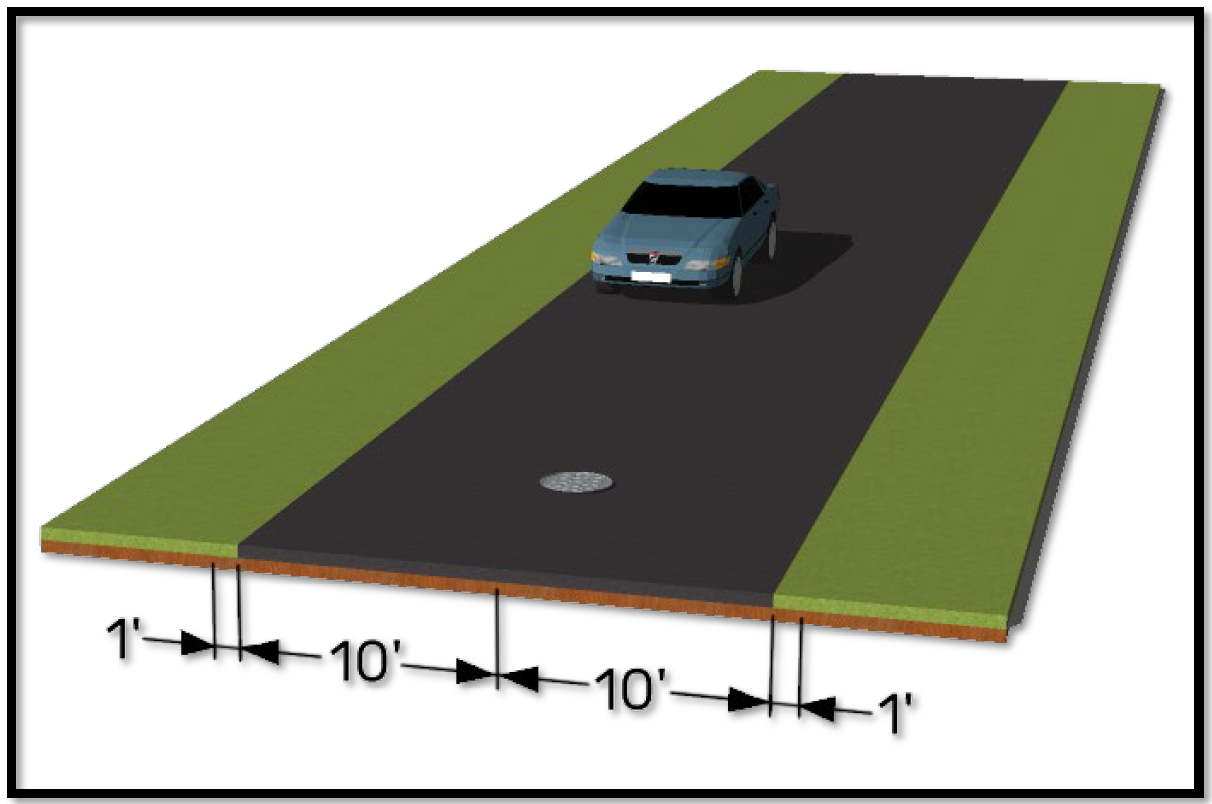
RURAL 2-LANE STREET.
SATELLITE PARKING. A parking facility located on a separate lot from the principal use it is intended to serve.
SEDIMENT. The solids particulate matter both mineral and organic that has been or is being transported by water, air, gravity or ice from its site of origin.
SEDIMENT POLLUTION CONTROL ACT (SPCA ACT). North Carolina Sediment Pollution Control Act of 1973 and all rules and orders adopted pursuant to it.
SEDIMENTATION. The process by which sediment resulting from accelerated erosion has been or is being transported off the site of the land-disturbing activity or into a lake or natural watercourse.
SEEDING. Seed, straw and tack, hydroseed, sod, or other approved seeding method.
SETBACK (MINIMUM). A line parallel to the front property line in front of which no structure shall be erected. Setbacks shall be figured from the right-of-way line.
SIDE SETBACK. The side setback is an open, unoccupied space on same lot with a main building situated between the side line of the building and adjacent side line of the lot and extending from the rear line of the front yard to the rear yard. Any yard that is not a rear or front yard shall be deemed a side yard.
SIGHT TRIANGLE/SIGHT DISTANCE TRIANGLE. The triangular area formed by a diagonal line connecting two points on intersecting property lines (or a property line and the curb or a driveway), each point being 15 feet and 75 feet from the point of intersection.
SIGN. Any device, fixture, placard or structure that uses any color, form, graphic, illumination, symbol or writing to advertise, announce the purpose of, or identify the purpose of a person or entity, or to communicate information of any kind to the public.
SILTATION. Sediment resulting from accelerated erosion which can be settled or removed by properly designed, constructed, and maintained control measures; and which has been transported from its point of origin within the site of a land-disturbing activity; and which has been deposited, or is in suspension in water.
SMALL TREE. Small-growing trees with an expected mature height of 20—40 feet.
SOLID WASTE DISPOSAL FACILITY. As defined in NCGS § 130A-290(a)(35), any facility involved in the disposal of solid waste.
SOLID WASTE DISPOSAL SITE. As defined in NCGS § 130A-290(a)(36), any place at which solid wastes are disposed of by incineration, sanitary landfill, or any other method.
SPECIAL FLOOD HAZARD AREA (SFHA). The land in the floodplain subject to a 0.2% or greater chance of being flooded in any given year based on current conditions hydrology.
STABILIZATION. The process of restoring a site with ground cover or armor to resist soil erosion from the forces of air, wind, or water.
START OF CONSTRUCTION. Includes substantial improvement, and means the date the building permit was issued, provided the actual start of construction, repair, reconstruction, rehabilitation, addition placement, or other improvement was within 180 days of the permit date. The actual start means either the first placement of permanent construction of a structure on a site, such as the pouring of slab or footings, the installation of piles, the construction of columns, or any work beyond the stage of Excavation; or the placement of a manufactured home on a foundation. Permanent construction does not include land preparation, such as clearing, grading, and filling; nor does it include the installation of streets and/or walkways; nor does it include excavation for a basement, footings, piers, or foundations or the erection of temporary forms; nor does it include the installation on the property of accessory buildings, such as garages or sheds not occupied as dwelling units or not part of the main structure. For a substantial improvement, the actual start of construction means the first alteration of any wall, ceiling, floor, or other structural part of the building, whether or not that alteration affects the external dimensions of the building.
STEALTH OR STEALTH DESIGN. A design or treatment such as a Distributed Antenna System or its equivalent that minimizes adverse aesthetic and visual impacts on the land, property and buildings, and other facilities adjacent to, surrounding, and in generally the same area as the requested location of such Wireless Telecommunications Facilities, which shall mean using the least visually and physically intrusive facility that is not technologically or commercially impracticable under the facts and circumstances.
STEALTH OR STEALTH TECHNOLOGY. A design or treatment that minimizes adverse aesthetic and visual impacts on the land, property, buildings, and other facilities adjacent to, surrounding, and in generally the same area as the requested location of such Wireless Telecommunications Facilities, which shall mean building the least visually and physically intrusive facility and Complex that is not technologically or commercially impracticable under the facts and circumstances. Stealth technology includes such techniques as DAS or its functional equivalent or camouflage where the Tower is disguised to make it less visually obtrusive and not recognizable to the average person as a Wireless Facility or Complex.
STOP WORK ORDER. A written order to stop work, issued by the Administrator, upon determining that work is being conducted in violation of this ordinance.
STOREFRONT WINDOW SYSTEM. An architectural wall assembly of large glass panes formed in relatively thin metal members and typically used at the ground floor of commercial buildings.
STORM DRAINAGE FACILITIES. The system of inlets, conduits, channels, ditches, and appurtenances which serve to collect and convey stormwater through and from a given drainage area.
STORMWATER BEST MANAGEMENT PRACTICE MANUAL. The Stormwater Best Management Practice Manual approved for use in Phase II jurisdictions by the N.C. Division of Water Resources and certified by this jurisdiction is at least as stringent as the Stormwater Best Management Practice Manual approved for use in Phase II jurisdictions the proper implementation of the requirements of the federal Phase II stormwater program. All references herein to the Stormwater Best Management Practice Manual are to the latest published edition or revision.
STORMWATER RUNOFF. The surface flow of water resulting from precipitation in any form and occurring immediately after rainfall or melting.
STREAM. An intermittent or perennial surface water subject to U.S. Army Corps of Engineers (Corps) and/or NC Division of Water Resources (DWR) 404/401 jurisdiction. To confirm jurisdictional status, a formal Corps and/or DWQ response is required (e.g., Jurisdictional Determination).
STREAM CLASSIFICATION. The existing or contemplated best usage of streams, pursuant to 15A NCAC 02B .0300, and/or subsequent clarifications, modifications, and addenda.
STREET. A dedicated and accepted public right-of-way, or privately-maintained access, for vehicular traffic that conforms to any of the street classifications contained within this Ordinance or other adopted plans and policies of the Town of Wingate.
STREET SETBACK. A setback measured across the full width of the lot, extending from the front line of the nearest building on the lot to the front line of the lot.
STRUCTURAL BMP. A physical device designed to trap, settle out, or filter pollutants from stormwater runoff; to alter or reduce stormwater runoff velocity, amount, timing, or other characteristics; to approximate the pre-development hydrology on a developed site; or to achieve any combination of these goals. Structural BMP includes physical practices such as constructed wetlands, vegetative practices, filter strips, grassed swales, and other methods installed or created on real property. "Structural BMP" is synonymous with "structural practice", "stormwater control facility," "stormwater control practice," "stormwater treatment practice," "stormwater management practice," "stormwater control measures," "structural stormwater treatment systems," and similar terms used in this ordinance.
STRUCTURAL CAPABILITY OR "STRUCTURAL CAPACITY". With regards to wireless telecommunications facilities, anything to the contrary in any other standard, code, regulation or law, up to and not exceeding a literal 100% of the designed loading and stress capability of the support structure.
STRUCTURE. A walled and roofed building that is principally above ground, a gas or liquid storage tank, or other man-made facilities or infrastructure. For floodplain management purposes "principally above ground" means that at least 51% of the actual cash value of the structure is above ground.
STRUCTURED PARKING. A covered structure or portion of a covered structure that provides parking areas for motor vehicles. Parking on top of a structure, where there is gross building area below the parking, is also considered structured parking.
SUBDIVIDER. Any person, firm, or corporation who subdivides or develops any land deemed to be a subdivision as herein defined.
SUBDIVISION. All divisions of a tract or parcel of land into 2 or more lots, building sites, or other divisions for the purpose of sale, or building development (whether immediate or future) and shall include all divisions of land involving the dedications of a new street or a change in existing streets.
SUBSIDIARY. An affiliate that is, directly or indirectly, through one or more intermediaries, controlled by another person.
SUBSTANTIAL DAMAGE. As used in the flood damage prevention ordinance, damage of any origin sustained by a structure during any 1-year period whereby the cost of restoring the structure to its before damaged condition would equal or exceed 50% of the market value of the structure before the damage occurred. See definition of "substantial improvement". Substantial damage also means flood-related damage sustained by a structure on 2 separate occasions during a 10-year period for which the cost of repairs at the time of each such flood event, on the average, equals or exceeds 25% of the market value of the structure before the damage occurred.
SUBSTANTIAL IMPROVEMENT. As used in the flood damage prevention ordinance, any combination of repairs, reconstruction, rehabilitation, addition, or other improvement of a structure, taking place during any 1-year period for which the cost equals or exceeds 50% of the market value of the structure before the "start of construction" of the improvement. This term includes structures which have incurred "substantial damage", regardless of the actual repair work performed. The term does not, however, include either:
•
Any correction of existing violations of State or community health, sanitary, or safety code specifications which have been identified by the community code enforcement official and which are the minimum necessary to assure safe living conditions; or
•
Any alteration of a historic structure provided that the alteration will not preclude the structure's continued designation as a historic structure.
SUBSTANTIAL MODIFICATION. As it relates to wireless telecommunications facilities, a change or Modification that increases the existing vertical height of the structure by the greater of: (a) more than ten percent (10%); or (b) the height of one additional antenna array with separation from the nearest existing antenna not to exceed 20 feet; or: (a) except where necessary to shelter the antenna from inclement weather or to connect the antenna to the tower via cable, adding an appurtenance to the body of a wireless support structure that protrudes horizontally from the edge of the wireless support structure the greater of: (i) more than 20 feet; or (ii) more than the width of the wireless support structure at the level of the appurtenance; or (b)increases the square footage of the existing equipment compound by more than 2,500 square feet.
SUBSTANTIAL PROGRESS. For the purposes of determining whether sufficient progress has been made on an approved plan, one or more of the following construction activities toward the completion of a site or subdivision plan shall occur: obtaining a grading permit and conducting grading activity on a continuous basis and not discontinued for more than 30 days; or installation and approval of on-site infrastructure; or obtaining a building permit for the construction and approval of a building foundation. "Substantial progress" for purposes of determining whether an approved plan is null and void is not necessarily the same as "substantial expenditures" used for determining vested rights pursuant to applicable law.
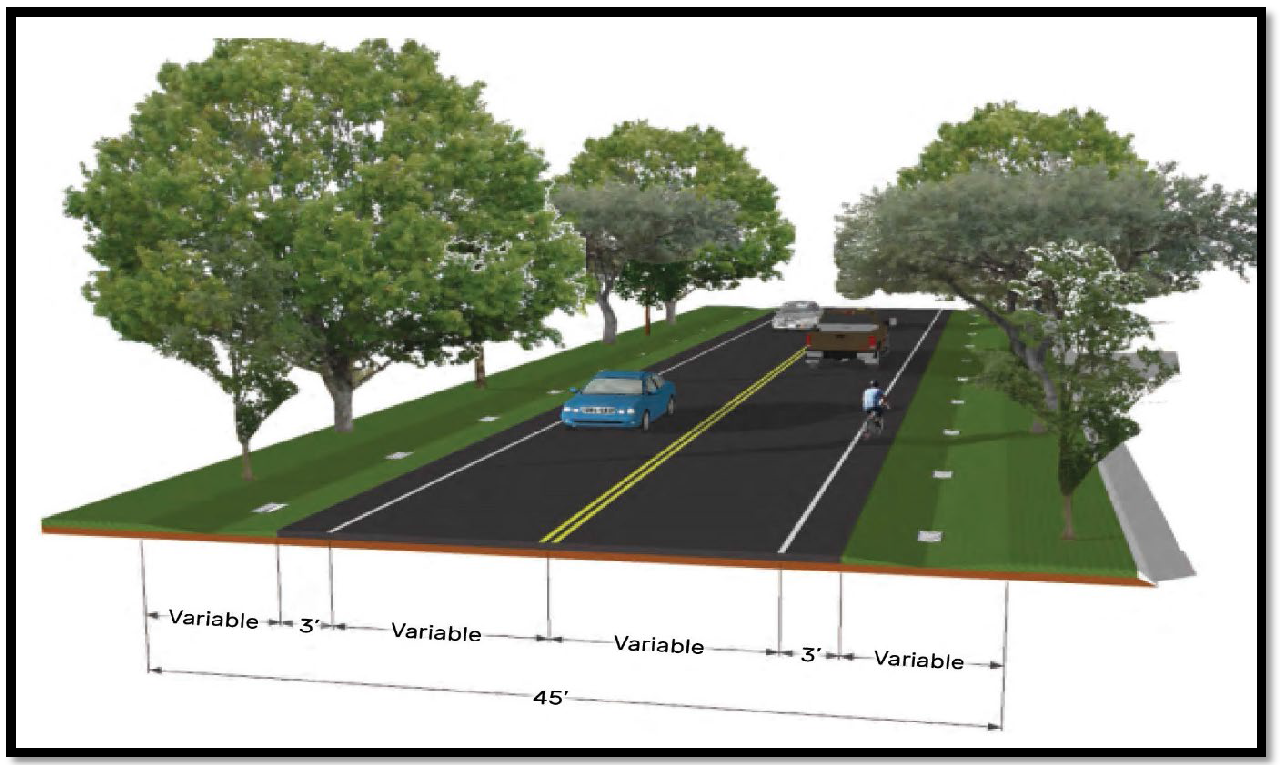
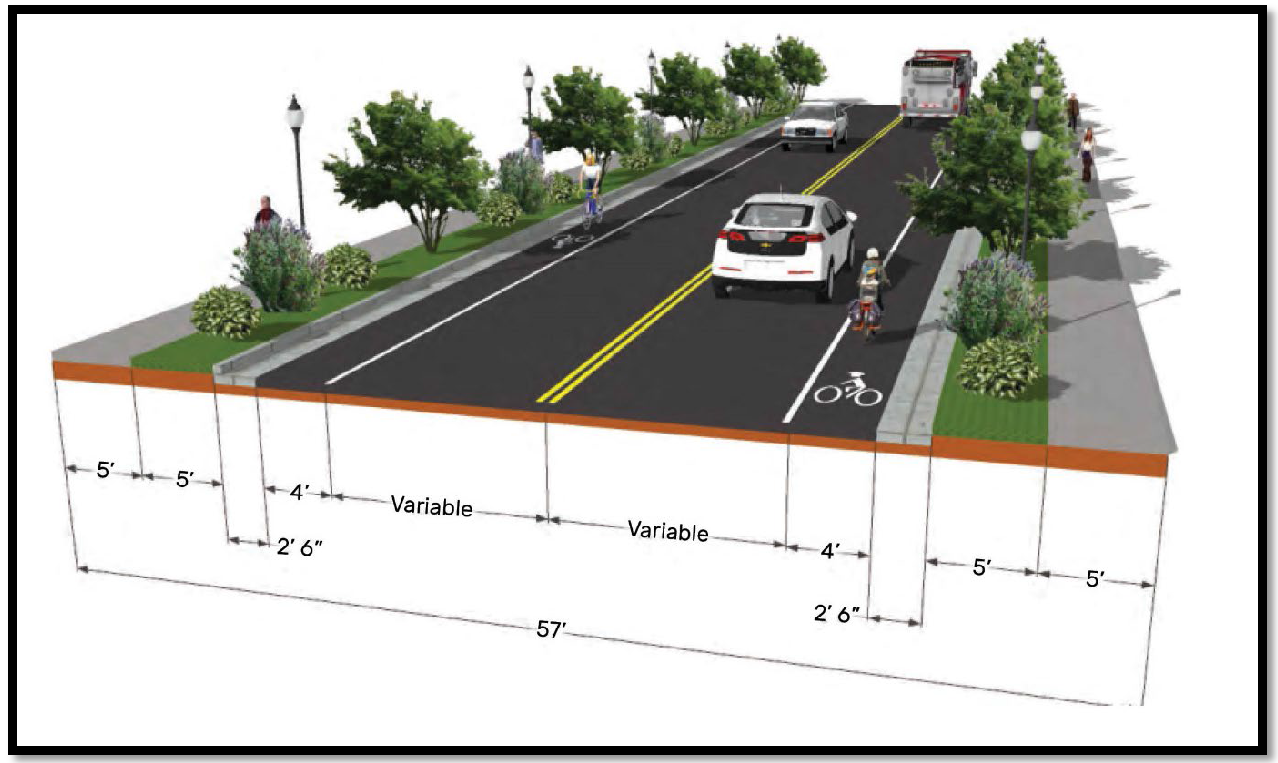
SUBURBAN 2-LANE STREET.
TELECOMMUNICATIONS. The transmission and/or reception of audio, video, data, and other information by wire, radio frequency, light, and other electronic or electromagnetic systems.
TELECOMMUNICATIONS STRUCTURE OR SUPPORT STRUCTURE. A structure used in the provision of services described in the definition of Wireless Telecommunications Facilities to physically support antennas and other equipment necessary for the provision of wireless service.
TEMPORARY SIGNS. Portable signs used to announce or advertise specific events which have a definite beginning and end date/time.
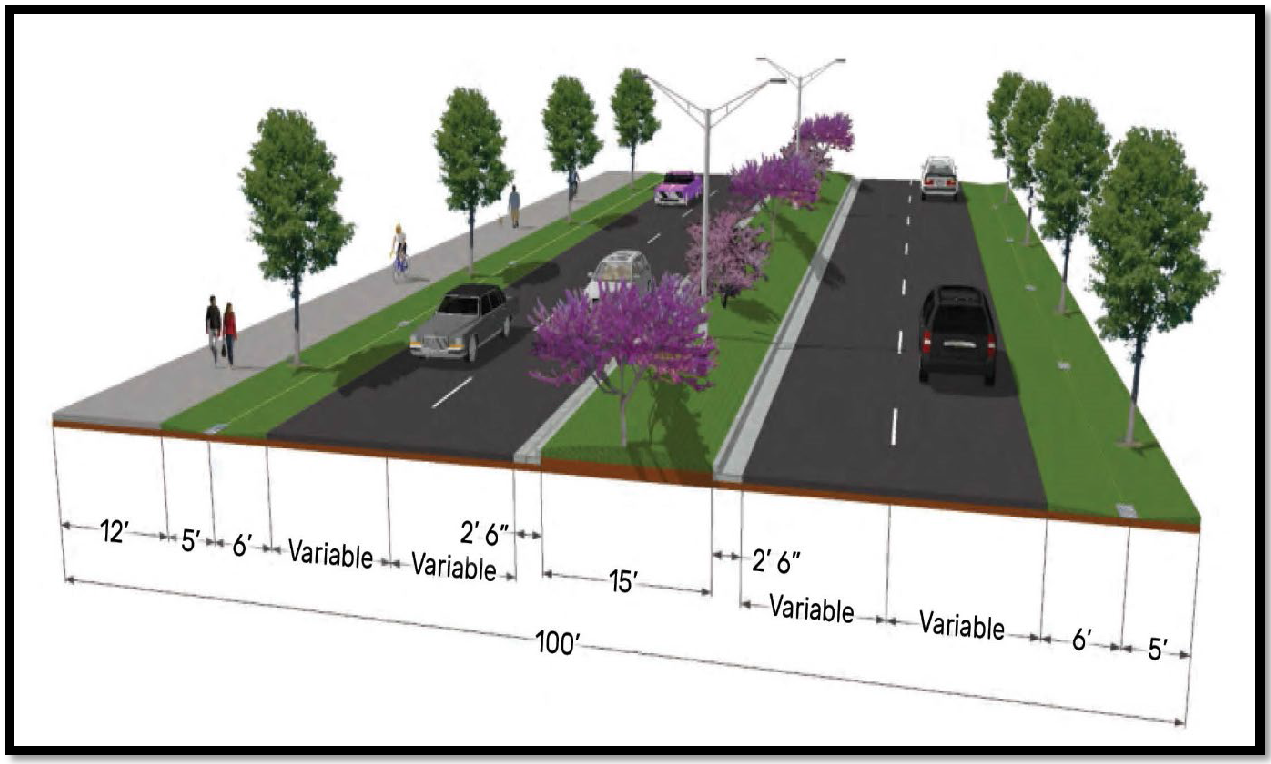
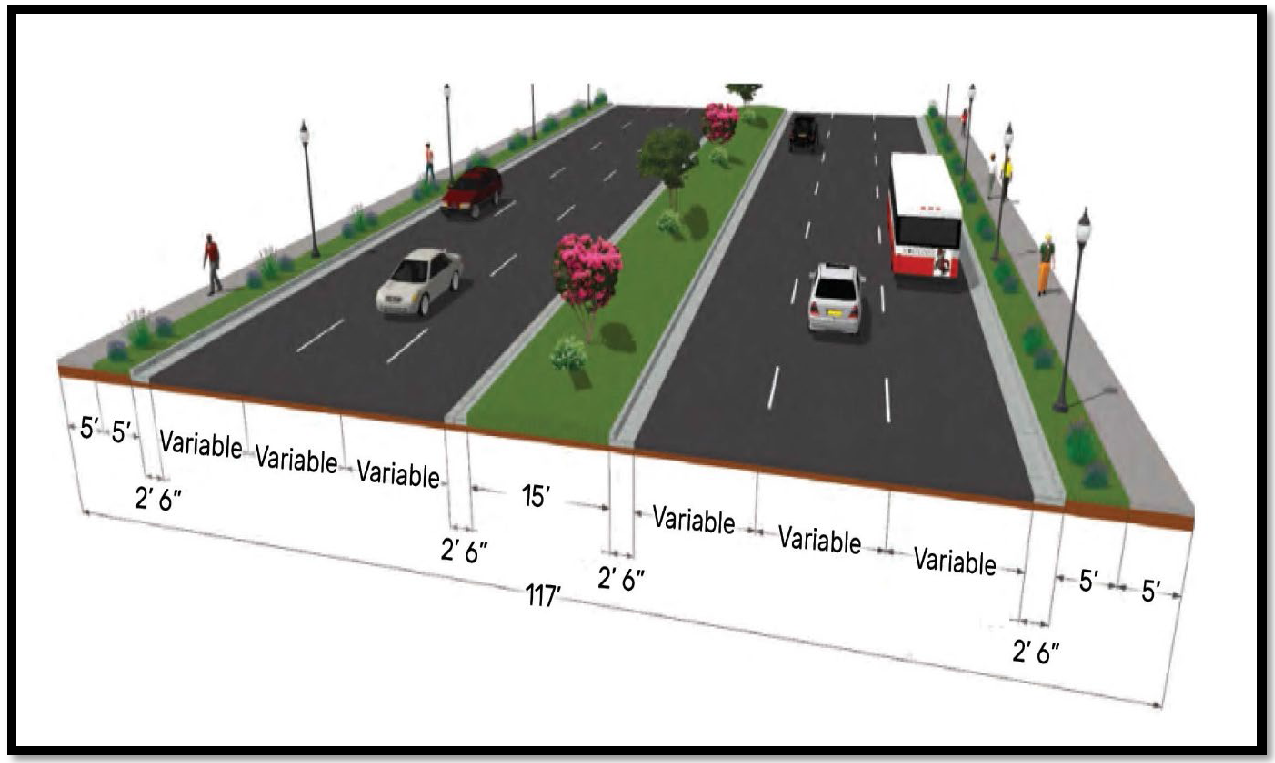
THOROUGHFARE, 4-LANE DIVIDED.
THOROUGHFARE, 4-LANE SUBURBAN.
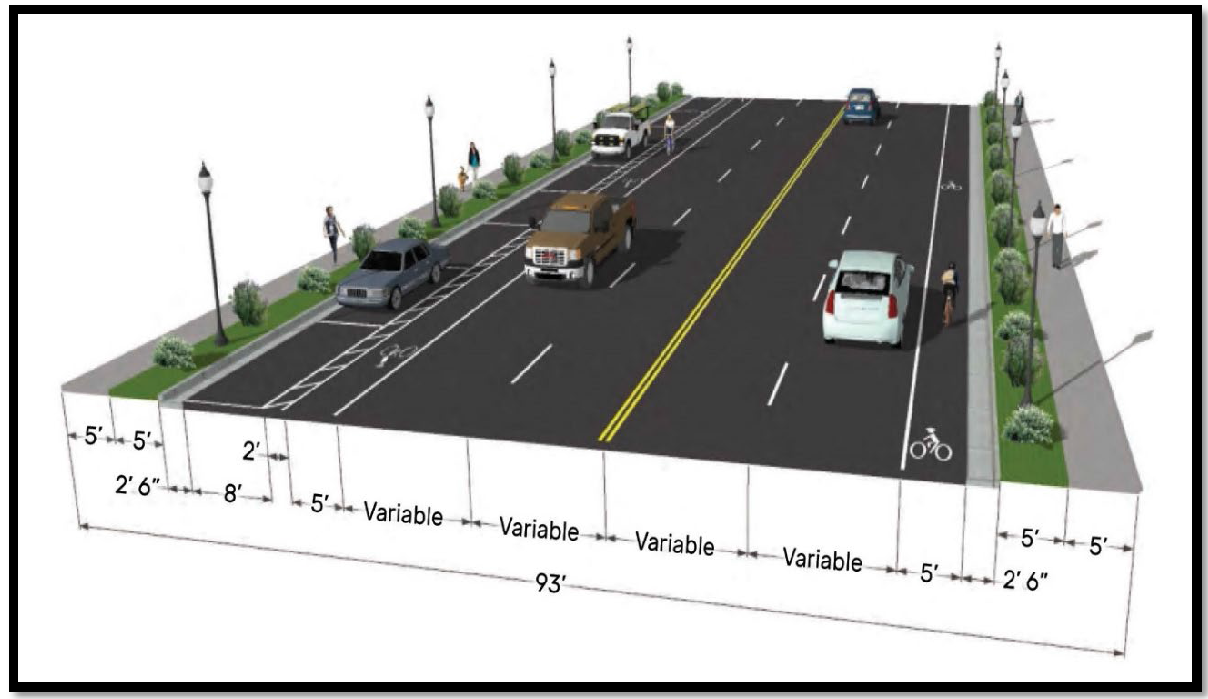
THOROUGHFARE, MAJOR 5-LANE.
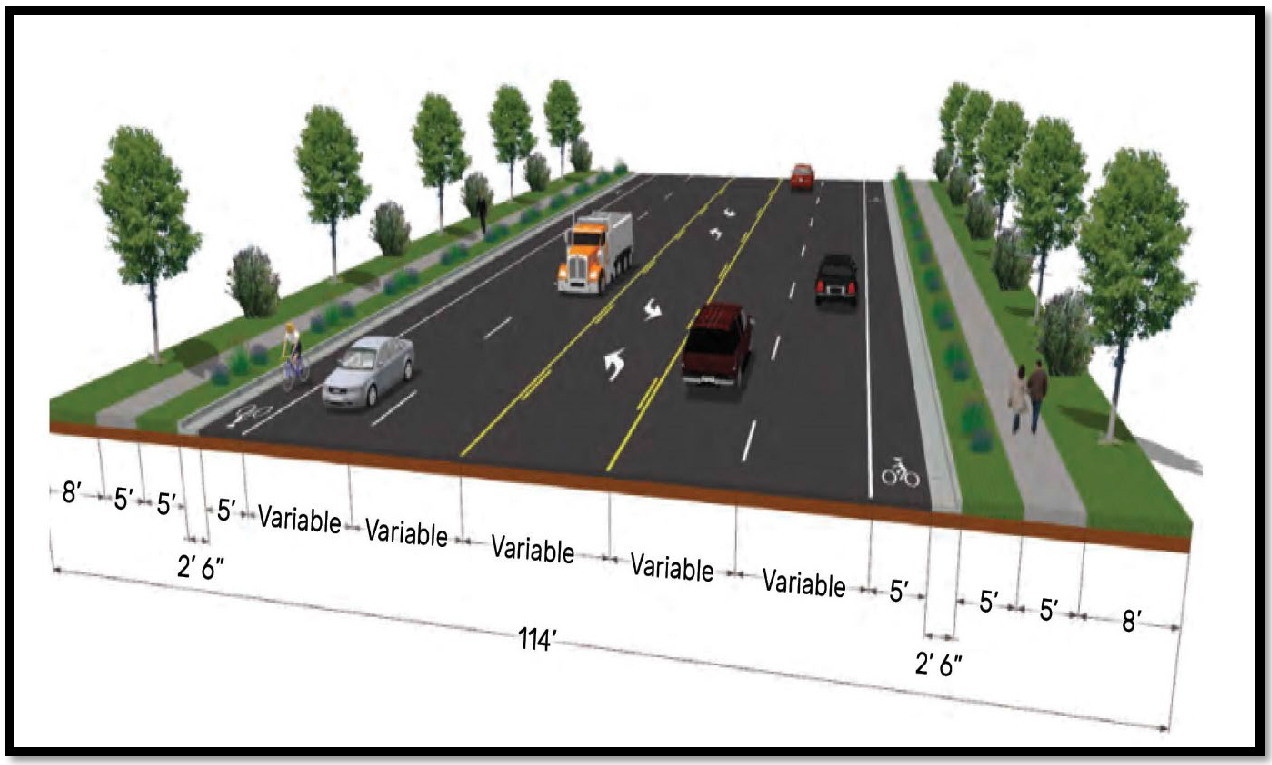
THOROUGHFARE, MAJOR (DIVIDED).
TOWER. Any structure designed primarily to support an antenna for receiving and/or transmitting a wireless signal.
TRACT. All contiguous land and bodies of water being disturbed or to be disturbed as a unit, regardless of ownership.
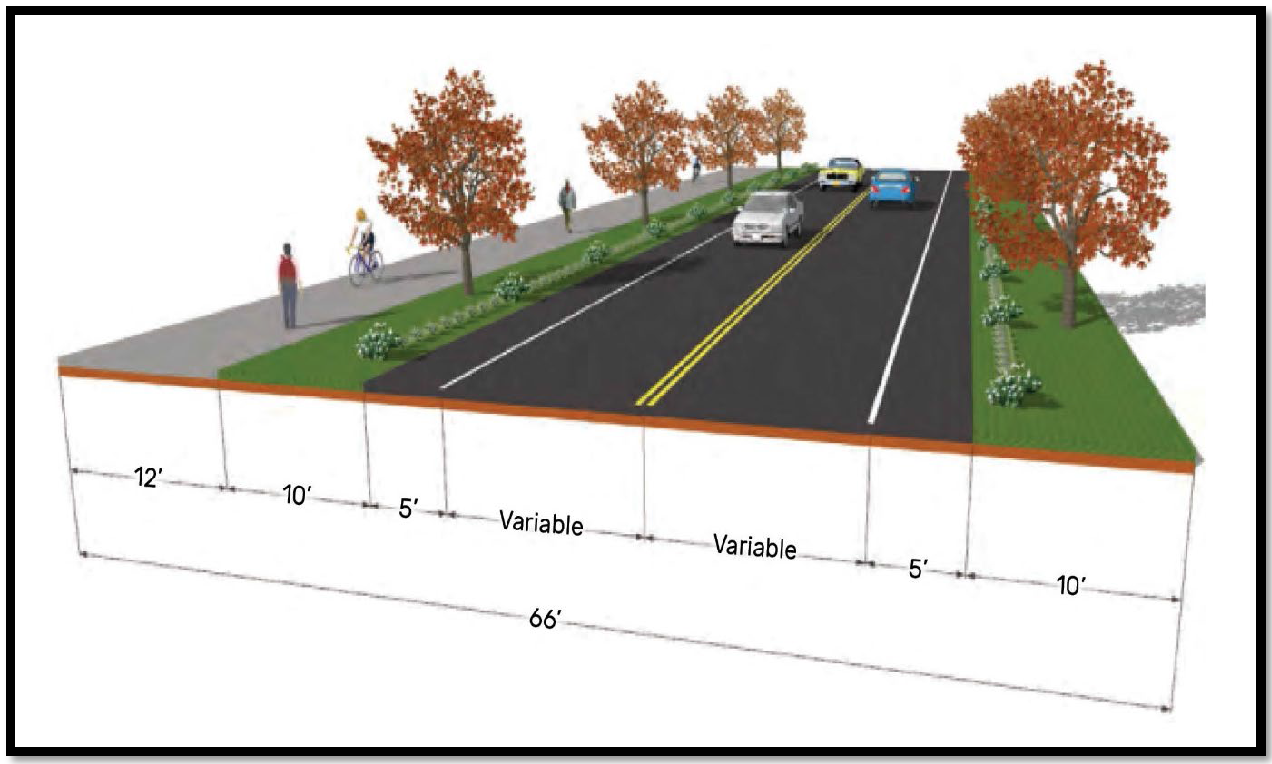
URBAN 2-LANE STREET.
VEHICLE ACCOMMODATION AREA. The portion of a lot that is used by vehicles for access, circulation, parking, loading, and unloading. It comprises the total of circulation areas, loading and unloading areas, and parking spaces and aisles. In the vernacular, this area is typically referred to as a "parking lot."
WALL SIGNS. A sign attached to or painted on a wall or building, with the exposed display surface of the sign in a plane parallel to the plane of the wall to which it is attached or painted, and including signs affixed to or otherwise displayed on or through a façade window.
WATER SURFACE ELEVATION (WSE). The height, in relation to mean sea level, of floods of various magnitudes and frequencies in the floodplains of coastal or riverine areas.
WATERCOURSE. A lake, river, creek, stream or other topographic feature on or over which waters flow at least periodically. Watercourse includes specifically designated areas in which substantial flood damage may occur.
WATERCOURSE BUFFER ZONE. The strip of land adjacent to a lake, river, creek, stream.
WETLANDS. Areas that are inundated or saturated by surface or ground water at a frequency and duration sufficient to support, and that under normal circumstances do support, a prevalence of vegetation typically adapted for life in saturated soil conditions. Wetlands generally include swamps, marshes, bogs, and similar areas. This definition of wetlands is used by the U.S. Army Corps of Engineers (Corps) and the U.S. Environmental Protection Agency (EPA) since the 1970s for regulatory purposes in Section 404 of the Clean Water Act.

