
Tarboro City Zoning Code
CHAPTER 9
- PARKING AND DRIVEWAYS
9.1 - PURPOSE AND INTENT
Parking lots and similar features are necessary elements of the urban environment; however, the provision of parking facilities must be regulated to avoid negative impacts such as:
•
Increased stormwater volume and velocity,
•
Increased surface pollutants,
•
Increased surface level heat and glare,
•
Reduction in the efficiency of the surrounding street system, and
•
Reduction in the operations of the surrounding pedestrian and bicycle network.
The purpose of this chapter is to ensure the adequate provision of parking in Tarboro without degrading the urban or natural environment.
9.2 - APPLICABILITY
The provisions of this chapter shall apply to all new and expanded development, as well as any changes in use.
9.3 - PARKING REQUIREMENTS
Permanent off-street parking (including on-street parking in accordance with the requirements below) is required subject to the table below. If required, parking shall be provided at the time of erection, alteration, enlargement, establishment, or change of use of any building or open use of land which requires addition off-street parking. The minimum parking requirements have been set intentionally well below the general market expectations as a means to mitigate against the negative aspects of paved surfaces on the environment such as excessive runoff, water pollution, and urban heat island effect.
9.3.1 MINIMUM REQUIRED PARKING TABLE
9.3.2 EXEMPTIONS AND ADJUSTMENTS
A.
Uses in the CBD, Central Business District, are exempt from the minimum parking requirements in this section.
B.
The Administrator may allow deviations from the minimum parking requirements above for a particular use on a particular lot whenever they find that such deviation is more likely to satisfy the parking requirements for that instance. A deviation for a particular use on a particular lot does not automatically alter the minimum parking required for a similar use on a different lot.
1.
Approved deviations shall be based on parking studies provided by a certified professional, or on previously approved developments that are similar in nature to the subject development.
2.
Whenever the Administrator allows a deviation from the minimum parking requirements in Section 9.4.1, the permit approving the development shall include the parking shall include a note that indicates the approved parking requirement and the reason for permitting the deviation.
3.
Without limiting the generality of the foregoing, the Administrator may allow deviations from the parking requirements of this section when it is found that:
a.
A residential development is irrevocably oriented toward the elderly; or
b.
A business is primarily oriented towards walk-in trade.
9.3.3 JOINT PARKING
A.
One parking area may contain required spaces for several different uses, but except as provided in this section, the required space assigned to one use may not be credited to another.
B.
To the extent that development wish to make joint use of the same parking spaces operate at different times, the same spaces may be credited to both uses. For example, if a parking lot is used in connection with an office use Monday-Friday but is generally 90% vacant on weekends, another development that operates only on weekends could be credited with 90% of the spaces in that lot.
C.
If the joint use of the same parking spaces by two or more principal uses involves satellite parking spaces, then the provisions of 9.4.4 are also applicable.
D.
Any plans for joint use of parking spaces used to satisfy the minimum off-street parking requirements of this Ordinance shall be provided to the Administrator for review. The Administrator and the owners of the lots involved shall each sign an approved agreement which has been deemed by the Administrator to satisfy these requirements. A copy of such agreement shall be recorded in the Register of Deeds Office. Evidence of the recording of the agreement shall be presented to the Administrator prior to the issuance of permits or certificates of occupancy for the lot and/or use benefiting from the agreement.
9.3.4 SATELLITE PARKING
A.
If the number of off-street parking spaces required cannot be reasonably provided on the same lot where the principal use is located, spaces may be provided on adjacent or nearby lots in accordance with this section.
B.
All such satellite parking spaces must be located within a reasonable distance to the primary public entrance of the principal building, or the lot on which the associated use is located if there is no principal building.
C.
The applicant must provide written evidence that they have permission of the property owner, or owner's agent, to use the satellite parking spaces. Such agreement shall be signed by both the applicant and the property owner, or owner's agent, containing the satellite parking. The applicant must also acknowledge that the permit approving the subject development is only valid on the continued provision of the parking meeting the minimum requirements of this Ordinance.
D.
The applicant will not be held responsible by the Town of Tarboro for the maintenance of satellite parking areas or for ensuring that said parking areas meets the design requirements in this Chapter.
9.3.5 CHANGE OF USE
If there exists a lot with one or more structures on it which were constructed before the effective date of this Ordinance, and there is a subsequent change of use, the required amount of off-street parking shall be provided for that use either on-premises, as joint parking provided per § 9.3.3, or as satellite parking provided per § 9.3.4.
9.4 - VEHICLE PARKING DESIGN STANDARDS
9.4.1 PARKING AREA GENERAL DESIGN STANDARDS
A.
Unless no other practical alternative is available, vehicle accommodation areas shall be designed so that, without resorting to extraordinary movements, vehicles may exit such areas without backing onto a public street. This requirement does not apply to parking areas consisting of driveways that serve single-family, duplex, or townhome dwelling units. Under no circumstance may a parking area be designed to require vehicles to back onto streets classified as arterial or higher.
B.
Vehicle accommodation areas of all developments shall be designed that that emergency, sanitation, and other public service vehicles can serve such developments without the necessity of backing unreasonable distances or making other dangerous or hazardous movements.
C.
Every vehicular accommodation area shall be designed so that vehicles cannot extend beyond the perimeter of such area onto adjacent properties or public rights-of-way. Such areas shall also be designed so that vehicles do not extend over public and private sidewalks.
D.
All vehicular parking spaces shall be no closer than 10 feet to any structure.
E.
Circulation areas shall be designed so that vehicles can proceed safely without posing a danger to pedestrians or other vehicles.
9.4.2 SURFACING
Off-street parking areas shall be properly graded, marked and located on improved lots or within parking structures. The material for surface parking spaces and corresponding access drives required by this section, except for single-family and duplex dwelling units, shall consist of suitable material as set forth below.
A.
Vehicle accommodation areas that are required to have 5 or more parking spaces and are used regularly (at least 5 days per week) shall be graded and surfaced with asphalt or concrete to protect against potholes, erosion, and dust.
B.
Vehicle accommodation areas that are required to have 5 or more parking spaces and are used at least 5 days a week shall be constructed with perimeter curb and gutter.
C.
Vehicular accommodation areas that do not meet the requirements of § 9.4.2.A and § 9.4.2.B shall be graded and surfaced with crushed stone, gravel, or other suitable material to provide a surface that is stable and will help to reduce dust and erosion. The perimeter of such parking areas shall be defined by bricks, stones, railroad ties, or other similar devices. In addition, whenever such a vehicle accommodation area abuts a paved street, the driveway leading from such area to such street shall be paved as provided in § 9.4.2.A for a distance of not less than 15 feet from the edge of the street pavement. This section shall not apply to single-family and duplex dwelling units or any other use required to have two or less parking spaces.
D.
Parking spaces improved per the standards of § 9.4.2.A shall be appropriately demarcated with painted lines or other markings. Parking spaces surfaces in accordance with § 9.4.2.B shall be demarcated when practical.
E.
Vehicle accommodation areas shall be properly maintained in all respects. In particular, and without limiting the forgoing, vehicle accommodation area surfaces shall be kept in good condition and parking space lines shall be kept clearly visible and distinct. Maintenance of vehicle accommodation areas is considered a condition of the approval of all new development. Failure to properly maintain vehicle accommodation areas is considered a violation of the approved development permit and may be subject to the standards of Chapter 16 of this Ordinance.
F.
Temporary parking lots may be constructed out of crushed stone, gravel, or other suitable material. A temporary parking lot is defined as one that will not be used for a period exceeding 365 days from the date the parking lot is first put into service. The Administrator may grant up to two extensions, each for a period of up to 6 months if the applicant can show that provisions are being made to either construct a permanent parking lot or discontinue use of the temporary parking lot. Once the temporary parking lot is discontinued, all above ground appurtenances related to the parking lot, such as lights, curb stops, etc., shall be removed within 30 days of such discontinuation of use.
G.
All accessible spaces and corresponding access paths shall be constructed of concrete or asphalt.
H.
Porous paving blocks and pervious paving materials are permitted and encouraged as material for parking lots. The use of reinforced grass as a parking lot surface is permitted for use in approved satellite parking areas.
9.4.3 PARKING SPACE DIMENSIONS
A.
Each parking space shall contain a rectangular area at least 19 feet wide and 9 feet long. Lines demarcating parking spaces may be drawn at various angles in relating to curbs and aisles, so long as the parking spaces so created contain within them the rectangular area required by this section.
B.
In parking areas containing 10 or more parking spaces, up to 25% of the parking spaces may contain a rectangular area of 7½ feet wide by 15 feet long. If such spaces are provided, they shall be conspicuously designated as reserved for small or compact cars only.
C.
Whenever parking areas consist of spaces set aside for parallel parking, the dimensions of such parking spaces shall be not less than 22 feet by 9 feet. The width of parallel parking spaces is measured from the face-of-curb.
9.4.4 REQUIRED WIDTHS OF PARKING AREA AISLES AND DRIVEWAYS
A.
Parking area aisle widths shall conform to the following table, which varies the width requirement according to the angle of parking:
B.
Driveways shall not be less than 10 feet in width for one-way traffic and 18 feet in width for two-way traffic, except that 10 feet wide driveways are permissible for two-way traffic when:
1.
The driveway is no longer than 50 feet; and
2.
The driveway provides access to not more than 6 spaces; and
3.
Sufficient turning space is provided so that vehicles need not back into a public or private street.
9.4.5 CONNECTIVITY
A.
Adjoining vehicle accommodation areas serving, or potentially serving, non-residential or multi-family dwelling uses shall be interconnected as follows:
1.
The vehicle accommodation area under development has a minimum of 24 parking spaces or equivalent parking area.
2.
At least one connection is provided at all lot lines that are coincident for at least 60 feet with another lot zoned for non-residential or multi-family dwelling uses.
3.
The connection point is at least 20 feet in width.
4.
If applicable, the connection shall align with a connection that has been previously constructed on an adjacent property.
5.
The connection point shall not have a slop of greater than 15%.
6.
The connection shall not be placed where a building on an adjacent property is within 15 feet of the lot line which would hamper traffic movements within the parking lot.
7.
The connection is placed in an area what will not require the removal of significant natural features such as wetlands, stream buffers, and floodplains, or removal of a canopy tree with a caliper of 6 inches or more.
8.
In the event that these conditions cannot be met, or if such connection would create and undesirable flow of vehicular traffic, the Administrator may waive the connection requirement.
B.
Where a parking lot connection is required, a permanent easement for ingress and egress to adjacent lots shall be recorded with the County Register of Deeds in the form of an easement plat.
9.5 - DRIVEWAY ACCESS
9.5.1 DRIVEWAY STANDARDS
Any use which required lowered or cutaway curbs, for the purposes of ingress or egress, shall be subject to the provisions below.
A.
Maximum Number of Driveways: The maximum number of combined driveway entrances and exits allowed on any parcel shall correspond to the frontage of that parcel on any one street as indicated in the following table:
B.
Where the posted speed limit is 55 mph or more, driveway spacing shall be at 300-foot intervals or more. Where the posted speed limit is less than 55 mph, driveway spacing shall be 230 feet or more.
C.
Adjacent or adjoining lots with street frontages of less than 100 feet are encouraged to combine driveways accesses.
D.
Whenever separate or single parcels are assembled under one purpose, plan, entity, or usage, consolidation of existing driveways shall be required to the extent feasible. Approval depends on the property owner or developers plan to use existing driveways. However, the number of driveways permitted shall not exceed the standards in § 9.5.1.A.
E.
The Planning Board may allow modifications to these standards where the technical feasibility (geometric design and operational requirements for implementation) does not compromise the "access control" and where it is shown that the lot(s) in question could not be developed without such modifications. With a complete set of design and operational requirements available, when the North Carolina Department of Transportation advises that a particular development design or technique can still achieve a satisfactory level of "access control" consistent with the objectives of this section.
F.
All driveways shall be constructed so that:
1.
Vehicles can enter or exit the lot in question without posing a danger to themselves, pedestrians, or vehicles travelling on adjacent streets.
2.
Interference with the free and convenient flow of traffic on abutting or surrounding streets is minimized.
G.
Driveway Widths: Required driveway width is measured at the lot boundary shared with a recorded public right-of-way. Where no record exists of the location of the public right-of-way, driveway width shall be measured at the edge of pavement, back of curb, or edge of sidewalk, as applicable.
1.
Single-Family Residential Dwellings: Driveways for detached single-family residential dwelling units shall have a maximum width of 18 feet.
2.
All Other Driveways: The width, in feet, of a driveway shall be within the minimum and maximum limits below.
a.
One-way drives shall have a minimum width of 12 feet and a maximum width of 24 feet.
b.
Two-way drives shall have a minimum width of 18 feet and a maximum width of 30 feet.
3.
Public Service Driveways Exempt: Driveways for parcels housing public services such as fire protection, law enforcement, emergency response, or other public services shall be exempt from the driveway width requirements in this section.
H.
Utility Driveways: A 10-foot wide curb depression shall be provided at all locations where utilities cross curb and gutter to run unto off-site easements. The purpose of the depression is to provide access to utility equipment without requiring vehicles to drive over the curb.
I.
Compliance with Local and State Requirements:
1.
Any person or corporation desiring to construct a driveway or other connection within right-of-way of the town or state shall, before beginning any construction, secure the appropriate permits from the authorizing agency allowing such construction. Driveway connections to residences are normally excluded from this requirement but may be included at the discretion of the authorizing agency.
2.
Failure to secure a permit prior to construction may result in the removal of the driveways and denial of access at the requested location.
J.
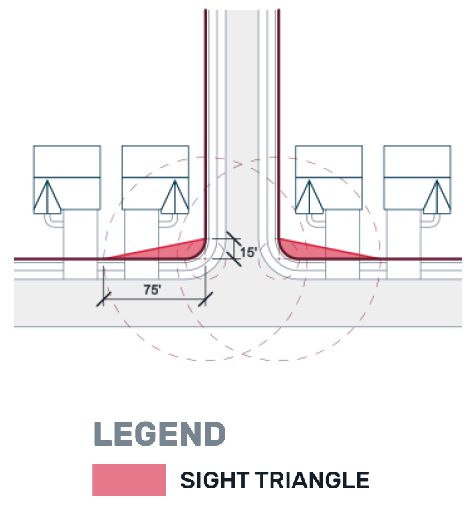
Driveway Sight Triangles:
1.
At all driveway approaches, a sight area shall be maintained. Within the sight area no fence, wall, sign, graded slope or embankment, parked vehicle, hedge, foliage, tree or other planting, and no other object shall be placed, erected, or maintained which will obstruct visibility at a height greater than 2½ feet.
2.
The Town follows AASHTO's recommendations for sight distance along major roadways. Access to major roadways shall provide adequate sight distance to avoid striking an unexpected in the travel way. This length will vary based on design speed on the intersecting roadway. All sight distance triangles shall be computed from the decisions point of the vehicle entering the major roadway.

